« Got to get into my pajamas… quickly! Got to… oh, Lord… NO! »
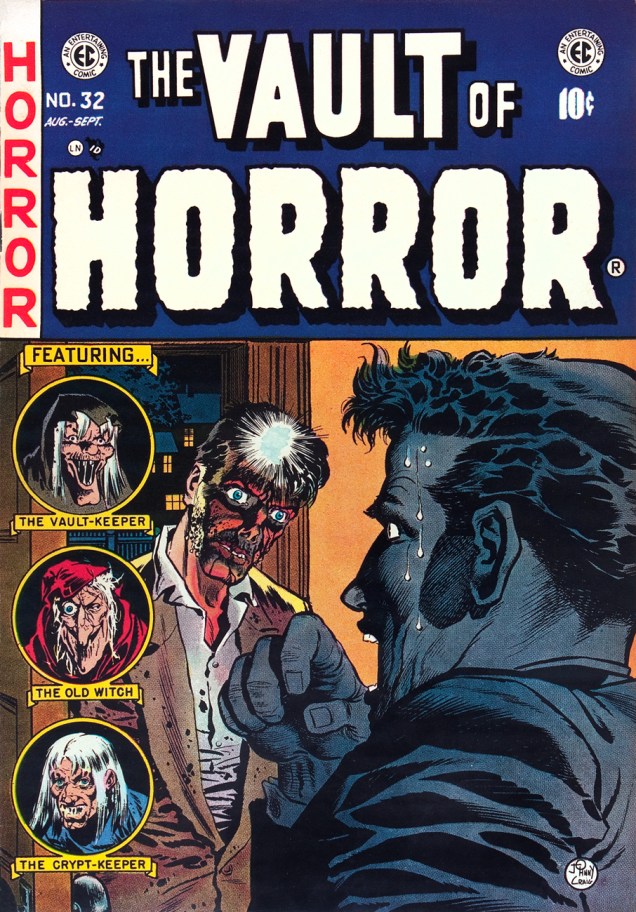
High time for some grue! I couldn’t reasonably be expected to shy away from EC’s 50s horror line, now could I? Of Entertaining (formerly “Educational”) Comics’ infamous/legendary trio of “New Trend” horror anthologies, The Vault of Horror surely was the finest. The deciding factor? The meticulous editorship, writing and artwork of Johnny Craig. While Tales From the Crypt and the The Haunt of Fear fed us a steady diet of Jack Davis, ‘Ghastly’ Graham Ingels and *choke* Jack Kamen (grandfather of the Segway, incidentally), with the fourth tale generally handled by Reed Crandall, Joe Orlando or George Evans, or if you got *really* lucky with your dime, Bernie Krigstein, things got stale. It didn’t help that the writing of the Bill Gaines / Al Feldstein duo, despite sporadic excellence, was quite formulaic and oh-so-verbose. Things got kind of claustrophobic for the artists. The Vault of Horror was different enough: Johnny Craig took care of the opening story, and wrote it himself, sparely and with great intelligence. A true breath of fresh air, though I’ll admit it’s an odd thing to say about EC’s gory tales.
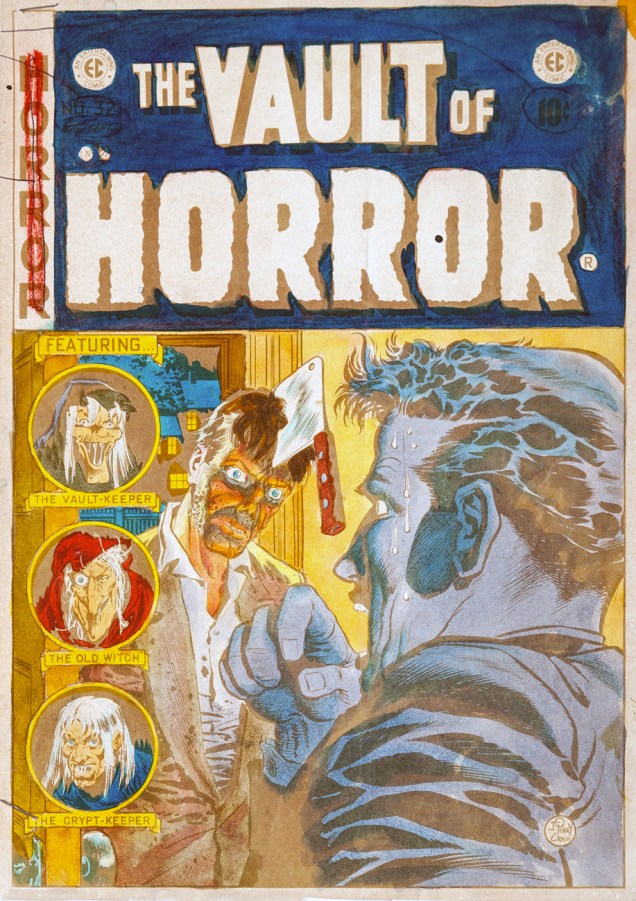
This particular cover (depicting a scene from Al Feldstein and Jack Davis’ « Out of His Head ») wasn’t originally slated for publication this way: EC’s attorney wisely insisted that it be toned down. The original version had appeared in house ads, so astute readers knew what they were missing.
To give you a sense of how far along things went before the punch was pulled, here’s the original, circa 1953, Silverprint cover proof in its original version, before being altered for publication. The proof was shot from the original negatives, with the image area reduced to printed size. Marie Severin used watercolours to specify the ink colours to be used.
Finally, the version below was recoloured (from cool to warm!) for Russ Cochran‘s deluxe hardcover reprint set of the 1980s and retained for subsequent Gladstone and Gemstone reprints.
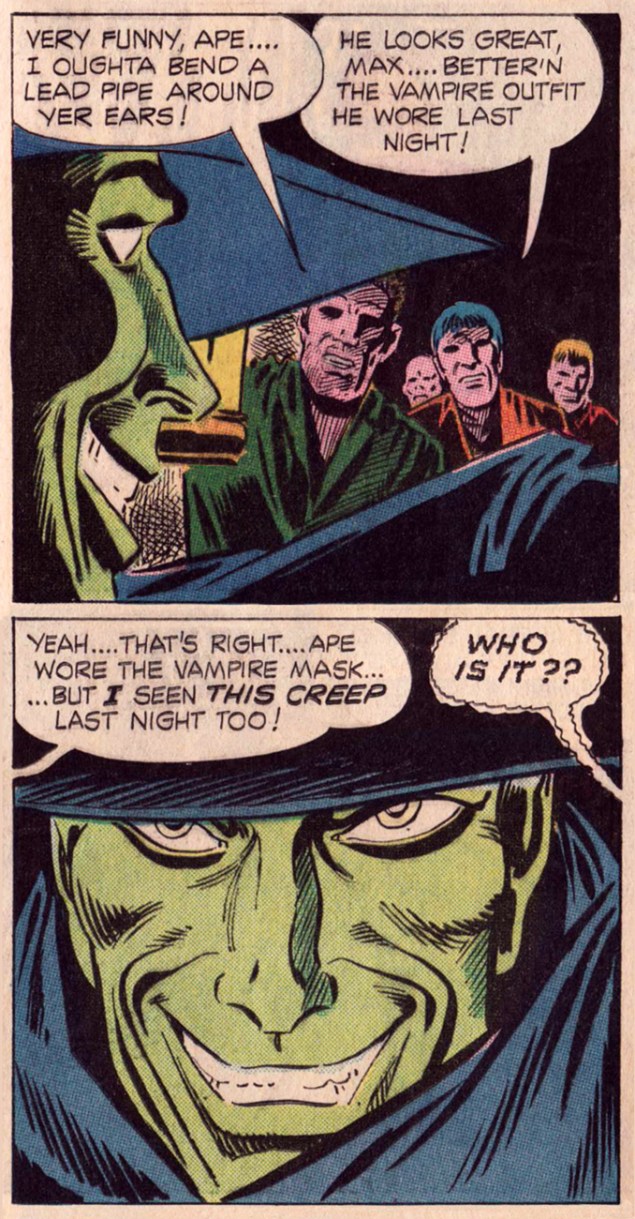
« Ape is real spooked, guys! He’s always imaginin’ he sees someone in there! »
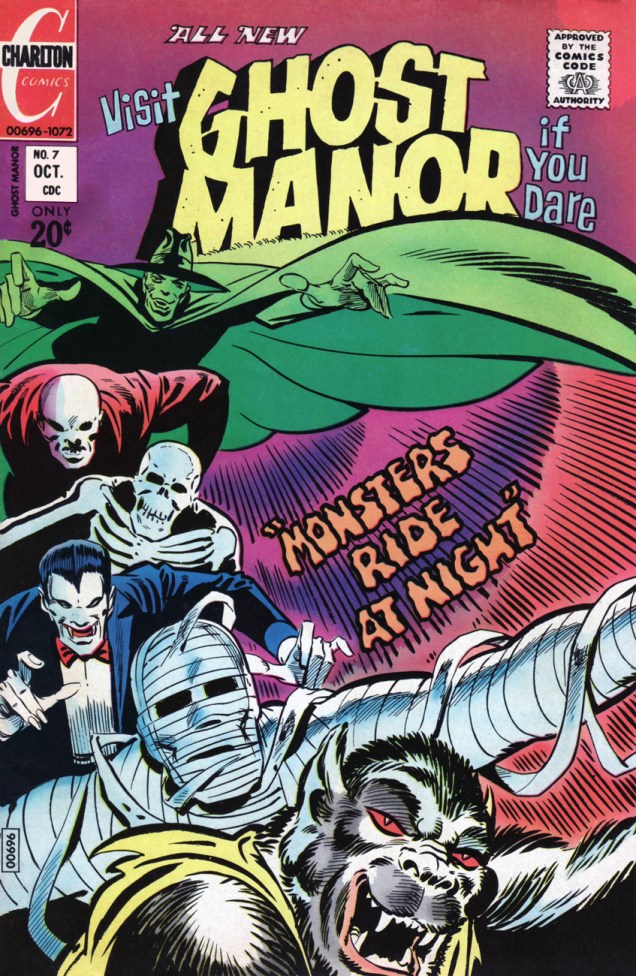
Here we have an evocative Steve Ditko cover, solid evidence of his tremendous design chops, from Charlton’s Ghost Manor (no. 7, second series, October 1972). A collaboration between Joe Gill and Ditko, « The Monsters Ride at Night » is an elegant bit of storytelling legerdemain, a fairly basic yarn that retains its mystery past the conclusion and whose deliciously dusty mood lingers in the mind. Well, in mine, at any rate. Back in the late ’70s, I traded a copy of Amazing Spider-Man 121 (acquired at a garage sale in a two-for-five-cents deal) for this one. I know I came out ahead in the deal*.
Again, I had every intention of providing the whole spooky shebang right here, but seeing as how I was preceded in this particular enthusiasm by a sinister confrère, it seems unnecessary. Just dim the light, settle in, point your browser to Destination Nightmare, pour yourself a noggin of your preferred poison, and savour this fine vintage.
I’m particularly fond of the mid-tale interlude, where our esteemed host, Mr. Bones, seizes the occasion to poke around the cobwebs a bit, a narrative game that the Gill-Ditko duo excelled at. DC and Warren’s hosts (with the obvious exception of Vampirella) never got to play such an active rôle in their respective recitals.
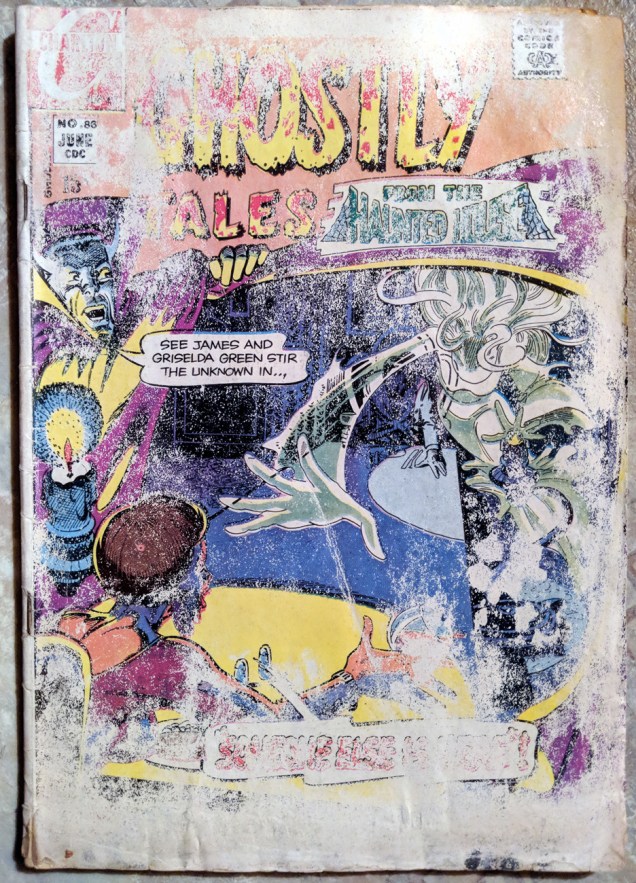
Oh, and since we’re on the topic of early 70s Charlton ghost books, here’s one I picked up just this afternoon, in the 50 cents box of the local comic book shop in Wolfsville, NS. It clearly had been through such hardships, I couldn’t resist giving it a home.
This is (or used to be) Ghostly Tales no. 86 (June, 1971), featuring three Joe Gill tales: « Return to Die » (illustrated by Pete Morisi), « Ghost Town » (illustrated by Pat Boyette), and « Someone Else Is Here! » (illustrated by Steve Ditko.) If books could speak…
« It was like plunging deeper and deeper into a growing nightmare! »
A powerful (what else?) Jack Kirby piece, one of his last before decamping to DC. He actually gets a full writer/artist credit (a telling tail end turning point of that Marvel residence) on this tale, … and Fear Shall Follow!. The lush cover inks are provided by fellow Golden Age titan Bill Everett (1917-1973), a far cry from the miserable Vince Colletta « finishes » he would be saddled with at DC for the next couple of years (at their insistence!)
I was planning on featuring the entire story, but others have long ago preceded me down that primrose path. Why fight it? Just pay Diversions of the Groovy Kind a visit, where you’ll receive, as a bonus, Kirby’s other solo outing for the House of (mostly his) Ideas, The Monster!, from the previous issue of Chamber of Darkness (no.4, April, 1970). Both are sympathetically inked by Marvel’s production manager at the time, the underrated and gone-too-soon John Verpoorten (1940–1977). Again, several notches above “Valiant” Vince Colletta’s casual sabotage.
Plot-wise, … and Fear Shall Follow!, while another variant in the Carnival of Souls tradition, is enriched by its unusual setting and whiff of incense and philosophy. Reminds me of a possibly apocryphal exchange between Watchmen editor Len Wein and its writer Alan Moore: « Alan, that ending’s already been done on The Outer Limits! »; (in thick Northampton accent, dripping with sarcasm) « Yes, Len, but it’s never been done by me! ». With all due respect, it’s not as if Mr. Wein had any moral lessons to dispense regarding originality.
Finally, Tentacle Tuesday is here, and the tentacles are back with a vengeance! I’ve been waiting all week to spring ’em on you.
This cutie, the Triclopus, kindly agreed to let us use his, err, face to kick off the Tentacle Tuesday festivities.
The Triclopus is a Ken Reid creation from August 31st, 1974. There’s a full list of Creepy Creations (published in the British Shiver and Shake) – with pictures! – over at Kazoop!, a great blog about British humour comics of the 60s and 70s. Go check it out. As for Ken Reid, we’ve previously talked about him here.
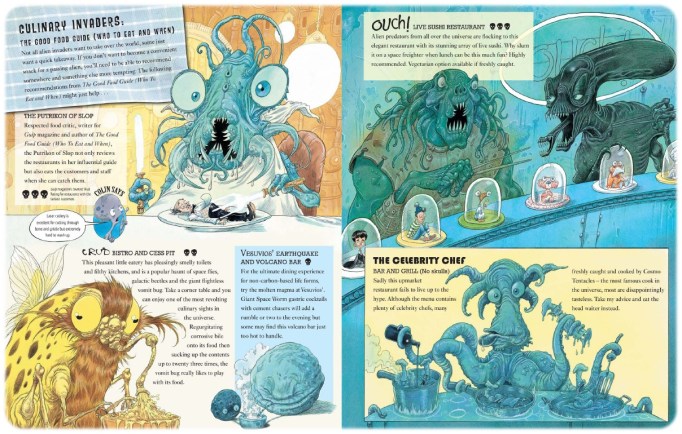
Excerpt (or, as the Brits would say, extract) from Alienography by Chris Riddell (2010).
Chris Riddell is a British illustrator, writer of children’s books, acclaimed political cartoonist, talented doodler, etc. His hand-lettering (not at all on display in Alienography, I admit) is sort of Richard Sala, Edward Gorey-ish, as is his somewhat macabre sense of humour. Visit Riddell’s blog here.
This splendid illustration by Roger Langridge (tentacle artist par excellence) was published in Doctor Who Magazine no. 300 (February, 2001) to accompany some-article-or-other about “Spearhead from Space” (a Doctor Who episode, the seventh season opener, if you really must know).
A bit more information about the cool Dr. Langridge-and-Dr. Who pairing:
“Within Doctor Who comics, he can be regarded as effectively the current Doctor Who Magazine “house letterer”, having lettered the overwhelming majority of comics since his debut on DWM 272’s Happy Deathday in late 1998. Almost every issue of DWM published in the 21st century was lettered by Langridge.
He has also occasionally pencilled, inked and even coloured some stories along the way. Deathday, for example, was also his Doctor Who pencil and ink debut, and was followed by artistic duties on TV Action!, the back half of The Glorious Dead (where he was co-credited as penciller with Martin Geraghty), The Autonomy Bug, Where Nobody Knows Your Name, The Green-Eyed Monster, Death to the Doctor!, and Planet Bollywood. He is thus perhaps the only artist to professionally draw all eleven incarnations of the Doctor, even though many of his renderings were obvious parodic in Death. Finally, he coloured Me and My Shadow and Where Nobody Knows Your Name.” [source]
The Wizard, a weekly British publication put out by D.C. Thomson (without a P, though it’s tempting), was created in 1922 and lasted all the way until the late seventies (with periodic interruptions for a merger and several title changes, from “Wizard” to “Rover and Wizard” to “Rover” and then again back to “Wizard” in 1970 until its final demise in 1978).
This edition of The Wizard is from October 26th, 1974, but I unfortunately have no idea who the artist is.
Between WWI and WWII (and sometimes beyond), D.C. Thomson published a number of weekly magazines/papers aimed at boys between 8 and 16. They cost 2 pence, and were thus known as “Tuppenny Bloods”, or the Big Five: Adventure, Rover, Skipper, Hotspur and the aforementioned Wizard. What could one hope to find in a Tuppenny? Short stories with illustrations, some comics, some non-fiction articles…. pretty much everything a growing boy (and girl!) with a lively mind would want.
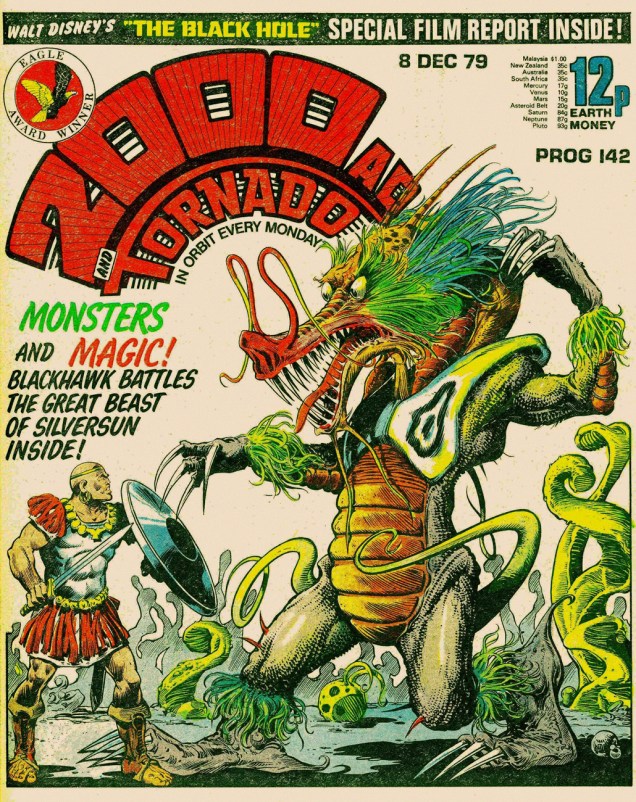
2000 AD no. 142 (1979). I call this the “dragons’n’tentacles” ploy. Other than tentacles on the cover, this issue contains part 3 of Judge Dredd: The Black Plague, which I highly recommend, and some Stainless Steel Rat adventures.
« … it was a balled-up thing… like an empty wrapper thrown carelessly aside… but somehow still recognizable as having once been human… »
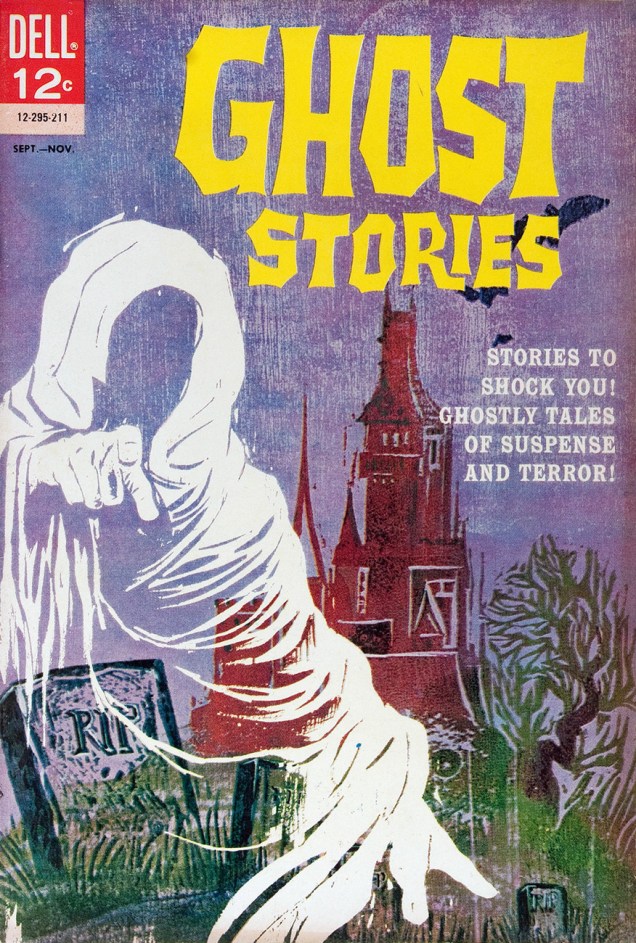
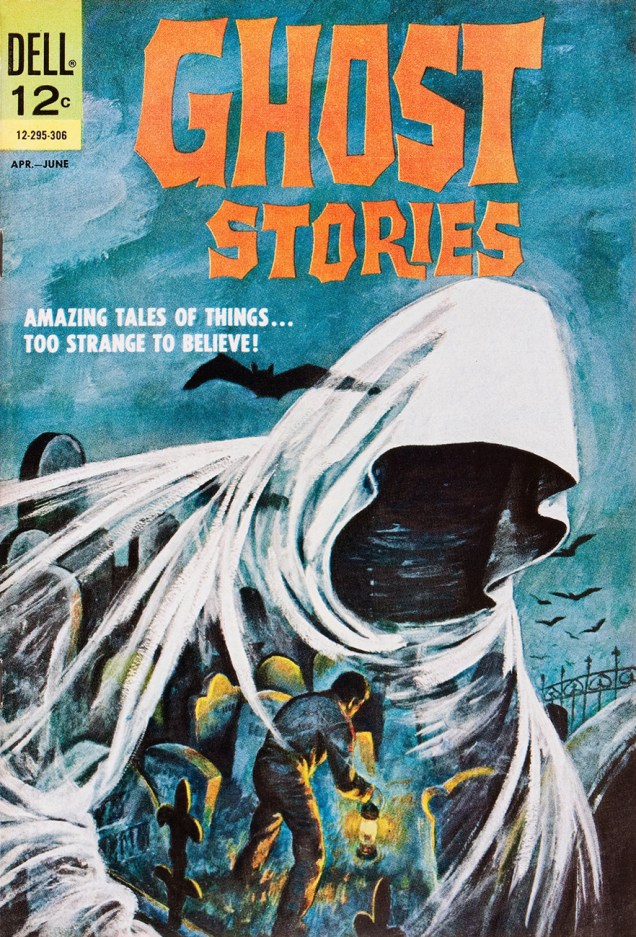
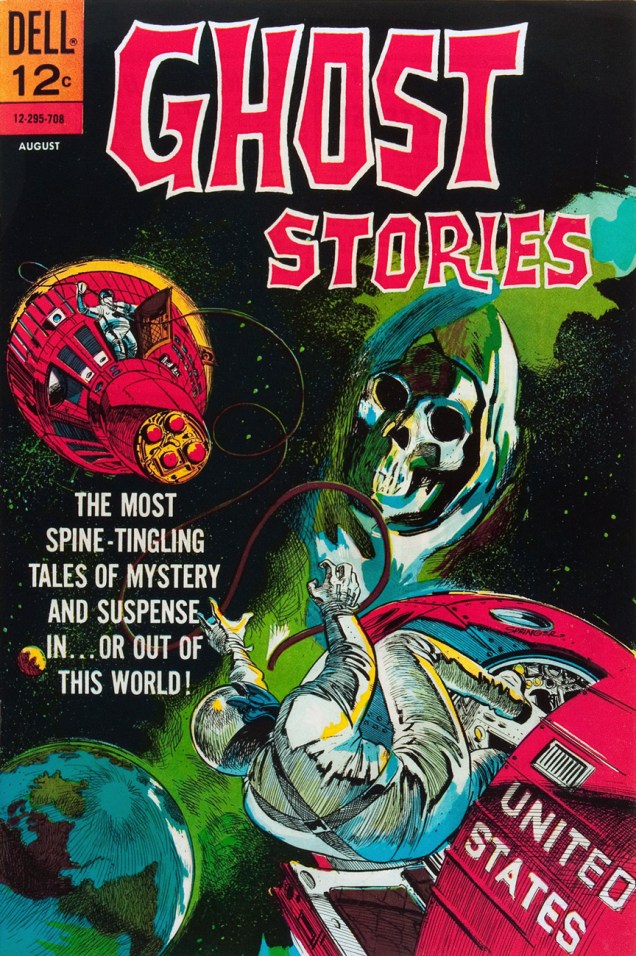
Dell’s Ghost Stories (1962-1973, with issues 21 to 37 lazily and straight-up reprinting numbers 1 to 16… with a single, perplexing exception, the all-new, surprisingly decent issue 35, late in 1972) were quite tame, trifling stuff, with one notorious bright spot: the première issue, entirely written by John Stanley (1914-1993) and comprising, amidst other excellent short pieces, what’s possibly the most nightmarish tale to see print up ’til then in American comics (particularly all-ages comics!), « The Monster of Dread End ». It represented the kind of material few comics publishers could have gotten away with at the time, save, ironically, one of the squeaky-clean stalwarts (Dell, Gilberton, Gold Key…) that opted out of the industry’s recently-instituted governing censorship board, the Comics Code Authority. Their reasoning was that, having never published anything objectionable to begin with, they were unlikely to head down that sordid path in the future.
Journeyman cartoonist Frank Springer (1929-2009) provided some decent artwork through most of the book’s run, but as he didn’t have much to work with, script-wise (Carl Memling was no substitute for Mr. Stanley), the end result remains underwhelming. Looking at the bright side, he did provide a couple of quite alluring covers, the final, non-painted entries in our select little gallery.
If you haven’t already made its acquaintance, treat yourself to the nerve-tingling Number One, available gratis under the auspices of the fine folks at comicbookplus.com. Love the semi-woodcut technique used on the cover by the Unknown Artiste.Ghost Stories no. 3 (April-June 1963). Cover artist unknown.Ghost Stories no. 10 (April-June 1965). Cover artist unknown.Ghost Stories no. 19 (August 1967). Cover and interiors by Frank Springer.Ghost Stories no. 31 (January 1972). Cover and interiors by Frank Springer, price and indicia aside, a facsimile of issue 11 (July-September 1965). My own tepid introduction to the series.
« His face taut… his coloring now shell white… Fred took the object from his bowling bag… his friends screamed in horror… »*
Welcome to the second edition of Who’s Out There’s annual Hallowe’en Countdown. We’ll be greasing the rails to carry us along with sinister haste through to that most shiver-iffic of holidays, but duly noting and relishing each daily marker along the way.
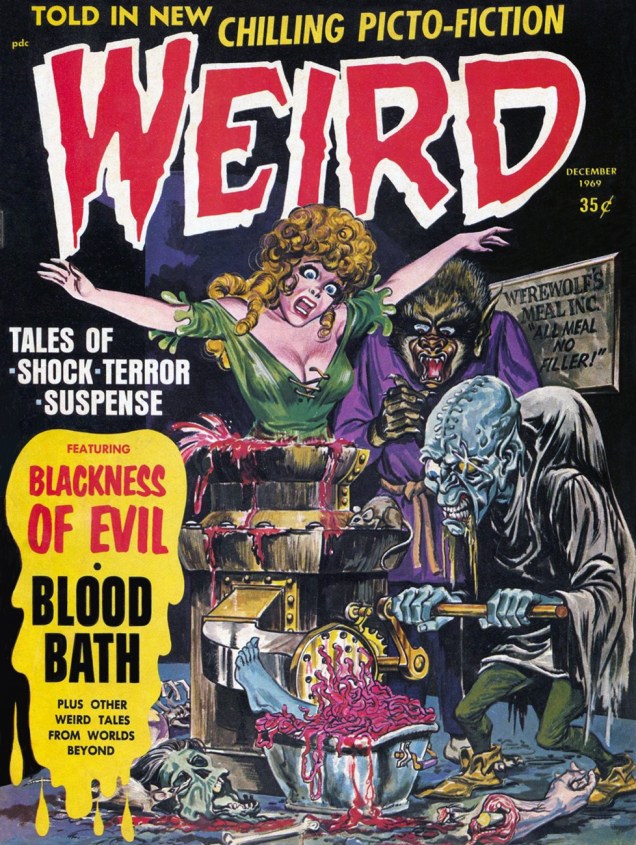
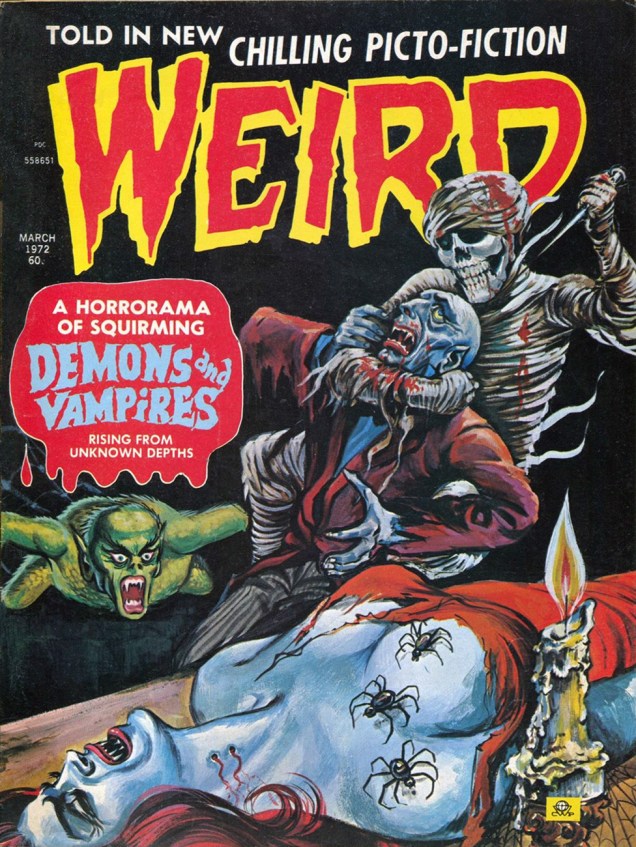
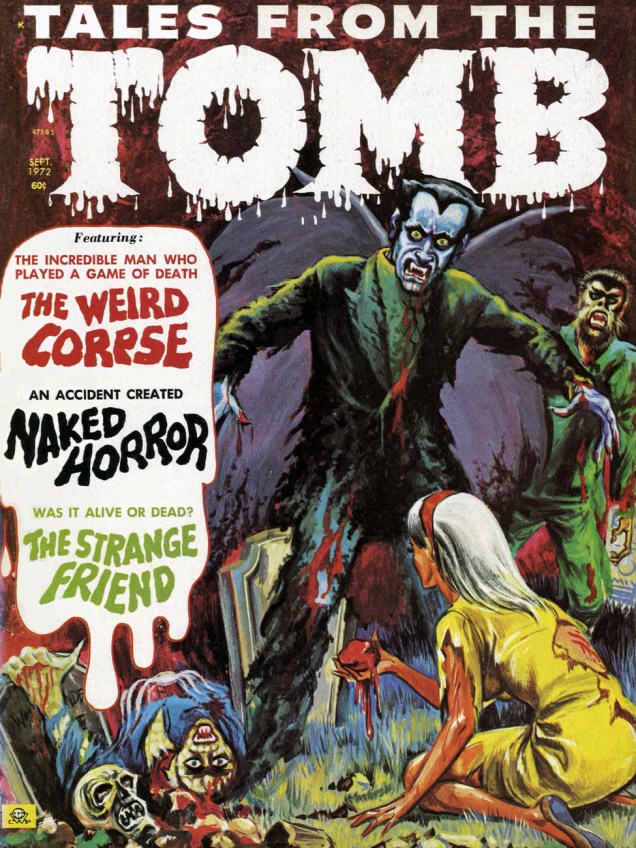
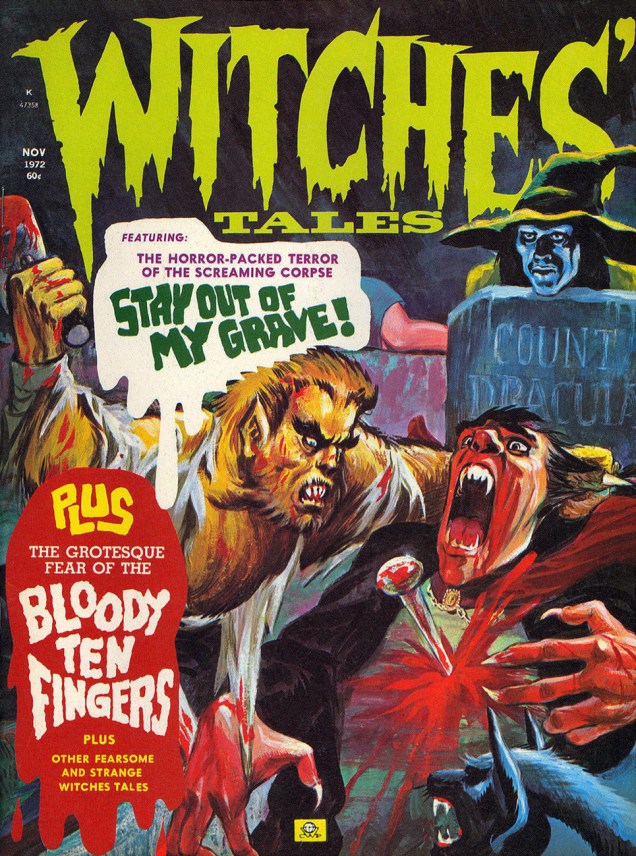
Let’s push off with a tasteful dash of splatter and a tidy selection of Eerie Pubs‘ typically over-the-top, gloriously gory cover artwork. While EP covers featured the work of a handful of artists, none is better-remembered or more closely associated with the line than former Irving Klaw-associated fetish specialist Bill Alexander. Fact is, the notoriously cheap-jack publisher cut ‘n’ pasted and endlessly recycled (not to say bowdlerized) Alexander’s work, and it’s sadly safe to assume he was only remunerated once, and poorly at that. Just another soul stranded in the limbo of exploitation publishing…
And the insides, you ask? Oh, that. Some reprints of lacklustre pre-Code
horror (Ajax/ Farrell) owned by publisher and gun enthusiast Myron Fass sometimes with added gore, sometimes redrawn from scratch and updated. Then, for a while, actual original material, not entirely devoid of occasional just-about-accidental charm. It’s a special kind of charge to witness the Grand Guignol excesses of pedestrian early 60s Jack Kirby inkers Dick Ayers and Chic Stone as they give vent to their less wholesome tendencies, overcompensating with eyeball-gouging and limb-hacking vengeance.
But all is not blood ‘n’ guts ‘n’ fury… sometimes the quiet, ink-washed ambience weaves a low-rent hypnotic spell and the fool thing works. But what with all the reprints and mediocrity, it’s a uncommonly perverse mania that drives a collector to pursue a complete set of these musty bits of flotsam. After decades of neglect, they’ve become impressively pricey.
– RG
* from « The Mad Bowler » (Horror Tales vol. 4 no. 6, Oct. 1972). Read it here!
French comics artist Georges Pichard (1920-2003) specialized in erotic comics, and his work ranged from “just controversial” to “outright banned”. I have a soft spot for his excellently-endowed women with almond-shaped eyes – what they lack in sensuality (to my opinion, at least), they compensate with cantankerous personalities and odd liaisons with deities. Pichard also displays a preoccupation with labour and industrial themes, kind of a communist thing to my mind – his women are called upon (mostly unwillingly) to work with heavy hardware, build railroads, excavate mines, and undertake other menial tasks involving much metal and machinery. This, of course, is accomplished while naked, or nearly naked (shackles are frequently involved.) It doesn’t come off as sadistic or even sexist, however – it’s more like a grotesque comedy or satire. Anyway, I’ll get to all that in just a second.
First I’d like to show a few examples of his earlier work, which wasn’t “pushing moral boundaries” (as an anonymous admirer once put it). His two early series – Ténébrax and Submerman – were collaborations with comics artist Jacques Lob. Although Pichard’s eye for pretty women was already in evidence, his style was much cartoonier, which is lovely.
Ténébrax is an homage of sorts to the roman policier (the French genre of detective stories): a villain uses the Paris subway for his base while he whips his rat army into tip-top shape for world domination, but his heinous plans are foiled by a whodunit writer and his assistant, who manage to throw a spanner into his nefarious schemes.
Ténébrax, the first collaboration between scénariste Jacques Lob and Georges Pichard, was published in episodes in the short-lived weekly Chouchou (1964.)The opening page of Ténébrax. The bottom panel says (or, rather, our human protagonist says), « Who are you? Help! »
Submerman, on the other hand, is a superhero parody:
A page from Submerman from Pilote n°527 (1969). See all Pilote covers featuring Submerman here. The series was published between 1967 and 1970. People looking for a really obscure Halloween costume, take note of Submerman’s get-up: it wouldn’t be so hard to draw a yellow fish on a red onesie.Submerman: La faune des profondeurs, published in Super Pocket Pilote n°4 (1969). « Sauve qui peut! » translates to « Run for your life! » Interestingly, English doesn’t have a « Save yourselves, those who can », but French and Russian do. I can’t vouch for other languages.
Now, I promised you some of Pichard’s women. An obvious place to start is the series Paulette, scripted by Georges Wolinksi (who, by the way, was killed in the terrorist attack on Charlie Hebdo in 2015) and illustrated by Pichard.
Paulette began in 1970 and chronicled the wild (and ever so slightly improbable) adventures of (who else?) Paulette. She gets kidnapped (more than once, by different parties), wooed, attacked, betrayed, saved, pregnant, communist-icated, converted to capitalism, harem-ed, and so on, not necessarily in that order. The only thing she doesn’t get is left alone. Poor girl. I wouldn’t say the series is entirely light-hearted, however – the authors used their pretty héroïne to ventilate all sorts of issues.
Paulette en Amazonie (Éditions du Square, 1975). Is it wrong that I love the drawing of evil Nazis and dumb soldiers a lot more than the damsel in distress? Pichard’s women all looked the same, but his villains had a lot more variety – which is not untypical of artists who are obsessed with the female form, actually. Silly, really; one would think that an obsession would lead one to exploring different shapes and forms, but somehow it rarely works out that way.
« Here she is, ready to climb aboard airplanes that are inevitably hijacked, to wind up in jungles, in wasp nests, in ambushes, to crash through panels, through traps, into the arms of men unworthy of her, and to come through all this with a smile, without blaming anyone, not even Pichard and Wolinski, whose main preoccupation it is to never leave her alone.» (Introduction to Paulette 4, 1975)
An illustration to the political-gone-absurd content of Paulette:
The colours make me think of a black light poster. Here Paulette wakes up her bearded beau (who figures that her « Something terrible has happened to me! » refers to a pregnancy, and responds with « Don’t worry, if you have money that’s nothing, In Switzerland or Morocco… ») to inform him that « I think I am a communist! »
Speaking of bearded beaus: one of my favourite Paulette plots – although I haven’t read the whole series – involves Joseph, the old perv we just saw in bed, whose job is to protect Paulette from… err, himself, I guess? When Paulette rescues a magical mole, it offers her one wish, and because she is terminally naïve (bordering on the cretinous, if with a heart of gold), she wishes for Joseph to become young again. The mole, however, is myopic like all others of its kin, and mistakes Joseph for a woman, so he gets transformed into a sultry brunette.
Moving on to other oeuvres…
Original art from Bornéo Jo (Dargaud, 1983), with script by Danie Dubos and art by Pichard.Marlène et Jupiter (Yes Company, 1988).A panel from L’usine (Glénat, 1979).
And I saved the funniest as a digestif: in the last panel, the man is saying « But what am I supposed to do now? », to which she responds with « Replace your windshield, of course! I’ll give you an address, they’ll give you a ten percent discount if you mention that you were sent by Fairy Motricine – I’m the sister-in-law of Fairy Electricity. » (Note: Motricine was a brand of gas.)
« I’m not content when I’m traveling, but I’m not content when I’m not traveling. So I guess I’ll keep traveling. » – Shel Silverstein
Another one of those nice Jewish boy geniuses, Sheldon Allan Silverstein (1930-1999) was born eighty-eight years ago, on September 25, 1930, in Chicago, Illinois. Uncle Shelby lived life to the fullest, creatively in every respect. He tried his hand at many things, and what do you know? He succeeded at every often-unlikely turn, sometimes artistically if not commercially, but generally on both counts: cartoonist, singer, songwriter, screenwriter, poet, actor, playwright, children’s book author, bon vivant, raconteur and lover… yet his dad was never impressed. Old man Nathan wanted his son to join him in selling furniture. Some obstacles are just plain insurmountable.
Once more, faced with the daunting prospect of discussing a prolific and versatile creative soul, it seems well-advised to concentrate on a tiny area of his roadmap. And so…
In 1957, Playboy magazine founder and esteemed patron of cartoonists Hugh Hefner entrusted Shel with a special assignment, that of roaming the Earth and recording his special impressions. The results, published between 1957 and 1968, were twenty-three travelogues brimming with the gregarious Silverstein spark and spirit. But he first had to be sold on the approach. According to Hefner, in his foreword to the definitive collection “Playboy’s Silverstein Around the World” (2006), « I envisioned something along the travel letters Ernest Hemingway submitted to Esquire — A sort of personal diary that would be dispatched from around the globe. Shel was uncomfortable in that role. He didn’t want to include himself, but I persisted. And I’m glad I did. What we got back in those drawings was narrative storytelling of a very personal manner. We saw Shel establish himself as a character.»
From “Return to Tokyo” (May, 1957).From “Silverstein in Paris” (January, 1958).From “Silverstein in Moscow” (March, 1958).From “Silverstein in Greenwich Village” (September, 1960).From “Silverstein in Hollywood” (January, 1968).From “Silverstein Among the Hippies” (August, 1968).Shel at work in Italy (1958); photograph by John Reid, Jr.
Let’s leave off with these revealing words from Playboy photographer Larry Moyer: « He was one of the funniest guys I ever knew — and it was never at anybody’s expense. A lot of humor is based on putting other people down. I don’t remember one time Shel ever put anybody down in his work — and that’s something. » That’s something indeed, now more than ever.
As I pointed out during my initial foray into the tangled relationship between superheroes and tentacled creatures (Superheroes in Octopus Land), even heroic stock characters with extraordinary powers get bested by the occasional octopus, be it of oceanic, mystical, or outright intergalactic origins. Some of these monsters are aliens from proverbial outer space, some swam out from the depths of the sea for reasons they alone comprehend; some are plants, some are mammals – animal, mineral, or vegetable in form and content.
Our first entry is someone who’s faster than a speeding bullet… but requires a passerby’s help to get rid of some pesky plant tentacles. None too impressive for someone of his calibre, the first superhero that comes to mind for most.
Superman no. 285 (March 1975). Cover by Nick Cardy.
That’s enough bumbling. I’ll move on to someone who can *really* handle tentacle problems!
“High atop Slaughter Mountain, where the rain never stops, stately Stearn Mansion stands silhouetted against the blood-red moon. This is the home of Dr. Strongfort Stearn, known throughout the world as … Mr. Monster!! From this lofty perch, Doc Stearn peers unflinchingly into the black abyss below. For it is Mr. Monster’s mission to search out evil — and destroy it!” Today Mr. Monster is fighting a cute octopus with googly eyes. Sometimes monsters look most innocuous, you know.
Original art for Mr. Monster: Who Watches the Garbagemen? (2005). Cover by Alex Horley. As usual, the octopus has excellent taste in women.
And this is the way it was published:
Mr. Monster: Who Watches the Garbagemen? (2005). Cover by Alex Horley.
« Since the first simple life-form crawled from the pounding turf, the sea has been laced with legend! From the daring men who faced the raging waves in primitive wooden craft to those who probe the hidden depths today in devices of plastic and steel, fables have been passed, secrets whispered from father to son… » And where there’s sea legends and fables of raging depths, there’s tentacles, you can be sure of that. Can the mysterious Phantom Stranger cope with them?
The Phantom Stranger no. 18, March-April 1972, with art by Neal Adams.
Maybe saying that starfish have tentacles is stretching it a bit, but just look at the way their arms bend at the ends! Besides, they can “walk” using their tubed appendages, which look like tentacles to all but the most pedantic.
Justice League of America no. 190 (May, 1981); cover by Brian Bolland, with colours by Anthony Tollin. This may not be a fashion statement, but think of all the money people would save on makeup and surgery!
Starro, a.k.a. Starro the Conqueror, was created by Gardner Fox and Mike Sekowsky in 1960. He’s a mean, stubborn alien lifeform with an idée fixe to enslave mankind, which he repeatedly tries to do by scattering his starfishy spores (which grow into clones of himself) over large cities. And, yes, he has prehensile extremities; it’d be difficult to wreak as much havoc without them.
Technically, Medusa’s got hair, not tentacles, but she expressed the wish to be part of our Tentacle Tuesday line-up… and I am not going to argue with a woman with hair that can knock out an army.
Created by Jack Kirby, Medusa first appeared In Fantastic Four #36 (1965). This is a pin-up from Fantastic Four Annual #5, November 1967; pencils by Kirby, inks by Frank Giacoia.
A panel from Batman, Inc. no. 1 (January 2011), pencils by Yanick Paquette and inks by Michel Lacombe.
Does anybody have an answer for catty Ms. Kyle? I’ll see you next Tentacle Tuesday – until then, keep away from hungry and horny octopuses.
« I prefer drawing to talking. Drawing is faster, and leaves less room for lies. » – Le Corbusier
Carl Buettner (1905-1965) started out as an animator with Disney Studios and Harman-Ising Studio (founders of Warner Bros and MGM animation studios), then shifted to newspaper strips for a few years (Charlie McCarthy, 1938-40), then on to Western Publishing for the rest of his career, handling a bunch of Disney characters for Dell Comics (Joe Carioca, Bucky Bug, Dumbo The Flying Elephant, Bambi…) until the early 1950s, when he became editor of Western’s Little Golden Books line.
On the side, he kept his hand in with a nifty tutorial feature, “Quick on the Draw”, that ran in Western’s The Golden Magazine for Boys and Girls. Though he passed away early in 1965, Buettner’s QOTD ran well into the next year, since he was evidently working well ahead. The feature was then taken over by his fellow former Disney animator and scribbler Carl Fallberg (1915-1996). Fallberg spent most of his long career working on the scripting and story directing side, but he evidently kept his pencils sharp.
From Golden Magazine Vol. 2 No. 10 (October, 1965)From Golden Magazine Vol. 2 No. 11 (November, 1965)From Golden Magazine Vol. 4 No. 4 (April, 1967). Fallberg was a lifelong “narrow gauge” railroad enthusiast. His delightful Fiddletown and Copperpolis cartoons, published in Railroad Magazine in the late ’40s to the early ’50s, were collected in 1985 and still in print (and affordable!) to this day.From Golden Magazine Vol. 4 No. 9 (September, 1967)From Golden Magazine Vol. 4 No. 12 (December, 1967)