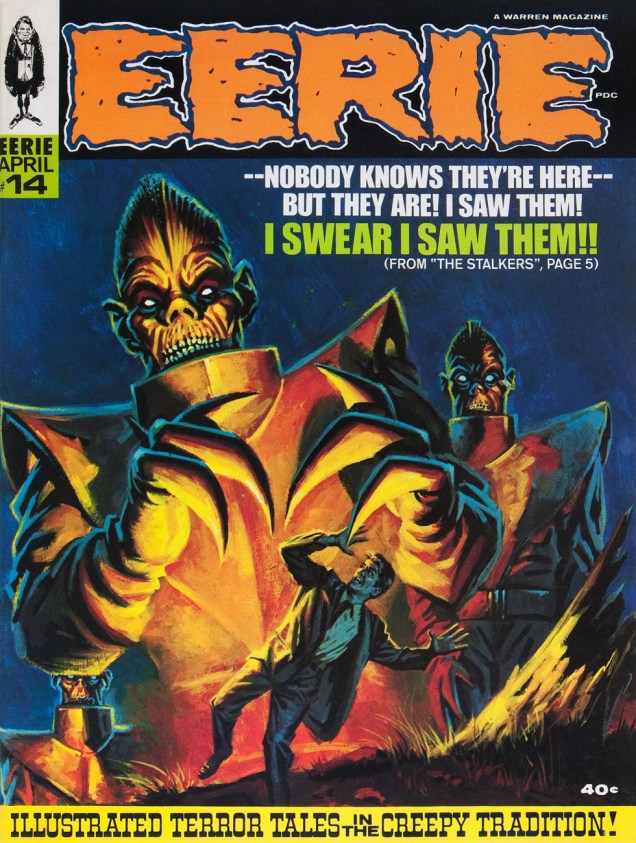
« These dreams? Hallucinations… or whatever you call them! It was on a business trip… in the middle of nowhere… I’ll never forget it! » — Alex Colby, who swears he saw them.
When people talk about Warren magazines cover artists, the name of Vic Prezio is rarely brought up. Well, someone has to, and it might as well be me. It doesn’t help that he only painted a handful of covers for Warren, but hell, I love them all in their pulpy glory.
Prezio is better known for his over-the-top men’s adventure magazine covers and, to a lesser extent, his Magnus: Robot Fighter covers for Gold Key. Mostly anonymous work, though. It’s a filthy business.
In Part One, we looked at Prezio’s Creepy Covers. As it’s « age before beauty », Cousin Eerie now gets his turn to bow.
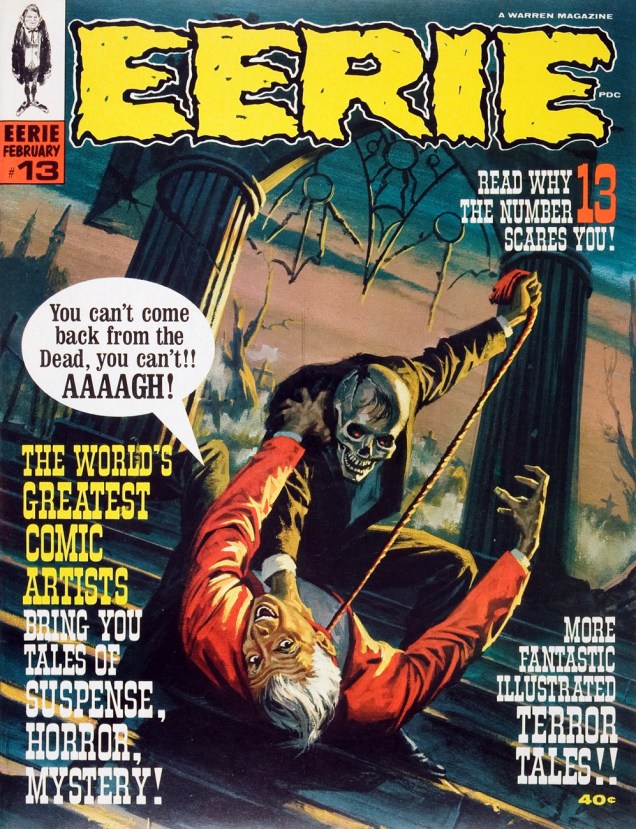
« Don’t you dare presume to tell me what I can and can’t do, Sheldon! » Some guys turn mean when their male pattern baldness spreads to their entire face.
An inspiring reminder of why you shouldn’t let the naysayers drag you down (even six feet under). Be all that you can be, on this side of the grave and beyond!
This alien encounter is *not* going to turn out all fuzzy-friendly.
Prezio’s painting conveys vividly the high paranoia of Archie Goodwin and Alexander Toth‘s The Stalkers, reprinted in this issue from Creepy no. 6, just a couple years old by then. Warren Publications were *not* in good shape at the time, having lost more of their key talent and left to the bare minimum of original material, including, thankfully, the covers. The out-of-left-field success of Vampirella would swoop in and save the enterprise in 1969. Close call!
Possibly the lesser entry amongst Prezio’s Warren pieces, but still an attractive cover, if not exactly terrifying. Somehow, it brings to mind Aurora model kit art more than it does a Warren cover (still, comparison to early-ish James Bama should hardly be considered a slag.)« AAAAAAAAAGAH! What is it? » I’ve often pondered that very question myself, sometimes while perusing this “throbbing” issue.
Another striking (if a bit rushed-looking) Prezio cover, this time representing Slight Miscalculation by writer Bill Parente and artists Bill Fraccio and Tony Tallarico. The much-maligned Fraccio and Tallarico often worked together under the joint nom de plume of Tony Williamsune (it is said that Tallarico pulled most of the weight.)
This time out, the cover story is H2O World by Larry Ivie, Al Williamson, and his Fleagle Gang acolyte and mentor Roy G. Krenkel, a reprint from Creepy no. 1 (1964).
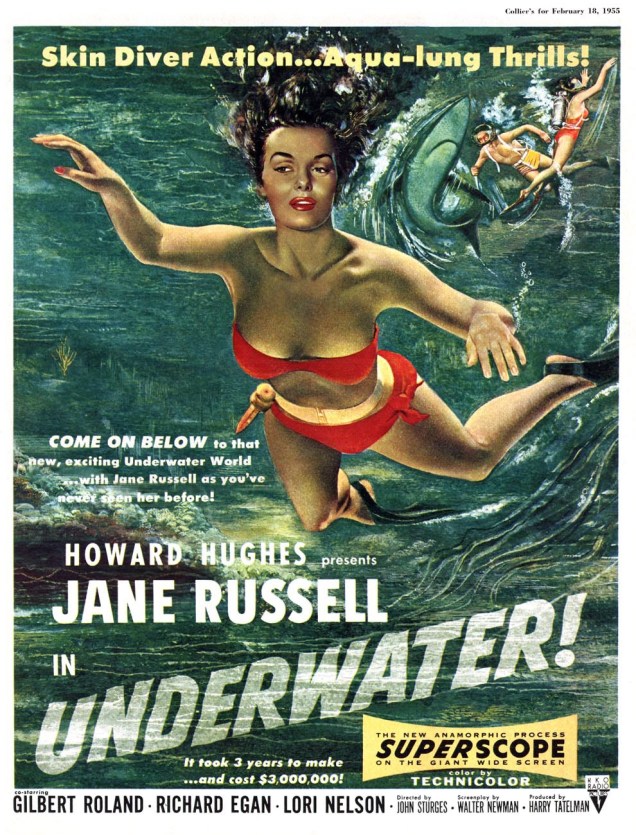
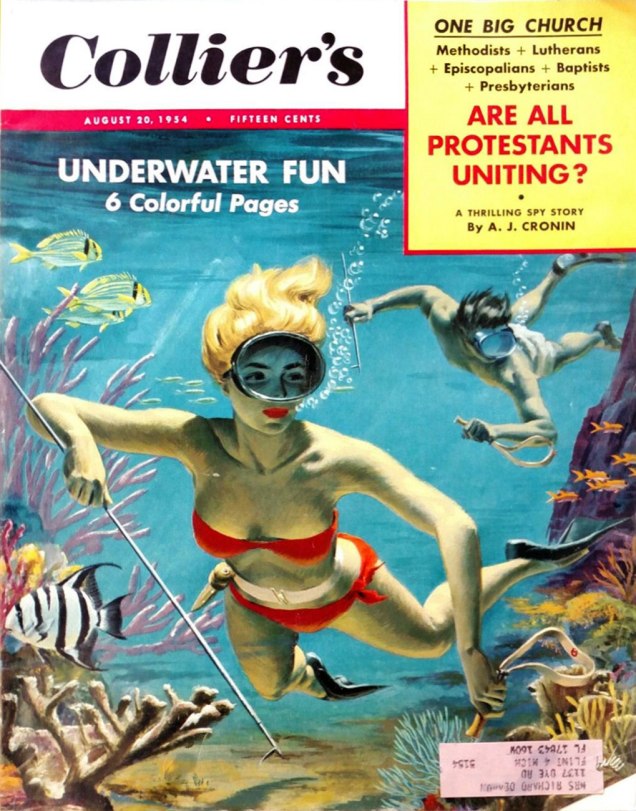
The girl looks familiar, though…
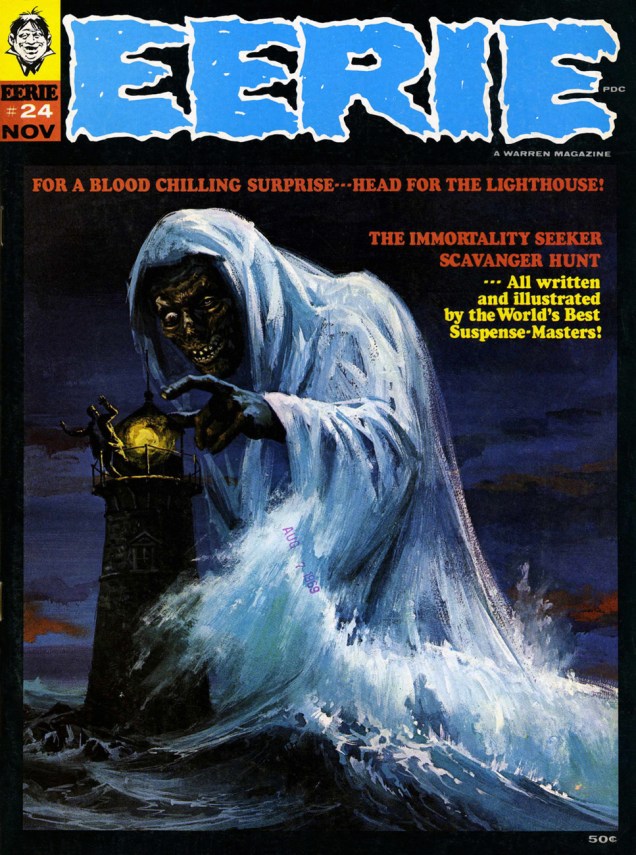
From a 1955 film poster…… itself swiping heavily from a 1954 Collier’s cover painted by Bill Baker. « You’ll find skin-diving now from Maine to California, wherever there is enough water for a person to plunge into. Divers, like the spearfishing pair on our cover, have made it America’s fastest-growing sport. » I’ll bet she’d rather dive with her husband, armed with a spear, than in the darkness with overly-friendly monsters.Prezio’s final Eerie cover (he would paint a couple of beauties for FMOF the following year), this lugubrious tableau from the bone-chilling month of November 1969, is likely my favourite Prezio. It illustrates Bill Parente and Michael Royer‘s Head for the Lighthouse!
Warren seemed, at this point, without a decent in-house copy editor. Witness the cover’s “Scavanger” Hunt, and inside, a story mistitled « The Wrong Tennant ».
« Wrong Tennant? You don’t say! I’d read *that*! »
All tomfoolery aside, this wraps up our survey of Mr. Prezio’s work at Warren. Hope you enjoyed the ride!
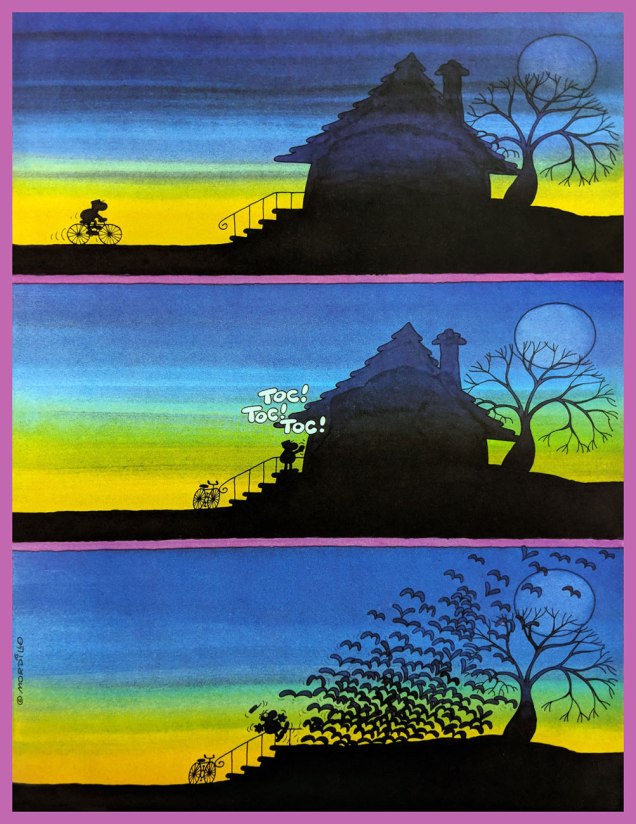
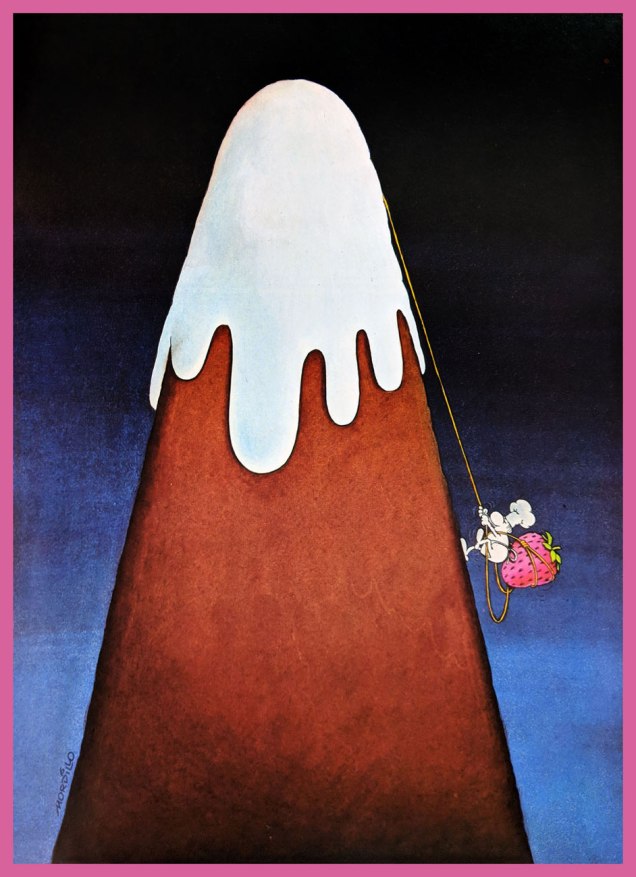
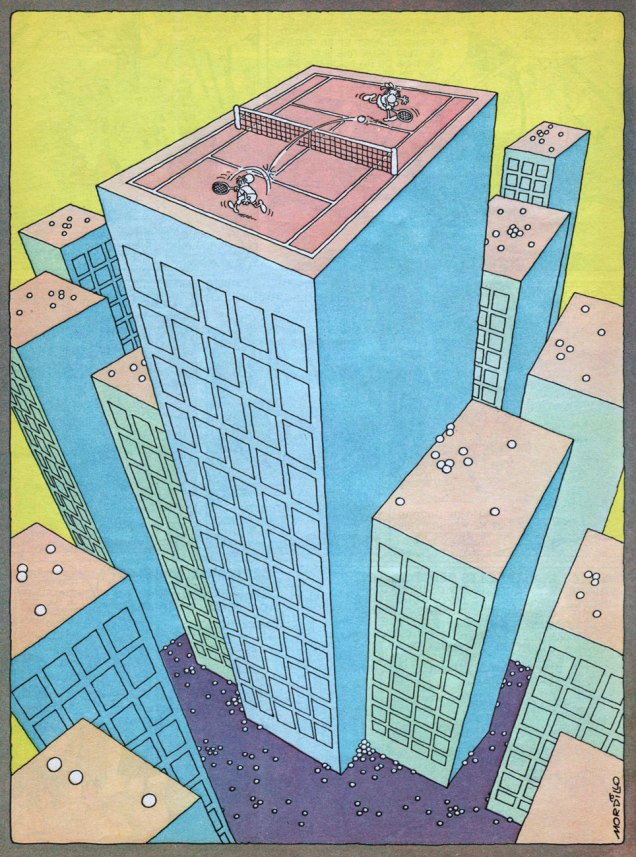
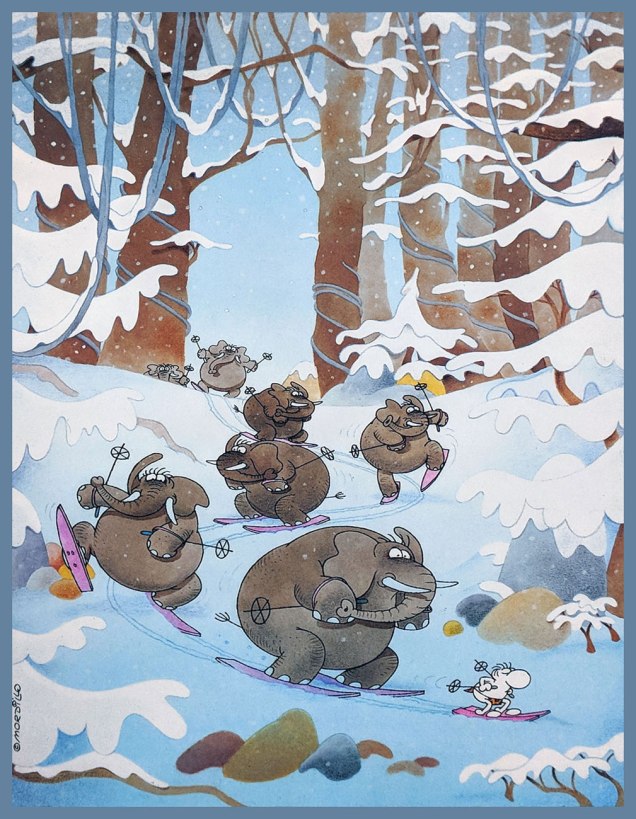
Guillermo Mordillo (1932 – 2019), known simply as Mordillo, was an Argentine artist of Spanish parentage. Through his long and productive career, he released more comic albums than you could shake a stick at… and at 86, was still active in the comics field. His easily recognizable style, love of bright colours and oft-surreal humour make his work memorable despite his persistent profligacy.
It would be impossible to provide an overview of his body of work in one post, but it is my pleasure to furnish a fun sampling of his œuvre. Most images below have been gleaned from Opus 5 (Glénat, 1984) and Safari (Glénat, 1990), unless indicated otherwise.
The following two images were scanned from early 1970s issues of Pif Gadget.
In the mid-70s, Mordillo’s cartoons were used by Slovenian artist Miki Muster to create Mordillo, a series of cartoon animations that ended up being 400 “episodes” long (for a total of 300 minutes – each episode is under a minute). These droll snippets were broadcast in over 30 countries between 1976 and 1981. Should you have a few minutes to spare for a chuckle or two, have a look at this video (recorded by somebody in Germany on VHS tape in the 90s and, many years later, uploaded to Youtube – what lovely, contorted pathways some of these things take).
« Or… uh, huh… with the severed neck of a dead ostrich… Yow! Tentacles! Long wriggly tentacles! Woo-WOO! »
Ah, Brian Bolland, the British artist that generally comes to mind when one mentions Judge Dredd. This was certainly *my* introduction to him, and my so-called initiation went over with a bang! (Which is to say, I fell in love with his art instantly. It took me a little longer to learn to appreciate Judge Dredd stories illustrated by other artists.) His crisp line adorns many, many comic titles, and I’m not going to enumerate all the pies he’s had his fingers in. I can, however, kill two birds with one stone by combining Wonder Woman Tentacle Tuesday part 2 (part 1 can be found here) with Bolland tentacles along other lines.
Actually, DC’s 1987 Wonder Woman series is a treasure trove of tentacles even without Mr. Bolland. However, some of these covers are frankly too ugly to feature here (I have high standards, in case you hadn’t noticed), while he can be relied on to always provide us with eye candy and an engaging composition.
Wonder Woman no. 75 (June, 1993).
Bolland is reputedly fond of his work on Wonder Woman covers, marking that it was “one of the few occasions he actually sought work rather than being sought for work.”
Wonder Woman no. 86 (May, 1994).
A bonus WW illustration as a special treat, albeit a follicular extension of the definition of a tentacle, I confess. Well, it *is* Movember.
A pin-up published in Wonder Woman no. 120 (April, 1997): Wonder Woman vs Egg Fu!
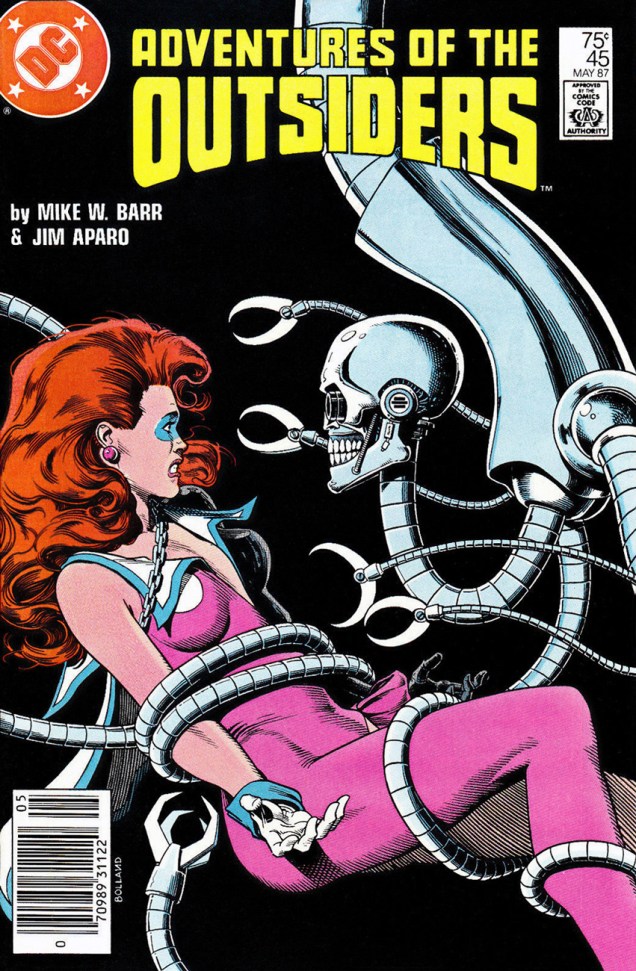
Moving on from the powerful, intrepid Wonder Woman to smaller crawfish, we have this maiden in an incredibly silly costume, which Bolland managed to somewhat redeem, mostly by hiding the stupid bow and differently-coloured boot on her left leg.
Adventures of the Outsiders no. 45 (May 1987). Mechanical tentacles are all well and good, but it’s Duke of Oil‘s inane grin I like best.
The maiden’s name, by the way, is Looker (!), presumably because the team who created her (Jim Aparo and Mike W. Barr) couldn’t think of a better moniker for a woman who went from a mousy bank teller to a cocotte (oh, sorry, I meant “coquette”) with superpowers. Pardon me going off-topic, but I really must illustrate: here’s what her costume looks (oh, har har) like in its full frontal glory.
Batman and the Outsiders no. 31 (March 1986), cover by Alan Davis.
And a last piece of balderdash:
« Her original costume was manufactured from a material unique to Abyssia; one way fabric, which was invisible from one side. This allowed her to keep her costume handy but not visible. She would turn the clothing out to make it visible. »
Moving on to classic Bolland with creepy-crawlies, fatal beauties and grotesque sub-humans, we have this delightful poster:
And a last madcap entry, amusingly full of non-sequiturs:
A page from « Silver Sweater of the Spaceways », featuring Zirk, and published in Axel Pressbutton no. 1 (November, 1984), scripted by Steve Moore and illustrated by… well, you know.
« Stop that whimperin’, Emma — or I’ll lay into ya like a butcher in a cowpen! » — Raymond Marais, Rescue of the Morning Maid
The mysterious, but nonetheless well-remembered journeyman pulp illustrator, Vic Prezio, though chiefly associated with the infamous Men’s Sweat adventure magazines (« Weasels Ripped my Flesh! ») also produced notable work for Dell (The Outer Limits, Kona, Naza, Brain Boy, Frogmen…), Gold Key (Magnus, Robot Fighter) and Warren, and that’s just the tip of the iceberg. I did say he was a journeyman.
In all, Prezio produced, for the Warren Magazine line, six covers for Famous Monsters of Filmland, some of them classics, four for Creepy and six for Eerie. And that’s not all: Prezio painted a pair of covers for FMOF companion title Monster World (no. 2, Jan. 1965, and no. 4, June 1965); these would have been his earliest Warren contributions. Thanks to eagle-eyed Michael Prince for bringing these last to my attention!
Today, we’ll admire Uncle Creepy’s dodgy wares, and reserve Cousin Eerie’s mouldy goodies for part two. The FMOF issues regrettably fall outside our purview, but for the record, these are numbers 35, 36, 38, 39, 67 and 68. Check ’em out.
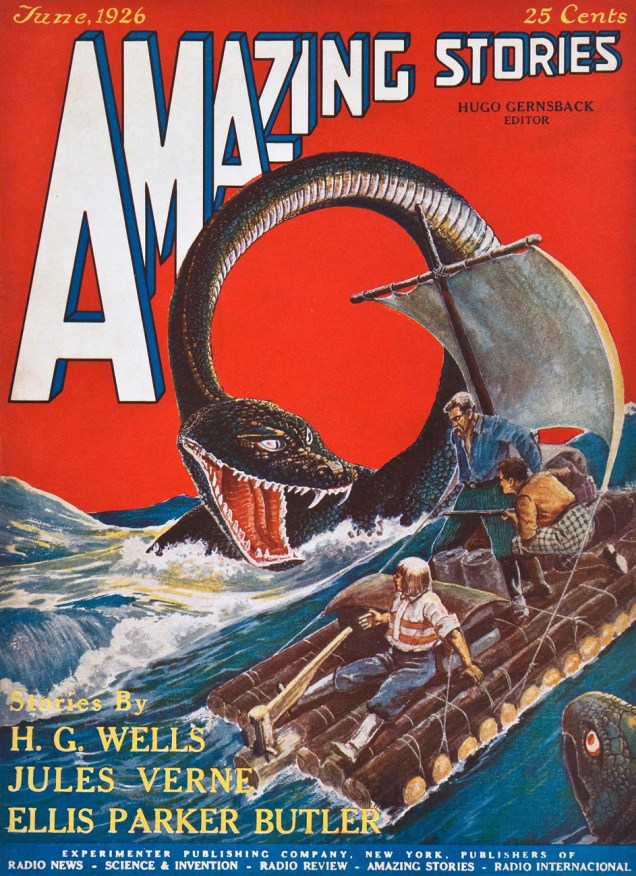
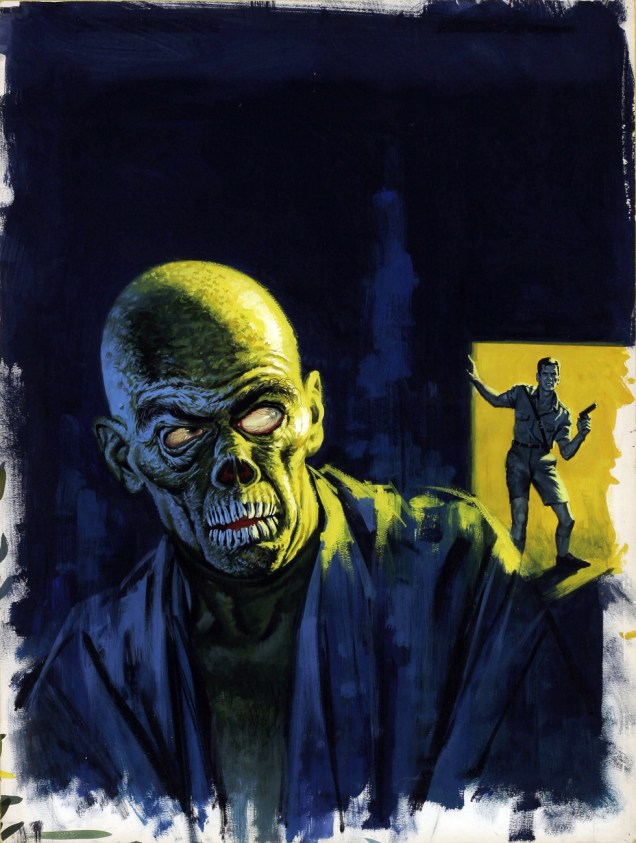
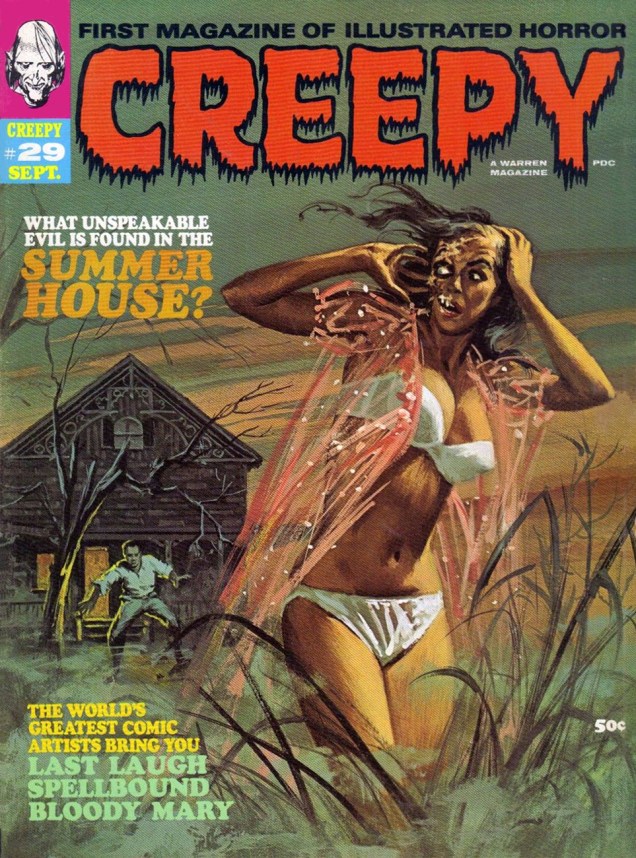
Oh, it’s just your lousy luck: you finally get your best girl alone on your raft, then along comes this humongous critter to put a damper on the romantic mood. Prezio brings the scene to life for issue 18 of Creepy (Jan. 1968)… but I can’t quite shake the feeling that said scene looks sort of familiar…Ah, that must be it. I see there used to be two snakes involved.« I say, are you the chap that’s been short-sheeting my bunk every night? » Mr. Prezio’s nasty (in a good way) cover painting gives us a glimpse of Rudyard Kipling‘s (by way of Craig Tennis & Johnny Craig) The Mark of the Beast(1890), reprinted from Christopher Lee’s Treasury of Terror (Pyramid Books, 1966).A look at the original painting, which thankfully survives. Can’t take such things for granted.« Good Lord! » I wonder what that ‘one thing’ is. Prezio’s cover for Creepy no. 28 (Aug. 1969) is based on Archie Goodwin and Dan Adkins‘ story The Doorway, reprinted in this issue. Read it here, if you must.Some editorial second-guessing went on, as evidenced by the most consistent colour scheme of the original painting. It’s a great piece, so it works all the same.« Come back, baby! Sure, my saliva’s a bit… corrosive, but you’ll get used to it! » Vic Prezio’s twist on the then-prevalent gothic romance trope of the gorgeous, scantily-clad damsel-in-distress running away from some castle or mansion. This is Creepy no. 29 (Sept. 1969).Now, Vic’s original painting: the image was flipped for publication (as if you couldn’t tell), which was probably a sound decision. Left to right motion is more visually natural and dynamic.
If you’re looking for gory tentacles, fountains of flesh and mounds of blood (err… unless it’s the other way around?), screaming hordes being devoured by a famished cephalopod with a mean streak… go look at our other Tentacle Tuesdays posts, for today’s entry is not for you.
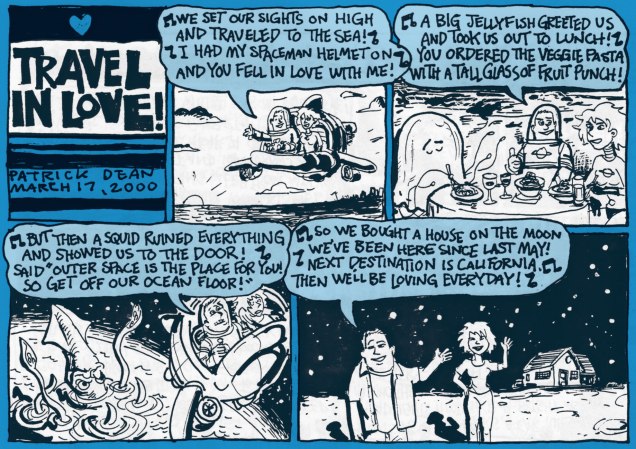
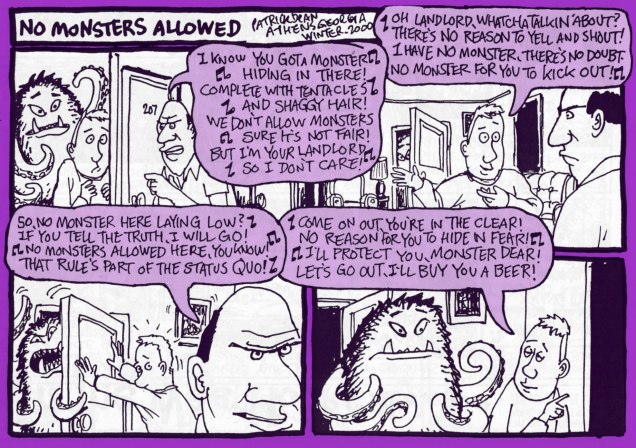
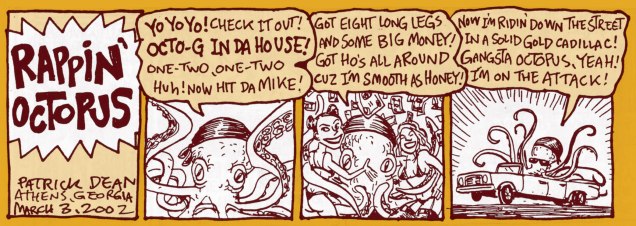
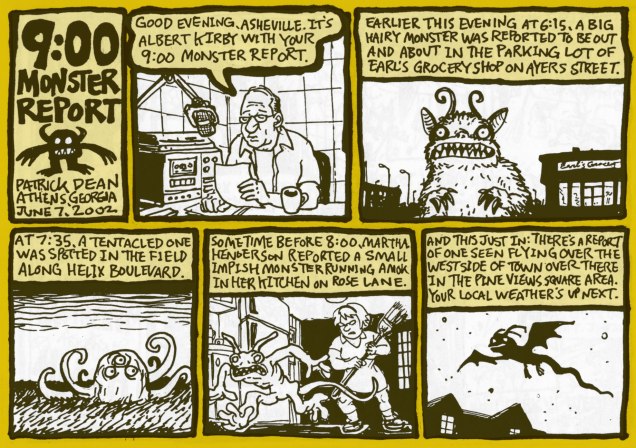
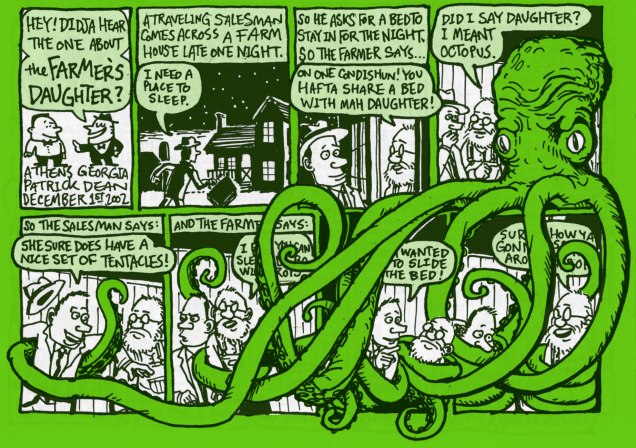
However, those of you who like a friendly octopus and can appreciate understated wit and off-beat humour, stick around as we travel into a land created by Patrick Dean (not British Ambassador to the States). A word of warning – people randomly bursting into song and cohabiting with monsters is quite normal here.
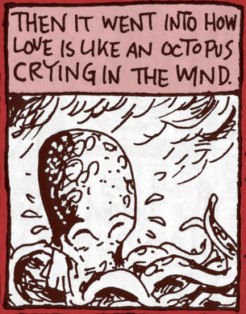
Monsieur Dean likes monsters – nay, loves them – but he likes to contemplate them in their quieter moments: wooing a potential mate, politely asking for a BLT sandwich, watching a Julia Roberts movie or even reciting poetry.
All images in this post have been scanned from Big Deal Comics & Stories numbers 1 through 4 (published from 2000 to 2004), and lovingly coloured by my co-admin-cum-partner. I reread them recently in my ceaseless quest for tentacles, and while I remembered really enjoying them a few years back, I had forgotten how good they were. A lot of comics of a random, episodic nature are very much hit or miss, but these little gems are all gold, if you pardon my mixed metaphor. For instance, here’s PD’s summary of #3:
« More assorted one page strips. 28 pages of witches, cities, investigators, sailors, big shows, haunted houses, bees, record collections, band directors, roommates, octopuses, ham, radio towers, rainy days, treasure maps, J.D. Salinger, pork chops, and four leaf clovers. »
What kind of stone-hearted, dull-witted person would say “nope, not interested” to that? Luckily, not all Big Deal Comics are sold out – three issues are still available for purchase.
The best part of Cathy’s letter is… well, you guessed.
Those musical interludes I coyly alluded to earlier? Here.
The best saved for last? I think so!
Don’t forget to visit Patrick Dean’s website, visit his FB page, or admire more of his art here.
« All studies of propaganda tell what a powerful weapon it is; that since armies fight as people think, it is essential to control that thought. This means some form of managing the news, and the only question is the degree to which the news should be managed openly and the degree to which it should be managed subtly. » ― Phillip Knightley, The First Casualty: The War Correspondent as Hero, Propagandist, and Myth-maker from the Crimea to Vietnam
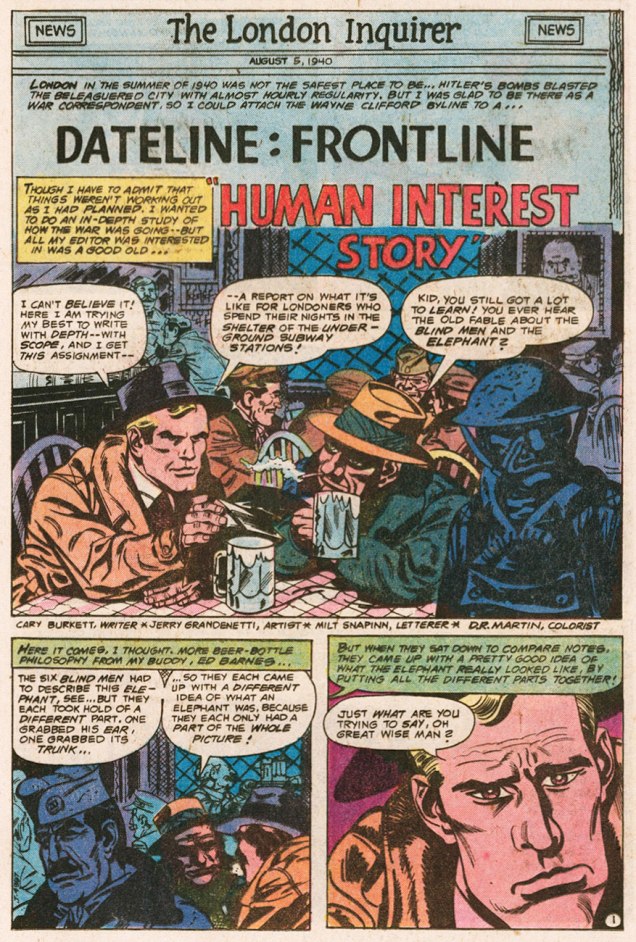
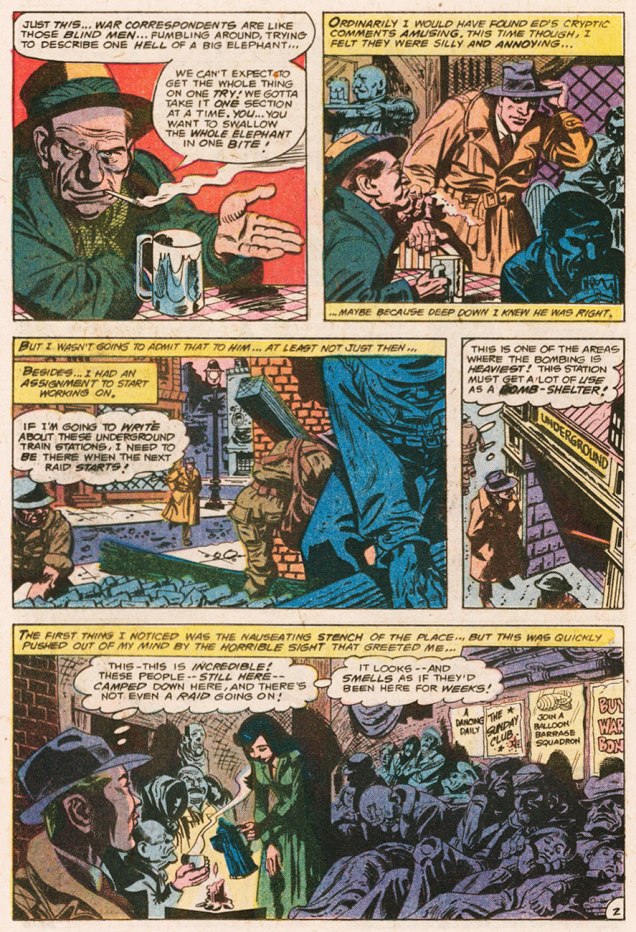
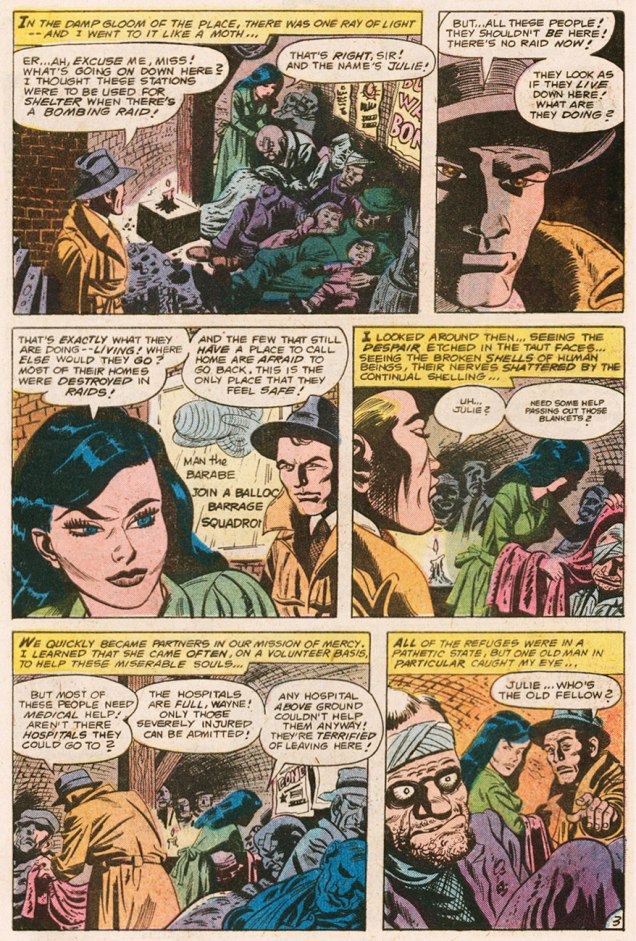
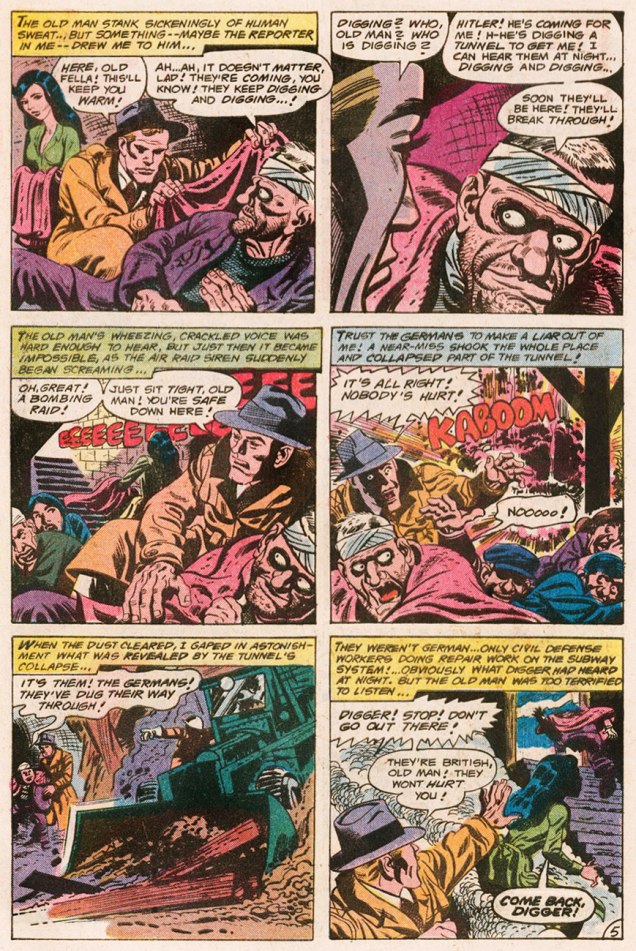
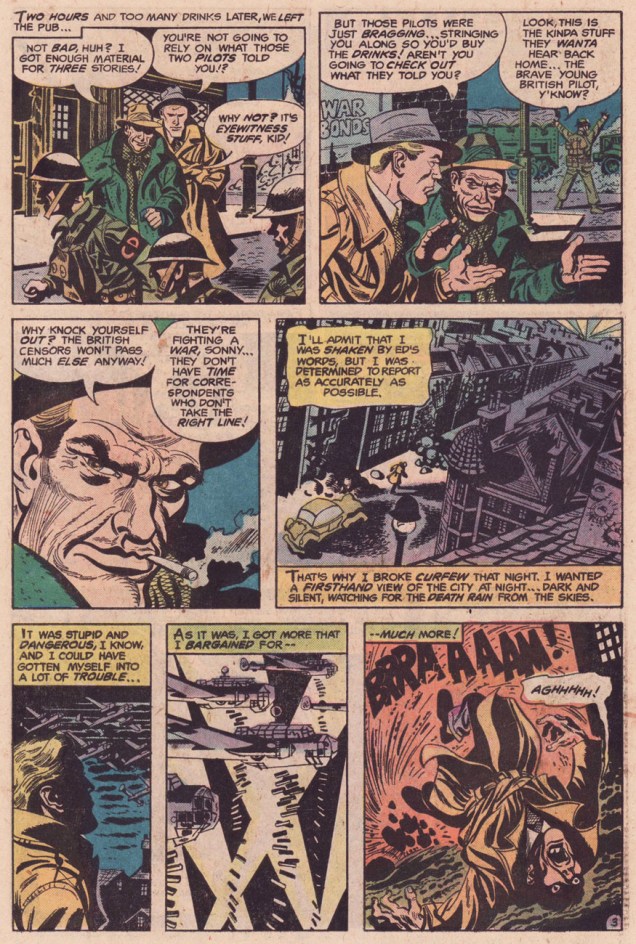
In most collectors’ lives, there’s a degree of more casual, automatic accumulation. Things you pick up for a song, just because the opportunity arises, and that you file away, planning half-heartedly to look them over when you find the time. As a devoted Jerry Grandenetti fan, I always pick up his work… but I favour some genres over others. Mr. G has crafted, for instance, a lot of war comics for DC over the years (1952-1984!), most of which I haven’t seen. For me, it’s always been about his horror/mystery work. So… I had picked up, somewhere along the line, a consecutive pair of issues of DC’s Men of War (26 issues, 1977-80), numbers 9 and 10, featuring the first two parts of a Dateline: Frontline backup sequence, « Bathtub Blues » and « Glory Soldier ». I was very, very impressed.
Now, most of DC’s war books were scripted by a small cadre of authors, namely the indefatigable Robert Kanigher, as well as Bob Haney, Ed Herron, Jack Miller… but mostly Kanigher. In the Seventies, things changed a bit, with solid help and variety coming from Frank Robbins and David Michelinie on The Unknown Soldier, for instance. I had encountered Cary Burkett’s name here and there, being a regular reader of Batman titles The Brave and the Bold and Detective Comics, where he scripted backups (Nemesis, Batgirl) and the occasional lead feature. But this was… different. Hard-hitting, quite free from convention, and damn well buried in the back of a second-tier war book.
I hunted down the rest of the D:F series, and my initial impression did not fade… quite the contrary, indeed. The third serial (MoW 21-23), set on the Russian front, actually brought some tears to my eyes. Why was this feature so little-known? Oh, I know… the usual reasons. But I wanted to find out more, and the next logical step was to reach out to the series’ surviving author, who was happy to oblige, to my delight. And so here we are. The stage is yours, Mr. Burkett.
Dateline: Frontline recollections, by Cary Burkett
« Paul Levitz was editor of a new war comic called ‘Men of War‘ featuring a character called ‘Gravedigger’.He wanted to have backup stories in each issue, and he came up with the title ‘Dateline: Frontline‘ and the idea that it would feature a war correspondent as the main character. I was working as his assistant at the time (1976), and he asked me to do a series of 3 six-page stories.
He pointed me toward a book called ‘The First Casualty‘ by Philip Knightley. The title was inspired by a famous quote ‘The first casualty when war comes, is truth‘.The book was a history of war correspondents from early days of reporting through the Vietnam War. It became a basis for the new comic series in terms of setting up the inner dilemma of the main character, which was how to report ‘the truth’ in time of war.
I chose to set the series in World War II and named the main character Wayne Clifford. My idea was that he would begin his career as a war correspondent being very idealistic and naïve. Over the series of stories, he would come face to face with wartime situations which challenged his assumptions about news reporting, war, ‘truth’ and about himself.
That, in a nutshell, was the core of the series.I chose to set the narration in first person, which I guess is pretty much the standard in comics now, but was not common then.
After the first 3 stories, Paul asked me to continue the series. But we kept the idea that the series would be done in groups of 3 related stories.
I did a lot of research to depict true, historic wartime settings which I hoped would show more aspects of war than to just have the hero ‘fight the enemy’ and stop the Führer’s latest grand plan.
Paul had gotten Jerry Grandenetti to be the artist on the series from the very beginning. I admit, when I first heard this, it didn’t thrill me. I was not that familiar with Grandenetti’s work, but I had seen a few stories he had done and had been put off a bit by his strange, exaggerated style.
But when I saw his art for my first DF story, I realized why he was such a respected artist. His expressionistic kind of style emphasized certain qualities that gave a distinctive mood to the story.
But what I felt the most strongly was that Grandenetti understood how to make the story flow. If you could let yourself be drawn into the visual universe he created, it would come alive. The sequences of images he created would merge into one storytelling stream.
I didn’t know at the time that Grandenetti had worked on The Spirit with Will Eisner, but that strong storytelling aspect of his art was what I responded to most when I saw Jerry’s work on my stories.
My Dateline:Frontline stories were done ‘full-script’, meaning I wrote out full panel-by-panel breakdowns for the artist to follow. And I could see how Jerry would take my panel descriptions and make them flow into each other. If I was going for a specific kind of pace or mood with a sequence, Jerry immediately knew what I was after, and knew how to emphasize it visually.
I worked with very few artists who had Jerry’s instinctive grasp of this and his skill for executing it. »
Each Dateline: Frontline episode was conceived to stand on its own, but be part of a larger trilogy. This London entry, the series’ introduction, appeared in Men of War No. 4 (Jan. 1978). In part two of our talk with Cary Burkett, we’ll feature the second London chapter, « Human Interest Story » and our guest will generously answer some of WOT’s questions.
Incidentally, but not coincidentally, one hundred years ago today, on the 11th of November, 1918, the Armistice of Compiègne was signed, formally ending the First World War. The event is commemorated each November 11 as Armistice Day or Remembrance Day.
This eloquent little tag appeared at the end of DC’s war stories, at least those edited by Joe Kubert, in the early 1970s.
« It was long past midnight on a hot, wet June night many years ago… Central City lay choking for breath in an eerie fog… »
In this, part three of our chronicle following as we can the meandering and sometimes mystifying odyssey of Will Eisner’s The Spirit, we reach the most outré segments of the former Denny Colt’s road.
In a unique twist, The Spirit’s next residence, nearly a decade after his Fiction House run, had nothing at all to do with Will Eisner… in terms of securing his assent, that is.
It was down to the fabulously sketchy Israel Waldman, one of those fringe-dwelling characters who made the comics industry such a colourful snake pit. To quote the Grand Comics Database: « I.W. Publications (1958-1964) was part of I.W. Enterprises, and named for the company’s owner, Israel Waldman. Reportedly, Waldman came into possession of a printing company and among the assets were the production materials for several hundred comic books previously published by various publishers as well as a limited amount of previously unpublished material. Waldman equated possession of production materials as the right to reprint and I.W. became notable for publishing unauthorized reprints of other companies’ comics, often with new covers, as Waldman’s windfall did not often include the production materials for covers. The later half of the company’s existence, it published comics under the Super Comics name. Usually these companies were out of business, but not always. »
This is The Spiritno. 11 (1963), featuring The Man Who Killed The Spirit(Mar. 24, 1946), cover-featured The Case of the Balky Buzzard (Apr. 21, 1946), Carrion’s Rock (May 19, 1946), all scripted by Eisner, as well as Honeybun and Flatfoot Burns shorts. Cover by Joe Simon (“Joe, did you even read the story you’re depicting?“). This one was well worth one’s hard-earned twelve pennies. Read it here.This is The Spiritno. 12 (1964), featuring, this time, a trio of WWII-era Spirit stories scripted by Manly Wade Wellman and Bill Woolfolk and illustrated by Lou Fine, rounded off with a pair of Flatfoot Burns shorts by Al Stahl . Cover again by Joe Simon. Read it here.
If memory serves, Waldman’s comics craftily bypassed the Comics Code (another exception!) and the newsstands, being exclusively sold in sealed bags of three in bargain-basement department stores. To bait the hook, Waldman paid top dollar for new cover artwork, approaching established pros like Ross Andru (who actually delivered some fun stuff, unlike his unforgivably atrocious turn as DC’s main cover artist in the late 1970s), John Severin, Jack Abel, and in these two cases, Jacob Kurtzberg‘s old partner, Joe Simon.
Unsurprisingly, Waldman skimped on all other materials, particularly the paper his comics were printed on, which means that I.W./Super Comics are pretty hard to come by these days in any kind of decent state, so they’re ironically pricey.
A few years later, Eisner struck a deal with another rascal (albeit one with cleaner fingernails), Alfred Harvey of Harvey Comics, Stan Lee‘s only credible competition in the credit-usurping, I created-the-Universe stakes. Again, two issues, but this time with some new Eisner material, including origin stories for The Spirit (his third, but definitive one), and his arch-nemesis Zitzbath Zark, which you may know as purple glove enthusiast The Octopus.
Harvey’s The Spiritno. 1 (Oct. 1966), featuring the new Origin of the Spirit by Eisner, and classics Lorelei Rox (Sept. 19, 1948), Two Lives (Dec. 12, 1948), Agent Cosmek/Visitor (Feb. 13, 1949), The Story of Rat-Tat the Toy Machine Gun (Sept. 4, 1949), Ten Minutes (Sept. 11, 1949), Thorne Strand (Jan. 23, 1949), Gerhard Shnobble (Sept. 5, 1948), all scripted by Eisner, save Ten Minutes, which hails from the mind of Jules Feiffer.Harvey’s The Spiritno. 2 (March, 1967) features the brand-new Octopus: The Life Story of the King of Crime and 2-pager The Spirit Lab, plus a generous helping of fine oldies, namely Plaster of Paris (Nov. 7, 1948), The Deadly Comic Book (Feb. 27, 1949), Rudy the Barber (Oct. 22, 1950), The Story of Sam, the Saucer That Wanted to Fly (Sept. 17, 1950), Sam Chapparell (Oct. 10, 1948), La Cucaracha (Nov. 19, 1950), The Halloween Spirit of 1948–Ellen Meets Hazel (Oct. 31, 1948), all scripted by Eisner… the book wraps up with a preview of the next issue, which never saw print. And so it goes…
Mr. Eisner then finally had the good fortune to run into an honest man, who would prove in time to be his most steadfast ally: Mr. Denis Kitchen. Their first collaborations were a bit tentative, but quite sympathiques, with Eisner kind of slouching towards the Underground, his creation even cover-featured on Kitchen’s long-running humour anthology Snarf.
This is Kitchen Sink Enterprises’ Snarfno. 3 (Nov. 1972), featuring an original Eisner cover.Another two-issue run! Kitchen Sink’s The Spiritno. 1 (Jan. 1973), featuring a new cover by Eisner, and precious relics Max Scarr’s Map (Apr. 14, 1946), Caramba (Nov. 10, 1946), Return to Caramba (Nov. 17, 1946), The Rubber Band (June 23, 1946), plus a few brand-new short pieces.Kitchen Sink’s The Spiritno. 2 (Nov. 1973), featuring a new Eisner cover, an original four-pager, The Capistrano Jewels, and, as boasts the cover, all about P’Gell, with Meet P’Gell (Oct. 6, 1946), The School for Girls?? (Jan. 19, 1947), Competition (Aug. 3, 1947) and The Duce’s Locket (May 25, 1947).
Next time out: some interesting times with Warren.
Marvel’s looong-running Savage Sword of Conan (published 1974 – 1995) was not restrained by the Comics Authority Code, being a magazine. So what did the illustrators and writers involved do with all this freedom? They heaped piles of gore and violence (badass violence) into the stories, and they made sure most Conan covers contained (1) naked damsels; (2) a heroic chopping-off-things-with-my-sword pose; (3) tentacles. If there was a shortage of cephalopods that month, other tentacle-like props would be happily used: elephant trunks, serpents ‘n’ snakes, dragon tails, and other grabby appendages.
I recommend reading The 10 Most Brutal Moments from Savage Sword of Conan the Barbarian! f̶̶̶o̶̶̶r̶̶̶ ̶̶̶a̶̶̶ ̶̶̶g̶̶̶o̶̶̶o̶̶̶d̶̶̶ ̶̶̶g̶̶̶i̶̶̶g̶̶̶g̶̶̶l̶̶̶e̶̶̶ for a good look at just how, erm, badass and savage and brutal Conan is. And when you’re done with that, take a gander at today’s line-up of tentabulous and tentarrific covers in which Mr. Conan slashes and hacks his way through rapacious monsters!
The Savage Sword of Conan #13 (July 1976), painted by Richard Hescox. Mostly undressed cutie (who may actually be a drag queen?): check. Bloody knife: check. Murderous, glazed-over eyes, a mask of hate and sadism on Conan’s face: double check. Poor scared octopus who was minding his own business… sigh, I’m afraid he’s mincemeat.The Savage Sword of Conan #20 (July 1977), cover painted by Earl Norem. Braless beauty: check. Interestingly, Conan seems to have only one nipple. The sword hasn’t been plunged it, yet, but I’m sure it will take no time at all.
Incidentally, this is what our Slithering Shadow looks like from another angle:
Pencils by John Buscema, inks by Alfredo Alcala.The Savage Sword of Conan #23 (October 1977), cover painted by Earl Norem. It’s a little-known fact that if you squeeze a woman by the midriff, her boobs pop out. At least Red Sonja is a little more feisty than the average helpless maiden.The Savage Sword of Conan #81 (October 1982), painted by Joe Chiodo. Completely exposed woman in lingerie: check. Has she wandered in from a gothic romance in which she was roaming the halls at night, dressed in naught but a flimsy nightie? Oh, sorry, wrong trope.The Savage Sword of Conan #101 (June 1984), painting by Michael Golden (‘when in doubt– smudge!‘). Man, Conan has a heck of a square, prominent chin. I almost didn’t include this cover because of the ridiculous anatomy – the front guy’s arm looks like a bovine leg (complete with hoof??), and Conan’s thigh and its bulging muscles don’t seem to be attached to his body – but the tentacles beckoned.
The following may be my favourite cover of today’s post, so here’s the original painting so we can admire the myriad details properly. For a second, I was worried that it couldn’t become part of today’s roster for lack of tentacles, but a scene of this type just *had* to have at least one tentacled creature. This has several, I am happy to report, though sometimes it’s hard to tell who’s who (and what’s what) in this glorious tangle of tails, wings and appendages.
Original painting for the cover of The Savage Sword of Conan #123 (April 1986). Painted by Ernie Chan. Note that there is no, I repeat no naked woman on this cover, just a scared child of indeterminate gender. And Conan doesn’t look like a complete asshole. Ernie Chan, you made my day. ❤ ❤The Savage Sword of Conan #178 (October 1990), painted by Joe Chiodo. Back to our regular program: violent He-Man hero, ghostly mostly-naked chick (who doesn’t have an ass at all, it seems, while her legs are mysteriously floating in the mist generated by the animal heat and moisture given off by Conan).The Savage Sword of Conan #190 (October 1991), cover painted by Earl Norem. Wait, Conan is wearing a vest? And he looks younger and almost scared? What’s happening?
« And it’s worse when I try to remember When I think about then and now I’d rather see it on the news at eleven Sit back, and watch it run straight down »
— Warren Zevon, Run Straight Down (1989)
Just a brief little post today, with a thought to our friends in the USA who have an important opportunity coming up tomorrow.
Despite the vividness of his ‘cranky old man’ image, Harvey Pekar (1939-2010) wasn’t some coot screaming at the kids to get off his lonke or ranting about aliens in the drinking water. He was a keen-eyed observer with astounding perspective. Witness this unnervingly accurate and oh-so timely piece from eighteen years ago. Illustrated by Josh Neufeld, it was published as the back cover of the one-shot American Splendor: Bedtime Stories (2000, Dark Horse, edited by Diana Schutz).
There’s probably no need to write a panegyric on Leonard Brandt Cole, 1918-1995. (But did you know he had a doctorate in anatomy and physiology?) The first thing that springs to mind is his use of primary colours over frequently black backgrounds, what he referred to as “poster colours”. Indeed, most L.B. Cole covers would, and occasionally do, make great posters. Going into biographical detail, one might also mention his publishing company, Star Publications, founded in 1949 and singled out in Fredric Wertham’s 1954 exposéSeduction of the Innocent for the “grisly” nature of its published horror titles. Then there’s his work as art director and editor at Dell in the early 1960s… but as usual, I’ll let others get to the nitty-gritty of his life and career. Here are some of my very favourite L.B. Cole covers, in chronological order.
Mask Comics no. 2, April-May 1945 (Rural Home). Read it here. The classically-oriented study of human expressions had me smitten even before I noticed the devil’s muscular thighs.Great Comics no. 1, 1945 (Novack Publishing). Read it here.
« An avid science fiction fan, Cole was known for slipping in sci-fi elements even when they weren’t appropriate, such as rocket ships and ray guns appearing on the covers of Captain Flight Comics and Contact Comics. Both titles were supposed to be devoted to contemporary aviation. » (source) Fuck being appropriate, I say!
Captain Aero Comics no. 26, August 1946 (Continental Magazines). Read it here. This is like a Soviet poster in overdrive.Cat-Man Comics no. 31, June 1946 (Continental Magazines). A great scene, isn’t it? Though shoddily printed, the tension of the moment comes through loud and clear, and I love the dots of snow in the darkness. Cat-man isn’t to be confused with Catman, a supervillain and enemy of Batman (first appearance in Detective Comics in 1963). Catman: a professional trapper of jungle cats turned to crime for the usual reason (i.e. boredom) after procuring himself a costume made out of ancient African cloth (?!) Cat-man: raised by a tigress to be an upstanding member of society and scourge of criminals, with 9 lives, super-strength and night vision at his disposal. The moral – be kind to tigers! Read the issue here.Cat-Man Comics no. 32, August 1946 (Continental Magazines). Cat-Man (created by Irwin Hasen), usually paired up with sidekick Kitten (created by Charles M. Quinlan), a former circus acrobat. That’s them frolicking underwater on this cover – tigers love water, by the way. This is the last issue of Cat-Man, so Kitten, who was 11 years old when her association with son-of-tigress began, is at her shapeliest. Mr. Cole wasn’t well-versed in anatomy for nothing. Read it here.“Into its gurgling ghastliness goes Peep… sailing blithely in the rocket car...” I somehow imagine that read out loud with a British accent. And yes, there’s a character named “Peep” in the story. Jeep Comics no. 3, March-April 1948 (Spotlight Publishers). Read the issue here.Guns Against Gangsters vol. 1 no. 6, July-August 1949 (Premium). Read the issue here. Another cover with that blue-green-yellow gradation, and while I love these colours together, it’s the cartoony shark that gets my vote (and sympathy). Sadly, when one pits a woman in high heels and a miniskirt against a huge shark, the latter will always lose.Blue Bolt no. 105, April-May 1950 (Star Publications). I can’t resist the combination of a dragon/bird flown straight out of a Slavic fairy-tale with stylish space opera.Blue Bolt Weird Tales of Terror no. 113, May 1952 (Star Publications). A genuinely spooky cover.Blue Bolt Weird Tales of Terror no. 113, August 1952 (Star Publications). « It was a terrible thing that moaned and cried out in the dark vistas of the deep bayous… » This cover is busy, no doubt about it, but I think it works. That slow, grotesque shuffle through water… brrr! Say what you will about L.B. Cole’s style or his propensity for using reds and greens, but the guy knew what he was doing.