Shigeru Mizuki and the World of Yōkai

Shigeru Mizuki, Japanese comics artist and historian, is probably one of the best-known manga authors. A lot of his stuff has been translated into English, so when I started my timid forays into manga, his name instantly popped up. Mizuki’s area of interest (and expertise) was the Yōkai, or Japanese monsters, ghouls, goblins and other assorted bogeymen – right up my street, I thought!

Despite my interest in Japanese monsters, the first Mizuki book I picked up, NonNonBa,  failed to capture my interest. Since then, I’ve tried looking through a few others I’d spot in bookstores… and I’ve resigned myself to the fact that Mizuki is just not my thing, whatever other people may see in his work.

That being said, I still really enjoy some of his illustrations, especially if they’re in colour – and I love the way they give us a peek into the rich (and quite scary) world of Japanese folklore.

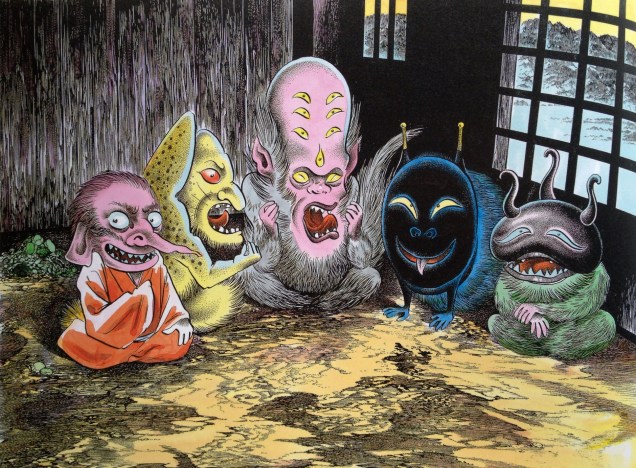
ShigeruMizuki-Godofpestilence
Gods of Pestilence or cute pets? Your choice.
ShigeruMizuki-Gashadokuro
Hiratsuka-juku is a post station in Tōkaidō. A famous painting by Andō Hiroshige depicts a part of the road that leads to it. Mizuki took the painting as a basis and added a « small » detail: a Gashadokuro, one of my favourite Yōkai (and man, there’s a lot of cool Japanese monsters to vie for that spot). The Gashadokuro, literally « starving skeleton », is a gigantic pile’o’bones held together by sheer malevolence, created from skeletons of people who died of starvation. It starts its rounds after midnight… and is invisible until it bites your head off. If you ever hear bells ringing in your ears, congratulations, you’ve about to be eaten by a Gashadokuro!
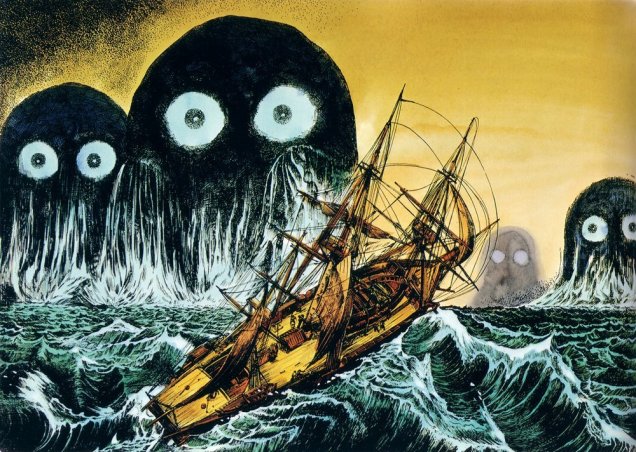
ShigeruMizuki-umibozu-YokaiJiten
« Umibozu », from Graphic World of Japanese Phantoms, 1985. These ‘sea monks’ seek to destroy ships and won’t rest until the crew is at the bottom of the ocean.
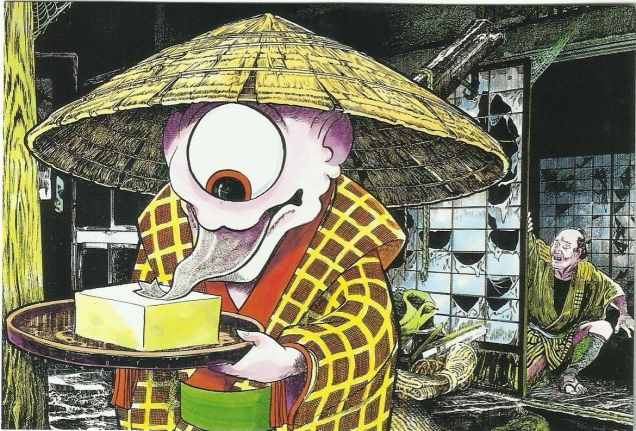
ShigeruMizuki-Yokai-Tongue
Is this a Akaname, the filth licker? Readers versed in Yōkai, please let us know!

Futaba Kikaku Co.,Ltd.

shigerumizuki-suiko-1981
A Suiko, or ‘water tiger’, although this one looks more like a balding dinosaur.

In the 1960s, Shigeru Mizuki released Yōkai Daizukai, an anatomically-oriented guide to traditional monsters from Japanese folklore. I don’t think it’s ever been released in English, but a French version came out in 2018 (and I fully intend to purchase it when I come across it).

Shigeru Mizuki-Yokai1
A Kuro-Kamikiri, or hair cutter, which doesn’t sound so terrifying… unless you live in a society where long hair is a status symbol and loss of it means disgrace.
Shigeru Mizuki-yokai2
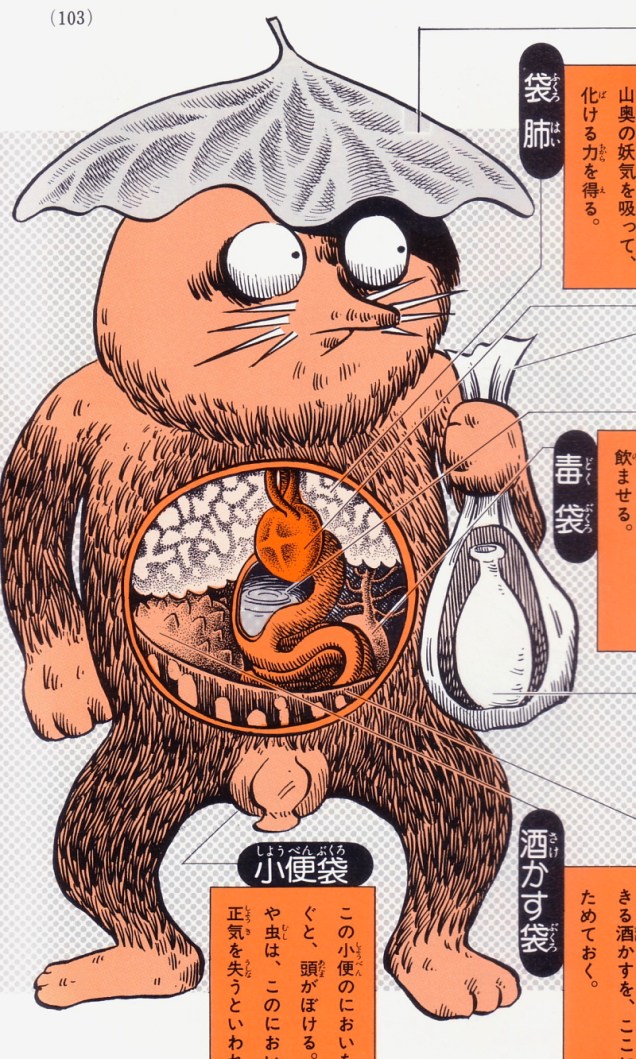
A Fukuro-sage, a type of Tanuki (or
Japanese raccoon dog),  who has the ability to transform itself into a bottle of sake. «The Fukuro-sage usually wears a large potato leaf or fern leaf on its head and carries a bag made from human skin. The bag contains a bottle of poison sake. Anatomical features include a stomach that turns food into sake, a sac for storing poison that it mixes into drinks, and a pouch that holds sake lees. The Fukuro-sage’s urine has a powerful smell that can disorient humans and render insects and small animals unconscious.»
Shigeru Mizuki-Yokai3
The pillow-flipper or Makura-gaeshi move pillows about, occasionally suffocating people with them or even stealing their souls.

For a further assortment of monsters, click visit the Pink Tentacle blog.

And a final morsel – Craig Thompson‘s hommage to Shigeru Mizuki. The little boy depicted is from GeGeGe no Kitarō, Mizuki’s 1960’s series.

CraigThompson-gegegenokitaro

~ ds

Tentacle Tuesday: Cephalopods in Suburbia

There are places and situations where one definitely expects to run into octopuses – in seas and oceans, on other planets, in brothels and harems (much like one can put a box in the middle of the room and a cat will suddenly appear to sit in it, even when one does not own a cat, a nearly-naked woman is almost guaranteed to summon an octopus). But sometimes the presence of tentacles is quite unexpected. Just when you think you’re safe – no, oops, a touch of the cephalopod springs abruptly into your life.

Tentacles at the cinema? No way. What would they be doing there?

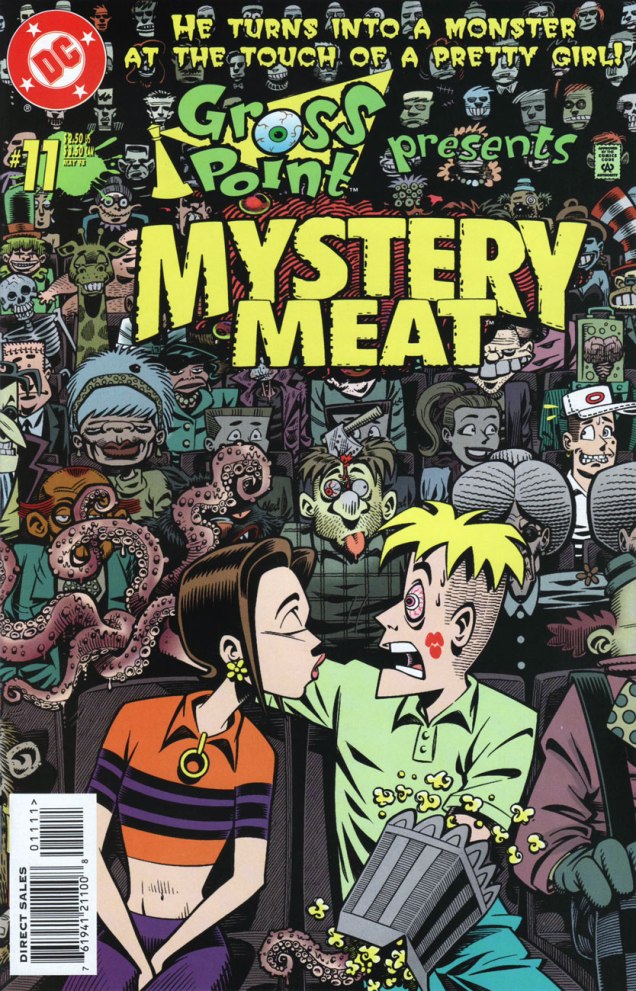
GrossPoint11A
« He turns into a monster at the touch of a pretty girl! » Say, that sounds familiar… This is Gross Point no. 11 (May 1998), cover by Roger Langridge. This nearly-forgotten comic (so forgotten, in fact, that Google will try to correct you if you look its title up) is a delight for those of us who like to bask in a Halloween mood year-round. The plot is not exactly original, yet beautiful art by Roger Langridge makes it a very enjoyable read, especially given the latter’s propensity to add little jokes to the script. Unfortunately, too many issues are sloppily pencilled by Joe Staton, whose art cannot be entirely redeemed, even by Langridge inking it.

Because I’m nice and this January 1st, here’s a link to all the issues of Gross Point, to save you the trouble of hunting them down.

GrossPoint1-RogerLangridge
A page from “Welcome to Gross Point”, pencilled by S.M. Taggart and inked by Roger Langridge.

Or you purchase a box of doughnuts and then…

KreepyKremeA
Wacky Packages no. 17 (All-new Series 7), 2010. Art by David Gross, I believe.

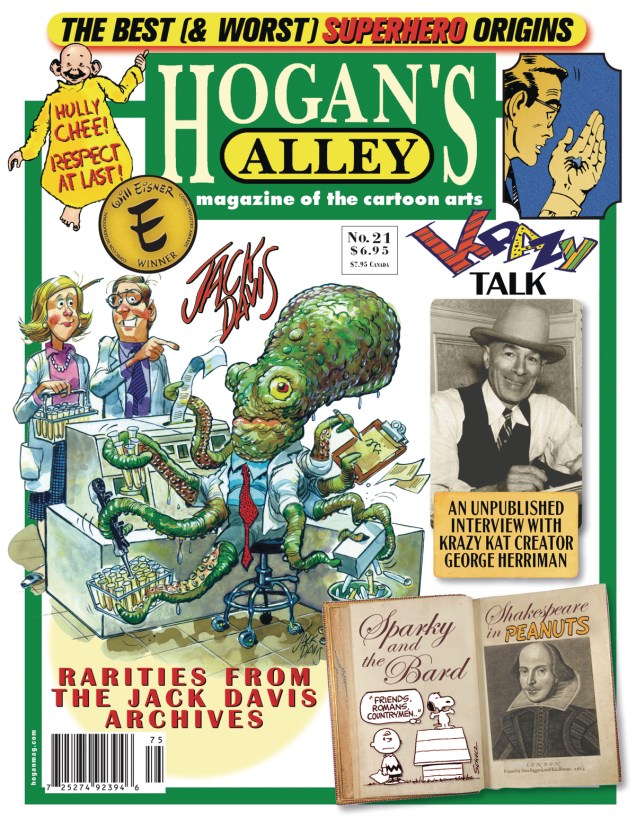
How would you feel about going back to the office after the holidays and finding a multi-tasking octopus taking over your duties?

HogansAlley21
Hogan’s Alley no. 21, February 2017. The hard-working octopus (it must have been hard to find pants that fit him, but octopuses are dedicated workers!) is drawn by Jack Davis, of course.

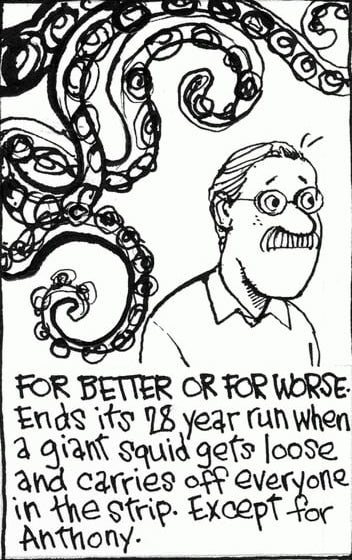
I’d say the most unexpected tentacles of all would be found in a For Better or For Worse strip. There’s no way that would happen.

Almanac-RichardThompson
Panel from “Comic Strip Previews for 2007“, a Richard’s Poor Almanack (sic) by Richard Thompson.

~ ds

The Many Lives of Jerry Robinson

« When comics came along in the 1930s there was a talent pool waiting. And one reason is so many areas were closed to Jews. Colleges, advertising agencies, many of the corporations – the doors that were closed led to the one that was open. » — Jerry Robinson

It’s New Year’s Day, which means it’s also the titanic Sherrill David ‘Jerry’ Robinson‘s birthday. Born on the first of January in 1922, he left us not so long ago, on December 7, 2011. He played at the very least a strong rôle in the creation of Batman’s sidekick Robin, his foes the Joker and Two-Face, his butler Alfred Pennyworth… and much more. Naturally, since we’re entering the murky world of Bob Kane, the whole process is mired in controversy, conflicting accounts and perhaps a little fibbing from certain parties.

Robinson went on to, well, several brilliant careers. In the 1950s, he worked as an instructor at New York City’s School of Visual Arts, where he mentored and considerably influenced a young Steve Ditko (among many others); he had a hand in several successful newspapers strips; served as president of the National Cartoonists Society (1967-69) and of the Association of American Editorial Cartoonists (1973-75); he lobbied hard for cartoonists’ rights, helping Superman creators Jerry Siegel and Joe Shuster obtain long-denied compensation and credit; he wrote, in 1974, The Comics: An Illustrated History of Comic Strip Art. And this is but a sprinkling of highlights…

RobinsonBehindMaskA
We won’t limit ourselves to the obvious Bat-imagery, which was mostly studio work anyway. Here, for instance, is a more obscure but purer œuvre, both pencilled and inked by Robinson: the original art from « Behind the Mask », page 2, originally printed in Atlas’ Marvel Tales no. 103 (Oct. 1951). Writer unknown.
PhantomBrakemanCoverA
My earliest encounters with Mr. Robinson’s work were through a pair of books for young readers he illustrated in the late 1950s, in a beautifully free and expressive styles. Here’s the cover and one interior vignette from The Phantom Brakeman (1959, Scholastic), written by Freeman Hubbard, then editor of Railroad Magazine.

PhantomBrakemanIlloA

HurricaneLuck01A
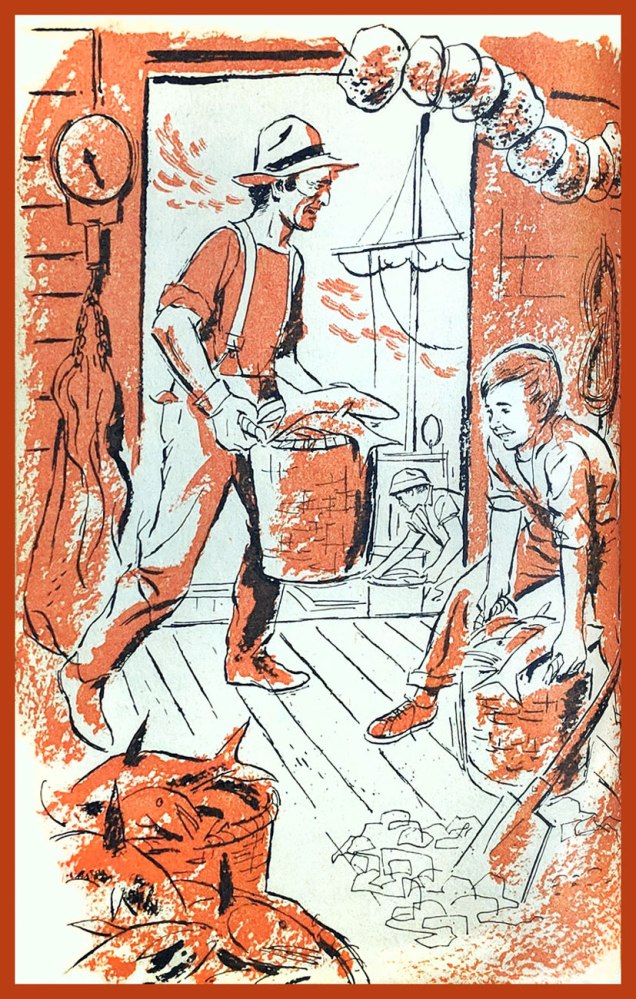
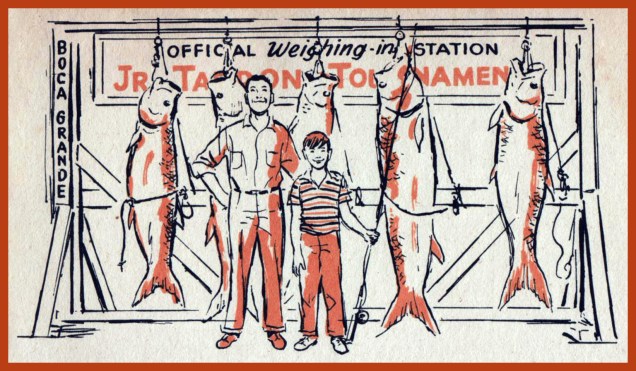
The following two pieces belong to Hurricane Luck (1959, Scholastic), written by Carl Carmer.
HurricaneLuck02A
Spoiler alert: Peter does, in the end, win the Tarpon fishing contest.

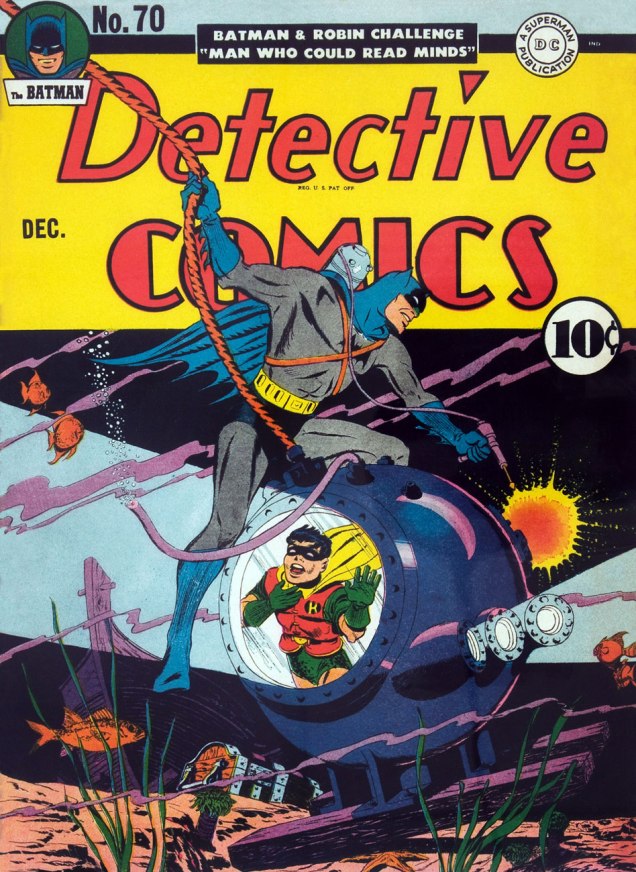
« What about Batman? », you might say. Okay, I admit I don’t have a prayer of getting away with a Jerry Robinson tribute devoid of the caped crusader and his trusty bird-themed sidekick, so here goes!

Detective70A
Detective Comics no. 70 (Dec. 1942). Pencils and inks by Robinson.
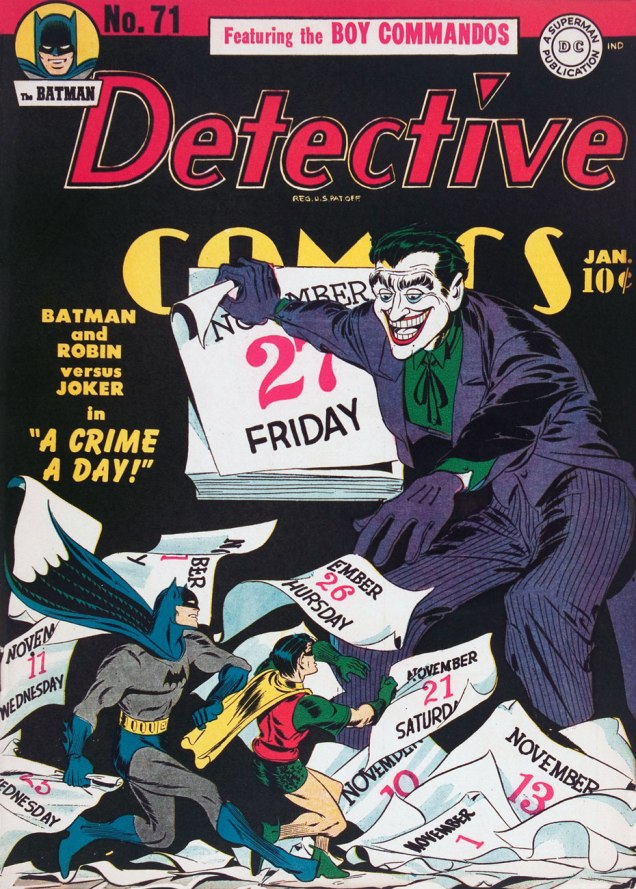
Detective71A
Detective Comics no. 71 (Jan. 1943). Pencils and inks by Robinson.

-RG

The Old Year’s Final Boarding Call

« On New Year’s Eve the whole world celebrates the fact that a date changes. Let us celebrate the dates on which we change the world. » — Akilnathan Logeswaran

Earlier this month, as we showcased Justin Green’s Musical Legends, I mentioned that I was reserving one of the strips for a special occasion, and it has come.

JustinGreenLastTrainA
Originally published in the December, 2001 issue of Pulse!

« Shedding light on past and present musicians — and there are countless possibilities — is  a real challenge. But when it works, the comic vision can change the listening experience. » Justin Green, from his Authoroonist Acknowledgements & Apologies (2004).

This entry stands out from its brethren in that the artist was personally involved in, or more precisely a witness to, the events depicted. In addition, no famous or semi-famous musical figure occupies the spotlight; instead, we get a gentle, low-key, soulful anecdote.

Who’s Out There has had a good year, and so we thank all of you readers around the world (and I do mean around the world: according to WordPress’ statistics, comics fans visited us from a whopping eighty-three countries these past twelve months) and wish each of you a wonderful, or at the very least better, year 2019.

-RG
Little Dot’s Playful Obsession

« Y’gotta develop an annoying compulsion if y’wanta get anywhere in this world! » — Dan Clowes’ Willy Willions (Eightball No. 5, Feb. 1991)

Dorothy Polka, known to the world at large as « Little Dot », made her first appearance in Harvey’s Sad Sack Comics no. 1 (Sept. 1949). All you need to know is that she’s inordinately fond of dots and circles, and that she has an absurdly large extended family. That raises a few choice questions, but we’ll leave them for someone else to tackle.

While I cheerily dismiss the bulk of Harvey Comics’ post-Code output as at best charming in a decidedly minor way, I opt to focus on the line’s most singular highlight: art director/chief artist Warren Kremer‘s endlessly inventive and escalatingly bonkers cover variations on the Harvey stable’s absurdly formulaic monomanias. Kremer clearly viewed the preposterous task he’d been handed as an opportunity to continually challenge himself with elegant design exercices and experiments. While I see little point in collecting, nor even reading most Harvey Comics, my admiration for Mr. Kremer just grows and grows. Perhaps these examples will give you a sense of what I see in them.

Oh, and bonus points to Kremer for his increasingly callous treatment of that omnipresent visual blight, the Comics Code Authority stamp. Clearly, he judged the censorious seal de trop.

LittleDot29A
Little Dot no. 29 (January, 1958)
LittleDot38A
Little Dot no. 38 (October, 1958)
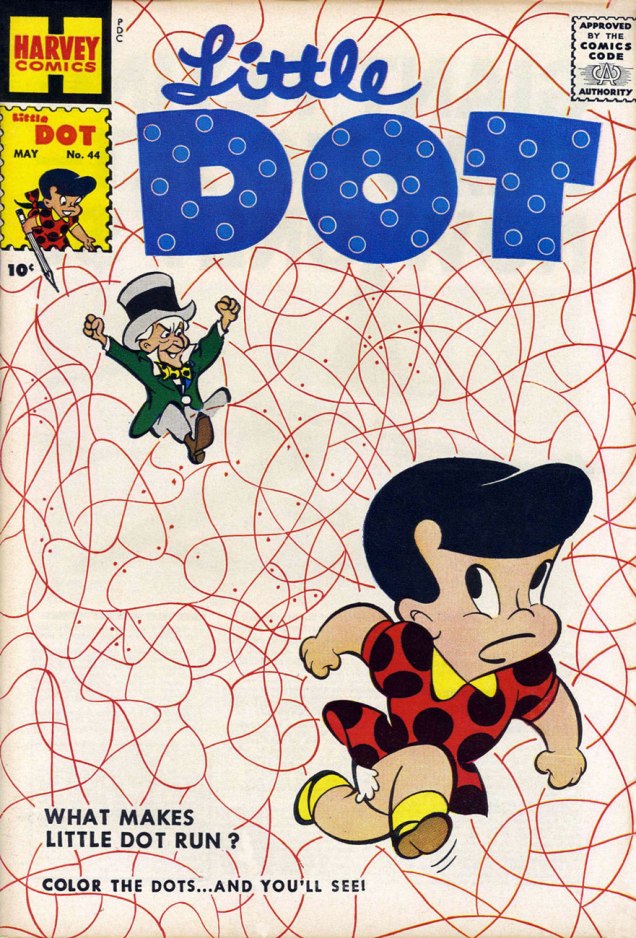
LittleDot44A
Little Dot no. 44 (May, 1958)
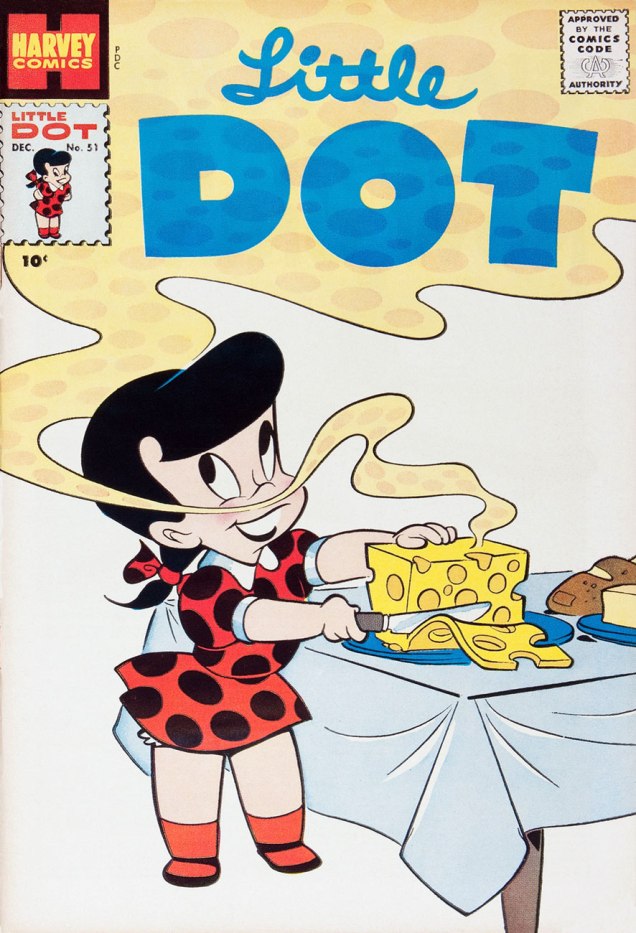
LittleDot51A
Little Dot no. 51 (December, 1959) Gruyère? Impressive refinement for a little kid. Perhaps there’s more to the little lady than meets the eye…
LittleDot52A
Little Dot no. 52 (January, 1959)
LittleDot97A
Little Dot no. 97 (January, 1965)
LittleDot119A
Little Dot no. 119 (October, 1968)
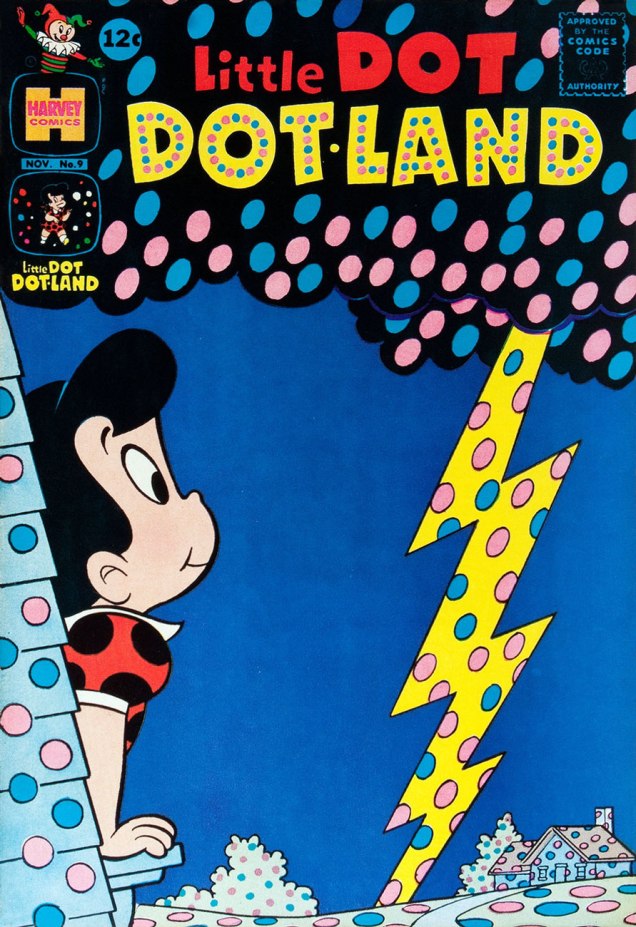
LittleDotland9A
Little Dot Dotland no. 9 (November, 1963)
Dotland38A
A timely one: Little Dot Dotland no. 38 (March, 1969)
DotUncles21A
Little Dot’s Uncle$ and Aunt$ (they’re loaded, I guess) no. 21 (November, 1967)

-RG

John Severin, ‘Super Comics’ Cover Man

« I got into the comic business the same way I got into the bubble gum business: somebody gave me a job. » — John Severin

I’ve said it before, and I still feel that way: If you’re going to discuss a career of such length, variety, depth and consistency as John Severin’s (from the late 1940s to the early 2010s!) it’s simply too easy to lose your way in the details, sidebars and bifurcations. Best to pick a small area and stick to it, particularly if you don’t have the luxury of endless pages to devote to the task.

Speaking of sidebars: In this forum, I keep returning to the topic of Israel Waldman and his dodgy, but mesmerizing publishing ventures. The many scattershot titles issued under the IW / Super Comics (1958-1964) banner were printed on shoddy paper (which makes them, nowadays, nearly impossible to find in any sort of decent shape), were sold outside the usual channels (in bags of three through department stores, and not the fancy ones at that), consisted of rather hoary, indifferently-packaged reprints… but foxy businessman Waldman didn’t scrimp on the one count that mattered: he shelled out top dollar to commission top talent to create attractive covers. That sweet old bait-and-switch.

Sure, some of these random assemblages of decaying pulp happen to be good comics, but given the nature of odds, it was bound to happen.

John Powers Severin, born ninety-seven years ago today (Dec. 26, 1921-Feb. 12, 2012), was part of Waldman’s cadre of cover artistes, and he delivered beautifully, as he always did, right to the end of his career.

Here, then, are some highlights of these little-seen Severin pieces. Happy birthday, Mr. Severin!

Blazing6guns16A
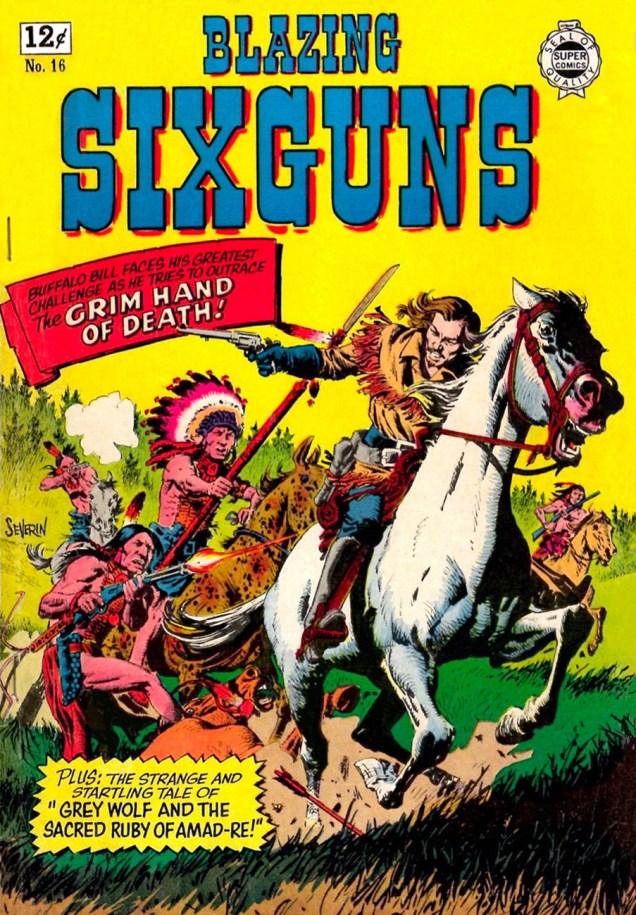
Blazing Sixguns no. 16 (1964), ten issues, 1958-1964. Read this issue here.
Danger10A
Here’s Danger no. 10 (1963), the first of  seven issues. Read it here.
FantasticAdv10A
This is Fantastic Adventures no. 10 (the first of seven issues, 1963-64). Read it here.
Gufighters18A
Looks like Marvel’s Kid Colt did a bit of moonlighting for Super Comics (as did king of all media Gabby Hayes!). This is Gunfighters no. 18, fifth and final issue of the series (1958-1964).
SilverKid01A
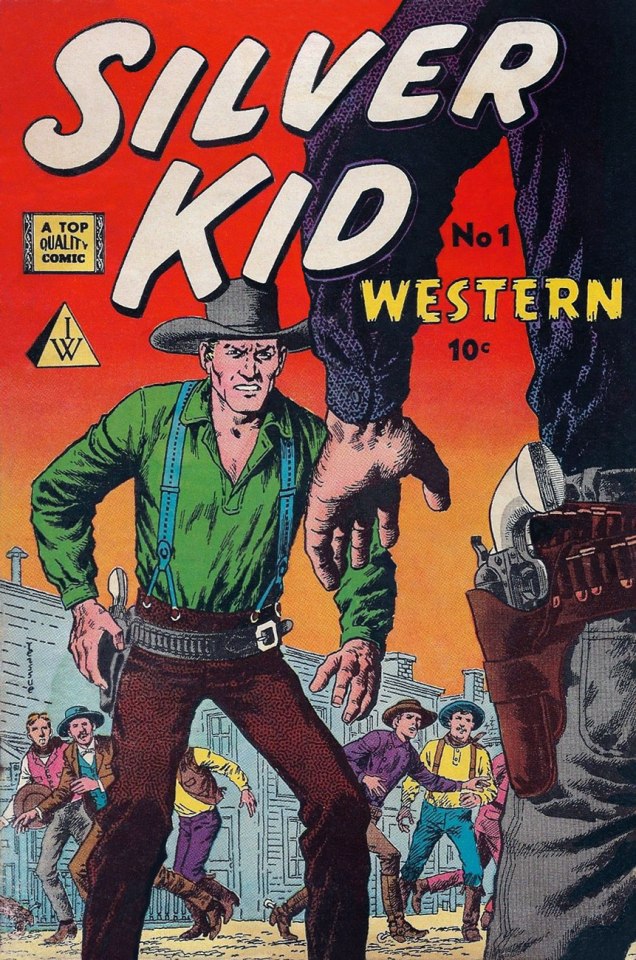
This is Silver Kid Western no. 1 (1958), first of two issues. Read it here.
Robin-Hood9A
This is Robin Hood no. 9 (1958),  third of five issues (1958-1964). Read it here.
Westerner17A
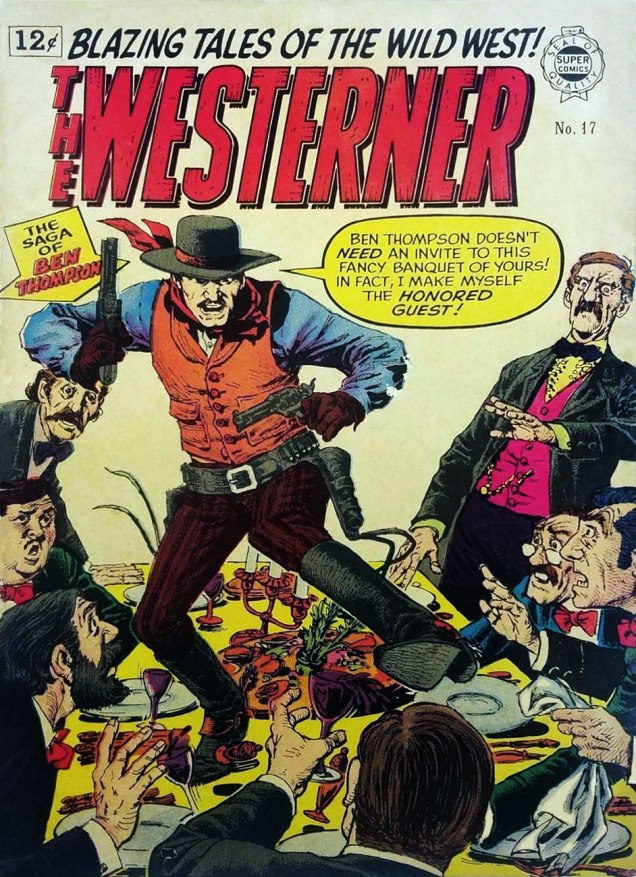
An alternative view of table étiquette from real-life figure Ben Thompson. This is The Westerner no. 17 (1964), third of three issues.

And if you’re hankering for more John Severin, check out our earlier post and/or this illuminating, life-spanning and definitive Comics Journal interview.

-RG

Tentacle Tuesday: “Foul as Sewer Slime!”

This is the final Tentacle Tuesday of the year (the next one falls on January 1st). As few tentacles venture out into the snow, I had to find something else to celebrate the occasion. I’ve been hoarding some images for sharing at some later date, and I feel the moment has come to return to a topic that’s dear to my heart – for each girl, there must be some tentacles…

Amethyst-Princess ofGemworld4
Amethyst, Princess of Gemworld no. 4 (August, 1983). This is a page from the story Dark Journeys!, drawn by Ernie Colón. I can’t vouch for the quality of the writing of this series, but the covers are a lot of fun for those of us who like Colón (I’ll hold my hand up there).
Cinema Sewer17
Cinema Sewer no. 17 (2005), cover by Mike Hoffman. CS, in case  you didn’t know, is a movie magazine (a mix of articles, illustrations and comics), the brainchild of Canadian Robin Bougie. Let’s give a polite round of applause to the strategically placed tentacles!

As long as we’re in the gutter, err, sewer… Sewer slime!

EpicIllustrated2311_Page_65
A page from “Marada the She-Wolf” , written by Chris Claremont and illustrated John Bolton,  from Epic Illustrated no. 23 (April, 1984). I was convinced the octopus was attacking a pregnant girl until I looked closer. Damn deceptive black-and-white!

Next, a window with the world of superheroines… in which zippers magically stop just before full frontal nudity, every woman boasts a F cup size, hair writhes passionately all by itself, and pain looks like lust. “Nothing… beats these tentacles.” Thank you, Beatriz da Costa, for those immortal words.

JLA-#100
Justice League America no. 100 (June, 1995, DC). Opening Up the Game is scripted by Gerard Jones, pencilled by Chuck Wojtkiewicz, inked by Bob Dvorak and Doug Selogy. Wait, how many people had to get involved in this?!

The next one is an obvious – even boring – scene: girl tied up, blah blah, tentacles reaching for her *yawn* nether regions… Bonus points if she’s wearing some terrifically overwrought hair decoration/jewelry/shoes (and nothing else).

WarlordofMars-Dejah Thoris10-JoeJusko
Original art for Warlord of Mars: Dejah Thoris no. 10, variant cover A by Joe Jusko (Feb. 2012, Dynamite).

Here’s to a new year of grabbery and slimy appendages, then!

~ ds

How do you like *your* Christmas?

« Christmas, Christmas, Christmas, Christmas makes me happy
I love Christmas cold and grey, I love it sweet and sappy
Says crazy kissin’ Cousin Flo:
‘Let’s break out the mistletoe’ »

FourColor201, 1948
The heart-warming cover of that Four Color no. 201, 1948. Art by Walt Kelly. Check out the adorable moon-jumpin’ cow in the top left corner!
Dell's Four Color #302
This is the back cover of Dell’s Four Color no. 302 (Santa Claus Funnies), 1950. Such warm colours. Art by Canadian Mel Crawford, who worked on various Dell publications in the 1950s (such as Howdy Doody, Mr. Magoo, and Four Color Comics) to later become an accomplished watercolours/acrylics painter.

« Christmas, Christmas, Christmas, Christmas out the waz
Christmas, Christmas, Christmas, Christmas up the schnozz
Come all ye faithful, don’t be slow
It’s Christmas time, you can’t say no »

Creepy68-Christmas
Creepy no. 68 (January 1975), cover by Ken Kelly. “House’ and “about” don’t rhyme, but it’s the season to forgive. I like how Santa appears to be bawling in frustration.
VaultofHorror35
Vault of Horror no. 35 (EC, 1954), cover by Johnny Craig. Maybe open the lid of the coffin first, dumbass?

« Momma wants a kitchen sink
And daddy wants a stiffer drink
Grandma wants us to cut the crap
Grandpa wants a nice long nap »

Richard-Thompson-Christmas
Illustration by Richard Thompson. Who else wants some Festive Dietetic Crackers? I’d definitely sit with the mouse.

« Christmas, Christmas, Christmas, Christmas everywhere
Christmas, Christmas, Christmas, Christmas pullin’ out my hair
Shoppers lined up out the door
Traffic backed up miles and more
It’s Christmas time, so what the heck
Let’s go spend the whole paycheck »

MargeBuell-LittleLulu-Christmas
A Little Lulu cartoon by Marge Buell (Saturday Evening Post, 1944).
HilaryBarta-FelizNavidada
From the pleasantly warped mind of Hilary Barta with a fond tip of the Santa hat to old Uncle Salvador, obviamente. Да да да!

« Deck the halls, it is the season
We don’t need no rhyme or reason
It’s Christmas time, go spread the cheer
Pretty soon gonna be next year »

SensationComics38
Sensation Comics no. 38 (1945), cover by H.G. Peter.
LittleOrphanAnnie-Christmas
Original art for a Christmas card of Little Orphan Annie by Harold Gray. Just some 70 years ago, right?

Merry Christmas!

~ ds

Playboy Cartoons for a Festive Mood

With every passing year, I have more and more trouble getting into the spirit of Christmas (especially since all the snow has now melted). An early present of Rodney Crowell’s Christmas Everywhere helped a bit, but to speed things along some more – and before Christmas Eve takes me by surprise – I’d like to titillate everybody’s taste buds with this spread of Playboy Christmas cartoons.

BuckBrownChristmas
Cartoon by Buck Brown (real name Robert Brown), an African-American cartoonist and painter, creator of the naughty (and adorable!) Granny.
SokolChristmas
Cartoon by Austrian Erich Sokol. A little linguistic tidbit: “sokol” means “hawk” in Russian.

And on the topic of bedding Santa Claus…

DougSneydChristmas
Cartoon by Canadian Doug Sneyd.
DediniChristmas
Eldon Dedini! (We ran an earlier exposé about him here.) Who needs naked women when you have the (slightly grabby) three magi?
JackColeChristmas1955
Cartoon by the ineluctable Jack Cole! Don’t forget to take a peek at my mate’s post, The Unforgettable Jack Cole.
PhilInterlandiChristmasPlayboy
Cartoon by Phil Interlandi.

And, on a slightly morbid note, three cartoons by Gahan Wilson (who paints what he sees!)

GahanWilsonChristmasDrunk

GahanWilsonChristmasSanta

GahanWilsonChristmas

~ ds

Newsflash: check out this post’s sequel, the imaginatively-titled More Playboy Cartoons for a Festive Mood!

Dateline: Frontline – The Cary Burkett Interview, Part 3

« From time to time a sputtering doodle-bug shatters the torpor of the overcast sky. One second, sometimes two … at most three … of silence. Visualizing that fat cigar with shark fins as it stops dead, sways, idiotically tips over, then goes into a vertical dive. And explodes. Usually it’s an entire building that’s destroyed. » — Jacques Yonnet

Perhaps the title gave the game away, but we’re back with part three to wrap up (in style!) our talk with Cary Burkett on his and Jerry Grandenetti‘s (and Ric Estrada‘s) Dateline: Frontline (1977-1981).

Who’s Out There: How hands-on an editor was Paul Levitz?

CB: Paul was more hands-on at the beginning. We would have a plot conference and he would toss out suggestions and sometimes specific directions. But Paul was a very smart guy, and he had a way of figuring out how to best to work with individual writers. With me, it usually worked better to plant a seed and let it develop rather than to nail things down too tightly. I didn’t think fast in a plot conference setting, I was too intimidated by Paul’s creativity and confidence. I think Paul figured this out and found ways to drop a little guidance in that I could take time to mull over on my own.

Paul was also extremely busy, not just an Editor but the Editorial Coordinator for the whole line of DC comics, and that is a whopping responsibility. So as things progressed, he was less hands-on. I like to think he began to trust the material I was giving him.

WOT: Was there much distance between the précis Mr. Levitz assigned you to do and the scenario you handed in?

CBI don’t think so.

WOT: Dateline: Frontline is clearly a bit of a ‘pill in the hamburger’, that is to say, instructive, eye-opening material. Was this ‘Trojan Horse’ approach considered and deliberate? (Surely it wasn’t just intended as pure entertainment!)

CBIn a way, it was deliberate, although not carefully considered or planned out. The trajectory was set by Paul when he passed on to me the book The First Casualty as background guidance. The tone of that book and all the eye-opening material in it definitely influenced the approach to the series. The very idea that the main character would be a war correspondent, not a soldier or fighter, meant that these stories would have a different kind of focus. That concept came from Paul, along with the title of the series.

Of course, in comics, you could do a series with a war correspondent where the protagonist becomes a fighter, a behind-the-lines de-facto special forces soldier. If this had been a Jack Kirby strip in the ‘60’s, the correspondent would probably be thrown into situations every issue where he had to fight his way out to save threatened soldiers from some Nazi ambush. You know what I mean.

So we knew we weren’t going for pure entertainment, sure. And the more research I did, the more interested I became in the reality of what happened in the war, and the more I wanted to portray that. And since it was just a 6-page, irregular backup series, we could go in that direction.

WOT: If you were to write this series today, what, if anything, would you do differently? What effect might the intervening years and the current political climate have, for instance?

CBToo much to think about. But I will say this, I think to try to tie the series to any current political issue would tend to push it into something contrived to fit the agenda. In a way, then, it would become a kind of political propaganda, the very opposite of what the series grapples with.

That’s part of why I wasn’t so interested in setting it during the Vietnam War back in 1976 or ’77. Today, it could be put in that setting without triggering a firestorm of controversy which might drown out what the series is trying to show.

My point is that the issue of seeking truth in a time of war is not limited to any time or place. By attaching the theme to a current political hot button issue, it becomes weaker, not stronger. It becomes more limited, not broader. And it’s more difficult to hear.

My preference would be to see the series deal with the questions outside of the current political setting, and hopefully along the way to see in some way how they apply today.

Maybe that is the ‘Trojan Horse’ method you mentioned.

WOT: I’d say you nailed it.

WOT: Were you writing and planning much in advance? Are there any contemplated, but unpublished, plotlines you’d care to share?

CBI wasn’t planning specifically very far in advance. I was never sure which set of stories might be the last. But I had a vague outline in my head that I would progress through the major events of the war, choosing specific ones for Clifford to be present reporting. They would be chosen for their historical significance but also to advance general themes of the conflict between reporting the truth and trying to win a World War.

The final series of stories, I think, would have been centered on events in Hiroshima and Nagasaki, and somehow Clifford would have found a way to write a story about it which revealed some of the horrible details … which of course, would never have seen the light of day. Even now, thinking about this, some lines of dialogue closing out the series kind of come to my mind.

I see Clifford, exhausted and disappointed, having given his all to get this incredible story, bitter and at the breaking point. Like it happens to all of us sometimes, the fact that he can’t publish this story seems to him to be an event that sums up his whole life as a failure. He questions why he made such a herculean effort to get the story, why he ever even bothered to try. All his previous failures to get the truth out come back to accuse him.

Maybe it’s his old mentor, the older reporter who tried to ground him a few times, who has the last word. And those words would be about the truth, and the value of searching for it no matter the outcome. And that the truth itself will stand even if only one person knows it. And the old reporter, cynical as he might have seemed at times, would be shown to have his own ideals which have sustained him through the same battles that Clifford has fought.

Yeah, maybe it sounds a bit corny out of the context of the story. But I think I’d go there. I might even have the old reporter say something like, “Truth may seem to be the first casualty in a war. But Truth can never really die, right? Someday people will know the truth about what happened.”

HA! I never expected a story idea for Dateline:Frontline would pop into my head like that after all these years. Seems like this would be a good closing question for this interview. I appreciate you bringing it up, and thanks for giving me a chance to reminisce.

WOT: And thank you for doing it so thoughtfully and graciously.

WhoThereLogotype

And now, to see our readers off with a story, here, as promised last time, is the concluding episode of Dateline:Frontline’s London trilogy.

Dateline3London01ADateline3London02ADateline3London03ADateline3London04ADateline3London05ADateline3London06A

And as a parting bonus, a vintage in-house biography of young Mr. Burkett!

BurkettBio78A

-RG