« Spine-chilling tales of suspense, horror, and the supernatural—prepare yourself for Adventures into the Unknown! »
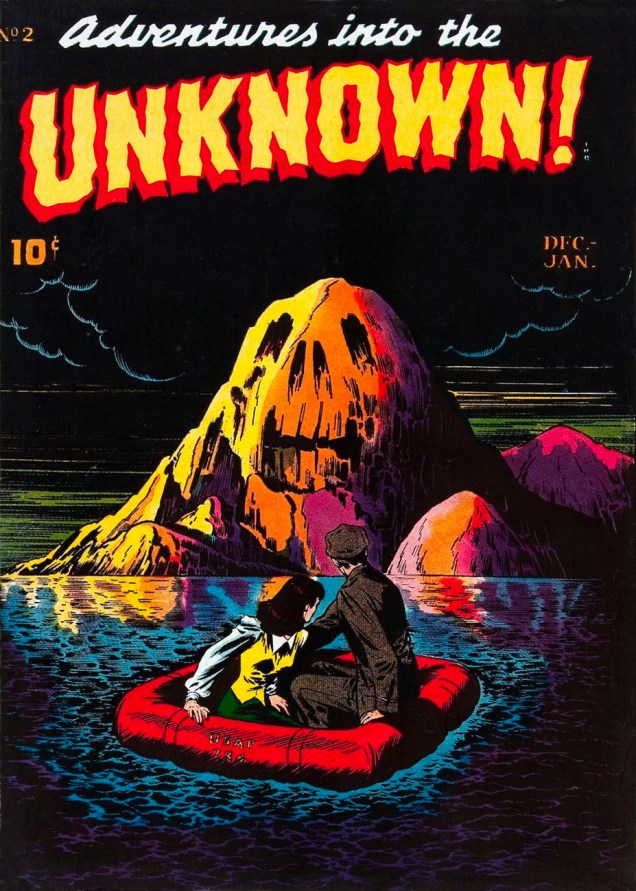
This American Comics Group (ACG) entry is generally considered the first title fully committed to the supernatural genre in the history of US comics. And this arresting, Isle of the Dead-styled tableau graces the cover of the title’s second issue (December, 1948). Art by Edvard Moritz. Most of the stories were scripted by horror legend and H.P. Lovecraft disciple Frank Belknap Long (read his The Hounds of Tindalos and forfeit your soul!) Speaking of which, the entire issue’s contingent of chills and thrills is available right here for your pleasure and leisure.
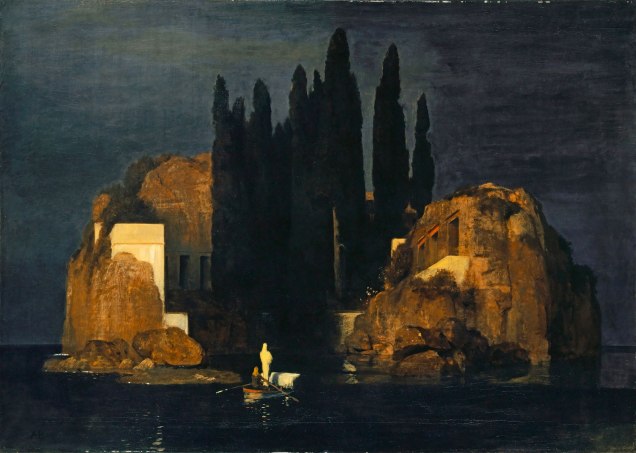
This is Adventures Into the Unknown! no. 2 (Dec. 1948 – Jan. 1949, ACG).As I was saying, Arnold Böcklin‘s Isle of the Dead painting, in its original version… of several.
« … his appreciation for city life was such that when I was a little girl and we would be going on walks, he would periodically draw my attention to the colorful and interesting patterns created by garbage strewn about on the streets, or by dilapidated storefronts with their torn-off signs. » — Gina Kovarsky on her father’s perspective
Funny how history works: for every world-famous New Yorker cartoonist, there’s another who’s just about been forgotten, yet is every bit the equal of his more celebrated colleague.
Anatol Kovarsky (born in Moscow in 1919, lived and thrived to the impressive age of 97) began working for the New Yorker in 1947, who published his cartoons and cover illustrations until 1969, when the man turned his full attention to painting.
This specific piece first saw print in The New Yorker in 1956, and was collected later that year as part of the classic Kovarsky’s World (Alfred A. Knopf).
« ... and suddenly, an ordinary business day becomes a day of horrible visions… »
When he was introduced in 1951 (Star Spangled Comics no. 122), Dr. Terrance Thirteen was a perfect fit for the DC universe: a skeptic who, in the nominally-rational world he inhabited, got to elucidate and debunk all sorts of mock-supernatural shenanigans. When the ghost-breaker made his return in the late 60s (as a foil to his also-returning contemporary The Phantom Stranger), however, the world had changed. The editorial balance had shifted in favour of the mystical, and Dr. 13 wasn’t as fortunate as the kids from Scooby Doo: he now faced bonafide manifestations from the beyond, but he wouldn’t have any of it, becoming a blind, overbearing ideologue in the vein of filmic non-believers Dana Andrews in Night of the Demon (aka Curse of the Demon) or the fabulous Peter Wyngarde in Night of the Eagle(aka Burn, Witch, Burn… adapted from Fritz Leiber’sConjure Wife).
And things got worse and worse over the years; by now Dr. 13 is treated as a joke and a punching bag (even Matt Howarth blew it, a rare misfire), but that’s the general climate in the modern mainstream: most long-running characters, even the heroes, with a scientific background (Henry Pym, Reed Richards, Tony Starket al) are frequently depicted as arrogant, misguided and often downright insane.
For a brief time in the early 1970s, Dr. 13 was handled by a sympathetic and skillful writer who understood what the man stood for and what made him tick. For a full example, check out our earlier post on another Dr. 13 case, … and the Dog Howls Through the Night! (1974).
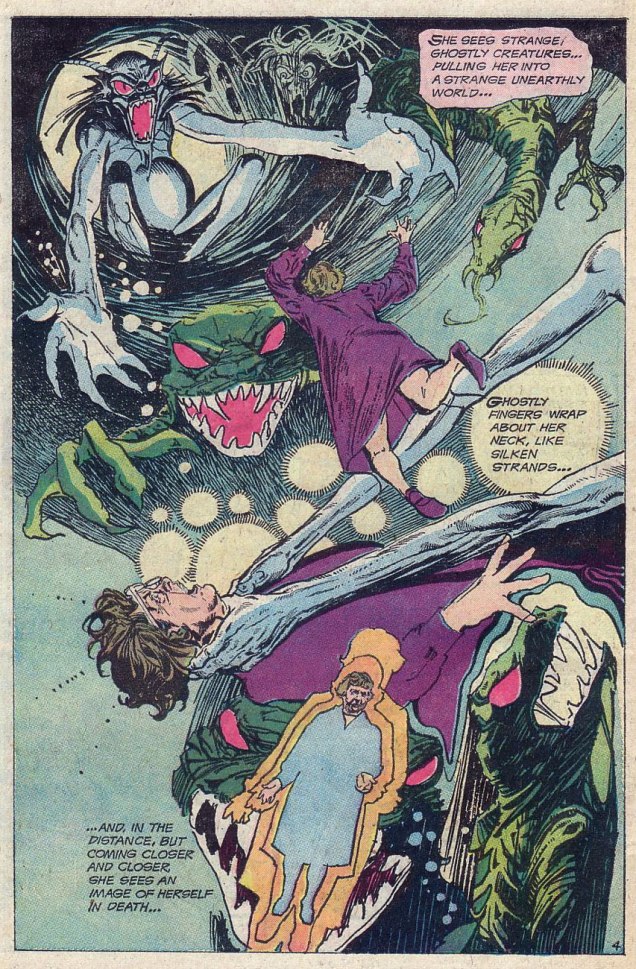
Scripter Skeates stated, a few years ago: « I quite like this story, especially the beautiful psychedelic scary artwork DeZuniga provided (an artist I very much enjoyed working with; he also illustrated a number of my Supergirl tales), plus the ending in which I somehow decided to treat this yarn as though it were a cautionary tale, the lesson learned being that one shouldn’t commit murder! For the longest time a copy of this comic wasn’t in my collection , but a couple of years ago I came upon a copy at a convention — the price-tag was a bit high due to the origin story that’s also in there! When I told my wife I had shelled out forty bucks for a comic with a story of mine in it that didn’t even have credits on it, she concluded that I was the one who was quite definitely insane!! »
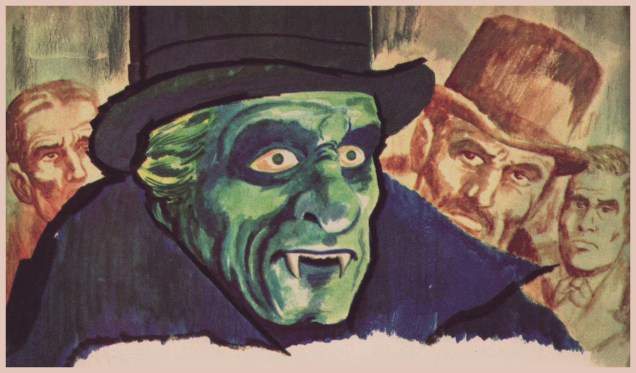
« Apparently, no one could credit such a grotesque being with any sense of kindliness, and so the wounded monster limped along his way, his hatred of humanity grew in proportion to his size. »
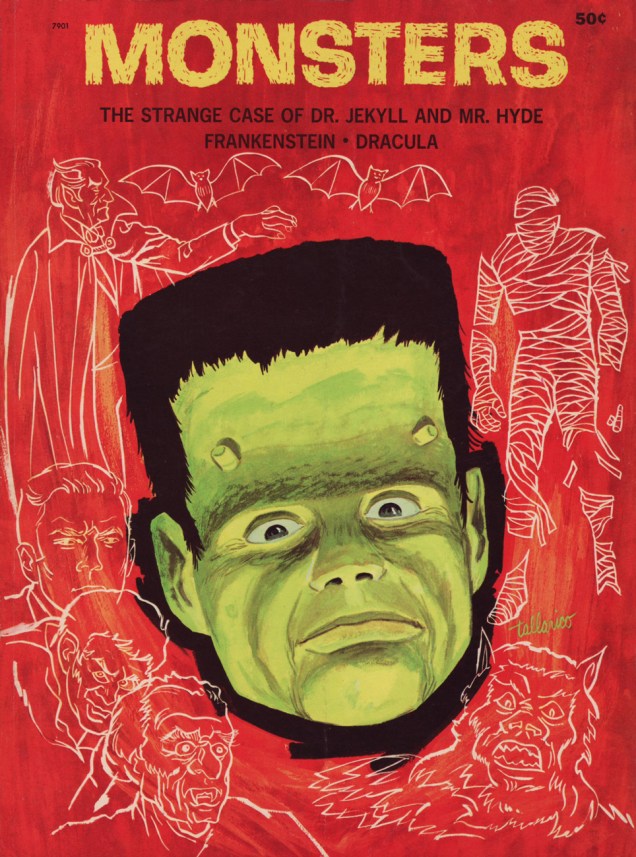
Unleashed upon the world in 1965 by Wonder Books, this generously-illustrated volume of classic adaptations is a collaboration between fellow prolifics Walter Brown Gibson (1897 – 1985), the writer most closely associated with Street & Smith’s The Shadow, and artist Tony Tallarico, a journeyman who produced a bounty of work, as artist and packager, for just about every publisher in the business… save DC and Marvel, and who, upon leaving the mainstream comics field in the mid-1970s carved out a lucrative little niche for himself putting together scads of illustrated books, mostly for children, on just about every subject under the sun.
« Dracula’s form had materialized now, His long-nailed fingers were gripping the window bars, and the mist had become a swirl of moths behind him. »« The man’s ugly, fiendish look chilled Enfield, but the crowd threatened the ruffian, who finally said that his name was Hyde… »
Tallarico would, the following year, revisit some of the fiends depicted here for a short-lived but infamous trio of series for Dell: Dracula, Frankenstein and Werewolf. Ah, but don’t be so dour: it’s just light, campy fun.
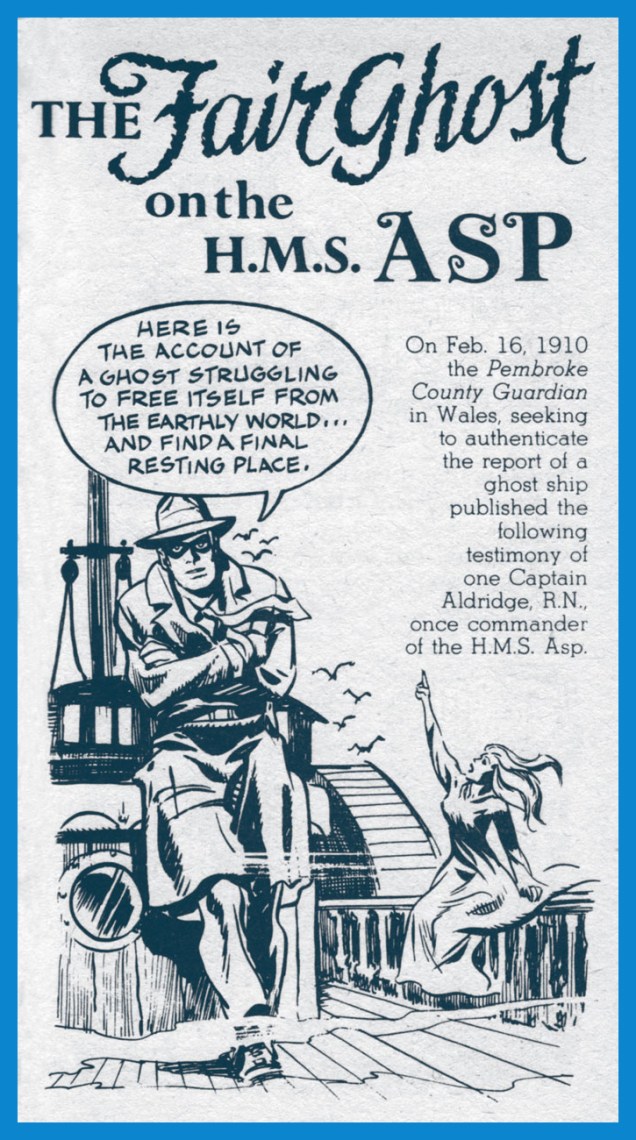
« In June, 1913, the family moved out in terror! … they simply abandoned the house in the Midlands. There is no record of successors. If you are looking to rent a house, cheap… it may still be there! »
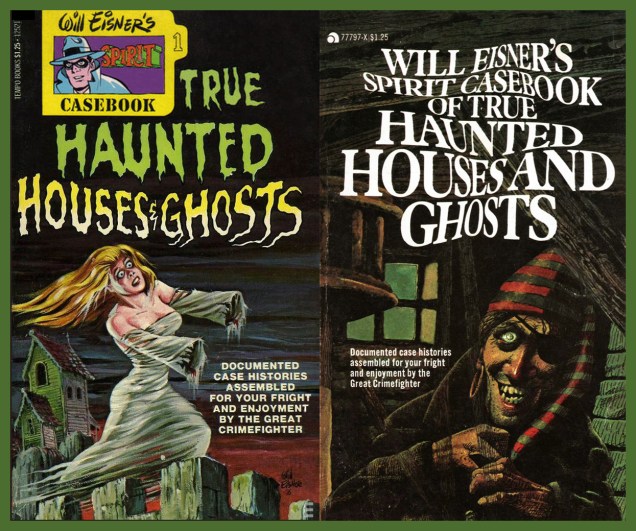
On this second day of our Hallowe’en countdown, let’s peer through the mists of time at 1976, when Will Eisner was still experimenting with marketing formats for comics-type material. This was still a couple of years before his A Contract With God and Other Tenement Stories (1978) appeared. During that period and beyond, Eisner was throwing a lot of material at the wall, in the finest exploitation tradition, hard on the heels of every bankable trend: Will Eisner’s Gleeful Guide to the Quality of Life, 101 Outerspace Jokes, Will Eisner’s Gleeful Guide to Communicating With Plants, Will Eisner’s Gleeful Guide to Living With Astrology, 300 Horrible Monster Jokes… and it wasn’t all good, as you can imagine.
This 160-page paperback from 1976 is arguably the cream of that crop; an easy choice for those of us who value Eisner’s expert hand at setting a shadowy mood.
Mr. Eisner’s original back cover.
Publisher Tempo Books seems to have had limited faith in the sales appeal (too gruesome?) of the original cover, as a variant edition was issued in short order, bearing a fine, but non-Eisner cover. Can anyone identify the artist?
Behold! I return to a topic close to my heart, as close as tentacles are close to human flesh in this post! Namely, PG manifestations of shokushu goukan. But I wouldn’t like you to think that I’m one-track minded: today’s crop has its share of fantasy scenes, scantily-clad women who are about to be even further undressed, but! it also includes panoramas of serious (and unsexy) struggle, tongue-in-cheek héroïnes quite nonplussed by their predicament, tentacles overpowering female protagonists despite their superpowers, etc.
Without further ado, I give you… damsels in tentacular distress.
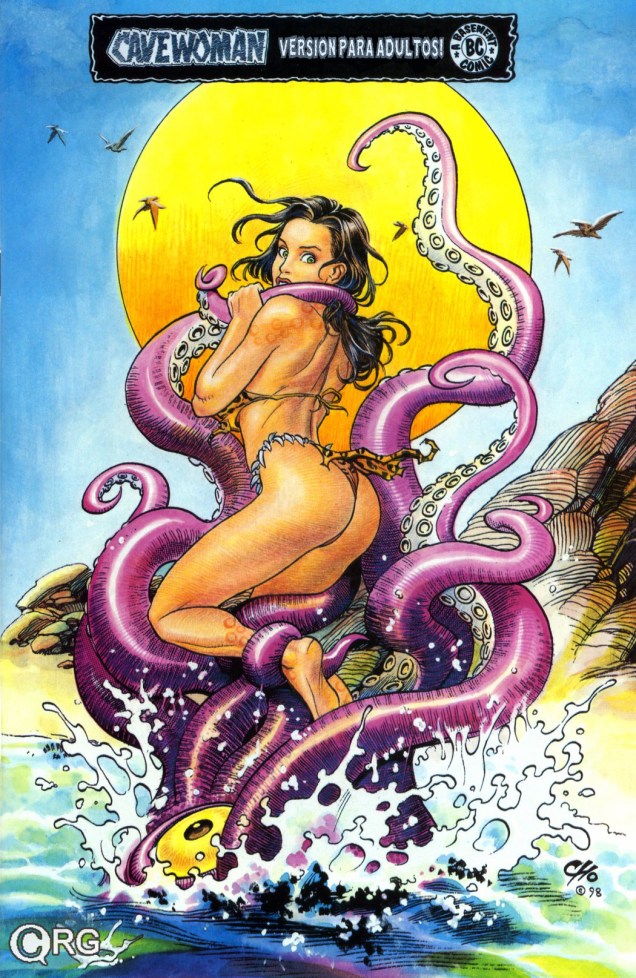
Cover painted by Bernie Wrightson for Nightmare Theater no. 3 (Chaos Comics, 1997).Cover from Pangaean Sea no. 4 (Basement Comics, 2000); art by Budd Root, the owner of this publishing company.Another one from Basement Comics: Jungle Tales of Cavewoman no. 1 (1998), variant cover by Frank Cho. It will come as a surprise to no-one that Cavewoman was created by the aforementioned Budd Root. Cavewoman is Meriem Cooper (I suppose calling her Myriam was too staid). I stumbled upon this amusing quote from Root recently, who said that Meriem was « patterned after pretty much all the women I really respect. She’s got a body with kind of a Little Annie Fannie face with Danni Ashe’s boobs and Nina Hartley’s butt. » No comment.
The maiden doesn’t always need to be rescued, nor does she necessarily *want* to be ravished – here’s a look at some heroines standing their ground against tentacular invasion.
Page from Wonder Woman: The True Amazon (DC, 2016) by Jill Thompson. I wasn’t much impressed by this graphic novel, but I loved Beasts of Burden, a collaboration between Thompson and writer Evan Dorkin.My Greatest Adventure no. 81 (August 1963), art by Bruno Premiani.Or you can resort to other, more… creative… means for getting out of the octopus’ embrace. Pages from Lorna: Heaven is Here (Treize Étrange, 2006) by Brüno.
I promised you superheroines, and by Jove, you shall get some!
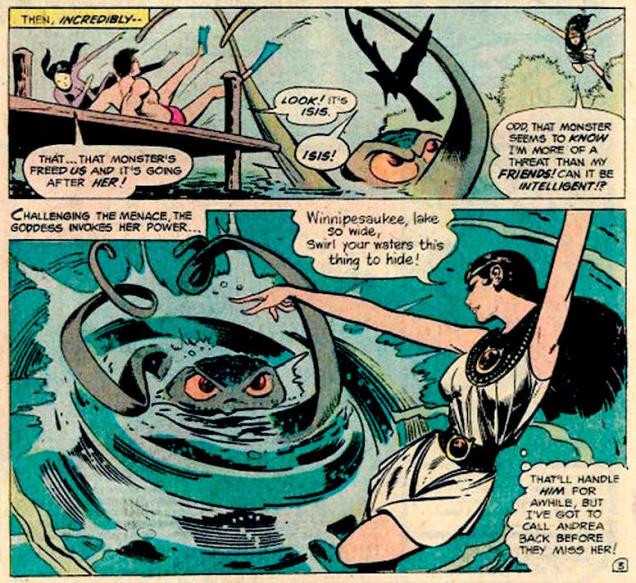
Isis no. 4 (April-May 1977), pencilled by Mike Vosburg and inked by Dick Giordano. Isis clearly used to be a ballerina…. or the artists have a knack for awkward anatomy.Treasure of Lost Lake is scripted by Jack C. Harris, pencilled by Mike Vosburg and inked by Vince Colletta. I honestly can’t recommend this story to you – the art is about as good as the storytelling, which is not a compliment to either.Page from Ferra Naturae, scripted by Bill Mantlo, penciled by Al Milgrom and inked by Jim Mooney, published in Spectacular Spider-Man no. 75 (February 1983). Obviously many have grappled with Dr. Octopus’ tentacles… but I think this particular scene is worthy of inclusion in this post.
They all climbed up on a high board fence — Nine little goblins, with green-glass eyes — Nine little goblins that had no sense, And couldn’t tell coppers from cold mince pies; And they all climbed up on the fence, and sat — And I asked them what they were staring at.
And the first one said, as he scratched his head With a queer little arm that reached out of his ear And rasped his claws in his hair so red — “This is what this little arm is fer!” And he scratched and stared, and the next one said, “How on earth do you scratch your head?”
And he laughed like the screech of a rusty hinge — Laughed and laughed till his face grew black; And when he choked, with a final twinge Of his stifling laughter, he thumped his back With a fist that grew on the end of his tail Till the breath came back to his lips so pale.
And the third little goblin leered round at me — And there were no lids on his eyes at all — And he clucked one eye, and he says, says he, “What is the style of your socks this fall?” And he clapped his heels — and I sighed to see That he had hands where his feet should be.
Then a bold-faced goblin, gray and grim, Bowed his head, and I saw him slip His eyebrows off, as I looked at him, And paste them over his upper lip; And then he moaned in remorseful pain — “Would — Ah, would I’d me brows again!”
And then the whole of the goblin band Rocked on the fence-top to and fro, And clung, in a long row, hand in hand, Singing the songs that they used to know — Singing the songs that their grandsires sung In the goo-goo days of the goblin-tongue.
And ever they kept their green-glass eyes Fixed on me with a stony stare — Till my own grew glazed with a dread surmise, And my had whooped up on my lifted hair, And I felt the heart in my breast snap to, As you’ve heard the lid of a snuff-box do.
And they sang “You’re asleep! There is no board fence, And never a goblin with green-glass eyes! — ’tis only a vision the mind invents After a supper of cold mince pies. — And you’re doomed to dream this way,” they said, —
“And you sha’n’t wake up till you’re clean plum dead!”
« It blew into the village from the sea one stormy night — a ghostly ship, with a ghostly crew and ghostly ways… » — Richard Middleton, The Ghost Ship. Read and/or listen to the entire yarn here!The Spook Upon the Stair, by Andrew McCullen, aka Robert Arthur (1965)
I met a spook upon the stair; He was a haunt who had no hair. In fact, he didn’t have a head (Which made me think he might be dead).
His head I saw beneath his arm, Safely tucked away from harm, But still to me it spoke, and said, “Before you go on up to bed, Please let me say you should not stare At ghosts you meet upon the stair.”
Thus spoke that spook, I do not lie, Before I could quite pass it by. “The thoughtful, gentle thing to do,” It said to me, as I say to you, “Is act as if they were not there, And never, never, never stare, Even though beneath an arm Their heads they carry, safe from harm.”
“However frightful they may be, Act as if you did not see, And if you did, would not have cared. Above all, never show you’re scared.”
This spook he spoke so plain and fair, I heeded him, right then and there. I hurried on up to the top And as I went I heard a pop. I turned — and there was nothing there. The spot the spook had been was bare.
If you dig his work (of course you do!), Jim Flora (1914-1988) you’ll be right chuffed to learn that his œuvre has been the subject of a quartet (at last count) of definitive and definitely gorgeous monographs, The Curiously Sinister Art of Jim Flora, The Mischievous Art of Jim Flora, The Sweetly Diabolic Art of Jim Flora and The High Fidelity Art of Jim Flora. Dig in!
– RG
*actually (fittingly) ghost-writing editor Robert Arthur (1909-1969), chiefly remembered as the creator of the Three Investigators series. We took a not-so-furtive peek at one of his excellent anthologies during last year’s countdown.
Greetings! Today we take another foray (I started with Tentacle Tuesday: the Many-Armed Tentacle Strip) into (modern) newspaper strips. It’s easy to assume that everything published in your paper’s comics page is drivel, but there’s some reassuring exceptions to this rule.
First, we have Canadian Pooch Café, around since 2000. One wouldn’t think that a strip about a dog (Poncho, the terror of the neighbourhood) and its owners and friends would have tentacles in it, but it does, much to my delight.
The fish in the bowl (named Fish) is a recurring character, cohabiting (and occasionally having his life and safety threatened by) Poncho.All cats in this strip are purple and are indistinguishable one from another.
Scary Gary, by Mark Buford, follows the everyday tribulations of a 700-hundred year old vampire who’s gone quite soft and suburban. The most excitement he can hope for is purchasing a new bag of chips… on the other hand, his henchman Leopold’s life is a whirl of nefarious, villainous schemes and ploys.
In case you didn’t know what a mind flayer is, it’s the same thing as an illithid 😉
My colleague has talked in detail about a certain crotchety witch in Growing Old Gracelessly With Broom-Hilda, so I’ll just leave this one strip here (and politely inquire why Broomie thinks that the octopus isn’t good enough to cuddle with, huh, HUH??)
Mark Tatulli’s Lio is a riot of tentacles, given that Lio’s best friend is a giant squid. All of it is pretty fun, but once in a while I’m so charmed that I save the strip to my computer. Here are some of those saved, favourite strips:
No doubt Dr. Zoidberg would rush towards the seafood buffet offer with similar speed. Or is Ishmael just angry for friends of his that have been fried?
Bizarro – ah, to be able to rely on something that’s still good some thirty-plus years later -, has already had a Tentacle Tuesday of its own (see Let’s Get Bizarro), but since then I’ve accumulated a few extra strips.
« Oh, this is perfect . . . this is exactly what comic books are supposed to look like. » — Chris Samnee on encountering Frank Robbins‘ “Man-Bat Over Vegas” [ source ]
For a change of pace, here’s an artist in the prime of life and at the peak of his powers.
Chris Samnee, born in 1979, first caught my interest when he collaborated with Roger Langridge on Thor: The Mighty Avenger, for which he reaped the 2011 Harvey Award for Most Promising New Talent. But some of my superhero-lovin’ friends had been raving about Samnee’s work for a while.
While obviously a man of his time, he’s clearly drunk deep from the well of classic illustration, comic books and most of all, comic strips. It’s hard to miss in his work echoes of Alex Toth, Doug Wildey, Frank Robbins, Milton Caniff, Will Eisner, Roy Crane… an artistic heritage not too unlike his fellow Daredevil alumnus David Mazzucchelli‘s… fine company, plumb in that sweet spot between ‘realistic’ and ‘cartoony’, and wisely drawing from both.
As befits a first-rate cover artist, Samnee thoroughly thinks and feels his pictures through, thumb-nailing his layouts and planning his moves. Here are some of his preliminaries from The Rocketeer: Cargo of Doom (2011), for which he shared (with David Aja) the 2013 Will Eisner Award for Best Penciller/Inker.
Cargo of Doom marks the first time ever when the character of Betty isn’t sexualized to the hilt. That’s got to count for something.This is Daredevil no. 9 (Dec. 2014). Incidentally, after the intrusion of bar codes on covers in 1975, followed by an increasingly hard-sell culture, the kind of elegantly spare, striking design I personally gravitate to hasn’t had it easy. A surprising step in the right direction came in recent years with the demise of the Comics Code, the introduction of digital editions and the appearance of a handful of enlightened editors (take a bow, Axel Alonso!), first at DC/Vertigo, then (as usual) later at Marvel.This is Daredevil no. 10 (Jan. 2015). Another example of a digital edition: compare this to a 1970s Marvel cover!This is Daredevil no. 11 (Feb. 2015). The Stunt-Master, seen here, first appeared in Daredevil no. 58 (Nov. 1969). It was the era of Evel Knievel and his Daredevils.This is Daredevil no. 11 (Feb. 2015). Hey, even more room for the art!And this is Daredevil no. 13 (Apr. 2015).
And speaking of inks, he sharply stands out in that regard in today’s assembly-line industry. It’s different for every artist, but Samnee loves to ink. He claims: « My pencils are just awful. I can’t imagine anybody else inking me nowadays because most of the work is done in the ink. ». I can relate.
While I greatly enjoyed Thor: The Mighty Avenger, the covers were solid but not outstanding. But Mr. Samnee’s still improving (!), and so a couple of years down the pike, and with the crucial input of colourist Matthew Wilson, a man without fear of colour saturation, we have a hot streak! And yeah, surrounding issues 8 and 14 kind of fell flat, so it’s a fairly short one. But there are quite a few quite outstanding covers outside of this subjective selection, so keep an eye out, and prepare to have it dazzled.
« You know, the dog food that Billy Jack loves! » — The Firesign Theatre
Ah, September the 18th. Today’s the birthday of the staggeringly accomplished William Stout (born in 1949), master of ancient reptiles, bootleg record covers, friend of The Firesign Theatre, former Russ Manning assistant (none but the best would do!), and I’ll spare you the illustrious details of his career in cinema. Still, let’s look around a bit, shall we?
Here’s an unforgettable cover from Alien Worlds no. 3 (July, 1983, Pacific Comics). This scene gave me nightmares, and still raises a shudder. These critters look like a hybrid of a platypus and a piranha. Happy landings!Stout’s wonderful original logo for Rhino Records, circa 1974.
Speaking of ’74, isn’t that rhino a dead ringer for Swan’s oleaginous right-hand man, Philbin, from Phantom of the Paradise?
This is the back cover (the recto is equally sumptuous) for The Firesign Theatre‘s 1975 opus, In the Next World, You’re On Your Own, featuring a pair of classic sidelong suites, Police StreetandWe’ve Lost Our Big Kabloona.A clutch of underground classics? Sure. Here’s Cocaine Comix no. 1 (Feb. 1976, Last Gasp).Another number one (with a bullet, of course): 50’s Funnies no. 1 (1980, Kitchen Sink). More lies inside!A favourite page from Stout’s masterpiece (or certainly his great labour of love, at the very least): The Dinosaurs: A Fantastic New View of a Lost Era (1981, edited by Byron Preiss). This piece (the first he drew for the book) is entitled Hot Weather. « After lifting his head for air, he drank more and then wallowed his whole length and breadth into the ooze, vocalizing for the first time that day, and loudly. »Say hello to friendly Ed Gein. Weird Trips no. 2 (1978, Kitchen Sink). Please note the sinisterly customized Kitchen Sink Enterprises logo, Wrightson–brand coffee, and EC Comics narrator The Old Witch impishly peeking from a lower-right shelf. And yes, can’t go disemboweling your fellow man and woman without a copy of Gray’s Anatomy. Preparation is everything!Well, there never was any doubt that Mr. Stout was an EC Comics überfan. The Comics Journal no. 81 (May, 1983, Fantagraphics).I did bring up his Hollywood work, so here’s a sample. I wasn’t going to go with his the far-too-familiar Rock ‘n’ Roll High School poster… you all know it already, so where’s the fun in that? Of course, Joe Dante’s Amazon Women on the Moon again (1987) raises the eternal question: « Who made Steve Guttenberg a Star? »
And that’s Bill Stout for you: stunningly versatile, but always himself. Could any artist strive for more?