« And something horrible is going on in Foley’s body! Come at once! Come quickly! »
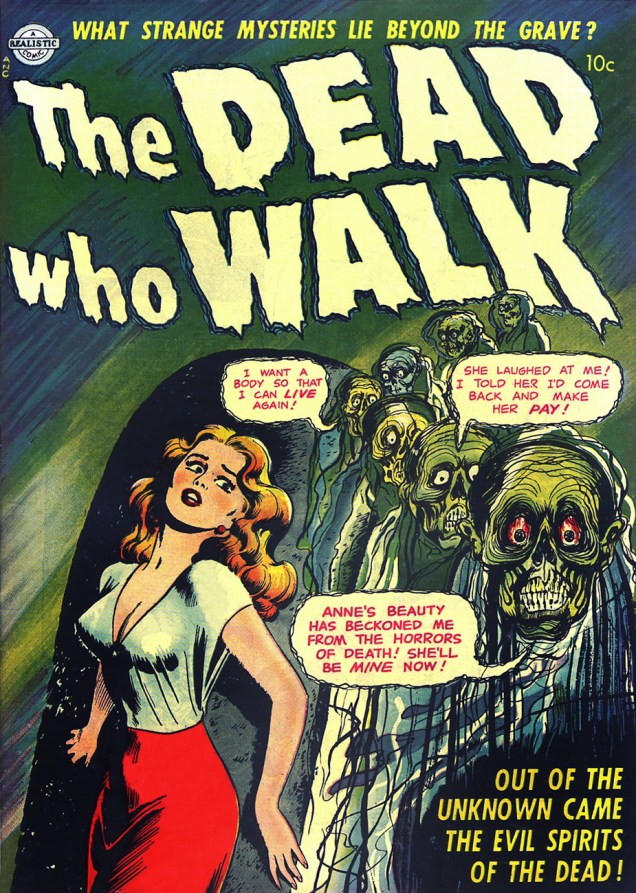
The Dead Who Walk is a mysterious one-shot from 1952. It was issued by Realistic Publications, an ephemeral publishing arm of Avon Books, during the decade that they haphazardly dabbled in the funnybook field.
Boy, whatever you can say about Anne, she certainly made an impression.
The pungent dialogue and its implications aside, what fascinates me about this lavishly grotesque cover is the jarring schism in art styles: the damsel in peril is of the classically-buxom Matt Baker–Nick Cardy species, while the revenants belong to an expressively oddball Edvard Munch–Manny Stallman–Jerry Grandenetti school. As far as I know, the cover artist(s)’s identity is lost to time and obscurity. It has been established, thanks to a signature, that the insides were provided by longtime jobber Tex Blaisdell… a rather stiff and workaday performance, regrettably. But the cover assuredly isn’t his, no matter what the good ol’ GCD says.
The most accomplished interior page, in my view, is the inside front cover intro. Art by Tex Blaisdell.
« Welcome to the house of horrors! Brought to you by Grippo Denture Adhesive! »
A little while back, we made a brief detour through artist Samm Schwartz’s Silver Age Archie comics covers and touched upon the time he took the last bus out of Riverdale and headed for the greener pastures of New York… and an art director gig with Tower Publications.
Robert Klein and Michael Uslan, in their foreword to T.H.U.N.D.E.R. Agents Archives Volume 1 (DC Comics, 2002), stated: « With Samm Schwartz not very familiar with or comfortable editing super-hero adventure books, publisher Harry Shorten cut a dream deal with Wally Wood. Samm would handle the Tippy Teen titles as well as the Undersea Agent comic book and the war comic book called Fight the Enemy. He would be the managing editor of the company and its day-to-day office executive. »
So that’s that. Schwartz’s books, Tippy Teen (27 issues), Tippy’s Friends Go-go and Animal (11 issues) and Teen-in (4 issues), Undersea Agent (6 issues) and Fight the Enemy (3 issues) actually comprise the greater part of Tower’s output, though they’ve received far less attention since, were easily of comparable quality to T.H.U.N.D.E.R. Agents and its spinoffs. Certainly, the humour titles’ wit was a passel of notches above the Archie line’s, what with such heavyweights as Jack Mendelsohn on board*.
Interestingly, Tippy Teen was the first Tower material to be reprinted: in 1975, four issues of Vicki (a renamed Tippy) were issued by the *very* short-lived Atlas/Seaboard, featuring ugly new covers by Stan Goldberg. These issues rank among the most scarce and priciest Atlas releases. Most of the line’s books can still be easily found and acquired dirt cheap… but not Vicki.
This is Tippy’s FriendsGo-Go and Animal no. 7 (Dec. 1967, Tower). Cover art by Samm Schwartz.This is Penny Century no. 5 (June 1999, Fantagraphics). Cover art by Jaime Hernandez, with colours by Chris Brownrigg. Now, you won’t convince me that this cover isn’t a fond homage to Schwartz’s Hallowe’en-themed Go-Go cover… hey, maybe he *thought* this was a DeCarlo.
When I hear about Dan DeCarlo‘s would-be artistic influence on Jaime Hernandez, I can’t help but wince. If I squint real tight, I can kinda-sorta-maybe see a flicker of it in the wholesome sexiness of Betty and Veronica circa 1960-63, but no more. DeCarlo was soon reduced to such a state of hackdom that I can’t fathom how Jaime would have been driven to imitate and absorb the lessons of such hastily-executed, formulaic drivel. There, I’ve said it. On the other hand, Hank Ketcham, Steve Ditko, and, dammit, Mr. Schwartz’s touches are evident all over, though perfectly amalgamated into Jaime’s own singular vision. The way Schwartz and Hernandez draw clothing folds, the beautifully expressive comedic body language… it’s unmistakable.
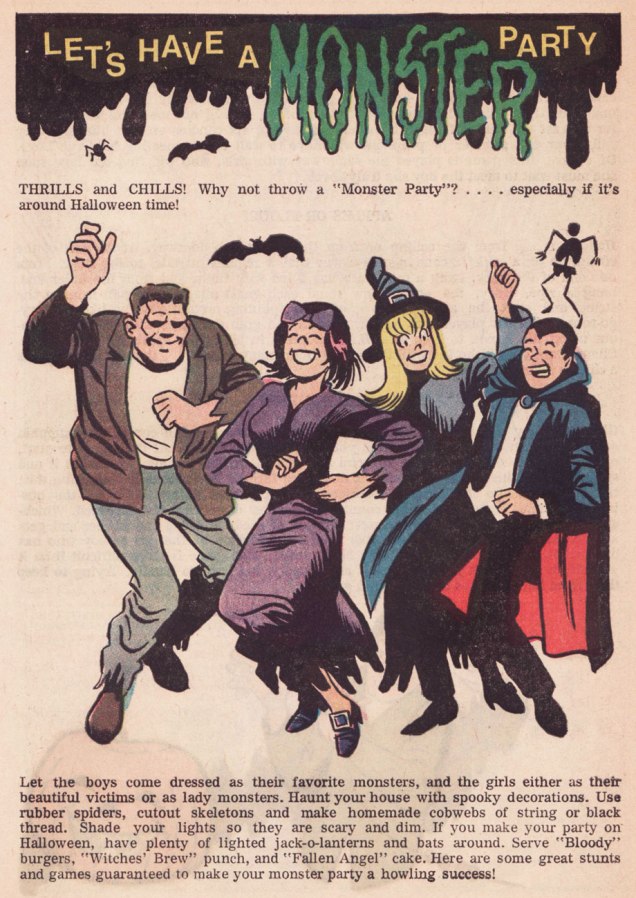
And as a bonus, this helpful feature from Tippy’s Friends Go-Go and Animal no. 3 (June 1966, Tower), illustrated by Samm Schwartz. And yes, the boys can also come as beautiful victims.
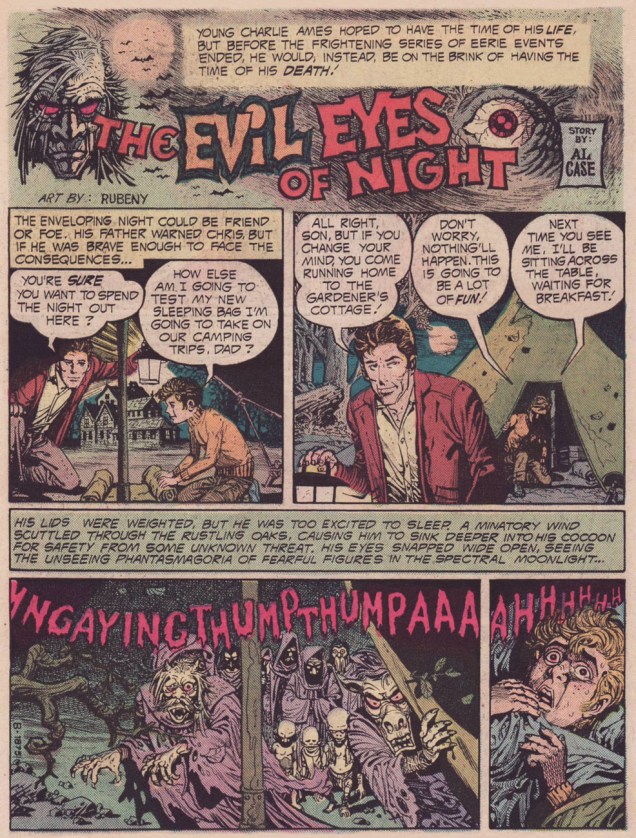
« You’re sure you want to spend the night out there? »
As an avid backyard camper, this effectively chilling cover by the versatile Argentine Luis Dominguez never failed to bring a pleasant tingle of dread. It has that quality of a silent, slow-motion nightmare. Barely-glimpsed but eerily tangible horrors shambling your way… and you can hardly move, helpless but with all senses on edge. Eek.
Though it came late in Carmine Infantino‘s tenure, one can safely assume that DC’s publisher and his adjutant, art director Nick Cardy, had a hand in the cover’s layout. It certainly does tick Carmine’s boxes of « Leave Room for the Kids » and « Make It More Mysterioso. »
DC’s The Unexpected no. 166, (July 1975). The moody featured story, The Evil Eyes of Night, scripted by Al Case (one of editor Murray Boltinoff‘s several noms de plume) and illustrated by an inspired Ruben Yandoc, doesn’t betray or squander the promise proffered by the cover, though it hardly proceeds as one might presume. This isn’t The Expected, after all…
I do believe that Yandoc did his own lettering, as it’s a consistent element across his American output. That’s always a plus, an added touch of personality. Love those sinister onomatopoeia!
« Somehow, this thing had caught the spark of life! And, anything that lives will fight to stay alive… even if it’s just a Rag-a Bone and a Hank of Hair! »
Ah, Brother Power, the Geek. A notorious flop for DC in 1968… or was it? At the time, it took several months for a book’s initial sales reports to make their way back to the publisher. Axing a title after two measly issues is quite a preemptive and premature strike against it. I suspect a case of toxic in-house politics. From the onset, editorial cold feet had the suits meddling with the project: the character of the animated rag doll was to be called The Freak, which was nixed in favour of the less druggy but more chicken-head-bite-y TheGeek.
This is Brother Power The Geek no. 2 (Nov.-Dec. 1968, DC); cover by Joe Simon, colours by DC’s peerless production manager Jack Adler, and logo presumably by Gaspar Saladino.I recall that this particular house ad seared itself into my brain at a very young age, but I had to wonder where exactly I’d first encountered it. As it turns out, it was in a random comic book that happened to land my way in childhood, namely Superman no. 211 (Nov. 1968), featuring You, Too, Can Be a Super-Artist!, written by Frank Robbins (I just found out!) and illustrated by Ross Andru and Mike Esposito.
This is Black Magic no. 13, aka vol. 2 No.7 (June 1952, Prize); cover, of course, by Jack Kirby, with likely inks by Joe Simon. Read it here!
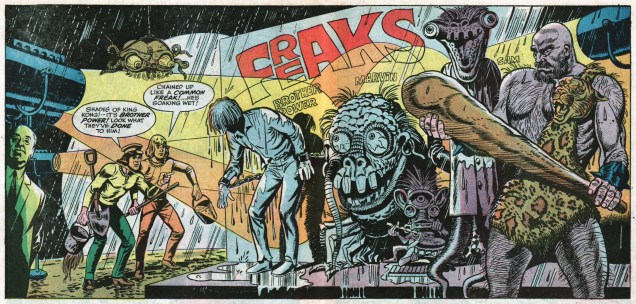
This lovely panorama is from Brother Power The Geek no. 1 (Sept.-Oct. 1968, DC). Written, laid out and inked by Joe Simon, finished pencils by Al Bare.
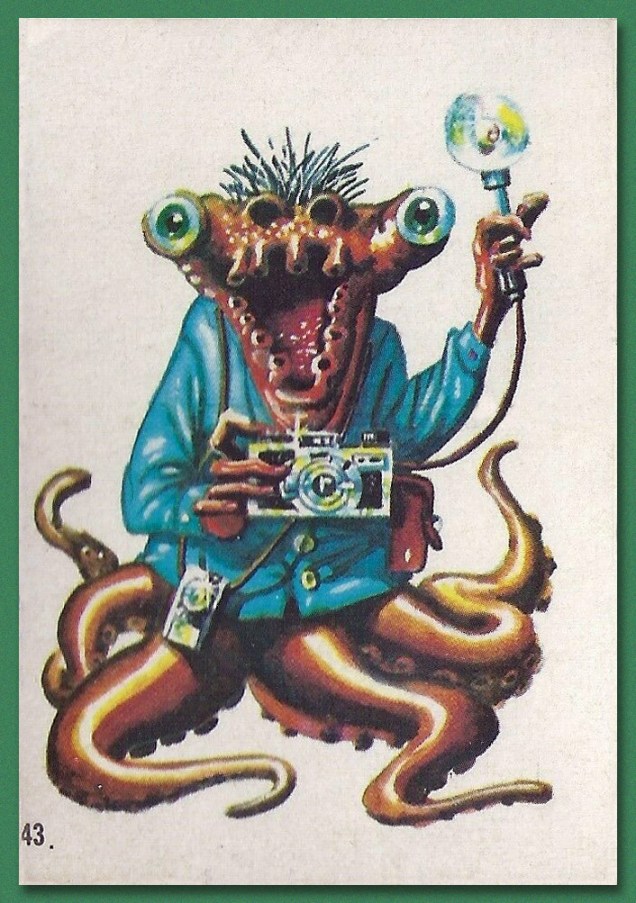
Say, have I seen Brother Power’s fellow detainees somewhere? Why, yes, of course! It’s Tentacle Master Wally Wood‘s Dorothy, Stanley and Doris, introduced to the world by Topps‘ Ugly Stickers back in 1965! Designed by Wood, they were painted by the masterful Norman Saunders.
Brother Power the Geek, despite its commercial failure and infamy, offered a good-natured, unpretentious romp, even if didn’t quite show us « The Real-Life Scene of the Dangers of Hippie-Land! » You can’t always get what you want.
Brother Power was brought back under DC’s Vertigo imprint in 1993, but as with the revival of its fellow Joe Simon creation, Prez, it received a « groovy » and « ironic » hipster treatment. Bah.
« A knot you are of damned bloodsuckers. » — William Shakespeare
One of my favourite Atlas mood-masters was Anthony Lewis “Tony” DiPreta (July 9, 1921 – June 2, 2010); it appears Mr. DiPreta and his colleague Murphy Anderson share not merely a birthday, but a day of birth as well.
Tony DiPreta’s long career in comics began with his arrival at the “Busy” Arnold studio, with his first credits appearing in early 1942. He worked extensively for Hillman Periodicals, handling such features as Airboy (yay!), Skinny McGinty, Flying Dutchman and Stupid Manny; Lev Gleason Publications (various crime stories and The Little Wise Guys); and of course Atlas Comics, where he chiefly, but not exclusively, cut loose on moody-but-not-gory horror stories, often with a finely-turned streak of gallows’ humour.
Tony survived the post-Code near-collapse of the comics industry when he succeeded Moe Leff on Ham Fisher‘s Joe Palooka strip, which he carried until the feature’s final curtain in 1984. In the 1970s, he also did a bit of moonlighting for Charlton, contributing to a couple of issues of The Flintstones spin-off The Great Gazoo. In 1994, DiPreta took on another venerable, long-running newspaper strip, medical soap opera Rex Morgan, M.D., until his well-earned retirement (DiPreta’s, not Morgan’s) in 2000.
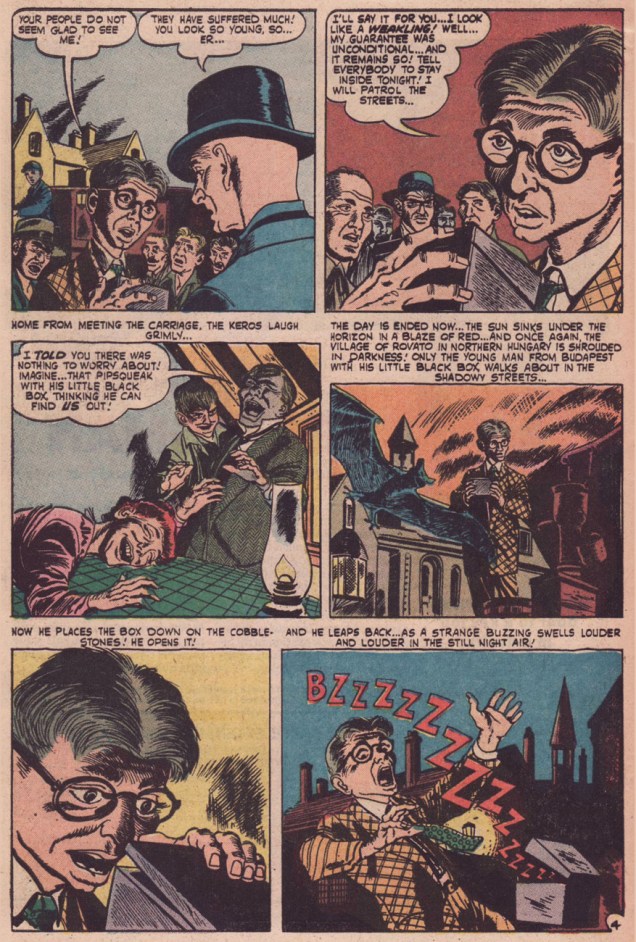
For your reading pleasure and mine, I’ve selected this adorably wacky tale from Atlas’ Journey Into Mystery no. 11 (August, 1953). Writer unknown, which is a shame.
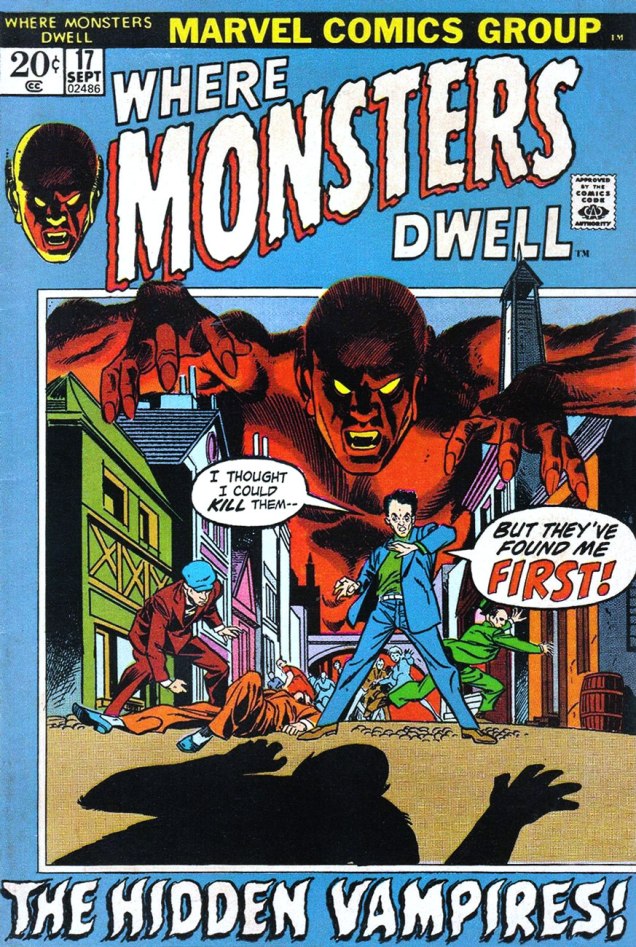
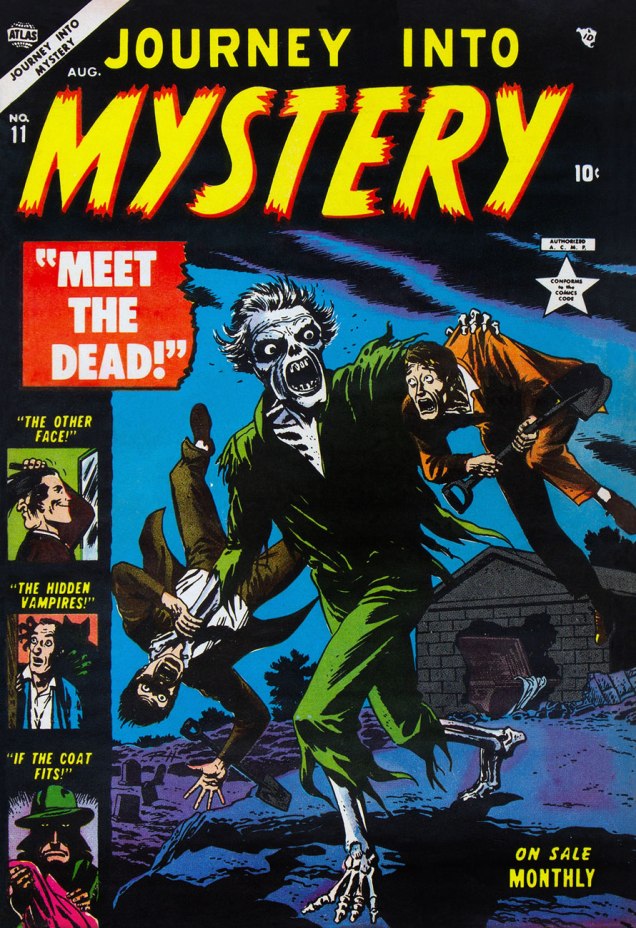
Well, I suppose it might have been simpler to see who wasn’t around in the daytime, but let’s face it, Mazerok’s method is far more entertaining and original.The story was reprinted in Where Monsters Dwell no. 17 (Sept. 1972, Marvel); though cover-featured, the cover itself was a lacklustre job by an overworked and uninspired Gil Kane, stuck here with Vinnie Colletta, though to be fair, there’s nothing here to ruin. Beyond the cover, the insides are great: two Ditko stories (« I Opened the Door to… Nowhere! » and « The World Beyond », a low-key Russ Heath (« If the Coat Fits », also from JIM 11), and our featured yarn.Now that’s more like it! The Hidden Vampires‘ original place of appearance, Journey Into Mystery no. 11 (Aug. 1952, Atlas), boasts a just-about-classic cover by Russ Heath, with a fine colouring job by Stan Goldberg.Heath did a lovely job with the small space allotted to preview the other stories. Pre-Code Atlas books were graced with a clever and attractive cover grid.
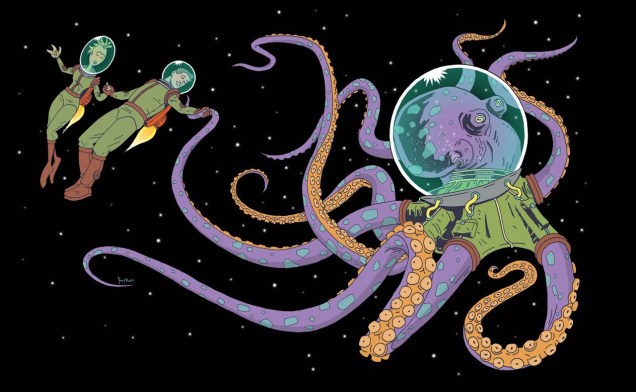
Today’s post may step a bit outside my usual purview, which is to say that the octopuses I am introducing do not come from the pages of comics per se. They’re used for mercantile purposes, to attract public to a concert, sell a book or deliver a message. But though they are octopuses in advertising, their artists still clearly have their hearts (and fingers) in the cartooning world.
Exhibit A is this cover for Centipede Press’ edition of Masters of Science Fiction: Fritz Leiber. This edition was limited to 500 numbered copies, so it will surprise no-one when I state that it’s quite sold out (See? Tentacles sell.) The cover is by Jim & Ruth Keegan, a wife-and-husband team, also the authors of the comic The Adventures of Two-Gun Bob.
Next, we have two music-related scenes, both from the Spanish side of things. ¡Fíjate!
The Roctopus Tea Party Festival takes place in Toledo, Spain. (Due to language constraints, I’m not exactly sure how many editions of it there have been.) Each poster features an octopus, but this is my favourite of the lot.
Whoever designed the festival’s logo knew how to harness the power of a lone octopus eye.
This Mardid “lunch box restaurant & tiki room” (now sadly defunct) held a series of “Galician lunches with DJ” splendidly named Día del Tentáculo. With a little Google Translate magic, I came up with this description: « Imagine a restaurant where you can eat hamburger with shiitake and jalapeños, drink the mythical Mai Tai cocktail or enjoy Tentacle Day with the best Galician octopus. And all while listening to good music in an environment inspired by the 50’s America. Sounds like an explosive mix, right? » The hamburger sounds good, but it’s really the Galician octopus that draws one in!
As the Spanish artist Roberto Argüelles held a few exhibitions of his art at Lunch Box, I’m going to assume this is his artwork.
This one I spotted plastered over some other poster in my neighbourhood. It states something like « Ultimatum: provide wages for all internships at all levels, or we go on strike. »
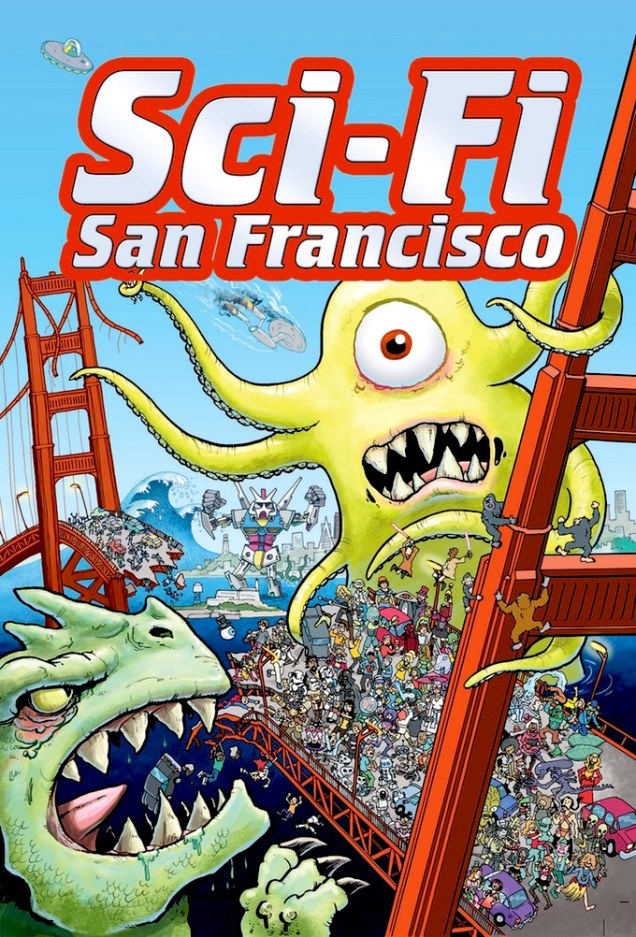
At first I assumed this was poster for a sci-fi convention in San Francisco, but it turned out to be the cover of a comics anthology published by Skodaman Press.
« I saw old Autumn in the misty morn stand shadowless like silence, listening to silence. » — Thomas Hood (1799-1845)
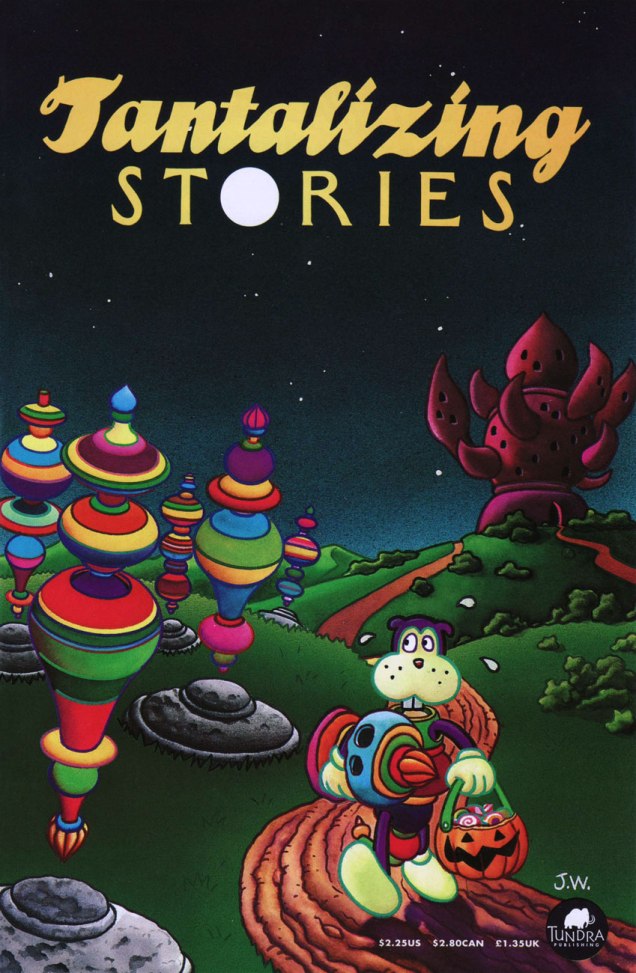
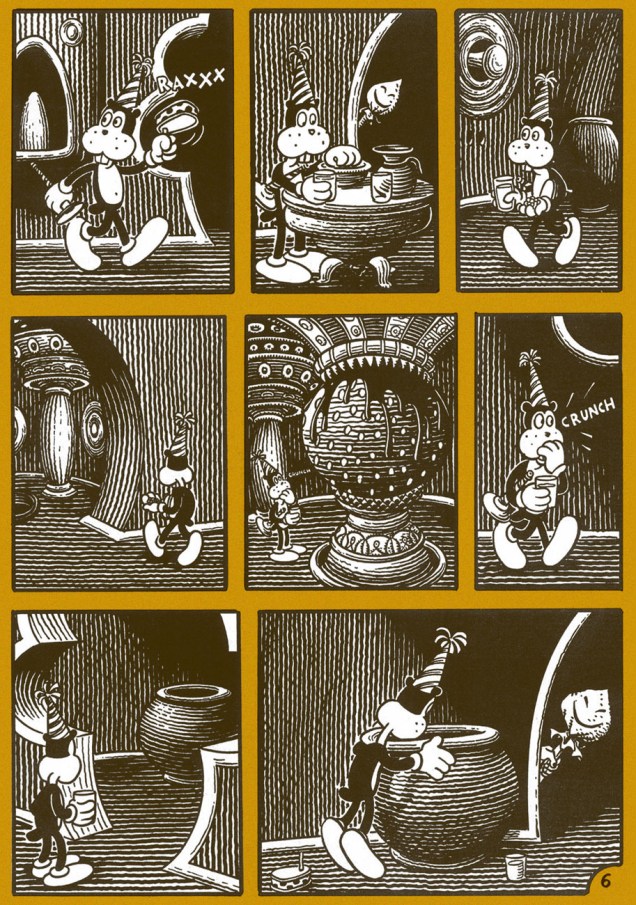
Jim Woodring‘s Frank, cogently termed « a bipedal, bucktoothed animal of uncertain species » was introduced to readers on the cover of Jim no. 4 (Dec. 1990, Fantagraphics), virtually straight from his genitor’s id. He would turn out to be Woodring’s most enduring creation. I was absolutely in awe of Woodring’s original, somewhat autobiographical showcase title, Jim. But it practically sold in the negative numbers (I recall an admiring / dismayed Dan Clowes stating something to that effect during an interview), and dammit, a genius like Woodring should be able to earn a living in freedom and dignity, so I understand the slight shift in gears. Though I miss Woodring’s tremendous verbal gifts, Frank’s is a rather extraordinary universe.
This is Tantalizing Stories no. 1 (Oct. 1992, Tundra), a duplex anthology shared by Woodring and Mark Martin. Painted cover by Woodring, of course.
Speaking of Tundra, its tale is quite a colourful one: it was the publisher that The Teenage Mutant Ninja Turtles built; an act of atonement? « Tundra was certainly, not to put too fine a point on it, the biggest and most absurd (as well as the most idealistic) publishing catastrophe in the history of comics — maybe in the history of the print medium. » [ source ]
Frank observes the signs of autumn, which puts him in a contemplative, melancholy mood; the middle tier of page 2.
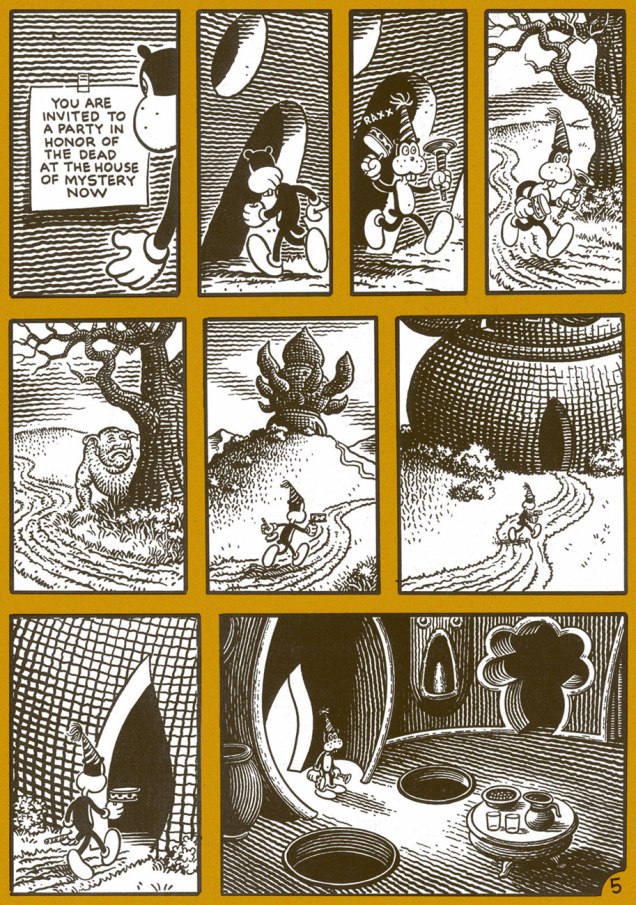
Yeah, I’ve been to a couple of those parties too.The party sequence; I wouldn’t want to spoil the ending, which comes one page later. Read the issue in full here. Woodring is of that rare complete breed of cartoonist, a uniquely soulful writer and a master of both black and white and colour rendering, quite autonomous but also a fine collaborator.
Woodring, nearly three decades down the line, has stated that he’s ‘extremely interested’ in wrapping up Frank’s adventures.
« Mama threw out my Hooded Cobra and Black Widow! »
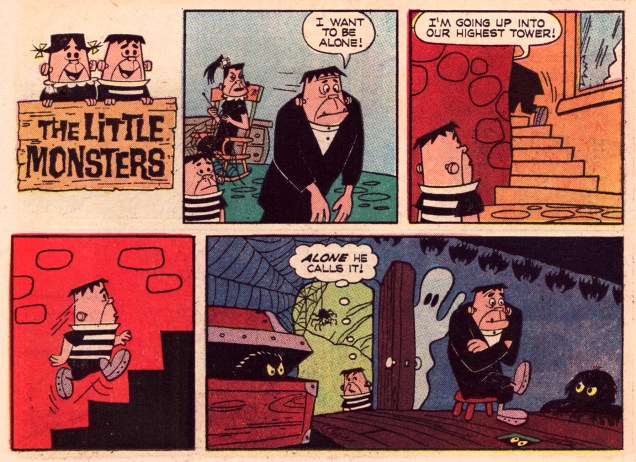
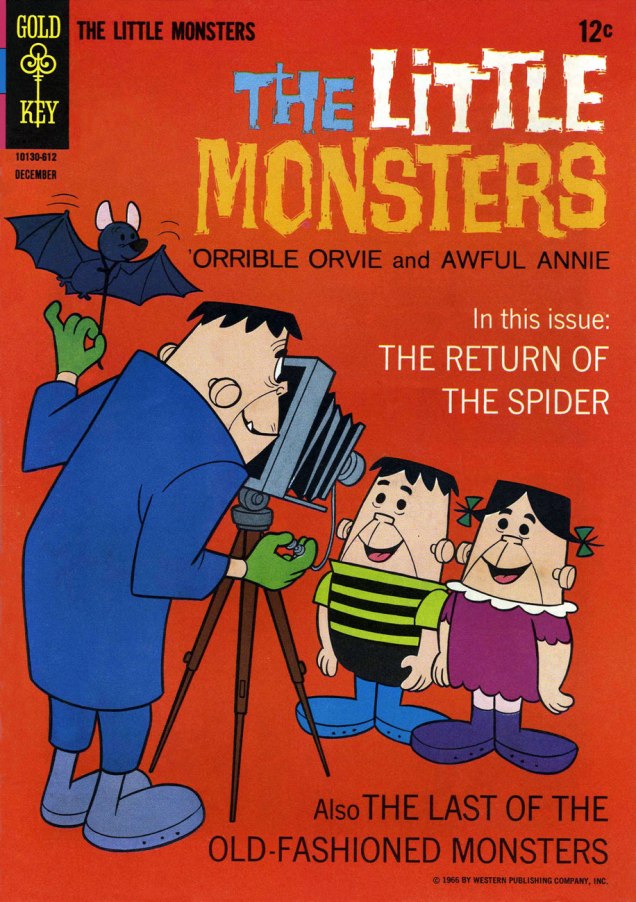
A delightful entry in the 1960s monster craze, Gold Key’s anonymously-created The Little Monsters first reared their fetchingly homely heads in the back pages of The Three Stooges no. 17 (May, 1964), predating by several months the near-simultaneous (just a week apart!) arrival on the tube of both The Addams Family and The Munsters. Now this ghastly family unit, assembled in the laboratory of kindly mad scientist Dr. Frankenfurter, comprised Papa Mildew, Mama Demonica, and their titular kids, ‘orrible Orvie and Awful Annie. The Little Monsters enjoyed a quite respectable rampage in comics, running amok for 44 issues between 1964 and 1978, outlasting by some years the craze that spawned them.
In this half-pager is from Little Monsters no. 7 (Dec. 1966, Gold Key), Papa Mildew essays Greta Garbo’s immortal line. Writer and artist unknown and uncredited, for shame. Pete Alvarado has been proposed as a possibility, but the man’s chameleonic versatility complicates identification somewhat.
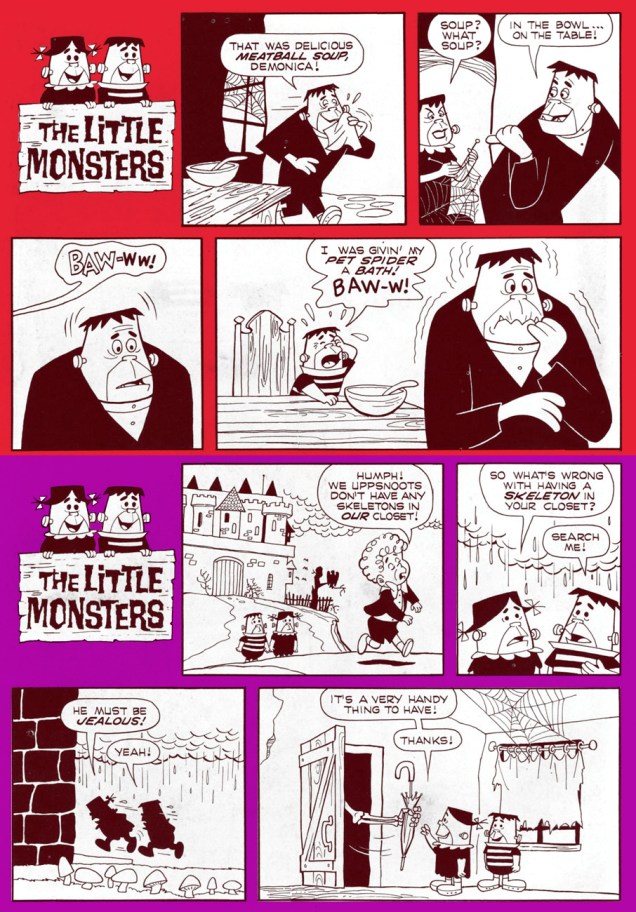
Ah, why be stingy? Let’s have a few more short pieces from the same issue.
« Eeeeeeeeeee! A horrible monster! He wants to… to eat me! »
With the coming of Hallowe’en, you have to get all the bases covered: an ungodly hoard of candy, a pumpkin to carve and assorted decorations to array about the house. Thank your lucky stars for the lightness of your burden: the average Balkan peasant also has to polish his pitchfork, sharpen and set out wooden stakes, gather sprigs of wolfsbane, and round up the requisite number of torches.
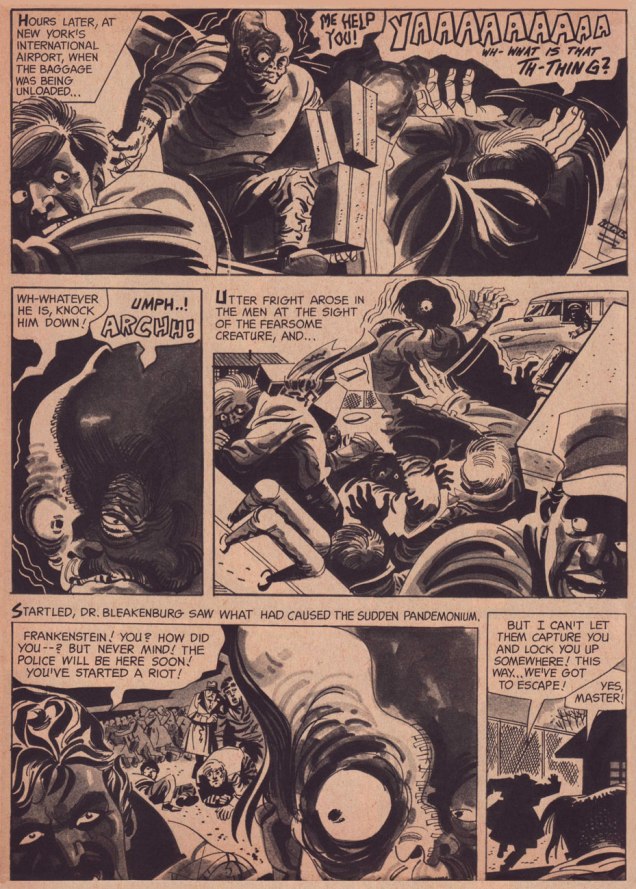
A detail from page eight: Grandenetti at his late-period finest, each page crackling with nervous energy and brimming with shadowy ambiance.
This merry nocturnal chase is brought to you by the team of Otto Binder, writer, and local favourite Jerry Grandenetti, illustrator. It comes from the sixth issue (January, 1969) of Cracked‘s go at a Warren-style Monster mag, For Monsters Only (10 issues… plus a best-of “annual”, sporadically published between 1965 and 1972). This was Frankenstein ’68, the first of three entries in Binder and Grandenetti’s The Secret Files of Marc Vangoro*, featured in issues 6, 7 and 8 of the mag. Well worth hunting down.
While this material has never, to my knowledge, been reprinted, and as copies of these long-neglected mags are getting scarcer and naturally pricier, fear not… for some kind souls have taken the considerable trouble of scanning, and more to the point, sharing them. In this particular case, look here.
Here’s the cover you need to keep an eye for. This is Cracked’s For Monsters Only no. 6 (Jan. 1969). That handsome fella is said to be the creation of the renowned wildlife painter Charles Fracé, of all people.It’s heartening to know that the original art still exists and is in presumably caring hands.
« Since man cannot live without miracles, he will provide himself with miracles of his own making. He will believe in witchcraft and sorcery, even though he may otherwise be a heretic, an atheist, and a rebel. » — Fyodor Dostoyevsky
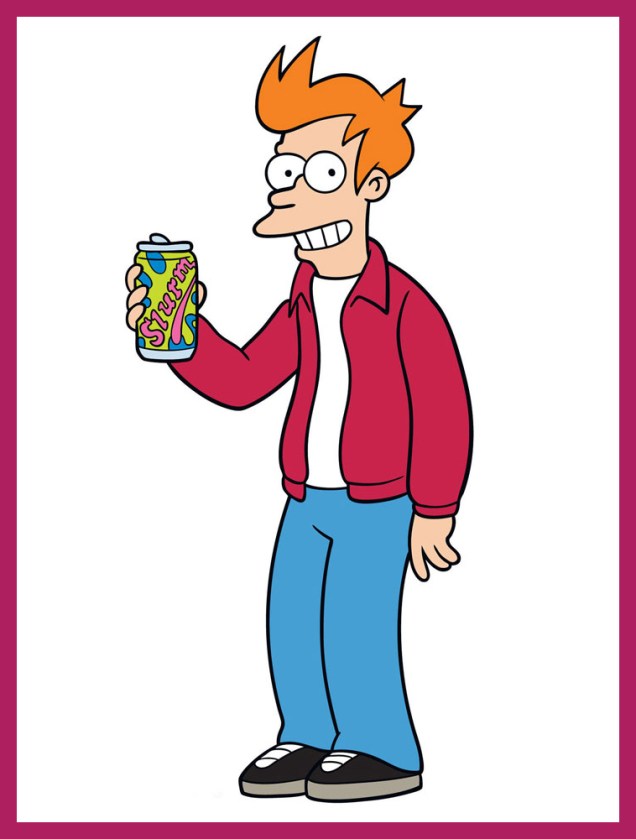
Here’s the earliest recorded appearance of Futurama’s Phillip J. Fry, and it would appear that he’s in for a heap of trouble… voodoo trouble! Fortunately, world-class sleuth Ellery Queen is on the case and on his side. That’s him discreetly crouching behind a gravestone.
This once-upon-a-midnight-dreary George Wilson beauty served as the cover of Dell’s Four Color no. 1243 (Nov. ’61 – Jan. ’62), the tale of The Witch’s Victim, featuring interior art by Mike Sekowsky, with inks by, from the look of it, George Roussos.
I wonder what Fry had done to get a coven so howling mad at him? I mean, just look at that innocent face…
Here’s how the painting fared in print.
A couple of sample pages from the story…. interesting to see the tension between the staid-by-design Dell style and a bit of an iconoclast like Sekowsky. It’s impressive that Mr. S. could find the time, between pencilling the rollicking monthly adventures of Snapper Carr, to moonlight for the competition… but here we are.





















 Who's Out There?