« Il vente — C’est le vent de la mer qui nous tourmente… »
Yesterday, I finished reading an excellent book by French author Pierre Mac Orlan, best known for Quai des brumes (Port of Shadows), written in 1927 and transformed into a movie in 1938. In other words, a while ago! The title of the novel I joyously devoured is Le chant de l’équipage (1918), and it’s a grand tale of swashbuckling adventure on the high seas. Well, actually it’s a lot more complex than that, and it’s beautifully written. As it’s in the public domain, you can read it online here (but in French only, I’m afraid). As I’m still digesting scenes from the novel, so to speak (no, the équipage did not encounter an octopus on its journey), my mind’s eye is focused on the far-away sea… so today’s Tentacle Tuesday has been rerouted from its original concept into everything nautical. Let’s spend a little time inhaling the healthy sea-breeze, in a world of handsome ships and the people who make them sail.
Perhaps the following story does not depict your standard encounter with an octopus… but it’s indubitably a seafaring tale. The Eyes, illustrated by Pete Tumlinson, was published in Astonishing no. 30 (February 1954, Atlas):
In the next page, the octopus-balls steal a lot of sunglasses (their discovery that ears are needed to wear glasses is off-panel, though).
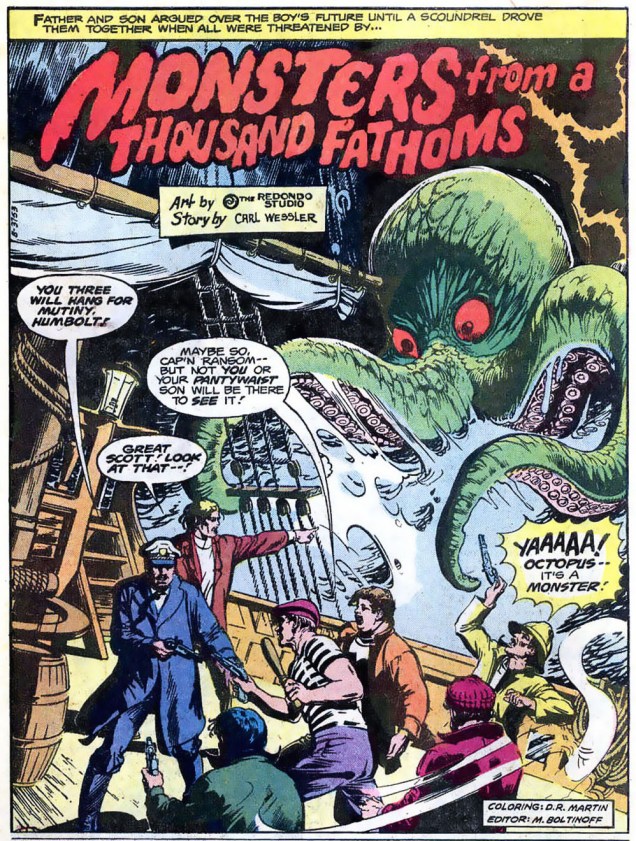
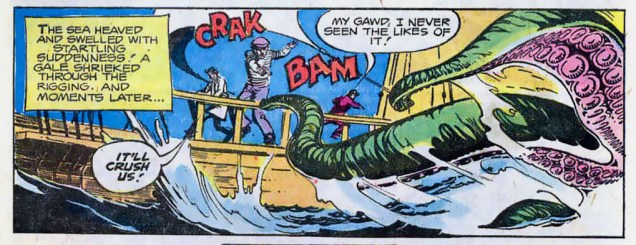
Monsters from a Thousand Fathoms, scripted by Carl Wessler and illustrated by the Redondo Studio (RG: with a heavy dose of E.R. Cruz), was published in The Unexpected no. 185 (May-June 1978, DC):
Ads endeavouring to put the viewer into the shoes of an action-type he-man to sell some nonsense is nothing new. And yet, through this hackneyed jungle, sometimes a glimmer of real excitement comes through:
An ad published in The Marvel Family no. 60 (June 1951, Fawcett). Never mind the Cola (it’s still around, incidentally), but that fight scene was pretty well orchestrated, if you ask me!
Those of us who like to dream of adventure, but preferably from the comfort of our own homes, I have this strip:
Since the aforementioned The Tracy Twins got its wings in a colour supplement of monthly scouting magazine Boys’ Life in 1952, I will now smoothly segue into a related topic, or a bit of warning, if you like.
If you start out as a wide-eyed kid in search of sea-faring thrills, and meet an octopus, just like this:
An issue of Adventures for Boys (December 1954, Bailey Enterprises).
You might end up, many years down the road, growing up to be, well… a little peculiar, shall we say.
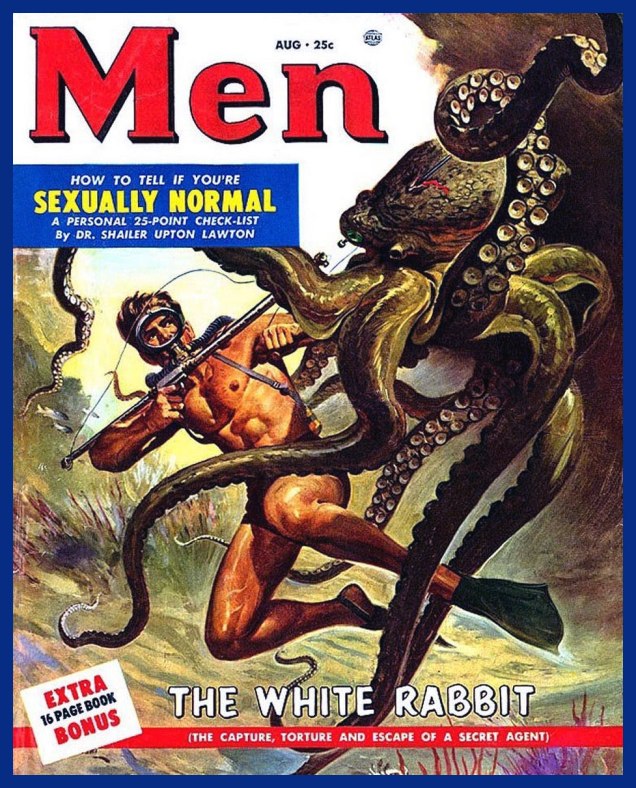
I’m sure several parts of that 25-point check-list for sexual normalcy involves cephalopods. This is Menvol. 2 no. 8 (Aug. 1953, Atlas). Cover by Robert Emil Schulz.
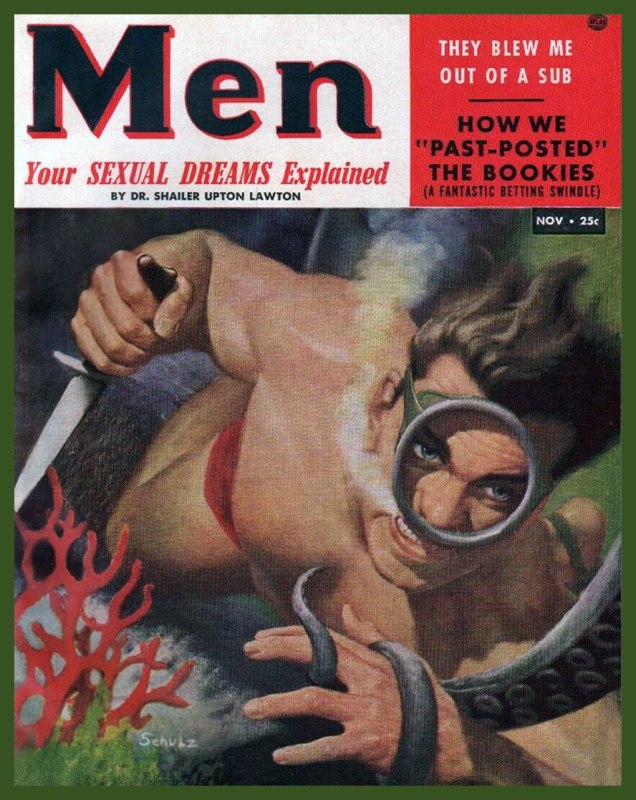
And if that wasn’t sufficient, the same doctor has further advice for his readers in this slightly subsequent issue:
Menvol. 2 no. 11 (Nov. 1953, Atlas). Cover by Robert Emil Schulz.
« Naturally there was quite a ruckus when everyone found out who… and what Rah was. But there wasn’t any rules concernin’ the eligibility of a mummy to play ball, so the Jets’ victory stood… » — from Roger McKenzie’s The Return of Rah
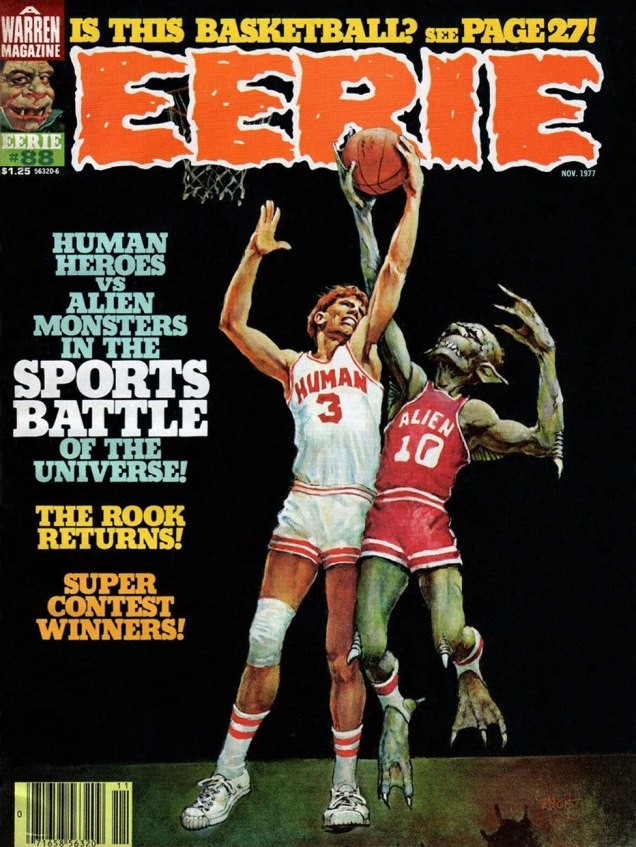
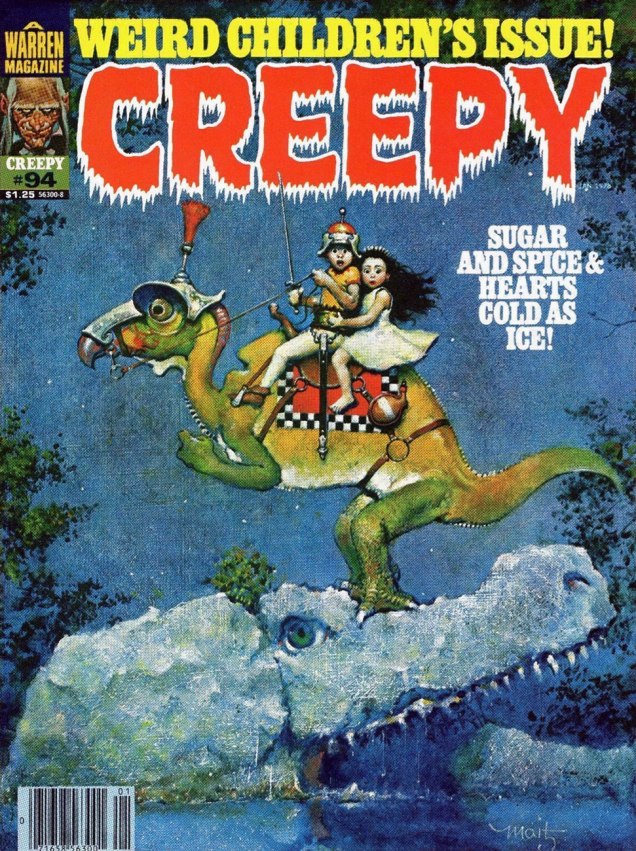
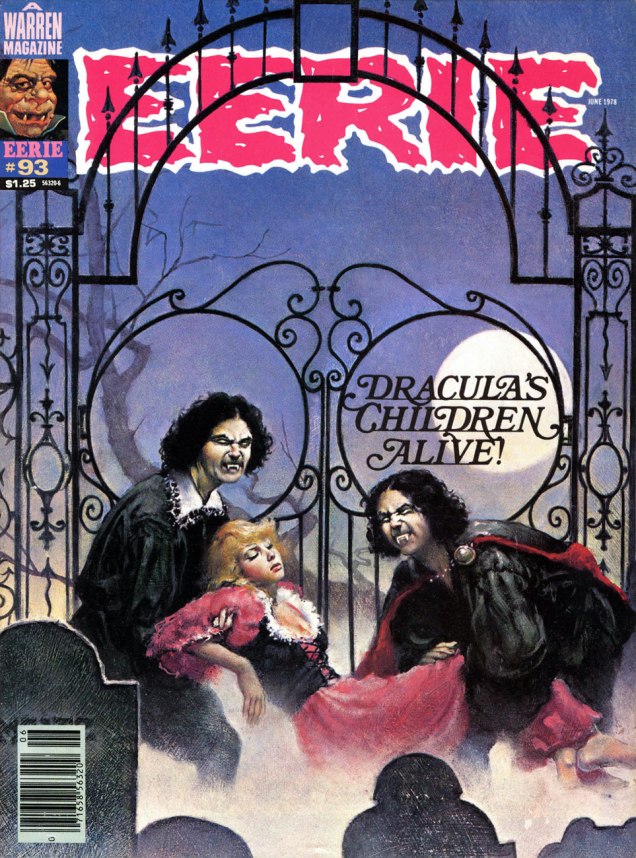
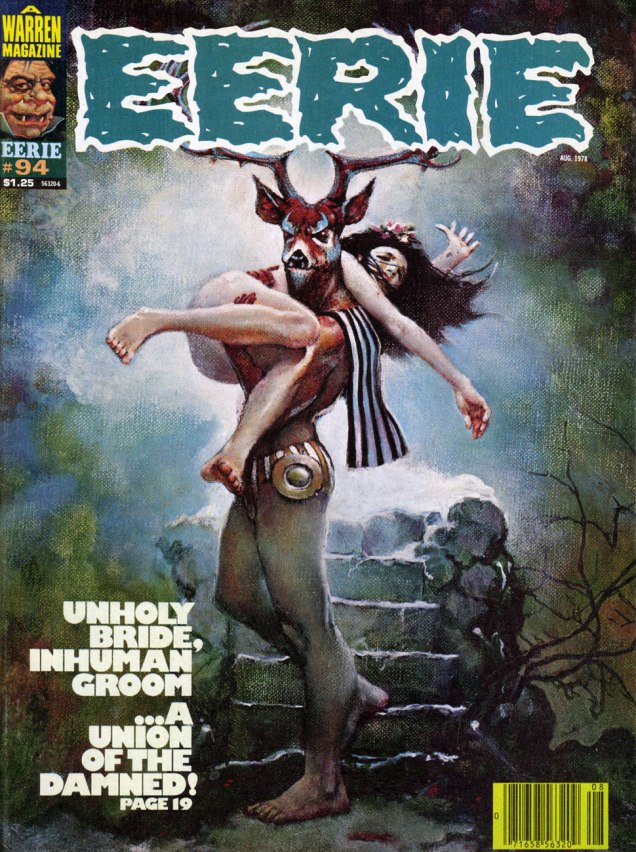
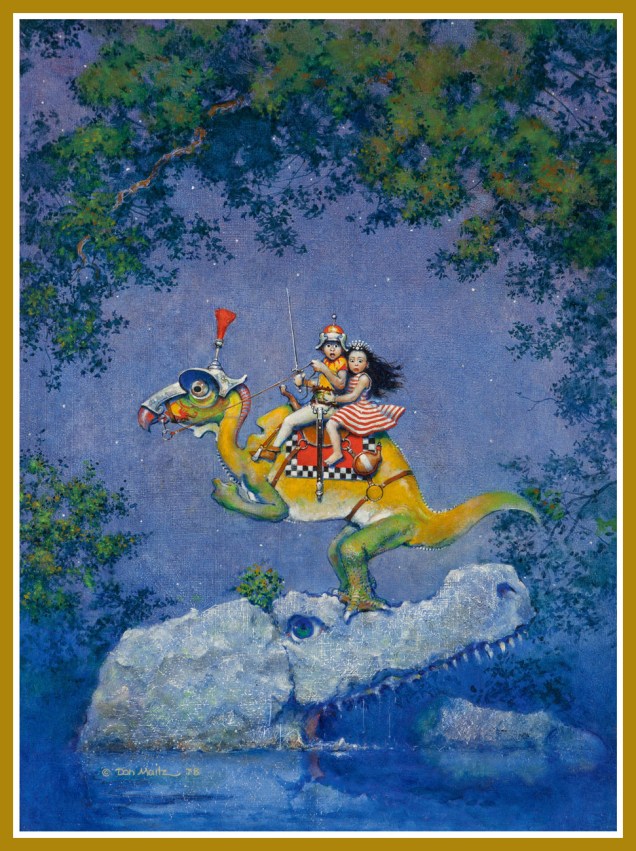
Carrying on with our irregular survey of significant Warren cover artists whose names and reputations are somewhat less inextricably linked with the publisher than the usual suspects, and thereby sometimes overlooked. Fresh out of art school, and on his way to a truly remarkable, award-peppered career, Don Maitz (born 1953, Plainville, CT) graced a brace of Warren Mags with some of his earliest professional imaginings, which I’ve gathered here.
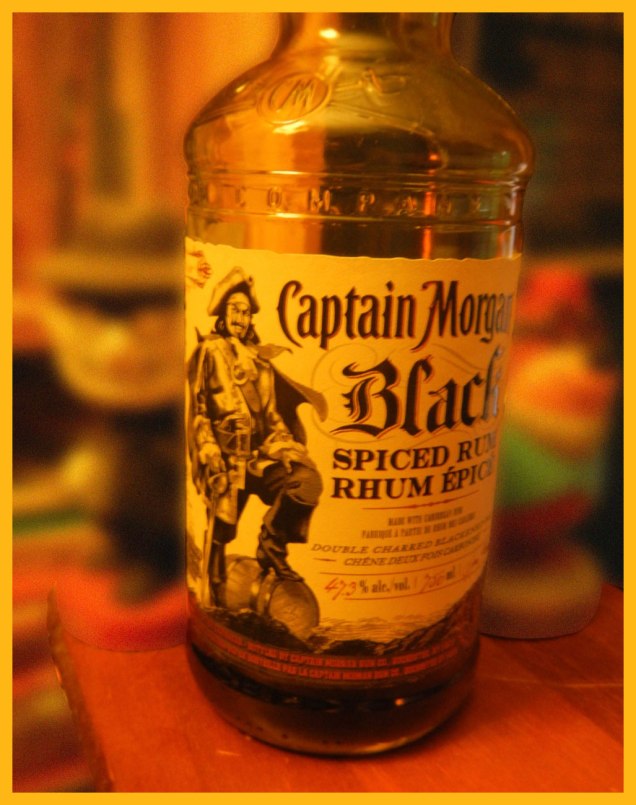
A lot of people apparently don’t much care for Warren’s late 70s sports-themed issues, but I like ’em, given that they feature a trove of gorgeous Carmine Infantino artwork, when he was experimentally-paired with a dizzying assortment of inkers (in this issue, John Severin, Alfredo Alcala, Alex Niño… and, well, Dick Giordano). At their best, the sports issues allowed him to revisit with more latitude (though less ingenuity, I’d argue) the Strange Sports Stories format he’d initiated in 1962 with writer Gardner Fox and editor Julius Schwartz. This is Creepy no. 93 (Nov. 1977, Warren). Senior editor Louise Simonson* (née Mary Louise Alexander) was commendably trying to spice up what had become a stale formula, but it turned out that there just wasn’t sufficient overlap between Warren readers and sports fans. A more staggered release programme might have cushioned the blow: as it was, Warren readers got two sports-centric issues in November 1976, then another pair in November 1977.I hope that headline was meant ironically, because (spoiler alert), the humans are the monsters and the aliens… aren’t, in Bill Mohalley and Nicola Cuti’s Deathball 2100 A.D., a sordid, derivative (Rollerball + Death Race 2000, geez) and heavy-handed tale made uglier by Dick Giordano’s usual stiff, graceless visuals. Nice cover, though. This is Eerie no. 88 (Nov. 1977, Warren).Well, now! This marvellous vision, marking quite a tonal break from the usual Warren diet, corresponds to no particular tale within this ‘bad seed’ issue, yet teems and brims with story, with nary malice… but so much wonder. A bold move on the part of editors Simonson and Nick Cuti. This is Creepy no. 94 (Jan. 1978, Warren).This handsome simian trio deserves better than their association with Cary Bates and Esteban Maroto‘s rather juvenile, Lord Greystoke-slandering Murder on the Vine. You’ve done better, boys. This is Creepy no. 95 (Feb. 1978, Warren), a cover bearing more than a mere whiff of Frazetta.The probability of violent demise aside, isn’t this just the most unctuously idyllic autumnal scene? This is Eerie no. 91 (March 1978, Warren).Though this one is to my mind the lesser entry in the parade, I must concede that it’s presented in exemplary fashion: the colour choices, the placement of the type, even the integration of that unholy blight, the bar code. This is Eerie no. 93 (June 1978, Warren).Young master Maitz’s final Warren cover (chronologically speaking): this is Eerie no. 94 (Aug. 1978, Warren), illustrating Nicola Cuti and Leo Durañona‘s Honor and Blood. « Can the child born out of an unholy union between man and vampire grow up to lead a ‘normal’ life? You can’t escape the sins of your parents. Their errors ripple faintly down the generations! » “Er, what’s with the deer head?”, you may ask. The answer, from the story: « The bride was never to see the weak, corrupted face of her human husband. She wedded the Elk, symbol of the Beast. »« A lowly elk, “symbol of the Beast”?Maaa, you’re just making shit up, Nick. » The feeling on that point seems, in fact, quite unanimous.And here’s a privileged peek at Mr. Maitz’s Creepy 94 cover painting original (Mixed media on Masonite, 24” x 18”), which, as it turns out, is entitled Unsafe Footing, which makes me love it even more.As a rum enthusiast, I am naturally aware of the Captain Morgan brand… whose mascot (circa 1982) is, as it happens, Maitz’s most familiar creation… to date. Prost!
When I was in college, most of my professors could easily be divided into two categories: those who had good taste in comics, and those who did not. I don’t know who launched this tradition (is this something that’s universal to all post-highschool educators?), but somehow the majority of teachers were fond of clipping particularly pleasing items from newspapers and (usually messily) scotch-taping them to their office door. This usually included some brief newspaper articles, and definitely a cartoon or two.
I have to admit that I had a soft spot for panels that clearly had spent the last decade (or three) in that spot, and were little more than yellowed, warped, sometimes downright indecipherable relics of yesteryear. However, of greater interest were office doors tended as carefully as an prize-winning garden, proudly displaying a frequently renewed wall of cartoons, meticulously positioned and impeccably pasted onto the door’s surface.
I was lucky enough to know one professor who was passionate about Bizarro, and another one who harboured a similar fire for Gary Larson‘s The Far Side. At the time, I didn’t know that Larson had retired in 1995, and that new work of his was no longer published in newspapers. I was in college in 2004. Did the professor in question hoard large archives of cut-out The Far Side strips (these weren’t photocopies), and just cycle through them? Was there, in her office, some portal to an alternate reality? That mystery shall only deepen over time. I can only state that I would make sure to swing by first thing in the morning to enjoy that day’s offering.
Today we present you with a fairly complete collection* of Gary Larson tentacles. I give my gratitude to co-admin RG for his “eagle eye” – he spent an hour or two going through his paperback collections of the strip (and giggling maniacally) to spot anything cephalopodian. He then scanned ’em (and added colour frames, because that’s the kind of man he is), so this post has honestly been more work for him than for me.
*It turns out there’s quite a lot of them, so this shall be a two-part post.
Larson has been notoriously opposed to having his strips posted online by fans, but in December 2019, he has decided to start a The Far Side website, featuring a random selection of cartoons, some weekly selections organized by theme, and the occasional doodle or sketch. I have absolutely no wish to disrespect the opinion of the author, but I hope that now it’s okay to share our excitement about so much tentacle goodness with our readers. Besides, tentacles or not, most of these are hilarious and surreal, a combination that’s dear to my heart.
Without further ado…
« Controversy never seemed too far away from me, especially during my first year of syndication. I truly thought my career may have ended a number of times. I remember one I did of a couple dogs that were playing this game, where they were smacking around a cat hanging from a long rope attached to a pole. I called it “Tethercat.” To me, and I assume my editor, it didn’t cross any line because this was just a game dogs might play. But that one got people stirred up. Especially cat people. I’ll forever be grateful to fans, who in those early days often rescued “The Far Side” from cancellation, or campaigned to get it reinstated. » 〈source〉
« Among the massive fan base that The Far Side would eventually develop, interestingly scientists and academics were among the first to take to the comic, despite Larson’s frequent jabs at this very same group. The strip also had a tangible impact on the world of paleontology. In an 1982 comic, a group of cavemen are in lecture hall being shown a slide of a dinosaur. The caveman instructor is pointing to the spiky tail of a Stegosaurus while saying, “Now this end is called the thagomizer…after the late Thag Simmons.” As it turned out, in real life, no one had actually given that part of the Stegosaurus’ tail a name. Despite Larson’s fudging of the facts (in actuality, dinosaurs and humans missed each other by more than 140 million years), paleontologists adopted “thagomizer” as the official name of the spikes on a Stegosaurus. » 〈source〉
And, in glorious colour…
While there are cheap and abundant paperback collections of The Far Side in every self-respecting bookstore, in 2014, Andrews McMeel Publishing released a beautifully designed 3-volume The Complete Far Side. Oh, and it weights 20 pounds. For bonus value, some letters written to the newspapers by befuddled or angry readers are included. Few of us may feel the need to possess such a grand coffee table book (I’ve been pondering that myself ever since it got published), but its very existence is a lovely testament to the enduring nature of Gary Larson’s world.
±≠ ds
P.S. Those teachers with bad taste in comics I mentioned? They had Garfield and Cathy on their doors…
Some content on this page was disabled on June 3, 2022 as a result of a DMCA takedown notice from Gary Larson. You can learn more about the DMCA here:
« Death smiles at us all, all a man can do is smile back. » — Marcus Aurelius
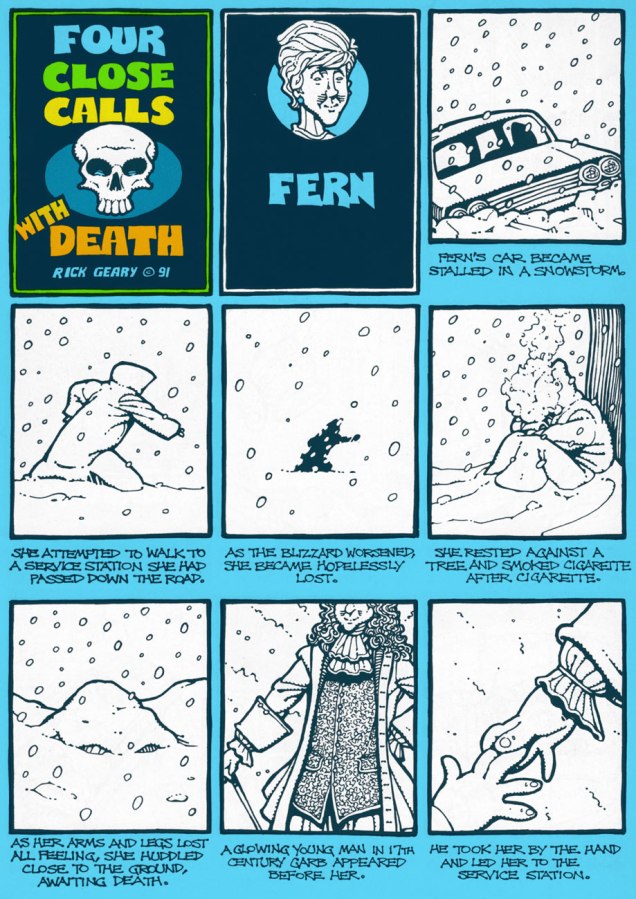
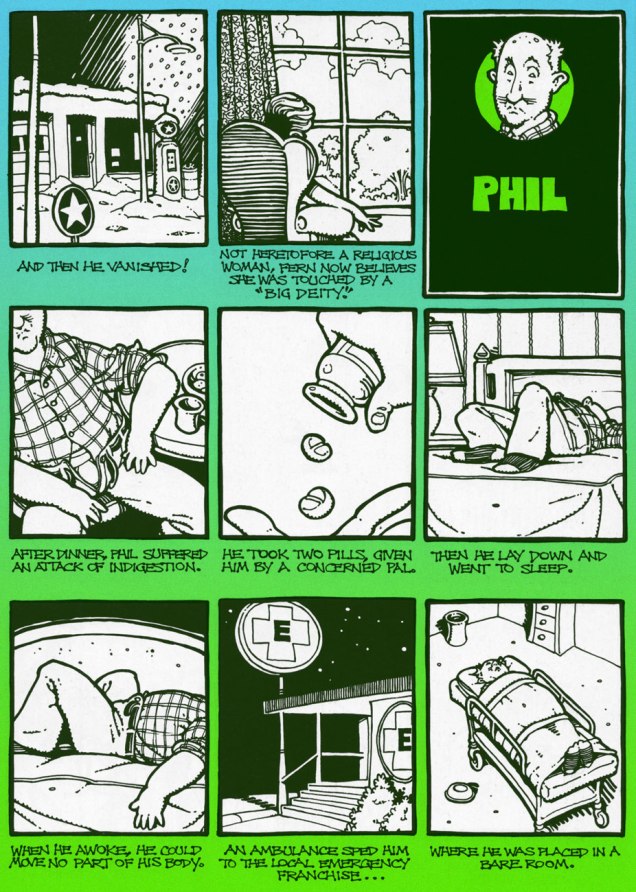
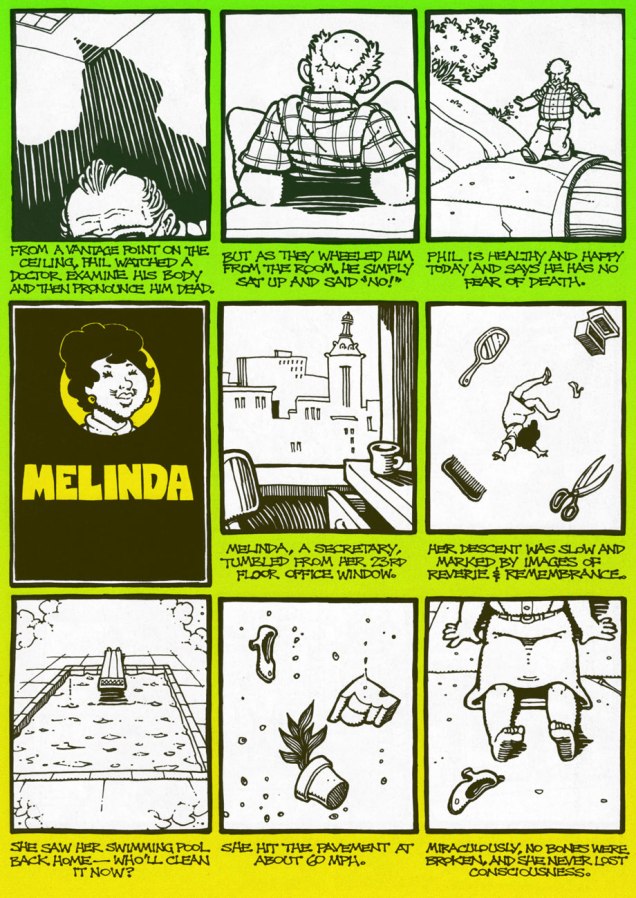
The other day, I chanced upon a Rick Geary piece about tangos with the Angel of death, which returned my mind to a time, when I was but six years of age, and that my parents had gone holidaying, leaving me in the care of some old friends. At their home, I recall perusing some back issues of that evergreen Reader’s Digest (the French-Canadian edition, called Sélection du Reader’s Digest), wherein I encountered some memorable articles, including one about the miraculous survival of people who tumbled from great heights*, unencumbered with parachutes, and another that grimly recounted the calamitous landslide that one night engulfed a village, Saint-Jean-Vianney, just a few kilometres from my hometown.
Ah, but human memory is notoriously fallible and self-deceiving. So I deemed it prudent to inquire whether the events were truly as recollected. A quick call to my folks confirmed that yes, they did toddle off to Europe for three weeks in November of that year (I think my parents are delighted when I quiz them about such matters). The landslide took place in May, so that fits too.
As the close shave lends itself well to comics, I’ve gathered a potpourri of short pieces on the topic. Tighten your seatbelts, we’re in for a rough ride!
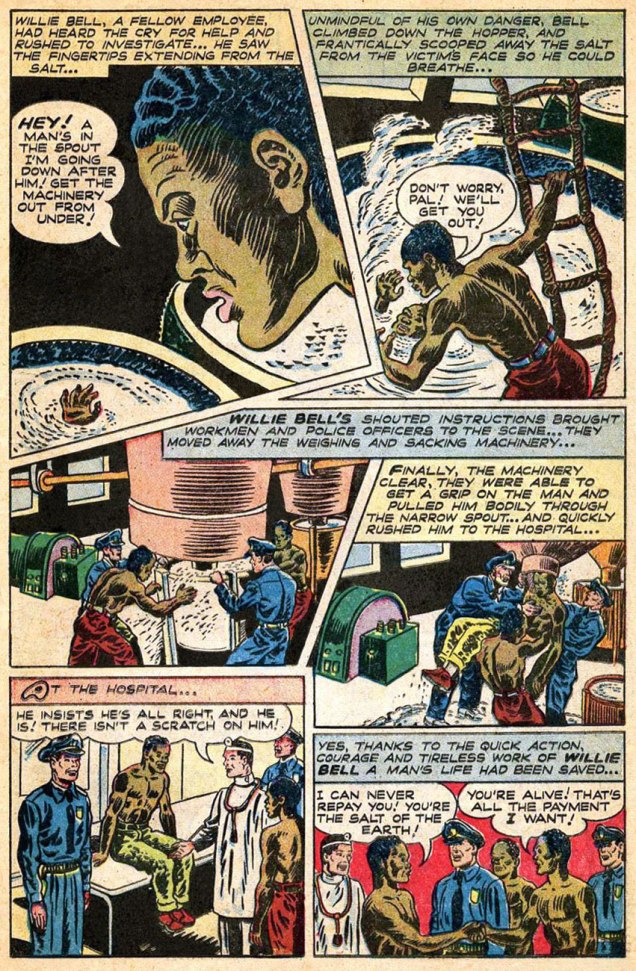
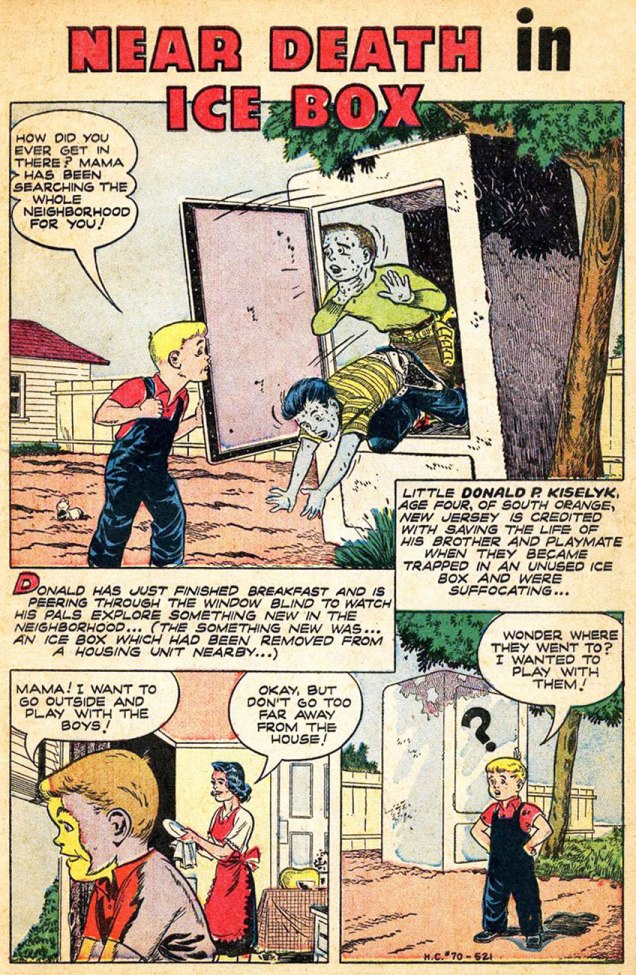
A presumably factual two-pager from New Heroic Comics no. 70 (Jan. 1952, Famous Funnies), featuring artwork by no less an eminence than the great Harry Peter (according to Ger Apeldoorn, which is good enough for me). The whole ‘salt of the earth’ thing rings pretty hokey, but one has to appreciate that this account of selfless heroism wasn’t whitewashed.
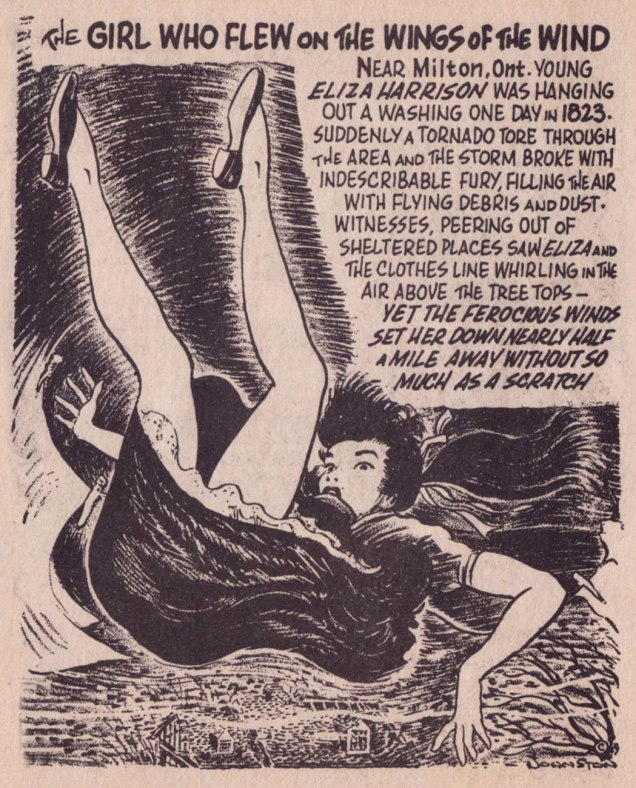
This post’s springboard, originally published in Dark Horse Presents no. 82 (Feb. 1994, Dark Horse). From Heavy Metal to National Lampoon, with High Times and The American Bystander in between, I’ve yet to encounter a publication wherein Mr. Geary’s work failed to rise to the very top with its patented palette of fanciful perspective, sunny understatement and psychological verisimilitude. An airborne entry from Gordon Johnston‘s Ripley’s Believe It or Not-style syndicated strip ‘It Happened in Canada‘ (1967-81). However, the Wikipedia listing of historical tornadoes in Canada fails to turn up one such whirlwind in 1823. Perhaps it happened in Kansas instead.
Pesty baby brother saves the day! Another entry from New Heroic Comics no. 70 (Jan. 1952, Famous Funnies), artist unknown. Astoundingly, a little research (I wouldn’t want to pry further) indicates that a Donald P. Kiselyk, now 73, still resides in New Jersey. Doing the math, he would have been born in 1947, which fits perfectly). I wonder whether he recollects his hour of four-colour glory…Another It Happened in Canada entry. Looks legit, too, though it seems Johnston didn’t nail the spelling: the resilient gent’s moniker is Myllyla. According to Wikipedia, « At 9:57 in the morning, an avalanche of snow buried the Leduc Camp in British Columbia, killing 27 copper miners working for the Newmont Mining Corporation workers and destroying several buildings. Another 42 of the 68 people buried were rescued on the same day, while a carpenter, Einar Myllyla, was saved three days later from the ruins of a collapsed building. “To their everlasting credit”, author Jay Robert Nash would write later, “rescuers refused to abandon their search until every man in the camp had been accounted for.“ »Obviously, I couldn’t leave out this Gary Larson classic.
Keep your arms and legs in the vehicle, don’t tease the wild animals, wear your life jacket, look to both sides before crossing the road, and don’t forget to floss. Oh, and call your mother more often; she misses you.
-RG
*the fellow whose tale stayed with me was most likely Lt. I.M. Chisov, « … a Russian airman whose Ilyushin IL-4 bomber was attacked by German fighters in January of 1942. Falling nearly 22,000 feet, he hit the edge of a snow-covered ravine and rolled to the bottom. He was badly hurt but survived. »
Some content on this page was disabled on June 30, 2022 as a result of a DMCA takedown notice from Gary Larson. You can learn more about the DMCA here:
My grandfather, born around 1920, used to tell me tales of what life used to be like in the 40s for a young man. He skipped the salacious adventures, of course, as that would have been inappropriate fodder for a child, but another thing he seems to have omitted is the presence of all manner of tentacles in everyday life… I cannot ask him about it, as he passed away many years ago, but I nevertheless dedicate this post to his memory.
Famous Funnies no. 83 (June 1941, Eastern Color), artist unknown. To be attacked by a sock puppet trying to pull you into the sea is tragic, not funny!Planet Comics no. 22 (January 1943, Fiction House), cover by Dan Zolnerowich. I somehow completely overlooked this cover when doing Tentacle Tuesday: Planet of Tentacles, courtesy of Fiction House.Air Fighters Comics no. 5 (February 1943, Hillman). Cover by Charles Biro.The United States Marines no. 3 (1944, Magazine Enterprises). Cover by Creig Flessel. I don’t know if fighting a Japanese head caricature attached to seven tentacles qualifies as an “authentic marine corps story”.Famous Funnies no. 157 (August 1947, Eastern Color). Cover by Stephen Douglas.
« Mister X has always puzzled me. I’ve never been exactly certain where he came from. It seems like he has always been present — maybe not skulking through the perplexing shadows of the city so much as through some kind of collective unconsciousness. » — Dean Motter (1986)
On this day, back in 1953, the celebrated art director, graphic designer, writer-illustrator and cartoonist Dean Motter was born in Berea, Ohio, not far from Cleveland.
Over the course of his illustrious career, Motter has flitted in and out of comics, often in tandem with a rather remarkable array of collaborators, among them Jaime Hernandez, Paul Rivoche, Seth, Ty Templeton and Michael Lark… but just as frequently on his own.
As you’ll see, though he is quite adept in a vast range of media and techniques, nearly all of his mature work is lovingly filtered through his abiding interest in Will Eisner’s The Spirit, film noir, Art Deco, German Expressionism, with, I’d say, a soupçon of Soviet Propaganda art… resulting in a surprisingly cogent and coherent retro-futurist vision. The future as seen from the past, in short. And that’s just the visuals.
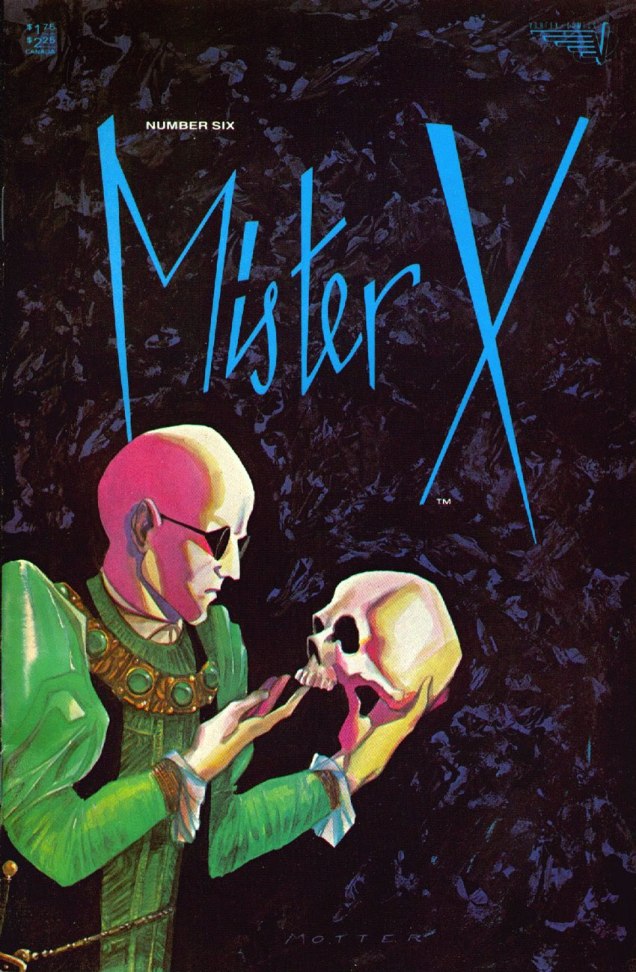
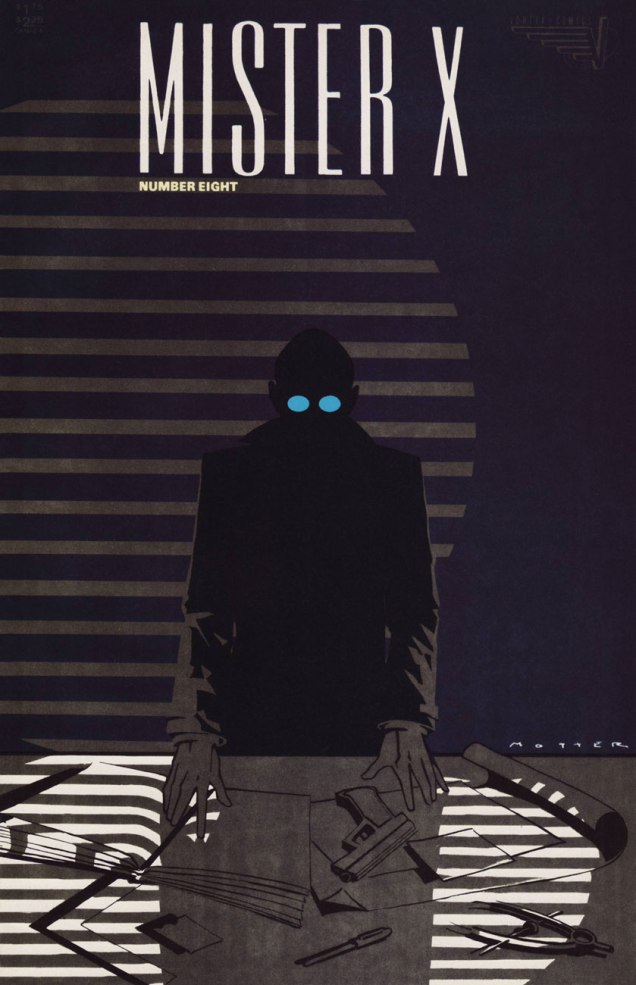
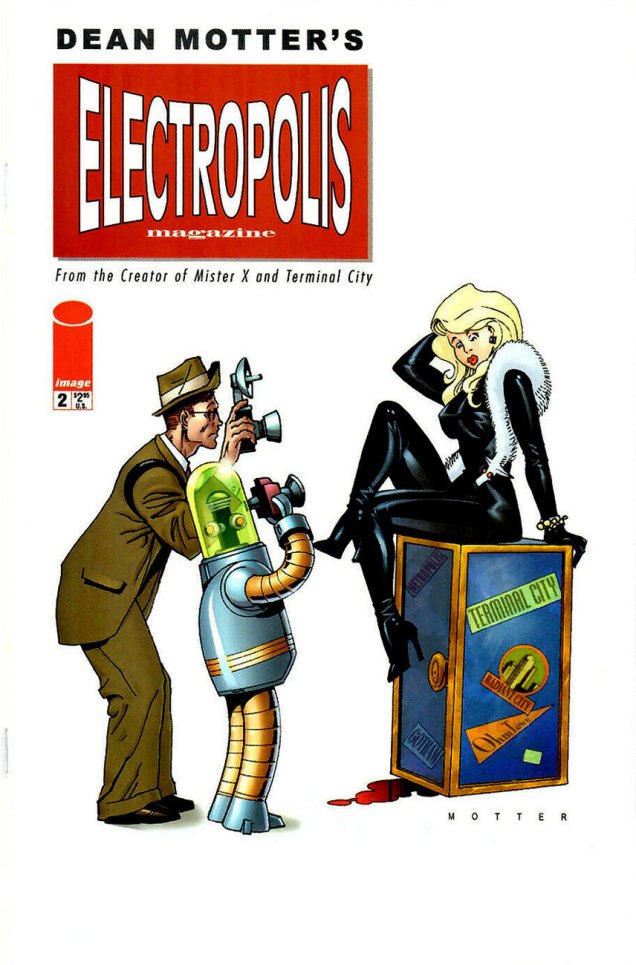
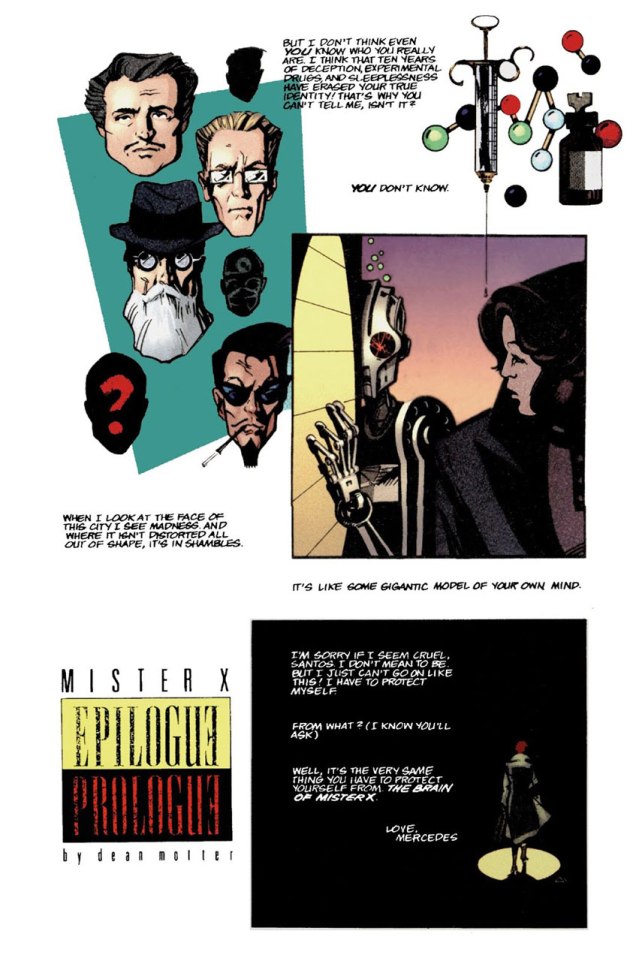
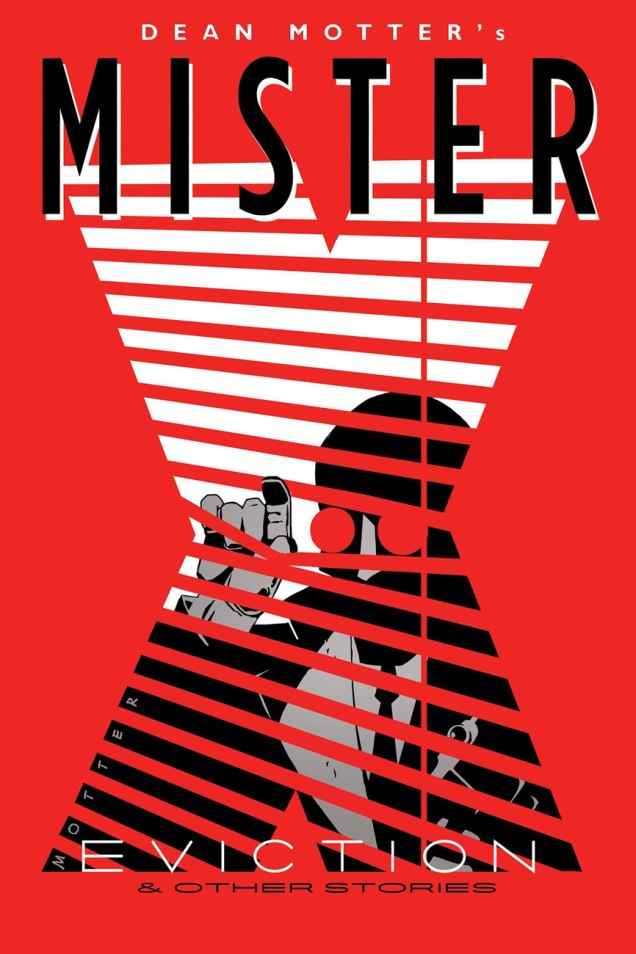
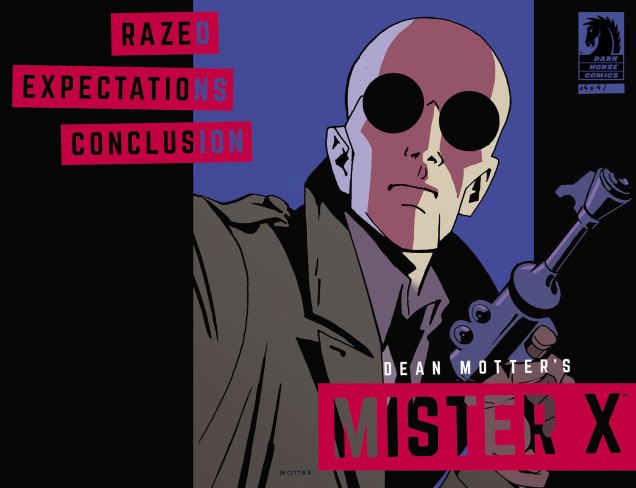
Ah, youthful indiscretions! Motter’s cover for the inaugural issue of the tabloid version of Andromeda (1974, Media Five; Bill Paul, editor). Herein, Motter wears some rather less highfalutin’ influences on his sleeve, notably those of Mssrs. Brunner,Kane and Steranko. « Focus Fire ~ white Eclipse The Aurora Anti-Cosmos Splitting Heavens Apocalypse. »… concluded Young Master Motter’s epic poem, Celestial Circuit Cirkus.An early appearance from (a yet-unnamed?) Mister X, snuck its way onto a Canadian reissue of Patrick Cowley‘s Megatron Man (1982, Attic Records). And here is a later, rather dodgy recycling of his artwork that must give Dean some choice nightmares.A nice change of pace to showcase his range, this is Motter’s cover for Mister X no. 6 (Dec. 1985, Vortex). This splendid logo, débuting here, would thankfully return from time to time.This is Mister X no. 8 (Oct. 1986, Vortex); In its subtlety, this cover stretched the limits of what was technically possible in comics printing at the time, in terms of saturation and contrast.In the late 1980s, Motter jumped at the chance to write and illustrate Shattered Visage (oh dear me, a Shelley quote!) a sequel to 60s British television classic The Prisoner (4 issues, prestige format). This is the (much improved) cover to a 2019 reprint (Titan Books) of the original 1990 DC Comics collected edition.This is Electropolis no. 2 (Sept. 2001, Image), a spin-off of his Terminal City limited series (1996-97, DC Comics).Page two of Epilogue Prologue from A1 no. 1 (Atomeka Press, 1989), story and art by Motter.Cover from Mister X: Eviction no. 2 (June 2013, Dark Horse).The cover of Dean Motter’s Mister X: Eviction & Other Stories (Nov. 2013. Dark Horse).Front and back cover spread of Mister X: Razed no. 4 (May 2015, Dark Horse). Unusually done in gouache, if I’m not mistaken.One of the current comics field’s crasser, most mercenary outfits, Dynamite Entertainment specializes in the frivolous mangling and mingling of established franchise properties, with the wankbait titillation ramped way the hell up and variant covers out the wazoo. Sample titles: Red Sonja & Vampirella Meet Betty & Veronica (twelve issues so far, as it’s so very high-concept), Barbarella / Dejah Thoris, or Army of Darkness / Xena… I mean, check out this train wreck of a lineup. Such is the power of their brain-dead crappitude that they even managed to produce an abysmal mini-series from a Roger Langridge script, a career first for the great man. Their not-so-secret weapon: in the hallowed publisher’s tradition of the old bait-and-switch, they don’t scrimp on the slick-as-spit cover artwork. This is The Shadow no. 25 (May 2014); a variant cover, need you even ask?
Aside from his comics work, Motter spent a considerable part of the 1980s working for the Canadian arm of what was then the biggest (and possibly stingiest) record label in the world, CBS/Sony, shepherding or designing beautiful and clever covers for albums that were often neither… but that’s an art director’s job, cynical as it may seem. Anyway, you know you’ve made it when your work rates a pastiche decades on; to wit:
This reminds me of how a single-minded, contrarian generation of Chuck Klostermans has taken over music criticism in order to wipe away the work of the Obama AdministrationRobert Christgaus and Dave Marshes of this world, aiming to vindicate and impose their beloved childhood bands, which once were the reigning critics’ whipping boys. Nowadays, you’ll find 4 and 5 star ratings (out of five, there’s no room here for moderation!) of Van Halen, Kiss, Loverboy and Journey albums, which was unthinkable at the time of their release. Plus ça change…
What is there left to do but to warmly wish Mr. Motter the finest of birthdays… at a safe distance? Alles Gute zum Geburtstag!
« In the spring, at the end of the day, you should smell like dirt. » – Margaret Atwood
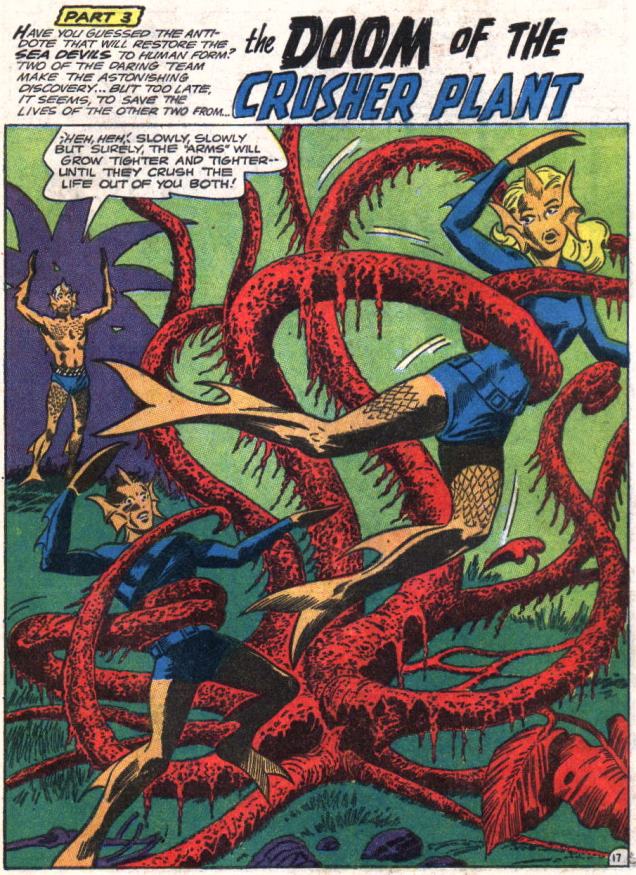
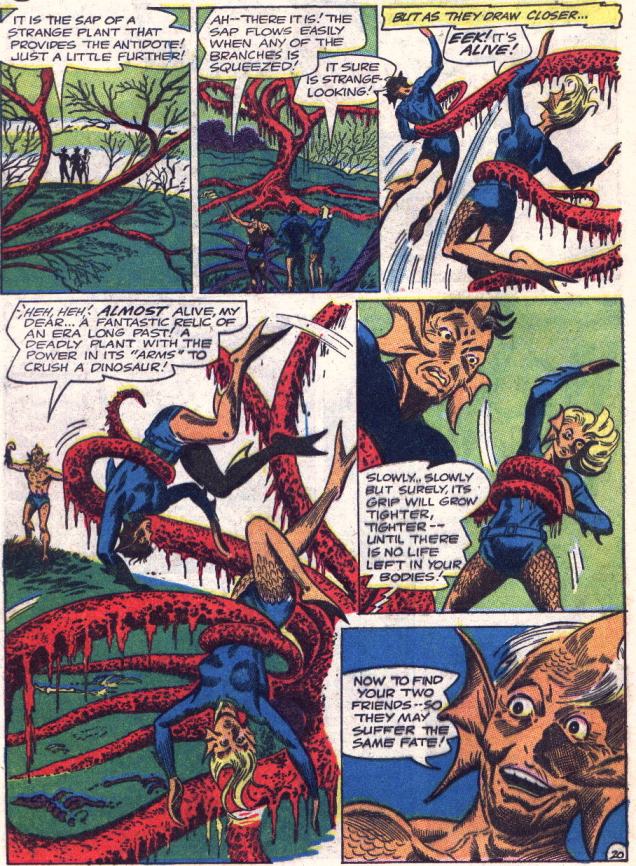
Our neighbours are certainly following this sage piece of advice, crawling out with shovels and rakes, clad in rubber boots and – a new development this year – face masks. As far as I’m concerned, the flu virus can’t be transmitted by plants, so one is quite safe in the garden or backyard, as far as that goes… but how about proper protection against plant-tentacles? ♪♪ Whether on land or under the sea, tentacles are coming for you and me… ♫♫ I promise to stay away from song-writing in the future. But now, for the comics!
Sea Devils no. 18 (July-August 1964). Cover by Howard Purcell. The Sea Devils grapple with tentacles quite a lot, so they had a whole Tentacle Tuesday: Ahoy, Sea Devils! to themselves.
The art inside is quite nice, with pencils by Howard Purcell and inks by Sheldon Moldoff (read the whole issue here):
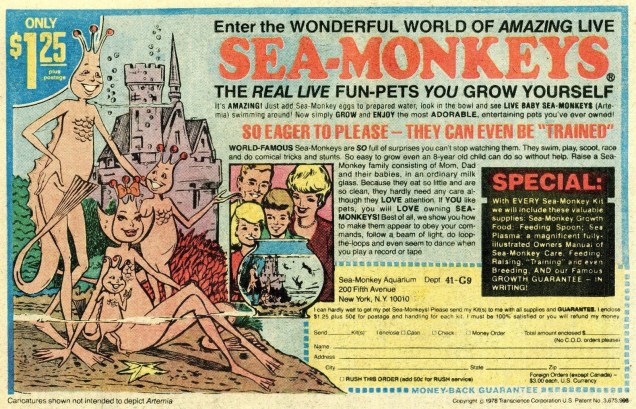
Incidentally, co-admin RG pointed out that the Sea Devils were basically turned into Sea-Monkeys – and minus the tail, he’s perfectly right!
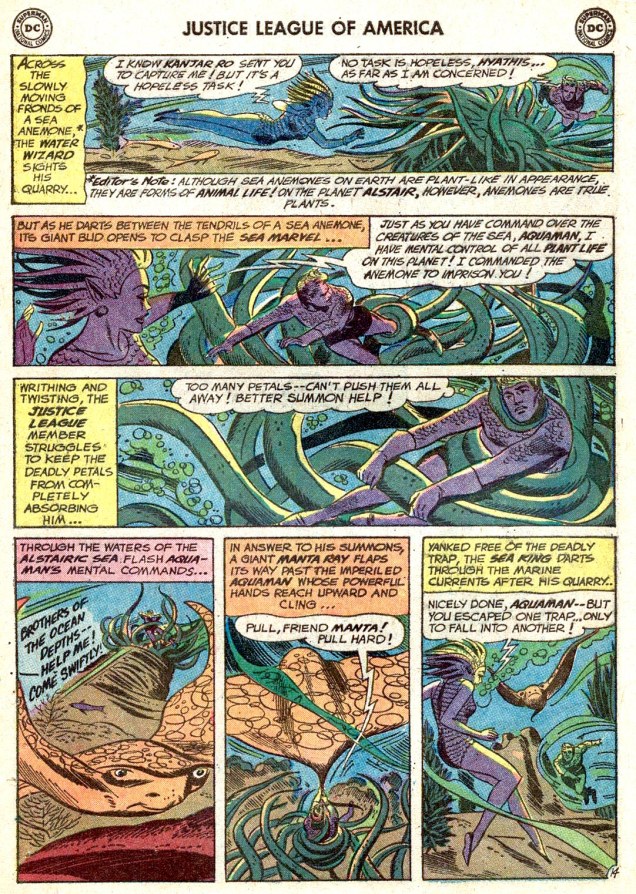
Many people are highly wary of seaweed – and this story proves them right. Remember, eat seaweed, but don’t let seaweed eat you!
Page from The Slave Ship of Space!, scripted by Gardner Fox, pencilled by Mike Sekowsky and inked by Bernard Sachs. This story was published in Justice League of America no. 3 (Feb-March 1961). I wonder why the author decided to make anemones into “true” plants, when he could have simply incorporated actual seaweed into this story.
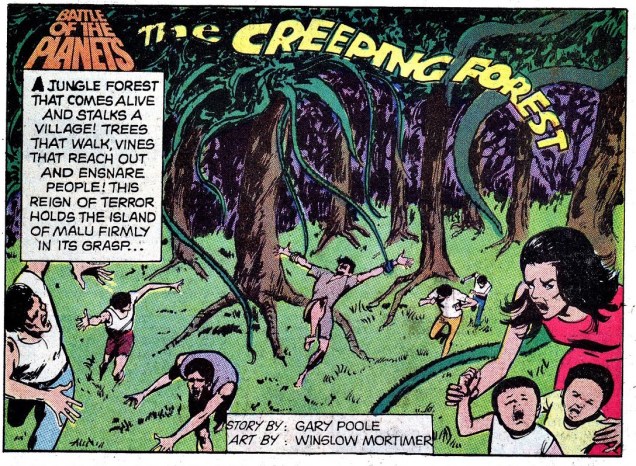
Back on land, and not even on a different planet, we have a story featuring hungry, hungry vines *and* the novel sport of “princess-tossing”:
Battle of the Planets no. 4 (December 1979), cover by Win Mortimer.
The Creeping Forest is scripted by Gary Poole and illustrated by Win Mortimer:
Of (relatively) recent vintage, a philosophical young man pondering the mysteries of life while held in the tender embrace of this, err, plant:
Fenrir no. 4 (Norvert Hethke Verlag, 1988).
Previous botanical Tentacle Tuesdays can be perused here.
« The observer, when he seems to himself to be observing a stone, is really, if physics is to be believed, observing the effects of the stone upon himself. » — Bertrand Russell
Irv Phillips‘ (1904-2000) Mr. Mum was a comic strip that ran between 1958 and 1974 (at which point both author and alter ego took their well-earned retirement), attaining a quite considerable level of popularity, thanks its appearance in over 180 newspapers in 22 countries or so. The pantomime approach certainly helped sell it abroad. The titular character is a bystander, an eternal witness to… everything and especially anything.
In an interview published in Cartoonist Profiles no. 4 (Fall, 1969; Jud Hurd, editor), we learn that Phillips « ... has been an actor, a violinist, a Hollywood script writer, the Humor Editor of ‘Esquire’ magazine, a playwright, as well as a very successful syndicated cartoonist. » He goes on to reveal that « I didn’t draw until I became Humor Editor of Esquire Magazine in my thirties. I used to make little rough sketches to try to illustrate gags that I had written for the various Esquire cartoonists. I would take these sketches in to Dave Smart, the founder and publisher of Esquire, and together we would make the choices as to which cartoonist would handle one idea best, which man would be best suited to another idea, etc. It seems that these little sketches sort of intrigued Dave for a while and finally he said, ‘Why don’t you try to draw?’ »
While Phillips’ style is deceptively rudimentary (but still distinctive), it’s evident that his years as a gag man taught him the fundamentals: economy, clarity and substance. Here are a few samples drawn from a variety of sources:
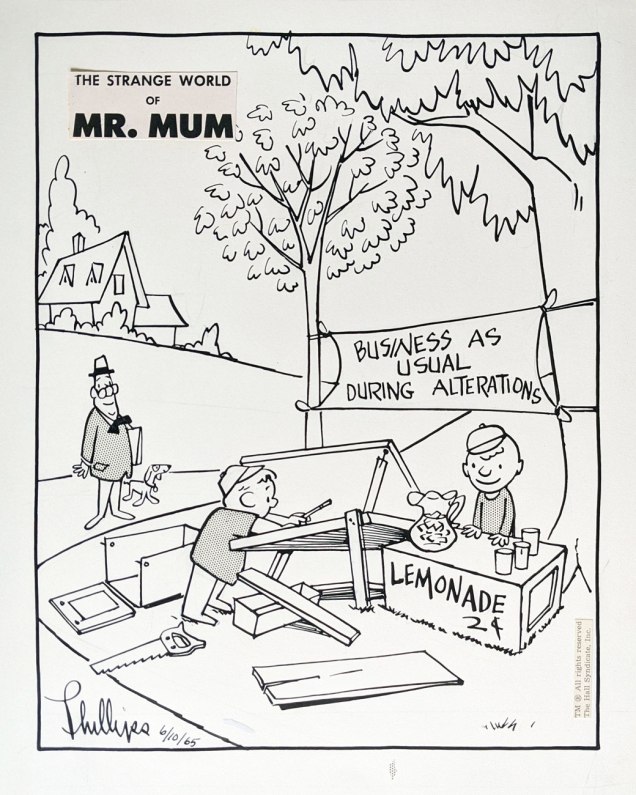
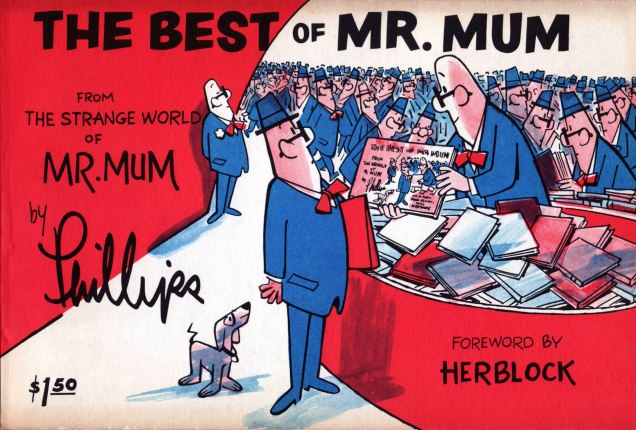
Sunday strip from March 2, 1969.I’ve often wondered myself just how certain stray shopping carts arrived at their unlikely destination.The Valentine’s Day Sunday of 1971, as it appeared in print. There’s always something to fret about, isn’t there?The lone Mr. Mum original piece in my collection, it’s the June 10, 1965 daily. It was a Thursday. The artwork is surprisingly large, at 22 x 28,5 cm (8,75″ x 11″). Note the little bit of halftone film stranded outside the frame.During the strip’s run, three collections appeared: this is the first, published in 1960 by Pocket Books.Issued in 1965 by G. P. Putnam’s Sons, this is the second and finest of the collections, its format comfortably allowing the presentation of dailies (two to a page) and Sunday strips. Hell to scan from, though.Finally, The Popular Library brought us the third collection, 1971’s No Comment by Mr. Mum. A slim, unprepossessing volume, it’s nonetheless filled to the brim with great picks.A sample of a card he has given people who have sent him ideas. Phillips said: « Most of the fan mail seems to come from intellectuals and children. When people send in ideas, I send them the card, write them a letter, and if I use the idea, I send them a signed original. »
The Mum aficionado will seek sustenance wherever he can find it, but it helps that in this century, a pair of easy-to-find, affordable print-on-demand collections have seen the light of day. They are Classic Mr. Mum Volume 1 (2010, iUniverse) and The Strange World of Mr. Mum (2011, Empty-Grave Publishing).
One unexpected hurdle that stands in the way of a Mr. Mum revival is that an overwhelming number of Phillips’ originals repose in one man’s private collection. Not to put too fine a point on it, painter Andrew Massullo, though evidently a man of discernment, is hogging all the Mr. Mum original art. In a profile that appears in the San Francisco Chronicle’s website, SFGate, he reveals the appeal and the breadth of his collection:
Mr. Mum Cartoon Collection by Irving Phillips How many: 1,385 –
« It’s like potato chips, you can’t just have one. » Why? The deadpan humor and the beautiful drawing.
« They remind me of my childhood. » From? From his estate and eBay. Any more? « No, I have all I want. »
Ah, that’s probably why I managed to snag one for myself. Let’s hope Andrew, if someone should make the request, will be open to the idea of a definitive Mr. Mum collection. I heartily concur with Mr. Massullo’s verdict on the addictive power of the strip. It vividly brings to mind the québécois adage « Le plaisir croît avec l’usage. » The deeper one delves into Mr. Mum’s oddly comforting universe, the more one appreciates the depth of his brilliance. For a start, scope out this fine selection of strips on Ger Apeldoorn’s ever-excellent blog The Fabulous Fifties. And while you’re at it, sneak a peek at my Christmas-themed ode to this loveable bystander.
« Challenge Merlin and be a fool! — Challenge a demon — and be destroyed! »
Suddenly having so much time on my hands (courtesy of COVID-19) is an eerie, though by no means unpleasant, experience. While I could crochet mini couches for my cats or enrol my partner’s help to re-create some favourite classic paintings, I prefer to catch up on books I’ve been meaning to read for a while. Case in point: in April, I’ve been joyously absorbing Jack Kirby’s Fourth World saga, reprinted in a handsome 4-tome omnibus (and to which I have easy access, thanks to co-admin RG’s vast library). That ended all too soon, and I moved on to a collection of Etrigan the Demon. It was a somewhat underwhelming experience, especially given the epic scope of Fourth World, but of course still worth a read.
The red-eyed, yellow-skinned creature called Etrigan came into existence in 1972. Mark Evanier, in his introduction to Jack Kirby’s The Demon, explains: « There was, at the time, a feeling around DC that perhaps superheroes were on the way out again. Ghost and mystery comics like House of Mystery and Phantom Stranger seemed to be selling, and some in the office felt the next trend was what Joe Orlando, who edited most of them, dubbed “weird adventure” comics. A few weeks later, [Carmine] Infantino asked Jack to whip up something in that category… »
Kirby accepted the challenge and, despite his lack of interest in horror, created The Demon, patterning his face on a a detail from Hal Foster‘s Prince Valiant strip as an inside joke.
As great a storyteller Kirby is, I think being asked to write about a subject he wasn’t particularly into had its repercussions. Although he clearly tried to give Etrigan a stimulating playground of supernatural rogues of varying degrees of viciousness to bat around, the overall result is rather underwhelming by Kirby standards. I’ve seen quite a few people in comic forums expressing their undying love for the Demon – if you’re one of them, I’m open to being convinced!
I actually first encountered Etrigan the Demon in a Swamp Thing issue written by Alan Moore. He first made an appearance in Swamp Thing no. 26 (July 1984) and then came back for the 14-issue storyline American Gothic that ran from June 1985 to July 1986. In Moore’s hands, Etrigan cut a dashing, mysterious figure, and he spoke in rhyme, which was a really nice touch. I admit I was disheartened to find out that he really wasn’t that exciting in his original form.
However, he *did* encounter tentacles, and more than once!
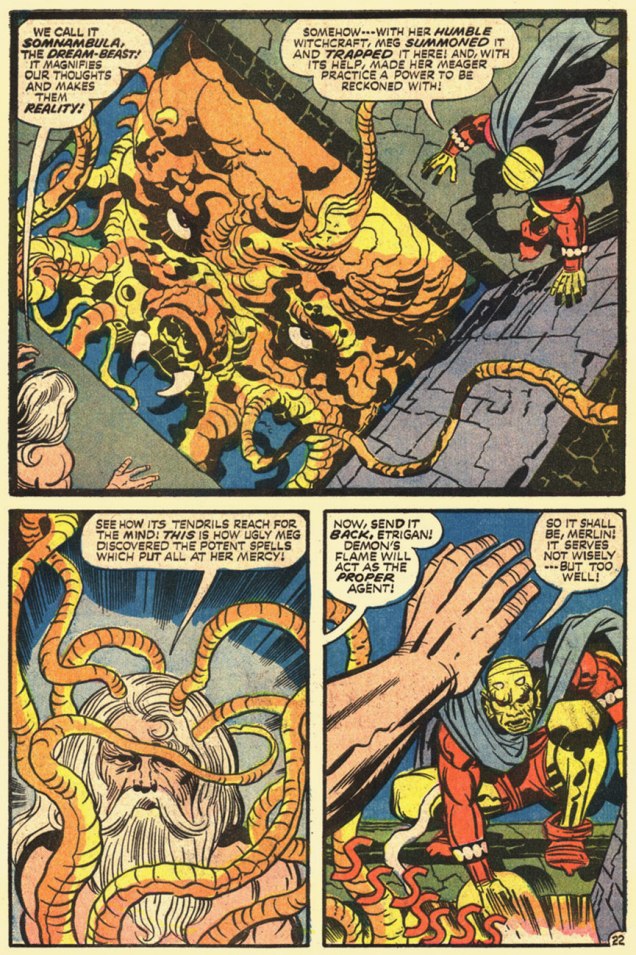
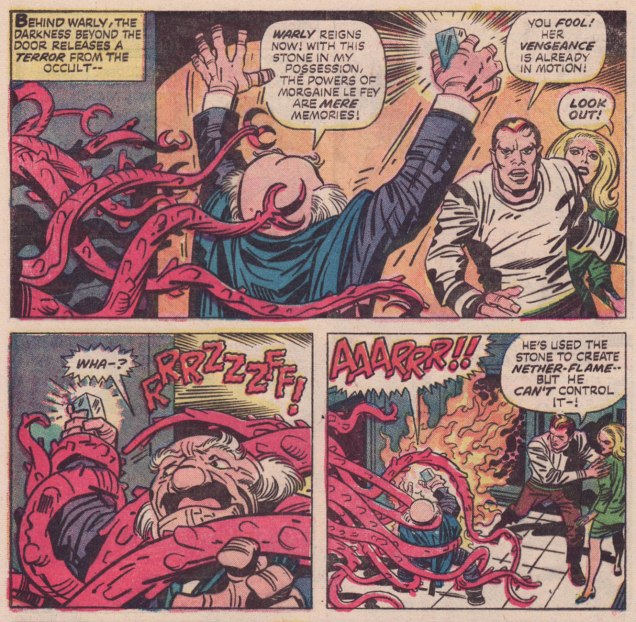
I was rather hoping the Somnambula would stick around, but it came and went in one page. Merlin’s Word… Demon’s Wrath! was published in The Demon no. 5, January 1973.The spoiled and malicious brat Klarion and his cat/pussycat-princess Teekl are my favourite characters of the series. The One Who Vanished!! was published in The Demon no. 15 (December 1973), the penultimate issue. This scene is reminiscent of a sequence from the 1961 movie Night Tide.In the following (and final) issue, tentacles reared their grabby suckers yet again. Immortal Enemy! was published in Demon no.16 (January 1974). One more complaint from me – Kirby’s use of the philosopher stone (which Warly is clutching on this page) as a sort of Deus ex machina, that can be used for accomplishing pretty much everything (some examples: it produces the ultimate cold or demon flame, shields the owner from thousand-volt electricity or brings people back form the dead, turns people into vultures or an Egyptian mummy or a chair into flowers, randomly makes objects levitate, etc.) This makes one wonder why Jason bothers running around at all, instead of elegantly waving the stone about and solving all problems instantly.
The three pages above are Etrigan’s encounters with actual tentacles, but we have an honorary mention of almost-tentacles-but-not-quite, which I wanted to include in the spirit of thoroughness.
Can the following creature’s beard tentacles be used to grab anything? We never learn if they’re prehensile or not, because the fear-monster doesn’t stick around long enough.
The Demon no. 3 (November 1972). This little baby is one of my favourite monsters of the series, despite just being part of Jason Blood/Etrigan’s nightmare – one can really felt its crushing weight. Besides, it’s probably a preview of the Kamara, a creature that becomes what the person fears most, and an awe-inspiring enemy.A panel from Reincarnators.
In case anyone is interested, I am currently re-reading Kamandi: the Last Boy on Earth, which was my first exposure to Kirby.
« Maybe one day I’ll feel her cold embrace and kiss her interface; ’til then, I’ll leave her alone. » — Jeff Lynne, Yours Truly, 2095
Without further tergiversation — here’s the thrilling conclusion of our tale!
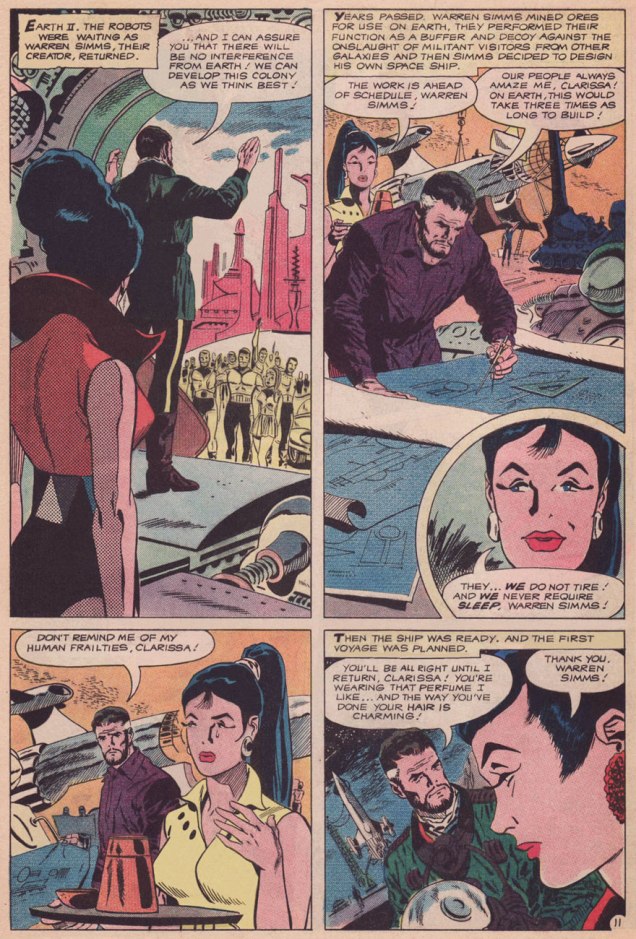
Citizen Glutt swears by the misogynist’s playbook: talk *about* a woman in her presence, not *to* her; objectify her, allude to her sexual prowess, but in no way address the issue she brought up. “How close to a human can you build them, Simms? Hmmm?” Looks like Glutt is ready to place his order.
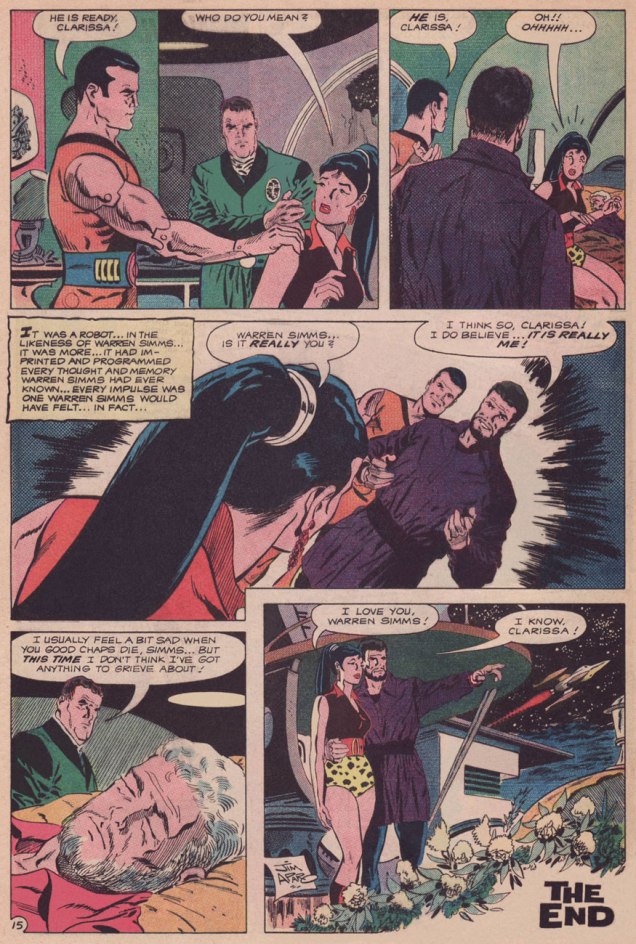
Note the reborn Simms’ moment of hesitation: he doesn’t quite know himself the answer to Clarissa’s query. And ‘I know, Clarissa!‘ is a perfectly fitting ending; it perhaps means that he can now sense things the way Clarissa always could. Congratulations, you two; you’ve earned your happiness.
In case anyone’s wondering, why do I treasure this particular tale?
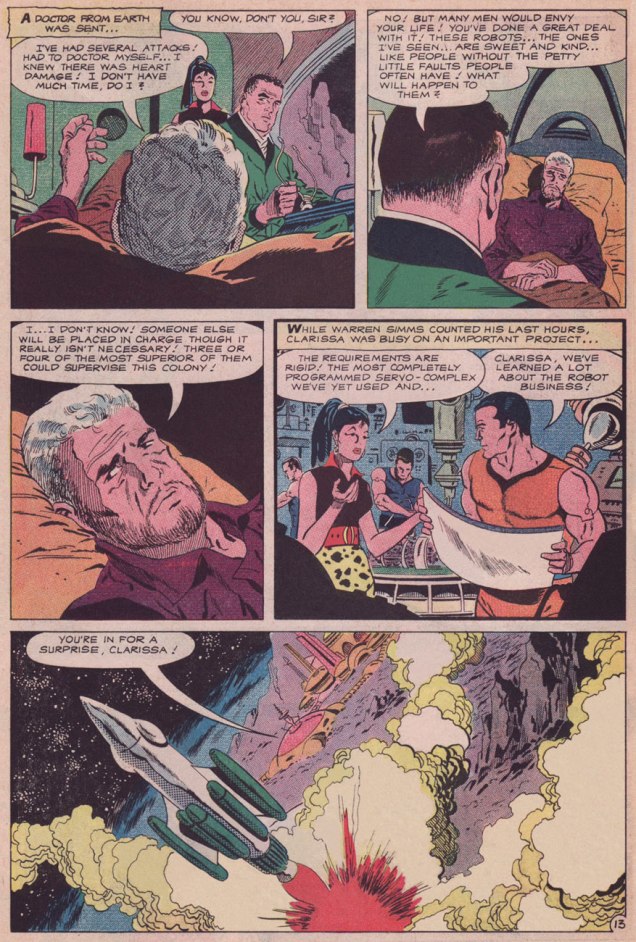
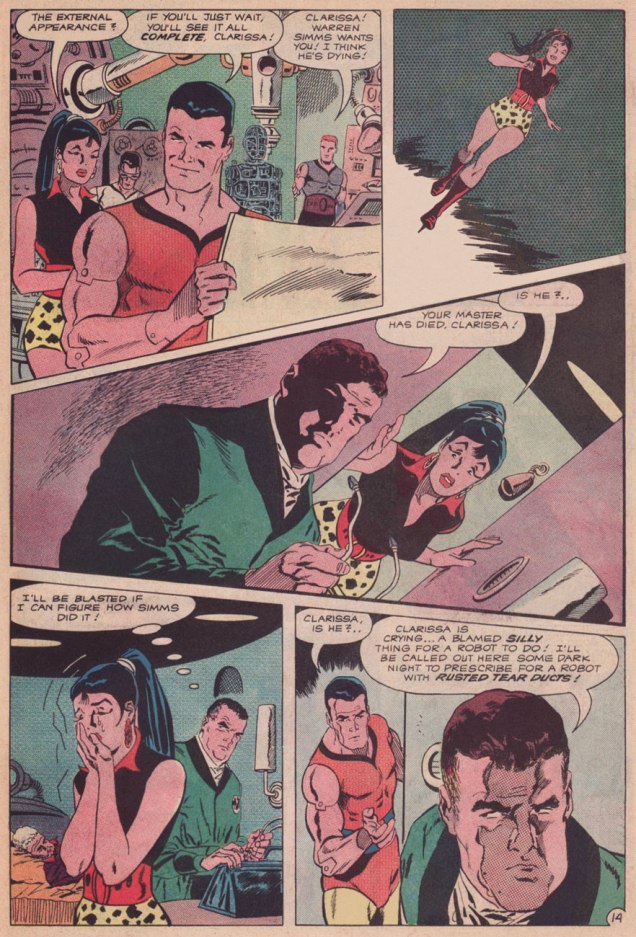
Let me count the ways and means: the cosmic adventures are treated as asides, ceding centre stage to Warren Simms’ and Clarissa’s slow-simmering pas de deux. Whatever surprise comes at the dénouement had been carefully and honestly foreshadowed and backgrounded, respecting the reader’s intelligence. Unsavoury implications of the robot/human relationship are brought up, then coyly cast aside, in a ‘we know, but we’re not going there‘ move.
For me, it’s mostly about Joe Gill’s sober, understated writing, though I can hardly envision anyone turning in more lushly complementary visuals than did Mr. Aparo. I’d be over the moon to say that The Imitation People was one bead on a long string of commensurate efforts, but nope, it’s just about a one-off. It was only preceded by Denny O’Neil and Pat Boyette‘s classic Children of Doom (read it here).
Thoughtful science-fiction* in American comics as always been poorly served: with meagre exceptions, it’s been a numbing, near-constant diet of space opera.
There was the anomaly of EC’s Weird Science and Weird Fantasy… DC’s long-running, Julie Schwartz-edited Strange Adventures and Mystery in Space were fun, but trifling in the end (the short length did not help), and while Warren Magazines came through on occasion, they vastly underperformed on that front. Western Publishing’s Starstream tackled some classic adaptations, but the results were a bit staid. Grandmasters Jack Kirby and Will Eisner, of course, could handily pull off the feat: the former’s OMAC was a wonder of anticipation (with an honourable mention to his 2001: A Space Odyssey), and the latter’s tense serial Life on Another Planet (also collected as Signal From Space) kept its focus on the human drama.

































 Who's Out There?