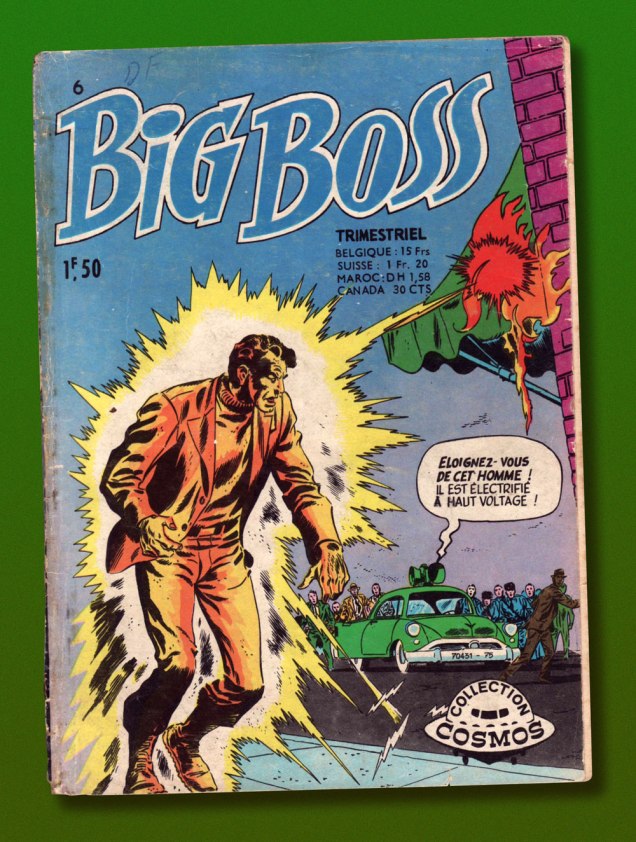
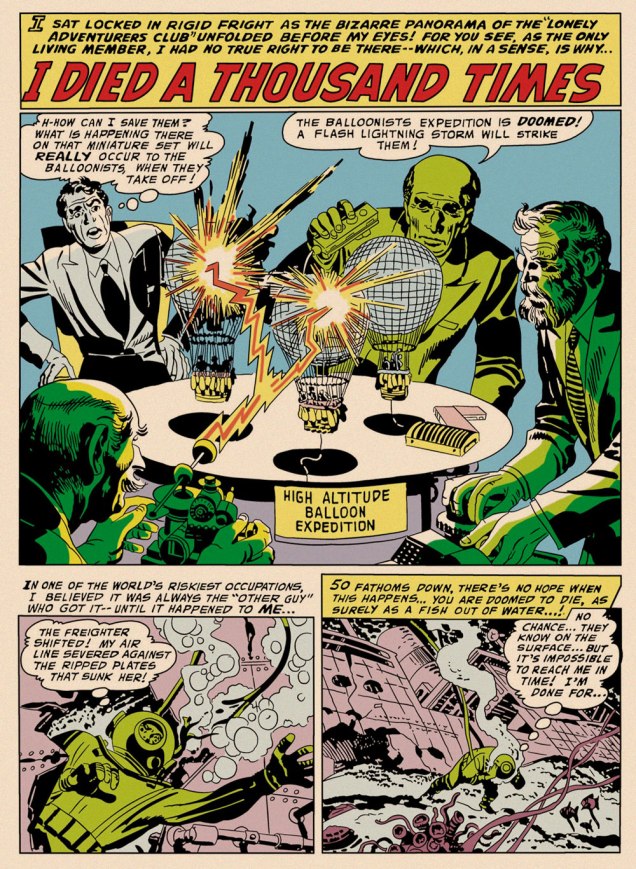
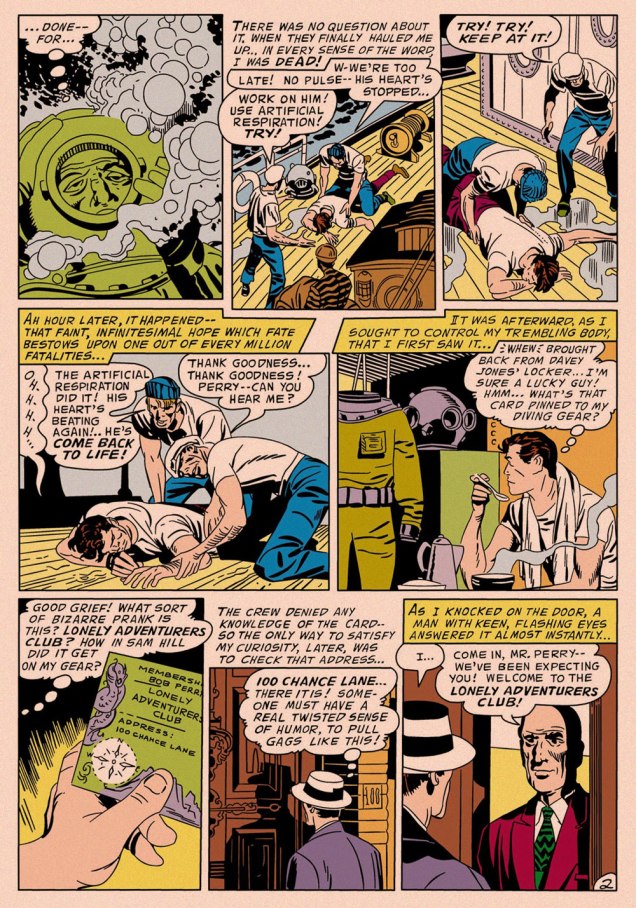
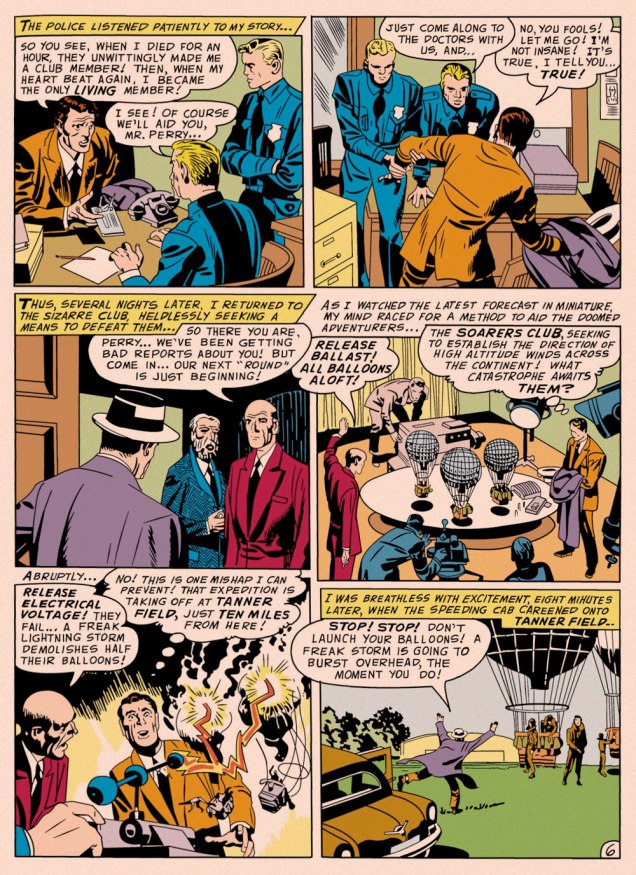
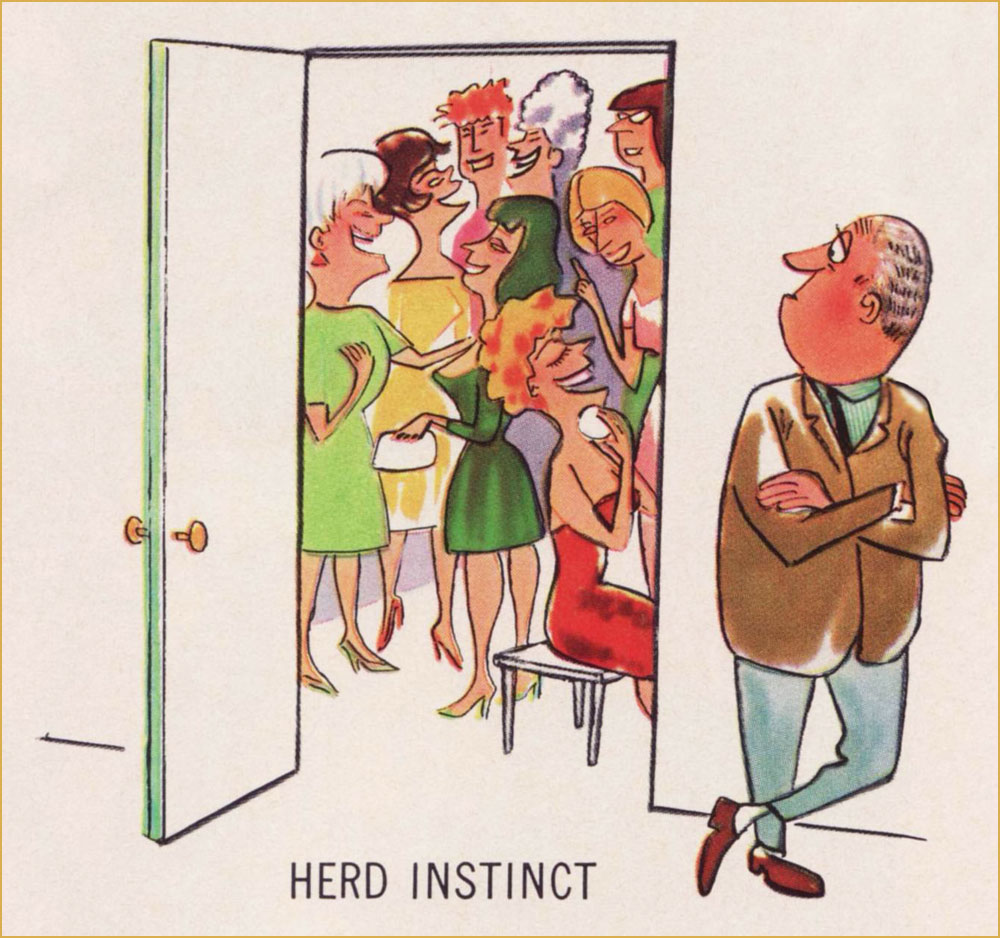
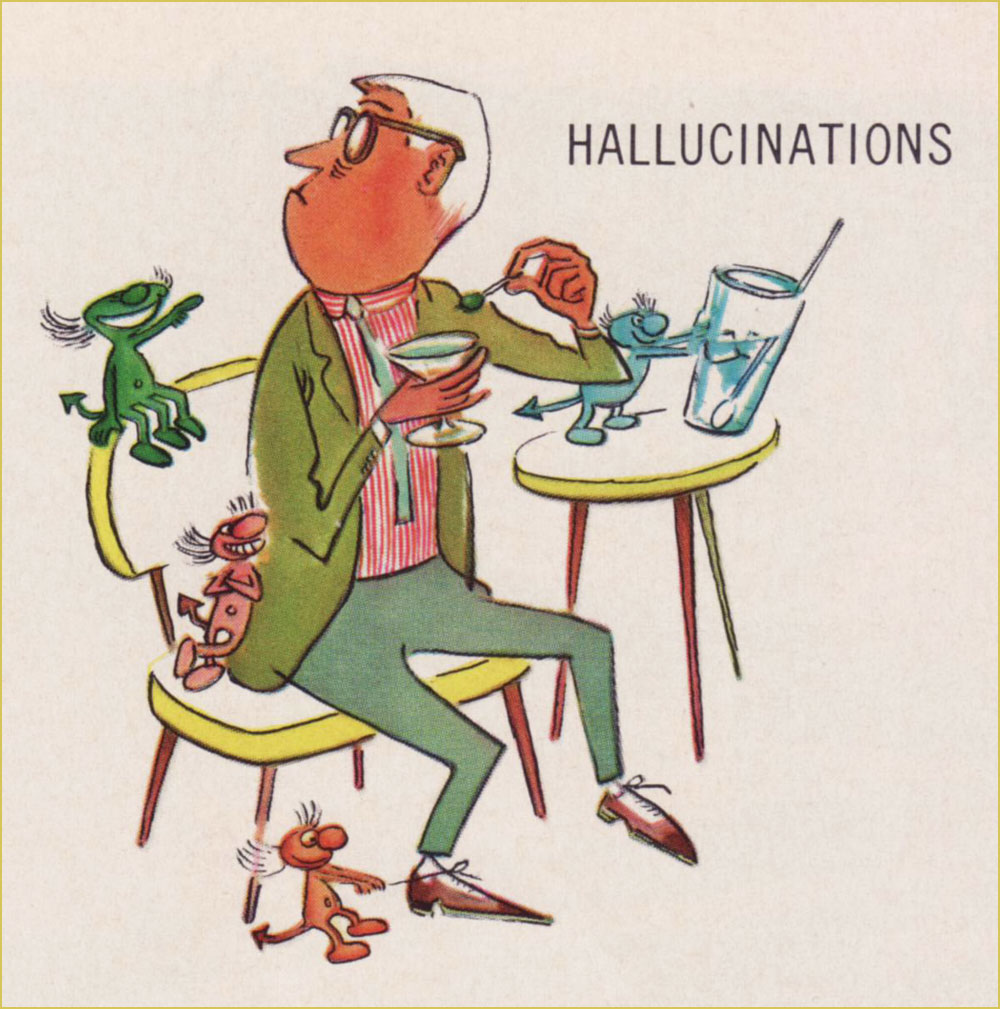
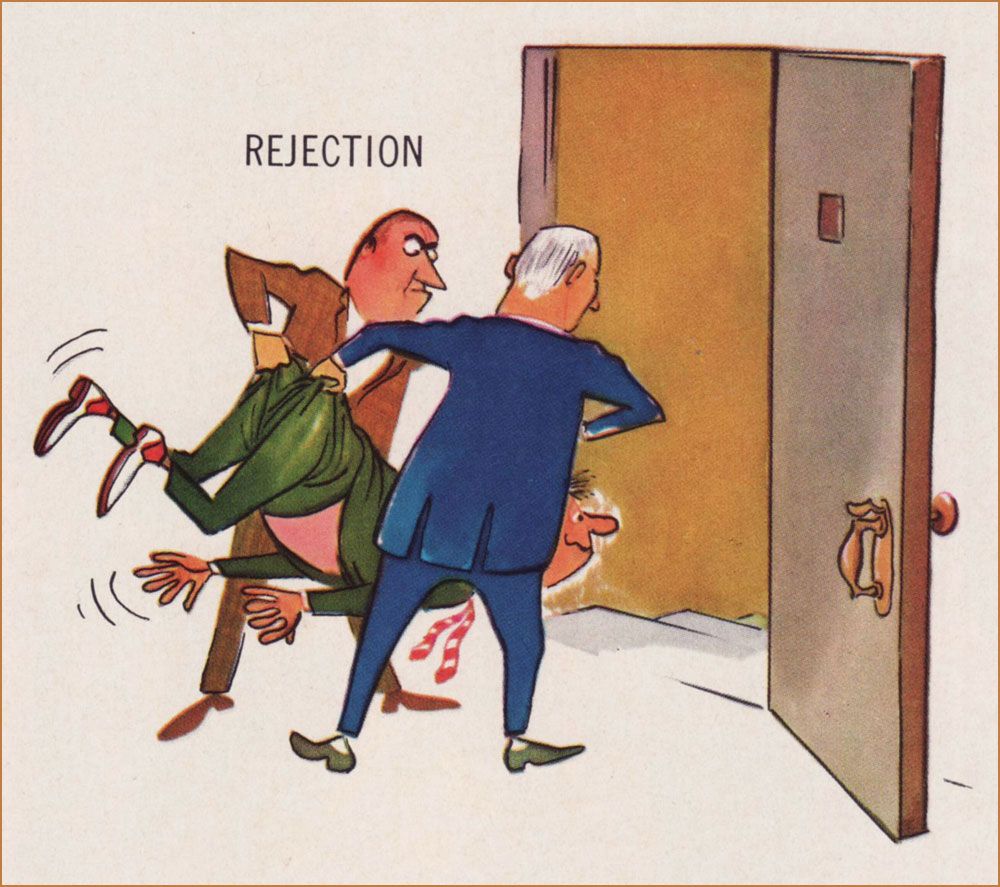
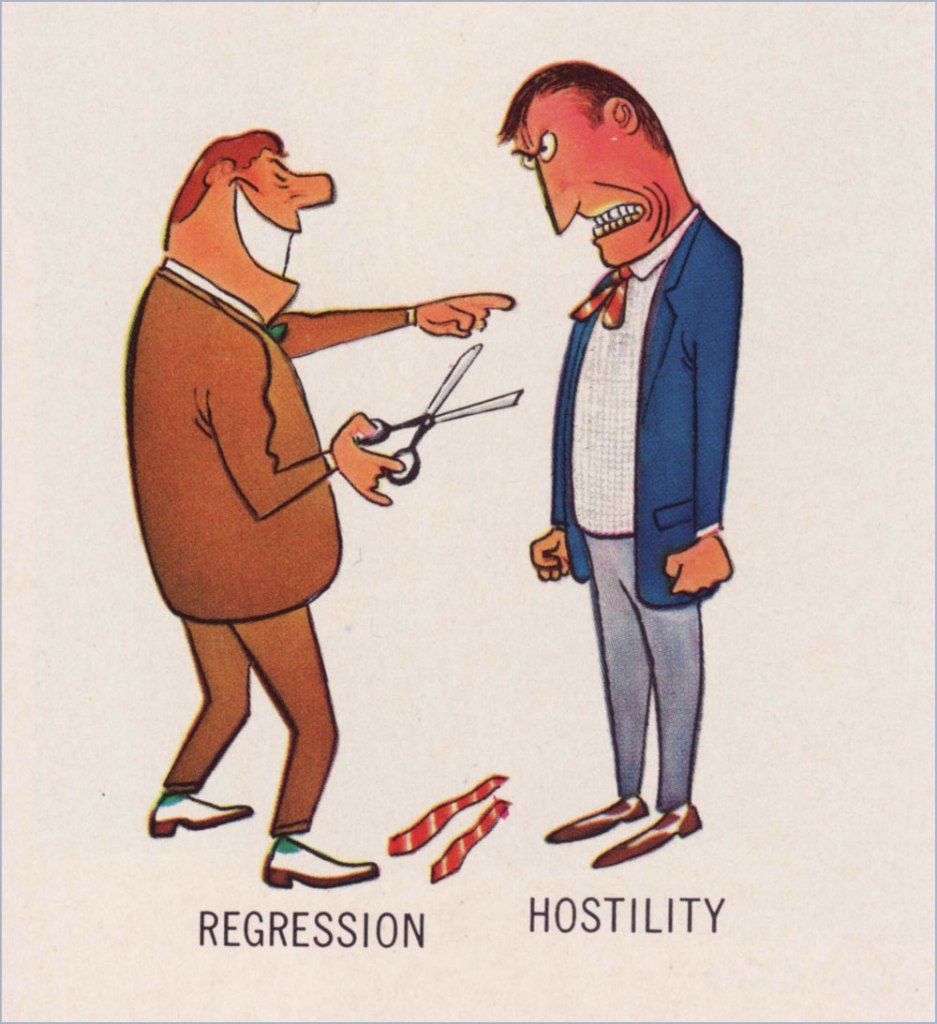
« If Freud had worn a kilt in the prescribed Highland manner he might have had a very different attitude to genitals. » — Woodrow Wilson
Let’s talk about your drinking.
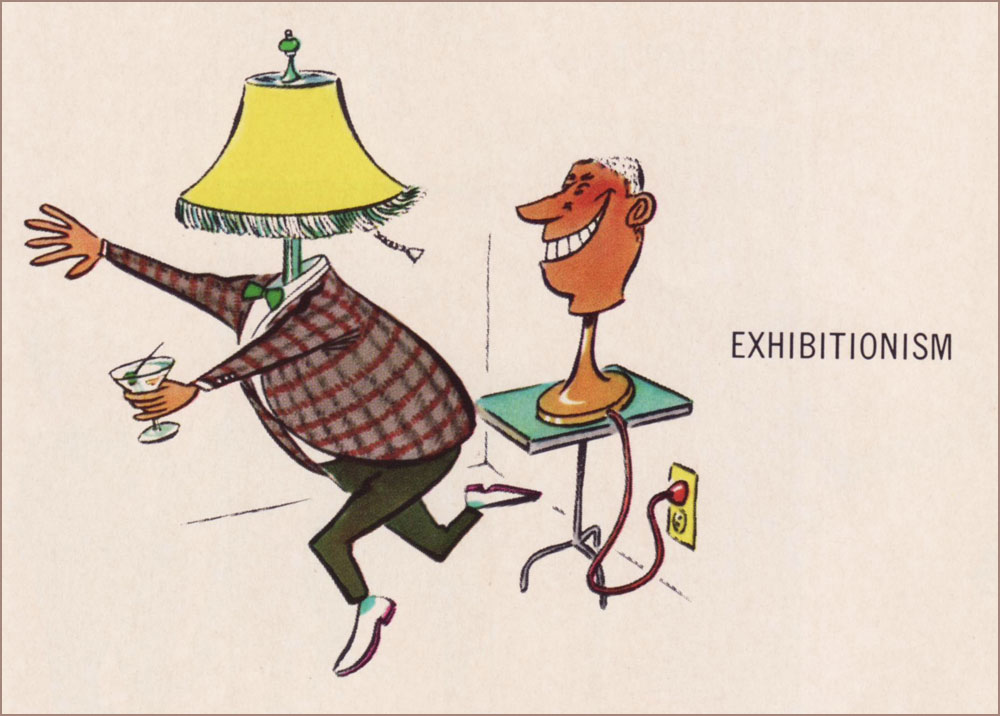
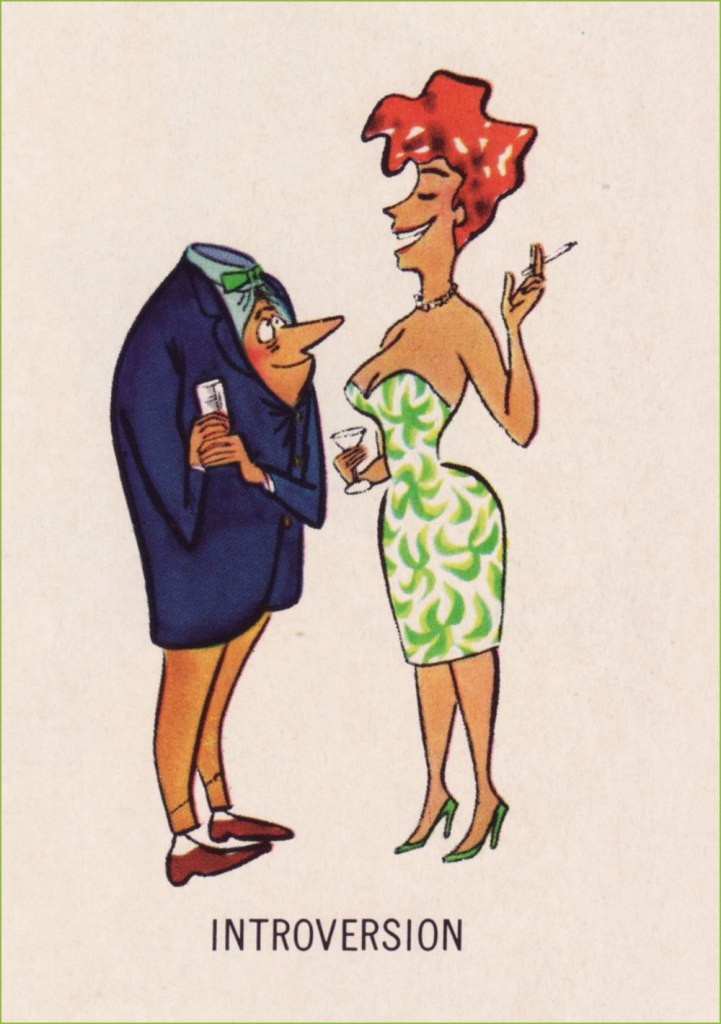
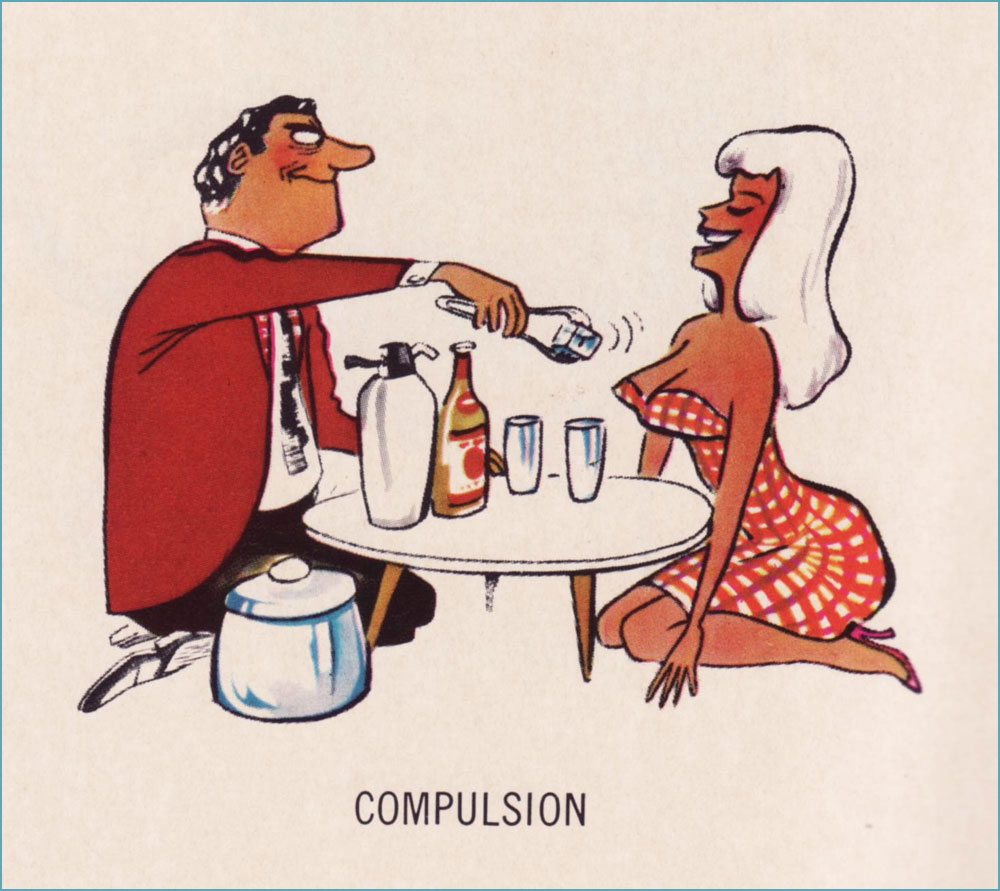
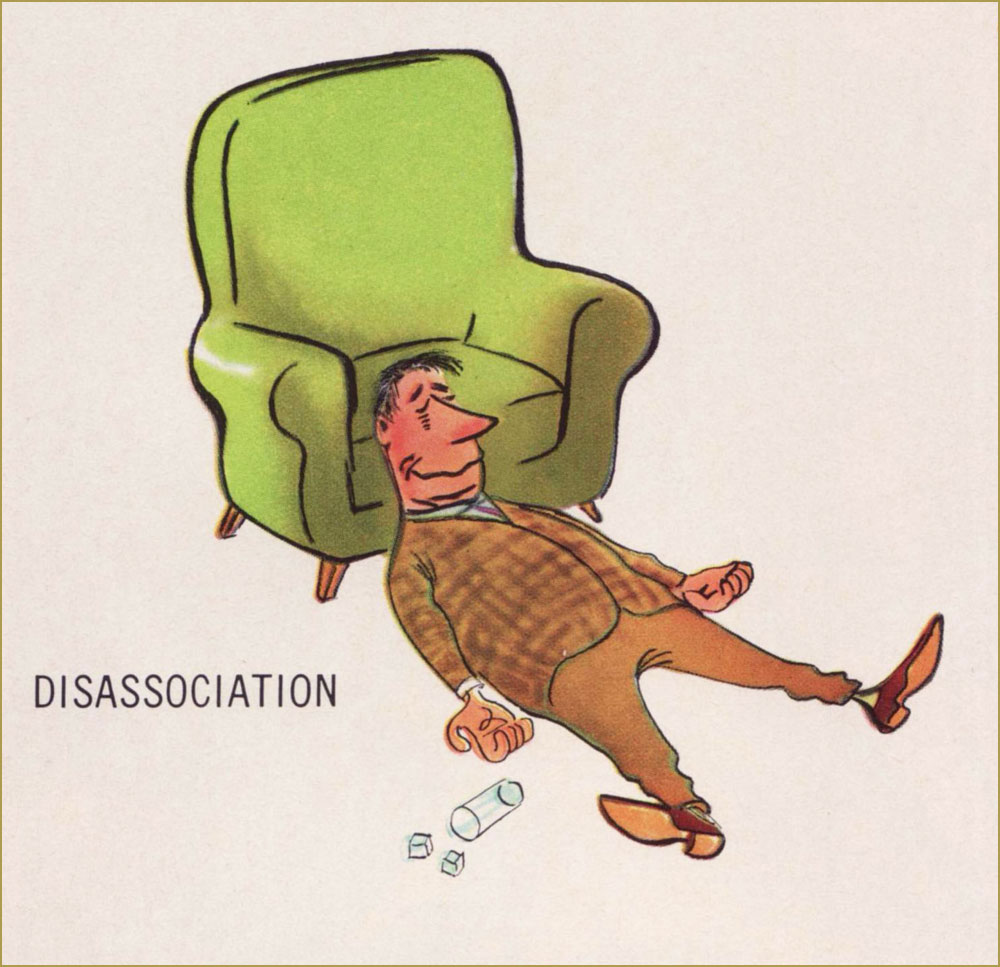
Aw, just kidding: that’s your business and none of mine. There’s certainly no shortage of reasons — or might these be excuses? — for it nowadays. Speaking of which, here’s the recipe for the Freudian Slip Cocktail, which is presumably what ol’ Sigmund is shown energetically mixing up below. Cul sec, friends!
Virgil Partch‘s « Sigmund Freud’s Cocktail Party » originally appeared in Playboy Magazine’s August, 1962 issue.
« Save time and cut fingers with a parsley mincer. »
It seems that oodles of my posts start with ‘I found this book randomly in a second-hand bookstore…’, when ‘retrieved from the bottom of a dusty chest in a forgotten attic’ would make for a much more enthralling story. Alas, I am bound to truth… as is Can It Be True? (originally published in 1953 by MacDonald and Co; I have the 3rd edition from 1954), which was priced one measly buck despite its generally excellent condition and venerable age.
It consists of a collection of misprinted and typo’d quotes drawn from newspaper clippings, magazine articles and other paraphernalia, expertly gathered and compiled into a thin volume by Denys Parsons. This by itself makes for an amusing read, but the cherry on the cake is the occasional illustrations by blog favourite Anton (see Anton’s Spivs and Scoundrels, Baronesses and Beezers, if you’re not sure whom this nom de plume conceals).
As seen from a panel inside the book, the man is holding a poster that reads’ SHRDLUS AT IT AGIAN – Evning Srta’
« ... Spread around her was a sun-flooded valley where buttercups nodded lazily in the summer breeze and tranquil cows chewed solemnly at her elbow. » – Western Family Magazine
« Para. 27B. Men employed on quasi-clerical nature should not be provided with any clothing. » – Post Office Magazine
« The best plan is to hold the bottle firmly and remove the cook as gently as possible. » – Woman’s Paper
« The flames starting on the third floor of the midwest Salvage Co. spread so rapidly that the first firemen on the scene were driven back to safety and leaped across three streets to ignite other buildings. » – Cincinnati Times Star
« The word lawyer, he argued, was a general term, and was not confined to solicitors, but anybody who practised any breach of law. » – Cambridge Paper
« Mr. and Mrs. Benny Croset announce the birth of a little son which arrived on the 5.15 last Thursday. » – West Union (Oregon) People’s Defender
Denys Parsons, ‘the undisputed king of the misprint’, has a few more books I’m interested in, including another volume of It Must Be True (this one illustrated by Ronald Searle), as well as Many a True Word (another Anton volume!) and All Too True (with drawings by Peter Kneebone). Perhaps another time, another p̶l̶a̶c̶e̶ used bookstore…
« A dead body revenges not injuries. » — William Blake
« Do you end every Hallowe’en Countdown with Steve Ditko? », ds reasonably asked me last month. Well, no, I replied, but it generally plays out that way since, by my reckoning, nothing embodies the spirit of this finest of holidays quite like a sepulchral Joe Gill – Steve Ditko yarn.
My heartfelt thanks to all our guests — visitors, readers and contributors — who made this breakneck endeavour possible… in particular ds, who shouldered a significant part of the load and came through with flying, but appropriately sombre, colours.
Take it away, Messrs Gill, Ditko and Dedd!
Yes, it’s your basic ‘greedy relative’ plot, but perfectly executed. And the late Mr. Strick would surely concur about the ‘perfectly executed’ part. And since the cover gives away a bit too much, here it is, after the story. This is Ghostly Tales no. 103 (Apr. 1973, Charlton). Cover by Steve Ditko, naturally.
And we have one more countdown concluded against soul-searing odds. Now, if you’re craving more, you insatiable ghouls, feel free — could we stop you even if we tried? — to slobber amidst our back pages, at this point numbering two hundred and forty-eight posts :
« New mysteries. New day. Fresh doughnuts. » — David Lynch
Welcome to the bewitching burg of Blinsh, Pinksylvania, where vampires peacefully coexist with ‘normal-type Blinshites’, though the latter do exhibit a touch of grumpiness when suddenly bitten by their fanged neighbours. Put on your cape (surely you own a cape?) and follow us to this land of boiled turnip and sauerkraut doughnuts… but I would recommend not going on an empty stomach.
The pages of Vampires of Blinsh (Sept. 2020, Abrams Books for Young Readers) are positively overflowing with jolly vampires, promenading chickens, sneaky racoons, people tripping over bikes, floating basketball players, children munching doughnuts, janitors in eyepatches, and so on. In short, a typical Daniel Pinkwater creation, and I say this with the utmost delight.
This book was illustrated by Aaron Renier, whom I already knew from his young readers series The Unsinkable Walker Bean. The latter definitely has its heart in the right place, but failed to fully capture my interest, though I can confirm the art was great, so I was happy to see Renier’s drawing talent matched up with a story I could really sink my fangs* into. Not that Vampires of Blinsh has a story, per se – which seems to have baffled a few readers, some of whom, judging by their reviews, found it confusing and indecipherable. VoB is more of a quick dip into the non sequitur, somewhat absurd, always charming world of Pinksylvania, as readers are taken on a quick tour of Blinsh, its twin sister city Blorsh, as well as the capital of Pinksylvania, Farshningle. Many potential storylines are hinted at, but none are lingered upon, as Pinkwater effortlessly flings ideas (of which he clearly has an abundance) around and pirouettes on to the next vignette.
Hallowe’en in Blinsh!« But there is no place like home, which is to say there is no place like Blinsh. »
It actually turns out that this book was in no way the result of a straightforward collaboration between artist and writer. Co-admin RG got the story from the horse’s mouth (the horse, naturally, being DP), and here I quote Pinkwater’s anecdote**:
« The book had a completely different text. It was one of those cumulative counting stories. […] The book was written before Covid, the illustrator did his thing, with no input from me at all. And when it was ready for publication, the editor, the illustrator and I all realized it would seem we were making sport of something that looked like going to be a worldwide catastrophe…making sport or trying to capitalize on an event that would cause millions of deaths. People would break our windows. So we decided to kill the book. For all I know the bound copies, (which may have already been on the boat), were dumped into the sea. I own two sets of proofs. I asked my colleagues if I could try to come up with a new text, not a single drawing to be changed. They let me do it. It was printed with my new words, and that’s the book you have. The three of us promised each other we would never tell the story I’ve just told you– (I am not to be trusted). Now I wish we had let the original version be published. We could have sent a copy to Donald Trump. If someone read it to him, he might have understood the nature of a pandemic, and lives could have been saved. »
Were Blinsh and Blorsh even part of the original tale? Who knows. Let’s chalk it all up to serendipity and wander off to procure Kat Hats (Sept. 2022, Abrams Books for Young Readers), another Renier-Pinkwater collaboration .
~ ds
* I used to have pointy canines, until my orthodontist decided to file them down without asking for my opinion first – and this is by no means a unique experience, as is evidenced from any discussion on social media about the delights of orthodontistry. Some of those ‘professionals’ are true ghouls.
** Pinkwater’s Anecdote is less known than, say, Occam’s Razor, Chekhov’s Gun or Russell’s Teapot, but maybe we can squeeze it into the pantheon of eponymous principles anyway, something like ‘entertaining stories can be found wherever Pinkwater goes‘.
« There’s a saying among prospectors: ‘Go out looking for one thing, and that’s all you’ll ever find.‘ » — Robert J. Flaherty
Here’s a rarely-seen Stephen R. Bissette gem, The Prospector’s Luckiest Strike! I wasn’t aware of its existence until recently, when I chanced to purchase an issue of Scholastic’s Bananas devoted entirely to comics. It turned out to hold a pair of Bissette aces, the other being A Toast to Mr. Dalyrimple!. I wondered why these dark lovelies had been left out of Eclipse’s 1985-86 Fearbook and Bedlam, collections of Scholastic material. Were they too recent?
As it turned out, these remaining tales were soon gathered in a one-shot anthology entitled Deadtime Stories (Nov. 1987) published by the short-lived New Comics Group (1987-1989).
Note the discreet, elegant use of photo backgrounds here and there.
I turned to the artist for his recollections, which he most generously provided:
« Scholastic Magazines was one of the luckiest strikes I ever had in my early freelance career, that’s for sure! Between the generous page rates (best I’d earned from any publisher at that time, better even than Heavy Metal), the very kind people I was fortunate enough to be working with—editors Bob and Jane Stine (Bob was later better known as R.L. Stine, author of the Goosebumps empire), art director Bob Feldgus, writers like Suzanne Lord, and everyone at Scholastic at that time—and the frequency of steady freelance assignments from them, I couldn’t have hallucinated a better, more rewarding work relationship or environment in my wildest dreams.
“The Prospector’s Luckiest Strike” was late in the game for me, among the Suzanne Lord scripts I was assigned, and I gave it my all for a variety of reasons. First of all, it was exciting to be invited to contribute not one but two stories to the “all comics” issue, and even more exciting because of my friend Howard Cruse doing the cover and a one-pager, closer-still friends Tom Yeates, John Totleben, and Rick Veitch also contributing top-notch work, and Alyse Newman, Bob Taylor, and John Holmstrom (hey, I was a fan of Punk Magazine) also in the lineup. It was an unusual venture and sounded like a great issue, and Bob, Jane, and Bob F. were so enthusiastic about doing it — well, that was contagious.
The issue in question, with its rollicking Howard Cruse cover.
The deadlines were tight, and I’m not entirely happy with my second story in the issue (Rick Veitch still mocks my splash page for “Mr. Dalyrimple,” justifiably so), but “Prospector’s Luckiest Strike” turned out to be one of my best jobs for Bob, Jane, and Bob.
It was, sadly, also among the last. Bananas #54 came out in 1982, if memory serves, and I was amid a really screwy project with Marvel at the time (the never-completed, never-published Titan Science Project), and one year later I was both a new father (our firstborn, Maia, born at home April 1983) and working on my first collaborative Saga of the Swamp Thing issues, major life changes, to say the least. »
A huge thank you to Mr. Bissette for his generosity and insight!
He has three books available from Conundrum Press: Other Stories and the Horse You Rode in On (2013), Don’t Get Eaten by Anything (2015), and To Know You’re Alive (2020). McFadzean was a co-editor/co-founder of the comics and art anthology Irene, and distributes his own short stories in his ongoing minicomic series, Last Mountain. He currently lives in Regina, Saskatchewan with his wife and two sons. »
My chance encounter with Mr. McFadzean’s work came through the above-named 2015 collection, and while a daily webcomic is by design uneven, this one scales impressive heights far more often than the law of averages would predict. I’ll say this for him, he’s mighty skilled in conjuring up and expressing existential angst… adroitly melding the waggish and the distressing.
All strips excerpted from Don’t Get Eaten by Anything: a Collection of “The Dailies” 2011-2013 (Conundrum Press, 2015).
Today’s offering features plenty of colour… which in my humble opinion does not detract in the slightest from a sombre, autumnal atmosphere with chills as palpable as thick mist. While you would not be amiss in deciding that this art comes from a European hand, it’s not a French one, despite the language most of the following pages are in.
Josep Maria Beà i Font, usually shortened to and credited as José Beá, is a Spanish comics artist — born in 1942 — who’s happily still with us. Fans of Warren-published comics may recognize his distinctive style, as he wrote *and* illustrated quite a few (around thirty) stories published in Vampirella, Creepy and Eerie, starting with The Silver Thief and the Pharoah’s Daughter published in Vampirella no. 13 (Sept. 1971). It seems that he is another of those love-’em-or-hate-’em artists, as while doing some research for this post, I stumbled upon more than one instance of opinions such as ‘my least favourite Warren artist‘ or ‘passable art‘. This is fortunately balanced out by those who seek out Beà’s stories, going as far as delving into Spanish comics while not being able to speak the language.
A panel from the terrifically gruesome story Head Shop, illustrated by Beá and written by Don Glut and published in Eerie no. 39 (April 1972)
Beá’s collaboration with Spanish publishing house Buru Lan Ediciones starting in 1970 marked his return to comics after a 8-year break taken to focus on his painting. Specifically, it’s within the pages of its anthology Dráculathat Beá started first scripting his own stories. These became available to an anglophone audience when The New English Library reprinted a number of its issues under the name Dracula(now there’s an easy translation).
The cover of a Dracula Annual from 1973, published by The New English Library. I found this image on the lovely When Churchyards Yawn blog, go pay their post a visit! The illustration is by Esteban Maroto, a frequent face at Warren in the 1970s.
« New English Library issued 12 English-language versions of the publication, which was originally produced by Buru Lan in Spain. The New English Library publication ended after 12 issues, although it continued for many issues afterwards in Spain. Only the first 6 issues were included in the Dracula book produced by Warren, but one can probably track down the remaining 6 English language issues if they try hard enough. »
The following pages are taken from a French-reprint collection title Les nuits de l’épouvante, published by Dargaud in 1973 (I stumbled upon it years ago in a used bookshop, and instantly took to the art despite having no idea who Beá was). The dates I provide for their publication in English are from The New English Library’s Dracula, not the Spanish Drácula.
The following two pages are taken from Le serpent (written by Beà and Sadko*, illustrated by Beà), or The Snake, originally published in Dracula no. 3 (Oct. 1972):
La momie (written by Maroto, illustrated by Beà), or The Mummy, published in Dracula no. 4 (Nov. 1972) features some more memorable strangling scenes:
Finally, I would be remiss not to include some pages from Beà’s Sir Leo series, originally created for Drácula. Handsome Sir Leo is an English aristocrat who, in typical fashion, has walked away from his birthright… and walked into the arms of the supernatural, many dangerous adventures ensuing. The following two pages are from Sir Leo – le chat (written by Luis Vigil, illustrated by Beà), or The Cat, originally published in Dracula no. 8 (Dec. 1972). Read it here.
« Sooner or later we all sit down to the banquet of consequences. » — Robert W. Frank, paraphrasing Robert Louis Stevenson
Today, we ask: who was Peter Randa? I’m asking because I read one of his books at random — actually, the comics adaptation, and was deeply impressed with its quality. Randa, né André Duquesne (1911-1979) in Marcinelle, Belgium, wrote some 300 hundred novels in various genres over a mind bogglingly productive quarter-century under a myriad of pseudonyms, namely Jean-Jacques Alain, Urbain Farrel, Herbert Ghilen, Jules Hardouin, Jim Hendrix (!), Henri Lern, André Ollivier, H.T. Perkins, F.M. Roucayrol, Diego Suarez, Jehan Van Rhyn and Percy Williams. There may be others. He dealt in the genres of science-fiction, horror, espionage, crime, and erotica (with over fifty novels written in the early 1970s).
Two more covers (respectively 1955 and 1973) painted by the also miraculously prolific French illustrator Michel Gourdon. Here’s a segment from a French TV show touching upon the scope of his career, on the occasion of the auctioning of his vast trove of original art. Hope it all found good homes.
Well, here’s the basic plot, taken from the current e-book edition (which I’m grateful exists at all, as even outstanding work often languishes in utter obscurity or downright oblivion): « Archie Leggatt is a madman, a real one. He believes himself the Devil, had kidnapped three young women and terrorised a fourth. A run-of-the-mill serial killer? Perhaps… but when such an un assassin boasts supernatural powers and leaves more than the scent of brimstone behind, physicians and investigators begin to wonder and ask themselves questions with terrifying implications. Can one truly hope to put Satan behind bars? »
Illustrator unknown, wouldn’t you know it? Given his skill, style and stamina, I’m guessing he’s Spanish, but beyond that, I’m drawing a blank. Still, kudos to this anonymous artistic practitioner.I know, I know: it’s Warren’s Uncle Creepy with a pencil moustache. Jeannine agrees to the Faustian deal Leggatt proposes.A handsome doctor thinks he can save the woman he loves. Randa sets up the usual scenario, all the better to kick the reader’s legs out from under him. Le banquet des ténèbres — the bédé adaptation — saw print in Eclipso no. 30 (June 1973, Arédit). Amusingly, mycomicshop.com’s archivist describes Eclipso as ‘French publication reprinting comics from various Marvel properties.’ Well, not exactly. The title should clue you in: the anthology started out reprinting DC series such as Eclipso, Deadman, Mark Merlin, Challengers of the Unknown, Hawkman, Doom Patrol… while also dipping into Tower’s T.H.U.N.D.E.R. Agents, for instance. Marvel got stirred into the mix in the early 1970s, then came a period of French novel adaptations, then back to US comics, mostly from Marvel. The ride ended in 1983.
What fascinated me about Le banquet is its steady ambiguity between possible mental aberration, hypnotic suggestion, and the outright supernatural. This precarious balance — and slow-burning tension — is maintained right to the end, which is no mean feat. Is Leggatt just a regular madman, a consummate mesmerist, or a temporary, occasional shell for Old Nick? I’m reminded of a similar exploit accomplished by Arturo Pérez-Reverte in his 1993 novel El Club Dumas (The Club Dumas), wherein one didn’t know for certain whether there was anything actually uncanny going on… until the conclusion. Sadly, Roman Polanski fumbled his cinematic adaptation (as The Ninth Gate), starting with the absurd casting of Johnny Depp as the presumably intelligent book detective protagonist. When Polanski’s wife starts flying, the jig is up, I’m afraid.
« But Mireault was, here as ever, a little too raw, a little too honest, a little too vulnerable for what comics might expect. » — Zach Rabiroff
This is as sombre as I’m willing to go. Hallowe’en, to me, is more about a seasonal mood and a welcoming sort of darkness… than serial killers and other aspects of people’s inhumanity to one another. And yet…
This is a testament to the late Bernie Mireault’s compositional virtuosity and mastery of the syntax of comics… but it’s also evidence of how deeply he could look into the abyss.
It’s obviously not a joyous read, but Zach Rabiroff’s Remembering Bernie Mireault: 1961-2024, recently posted on The Comics Journal’s website, is an exemplary tribute to a great overlooked talent.
Last month — and some twenty-five posts ago — I wrote about Bernie, showcasing a pair of stories poles apart from today’s offering… but they’re all Bernie’s. He was that solid a stylist.
Left Alone: The Rustin Park Killings, written by Jennifer Van Meter and illustrated by Mireault, appeared in The Blair Witch Project no. 1 (Oni Press, July 1999).
You see, there were these two competing comics publishers…
… which is to say DC Thomson and the dystopian-monikered International Publishing Corporation (IPC); between them, they dominated the UK comics market. By the late 1970s, said market had surpassed circulation of ten million copies, its rosiest sales outlook ever.
To be perfectly cynical, the rival publishers’ editorial vision was mostly to copy one another’s successes. Same mouldy old dough.
In 1977, « Freelance writer Pat Mills had an idea for a girls’ horror comic* that would use his 2000 AD approach — longer stories, bigger visuals, with adaptations of stories from big name writers… Misty was about to be born. »
This, of course, is the Stan Lee version of an ‘idea’, for what IPC was commissioning, and Mills was providing, was a copy of DC Thomson’s existing Spellbound. However, since Mills was asking for a piece of the pie, he was sacked before the new magazine’s launch, and replaced with a perhaps more pliable sancho.
In terms of timing, Spellbound happened to cease publication (after 69 issues) just a few weeks before its clone’s launch. For its part, Misty lasted 101 issues before being folded** into the more reliably successful Tammy; a common practice in England for underperforming magazines that still have a following. After all, Spellbound, upon its own cancellation, had been whisked into Debbie.
This is Misty No. 22 (July 1st 1978, IPC). This one I can credit: Jordi Badía Romero (1958-1984).This is Misty No. 28 (Aug. 12 1978, IPC).This is Misty No. 34 (Sept. 23 1978, IPC).This is Misty No. 64 (Apr. 28 1979, IPC).This is Misty No. 94 (Nov. 24 1979, IPC).
And here’s a short story.
Dr. Julia Round recalls, in her foreword to Misty: 45 Years of Fear (2023, Rebellion): « Misty is perhaps best remembered for its one-shot stories, which were vicious cautionary tales in which characters would be brutally punished for a mistake or misdeed. There was a strong sense of dramatic irony in these stories — wishes backfire, magical items that are gained dishonestly turn on the owner, and unkindness to animals or nature sees girls transformed into bugs or plants. » This particular example is gentler, obviously.
Blood Orange was published in Misty Annual 1979. No credits whatsoever, thank you very much.
-RG
*It’s worth noting — with a shudder — that UK comics were both stringently gender *and* genre specific.
** « Most titles were folded when they got down to about 200,000 sales. They said is was not viable, but can you imagine now, having a circulation of 200,000? » — Wilf Prigmore