Hallowe’en Countdown V, Day 18

« La matière en était gélatineuse et peu consistante; elle se décomposa, au bout de quelques heures, en un liquide rose et gluant, d’une odeur insupportable.* » — Jean Ray, Dans les marais du Fenn

Aw, good old muck monsters…

Perhaps the first to emerge, at least in the English language, was Theodore Sturgeon’s “It”, published in Unknown’s August, 1940 issue, whose title page warned: “IT wasn’t vicious, IT was simply curious — and very horribly deadly!

But IT was preceded, by some years, by Raymond Marie de Kremer alias Jean Ray’s superb Dans les marais du Fenn (« In the Fenn Marshes »), first published in the Belgian literary magazine L’ami du livre’s issue of November 1st, 1923! A handful of Ray stories (often published under his alternate nom de plume, “John Flanders”) were published in US pulps, including the legendary Weird Tales, but “Dans les marais…” appears to have somehow, to this day, remained untranslated to English.

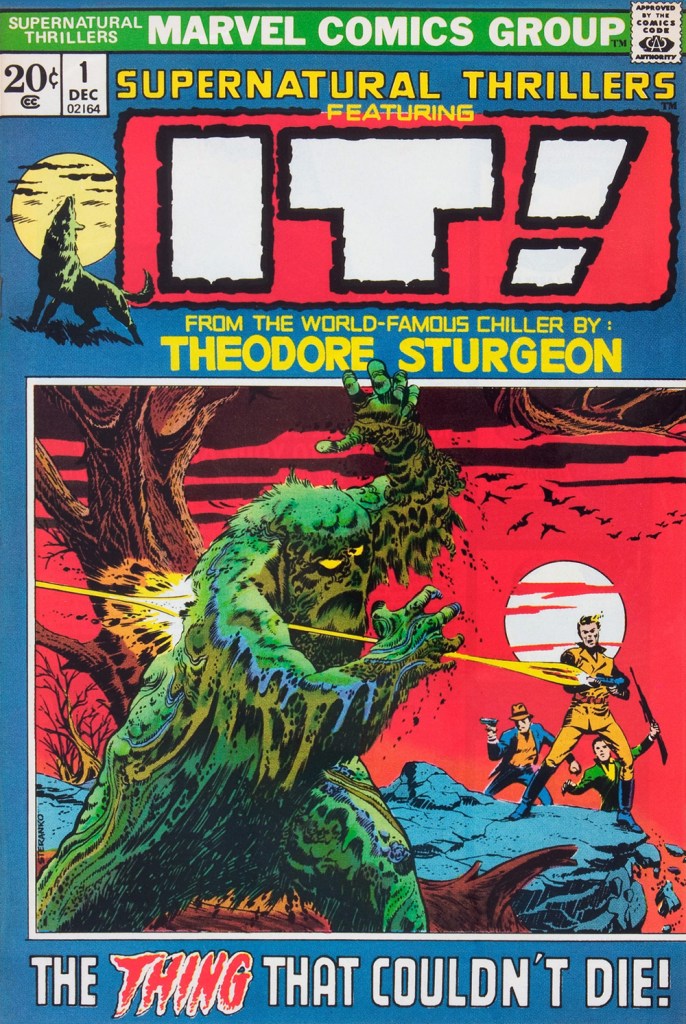
This is Supernatural Thrillers no. 1 (December, 1972, Marvel), an adaptation by Roy Thomas, Marie Severin and Frank Giacoia. Cover by Jimmy “Profa” Steranko.

The opening — and best — page from Marvel’s IT adaptation, which fails, imho, because Rascally Roy, overly attached to the original text, doesn’t let the visuals breathe. The mediocre results, at once too pedantically faithful and well off the mark, are no substitute for Sturgeon’s original.
IT originally saw print in this issue of Street & Smith’s Unknown, which had, just one month earlier, abandoned its striking painted covers for this money-saving but comparatively stodgy, ‘dignified’, Reader’s Digest-style design. It looks like there’s a page missing — the best one!
And they were soon at it again. How did they manage to convince themselves that this was going to succeed as an adaptation? This is Worlds Unknown no. 6 (Apr. 1974, Marvel). Pencils by Gil Kane and inks by Ernie Chan, with extensive alterations by John “Heavy Hand” Romita. This has been bestowed the impressive (if true) honour of being called The Lyingest Cover in Marvel Comics History.

-RG

Its matter was gelatinous and insubstantial; it decomposed, within a few hours, into a viscous pink liquid of unbearable odour. »

Hallowe’en Countdown V, Day 17

« Dreams surround our desires with ugliness and dread. » — Mason Cooley

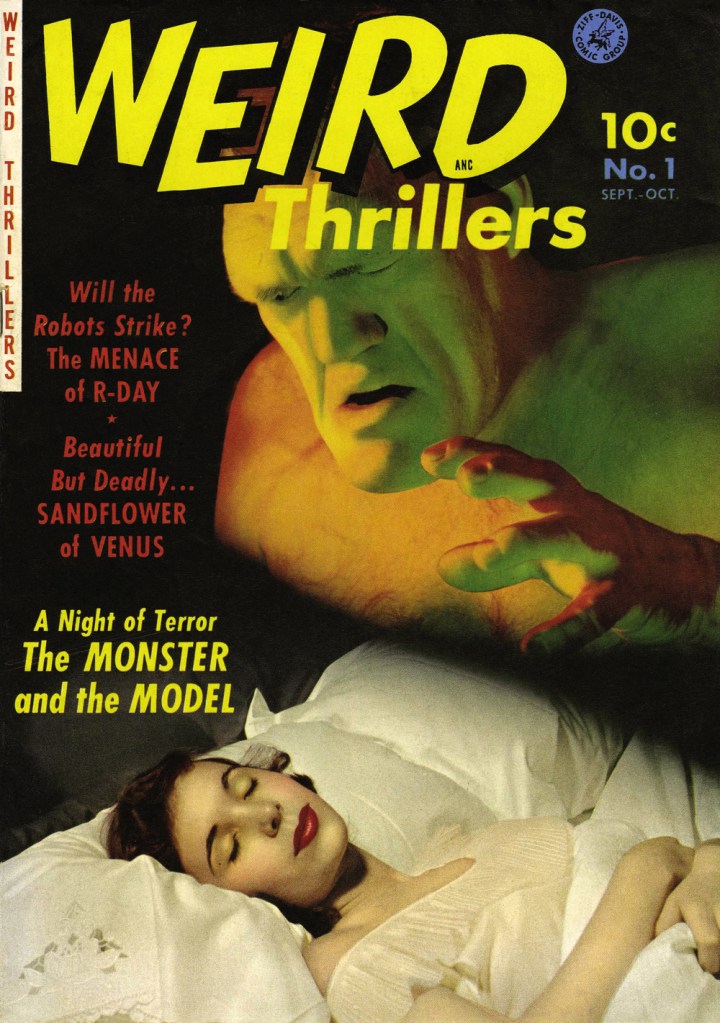
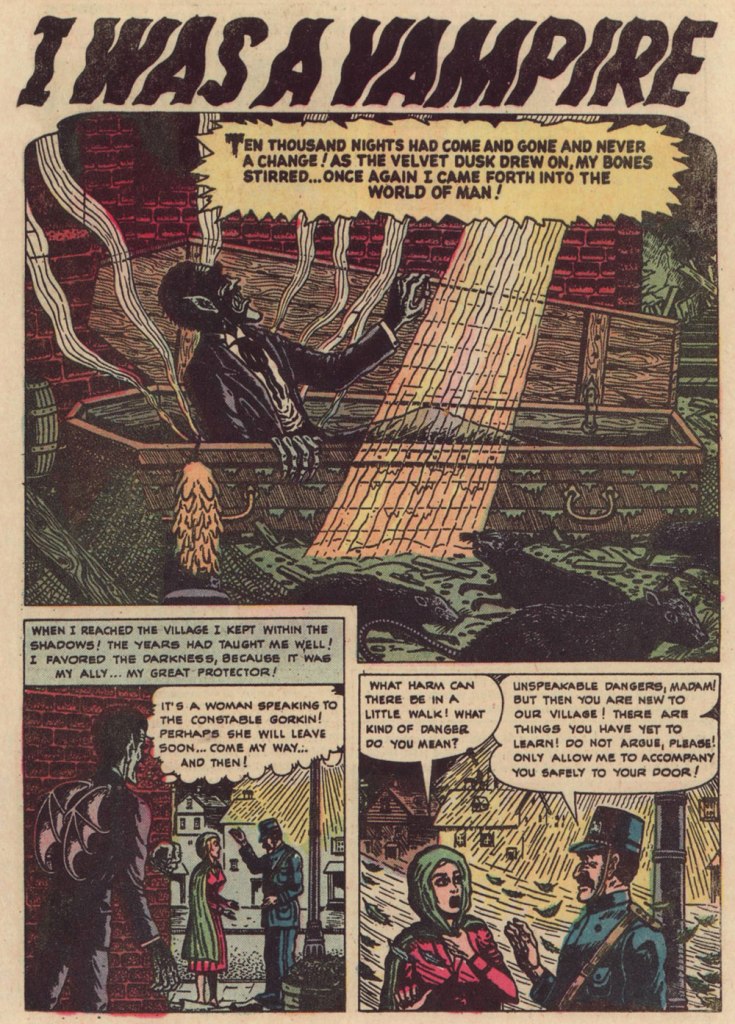
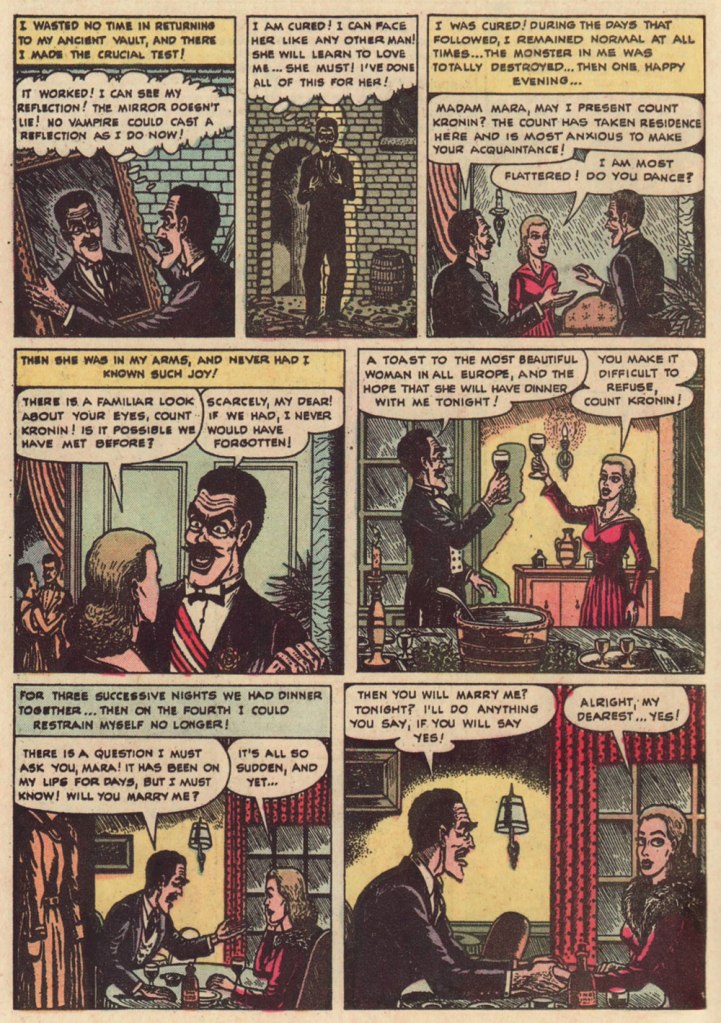
As everyone knows, the early fifties were a more innocent and wholesome era, when the average bobbysoxer would swoon away the nights with fantasies of dishy teen idol Rondo Hatton. I mean, just look at her blissful expression!

This is Weird Thrillers no. 1 (Sept. 1951, Ziff-Davis). Disappointingly, given the cover’s promise, the issue comprises mostly science-fiction and crime stories.

Surprisingly, the cover scene does, for once, occur within!

The opening pages from our cover tale, The Monster and the Model, pencilled by future Rip Kirby artist John Prentice. The entire issue is available for your perusal, legally and gratis, right here!
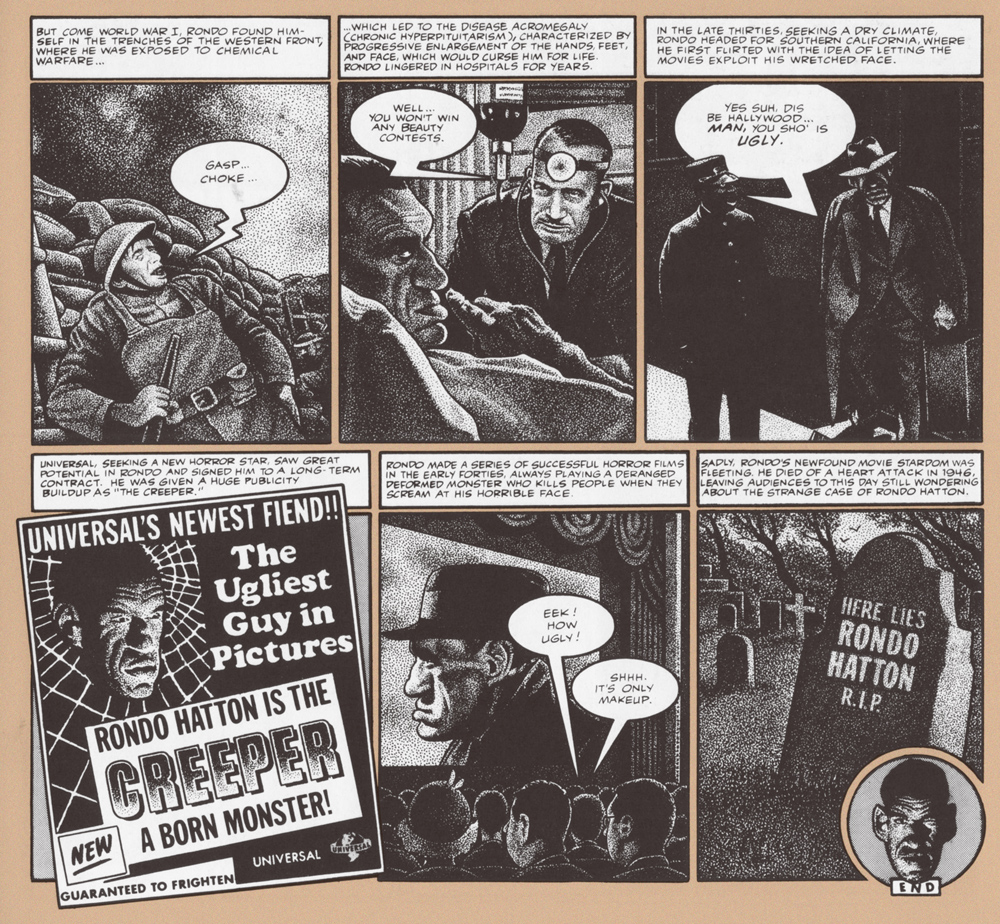
“So, who is this Rondo guy?”, you may ask. Before Mr. Hatton became a household name, got an award named after him and was the subject of his own book-length biography (Beauty Within the Brute), cartoonist Drew Friedman, ahead of the curve as usual, was endeavouring to preserve from oblivion the unfortunate man’s memory… in his own sardonic way.

One more for the road?

Originally published in Raw no. 8 (Sept. 1986, Raw Books). You may have heard of some other folks tragically afflicted with acromegaly.

-RG

Hallowe’en Countdown V, Day 16

« The whole planet reeks of mysticism without revelation. » — Dan Simmons

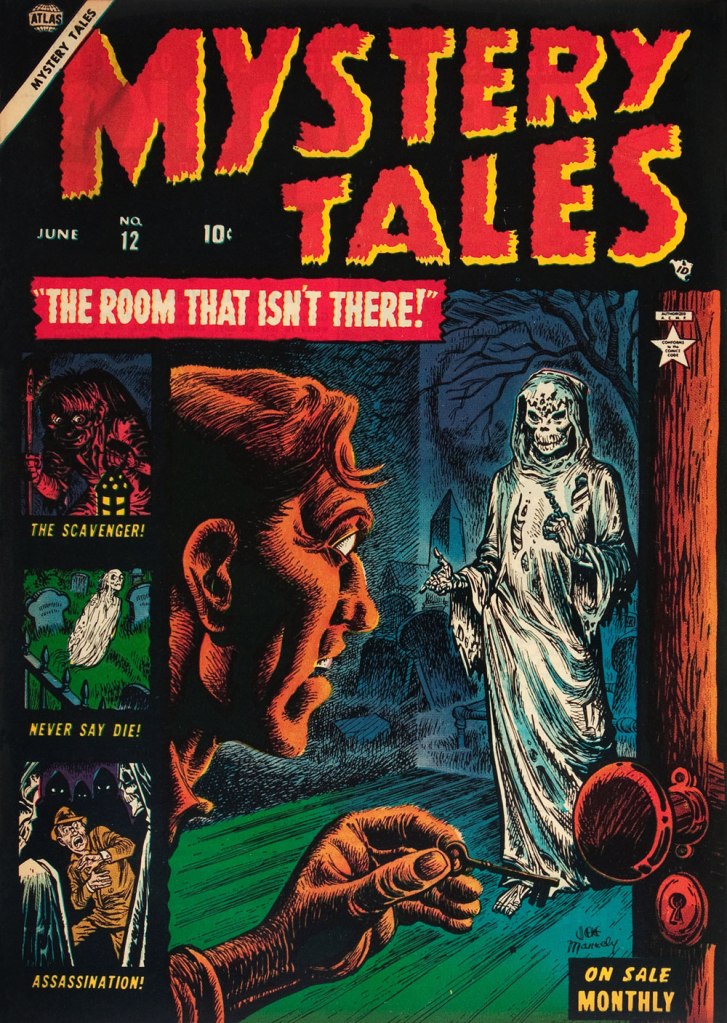
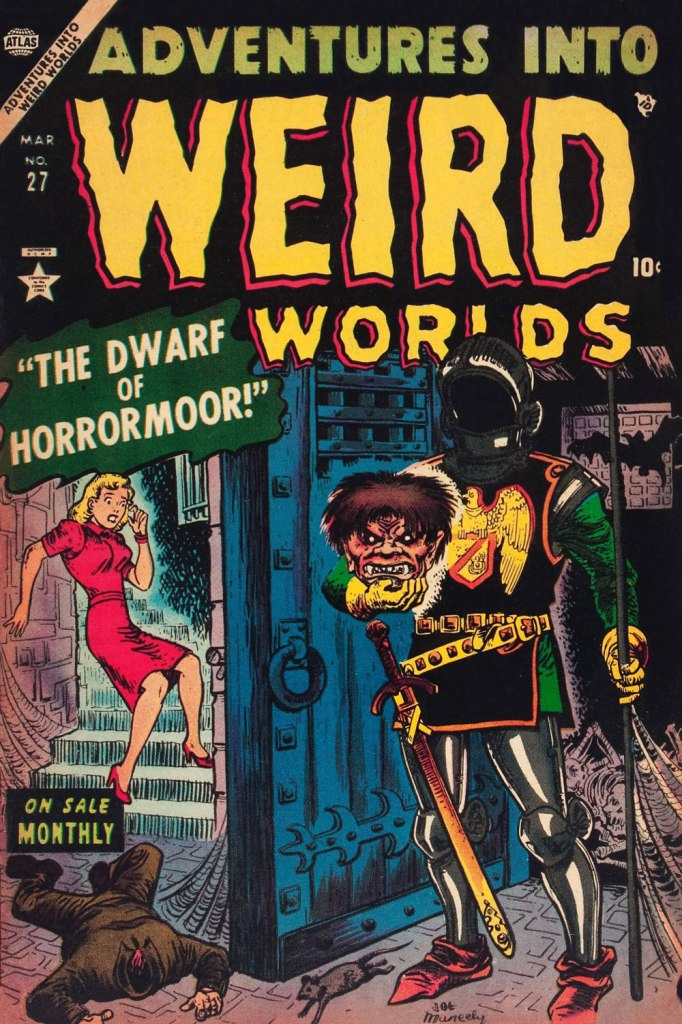
Last May, when I showcased Joe Maneely‘s Atlas cover art (see Joe Maneely, Atlas of Versatility), I intentionally left out his pieces for the horror titles, knowing them worthy of some attention of their own, an ideal topic for the Hallowe’en countdown. Besides, it took some pressure out of the selection process if I could save one whole genre for a rainy day — and today’s most certainly that day!

This is Mystic no. 7 (Mar. 1952, Atlas); colours by Stan Goldberg.
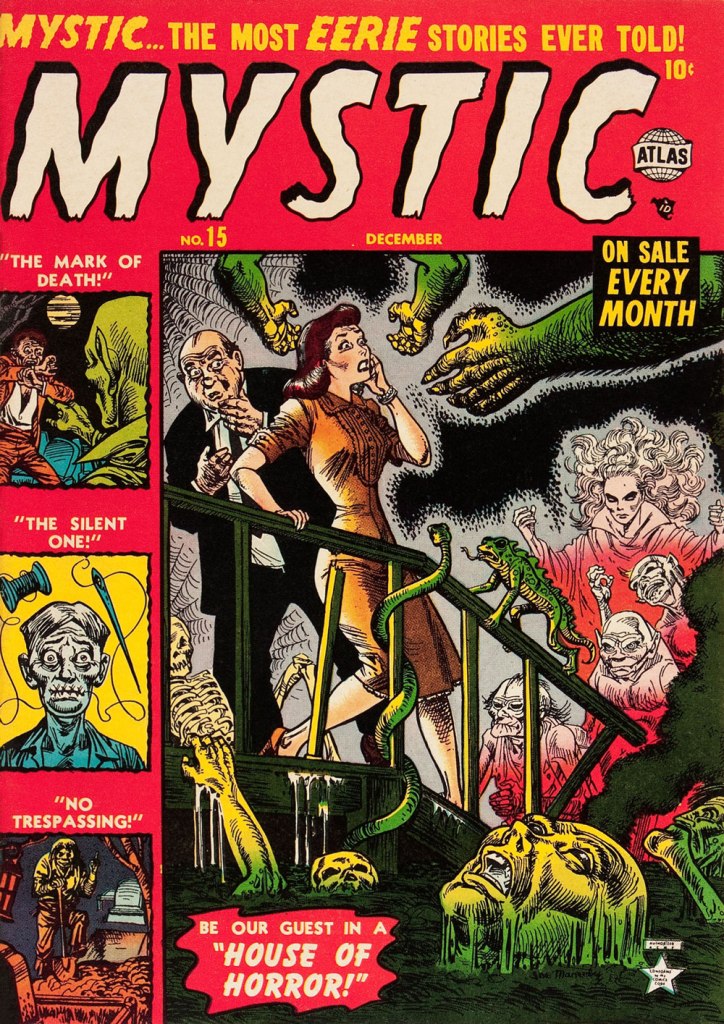
This is Mystic no. 15 (Dec. 1952, Atlas); colours by Stan Goldberg.

“Mystic” is evidently one of Marvel’s pet titles: the title was first used by Timely in 1940-42, then again in 1944-45; once more, most successfully in this Atlas horror series, for 61 issues from 1951-57. And lately in 2009 and 2011. I’ll bet that tradition’s not yet done with, but why on earth?

This is Mystery Tales no. 12 (June 1953, Atlas); colours by Stan Goldberg.
This one’s got it all! Here’s Adventures Into Weird Worlds no. 27 (Mar. 1954, Atlas); colours by Stan Goldberg.
This is Mystic no. 29 (Apr. 1954, Atlas); colours by Stan Goldberg. Maneely’s Atlas horror covers generally distinguished themselves by their goofiness.
Begging the question: What’s worse than having two left feet? Having three left hands, apparently. This is Riot no. 3 (Aug. 1954, Atlas); colours by Stan Goldberg.
This is Mystery Tales no. 24 (Dec. 1954, Atlas); colours by (need you ask?) Stan Goldberg. While I make no bones about my disdain for Goldberg’s work at Archie, he was a superb colourist in the 1950s. In terms of legibility, Atlas’ busy covers had to be quite a challenge to pull off, and he did it again and again.

-RG

Hallowe’en Countdown V, Day 15

« Get ready for the future: it is murder. » — Leonard Cohen

Since Hallowe’en isn’t as widely celebrated in Europe — Ireland and the rest of the U.K. aside, obviously — as it is in North America, it’s not always evident and easy to keep the countdown truly international. No worries: in such a situation, I’m no stickler — I’ll take the spirit of the law over its letter.

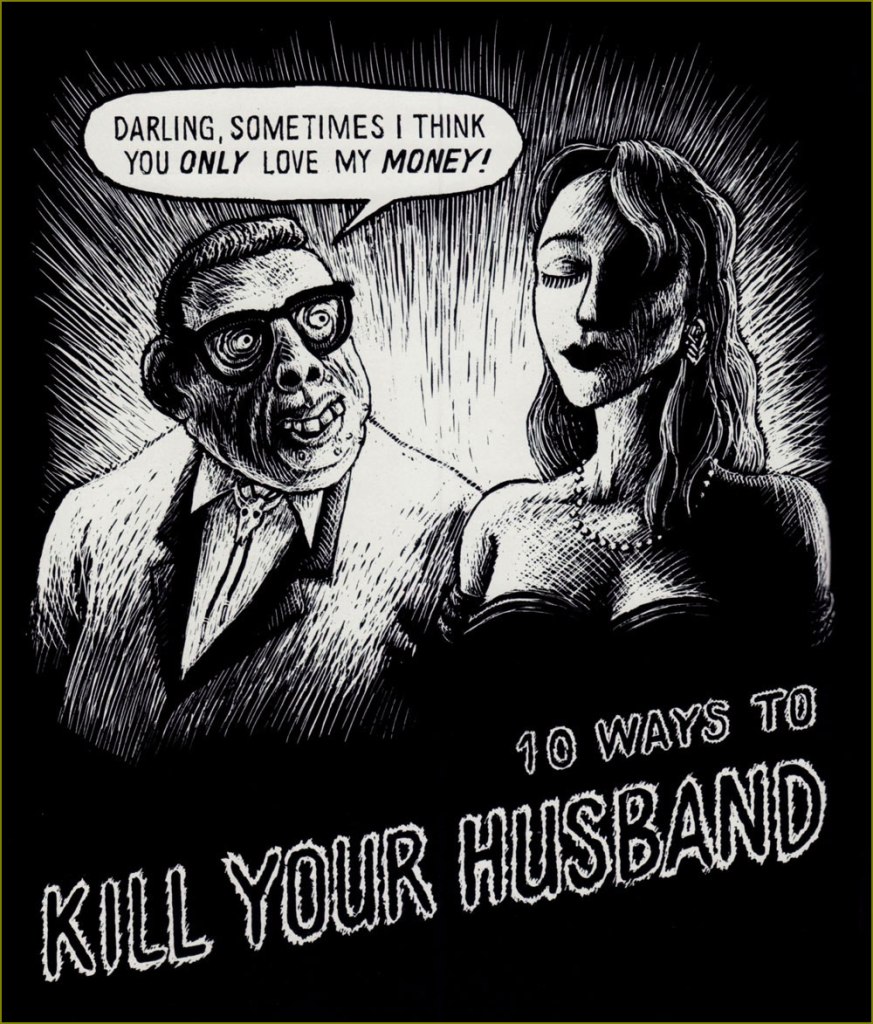
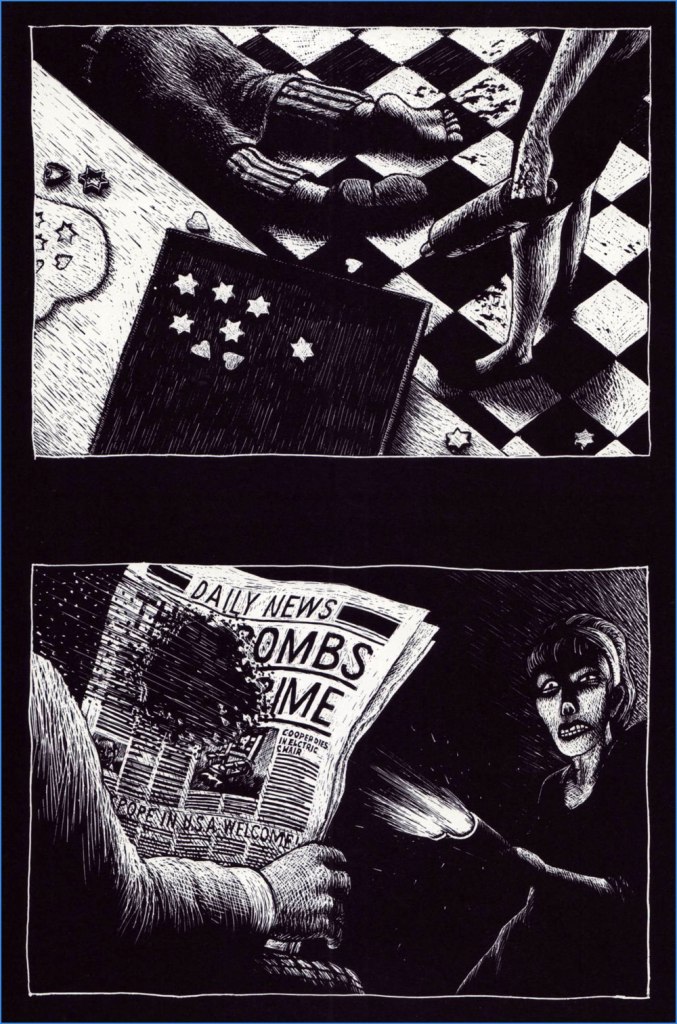
The first (and until now, only) time I posted about Thomas Ott, I wound up with a contender for least-popular post in this blog’s history. Have I learned my lesson? Heavens, no. I live, perhaps naïvely, in the belief that our audience has grown in the interim, and that said audience is ever more attuned and receptive to our quirks.

Here, then, is some gallows humour from Mr. Ott. Don’t try this at home, unless…

Top: The Night Porter, anyone?
Er… Top: Deadly Weapons, anyone?
Originally published in Tales of Error (Oct. 1989, Edition moderne, Switzerland). Yes, a book in English by a German-speaker from a Swiss publisher with a French name.
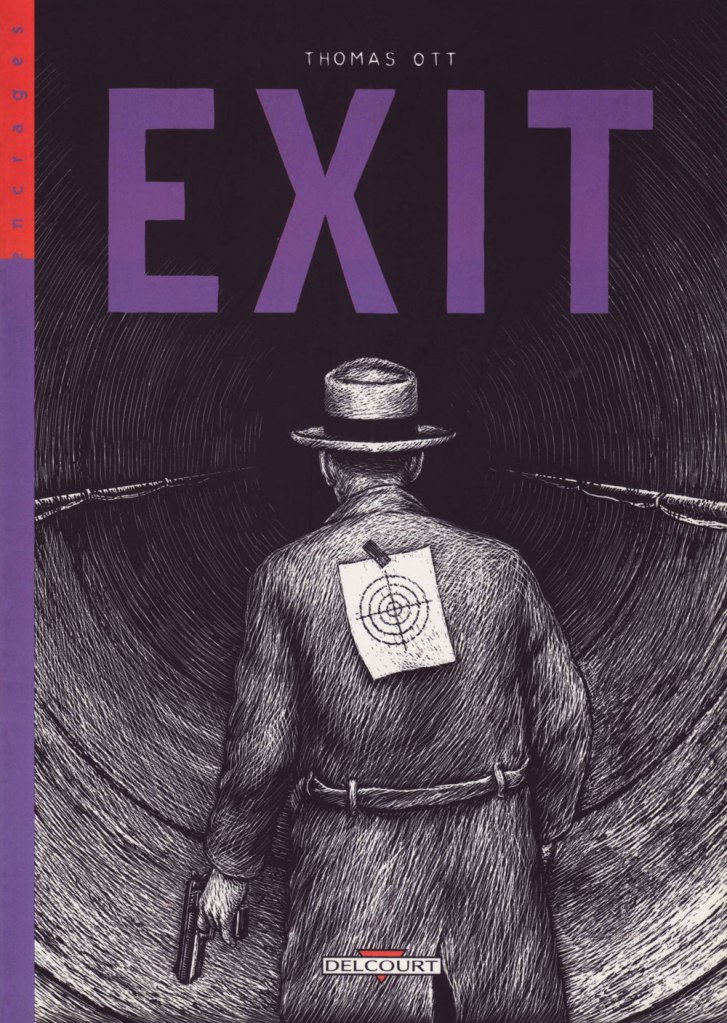
The Exit collection (Sept. 1997, Delcourt) gathers the essential bits of Ott’s first three albums (Tales of Error, Greetings from Hellville and Dead End), as well as some new pieces.

For more poisoned goodies from Mr. Ott, just plod your carcass over to his official website.

-RG

Hallowe’en Countdown V, Day 14

« Upon its head, with red extended mouth and solitary eye of fire, sat the hideous beast whose craft had seduced me into murder, and whose informing voice had consigned me to the hangman. » — The Black Cat (1845)

What can I tell you about the legendary English cartoonist and bon vivant Hunt Emerson — born in 1952 in Newcastle and still devilishly active these days — that he can’t tell you in his own words?

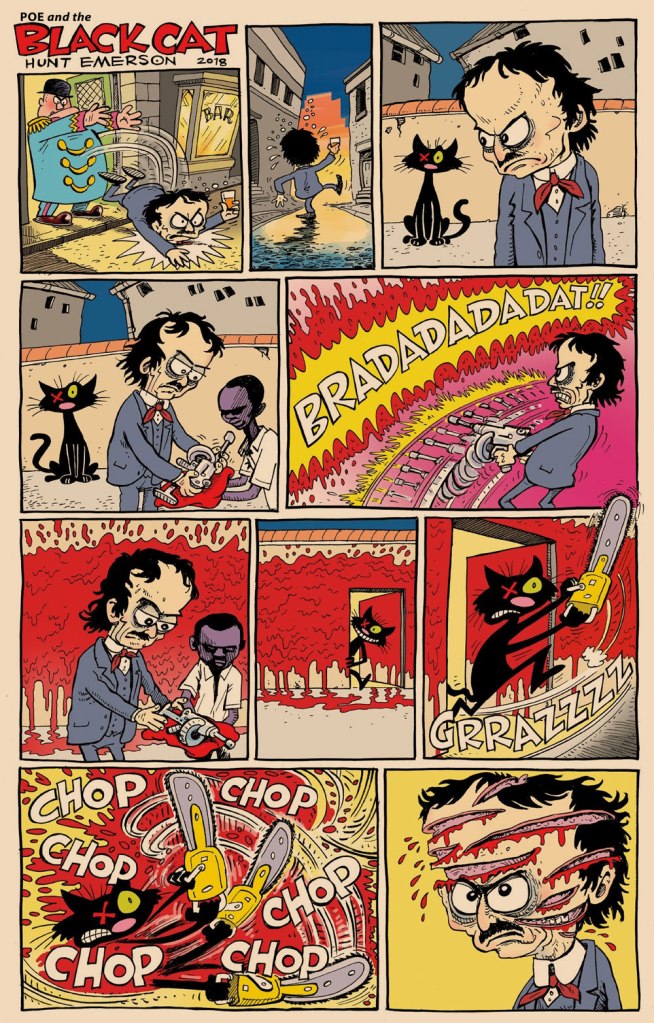
Mr. Emerson has recently (and I do mean recently!) contributed a series of hi-concept short strips to Ahoy Comics’ gamut-running Poe-themed humorous horror anthology. Taking his place in a thematic thread that includes Tom and Jerry, Antonio ProhíasSpy vs Spy, Brian McConnachie and Warren Sattler‘s Kit ‘n’ Kaboodle, Massimo Mattioli‘s Squeak the Mouse* and Simpsons cartoon-within-a-cartoon Itchy and Scratchy, Emerson merrily escalates the hostilities launched in Poe’s The Black Cat, with Poe himself in the rôle of the narrator. Assume the position!

Originally published in Edgar Allan Poe’s Snifter of Terror no. 2 (Nov. 2018, Ahoy).
Originally published in Edgar Allan Poe’s Snifter of Terror no. 4 (Jan. 2019, Ahoy).
Originally published in Edgar Allan Poe’s Snifter of Terror no. 5 (Feb. 2019, Ahoy).
You’ll get all these, and plenty more besides, in Edgar Allan Poe’s Snifter of Terror Volume 1 (Oct. 2019, Ahoy), collecting the title’s first six issues. Cover art by Richard Williams, with a title logo by Todd Klein.

-RG

* not, by a long shot, Mattioli’s best work. *That* would be, without question, his nonpareil M le magicien (1968-73).

Hallowe’en Countdown V, Day 13

« How could you be so sure? … they could be real! » — Reggie Mantle, believer

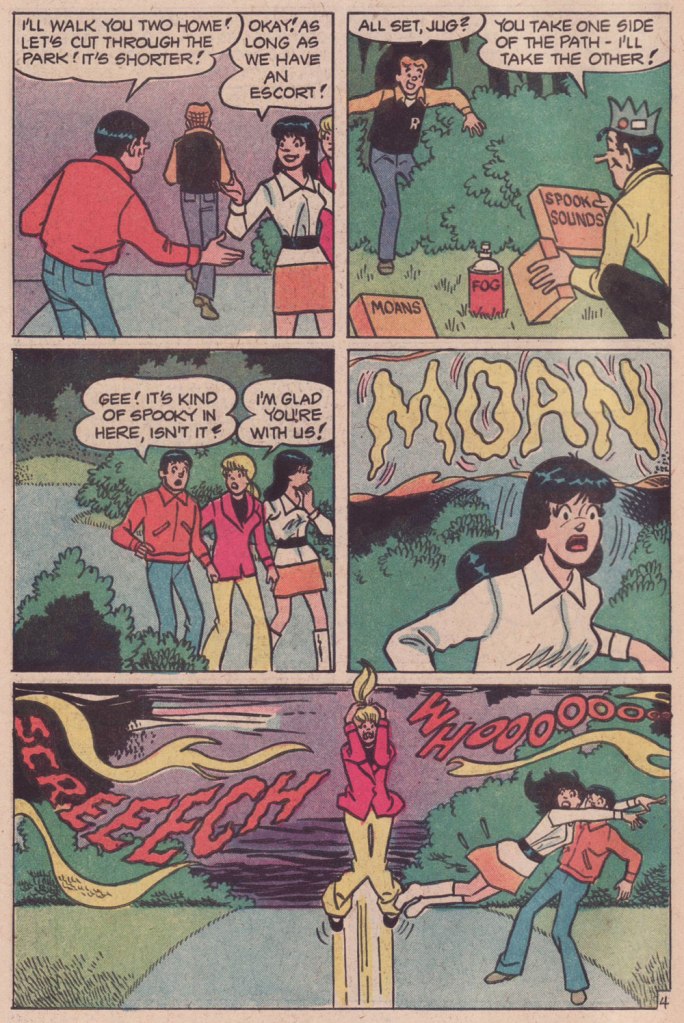
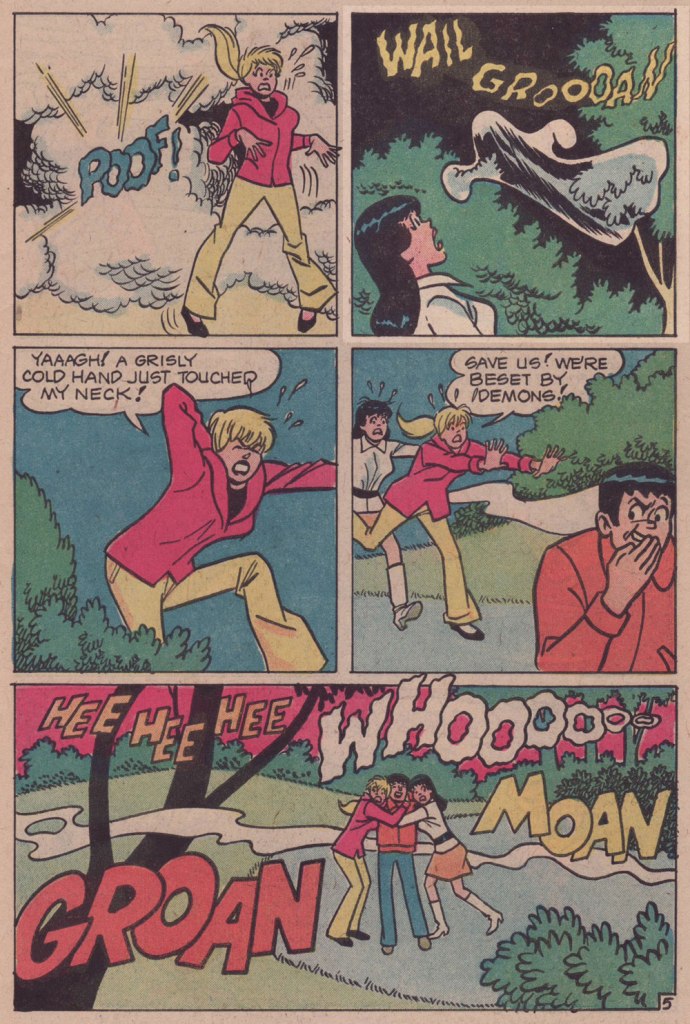
Sure, it’s a hoary ol’ plot, used both to comedic and dramatic effect a gazillion times, but… as is often the case, the plot is more or less accessory. I always enjoy an Archie comics story that reminds us that these kids have known one another forever (from their perspective — not in the sense that they’ve been around since the 1940s, that’s too metatextual). With Archie for the most part being someone things happen to, as opposed to a catalyst — one who sets events into motion, I’m rather more interested in the adversarial (and sometimes collaborative) relationship between Reggie and Jughead… when it’s properly explored.

As with the previous Samm Schwartz story I spotlighted, Tee for Three, Dilton’s garage plays a key part. Intriguing…

Beasties of the Night originally appeared in Jughead no. 279 (Aug. 1978, Archie). It was scripted by Frank Doyle (1917-1996).

-RG

Hallowe’en Countdown V, Day 12

« After that I never saw him again. He became the ‘phantom’ artist, whereabouts unknown! » — Bhob Stewart

Hello again. Last year, I touched upon the stint that Matt Fox (1905-1988) did as an occasional and unappreciated inker at Marvel in the Silver Age. While he’s assured a sort of immortality for the eleven winningly oddball covers he painted for Weird Tales, he also left his distinctive and lasting mark on horror comics of the 1950’s. Let’s give the old burying grounds the once-over, shall we?

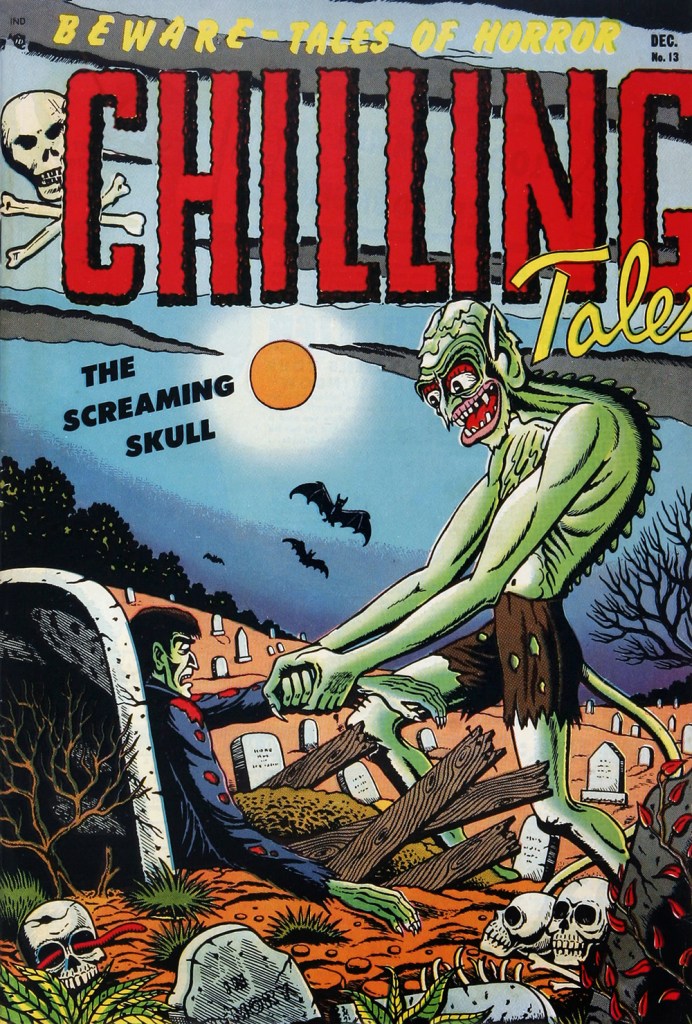
This is Chilling Tales no. 13 (Dec. 1952, Youthful), actually the title’s début, as it picks up its numbering from Beware. In addition to its cover, the issue features within a rare Fox story, The Hand of Glory. Read it here… at your own peril! (just kidding, it’s all perfectly safe).
This is Chilling Tales no. 15 (Apr. 1953, Youthful). What in tarnation is going on here?
This is Chilling Tales no. 17 (Oct. 1953, Youthful). Incidentally, this title was edited (anonymously) by Sally the Sleuth creator Adolphe Barreaux.

Here’s one of Fox’s all-too-infrequent forays between comic book covers. This one appeared in Uncanny Tales no.6 (March 1953, Atlas). Writer unknown… though that’s no great loss to history.

From the Tomb editor Peter Normanton, in the lumberingly-titled The Mammoth Book of Best Horror Comics, astutely noted that:

« There is an air of disquiet to his vision, yet it charms through a surreptitious blending of the primitive with the mockingly insane. His characters border on the lunatic, seemingly at home in his landscapes, concealing a darkness corruptive of the soul. »

And I leave the final word to my trusted accomplice ds, who observed that:

« I find that the art of Matt Fox reminds me of Terrance Lindall… Both can create disquieting monsters with eyes that speak of inner torment, reminiscent of Christian Art (mostly Spanish, I believe) from a few centuries ago. »

-RG

Tentacle Tuesday Masters: Sean Äaberg

« Every Goblinko product is a seed of a better world. Better because it is built to last – built for relevance – built for survival – built for buttermilk – built for speed – built for living the chaos – built for you! Everything else sucks! Go Goblinko! »

My path to discovering Sean Äaberg‘s art was rather tortuous.

On one hand, I’ve liked Goblinko t-shirt designs for a while – co-admin RG is a big fan, and given my love for pickles, so am I. Somehow I was not aware of those was creating these designs, however.

As for Äaberg art, it all began when I saw some very striking Tarot cards on some forum discussion – I have no interest in Tarot, but these were hitting all the right buttons, with their super bright green-magenta-yellow colour scheme and lush artwork. I looked up the artist, and landed on his Dungeon Degenerates on the wonderful Monster Brains blog.

As I am one of those silly people who want to own stuff on paper, I looked for a book and found Acid Vomit! The Art of Sean Äaberg on Kickstarter. When I received this (glorious, by the way) compendium, something clicked into place and suddenly I realized that Sean Äaberg = Goblinko!! (Well, to be fair, Sean’s wife Katie is part of it, too.) Nothing like one of those ‘well, that should have been obvious a long time ago…’ realizations to put one into a philosophical mood.

Another Kickstarter campaign is currently taking place, this time for a Halloween book (which this household is of course supporting, given that Halloween is our favourite holiday!) Please lend a much-needed (financial) hand to this worthwhile project!

« Crammed to the gills with real Street Rocker junk scraped from the mean streets of Porkland. » This is Pork no. 20. It was, indeed, free as the cover promises – you can admire the covers of other issues here. Yes, the tentacles are subtle, but they’re nevertheless lurking!
A cutie pie! Scanned from Acid Vomit! The Art of Sean Äaberg (Gingko Press, 2012).
Some classic plant tentacles. Scanned from Acid Vomit! The Art of Sean Äaberg (Gingko Press, 2012).

~ ds

Hallowe’en Countdown V, Day 11

« We see light, not dark. But it is in the dark that we feel goblins and ghosts. » — Rex Brandt

The ever-creative Tom Eaton‘s Oliver Cool (1975-79) always reserved a special treat for Hallowe’en. In past countdowns, I’ve shared the first (1975) and second (1976) entries devoted to the beloved occasion, and here is the final pair.

From Young World Volume 14 no. 8 (Oct. 1977, The Saturday Evening Post Company).
Eaton’s Fizz & Farra In the Year 2250 strip ran concurrently in Young World’s sister publication, Child Life. This seasonal cover by Arthur Wallower was simply too good not to include.
From Young World Volume 15 no. 8 (Oct. 1978, The Saturday Evening Post Company).
As a bonus, here’s one item some of you monster kids may fondly remember: Monster Stand-Up Greeting Cards (1980, Scholastic). Pricey these days, from the look of it.
-RG

Hallowe’en Countdown V, Day 10

« Ghost stories … tell us about things that lie hidden within all of us, and which lurk outside all around us. » — Susan Hill

We’ve once before turned our attention upon Dell’s Ghost Stories, an anthology title with such an incredible first issue (written and directed by John Stanley) that all the subsequent ones whither in the long shadow it casts. In recent years, I’ve somewhat softened my stance on these sequels, taking into account that nothing could measure up to Stanley’s work on numero uno — and accordingly judging them on their own merits.

As a kid, I didn’t think too highly of Frank Springer (1929-2009), being primarily familiar with his inks over Frank Robbins on The Invaders (too sloppy, and no substitute for Robbins inking himself, which never happened at Marvel anyhow). Down the line, I ran into some of his earlier work (Phoebe Zeit-Geist, The Secret Six, The National Lampoon, Dial H for Hero and sundry items for Dell) and grew to appreciate his strengths.

Now, Ghost stories was interesting as a ‘horror’ (in the very limited Silver Age/Comics Code in full force sense) anthology, in that the vast majority of the stories were, after that peerless first issue, the work of one single artist (Gerald McCann, after contributing a couple of page to number one, handled issues 2-5, with a couple of filler pages thereafter, then Springer took over for 6-20, the rest of the run consisting of reprints, with the unexpected exception of no. 35).

Here then is what’s likely my favourite Springer Ghost Story: A Room with a Dreadful Secret.

This is Ghost Stories no. 14 (June 1966, Dell). Cover by Springer.

-RG