Panning the murky old print stream for the odd glimmering nugget
They Called It… The Golden Age!
That’s the period opening with the advent of the first comic books, in the early 30s, and ending with the release of Showcase no. 4 in 1956 (introducing the new Flash), which signals the passage to the next era, the Silver Age, of course.
« Jerry Grandenetti started out ghosting The Spirit, and nobody… NOBODY… captured the spirit of The Spirit better. Not content to stay in Will Eisner’s shadow forever, he forged his own unique style leading to a highly successful comics career lasting decades. » — Michael T. Gilbert
Since my very first encounter with his work, Jerry Grandenetti (1926-2010; born ninety-five years ago today, another Thursday April 15th) has endured as one of my true artistic heroes. But he’s not celebrated much at all.
Though he’s worked extensively on The Spirit, he’s treated as a bit of a footnote in the Eisner hagiography. His DC war work is well-regarded, but he’s inevitably overshadowed by the Joe Kubert – Russ Heath – John Severin trinity. Besides, by and large, the war comics audience doesn’t overlap much with the spandex long johns crowd. Grandenetti has only very occasionally and timidly dipped a toe into the super-heroics fray, and he was far too unusual for overwhelming mainstream acclaim.
In fact, aside from the couple of converts I’ve made over the years, I can only think of three fellow torch-bearing aficionados: Michael T. Gilbert (who digs best the early, Eisner-employed Jerry); Stephen R. Bissette (who favours the spooky 60s and 70s work); and Don Mangus, who’s most into the DC war stuff. I daresay I enjoy it all, but my taste is most closely aligned with Mr. Bissette’s on this particular point. Let’s sample a bit of everything, insofar as it’s feasible to sum up a career spread out over five decades… in a dozen-or-so images.
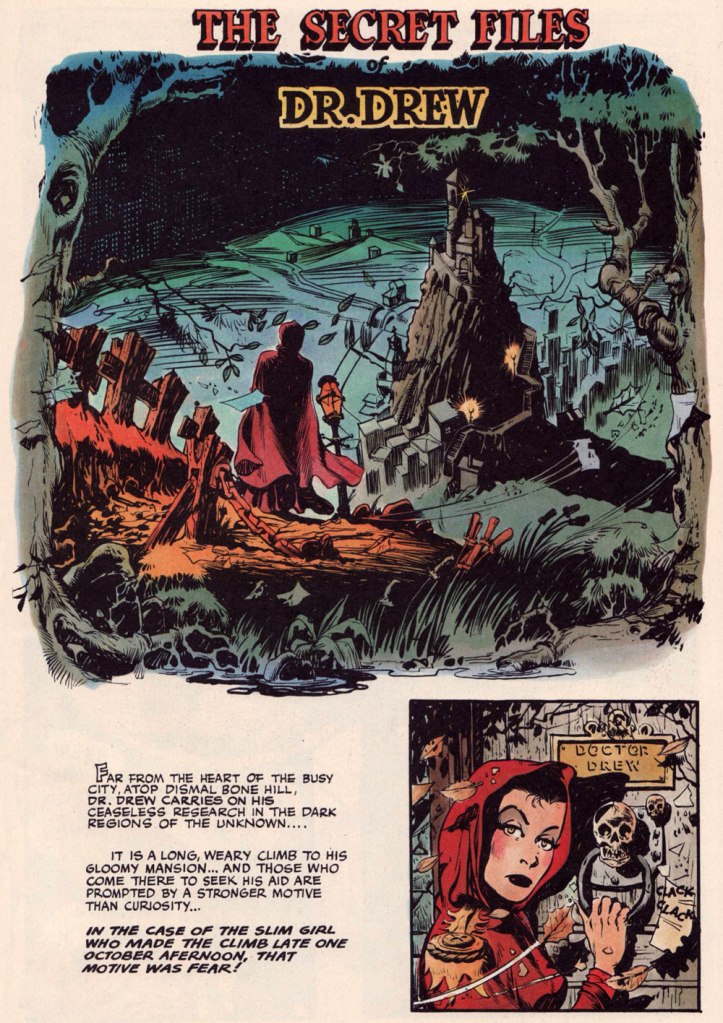
Opening splash from The Secret Files of Dr. Drew: Sabina the Sorceress, written by Marilyn Mercer and lettered by Abe Kanegson, from Rangers Comics no. 56 (Dec. 1950, Fiction House); this version hails from a reprint (Mr. Monster’s Super Duper Special no. 2, Aug. 1986, Eclipse) using the surviving original art; it was recoloured by Steve Oliff.
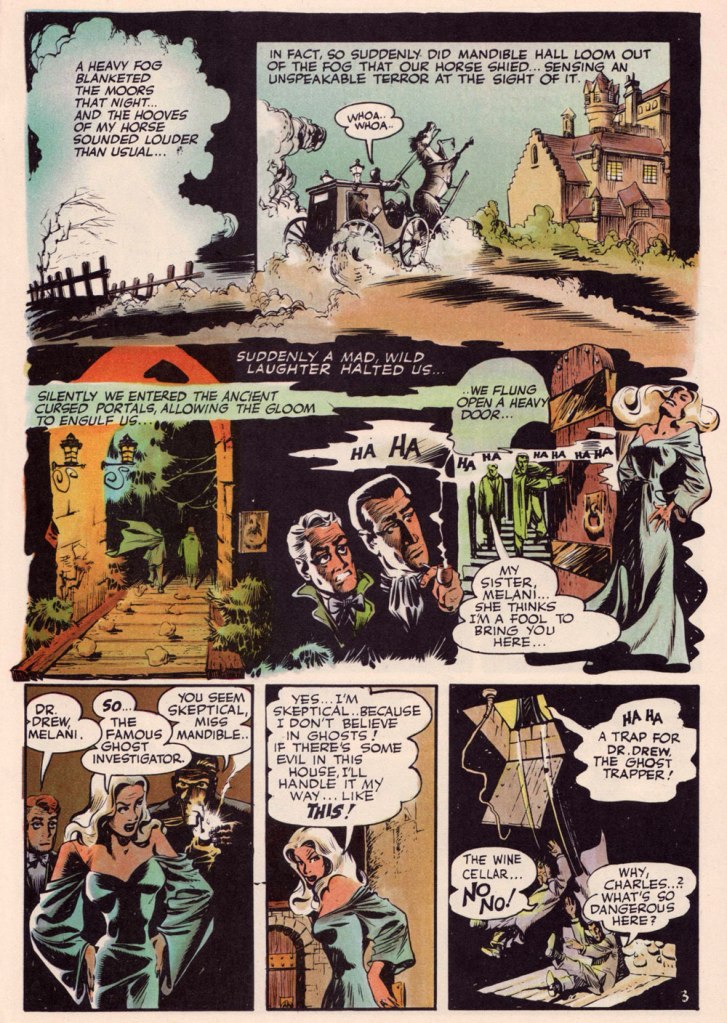
Page 3 from The Secret Files of Dr. Drew: Curse of the Mandibles!, written by Marilyn Mercer and lettered by Abe Kanegson, from Rangers Comics no. 55 (Oct. 1950, Fiction House); this version hails from a reprint (Doc Stearn… Mr. Monster no. 4, Dec. 1985, Eclipse) using the surviving original art; it was most tastefully recoloured by Steve Oliff.
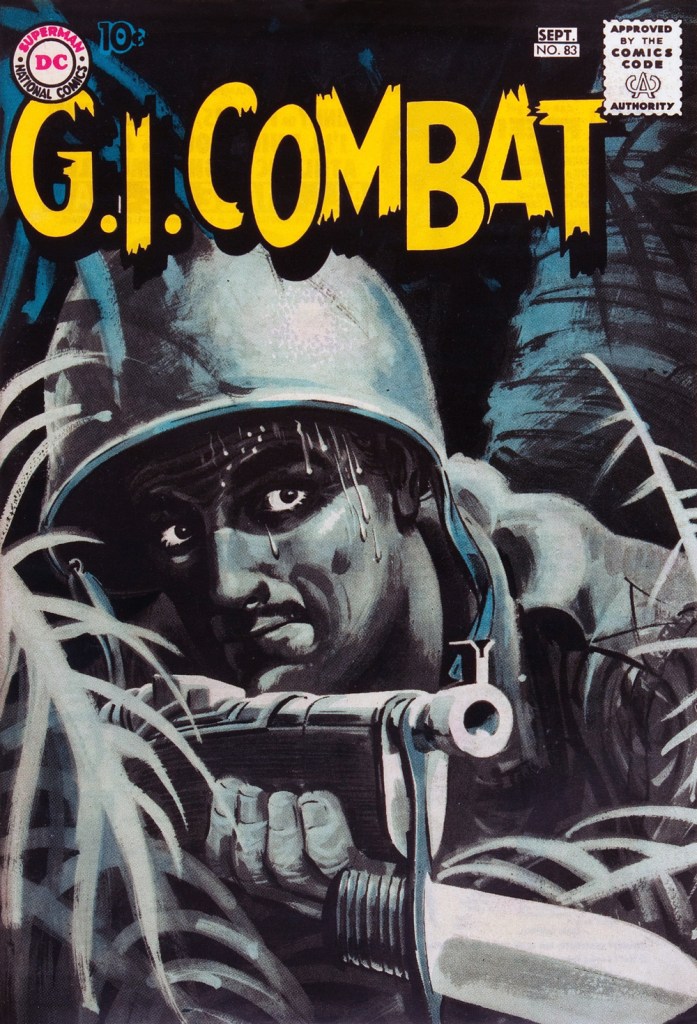
In 1954, the powers-that-be at National Periodical Publications (you know, DC) gave Grandenetti some latitude to experiment with their War covers. Grandenetti produced an arresting hybrid of painted and line art. The process involved a grey wash painting that was photostatted, with flat colour laid over the resulting image. The first few attempts yielded striking, but nearly monochromatic results. A bit farther down the pike, the production department got more assured in its technical exploration.
This is G.I. Combat no. 77 (Oct. 1959, DC); wash tones and colouring by Jack Adler, who recalled, in a 1970s interview: « It was suggested that we start doing washes for covers, and we were talking about doing it for so damned long, but nobody attempted it. I think Grandenetti did the first one, an army cover with someone floating in the water. I think that was the first wash cover that was done. That one ended up looking like a full color painting. »
This is G.I. Combat no. 83 (Aug.- Sept. 1960, DC); wash tones and colouring by Jack Adler. In 1995, Robert Kanigher, Grandenetti’s editor on the DC war books and a frequent collaborator, recalled: « Jerry liked to experiment and I had to sit on him to get him to stop it. Especially in his covers, which were outstanding, when I forced him to draw as realistically as possible. »
Original art from The Wrath of Warlord Krang!, smothered in dialogue and exposition by Stan Lee, from Tales to Astonish no. 86 (Dec. 1966, Marvel); inks by Bill Everett. Namor‘s constant random shouts of ‘Imperius Rex!‘ make him sound like a sitcom character with Tourette’s. As far as I’m concerned, it’s possibly been the most annoyingly asinine slogan in comics since Stan stole ‘Excelsior!‘ from Jean Shepherd.
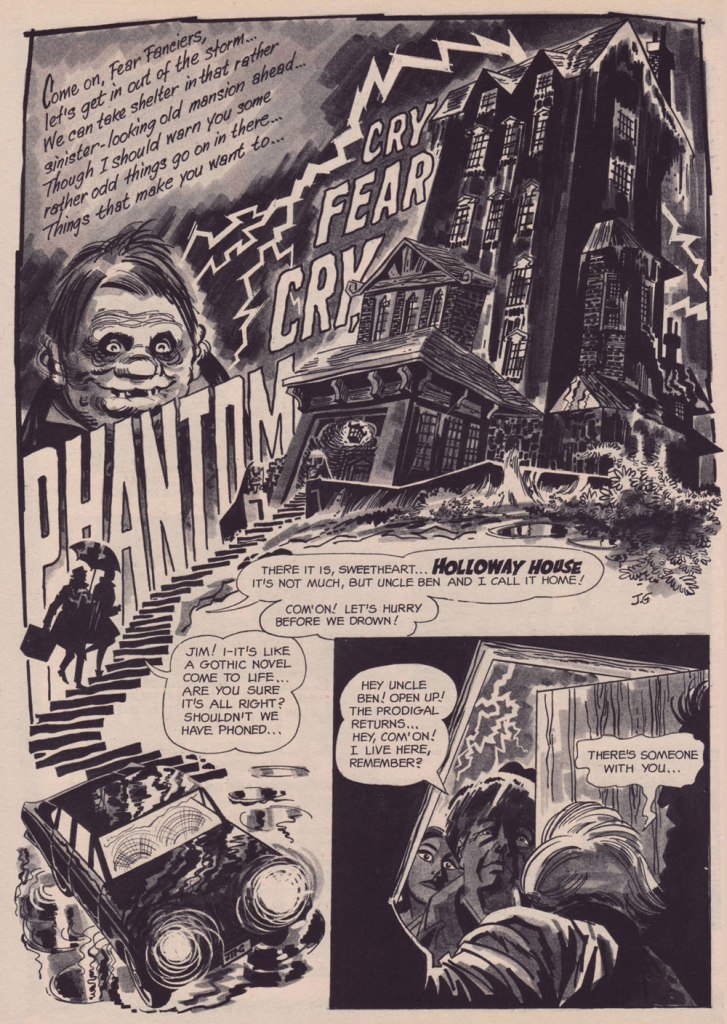
The opening splash from Cry Fear, Cry Phantom, written by Archie Goodwin, from Eerie no. 7 (Jan. 1967, Warren). In the mid-60s, presumably tiring of being pigeonholed as a war artist at DC, Grandenetti made the publishers’ rounds, doing a bit of work for Tower, Gold Key, Charlton, Marvel, Cracked (check it out here) and most memorably Warren where, after ghosting a few stories for Joe Orlando, he unleashed his innovative expressionistic style.
DC was generally hesitant to entrust its more established properties to the more “out there” artists. In the cases of Grandenetti and Carmine Infantino, the solution was to match them with the weirdness-dampening inks of straight-arrow artist Murphy Anderson. And you know what? It did wonders for both pencillers and inker.
This is The Spectre no. 6, October, 1968. A tale told by Gardner Fox (and likely heavily revised by hands-on editor Julius Schwartz, a man who loved alliterative titling) and superbly illustrated by the Grandenetti-Anderson team. Steve Ditko aside, Jerry Grandenetti had no peer in the obscure art of depicting eldritch dimensions (you’ll see!)
Page 13 from Pilgrims of Peril! written by Gardner Fox, from The Spectre no. 6 (Sept.- Oct. 1968, DC); inked by Murphy Anderson. Dig the salute to a trio of real-life spooky writers, all of whom editor Julius Schwartz knew well, having even served as Lovecraft’s literary agent late in the man’s life. By the tail end of the 1960s, Lovecraft’s work was finally making some commercial inroads, thanks largely to Arkham House co-publisher Derleth‘s unflagging diligence.
Page 22 from Pilgrims of Peril! written by Gardner Fox, from The Spectre no. 6 (Sept.- Oct. 1968, DC); inked by Murphy Anderson.
Page 2 from Men Call Me the Phantom Stranger, written by Mike Friedrich, from Showcase no. 80 (Feb. 1969, DC); inks by Bill Draut. This story reintroduced an obscure character from the early 50s, which Grandenetti had drawn a couple of times during his six-issue run. The Phantom Stranger has remained active ever since, but most writers (save Alan Moore, wouldn’t you know it?) don’t really know what to do with him. This, however, is my very favourite PS appearance. Draut, a slightly old-fashioned penciller by this time was, as a slick inker, a wonderful fit for Grandenetti’s confidently loopy layouts.
Page 3 from The Haunting!, written by Jack Oleck, from House of Mystery no. 183 ((Nov.-Dec. 1969, DC). Grandenetti pencils and inks: undiluted!
Page 2 from Eyes of the Cat, written by Robert Kanigher, from House of Mystery no. 189 (Nov.-Dec. 1970, DC); inks by Jerry’s fellow Will Eisner ghost Wallace Wood. The inspired combination of Grandenetti’s adventurous layouts and the velvety unctuousness of Wood’s finishes are a match made in heaven, but one Woody wasn’t fond of. Oh well.
So there you are. Just the tiniest tip of the iceberg. Happy birthday, Mr. Grandenetti!
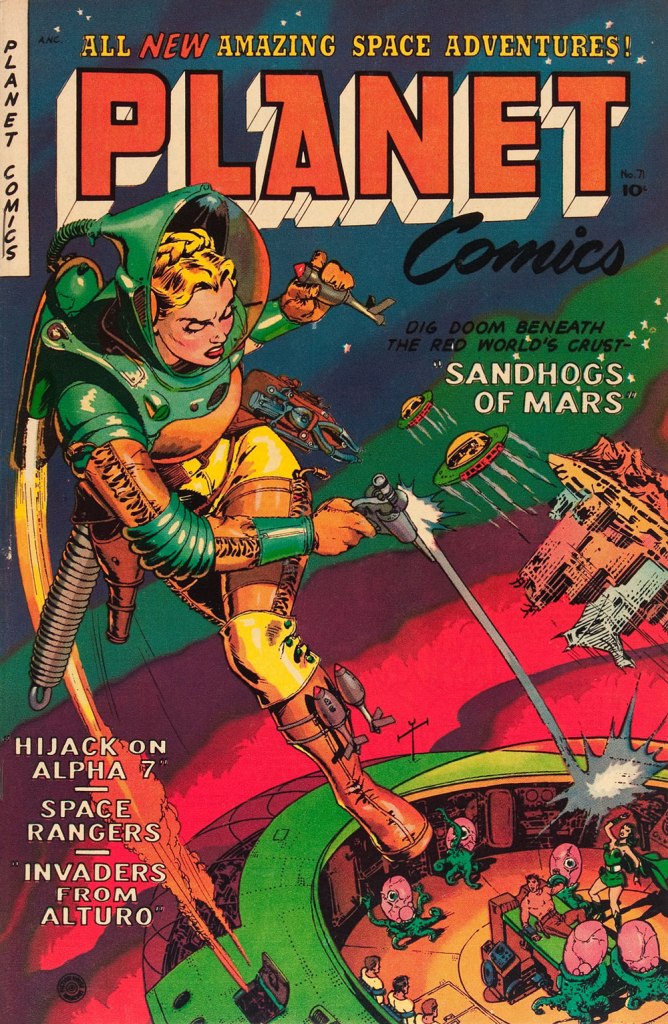
It was high time to finish what I started! Here is part two of Tentacle Tuesday: Planet of Tentacles, courtesy of Fiction House. I doubt I will exhaust Planet Comics’ source of tentacles when it comes to inside stories, but at least we’ll be able to say that we’ve completed our tour of its tentacle-bearing covers.
Planet Comics no. 2 (February 1940). Cover by, believe it or not, Will Eisner, a mere 23 at the time. If it’s meant to be scary, it is! Though perhaps the garish colours have something to do with it.
Planet Comics no. 15 (November 1941). Cover by Dan Zolnerowich, under his nom de plumeZolne Rowich.
Planet Comics no. 52 (January 1948). Cover by Joe Doolin.
Honestly, I wasn’t quite sure whether these were tentacles or what, but one look at the cover story dispelled my doubts. Does anybody care that the monsters inside look nothing like the ones on the cover? Naaah.
Mystery of the Time Chamber! was scripted by Ross Gallun and illustrated by Maurice Whitman.
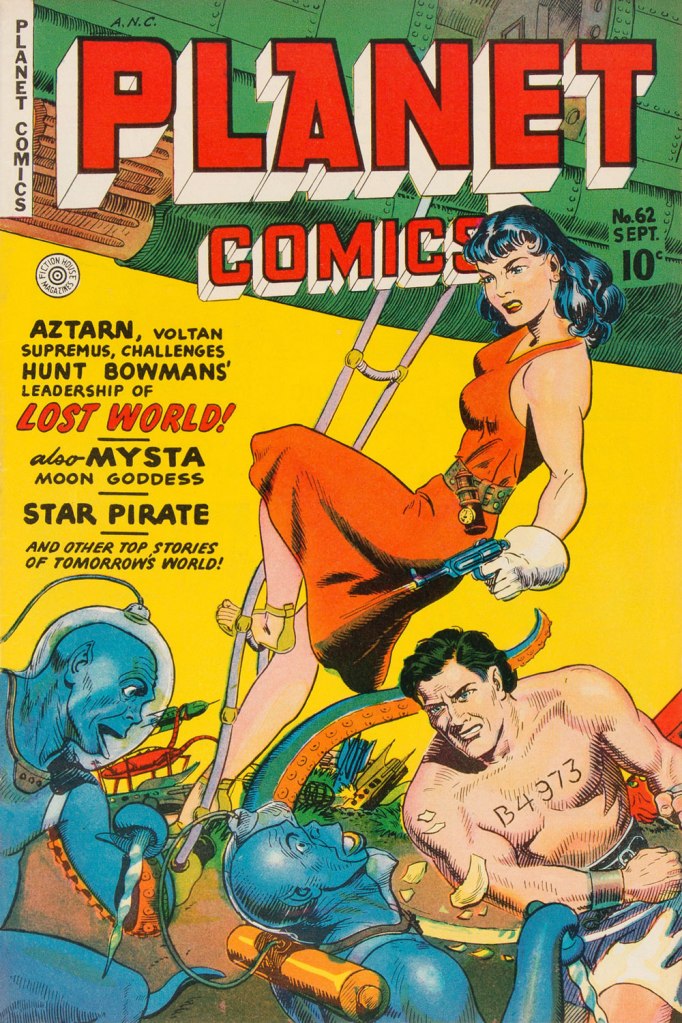
Planet Comics no. 62 (September 1949). Cover pencilled by Joe Doolin and inked by John Celardo.
And, last but not least, look at these baby cephalopods! So cute.
The tentacled well of funny animal insanity from the Golden Age is nearly bottomless. Just when I think I’ve more or less covered it all, some new goofy octopus cover that I have never seen before pops up, or an unhinged inside story swims by and waves a cheerful ‘hi there!’ with a free tentacle.
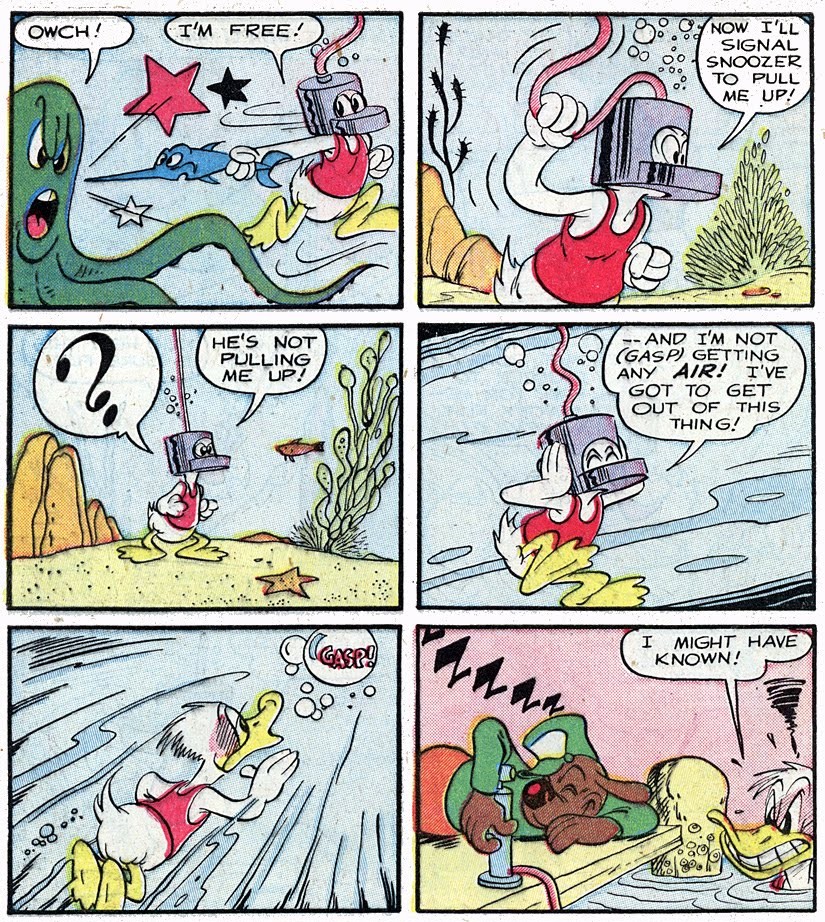
Next up, two pages from The Daffy Diver, published in Dizzy Duck no. 32 (November 1950, Standard Comics), artist once again unknown:
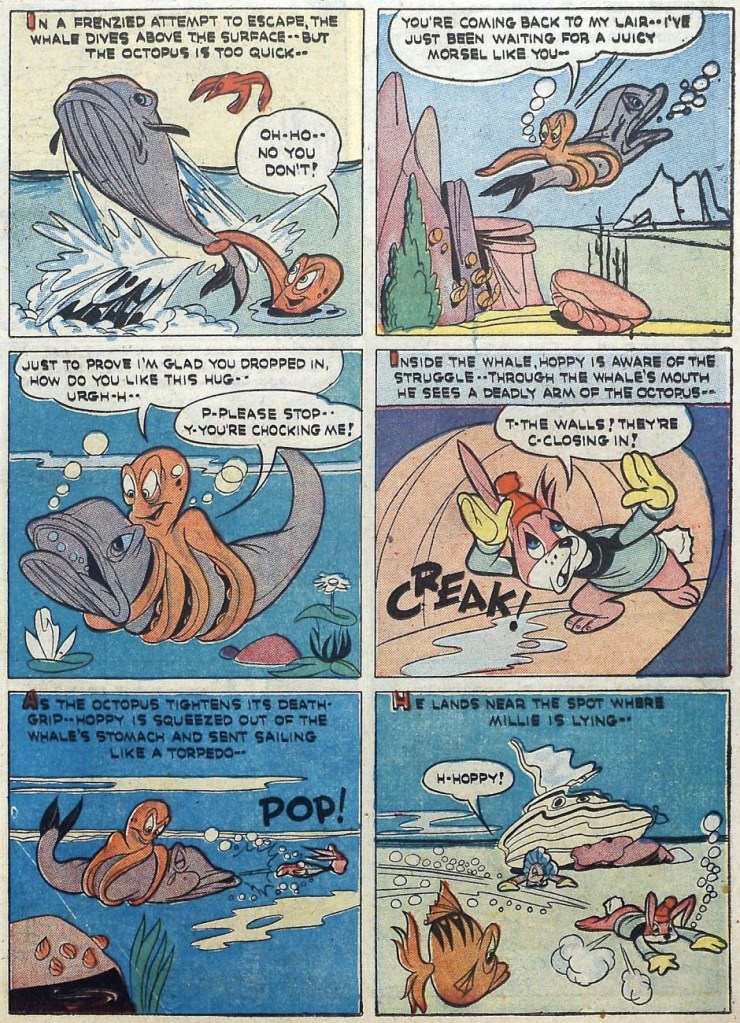
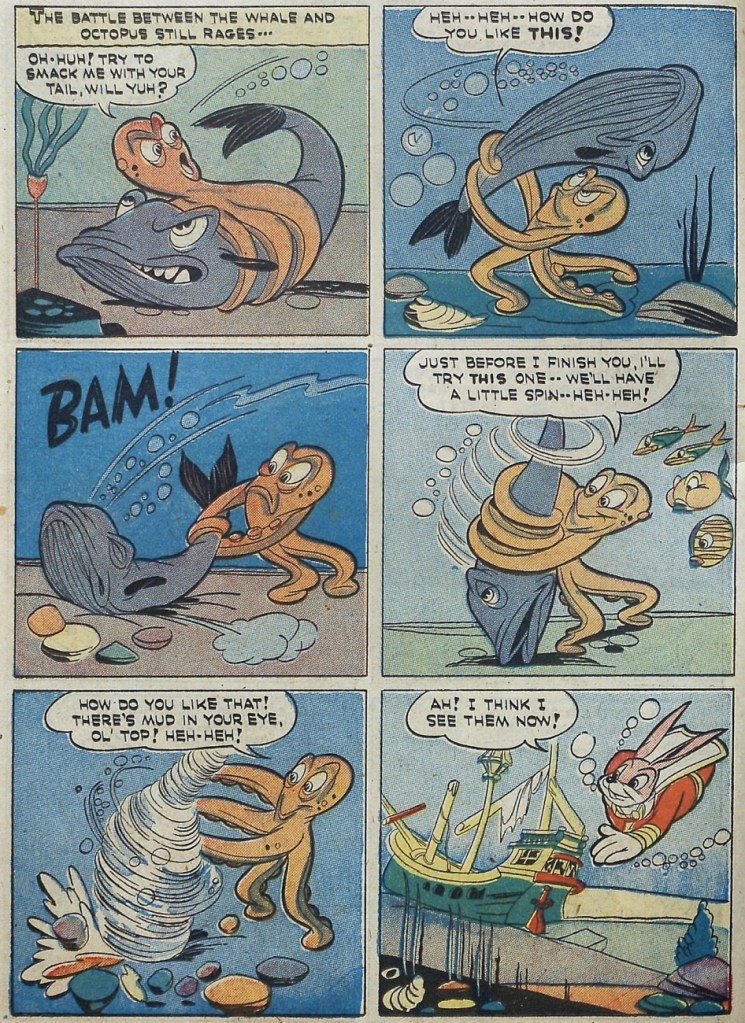
I promised some bunny action – but not the kind that springs immediately to mind! Enjoy this 2-page tentacled tussle in this Hoppy the Marvel Bunny story illustrated by Chad Grothkopf and published in Fawcett’s Funny Animals no. 5 (April 7th, 1943, Fawcett).
For dessert, two covers, because a man does not live on inside pages alone!
National Comics no. 70 (February 1949, Quality Comics). Cover by Gill Fox.
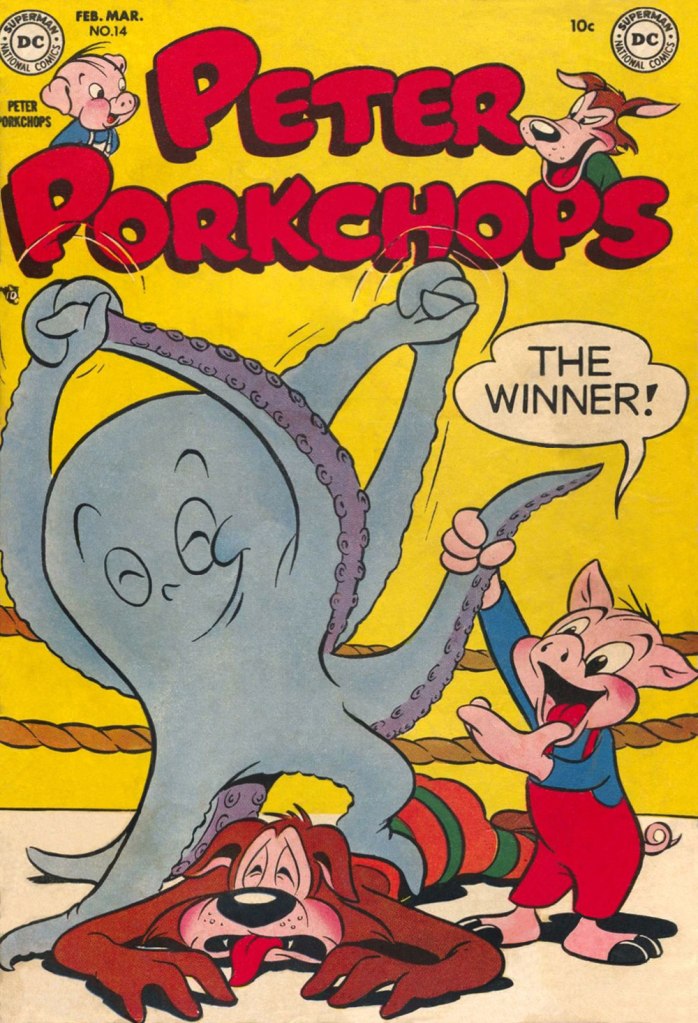
Peter Porkchops no. 14 (February-March 1952, DC); cover by Otto Feuer.
Greetings, tentacle aficionados! Phew, this post started out as just a couple of images and spun somewhat out of control. My thanks to co-admin RG for cleaning up, re-arranging and even colourizing the following scans and photographs. Today we gaze at cephalopod apparitions in newspapers strips from the 40s and 50s. There are actually few things I like better: there is something comforting about the smell of an old newspaper (even if we have to imagine it!), the aesthetic appeal of yellowed paper, the concerns of imaginary characters who lived so long ago and yet who seem so close to us. Irrelevant to the modern age? Not at all. Look past the technological trimmings and you’ll find people who have lived and loved and struggled much like we do today. On a lighter note, the techniques of fighting off tentacles haven’t changed much, either!
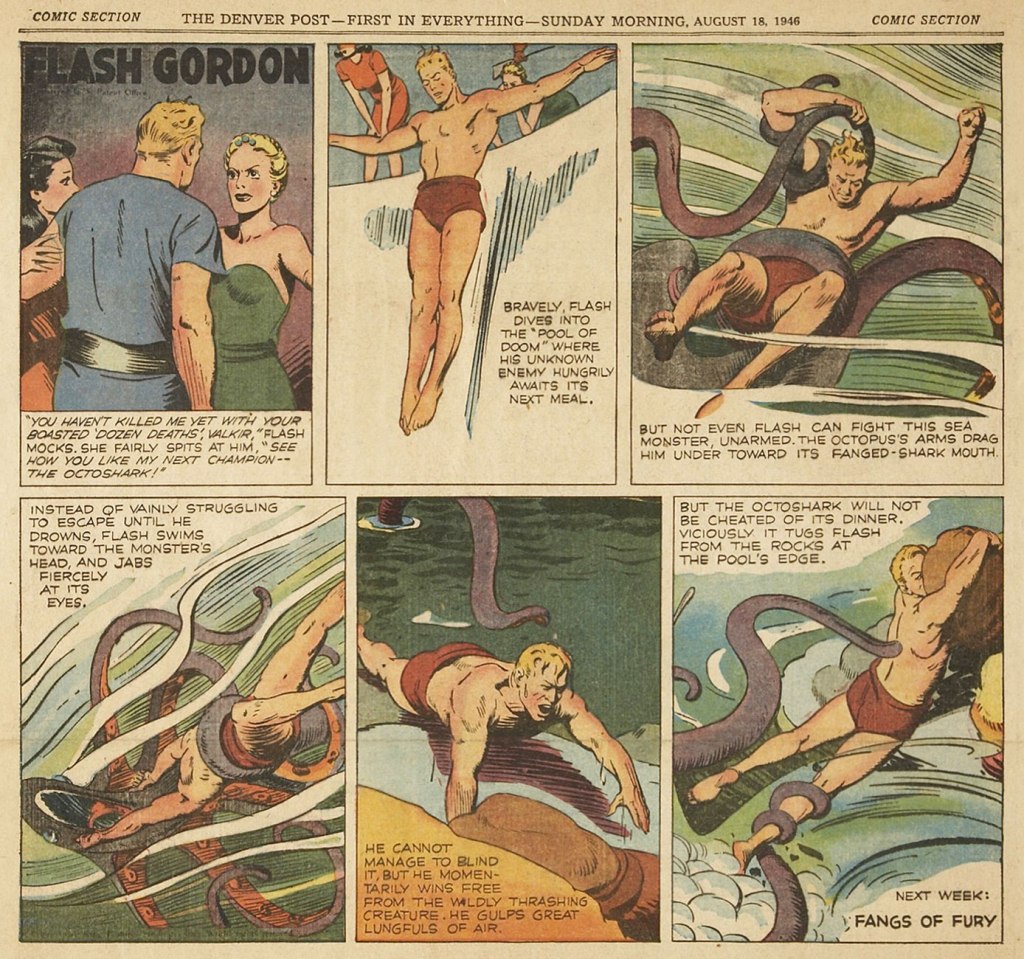
Flash Gordon, created in 1934 by Alex Raymond for King Features Syndicate to compete with the Buck Rogers newspaper strip, was immensely popular, witnessed by both its longevity – the strip continued all the way into 2003 – and multiple licensed products on offer for starry-eyed kids who wanted a spaceship or ray gun to call their own. Raymond left in 1944 to join the US Marines, and Austin Briggs, who up to that point was drawing the Flash Gordon dailies (introduced in 1941 to capitalize on the popularity of Raymond’s Sunday strips), switched to drawing Sundays, the dailies now cancelled. The following is from August 18th, 1946, art by Austin Briggs.
In 1951, King Features reinstated the Flash Gordon dailies and put Dan Barry in charge, famously assisted by Harvey Kurtzman and Harry Harrison on scripts, and a bevy of ghost-drawing writers.
The following are two Flash Gordon dailies from 1954. These reprints hail from Flash Gordon: Dan Barry Vol. 2: The Lost Continent, which collects dailies from October 26th 1953 to October 29th 1955.
Frank Robbins created Johnny Hazard for King Features Syndicate in 1944. What I find impressive is that the strip continued, with no other writers or artists involved, all the way until 1977 – contrast that with other newspaper adventure strips from around that time. Robbins must have been a powerhouse. To quote from the no-longer-updated (its creator, Donald Markstein, died in 2012), but still kindly maintained by relatives Toonopedia, « … Unlike many fictional two-fisted adventurers, [Johnny Hazard] matured — not as quickly as real people, but after a third of a century or so, he was quite gray at the temples. And a third of a century was as long as the strip ran. It was popular enough at first, and ran far longer than most post-war adventure strips, but the times were against it. Newspaper editors were more interested in daily gags than continuous stories, and Johnny Hazard succumbed to the trend in 1977. Robbins went to work for DC Comics, where he drew Batman, and Marvel, where he drew The Invaders, and never again created his own feature. » Eventually, Robbins is said to have retired, moved to Mexico, and devoted himself to painting – where he remained his death in 1994. This daily is from July 1951.
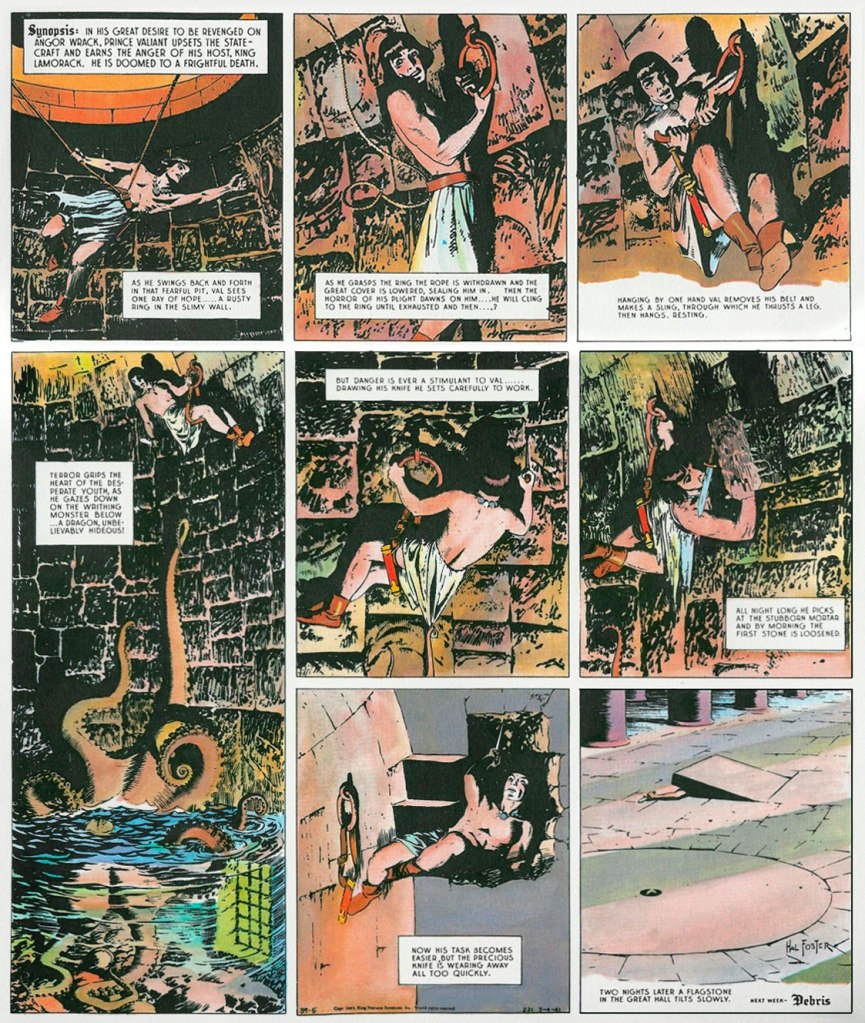
Prince Valiant is one of those newspaper strips institutions that most readers will have heard of, though some, kind of like me, may be uncertain about about the who, the when, and the hows of it. It was created by Canadian Hal Foster (1892-1982) – who, while illustrating the Tarzan newspaper strip (more about this a little further down!), developed a craving to work on his own oeuvre. He pitched his medieval adventure idea to William Randolph Hearst, who was so impressed that he even gave Foster ownership of the strip. It’s still ongoing (after a little more than 4000 Sundays!) This magnum opus has been credited with plenty, as the « greatest contribution to English literature in the past hundred years », « the pinnacle of comic strip adventure storytelling », and so on. I feel a little bad for being bored to tears by it, but as the Russians say, ‘и на старуху бывает проруха‘, more-or-less directly translated ‘even a crone can blunder’, or in other words, even Homer nods. The following Sundays are from April-May 1941 – spending two nights in a well, instead of trying to fight off the octopus, is an interesting approach, and I’m sure both man and animal were immensely frustrated.
I promised to say more about Tarzan – ah, the very, very long-running Tarzan strip. Started in 1929 with an adaptation of Edgar Rice Burroughs‘ Tarzan of the Apes illustrated by the aforementioned Hal Foster, syndicated by the United Feature Syndicate, it went on (and on…) all the way until 1995, with quite the cast of different artists over the years. The following Sunday is from the Burne Hogarth years, and is part of a story cycle called Tarzan and N’ani, which was published between December 14th 1947 and May 9, 1948. As for Hogarth, he seemed to hold the distinction of being the only artist with two runs on Tarzan: he drew the strip from 1937 to 1945, and again from 1947 to 1950.
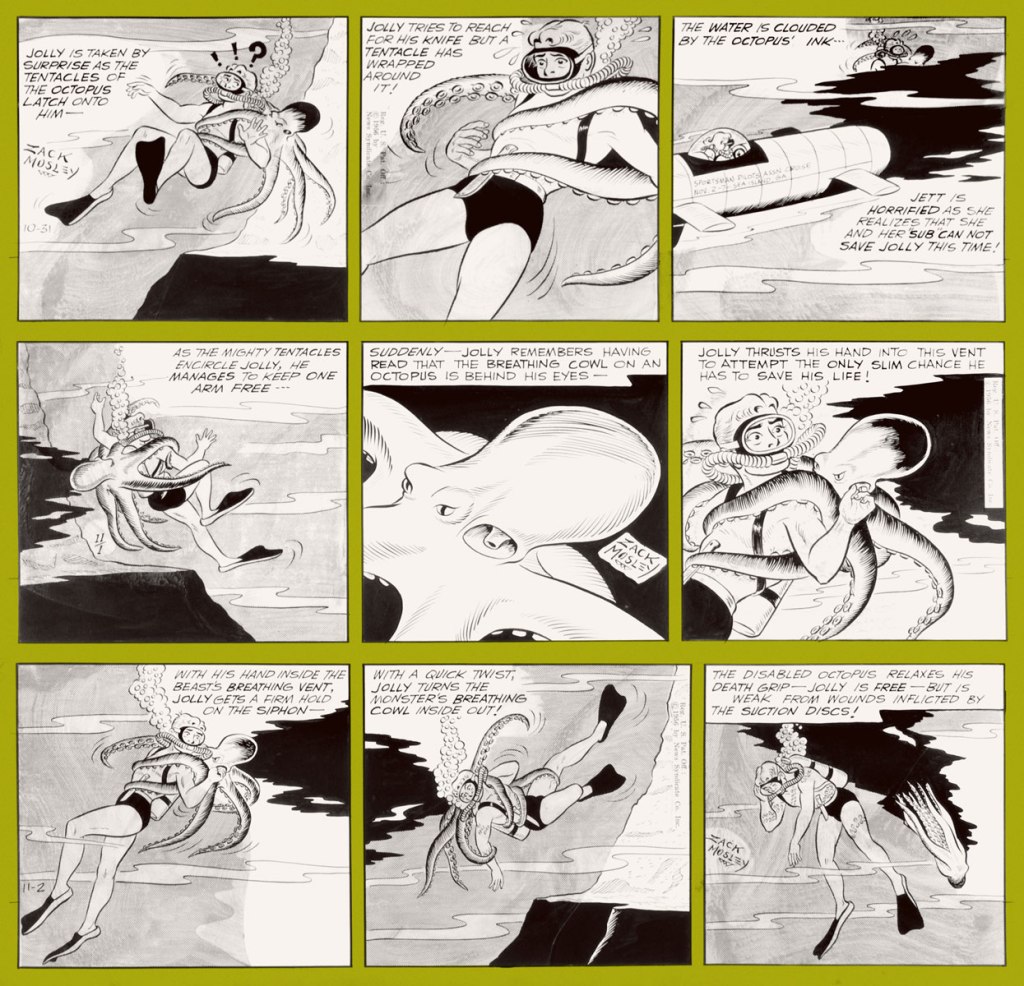
The Adventures of Smilin’ Jack, distributed by the Chicago Tribune Syndicate, ran from 1933 to 1973. I know that doesn’t sound as impressive because all strips discussed so far had crazily long runs, and yet: Smilin’ Jack, as it came to be called a little later on, lasted a good fifty years, which is partially explained by this strip’s motley cast of endearing supporting characters, but also by the realism with which Jack’s flying adventures were depicted – Zack Mosley, the creator, was an aviation enthusiast and licensed pilot with a true love of everything aeroplane. The following three dailies are from November 1956. You’ll be happy to learn that Mosley, upon retiring at 67, spent the rest of his days flying his own plane.
Created by George Shedd, a former Al Capp assistant, for the Post-Hall Syndicate, Marlin Keel ran between 1953 and 1954. Very little information about it survives – from what I understood, Shedd first wrote and drew this newspaper strip by himself, and later relinquished the illustration to assistants. Most notable (and what seems to be motivating rare collectors) is the involvement of Alvin Carl Hollingsworth (1928-2000), one of the few African-Americans working in the field at the time, who started by helping out (not sure to what degree) and became the official illustrator of Markin Keel towards the end of its run. Hollingsworth, who’s often mentioned as Joe Kubert‘s classmate at NYC’s High School of Music & Art – a fact that, albeit cool, underplays Hollingsworth’s talent and career – seems to have always maintained an interest in painting. Later in life, in the 1970s, he abandoned the comics field in favour of becoming a (fine) painter – you can see some of his paintings here. This is the original art for a 1954 Sunday strip.
The octopus may be off-camera, but my appreciation of Bob Montana made me include this strip in today’s roster. That’s right, it’s not my fault! This is an Archie daily from July 24th, 1953.
I hope you enjoyed this walk down history’s lanes and byways!
« That’s the conditions that prevail! » — Jimmy Durante
Today, we salute noted vaudevillian, piano player, comedian, singer, film and radio star, raconteur and unlikely comics legend James Francis “Jimmy” Durante, born on this day, February 10, in 1893 (as it was a Friday, the family presumably fasted or had fish for dinner). He truly was a master of all media, as you’ll witness.
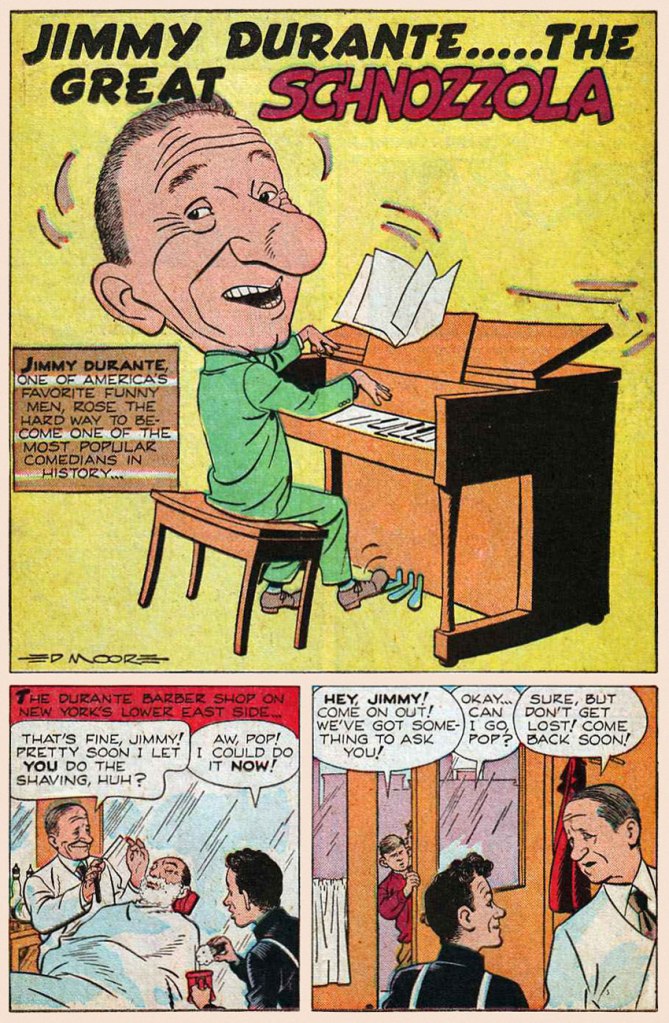
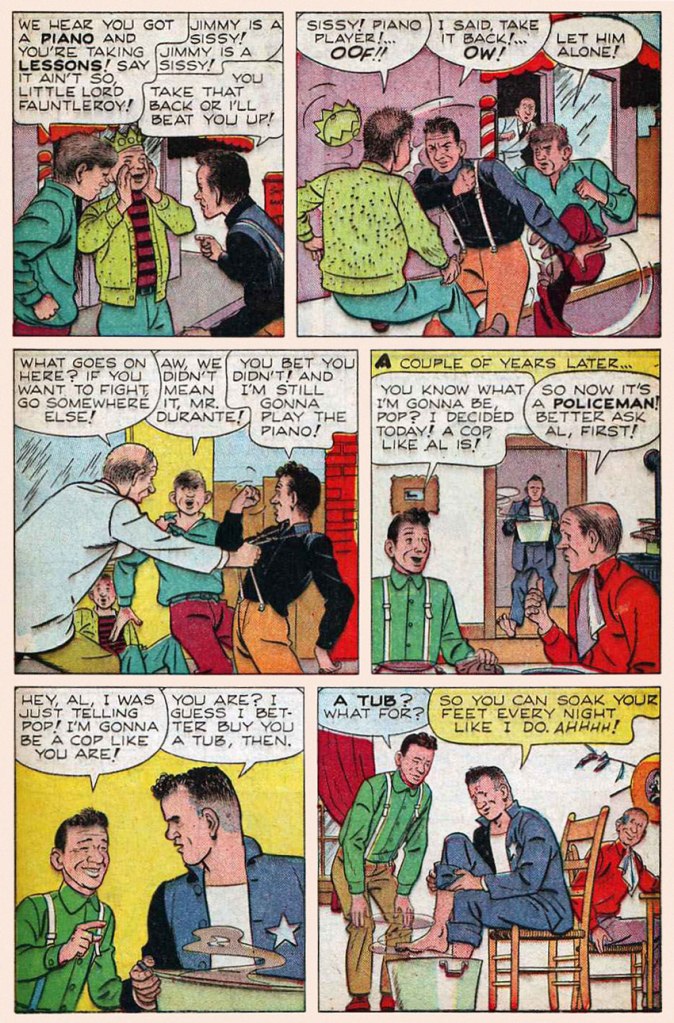
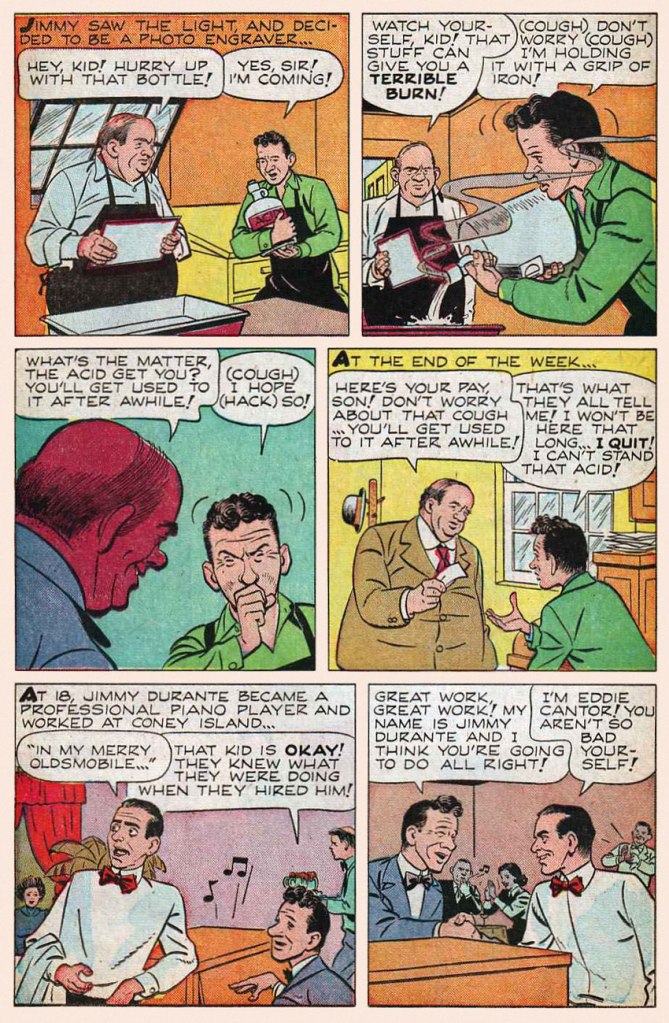
This early bit of biography appeared in Juke Box Comics no. 4 (Sept. 1948, Eastern Color); it was illustrated by Ed Moore. Hear Cantor and Durante reminisce about their early days on this 1947 episode of The Jimmy Durante Show.
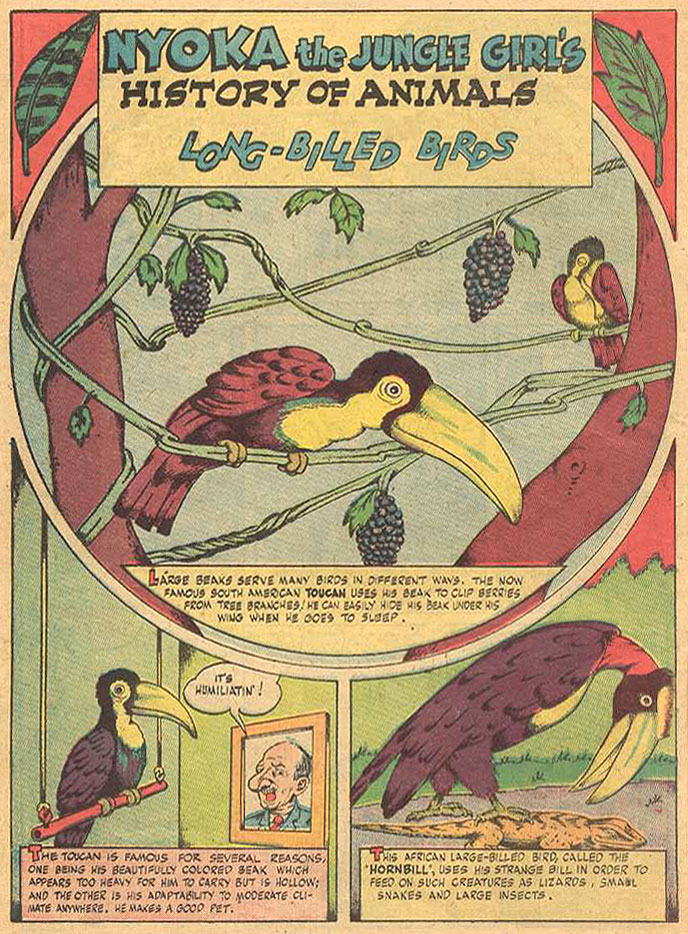
A passing mention of old Jimmy, from Nyoka the Jungle Girl no. 24 (Oct. 1948, Fawcett). Writer and artist unknown.
An early cover by Dick Ayers (1924-2014), this is Jimmy Durante Comics no. 1 (Oct. 1948, Magazine Enterprises).
The second and final issue of Jimmy Durante Comics (Winter 1948-49, Magazine Enterprises).
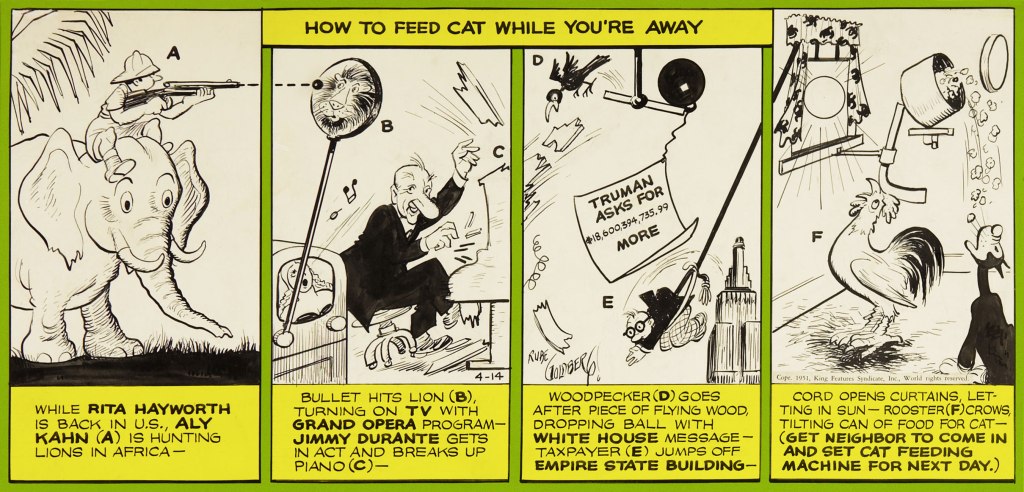
Mr. Durante rates a smashing musical appearance in this Rube Goldberg Device daily strip (Apr. 14, 1951, King Features Syndicate)… by Rube Goldberg, naturally.
And here’s the Shnozzola in the midst of a carnal melée of his fellow Old Hollywood legends (can you name them all, cinephiles?) This is Bill Griffith‘s cover for The Tiajuana Bible Revival Volume Two: Under the Stars in Hollywood (1977, Hooker, California: Paramounds Prod.). This was « An anthology reprinting 1930’s Tijuana Bibles, some of which were obscene parodies of popular newspaper comic strips of the day. Others made use of characters based on popular movie stars and sports stars of the day, such as Mae West and Joe Louis, sometimes with names thinly changed. Before the war, almost all the stories were humorous and frequently were cartoon versions of well-known dirty jokes that had been making the rounds for decades. » [ source ]
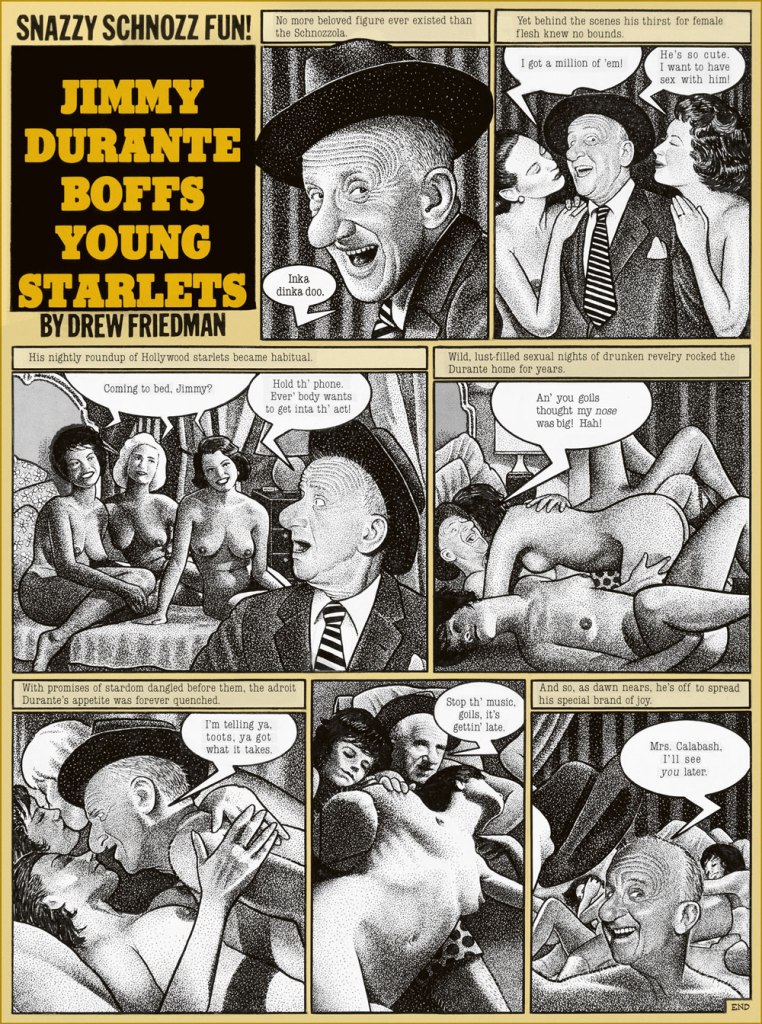
Pointillist-satirist Drew Friedman‘s immortal Jimmy Durante Boffs Young Starlets first saw print in National Lampoon vol. 2 no. 78 (Jan. 1985).
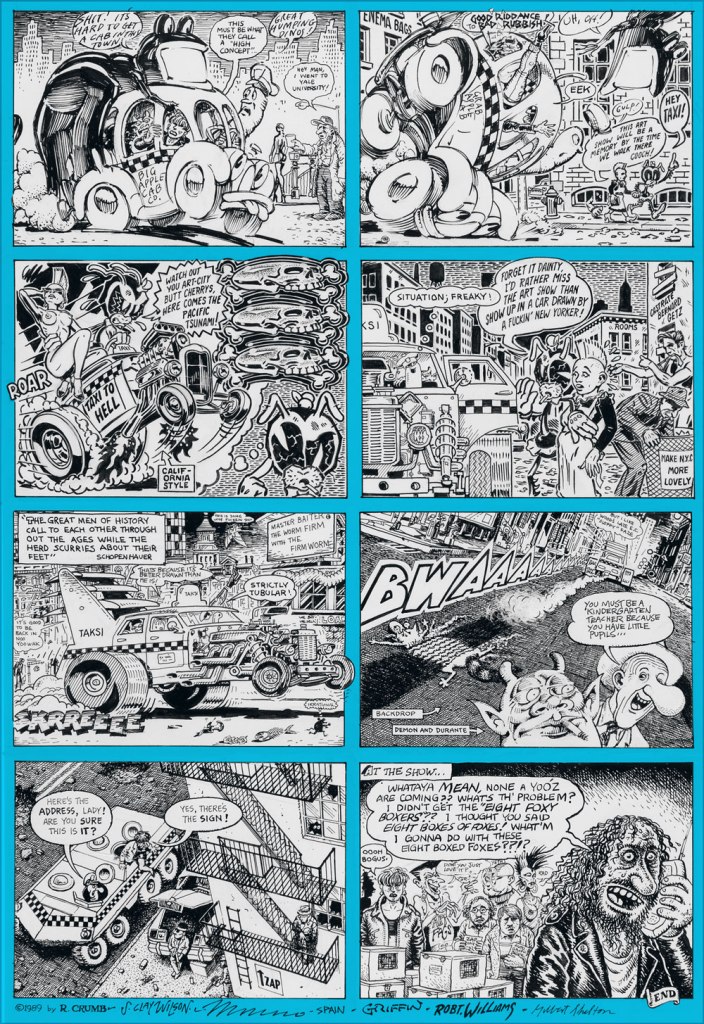
Durante briefly pops up (with the Checkered Demon!) in the second half of a truly all-star underground comix jam involving R. Crumb, Steve Clay Wilson (1941-2021… he left us just three days ago, aged 79… RIP), Victor Moscoso, Spain Rodriguez, Rick Griffin, Robert Williams and Gilbert Shelton. It appeared in Zap Comix no. 12 (1989, Last Gasp). Cartoonists are generally fond of the Schnozzola, but Underground cartoonists are just mad about him.
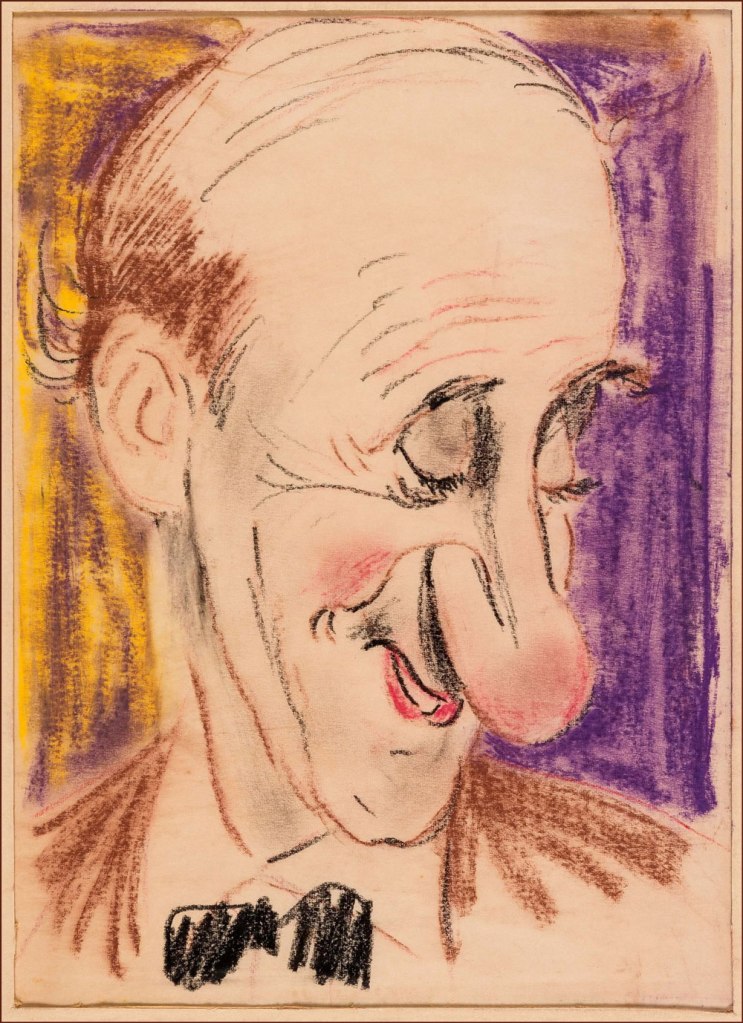
And finally, on a gentler note… here’s a clearly affectionate caricature (a preliminary sketch) of the esteemed Signor Durante (aw, he’s blushing!) by the amazing Sam Berman (crayon on onionskin paper, 1947). Berman (1907-1995) was, deservedly, quite a big deal in his day; as the erudite Drew Friedman told Print Magazine in his quality of co-curator of the 12 Legendary Caricaturists You’ve (probably) Never Heard Of exhibition at NYC’s Society of Illustrators, Berman « was indeed famous and celebrated in his day. Beginning his career in the late 1930s, he created iconic sculpted caricature covers for Esquire featuring their new mascot “Esky” (created by Berman) for an entire year. He created the sculpted caricatures of the leading actors (Fredric March, Carole Lombard, etc.) for the opening titles of the 1937 classic screwball comedy Nothing Sacred, did huge amounts of work for all the top magazines and newspapers of the day, including for Mark Hellinger’s popular column, created close to 60 amazing full-color portraits for the 1947 booklet The NBC Parade of Stars, drew children’s books, and arguably his most famous creation, the opening caricature of Jackie Gleason rising over Brooklyn for “The Honeymooners,” although he was never credited on the show for drawing that image, nor in any books. He then inexplicably went into map-making and faded quietly into obscurity. »
« ‘A face like an oyster, huh?‘ Danny Lomax repeated, and swallowed hard. ‘That’s what it’s going to look like?‘ Nick Deene chuckled and nodded. ‘If there’s anything deader-looking than a watery blue oyster that’s been open too long,‘ he said, ‘I don’t know what it is.‘ » — Robert Arthur, The Believers (1941)
Today, we’ll peer through filmy years past at another example of cultural cross-pollination: a notion is born, seemingly out of nowhere, then it ineffably catches the collective fancy and is in some fashion absorbed into folklore, scattered like grain by wind and whisper. Then some soul, blessed with a way with words, polishes it for publication and some editor buys it for peanuts. Another wordsmith reshuffles and refines it, sprinkling some notions of his own, perhaps a glint of sardonic humour. Hungry for material, radio gets hold of the setup and reshapes it a little to fit another medium. Late one night, some comic book hack hears that presentation, and recollects its essence, some years on, in a frantic rush to fill some pages and scrape together a meagre living. Or perhaps he saw it in a competitor’s rag. Bah, no-one’ll remember… or give a toss. “I’ll give it a stab from another angle!“
First, there was… well, I’m not sure. But let’s begin with Henry Russell Wakefield‘s short story Ghost Hunt (either 1938 or 1948… sources differ), in which…
A radio host broadcasts a live ghost hunt in a house in London where there have been “no less than thirty suicides”. Most have run from the house at night to throw themselves off the cliff and into the nearby river. The radio broadcaster is joined by a paranormal investigator. The investigation proves all-too successful in this chilling story.
The Believers is a classic horror story by Robert Arthur. It’s about a radio host who decides to broadcast a live show from a haunted house. This story is also known as “Do You Believe in Ghosts?” and it was based on an older story by H. Russell Wakefield called “Ghost Hunt“. It also inspired a horror comic story and an episode of Tales From The Crypt, both of which were called “Television Terror“.
The Believers was featured in this 1963 Random House collection (which Robert Arthur himself edited as well as authored), under its alternate title of Do You Believe in Ghosts?. The splendiferous wraparound cover is by Arthur Shilstone (1922-2020).
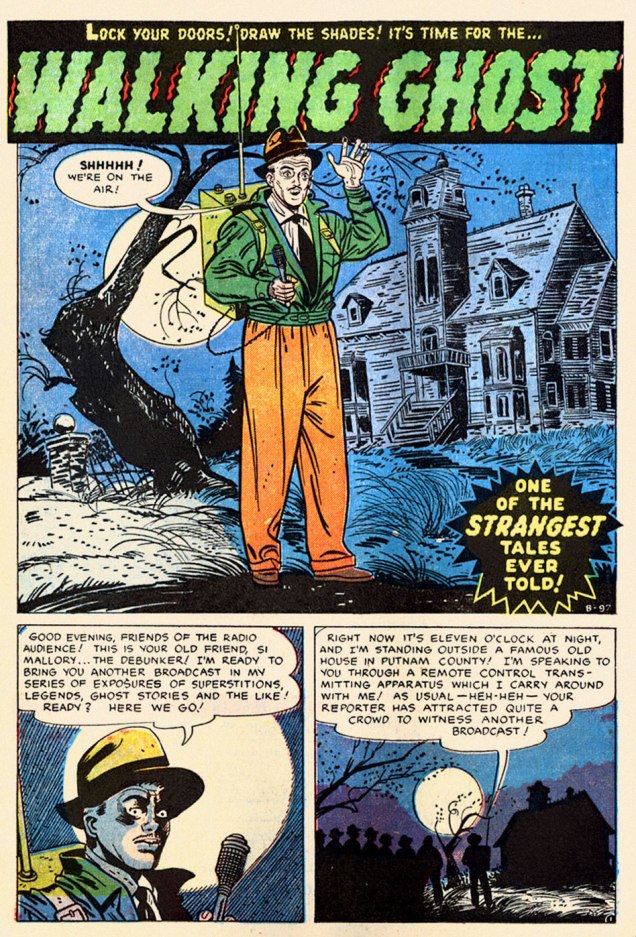
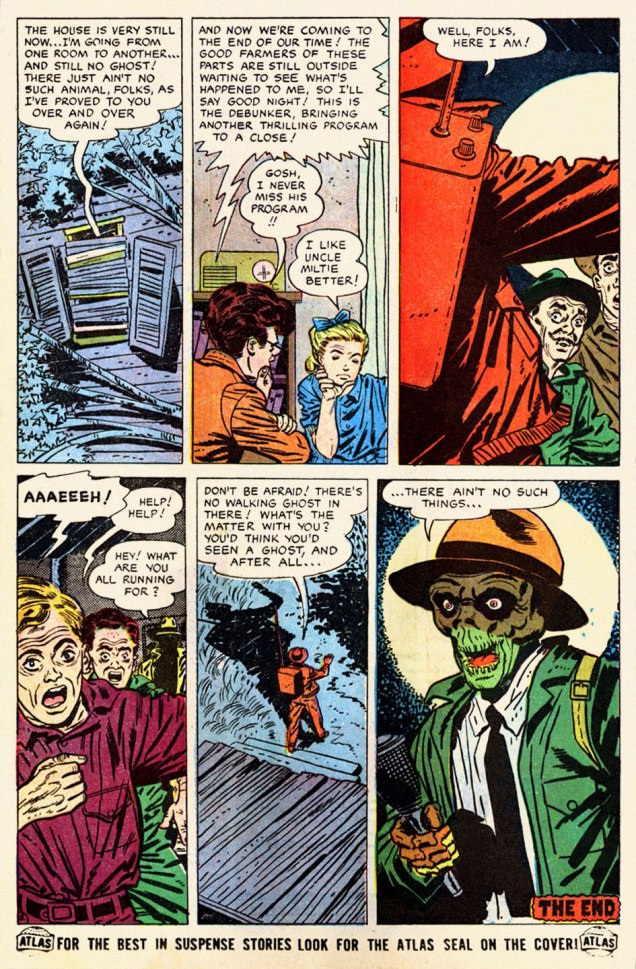
And more that just the one ‘horror comic story’ was inspired by this singular scenario. In 1952, The Unknown (or at least uncredited, which amounts to the same thing) Writer came up with The Walking Ghost, which will now break up the tedium of text, text, text, and provide you with some welcome visuals by Messrs. Mike Sekowsky on pencils and Bill Walton on inks.
This adaptation (if you will) strikes a middle ground between the Wakefield and the Arthur approaches.
The Walking Ghost was reprinted decades later in Crypt of Shadows no. 3 (May, 1973, Marvel), where I first encountered this tale, and this bit of dialogue was modified to better (but not by much) fit the times:
And what exactly was the matter with “Uncle Miltie“? Doesn’t having the biggest schlong in Hollywood buy you any respect anymore? The Twilight Zone wasn’t even a radio show!
The Walking Ghost first saw print in Strange Tales no. 11 (Oct. 1952, Atlas); cover by Bill Everett. It didn’t even rate the cover.
« Listen, youse guys — we’ve had enough of dis horsin’ around! When do we grab the dough? » — a hood craves action, from Haunted Halloween! (Flash Comics no. 78)
Superheroes, back when they weren’t all wrapped up in their grimness and grittiness, took a bit of time to properly enjoy the holidays.
This is Flash Comics no. 78 (Dec. 1946, All-American Comics), featuring Haunted Halloween!, scripted by Gardner Fox and illustrated by Everett Edward Hibbard… plus four more stories for your dime. Edited by Sheldon Mayer, with a cover by Hibbard.
And here’s All-American Comics no. 61 (Oct. 1944, All-American Comics), featuring The Green Lantern (and Doiby Dickles!) squaring off against a gruesome new foe, Solomon Grundy, in a tale entitled Fighters Never Quit!, written by none other than Alfred Bester (later the author of The Demolished Man andThe Stars My Destination) and illustrated by Paul Reinman. Edited by Sheldon Mayer, with a Reinman cover.
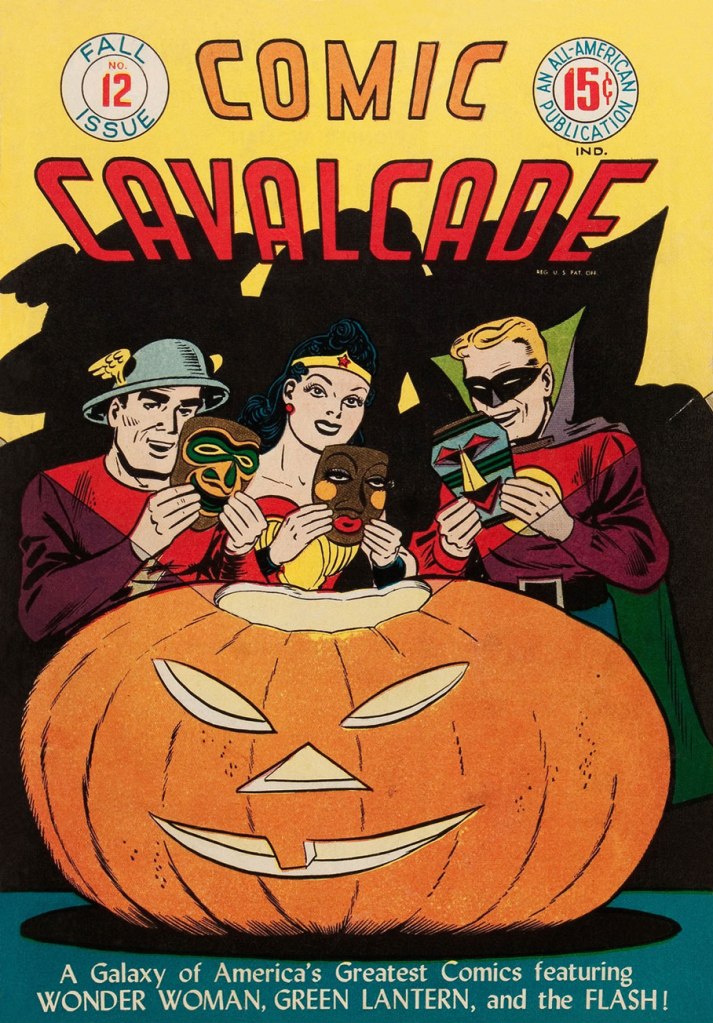
And this is Comic Cavalcade no. 12 (Fall, 1945, All-American Comics), where we catch both The Flash and Wonder Woman about to indulge in some blackface. Edited, you guessed it, by Sheldon Mayer. Cover by E. E. Hibbard (The Flash), H.G. Peter (Wonder Woman) and Martin Naydel (Green Lantern).
« Then — when O’Flaherty turned on the light, his blood crystallized! »
This is Unknown World no. 1 (June 1952, Fawcett); cover painted by the rightly fabled Norman Saunders.
Its classic cover aside, this Fawcett one-shot is barely worth reading, save for the utterly bizarre Footprints on the Ceiling.
Synopsis:
The gangsters O’Flaherty and Flitcher train a revived dead dog to be a trick dog on stage. But they have to fight off hordes of skeletal zombies coming after them to bring the dog where it belongs – in the province of the dead.
Who came up with that scenario? (it’s not merely a rhetorical question: no one seems to officially know). Might its loopiness have in some small way inspired Bob Burden’s gonzo Flaming Carrot epic The Dead Dog Leaped Up and Flew Around the Room? It’s not such a stretch, given that Burden is no stranger to Golden Age comics, having been a-dealing in such goods, with a marked (and healthy) predilection for the oddball. Obviously.
Diving right into the splashy fray, here’s the immortal tale’s opening, from Flaming Carrot Comics no. 12 (May 1986, Renegade Press).
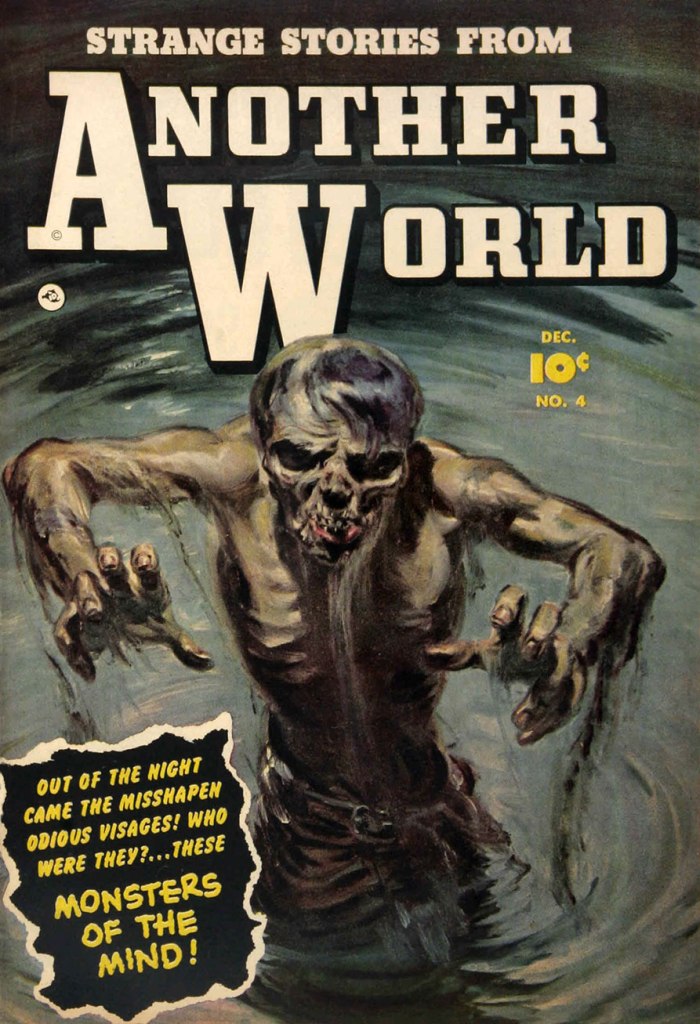
And here’s a bonus one from Mr. Saunders which, thanks to its decidedly muted palette, looks more like a pulp cover than a comic book. This is Strange Stories From Another World no. 4 (Dec. 1952, Fawcett), and you can read it here!
And after all these dead dogs, what do you say we enjoy the sight of a curious and healthy live one?
« Ghosts! Haunted house! … wow! I’m glad we don’t have to investigate around a joint like that! » — Woozy Winks… who else?
How about some Golden Age Plastic Man Hallowe’en goodness? I thought as much. All this and Woozy Winks too!
This lovely splash opens Murder in Maniac Mansion, from Police Comics no. 17 (March 1943, Quality), edited by John Beardsley. Script, pencil and inks by Jack Cole.
Mr. Cole’s splashy splash from another spooky Plas yarn, The Ghost Train, from Police Comics no. 23 (Oct. 1943, Quality). Read it here: https://comicbookplus.com/?dlid=37425
The supremely versatile Jack Cole could always be counted on to inject a bit of sinister ambiance (or over-amped sensuality, depending on his mood) to mix up the generally humorous proceedings of the stretchy exploits of the former Patrick “Eel” O’Brian. At times, things got pretty grand-gignolesque, as in the following case.
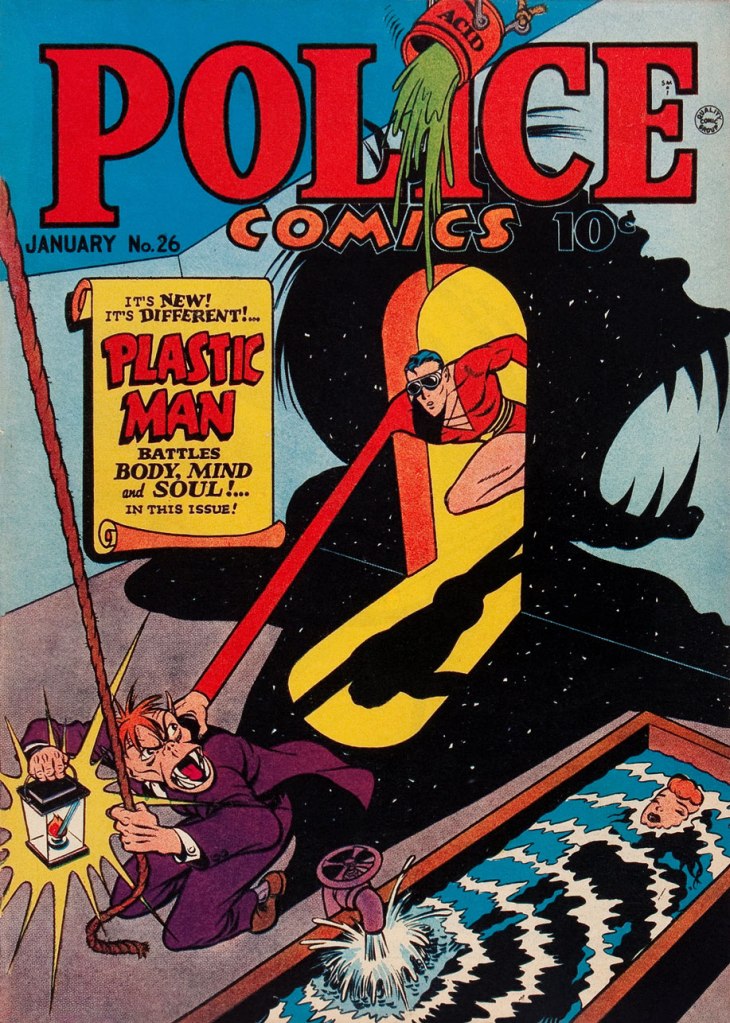
This is Police Comics no. 26 (Jan. 1944, Quality). Cover art by Jack Cole.
By the 1950s, Jack Cole had moved on to other pastures and projects, but Plastic Man kept right on stretching, one of the few superheroes flexible enough to withstand the horror boom. But not without a few alterations to fit the times, as evidenced by the following pair of samples.
This is Plastic Man no. 38 (Jan. 1952, Quality); cover art by Alex Kotzky. You have to appreciate that boney Monk Mauley hung on to his lucky belt even as his pants lost their corporeality. That’s commendable dead-ication! (sorry); Oh, read all about it: https://comicbookplus.com/?dlid=30201
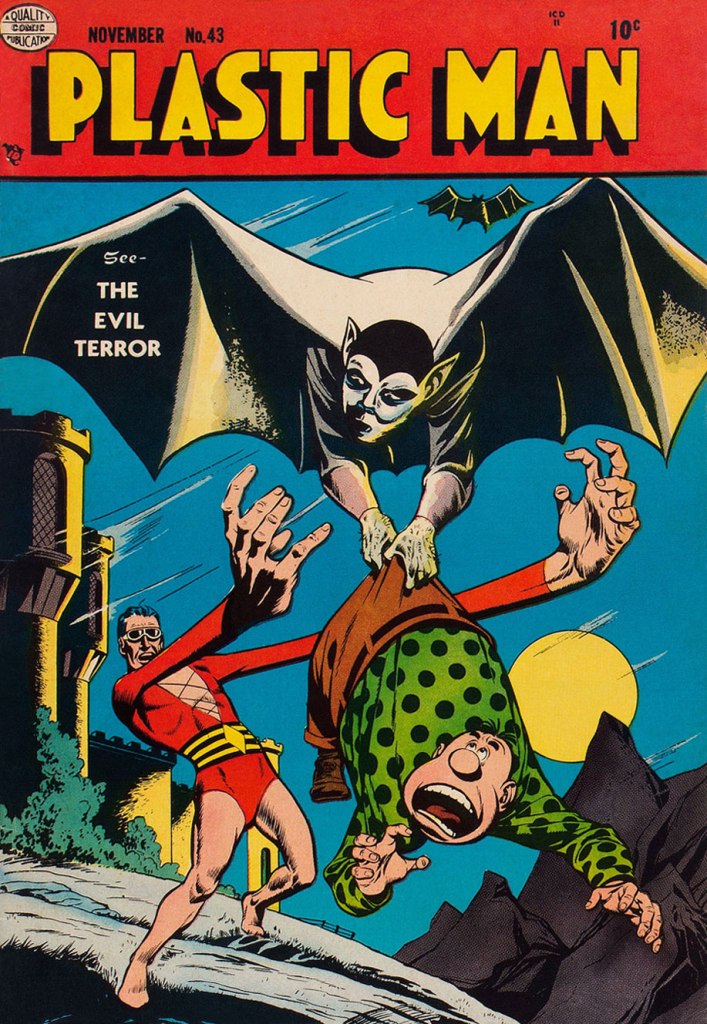
This is Plastic Man no. 43 (Nov. 1952, Quality); cover pencils by Dick Dillin, possible inks by Chuck Cuidera.
It must be stated that, even without the masterly Jack Cole, Plastic Man clearly brought the best out of the rest of Quality’s admittedly admirable bullpen, so his adventures remain worth reading… which is certainly not the case with most subsequent revivals, with the exceptions of DC’s 1976-77 mostly-ignored Ramona Fradon run and Kyle Baker‘s award-winning 2004-06 outing.
« Merchant and pirate were for a long period one and the same person. Even today mercantile morality is really nothing but a refinement of piratical morality.» — Friedrich Nietzsche
This charming rogue doesn’t look like he’s going to share his pretties with just anyone, so be sure to ask nicely.
Stanley P. Morse ran a rather fly-by-night operation, even by funnybook industry standards, but someone in there had some taste, as evidenced by the classic material produced under its various dodgy banners (Aragon, Gilmor, Key Publications, Media, S.P.M., Stanmor, Timor…) by such notables as the aforementioned Mr. Baily, Basil Wolverton (including his enduring The Brain Bats of Venus) and a fledgling Steve Ditko.
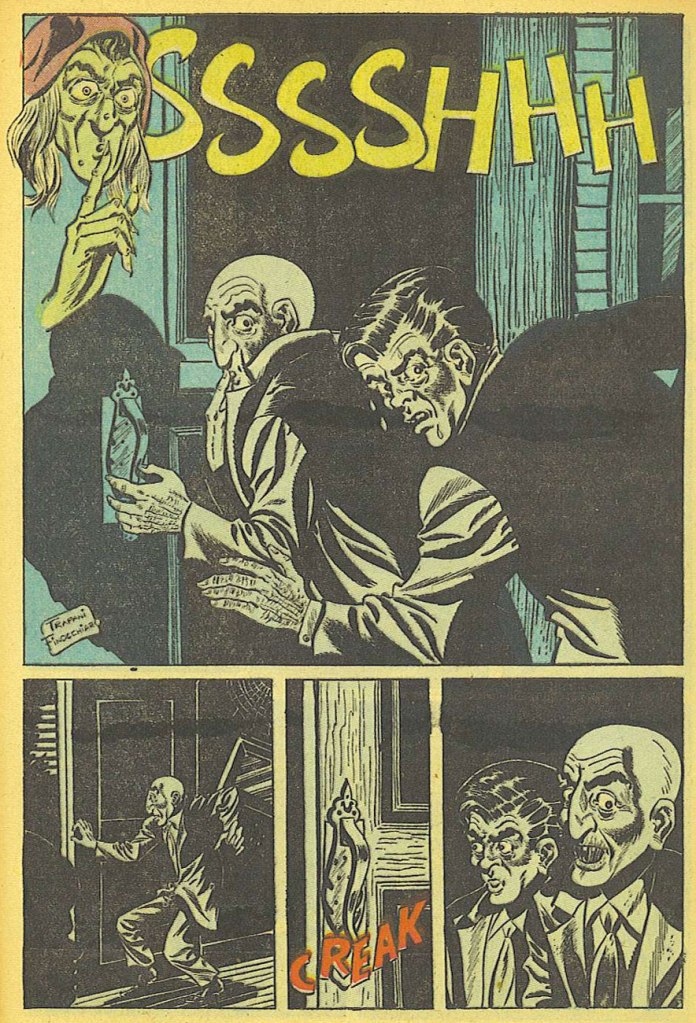
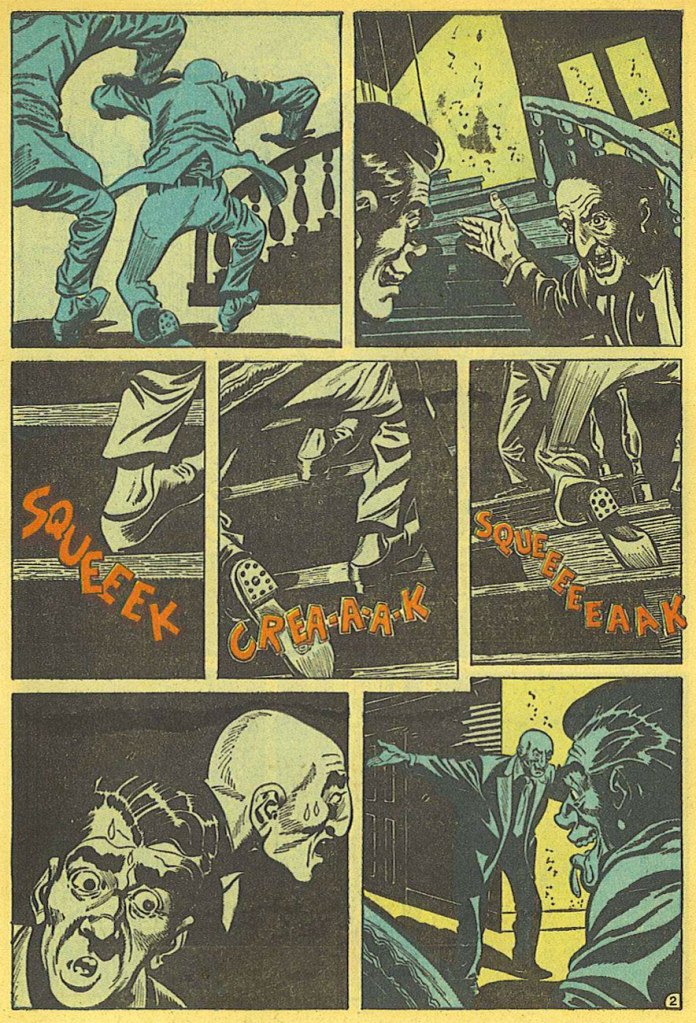
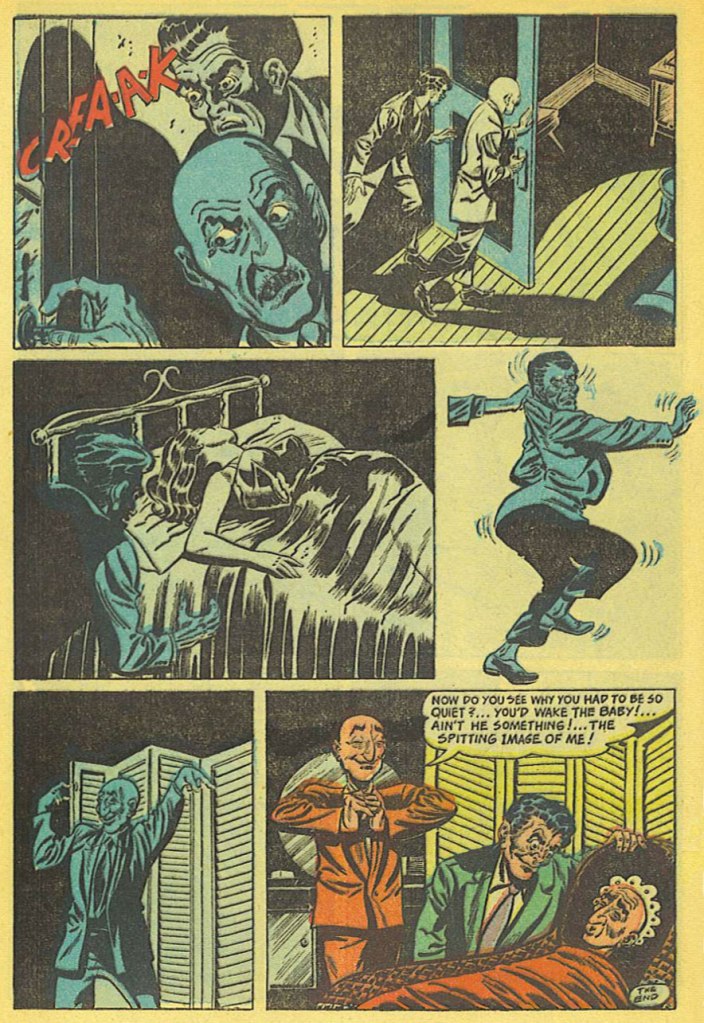
Still, the highlight of the issue has to be a brilliantly idiotic short tale intriguingly entitled… Sssshhh. Here it is:
Scripter unknown, with pencils by Sal Trapani, with inks by S. Finocchiaro. I have to say that this is my favourite-ever work by Trapani, a hack if there ever was one, whose inking jobs (his specialty in later years) generally did no favours to anyone’s pencils. And he had quite a prolific career, which was surely not hindered in the least by his being Dick Giordano‘s brother-in-law. For the defence, one of my close pals and colleagues holds that Trapani’s inks over Herb Trimpe‘s pencils on The Incredible Hulk (issues 156-166) were the finest of Trimpe’s lengthy run on the title. As far as that goes, I’ll stick with John Severin, but I do concede that Trimpe and Trapani did mesh well.
































 Who's Out There?