Tentacle Tuesday: Pleasantly Goofy

I’d like to interrupt the regularly scheduled Tentacle Tuesday with the double whammy of tentacles and kiss-me-I’m-Irish:
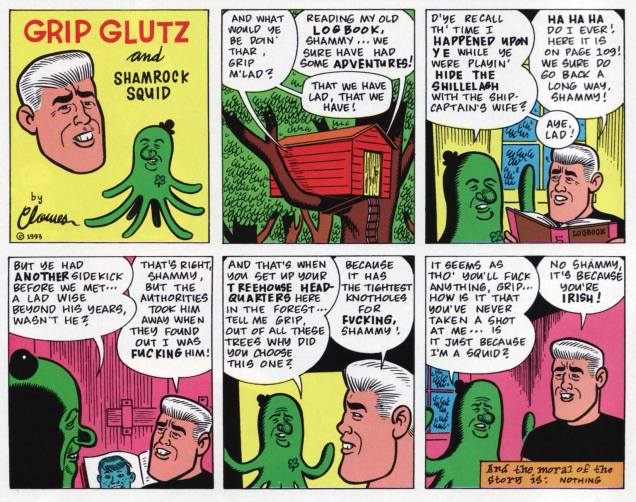
GripGlutzandShamrockSquidDanielClowes
It’s Grip Glutz and Shamrock Squid! Originally published in Eightball no. 10 (February 1993.) Story and art by Daniel Clowes, of course. I love stories with no moral.

Shamrock Squid, created by Clowes, is an “open source” character, which is to say that other cartoonists have official permission to use him in their work.

« While Shamrock Squid was originally featured in Clowes’s comic book Eightball as a comic companion to “Grip Glutz” in a one-page ‘gag’, he has also made surprise or cameo appearances in other alternative comics such as Peter Bagge’s Hate and Rick Altergott’s Doofus. The most detailed, epic and perhaps final use of Shamrock Squid was done by Adrian Tomine and Peter Bagge in a 7 page piece in Hate #28 entitled “Shamrock Squid: Autobiographical Cartoonist”, which lampooned autobiographical alternative comics, teen angst, and fandom. It would seem that the gag has gone as far as it can. » (source)

I’m not sure what is implied by “the gag has gone as far as it can”, but since Adrian Tomine is involved, I’ll happily agree that enough is enough.

So if you’re planning to booze your woes away this Saturday on St-Patrick’s, happy drinking!

TentacleTuesdayIcon

Moving on to the goofiness promised, here’s Tentacle Tuesday in all its glory.

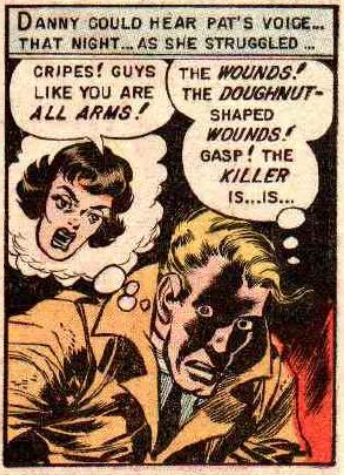
Many women get killed. Their corpses are covered in doughnut-shaped marks. A killer in a trench-coat sporting a wide-brimmed hat has been spotted retreating into the city’s aquarium after his crime. “Who Doughnut?”, the story’s title asks, and it is indeed a stumper.

WhoDonut1

The intrepid detective follows the killer! His mind struggles with the vital question of who or what could have possibly left such bizarre marks on his victims…
WhoDonut2

… and comes up with the answer! It’s…. (drumroll, please)…

WhoDonut3

Well, duh. Everyone knows octopuses suck blood (and have a weakness for stylish hats).  « Who Doughnut? », written by Al Feldstein and drawn by Jack Davis, was published in Vault of Horror no. 30, April-May 1953. The art is glorious, and the story – while preposterous – is moody as hell, so do yourself a favour and read it here. As a matter of fact, it’s so well drawn that one forgets the farcical plot and shudders along with the protagonist.

JackDavisWhoDoughnut
The composition just pulls you in, doesn’t it? Although you might wanna watch that… lest you come face-to-face with a vampire octopus.

TentacleTuesdayIcon

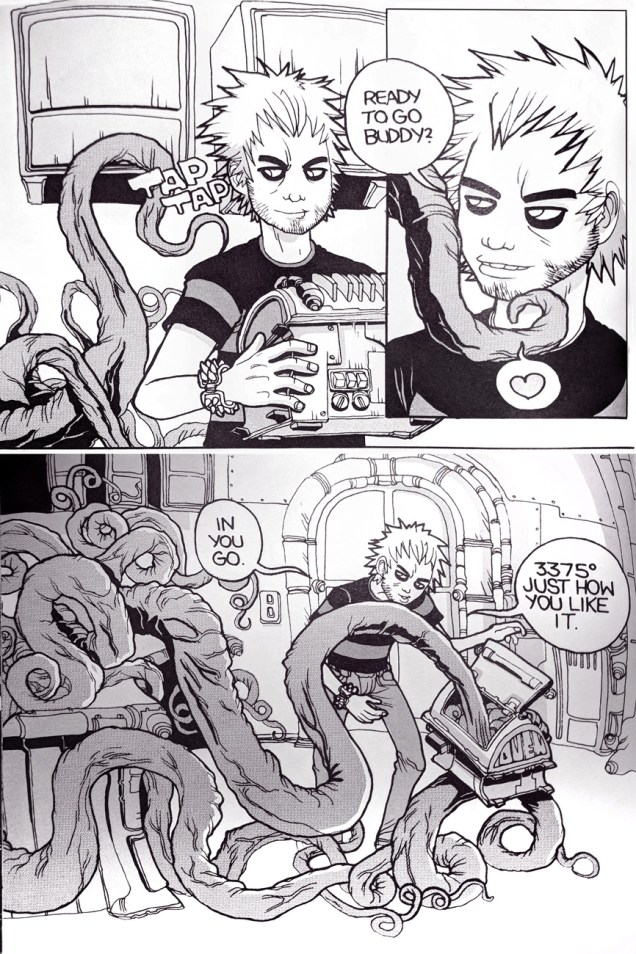
Quite on a different note, meet an alien lifeform with an appetite for self-destruction. Which is to say: it likes to be eaten.
WontonSoupJamesStokoe
« The CXL spice paste is made up of millions of hive-minded micro-organisms whose sole purpose in life is to be eaten in a delicious meal. If the lettuce is too thick and chunky, the CXL will realise they are being prepared wrong and will strangle the chef responsible. »
Snippet from James Stokoe’s Wonton Soup, published by Oni Press in 2014. Thanks to RG for putting together my hasty photographs of this page from a completely unscannable, thick and tightly-bound book.

Canadian Stokoe is probably best known for his take on Godzilla, which comic left me frankly underwhelmed. However, I heartily recommend the unfortunately unfinished Orc Stain. As for Wonton Soup, it was loads of fun to read. Here’s a summary from Publisher’s Weekly: « Stokoe’s wittily vulgar debut graphic novel follows former-cook–turned–space trucker Johnny Boyo as he fights off space ninjas, returns to the planet of his ex-girlfriend Citrus Watts, and finally faces a cook-off duel with a pair of alien twins who’ll stop at nothing to achieve culinary victory. » That covers the gist of part 1; to which I’ll add that part 2 of Wonton Soup concerns itself largely with Johnny’s buddy Deac’s reminiscences about his mad escapades with a sex bear, which are not for the squeamish.

TentacleTuesdayIcon

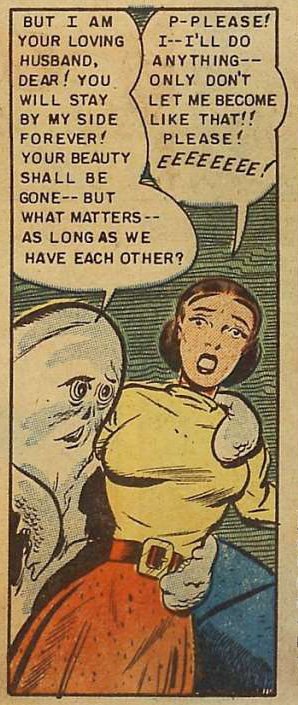
Let’s end this cephalopod festival not with a bang but with a whimper… the whimper of a wife who’s getting carried off by tentacles, that is.

GahanWilsonTentaclesWishingWell
“Sorry, dear.” Cartoon by Gahan Wilson, who can always be relied on to resort to tentacles whenever possible.

~ ds

Tentacle Tuesday: Planet of Tentacles, courtesy of Fiction House

In today’s Tentacle Tuesday, I’d like to demonstrate that Planet Comics, a sci-fi comic series published by Fiction House from 1940 to 1953, liked to tantalize its rapt audience by featuring tentacled monsters as often as basic decency permitted. Not to say that they limited their cheap pandering to tentacles; other tropes reared their ugly head, too. Faithful to its pulp magazine roots (Planet Comics was a Planet Stories’ spinoff), there’s always some stunning damsel in distress on the cover, and often some dashing muscle-head to rescue her. Mike Benton summarized Planet Comics’ raison d’être beautifully, if somewhat cruelly, in his Science Fiction Comics: The Illustrated History (1992) as «the barest smattering of sense and substance».

In its defence, P.C. also often ran stories in which female protagonists saved their friends’ bacon. How oddly progressive: the gals were clearly dressed to impress, but their skills and smarts repeatedly allowed them to overcome the odds while the big hunks stood helpless. Between that and all the tentacles, there’s a warm spot in my heart for Planet Comics.

TentacleTuesdayIcon

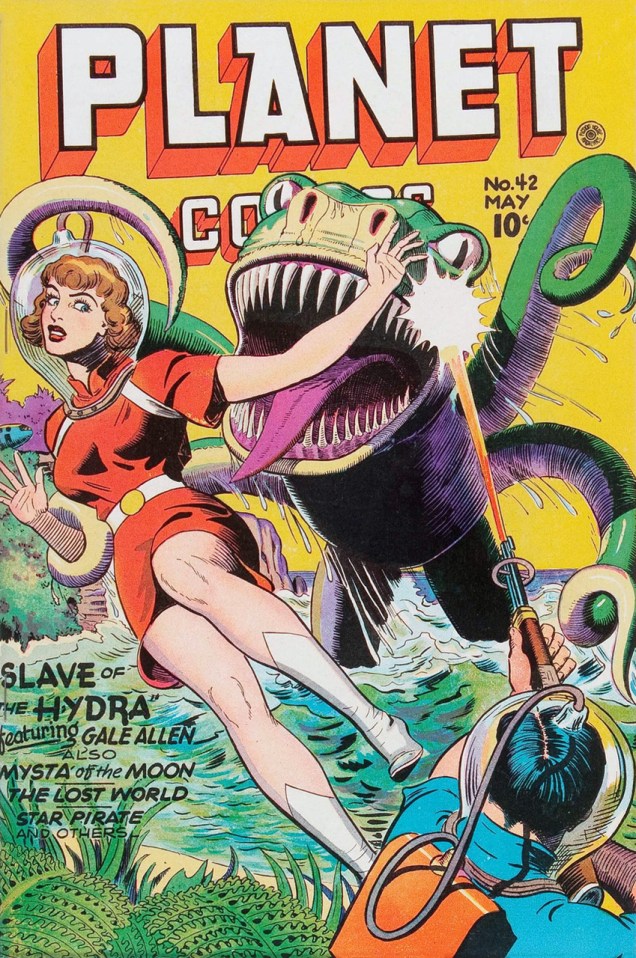
Let’s start with no. 42, which features Gale Allen, a Venusian princess with a knack for getting into trouble and the courage for getting herself out of it. Her Girl Squadron, comprising female pilots and soldiers, may have been an excuse for drawing yet more pretty girls, yet in the stories the squadron was still a force to be reckoned with, by friend or foe.

PlanetComics42A
Planet Comics no. 42, May 1946. Cover by Joe Doolin, adept at depicting the female form in an aesthetically pleasing way. Here Gale is being rescued by some dark-haired stud with a laser gun (who cares about him?), but let’s peek inside…
PlanetComics42panel
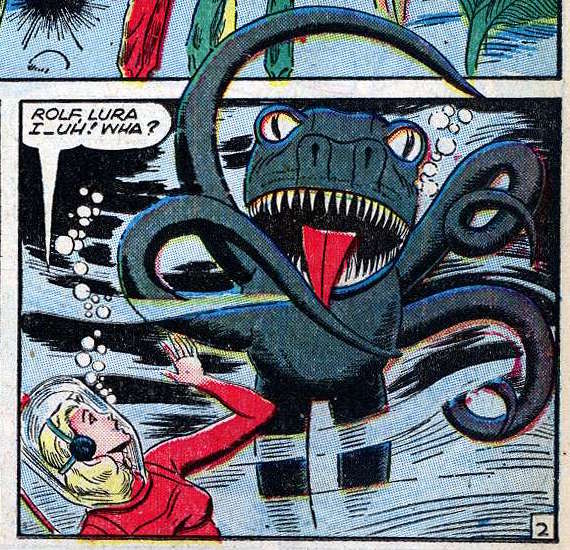
This is what Gale has to deal with in « Slave of the Hydra », also drawn by Doolin. This toothy beast is supposed to be a Hydra. Hydra of the Hydridae family, or the Greek many-headed serpent? Neither supposition makes sense.
PlanetComics42page
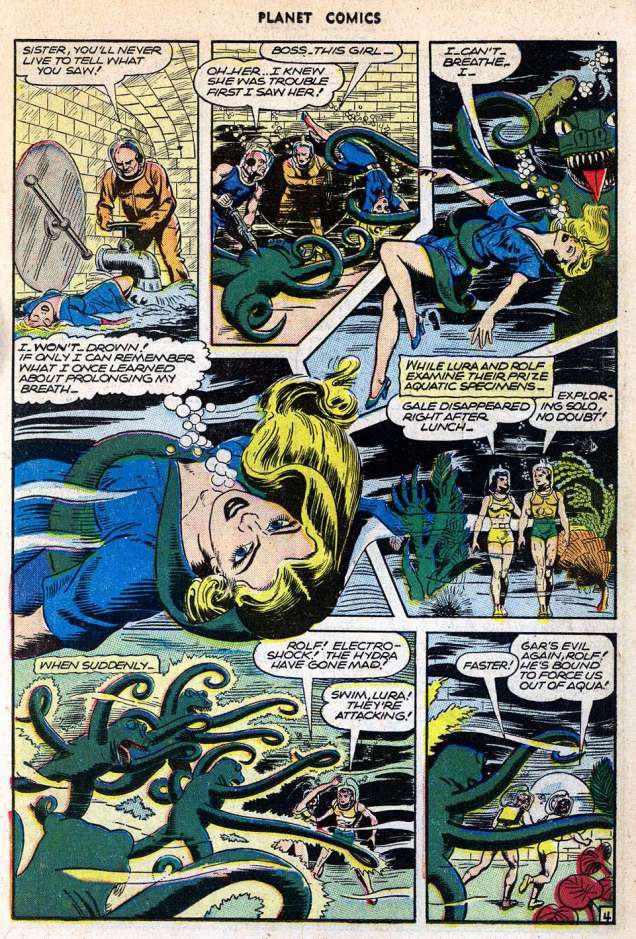
Our plucky heroine manages to save the day by escaping a certain drowning! It’s a little known fact that girls can actually store extra oxygen in their boobs. Kidding aside, I can understand why Planet Comics had a female readership that must have enjoyed reading about women who don’t crumble under pressure, and sometimes even kick monster tush.

Moving on to the next cover, an odd one even by Golden Age sci-fi standards:

PlanetComics44
Planet Comics no. 44 (September 1946), cover by Joe Doolin. She’s a generic damsel-in-distress, I get that, but the alien is strange – even for an alien. I imagine that the artist’s internal conversation went something like this: “okay, I’ll give him arms that double as tentacled snouts, and snail eyeball stalks. Oh, and I’ll make him a cyclops while I’m at it. And he’ll be drooling. And I’ll make him look black because that’s more exotic.” Yikes.

A glimpse at the stories inside quickly proves that the cover has nothing to do with Mysta of the Moon, or any of the “many others” advertised on the cover. There is, however, an octopus in the Futura story. Futura was another recurring heroine, an ordinary girl abducted by Brain-Lords of Cymradia and “improved” into a stronger, smarter version of her old self. Smart, resourceful and a damn good fighter, Futura is fun to watch in action. Especially when tentacles are involved! Take a look:

PlanetComics44panel
Officially signed by John Douglas; pencils and inks by Chester Martin. I feel oddly sorry for the crocodile.

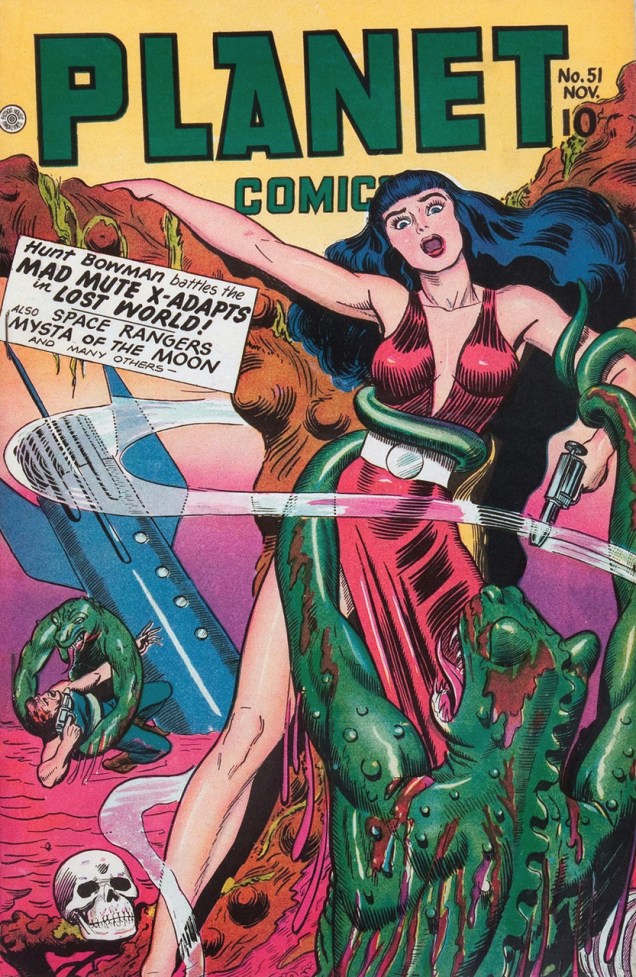
Let’s have a look at several covers where tentacles are actually used as the good lord has intended, i.e. for grabbing pretty girls:

PlanetComics51A
Ah, yes, the old “reptiles with tentacles” scare. Planet Comics no. 51, November 1947. Cover by Joe Doolin (again). Man, his girls are pretty delectable.
PlanetComics67A
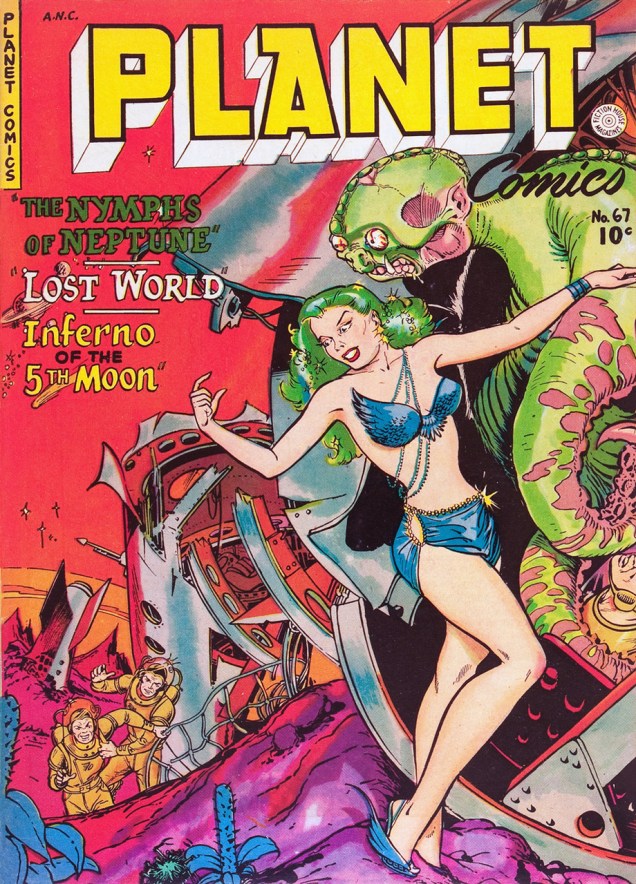
Planet Comics no. 67, summer 1952. Cover by Maurice Whitman. There are absolutely no tentacles in any of the stories. Boo, I say.
PlanetComics70
Planet Comics no. 70 (spring 1953), cover by Maurice Whitman. I like the alien’s get-up in general: his flappy ears, the motorcycle helmet, the hip lip piercings… He’s one cool cat. I am equally impressed by how he’s managing to fire a gun when he doesn’t have opposable thumbs (maybe the pistol is specially tentacle-adapted; instead of a trigger, some sort of squeeze sensor). Disappointingly, the insides of this issue don’t have any tentacles whatsoever, although there are some dinosaurs and giant man-eating spiders (and most of us will be happy to settle for that).

Oh, perhaps I have been neglecting burly heroes a tad. Those of us who prefer muscle to curve deserve some eye candy, too! So here’s good old Reef – and some green men in Speedos.

PlanetComics17Page
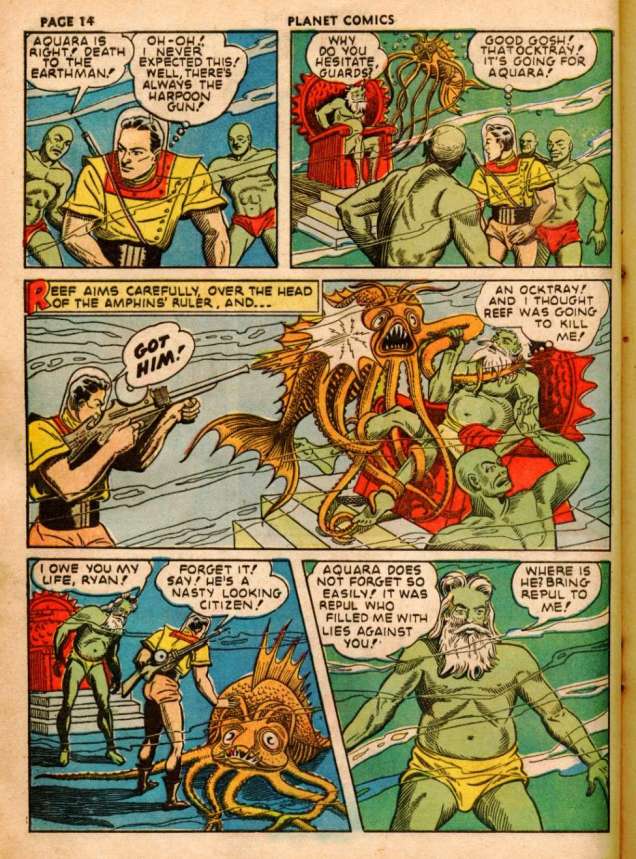
Planet Comics no. 17, March 1942. A Reef Ryan story, possibly pencilled by George Appel and inked by Al Gabriele, though it’s credited to Hugh Fitzhugh, a funky nom-de-plume for parties unknown.

And men get grabbed by tentacles, too:

PlanetComics31page
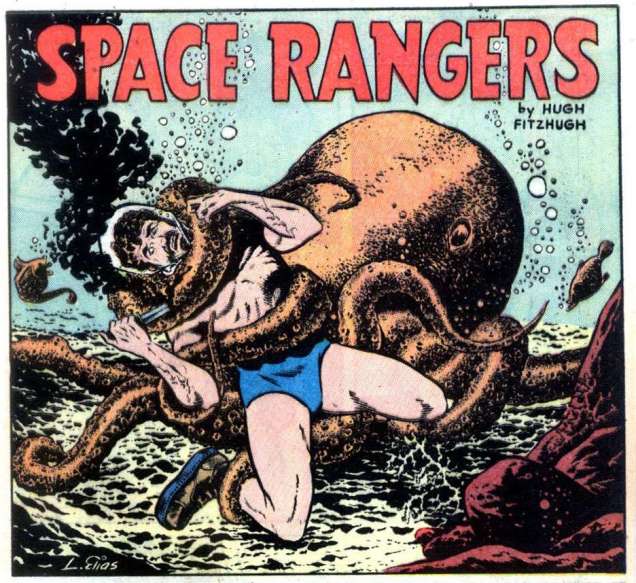
Planet Comics no. 32, September 1944. Art by Lee Elias.

There’s about 10 more Planet Comics covers with tentacles left, and quite a few more interior pages showcasing the beauty of the octopus, or tentacled alien, or cephalopod reptile, or whatever else the kooky minds writing and drawing for Fiction House have dreamed up… but that’s enough for now. There’s only so much probing appendage the human mind can take in one go, so I’ll say Auf Wiedersehen.

Until the next time our paths (and tentacles) cross again!

~ ds

“He sure is my heap hep dream beam!”* In praise of Bob Lubbers (1922-2017)

Mr. Lubbers (pronounced LEW-bers) , born January 10, 1922, left us last summer at the venerable age of ninety-five. As it happens, he also left us some fine, fine artwork.

My initial encounter with Bob Lubbers‘ work came in 1978, when he provided a handful of covers and a couple of issues to Marvel’s Human Fly, a book about masked Canadian stuntman Rick Rojatt, whose real-life, non-funnybook story is a gripping read**. Anyway, the series was usually pencilled either by Lee Elias*** or by the mighty Frank Robbins; by the time Lubbers came along, Robbins had rightly had his fill, given the comics industry the one-finger salute and decamped to México to retire and paint in peace. Wise man.

HumanFly16A
Lubbers’ fourth and final The Human Fly cover (no. 16, Dec. 1978, Marvel). Inks by Bob McLeod. Inside, “Niagara Nightmare!” is written by Bill Mantlo, with art by Lubbers and Ricardo Villamonte.

I then became aware of Mr. Lubbers as one of the Golden Age’s primo ‘good girl’ cover artists, with Fiction House, no less. That’s what I’ll chiefly focus on here. Can you honestly blame me? Unlike some of his peers (hello, Bill Ward), he wasn’t just good at, and interested in, the saucy depiction of lightly-clad sirens: he could draw anything with finesse and brio.

Wings82A
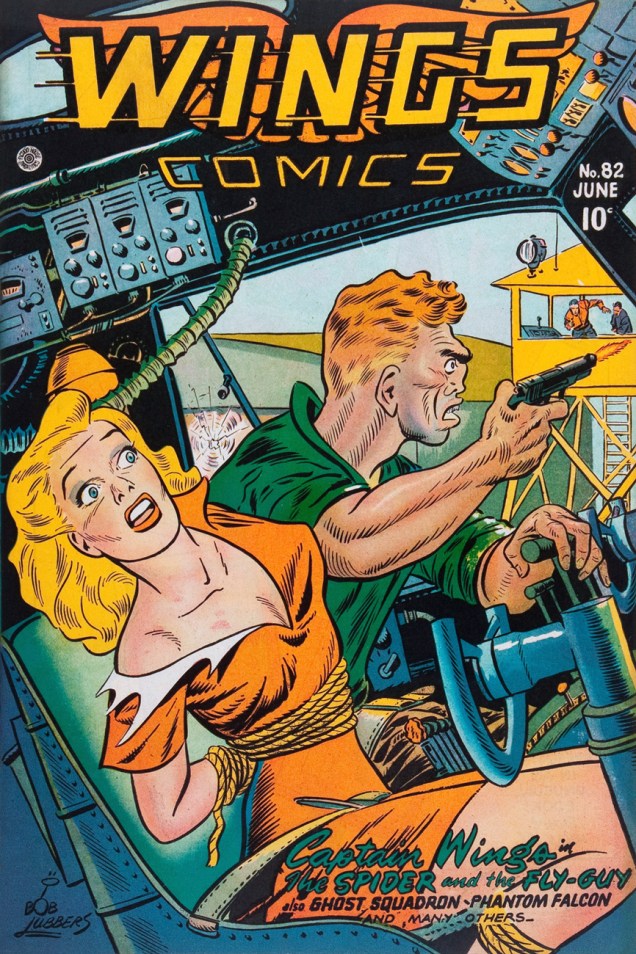
Mouth-breathing, slope-browed… I guess he’s not the hero in this one. Wings Comics no. 82 (June 1947, Fiction House.)
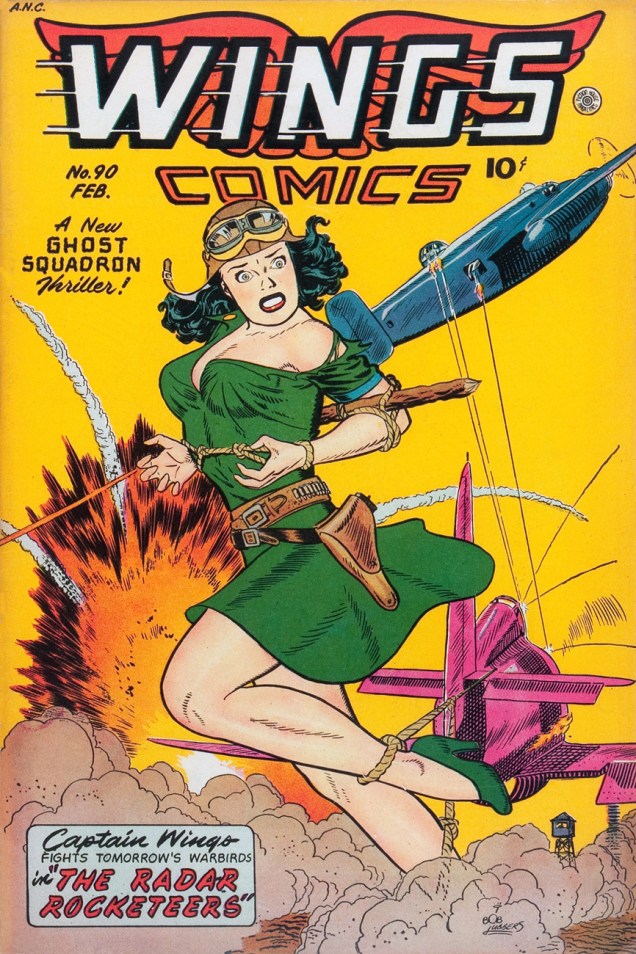
Wings90A
Arguably the most (in)famous of Lubbers’ Wings covers. “Classic bondage and headlights cover!”, cry the ancient fanboys. Wings Comics no. 90 (Feb. 1948, Fiction House.)
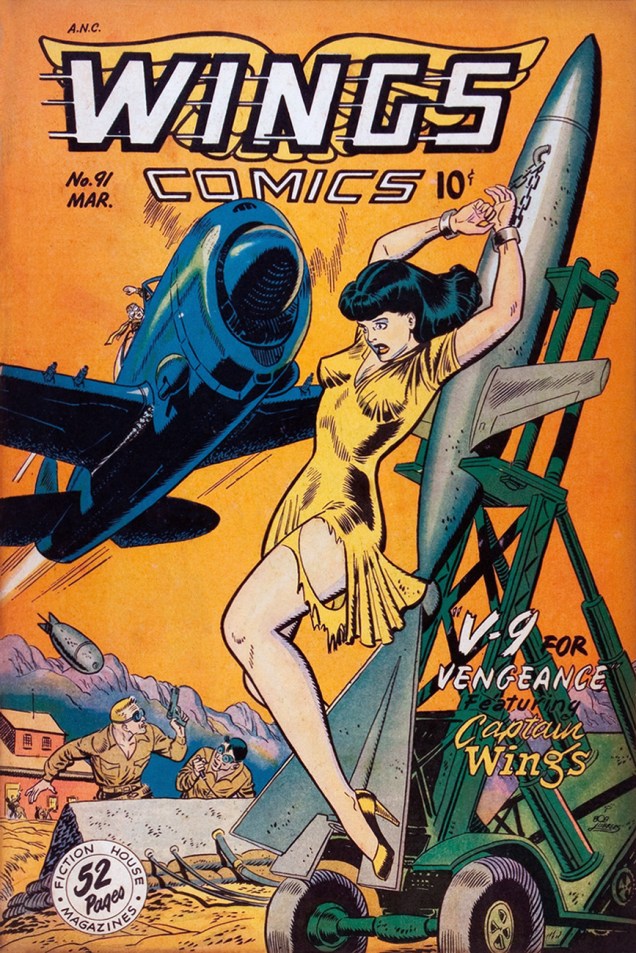
Wings91A
If our man of the hour had rescue in mind for the imperilled damsel, dropping a payload (you heard me!) a hundred feet away from her is likely to… make the situation a bit messy. Wings Comics no. 91 (March 1948, Fiction House.)
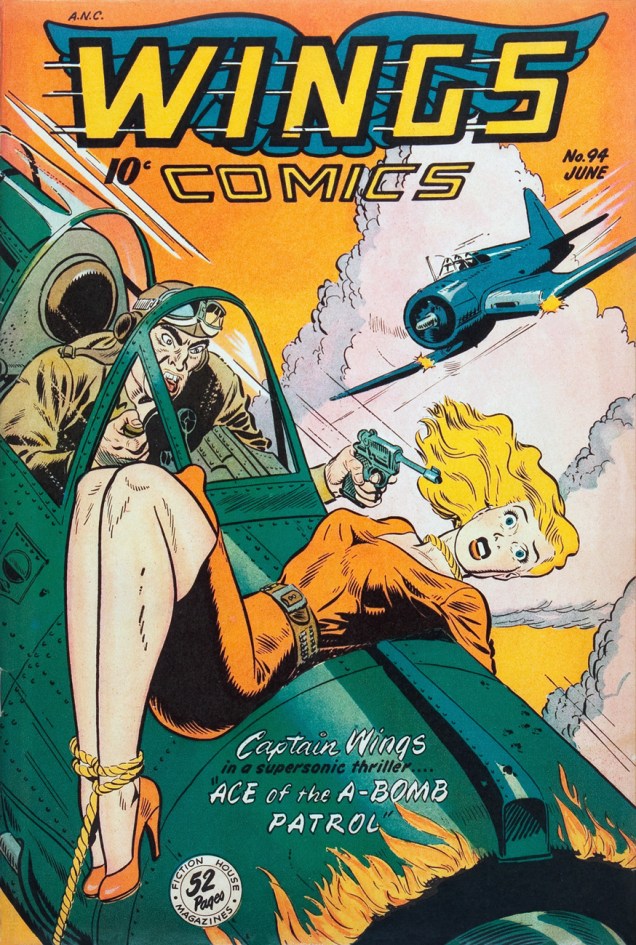
Wings94A
« Seriously? The engine is on fire, we’re being strafed, I’m hogtied and helpless, and he’s still going to threaten me with a gun? » Wings Comics no. 94 (June 1948, Fiction House.)
Wings98A
The life of a crocodile dentist isn’t an easy one, but the satisfaction of a job well done is its own reward. Wings Comics no. 98 (Oct. 1948, Fiction House.)
Wings100A
Here comes the mother of all rope burns, sister. You’re supposed to grab the loop! Wings Comics no. 100 (Dec. 1948, Fiction House.)
AuthenticPolice5A
The exception to the Fiction House Wings set: Authentic Police Cases no. 5 (Oct. 1948, St. John.) The babes never could resist a bad boy.

Yet farther along, I would learn of his large and distinguished body of comic strip work: Long Sam, Secret Agent X-9, Tarzan, The Saint, Lil’ Abner, and best of all, his most personal work, Robin Malone (1967-70). On the latter, I can’t praise enough Tom Heintjes‘ definitive article (Hogan’s Alley no. 19, 2014), here’s a version of it: www.hoganmag.com/blog/the-life-and-death-of-robin-bob-lubbers-robin-malone

… and don’t forget to scroll down, down, down so you can sample (though it’s never enough!) the article’s lavish bounty Robin Malone Sunday strips.

*From the Captain Wings adventure « The Spider and the Fly-Guy » (Wings Comics no. 82) Read it right here (or pick from a generous selection of Wings Comics issues at Comicbookplus.com)

**speaking of which, check out this fine piece about The Human Fly’s rocket bike and the stunt that ended his career: http://kymichaelson.us/human-fly. You have to admit that jumping over 27 buses is a tad ambitious… and he was originally going to try for 36!

***likely picked for the job due to his fine work on another masked stuntperson character, Harvey’s The Black Cat.

– RG

Tentacle Tuesday: Out of the Snowbank and Into the Jungle!

Welcome to the first Tentacle Tuesday of 2018. Exciting, isn’t it?

Since it’s currently chillingly cold outside (or so the weather networks tell us), let’s bask in a bit of warmth and visit some exotic places where heat reigns supreme all year ‘round.

TentacleTuesdayIcon

What’s the first thing to do on a vacation? Take a leisurely walk, of course. However, I’d advise against venturing into a swampy forest. Some people never listen to sage advice, however…

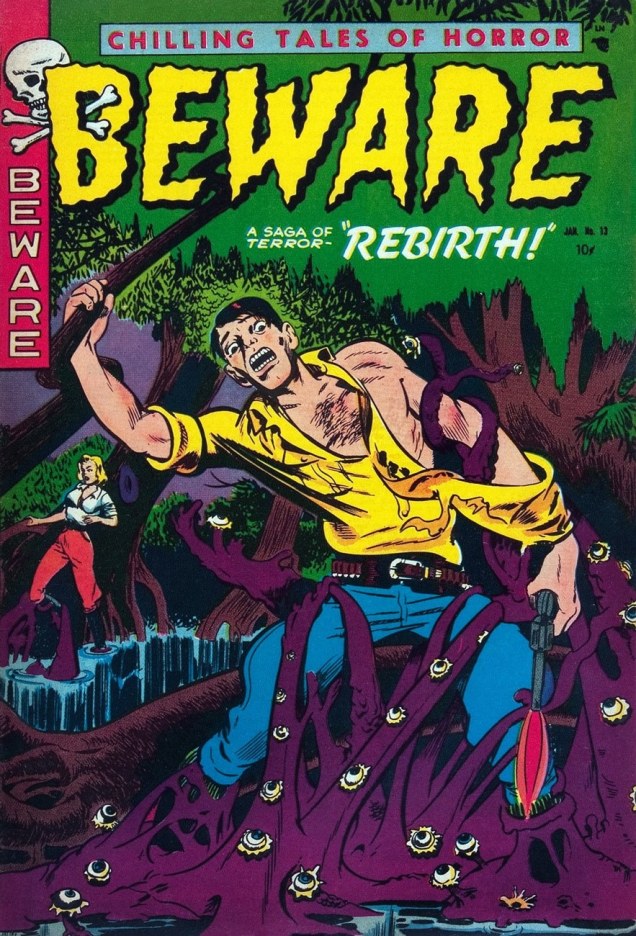
Beware13
This is Beware no. 13 (1953), with a cover by Harry Harrison. « Out of the filth and mud-spawned deep it came, this horrible slug-white creature that wanted only one thing — to be loved! » Wait, what? “Rebirth”, the cover story, also illustrated by Harrison, clearly has absolutely nothing to do with the cover.

I’m quite fond of Harry Harrison as a writer, but as an artist he seems to have been rather middling. Although advertised as a “saga of terror”, Rebirth is an intriguing story in which the “horrible slug-white creatures” are actually far more likeable than the regular humans, who are back-stabbing, greedy assholes. Not that the plot makes much sense.

Beware13HarryHarrisonPanel1
The “white slug” may be well-intentioned, but he tends to launch into pompous speeches at the drop of a hat.
Beware13HarryHarrisonPanel2
A heart-warming, romantic scene.

TentacleTuesdayIcon

Okay, so a walk through a forest didn’t pan out quite as hoped. Let’s take a soothing dive into welcoming, warm waters. Did I say “welcoming”? Perhaps a little *too* welcoming.

TerrorsoftheJungle20
Terrors of the Jungle no. 20 (December 1952), cover by L.B. Cole. Normally I like Cole’s use of bright colours, but on this cover he goes all the way into gaudiness. However, the octopus is quite handsome, and he’s got startlingly human, expressive eyes. I’m rooting for him! Once again, the cover has little to do with the cover story.

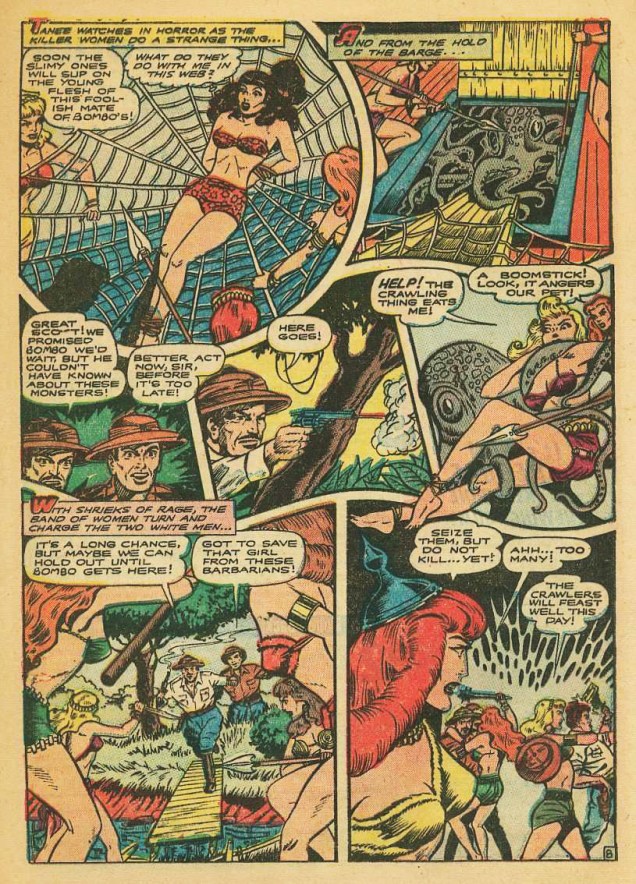
The Creeping Scourge, credited to the Iger Shop (that my spellchecker keeps correcting to “tiger shop”), a comics packager that was officially known as the Eisner and Iger Studio, is an entertaining romp with babes in bondage, wild natives, catfights, blood sacrifices, etc. For example:

TerrorsoftheJungle20Panel
A typical page from The Creeping Scourge, published in Terrors of the Jungle no. 20 (December 1952). « Help! The crawling thing eats me! » is a pretty snappy catchphrase.

TentacleTuesdayIcon

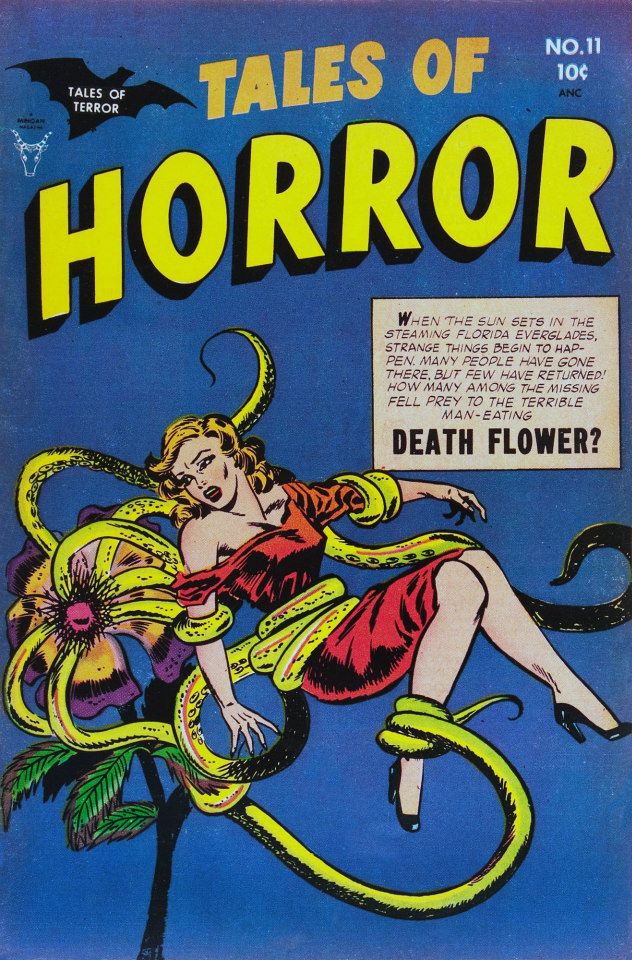
For the botanically-minded, a vacation is a fine opportunity to admire some heretofore unseen exotic plants. Take a look at this sweet little flower:

TalesofHorror11
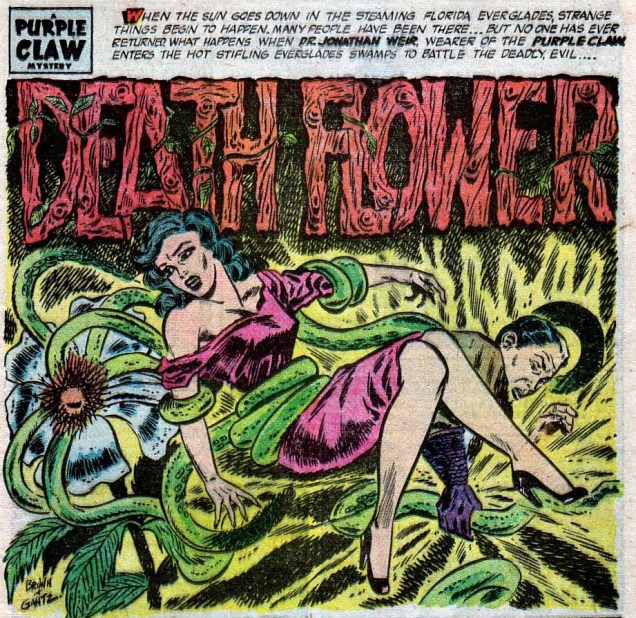
« In the middle of the everglades, there’s a flower that’s different from any you’ve seen… »  Tales of Horror no. 11 (June 1954). Pencils by Ben Brown, inks by David Gantz. Death Flower tells the blood-curdling tale of a creepy old man who lives in the Florida swamps and feasts on human flesh – after having turned into a flower, of course.
DeathFlower1
The opening panel of Death Flower, also drawn by the Ben Brown (pencils) and David Gantz (inks) team.
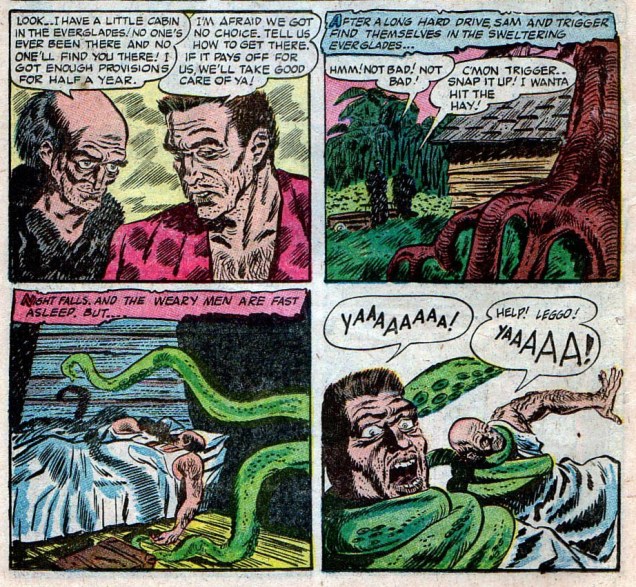
DeathFlower2
Wouldn’t *you* trust this old man? Just look at him – such honest eyes, such a confidence-inspiring face. Yes, of course we’ll go to your cabin, venerable oldster!

That’s it for our little holiday pleasure trip – come to think of it, I’ll remain where it’s cold and snowy, thanks.

~ ds
Hey, Easy With the Jackhammer!

I understand that this image has to do with the tradition of greeting the new year by banging on pots and pans and generally making a racket, but I presume that both sailor-garbed primate and pneumatic drill were optional, particularly in times of scarcity.

FamousFunnies138A

Art by Stephen Douglas, from Famous Funnies no. 138 (January, 1946). FF number one (July, 1934) was likely the second comic book issued, and the first one *sold*. It was published by Eastern Color / Dell Comics.

Read the issue here: http://comicbookplus.com/?dlid=35200

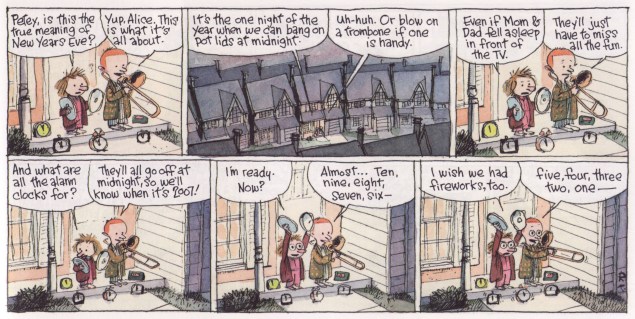
And while we’re on the subject of ushering in the New Year by making a hellacious din, let’s treat ourselves to a couple of relevant Cul de sac pieces. The first returns us to the strip’s formative, water-coloured years, when it appeared weekly (2004-2007) in The Washington Post‘s weekly magazine section.

CuldeSacNewYearsA
The Washington Post Magazine, Dec. 31st, 2006. Richard Thompson: « From when Petey played the trombone, and I found it too hard to draw. »
CuldeSacNewYears2008-09
The master tackled the theme again in this brief sequence from Dec. 31, 2008- Jan. 1st, 2009.

Nothing left to do now but to wish a joyful 2018 to all you monkeys and assorted critters!

– RG

Felicitous Festivities, Funky Flashman!

Today is birthday number ninety-five for Stanley Lieber, aka Stan Lee. He was hatched on December 28, 1922. Have a good one, Stan.

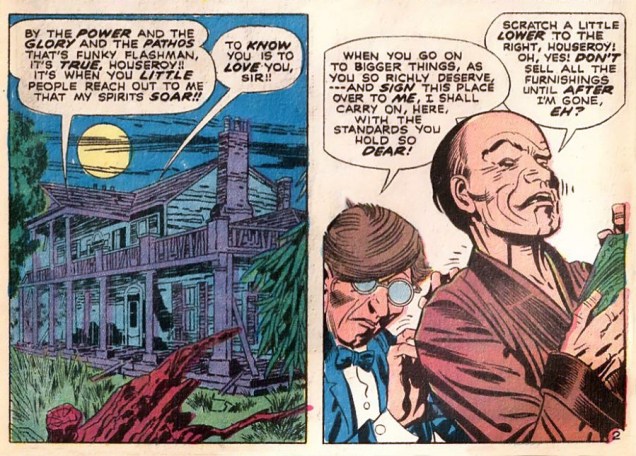
FunkyFlashman
Jack Kirby recalls with fondness his former editor and his toady, in “Funky Flashman!” (Mister Miracle no. 6, January-February 1972, DC).

On this momentous occasion, let’s hear about Stan from some of his colleagues, who knew The Man and obviously loved the experience:

Wally Wood:
« Did I say Stanley had no smarts? Well, he DID come up with two sure fire ideas… the first one was ‘Why not let the artists WRITE the stories as well as draw them?’… And the second was … ‘ALWAYS SIGN YOUR NAME ON TOP… BIG’. And the rest is history… Stanley, of course became rich and famous … over the bodies of people like Bill [Everett] and Jack [Kirby]. Bill, who had created the character that had made his father rich wound up COLORING and doing odd jobs. »

EC legend Bernie Krigstein, who collaborated with Stan at Atlas, and whose « Suppressed Desire » is featured in Spellbound no. 17 (September 1953) , with a glorious cover by the above-mentioned Bill Everett.

EverettSpellbound17A

In the course of a 1960s interview with comics scholar John Benson, Krigstein responded to Benson’s statement of « I guess you know that Stan Lee has been the spearhead of the so-called current revitalization of comics »:

« I’m delighted to learn that. Twenty years of unrelenting editorial effort to suppress the artistic effort, encourage miserable taste, flood the field with degraded imitations and non-stories have certainly qualified him for this respected position. »

Then Gil Kane, who was Marvel’s principal cover artist for much of the 70s, and who collaborated with Lee on The Amazing Spider-Man in some of its most popular years, including the infamous, comics-code unapproved “drug” issues (nos. 96-97, May-June 1971), on the respective creative roles of Stan and Jack Kirby:

« On each page, from 1964 – 1970 next to every single panel Jack wrote extensive margin notes explaining to Lee what was taking place in the story. It took Jack about 2 weeks to do a single story, it may have taken Lee as little as 4 hours to add text to Jack’s art. »

And Steve Ditko, in a letter to the editor of Comic Book Marketplace, published in the magazine’s 63rd issue in 1998, on his and Stan’s respective roles in crafting an issue of Spider-Man:

« The fact is we had no story or idea discussion about Spider-Man books even before issue no. 26 up to when I left the book. Stan never knew what was in my plotted stories until I took in the penciled story, the cover, my script and Sol Brodsky took the material from me and took it all into Stan’s office, so I had to leave without seeing or talking to Stan. »

Further  illuminating reading: http://kirbymuseum.org/blogs/effect/2015/07/25/according-to-kirby-1/

Once again, Happy Birthday to the Funky Flashman! ’nuff said and all that rot.

-RG

The Unforgettable Jack Cole

« What are you mumbling about? »
« Oh, nuthin’! … just that 
my false teeth get loose 
an’ make a lot of noise! »

Today marks the one hundred and third anniversary of the enigmatic Jack Cole (December 14, 1914 – August 13, 1958) a man embodying, in equal parts, hilarity, talent and torment. Just when everything seemed to be going his way, he took his own life in 1958, for reasons still surmised about. His widow was the only one to know, and she took her secret to the grave.

Let’s move past this morbid stuff and concentrate on the man’s creative legacy, shall we?

Police25A
Cole’s cover for his Plastic Man story « The Rare Edition Murders » (originally called « The Bookstore Mystery », judging from the cover art) cleverly ties in the mag’s other features. And they do need to be mentioned: Flatfoot Burns by Harvey Kurtzman, The Darson Twins by Jack Keller, The Spirit by Will Eisner (or his talented ghosts), Manhunter by Reed Crandall… This is Police Comics no. 25 (December 1943, Quality).
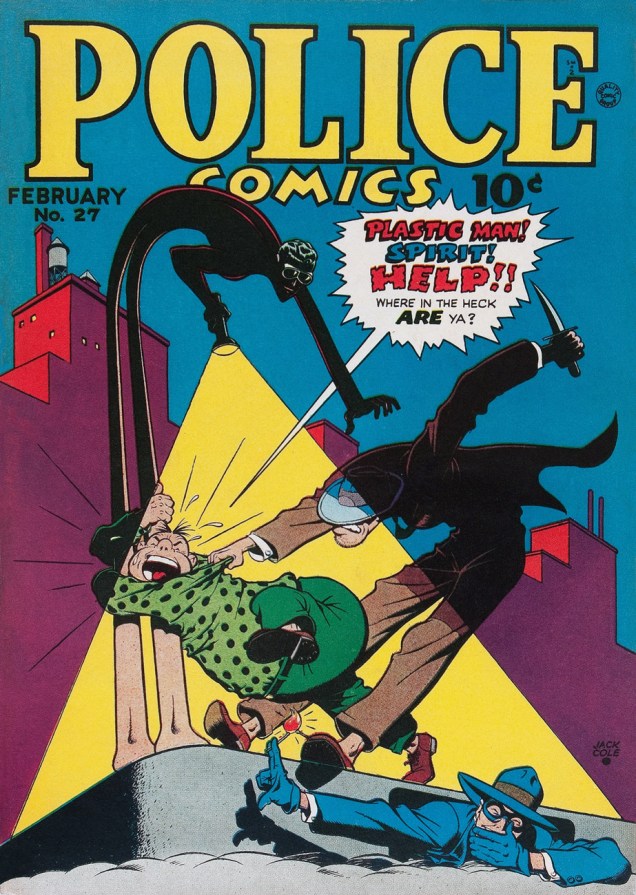
Police27A
Routine, the same old grind… another issue of Police Comics, another splendid Jack Cole cover. This is Police Comics no. 27 (February, 1944), featuring Plastic Man in « Woozy Winks, Juror », and tales of Dewey Drip, Flatfoot Burns, Destiny, Manhunter, Dick Mace, The Human Bomb, Burp the Twerp (by Cole), and of course The Spirit. Sounds potentially entertaining? Read it here, then: http://comicbookplus.com/?dlid=37421
Police72A
Cole’s Plastic Man, one of the timeless wonders of comics’ Golden Age, a character only his creator truly knew how to handle properly. This is Police Comics no. 72 (November 1947, Quality).
Police76A
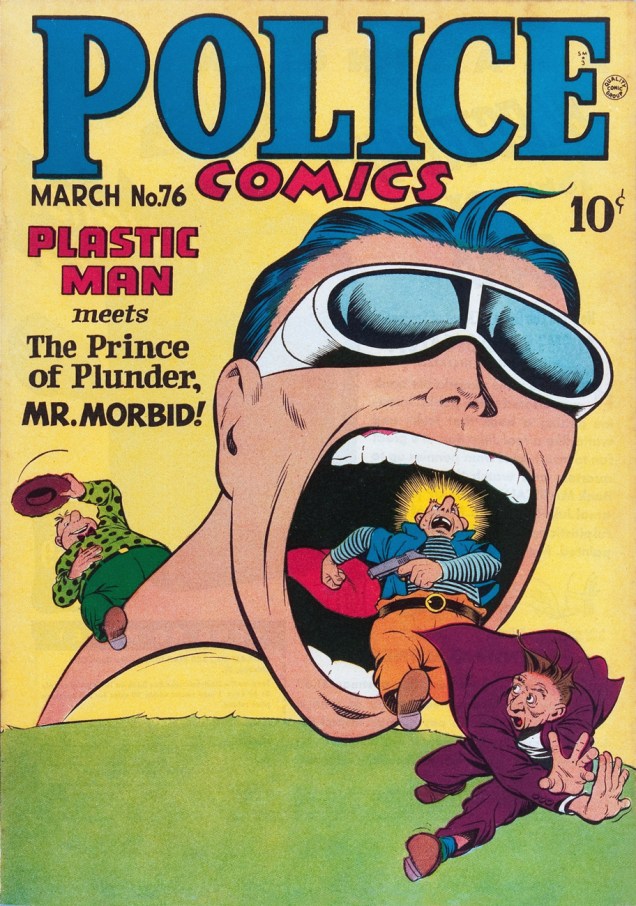
Another vivid (what else?) example of Mr. Cole’s boundless inventiveness, featuring his flagship creation, Plastic Man (and rotund sidekick Woozy Winks). This is Police Comics (1941-1953, 127 issues) no. 76 (March 1948, Quality).
Web-of-Evil5A
« You mean this guy had nine slugs in his chest and still choked the other one to death? » Web of Evil no. 5 (July 1953, Quality).
WebofEvil6A
Web of Evil no. 6 (September 1953, Quality).
ColeElongatedHandA
This lovely watercolour ran in Playboy Magazine‘s August, 1955 issue. It’s titled « The Elongated Hand ».
JackColeCabinA
« Like they say in the travel folders, Miss Duncan – ‘Getting there is half the fun’ ».
Playboy Magazine, August, 1956.

Versatile, wasn’t he?

– RG

On This Day: Boris Karloff Crosses Over

« What’s that noise comin’ up from the cellar?
It’s the restless bones of Boris and Bela* »

It’s a cinch that William Henry Pratt, back when he was eking out a living in Canada, digging ditches or driving a truck, never suspected that his name, his stage name that is, would still elicit shivers of recognition long after his passing. Here we are, a whole hundred and thirty years past his birth, in Camberwell, South London, on Wednesday, November 23, 1887.

From his ascent to stardom in the early 1930s until his passing in 1969, he certainly lived to see his likeness appear in a bewildering array of toys and games and bedsheets and mugs and a zillion knicknacks and gewgaws, a parade that continues to this day. But he was likely never represented more consistently and abundantly than he was in comic books.

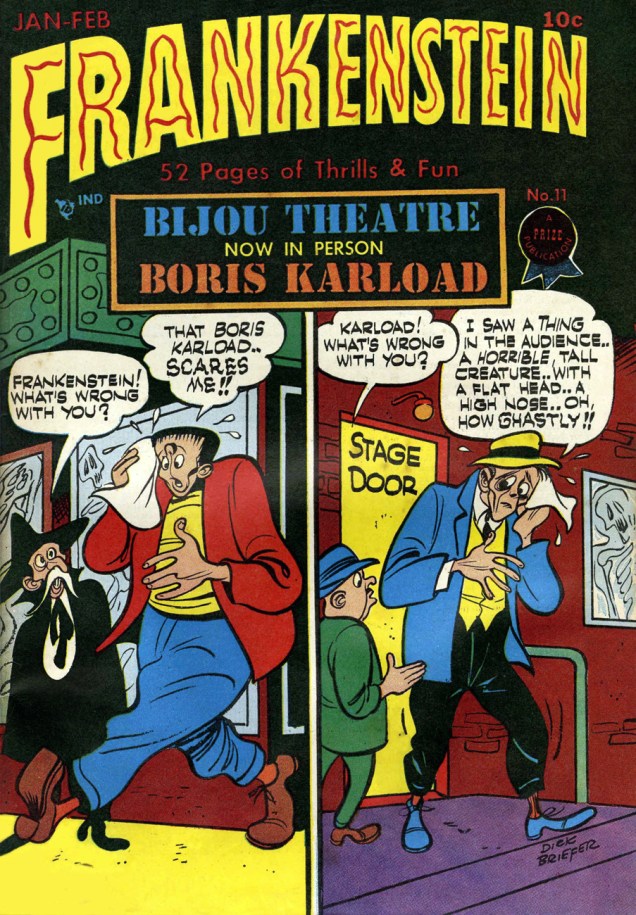
Frankenstein11A.jpg
Here, the Monster meets his… inspiration, in « Boris Karload, Master of Horror ». Dick Briefer‘s Frankenstein is a definite highlight of the Golden Age of comics. This is Frankenstein no. 11 (Jan.-Feb. 1948, Prize Comics). Read it here: http://comicbookplus.com/?dlid=39937 And if you, er… dug that, treat yourself to Craig Yoe‘s selection of Briefer’s rendition(s) of the Famous Monster. It’s a great package, and Mr. Yoe can always use the money… to unleash further wonders.

Here’s a gallery of cover highlights from Gold Key Comics’ long-running Boris Karloff Tales of Mystery (95 issues, 1962-80).

BorisThriller1A
Before there was called Boris Karloff Tales of Mystery, there was, for two issues, Thriller, based on the by-then-cancelled NBC series. Gold Key were often quite slow in making their licensing moves. The TV Thriller was often terrifying (“Pigeons From Hell”, “The Hungry Glass”…), but the comic book never scaled such heights, even sans the emasculating influence of the Comics Code Authority.
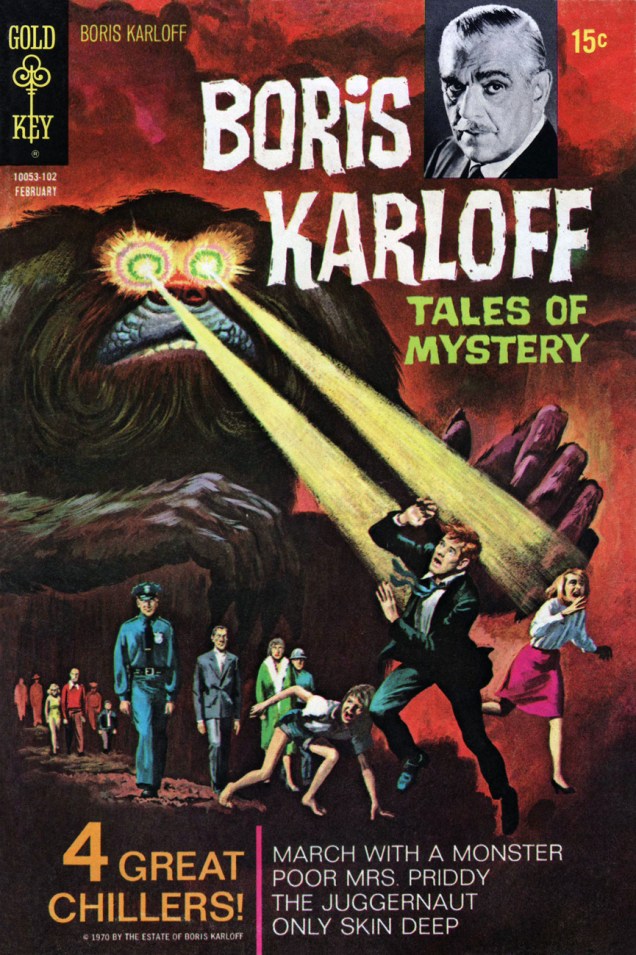
Boris33A
« You know that one sideways glance from that bug-eyed banshee can turn your brains to prune-whip! » Boris Karloff Tales of Mystery no. 33 (Feb. 1971), Cover painted by George Wilson, illustrating Len Wein, Tom Gill and John Celardo’s March with a Monster.
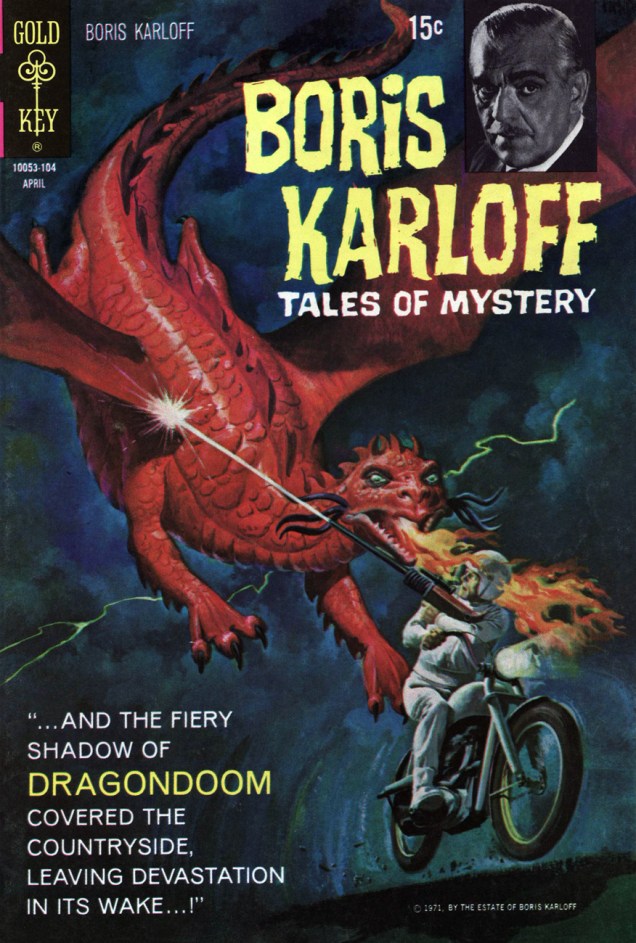
Boris34A
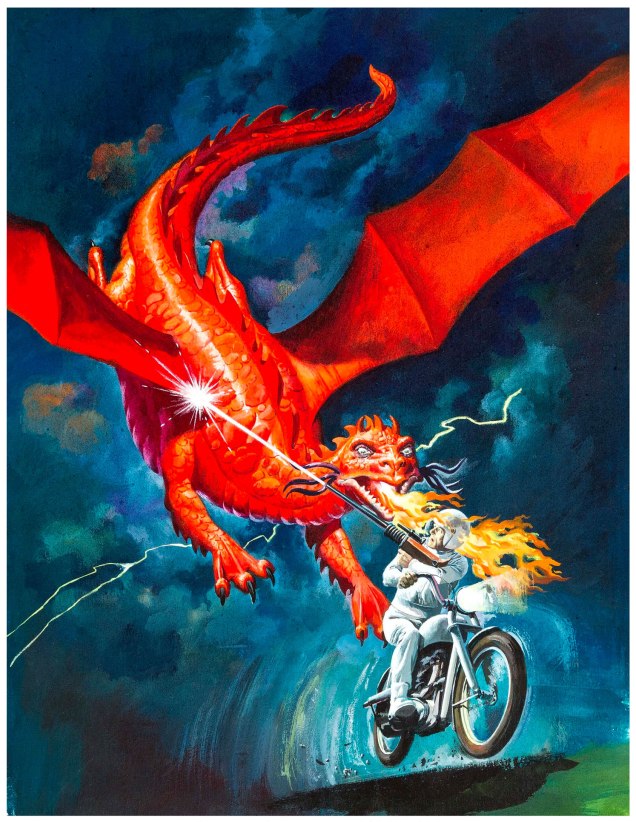
« I’m being scorched by something that shouldn’t even exist! » A laser cannon-equipped Evel Knievel tussling with a badass reptilian nightmare? That’s the Seventies for you. Gold Key’s mystery comics were generally pretty tame fare, but their covers, such covers! This one’s painted by Saint George Wilson. Boris Karloff Tales of Mystery no. 34 (April 1971.) You just know that Dragondoom is written by Lein Wein, because its damsel-in-distress shares his wife’s name, Marvel and DC colourist Glynis.
Boris34OriginalA
A look at Mr. Wilson’s original painting gives us an idea of just how much was lost in the transition from brush to print. Sometimes it’s better *not* to know.
Karloff43A
« Feast your eyes upon them, mortal! Do they satisfy your appetite for witchcraft? Hee Hee! » Wayne Howard conjures up some decent monsters inside, but Psychotomimetic George Wilson, who painted this mind-melting cover, shows how it’s *really* done. Boris Karloff Tales of Mystery no. 43 (Oct. 1972.)
Boris49A
« The car — being sucked in by this blasted fetid swamp! Goodbye car… goodbye, convention! » Roadside George Wilson strikes again! Boris Karloff Tales of Mystery no. 49 (March 1973.)

DominguezKarloff62A

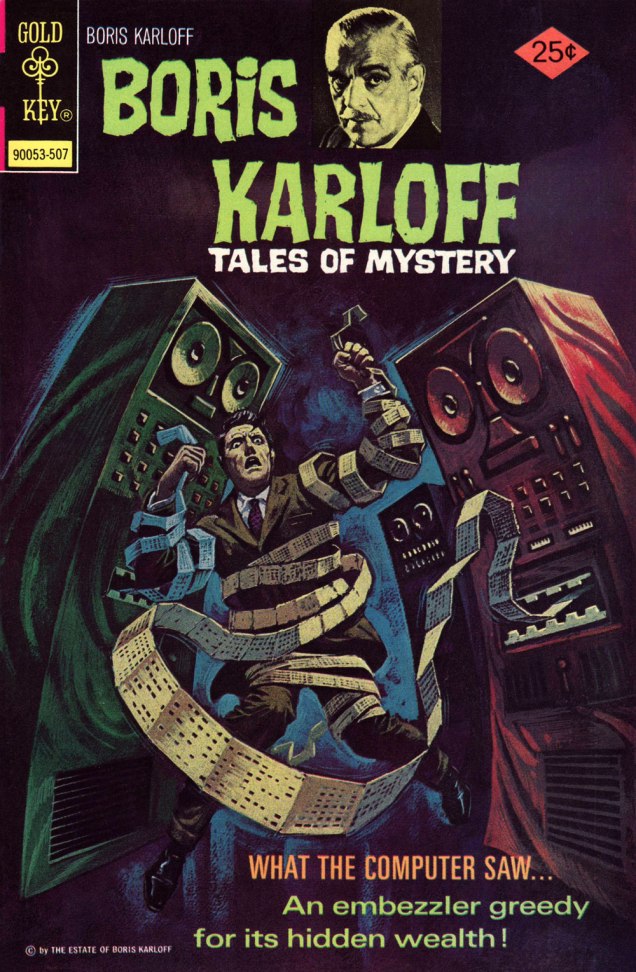
« These computer cards are wonderful… almost as if they were alive! They tell me everything! » Boris Karloff Tales of Mystery no. 62 (July 1973). Luis Angel Dominguez‘s painted cover depicts a scene from Arnold Drake‘s witty It’s in the Cards.

Boris65A
« G-g-get away, B-Bobby! There’s a living horror out there! » « Aww, gee, dad! I’m sorry about that! It’s just my sea monster! » Meet The Mail-Order Monster, a gem from an uncredited scripter (likely Arnold Drake, if the sparkling wit is any indication), and illustrated by Ed Robbins. It’s a fabulously wacky yarn, combining to fine effect good old Sea-Monkeys (brine shrimp, really) and a generous sampling of Ray Bradbury’s Boys! Raise Giant Mushrooms in Your Cellar! 
This is Boris Karloff Tales of Mystery no. 65 (Dec. 1975), edited by Paul Kuhn. Also within: Don’t Put It on Paper, another of the handful of jobs José Luis García-López did for Gold Key, before settling down at DC later that year. The plot is basically that of Clark Dimond/Terry Bisson & Steve Ditko’s The Sands That Change! (Creepy no. 16, Aug. 1967, Warren), but with a much gentler outcome.
Boris92A
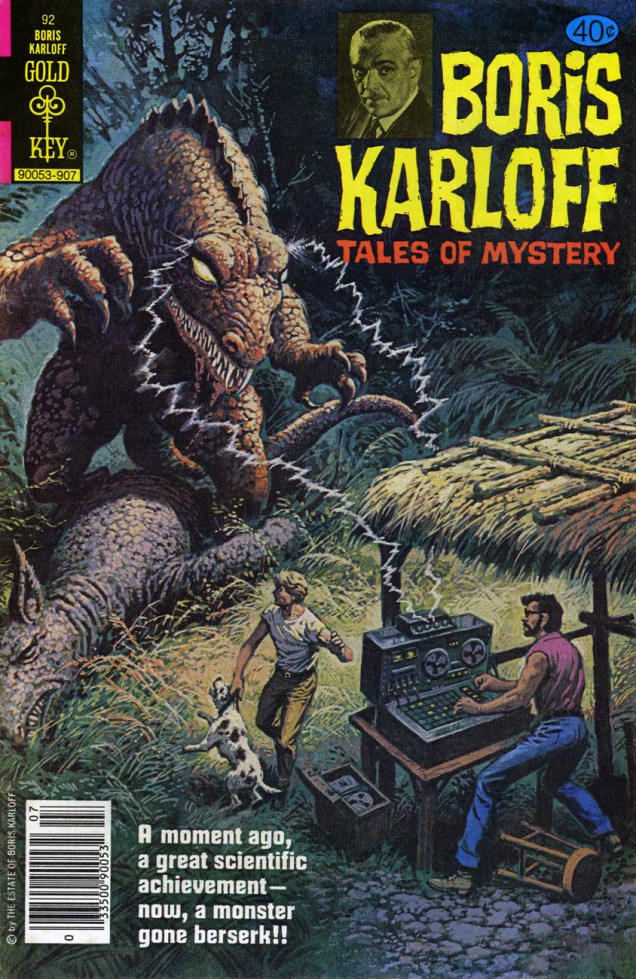
« But — why would anyone create something so — so terrifying? » One thing you can nearly always count on in any given issue of BKToM: “scientific” experiments always go awry, and they nearly always yield rampaging monsters. Fitting! Luis Angel Dominguez provides this electrifying cover for issue no. 92 (July, 1979.) The man had such a peerless colour sense.

And remember, there’s far more to Boris Karloff than Frankenstein’s Monster: for evidence of his talent, check out The Body Snatcher (1945, directed by Robert Wise and produced by Val Lewton) or Targets (1968, directed by Peter Bogdanovich.)

Let’s reserve our closing words for the man (monster) himself: « Certainly I was typed. But what is typing? It is a trademark, a means by which the public recognizes you. Actors work all their lives to achieve that. I got mine with just one picture. It was a blessing. »

– RG

*Ships Don’t Disappear In The Night (Do They?) by 10cc (1973)

In Memory of Mike Sekowsky

Sekowsky, born on November 19, 1923 (it was a Monday), was another of those precocious, tireless, versatile pioneers of the comic book industry, such as Joe Kubert, Carmine Infantino and Alex Toth. He started out with Timely Comics in 1941.

I’ve always enjoyed his mature style most, as it became more eccentric and more distinctive, without sacrificing an iota of storytelling and compositional ability. We’ll come back to the topic with some examples in tow, but for the present, here’s a select gallery of his covers over the years. I stayed away from the more obvious choices… we hardly need to revisit his introduction of the Justice League of America (Brave and the Bold no. 28, March 1960), for instance.

AdventuresDarkness13A
I’m reminded of an old joke (usually) told about Beethoven: « A tourist is sightseeing in a European city. She comes upon the tomb of Beethoven, and begins reading the plaque, only to be distracted by a low scratching noise, as if something was rubbing against a piece of paper. She collars a passing native and asks what the scratching sound is. The person replies, ‘Oh, that is Beethoven. He’s decomposing. » This jazzy Mike Sekowsky / Mike Peppe (attributed) cover tableau sadly doesn’t turn up in any of the inside tales. Typical. This is lucky issue 13 of Standard/Better/Nedor Comics’ Adventures into Darkness (Dec. 1953.) And if you’re in the proper mood, the whole thing’s available for your reading pleasure right here.
Captain-Flash1A
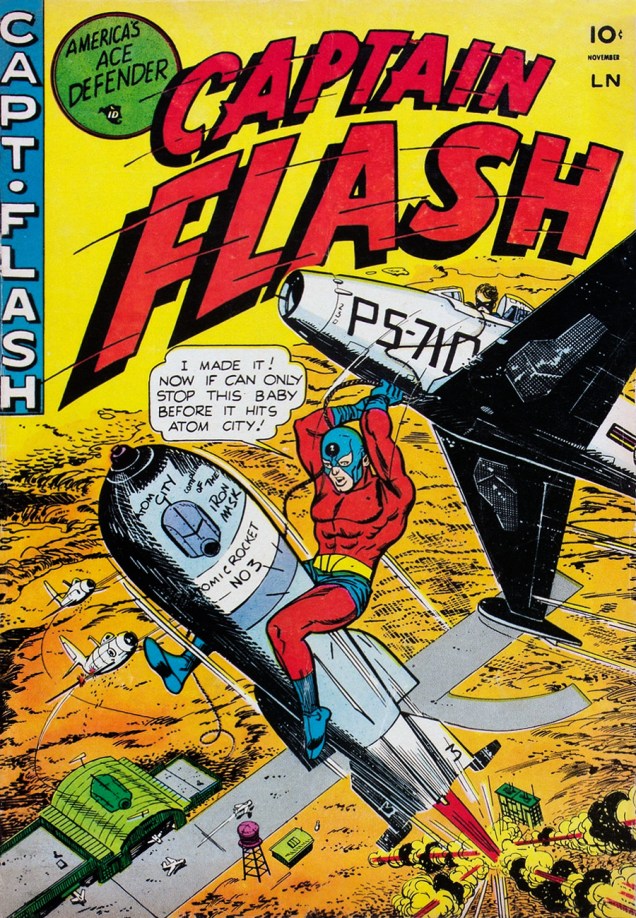
« Sorry, old buzzard! Pick on someone your own size! » One of the last new supermen of the Golden Age, the absurdly well-endowed Captain Flash came along just before the Code did, in November 1954. Captain Flash’s adventures were published by tiny Sterling Comics, which released a handful of titles in 1954-55 then vanished. Bad timing. Captain Flash gained his mighty powers through accidental exposure to cobalt rays, if you must know. Thrill to his heroics right here: http://comicbookplus.com/?dlid=17682
B&B68A
« Blazes! And if I remember my Bat-lore, that’s the flying bat-cave he’s using to charge that bank! Hit the brakes, stoop-skull! » Bob Haney and Mike Sekowsky bring the wacky to this issue of The Brave & Bold no. 68 (Oct/Nov. 1966), with the saga of “Alias the Bat-Hulk“! Script by Haney, pencils by Sekowsky, cover inks by Joe Giella and story inks by Mike Esposito. Gotta love the cackling peanut/rogues’ gallery!
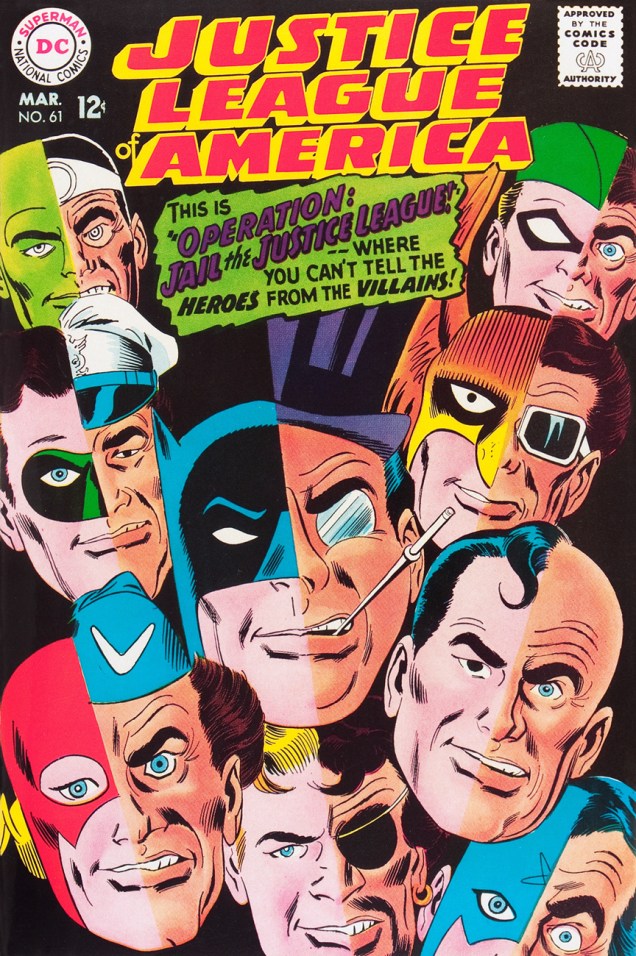
JLA61A
I’ve always had a soft spot for Gardner Fox and Sekowsky’s JLA, but no-one else’s, really. Especially late in their run, when things got increasingly bizarre. This is Justice League of America no. 61 (March 1968). Cover by Sekowsky and Jack Abel.
GL66A
Ah, the always fun “screw you, hero!” cover theme. This is Green Lantern no. 66 (January, 1969), pencilled by Sekowsky and inked by Murphy Anderson, an unusual but effective combo. Within, «5708 A.D. — A Nice Year to Visit — But I Wouldn’t Want to Live Then!» is scripted by John Broome, pencilled by Sekowsky and inked by Joe Giella.
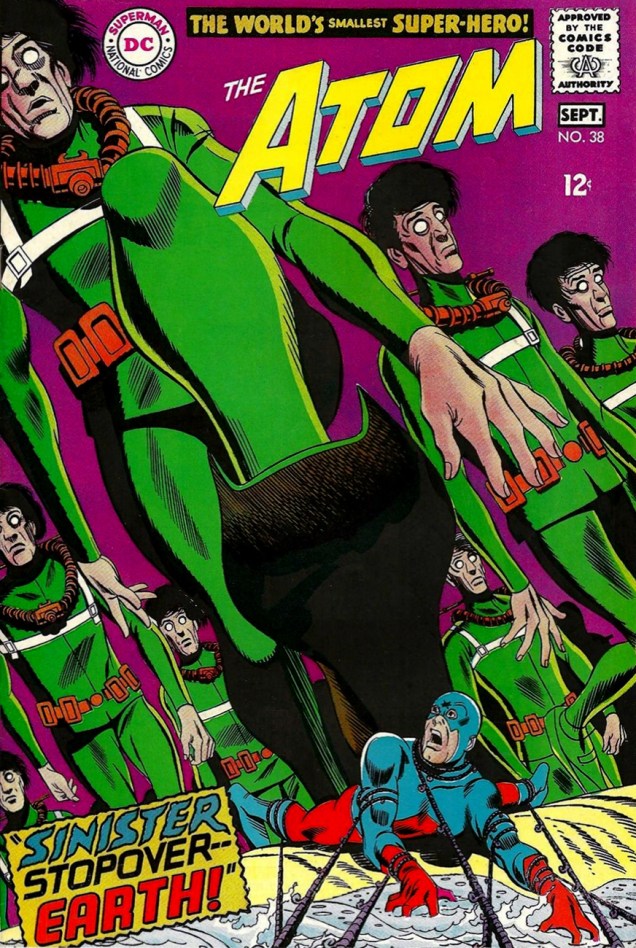
Atom38A
The final issue of the Atom as a solo book. He would team up with Hawkman for a few issues (with gorgeous Joe Kubert covers), but all in vain. The Atom no. 38‘s (Aug./Sept. 1968) « Sinister StopoverEarth! » is written by Frank Robbins, pencilled by Sekowsky and inked by George Roussos. Cover by Sekowsky and Jack Abel.
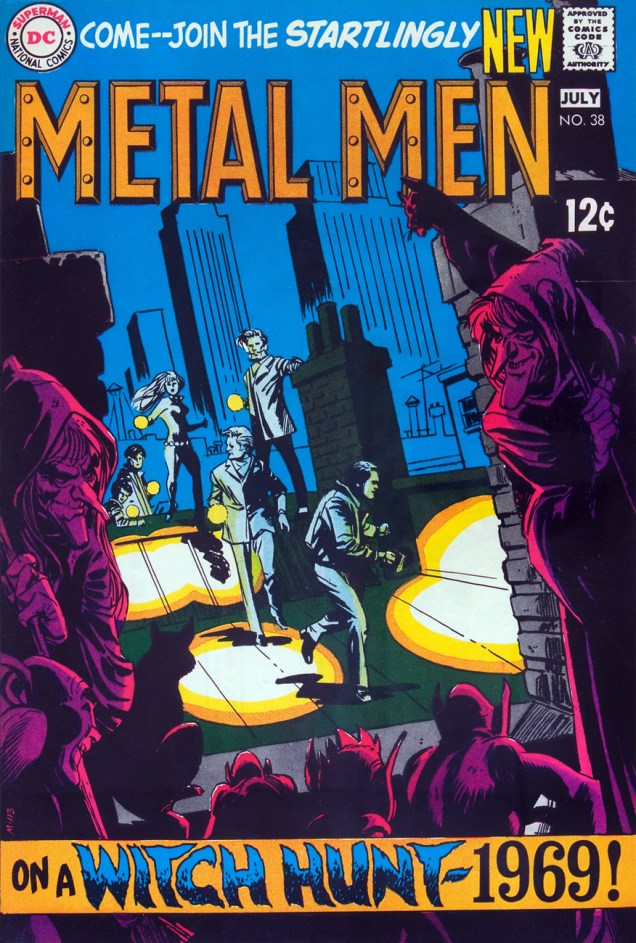
MetalMen38A
While newly-ensconced editorial director Carmine Infantino seemed to have boundless faith in Sekowsky in the late 1960s and early 1970s, pretty much every one of his creations and revamps turned out to be box office poison… but they were often bold, and certainly different. His take on Bob Kanigher and Ross Andru‘s Metal Men was odd, at times baffling, invigorating… and, at six issues, quite short-lived. This is Metal Men no. 38 (June-July 1969).
WH3A
« Do we dare follow? Keep your distance now… don’t let it know you’re there! »
Nick Cardy crafted the majority of DC’s The Witching Hour’s gorgeous early covers, some of his finest work. But… *this* understated beauty was pencilled by Sekowsky and inked by Cardy. The picturesque results are set in the selfsame 1930s Universal Studios backlot Balkans of the mind so dear to several generations of monster-loving artists and kids. This is The Witching Hour no. 3 (June-July, 1969.)

– RG

Hallowe’en Countdown, Day 24

« If you didn’t have a shootin’ iron, I’d give you a fust class spankin’! »

I bet you say that to all the boys.

Here’s a nostalgic entry cover-featuring the official bogeymen of Hallowe’en ’43: Adolf, Benito and Hirohito (Uncle Joe was still our “friend”.)

4Most
This is 4Most vol. 2 no. 4 (Novelty Press, Fall, 1943). This anthology ran for 36 issues, published between 1942 and 1949. Cover artwork by longtime Superman chronicler Al Plastino.

Gorsh dagnabbit, you can read the whole consarned issue right here, thanks to comicbookplus.com.

– RG