Panning the murky old print stream for the odd glimmering nugget
They Called It… The Golden Age!
That’s the period opening with the advent of the first comic books, in the early 30s, and ending with the release of Showcase no. 4 in 1956 (introducing the new Flash), which signals the passage to the next era, the Silver Age, of course.
« Our story opens on a rainy night on Central City’s waterfront… »
Continuing our chronicle of The Spirit’s wanderings from harbour to harbour over the decades, we make land today at pulp and comic book producer Fiction House, whose “Big Six” were the blandly-named but action-packed Fight Comics (86 issues, 1940–1954), Jumbo Comics (167 issues, 1938–1953), Jungle Comics (163 issues, 1940–1954), Planet Comics (73 issues, 1940–1953), Rangers Comics* (69 issues, 1941–1953) and Wings Comics (124 issues, 1940–1954). Compared to these, The Spirit’s five-issue stay was but a blip. Still, since FH’s art director was none other than Eisner’s old partner Samuel Maxwell “Jerry” Iger (1903-1990), this particular match is unsurprising.
Of course, it wasn’t common knowledge at the time, but these issues comprise little else but what came to be known as “the post-Eisner Spirit”, inarguably inferior work with the occasional highlight, generally a Jules Feiffer script let down by the visuals.
According to Eisner, interviewed in 1990 by Tom Heintjes: « Looking back, I have to say that it’s a blemish on my career that I allowed The Spirit to continue through this period, because I compromised the character just because I was busy with other things. That’s not to say that these are all bad stories, but they just don’t have the consistent outlook they had when I was directly involved. » « I look at these stories and I want to cringe – again, not because they’re bad, but because only the merest essence of the character is retained. »
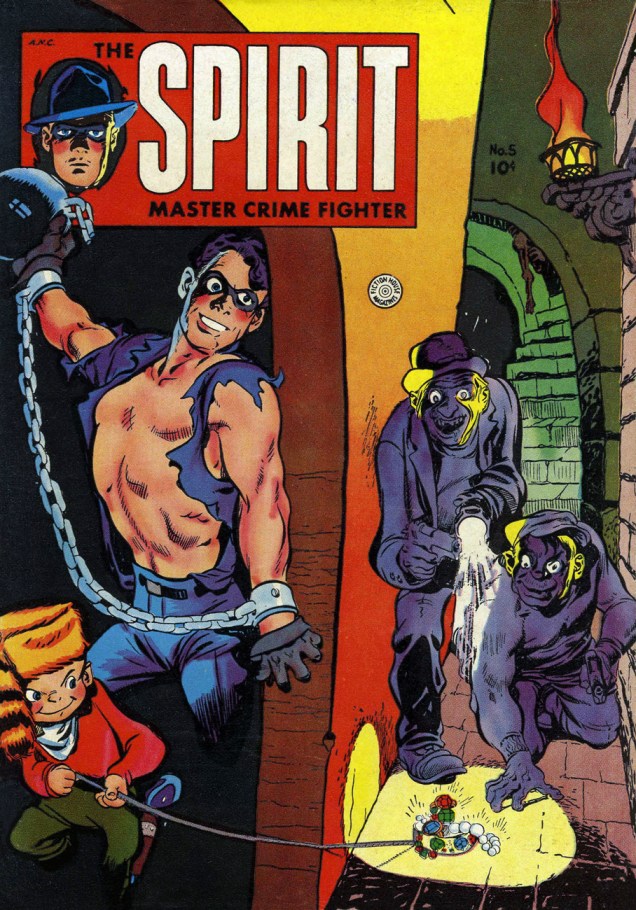
This is The Spirit no. 1 (Spring, 1952), featuring The Case of the Counterfeit Killer (Sept. 16, 1951), cover-featured The Curse of Claymore Castle (Nov. 4, 1951), The Plot of the Perfect Crime (Oct. 28, 1951), and Panic on Pier 8 (Aug. 19, 1951), each scripted by Feiffer. Cover artist unknown, but it’s a considerable improvement over the actual story.This is The Spirit no. 2 (Summer, 1952), reprinting The Amazing Affair of the First Man on Mars (Jan. 27, 1952), Contraband Queen (May 20, 1951), The Case of the Baleful Buddha (Nov. 18, 1951), and The $50,000 Flim-Flam (Apr. 15, 1951), the final three benefiting from some Eisner involvement. Again, cover artist unknown., but isn’t that gorgeously coloured?Ah, we’re getting more Eisner-ish, though not quite all the way. This is The Spirit no. 3 (1952), featuring The Walking Corpse (Mar. 9, 1952), It Kills by Dark (Feb. 24, 1952), The League of Liars (Nov. 25, 1951), and A Man Named Nero (Feb. 3, 1952). The first three are scripted by Feiffer, and the fourth is undermined; I wouldn’t brag about that one either.This is The Spirit no. 4 (1953), featuring The Last Prowl of Mephisto (Apr. 1, 1951), scripted and illustrated by a heavily-assisted and pressed for time Eisner; Design For Doomsday (Jan. 13, 1952), The Sword and the Savage (Sept. 2, 1951), and The Great Galactic Mystery (Apr. 20, 1952), these last three scripted by Feiffer. And another nearly-Eisner cover… he never would have made it this busy, I think.This is The Spirit no. 5 (1954), cover-featuring Dragnet for Johnny Buffalo (Apr. 8, 1951), and also The Target-Man in 16-A (July 22, 1951), Damsels in Distress (a relative oldie from August 3, 1947), and The Loot of Robinson Crusoe (July 8, 1951), scripts a toss-up or a collaboration between Feiffer and Eisner. Now this cover I can buy as the genuine Eisner article: it’s a characteristic composition for him, and it’s sloppy in all the right places. The Spirit’s sidekick in this instance is Walkalong Haggerty, who saves his hide in “Dragnet..“
So concludes our masked crimefighter’s passage at Fiction House. Fortunately, the publisher’s art department and production values were top-notch, so accommodations were quite cozy. Next time out, we’ll see how The Spirit would fare at the hands of Harvey Comics and (separately) at those of that nefarious rascal, Israel Waldman, in the swinging Sixties.
-RG
*Fiction House’s Rangers Comics featured the excellent “The Secret Files of Dr. Drew“, which ran in issues 47 to 60 (1949-51); the feature was the combined work of several of Eisner’s top Spirit alumni, namely writer Marilyn Mercer, penciller-inker Jerry Grandenetti, and letterer Abe Kanegson. The first ten (of fourteen) episodes just about out-Eisnered Eisner, until he protested and put an end to that gorgeous nonsense. This lot was lovingly restored and collected by Michael “Mr. Monster” Terry Gilbert (2014, Dark Horse). If you ask me, it’s the sole reprint of vintage colour material bearing the Dark Horse brand worth a damn… because Gilbert handled the work himself.
Catfight (noun):A vicious fight between two women that features biting & scratching and often involves clothes being ripped off.
To which I’ll add that if you put two women with different hair colours in one room, it’s like there’s a chemical reaction that makes them instantly aggressive. In comics, at least – and we all know that comics reflect real life accurately, right? The resulting combativeness is especially obvious when the encounter is between a blonde and a brunette. The women involved must also be beauties – presumably, plainer girls resort to verbal assaults when provoked, eschewing physical violence, unlike their flashier counterparts.
Or it could have something to do with the mostly-male audience who actively likes watching belles brawl. (Perhaps “ogle” would be a better description.) Let’s move on to the ogling bit, then!
Err, agreed on the “talking too much” bit. Manhunt no. 9 (Magazine Enterprises, June 1948). That art’s by Ogden Whitney.
“Jeepers! Baldy’s been skewered through the ticker! He’s defunct!” This charming scene with boob grabbery and skirt rippery (I know, don’t I have a way with words?) is from “Off Stage Kill”, a Dan Turner Hollywood Detective story from Crime Smashers no. 7 (Trojan Magazines, 1951).
Script by Robert Leslie Bellem, pencils and inks by Adolphe Barreaux (who was also the editor). Read the issue here. In case you were wondering, Fifi and Brenda are just acting out a fight scene for a movie, although they do get a little carried away (and accidentally skewer Baldy in the process). How many women have a knife tucked away in their garter belt?
Skipping ahead ten years or so…
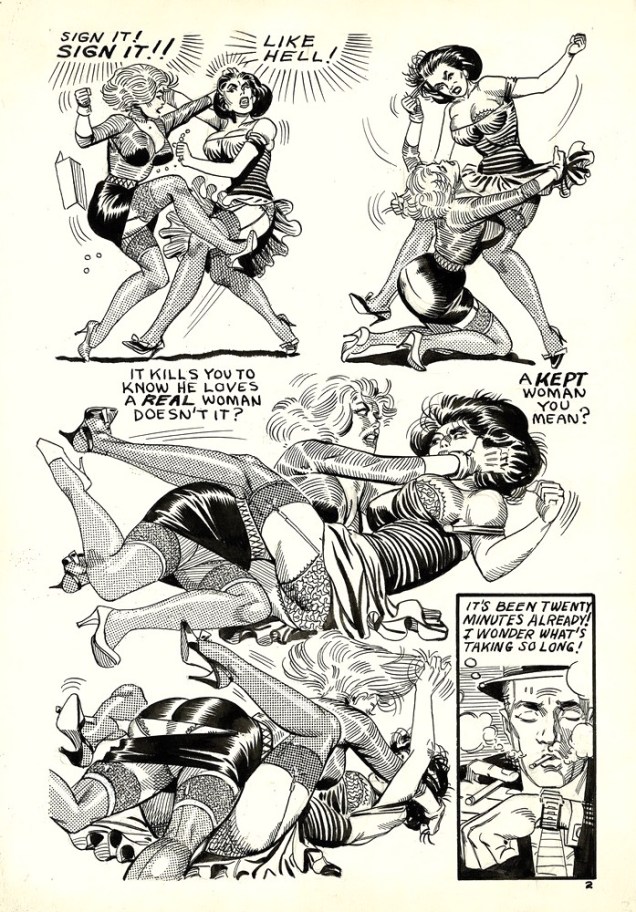
Ditko shared a studio in NYC with artist Eric Stanton between 1958 and 1968, and they collaborated on some bondage comics (or at least it’s commonly assumed that they have – for more information on that, dive into a discussion on the Four Realities blog, or read this excerpt from Fantagraphics’ Dripping with Fear: the Steve Ditko Archives Vol. 5.) This page is from a story published in 1966 and entitled “Divorce Agreement”.
The clothes-shredding and breast-mauling (ouch) continues…
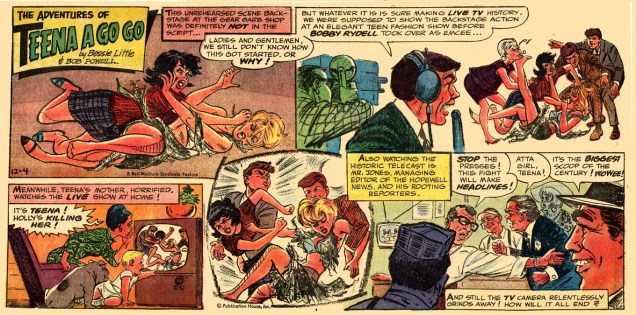
Newspaper comics do it, too! This is Teena A Go Go from December 4th, 1966, written by Bessie Little and illustrated by Bob Powell.
Sometimes Betty and Veronica associations are hard to avoid. These girls also made sure to wear contrasting costumes while fighting, for maximum visual appeal, proving it’s possible to be fashion-conscious even in prehistoric times.
Anthro (the happy teenager watching this scene, and normally a redhead) will marry the victorious maiden… but the fight is a draw, and so he has to marry both in this “The Marriage of Anthro” story. This is Anthro no. 6 (July-Aug. 1969). Pencils by Howard (Howie) Post (who created Anthro, the “first boy”, a Cro-Magnon born to Neanderthal parents) and inks by Wally Wood. Let it be mentioned that Anthro is an immensely fun series, and that I love Howie Post’s art with or without Wood’s beautifying influence.
Women of other cultures aren’t immune from this phenomenon, by the way. Witness Italian chicks fighting:
Maghella no. 13 (Elvifrance, 1975), cover by Averardo Ciriello. ” The title is something like “a scalded pussy doesn’t fear cold water”, a play on “chat échaudé craint l’eau froide“, an idiom that means roughly “twice bitten, once shy” or “a burnt child dreads the fire” and translates literally to “a scalded cat fears cold water”.
Italian erotica can be so entertaining! Maghella means a “young witch” in Italian. “The girl is identified by two braids of black hair and giant breasts with unspecified powers“, reads Wikipedia… Odd, I would have thought that her breasts have very specified powers, indeed. 😉
Moving on to French damsels…
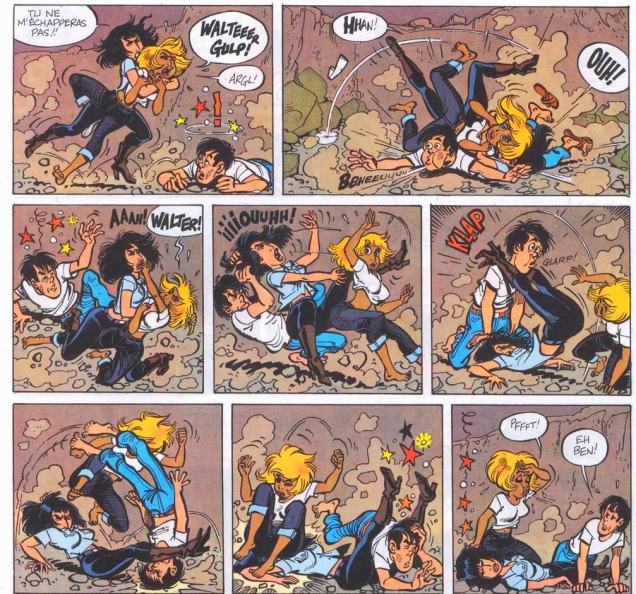
Natacha (hôtesse de l’air) is a Franco-Belgian comics series, created by François Walthéry and Gos. This page is from an adventure (one of the final stories scripted by the great Maurice Tillieux) called Le treizième apôtre (The Thirteenth Apostle), published in 1978. The blonde is Natacha, our heroïne.
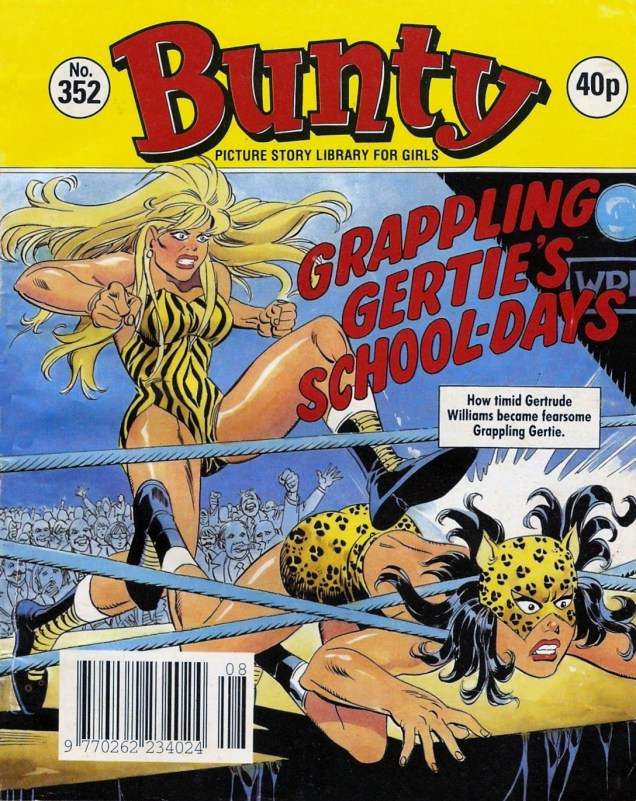
If you want to emphasize the catfight aspect, dress your girls in feline-motif outfits. Oh, I’m sorry – this is no quotidian quarrel, it’s professional wrestling!
Bunty no. 352 (1992) – unfortunately, I don’t know who did the cover. British Picture Story Library was a 62 page a comic digest, published weekly. If you’d like to know how Leopard Lily overcame Tiger Tina, visit Assorted Thoughts from an Unsorted Mind.
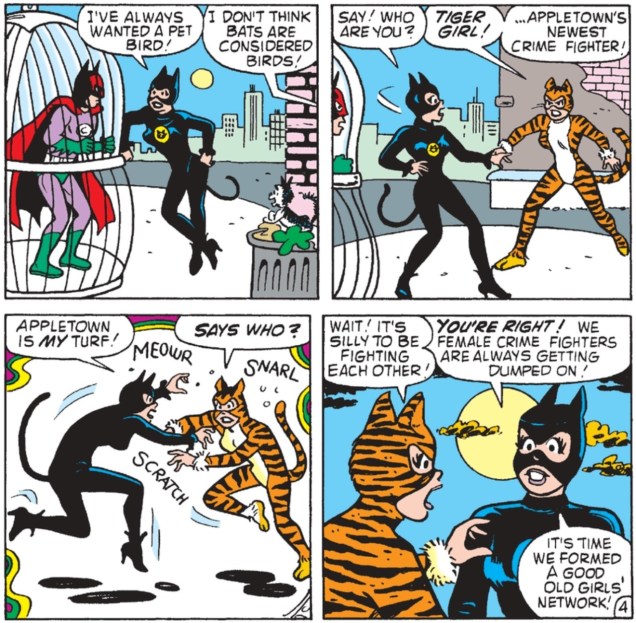
I think we need one even more literal interpretation of “cat fight”:
A snippet from “Meow Row”, published in Betty and Veronica no. 59 (January 1993). Script by George Gladir, pencils by Dan DeCarlo, inks by Alison Ford. Now guess who is who. (It’s obvious: Tiger Girl is Betty, and Veronica gets Meow Girl’s sexier costume.)
This is a fairly inexhaustible topic, but one must quit sometime. Cold shower, anyone?
« I tell ya, Spirit… this neighborhood is like a lit firecracker… »
I’m surprised that it took us this long to get to Will Eisner and his signature creation, The Spirit. Is it perhaps too obvious a topic? Nah. Though the ink and the pixels may flow, and even if everyone and his chiropractor has already waxed rhapsodic about old Will, the subject retains its depths of evergreen freshness.
For most generations of cartoonists, Eisner is an irresistible influence. My own initial encounter came in the early 1970s, when I glimpsed ads for Warren’s Spirit reprints in the rear section of Famous Monsters of Filmland. And then I was introduced to his groundbreaking style and storytelling approach… only it wasn’t, in this case, quite his.
In 1975, I had stumbled upon a Dutch collection of WWII-era Spirit newspaper strips (The Daily Spirit, Real Free Press, 1975-76… a publication designed by none other than Joost Swarte), and I was captivated… by the ghost work of no less than Plastic Man creator Jack Cole!
« You can do that in a comic strip? » was my general feeling as a ten-year-old aspiring cartoonist. From The Spirit daily strip, January 3, 1942 (scripted by Manly Wade Wellman, illustrated by Jack Cole).
I won’t go over the action-packed history of the character… what I’ll focus on here instead is inextricably linked to Eisner’s terrific business acumen: having held onto his character’s ownership, he could shop him around the publishing world, a process still unfolding to this day, well beyond his own passing.
The Spirit, that well-travelled rascal, has witnessed his exploits bearing many a publisher’s imprint, from Quality to Fiction House, through I.W. (naughty, naughty!), Harvey, Kitchen Sink, Warren, and DC… so far. And the coolest thing is that Eisner was along for most of the ride, creating glorious new cover visuals for the venerable archives.
Today, we’ll focus on Quality’s output (1942-50), which alone was contemporary to the strip’s tenure. About half of it was Eisner, but I’m no purist: the man hired some of the finest ghosts in the medium’s history, when it came to both story and art. To name but a few favourites: Manly Wade Wellman, Jerry Grandenetti, Jules Feiffer, Wally Wood…
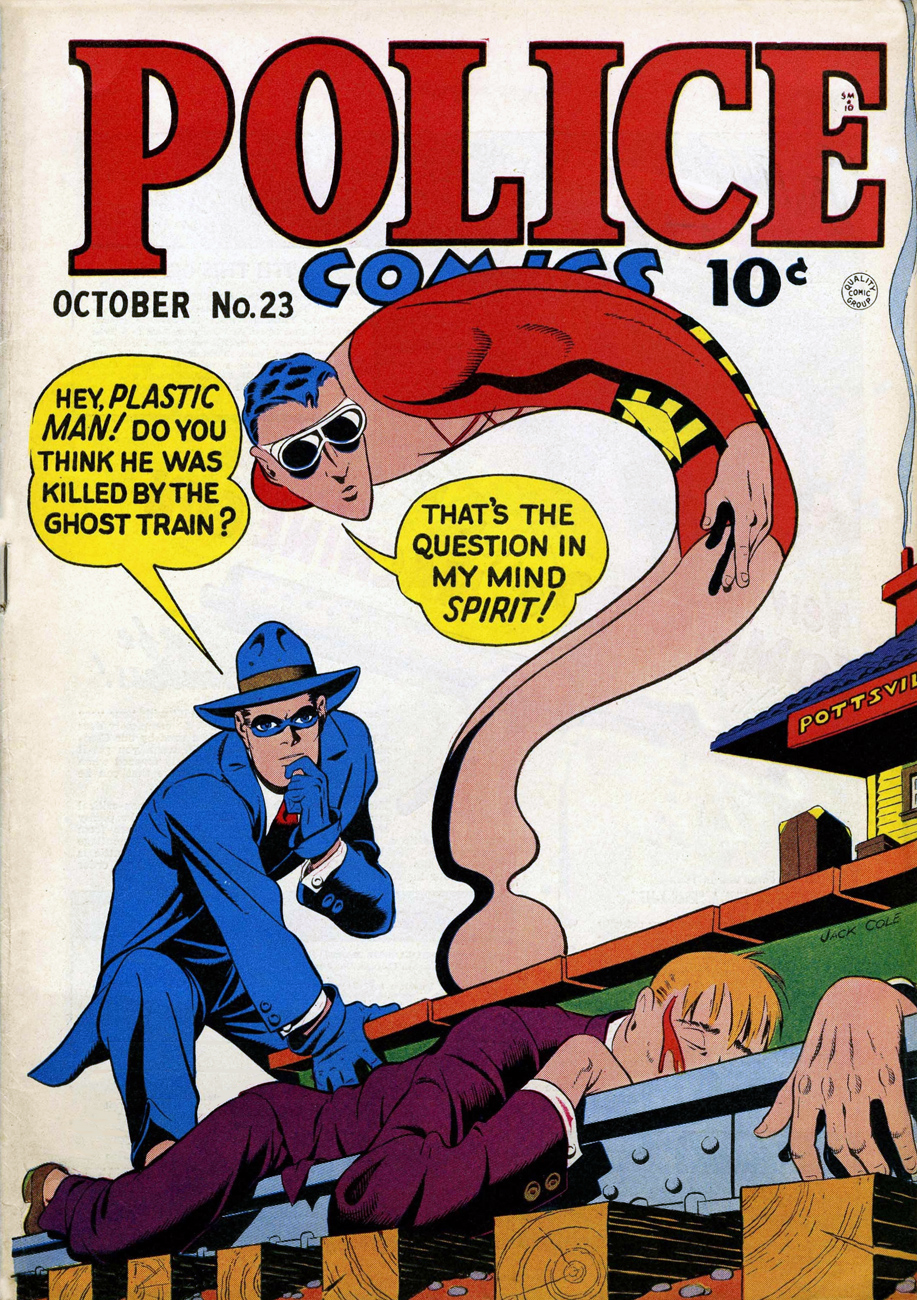
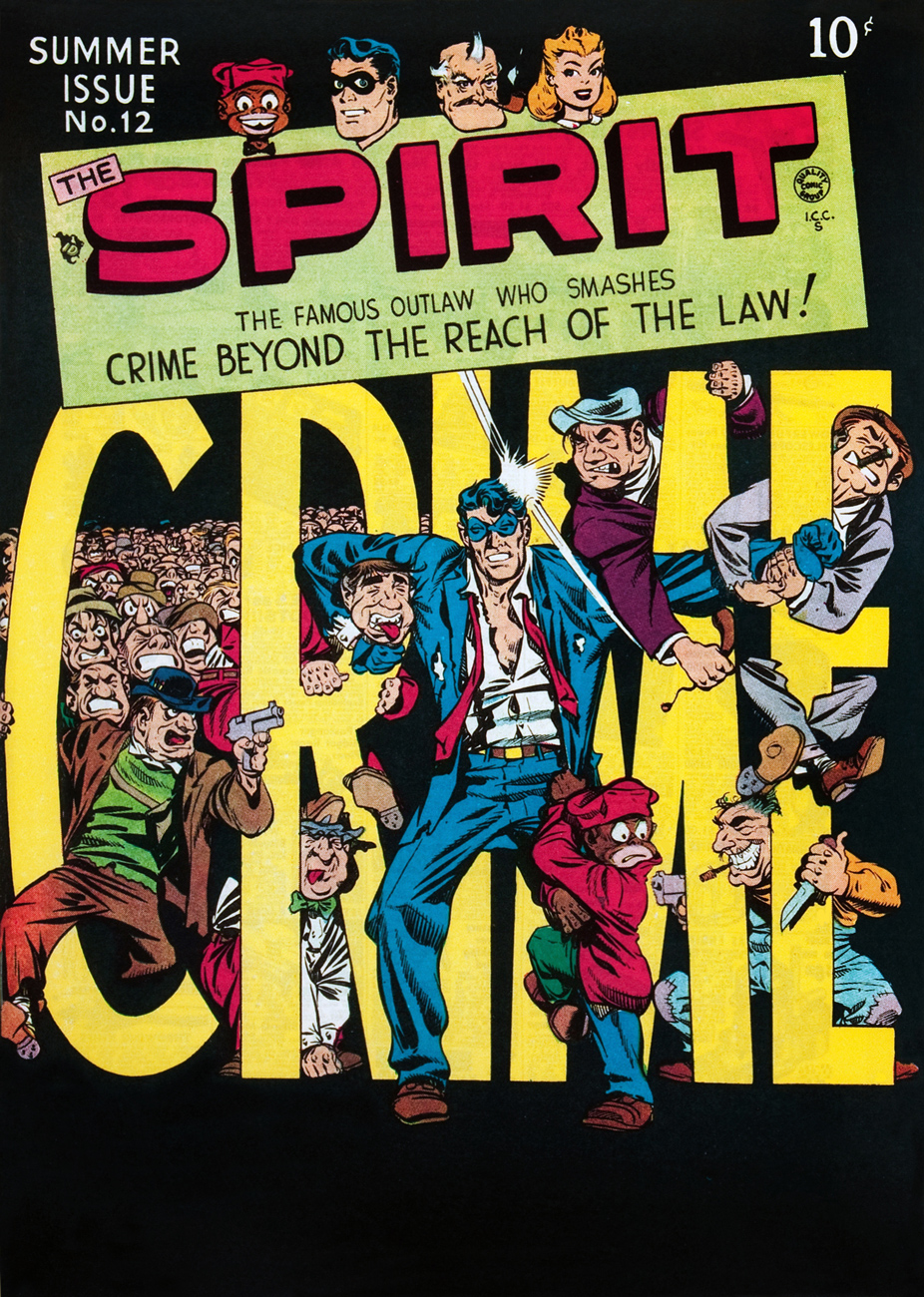
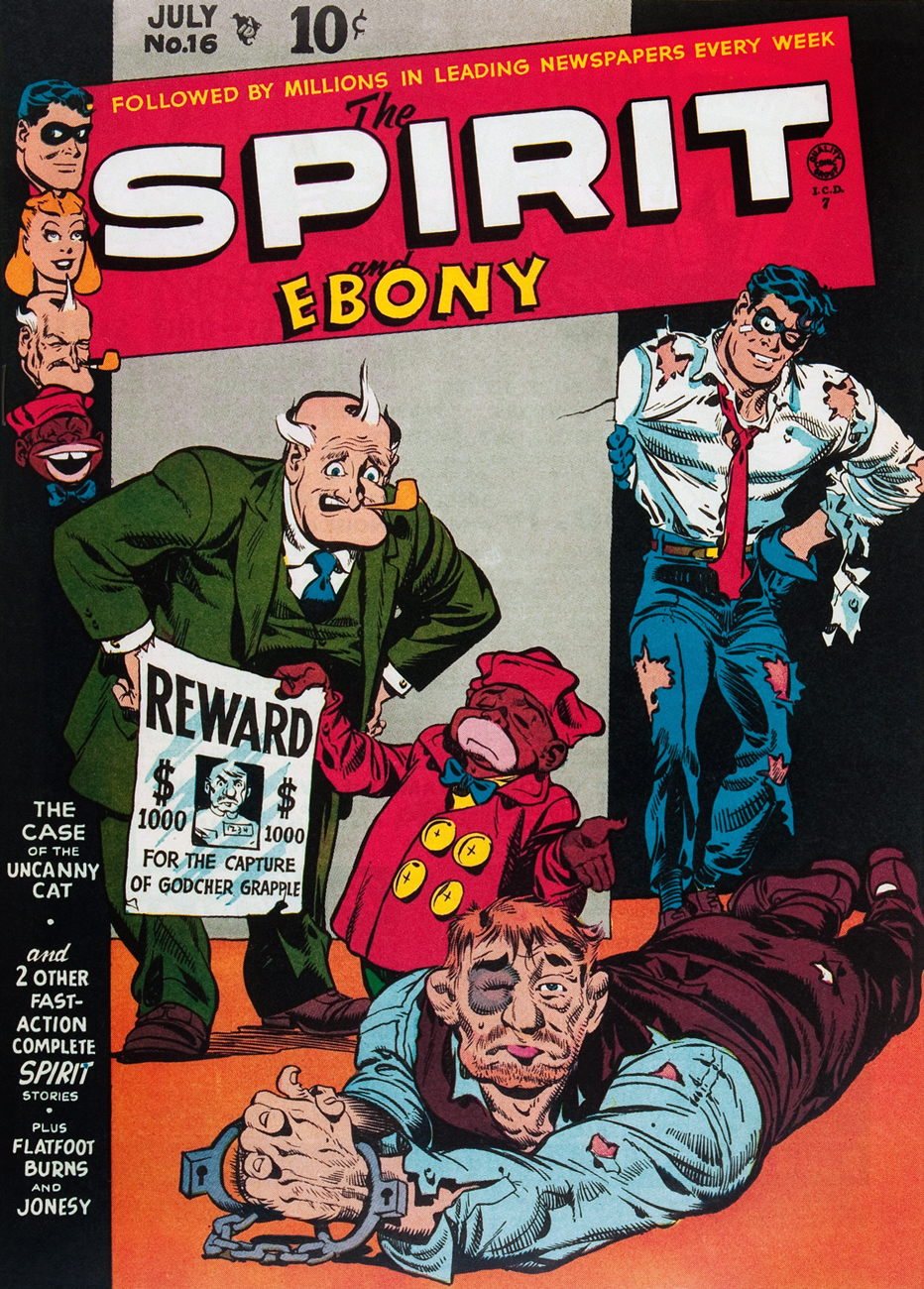
Speaking of Jack Cole… before he got his own title, The Spirit was featured for a couple of years in Quality’s Police Comics anthology. He occasionally ran into his fellow headliner, Plastic Man. This is Police Comics no. 23 (October, 1943). Cover by Jack Cole. Read this issue here.This is The Spirit no. 12 (Summer 1948), cover by Eisner, and featuring a bunch of Manly Wade Wellman / Lou Fine Spirit tales, which is to say “Eye, Feets, and Lock” (August 12th, 1945), “The Case of the Missing Undertaker” (September 30, 1945), “Skelvin’s School for Actors” (November 18, 1945), “The Whitlock Diamond Caper” (June 24, 1945) and “Nitro” (October 21, 1945).This is The Spirit no. 13 (Autumn, 1948), cover by Eisner, and gathering a clutch of Wellman / Fine outings, i.e. “Mr. Martin’s Pistols” (September 23, 1945), “Red Scandon” (June 3, 1945), “The Strange Case of the Two $5.00 Bills” (December 9, 1945), “Mr. Exter” (May 27, 1945) and “Vaudeville Vinnie” (November 4, 1945).Another high-wire master class in design and tension from Mr. Eisner. This is Quality Comics’ The Spirit no. 14 (Winter, 1948), featuring reprints of Spirit adventures (“The Alibi Factory“, “The Kuttup Shop“, “Prominent Executives Vanish“, “The Masked Magician“, “Belle La Trivet“) from 1945, written by Chapel Hill‘s foremost scribe, Manly Wade Wellman, and illustrated by Lou Fine and the Quality shop.This is The Spirit no. 15 (Spring, 1949), cover by Eisner, and gathering a bouquet of Wellman / Fine offerings, namely “Rosilind Ripsley” (June 10, 1945), “Madame Lerna’s Crystal Ball” (September 16, 1945), and “The Case of the Will O’Wisp Murders” (November 5, 1944).This is The Spirit no. 16 (Autumn, 1948), boasting an Eisner cover and rounding up a rogues’ gallery of Spirit exploits scripted by Bill Woolfolk: “The Case of the Uncanny Cat” (October 8, 1944) and “Jackie Boy” (September 9, 1944) and Manly Wade Wellman: “The Case of the Headless Burglar” (September 24, 1944), all pencilled by Lou Fine.I’ll bet Dolan could kick himself if he wasn’t so tidily trussed up. Fooled by a pretty… er, face again. This is The Spirit no. 20 (April 1950), featuring “The Vortex” (September 8, 1946); “The Siberian Dagger” (January 27, 1946); “Magnifying Glasses” (May 26, 1946), plus a couple of Flatfoot Burns stories by Al Stahl. Cover by Will Eisner, and a gold star and a hearty round of applause for the colourist.
As for the insides… I’m tickled to inform you that all of Quality’s issues of The Spirit are available gratis on comicbookplus.com. Enjoy!
– RG
p.s. For more (much more!) of Will Eisner’s famous creation, just click on the umbrella category, THAT’S THE SPIRIT!
Aliens inevitably have tentacles. It’s a simple fact of life for any space explorer. Although I’m sure you wouldn’t dream of doubting my words, here are a few exhibits for your pleasure.
We’ll start off with a tentacle bonanza! This is what happens when you cross an octopus with a centipede.
Spaceman no. 6 (July 1954), cover by always-enjoyable Joe Maneely. “Speed Carter, Spaceman” only lasted six issues, which is unfortunate – the stories are a lot of fun, with great art and intelligent-but-humorous scripts.
When “plant creatures” (who look remarkably like toothy goldfish) gone berserk deploy their tentacles to strangle you – in space, no less – , it must be Tentacle Tuesday.
Space Family Robinson Lost in Space no. 30 ( Gold Key Comics, October 1968). Cover by George Wilson, whose paintings are usually quite well executed (and this is no exception). The tentacle story, titled “Attack of the Plant Creatures”, is scripted by Gaylord Dubois and illustrated by Dan Spiegle. Incidentally, Space Family Robinson was an original science-fiction comic by Gold Key, and predates the Lost in Space TV series.
Seriously, who keeps stranding these vicious octopuses in space?
Space Ace no. 5 (1952, Magazine Enterprises), cover by Dick Ayers. I like these elegant space suits of the 50s, where naught but a small glass bubble and a tiny tank provided all the air one might need, and the costumes were tight enough to show off the guy’s muscles. The tentacle wrapped around the astronaut’s leg looks severed.
Just watch Solar-Brain nimbly dismantle an expensive piece of machinery with its tentacles. Tsk, tsk. These panels are from “The Living Gun”, a story from Metal Men no. 7 (April-May 1964) written by Robert Kanigher, pencilled by Ross Andru and inked by Mike Esposito.
Since I like pointing things like that out, please note that all the plot points of “The Living Gun” that concern Platinum (the only girl on the team) are fucking inane. She gets jealous when Doc Magnus is wooed by a beautiful model; participates in a beauty pageant while everybody else continues with their scientific research; attacks her team-mates when she’s disqualified from the pageant for not being human; quits the Metal Men in a huff and barely makes it into the epic battle pitting Magnus and his Metal Men against the murderous, power-grabbing Solar Brain. Girls will be girls… at least when a certain writer with the initials R.K. is around.
I’m reading a play by Anton Chekhov these days. What relevance does this have to comics? Let me explain. I don’t know about the so-called « mysterious Russian soul », but this particular play is histrionic. And the chief cause of drama, of course, is love. One woman tries to poison herself upon discovering her husband has a mistress and is preparing to run off with yet another man’s wife; others literally crawl around while trying to convince the rascal they’ve fallen in love with to condescend to granting them a small sign of affection; small children are threatened with deadly diseases; men launch into hair-tearing monologues, intermittently planning suicide or murder but never actually getting around to it; money is borrowed, and is immediately tossed in the air, friendships are shattered, insults are hurled and then profuse apologies proffered… and everybody, and I do mean everybody, goes hysterical.
Which brings us to Golden Age romance comics. Ha!
I’m not intending to suggest that *all* of them are ridiculously over the top. However, a lot of them are plotted like your average soaper – understandably, as these stories were written with a drama-hungry, lovelorn audience in mind. « Boy meets girl, everything goes well, they’re happy together » is not the kind of thing that moves copies.
Here’s a selection of covers I really like (for various reasons), depicting some common situations in a young woman’s life – like getting back-stabbed or pawed or pregnant while dreaming of some Perfect Love.
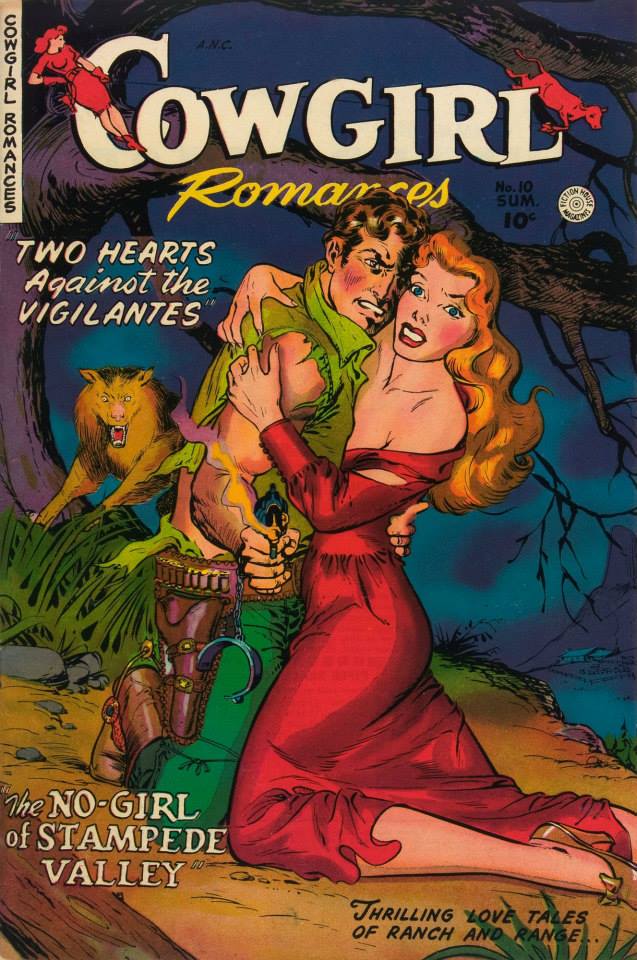
Some gals don’t merely have to contend with vigilantes, but also wolves (of the animal *and* human varieties).
Cowgirl Romances no. 10 (1950, Fiction House). Cowgirl Romances lasted for 12 issues, and usually featured strong heroines capable of defending themselves… although this one looks like she might need a bit of help. Read it here.
Oh, never mind – she doesn’t need help after all. It’s a refreshing change from women who stand by doing nothing while their loved one gets pummelled… or try to help and end up conking the wrong man.
Speaking of wolves, we have this cozy scene with distinctly creepy overtones. Anytime someone mentions an “experienced man”, run the other way.
A Moon, a Girl…Romance no. 11 (January-February 1950, EC). Cover by Al Feldstein.
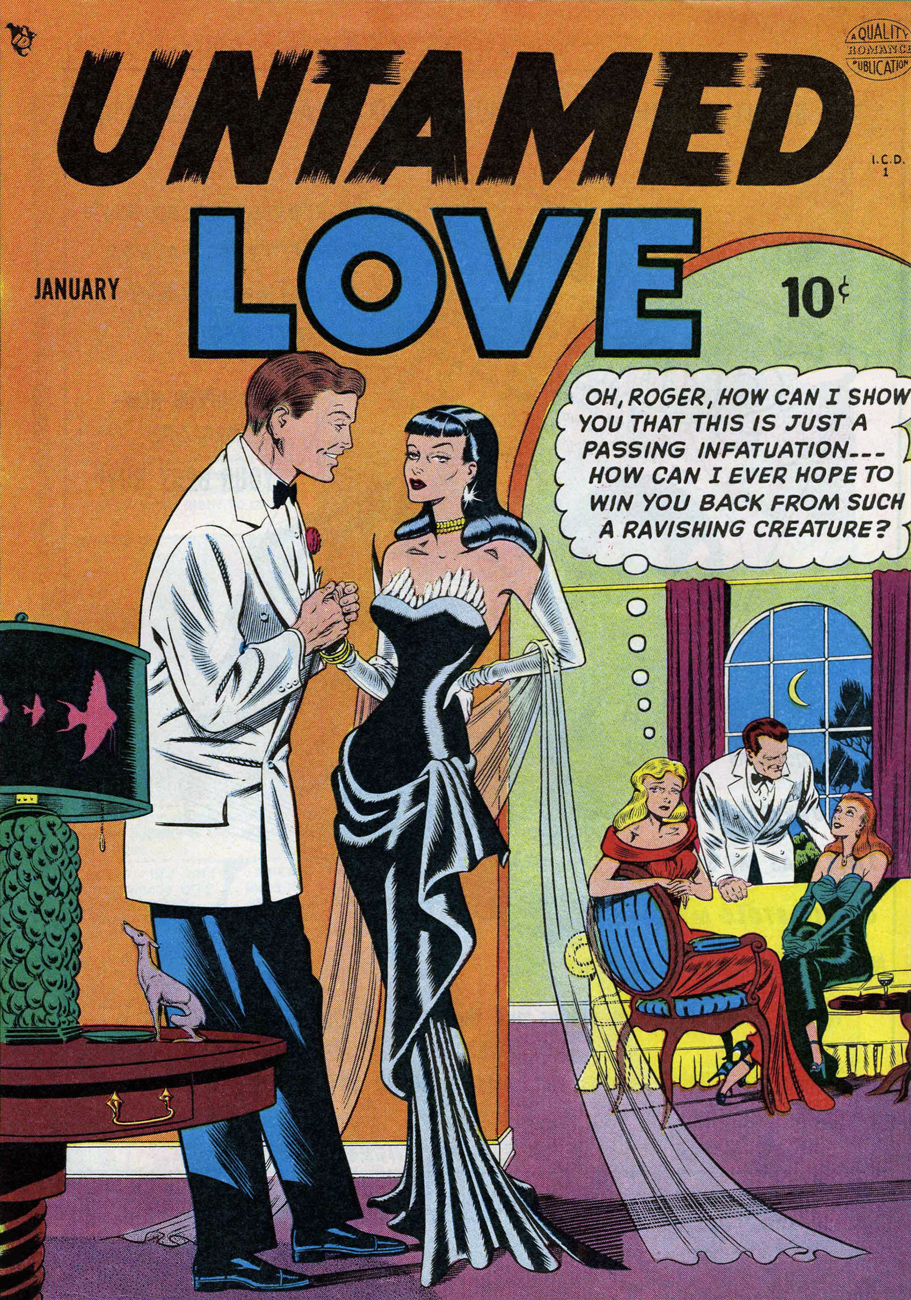
“Julie fought, but now she fought as much against her own hungry response as against his muscles. Try as she would, she could not keep herself from returning that kiss with all the fiery ardor of her wild loneliness.” Untamed Love is quite racy, as the title promises, and as much over-the-top as one could wish for. The cover story is about an evil seductress, but the rest of the tales all concern themselves with a love triangle of another kind, one in which a girl has to choose between two guys. This one’s for the ladies – it’s hunks galore!
Untamed Love no. 1 (January 1950, Quality Comics). Cover by Bill Ward. “Scary” comes to mind more than “ravishing”! Read the issue here.
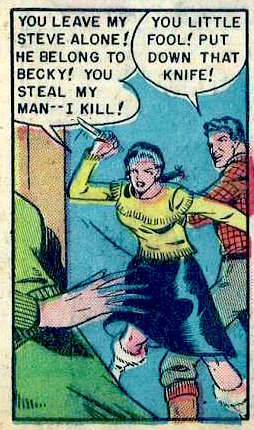
Here’s the “ravishing creature” in action, in case you’re interested:
Alaskan beauties don’t understand English grammar, but they dig the language of love! Panel from “The Wrong Road to Love”: “Julie falls in love with truck driver Steve, but he moves to Alaska to become a fisherman. She follows him there, only to discover local resident Becky considers Steve “her man.” Julie is consoled by Steve’s partner Hank. Steve and Becky run off, taking all the money Steve and Hank have earned. Julie decides to go home, but Hank says she can stay — as his wife.”
Another sentimental overload (though one would think that being at war was dramatic enough)? The redhead in the square on the right is in love with a gay man! (She was in love with a man’s fiancé, after all.) The girl at the dance is struggling to get away from a grabby asshole! (Unfortunately, all-too-common even today.) The girl in the green dress is faking it because she’s too polite to say no! (Ditto.)
Wartime Romances no. 10 (October 1952, cover by Matt Baker).
“They were like two jailers, my pa and my brother Bill! At 18, I hadn’t tasted the sweetness of courtin’! And I was hungry for it… bitter hungry…” Things quickly get out of hand in this issue of First Love – a young maiden meets a charming young man who kills her brother (by accident), after which she gets shot by her dad (also by accident). The story concludes with the two lovebirds reuniting while the father realizes that “his soul is black with sin“. Geez, the things some people have to go through to reach a happy ending in a comic story.
First Love Illustrated no. 34, 1953. Read the issue here.
This issue has plenty more “man-starved” maidens up for grabs…
Panel from “Bad Girl”, illustrated by John Prentice.
… and one memorable male character, Alan, “the gay, vital, gloriously-alive lover”.
Page from “My Heart Cried Out”, pencils by John Giunta, inks by Manny Stallman.
The next cover reminds us to never send our dates for refreshments (punch, you say? looks more like something out of a witch’s cauldron), for this is where femmes fatales lurk in hopes of snaring fresh prey.
My Own Romance no. 26 (January 1953, Marvel). The irresistible team-up of two comic-field professionals who would later become terrible Archie artists: Al Hartley (art) and Stan Goldberg (colours). Is that teacup floating in her hand or what?
Pictorial Romances no. 19 (May 1953, St. John). Cover by Matt Baker. Read the issue here. If I had to recommend only one issue out of today’s roster, it would be this one: there’s nice art, and the stories are actually detailed and interesting, and even boast a certain internal logic.
It’s important to know the difference in different tinned meats. Art by Matt Baker.
If you want a lover who doesn’t resist, put her in a trance, first, and then Miss Smith won’t be able to help but say “yes!”
Lovers no. 50 (June 1953, Atlas). This, again, is the handiwork of those two buffoons, Hartley and Goldberg. Look, she’s still holding the chloroform-dosed handkerchief he used to knock her out!
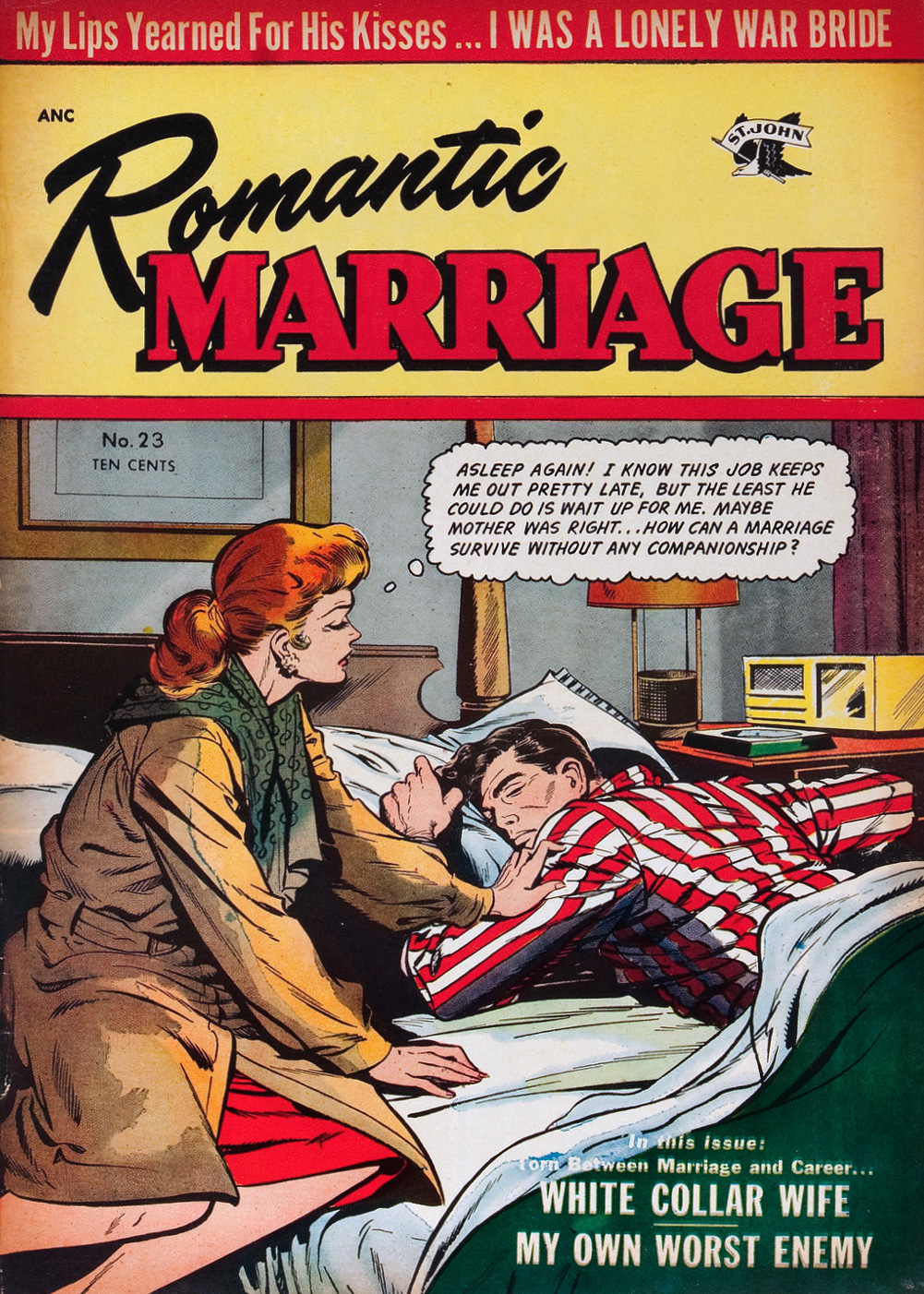
Romance comics love to pit a woman’s career against everything a female should strive for (i.e. marriage). Am I carping that romance comics weren’t very progressive in the 1950s? Ah, I wouldn’t be, if I didn’t know for a fact that Silver Age romance comics often don’t do that much better in that department.
Romantic Marriage no. 23 (July 1954, St. John), cover by Matt Baker. “Companionship”, eh? Read the issue here.
What do we have here? Despite what one would tend to think, this necklace was stolen, not given as a romantic offering. Such are true life secrets: kleptomania, clandestine children, and double-crossed partners.
True Life Secrets no. 25 (March 1955, Charlton). Read the issue here.
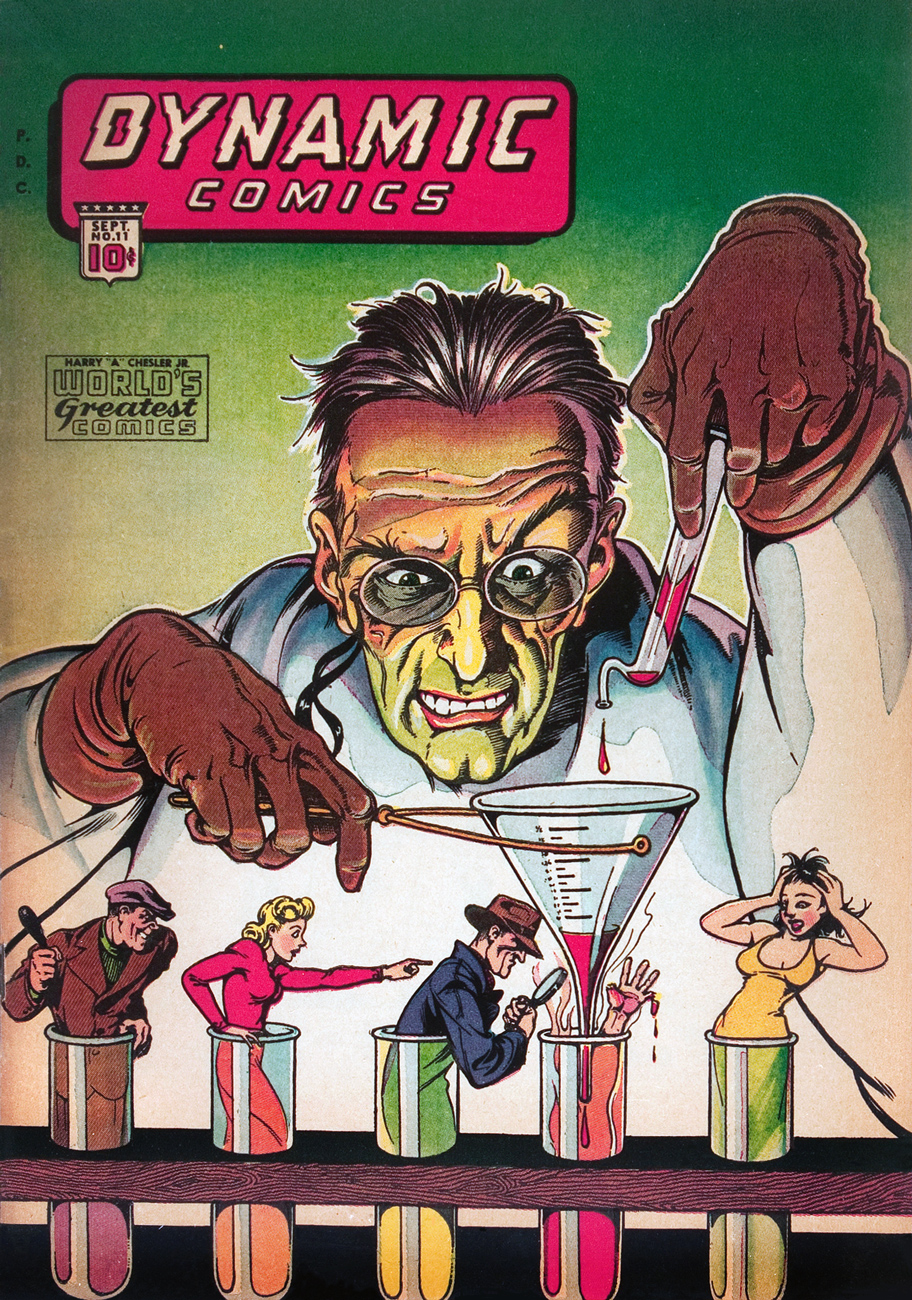
« Gosh, if only Dad would inject me with some of that!* »
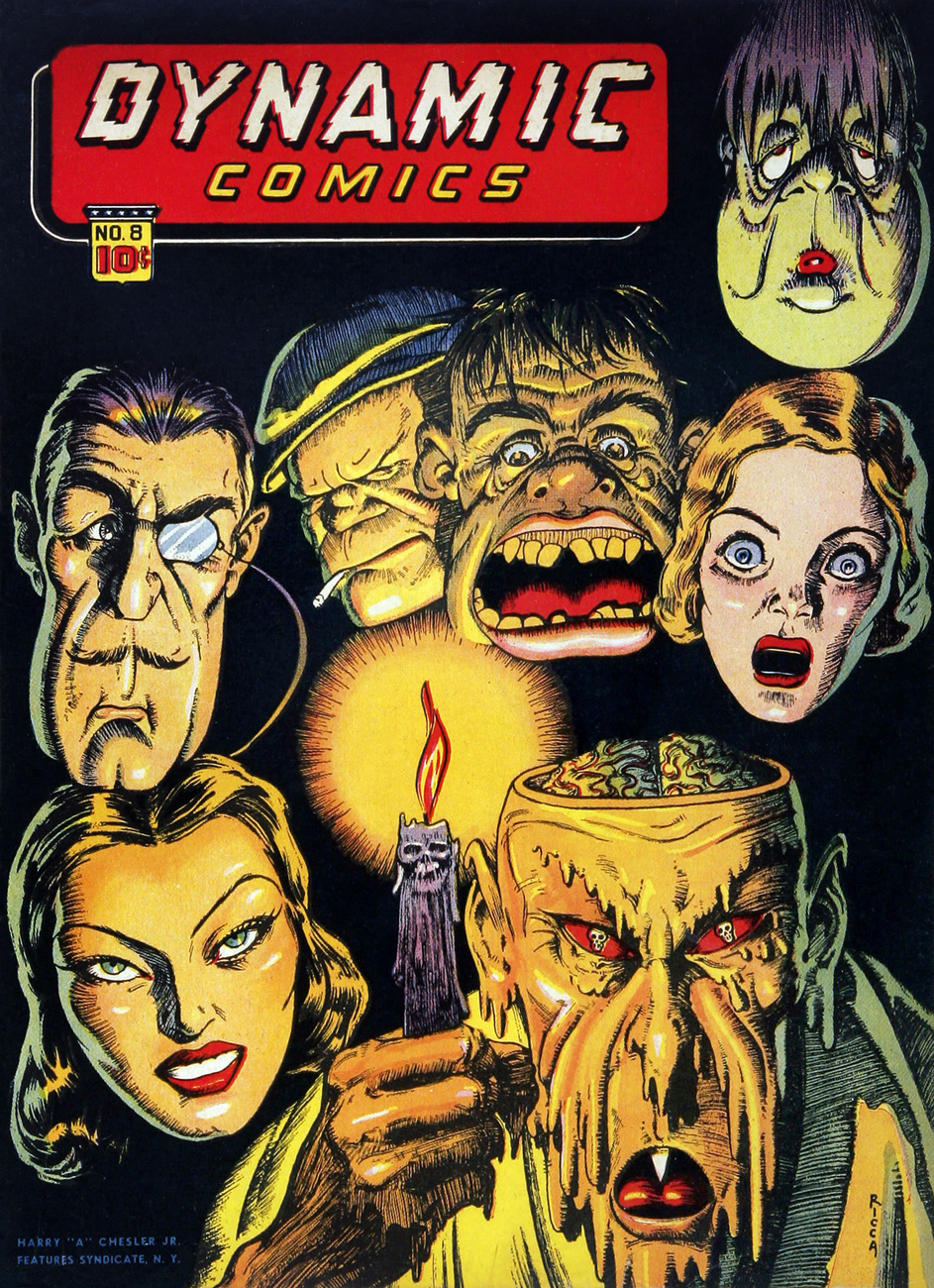
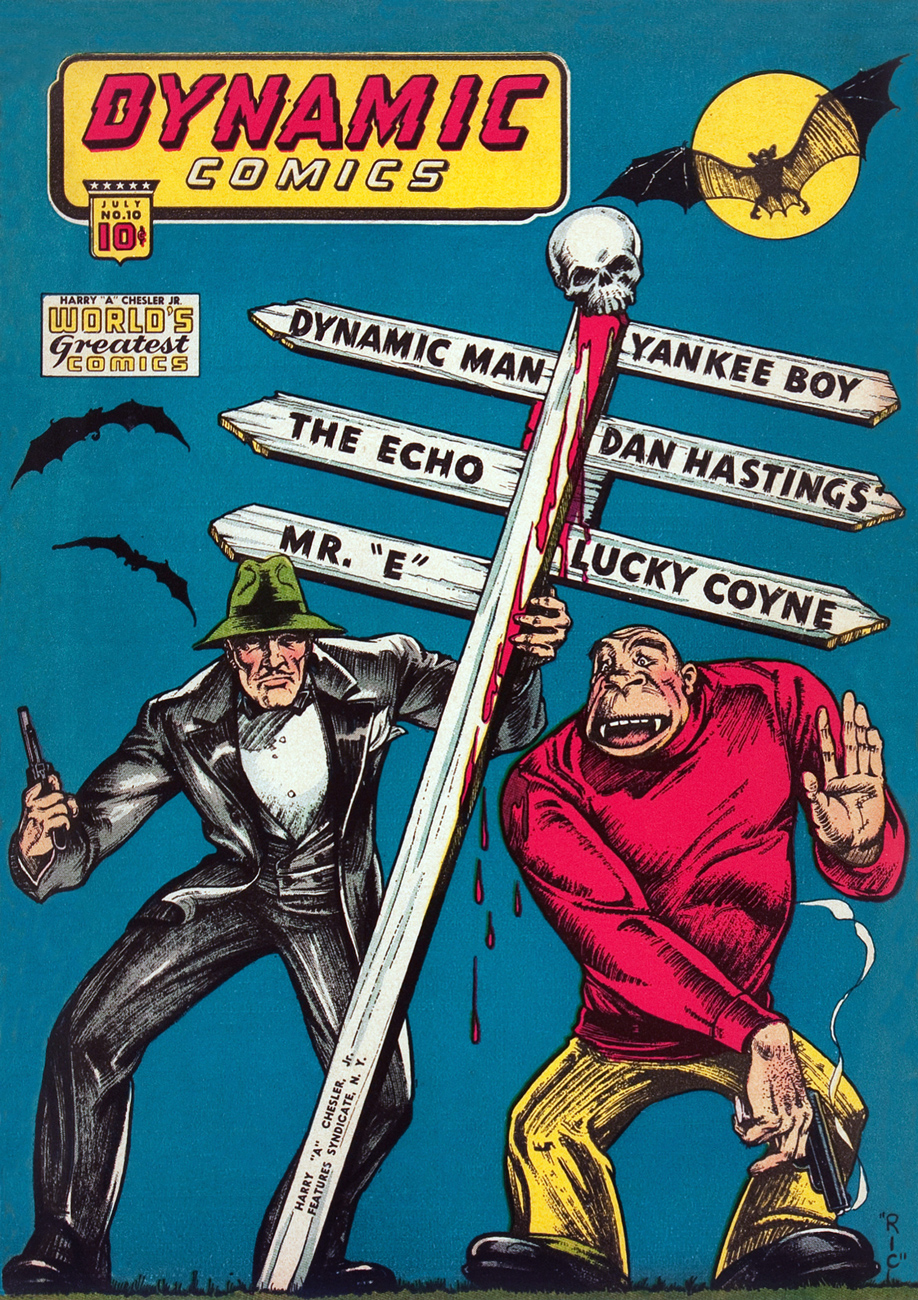
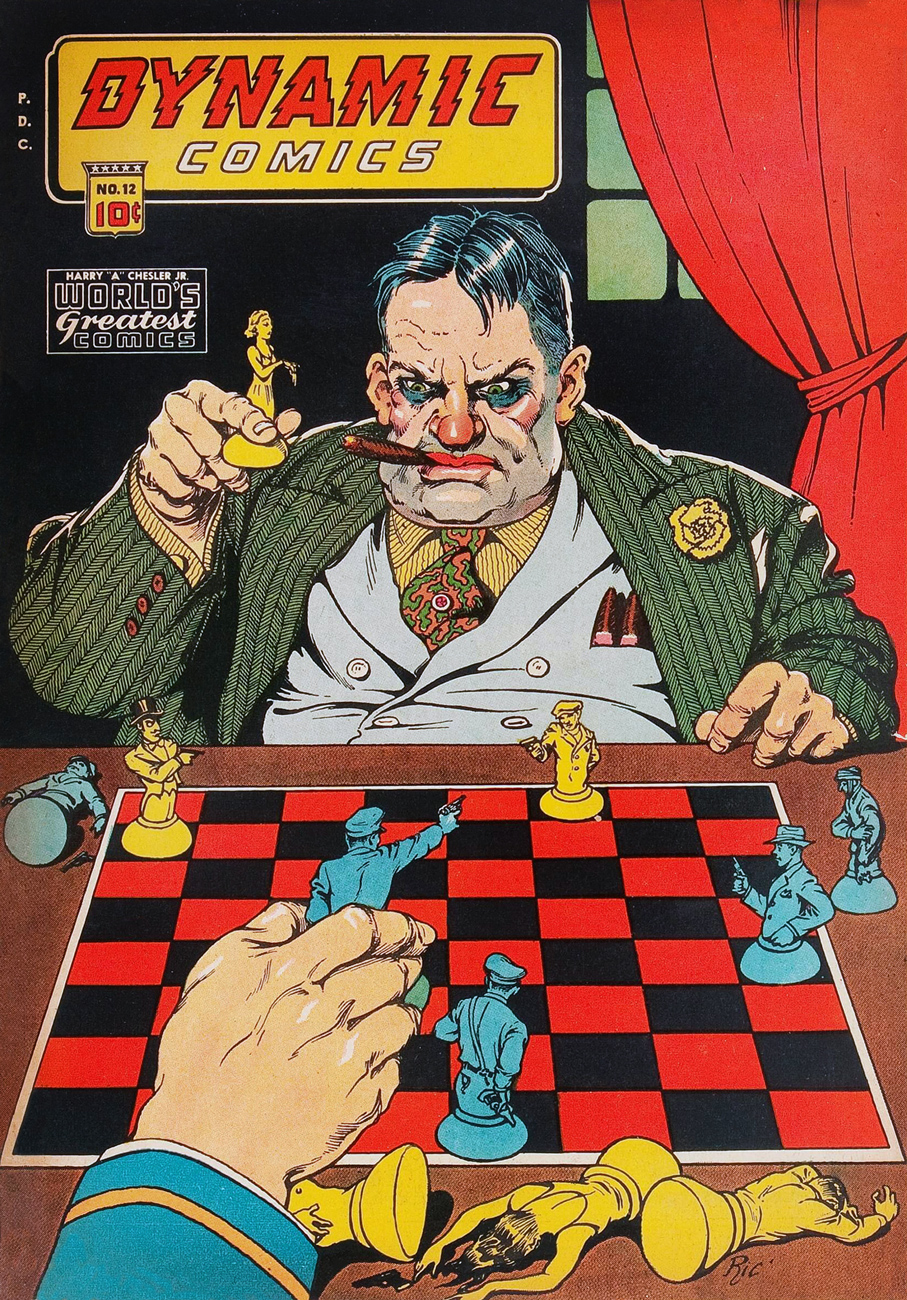
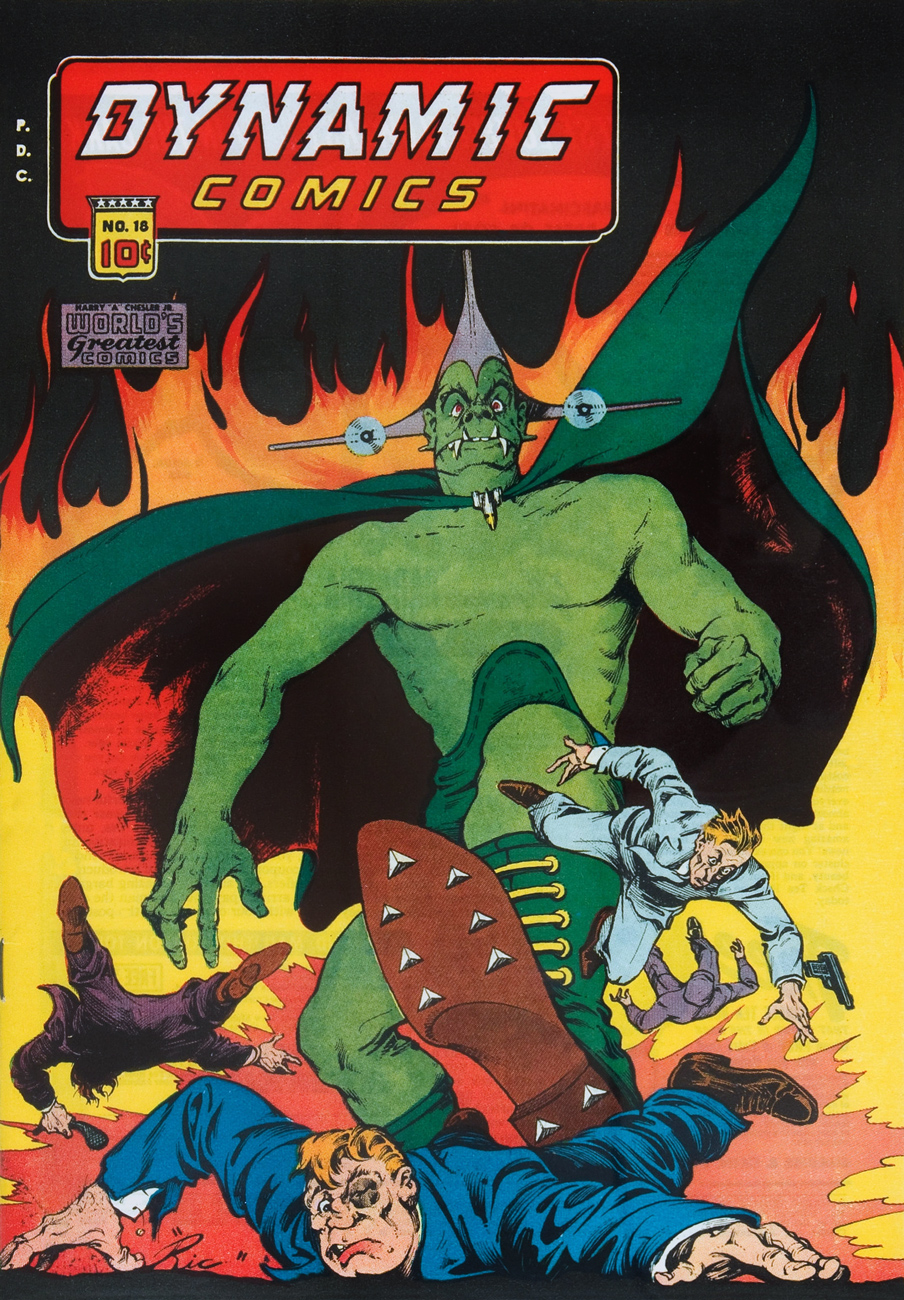
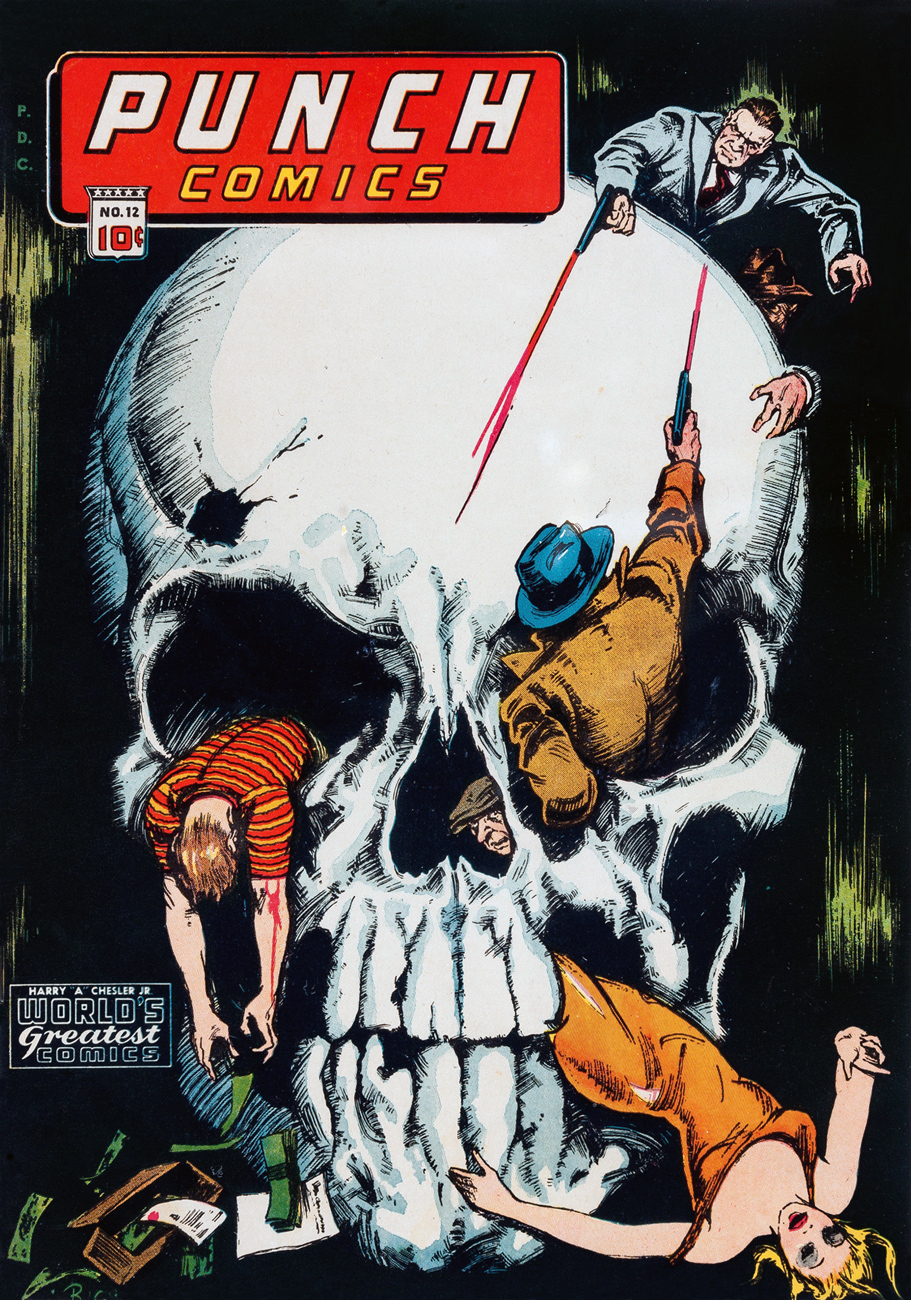
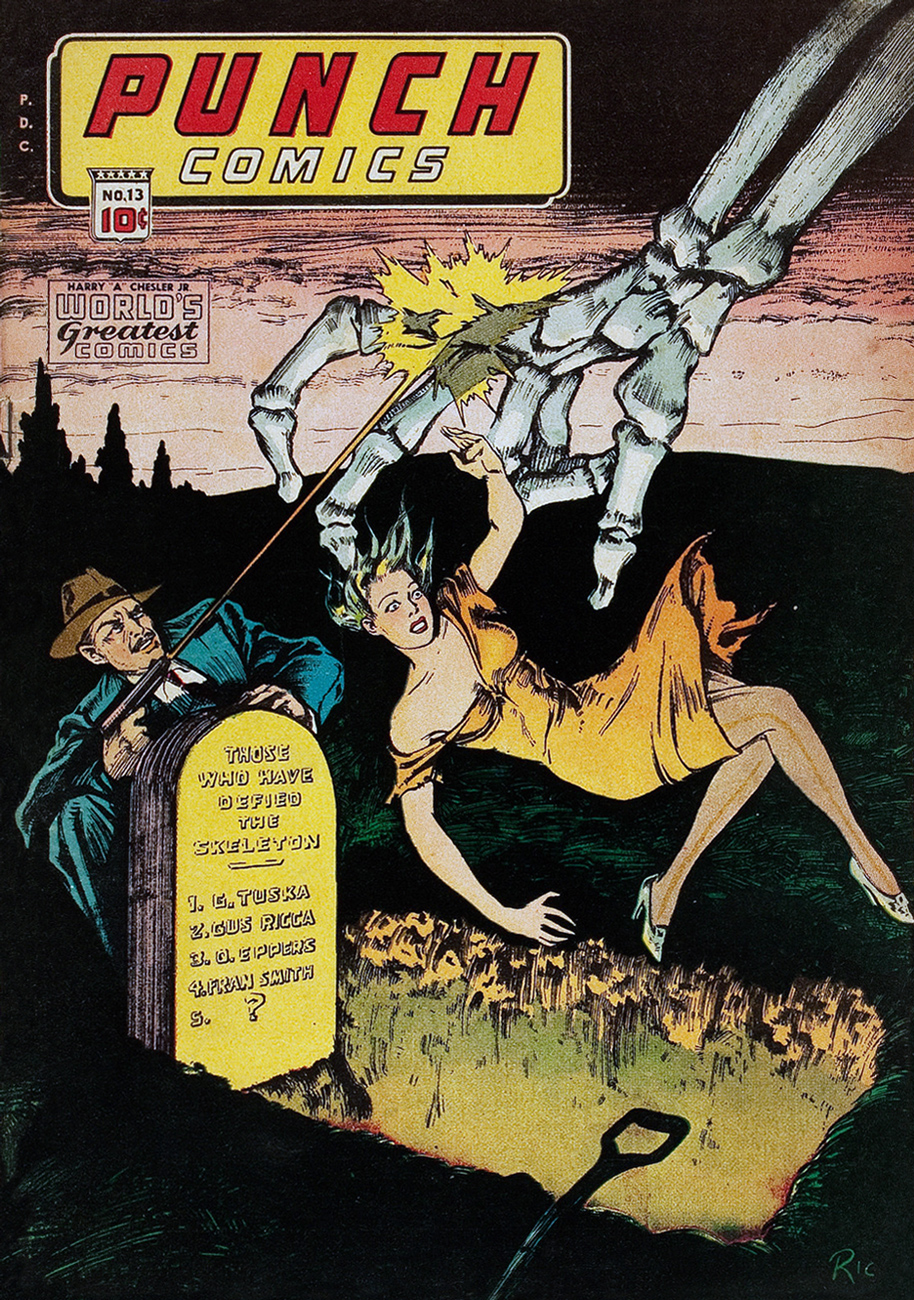
The undervalued Gaspano “Gus” Ignazio Ricca (1906-1956) managed, in the first half of his scant half-century of life, to get his foot in a lot of important doors: The New Yorker (1928), Liberty (1933), Time (1934), Collier’s (1935)… then he wound up in pulps and comics, for better or worse.
Having joined, at the dawn of the 40s, the fabled studio of Harry A. Chesler, the original comic book packager, he became, in 1944, art director of one of Chesler’s many lines, namely Dynamic Comics.
In general, Dynamic’s output wasn’t anything particularly distinguished or accomplished, but oh, those eye-catching covers!
Dynamic Comics no. 11 (September 1944, Chesler / Dynamic.) Read this issue here. The “little people in test tubes” motif never lost its cool, and it pops up all over: for instance, here, here, and also here.
Dynamic Comics no. 12 (November 1944, Chesler / Dynamic.) According to the Grand Comics Database, “The man playing chess bears a distinct resemblance to many contemporary descriptions of Harry “A” Chesler.” Read this issue here.
As if the back-breaking, eye-straining labour, low pay and oppressive deadlines weren’t enough to sap the spirit of a cartoonist. This is Punch Comics no. 9 (July 1944, Chesler / Dynamic.) Read this issue here.
This is Punch Comics no. 12 (January 1945, Chesler / Dynamic.) Read this issue here.
This is Punch Comics no. 13 (April 1945, Chesler / Dynamic.) Read this issue here. Pray note that Mr. Ricca seized the opportunity to symbolically write finis to his and a trio of his colleagues’ lives. « You should’na oughta defied The Skeleton, chum! »
-RG
* from the mouth of Yankee Doodle Jones’ sidekick “Dandy”, Dynamic Comics no. 6. Read it here!
« It’s difficult to know just what to make of C.C. Beck. He’s crusty and curmudgeonly in the Cleveland Armory mold. He’s virulently opinionated, yet insists that he doesn’t take himself seriously. His aesthetics are inflexible if not reactionary, and not entirely consistent at that. He also happens to be one of the most endearing and original cartoonists ever to breathe life into a super-hero.“*
Charles Clarence Beck was born on June 8th, 1910 and left this world in 1989. The world is a stodgier place without him!
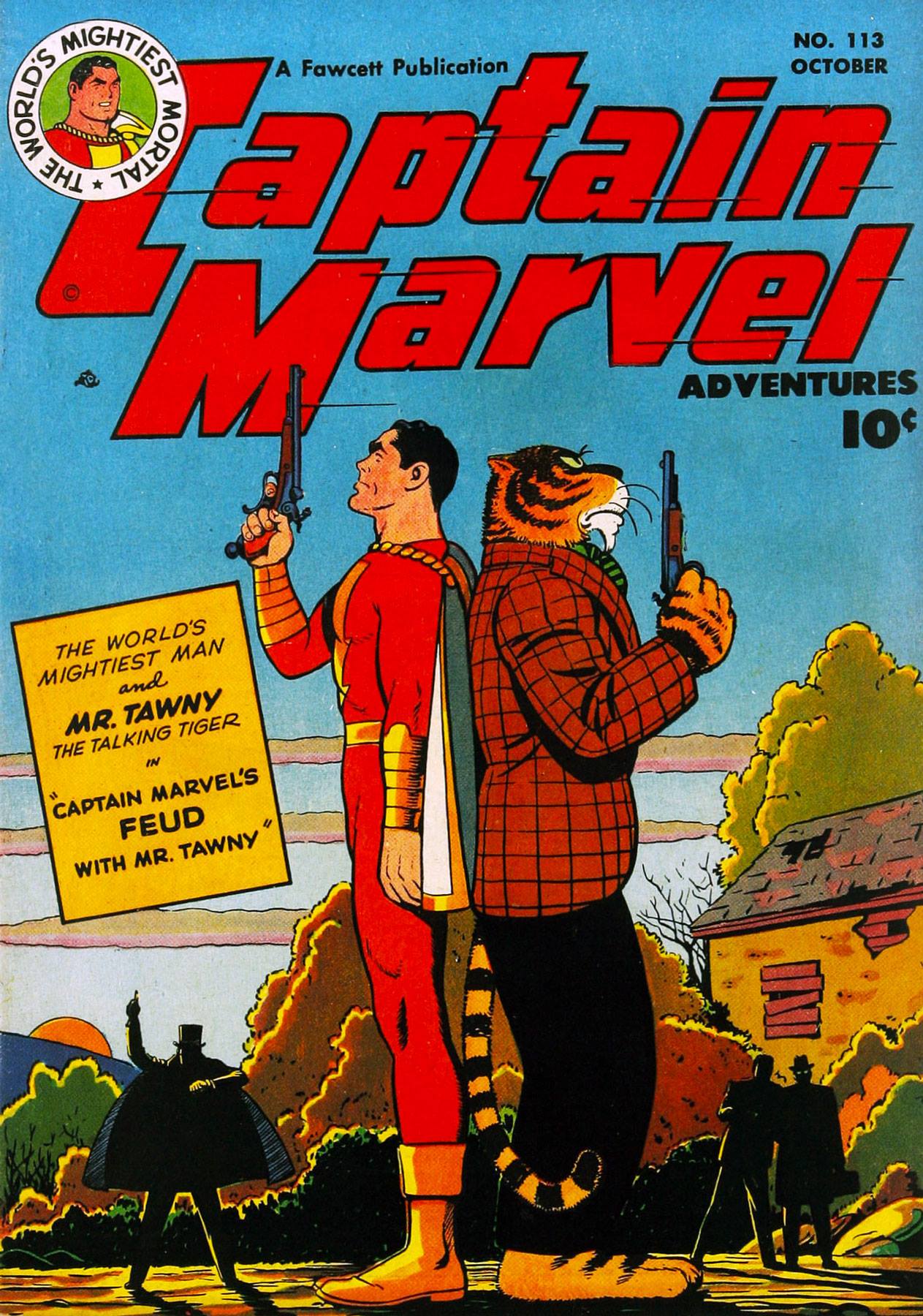
My favourite of Otto Binder/C.C. Beck’s characters – Tawky Tawny, the well-mannered, reasonable, tweed-wearing tiger. Sweet Tawny first appeared in Captain Marvel Adventures #79 (December 1947), as a talking tiger who longed for a life as a normal, suit-wearing, polite member of society. He also really likes ice cream. This panel is from “Mr. Tawny’s Personality Peril”, a story by the Binder and Beck team, published in Captain Marvel Adventures #115 (December 1950).
Here are a few covers which showcase A) C.C. Beck’s stylish art B) the lovely goofiness of it all. To quote the man, « When Bill Parker and I went to work on Fawcett’s first comic book in late 1939, we both saw how poorly written and illustrated the superhero comic books were. We decided to give our reader a real comic book, drawn in comic-strip style and telling an imaginative story, based not on the hackneyed formulas of the pulp magazine, but going back to the old folk-tales and myths of classic times. » Well, to be honest, aside from the so-called Greek origins of Captain Marvel (“Shazam”, the catalyzing cry which allows ordinary Billy Batson to transform into his superhero alter-ego, stands for “Solomon, Hercules, Atlas, Zeus, Achilles, Mercury”), there’s little in these stories that evokes classic folk tales *or* mythology. I know the Ancient Greeks were into some kooky shit, but I don’t recall any myopic worms with a Napoleon complex nor talking tigers in suits. Ultimately, Captain Marvel comics are family fun. “Old-fashioned” values are the backbone of these stories: friendship, loyalty, kindness to those weaker (or stupider) than us. If that sounds boring, it isn’t. Beck had a cartoony style that make his stories fucking adorable, especially when coupled with the often surreal and delightfully wacky plots.
“Quote! Mr. Tawny is not a tiger – he’s a worm! Unquote!”
At first glance, this cover is celebrating the beauty of autumn; upon a closer inspection, it turns out that it has much darker overtones – two faceless guys in the background, clearly following some nefarious plan to break up Tawny and Captain Marvel’s friendship (how dare they!) and a creepy boarded-up house. This is Captain Marvel Adventures #113 (October, 1950), cover by C. C. Beck. Read “His Feud With Mr. Tawny” (scripted by Otto Binder, illustrated by C.C. Beck), which is finally not at all gruesome, just heart-warming, here.
C.C. Beck co-created Captain Marvel with writer Bill Parker in 1939. The Big Red Cheese made his first stellar appearance in Whiz Comics #2 (cover date February 1940), published in late 1939. Captain Marvel was a huge hit, and so Fawcett put out a number of spin-off comic books – as for Beck, he opened his own comic studio in 1941 that provided most of the artwork in the Marvel Family line of books.
« Special! Baby dinosaurs! New! Different! Be the envy of your friends! »
Captain Marvel Adventures #123, 1951. Did you know that dinosaurs apparently wag their tails like dogs to express their affection? No? Head over here.
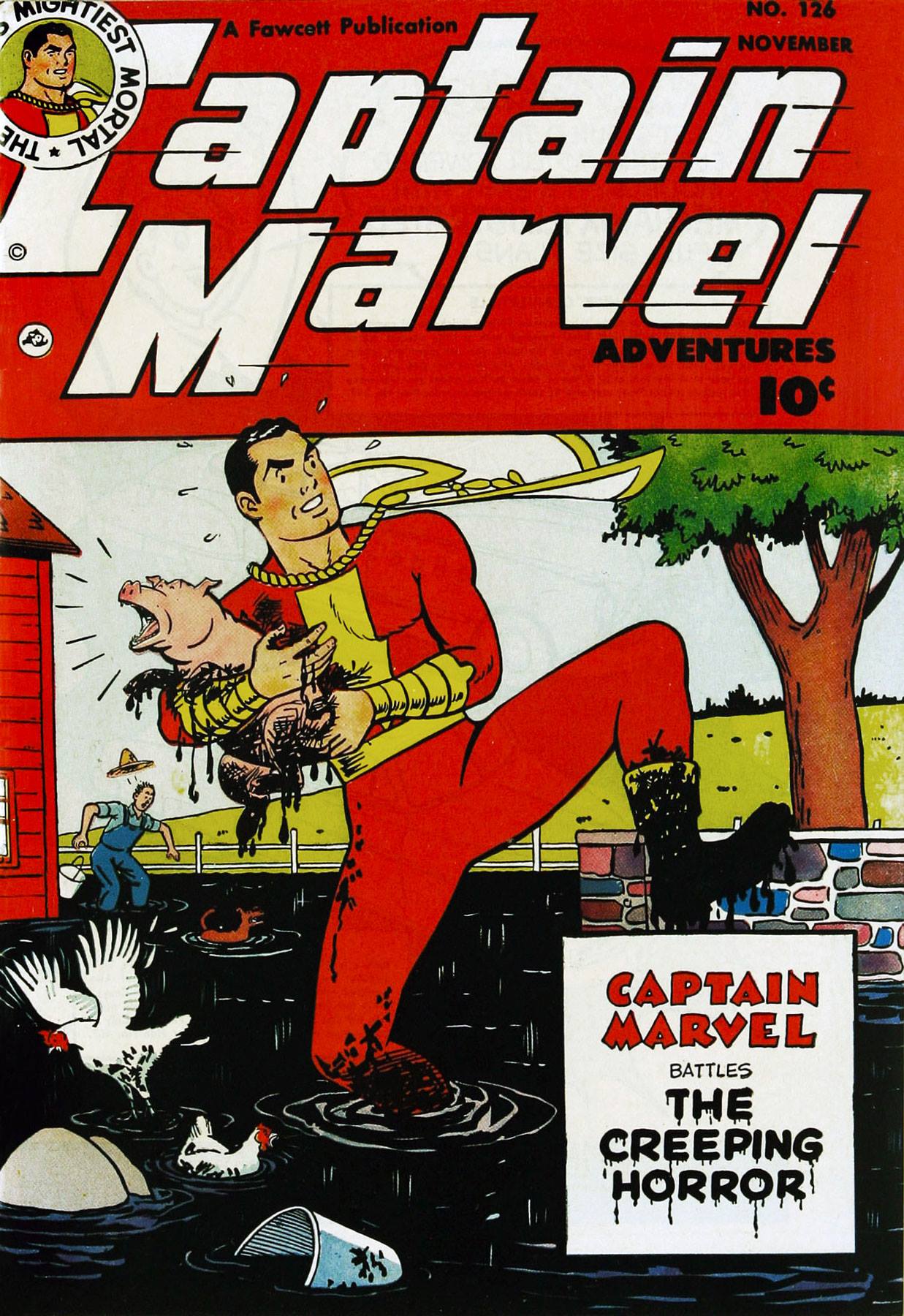
« Wait! This isn’t oil! It’s dense, black and real sticky! »
Don’t let go of that piglet, Captain Marvel! Pigs’ reputation for loving mud may be well deserved, but no self-respecting swine wants to be dropped into black, sticky goo. This is Captain Marvel Adventures #126 (November 1951), cover by C.C. Beck. The cautionary cover tale, Captain Marvel and the Creeping Horror, was written by Otto Binder and pencilled by C.C. Beck (with inks, tentatively, by Pete Costanza).
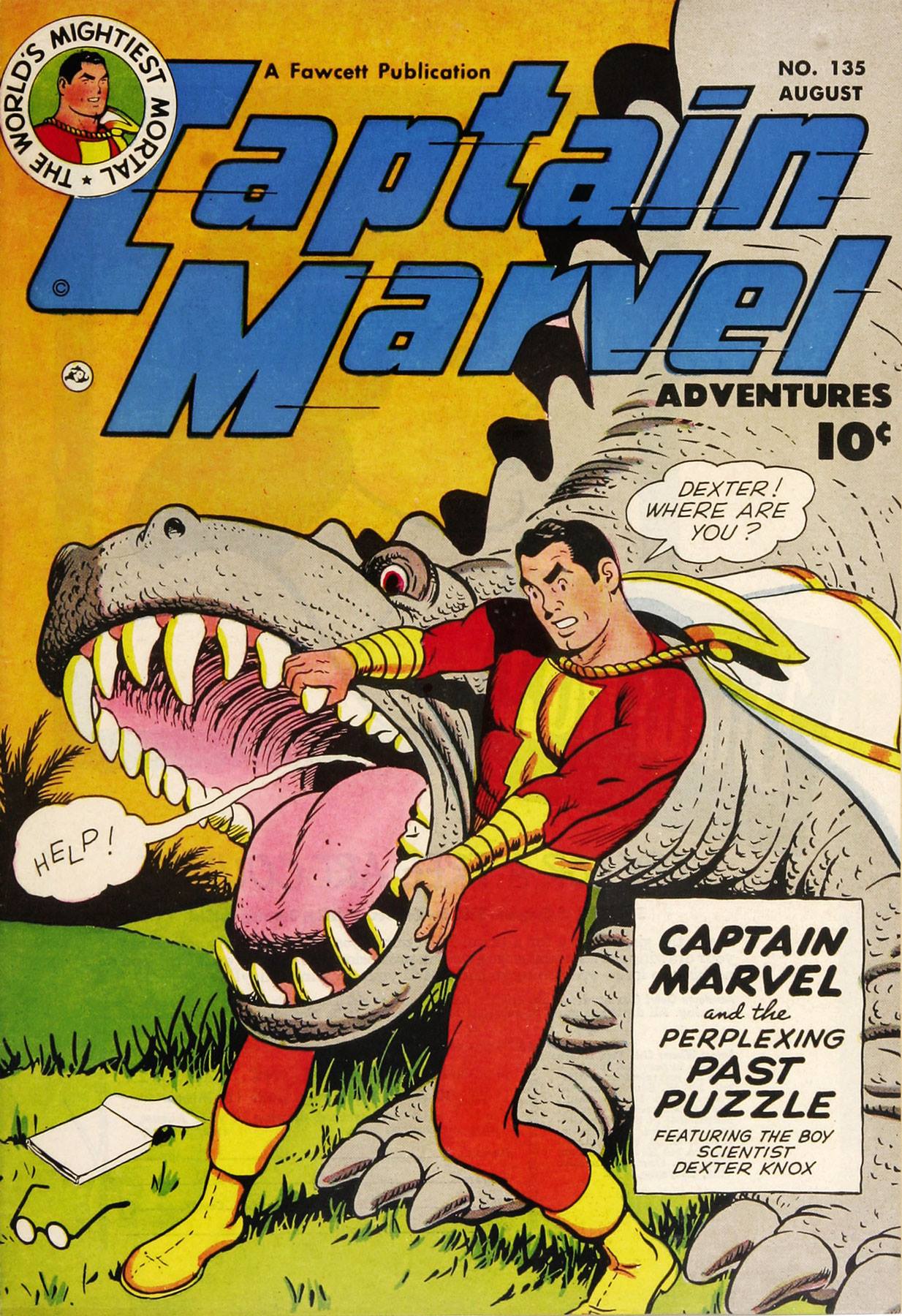
« Did you hear that, ma? We’re on another – uh – world! Ma, aren’t you scared? » « Land sakes, pa, why get scared? At least my wash will dry nice and fast with two suns shining down! »
Captain Marvel Adventures #135 (August 1952); cover by C.C. Beck.
IGN ranked Captain Marvel as the 50th greatest comic book hero of all time. You know how they qualified it? “Times have changed, and allegiances with them, but Captain Marvel will always be an enduring reminder of a simpler time.” If there’s one thing I hate, it’s people who assume that generations before theirs were naïve or that the world was a “simpler” place (take a peep in any good history book and see if that was the case). This kind of condescension poisons any compliment.
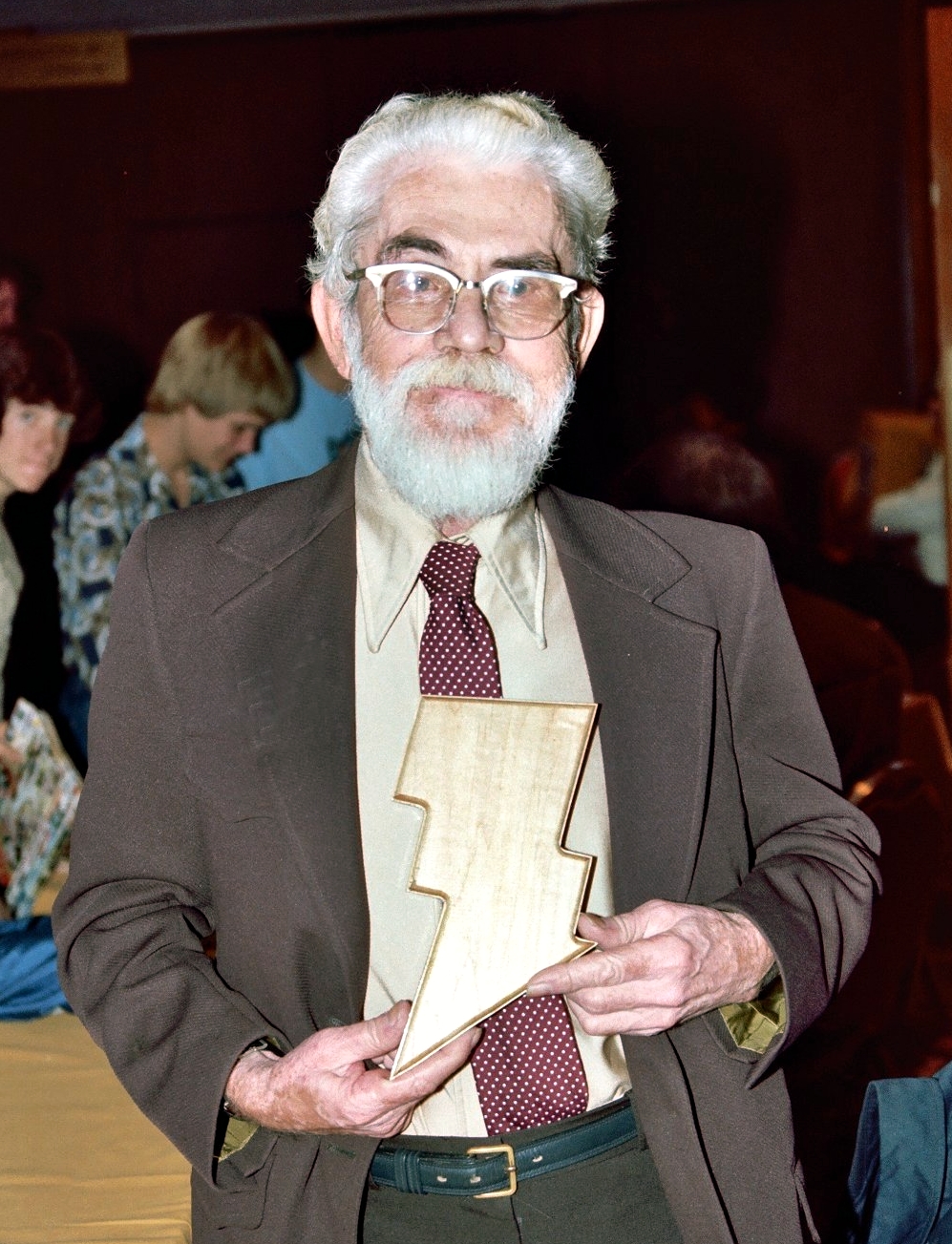
C.C. Beck in 1982. He kinda looks like my physics teacher from high school!
Doctor Sivana comes out with his whole family to taunt Billy! Says Beck, “The publisher also once wanted to drop Sivana, claiming the old rascal was becoming a more interesting character than Captain Marvel. The editors paid no attention to so silly an order and kept him alive and cackling.”
There’s a beautifully conducted interview with Beck by Tom Heintjes, published in Hogan’s Alley. I highly recommend it. Heart-breakingly, Heintjes explains in the introduction that “when Beck died of renal failure on November 23, 1989, my inability to complete a book celebrating Beck’s life and career—to my mind, one of the most commercially and aesthetically successful in the entire history of comic books—was a source of acute regret.”
~ ds
*Gary Groth’s introduction to an interview with C.C. Beck published in Comics Journal #95 (February 1985) and conducted in 1983.
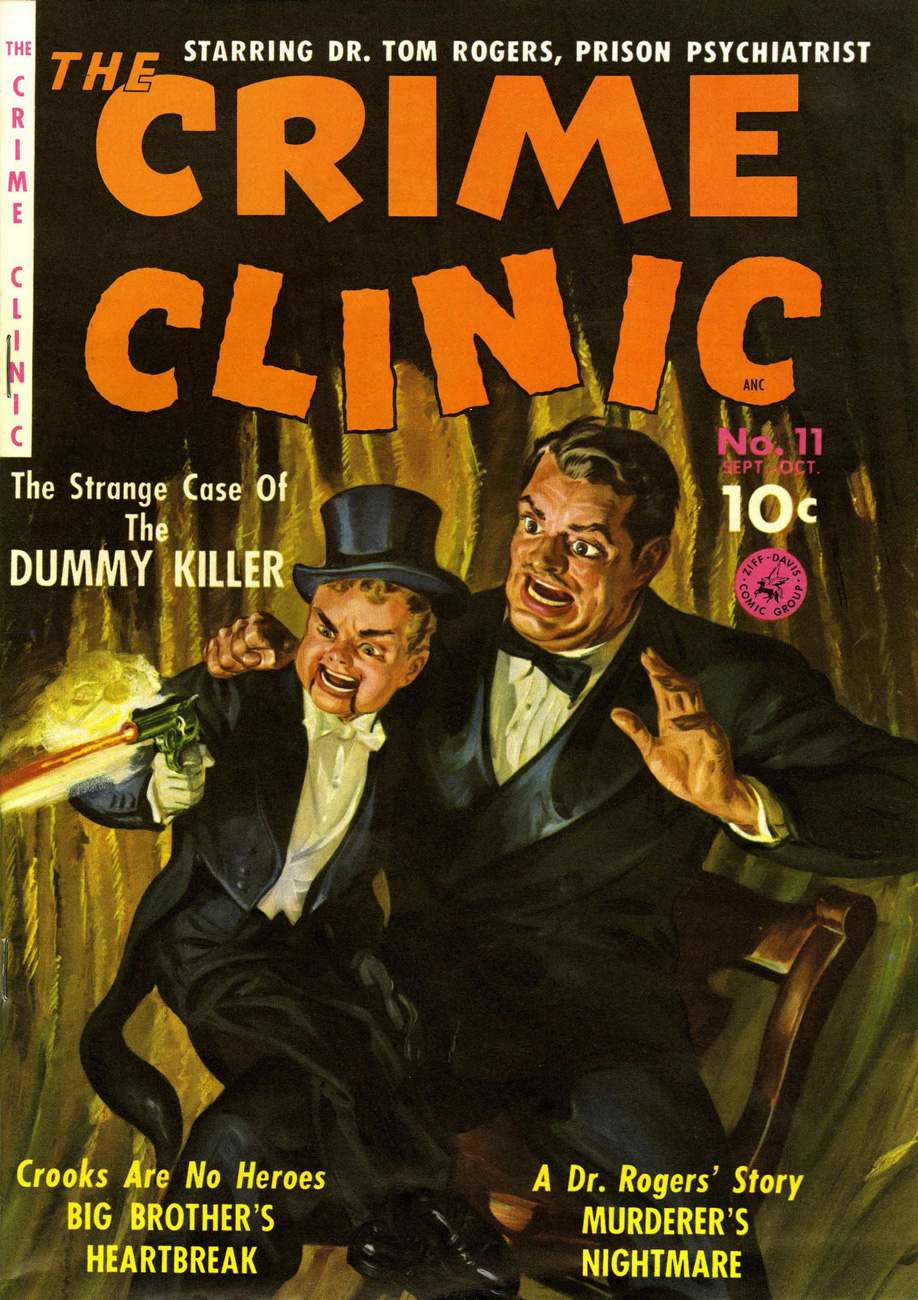
« Now, Carlos — put that gun away! »
« Why, Fernando, I thought I’d start the show with a bang! »
That guy in the audience with the irritating donkey laugh is finally getting his. This unforgettable cover is the work of the peerless Norman Saunders, whose long and prolific career blazed its way through pulps, comic books, slicks, men’s adventure magazines, paperbacks, trading cards… you name it!
This is Ziff-Davis’ The Crime Clinic no. 11 (actually its second issue, September-October 1951). And for once, the inside story kind of matches the cover mayhem.
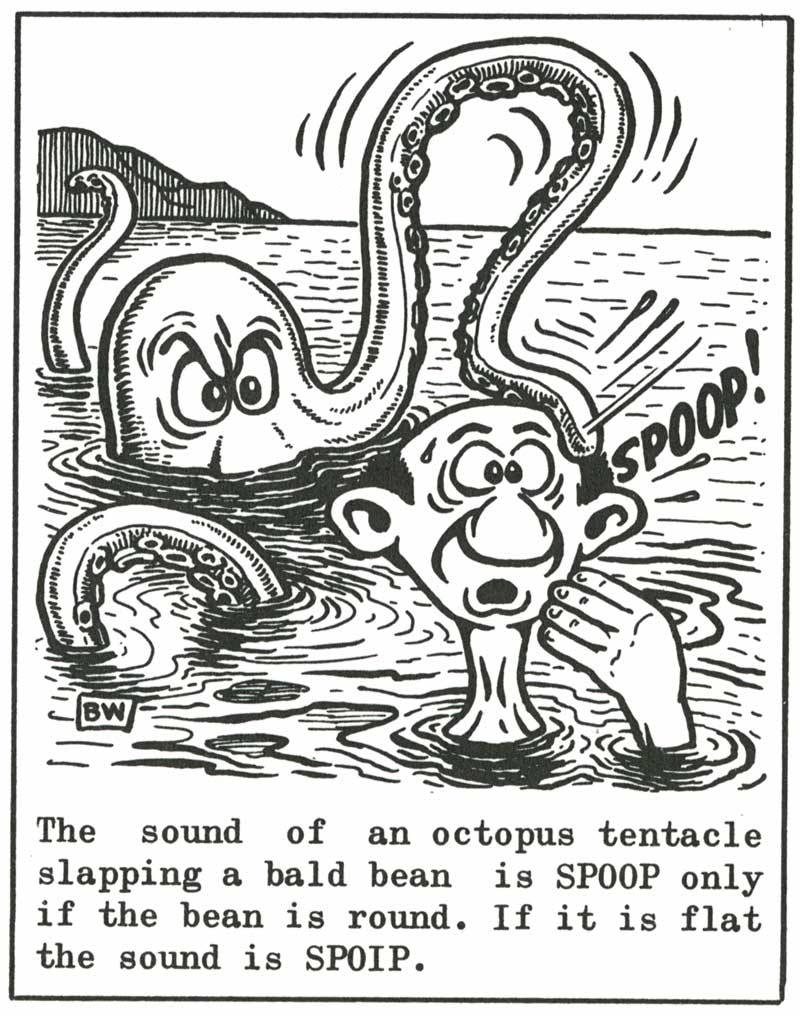
SPOOP! And a happy Tentacle Tuesday to you, too. Today’s feature is devoted to Basil Wolverton. A lot could be said about his sense of semi-slapstick, semi-surreal comedy and his unhinged-yet-meticulous drawing style, his delightful work in the realm of humour comics or his genuinely scary contribution to horror-in-pictures… but as I have a one-track mind, I’ll focus on his love of tentacles. No matter what sort of thing he was drawing, tentacles somehow managed to slip into it… and that’s understandable, for tentacles are both hilarious and fearsome. Without further ado, here’s your master of ceremonies and cephalopods… Basil Wolverton!
Here’s some more sounds you might like to know about, to be used indiscriminately to spice up humdrum conversations around the water cooler:
Hungry cannibal filing eyetooth: FWATCH! Man with calloused feet crossing rough linoleum: SKIRP! SKIRP! Thumb gouging eye: SPOP! Hot lava speweing on WCTU convention: FOOSK! Hot lava spewing on Elks’ convention: SSSCRISH! Person skidding on hot stove in bare feet: SCREESH! Beaver biting into wooden leg: CRASP! Car crashing into large vat of frogs’ eggs: SKWORP! False teeth falling through skylight: TWUNK! Sock in the face with Sears Roebuck catalog: PWOSH! Sock in the face with Montgomery Ward catalog: PWASH!
This mirth-inducing stuff is from an article that Basil Wolverton wrote for the Daily Oregon in 1948 called “Acoustics in Comics”. Here’s another excerpt of that article (which is definitely worth reading in its entirety, and is fortunately easily found online… here, for instance):
« ‘I want realism!’ he (my publisher) had bellowed. ‘No more of this wild imaginative stuff that’s causing some people to want to ban our comic books! From now on, get that realism in there, and your strips will be horribly funny! Then the readers will go into hysterics and laugh like crazy, and our books will be acclaimed the most laugh provoking on the stands!’ That meant that an imaginative word like CRANCH was taboo. It was up to me to get the real sound word. »
And, hoppin’ horse hocks, he did.
Enough of the rib-splitting stuff: this is a serious blog that discusses serious horror. *ahem*
Page from Ethan Downing (1935), an early endeavour by Wolverton – unpublished.
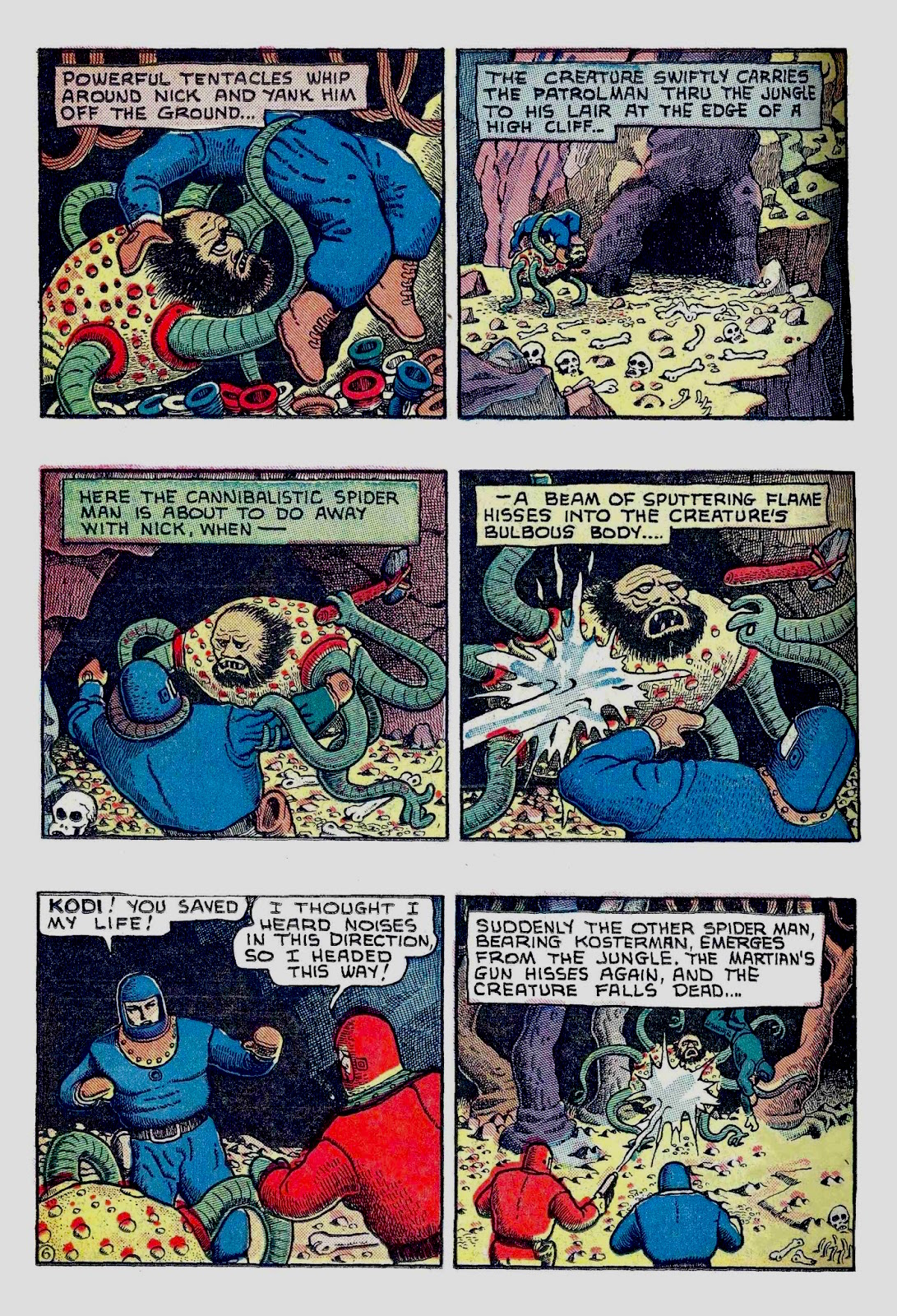
Amazing Mystery Funnies vol. 2 no. 12, December 1939. You may with to point out that this bandit is a cannibalistic spider, *not* a tentacled creature, but look at how he’s using his appendages, look me straight in the eye, and tell me that those aren’t tentacles. Besides, spiders have 8 legs, not 6, and this guy is definitely a 6-leg wonder… and they get called « tentacles », right from panel one.
No inventory of Wolverton tentacles would be complete without the classic « Creeping Death from Neptune », first published in Target Comics vol. 1 no. 5 (June 1940), and reprinted many a time since, nearly as often the amazing Brain Bats of Venus (also quite heavy in quasi-tentacles. If aren’t familiar with it already, do yourself a favour and read it in full here.)
A page from Creeping Death from Neptune, first published in Target Comics vol. 1 no. 5 (June 1940). The earth-girl is interestingly deadpan about being consumed alive by some sort of slithering weirdness.
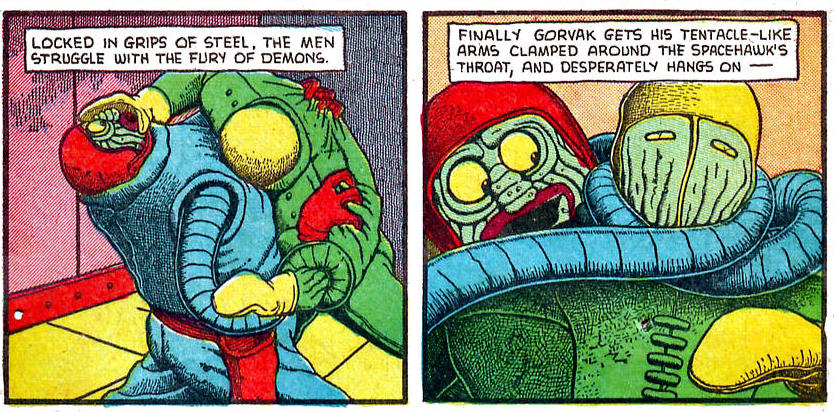
This story also has « tentacle-like » metal arms. I’m telling you, pretty much everything’s a tentacle where Wolverton is concerned.
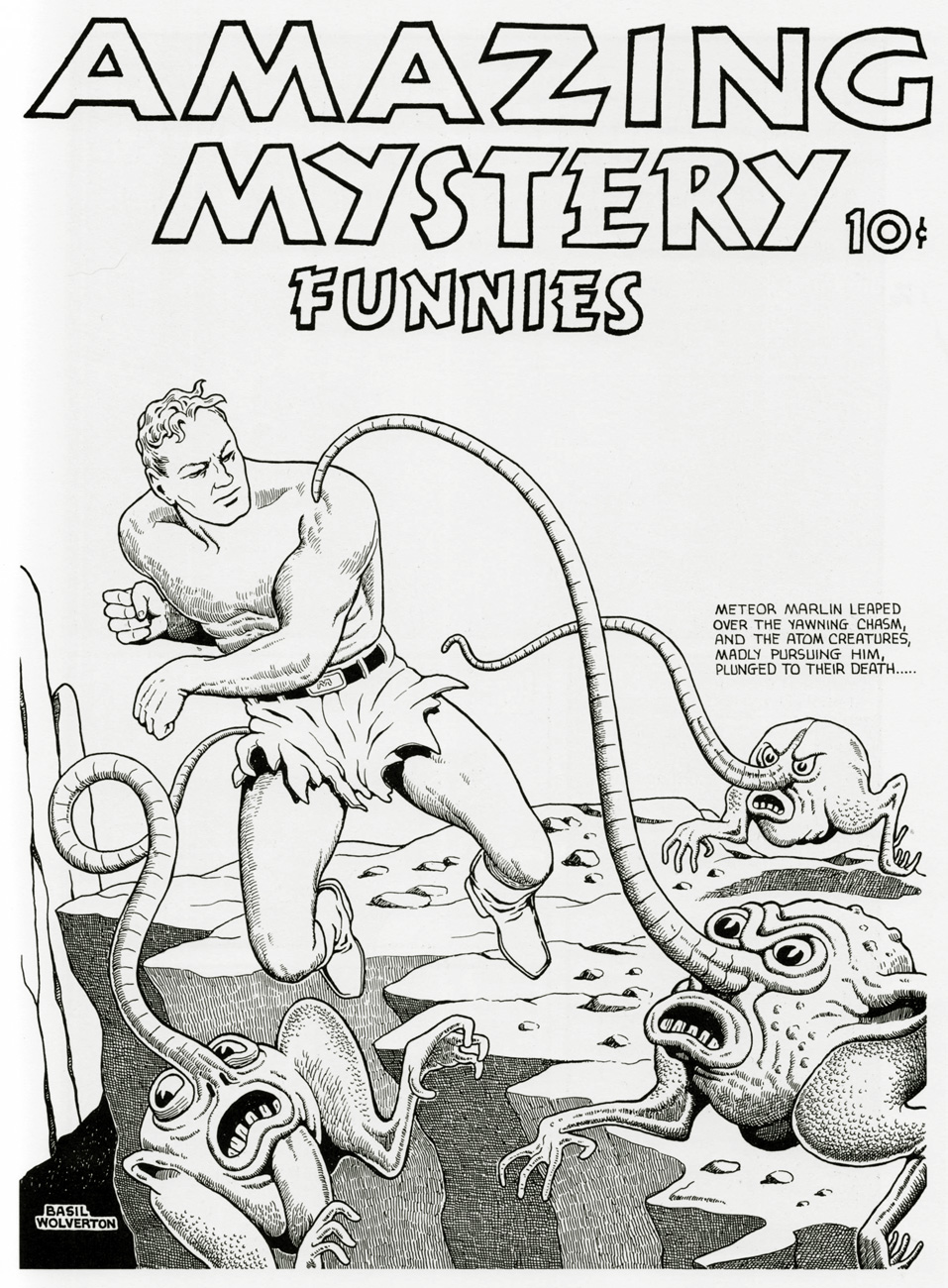
Meteor Marlin, cover illustration for episode one, April 4th, 1940… never published. In this one, noses are tentacles!
A panel from Nightmare World by Basil Wolverton that originally appeared in Weird Tales of the Future no. 3, 1952. This is a reprint from Mr. Monster’s Super Duper Special no. 8, 1987, re-coloured by Jeff Bonivert.
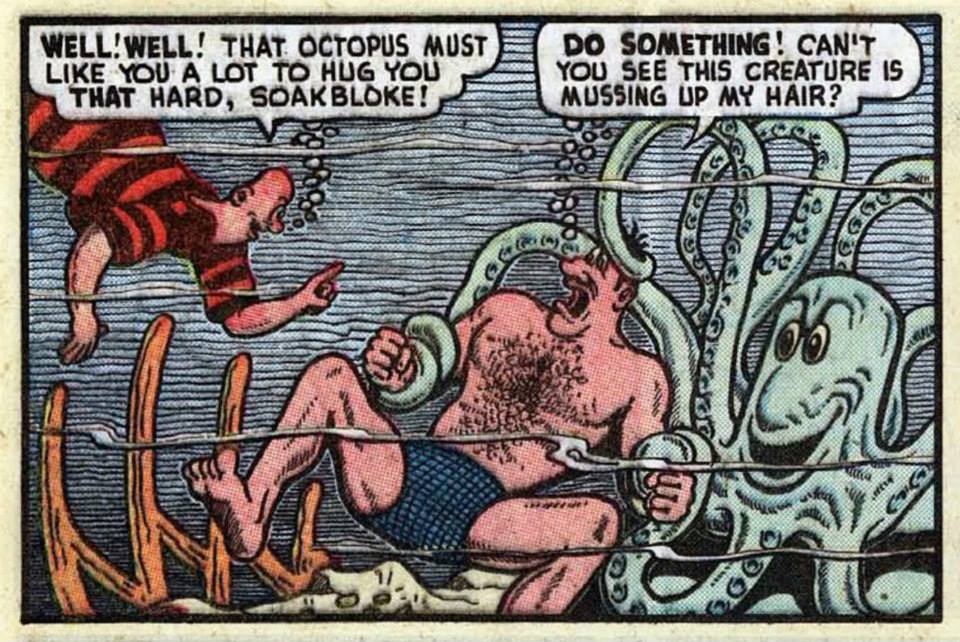
Phew! I’ll end this on a humorous note: octopuses evidently make fabulous hairdressers.
This is a panel from a Powerhouse Pepper story that doesn’t really have a title, being referred to as “Haw! Haw! Grab a good gander…” instead. Originally published in Tessie the Typist Comics no. 9, April 1947.
Sadly, Wolverton’s weirdly frightening villains did not always find favour with the powers-that-be. Back in 1940, Jim Fitzsimmons, assistant editor at Centaur, publisher of Amazing Mystery Funnies, wrote:
« Though the fantastic and weird are the essential selling point of this feature, we would advise that you keep away from the use of revolting characters such as Brain-Men. Some of these characters you have developed have actually sent shudders down my otherwise unconcerned vertebrae. »
Reading The Life and Comics of Basil Wolverton, Volume 1: 1909-1941 written by Greg Sadowski (2014, Fantagraphics), one gets the impression this brilliant master of spaghetti-and-meatballs* comics spent his artistic life trying to fit his imagination into the narrow guidelines imposed by editors, heads-of-companies and other pundits. He died in 1978, aged 69, but was active in the comics field until 1973 («Plop!») I’ll leave it for people more erudite than I to debate his success (or lack thereof) in the comics field…. I’m just happy to witness a resurgence of interest in this great artist, and enjoying the treasure-trove of material that’s available.
I’d like to bring to your attention that on March 22nd, 1914, more than a hundred years ago, John Stanley, American cartoonist and comic book writer extraordinaire, was brought into this world. He died in 1993 at age 79, but he left an undeniable mark on this world. (At least I hope it’s an indelible one.)
I won’t talk about his artistic parcours, as people far more erudite than I have already done it. For an enjoyable gallop through Stanley’s multi-faceted and staggeringly productive career, head over to the Comics Journal and read an excellent article by Frank Young. Want to read some stories (and have a few hours, if not days, to spare?) Visit Stanley Stories, a truly impressive blog by the same Frank Young, who scanned tons of comics and perceptively analyzed them for our great enjoyment.
Me, I’m just an devotee who likes to curl up and read his comics. I’ll share some images. The art is by John Stanley, unless otherwise specified.
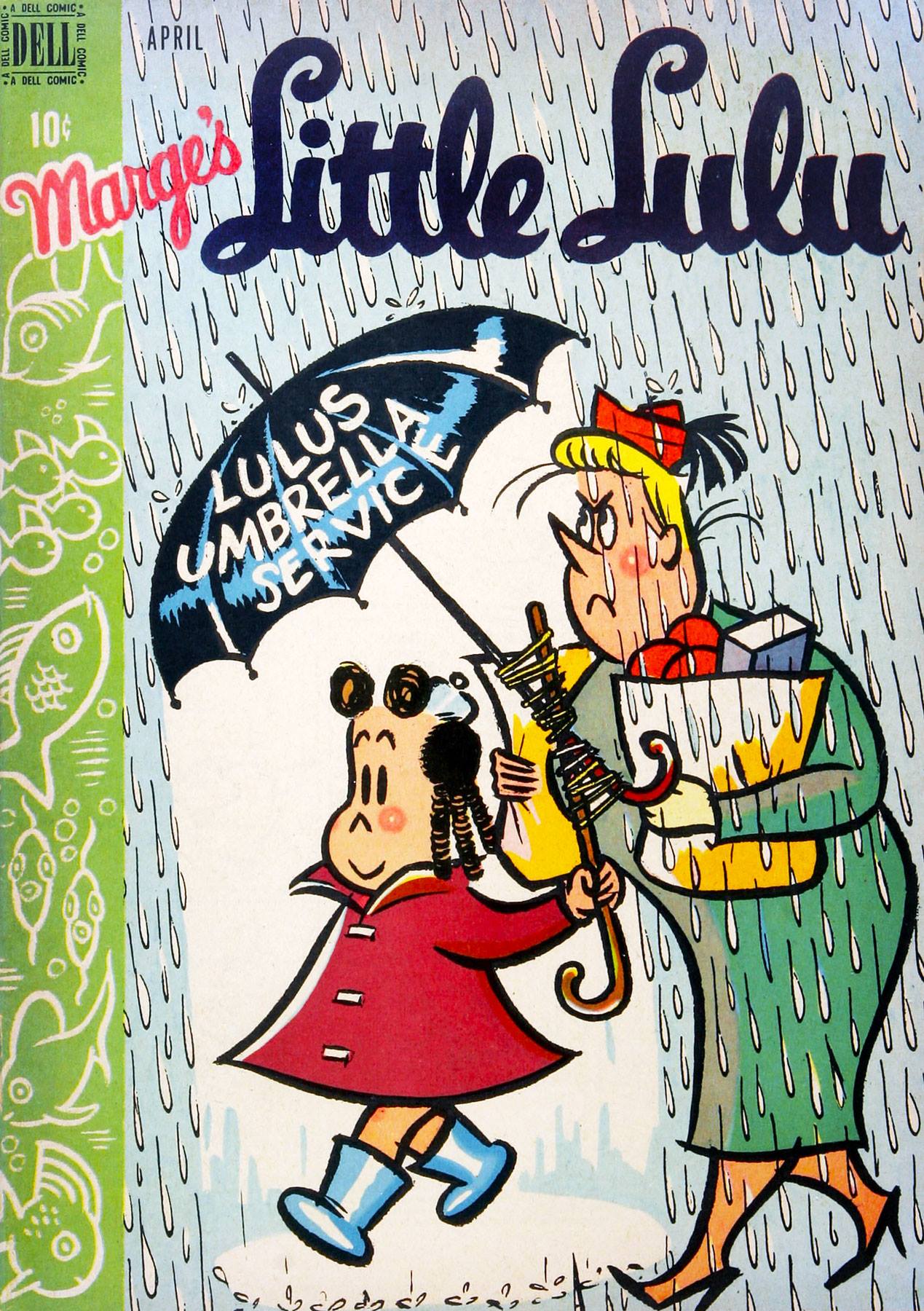
Marge’s Little Lulu no. 10 (April 1949). I recommend « John Stanley: Giving Life to Little Lulu » by Bill Schelly, published in Fantagraphics in 2017, which pieces together Stanley’s transformation of Little Lulu into the beloved, iconic figure she is today. I’ve never felt the need to have female characters to relate to, yet Lulu’s a great role-model for mischievous little girls who can pitch a mean snowball as well as any boy!
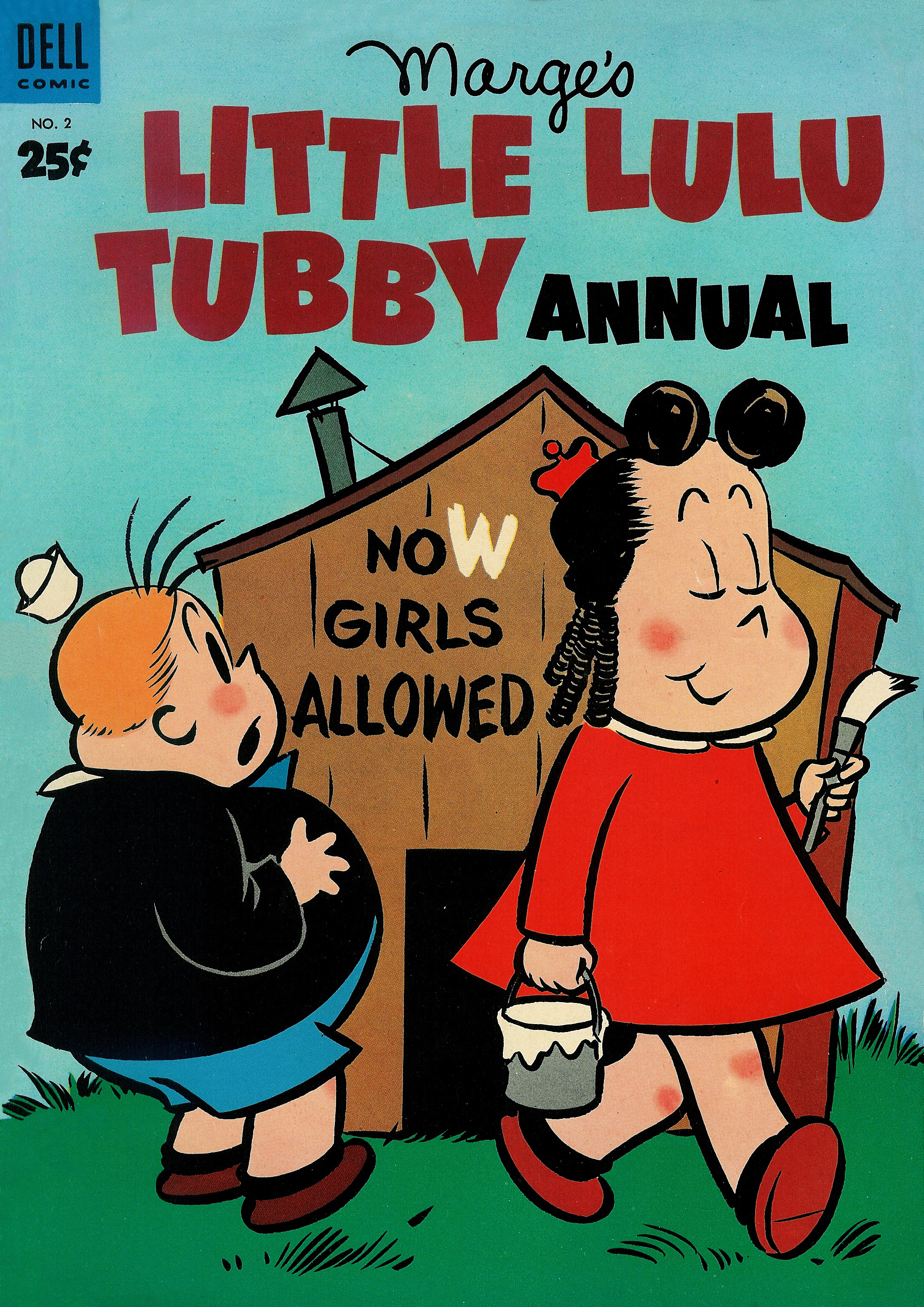
Marge’s Little Lulu Tubby Annual no. 2, March 1954. Cover by Irving Tripp from a layout by Stanley. Tubby’s series is an offshoot of Lulu’s.
Page 8 from « Guest in the Ghost Hotel », from Tubby no. 7 (January-March 1954). Looking for ghosts, ghouls and monsters? Look no further than Stanley comics.
John Stanley took a stab at Krazy Kat stories when Dell revived the comic in 1951. Krazy Kat Comics lasted for 5 issues (presumably poor sales doomed it), all published in the same year. This is Krazy Kat no. 1, 1951.
How do Beatniks while away the hours? They compose nonsensical poetry, noodle it out… and dig girls, of course. Kookie was John Stanley’s creation; the series was written and laid out by him. Unfortunately, it was very short-lived, running for a grand total of 2 issues. This is Kookie no. 1, February-April 1962. The handsome painted cover is by Bill Williams from a layout by Stanley. You can read the issue here.
Dunc And Loo no. 6, April-June 1963. Cover by Bill Williams from a layout by Stanley.
Lou (of Dunc & Lou) was apparently destined to be a newspaper strip, but never made it.
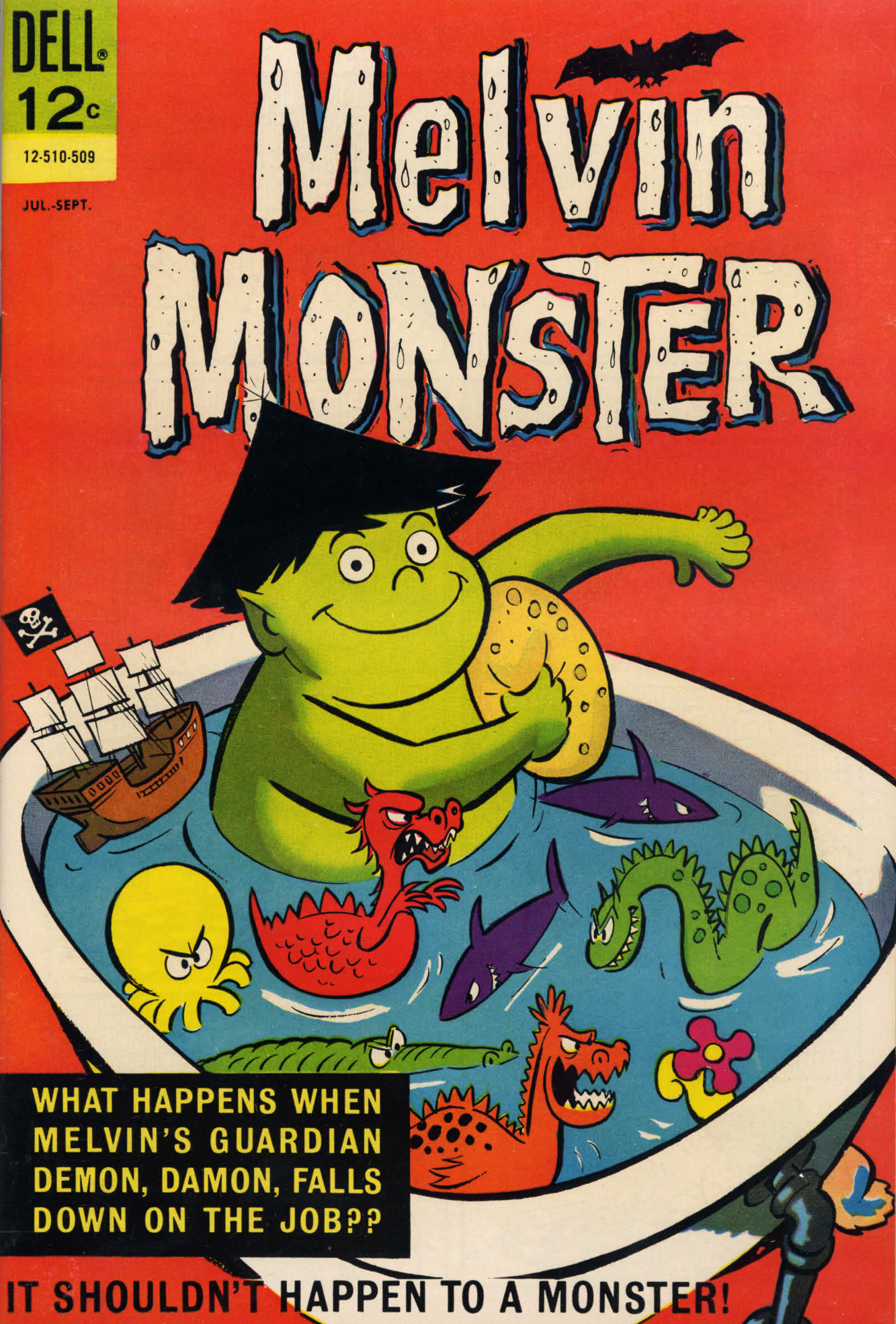
Melvin Monster no. 2, July-September 1965.
O.G. Whiz no. 1, February 1971.
An inside page of O.G. Whiz, with very typical madcap Stanley action.
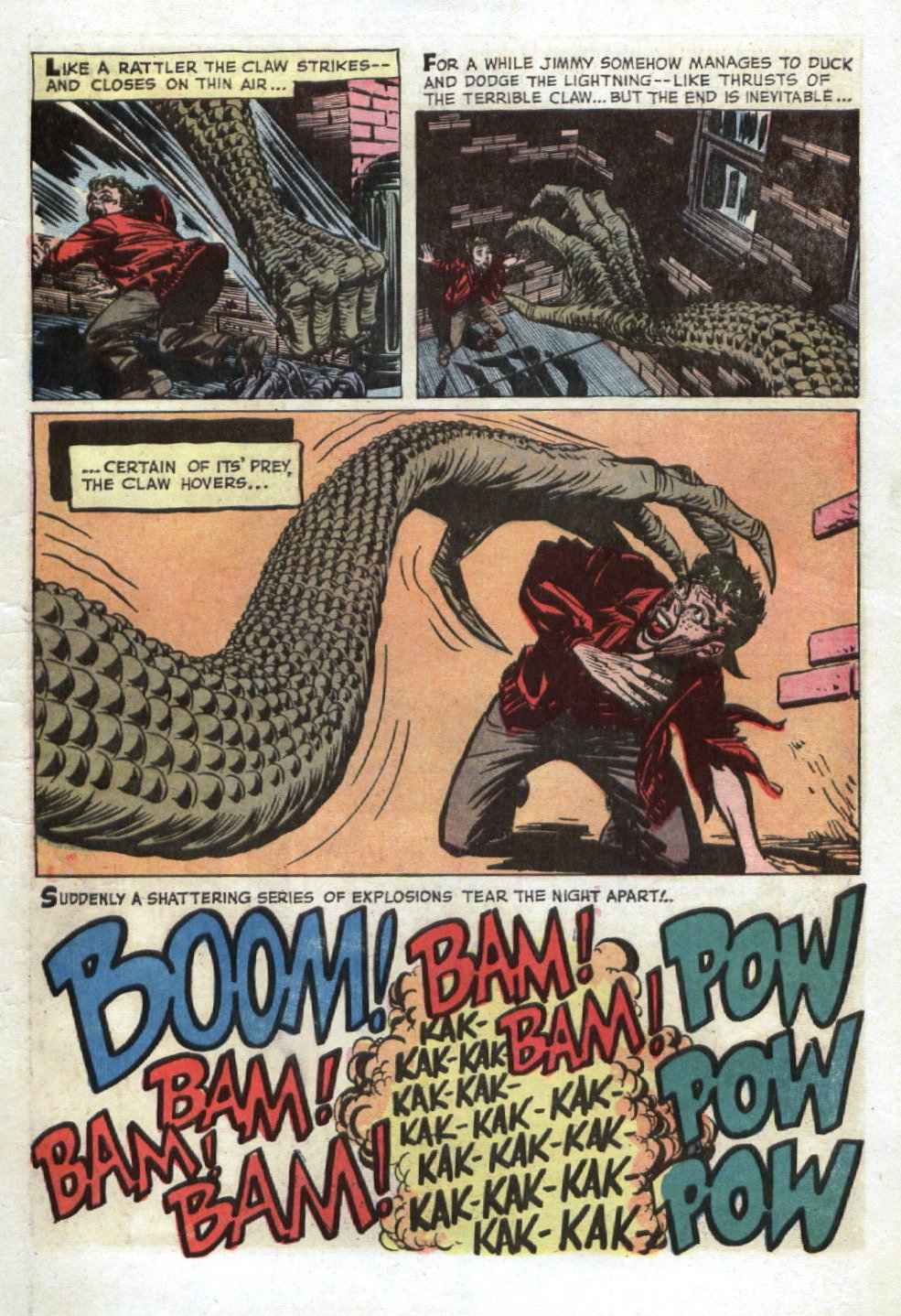
It’s not all fun, though: « The Monster of Dread End », written by John Stanley for Ghost Stories no. 1 (Dell, September-November 1962), is genuinely scary. Art by Ed Robbins.
And I haven’t even mentioned Stanley’s Nancy, nor her friend (and my favourite character) Oona Goosepimple. Next time… pick yourself up a copy of Drawn & Quarterly’s Nancy: The John Stanley Library, and happy reading!





























 Who's Out There?