Tentacle Tuesday: a Treasure Trove of Charlton Tentacles

I wasn’t around in the 70s. (Literally, as in “I hadn’t been born yet”.) So when somebody – in, oh, say 2008 or so – handed me a copy of some ghost comics printed by Charlton Comics (I don’t remember what exactly), that was my first exposure to this publishing company. I wasn’t aware that I wasn’t « supposed » to like this stuff… and by the time some kind soul pointed out that it’s not exactly orthodox to seek out Charlton publications, it was too late to change my mind. Clearly, that’s how monsters with no taste are created.

Charlton Comics had the reputation for inferior printing (as one of my friends put it, « godawful colours and reproduction and paper ») and low quality control. I’d say that when one contemplates the variety of artistic styles and the dizzying panoply of artists published by them, the quality of the printing distinctly becomes a less important consideration. Charlton paid badly, sure, but since when do people decide what they like and what they don’t based on how artists are treated? (Just look around – companies that trample on creators’ rights are doing very well indeed.) It seems like a knee-jerk reaction; I often wonder if people who automatically react with sneers to the very mention of Charlton have actually read any of the comics this company printed. Or perhaps they’re scared by some of the artists’ styles which are just too wild, too squiggly, just not clean enough. (Sloppy line work! Anathema to any comic book lover worth his salt, right?)

Anyway, Charlton’s « loose editorial oversight » meant there was no house style to speak of, and artists with highly idiosyncratic styles could let their eccentricities shine.

You may notice some names are conspicuously absent from today’s post. Tom Sutton, exhibit A of the “chaotic, scratchy art” category, will get a Tentacle Tuesday post all to himself at a later date. Some beloved artists just didn’t draw any tentacles for Charlton (as far as I know!): Warren Sattler, Don PerlinSam Glanzman, Don Newton, Rocco Mastroserio, etc. Wayne Howard is already part of a Tentacle Tuesday (see Plant Tentacle Tuesday), as is Enrique Nieto (Tentacle Tuesday: Spunky Skirmishes).

Without further ado, but with lots of tentacles…

First, two beauties from Steve Ditko (if you’d like more Ditko – and who wouldn’t? – visit my co-admin RG’s lovely posts about him: Ditko’s Ghostly Haunts and Happy 90th birthday, Mr. Ditko!), both featuring “70s Ditko green“. (It’s that characteristic green hue that often appears on his covers, a fitting term coined by erudite Professor Fester.)
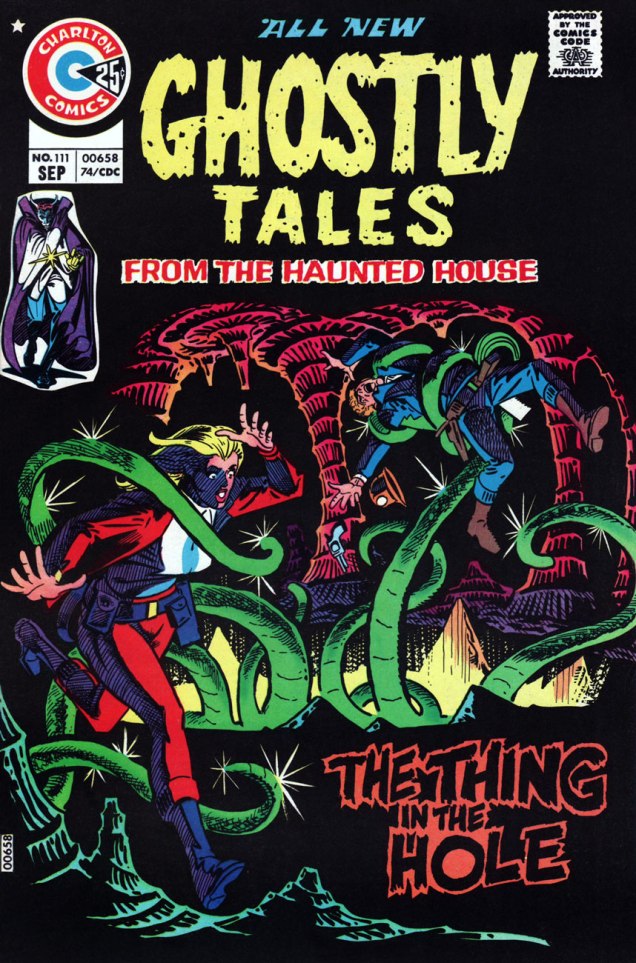
GhostlyTales#111-SteveDitko
Ghostly Tales no. 111 (September 1974), cover by Steve Ditko. « The Thing in the Hole » is a really cool story, but it’s written and drawn by Tom Sutton, and as such it’s off-limits for now (I’m hoarding material for a different post.)
GhostlyTales#122-SteveDitko
Ghostly Tales no. 122 (August 1976), cover by Steve Ditko.
GhostlyTales#122-inside
Do these green noose-appendage-things count as tentacles? Sure they do! Panel from The Crew That Was Hanged!, illustrated by Steve Ditko and written by Joe Gill.

And moving on to other series, other artists:

Haunted#8-JackAbel
Haunted no. 8 (October 1972), cover by Jack Abel (1927-1996), perhaps best known as an inker for DC and Marvel.
Haunted#13-WrongTurn-PeterMorisi
Newly-weds that are half-squid, half-fly, but newly-weds nonetheless. Page by Peter A. Morisi (1928-2003), who went by the nom de plume of PAM (or, since his signature’s M looks like a triple “I”, “PAIII!”). He was a NYC police officer, and moonlighted as a comics artist. I really like his calm, easily recognizable style and the way his characters seem to be frozen in each panel. There’s something quite effective about this stillness, a pleasing contrast between the drama and action of a story and the way people are staring off-panel in quiet contemplation, even when terrified. This story is called “Wrong Turn” and comes from Haunted no. 13, 1973.
BaronWeirWulf'sHauntedLibrary#28-MikeZeck
(Baron Weirwulf’s) Haunted (Library) no. 28 (July 1976), cover by Mike Zeck, whose career actually started at Charlton (he later moved on to Marvel to work on Master of Kung Fu, Captain America, etc.).
Haunted#28-FrankBolle-TheSource
« The creature’s tendril closed so gently around his leg, he didn’t notice it at first. Then a second grasped his arm! » The Source is the cover story of Haunted no. 28. Is old Thomas Willet mad? Well, he just has unusual taste in pets, that’s all (and, as tradition demands, he will pay dearly for his extravagance). Pencils and inks by Frank Bolle(1924-2020), who worked for Gold Key and Charlton, illustrated horror stories for Warren titles, and also had a hand in several newspaper strips (Winnie Winkle, Apartment 3-G, Stan Drake’s The Heart of Juliet Jones, and Gil Thorp).
GhostManor#1-PatBoyette
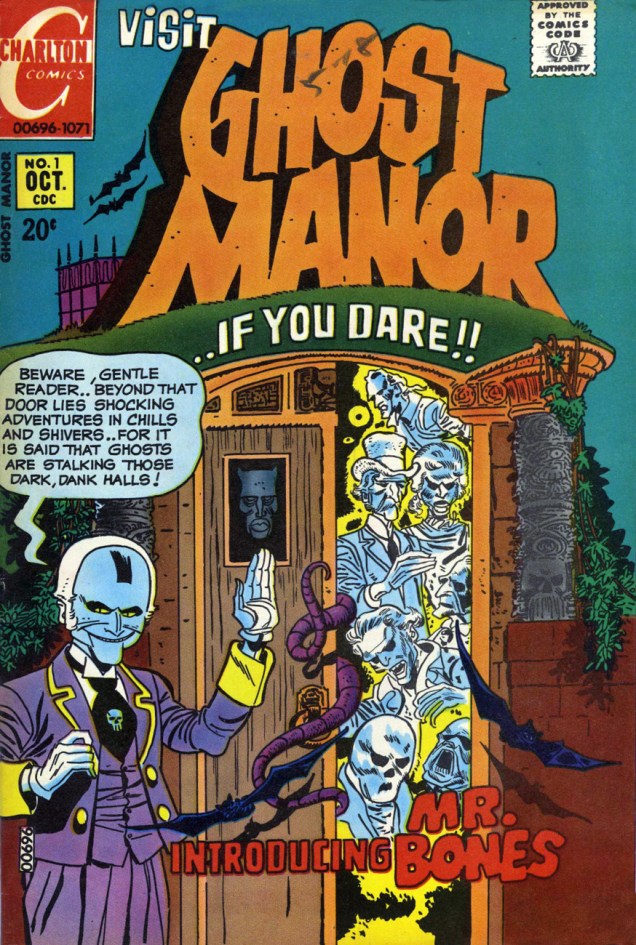
Ghost Manor no. 1 (October 1971), cover by the ever-masterful Pat Boyette (1923-2000), who’s a big favourite at Who’s Out There. Go read a whole story by him: Pat Boyette — Hillbilly Makes Good

We couldn’t find a good enough scan of this issue online, and it’s one of the rare Ghost Manors co-admin RG doesn’t actually own, so here’s a cover photostat (slightly coloured):

GhostManor58ProdA
Ghost Manor no. 58 (August 1981), cover by the Recreo Studio.
GhostlyHaunts#48-RichLarson
Ghostly Haunts no. 48 (February 1976), cover by Rich Larson (we’ve seen him before in Haunted House of Lingerie — see Tentacle Tuesday: a Day at the Beach).
GhostlyHaunts52A
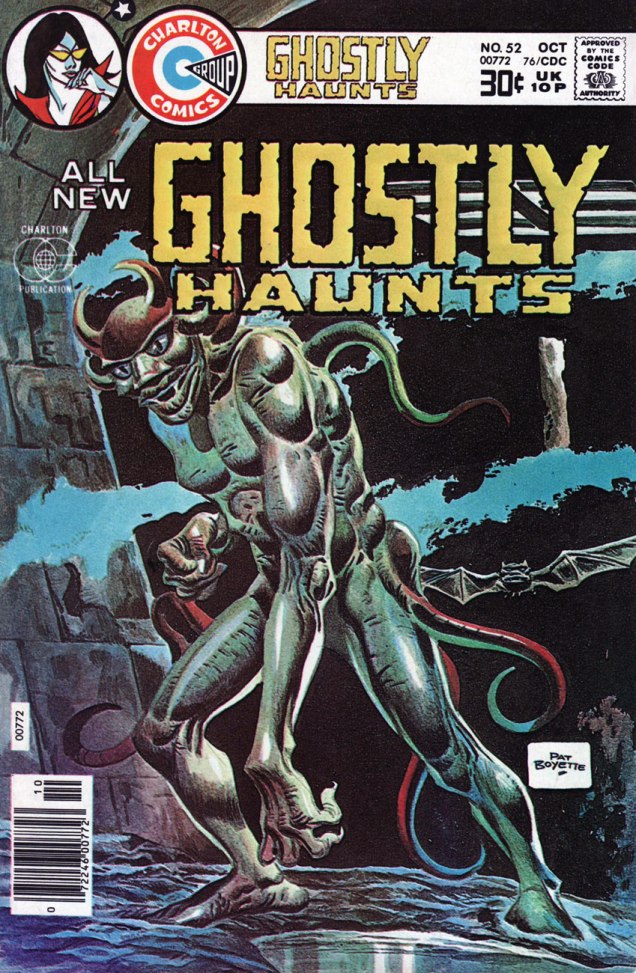
Ghostly Haunts no. 52 (October 1976), another cover by Pat Boyette, this time gorgeously painted.
BeyondtheGrave#11-MitchOConnell
Beyond the Grave no. 11 (October 1983), cover by Mitch O’Connell (also present in Have Tentacles, Will Space Travel).

~ ds
Kenneth Smith’s Singular Warren Visions

« Quodo seemed to be a paradise. It was a lush green planet of peace and solitude. Then the pilot met the blonde… » — Nicola Cuti, “Weird World”

Kenneth Smith (1943-), the fantasy artist, inhabits the same body as Kenneth Smith, the retired philosophy professor and incorrigible obfuscator. Whereas someone like, say, Bertrand Russell would make his point clearly and concisely, Kenneth would just pile it higher and higher, leaving the reader entangled in a maze of syntax and syllogism.

Since you may not be familiar with the man’s infamous column in The Comics Journal, Dramas of the Mind, here’s a typical quotation from the man, where he, er… takes on “obscurantism”:

« In characterizing realities no less than in taking positions on issues, consciousness generalizes, i.e. genericizes: in articulating or formulating, it reduces things, even our own selves, to forms, abstractions, idealizations, types, archetypes, simplisms. “Thinking” is an activity that ultimately grounds or resolves itself in the satisfying, self-certain form of orthodoxies, preconceptions, uncriticized and imperative norms; and it is overwhelmingly inept to recognize just how pathetic, parasitic or placental is its relation to its “own” fundamental norms of understanding and valuation. Rarely if ever does any act of thinking grow so laserlike or iconoclastically intensive as to escape from the dense miasma of what is acceptable. To think what actually is is even more contranatural for humans than to see what actually is: as subjectivizing as “seeing” is, “thinking” is many degrees or magnitudes more saturated with conditioned biases, delusions, self-deceptions. A program of hygiene or asepsis for the sanity, acuity and clarity of syncretic or wholesided thinking—a discipline of orthotics for sobering, grounding and polemicizing of well-formed gnoseonoesis—is needless to say unknown in modernity. Not just language but virtually all of intellect, education, culture, etc. have been adapted into utilities, tools whose very aspectivity militates against the nakedness of “evidence,” which is to say, against candor and against truth: regardless of what it may be called, “evidence,” even the most obvious and blatant, is in actuality not so “evident” to most people, and the modern development of “sophistication” or “education” typically worsens the obscurantism. »
For all that, I’ll take a guy with such an overflowing abundance of vocabulary and ideas that he doesn’t know when to quit… over most of the boneheads frequently passing for writers nowadays. Still, if you don’t mind, we’ll (mostly) stick to his Warren artwork today.

Creepy35A
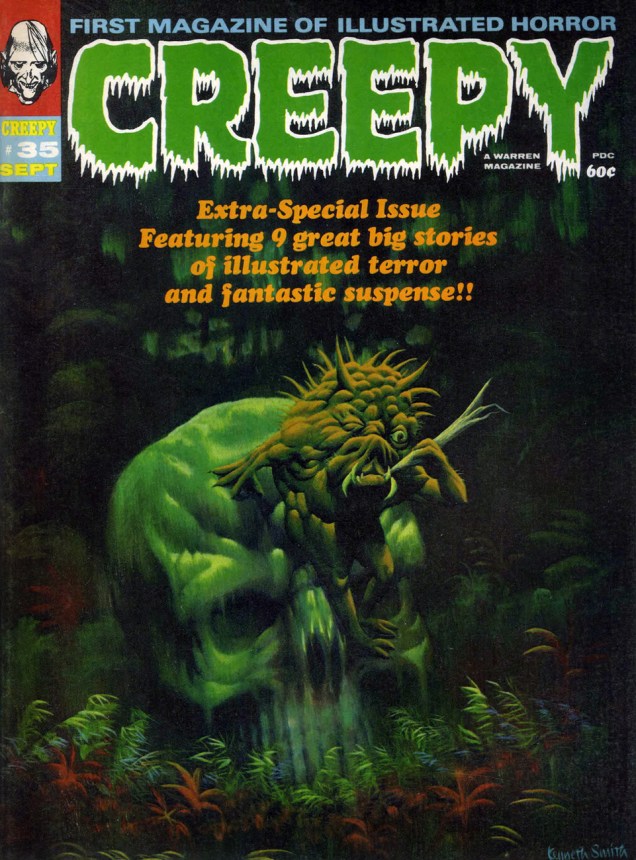
Creepy no. 35 (Sept. 1970). Regardless of its month of release, its lovely shades of emerald bring thoughts of springtime to mind.
Creepy36A
Creepy no. 36 (Nov. 1970), unique amidst Smith’s Warren covers in that it presents the human form in a somewhat less… grotesque fashion.
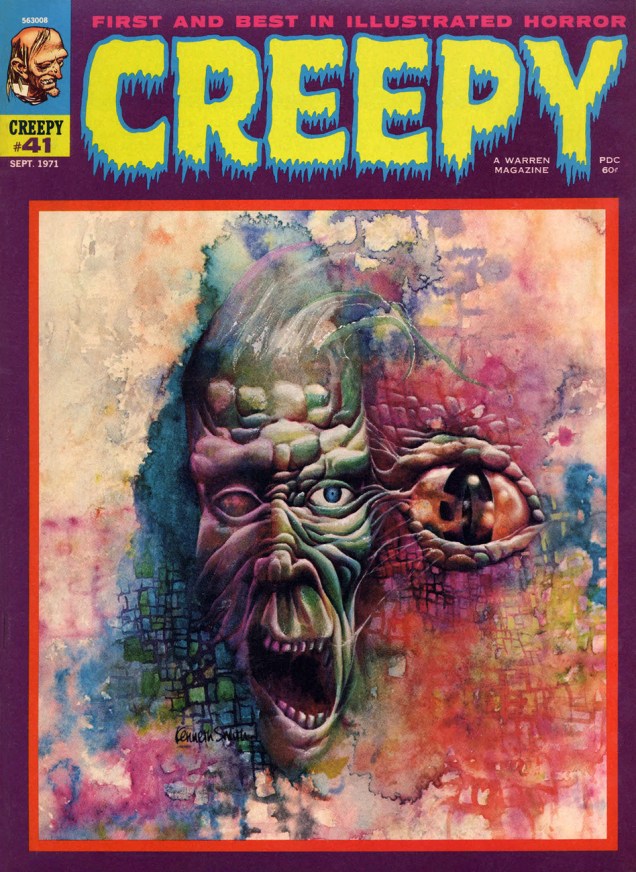
SmithCreepy41A
This is Creepy no. 41 (Sept. 1971). Owing to its lower than usual print run, this ranks amongst the scarcest Warren issues.
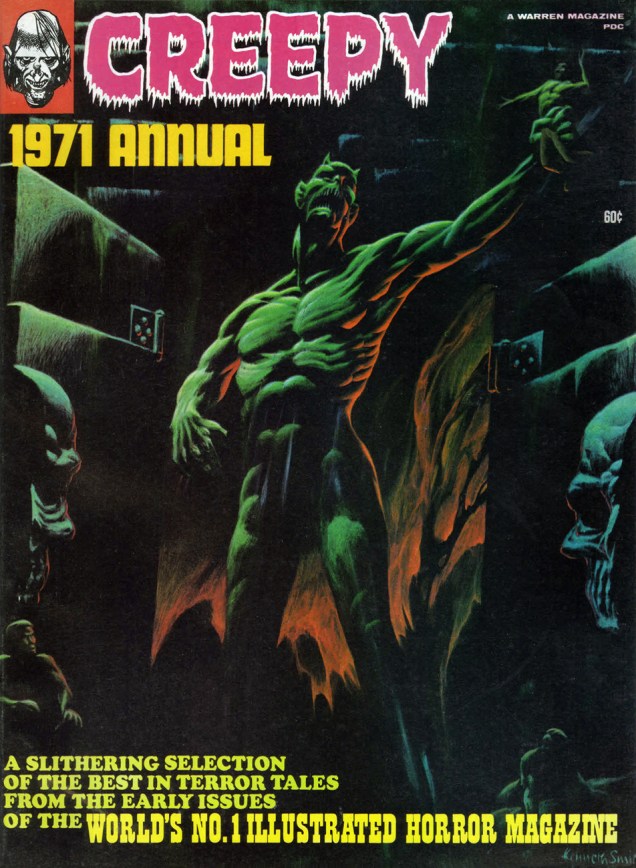
CreepyAnnual1971A
This is Creepy 1971 Annual, all reprints, but quite a choice roster of them: Ditko, Toth, Boyette, Craig, Crandall, Sutton, Adams, and Torres.
EerieAnnual71A
And here we have Mr. Smith’s last, and arguably least, Warren cover. Only a detail of the full painting was used. Eerie 1971 Annual also features naught but reruns.
SmithEerieAnnual1971ORIG
And this is the original painting in its entirety. Sorry about the glare, but this is likely the only publicly available image of this privately-owned piece.

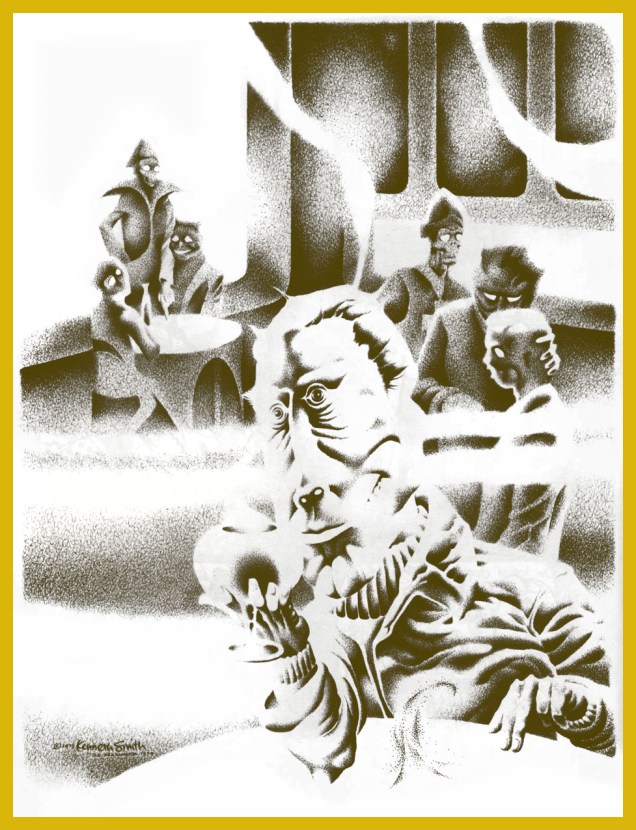
Bonus time: Mr. Smith created this lovely piece to illustrate R.A. Lafferty‘s masterful short story Mr. Hamadryad. I first encountered them* in the anthology Prime Cuts no. 1 (Jan. 1987, Fantagraphics). Hey, any fan of Old Man Lafferty’s is someone I’d happily clink glasses with. Cul sec, Mr. Smith!

SmithHamadryadA
« I believe that Mr. Hamadryad was the oddest-looking person I had ever seen. Surprisingly I regarded him so, for I first became aware of him in The Third Cataract Club in Dongola, and some very odd-looking gentlemen came into The Third Cataract. If you cock an eyebrow at someone in that place, then he’s really odd. » — R.A. Lafferty

*Smith’s illustration first graced Lafferty’s tale in the limited edition (1000 copies) collection Golden Gate and Other Stories (1982, Corroboree Press, MN). However, “Mr. Hamadryad” first turned up in STELLAR I (Judy-Lynn Del Rey, ed., 1974).

-RG

Hot Streak: Steve Ditko’s Ghostly Haunts

« There’s no room for professional jealousy around the graveyard, chums… life is too short, as they say… but what comes after that short life may stretch into all eternity! »

I could carry on endlessly (or so it would seem) on any number of obscure topics, but it’s healthy, every once in a while, to take a deep breath, empty one’s mind of its flotsam and jetsam, and reach for an old favourite.

I hadn’t yet written anything about Steve Ditko‘s passing, as I figured it would get lost in the mad shuffle of tributes. That base was well-covered. Still, while I’d known all along the day would come, it was hard to imagine a world without that reclusive genius, likely my very first artistic inspiration.

I didn’t see much of Ditko’s 60s Marvel work until the late 70s pocket book reprints (the period equivalent of watching a movie on one’s cellphone), but the Charlton ghost books grabbed me at a tender age. And so…

As my candidate for Steve Ditko’s finest cover run, at any company, I submit issues 22-27 and 29-30 (curse you for the interruption, Joe Staton!), from January 1972 to March 1973, final year of Ditko’s peak period, imho.

ghostlyhaunts22a
Ghostly Haunts no. 22 (Jan. 1972), an excellently-balanced all-around winner, with the whimsical “Wh-Who’s in Th-There?” (w: Joe Gill p: Charles Nicholas i: Vince Alascia), “Witch’s Brew“, a taste of creepy suburbia with a whiff of Rosemary’s Baby brimstone (w: Joe Gill, p/i Pat Boyette) and our headliner, “The Night of the Lonely Man!” by Gill and Ditko. Read the whole pamphlet here, folks.
ghostlyhaunts23a
Ghostly Haunts no. 23 (Mar. 1972), offers two Gill-Ditko stories: “Treasure of the Tomb” and the cover-featured “Return Visit!“… and I’d be hard-pressed to pick the superior entry. The reader wins. Ah, you cast the deciding vote: read them both here.
ghostlyhaunts24a
Ghostly Tales no. 24 (Apr. 1972), another strong issue, thanks to Gill and Boyette’s “The Other One!” and of course Ditko illustrating “A Man Who Was Here“, Joe Gill’s parable about a Tennessee mountain man displaced, but not entirely, by the construction of a modern superhighway. Read the entire issue here, ladies and gentlemen.
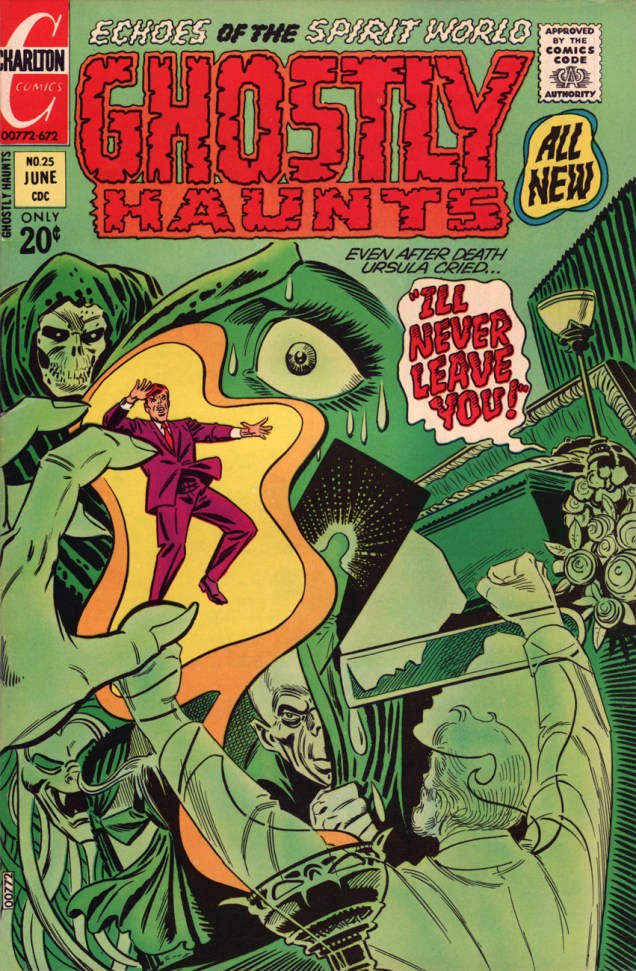
ghostlyhaunts25a
« The butler’s a real monster! » Ghostly Tales no. 25 (June 1972) is where Mr. Ditko demonstrates his unmatched virtuosity in the delicate task of incorporating several elements of a tale without winding up with the dog’s breakfast. Compositional alchemy of the highest order! The cover tale aside, Joe Gill’s wonderfully-titled “What Will Lance Surprise Us with This Time?“, illustrated by Fred Himes, is loads of fun. Read “I’ll Never Leave You!here.
ghostlyhaunts26a
Roger C. Feeney, Indian Affairs bureaucrat from Washington, DC, appears to have stumbled onto the wrong sacred Hopi cave. Uh-oh, Roger, it appears you’ve been noticed by… something. This is Ghostly Haunts no. 26 (Aug. 1972). Beyond the classy Ditko cover, it’s just an okay issue.
ghostlyhaunts27a
« Why does it happen each year? Citizens of Trappton don’t know it, but it always begins right here… at an unmarked grave… » Presumably bearing no direct relation to the 1967 Michael Winner- Orson Welles – Oliver Reed film, I’ll Never Forget What’s-His-Name“, the Gill-Ditko cover story is a classic, the tale of a forgotten man, Bertram Crumm, who merely wanted his existence recognized by the town that spurned him during his lifetime.
It’s too bad Charlton only occasionally featured mystery host Dr. Graves in active (rather than narrative) roles, because when they did, the results were pretty gripping. Unusually, Graves guests outside his own book and in Winnie’s, and we find ourselves with a classic on our hands. This is Ghostly Haunts no. 27 (Nov. 1972). Read the Gill-Ditko story here, but don’t miss the fabulously oddball “The Mine’s All Mine!” by Gill and Stan Asch, featured right here.
ghostlyhaunts29a
« Maybe I’m going mad! I keep imagining I hear his voice! » Ghostly Haunts no. 29 (Jan. 1973) features a striking (gold) exercise in fearful symmetry announcing the Joe Gill – Ditko saga of two untrustworthy acolytes in the Canadian North. Check out “Partners!here.
ghostlyhaunts30
« Ugh! It’s really hideous! Is it a self-portrait of the real you?»  We put the finishing touches on our tour of Steve Ditko covers from 1971-72 with Ghostly Haunts no. 30‘s “Fear Has Three Dimensions” (Mar. 1973). Despite a theme right in Ditko’s wheelhouse, none of his art appears within; the cover feature is handled by Wally Wood disciple Wayne Howard, and the other tales are deftly told by Fred Himes and Warren Sattler.

That just about wraps it up. For further reading on the topic, I recommend you check out Ben Herman’s perspective on some of these very stories, and on Ditko’s spooky Charlton work of the 70s in general.

« Poor Agatha Wilson still has screaming fits! »

-RG

Edgar Allan Poe: Immortality Is but Ubiquity in Time*

« Be silent in that solitude
    which is not loneliness — for then
the spirits of the dead who stood
    in life before thee are again
in death around thee — and their will
shall then overshadow thee: be still. »
— Edgar Allan Poe (1829)

It was on this day, two hundred and ten years ago, that the great writer, poet and posthumous master of all media Edgar Poe (Jan. 19, 1809 – Oct. 7, 1849) was born in Boston, Massachusetts. I’ll spare you the usual biographical details, widely available elsewhere, and we’ll concentrate on his unflagging ubiquity in the medium of comics.

Poe’s literary reputation was in tatters in America, thanks to a rash of hatchet jobs and dismissals, some of the most vicious from the pen of one Rufus Griswold, the very worm he’d named his literary executor (!), as well as such notables as Ralph Waldo Emerson and T.S. Eliot… while his renown was undimmed in Europe, particularly in France (in no small part owing to Charles Beaudelaire’s legendary translations), rehabilitation at home slowly came as the 20th century crept along, but it was likely the publication of Arthur Hobson Quinn’s definitive Poe biography, in 1941, that sealed the deal and opened the floodgates.

spiritushera
Top two tiers from page 2 of The Spirit‘s August 22, 1948 episode. Layout by Will Eisner, pencils and inks by Jerry Grandenetti. As Dave Schreiner puts it: « Grandenetti captures the asthenic look of Roderick Usher that Poe described. The man is a decadent waif; insular, fragile, high-strung, possibly in-bred. »

Classics Illustrated publisher Gilberton was first out of the gate with Poe adaptations, at first tentatively with a pair of poems (Annabel Lee, then The Bells)**, then more substantially with The Murders in the Rue Morgue, in Classic Comics no. 21 3 Famous Mysteries (July, 1944), sharing the stage with Arthur Conan Doyle and Guy de Maupassant. Read it here. Pictured below is Classics Illustrated no. 84 (June 1951, Gilberton), cover by Alex A. Blum. Read the issue here.

classicillustrated84goldbuga
A relevant passage from Simon Singh‘s fascinating (if you’re into that sort of thing… and I hope you are) The Code Book: The Secret History of Codes and Code-Breaking (1999): « On the other side of the Atlantic, Edgar Allan Poe was also developing an interest in cryptanalysis. Writing for Philadelphia’s Alexander Weekly Messenger, he issued a challenge to readers, claiming that he could decipher any monoalphabetic substitution cipher. Hundreds of readers sent in their ciphertexts, and he successfully deciphered them all. Although this required nothing more than frequency analysis, Poe’s readers were astonished by his achievements. One adoring fan proclaimed him ‘the most profound and skilful cryptographer who ever lived’. In 1843, keen to exploit the interest he had generated, Poe wrote a short story about ciphers, which is widely acknowledged by professional cryptographers to be the finest piece of fictional literature on the subject. The Gold Bug tells the story of William Legrand, who discovers an unusual beetle, the gold bug, and collects it using a scrap of paper lying nearby. That evening he sketches the gold bug upon the same piece of paper, and then holds his drawing up to the light of the fire to check its accuracy. However, his sketch is obliterated by an invisible ink, which has been developed by the heat of the flames. Legrand examines the characters that have emerged and becomes convinced that he has in his hands the encrypted directions for finding Captain Kidd’s treasure. »
crandalltelltale2a
A page from EC Comics great Reed Crandall‘s exemplary adaptation of Poe’s The Tell-Tale Heart, from Creepy no. 3 (June, 1965). While Crandall’s work is outstanding, scripter-editor Archie Goodwin tried to ‘improve’ upon Poe by tacking on a tacky ending, a nasty habit he would indulge in again on subsequent adaptations, notably issue 6’s The Cask of Amontillado!. Read The Tell-Tale Heart. And don’t miss The Cask…, if only for the artwork.
creepy70a
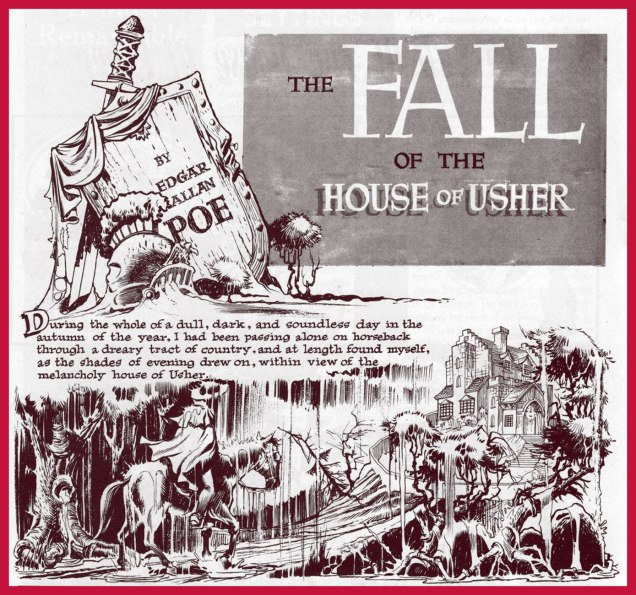
In the mid-70s, Warren would devote two full issues of Creepy to Poe adaptations; issue 69 (Feb. 1975), featured The Pit and the Pendulum, The Fall of the House of Usher, The Premature BurialThe Oval Portrait, MS Found in a Bottle!, Facts in the Case of M. Valdemar; issue 70 (Apr. 1975) comprised The Murders in the Rue Morgue, Man of the Crowd, The Cask of Amontillado!, Shadow, A Descent into the Maelstrom! and Berenice
All stories were adapted, with far greater respect than Mr. Goodwin seemed capable of, by Rich Margopoulos, and illustrated by a host of artists. The project was edited by Bill DuBay, and the cover painting is by Ken Kelly.
isidromontesberenicesplasha
Isidre Monés‘ fabulous opening splash from Creepy no. 70‘s Berenice. Read the story in full here.
wrightsondescenta
« The rays of the moon seemed to search the very bottom of the profound gulf; but still I could make out nothing distinctly, on account of a thick mist in which everything there was enveloped, and over which there hung a magnificent rainbow, like that narrow and tottering bridge which Musselmen say is the only pathway between Time and Eternity. » In 1976, a peak-form Berni Wrightson got out his brushes and paint tubes for a heartfelt portfolio of Poe-inspired oils. A sensitive and subtle sense of colour was among Wrightson’s chief assets; it’s a shame we didn’t see more of it. I opted to feature my favourite piece from the lot, A Descent Into the Maelström, but by all means feast your eyes on the whole shebang.
rudymesinapita
In 1976, Marvel Comics set out to make their mark on the classics… with dubious, but predictable results. It wasn’t what their zombie readership had clamoured for. Here’s the best page (art by Rudy Mesina) from Marvel Classics Comics no. 28, The Pit and the Pendulum (1977), featuring three tales adapted by scripter Don McGregor, and including future superstar Michael Golden‘s abysmal professional début on yet another helping from The Cask of Amontillado, where he demonstrates how he believes wine is to be drunk just like Pepsi. See what I’m griping about here.
poeenchantinglove2a
Think Poe’s all about the horror? Think again! You don’t become a household name by putting all your eggs in the same basket. Meet Edgar ‘Eddie’ Allan Poe, romantic leading man. “Based on actual records…” and sanitized beyond recognition. Given that Virginia and Edgar were first cousins and that they married when she was thirteen, you can see how absurd this strip is. Read the full tale of romance and pathos right here. The Beautiful Annabel Lee appeared in Enchanting Love no. 2 (Nov. 1949, Kirby Publishing). Writer unknown, art by Bill Draut and Bruno Premiani.
skotolsenpoea
Kubert School alum Skot Olsen‘s cover illustration for the revised and expanded second edition (July, 2004) of Graphic Classics‘ Poe compendium.
elderravena
As with, say, Elvis or H.P. Lovecraft, when both legend and œuvre reach a certain tipping point of iconic fame, one can bend and twist the concepts any which way and they’ll still be recognizable. Here’s a panel from Harvey Kurtzman and Will Elder‘s faithful-in-its-fashion take on The Raven, from Mad no. 9 (Feb.-Mar. 1954, EC).
twofistedpoea
Michael Kupperman strikes again. From Snake ‘n Bacon’s Cartoon Cabaret ( 2000, HarperCollins)
snifter2a
Hot off the presses! It’s Edgar Allan Poe’s Snifter of Terror no. 2 (Nov. 2018, Ahoy), featuring a collaboration between Rachel Pollack and the fabulous Rick Geary. Don’t miss it! Oh, and if the pose looks familiar, you’re thinking of this.

Whew — that’s it for now. In closing, I must bow and salute before the gargantuan endeavour accomplished by Mr. Henry R. Kujawa on his truly indispensable blog, Professor H’s Wayback Machine. Thanks for all the heavy lifting, Henry. I get exhausted just thinking about it.

Tintinabulate on, Mr. Poe — wherever you are!

-RG

*my thanks to Herman Melville for those words of wisdom.
**and thanks to the aforementioned Mr. Kujawa for that precious scrap of arcane lore.

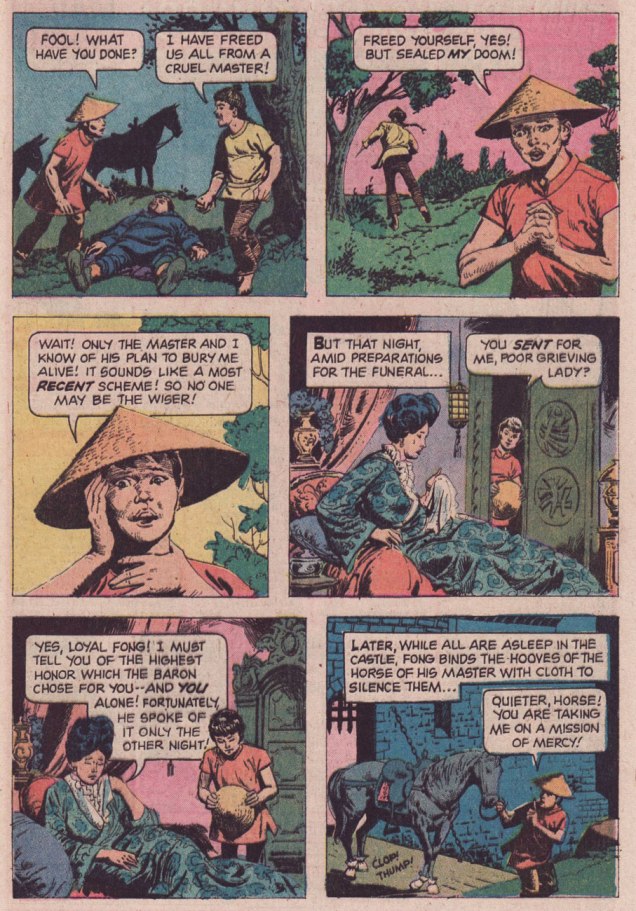
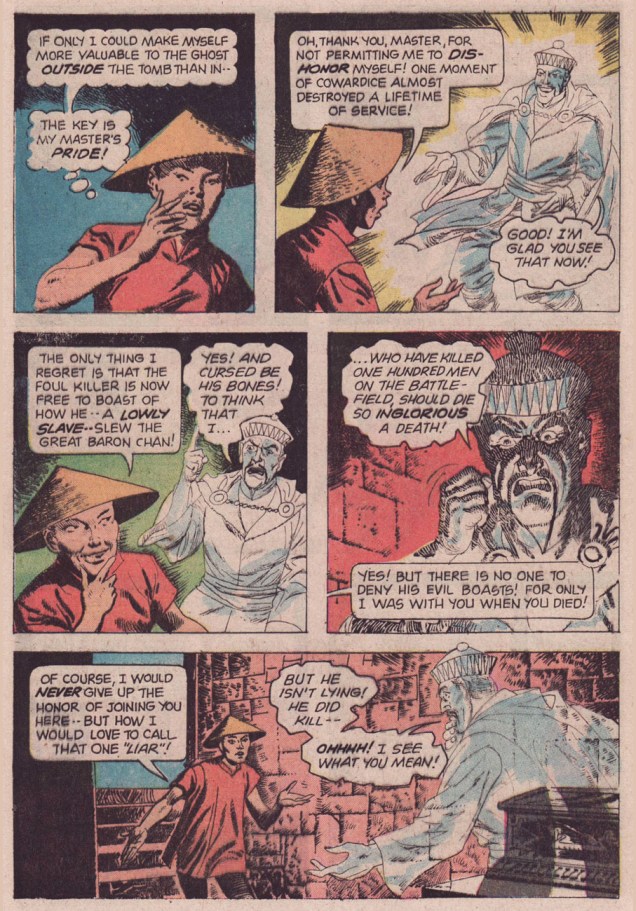
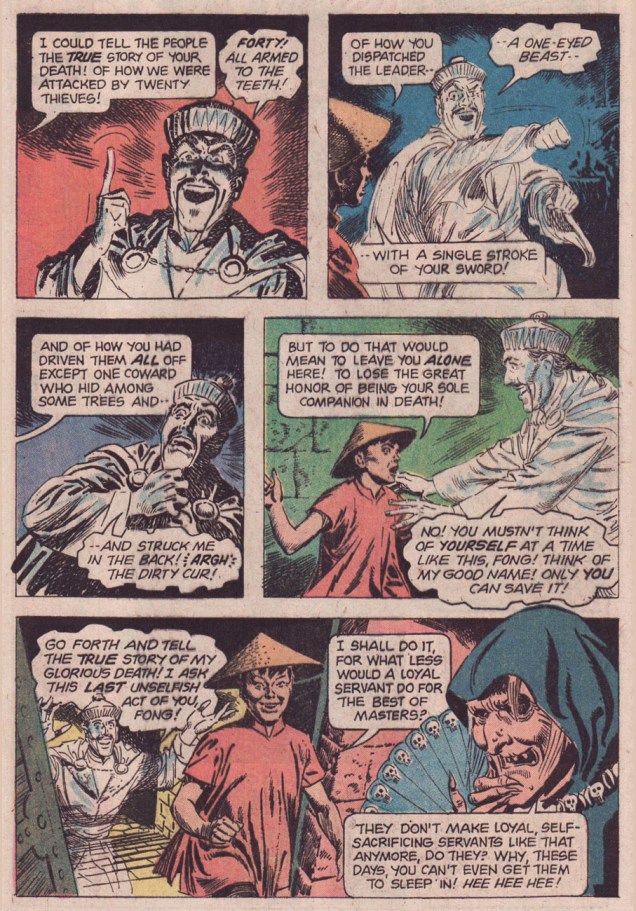
Treasured Stories: “The Servant of Chan” (1975)

« Followers in death: Attendants and relatives who were killed so they could be buried in the tomb with the person (normally someone very important or wealthy) who had died. » — The British Museum

Let’s face it, Gold Key’s would-be-spooky comics rarely lived up to their habitually fine painted covers (mostly courtesy of hard-working George Wilson, with Vic Prezio, Luis Domínguez, Jesse Santos or Jack Sparling occasionally chipping in); as with most things, there were exceptions: I’ve raved earlier about a particular issue of the generally ho-hum Grimm’s Ghost Stories, namely issue 26, boasting, along with the usual Paul S. Newman sleep aids, two excellent yarns from the undervalued Arnold Drake (co-creator of The Doom Patrol, Deadman, and the original Guardians of the Galaxy).

Ah, but today, we’re celebrating Drake’s co-conspirator, the prolific Argentine master (yes, another one) Luis Ángel Domínguez, reportedly born ninety-five years ago to the day (Dec. 5, 1923), and still among the living… as far as we know. I like to envision him warmly surrounded by several generations of loved ones and well-wishers, an impish gleam in his eye.

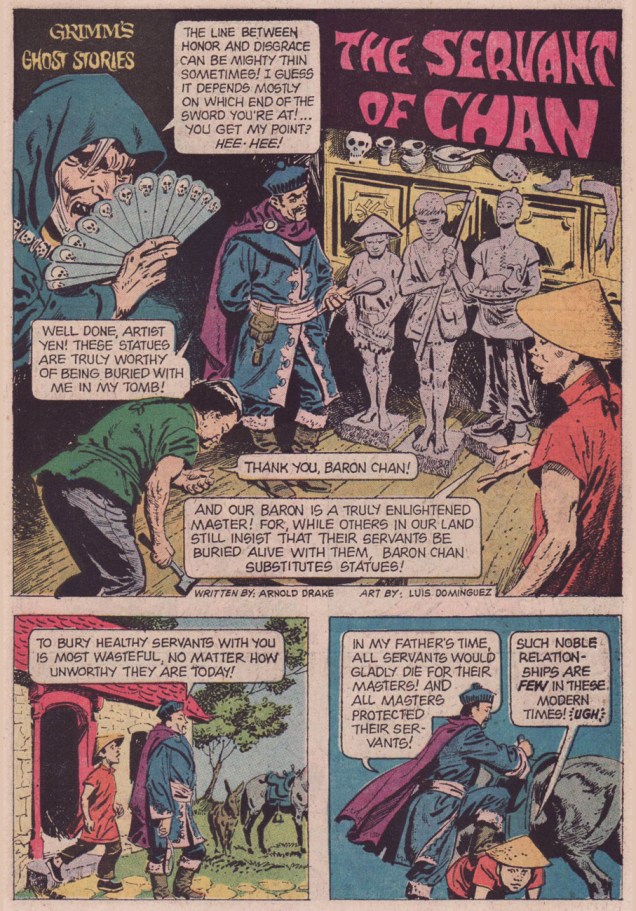
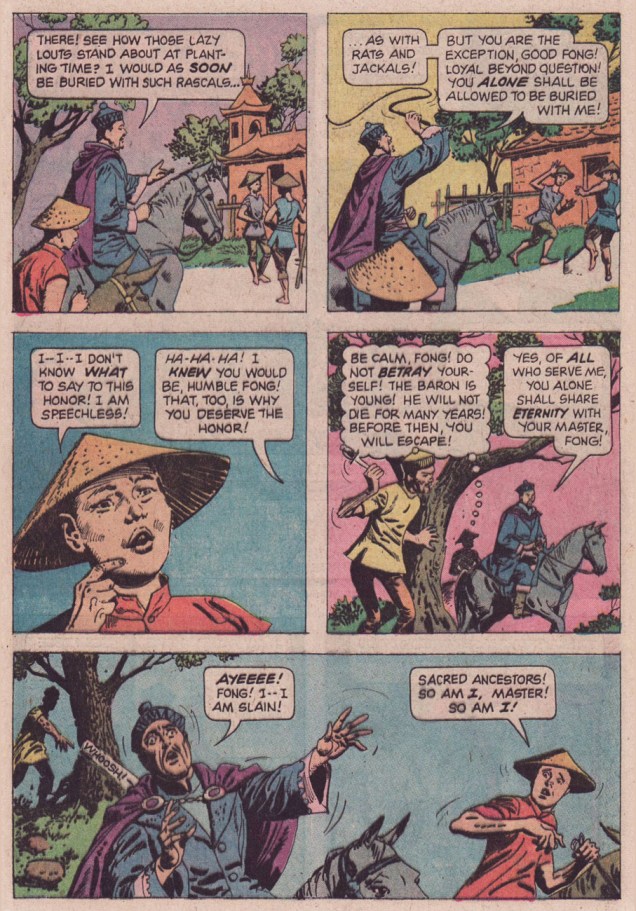
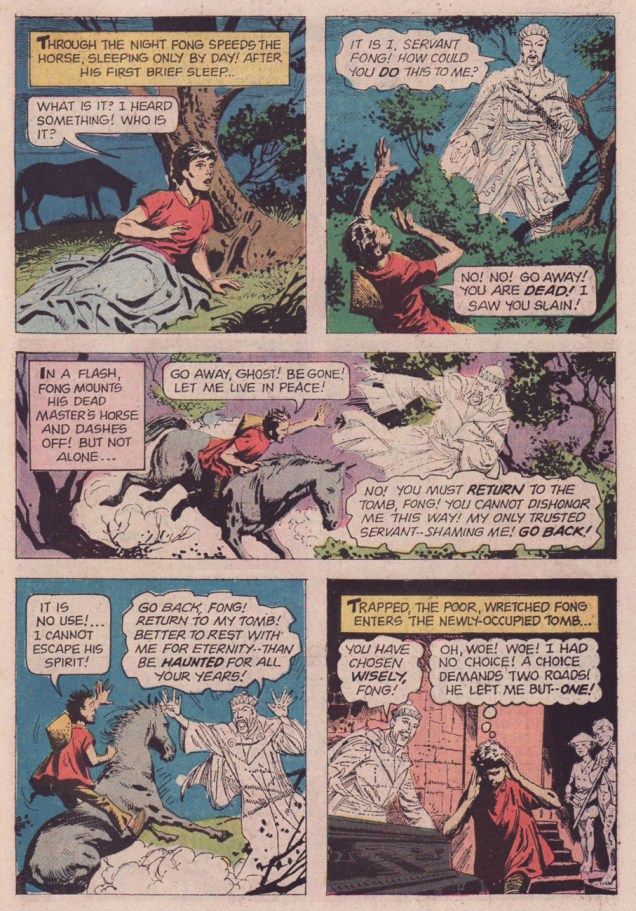
Without further foot-dragging, here’s a vintage tale of quick wits in ruling class hubris from beyond the grave, The Servant of Chan, by that dastardly duo, Drake and Domínguez.

ServantChan01AServantChan02AServantChan03AServantChan04AServantChan05AServantChan06A

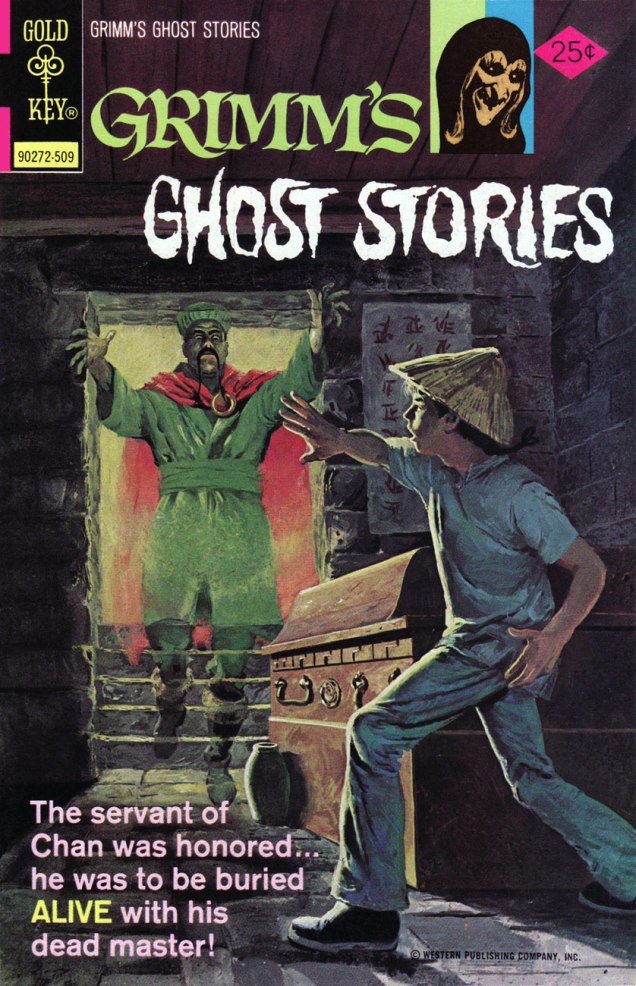
GrimmsGhost26CoverA
George Wilson’s cover highlights a dramatic scene from our little story. This is Grimm’s Ghost Stories no. 26 (Sept. 1975, Gold Key).

Some further details on historical context, from Ancient China for Kids (!):

« Slavery in ancient China was not a pleasant experience. The lives of slaves were filled with hardship. Many were abused. Many slaves were children.

Most people who were slaves worked in the fields, alongside of peasants. They did the same job, and had the same hours, and pretty much the same clothing and food, as free farmers. But they were not treated with the same respect given to farmers. Some slaves built roads. Some worked in government.

But slaves who worked for the emperor, the royal family, and sometimes the nobles, had the worst of it. They could only do what they were told to do. They were treated in any way that their master and his family felt like treating them. Many were treated with great cruelty. When their master died, they were killed, and buried with their master in his tomb, so they could continue to serve their master after his death. »

Brr. All the same, if you’ve enjoyed this yarn, check out Arnold Drake’s other contribution to this issue, The Anti-13, which we enthusiastically featured some time ago.

¡Feliz cumpleaños, Señor Domínguez… wherever you may be!

-RG

Hallowe’en Countdown II, Day 8

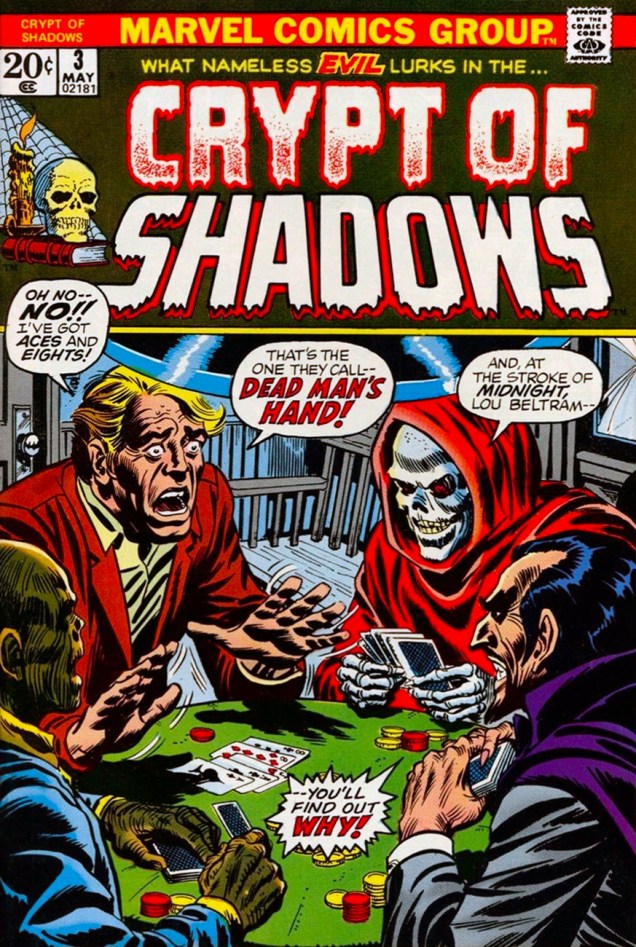
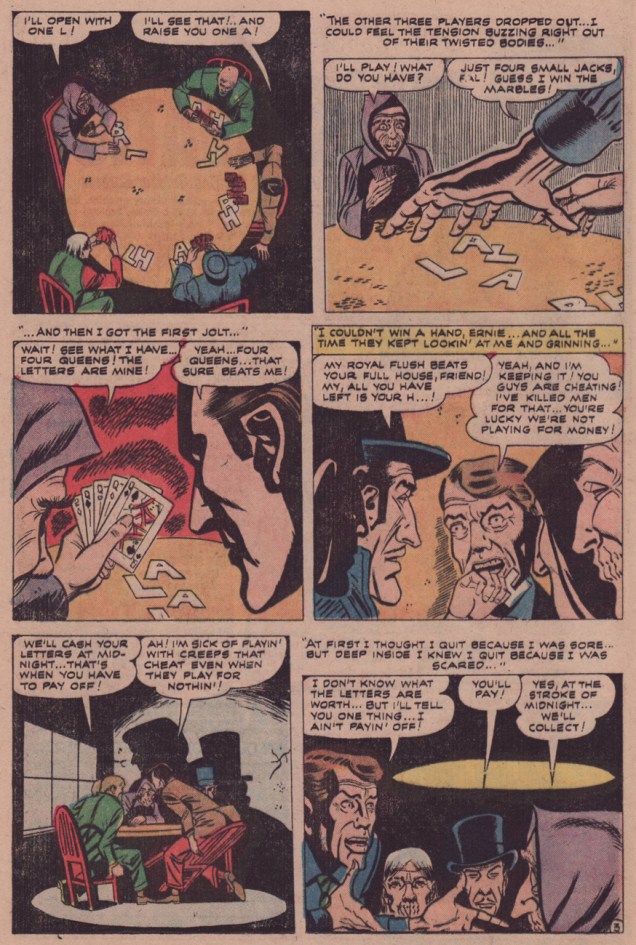
« The other three players dropped out… I could feel the tension buzzing right out of their twisted bodies… »

Poor, naïve Lou Beltram!

I first laid eyes on this one when I visited, in the fall of 1976, a tabagie (a tobacco shop) at a recently-opened shopping mall. For some reason, they had a batch of comics dating from 1973. This was one*.

CryptShadows3A

The cover feature, « The Strange Game », is a typical product of the early 1950’s horror boom: it doesn’t make a lick of sense, but it is fairly irresistible stuff, at least from the perspective of an 11-year-old. This wacky cover art, from this May 1973 issue, is the work of company man supreme John Romita Sr., Marvel’s heavy-handed art director of the period.

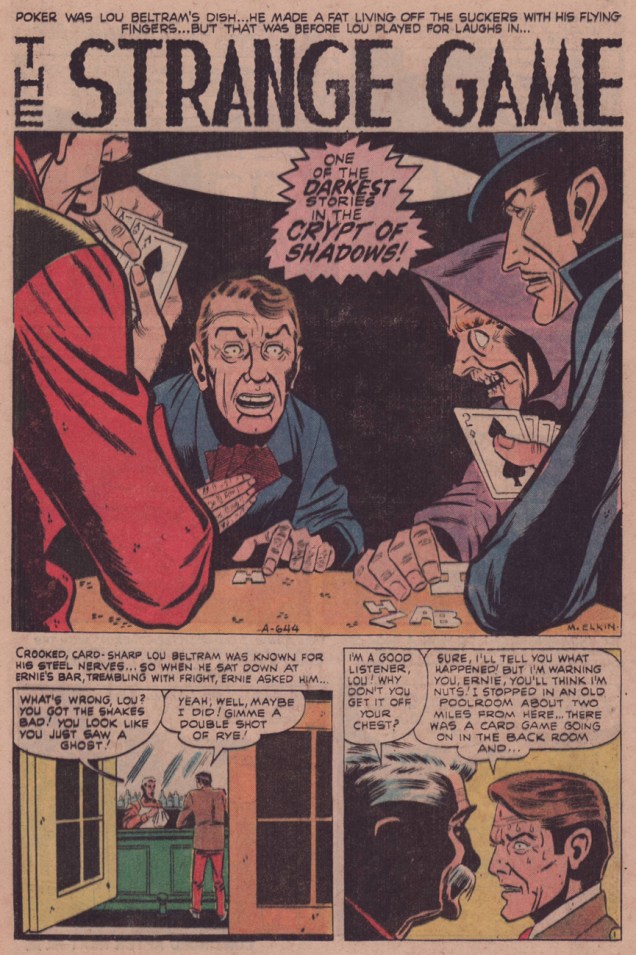
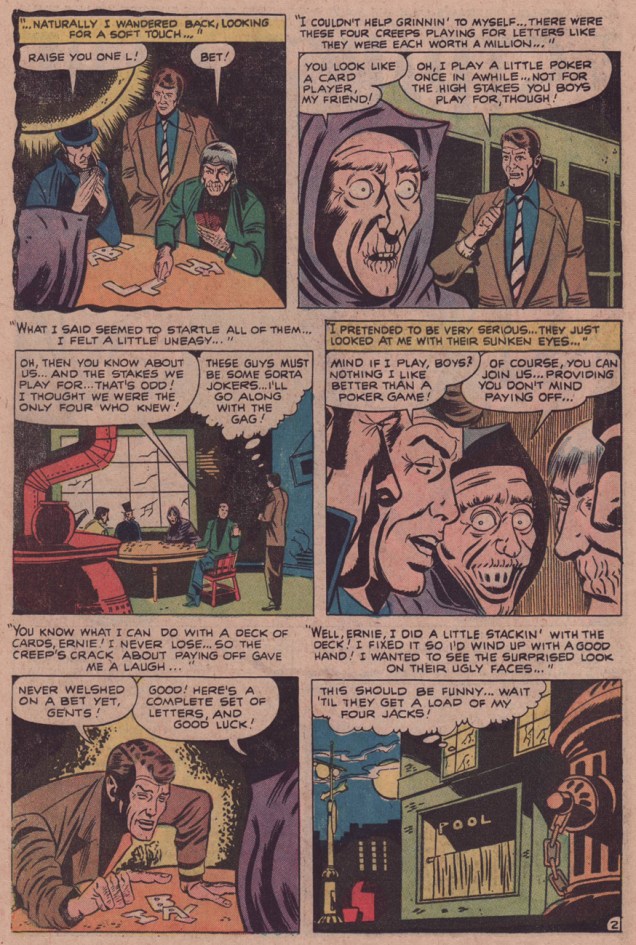
This time (sorry!) you’re getting the story right here, since… who else would get interested in such a boneheaded piece of claptrap, badly drawn to boot? (technically speaking… I do, however, find its primitive ineptitude quite charming). Suspend all disbelief and critical sense, and enjoy!

StrangeGame01AStrangeGame02AStrangeGame03AStrangeGame04A

The tale in question, scripted by an unknown writer and illustrated by Marty Elkin (reportedly Gil Kane‘s cousin!), was reprinted from Atlas’ (what Marvel Comics were called back in the day) Strange Tales #9 (August, 1952).

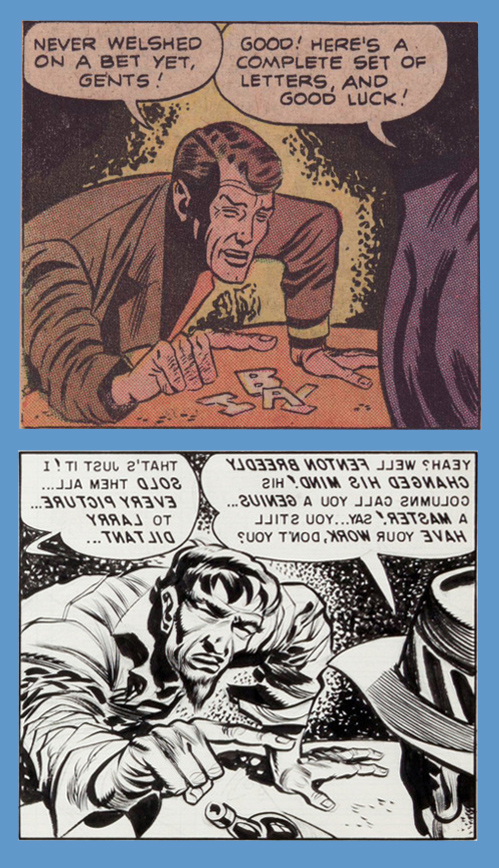
Oh, and something was nagging at me about a particular panel… so I did a little digging, here’s what I found: while swiping from Jack Davis has long been a national pastime, here’s one of the earliest infractions not perpetrated by Howard Nostrand (who’s fine in his own right, but he did have that singular, corner-cutting vice).

StrangeSwipe
It’s a flipped (how devious!) steal from page 2, panel 6 of « Drawn and Quartered! » (script by Al Feldstein, art by Jack Davis), Tales from the Crypt no.26 (Oct.-Nov. 1951, EC Comics). Marty seems a bit hazy on the general concept of hands.

I also suspect page 2’s second panel to be an early EC Joe Orlando or Wally Wood swipe, but I can’t quite nail it down… yet.

-RG

*The Unexpected 146 and The Demon 8 (both cover-dated April 1973) were the others I picked up. What else was there? An issue of The Cat I didn’t buy, but otherwise, I’m drawing a blank. 😉

Hallowe’en Countdown II, Day 7

« Why do four skeletons and a coffin cross a small fishing village? The question has been asked! »

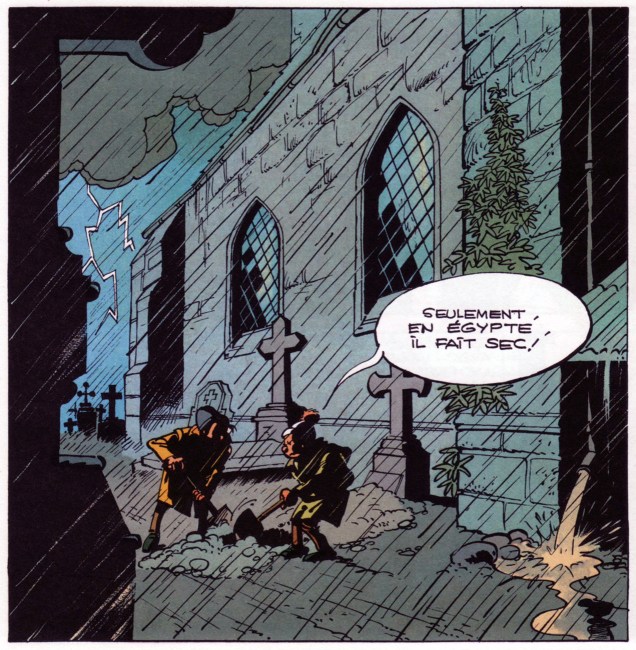
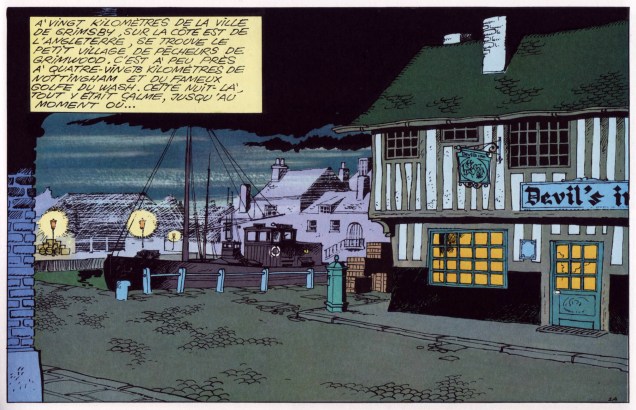
How’s this for setting the mood? Here’s a quintet of panels from Belgians Maurice Tillieux (script) and Willy Maltaite (aka Will, pencils and inks) gently ripped from the exploits of Tif et Tondu, a series that ran in the weekly bandes dessinées magazine Spirou from 1938 to 1997.

TifTonduRessuscitésA
This standalone illustration originally saw print on the cover of Spirou no. 1789, in 1972. Incidentally, the guy on the left is just a passing acquaintance, a soap salesman who also found himself stranded in Brittany, some foggy night.
TifTonduRessuscités2A
« In Egypt, at least it’s dry! »
TifTonduRessuscités3A
« There’s still a cottage beyond the old castle. Let’s give it our last shot. »  « Talk about a nest for ghosts. He’s straight out of a Perrault fairy tale, that one. »

These three come from the Les Ressuscités (‘The Resurrected”), Tif et Tondu’s 54th adventure overall, but no.20 in the album series), as only the post-1954 stories (when the series’ tone gained some gravitas, as well as its first significant scripter in Rosy) are considered, shall we say… canonical.

TifTonduRetourBête02A
Panels from Le retour de la bête (“Return of the Beast”), serialized in issues 1988 to 1999 of Spirou magazine in 1976,  sort-of sequel to 1971’s Sorti des abîmes (“Out of the Abyss”).

TifTonduRetourBête01A

This is drawn from the 59th Tif et Tondu story (but no.25 in the collection). We’ve already been introduced to the Beast in question, as well as to Tif et Tondu, one misty Tentacle Tuesday last October.

Regrettably, nothing supernatural occurs, but talk about atmosphere! The series does veer into some pretty dark science-fiction at times, especially under Tillieux’s watch (1968-1978, his death).

The mysterious events are set in the fictive village of Grimwood, near the actual town of Grimsby, which is dear, perhaps sarcastically, to Sir Elton John.

-RG

Hallowe’en Countdown II, Day 4

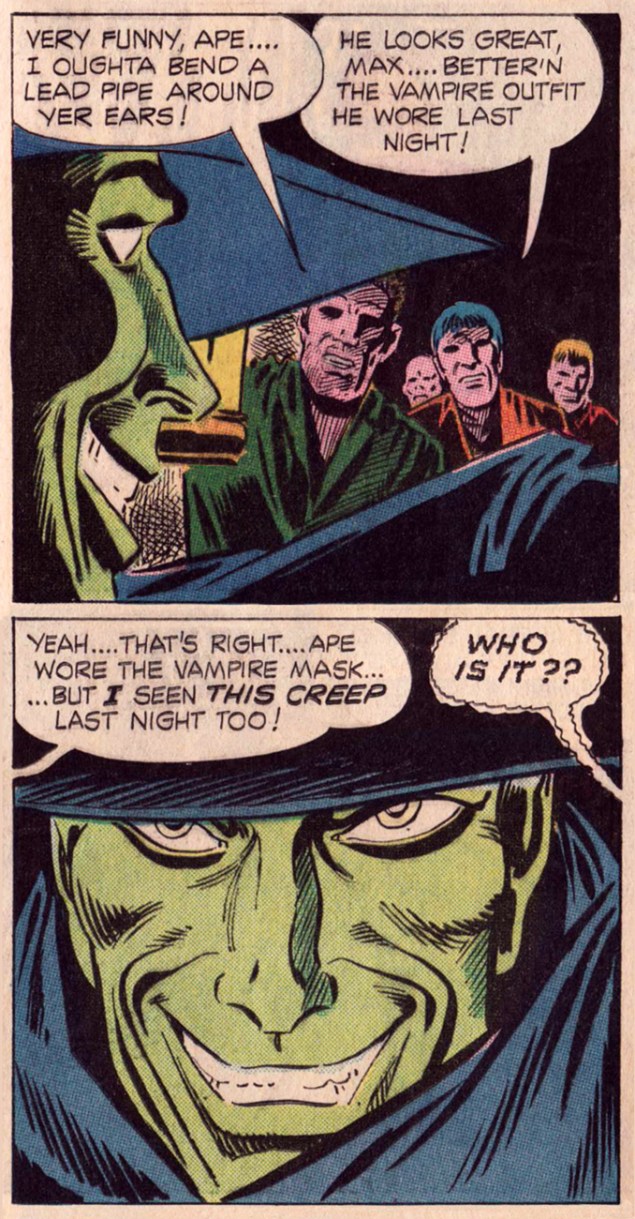
« Ape is real spooked, guys! He’s always imaginin’ he sees someone in there! »

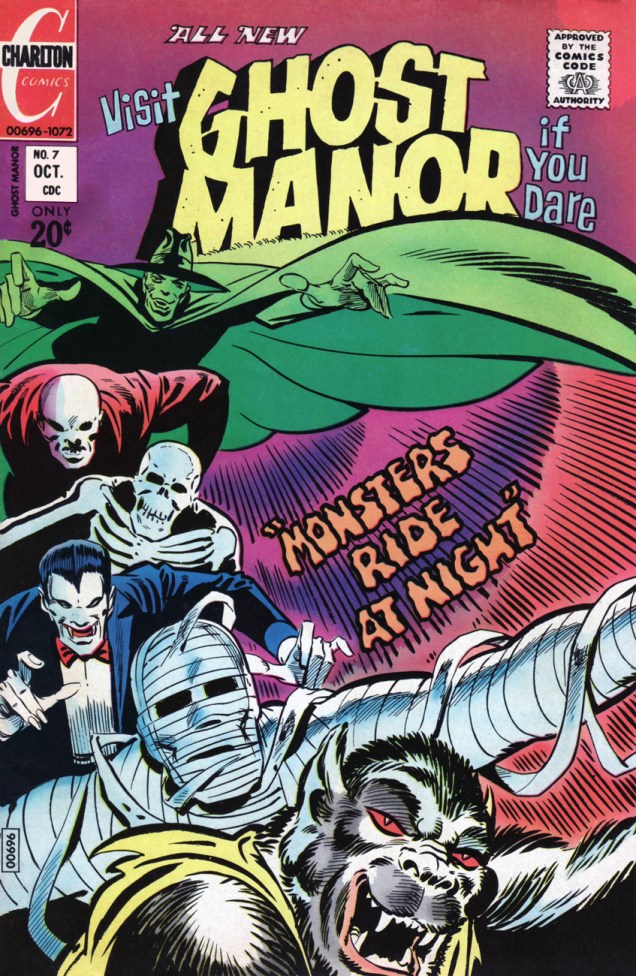
Here we have an evocative Steve Ditko cover, solid evidence of his tremendous design chops, from Charlton’s Ghost Manor (no. 7, second series, October 1972). A collaboration between Joe Gill and Ditko, « The Monsters Ride at Night » is an elegant bit of storytelling legerdemain, a fairly basic yarn that retains its mystery past the conclusion and whose deliciously dusty mood lingers in the mind. Well, in mine, at any rate. Back in the late ’70s, I traded a copy of Amazing Spider-Man 121 (acquired at a garage sale in a two-for-five-cents deal) for this one. I know I came out ahead in the deal*.

Ghost-Manor7A

Again, I had every intention of providing the whole spooky shebang right here, but seeing as how I was preceded in this particular enthusiasm by a sinister confrère, it seems unnecessary. Just dim the light, settle in, point your browser to Destination Nightmare, pour yourself a noggin of your preferred poison, and savour this fine vintage.

Ghost-Manor7WhoIsA

I’m particularly fond of the mid-tale interlude, where our esteemed host, Mr. Bones, seizes the occasion to poke around the cobwebs a bit, a narrative game that the Gill-Ditko duo excelled at. DC and Warren’s hosts (with the obvious exception of Vampirella) never got to play such an active rôle in their respective recitals.

Oh, and since we’re on the topic of early 70s Charlton ghost books, here’s one I picked up just this afternoon, in the 50 cents box of the local comic book shop in Wolfsville, NS. It clearly had been through such hardships, I couldn’t resist giving it a home.

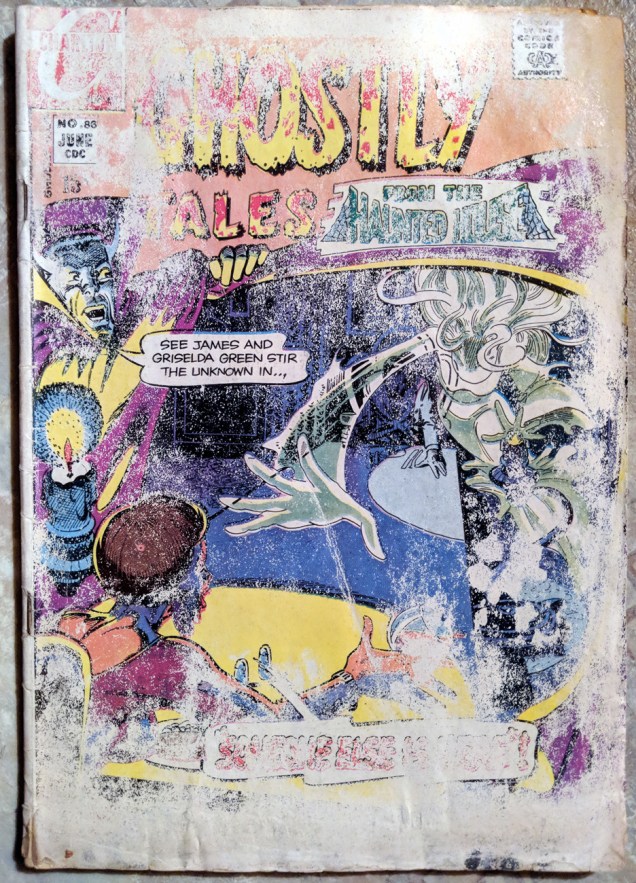
GhostlyTales86Beater.jpg
This is (or used to be) Ghostly Tales no. 86 (June, 1971), featuring three Joe Gill tales: « Return to Die » (illustrated by Pete Morisi), « Ghost Town » (illustrated by Pat Boyette), and « Someone Else Is Here! » (illustrated by Steve Ditko.) If books could speak…

-RG

*I had an extra copy, what do I care?

Hallowe’en Countdown II, Day 3

« It was like plunging deeper and deeper into a growing nightmare! »

A powerful (what else?) Jack Kirby piece, one of his last before decamping to DC. He actually gets a full writer/artist credit (a telling tail end turning point of that Marvel residence) on this tale, … and Fear Shall Follow!. The lush cover inks are provided by fellow Golden Age titan Bill Everett (1917-1973), a far cry from the miserable Vince Colletta « finishes » he would be saddled with at DC for the next couple of years (at their insistence!)

KirbyCOD5A

I was planning on featuring the entire story, but others have long ago preceded me down that primrose path. Why fight it? Just pay Diversions of the Groovy Kind a visit, where you’ll receive, as a bonus, Kirby’s other solo outing for the House of (mostly his) Ideas, The Monster!, from the previous issue of Chamber of Darkness (no.4, April, 1970). Both are sympathetically inked by Marvel’s production manager at the time, the underrated and gone-too-soon John Verpoorten (1940–1977). Again, several notches above “Valiant” Vince Colletta’s casual sabotage.

Plot-wise, … and Fear Shall Follow!, while another variant in the Carnival of Souls tradition, is enriched by its unusual setting and whiff of incense and philosophy. Reminds me of a possibly apocryphal exchange between Watchmen editor Len Wein and its writer Alan Moore: « Alan, that ending’s already been done on The Outer Limits! »; (in thick Northampton accent, dripping with sarcasm) « Yes, Len, but it’s never been done by me! ». With all due respect, it’s not as if Mr. Wein had any moral lessons to dispense regarding originality.

– RG

Hallowe’en Countdown II, Day 1

« His face taut… his coloring now shell white… Fred took the object from his bowling bag… his friends screamed in horror… »*

Welcome to the second edition of Who’s Out There’s annual Hallowe’en Countdown. We’ll be greasing the rails to carry us along with sinister haste through to that most shiver-iffic of holidays, but duly noting and relishing each daily marker along the way.

Let’s push off with a tasteful dash of splatter and a tidy selection of Eerie Pubs‘ typically over-the-top, gloriously gory cover artwork. While EP covers featured the work of a handful of artists, none is better-remembered or more closely associated with the line than former Irving Klaw-associated fetish specialist Bill Alexander. Fact is, the notoriously cheap-jack publisher cut ‘n’ pasted and endlessly recycled (not to say bowdlerized) Alexander’s work, and it’s sadly safe to assume he was only remunerated once, and poorly at that. Just another soul stranded in the limbo of exploitation publishing…

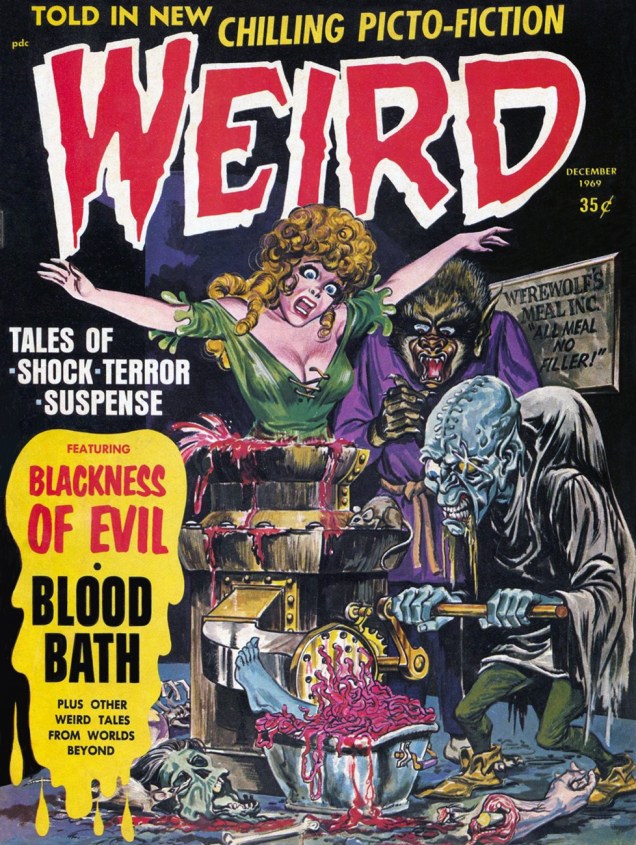
Weird_V3#5A
Weird vol. 3 no. 5 (December, 1969)
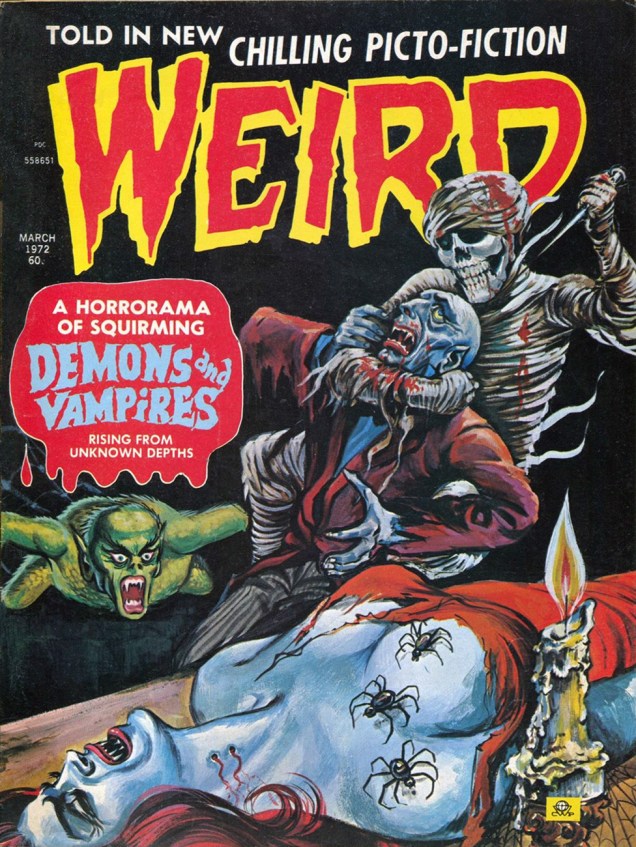
WeirdV6#2A
Weird vol. 6 no. 2 (March, 1972)
WT_V4#3A
Witches’ Tales vol. 4 no. 3 (May, 1972)
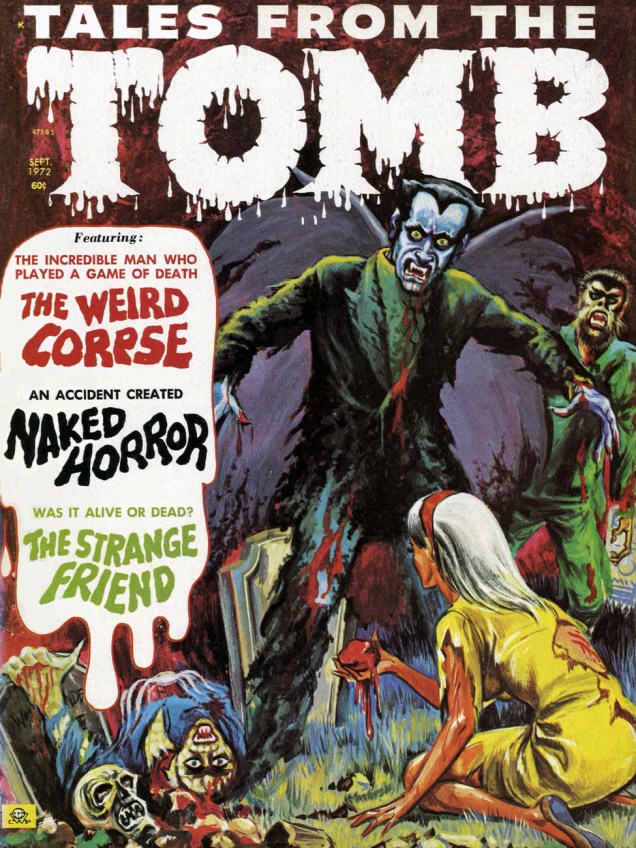
TFTT_v4#4A
Tales From the Tomb vol. 4 no. 4 (September, 1972)
WT_V4#6A
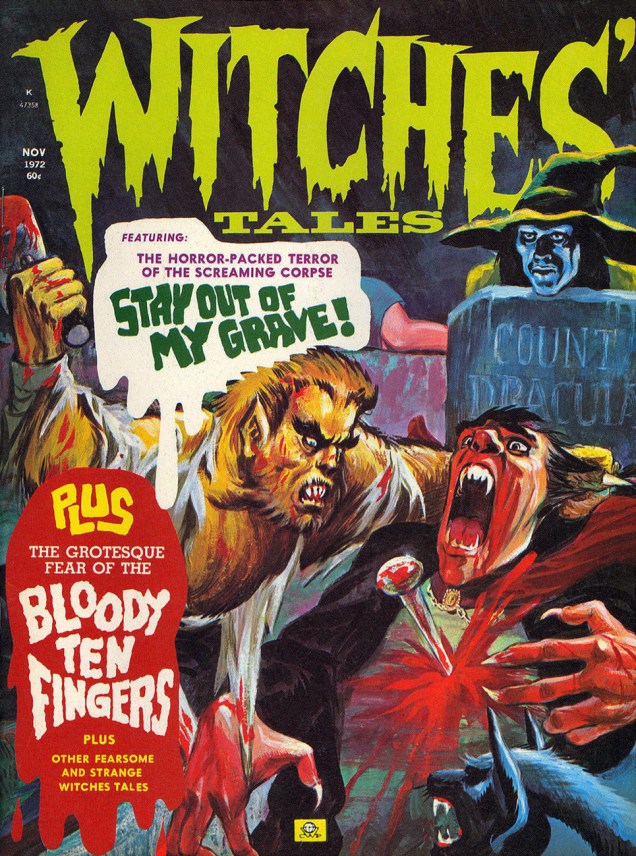
Witches’ Tales vol.  4 no. 6 (November, 1972)

And the insides, you ask? Oh, that. Some reprints of lacklustre pre-Code
horror (Ajax/ Farrell) owned by publisher and gun enthusiast Myron Fass sometimes with added gore, sometimes redrawn from scratch and updated. Then, for a while, actual original material, not entirely devoid of occasional just-about-accidental charm. It’s a special kind of charge to witness the Grand Guignol excesses of pedestrian early 60s Jack Kirby inkers Dick Ayers and Chic Stone as they give vent to their less wholesome tendencies, overcompensating with eyeball-gouging and limb-hacking vengeance.

But all is not blood ‘n’ guts ‘n’ fury… sometimes the quiet, ink-washed ambience weaves a low-rent hypnotic spell and the fool thing works. But what with all the reprints and mediocrity, it’s a uncommonly perverse mania that drives a collector to pursue a complete set of these musty bits of flotsam. After decades of neglect, they’ve become impressively pricey.

– RG

* from « The Mad Bowler » (Horror Tales vol. 4 no. 6, Oct. 1972). Read it here!