It Was… the Day After Doomsday!

« May the man who has his finger on the button have a lovely day today / Hope nothing hangs him up or ticks him off or bums him out in any way / Lord, help him keep his cool cause he could pull the final curtain on my play / May the man who has his finger on the button have a lovely day today. » — Larry Wilkerson (as warbled by Bobby Bare)

The idea for this post came to me a couple of days ago, and this afternoon, while cobbling together the visual components, it dawned on me that today’s Memorial Day (Remembrance Day for Canadians, and ‘Victory Day‘ for those afflicted with brain worms and/or syphillis), and therefore quite à propos.

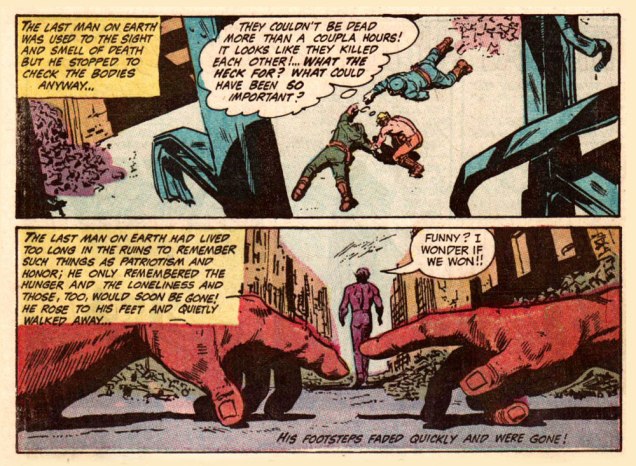
DC’s The Day After Doomsday series first turned up — of all places — in the pages of The Witching Hour, a page and a half bit of filler fluff by Len Wein and Jack Sparling. It must have struck a chord, if not with readers, then with its creators, for the feature stubbornly kept a-rising from its post-apocalyptic grave.

In spite of its episodic and arguably slight nature, TDBD enjoyed surprising longevity. It truly found its home in the Joe Orlando-edited Weird War Tales (1971-1983, DC’s gateway title for war fans into ‘horror’ and vice versa), where most of its dispatches saw print. You never know what’s going to catch on with the unwashed masses.

A most humble beginning for a series, this brief scene appeared in The Witching Hour no. 9 (June/July 1970, DC). Script by Wein, art by Jack Sparling (1916-1997). Dick Giordano, editor.
Humour rears its homely head in the concurrently appearing second instalment — too close to call! — this one from House of Secrets no. 86 (June/July 1970, DC). Same creative team.
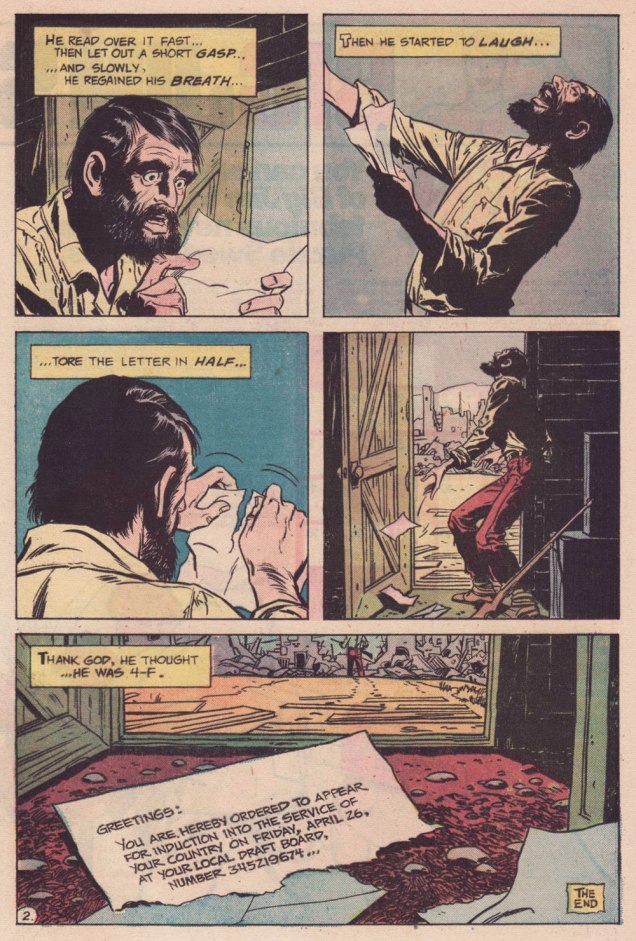
My candidate for the series’ finest hour, this episode elegantly riffs both on the Vietnam War Draft and on Fredric Brown‘s classic 1948 short-short ‘Knock‘, wherein «The last man on Earth sat alone in a room. There was a knock on the door… » 4-F, incidentally, signifies « Registrant not acceptable for military service. To be eligible for Class 4-F, a registrant must have been found not qualified for service in the Armed Forces by an MEPS under the established physical, mental, or moral standards. » And let’s hear it for perennially under-appreciated artiste Bill Draut (1921-1993).

That issue had a splendid cover, and so here it is!

This is Weird War Tales no. 30 (Oct. 1974, DC); cover pencils and inks by Luis Domínguez, from a probable design by publisher Carmine Infantino.
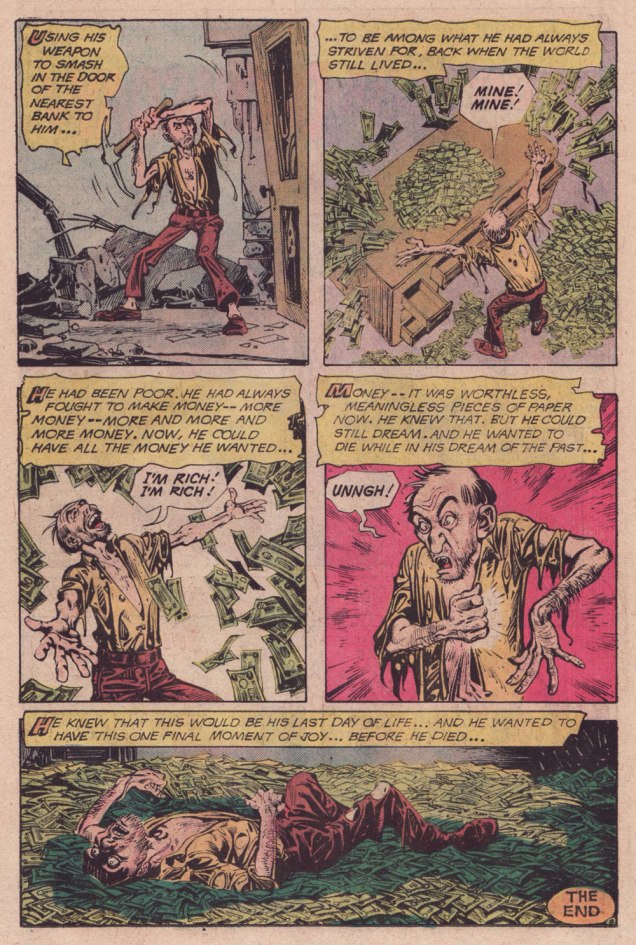
A scroogey teaming of WOT? favourites Steve Skeates and Alfredo Alcala, this turned up in Weird War Tales no. 35 (March 1975, DC). I’ll bet they had trouble deciding whether to run it in Plop! or WWT.
Finally, this one appeared in Weird War Tales no. 48 (Sept./Oct. 1976, DC). Script by Skeates, art by Buddy Gernale.

-RG

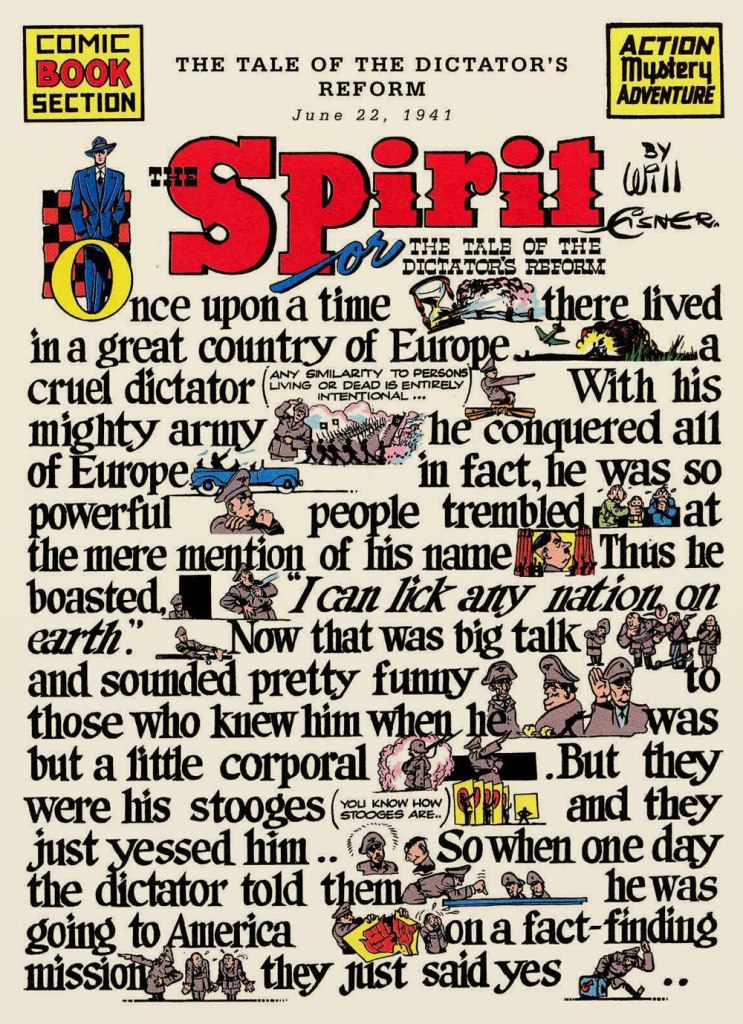
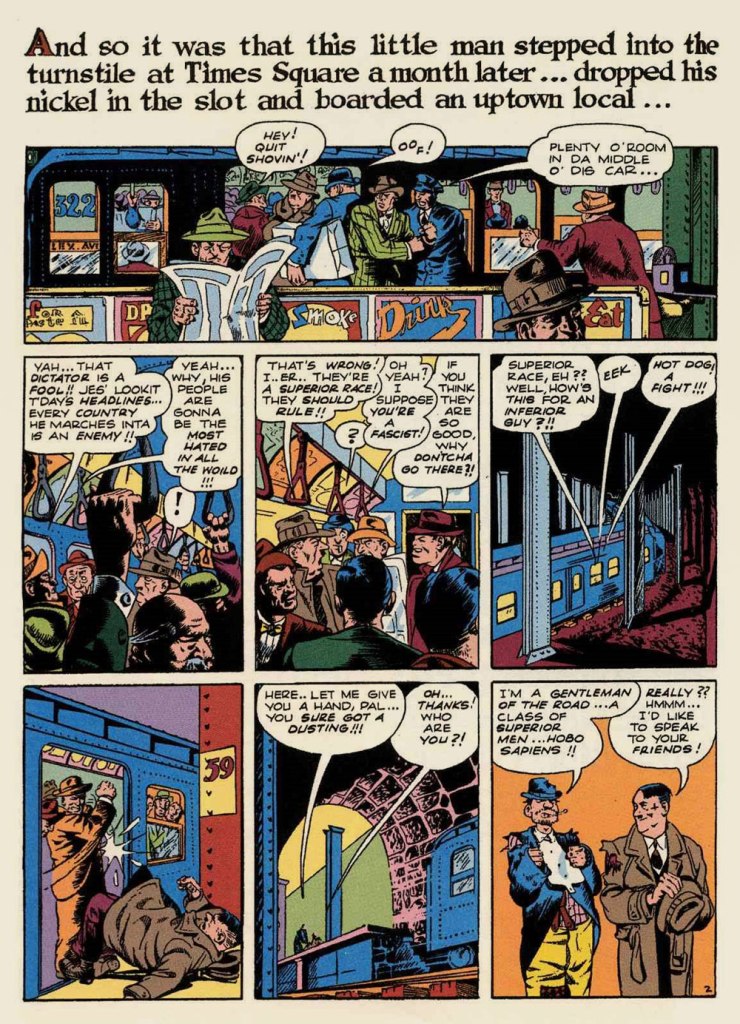
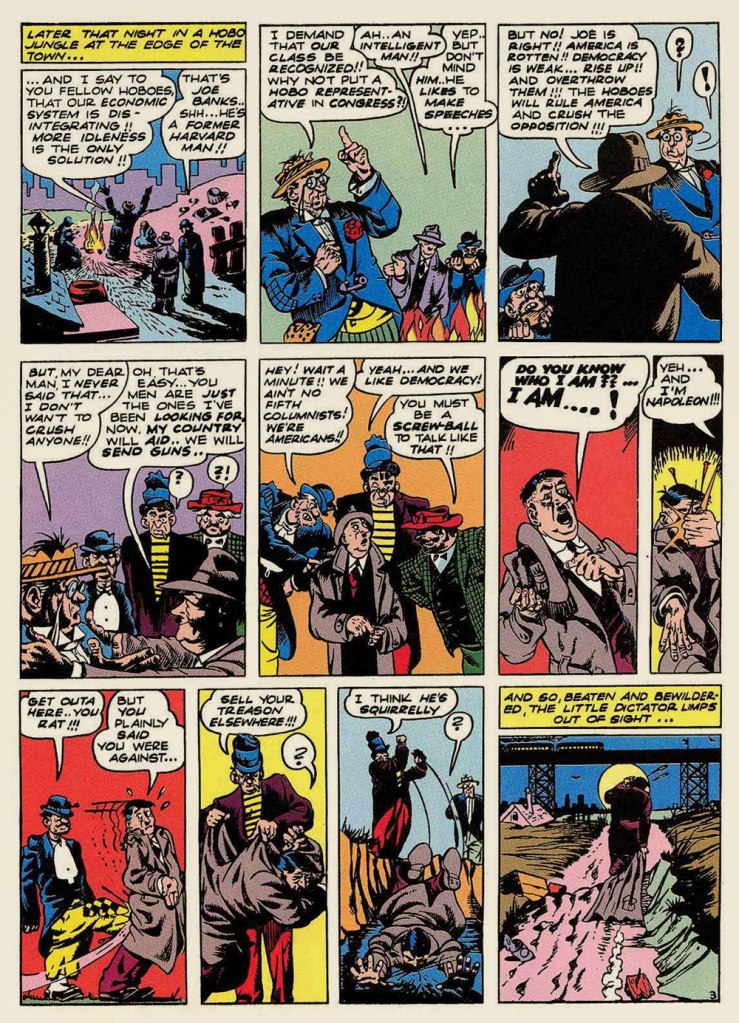
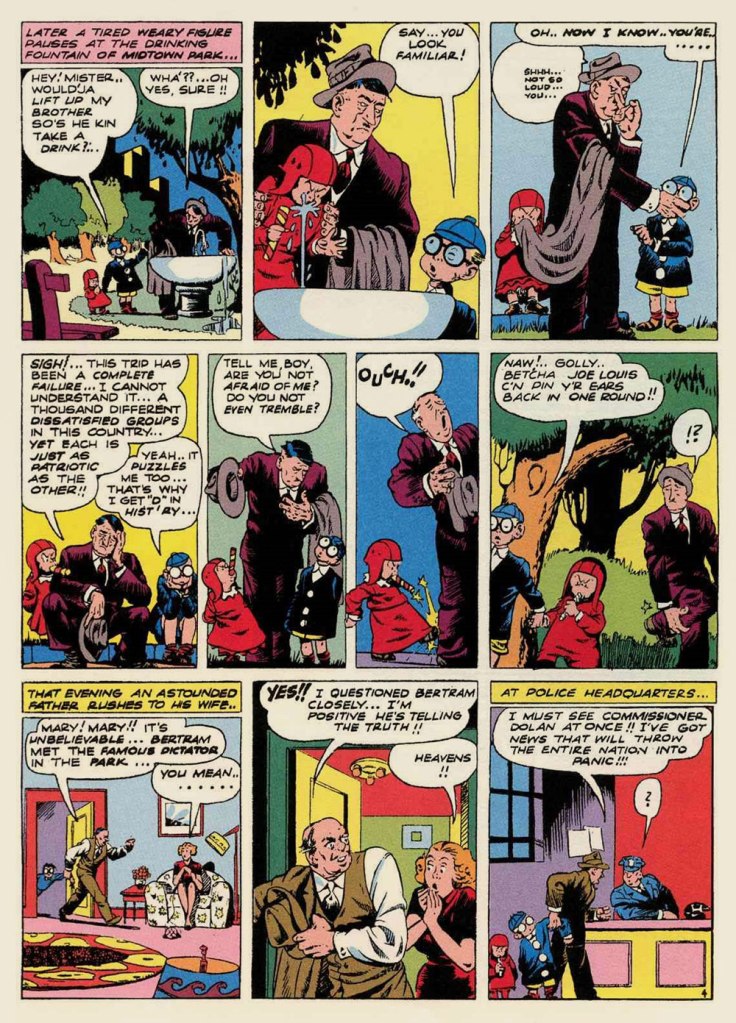
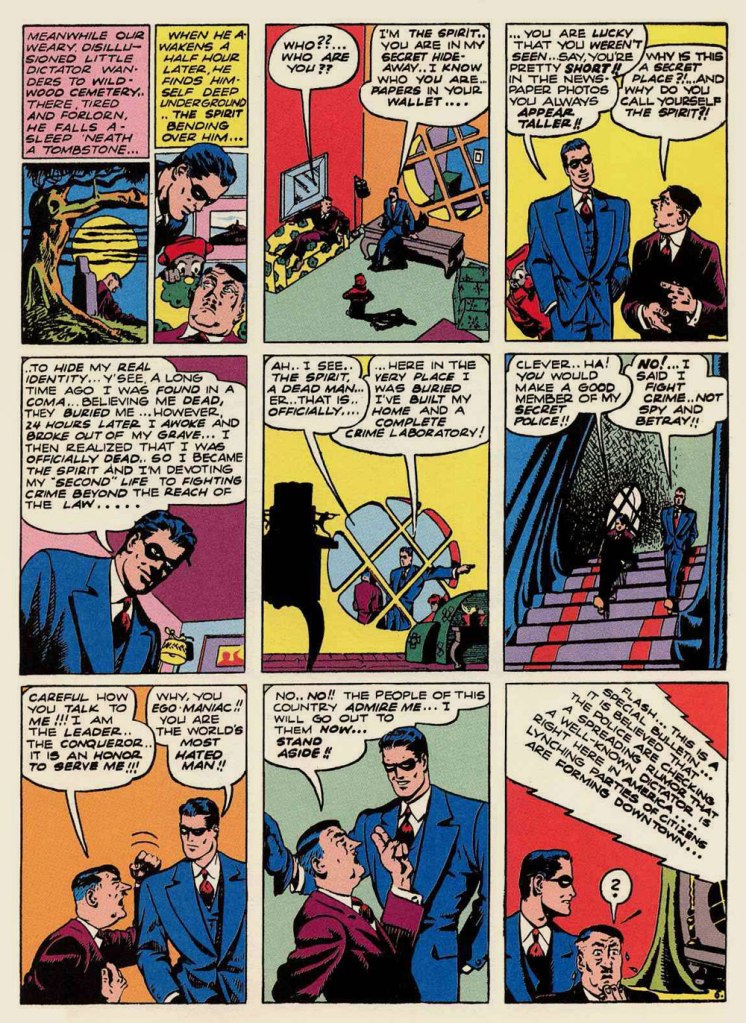
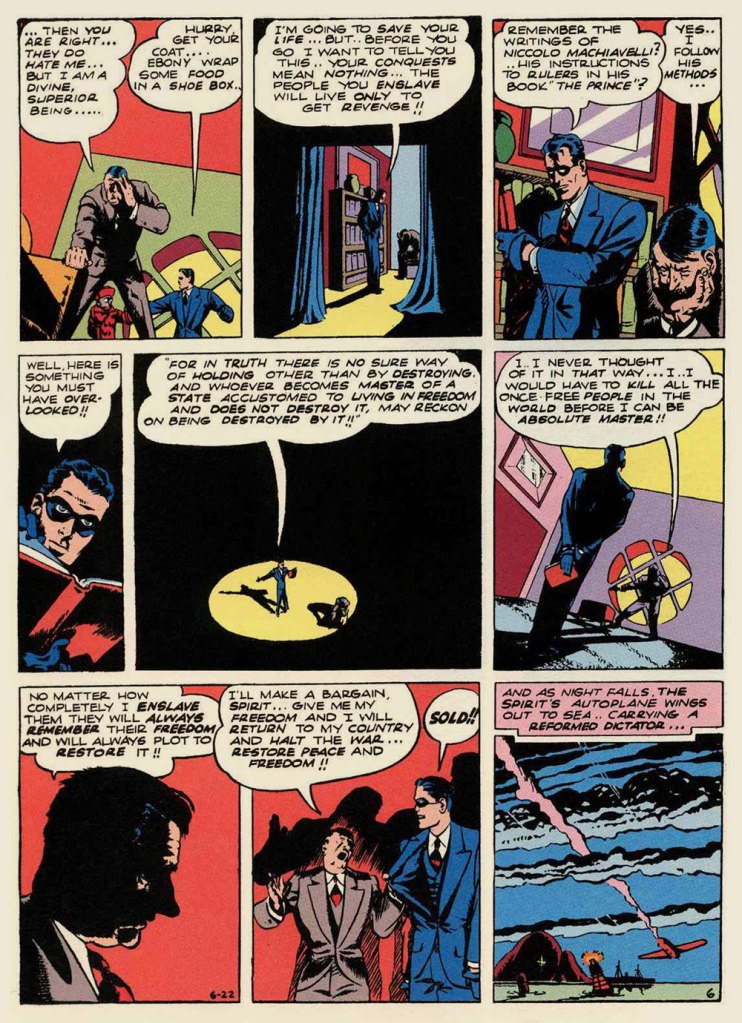
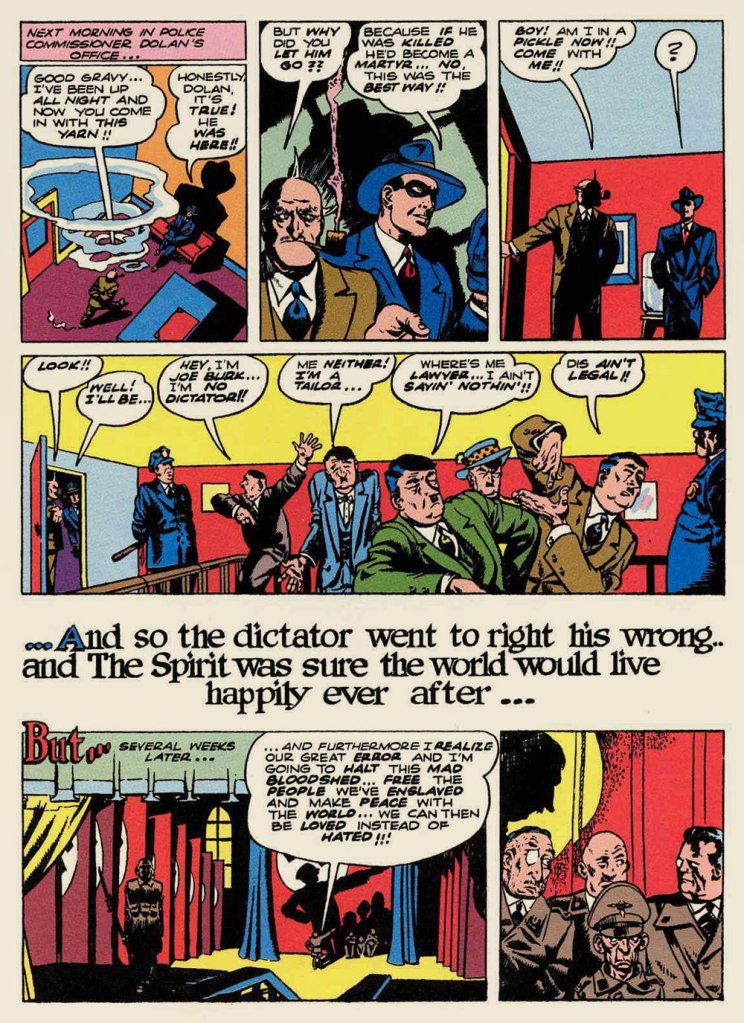
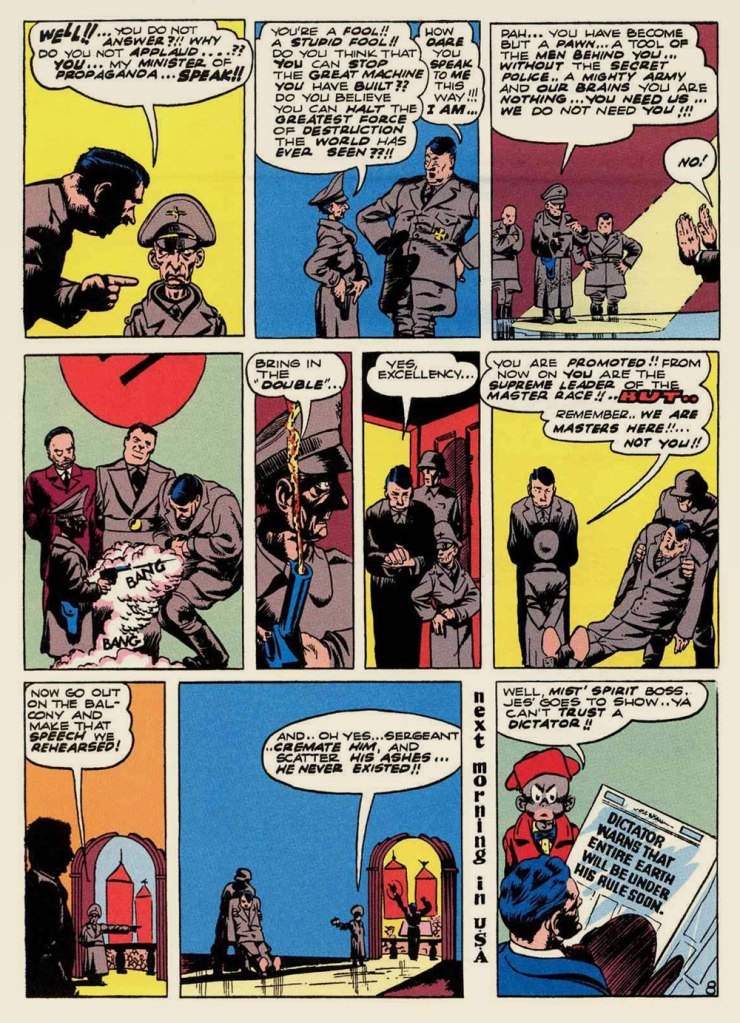
The Spirit in “The Tale of the Dictator’s Reform” (1941)

« Fascism will come to America wrapped in a flag. » — Sinclair Lewis

With the exception of its daily strip incarnation (1941-44), principally ghosted by Jack Cole, the early years of Will Eisner’s The Spirit never drew me in. Next to the work Eisner produced upon his return from WWII, the first years seemed tentative and inchoate. It didn’t help that the original artwork — or even quality photostats — of the material had not survived, and so reprints were consequently hobbled by dodgy reproduction.

The other day, a most generous friend presented me with the second volume of Will Eisner’s The Spirit Archives — he had a spare copy — and, not wishing to look a gift horse in the mouth, I duly proceeded to read it. I should state that DC Comics’ complete reprinting of Eisner’s magnum opus is a definitive one, so the pill was far easier to swallow this time.

I was particularly taken with one gem near the end of the volume. And since America is currently awash in fascists and Brownshirts, Eisner’s political parable seems unnervingly apropos. See what you think!

Like it says at the top of page one, The Tale of the Dictator’s Reform was originally published on June 22, 1941. The United States’ December 9th entry into the war was still several months away.

This episode was cited as a solid favourite of his lone surviving The Spirit assistant*, the mighty Jules Feiffer (born 1929) in his pioneering work of comics history, 1965’s The Great Comic Book Heroes. Mr. Feiffer wrote: « Eventually, Eisner developed story lines that are perhaps best described as documentary fables — seemingly authentic when one reads them, but impossible, after the fact. There was one about Hitler walking around in a Willy Lomanish middle world: subways rolling, Bronx girls chattering, street bums kicking him around. His purpose in coming to America: to explain himself, to be accepted as nice guy, to be liked. Silly when you thought of it, but for eight pages, grimly convincing. »

When the story finally was reprinted — some sixteen years after Feiffer’s tantalising plot summary — in Will Eisner’s The Spirit no. 32 (Dec. 1981, Kitchen Sink), associate editor Cat Yronwode added: « Indeed, the story is all that Feiffer said of it and more. He forgot to mention that The Spirit fixed Der Fuehrer a nice bag lunch, for instance, and obligingly flew him home after his American sojourn. It’s been a long time coming, but at last we can proudly bring you this little gem, possibly the most eccentric political homily ever produced in the comics form. Enjoy it, but don’t ask for more of the same. It’s unique. »

-RG

*the next-to-last Spirit assistant, Don Perlin, passed away earlier this month. He had pencilled three stories over Feiffer’s layouts in 1951, late in The Spirit’s run.

Ragged, Starved, Hopeless: DeFuccio and Severin’s ‘Spoilers!’ (1971)

« History deals mainly with captains and kings, gods and prophets, exploiters and despoilers, not with useful men. » — Henry Louis Mencken

A few months ago, I was reading an old John Severin interview (in Graphic Story Magazine no. 13, Spring, 1971, Richard Kyle, editor) conducted by John Benson, and this passage stuck with me:

BENSON : Who are your favorite comics writers that you’ve worked with?

SEVERIN: I don’t even know who writes half the stories. Well, there are two guys, but they aren’t essentially comics writers. I like to work with Jerry DeFuccio and with Colin Dawkins. They write stories.

Which in turn led me to another Severin interview, this one conducted by Gary Groth in the early 2010s.

GROTH: In the back of the book, I’m looking at one issue of Son of Tomahawk actually, which I guess is a post-Tomahawk spin-off, but Frank Thorne does the lead feature and you did a really beautiful backup, I think one of your best strips during this period called Spoilers, that Jerry DeFuccio wrote.

SEVERIN: Really?

GROTH: You don’t sound like you have any recollection of this whatsoever.

SEVERIN: No, not at all. Oh, there’s an awful lot of stuff. Once I do a script and turn it in, it’s only with minor exceptions that I’ll remember the thing next week! I might remember it later on if somebody reminds me of something, but if somebody said, “What did you do last week?” I’d be damned if I know.

Severin’s reaction, to me, is a reminder of two things: first, that some artists (and fans!) are only interested in the visual aspects of comics. And second, that work conditions in the comics field (and most other commercially driven endeavours) are pretty inhumane if you have to just keep chugging on, with little time or impetus to look back and sniff the newsprint, let alone reflect.

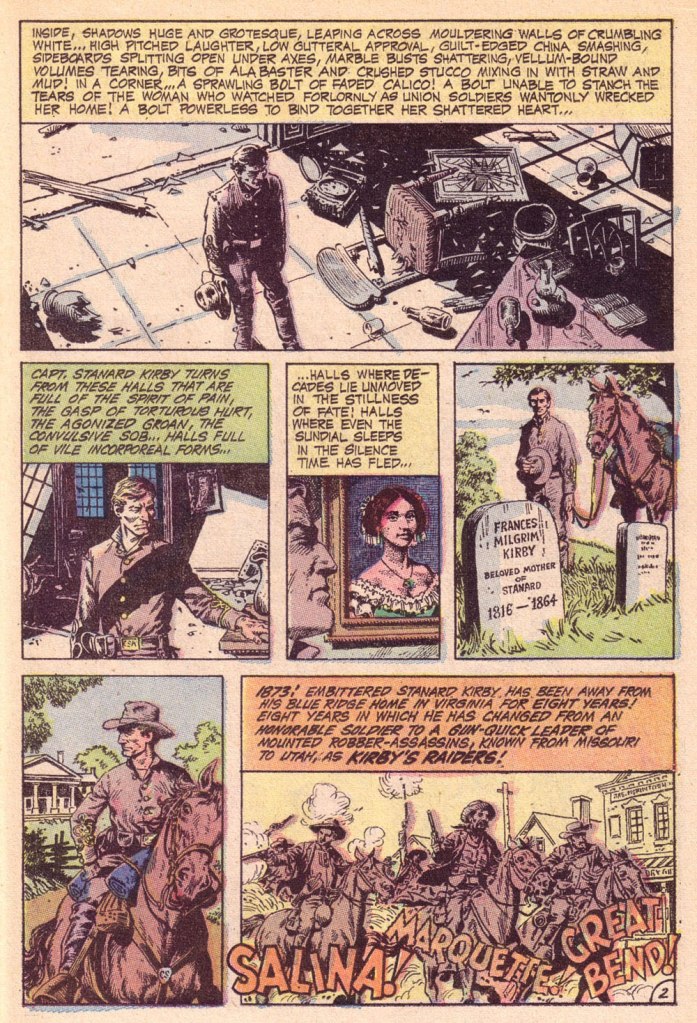
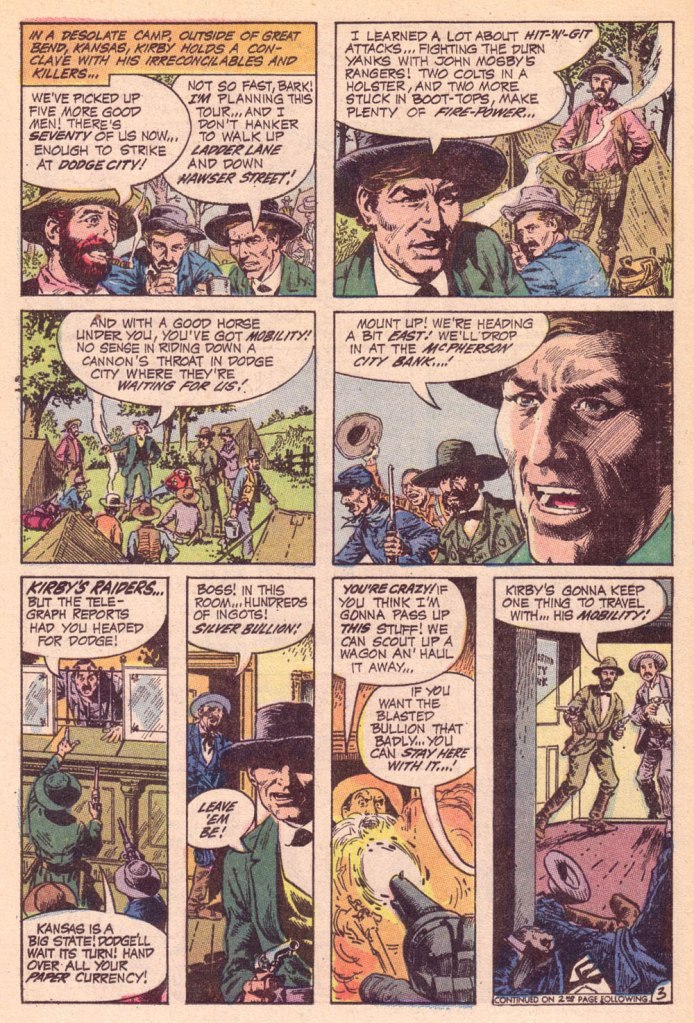
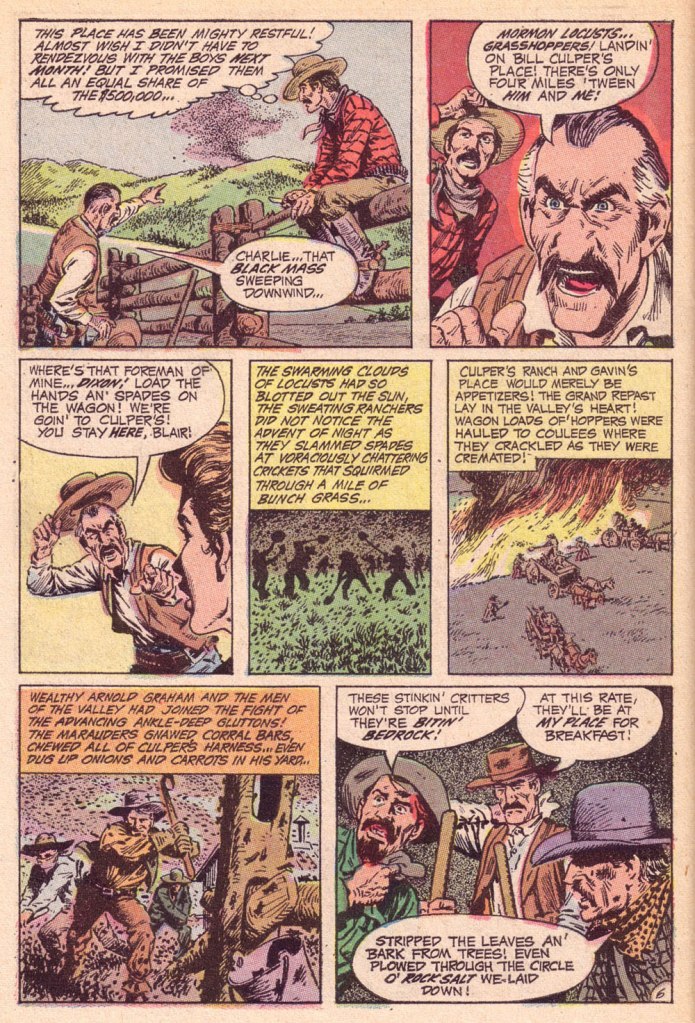
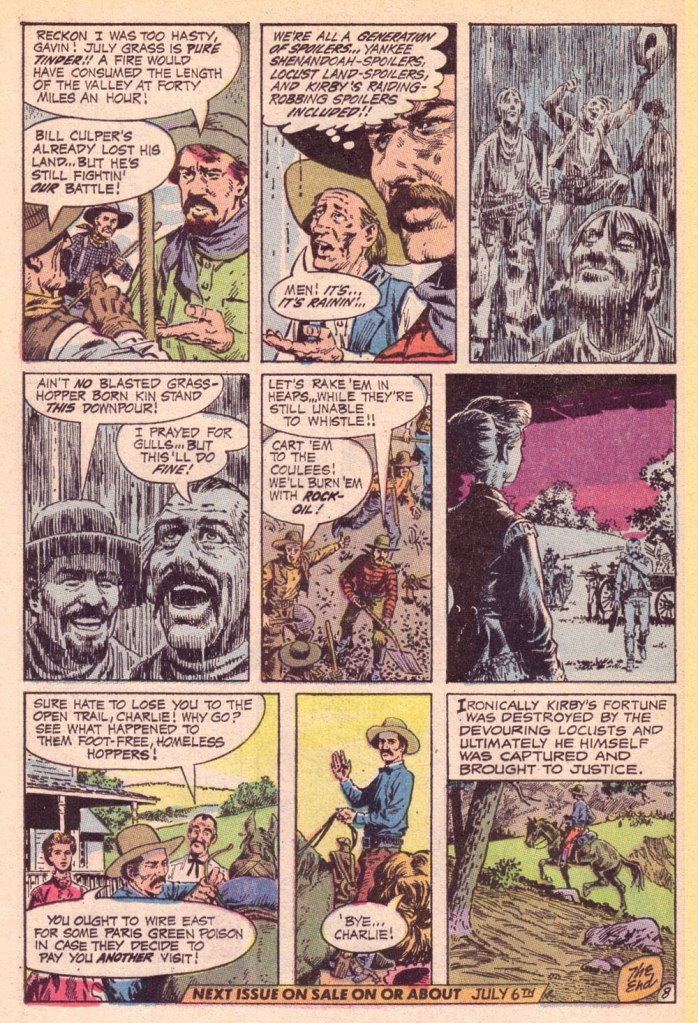
Jerome ‘Jerry’ DeFuccio (1925 – 2001) was born on this day, ninety-eight years ago. While he’s most closely associated with his quarter-century stint as associate editor of Mad Magazine, readers of EC’s war/adventure titles know he could also pen, in excellent fashion, a thoroughly gripping yarn. Here’s one of the handful he later did for DC, for editor Joe Kubert. And while Son of Tomahawk wasn’t commercially successful, it was a highlight of its era, a truly adult comic book. See for yourself:

‘Spoilers!’ saw print in Tomahawk no. 135 (July-Aug. 1971, DC).
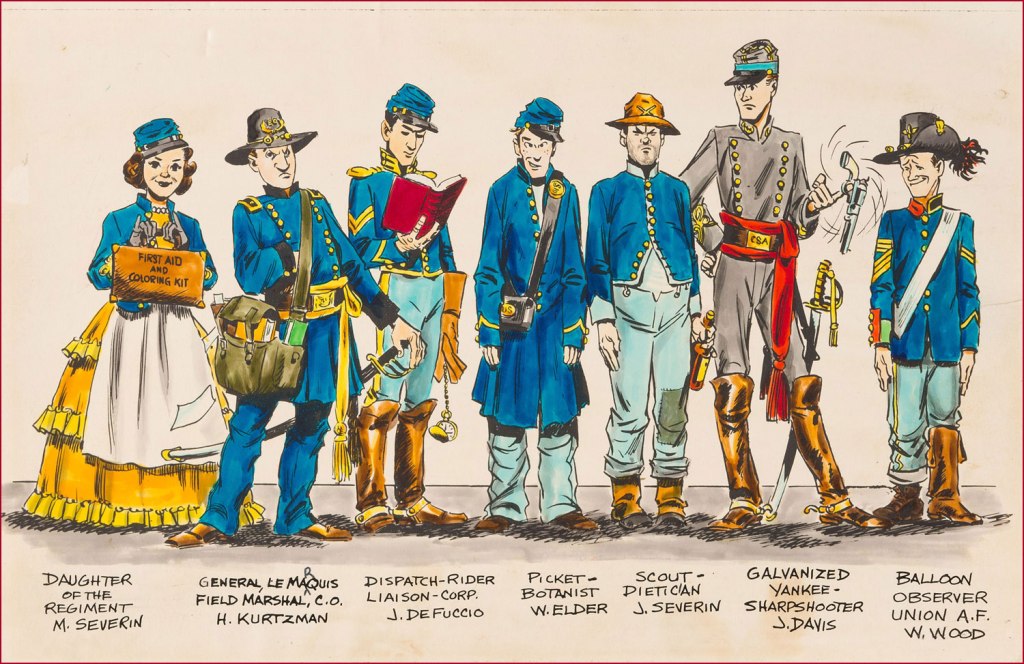
Here’s a lovely illustration of some of the EC gang, in civil war drag . Like it says, DeFuccio’s third from the left. Ink and wash over graphite pencil on Bristol board. » Drawn in the 1950s, this piece saw print in 1983, in issue 9 of the excellent EC fanzine Squa Tront.

GROTH: Was DeFuccio working for Mad at that time?

SEVERIN: Yeah.

GROTH: It seems like you remained friends with DeFuccio for a very long time.

SEVERIN: Yeah, I had to. He was my wife’s cousin.

-RG

Into the Inky Shadows With Jerry Grandenetti

« Jerry Grandenetti started out ghosting The Spirit, and nobody… NOBODY… captured the spirit of The Spirit better. Not content to stay in Will Eisner’s shadow forever, he forged his own unique style leading to a highly successful comics career lasting decades. » — Michael T. Gilbert

Since my very first encounter with his work, Jerry Grandenetti (1926-2010; born ninety-five years ago today, another Thursday April 15th) has endured as one of my true artistic heroes. But he’s not celebrated much at all.

Though he’s worked extensively on The Spirit, he’s treated as a bit of a footnote in the Eisner hagiography. His DC war work is well-regarded, but he’s inevitably overshadowed by the Joe KubertRuss HeathJohn Severin trinity. Besides, by and large, the war comics audience doesn’t overlap much with the spandex long johns crowd. Grandenetti has only very occasionally and timidly dipped a toe into the super-heroics fray, and he was far too unusual for overwhelming mainstream acclaim.

In fact, aside from the couple of converts I’ve made over the years, I can only think of three fellow torch-bearing aficionados: Michael T. Gilbert (who digs best the early, Eisner-employed Jerry); Stephen R. Bissette (who favours the spooky 60s and 70s work); and Don Mangus, who’s most into the DC war stuff. I daresay I enjoy it all, but my taste is most closely aligned with Mr. Bissette’s on this particular point. Let’s sample a bit of everything, insofar as it’s feasible to sum up a career spread out over five decades… in a dozen-or-so images.

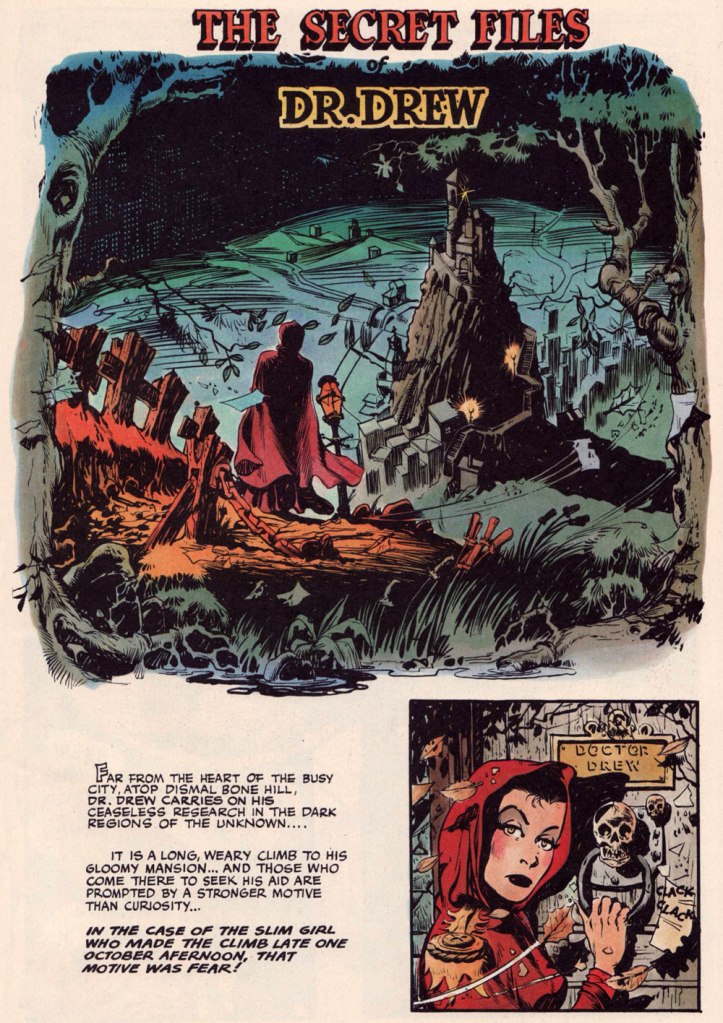
Opening splash from The Secret Files of Dr. Drew: Sabina the Sorceress, written by Marilyn Mercer and lettered by Abe Kanegson, from Rangers Comics no. 56 (Dec. 1950, Fiction House); this version hails from a reprint (Mr. Monster’s Super Duper Special no. 2, Aug. 1986, Eclipse) using the surviving original art; it was recoloured by Steve Oliff.
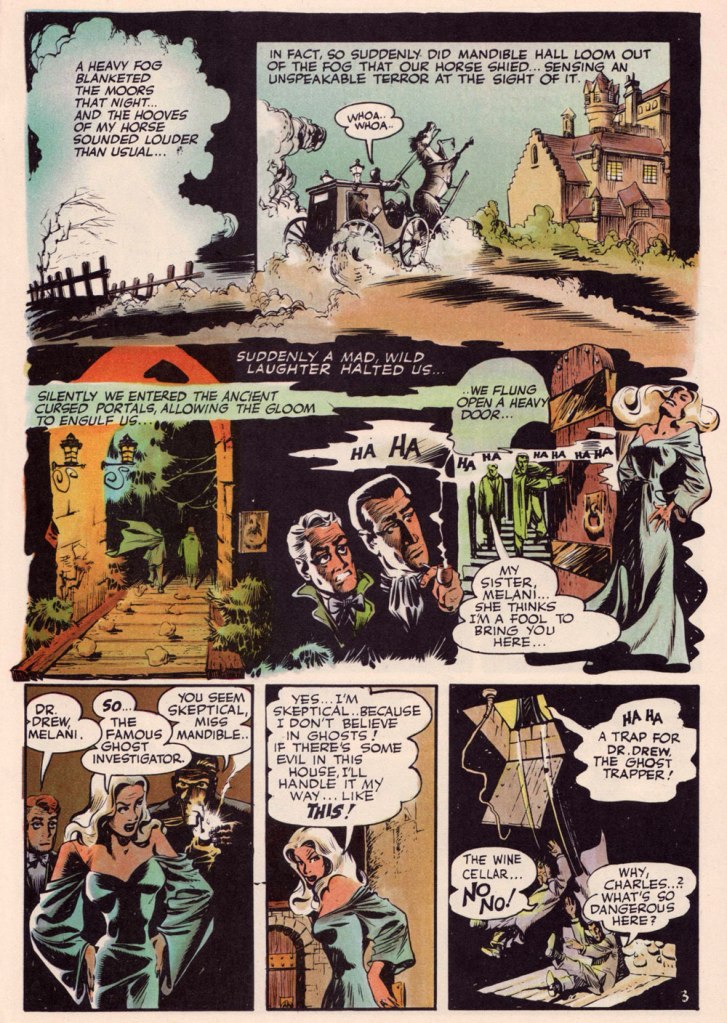
Page 3 from The Secret Files of Dr. Drew: Curse of the Mandibles!, written by Marilyn Mercer and lettered by Abe Kanegson, from Rangers Comics no. 55 (Oct. 1950, Fiction House); this version hails from a reprint (Doc Stearn… Mr. Monster no. 4, Dec. 1985, Eclipse) using the surviving original art; it was most tastefully recoloured by Steve Oliff.

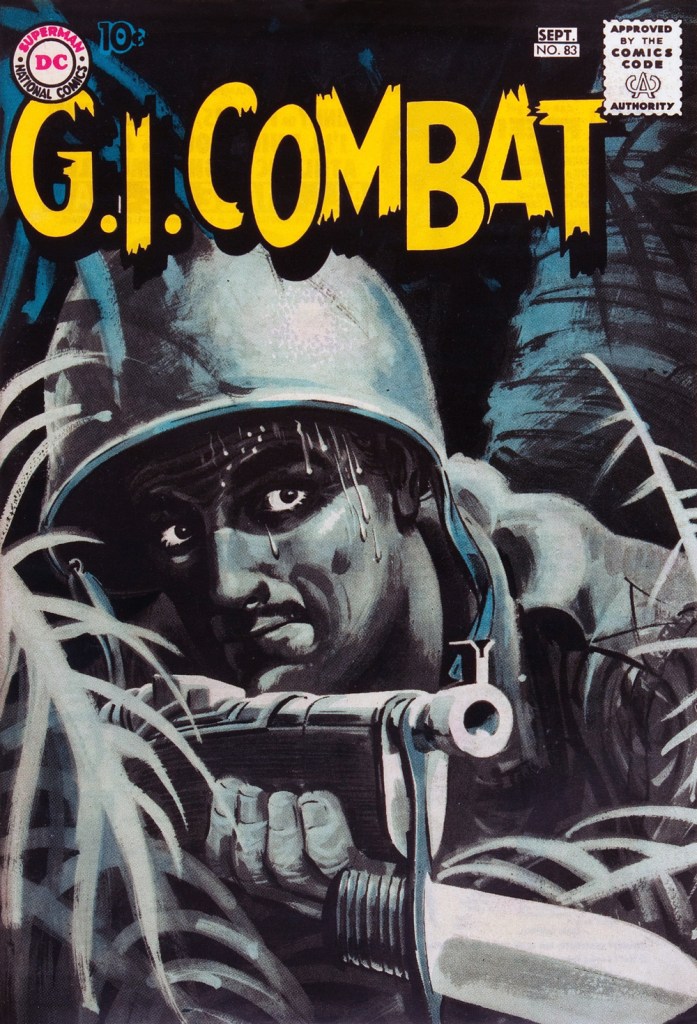
In 1954, the powers-that-be at National Periodical Publications (you know, DC) gave Grandenetti some latitude to experiment with their War covers. Grandenetti produced an arresting hybrid of painted and line art. The process involved a grey wash painting that was photostatted, with flat colour laid over the resulting image. The first few attempts yielded striking, but nearly monochromatic results. A bit farther down the pike, the production department got more assured in its technical exploration.

This is G.I. Combat no. 77 (Oct. 1959, DC); wash tones and colouring by Jack Adler, who recalled, in a 1970s interview: « It was suggested that we start doing washes for covers, and we were talking about doing it for so damned long, but nobody attempted it. I think Grandenetti did the first one, an army cover with someone floating in the water. I think that was the first wash cover that was done. That one ended up looking like a full color painting. »
This is G.I. Combat no. 83 (Aug.- Sept. 1960, DC); wash tones and colouring by Jack Adler. In 1995, Robert Kanigher, Grandenetti’s editor on the DC war books and a frequent collaborator, recalled: « Jerry liked to experiment and I had to sit on him to get him to stop it. Especially in his covers, which were outstanding, when I forced him to draw as realistically as possible. »
Original art from The Wrath of Warlord Krang!, smothered in dialogue and exposition by Stan Lee, from Tales to Astonish no. 86 (Dec. 1966, Marvel); inks by Bill Everett. Namor‘s constant random shouts of ‘Imperius Rex!‘ make him sound like a sitcom character with Tourette’s. As far as I’m concerned, it’s possibly been the most annoyingly asinine slogan in comics since Stan stole ‘Excelsior!‘ from Jean Shepherd.
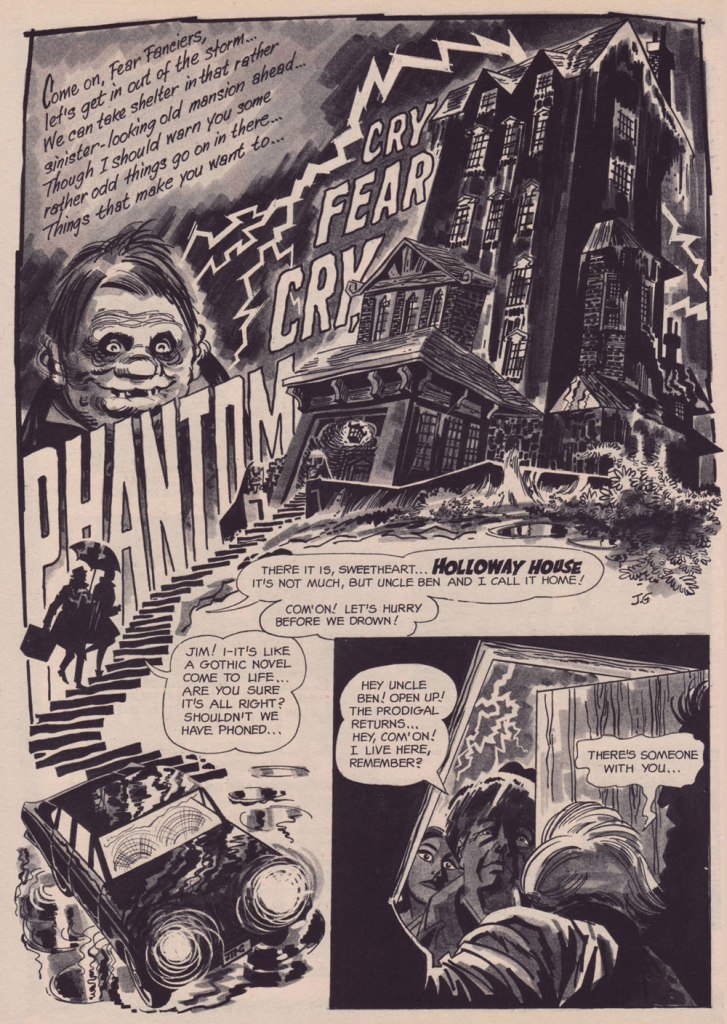
The opening splash from Cry Fear, Cry Phantom, written by Archie Goodwin, from Eerie no. 7 (Jan. 1967, Warren). In the mid-60s, presumably tiring of being pigeonholed as a war artist at DC, Grandenetti made the publishers’ rounds, doing a bit of work for Tower, Gold Key, Charlton, Marvel, Cracked (check it out here) and most memorably Warren where, after ghosting a few stories for Joe Orlando, he unleashed his innovative expressionistic style.

DC was generally hesitant to entrust its more established properties to the more “out there” artists. In the cases of Grandenetti and Carmine Infantino, the solution was to match them with the weirdness-dampening inks of straight-arrow artist Murphy Anderson. And you know what? It did wonders for both pencillers and inker.

This is The Spectre no. 6, October, 1968. A tale told by Gardner Fox (and likely heavily revised by hands-on editor Julius Schwartz, a man who loved alliterative titling) and superbly illustrated by the Grandenetti-Anderson team. Steve Ditko aside, Jerry Grandenetti had no peer in the obscure art of depicting eldritch dimensions (you’ll see!)

Page 13 from Pilgrims of Peril! written by Gardner Fox, from The Spectre no. 6 (Sept.- Oct. 1968, DC); inked by Murphy Anderson. Dig the salute to a trio of real-life spooky writers, all of whom editor Julius Schwartz knew well, having even served as Lovecraft’s literary agent late in the man’s life. By the tail end of the 1960s, Lovecraft’s work was finally making some commercial inroads, thanks largely to Arkham House co-publisher Derleth‘s unflagging diligence.
Page 22 from Pilgrims of Peril! written by Gardner Fox, from The Spectre no. 6 (Sept.- Oct. 1968, DC); inked by Murphy Anderson.
Page 2 from Men Call Me the Phantom Stranger, written by Mike Friedrich, from Showcase no. 80 (Feb. 1969, DC); inks by Bill Draut. This story reintroduced an obscure character from the early 50s, which Grandenetti had drawn a couple of times during his six-issue run. The Phantom Stranger has remained active ever since, but most writers (save Alan Moore, wouldn’t you know it?) don’t really know what to do with him. This, however, is my very favourite PS appearance. Draut, a slightly old-fashioned penciller by this time was, as a slick inker, a wonderful fit for Grandenetti’s confidently loopy layouts.
Page 3 from The Haunting!, written by Jack Oleck, from House of Mystery no. 183 ((Nov.-Dec. 1969, DC). Grandenetti pencils and inks: undiluted!
Page 2 from Eyes of the Cat, written by Robert Kanigher, from House of Mystery no. 189 (Nov.-Dec. 1970, DC); inks by Jerry’s fellow Will Eisner ghost Wallace Wood. The inspired combination of Grandenetti’s adventurous layouts and the velvety unctuousness of Wood’s finishes are a match made in heaven, but one Woody wasn’t fond of. Oh well.

So there you are. Just the tiniest tip of the iceberg. Happy birthday, Mr. Grandenetti!

-RG

Take Ten With Shel Silverstein

« Join the army and see the next world. » — Dylan Thomas

A couple of eternities ago, in Shel Silverstein: Without Borders, we profiled you-know-who and showcased the travel cartoons he produced for Hugh Hefner and Playboy Magazine. Now, we reach back even earlier, to his first stirrings as a professional cartoonist… and a lifelong rover. As it would turn out, Shel truly was a free spirit.

A little bit of biography to set the stage… circa 1955. I can just about hear him, in that distinctive voice of his, hawking hot dogs at Comiskey Park!
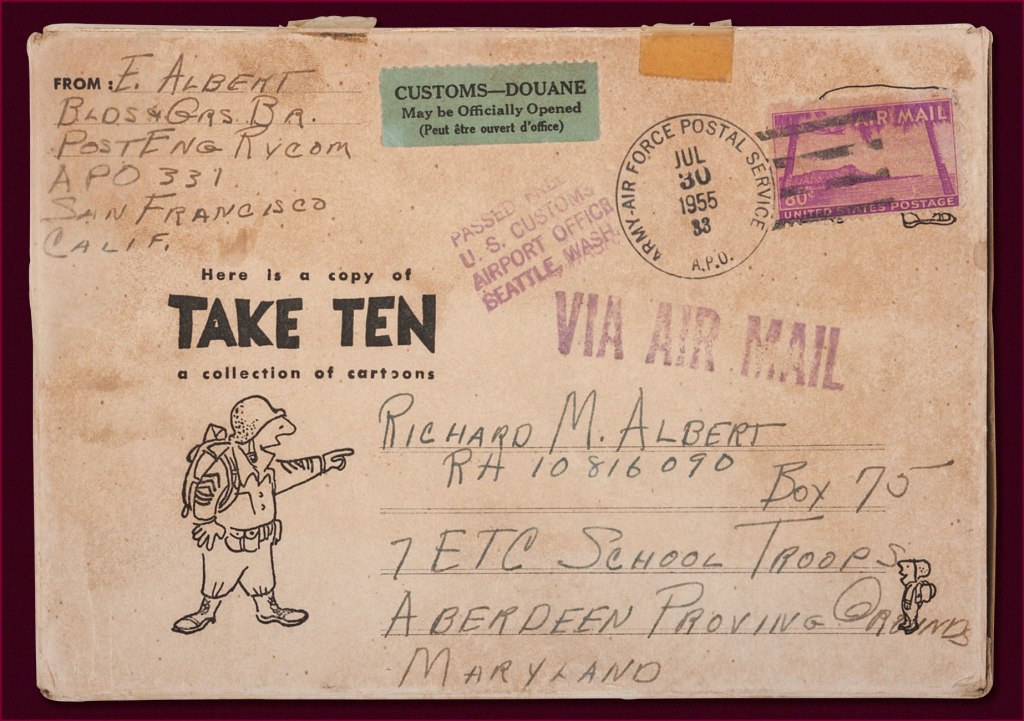
« In 1955, Stars and Stripes published Take Ten, a book collection of his cartoons that was sold through military PXs et commissaries. » And also by mail!
« Here they are… the Centaurs and Bird men… the Geniis and Cobras… the fifteen-foot PFC’s and two-inch E-1’s. Here is TAKE TEN, the first collection of Shel Silverstein’s cartoons, taken from Pacific Stars and Stripes, Army Times and his untapped top drawer. Here is a pocket-full of cartoons that will make you smile and chuckle and laugh out loud. »

Lisa Rogak writes, in her A Boy Named Shel (2007, St. Martin’s Press):

Once he arrived in Tokyo, Shel was assigned to the Pacific Stars and Stripes to past up stories and photo features for the paper. When his work was done — which he performed as quickly as possible — he turned his attention to drawing cartoons using the material that was right in front of him: the military. Shel roamed the streets of Shinbashi, a neighborhood that GIs frequented that once served as the end of the line of Japan’s first railroad. He spent hours each day wandering the streets taking note of the activities of his fellow soldiers, which would invariably end up in one of his cartoons.

He initially did it for his own amusement, through within a few weeks, the paper began to print his work. After spending six months juggling newspaper paste-up with cartooning, he convinced his editors to take him off layout duties and allow him to wander the Far East and send back reports in the form of one-panel cartoons. They agreed.

Evidently, Mrs. Silverstein’s boy was a most charming and persuasive fellow. He would soon pull the same stunt on Hugh Hefner… but none can claim, in either case, that he failed to deliver on his lofty promises!

Here’s a little bit of background on that famous old General, should you need it.
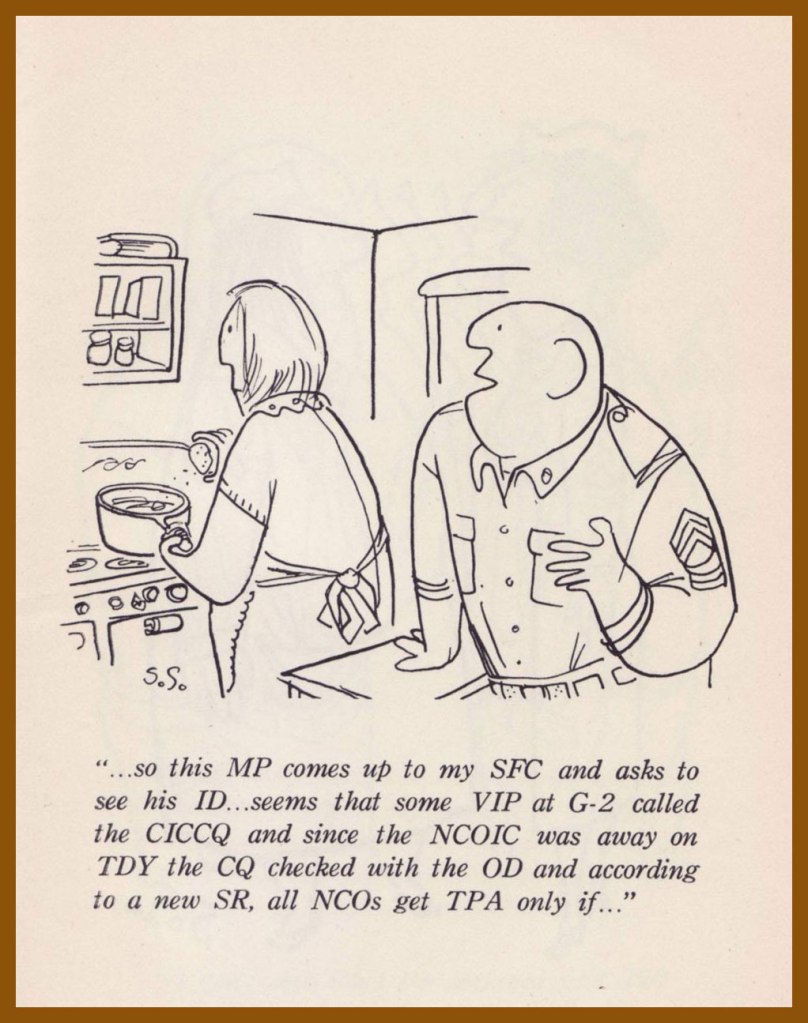
Here’s a helpful guide to US Military acronyms. Who knows, it might spare you some confusion one day.

Even with his freedom, Shel had a hard time dealing with the restraints of army protocol. Corky Alexander, the late editor of the English language Tokyo Weekender, first met Shel at Stars and Stripes. “He was an army corporal and was perhaps the worst soldier in the history of armed might, down through the ages,” he said.

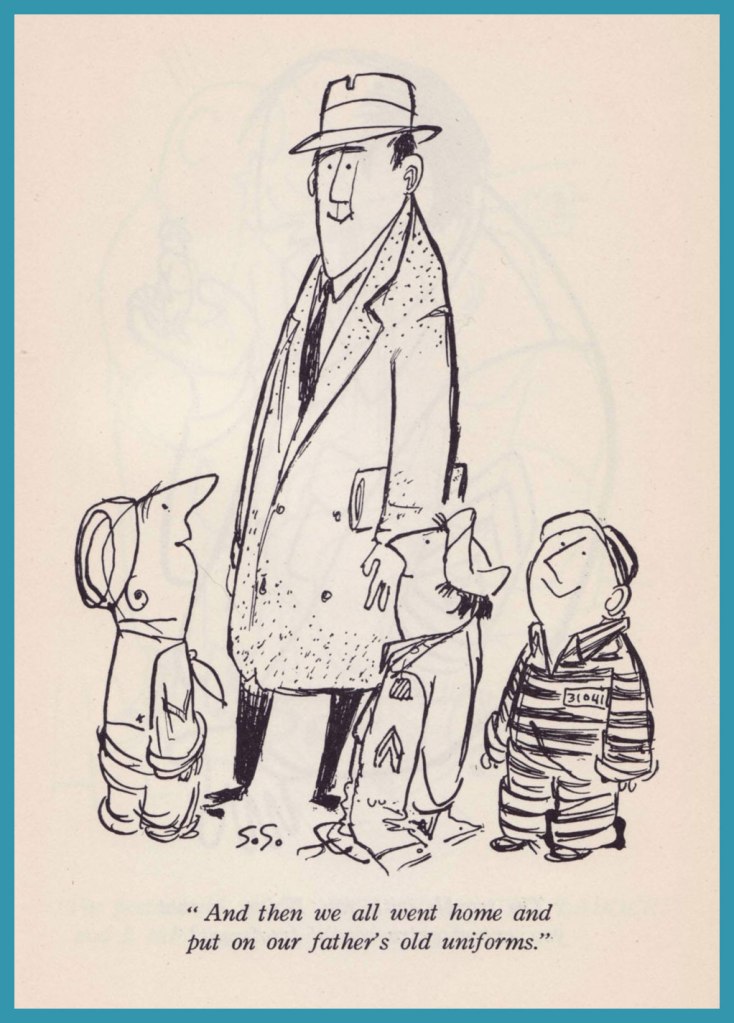
His technique followed a simple pattern. First he thought of an object — say, his first sergeant. He’d concentrate until he would come up with 20 or 30 gags on the one subject. Out of it came situations peopled by his long-nosed characters, his little men, his giants, the animals and the strange creatures for which he has a special affection.

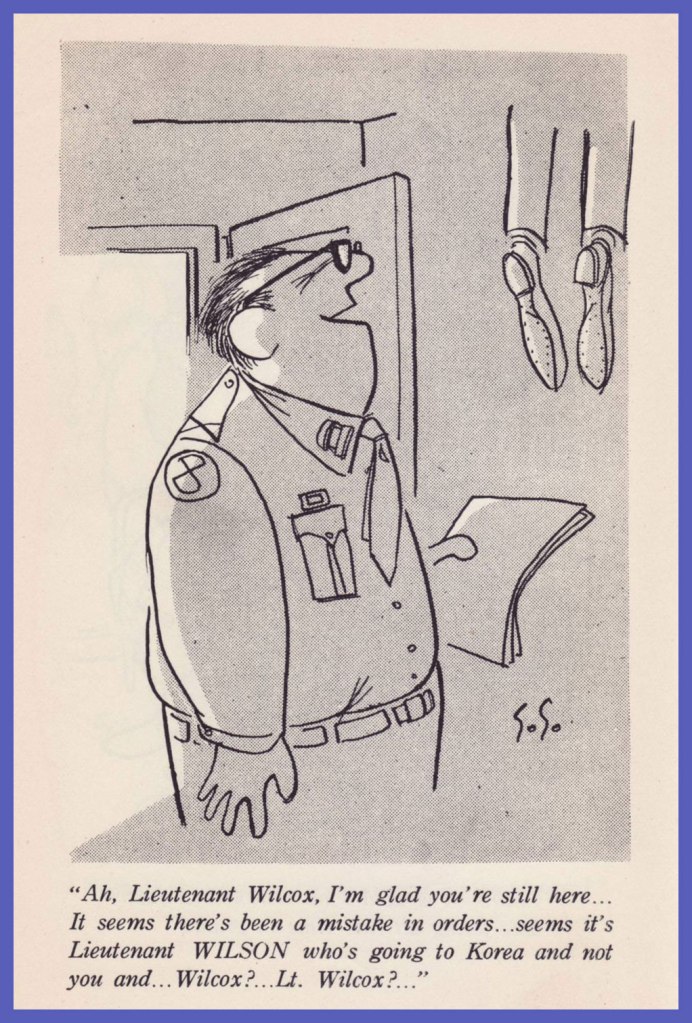
His favorite overall targets were the officers. “They even made zebras off-limits to me because they had stripes,” Shel said.

Old habits die hard. An occupational hazard, you might say.
This, er.. pet might be an early prototype of Shel’s mythic Floobie Doobie Doo.
Now what is that?
It ain’t no dog and it ain’t no cat.
It’s nine feet tall with eyes of blue.
I never seen such a thing
As a thing called a Floobie Doobie Doo.
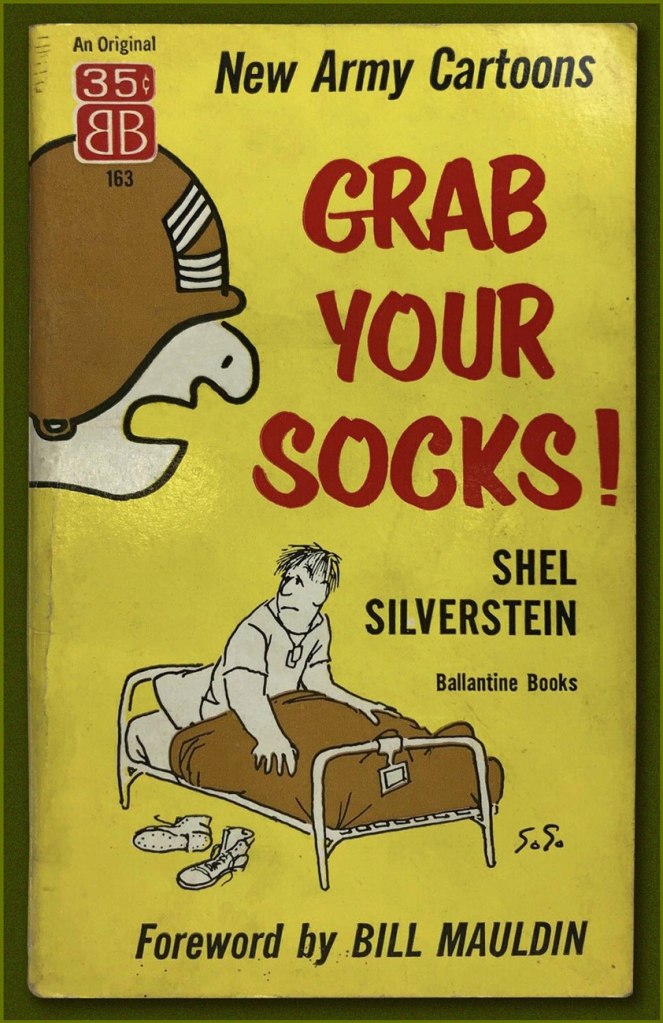
« Shel’s humor had struck such a nerve, and soldiers based in the Pacific shared his cartoons with their families and other civilians to show them what life in the military was really like, that a larger audience for his work was a natural consequence. In 1956, Ballantine Books published a thirty-five-cent mass market paperback edition of Take Ten called Grab Your Socks! »

In his foreword to Take Ten, Shel’s good buddy and PS&S colleague Bob Sweeney recounts:

In a letter to the home office, Bob Brown of the S&S Seoul Bureau wrote:
He stays up all night chewing pencils, drawing cartoons and writing ideas on little scraps of paper he never finds again. In the first twenty minutes he was here he had our little office more cluttered than the convention hall in his native Chicago.”

But,” added Brown, “he knows the people he draws. He’s lived through the same experiences and heard the same lines.

Here then are the simplicities as well as the subtleties — the obvious and the obtuse — the wonderful conglomerate of a man who loves to write, to draw, to create — and best of all — who loves to laugh.

-RG

Treasured Stories: “Christmas Dinner” (1979)

« She kept her ears permanently tuned to the chicken voices outside, so knew immediately when a coyote had crept into the yard, and barrelled screaming for the front door before the rest of us had a clue. » ― Barbara Kingsolver

Given how muted the holiday season is likely to be for most of us, and in light of how much our readers appear to enjoy our past Christmas offerings — (all year long!), I’d thought I’d get an early start on the festivities.

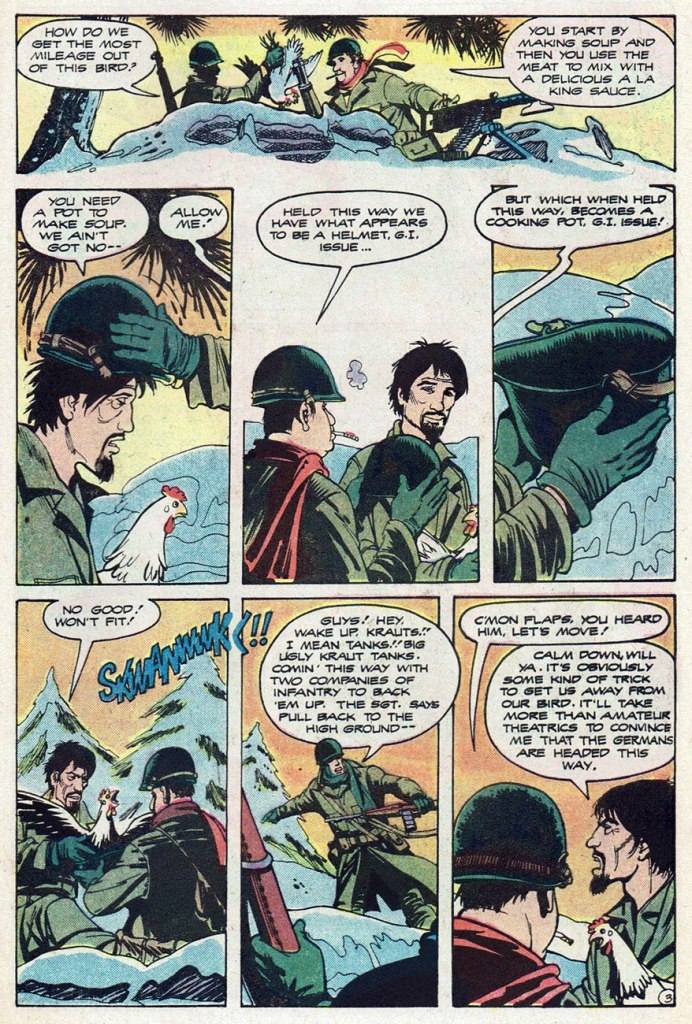
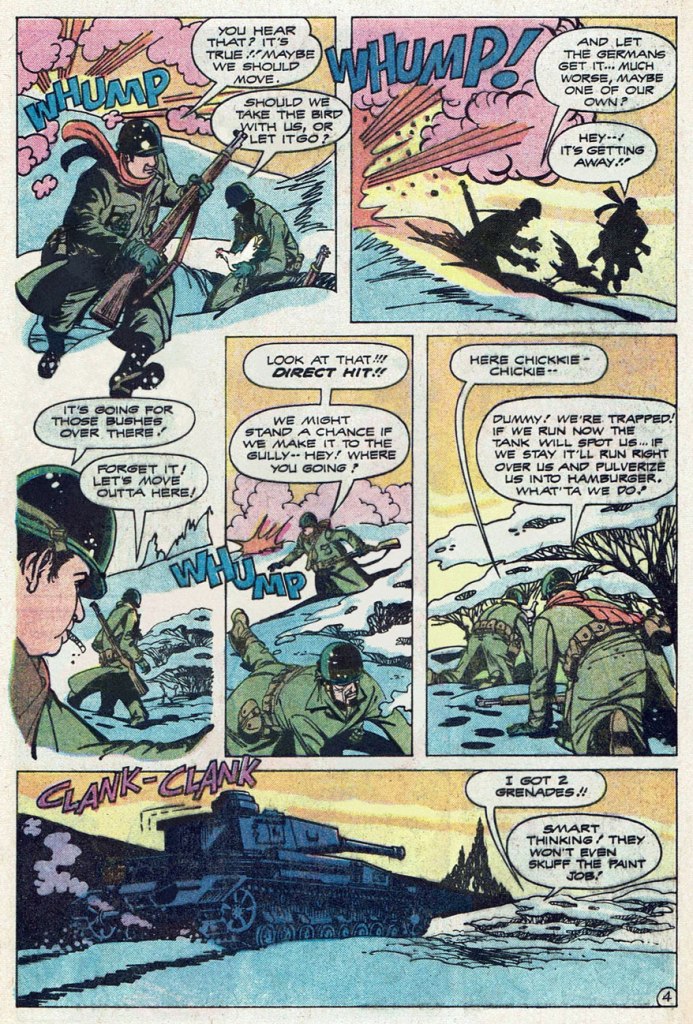
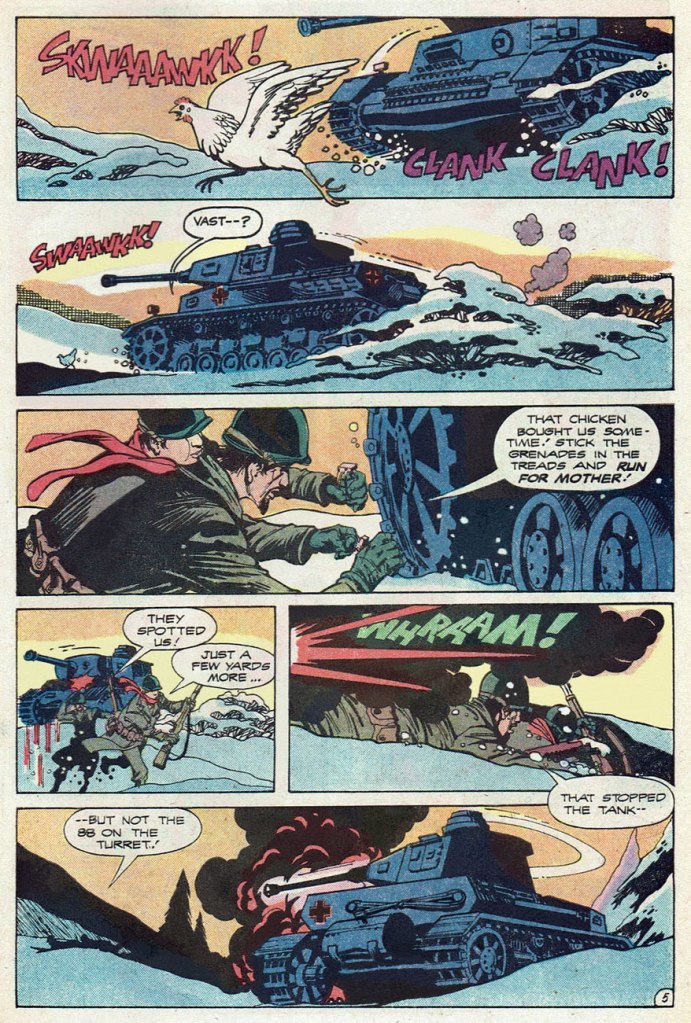
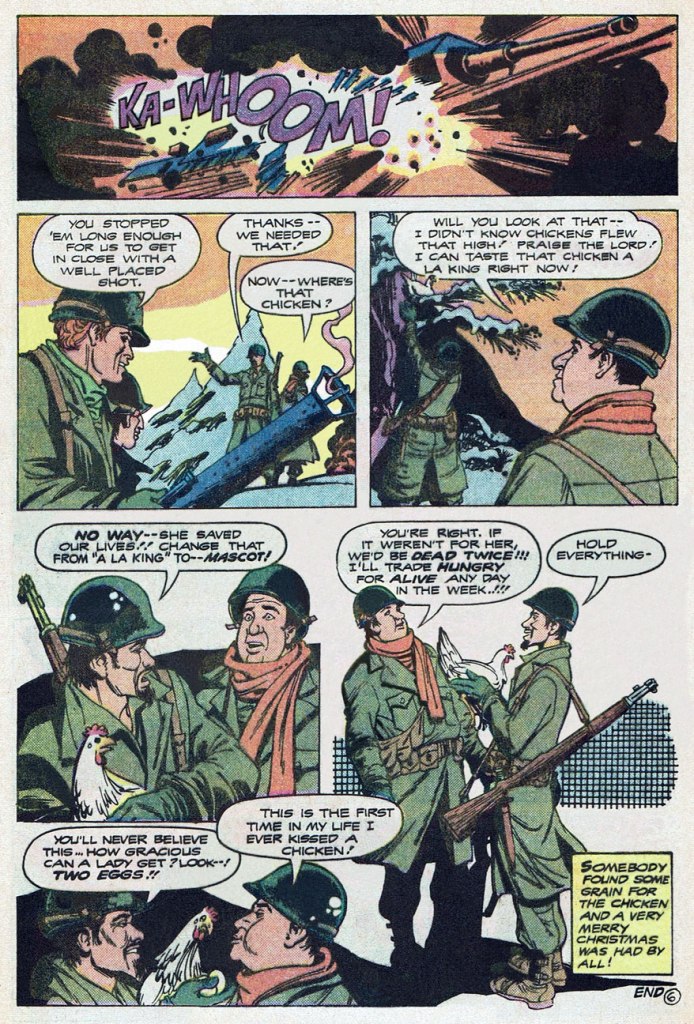
Here’s a fine, but truly obscure little Christmas fable. It was buried in the back of an issue of The Unknown Soldier, at a time when the DC war line was well into its final decline.

… as much of a ‘very merry Christmas’ one may possibly enjoy in the midst of war, far from home and loved ones, at any rate. I would have enjoyed seeing more of those two kind-hearted doofuses, Burf and Flaps… and their chicken mascot. I wonder what name they would have given her…

According to editor Paul Levitz, Christmas Dinner‘s script had been purchased six or seven years earlier by his predecessor Archie Goodwin but had lain fallow in the interim. It was written by one Janus Mitchell (his sole credit in comics, but we may be in the presence of pseudonymous shenanigans) and was finally assigned for illustration to Teny Henson (often credited in the US as ‘Tenny Henson, as he is here), one of my favourite creators from the ranks of the Filipino Komiks community. In America, Henson’s work mostly appeared in DC publications for about a decade (1974-83), beginning with the plum commissions of inking a returning Sheldon Mayer (post-cataract surgery) on his Rudolph the Red-Nosed Reindeer Limited Collectors’ Edition giants, and inking Ramona Fradon‘s pencils on DC’s underrated second revival of Plastic Man for a pair of issues. All in all, Teny flew under the fanboy radar, chiefly providing artwork for mystery and war short stories, and always at a high level of craft and inspiration.

I love the economy and precision of his line, his limpid storytelling, and his mastery of an aesthetic merrily at play in the sweet spot between the cartoonish and the representational. Fittingly, he went on to work in the animation field.

This is The Unknown Soldier no. 237 (Mar. 1980, so on the stands in Dec. 1979, DC), picking up its numbering from the venerable Star-Spangled War Stories; cover, of course, by Mr. Joe Kubert, though by no means among his finer moments — that ‘Nazis in ambush’ formula was getting pretty long in the tooth by then.

Watch for more holiday goodies coming your way!

-RG

The Masulli-Mastroserio Cover Deluge of ’65!

« Charlton was just a place where you felt you could let off a little steam, even if you were never going to get rich. » – Roy Thomas

For over a decade, Pat Masulli (1930-1998) was executive editor of Charlton Publications’ comics line… and of its more lucrative song lyrics (Hit Parader, Song Hits) and crossword puzzle magazine line. Though much has been made of artist Carmine Infantino rising through the editorial ranks at DC Comics (positions traditionally held by writers or just plain bossy types; Sheldon Mayer was a most notable exception at DC), Charlton always did employ artists to manage the comics wing: Al Fago (1951-55), Masulli (1955-66), Dick Giordano (1965-68), Sal Gentile (1968-71) and finally George Wildman (1971-85). There are overlaps in time as well as the porous distinctions betwixt the titles of Managing Editor and Executive Editor.

Now, all of the aforementioned are serviceable artists, but I’m most interested in Masulli. Over the years, it’s gradually dawned on me that, for a few months in 1965-66, Masulli, as if he weren’t busy enough already, decided to lay out and pencil most of the comics line’s covers. And, astoundingly, they represented some of the finest (though often obscure) comics artwork of the decade. Cover artist is a plum job in comics, but few are born that can smoothly fill these tight, squeaky shoes.

What was Masulli like? It depends on whom you ask. His one-time assistant, artist (and later DC inker) Frank McLaughlin, responded with a diplomatic, amused « You don’t want to know. » Charlton’s main writer, Joe Gill, queried about Masulli as editor, sums it up: « Terrible. Pat’s dead now, but he was a martinet, not a friendly guy that enjoyed amiable relations with the artists. He ruled it, and he and I co-existed. » On the other hand, writer-editor Roy Thomas (who was granted his entrée into the industry from Masulli), understandably speaks well of him although, to his regret, they never met. Before they could, Masulli was promoted at Charlton, leaving him to devote his time and effort to the music division, handing the reins of the comic book line to his now-and-again assistant, Mr. Giordano.

Masulli’s go-to guy within his stable of artists appears to have been the versatile, underrated Rocco ‘Rocke’ Mastroserio, who died far too young (at the age of 40!), still steadily improving and shortly after landing some promising jobs at Warren and DC. Mastroserio’s early work can be a tad gawky and lopsided, but shows much promise. By the mid-60s, his covers (his forte) could at times attain a level of craft and inspiration rivalling (and akin to) the work of John Severin and Joe Maneely, fine models to emulate.

This time, however, let’s focus on highlights from the Masulli-Mastroserio flash flood of ’65.

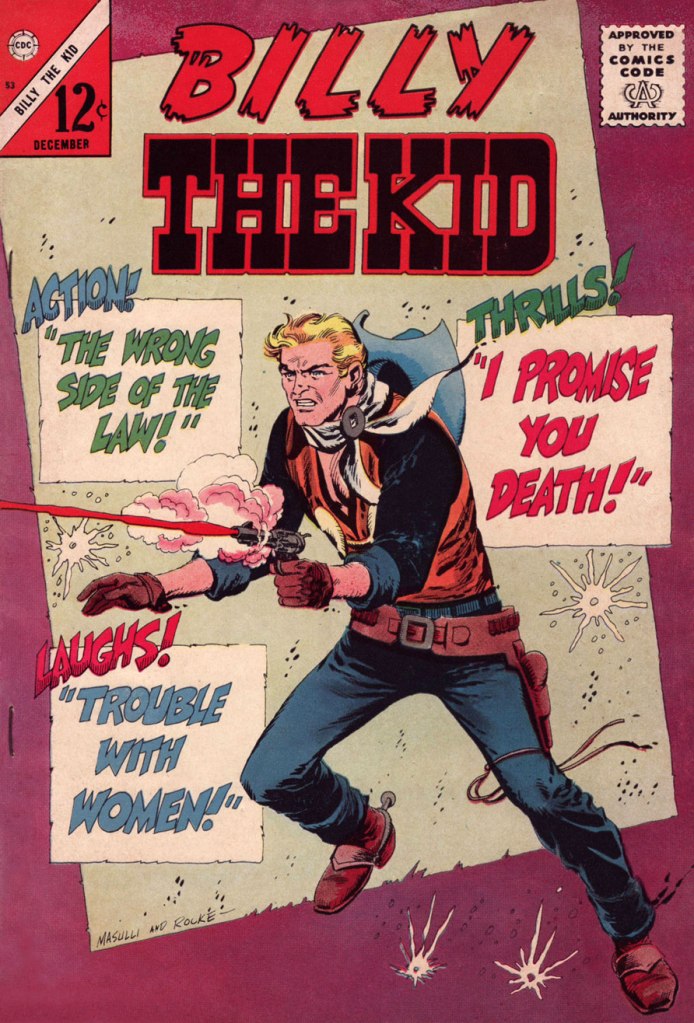
This is Billy the Kid no. 53 (Dec. 1965, Charlton).
This is Special War Series no. 1 (Aug. 1965, Charlton).
This is Fightin’ Navy no. 124 (Jan. 1966, Charlton).
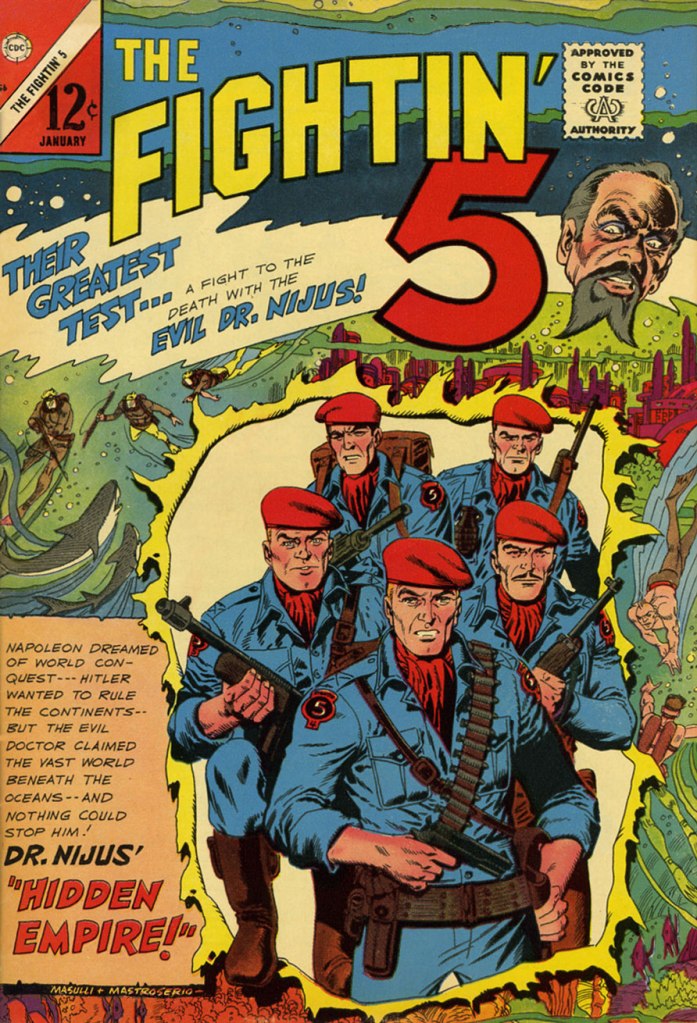
Intricate yet easy to parse, this is The Fightin’ 5 no. 36 (Jan. 1966, Charlton). Comic Book Artist editor Jon B. Cooke once or twice opined that The Fightin’ 5 were ‘a Sgt. Fury and His Howling Commandos swipe‘… but he was wrong: they were a Blackhawk swipe (if anything), and, let’s be honest, Sgt. Fury is, for his part, a Sgt. Rock and Easy Company swipe. All clear now?
This is Hot Rod Racers no. 9 (Jan. 1966, Charlton).
This is Hot Rod and Racing Cars no. 78 (Mar. 1966, Charlton). Masulli began his career as a colourist, and it certainly shows in his cover work.
This is Konga no. 23 (Nov. 1965, Charlton), the series’ final issue. The mighty Steve Ditko had begun the series, but later art chores were capably handled by the solid team of Bill Montes and Ernie Bache.
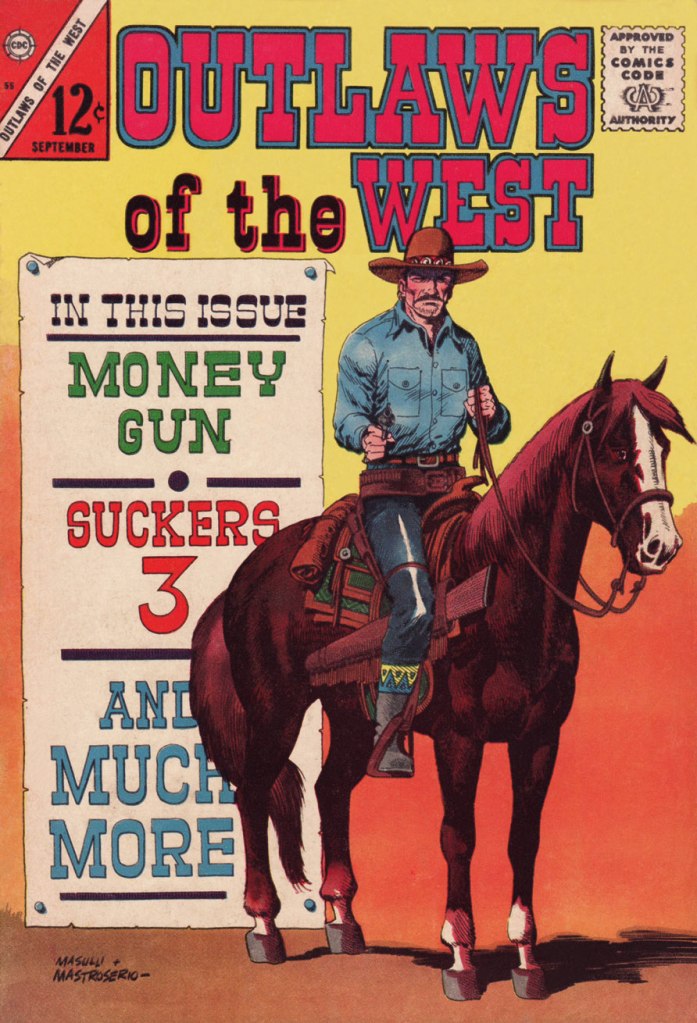
This is Outlaws of the West no. 55 (Sept. 1965, Charlton). Masulli could do busy and action-packed, and he could also do spare, clean and serene. Unlike many a cover artist, he didn’t seem to rely on one particular formula, or even two.
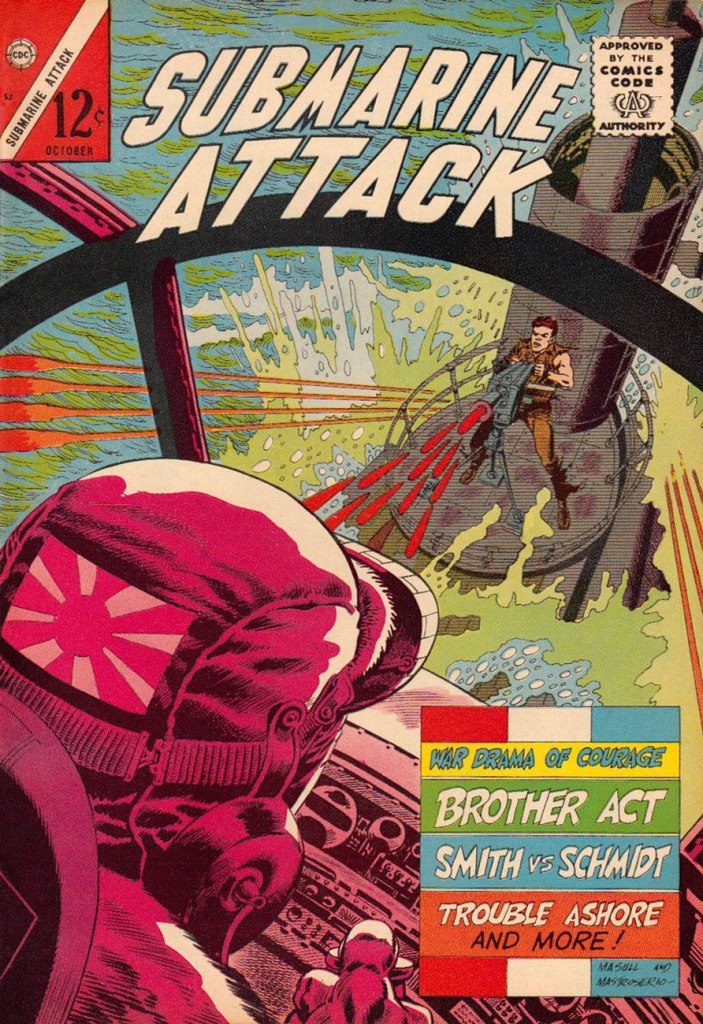
This is Submarine Attack no. 52 (Oct. 1965, Charlton). Both composition (that foregrounding!) and colouring are top-notch.
This is Texas Rangers in Action no. 53 (Dec. 1965, Charlton). Nearly all of Charlton’s covers of this period were distinctively lettered by Jon D’Agostino (1929-2010).
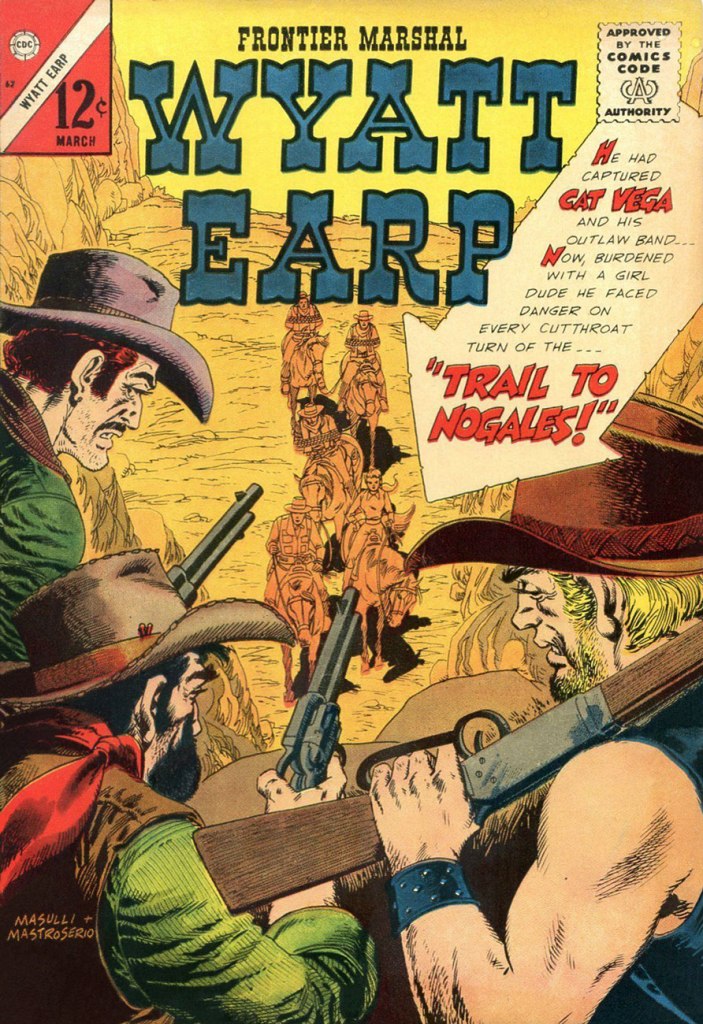
This is Frontier Marshal Wyatt Earp no. 62 (Mar. 1966, Charlton). Mastroserio’s savvy variation of line thickness to convey perspective and emphasize depth is what most reminds me of Joe Maneely‘s work for Atlas and DC (speaking of artists snatched away in their prime).

I’ll return at some point to spotlight solo Mastroserio. Next on the agenda for me, however, is this year’s Hallowe’en Countdown!

-RG

Philosophy From the Foxholes: Bill Mauldin

« Wherever despotism abounds, the sources of public information are the first to be brought under its control. Where ever the cause of liberty is making its way, one of its highest accomplishments is the guarantee of the freedom of the press. » — Calvin Coolidge

Ah, the pitfalls of anchoring yourself to the news cycle: given the shocking news, last week, of the impending, unjustified closure of one of the greatest American journalistic institutions, the independent military daily newspaper The Stars and Stripes (founded in 1861!). I was all set to cobble together a series of posts showcasing the work of S&S’s greatest cartoonists, but then the massively unpopular decision was just as abruptly reversed. For now.

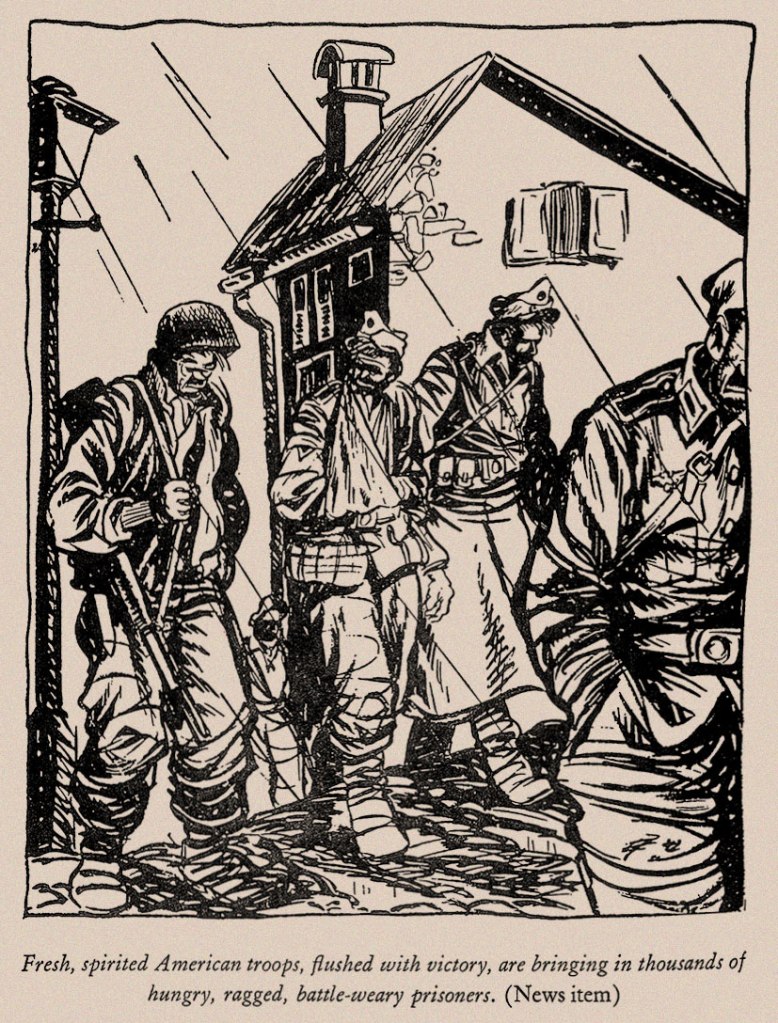
So I’ll stick to one post for the nonce (Shel and Tom will have to wait) and feature one of history’s greatest soldier cartoonists, William Henry “Bill” Mauldin (1921-2003), twice recipient of the Pulitzer Prize (1945, 1958), the Legion of Merit… and a host of other distinctions, both military and civilian.

Our baby-faced artist photographed during WWII.

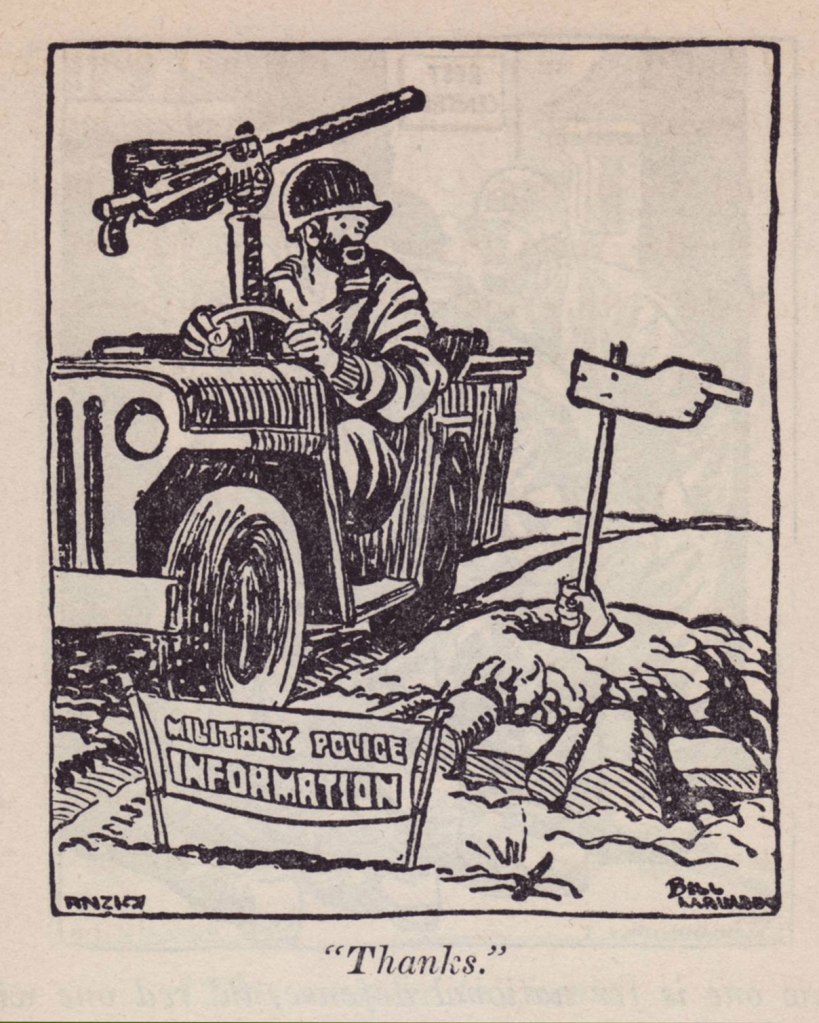
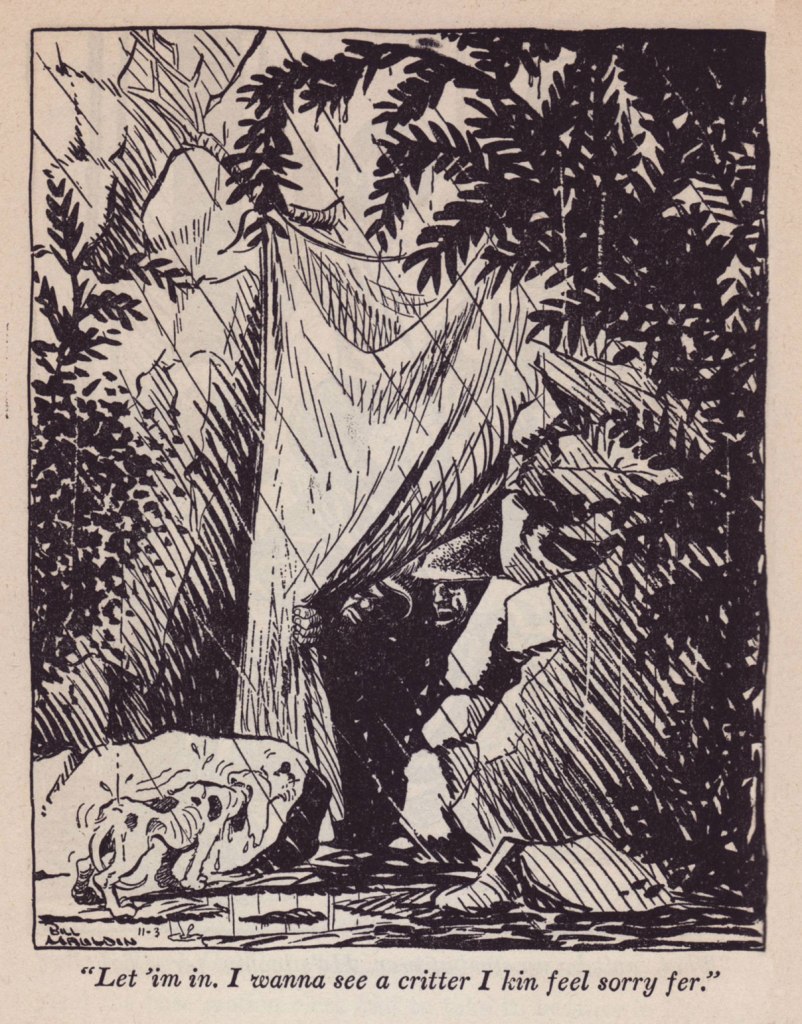
With but a single exception, the following are samples from his essential Up Front collection (1945), which Mauldin humbly opens with: « My business is drawing, not writing, an this text is pretty much background for the drawings. »

But such a background! Mauldin is, naturally, funny and insightful, but there’s much to learn therein, not merely about men in war, but just about everything under the sun. While so many nowadays mix up freedom and privilege, it’s good to be gently reminded of the high price of both.

« Until some intelligent brass hat repaired a big brewery in Naples and started to send beer to Anzio, the boys at the beach-head were fixing up their own distilleries with barrels of dug-up vino, gasoline cans, and copper tubing from wrecked airplanes. The result was a fiery stuff which the Italians called grappa. The doggies called it ‘Kickapoo Joy Juice’, and took the name from the popular ‘Li’l Abner’ comic strip which Stars and Stripes printed daily. It wasn’t bad stuff when you cut it with canned grapefruit juice. »
Mauldin’s biographer, Todd DePastino, wrote, in his Bill Mauldin: A Life Up Front: « First published on October 13, 1944, this cartoon made the 23-year-old Bill Mauldin the youngest Pulitzer Prize winner in history. Both he and his editors at Stars and Stripes were astonished by the selection, which did not seem to them particularly noteworthy. »

For a deeper dive into Mauldin’s war through the eyes of his ragged infantrymen, scrounge yourself a copy of Fantagraphics’ glorious Willie & Joe: The WWII Years (2008).

In closing, shall we hear from another president?

« I have great respect for the news and great respect for freedom of the press and all of that. » — Donald J. Trump

-RG

Barracks Life With Le Sergent Laterreur

« Le sergent Laterreur resembles no-one. It’s impossible for anyone to be so ignoble, so sinister, so cruel. One feels that the two poor bastards that created him are exacting their revenge for all the humiliations suffered at the hands of the strong. One wouldn’t have been surprised to discover that the authors of Sergent Laterreur were Jewish, Black, Irish or Czech. They’re Belgian. » — Georges Wolinski

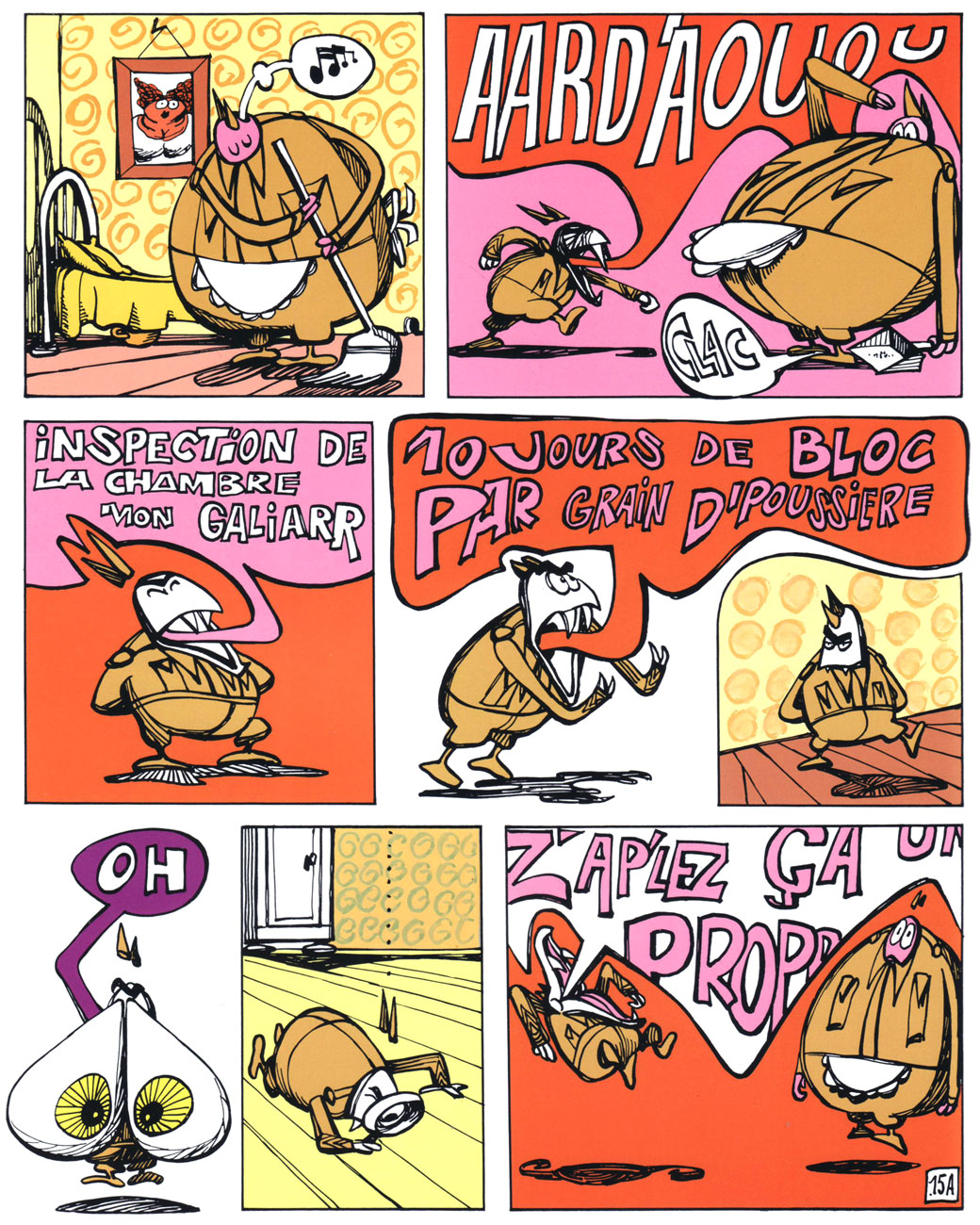
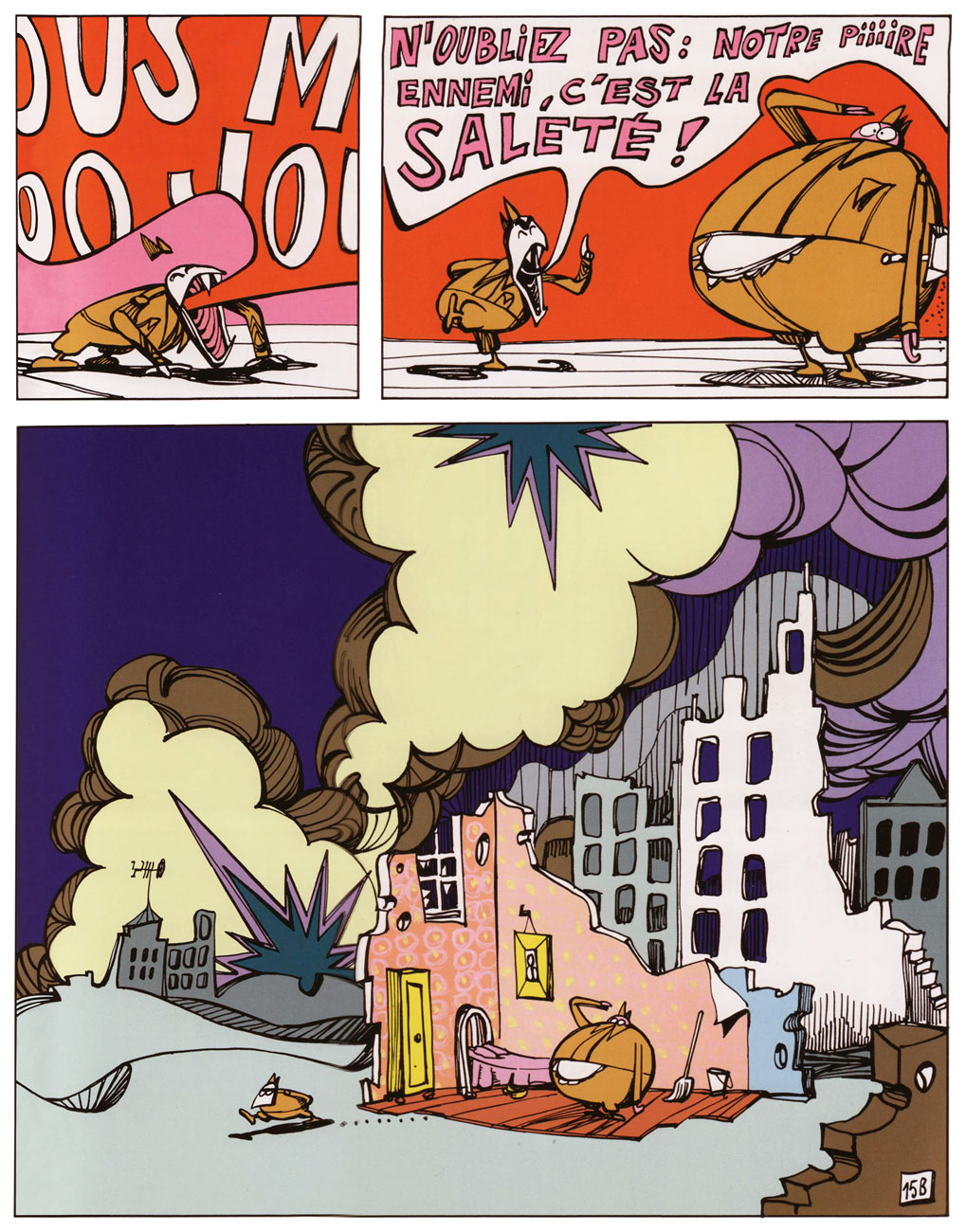
“Le Sergent Laterreur” is a strip that ran in the fabled bédé weekly Pilote from February 1971 to December 1973.

This vitriolic lampoon of military life (no Beetle Bailey this) was the brainchild of Belgians Touïs ( Vivian Miessen, b. 1940) and Gérald Frydman (b. 1942).

Pilote590A
Pilote no. 590 (February 21, 1971, Dargaud), the Sergent’s third appearance in the magazine and his first (of two) on the cover.

Laterreur4A

Laterreur4B
Episode 4: Flower Power

Laterreur15A

Laterreur15B
Episode 15: « Et tu retourneras les poussières ». The Sergent’s immortal maxim: « Don’t forget that dirt is our worst enemy! »

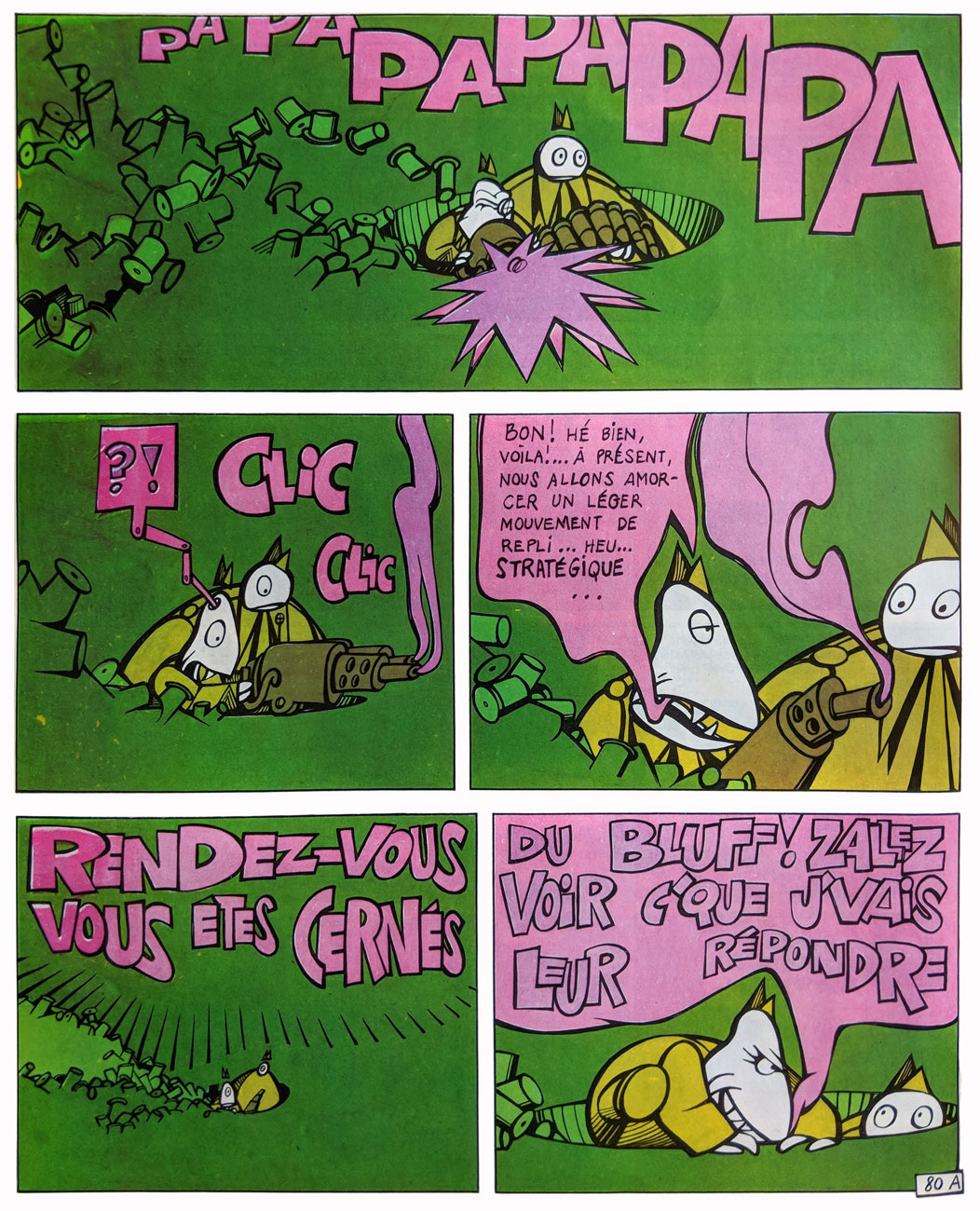
Laterreur80A

Laterreur80B
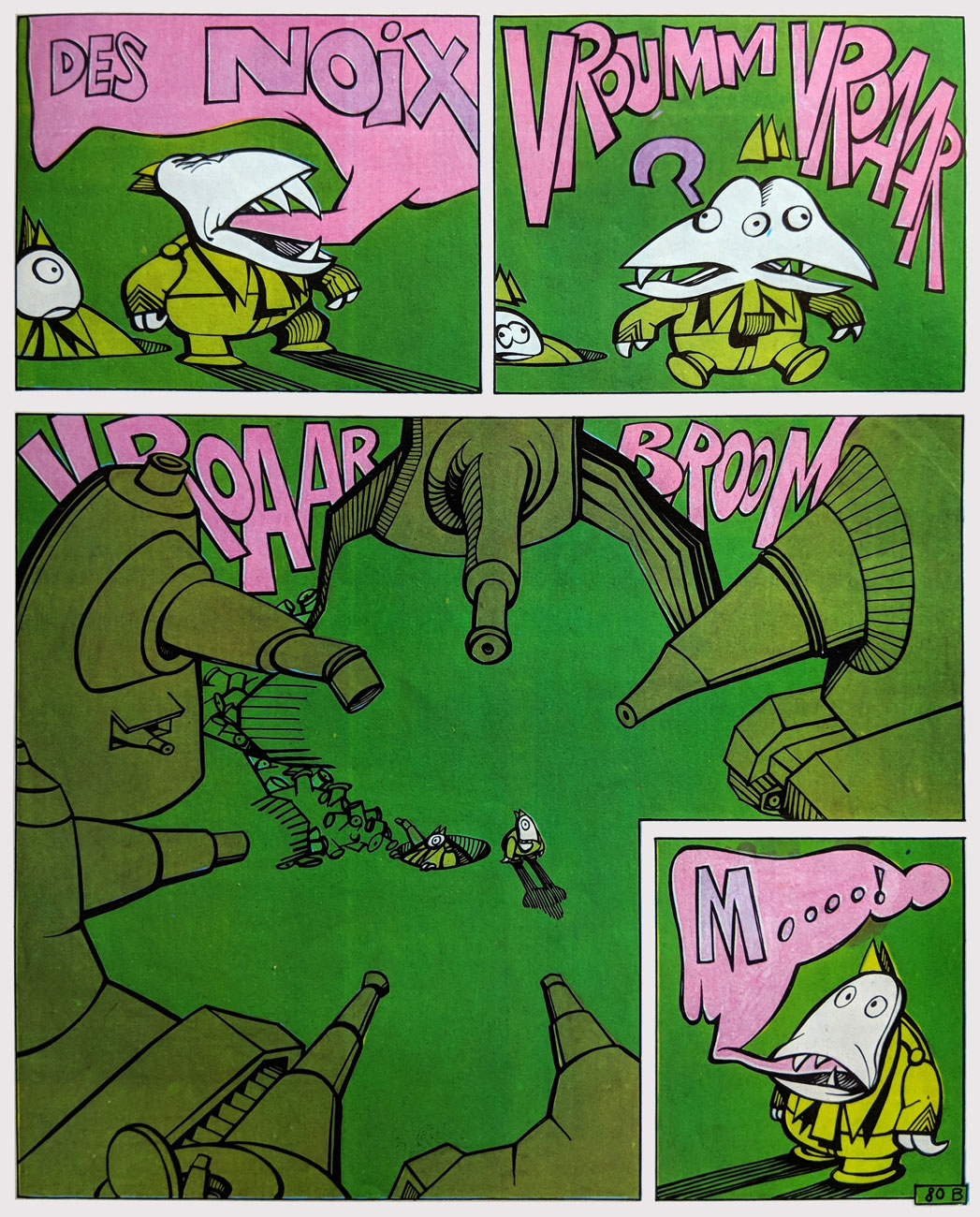
Episode 80: Les mots historiques. Laterreur thought the enemy was bluffing.

Miessen produced a few more comics during the 70s, and made a notable comeback contribution to L’Association‘s massive anthology Comix 2000, but he chiefly worked in animation. Frydman mostly pursued projects in photography and film, directing several short subjects.

Laterreur’s full effect is best experienced in massive doses, and L’Association, fully cognizant of that fact, issued a splendid Le Sergent Laterreur omnibus in 2006. An obscure creation, it remains obscure, but at least it’s available if you seek it out.

Laterreur85A

Laterreur85B
Episode 85: Du gâteau. A fitting way for a dotty old general to blow out his birthday candles.

Laterreur108A

Laterreur108B
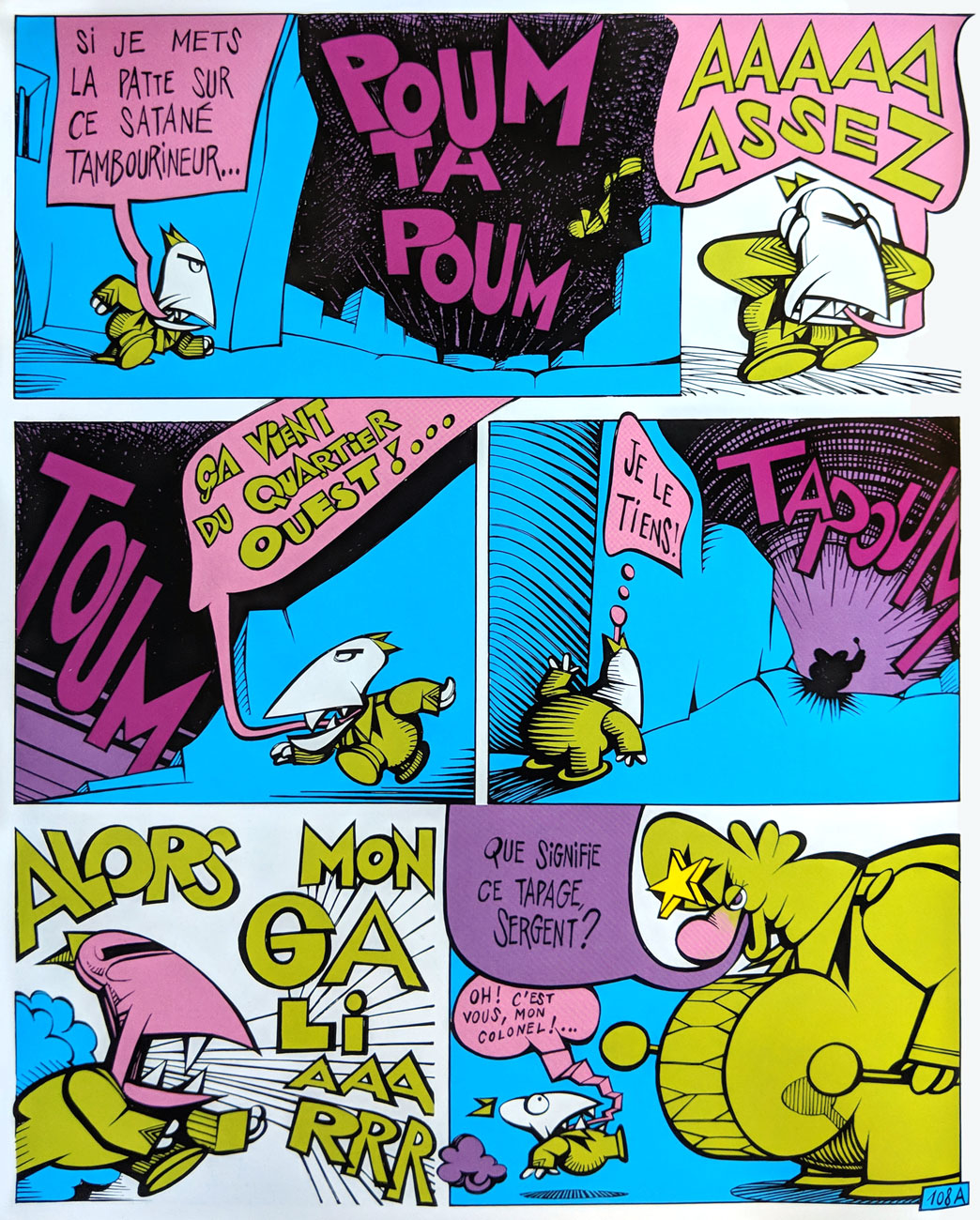
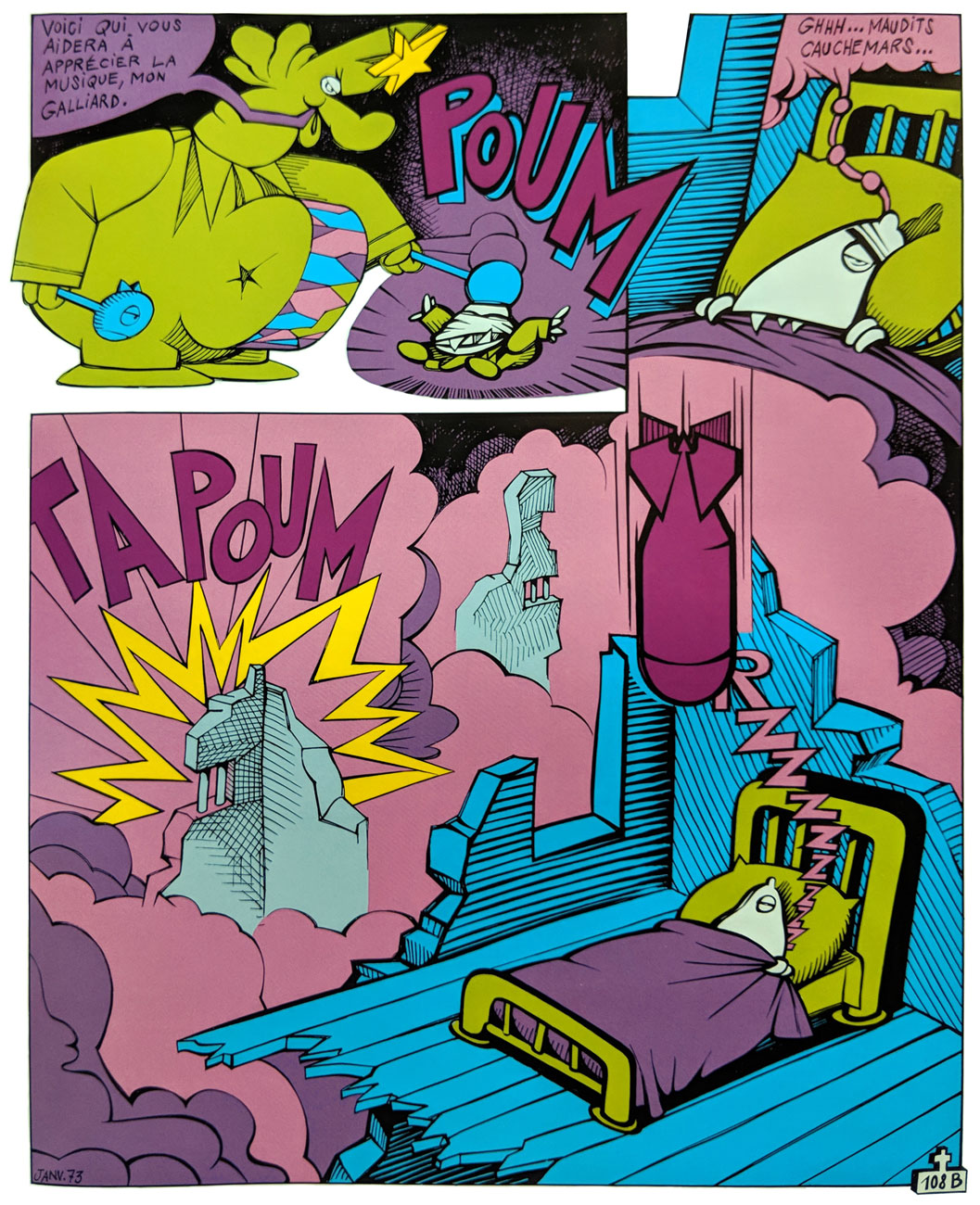
The finale, Episode 108: Tapage nocturne. Now you know how it goes down, so to speak.

Fun factoid: The strip’s name presumably comes from the French title of a USA “boot camp” Korean War propaganda film from 1953, “Take the High Ground!“, directed by Richard Brooks. and starring Richard Widmark and Karl Malden.

– RG

Dateline: Frontline – The Cary Burkett Interview, Part 3

« From time to time a sputtering doodle-bug shatters the torpor of the overcast sky. One second, sometimes two … at most three … of silence. Visualizing that fat cigar with shark fins as it stops dead, sways, idiotically tips over, then goes into a vertical dive. And explodes. Usually it’s an entire building that’s destroyed. » — Jacques Yonnet

Perhaps the title gave the game away, but we’re back with part three to wrap up (in style!) our talk with Cary Burkett on his and Jerry Grandenetti‘s (and Ric Estrada‘s) Dateline: Frontline (1977-1981).

Who’s Out There: How hands-on an editor was Paul Levitz?

CB: Paul was more hands-on at the beginning. We would have a plot conference and he would toss out suggestions and sometimes specific directions. But Paul was a very smart guy, and he had a way of figuring out how to best to work with individual writers. With me, it usually worked better to plant a seed and let it develop rather than to nail things down too tightly. I didn’t think fast in a plot conference setting, I was too intimidated by Paul’s creativity and confidence. I think Paul figured this out and found ways to drop a little guidance in that I could take time to mull over on my own.

Paul was also extremely busy, not just an Editor but the Editorial Coordinator for the whole line of DC comics, and that is a whopping responsibility. So as things progressed, he was less hands-on. I like to think he began to trust the material I was giving him.

WOT: Was there much distance between the précis Mr. Levitz assigned you to do and the scenario you handed in?

CBI don’t think so.

WOT: Dateline: Frontline is clearly a bit of a ‘pill in the hamburger’, that is to say, instructive, eye-opening material. Was this ‘Trojan Horse’ approach considered and deliberate? (Surely it wasn’t just intended as pure entertainment!)

CBIn a way, it was deliberate, although not carefully considered or planned out. The trajectory was set by Paul when he passed on to me the book The First Casualty as background guidance. The tone of that book and all the eye-opening material in it definitely influenced the approach to the series. The very idea that the main character would be a war correspondent, not a soldier or fighter, meant that these stories would have a different kind of focus. That concept came from Paul, along with the title of the series.

Of course, in comics, you could do a series with a war correspondent where the protagonist becomes a fighter, a behind-the-lines de-facto special forces soldier. If this had been a Jack Kirby strip in the ‘60’s, the correspondent would probably be thrown into situations every issue where he had to fight his way out to save threatened soldiers from some Nazi ambush. You know what I mean.

So we knew we weren’t going for pure entertainment, sure. And the more research I did, the more interested I became in the reality of what happened in the war, and the more I wanted to portray that. And since it was just a 6-page, irregular backup series, we could go in that direction.

WOT: If you were to write this series today, what, if anything, would you do differently? What effect might the intervening years and the current political climate have, for instance?

CBToo much to think about. But I will say this, I think to try to tie the series to any current political issue would tend to push it into something contrived to fit the agenda. In a way, then, it would become a kind of political propaganda, the very opposite of what the series grapples with.

That’s part of why I wasn’t so interested in setting it during the Vietnam War back in 1976 or ’77. Today, it could be put in that setting without triggering a firestorm of controversy which might drown out what the series is trying to show.

My point is that the issue of seeking truth in a time of war is not limited to any time or place. By attaching the theme to a current political hot button issue, it becomes weaker, not stronger. It becomes more limited, not broader. And it’s more difficult to hear.

My preference would be to see the series deal with the questions outside of the current political setting, and hopefully along the way to see in some way how they apply today.

Maybe that is the ‘Trojan Horse’ method you mentioned.

WOT: I’d say you nailed it.

WOT: Were you writing and planning much in advance? Are there any contemplated, but unpublished, plotlines you’d care to share?

CBI wasn’t planning specifically very far in advance. I was never sure which set of stories might be the last. But I had a vague outline in my head that I would progress through the major events of the war, choosing specific ones for Clifford to be present reporting. They would be chosen for their historical significance but also to advance general themes of the conflict between reporting the truth and trying to win a World War.

The final series of stories, I think, would have been centered on events in Hiroshima and Nagasaki, and somehow Clifford would have found a way to write a story about it which revealed some of the horrible details … which of course, would never have seen the light of day. Even now, thinking about this, some lines of dialogue closing out the series kind of come to my mind.

I see Clifford, exhausted and disappointed, having given his all to get this incredible story, bitter and at the breaking point. Like it happens to all of us sometimes, the fact that he can’t publish this story seems to him to be an event that sums up his whole life as a failure. He questions why he made such a herculean effort to get the story, why he ever even bothered to try. All his previous failures to get the truth out come back to accuse him.

Maybe it’s his old mentor, the older reporter who tried to ground him a few times, who has the last word. And those words would be about the truth, and the value of searching for it no matter the outcome. And that the truth itself will stand even if only one person knows it. And the old reporter, cynical as he might have seemed at times, would be shown to have his own ideals which have sustained him through the same battles that Clifford has fought.

Yeah, maybe it sounds a bit corny out of the context of the story. But I think I’d go there. I might even have the old reporter say something like, “Truth may seem to be the first casualty in a war. But Truth can never really die, right? Someday people will know the truth about what happened.”

HA! I never expected a story idea for Dateline:Frontline would pop into my head like that after all these years. Seems like this would be a good closing question for this interview. I appreciate you bringing it up, and thanks for giving me a chance to reminisce.

WOT: And thank you for doing it so thoughtfully and graciously.

WhoThereLogotype

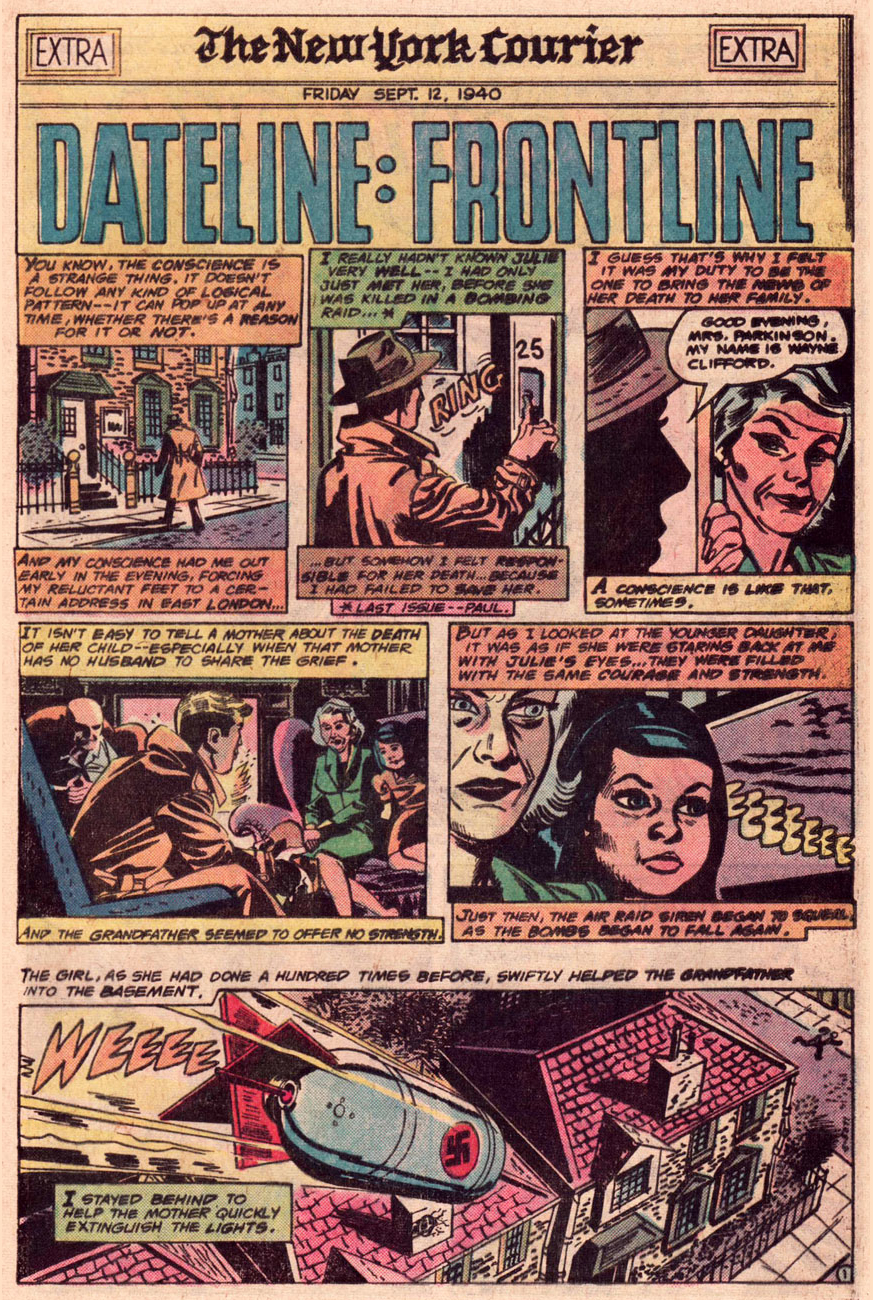
And now, to see our readers off with a story, here, as promised last time, is the concluding episode of Dateline:Frontline’s London trilogy.
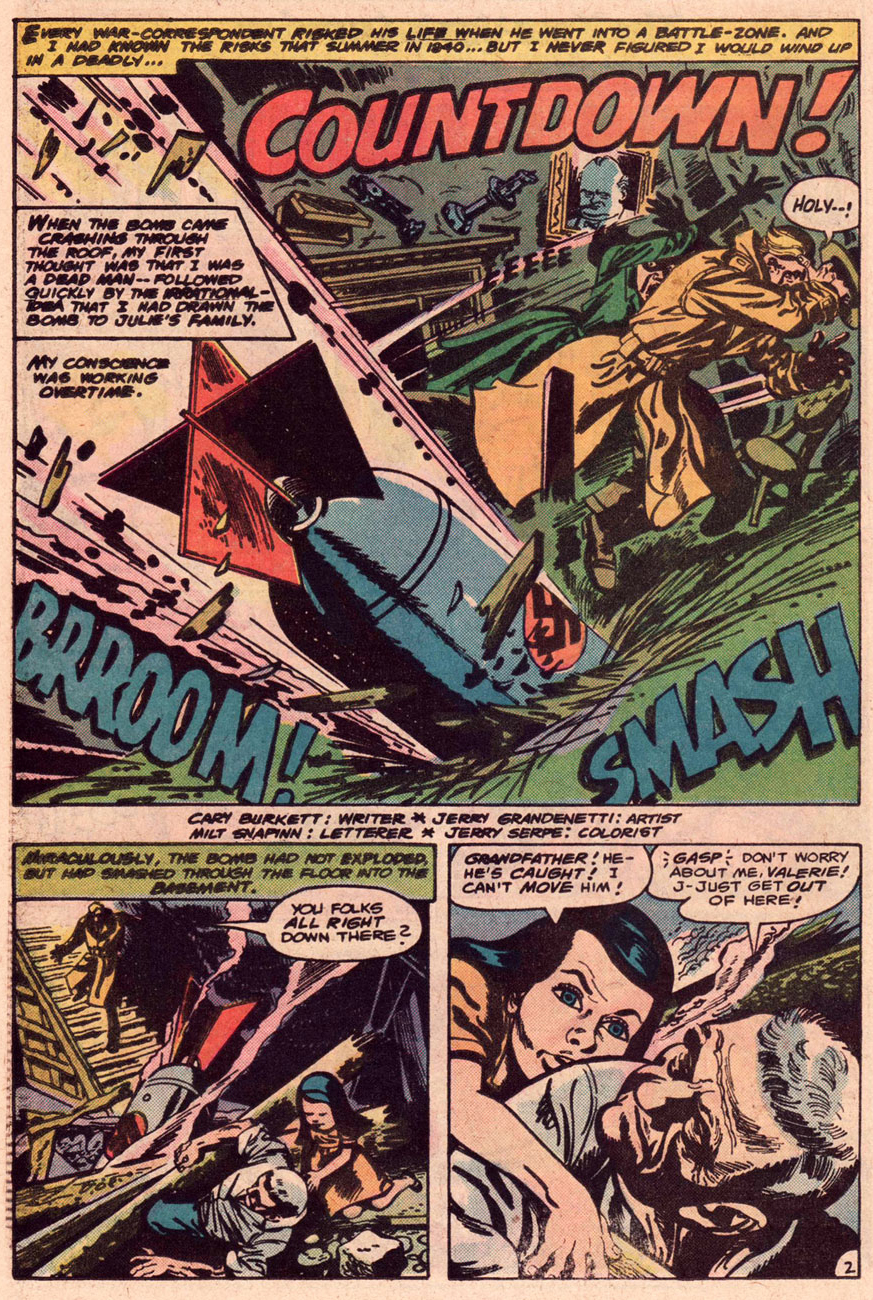
Dateline3London01ADateline3London02ADateline3London03ADateline3London04ADateline3London05ADateline3London06A

And as a parting bonus, a vintage in-house biography of young Mr. Burkett!

BurkettBio78A

-RG