Tentacle Tuesday: All Aboard the Batmarine!

« Even without the benefit of philosophical reflection, anyone who has spent some time in an enclosed space with an excited bat knows what it is to encounter a fundamentally alien form of life. » (Thomas Nagel, What is it like to be a bat?)

Bats and octopuses, now there’s a combination that doesn’t often occur in nature – while both are admirable, fascinating animals, they’re not linked by lifestyle or environment, and neither is the other’s prey. Batman, on the other hand, has definitely tangled with many tentacled monsters in his time (which proves that he’s not a bat). I’m sure today’s post didn’t unearth *all* the octopuses that Batman has had the pleasure of defeating, especially those of a more modern vintage (with mostly horrible art, which is why I’m not too worried)… but today’s selection, you will have to admit, is quite fair.

The Voyage of the First Batmarine!, scripted by Edmond Hamiton, pencilled by Dick Sprang and inked by Charles Paris, was published in Batman no. 86 (September 1954).

Batman86A

Bat-Mite Meets Mr. Mxyzptlk (he must be from Poland, with a name like that), scripted by Jerry Coleman, pencilled by Dick Sprang, and inked by Sheldon Moldoff, was published in World’s Finest Comics no. 113 (November 1960):

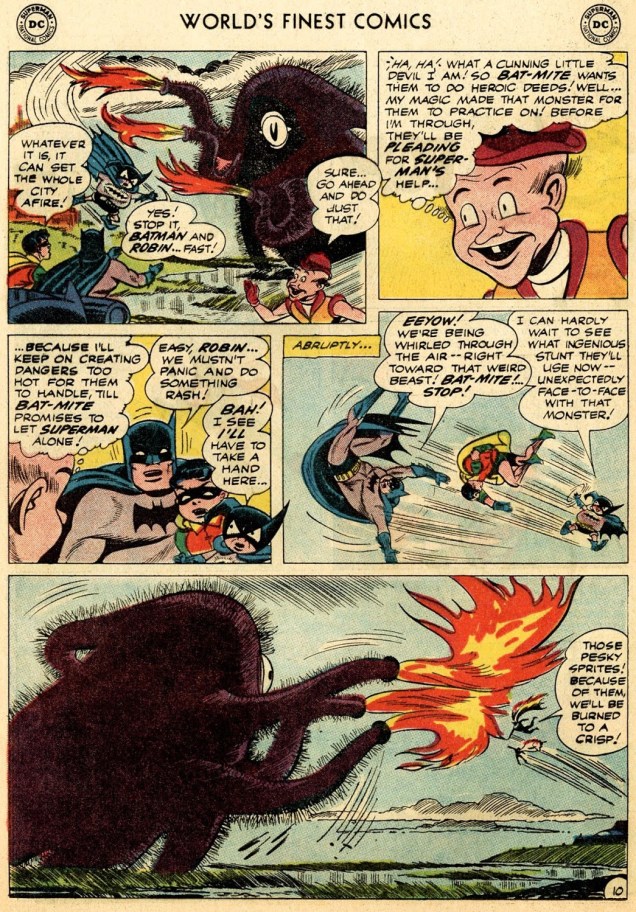
World'sFinestComics113
I totally squee-ed when I saw this panel.

World'sFinestComics113-2

Justice League of America no. 27 (May 1964), with the cover pencilled by Mike Sekowsky and inked by Murphy Anderson:

JusticeLeagueofAmerica027A

The inside story, The “I” Who Defeated the Justice League! is scripted by Gardner Fox, pencilled by Mike Sekowsky, and inked by Bernard Sachs:
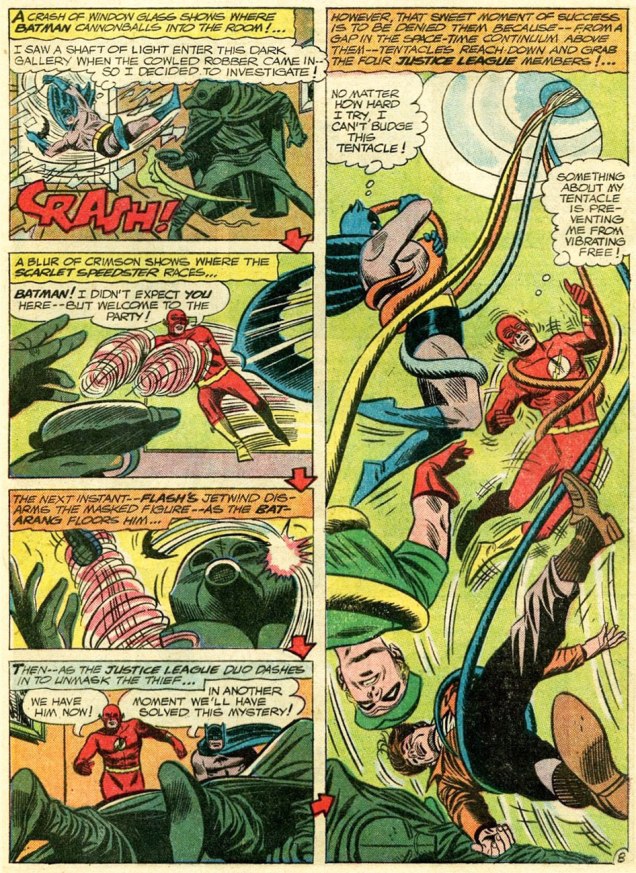
SekowskyJLA27A

Batman no. 357 (March 1983). Cover pencilled by Ed Hannnigan and inked by Dick Giordano:

Batman357A

The cover story, Squid, is scripted by Gerry Conway, pencilled by Don Newton, and inked by Alfredo Alcala:

Batman357-SquidA

Since they threatened us with the continuation of the story, I followed up, and dug up more tentacles. Deathgrip, scripted by Gerry Conway, pencilled by Don Newton and inked by Dick Giordano, was published (as promised) in Detective Comics no. 524 (March 1983):
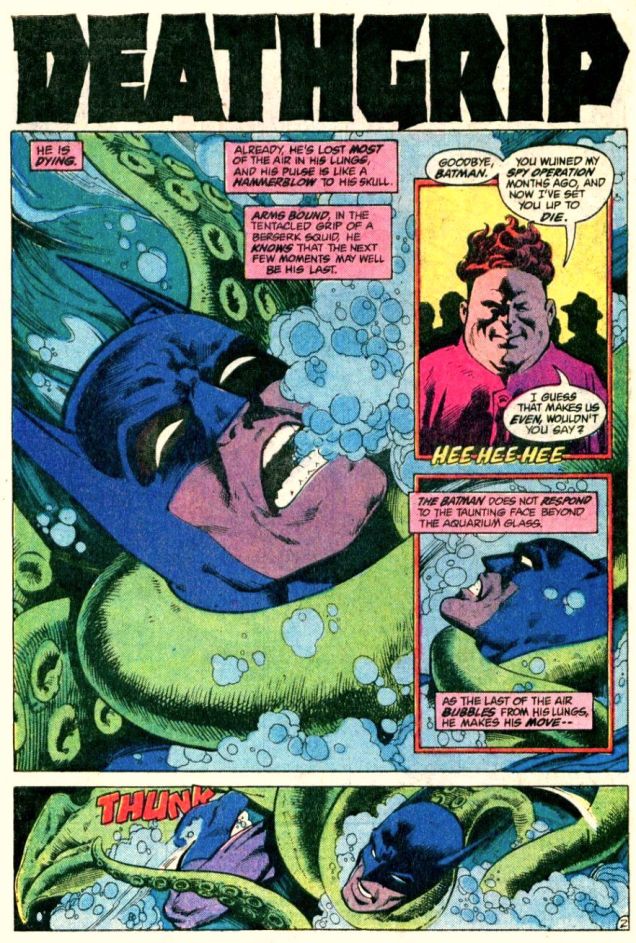
DetectiveComics524

Enigma of the Death-Ship!, scripted by Bob Haney and illustrated by Jim Aparo, was published in The Brave and the Bold no. 142 (July-August 1978):
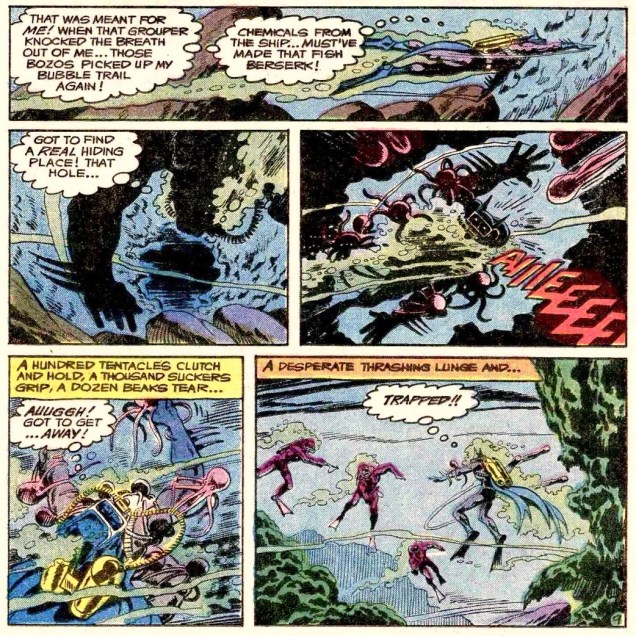
BraveandtheBold142

I mentioned modern comics, earlier – I’ve chosen two examples published relatively recently, with passable art.

The pompously titled Leaves of Grass, Part 3: Comedown!, scripted by Alan Grant, pencilled by Dave Taylor and inked Stan Woch, was published in Batman: Shadow of the Bat no. 58 (January 1997):
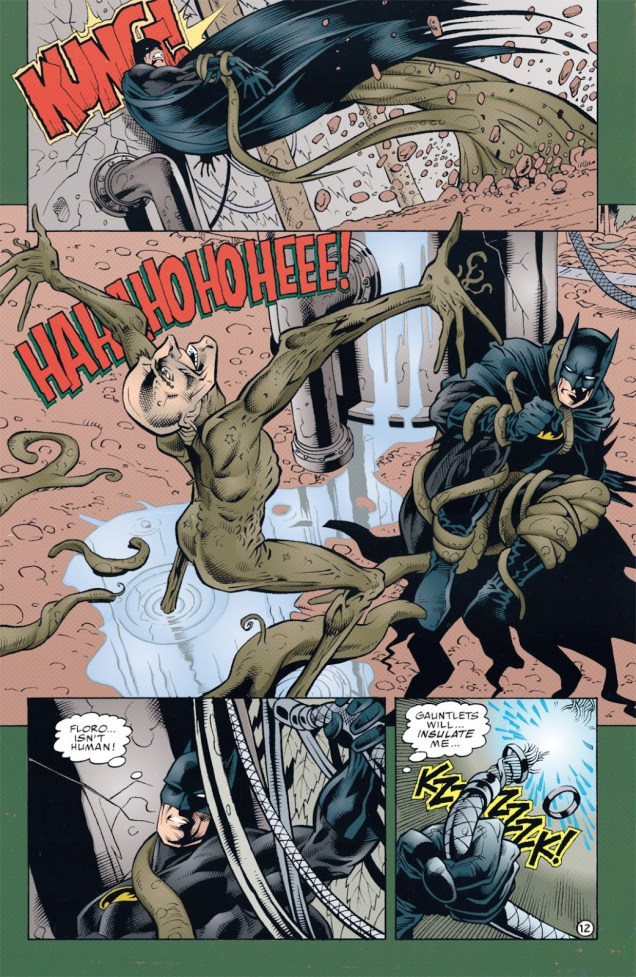
Batman-shadowofthebat58

Knightmares, Part 4, scripted by Tom King and illustrated by Jorge Fornes, was published in Batman no. 66 (May 2019):
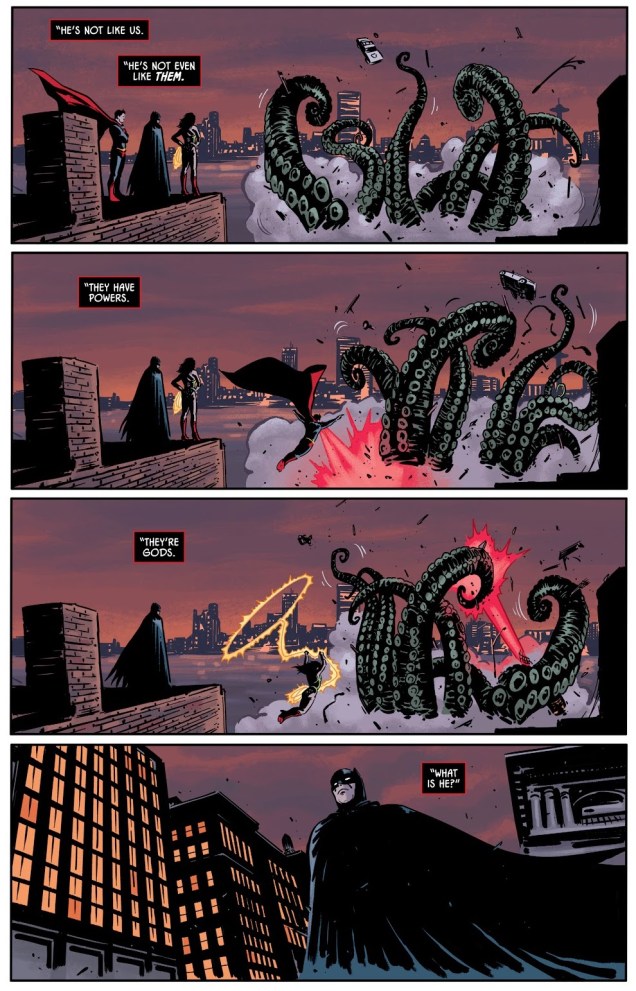
Batman66-Jorge Fornes

To conclude on a more pleasant note…

Tentacled Terror, number 8 in Topps‘ 1966 Batman ‘Red Bat’ trading card set, boasting painted artwork by Norman Saunders.

SaundersBatmanCardA

∼ ds

Tentacle Tuesday: Rahan to the Rescue

« Rahan n’a plus peur de la nuit, ni du feu, ni du tonnerre du ciel, ni des fleuves sans fin… »

(Rahan no longer fears the night, nor fire, nor the sky’s thunder, nor endless rivers…)

Even non-European readers will probably have some familiarity with handsome troglodyte Rahan, one of the heroes of the Franco-Belgian bande dessinée.

In 1969, Rahan made, to general acclaim, his début in the inaugural issue of Pif Gadget: apparently his escapades appealed to both male and female audiences. The series was created by writer Roger Lécureux and artist André Chéret, both seasoned comic pros by then. His adventures spanned years upon years of publication and spawned legions of rabid fans. To give you an idea of what “many years” implies, the last album – with new material! – came out in 2012; the collected series, which gathers material between 1969 and 1999 (30 years of the Lécureux – Chéret team), took up 26 handsomely-printed hard-cover volumes.

The following sequence is from La flèche blanche, originally published in Pif Gadget no. 90 (Nov. 1970), and reprinted in colour in Rahan no. 7 (Oct. 1973).

RahanPieuvre01A

RahanPieuvre02A

RahanPieuvre03A

RahanPieuvre04A

I first encountered Rahan on his home turf, which is to say in some old issues of Pif Gadget. I am not a big fan of the prehistoric genre, as it demands a more momentous suspension of disbelief on my part than I can provide. (The endless parade of clean-shaven blonde hunks accompanied by female nubile savages is a little too much for me.) Besides, Pif Gadget offered far more fascinating strips to focus on, so I happily skipped over the adventures of Rahan, just as I would gleefully ignore Les pionniers de l’espérance (same writer as Rahan) or the boringly handsome Docteur Justice (not the Marvel one).

However, I have to (grudgingly) avow that Rahan doubtlessly had great things going for it. Its strengths are also what seems to provoke some modern readers into dismissing Rahan with a patronizing hand-wave: aligning itself with the communist nature of Pif Gadget, Rahan espoused such values as justice and equality. He was also an immensely curious young man with a scientific mindset, which led him to discovering/creating useful tools, helped him to solve problems and shielded him from the superstitious nonsense others believed. One doesn’t often run into a caveman whose leitmotif is Humanism.

I did not grow up with Rahan, having only come to Pif Gadget in the last ten years or so (through the influence of co-admin RG), but these values are well known to me from growing up on Soviet science-fiction (Russian has a nicer word, fantastika, which is much more encompassing and also includes any forays into fantasy, prehistoric or otherwise). That, too, often gets thrown under the train of « childish, naive and simplistic », the holy trinity of a jaded cynic that’s currently en vogue as a role-model.

This seems especially unfair given that the series did not shield its mostly young readers from some harsh truths about life. Death and violence accompanied our hero wherever he went, and a lot of characters he encountered were, frankly, colossal assholes, as disinterested in fairness or egalitarianism as some modern poo-pooing readers. Not to mention Rahan’s curse of solitude – orphaned twice, he is never really accepted by the tribes he bumps into during his travels. He’s either rejected as an intruder… or venerated as a sort of a god, once he creatively extricates himself (and frequently the tribe) from some predicament. Oh, and this being a French comic, there are also bare-breasted women like it’s no big deal (and even some breast-feeding).

RahanIntegrale16A
Original cover art from Rahan – L’intégrale Tome 16 (2019, Soleil).

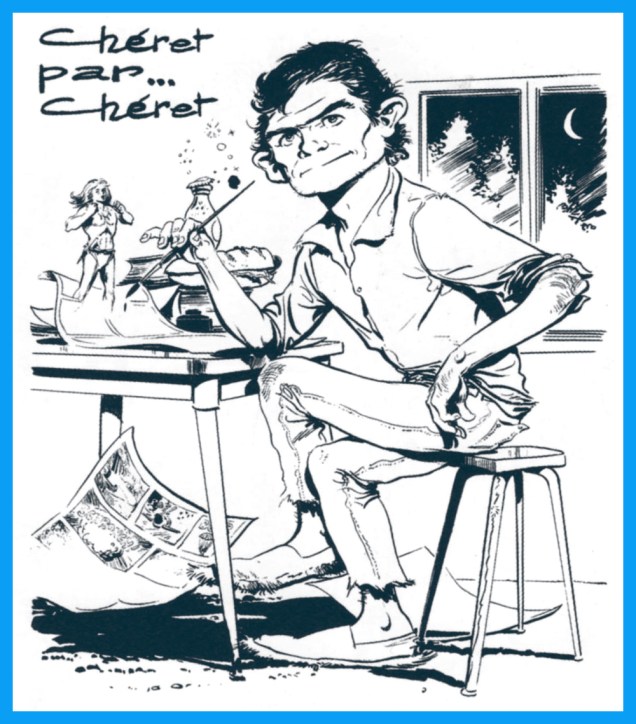
Today’s post is dedicated to André Chéret, who died less than a month ago, on March 5th. He was 82.

CheretAutoportraitA
A self-portrait of the artist, which originally saw print in Pif Gadget no. 81 (Sept. 1970).

You can read some Rahan stories here.

∼ ds

Tentacle Tuesday: Sailing Through Space on a Synthi-Biscuit*

« Take ’em from behind — best way to kill those slimy aliens! »

This Tentacle Tuesday takes us on a little trip to beautiful ol’ Albion, the land of Tharg the Mighty and « Harlem Heroes, an all-black sports team who played a futuristic airborne blend of basketball and football, obviously inspired by the movie Rollerball; Mach-1, a Six Million Dollar Man-style bionic hero; a revamped version of classic British stiff-upper-lip space hero Dan Dare; Flesh, in which time-travelling cowboys hunted dinosaurs to feed an overpopulated future society; and Invasion!, about the occupation of Britain by warlike Volgans from somewhere to the east, which played nicely into the growing fears of conflict with the Soviet Union. » (source: 40 years of 2000AD: looking back on the future of comic books) This may not sound like the Britain we know and love, but frankly it might be an improvement on today’s version of it.

The aforementioned Dan Dare got a Tentacle Tuesday all to himself, and I’ve used a couple of 2000 AD covers before, but these five are new to Who’s Out There (I don’t recycle material, other than in cases of dire emergency) – and watch out for the bonus inside story!

TentacleTuesdayLogoA

200ADProg24A
2000 AD prog no. 24 (August 1977), cover by Kevin O’Neill.
AD36
2000 AD programme no. 36 (October 1977), cover by Lopez.
2000ADProg255A
2000 AD prog no. 255 (March 1982), cover by Ian Gibson.
2000AD-programme310
Judge Dredd has quite a hard time getting rid of overly clingy admirers…  2000 AD programme no. 310 (April 1983), cover drawn by Mike McMahon.
2000AD-1814
2000 AD prog no. 1814 (January 2013), cover by Simon Davis. Retief, is that you? Click here to find more about what this cover is an homage to and what the original art looked like.

The following is from the story Food for Thought, scripted by Steve Moore and illustrated by Horacio Lalia, originally published in 2000 AD prog no. 26 (August 1977).

FutureShocks-FoodForThought

FutureShocks-FoodforThought-2.jpg

£ ds

* « You creeps must think I sailed through space on a synthi-biscuit! » (Judge Dredd in The Judge Child, Part 22 – Blind Hate!, printed in 2000 AD prog no. 177, September 1980.)

Tentacle Tuesday: Dark Tendril of Contagion

« Morticoccus is overpoweringly large and sinister! In this new world he can live — only if he destroys all other life around him — kingdoms and empires would crumble to dust at his deadly touch! Morticoccus waits in his prison — he waits to get out — and breed!! »

I apologize, but according to co-admin RG (whose sense of humour is apparently more morbid than mine) this is Contagion Week on Who’s Out There? Well, I suppose tentacled microbes and germs are as good a topic as any right now…

Our first foray into germs is This Beachhead Earth, scripted by Roy Thomas, penciled by Neal Adams and inked by Tom Palmer, published in The Avengers no. 93 (November 1971). The Vision collapses, the Avengers send Ant-Man into his body to figure out what’s amiss. I made an earnest attempt at following the plot, but the bad dialogue made my head hurt. Did you know that the scream of an ant « is like the wailing of a forsaken child »?  The story includes gems like « frankly, my dear, I don’t give an hydroelectric dam» and « therein lies the only true superiority of the educated man — that he analyzes — dissects — probes — reconstructs ». Oh, the glorious mix of bad puns and pompous lines!

TheAvengers93

TheAvengers93-2

You can read this « paltry prologue to the most portentous Avengers saga of all! », the work of a fellow who’s just a little too fond of calembours and his thesaurus, here.

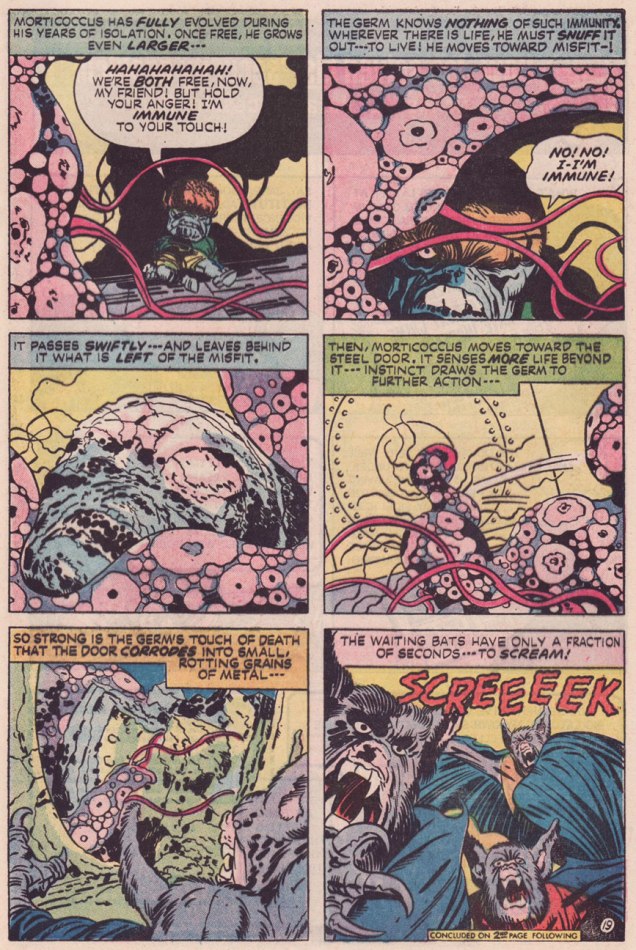
Continuing on a grand scale – this time, it’s the grandest scale there is! – we pay a visit to the aforementioned Morticoccus (sinister a’plenty, you shall surely agree), arguably the most fatal disease known to mankind, or at least the deadliest to spring from Jack Kirby‘s fertile mind (ouch) . As for me, I really like the giant, lethal bats.

KirbyKamandi10p18A
Kamandi, The Last Boy on Earth no. 10 (October 1973). Killer Germ! is written and pencilled by Jack Kirby, and inked by Mike Royer, with whom co-admin RG has conducted an interview. 
KirbyKamandi10p19A

Our third medical study is a little case of fungoid infection that even boasts a name. M’Nagalah had a rather complicated birth. Created by British horror writer Ramsey Campbell for his cycle of H.P. Lovecraft pastiches (to be more precise, the creature first appeared in the short story The Inhabitant in the Lake in 1964), it was soon adopted by DC Comics, after doubtlessly being bowled over by its puppy eyes while visiting a no-kill shelter of the Great Old Ones. It was first borrowed for Swamp Thing no. 8 (1974) and afterwards used as per the Russian idiom “a plug for every barrel“. Just look at this mess.
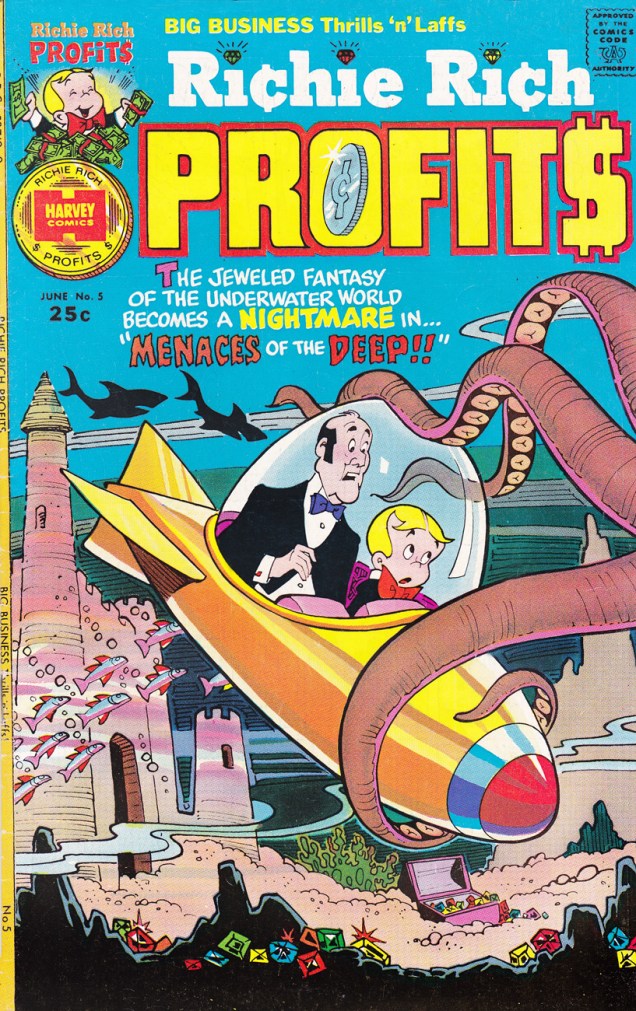
Challengers of the Unknown no. 82 (August-September 1977), scripted by Gerry Conway, pencilled by Michael Netzer, and inked by Joe Rubinstein, starts off with a just mild (if disgusting) contamination…

LegacyoftheDamned-ChallengersoftheUnknown82

That fast progresses to the old “unspeakable, indescribable horror” (yawn).

TheSoulPredator-ChallengersoftheUnknown82

Swamp Thing gets dragged in, and professor Mark Haley blooms prettily in the beginning of Challengers of the Unknown no. 82 (October-November 1977), also scripted by Gerry Conway, but this time pencilled by Keith Giffen and inked by John Celardo

ChallengersoftheUnknown83

It is soon explained that this is actually some Elder God trying, as usual, to take over the planet, blah blah blah.

ChallengersoftheUnknown83-2-GerryConway

Wishing everyone health and bon courage in these trying times, especially to our poor American friends who seem to be caught in the middle of the virus vortex… And a last strip to end on a more positive note:

CalvinHobbes-StomachMicrobes
Calvin & Hobbes strip from February 7, 1993. May our worst encounter with microbes be of the digestive variety!

Oh, all right, one more:

UncleScrooge359
Page from The Incredible Shrinking Tightwad, published in Uncle Scrooge no. 359 (November 2006). Story by Don Rosa, of course!

∞ ds

Tentacle Tuesday: Matchboxes and Woodblocks

Much like fish painstakingly climbed out of the water and became mammals aeons ago, humorous representations of life, artists’ flights of whimsical fancy or taut fight scenes from centuries gone by morphed, over time, into something that resembled more and more what everyone now recognizes as comics. Me, I like blurred lines, the point at which several trees become a forest. What fun is it to live in a world where everything is well-defined, sorted into tidy little piles? Today’s Tentacle Tuesday stretches this blog’s comics-bound raison d’être just a teensy-weeny little bit. But I believe that the kinetic energy hidden within the following illustrations, the jump-off-the-page personality of these octopuses makes them close cousins to their more modern counterparts who dwell in the seas of sequential panels and images.

Just mentally add a speech bubble or two, if you must!

First of all, I have three woodblock prints, all three from the Edo period (Edo being the old name for Tokyo). The latter term refers to the period between 1603 and 1868 in the history of Japan, and is of interest  because it was characterized, among other things, by a flourishing interest in culture, be it music, poetry, theatre, or, more relevantly to the current post, art. That famous woodblock print, the Dream of the Fisherman’s Wife, which I have no need to include because of its ubiquity, was not the first painting featuring a woman in the embrace of an octopus. Yet it’s probably the most influential one, precursor of the hentai now so entrenched in popular culture…. and it was created during the aforementioned Edo era by Katsushika Hokusai (who, incidentally, also brought into existence the ever-popular The Great Wave off Kanagawa, ensuring the relative immortality of his art.)

Collectively, the work crafted during the Edo era (not necessarily woodblock prints, although these seemed to predominate, but also paintings) is referred to as Ukiyo-e, which in Japanese vaguely means something like “images of a floating world”. Poetic as usual, the Japanese.

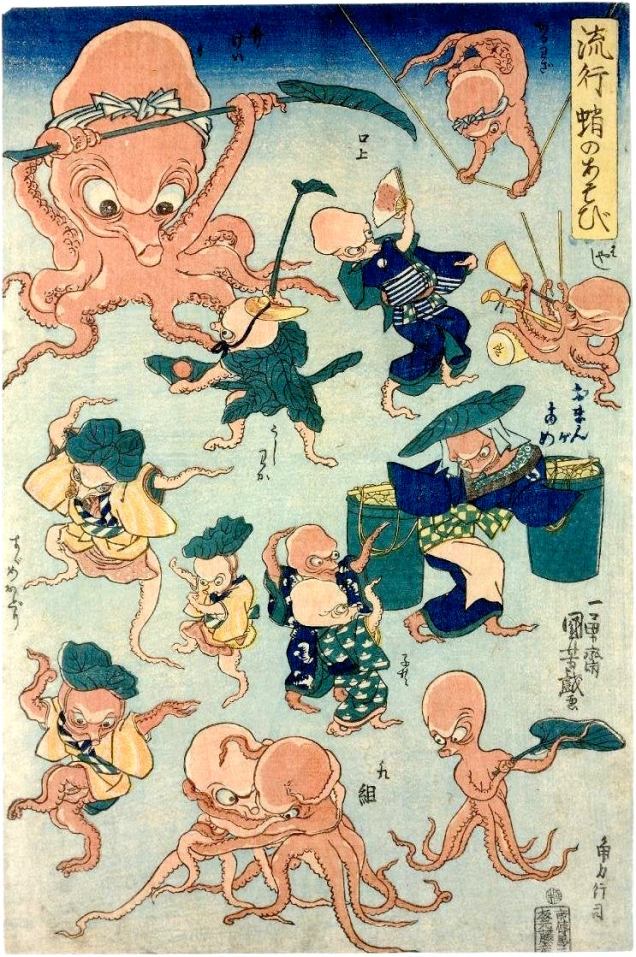
The fist woodblock print is entitled “Ryuko tako no asobi“, or The Fashionable Octopus Games. The British Museum (which seems to currently own this piece) describes it as « Octopuses re-enacting human amusements, such as the fight between Ushiwakamaru and Benkei on Gojo Bridge (top left) and sumo wrestling (bottom centre), dance, sword play, music, acrobatics, and other activities. » The artist is Utagawa Kuniyoshi.

Utagawa Kuniyoshi-OctopusGames

The second one, a triptych, is called One Hundred Turns of the Rosary and belongs to the One Hundred Wildernesses series, which shows « a procession of demons who appear throughout the night, offering a spectacular visual encyclopedia of supernatural creatures of premodern Japanese folklore » (description from the website of The Metropolitan Museum of Art). The artist is Kawanabe Kyosai.

Kawanabe Kyosai-one-hundred-wildernesses

My favourite is the following woodblock print by Utagawa Kuniyoshi, who had a great fondness for cats and inserted them seemingly everywhere. Visit this gallery of his cat-themed art over at the Great Cat blog, from which I’ll quote a paragraph for those who aren’t inclined to follow links:

« Utagawa Kuniyoshi was a great cat lover, and it was said that his studio was full of them. Often he could be seen working with a kitten snuggled up in his kimono. An apprentice, Yoshimune, reported that when one of Kuniyoshi’s cats died, he would have it sent to a nearby temple, and a Buddhist altar for his deceased cats was erected in his home. There he kept tablets with the cats’ Buddhist names on the altar. Kuniyoshi’s love of his felines spilled over into his art. Cats fill many of his compositions and he even began to give Kabuki actors cat faces. Kuniyoshi’s Ume no haru gjusantsugi was performed in 1835. A cat has shape-shifted into an old woman while a cat wearing a napkin dances while a cat licks the lamp. The cloth on the cat’s head represents the folk belief that cats would steal napkins and would dance together and howl “Neko ja!” (We are cats!). Cats often times licked Japanese lamps of the period because they were fueled with fish oil. »

A_cat_dressed_as_a_woman_tapping_the_head_of_an_octopus

I’ll doubtlessly howl “Neko ja!” at the next available opportunity.

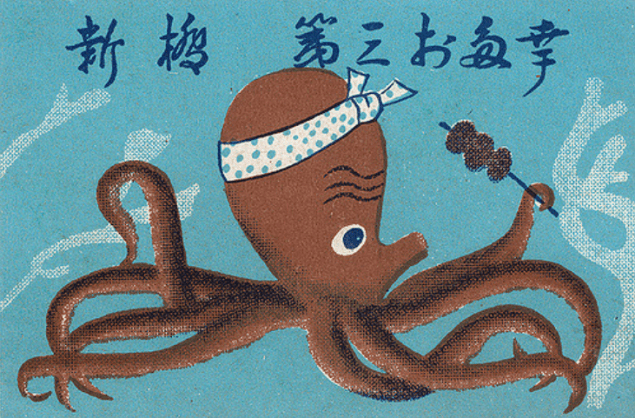
Moving on, we have two illustrations from Japanese matchboxes.

First, a Japanese matchbox from around 1920s-40s. This little guy comes from a collection posted by Jane McDevitt, who’s passionate about matchbox art. I also really enjoyed her Eastern European matchbox label collection, which you can admire here.

Japanese-Matchbook-Tentacles

Of further interest on this topic is this comic strip by Roz Chast about her predilection for collecting matchbox art, published in the April 4, 2016 issue of New Yorker Magazine. As it turns out, Chast rejects the hassle of actually owning them, preferring to keep her collection as digital files. I suppose I am a collector, for I definitely prefer “owning” the physical version of things that interest me, but to each her own!

And another matchbox octopus from the 1950s:

Japanese-matchbox-1950

And it’s « goodnight from me »!

– ds

Tentacle Tuesday: Slidin’ Down the Cinema Sewer

Due to unforeseen computer troubles (are those ever anticipated?), the program I was planning for today is postponed, as I don’t quite have access to the needed files. It’s Robin Bougie (Canadian “artist, writer, publisher and general sleaze visionary“) to the rescue! His film (maga)zine Cinema Sewer boasts a panoply of fun covers by a sturdy cadre of illustrators. To this I might add that this naughty publication doesn’t nearly receive all the lovin’ it deserves, so I’m all in favour of (well-earned) hype.

In case you’ve never heard of it, here’s a review by Richelle Charkot of a random issue (no. 28, if you should ask), which is representative of the whole series in general:

« Robin Bougie does it again with another enthralling and disgusting chapter in the Cinema Sewer series. This set of fascinating essays on cult films, genre films, vintage porn and their attendant subcultures is meticulously assembled as usual, with hand-written text and amazingly sultry illustrations largely written, drawn, laid out and published by Bougie himself. Cinema Sewer is so readable that it could potentially be quite easy to burn through, but thanks to Bougie’s wealth of dirty knowledge, there is plenty to *ahem* chew on, so you won’t destroy the issue too quickly. The zine covers everything from the life of pornographic photographer Johnny Castano (of which Bougie describes his work as “an artform”), to Lili Marlene, aka ‘The Forgotten Anal Princess’, with dozens and dozens of alt-cinema reviews to peruse through. As with its previous installments, Cinema Sewer is definitely an acquired taste, and many may be offended by Bougie’s tendency to be incredibly crass and fast and loose with colloquial genital terms that might unsettle some readers. But for those who are not weak of heart and possess a desire to learn, let this series be your quintessential guide to the underbelly of film. »

00
Cinema Sewer no. 16 (2005). Cover by Danny Hellman, who not only has a peculiar sense of humour (it’s a compliment, Danny!), but is also an excellent tour guide through the wilds of Brooklyn.
Cinema Sewer17
Cinema Sewer no. 17 (2005), cover by Mike Hoffman. This scene raises far more questions than could possibly be answered.
CC00
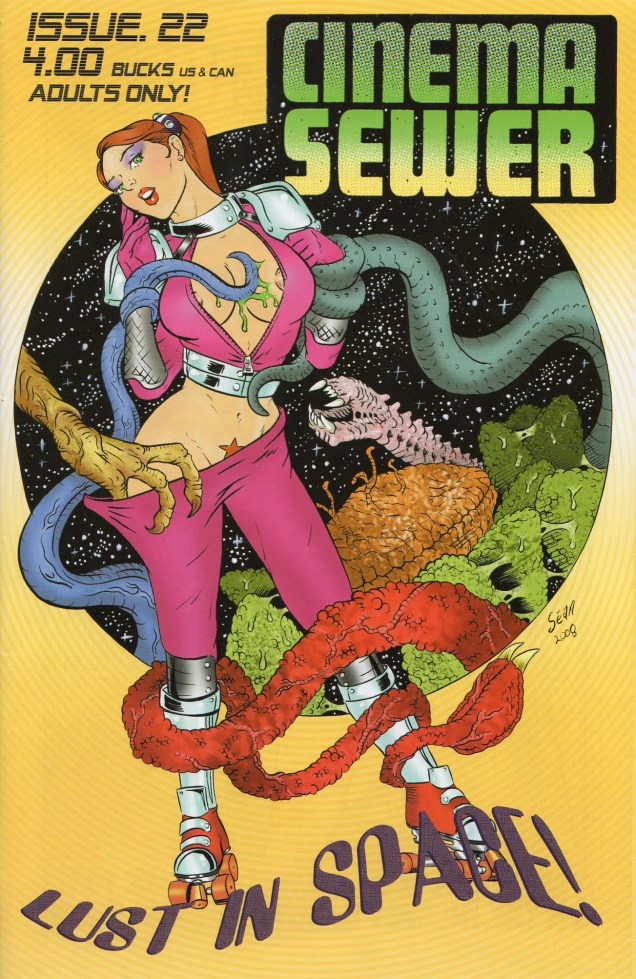
Cinema Sewer no. 22 (2009), with a cover by Sean Donahue. Her expression seems to be saying “ah, come on, you guys…” There’s some mysterious link between roller skates and tentacles – just take a gander at John Pound’s cover for Commies from Mars no. 3.
CinemaSewer26A
Cinema Sewer no. 26 (2013), cover by Canadian comics artist James Stokoe. I find his work (and colours) to be a bit hit or miss, but I loved his (currently unfinished) Orc Stain and quite enjoyed Wonton Soup.
CinemaSewer31A
Cinema Sewer no. 31 (2018). Cover by William Skaar, who clearly entertains a certain fondness for both tentacles and big-chested girls (just take a peek at his website or his Kickstarter project). Well, don’t we all? 😉

– ds

Tentacle Tuesday: By the Sign of the Jack-in-the-Box Harlequin

As Tentacle Tuesday creeps by once again, we found ourselves knee-deep in ghosts and devils – adorable, baby-featured ones. As a matter of fact, if you’re the kind who breaks out in hives when exposed to an overdose of cuteness, I would suggest skipping this week’s installment.

harveycomicslogo

The best-known titles published by Harvey Comics, whether comic book adaptations of an animated cartoon (for instance, Casper the Friendly Ghost or Baby Huey, both adapted from Paramount’s Famous Studios cartoons) or original series, are certainly no passion of mine for the simple reason that the stories are, for the most part, quite boring. Their strained slapstick elicits, at best, a semi-chuckle: each character is so tied to a shtick that the whole thing becomes predictable very quickly. Hot Stuff, the little devil with temperature regulation problems, constantly burns through and/or melts stuff. Little Dot draws polka dots on everything – or hangs out with giraffes. Little Lotta demolishes all food in sight à la Garfield. Richie Rich swims in money, eats money, inhales money. Wendy the Good Little Witch is nauseatingly boring (I disagree with that being a viable definition of “good”).

All of these characters have redeeming features – their heart is in the right place and they enthusiastically come to the aid of friends and animals. The Harvey Girls, as they’re called (Little Lotta, Little Dot and Little Audrey) are clever and enterprising, if spoiled and headstrong, which is a pleasant change from females in need of rescuing. I wouldn’t go as far as calling their antics “proto-feminist”, notwithstanding the lofty claim made to that effect in the introduction to the Dark Horse Harvey Girls anthology.

One can hem and haw about it all day, but there is one redeeming and indisputably striking feature, and it’s one to contend with: the covers are beautiful! Lovingly designed, gorgeously coloured, they’re pure eye candy.

We have artist and art editor Warren Kremer, who worked at Harvey for some 35-odd years starting in 1948, to thank for that. See my colleague’s Little Dot’s Playful Obsession and his spotlight on Spooky the Tuff Little Ghost for more details. Me? I shall simply concentrate on tentacles.

CasperandNightmare21
Casper & Nightmare no. 21 (1968). Casper the Friendly Ghost was adapted from Famous Studiosanimated cartoon, and soon gave birth, so to speak, to a score of spinoffs, such as Spooky the Tuff Little Ghost and Wendy the Good Little Witch.
Richie-Rich-128
Richie Rich no. 128 (September 1974). Richie Rich, yet another Warren Kremer character, debuted in Little Dot. Don’t you just love the super-bashful octopus?
DevilKids-Starring-HotStuff-67
Devil Kids Starring Hot Stuff no. 67 (December 1974). Hot Stuff the Little Devil is another Kremer character.
RichieRichProfits5
Richie Rich Profits no. 5 (June 1975)
CasperDigest2A
Casper Digest no. 2 (December 1986). This would be a far nicer image sans all the page-cluttering copy (and bar code)!

~ ds

Tentacle Tuesday: Your Dime’s Worth of Tentacles!

Some folks seem to display a knee-jerk reaction to the legacy left behind by men and women who lived decades ago: that of condescension. Surely, if it was something that our grandparents believed in, something that made their imaginations soar or intrigued them, by now it’s no longer relevant or just utterly jejune. Frankly, I’d poo-poo this repulsive straw-man I’ve just erected, if it wasn’t for the fact that these narrow-minded airheads actually do live among us. “I’ll listen to music from before my time when today’s musicians stop releasing such excellent music”, somebody daft once opined, and the same (ahem) logic seems to be apply to other forms of culture. If TV shows from two years ago are ancient (overheard at a restaurant), what can we possibly think of comics from 70, 80 years ago?

As you probably noticed, this blog suffers from no such delusions: there’s plenty of intelligent, touching, excellent-all-around material to be dug up from (in this instance) the Golden Age.

Sorry about the varying quality of the images; some of these stories have been reprinted in recent years (and thus, thoroughly cleaned up, or even lovingly restored from original art); and some of them are only available in the original form, which is to say shoddily printed, dubiously coloured, and not all that well preserved. The Golden Age was, as I noted previously, a long time ago…

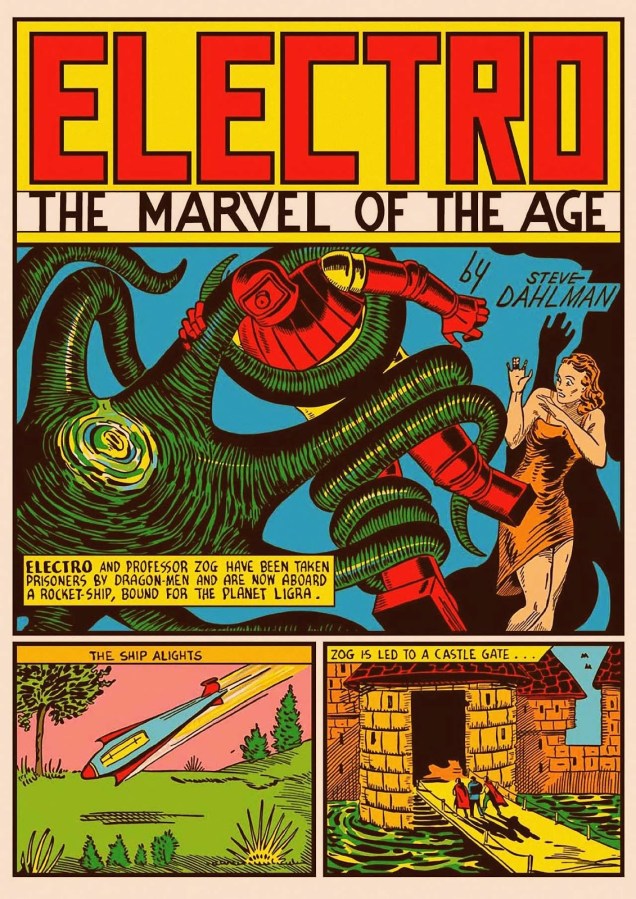
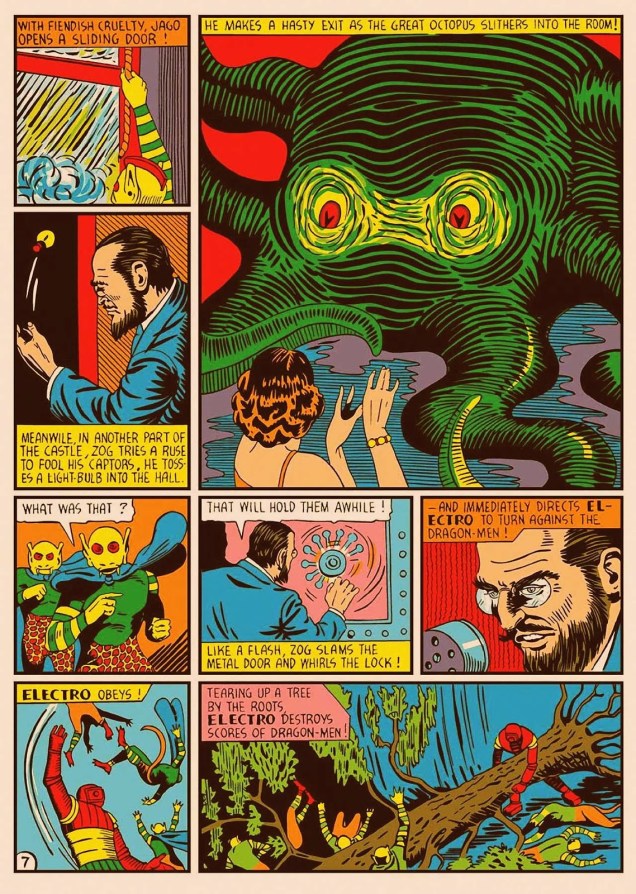
All right, let’s begin! I have a few favourites in this post, and our first story is one of them. I had access to a pristine, cleaned up, painfully white-papered version of it from Golden Age Marvel Comics Omnibus no. 1 (2009), but I by far prefer the following version, which keeps the colours, shall we say… less blinding? This is On the Planet Ligra, originally published in Marvel Mystery Comics no. 9 (Marvel, July 1940). It is  scripted by Steve Dahlman, who did a very nice job of it, too. It’s worth a read in its entirety; find it here.

Marvel Mystery Comics no. 9-ontheplanetLigra

Marvel Mystery Comics no. 9-ontheplanetLigra2

Marvel Mystery Comics no. 9-ontheplanetLigra3

The next few pages demonstrate the dodgy printing I was referring to earlier…

PlanetComics4-tentacles
Slave Planet is scripted by Herman Bolstein (as Starr Gayza; what a nom de plume!), and illustrated by Arthur Peddy, possibly with some help by Will Eisner on inks. Published in Planet Comics no. 4 (Fiction House, April 1940). Incidentally, we have a whole bevy of Fiction House Tentacles at Tentacle Tuesday: Planet of Tentacles, courtesy of Fiction House.
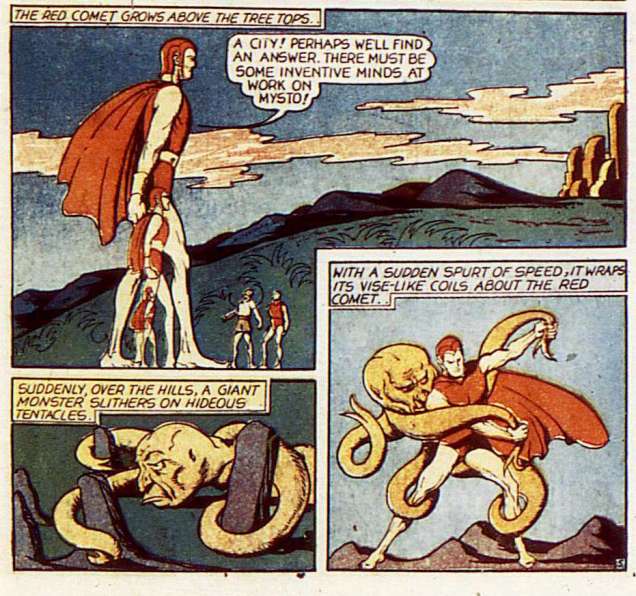
CometPlanet8-MysteryoftheVanishingMen-The-Red-Comet1
Mystery of the Vanishing Men, published in The Red Comet no. 8 (Fiction House, September 1940), is illustrated by Alex Blum.
CometPlanet8-MysteryoftheVanishingMen-The-Red-Comet
Another page from Mystery of the Vanishing Men.

This next part I like a lot, because I’m quite fond of Henry Fletcher, Barclay Flagg and perhaps even Hank Christy. These are all the same person, of course: Fletcher Hanks, The Most Bonkers Comic Book Creator of All-Time, according to Mark Peters. For now, let’s just look at some tentacles, although I will doubtlessly return to this theme at some later juncture.

Because of Fletcher Hanks’ relative cachet, comic scholars and restorers seem to have paid a little more attention to his work of late, and at a result, we can admire the two following pages in all their mighty crispness.

FantasticComics16-StardusttheSuperWizard
A page from Stardust « featuring the Octopus of Gold!», published in Fantastic Comics no. 16 (Fox, March 1941), scripted and illustrated by Fletcher Hanks.
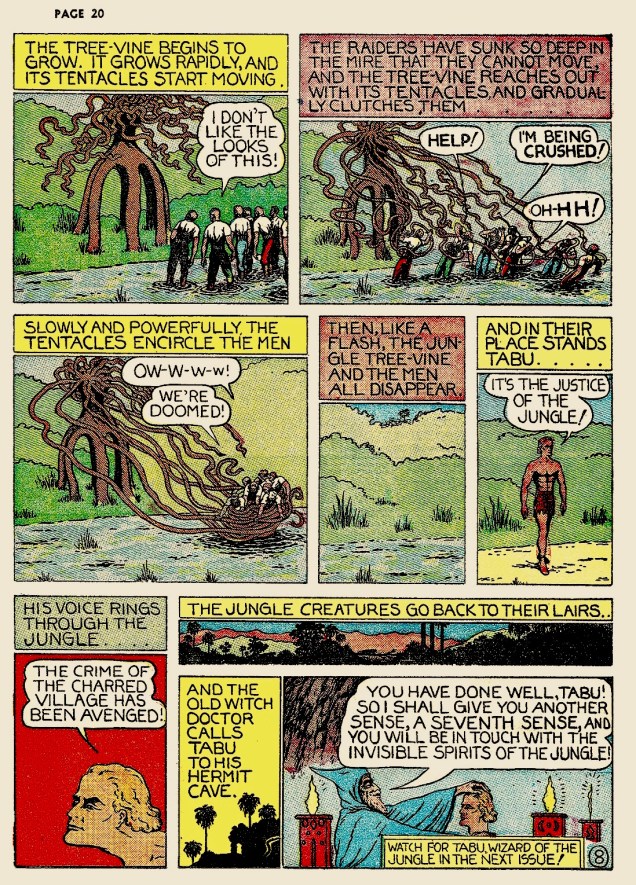
Fletcher-Hanks-Jungle Comics # 1-tentacles
The Slave Raiders is scripted and illustrated by Fletcher Hanks. It was originally published in Jungle Comics no. 1 (Fiction House, January 1940).

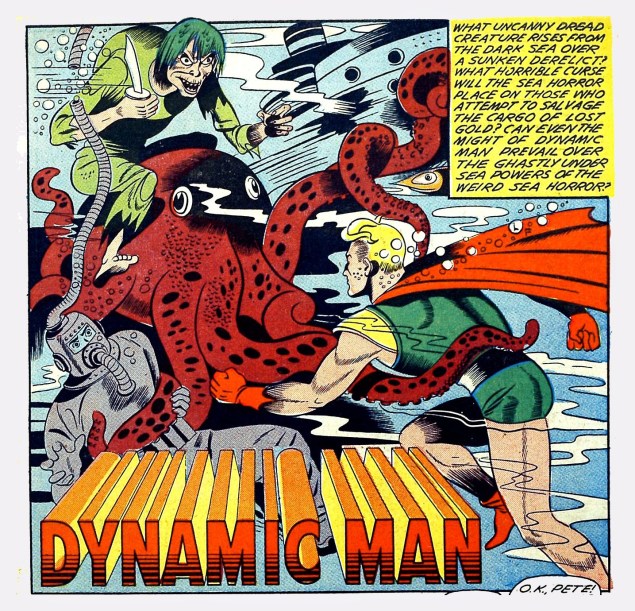
Getting off the Hanks bandwagon, we move into nonetheless enjoyable territory with Dynamic Man. These panels are from an unnamed story (with matching unknown artist ) published in Dynamic Comics no. 9 (Chesler/Dynamic, 1944).

DynamicComics9-DynamicMan
This has no tentacles, but I enjoyed these two panels far too much to not share: the guys’ New Yawk accents, and the witch’s demented rictus (not to mention that it’s all happening underwater).
Dynamic Comics No.9 -theseahorror
How many more rhetorical questions are you going to ask us?

DynamicComics9-DynamicMan1

Last but not least, as boring people say, is my second favourite of today’s post, both because I love the art and because the story gave me something to sink my teeth into. .

SuperMagicianV5#8A
Super-Magician Comics vol. 5 no. 8 (Feb-March 1947), cover by Edd Cartier. Dig the guy’s dopey, sneezy expression… contrasted with the octopus’ hypnotic stare.

Twilight of the Gods, the cover story, is also illustrated by Edd Cartier. It’s surprisingly nuanced, doesn’t fall into horrible stereotypes despite the presence of several Chinese characters, and even has an interesting moral. Read it here.

SuperMagician56-TwilightoftheGods

SuperMagician56-TwilightoftheGods-2

Next week, I’ll return to my usual diet of the Latest Published Thing as well as superhero crossovers! Just kiddin’.

~ ds

Tentacle Tuesday: Tentacle Trek

veg·e·tal /ˈvejədl/

adjective:  relating to plants. “a vegetal aroma”

Today’s installment of Tentacle Tuesday provides us with another healthy dose of tentacles of a vegetal nature. With my co-admin RG’s blessing, I decided to be a little unorthodox and instead of my usual piecemeal approach, share one single story.

I must admit to having no rapport whatsoever with Star Trek – I did not watch the show as a child (or as an adult), and haven’t even managed to pick up characters, plot lines or cultural references from the surrounding atmosphere, aside from the stuff *everybody* knows.

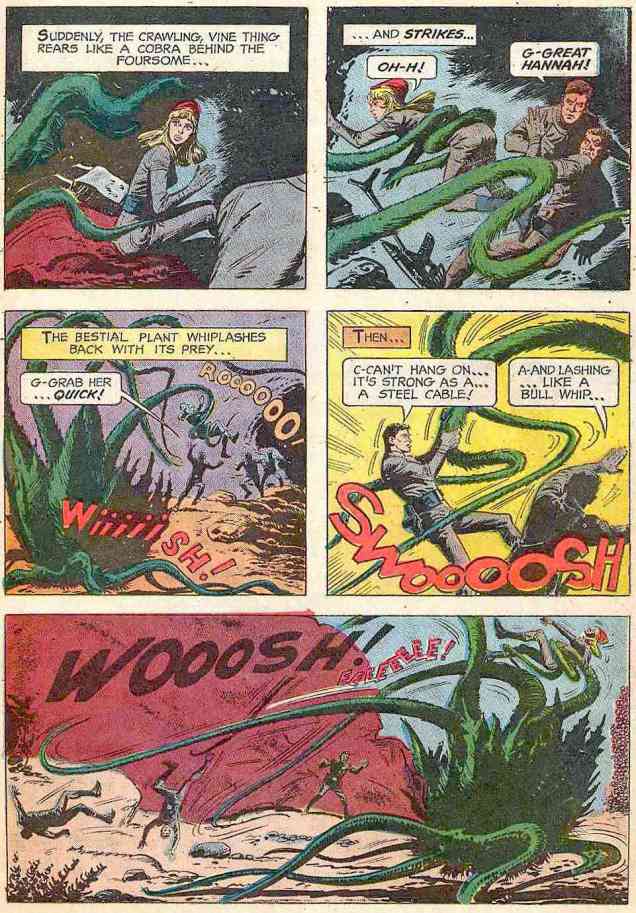
But The Planet of No Return (published in Star Trek no. 1 (October 1967, Gold Key), scripted by Dick Wood and illustrated by Nevio Zeccara) is a delight for any keen child who’s ever been mesmerized by the notion of a carnivorous plant and has carried that love through the years into adulthood. I’ll hold my hand up there! It’s also right in the sweet spot of a Venn diagram, the riveting intersection of  “interested in Venus flytrap plants” and “fascinated with tentacles”. I’m not featuring the full story (you can read it here), preferring to tantalize my audience with the many tentacle-laden panels of grabby, aggressive human-devouring plants.

Incidentally, “cannibal plant” is a misnomer (shame on you, Pavel Chekov!) – cannibals involve individuals consuming individuals of the same species.

StarTrek1-PlanetofNoReturn

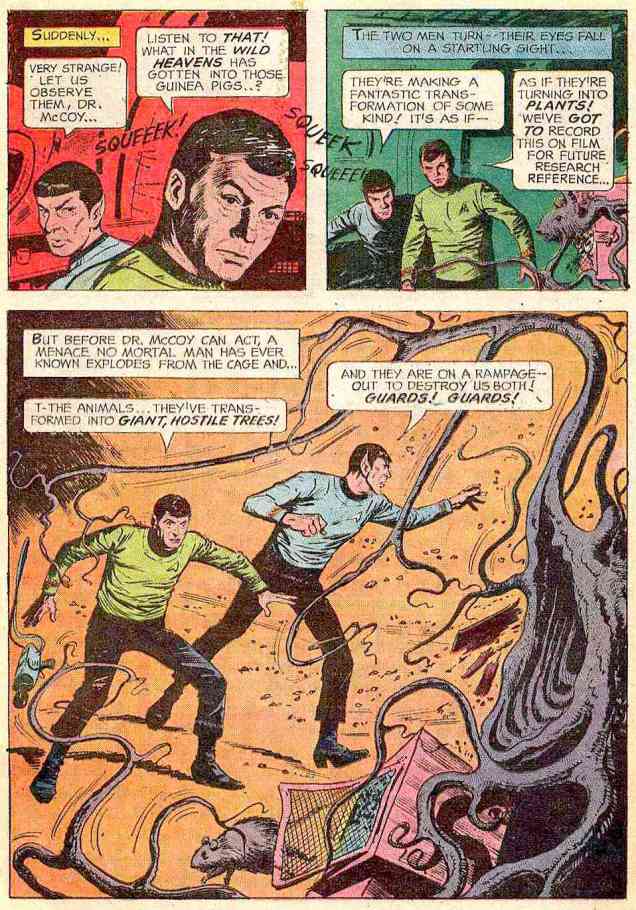
It all starts with some strange plant spores sucked in through the ship’s ventilation system while it’s drifting next to an unexplored planet…

StarTrek1-PlanetofNoReturn2

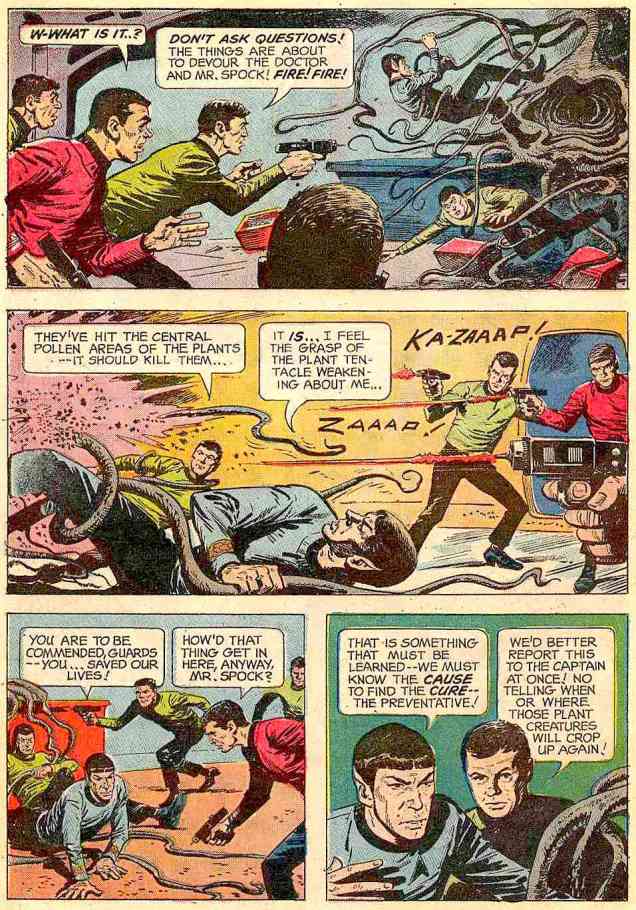
StarTrek1-PlanetofNoReturn3

The ship gets teleported to the planet to pursue their original exploration mission as planned… and get almost eaten by a tentacled “cannibal” (once again, not actually a cannibal) plant. A “giant plant tree”, strangely mobile, saves them from this worse-than-death fate… and turns out to have been Hunt, one of their teammates transformed into plant life by spores. No, I don’t know who Hunt is, either – he’s certainly not on the official Star Trek character list, introduced seemingly to be promptly killed after performing his heroic deed.

StarTrek1-PlanetofNoReturn4
Well, okay, if the plant tried to eat a tree, maybe it is, technically, a cannibal.

The now four-people team (the fifth one, Hunt the tree, dies after his epic battle with the Cannibal Plant) continue further into the wilderness… and stumble across a village of sentient plants, who don’t take kindly to intruders. Geez, can you blame them?

startrek2-planetofnoreturn-uglyplanet
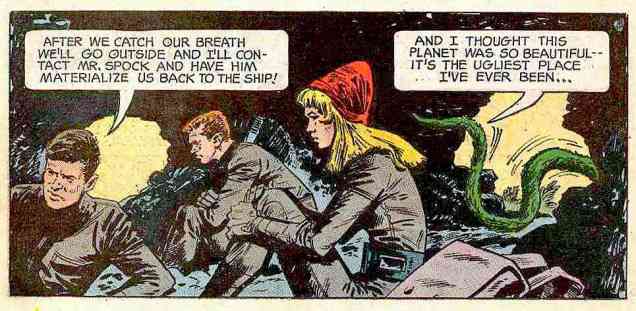
After shooting at (and presumably maiming) various denizens of the plant village, the humans retreat to a cave and conclude that this planet is ugly. Sentient plant life is not amazing enough for them, apparently. I suppose being part of Star Trek makes one really blasé about such things.

Janice Rand has it coming for being annoying and whiny…

StarTrek1-PlanetofNoReturn5

At this point, we’re more or less done with tentacles, but I can’t leave you on this cliffhanger (especially if you don’t have some time to waste reading a comic of questionable taste).

Here’s how it ends:

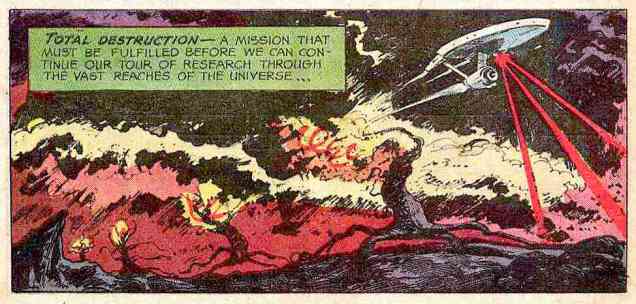
What does this “bestial plant” want with Janice? It wants to put her into a cattle pen, of course! Aiming to rescue her from its clutches, our intrepid explorers break into the pen, and, observing the landscape, conclude that the plants are raising dinosaur-like creatures who consume vegetable-type plants. «The lower plant life on their social scale are used as fodder… food for the beast creatures! Vegetable food!» Oh, and «The vegetables are alive – they’re making sounds also!» So sentient plants are farming animals whom they feed on other sentient plants. (At this point, I was muttering “what is wrong with this comic?”) It turns out that the superior plants eat the animals, who eat the inferior plants, and Janice is now one of the cattle, about to be sent into the giant trees-cum-slaughter-houses to be transformed into food. During the climax of the story, the slaughterhouse trees are blown to smithereens by Mister Spock and his laser beam destruct ray (it’s automatic, it’s systematic, it’s hydromatic), and everybody is teleported back into the relative safety of the ship. The surface of the planet (a.k.a. “hideous little globe”) is then obliterated by laser beams – just in case.

StarTrek1-totaldestruction
So how come only Hunt got transformed into a tree? Are we to assume that the other members of the team are immune?

If you’re craving more bold adventures of a carnivorous/cannibal plant nature, head over to A Child’s Garden of Carnivorous Plants, The Hungry Greenery, or Plants Sometimes Have Tentacles, Too.

~ ds

Tentacle Tuesday: Toothsome and Monstrous

« Teeth are always in style. »  — Dr. Seuss

By now, we have surely established that in the compendium of made-up monsters, tentacles are an artistic short-cut for evoking an especially terrifying creature. As it turns out, if there’s one way to make an already spine-chilling abomination even scarier, it’s to equip its gaping maw with teeth. Be it fangs borrowed from some unfortunate vampire, the implausibly symmetrical dentures of a TV show host, or clearly carnivorous, sharkish chompers, artists have been inserting teeth where no teeth should be long before you or I were born.

« But Grandmother! What big teeth you have! », once quipped Little Red Riding Hood in the 19th century, and this fear of teeth has clearly followed us into the Modern Age.Take a look —

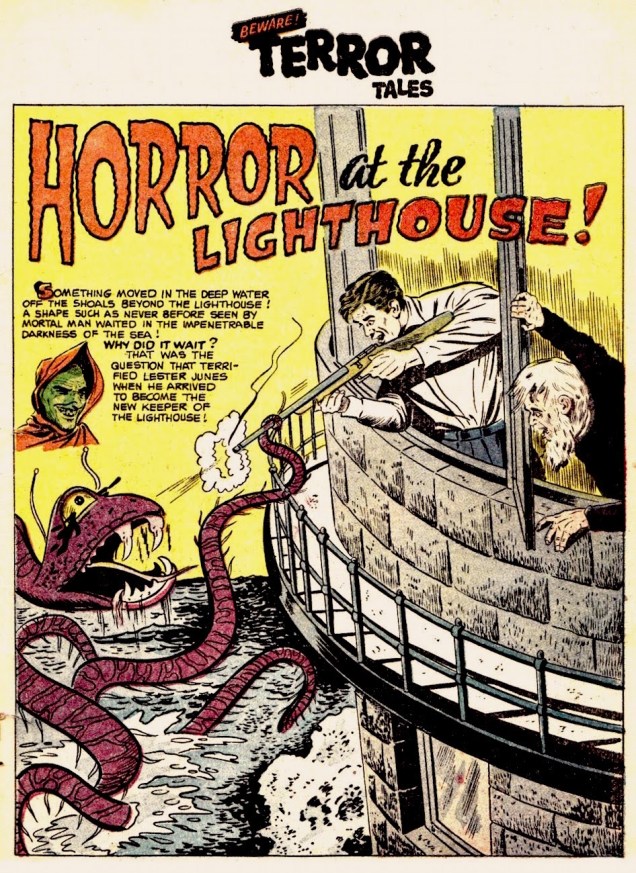
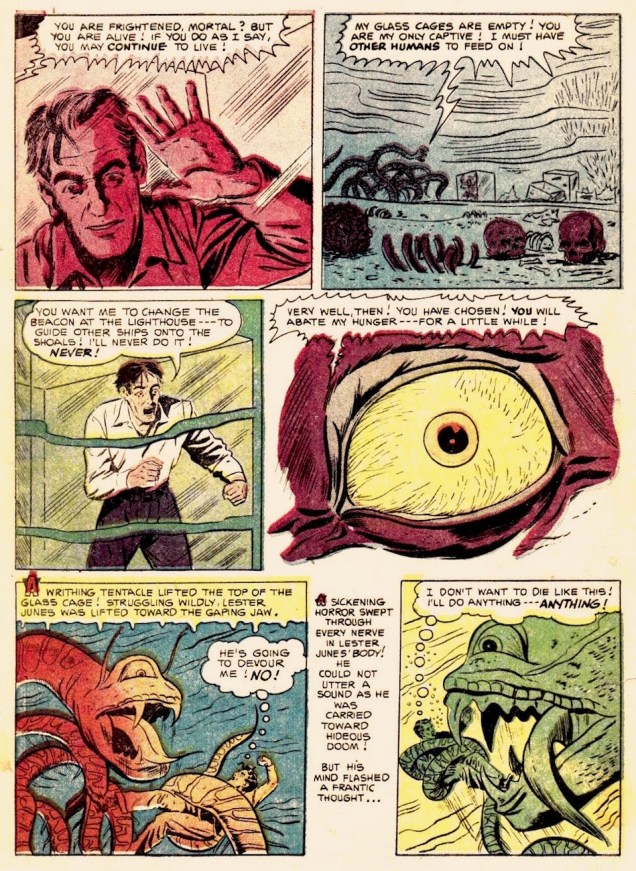
Sheldon Moldoff was probably thinking of a snake’s fangs when he came up with this cutie:

TerroratheLighthouse-SheldonMoldoff-Beware! Terror Tales #6,
A page from Horror at the Lighthouse!, published in Beware! Terror Tales no. 6 (Fawcett Comics, March 1953). Scripted by Bill Woolfolk, drawn by Sheldon Moldoff. Read the full story at The Horrors of It All.

TerroratheLighthouse-2-SheldonMoldoff-Beware! Terror Tales #6,

This cross between a dinosaur and a mole (or is that more of an ant?) boasts an enviable set of sparklingly white dentition:

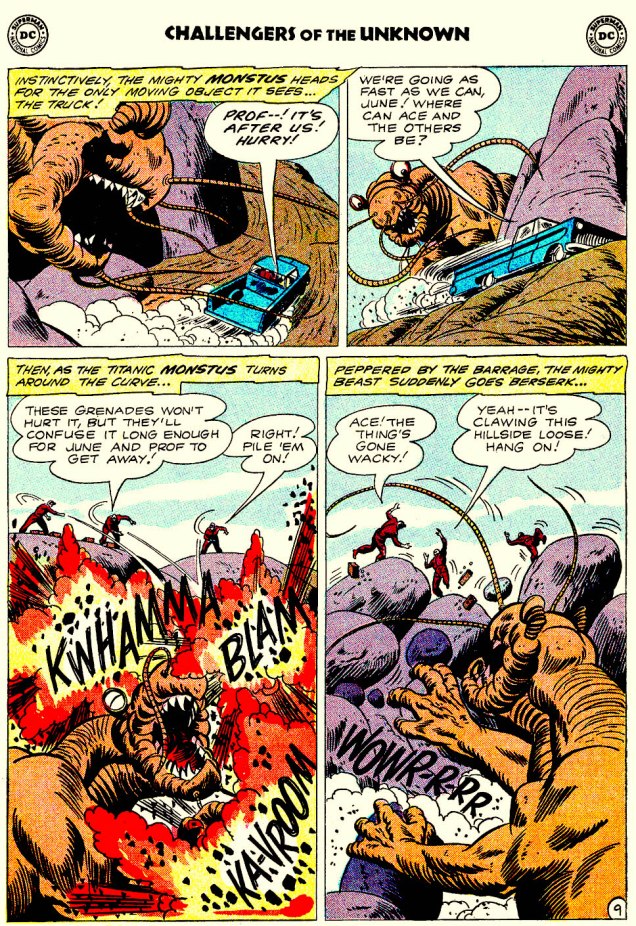
Challengers22A
Challengers of the Unknown no. 22 (Oct-Nov 1961), cover by Bob Brown.
Challenges of the Unknown22-1961-Bob Brown-TheThinginChallengerMountain2
Aw. You’d go “wacky”, too, if some jerk piled on grenades on you.

One thing you can say about tentacled monsters, it’s that they sure keep their denticulations (yes, it’s a word) impeccably clean. Maybe they choose their victims based on that, like cats gleefully enjoying the crunch of a good teeth-cleaning croquette?

WeirdMysteryTales#9DominguezA
Holy crap, look at those white chompers (that are about to get a little marred with blood, gristle and whatnot)! Weird Mystery Tales no. 9 (Dec 1973 – Jan 1974), cover by Luis Dominguez.

On the other hand, some monsters could have used a set of braces (this one is an orphan, which is why it had to make do with a British set of teeth).

Eerie131
Eerie no. 131 (June 1982), cover by Rudy Nebres. Can you imagine trying to chew anything with such a set?!

A somewhat similar (but a lot less overcrowded) set of ivories for gnawing and gnashing can be spotted in water:

Chet Phillips MartianKraken
A collectible card (from sometime in the 2000s) by illustrator Chet Phillips. Here you can admire his series about Japanese monsters, or visit his website, chetart.com.

This toothy post is now at its end – happy brushing (and flossing — it’s important!) to all, and ’til next Tentacle Tuesday!

~ ds

p.s. Not particularly related to comics, but I found this photograph distinctly on the side of scary:

expressteethwhitening
Captioned « Women in London sit down for express teeth whitening ». I think they’re about to be transformed into aliens, or contaminated with some deadly germ, or perhaps just burnt to a crisp by some mysterious rays. Have I been reading too many comics?