Christmases, Both Sour and Sweet

« In the bleak midwinter, frosty wind made moan,
Earth stood hard as iron, water like a stone;
Snow had fallen, snow on snow, snow on snow,
In the bleak midwinter, long ago.
» — Christina Rossetti

Christmas is nearly upon us, but while a great many will opt to retreat into the miasma of nostalgia to forget what an annus horribilis it’s been, I’ve picked something a bit more appropriately sombre in tone to nail down the occasion.

But with a more hopeful chaser… to balance things out a bit.

When the indefatigable Carmine Infantino (1925-2013) stepped down from his multi-hatted rôle of publisher, editor-in-chief, cover designer and art director — and so on — at DC, he found that no-one was beating his door down to offer him a similar position.

So he went back to drawing, as a freelancer. As Infantino put it: « Jim Warren was the first comics publisher to contact me after DC. I said “I’ll do work for you, but nothing full-time because I’m busy with other things.” He said, “Okay, whatever you’re willing to give me.” I wasn’t really comfortable with the Warren material — it was the sexiest work I’d ever done! Jim had an older audience and wanted it that way. My feelings about the material never affected the mutual respect Jim and I had for one another. » [ source ]

All told, Infantino pencilled around forty stories for Warren in a span of four years. There was even a brief period when he just about monopolized individual issues of Creepy and Eerie, which was offset by pairing him with wildly disparate inkers. Sometimes the results sang, sometimes they croaked.

Here’s a case of rarely combined styles that nevertheless meshed beautifully: Infantino and John Severin. Let’s face it, who’s more reliably excellent than Mr. Severin?

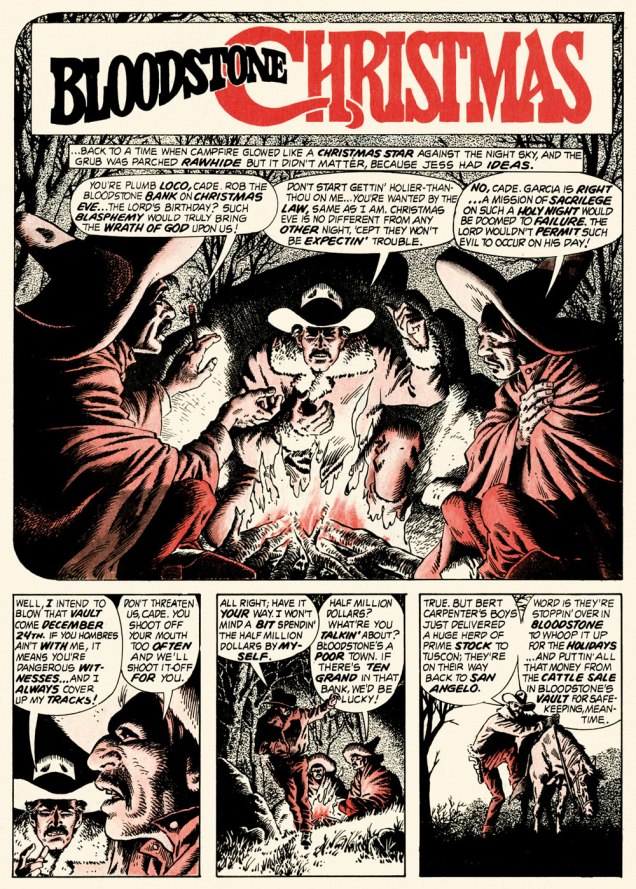
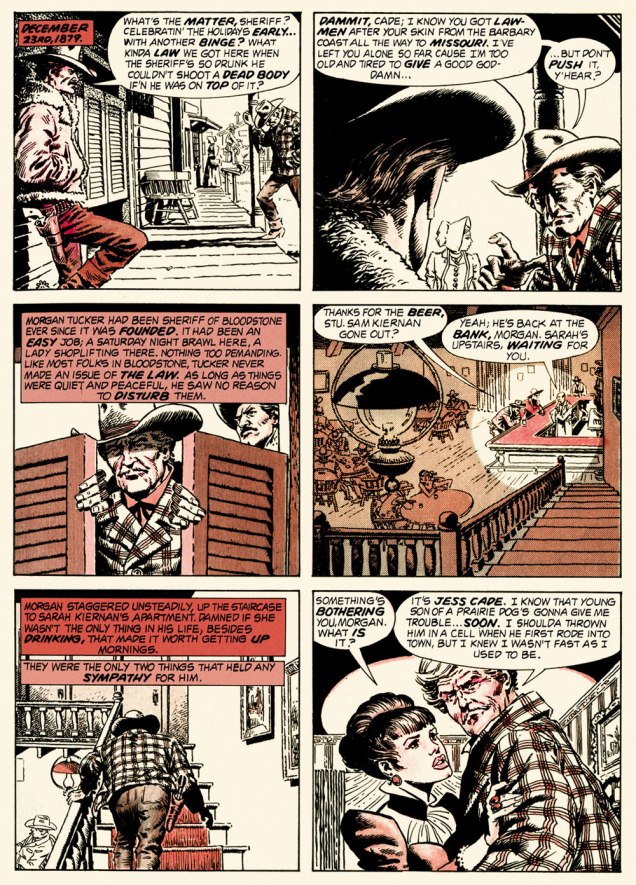
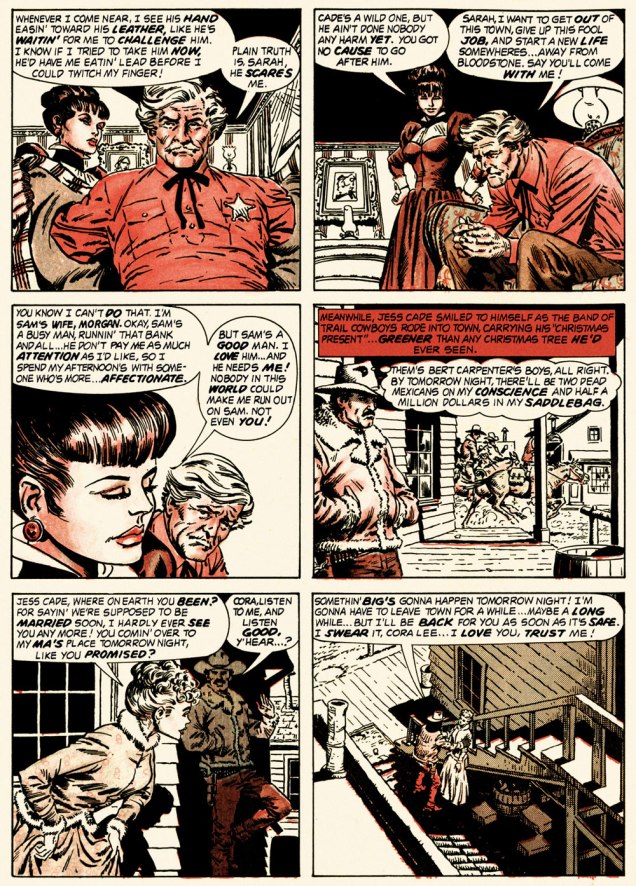
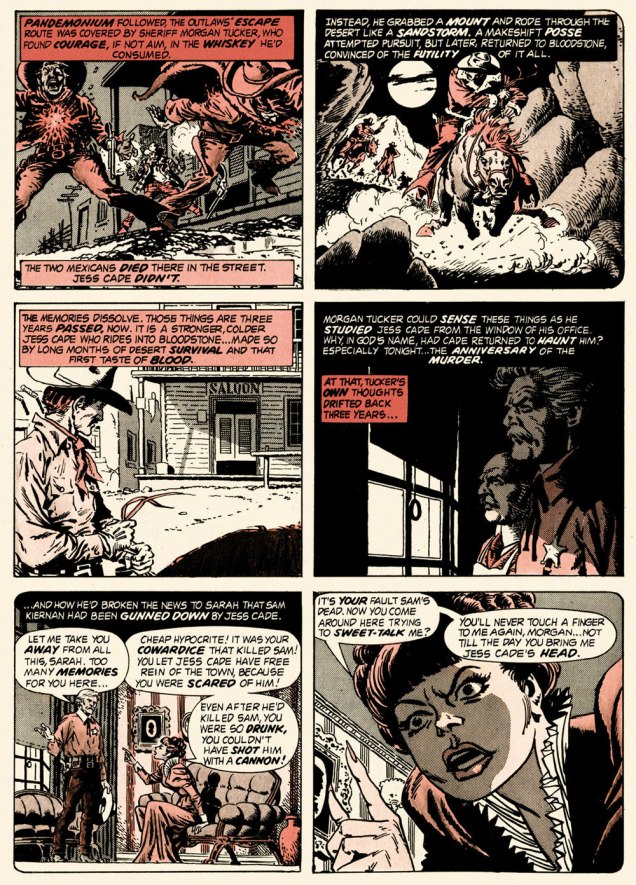
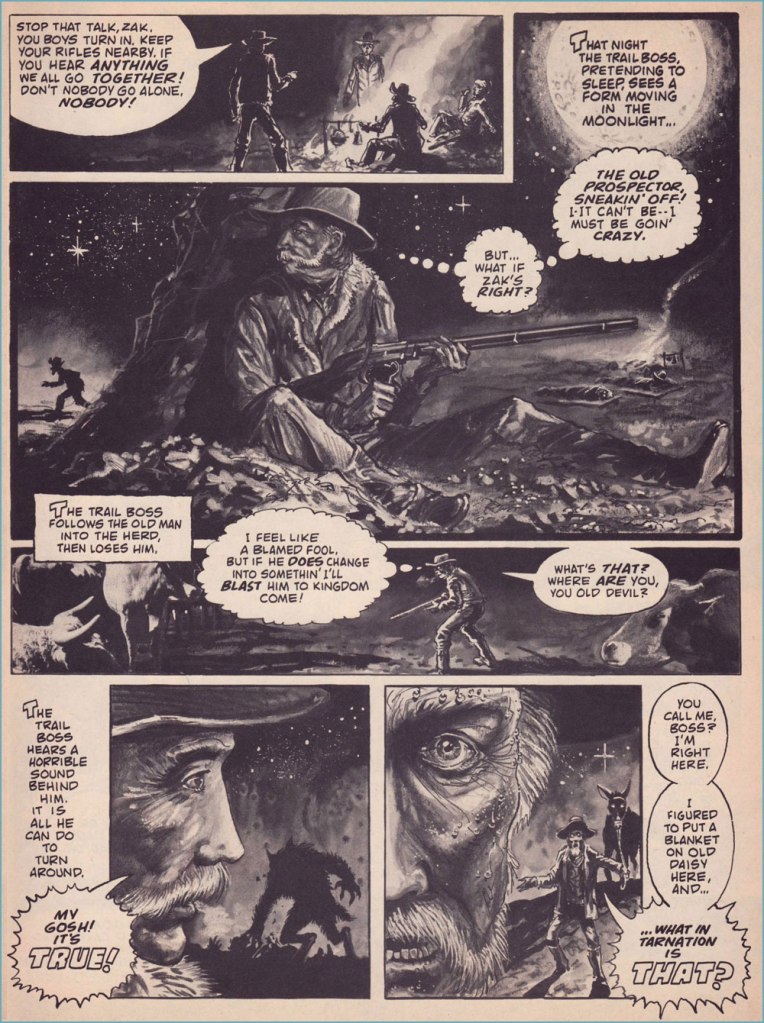
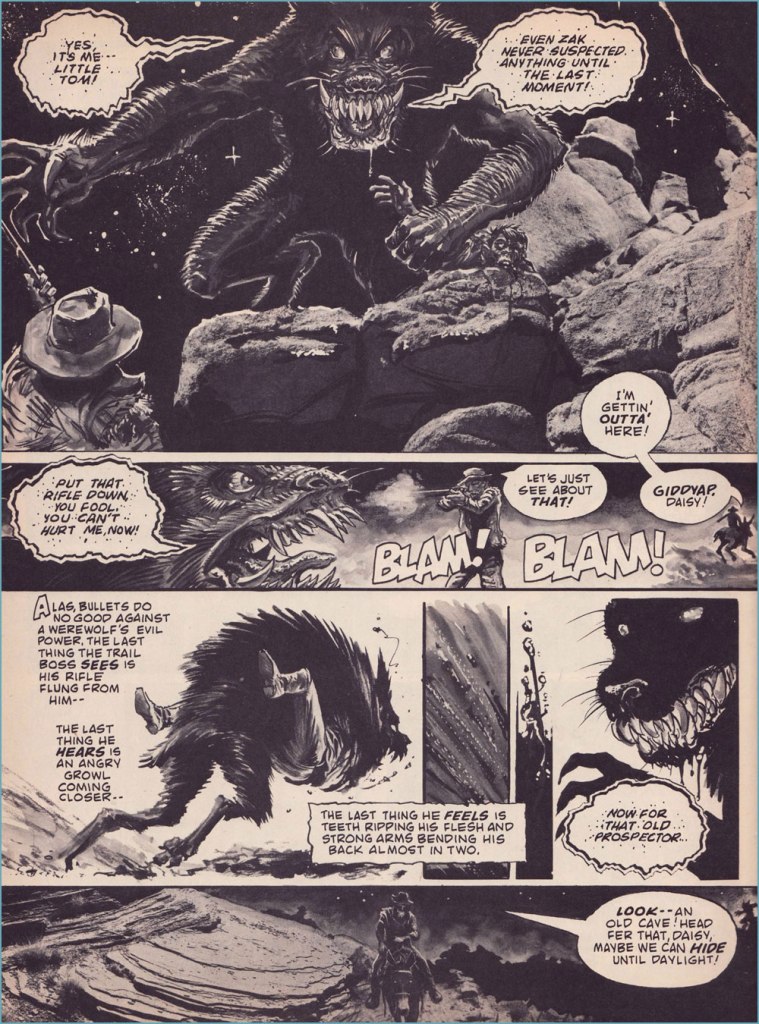
And so this is… Bloodstone Christmas, written by Gerry Boudreau, pencilled by Infantino, and inked by John Powers Severin (1921-2012).
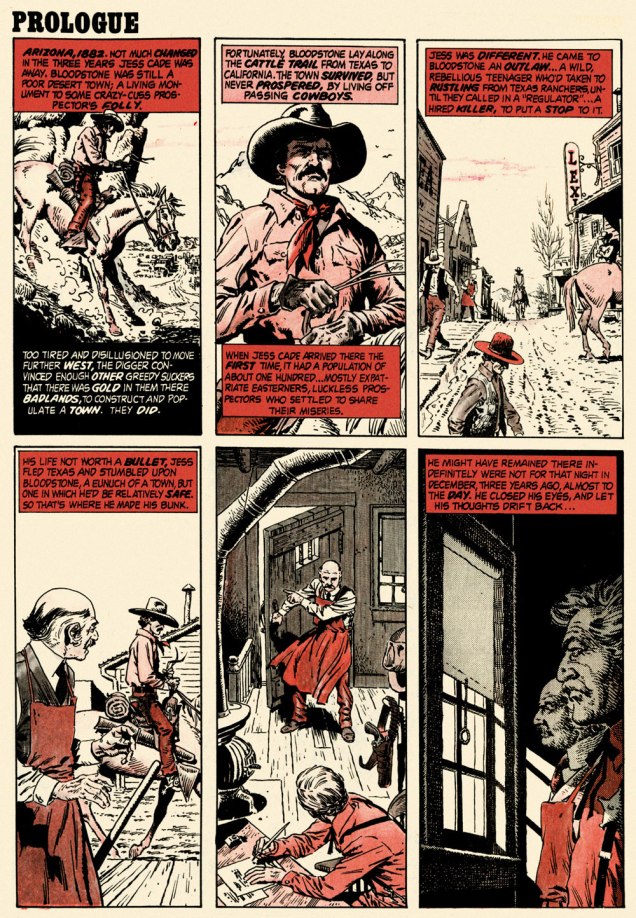
I won’t pretend that the entire cast isn’t peopled with stock characters, but its sting in the tail lands satisfyingly, prefiguring the flavour of weird westerns by Joe Lansdale, for one.
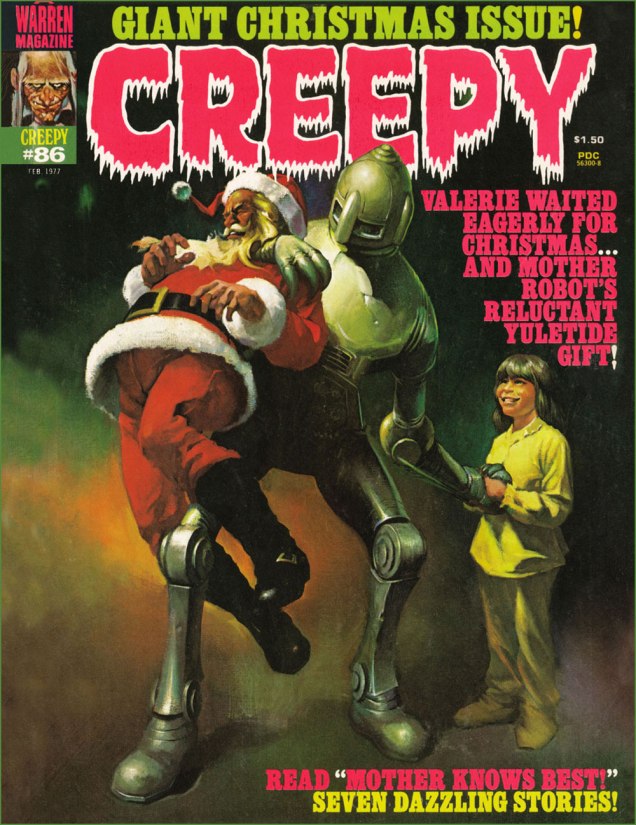
This is Creepy no. 86 (Feb. 1977, Warren). Cover by Ken Kelly (1946-2022).

And now, for the sweeter part of our double-header.

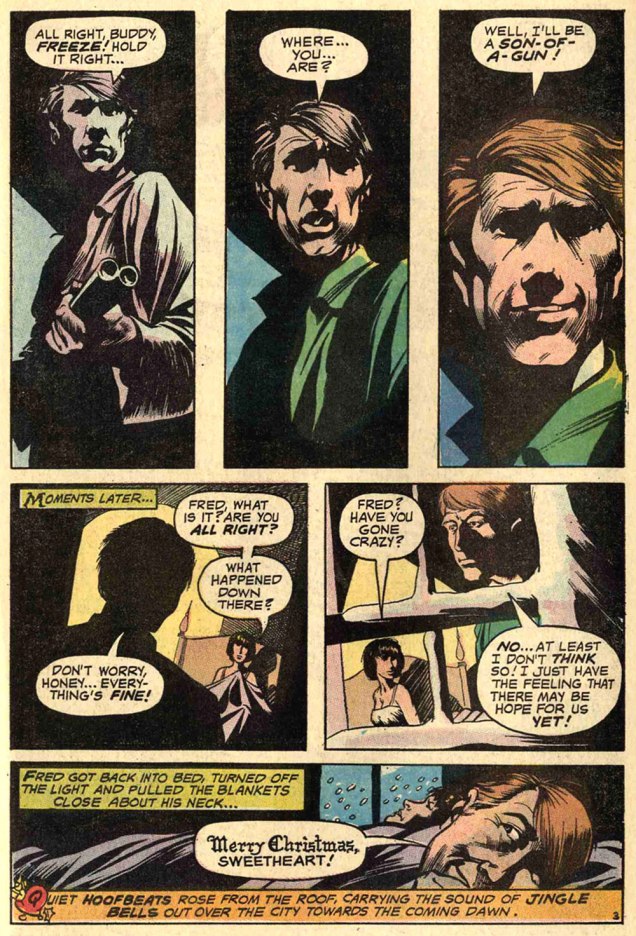
Night Prowler was an early collaboration by Swamp Thing‘s co-creators, writer Len Wein and artist Bernie Wrightson. It was published in House of Mystery no. 191 (Mar.-Apr. 1971, DC). Joe Orlando, editor.

Oh, and Happy Holidays to you, esteemed readers!

-RG

p.s. Oh, and speaking of carmine, the colour, not the man: I just read, a few days ago, in Steve Ettlinger‘s superb Twinkie, Deconstructed (2007), that « the fascinating, rich magenta carmine, also known as cochineal, is extracted from the dried body of the female cochineal insect », and that « the output of the Canary Islands is used almost exclusively to colour the Italian apéritif Campari. » Caveat emptor, then! Ironically, « carmine dye is produced from the acid that females naturally secrete to deter predators. » Not, however, industrious humans.
Hallowe’en Countdown VIII, Day 29

« There’s a saying among prospectors: ‘Go out looking for one thing, and that’s all you’ll ever find. » — Robert J. Flaherty

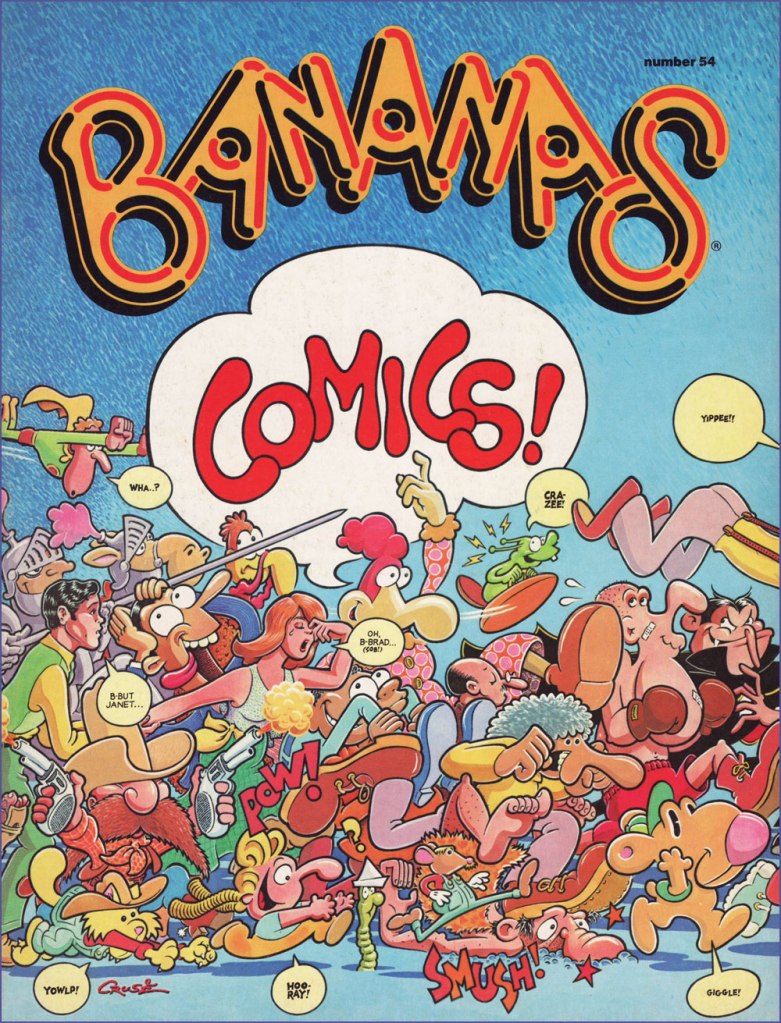
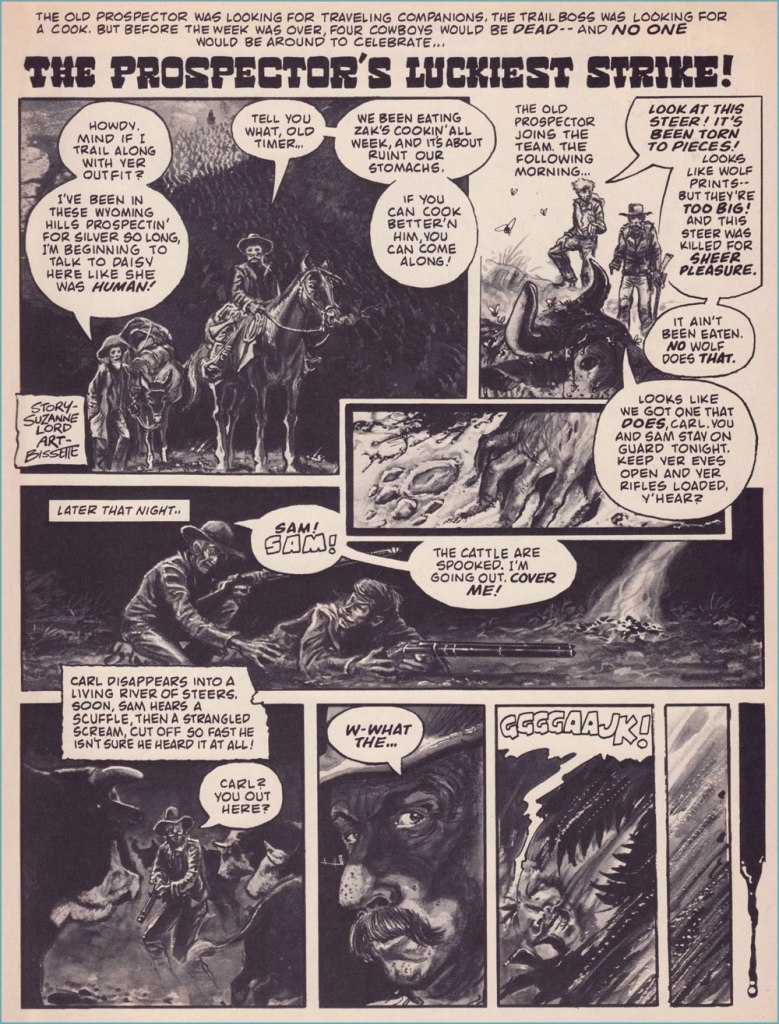
Here’s a rarely-seen Stephen R. Bissette gem, The Prospector’s Luckiest Strike! I wasn’t aware of its existence until recently, when I chanced to purchase an issue of Scholastic’s Bananas devoted entirely to comics. It turned out to hold a pair of Bissette aces, the other being A Toast to Mr. Dalyrimple!. I wondered why these dark lovelies had been left out of Eclipse’s 1985-86 Fearbook and Bedlam, collections of Scholastic material. Were they too recent?

As it turned out, these remaining tales were soon gathered in a one-shot anthology entitled Deadtime Stories (Nov. 1987) published by the short-lived New Comics Group (1987-1989).

Note the discreet, elegant use of photo backgrounds here and there.

I turned to the artist for his recollections, which he most generously provided:

« Scholastic Magazines was one of the luckiest strikes I ever had in my early freelance career, that’s for sure! Between the generous page rates (best I’d earned from any publisher at that time, better even than Heavy Metal), the very kind people I was fortunate enough to be working with—editors Bob and Jane Stine (Bob was later better known as R.L. Stine, author of the Goosebumps empire), art director Bob Feldgus, writers like Suzanne Lord, and everyone at Scholastic at that time—and the frequency of steady freelance assignments from them, I couldn’t have hallucinated a better, more rewarding work relationship or environment in my wildest dreams.

The Prospector’s Luckiest Strike” was late in the game for me, among the Suzanne Lord scripts I was assigned, and I gave it my all for a variety of reasons. First of all, it was exciting to be invited to contribute not one but two stories to the “all comics” issue, and even more exciting because of my friend Howard Cruse doing the cover and a one-pager, closer-still friends Tom Yeates, John Totleben, and Rick Veitch also contributing top-notch work, and Alyse Newman, Bob Taylor, and John Holmstrom (hey, I was a fan of Punk Magazine) also in the lineup. It was an unusual venture and sounded like a great issue, and Bob, Jane, and Bob F. were so enthusiastic about doing it — well, that was contagious. 

The issue in question, with its rollicking Howard Cruse cover.

The deadlines were tight, and I’m not entirely happy with my second story in the issue (Rick Veitch still mocks my splash page for “Mr. Dalyrimple,” justifiably so), but “Prospector’s Luckiest Strike” turned out to be one of my best jobs for Bob, Jane, and Bob. 

It was, sadly, also among the last. Bananas #54 came out in 1982, if memory serves, and I was amid a really screwy project with Marvel at the time (the never-completed, never-published Titan Science Project), and one year later I was both a new father (our firstborn, Maia, born at home April 1983) and working on my first collaborative Saga of the Swamp Thing issues, major life changes, to say the least. »

A huge thank you to Mr. Bissette for his generosity and insight!

-RG

Hallowe’en Countdown VIII, Day 13

« I won’t put in a load of laundry, because the machine is too loud and would drown out other, more significant noises – namely, the shuffling footsteps of the living dead. » — David Sedaris

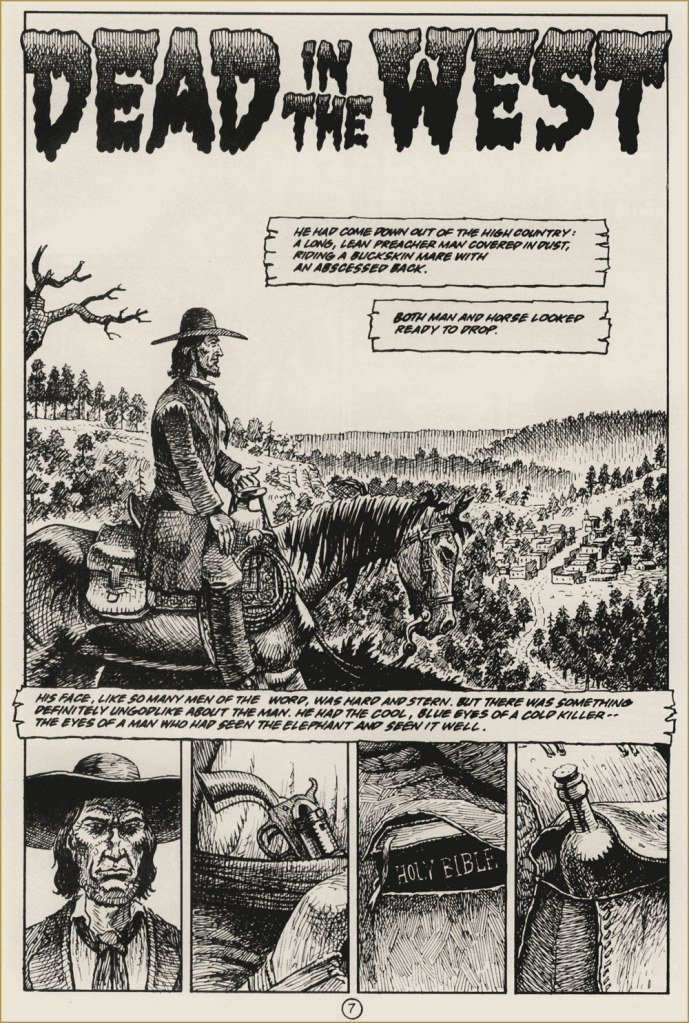
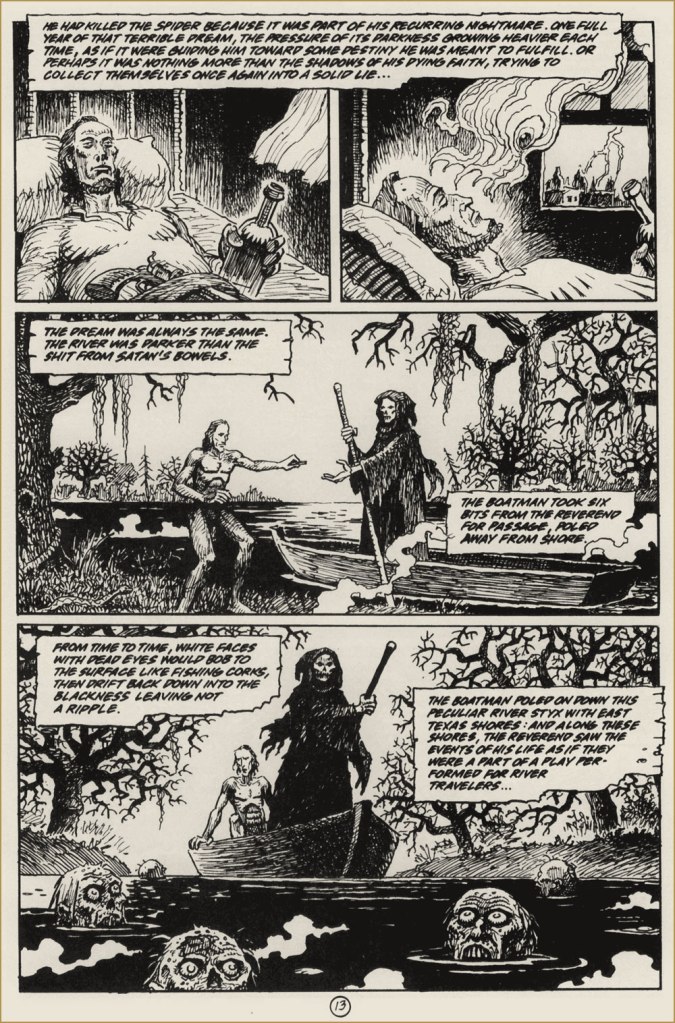
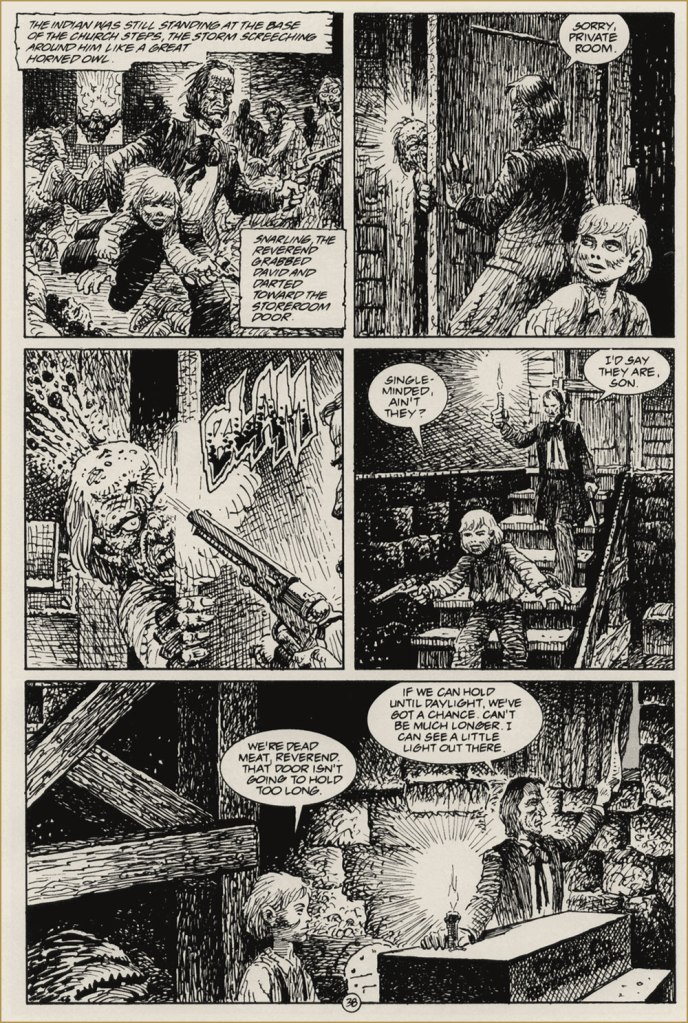
First things first — the general plot: « Dead in the West is a short horror novel written by American author Joe R. Lansdale. It involves the tale of longtime Lansdale character the Reverend Jebediah Mercer: he rides into the town of Mud Creek, Texas that is about to be attacked by an Indian medicine man who was unjustly lynched by the town inhabitants. Soon the dead will rise and seek human flesh and the Reverend finds himself right in the middle of it. He aligns himself with the town doctor and two of the town’s inhabitants, Abbey and David. Together they fight the zombie horde and try to dispatch the medicine man who is the cause of all the evil. » [ source ]

Well, I haven’t read the novel, but the comics adaptation, by seasoned scripter Neal Barrett Jr. (1924-2016) and illustrator Jack ‘Jaxon’ Jackson (1941-2006), is exemplary… well, the results are, at any rate. While we’re not dealing with anything truly new here… I mean, it’s a zombie siege in the well-trod Night of the Living Dead tradition, but in an Old West setting. But the pacing is flawless, the gore and horror balanced with judicious sprinklings of gallows’ humour — served deadpan — and Lansdale’s trademark brutal frankness strikes just the right tone.

Jackson, a fifth-generation Texan and in many ways the original Underground cartoonist, was an inspired choice, as he’s well and truly in his element here.

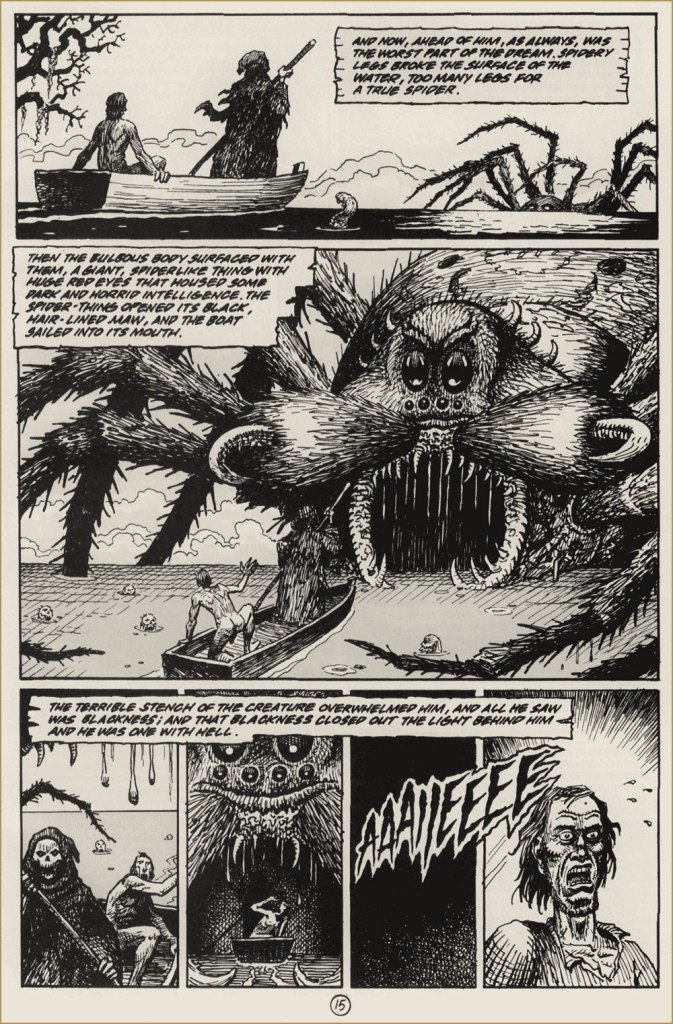
As this thing is fairly long — as it ought to be! — I’ve just plucked some favourite pages as examples. But if this is up your alley, do yourself a favour and grab yourself copies. Over three decades down the dusty road, these babies are still available at below cover price. It is to weep… but it’s a bargain well worth making.

This is Dead in the West no. 1 (Oct. 1993, Dark Horse); cover by Lansdale regular Timothy Truman. I guess he sells more books than Jaxon, but I’ve never been a fan, save when he’s inked by Sam Glanzman, (1924-2017) who expertly ironed out the chronic stiffness in Truman’s pencilling.
I must concede that the giant spiders are a novel touch.

This is Dead in the West no. 2 (Oct. 1993, Dark Horse); cover, again, by Mr. Truman.

-RG

José Delbo and Billy the Kid’s Long, Dusty Trail

« There will be no questions asked if I kill you here, gringo! » — Bad hombre Alejandro Roja

On February 5, 2024, versatile veteran cartoonist José Delbo (born in Buenos Aires, Argentine, on December 9, 1933) left us at the most respectable age of ninety. Comics fans of a certain age will no doubt recall him chiefly from his long stint on DC’s Wonder Woman (1975-1981, issues no. 222-286), but to my mind, that’s hardly his finest hour: he wasn’t done any favours there, hobbled as he was by pedestrian (or worse) writing and indifferent (or worse) inking. Same goes for his run on Batgirl (1976-82) in Batman Family and Detective Comics.

For a detailed rundown of his remarkably long and varied career, you can’t go wrong with this excellent bio.

This post’s title gave away my candidate for Delbo’s magnum opus, such as it is; but I would be remiss in failing to also note his charming work on Dell’s The Monkees (fifteen issues), where he got to demonstrate his deft hand at humour; and his winningly bizarre collaboration with Tony Tallarico, Geronimo Jones (nine issues, 1971-73, plus one that remains unpublished).

This is Billy the Kid no. 58 (Nov. 1966, Charlton), Delbo’s second issue on the title but his first cover. After this one, he would go on to pencil and ink the subsequent fifty or so covers and most of the inside features. When you find an artist who can draw horses, you hold on to him (or her)! How many, among the current generation, could successfully handle that particular mission?

Incidentally, Billy’s distinctive steed appears to be an Appaloosa: « The Appaloosa’s eye-catching pattern comes from the spotted horses brought into the Americas by Spanish Conquistadors. Known as the Dalmatian horse breed, it was bred in the mid-18th century by the Native American Nez Percé people. Its name comes from the Palouse River that flows through what used to be Nez Percé territory. » [ source ]

Charlton Comics’ flagship western title, Billy the Kid (153 issues, 1955-1983, including its first five as “Masked Raider”), endured as long as it did for good cause: notable runs by accomplished artists, among them John Severin, Rocco Mastroserio, Luis Domínguez, Delbo, and finally Warren Sattler. Yet, for my money, it’s Joe Gill’s spare but psychologically consistent and highly humane scripting that holds the enterprise together.

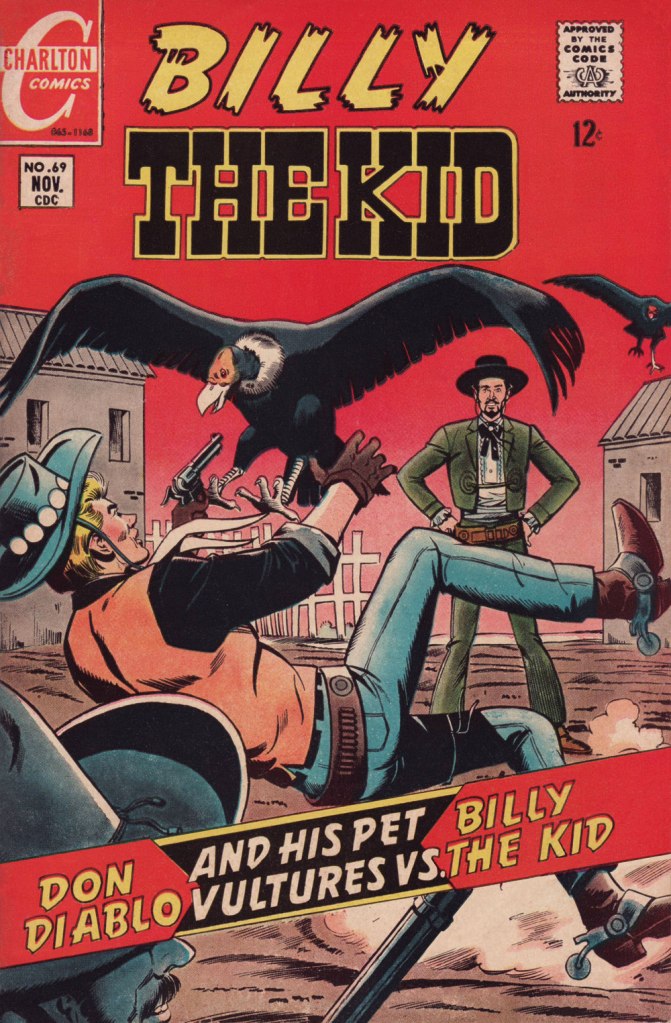
This is Billy the Kid no. 69 (Nov. 1968, Charlton).
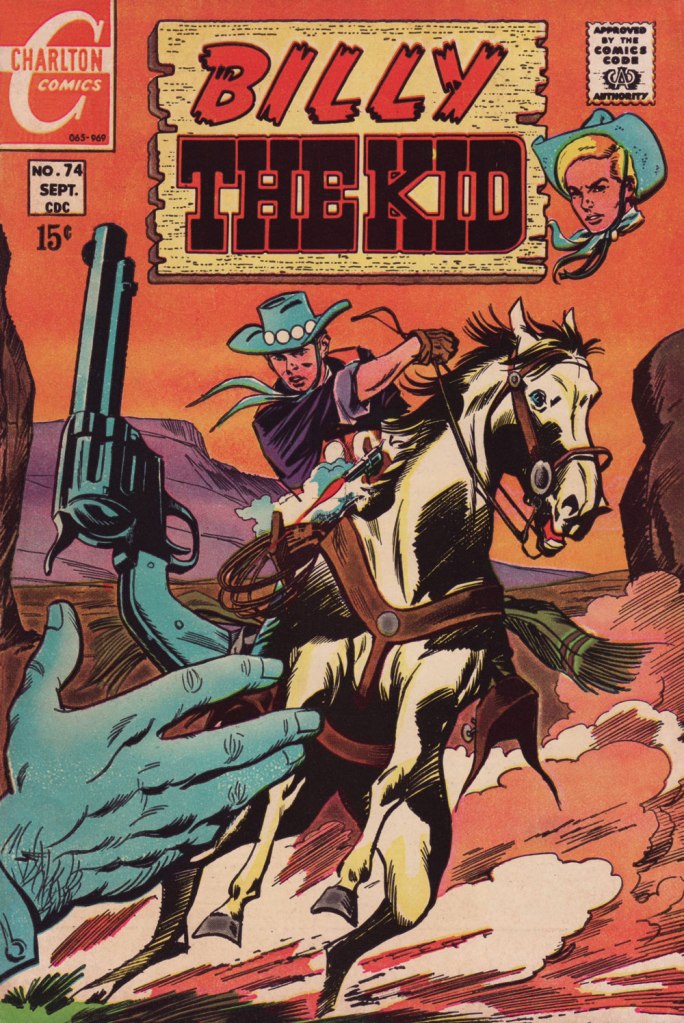
This is Billy the Kid no. 74 (Sept. 1969, Charlton).
This is Billy the Kid no. 80 (Sept. 1970, Charlton).
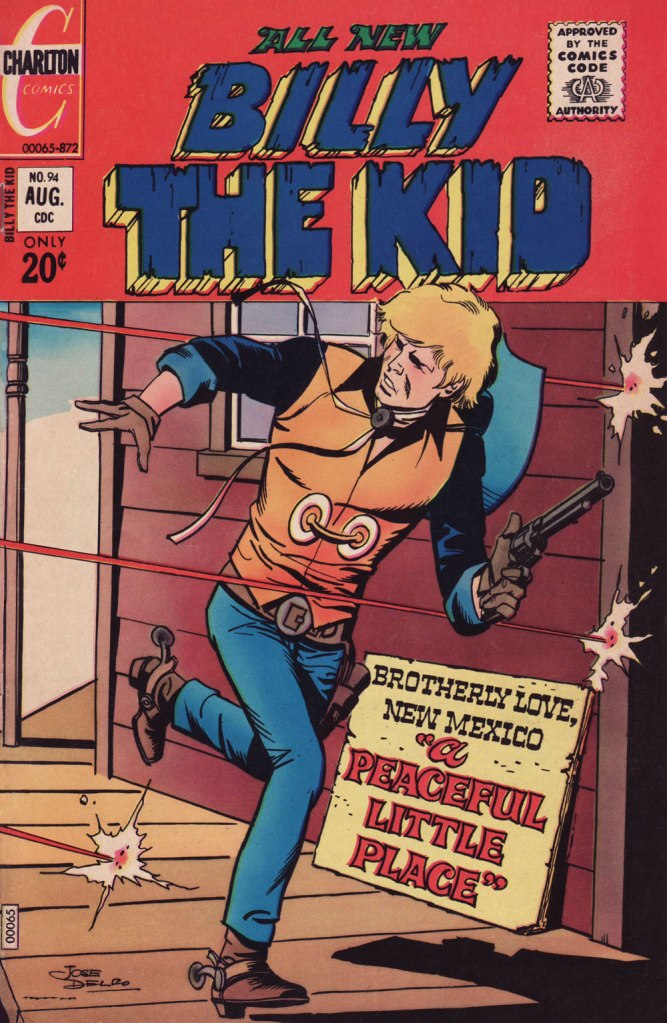
This is Billy the Kid no. 94 (Aug. 1972, Charlton); I love the clever signpost integration of the featured title.
This is Billy the Kid no. 98 (Jan. 1973, Charlton). Readers accustomed to Marvel and DC-style hype may notice how light on text these covers are. A lot of shouting isn’t what sells a cover: an arresting visual will do that.
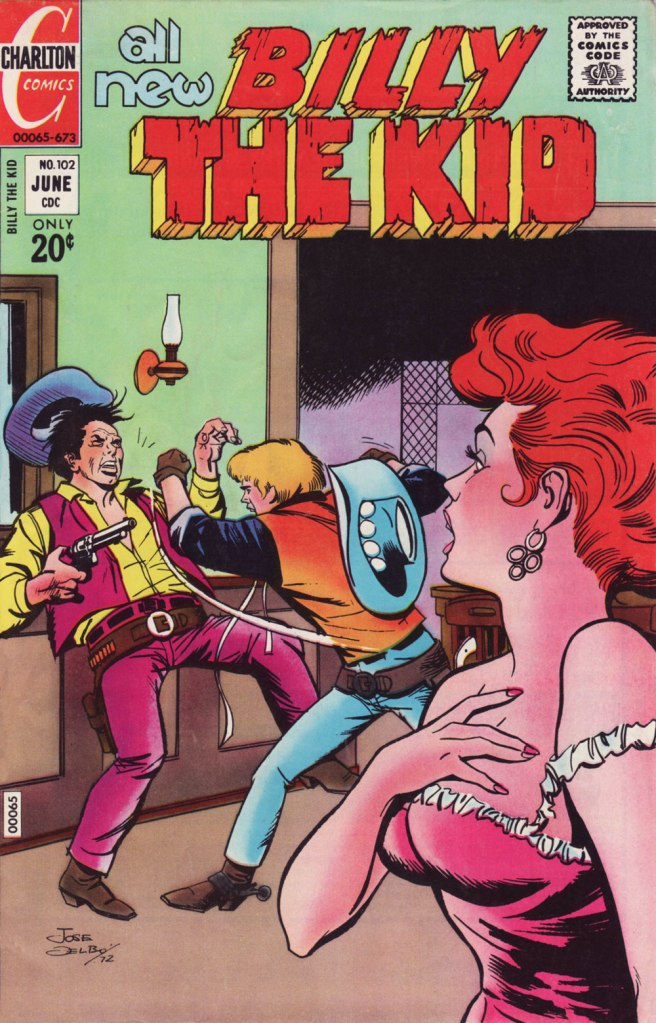
This is Billy the Kid no. 102 (June 1973, Charlton).
This is Billy the Kid no. 103 (Aug. 1973, Charlton).
This is Billy the Kid no. 106 (Dec. 1973, Charlton). The foxy villainess Billy’s tussling with is La Duquesa, featured in “Slave of Beauty”.

Happy trails, and gracias for everything, Señor Delbo!

-RG

Hot Streak: Nick Cardy’s Bat Lash

« You should be ashamed, Mr. Lash! Making such noises in front of the children! »

Bat Lash was introduced with issue 76 (August, 1968) of DC’s launching pad title Showcase, wedged between the respective débuts of Hawk and Dove and Angel & the Ape. At various stages of his conception, the character of Bartholomew “Bat” Aloysius Lash reportedly went through the hands of Carmine Infantino (who designed or at least supervised all of the following covers), Joe Orlando, Sheldon Mayer and Sergio Aragonés. Sergio plotted and thumbnailed the mise en scène, Dennis O’Neil added dialogue, then Nick Cardy pencilled and inked. For such a product-by-committee, Bat Lash is quite remarkably good — but then consider the talent involved!

Mind you, I make no claims of originality for Bat — he was distinctly a product of the times, when the vogue of Spaghetti Western had peaked* and ironically left its (off)brand on its model. By the time — in 1968 — its market reached its apex, the Italian Oater idiom threatened to congeal into a morass of clichés, becoming, as these things tend to go, (over)ripe for self-parody. Intentional and otherwise.

I surmise that the key model for Bat Lash was the ever-charming Mario Girotti**, reportedly enlisted thanks to his resemblance to the intense but one-note Franco Nero, even replacing the latter in his star-making, titular role of Django (1966) for a 1968 sequel, Prepare a Coffin, Django.

Ripe for its time it may have been, but I suppose that American audiences were still quite allergic to jarring tonal shifts in their entertainment (now commonplace), and would be for some time — just ask, say, John Carpenter. So the blend of light comedy and dark drama that Bat Lash proposed must have been difficult to market.

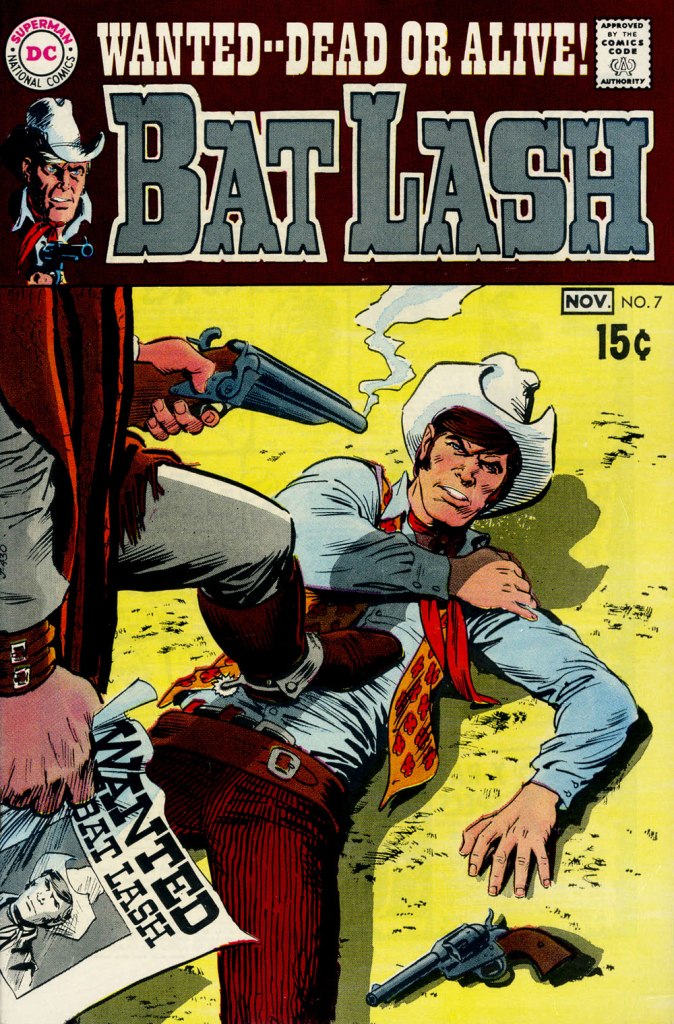
Our streak begins with Bat Lash no. 2 (Dec. 1968-Jan. 1969, DC) since the covers of Showcase no. 76 and Bat Lash no. 1 were good, but not — imho — great. I daresay this one is, in fact, the finest of the lot, with Cardy at his most Tothian.
A peek inside the same issue, for contrast: lively and loose inking over rock-solid pencilling, and miles away from the tone of the cover. My guess is that some people weren’t happy.
Bat Lash no. 3 (Feb.-Mar. 1969, DC) highlights the comedic side of the feature, which all but evaporated by the last two issues.
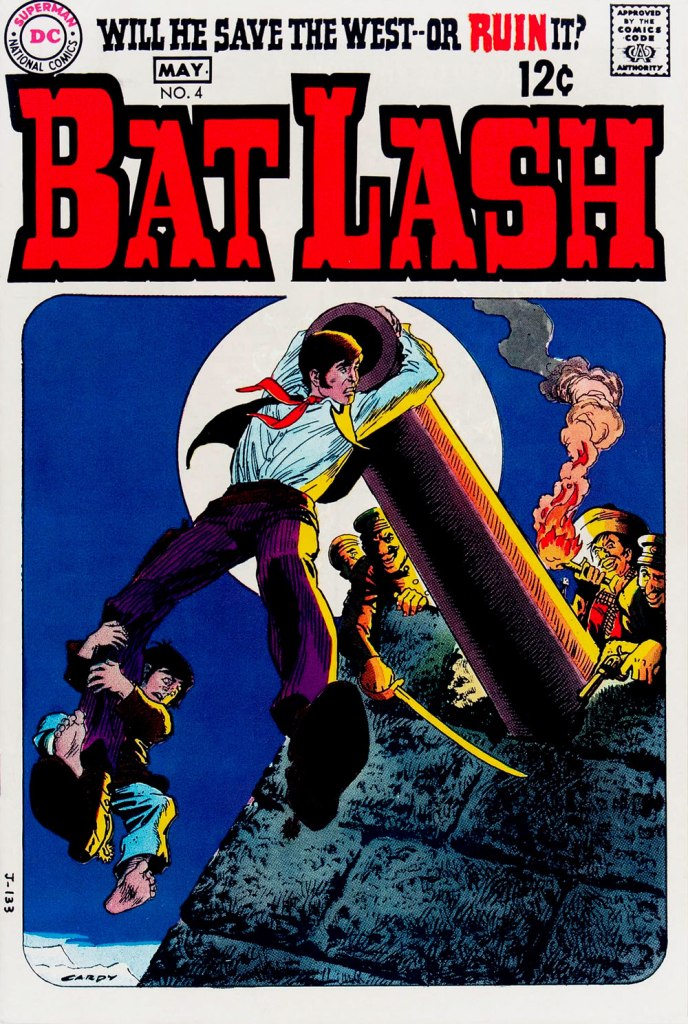
This is Bat Lash no. 4 (Apr.-May. 1969, DC). Dig Cardy’s expert use of the ‘drybrush‘ technique on the stones.
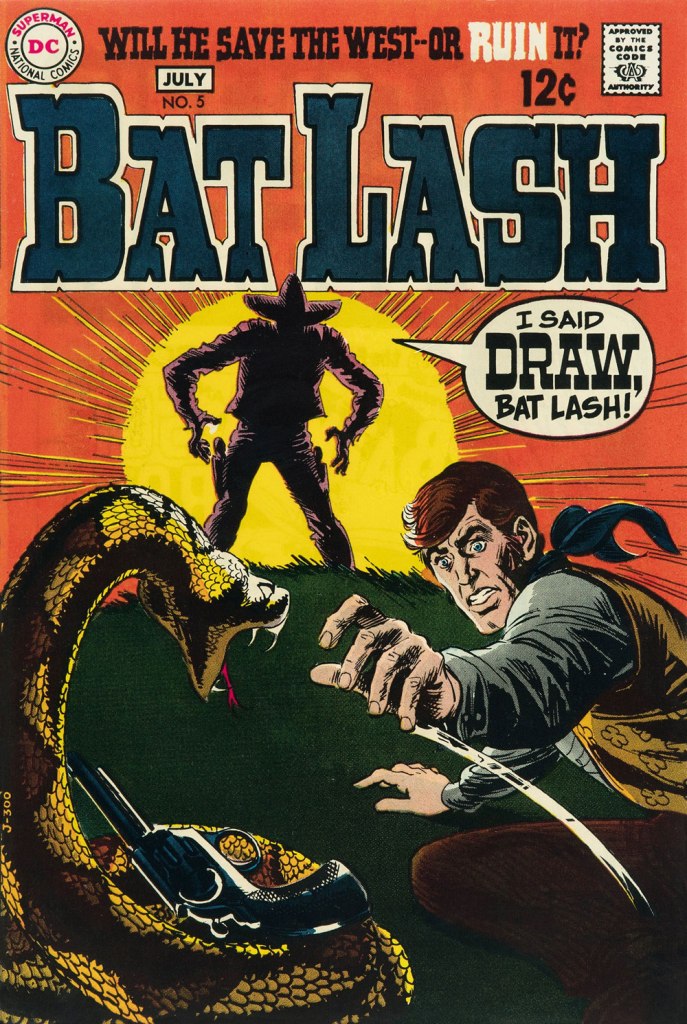
This is Bat Lash no. 5 (June-July 1969, DC). I’m reminded of a similar, later cover featuring one of Bat’s successors, Jonah Hex.
The price goes up and the comedy… just goes. This is Bat Lash no. 6 (Aug.-Sept. 1969, DC).
… and there goes the original tagline. This is the final issue, Bat Lash no. 7 (Oct.-Nov. 1969, DC)… and so must end this particular hot streak.

And now, some choice bonuses!

From issue 7, editor Orlando gives us some cheeky insight into the creation of an issue of Bat Lash.
And plotter Aragonés provides some visual direction.
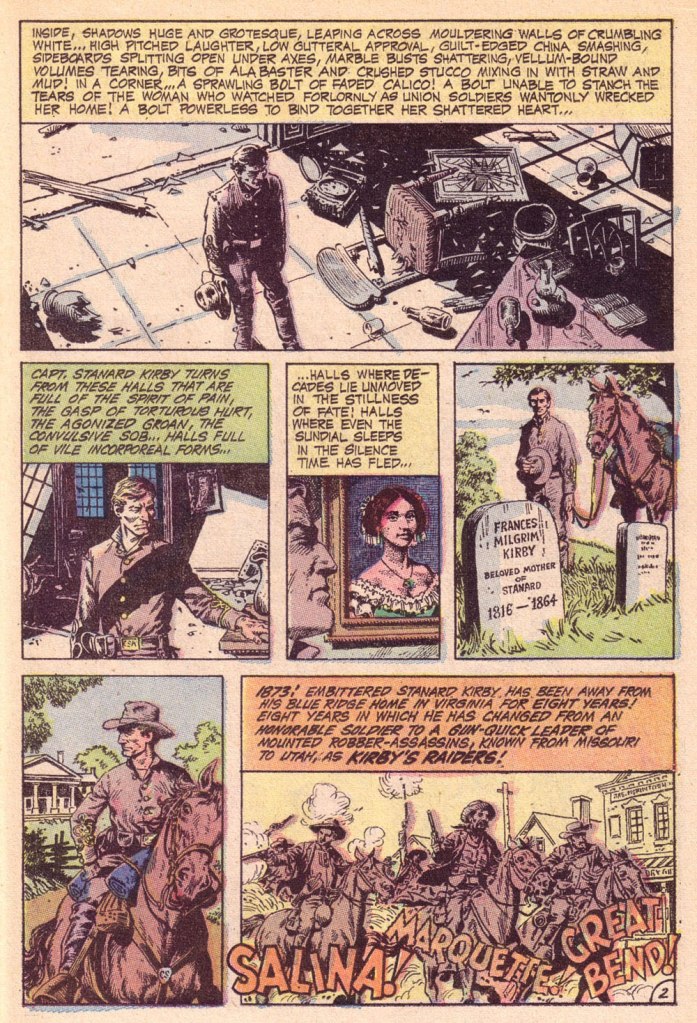
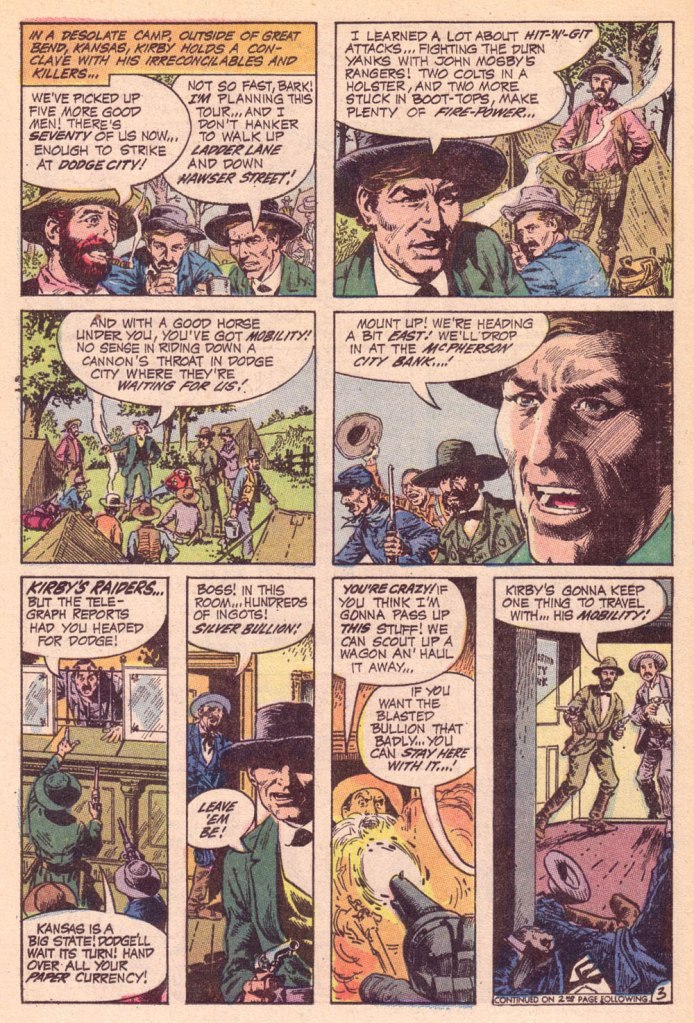
To give you a sense of the less flippant, but not altogether grim, tone of the later issues, this is page two from issue 7. DC Comics of that period were quite ambitious with the limited means of the four-colour reproduction process, using plenty of backlighting and projected light… quite another level.

I was *delighted* to see ol’ Bat Lash turn up in the Weird Western Tales of DC’s outstanding Justice League Unlimited animated series, , along with some of his distinguished colleagues. In the usual order: Ohiyesa ‘Pow Wow’ Smith, El Diablo, Bat Lash, Jonah Hex.

-RG

*In 1968, the wave of spaghetti Westerns reached its crest, comprising one-third of the Italian film production, only to collapse to one-tenth in 1969.” [ source ]

**alias « Terence Hill ».

Ragged, Starved, Hopeless: DeFuccio and Severin’s ‘Spoilers!’ (1971)

« History deals mainly with captains and kings, gods and prophets, exploiters and despoilers, not with useful men. » — Henry Louis Mencken

A few months ago, I was reading an old John Severin interview (in Graphic Story Magazine no. 13, Spring, 1971, Richard Kyle, editor) conducted by John Benson, and this passage stuck with me:

BENSON : Who are your favorite comics writers that you’ve worked with?

SEVERIN: I don’t even know who writes half the stories. Well, there are two guys, but they aren’t essentially comics writers. I like to work with Jerry DeFuccio and with Colin Dawkins. They write stories.

Which in turn led me to another Severin interview, this one conducted by Gary Groth in the early 2010s.

GROTH: In the back of the book, I’m looking at one issue of Son of Tomahawk actually, which I guess is a post-Tomahawk spin-off, but Frank Thorne does the lead feature and you did a really beautiful backup, I think one of your best strips during this period called Spoilers, that Jerry DeFuccio wrote.

SEVERIN: Really?

GROTH: You don’t sound like you have any recollection of this whatsoever.

SEVERIN: No, not at all. Oh, there’s an awful lot of stuff. Once I do a script and turn it in, it’s only with minor exceptions that I’ll remember the thing next week! I might remember it later on if somebody reminds me of something, but if somebody said, “What did you do last week?” I’d be damned if I know.

Severin’s reaction, to me, is a reminder of two things: first, that some artists (and fans!) are only interested in the visual aspects of comics. And second, that work conditions in the comics field (and most other commercially driven endeavours) are pretty inhumane if you have to just keep chugging on, with little time or impetus to look back and sniff the newsprint, let alone reflect.

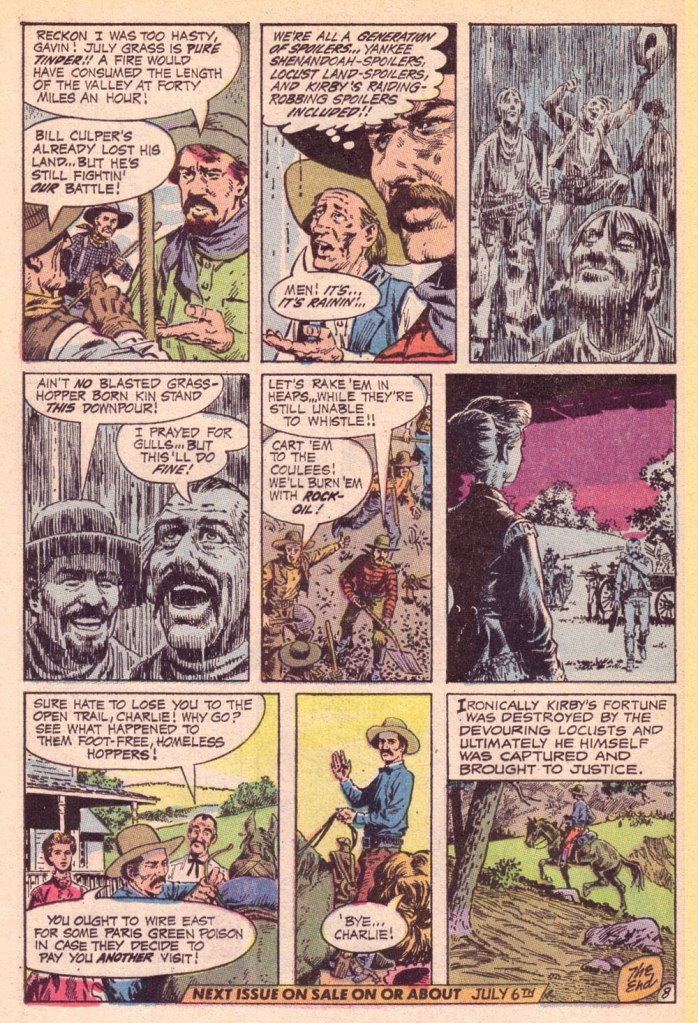
Jerome ‘Jerry’ DeFuccio (1925 – 2001) was born on this day, ninety-eight years ago. While he’s most closely associated with his quarter-century stint as associate editor of Mad Magazine, readers of EC’s war/adventure titles know he could also pen, in excellent fashion, a thoroughly gripping yarn. Here’s one of the handful he later did for DC, for editor Joe Kubert. And while Son of Tomahawk wasn’t commercially successful, it was a highlight of its era, a truly adult comic book. See for yourself:

‘Spoilers!’ saw print in Tomahawk no. 135 (July-Aug. 1971, DC).
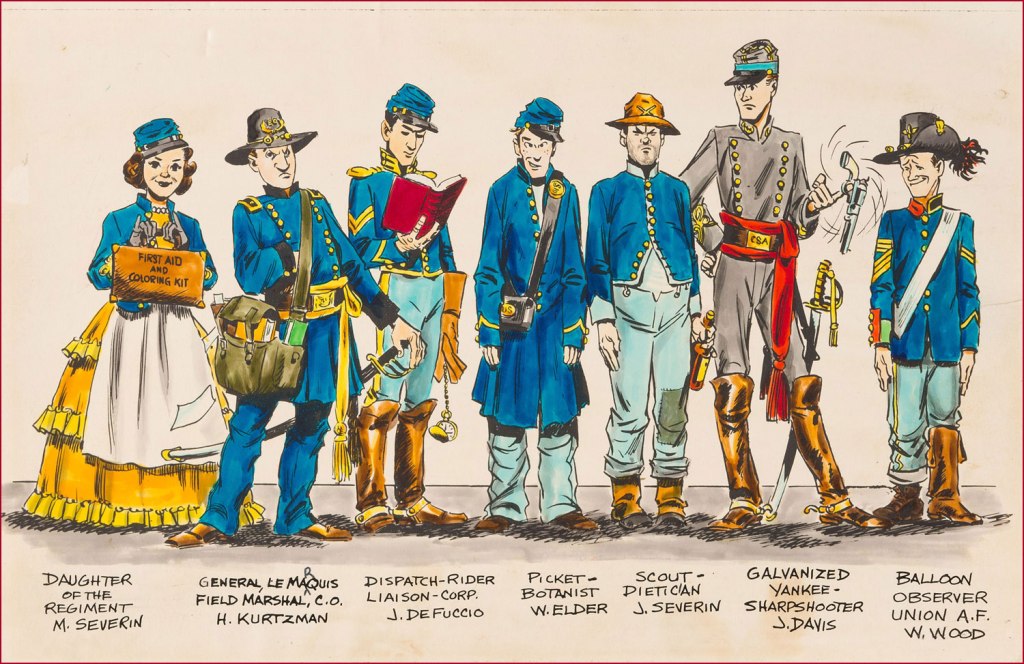
Here’s a lovely illustration of some of the EC gang, in civil war drag . Like it says, DeFuccio’s third from the left. Ink and wash over graphite pencil on Bristol board. » Drawn in the 1950s, this piece saw print in 1983, in issue 9 of the excellent EC fanzine Squa Tront.

GROTH: Was DeFuccio working for Mad at that time?

SEVERIN: Yeah.

GROTH: It seems like you remained friends with DeFuccio for a very long time.

SEVERIN: Yeah, I had to. He was my wife’s cousin.

-RG

Gérald Forton, Tall in the Saddle All the Way!

« Horse sense is the instinct that keeps horses from betting on men. » — Josephine Tey

While ‘academic’ realism has never been my thing in comics, I’ve always had a soft spot for Gérald Forton (Apr. 10, 1931 – Dec. 18 2021), who left us late last year, and who would be turning 91 today. He’s certainly my favourite Bob Morane artist (1962-67), but that’s not saying much, and besides, not his best work.

And just what is his best work? Ah, that’s easy: Teddy Ted. Just like his forebears, including his grandfather, the legendary Louis Forton (1879-1934), creator of Les Pieds Nickelés and Bibi Fricotin, grew up with an undying passion for horses. The Forton clan bred, raised, sold and raced horses, so it wasn’t a mere case of the banal and stereotypical European passion for the American ‘Far West’ and its Cowboys and Indians.

In 1964, Forton and ace scripter Roger Lécureux (Les pionniers de l’Espérance, Rahan) picked up the reins of a series launched by Jacques Kamb and Francisco Hidalgo and abandoned after three episodes. The new team revamped Teddy Ted, turning the protagonist from a boy to a man and instilling Lécureux’s humanist worldview* into the proceedings.

Teddy Ted and Forton reached their peak soon after the artist left Belgium, and the Bob Morane series, to raise horses in the South of France, a direct source of inspiration and documentation!

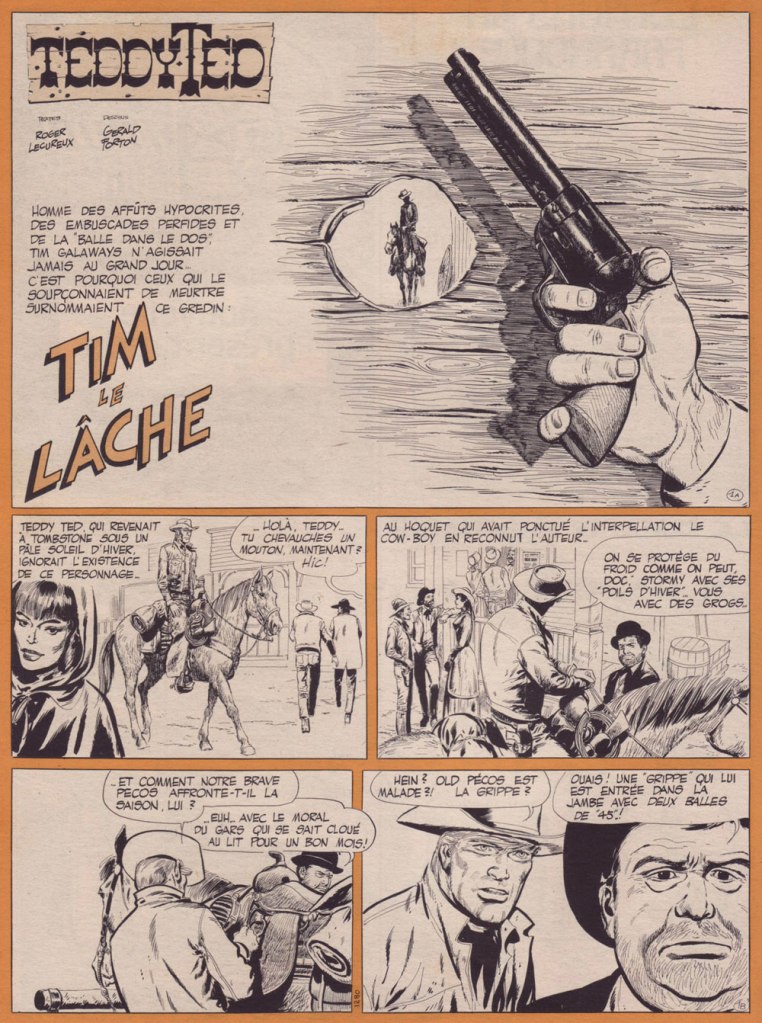
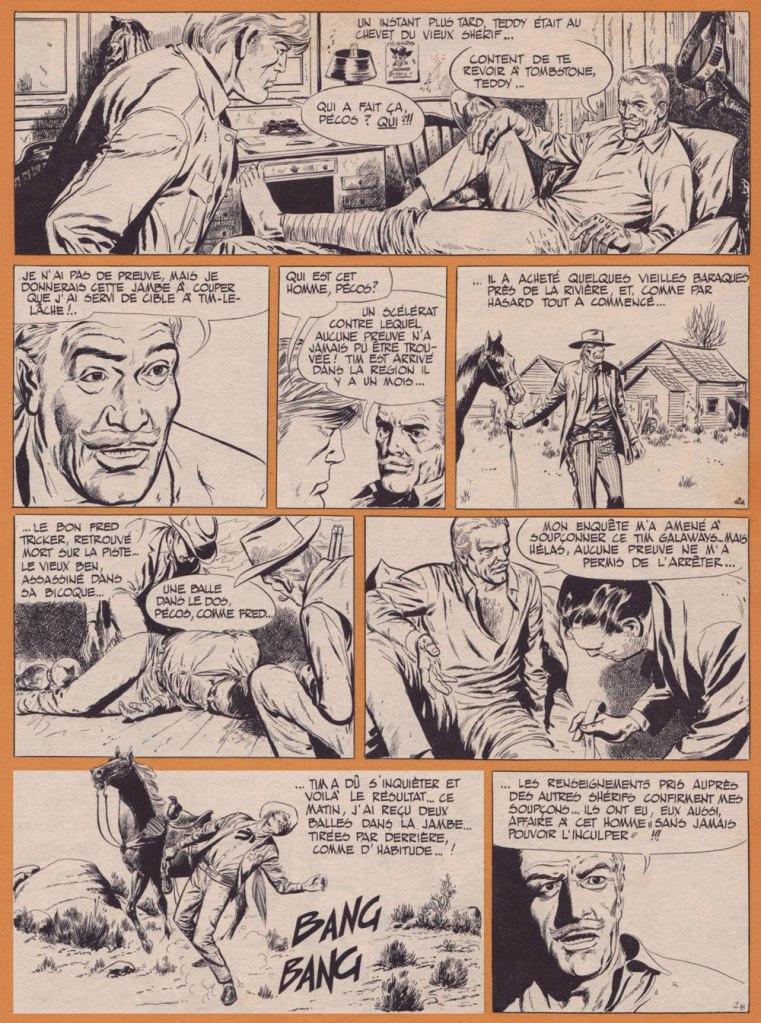
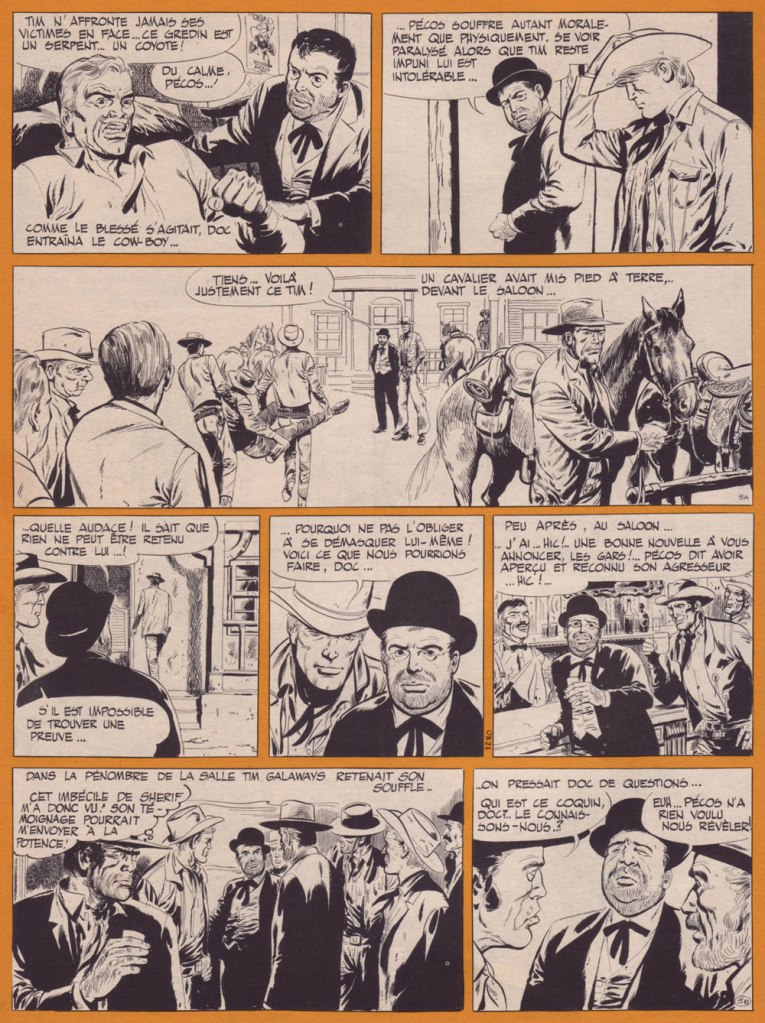
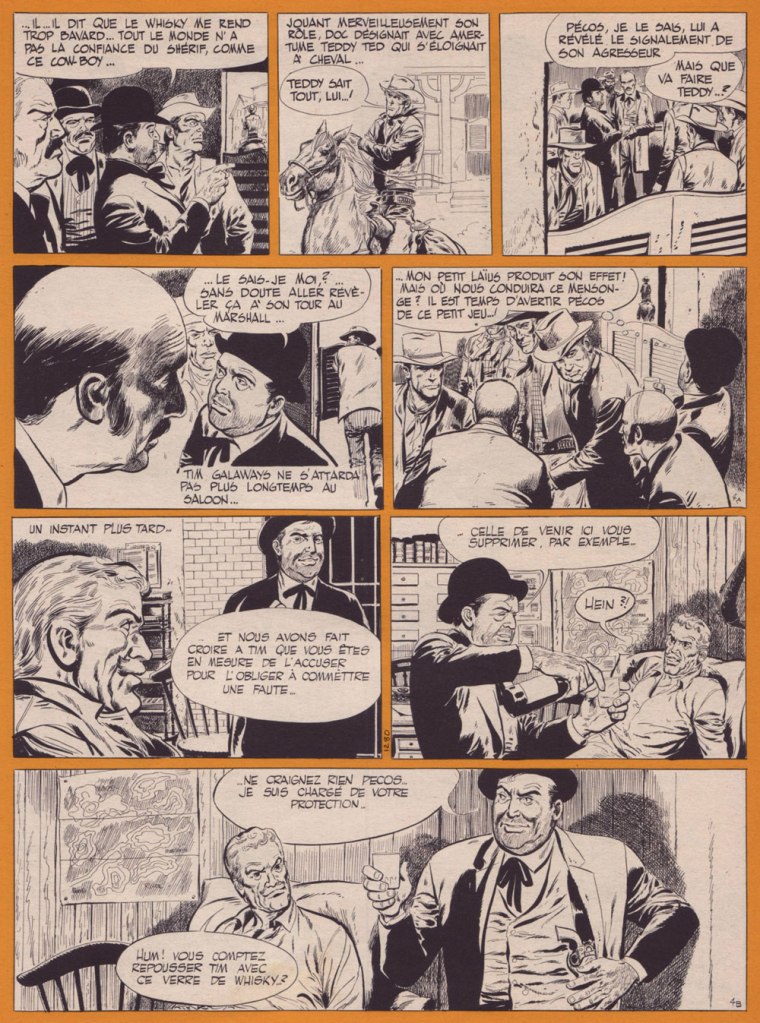
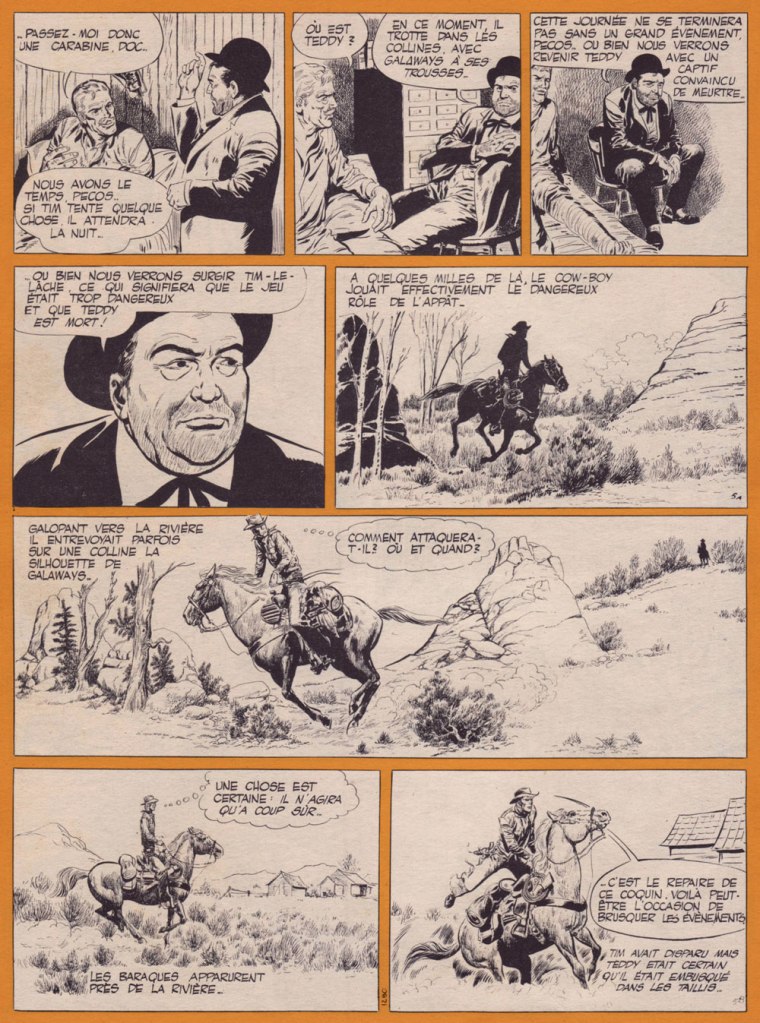
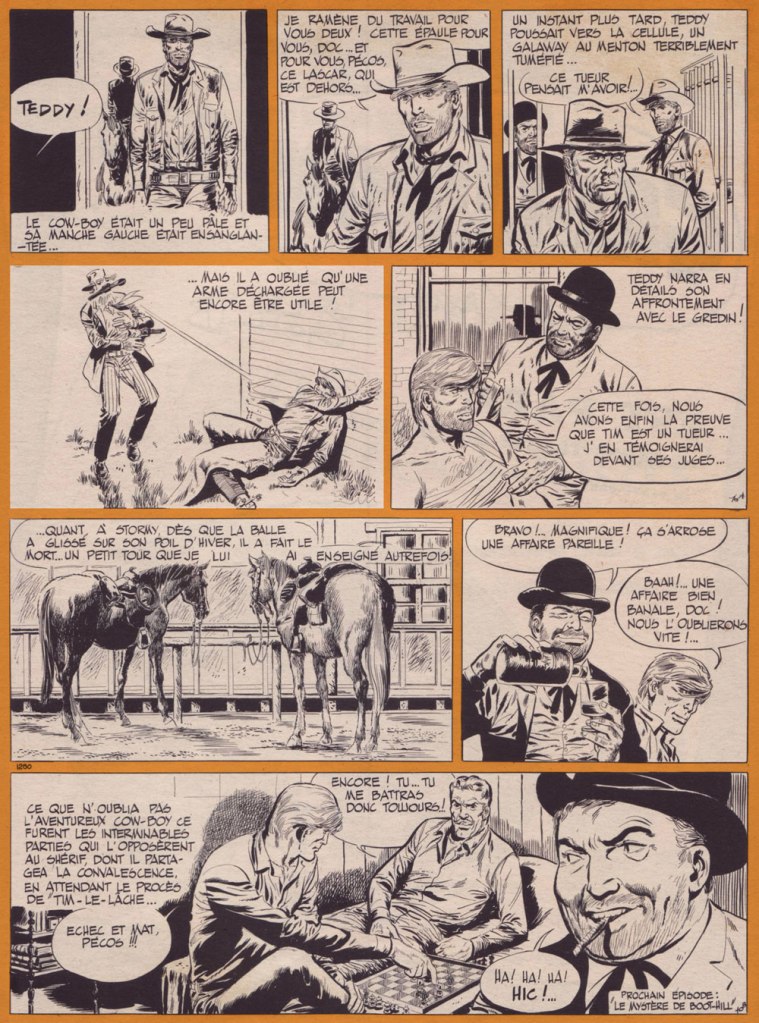
Without further ado, here’s my pick: Tim le lâche, from Pif Gadget no. 42 (Dec. 1969, Vaillant). It’s the tale of a craven back-shooting sneak against whom no-one has been able to garner any evidence, given the lack of survivors or witnesses. Given that Teddy’s close friend Pecos has been ambushed and taken out of commission by Craven Tim Galaways, Teddy and the town drunk (also its doctor!) set a dangerous trap with Teddy as bait and human target.

I’ve long had an aversion to ‘realistic’ European westerns, and that’s largely because of the absurd density of useless detail, the pages so busy and darkly-coloured as to buckle and collapse under the weight of the ink. Forton, by contrast, aside from being a master at spotting blacks, is just as bold in leaving white space where it’s needed, where the reader’s eye needs it. And here, unlike a lot of the technically-challenging genre strips (by which I mean, for instance, aviation, war or car racing, where one all-too-often encounters perfectly depicted machinery and stiff, generic human figures), Forton lavishes attention and care to every single thing, so we don’t wind up with beautiful horses and cardboard everything else. Which brings me around again to my point of Forton’s exceptionalism among the ‘realists’: the verisimilitude of his art is the result of observation, not soulless photo documentation.

After Teddy Ted was dropped from Pif Gadget, circa 1975, by its less-enlightened new management, Forton was picked to illustrate an adaptation of TV’s The Wild, Wild West (“Les mystères de l’Ouest”), which ironically made for the most realistic version of that colourful, but painfully stagey show, thanks to Forton’s excellence at capturing likenesses and conveying wide open spaces and details of period and setting.

By the early 1980s, Forton had moved to the US, where he tentatively freelanced in comic books, where he proved a poor fit. Though the French deemed him one of the most ‘American’ of Franco-Belgian cartoonists, he stood out like a sore thumb in the 1980’s mainstream, likely since his influences hailed not from comic books but rather comic strips, and those of an earlier generation at that (Alex Raymond, Frank Robbins, Milton Caniff… and his idol, Fred Harman).

He then heeded Horace Greeley’s legendary bit of advice and headed to California, bought himself a ranch in Apple Valley and, like many an overqualified but outmoded veteran cartoonist, toiled in mediocre animated shows.

Ah, but he still had plenty of life in him: moving to more fertile and rewarding soil, he smartly shifted to film storyboards (here are some samples!). Among his more notable credits: the original Toy Story, The Prince of Egypt, Coyote Ugly, Starship Troopers, Ali**

Retiring from the film industry at age 75, he then devoted his time to painting, playing the guitar, riding horses, and burnishing his œuvre for posterity by providing new artwork for reprint collections of his past works, in the midst of a resurgence in Europe.

Humble, active and alert to the very end, Forton finally and peacefully rode into the sunset, at the most venerable age of 90. For more Forton art, check out this lovingly assembled gallery.

-RG

*I’m inclined to draw parallels between Lécureux’s view of the West on Teddy Ted to Star Trek creator Gene Roddenberry‘s approach on Have Gun, Will Travel: compassion, but with a hard edge.

**wherein Will Smith doled out punches rather than slaps

Wyatt Earp, Ubiquitous Comic Book Marshall

« Fistfightin’ may not be your style, Marshall Earp! If you want to crawl, I’ll let ye off easy! »
« Crawl, Irish John? I’m going to tie a knot in your cauliflower ears! » — ‘Hired to Die’ (1965)

Happy one hundred and seventy-fourth birthday to Wyatt Berry Stapp Earp (March 19, 1848 – January 13, 1929), bison hunter, teamster, bouncer, saloon-keeper, gambler, brothel owner, pimp, miner, boxing referee, constable, city policeman, county sheriff, and, lest we forget, comic book hero… for several publishers at once!

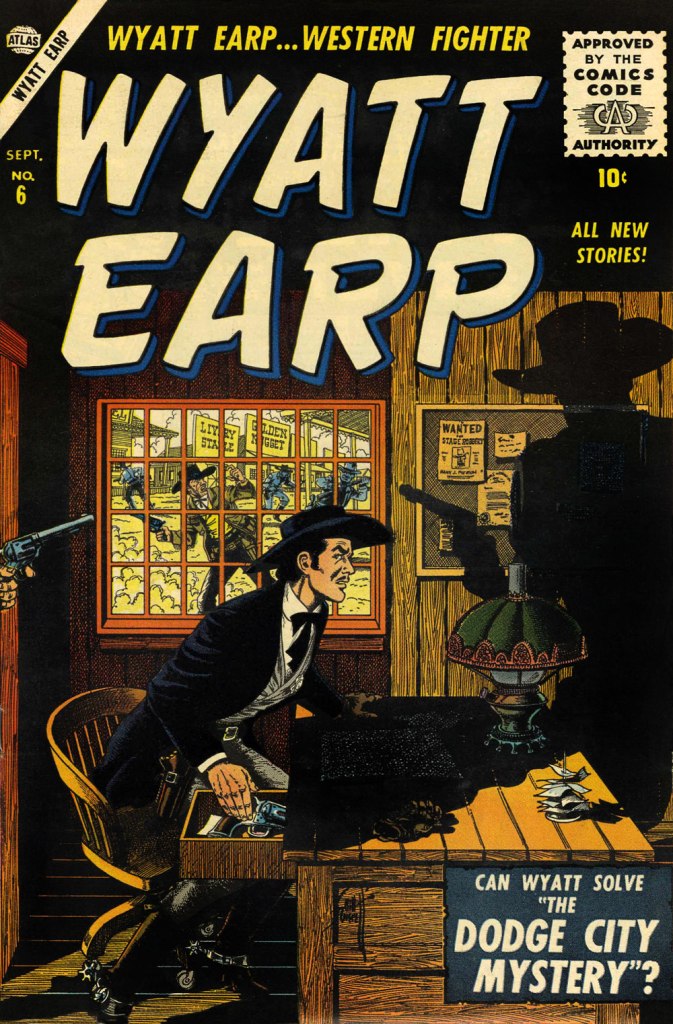
This is Wyatt Earp no. 6 (Sept. 1956, Atlas); ultra-detailed cover by Bill Everett, colours by Stan Goldberg.
This is Wyatt Earp no. 9 (March 1957, Atlas); cover by John Severin, colours by Goldberg.
This is Wyatt Earp no. 11 (May 1957, Atlas); cover by John Severin, colours by Goldberg.
This is Wyatt Earp no. 15 (Feb. 1958, Atlas); cover by Joe Maneely, colours by Goldberg.
To cash in on the success of The Life and Legend of Wyatt Earp (1955-61) tv series, Dell also threw their Stetson into the ring. This is Hugh O’Brian, Famous Marshal Wyatt Earp (sheesh!) no. 13 (Dec. 1960-Feb. 1961, Dell), the final issue.

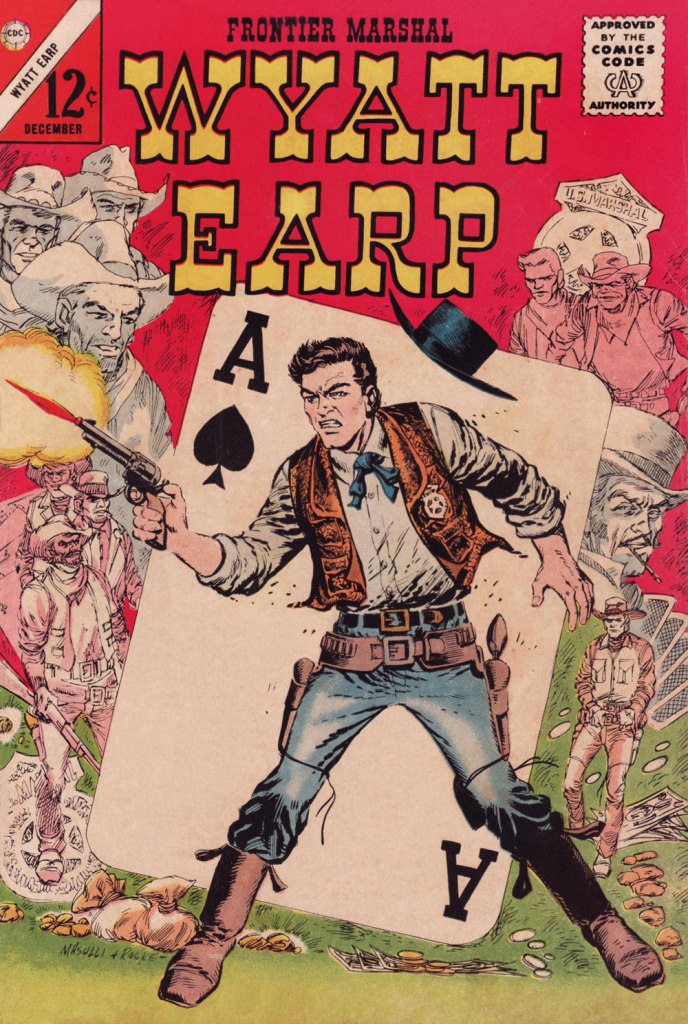
Mr. Earp had an especially notable run at Charlton (and by far the best title logo), with sixty-one issues of his very own title published between 1956 and 1967. And with Joe Gill scripts, so it’s solid stuff. This is Wyatt Earp, Frontier Marshal no. 61 (Dec. 1965, Charlton); cover by Pat Masulli and Rocco Mastroserio. I’d saved this one for this occasion, having withheld it from my M/M showcase The Masulli-Mastroserio Cover Deluge of ’65!

This is Wyatt Earp, Frontier Marshal no. 64 (July 1966, Charlton); cover by Mastroserio, lettering by Jon d’Agostino.
This is Wyatt Earp, Frontier Marshal no. 69 (June 1967, Charlton); cover by Mastroserio.
This is Wyatt Earp, Frontier Marshal no. 72 (Dec. 1967, Charlton), the fiery finale of *that* run. Another effective cover by Mr. Mastroserio, who passed away a few months later, aged a mere 40.
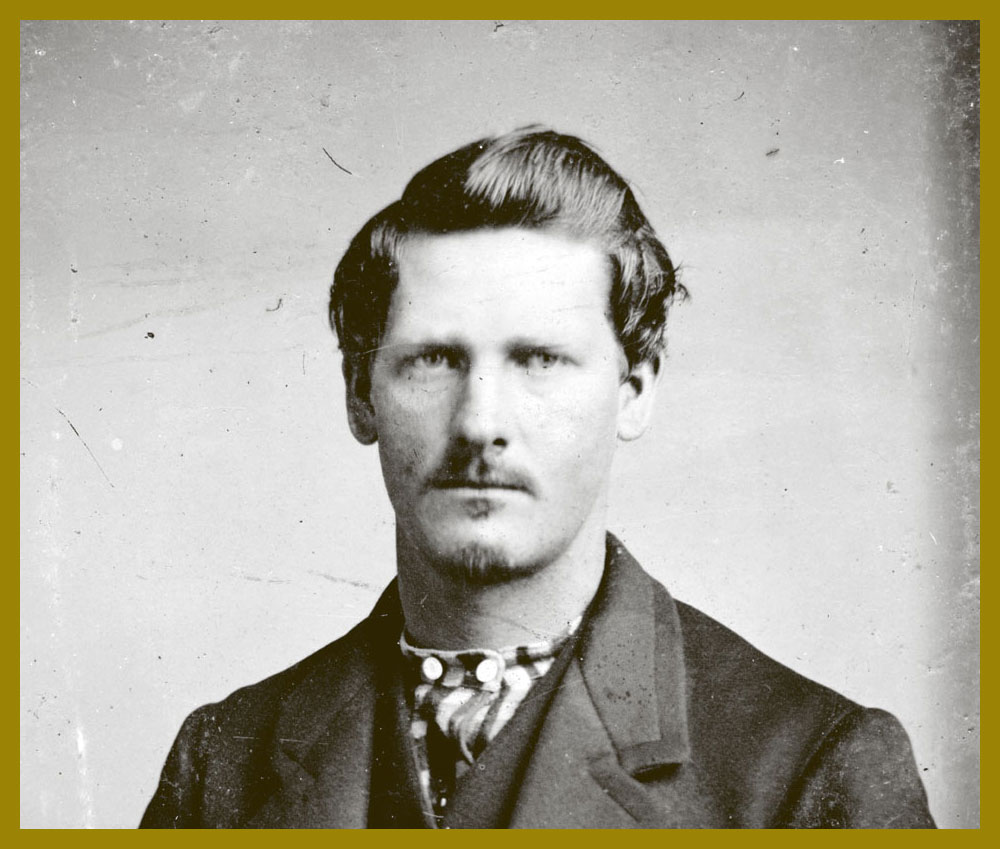
And here’s a shot of the real-life Mr. Earp. Don’t look so glum, hombre — it’s your birthday!

-RG

Salami Western: Benito Jacovitti’s Cocco Bill

« I’m a salami writer. I try to write good salami, but salami is salami. You can’t sell it as caviar. » — Stephen King

Farcical ‘Wild West’ comic strips may be a dime a dozen, but despite the undeniable hoariness of the premise, a number of them are inevitably outstanding. To name but a few, there’s been Maurice ‘Morris’ De Bevere‘s Lucky Luke (1946); Basil Wolverton‘s Bingbang Buster (1949); Harvey Kurtzman‘s Pot-Shot Pete (Sheriff of Yucca-Pucca Gulch) (1950); Jean-Claude Poirier‘s Horace, cheval de l’Ouest (1970); Jean ‘Cézard’ César‘s Billy Bonbon (1973); and today’s cowboy in the spotlight, Benito Jacovitti‘s Cocco Bill (1957).

Cocco Bill was introduced in the pages of Il Giorno dei Ragazzi (1957-68), “originally intended as the Italian version of the British children’s periodical Eagle“. After Il Giorno’s demise, Cocco Bill shifted his sagebrush shenanigans to the venerable Corriere dei Piccoli (1908-95).

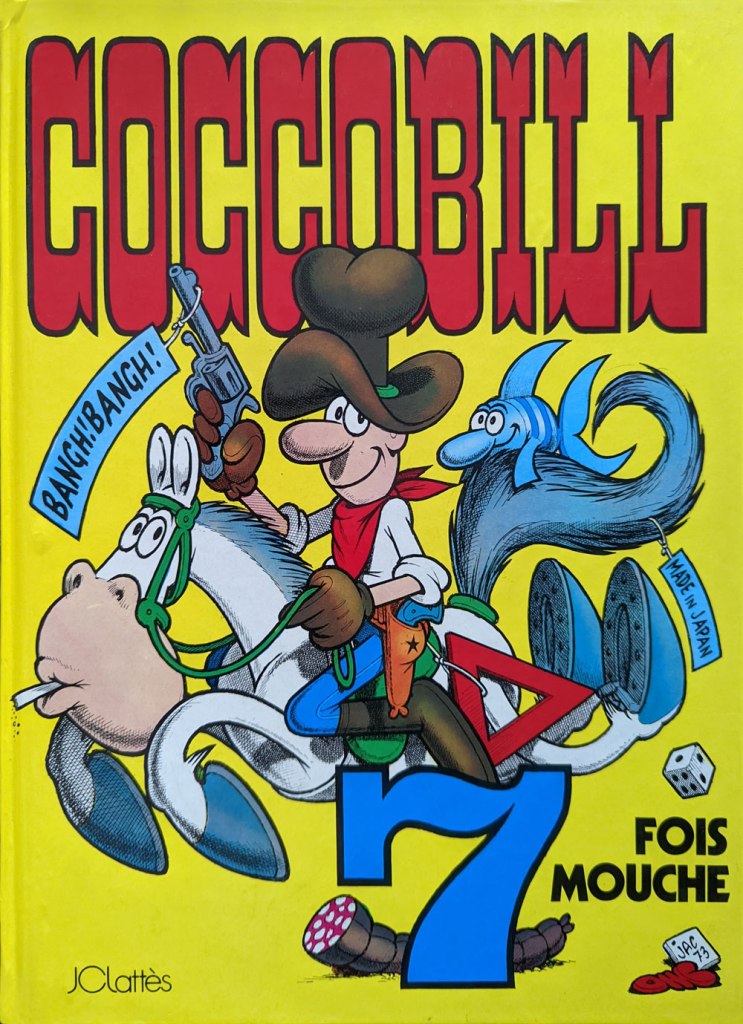
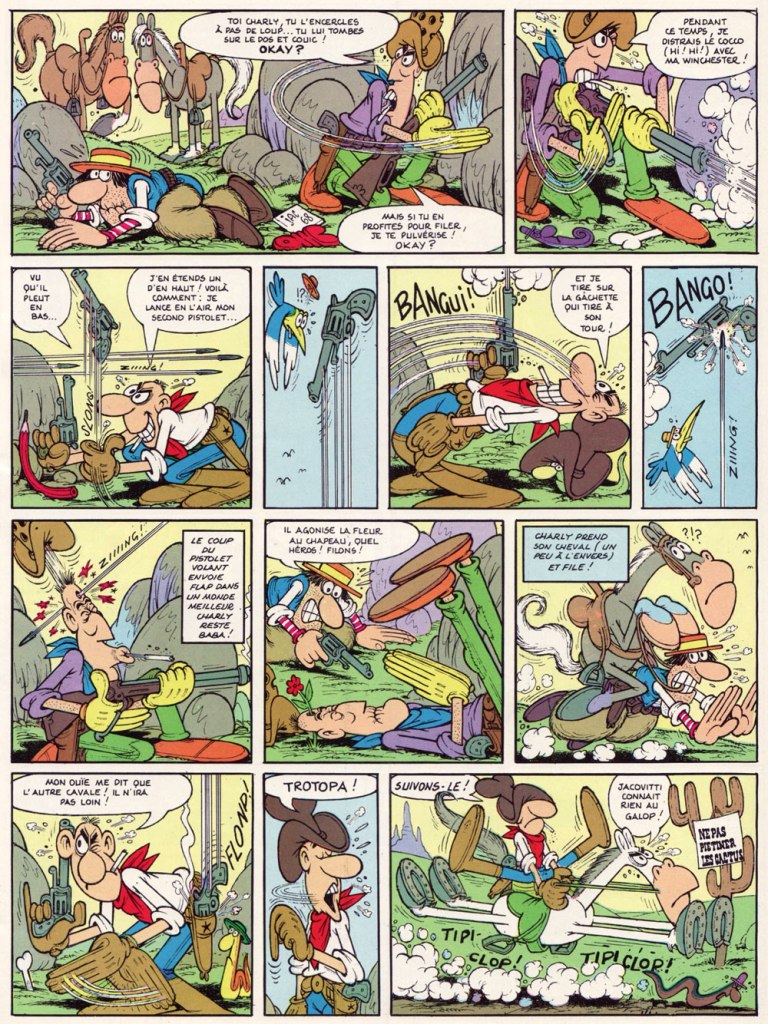
This is 7 fois mouche (1975, JC Lattès, France), originally serialised in Corriere dei Piccoli as “Cocco Bill fa sette più”, 1968-69. In Italy, it was actually number twenty in the series.

With Wolverton, Jacovitti (1923 – 1997) shares an animist sort of predilection for cramming every square centimetre of the panel with absurdist details, facetious sound effects, recurring motifs and symbols and, naturally, gags. It’s a most noble cartooning tradition that runs the course of the medium’s history, from Bill Holman through Kurtzman and Will Elder (chicken fat!) and merrily endures to this day in Dan Piraro and Wayno‘s oft-sublime Bizarro.

Here’s a two-page ambush sequence that gives you a sense of how handy — and deadly — our protagonist is with a pair of irons.

The sign says: “Do not trample the cacti“.
The surviving bushwacker is put out of his misery by the gang’s second-in-command, the Chaplinesque Kruel; you know he’s a villain of substance because he rides a double horse. Pray note the lovely SALOOOOOOOOOOOOOOOOOOON sign with its behatted snake carvings.
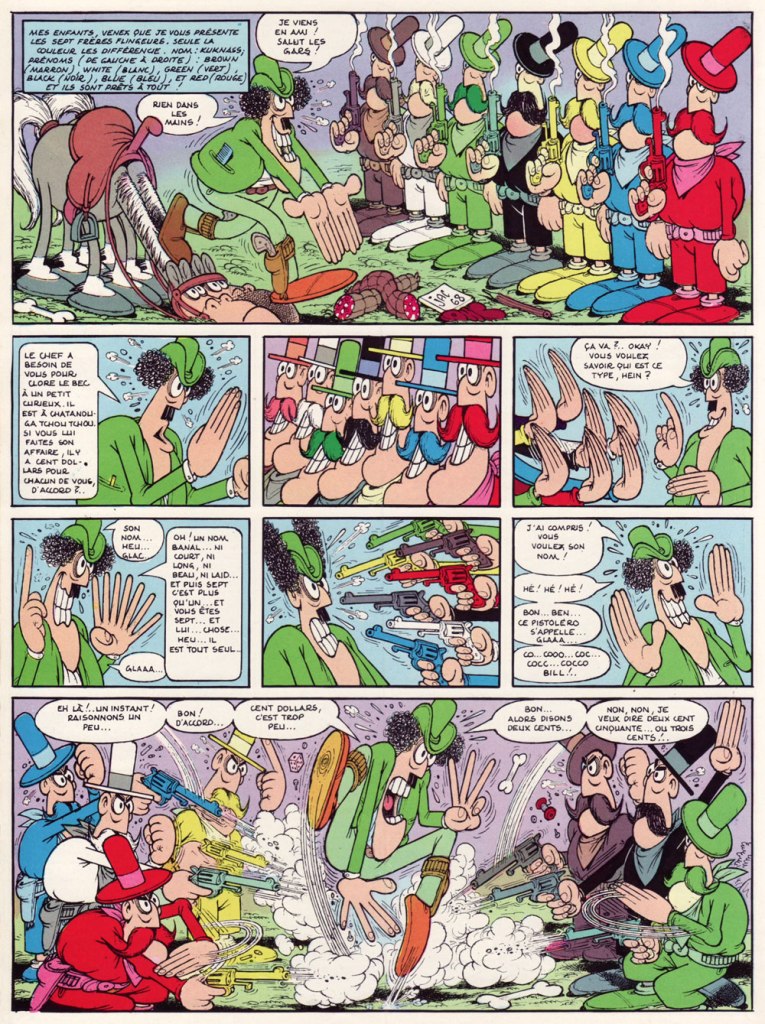
Meet hired guns the Kuknass Brothers: Brown, White, Green, Black, Yellow, Blue and Red, of course. Like the idea, Quentin? Note the extra digits (the better to count with, panel five). It’s easy to imagine Jacovitti having some influence on Mad’s Don Martin
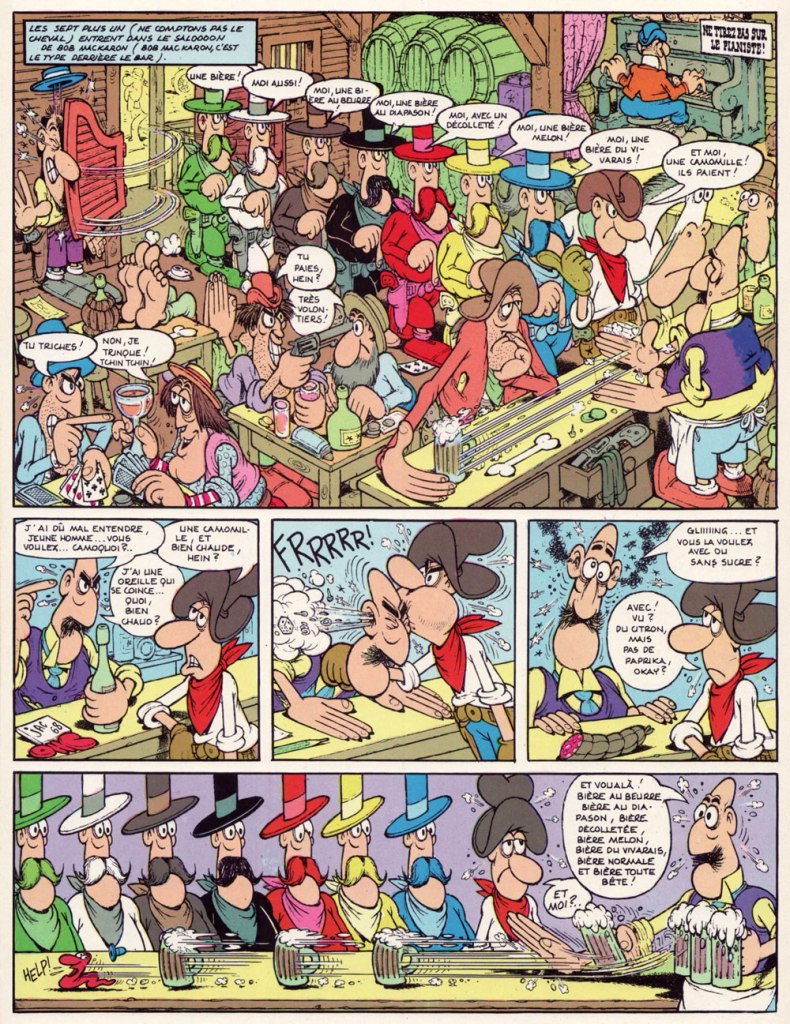
In the manner of many a pure-hearted cowboy, Cocco Bill’s brew of choice is alcohol-free; his poison is chamomile tea, a drink with numerous health benefits! With sugar and lemon, but hold the paprika, thank you! Note: Don’t Shoot the Piano Player!
This is Sur les rails (1975, JC Lattès, France), originally serialised in Corriere dei Piccoli as “Cocco Bill sulle rotaie”, 1969. In Italy, it was number twenty-one in the series.
The train meets the stagecoach, and how! A page from Sur les rails.

Last month, my co-admin ds reported, in the course of her spotlight on Massimo Mattioli, that Jacovitti is said to be the Italian cartoonist best known internationally. I have no idea how such popularity is measured, but I do enjoy the idea of a palmarès headed by cartoonists I love, for once. I do, however, suspect that the global reach of animation frequently contributes more to a cartoonist’s name recognition than does his printed work (think Guillermo Mordillo). Case in point: while Cocco Bill strips have been translated and reprinted in several countries, these efforts have been, more often than not, patchy and sporadic. On the other hand, the Cocco Bill TV series (2000-04) ran a healthy 104 episodes. And it looks great, which didn’t hurt. Check out the pilot episode, ‘Cocco Augh‘. For a creator, it’s assuredly a classier calling card than a bunch of sordid sex ‘comedies’.

I’d like to dedicate this post to the fond memory of a departed cartooning colleague, Patrick ‘Henriette Valium’ Henley (1959-2021), since Cocco Bill was, I’ve heard tell, his favourite bédé.

-RG

(Fondly) Remembering Tony Tallarico

« Someone at Dell Comics decided it’d be swell to turn famous monsters into superheroes — an idea whose time never came. And just to make sure there were bad, they hired Tony Tallarico to draw them. » — — James Schumeister, with the sort of brickbat typically lobbed at Mr. Tallarico.

Last week, we lost, at the venerable age of eighty-eight, the controversial, much-maligned Tony Tallarico (Sept. 20, 1933 – Jan. 7, 2022). The case of Mr. Tallarico’s reputation is typical of mainstream US cartoonists who generally eschewed the superhero genre. His mistake, I suppose, is that he drew a handful of them, and in his own distinctive fashion to boot, thus sealing his doom in Fanboy court.

Yet there’s far more depth and variety to Tallarico’s career, and that’s should be remembered. Besides, those superhero comics were just light-hearted, unpretentious fun. Obviously not what the continuity-addicted True Believers craved.

Let’s take a tour of some of the highlights!

A page from Crazy Quilt, one of three stories Tallarico illustrated for my personal candidate for greatest horror comic book of all time, the unlikely one-shot Tales From the Tomb (Oct. 1962, Dell). Script and storyboard by John Stanley. Read the rest (complete with, fittingly, its analysis) of Crazy Quilt here.
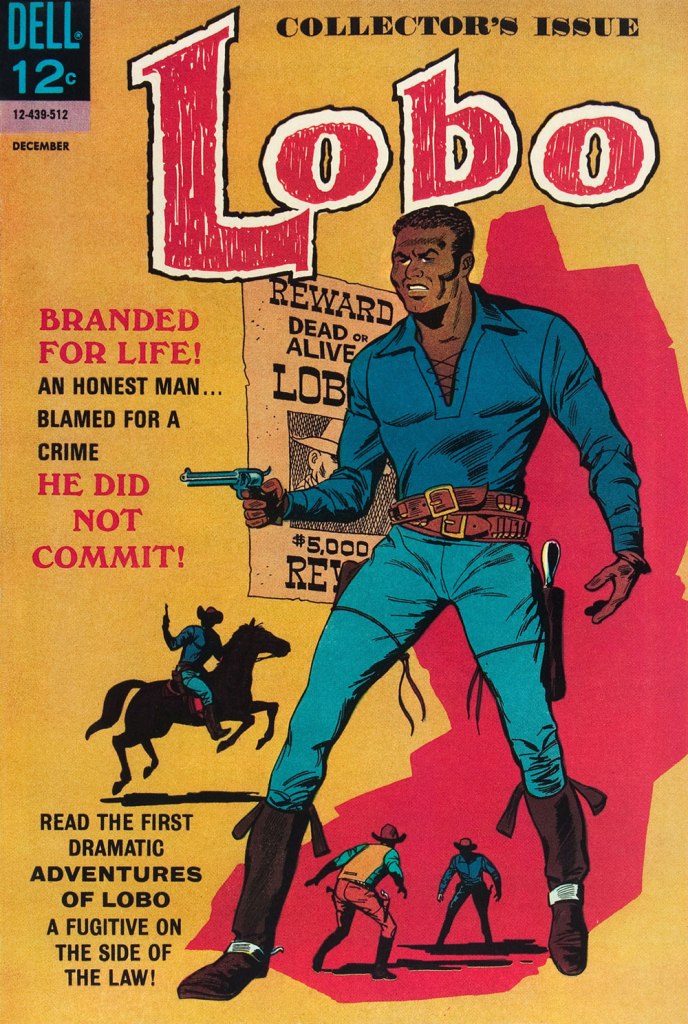
Arguably, if Tallarico’s going to be remembered in comics and general history, it may be for this once-obscure but significant mid-60s creation. This is Lobo no. 1 (Dec. 1965, Dell Comics). Tallarico and writer D.J. Arneson hold different views as to the character’s genesis, as Canadian researcher Jamie Coville discovered in 2016. To his credit, Coville simply let the former collaborators present their respective side of the story. Read the resulting interviews here! And do check out the début issue itself, along with Tom Brevoort’s analysis… right here.

As reported in Alter Ego no. 106 (Dec. 2011, TwoMorrows): « On May 20, 2005, Tony Tallarico received the Pioneer Award, given for his co-creation of the first African-American comic book hero, Lobo, a post-Civil War cowboy who appeared in two issues of his own Dell/Western title. The honor was given at a ceremony held at Temple University in Philadelphia, Pennsylvania. »

A Tallarico ad from Eerie no. 20 (March 1969, Warren); Tony enjoyed keeping things in the family, and so young “Danny Smith” was actually Tony’s wife’s nephew, Danny Grosso. My thanks to Tony’s daughter Nina for graciously divulging this bit of inside info!
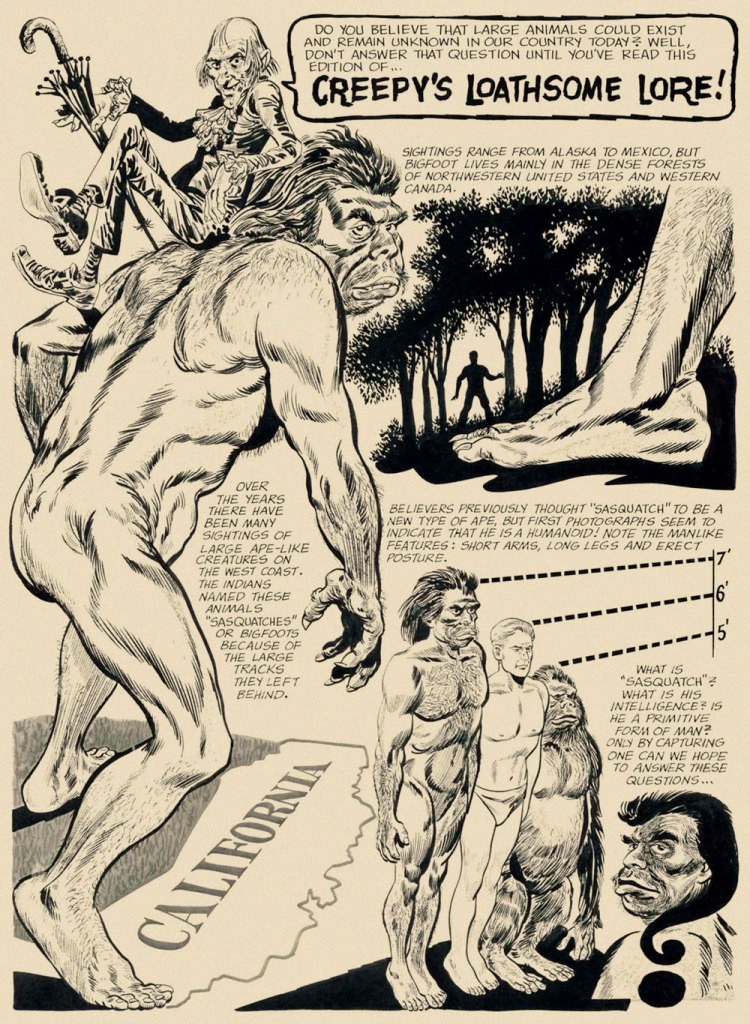
Cryptozoologists take note! Creepy no. 26 (April 1969, Warren); script by editor Bill Parente. I just adore Uncle Creepy’s pose (great use of props!), not to mention the question mark mullet. Should be the hit of the next tonsorial season!
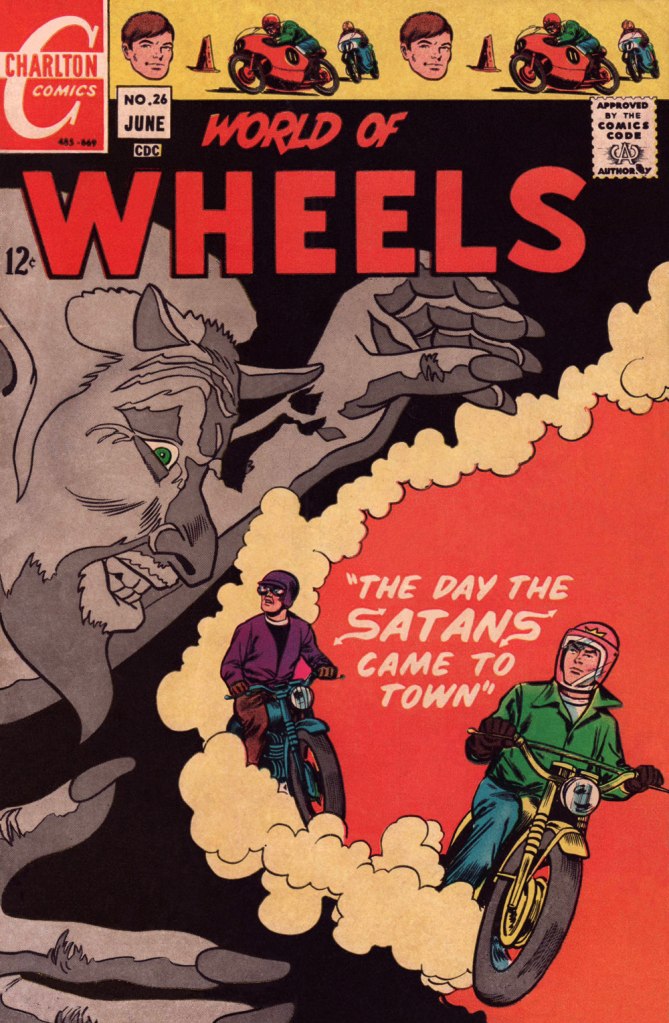
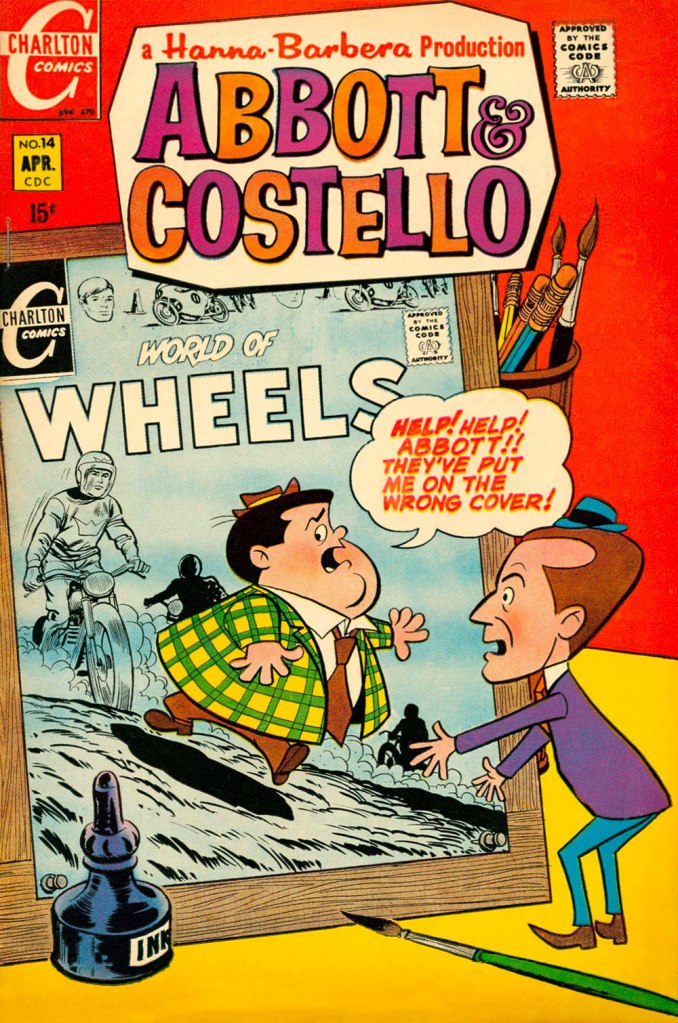
Joe Gill and Tallarico took over the handlebars of one of Charlton’s established hot-rodders, Ken King. Following the direction blazed by their predecessor, Jack Keller, King had become “the Most Hated Man on Wheels!” (in Drag-Strip Hotrodders no. 13, Jan. 1967, Charlton) after being unjustly accused of wrecking his best friend, Jerry Gerard, aka “The Nicest Guy in Racing” during a meet. The series’ unremittingly bleak portrayal of the racing scene is fascinating, and Gill and Tallarico wisely kept the pace. This is World of Wheels no. 26 (June 1969, Charlton); cover by Tallarico.
An in-house ad from Eerie no. 23 (September 1969, Warren), technically Vampirella’s first published appearance. Art by “Tony Williamsune”, the collective nom de plume adopted by frequent collaborators Tallarico and William ‘Bill’ Fraccio. According to Tallarico, their collaboration was quite fluid: both contributed to layout, pencils and inks, but Tony was the extroverted go-getter, while Bill was the quiet one.
A “Williamsune” splash from Creepy no. 31 (February 1970, Warren). Tallarico on his association with Fraccio: « I would pencil some, he would ink some, visa versa y’know one of those things. I was really the guy that went out and got the work. Bill never liked to do that. It would depend. If he was working on something else I would start a project too and do pencils. It was a fun time. » [ source ]
This is Abbott & Costello no. 14 (April 1970, Charlton), featuring the beloved veteran comedians’ crossover with the aforementioned Ken King. The look of the series is based upon Hanna-Barbera‘s 1967-68 The Abbott and Costello Cartoon Show rather than on the duo’s classic movies and routines. Besides, Lou Costello having passed away in 1959, his part was voiced by Stan Irwin (with Bud Abbott as… Abbott).
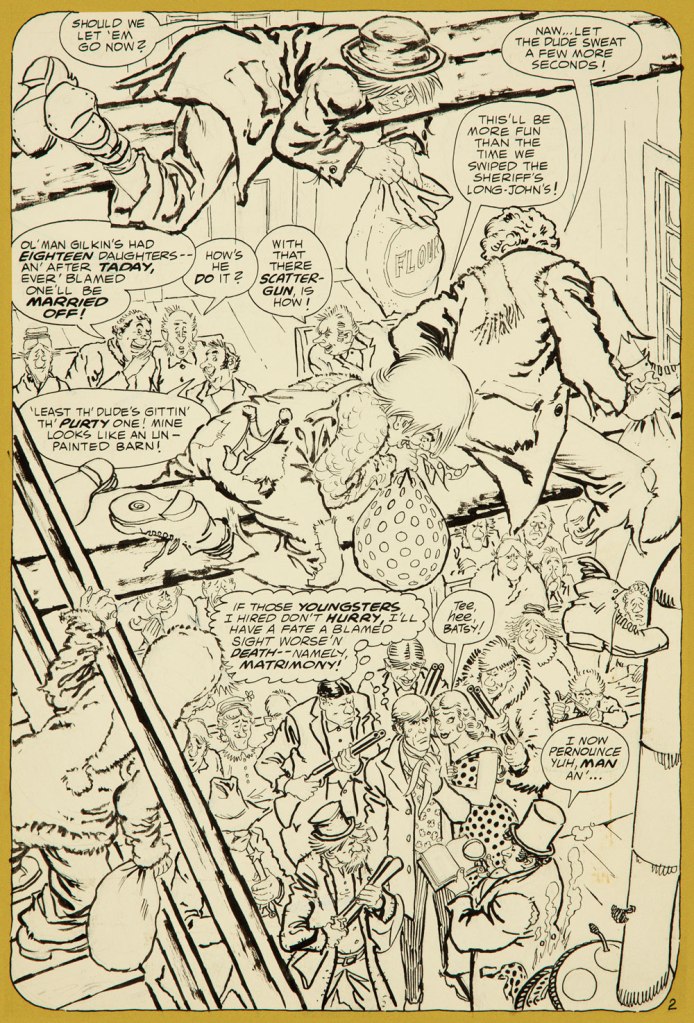
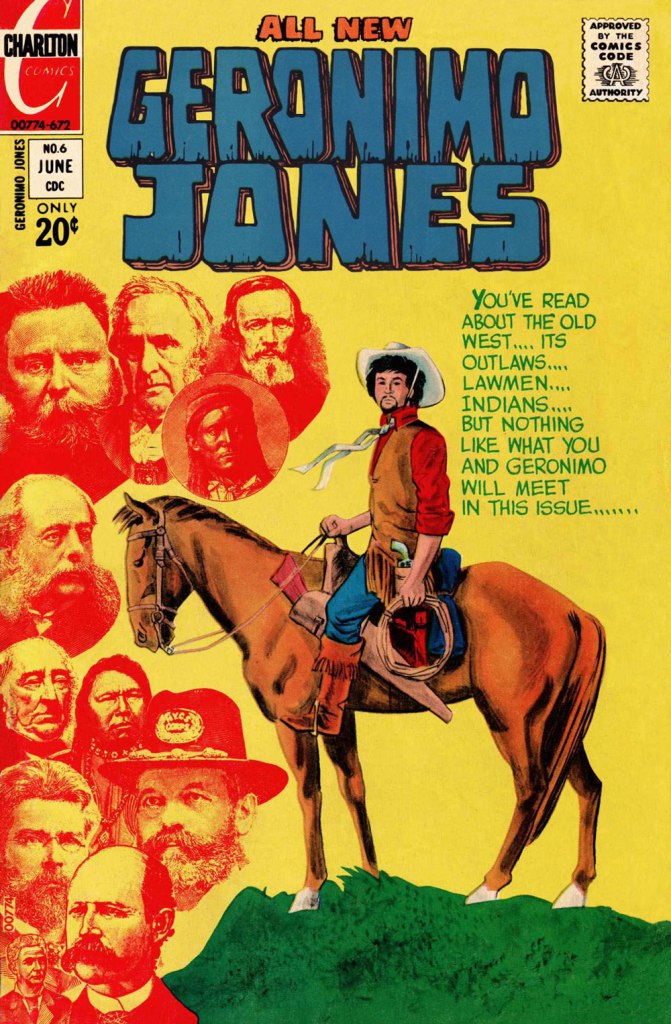
Preceding the advent of Jonah Hex by some months* in the Weird Western stakes, Geronimo Jones was a truly oddball oater series, in the best sense of the term. Created by Tallarico (script and inks) and José Delbo (pencils), Geronimo’s adventures ran for 9 issues (plus one that remains unpublished), from September, 1971 to January, 1973. Geronimo himself was essentially a young pacifist seeking his quiet place in the Old West, in the finest tradition. However, strange encounters and occurrences keep thwarting his laudable goal. And none is more outlandish and shocking than what he comes up against in this issue, cover warning and all. This is Geronimo Jones no. 6 (June 1972, Charlton). The GCD credits the cover to Delbo alone, but the use of collage and halftone wash are telltale Tallarico trademarks… not to mention his distinctive lettering. My guess therefore is: pencils by Delbo, layout, inks and collage by Tallarico.
Tallarico and Fraccio did only a handful of stories in this wild, swirly style, including four for Charlton: The Curse of the Vampire in The Many Ghosts of Dr. Graves no. 44 (Jan. 1974, Charlton);
this one, Come See Our Ghost… in Haunted no. 16 (June 1974, Charlton); The Reuger Formula in Haunted no. 24 (Nov. 1975) and A Solemn Oath! in Ghostly Tales no. 118 (Nov. 1975). Let me assure you that the sort of bold inking on display here, while deceptively simple in appearance, takes unerring confidence and skill to achieve. Bravissimo!

By the mid-70s, with his main comics accounts defunct or dormant (Dell, Treasure Chest, Charlton), Tallarico, ever the astute and tireless businessman (another rare trait among cartoonists) simply stepped up and diversified his efforts, branching out and creating a market for himself. « In the 70s the whole business went kaput. Luckily I was able to transfer over into doing children’s books. I’ve been doing children’s books ever since. My wife went though a count several months ago. It was over a thousand titles. That’s a lot of children’s books. »

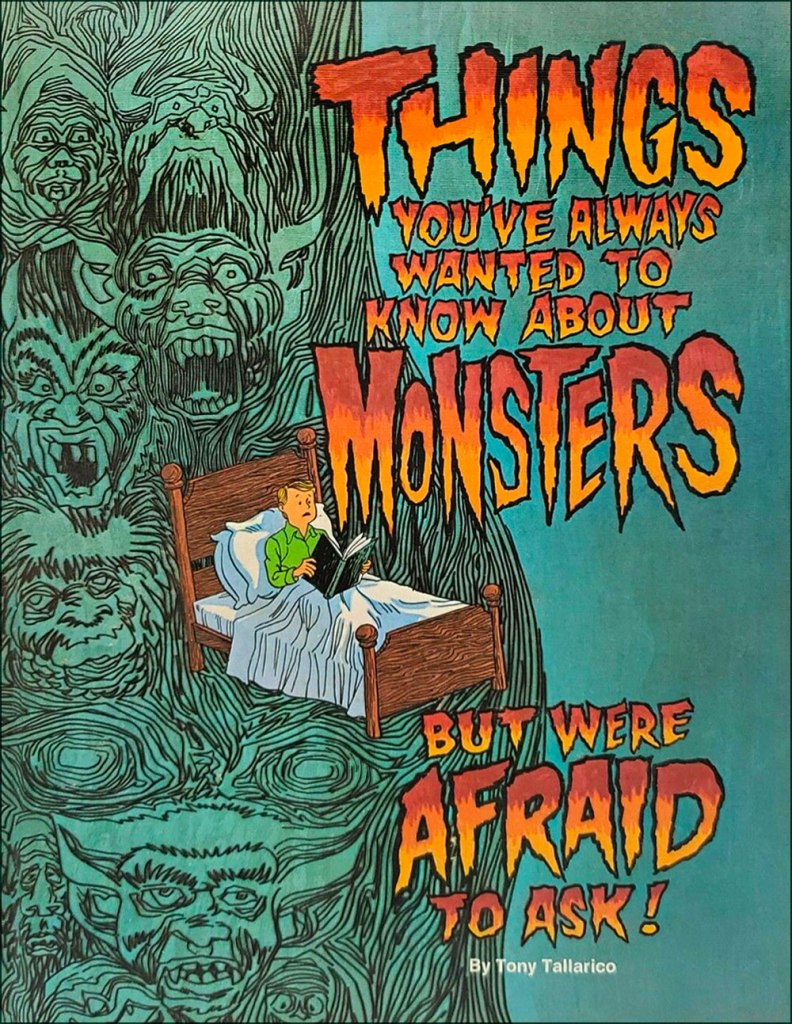
Here’s a lovely one: Things You’ve Always Wanted to Know About Monsters (1977, Grosset & Dunlap). From the author’s introduction: « My sincere thanks to the many motion picture studios who produced these great monster films. They have kept many a generation of fans ‘monsterized‘. My thanks to my parents, who did not forbid me to see these films when I was a boy. Instead, they brought out in me many of the questions that appear in this volume. They always stressed that monsters are another form of fictional entertainment. My thanks to my wife Elvira, and my daughter Nina**, who stood by while my son and I made a mess of the living room as we selected the many pictures that appear here. »

I should point out that I haven’t forgotten one of my favourite Tallarico projects, namely his charming work on the Bobby ShermanGetting Together” comic book (7 issues, Feb.-Oct. 1972, Charlton)… it’s just that I’ve already addressed the topic: check out Let’s Hear It for Bobby Sherman!

And what of his 1965 collaboration with The Shadow’s Walter Gibson, Monsters? Got you covered on that one as well!

I don’t know whether I’ll change anyone’s mind about Mr. Tallarico’s work, but I believe I can rest assured I gave it my best shot.

-RG

*Hex was introduced in All-Star Western no. 10 (Feb.-Mar. 1972, DC).

**My closest brush with the Tallaricos came in 2015 when I helped his daughter Nina identify and source some artwork she was selling on eBay for her dad. In my experience, a very nice lady. My sincere condolences to the bereaved family.