Today’s Tentacle Tuesday is a continuation of previous post that’s close to my heart. In a little less than a year, I have accumulated a new batch of tantalizing tentacles from the pens and minds of that intrepid team, Wayno and Dan Piraro. The initial post can be found here: Tentacle Tuesday: Let’s Get Bizarro. The loveliest thing is that some of these are from 2021 – I am not taking for granted the fact that these guys just keep going on, with no loss in quality, year after year. Without further delay…
First, some Dan Piraro Sundays – Wayno has been part of the team since 2018, but only on the dailies.
And now, on to the aforementioned dailies! Wayno straddles the line between continuing the Bizarro aesthetic and keeping his own drawing style beautifully, I think.
As a bonus, 3 older Piraro dailies, artfully collated by co-admin RG. Wouldn’t you like to hang this in your home? I know I would.
« Join the army and see the next world. » — Dylan Thomas
A couple of eternities ago, in Shel Silverstein: Without Borders, we profiled you-know-who and showcased the travel cartoons he produced for Hugh Hefner and Playboy Magazine. Now, we reach back even earlier, to his first stirrings as a professional cartoonist… and a lifelong rover. As it would turn out, Shel truly was a free spirit.
A little bit of biography to set the stage… circa 1955. I can just about hear him, in that distinctive voice of his, hawking hot dogs at Comiskey Park!
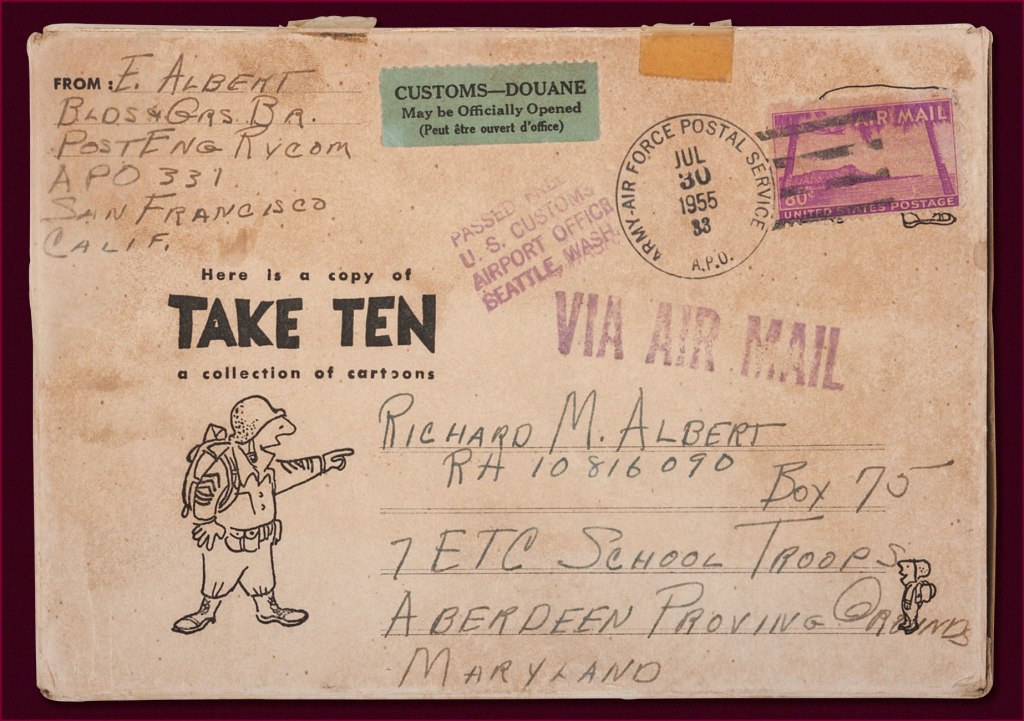
« In 1955, Stars and Stripes published Take Ten, a book collection of his cartoons that was sold through military PXs et commissaries. » And also by mail!
« Here they are… the Centaurs and Bird men… the Geniis and Cobras… the fifteen-foot PFC’s and two-inch E-1’s. Here is TAKE TEN, the first collection of Shel Silverstein’s cartoons, taken from Pacific Stars and Stripes, Army Times and his untapped top drawer. Here is a pocket-full of cartoons that will make you smile and chuckle and laugh out loud. »
Lisa Rogak writes, in her A Boy Named Shel (2007, St. Martin’s Press):
Once he arrived in Tokyo, Shel was assigned to the Pacific Stars and Stripes to past up stories and photo features for the paper. When his work was done — which he performed as quickly as possible — he turned his attention to drawing cartoons using the material that was right in front of him: the military. Shel roamed the streets of Shinbashi, a neighborhood that GIs frequented that once served as the end of the line of Japan’s first railroad. He spent hours each day wandering the streets taking note of the activities of his fellow soldiers, which would invariably end up in one of his cartoons.
He initially did it for his own amusement, through within a few weeks, the paper began to print his work. After spending six months juggling newspaper paste-up with cartooning, he convinced his editors to take him off layout duties and allow him to wander the Far East and send back reports in the form of one-panel cartoons. They agreed.
Evidently, Mrs. Silverstein’s boy was a most charming and persuasive fellow. He would soon pull the same stunt on Hugh Hefner… but none can claim, in either case, that he failed to deliver on his lofty promises!
Here’s a little bit of background on that famous old General, should you need it.
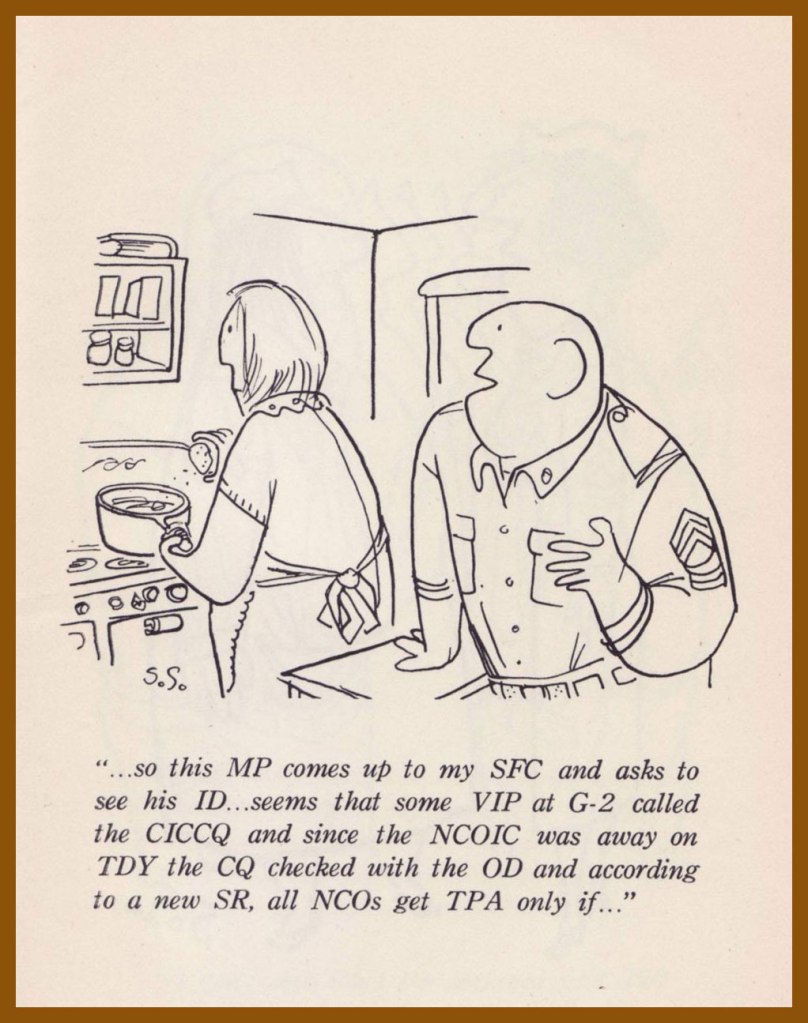
Here’s a helpful guide to US Military acronyms. Who knows, it might spare you some confusion one day.
Even with his freedom, Shel had a hard time dealing with the restraints of army protocol. Corky Alexander, the late editor of the English language Tokyo Weekender, first met Shel at Stars and Stripes. “He was an army corporal and was perhaps the worst soldier in the history of armed might, down through the ages,” he said.
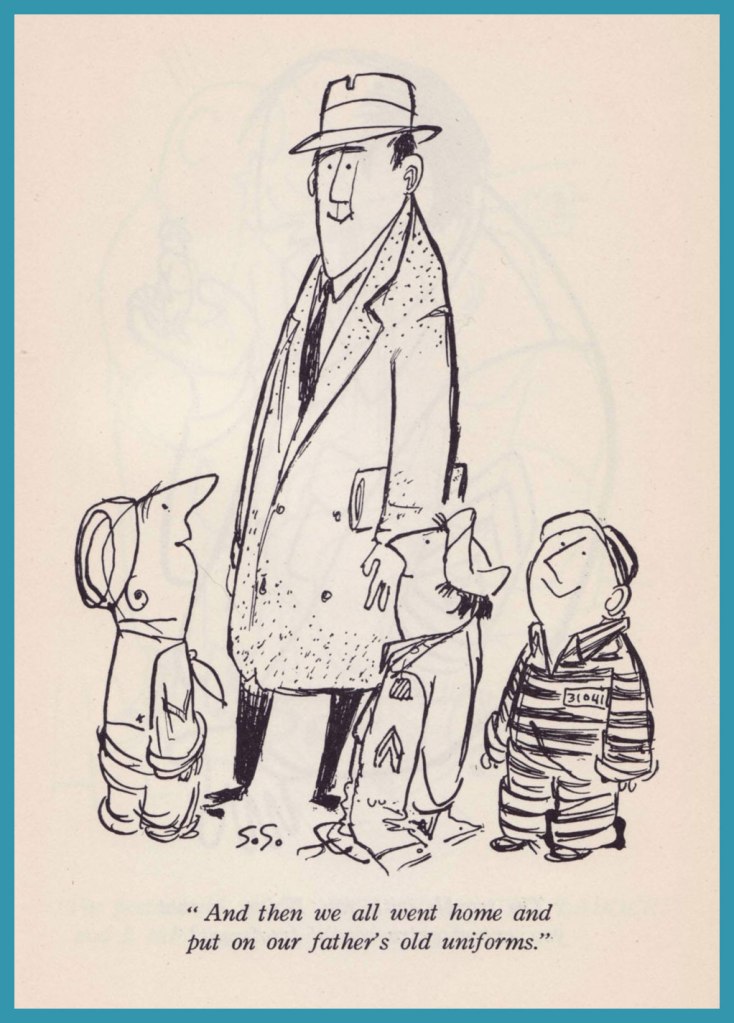
“His technique followed a simple pattern. First he thought of an object — say, his first sergeant. He’d concentrate until he would come up with 20 or 30 gags on the one subject. Out of it came situations peopled by his long-nosed characters, his little men, his giants, the animals and the strange creatures for which he has a special affection.“
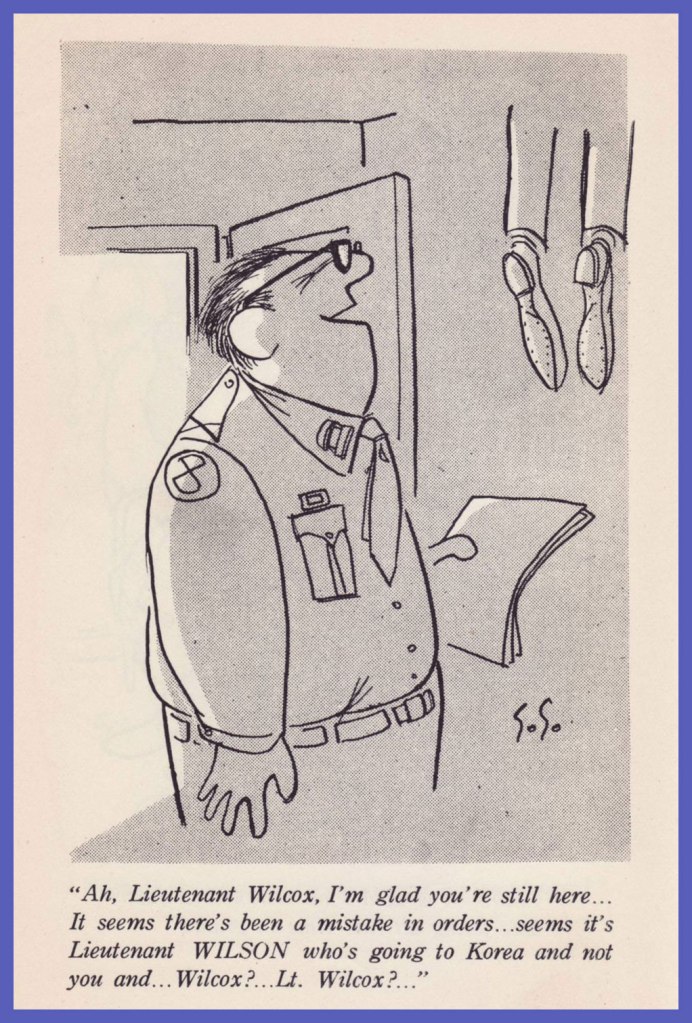
His favorite overall targets were the officers. “They even made zebras off-limits to me because they had stripes,” Shel said.
This, er.. pet might be an early prototype of Shel’s mythic Floobie Doobie Doo. Now what is that? It ain’t no dog and it ain’t no cat. It’s nine feet tall with eyes of blue. I never seen such a thing As a thing called a Floobie Doobie Doo.
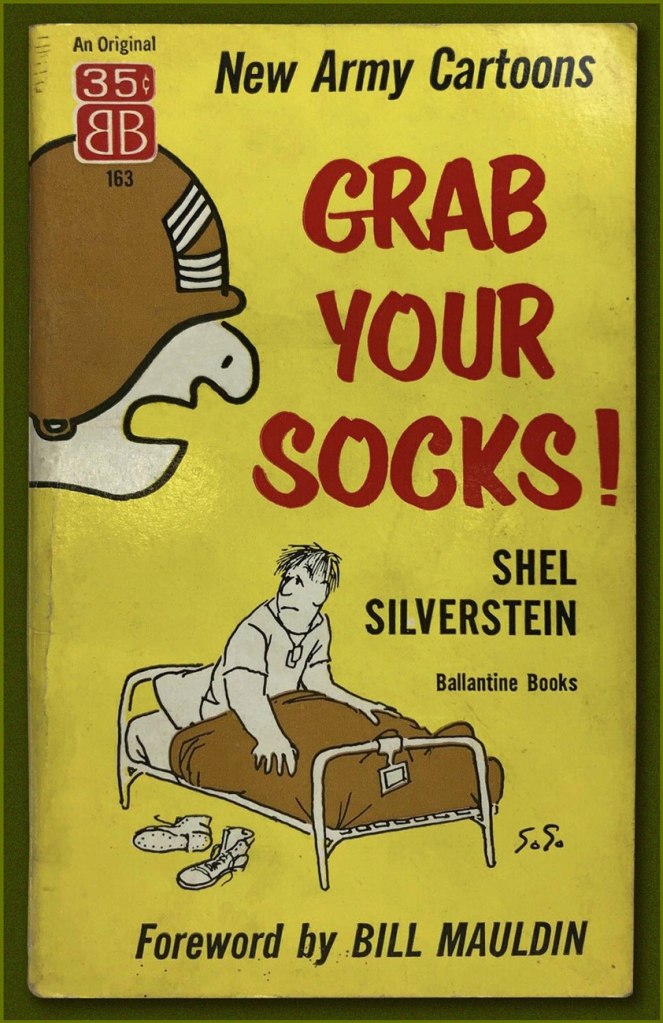
« Shel’s humor had struck such a nerve, and soldiers based in the Pacific shared his cartoons with their families and other civilians to show them what life in the military was really like, that a larger audience for his work was a natural consequence. In 1956, Ballantine Books published a thirty-five-cent mass market paperback edition of Take Ten called Grab Your Socks! »
In his foreword to Take Ten, Shel’s good buddy and PS&S colleague Bob Sweeney recounts:
In a letter to the home office, Bob Brown of the S&S Seoul Bureau wrote: “He stays up all night chewing pencils, drawing cartoons and writing ideas on little scraps of paper he never finds again. In the first twenty minutes he was here he had our little office more cluttered than the convention hall in his native Chicago.”
“But,” added Brown, “he knows the people he draws. He’s lived through the same experiences and heard the same lines.“
Here then are the simplicities as well as the subtleties — the obvious and the obtuse — the wonderful conglomerate of a man who loves to write, to draw, to create — and best of all — who loves to laugh.
« I have stuck to my simple art style while the smart illustrative men were snapping in their shadows all around me, because I believe that my story is more clearly told with a minimum of picture distraction. » — the wise, but absurdly humble Frank King (1959)
Gasoline Alley (1918-) is the second longest-running comic strip of them all. The Katzenjammer Kids (1897-2006) still tenuously clings to first place, but Gasoline Alley, boasting the advantage of still being around, should overtake it by 2027. Of course, that’s all academic and fairly irrelevant to us, because the strip’s originator, Frank Oscar King (1883-1969), is no longer guiding its destiny.
The collective memory being woefully short, if Gasoline Alley is likely to be remembered, it will be for its central innovation: characters age in real time, growing up and old and passing away, its cast and its world ever changing and evolving, in a small-town America sort of fashion. However, the strip’s original star, Walt Wallet, is still around, well into his second century.
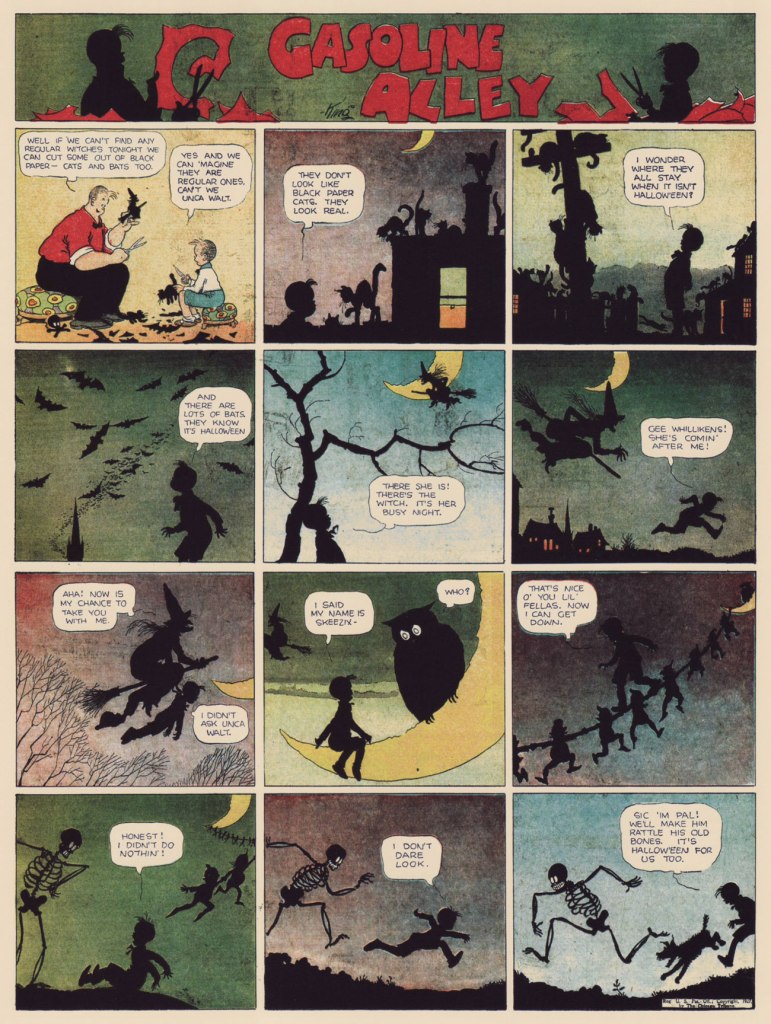
Today, we’re digging deep, returning to those long-ago dinosaur days when newspapers were gigantic and so were the comic strips they featured, particularly on Sundays. And the Sunday Gasoline Alley was indeed something special.
I couldn’t possibly put it better than Chris Ware did in 2000, in tribute to King:
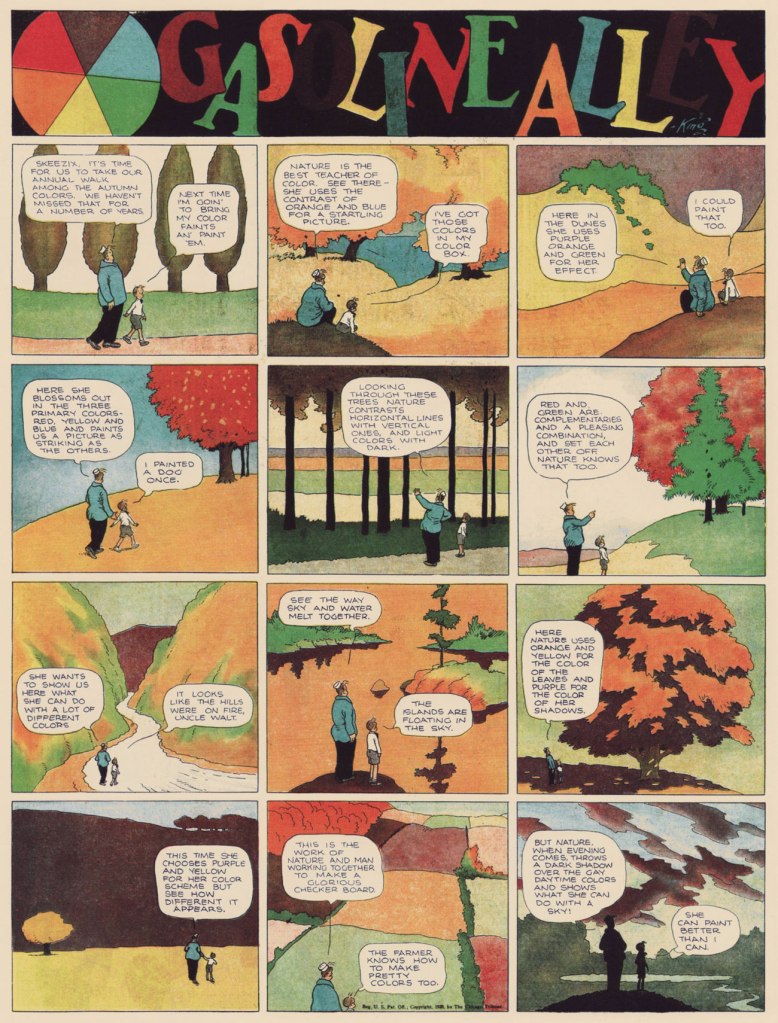
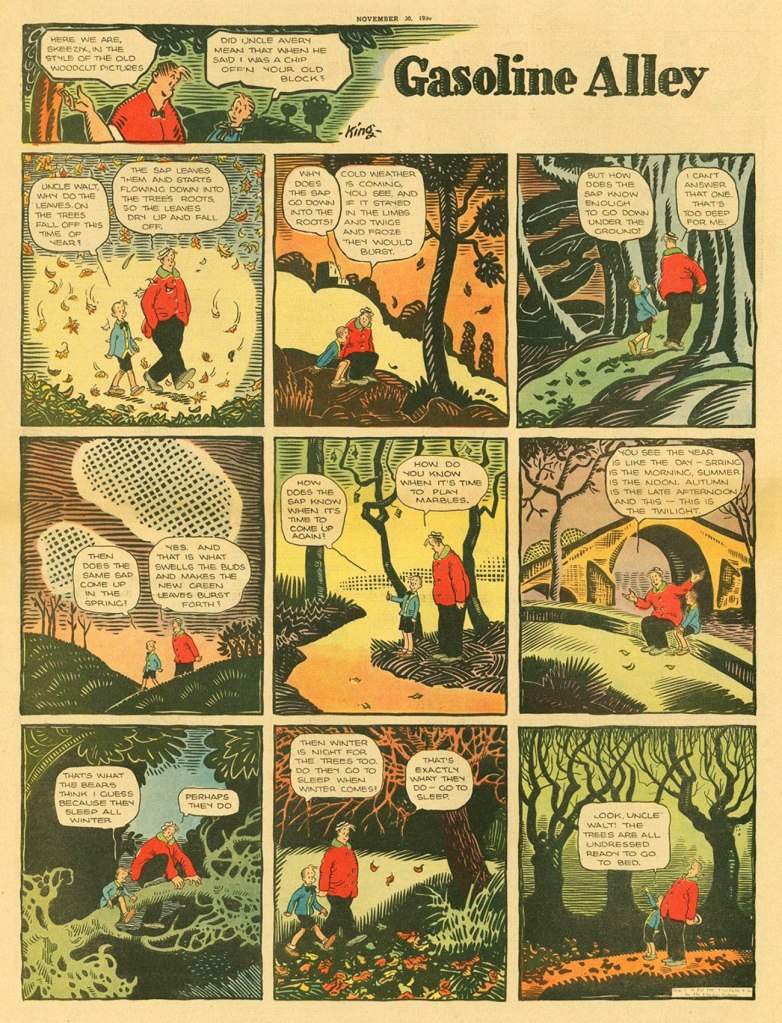
« Reserving his five daily strips for more complicated storylines, King’s full-color Sunday pages often presented Walt and Skeezix simply wandering the countryside of America, idly remarking about natural landmarks, the quality of the sky, or the colors of the seasons.
Frequently, these pages were richly-textured experiments in form and style, often having no joke or ‘punchline’ at all, only a quiet, sustained tone of serenity and gentleness. »
Halloween 1928!
Halloween 1931.
Halloween 1933.
And you know, since these are so gorgeous and just as seasonal, let’s be indulgent, broaden our scope the tiniest bit and take in some of King’s paeans to sweetest Autumn.
Autumn, 1926. Pro-squirrel, too. Good man!
Autumn, 1928.
And finally, the Autumn of 1930. Phew!
Incidentally, a lovely collection (designed by Mr. Ware!) of King’s finest Gasoline Alley Sundays from the strip’s first fifteen years was published a couple of decades ago: Sundays with Walt and Skeezix (2000, Sunday Press)… and, wonder of wonders, it’s still available from the publisher.
« Superstition, the mother of those hideous twins, fear and faith, from her throne of skulls, still rules the world. » — Robert G. Ingersoll
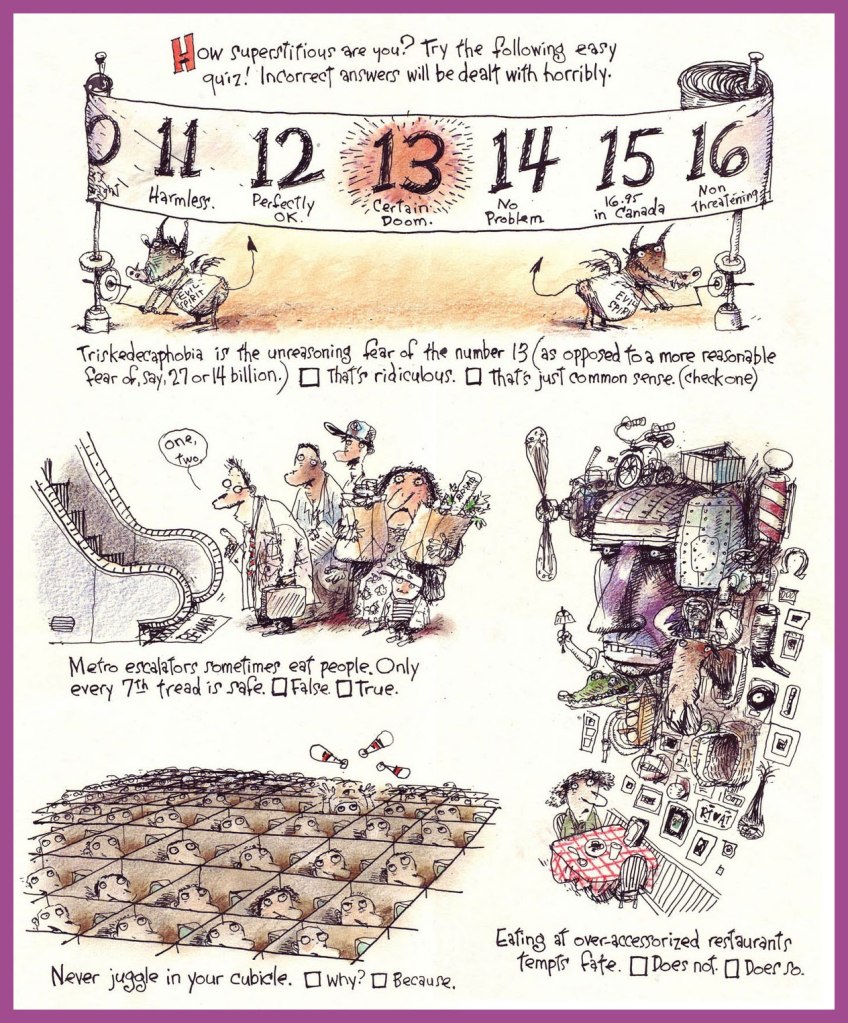
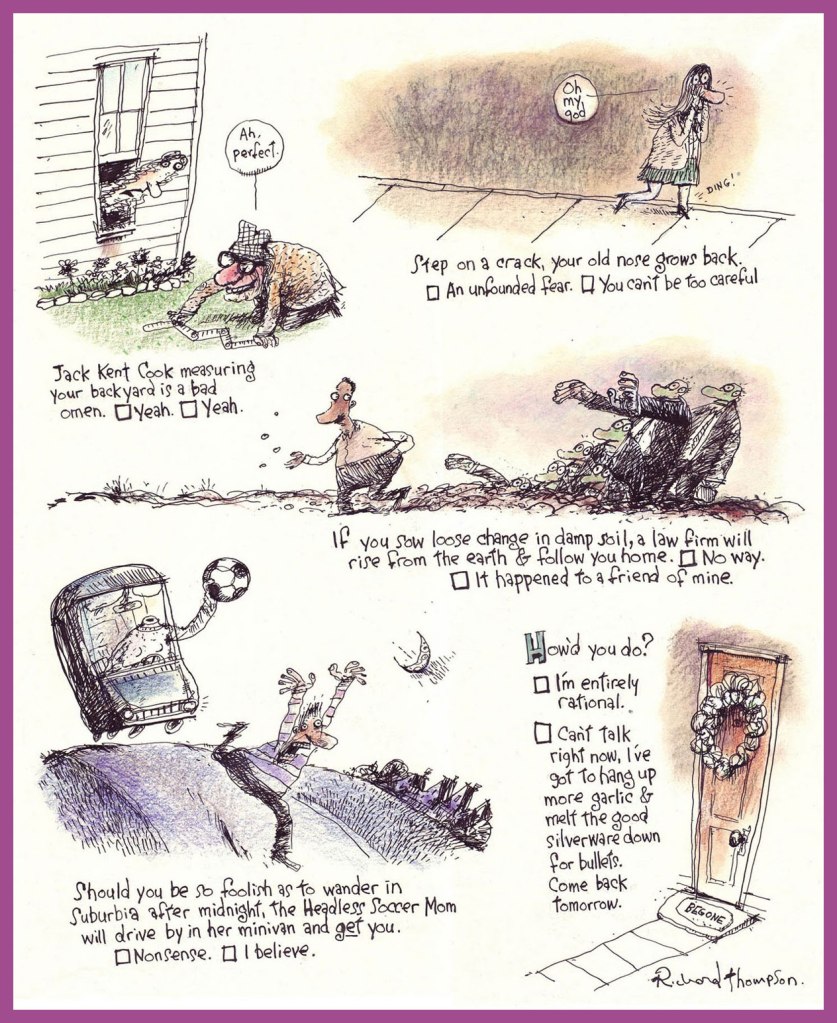
Feeling a tad superstitious? Today, as it also happens to be Richard Thompson’s birthday (coïncidence? hardly!), we combine two fabulous flavours into this confection of sheer frightful delight. Careful you don’t bite your tongue or deal yourself a case of whiplash.
Thompson « drew it for the Washington Post Weekend section back in September of 1996 and it appeared on Friday the 13th. » I believe!
Take the quiz and quell, at least for a time, those vicious neighbourhood rumours concerning you. For further such priceless resources, do take a gander at our prior Thompson posts, including this Hallowe’en-themed goodie and this fair sampling from Richard’s Poor Almanac.
« Wherever despotism abounds, the sources of public information are the first to be brought under its control. Where ever the cause of liberty is making its way, one of its highest accomplishments is the guarantee of the freedom of the press. » — Calvin Coolidge
Ah, the pitfalls of anchoring yourself to the news cycle: given the shocking news, last week, of the impending, unjustified closure of one of the greatest American journalistic institutions, the independent military daily newspaper The Stars and Stripes (founded in 1861!). I was all set to cobble together a series of posts showcasing the work of S&S’s greatest cartoonists, but then the massively unpopular decision was just as abruptly reversed. For now.
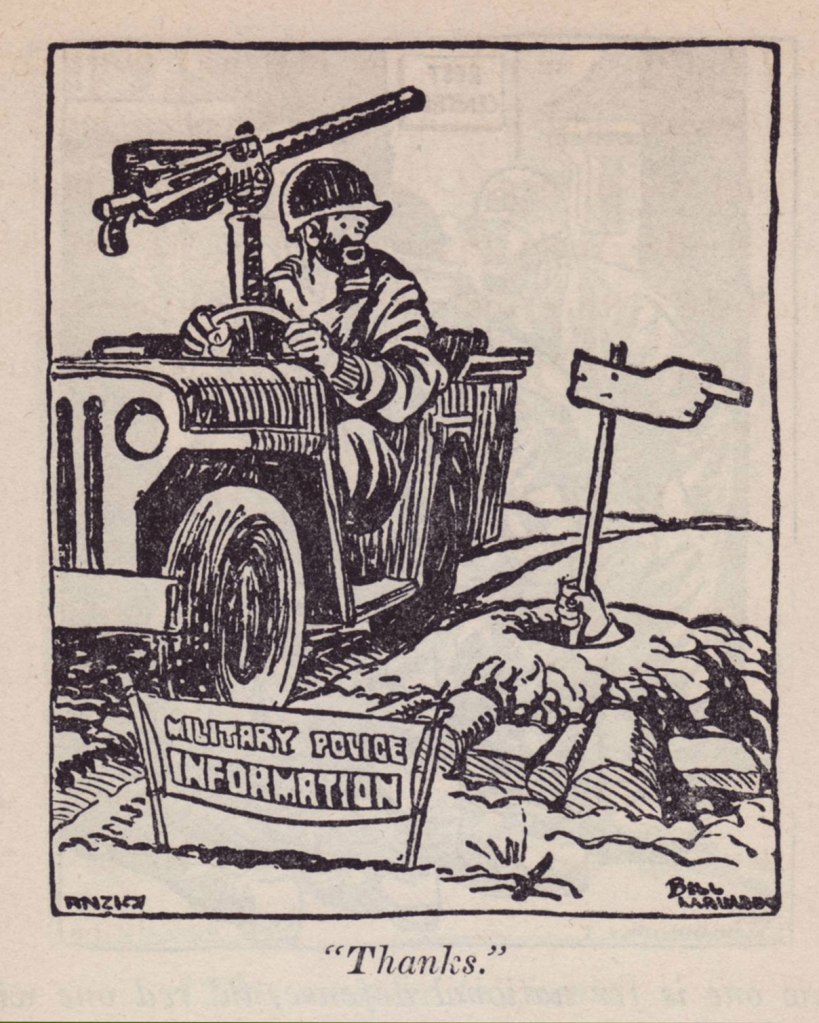
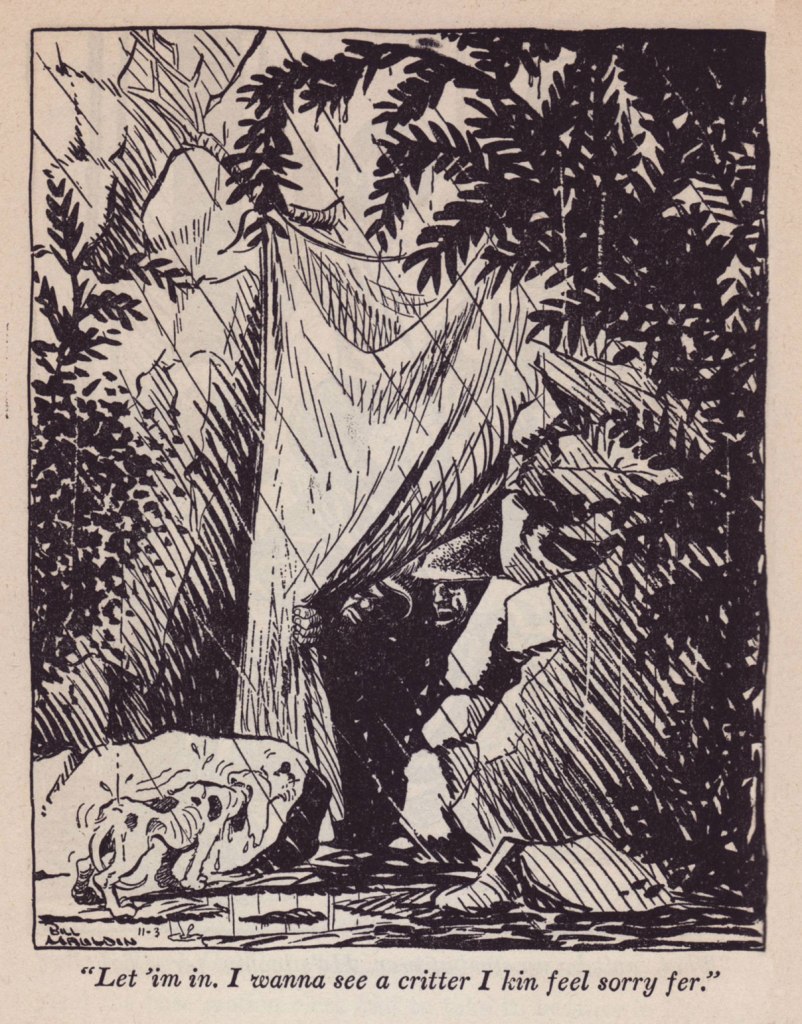
So I’ll stick to one post for the nonce (Shel and Tom will have to wait) and feature one of history’s greatest soldier cartoonists, William Henry “Bill” Mauldin (1921-2003), twice recipient of the Pulitzer Prize (1945, 1958), the Legion of Merit… and a host of other distinctions, both military and civilian.
Our baby-faced artist photographed during WWII.
With but a single exception, the following are samples from his essential Up Front collection (1945), which Mauldin humbly opens with: « My business is drawing, not writing, an this text is pretty much background for the drawings. »
But such a background! Mauldin is, naturally, funny and insightful, but there’s much to learn therein, not merely about men in war, but just about everything under the sun. While so many nowadays mix up freedom and privilege, it’s good to be gently reminded of the high price of both.
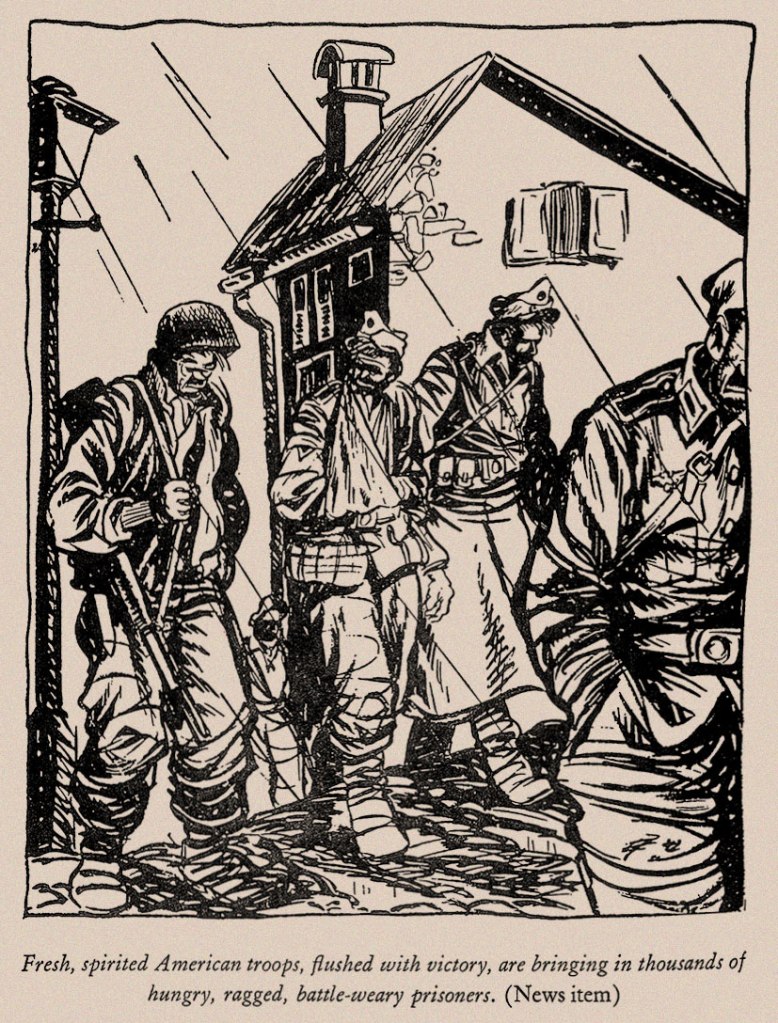
« Until some intelligent brass hat repaired a big brewery in Naples and started to send beer to Anzio, the boys at the beach-head were fixing up their own distilleries with barrels of dug-up vino, gasoline cans, and copper tubing from wrecked airplanes. The result was a fiery stuff which the Italians called grappa. The doggies called it ‘Kickapoo Joy Juice’, and took the name from the popular ‘Li’l Abner’ comic strip which Stars and Stripes printed daily. It wasn’t bad stuff when you cut it with canned grapefruit juice. »
Mauldin’s biographer, Todd DePastino, wrote, in his Bill Mauldin: A Life Up Front: « First published on October 13, 1944, this cartoon made the 23-year-old Bill Mauldin the youngest Pulitzer Prize winner in history. Both he and his editors at Stars and Stripes were astonished by the selection, which did not seem to them particularly noteworthy. »
For a deeper dive into Mauldin’s war through the eyes of his ragged infantrymen, scrounge yourself a copy of Fantagraphics’ glorious Willie & Joe: The WWII Years (2008).
In closing, shall we hear from another president?
« I have great respect for the news and great respect for freedom of the press and all of that. » — Donald J. Trump
Tentacle Tuesdays have been a fixture of this blog since the very beginning (which is to say September, 2017). I am not about to run out of material, but over the years I do tend to accumulate odd and ends that don’t neatly fit into a theme. Though I know of at least one faithful reader of this blog who doesn’t like it much when a TT entry is all over the place, hopefully there’s something in here for everyone. Just consider it the equivalent of spring cleaning in my archives!
Panel from Treasure Chest Vol. 19 no. 6 (Nov. 21, 1963). Written by Dave Hill and illustrated by Fran Matera. Everybody in this panel is adorable, but the octopus is especially fetching, I think.
A cartoon by Rowland Wilson, from Playboy‘s June, 1980 issue. Several tons of meat are going to need a lot of butter. It would be much more economical for the creature to eat the astronaut!
This tentacled-monster-pothole was dreamed up by Richard Thompson and appeared in his Poor Richard’s Almanac. It would make being stuck in traffic jams a lot more entertaining, don’t you think?
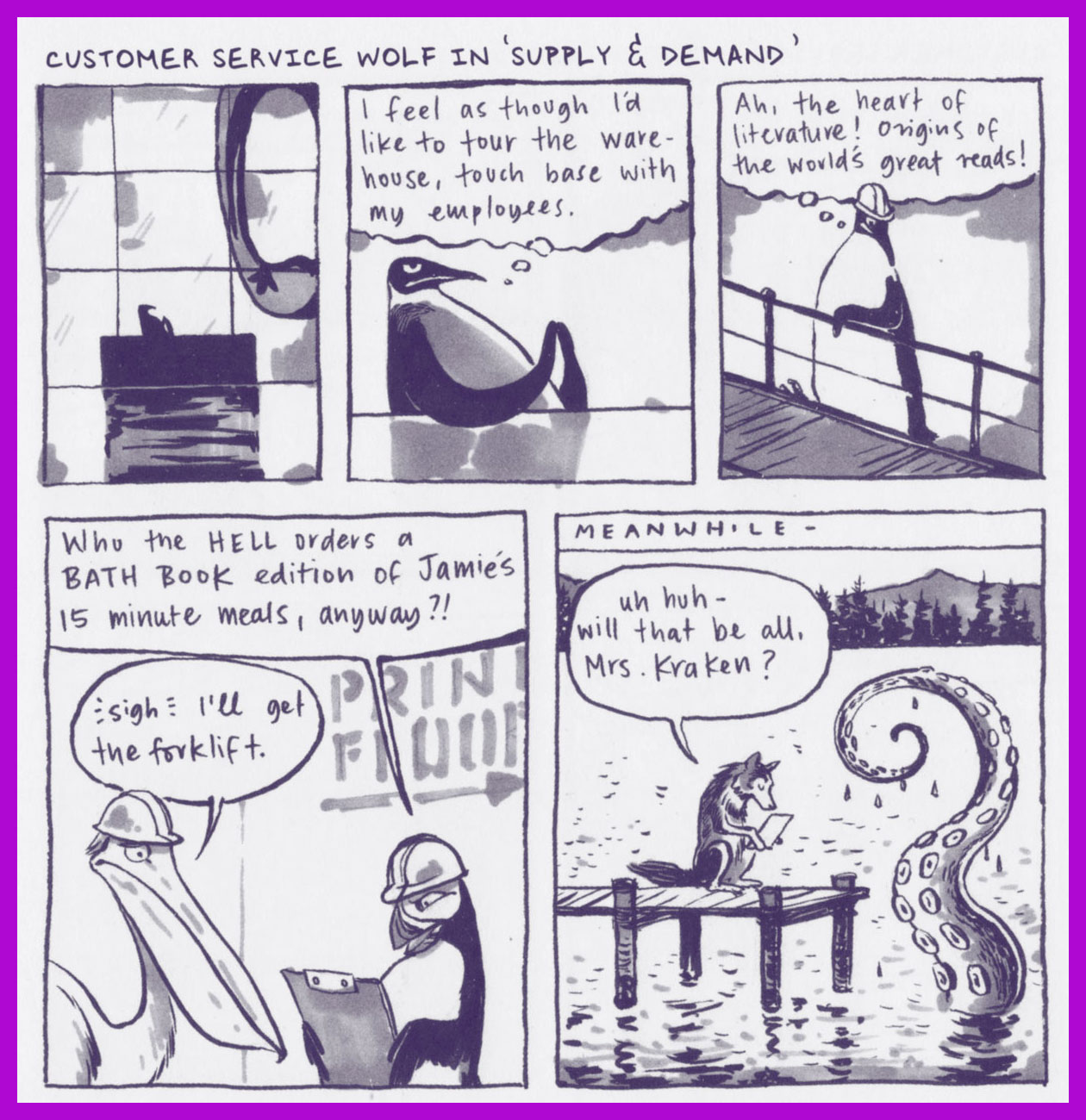
Customer Service Wolf is a hilarious comic strip by Australian illustrator Anne Barnetson, who has worked in a bookstore for long enough for have encountered all kinds of annoying customers. Anyone who has toiled in retail will know that most people are insane, but a bookstore is a backdrop for a very special kind of lunacy.
I’ve been following British sculptress Caroline McFarlane-Watts and her company Tall Tales Productions for a while. She makes incredibly detailed sculptures of all sorts of things, most notably of witches and their ménage (take a discreet peek at their activities on her website, but be careful, they’re cantankerous old bats). McFarlane-Watts also draws, sometimes comics. This pink (take my word for it) octopus is a witch’s best pal!
Thanks for sticking around while I got things off my chest!
« In the sphere of thought, absurdity and perversity remain the masters of the world, and their dominion is suspended only for brief periods. » — Arthur Schopenhauer
If you were to query me as to my absolute favourite comic strip of the 1980s (just humour me!), I wouldn’t waffle one bit: it’s Sam Hurt‘s Eyebeam.
Oh, the Eighties were rightfully dominated by a trio of titans: Bill Watterson‘s Calvin and Hobbes, Berkeley Breathed‘s Bloom County and Gary Larson‘s The Far Side. While I’m fond of all three, I find C&H too repetitive to revisit, I can no longer quite relate to Bloom County and… I still treasure the Far Side. But it doesn’t quite inspire the same devotion I hold for Eyebeam above all.
As I noted just last week, certain subjects are just too dang daunting to tackle. Eyebeam is one of these thorny critters, thanks to its convoluted history, vast, nearly boundless cast of characters, constantly shifting form and focus… I won’t even try.
I have, however, devised an elegant loop-hole: In 1989, Hurt initially shelved Eyebeam after…
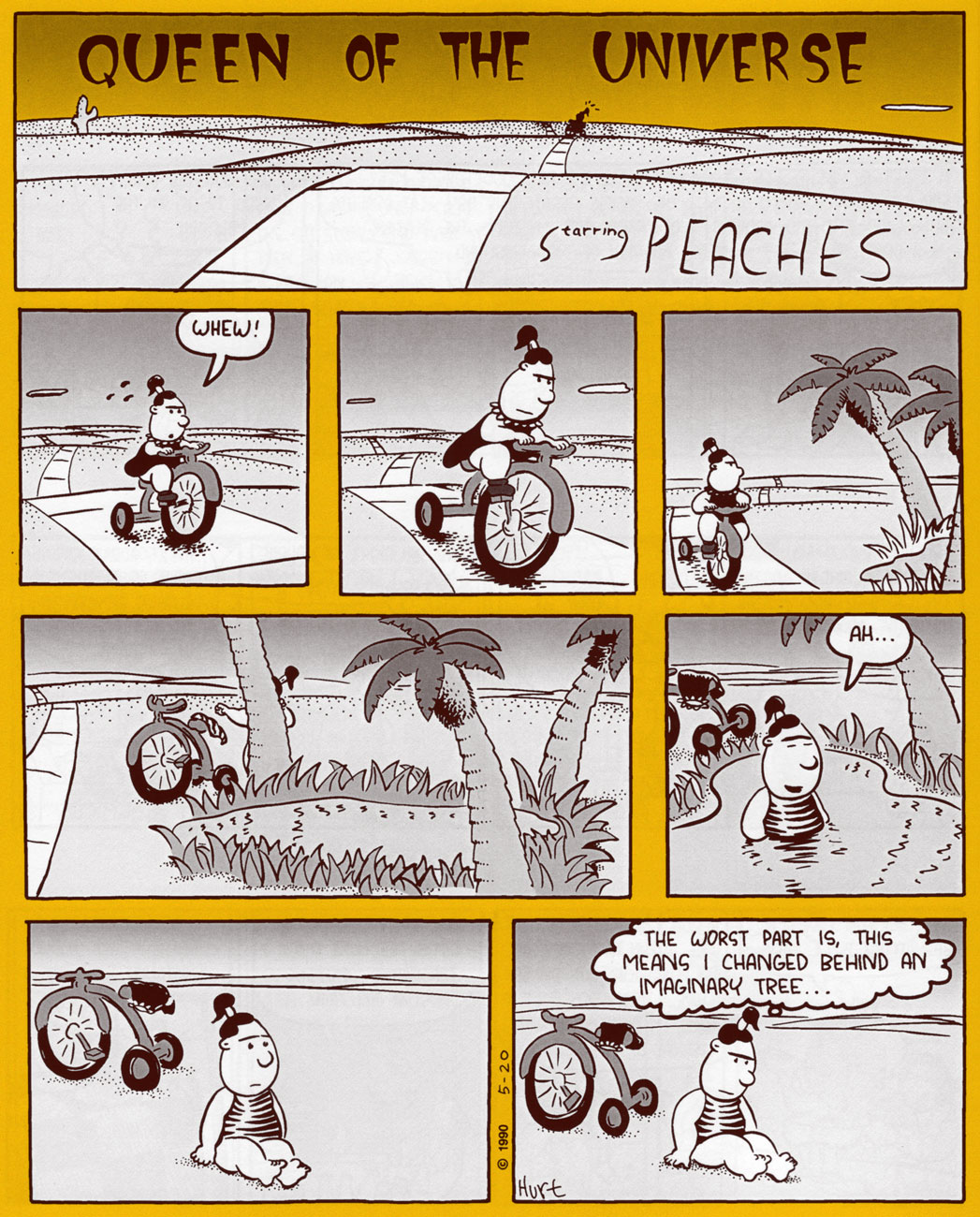
« taking an offer from United Feature Syndicate to start a new strip based on the Peaches character, Queen of the Universe. Hurt’s freewheeling style did not translate as well under the syndicated system, which was apparently hoping for a female Calvin character, and the latter strip was not a success. Hurt described the strip’s demise as the result of “a printing accident… [it] drowned in a sea of red ink. »[ source ]
Queen of the Universe lasted two dazzling years, and the strip’s entire run has thankfully been gathered into three handsome-but-affordable volumes and published by Hurt himself. These may be purchased directly from the distinguished artiste.
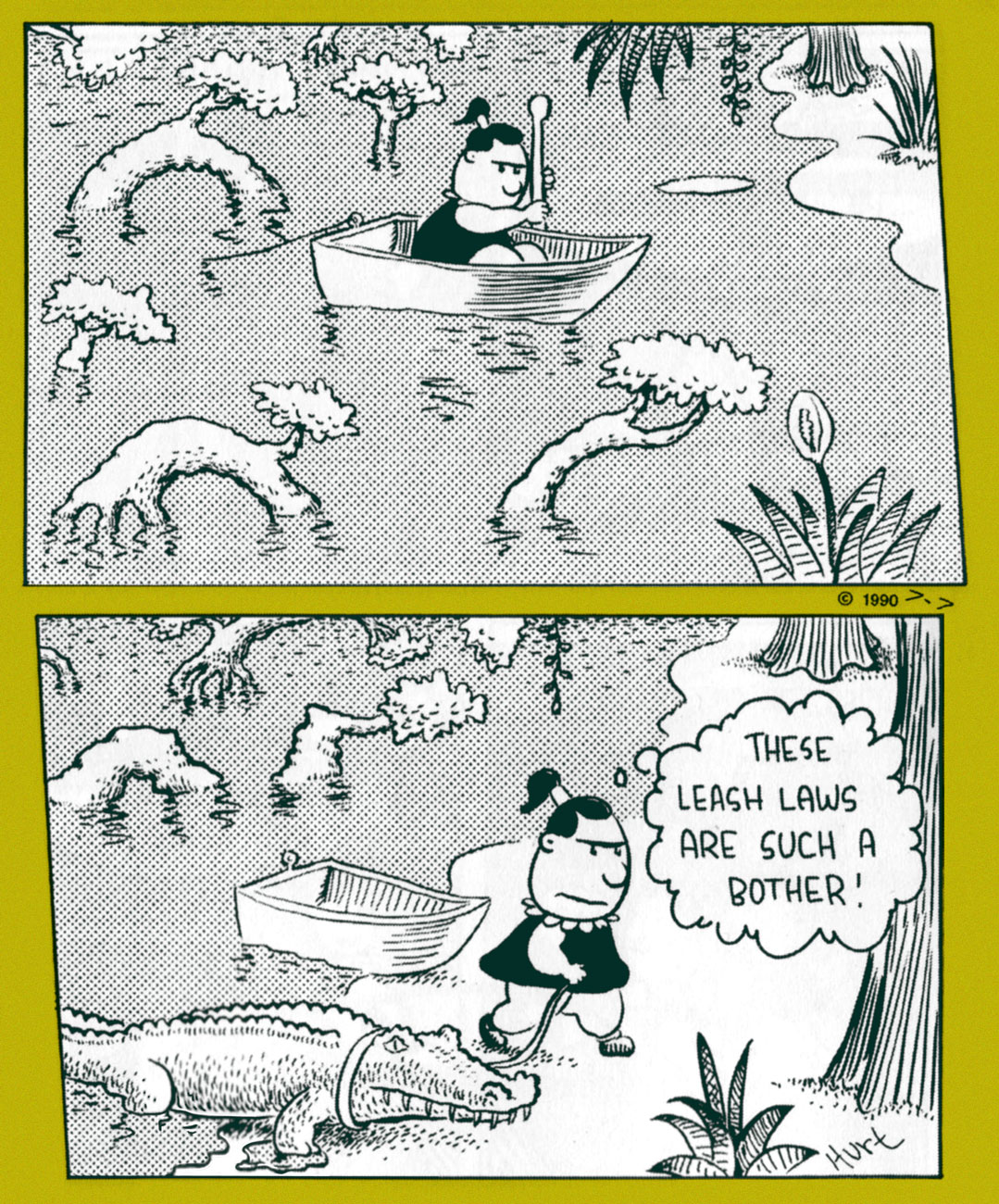
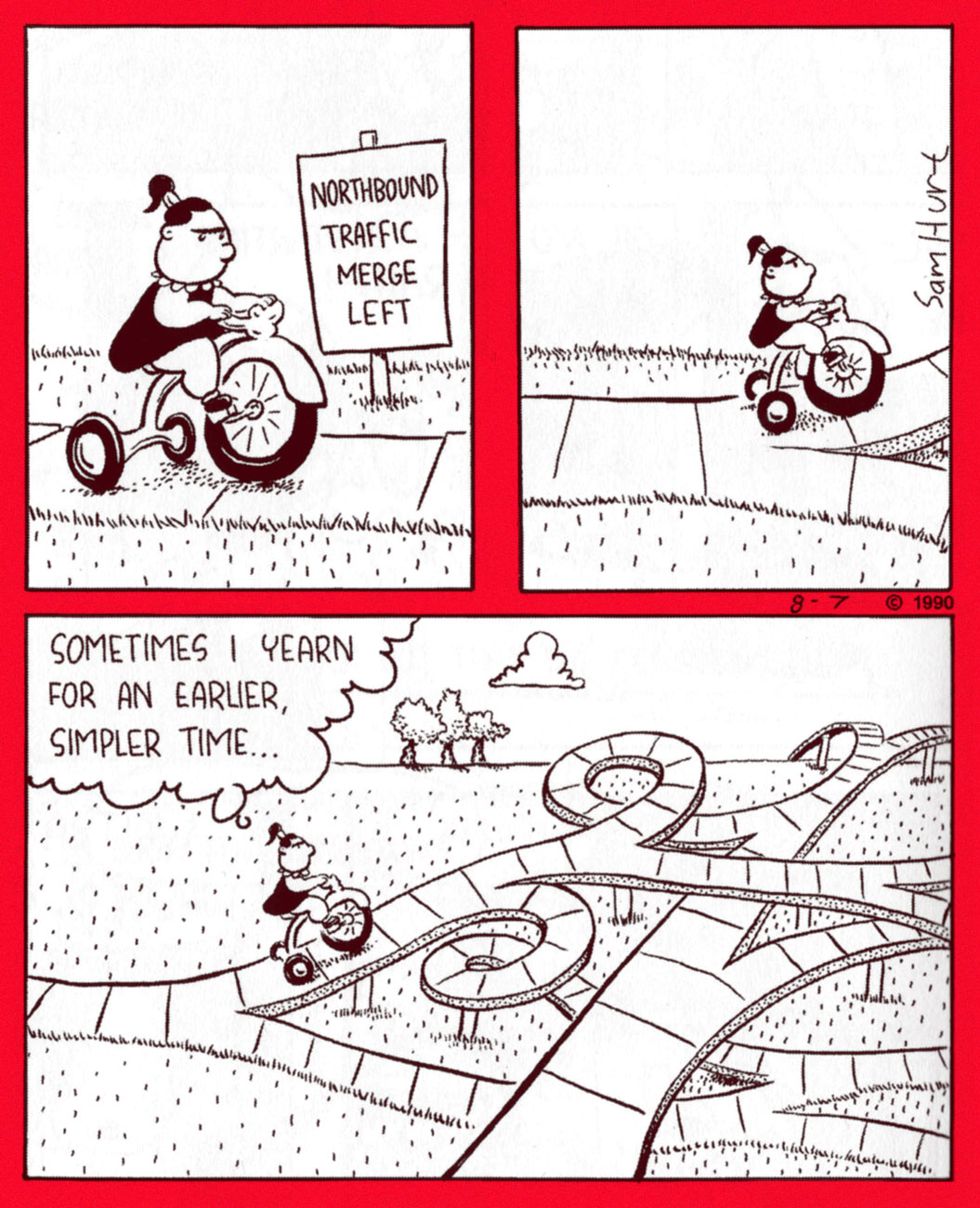
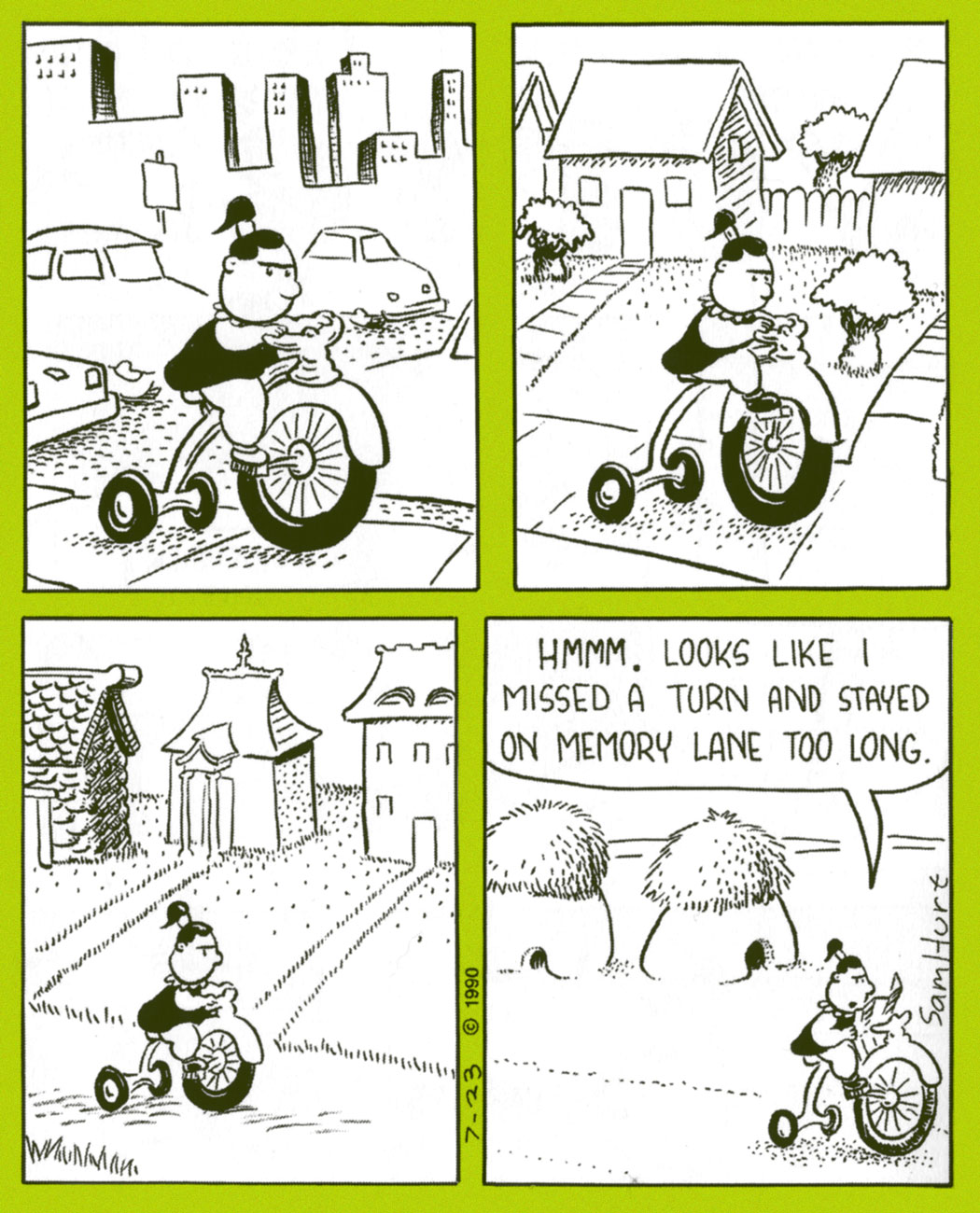
And if you’re unfamiliar with Mr. Hurt’s winningly peculiar brand of brilliance, here’s my sampling of Queen of the Universe (it wasn’t easy!), which includes some early Peaches appearances from Eyebeam. Someday I’ll screw up the reckless fortitude to delve into that sweet, singular quagmire… but this isn’t that day.
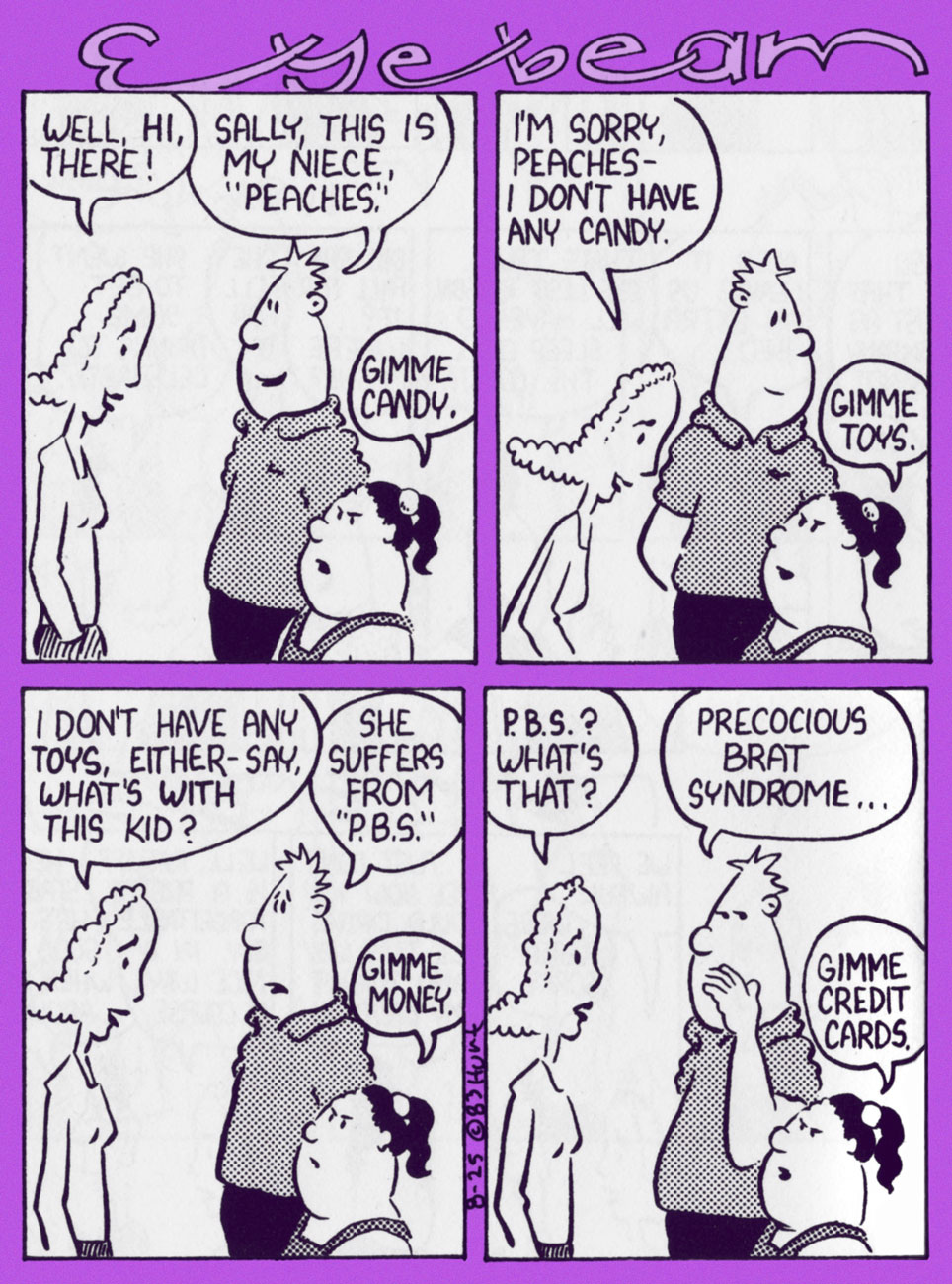
Peaches is introduced in Eyebeam (Aug. 25, 1983… t’was a Thursday)
Somewhere down the line, Eyebeam’s old roommate (and Peaches’ uncle) Ratliff got saddled with his sister’s kids in presumably permanent fashion.
By the time the seventh Eyebeam paperback collection (1988’s Render Unto Peaches, Texas Monthly Press) appeared, bossy Peaches had pretty much taken over the feature, as you can surely see.
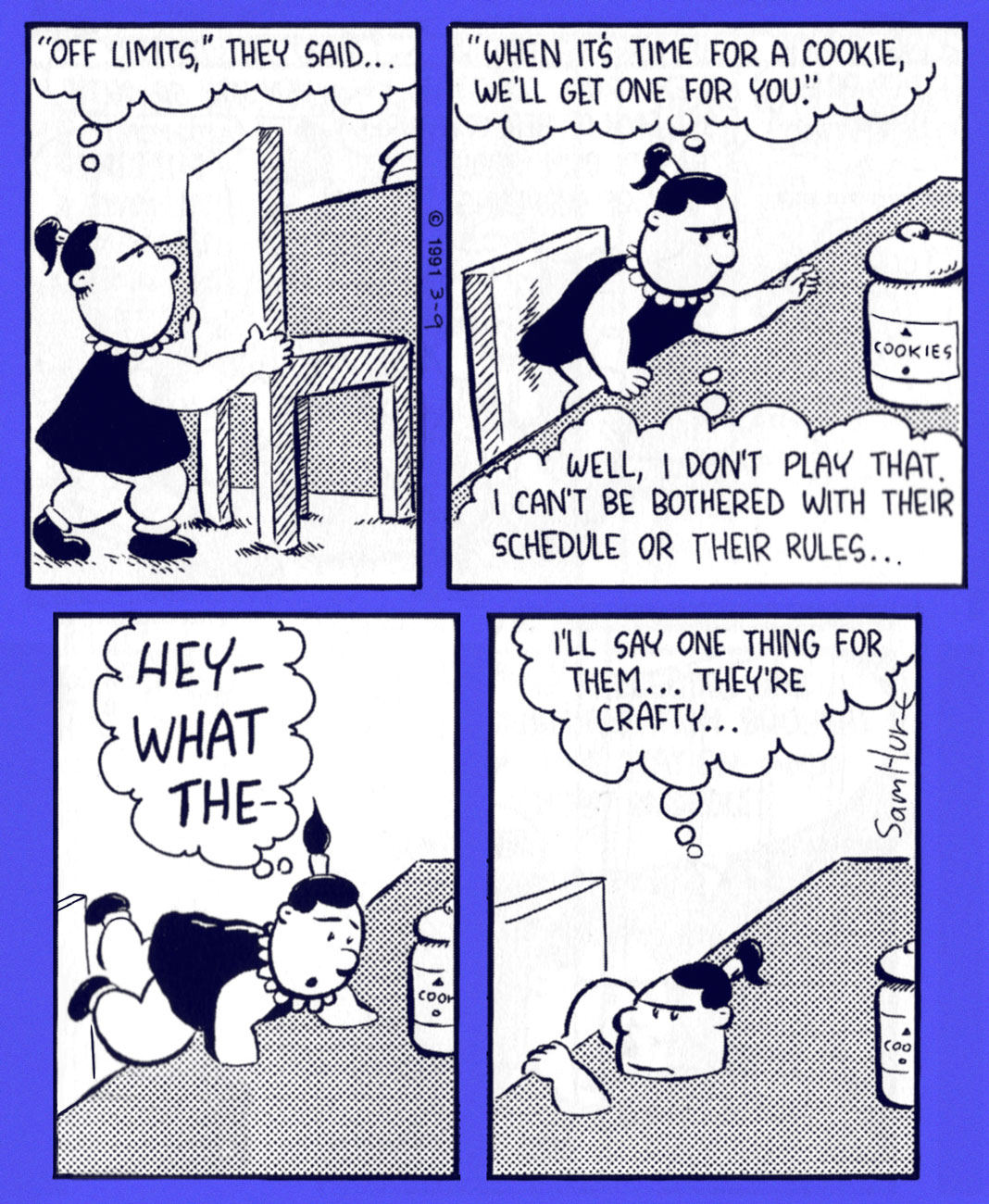
Hurt’s trademark surrealism smoothly carried over to his new feature. This is the March, 1991 strip.
The second Queen of the Universe Sunday strip, from May 5, 1990.
Peaches feeds this toothsome pet on ‘Purina Croc Chow’. From July 7, 1990.
The bent utensils are, of course, a reference to discredited ‘psychic’ charlatan Uri Geller. His spoon-bending act was publicly and elegantly debunked by none other than James ‘The Amazing’ Randi, who gets his second mention on our blog this week. « If Uri Geller bends spoons with divine powers, then he’s doing it the hard way. » —James Randi
I love how Sam Hurt leaves the question of Peaches’ great powers somewhat ambiguous. The cowboy is her best pal Kid Kareem.
Peaches’ tricycle is an Electra 5000, obtained gratis through threatening to expose the IRS to some of the toy store owner’s “more creative accounting practices”. From Aug. 7, 1990.
From July 23, 1990. Nice and deadpan, which must have baffled many a casual reader.
Now and again, Peaches will flub one. Sunday strip from June 30, 1991.
As ace newscaster Trish Tringle, Peaches never misses an opportunity to humiliate the neighbourhood’s ‘stupid boys’. Many a time has an ‘anonymous source’ or ‘concerned citizen’ alerted the authorities to some dodgy boyish shenanigans. From March 14, 1991.
« You know, I once took a ride in a Volkswagen convertible driven by Harvey Kurtzman, with fellow passengers Terry Gilliam and Robert Crumb. Had we been smacked by a garbage truck the history of humor and popular culture would have been slightly changed. Interestingly not one of us had the slightest interest in any of the other three. Except, I am pretty sure we all hated Kurtzman, but who didn’t? » — Daniel Pinkwater
This post was originally going to be an interview. Having belatedly discovered Norb (1989-1990), I got in touch with Daniel Pinkwater (who better to ask?), intending to pepper him with questions, but he was so very helpful, providing me with all the background material I could have desired, that his prediction that « … since I have nothing to add, you may not need to formulate any questions for me » … came to pass. And so I gladly yield the floor to the sterling Mr. Pinkwater.
Tony Auth was a brilliant artist. He had an important day job as editorial cartoonist for the Philadelphia Inquirer. I think it was his first job, which he held for decades, and he was a Pulitzer Prize winner. We talked about doing ‘something’ together for a couple of years. Tony wanted to do a daily/Sunday newspaper strip, so we did that. Every day we’d remind one another, ‘keep it stupid.’ The fact was, we had no idea how stupid a commercial strip needed to be.
Stroke of luck, Denny Allen, who was temporarily in a position of influence at King Features had approached me years before about doing a strip. We met the power elite at King Features. I won’t characterize them except to say that the concept of stupid did not elude them, nor would it have been likely to. We negotiated for, and received a substantial advance from King, covering two years. I understand this was unheard of in the highly competitive rat race with a great many submissions coming in every day from marginally talented cartoonists.
So we went to work. My part was utterly easy. I would write the dailies and the separately plotted Sunday strip every Saturday while watching Dr. Who. Tony was putting in long hours in addition to his job at the newspaper. The strip launched in something like 70 papers, and I was told this was a big launch and unusual for the times.
We started in the vacancy created when Bloom County ceased production. The response from readers consisted entirely of actual hate-mail, letters saying it was hoped we would die, crude drawings of tombstones and daggers dripping blood. The only piece of positive fan mail I remember came from Jules Feiffer. A few papers dropped the strip, some in response to outrage from readers for whom the comics page was their literature. The typical letter read, ‘I hate NORB, it makes me feel stupid.’ Fair enough, I thought.
I understood that as few as 10 negative letters were enough to spook a paper into dropping a feature. My wife did a bit of research and discovered that all new strips have it rough initially, but if one survives two years it becomes un-droppable, and it is the editorial staff who get the threatening letters. Interestingly, Tony, who was a fair-minded political cartoonist, and got abuse all the time, (he’d had his office trashed by the right and the left at different times over the same issue, for example), and didn’t mind it, regarded the comic strip as the product of his heart, and was hurt by the unfair criticism.
So, at the end of the first year, Tony, exhausted by working two full-time jobs, depressed by the evidence that nobody seemed to like the strip, unwilling, as I was, to follow the advice from the comics/humor expert at King Features, let me know that he was not having any fun. ‘So, shall we quit?’ I asked. Since he was carrying 90% of the weight, I didn’t feel it should be my call. King was delighted to kill the strip because that meant they wouldn’t have to pay us the second year’s advance, and apparently they thought that saving money was the same as making money.
Exactly a year after the strip stopped appearing the fan mail started to come in, ‘Where’s NORB?’ ‘NORB was my favorite comic.’
A pair of dailies from the first week, whereupon we meet our protagonists and our protagonists meet.
From week two. It’s lovely that Mr. Pinkwater opted to bring along a character from his Snarkout Boys novels (The Snarkout Boys and the Avocado of Deathand The Snarkout Boys and the Baconburg Horror), Bentley Saunders Harrison Matthews, aka Rat Face aka Rat. She fits right in. That kind of freedom is among the foremost perks of owning your work.
A four-day sequence, to give you a better sense of the strip’s flow. I love how the alien armada is basically pixelated. Spoiler: They won’t get very far with their plan of conquest.
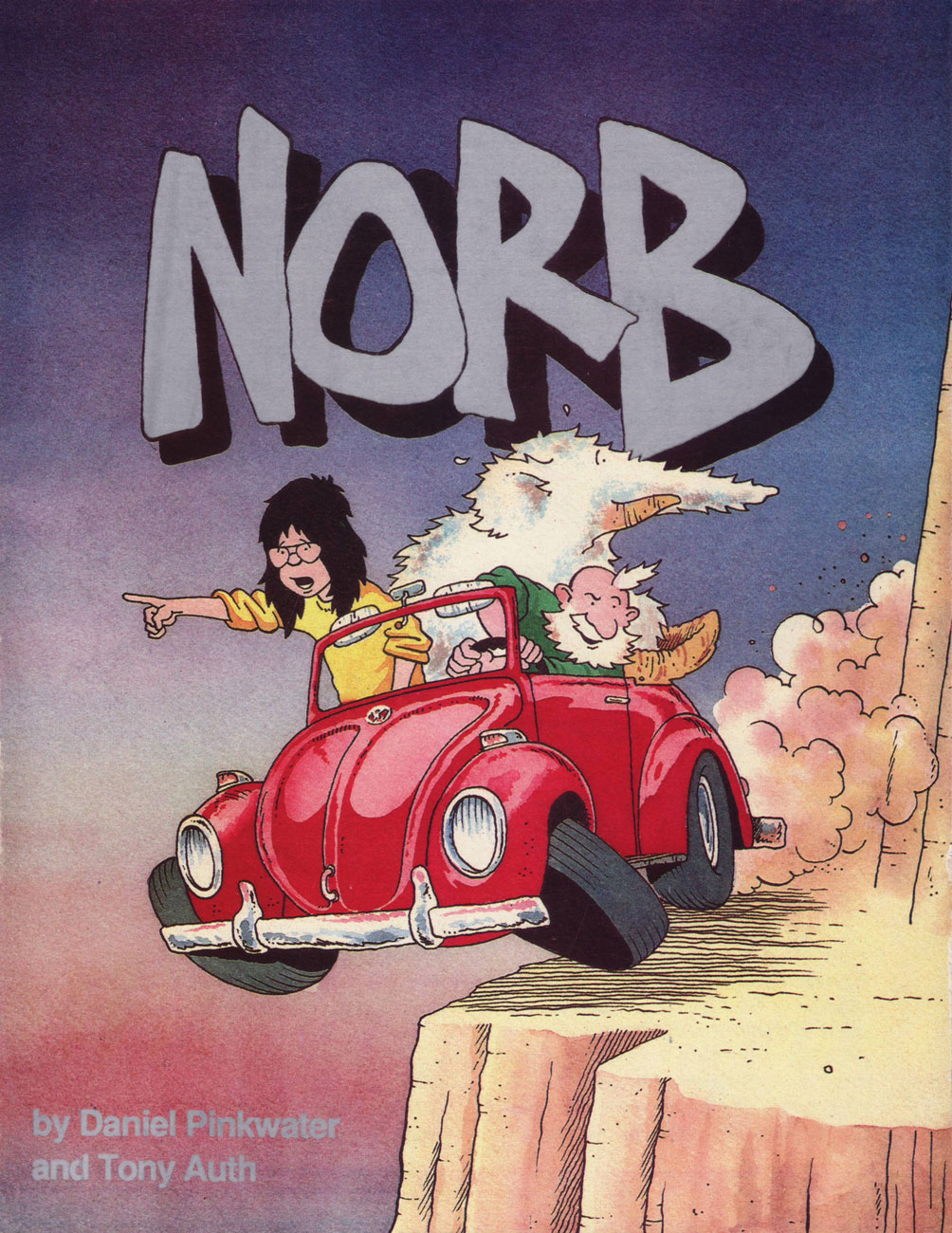
Front cover of Mu Press‘ collection of the Nord dailies, published in 1992. To quote the late SF luminary Vonda McIntyre in her INTROdadaDUCTION: « When [Mu Press] decided to reprint NORB, I jumped at the chance to write this essay. Only then did I discover that writing it didn’t mean I got to reacquaint myself with the Sunday strips… it meant I got to see the daily strips, which I didn’t even know about, for the first time. »
Now and then, Pinkwater would drop out of the narrative, go into meta-textual mode and engage the critics in an entertainingly passive-aggressive fashion. I do prefer the plot-driven strips, however… as does Rat. « Problem, Norb-Baby. Humorous adventure with a touch of satire is out this year. I don’t know where to put you. » (07/13/1990)
« You’ll pay for treating my employer like a baked ham, you evil person! ». Don’t worry, Norb’ll be okay: « Explain. Were you sliced like a radish or not? » « Oh, I was! But it was in the future. »
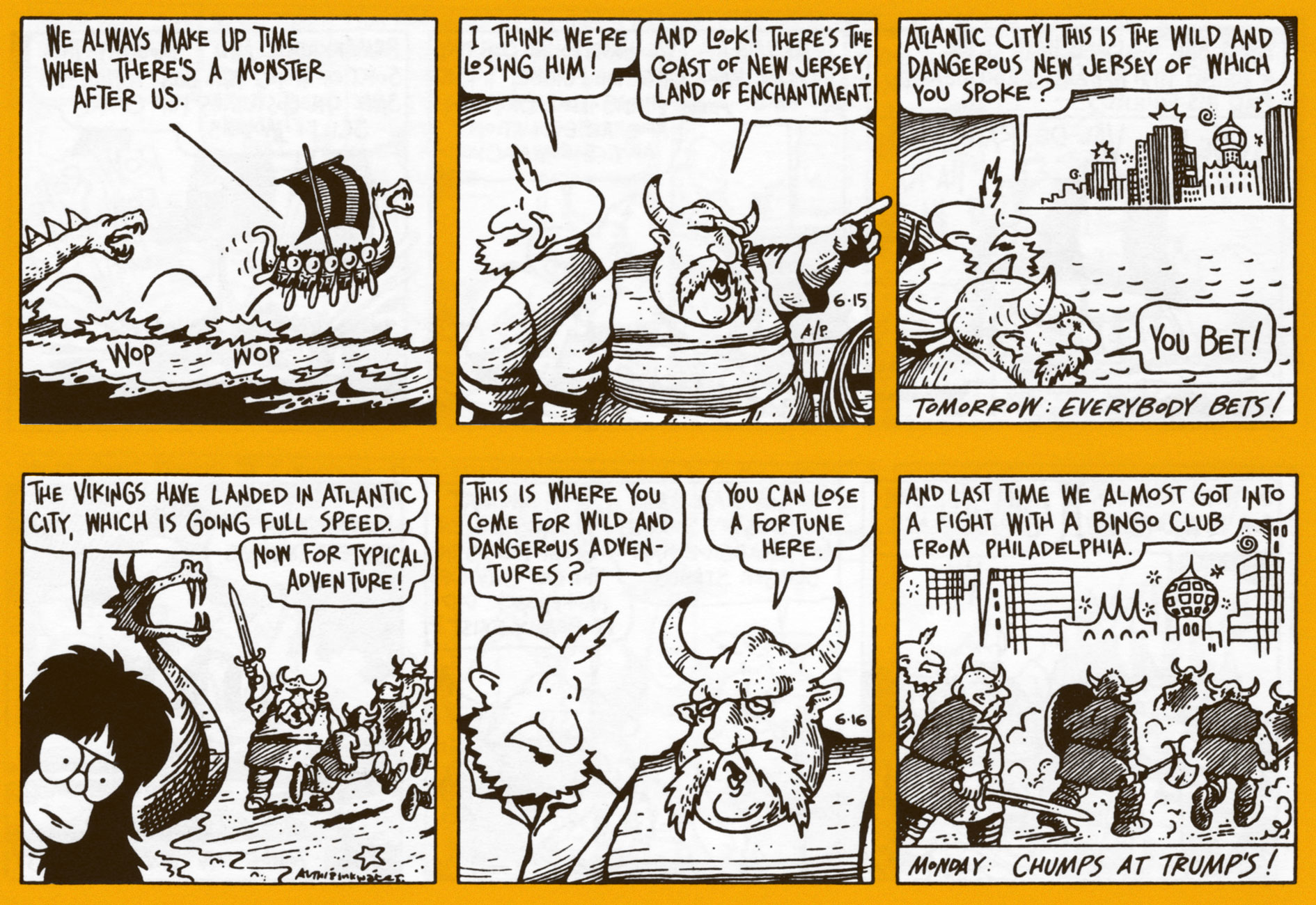
Anything goes, in the most winning sense. The noble Norse warriors were soon to realize that at Trump’s, you simply can’t out-chump the boss.
Norb is an exemplar of the narrative strip that doesn’t take itself seriously: while the story proper is intriguing, any individual fragment is quite entertaining on its own.
Never having been reprinted, the Sunday strips are rare as hen’s teeth, and those who possess them presumably clipped them out of their local paper back in the day. Foresight! As is often the case with King Features continuity strips, Sundays and dailies feature separate storylines.
Several years ago, Norb was featured as the Obscurity of the Day on the excellent Stripper’s Guide blog. There you’ll find a handful more of these gorgeously-coloured (aside from all their other evident virtues) Sundays, and more dirt about Norb.
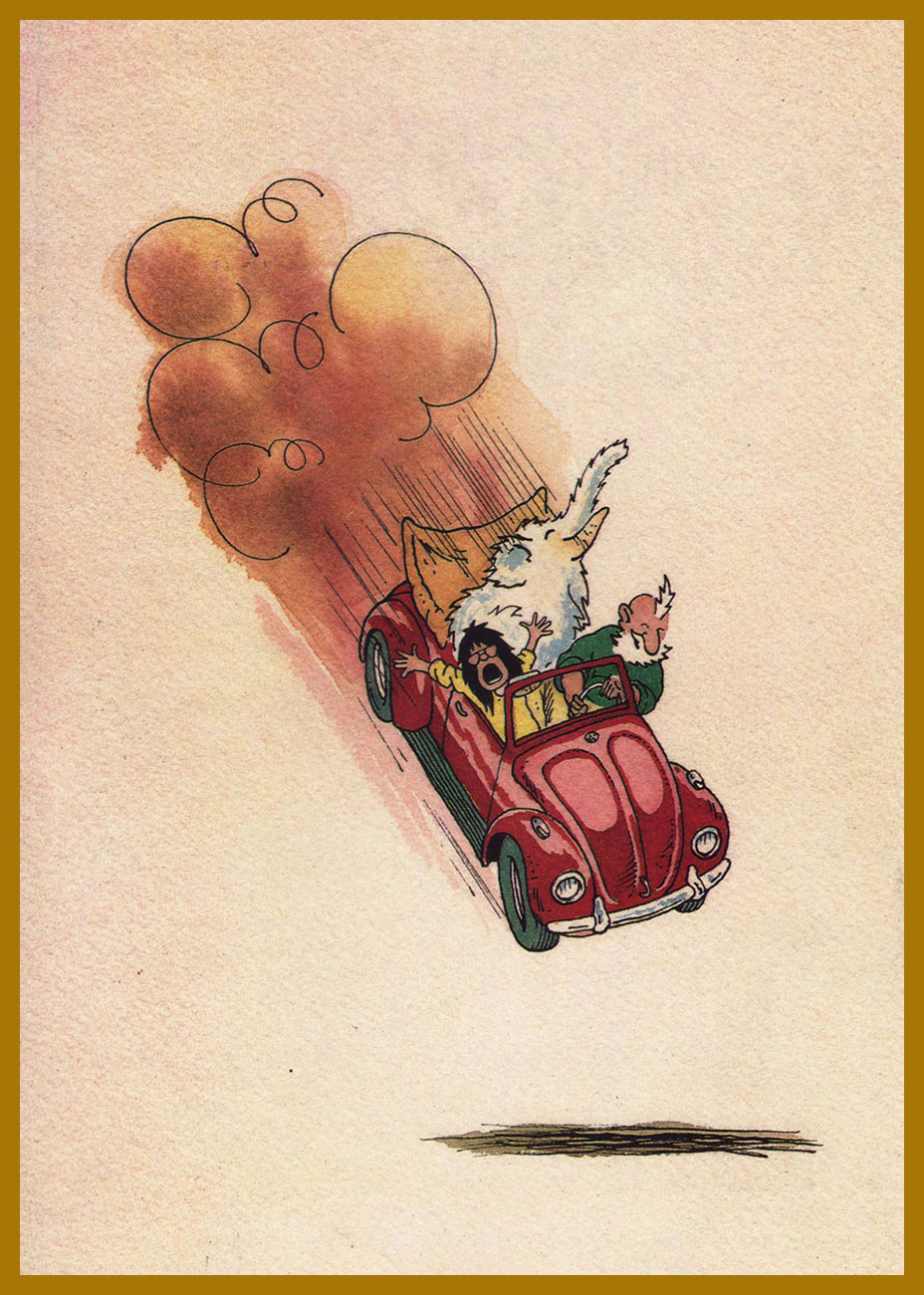
Et pour conclure, Auth’s back cover illustration from the Norb collection.
« It’s pretty clear that you take the whole subject of comics and cartooning a lot more seriously than I do. » Guilty as charged. Thanks for your most kind coöperation, Mr. Pinkwater!
This post is dedicated to the memory of Mr. Tony Auth (1942 – 2014).
« … And so Hooten Landing remained unchanged through the years… a landmark and a memorial… a colonial world that had made only one or two concessions to the march of progress. » — From Ye Olde Spirit of ’76 (July 3, 1949)
Having reached the last half of Kitchen Sink’s chronological reprinting of the Post-WWII Spirit, we come at last to the end of our own chronicle. As stated earlier, facing an inexorable dwindling of Eisner’s involvement and investment in his creation due to other commitments and an understandable sagging of his stamina, the strip slowly entered its decline. Then as now, good help was hard to find, to the point where Eisner opted to wrap up the strip rather than let it peter out completely. This sober and courageous decision most certainly contributed in preserving the feature’s solid reputation to this day.
As we embark on the inarguably lesser half of the run, we encounter fewer standout covers, which is to be expected, given the creator’s diminished affection for the contents. Nevertheless, forty-four Will Eisner covers are bound to yield some genuine sparklers. Here, then, are my picks.
Kitchen Sink Press’ The Spirit no. 46 (July 1988) cover-features Satin, originally published on June 12, 1949. Also in this issue: the clever and entertaining The Prediction (June 19, 1949); The Elevator (June 26, 1949); and Ye Olde Spirit of ’76 (July 3, 1949). Cover by Eisner, with colours by Ray Fehrenbach. Obviously, we’re still in classic territory.
This is The Spirit no. 46 (Aug. 1988), which, over six instalments, « takes The Spirit to the Peligros, a fictional group of South Pacific islands, where he interacts with an entirely new set of characters, cultures and adventures. » The issue opens with Lilly Lotus(July 10, 1949); then follows with Sally of the Islands (July 17, 1949); The Masked Man (July 24, 1949); and The Ball Game (July 31, 1949), introducing latter-day sidekick and comic foil Sammy. Cover colours by Ray Fehrenbach.
This is The Spirit no. 47 (Sept. 1988), which wraps up the masked man’s Pacific Island with the cover-featured Matua (Aug. 7, 1949), followed naturally by The Return (Aug. 14, 1949); then it’s back to Central City business with The Candidate (Aug. 21, 1949) and White Cloud (Aug. 28, 1949). Cover colours by Ray Fehrenbach.
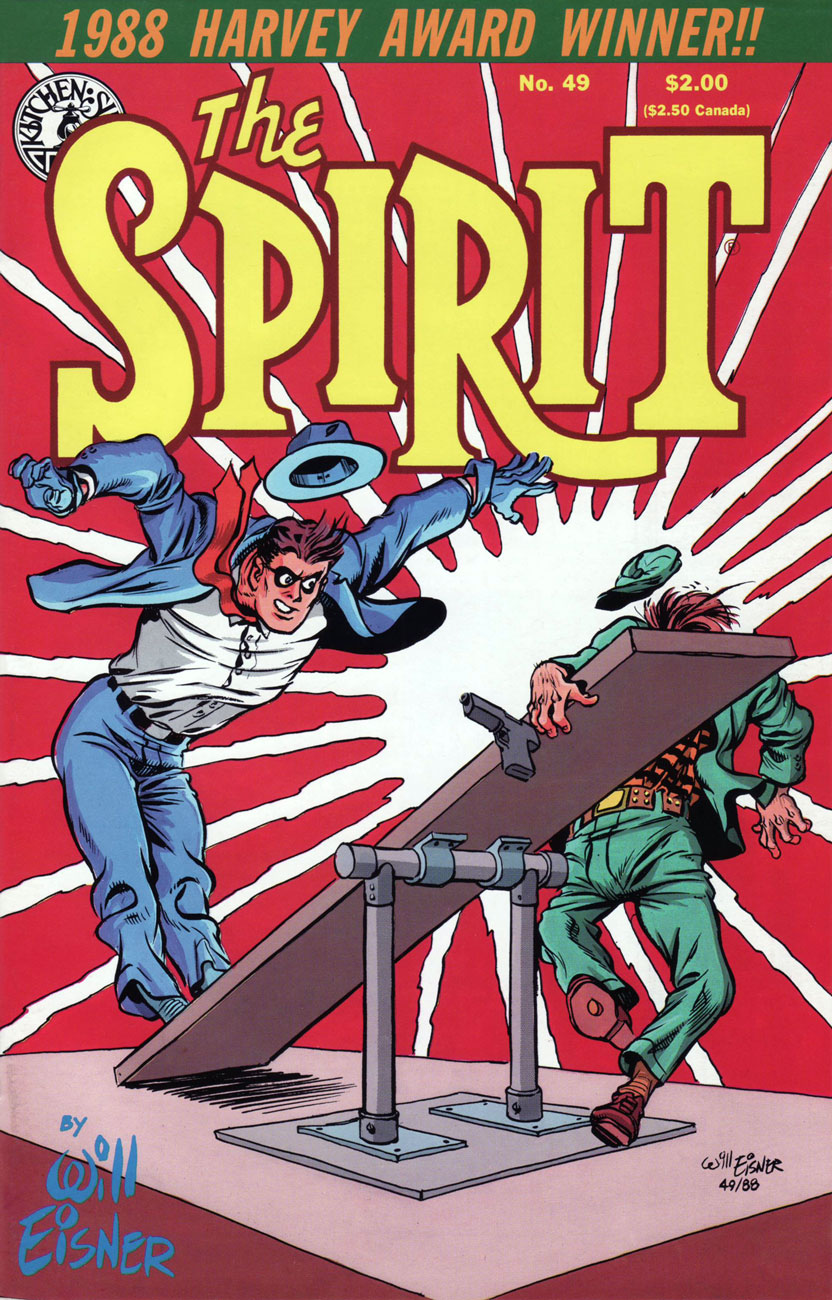
This is The Spirit no. 49 (Nov. 1988), presenting Crime (Oct. 2, 1949); Death of Autumn Mews (Oct. 9, 1949) partly a retelling of the former Denny Colt’s origin, and boasting a true-blue classic splash page; The Curse (Oct. 16, 1949); and Fox at Bay (Oct. 23, 1949). Cover colours by Ray Fehrenbach. Incidentally, The Spirit was the 1988 Harvey Awards laureate in the category of “Best Reprint Project”.
This is The Spirit no. 50 (Dec. 1988). Gathered therein are the Hallowe’en tale of Elect Miss Rhinemaiden of 1950 (Oct. 30, 1949), featuring the return of the sorcerous Hazel P. Macbeth; The eerie The Inner Voice (Nov. 6, 1949); Surgery… (Nov. 13, 1949); and The Thanksgiving Spirit (Nov. 20, 1949). And yes, The Spirit spends the entire issue on crutches. Eisner was ever the innovator! Cover colours by Ray Fehrenbach.
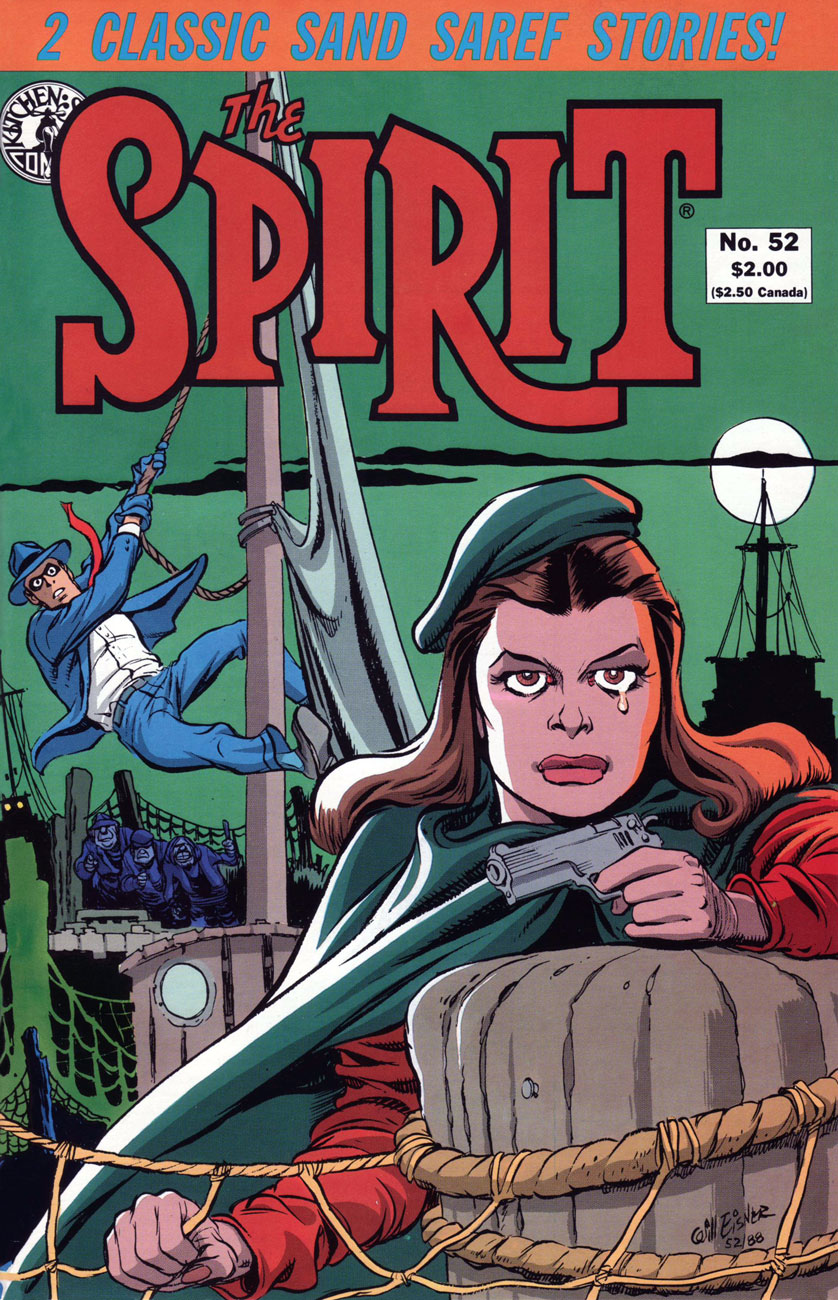
This is The Spirit no. 52 (Feb. 1989), and it cover-features the classic Bring in Sand Saref (Jan. 15, 1950); also in this issue: The Christmas Spirit (Dec. 25, 1949); Fan Mail (Jan. 1, 1950); and part one of the cover story, Sand Saref (Jan. 8, 1950); this cover bears some outstanding colour work by Mr. Fehrenbach, if I may say so.
Some background about the classic Sand Saref two-parter, from Tom Heintjes‘ Stage Settings column:
« The final two stories form one longer tale, and they’ve earned a place in comics history. Eisner’s work and film noir have been mentioned in the same breath for decades, and you hold in your hands one of the best reasons why. »
« The story’s history is unorthodox. Sand Saref and Bring in Sand Saref had their origins in Eisner’s shop, which had been producing various comic books and pieces of commercial art with growing frequency. The two stories were originally done as a single 11-page feature, but it didn’t star The Spirit. The lead character was John Law, a character Eisner intended to launch independently of The Spirit feature.
When the John Law project was shelved due to the often poor newsstand distribution of many comic books, Eisner later saw an opportunity, and seized it by breaking the 11-page John Law feature into a two-part Spirit story. Astute readers are now saying: ‘But Spirit stories are seven pages long, requiring fourteen pages of art.‘ Well, there are no flies on Will Eisner. He created the first three pages of ‘Sand Saref’ to bring up the page count.
Eisner said breaking the John Law story into two halves, eliminating all traces of the intended hero, and inking in the faces of The Spirit’s cast of characters wasn’t simple. “The characters were different people, so considerable dialogue had to be rewritten,” he said. “John Law was a policeman and The Spirit wasn’t. Merely because they both fought on the side of law and order didn’t make them the same character.” In fact, Eisner has Sand Saref tell The Spirit ‘you’re a cop’ in the climax of the 14-page story. »
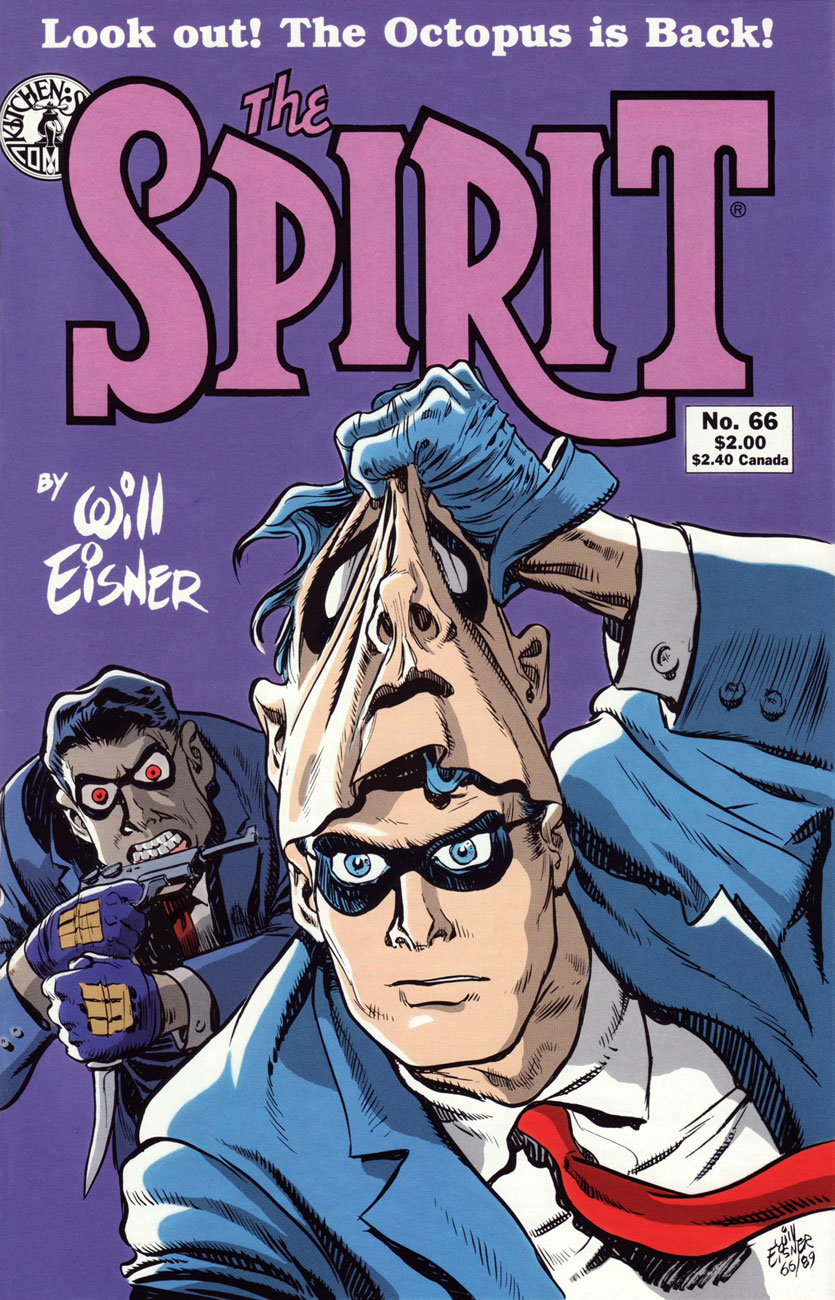
This is The Spirit no. 66 (Apr. 1990), and the issue reprints Future Death (Jan. 21, 1951); The Meanest Man in the World (Jan. 28, 1951); the shadowy, ultra-violent Showdown (Feb. 4, 1951); and its cover-featured conclusion, The Octopus Is Back (Feb. 11, 1951). Cover hues by none other than Joe Matt!
The Spirit no. 69 (July 1990) reprints Time Bomb (Apr. 15, 1951); Hobart (April 22, 1951); Help Wanted (April 29, 1951); and cover-featured The Facts (May 6, 1951); Ray Fehrenbach is back on colours.
The Spirit no. 70 (Aug. 1990) reprints The Hero (May 13, 1951); The 7th Husband (May 20, 1951); King Wang (May 27, 1951); and The Thing in the Jungle (June 3, 1951); Eisner’s cover illustration mixes elements of the second and fourth stories, and it is ably coloured by Ray Fehrenbach, comme d’habitude.
This is The Spirit no. 85 (Nov. 1991), featuring The Ballad of Greenly Sleeve (July 6, 1952); Matt Slugg (July 13, 1952); Marry the Spirit (July 20, 1952) and of course, the sadly tantalizing cul-de-sac that was Jules Feiffer and Wally Wood‘s Outer Space (July 27, 1952). Cover by Eisner and colours by Fehrenbach.
A word or two about The Outer Space Spirit, as it’s come to be called: Eisner, looking for a worthy successor to bequeath the strip to, found young Wally Wood. Talented as he was, Wood’s tragic character flaws were already well established: unlike Eisner, he couldn’t pace himself and he couldn’t stay the course, two qualities essential to the steady production of a comic strip. But for the couple of weeks before Wood started missing deadlines, such lush, interstellar beauty! Feast your peepers here.
Finally, as a bonus: detail from a Kitchen Sink house ad devoted to the publisher’s more-than-fine assortment of Eisnerania; it first appeared on the back cover of The Spirit no. 45 (July, 1988).
Well, that’s it! Thanks for tagging along on Will Eisner and his most famous creation’s tireless peregrinations.
If you’ve missed the earlier entries in the series (punctuality is not one of your strong suits, is it?), all is not lost. In fact, it’s all handily archived within easy reach :
… or if single-clicking is more your speed (takes all kinds!), there’s always our general category, That’s THE SPIRIT!, which will bring up everything at once… but in chronologically inverse order.
It’s lovely to enthusiastically anticipate new oeuvres from a present-day cartoonist, or to have the opportunity to praise his work knowing that, perhaps, some of this praise will eventually reach him. I spend much time reading books written and drawn by people long gone, so it’s truly a pleasure to endorse cartoons by a contemporary artist.
In this case, this post was prompted by getting my hands on Department of Mind-Blowing Theories, which came out in April 2020. It took me a few months to get my hands on it, yes, but get to it I did.
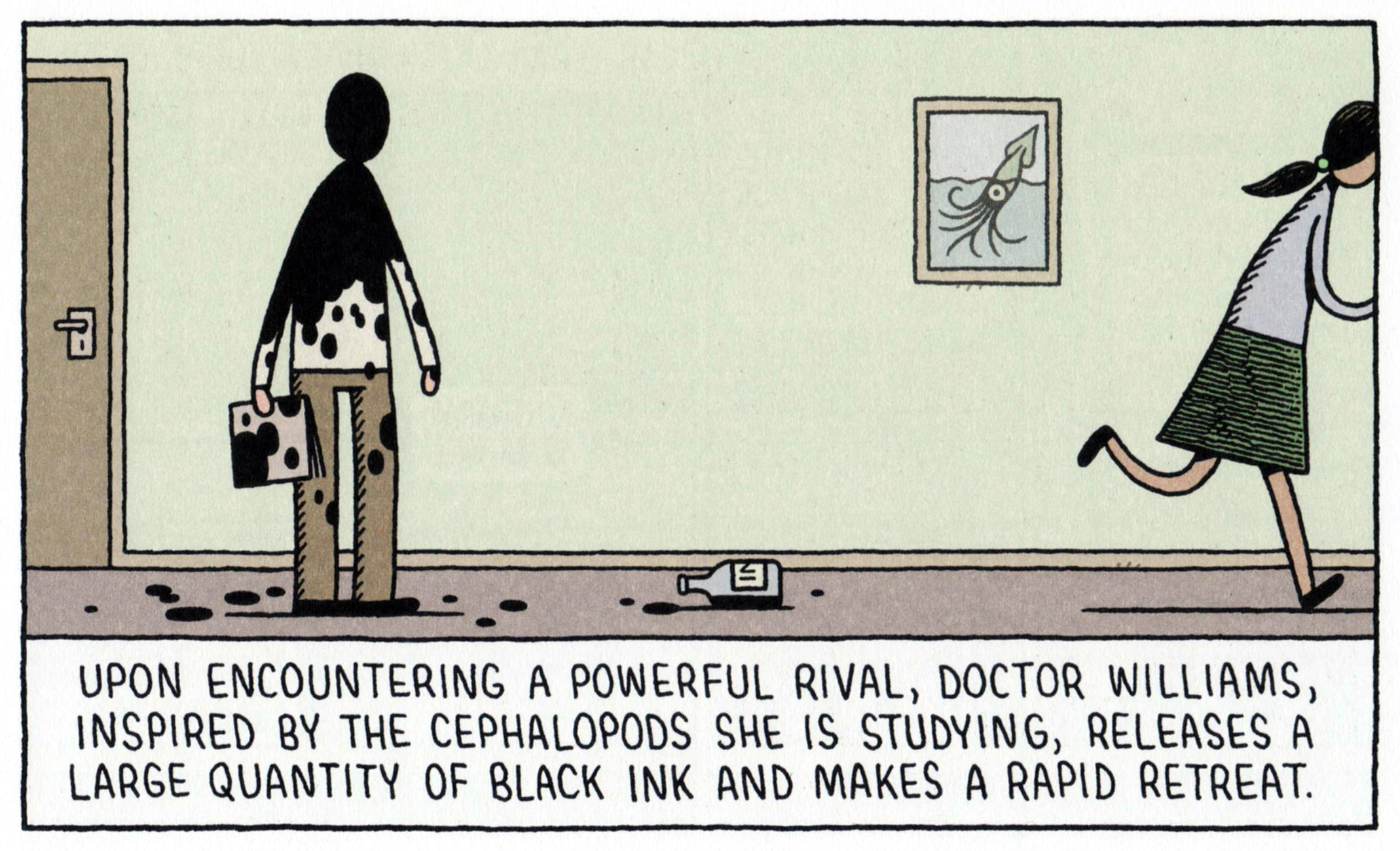
Tom Gauld, hailing from a Scottish county with the romantic name of Aberdeenshire, is a self-declared SF/F nerd with a scientific bent, the latter proclivity acquired thanks to his grandfather, who was a marine biologist. To quote Gault, « he was a quiet and thoughtful man and I think because of him, the whole family had a respect for science and scientists. He subscribed to New Scientist and would give them to my Dad after he’d read them, so there were always copies around our house as I was growing up. » The first time I encountered Gauld’s strips, I thought he was a scientist, so accurate were his depictions of the struggles of the scientific community. As it turns out, this is a somewhat new and recent direction for him – he’s only been contributing to the New Scientist since 2014. His more literary-minded work has been published by The Guardian since 2005, and he has also created some lovely covers for The New Yorker (eight, to be more precise).
All material (except the first image) in this post has been scanned from You’re All Just Jealous of My Jetpack (2013, Drawn & Quarterly), a collection of selected strips published in The Guardian, and the aforementioned Department of Mind-Blowing Theories (2020, Drawn & Quarterly), his fifth book with this Montreal publishing company.
A print from a series of twenty four commissioned by Bart’s Hospital. These prints are installed throughout its Cystic Fibrosis Unit. « As part of Tom’s commission, he met with patients to gain insight into the particular circumstances of their condition, the hurdles they encounter, their hopes and fears in order to create a project that is relevant to their reality. The outcome is an urban park featuring humorous vignettes and unexpected elements. Each isolation room in the Unit displays a selection of prints from Tom’s Imaginary London Park series. Embedded within each image are an array of symbols that relate to an explanatory key, included in the rooms. Patients can imagine the variations in their own, as well as adjacent rooms. Due to frequent re-admission, patients can explore more of the work, and discover new vistas, when they return to the Unit and occupy a different room. »
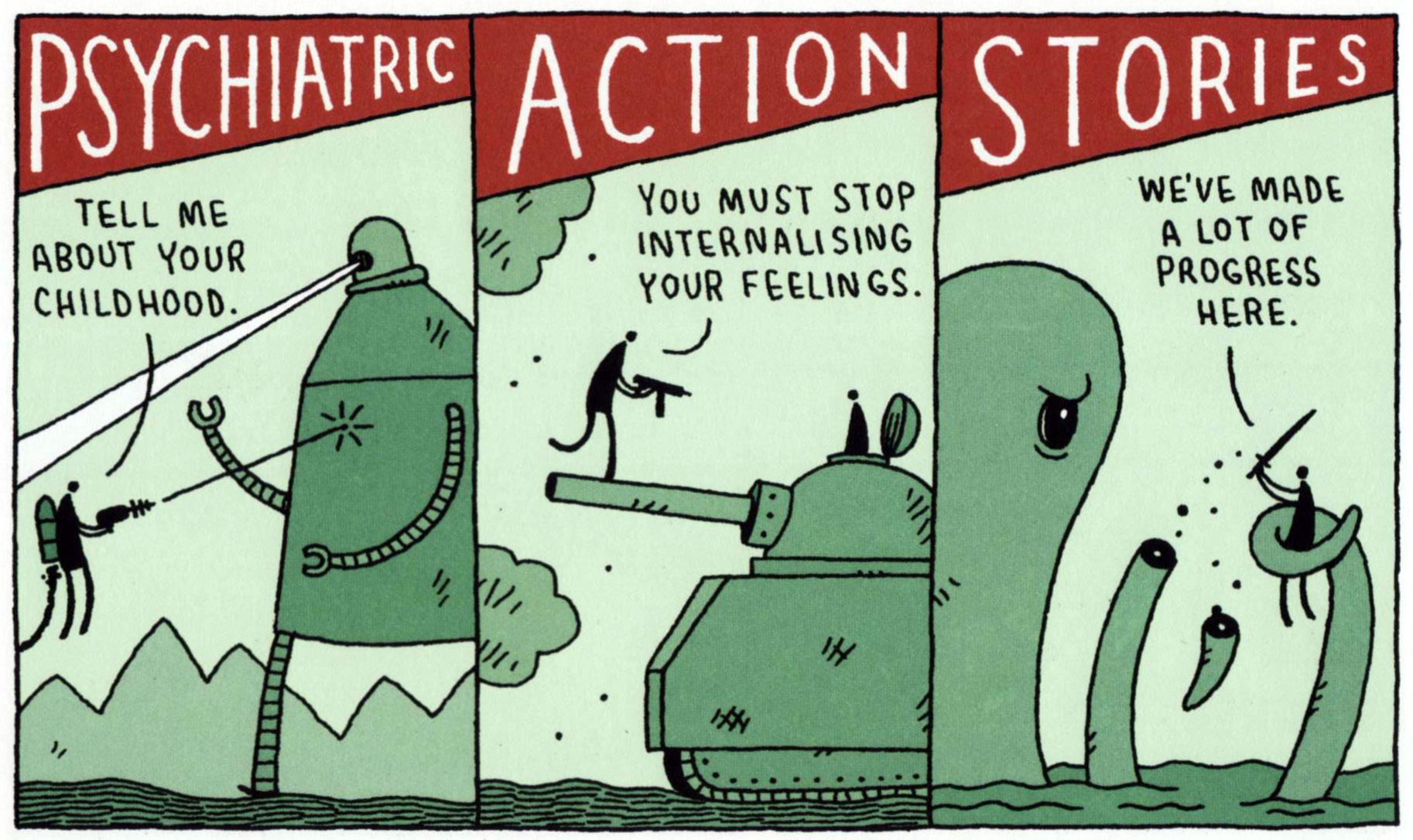
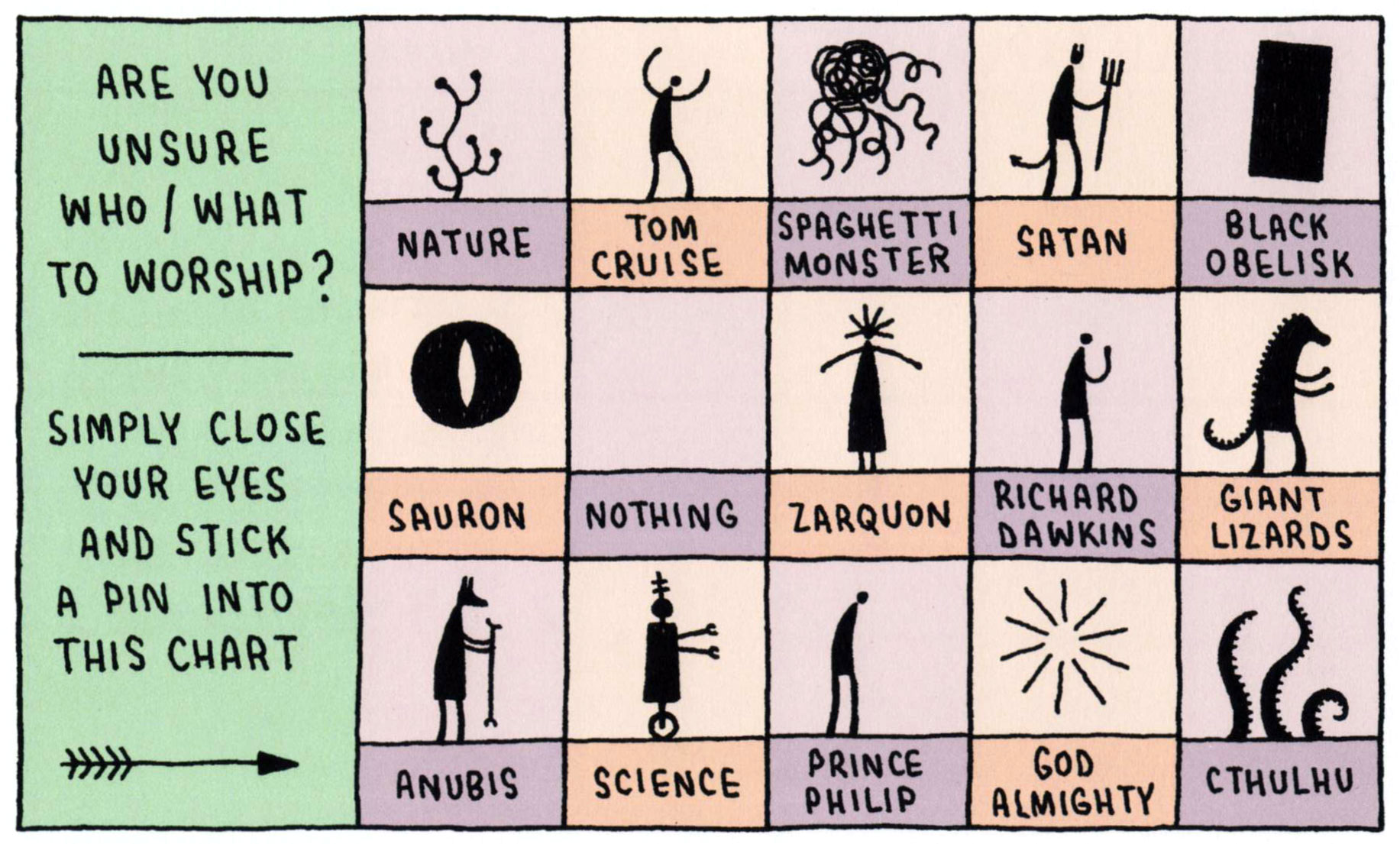
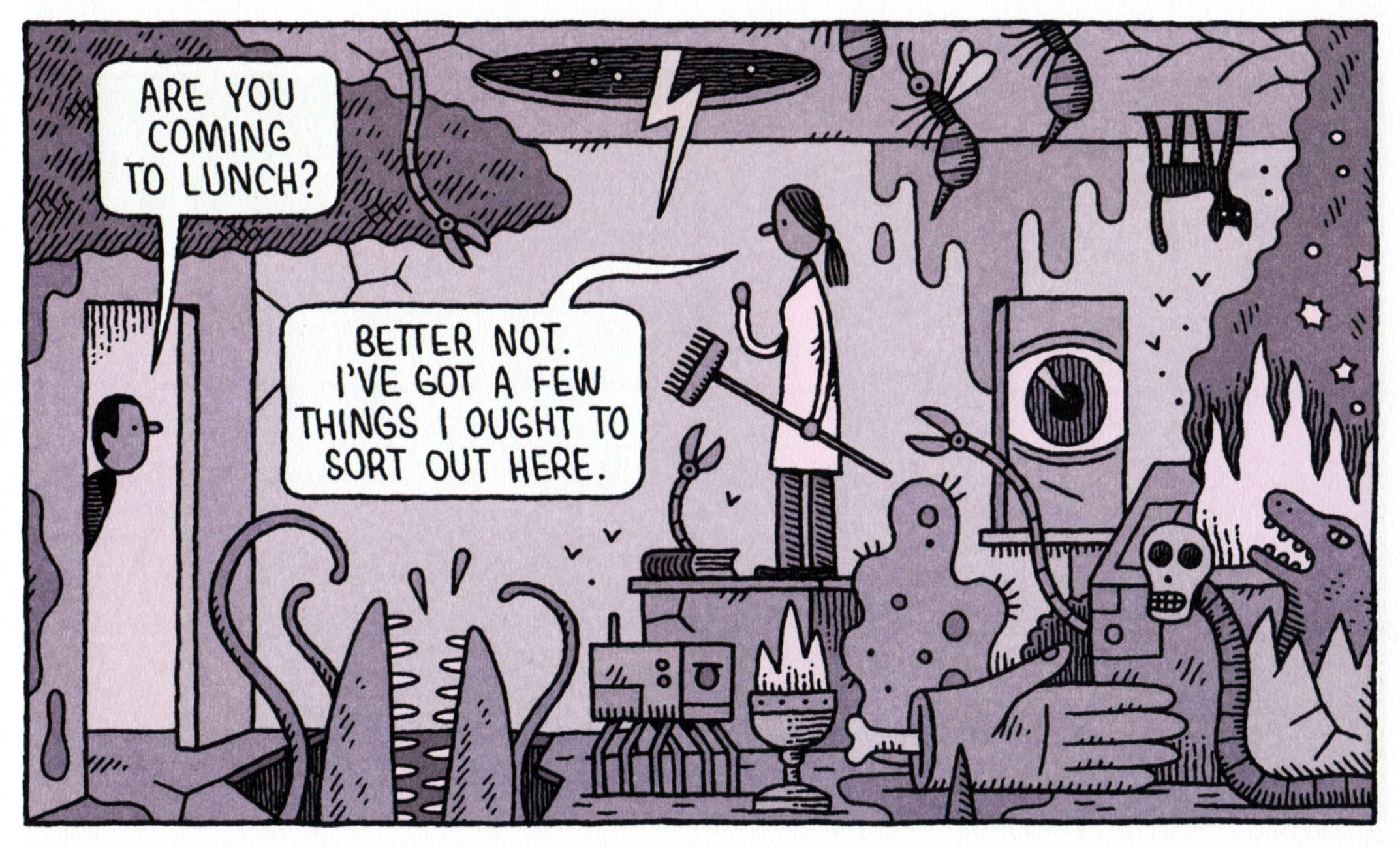
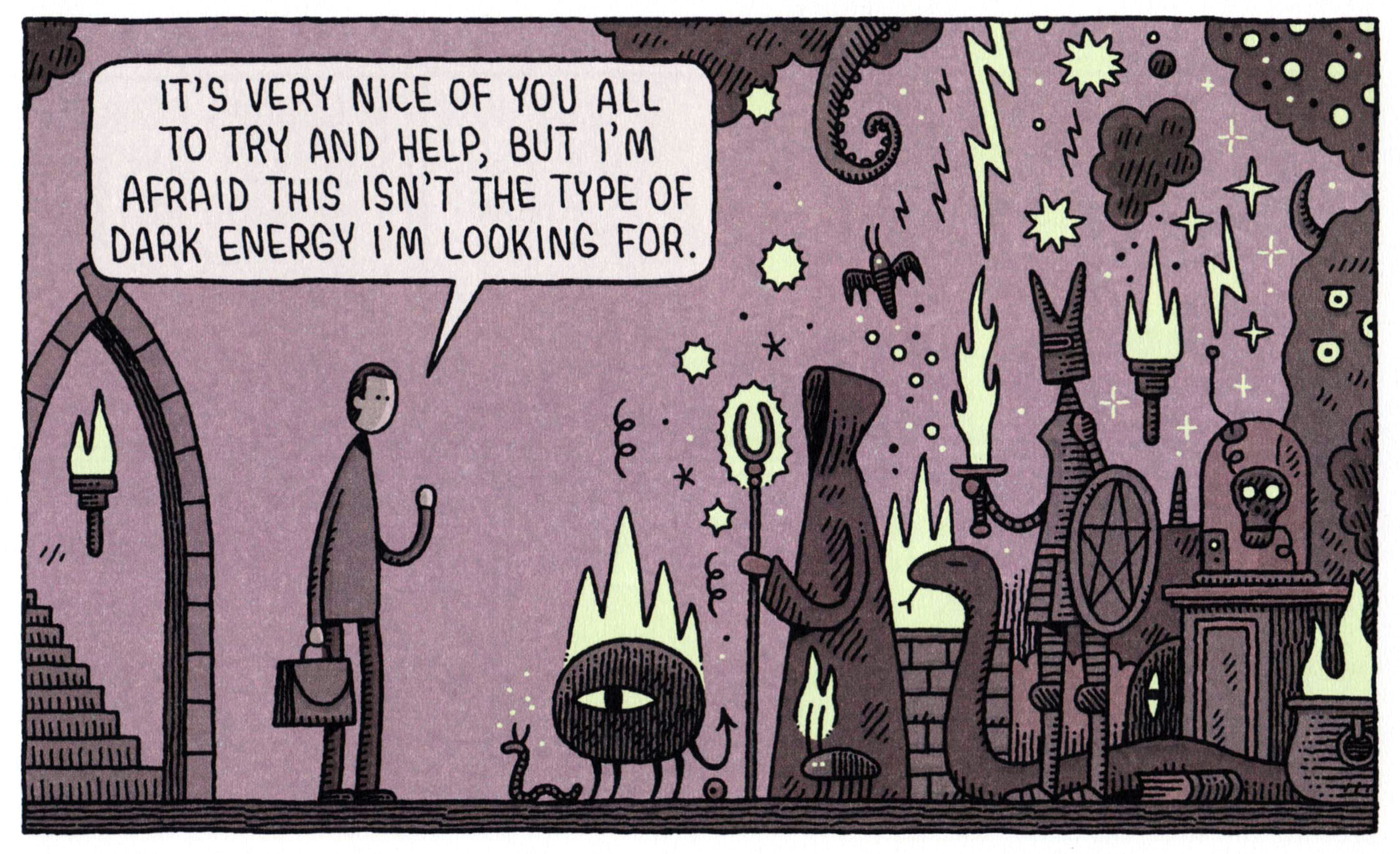
Gauld’s tentacles aren’t always front-and-centre, occasionally occupying a humble corner. I got Richard Dawkins, by the way.
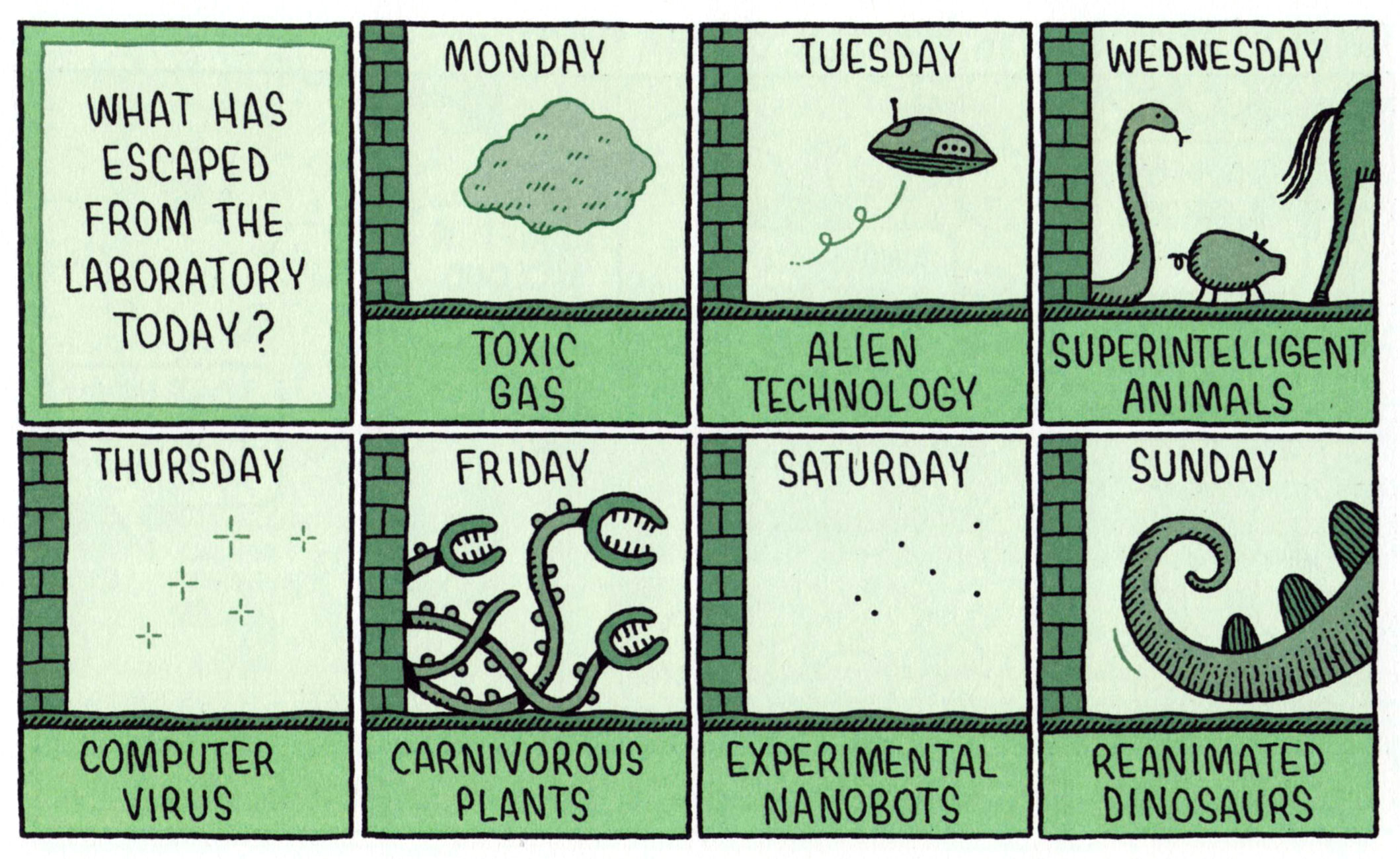
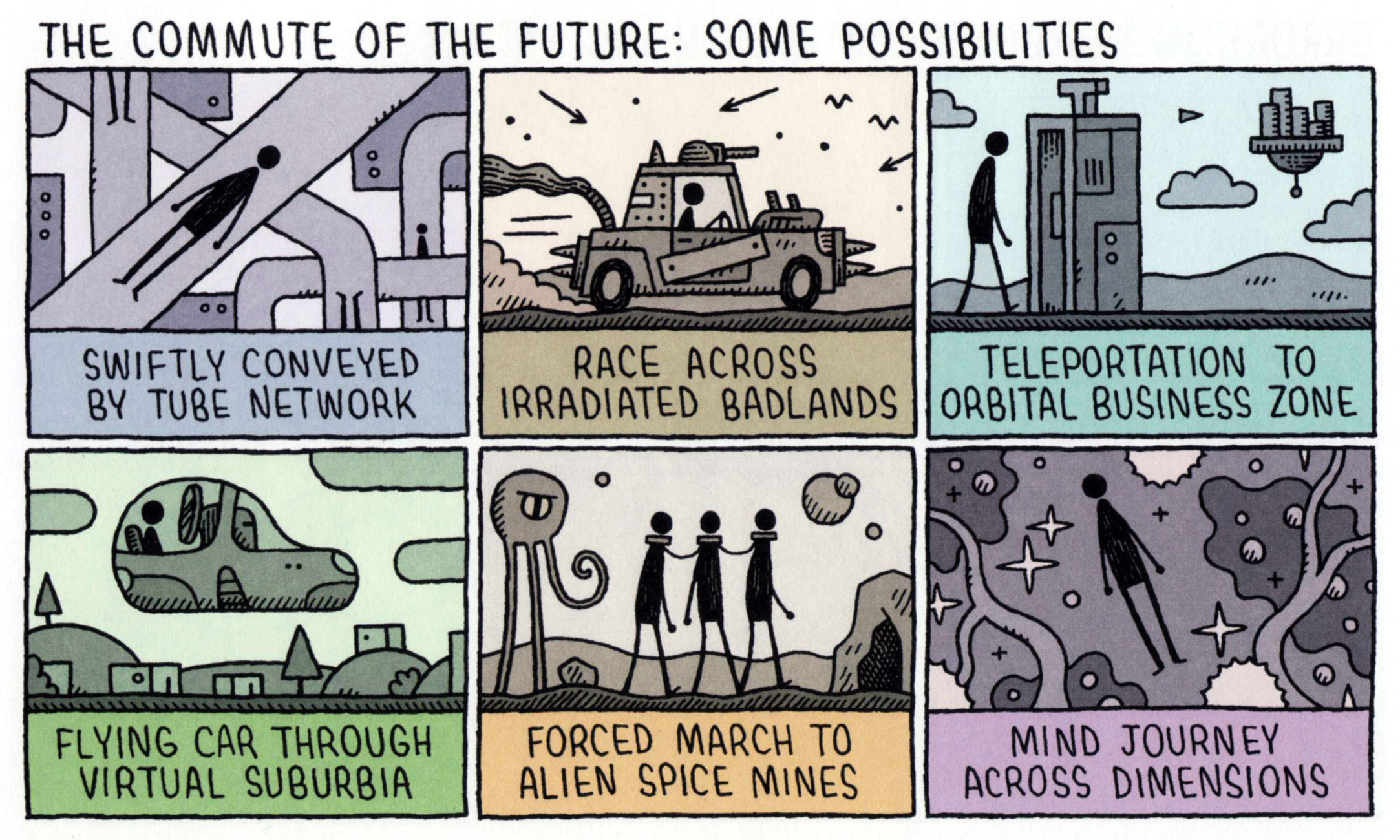
« There sometimes seems to be an idea that in order to be a scientist you have to put aside your humanity and become an emotionless logic-machine. I think that’s wrong, but some people (even some scientists) seem to believe it. There’s a thread running through the book of cartoons that depict scientists being human: Being unsure, bickering, misunderstanding, and messing things up. It’s much more fun (and realistic, I think) to depict flawed, klutzy humans than idealised successes. » |source|
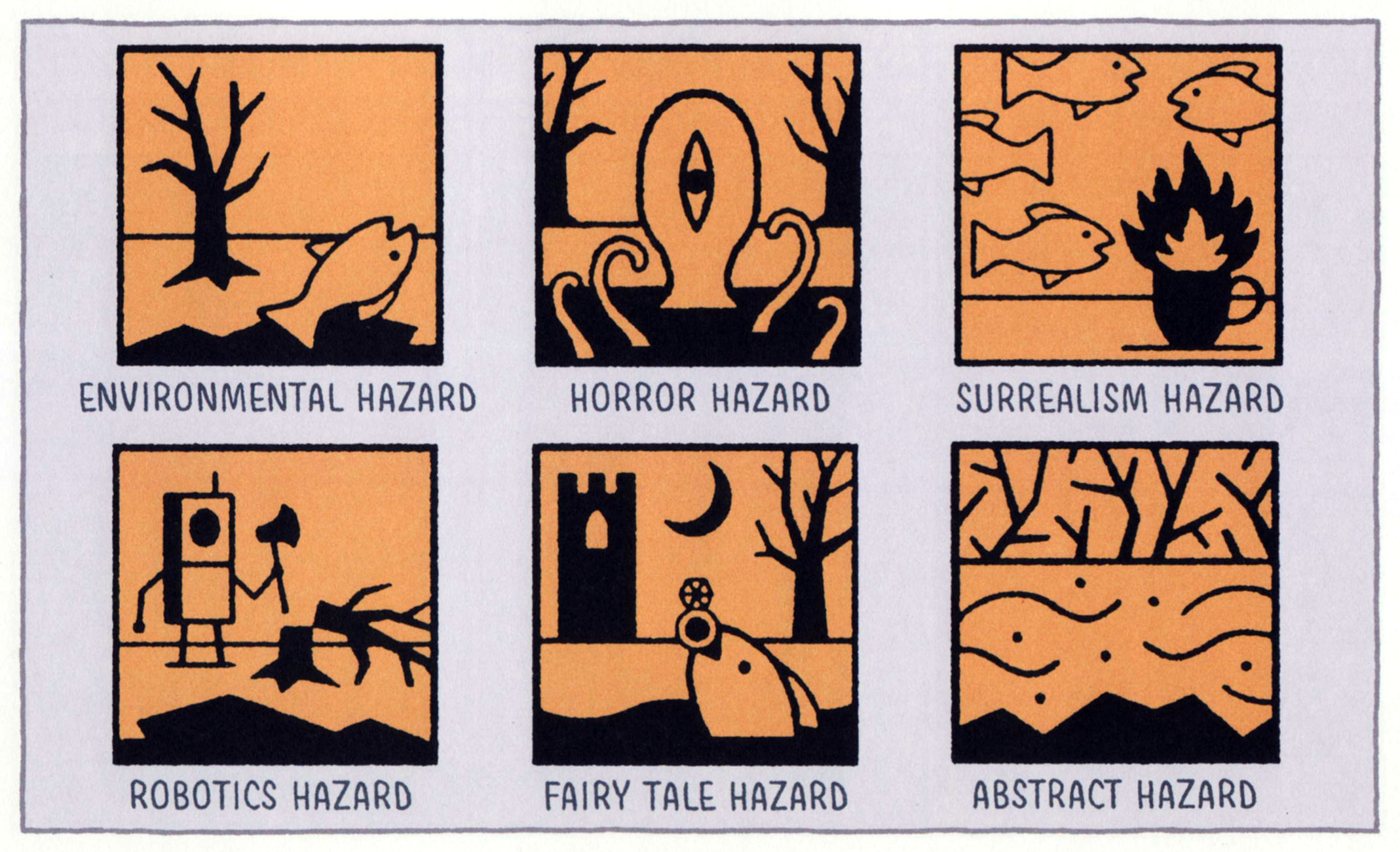
« I spent seven years at art school and tried all sorts of drawing styles, but when I got into drawing comics I found that a simple style worked best. I gave up trying to be “artistic” and just used the type of drawing I’d naturally revert to when I wasn’t thinking too much: the style I’d use for a silly cartoon to amuse a friend, or to draw a map or an idle telephone doodle. I’ve tried to improve as I’ve gone along, and I hope I’ll never be stuck with a fixed, unchanging style. I want the images to be simple and clear, but with a bit of human warmth, a bit of handmade wobble in the lines, to stop it seeming completely diagrammatic and cold. » |source|






































 Who's Out There?