« Everything that happened to Archie happened to me in school, except that Archie always seemed to get out of it. » — Bob Montana
Despite the hundreds, if not thousands, of variably-abled hands that have toiled in the Archie Comics salt mines, the most important set of mitts devoted to the task was also the very first.
Archie creator Bob Montana* (1920-1975) knew what he was doing from the git-go. After all, he rubbed shoulders with the characters’ real-life counterparts from the Class of 1940: according to a 1989 Associated Press story, his buddy ‘Skinny’ Linehan became Jughead, football hero Arnold Daggett became Big Moose Mason; principal Earl MacLeod gave us Mr. Weatherbee and school librarian Elizabeth Tuck inspired Miss Grundy… and so on.
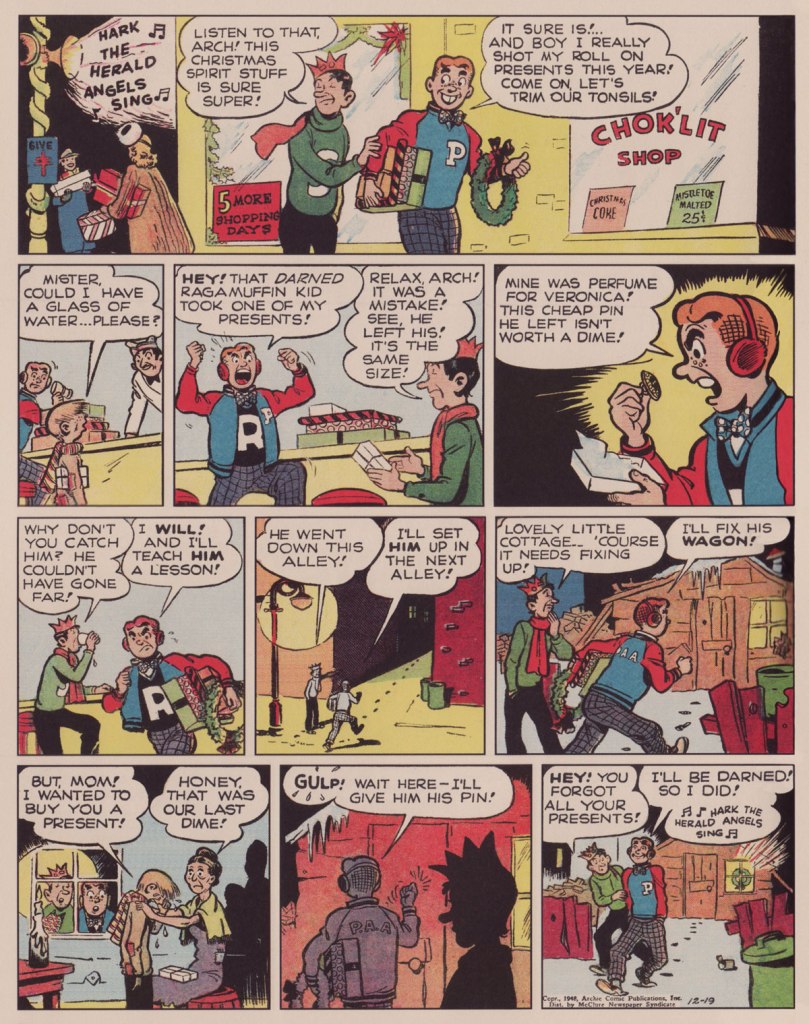
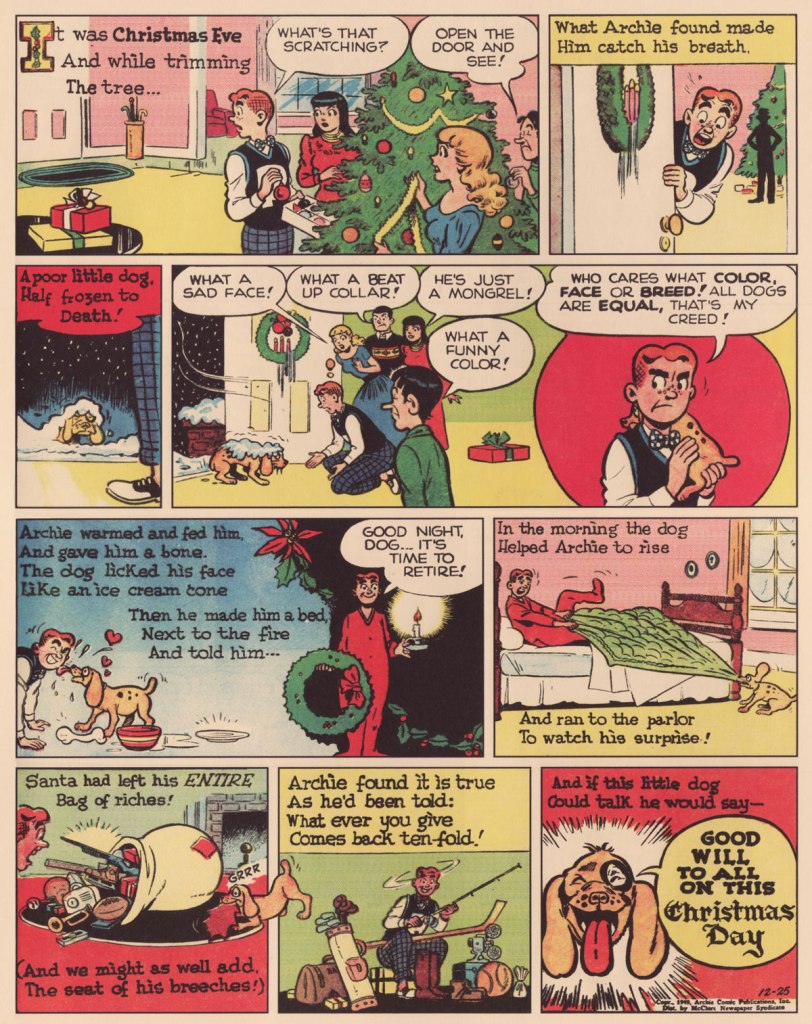
Montana was also that rare cog in the Archie machine: an autonomous writer-artist. This served him well in the newspaper strip world: he débuted the Archie feature in 1946 and remained in charge, dailies and Sundays, until his 1975 passing. I do prefer Samm Schwartz’s Jughead, but Montana drew the definitive version of every single other member of the Riverdale ensemble. In particular, as you’ll witness, Betty and Veronica were never slinkier.
The Sunday, December 22, 1946 strip.The Sunday, December 21, 1947 strip.The Sunday, December 19, 1948 strip.The Sunday, December 26, 1948 strip.The Sunday, December 25, 1949 strip.
And a bonus New Year’s-themed one for the road!
The Sunday, December 28, 1947 strip.
And with this… Merry Christmas, everyone!
-RG
*On the Archie plantation, as with the Harvey gulag, we can safely dismiss the founders’ specious and strident claims of having created their cash cows. In this case, Archie “creator” John Goldwater‘s original mandate to Montana was essentially to riff on popular radio show The Aldrich Family (1939-1953).
« The working class is revolutionary or it is nothing. » — Karl Marx
Pif le chien was introduced to the world on March 26, 1948, in the French Communist daily L’Humanité. His strip was intended to replace that of Felix the Cat, who was deemed too bourgeois, what with his magic bag and invisible means of financial support. On the other paw, Pif, early on, was even a stray, homeless and starving. In time, he was taken in by a humble working-class family (as late as 1957, it was the outhouse and public baths), and that’s when the elements clicked into place.
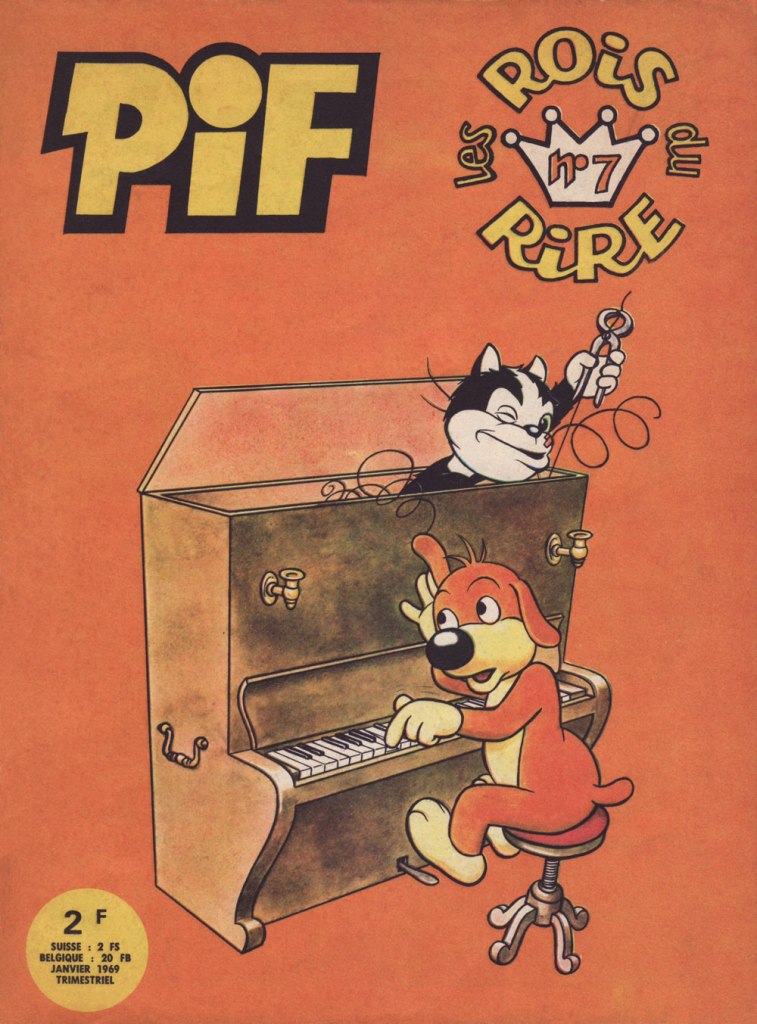
This is Les rois du rire no. 7 (Jan. 1969, Vaillant), a rotating anthology title gathering, in this case, two-pager Pif strips from the pages of Vaillant. Cover art by Pif’s creator, José Cabrero Arnal (1909-1982).
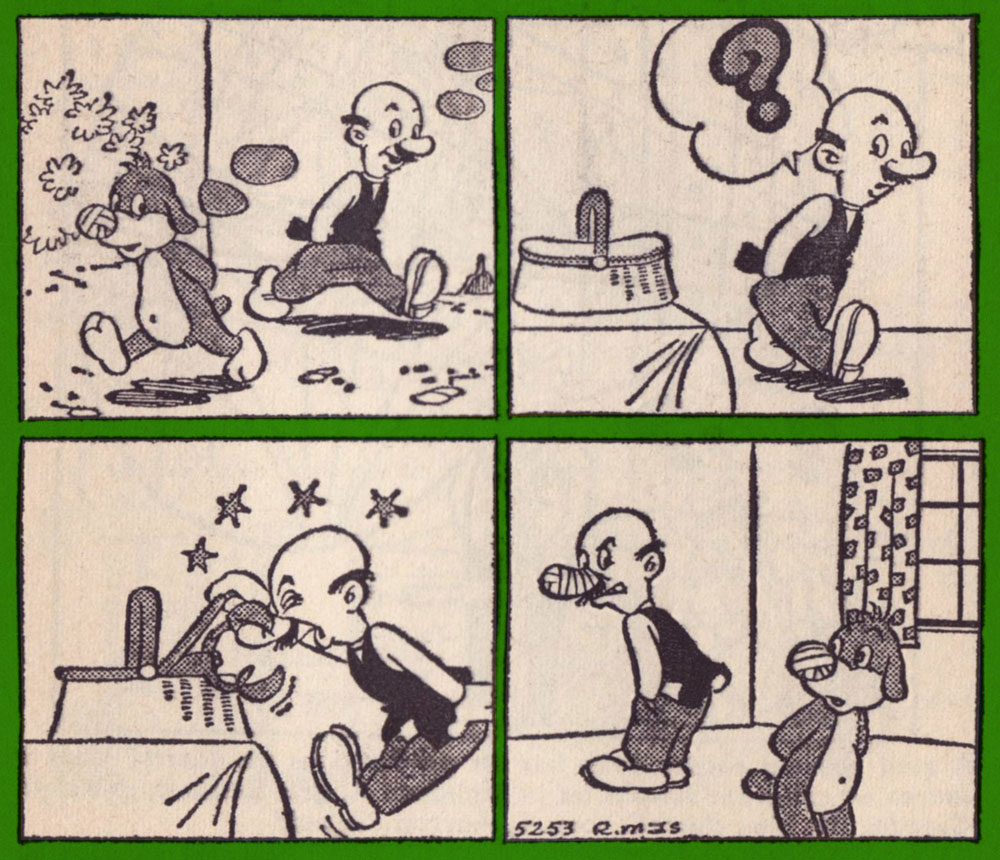
While I greatly admire and enjoy the work of Pif pater José Cabrero Arnal — and trust me, his is a story worth the telling: fought the Fascists in Spain, spent four years in a Nazi Stalag in Austria before being liberated by the Soviets, never quite recovered from the ordeal of his captivity, and remained fragile for the rest of his days. Consequently, in 1953, he handed Pif’s leash over to the truly indefatigable Roger Masmonteil (1924-2010).
Of Masmonteil (who signed R. Mas.), historian Hervé Cultru writes, in his Vaillant, 1942-1969 : La Véritable histoire d’un journal mythique (2006, Vaillant Collector):
« The problem is that, once he got his finger caught in the gears of the freelancing engine, he couldn’t just yank it out! Because giving life to the Césarin family is practically a vocation: one must provide the daily strip, six a week. Over thirty years, Masmonteil, aka Mas, crafted over eleven thousand of them. There are also the Sunday strips, the pages for Vaillant, solo Pifou stories, Léo, created for Pif Gadget. It never ceased. By his career’s end, he had racked up some 45,000 gags or so. »
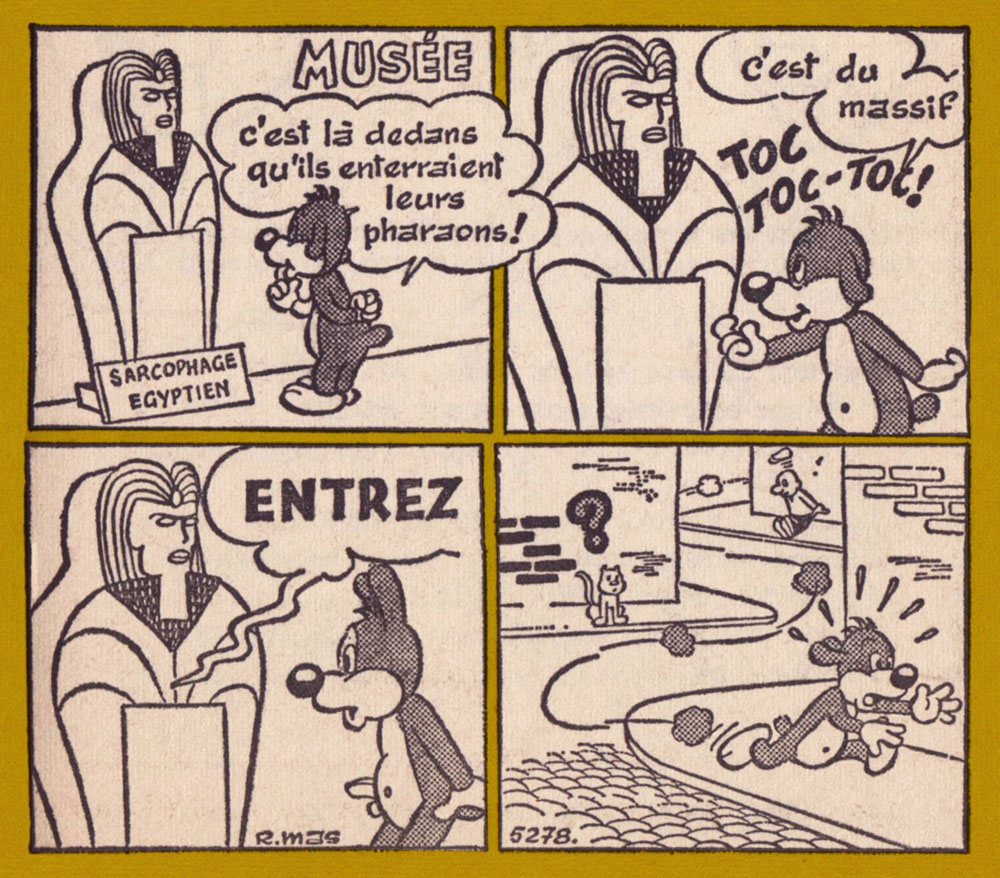
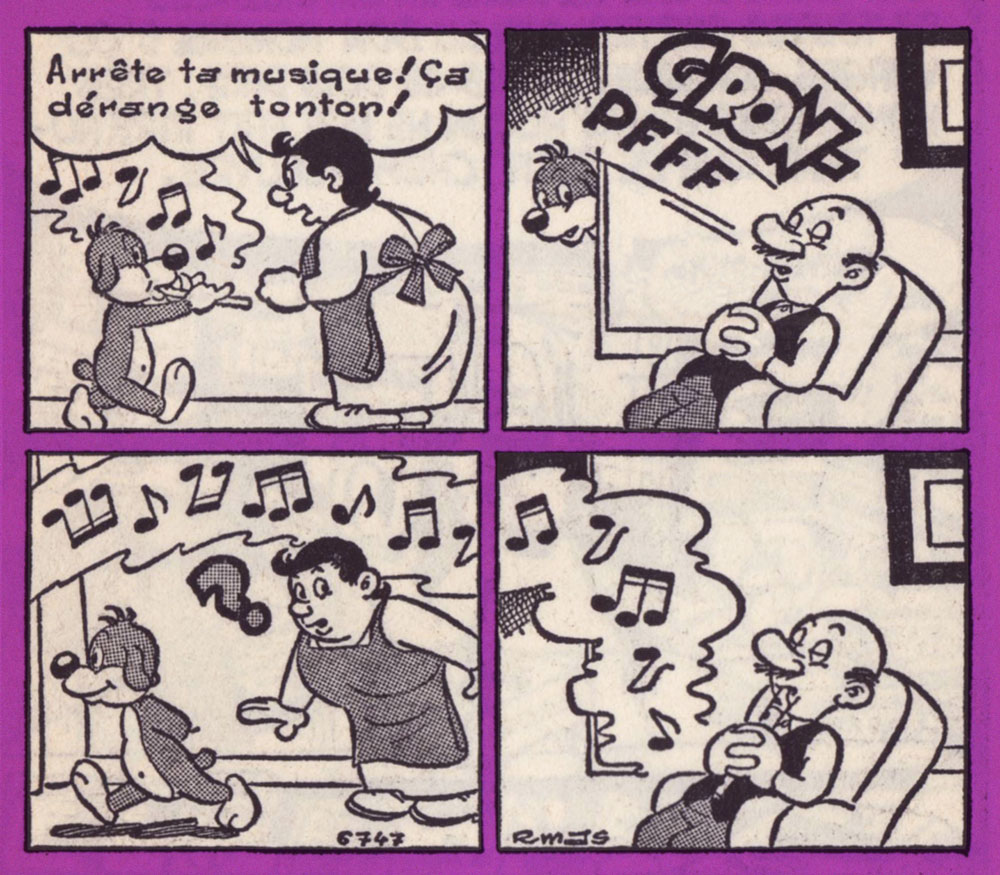
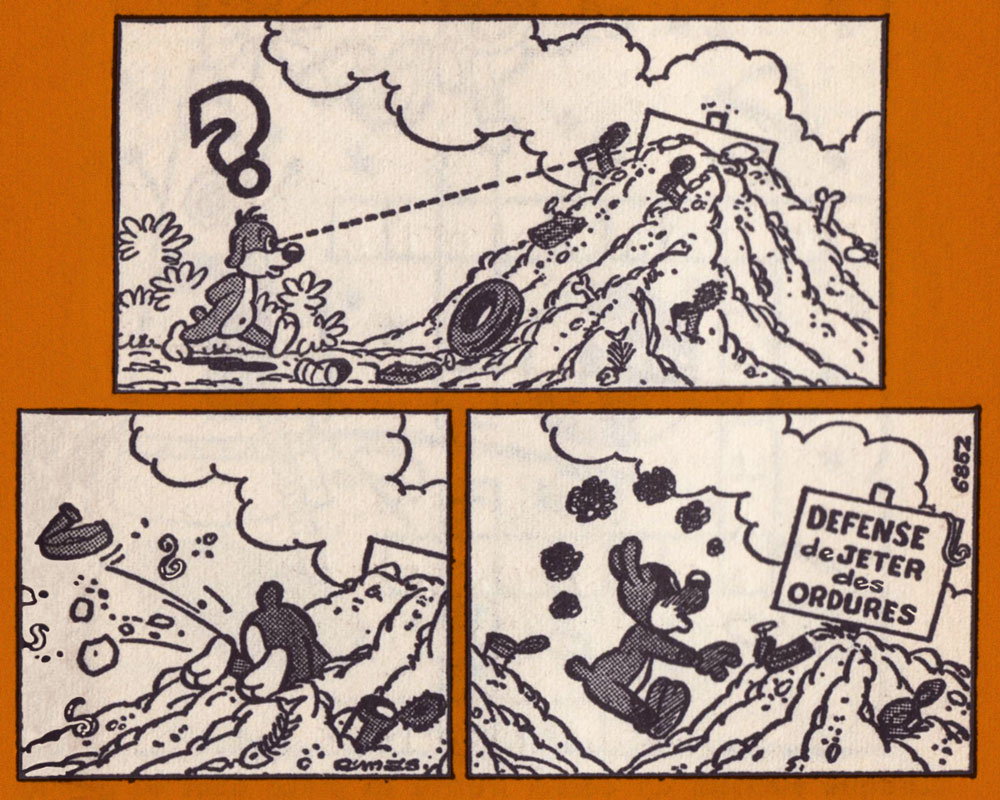
« Unlucky me, I’ve smashed the vase! » « Out of sight, out of mind! » « Bleh! What a revolting aroma! » « I’m found out! »« When the sea is too far, one makes do with a little corner of the Seine! » « I’m the back-float king ! » “Sur mer” (“On-Sea” would be the English equivalent) is a popular suffix to denote a town or resort’s coastal location. The Seine’s toxicity borders on the legendary, but things have actually improved in recent decades.I love a good pantomime gag. And every look is a sideway glance, which makes it even more special.« It’s in these things that they buried their pharaohs! » « That’s solid stuff! » « COME IN ». What most impresses me here is the final panel, with its expert use of a tiny space to convey depth, distance and setting. That’s the cartoonist’s art!« Quit your music! It bothers tonton! ».« And a-one! » « Brr! Doesn’t it cause him pain when you remove the hook? » « Not at all… it’s designed not to hurt… » « Next! » « Quiet! It’s designed not to! » Up yours, René Descartes!A slice (ouch!) of politico-historical guillotine humour.A dollop of social criticism. The sign says, naturally, « No Littering ».Pif’s archenemy, Hercule, at work. « Who’s going to get a good soaking? The Pif, that’s who! » « Failed! »
I’m inclined to admire Mas for the same reasons I hold Nancy’s Ernie Bushmiller in the highest regard: the uncanny ability to find humour in any and every place or situation, to distill and express it in a pared-down visual language made all the more potent by its universal simplicity. But it’s hard work, even if geniuses make it look easy. As Hervé Cultru explains, in Mas’ case:
« … Pif gets the last word in: at night, he haunts Mas’ dreams. The point at which he’s about to doze off is actually one of intense creativity. He constantly keeps a notepad and pencil at his bedside, to jot down ideas straight away, because if he neglects this precaution, all is forgotten by morning. »
An ad from L’Humanité, circa the late 1950s.Our cast: Tante ‘Tata’ Agathe and Oncle César ‘Tonton’ Césarin, Doudou, Pif, Hercule, and Pif’s son, Pifou. This is my copy of Album Vaillant no. 8— 4th series (comprising issues 952 to 960, August to October 1963), its rather fragile spine helpfully reinforced by a previous proprietor. I long wondered why on earth the French call wrestling ‘catch’. Turns out it’s their shorthand version of the forgotten 19th century appellation of the sport as ‘catch-as-catch-can‘.
In April 1967, Mas walks away from the Pif feature in Vaillant (four pages a week!), maintaining the daily in l’Humanité and Pifou’s solo strip. Pif returns briefly to Arnal, who still can’t handle the workload; Pif then passes into other, and decidedly far lesser hands.
Mr. Cultru, again:
« In 1968, the team takes umbrage with the repetitive and by far too ‘domestic’ character of the adventures.It feels that the working class household, typical of certain post-war values, that serves as a setting, has become obsolete, if not grotesque, and that it no longer fits the social context of the times. »
So they methodically excised everything that made Mas’ Pif special, and turned him into another Mickey Mouse, which is to say the familiar mascot or standard-bearer of a company, but one whose adventures nobody reads or truly gives a hoot about. Oh well — you still had a good run, Pif!
« This kind of accuracy, continued long enough, can ruin a man who is constructed as I am. I want to be pretty. I want to eliminate facts and fill up the gap with charm. » — Samuel Clemens, writing to a friend of a pen sketch sent to him by young admirer H.T. Webster
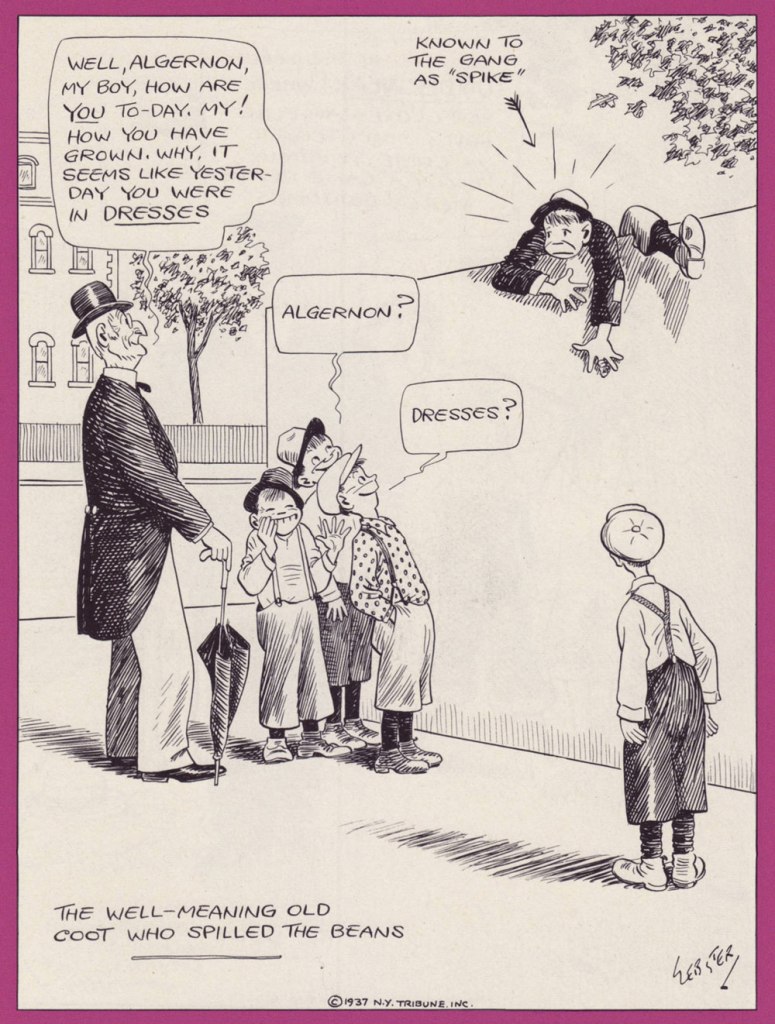
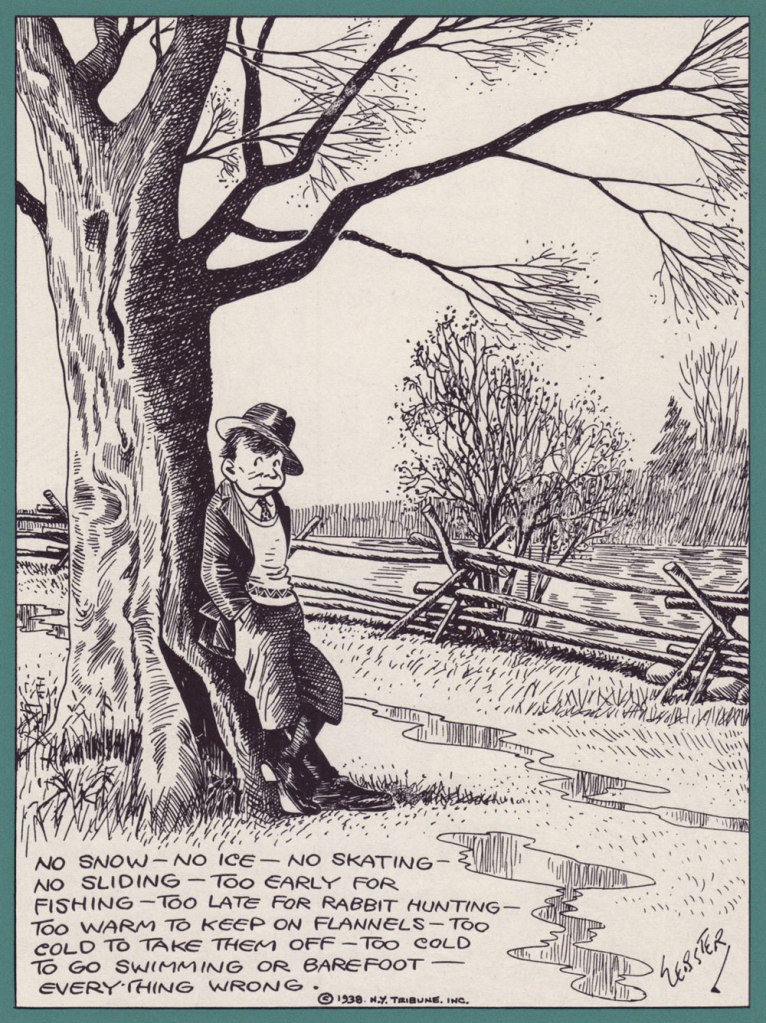
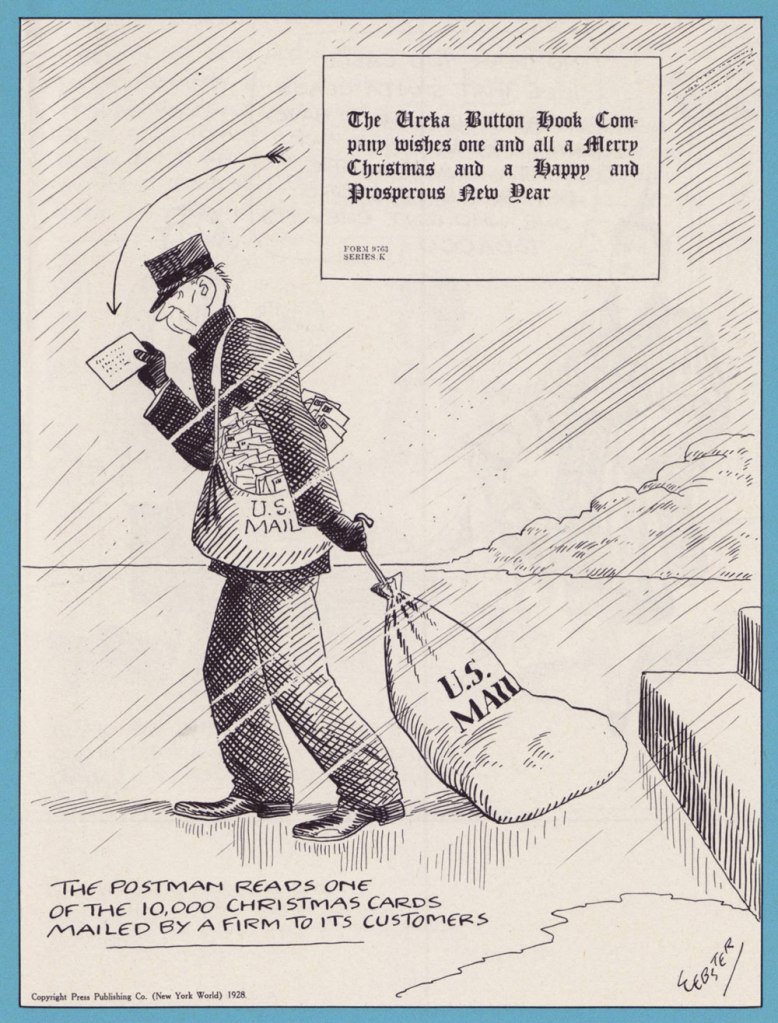
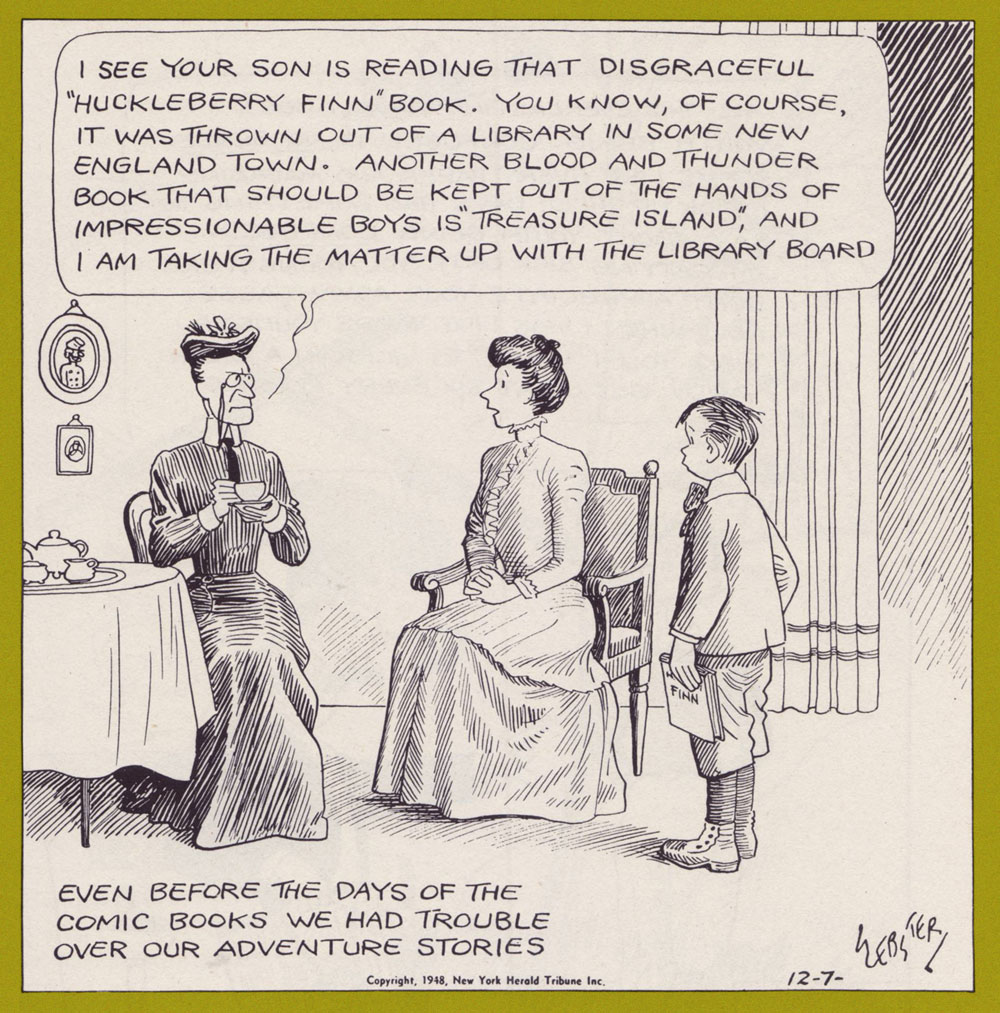
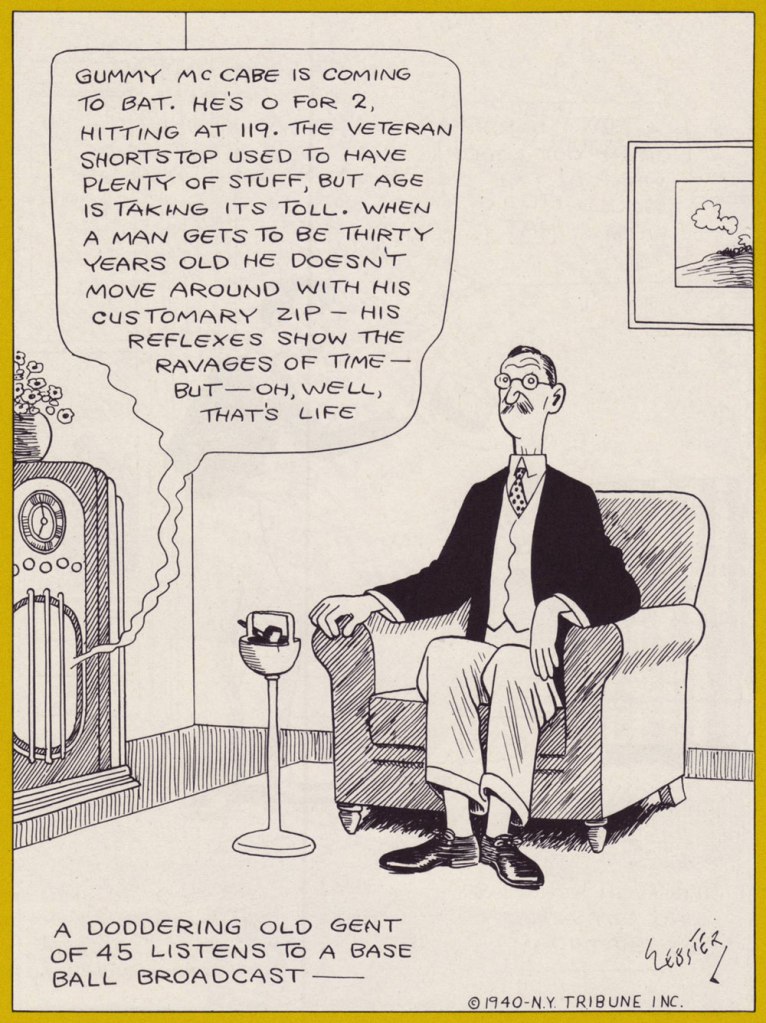
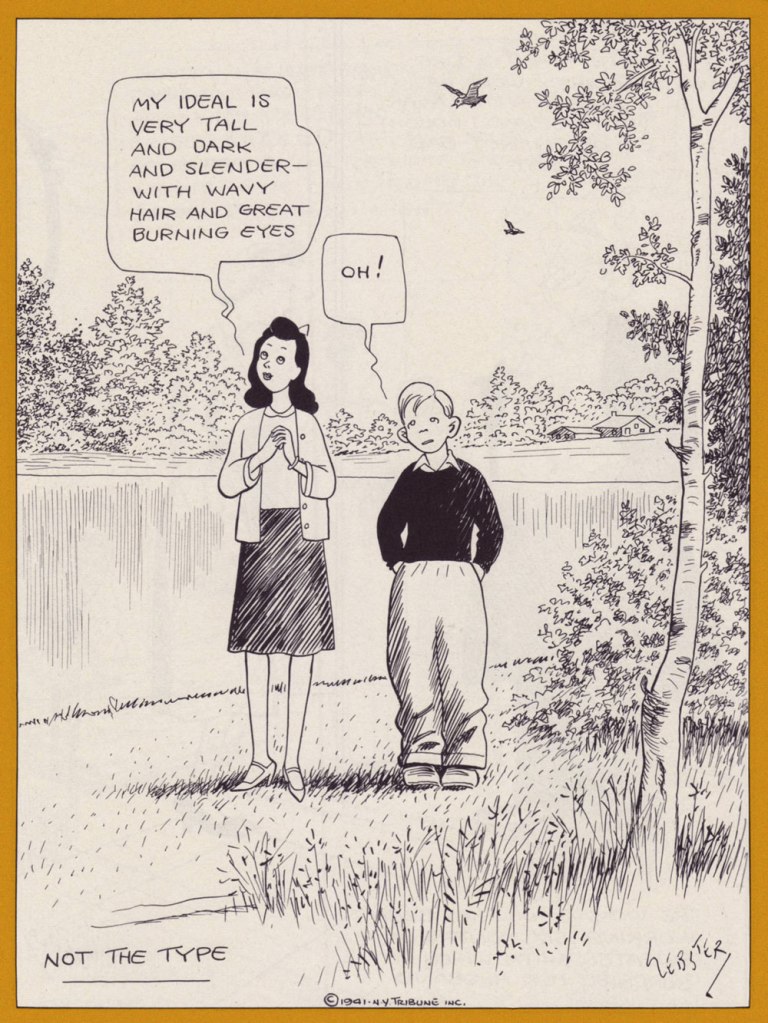
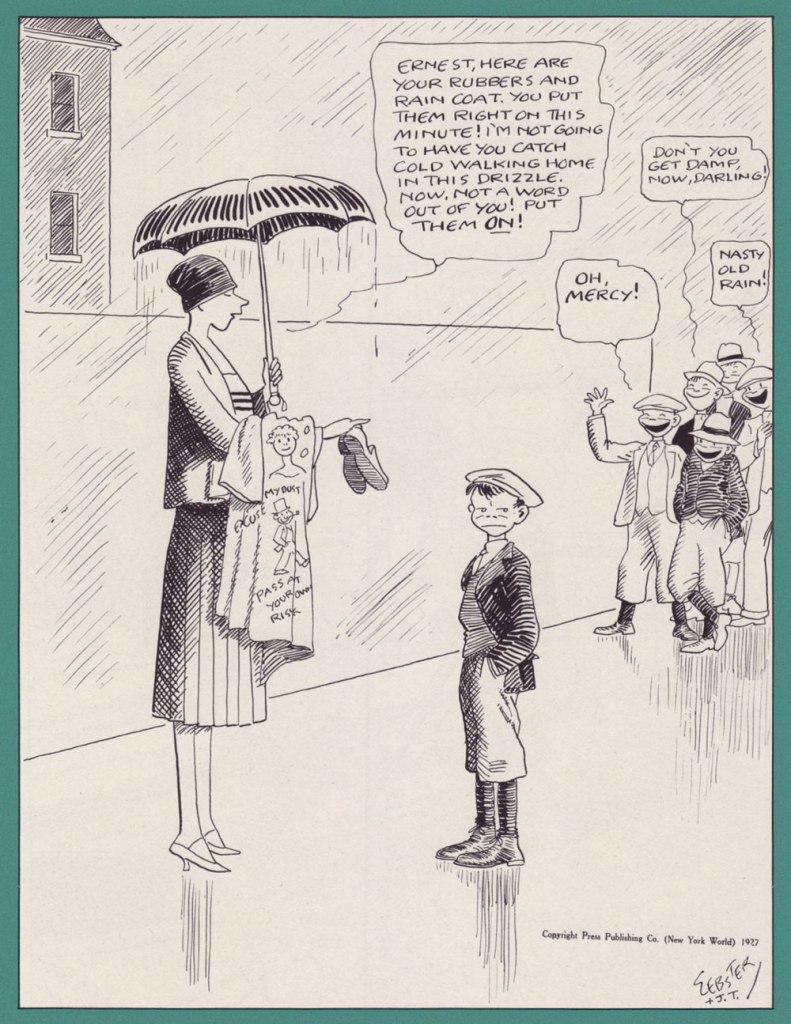
Thankfully, it’s fair to say that Webster (1885-1952) had plenty more arrows in his quiver. According to a 1945 Time Magazine profile of the artist (who was even featured on the cover!):
« H. T. Webster has learned to slice and serve his generous chunks of U.S. life methodically. Caspar (The Timid Soul) appears Sundays and Mondays. The pitilessly fanatic and bad-mannered bridge players run Fridays. Boyhood’s lovingly elaborated triumphs (The Thrill That Comes Once in a Lifetime) and defeats (Life’s Darkest Moment) appear on Saturdays and Tuesdays. Thursdays bring How to Torture Your Husband (or Wife). On Wednesdays, in The Unseen Audience**, he pokes a sharp-pointed stick at radio—which of all mixed blessings most needs satirizing, and gets it least. Webster, in fact, is possibly radio’s most effective critic. »
Honestly, they’d each be rewarding choices, but I’ve opted, on this occasion, to draw from the cool, sombre well of Life’s Darkest Moment.
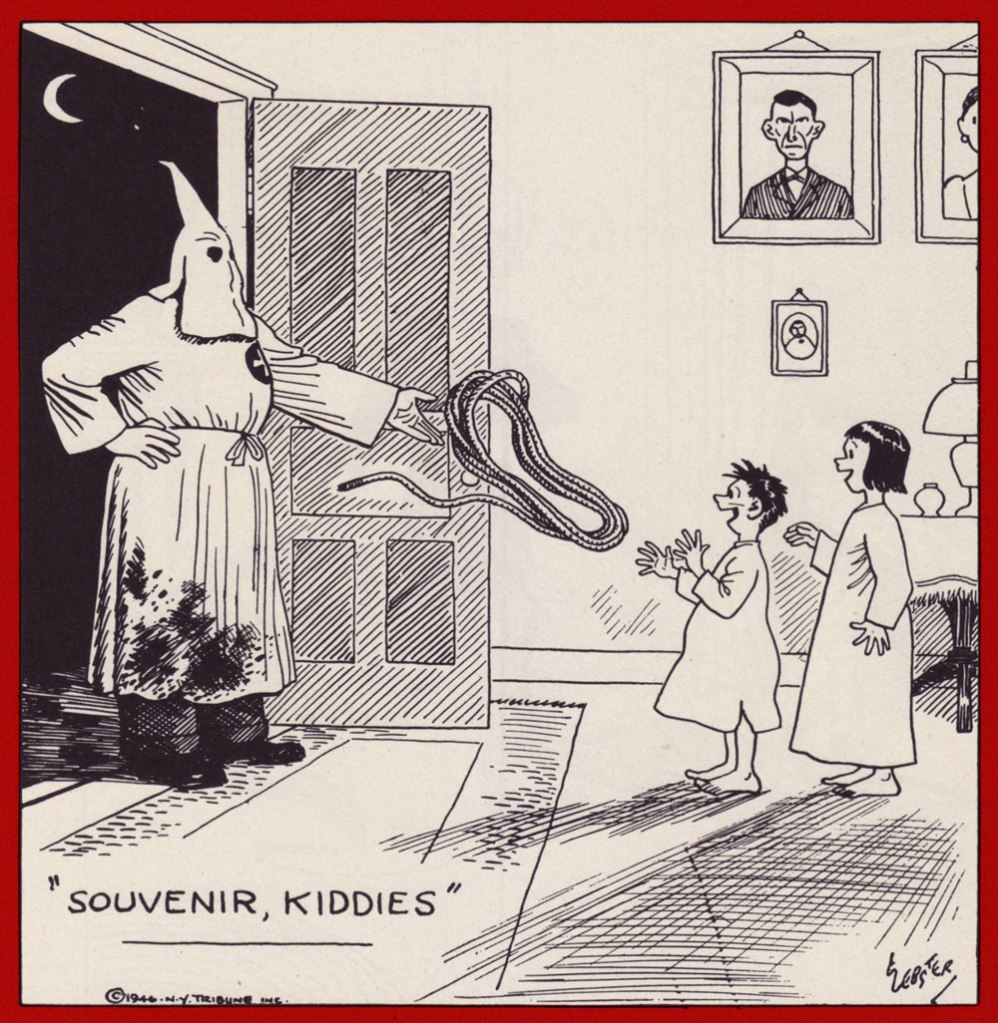
A glimpse at the infancy of spam.Up here in Canada, we recently had a bit of a furore over a sanctimonious (yet deceitful) fusspot spearheading the destruction of a bunch of graphic novels. Oh, and speaking of Robert Louis Stevenson, tomorrow’s his birthday, number one hundred and seventy one!Then as now, one can generally rely on the news to be dire.Another entry in our collection of Legendary Cartoonists With a Great Tousled Head o’ Hair.And just so you don’t conclude that Webster’s work was all about, and just about ‘poking gentle fun at life’s little foibles‘, here’s what has to be the darkest, most brutally scathing political cartoon*** I’ve ever seen come out of the mainstream US press (circa 1946!). Incidentally, Webster was a Republican. The original art of this masterpiece resides in the permanent collection of The Library of Congress, right where it belongs.
-RG
*“For many years no one but his close friends knew of an acute arthritis which in 1927 cost him the use of his right hand. In three months he trained himself not only to write, but to draw, left-handed.” — Philo Calhoun in Biographical Sketch, The Best of H.T. Webster (1953, Simon and Schuster).
***He “… returned to Chicago, where he spent three years drawing front-page political cartoons for the Chicago Inter-Ocean, prompting one politician to introduce a bill in the state legislature forbidding unflattering cartoons.” (it didn’t pass.)
Today’s entry is fun and light-hearted, but as this is the last week before Hallowe’en, let’s open on something with a bit more decorum!
Once upon a time, Vincent Price accorded his (paid) stamp of approval to Creamettes, a brand of elbow macaroni. You can read all about that in Vincent Price’s Supper Casserole! on the Dinosaur Dracula blog (where there are plenty of other things, too). I far prefer the version below. Who was this delightful parody created by? Is it something that would be served at The Monster Club with a nice glass of ruby red what-is-this-liquid-anyway? So many questions!
*No actual octopuses were eaten in the making of this post
« We see light, not dark. But it is in the dark that we feel goblins and ghosts. » — Rex Brandt
The ever-creative Tom Eaton‘s Oliver Cool (1975-79) always reserved a special treat for Hallowe’en. In past countdowns, I’ve shared the first (1975) and second (1976) entries devoted to the beloved occasion, and here is the final pair.
From Young World Volume 14 no. 8 (Oct. 1977, The Saturday Evening Post Company).
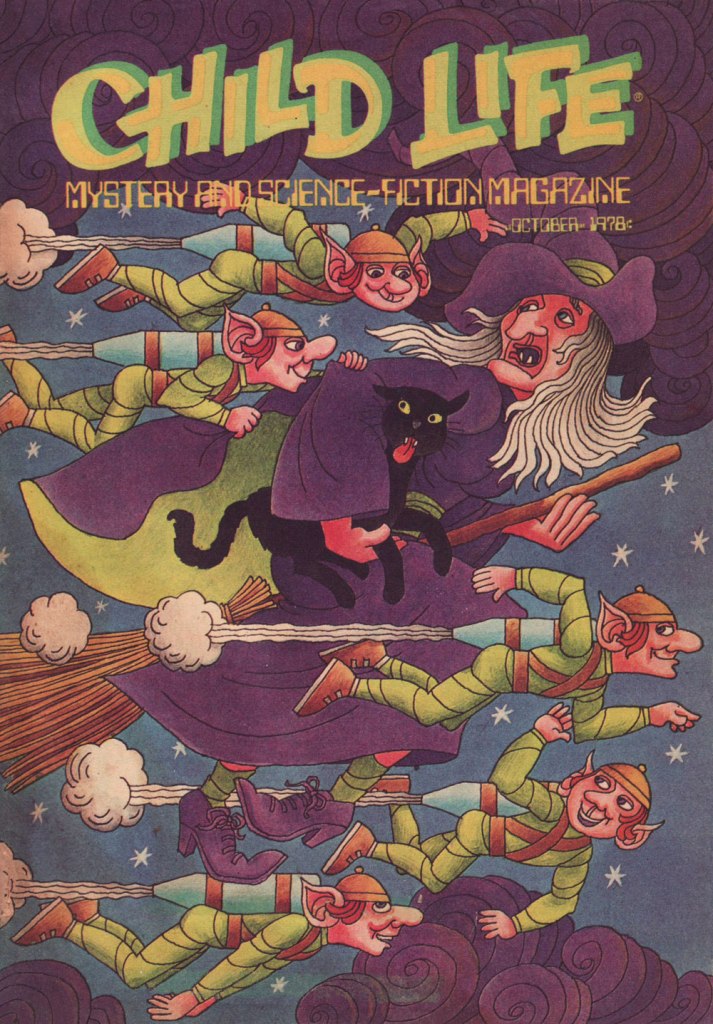
Eaton’s Fizz & Farra In the Year 2250 strip ran concurrently in Young World’s sister publication, Child Life. This seasonal cover by Arthur Wallower was simply too good not to include.
From Young World Volume 15 no. 8 (Oct. 1978, The Saturday Evening Post Company).
As a bonus, here’s one item some of you monster kids may fondly remember: Monster Stand-Up Greeting Cards (1980, Scholastic). Pricey these days, from the look of it.
« Dennis the Menace was probably the most realistic comic book ever done. No space aliens ever invaded! » — Gilbert Hernandez
Is it already October? So it is. Well, here we go again with our annual Hallowe’en Countdown. We’ll kick this edition off by featuring that pint-sized bundle of toxic toddler masculinity, Dennis the Menace (I can’t help but think that his French name, Denis la Malice, is a far more accurate description of his sociopathic essence).
Here at WOT?, we’re both (amble over to ds’ earlier DTM spotlight) huge fans of Hank Ketcham’s cartooning finesse… I mean, these are beautiful! But… drawing skill aside, the stuff is hard to take is large doses. To quote one frazzled babysitter to Dennis’ parents: « how can you stand it? »
Dennis’ first Hallowe’en, from Oct. 31, 1951, the strip’s inaugural year.
October 30, 1952.
Just put yourself in Dennis’ parents’ shoes, and you get a better sense of the sheer magnitude of his malevolence. His poor folks don’t seem to have done anything to deserve being forever trapped in this relentless cycle of humiliation and injury. October 31, 1952.
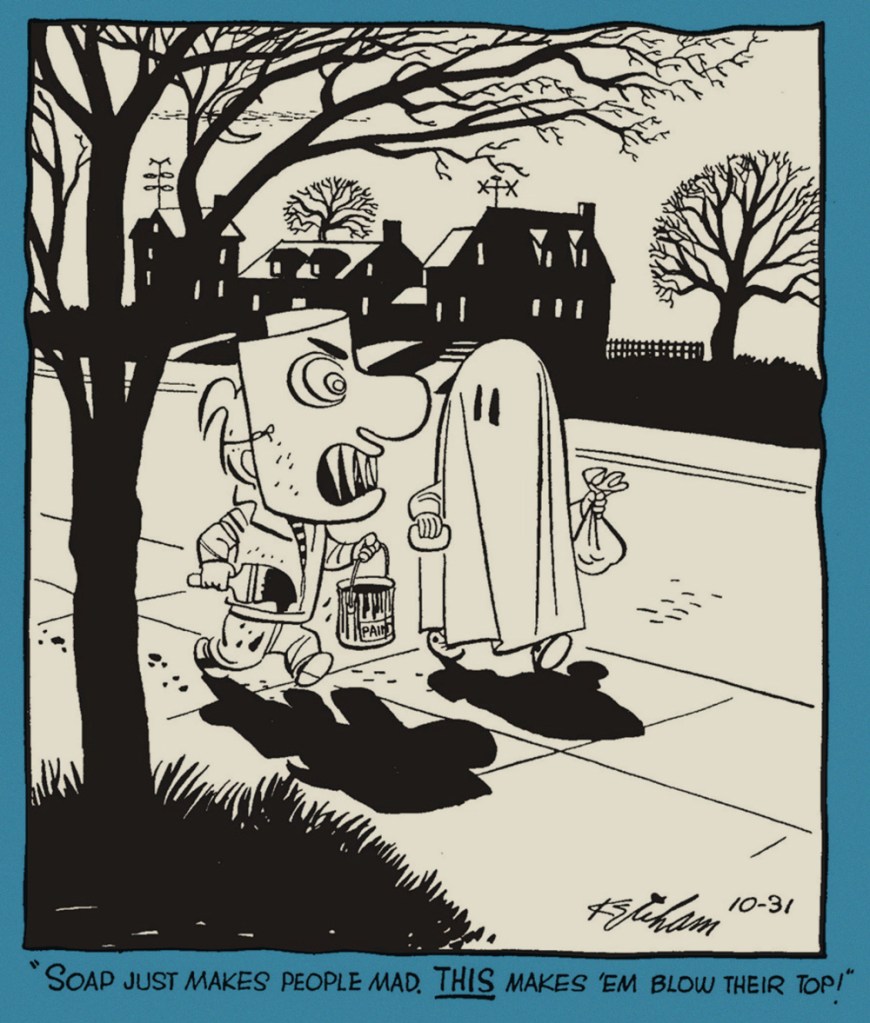
The old lady didn’t think it was so silly. October 31, 1953.
This is Dennis the Menace Bonus Magazine Series no. 155 (July, 1976, Fawcett).
And a look inside…
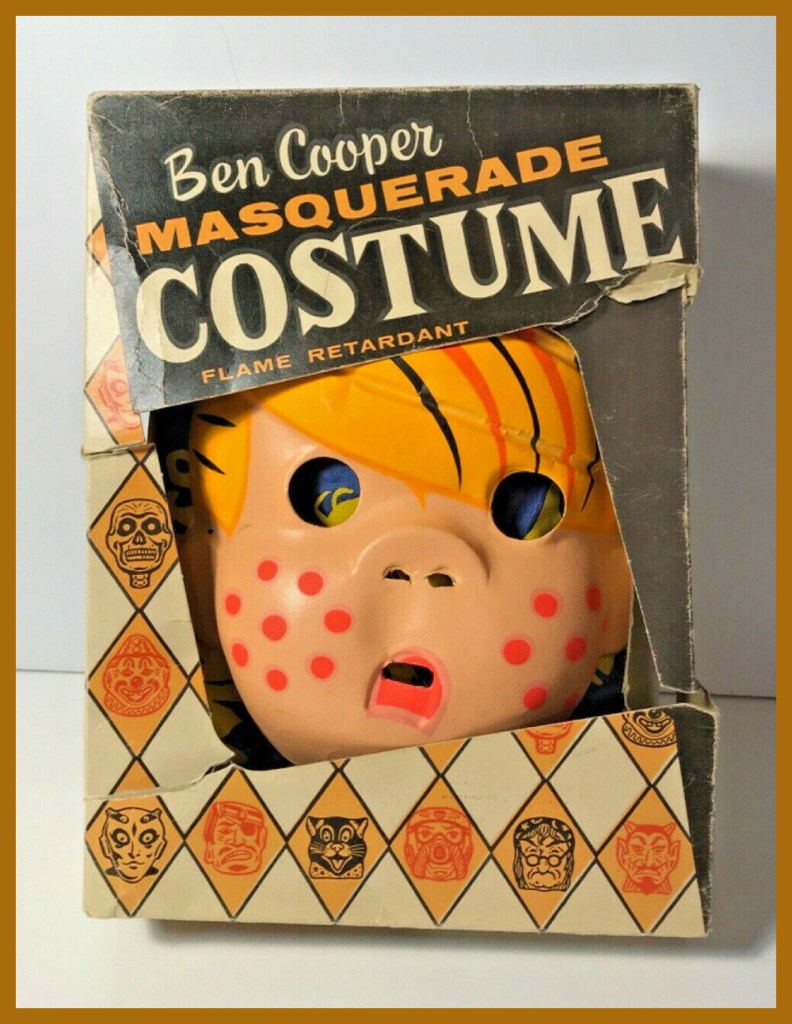
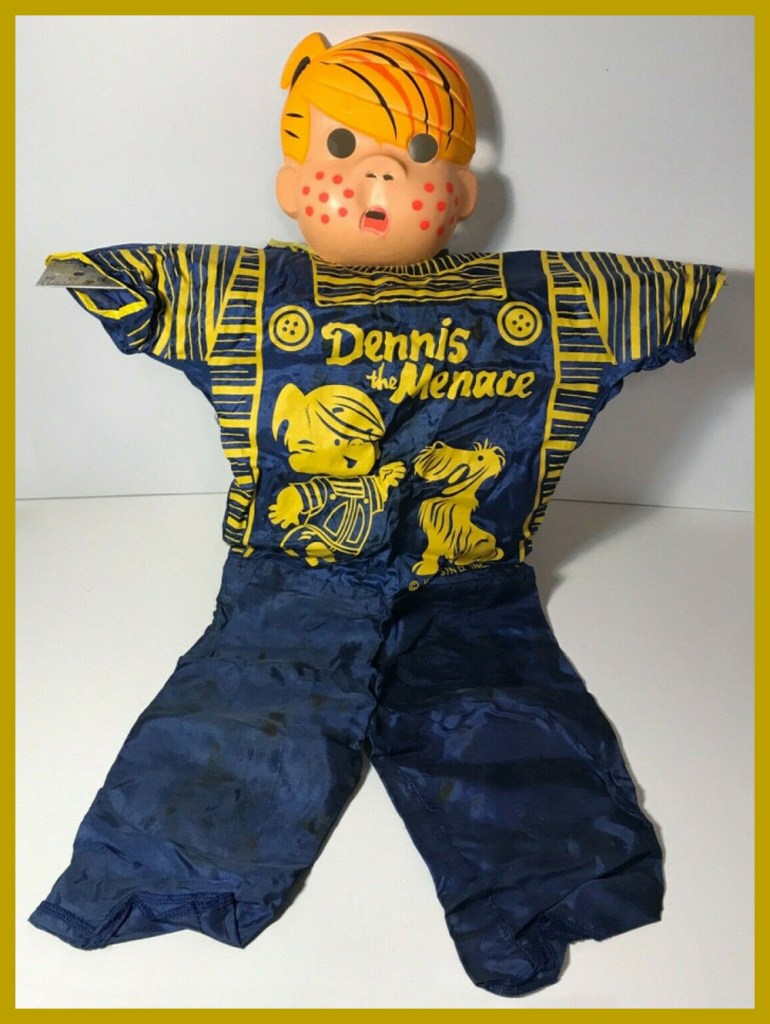
Back in the day, you could *be* Dennis (more or less) for trick or treating, thanks to that fondly-remembered purveyor of cut-rate (but cool in their way) costumes, Ben Cooper, Inc.
A fuller look at the Dennis ensemble. And do check out this bit of Ben Cooper history!
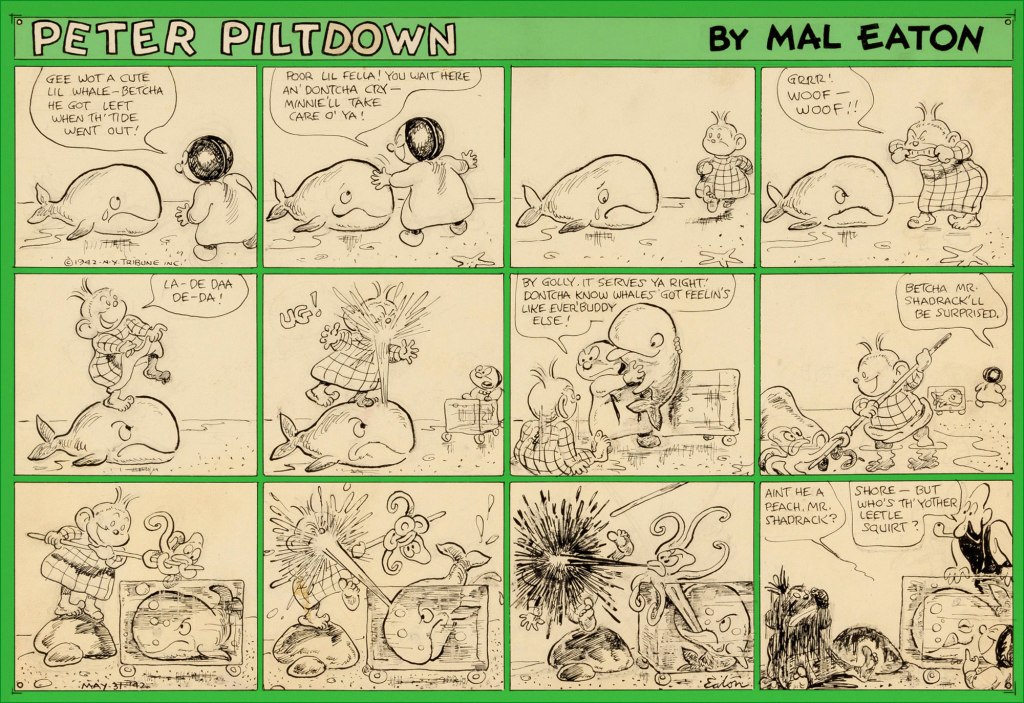
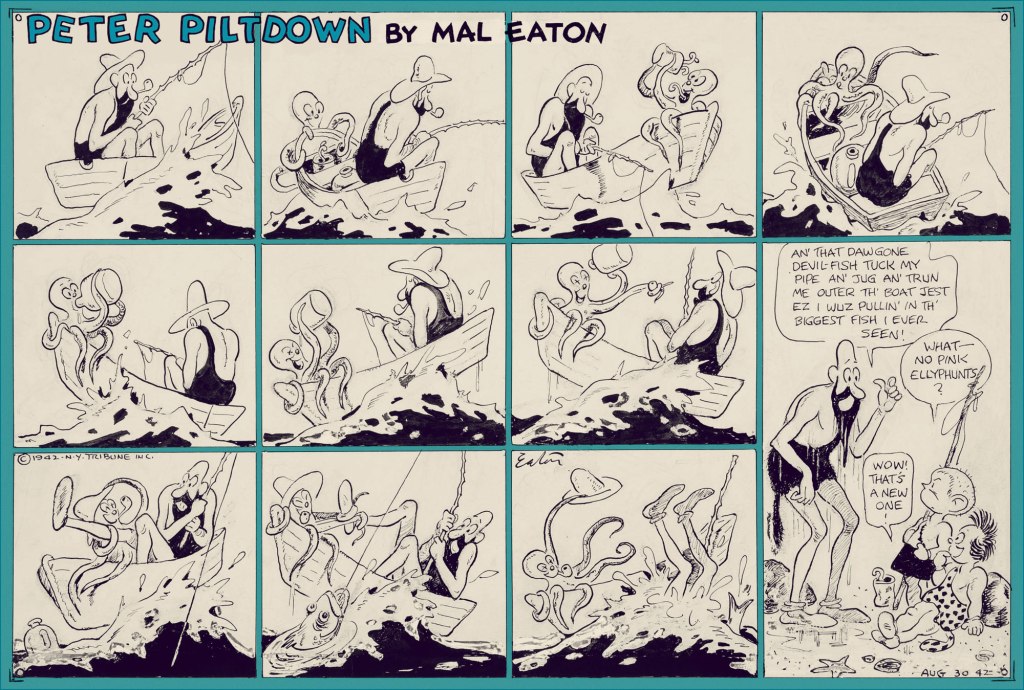
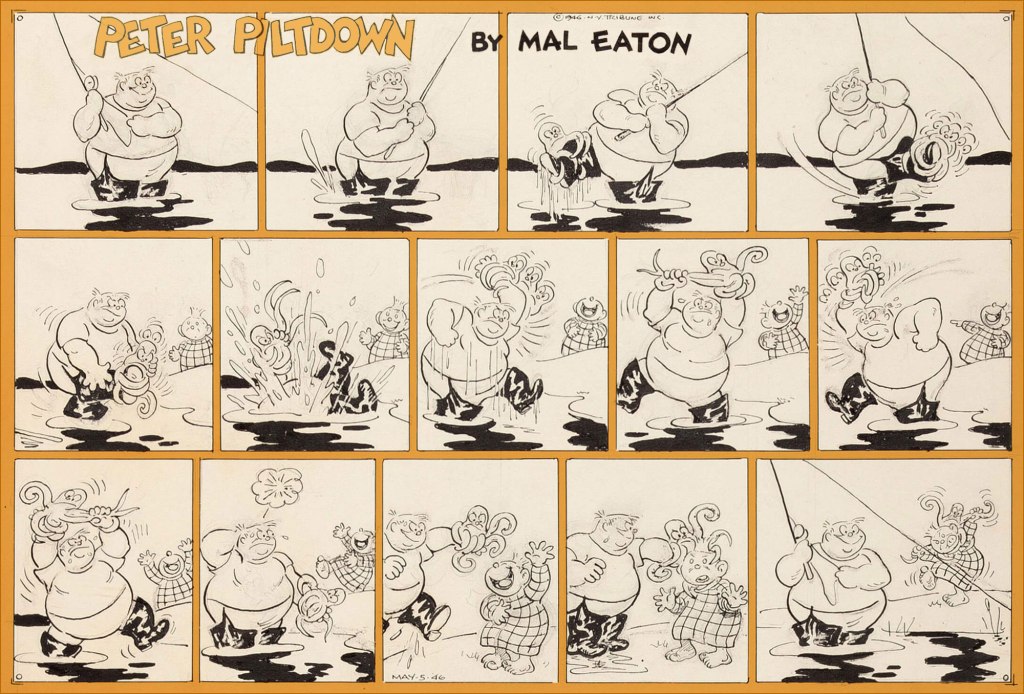
It’s time for a Peter Piltdown Tentacle Tuesday! We have previously written about Peter Piltdown, Mal Eaton’s nearly forgotten strip, but a few Sundays were kept in reserve for very obvious (tentacular!) reasons. Given the paucity of these strips, I am truly amazed that the original art of four octopus strips is available online. Eaton has a great ease with depicting flexible, expressive tentacles, so I am very pleased to be able to raise him to the rank of a 🐙Tentacle Master🐙!
Without further ado (just a little side note: these images were found on Heritage Auctions – I am not lucky enough to own any Mal Eaton art, or at least not yet!) …
May 31st, 1942. I didn’t know that whales ate octopus, but apparently they do – ‘the majority of toothed whales will eat whale food species such as squid, octopus, crustaceans and fish.‘
August 30th, 1942. This octopus knows how to live it up! This strip makes up for the unfortunate end of the member of his species in the previous one.
May 5th, 1946. I don’t know what the octopus wanted the man’s leg for in the first place, but he sure looks peeved by this whole interaction. These fishing bouts are just fraught with octopus danger…
… even if the danger is sometimes imaginary. August 18th, 1946.
Speaking of day-dreaming, I like to fantasize that Mal Eaton had a whole octopus-centric strip, and that one day somebody is going to unearth it and publish a beautiful collection. In the meantime, I’d happily settle for another volume of Jack Kent’s King Aroo…
« When I grow up I would like to be an artist in France. » — Keith Haring
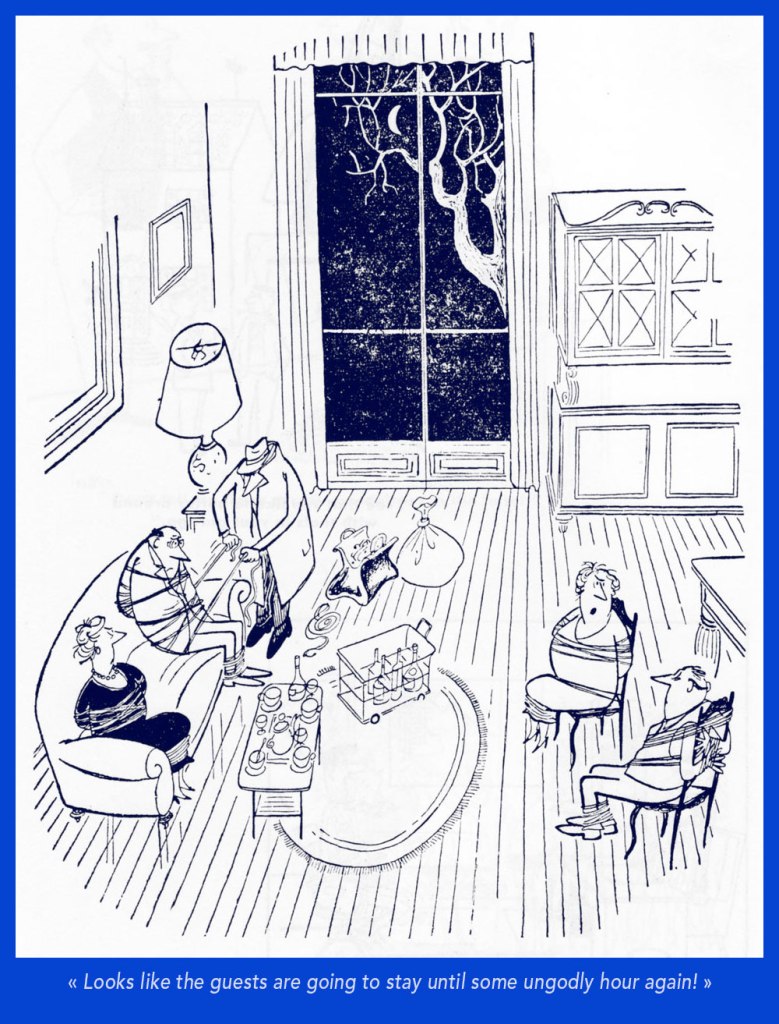
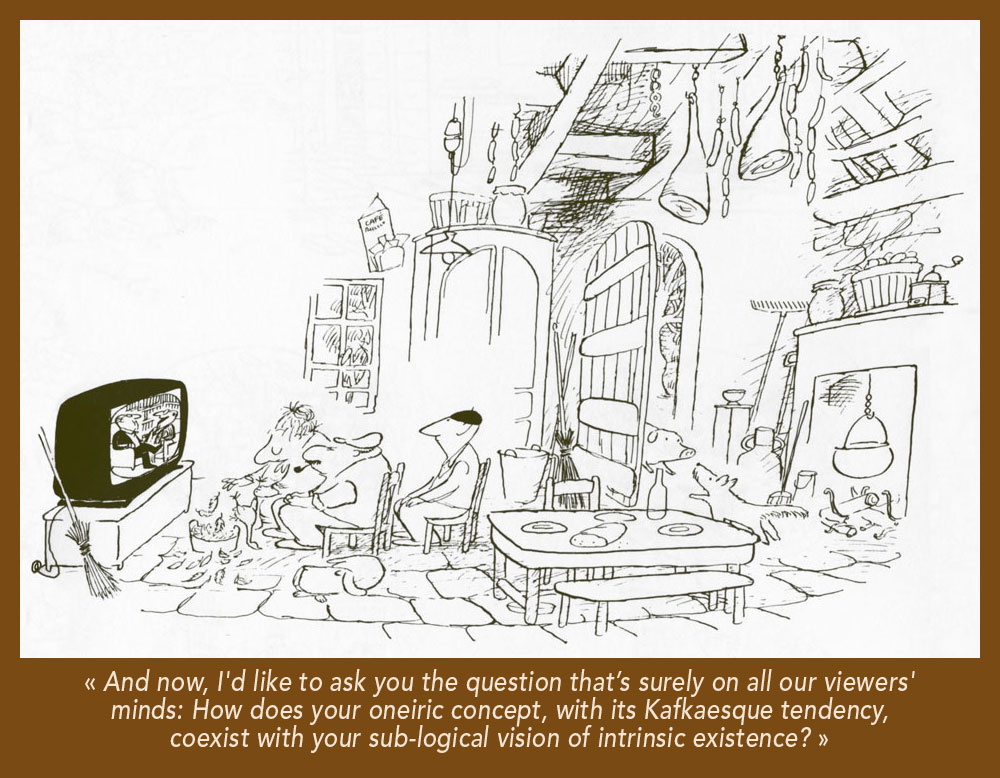
The other day, while weighing the idea of producing this post, I asked my wife: “Is Sempé too obvious a choice?”, to which she wisely replied: “To whom?”. To add another few grammes of perspective, I’m reminded of how, a decade-or-so ago, I was helping out a friend by manning his business phones while he took a vacation. One caller identified herself as Mme Sempé. I immediately asked whether she was related to the cartoonist. She was (they’re second cousins), but rather shockingly, this was the first time anyone had ever brought up the subject with her. Okay, so not so obvious after all.
If you only know Jean-Jacques Sempé‘s work through his cover illustrations for The New Yorker, well, you’ve missed his finest. Sempé (born August 17, 1932, in Bordeaux, France; died August 11, 2022, just a few days short of his 90th birthday) was recruited in the late 70s, in the twilight of editor William Shawn‘s tenure (1952-87) with the magazine. To be quite frank, Sempé’s New Yorker work is his weakest, comprising almost invariably mawkish scenes of the dying arts: little girls practicing scales at grand pianos, ballet rehearsals and grand operas. And the work has only grown more anachronistic and sentimental with time; I’d say he’s the least compelling cover artist currently working for the magazine, with the exception of art director Françoise Mouly‘s little chouchou, the stiff and bland Adrian Tomine, he of the lifeless line and emetic palette. Ahem.
But there was a time…
In 1968, a decade-and-a-half into Sempé’s career, ever-lucid Belgian writer and historian Jacques Sternberg perceptively summed up the artist’s appeal:
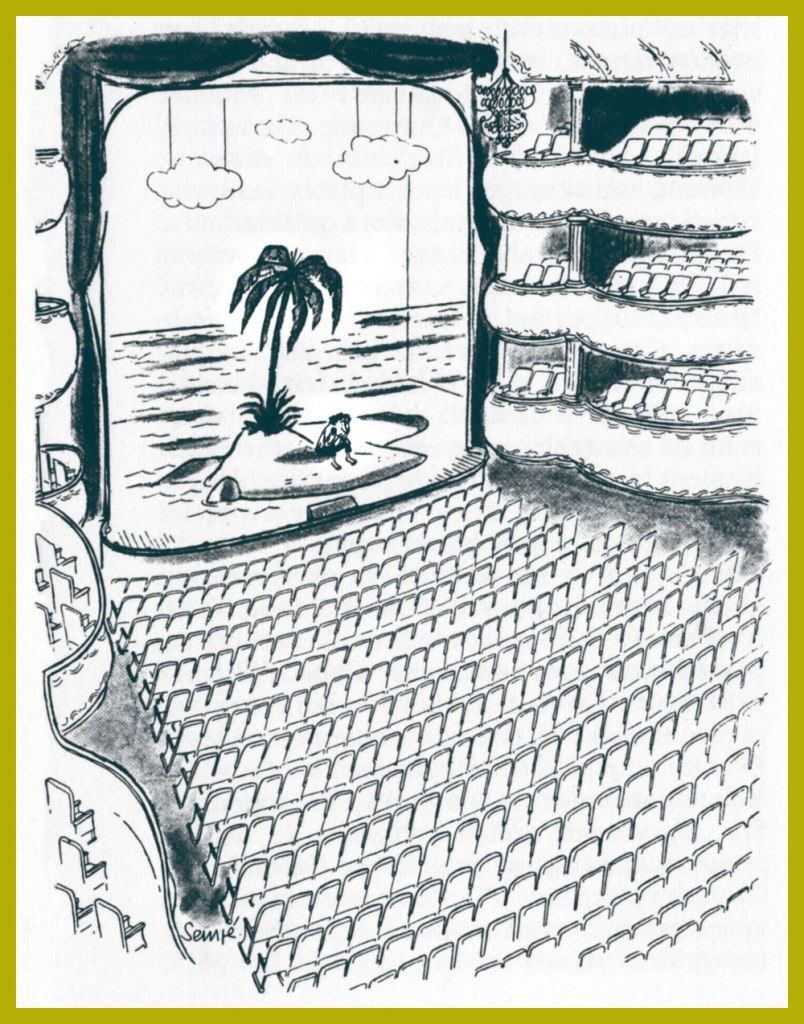
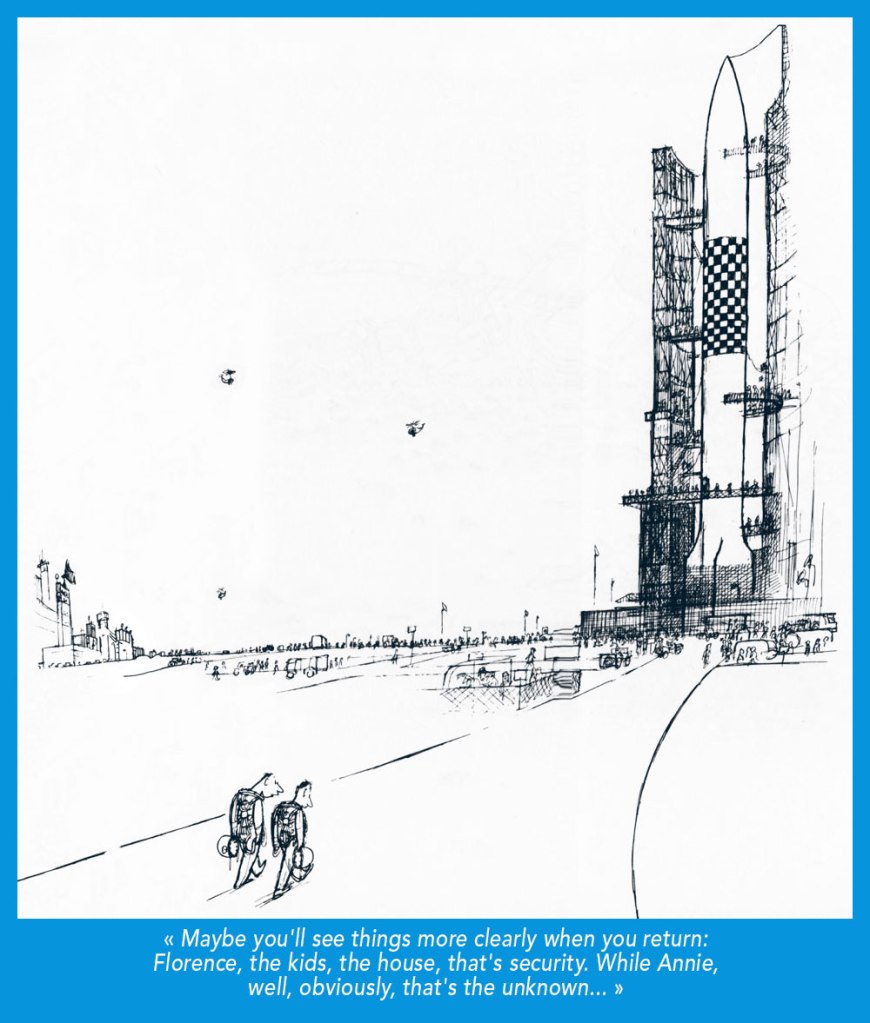
« But Sempé’s humour has earned the favour of a very wide audience. Without a doubt because he’s able to observe with a playful — but rarely sadistic — eye the drawbacks and peculiarities of our daily lives, and that his reader feels — mistakenly — reassured by this vision.
Sempé has, in fact, a way with an impressive setting, with meticulous detail, of the mise en scène that sugarcoats the bitter pill and of the lyrical flight that dampens the ferocity of the content. The miracle occurs as if by magic: Sempé, who is rather scathing, seduces rather than worries his readers. »
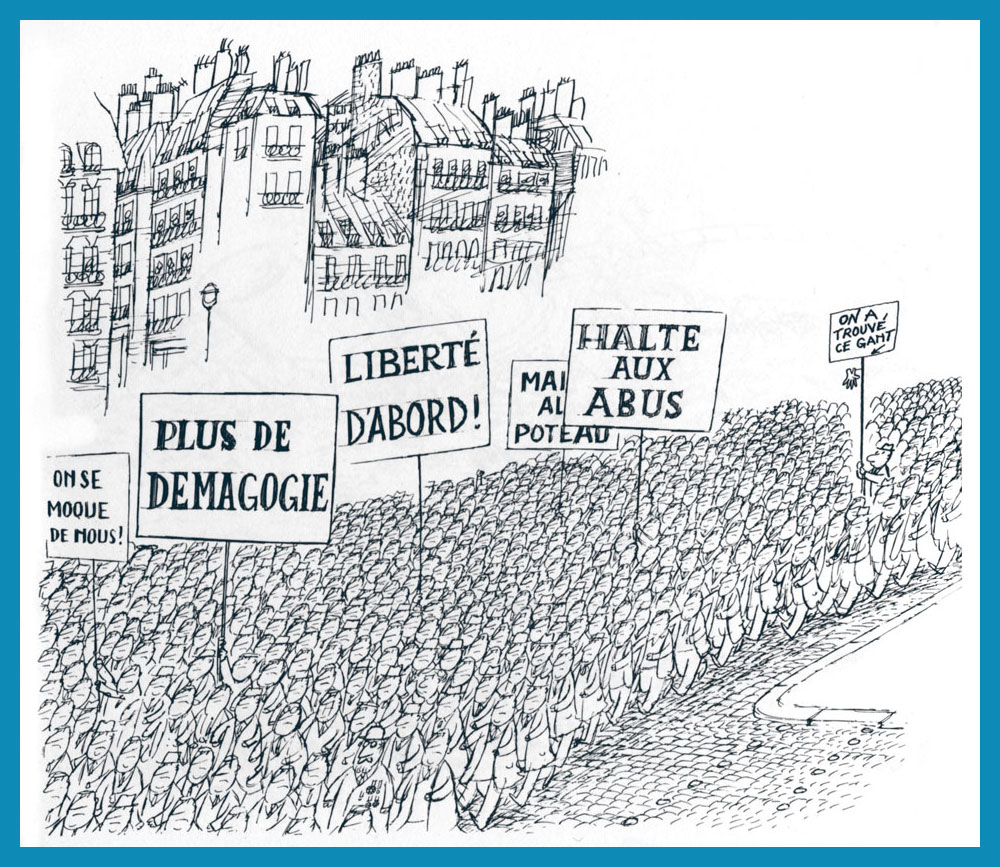
A cartoon that first saw print in the pages of Ici Paris in 1958.
The signs say, from left to right: “They’re mocking us“; “Nomore demagoguery“; “Freedom First!“; “End the abuse“, “Down with…” and… “We have found this glove“.
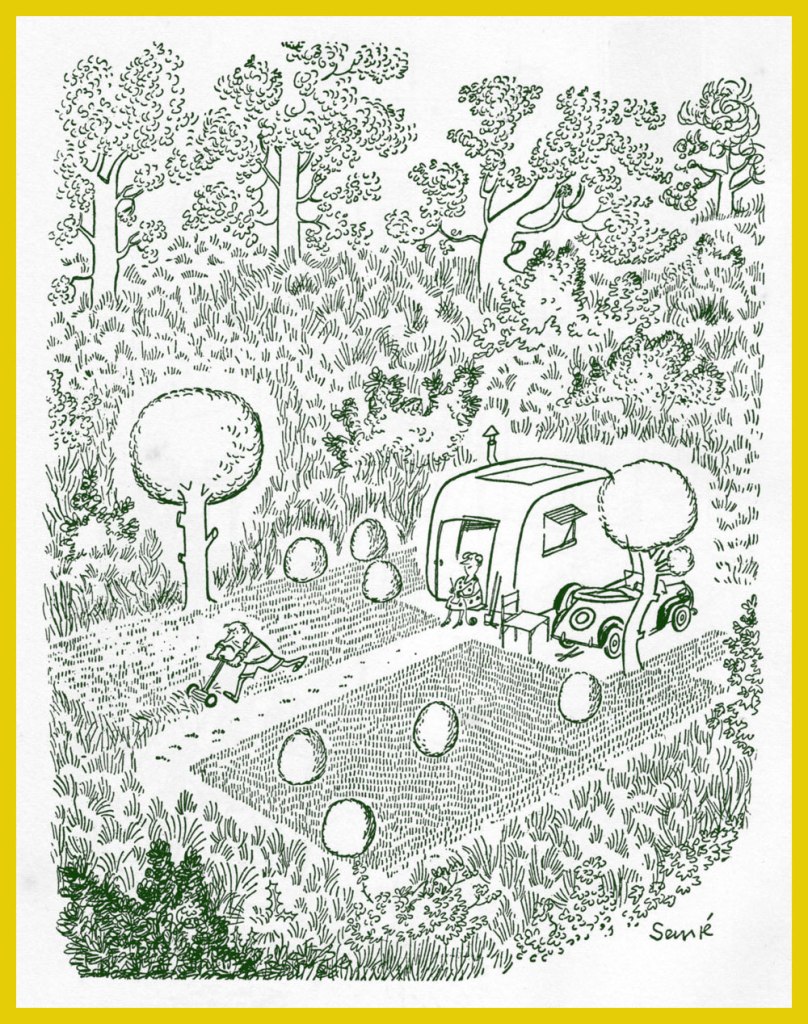
From France Dimanche (1957). This one strikes close to home for me. Makes me think of the sort of barbarians always seeking to ‘improve upon’ nature. A passage from friendly gadfly and crime writer Carl Hiassen‘s brilliantly scathing polemic, Team Rodent: How Disney Devours the World (1998) comes to mind:
« Disney is so good at being good that it manifests an evil; so uniformly efficient and courteous, so dependably clean and conscientious, so unfailingly entertaining that it’s unreal, and therefore is an agent of pure wickedness. Imagine promoting a universe in which raw Nature doesn’t fit because it doesn’t measure up; isn’t safe enough, accessible enough, predictable enough, even beautiful enough for company standards. Disney isn’t in the business of exploiting Nature so much as striving to improve upon it, constantly fine-tuning God’s work.
Lakes, for instance. Florida’s heartland is dappled with lovely tree-lined lakes, but the waters are often tea-colored from cypress bark. For postcard purposes, tea-colored water was deemed unsuitable for Disney World’s centerpiece, Bay Lake, so in the early 1970s Team Rodent sprang into action—yanking out many of the cypresses, draining the lake, scraping out the bottom muck, replacing it with imported sand, then refilling the crater. All this was done to make the water bluish and therefore more inviting to tourists. For good measure, Disney even added beaches.» [ read it here ]
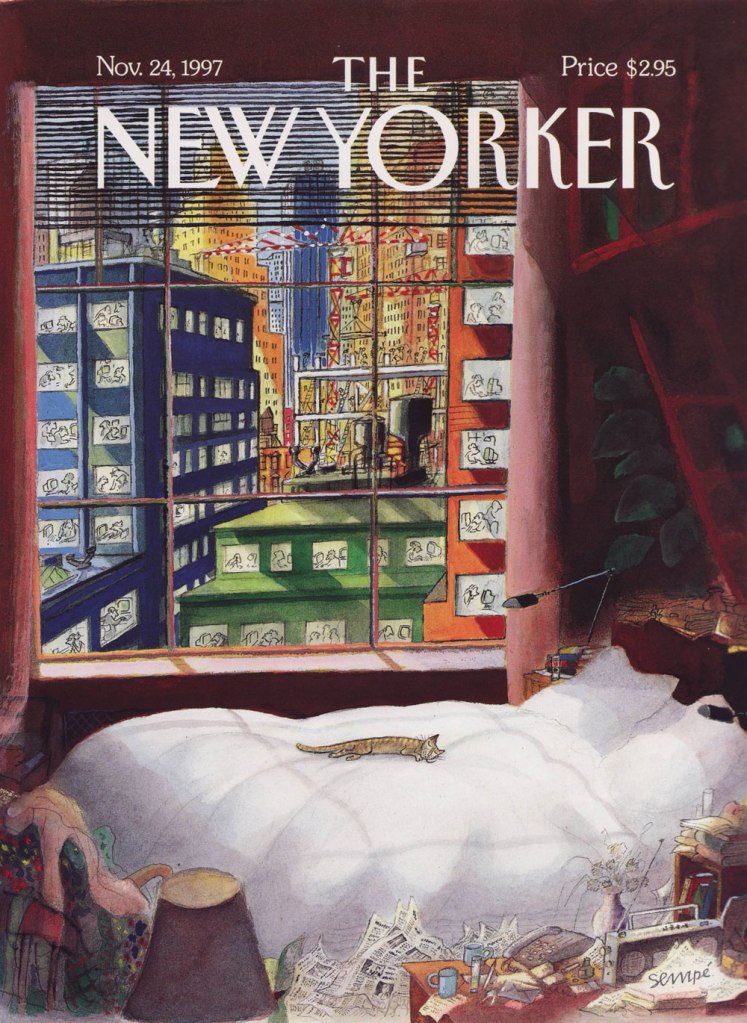
Naturally, I don’t dislike *all* of his New Yorker covers. This one, from the November 24, 1997 issue, is a peach.
« I used to be Snow White, but I drifted. » — Mae West
Spring has most definitely arrived, even up here in the Northern latitudes.
Last week, while wandering the neighbourhood on a gorgeous, inviting day, we roamed farther afield than usual, and happened upon a mostly-deserted parking lot flanked by a humongous pile of sooty snow. I’ve always been fascinated by these filthy behemoths; where I grew up, increasingly crusty and grotesque snowbanks would endure midway through June each year.
It always made sense to me that, being dark, these mounds would absorb more heat from the spring sunlight and melt faster than pristine snow. Counterintuitively, they just stuck around. As it usually turns out, there are more factors at play than one might initially suspect. Here’s a handy scientific explanation.
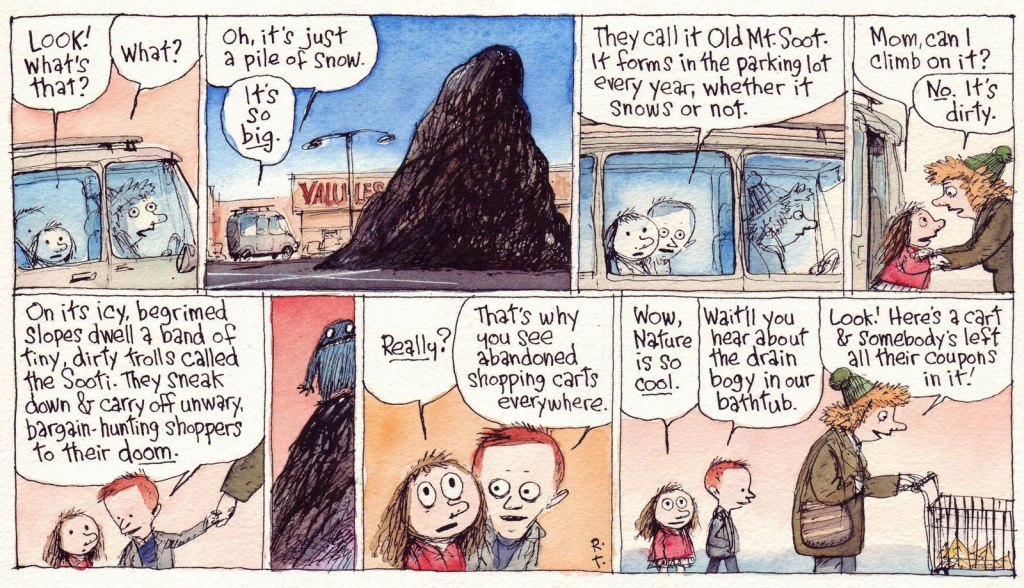
Another individual who shared my bemused interest in the phenomenon was incredibly-gifted cartoonist Richard Church Thompson (1957-2016), who bestowed upon the unsightly obsidian lumps some intriguing bits of mythology, as he so often and compellingly did to the base materials of the everyday.
This Richard’s Poor Almanac entry « … predates Cul de Sac by some years, yet keen eyes will note the kids in silly hats and the pile of parking lot snow, which have both found their way into the strip. »
Thompson: « CUL DE SAC began as a Sunday-only feature in The Washington Post Magazine in 2004. I painted them in watercolors instead of the process color needed for most newspaper comic strips. »The syndicated strip remake, from Sunday, January 9, 2011. Rats! Now we’ll never hear about the bathtub drain bogy…
Alice retells the Sooti legend with some slight distortions… but you just wait until Dill recounts it his way. Sadly, this was the final allusion to these mysterious creatures. This is the Cul de sac daily from Tuesday, Feb. 8, 2010.
We set off on a quest just yesterday and indeed, there are abandoned shopping carts by the score… if you know where to look.
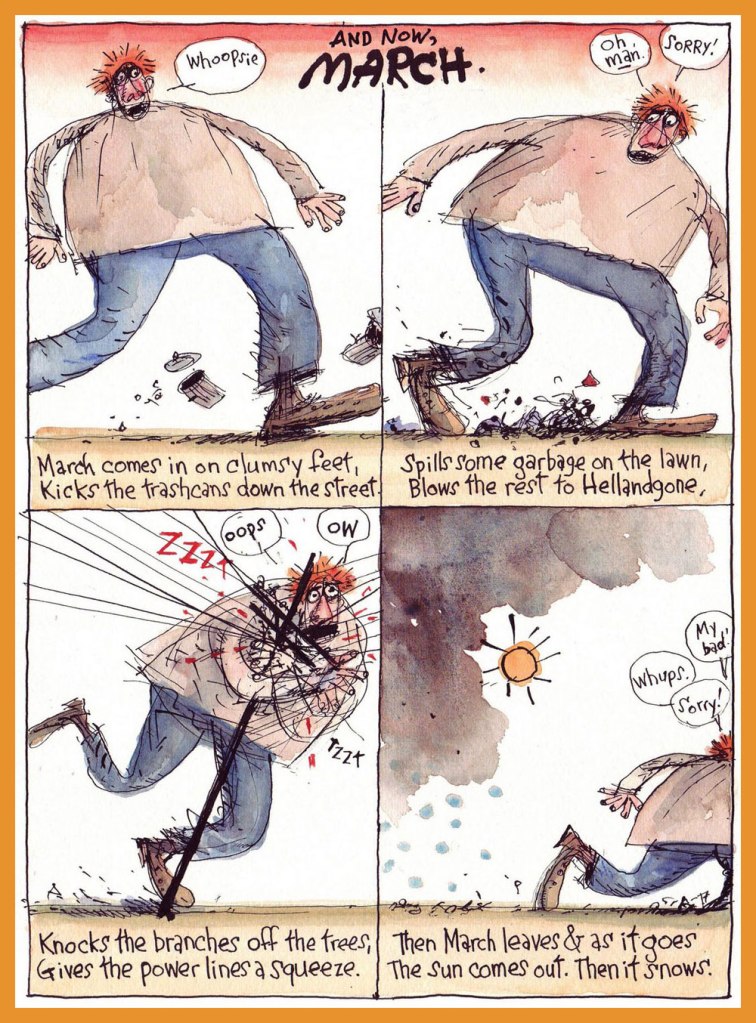
And a bonus seasonal entry to wrap things up! Then it snows.
For more Thompson marvels, do check out our general category, The Stupendous Richard Thompson, and expect massive doses of both awe and amusement.
Greetings, tentacle aficionados! Phew, this post started out as just a couple of images and spun somewhat out of control. My thanks to co-admin RG for cleaning up, re-arranging and even colourizing the following scans and photographs. Today we gaze at cephalopod apparitions in newspapers strips from the 40s and 50s. There are actually few things I like better: there is something comforting about the smell of an old newspaper (even if we have to imagine it!), the aesthetic appeal of yellowed paper, the concerns of imaginary characters who lived so long ago and yet who seem so close to us. Irrelevant to the modern age? Not at all. Look past the technological trimmings and you’ll find people who have lived and loved and struggled much like we do today. On a lighter note, the techniques of fighting off tentacles haven’t changed much, either!
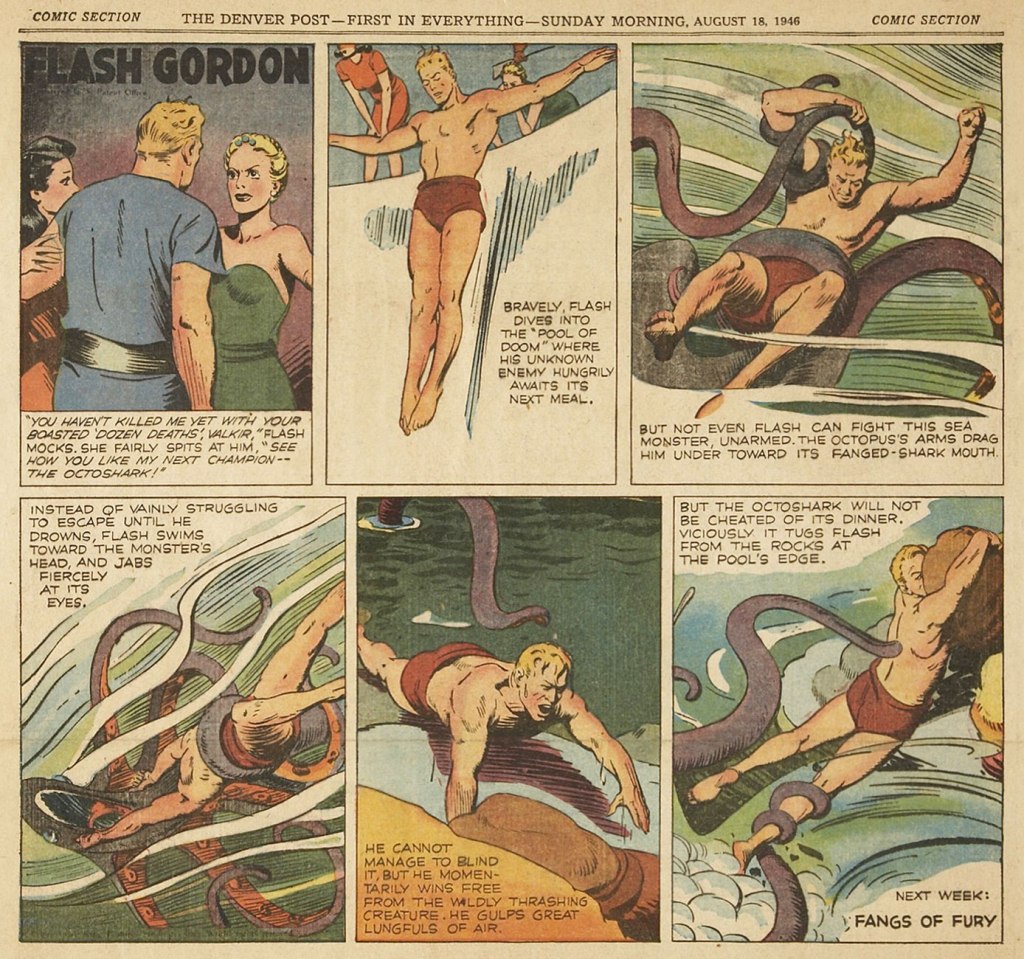
Flash Gordon, created in 1934 by Alex Raymond for King Features Syndicate to compete with the Buck Rogers newspaper strip, was immensely popular, witnessed by both its longevity – the strip continued all the way into 2003 – and multiple licensed products on offer for starry-eyed kids who wanted a spaceship or ray gun to call their own. Raymond left in 1944 to join the US Marines, and Austin Briggs, who up to that point was drawing the Flash Gordon dailies (introduced in 1941 to capitalize on the popularity of Raymond’s Sunday strips), switched to drawing Sundays, the dailies now cancelled. The following is from August 18th, 1946, art by Austin Briggs.
In 1951, King Features reinstated the Flash Gordon dailies and put Dan Barry in charge, famously assisted by Harvey Kurtzman and Harry Harrison on scripts, and a bevy of ghost-drawing writers.
The following are two Flash Gordon dailies from 1954. These reprints hail from Flash Gordon: Dan Barry Vol. 2: The Lost Continent, which collects dailies from October 26th 1953 to October 29th 1955.
Frank Robbins created Johnny Hazard for King Features Syndicate in 1944. What I find impressive is that the strip continued, with no other writers or artists involved, all the way until 1977 – contrast that with other newspaper adventure strips from around that time. Robbins must have been a powerhouse. To quote from the no-longer-updated (its creator, Donald Markstein, died in 2012), but still kindly maintained by relatives Toonopedia, « … Unlike many fictional two-fisted adventurers, [Johnny Hazard] matured — not as quickly as real people, but after a third of a century or so, he was quite gray at the temples. And a third of a century was as long as the strip ran. It was popular enough at first, and ran far longer than most post-war adventure strips, but the times were against it. Newspaper editors were more interested in daily gags than continuous stories, and Johnny Hazard succumbed to the trend in 1977. Robbins went to work for DC Comics, where he drew Batman, and Marvel, where he drew The Invaders, and never again created his own feature. » Eventually, Robbins is said to have retired, moved to Mexico, and devoted himself to painting – where he remained his death in 1994. This daily is from July 1951.
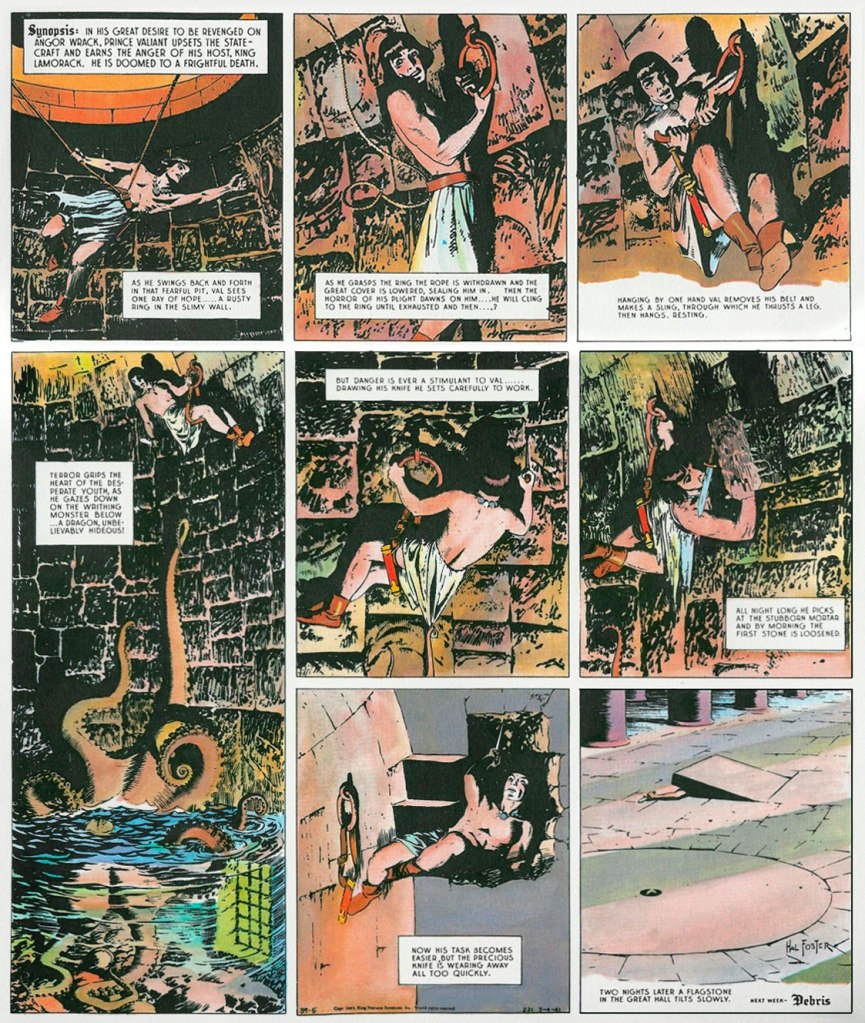
Prince Valiant is one of those newspaper strips institutions that most readers will have heard of, though some, kind of like me, may be uncertain about about the who, the when, and the hows of it. It was created by Canadian Hal Foster (1892-1982) – who, while illustrating the Tarzan newspaper strip (more about this a little further down!), developed a craving to work on his own oeuvre. He pitched his medieval adventure idea to William Randolph Hearst, who was so impressed that he even gave Foster ownership of the strip. It’s still ongoing (after a little more than 4000 Sundays!) This magnum opus has been credited with plenty, as the « greatest contribution to English literature in the past hundred years », « the pinnacle of comic strip adventure storytelling », and so on. I feel a little bad for being bored to tears by it, but as the Russians say, ‘и на старуху бывает проруха‘, more-or-less directly translated ‘even a crone can blunder’, or in other words, even Homer nods. The following Sundays are from April-May 1941 – spending two nights in a well, instead of trying to fight off the octopus, is an interesting approach, and I’m sure both man and animal were immensely frustrated.
I promised to say more about Tarzan – ah, the very, very long-running Tarzan strip. Started in 1929 with an adaptation of Edgar Rice Burroughs‘ Tarzan of the Apes illustrated by the aforementioned Hal Foster, syndicated by the United Feature Syndicate, it went on (and on…) all the way until 1995, with quite the cast of different artists over the years. The following Sunday is from the Burne Hogarth years, and is part of a story cycle called Tarzan and N’ani, which was published between December 14th 1947 and May 9, 1948. As for Hogarth, he seemed to hold the distinction of being the only artist with two runs on Tarzan: he drew the strip from 1937 to 1945, and again from 1947 to 1950.
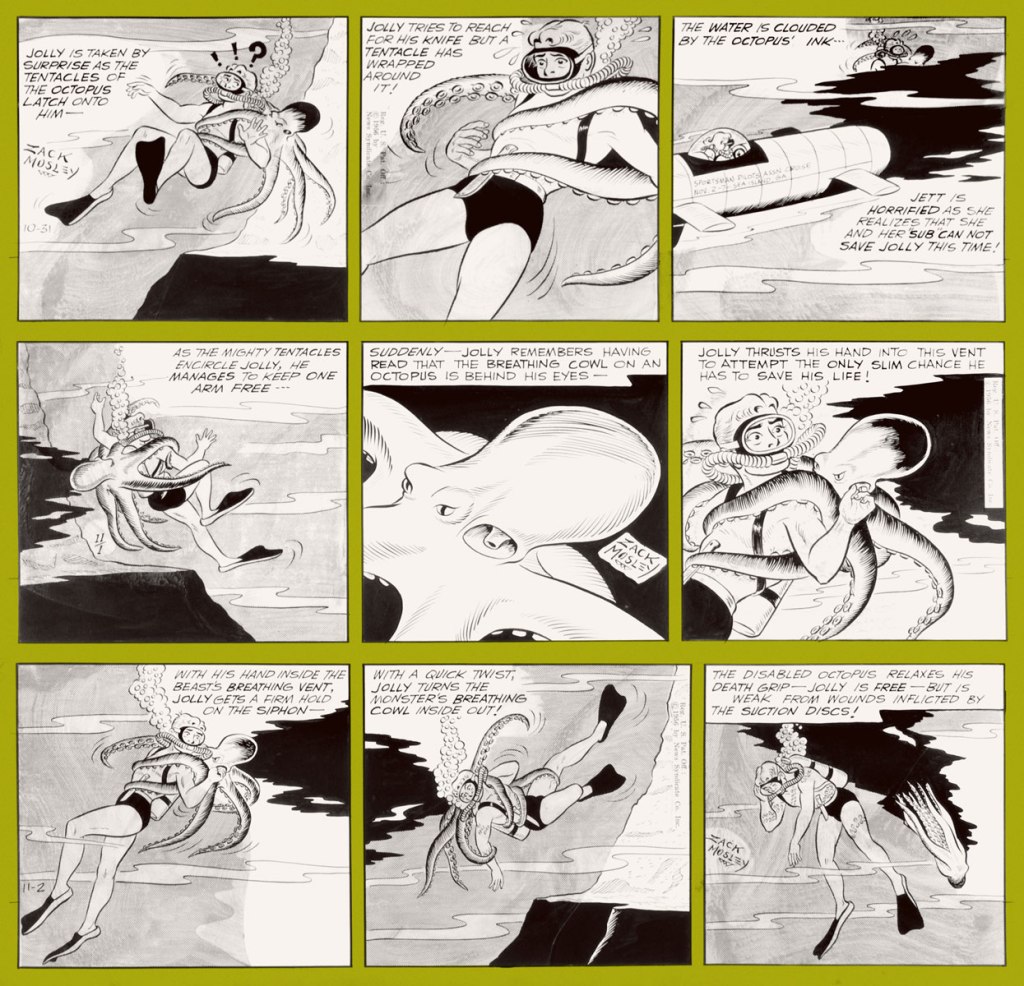
The Adventures of Smilin’ Jack, distributed by the Chicago Tribune Syndicate, ran from 1933 to 1973. I know that doesn’t sound as impressive because all strips discussed so far had crazily long runs, and yet: Smilin’ Jack, as it came to be called a little later on, lasted a good fifty years, which is partially explained by this strip’s motley cast of endearing supporting characters, but also by the realism with which Jack’s flying adventures were depicted – Zack Mosley, the creator, was an aviation enthusiast and licensed pilot with a true love of everything aeroplane. The following three dailies are from November 1956. You’ll be happy to learn that Mosley, upon retiring at 67, spent the rest of his days flying his own plane.
Created by George Shedd, a former Al Capp assistant, for the Post-Hall Syndicate, Marlin Keel ran between 1953 and 1954. Very little information about it survives – from what I understood, Shedd first wrote and drew this newspaper strip by himself, and later relinquished the illustration to assistants. Most notable (and what seems to be motivating rare collectors) is the involvement of Alvin Carl Hollingsworth (1928-2000), one of the few African-Americans working in the field at the time, who started by helping out (not sure to what degree) and became the official illustrator of Markin Keel towards the end of its run. Hollingsworth, who’s often mentioned as Joe Kubert‘s classmate at NYC’s High School of Music & Art – a fact that, albeit cool, underplays Hollingsworth’s talent and career – seems to have always maintained an interest in painting. Later in life, in the 1970s, he abandoned the comics field in favour of becoming a (fine) painter – you can see some of his paintings here. This is the original art for a 1954 Sunday strip.
The octopus may be off-camera, but my appreciation of Bob Montana made me include this strip in today’s roster. That’s right, it’s not my fault! This is an Archie daily from July 24th, 1953.
I hope you enjoyed this walk down history’s lanes and byways!




































 Who's Out There?