Fifty Years of Kotter: A Talk With Elliot S! Maggin

« I think people will believe anything about someone they haven’t seen for a while. » — Gabriel Kaplan

I’ve been meaning to do a Welcome Back, Kotter post for several years. But when I thought about it, I understood that hitching it to the show’s fiftieth anniversary made considerably more sense than, say, its forty-seventh. And while I adore William Johnston‘s sextet of tie-in novels, it would be quite a stretch for a comics blog to cover. Far closer to the mark lies Arnold Drake‘s trio of WBK storybooks, illustrated by Mel Crawford and Jack Sparling. But in the end, I bided my time and managed to get in touch with the scribe first assigned the Kotter Komic assignment, Elliot S! Maggin. And boy, am I glad I did. And so, fifty years to the day of the airing of its pilot episode*, let’s talk Kotter!
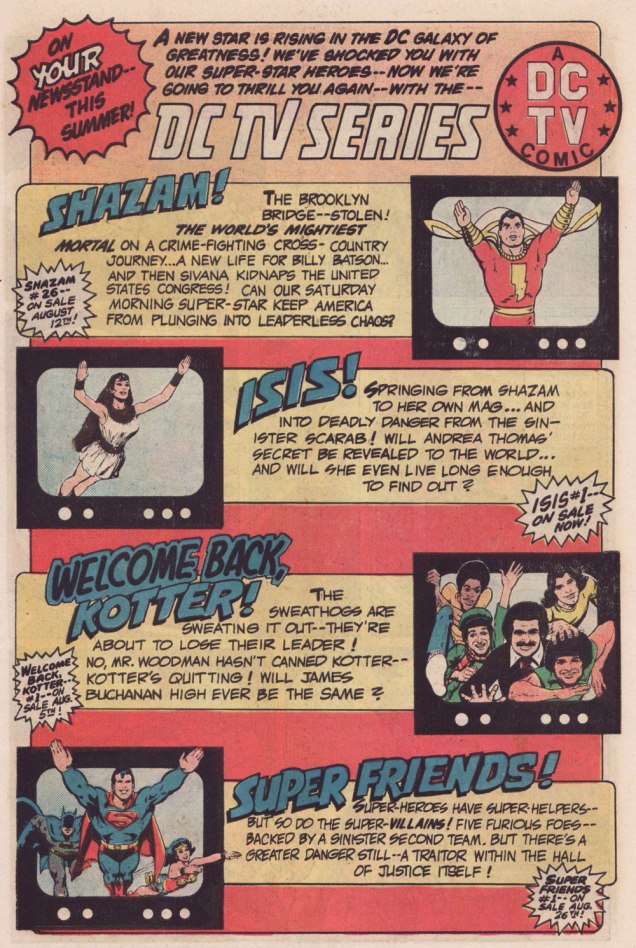

Remember the DC TV line? This ad ran in several DC titles over the summer of ’76.

ES!M: Well, Julie was kind of proprietary about me for most of the time I was working with him.

ES!M: I guess. At some point, Dorothy Woolfolk was editing the Lois Lane book, and… he introduced me to her. She just came into his office for some reason. She said: « Oh, you know, you should write some stuff for me! » And he said « No, he’s very busy, go away! » And he chased her out of the office. And I’m thinking, « Oh, okay. That’s how we’re doing it. »

So I didn’t really go about… I didn’t really make friends with many of the other editors. I tried to make friends with Joe Orlando. You know, I’d have lunch with him once in a while, I guess.

This is Welcome Back, Kotter no. 1 (Nov. 1976, DC); cover by Bob Oksner.

ES!M: But around the time Kotter came out…

You know, people used to hang out outside of Julie’s office door, listening to us plot, because it was so loud. We would yell and scream at each other constantly. He was this Jewish boy from the Bronx, and I was this Jewish boy from Brooklyn, and once I got comfortable working with a guy thirty-five years older than me, we’d just fight all the time. And every once in a while, we’d get serious.

ES!M: I guess at that point, he got mad at me, and I didn’t get work for a couple of weeks. I went to Joe, and I said: « What ya got? », and he said he’s doing this Welcome Back, Kotter book, and I said « Great! I watch that show, that’s fun. » So I wrote the first issue, and that was fine.
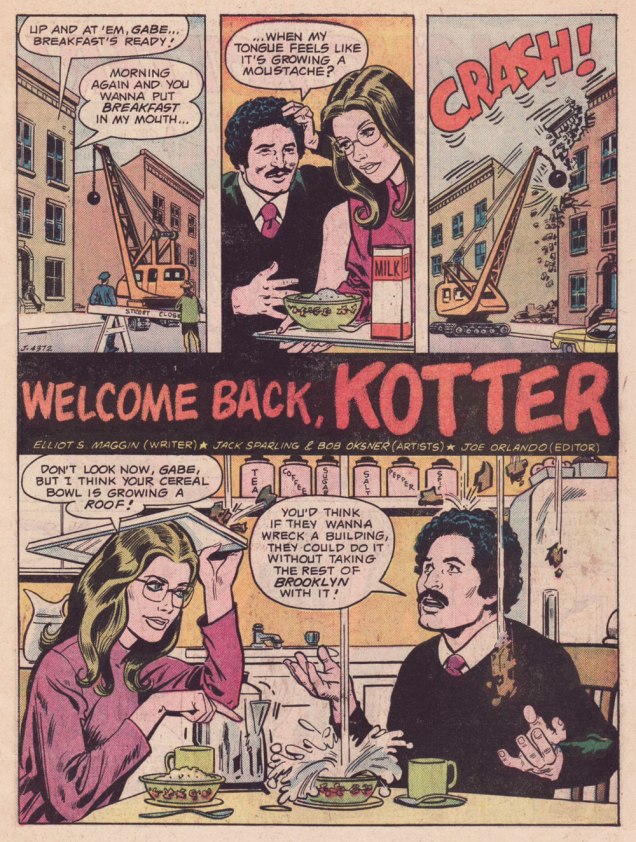
Here’s a quartet of pages from the première issue. Pencils by Sparling and finishes (and surely likenesses) by Oksner.
Aw, Maggin’s Mr. Pevey would have made a great addition to the TV show’s cast.

ES!M: They called me down in Carmine‘s office, to watch episodes of the show. It had been on maybe six weeks at that point. Episodes I had already seen, but I liked hanging out in Carmine’s office, because it was big, and he had a lot of toys around. So they set up this video tape… thing, and I watched the shows again, and I wrote the second issue.
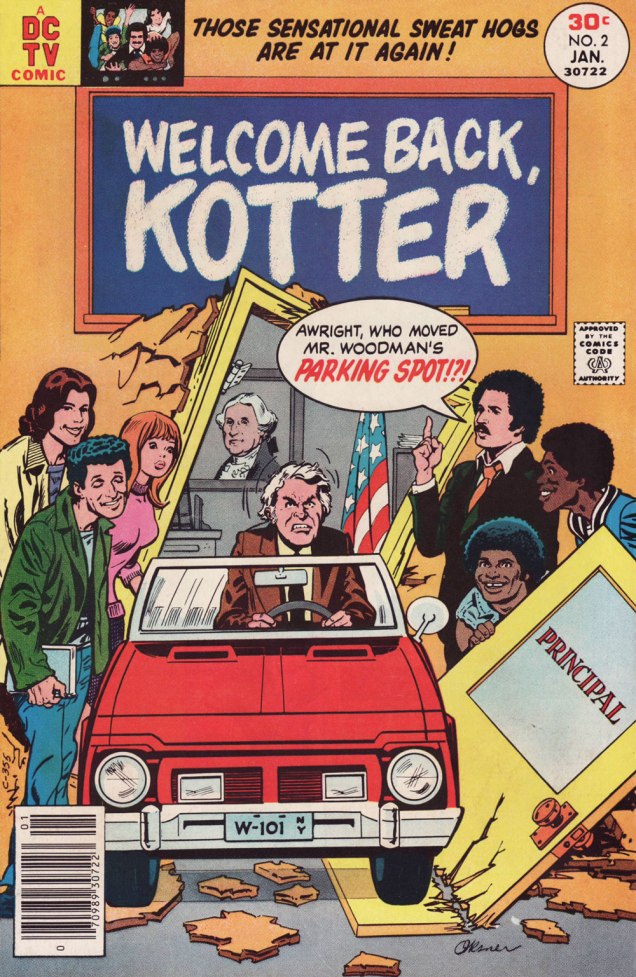
This is Welcome Back, Kotter no. 2 (Jan. 1977, DC); cover by Oksner.
Art-wise, the second issue seemed comparatively rushed, and sans Oksner, likenesses pretty arbitrary. See what I mean? The GCD attributes the inks to Sparling, but I lean towards Frank Springer.

ES!M: I was living in an apartment complex on Long Island, and there were all these kids around… little kids. And I would work at home, mostly. So they would hang around with me, whenever they realized I was home. They would… shoot me through the window or… something. At some point, whenever I’d write a gag, I would…

ES!M: Yeah! And they’d laugh, and run off and play some more. And I figured, as long as they laughed, it was okay. Because they were hearing the voice of Barbarino, or whoever. At some point Travolta would say, « Uh? », or « Duh », or « What d’you think? », something dull, that he delivered in a funny way. And the kids related what I wrote to what Travolta did on screen, so they were getting it. And at some point I realized that Joe [editor Orlando] didn’t watch the show.

ES!M: And he would then object to my Barbarino bits, or Horshack bits, or whatever. So I told him « You’ve got to watch the show, you’ll get it! » But you know, after maybe… how many issues did I write, three, four?

ES!M: I’m sure he (Evanier) watched the show — he watched everything.

ES!M: But Joe did not. I mean, he didn’t have time, and he was madly in love with his wife, and he didn’t watch television at all (laughs). He wasn’t paying attention to the source material.

ES!M: I wrote two issues, and at some point, Joe said: « You can’t write! ». He said « No, you can’t write! »
A blanket condemnation of everything I’d ever done.

ES!M: By that time, I’d made up with Julie, and I was writing more Superman stuff. After that, wherever any of my fights with Julie got serious, I’d go down the street to Marvel, and do something there. Then I would make up with Julie, and they’d never see me again… until I had another fight with Julie.

That was my experience writing Kotter.

And here’s what undoubtedly has to be the Guernica, if you will, of Kotter art: Bob Oksner‘s superlative cover for Limited Collectors’ Edition C-57, from 1978, DC’s final — and finest — WKB publication. Feel free to open it in another tab for a fuller view… I provided a larger image so you can fully take in the wealth of details.

ES!M: I just wrote a book called Lexcorp. A novel. Which you should probably plug.

ES!M: It’s a first-person story that Lex Luthor tells. And he identifies himself as an unreliable narrator, like… Huckleberry Finn. But it does tell the story of how he saves the world. Stuff like that.

I’m working on another book, working on a time travel story. And my ex-wife asked me to write an autobiography so my grandchildren know who I am.

I have all these people I know with Pulitzer Prizes; and at some point in the autobiography, I wrote: « I have about a dozen Pulitzers floating around through my life, and none of them are mine. This book is available for consideration. »

-RG

*the pilot episode, for some reason, was aired third, on September 23, 1975, while the show premiered on the 9th of September with ‘The Great Debate‘ (featuring a wonderfully smarmy James Woods).
Twilight of the Musical Heroes

« Sunny down snuff » — Van Dyke Parks

While I’m painfully aware that such things are inevitable, the past couple of weeks have been pretty brutal to the ranks of my musical heroes. First went Sylvester ‘Sly Stone’ Stewart; then Brian Douglas Wilson; then Lugee Alfredo Giovanni Sacco, aka Lou Christie, and then Bobby Sherman*… all born in 1943!

It would require quite a stretch to write more about Sly and Lou, but I’ve already devoted a piece to Mr. Sherman (Let’s Hear It for Bobby Sherman!), who enjoyed his own comics series in the early 1970s.

Which leaves us Brian. I’ve been a diehard fan long enough to remember that his name and accomplishments didn’t get separated from his band’s — especially given the embarrassment that the Mike Love-led Beach Boys touring cavalcade had become — until the early 90s. And I also recall that Pet Sounds was, for decades, just an expensive but critically acclaimed commercial failure that didn’t get certified ‘Platinum’ until the year 2000, a third of a century after its release. For similar tales of vindication through gradual changes in fortunes, see The Kinks are The Village Green Preservation Society and The Zombies’ Odessey and Oracle.

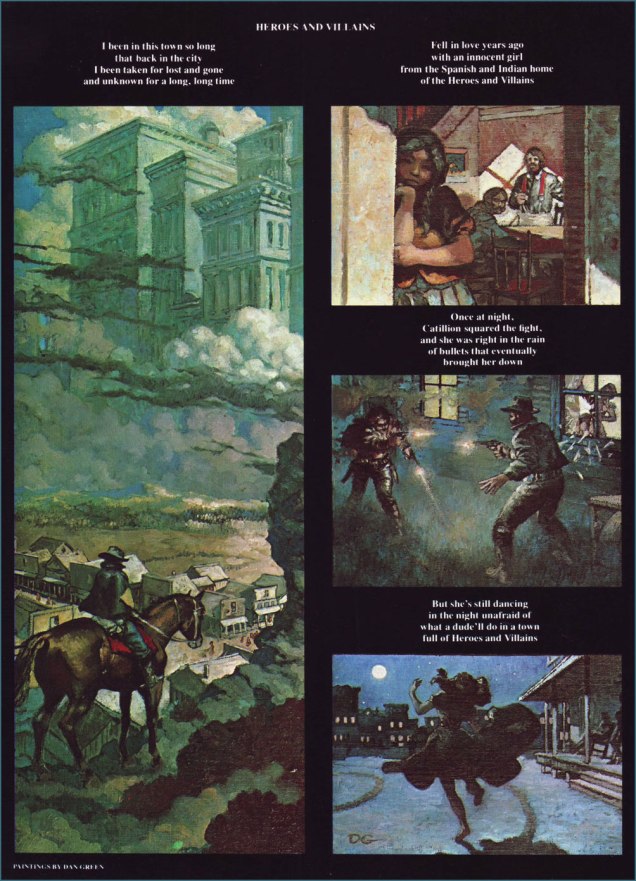
So I turn (for the second time!) to Byron Preiss‘ marvellously illustrated authorized biography of the Beach Boys, from 1978. In addition to a highly entertaining and well-documented text, Preiss, a man with an astonishingly well-filled Rolodex, had the bright idea of tapping various illustrators to contribute their visual cover version of a favourite BB song.

I’ve written about Mr. Stout already, in The Prodigious William Stout, which ought to give you an idea of how I feel about his work. Lyrics by BW collaborator and future record (including a young Bobby Sherman!) producer Gary Usher.
Cheeky Harvey Kurtzman spells out just what sort of ‘Fun, Fun, Fun‘ could be had « ’til her daddy takes the T-bird away ».
Nice drawing, although the only detail Ralph Reese truly gets right is poor Dennis Wilson‘s ill-starred appetite for the ladies. Also… Mike Love with a guitar, really?
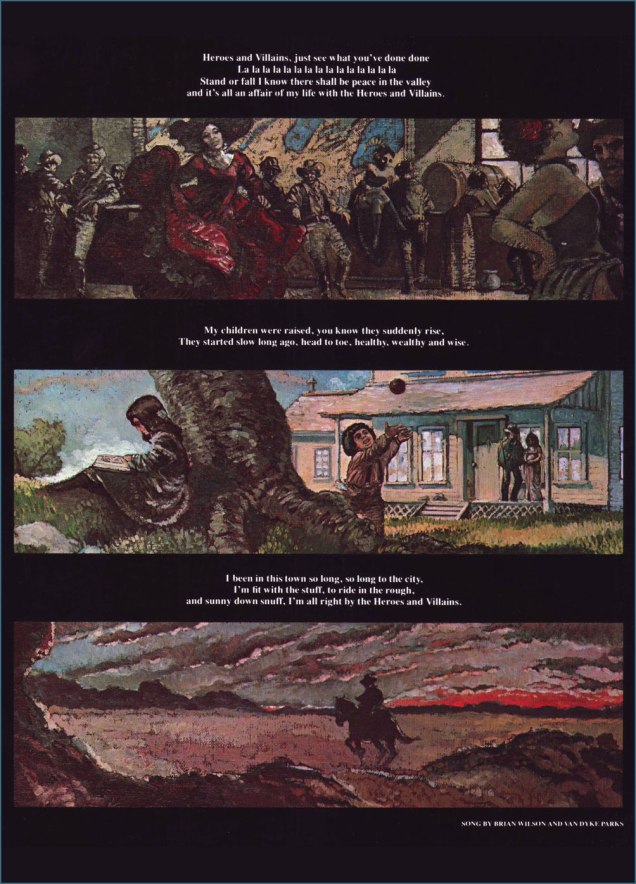
Those only familiar with Dan Green (1951-2023; another awkward lacuna from Lambiek’s comiclopedia) as a journeyman inker at Marvel and DC will likely be surprised at his adroitness with a brush. Here he tackles Wilson and Van Dyke Parks‘ (a true gentleman… and also from the class of ’43) arguably most ambitious œuvre, Heroes and Villains.
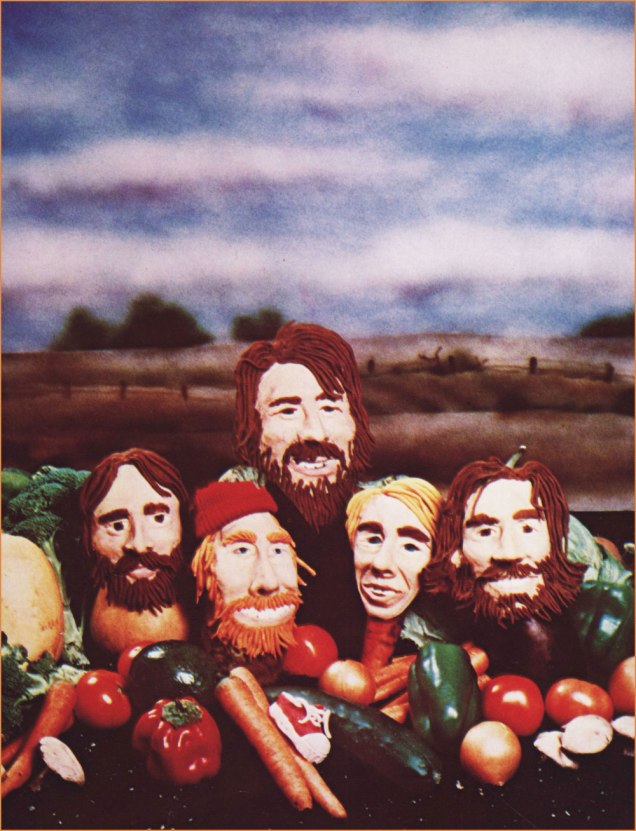
A surprising clay-based entry from Joey Epstein and her husband, our beloved Tom Hachtman, photographed by Ben Asen. The likenesses are pretty solid… save for Brian, who’s too skinny. The song in question is, of course, Vegetables. « I know that you’ll feel better when you send us in your letter an’ tell us the name of your… your favorite vege-table. »
This is former Air Pirate and Dirty Duck and Popeye cartoonist Bobby London‘s joyous celebration of Cool, Cool, Water, a tune intended for inclusion on the Beach Boys’ fabled Smile album (though it initially surfaced on their excellent Sunflower LP). To this day, however, London’s got mixed feelings about the whole thing. To begin with, he had no particular fondness for the Beach Boys, and getting dragged by Preiss to a late-70s BB live show, sans Brian (who was in no shape to perform anyhow) and with Dennis likely off promoting his Pacific Ocean Blue album, didn’t move the needle one iota. As London told me: « I had something more interesting and less Crumb-y in mind. »
Now *that* is caricature. Despite depicting the Boys as animals, illustrator — and Official Horror Host Hall of Fame inductee — George Chastain unerringly nails the essence of each, not to mention the group dynamics: of course Brian’s off to do his own thing. Not linked to any specific song, this is nonetheless my favourite piece in the book. Take a bow, sir!

-RG

p.s. I should also mention that another one of my favourite musicians died this week, namely Argentine composer Boris Claudio ‘Lalo’ Schifrin, but as he was born in 1932 (he was ninety-three!), his inclusion would have spoiled the pattern. Hope you understand, Lalo. Here’s a mesmerising favourite from his jazz sideman days: 1963’s The Fakir, recorded by Cal Tjader (« the Swedish Nerd king of Latin Jazz », as my friend Rupert dubbed him), and composed, arranged and conducted by Señor Schifrin.

A Very Langridge Christmas

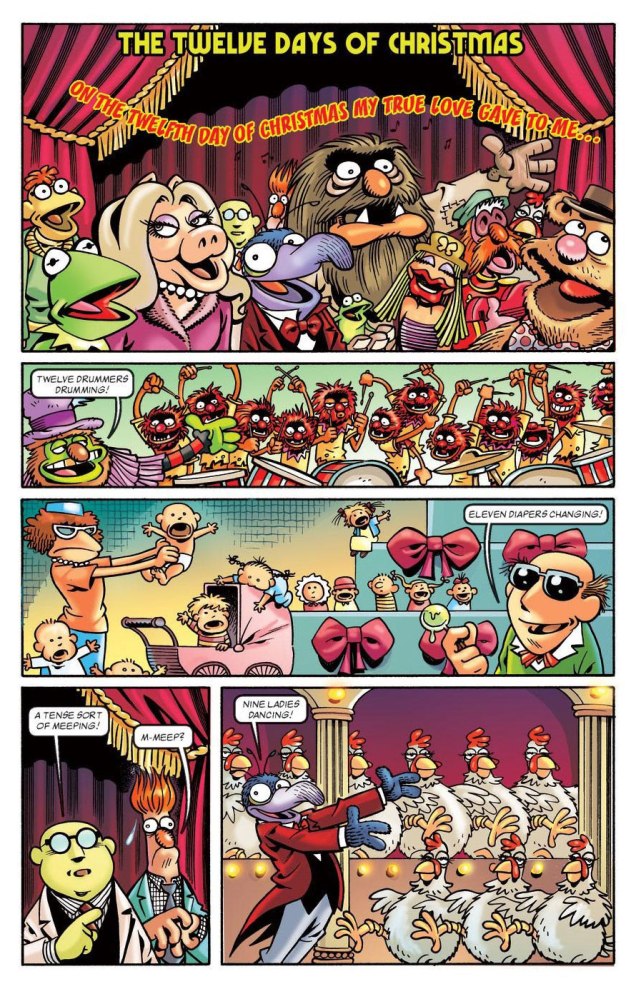
Speaking of festive mayhem, there is none better than penned (imagined, executed!) by Roger Langridge. Over the scope of his long (and ongoing!) career, the whole ‘rocking around the Christmas tree’ thing has shown up at least a couple of times — you may not have snow where you live, but take a gander at these and watch your holiday spirits soar (especially if bolstered by a bit o’ tipple).

Here’s are some merry excerpts taken from The Four Seasons: Winter storyline printed in Muppets: The Four Seasons (2012, Marvel) for your enjoyment:

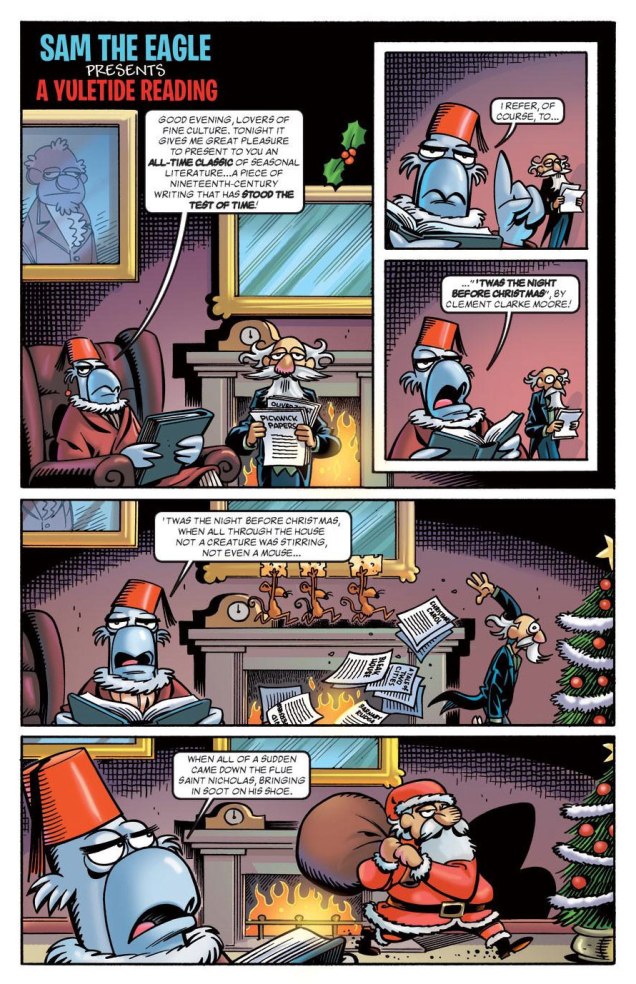
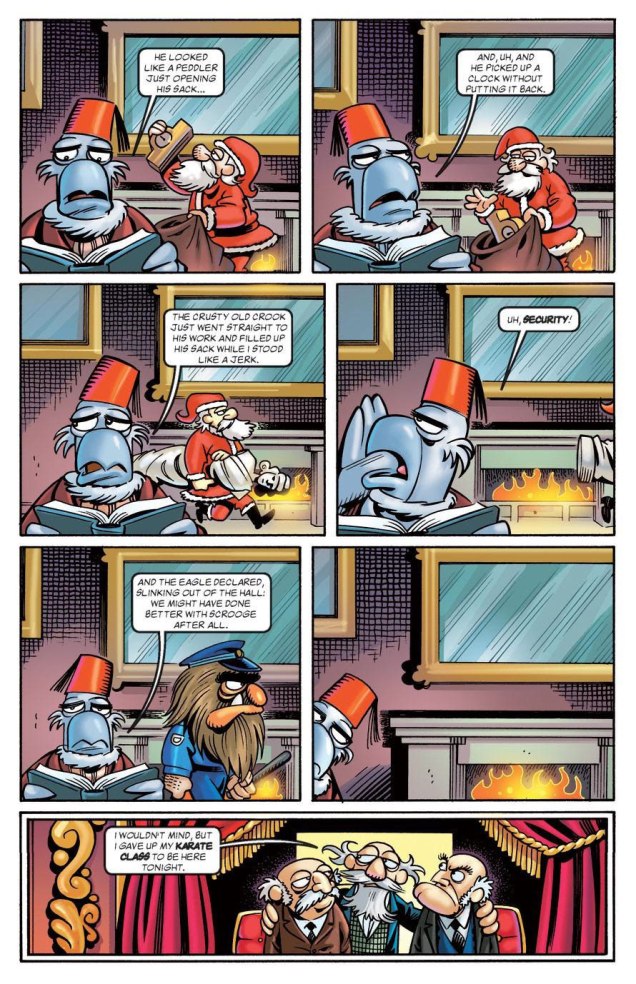
From the same issue, in this two-page digression (though what is The Muppets if not a series of glorious digressions), Sam narrates Dickens’ magnum opus… oh, nevermind.

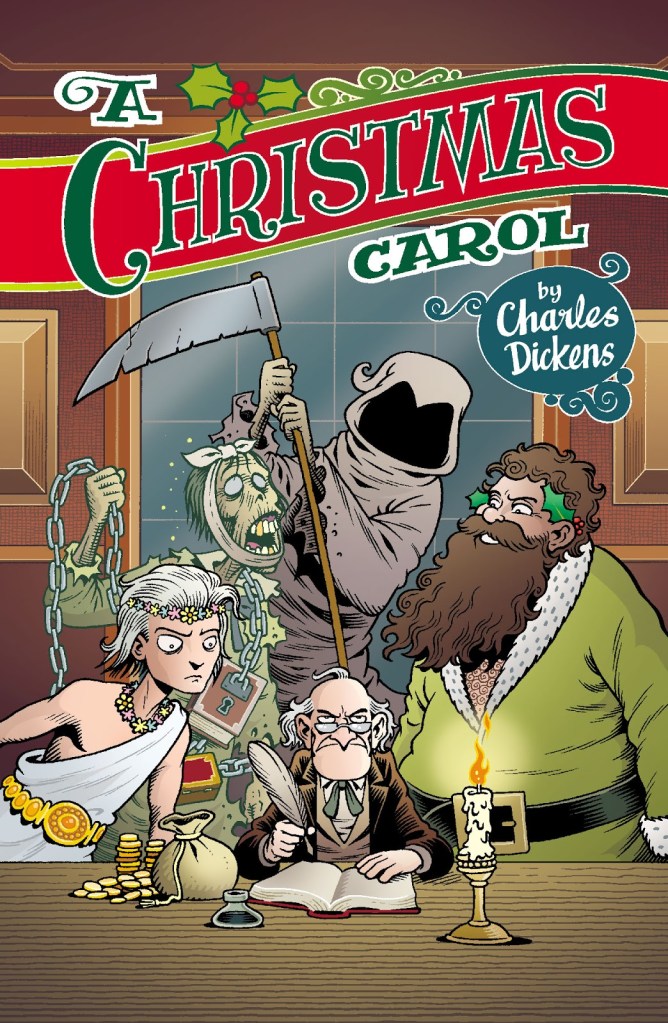
Speaking of Dickens, though, he did not go un-Langridged, happily:

A Christmas Carol (2013, St Mark’s Press)

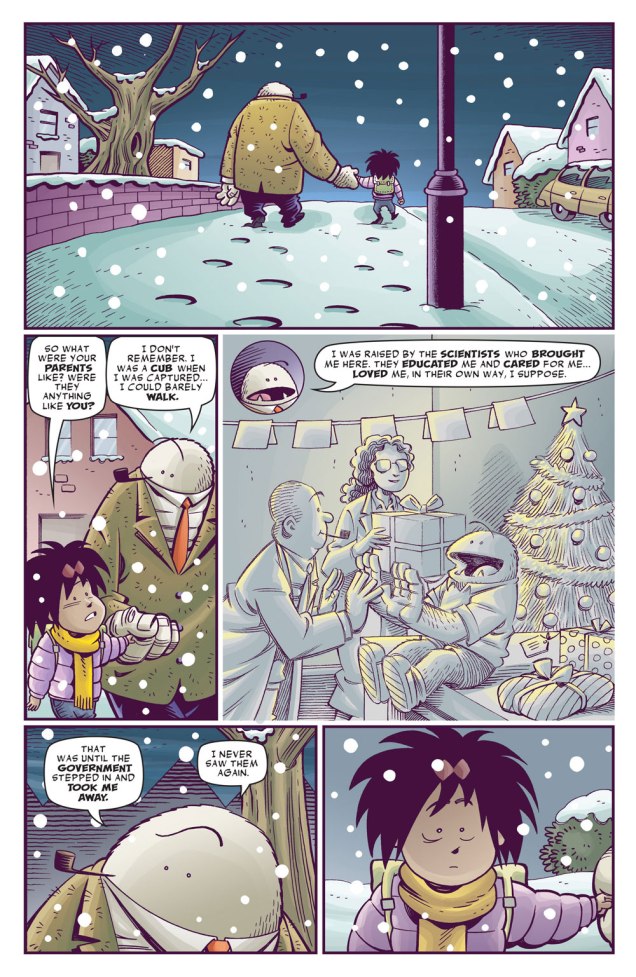
To further your cheer, a few more pages from Langridge’s Abigail & The Snowman (2016, KaBOOM!). This decade sure is a depressing one for all artistic professions — current active cartoonists seem to be mostly doomed to juggling thankless jobs for corporate giants such as Disney-slash-Marvel while defending their right to be (and to own their work) from AI pilfering (although ‘pilfering’ is too cute a word for it). Even such pundits as RL can rarely afford to work on what’s actually dear to their hearts. In that context, the sweet (and thoughtful) story of Abigail and her snowman friend was a very welcome addition to Langridge’s career, lodged as it was between two extremely underwhelming Dynamite-published affairs where he acted as the writer, namely King: Mandrake the Magician (2015) and Betty Boop (2017). I’m now convinced that Langridge’s art can save a poor script (thanks to jokes and beautifully non-sequitur asides inserted into the art), whereas a flat artist can ruin a plot faster than you can shout ‘Gisele Lagacé‘.

Langridge has been drawing daily cartoons based on his life for around 5 years now. This is the strip’s final week, as he has decided that it’s time to move on to something else, so I wanted to mention it before it’s too late — especially since it’s perfectly relevant to the season.

Strip from December 21, 2023

And a merry Christmas to all! We’ll see you again before the New Year.

~ ds

Hallowe’en Countdown VIII, Day 25

« But Mireault was, here as ever, a little too raw, a little too honest, a little too vulnerable for what comics might expect. » — Zach Rabiroff

This is as sombre as I’m willing to go. Hallowe’en, to me, is more about a seasonal mood and a welcoming sort of darkness… than serial killers and other aspects of people’s inhumanity to one another. And yet…

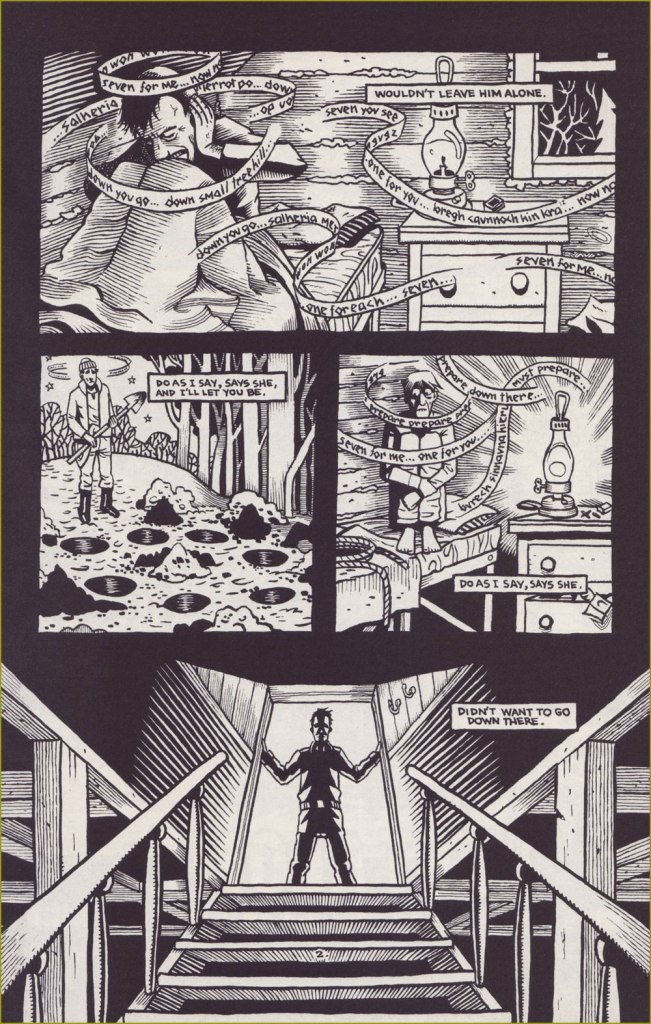
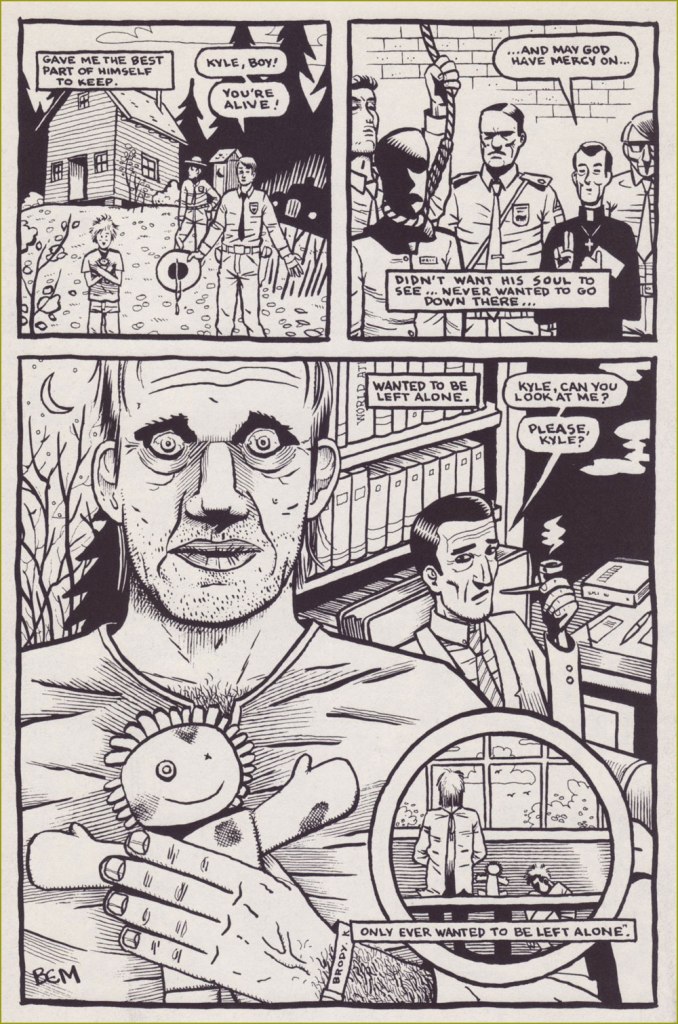
This is a testament to the late Bernie Mireault’s compositional virtuosity and mastery of the syntax of comics… but it’s also evidence of how deeply he could look into the abyss.

It’s obviously not a joyous read, but Zach Rabiroff’s Remembering Bernie Mireault: 1961-2024, recently posted on The Comics Journal’s website, is an exemplary tribute to a great overlooked talent.

Last month — and some twenty-five posts ago — I wrote about Bernie, showcasing a pair of stories poles apart from today’s offering… but they’re all Bernie’s. He was that solid a stylist.

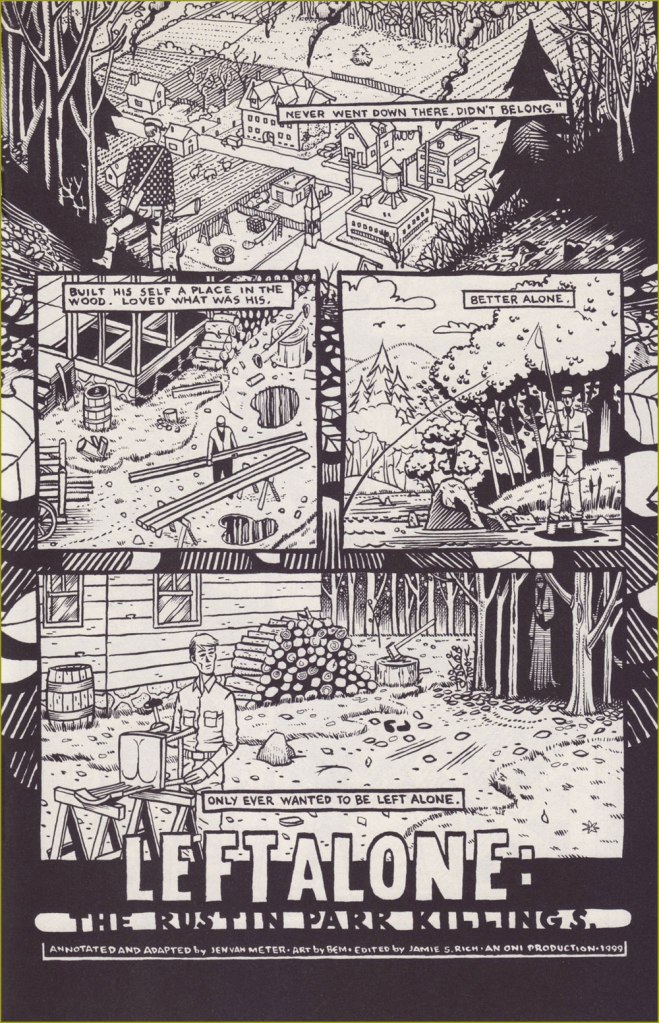
Left Alone: The Rustin Park Killings, written by Jennifer Van Meter and illustrated by Mireault, appeared in The Blair Witch Project no. 1 (Oni Press, July 1999).

-RG

The Insult That Made Charles Atlas Famous!

« I opened my magazine (What did you see?) / I saw Mr. France (What did he have?) / A girl on each shoulder (What else?) / And one in his pants » — 10cc, Sand in My Face (1973)

You may think of this post as a companion piece, a spinoff of its predecessor. I’d had for some time, in the back of my mind, the notion to showcase some obscure French ‘human sculpture’ ads, but it needed more. Comments on the previous post provided the spark.

Is there a more classic “humble immigrant makes good in the USA” yarn than that of Angelo Siciliano, born in 1892 in the tiny Italian town of Acri? The Smithsonian has told the full, colourful story, so I’ll spare you a rehashing of it.

Let’s just say that young Siciliano worked hard to overcome adversity and redeem his puny physique, and the rest is the stuff of legend. The principles of ‘dynamic tension‘ and his immortal moniker aside, Angelo’s finest brainstorm was to employ the lowly but then-ubiquitous medium of comic books to introduce his product and its natural audience to each other. Let’s take the tour!

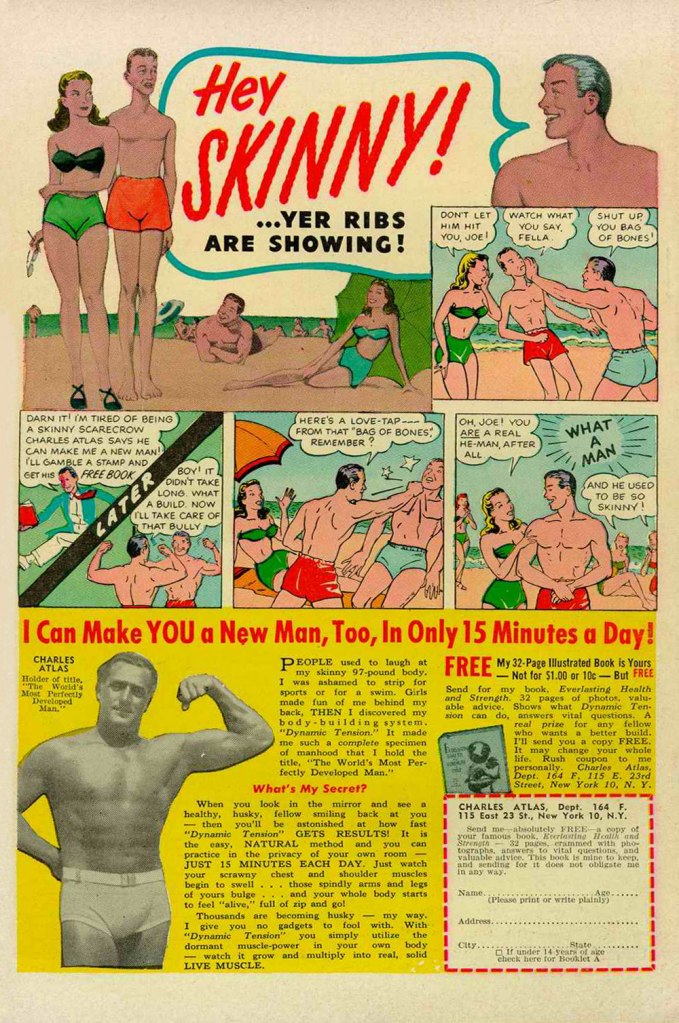
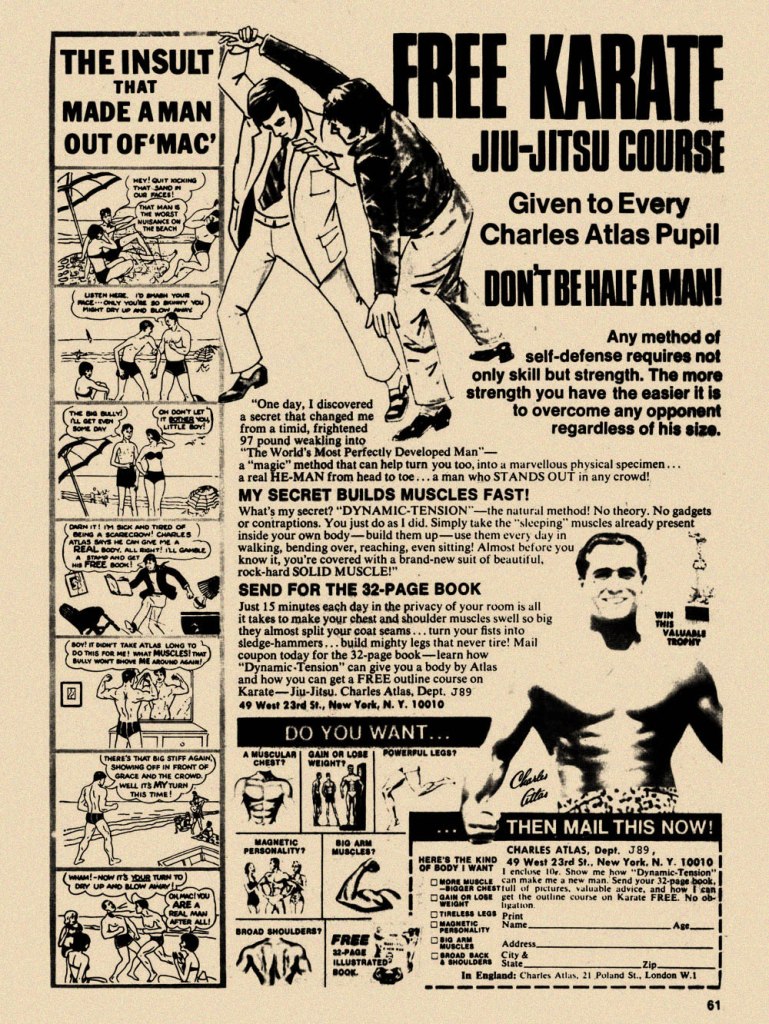
While the Charles Atlas ads began running in the 1930s, this is probably their classical expression. This one saw print as the back cover of Mad no. 14 (Aug. 1954, EC). Its opening insult even inspired Miles Heller’s 1995 salute to the great old comic book ads, Hey Skinny!
There was inevitably fierce competition in the self-improvement field. This entry, from the U.S. Nature Products Corp., appeared in Stan Lee’s oh-so-macho Man Comics no. 10 (Oct. 1951, Atlas).
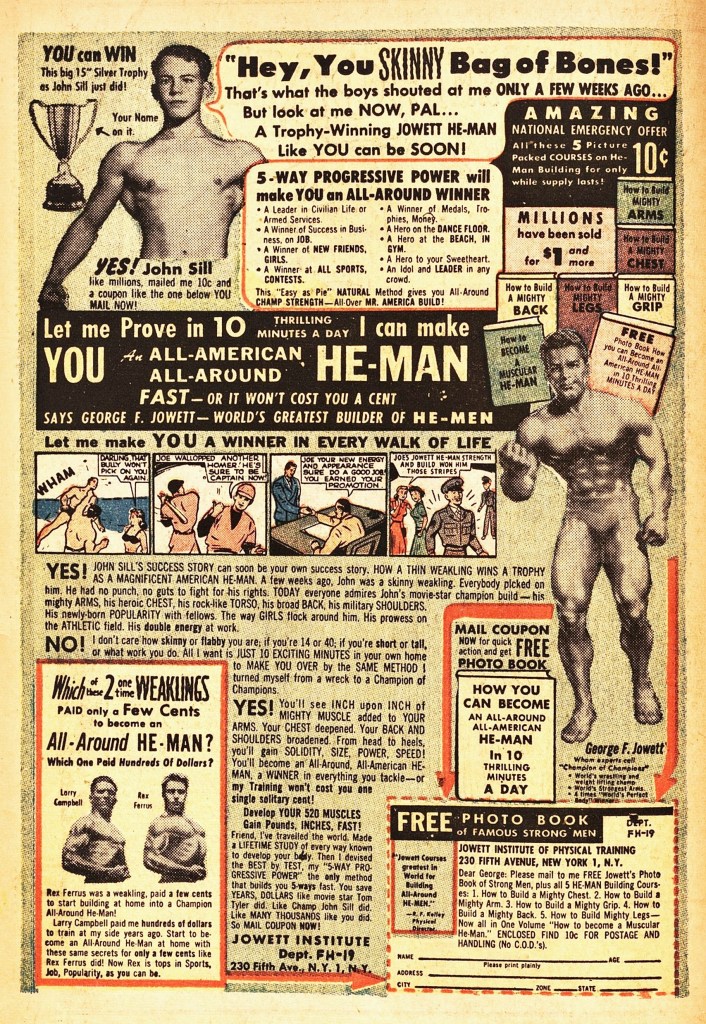
Lots and lots of copy — but the all-important cartoon hook is present and accounted for. From the pages of Firehair no. 9 (Fall 1951, Fiction House). The Jowett Institute of Physical Training wants you to get buff! To be fair, George F. Jowett got there first.
This is surely the definitive version, with the unforgettable tag line and ‘hero of the beach’ conclusion. I pulled this one from The Witching Hour no. 25 (Nov. 1972, DC), which hit newsstands just a few months before Mr. Atlas passed away, aged 80, on Christmas Eve.
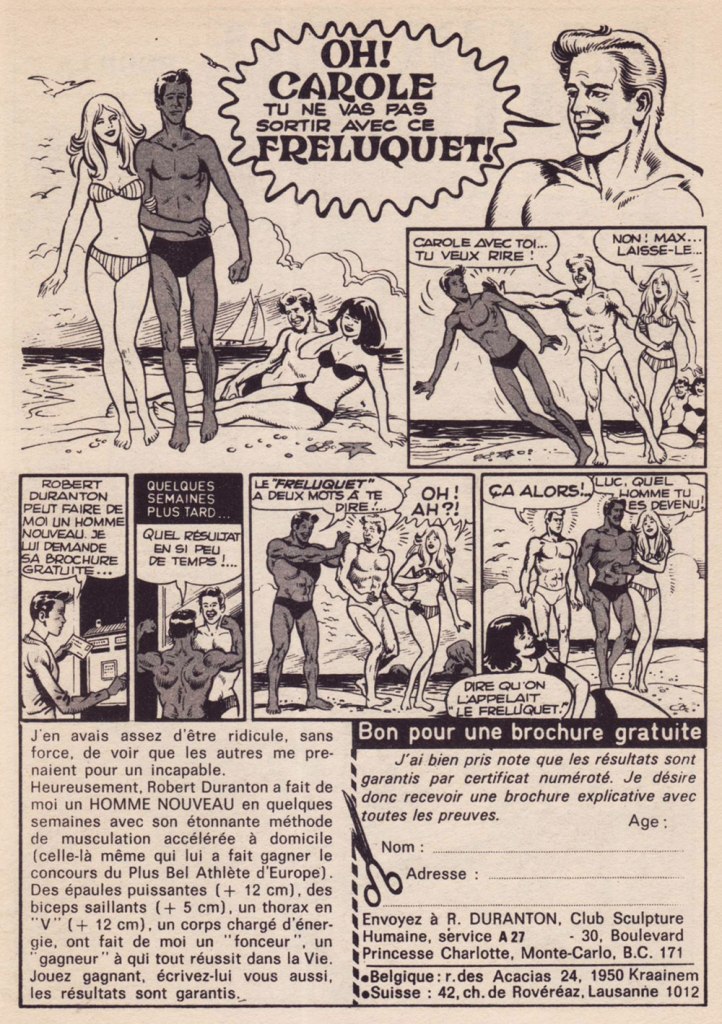
I can’t help being amused: French publisher Arédit, whose digest-sized collections of (mostly) reprints of US comics proudly bore the tag « Comics for adults », featured very few outside ads… and those were almost exclusively for self-defense and body-building systems. Here’s a sample trio. This one appeared in Maniaks no 4 (Fall, 1971). This title featured reprints of DC Silver Age ‘humour’ comics… all but the only actually funny one (that would be Sugar and Spike, of course).
Oh, I’m sure the ERB Estate got their cut. And who might that R. Duranton fellow be? Four times Mr. France, for one thing! Here he appears with Louis de Funès in a famous scene from Le Corniaud, a 1965 farce starring beloved stars André Bourvil / De Funès and directed by Gérard Oury.
This one’s from Kamandi no. 4 (Summer 1976, Artima), which featured reprints of various 60s and 70s DC adventure comics. It was an affordable way to catch up on material one might have missed — or couldn’t afford!
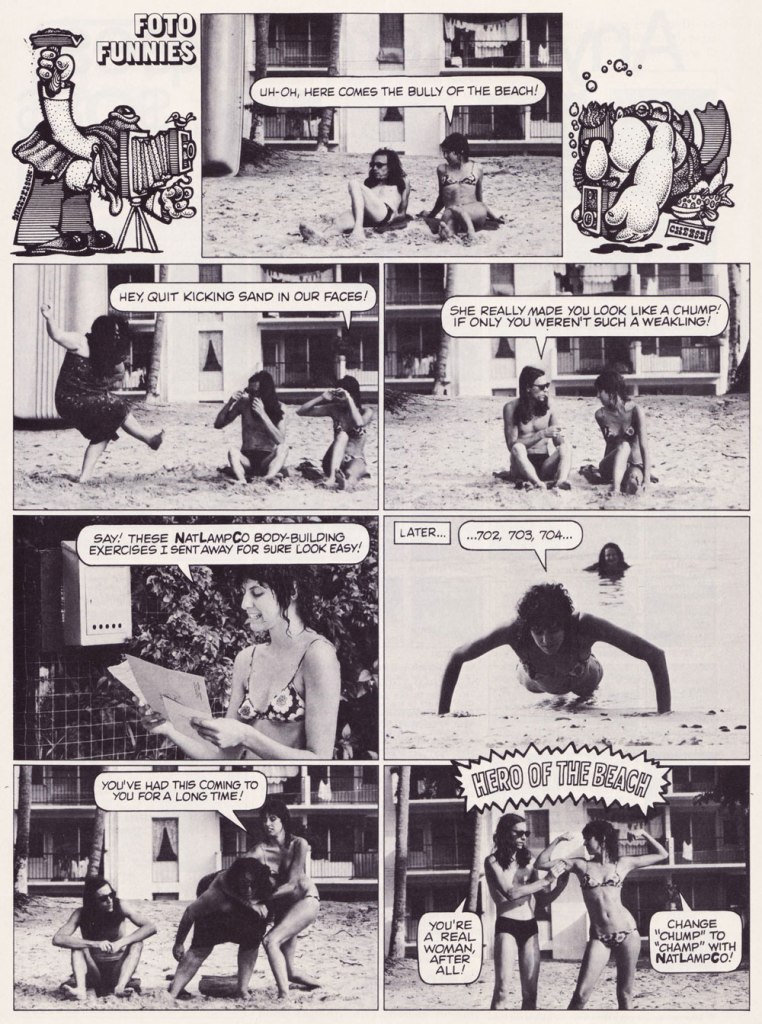
This refreshing gender-switched lampoon comes from the pages of National Lampoon no. 26 (May, 1972), the ‘Men!’ issue, guest-edited by Anne Bats, No other credits, dammit.
The opening page (of four) of Steve Skeates and Sergio Aragonés‘ wacky satire, from the pages of Plop! no. 2 (Nov.-Dec. 1973, DC). There have been truly countless spoofs of the Atlas adverts… most of them quite dire. Once more, I’ll spare you.
By the mid-1970s, with America in the kung-fu grip of martial arts fever, it’s understandable that many a young man was envisioning Bruce Lee‘s lithe, compact physique as an alternative to the hulking musclemen of yore. The Charles Atlas company tried to cover all bases with this ad; from — speaking of old-time musclemen — Doc Savage no. 2 (Oct. 1975, Marvel).

Then here’s a parody by Lou Brooks:

Ah, yes — those days when ‘Bruce‘ was the stereotypical gay name. From the ‘Playboy Funnies’ section of the magazine’s November, 1977 issue.
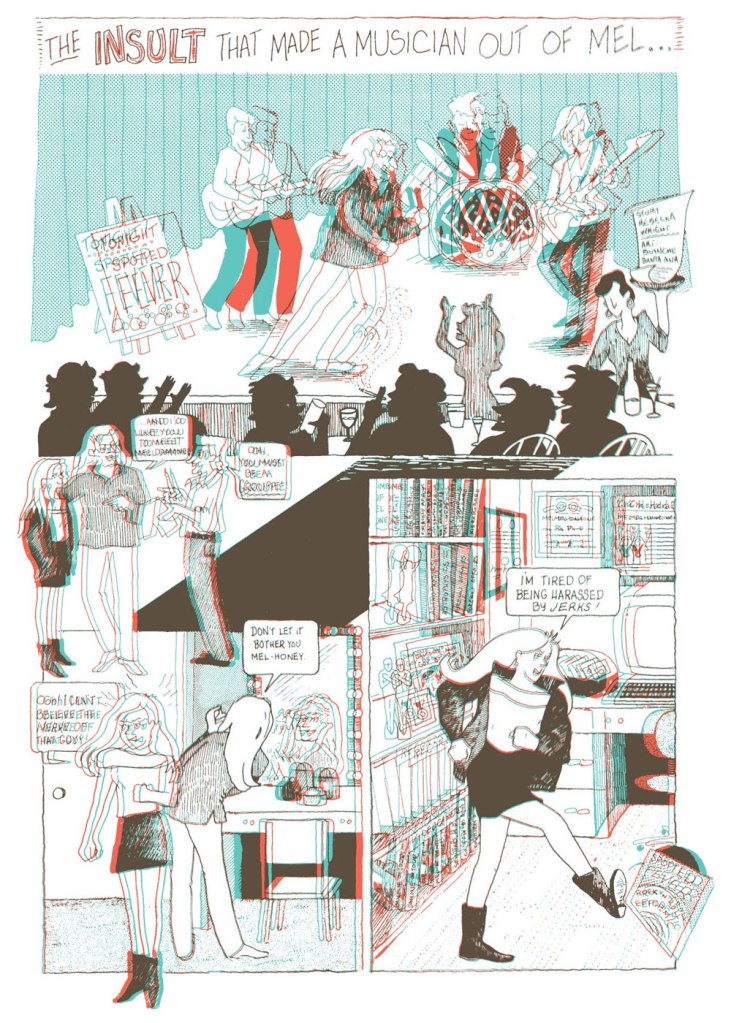
And for something a bit off the beaten path: this is The Insult That Made a Musician Out of Mel, scripted by Rebecka Wright, illustrated by Blanche Santa Ana, with 3-D effects by Ray Zone, from Wimmen’s Comix no. 12 (Nov. 1987, Renegade Press), edited by Angela Bocage and Rebecka Wright.
Does this look familiar? This is the first page of Flex Mentallo’s origin tale, as it appeared in Doom Patrol no. 42 (Mar. 1991, DC), written by Grant Morrison, with art by Mike Dringenberg and Doug Hazlewood. I have no idea whether Atlas had a sense of humour, but his successors sure didn’t, as evidenced by the lawsuit they filed against DC Comics over this clear — if brazen — case of satire. I much prefer the TV show version of Flex, I confess.
Peter Kuper deftly used the cliché to take a jab at George Bush Sr.’s image and the first Gulf War. Dated and irrelevant? Trying to prove your ‘manhood’ remains distressingly au courant… just consider these two schmucks, to cite but one recent example. And hey, here’s “Stormin’ Norman lying on T.V.” From Bleeding Heart no. 1 (Winter 1991-92, Fantagraphics).
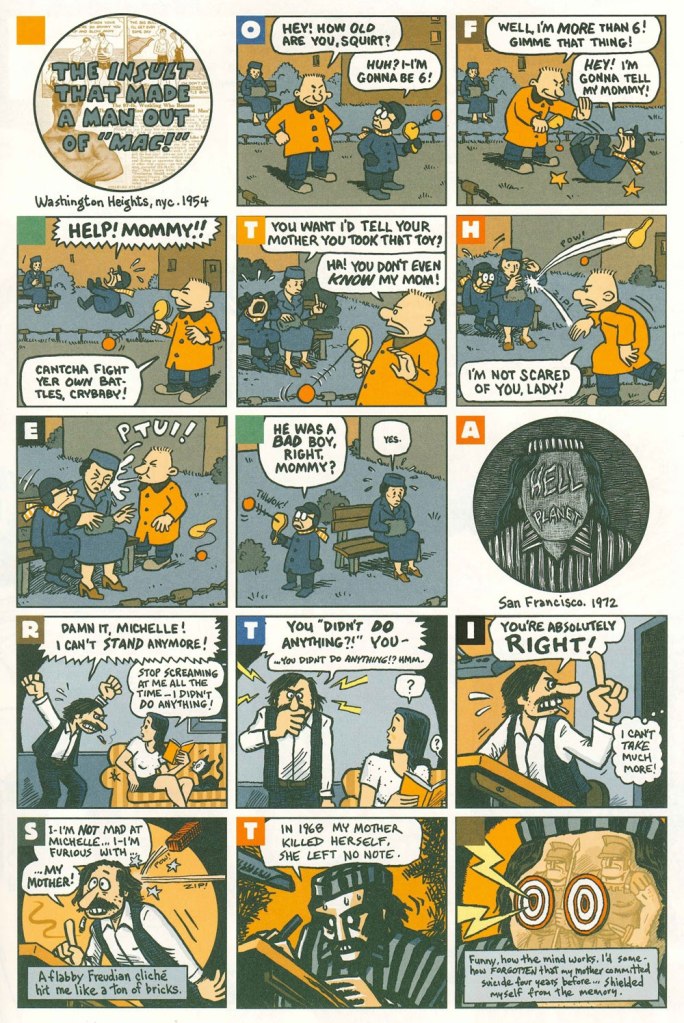
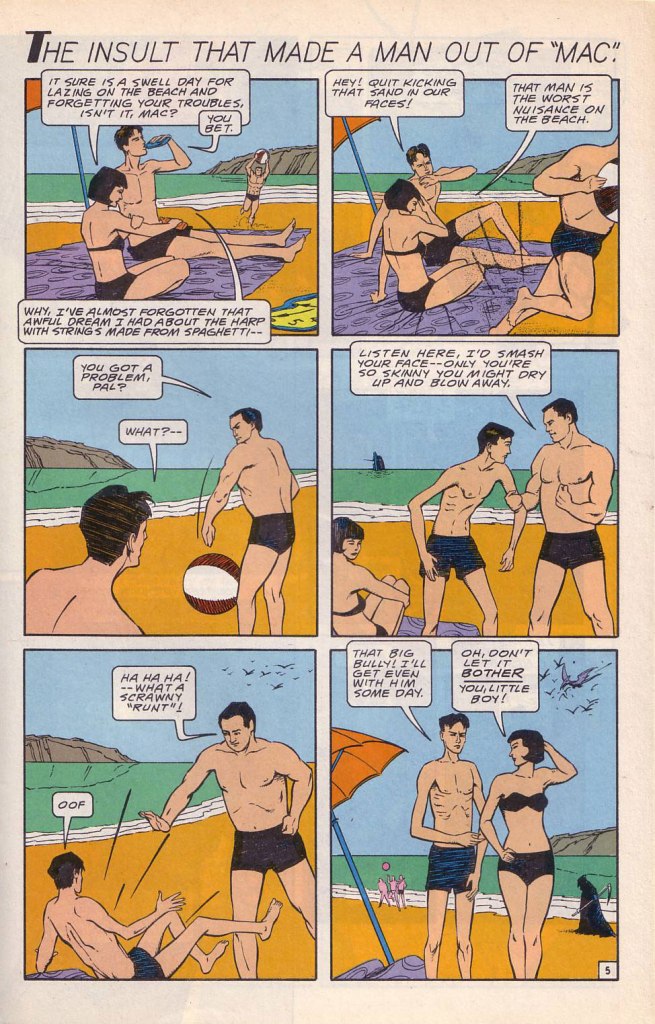
Art Spiegelman digs deeper and makes more discerning use of the raw materials at hand with The Insult that Made a Man out of “Mac!”, first previewed in The Virginia Quarterly Review and then collected in Breakdowns Portrait of the Artist as a Young %@?*! (Oct. 2008, Pantheon).

-RG

Adverts With Punch!

« All advertising advertises advertising. » — Marshall McLuhan

When you move house, as I did a few months ago, some items inevitably get buried while others get kicked loose. For instance, several decades ago, I had picked up (at a dollar fifty apiece, apparently) a tidy little pile of Punch issues from 1946 and 1955. Punch (1841-2022) of course, boasted at the time what was likely the world’s finest roster of cartoonists. Not only were the cartoons splendid — and now I’m old enough to actually get most of the jokes — but even the ads, often produced in-house, were exquisitely illustrated. And so, instead of the cartoons (you can still scratch that itch with our recent Rowland Emett’s Ramshackle Poesy in Motion, for instance), I’m proposing a sampling of adverts from my pile o’ Punches.

Remember the days before built-in obsolescence? Me neither. I note with pleasure that the grand old Scottish firm of Saxone still stands. For more Anton, check out Anton’s Spivs and Scoundrels, Baronesses and Beezers.
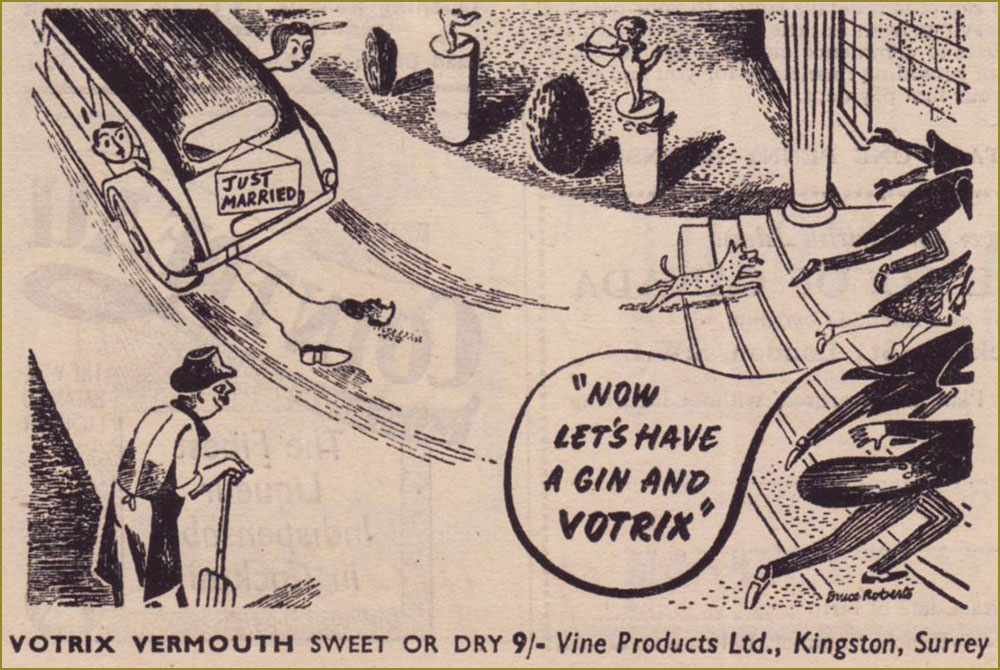
From the June 3, 1946 edition of Punch, the Summer Number. This Votrix stuff wasn’t very good, it would appear. « As the second world war started to take hold, the export of vermouth from Italy and France become non-existent. Given the devastation left behind, it was slow to start back up again once the conflict was over.
In England Vine Products based in Kingston, Surrey (whom had been making British copies of Sherry and Port for some years) launched Votrix Vermouth advertising it as “Indistinguishable” from pre-war Vermouths from Europe.
They claimed it was made with the finest grape juice blended with genuine vermouth herbs. There was a lot of controversy and even several court cases as to how this grape juice was made (and if it was actually wine made from raisins rather than grapes). It was never any real challenge to the vermouths from Italy and France.
» [ source ]
While Rothman still exists in name, the company’s true lifespan was 1890-1999. Mergers and acquisitions, that same old story…
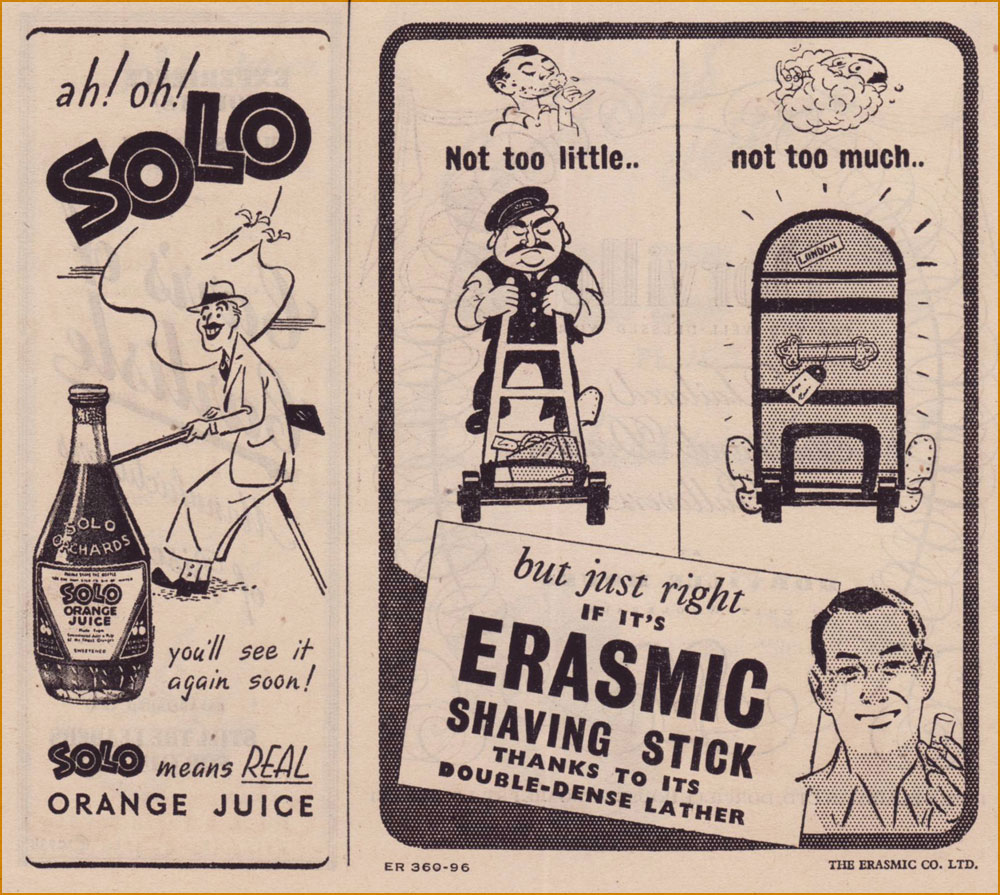
Solo is gone. « Pablo Utrera owned Solo Orchards, an orange juice business. In 1960 Idris Ltd., the soft drinks firm, acquired the whole of the issued share capital of Solo Orchards (“A small but well-known company making quality products“) for a consideration of 143,500 ord. 5s. shares in the company, worth £130,000. By April 1962 Idris had disposed of the Totteridge (Barnet, north London) premises of Solo Orchards, moving production to other factories. » [ source ]

Erasmic (founded in 1869), on the other hand, still operates, its products widely available.
An interesting soft sell approach to selling brakes! Established in 1926, Lockheed merged with Martin Marietta in 1995 to constitute Lockheed Martin.
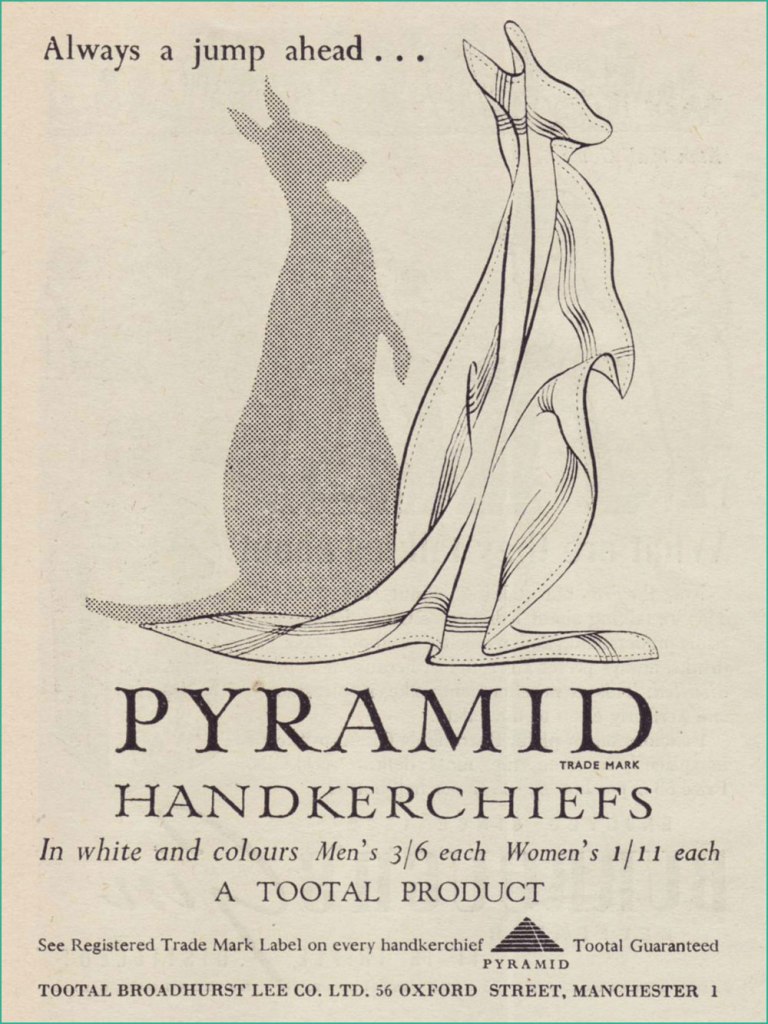
Despite the advent of disposable tissues, Pyramid handkerchiefs appear to have survived. I believe they were named so because they were made from Egyptian cotton. That said, what a clever ad… as a product, hankies hardly strike me as a boundless fount of exciting visual ideas. Get yours here!
Having toiled in advertising illustration for some years, I can tell you that the privilege of signing one’s name in an advert is a rarely-accorded one. Unless, of course, your famous name was part of the pitch. This one’s from the pen of Bruce Angrave (1912 – 1983). From the Nov. 28, 1951 issue. Read about the history of the International Wool Secretariat.
Guinness for Strength, went the famous slogan. But was there anything to the Irish brewer’s bold claim? CNN looked into the question. Here, the artwork was provided by John Lobban, who went on to be “one of Britain’s foremost numismatic artists”…. and Paddington Bear illustrators.
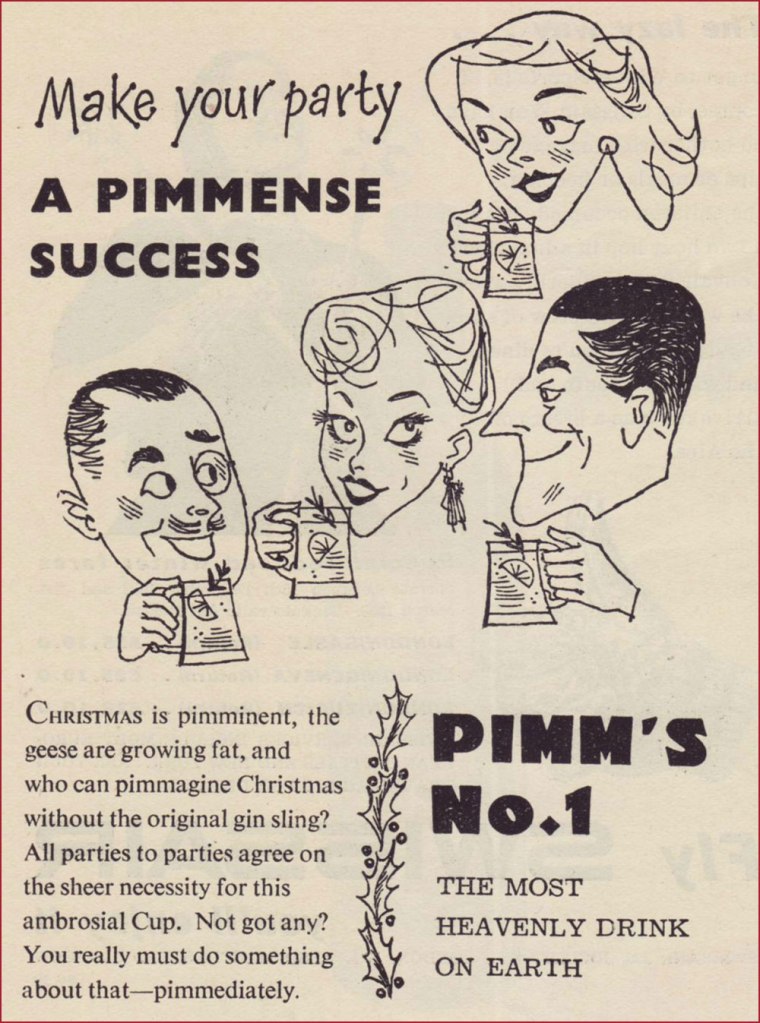
« Every day we left the house in his Phantom V, always with a big pitcher of Pimm’s close at hand. Then we went into this little studio and Richard took his place at the mic with a tall stool to his left and the Pimm’s on the stool. Then we started recording, for maybe three or four hours or until the Pimm’s was gone. He did like to lubricate his voice chords but that was as far as it went – he could have never got through that music in a drunken state. » A decade or so ago, upon reading this quote from songsmith Jimmy Webb about his work with Irish rapscallion Richard Harris, I wondered just what this Pimm’s might be. It was a bit hard to find at the time, and kind of costly for a matter of idle curiosity, but I’m happy to report that it’s delicious.
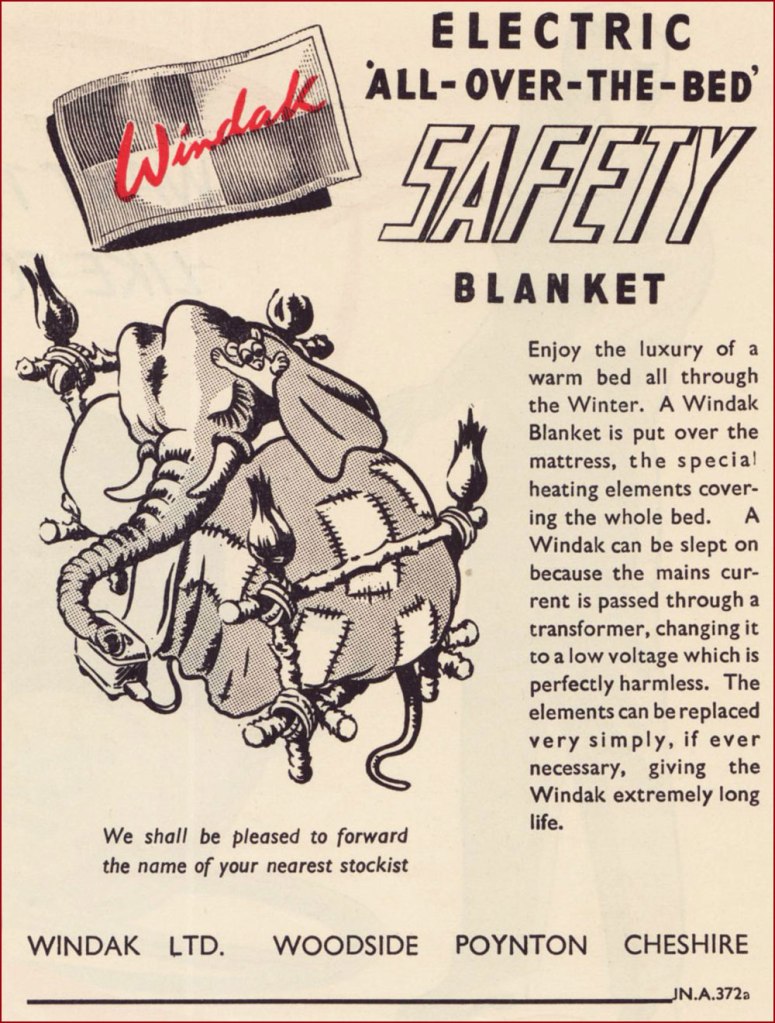
Windak was an offshoot of Baxter Woodhouse Taylor (still around!). Here’s an intriguing bit of trivia: « The Cold-War era of High Altitude flying led there to be an array of different flying suits and helmets trialled for this purpose. At the time, nobody really knew the effects of flying at high altitudes, or what the adverse affects of a sudden cabin depressurisation could be (such as the fear of canopy blowing off). To protect the aircrew against this perceived danger, initial efforts were placed on developing fully enclosed pressure suits.
The life span of the development full pressure suits was short lived, as it was soon realised that partial pressure helmets and a pressure jerkin, and eventually just a demand oxygen mask and pressure jerkin was sufficient to “
get you down” safely after a cabin depressurisation event.
Of the array of full pressure suits tried, this series, known collectively as the “
Windak” suit and helmet has become the most well known, due to many television and film appearances in science-fiction works, as space suits.
“Windak” was a trade name used by Baxter Woodhouse Taylor, and had been in use since the second world war on items of heated flying clothing. However, people seem to solely refer to this series of full pressure suits as “
The Windak Suit“, even though the series contains a few variants. » [ source ]
Heinz, as surely you know, is still around.
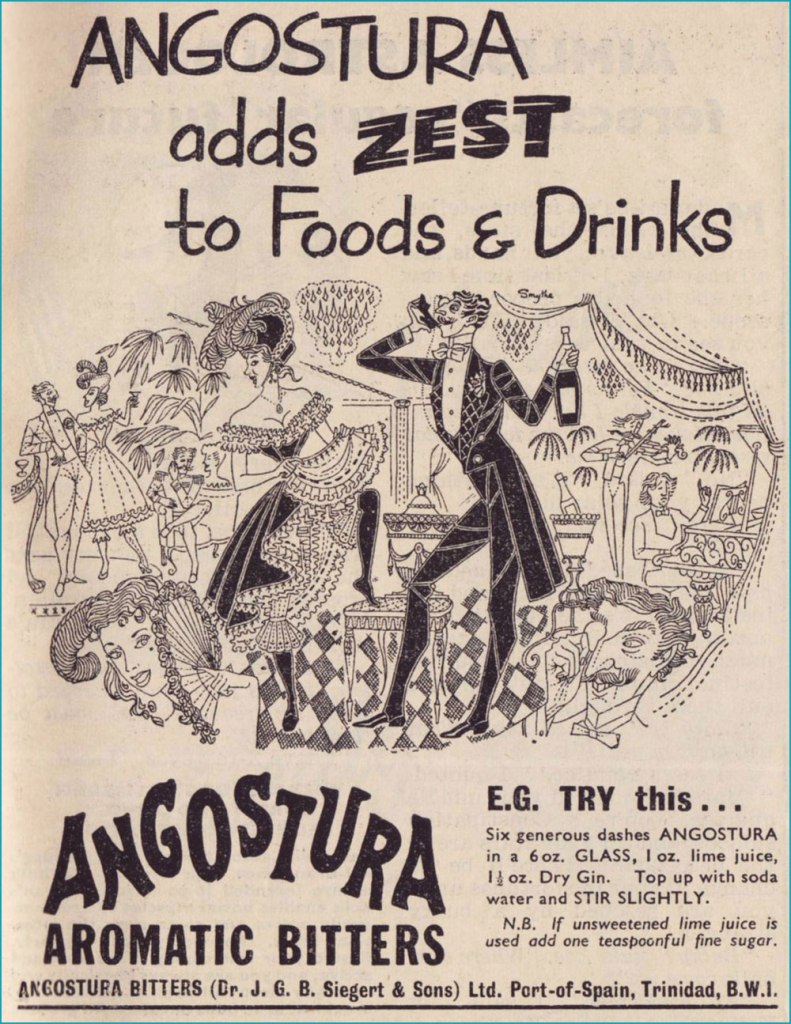
Angostura Bitters remain an essential tool in the mixologist’s attirail.
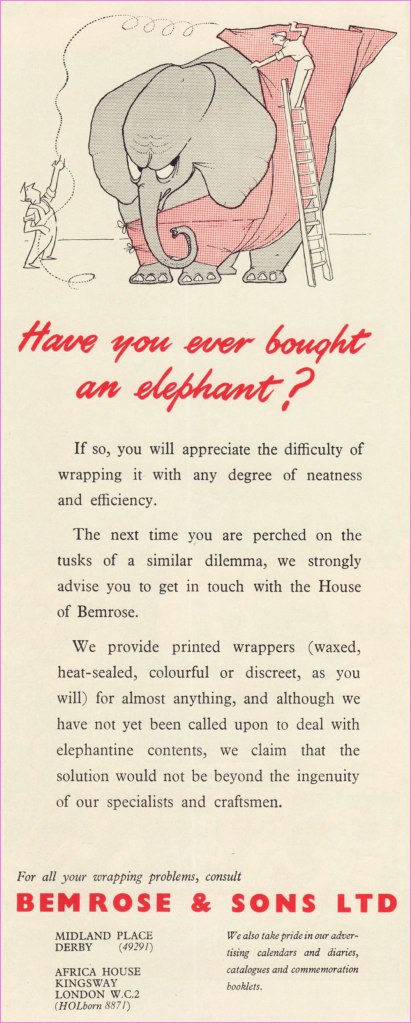
Despite several changes in name and vocation over the years, the firm of Bemrose & Sons abides in some fashion to this day. A perfect example of adapting to survive.
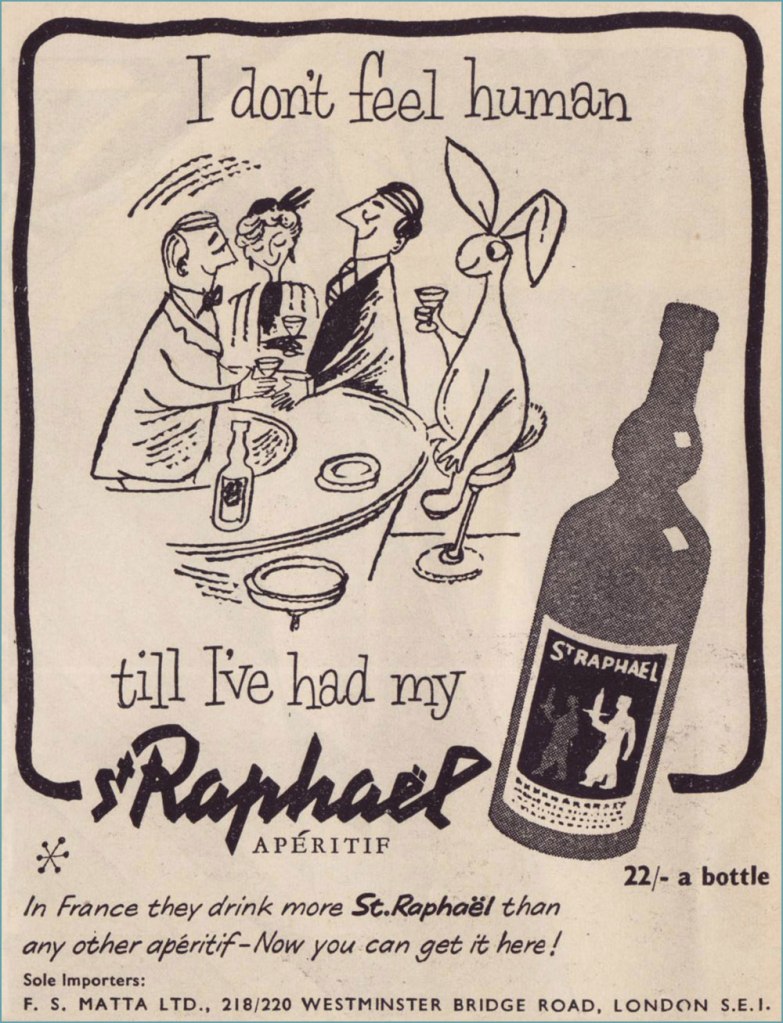
A pair of examples from a series of themed ads. The first saw print in the Aug. 10, 1955 issue, the second in the Sept. 14 one. They didn’t go much for repetition, did they? First concocted in 1830, St Raphaël remains a highly popular apéro. Read its history here. I’m getting a sense that in the liquor business, if you’re hawking a decent quality product, you’re in for the long haul, barring Edgar Bronfman Jr.-level greed and incompetence. But in the business world, that’s as rare as rocking-horse poo, right?

-RG

Into The Black Hole With Kirby and Royer

« This is the very center of everything there is. A huge black hole eating up the galaxy. The end of everything. » — Clifford D. Simak

Early in the Fall of 1979, I was pleasantly surprised to discover some new work by Jack Kirby in our weekend paper’s comics section. Things had been awfully quiet on the Kirby front since late 1978, the ‘King’ having unhappily — and quite understandably — left Marvel for the second time that decade.

This new work was part of the long-running anthology strip Walt Disney’s Treasury of Classic Tales (1952-1987). I dutifully collected the shabbily-printed comics sections and patiently hoped for an improved presentation.

The October 28, 1979 Sunday strip, as it appeared in newsprint. Incidentally (and unoffically) here’s the whole story.
The surviving original art page from the same date, for comparison.

Western Publishing, usual licensee of Disney product since its acrimonious split from Dell in 1962, then issued a Black Hole adaptation, in both a slick magazine and comic book format. But — holy bait-and-switch! — it wasn’t the Kirby version!

A typical page from the Western Publishing adaptation. Written by Mary Carey and illustrated by Dan Spiegle (1920-2017), a perennial favourite of the publisher’s. Another mystery: since Spiegle had earlier proven himself well-capable of capturing likenesses, one must assume that the decision to dispense with likenesses of Anthony Perkins and Ernest Borgnine and replace them with those of, I dunno, ‘Weird’ Al Yankovic and Ontario prime minister Doug Ford must have come down from on high. But… why?

I’ve been musing over these riddles ever since (in my spare time). Recently, I decided to act by putting the question to one who was there… namely Mr. Michael Royer, who’s been most gracious to us with his time and recollections (check out our three-part interview with MR!) — and continues to be!

RG: Mr. Royer, I’ve long been baffled as to why Disney (or Western Publishing, at any rate), thought it necessary to commission two separate comics adaptations of The Black Hole. I’ve always surmised that Kirby was considered too wild for them, but that’s just speculation on my part.

Since you were working for Disney at the time, and you inked the Kirby adaptation, I presume that you played some kind of role behind the scenes as well. Could you share some of the facts with me (and my readers)?

MR: Jack Kirby was selected to draw THE BLACK HOLE Sunday comic strip on MY recommendation. Gold Key editors always selected their OWN artist for similar licensed material… plus they were in no position to pay their artist the fee I got Jack. I inked and lettered HOLE and made necessary changes to the robots to protect the image for toy, etc. sales trademarks. Jack was an impressionist and I made the robots “on model.”

Jack became so bored with the scripts, that were done “storyboard” like by someone who had NO understanding of how to make comic art interesting and exciting, that he asked me to layout the FINAL Sunday page, which I did. I had told the powers that be at Disney that Jack must get his originals back but, of course, being Disney, they did not return them as they had promised. Jack only got the remaining pages not yet sold by the Circle Galleries after threatening Disney with a lawsuit. Disney gave me one of the Sunday originals because someone had spilled a cup of coffee on it.

The head of our Creative Services dept. at Disney was not a big fan of Kirby* and after I had inked the first Sunday he had another staff artist “fix” the faces, which stood out like what they became: inept changes. I yelled “DON’T CHANGE THE FACES!” They gave in to my warning.

It was an interesting time back then. Bob Foster and I were the ONLY artists in Creative Services who had worked in comic books and strips. They would never take our word about things until our department head, Bob and I, were on a conference call with Sylvan Beck (King Features Strip Editor in New York) and then they believed what we had to say about the ways a Sunday strip could be drawn to fit many formats. It was very frustrating at times knowing more than your “bosses.”. But… it is the same old story. Middle management was loaded with MBAs who didn’t know shit from shinola! We used to joke that if one had an MBA anyone could get hired at Disney… You didn’t have to know a damn thing about anything else except how to get the MBA.

RG: I’ve read somewhere that the Black Hole scripts were the work of Carl Fallberg. I mean, if that’s true, surely he wasn’t the one who storyboarded the script, as it’s a bit hard to reconcile ‘NO understanding of how to make comic art interesting and exciting’ with a visual artist of Fallberg’s calibre… might he have delegated the task to some flunky?

MR: It was Fallberg… storyboard layouts for each panel/page. I liked Carl and he was a nice man, but he had no idea how to “jazz” up the film visually and Jack wasn’t about to rock the boat, by being his usual inventive self. The script layouts were just like the film… boring. Just a blow by blow of what was going on in the film. The comic strip could have been exciting if Carl hadn’t just “stuck” to the movie. But, perhaps I am being too critical. Carl was probably “following orders” from our department head. When I tried out to do strip art for Disney in the late 60s or early 70s that same department head told me NOT to worry about “likenesses” of the actors. So when I told in my samples they were turned down because “no one looked like the actors.” Gawrsh…as Goofy would say. As I said… Bob Foster and I were the only guys in Creative Services who had ever been intimately involved in comic book or strip art production in our department. Things did change a bit eventually.**

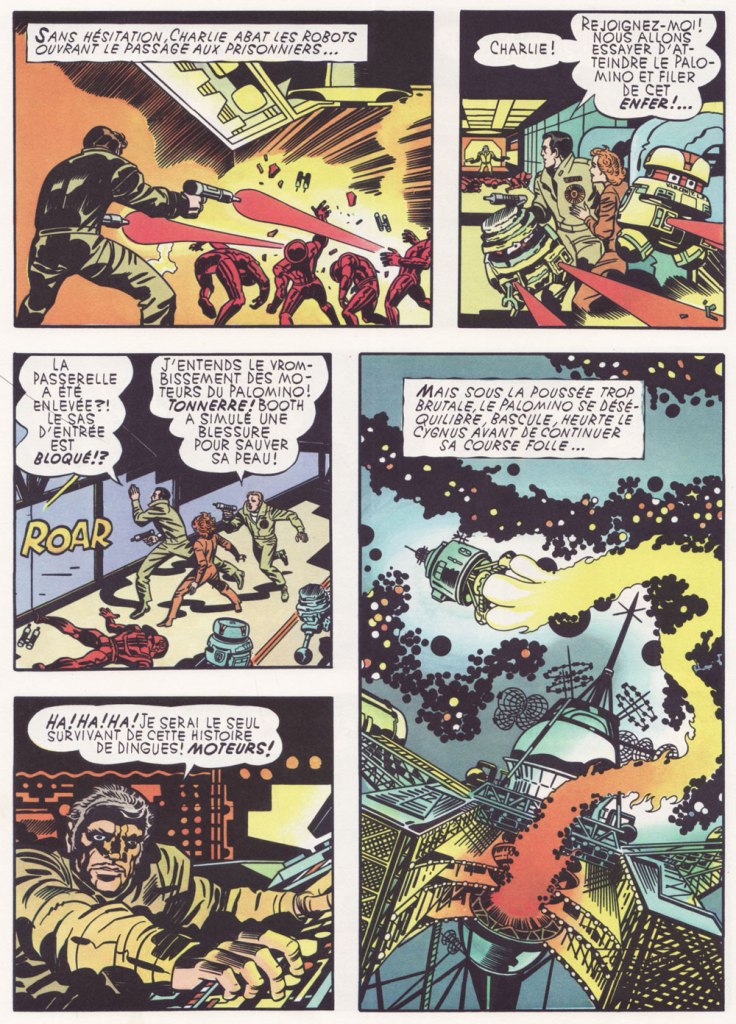
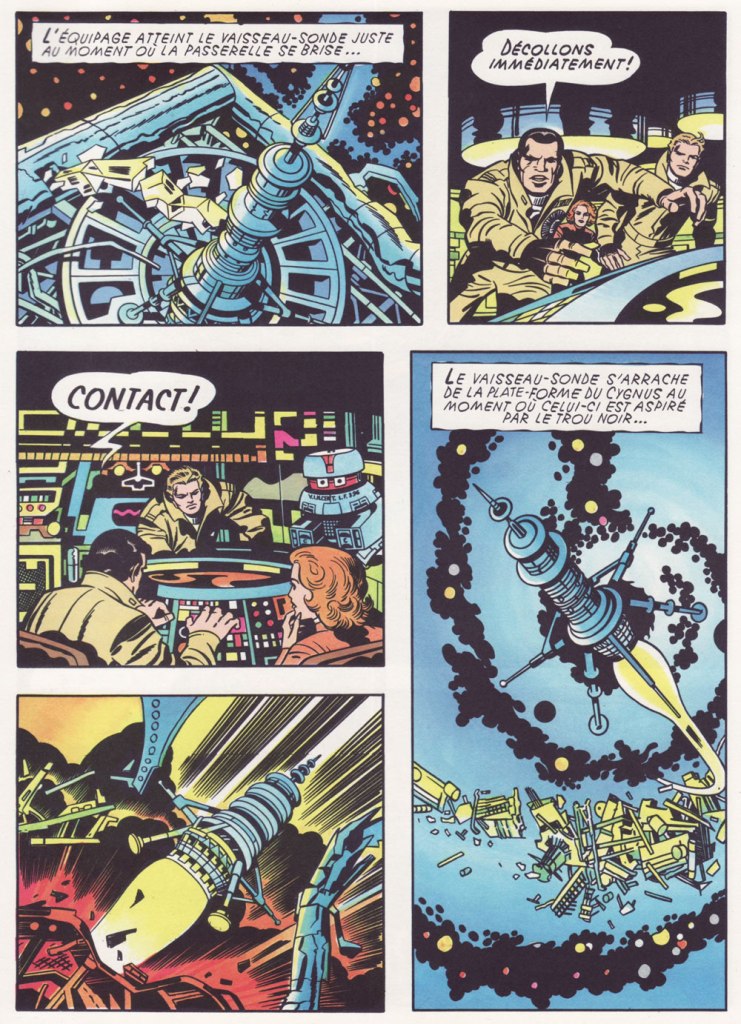
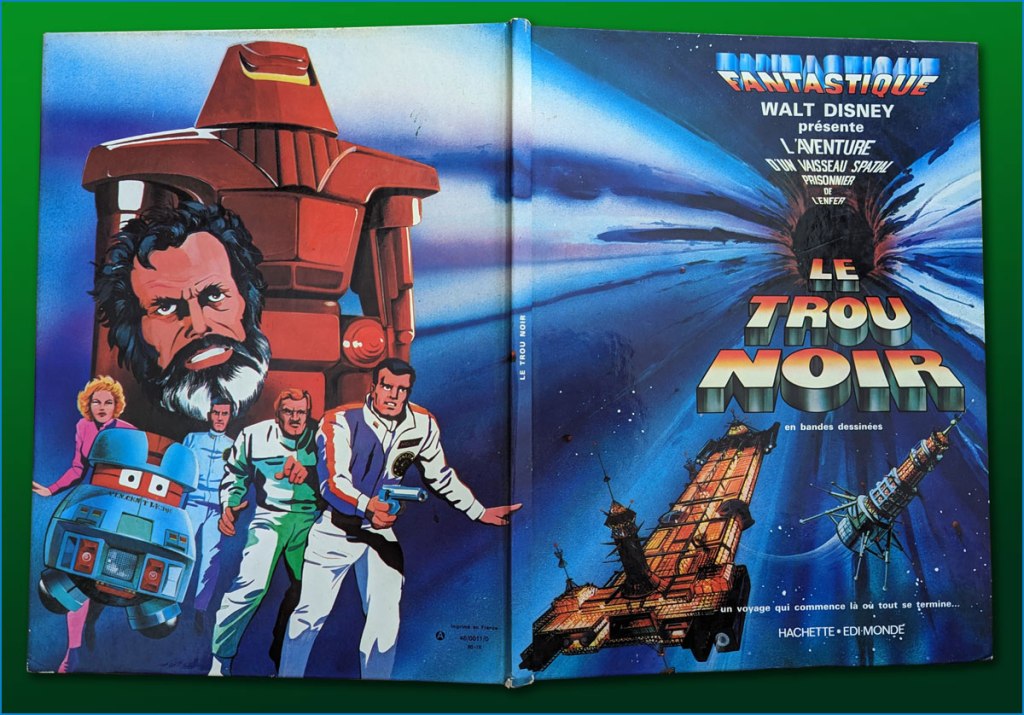
I’ve heard it said that the Kirby Black Hole material has never been reprinted or collected in full… which is only true if you only count English-language editions. I happen to have on hand the well-produced French collected edition (Fall 1980, Edi-Monde/Hachette). It was serialised earlier in the weekly Le Journal de Mickey (published continuously since 1934!).
I’ve mostly gone with the action sequences. In an episode of Sneak Previews, film critics Gene Siskel and Roger Ebert perceptively assessed The Black Hole‘s shortcomings.
Here’s a look at the hardcover collection in question, with its amusing cod-Kirby painted back cover.

I leave the final words to Mr. Royer, along with my earnest appreciation of his gregarious generosity!

MR: As a point of interest (or none at all), I designed and drew the Sunday page BLACK HOLE title panel as well as lettering, correcting robots and inking. I have a full set of B&W proofs if any one is interested in putting them into print. Offered to loan them to IDW but I guess they weren’t interested. My price must have been too high. Two comp copies of whatever they printed. LOL sigh.

*this was decades before Disney became perfectly fine with reaping billions upon billions from Kirby’s creations.

**but not soon enough to save Tron! Check out the impressively flat adaptation of the studio’s following foray into SF.

Boop-Oop-a-Doop Like It’s the Thirties!

« Her surname, a familiar catchphrase of the time, was inspired by the inter-lyric expostulations of a nationally famous Paramount Pictures songbird, Helen Kane. ‘Boop Boo a Doop!’ was the chant she sang in her sweet, high-pitched voice, a flippant raspberry to the jazz age. Somehow these nonsense syllables seemed to embody the spirit of the waning days of the twenties… »

I think everybody knows Betty Boop, though probably not that many have seen the original cartoons from the 1930s. She was ‘created’ by Max Fleischer orchestrating a team of animators – as with any gestalt creation, one can argue about who was responsible for what until one is blue in the face, but it has been convincingly argued (by Bill Blackbeard, for example) that Grim Natwick was the actual creator, probably with a stable of other animators.

In 1930, Betty, then still nameless, made her first appearance in (the pleasantly weird) Dizzy Dishes as a supporting character, as a seductive canine anthropomorph with dog ears and human curves. She acquired more personality once she was matched up with Bimbo, another doggo, in Bimbo’s Initiation (1931) – which is an even stranger cartoon, a tale of hazing by a bunch of creatures with pulsating buttocks and candles on their heads pursuing Bimbo with chants of ‘wanna be a member? wanna be a member?’, to which Bimbo always responds ‘no!’ to get sent to yet another chamber of tortures. I would suggest not psychoanalysing that too closely. Watch for the grand WTF finale:

By 1932, Betty, who now had a stable position as Bimbo’s regular girlfriend and a name to call her own, had jettisoned her dog attributes, floppy dog ears quite seamlessly transformed into big hoop earrings. Though she was a’booping from the very beginning, she acquired her hallmark Boop surname with Betty Boop Limited (1932). The aforementioned Helen Kane* was not pleased, and there were, as Blackbeard explains in his introduction to Betty Boop’s Sunday Best: The Complete Color Comics, 1934-1936 (Kitchen Sink Press, 1995), ‘threats of lawsuits, various legal manœuvres, and demands for creator royalties, all without result‘.

In 1933, Hearst’ King Features Syndicate started negotiating terms for a Betty Boop comic strip, and in 1934 the strip, drawn by Bud Counihan, appeared. However, this was not exactly the same unhinged, hip-jiggling Betty of earlier years. King Features wanted to appeal to more conservative audiences, and Betty’s sexuality was toned down a notch. The animated Betty didn’t fare much better – as usual, guardians of Moral Purity™stuck their fingers in the pie, and from June 1934, the Motion Picture Production Code kicked into effect, forcing Betty to leave behind her carefree flapper days to become either a career girl, or some generic housewife.

Oh, but there was still plenty fun to be had. Besides, the comic strip Betty was not quite as smothered – while the latter was nursing babies and whatnot in a long dress, the former was still running around in her risqué red number, occasionally even kissing men and living the life of a spoiled movie star. Here are a few Sunday strips – thanks for co-admin RG for scanning these unscannables.

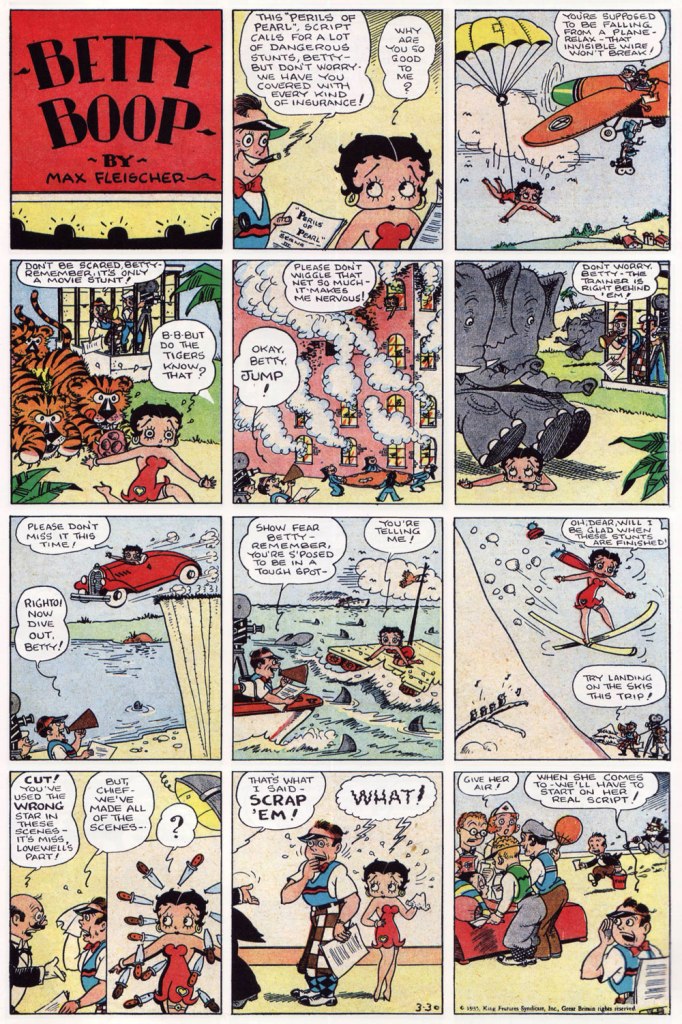
Sunday strip from March 1935. Counihan’s tigers are consistently adorable.
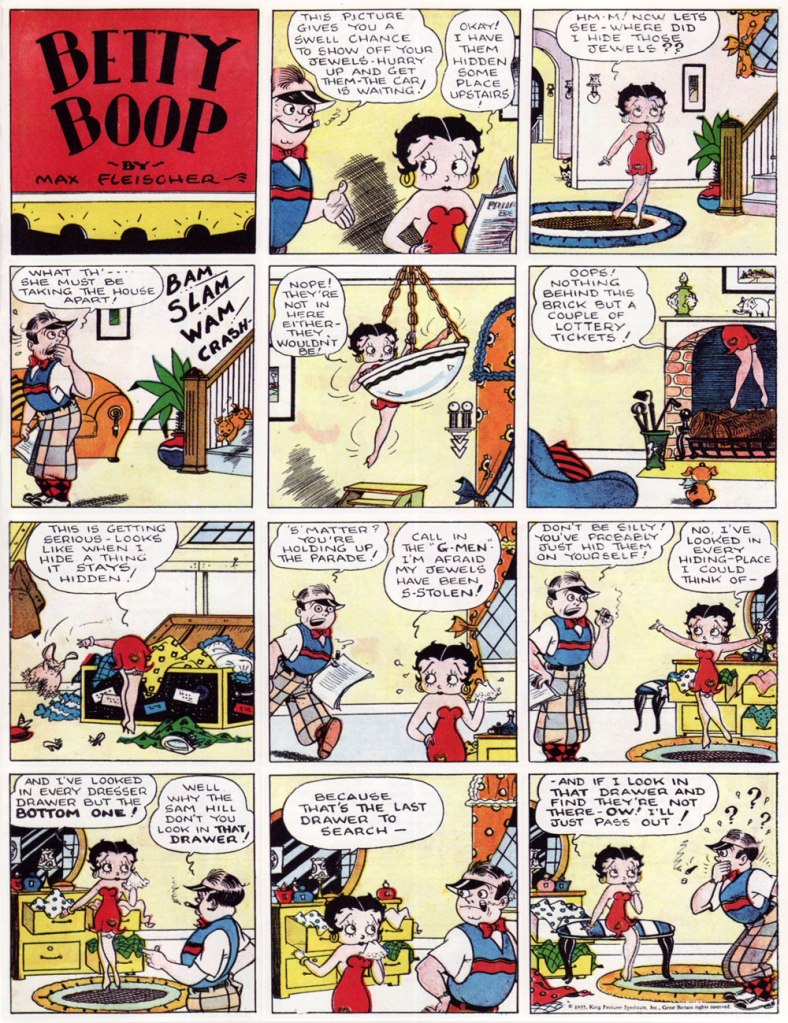
Sunday strip from 1935, and a few different perspectives on Betty’s legs and derrière.
Sunday strip from 1935. That’s a more fun version of a police line-up…
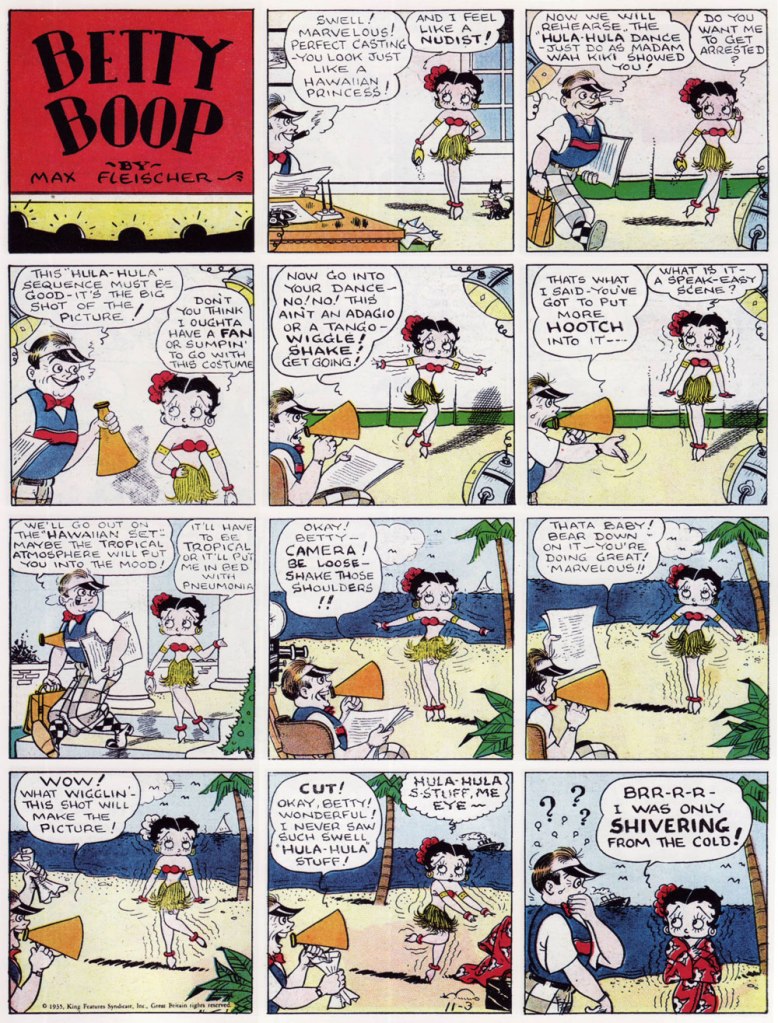
Sunday strip from 1935. Mentions of nudism come up more often than one would expect (and yet Betty is never particularly undressed, at least not by modern standards).
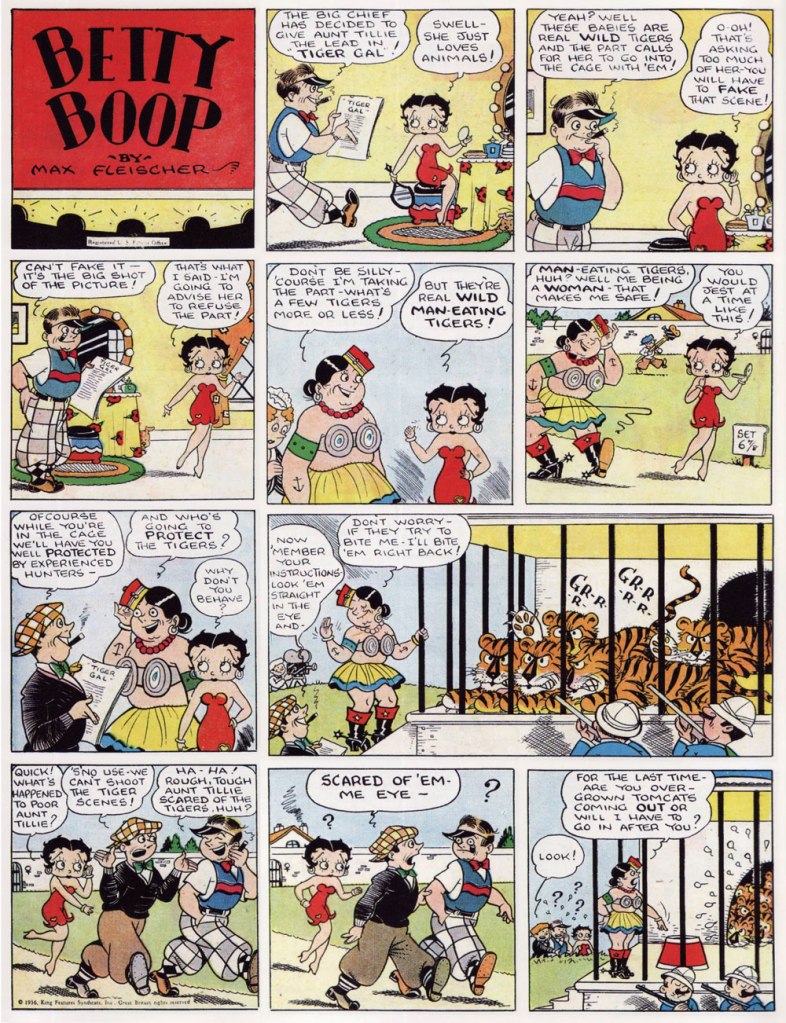
Sunday strip from 1936. In the later years, Betty’s indomitable aunt Tillie monopolized much of the action. She may have not had Betty’s sex appeal, but she was kind of fun to watch – a generous woman (also generous with her fists in cases of disagreement). Have I mentioned the tigers?

Blackthorne Publishing, known for their reprints of classic titles, issued three 72-page collections of Betty Boop reprints, comprising a mix of dailies and Sundays.

Blackthorne Comic-Strip Preserves nos. 1 and 2 (both published in January 1986). Covers by Bud Counihan.

There are a lot of modern conversations about the meaning of Betty Boop**. Was she but a sex symbol, bent to the lascivious male gaze that created her? Or perhaps an early example of a feminist icon, in control of her own sexuality? Her combination of innocence and feminine wiles actually reminds me of Sally the Sleuth (see Here Comes Sally the Sleuth… and There Goes Her Dress!), as Betty effortlessly runs around half naked, thwarting rape attempts without losing an ounce of her cheerfulness. These questions mostly address a pre-1934 Betty, as her identity in the public eye seems to have been formed in those few years of unhinged actions and symbolism… as well as BB merchandise in the 1980s, as she was rediscovered by makers of all manner of goods (note that it was still her sexier form that was used on cups, lamps, t-shirts, keychains, and whatever else you can think of).

From recent attempts to revive the character, Gisele Lagacé and Roger Langridge‘s comic series comes to mind – more as a traumatic experience rather than a pleasure, despite being hyped as ‘insanely entertaining‘. Langridge is a WOT favourite, but in this case even his script cannot save Lagacé’s insipid art (‘Lagace’s art is amazing. Her characters emote in ways I didn’t think two-dimensional cartoons could.’ says The Court of Nerds) or the flat colours by Maria Victoria Robado (who normally opts for colourful images, so I’m thinking that the drabness was imposed upon her by the artist). At least some of the covers of this 4-issue series were nice…

Betty Boop no. 4 (January 2017), cover by Roger Langridge.

*In recent years, it has come out that Kane was probably aping the act of black vaudeville performer Esther ‘Baby’ Jones.

**See, for example, The Forgotten Black Woman Behind Betty Boop.

~ ds

Hallowe’en Countdown VI, Day 17

« In this club all members are equal, be they of claw, talon or fang; skin, fur or scale; from grave, tomb or laboratory; if they slither, walk or crawl; if they breathe, gasp or do neither. No one monster will take precedence over another. » — Signed EATM Ghoul (Hon Sec)

Like many a horror fan of my generation, I grew up adoring Amicus Productions‘ films, particularly their multi-segment entries, known as Portmanteau movies. These include fine adaptations of Robert Bloch stories, generally scripted by the master himself: Torture Garden (1967), The House That Dripped Blood (1971) and Asylum (1973), and a pair of well-crafted adaptations of EC Comics, 1972’s Tales From the Crypt and 1973’s The Vault of Horror, which unveiled these classics to an eager new audience.

With 1974’s From Beyond the Grave, Amicus partners Milton Subotsky and Max Rosenberg found themselves a new wellspring in British author Ronald Henry Glynn Chetwynd-Hayes (1919-2001). While some consider 1981’s Chetwynd-Hayes portmanteau The Monster Club part of the Amicus œuvre, the company had been dissolved in 1975… but as the film was produced by Subotsky, the notion is not without merit.

And so… comics? Enter UK comics maven Derek ‘Dez’ Skinn. As Dez tells it:

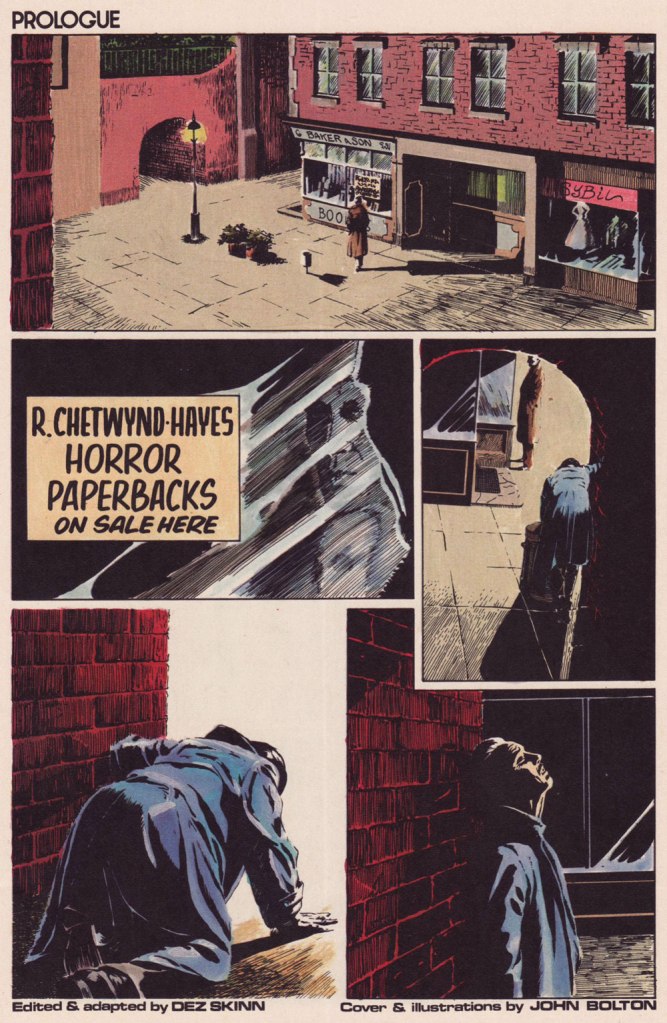
« Milton Subotsky, the London-based US powerhouse behind the horror film company Amicus Films, had always been madly envious that rivals Hammer had their own magazine and was constantly twisting my arm to work with him. When he got a distribution deal on R. Chetwynd-Hayes’ The Monster Club, he saw his chance. Actors including Vincent Price and John Carradine were signed up but there was no time to shoot any footage to promote the production at the Cannes Film Festival. So he called me up and asked if we could adapt the film into comic strip format, much like we’d done with Hammer, so that printed copies could be used to sell the film overseas at Cannes.

We only printed 1,000 copies of The Monster Club, making it an instant collectors’ item in fan circles! Adapting the film script myself, I assigned John Bolton to produce the 26 pages of artwork (although David Lloyd valiantly came in to handle one chapter because of the tight deadline). Targeted at an international audience of film buyers on lush glossy paper, it was surely the most inexpensive yet effective film promotion ever! » [ source ]

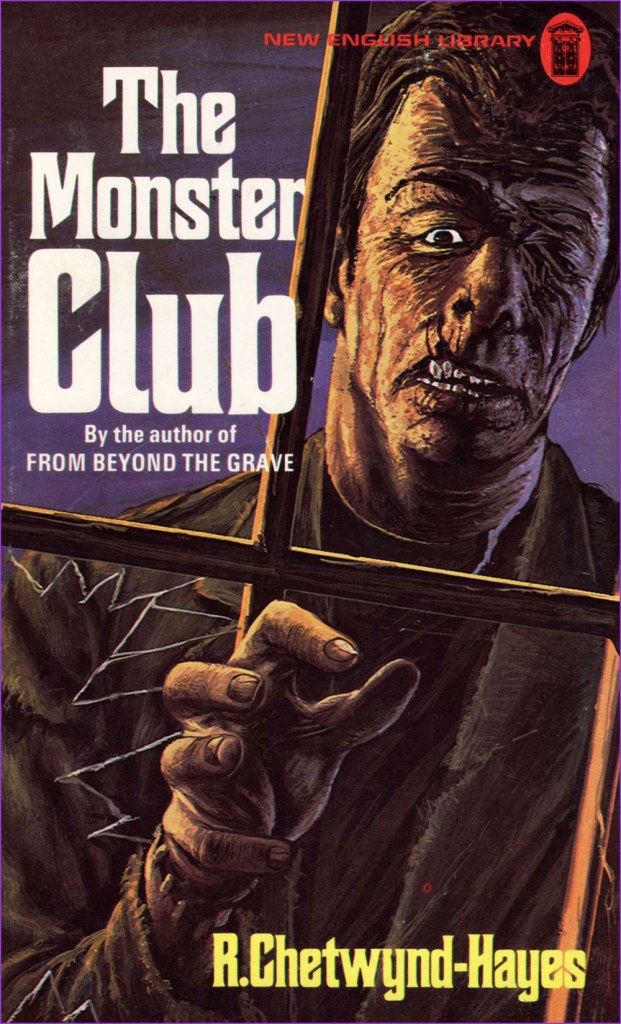
The cover of the original paperback edition (March 1976, New English Library). Would it have killed them to credit the cover artist, whose work is surely a strong selling point?

This material was reprinted (waste not, want not!) in Halls of Horror nos. 25 and 26 in 1983, then in North America, in a coloured version, in John Bolton’s Halls of Horror nos. 1 and 2 (both June 1985, Eclipse). And so here we are.

John Bolton’s (who else?) double spread cover painting.

As far as the adaptation goes, I must confess I far prefer the witty linking bits to the stories proper.

Lest we forget, this version was coloured by Tim Smith.

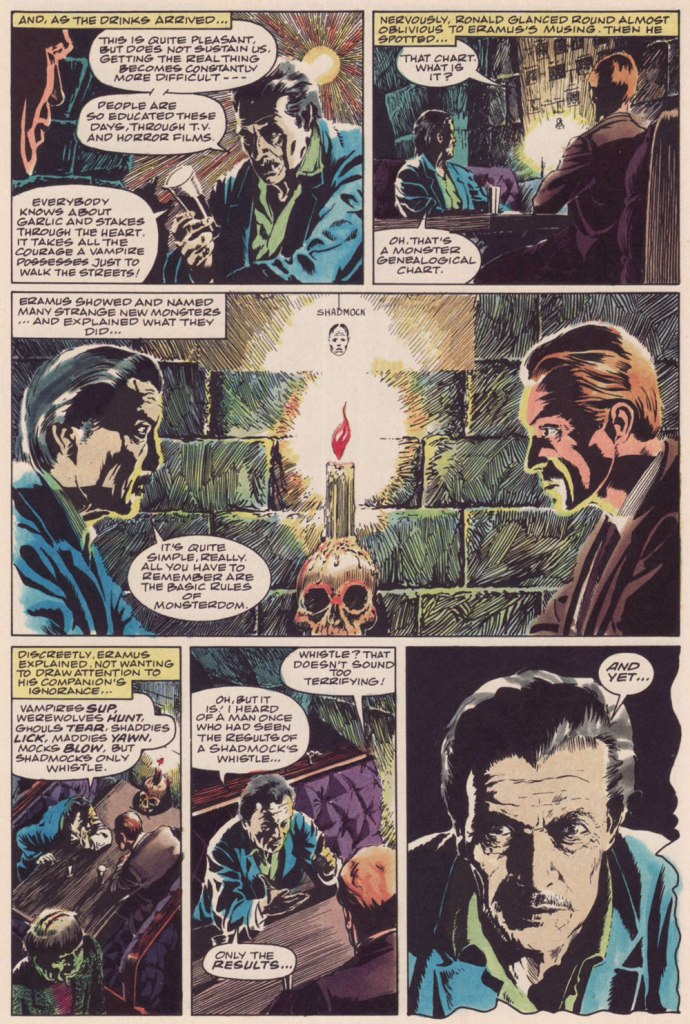
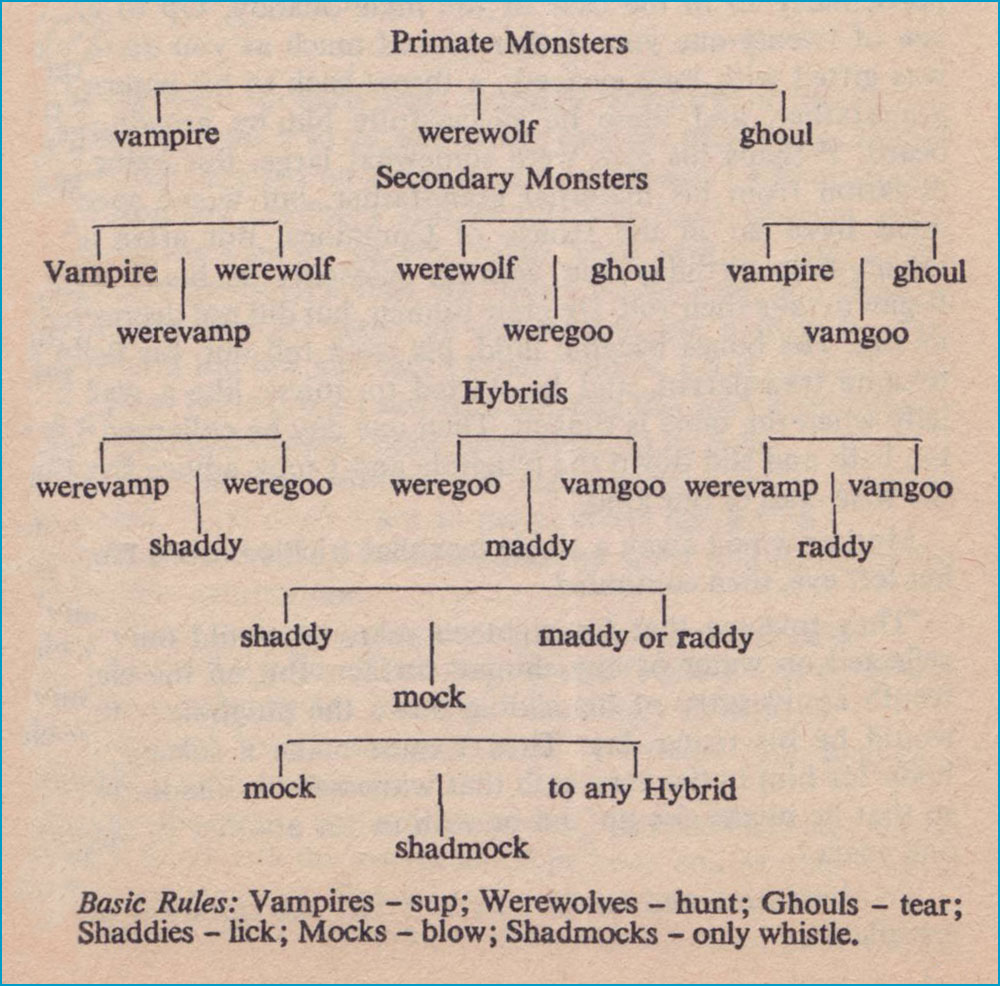
Among the most intriguing features of Chetwynd-Hayes’ book is his clever conceit of monsters forming an oppressed (by humanity) society with its own castes, hybrids, classifications and creeds. Here’s a most helpful table:

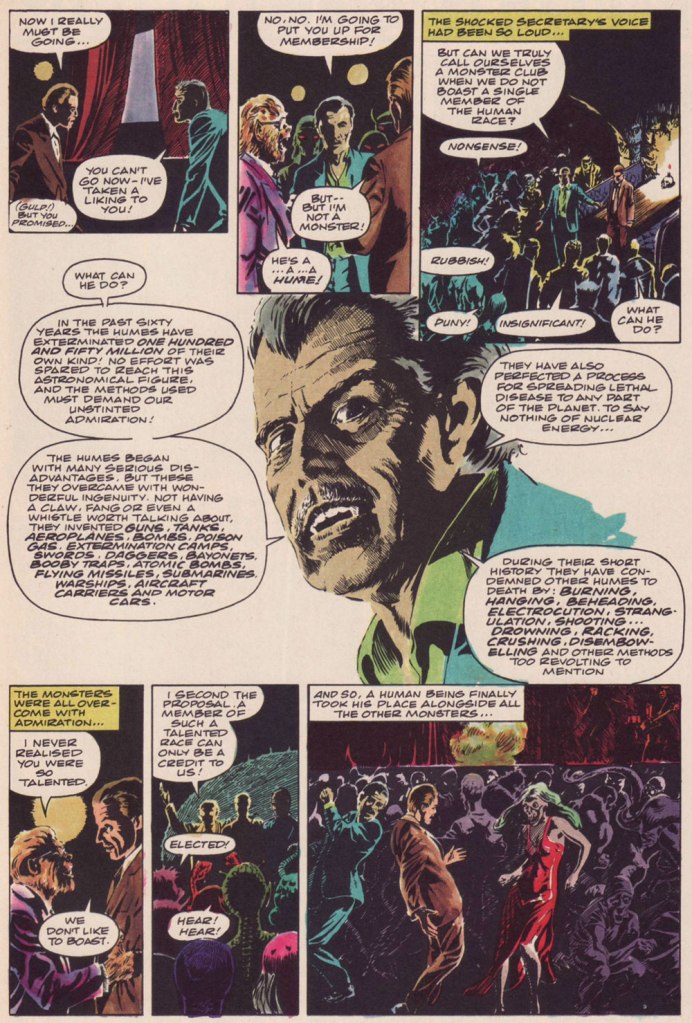
And the happy conclusion (after plenty of angst and grue in the stories). The movie’s better and the book better yet, but this was a worthwhile project and a fun curio.
This is The Ghoul, one of a set of specialty images Bolton created for the film’s promotion:

In closing, here’s a catchy musical number from the film, performed by one of my musical heroes, B.A. Robertson… not to be confused with T.M. Robertson, another favourite musician.

-RG

Hallowe’en Countdown VI, Day 13

« Everybody’s a mad scientist, and life is their lab. We’re all trying to experiment to find a way to live, to solve problems, to fend off madness and chaos. » — David Cronenberg

I take it that Monsieur Jacques Clouseau, aka The Inspector needs no introduction around these parts. So here he is:

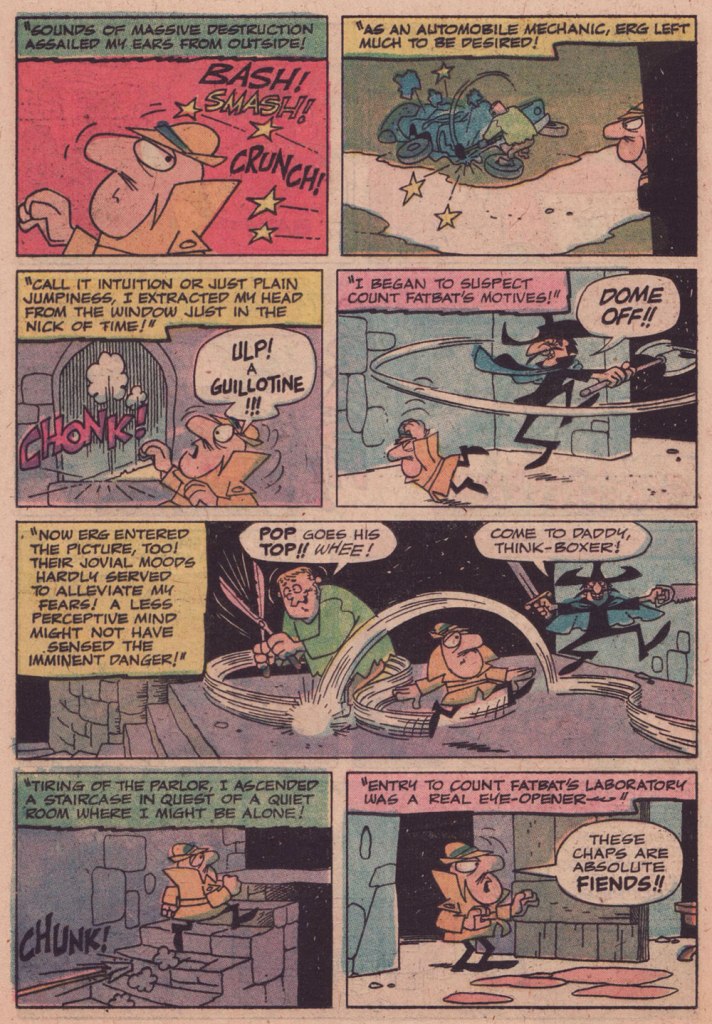
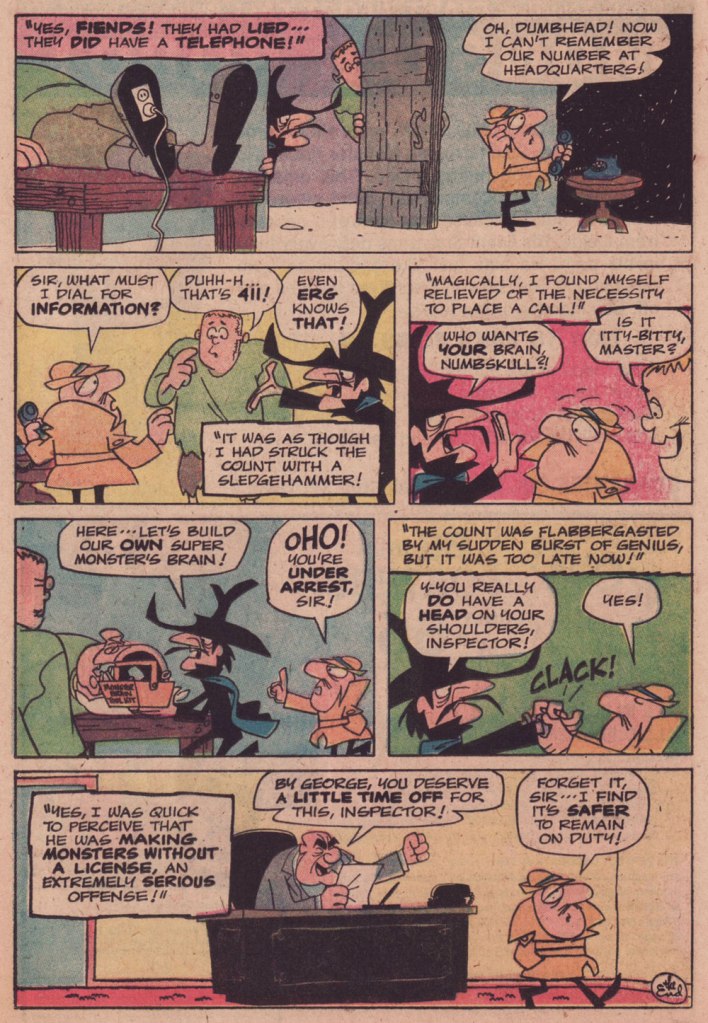
Case of: The Great Brain Bait, along with a trio of Pink Panther adventures, was featured in this, The Pink Panther no. 23 (Nov. 1974, Gold Key). Cover art attributed to Phil De Lara, though if it was indeed his work, it was published posthumously, De Lara having passed on to the Old Animators’ Home in the Sky in 1973.
While Gold Key’s Pink Panther and Inspector comics were fairly competently written and drawn (The Pink Panther didn’t last eighty-four issues for nothing) they could not hold a candle to Mirisch Films‘ mid-1960s Inspector shorts. In fact, this particular Inspector tale is a retelling/adaptation of one of these, 1968’s Transylvania Mania. Watch it for comparison (and enjoyment) — they’ll be six rather well-spent minutes of your time!

-RG