« Christmas, Christmas, Christmas, Christmas makes me happy I love Christmas cold and grey, I love it sweet and sappy Says crazy kissin’ Cousin Flo: ‘Let’s break out the mistletoe’ »
The heart-warming cover of that Four Color no. 201, 1948. Art by Walt Kelly. Check out the adorable moon-jumpin’ cow in the top left corner!This is the back cover of Dell’s Four Color no. 302 (Santa Claus Funnies), 1950. Such warm colours. Art by Canadian Mel Crawford, who worked on various Dell publications in the 1950s (such as Howdy Doody, Mr. Magoo, and Four Color Comics) to later become an accomplished watercolours/acrylics painter.
« Christmas, Christmas, Christmas, Christmas out the waz Christmas, Christmas, Christmas, Christmas up the schnozz Come all ye faithful, don’t be slow It’s Christmas time, you can’t say no»
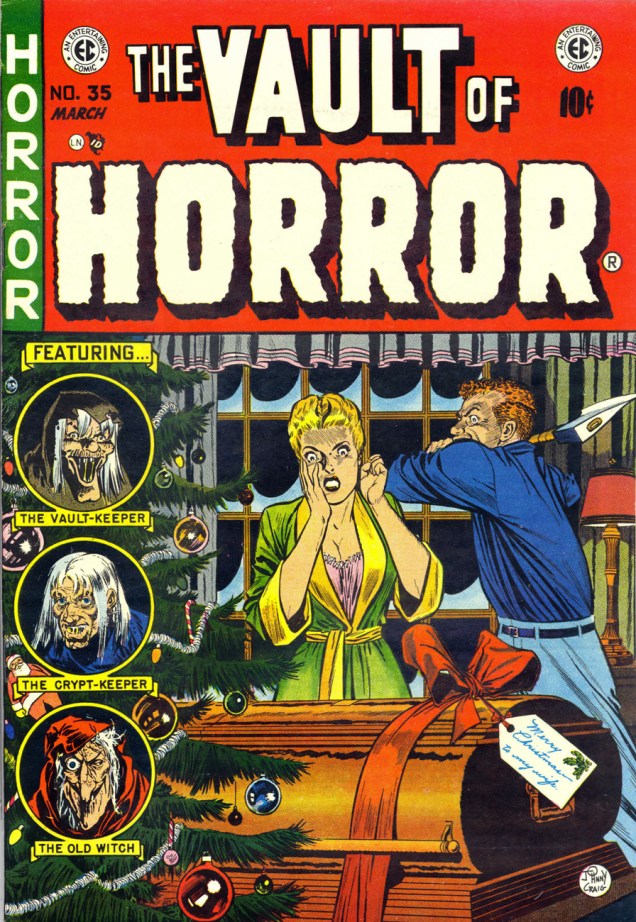
Creepy no. 68 (January 1975), cover by Ken Kelly. “House’ and “about” don’t rhyme, but it’s the season to forgive. I like how Santa appears to be bawling in frustration.Vault of Horror no. 35 (EC, 1954), cover by Johnny Craig. Maybe open the lid of the coffin first, dumbass?
« Momma wants a kitchen sink And daddy wants a stiffer drink Grandma wants us to cut the crap Grandpa wants a nice long nap »
Illustration by Richard Thompson. Who else wants some Festive Dietetic Crackers? I’d definitely sit with the mouse.
« Christmas, Christmas, Christmas, Christmas everywhere Christmas, Christmas, Christmas, Christmas pullin’ out my hair Shoppers lined up out the door Traffic backed up miles and more It’s Christmas time, so what the heck Let’s go spend the whole paycheck »
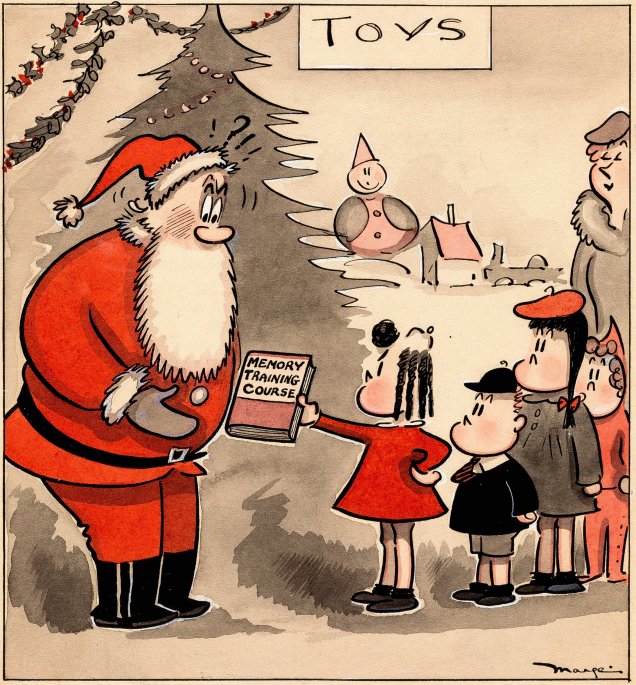
A Little Lulu cartoon by Marge Buell (Saturday Evening Post, 1944).From the pleasantly warped mind of Hilary Barta with a fond tip of the Santa hat to old Uncle Salvador, obviamente. Да да да!
« Deck the halls, it is the season We don’t need no rhyme or reason It’s Christmas time, go spread the cheer Pretty soon gonna be next year»
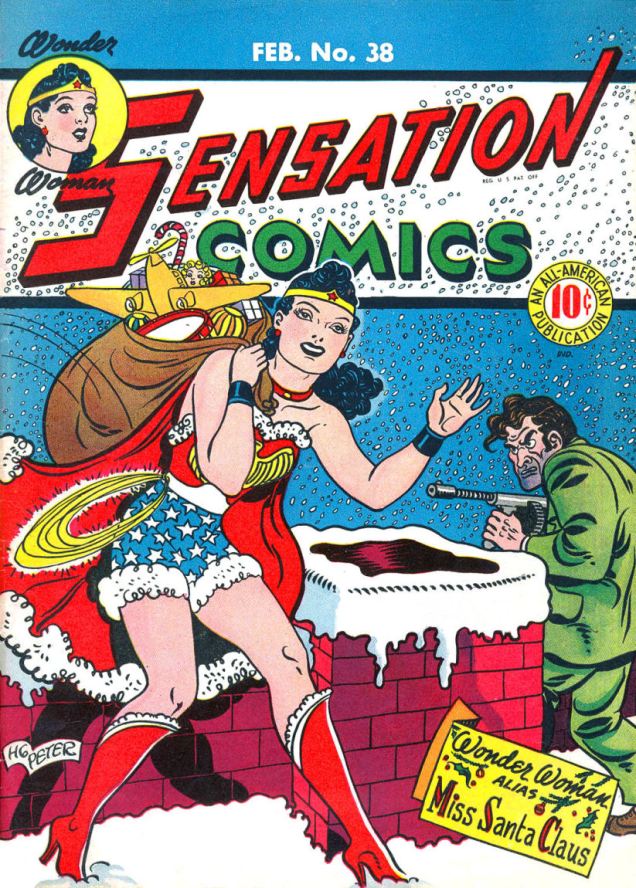
Sensation Comics no. 38 (1945), cover by H.G. Peter.Original art for a Christmas card of Little Orphan Annie by Harold Gray. Just some 70 years ago, right?
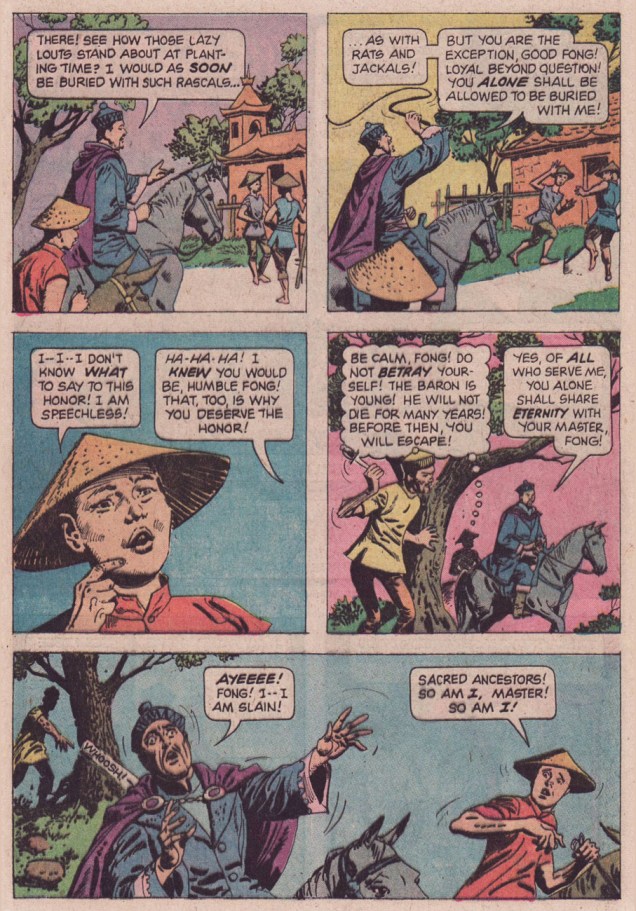
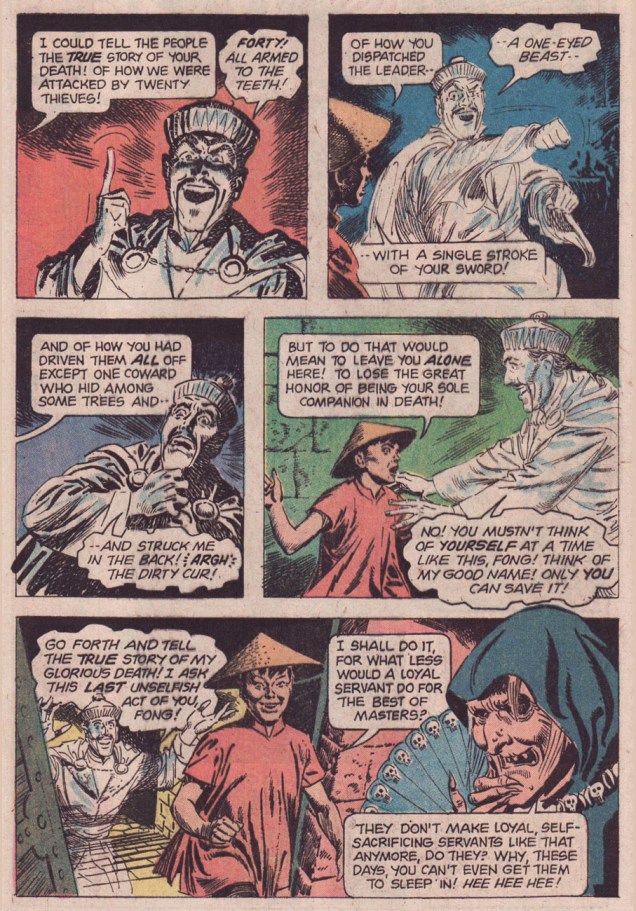
« Followers in death: Attendants and relatives who were killed so they could be buried in the tomb with the person (normally someone very important or wealthy) who had died. » — The British Museum
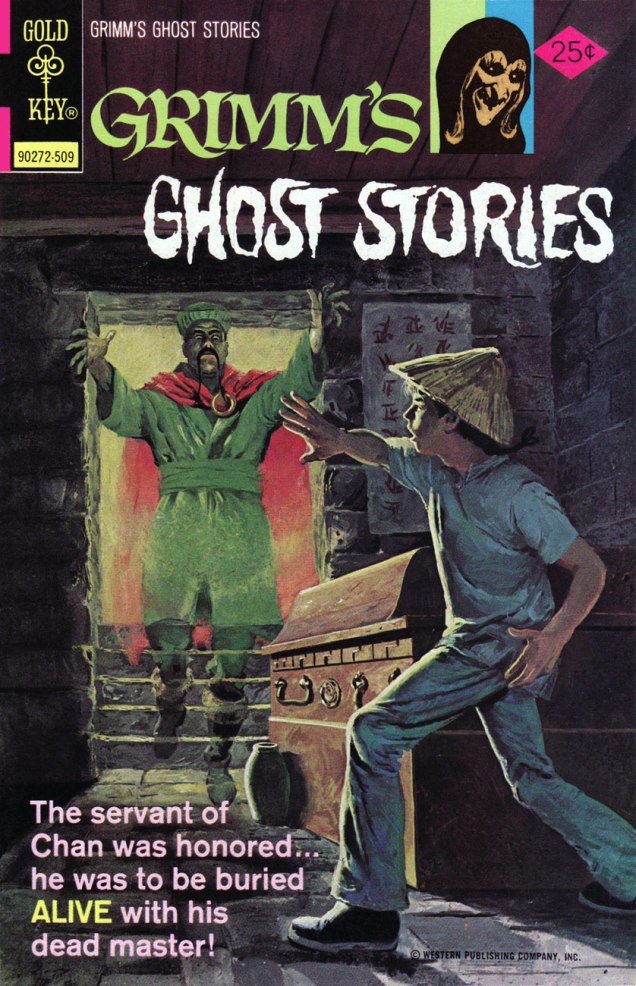
Let’s face it, Gold Key’s would-be-spooky comics rarely lived up to their habitually fine painted covers (mostly courtesy of hard-working George Wilson, with Vic Prezio, Luis Domínguez, Jesse Santos or Jack Sparling occasionally chipping in); as with most things, there were exceptions: I’ve raved earlier about a particular issue of the generally ho-hum Grimm’s Ghost Stories, namely issue 26, boasting, along with the usual Paul S. Newman sleep aids, two excellent yarns from the undervalued Arnold Drake (co-creator of The Doom Patrol, Deadman, and the original Guardians of the Galaxy).
Ah, but today, we’re celebrating Drake’s co-conspirator, the prolific Argentine master (yes, another one) Luis Ángel Domínguez, reportedly born ninety-five years ago to the day (Dec. 5, 1923), and still among the living… as far as we know. I like to envision him warmly surrounded by several generations of loved ones and well-wishers, an impish gleam in his eye.
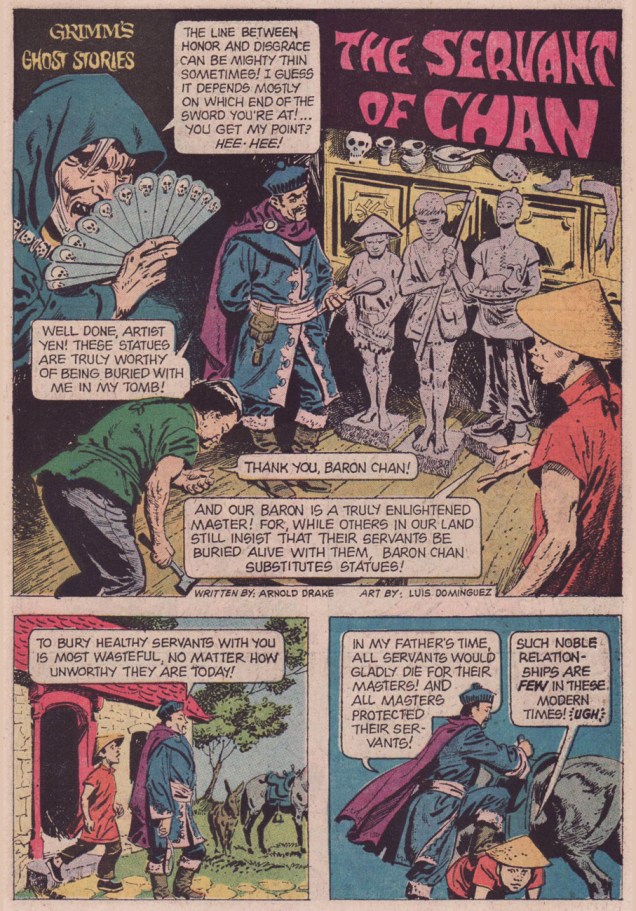
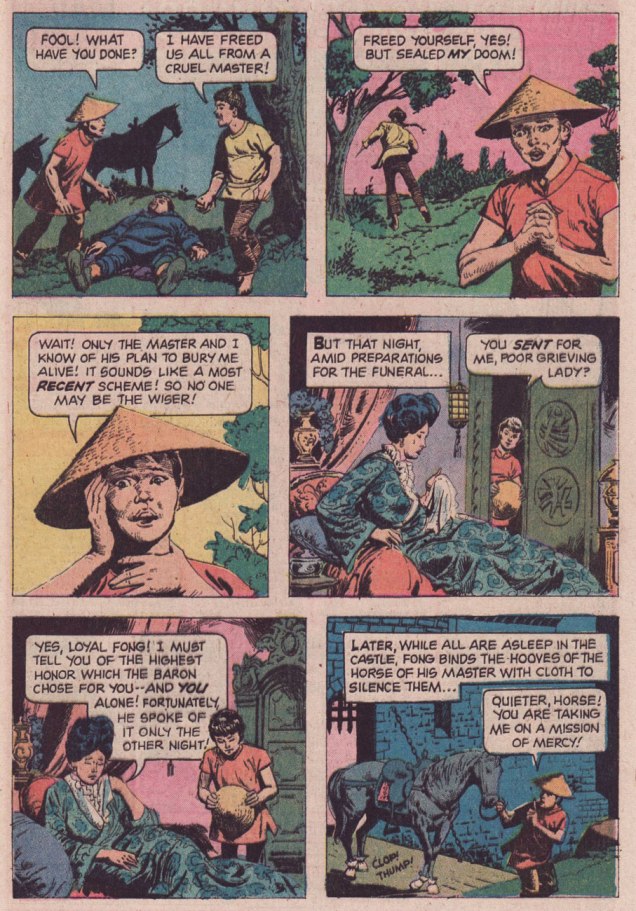
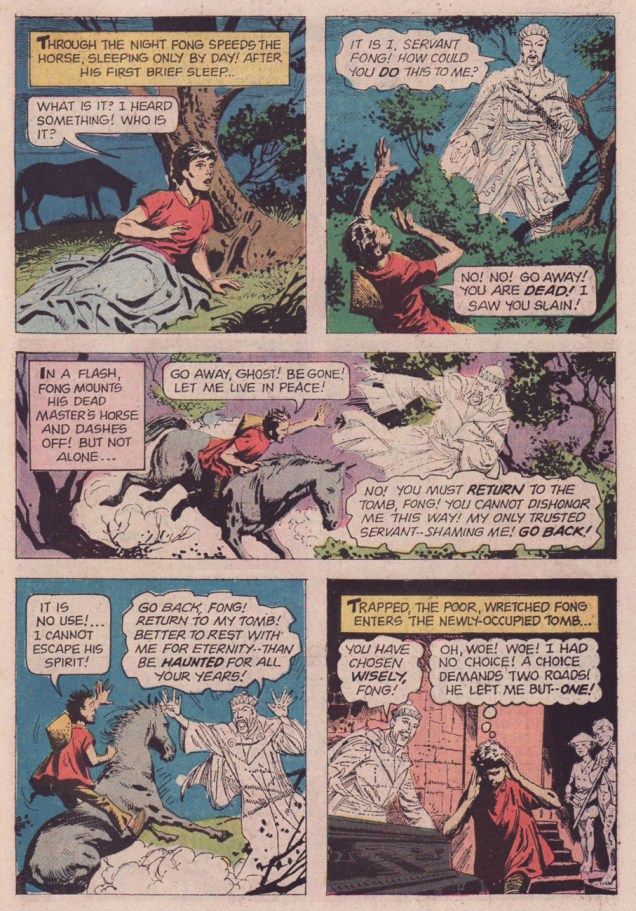
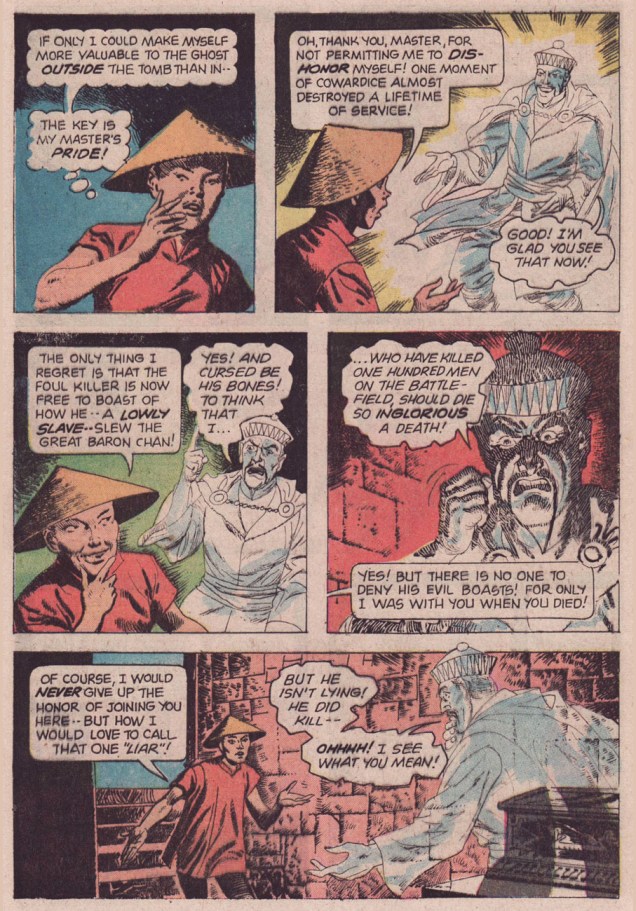
Without further foot-dragging, here’s a vintage tale of quick wits in ruling class hubris from beyond the grave, The Servant of Chan, by that dastardly duo, Drake and Domínguez.
George Wilson’s cover highlights a dramatic scene from our little story. This is Grimm’s Ghost Stories no. 26 (Sept. 1975, Gold Key).
« Slavery in ancient China was not a pleasant experience. The lives of slaves were filled with hardship. Many were abused. Many slaves were children.
Most people who were slaves worked in the fields, alongside of peasants. They did the same job, and had the same hours, and pretty much the same clothing and food, as free farmers. But they were not treated with the same respect given to farmers. Some slaves built roads. Some worked in government.
But slaves who worked for the emperor, the royal family, and sometimes the nobles, had the worst of it. They could only do what they were told to do. They were treated in any way that their master and his family felt like treating them. Many were treated with great cruelty. When their master died, they were killed, and buried with their master in his tomb, so they could continue to serve their master after his death. »
Brr. All the same, if you’ve enjoyed this yarn, check out Arnold Drake’s other contribution to this issue, The Anti-13, which we enthusiastically featured some time ago.
¡Feliz cumpleaños, Señor Domínguez… wherever you may be!
« I’m not content when I’m traveling, but I’m not content when I’m not traveling. So I guess I’ll keep traveling. » – Shel Silverstein
Another one of those nice Jewish boy geniuses, Sheldon Allan Silverstein (1930-1999) was born eighty-eight years ago, on September 25, 1930, in Chicago, Illinois. Uncle Shelby lived life to the fullest, creatively in every respect. He tried his hand at many things, and what do you know? He succeeded at every often-unlikely turn, sometimes artistically if not commercially, but generally on both counts: cartoonist, singer, songwriter, screenwriter, poet, actor, playwright, children’s book author, bon vivant, raconteur and lover… yet his dad was never impressed. Old man Nathan wanted his son to join him in selling furniture. Some obstacles are just plain insurmountable.
Once more, faced with the daunting prospect of discussing a prolific and versatile creative soul, it seems well-advised to concentrate on a tiny area of his roadmap. And so…
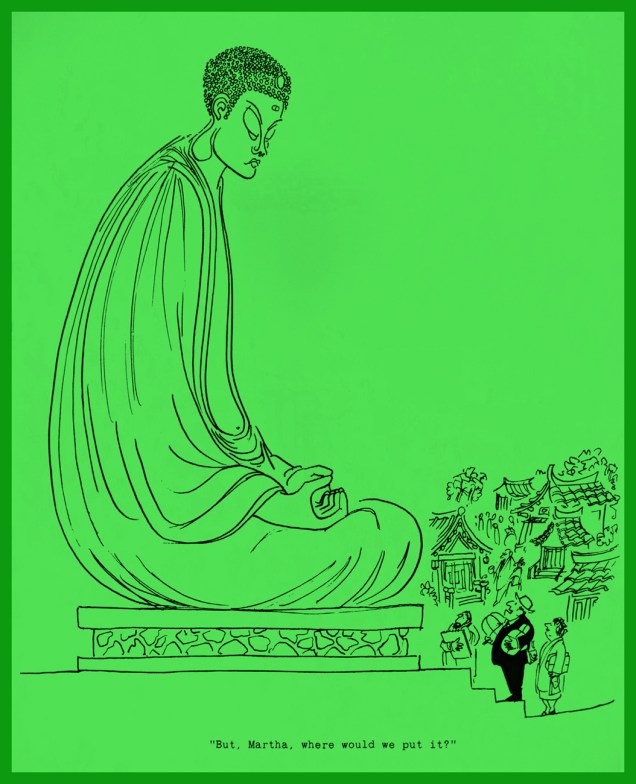
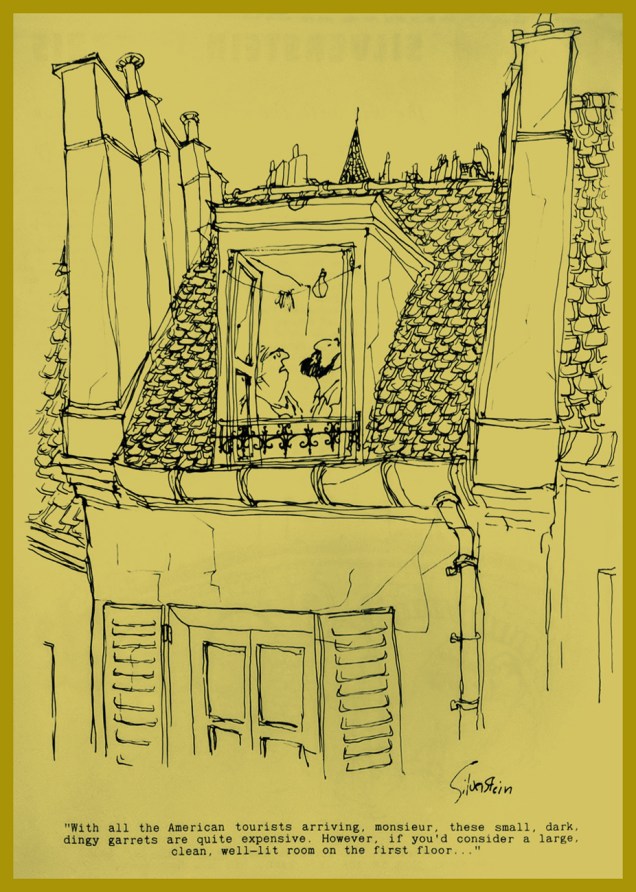
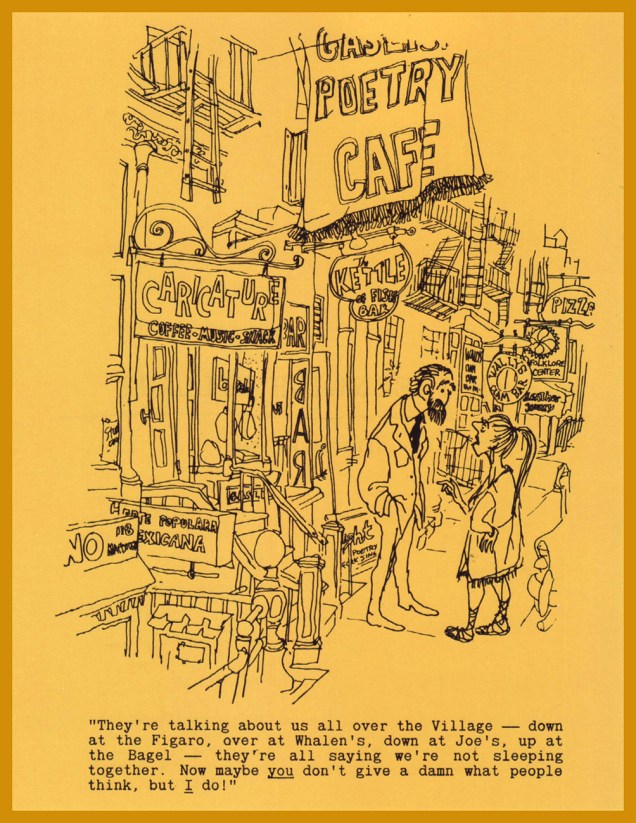
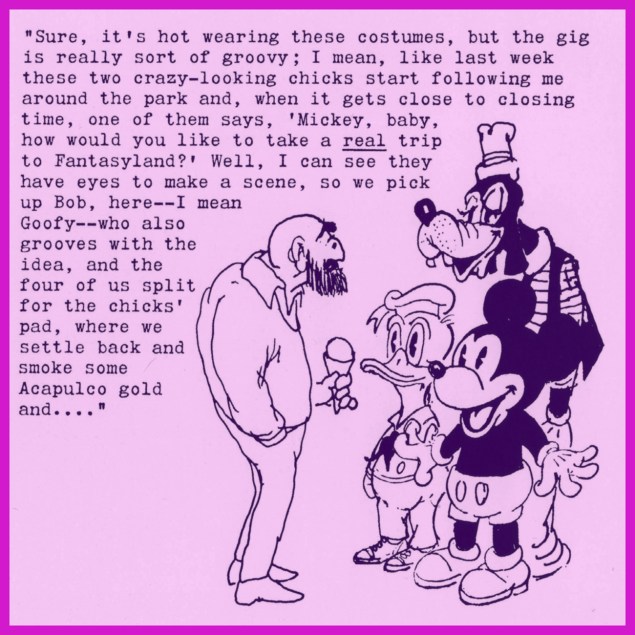
In 1957, Playboy magazine founder and esteemed patron of cartoonists Hugh Hefner entrusted Shel with a special assignment, that of roaming the Earth and recording his special impressions. The results, published between 1957 and 1968, were twenty-three travelogues brimming with the gregarious Silverstein spark and spirit. But he first had to be sold on the approach. According to Hefner, in his foreword to the definitive collection “Playboy’s Silverstein Around the World” (2006), « I envisioned something along the travel letters Ernest Hemingway submitted to Esquire — A sort of personal diary that would be dispatched from around the globe. Shel was uncomfortable in that role. He didn’t want to include himself, but I persisted. And I’m glad I did. What we got back in those drawings was narrative storytelling of a very personal manner. We saw Shel establish himself as a character.»
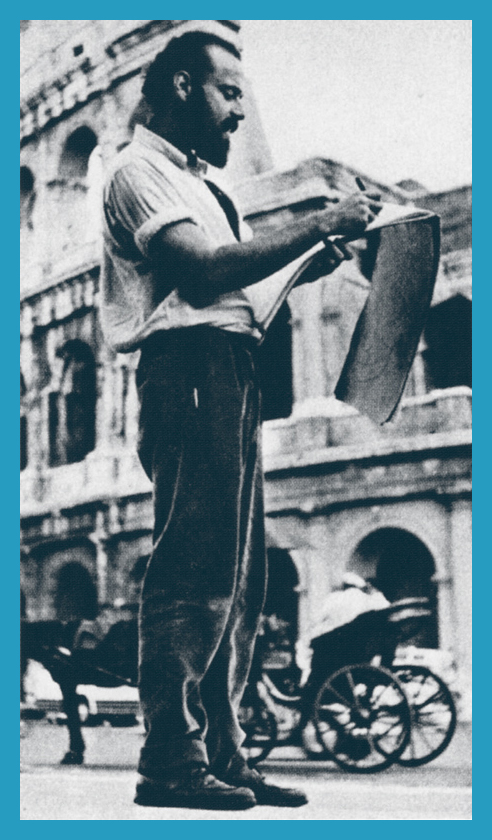
From “Return to Tokyo” (May, 1957).From “Silverstein in Paris” (January, 1958).From “Silverstein in Moscow” (March, 1958).From “Silverstein in Greenwich Village” (September, 1960).From “Silverstein in Hollywood” (January, 1968).From “Silverstein Among the Hippies” (August, 1968).Shel at work in Italy (1958); photograph by John Reid, Jr.
Let’s leave off with these revealing words from Playboy photographer Larry Moyer: « He was one of the funniest guys I ever knew — and it was never at anybody’s expense. A lot of humor is based on putting other people down. I don’t remember one time Shel ever put anybody down in his work — and that’s something. » That’s something indeed, now more than ever.
« They’re drinkin’ red-eye, playin’ stud poker, and havin’ a high old time! I’ll just hang around awhile… »
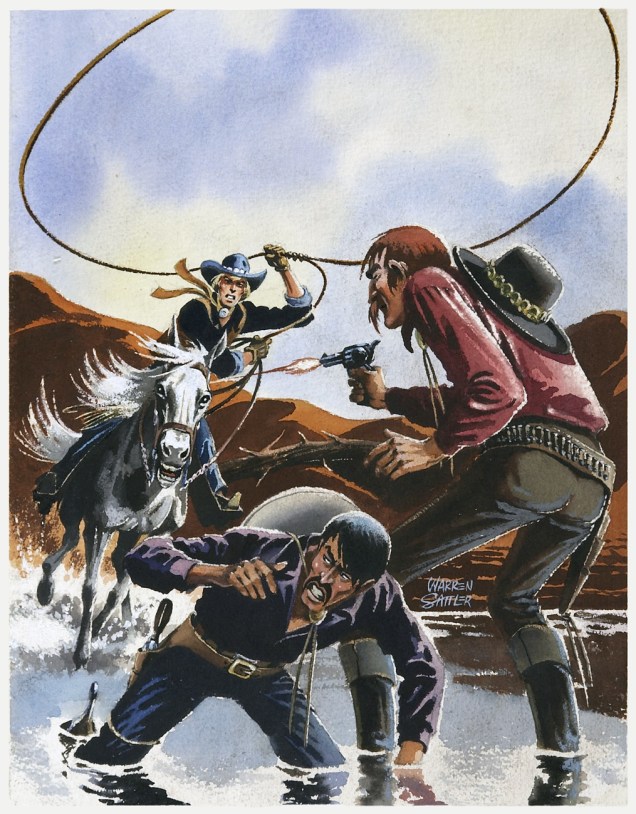
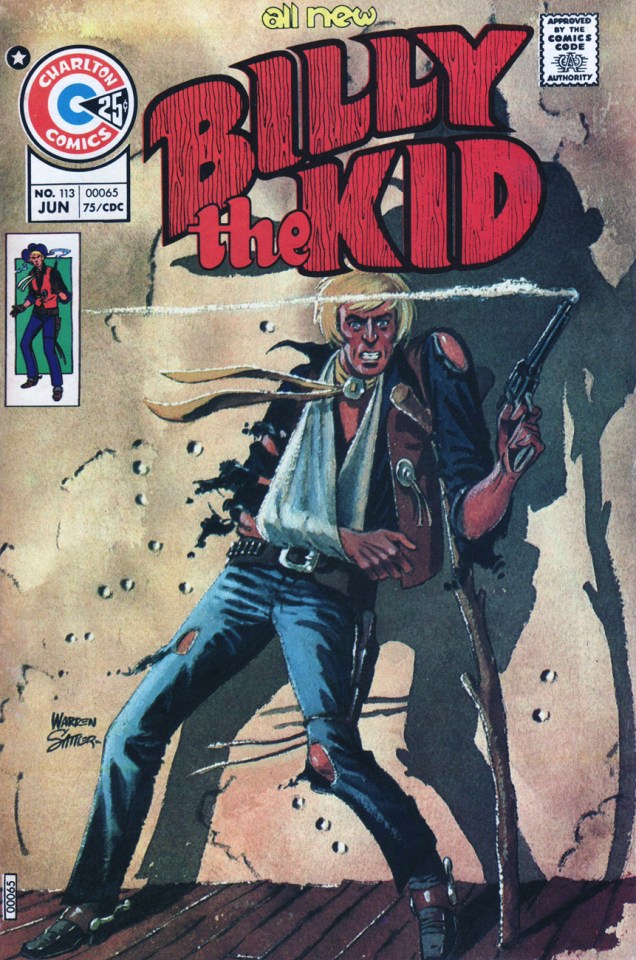
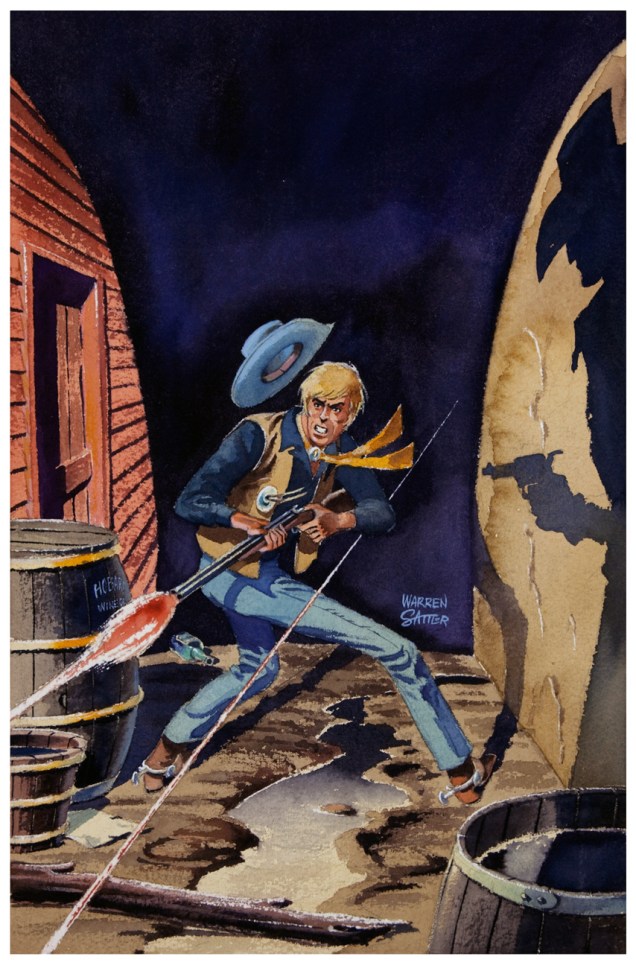
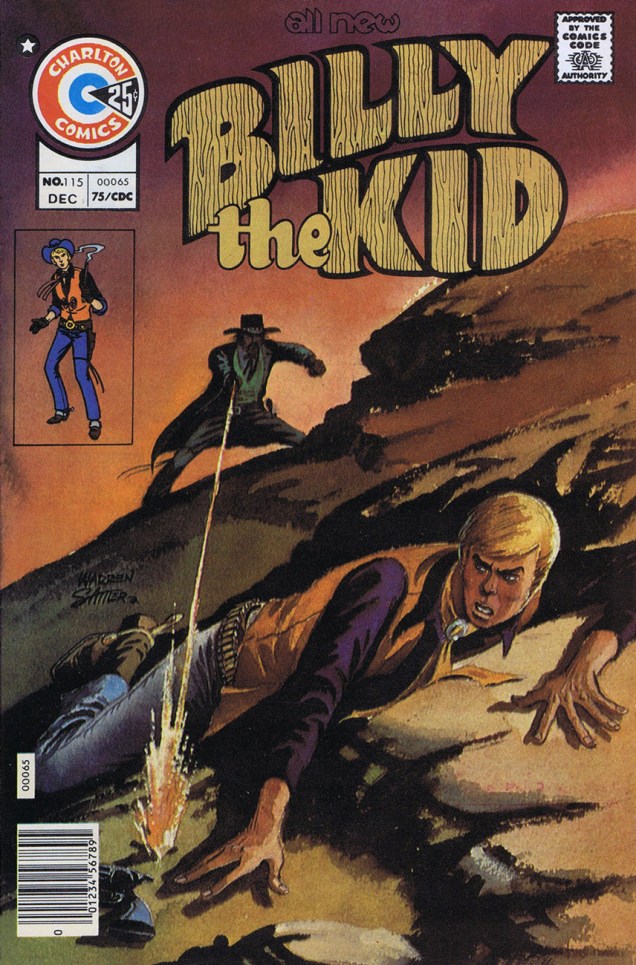
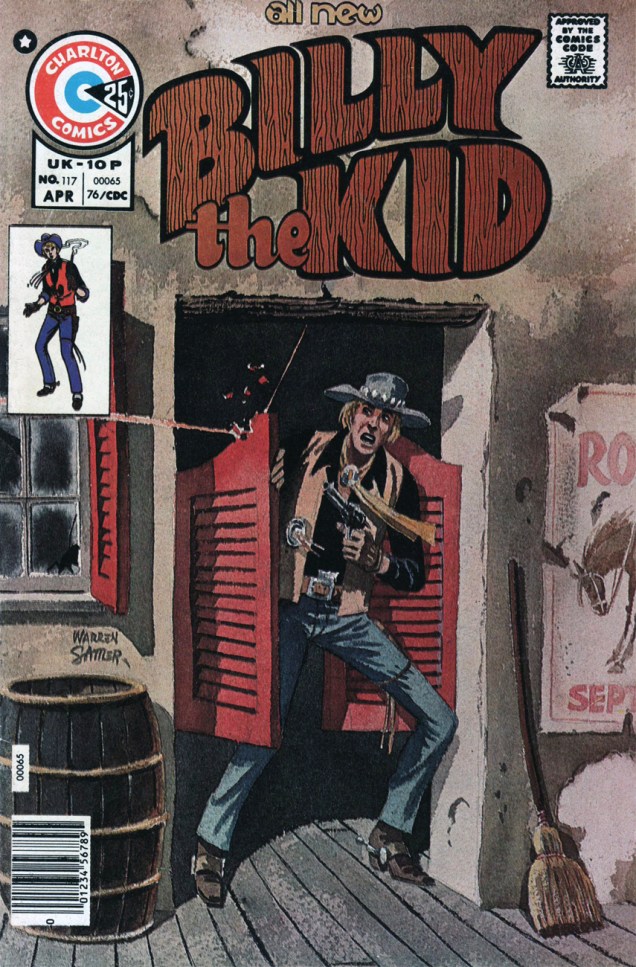
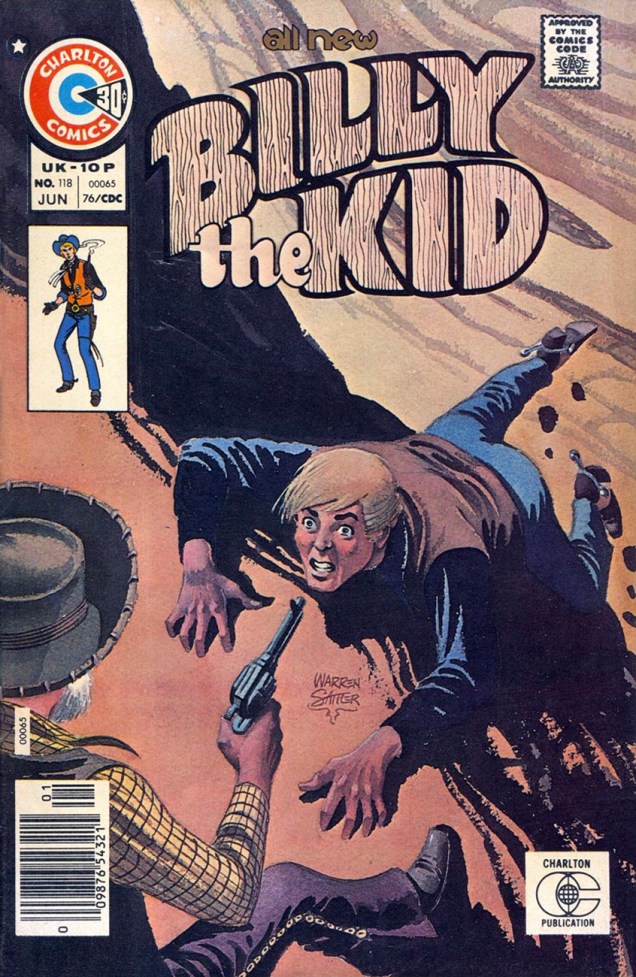
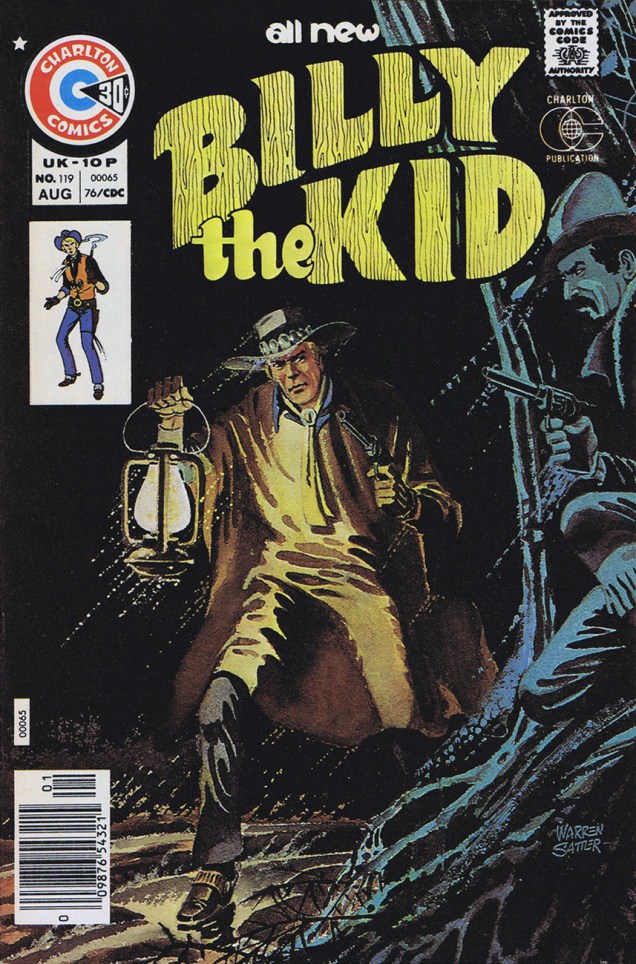
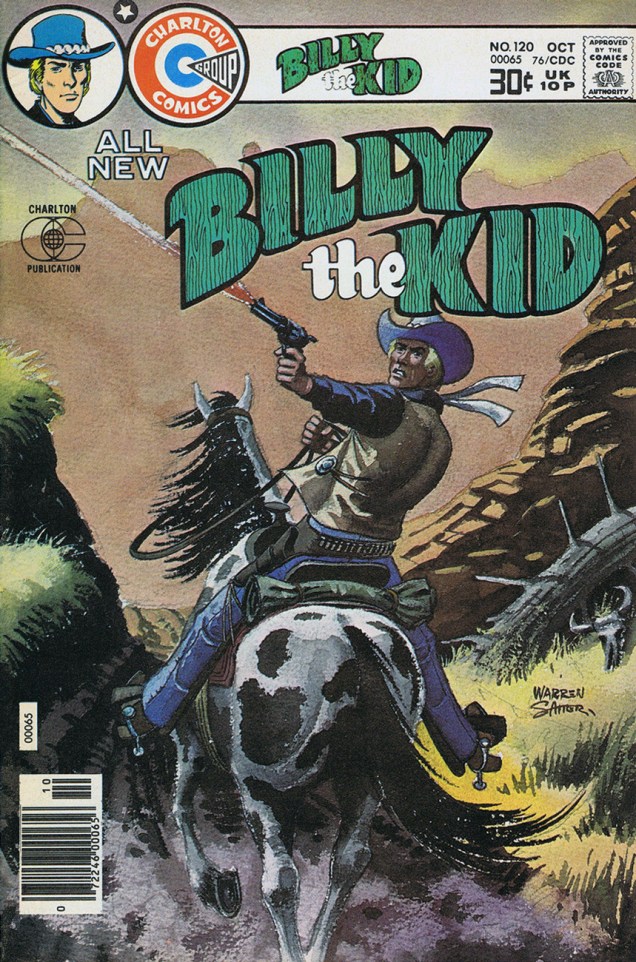
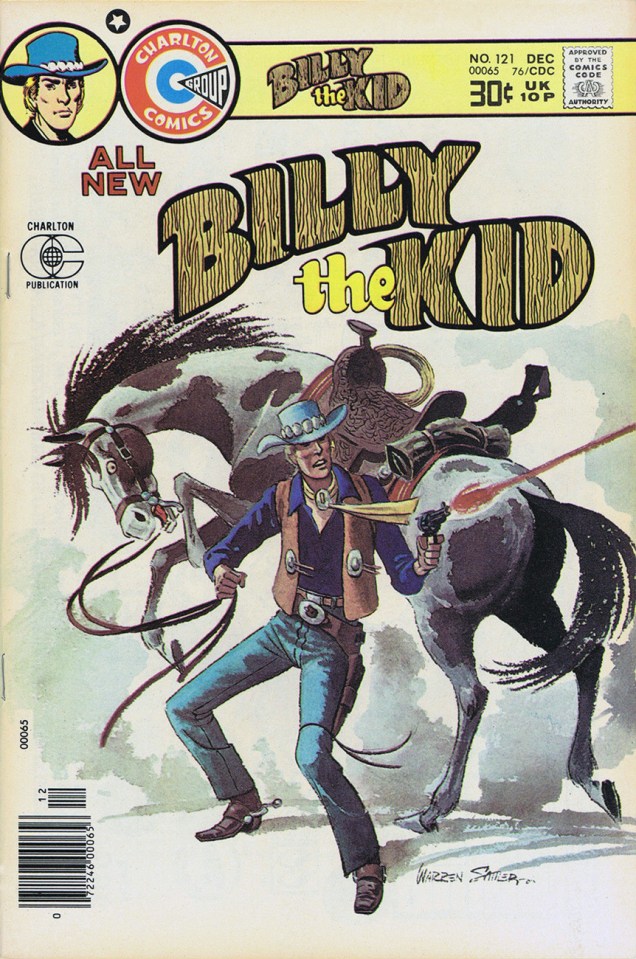
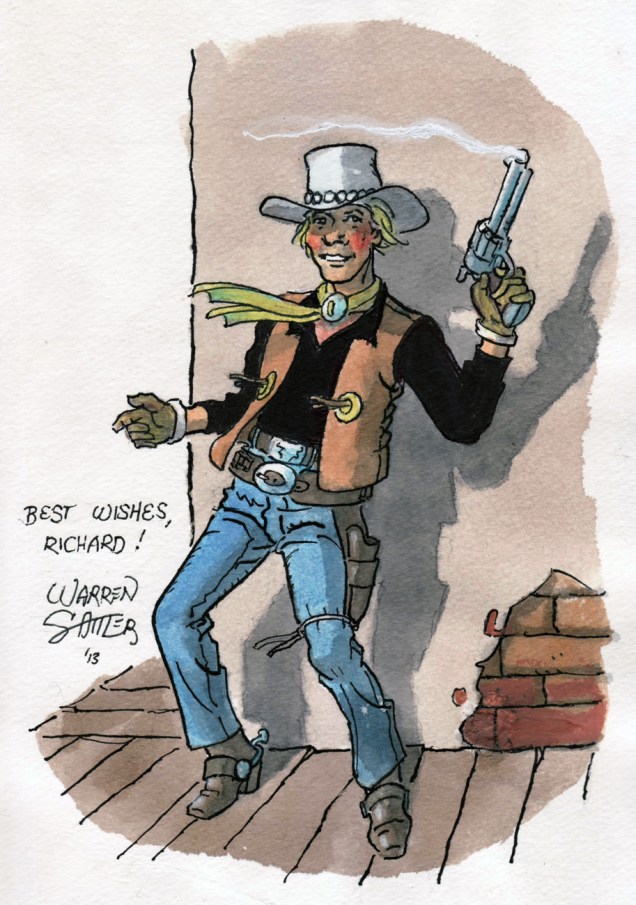
In the mid-1970s, thanks to Pat Boyette’s connections in Texas, Charlton Publications found themselves able to affordably produce painted covers, a development that several members of their iconoclastic stable of artists took full and glorious advantage of. Tom Sutton, Don Newton and Boyette were naturals, but Warren Sattler often gets unfairly sidelined from that esteemed lot… perhaps because he rarely worked for Charlton’s ghost books. Each of his cover paintings was produced for the publisher’s western / martial art adventure series, Yang, House of Yang, and Billy the Kid. And he alone worked in that most unforgiving of media, watercolours, wherein, unlike oils or acrylics, one requires unerring confidence and dexterity if you’re aiming to come up with anything above a muddy mess.
Today, Mr. Sattler (born September 7, 1934, in Meriden, Connecticut, where he resides to this day) celebrates his eighty-fourth birthday. Let’s wish him all the best!
Over the years, I’ve become quite enthused with Charlton’s long-running Billy the Kid series (1957-1983!), which featured over the years the artwork of such luminaries as John Severin, Maurice Whitman, Rocco “Rocke” Mastroserio, José Delbo and of course Mr. Sattler. As far as I know, Joe Gill just about wrote the entire series, which is one of its chief pleasures: over a hundred issues of consistent characterization of young Bill Bonney as a peace-loving, unprejudiced champion of the underdog whom his amigos in Old México fondly nicknamed « El Chivito ». I know, hardly the real-life Bill Bonney, but what could one expect under the Comics Code Authority‘s heavy thumb?
Several of Mr. Sattler’s cover paintings have, thank goodness, survived destruction. They have to be viewed in person to be fully appreciated. For the nonce, we’ll make do with mere digital reproductions.
For his first painted comic book cover (or second, Yang no. 7 appeared that same month), I believe Mr. Sattler got the proportions slightly wrong, so the cover art was cropped fairly tight horizontally, which still made for a striking, action-packed cover, but since we’ve got the original…Two Billy adventures appear in this one: the cover-featured “The Good Life” and “The Spoilers!”This one was featured as the cover of Billy the Kid no. 114 (Oct. 1975), illustrating Gill and Sattler’s “Killers in the Shadows!”I’m sure Billy would be admiring the lovely light of dusk if he wasn’t being ambushed. Such a splendid and unusual (for comics) palette!The printed version of this painting, which appeared on the cover of Billy the Kid no. 116 (Feb. 1976), lost quite a bit of its subtlety in translation, so I’m happy to show you the original. I love that bit of yellow in the clouds, echoed in the bushwhacker’s shirt. For the first time, a solo Sattler Billy the Kid tale, “The Treasure”.
Beautiful composition, and an effective and economical way to convey height and distance. Note the cattle horns in the artist’s signature.This one’s mood and palette bring to mind the work of Doug Wildey. A good thing, you understand. Excellent use of the « dry brush » technique for texture.After several issues’ absence from the insides, Mr. Sattler reunites with Joe Gill on “Three for the Money!”One final painted cover before Charlton rode off into the sunset…. for the first time.
Mr. Sattler, a true prince of a man, created this piece especially for me a few years ago… without any request on my part! But you can bet I’ll always be grateful for this touching act of generosity and kindness.
As El Chivito’s many friends across the border would surely say, « ¡Que cumplas muchos más! », and thanks for everything!
« If i should sleep with a lady called death… » – E.E. Cummings
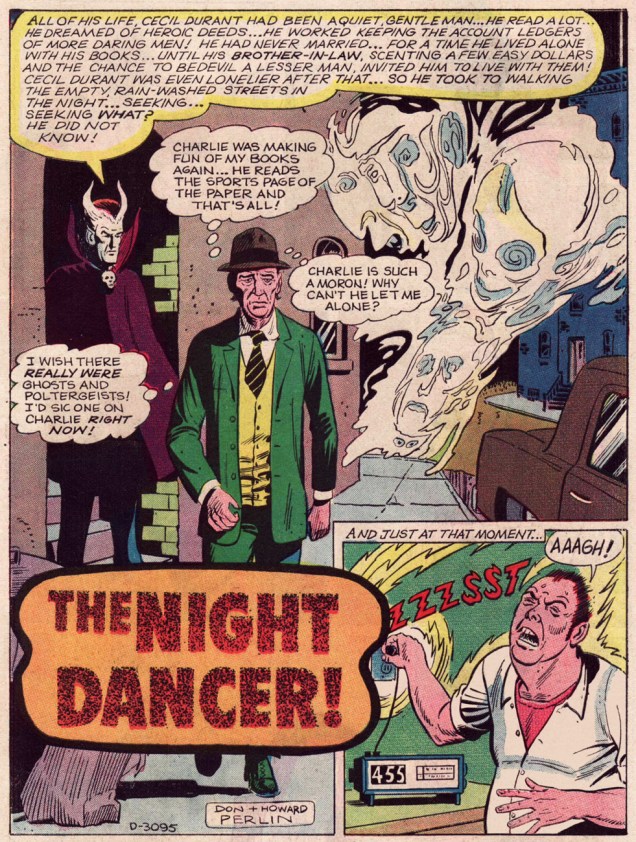
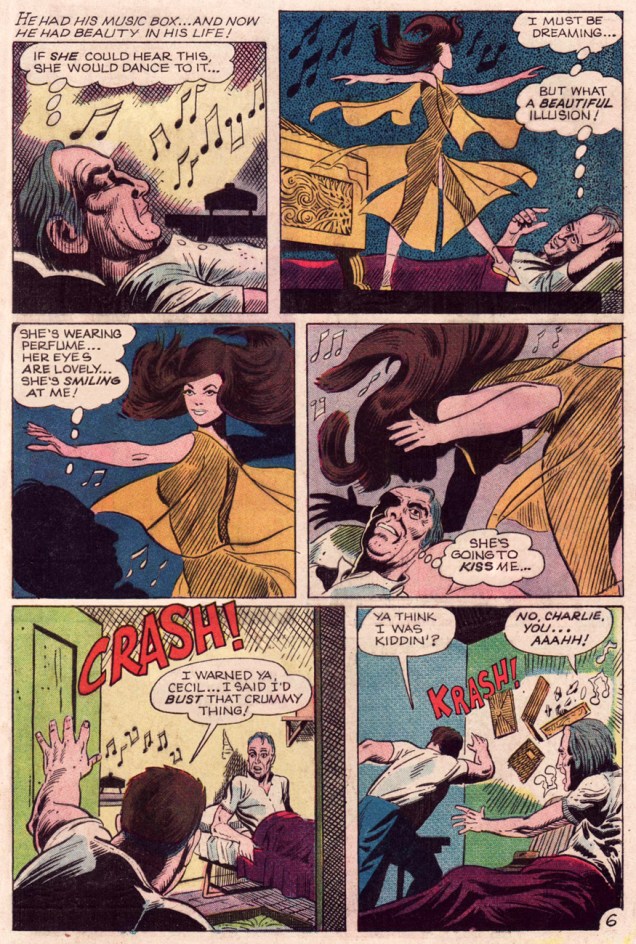
This time out, I’ve plucked a delicate story that’s resonated with me since our first encounter… somehow, the tragic plight of a lonely, vulnerable old man touched me deeply, even if I couldn’t have been more than ten years old when first I read it.
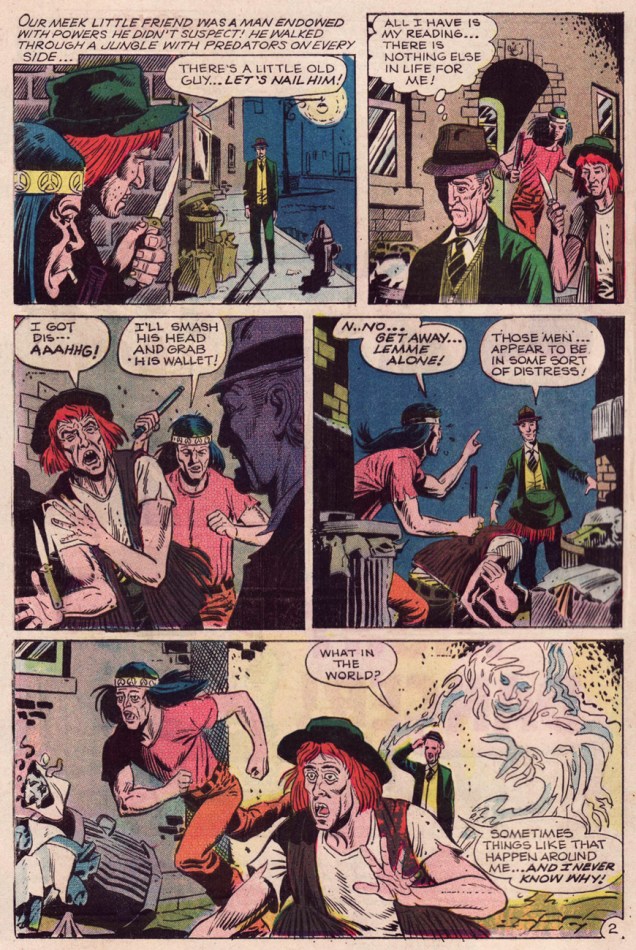
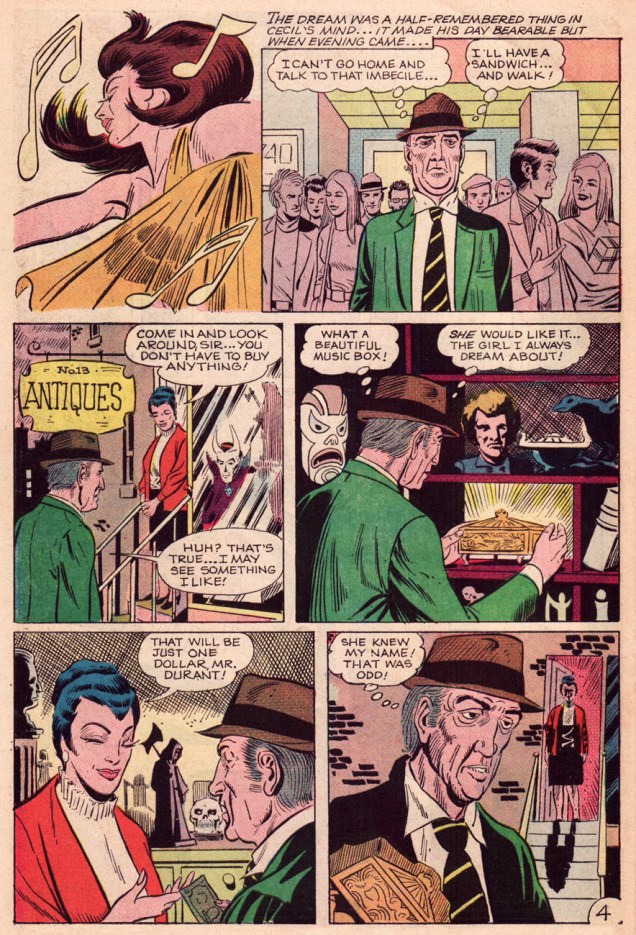
In the intervening years, witnessing the rise of elder abuse, the growing fragility of my own parents, and the sometimes desperate loneliness of acquaintances, old friends and strangers alike, Joe Gill and Don Perlin‘s The Night Dancer! (Ghostly Tales no. 99, Nov. 1972, Charlton) has steadily gained in poignancy. Its spirit, theme and mood remind me of some very fine tales by Joseph Payne Brennan*, who conveyed all too convincingly the quiet desperation of a near-destitute life lived with scant hope or companionship.
On a more cheerful note, it happens that (okay, it’s no accident) ‘Dauntless’ Don Perlin celebrates his eighty-ninth anniversary on this very day. While he’s most appreciated for his runs on Werewolf By Night, Ghost Rider, Moon Knight (his co-creation with writer Doug Moench) and The Defenders at Marvel Comics, I steadfastly cling to the notion that his finest efforts were brought to bear on hot rod and ghostly yarns for Charlton at the dawn of the 1970s. Judging by the results, I’d venture that he’s especially inspired by adventures set in the American Southwestern desert country. I’ll return to this topic in due time and present my case.
Without further tarrying ‘n’ foot dragging, meet our hapless protagonist, Cecil Durant… and his tormentors and benefactors.
While Mr. Perlin never became a superstar (and I suspect it never was his goal), the longevity of his career is easily explained: solid craft, excellent storytelling skills, a clean, unfussy line, and of course that supreme asset: reliability. Incidentally, co-credited Howard Perlin was Don’s young son, who was helping dad out around the studio that day.
Yom hu’ledet sameach, Mr. Perlin… and many happy returns!
– RG
*particularly The Way to the Attic (1967) and Mrs. Clendon’s Place (1984)
« On my entire street there were only two kids that went to high school… that was the equivalent in those days of making Phi Beta Kappa. »
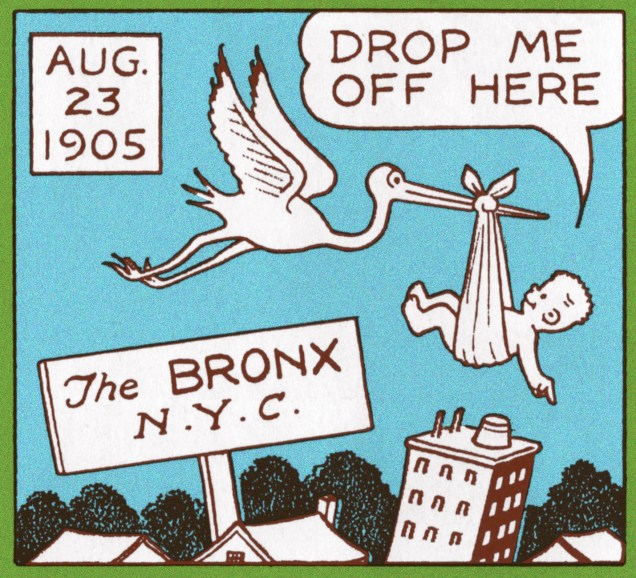
On this, the one-hundred and thirteenth birth anniversary of the oft-misunderstood Ernie Bushmiller (23 August 1905 – 15 August 1982), was I going to go through a veritable mountain of Nancy strips, naïvely hoping to pare it down just the one? No sir, not me. Life’s too short.
A tidy bit of autobiography from the pen of Mr. B.
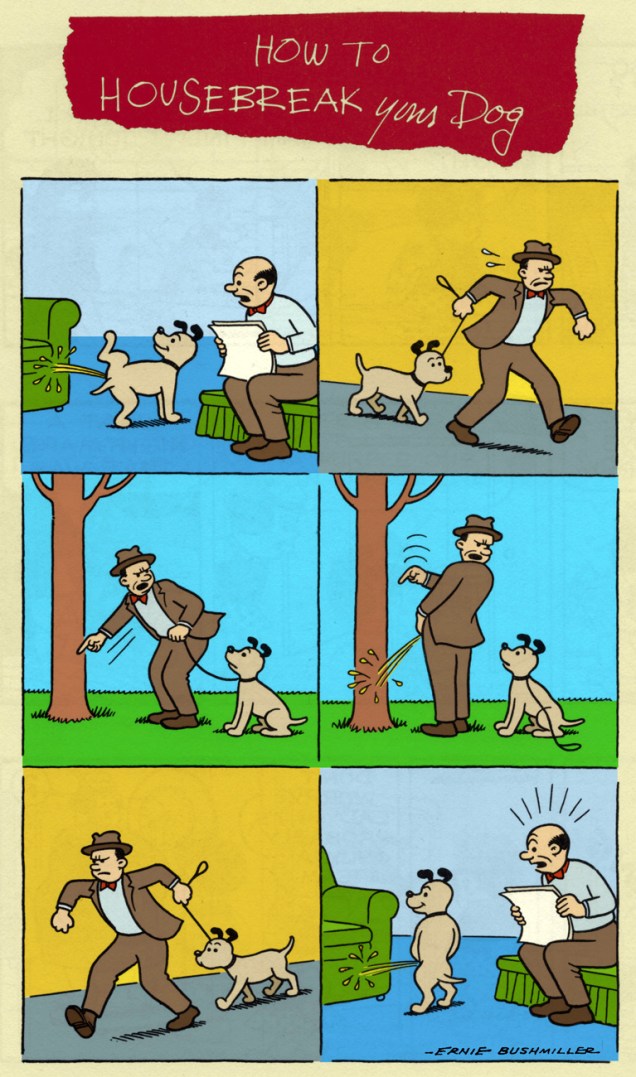
Instead, here’s an oddity that Ernie created, historians say, for the Dutch Treat Club* Yearbook (1961). Bushmiller referred to the often-imitated and bootlegged, now-famous cartoon as « the only dirty thing I ever did ».
I decided, a couple of years back, to colour the piece myself, and to restore Bushmiller’s signature. Can you believe the gall of some people? (Rhetorical question, I know.) Here at WOT, we firmly believe in proper authorial attribution.
Happy birthday, Mr. Bushmiller, and thanks for all the chuckles.
– RG
p.s. Thanks to Bushmiller scholar-cartoonist Mark Newgarden for doing the legwork as to provenance. I’m standing on the shoulders of giants, as usual! Oh, and since it’s quite relevant (and even if it wasn’t), if you’re a true-blue Bushmiller aficionado, you owe it to yourself to check out Messrs Paul Karasik and Newgarden’s « How to Read Nancy » (2017, Fantagraphics).
A portrait of Ernie from the brush of his esteemed colleague Frank Godwin.
*If you’re, er… qualified, it’s not too late to join the Dutch Treat Club!
The Old Underground Hall of Legends took some bad hits in 2017, with the losses, within less than a couple of weeks, of Jay Lynch (January 7, 1945 – March 5, 2017) and Mervyn “Skip” Williamson (August 19, 1944 – March 16, 2017). Skip, in fact, would have turned seventy-four today.
Again, we’re dealing with an artist with a long and nomadic career, so it’s best to think small. There’s plenty of excellent, in-depth biographical material on the subject already out there, so I’ll scare up a few scarce items that reflect Skip’s lifelong love of (and involvement with) music.
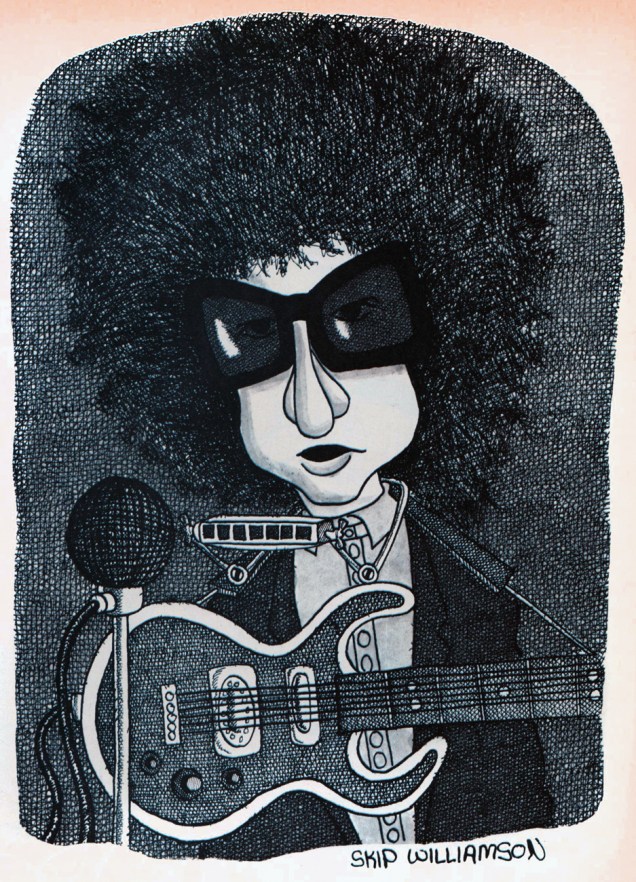
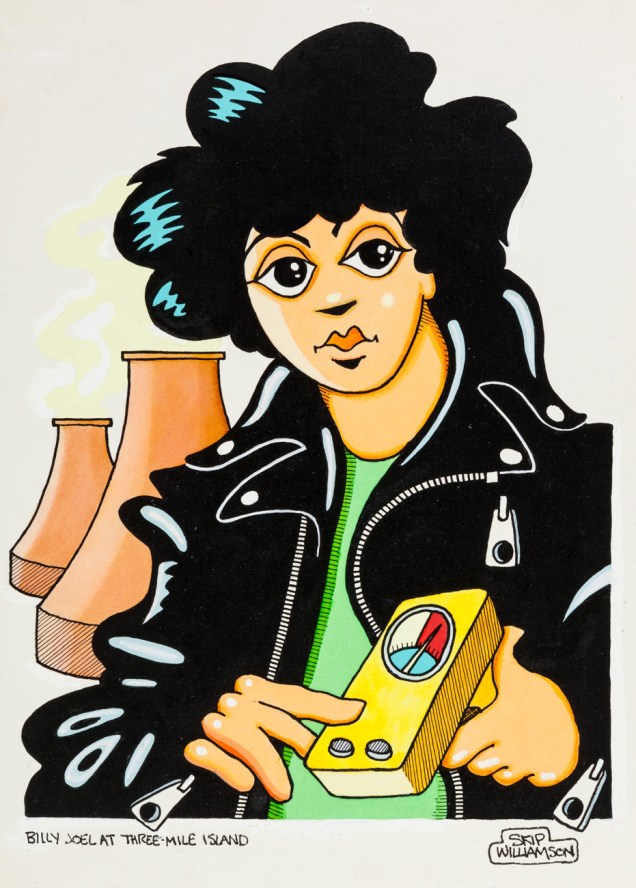
« Right now I’d like to do an original composition which deals with the basic existentialistic thought and parallels between the works of Kafka, Tillich, and Buber in relation to the ‘I-Thou’ concept, and which has just been covered by the Rolling Stones…» Underground comix provocateur Mervyn “Skip” Williamson (born 1944 in San Antonio, TX) takes a witty jab at noted self-mythologist Robert Allen “Bob Dylan” Zimmerman. From the March, 1967 issue of Escapade (incorporating Gentleman!), likely a Charlton Publications product (“Second class postage paid at Derby, Conn.”), a factoid that may someday help you win a bet.« Snuk Comix no. 1 (Skip Williamson, 1970). Extremely rare comic book created for the band Wilderness Road, by Underground Comix artist Skip Williamson. The story is that the printer objected to drug references, and would not deliver the printed comics; Skip managed to grab a few copies before the run was destroyed. As of 2003, only two copies were known to exist; while there have been a few more found since that time, the number of existing copies is staggeringly small… » Typical boorish behaviour on the part of the printer. Most people are unaware of the power that printers held and frequently abused before the salutary advent of digital print. Guys, *first* you nail the printing job (you call that registration?), *then* you indulge in moral grandstanding.1979 original art for a piece Williamson produced for Playboy magazine. « Now what », you may ask « Do Billy Joel and Three Mile Island have to do with one another? » Here’s one account: « Anne had a couple of his 8-tracks, and made plans to see him live at the Hershey Arena during his 1979 tour … plans that were thwarted by a little incident at a nuclear reactor near my home, Three Mile Island. See, when the accident happened, in March of ’79, people had to be evacuated. And those people had to go somewhere. And there just weren’t a whole lot of large buildings suitable for holding thousands of radioactive refugees in the area at that time, so The Hershey Arena had to be put to use, even if it meant canceling a few Hershey Bears games and a Billy Joel concert »
I was too young and in the wrong small town for Underground Comix to reach me back in the 1970s, but when Skip put together the « Playboy Funnies » section (featuring the likes of Bobby London, Jay Lynch, Chris Browne, Art Spiegelman…) for Mr. Hefner’s magazine, I in due course discovered his work since I read Playboy for the cartoons. I immediately took to Williamson’s stylish, bouncy, clean and friendly visuals, paired with his unflagging subversiveness. Not that I got much of said subversiveness at the time… but that’s how it works.
Happy birthday, Skip!
-RG
*Class War (Bijou Funnies no. 3, 1969 The Print Mint)
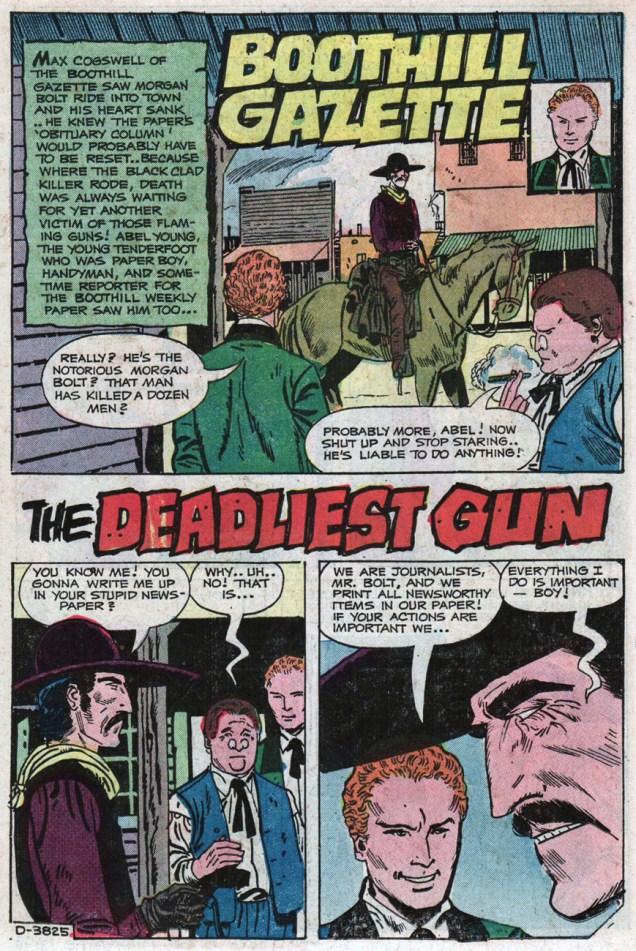
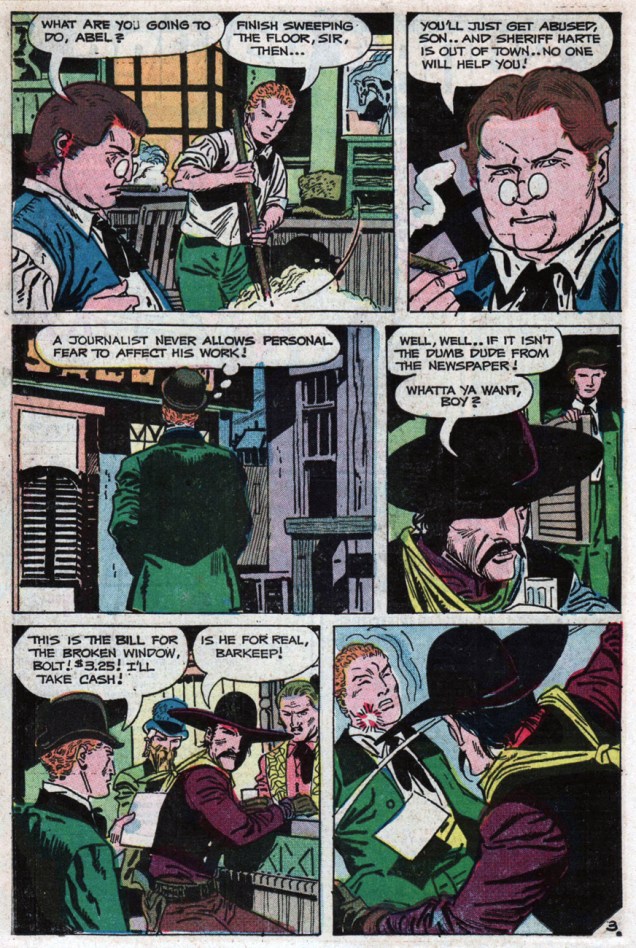
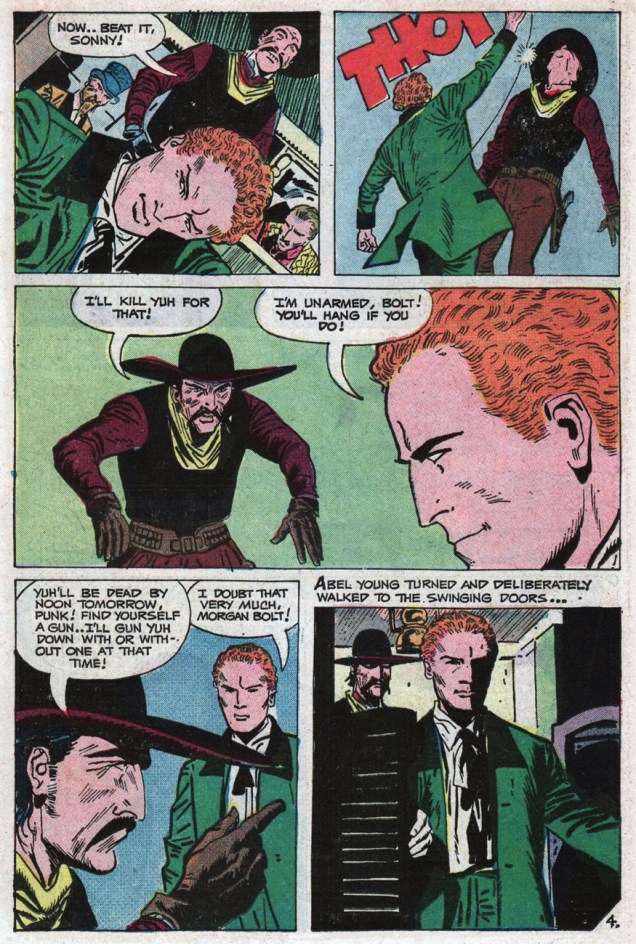
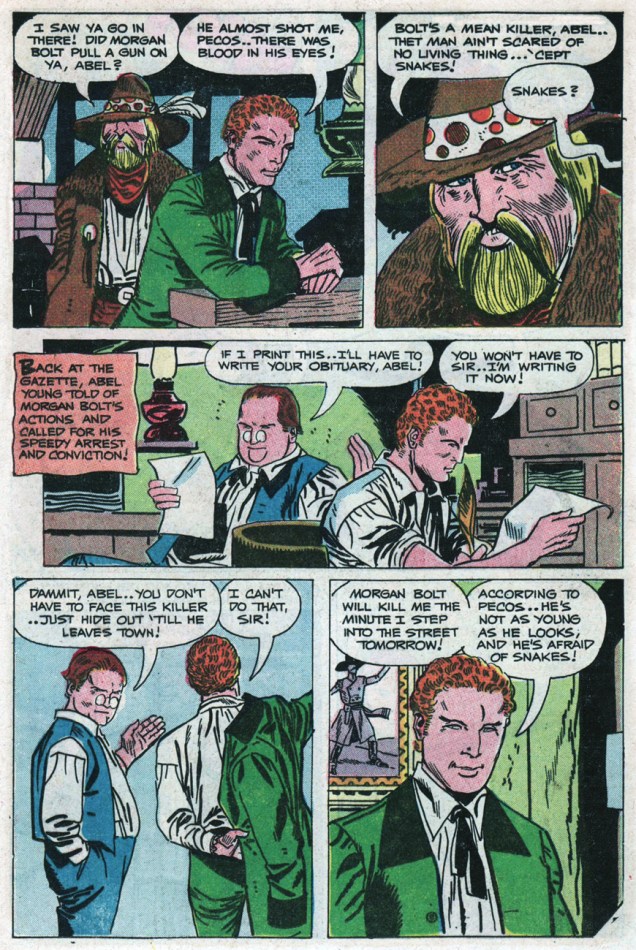
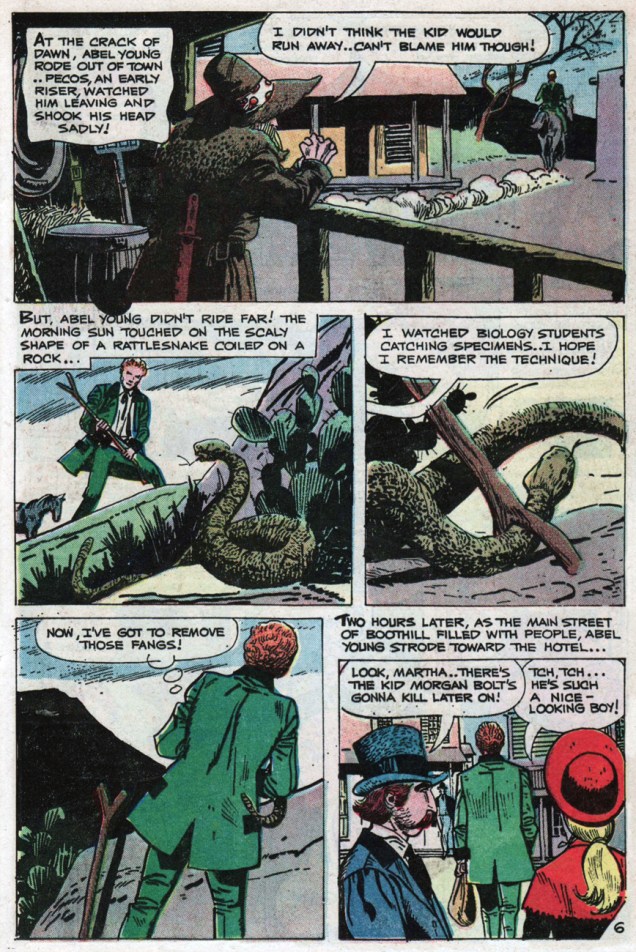
« That young fella must be the college kid who’s going to work for my paper! Those two prairie wolves will pick him clean… it’ll be an excellent lesson to him, I reckon! » — Max Cogswell, editor-publisher of The Boothill Gazette
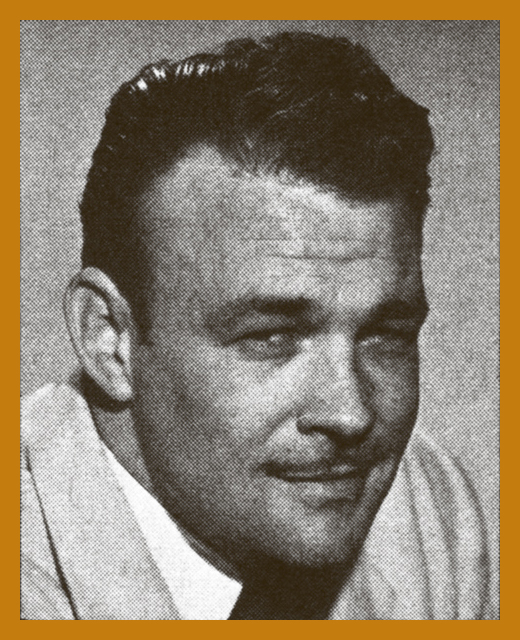
Today marks what would have been the ninety-fifth birthday of suave Texan Renaissance man Aaron P. “Pat” Boyette (July 27, 1923 – January 14, 2000). The Golden-voiced Mr. Boyette was in turn actor, radio announcer, cinematic auteur and of course a far-beyond-fine painter and cartoonist. Ah, and if anything could speak more eloquently of his worth as a human being, he was best man at Gus Arriola‘s wedding.
Didn’t I say he was suave?
Now, I could have focussed on any number of his remarkable projects: his 1966-67 run on The Peacemaker (« A man who loves peace so much that he is willing to fight for it! »), his tour-de-force fill-ins on DC’s Blackhawk (issues 242-43, from 1968), his lavishly-detailed work for Warren Magazines (1968-72), his brilliant, but admittedly controversial, run on The Phantom at Charlton (1970-73), his far-better-than-its-source adaptation of Hanna Barbera’s Korg 70,000 B.C., his intense The Tarantula for Atlas-Seaboard (with Michael Fleisher, 1975), his fun revival of Spencer Spook for ACE Comics in the 1980s, or any of his moody work for Charlton’s ghostly anthologies… but I won’t, at least not this time.
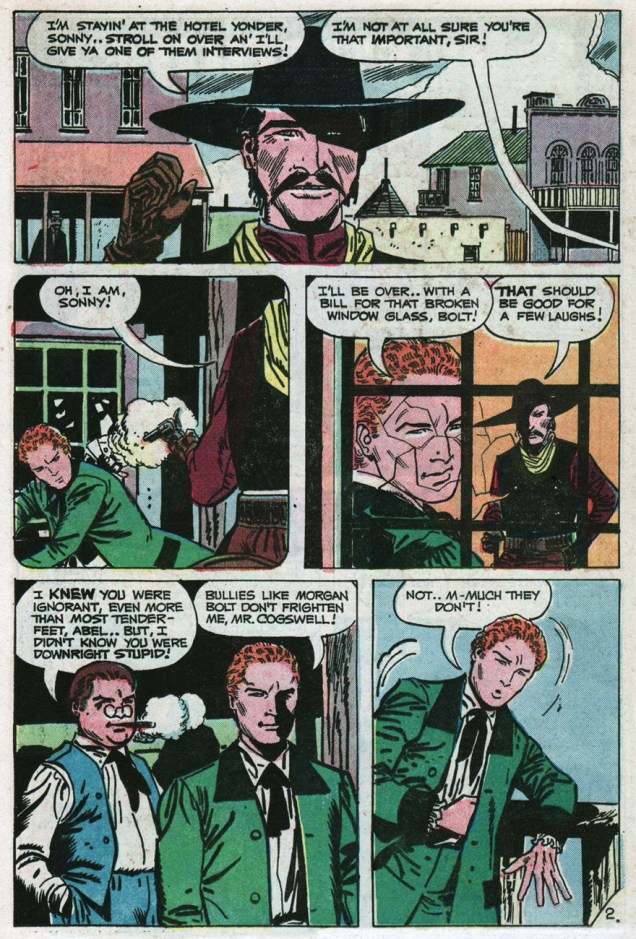
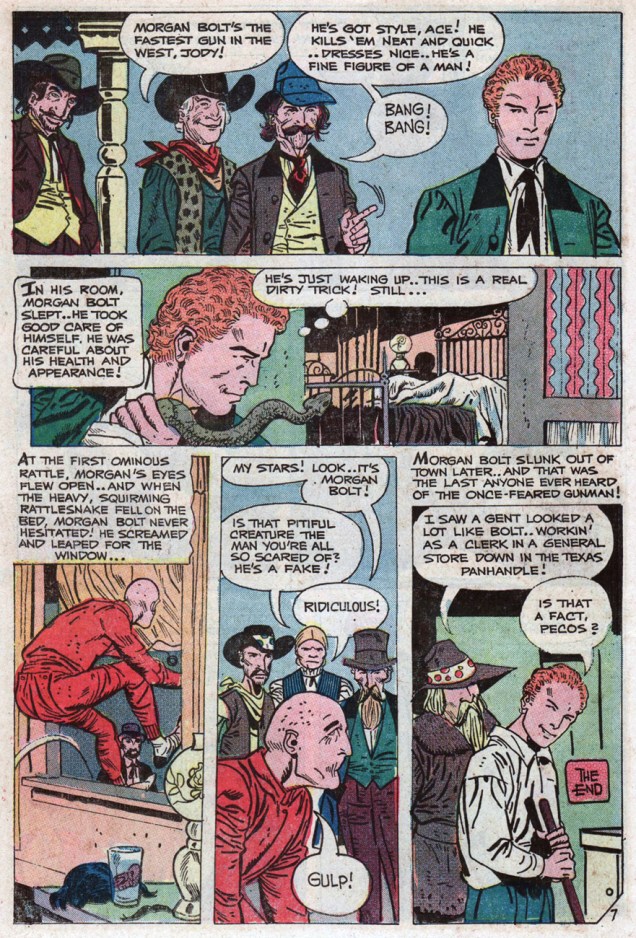
Instead, if you’ll bear with me, we’ll take a gander at a fine, fine backup series he co-created with Joe Gill for the pages of Charlton’s long-running Billy the Kid. Mr. Young of the Boothill Gazette (BTK 88, Dec. 1971, to BTK 110, Dec. 1974). Abel Young, bereft of sharp-shooting or pugilistic skills, is a true hero: a fool, an idealist, a stubborn cuss who acts nobly even when he’s scared spitless. His is a charming strip, full of graceful humour and humanity.
Here, then, is my selection: the series’ thirteenth episode, originally published in Billy the Kid no. 100 (March, 1973, Charlton).
Happy birthday, Mr. Boyette. The world needs more gentlemen of your ilk.
-RG
*so proclaimed the headline of a Boyette profile published in Creepy no. 33 (June 1970, Warren).
We’d like to wish a happy birthday to Mexican cartoonist and animator Gustavo “Gus” Arriola, creator of beautiful, experimental, charming (am I running out of superlatives yet?) comic strip Gordo, published for an impressive some-forty-odd years (between 1941 and 1985, to be exact). Arriola was born on July 17th, 1917 and died in 2008, when he was 90 years old.
Gordo was designed to be a Mexican version of Li’l Abner, but Arriola quickly realized that his strip was relying on stereotypes of Mexican culture as seen through American eyes. He strove to make it truer to his mother culture, making Gordo (the main character – his real name being Perfecto Salazar Lopez, with his nickname more or less translating to « Fatso ») “an accidental ambassador” for Mexican mores.
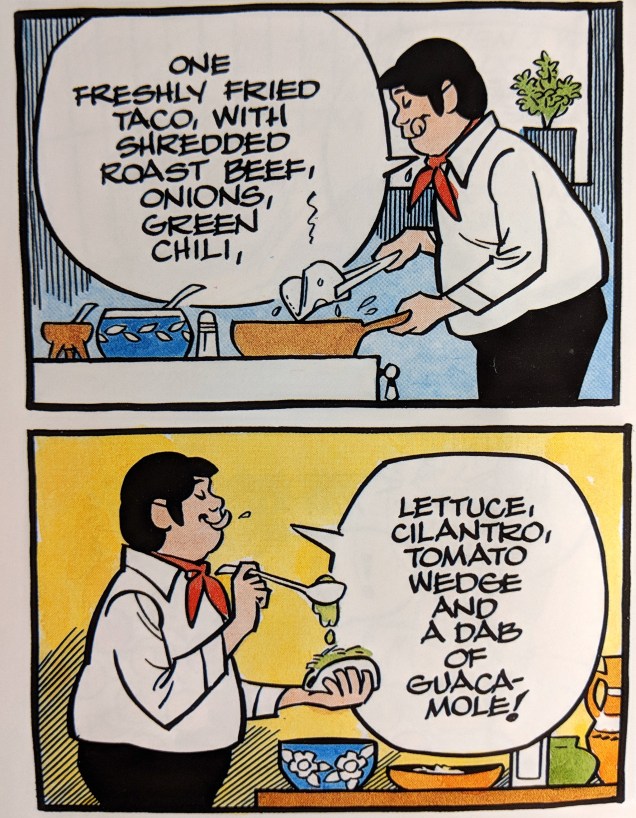
The strip featured a lot of animals, and its plotlines often pivoted around concerns about the environment. It also regularly included recipes. For instance, Gordo’s beans and cheese recipe from a strip in 1948 got the comic strip into 60 extra newspapers. And, significantly, Gordo also had gorgeous, inventive art!
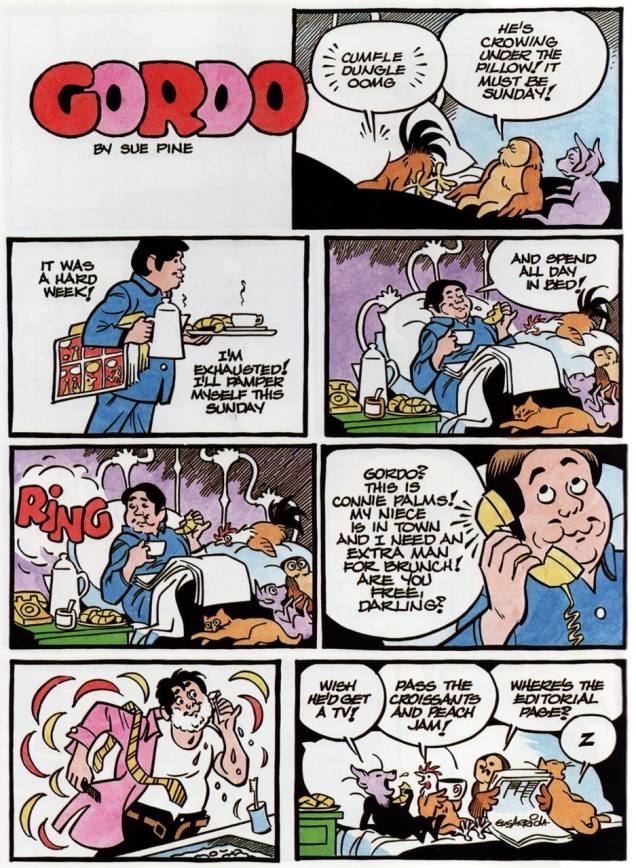
This sweet strip was scanned from a collection of Gus Arriola strips, “Gordo’s Critters: The Collected Cartoons”, published in 1989 and sadly out of print. Gus Arriola had a wonderful drawing style and a bouncy imagination, but it’s his sense of humour I like best: gently philosophical, hilarious but always kind to its characters.Sunday strip from January 25th, 1959.
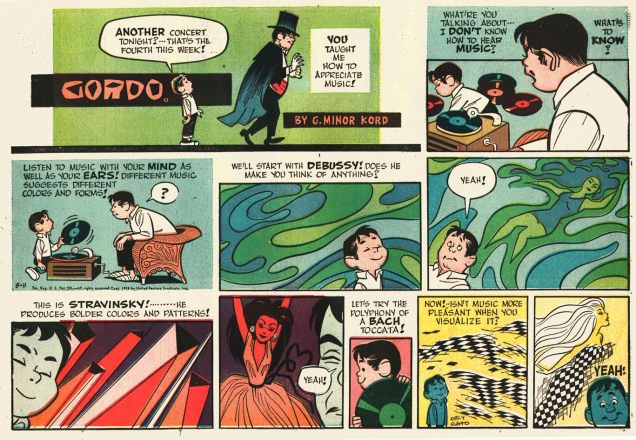
Aside from being a music aficionado, Gus Arriola was also a great connaisseur of art. R.C. Harvey, the editor/writer of “Accidental Ambassador Gordo: The Comics Strip Art of Gus Arriola” mentions Arriola’s love for jazz: “[he] finally [settled] in Carmel, where he met his life-long friend and fellow cartoonist, Eldon Dedini, and they both became fixtures at Doc’s Lab, where Hank Ketcham and other habitués of the place met weekly to admire jazz and tell stories.” Read the rest of his lovely article here.
Sunday from June 11th, 1958.
In 1999, Arriola was interviewed by John Province for Hogan’s Alley no. 6 – it’s well worth a read if you’ve got some spare quality time! You can read the interview here.
Sunday from 1958.
Want to see more? Head over to the Fabulous Fifites blog, where many scans of Sundays strips are available for perusal. (Ger Apeldoorn, the blog’s author, did a monumental job of scanning newspaper strips for our enjoyment.)
There’s an impressive parade of artists born in July. Of present concern is the birthday of one Murphy Anderson, who came into this world on July 9th, 1926 (and ceased to exist in 2015, at 89, no doubt moving into some parallel dimension).
His work on the Atomic Knights or Hawkman is fondly remembered… but I’ll concentrate on some covers dear to my heart from DC’s science-fiction titles because sci-fi + great art = squeals of enjoyment. Anderson had no trouble portraying any number of far-fetched monsters or depicting incredible situations in his crisp, clean style that made his audience willingly suspend disbelief. Ah, okay, I called it “science-fiction”, but it often crosses the line into fantasy, or horror, with occasional detours into superhero, or just plain quirkiness. To follow the loopy logic of the stories contained in the pages of the following publications, one has to abandon the notion that A leads to B, and prepare oneself for a wild romp through the whole alphabet. Great art certainly facilitates this – the story may leave me scratching my head, but Murphy Anderson’s illustrating chops provide a firm ground to anchor to.
Without further ado, the great Murphy Anderson and some of his artwork!
For instance, take a look at some of the creatures featured in DC’s Strange Adventures through the decades. Anderson’s gallery of characters includes, but is not limited to, startled fishermen, anthropomorphized atomic clouds, and Middle-Age barbarians from another planet, all impeccably drawn.
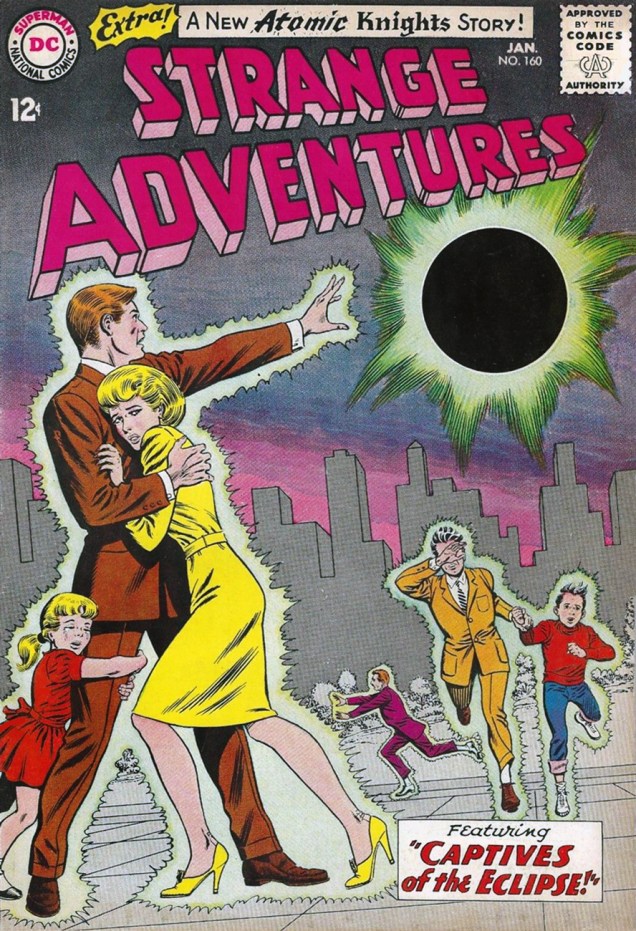
“But I tell you I actually hooked one on my line… THIS BIG!” It’s only fair. I guess you don’t even need to use bait for this type of fishing. Strange Adventures no. 21 (June 1952). Cover by Murphy Anderson.There’s no head-breaking over what title to give these stories… “The Face in the Atom Bomb Cloud” it is! Pencils and inks by Murphy Anderson, grey tones and colours by Jack Adler, lettering by Ira Schnapp. This is Strange Adventures no. 143 (August, 1962). Edited by Julius Schwartz.Strange Adventures no. 160 (January 1964), cover by Murphy Anderson. This issue is a treat, featuring two parts of an Atomic Knights story (“Here come the Wild Ones!”, written by John Broome and illustrated by Anderson).I promised barbarians, didn’t I? Strange Adventures no. 222 (Jan-Feb 1970), art by Murphy Anderson. I have a love/hate relationship with Adam Strange, often loving the art and hating the stories. It’s been a while – I have to re-read this stuff and see if I still find it indigestible.
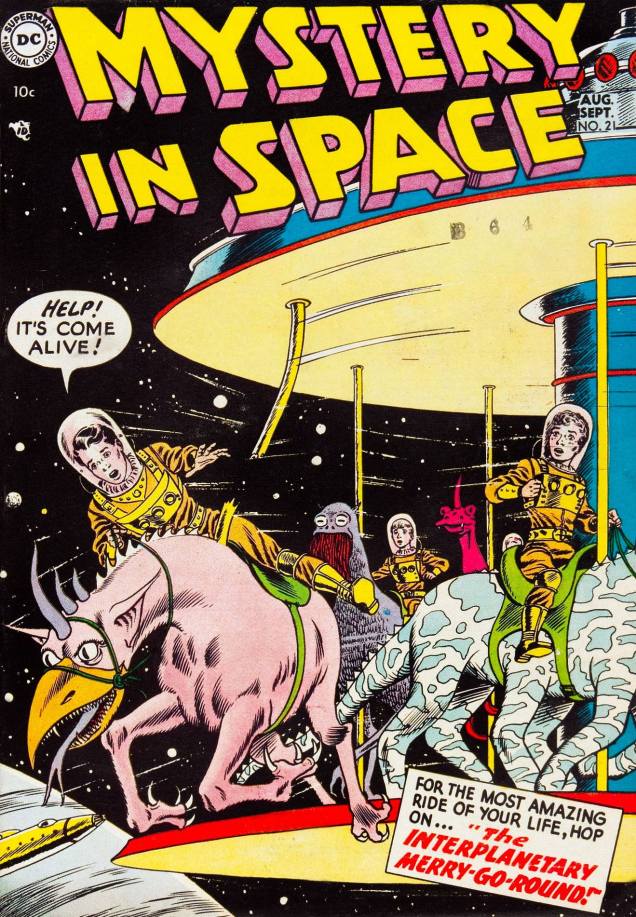
Another favourite series for its oft-striking covers is Mystery in Space. I love it when Anderson invents “space” animals composed of body parts from several Earth species. It’s indubitably fun, and children often have a great time inventing new creatures, but it takes chops to draw the result and make it work, anatomically and aesthetically.
Damn, the safety regulations for those carousel things are really lax these (future) days. It might not be science-fiction per se, but it sure is fun! Mystery in Space no. 21 (August-September 1954), with a cover by Mr. Anderson.
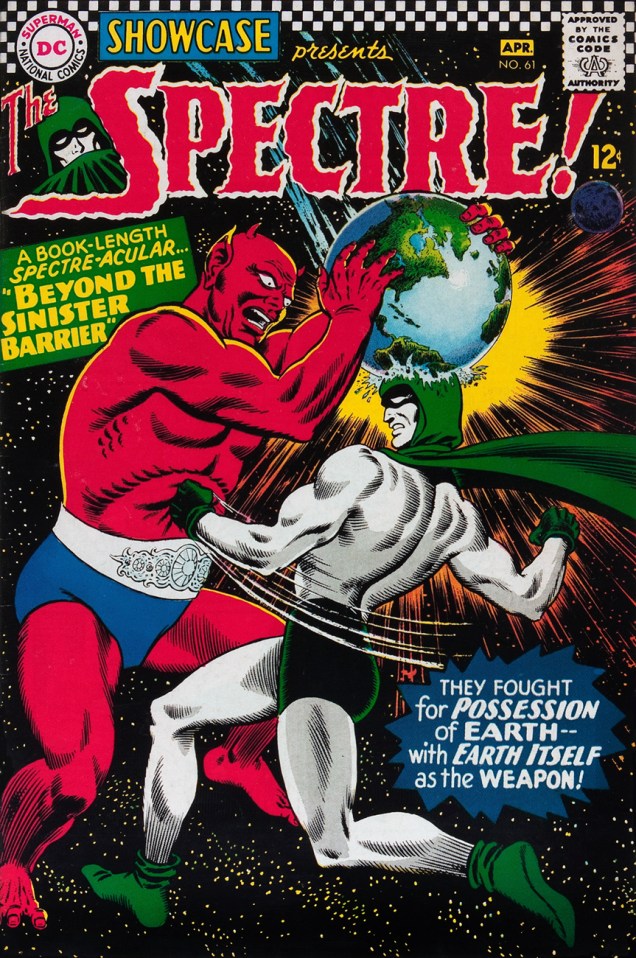
Despite my general resistance to superhero stuff, here’s a cover featuring the Spectre, whose classy costume is easy on the eyes.
When you have to boink your arch-enemy on the head with a whole planet to knock him out and it still doesn’t work, you know you’re dealing with a pro. Showcase no. 61 (March-April 1966), cover by Murphy Anderson.
And one for the road…
Goofiness or social commentary? Frankly, the green “president” looks a lot friendlier than most current politicians. Tales of the Unexpected no. 94 (April-May, 1966). Cover by Murphy Anderson.





















 Who's Out There?