I understand that this image has to do with the tradition of greeting the new year by banging on pots and pans and generally making a racket, but I presume that both sailor-garbed primate and pneumatic drill were optional, particularly in times of scarcity.
Art by Stephen Douglas, from Famous Funniesno. 138 (January, 1946). FF number one (July, 1934) was likely the second comic book issued, and the first one *sold*. It was published by Eastern Color / Dell Comics.
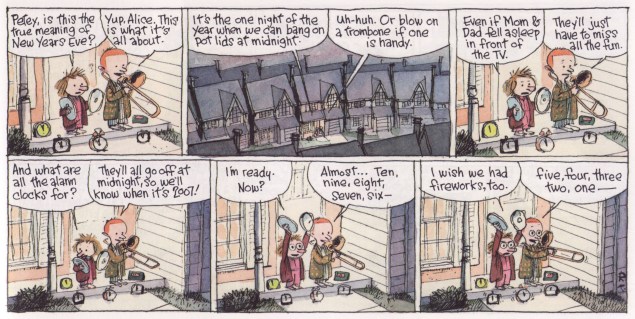
And while we’re on the subject of ushering in the New Year by making a hellacious din, let’s treat ourselves to a couple of relevant Cul de sac pieces. The first returns us to the strip’s formative, water-coloured years, when it appeared weekly (2004-2007) in The Washington Post‘s weekly magazine section.
The Washington Post Magazine, Dec. 31st, 2006. Richard Thompson: « From when Petey played the trombone, and I found it too hard to draw. »The master tackled the theme again in this brief sequence from Dec. 31, 2008- Jan. 1st, 2009.
Nothing left to do now but to wish a joyful 2018 to all you monkeys and assorted critters!
Today is birthday number ninety-five for Stanley Lieber, aka Stan Lee. He was hatched on December 28, 1922. Have a good one, Stan.
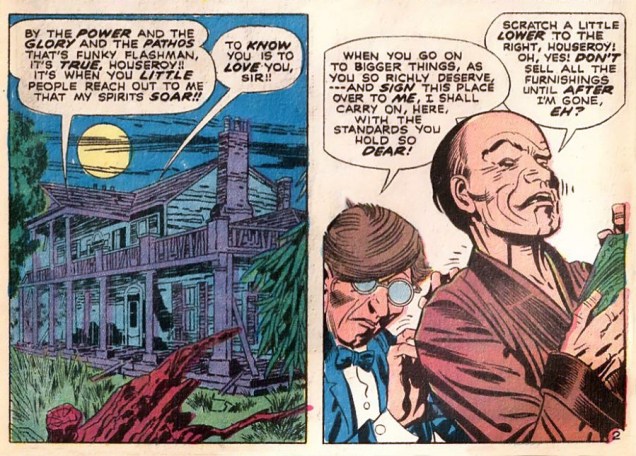
Jack Kirby recalls with fondness his former editor and his toady, in “Funky Flashman!” (Mister Miracle no. 6, January-February 1972, DC).
On this momentous occasion, let’s hear about Stan from some of his colleagues, who knew The Man and obviously loved the experience:
Wally Wood:
« Did I say Stanley had no smarts? Well, he DID come up with two sure fire ideas… the first one was ‘Why not let the artists WRITE the stories as well as draw them?’… And the second was … ‘ALWAYS SIGN YOUR NAME ON TOP… BIG’. And the rest is history… Stanley, of course became rich and famous … over the bodies of people like Bill [Everett] and Jack [Kirby]. Bill, who had created the character that had made his father rich wound up COLORING and doing odd jobs. »
EC legend Bernie Krigstein, who collaborated with Stan at Atlas, and whose « Suppressed Desire » is featured in Spellbound no. 17 (September 1953) , with a glorious cover by the above-mentioned Bill Everett.
In the course of a 1960s interview with comics scholar John Benson, Krigstein responded to Benson’s statement of « I guess you know that Stan Lee has been the spearhead of the so-called current revitalization of comics »:
« I’m delighted to learn that. Twenty years of unrelenting editorial effort to suppress the artistic effort, encourage miserable taste, flood the field with degraded imitations and non-stories have certainly qualified him for this respected position. »
Then Gil Kane, who was Marvel’s principal cover artist for much of the 70s, and who collaborated with Lee on The Amazing Spider-Man in some of its most popular years, including the infamous, comics-code unapproved “drug” issues (nos. 96-97, May-June 1971), on the respective creative roles of Stan and Jack Kirby:
« On each page, from 1964 – 1970 next to every single panel Jack wrote extensive margin notes explaining to Lee what was taking place in the story. It took Jack about 2 weeks to do a single story, it may have taken Lee as little as 4 hours to add text to Jack’s art. »
And Steve Ditko, in a letter to the editor of Comic Book Marketplace, published in the magazine’s 63rd issue in 1998, on his and Stan’s respective roles in crafting an issue of Spider-Man:
« The fact is we had no story or idea discussion about Spider-Man books even before issue no. 26 up to when I left the book. Stan never knew what was in my plotted stories until I took in the penciled story, the cover, my script and Sol Brodsky took the material from me and took it all into Stan’s office, so I had to leave without seeing or talking to Stan. »
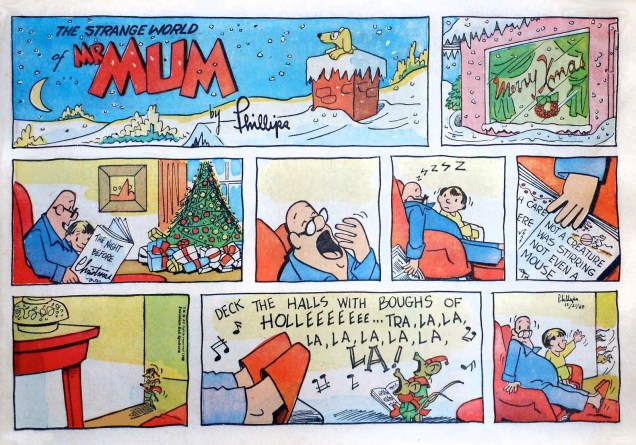
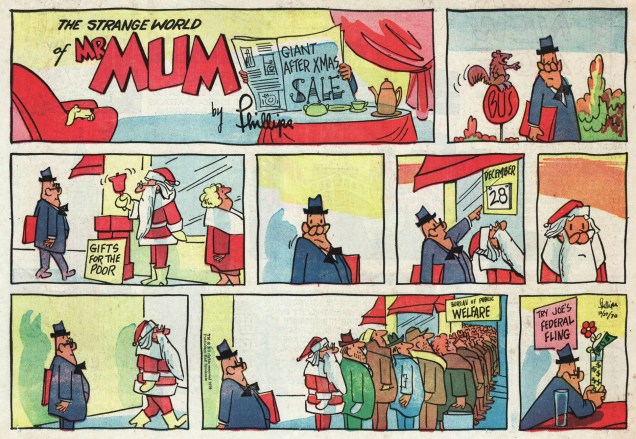
Irving Phillips (1904-2000)…« has been an actor, a violinist, a Hollywood script writer, the Humor Editor of ‘Esquire’ magazine, a playwright, as well as a very successful syndicated cartoonist.* »
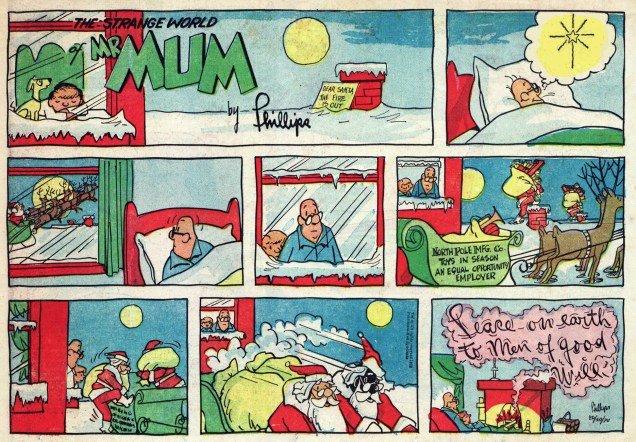
He was most notably the creator of The Strange World of Mr. Mum, which was published from 1958 to 1974 (the Sunday edition began in 1961); at its peak, the strip appeared in 180 newspapers.
Mr. Mum, as his name suggests, is the silent observer of various strange happenings. Anything can, and does, happen in Mum’s world, and much of it is delightfully surreal.
Today, as befits the season, we propose a handful of Christmas (and post-holiday) themed Mr. Mum Sundays.
Originally appeared on December 21, 1969.Originally appeared on January 4, 1970.Originally appeared on December 20, 1970.Originally appeared on December 27, 1970.
As Mr. Mum himself might say, were he ever inclined to chime in: « Have a Merry Christmas! » May you find some good comics in your holiday stash. And try Joe’s Federal Fling… it’s tastier than eggnog.
Craving more Mr. Mum? Then scoot over to Ger Apeldoorn’s The Fabulous Fifties blog, where a veritable Mum trove awaits !
– RG / ds
*quoted from a interview with Mr. Phillips in Cartoonist Profiles no. 4, (November, 1969).
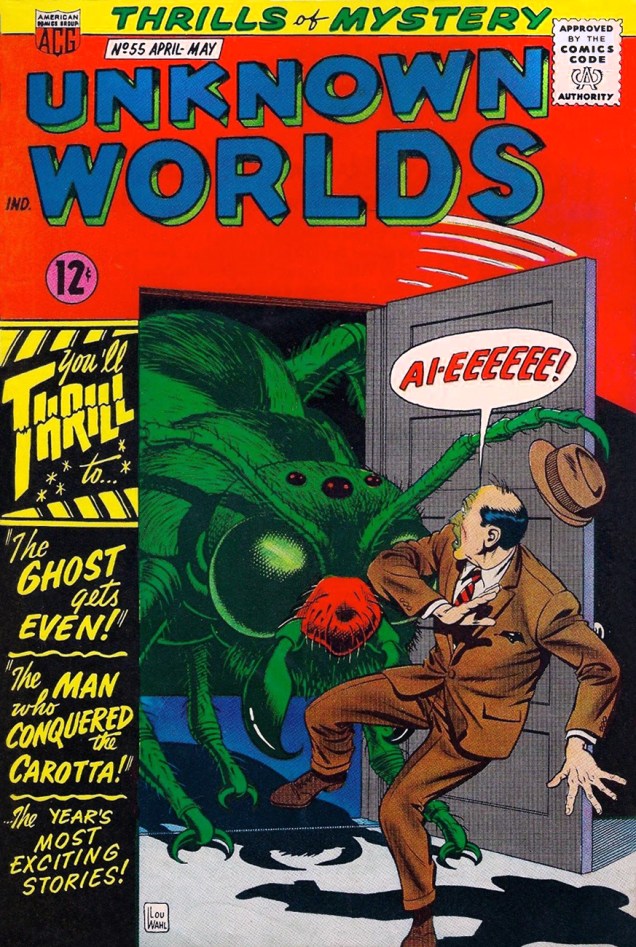
Surprise! Happy birthday to Lois Lane artist supreme Kurt Schaffenberger (December 15, 1920 – January 24, 2002), here working under the alias of Lou Wahl, (he was also Jay Kafka, which would have been fitting here!) a popular and entertaining practice at ACG and Marvel. The DC brass were presumably *not* amused by these moonlighting shenanigans. I’m looking at you, “Adam Austin”, “Mickey DeMeo” (aka Joe Gaudioso), “Jay Gavin” and “George Bell”…
This is Unknown Worlds no. 55 (April-May 1967, ACG), one of the final issues of this fine anthology title.
In case you were wondering: Adam Austin was Gene Colan‘s alias, Mickey DeMeo and Joe Gaudioso were Mike Esposito‘s nomsdeplume, and Jay Gavin and George Bell were pseudonyms respectively favoured by Werner Roth and George Roussos.
« What are you mumbling about? »
« Oh, nuthin’! … just that my false teeth get loose an’ make a lot of noise! »
Today marks the one hundred and third anniversary of the enigmatic Jack Cole (December 14, 1914 – August 13, 1958) a man embodying, in equal parts, hilarity, talent and torment. Just when everything seemed to be going his way, he took his own life in 1958, for reasons still surmised about. His widow was the only one to know, and she took her secret to the grave.
Let’s move past this morbid stuff and concentrate on the man’s creative legacy, shall we?
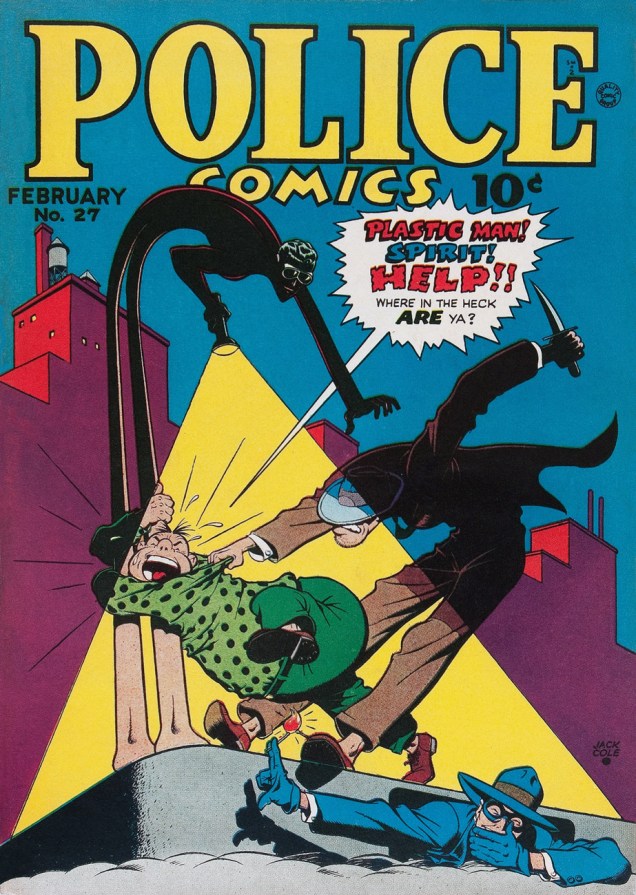
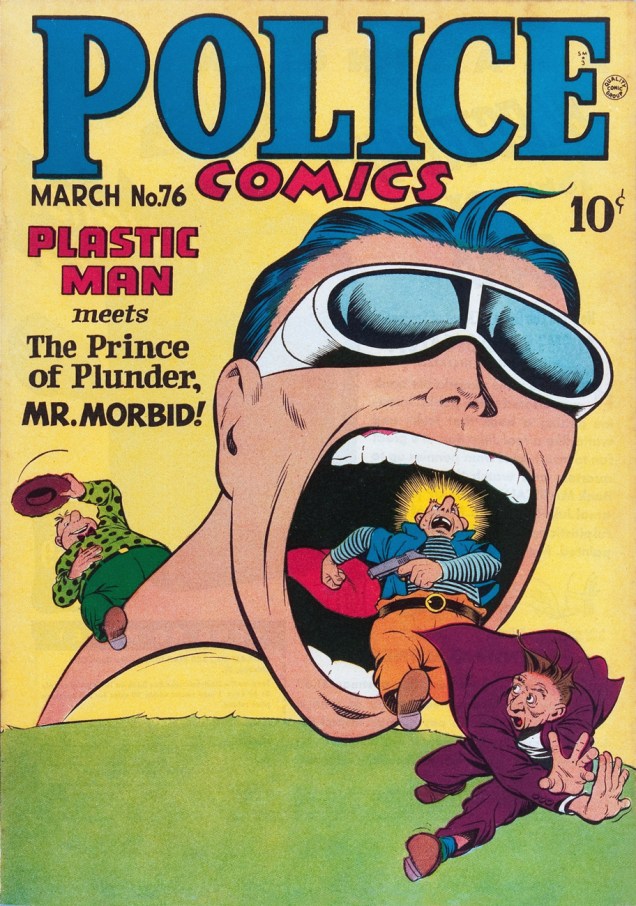
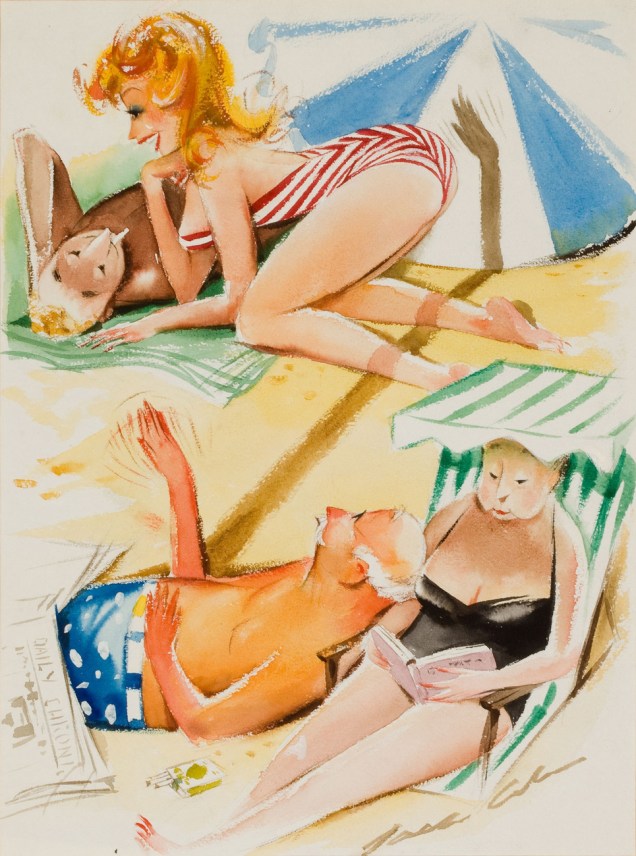
Cole’s cover for his Plastic Man story « The Rare Edition Murders » (originally called « The Bookstore Mystery », judging from the cover art) cleverly ties in the mag’s other features. And they do need to be mentioned: Flatfoot Burns by Harvey Kurtzman, The Darson Twins by Jack Keller, The Spirit by Will Eisner (or his talented ghosts), Manhunter by Reed Crandall… This is Police Comics no. 25 (December 1943, Quality).Routine, the same old grind… another issue of Police Comics, another splendid Jack Cole cover. This is Police Comics no. 27 (February, 1944), featuring Plastic Man in « Woozy Winks, Juror », and tales of Dewey Drip, Flatfoot Burns, Destiny, Manhunter, Dick Mace, The Human Bomb, Burp the Twerp (by Cole), and of course The Spirit. Sounds potentially entertaining? Read it here, then: http://comicbookplus.com/?dlid=37421Cole’s Plastic Man, one of the timeless wonders of comics’ Golden Age, a character only his creator truly knew how to handle properly. This is Police Comics no. 72 (November 1947, Quality).Another vivid (what else?) example of Mr. Cole’s boundless inventiveness, featuring his flagship creation, Plastic Man (and rotund sidekick Woozy Winks). This is Police Comics (1941-1953, 127 issues) no. 76 (March 1948, Quality).« You mean this guy had nine slugs in his chest and still choked the other one to death? » Web of Evil no. 5 (July 1953, Quality).Web of Evil no. 6 (September 1953, Quality).This lovely watercolour ran in Playboy Magazine‘s August, 1955 issue. It’s titled « The Elongated Hand ».« Like they say in the travel folders, Miss Duncan – ‘Getting there is half the fun’ ». Playboy Magazine, August, 1956.
« I know what’s the matter with your comic artists, they’re all crazy. »
« Of course they’re crazy, they wouldn’t be worth a whoop if they weren’t crazy. »
Today we commemorate the birthday of Popeye creator Elzie Crisler Segar (December 8, 1894 – October 13, 1938). The man succumbed to leukaemia and liver disease at the distressingly early age of 43… but not before making his everlasting mark on the world of cartooning and the world at large.
In this Popeye Sunday strip dated August 14, 1938, J. Wellington Wimpy ably demonstrates his solid-gold mooching wiles.
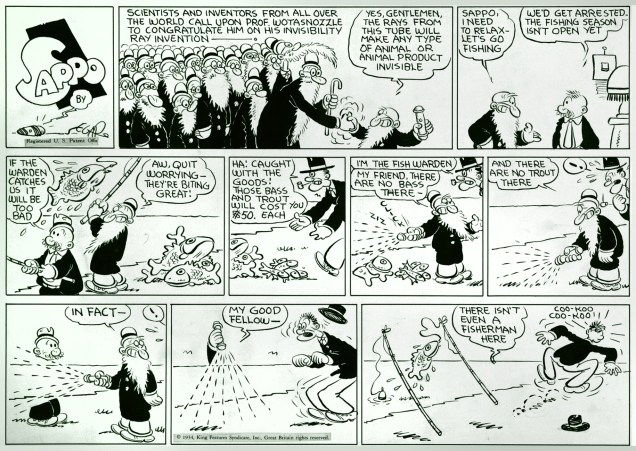
And for dessert, have a chaser of Segar’s even more endearing (in my opinion) companion strip, Sappo, featuring his delightfully bonkers Professor O. G. Wotasnozzle.
Sappo appeared as Thimble Theatre / Popeye’s “topper” on Sundays. This out of sight entry appeared on April 8, 1934.
Happy Birthday and bon appétit, Mr. Segar, wherever you are!
« What’s that noise comin’ up from the cellar? It’s the restless bones of Boris and Bela* »
It’s a cinch that William Henry Pratt, back when he was eking out a living in Canada, digging ditches or driving a truck, never suspected that his name, his stage name that is, would still elicit shivers of recognition long after his passing. Here we are, a whole hundred and thirty years past his birth, in Camberwell, South London, on Wednesday, November 23, 1887.
From his ascent to stardom in the early 1930s until his passing in 1969, he certainly lived to see his likeness appear in a bewildering array of toys and games and bedsheets and mugs and a zillion knicknacks and gewgaws, a parade that continues to this day. But he was likely never represented more consistently and abundantly than he was in comic books.
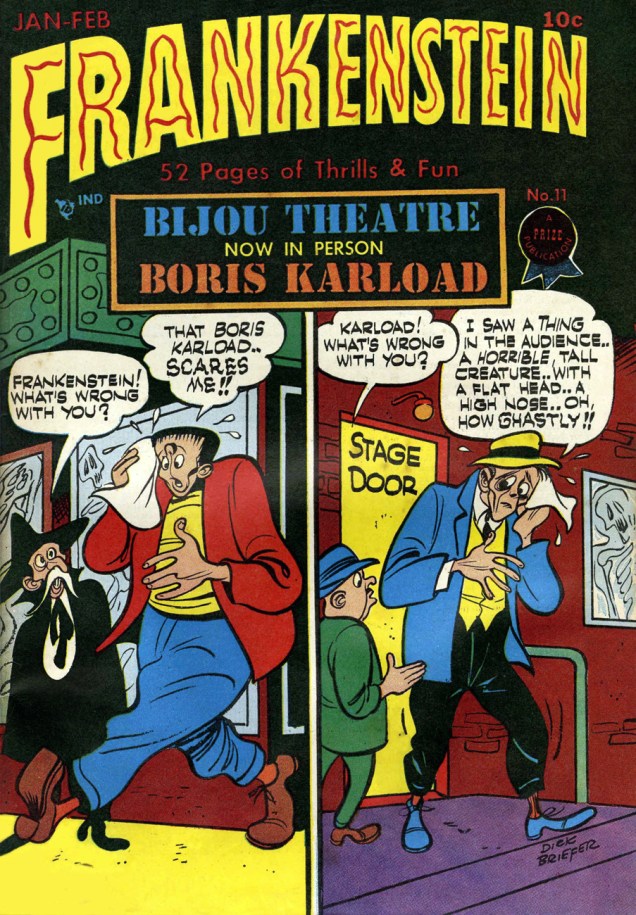
Here, the Monster meets his… inspiration, in « Boris Karload, Master of Horror ». Dick Briefer‘s Frankenstein is a definite highlight of the Golden Age of comics. This is Frankenstein no. 11 (Jan.-Feb. 1948, Prize Comics). Read it here: http://comicbookplus.com/?dlid=39937 And if you, er… dug that, treat yourself to Craig Yoe‘s selection of Briefer’s rendition(s) of the Famous Monster. It’s a great package, and Mr. Yoe can always use the money… to unleash further wonders.
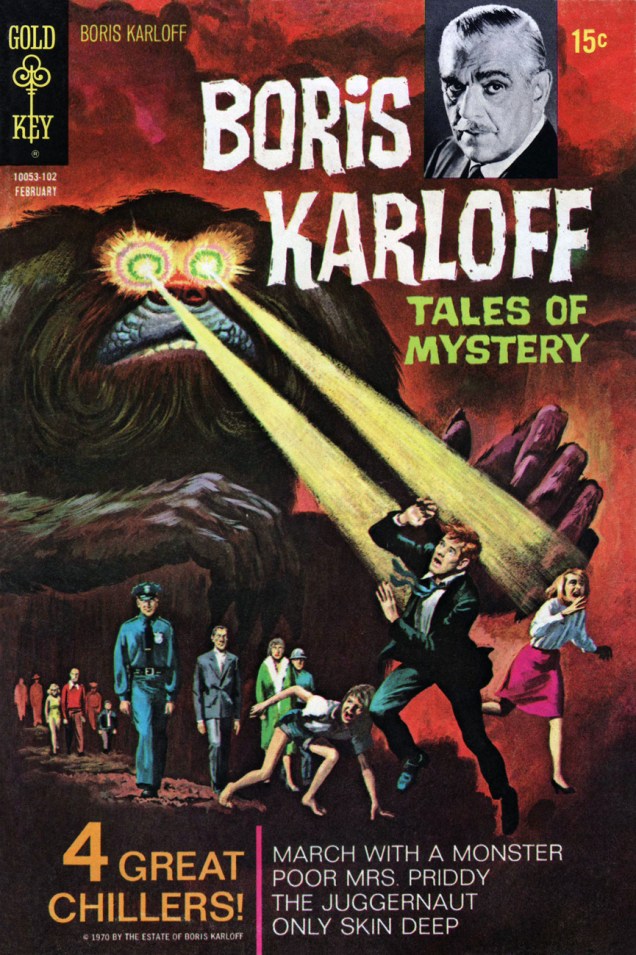
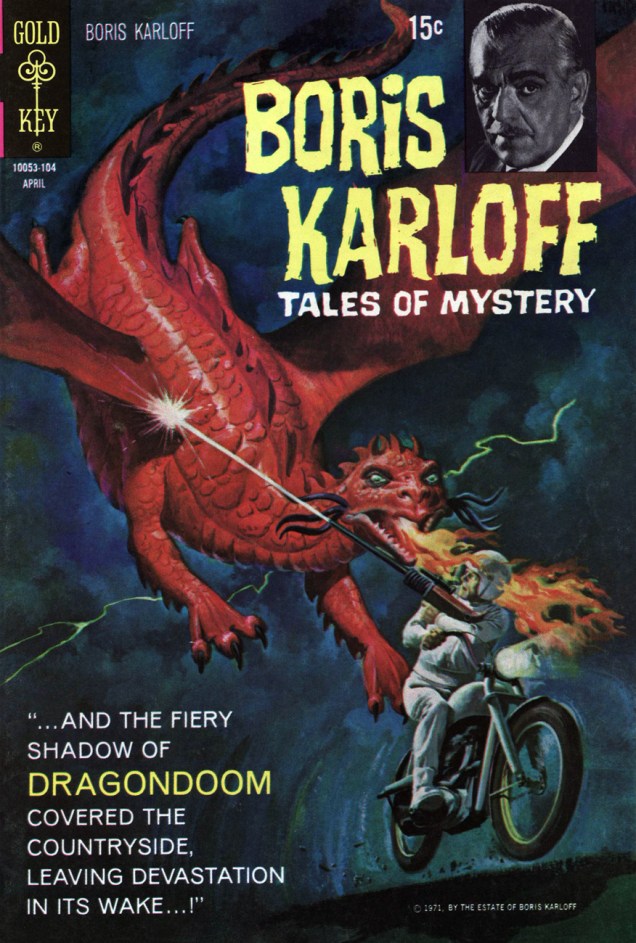
Here’s a gallery of cover highlights from Gold Key Comics’ long-running Boris Karloff Tales of Mystery (95 issues, 1962-80).
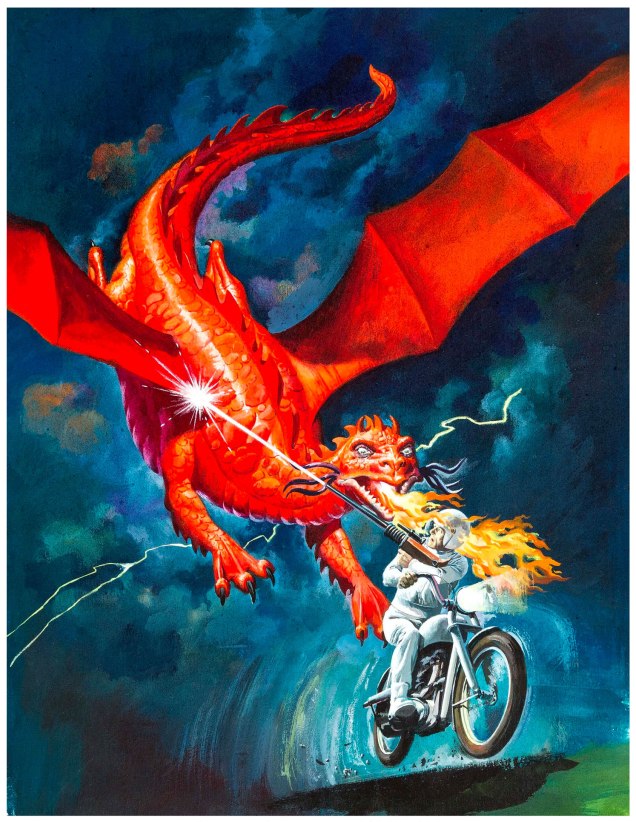
Before there was called Boris Karloff Tales of Mystery, there was, for two issues, Thriller, based on the by-then-cancelled NBC series. Gold Key were often quite slow in making their licensing moves. The TV Thriller was often terrifying (“Pigeons From Hell”, “The Hungry Glass”…), but the comic book never scaled such heights, even sans the emasculating influence of the Comics Code Authority.« You know that one sideways glance from that bug-eyed banshee can turn your brains to prune-whip! » Boris Karloff Tales of Mystery no. 33 (Feb. 1971), Cover painted by George Wilson, illustrating Len Wein, Tom Gill and John Celardo’s March with a Monster.« I’m being scorched by something that shouldn’t even exist! » A laser cannon-equipped Evel Knievel tussling with a badass reptilian nightmare? That’s the Seventies for you. Gold Key’s mystery comics were generally pretty tame fare, but their covers, such covers! This one’s painted by Saint George Wilson. Boris Karloff Tales of Mystery no. 34 (April 1971.) You just know that Dragondoom is written by Lein Wein, because its damsel-in-distress shares his wife’s name, Marvel and DC colourist Glynis.A look at Mr. Wilson’s original painting gives us an idea of just how much was lost in the transition from brush to print. Sometimes it’s better *not* to know.« Feast your eyes upon them, mortal! Do they satisfy your appetite for witchcraft? Hee Hee! » Wayne Howard conjures up some decent monsters inside, but Psychotomimetic George Wilson, who painted this mind-melting cover, shows how it’s *really* done. Boris Karloff Tales of Mystery no. 43 (Oct. 1972.)« The car — being sucked in by this blasted fetid swamp! Goodbye car… goodbye, convention! » Roadside George Wilson strikes again! Boris Karloff Tales of Mystery no. 49 (March 1973.)
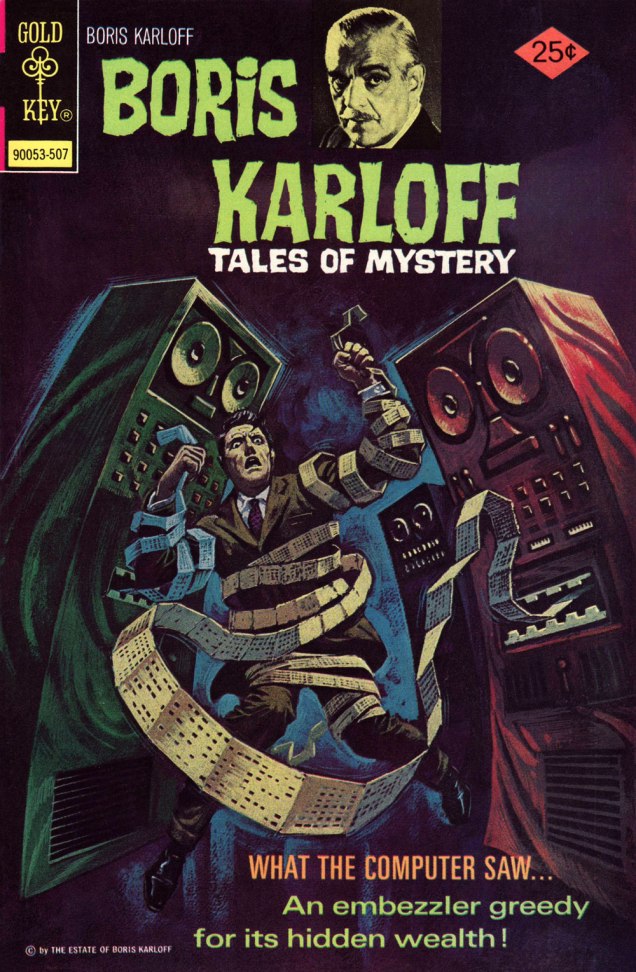
« These computer cards are wonderful… almost as if they were alive! They tell me everything! » Boris Karloff Tales of Mystery no. 62 (July 1973). Luis Angel Dominguez‘s painted cover depicts a scene from Arnold Drake‘s witty It’s in the Cards.
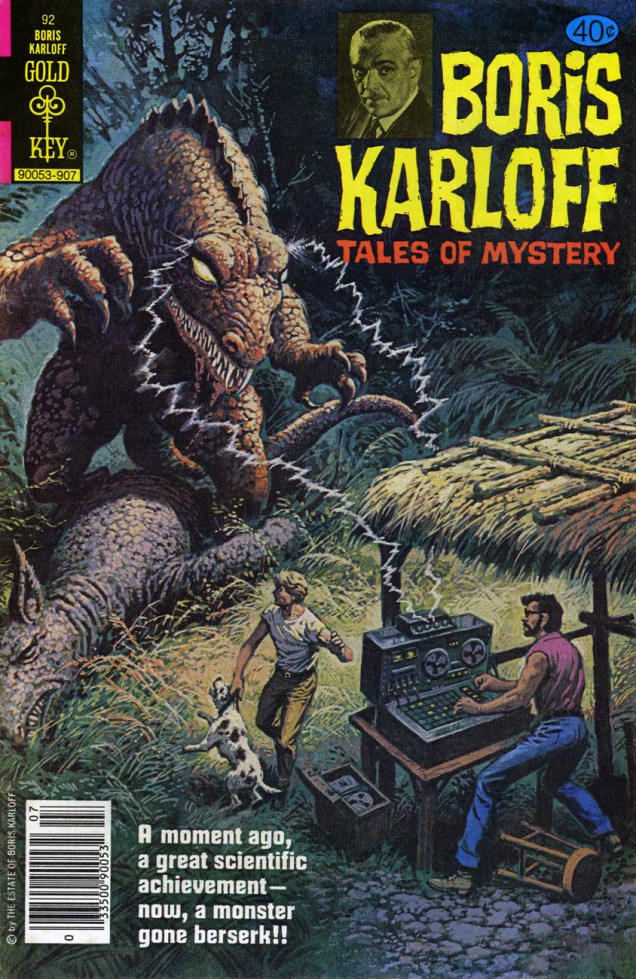
« G-g-get away, B-Bobby! There’s a living horror out there! » « Aww, gee, dad! I’m sorry about that! It’s just my sea monster! » Meet The Mail-Order Monster, a gem from an uncredited scripter (likely Arnold Drake, if the sparkling wit is any indication), and illustrated by Ed Robbins. It’s a fabulously wacky yarn, combining to fine effect good old Sea-Monkeys (brine shrimp, really) and a generous sampling of Ray Bradbury’s Boys! Raise Giant Mushrooms in Your Cellar! This is Boris Karloff Tales of Mystery no. 65 (Dec. 1975), edited by Paul Kuhn. Also within: Don’t Put It on Paper, another of the handful of jobs José Luis García-López did for Gold Key, before settling down at DC later that year. The plot is basically that of Clark Dimond/Terry Bisson & Steve Ditko’s The Sands That Change! (Creepy no. 16, Aug. 1967, Warren), but with a much gentler outcome.« But — why would anyone create something so — so terrifying? » One thing you can nearly always count on in any given issue of BKToM: “scientific” experiments always go awry, and they nearly always yield rampaging monsters. Fitting! Luis Angel Dominguez provides this electrifying cover for issue no. 92 (July, 1979.) The man had such a peerless colour sense.
Let’s reserve our closing words for the man (monster) himself: « Certainly I was typed. But what is typing? It is a trademark, a means by which the public recognizes you. Actors work all their lives to achieve that. I got mine with just one picture. It was a blessing. »
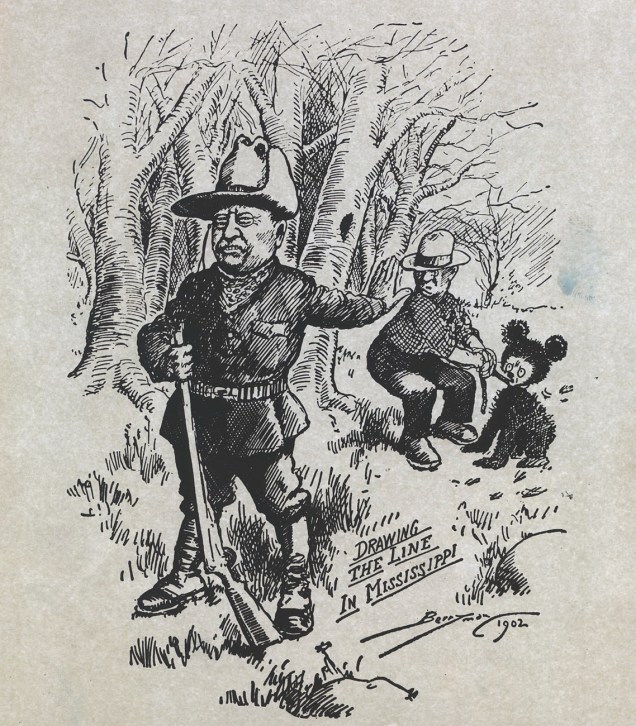
A cartoon appears in the Washington Post, prompting the Teddy Bear Craze, after President Teddy Roosevelt refused to kill a captive bear tied up for him to shoot during a hunting trip to Mississippi.
Boy, American presidents sure were different back in those days.
The history-making cartoon by Pulitzer Prize–winning cartoonist Clifford K. Berryman (1869-1949), who worked with the Washington Post from 1891-1907, then with the Washington Star from 1907-1949.
Which brings us to Teddy Bears (as they became known henceforth) returning the favour of protecting the vulnerable and innocent.
The earliest instance that comes to mind is Johnny Craig and “Ghastly” Graham Ingels’ holiday charmer, Shoe-Button Eyes!, which appeared in The Vault of Horror no. 35 (Feb.-Mar. 1954, EC), wherein a blind, put-upon little boy gets a new set of peepers… the hard way.
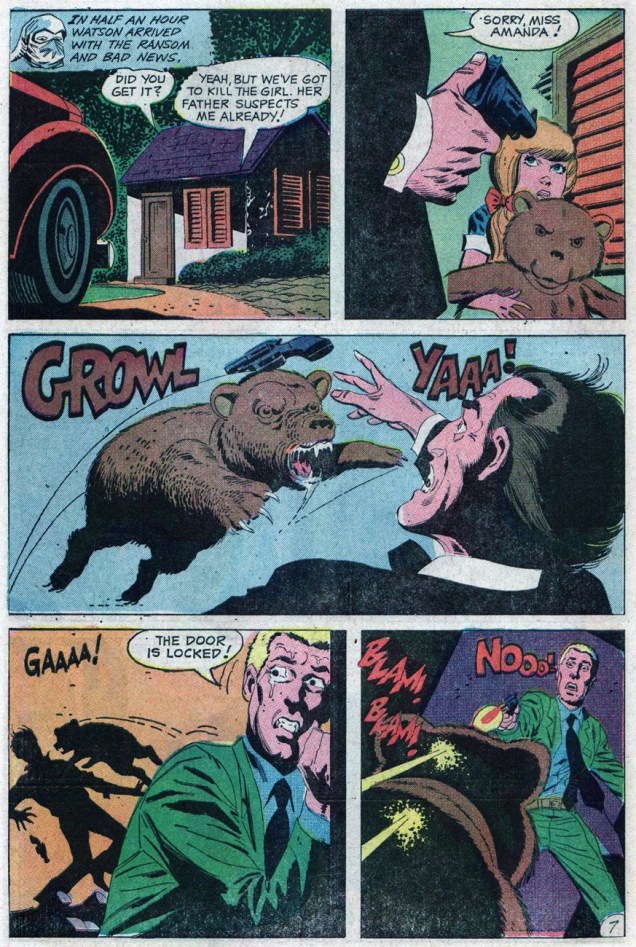
Post-Code, this sort of harsh poetic justice had to be handled very gingerly, if at all. The vengeful bear turned up again in Nicola Cuti and Jack Abel’s elegantly-told The Teddy Bear, in Haunted no. 15 (Nov. 1973, Charlton.)
Quoth the plush companion: « I was sent to you to protect you and I will! » Spoiler alert: the butler did it.
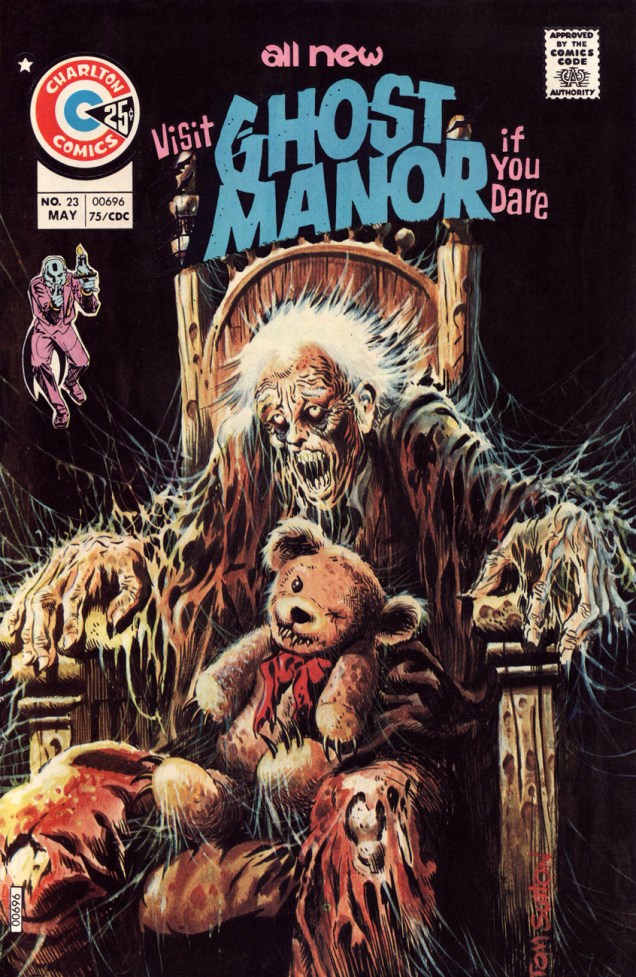
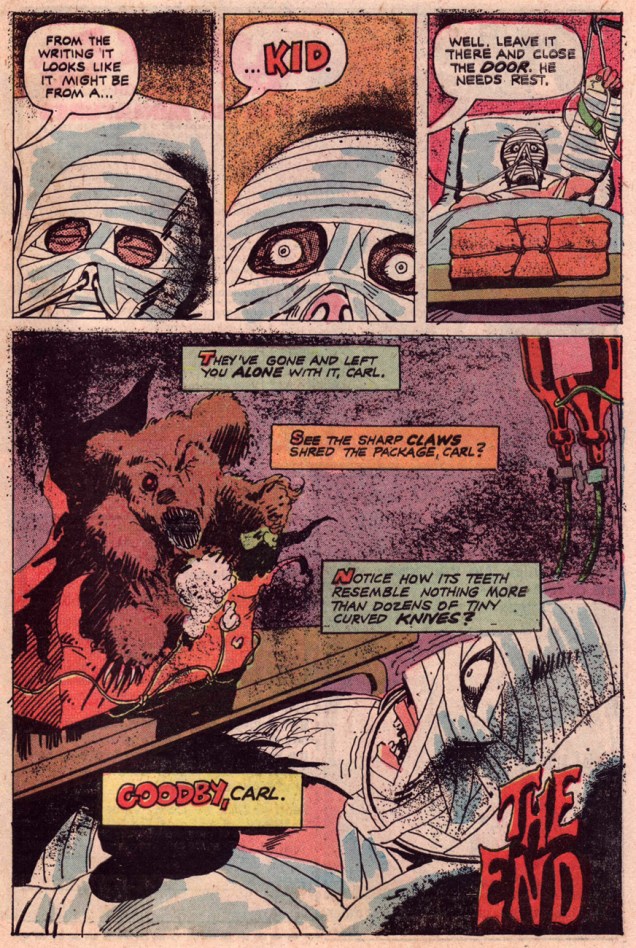
A couple of years down the pike, “Grisly”* Tom Sutton took up the gauntlet with his «Terrible Teddy!», from Ghost Manor no. 23 (May 1975, Charlton). Here it is, presented in its glorious entirety (including Sutton’s gnarly painted cover).
– RG
*perhaps more appropriately “Grizzly”, in this instance.
« Herbal tea. My own recipe. It’s added years to my life. May I offer you a cup? »
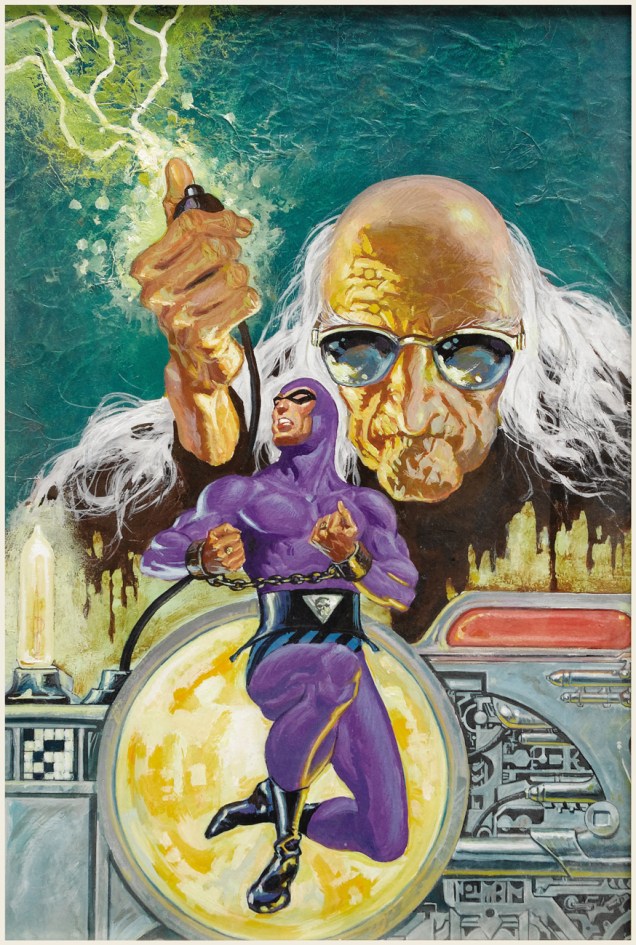
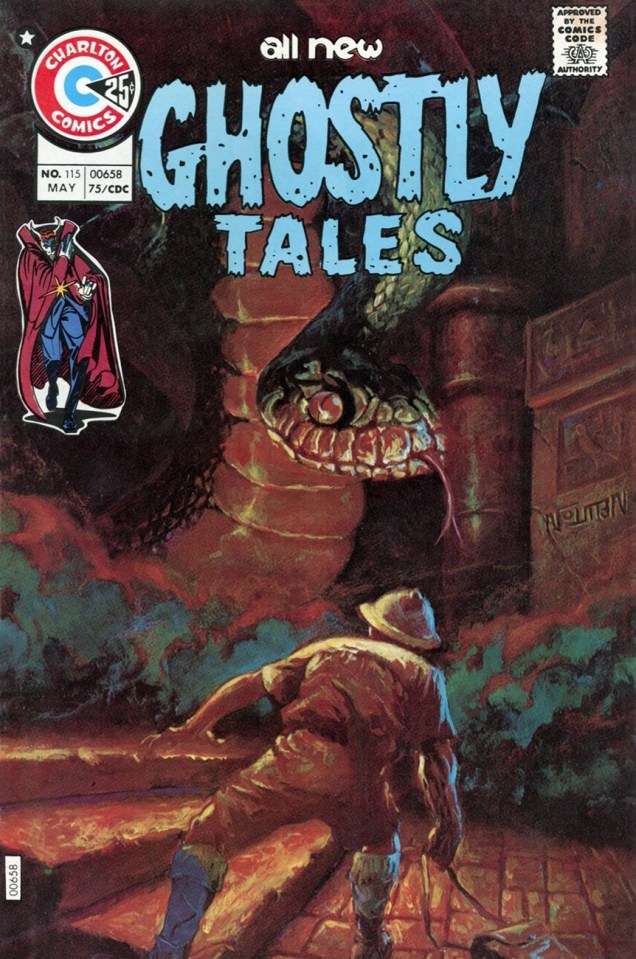
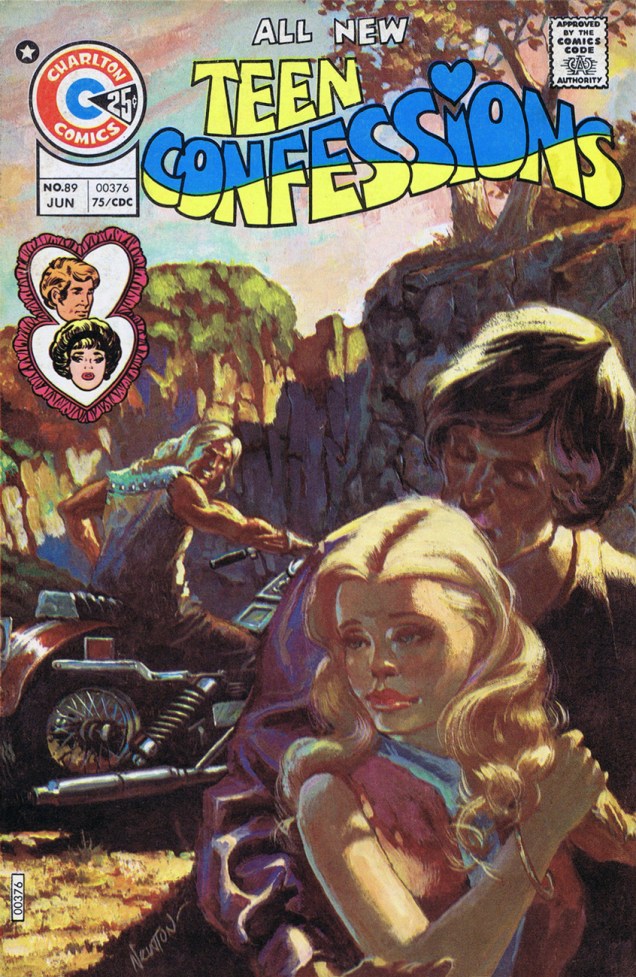
After producing some exceptionally solid fan art (chiefly for the long-lived Rocket’s Blast Comicollector (153 issues, 1961-1985), Arizona art teacher Don Newton made his jump into the pro leagues in 1974 with Charlton, where he got his chance to show off his considerable painting skills. After a handful of mystery stories, he took over Charlton’s version of Lee Falk and Ray Moore‘s The Phantom, which he drew for six issues (and one cover) before the title was cancelled… along with the rest of Charlton’s original comics line, really.
Newton’s original cover painting for issue 68 (December, 1975, Charlton) of The Phantom, illustrating the tale of The Beasts of Madame Kahn by Nicola Cuti and Newton.Newton’s cover painting (in acrylics, if you must know) for the penultimate issue of The Phantom’s Charlton run, no. 73 (October, 1976), “The Torch”, written by Ben S. Parillo (alias Bill Pearson), pencilled and inked by Don Newton. The wizened mastermind is a fella who simply goes by the name of ‘Raven’.« How could a snake be alive here, buried deep in the earth for thousands of years? » Don Newton’s painting (Ghostly Tales no. 115, May, 1975) depicts a scene from Joe Gill and Steve Ditko’s “Wings of Death!”« Turn her loose, Pike… I want to road-test the new talent! » Mr. Newton illustrates the Unknown Scribe and Demetrio Sánchez Gómez‘s biker operetta “Running Wild!”, from Teen Confessions no. 89 (June, 1975, Charlton.)
Newton would go on to DC (and a couple of brief dalliances with Marvel), illustrating Batman, Captain Marvel (er, “Shazam!”), Aquaman, Star Hunters, and The New Gods for DC, before being, all too soon, felled by a heart attack at the age of 49. Most of the time, though, he provided great art to ho-hum stories.
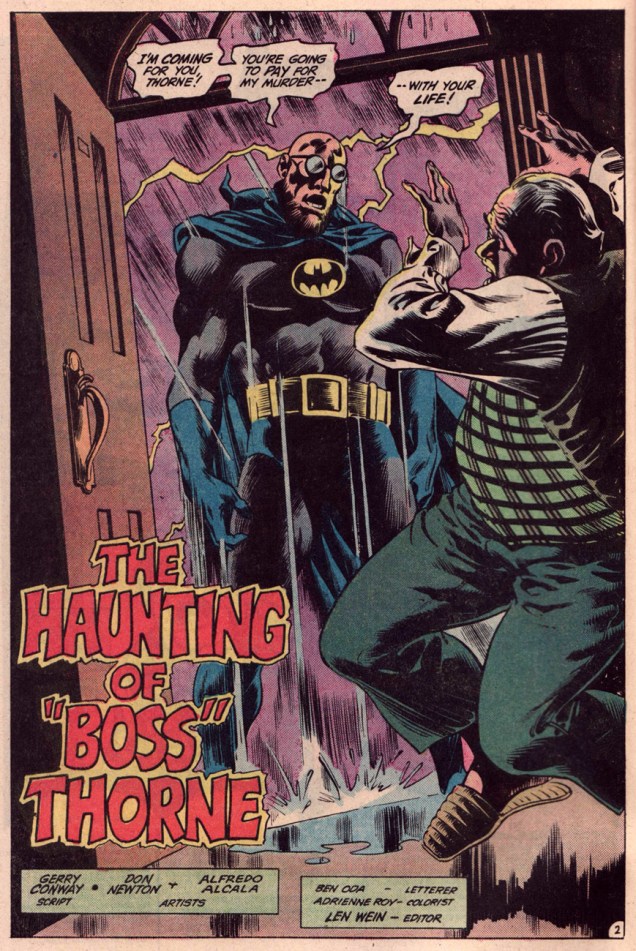
Against all odds, around 1982, scripter Gerry Conway, a name synonymous with half-assed, content-free hackwork since the early ’70s, actually blossomed into a decent writer. Fortuitously, while assigned to pencil Batman’s adventures in Detective Comics, Newton was paired with prolific* Filipino legend Alfredo Alcala, and the stars were in proper alignment. You won’t have to take my word for it, however. Feast your eyes on the palpable ambiance from the Conway-Newton-Alcala trio.
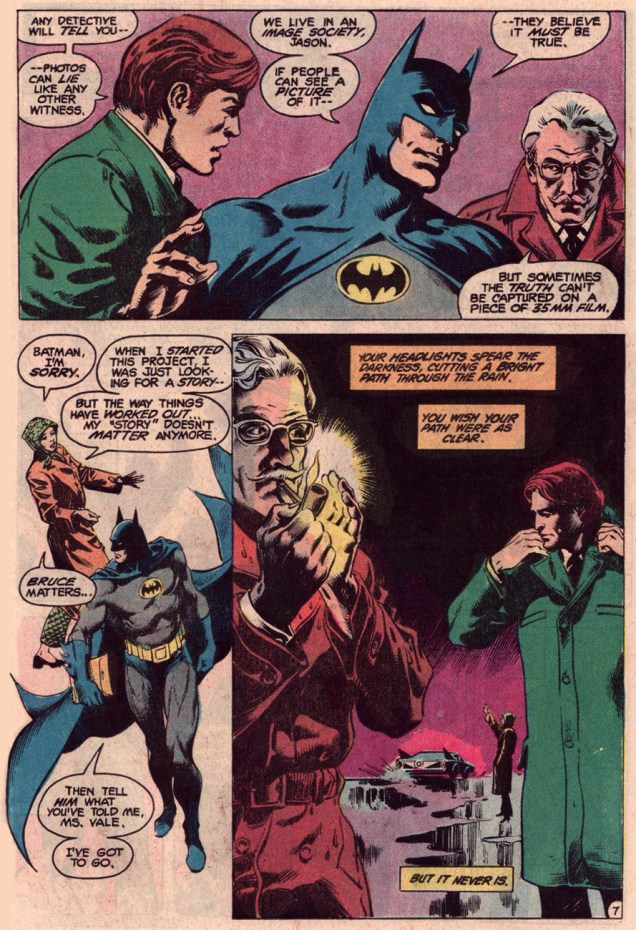
Picking up strands from Steve Englehart‘s run on the book (nos. 469–476, in 1977-78), creepy-but-buff scientist Hugo Strange returns to pester his murderer, crooked politician Rupert Thorne. Colourist Adrienne Roy’s hand is betrayed by the 100% magenta/30% black mix.Well, I have to show Newton’s actual Batman, don’t I? His was one of the few characterizations that were physically believable. You could buy this guy as an acrobat, as a fighter *and* as detective. Alcala often overwhelms whomever he’s inking, but since Newton’s pencils were probably tight as a camel’s ass in a sand storm, both men’s contributions mesh splendidly with no loss of identity. Pages 2 and 7 from Detective no. 520 (Nov. 1982).
– RG
*How prolific was Alcala? « It is said that his fastest page rate was twelve pages in a nine-hour sitting. » And the scary thing is that it hardly ever looked rushed or less than committed, unlike the work of some other inkers we could name. What a guy.
« It’s kind of like a spider web, only sweeter, and also it’s more pink »
Today would have been the 91st birthday of the great Jack Mendelsohn (1926-2017), who passed away last January, leaving behind a life well-lived and a sumptuous, if often unsung or anonymous, legacy.
Yet Mendelsohn will be no stranger to those accustomed to reading the small print and staying for the credits crawl: he co-wrote Yellow Submarine (the film, and got credit for it, unlike Donovan for the song), episodes of Laugh-In, The Carol Burnett Show, then decades of soul-killing animation scripting, not to mention, er… Three’s Company.
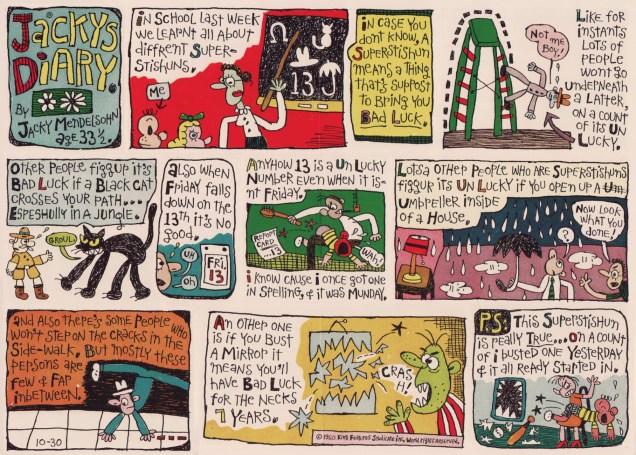
Ah, but today we salute him for his greatest triumph, though probably not the one his fans brought up when they met him*: the short-lived Sunday-only King Features comic strip Jackys Diary** (1959-61). In 1960, Dell Comics (were good comics, so they said) in a fit of mad inspiration, issued a one-shot (Four Color 1091, April-June 1960) drawing from the strip’s run… a flashback to the early practices of the comic book industry, when its product consisted of repackaged comic strip reprints.
Jackys Diary, October 30, 1960.
For a more comprehensive sample, hunt down the comic book, or Dan Nadel’s excellent Art Out of Time (2006, Abrams), which may just turn you on to further neglected but worthy visions. Or get thee hence swiftly to Sam Henderson‘s wonderful blog, The Magic Whistle. Sam saved me a lot of work (and stole my thunder) by graciously providing top-quality scans of the entire Dell comic book.
Then, if you’re good and hooked, you’ll be chuffed to hear that a complete collection of the strip’s run was miraculously assembled and published a few years ago, and finer than even the most fervent optimist could have envisioned. Once again, international treasures Craig Yoe & Clizia Gussoni and their crack production team have delivered a dream.
Produced with utmost attention to detail, as well as the full and clearly enthusiastic coöperation of the auteur himself, this handsome tome boasts, in addition to the full complement of excellently-reproduced strips, a fascinating and richly-illustrated retrospective article by Mendelsohn and a fondly witty foreword and backword by colleagues and accomplices Mort Walker (then 90 1/2) and Mell Lazarus (then 86 1/2). As they say, get yours now!
Jackys Diary, August 6, 1961.
*On that very topic, from his interview with John Province, published in Hogan’s Alley no. 10 (2002): « What fans? I have no fans! Why do you think I’m clinging to you? »
**that’s how it was intentionally spelled, for effect. Unlike spelling nowadays…



















 Who's Out There?