Panning the murky old print stream for the odd glimmering nugget
Oh, the Horror: the 1950s
The 1950s, as we all know, brought us the acme (and nadir) of horror comics. A zillion publishers, most of them long gone, got into the gore game before the censors stepped in. Let’s take a look at what led to the neutering of the comics industry…
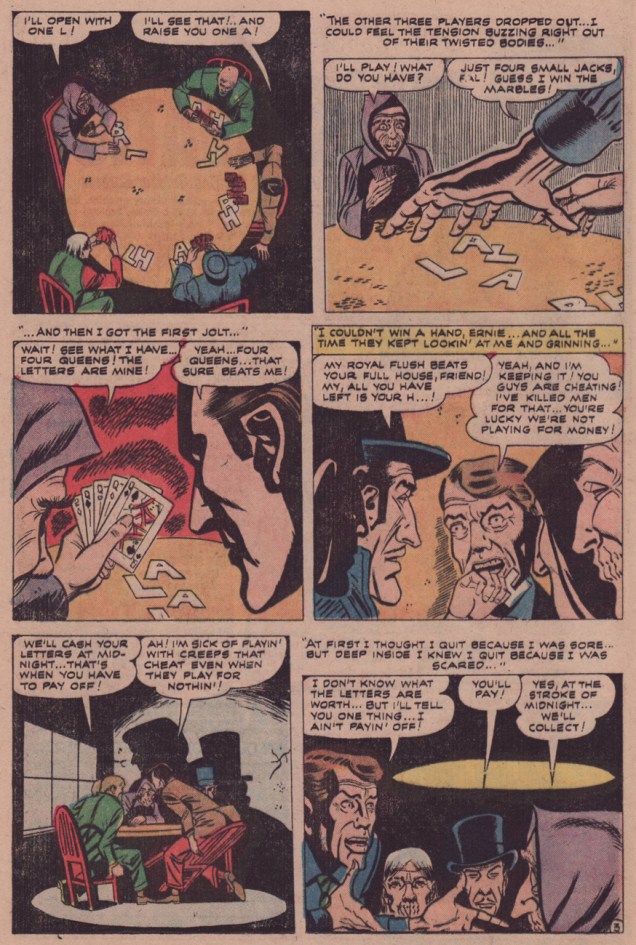
« The other three players dropped out… I could feel the tension buzzing right out of their twisted bodies… »
Poor, naïve Lou Beltram!
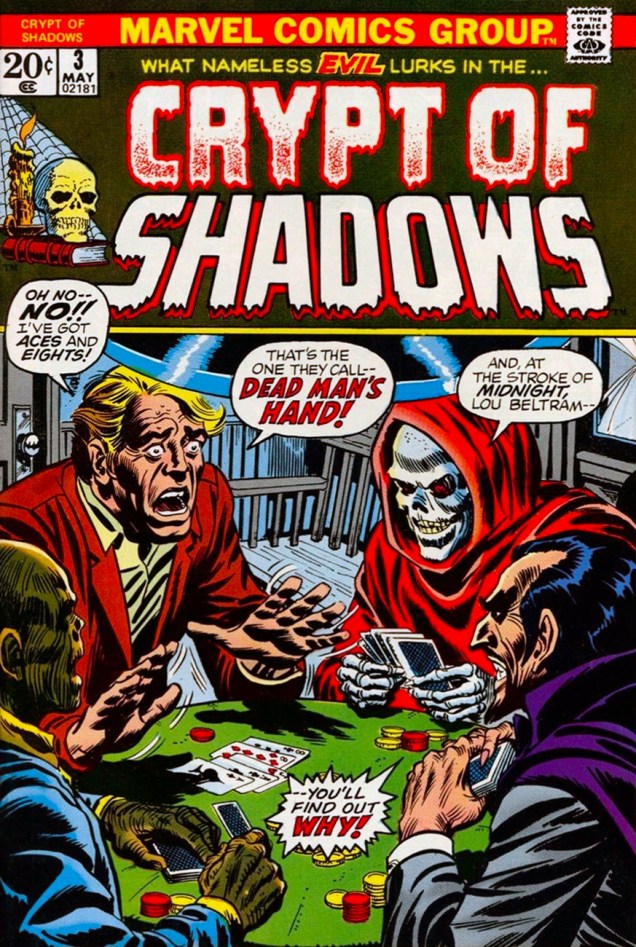
I first laid eyes on this one when I visited, in the fall of 1976, a tabagie (a tobacco shop) at a recently-opened shopping mall. For some reason, they had a batch of comics dating from 1973. This was one*.
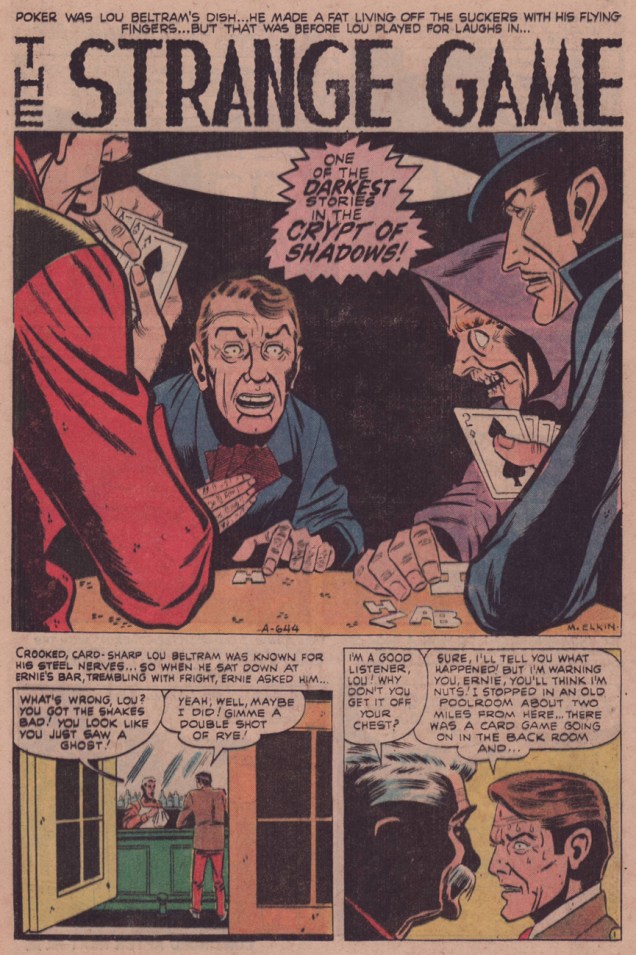
The cover feature, « The Strange Game », is a typical product of the early 1950’s horror boom: it doesn’t make a lick of sense, but it is fairly irresistible stuff, at least from the perspective of an 11-year-old. This wacky cover art, from this May 1973 issue, is the work of company man supreme John Romita Sr., Marvel’s heavy-handed art director of the period.
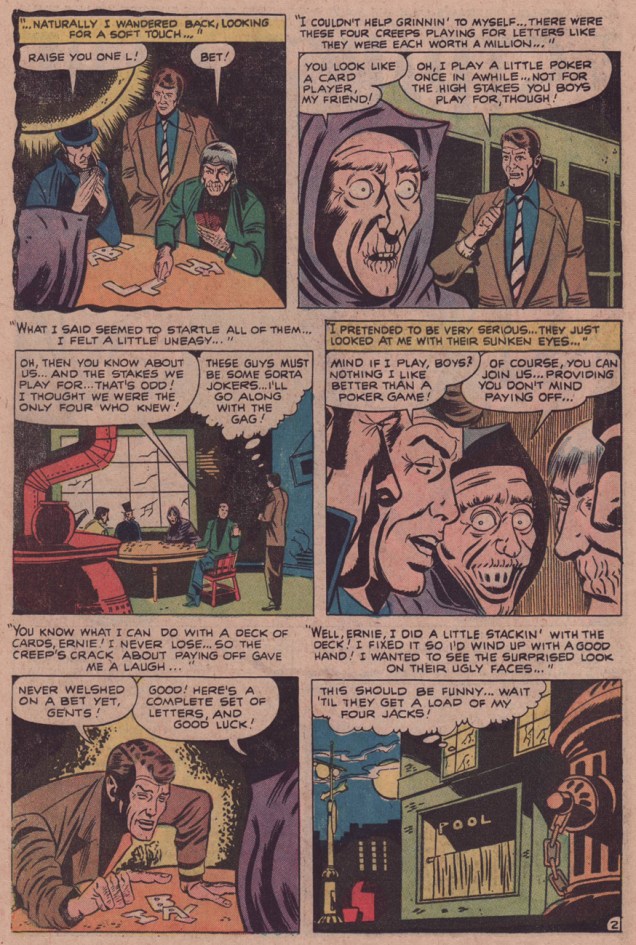
This time (sorry!) you’re getting the story right here, since… who else would get interested in such a boneheaded piece of claptrap, badly drawn to boot? (technically speaking… I do, however, find its primitive ineptitude quite charming). Suspend all disbelief and critical sense, and enjoy!
The tale in question, scripted by an unknown writer and illustrated by Marty Elkin (reportedly Gil Kane‘s cousin!), was reprinted from Atlas’ (what Marvel Comics were called back in the day) Strange Tales #9 (August, 1952).
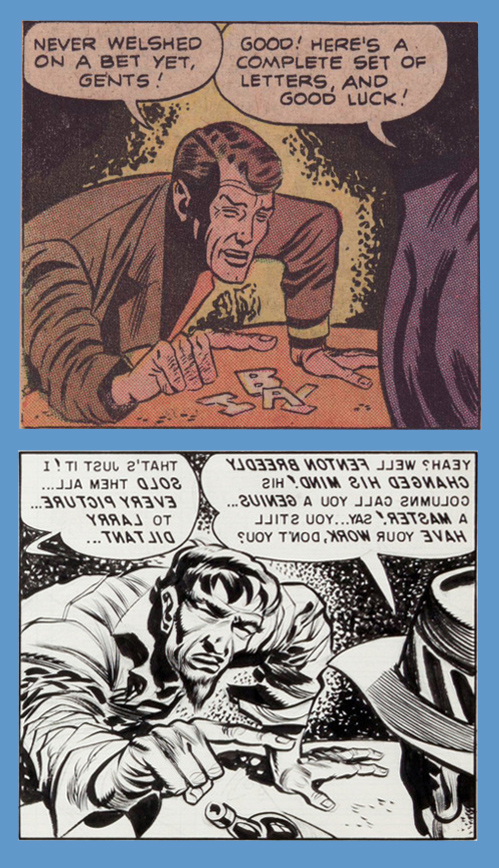
Oh, and something was nagging at me about a particular panel… so I did a little digging, here’s what I found: while swiping from Jack Davis has long been a national pastime, here’s one of the earliest infractions not perpetrated by Howard Nostrand (who’s fine in his own right, but he did have that singular, corner-cutting vice).
It’s a flipped (how devious!) steal from page 2, panel 6 of « Drawn and Quartered! » (script by Al Feldstein, art by Jack Davis), Tales from the Crypt no.26 (Oct.-Nov. 1951, EC Comics). Marty seems a bit hazy on the general concept of hands.
I also suspect page 2’s second panel to be an early EC Joe Orlando or Wally Wood swipe, but I can’t quite nail it down… yet.
-RG
*The Unexpected 146 and The Demon 8 (both cover-dated April 1973) were the others I picked up. What else was there? An issue of The Cat I didn’t buy, but otherwise, I’m drawing a blank. 😉
« Got to get into my pajamas… quickly! Got to… oh, Lord… NO! »
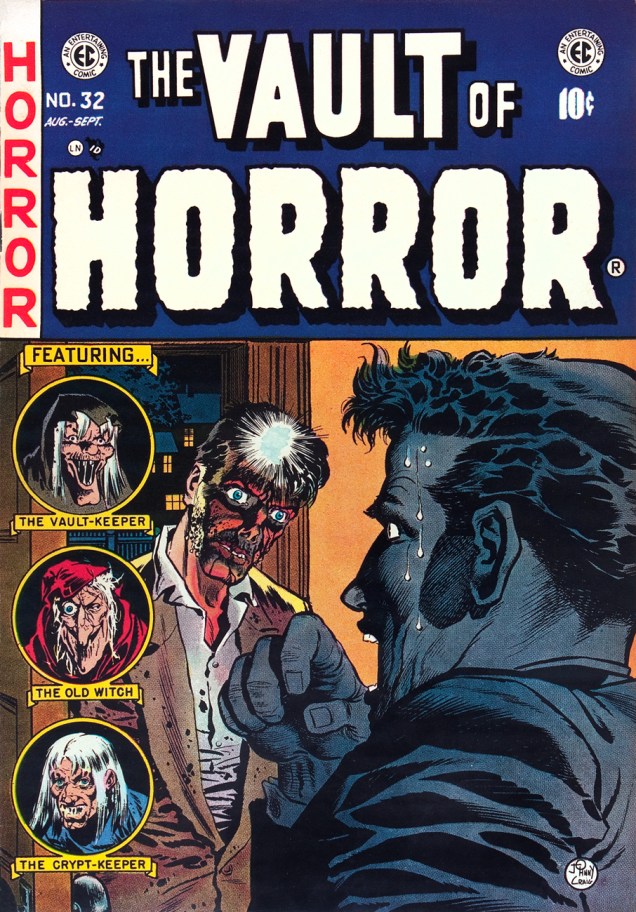
High time for some grue! I couldn’t reasonably be expected to shy away from EC’s 50s horror line, now could I? Of Entertaining (formerly “Educational”) Comics’ infamous/legendary trio of “New Trend” horror anthologies, The Vault of Horror surely was the finest. The deciding factor? The meticulous editorship, writing and artwork of Johnny Craig. While Tales From the Crypt and the The Haunt of Fear fed us a steady diet of Jack Davis, ‘Ghastly’ Graham Ingels and *choke* Jack Kamen (grandfather of the Segway, incidentally), with the fourth tale generally handled by Reed Crandall, Joe Orlando or George Evans, or if you got *really* lucky with your dime, Bernie Krigstein, things got stale. It didn’t help that the writing of the Bill Gaines / Al Feldstein duo, despite sporadic excellence, was quite formulaic and oh-so-verbose. Things got kind of claustrophobic for the artists. The Vault of Horror was different enough: Johnny Craig took care of the opening story, and wrote it himself, sparely and with great intelligence. A true breath of fresh air, though I’ll admit it’s an odd thing to say about EC’s gory tales.
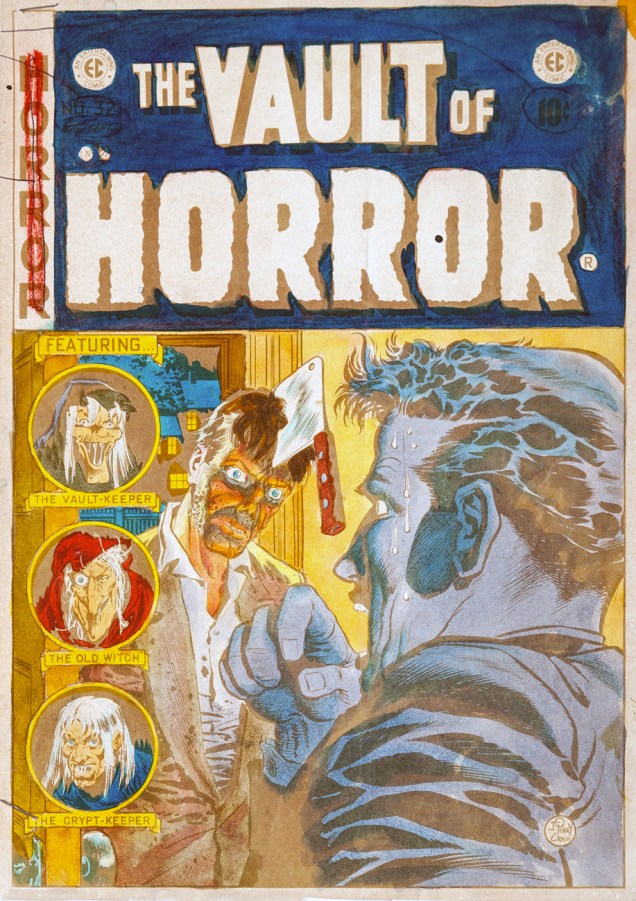
This particular cover (depicting a scene from Al Feldstein and Jack Davis’ « Out of His Head ») wasn’t originally slated for publication this way: EC’s attorney wisely insisted that it be toned down. The original version had appeared in house ads, so astute readers knew what they were missing.
To give you a sense of how far along things went before the punch was pulled, here’s the original, circa 1953, Silverprint cover proof in its original version, before being altered for publication. The proof was shot from the original negatives, with the image area reduced to printed size. Marie Severin used watercolours to specify the ink colours to be used.
Finally, the version below was recoloured (from cool to warm!) for Russ Cochran‘s deluxe hardcover reprint set of the 1980s and retained for subsequent Gladstone and Gemstone reprints.
Today’s Tentacle Tuesday comes courtesy of American Comics Group, which delighted its readers with horror, satire and other strange offerings between 1943 to 1967.
ACG’s Adventures into the Unknown is now recognized as comics’ first continuing horror title. A good variety of horror tropes (though I imagine that back then, the clichés we’re painfully familiar with today weren’t quite as clichéd) , from the amusingly bizarre to the genuinely scary, could be found within its pages: killer puppets, homicidal ghosts, murderous mummies, vicious dinosaur relics, spooky skeletons… and tentacles, of course. Unlike many of its brethren, the series survived the fall-out of the 1954 comic book hearings that were started by the Senate Subcommittee on Juvenile Delinquency, but the title did drop its creepier storylines in favour of goofiness. Not a bad way to go, really, as long as the result is entertaining!
I’d like to welcome you to Tentacle Tuesday by kicking things off with this unnecessarily graphic cover in which somebody’s tentacle is getting lopped off. Note that the she-octopus also has vampire fangs. Beautiful? I wouldn’t go that far… or anywhere near it.
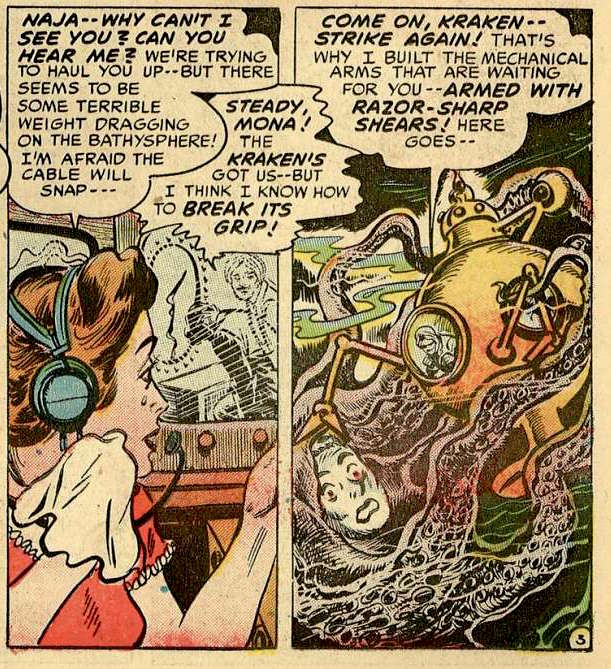
“…A monster which exists! I know — for I have met her face to face! Picture a face gigantic, beautiful — on a huge and monstrous body which reeks of evil — and death!” Adventures into the Unknown no. 49 (November 1953), cover by Ken Bald.A panel from « The Kraken », drawn by Jon Blummer. Geez, poor kraken. Later on, she (?) gets attacked with a “corrosive acid – with a nozzle activated from within “… Mona can’t bear to watch, and I agree.
There are five Adventures in the Unknown covers that feature octopuses (or someone’s nightmarish and anatomically ridiculous idea of an octopus, at any rate). We’ve already featured no. 157 (revisit the past here – Nemesis is waiting for you!); the remaining four were published between August and November of 1953 and illustrated by Ken Bald (who drew the covers for issues 21 through to 50). Didn’t he get tired of drawing tentacles? Was it his idea? Did he have nightmares afterwards?
(A little aside: speaking of Mr. Bald, he’s been in the Guinness book of records for a couple of years now, for being the “oldest artist to illustrate a comic book cover”. The comic in question is Contest of Champions no. 2 (2015, Marvel Comics), which he drew at the age of 95.)
I’ll skip no. 48 for now, as its tentacles are plant-like in nature, but onward with the other two!
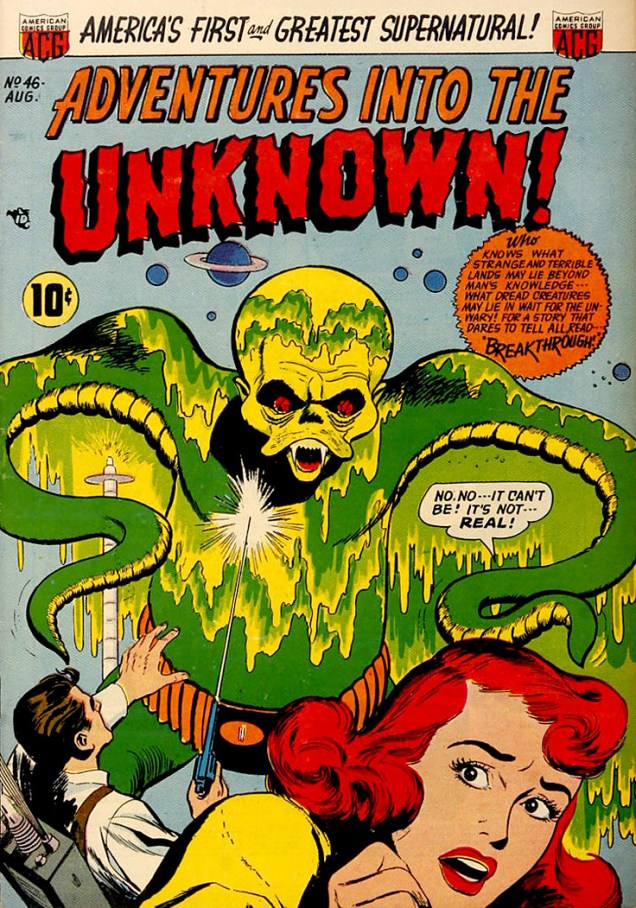
« Tale of Terror » from Adventures into the Unknown no. 46 (January 1953). Illustrated by Lin Streeter. It’s a well known fact that monsters on a diet are very irritable (and he’s still got a long way to go, judging by his chubby midsection).
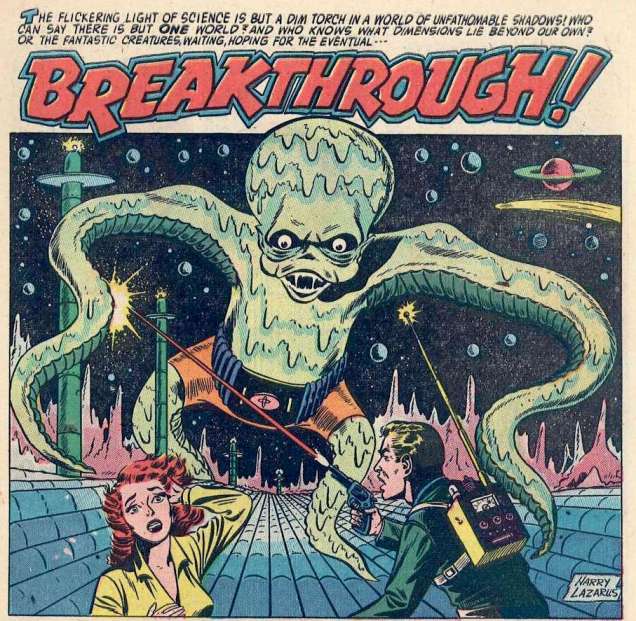
“Breakthrough!”, the title story, is beautifully illustrated by Harry Lazarus and brimming over with tentacles. Take a peek:
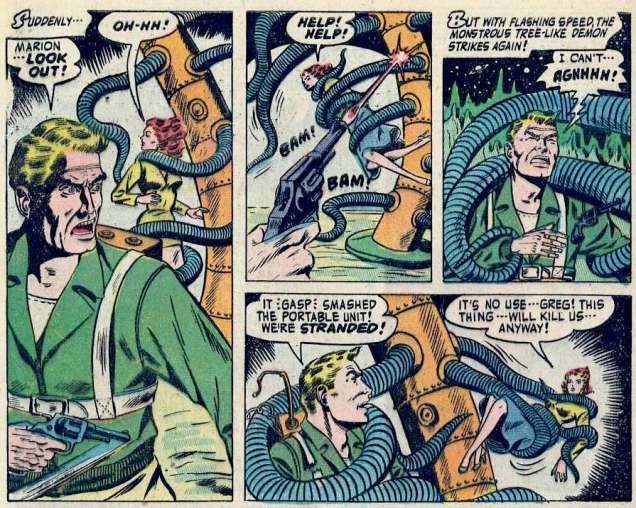
The main tenta-gonist of “Breakthrough!”, drawn by Harry Lazarus.In “Breakthrough!”, even cables have tentacles!
“It’s no use strugglin’ — not when ye’ll be the sea hag’s slaves forever!”Adventures into the Unknown no. 47 (September, 1953). Cover by Ken Bald.Ruthless pirates! A sea hag! Tentacles and “evil specters of the past!” All can be found in “The Derelict Fleet!”, illustrated by Jon Blummer in an interestingly fluid style.
Naturally, there is some tentacle goodness *inside* some issues of Adventures into the Unknown, despite an utter lack of cephalopods on the cover. I’ll give two examples (gracefully scanned by co-admin RG from the collected Adventures into the Unknown: Volume 8, published by PS Artbooks in 2014).
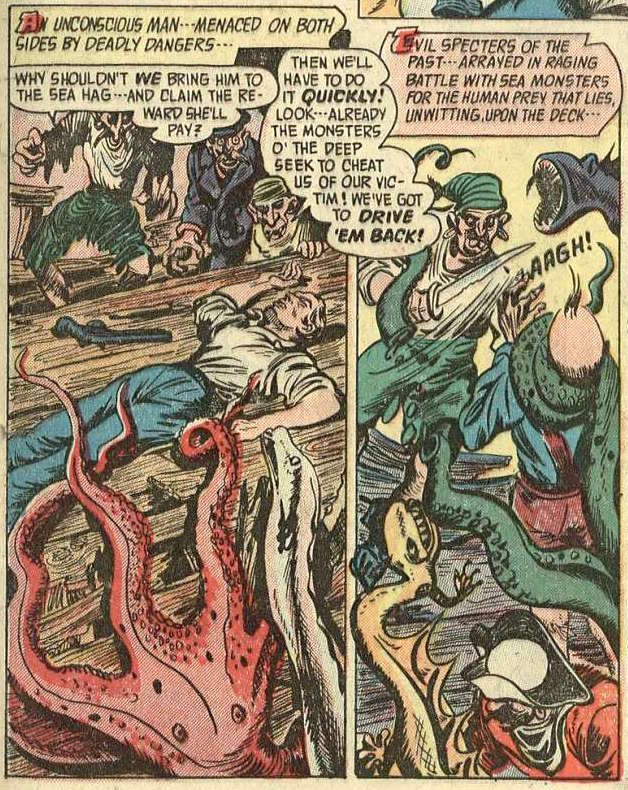
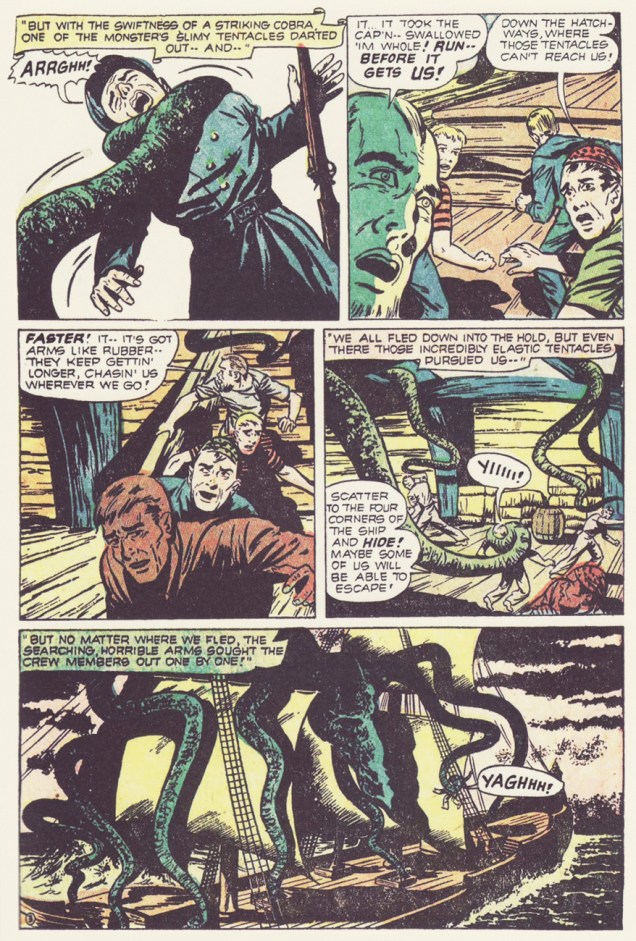
A panel from « Tale of Terror », published in Adventures into the Unknown no. 39 (January 1953) and Illustrated by Lin Streeter. This panel was wisely used for the PS reprint tome’s front endpapers, to great effect.Page from « Mystery of the Marie Celeste », published in Adventures into the Unknown no. 41 (March 1953), pencilled by Al Camy and inked by Edvard Moritz. How (and why) did the octopus manage to climb atop a ship?
Where there be pirates, there be treasure; where there be treasure, there be a displeased octopus, irritable after being roused by some foolish fortune-hunter. I’d like to dedicate this Tentacle Tuesday to the murderous marauders who, in bold search for immeasurable treasure, have to tackle tentacles (and survive, hopefully).
Weird Terror no. 2, November 1952. Cover by H.C. Kiefer. Note the dead pirate’s hook embedded in the diver’s shoulder, while the former’s other hand is severing his umbilical cable… I think the octopus is the least of this treasure-hunter’s worries. By Weird Terror standards, this cover is actually pretty tame; this green octopus is not responsible for Fredric Wertham‘s nightmares.
Any octopus action inside, you may ask? Just two panels.
AAAGH-BLUB! Panels from « Wrath of Satan », pencilled by John Belcastro and inked by Joe Galotti.
I never thought I’d be posting something Garfield-related, but in Roger Langridge‘s hands, even the insipid orange cat acquires some charm.
A panel from « Pirate Cat », written by Scott Nickel and illustrated+lettered by Roger Langridge, published in Garfield no. 34: His 9 Lives Part 2, (KaBOOM!, February 2015).
Melvin the Menacing Sea Monster isn’t just a pretty eye; he’s got at least one excellent pitching arm, too.
All this proves is that there’s a simple solution to an inane plot and pedestrian characters: hire Langridge to illustrate your story, and it will magically transform into a fun yarn.
Our next selection doesn’t technically feature pirates, but it features sailors, Spanish smugglers, swindlers and cheats, as well an epic battle with an octopus and stolen treasure buried at the bottom of the sea, so it damn well qualifies.
Classics Illustrated no. 56, February 1949; cover by August M. Froelich. For one thing, I never knew Victor Hugo had written anything squid-related. As it turns out, Toilers of the Sea (French: Les travailleurs de la mer) is a novel from 1866. How educational! Classics Illustrated was created by Russian-born Albert Kanter (1897-1973), who wanted to use the power of comics to introduce young readers to “great literature” that they might not otherwise have deigned to read. “Classic Comics” began publication in 1941, with the name of the series changed to “Classics Illustrated” in 1947. The series lasted until 1971 for a total of 169 issues; various other companies reprinted its titles. I don’t know whether this series really made a difference in the edification of youth, but many of its issues are highly collectible, anyway.
As a little bonus, here’s a cover that’s somewhat lacking in swashbucklers, but boasts some decent treasure and (quintessential ingredient) some tentacles.
If Rex the Wonder Dog (created by Robert Kanigher and Alex Toth) can ride horses, show off as an expert bullfighter, use cameras, defeat a Tyrannosaurus Rex and swing on ropes (among his many other accomplishments), I don’t see why he wouldn’t be able to effortlessly fend off some pink tentacles. This is The Adventures of Rex the Wonder Dog no. 42 (Nov.-Dec. 1958). The cover is by Gil Kane on pencils, Bernard Sachs on inks, and Jack Adler on tones and colours.
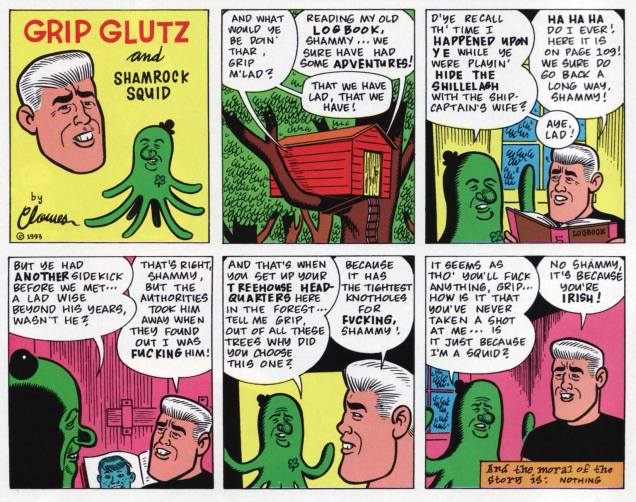
I’d like to interrupt the regularly scheduled Tentacle Tuesday with the double whammy of tentacles and kiss-me-I’m-Irish:
It’s Grip Glutz and Shamrock Squid! Originally published in Eightball no. 10 (February 1993.) Story and art by Daniel Clowes, of course. I love stories with no moral.
Shamrock Squid, created by Clowes, is an “open source” character, which is to say that other cartoonists have official permission to use him in their work.
« While Shamrock Squid was originally featured in Clowes’s comic book Eightball as a comic companion to “Grip Glutz” in a one-page ‘gag’, he has also made surprise or cameo appearances in other alternative comics such as Peter Bagge’s Hate and Rick Altergott’s Doofus. The most detailed, epic and perhaps final use of Shamrock Squid was done by Adrian Tomine and Peter Bagge in a 7 page piece in Hate #28 entitled “Shamrock Squid: Autobiographical Cartoonist”, which lampooned autobiographical alternative comics, teen angst, and fandom. It would seem that the gag has gone as far as it can. » (source)
I’m not sure what is implied by “the gag has gone as far as it can”, but since Adrian Tomine is involved, I’ll happily agree that enough is enough.
So if you’re planning to booze your woes away this Saturday on St-Patrick’s, happy drinking!
Moving on to the goofiness promised, here’s Tentacle Tuesday in all its glory.
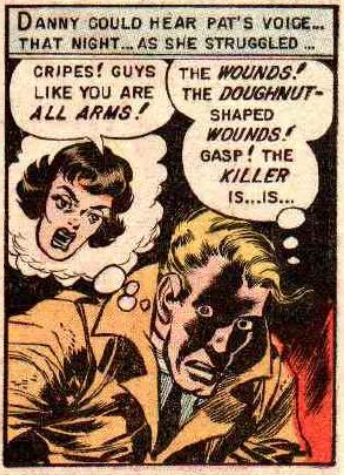
Many women get killed. Their corpses are covered in doughnut-shaped marks. A killer in a trench-coat sporting a wide-brimmed hat has been spotted retreating into the city’s aquarium after his crime. “Who Doughnut?”, the story’s title asks, and it is indeed a stumper.
The intrepid detective follows the killer! His mind struggles with the vital question of who or what could have possibly left such bizarre marks on his victims…
… and comes up with the answer! It’s…. (drumroll, please)…
Well, duh. Everyone knows octopuses suck blood (and have a weakness for stylish hats). « Who Doughnut? », written by Al Feldstein and drawn by Jack Davis, was published in Vault of Horror no. 30, April-May 1953. The art is glorious, and the story – while preposterous – is moody as hell, so do yourself a favour and read it here. As a matter of fact, it’s so well drawn that one forgets the farcical plot and shudders along with the protagonist.
The composition just pulls you in, doesn’t it? Although you might wanna watch that… lest you come face-to-face with a vampire octopus.
Quite on a different note, meet an alien lifeform with an appetite for self-destruction. Which is to say: it likes to be eaten.
« The CXL spice paste is made up of millions of hive-minded micro-organisms whose sole purpose in life is to be eaten in a delicious meal. If the lettuce is too thick and chunky, the CXL will realise they are being prepared wrong and will strangle the chef responsible. » Snippet from James Stokoe’s Wonton Soup, published by Oni Press in 2014. Thanks to RG for putting together my hasty photographs of this page from a completely unscannable, thick and tightly-bound book.
Canadian Stokoe is probably best known for his take on Godzilla, which comic left me frankly underwhelmed. However, I heartily recommend the unfortunately unfinished Orc Stain. As for Wonton Soup, it was loads of fun to read. Here’s a summary from Publisher’s Weekly: « Stokoe’s wittily vulgar debut graphic novel follows former-cook–turned–space trucker Johnny Boyo as he fights off space ninjas, returns to the planet of his ex-girlfriend Citrus Watts, and finally faces a cook-off duel with a pair of alien twins who’ll stop at nothing to achieve culinary victory. » That covers the gist of part 1; to which I’ll add that part 2 of Wonton Soup concerns itself largely with Johnny’s buddy Deac’s reminiscences about his mad escapades with a sex bear, which are not for the squeamish.
Let’s end this cephalopod festival not with a bang but with a whimper… the whimper of a wife who’s getting carried off by tentacles, that is.
“Sorry, dear.” Cartoon by Gahan Wilson, who can always be relied on to resort to tentacles whenever possible.
Welcome to the first Tentacle Tuesday of 2018. Exciting, isn’t it?
Since it’s currently chillingly cold outside (or so the weather networks tell us), let’s bask in a bit of warmth and visit some exotic places where heat reigns supreme all year ‘round.
What’s the first thing to do on a vacation? Take a leisurely walk, of course. However, I’d advise against venturing into a swampy forest. Some people never listen to sage advice, however…
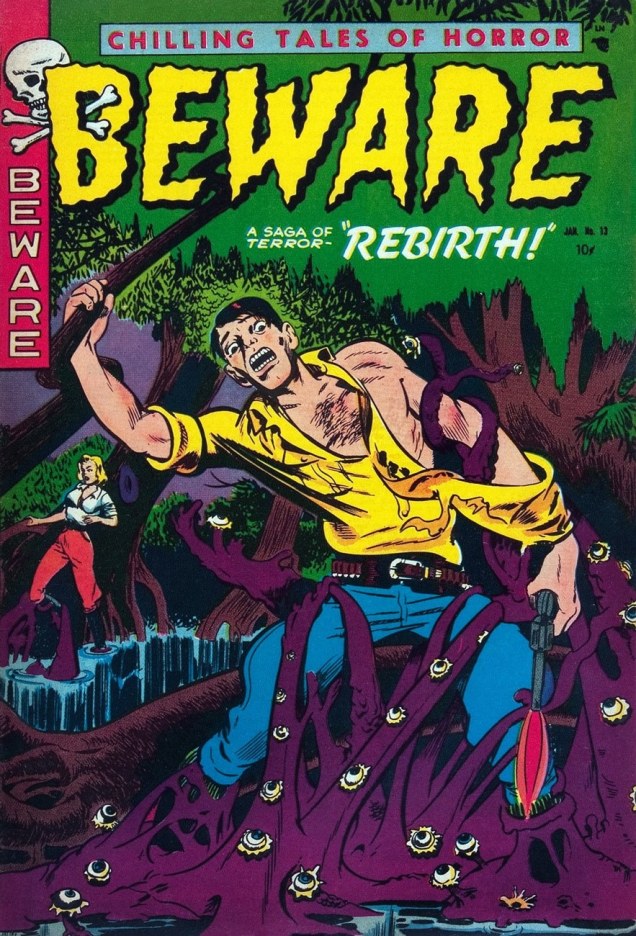
This is Beware no. 13 (1953), with a cover by Harry Harrison. « Out of the filth and mud-spawned deep it came, this horrible slug-white creature that wanted only one thing — to be loved! » Wait, what? “Rebirth”, the cover story, also illustrated by Harrison, clearly has absolutely nothing to do with the cover.
I’m quite fond of Harry Harrison as a writer, but as an artist he seems to have been rather middling. Although advertised as a “saga of terror”, Rebirth is an intriguing story in which the “horrible slug-white creatures” are actually far more likeable than the regular humans, who are back-stabbing, greedy assholes. Not that the plot makes much sense.
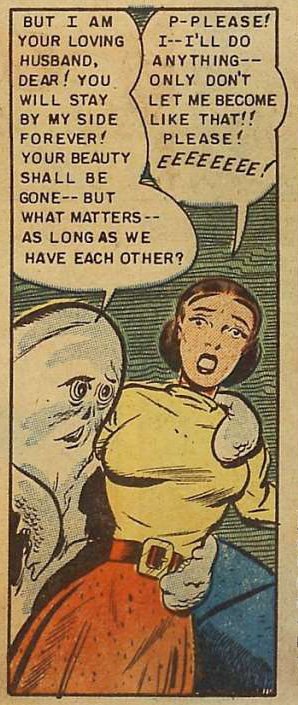
The “white slug” may be well-intentioned, but he tends to launch into pompous speeches at the drop of a hat.A heart-warming, romantic scene.
Okay, so a walk through a forest didn’t pan out quite as hoped. Let’s take a soothing dive into welcoming, warm waters. Did I say “welcoming”? Perhaps a little *too* welcoming.
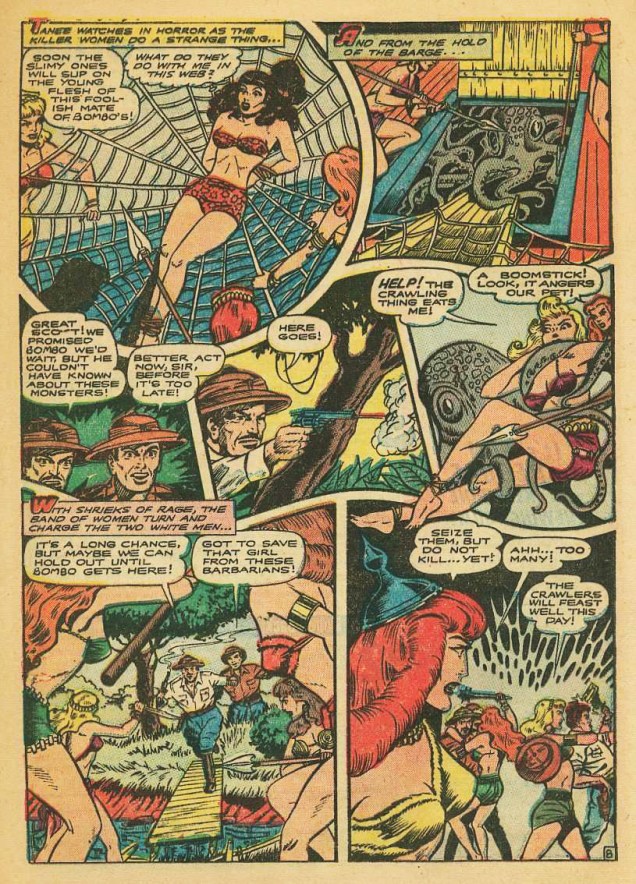
Terrors of the Jungle no. 20 (December 1952), cover by L.B. Cole. Normally I like Cole’s use of bright colours, but on this cover he goes all the way into gaudiness. However, the octopus is quite handsome, and he’s got startlingly human, expressive eyes. I’m rooting for him! Once again, the cover has little to do with the cover story.
The Creeping Scourge, credited to the Iger Shop (that my spellchecker keeps correcting to “tiger shop”), a comics packager that was officially known as the Eisner and Iger Studio, is an entertaining romp with babes in bondage, wild natives, catfights, blood sacrifices, etc. For example:
A typical page from The Creeping Scourge, published in Terrors of the Jungle no. 20 (December 1952). « Help! The crawling thing eats me! » is a pretty snappy catchphrase.
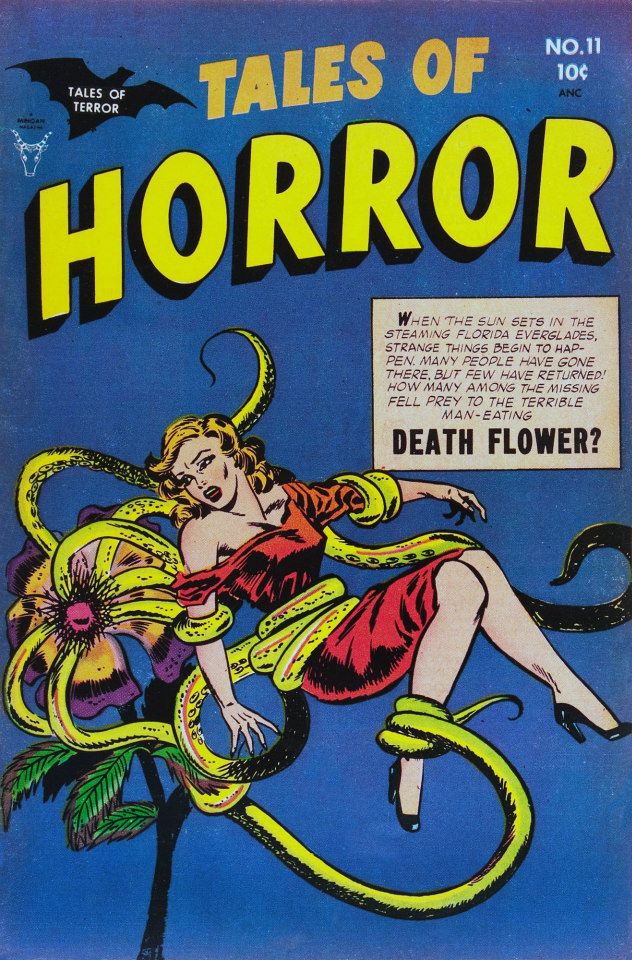
For the botanically-minded, a vacation is a fine opportunity to admire some heretofore unseen exotic plants. Take a look at this sweet little flower:
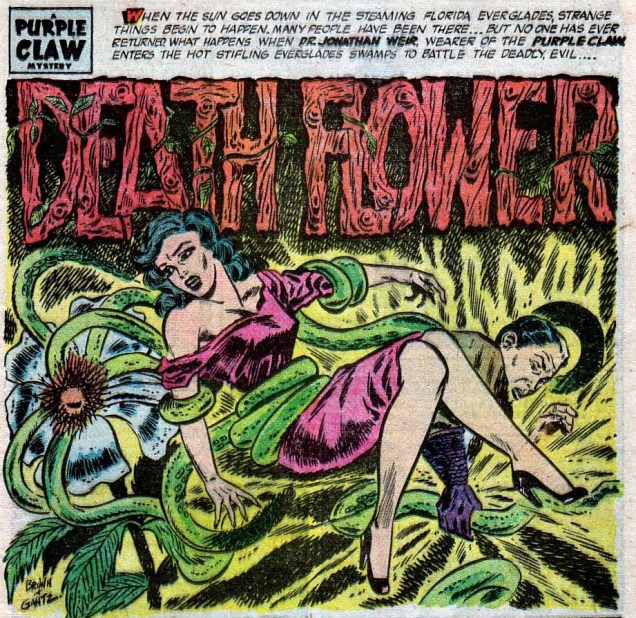
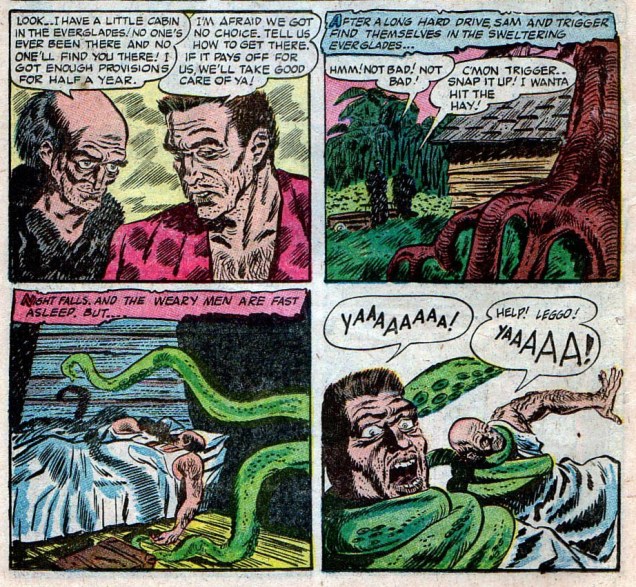
« In the middle of the everglades, there’s a flower that’s different from any you’ve seen… » Tales of Horror no. 11 (June 1954). Pencils by Ben Brown, inks by David Gantz. Death Flower tells the blood-curdling tale of a creepy old man who lives in the Florida swamps and feasts on human flesh – after having turned into a flower, of course.The opening panel of Death Flower, also drawn by the Ben Brown (pencils) and David Gantz (inks) team.Wouldn’t *you* trust this old man? Just look at him – such honest eyes, such a confidence-inspiring face. Yes, of course we’ll go to your cabin, venerable oldster!
That’s it for our little holiday pleasure trip – come to think of it, I’ll remain where it’s cold and snowy, thanks.
Today is birthday number ninety-five for Stanley Lieber, aka Stan Lee. He was hatched on December 28, 1922. Have a good one, Stan.
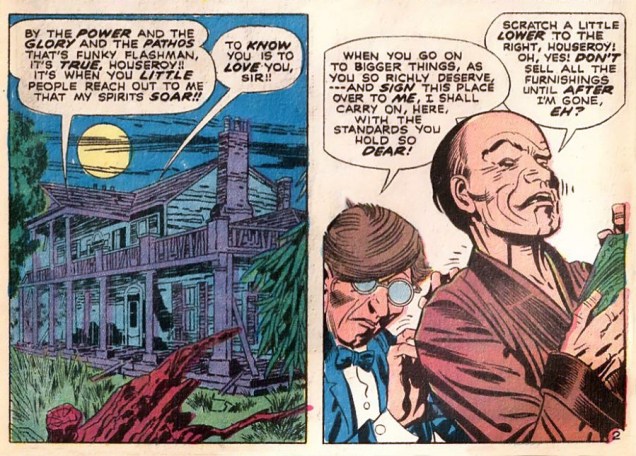
Jack Kirby recalls with fondness his former editor and his toady, in “Funky Flashman!” (Mister Miracle no. 6, January-February 1972, DC).
On this momentous occasion, let’s hear about Stan from some of his colleagues, who knew The Man and obviously loved the experience:
Wally Wood:
« Did I say Stanley had no smarts? Well, he DID come up with two sure fire ideas… the first one was ‘Why not let the artists WRITE the stories as well as draw them?’… And the second was … ‘ALWAYS SIGN YOUR NAME ON TOP… BIG’. And the rest is history… Stanley, of course became rich and famous … over the bodies of people like Bill [Everett] and Jack [Kirby]. Bill, who had created the character that had made his father rich wound up COLORING and doing odd jobs. »
EC legend Bernie Krigstein, who collaborated with Stan at Atlas, and whose « Suppressed Desire » is featured in Spellbound no. 17 (September 1953) , with a glorious cover by the above-mentioned Bill Everett.
In the course of a 1960s interview with comics scholar John Benson, Krigstein responded to Benson’s statement of « I guess you know that Stan Lee has been the spearhead of the so-called current revitalization of comics »:
« I’m delighted to learn that. Twenty years of unrelenting editorial effort to suppress the artistic effort, encourage miserable taste, flood the field with degraded imitations and non-stories have certainly qualified him for this respected position. »
Then Gil Kane, who was Marvel’s principal cover artist for much of the 70s, and who collaborated with Lee on The Amazing Spider-Man in some of its most popular years, including the infamous, comics-code unapproved “drug” issues (nos. 96-97, May-June 1971), on the respective creative roles of Stan and Jack Kirby:
« On each page, from 1964 – 1970 next to every single panel Jack wrote extensive margin notes explaining to Lee what was taking place in the story. It took Jack about 2 weeks to do a single story, it may have taken Lee as little as 4 hours to add text to Jack’s art. »
And Steve Ditko, in a letter to the editor of Comic Book Marketplace, published in the magazine’s 63rd issue in 1998, on his and Stan’s respective roles in crafting an issue of Spider-Man:
« The fact is we had no story or idea discussion about Spider-Man books even before issue no. 26 up to when I left the book. Stan never knew what was in my plotted stories until I took in the penciled story, the cover, my script and Sol Brodsky took the material from me and took it all into Stan’s office, so I had to leave without seeing or talking to Stan. »
« What are you mumbling about? »
« Oh, nuthin’! … just that my false teeth get loose an’ make a lot of noise! »
Today marks the one hundred and third anniversary of the enigmatic Jack Cole (December 14, 1914 – August 13, 1958) a man embodying, in equal parts, hilarity, talent and torment. Just when everything seemed to be going his way, he took his own life in 1958, for reasons still surmised about. His widow was the only one to know, and she took her secret to the grave.
Let’s move past this morbid stuff and concentrate on the man’s creative legacy, shall we?
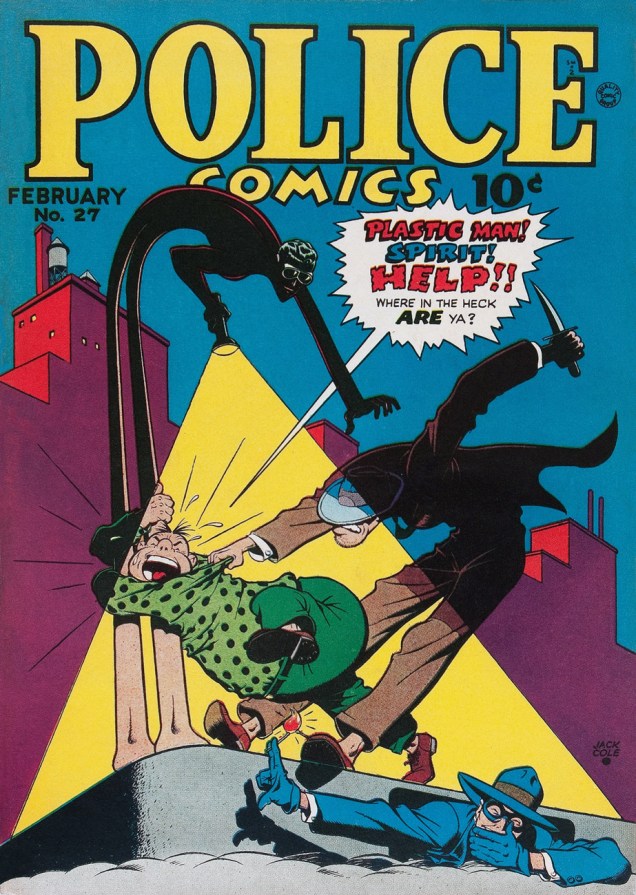
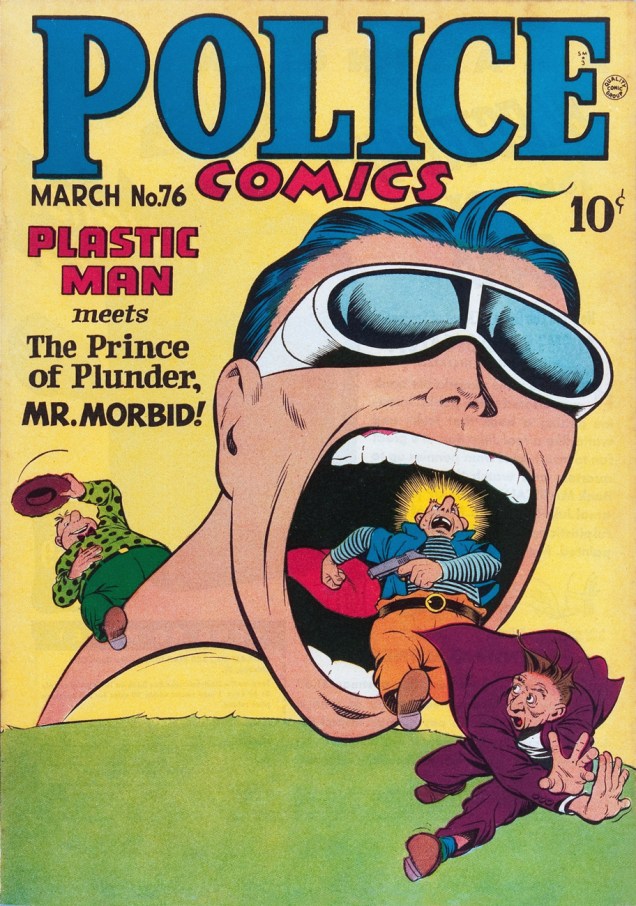
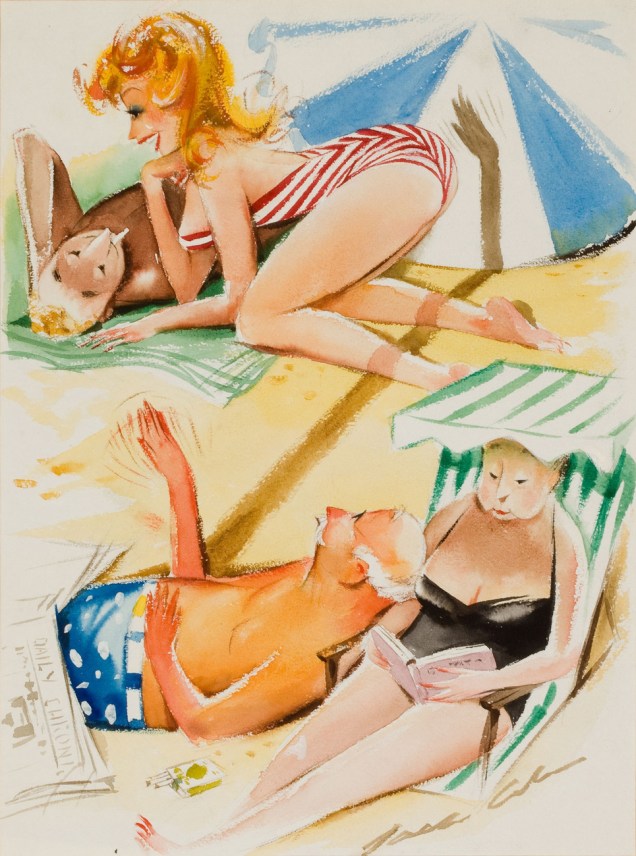
Cole’s cover for his Plastic Man story « The Rare Edition Murders » (originally called « The Bookstore Mystery », judging from the cover art) cleverly ties in the mag’s other features. And they do need to be mentioned: Flatfoot Burns by Harvey Kurtzman, The Darson Twins by Jack Keller, The Spirit by Will Eisner (or his talented ghosts), Manhunter by Reed Crandall… This is Police Comics no. 25 (December 1943, Quality).Routine, the same old grind… another issue of Police Comics, another splendid Jack Cole cover. This is Police Comics no. 27 (February, 1944), featuring Plastic Man in « Woozy Winks, Juror », and tales of Dewey Drip, Flatfoot Burns, Destiny, Manhunter, Dick Mace, The Human Bomb, Burp the Twerp (by Cole), and of course The Spirit. Sounds potentially entertaining? Read it here, then: http://comicbookplus.com/?dlid=37421Cole’s Plastic Man, one of the timeless wonders of comics’ Golden Age, a character only his creator truly knew how to handle properly. This is Police Comics no. 72 (November 1947, Quality).Another vivid (what else?) example of Mr. Cole’s boundless inventiveness, featuring his flagship creation, Plastic Man (and rotund sidekick Woozy Winks). This is Police Comics (1941-1953, 127 issues) no. 76 (March 1948, Quality).« You mean this guy had nine slugs in his chest and still choked the other one to death? » Web of Evil no. 5 (July 1953, Quality).Web of Evil no. 6 (September 1953, Quality).This lovely watercolour ran in Playboy Magazine‘s August, 1955 issue. It’s titled « The Elongated Hand ».« Like they say in the travel folders, Miss Duncan – ‘Getting there is half the fun’ ». Playboy Magazine, August, 1956.
Sekowsky, born on November 19, 1923 (it was a Monday), was another of those precocious, tireless, versatile pioneers of the comic book industry, such as Joe Kubert, Carmine Infantino and Alex Toth. He started out with Timely Comics in 1941.
I’ve always enjoyed his mature style most, as it became more eccentric and more distinctive, without sacrificing an iota of storytelling and compositional ability. We’ll come back to the topic with some examples in tow, but for the present, here’s a select gallery of his covers over the years. I stayed away from the more obvious choices… we hardly need to revisit his introduction of the Justice League of America (Brave and the Bold no. 28, March 1960), for instance.
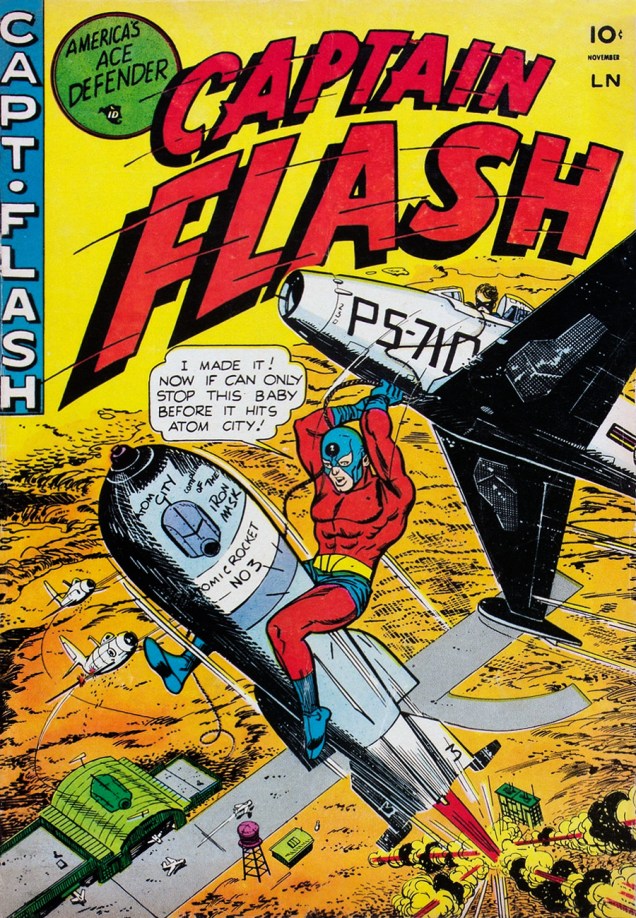
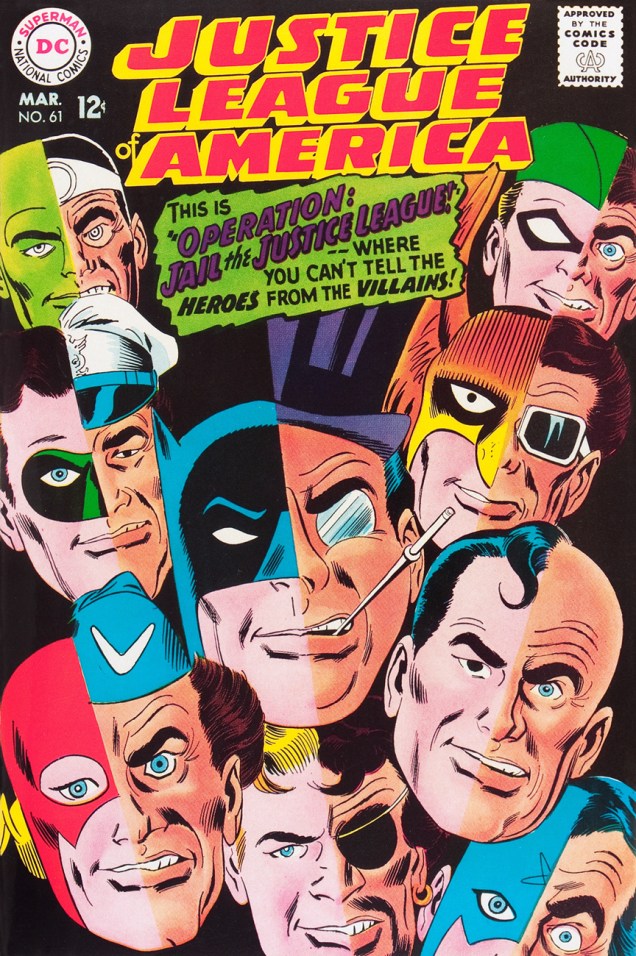
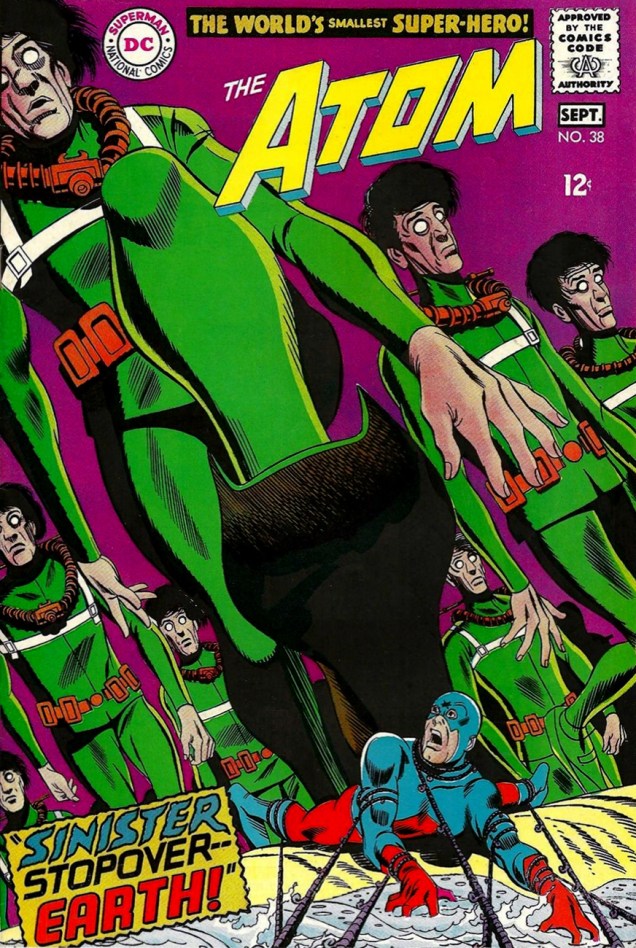
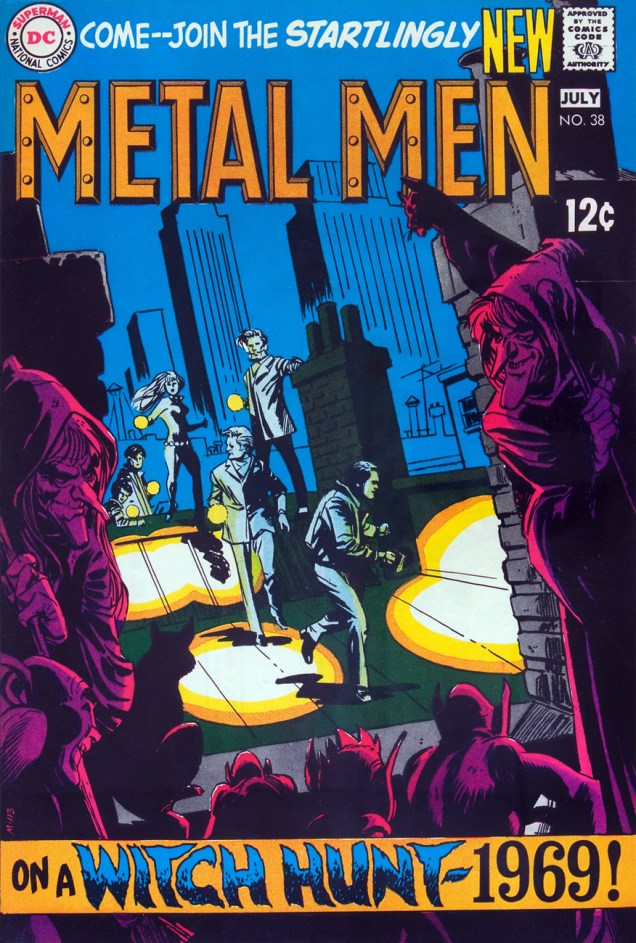
I’m reminded of an old joke (usually) told about Beethoven: « A tourist is sightseeing in a European city. She comes upon the tomb of Beethoven, and begins reading the plaque, only to be distracted by a low scratching noise, as if something was rubbing against a piece of paper. She collars a passing native and asks what the scratching sound is. The person replies, ‘Oh, that is Beethoven. He’s decomposing‘. » This jazzy Mike Sekowsky / Mike Peppe (attributed) cover tableau sadly doesn’t turn up in any of the inside tales. Typical. This is lucky issue 13 of Standard/Better/Nedor Comics’ Adventures into Darkness (Dec. 1953.) And if you’re in the proper mood, the whole thing’s available for your reading pleasure right here.« Sorry, old buzzard! Pick on someone your own size! » One of the last new supermen of the Golden Age, the absurdly well-endowed Captain Flash came along just before the Code did, in November 1954. Captain Flash’s adventures were published by tiny Sterling Comics, which released a handful of titles in 1954-55 then vanished. Bad timing. Captain Flash gained his mighty powers through accidental exposure to cobalt rays, if you must know. Thrill to his heroics right here: http://comicbookplus.com/?dlid=17682« Blazes! And if I remember my Bat-lore, that’s the flying bat-cave he’s using to charge that bank! Hit the brakes, stoop-skull! » Bob Haney and Mike Sekowsky bring the wacky to this issue of The Brave & Bold no. 68 (Oct/Nov. 1966), with the saga of “Alias the Bat-Hulk“! Script by Haney, pencils by Sekowsky, cover inks by Joe Giella and story inks by Mike Esposito. Gotta love the cackling peanut/rogues’ gallery!I’ve always had a soft spot for Gardner Fox and Sekowsky’s JLA, but no-one else’s, really. Especially late in their run, when things got increasingly bizarre. This is Justice League of America no. 61 (March 1968). Cover by Sekowsky and Jack Abel.Ah, the always fun “screw you, hero!” cover theme. This is Green Lantern no. 66 (January, 1969), pencilled by Sekowsky and inked by Murphy Anderson, an unusual but effective combo. Within, «5708 A.D. — A Nice Year to Visit — But I Wouldn’t Want to Live Then!» is scripted by John Broome, pencilled by Sekowsky and inked by Joe Giella.The final issue of the Atom as a solo book. He would team up with Hawkman for a few issues (with gorgeous Joe Kubert covers), but all in vain. The Atom no. 38‘s (Aug./Sept. 1968) « SinisterStopover… Earth! » is written by Frank Robbins, pencilled by Sekowsky and inked by George Roussos. Cover by Sekowsky and Jack Abel.While newly-ensconced editorial director Carmine Infantino seemed to have boundless faith in Sekowsky in the late 1960s and early 1970s, pretty much every one of his creations and revamps turned out to be box office poison… but they were often bold, and certainly different. His take on Bob Kanigher and Ross Andru‘s Metal Men was odd, at times baffling, invigorating… and, at six issues, quite short-lived. This is Metal Men no. 38 (June-July 1969).« Do we dare follow? Keep your distance now… don’t let it know you’re there! » Nick Cardy crafted the majority of DC’s The Witching Hour’s gorgeous early covers, some of his finest work. But… *this* understated beauty was pencilled by Sekowsky and inked by Cardy. The picturesque results are set in the selfsame 1930s Universal Studios backlot Balkans of the mind so dear to several generations of monster-loving artists and kids. This is The Witching Hour no. 3 (June-July, 1969.)
« Thought I’d inject a little excitement into this initiation… do I look any worse for wear? »
When EC überfanRuss Cochran launched his incredibly ambitious series of hardcover sets of the complete EC Comics in the late 1970s, there was simply no way I could afford the lot… so I gathered my shekels and mail-ordered a single volume of Tales From the Crypt (no. 3, midway through the run) and further managed to sweet-talk a nice lady at the local public library into ordering the first volume of Weird Science (years later, I would meet a couple of kids who’d become obsessed with the book, signing it out dozens of times and wondering how it had ever come to be acquired by our small, mostly francophone library).
Since the EC formula (meaning Bill Gaines & Al Feldstein) does wear thin with prolonged exposure, I gravitated to the outliers: Harvey Kurtzman, Johnny Craig, Bernie Krigstein, the Bradbury adaptations… but the true revelation in these volumes turned out to be John Benson and Bhob Stewart’s superb documentary notes, comprising astute analyses and eloquent interviews with the surviving participants… which are nowadays down to, well, colourist Marie Severin.
Anyhow, I was particularly intrigued by Gaines and Feldstein’s early system of “springboards”, which is to say that they based stories upon anecdotes encountered in newspapers and magazines. One title evoked time and again is Try and Stop Me (1944)*.
From John Benson’s documentary notes in Haunt of Fear, Volume 1 (1985):
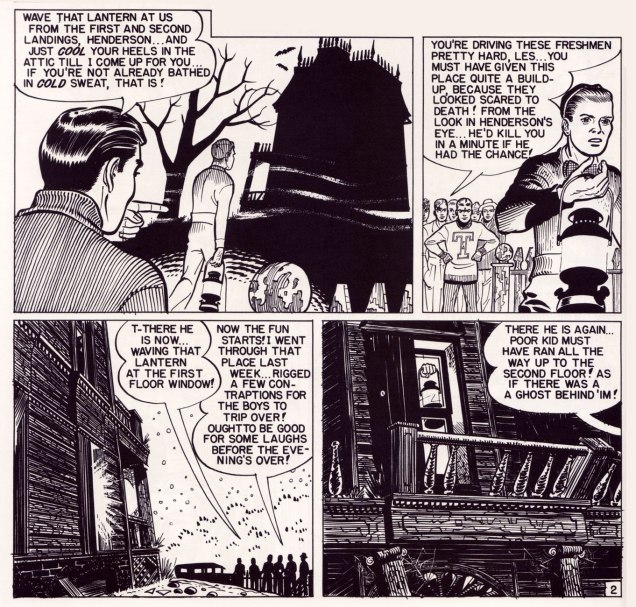
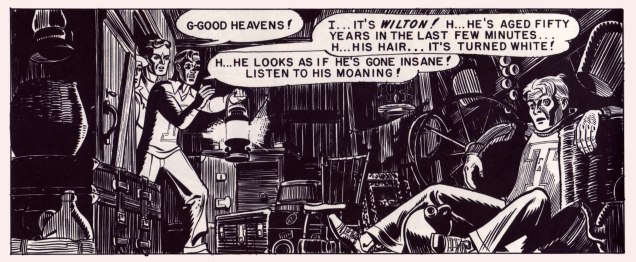
« ‘House of Horror’ [Tales from the Crypt no. 21, Dec. 1950 – Jan. 1951] is even more directly derivative; the story is merely an elaborated version of an anecdote from the Trail of the Tingling Spine chapter of Bennett Cerf’s Try and Stop Me, which was the source of a number of EC stories. Kurtzman remembers the story as ‘an ass-breaker.‘ It was the first story he did for the EC line and he wanted to make a good impression. ‘It was the effort that got me the EC account.‘ ».
House of Horror was scripted by Ivan Klapper, who contributed a few stories, early in the EC horror titles’ run. He went on to work on John Newland‘s 1959-61 anthology show, One Step Beyond.
If you’re used to the usual rubbery, sketchy (but deceptively spontanous-looking) Kurtzman, brace yourself.
« At initiation time it was my idea to take the three neophytes we had selected and brundle them out to a deserted house about fifteen miles from the campus. It had been unoccupied for years, was windowless, sagging and ugly, and was said by the villagers to be haunted. We picked a black, starless night for the initiation, and all the way out to the place poured tales of horror and the supernatural into the ears of our three apprehensive freshmen. »« I watched him enter the deserted house. It was about two hundred yards from where we were gathered. His instructions were to stay inside for a half-hour, and then come back to us. When forty-five long minutes went by without any sign of him, I experienced my first uneasiness, and dispatched the second freshman to fetch him. Ten more minutes went by. Nothing happened. There wasn’t a sound anywhere. The fire was burning low – we just sat there, quietly watching. »« ‘These kids are a little too smart for their own good’, I said at last. ‘Davis, get in there and bring them back fast,’ Davis was our prize conquest – a handsome, two-hundred-pound boy whose scholastic records foreshadowed an almost certain place on the next year’s All-American squad. He had already been elected president of the freshman class. »« The first thing that struck me when I entered was a musty smell like the smell of an attic full of old books and newspapers. I yelled for the boys, and poked my flashlight into every corner but there wasn’t a sign of them. Only a faint, steady tap that seemed to come from the roof. »The relevant illustration, by Carl Rose, from Try and Stop Me’s original version. « I stuck my head through the open skylight. There was Davis, stretched out on his stomach! His hair had turned snow-white. His eyes rolled in his head. He was mad as a hatter. In his hand he held a hammer covered with blood. » « He died in the college hospital the next morning without uttering a single syllable. We never found any trace of the other two boys… »
*I lucked out and found a nice copy in the 1980s… for $4.50, according to the usual lightly-pencilled note on the flyleaf.

 -RG
-RG






























 Who's Out There?