Hallowe’en Countdown, Day 30

« Thought I’d inject a little excitement into this initiation… do I look any worse for wear? »

When EC überfan Russ Cochran launched his incredibly ambitious series of hardcover sets of the complete EC Comics in the late 1970s, there was simply no way I could afford the lot… so I gathered my shekels and mail-ordered a single volume of Tales From the Crypt (no. 3, midway through the run) and further managed to sweet-talk a nice lady at the local public library into ordering the first volume of Weird Science (years later, I would meet a couple of kids who’d become obsessed with the book, signing it out dozens of times and wondering how it had ever come to be acquired by our small, mostly francophone library).

Since the EC formula (meaning Bill Gaines & Al Feldstein) does wear thin with prolonged exposure, I gravitated to the outliers: Harvey Kurtzman, Johnny Craig, Bernie Krigstein, the Bradbury adaptations… but the true revelation in these volumes turned out to be John Benson and Bhob Stewart’s superb documentary notes, comprising astute analyses and eloquent interviews with the surviving participants… which are nowadays down to, well, colourist Marie Severin.

Anyhow, I was particularly intrigued by Gaines and Feldstein’s early system of “springboards”, which is to say that they based stories upon anecdotes encountered in newspapers and magazines. One title evoked time and again is Try and Stop Me (1944)*.

From John Benson’s documentary notes in Haunt of Fear, Volume 1 (1985):

« ‘House of Horror’ [Tales from the Crypt no. 21, Dec. 1950 – Jan. 1951] is even more directly derivative; the story is merely an elaborated version of an anecdote from the Trail of the Tingling Spine chapter of Bennett Cerf’s Try and Stop Me, which was the source of a number of EC stories. Kurtzman remembers the story as ‘an ass-breaker.‘ It was the first story he did for the EC line and he wanted to make a good impression. ‘It was the effort that got me the EC account.‘ ». 

House of Horror was scripted by Ivan Klapper, who contributed a few stories, early in the EC horror titles’ run. He went on to work on John Newland‘s 1959-61 anthology show, One Step Beyond.

If you’re used to the usual rubbery, sketchy (but deceptively spontanous-looking) Kurtzman, brace yourself.

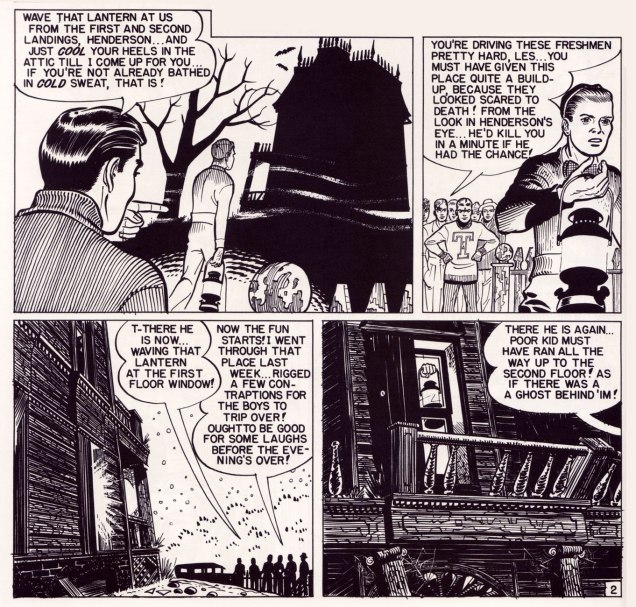
HOH1A
« At initiation time it was my idea to take the three neophytes we had selected and brundle them out to a deserted house about fifteen miles from the campus. It had been unoccupied for years, was windowless, sagging and ugly, and was said by the villagers to be haunted. We picked a black, starless night for the initiation, and all the way out to the place poured tales of horror and the supernatural into the ears of our three apprehensive freshmen. »
HOH2A
« I watched him enter the deserted house. It was about two hundred yards from where we were gathered. His instructions were to stay inside for a half-hour, and then come back to us. When forty-five long minutes went by without any sign of him, I experienced my first uneasiness, and dispatched the second freshman to fetch him. Ten more minutes went by. Nothing happened. There wasn’t a sound anywhere. The fire was burning low – we just sat there, quietly watching. »
HOH3
« ‘These kids are a little too smart for their own good’, I said at last. ‘Davis, get in there and bring them back fast,’ Davis was our prize conquest – a handsome, two-hundred-pound boy whose scholastic records foreshadowed an almost certain place on the next year’s All-American squad. He had already been elected president of the freshman class. »
HOH4
« The first thing that struck me when I entered was a musty smell like the smell of an attic full of old books and newspapers. I yelled for the boys, and poked my flashlight into every corner but there wasn’t a sign of them. Only a faint, steady tap that seemed to come from the roof. »
TinglingA
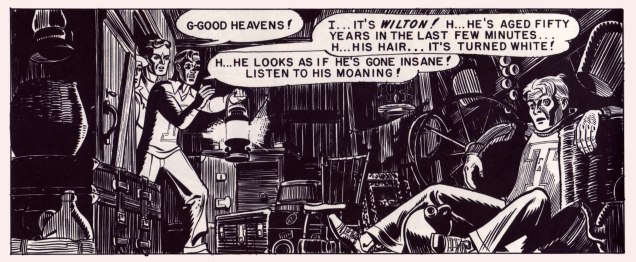
The relevant illustration, by Carl Rose, from Try and Stop Me’s original version. « I stuck my head through the open skylight. There was Davis, stretched out on his stomach! His hair had turned snow-white. His eyes rolled in his head. He was mad as a hatter. In his hand he held a hammer covered with blood. » « He died in the college hospital the next morning without uttering a single syllable. We never found any trace of the other two boys… »

*I lucked out and found a nice copy in the 1980s… for $4.50, according to the usual lightly-pencilled note on the flyleaf.

– RG
Hallowe’en Countdown, Day 22

« Newly dead, the gases of decomposition moving in the stomach… moving the body like a rag doll whose lips flutter and belch… »

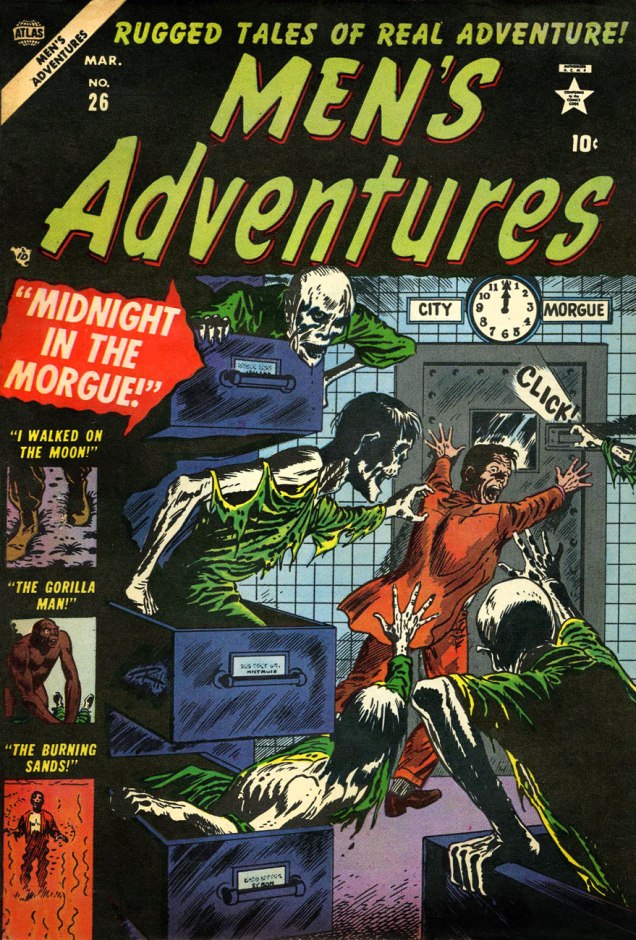
Atlas anthology Men’s Adventures (25 issues, 1950-54) was a pretty schizoid entity, with an editorial emphasis waffling from your typical would-be rugged he-man stuff (issues 4* to 8) to battle action (9 to 20) to mild horror (21-26) to, as a last resort, superheroes (27-28).

Men's-Adventures26A
Russ Heath delivers his usual fine job for Men’s Adventure no. 26 (March 1954, Atlas). I like the matching green outfits on the cadavers. Yay, team!

In the mid-1970s you could tell that Marvel was running low on reprintable pre-Code material when items from Men’s Adventure began to pop up in its mystery anthologies.

COC20A
Our cover story turned up then in Chamber of Chills no. 20 (Jan. 1976) announced by this ridiculous Ron Wilson/Dan Atkins cover.  There’s a Broadway musical in there, I swear.

Since this was 1970s Marvel, the corpse is not only well-preserved, he’s buff as it gets. For comparison, read “Midnight in the Morgue” (writer unknown, art by Dick Ayers), with our thanks and a fond tip of the hat to The Horrors of It All blog.

A more haunting variation on the “trapped in the morgue with the not-quite-dead” theme is Nostalgia Press’ historically significant Horror Comics of the 1950’s (1971, edited by Bhob Stewart, Ron Barlow and original publisher Bill Gaines), which gathered, in full colour, 23 EC classics, including one previously unpublished story, An Eye for an Eye. The cover revives (ha!) Al Feldstein’s Tales From the Crypt no. 23 art from 1951.

HC1950sA
Like many fellow modern-day EC Fan-Addicts, this book first came to my attention through the Captain Company catalogue that occupied the back pages of Warren Magazines. So many elusive, haunting grails… many of them turning out to be great beyond all reasonable expectations.

*the actual first issue… typical 1950s comics numbering scheme.

– RG

Hallowe’en Countdown, Day 12

« Within the hour, Roger Parris’ eyes had been removed from his still warm corpse! »

Some specimens of walking corpse are kind enough to just snap your neck or rip out your throat, but not old Roger Parris… he was, and remains, a spiteful coot.

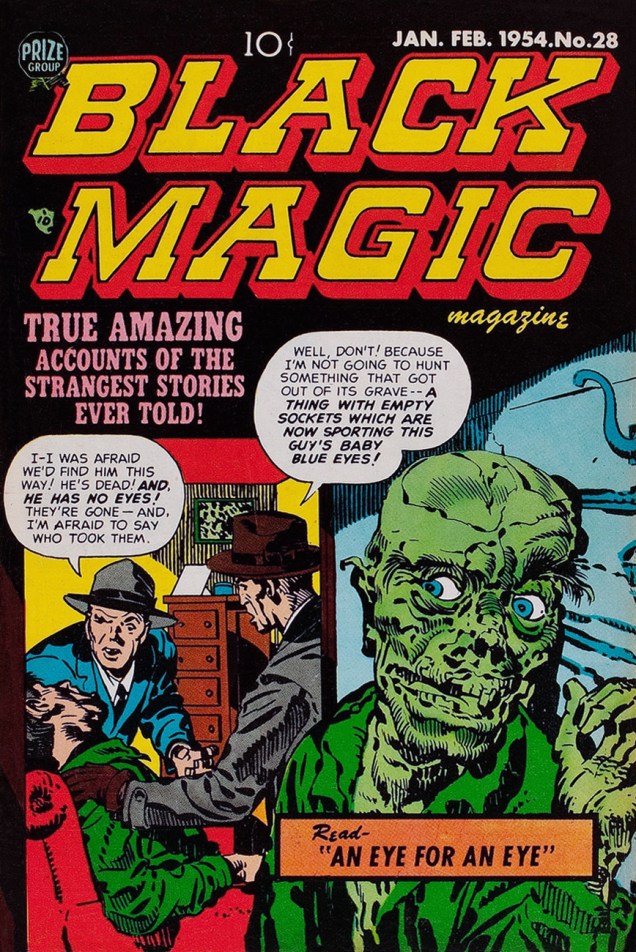
BlackMagic28A
This is Black Magic vol. 4 no. 4 (#28, Jan.-Feb. 1954, Prize), illustrating “An Eye for an Eye”. Pencils by Jack Kirby, inks by Joe Simon and/or Kirby.


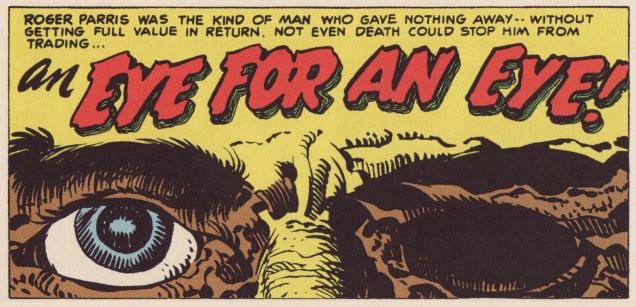
EyeforEyeKirby
The story’s opening panel. For my money’s S&K’s Black Magic offered the scariest ride in 50s horror… often with unlikely, seemingly innocuous topics, and without showing much in the way of gore or gratuitous imagery. They took the Val Lewton high road, if you will.
DropOfWater
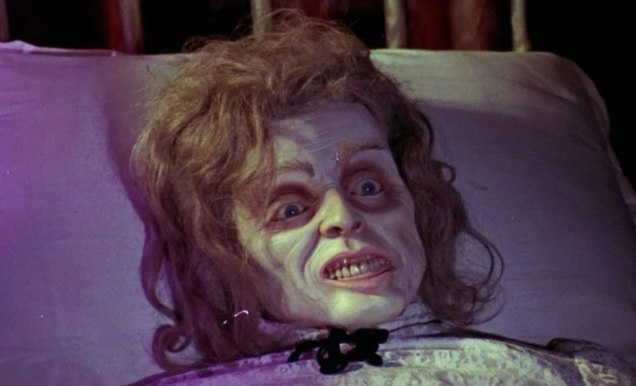
I’m reminded of another old dear who was inordinately attached to her earthly possessions (in her case, a ring) even after kicking the bucket. Well… not quite, it turned out. From Mario Bava‘s 1963 omnibus film, “I tre volti della paura” (aka “Les trois visages de la peur”, or “Black Sabbath”)’s most spine-tingling segment, “La goccia d’acqua” (“The drop of water”).

– RG

Hallowe’en Countdown, Day 3

« Ach ja! That field once produced the best wine in the world, for it is said it was fertilized with human blood! »

(Does that only apply to red wine?)

As far as 80s reprint packages go, this was something special by any measure: first of all, though the spooky tales within were produced in the pre-code 1950s, they had never gone to press. The material was intended for the 15th issue of Pines/Standard/Better/Visual Editions’ Adventures Into Darkness, which was never published, presumably in the wake of the heavy-handed censorship of the newly-instituted Comics Code Authority. Why bother revising and releasing a book that likely wouldn’t even get distributed?

Second, the originals were adapted for the 3D process. The effect was quite the rage in 1953-54, but these particular 3D separations were created retroactively, in the 80s, by modern stereoscopy master and keeper of the flame Ray Zone (1947–2012) and Tony Alderson.

Third, these morbid tales weren’t just hackwork scarcely worthy of publication, at least art-wise: they feature such solid talents as George Roussos, Mort Meskin, Mike Sekowsky, Alex Toth and Gene Fawcette.

And finally, there’s that eyeball-caressing Dave Stevens (1955-2008) cover. The gone-too-soon creator of The Rocketeer also made his mark with a cherished handful of covers in those dark Reagan years, a mark that thankfully shows no sign of fading.

3DHalloweenA

This is Seduction of the Innocent 3-D (Oct. 1985, Eclipse). Logo by Ken Steacy.

If you’re in the mood, a couple of 2D samples of the issue, perhaps? Try Harvest of Death or Death Dives Deep. Just tell dear Mr. Karswell we sent you!

– RG