Panning the murky old print stream for the odd glimmering nugget
Hallowe’en Countdown 2020
What, October again? Good. For the fourth time, Who’s Out There? will subject its fearful faithful to a parade of hopefully diverse variations on a spooky theme… sometimes somber, sometimes light, occasionally eye-searing.
« Listen, youse guys — we’ve had enough of dis horsin’ around! When do we grab the dough? » — a hood craves action, from Haunted Halloween! (Flash Comics no. 78)
Superheroes, back when they weren’t all wrapped up in their grimness and grittiness, took a bit of time to properly enjoy the holidays.
This is Flash Comics no. 78 (Dec. 1946, All-American Comics), featuring Haunted Halloween!, scripted by Gardner Fox and illustrated by Everett Edward Hibbard… plus four more stories for your dime. Edited by Sheldon Mayer, with a cover by Hibbard.
And here’s All-American Comics no. 61 (Oct. 1944, All-American Comics), featuring The Green Lantern (and Doiby Dickles!) squaring off against a gruesome new foe, Solomon Grundy, in a tale entitled Fighters Never Quit!, written by none other than Alfred Bester (later the author of The Demolished Man andThe Stars My Destination) and illustrated by Paul Reinman. Edited by Sheldon Mayer, with a Reinman cover.
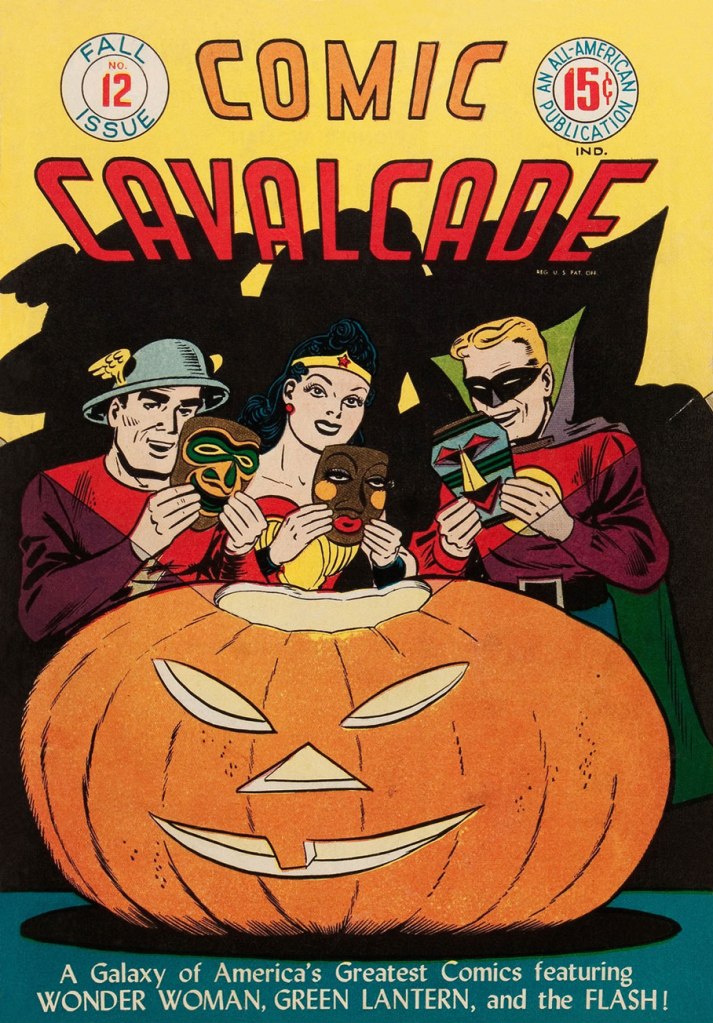
And this is Comic Cavalcade no. 12 (Fall, 1945, All-American Comics), where we catch both The Flash and Wonder Woman about to indulge in some blackface. Edited, you guessed it, by Sheldon Mayer. Cover by E. E. Hibbard (The Flash), H.G. Peter (Wonder Woman) and Martin Naydel (Green Lantern).
« When the mind is thinking, it is talking to itself. » — Plato
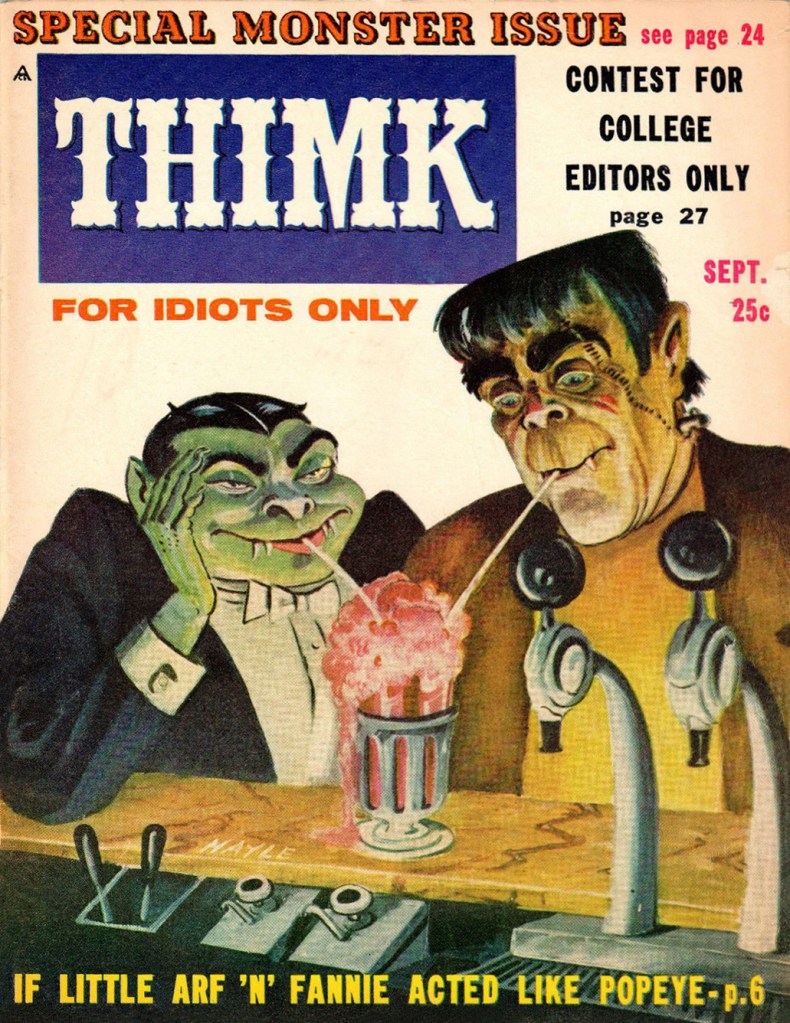
The waning years of the 1950’s marked the beginning of the monster craze, which coincided with Mad Magazine’s ripest period of influence. Here, then, is a publication that sought to capitalize on both occurrences. Alas, chasing fads too eagerly always did land you all-too-promptly in the cultural ditch. Still… Thimk had its moment.
This is Thimk no. 3 (Sept. 1958, Counterpoint). Edited by Alan Whitney, cover by Sam Hayle (1911-1996), who later did a bit of work for Cracked.
This is Thimk no. 4 (Dec. 1958, Counterpoint); cover by Sam Hayle. Elvis finds out first hand how fickle teenyboppers can be, and how a two-year army hitch might as well be an eternity, as far as they’re concerned. Uneasy lies the head that wears a crown!
Thimk was a short-lived (6 issues, 1958-59) would-be Mad, also in the black and white magazine format.
One holiday gleefully bleeds into another… this is Thimk no. 5 (Feb. 1959, Counterpoint). “Free… for 25 cents!”
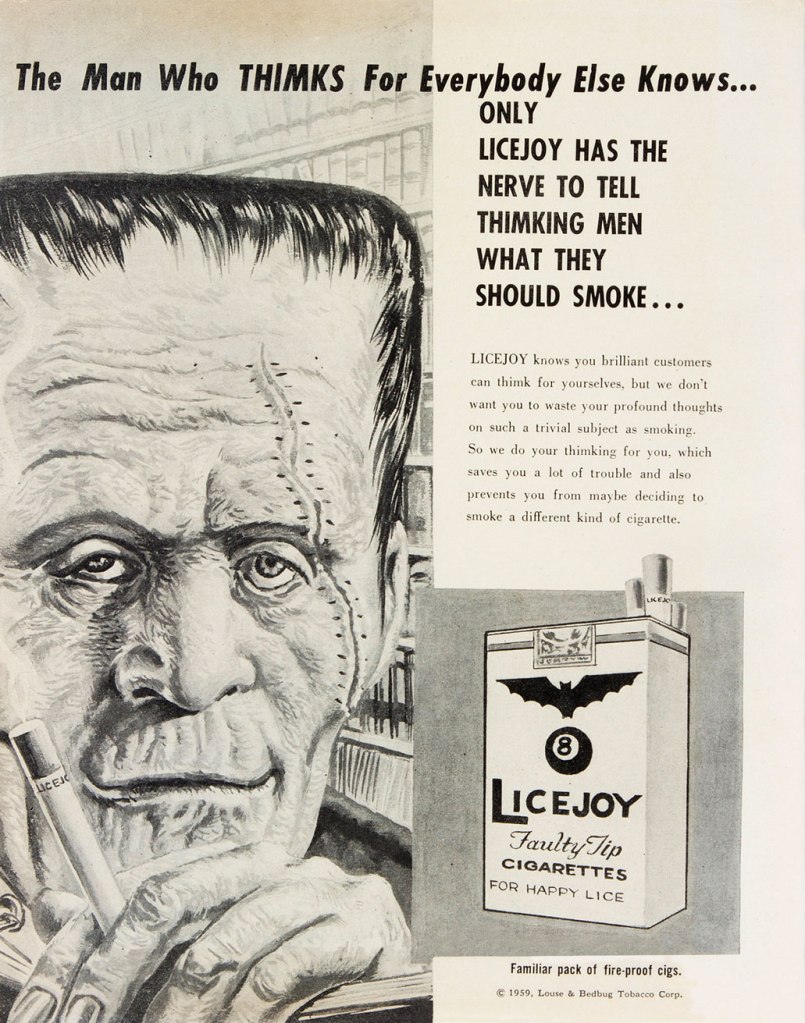
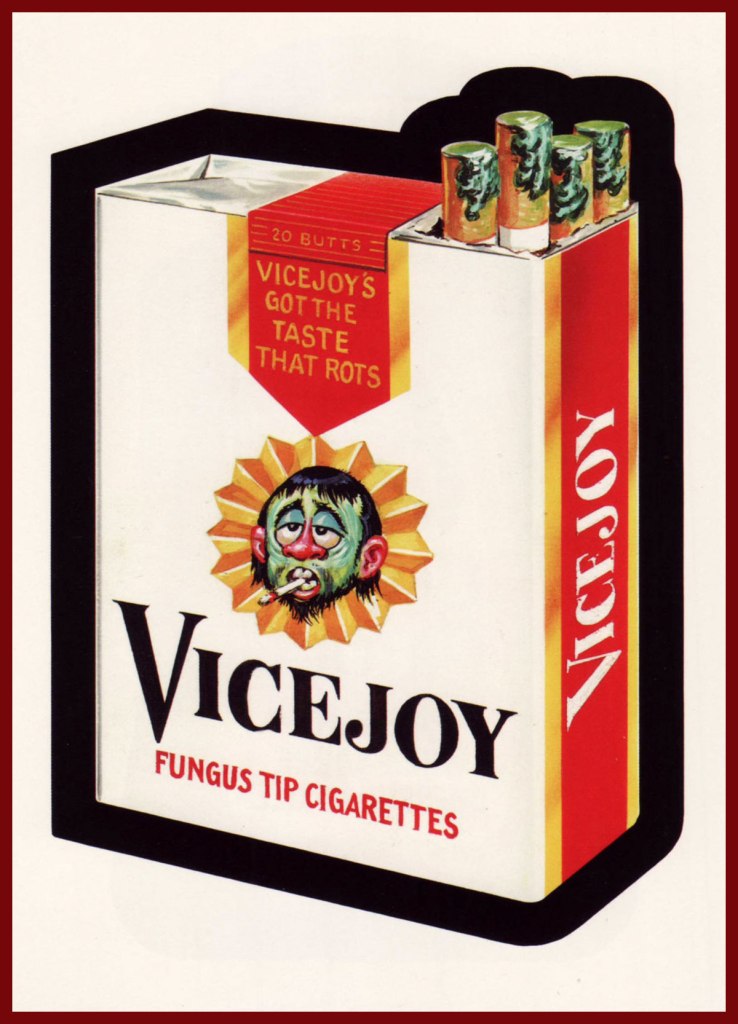
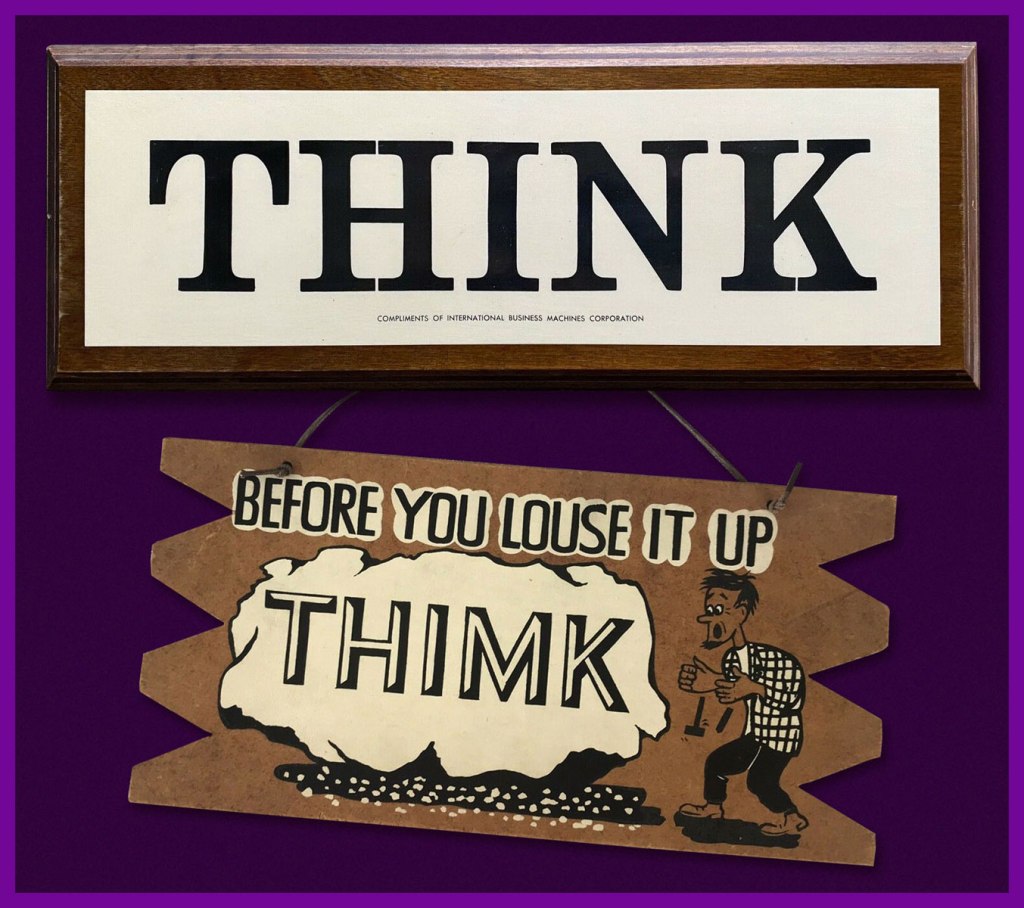
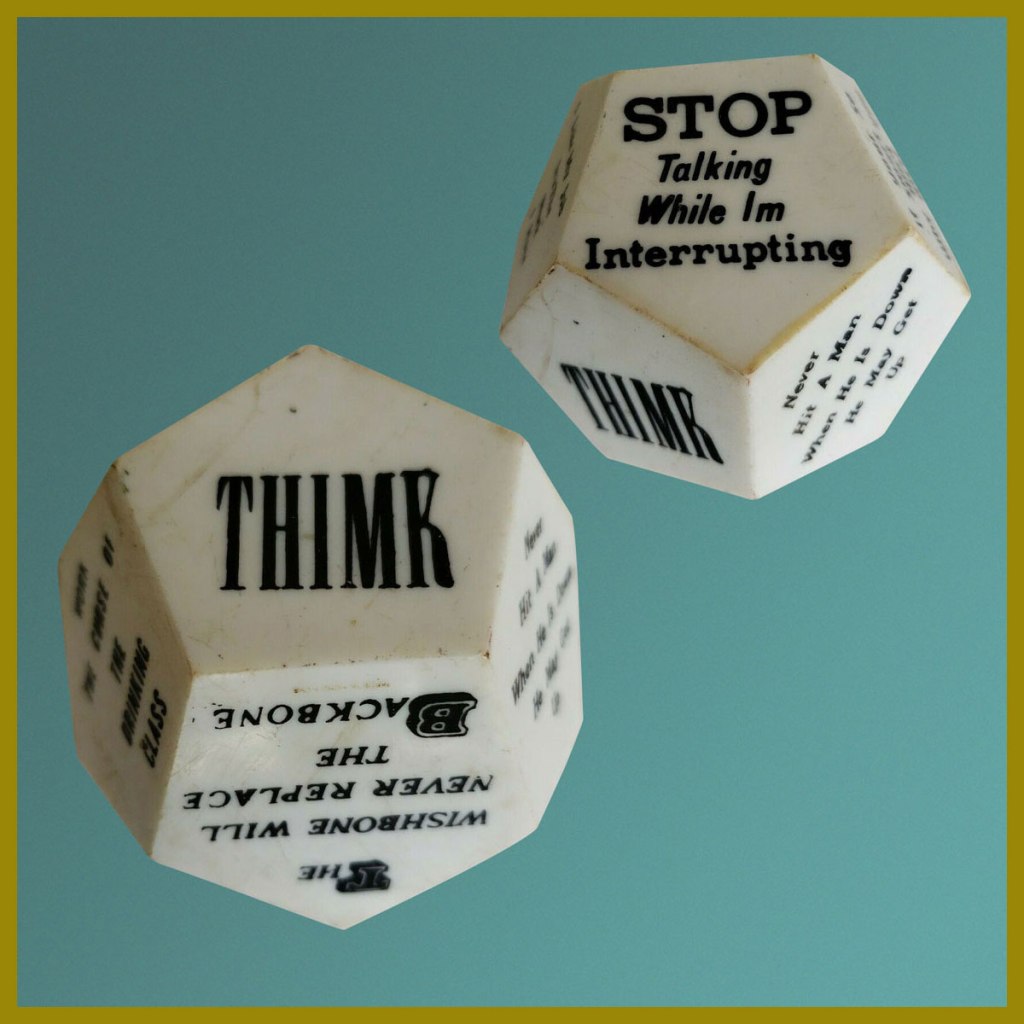
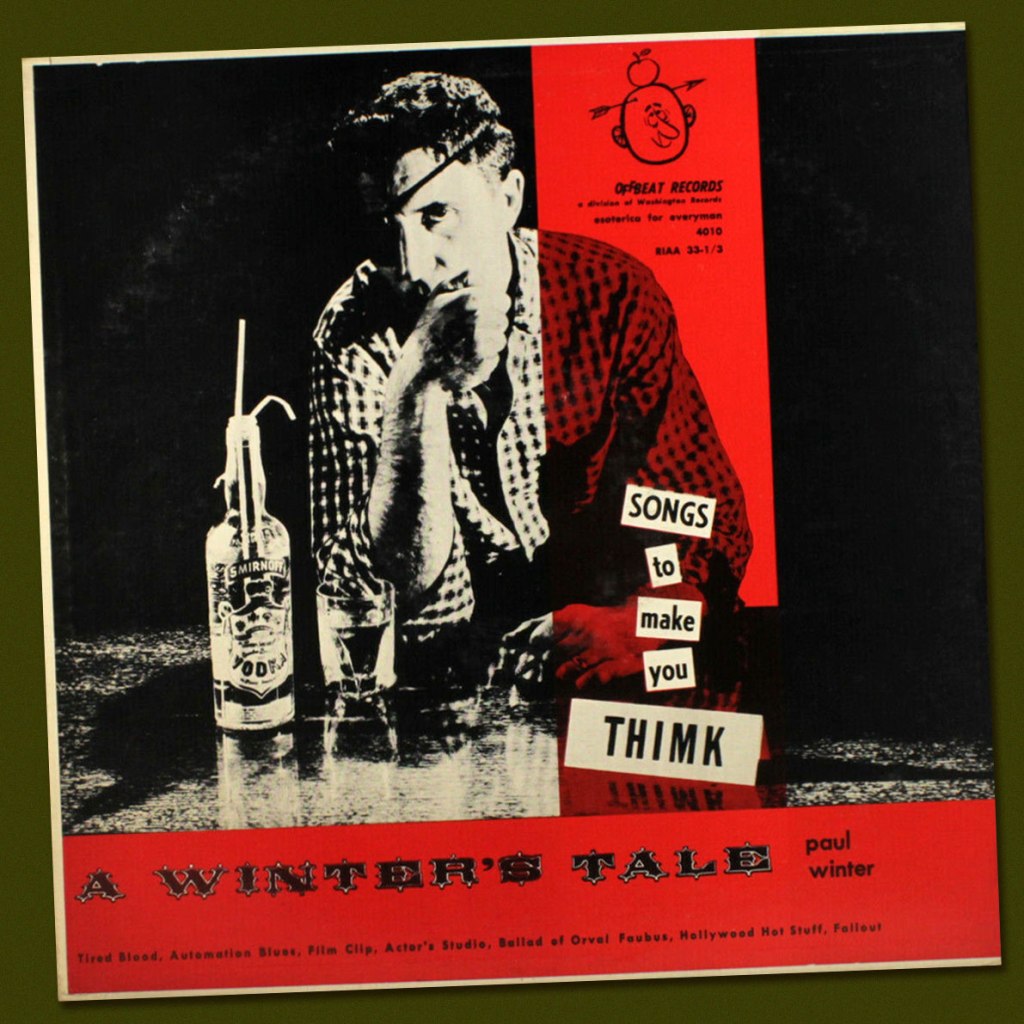
Thimk no. 5‘s back cover… a well-aimed barb at Viceroy Cigarettes.And some samples (there were many, many more!) from the object of parody, Viceroy’s The Man Who Thinks for Himself ad campaign. Lookit all them deep thinkers! (Martin Fry, cancer survivor, bottom left).And it wasn’t to be the last Viceroy parody, either: the brand was also an early Wacky Packages target. This entry hails from Series 1, featuring a rough concept by Art Spiegelman painted by Norman Saunders (1973, Topps). Heads up, Marlon… some… thing is about to cut in for a dance. Is his date dismayed or delighted? Last call: Thimk no. 6 (May 1959, Counterpoint) was the final issue. Cover art, again, by Sam Hayle.From Think to Thimk in one easy step. What began as a ubiquitous IBM slogan soon, inevitably, led to parodic counterpunches.During the late 50s, it spread seemingly everywhere.Legendary Detroit DJ Paul Winter (station WXYZ) got in on the act early (1957). Here’s a sample, Fallout, featuring Charlie Byrd on guitar!And of course, the great Steve Ditko took the slogan to heart (and mind), famously making his own sign. I wonder where it is now.
«I think it’s safe to surmise that Mr. Church viewed his comics as his own private passion, and wanted to share them with no one. Is it any wonder that his heirs didn’t show any fondness for them? » — Charles ‘Chuck’ Rozanski
Let’s give a little love and a spooky cheer to the greatest comics collector of them all, Coloradoan Edgar Church (1888 – 1978), who also happened to be a pretty terrific illustrator. When he passed away, it turned out that his collection comprised a whopping 18 to 22 thousand comics books, mostly in the high grades. Ouch.
With that out of the way, let’s take a step back and admire some of the man’s halloween-themed illustrations over the years.
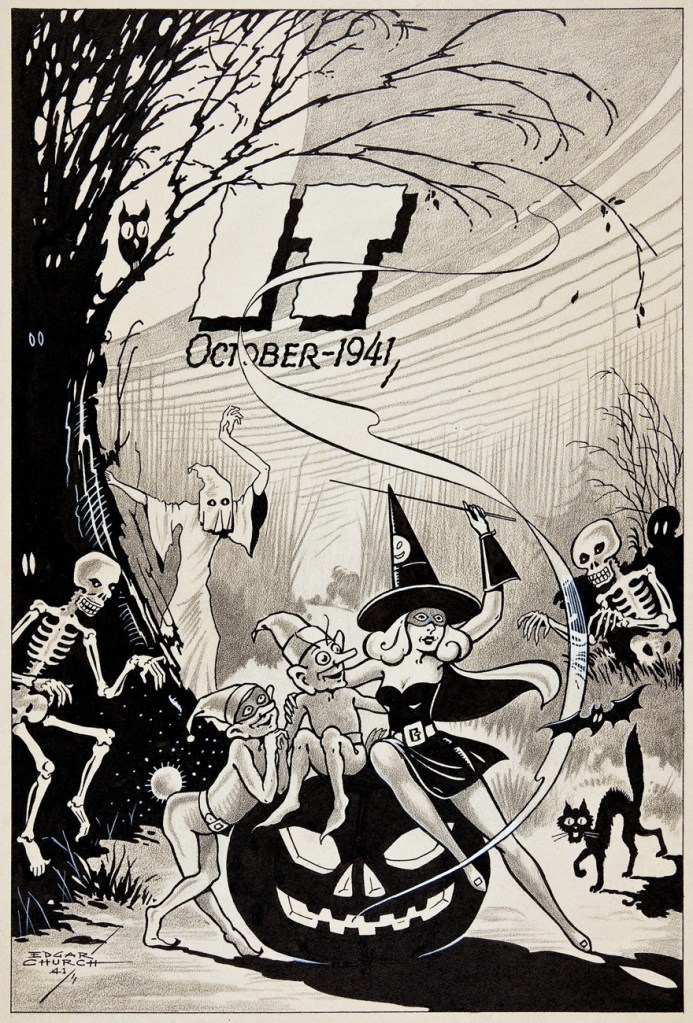
As it plainly states, this piece was created to commemorate 1941’s eeriest holiday. Isn’t “IT” a beauty?
Another IT peace from the same era, which I admit to colouring a bit, in what I like to consider good taste and restraint. « Not only was Church an important collector of first-generation comic books — he also ran a busy advertising-design studio in Denver and served as an illustrator for that city’s Smith-Brooks Printing Co. A marginal note identifies this splendid composition as an inside-back cover — likely for a Smith-Brooks magazine called It, to which Church was a frequent contributor. »
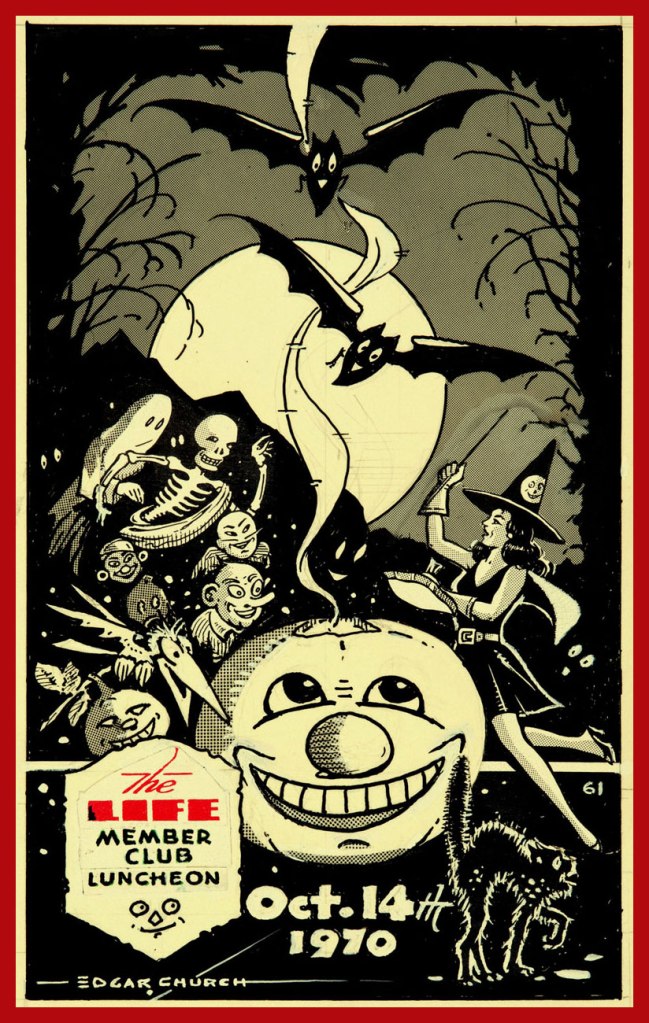
If those Life Member Luncheons were half a fun as Church’s ads made them seem, they must have been the highlight of Denver’s social season.
Featuring a wee bit of recycling, Church’s ad for the 1970 do. Interestingly, these shindigs were held on Wednesday nights, so they may not have been quite as debauched as one might have expected.
« Feminism encourages women to leave their husbands, kill their children, practice witchcraft, destroy capitalism and become lesbians. » — Pat Robertson
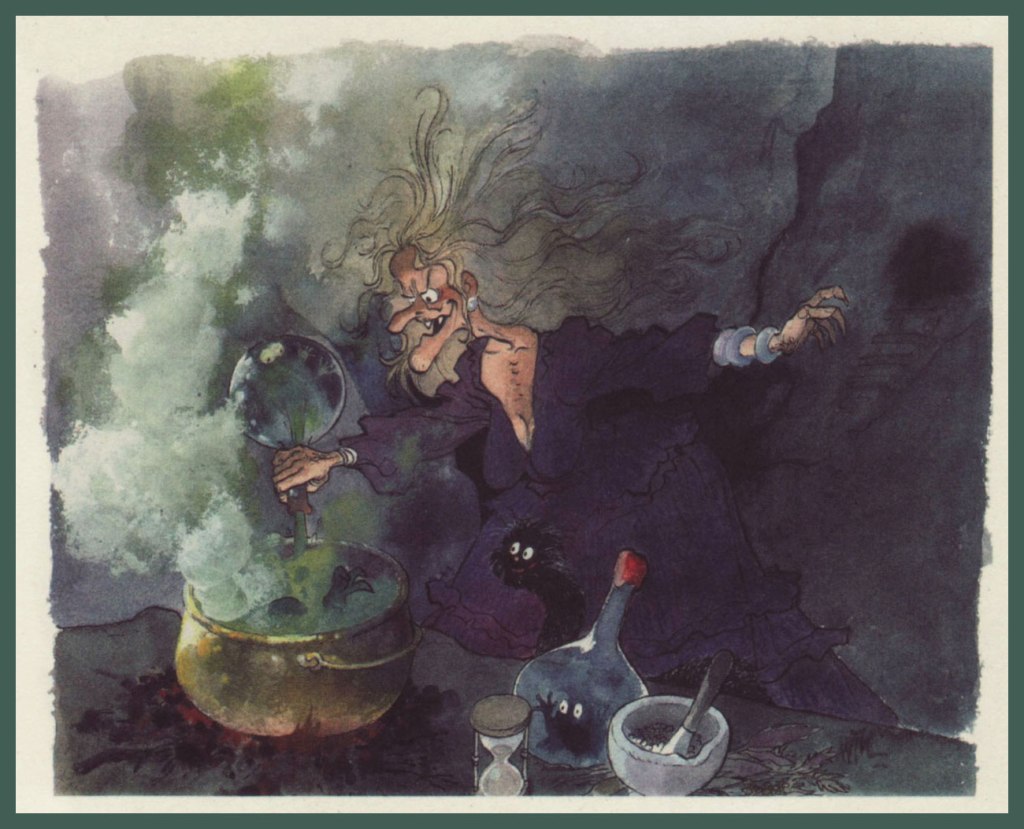
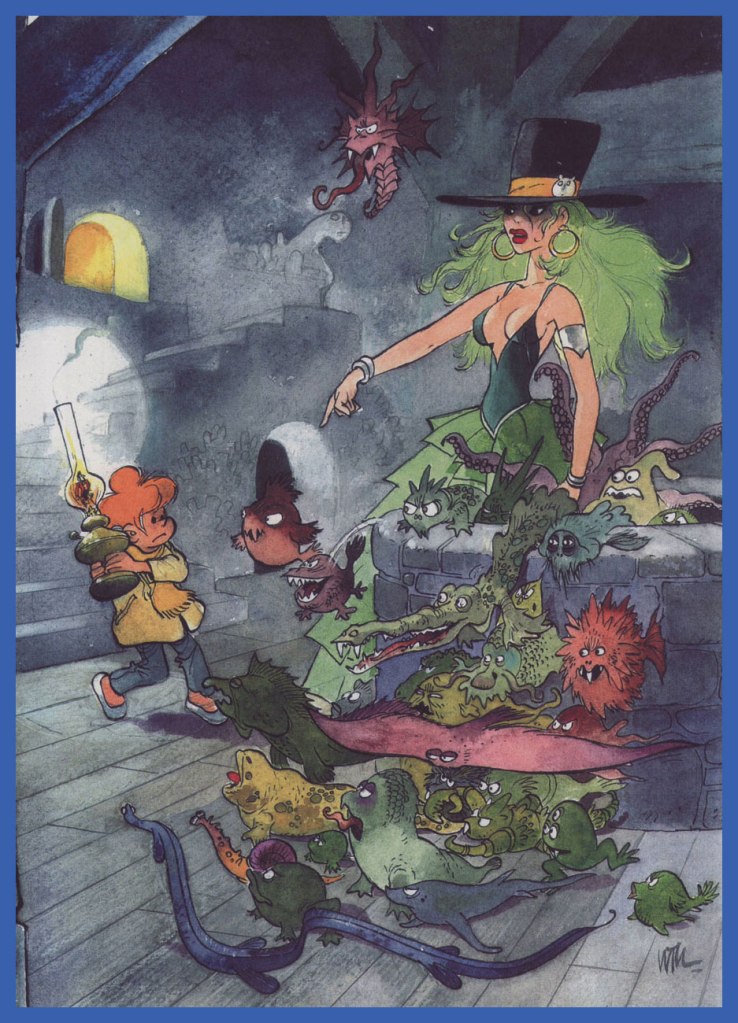
Truly one of the crown jewels of Franco-Belgian comics, Isabelle (1969-1995) has quite a pedigree: it was conceived by scripters Yvan Delporte, Raymond Macherot and illustrator Willy Maltaite, alias Will. When Macherot took ill, the legendary André Franquin stepped in, and the series took on a slightly more sombre shade, and its characterisations gained further depth. The best of all possible worlds, truly.
Brimming with magic, poetic grace, wit and atmosphere, Isabelle gave us, for a change, a level-headed and resourceful little girl in a world of infinite possibilities. I can’t stress this point enough: unlike every other little girl character in supernatural fantasy tales I’ve ever encountered, Isabelle doesn’t trip over roots, gasp loudly or drop a glass at the wrong time; she doesn’t disobey solemn, life-or-death instructions against all common sense. And yet she’s just an ordinary little girl, not a secret ninja or a princess in hiding. Truly refreshing. After reading Isabelle, most of what passes for fantasy is shown for the formulaic, stock dreck that it is. This is the genuine article.
In the mid-90s, publisher Les Éditions Dupuis brought the series to an unceremonious end, judging its sales numbers insufficient. Ah, but Isabelle has its fans, and a tenacious lot they are. Dupuis’ rival, Les éditions du Lombard (home of Tintin, and now merged with Dargaud, home of Astérix et Obélix) collected the entire series in 2007, in three stunning volumes rife with priceless documentary extras. Absolute bande dessinée nirvana. Good luck getting copies these days, sadly.
The cover of weekly Spirou no. 1929 (Apr. 3, 1975, Dupuis), beginning the serialization of the seventh Isabelle story (and her third album), Les maléfices de l’oncle Hermès (collected in book form in 1978). This is where two of the series’ pivotal characters, the titular Oncle Hermès and his eventual paramour, sexy witch Calendula, were introduced, not to mention her evil ancestress (the original) Calendula, the series’ archfiend.
The album in question, in its original edition (1978).
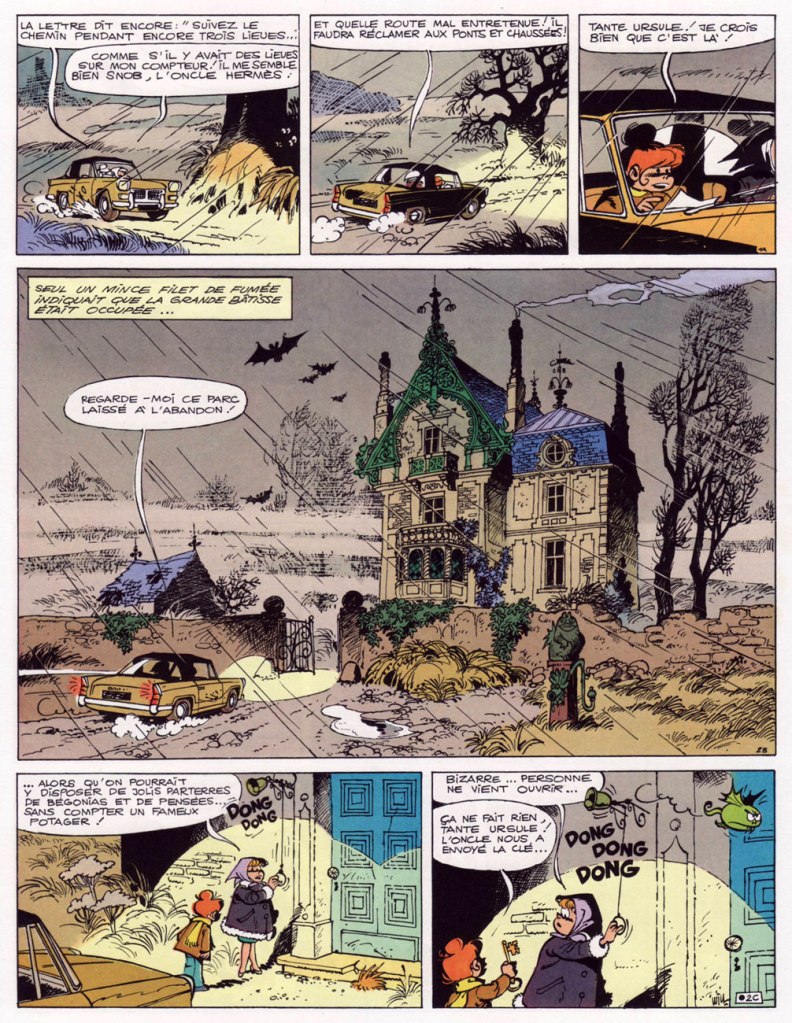
Page 2 of Les maléfices de l’oncle Hermès. During a long career shackled to characters he didn’t own (i.e. Tif et Tondu), Will was thrilled to work on a series of his own, one closer to his own interests and preoccupations. Dig that mood!
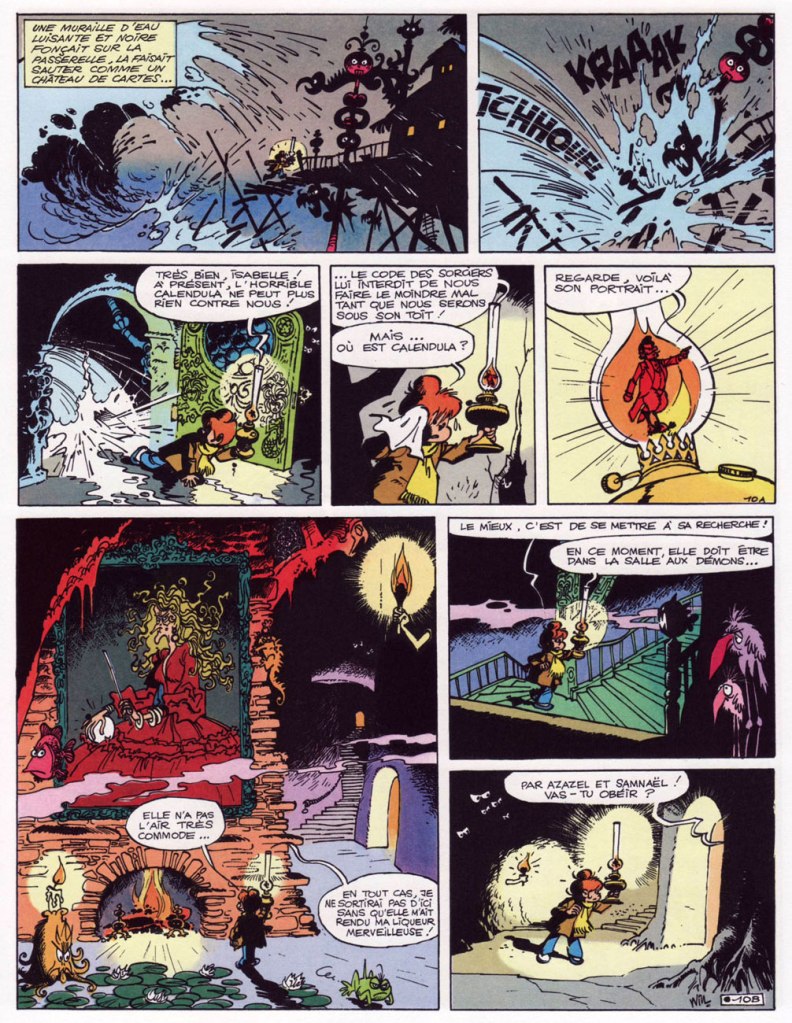
Page 10 of Les maléfices de l’oncle Hermès. Cloven-hoofed Oncle Hermès, the victim of a centuries-old curse, is trapped in a flame, and his great-great-great-great (etc.) niece Isabelle is endeavouring to set him free.
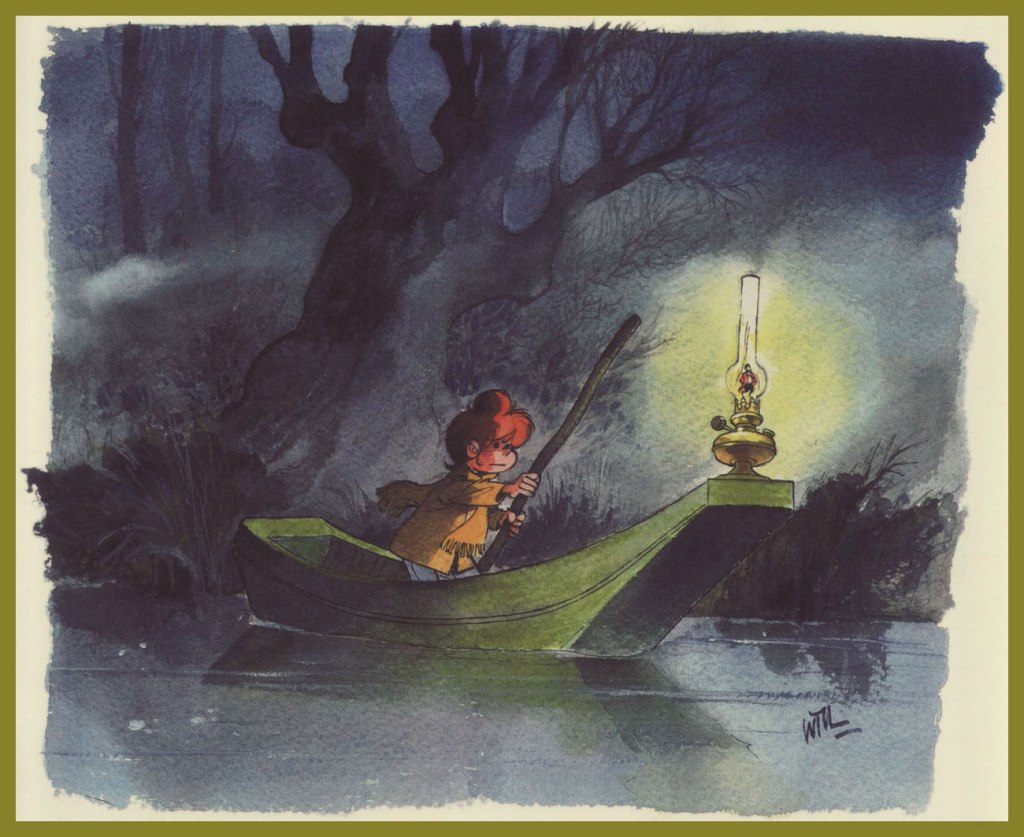
The journey is, of course, quite perilous… and the visuals gorgeous.
This is the original spell-caster, malevolent Calendula.
And this is her descendant of the same name, on the side of good, though she does have a temper.
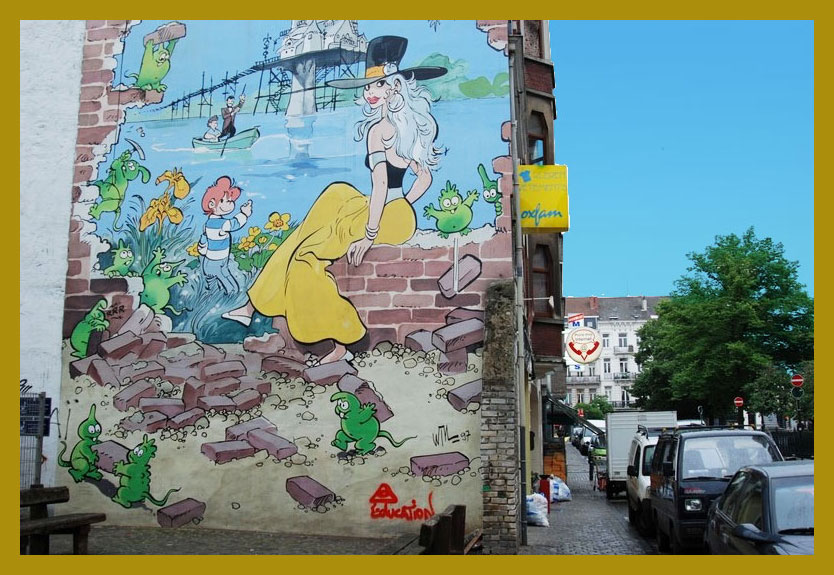
Isabelle and Calendula (and friends) feature as part of Brussel’s delirious Parcours BD. Does your hometown appreciate its comics this effusively and concretely? (update: The Isabelle mural was painted over in 2016, I regret to say.)
« I would rather sit on a pumpkin and have it all to myself, than be crowded on a velvet cushion. » — Henry David Thoreau
Have you picked out that special pumpkin for your fast incoming (dark, presumably) celebrations? If not, better get on it — someone (or something) else may be casting covetous glances and about to call dibs.
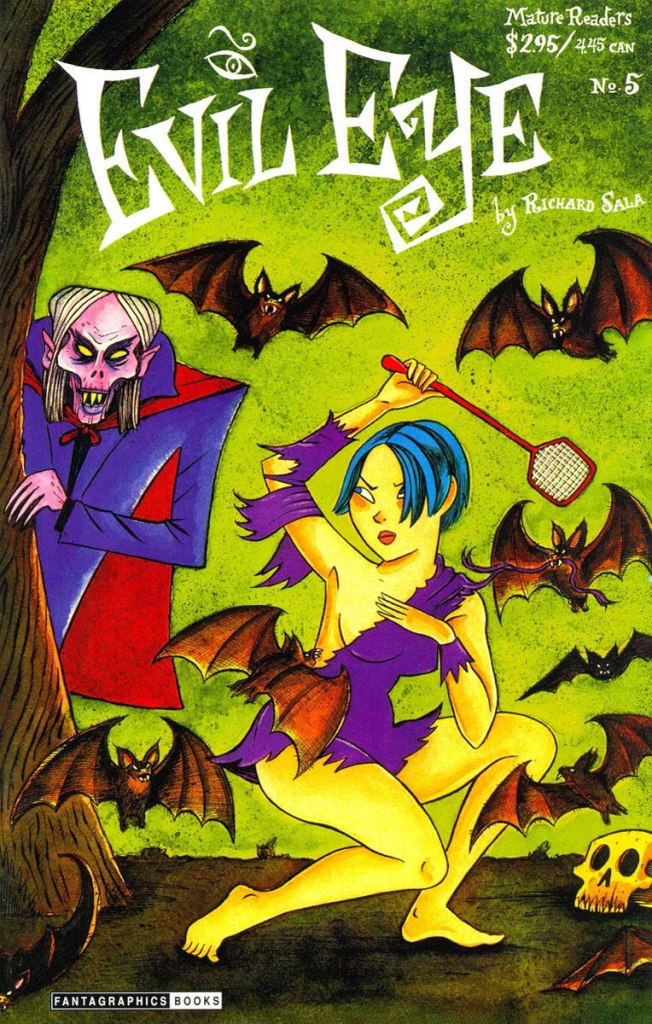
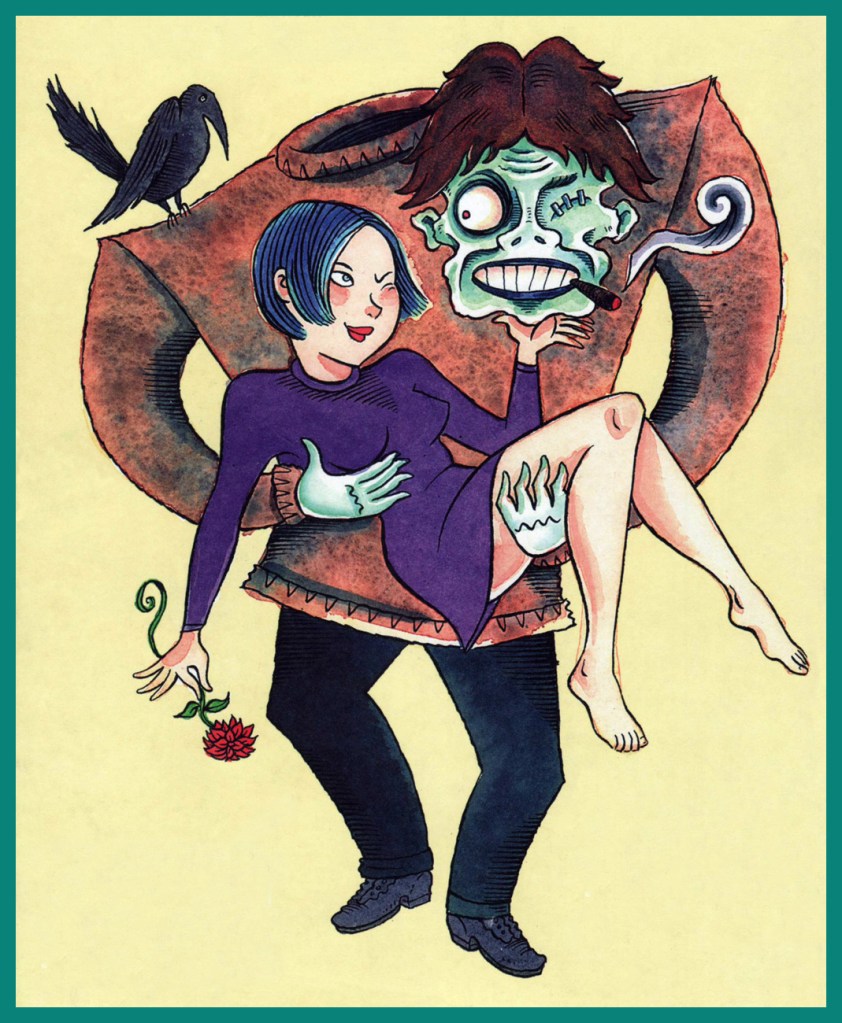
The lovely barefoot damsel is Richard Sala’s plucky heroïne (well, one of them!) Peculia. She was the star of Sala’s showcase title Evil Eye (1998-2004, Fantagraphics), as well as the graphic novel Peculia and the Groon Grove Vampires (2005). Fret not, she can fend for herself.
This is Evil Eye no. 2 (Oct. 1998, Fantagraphics).
This is Evil Eye no. 3 (Apr. 1999, Fantagraphics).
This is Evil Eye no. 5 (Mar. 2000, Fantagraphics).
As you may or may not have heard, Mr. Sala was one of the many notables we lost over the course of this nearly unparalleled Annus horribilis. Let’s remember him through this heartfelt eulogy penned by his closest friend and esteemed colleague, Mr. Daniel Clowes.
A fetching pinup from the back cover of the 2002 Peculia collection (2002, Fantagraphics).
« Then — when O’Flaherty turned on the light, his blood crystallized! »
This is Unknown World no. 1 (June 1952, Fawcett); cover painted by the rightly fabled Norman Saunders.
Its classic cover aside, this Fawcett one-shot is barely worth reading, save for the utterly bizarre Footprints on the Ceiling.
Synopsis:
The gangsters O’Flaherty and Flitcher train a revived dead dog to be a trick dog on stage. But they have to fight off hordes of skeletal zombies coming after them to bring the dog where it belongs – in the province of the dead.
Who came up with that scenario? (it’s not merely a rhetorical question: no one seems to officially know). Might its loopiness have in some small way inspired Bob Burden’s gonzo Flaming Carrot epic The Dead Dog Leaped Up and Flew Around the Room? It’s not such a stretch, given that Burden is no stranger to Golden Age comics, having been a-dealing in such goods, with a marked (and healthy) predilection for the oddball. Obviously.
Diving right into the splashy fray, here’s the immortal tale’s opening, from Flaming Carrot Comics no. 12 (May 1986, Renegade Press).
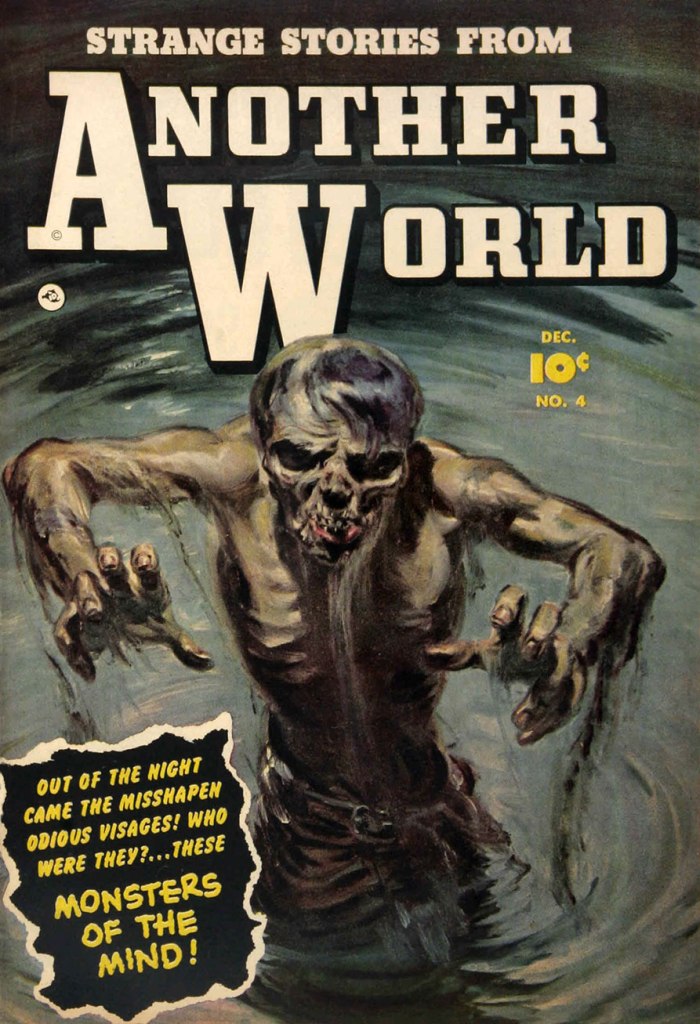
And here’s a bonus one from Mr. Saunders which, thanks to its decidedly muted palette, looks more like a pulp cover than a comic book. This is Strange Stories From Another World no. 4 (Dec. 1952, Fawcett), and you can read it here!
And after all these dead dogs, what do you say we enjoy the sight of a curious and healthy live one?
« He was homicidal. He was a real nut, a really tooty-fruity nut… he killed for fun… now society is avenged… avenged avenged avenged… and minus expensive court costs too… » — writer-editor Al Hewetson loved ellipses
For a few years in the early 70s, longtime Atlas/Marvel production manager Sol Brodsky joined forces with canny schemer Israel Waldman in order to give monster mag publisher James Warren a good scare, and it worked. During its relatively brief existence (1970-75), brassy upstart Skywald Publications gave Warren pause and cause to nervously peer over his shoulder and strong incentive to improve his product, which was hardly at its peak in 1970.
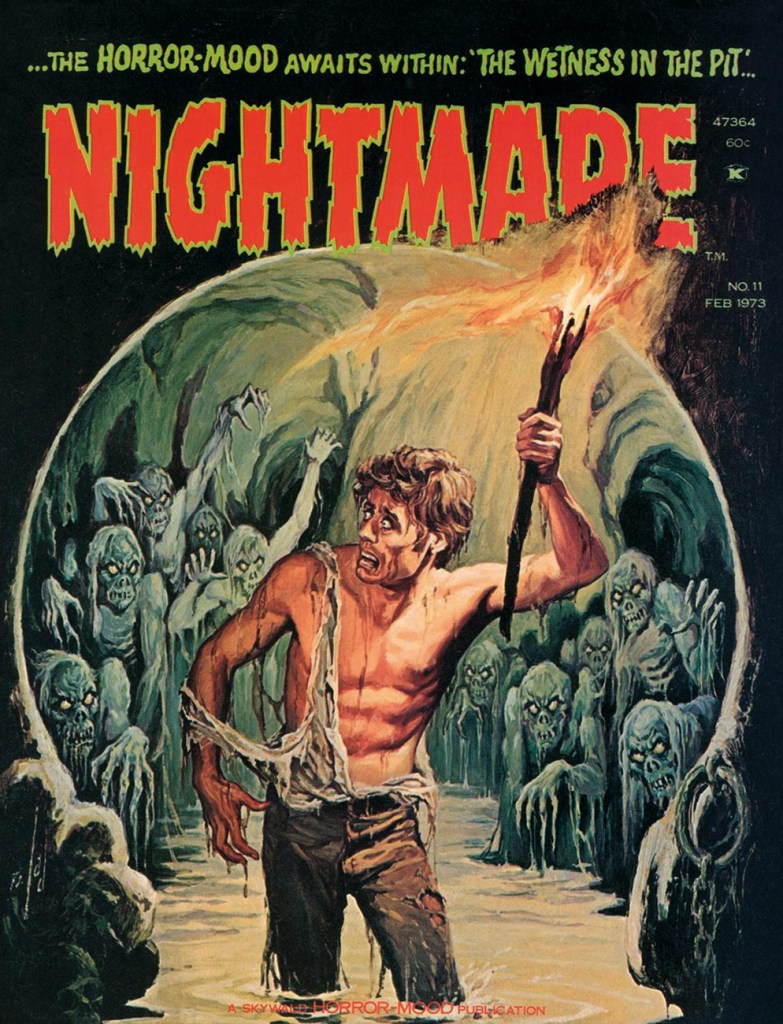
This is Nightmare no. 11 (February, 1973, Skywald). The spooky, claustrophobic cover is the brushwork of José Antonio Domingo, who also contributed a handful of painted covers to Marvel’s concurrent b&w magazine line.
By all means, do read this intriguing issue, which is available in its entirety right… here.
Oh, and why not? Here’s the finest of Domingo’s Marvel covers, à mon avis… despite the rather inept text placement.
« Listen, Angel! If they’re out of bananas… I’ll meet you at the corner fruit stand! »
Today, let’s combine our general theme with a celebration of the birthday of one of comics’ great, yet perpetually underappreciated talents: Bob Oksner (October 14, 1916 – February 18, 2007), DC’s go-to humour and good girl art guy. Can you beat that? Didn’t think so.
Bob had a winning penchant for mixing monsters and babes, and for this, he’s earned our lifelong gratitude.
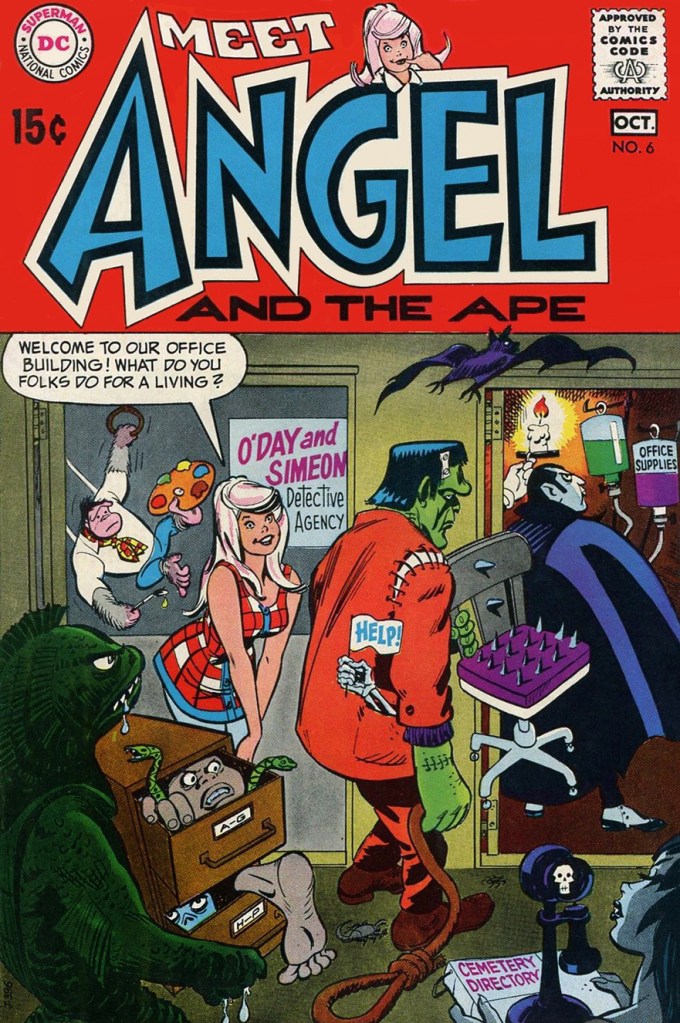
This is Angel and the Ape no. 6 (Sept.-Oct. 1969, DC), featuring The Robbing Robot and The Ape of 1,000 Disguises! (Would You Believe Four?), wittily written by John Albano, lusciously pencilled by Oksner, and creamily inked by Wallace “Wally” Wood. Truly swoon-inducing stuff. Edited by Joe Orlando (that explains all the monsters!), with a cover by Oksner.
You might say Angel and the Ape exist in an awkward sort of limbo: popular enough for the back issues to be kind of pricey, but not popular enough to have been reprinted (eight issues, including their Showcase appearance, ideal for a trade paperback, hint, hint).
So what else has Mr. Oksner cooked up over the years? Keeping to our theme, here are a few highlights, but first, a handy bio:
This piece appeared in The Adventures of Jerry Lewis no. 73 (Nov.-Dec. 1962, DC).
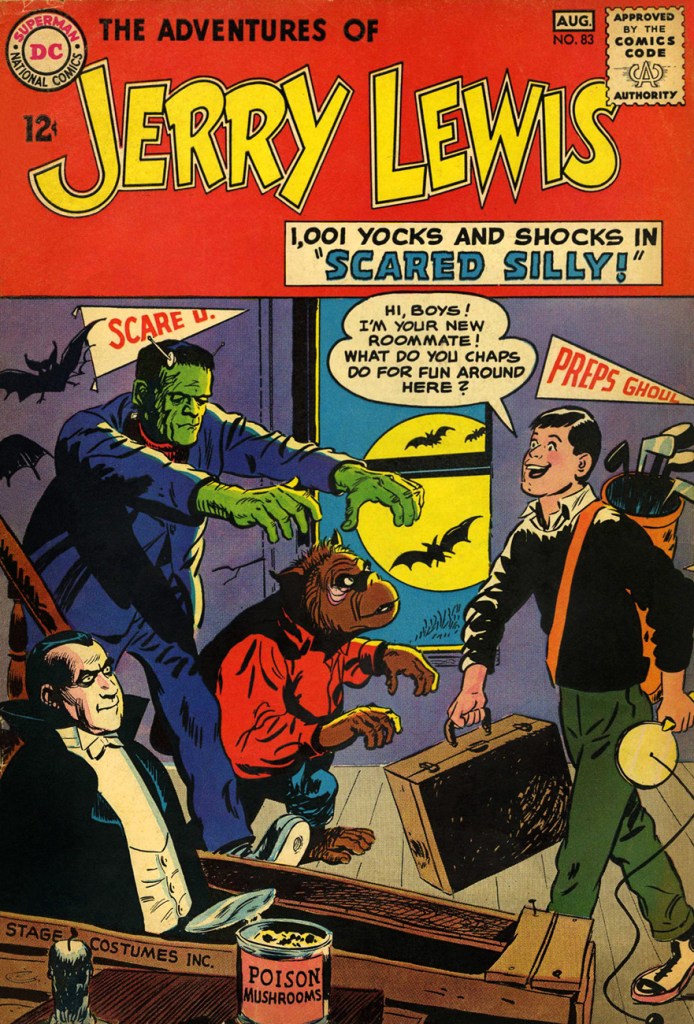
The is The Adventures of Jerry Lewis no. 83 (July.-Aug. 1964, DC). Formerly The Adventures of Dean Martin & Jerry Lewis… of course. The book (under both titles) featured some lovely artwork from Owen Fitzgerald, Mort Drucker and of course Oksner… but it was no Sugar and Spike. Still, it had its audience, long-lasting as it was (124 issues… Jerry wasn’t just big in France!)
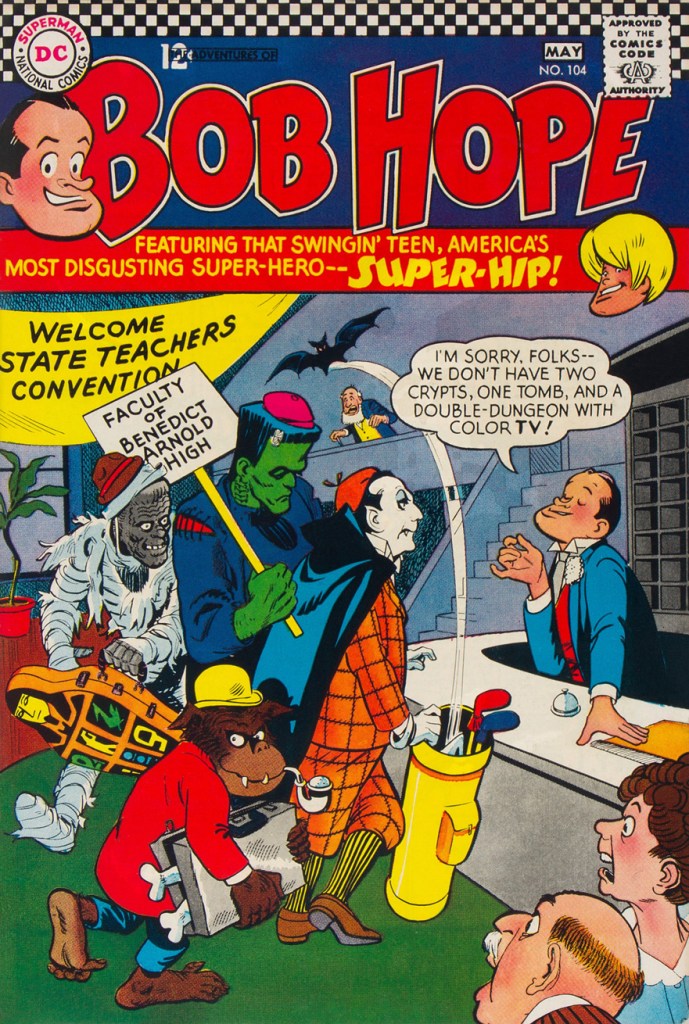
This is The Adventures of Bob Hopeno. 104 (Apr.-May 1967, DC). DC’s celebrity-licensed humour titles followed a parallel course: fading sales led to their nominal stars being more or less sidelined in their own book in favour of increasingly outlandish supporting casts.
An inside page from that issue. Good-looking comics… but they weren’t particularly witty, which can be a bit of a drawback. Arnold Drake was the writer, and while he could be pretty damn funny, it just didn’t work here. Still, you can bet that it was still more amusing than Milton Berle’s comic book.
1940s teenager Binky was pulled out of mothballs in the late 60s (ten years elapsed between issues 60 and 61). A moderate success (especially given it mostly consisted of slightly updated reprints), it returned to oblivion after another twenty-two issues, though the first seven boresome rather fine Oskner cheesecake covers. This is Leave It to Binky no. 67 (June-July 1969, DC).
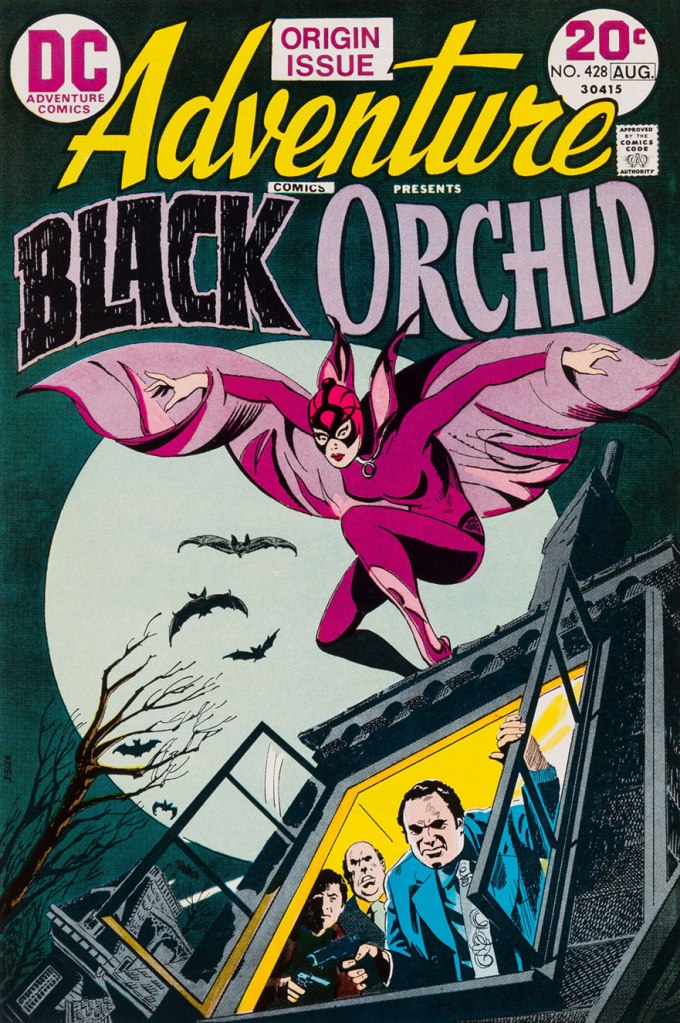
Finally, for a touch of the more ‘realistic’ Oksner style, here’s his cover introducing Sheldon Mayer‘s marvellously-mysterious Black Orchid. This is Adventure Comics no. 428 (July-Aug. 1973, DC). She deserved far more than a mere three-issue run!
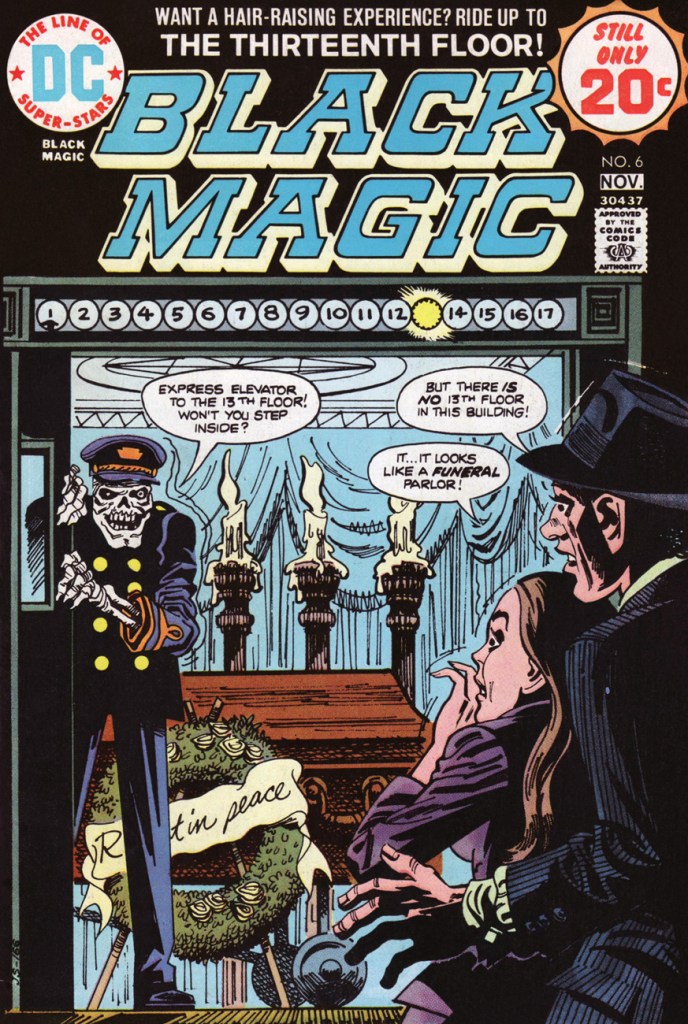
A Jack Kirby cover scene gets winningly recast for the 70s by Jerry Grandenetti, himself a contributor to the original series. This is Black Magic no. 6 (Oct.-Nov. 1974, DC).
When I was a kid (of twelve or so, if memory serves), I found a muddy and mildewed copy of this issue in the woods, which tremendously added to its allure, if not its readability.
And since I’ve mentioned it, here’s the original Kirby cover, regrettably one of the King’s least engaging, if you ask me. This is Black Magic no. 11 (vol. 2 no.5, Apr. 1952, Prize).
Well… little did I know what a protracted history this particular little scenario had. Let’s return to the presumed beginning, or at least the industrial age version.
Around the turn of the last century, the prolific English writer Edward Frederic Benson (1867 – 1940) wrote a story entitled The Bus Conductor [ read it here ] that saw print in Pall Mall Magazine in 1906. It was quite well-received, then began to widely make the rounds… as putative fact.
Things kicked into high gear in the mid-1940s, as the tale was recounted as an oft-heard anecdote in editor Bennett Cerf‘s 1944 short story anthology, Famous Ghost Stories, which contained a Benson contribution… but not The Bus Conductor.
That same year, Cerf shared the anecdote with the legion of readers who picked up his highly-entertaining (and still dirt-cheap and easy to find, over three-quarters of a century later, which gives you a sense of its original success and ubiquity) book of anecdotes, Try and Stop Me. The pertinent chapter was the splendidly-titledThe Trail of the Tingling Spine. As examined earlier on this blog, this chapter was used by EC Comics’ Bill Gaines and Al Feldstein as what they termed ‘springboards’ for their earliest stories.
Cerf’s version, from Try and Stop Me:
When an intelligent, comely girl of twenty-odd summers was invited for the first time to the Carolina estate of some distant relatives, their lovely plantation fulfilled her fondest expectations. She was given a room in the west wing, and prepared to retire for the night in a glow of satisfaction. Her room was drenched with the light of a full moon.
Just as she was climbing into her bed, she was startled by the sound of horses’ hooves on the gravel roadway. Curious, she walked to the window and saw, to her astonishment, a magnificent old coach pull up to an abrupt stop directly below her. The coachman jumped from his perch, looked up and pointed a long, bony finger at her. He was hideous. His face was chalk-white. A deep scar ran the length of his left cheek. His nose was beaked. As he pointed to her, he droned in sepulchral tones, “There is room for one more!” Then, as she recoiled in terror, the coach, the horses and the ominous coachman disappeared completely.
The girl slept little, but the next day she was able to convince herself that she merely had a nightmare.
The next night, however, the horrible experience was repeated. The same coach drove up the roadway. The same coachman pointed at her and exclaimed, “There is room for one more!” Then, as before, the entire equipage disappeared.
The girl, now panic-stricken, could scarcely wait for morning. She trumped up some excuse to her hosts and left immediately for home.
Upon arrival, she taxied to her doctor from the station and told him her story in tremulous tones. The doctor persuaded her that she had been the victim of a peculiar hallucination, laughed at her terror, and dismissed her in a state of infinite relief. As she rang for the elevator, its door swung open before her.
The elevator was very crowded, but she was about to squeeze her way inside — when a familiar voice rang in her ear. “There is room for one more!” it called. In terror, she stared at the operator.
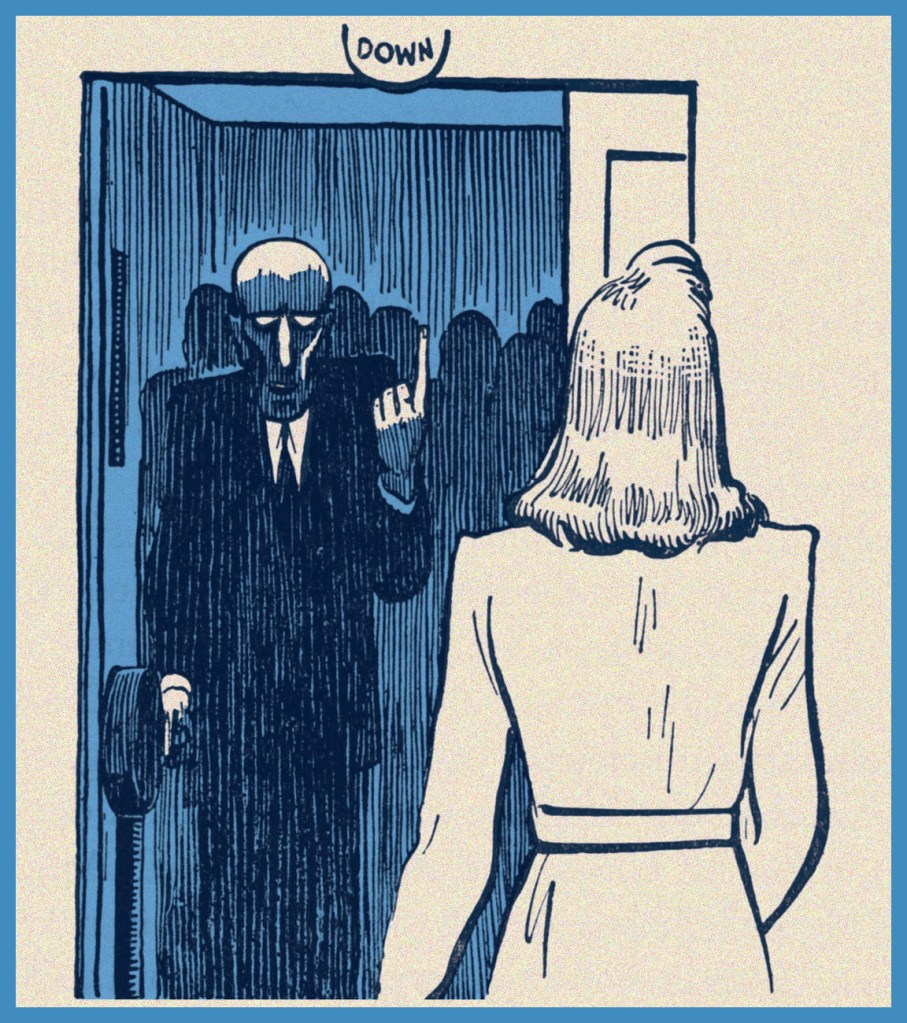
Try and Stop Me was lavishly and diversely illustrated by The New Yorker great Carl Rose, which surely must have contributed considerably to its success. I’d say Simon and Grandenetti were quite familiar with this striking image.
He was the coachman who had pointed at her! She saw his chalk–white face, the livid scar, the beaked nose! She drew back and screamed… the elevator door banged shut.
A moment later the building shook with a terrible crash. The elevator that had gone on without her broke loose from its cables and plunged eighteen stories to the ground. Everybody in it, of course, was crushed to a pulp.
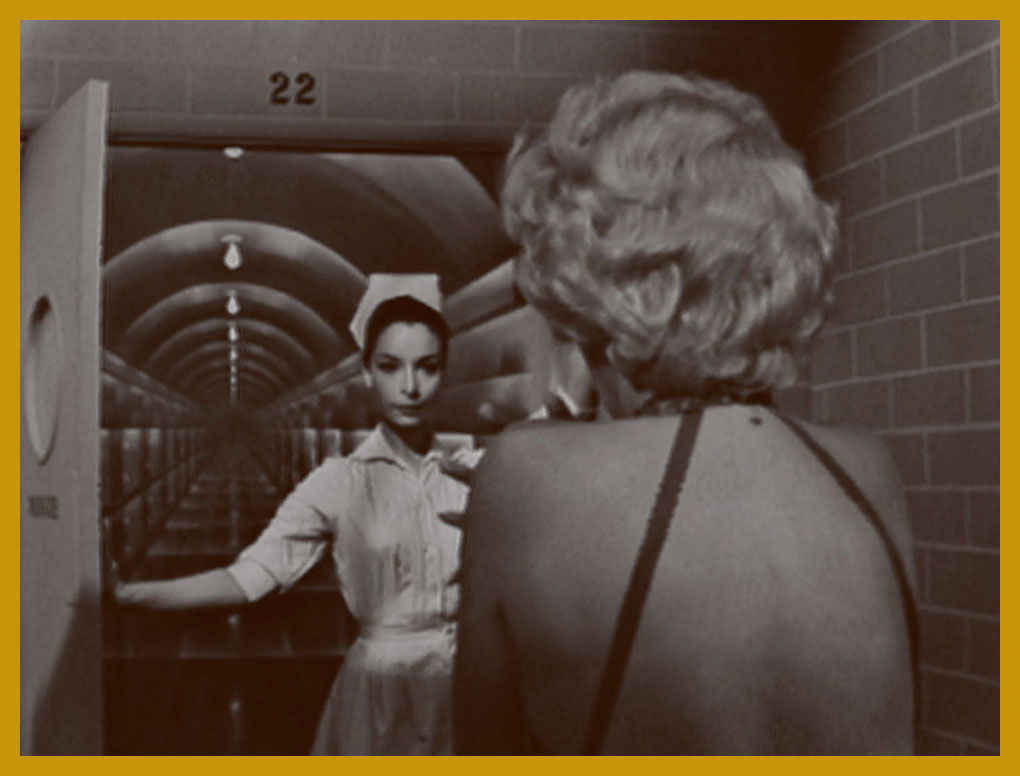
On to the Sixties: Rod Serling also drew upon the Cerf anecdote as grist for his The Twilight Zone episode Twenty Two (season 2, episode 17, aired Feb. 10, 1961). Here’s a pivotal scene from it.
Well, that’s certainly easier on the eyes than that gaunt vulture of an elevator operator… but no less menacing. You may recognize Mr. Spock’s future bride, Arlene Martel.
The Twilight Zone’s continuing popularity pretty much killed the scenario’s urban legend potency (Snopes.com checked it out!) In 1999, Urban legend authority Jan Harold Brunvand wrote, in his Too Good to Be True – The Colossal Book of Urban Legends:
According to my readers when I wrote a newspaper column in 1989 about the old ‘Dream Warning’ legends, The Twilight Zone version was the only one most of them knew. After numerous reruns, the TV episode had virtually replaced the folk legend in the popular mind. Every reader who wrote me following my column mentioned this episode, with one exception, and this person mentioned that he saw the plot enacted in a mid-1940s film, called Dead of Night. I’ll bet my legend-hunting license that this film, too, borrowed from the Cerf version.
I wouldn’t make that wager if I were you, Mr. Brunvand… since Dead of Night properly credits Benson.
To give you a sense of how effectively these stories flit and flicker across storytelling modes and media, power pop wizard Scott Miller (1960-2013) opened his band Game Theory‘s 1988 album, Two Steps From the Middle Ages, with a haunting ditty entitled Room for One More, Honey, an acknowledged quotation of the Twilight Zone episode.
« I don’t know what’s wrong with him! He’s in hellish torment! » — there’s witchery afoot, clearly
I’ll grant you in a heartbeat that Nick Cardy‘s (and, to a lesser extent, Neal Adams’) earlier The Witching Hour (full original title: It’s 12 O’Clock… The Witching Hour!, hence its twelfth day appearance) covers beat out subsequent entries on the overall quality front, but this particular beauty, in my opinion, takes home the terror tiara as the very creepiest of the bunch. Is it the otherwise-innocuous daytime setting, the tension between the pastoral and the grotesque? In the end, it induces shivers, and that’s what counts.
Though it comes as the tail end of their involvement, Carmine Infantino and Cardy still had a hand in, as publisher and art director, and took an active rôle in the design of each DC cover of the era.
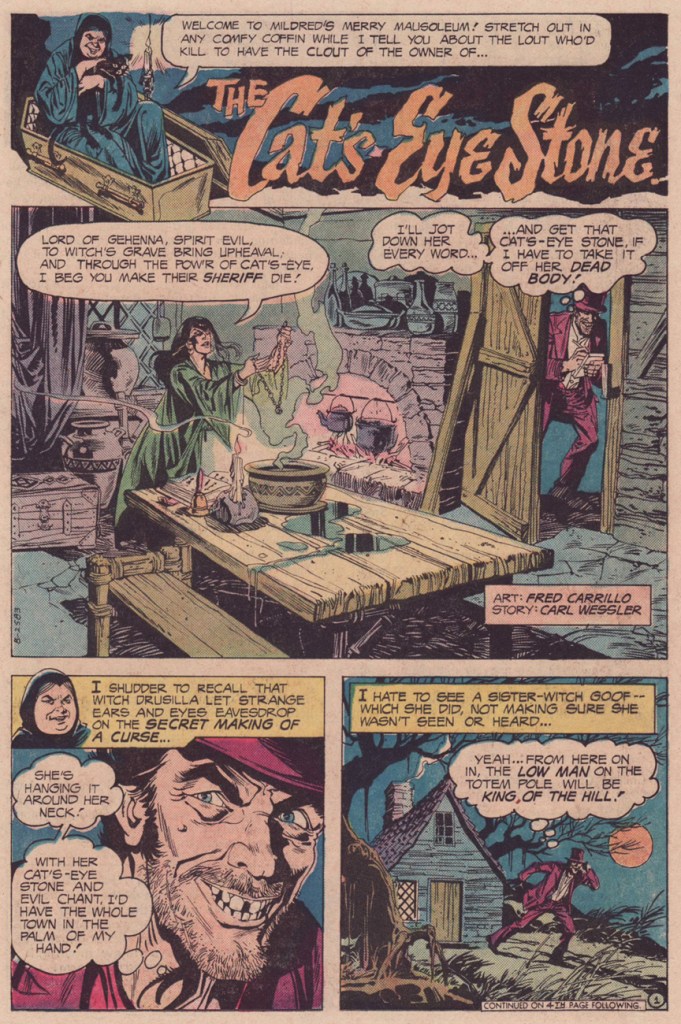
This is It’s Midnight… the Witching Hour no. 62 (Feb.-Mar 1976, DC). Edited by Murray Boltinoff. Argentine grand master Luis Dominguez’s cover art is loosely based on Carl Wessler and Fred Carrillo’s The Cat’s-Eye Stone. That aside, is it actually a picnic that Mr. Romantic has in mind, what with a “picnic place that no one will ever find“? Suspicious, to put it mildly.
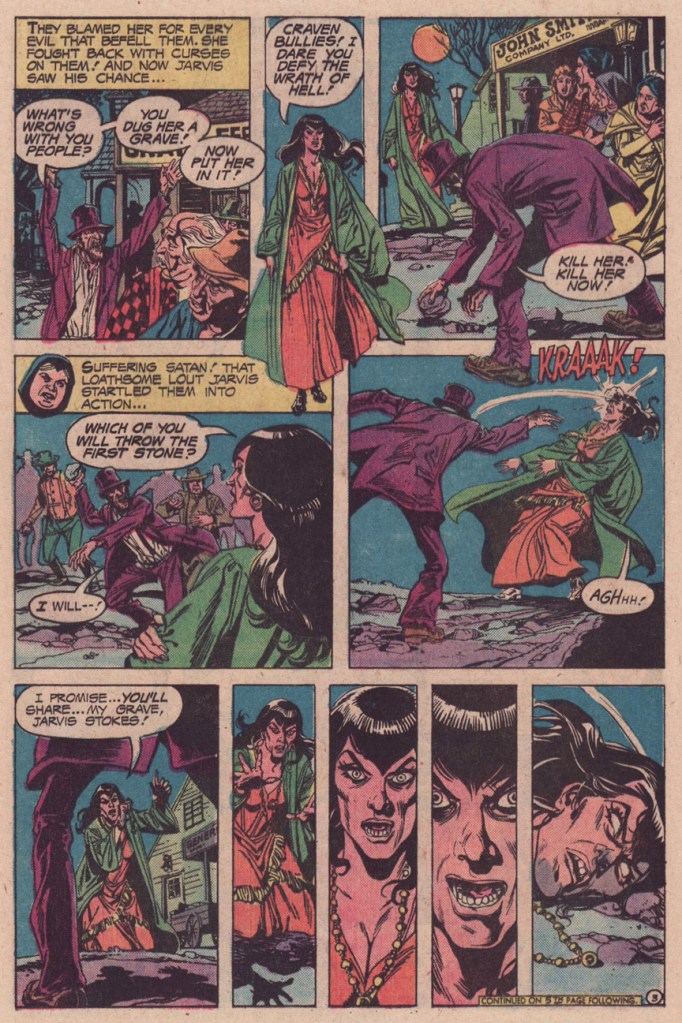
And so — why not? — here’s the full tale, so that you may judge for yourself.
One small quibble: doesn’t Drusilla’s witch’s brew count for something in the spell? Surely the words won’t suffice…
For a devil-worshipper, she’s pretty biblical (‘cast the first stone’). Or maybe that’s the point.
This story anticipates the shock ending of Carrie by almost a year. Or had this twist already made the rounds? Perhaps the cycle began with Let’s Scare Jessica to Death… but I’m not sure.
Wilfredo Limbana ‘Fred’ Carrillo (1926–2005) was an underrated Filipino artist who produced some quite fine work for DC Comics’ mystery titles in the 1970s. I was particularly fond of his work on The Phantom Stranger, when he illustrated both the titular feature and its worthy backup, The Black Orchid, at the tail end of the title’s run.


























 Who's Out There?