« In medical practice it is inevitable to observe the details. »
– Dr. Joseph Bell
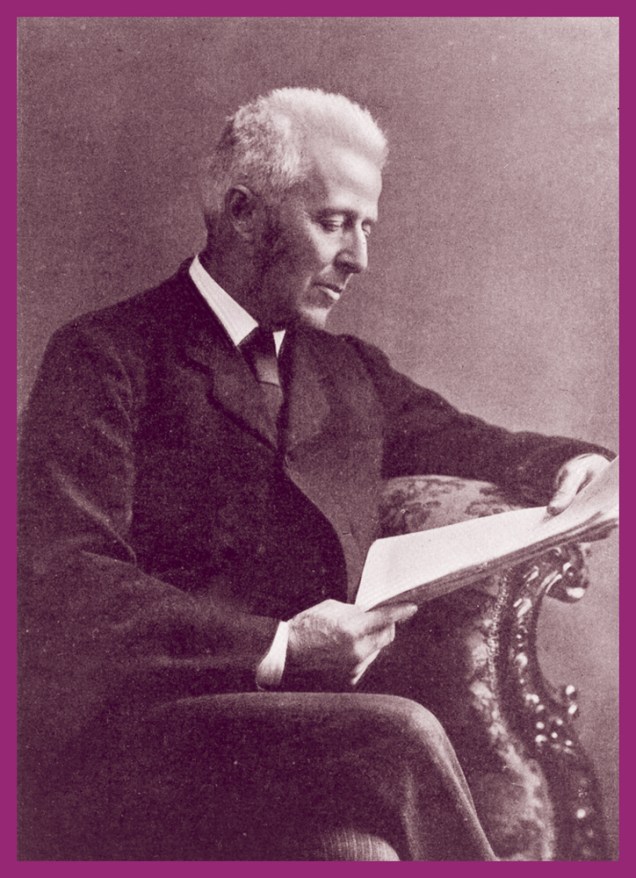
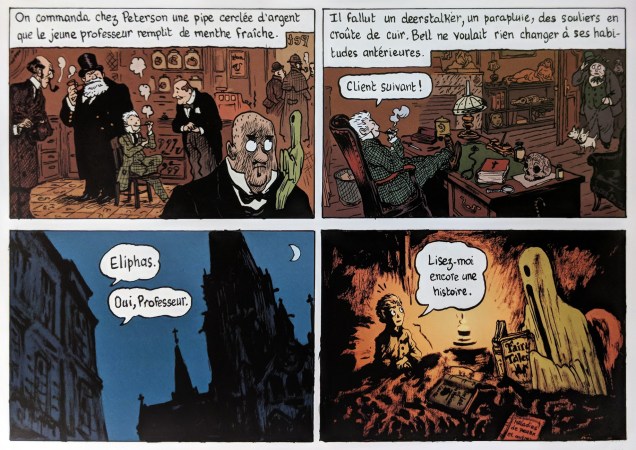
From France, then, we have the now-whimsical, now-terrifying exploits of Professeur Bell, somewhat loosely based on Joseph Bell, a lecturer at the medical school of the University of Edinburgh, who was Arthur Conan Doyle‘s teacher and the alleged real-life inspiration for Sherlock Holmes.
The good (actual) Dr. Bell. He’s only pretending to read.
Joan Sfar wrote and drew the first two entries in the series, but struggled to achieve the more realistic and detailed style he’d set for himself. With the third volume, he was joined by the skillful and versatile Hervé Tanquerelle, who handled the art chores from then on. A smooth transition.
Sfar has been invoking a marvellously complex and nefarious universe surrounding a « hero » with an increasingly slippery grasp on morality and reality. Heck, even Frank Belknap Long‘s Hounds of Tindalos got a surprise look-in. Recommended.
Published so far in French, Italian, German and Polish…
« L’Irlande à bicyclette » is the fifth and latest in the series, published in 2006. Ahem, fellas… it’s been *quite* a while. La suite, s’il vous plaît?
Intrigued, as you should be (you do have a pulse, right?)… care for a few furtive glances between the covers?
I’m not going to waste my breath trying to explain. Just dig that mood.
« Why do four skeletons and a coffin cross a small fishing village? The question has been asked! »
How’s this for setting the mood? Here’s a quintet of panels from Belgians Maurice Tillieux (script) and Willy Maltaite (aka Will, pencils and inks) gently ripped from the exploits of Tif et Tondu, a series that ran in the weekly bandes dessinées magazine Spirou from 1938 to 1997.
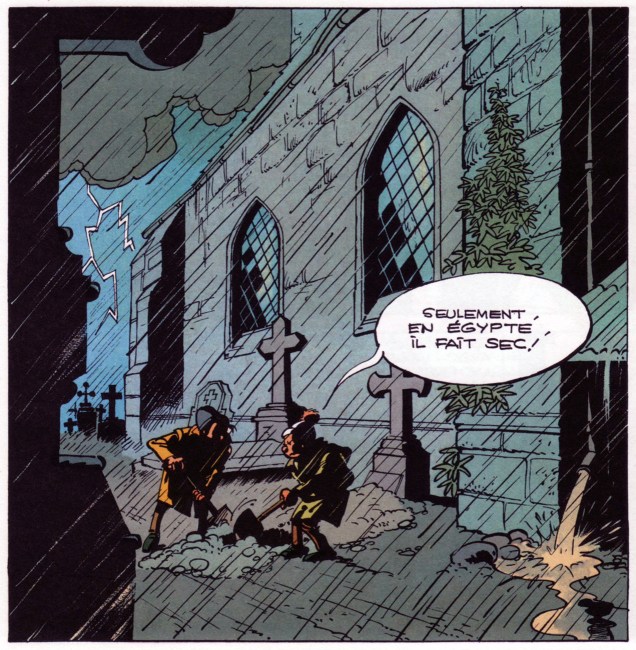
This standalone illustration originally saw print on the cover of Spirou no. 1789, in 1972. Incidentally, the guy on the left is just a passing acquaintance, a soap salesman who also found himself stranded in Brittany, some foggy night.« In Egypt, at least it’s dry! »« There’s still a cottage beyond the old castle. Let’s give it our last shot. » « Talk about a nest for ghosts. He’s straight out of a Perrault fairy tale, that one. »
These three come from the Les Ressuscités (‘The Resurrected”), Tif et Tondu’s 54th adventure overall, but no.20 in the album series), as only the post-1954 stories (when the series’ tone gained some gravitas, as well as its first significant scripter in Rosy) are considered, shall we say… canonical.
Panels from Le retour de la bête (“Return of the Beast”), serialized in issues 1988 to 1999 of Spirou magazine in 1976, sort-of sequel to 1971’s Sorti des abîmes (“Out of the Abyss”).
This is drawn from the 59th Tif et Tondu story (but no.25 in the collection). We’ve already been introduced to the Beast in question, as well as to Tif et Tondu, one misty Tentacle Tuesday last October.
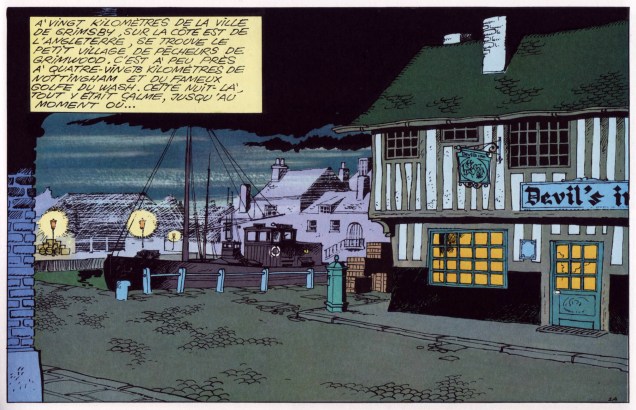
Regrettably, nothing supernatural occurs, but talk about atmosphere! The series does veer into some pretty dark science-fiction at times, especially under Tillieux’s watch (1968-1978, his death).
The mysterious events are set in the fictive village of Grimwood, near the actual town of Grimsby, which is dear, perhaps sarcastically, to Sir Elton John.
French comics artist Georges Pichard (1920-2003) specialized in erotic comics, and his work ranged from “just controversial” to “outright banned”. I have a soft spot for his excellently-endowed women with almond-shaped eyes – what they lack in sensuality (to my opinion, at least), they compensate with cantankerous personalities and odd liaisons with deities. Pichard also displays a preoccupation with labour and industrial themes, kind of a communist thing to my mind – his women are called upon (mostly unwillingly) to work with heavy hardware, build railroads, excavate mines, and undertake other menial tasks involving much metal and machinery. This, of course, is accomplished while naked, or nearly naked (shackles are frequently involved.) It doesn’t come off as sadistic or even sexist, however – it’s more like a grotesque comedy or satire. Anyway, I’ll get to all that in just a second.
First I’d like to show a few examples of his earlier work, which wasn’t “pushing moral boundaries” (as an anonymous admirer once put it). His two early series – Ténébrax and Submerman – were collaborations with comics artist Jacques Lob. Although Pichard’s eye for pretty women was already in evidence, his style was much cartoonier, which is lovely.
Ténébrax is an homage of sorts to the roman policier (the French genre of detective stories): a villain uses the Paris subway for his base while he whips his rat army into tip-top shape for world domination, but his heinous plans are foiled by a whodunit writer and his assistant, who manage to throw a spanner into his nefarious schemes.
Ténébrax, the first collaboration between scénariste Jacques Lob and Georges Pichard, was published in episodes in the short-lived weekly Chouchou (1964.)The opening page of Ténébrax. The bottom panel says (or, rather, our human protagonist says), « Who are you? Help! »
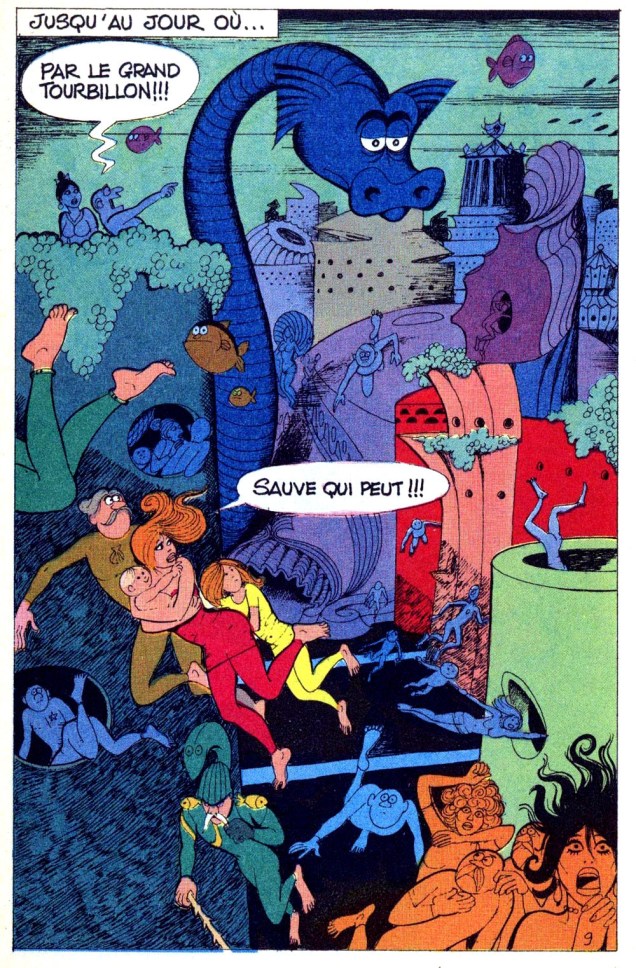
Submerman, on the other hand, is a superhero parody:
A page from Submerman from Pilote n°527 (1969). See all Pilote covers featuring Submerman here. The series was published between 1967 and 1970. People looking for a really obscure Halloween costume, take note of Submerman’s get-up: it wouldn’t be so hard to draw a yellow fish on a red onesie.Submerman: La faune des profondeurs, published in Super Pocket Pilote n°4 (1969). « Sauve qui peut! » translates to « Run for your life! » Interestingly, English doesn’t have a « Save yourselves, those who can », but French and Russian do. I can’t vouch for other languages.
Now, I promised you some of Pichard’s women. An obvious place to start is the series Paulette, scripted by Georges Wolinksi (who, by the way, was killed in the terrorist attack on Charlie Hebdo in 2015) and illustrated by Pichard.
Paulette began in 1970 and chronicled the wild (and ever so slightly improbable) adventures of (who else?) Paulette. She gets kidnapped (more than once, by different parties), wooed, attacked, betrayed, saved, pregnant, communist-icated, converted to capitalism, harem-ed, and so on, not necessarily in that order. The only thing she doesn’t get is left alone. Poor girl. I wouldn’t say the series is entirely light-hearted, however – the authors used their pretty héroïne to ventilate all sorts of issues.
Paulette en Amazonie (Éditions du Square, 1975). Is it wrong that I love the drawing of evil Nazis and dumb soldiers a lot more than the damsel in distress? Pichard’s women all looked the same, but his villains had a lot more variety – which is not untypical of artists who are obsessed with the female form, actually. Silly, really; one would think that an obsession would lead one to exploring different shapes and forms, but somehow it rarely works out that way.
« Here she is, ready to climb aboard airplanes that are inevitably hijacked, to wind up in jungles, in wasp nests, in ambushes, to crash through panels, through traps, into the arms of men unworthy of her, and to come through all this with a smile, without blaming anyone, not even Pichard and Wolinski, whose main preoccupation it is to never leave her alone.» (Introduction to Paulette 4, 1975)
An illustration to the political-gone-absurd content of Paulette:
The colours make me think of a black light poster. Here Paulette wakes up her bearded beau (who figures that her « Something terrible has happened to me! » refers to a pregnancy, and responds with « Don’t worry, if you have money that’s nothing, In Switzerland or Morocco… ») to inform him that « I think I am a communist! »
Speaking of bearded beaus: one of my favourite Paulette plots – although I haven’t read the whole series – involves Joseph, the old perv we just saw in bed, whose job is to protect Paulette from… err, himself, I guess? When Paulette rescues a magical mole, it offers her one wish, and because she is terminally naïve (bordering on the cretinous, if with a heart of gold), she wishes for Joseph to become young again. The mole, however, is myopic like all others of its kin, and mistakes Joseph for a woman, so he gets transformed into a sultry brunette.
Moving on to other oeuvres…
Original art from Bornéo Jo (Dargaud, 1983), with script by Danie Dubos and art by Pichard.Marlène et Jupiter (Yes Company, 1988).A panel from L’usine (Glénat, 1979).
And I saved the funniest as a digestif: in the last panel, the man is saying « But what am I supposed to do now? », to which she responds with « Replace your windshield, of course! I’ll give you an address, they’ll give you a ten percent discount if you mention that you were sent by Fairy Motricine – I’m the sister-in-law of Fairy Electricity. » (Note: Motricine was a brand of gas.)
Tentacles have no anglophonic bias. A tasty human morsel is every bit as appetizing when it’s babbling in Italian or German. Join me on a visit to the European side of things, where tentacles are truly horrifying and there’s none of this politely-hold-a-girl’s-leg stuff. It’s gore and revulsion through and through!
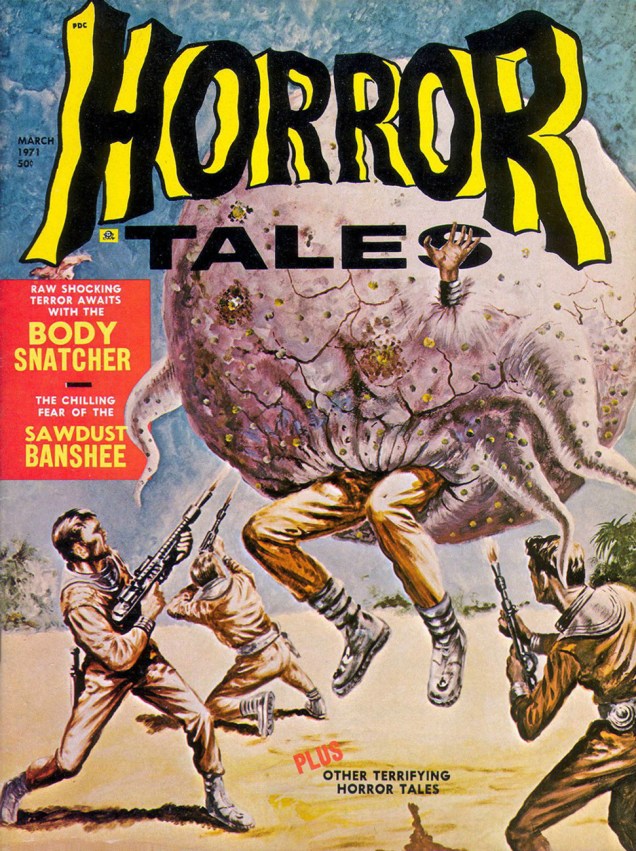
Horror Tales vol. 3 no. 2 (1971, Eerie Publications). Let’s have a moment of silence for what the poor guy is going through, being swallowed alive by a pulsating pink monstrosity which appears to have the same hole for eating and waste evacuation like some sea anemone (that has that has a single orifice for eating, excreting, and shedding eggs and sperm) and is about as appetizing. No, scratch that, sea anemones are much better.
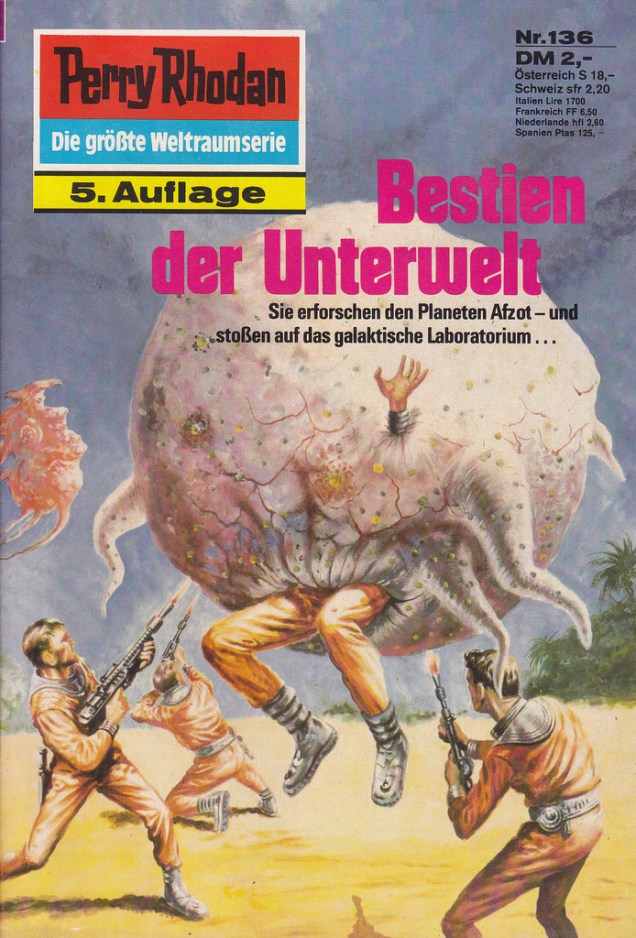
The cover, painted by German artist Johnny Bruck, is a reprint from the German sci-fi series Perry Rhodan, published by Moewig-Verlag starting in 1961. Here is the original:
Perry Rhodan no. 136. « Beasts of the Underworld », if you were wondering.
If the last cover made me vaguely think of an arsehole, this next one clenches, er, *clinches* this unfortunate association.
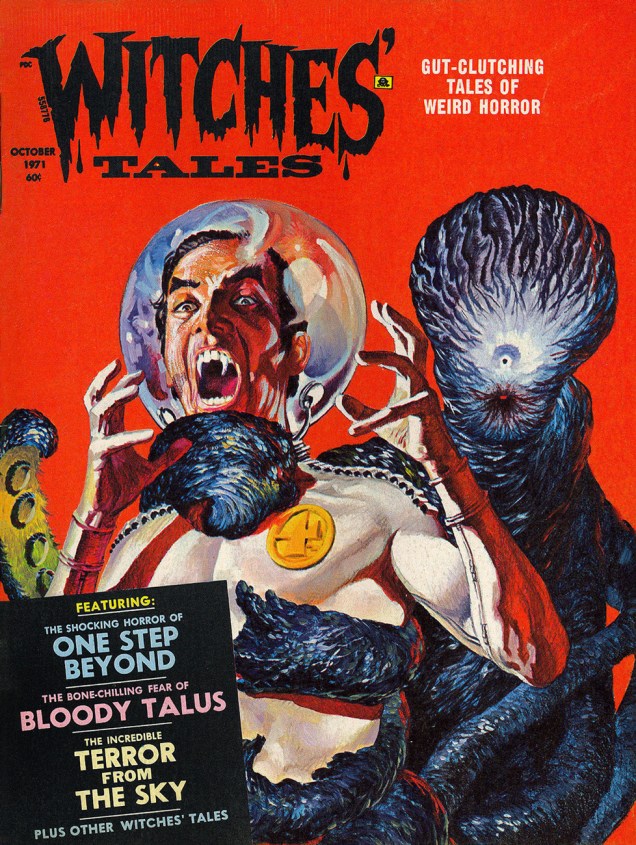
Witches’ Tales vol. 3 no. 5 (1971, Eerie Publications). Tentacles that look like furry slugs, a face like a puckered, blood-stained anus… this creature even his mother couldn’t love. And the victim? Why the fuck is a vampire in an astronaut’s helmet? And why a vampire at all – isn’t a tentacled monstrosity scary enough without bringing a blood-sucker into it? This witch is having nightmares.
The cover is by Franz Fernández, a Spanish artist born in Barcelona. He worked for Selecciones Illustrades, a Spanish art agency mostly known for its deal with Warren Publishing, which led to many Spanish artists submitting stories to Warren between 1971 and 1983.
On a somewhat less revolting, yet no less puzzling, note, we have these gorilla dinosaurs with tentacles. Why the hell not? I dedicate this cover to my friend Barney, a fan of silverback gorillas.
Gespenster Geschichten no. 1399 (1974, Bastei Verlag). Gespenster Geschichten, “Ghost Stories” in German, was a weekly comic book series that ran between March 1974 and March 2006, which certainly gives us a clue as to how successful it was. In the early years, most stories in Gespenster Geschichten were reprints of American horror comics, pretty much what one would expect: lots of appearances from Frank Frazetta, Jack Kirby and Wally Wood, for instance. When the magazine stopped relying on reprints and started featuring new content, Argentine, Spanish, Peruvian and Italian artists provided most of the artwork, together with Yugoslav artists (such as Goran Sudzuka) and a couple of German ones, most noticeably Hans Wäscher, a revered German comics artist (whom Google comically translated as “hans scrubber”). This cover points out that the contents are “neauflage”d (i.e. reprinted).
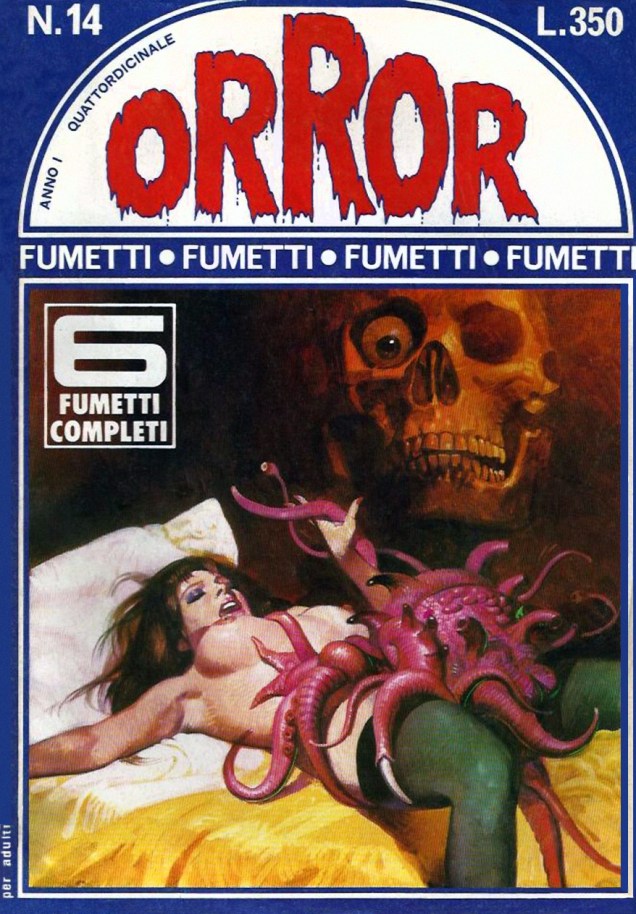
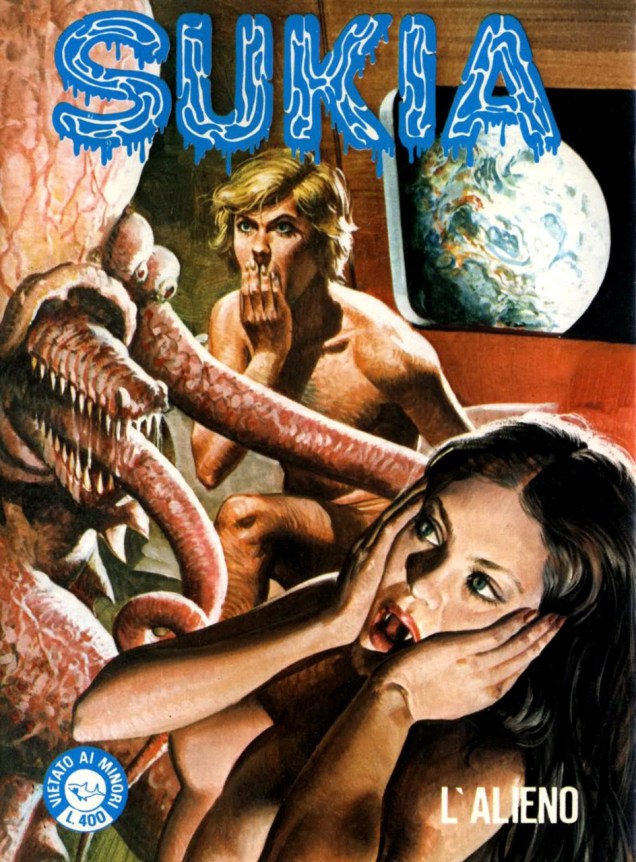
I appear to be utterly incapable of doing a Tentacle Tuesday post without some sort of scantily clad, beautiful maiden joining the fray. Why resist? Here are a couple of precursors of The Possession.
Orror no. 14 (1978, Edifumetto). For once, the monster is kind of cute, as opposed to completely nauseating. Art by Alessandro Biffignandi.Sukia no. 52 (1980, Edifumetto). Sukia was a joint effort of Renzo Barbieri, founder of Italian publishing house Edifumetto, and Fulvio Bosttoli. Ornella Muti fans, take note.
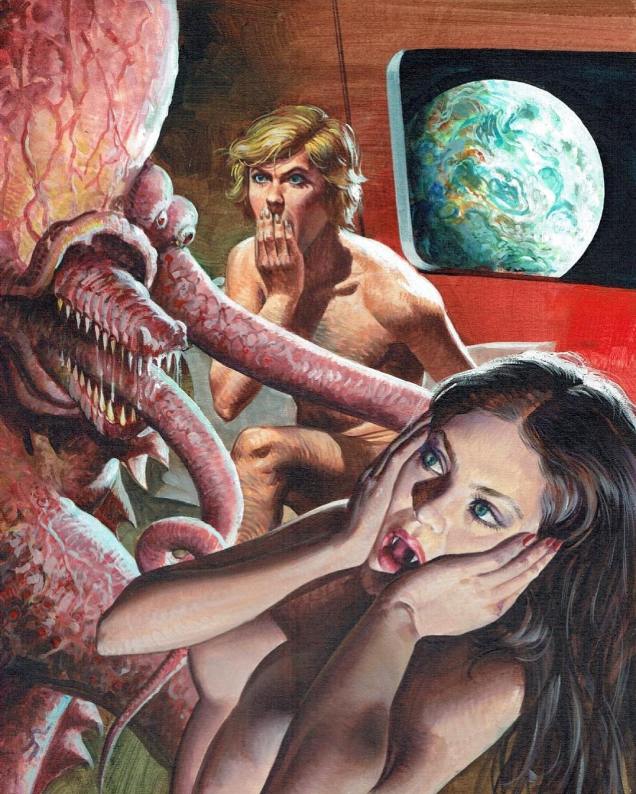
The original painting allows us to see more detail in the alien’s, err, anatomy. After seeing this, I don’t think anybody needs abstinence speeches.
« Tous les merdeux ricanaient en se disant qu’une revue sans merdeux à la tête, ça ne marcherait jamais.* »
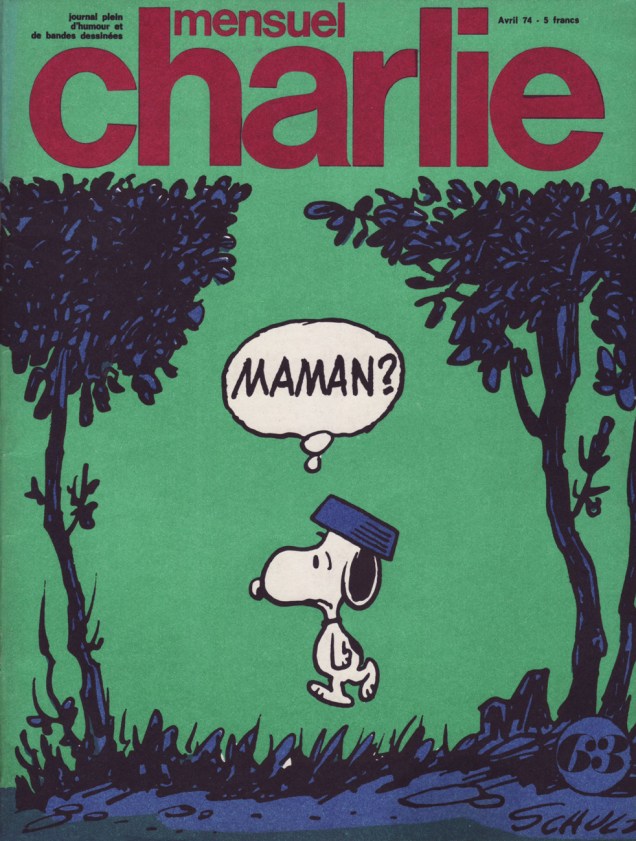
In issue 63 (April, 1974) of the recently rechristened « Charlie Mensuel » (to avoid confusion with its sister publication, Charlie Hebdo, yes, *that* Charlie Hebdo), insightful bandes dessinées critic and French national treasure Yves Frémion-Danet (b. 1947, Lyon), writing under his « Théophraste Épistolier » nom de plume, provided a classic essay accompanying a reprint of Harvey Kurtzman and Will Elder‘s « Goodman Gets a Gun », originally published in Help no. 16 (Nov. 1962, Warren). In his piece, Frémion posits that, with his 28 issues of Mad / Mad Magazine, Kurtzman’s brand of satire completely changed the rules of the game, and that despite an utter lack of commercial success and name recognition for himself and his work (reportedly, a French edition of Mad was published in 1965-66, for six or seven issues) on the continent, his influence on a significant swathe of the subsequent generation of French and Belgian cartoonists easily validates his vital importance.
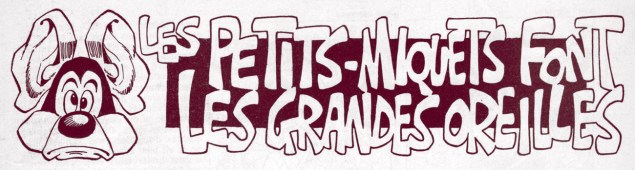
Théophraste Épistolier’s column’s logo, which translates as “Little Mickeys give you big ears”. A “Petit Miquet” is, in french, a generic name for cartoon characters from a dismissive and/or ignorant perspective. Someone to whom Mickey Mouse is the sole precursor of all Little Mickeys. Artwork by Gotlib.
Frémion spares no praise for Kurtzman’s acolytes Elder, Jack Davis, Basil Wolverton, Wally Wood and John Severin, and publisher Bill Gaines, but has nothing but contempt for editorial successor Al Feldstein (“vile copier”, “lumbering”, “regular”…). Frémion charts Kurtzman’s subsequent projects and associations, and his rôle in the rise of Underground Comix. Recommended reading… if you can read french.
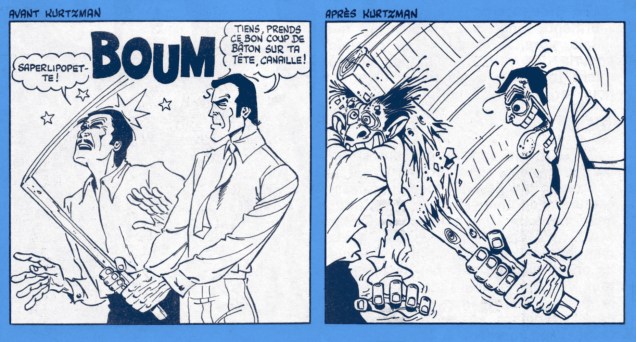
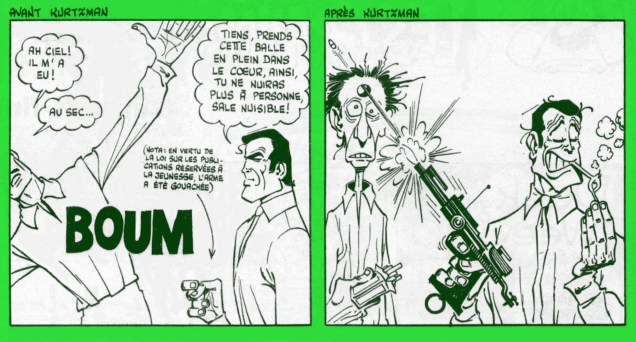
Ah, but that brings us to an apt illustration of that creaky adage, « A picture is worth a thousand words »: as it happens, the legendary Marcel Gotlib (b. 1934, d. 2016), speaking of influential, provided a quartet of original illustrations to put across what comics were like Before and After Kurtzman, commenting at once on American comics and on Franco-Belgian bande dessinée, with a snappy Gallic twist. Like Goofus and Gallant, but with far more tongue.
It took me a long time to come to terms with Gotlib. In my formative years, in Québec, his was such an outsize, smothering influence that one got quite sick of him. To be fair, not of him so much as his multitudinous, third-and-fourth-rate would-be clones. His style was easy to imitate, yet difficult to master. You see how that could easily careen off the rails?
In the left panel, the pistol is missing, having been whited-out « in accordance with the law on publications intended for young people », a quite repressive set of regulations adopted in 1949.More of the same: « Certain body parts have been whited-out. » Gotlib’s point is well made: when something relatively innocuous gets erased, the mind often fills the blanks with more perverse possibilities. Serves you right, censors.The issue in question. Charlie / Charlie Hebdo was published from Feb. 1969 to Feb. 1986, lasting, in fits and starts, 198 issues. It then merged with Pilote… and disappeared. Cover, of course, by Charles Schulz.
-RG
*« All the shitheads giggled, telling themselves that a magazine without an shithead in charge never would stand a chance. » – Théophraste Épistolier
Once in a while, I come across an artist I’ve never heard of before but whose work I really like. It’s always a delight to stumble upon an elegant boat afloat daintily on a sea of crap. (Life is full of new things to love that we just haven’t discovered yet, but the trick is to discover them amidst all the noise.)
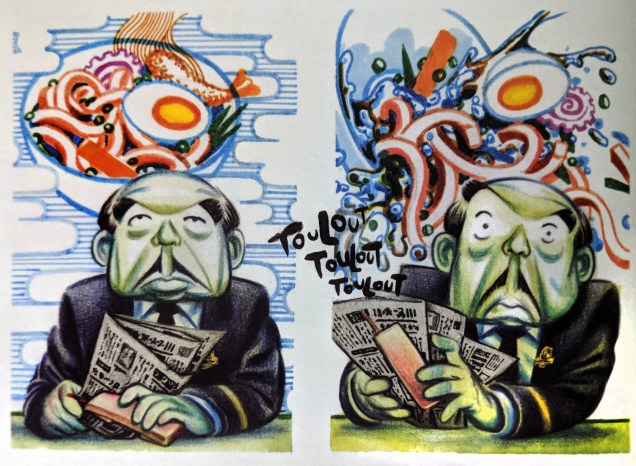
The chief of police dreams of food… but will he be able to find a tasty bowl of udon before all the noodle stalls close for the night? Panels from Petites coupures à Shioguni (Éditions Philippe Picquier, 2015).
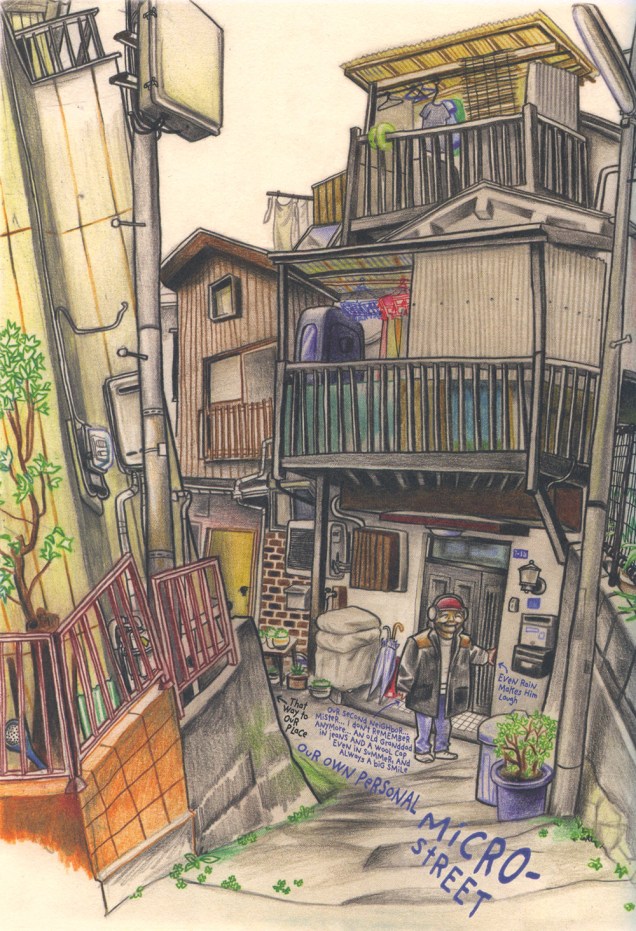
Florent Chavouet is an accomplished artist who prefers bright colours, which predisposed me to liking his art before I even considered the potency of his storytelling. He mostly draws in a cute, cartoony style that’s perfect for all the travelling-around-Japan chronicling he has done. However, architecture doesn’t stump him at all – a lot of his drawings are successful, detailed sketches of streets and apartments – and he’s amply capable of realism when the situation calls for it. And he’s an excellent storyteller, to boot.
My favourite book of his (so far) is my most recent acquisition: Petites coupures à Shioguni (Éditions Philippe Picquier, 2015), a complex story involving many characters and the ways their lives intersect and influence one another during a typical night in Japan. (Well, maybe not typical.) As the story unfolds after sunset, we get treated to a lot of pop-right-out-of-the-book, light-on-dark-background scenes, something Chavouet excels at. The art is his most accomplished yet; his latest book came out in 2016 (L’île Louvre), but I haven’t read it so far. I think we can say with certainty that he’s still developing his talents!
The cab driver has distinctly bad luck on that night. Petites coupures à Shioguni (Éditions Philippe Picquier, 2015).Another lovely feature of Petites coupures à Shioguni (Éditions Philippe Picquier, 2015) is the hand-lettered dialogue – it’s an integral part of the artwork.A promotional presentation of Petites coupures à Shioguni (Éditions Philippe Picquier, 2015).
This graphic novel hasn’t been translated to English yet, so non-French speakers will have to wait for a bit until it is.
Going back in time, but remaining in Japan, here are a few samples from Tokyo on Foot: Travels in the City’s Most Colorful Neighborhoods (Tuttle Publishing, 2011).
A page from Tokyo on Foot: Travels in the City’s Most Colorful Neighborhoods (Tuttle Publishing, 2011); it came out in the original French in 2009. You’ll be encountering scores of intriguing characters if you take Chavouet along as your guide.Tokyo on Foot is full of such isometric-projection layouts of people’s apartments.Tokyo on Foot also has plenty of beautifully rendered night scenes.Page from Tokyo Sanpo (Éditions Philippe Picquier, 2009).
Visit Chavouet’s blog here – if you don’t speak French, you can admire the art (though you’ll be missing the stories he likes to make up for each of his drawings/paintings).
An example of the critters you’ll encounter – which Chavouet calls Yokai, the Japanese word for demons or monsters – on his blog.
« The French have a phrase for it. The bastards have a phrase for everything and they are always right. To say goodbye is to die a little. »
― Raymond Chandler, The Long Goodbye
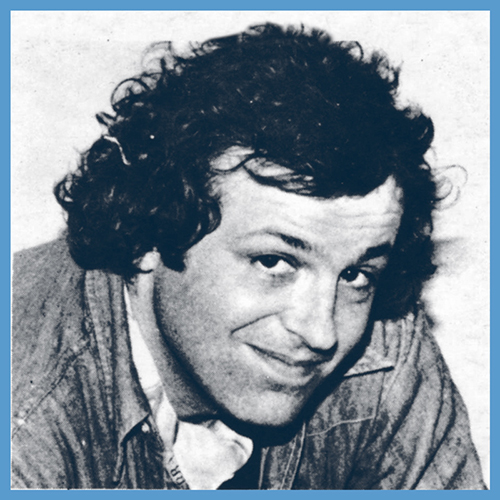
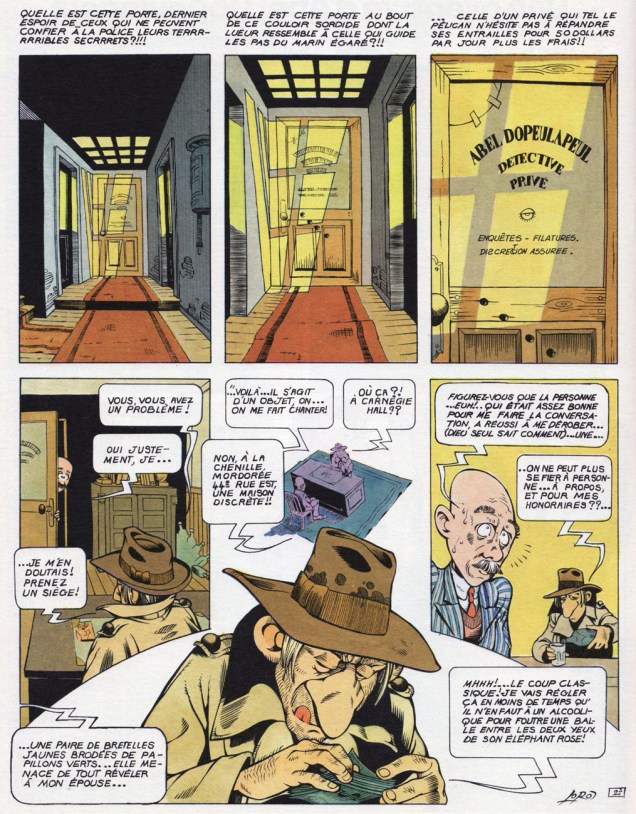
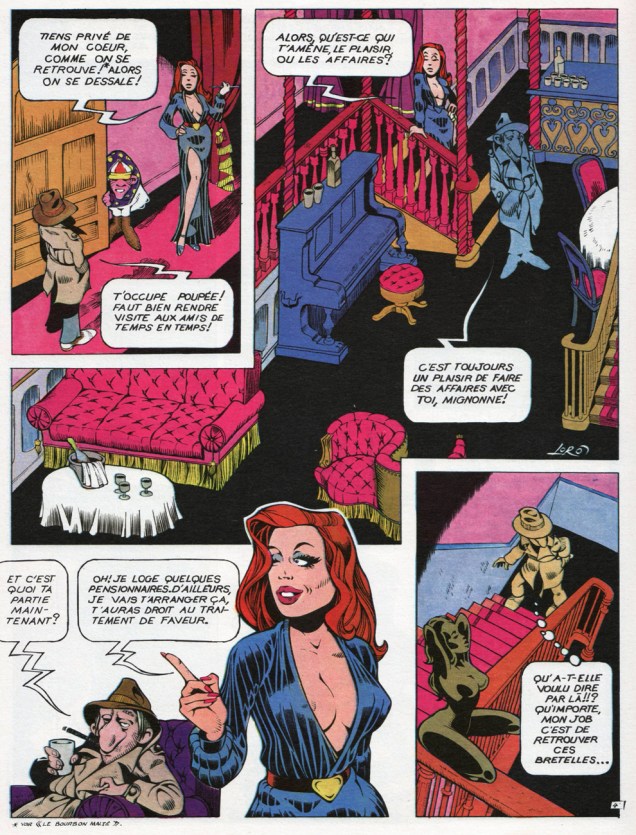
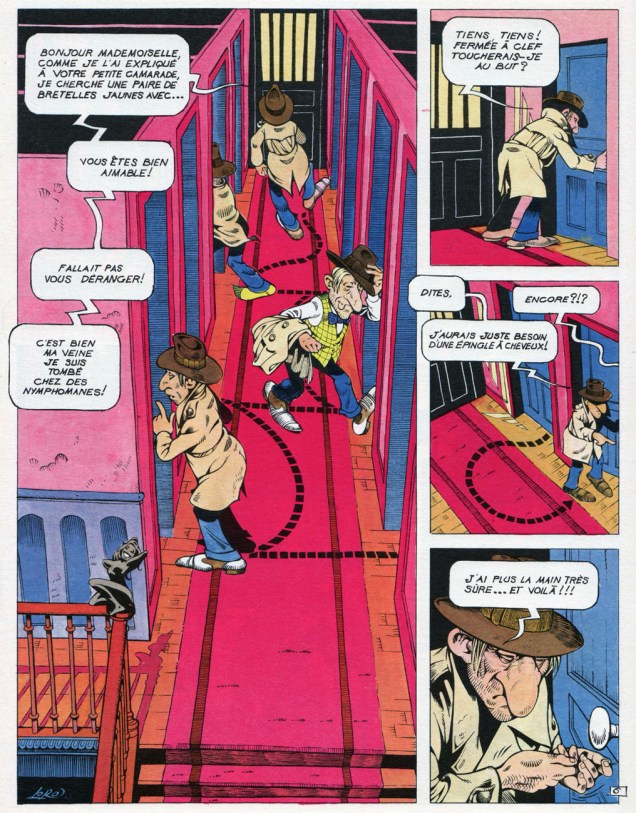
Dopey private detective parodies are a dime-a-dozen, and they seldom raise more than a lazy, jaded chuckle. With that out of the way, just how does Jean-Marc « Loro » Laureau (1943 – 1998)’s Les enquêtes d’Abel Dopeulapeul pull ahead of the pack? Let’s see: while it’s hardly side-splitting, it nevertheless scores precious points on the hilarity front by maintaining a mostly deadpan tone. But… one quick peek at the strip and the jig is up: it’s a glorious, unabashedly visual feast. Loro was blessed with that rather uncommon gift, the ability to seamlessly mix the cartoonish and the realistic. Even Wally Wood couldn’t pull that off. Frank Cho is a perfect contemporary example of someone who’s utterly incapable of it.
Monsieur Laureau himself, in the late 1970s.
M.A. Guillaume, who penned the back cover copy for the second Abel collection, Sale temps pour mourir (1979, Dargaud), clearly gets the picture. I’ll translate:
« Dopeulapeul, a parodic and cretinized response to [Philip] Marlowe, views himself as that marvellous guy who stalks vice and corruption on fifty dollars a day plus expenses. Within the haze of his dream fed by adulterated bourbon, he doubtless imagines he’ll croak on some moonless night, alone like a dog behind the last trashcan of some filthy dead end. The reader will cackle maliciously, knowing no-one gives a toss about the death of a caricature. But he’ll be wrong. Dopeulapeul conducts himself like some village idiot in the throes of some clandestine passion for Lauren Bacall. His blasé detachment, dragging a language school aftertaste, is as seductive as an unkempt stinkbug. It matters little how offhandedly Loro may treat the tentative meanderings of this poor beggar. Within him slumbers a fascinated vision that survives all clichés: in the debauched night, a man moves along, and his shadow is weary of knowing too well the callousness of the blacktop and of men’s hearts. He is free and solitary and Death is at his heels.
Parody can’t put a dent to that, and Loro knows it full well. He may laugh, parody, demystify, “Sale temps pour mourir” is nonetheless an homage to an untouchable legend. »
Loro is all-but-forgotten nowadays, but his ability to channel vintage Will Eisner (particularly The Spirit) without aping him, while displaying plenty of his own pyrotechnics, by itself deserves a more prominent place in history.
« Réquiem pour un privé », an early entry in the series, first saw print in Pilote Hors série aventure (No 17 bis, October 1975, Dargaud)
C’est un fou qui repeint son plafond et un autre fou arrive et lui dit: « Accroche-toi au pinceau, j’enlève l’échelle!*»
Marcel (and the hapless Yvonne) meet the Homo-Detritus. From Pilote no. 47-bis (April, 1978)
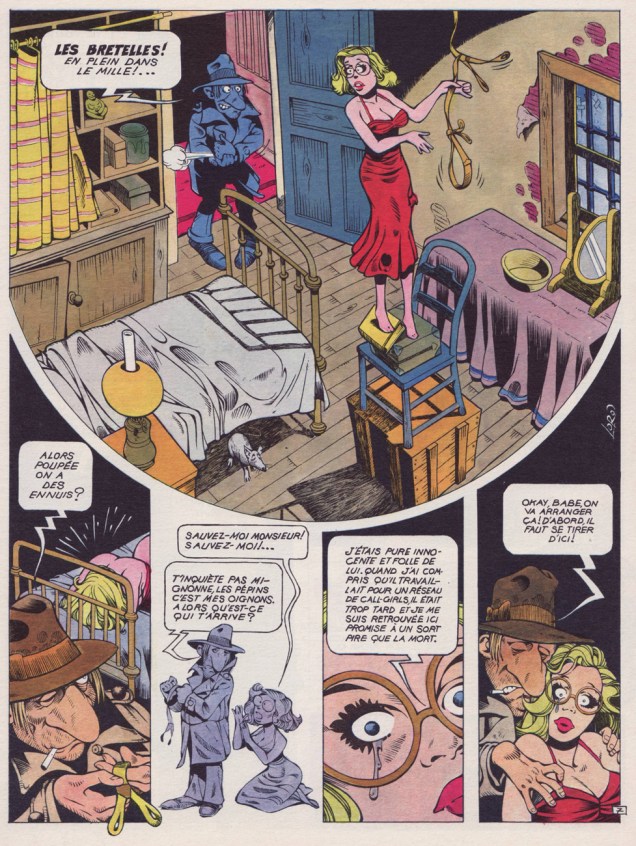
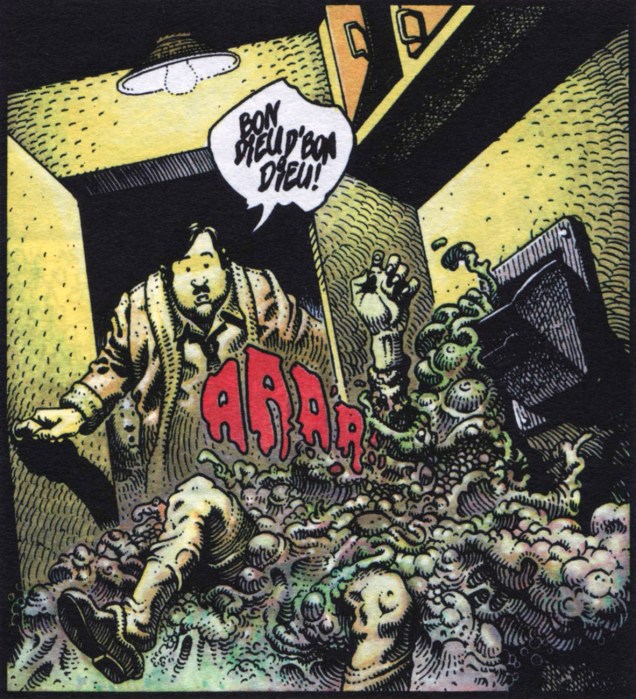
Poor Marcel Miquelon: a simple suburban nobody, he merely wants to get a good night’s sleep, but it’s never in the cards. When he and his Yvonne go to bed, each night at 10, some din from above invariably keeps him awake and frustrated. So what can he do but seize his faithful broom by the handle and bang on the ceiling to manifest his discontent? And dreadful things happen, in increasingly byzantine shades of dreadfulness.
These loosely-connected vignettes appeared sporadically from 1975 to 1979, under the portmanteau heading of Scènes de la vie de banlieue in the French monthly Pilote (1974-1989). They were the brainchild of Philippe Cazaumayou, alias Caza (b. November 14, 1941, Paris), also a renowned science-fiction illustrator, which should certainly surprise no-one.
This episode is titled Toujours du bruit au plafond (« Still some noise on the ceiling »); it originally saw print in Pilote Mensuel no. 34 (March, 1977). It’s the rare (possibly the only) one that ends peacefully for Marcel, perhaps because he didn’t bother with the broom. Better St. Peter than… well, everything else.
*One of the hoariest French jokes, everyone’s heard it, and its appeal has whirled countless times around the bend, deep into irony and meta-subtext. Thankfully, though, it’s actually translatable, at least verbally: A lunatic is painting the ceiling. Another madman comes along and says: « Hold on to the brush, I’m borrowing the ladder! »
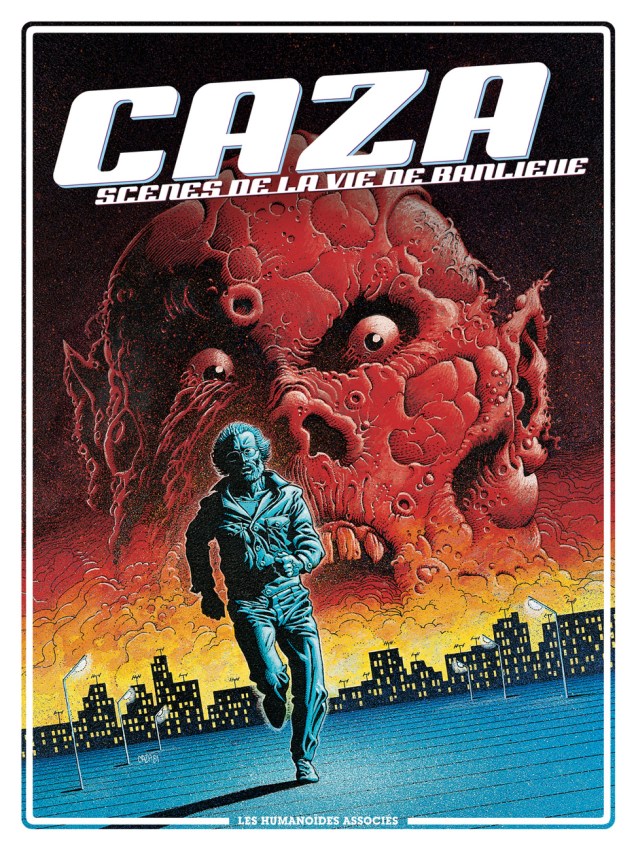
A ‘Scènes de la vie de banlieue’ collection (Dargaud, 1982). I agree: for all he’s gone through, Marcel Miquelon does deserve his own statue.The collected works (Les Humanoïdes associés, 2017)
« Once there was a fellow and his name was Buzz He was just a rookie cop, just a baby Fuzz He patrolled the Sunset Strip in the land of the free and the home of the hip He protected you and me until he met a girl called Alice D
Alice was the girl that all the hippies dread And they called her Sweet Alice the Head Alice it was plain to see was full of pot and STD She’d attract a great big crowd because her inner peace was much too loud »
Biff Rose, “Buzz the Fuzz” (1968)
This day in history: On April 16, 1943, the hallucinogenic effects of LSD were discovered.
Here’s an account of the event, from the folks at History.com:
In Basel, Switzerland, Albert Hofmann, a Swiss chemist working at the Sandoz pharmaceutical research laboratory, accidentally consumes LSD-25, a synthetic drug he had created in 1938 as part of his research into the medicinal value of lysergic acid compounds. After taking the drug, formally known as lysergic acid diethylamide, Dr. Hofmann was disturbed by unusual sensations and hallucinations. In his notes, he related the experience:
« Last Friday, April 16, 1943, I was forced to interrupt my work in the laboratory in the middle of the afternoon and proceed home, being affected by a remarkable restlessness, combined with a slight dizziness. At home I lay down and sank into a not unpleasant, intoxicated-like condition characterized by an extremely stimulated imagination. In a dreamlike state, with eyes closed (I found the daylight to be unpleasantly glaring), I perceived an uninterrupted stream of fantastic pictures, extraordinary shapes with intense, kaleidoscopic play of colours. After some two hours this condition faded away. »
After intentionally taking the drug again to confirm that it had caused this strange physical and mental state, Dr. Hofmann published a report announcing his discovery, and so LSD made its entry into the world as a hallucinogenic drug. Widespread use of the so-called « mind-expanding » drug did not begin until the 1960s, when counterculture figures such as Albert M. Hubbard, Timothy Leary and Ken Kesey publicly expounded on the benefits of using LSD as a recreational drug. The manufacture, sale, possession, and use of LSD, known to cause negative reactions in some of those who take it, were made illegal in the United States in 1965.
The genial Dr. Hofmann.
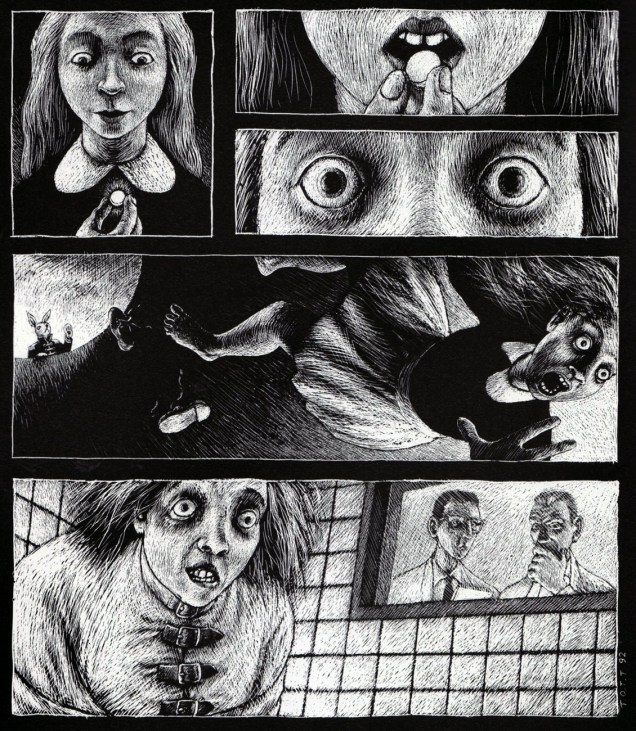
As a little digestif for the history lesson, here’s a poisoned bonbon from Thomas Ott (b. 1966, Zurich… a mere 76 km from Basel!), a proven meister of both comics storytelling and of the singularly exacting technique of scratchboard. This is Ott’s highly condensed and updated version of Lewis Carroll’s Alice’s Adventures in Wonderland, “Alice”, from 1992. I wouldn’t advise its use in preparing a book report.
Just this once, inquisitive English-speakers won’t be left out in the cold or reaching for their translation dictionaries, as Ott’s work is mostly mute, the only text appearing incidentally on newspapers, signs and assorted objects, and in English at that.
Ott’s chosen milieu is the perpetual nighttime of American film noir (which in turn comes from the French roman noir, a term first used in the 1700s to describe British gothics, becoming synonymous, in the 20th century, with bleak crime novels), so the headlines and billboards are in Inglés. In addition to the classic noir recipe, the Swiss artisan injects a discreet but usually lethal dose of his quite sardonic wit.
Cards on the table time: I never did much like Tintin. While there’s no denying the technical virtuosity and high imagination on display in Hergé’s work*, as a child, his overly-meticulous line and storytelling struck me as flat, sterile and remote. I thought I was just about alone in this view.
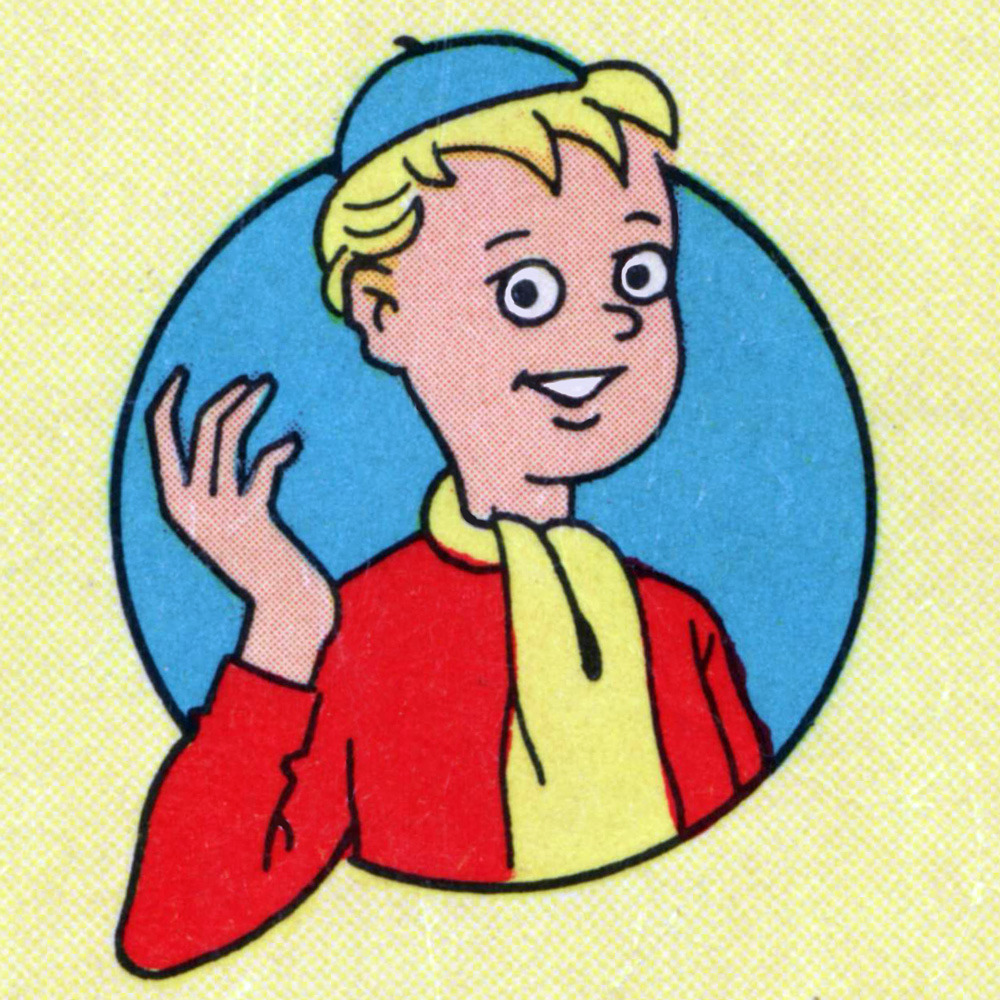
There was a Tintin-esque series I did delight in, and that was Martin le Malin, a translation of the Dutch « De Avonturen van Pinkie Pienter ». While much derided and nearly forgotten today, Pinkie remains, in my view, a misunderstood and under-appreciated work.
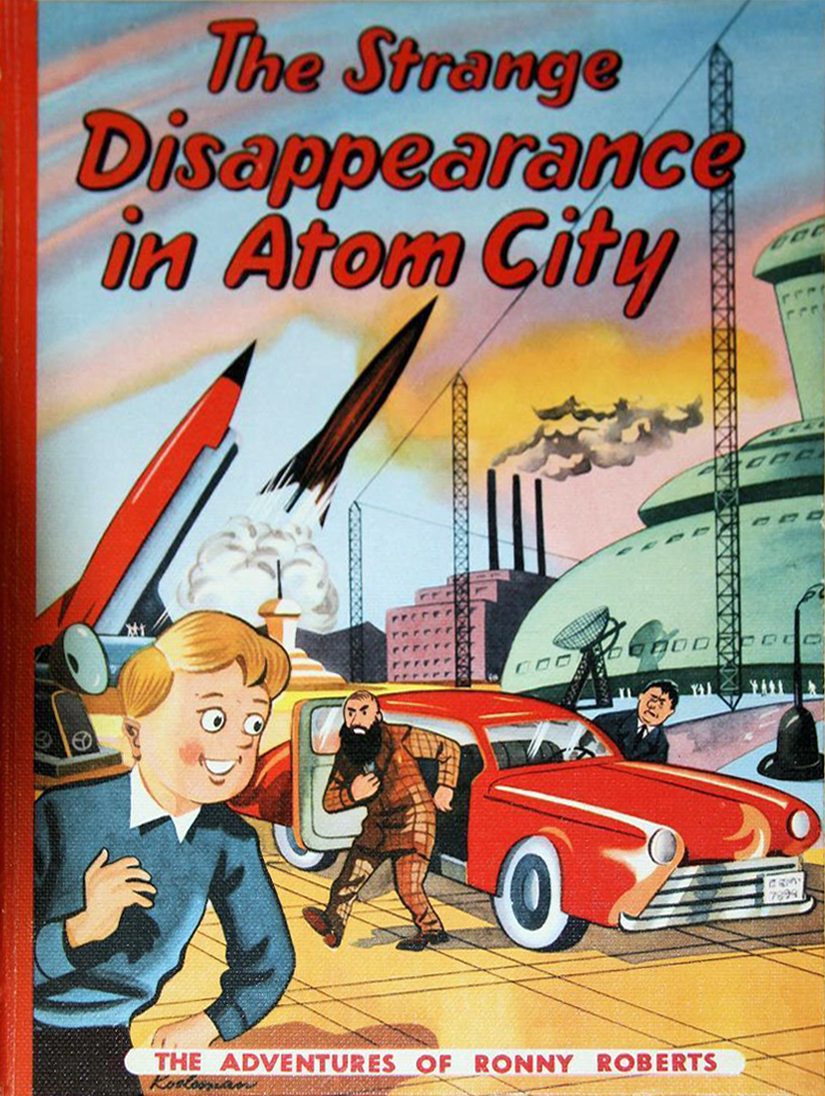
I was to learn, decades later, that the series was in fact created in response to the very aspects of Tintin that left me cold. In 1951, Dutch painter J.H. Koeleman (born October 30, 1926), while visiting his brother, learned from his young nephews that they were somewhat frustrated with and repelled by Tintin, finding the stories too complicated and the artwork too fastidious. From this incident, Uncle J.H. hit upon the idea of creating a series using a deliberately naïve and relatively primitive style, something closer in tone and essence to what a talented and imaginative child would craft for himself.
Koeleman produced and self-published a pair of albums, which were met with critical praise but disappointing sales. However, in early 1953, established publisher Mulder & Zoon came knocking and offered the man a deal: they would, using the greater resources at their disposal, republish and distribute his early efforts. The joint venture worked splendidly… at least for a time. In total, Koeleman wrote and drew twelve Pinkie Pienter albums between 1953 and 1958. These were also published in softcover 16-page colour instalments, which is the format I encountered them in. In my youth, they were everywhere: (long gone) supermarkets, department stores… and at 39 cents apiece, they offered a fine deal.
However, during Expo 58 (aka the Brussels World’s Fair), long-simmering tensions came to a head between the author and his publisher. Koeleman walked out, and the less said about his successors, the better. For it is in the later Martin le Malin albums that we can plainly witness the difference between intentional simplicity and economy… and sheer incompetence.
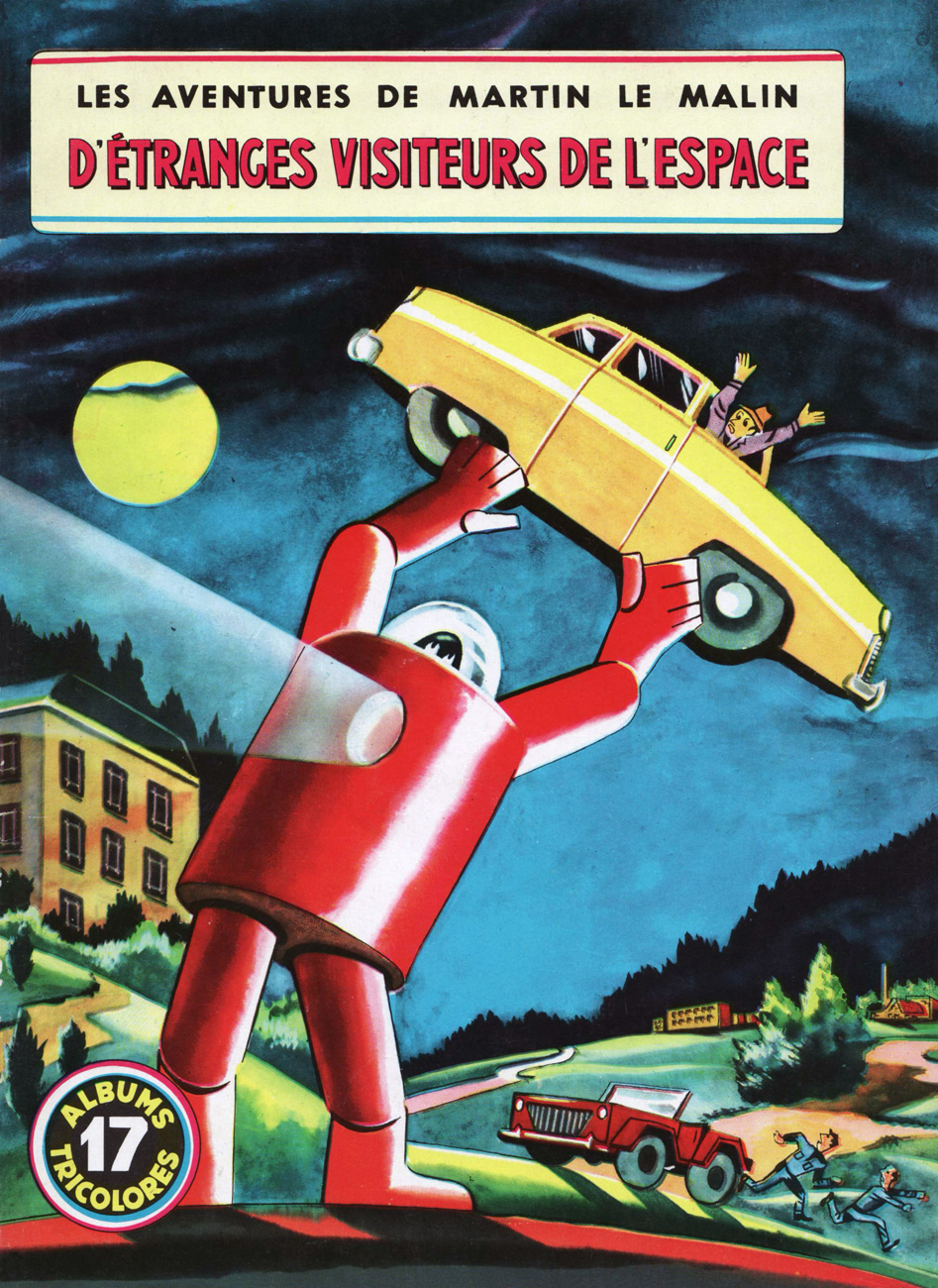
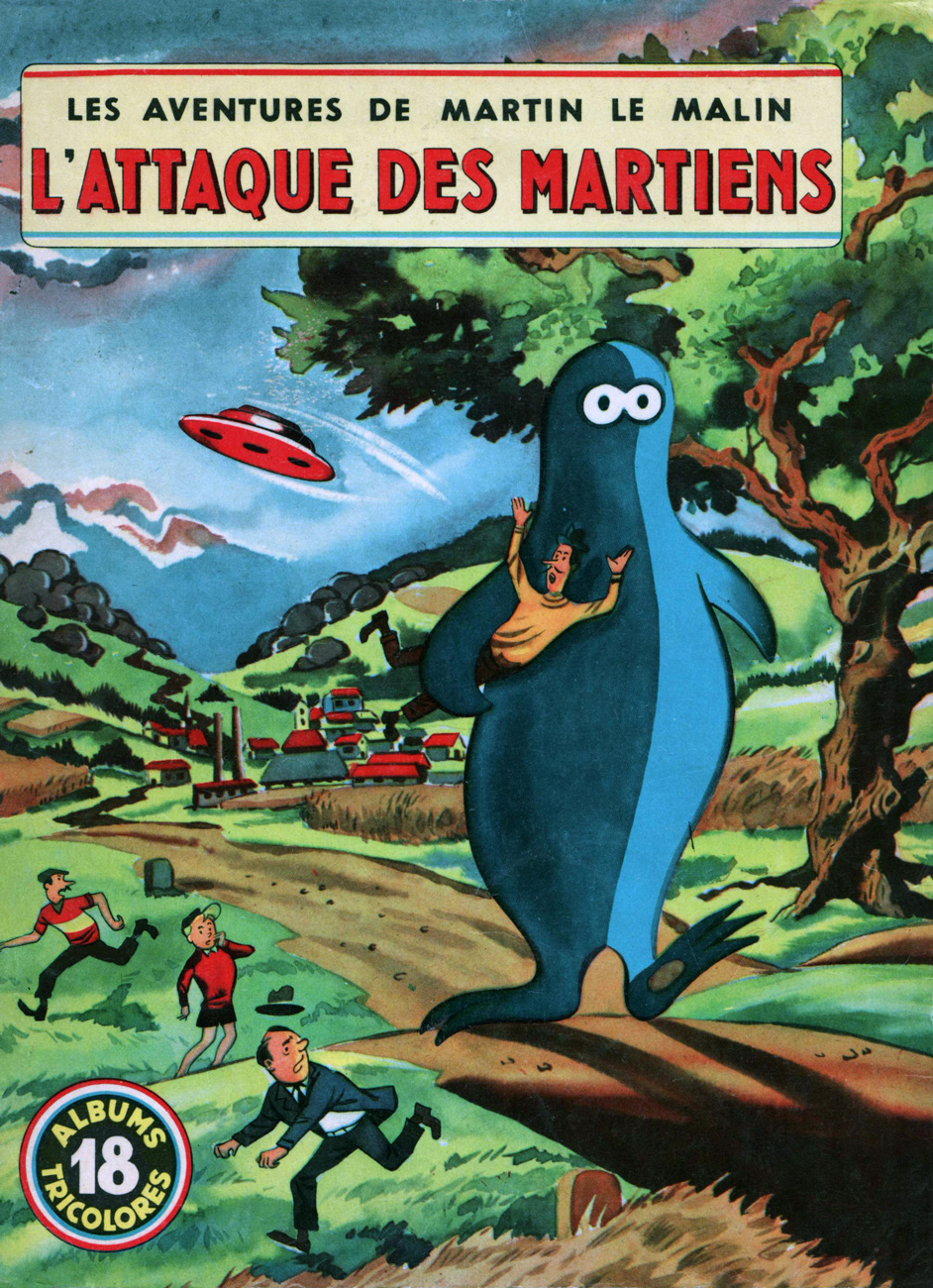
Today, I’ll focus on my favourite saga, « Les Martiens atterrissent » (Number 6 in the series, and serialized in « La soucoupe volante », « D’étranges visiteurs de l’espace » and « L’attaque des Martiens »).
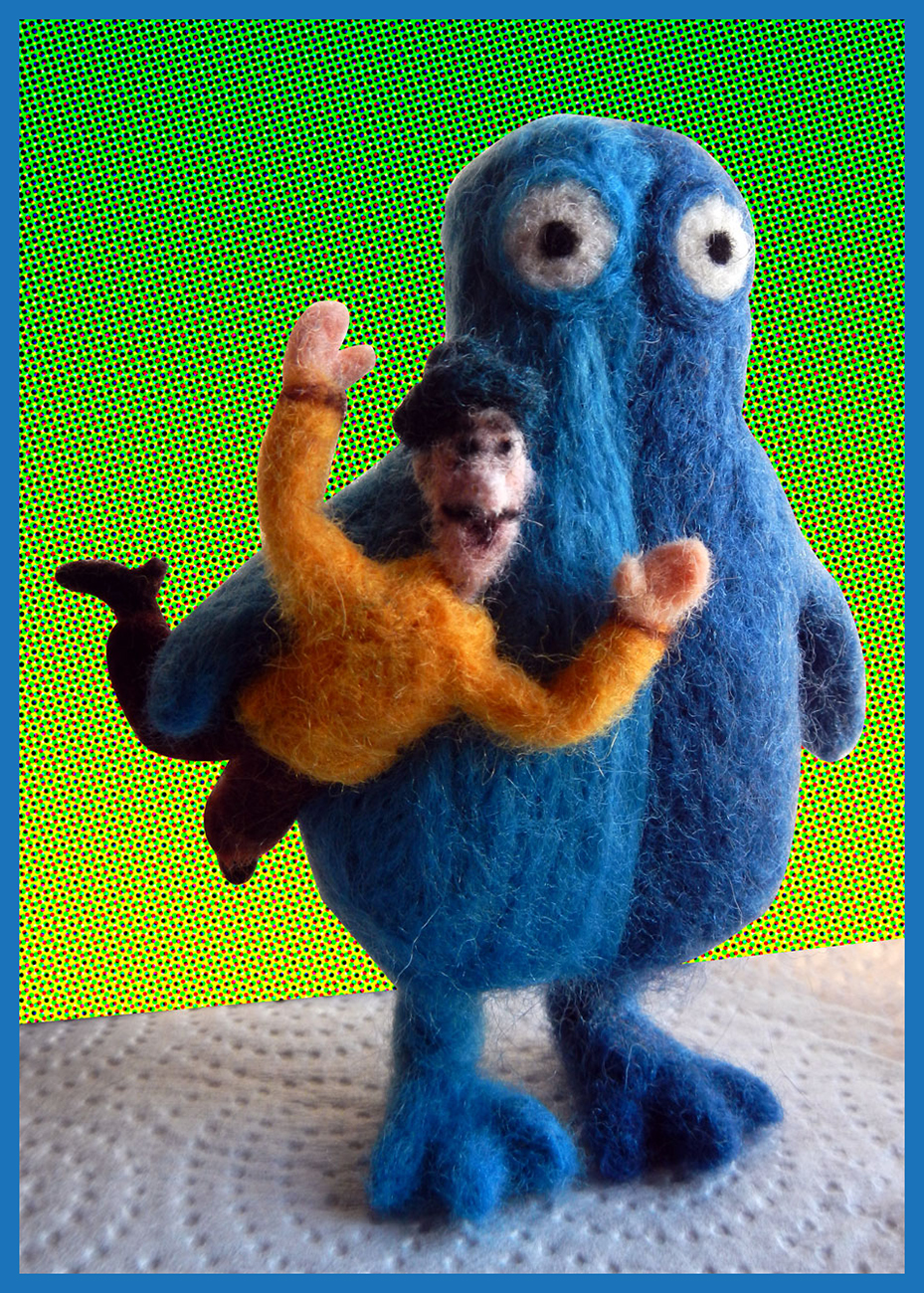
In the actual story, Martin’s bumbling sidekick, Floris Fidel (Floris Fiedel in the original) has been shrunk by Martian leader Plasticos (isn’t he just adorable?), but on the cover, while their size ratio remains constant, it’s Plastico who’s grown gigantic.
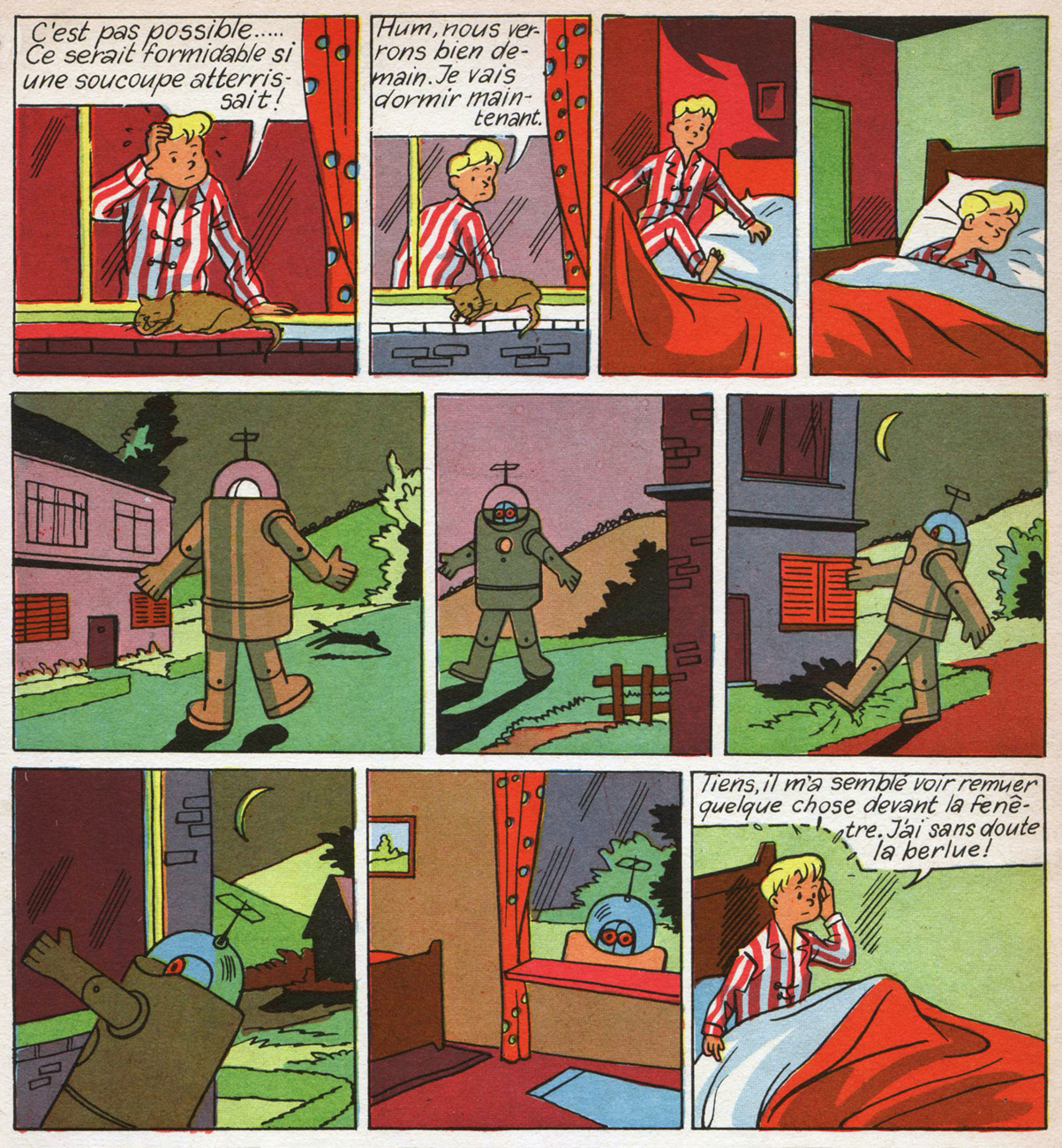
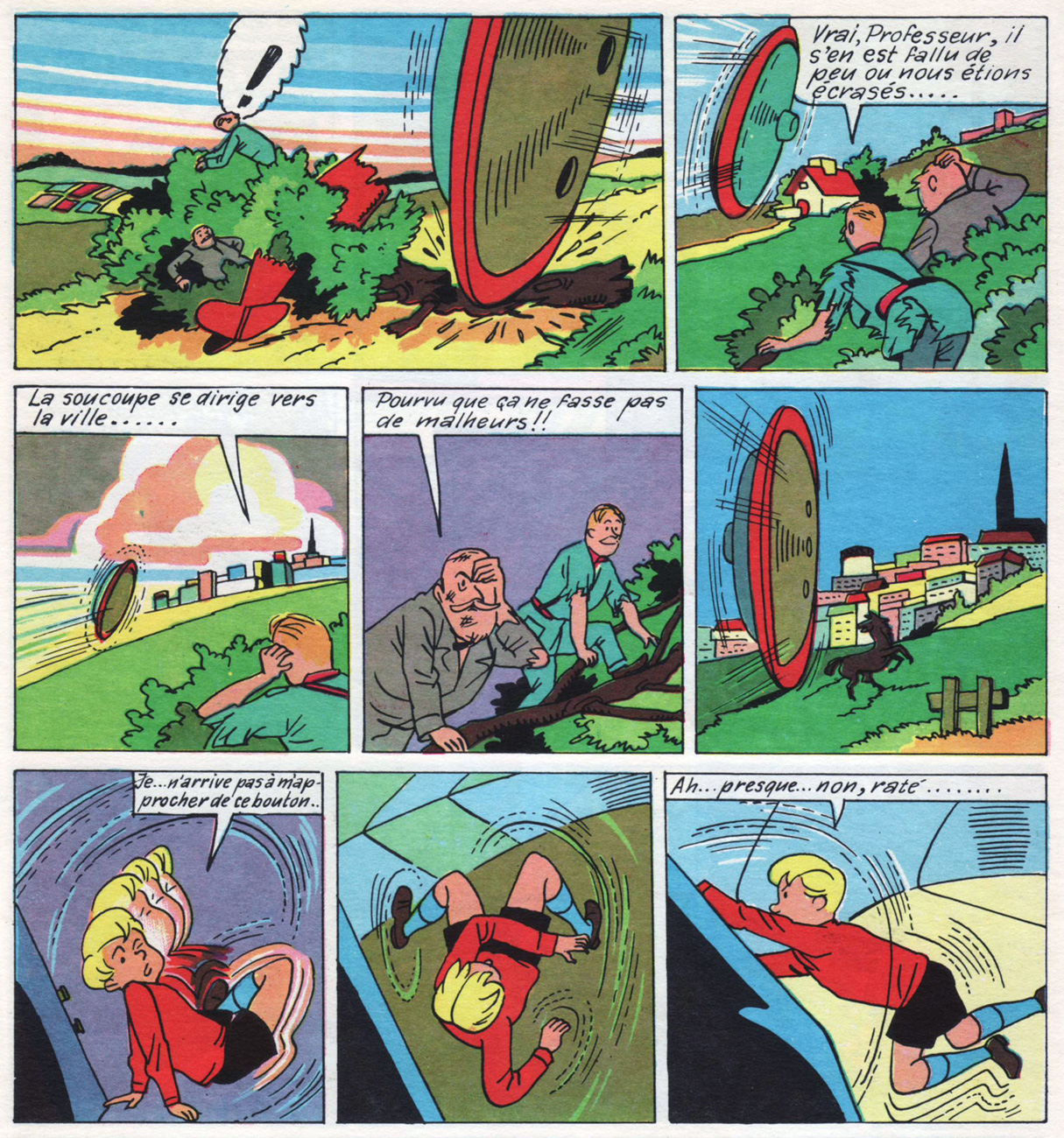
You go to bed quietly, and the next thing you know, Martians are trampling your hedgerows and peeking in your window. Next time, draw the curtains. Love the way the cat runs for it in panel 5.
Martin finds that piloting unfamiliar spacecraft is not something you pick up on the fly.
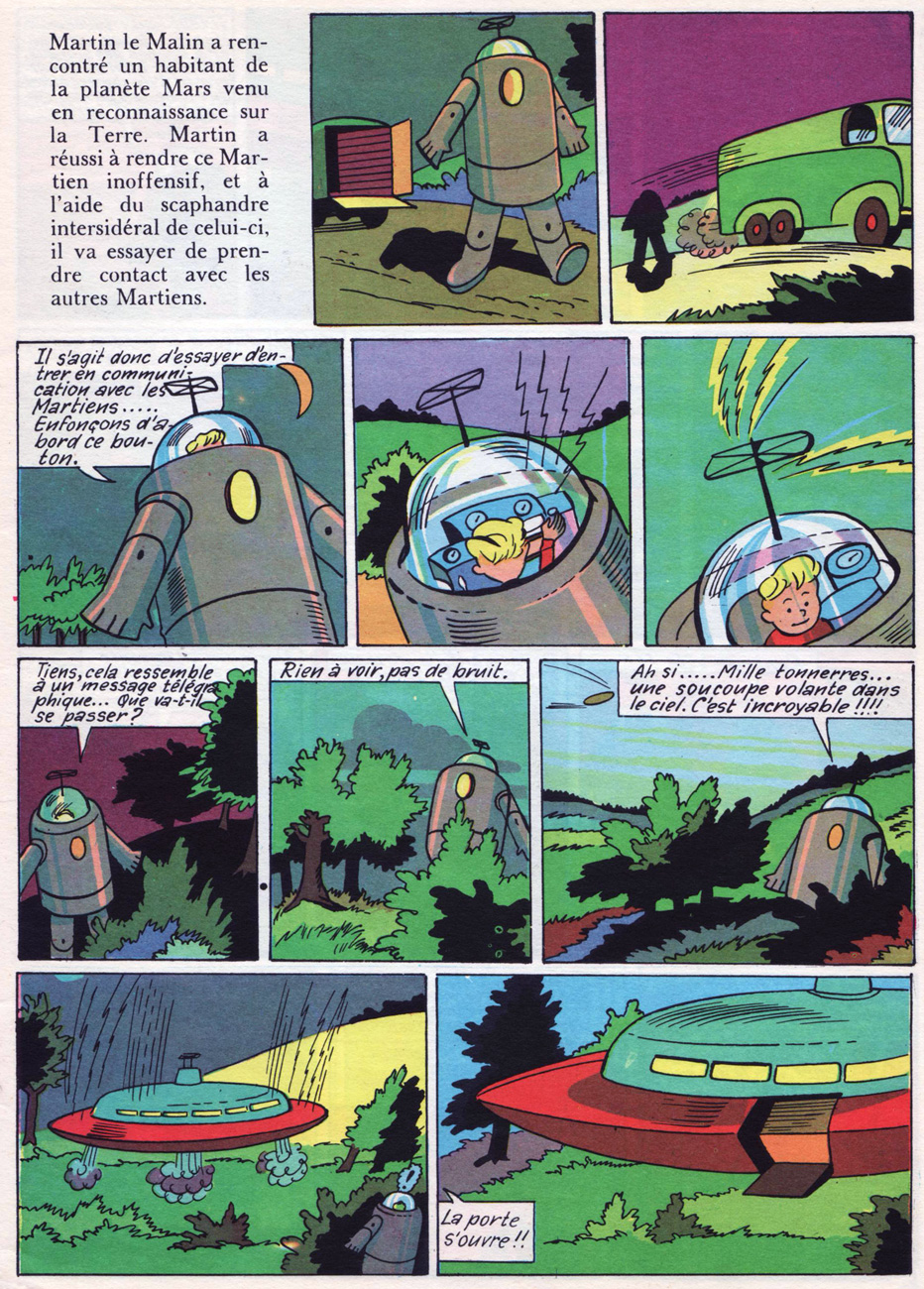
Having captured Martian Aluminicus’ spacesuit, Martin tries, and fails, to infiltrate the invaders’ ranks.
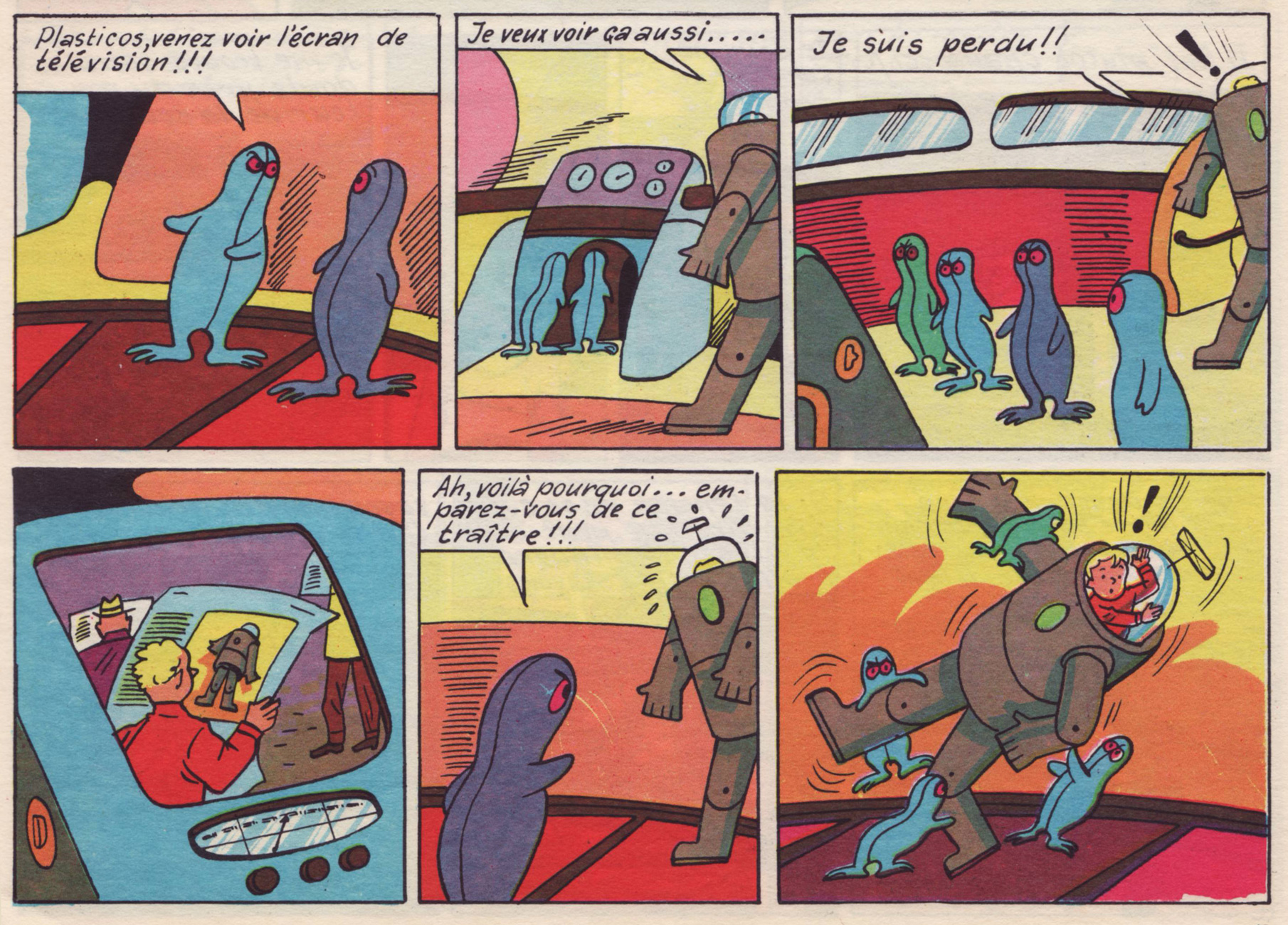
Oops. Another one of Floris’ screwups lands Martin in hot water.
I only learned today, while researching this post, that Pinkie/Martin was also published in English! Is anyone familiar with this edition?
The copies I’ve seen for sale are listed in far-flung Australia. Curiouser and curiouser…
The Martin cameo, as it appeared on the back of the first edition albums.
And here’s a custom-made Plastico (with Florisse in tow) needle-felted by WOT’s own multitalented ds.

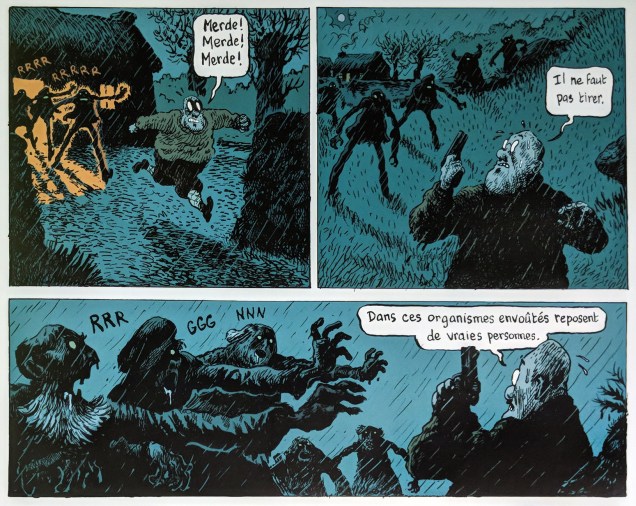

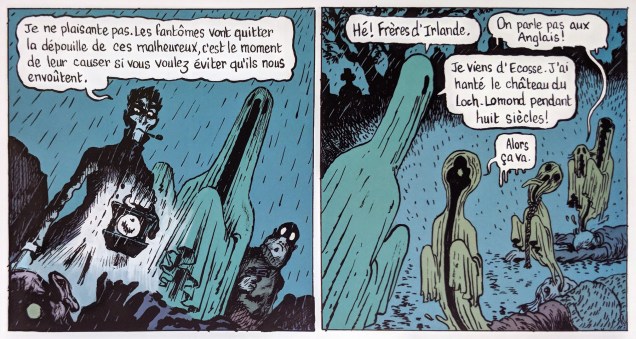

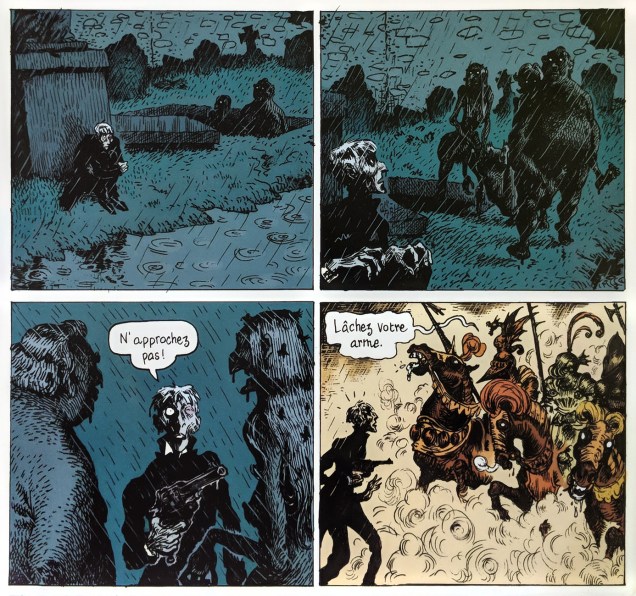


















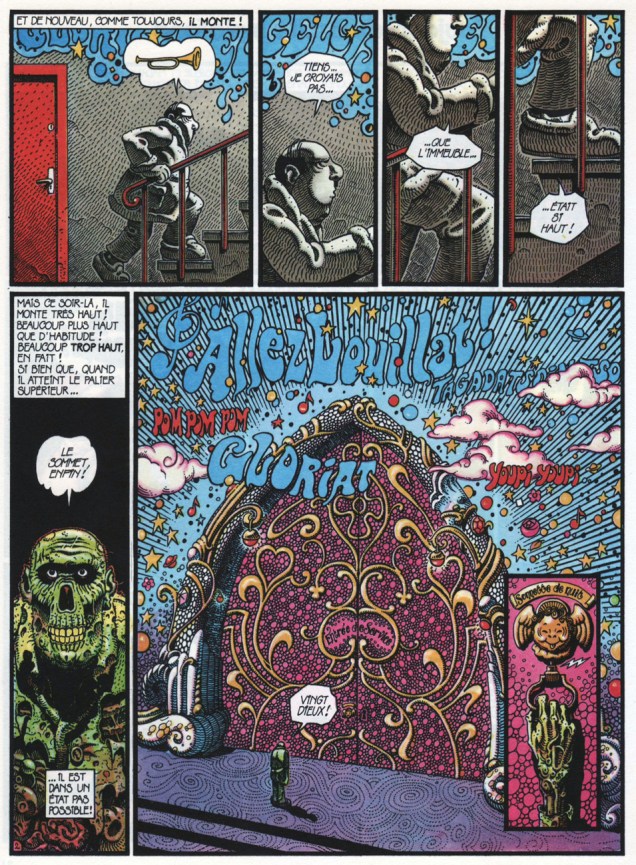

 This episode is titled Toujours du bruit au plafond (« Still some noise on the ceiling »); it originally saw print in Pilote Mensuel no. 34 (March, 1977). It’s the rare (possibly the only) one that ends peacefully for Marcel, perhaps because he didn’t bother with the broom. Better

 Who's Out There?