« Knock it off, squiddo! You couldn’t make a class-B horror picture on earth — you’re not even good for a milk shudder! Better skeddadle, or I’ll tie your tentacles into a bow! »
Tentacles are no cause for levity, you say? Ha! Their place in all manner of spoofs and parodies (and other silliness) is ensured. Peppered with a barrage of puns (never undersell puns, please!), whimsical tentacular entanglements abound in literature… err, comic literature, at any rate, and that’s good enough for me.
I meant “entanglements” very literally. Story published in Not Brand Echh no. 11 (December 1968, Marvel); script by Arnold Drake, art by Marie Severin.Say, did I hear some barely restrained giggling over “20 000 leaks under the sea?” (This story, written and drawn by Jay Disbrow, was reprinted in 2000 by Fantagraphics in a collection called The Sincerest Form of Parody: The Best 1950s MAD-Inspired Satirical Comics.) Unsane no. 15 (June 1954, Star Publications), cover by L.B. Cole.
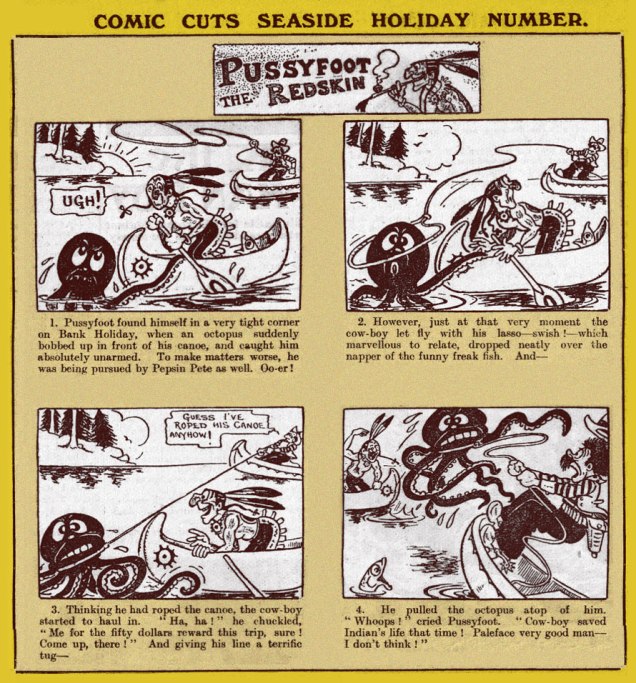
Even some 100 years ago (well, a little less), some unfortunate octopus could easily become a Figure of Fun if he wasn’t careful.
The story doesn’t say what happened to the freaking octopus, though. This edition of Pussyfoot the Redskin was printed in Comic Cuts no. 1735 (August 1923). Visit BLIMEY! The Blog of British Comics for more Comic Cuts.
I can’t mention équivoques and wordplay without mentioning Pogo, Walt Kelly‘s keenly intelligent comic strip. Sadly, this was the only appearance of Octopots, as far as I know (and I long to be corrected).
From Figmentality, from The Pogo Sunday Parade (1958). Art by Walt Kelly, of course!
In the competitive world of jokes in bad taste, the man from SRAM probably takes the cake. It’s lucky that he has no qualms about hitting females, or the world would be doomed… although his mirthless monologue would probably kill the creature with sheer ennui.
Madhouse in Hollywood (Man from SRAM), scripted by Otto Binder and drawn by Carl Pfeufer, published in Jigsaw no. 2 (December 1966, Harvey).
On the other hand, Superman‘s creative insults can easily shame a thin-skinned Tentacled Terror (was his spaghetti-and-meatball crack some sort of early Flying Spaghetti Monster reference, even though the latter was only officially created in 2005?)
Superman no. 184 (February 1966). The story is The Demon Under the Red Sun!, scripted by Otto Binder (again; he clearly has some unhealthy attraction to tentacles, like the best of us) and drawn by Al Plastino. Figure out what’s going on in this story (or not, for there’s not a lot of logic to be found, anyway) at Mark’s Super Blog.
This year, spring officially begins on March 20th, so it’s still a few days away… but the vernal bevy of birthdays has already started. Al Jaffee is still our first Spring Birthday Boy – he was always precocious, you know! Born in 1921 on March 13th, he turns 98 today, and that’s a truly impressive age, even for the oldest working cartoonist. Break out the bubbly!
Take my hand as we gallop through Jaffee’s career at a fast clip. In chronological order, then…
Original art for “Pain Relief Speed Test On Actual People In Actual Pain“, published in Humbug no. 7 (February 1958).
The New York Herald Tribune Syndicate published Tall Tales from 1957 to 1963. Al Jaffee came up with the idea of this strip’s format (one vertical panel for dailies, and a series of vertical panels for Sundays) when he was in financial straits – its unorthodox configuration ensured that newspaper editors would be able to squeeze it in *somehow*.
Sunday Tall Tales strip from 1960.
Visit The Fabulous Fifties blog for more – the amazing Ger Apeldoorn has scanned tons of Tall Tales from old newspapers, a monumental (and much appreciated) endeavour.
Sunday Tall Tales strip from 1961.
« The world is full of bloviators. And this kind of stuff, when there’s someone on the public scene who’s really going beyond his duties as a politician or a religious leader or a sportsman, he’s fair game. The main thing is to keep your eyes and ears open and when you hear something that’s clearly baloney, such as “eight out of 10 doctors smoke Chesterfield cigarettes” – these are ads that actually ran! One of the tobacco companies had the nerve to claim that doctors prefer their cigarettes. So it’s easy to shoot down that kind of bull. But you do it with a gentle hand, you don’t preach and say “tobacco kills! How can these doctors do that?!” No, you just go them one step further and say, “In addition to eight out of 10 doctors smoking this brand of cigarette, in their time off, they each drink a gallon of bourbon, which also has health benefits.” » |source|
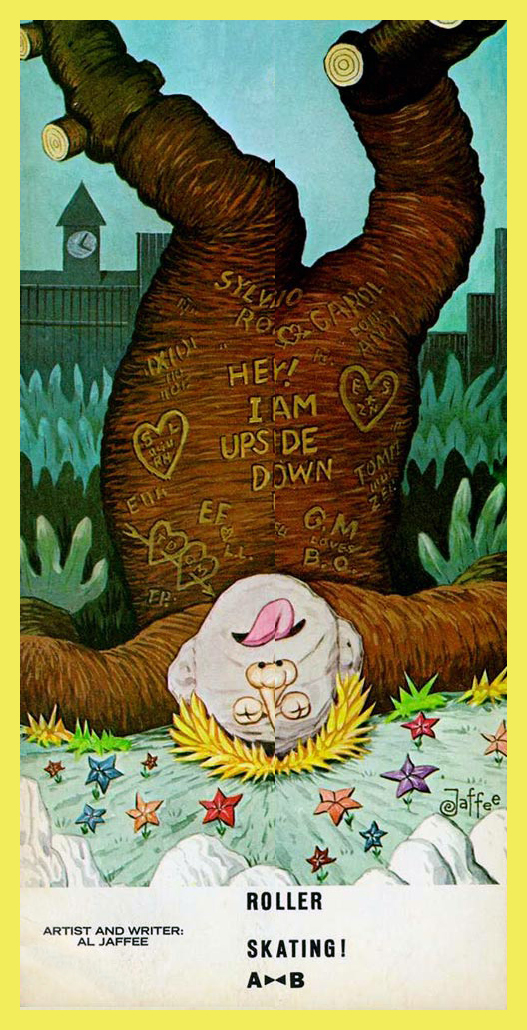
« Thanks a lot for ignoring my recent request for a house call, Doc! You saved me ten bucks!! It went toward the funeral!!! » Now, isn’t this a happy vernal scene? (Look at the pretty flowers!) Al Jaffee painted this “Get Mad” picture postcard for publication in The Worst From Madno. 12 (1969).First edition of Mad’s Al Jaffee Spews Out More Snappy Answers to Stupid Questions, (Signet, February 1972).
« I’m not an educator or a preacher. I think the important thing, in my line of work anyway, is that you’re helping the reader to think for himself. It’s not just about getting a chuckle from them. When you expose hypocrisy or nonsense or plain ol’ stupidity, you want to do it in a way that makes the reader connect the dots. Don’t tell the joke, just hint at the joke. If you over-explain it, it’s no good. » /source/
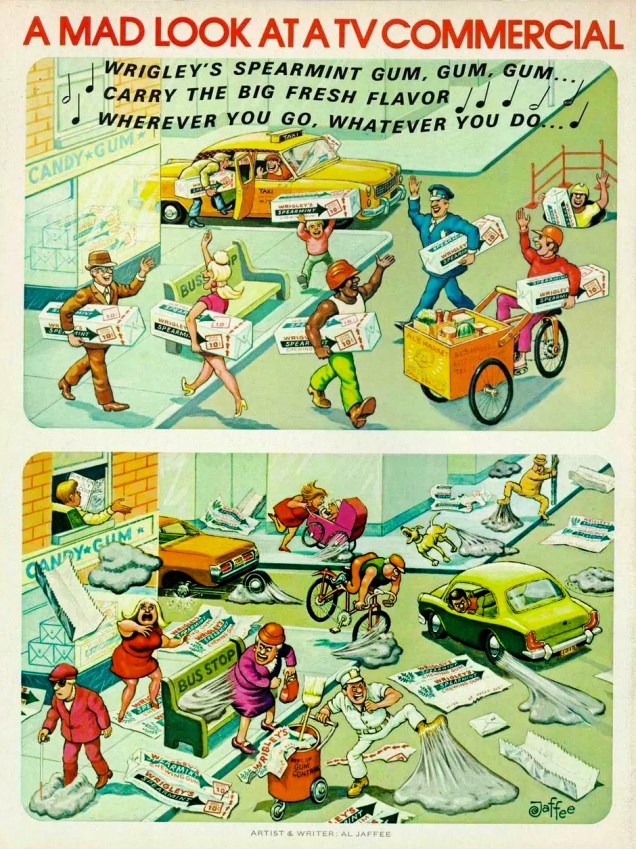
This painting (layout by Harvey Kurtzman, art by Al Jaffee) was designed to accompany an Esquire article from April 1972 about Elaine’s, a hip restaurant in NYC that was known for attracting writers, actors, and other prominent New Yorkers. Incidentally, Elaine Kaufman, the owner of this establishment, was a barrel of laughs (I’m not saying that sarcastically, either). « Kaufman was known for not mincing her words, for booting less-favored customers to seat new arrivals and for forbidding hamburgers to be served in her restaurant. She was once arrested after a physical altercation with a visiting Texan. Elaine also once had a fist fight with the actress Tara Tyson, and also chased away the notorious paparazzo Ron Galella by hurling two garbage can lids at him and exclaiming, “Beat it, creep… you’re bothering my customers”. » Ah, the people you knew at Elaine’s…The back cover of Mad no. 170 (October 1974), “A Mad Look at a TV Commercial“.
You might be wondering if Mr. Jaffee’s art and wit were any good much later in his career, say in the 90s. Stupid question, bub. Of course they were!
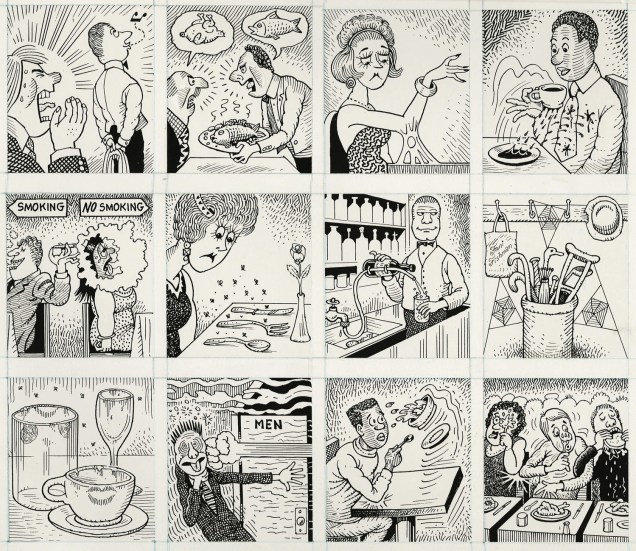
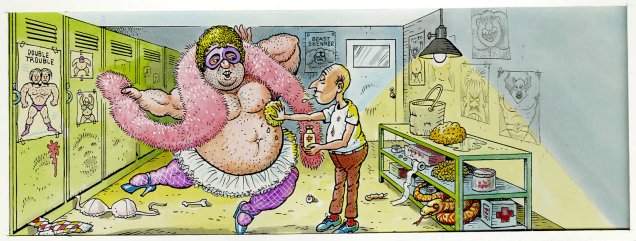
Original art from Mad’s Restaurant Survival Guide (Mad no. 300, January 1991).Art from a 1998 issue of Mad Special illustrating yet another round of Snappy Answers to Stupid Questions. When I said ’round’, I meant it: these are stupid questions asked at a wrestling programme. This one was probably “does this pink boa make me look fat?”
Have you ever wondered what Al Jaffee is like in person? Here’s your chance to find out:
“But you haven’t even mentioned MAD fold-ins!”, you might exclaim in dismay. Hey, I’m not gonna repeat myself… visit A MAD Dash… Inside for that and more Jaffee silliness.
Oh, fine, you guys. Just one, though, ’cause otherwise we’ll be here for another couple of hours, and frankly I’ve got hungry cats to feed.
What new way are people falling head over heels these days?, published in Mad no. 216 (July 1980).
You say you’re having trouble folding your screen? Geez, do we have to do *all* the work around here?
Many happy returns, Mr. Jaffee! <3<3<3
Mr. Jaffee and his wife Joyce in 2016, when he was but 95 years old. When he once quipped «Serious people my age are dead», he meant it as gospel. 😉
« Be silent in that solitude which is not loneliness — for then the spirits of the dead who stood in life before thee are again in death around thee — and their will shall then overshadow thee: be still. »
— Edgar Allan Poe (1829)
It was on this day, two hundred and ten years ago, that the great writer, poet and posthumous master of all media Edgar Poe (Jan. 19, 1809 – Oct. 7, 1849) was born in Boston, Massachusetts. I’ll spare you the usual biographical details, widely available elsewhere, and we’ll concentrate on his unflagging ubiquity in the medium of comics.
Poe’s literary reputation was in tatters in America, thanks to a rash of hatchet jobs and dismissals, some of the most vicious from the pen of one Rufus Griswold, the very worm he’d named his literary executor (!), as well as such notables as Ralph Waldo Emerson and T.S. Eliot… while his renown was undimmed in Europe, particularly in France (in no small part owing to Charles Beaudelaire’s legendary translations), rehabilitation at home slowly came as the 20th century crept along, but it was likely the publication of Arthur Hobson Quinn’s definitive Poe biography, in 1941, that sealed the deal and opened the floodgates.
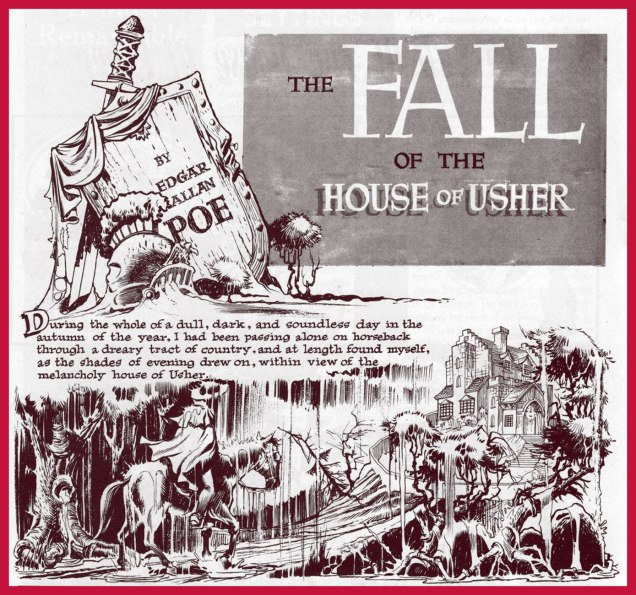
Top two tiers from page 2 of The Spirit‘s August 22, 1948 episode. Layout by Will Eisner, pencils and inks by Jerry Grandenetti. As Dave Schreiner puts it: « Grandenetti captures the asthenic look of Roderick Usher that Poe described. The man is a decadent waif; insular, fragile, high-strung, possibly in-bred. »
Classics Illustrated publisher Gilberton was first out of the gate with Poe adaptations, at first tentatively with a pair of poems (Annabel Lee, then The Bells)**, then more substantially with The Murders in the Rue Morgue, in Classic Comicsno. 21 – 3 Famous Mysteries (July, 1944), sharing the stage with Arthur Conan Doyle and Guy de Maupassant. Read it here. Pictured below is Classics Illustratedno. 84 (June 1951, Gilberton), cover by Alex A. Blum. Read the issue here.
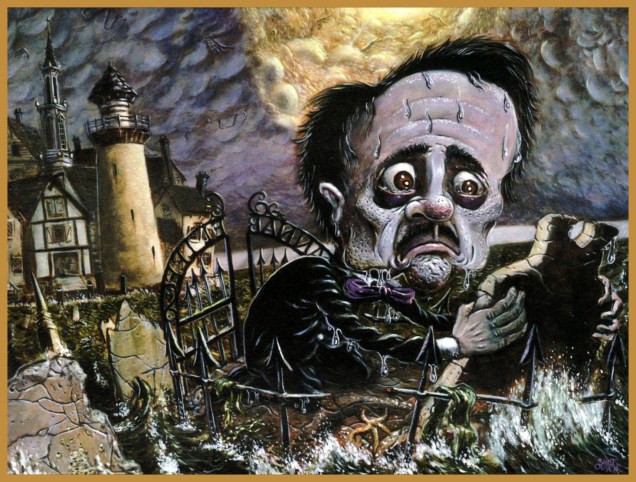
A relevant passage from Simon Singh‘s fascinating (if you’re into that sort of thing… and I hope you are) The Code Book: The Secret History of Codes and Code-Breaking (1999): « On the other side of the Atlantic, Edgar Allan Poe was also developing an interest in cryptanalysis. Writing for Philadelphia’s Alexander Weekly Messenger, he issued a challenge to readers, claiming that he could decipher any monoalphabetic substitution cipher. Hundreds of readers sent in their ciphertexts, and he successfully deciphered them all. Although this required nothing more than frequency analysis, Poe’s readers were astonished by his achievements. One adoring fan proclaimed him ‘the most profound and skilful cryptographer who ever lived’. In 1843, keen to exploit the interest he had generated, Poe wrote a short story about ciphers, which is widely acknowledged by professional cryptographers to be the finest piece of fictional literature on the subject. The Gold Bug tells the story of William Legrand, who discovers an unusual beetle, the gold bug, and collects it using a scrap of paper lying nearby. That evening he sketches the gold bug upon the same piece of paper, and then holds his drawing up to the light of the fire to check its accuracy. However, his sketch is obliterated by an invisible ink, which has been developed by the heat of the flames. Legrand examines the characters that have emerged and becomes convinced that he has in his hands the encrypted directions for finding Captain Kidd’s treasure. »A page from EC Comics great Reed Crandall‘s exemplary adaptation of Poe’s The Tell-Tale Heart, from Creepyno. 3 (June, 1965). While Crandall’s work is outstanding, scripter-editor Archie Goodwin tried to ‘improve’ upon Poe by tacking on a tacky ending, a nasty habit he would indulge in again on subsequent adaptations, notably issue 6’s The Cask of Amontillado!. Read The Tell-Tale Heart. And don’t miss The Cask…, if only for the artwork.In the mid-70s, Warren would devote two full issues of Creepy to Poe adaptations; issue 69 (Feb. 1975), featured The Pit and the Pendulum, The Fall of the House of Usher, The Premature Burial, The Oval Portrait, MS Found in a Bottle!, Facts in the Case of M. Valdemar; issue 70 (Apr. 1975) comprised The Murders in the Rue Morgue, Man of the Crowd, The Cask of Amontillado!, Shadow, A Descent into the Maelstrom! and Berenice; All stories were adapted, with far greater respect than Mr. Goodwin seemed capable of, by Rich Margopoulos, and illustrated by a host of artists. The project was edited by Bill DuBay, and the cover painting is by Ken Kelly.Isidre Monés‘ fabulous opening splash from Creepyno. 70‘s Berenice. Read the story in full here.« The rays of the moon seemed to search the very bottom of the profound gulf; but still I could make out nothing distinctly, on account of a thick mist in which everything there was enveloped, and over which there hung a magnificent rainbow, like that narrow and tottering bridge which Musselmen say is the only pathway between Time and Eternity. » In 1976, a peak-form Berni Wrightson got out his brushes and paint tubes for a heartfelt portfolio of Poe-inspired oils. A sensitive and subtle sense of colour was among Wrightson’s chief assets; it’s a shame we didn’t see more of it. I opted to feature my favourite piece from the lot, A Descent Into the Maelström, but by all means feast your eyes on the whole shebang.In 1976, Marvel Comics set out to make their mark on the classics… with dubious, but predictable results. It wasn’t what their zombie readership had clamoured for. Here’s the best page (art by Rudy Mesina) from Marvel Classics Comicsno. 28, The Pit and the Pendulum (1977), featuring three tales adapted by scripter Don McGregor, and including future superstar Michael Golden‘s abysmal professional début on yet another helping from The Cask of Amontillado, where he demonstrates how he believes wine is to be drunk just like Pepsi. See what I’m griping about here.Think Poe’s all about the horror? Think again! You don’t become a household name by putting all your eggs in the same basket. Meet Edgar ‘Eddie’ Allan Poe, romantic leading man. “Based on actual records…” and sanitized beyond recognition. Given that Virginia and Edgar were first cousins and that they married when she was thirteen, you can see how absurd this strip is. Read the full tale of romance and pathos right here. The Beautiful Annabel Lee appeared in Enchanting Loveno. 2 (Nov. 1949, Kirby Publishing). Writer unknown, art by Bill Draut and Bruno Premiani.Kubert School alum Skot Olsen‘s cover illustration for the revised and expanded second edition (July, 2004) of Graphic Classics‘ Poe compendium.As with, say, Elvis or H.P. Lovecraft, when both legend and œuvre reach a certain tipping point of iconic fame, one can bend and twist the concepts any which way and they’ll still be recognizable. Here’s a panel from Harvey Kurtzman and Will Elder‘s faithful-in-its-fashion take on The Raven, from Madno. 9 (Feb.-Mar. 1954, EC).Michael Kupperman strikes again. From Snake ‘n Bacon’s Cartoon Cabaret ( 2000, HarperCollins)Hot off the presses! It’s Edgar Allan Poe’s Snifter of Terror no. 2 (Nov. 2018, Ahoy), featuring a collaboration between Rachel Pollack and the fabulous Rick Geary. Don’t miss it! Oh, and if the pose looks familiar, you’re thinking of this.
Whew — that’s it for now. In closing, I must bow and salute before the gargantuan endeavour accomplished by Mr. Henry R. Kujawa on his truly indispensable blog, Professor H’s Wayback Machine. Thanks for all the heavy lifting, Henry. I get exhausted just thinking about it.
« When I was a boy, I always saw myself as a hero in comic books and in movies. I grew up believing this dream. » – Elvis Aaron Presley (1935 — ?)
Today, somewhere, the King of Rock ‘n’ Roll celebrates his eighty-fourth birthday, be he alive, dead or undead, he lives on. And never forget: Elvis is everywhere!
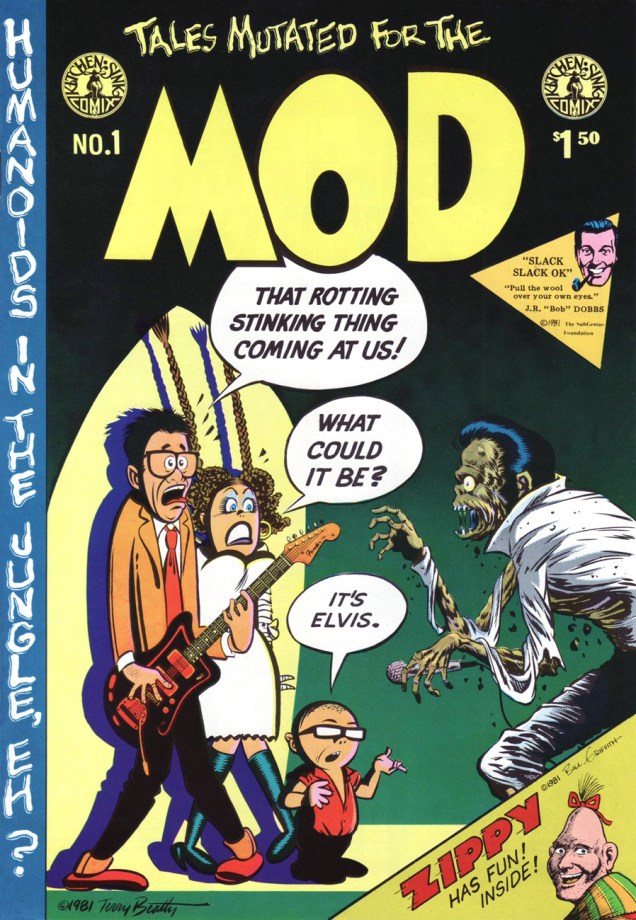
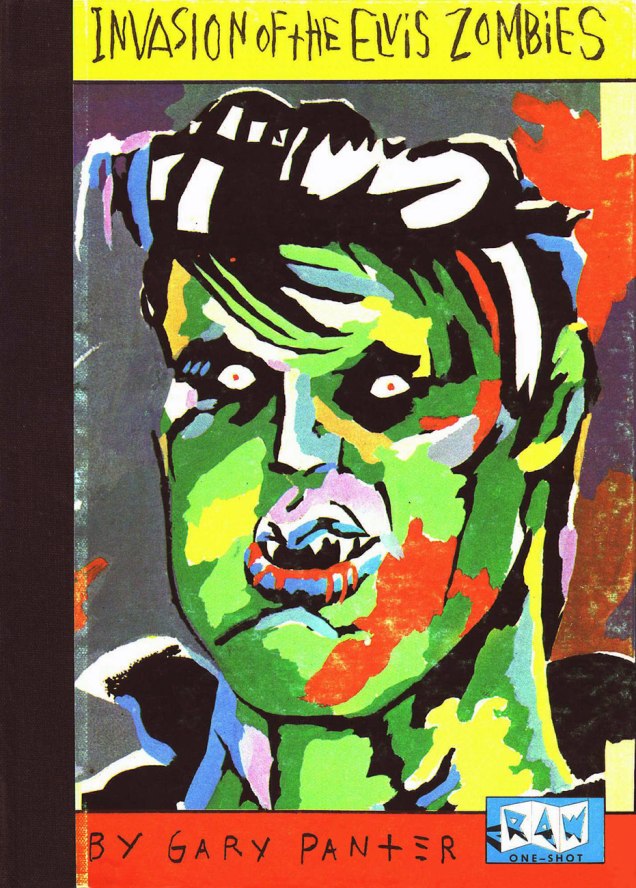
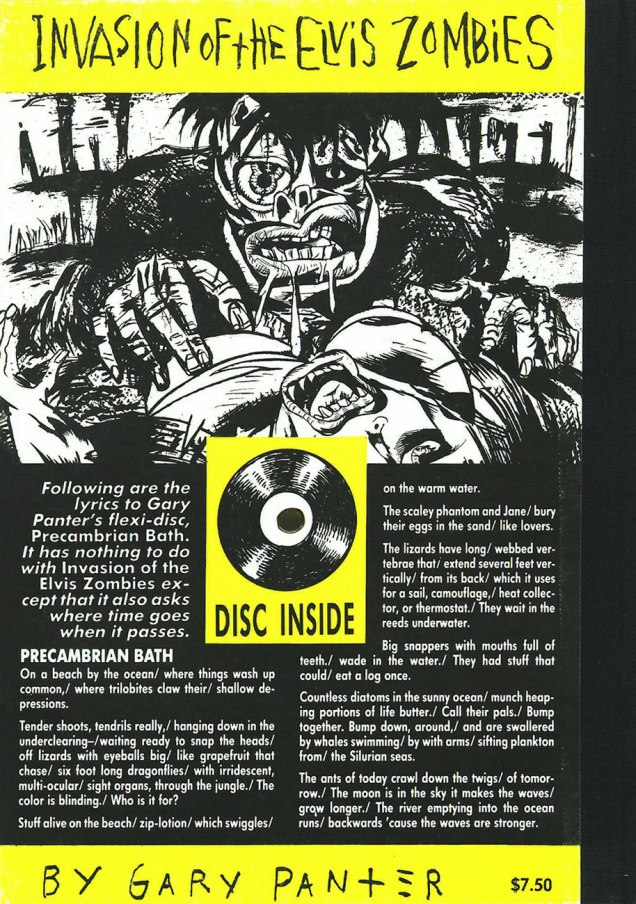
A most salty salute to the King of Rock ‘n’ Roll on his birthday! Compared to earlier decades, the 1980’s (and on!) were not kind to the anthology comic book. Thankfully, the meagre rewards and resounding indifference weren’t enough to quite dissuade some foolhardy souls from giving the format a go. But the fanboys wanted spandex, they wanted continuity and they soon wanted their « decompressed storytelling ». Bah. In 1981, Kitchen Sink Comix published the lone issue of Terry Beatty‘s labour of irradiated passion, Tales Mutated for the Mod. (June, 1981). Unlike John Byrne and others’ unceasing and pointless ‘tributes’ to Fantastic Four No. 1, this cover version of Harvey Kurtzman‘s Mad No. 1 is fiendishly clever. Kudos, Mr. Beatty!Gary Panter crafted this loving tribute in 1984, a one-shot published by RAW. Such heady stuff was well ahead of its time!The back cover… this beats Power Records‘ meek offerings flat!The oft-inaccurate Grand Comics Database really fumbles it this time: the instantly-recognizable icon on the right is, according to them… Fabian. Dopes. Hamilton, Ontario’s Win Mortimer (1919-1998), inducted into the Joe Shuster Hall of Fame in 2006, drew this cover for DC’s Heart Throbsno. 95 (April-May 1965); given the time period and The Pelvis’ shirt, he would presumably be shooting the dire Paradise, Hawaiian Style. If you’re of a mind to commemorate the King’s anniversary with one of his mid-60s cinematic offerings, better opt for the far finer Tickle Me (1965).His (alleged) paper boy claims, and I do want to believe him, that the Big E has peacefully decamped to the quietude of Eerie, Indiana. Looking good, Big E!
« Here, plainly, was a guy for whom cartooning held no mysteries. He was more than a master; he was a virtuoso, a source, an innovator whose style was completely natural and original and flexible enough to embrace dashed-off vulgarity and painstaking elegance, often in the same panel. » — Jim Woodring on Jack Davis
Here we are, coming to the end of our countdown (or count-up, depending on your point of view), and who better to convey the magic of Hallowe’en than the late, great Jack Davis (1924-2016)? Don’t answer that. 😉
Detail from Monster Rally (1959).
A 1959 collection of humorous horror songs by Alice Pearce and Hans Conried, Monster Rally (LPM/LSP-1923) sports a classic Davis painting – blending horror and humor into what amounts to a cutely-weird piece of art. Davis has mentioned that this scene is one he really enjoying doing and that he was quite pleased with. An ad for this album in issues of Famous Monsters of Filmland from back then read:
An insane and fantastically entertaining album featuring Hans Conried and Alice Pearce, singing and screaming ghoulish new songs like ‘Monster Rally’, ‘The Thing‘, ‘The Invisible Man‘, ‘Not of This Earth‘ and others. The album cover by Jack Davis is a masterpiece – suitable for framing.
[ Excerpted from Dick Voll‘s article Just for the Record: The LP Cover Art of Jack Davis (Fanfare no. 5, Summer 1983; edited and published by Bill Spicer). ]
And here are a mittful of extras, since I’m more inclined to treat than to trick on this special day.
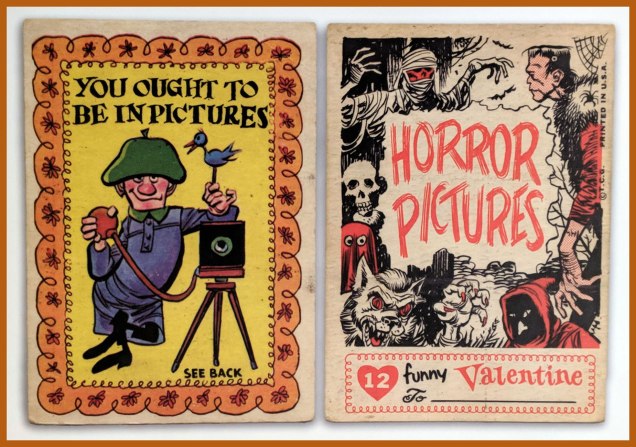
« From approximately ’59, Davis did a huge quantity of work for Topps Gum Co. Over the years, he did ‘Funny Monster Cards’, ‘Wanted Posters’, ‘Funny Valentines’, ‘Batty Book Covers’, ‘Wacky Packs’, ‘Silly Stickers’ as well as standard baseball and football tradings cards. » — Hank Harrison, The Art of Jack Davis (1986, Stabur Press). This, incidentally, is one of the ‘Funny Valentines’.
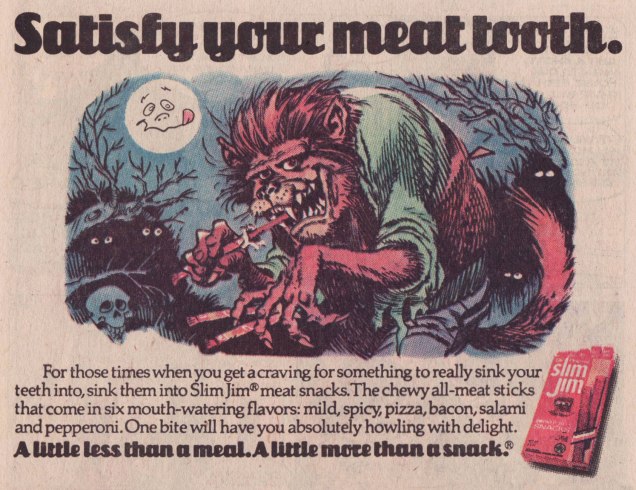
Davis’ classic Slim Jim commercials of the late 1970s. Of course. Can you believe they ran these earlier… with the bold-type, all-caps slogan of WHAT TO SINK YOUR TEETH INTO WHEN YOU’RE HUNGRY AND YOU’RE NOT A WEREWOLF… but sans Davis art? Thankfully, some bright kid at the ad agency saw the opportunity and managed to be convincing enough.
In closing, thanks for bearing with all my divagations through this second edition of WOT’s Hallowe’en Countdown, and let me wish you a most spooky Hallowe’en, one and all!
« Within this general framework of unbridled insanity, we got in our digs at corporate culture. » – Jay Lynch (1945-2017)
One could be reasonably forgiven for thinking that most cultural staples of one’s youth had just gone away after they slipped beneath one’s radar, or the craze fizzled out. Not so with Topps’ resilient Wacky Packages… they go away for a few years, then resurface in times of greater need. One does have to wonder what their exact audience is, though: some of these jokes and allusions take direct aim at adult sensibilities. Case in point: 2006’s « Brokeback Mountain Duo, The Drink You Wish You Could Quit » (courtesy of twisted masterminds Jay Lynch and John Pound).
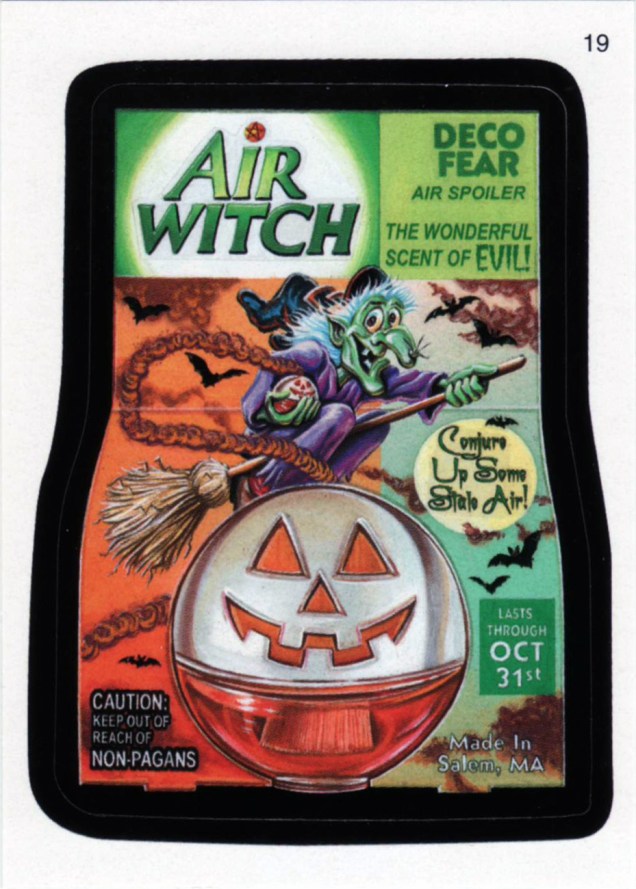
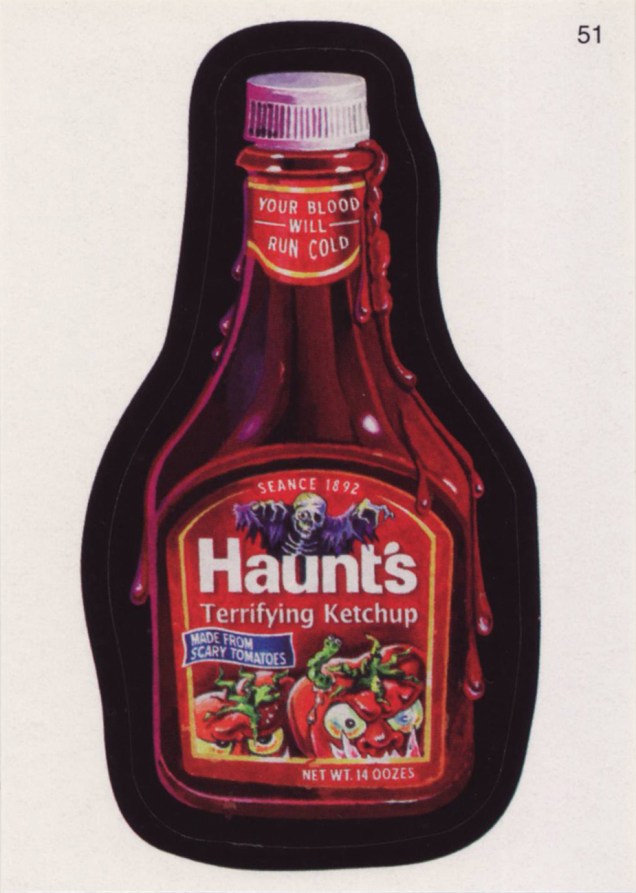
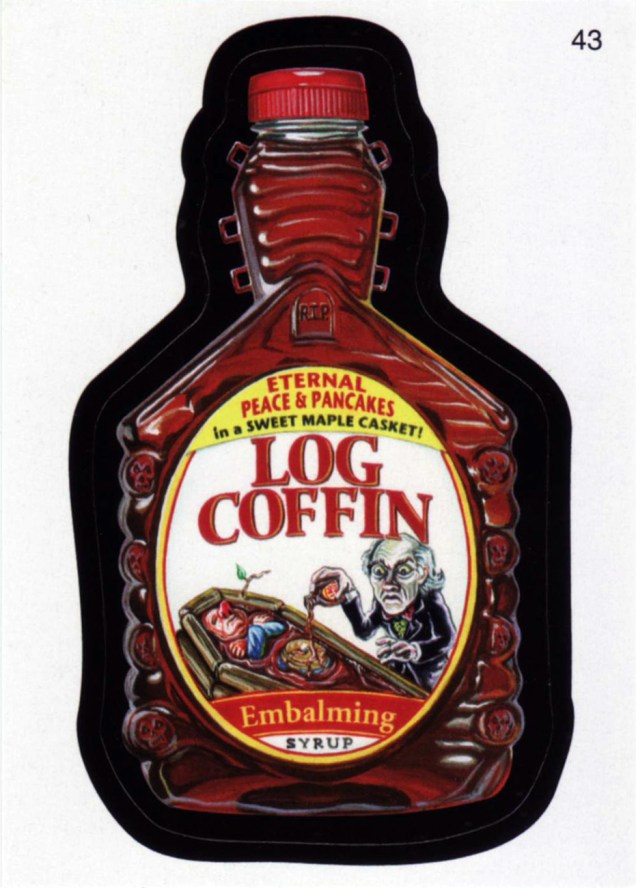
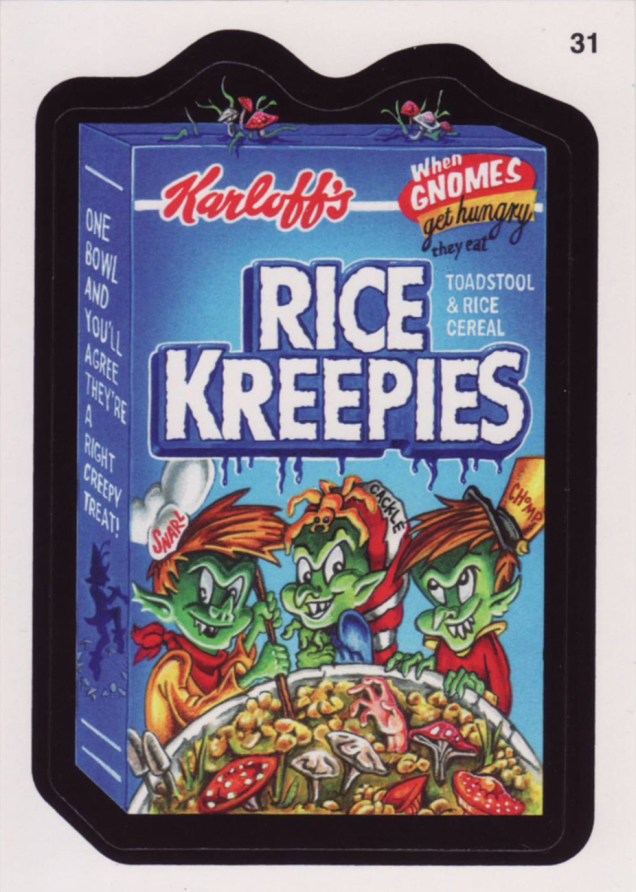
Without further ado, instead of the old stickers you fondly but perhaps dimly recall, here are some recent ones you most likely haven’t encountered (though the objects of parody will be familiar), with the properly spooky thematic accent, of course.
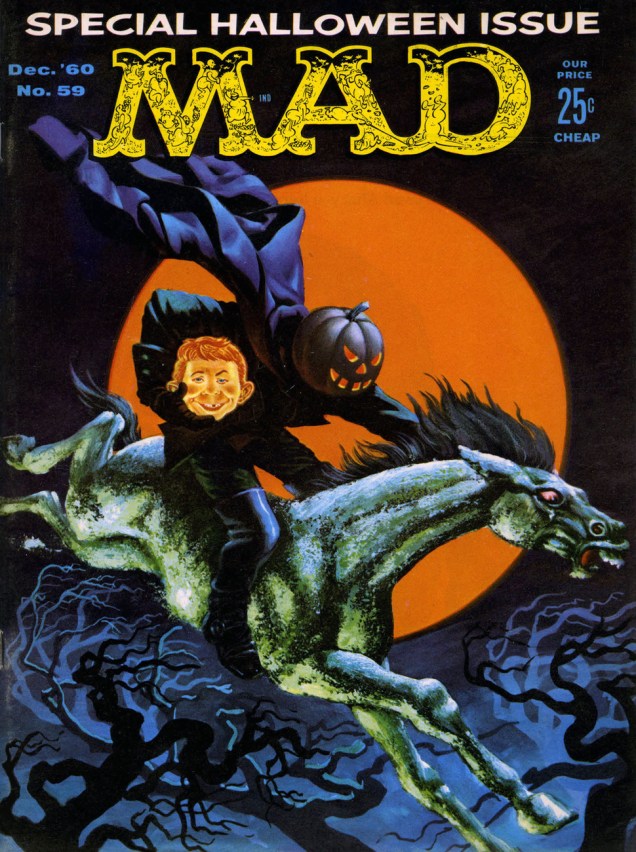
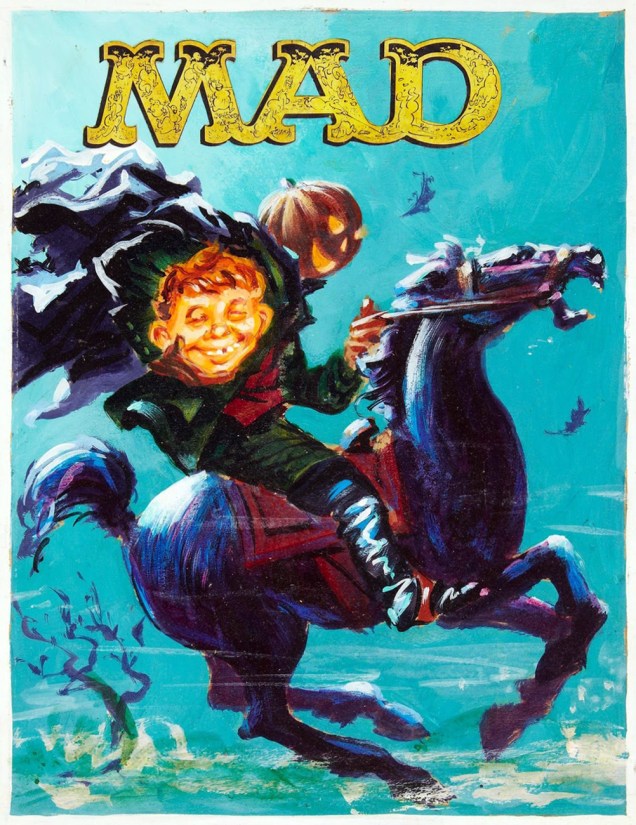
« Just then he saw the goblin rising in his stirrups, and in the very act of hurling his head at him. » — Washington Irving, The Legend of Sleepy Hollow
And here’s a peek at one of Freas’ preliminary versions of the cover. I daresay it’s lovely, but the final rendition is the clear winner. Sometimes the editorial process works just fine!
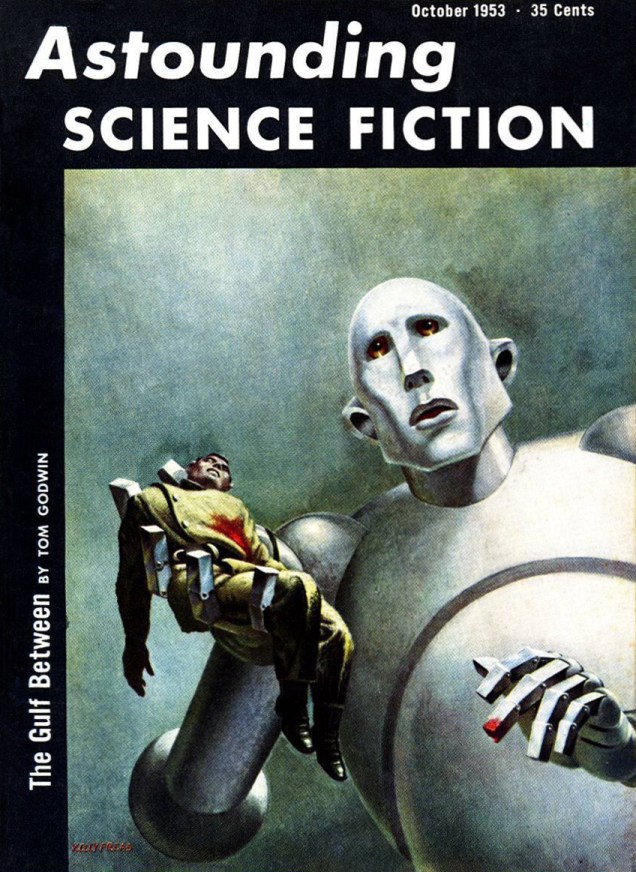
Some of you may recall Freas’ classic cover art for Queen’s News of the World album, back in 1977. That, in fact, was a case of Freas recasting his painting from the October 1953 issue of pulp mag Astounding Science Fiction. Look familiar?
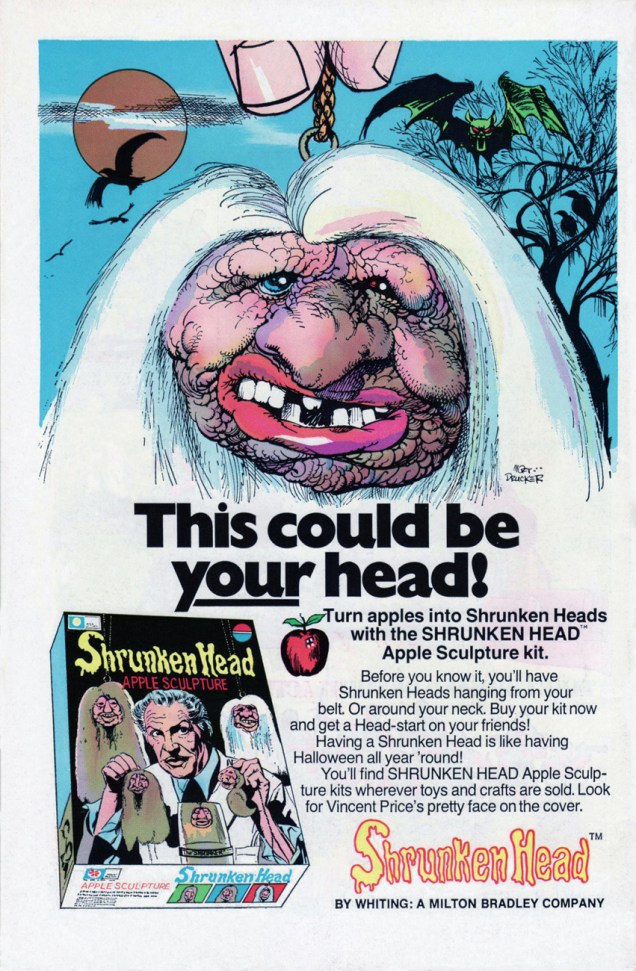
« Having a shrunken head is like having Halloween all year ’round! »
A classic, fondly-remembered ad from the back of comics published in the fall of 1975.
How cool is it that even the box art is hand-drawn? One of these will set you back a pretty penny on eBay these days.
The artwork is by Mad Magazine pillar (and arguably their artist most adept at capturing celebrity likenesses) Mort Drucker (b. 1929). Check out that fabulous signature!
Of course, I’d always longed to snag my own kit, and a few years ago, I succeeded.« Each apple will be different from any other; no two will be exactly alike. This is due to variations in many factors, but mostly in the moisture content of the apple. »« Caution: Do not use in excess of 40 watt bulb. »
Should you find yourself with some extra apples after a productive head-shrinking session, why not make the most of your leftovers with Vincent’s recipe for æblekage, which is to say Danish Apple Cake? Waste not, want not.
« Gosh! I never knew you had a school for monsters! »
« There are a lot of things about Transylvania that you American tourists do not know! »
Archie Comics’ earliest foray into monster humour was its long-running, in one form or another*, Mad House series (1959-82).
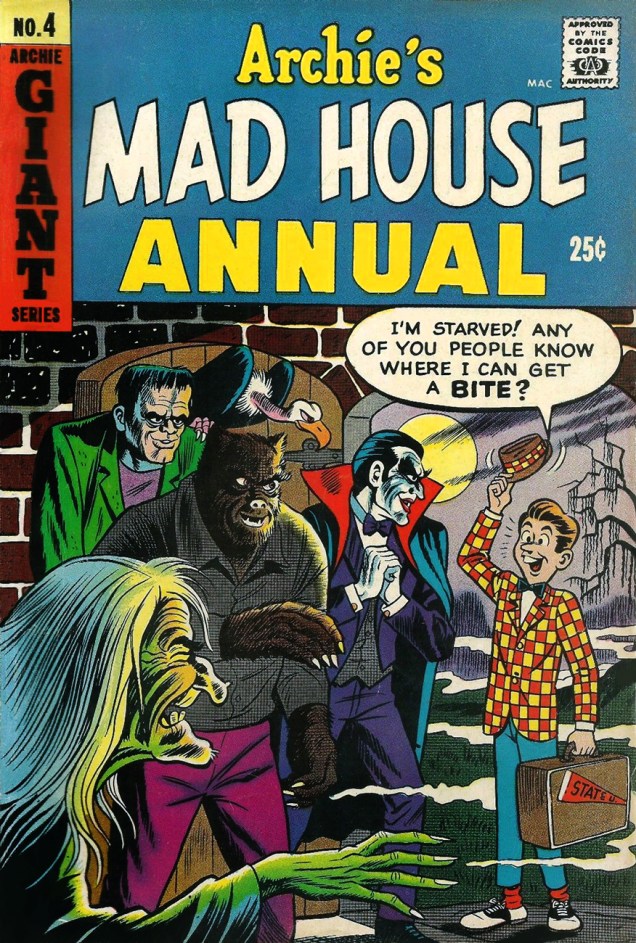
It doesn’t get any better than Samm Schwartz‘s cover for Archie’s Mad House no. 16 (December, 1961). The early issues featured Archie and the gang in slightly more surreal settings than usual, then they were phased out, with the noteworthy exception of Sabrina the Teenage Witch, who was introduced in AMH 22 (October, 1962). The title was a fine showcase for Archie’s best and most idiosyncratic stylists, Schwartz, Orlando Busino and Bob White in particular.
An idea they liked so well they used it (at least) twice. Bonus points for bothering to redraw it! This was Archie’s Mad House Annual no. 4 (1966-67), cover art by the aforementioned Bob White.
-RG
*It was called Archie’s Mad House (issues 1-60), then simply Mad House (61-65), then Madhouse Ma-ad Jokes (66-70), Mad House Ma-ad Freak-Out (71-72), The Mad House Glads (73-94), Madhouse (in a non-cartoony horror format, featuring the likes of Gray Morrow and Vicente Alcazar, 95-97), then finally Mad House Comics (95-130).
« Tous les merdeux ricanaient en se disant qu’une revue sans merdeux à la tête, ça ne marcherait jamais.* »
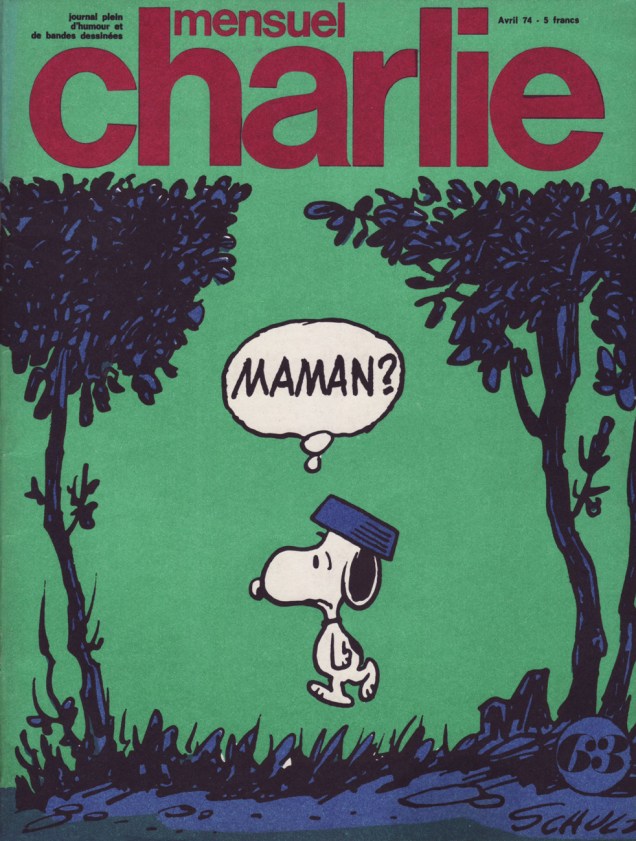
In issue 63 (April, 1974) of the recently rechristened « Charlie Mensuel » (to avoid confusion with its sister publication, Charlie Hebdo, yes, *that* Charlie Hebdo), insightful bandes dessinées critic and French national treasure Yves Frémion-Danet (b. 1947, Lyon), writing under his « Théophraste Épistolier » nom de plume, provided a classic essay accompanying a reprint of Harvey Kurtzman and Will Elder‘s « Goodman Gets a Gun », originally published in Help no. 16 (Nov. 1962, Warren). In his piece, Frémion posits that, with his 28 issues of Mad / Mad Magazine, Kurtzman’s brand of satire completely changed the rules of the game, and that despite an utter lack of commercial success and name recognition for himself and his work (reportedly, a French edition of Mad was published in 1965-66, for six or seven issues) on the continent, his influence on a significant swathe of the subsequent generation of French and Belgian cartoonists easily validates his vital importance.
Théophraste Épistolier’s column’s logo, which translates as “Little Mickeys give you big ears”. A “Petit Miquet” is, in french, a generic name for cartoon characters from a dismissive and/or ignorant perspective. Someone to whom Mickey Mouse is the sole precursor of all Little Mickeys. Artwork by Gotlib.
Frémion spares no praise for Kurtzman’s acolytes Elder, Jack Davis, Basil Wolverton, Wally Wood and John Severin, and publisher Bill Gaines, but has nothing but contempt for editorial successor Al Feldstein (“vile copier”, “lumbering”, “regular”…). Frémion charts Kurtzman’s subsequent projects and associations, and his rôle in the rise of Underground Comix. Recommended reading… if you can read french.
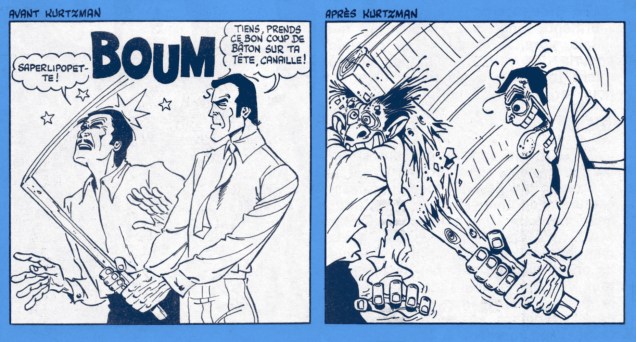
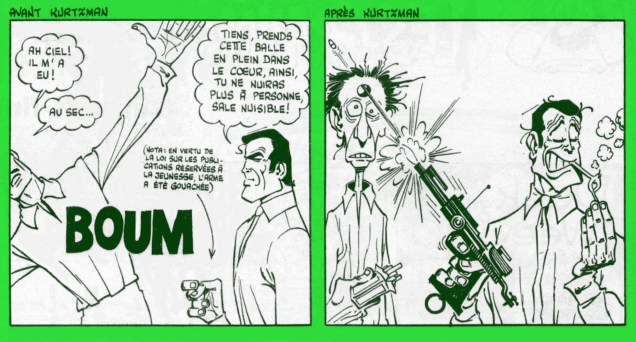
Ah, but that brings us to an apt illustration of that creaky adage, « A picture is worth a thousand words »: as it happens, the legendary Marcel Gotlib (b. 1934, d. 2016), speaking of influential, provided a quartet of original illustrations to put across what comics were like Before and After Kurtzman, commenting at once on American comics and on Franco-Belgian bande dessinée, with a snappy Gallic twist. Like Goofus and Gallant, but with far more tongue.
It took me a long time to come to terms with Gotlib. In my formative years, in Québec, his was such an outsize, smothering influence that one got quite sick of him. To be fair, not of him so much as his multitudinous, third-and-fourth-rate would-be clones. His style was easy to imitate, yet difficult to master. You see how that could easily careen off the rails?
In the left panel, the pistol is missing, having been whited-out « in accordance with the law on publications intended for young people », a quite repressive set of regulations adopted in 1949.More of the same: « Certain body parts have been whited-out. » Gotlib’s point is well made: when something relatively innocuous gets erased, the mind often fills the blanks with more perverse possibilities. Serves you right, censors.The issue in question. Charlie / Charlie Hebdo was published from Feb. 1969 to Feb. 1986, lasting, in fits and starts, 198 issues. It then merged with Pilote… and disappeared. Cover, of course, by Charles Schulz.
-RG
*« All the shitheads giggled, telling themselves that a magazine without an shithead in charge never would stand a chance. » – Théophraste Épistolier


















 An idea they liked so well they used it (at least) twice. Bonus points for bothering to redraw it! This was Archie’s Mad House Annual no. 4 (1966-67), cover art by the aforementioned Bob White.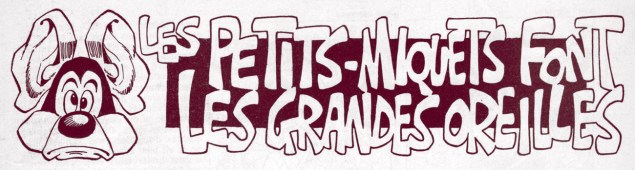


 Who's Out There?