Tentacle Tuesday Masters: The Far Side of Gary Larson

FarSidePreviewA

When I was in college, most of my professors could easily be divided into two categories: those who had good taste in comics, and those who did not. I don’t know who launched this tradition (is this something that’s universal to all post-highschool educators?), but somehow the majority of teachers were fond of clipping particularly pleasing items from newspapers and (usually messily) scotch-taping them to their office door. This usually included some brief newspaper articles, and definitely a cartoon or two.

I have to admit that I had a soft spot for panels that clearly had spent the last decade (or three) in that spot, and were little more than yellowed, warped, sometimes downright indecipherable relics of yesteryear. However, of greater interest were office doors tended as carefully as an prize-winning garden, proudly displaying a frequently renewed wall of cartoons, meticulously positioned and impeccably pasted onto the door’s surface. 

I was lucky enough to know one professor who was passionate about Bizarro, and another one who harboured a similar fire for Gary Larson‘s The Far Side. At the time, I didn’t know that Larson had retired in 1995, and that new work of his was no longer published in newspapers. I was in college in 2004. Did the professor in question hoard large archives of cut-out The Far Side strips (these weren’t photocopies), and just cycle through them? Was there, in her office, some portal to an alternate reality? That mystery shall only deepen over time. I can only state that I would make sure to swing by first thing in the morning to enjoy that day’s offering.

Today we present you with a fairly complete collection* of Gary Larson tentacles. I give my gratitude to co-admin RG for his “eagle eye” – he spent an hour or two going through his paperback collections of the strip (and giggling maniacally) to spot anything cephalopodian. He then scanned ’em (and added colour frames, because that’s the kind of man he is), so this post has honestly been more work for him than for me.

*It turns out there’s quite a lot of them, so this shall be a two-part post.

Larson has been notoriously opposed to having his strips posted online by fans, but in December 2019, he has decided to start a The Far Side website, featuring a random selection of cartoons, some weekly selections organized by theme, and the occasional doodle or sketch. I have absolutely no wish to disrespect the opinion of the author, but I hope that now it’s okay to share our excitement about so much tentacle goodness with our readers. Besides, tentacles or not, most of these are hilarious and surreal, a combination that’s dear to my heart.

Without further ado…

FarSideCheapPocketA

FarSideCalamariBlancA

FarSideJerryWon'tA

FarSideHorribleThingA

« Controversy never seemed too far away from me, especially during my first year of syndication. I truly thought my career may have ended a number of times. I remember one I did of a couple dogs that were playing this game, where they were smacking around a cat hanging from a long rope attached to a pole. I called it “Tethercat.” To me, and I assume my editor, it didn’t cross any line because this was just a game dogs might play. But that one got people stirred up. Especially cat people. I’ll forever be grateful to fans, who in those early days often rescued “The Far Side” from cancellation, or campaigned to get it reinstated. » 〈source

FarSideJumpFenceA

FarSideMrsNortonA

FarSideOctoObedienceA

FarSideSquidheadsA

« Among the massive fan base that The Far Side would eventually develop, interestingly scientists and academics were among the first to take to the comic, despite Larson’s frequent jabs at this very same group. The strip also had a tangible impact on the world of paleontology. In an 1982 comic, a group of cavemen are in lecture hall being shown a slide of a dinosaur. The caveman instructor is pointing to the spiky tail of a Stegosaurus while saying, “Now this end is called the thagomizer…after the late Thag Simmons.” As it turned out, in real life, no one had actually given that part of the Stegosaurus’ tail a name. Despite Larson’s fudging of the facts (in actuality, dinosaurs and humans missed each other by more than 140 million years), paleontologists adopted “thagomizer” as the official name of the spikes on a Stegosaurus. » 〈source

FarSideSuctionMarksA

FarSideWhatHitHimA

And, in glorious colour…

FarSideThingPaperA

While there are cheap and abundant paperback collections of The Far Side in every self-respecting bookstore, in 2014, Andrews McMeel Publishing released a beautifully designed 3-volume The Complete Far Side. Oh, and it weights 20 pounds. For bonus value, some letters written to the newspapers by befuddled or angry readers are included. Few of us may feel the need to possess such a grand coffee table book (I’ve been pondering that myself ever since it got published), but its very existence is a lovely testament to the enduring nature of Gary Larson’s world.

±≠ ds

P.S. Those teachers with bad taste in comics I mentioned? They had Garfield and Cathy on their doors…

Some content on this page was disabled on June 3, 2022 as a result of a DMCA takedown notice from Gary Larson. You can learn more about the DMCA here:

https://wordpress.com/support/copyright-and-the-dmca/
Some content on this page was disabled on June 3, 2022 as a result of a DMCA takedown notice from Gary Larson. You can learn more about the DMCA here:
https://wordpress.com/support/copyright-and-the-dmca/
Some content on this page was disabled on June 3, 2022 as a result of a DMCA takedown notice from Gary Larson. You can learn more about the DMCA here:
https://wordpress.com/support/copyright-and-the-dmca/
Some content on this page was disabled on June 3, 2022 as a result of a DMCA takedown notice from Gary Larson. You can learn more about the DMCA here:
https://wordpress.com/support/copyright-and-the-dmca/
Some content on this page was disabled on June 3, 2022 as a result of a DMCA takedown notice from Gary Larson. You can learn more about the DMCA here:

https://wordpress.com/support/copyright-and-the-dmca/
Some content on this page was disabled on June 3, 2022 as a result of a DMCA takedown notice from Gary Larson. You can learn more about the DMCA here:
https://wordpress.com/support/copyright-and-the-dmca/
Some content on this page was disabled on June 3, 2022 as a result of a DMCA takedown notice from Gary Larson. You can learn more about the DMCA here:
https://wordpress.com/support/copyright-and-the-dmca/
Some content on this page was disabled on June 3, 2022 as a result of a DMCA takedown notice from Gary Larson. You can learn more about the DMCA here:

https://wordpress.com/support/copyright-and-the-dmca/
Some content on this page was disabled on June 3, 2022 as a result of a DMCA takedown notice from Gary Larson. You can learn more about the DMCA here:

https://wordpress.com/support/copyright-and-the-dmca/
Some content on this page was disabled on June 3, 2022 as a result of a DMCA takedown notice from Gary Larson. You can learn more about the DMCA here:

https://wordpress.com/support/copyright-and-the-dmca/
Some content on this page was disabled on June 3, 2022 as a result of a DMCA takedown notice from Gary Larson. You can learn more about the DMCA here:

https://wordpress.com/support/copyright-and-the-dmca/
Some content on this page was disabled on June 3, 2022 as a result of a DMCA takedown notice from Gary Larson. You can learn more about the DMCA here:
https://wordpress.com/support/copyright-and-the-dmca/

Phew, That Was Close!

« Death smiles at us all, all a man can do is smile back. » — Marcus Aurelius

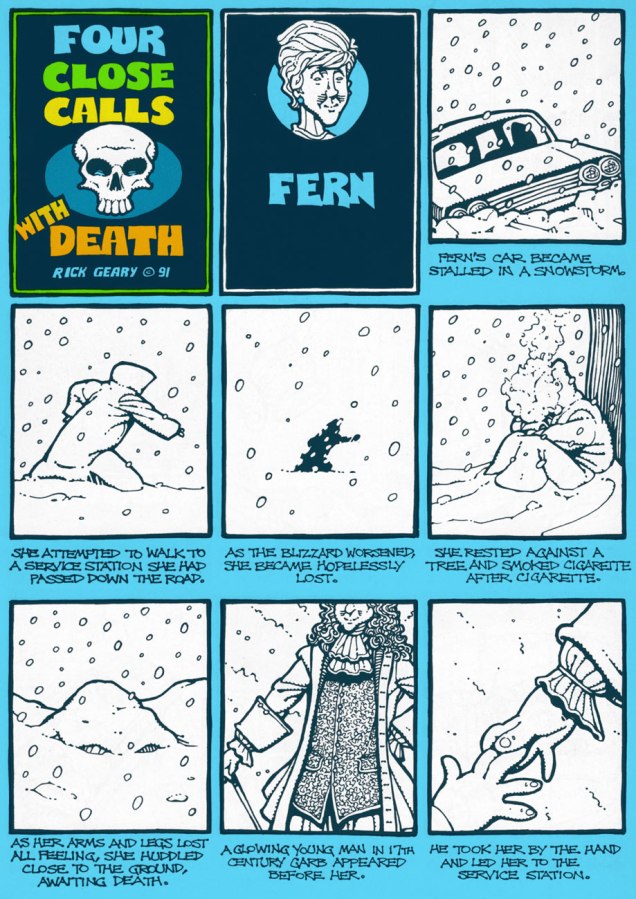
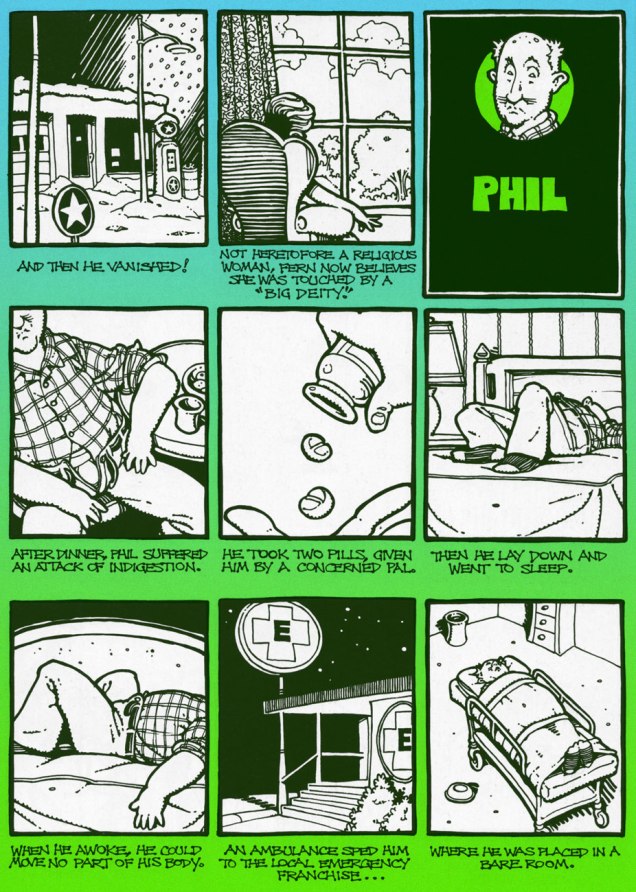
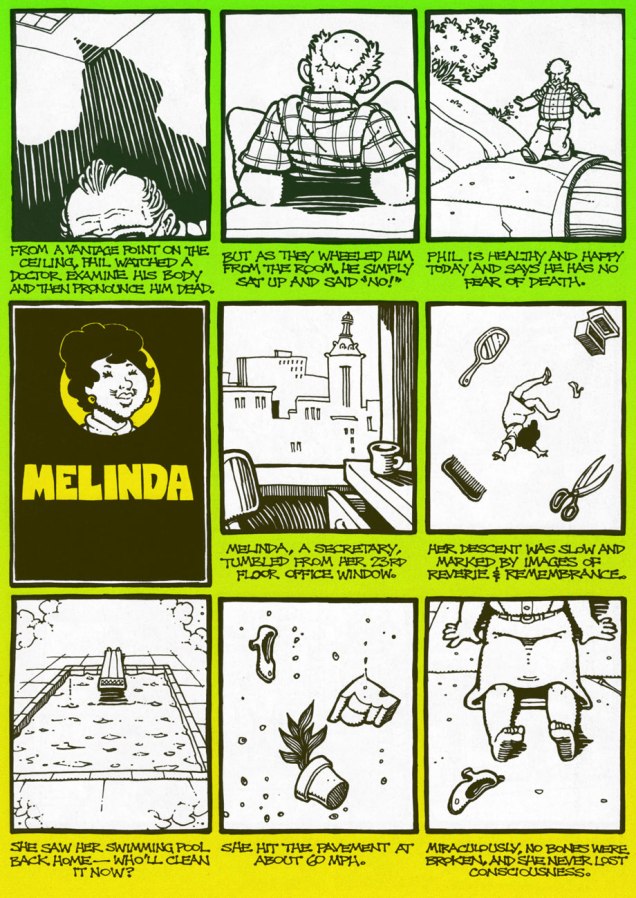
The other day, I chanced upon a Rick Geary piece about tangos with the Angel of death, which returned my mind to a time, when I was but six years of age, and that my parents had gone holidaying, leaving me in the care of some old friends. At their home, I recall perusing some back issues of that evergreen Reader’s Digest (the French-Canadian edition, called Sélection du Reader’s Digest), wherein I encountered some memorable articles, including one about the miraculous survival of people who tumbled from great heights*, unencumbered with parachutes, and another that grimly recounted the calamitous landslide that one night engulfed a village, Saint-Jean-Vianney, just a few kilometres from my hometown.

Ah, but human memory is notoriously fallible and self-deceiving. So I deemed it prudent to inquire whether the events were truly as recollected. A quick call to my folks confirmed that yes, they did toddle off to Europe for three weeks in November of that year (I think my parents are delighted when I quiz them about such matters). The landslide took place in May, so that fits too.

As the close shave lends itself well to comics, I’ve gathered a potpourri of short pieces on the topic. Tighten your seatbelts, we’re in for a rough ride!

Salt01A

Salt02A
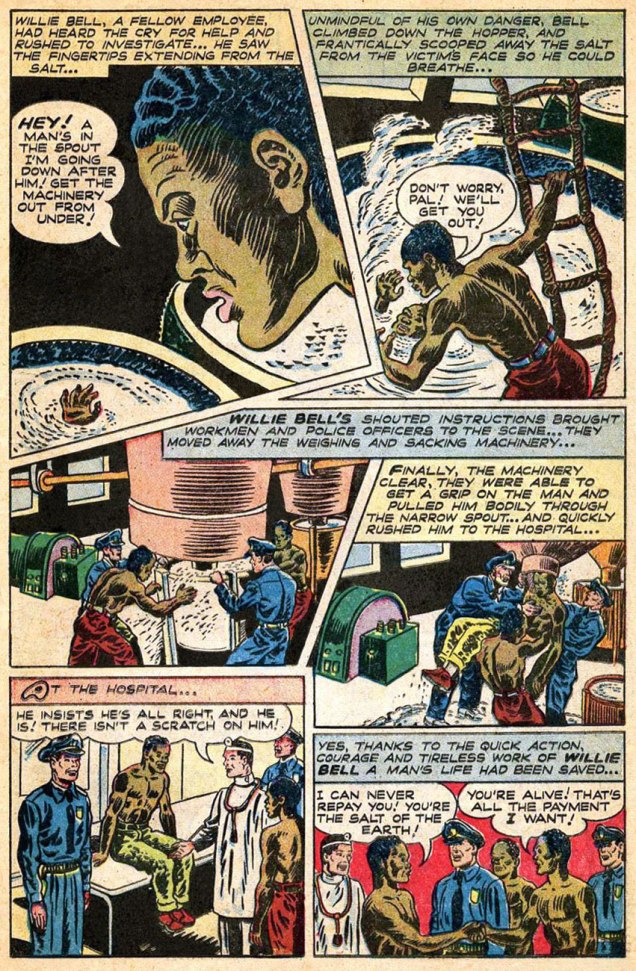
A presumably factual two-pager from New Heroic Comics no. 70 (Jan. 1952, Famous Funnies), featuring artwork by no less an eminence than the great Harry Peter (according to Ger Apeldoorn, which is good enough for me). The whole ‘salt of the earth’ thing rings pretty hokey, but one has to appreciate that this account of selfless heroism wasn’t whitewashed.

GearyNearDeath01AGearyNearDeath02AGearyNearDeath03A

GearyNearDeath04A
This post’s springboard, originally published in Dark Horse Presents no. 82 (Feb. 1994, Dark Horse). From Heavy Metal to National Lampoon, with High Times and The American Bystander in between,  I’ve yet to encounter a publication wherein Mr. Geary’s work failed to rise to the very top with its patented palette of fanciful perspective, sunny understatement and psychological verisimilitude. 
GirlFlewA
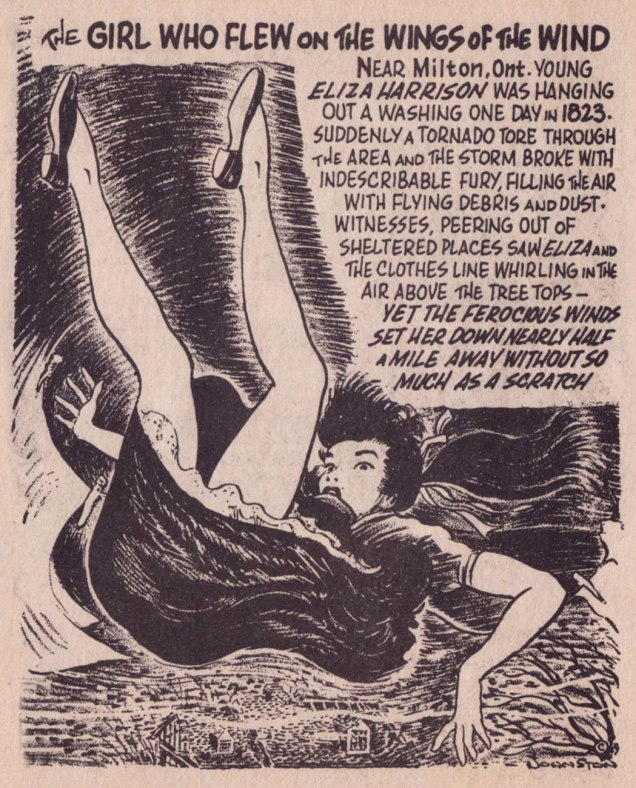
An airborne entry from Gordon Johnston‘s Ripley’s Believe It or Not-style syndicated strip ‘It Happened in Canada‘ (1967-81). However, the Wikipedia listing of historical tornadoes in Canada fails to turn up one such whirlwind in 1823. Perhaps it happened in Kansas instead.

Icebox01A

Icebox02A
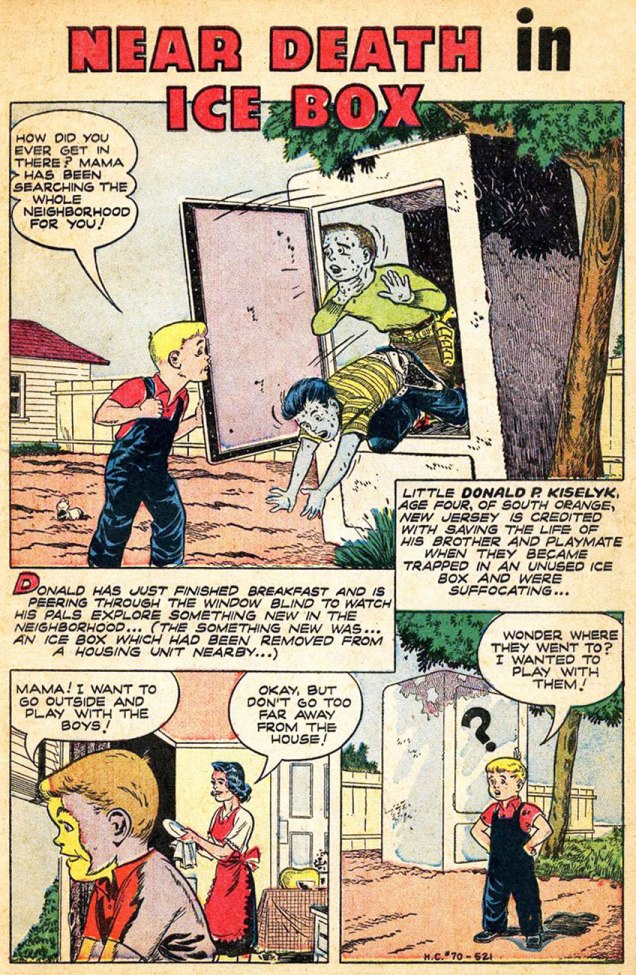
Pesty baby brother saves the day! Another entry from New Heroic Comics no. 70 (Jan. 1952, Famous Funnies), artist unknown. Astoundingly, a little research (I wouldn’t want to pry further) indicates that a Donald P. Kiselyk, now 73, still resides in New Jersey. Doing the math, he would have been born in 1947, which fits perfectly). I wonder whether he recollects his hour of four-colour glory…
BuriedAliveA
Another It Happened in Canada entry. Looks legit, too, though it seems Johnston didn’t nail the spelling: the resilient gent’s moniker is Myllyla. According to Wikipedia, « At 9:57 in the morning, an avalanche of snow buried the Leduc Camp in British Columbia, killing 27 copper miners working for the Newmont Mining Corporation workers and destroying several buildings. Another 42 of the 68 people buried were rescued on the same day, while a carpenter, Einar Myllyla, was saved three days later from the ruins of a collapsed building. “To their everlasting credit”, author Jay Robert Nash would write later, “rescuers refused to abandon their search until every man in the camp had been accounted for. »
FarSideBrushA
Obviously, I couldn’t leave out this Gary Larson classic.

Keep your arms and legs in the vehicle, don’t tease the wild animals, wear your life jacket, look to both sides before crossing the road, and don’t forget to floss. Oh, and call your mother more often; she misses you.

-RG

*the fellow whose tale stayed with me was most likely Lt. I.M. Chisov, « … a Russian airman whose Ilyushin IL-4 bomber was attacked by German fighters in January of 1942. Falling nearly 22,000 feet, he hit the edge of a snow-covered ravine and rolled to the bottom. He was badly hurt but survived. »

Some content on this page was disabled on June 30, 2022 as a result of a DMCA takedown notice from Gary Larson. You can learn more about the DMCA here:
https://wordpress.com/support/copyright-and-the-dmca/

Chew on This: Howard Cruse’s Bazooka Joe

« So to this my life has come: there’s meaning in a piece of gum » — Parthenon Huxley, Bazooka Joe
We recently lost another fine cartoonist in Howard Cruse (May 2, 1944 – Nov. 26, 2019), and while he’s most frequently celebrated for his pioneering work in Queer comix and his graphic novel Stuck Rubber Baby, I’m much fonder of his comparatively ‘lightweight’ humorous work. In other words, I’ll take the wacky short stories over the Ponderous Magnum Opus, thank you.

And things don’t get any lighter than Bazooka Joe, now do they?

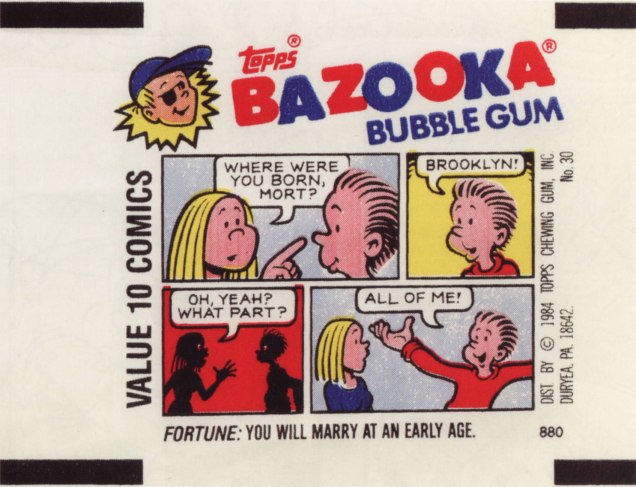
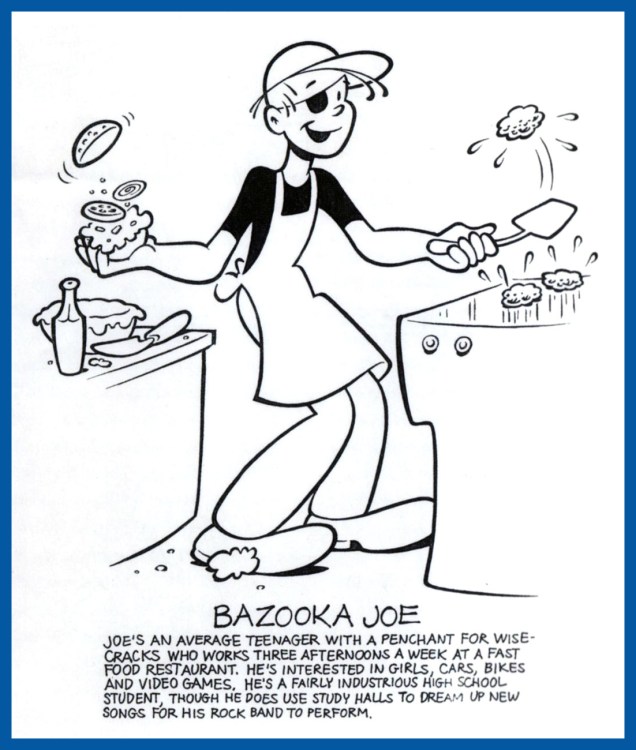
In 1983, Howard Cruse was engaged by Topps to redesign Bazooka Joe and illustrate a new set of strips, the series’ first true update since co-creator* Wesley Morse‘s passing in 1963. Topps, figuring on more-or-less total turnover of its kiddie audience, had been rotating batches of strips every seven years, drawing on the vast hoard of unpublished strips left by Morse, and now and then hiring freelancers to pad out the lot.

CruseJoeInstruct01A
An unpublished Howard Cruse instructional comic, mid-1980s. Cruse recalled: « I always liked  this strip because it’s practically the only time I was invited to draw the character at a size large enough to allow some stylistic personality. » I added the colouring, just because.
CruseBazookaModelA
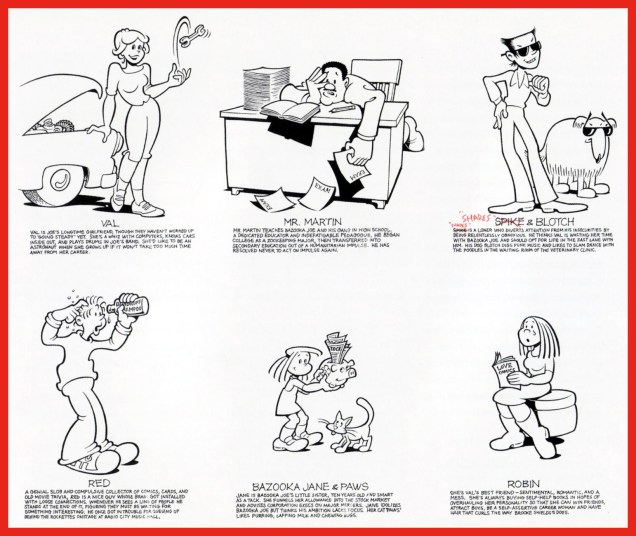
Howard Cruse Bazooka Joe model sheet, prepared for 1983 revamp.
CruseBazookaCastA
Cruse’s model sheet for the rest of the 1983-vintage cast.
CruseBazookaBrooklynA
Chameleonic cartoonist R. Sikoryak, who contributed gags to the second Cruise series, posits that « One of the pleasures of the traditional comic strip is the conciseness of words and pictures, and the Bazooka format takes this compression about as far as humanly possible. As with haiku, there is a great power in the constraints that must be respected in obeying a format. »
CruseBazooka83A
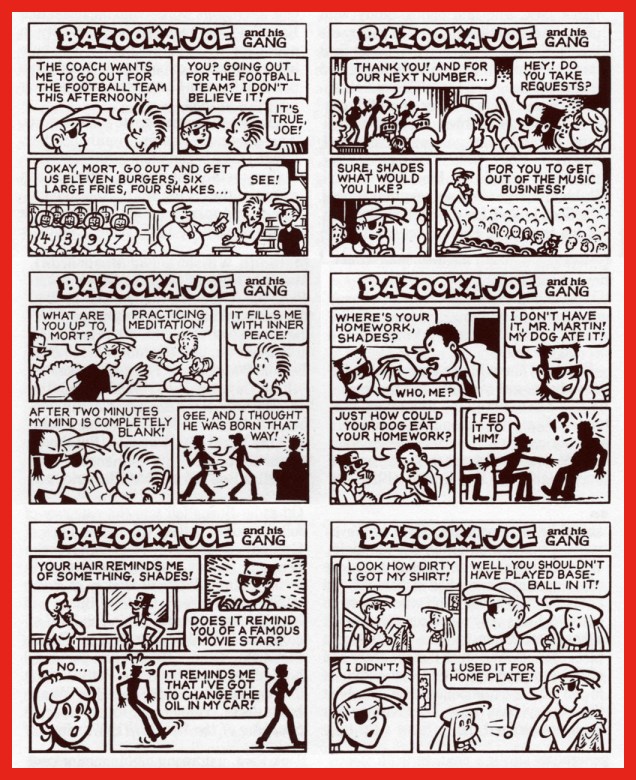
Samples of the 1983-84 vintage.
CruseBazookaPillowA
Jay Lynch explains: « Despite the brand managers and marketing companies responsible for the various revamps of Bazooka Joe over the years, and their valiant attempts to make the characters and the gags more ‘hip‘, I’ve always thought that the primary appeal of these tiny comics was their overall lameness. Back when I wrote Bazooka Joe, I’d usually start by going through turn-of-the-century joke books and rewriting the ancient quips to turn the 1908 ragtime aficionados into 1990’s heavy-metal enthusiasts… »
CruseSuggestionsA
Some thoughtful suggestions from Cruse for the 1988 crop.
CruseBazookaOriginalA
From my personal collection, original artwork supposedly from the 1983-84 batch… but something doesn’t add up. Incidentally, actual size is 3 x 3 5/8 inches.
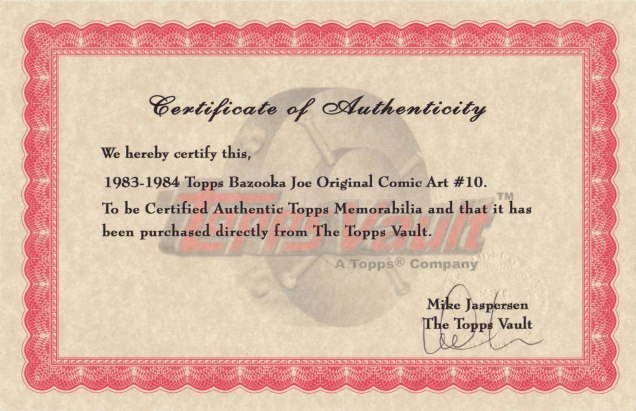
ToppsCertificateA
The accompanying certificate of authenticity raises more questions than it answers. To wit, as Mr. Cruse elucidates: « When I was asked… to reconceive Bazooka Joe as a teenager and provide him with a new ‘gang‘, the only holdover from the earlier tykes… was Mort, the weird sidekick who wore a turtleneck pulled up to his eyes. Len [Brown] and Art Spiegelman… thought the ultra-lengthy turtleneck was a bit – in fact, was literally – over the top, though. So for my first series of strips the sweater’s collar was brought down below Mort’s chin… Apparently this change disturbed some nameless traditionalists at Topps, so when I was hired to draw a second batch of strips in 1988, the turtleneck was restored to its original position… » In that case, if my original is from the ’83-’84 series, why is Mort’s turtleneck in its traditional, and proper place?
CruseBazookaJerkA
Another certificate, this one appearing on the back of Bazooka Jerk (Garbage Pail Kids Giant Series Stickers no. 1, from 1986). Illustrated by Howard Cruse.

Then, in 1990, when the time came for another series, Topps opted to subcontract the work to a marketing company that dismissed Cruise’s work as « too goofy », according to Jay Lynch. Then Lynch, Pete Poplaski and Grass Green took up the gauntlet, which is a fascinating tale in itself… but one for another day.

If such lowly cartoon ephemera hold even the slightest sway over you, you’ll likely be very interested in Topps’ Bazooka Joe and His Gang (2013, Abrams ComicArts, edited by Charles Kochman), which proved an invaluable resource in cobbling together this post.

« Bazooka Joe has become the personification of the lowest form of humor. And this is why he’s one of the most widely known comics characters on the planet. Sure, the jokes were cornball. But that’s their appeal. » — Jay Lynch

-RG

*with Topps executive (and Golden Age comic book artist) Woody Gelman.

Social Perils and Pitfalls: Abner Dean’s ‘Come As You Are’ (1952)

« What I don’t like about office Christmas parties is looking for a job the next day. » — Phyllis Diller

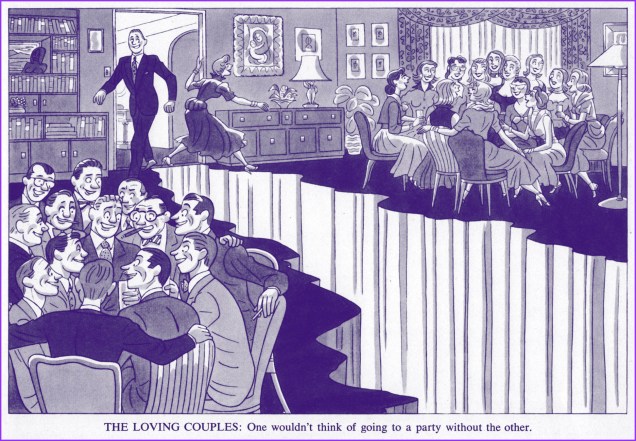
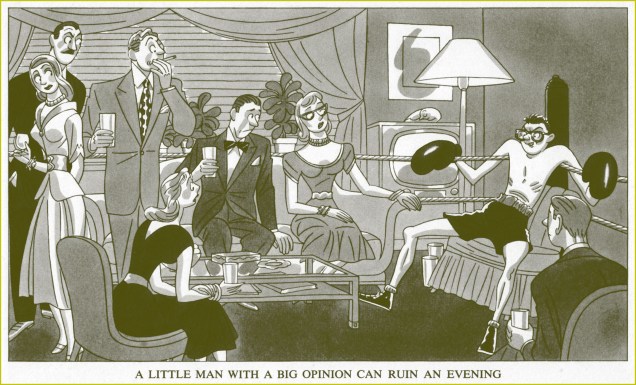
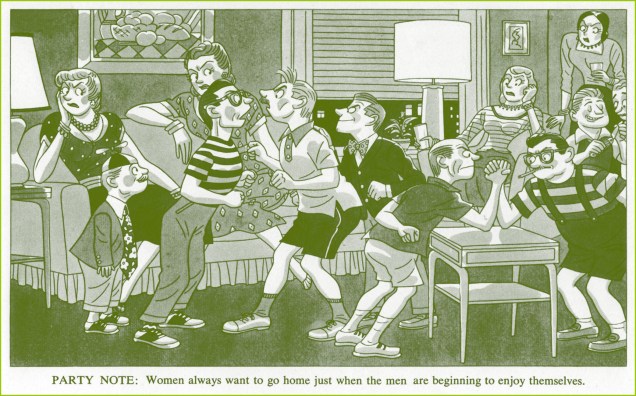
Between the poles of Abner Dean’s more normal magazine work and his often quite abstract, therapy-inspired books, lies his neglected Come As You Are, his most accessible single-theme work.

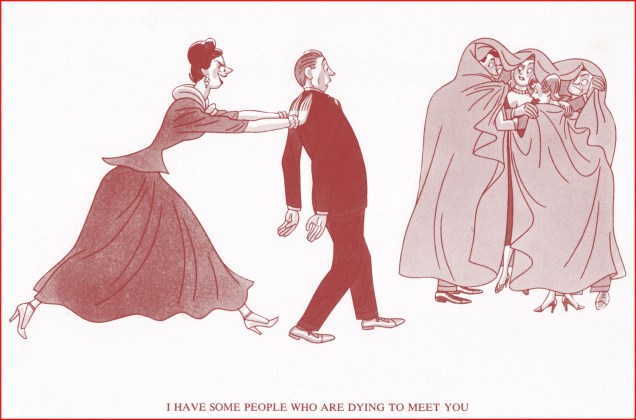
In few words but with devastating visual lucidity, Dean turns a probing spotlight on party dynamics, laying bare the casual cruelty, manipulations and seductions, feints and blindsides, alliances and betrayals, thrusts and parries. The results are often hilarious… but laden with uneasy recognition; despite the distance of nearly three-quarters of a century, little appears to have changed in the fundamentals… which really should come as no surprise to anyone.

Witness the following excerpts…

DeanComeAsYouAreFrontA
The front cover. The book is tellingly dedicated « To all those wonderful people who I hope will still ask me back. »

AbnerDeanCome08A

AbnerDeanCome02AAbnerDeanCome06AAbnerDeanCome05AAbnerDeanCome04AAbnerDeanCome03AAbnerDeanCome07A

AbnerDeanCome01A
According to our resident mycologist, these are pretty much all toxic. The game is rigged!

AbnerDeanCome09A

From the back end of the book: « This is Abner Dean’s fourth adventure with the cross-eyed muse in that area of unexpected turning and hilarious insights that is particularly his own.

The first, in 1945, was It’s a Long Way to Heaven. People began seeing themselves and their friends as Dean saw them. They were startled and fascinated by the view. With What Am I Doing Here? in 1947 they winced and laughed again. Psychiatrists started using certain of his drawings for discussion with their patients. People began playing games of identification with individual pictures.

In 1949 came And on the Eight Day to make more Dean converts. And now here’s a fourth book about people to smoke out any unbelievers who may be lurking in corners at parties.

For those who like their incidental intelligence in an unbalanced phrase — Abner Dean was born in 1910, attended the National Academy in 1927, was graduated from Dartmouth in 1931, and hasn’t been away from a drawing board for more than a few days since then. He is happily married and lives in New York. »

WhoThereLogotype

This is our third look at Mr. Dean’s œuvre. If you’re left longing for more, read on:

Abner Dean’s Universe: Before… 
followed of course by Abner Dean’s Universe: … After.

-RG

Hallowe’en Countdown III, Day 30

« If it wasn’t for baseball, I’d be in either the penitentiary or the cemetery. » — Babe Ruth

Since the (so-called) World Series is still going on, this seems all the more appropriate.

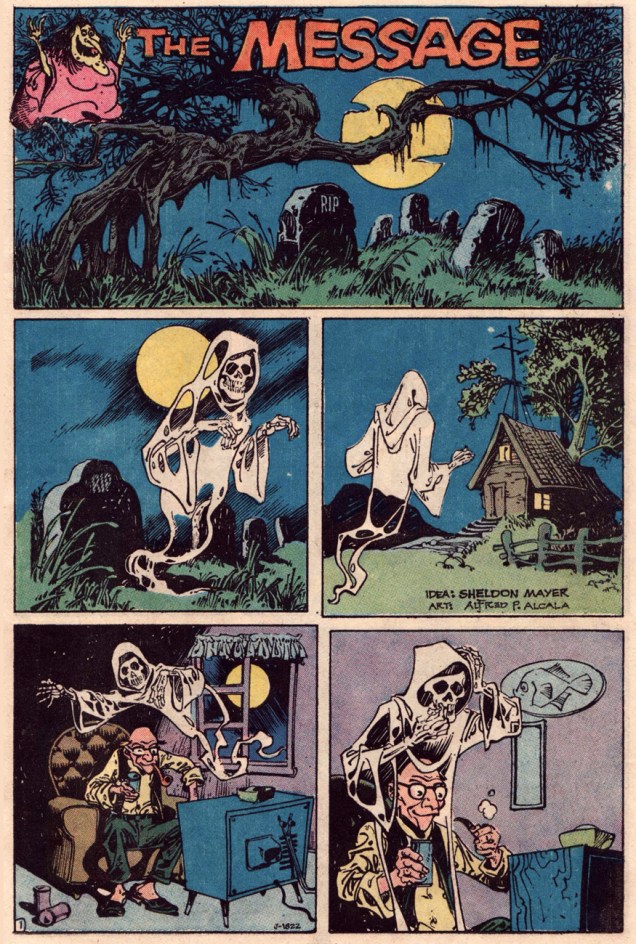
AlcalaMessage01AAlcalaMessage02A

It was with this piece that I first began to grasp just how gifted and versatile Filipino giant Alfredo P. Alcala (1925-2000) was. He’s inarguably a grandmaster of eerie moods, but hardly bereft of a fun side. This brief piece, a dream collaboration between Sheldon Mayer and Alcala, was published in Plop! no. 1 (Sept.-Oct. 1973, DC). And what an issue that was, gathering such talents as Basil Wolverton, Sergio Aragonés, Mayer and Alcala, Frank Robbins, George Evans, John Albano, Stephen Skeates and Berni Wrightson… yikes! (read it here!)

WolvertonPlop01BackA
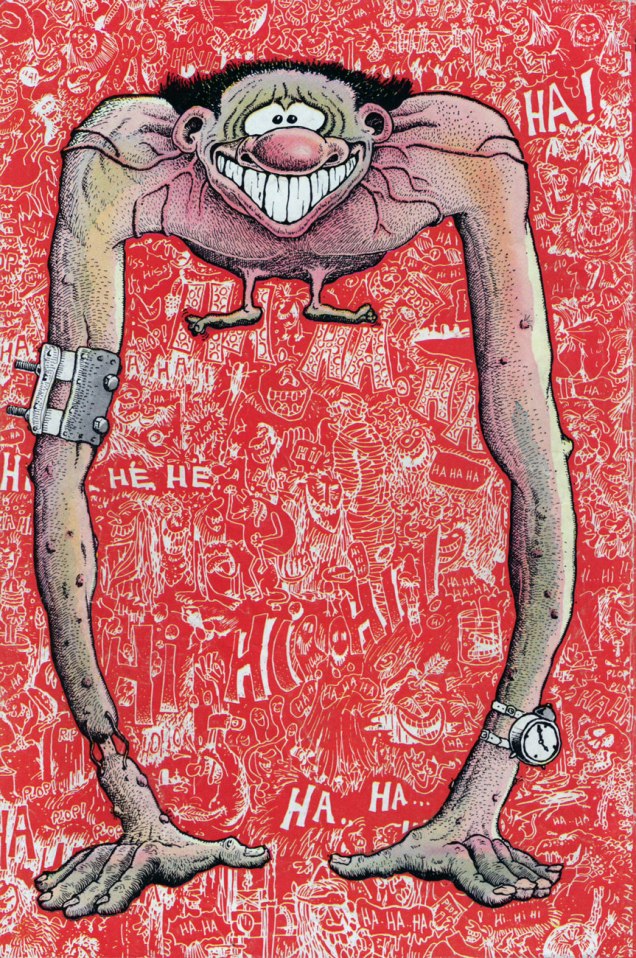
As a bonus, here’s the *back* cover of Plop! no. 1, featuring Wolverton’s cover boy “Arms” Armstrong. Which provides me with the opportunity to inform you that this very week has seen the long-delayed publication of Greg Sadowsky’s Brain Bats of Venus: The Life and Comics of Basil Wolverton Vol. 2 (1942–1952), his definitive biography of that singular and fascinating man. Read all about it here!

– RG

Nikita Mandryka’s Ailleurs

« If you don’t want to be idolized by the masses, you don’t become an author, you become a plumber-welder! » — Entretien avec Mandryka, Les cahiers de la bande dessinées no. 28 (1975), conducted by Numa Sadoul

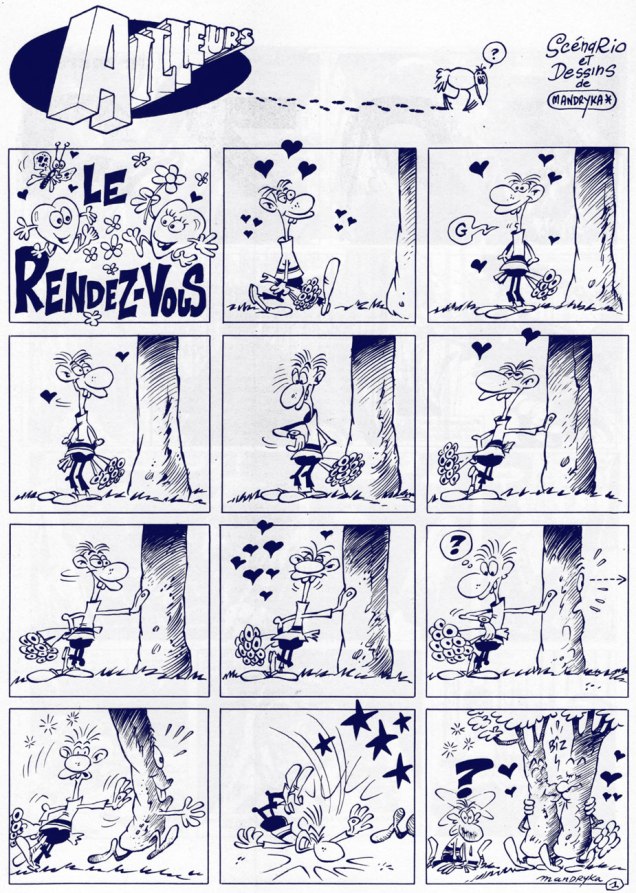
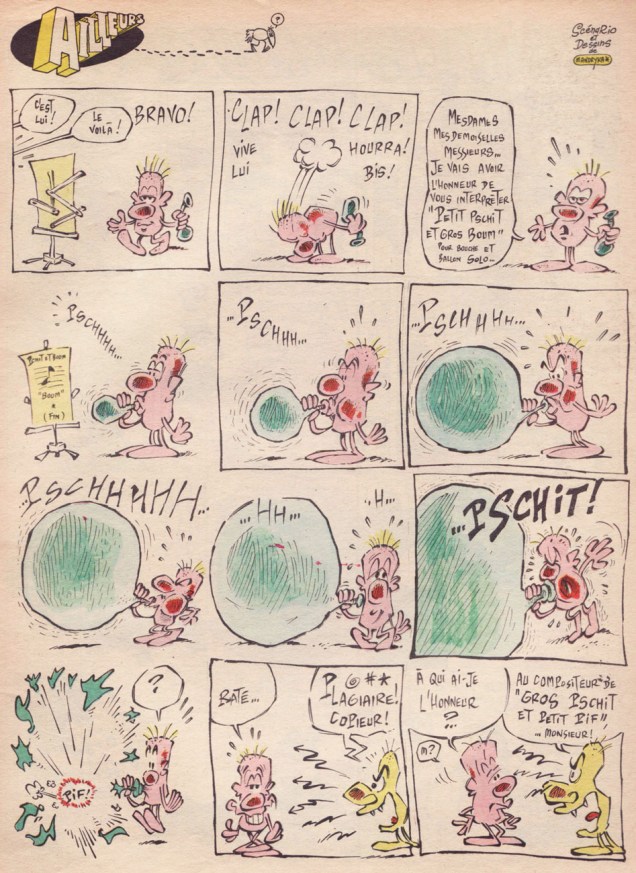
Nikita Mandryka was born October 1940 in Bizerte, Tunisia, to Russian émigré parents. His grandfather had fled the Russian Revolution in 1921 aboard a warship he was commanding. Nikita’s first professional strip appeared late in 1964 in Vaillant (Boff, in Vaillant no. 1024, Dec. 27, 1964), soon renamed Vaillant, le journal de Pif , then Pif Gadget in 1969. While he’s best known for his loquacious, dominoed cucurbit, Le Concombre Masqué, today we’re going to harvest the riches of his somewhat less familiar, but equally absurdist creation, the free-form strip Ailleurs (“Elsewhere”). The feature debuted with the inaugural issue of Pif Gadget and made its bow with issue 35, a few months down the line.

Mandryka left Pif Gadget on good terms (and returned over the years), and with a solid reason: while Pif’s editorial team rightly adored his work, its left-field humour left the majority of Pif’s young readership quite baffled, and sometimes infuriated. Mandryka’s place in the magazine may have been secure, but he yearned for an audience that actually understood him. This he would find at Pilote, with its teenage readership, and all the more so with L’Écho des Savanes (which he cofounded, in 1972, with Claire Bretécher and Marcel Gotlib).

Pif’s was an unusual case: its most singular, daring, arguably most valuable strips were those least appreciated by the kids. And that slice of the readership, you’ll have guessed it, tends to express its opinions more freely and vehemently than their elders, who did love (but more quietly) the somewhat abstract, second degré (offbeat, ironic) features, such as Marcel Gotlib and Henri Dufranne‘s Gai-Luron*, the recently-departed Massimo Mattioli‘s M. Le Magicien or Henri Crespi‘s Nestor. Still, the savvy editorial team, who after all had made the magazine a massive hit, keenly grasped the import of editorial balance and trusted its collective taste and instinct over the “wisdom” of the accountants and marketers… who, at the height of the magazine’s popularity, pulled a mutiny and… sank the ship. So, in hindsight, Mandryka was right to leave.

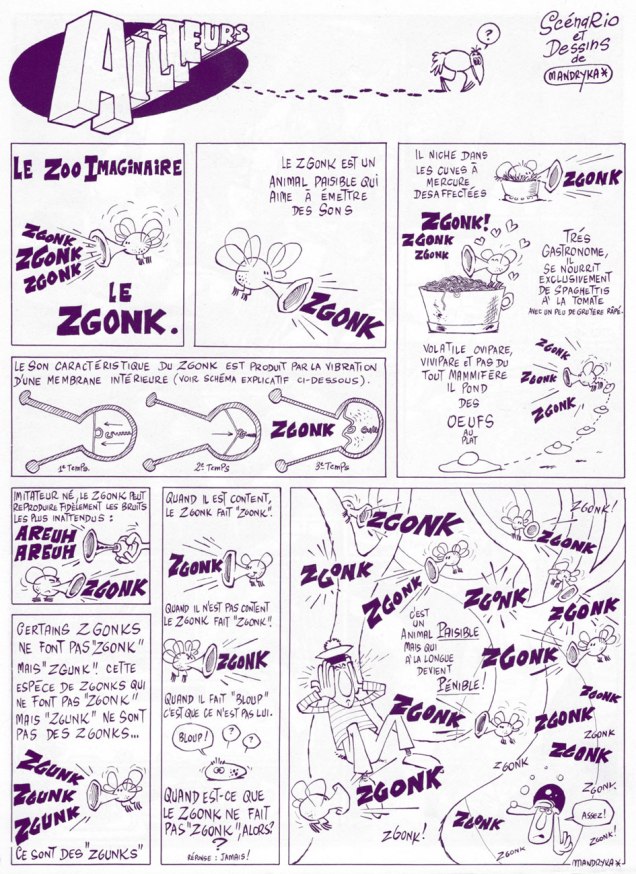
MandrykaAilleursZgonkA
Ailleursdébut, from the inaugural issue of Pif gadget / Vaillant no. 1239 (March 1st, 1969); If it goes “zgunk”, it’s not a zgonk, it’s a zgunk.

MandrykaAilleursArbresA

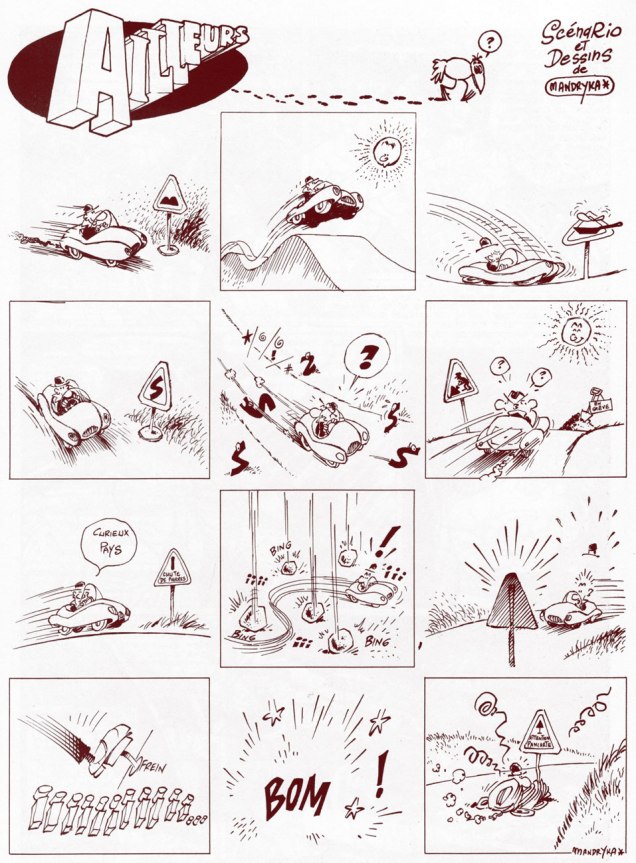
MandrykaAilleursRouteA

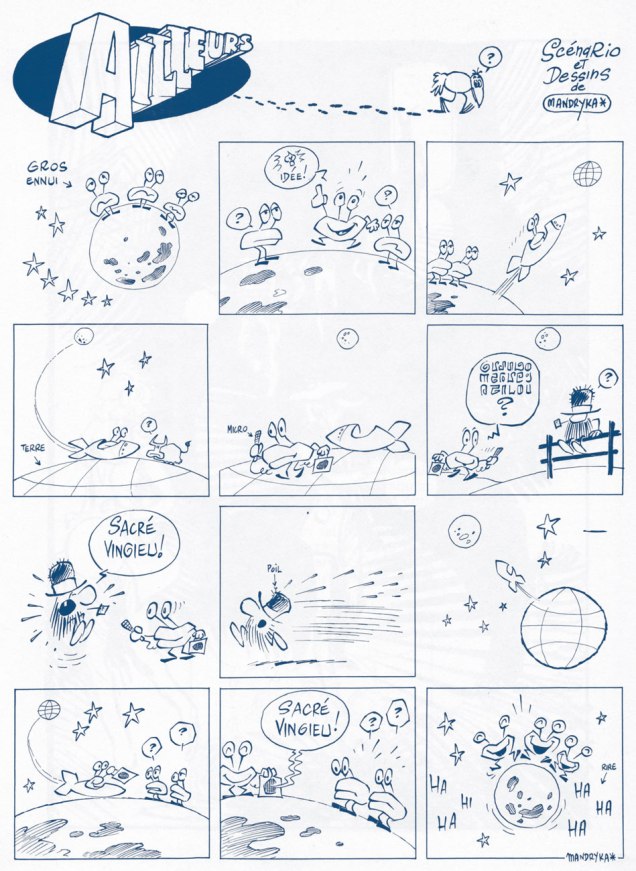
MandrykaAilleursVingnieuA
As an english equivalent to « Sacré vingieu! », I propose « Dagnabit! »
MandrykaAilleursTotoA
Ends with a sarcastic « Glory to the ten millionth discoverer of our planet! »
MandrykaAilleursPanierA
« An original solution to the parking problem. »
MandrykaAilleursBeefA
From Pif gadget no. 23 / Vaillant no. 1261 (July 1969); now you know what the legendarily stoic members of The Queen’s Guard do whilst at leisure.
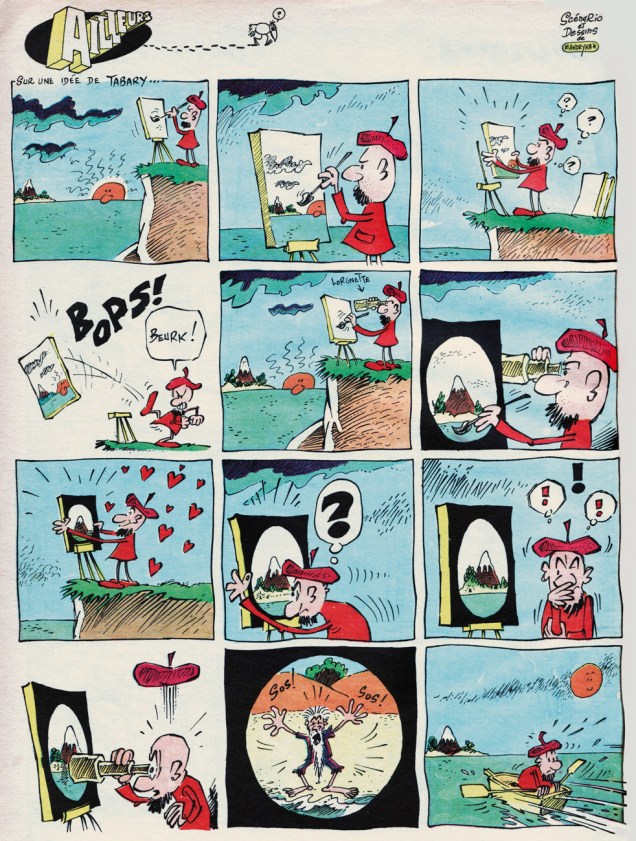
AilleursPeintreA
From Pif gadget no. 33 / Vaillant no. 1271 (Oct. 1969); idea provided by Tabary (Jean or his brother/ghost Jacques? We may never know).
MandrykaAilleursPetitPifA
The final Ailleurs strip, from Pif gadget no. 35 / Vaillant no. 1273 (Oct. 1969). This would have made a great skit for Jacques Tati‘s peerless Mr. Hulot.
MandrykaPortraitA
Nikita’s just heard a really good one during this photoshoot for a L’Écho des Savanes advert.

To my knowledge, Ailleurs has never been collected or comprehensively reprinted, save for nine of the strips turning up in Claude Moliterni‘s** excellent scholarly Phenix, revue internationale de la bande dessinée (nos. 31-31-32) in 1973.

-RG

*I’d even argue that Dufranne does a better Gotlib than Gotlib ever did.

**Among many notable achievements, he was co-founder of the Festival international de la bande dessinée d’Angoulême (Angoulême International Comics Festival).

Hoppel Poppel Comix

« I speak ten languages– all of them in Yiddish. » — Charles Rappaport

Like many a non-New-Yorker comics-loving goyim, my earliest encounters with Yiddish parlance came through Mad Magazine (furshlugginer, potzrebie, farshimmelt…), a practice initiated by its creator, Harvey Kurtzman, and carried on by his disciples and successors; unlike most of my ilk, however, my interest didn’t flag there, so I followed up Mad with Leo Rosten’s masterful The Joys of Yiddish.

As Art Spiegelman reminded us recently, in his controversial essay about the early American comic book industry, « the pioneers behind this embryonic medium based in New York were predominantly Jewish and from ethnic minority backgrounds. » Much like Mr. Spiegelman, I largely eschewed superheroes, unless nothing else was around. Of course, the trick to a varied diet is to stay alert to every possibility. Newspapers, naturally (it helps to live in or near a large metropolitan centre, though), random magazines, second-hand book stores, public and private libraries. Fluency in more than one language is a great asset, of course.

With the new possibilities opened up by the internet, I’ve grown quite fond of investigating obscure publications advertised or reviewed in old magazines. Case in point: a few years ago, I was flipping through The New Yorker‘s annual Cartoon Issue (another tip o’ the hat to Mr. Spieg) of 2001, and came upon this tiny, intriguing advertisement in its back pages.

HoppelPoppelAdA
Drek (rhymes with wreck): Dirt, shit, or inferior merchandise; Ferbissoner (fur-biss’-n-er): Someone who clenches their teeth all the time; a hard-ass; Bissel (biss-l): a little bit; Schmutzik (shmoot’ [as in book] – tzik): dirty; Tokkeh (tock’-eh): actually, or really.
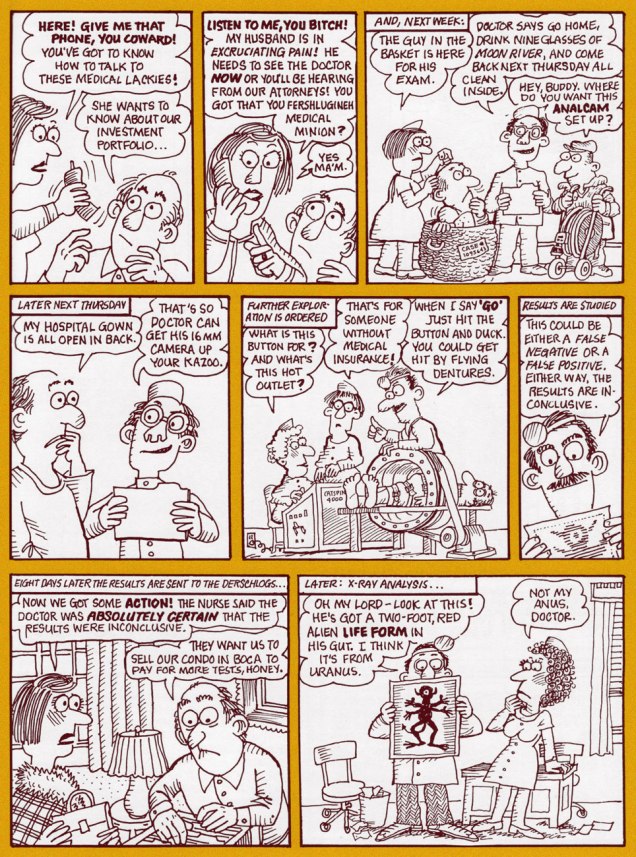
Obviously, I looked up Hoppel Poppel Comix online, found a copy, ordered it, loved it… and here we are. My pick, The Medical Journal of B.M. Derschlog, turns out to have been the first story produced, and the impetus for the rest of the collection.

HoppelMedical01AHoppelMedical02AHoppelMedical03AHoppelMedical04A

« Ken Eichenbaum’s comic book for adults began as cancer therapy. In 1999, Eichenbaum was diagnosed with colon cancer. While undergoing treatment, he began to come up with a 16-page thank-you card for those who had helped him through the ordeal. He was so encouraged by the response to that story, ‘The Medical Journal of B.M. Derschlog‘ — which lampoons his experience with the medical establishment — that he decided to write more illustrated tales. ‘I would lie in bed and there would be this shadow of illness. And I would come up with things that would make me chuckle to myself,’ says Eichenbaum, 70, who’s hesitant to talk about his cancer for fear of being seen as looking for sympathy. The result is a ‘graphic novel‘ — as these booklong comics are called — filled with sometimes funny, sometimes bawdy tales. Eichenbaum considers cartoonists Art Spiegelman and Ben Katchor to be two of his models, but ‘Hoppel Poppel‘ is less heart-wrenching than Spiegelman’s ‘Maus‘ and more slapstick than Katchor’s elliptical humor. » [source]

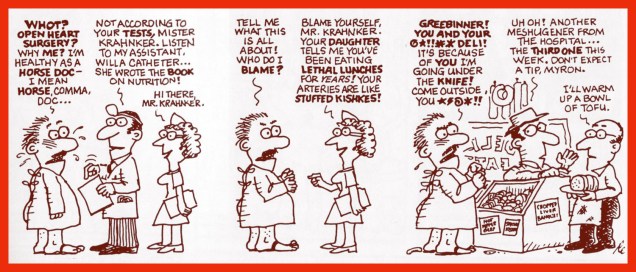
Mr. Eichenbaum was also clearly at ease with short-form gag strip (of these, the author coyly states: «… single-strip episodes, some of which may have previously appeared in Jewish community newspapers around the U.S. »). Some evidence:

HoppelSexAHoppelPinkAHoppelDrugsAHoppelDeliA

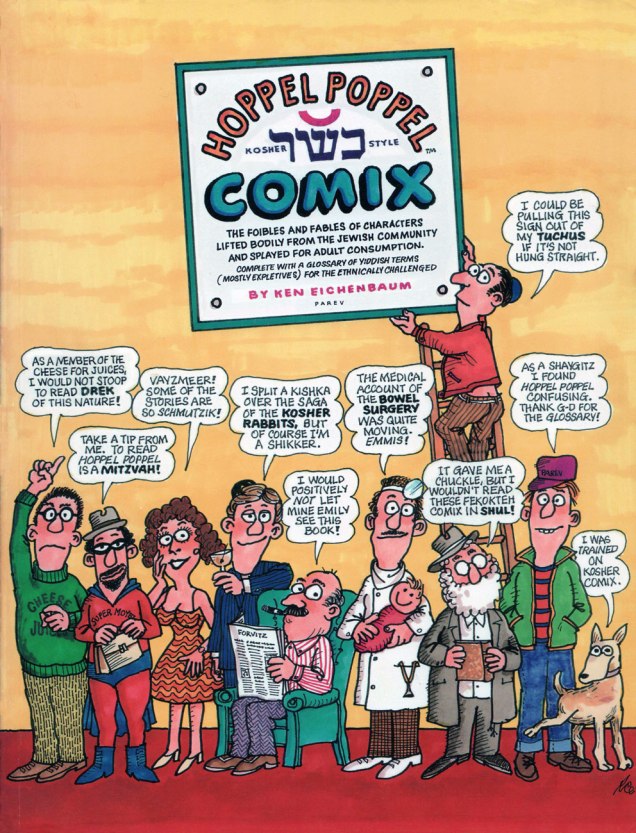
HoppelFrontCoverA
Cheese for juices : Jews for Jesus. Mitzvah (mitz’-Vah): A good deed, a commandment; Vayzmeer (vayz’-meer): A little prayer, like ‘help me’; Kishka (kish’-keh): Stuffed intestine, regarded by many as a delicacy; Shikker (shik’-ker): an inebriated person; the state of being drunk; Emmis (em’-miss; rhymes with tennis): truth!; Fekokteh (feh-kok’-teh): shitty; Shul (shul): a temple, as school; Tuchus (tuch’-es; rhymes with ruckus): buttocks– offensive; Shaygitz (shay’-gitz): a non-Jewish male.
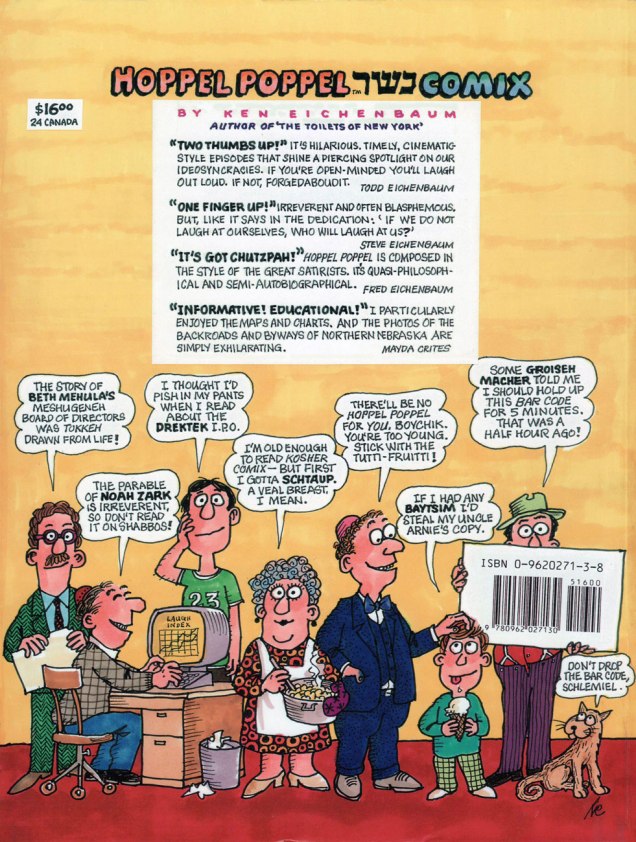
HoppelBackCoverA
… and the back.

Well, it looks like a lovely day out there, so I’m off to pick up some potato knishes (like Mr. Kotter, I simply can’t kick that particular addiction)!

-RG

Sweepin’ the clouds away: Jack Davis’ Sesame Street

« Until now Mr. Cookie Monster refused to talk about the matter because his mouth was full, and it’s not polite to talk with your mouth full. » — Guest Star Robert McNeil

With the venerable MAD Magazine (1952-2019) bowing out after sixty-seven years, and kid’s educational show Sesame Street (singalong time!) about to hit the half-century mark, it seems à propos to salute one of the geniuses their respective histories share, Jack Davis (1924 – 2016)… rather than mire ourselves in the inevitable stack of lachrymose paeans to Harvey Kurtzman’s long-lost progeny.

So, are you in need of a bit of cheering up after a down-in-the-dumps day? Take a stroll down friendly Sesame Street with sweet Mr. Davis! Now isn’t this a place where you’d care to linger a spell?

DavisCookieRemember1A
A lovely excerpt from the Sesame Street Annual (1972, Dell); according to the table of contents, it teaches ‘Planning’. Don’t worry, I won’t leave you in the lurch: the answers are at the end of this post. You’re welcome!
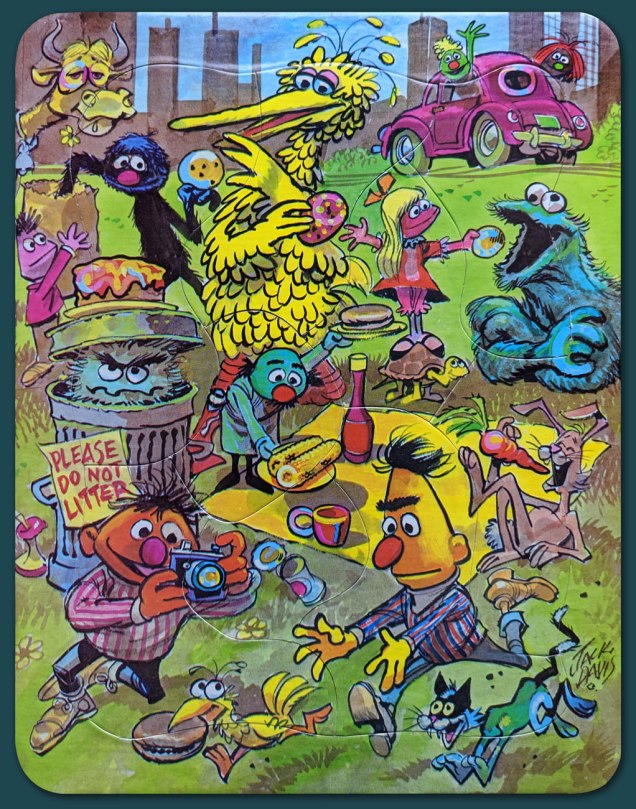
DavisHemlockPuzzleA
It’s a sunny day indeed when genial Jack Davis’ long legs come striding down Sesame Street! The series was called Sherlock Hemlock’s Hidden Answer Jigsaw Puzzles, and this is number one, The Puzzle of the Hidden C’s. Well, don’t just stand there gaping, how many can *you* spot, wise guy?
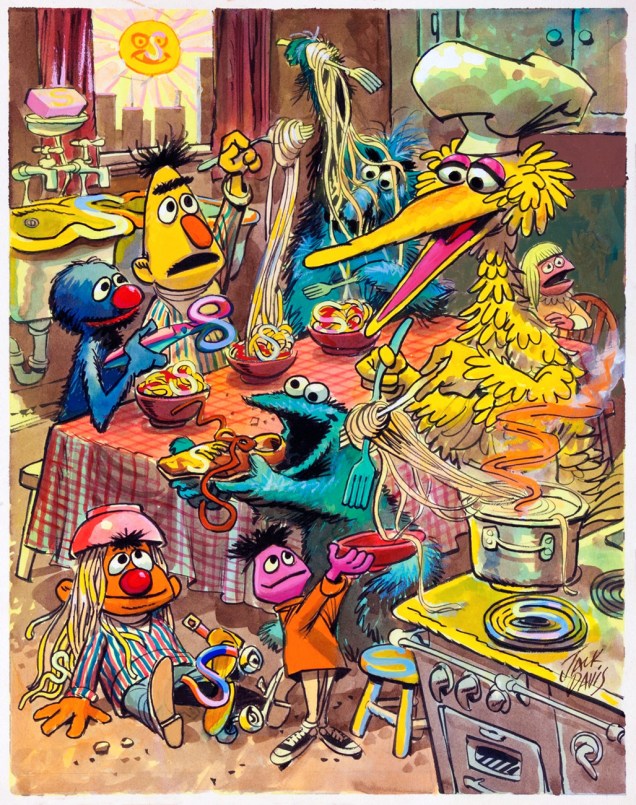
SherlockHemlockA
Spaghetti and chaos are on the menu in this scene that Davis was commissioned to create in 1971, early in the rise of the Muppet empire. This is number 2, The Puzzle of the Hidden S’s.
SherlockHemlock4A
This is number 3, The Puzzle of the Hidden Numbers. Each puzzle was packaged with a blue transparency “looking glass”, which could be used to discover hidden shapes in the picture. I’m afraid I don’t have one to spare, so you’ll have to procure your own.
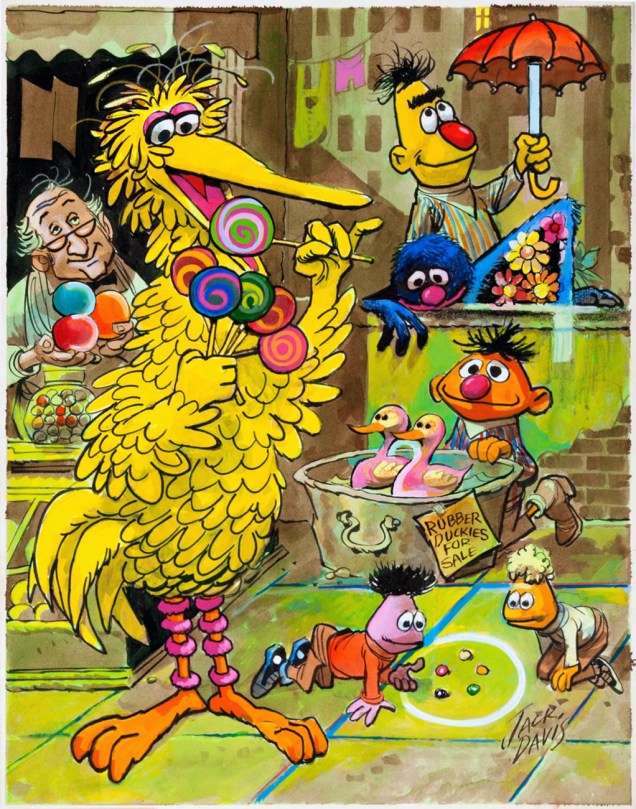
DavisHemlockStreetA
And here’s number four of the puzzle illustrations Mr. Davis created for Educational Toys’ Sherlock Hemlock’s Hidden Answer Puzzle series. This is número 4, The Puzzle of the Hidden Shapes… you know what to do next!

BlueLookingGlassA
Here’s the aforementioned [Yves Klein] blue looking glass you’ll need.
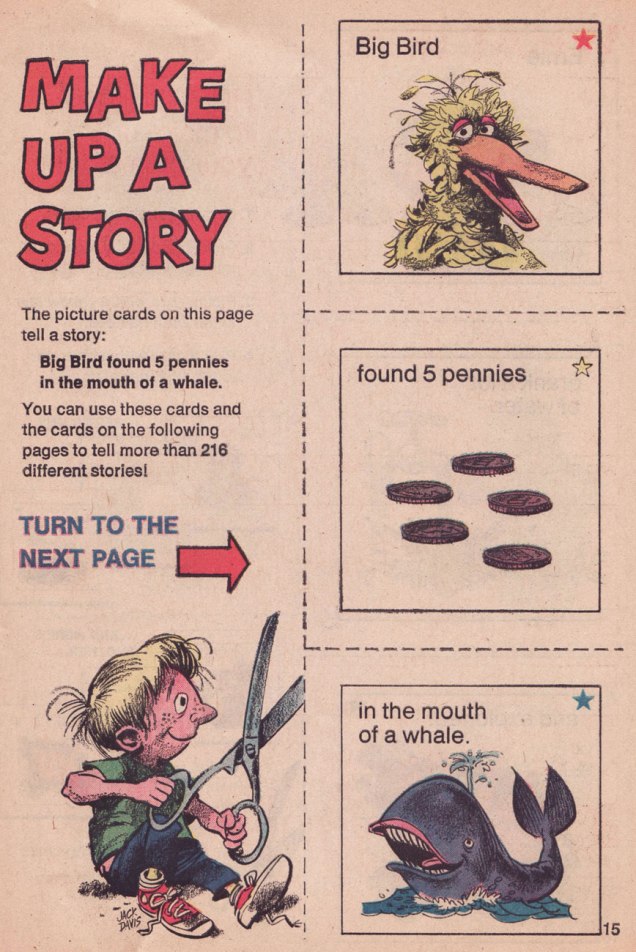
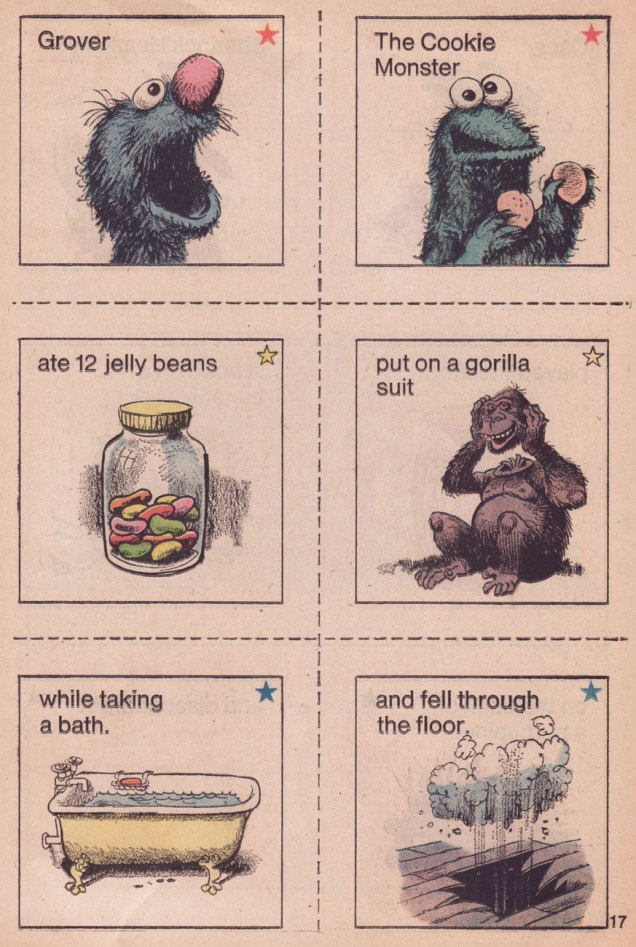
DavisMakeUpStory01ADavisMakeUpStory02ADavisMakeUpStory03A

DavisMakeUpStory04A
Another Davis-illustrated exercise in fun from the 1972 Sesame Street Annual, which also features some gorgeous contributions from Mel Crawford and Davis’ fellow Usual Gang of Idiots member, Al Jaffee. This one teaches, again according to the “Parents’ Guide to Contents”, “Pre-reading skills”.
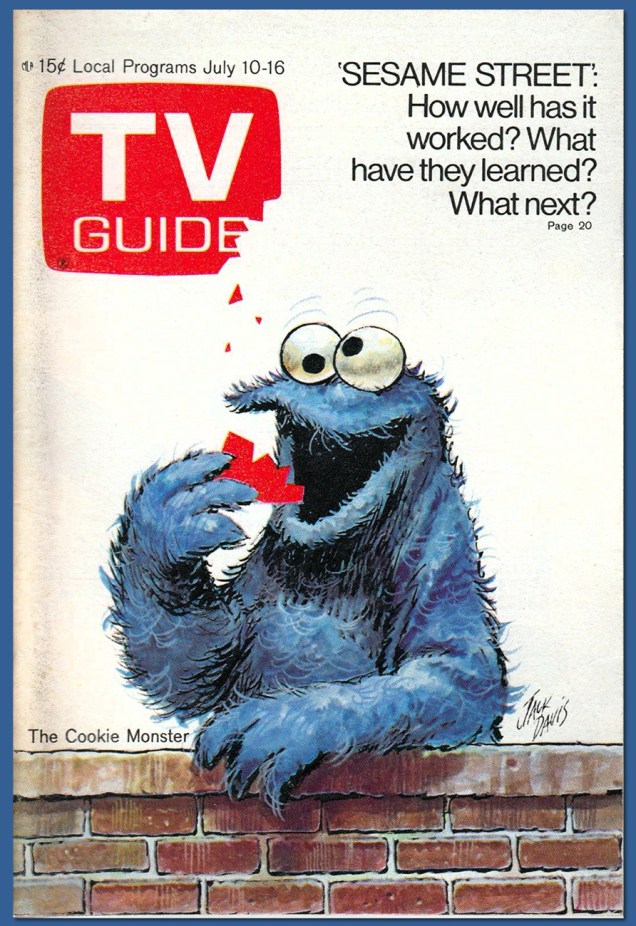
TVCookieA
As one of America’s most distinctive and deservedly successful illustrators, Davis created scores of splendid TV Guide covers, and he was uniquely well suited for this one. This is the July 10, 1971 issue. I never would have figured the mag’s logo to be edible, but then the Cookie Monster’s idea what’s fit to eat is pretty liberal.
SesameStreetPosterA
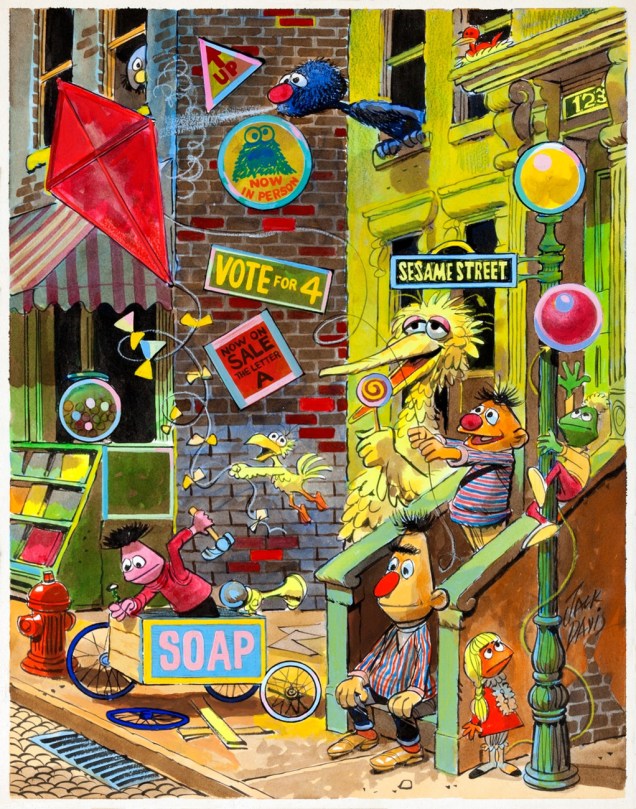
A very early Davis Sesame Street illustration initially used in The Sesame Street Learning Kit (Children’s Television Workshop, 1969); the show made its début on November 10, 1969, on the about-to-expire National Educational Television network. A merger soon turned the NET into the Public Broadcasting Service, which Sesame Street, now in its 49th season, calls home to this day.
DavisCookieRemember2A
And here’s your answer. Thanks for playing along!

In case one of you experts is wondering, I did leave out, deliberately, Davis’ single meatiest contribution to the show’s canon: The 1972 Sesame Street Calendar (which I look forward to reusing in 2028), twenty-five pages of pure Davis, including thirteen particularly lush watercolours. In order to do it justice, it’ll require at least one post of its own.

And as we’re on the topic of Sesame Street’s seemingly boundless creativity, I can’t recommend enough this recent profile of the enduring friendship of a pair of the show’s most pivotal songwriters.

« Never refer to me as an item. I’m a bird. » — Big Bird

– RG

A Garrulous Dilettante and Her Pals: Tom Hachtman’s Gertrude’s Follies

« Everybody thinks that this civilization has lasted a very long time but it really does take very few grandfathers’ granddaughters to take us back to the dark ages. » — Gertrude Stein

Several years ago, while browsing in the comics section of a rather lousy bookstore (by which I mean a book shop in which none of the employees know a thing about books, let alone are actual readers… I suspect that this is becoming more common, with predictable results), I stumbled upon an oddball item, a faded-looking, obscure comic strip collection lost amidst the monotonous stacks of DC ‘n’ Marvel superhero fare and the perennial dusty Garfield and Doonesbury paperbacks.

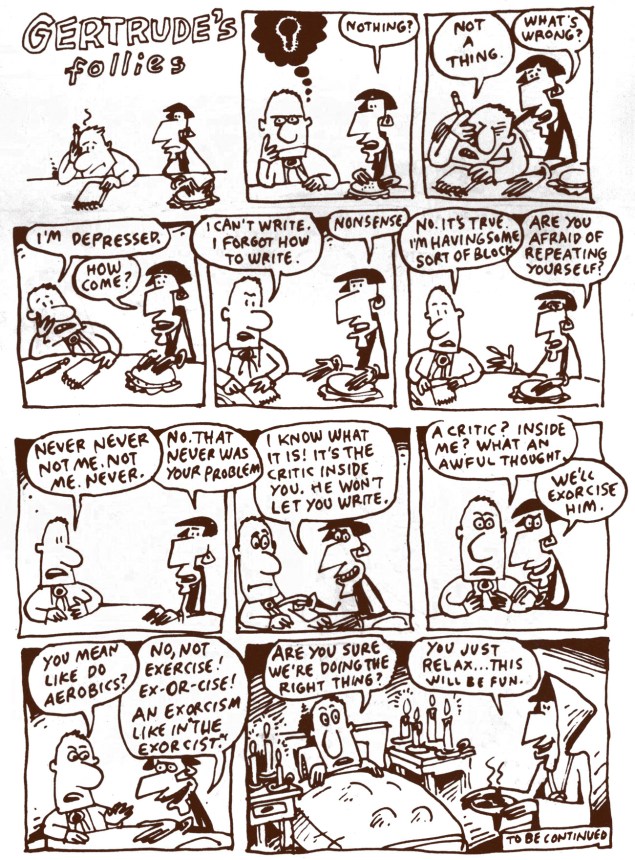
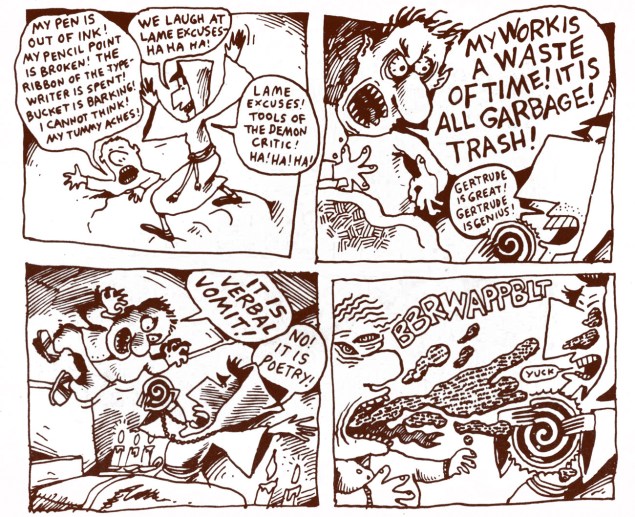
This was Fun City (1985), the second recueil of Tom Hachtman‘s newspaper strip Gertrude’s Follies, which at the peak of its circulation appeared in… well, one paper, but a good one, at least. That was the SoHo Weekly News (1973-82). After the weekly’s demise, a handful of episodes appeared in the fast-fading National Lampoon. Much, much later (which is to say currently) the strip lives on within the pages of American Bystander, an astonishingly well-staffed humour magazine. I smell doom.

Anyway, here’s Hachtman’s recollection of the strip’s genesis, from a 1980 interview conducted by Maxine Fisher for Funnyworld no. 22 (”The world of Animated Films and Comic Art”):

MF: What was your inspiration for a strip about Gertrude Stein and her companion, Alice B. Toklas?

TH: I knew of them, but I didn’t know much about them. And then I saw a photograph of them [by none other than Man Ray] sitting in a room at the home on the rue de Fleurus in Paris. I looked at this famous lesbian couple sitting across from one another — so far apart– and I thought: ”Look at that! One of them is fat, and the other one’s skinny. That’s funny. They’re just like a comedy routine. I wonder if they had any fun.” It didn’t look like they were having any fun in that picture; they just looked like they were posing for a picture. But I thought: ”maybe they ran around and had lots of fun.” So I started drawing pictures of them, and drawing pictures of their friend Pabs, and looking at pictures of them, and looking at pictures of Picasso.

Anyway, I started drawing Gertrude and Alice and Pabs and Hemingway and putting them into situations in my sketchbook.

Basically, I was doing Abbott and Costello or I Love Lucy starring Gertrude, Alice, and their friends.

I knew if would make a nice comic strip in a newspaper. And that narrowed it down. Here was a comic strip about a lesbian couple and all their artist friends. There weren’t too many newspapers that were going to publish this. In fact, I thought, there’s only one. And I started to watch the SoHo News, wondering where it would fit. Where would they put this thing? Would they give me a whole page to do a comic strip?

More juicy details from another interview, this one conducted in 2018 by Martin Kozlowski:

MK: One of the unique features of the strip is the blending of Jazz Age Paris and Punk Rock New York. Was that a deliberate strategy or did it naturally evolve?

TH: I was living in NYC in the 1970s. I only know Paris from movies and books. That’s right; I have never been to Paris. So, when I draw a mailbox I am too lazy to research what a mailbox looks like in Jazz Age Paris. I just draw a mailbox as I know it. I have been told that my readers in Paris find this very amusing. So, the blending happens — naturally.

GertrudeFollies02A

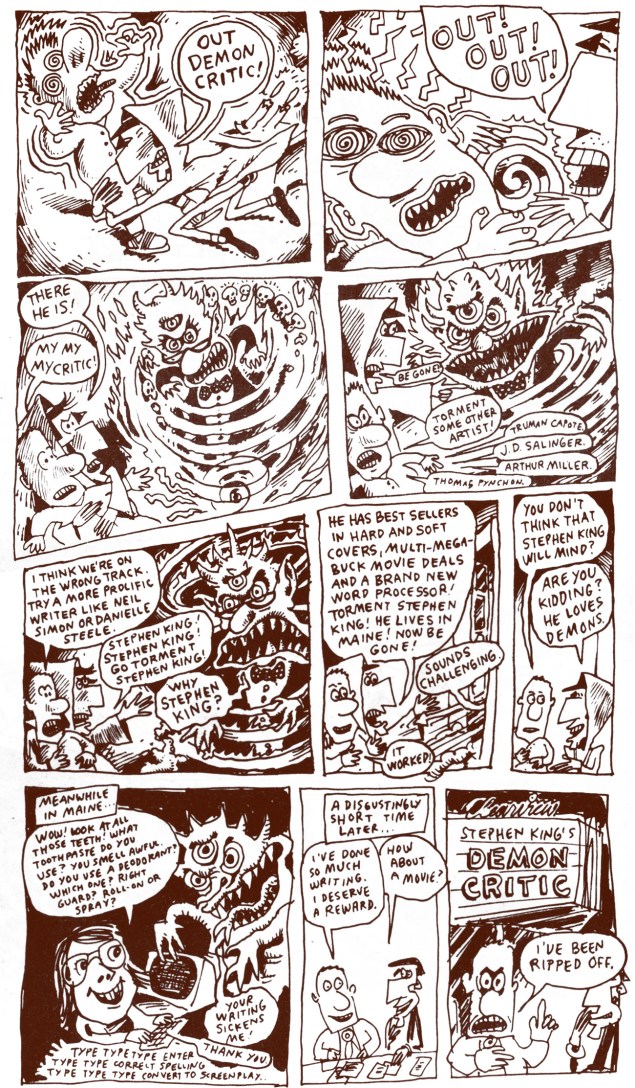
GertrudeExorcism02AGertrudeExorcism04AGertrudeExorcism05A

GertrudeExorcism07A
However, something that Stephen King does mind

GertrudeFollies01AGertrudeFollies03A

GertrudeBrideA
Oh, I’ll bet dear old Dr. Pretorius would be right chuffed with this Alice Bride. « To a new world of gods and monsters! », as the good doc famously exclaimed.
GertBucketAliceA
Our heroines in a more (or less) realistic vein. In the usual order: Gertrude, Bucket, Alice.
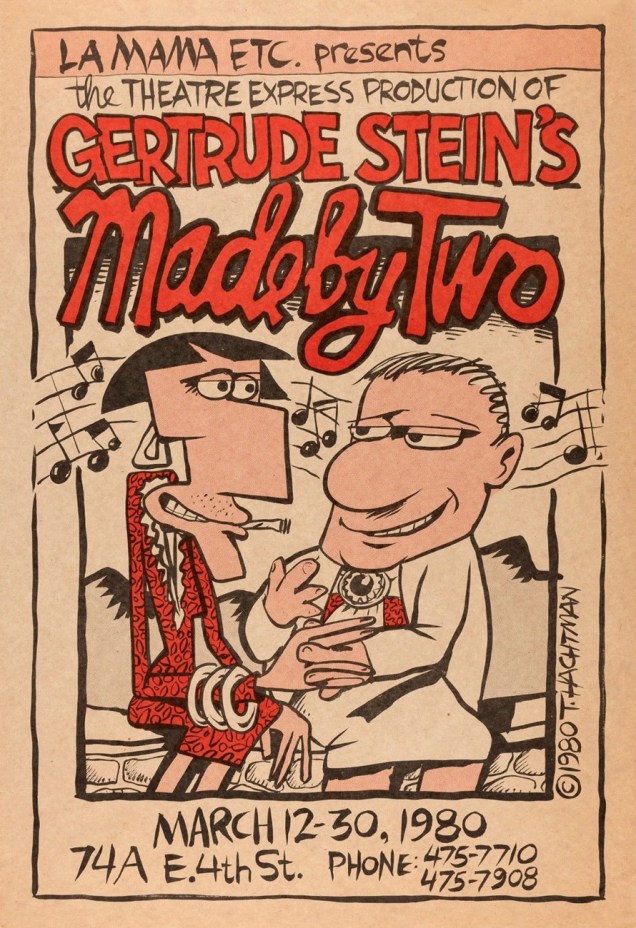
HachtmanCafeLaMamaPosterA
Despite, or perhaps because of the liberties he takes with these semi-sacred historical figures, Hachtman’s Gertrude appears to be rather beloved of the keepers of Gert and Alice’s mad flame. For example: « I look at the cover of the soon-to-be-reborn Follies several times a day and have a laugh each time. Too funny, Hemingway’s teeth, silly Picasso avec crayon, Basket’s slobbering excitement and Alice’s cigarette charm!! And Gert, yes sir, she is fierce!!! Rose flying like arrow ready to hit Alice’s nose. This can’t get any better! I hear the brooch ringing… Bravo! » –– Stein scholar Renate Stendahl
HachtmanPortraitA
The auteur, circa the late 70s. Say, what’s that he’s sporting?
GertrudeFolliesSunA
Un mini-parasol, une ombrelle. For shade, not protection from the rain. Hachtman was fond of road-testing some of the props employed by his players. Gives the strip that je ne sais quoi of authenticity, don’t you know.

If  you like what you see, you may rejoice in the fact that Gertrude’s Follies has lately become more widely available (whilst retaining its elusive cachet) thanks to the efforts of Now What Media. Amble over to their website, where they provide a generous sampling of strips and biographical information, not to mention the possibility of acquiring the collections.

Oh, and do check out Alice’s unusual, lasting contribution to popular culture.

« I love you, Alice B. Toklas, and so does Gertrude Stein… »

-RG

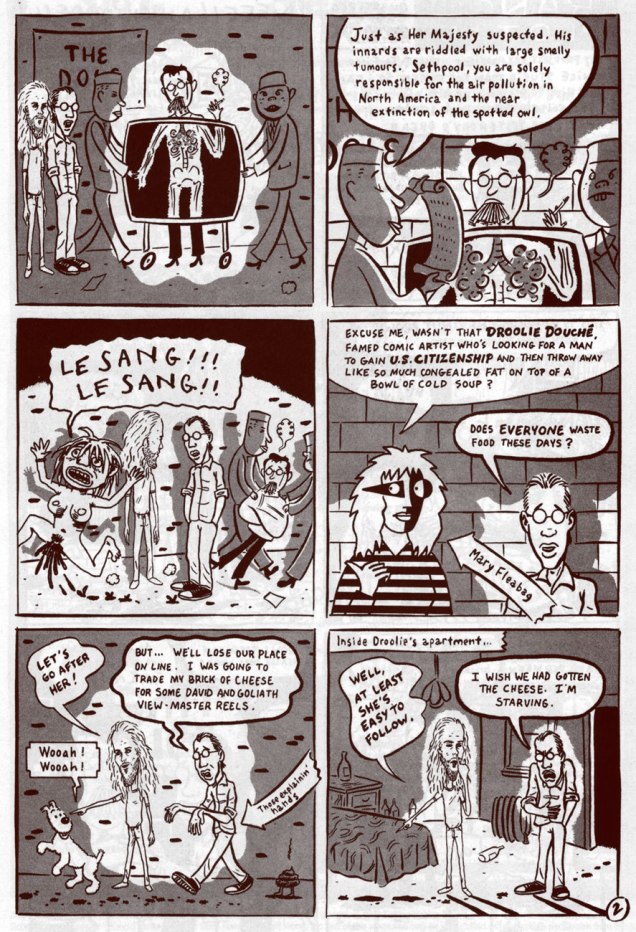
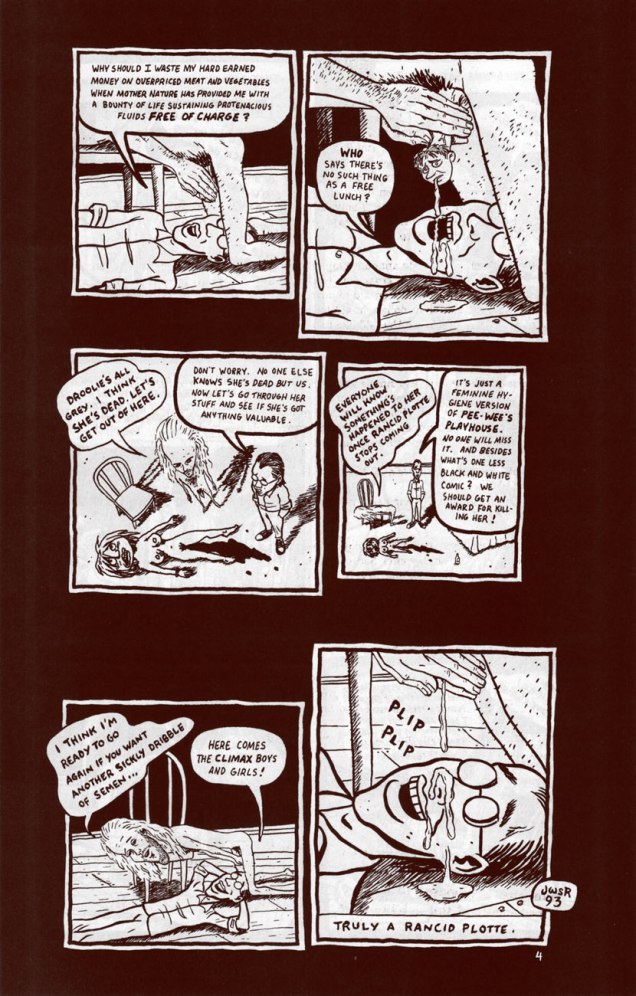
“Just a feminine hygiene version of Pee-Wee’s Playhouse”: Russo & Wong’s ‘Rancid Plotte’ (1993)

« We’re not very accepting of people who act strangely. » — Chester Brown

Scott Russo’s Jizz, published by Fantagraphics in 1991-93 (10 issues in all), was a fearless, often downright incendiary and frequently fascinating repository of vitriol from the heart and soul of Mr. Russo. As his own drawing style was pretty rudimentary (but clean and distinctive), the auteur drew upon collage, détournement and plain old text pieces for variety. Russo may have been embittered and misanthropic, but the entertainment he proffered was quite deliberate; a fine, dexterous trick to pull off.

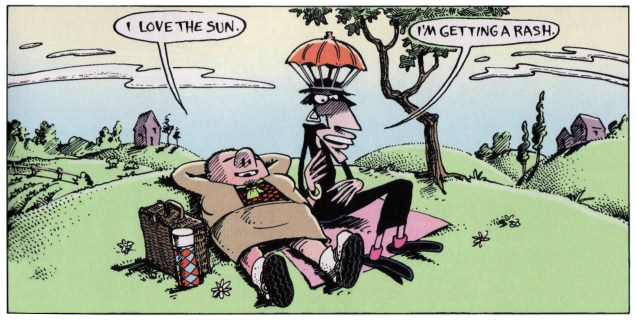
Here, from Scott Russo’s Jizz no. 10 (March 1993, Fantagraphics), is his merciless but spot-on takedown of publisher Drawn & Quarterly‘s stable of neurotics: Julie Doucet, Joe Matt, Chester Brown and Seth, rendered in a breathtakingly accurate facsimile blend of their respective styles and schticks. Script by Russo, art by his trusted confederate ‘Master’ Jeff Wong. Not particularly ‘safe for work‘, I should say.

RussoRancidPlotte01ARussoRancidPlotte02ARussoRancidPlotte03ARussoRancidPlotte04A

Russoolive01A

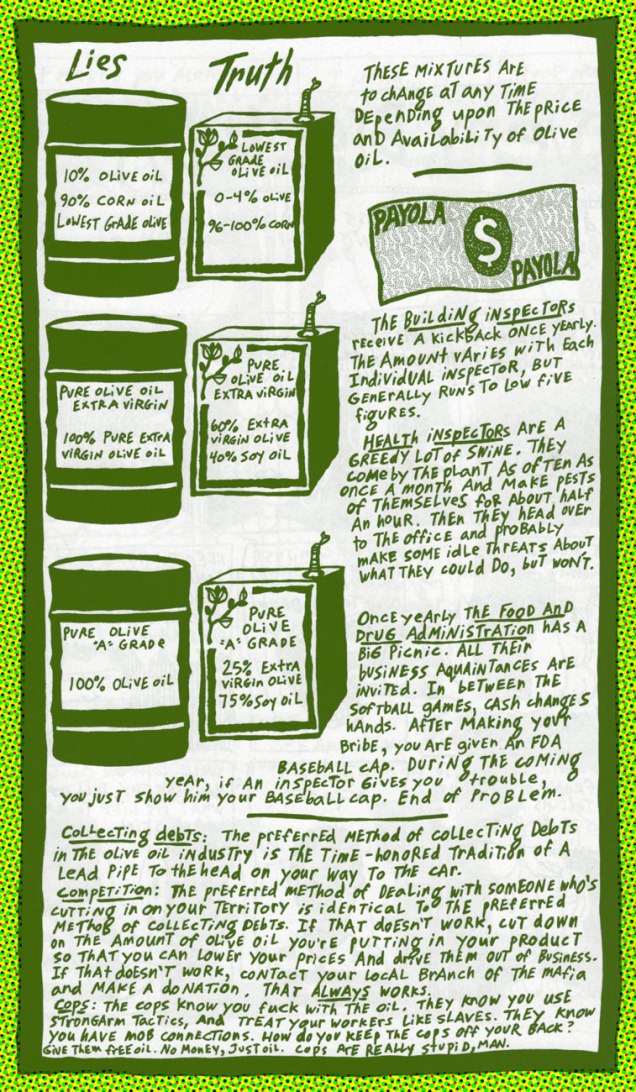
Russoolive02A
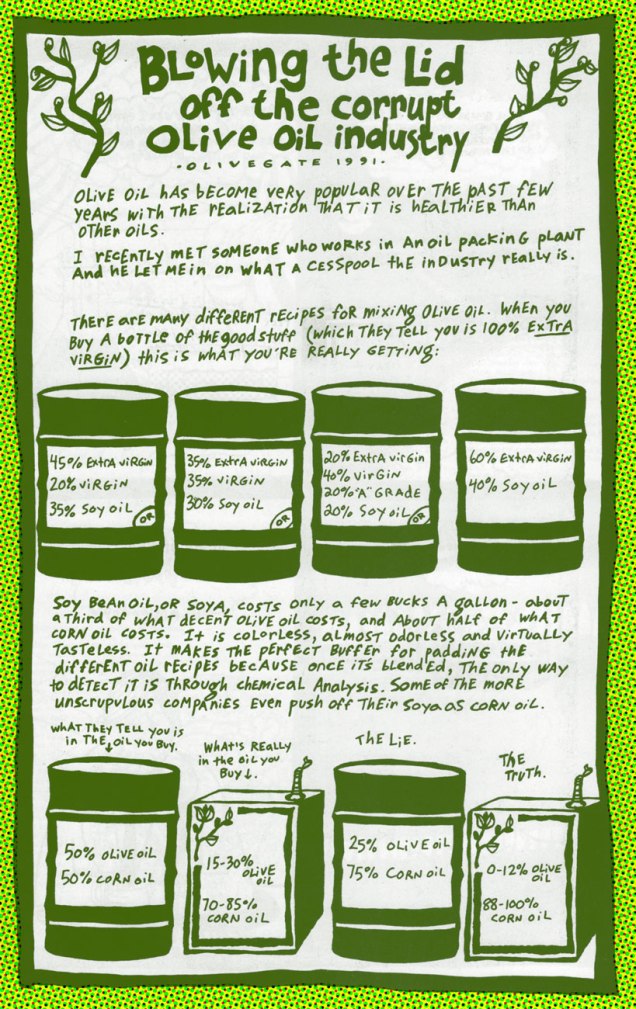
From Scott Russo’s Jizz no. 7 (Sept. 1991, Fantagraphics). I’ll always be grateful to Mr. Russo for this scathing exposé of the Olive Oil industry. My girlfriend at the time was taking a chemistry class at McGill University, during which they subjected various brands of olive oil to chemical analysis and essentially confirmed Russo’s claims. Now I merely snicker and shrug when I see someone shell out big bucks for the stuff… sometimes there’s no sense in trying to convince anyone.

-RG