« Be silent in that solitude which is not loneliness — for then the spirits of the dead who stood in life before thee are again in death around thee — and their will shall then overshadow thee: be still. »
— Edgar Allan Poe (1829)
It was on this day, two hundred and ten years ago, that the great writer, poet and posthumous master of all media Edgar Poe (Jan. 19, 1809 – Oct. 7, 1849) was born in Boston, Massachusetts. I’ll spare you the usual biographical details, widely available elsewhere, and we’ll concentrate on his unflagging ubiquity in the medium of comics.
Poe’s literary reputation was in tatters in America, thanks to a rash of hatchet jobs and dismissals, some of the most vicious from the pen of one Rufus Griswold, the very worm he’d named his literary executor (!), as well as such notables as Ralph Waldo Emerson and T.S. Eliot… while his renown was undimmed in Europe, particularly in France (in no small part owing to Charles Beaudelaire’s legendary translations), rehabilitation at home slowly came as the 20th century crept along, but it was likely the publication of Arthur Hobson Quinn’s definitive Poe biography, in 1941, that sealed the deal and opened the floodgates.
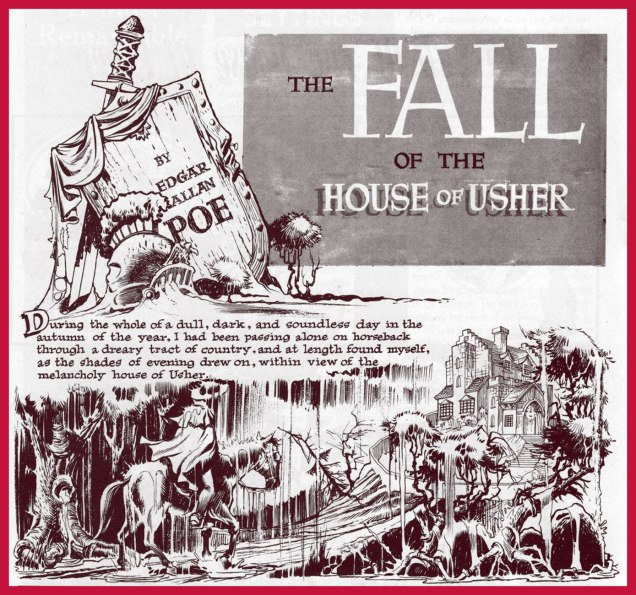
Top two tiers from page 2 of The Spirit‘s August 22, 1948 episode. Layout by Will Eisner, pencils and inks by Jerry Grandenetti. As Dave Schreiner puts it: « Grandenetti captures the asthenic look of Roderick Usher that Poe described. The man is a decadent waif; insular, fragile, high-strung, possibly in-bred. »
Classics Illustrated publisher Gilberton was first out of the gate with Poe adaptations, at first tentatively with a pair of poems (Annabel Lee, then The Bells)**, then more substantially with The Murders in the Rue Morgue, in Classic Comicsno. 21 – 3 Famous Mysteries (July, 1944), sharing the stage with Arthur Conan Doyle and Guy de Maupassant. Read it here. Pictured below is Classics Illustratedno. 84 (June 1951, Gilberton), cover by Alex A. Blum. Read the issue here.
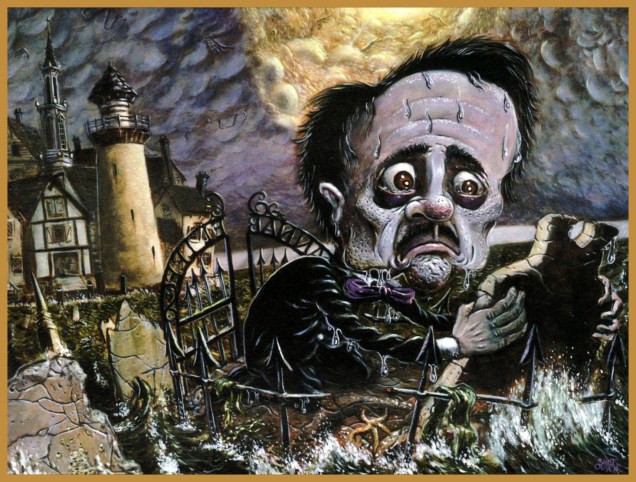
A relevant passage from Simon Singh‘s fascinating (if you’re into that sort of thing… and I hope you are) The Code Book: The Secret History of Codes and Code-Breaking (1999): « On the other side of the Atlantic, Edgar Allan Poe was also developing an interest in cryptanalysis. Writing for Philadelphia’s Alexander Weekly Messenger, he issued a challenge to readers, claiming that he could decipher any monoalphabetic substitution cipher. Hundreds of readers sent in their ciphertexts, and he successfully deciphered them all. Although this required nothing more than frequency analysis, Poe’s readers were astonished by his achievements. One adoring fan proclaimed him ‘the most profound and skilful cryptographer who ever lived’. In 1843, keen to exploit the interest he had generated, Poe wrote a short story about ciphers, which is widely acknowledged by professional cryptographers to be the finest piece of fictional literature on the subject. The Gold Bug tells the story of William Legrand, who discovers an unusual beetle, the gold bug, and collects it using a scrap of paper lying nearby. That evening he sketches the gold bug upon the same piece of paper, and then holds his drawing up to the light of the fire to check its accuracy. However, his sketch is obliterated by an invisible ink, which has been developed by the heat of the flames. Legrand examines the characters that have emerged and becomes convinced that he has in his hands the encrypted directions for finding Captain Kidd’s treasure. »A page from EC Comics great Reed Crandall‘s exemplary adaptation of Poe’s The Tell-Tale Heart, from Creepyno. 3 (June, 1965). While Crandall’s work is outstanding, scripter-editor Archie Goodwin tried to ‘improve’ upon Poe by tacking on a tacky ending, a nasty habit he would indulge in again on subsequent adaptations, notably issue 6’s The Cask of Amontillado!. Read The Tell-Tale Heart. And don’t miss The Cask…, if only for the artwork.In the mid-70s, Warren would devote two full issues of Creepy to Poe adaptations; issue 69 (Feb. 1975), featured The Pit and the Pendulum, The Fall of the House of Usher, The Premature Burial, The Oval Portrait, MS Found in a Bottle!, Facts in the Case of M. Valdemar; issue 70 (Apr. 1975) comprised The Murders in the Rue Morgue, Man of the Crowd, The Cask of Amontillado!, Shadow, A Descent into the Maelstrom! and Berenice; All stories were adapted, with far greater respect than Mr. Goodwin seemed capable of, by Rich Margopoulos, and illustrated by a host of artists. The project was edited by Bill DuBay, and the cover painting is by Ken Kelly.Isidre Monés‘ fabulous opening splash from Creepyno. 70‘s Berenice. Read the story in full here.« The rays of the moon seemed to search the very bottom of the profound gulf; but still I could make out nothing distinctly, on account of a thick mist in which everything there was enveloped, and over which there hung a magnificent rainbow, like that narrow and tottering bridge which Musselmen say is the only pathway between Time and Eternity. » In 1976, a peak-form Berni Wrightson got out his brushes and paint tubes for a heartfelt portfolio of Poe-inspired oils. A sensitive and subtle sense of colour was among Wrightson’s chief assets; it’s a shame we didn’t see more of it. I opted to feature my favourite piece from the lot, A Descent Into the Maelström, but by all means feast your eyes on the whole shebang.In 1976, Marvel Comics set out to make their mark on the classics… with dubious, but predictable results. It wasn’t what their zombie readership had clamoured for. Here’s the best page (art by Rudy Mesina) from Marvel Classics Comicsno. 28, The Pit and the Pendulum (1977), featuring three tales adapted by scripter Don McGregor, and including future superstar Michael Golden‘s abysmal professional début on yet another helping from The Cask of Amontillado, where he demonstrates how he believes wine is to be drunk just like Pepsi. See what I’m griping about here.Think Poe’s all about the horror? Think again! You don’t become a household name by putting all your eggs in the same basket. Meet Edgar ‘Eddie’ Allan Poe, romantic leading man. “Based on actual records…” and sanitized beyond recognition. Given that Virginia and Edgar were first cousins and that they married when she was thirteen, you can see how absurd this strip is. Read the full tale of romance and pathos right here. The Beautiful Annabel Lee appeared in Enchanting Loveno. 2 (Nov. 1949, Kirby Publishing). Writer unknown, art by Bill Draut and Bruno Premiani.Kubert School alum Skot Olsen‘s cover illustration for the revised and expanded second edition (July, 2004) of Graphic Classics‘ Poe compendium.As with, say, Elvis or H.P. Lovecraft, when both legend and œuvre reach a certain tipping point of iconic fame, one can bend and twist the concepts any which way and they’ll still be recognizable. Here’s a panel from Harvey Kurtzman and Will Elder‘s faithful-in-its-fashion take on The Raven, from Madno. 9 (Feb.-Mar. 1954, EC).Michael Kupperman strikes again. From Snake ‘n Bacon’s Cartoon Cabaret ( 2000, HarperCollins)Hot off the presses! It’s Edgar Allan Poe’s Snifter of Terror no. 2 (Nov. 2018, Ahoy), featuring a collaboration between Rachel Pollack and the fabulous Rick Geary. Don’t miss it! Oh, and if the pose looks familiar, you’re thinking of this.
Whew — that’s it for now. In closing, I must bow and salute before the gargantuan endeavour accomplished by Mr. Henry R. Kujawa on his truly indispensable blog, Professor H’s Wayback Machine. Thanks for all the heavy lifting, Henry. I get exhausted just thinking about it.
« When I was a boy, I always saw myself as a hero in comic books and in movies. I grew up believing this dream. » – Elvis Aaron Presley (1935 — ?)
Today, somewhere, the King of Rock ‘n’ Roll celebrates his eighty-fourth birthday, be he alive, dead or undead, he lives on. And never forget: Elvis is everywhere!
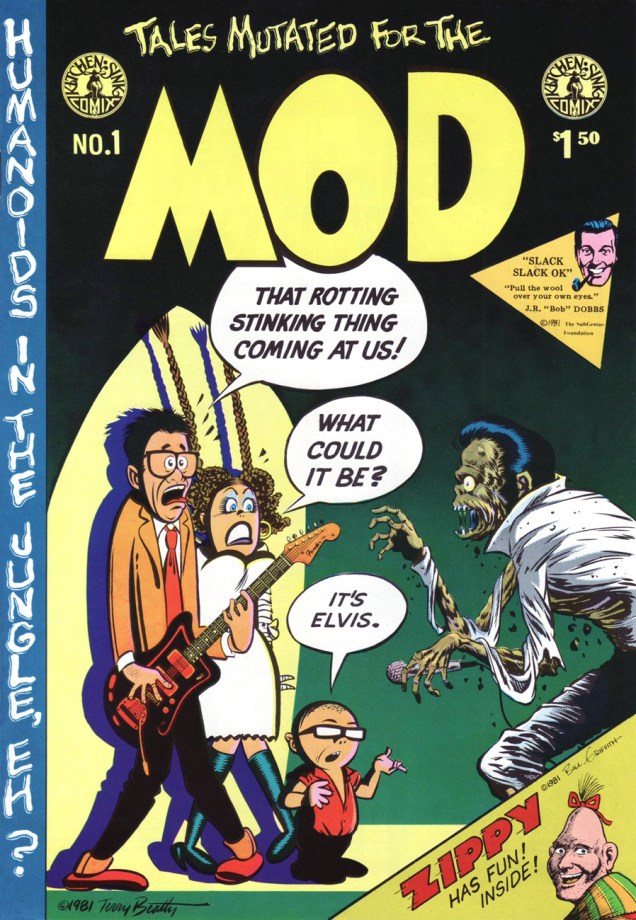
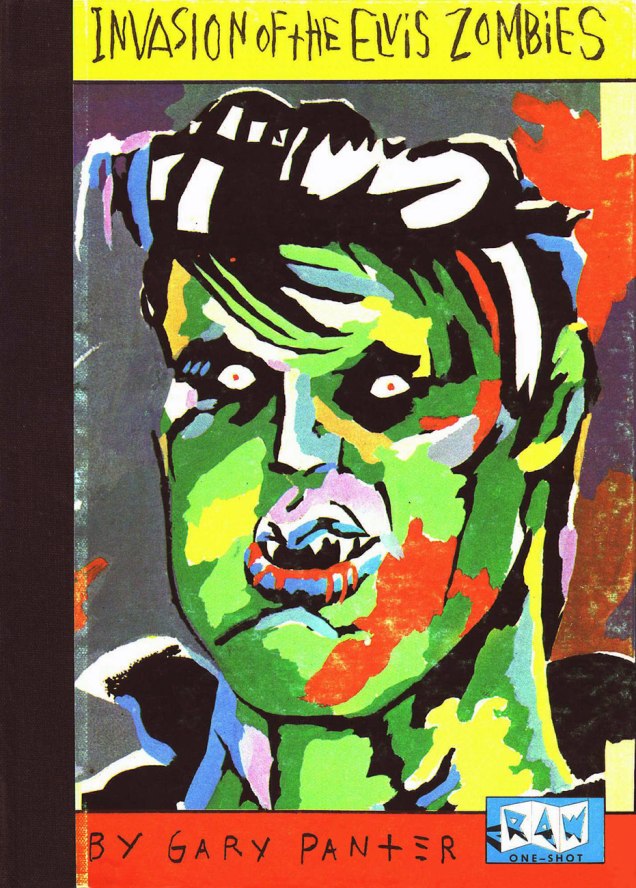
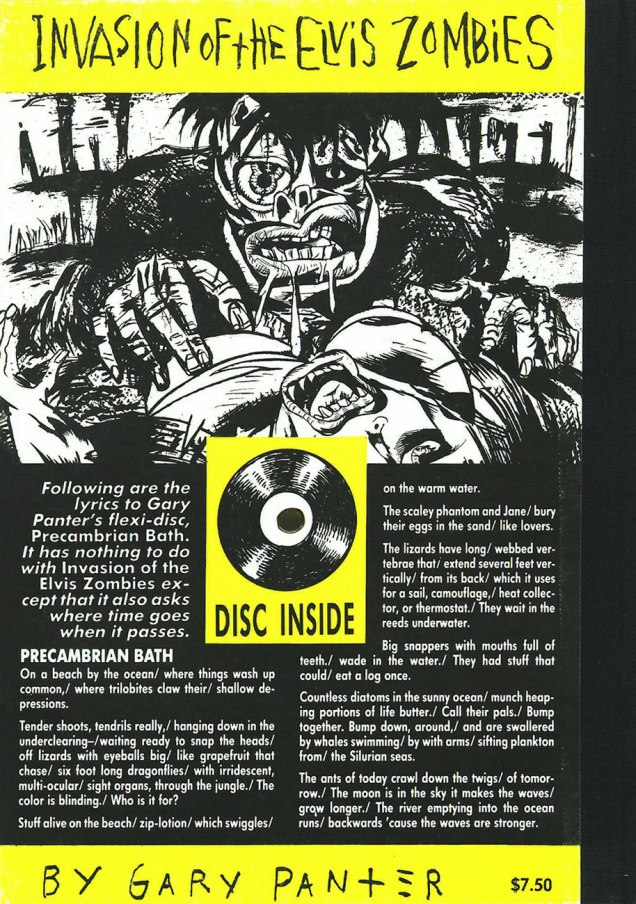
A most salty salute to the King of Rock ‘n’ Roll on his birthday! Compared to earlier decades, the 1980’s (and on!) were not kind to the anthology comic book. Thankfully, the meagre rewards and resounding indifference weren’t enough to quite dissuade some foolhardy souls from giving the format a go. But the fanboys wanted spandex, they wanted continuity and they soon wanted their « decompressed storytelling ». Bah. In 1981, Kitchen Sink Comix published the lone issue of Terry Beatty‘s labour of irradiated passion, Tales Mutated for the Mod. (June, 1981). Unlike John Byrne and others’ unceasing and pointless ‘tributes’ to Fantastic Four No. 1, this cover version of Harvey Kurtzman‘s Mad No. 1 is fiendishly clever. Kudos, Mr. Beatty!Gary Panter crafted this loving tribute in 1984, a one-shot published by RAW. Such heady stuff was well ahead of its time!The back cover… this beats Power Records‘ meek offerings flat!The oft-inaccurate Grand Comics Database really fumbles it this time: the instantly-recognizable icon on the right is, according to them… Fabian. Dopes. Hamilton, Ontario’s Win Mortimer (1919-1998), inducted into the Joe Shuster Hall of Fame in 2006, drew this cover for DC’s Heart Throbsno. 95 (April-May 1965); given the time period and The Pelvis’ shirt, he would presumably be shooting the dire Paradise, Hawaiian Style. If you’re of a mind to commemorate the King’s anniversary with one of his mid-60s cinematic offerings, better opt for the far finer Tickle Me (1965).His (alleged) paper boy claims, and I do want to believe him, that the Big E has peacefully decamped to the quietude of Eerie, Indiana. Looking good, Big E!
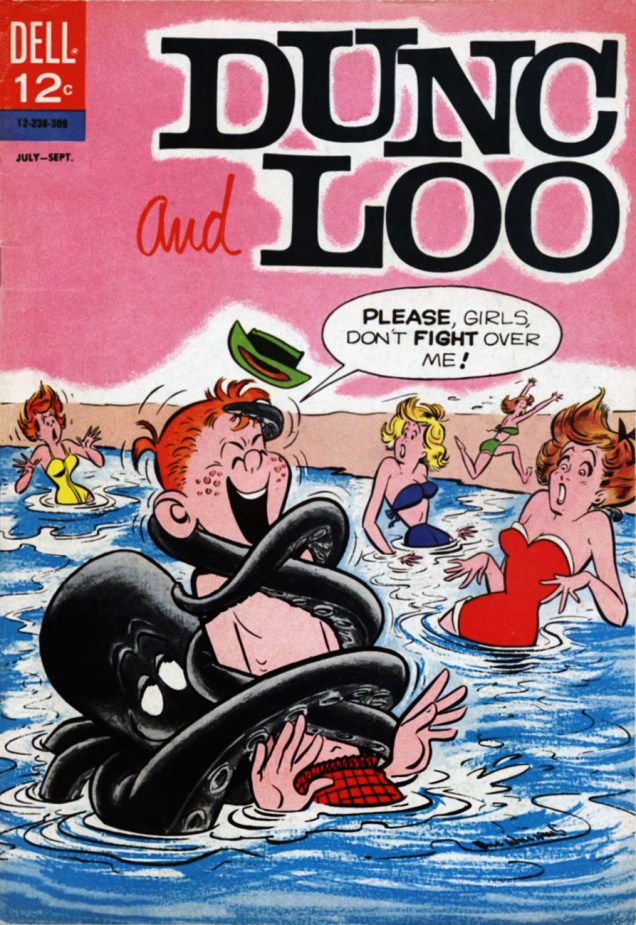
Dunc and Loo (which was called « Around the Block with Dunc & Loo » for the first three issues) was a comic written and story-boarded by John Stanley. (See our initial post about John Stanley, including more D&C covers.) The finished art for the series was provided by Bill Williams. This combination worked perfectly to provide readers with (only eight, alas) hilarious issues of teenage high-jinks and other silliness.
Dunc and Loo no. 7, July-September 1963, art by Bill Williams.
You can read the whole issue over at Comic Book Plus – no tentacles, I’m afraid, but some gorgeous art and zany stories. It’s well worth the detour!
Hey, octopuses like surfing, too. Or maybe this one just wanted the blonde for himself…
The Adventures of Bob Hope no. 94, 1964. Art by Bob Oksner… I think.
The Adventures of Bob Hope were published by National Periodical Publications from 1950 to 1968, for a total of 109 issues. The main stories centred around comedian Bob Hope (or his misadventures, rather); the cover stories often featured some other film-related characters. The original artist of the series was Owen Fitzgerald, with Cal Howard as the writer. Official credits aren’t really available, but these two seemed to provide much of the content for the first 60 issues. In #61, however, Mort Drucker (on main stories) and Bob Oksner (on back-ups) made their debut, and continued on their merry way until, oh, 1967 or so. In case you’re interested, Neal Adams did the last 4 covers for the series (eek).
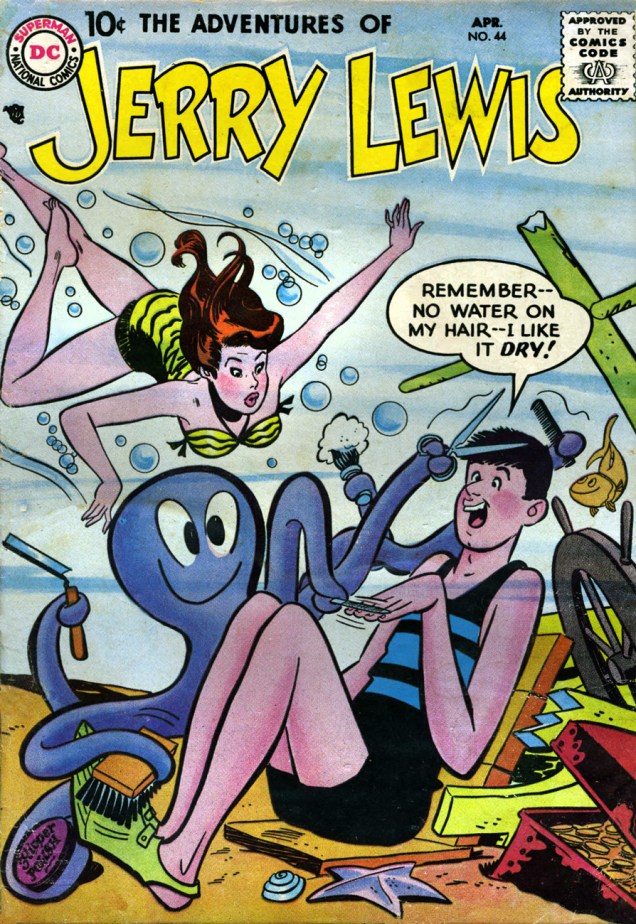
Here’s another series that followed a pretty similar path (unsurprisingly – same publishing house, comparable years, same subject matter): The Adventures of Dean Martin & Jerry Lewis (July-August 1952 – October 1957) that became The Adventures of Jerry Lewis with #41 (November 1957). The art, handled mostly by Owen Fitzgerald in the beginning, gradually landed increasingly into the more-than-capable hands of Bob Oksner, who stayed around until the end with issue #124 (June 1971). Here, also, Neal Adams stuck his nose in, this time for three issues (covers of #102 through to #104).
The Adventures of Jerry Lewis no. 44 (April 1958). Art is, presumably, by Bob Oksner, though GCD tentatively attributes it to Owen Fitzgerald.
Read this issue over at Ominous Octopus Omnibus (what could be more appropriate on Tentacle Tuesday?)
« Certain types of stories make perfect television fare. In the realm of the ghost story, however, I think the printed page has some advantages and I want you to discover them. When you read, you can be alone — absolutely alone. » — Alfred Hitchcock (but likely Robert Arthur in his name and place.)
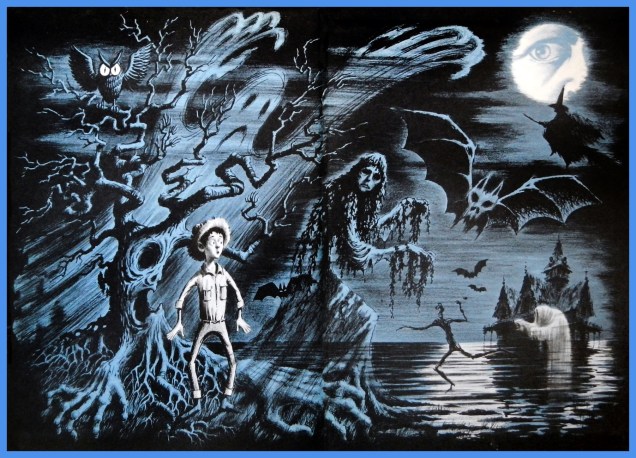
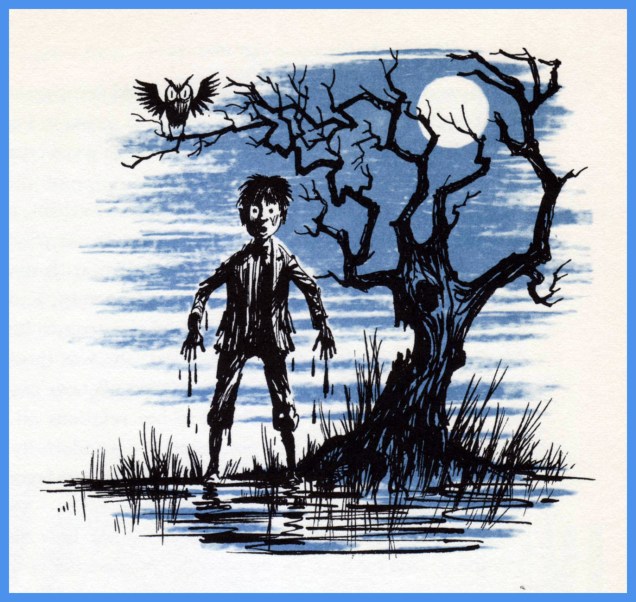
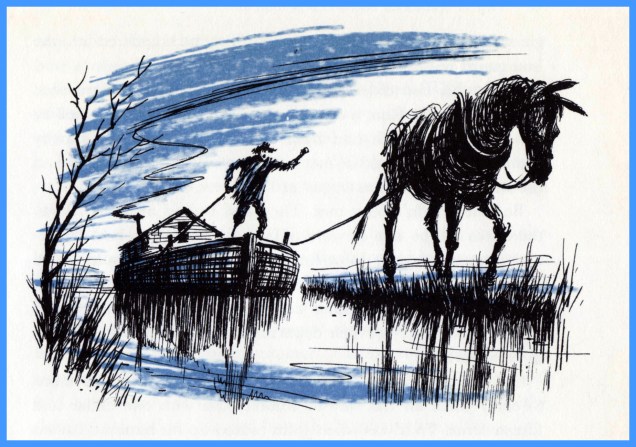
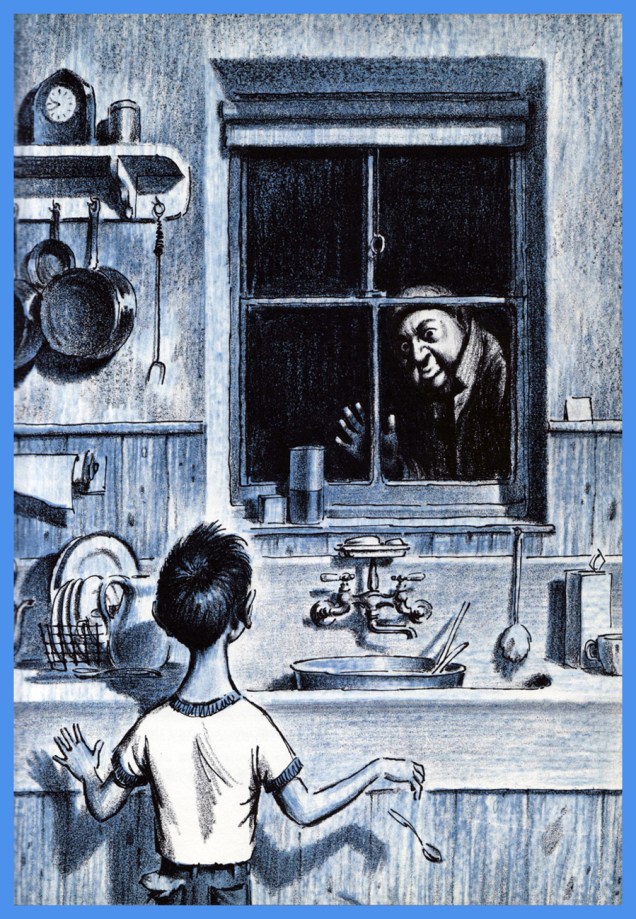
Today, we feature Fred Banbery’s fabulously detailed and, well, haunting illustrations for « Alfred Hitchcock’s Haunted Houseful ».
Haunted Houseful’s endpapers, a summary of much of what lurks within its pages.
Frederick Ernest Banbery (1913-1999) was perhaps the definitive Paddington Bear portrayer, but for me, it’s his Hitchcock-related work that truly sings. He illustrated three Random House Hitchcock books for younger readers: Haunted Houseful (1961), Ghostly Gallery (1962), and Solve-Them-Yourself-Mysteries (1963), plus the covers of a handful of Hitch paperback short story collections. These books can still be had surprisingly cheap to this day (I just checked eBay, and it holds), so keep an eye out. Every picture’s a gem, to say nothing of the stories!
A scene from Manly Wade Wellman‘s « Let’s Haunt a House ». Dollars to doughnuts that’s not an actual ghost.From Constance Savery’s « The Wastwytch Secret »From Walter R. Brooks’ oft-anthologized «Jimmy Takes Vanishing Lessons »
And finally, two illustrations from Louise and Donald Peattie‘s « The Mystery in Four-and-a-Half Street ». Is that powerfully moody or what?
My wife said something about my « stretching the definition of comics » with this one, but, honestly, thanks to the cartoony style, this feels more authentically like comics to me than, for instance, most comics painted in a self-consciously ‘realistic’ style (think Alex Ross, Jon J. Muth or Kent Williams), not that I’m disparaging that approach… it’s just not my thing.
« I find television very educating. Every time somebody turns on the set, I go into the other room and read a book. » ― Groucho Marx
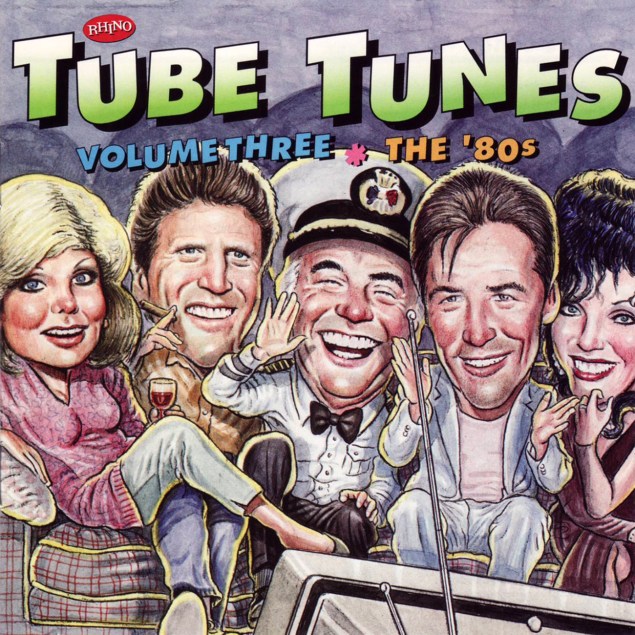
In the mid-90s, the always-discerning masterminds* at Rhino Records (they had, after all, picked William Stout to design their logo, back in 1974) called upon master satirist, caricaturist and of course pointillistDrew Friedman (1958-) to gather some perennial favourites on his old couch for the purposes of a three-volume compilation.
In this second entry in the trilogy, Mr. Friedman seems a bit out of his element, as drawing purdy gals and conventionally handsome men is hardly his forte. But he aces Gabe Kaplan, as you’d hope and expect. Judging from his expression, Gabe appreciates it.
This time, our artiste ably succeeds where he faltered earlier: he has no difficulty capturing the likenesses of Ms. Anderson and (5x so far) Mrs. Collins.
From volume 3’s liner notes: « The 1980s may well be remembered as the final decade of the television theme song. The disturbing trend of the ’90s seems to be the elimination of the title song in preference of an additional minute of commercial airtime – a sad state of affairs for fans of the opening anthem. »
Maybe it’s all for the better: I’d rather have an additional hour of commercial airtime than be subjected again to the opening jingle of, say, Charles in Charge. You have been warned.
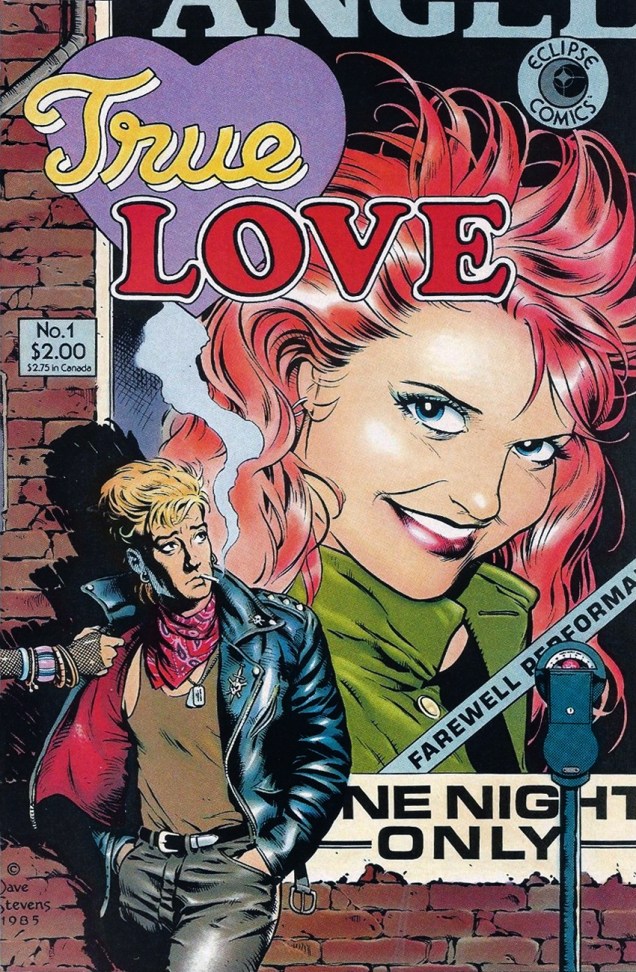
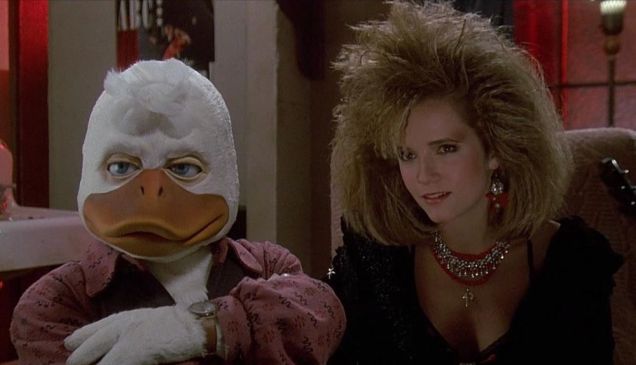
Brooding pretty boy (is that you, Brian Setzer?) is about to get a pleasant shock in this Dave Stevens (1955-2008) cover featuring a “punk rocker” in the well-scrubbed tradition of, say, Lea Thompson in the infamous Howard the Duck movie. Still, it’s a dazzler, as you’d be right to expect from Mr. Stevens.
« If you did, you may find your letter printed in this book… If you haven’t written The Monkees yet, join the fun that’s going on inside this crazy, lovin’ book. »
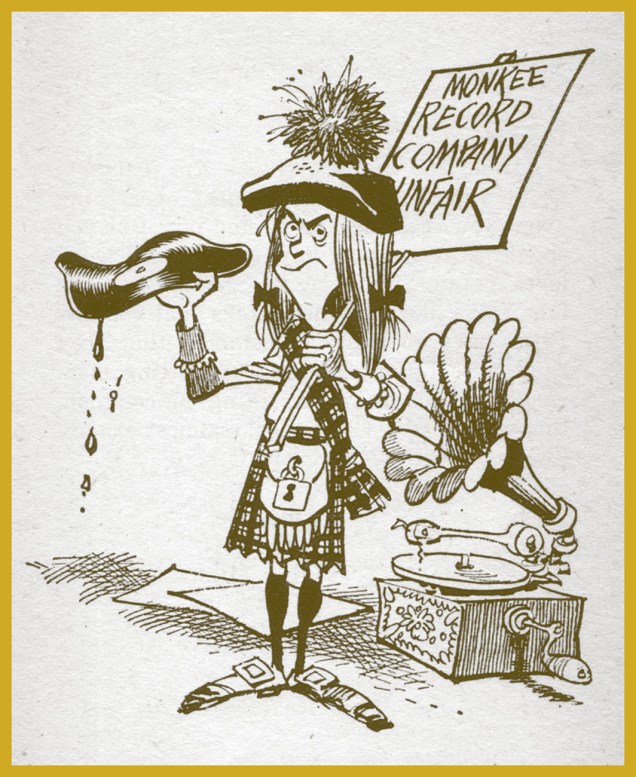
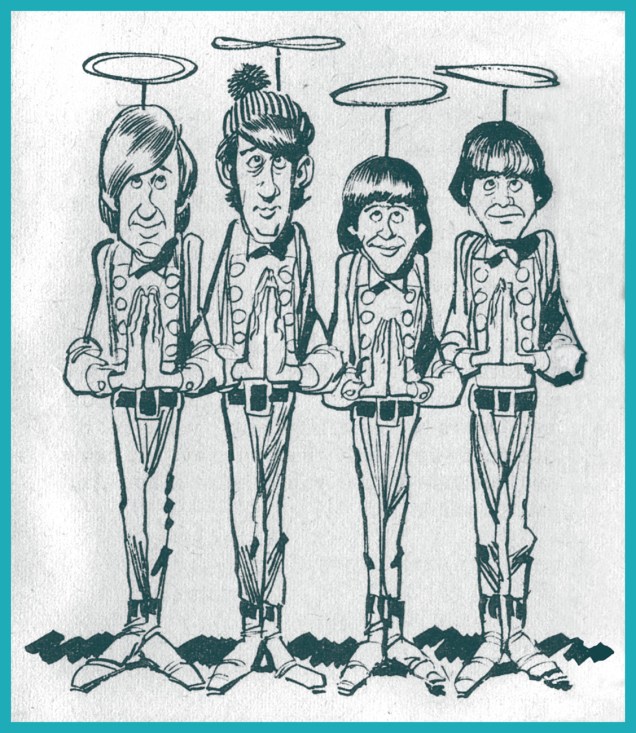
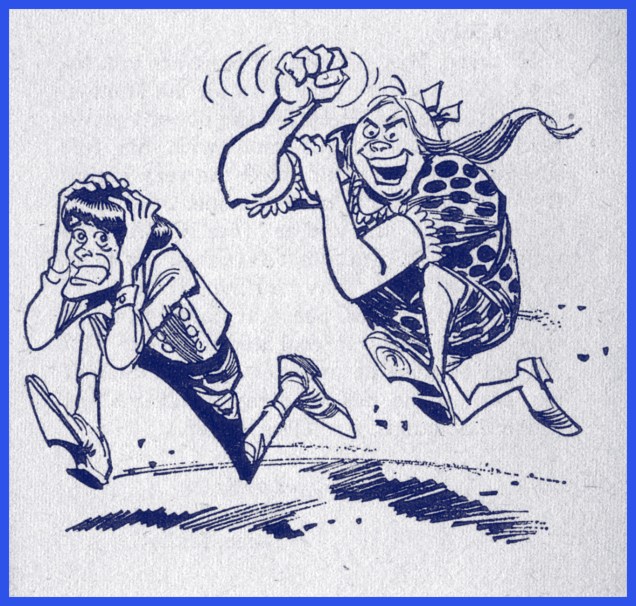
In 1967, the phenomenal Jack Davis (1924-2016), as prolific and versatile as an artist can get, provided twenty-one original cartoons and the cover to this snazzy little tome issued by the Popular Library.
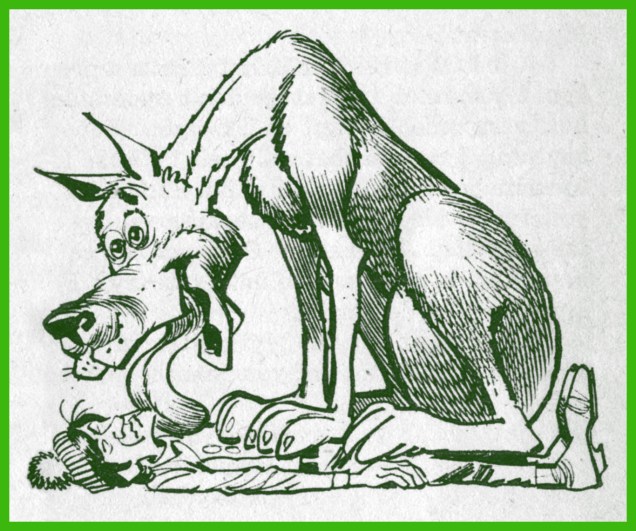
Dear Davy — I am one of your greatest fans. I have all the Monkees records that have been released so far. But I have one problem. I played your first record so much that it began to melt, and now it wobbles so much that I can’t play it anymore. I know it’s not your fault, but I don’t think it’s fair that I should be punished for being such a Monkee-lover. I think the record company ought to give me my money back so I can buy a new album. You could even think of it as a kind of award for loyalty or something. Please, Davy, talk to the record company and make them send me the money? Yours truly, Diana V., Charleston, SCDear Mike — You know your record ‘Gonna Buy Me a Dog’? Well, if you really want a dog, I have a three-month-old Great Dane that a friend gave me six weeks ago that I have to get rid of. He’s a little too playful. Last week he knocked over my mom’s favorite vase and my kid brother. His name is Linus, but he’s not too attached to it. Your fan, Steve R., Coral Gables, Fla.Dear Monkees — I like your group very, very much. You probably never heard of Varna. It’s a little town near Ithaca. I wrote a poem for you: I think the Rolling Stones are great, I think the Beatles are fine, On the other hand, I think the Monkees are DIVINE. Your fan, Jeannie G.Dear Monkees — My name is Wendy. I like your records. Please send me a picture of you. I forgot all your names so please put your autographs on the pictures. Sincerely, Wendy K., Butte, MTDear Davy Jones — I like your shows very much. I like all your songs too. I like all your clothes and your hair. You are very very cute. You better come to Wichita or I’ll smash you one. Lover, Carol K., WichitaDear Monkees — Please send me Davy Jones in the mail. Send it to Cindy L, Louisville, Kentucky.
In closing, I see Micky Dolenz (b. March 8, 1945) turned seventy-three… yesterday. Happy belated birthday, Corky!
« In the big wrinkled world, it would be like looking for a straw in a needle stack…»
Based upon, but with savvy improvements, Peter Sellers‘ Inspecteur Jacques Clouseau from the popular series of films launched with 1963’s “The Pink Panther“, the animated Inspector and the titular feline (who first appeared in the opening credits of the film) were spun off into a pair of successful series of animated shorts. Produced by DePatie-Freleng Enterprises, these series have earned their place as highlights of 1960s animation, though the competition was pretty toothless, compared to prior decades.
As for funnybooks, Gold Key’s “The Pink Panther and the Inspector” title was a solid success, lasting 84 issues (73 under the GK imprint, then 11 more under Whitman, 1971-1984), leading to a solo spinoff for The Inspector (19 issues, 1974-78). This is surprisingly witty stuff, written and drawn with assurance and verve. Comic strip great Warren Tufts (creator of Casey Ruggles) was reportedly involved, though when it comes to Gold Key and Dell, credits are at best sketchy.
This is issue 2 of The Inspector (Oct. 1974, Gold Key.)Speaking of the « Case of the Stolen Kiss », here’s a rather… daring public display of affection! This being Gold Key, the material was not submitted for approval to the industry’s censorship body, the Comics Code Authority.
« What’s that noise comin’ up from the cellar? It’s the restless bones of Boris and Bela* »
It’s a cinch that William Henry Pratt, back when he was eking out a living in Canada, digging ditches or driving a truck, never suspected that his name, his stage name that is, would still elicit shivers of recognition long after his passing. Here we are, a whole hundred and thirty years past his birth, in Camberwell, South London, on Wednesday, November 23, 1887.
From his ascent to stardom in the early 1930s until his passing in 1969, he certainly lived to see his likeness appear in a bewildering array of toys and games and bedsheets and mugs and a zillion knicknacks and gewgaws, a parade that continues to this day. But he was likely never represented more consistently and abundantly than he was in comic books.
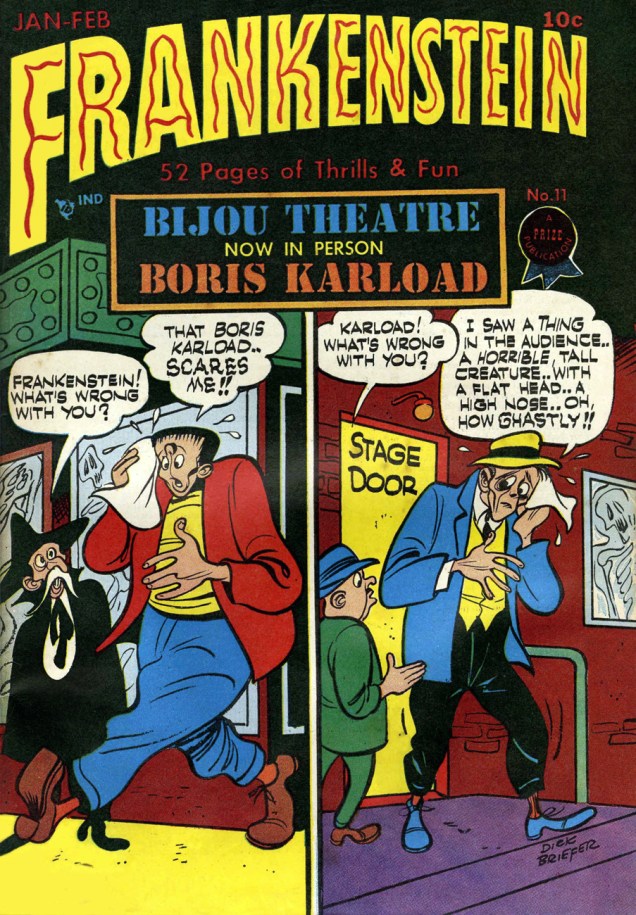
Here, the Monster meets his… inspiration, in « Boris Karload, Master of Horror ». Dick Briefer‘s Frankenstein is a definite highlight of the Golden Age of comics. This is Frankenstein no. 11 (Jan.-Feb. 1948, Prize Comics). Read it here: http://comicbookplus.com/?dlid=39937 And if you, er… dug that, treat yourself to Craig Yoe‘s selection of Briefer’s rendition(s) of the Famous Monster. It’s a great package, and Mr. Yoe can always use the money… to unleash further wonders.
Here’s a gallery of cover highlights from Gold Key Comics’ long-running Boris Karloff Tales of Mystery (95 issues, 1962-80).
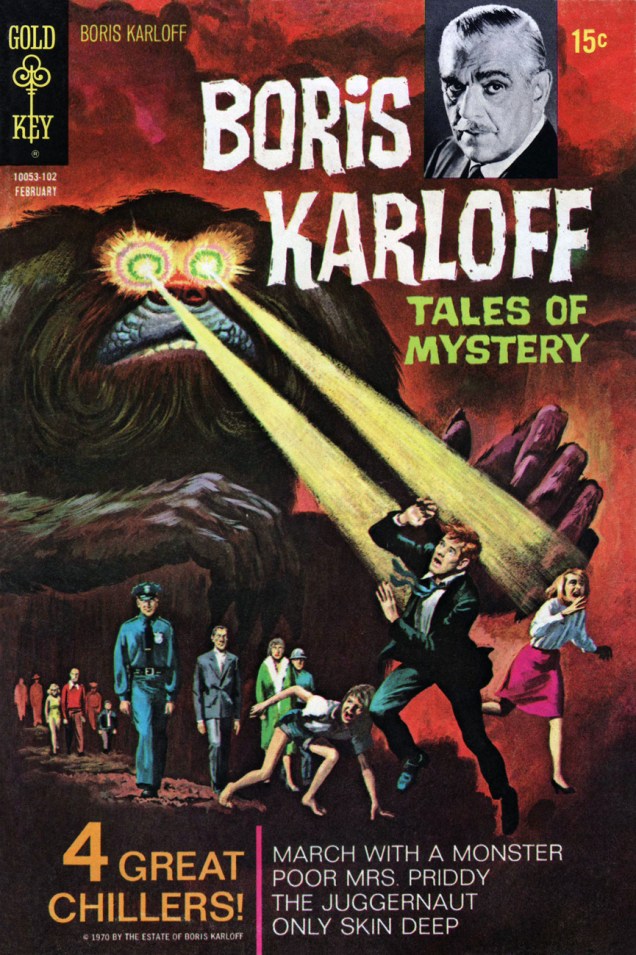
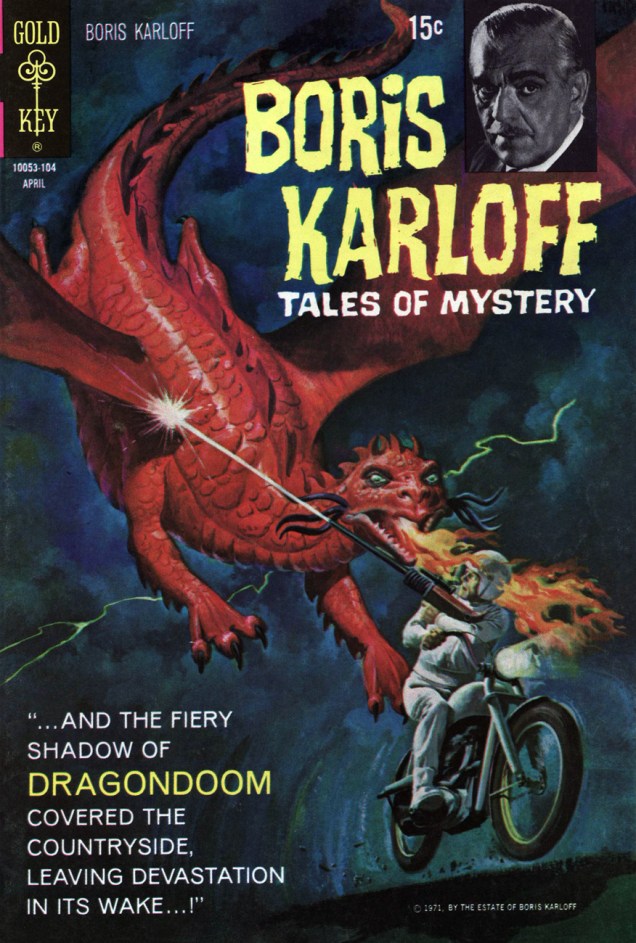
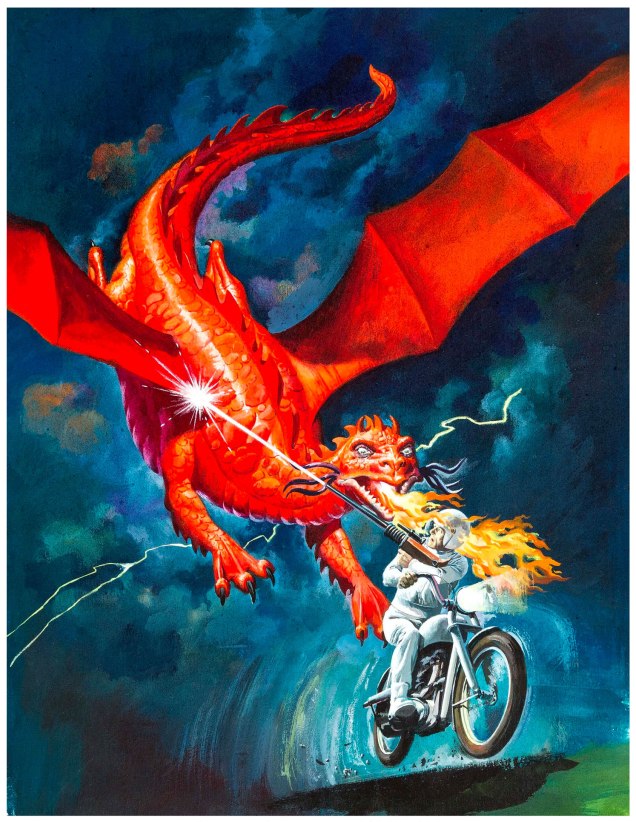
Before there was called Boris Karloff Tales of Mystery, there was, for two issues, Thriller, based on the by-then-cancelled NBC series. Gold Key were often quite slow in making their licensing moves. The TV Thriller was often terrifying (“Pigeons From Hell”, “The Hungry Glass”…), but the comic book never scaled such heights, even sans the emasculating influence of the Comics Code Authority.« You know that one sideways glance from that bug-eyed banshee can turn your brains to prune-whip! » Boris Karloff Tales of Mystery no. 33 (Feb. 1971), Cover painted by George Wilson, illustrating Len Wein, Tom Gill and John Celardo’s March with a Monster.« I’m being scorched by something that shouldn’t even exist! » A laser cannon-equipped Evel Knievel tussling with a badass reptilian nightmare? That’s the Seventies for you. Gold Key’s mystery comics were generally pretty tame fare, but their covers, such covers! This one’s painted by Saint George Wilson. Boris Karloff Tales of Mystery no. 34 (April 1971.) You just know that Dragondoom is written by Lein Wein, because its damsel-in-distress shares his wife’s name, Marvel and DC colourist Glynis.A look at Mr. Wilson’s original painting gives us an idea of just how much was lost in the transition from brush to print. Sometimes it’s better *not* to know.« Feast your eyes upon them, mortal! Do they satisfy your appetite for witchcraft? Hee Hee! » Wayne Howard conjures up some decent monsters inside, but Psychotomimetic George Wilson, who painted this mind-melting cover, shows how it’s *really* done. Boris Karloff Tales of Mystery no. 43 (Oct. 1972.)« The car — being sucked in by this blasted fetid swamp! Goodbye car… goodbye, convention! » Roadside George Wilson strikes again! Boris Karloff Tales of Mystery no. 49 (March 1973.)
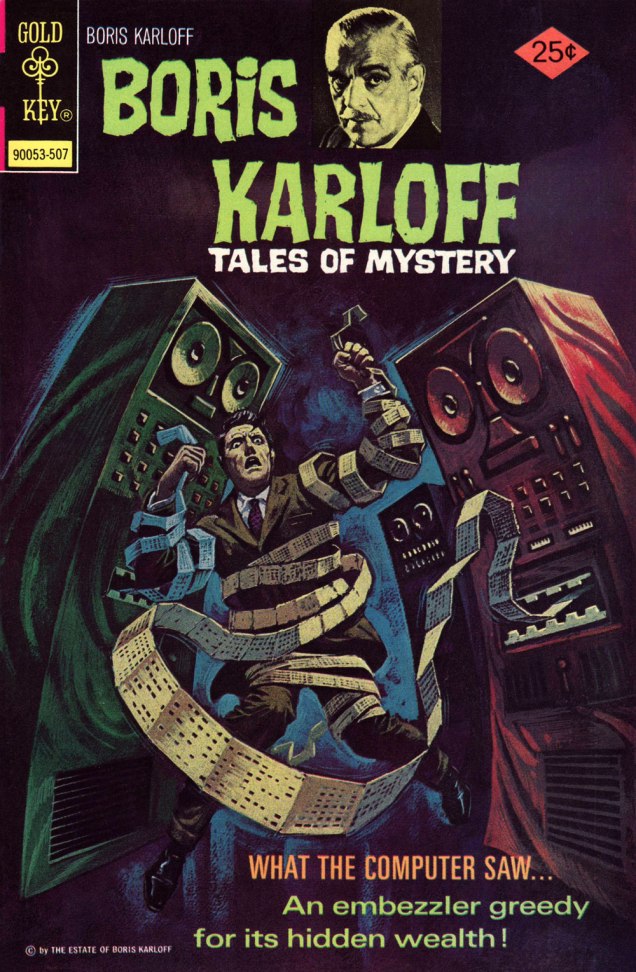
« These computer cards are wonderful… almost as if they were alive! They tell me everything! » Boris Karloff Tales of Mystery no. 62 (July 1973). Luis Angel Dominguez‘s painted cover depicts a scene from Arnold Drake‘s witty It’s in the Cards.
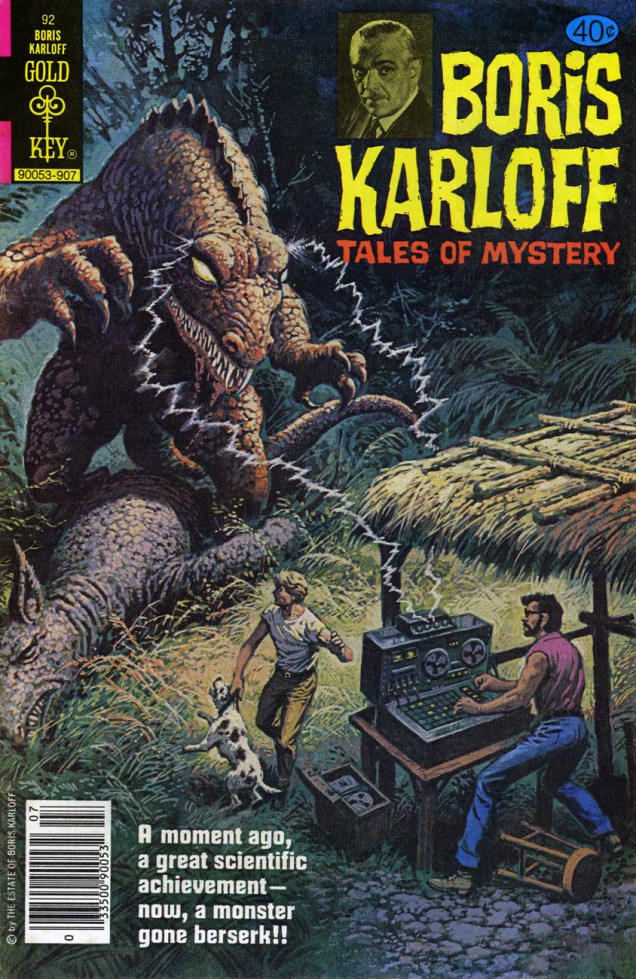
« G-g-get away, B-Bobby! There’s a living horror out there! » « Aww, gee, dad! I’m sorry about that! It’s just my sea monster! » Meet The Mail-Order Monster, a gem from an uncredited scripter (likely Arnold Drake, if the sparkling wit is any indication), and illustrated by Ed Robbins. It’s a fabulously wacky yarn, combining to fine effect good old Sea-Monkeys (brine shrimp, really) and a generous sampling of Ray Bradbury’s Boys! Raise Giant Mushrooms in Your Cellar! This is Boris Karloff Tales of Mystery no. 65 (Dec. 1975), edited by Paul Kuhn. Also within: Don’t Put It on Paper, another of the handful of jobs José Luis García-López did for Gold Key, before settling down at DC later that year. The plot is basically that of Clark Dimond/Terry Bisson & Steve Ditko’s The Sands That Change! (Creepy no. 16, Aug. 1967, Warren), but with a much gentler outcome.« But — why would anyone create something so — so terrifying? » One thing you can nearly always count on in any given issue of BKToM: “scientific” experiments always go awry, and they nearly always yield rampaging monsters. Fitting! Luis Angel Dominguez provides this electrifying cover for issue no. 92 (July, 1979.) The man had such a peerless colour sense.
Let’s reserve our closing words for the man (monster) himself: « Certainly I was typed. But what is typing? It is a trademark, a means by which the public recognizes you. Actors work all their lives to achieve that. I got mine with just one picture. It was a blessing. »
« One of these days, some driver will run me off the road… just because his chick recognizes me! »
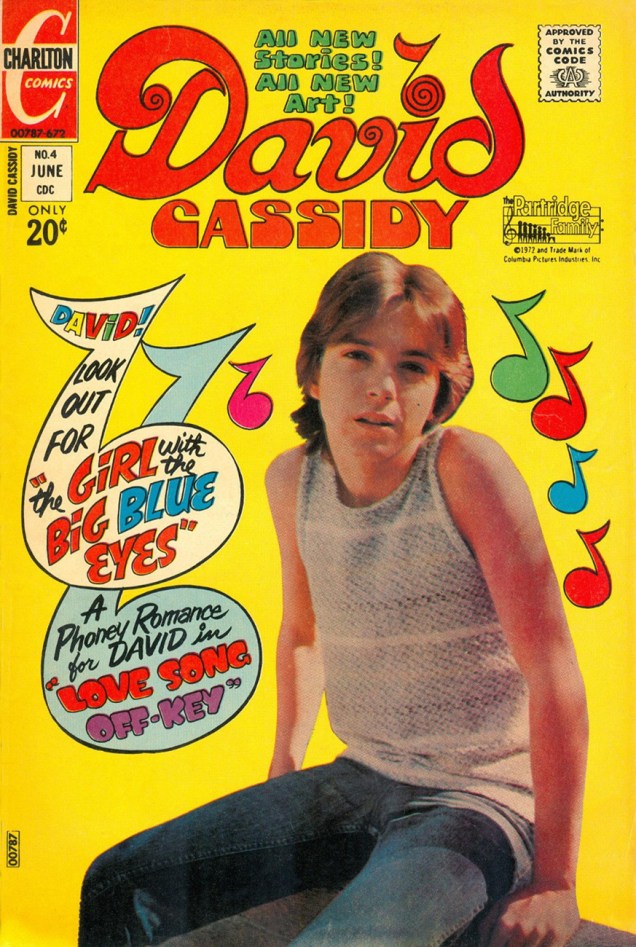
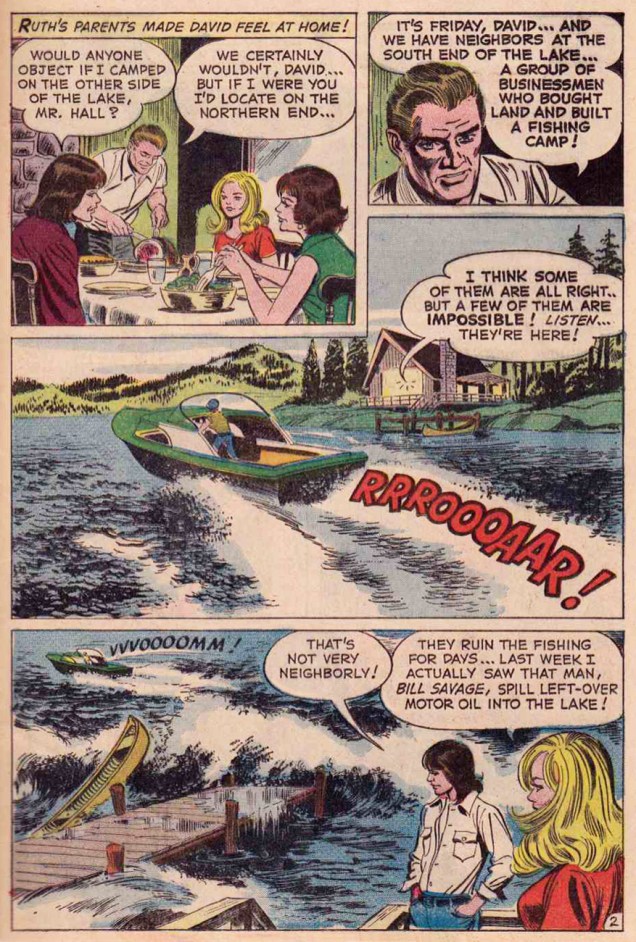
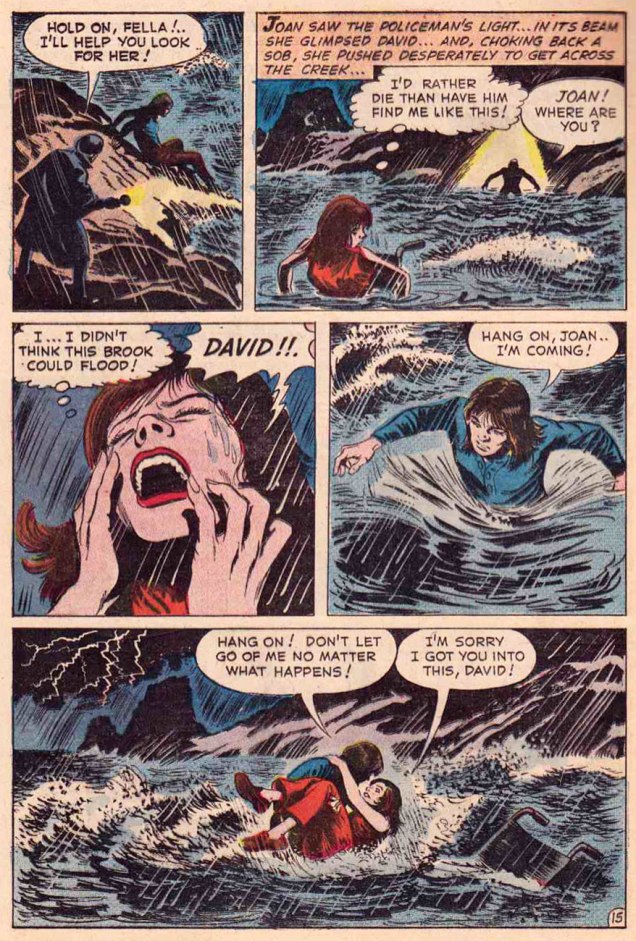
You may have heard the news… sorry to be the bearer of sad tidings if you haven’t. David Cassidy, who rose to fame as The Partridge Family tv show’s Keith Partridge in 1970, has passed away on November 21, 2017, at the age of 67. If this makes you want to pull out your old PF records and read some comics while grieving your lost innocence, let me help you with a word of warning: Charlton published two separate series based on the exploits of the acclaimed teen idol and his boob tube kith and kin, and they’re hardly in the same league. The Partridge Family (21 issues, March 1971 – November 1973), was utter dreck, the handiwork of infamous photo tracer and corner cutter Don Sherwood. The other, David Cassidy (14 issues, February 1972 – September 1973), was an altogether racier breed of cat, thanks to the lush artwork of the truly underrated Turkish-born master Sururi Gümen (1920-2000), who toiled anonymously for many years on the long-running Kerry Drake comic strip (there’s a special pit in hell reserved for folks like Alfred Andriola), but also produced some very fine work for Charlton. More on that later!
David Cassidy no. 4 (June 1972, Charlton Comics.)A sample from This Was Paradise from David Cassidy no. 3 (May 1972, Charlton Comics), presumably written by Joe Gill and definitely illustrated by Sururi Gümen. According to his son, illustrator-filmmaker-actor Murad, «… it was Charlton – and David Cassidy comics – that sent my sister to college.»A moody one from David Meets His No. 1 Fan!, the other story from David Cassidy no. 3 (May 1972, Charlton Comics), also scripted by Joe Gill and illustrated by Sururi Gümen.





















 Who's Out There?