Fifty Years of Kotter: A Talk With Elliot S! Maggin

« I think people will believe anything about someone they haven’t seen for a while. » — Gabriel Kaplan

I’ve been meaning to do a Welcome Back, Kotter post for several years. But when I thought about it, I understood that hitching it to the show’s fiftieth anniversary made considerably more sense than, say, its forty-seventh. And while I adore William Johnston‘s sextet of tie-in novels, it would be quite a stretch for a comics blog to cover. Far closer to the mark lies Arnold Drake‘s trio of WBK storybooks, illustrated by Mel Crawford and Jack Sparling. But in the end, I bided my time and managed to get in touch with the scribe first assigned the Kotter Komic assignment, Elliot S! Maggin. And boy, am I glad I did. And so, fifty years to the day of the airing of its pilot episode*, let’s talk Kotter!
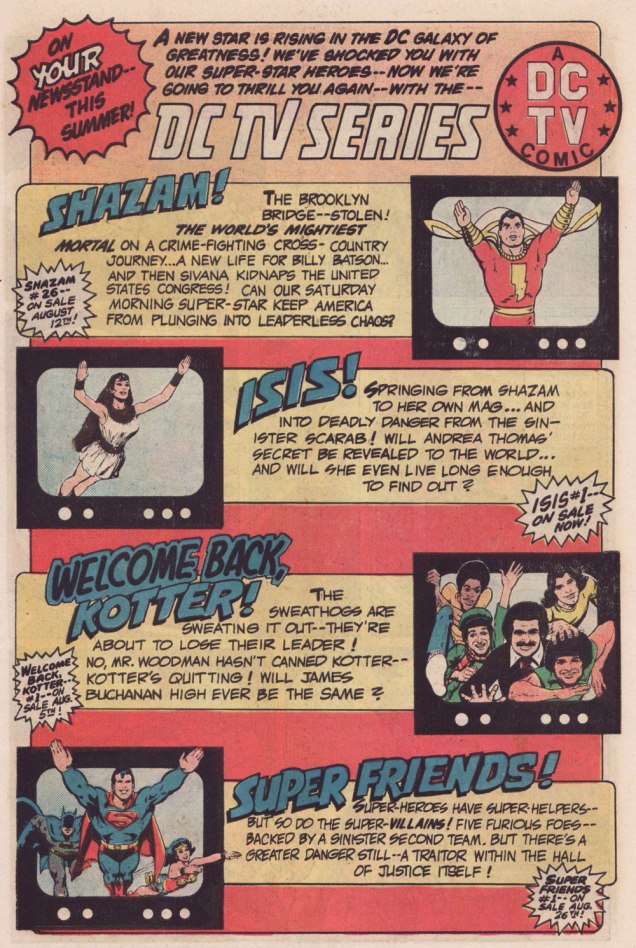

Remember the DC TV line? This ad ran in several DC titles over the summer of ’76.

ES!M: Well, Julie was kind of proprietary about me for most of the time I was working with him.

ES!M: I guess. At some point, Dorothy Woolfolk was editing the Lois Lane book, and… he introduced me to her. She just came into his office for some reason. She said: « Oh, you know, you should write some stuff for me! » And he said « No, he’s very busy, go away! » And he chased her out of the office. And I’m thinking, « Oh, okay. That’s how we’re doing it. »

So I didn’t really go about… I didn’t really make friends with many of the other editors. I tried to make friends with Joe Orlando. You know, I’d have lunch with him once in a while, I guess.

This is Welcome Back, Kotter no. 1 (Nov. 1976, DC); cover by Bob Oksner.

ES!M: But around the time Kotter came out…

You know, people used to hang out outside of Julie’s office door, listening to us plot, because it was so loud. We would yell and scream at each other constantly. He was this Jewish boy from the Bronx, and I was this Jewish boy from Brooklyn, and once I got comfortable working with a guy thirty-five years older than me, we’d just fight all the time. And every once in a while, we’d get serious.

ES!M: I guess at that point, he got mad at me, and I didn’t get work for a couple of weeks. I went to Joe, and I said: « What ya got? », and he said he’s doing this Welcome Back, Kotter book, and I said « Great! I watch that show, that’s fun. » So I wrote the first issue, and that was fine.
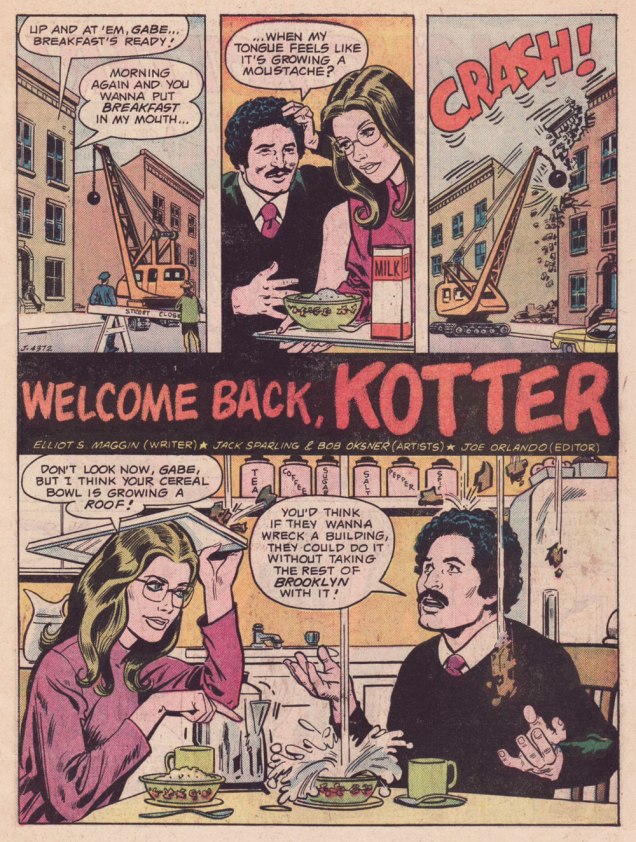
Here’s a quartet of pages from the première issue. Pencils by Sparling and finishes (and surely likenesses) by Oksner.
Aw, Maggin’s Mr. Pevey would have made a great addition to the TV show’s cast.

ES!M: They called me down in Carmine‘s office, to watch episodes of the show. It had been on maybe six weeks at that point. Episodes I had already seen, but I liked hanging out in Carmine’s office, because it was big, and he had a lot of toys around. So they set up this video tape… thing, and I watched the shows again, and I wrote the second issue.
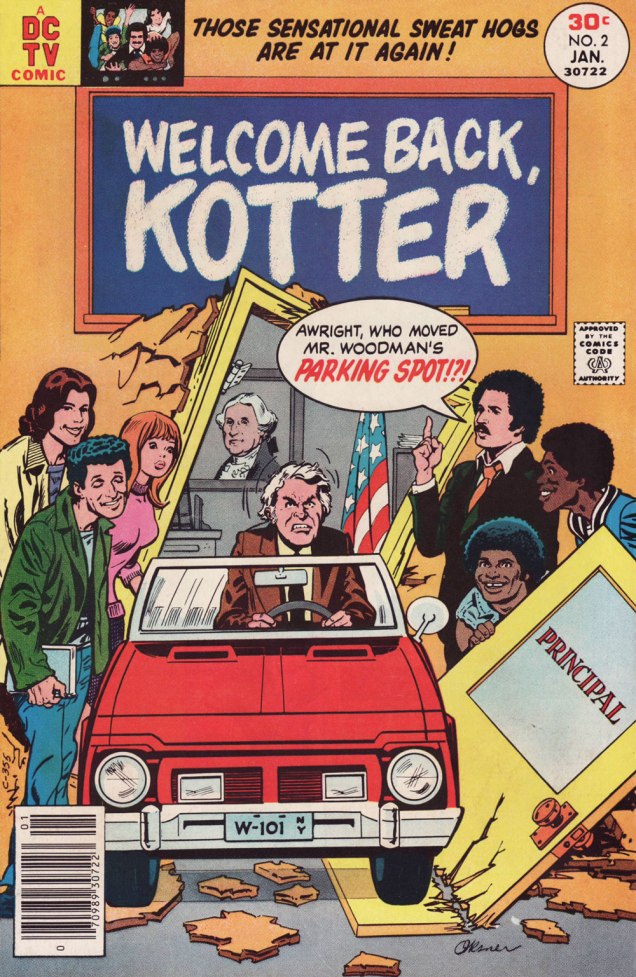
This is Welcome Back, Kotter no. 2 (Jan. 1977, DC); cover by Oksner.
Art-wise, the second issue seemed comparatively rushed, and sans Oksner, likenesses pretty arbitrary. See what I mean? The GCD attributes the inks to Sparling, but I lean towards Frank Springer.

ES!M: I was living in an apartment complex on Long Island, and there were all these kids around… little kids. And I would work at home, mostly. So they would hang around with me, whenever they realized I was home. They would… shoot me through the window or… something. At some point, whenever I’d write a gag, I would…

ES!M: Yeah! And they’d laugh, and run off and play some more. And I figured, as long as they laughed, it was okay. Because they were hearing the voice of Barbarino, or whoever. At some point Travolta would say, « Uh? », or « Duh », or « What d’you think? », something dull, that he delivered in a funny way. And the kids related what I wrote to what Travolta did on screen, so they were getting it. And at some point I realized that Joe [editor Orlando] didn’t watch the show.

ES!M: And he would then object to my Barbarino bits, or Horshack bits, or whatever. So I told him « You’ve got to watch the show, you’ll get it! » But you know, after maybe… how many issues did I write, three, four?

ES!M: I’m sure he (Evanier) watched the show — he watched everything.

ES!M: But Joe did not. I mean, he didn’t have time, and he was madly in love with his wife, and he didn’t watch television at all (laughs). He wasn’t paying attention to the source material.

ES!M: I wrote two issues, and at some point, Joe said: « You can’t write! ». He said « No, you can’t write! »
A blanket condemnation of everything I’d ever done.

ES!M: By that time, I’d made up with Julie, and I was writing more Superman stuff. After that, wherever any of my fights with Julie got serious, I’d go down the street to Marvel, and do something there. Then I would make up with Julie, and they’d never see me again… until I had another fight with Julie.

That was my experience writing Kotter.

And here’s what undoubtedly has to be the Guernica, if you will, of Kotter art: Bob Oksner‘s superlative cover for Limited Collectors’ Edition C-57, from 1978, DC’s final — and finest — WKB publication. Feel free to open it in another tab for a fuller view… I provided a larger image so you can fully take in the wealth of details.

ES!M: I just wrote a book called Lexcorp. A novel. Which you should probably plug.

ES!M: It’s a first-person story that Lex Luthor tells. And he identifies himself as an unreliable narrator, like… Huckleberry Finn. But it does tell the story of how he saves the world. Stuff like that.

I’m working on another book, working on a time travel story. And my ex-wife asked me to write an autobiography so my grandchildren know who I am.

I have all these people I know with Pulitzer Prizes; and at some point in the autobiography, I wrote: « I have about a dozen Pulitzers floating around through my life, and none of them are mine. This book is available for consideration. »

-RG

*the pilot episode, for some reason, was aired third, on September 23, 1975, while the show premiered on the 9th of September with ‘The Great Debate‘ (featuring a wonderfully smarmy James Woods).
Twilight of the Musical Heroes

« Sunny down snuff » — Van Dyke Parks

While I’m painfully aware that such things are inevitable, the past couple of weeks have been pretty brutal to the ranks of my musical heroes. First went Sylvester ‘Sly Stone’ Stewart; then Brian Douglas Wilson; then Lugee Alfredo Giovanni Sacco, aka Lou Christie, and then Bobby Sherman*… all born in 1943!

It would require quite a stretch to write more about Sly and Lou, but I’ve already devoted a piece to Mr. Sherman (Let’s Hear It for Bobby Sherman!), who enjoyed his own comics series in the early 1970s.

Which leaves us Brian. I’ve been a diehard fan long enough to remember that his name and accomplishments didn’t get separated from his band’s — especially given the embarrassment that the Mike Love-led Beach Boys touring cavalcade had become — until the early 90s. And I also recall that Pet Sounds was, for decades, just an expensive but critically acclaimed commercial failure that didn’t get certified ‘Platinum’ until the year 2000, a third of a century after its release. For similar tales of vindication through gradual changes in fortunes, see The Kinks are The Village Green Preservation Society and The Zombies’ Odessey and Oracle.

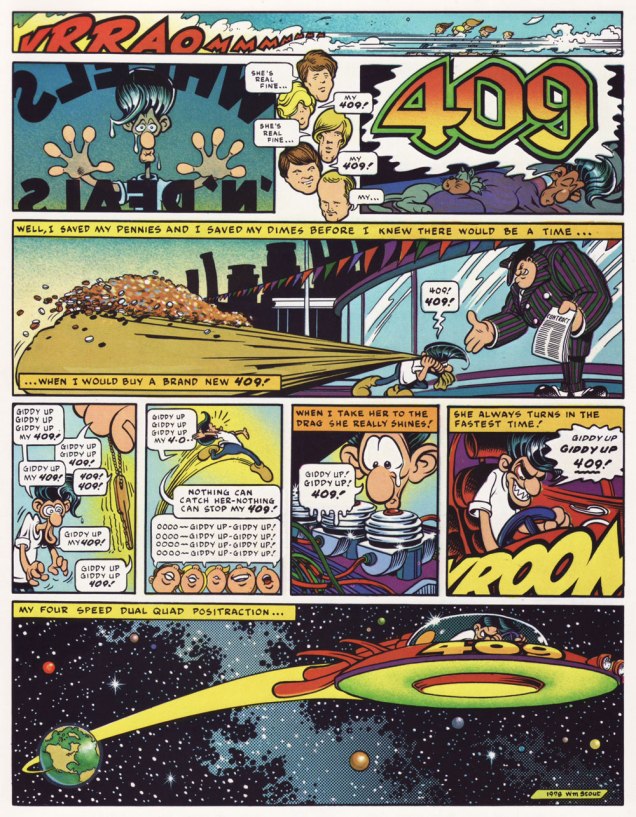
So I turn (for the second time!) to Byron Preiss‘ marvellously illustrated authorized biography of the Beach Boys, from 1978. In addition to a highly entertaining and well-documented text, Preiss, a man with an astonishingly well-filled Rolodex, had the bright idea of tapping various illustrators to contribute their visual cover version of a favourite BB song.

I’ve written about Mr. Stout already, in The Prodigious William Stout, which ought to give you an idea of how I feel about his work. Lyrics by BW collaborator and future record (including a young Bobby Sherman!) producer Gary Usher.
Cheeky Harvey Kurtzman spells out just what sort of ‘Fun, Fun, Fun‘ could be had « ’til her daddy takes the T-bird away ».
Nice drawing, although the only detail Ralph Reese truly gets right is poor Dennis Wilson‘s ill-starred appetite for the ladies. Also… Mike Love with a guitar, really?
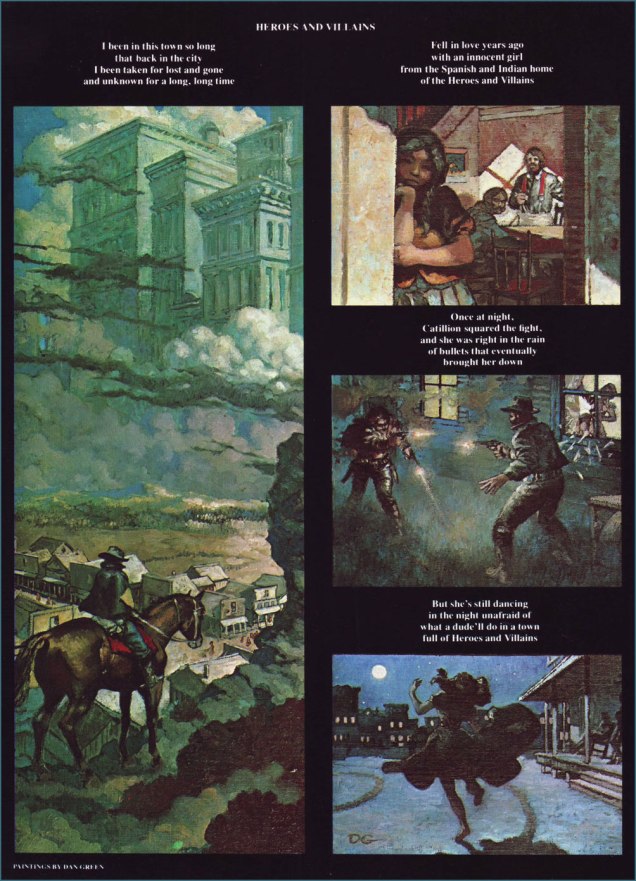
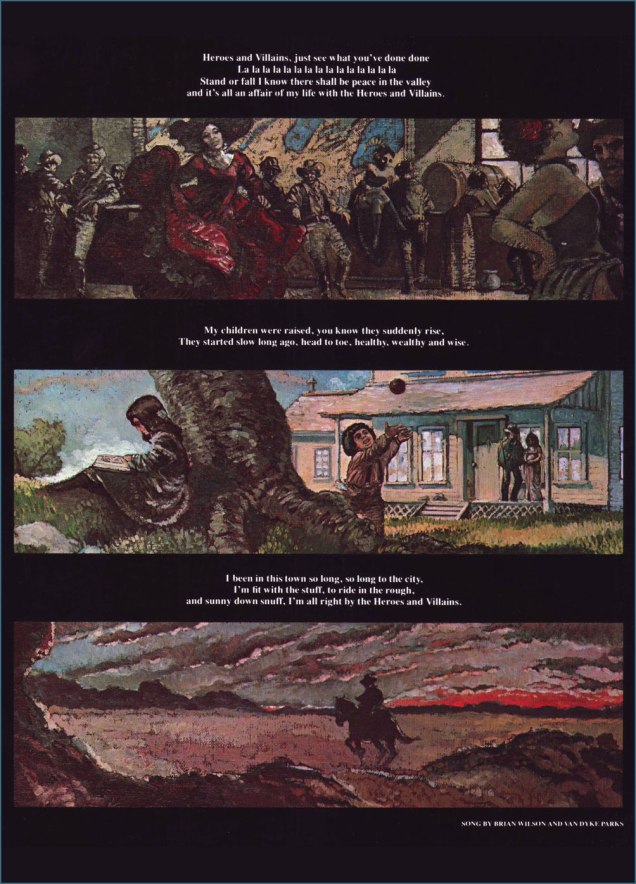
Those only familiar with Dan Green (1951-2023; another awkward lacuna from Lambiek’s comiclopedia) as a journeyman inker at Marvel and DC will likely be surprised at his adroitness with a brush. Here he tackles Wilson and Van Dyke Parks‘ (a true gentleman… and also from the class of ’43) arguably most ambitious œuvre, Heroes and Villains.
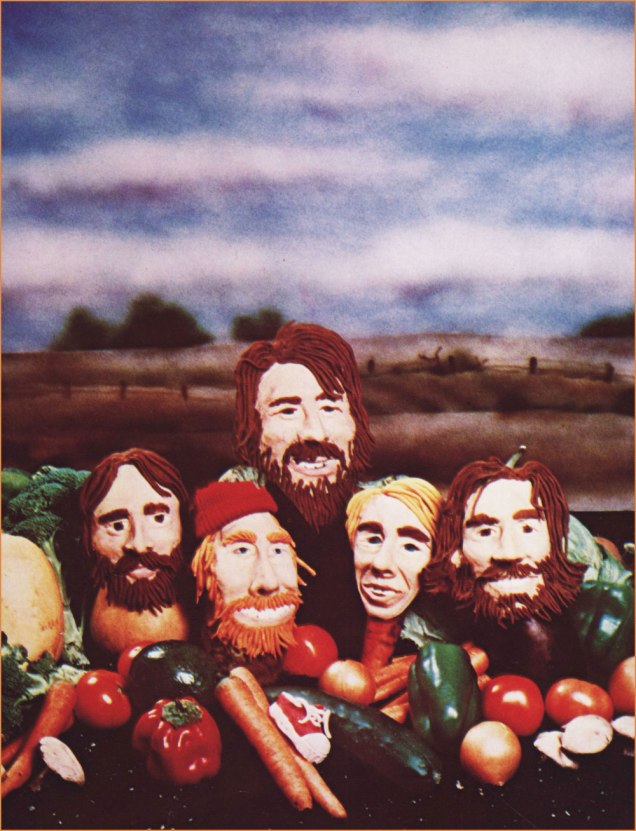
A surprising clay-based entry from Joey Epstein and her husband, our beloved Tom Hachtman, photographed by Ben Asen. The likenesses are pretty solid… save for Brian, who’s too skinny. The song in question is, of course, Vegetables. « I know that you’ll feel better when you send us in your letter an’ tell us the name of your… your favorite vege-table. »
This is former Air Pirate and Dirty Duck and Popeye cartoonist Bobby London‘s joyous celebration of Cool, Cool, Water, a tune intended for inclusion on the Beach Boys’ fabled Smile album (though it initially surfaced on their excellent Sunflower LP). To this day, however, London’s got mixed feelings about the whole thing. To begin with, he had no particular fondness for the Beach Boys, and getting dragged by Preiss to a late-70s BB live show, sans Brian (who was in no shape to perform anyhow) and with Dennis likely off promoting his Pacific Ocean Blue album, didn’t move the needle one iota. As London told me: « I had something more interesting and less Crumb-y in mind. »
Now *that* is caricature. Despite depicting the Boys as animals, illustrator — and Official Horror Host Hall of Fame inductee — George Chastain unerringly nails the essence of each, not to mention the group dynamics: of course Brian’s off to do his own thing. Not linked to any specific song, this is nonetheless my favourite piece in the book. Take a bow, sir!

-RG

p.s. I should also mention that another one of my favourite musicians died this week, namely Argentine composer Boris Claudio ‘Lalo’ Schifrin, but as he was born in 1932 (he was ninety-three!), his inclusion would have spoiled the pattern. Hope you understand, Lalo. Here’s a mesmerising favourite from his jazz sideman days: 1963’s The Fakir, recorded by Cal Tjader (« the Swedish Nerd king of Latin Jazz », as my friend Rupert dubbed him), and composed, arranged and conducted by Señor Schifrin.

Hallowe’en Countdown VIII, Day 21

« A gentleman does not boast about his junk. » — Emily Post*

Good manners… where have they gone, along with the other social niceties?

To prepare some of you for this satire, you need to be aware of who 19th century débutante and eventual étiquette authority Emily Post (1872-1960) was. The author of Etiquette in Society, in Business, in Politics, and at Home (1922… and updated to this day) was among the earliest American self-proclaimed experts on good manners. « Today, of course, you can barely dig up a débutante, let alone a ladies’ maid. And yet from the great beyond Emily Post continues to offer counsel. “Etiquette,” revised and edited by her great-granddaughter-in-law, a former flight attendant, is now in its seventeenth edition. » [ source ]

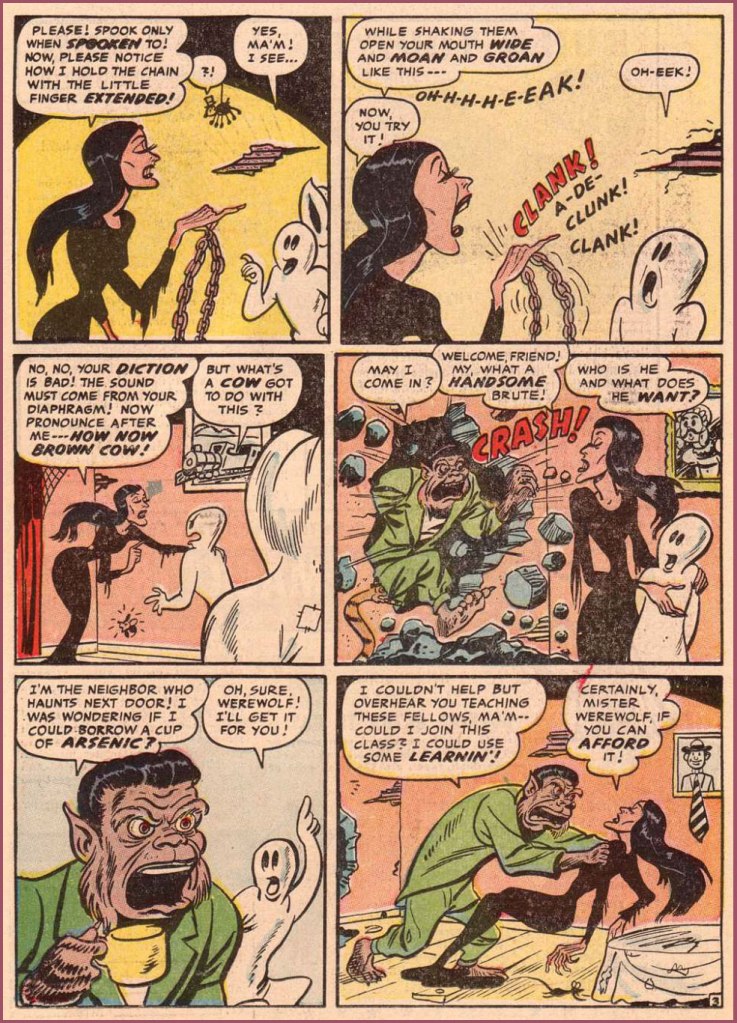
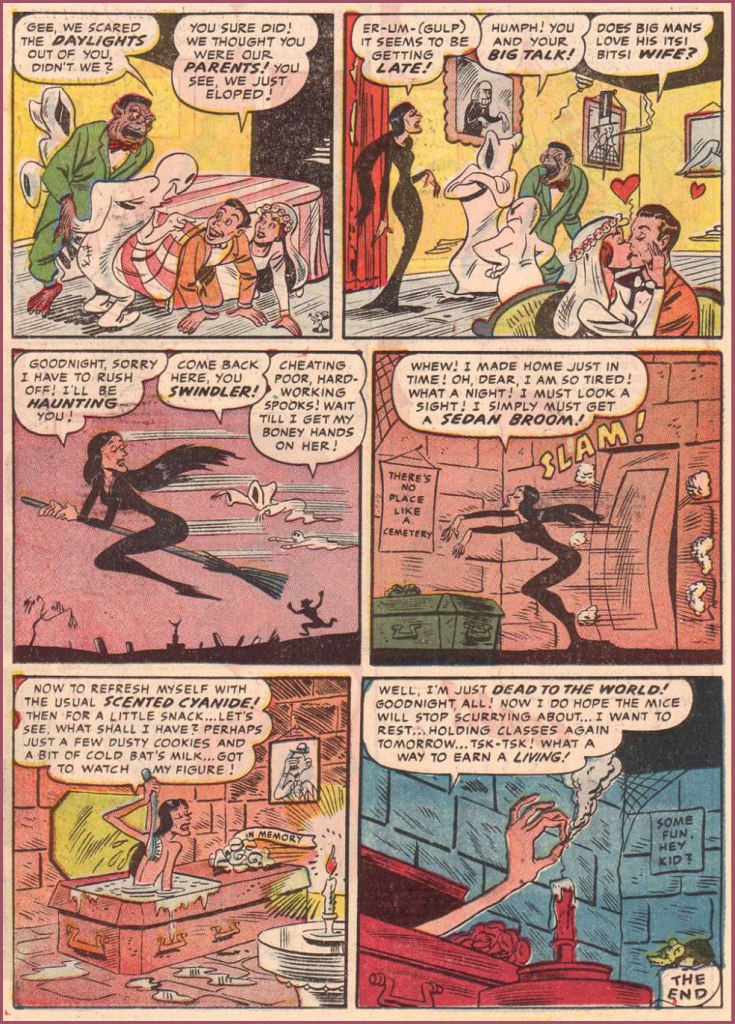
Well, that should suffice. Here’s a fun little parody from the early Silver Age. Both writer and artist are unknown, appropriately enough — it would be gauche to draw attention to oneself, don’t you know?

Don’t Be a Stumbling Spook! originally appeared — well concealed — in the back pages of Dark Shadows no. 2 (Jan. 1958, Farrell). An obscure story from an obscure title from an obscure publisher — the trifecta!

This is the one! The entire issue is available for free perusal right here.

I leave the esteemed Ms. Post to deliver the closing words, as I presume a gentleman should: « The only occasion when the traditions of courtesy permit a hostess to help herself before a woman guest is when she has reason to believe the food is poisoned. »

-RG

* That purported quote was too cute to pass up, apocryphal as it may be. Or is it a case of meaning drift? MIght ‘junk’ actually refer to bric-a-brac or — miraculously — a Chinese ship?

Hallowe’en Countdown VIII, Day 14

« I’ve had great success being a total idiot. » — Jerry Lewis

Hey, it’s Bob Oksner‘s birthday! I hope you’ll forgive me for double-dipping into that particular well — he also illustrated our earlier Mary Marvel entry — but I still wanted to highlight the occasion, incorrigible Oksner booster that I am.

DC’s Jerry Lewis (or Bob Hope, or Dobie Gillis…) comics weren’t even remotely funny, but they sure boasted some spiffy covers. Here’s a gallery of the most Hallowe’en-appropriate, from the pencil and pen of Mr. Oksner.

This is The Adventures of Jerry Lewis no. 87 (Mar.-Apr. 1965, DC).
This is The Adventures of Jerry Lewis no. 88 (May-June 1965, DC).

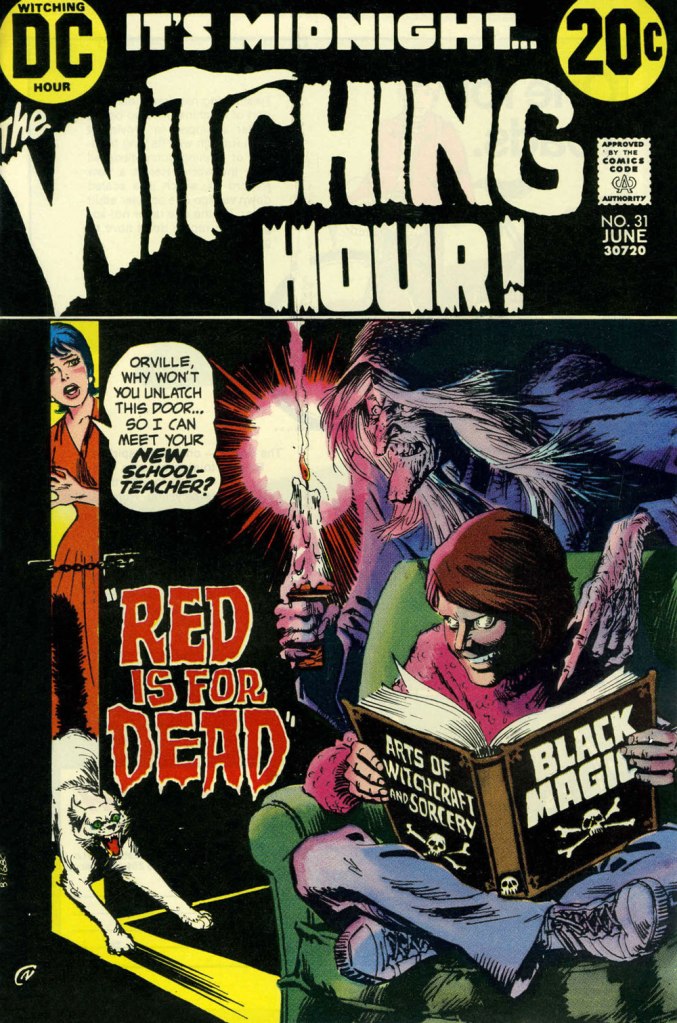
TAoJL editor Murray Boltinoff (1911-1994) had a soft sport for that particular cover concept, since he recycled it, eight years later and with a different tone, for another title he was overseeing:

Here, for comparison, is It’s Midnight… the Witching Hour no. 31 (June 1973, DC). Art by Nick Cardy.
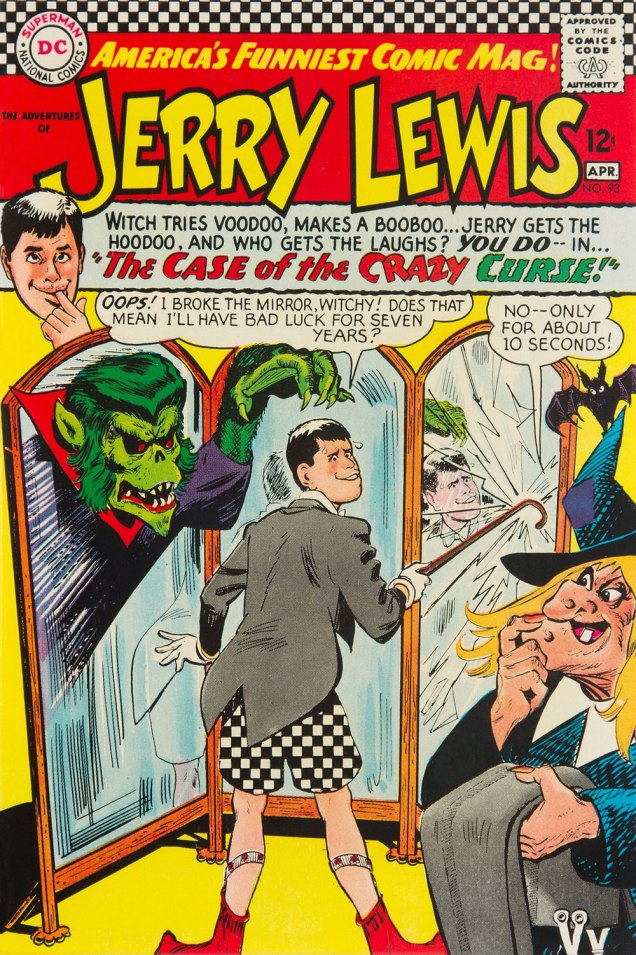
This is The Adventures of Jerry Lewis no. 93 (Mar.-Apr. 1966, DC).
This is The Adventures of Jerry Lewis no. 94 (May-June 1966, DC).
This is The Adventures of Jerry Lewis no. 98 (Jan.-Feb. 1967, DC).
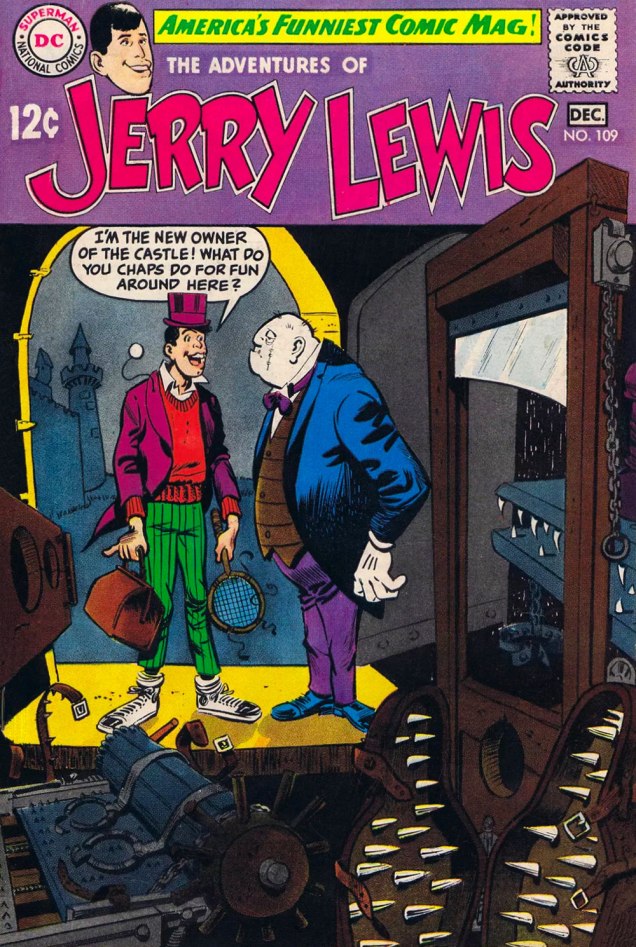
And finally, The Adventures of Jerry Lewis no. 109 (Nov.-Dec. 1968, DC). This one’s another riff on a rather hoary theme.

-RG

Hallowe’en Countdown VIII, Day 6

« Every poem should remind the reader that they are going to die. » — Edgar Allan Poe

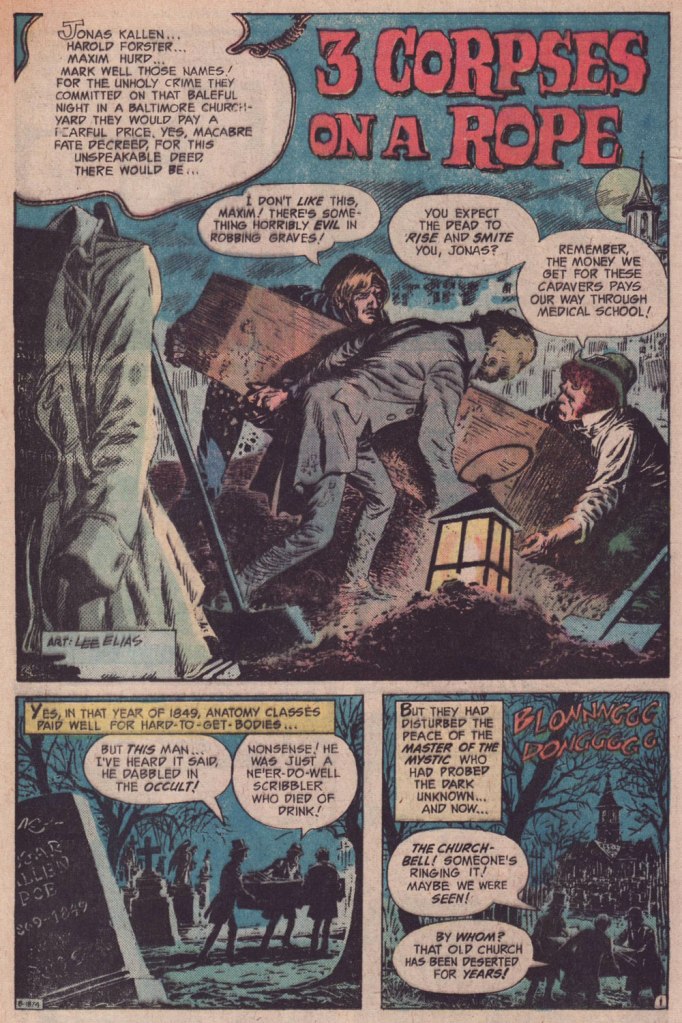
Ah, mixing fact with fiction — such an honoured tradition. In the mid-1970s, DC editor Murray Boltinoff (Ghosts, The Unexpected, The Witching Hour, Teen Titans, The Brave & the Bold) hit upon the notion of featuring historic writers encountering in daily life the supernatural object of their eventual inspiration.

Last year, I featured Bram Stoker‘s visit with a certain undead personage, The Most Fearful Villain of the Supernatural.

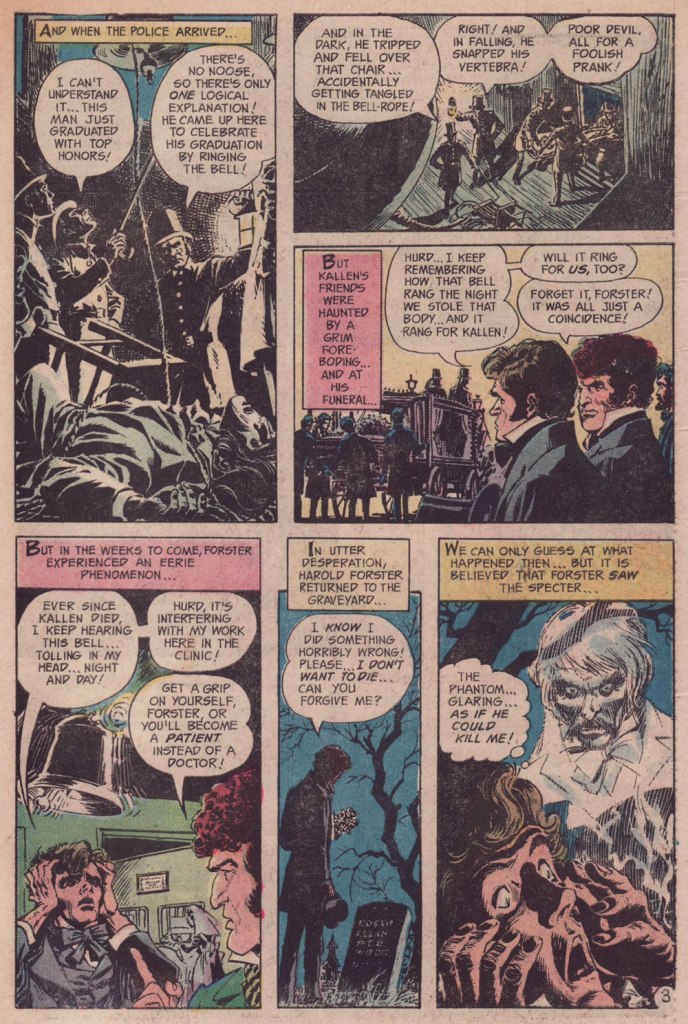
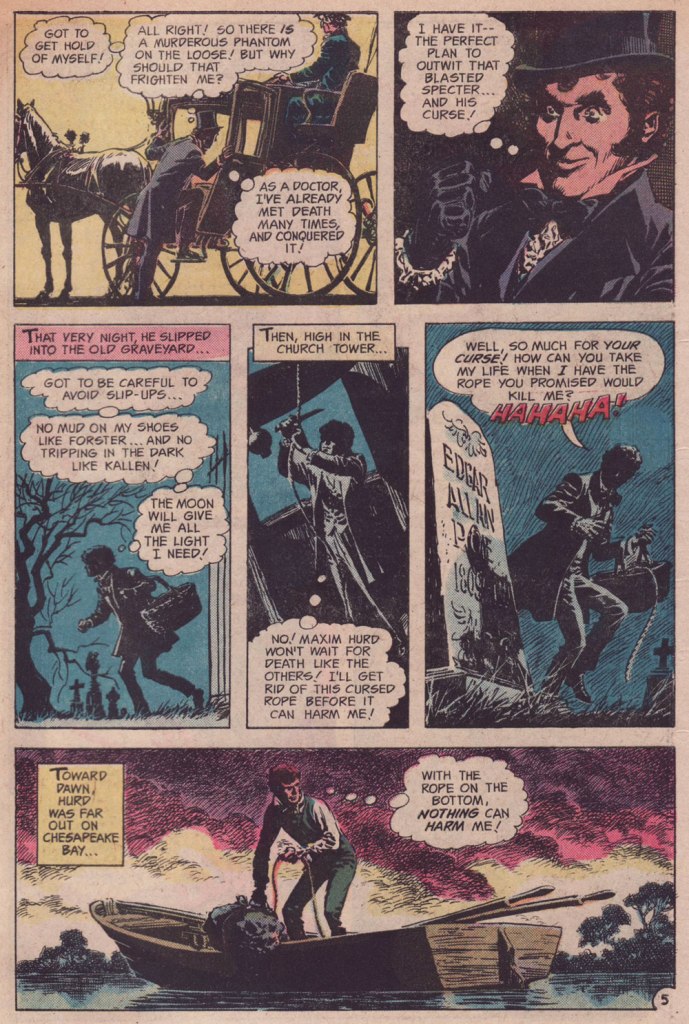
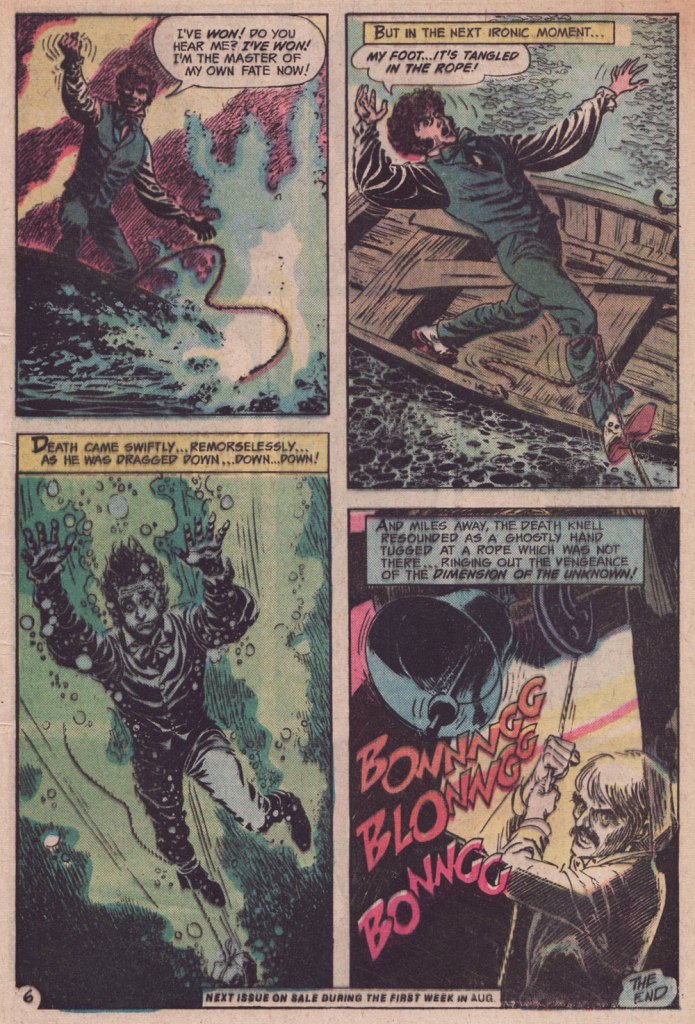
The formula was tweaked a bit for the Edgar Poe entry, in that the tale opens after Poe’s burial, and the late writer is not the protagonist. Read on!

3 Corpses on a Rope“, written by Carl Wessler and illustrated by Lee Elias, originally appeared in Ghosts no. 43 (Oct. 1975, DC).

If you ask me, despite his evident illustrative gift, Elias’ depiction of the revenant ends up looking more like Poe’s fellow Baltimorean John Astin, whom I envision starring in a one-man show entitled ‘An Evening With Edgar Allan Poe‘.

-RG

Thanks, Bernie: A Fine Pair From Mr. Mireault

This is a post I didn’t want to write — or rather, a post I didn’t want to write under the present circumstances. While I’ve known Bernie Mireault (June 27, 1961 – September 2, 2024) for a long time, I couldn’t presume to call him my friend. We were never particularly close, but we ran in similar circles for a time. Then our paths split, many years ago. But I always liked him and greatly admired and followed his work.

I remember him as a kind, generous, humble man, with a soothing voice and manner. And blessed — and cursed, I suppose — with massive, multifaceted talent. Now that he’s left this world, his memory and his work linger. Allow me to showcase a couple of my most treasured Mireaults.

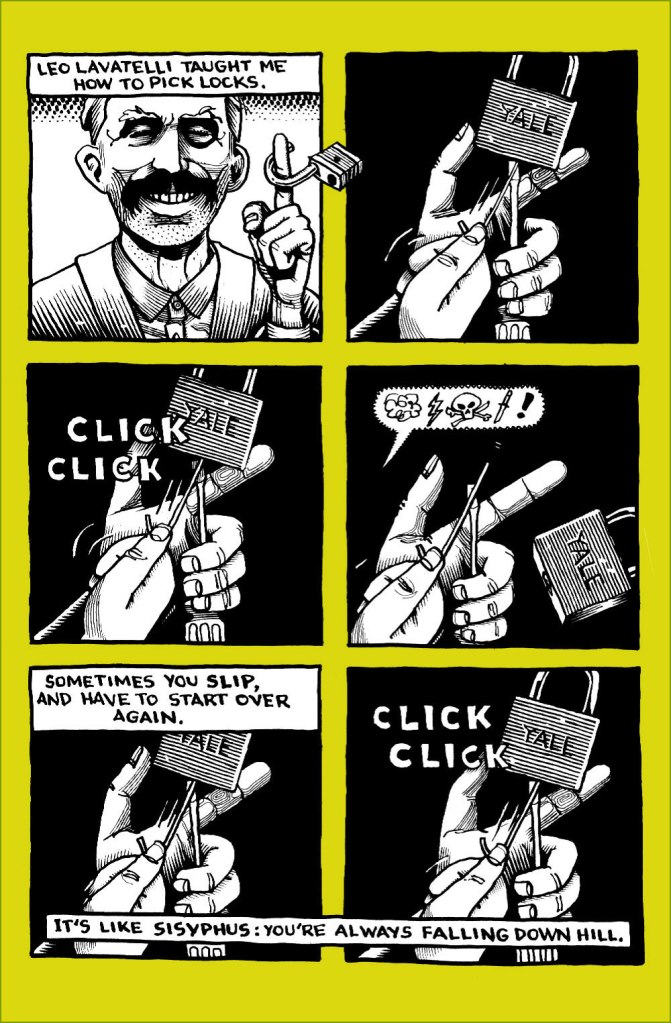
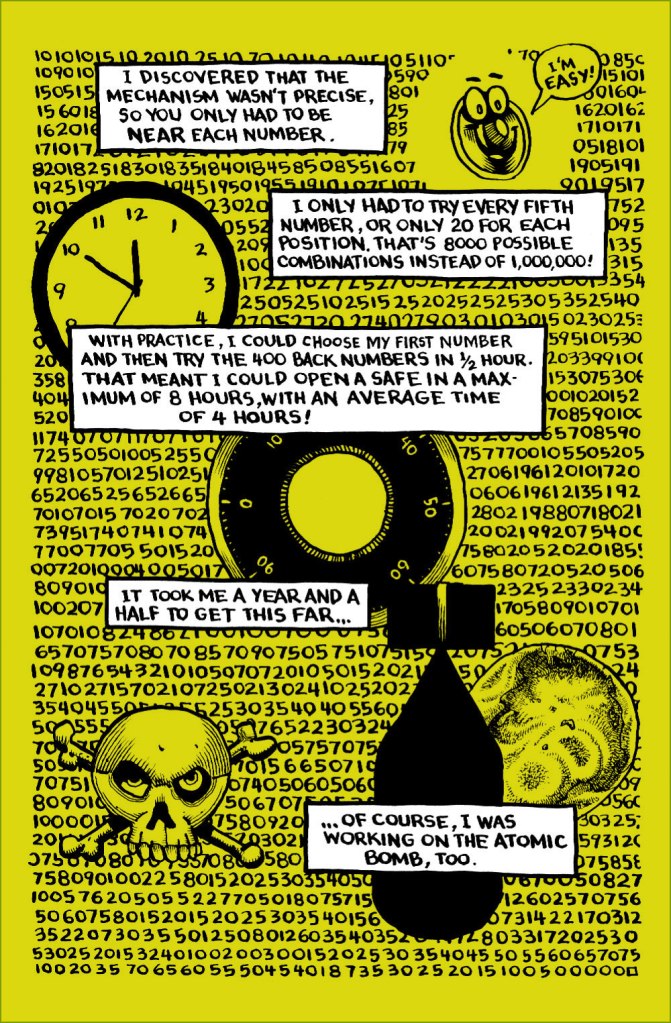
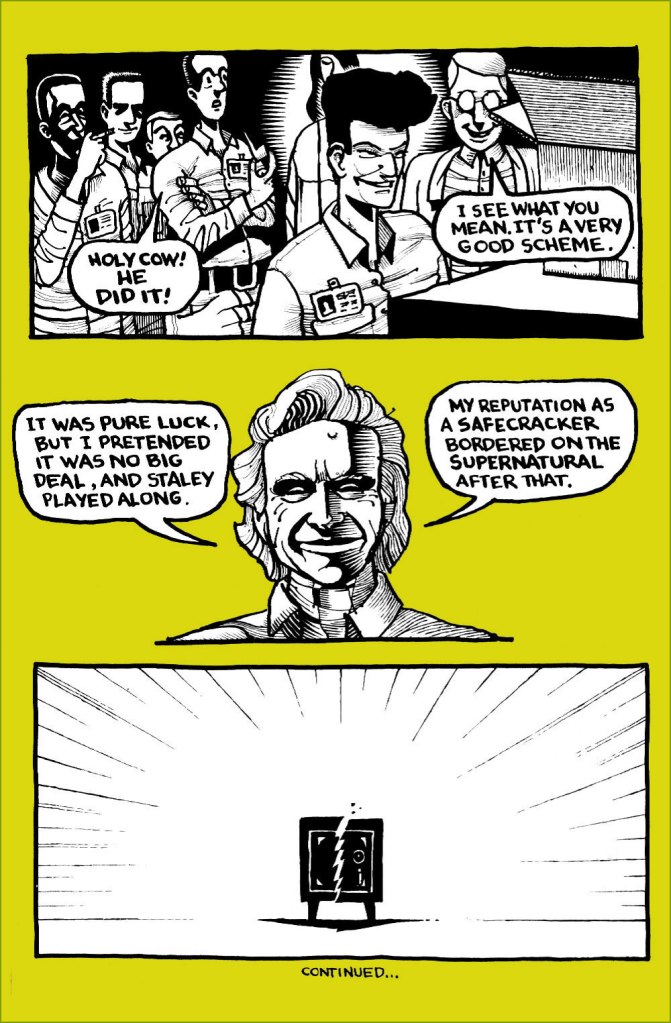
« Though this is fictionalized science, it’s not science fiction. We’ve imagined some of the details, but the characters existed, and did and said (most of) the things you’ll read. » Two-Fisted Science: Safecracker (1997, General Tektronics Labs). Published in advance of the Two-Fisted Science anthology, in order to promote it. However, Bernie’s piece outshines everything else, if you ask me. For good or ill, cheap copies of the comic book are still handily acquired.
This is only (most of) a single chapter of Bernie’s contribution — which totals 30 pages! — but it’s fully enjoyable on its own. Script by Jim Ottaviani, pencils, inks and lettering by Mr. Mireault.

A bit of background about Mr. Lavatelli (1917-1998)…

Pray note Bernie’s clever nod to the great Harvey Kurtzman (top left).

Of course, working on a story starring genial genius Dr. Richard Feynman already gives you an edge, but Bernie was one of the few cartoonists who could breathe life into the drabbest of narratives. Non-fiction seems especially daunting for today’s cartoonists, for some reason.

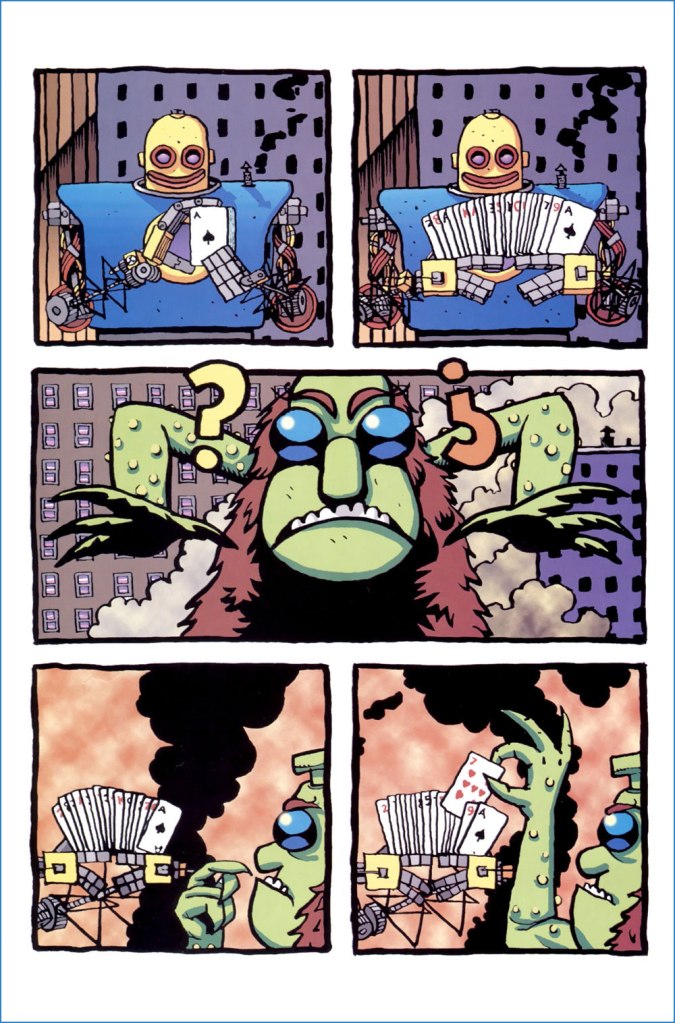
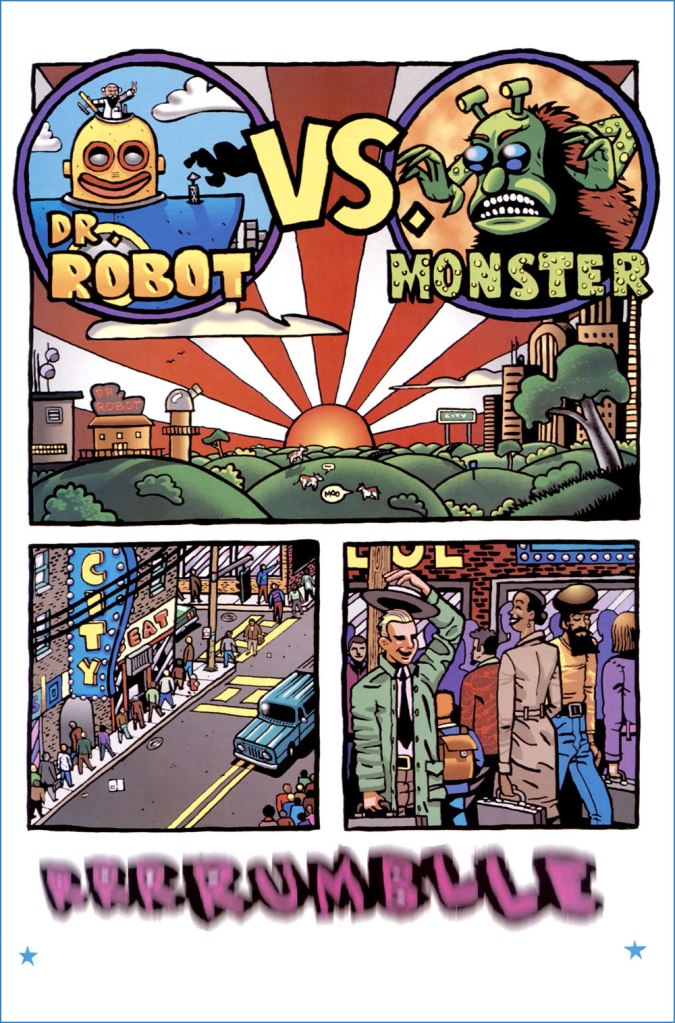
For another facet of Mireault’s talent, and to highlight his peerless colouring chops, here’s my favourite of his too-few Dr. Robot stories, written, pencilled, inked, lettered *and* coloured by Mireault. To this day, insultingly cheap copies are plentiful. Less than the original cover price, for Pete’s sake.

Thanks, Bernie. I’m truly sorry things didn’t work out for you.

I was going to post something very brief this month, telling you what to expect from us in September, which is… nothing else. We’re busily preparing this year’s edition of our Hallowe’en Countdown — which will include some more Mireault, that’s all I can tell you for now. See you soon!

-RG

Alain Delon Did Not Drink Eau de Cologne*.

« Better to have a lousy character than no character at all. » — Alain Delon (Nov. 8, 1935 – Aug. 18, 2024)

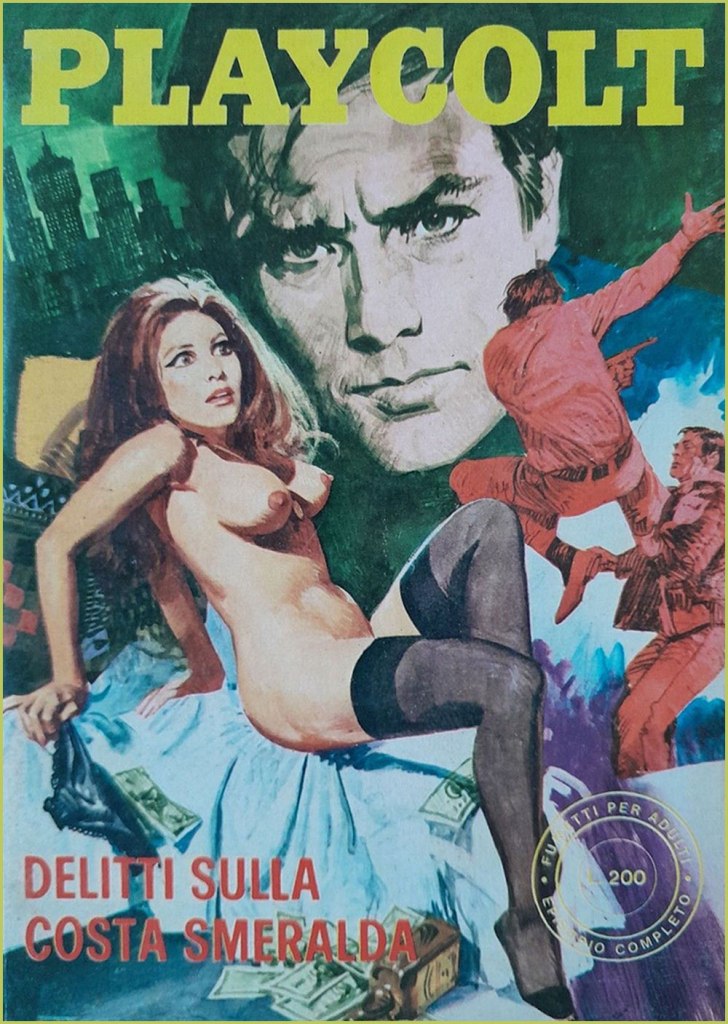
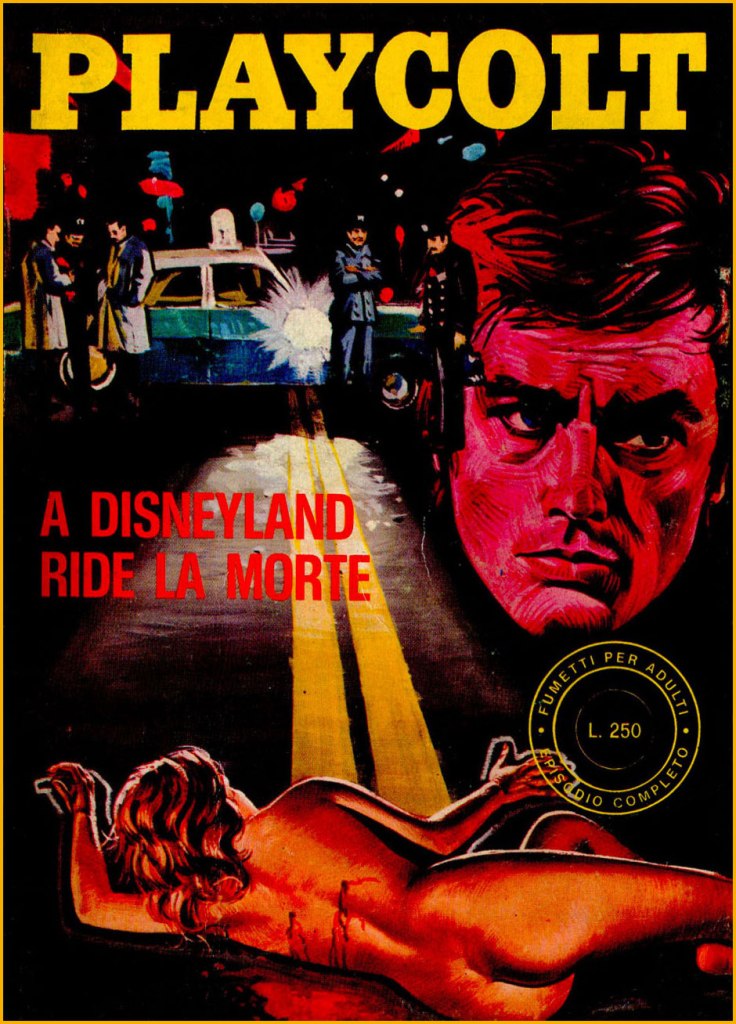
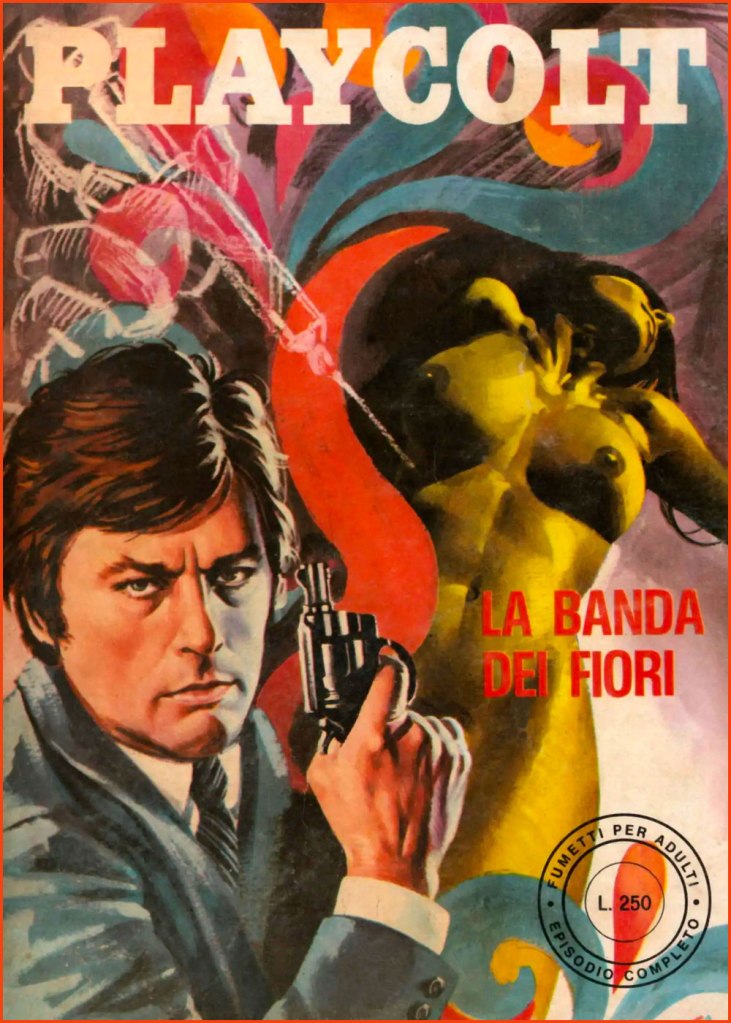
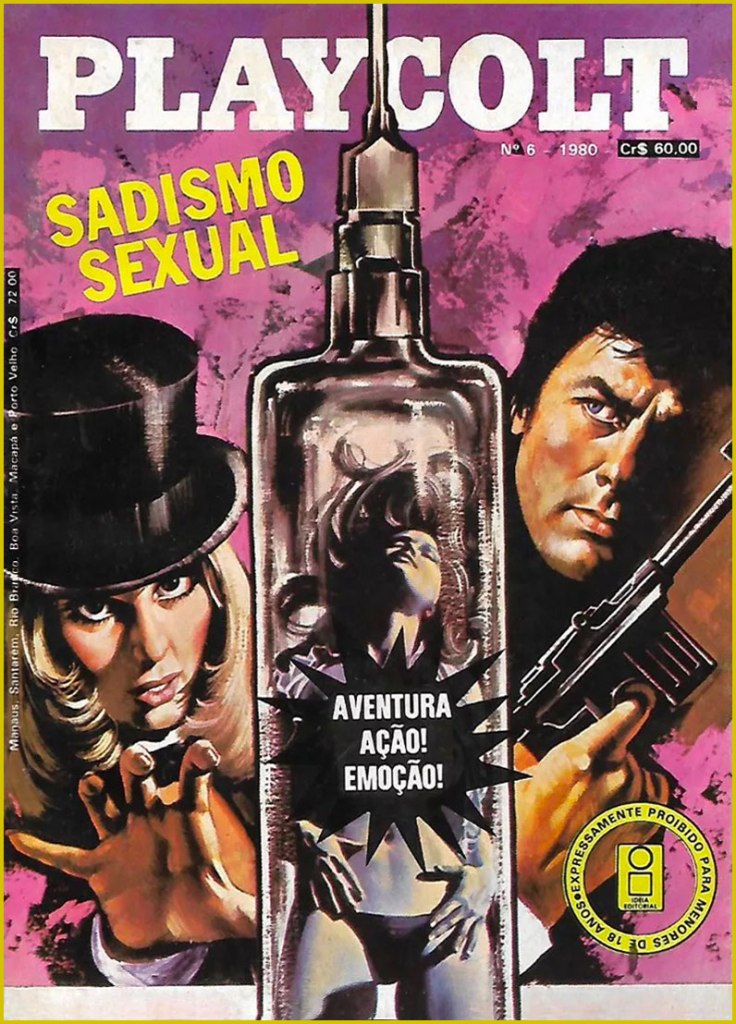
Quite recently, we lost monstre sacré Alain Delon. He was a complicated man, a bit of a prickly bastard, but he sure made a lot of great movies*. But comics, you ask? Well, I’m sure he never asked for it, but like many a celebrity (Jean-Paul Belmondo, Ornella Muti…) his famous countenance was appropriated by those incorrigible rascals at Edifumetto and Ediperiodici.

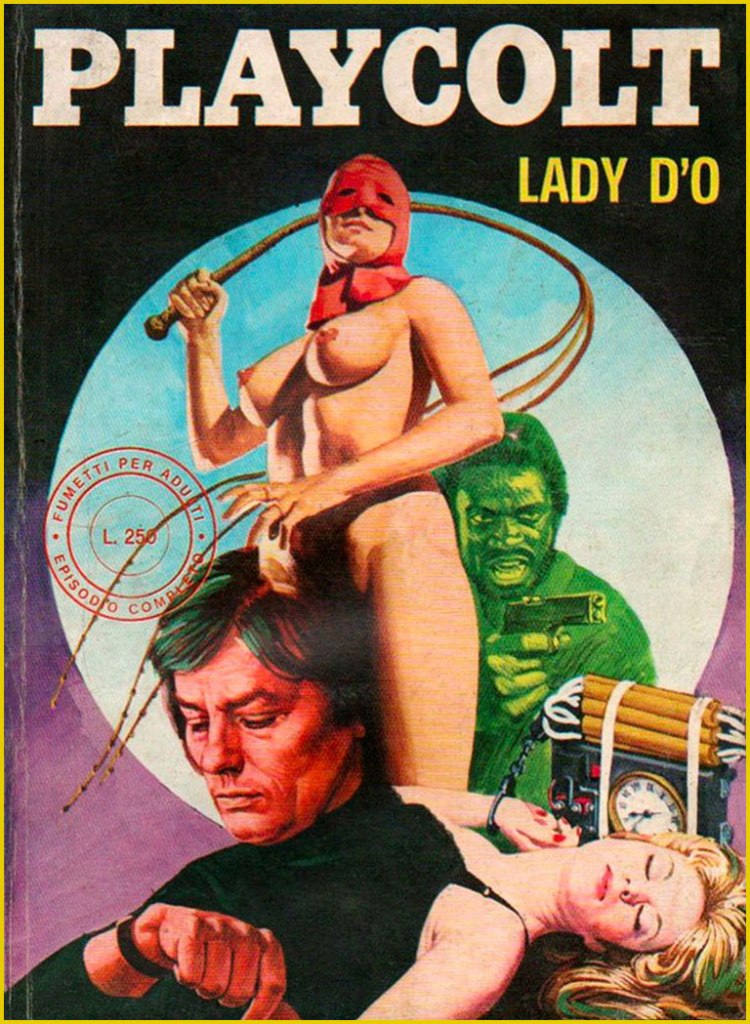
So Alain Delon became… « Alain Velon, a billionaire playboy who lives on an island “a 3-hour flight from New York“. He spends his private life conquering women in a continuous stream even if he is already engaged to the film actress Lizzy Scarlett, but “due to his innate sense of justice” he periodically transforms into Playcolt, a sort of superhero. His enemy is Linda Darnel, also a billionaire: sadistic and fetishist, she turns into the anti-heroine Za the Dead. Another historical rival is the always sadistic but lesbian Mandrakka. »

Now don’t get me wrong: these are virtually unreadable, poorly drawn, sadistic, illogical, reactionary misogynistic claptrap. But the covers are fascinating in their gonzo way, randomly cobbling together purloined bits from famous likenesses to established logos. You’d think this brazen wave of wholesale filching would have led to swift and decisive legal action from several stars’ solicitors, not to mention Hugh Hefner’s… but it seems not. This was, after all, the Italy that gave us Silvio Berlusconi.

« To the Sound of Punches »; this is Playcolt Series II no. 9 (Nov. 1973, Edifumetto). Cover art by Carlo Jacono, a nice piece, but celebrity likenesses evidently weren’t among his strong suits.
« Crimes on the Emerald Coast »; this is Playcolt Series II no. 14 (Aug. 1973, Edifumetto). This one’s *possibly* the work of Alessandro Biffignandi… or his studio.
« The Golden Rain » (ahem); this is Playcolt Series II no. 23 (Dec. 1973, Edifumetto). Another Jacono, another botched likeness.
« The Divine Sadist »; this is Playcolt Series III no. 1 (July 1974, Edifumetto).
« Death laughs in Disneyland »; this is Playcolt Series III no. 11 (June 1974, Edifumetto).
« There’s a mess in the middle of the sea »; a 1980 Brazilian edition reprinting Playcolt Series III no. 18 (Sept. 1974) in Portuguese.
« The Flower Gang »; this is Playcolt Series III no. 22 (Nov. 1974, Edifumetto). I have no concrete evidence, but the technique displayed here reminds me strongly of British illustrator-cartoonist Ron Embleton (1930-1988), co-creator of Oh, Wicked Wanda! and illustrator of the immortal Captain Scarlet closing credits.
No need for a translation, is there? A 1980 Brazilian edition reprinting Playcolt Series IV no. 1 (Jan. 1975) in Portuguese.
« Operation Puzzle »; this is Playcolt Series IV no. 12 (Nov. 1975, Edifumetto). Cover painted by the prolific Emanuele Taglietti, who handled quite a few covers in this series. Here’s an impressive gallery of these.
« The White Shark »; this is Playcolt Series IV no. 35 (May 1976, Edifumetto). Sharks were all the rage that year.
« To Love a Hole »; a 1980 Brazilian edition reprinting Playcolt Series IV no. 2 (Jan. 1975). Dig that strategic blurb placement; the Italian edition was not so coy.
Clearly a reference to the previous year’s hit ‘erotic’ film, L’histoire d’O; this is Playcolt Series IV no. 27 (Jan. 1976, Edifumetto). It’s funny how the Delon photos used span his career up to that point, which yields visual whiplash when you go from the Delon of Plein Soleil to the jaded, grizzled one of, say, Monsieur Klein or La mort d’un pourri from one issue to the next.
« Terror in California »; this is Playcolt Series IV no. 44 (Oct. 1976, Edifumetto). The obligatory Jaws cash-in. Say what you will, those Italians didn’t miss a trick.

There was, concurrently, another Delon homage in Jean Ollivier and Raffaele Carlo Marcello‘s successful Docteur Justice, a humane but hard-hitting series about a physician and expert judoka who roams the globe’s trouble spots for the World Health Organization. There was even a film adaptation in 1975, with John Phillip Law essaying the title role… and co-starring Delon’s ex — and only — wife, Nathalie. Among Pif Gadget’s adventure series, it was only bested in popularity by the prehistoric blond heartthrob Rahan. I’ll tell you more about it one of these days.

-RG

*So claims the Russian pop song entitled Взгляд с экрана, and who are we to doubt it?

[ source ] And for those who like to dig a little deeper, here’s a most illuminating article on the subject.

**I recommend Adieu, l’ami, Red Sun — both co-starring Charles BronsonLa mort d’un pourri, Jean-Pierre Melville‘s Le Samouraï and Le cercle rouge, Plein soleil… as cinema’s first Tom Ripley.

One Furious Woman and a Hatchet: the Saga of Carrie Nation

« In 1900, she bought from a Medicine Lodge hardware store the implement that became both her weapon and her symbol — a hatchet — and at the age of fifty-four sallied forth on a smashing campaign that carried her across the country, shouting: ‘Smash! Smash! For Jesus’ sake, Smash!’ »

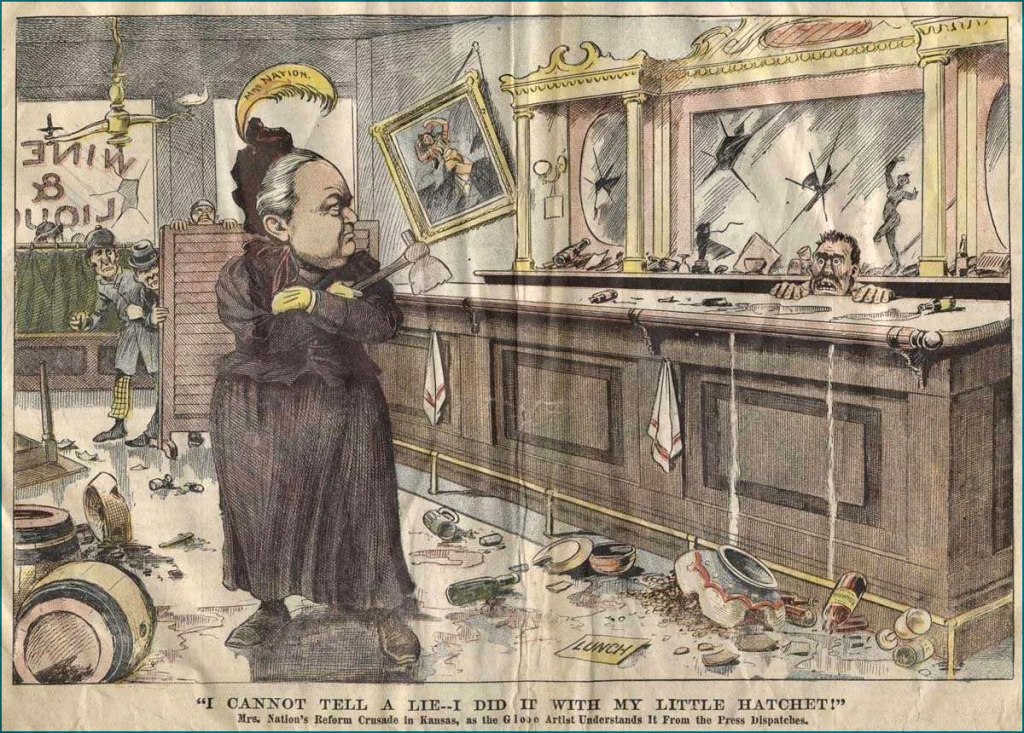
These days I’ve been reading Ardent Spirits: The Rise and Fall of Prohibition (1973) by John Kobler. I didn’t know much about the temperance movement in general, but what surprised me most is how intimately it was tied to suffragette activism. It’s in Ardent Spirits that I came across the fascinating character of Carry Nation*, a bulldog, running along at the feet of Jesus, barking at what He doesn’t like’. She seems a very fitting figure for a post on this March 8th, International Women’s Day.

Whether she was a total barmpot or a blazing visionary is up for some debate; I must give credit to Kobler, who cobbled together a fairly well-balanced portrait of her while many historians tended to quickly dismiss this hatchet-wielding devotee as a crazed lunatic. While basic facts remain the same (disagreement about Nation’s height notwithstanding), interpretation of events and motivations varies wildly. This can be quickly demonstrated by comparing two modern articles of some depth: Carry Nation is described as ‘a flamboyant, theatrical and completely outrageous woman at nearly 6 feet tall [..] smashing barrels on stage and singing her temperance songs to enthusiastic audiences who howled for more‘ (Carrie Nation: American Woman by Richard Behrens) but also as ‘a fearless populist progressive just over 5 feet tall** […] fighting tirelessly for good governance, women’s rights, civil rights, and cleaning the corruption out of the body politic‘ (Hatchet Nation by Mark Lawrence Schrad).

One of six postcards published in 1905 depicting Nation’s ‘hatchetations’: On the Warpath; Raiding a Public House; Addressing Cigarette Fiends; Smashing a Pub; In a Restaurant; In a Pub.
Cartoon from 1901 published in The Freethought Ideal, Vol II, 1901.

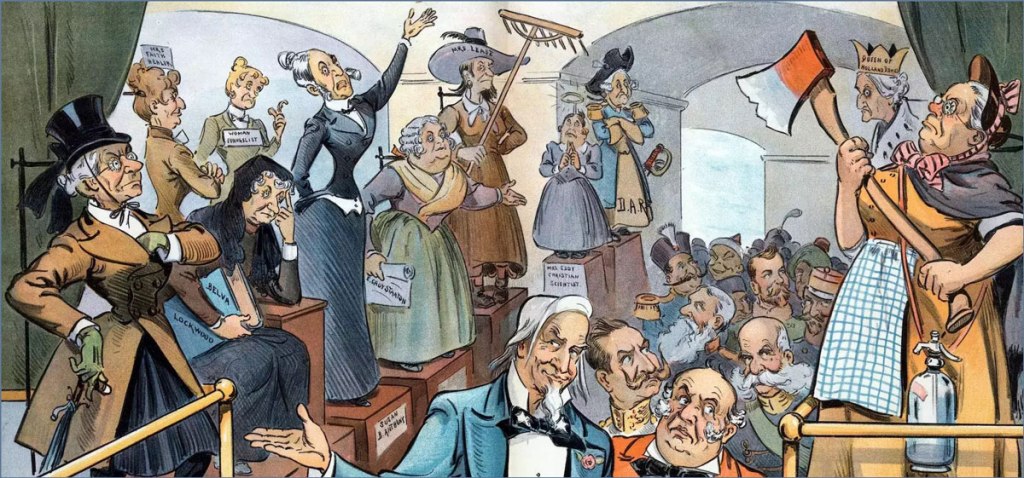
Nation went through an arsenal of weapons (aside from rocks and incidental objects, a sledgehammer) before settling on her beloved hatchet and coining the term ‘hatchetations’ to describe her saloon smashings. It comes as no surprise that she grabbed cartoonists’ imagination, even taking into account that real juicy conflict remains unillustrated (and this was a ruthless war between temperance advocates and their opponents). Just picture this colourful scene — a woman, garbed in the usual constrictive dress of early 19th century, marching into a bar and smashing up bottles, mirrors, chairs, slot machines with her trusty little axe. This striking image is likely why Nation’s name is first to spring up when the topic of prohibition arises in modern conversation.

American newspaper cartoon, 1901.
A cartoon in The Gazette by Harry Larimer, published in 1901.
Cartoon from April 14th, 1901.
Cartoon by Louis Walrymple published in Puck, v. 49, no. 1256 (April 3rd, 1901).
Cartoon published in the Minneapolis Journal on February 6th, 1901. You’ll doubtlessly notice that this caption gets around a lot!
Puck, 1908.
A bit closer to the present day, here’s a 1960s cartoon by bon vivant Eldon Dedini, who hypothesizes Ms. Nation’s likely reaction to a Playboy Club (the first one opened in Chicago, circa 1960). The caption? « Hi! ».

Happy Women’s Day (and Women’s History Month) to all readers!

~ ds

* This original name came about when Carry Moore, named Carry by a semiliterate father, married David Nation. She preferred to spell her name as ‘Carrie’, until she married David, yielding the grandiose full name Carry A. Nation (A. stood for Amelia), ‘carry a nation for temperance’.

** This question of height intrigues me, for most articles describe Nation as tall and powerful. Mark Lawrence Schrad, who just portrayed her as being just over 5 feet tall, has also written another article in which he calls her ‘imposing in stature, prone to violence and—claiming God spoke to her, urging her to attack saloons—slightly unhinged‘.

And Now a Word From Our Sponsor

« Advertising – A judicious mixture of flattery and threats. » — Stephen Leacock

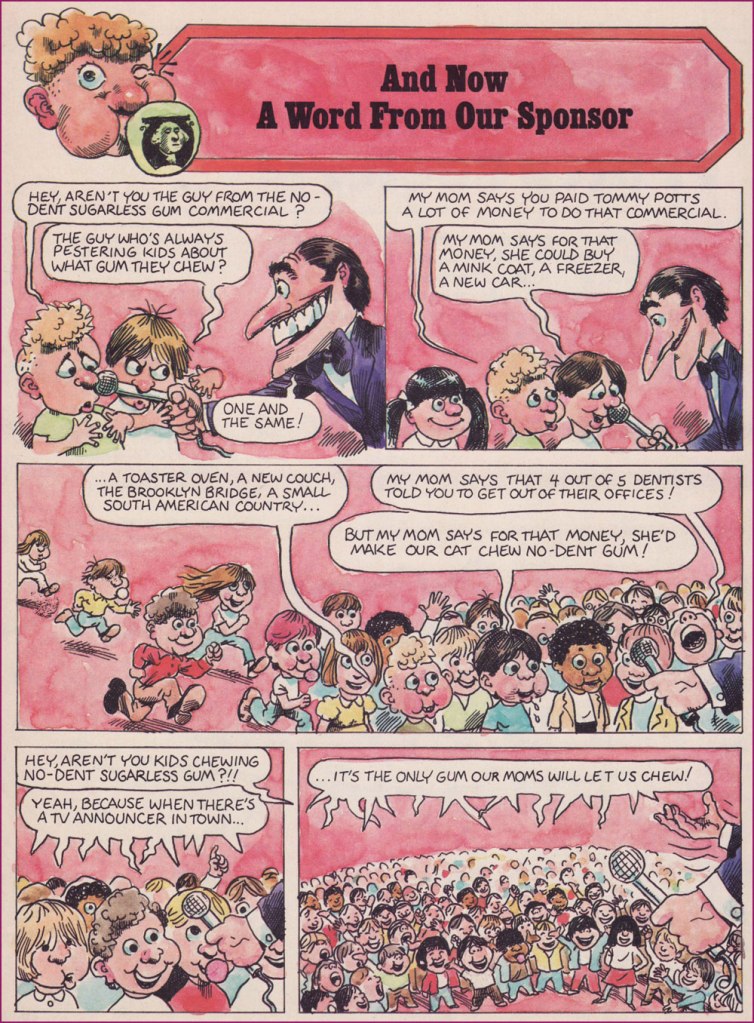
It’s long been established that one can scarcely be too skeptical in the face of advertising, and the sooner one starts questioning its wooly claims, the better. In the early 1950s, Harvey Kurtzman‘s Mad shone the giddily harsh light of truth on, well, just about everything, but Madison Avenue‘s tactics were a favourite and frequent target, and for good reason. In 1956, Kurtzman heatedly left his creation after a mere 28 issues; while it retained much of its cultural influence as its reach increased, it degenerated into rigid formula in the hands of his too-cautious successor at the helm, Al Feldstein.

Fast-forward to 1974, and Dynamite Magazine‘s sixth issue. Readers presumably too young for Mad could now receive their monthly inoculation against the advertising industry’s tainted baloney.

From 1974 to 1981, the feature was illustrated by Calvin Sanford “Sandy” Huffaker, Sr. (1943 – 2020); then the reins were passed into the able paws of future Mad art director (small world!) Sam Viviano. But that’s a tale for another day.

Since Huffaker was only credited for illustrating the feature, it stands to reason that it was written in-house, and that narrows it down to two main candidates: editor Jane Stine or Linda Williams Aber (aka “Magic Wanda”); my money’s on Aber, who also wrote Count Morbida’s Puzzle Monthly Puzzle Pages.

As Dynamite’s ‘Inside Stuff’ table of contents always billed it, here’s « A Dynamite look at BADvertising »!

The feature’s inaugural entry, from Dynamite no. 6 (Dec. 1974, Scholastic). The voracious oldster lampooned here is Euell Gibbons, who shilled for Post Grape-Nuts (which contain neither grapes nor nuts!) in this vintage commercial.
From Dynamite no. 7 (Jan. 1975, Scholastic). You might recognize Nancy Walker, aka Rhoda’s mom Ida, and future director of Can’t Stop the Music! (trigger warning: Steve Guttenberg); here she is, pre-orange hair, in a Bounty Paper Towel spot from the Me Decade.
From Dynamite no. 9 (Mar. 1975, Scholastic). Here’s a 1971 Bufferin vs. Aspirin ad. Place your bets!
From Dynamite no. 19 (Jan. 1976, Scholastic). You just may be familiar with the object of this parody.
From Dynamite no. 25 (July 1976, Scholastic). Here’s another ‘wonderful, quickJell-o recipe from those gelatin-happy days.
From Dynamite no. 26 (Aug. 1976, Scholastic). Remember Morris? Here’s the famously fussy feline in a 1974 Nine Lives ad.
From Dynamite no. 27 (Sept. 1976, Scholastic). Here’s a Hamburger Helper commercial of the corresponding vintage.
From Dynamite no. 28 (Oct. 1976, Scholastic). Here’s our pal Poppin’ Fresh in a 1972 commercial.
From Dynamite no. 37 (July 1977, Scholastic). On that topic, here’s our look at the 1970s bubble gum explosion!
This subscription ad appeared in Dynamite no. 26. I suspect it was a draft for issue 28’s more focused Laverne and Shirley cover, which had been previewed in ads as a photo cover.
From 1971, young Sandy wears his Ed Sorel influence a little heavily, but he was learning fast and from the best! For those who may not know — or who’ve forgotten — David Frye was possibly the nation’s premier Tricky Dick Nixon imitator. Was he? Listen here and judge for yourself!

Thanks to his versatility and ability to nail a likeness, Huffacker was among the most sought-after illustrators of the 1970s. Quoting from the Chattanoogan.com’s obituary:

« Huffaker was a highly acclaimed political cartoonist who started his career with The Birmingham News and the Raleigh News and Observer. He later moved to New York City and illustrated covers and articles for such publications such as Time Magazine, The New York Times, Sports Illustrated, Businessweek, People and Fortune Magazine. Some of the accolades awarded for his artwork include two Page-One Awards from the New York Newspaper Guild, three nominations for Cartoonist-of-the-Year by the National Cartoonists Society, A Desi Award of Excellence (Graphic Design Magazine), 20 Award of Merit citations from the Society of Illustrators, and was twice nominated for a Pulitzer Prize for illustration. »

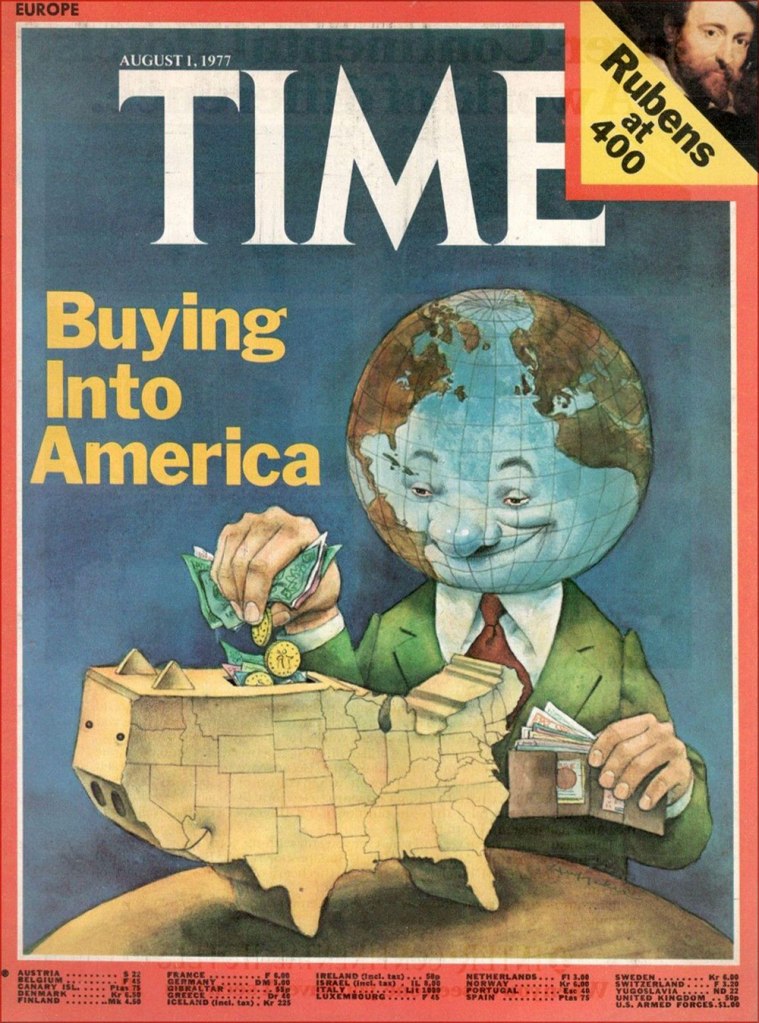
Here’s one of his aforementioned Time covers.

In a 2012 interview, he recalled those halcyon days: « During one week at the peak of his career as an illustrator, Sandy Huffaker had assignments from Time, Sports Illustrated and Businessweek. He had to turn down a fourth assignment that week from Newsweek. “I just didn’t have time. »

-RG

Hallowe’en Countdown VII, Day 18

« Life swarms with innocent monsters. » — Charles Baudelaire

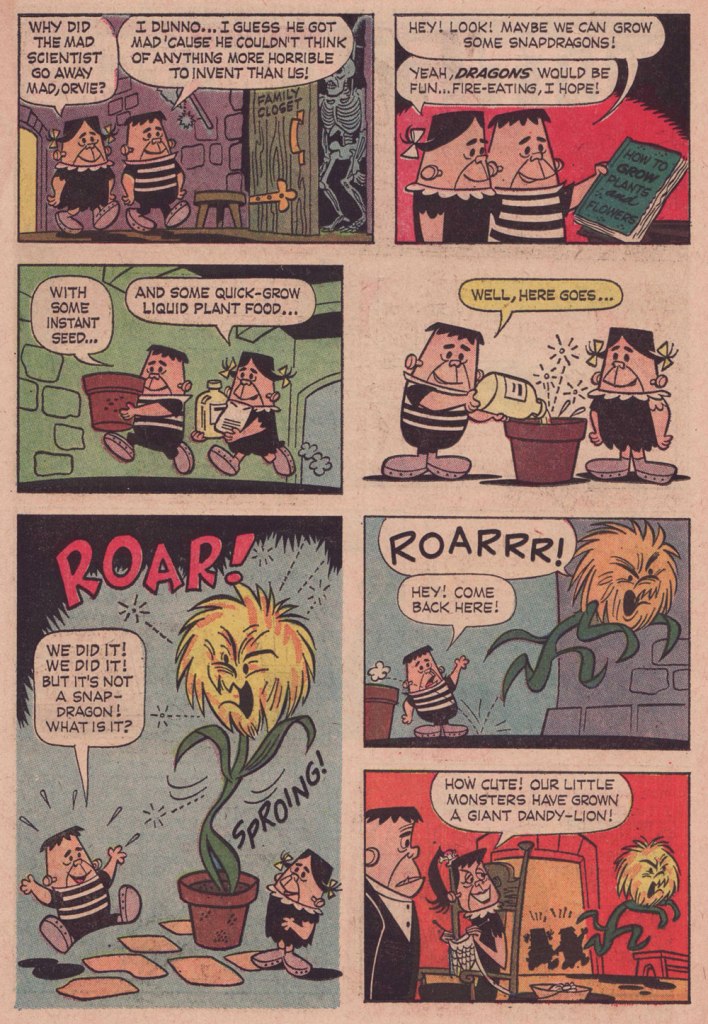
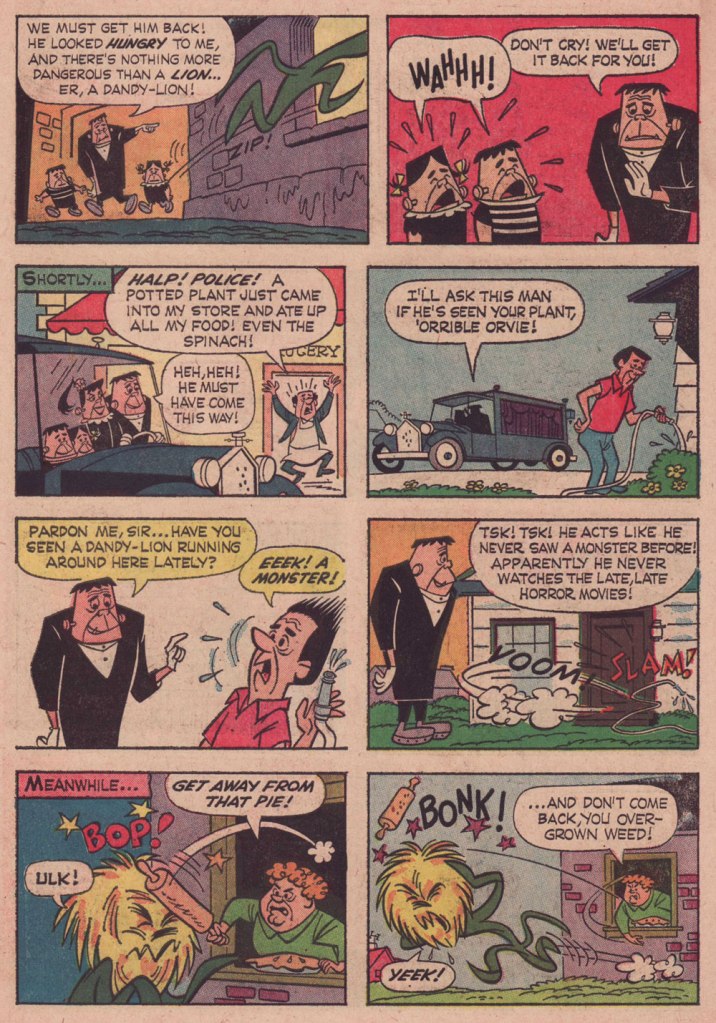
Few things evoke Hallowe’en so vividly to me as Gold Key’s The Little Monsters, one of the publisher’s relatively scarce non-licenced properties…

The series had its unlikely début as a backup feature in The Three Stooges no. 17 (cover-dated May 1964 — meaning it hit the stands in January) — months before The Addams Family (Sept. 18) or The Munsters (Sept. 24) reached television. Which is meaningless, of course, since the source for all of these fiends was Charles Addams’ New Yorker cartoons, wherein the clan did not even bear his name. Monsters everywhere! There must have been been something in the water.

Oddly enough, while Orvie, Annie, Demonica and Mildew soon (Nov. 1964) earned their own book, they remained loyal to Moe, Curly and Larry, retaining their backup slot to the very end of the Stooges’ run (no. 55, June 1972). And while the regular Little Monsters title often comprised reruns — as early as 1971’s issue 13 — the Stooges-sponsored backups never were reprinted.

I was all set to run with a furry little yarn from 1965, but then, just a few days ago, my nice mail lady fatefully handed me a box of comics that included The Little Monsters’ titular inaugural appearance.

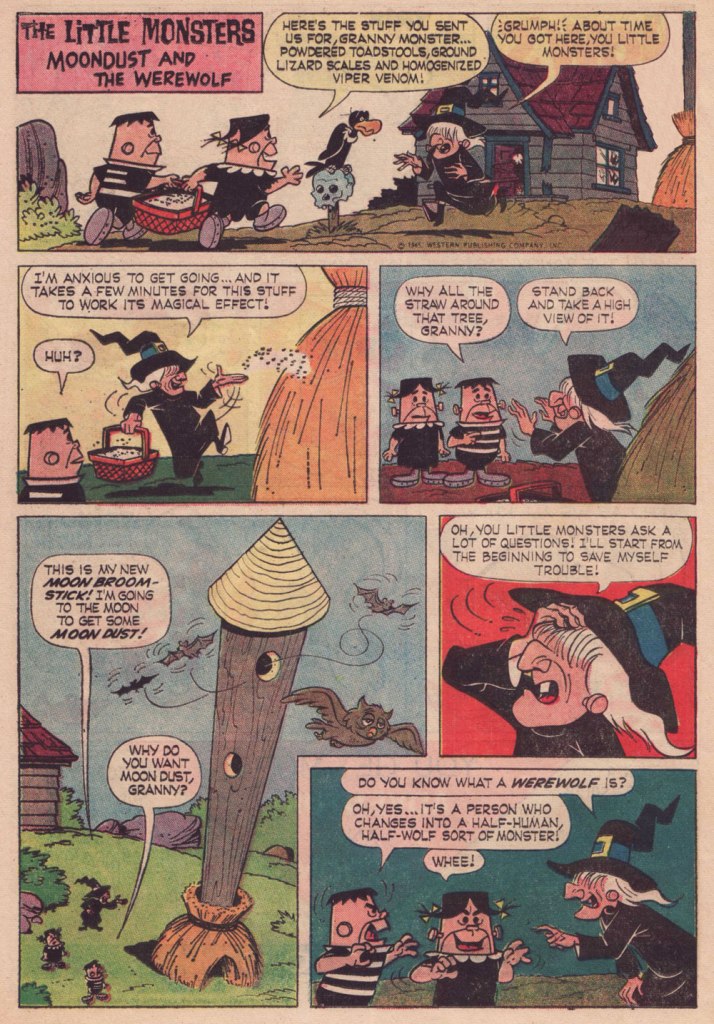
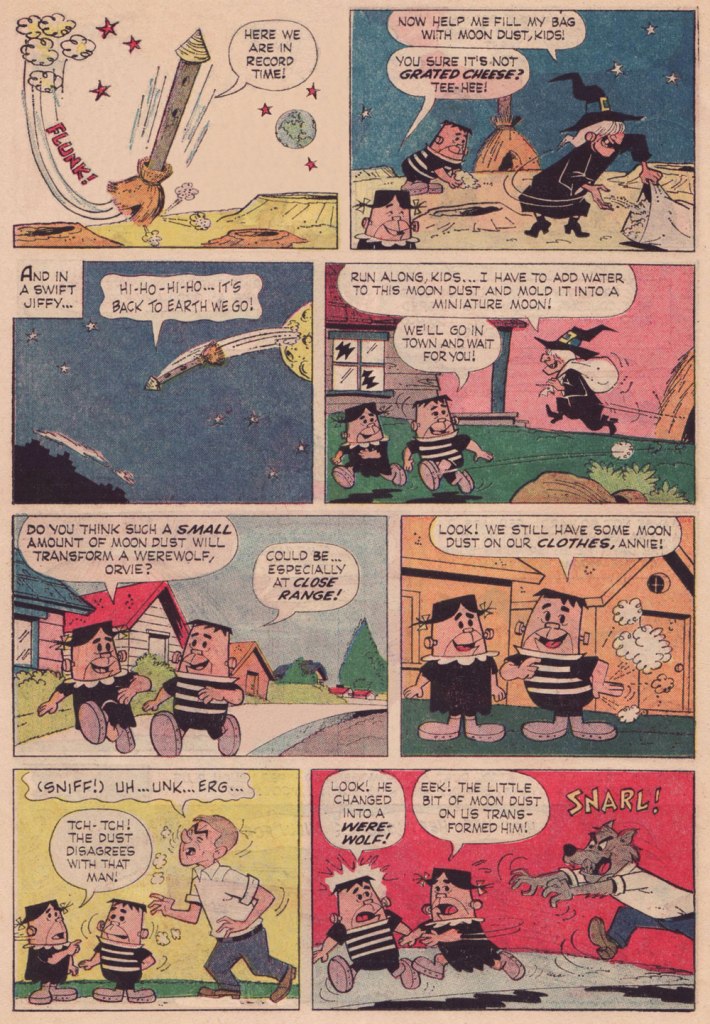
And, having mentioned it, here’s the story I had originally slated for this post: Moondust and the Werewolf from The Three Stooges no. 26 (Nov. 1965, Gold Key).

– RG