The Masulli-Mastroserio Cover Deluge of ’65!

« Charlton was just a place where you felt you could let off a little steam, even if you were never going to get rich. » – Roy Thomas

For over a decade, Pat Masulli (1930-1998) was executive editor of Charlton Publications’ comics line… and of its more lucrative song lyrics (Hit Parader, Song Hits) and crossword puzzle magazine line. Though much has been made of artist Carmine Infantino rising through the editorial ranks at DC Comics (positions traditionally held by writers or just plain bossy types; Sheldon Mayer was a most notable exception at DC), Charlton always did employ artists to manage the comics wing: Al Fago (1951-55), Masulli (1955-66), Dick Giordano (1965-68), Sal Gentile (1968-71) and finally George Wildman (1971-85). There are overlaps in time as well as the porous distinctions betwixt the titles of Managing Editor and Executive Editor.

Now, all of the aforementioned are serviceable artists, but I’m most interested in Masulli. Over the years, it’s gradually dawned on me that, for a few months in 1965-66, Masulli, as if he weren’t busy enough already, decided to lay out and pencil most of the comics line’s covers. And, astoundingly, they represented some of the finest (though often obscure) comics artwork of the decade. Cover artist is a plum job in comics, but few are born that can smoothly fill these tight, squeaky shoes.

What was Masulli like? It depends on whom you ask. His one-time assistant, artist (and later DC inker) Frank McLaughlin, responded with a diplomatic, amused « You don’t want to know. » Charlton’s main writer, Joe Gill, queried about Masulli as editor, sums it up: « Terrible. Pat’s dead now, but he was a martinet, not a friendly guy that enjoyed amiable relations with the artists. He ruled it, and he and I co-existed. » On the other hand, writer-editor Roy Thomas (who was granted his entrée into the industry from Masulli), understandably speaks well of him although, to his regret, they never met. Before they could, Masulli was promoted at Charlton, leaving him to devote his time and effort to the music division, handing the reins of the comic book line to his now-and-again assistant, Mr. Giordano.

Masulli’s go-to guy within his stable of artists appears to have been the versatile, underrated Rocco ‘Rocke’ Mastroserio, who died far too young (at the age of 40!), still steadily improving and shortly after landing some promising jobs at Warren and DC. Mastroserio’s early work can be a tad gawky and lopsided, but shows much promise. By the mid-60s, his covers (his forte) could at times attain a level of craft and inspiration rivalling (and akin to) the work of John Severin and Joe Maneely, fine models to emulate.

This time, however, let’s focus on highlights from the Masulli-Mastroserio flash flood of ’65.
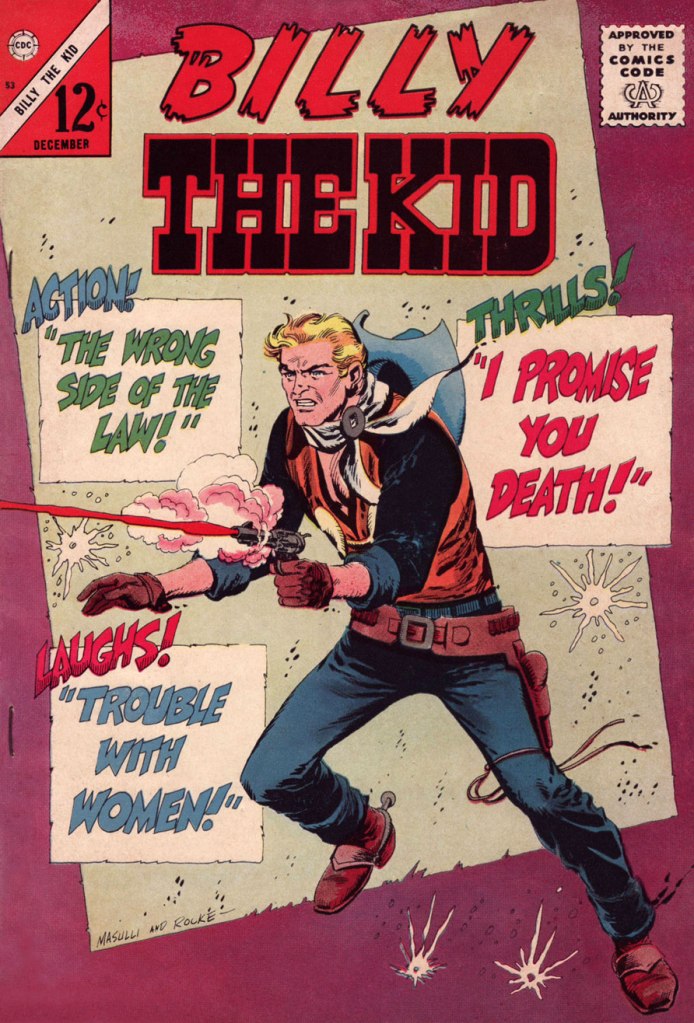
This is Billy the Kid no. 53 (Dec. 1965, Charlton).
This is Special War Series no. 1 (Aug. 1965, Charlton).
This is Fightin’ Navy no. 124 (Jan. 1966, Charlton).
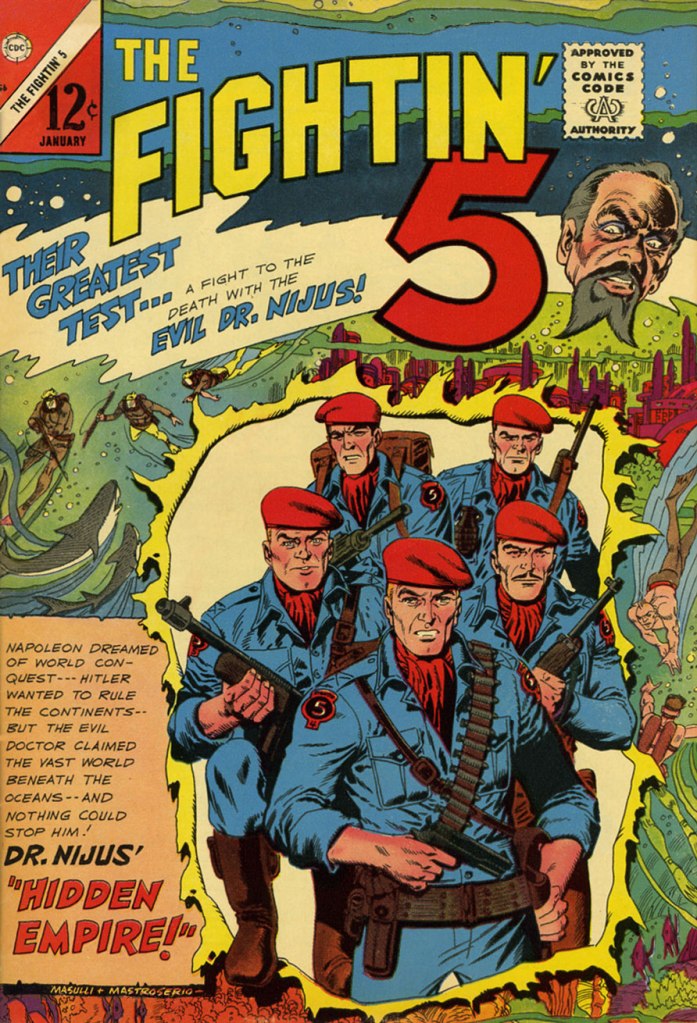
Intricate yet easy to parse, this is The Fightin’ 5 no. 36 (Jan. 1966, Charlton). Comic Book Artist editor Jon B. Cooke once or twice opined that The Fightin’ 5 were ‘a Sgt. Fury and His Howling Commandos swipe‘… but he was wrong: they were a Blackhawk swipe (if anything), and, let’s be honest, Sgt. Fury is, for his part, a Sgt. Rock and Easy Company swipe. All clear now?
This is Hot Rod Racers no. 9 (Jan. 1966, Charlton).
This is Hot Rod and Racing Cars no. 78 (Mar. 1966, Charlton). Masulli began his career as a colourist, and it certainly shows in his cover work.
This is Konga no. 23 (Nov. 1965, Charlton), the series’ final issue. The mighty Steve Ditko had begun the series, but later art chores were capably handled by the solid team of Bill Montes and Ernie Bache.
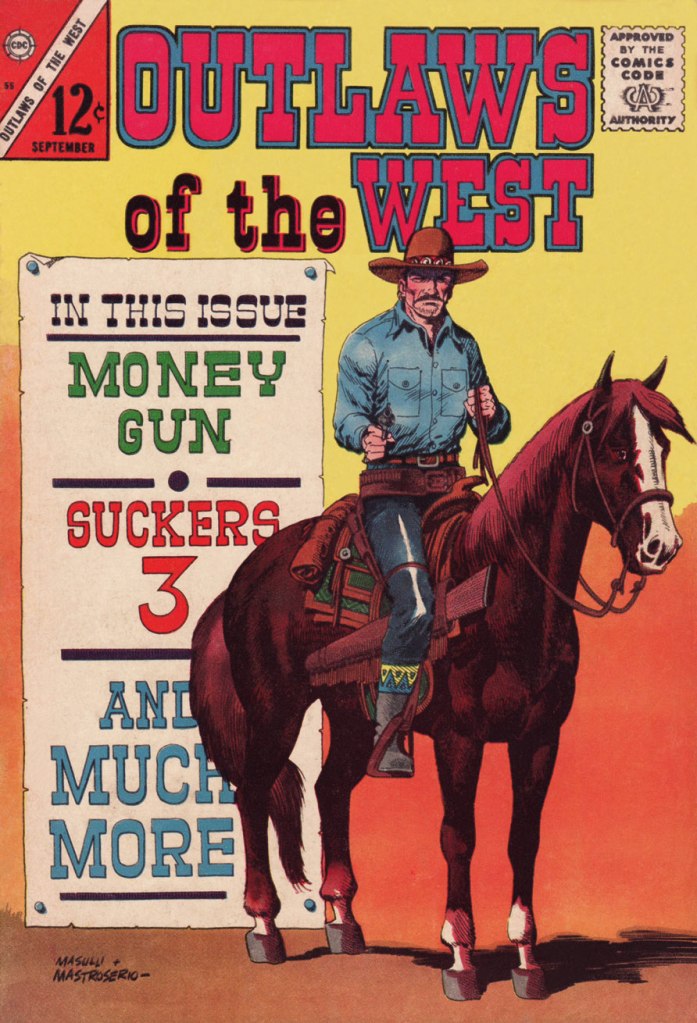
This is Outlaws of the West no. 55 (Sept. 1965, Charlton). Masulli could do busy and action-packed, and he could also do spare, clean and serene. Unlike many a cover artist, he didn’t seem to rely on one particular formula, or even two.
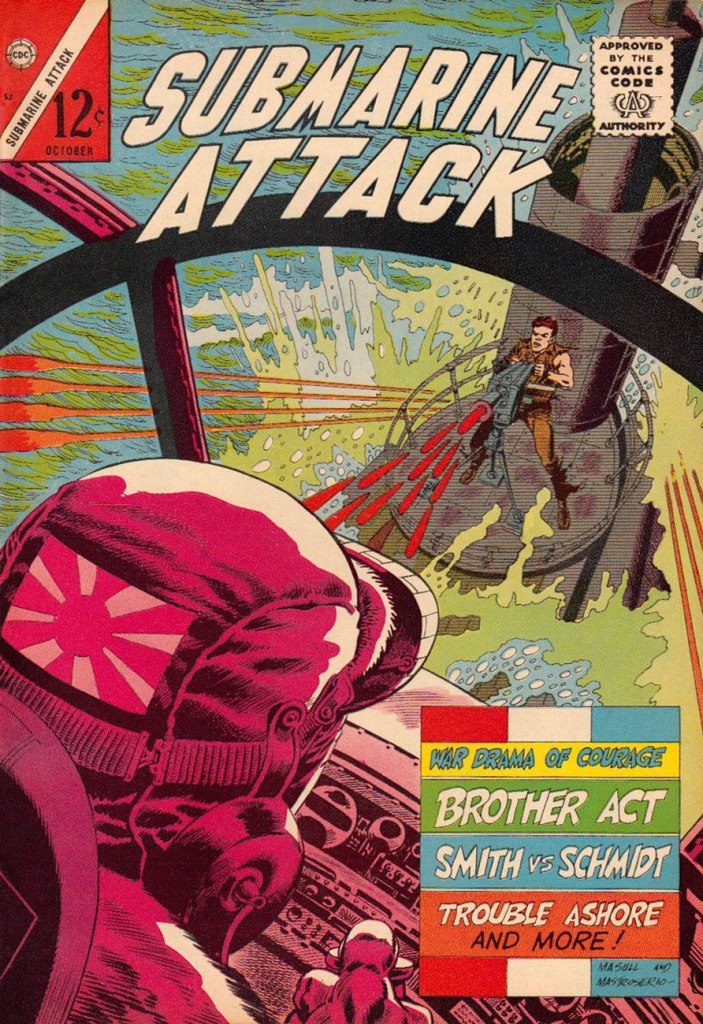
This is Submarine Attack no. 52 (Oct. 1965, Charlton). Both composition (that foregrounding!) and colouring are top-notch.
This is Texas Rangers in Action no. 53 (Dec. 1965, Charlton). Nearly all of Charlton’s covers of this period were distinctively lettered by Jon D’Agostino (1929-2010).
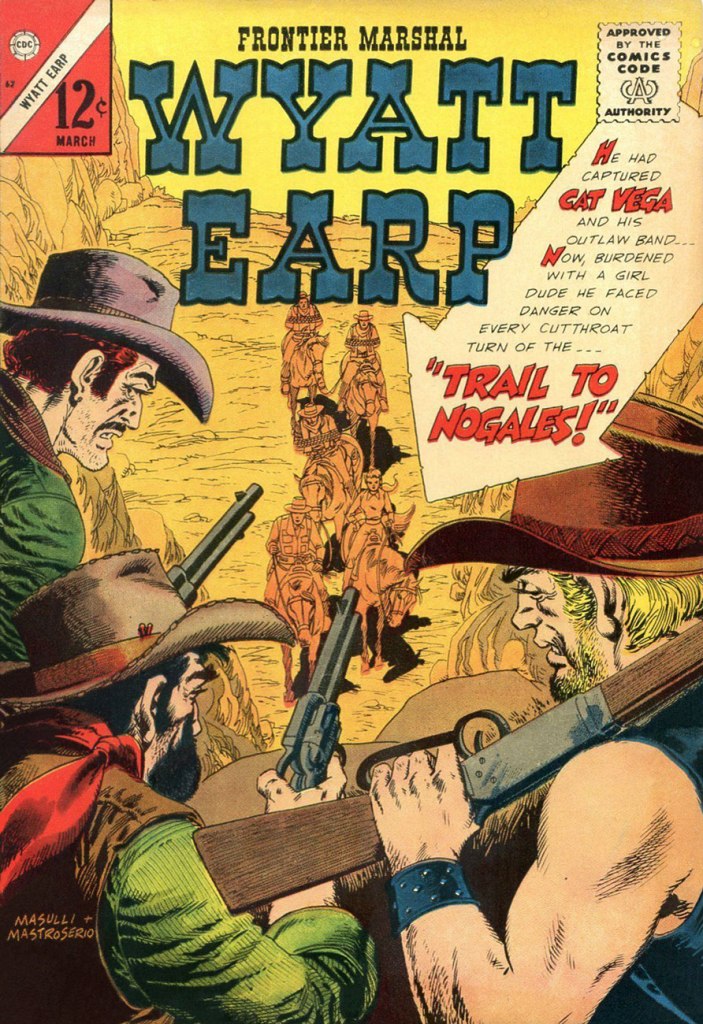
This is Frontier Marshal Wyatt Earp no. 62 (Mar. 1966, Charlton). Mastroserio’s savvy variation of line thickness to convey perspective and emphasize depth is what most reminds me of Joe Maneely‘s work for Atlas and DC (speaking of artists snatched away in their prime).

I’ll return at some point to spotlight solo Mastroserio. Next on the agenda for me, however, is this year’s Hallowe’en Countdown!

-RG

Treasured Stories: “The Monster Maker of Madison Avenue!” (1967)

« I’ve learned that any fool can write a bad ad, but that it takes a real genius to keep his hands off a good one. » — Leo Burnett

Given that they’re often referred to as comics, or funnybooks, mainstream American comic books haven’t been nearly as funny as one might reasonably expect… particularly the ones that set out to be humorous.

In the scope of the Ages of Gold and Silver, the selfsame Pantheon of Exceptional Providers of Hilarity pops up as if on cue: Carl Barks (Uncle Scrooge), John Stanley (Little Lulu, Melvin Monster, Dunc and Loo), Basil Wolverton (Powerhouse Pepper), Jack Cole (Plastic Man), Harvey Kurtzman (Mad). Pray note that these are all writer-artists*, hardly a negligible factor.

Humour being subjective, of course everyone will have their own favourite to contribute. The gist of my argument, however, is that comics books fail to raise guffaws to a level that, say, newspapers strips, animated cartoons and Franco-Belgian bandes dessinées routinely** do.

Meanwhile, DC Comics arguably boasted their singular genius humorist in Sheldon Mayer (Sugar and Spike). DC’s editors loved to divide and conquer, rarely allowing solo creators to take root, let alone flourish, in their tidy corporate garden patch. Given Mayer’s crucial early importance to the publisher’s rise, he was granted free(er) rein. Which leads one to ponder whether the assembly-line method, then, might not be utterly detrimental to quality humour.

So it was to my elated surprise that I came upon an authentically amusing (imho) tale betwixt the misaligned staples of a 1967 issue of Strange Adventures… what is more, uncredited. A mystery.

Which brings us ’round to another exceptional talent, a writer this time: long-time American Comics Group (ACG) editor Richard E. Hughes, who scripted most of the company’s mid-to-late output under an impressive array of aliases*** with a dry, deadpan, absurdist wit, most memorably deployed through the adventures of Herbie Popnecker, ably illustrated by Ogden Whitney.

In 1967, Hughes found himself at leisure with ACG’s demise (the final issues of its remaining titles, Adventures Into the Unknown and Unknown Worlds, were cover-dated August ’67). He passed through DC, scripting a smattering of stories for Superman czar Mort Weisinger (one might surmise that Kurt Schaffenberger, who worked for both editors, acted as the go-between), for Hawkman editor George Kashdan and Ghosts editor Murray Boltinoff before exiting the field. According to Wikipedia, « His final job appears to have been for Gimbel’s department store, composing response letters to customer complaints. » At least he’s received some posthumous recognition, as he was a 2015 recipient of the Bill Finger Award for Excellence in Comic Book Writing.

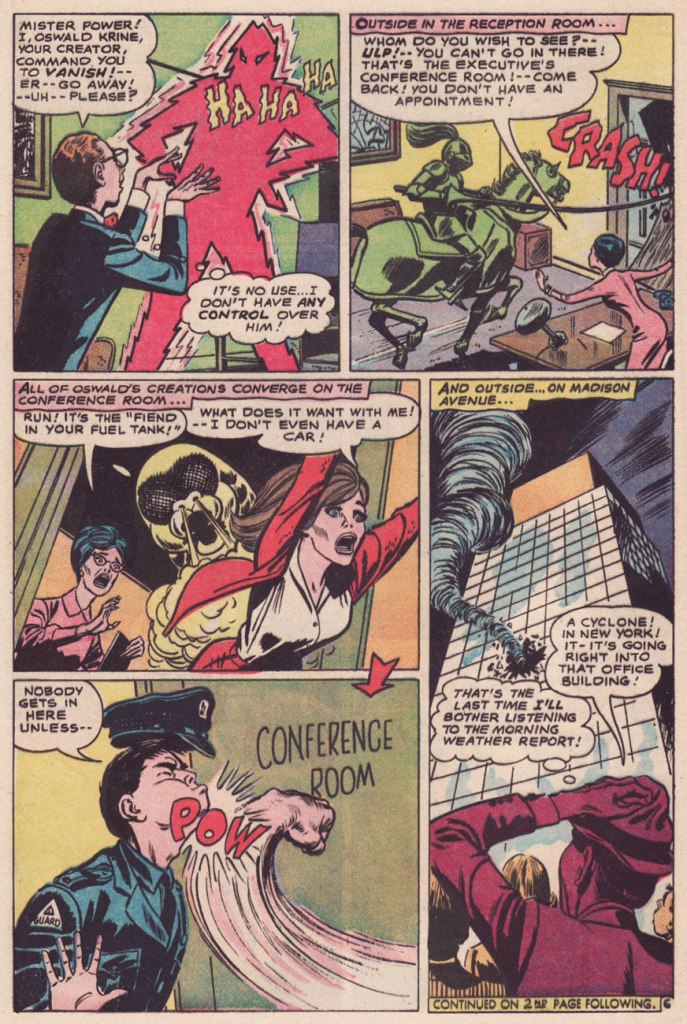
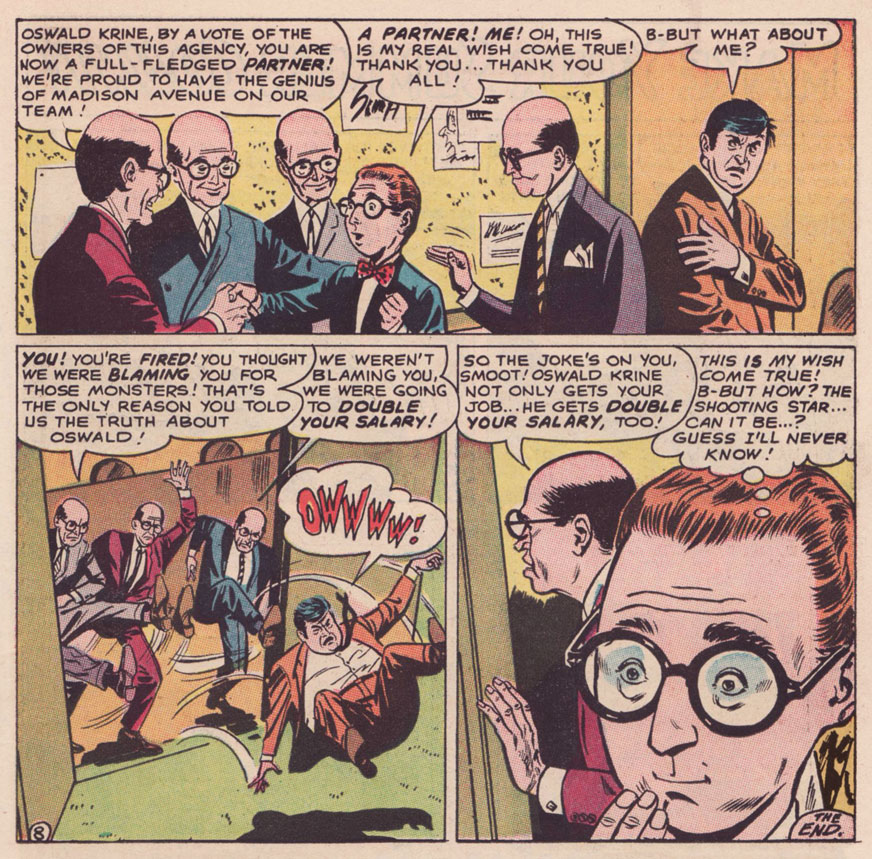
I do believe I can detect the Hughes cadence in The Monster Maker of Madison Avenue! According to GCD, the uncredited story is scripted by one Dennis Marks, an animation writer working for Filmation’s The Batman/Superman Hour at the time… but I just don’t know. It would be Marks’ sole comic book credit, and a speculative one at that. Besides, GCD attributes the artwork to Joe Orlando, which is flat-out, laughably wrong. A frequent problem of self-styled art experts is that they wear genre blinders. Most would never be caught dead reading, say, a romance comic, so they wouldn’t recognize (though they should!) the distinctive stylings of Jay Scott Pike (1924-2015).

On with our tale, which originally saw print in Strange Adventures no. 202 (July 1967, DC).

As for the ads parodied therein, I’m no expert, but I can hazard a few guesses: The Fiend in Your Fuel Tank refers to Esso’s famous Put a Tiger in Your Tank campaign; the housewive bluntly bestowing cleaning tips to her neighbour brings to mind Bold Detergent; The Green Knight surely lampoons Ajax’s White Knight; as for Popso Kooler’s Mister Power, it’s anybody’s guess. Pepsi commercials of the period looked great, but nary featured an animated lightning man. Anyone?

-RG

*Yes, Kurtzman (and Stanley) often worked with others to increase their output (and for the love of collaboration), but they fully controlled the mise-en-scène.

** They make it look easy… but it’s quite a feat.

***His imaginary roster comprised Pierre Alonzo, Ace Aquila, Brad Everson, Lafcadio Lee, Kermit Lundgren, Shane O’Shea, Greg Olivetti, Kurato Osaki, Pierce Rand, Bob Standish, Zev Zimmer… Fittingly, even Richard E. Hughes was a pseudonym: he was born Leo Rosenbaum.

Who Will Change the Devil’s Nappy?

« Don’t you know there ain’t no devil, it’s just god when he’s drunk. » — Tom Waits, Heartattack and Vine (1980)

Another week, another heat wave… I had something else in the pipeline for this week, but the canicular conditions brought to mind Hot Stuff The Little Devil (heat rises!) and his creator Warren Kremer‘s monumental parade of beautifully conceived and crafted calefaction variations.

As you may already know, the Harvey Comics stable consists, in the main, of one-note characters erected upon the visual template of licensed 1940s animation properties Casper the Friendly Ghost (Richie Rich, Hot Stuff, Spooky) for the boys, and Little Audrey (Little Dot, Wendy the Good Little Witch, Pearl) for the girls.

CasperRichieA
Would I kid you? (truthfully, I might). There’s even a meme about it.

We’ve already presented cover galleries from Spooky and Little Dot (as well as a Hallowe’en-themed array), and it’s now Hot Stuff’s turn to toast and roast. Though we’ve both been rather dismissive of the contents of Harvey Comics, I must point out that if there is a specific series that burns brighter than its brethren do, it’s Hot Stuff’s… at least during the line’s creative peak, the 1960s. Here’s an example of a good one.

Each cover is the brainchild and handiwork of Harvey’s indefatigable resident genius and art director, Warren Kremer. Obviously, one man does not a company make, and his able colleagues Howie Post, Ernie Colón, Sid Couchey and Sid Jacobson were hardly lightweights or slouches… but Kremer was the cover generator.

HotStuff09A
This is Hot Stuff, the Little Devil no.9 (Feb. 1959, Harvey). Is this helping? Probably not. Sorry!

HotStuff15A
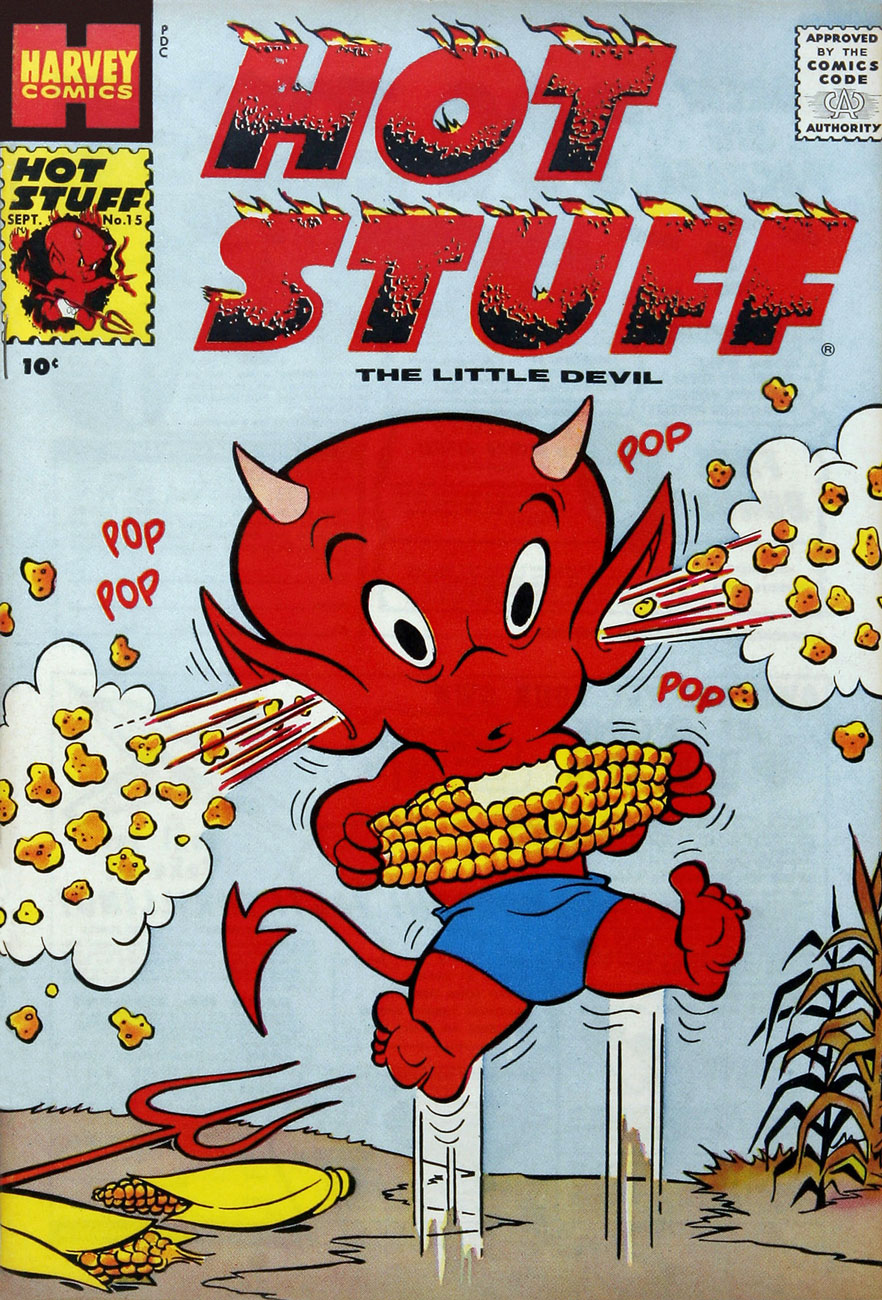
This is Hot Stuff, the Little Devil no.15 (Sept. 1959, Harvey).

HotStuff33A
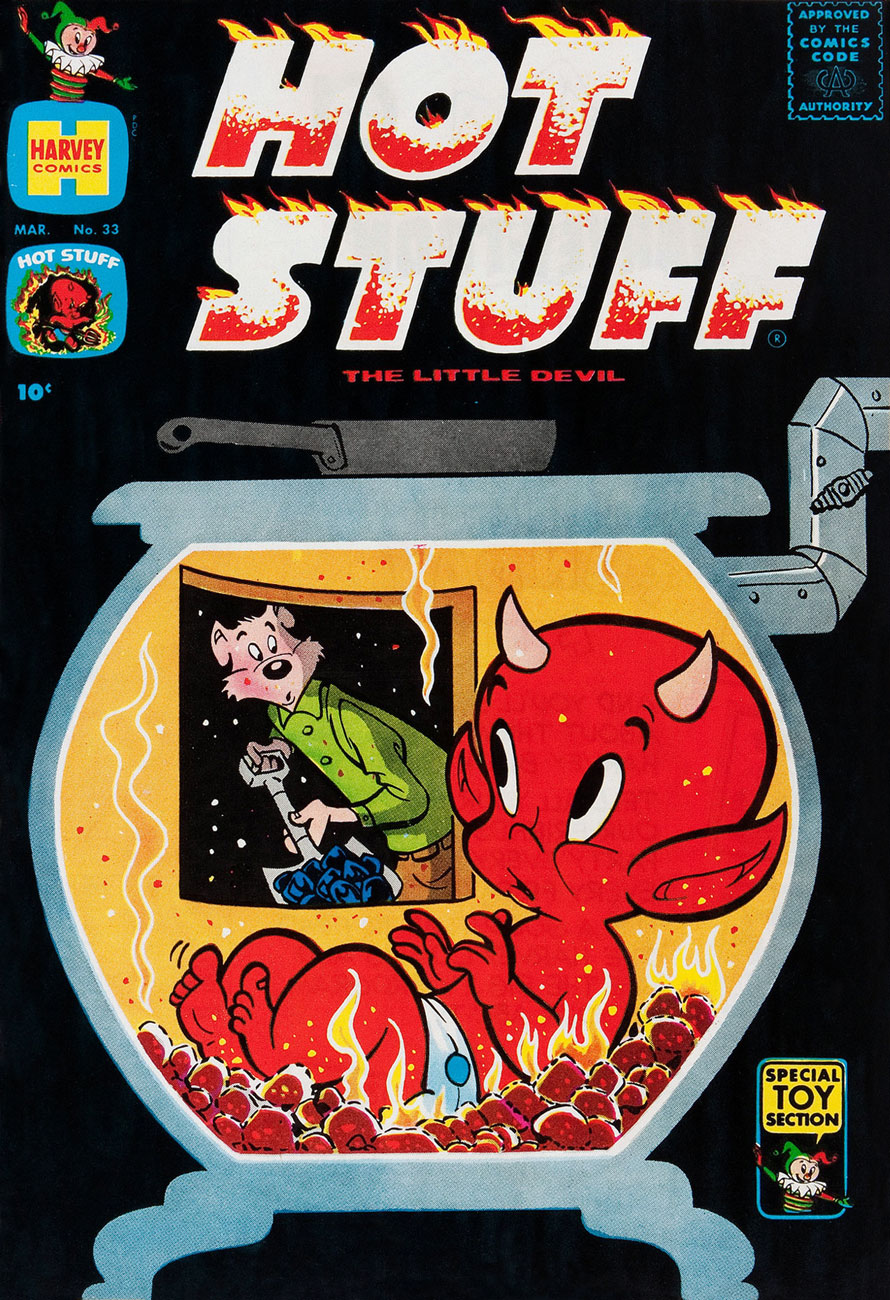
This is Hot Stuff, the Little Devil no.33 (Mar. 1961, Harvey). I especially admire Kremer’s black covers, though they complicated the printing and make issues in pristine (or even decent) shape a scarce proposition.

HotStuff34A
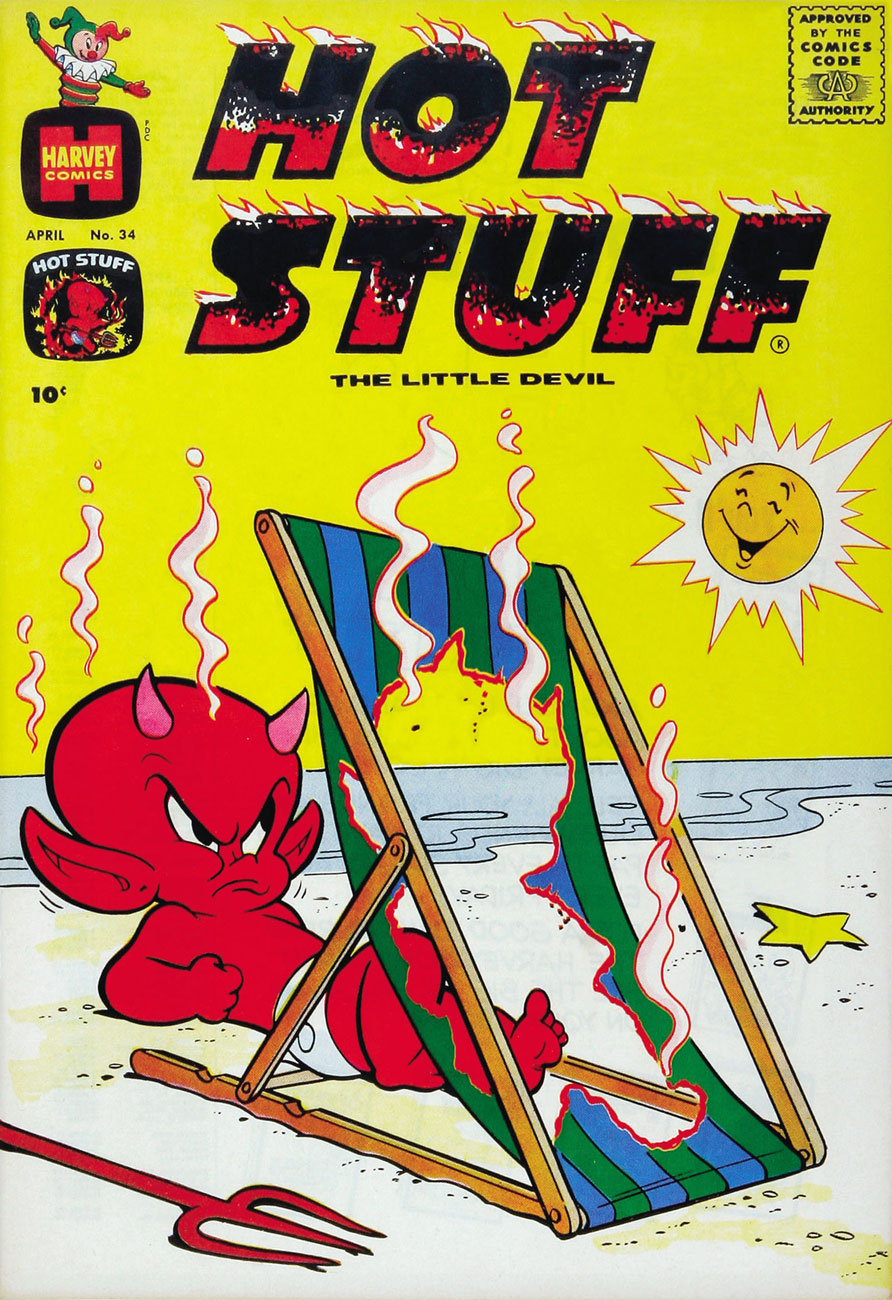
This is Hot Stuff, the Little Devil no.34 (Apr. 1961, Harvey).

HotStuff36A
This is Hot Stuff, the Little Devil no.36 (June 1961, Harvey).

HotStuff41A
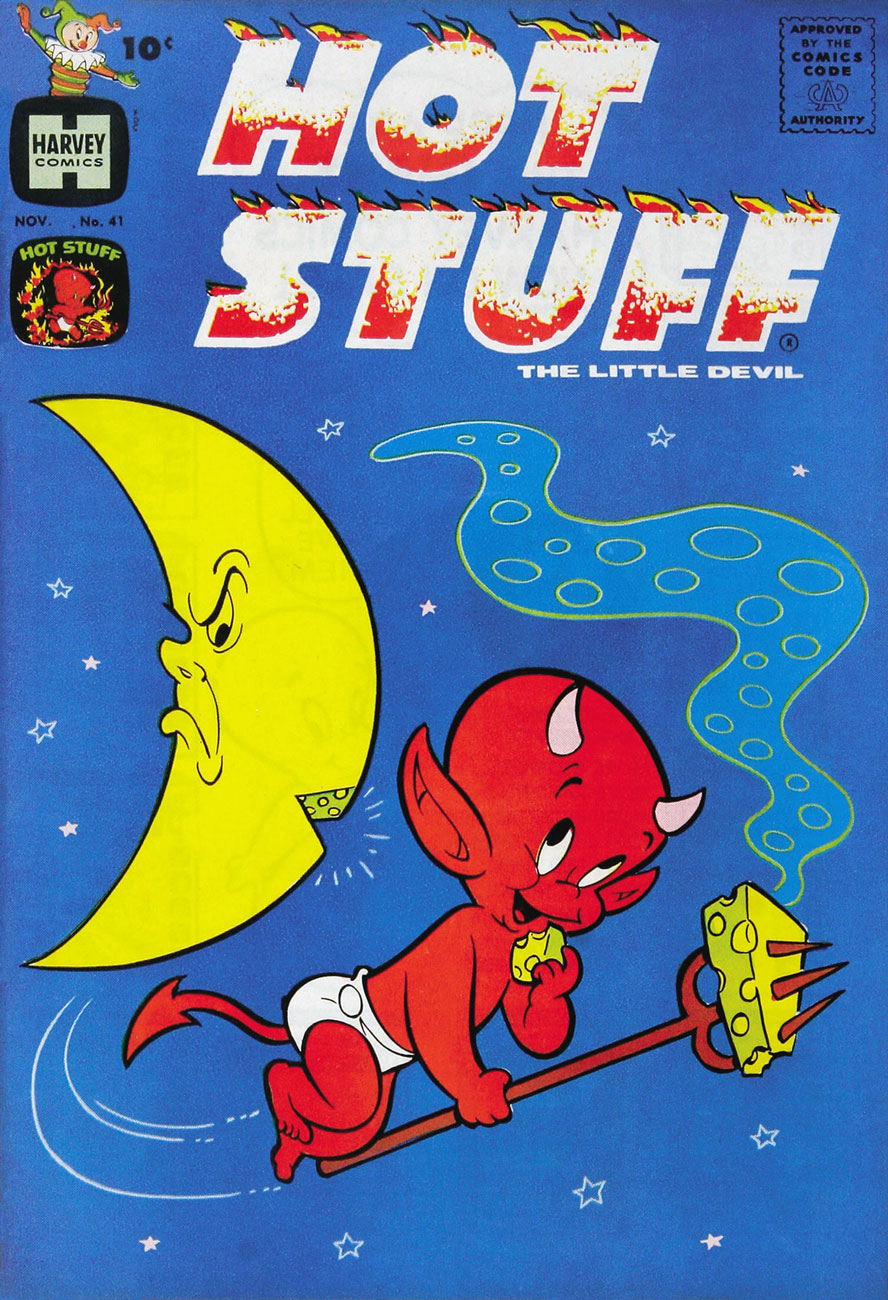
Ah, so that ol’ devil moon is not merely made out of cheese, but of stinky cheese to boot? Good to know. This is Hot Stuff, the Little Devil no.41 (Nov. 1961, Harvey). Fun fact: because of its distinctive holes, Swiss Gruyère is the shorthand cartoon cheese.

HSSizzlers07A
This is Hot Stuff Sizzlers no.7 (Feb. 1962, Harvey).

HSSizzlers08A
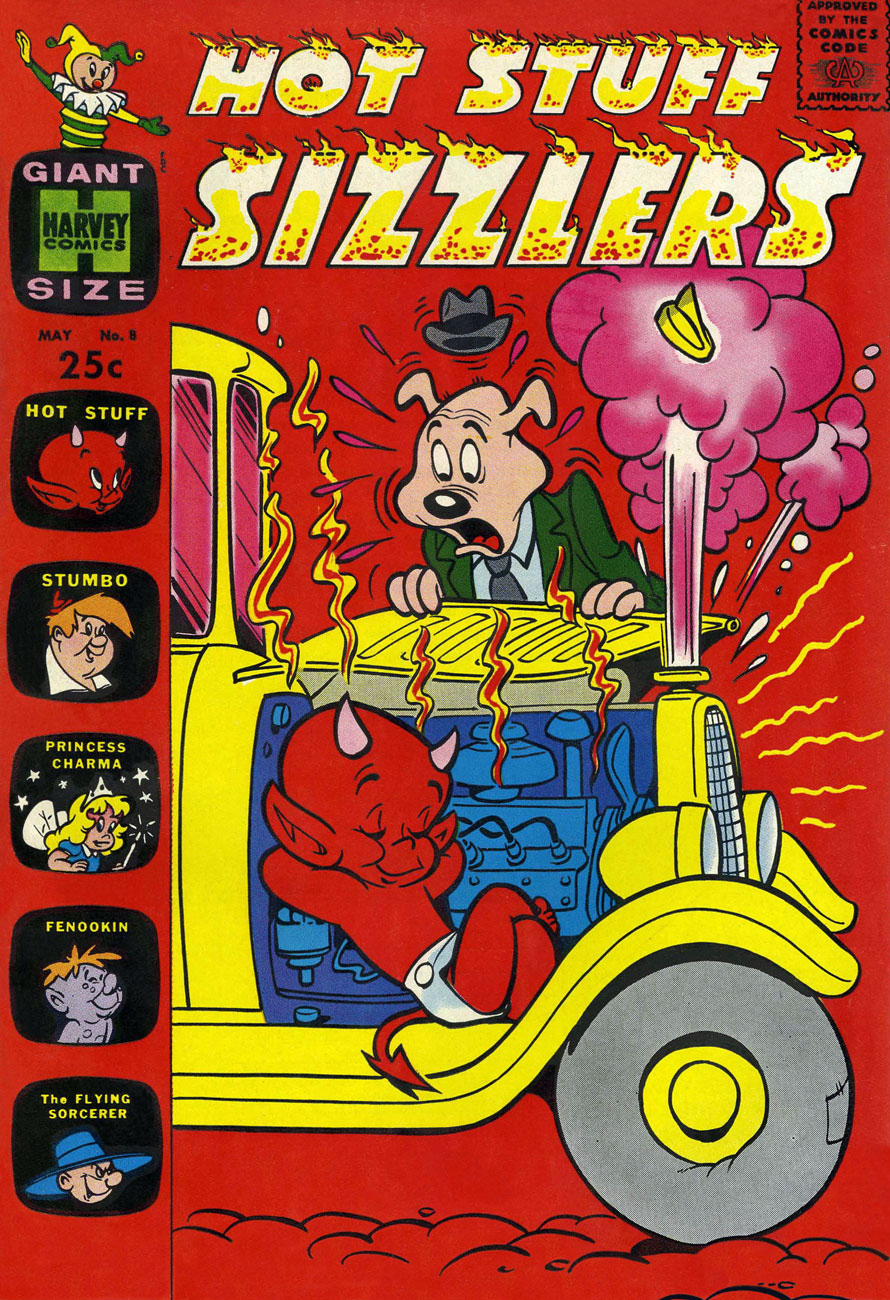
This is Hot Stuff Sizzlers no.8 (May 1962, Harvey).

DevilKids03A
This is Devil Kids Starring Hot Stuff no.3 (Nov. 1962, Harvey). One wonders why other comics publishers didn’t show the same lack of regard for the Comics Code Authority Stamp of Approval typically demonstrated by Kremer and Harvey. Their ‘shove it in a corner and colour it invisible’ approach is refreshing. I suppose that, like other publishers specialized in the nominally wholesome ‘kiddie’ market, Harvey’s code approval was a formality.

HotStuff68A
This is Hot Stuff, the Little Devil no.68 (Oct. 1965, Harvey). Listen to this excellent ‘word jazz‘ piece by the late, great Ken Nordine (1920-2019), on the fecund topic of… Fireflies.

DevilKids21A
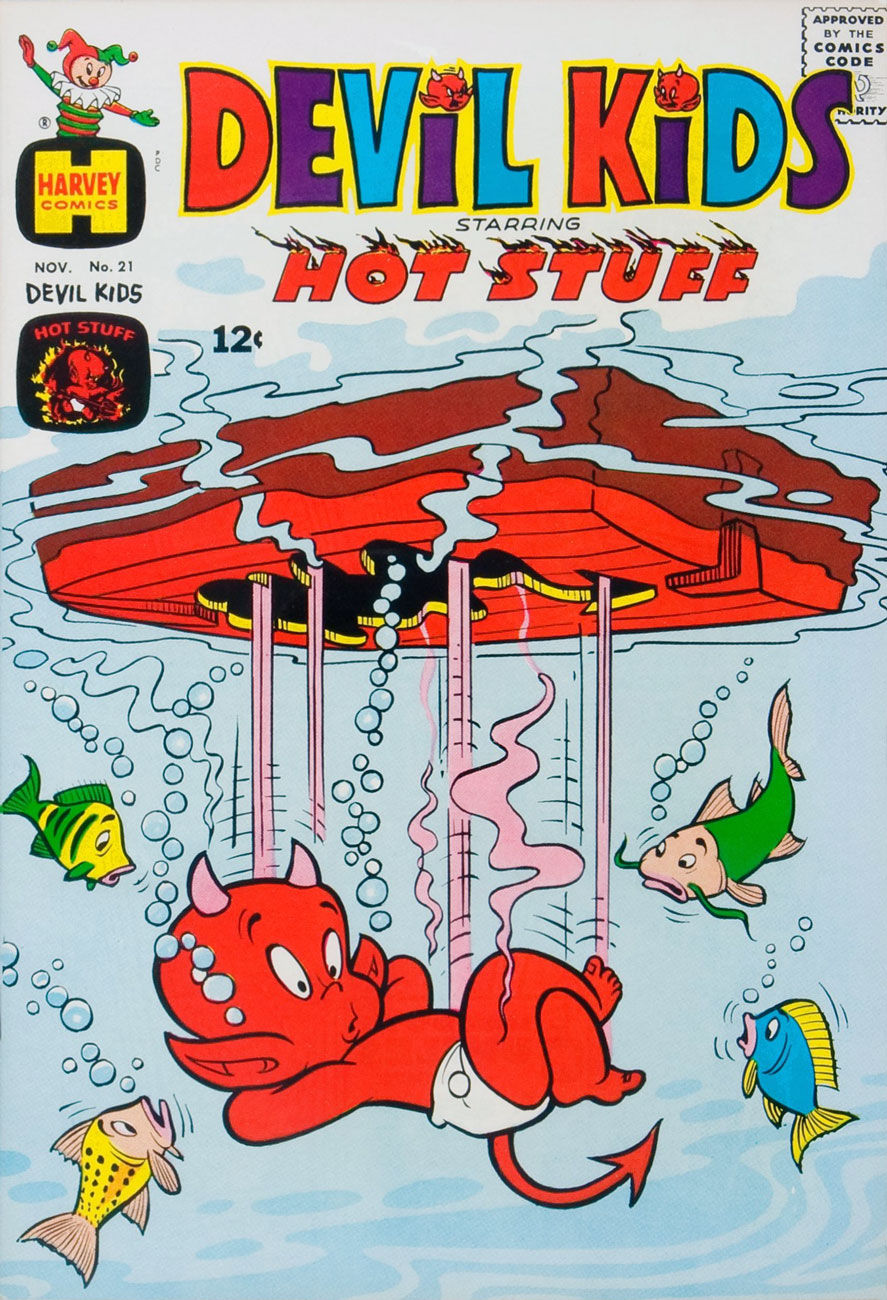
This is Devil Kids Starring Hot Stuff no.21 (Nov. 1965, Harvey). A little better, cooling-wise?

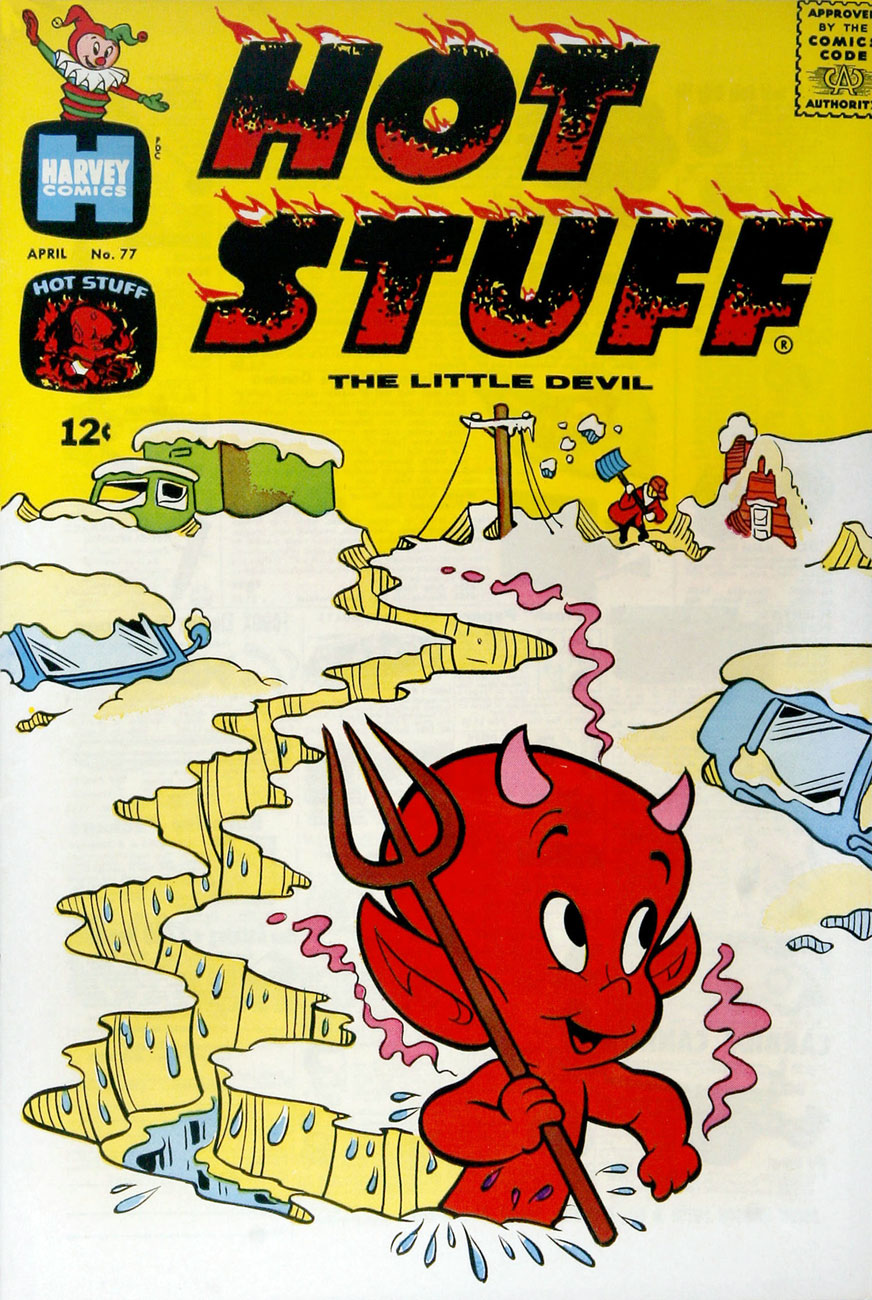
HotStuff77A
This is Hot Stuff, the Little Devil no.77 (Apr. 1967, Harvey). And how’s this?

That’s it for now! Keep cool, and may your asbestos underwear never chafe!

-RG
Treasured Stories: “Creeping Death” (1960)

« You can’t wake a person who is pretending to be asleep. » — Navajo saying (attributed)

I’ve written before of my appreciation of Joe Gill‘s long-running yet consistent ‘good guy with an edge‘ characterization of Billy Bonney, but I had stuck to the book’s exteriors, namely Warren Sattler’s watercolour covers from the final stage of the series’ original run. I’ve also — twice! (first here, then there) drawn attention to John Severin (1921-2012) and his colossal powers as a cover artist. Today, at long last, we dare to peer inside.

Some may wonder at the up-to-date slickness of our current selection. Bear with me. Sure, it’s old, sure, it’s obscure, and the original comic book it saw print in is on the pricey side… but it’s work that’s found some resolute champions in the intervening sixty years.

After the Charlton comics line made the switch to a mostly-reprints mode (circa 1977-78), executive editor (and cartoonist) George Wildman, possibly nudged along by his colleague Bill Pearson, endeavoured to harvest some dusty gems from the vast archives at his disposal. In this case, six consecutive issues (nos. 124-129) of the long-running Billy the Kid were aimed squarely at the discerning fans with a bold ‘All Severin Art‘ label.

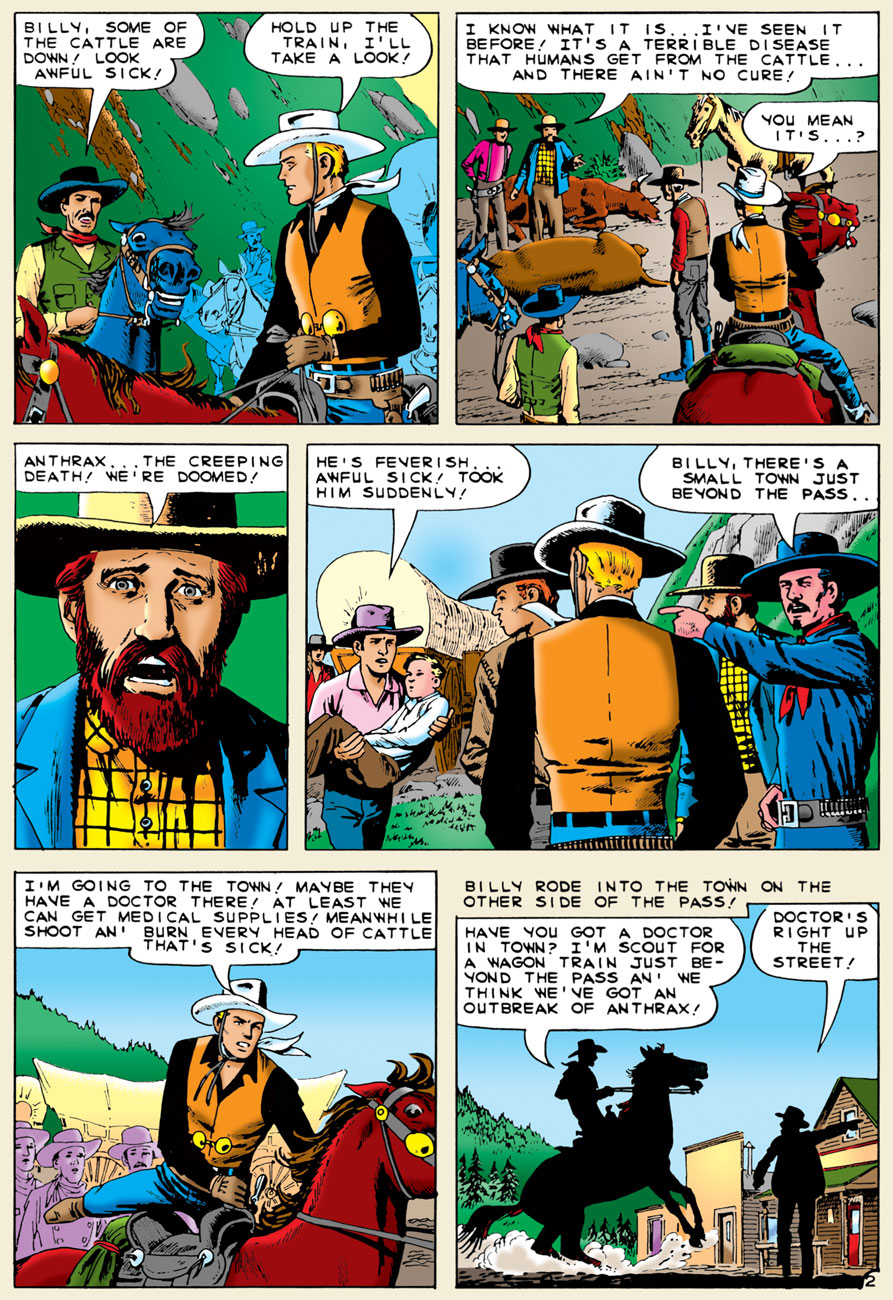
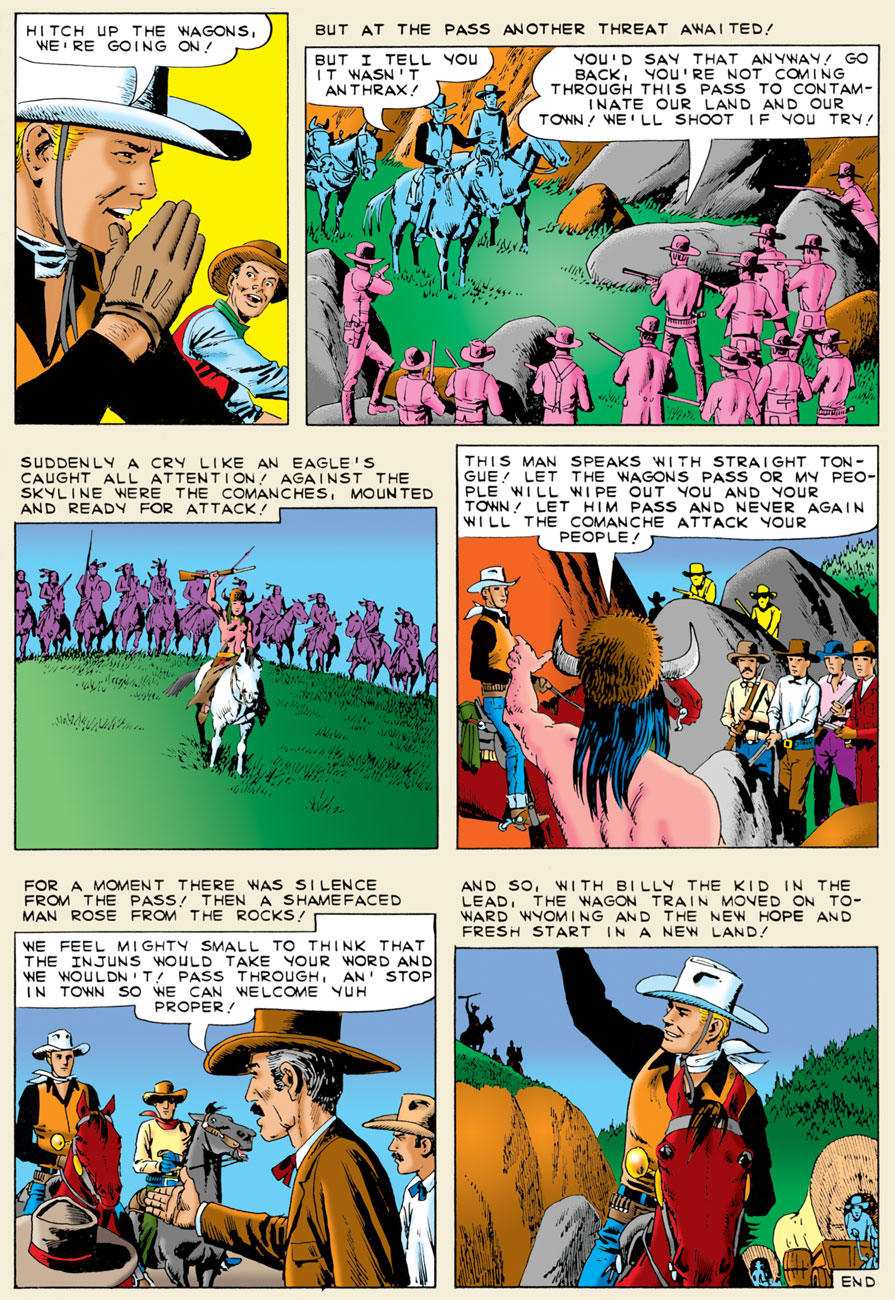
Fast forward to just a couple of years ago. As the nefarious, multifarious Mort Todd* tells it: « I had the extreme honor of working with John for many years as a writer, penciller and editor. When comics creator Bill Black told me he had a complete run of John’s work on Billy the Kid in the form of Charlton’s original photostats, we decided to recolor the work and release it in two volumes. Since the original artwork is lost to history, these photostats are the closest things to the originals to reproduce from. »

When I approached him, Mr. Todd most graciously granted me permission to showcase an excerpt from his restoration of Messrs Gill and Severin’s efforts. If you enjoy this one, do check out morttodd.com for more goodies!

CreepingDeath01ACreepingDeath02ACreepingDeath03ACreepingDeath04A

CreepingDeath05A
Why this particular story? Doesn’t it strike you as ever-so-slightly timely? We all could use a happy ending, though, in these times of contagion and racial strife.

BillytheKid20A
And here’s the original comic book in which Creeping Death appeared, namely Billy the Kid no. 20 (Jan. 1960, Charlton). Your basic “collage of interior panels” cover. Then again, with John Severin, you’re spoiled for choice… and you do get your dime’s worth.

PAMBillyOrigin01A
Not to be confused with the historical William Bonney, Charlton’s Billy was the legendary bad boy’s first cousin, and he aimed to redress the damage done to the family name by its all-too-infamous black sheep. Read it here! Written by Joe Gill, with art by Pete ‘PAM’ Morisi, this tale appeared in Billy the Kid no. 15 (Feb. 1959, Charlton).

You may have noticed that this Billy the Kid fella displays some awfully progressive attitudes for 1959… and, some might say, even for today. And if you surmised that the story’s writer, Joe Gill, was a card-carrying liberal, you’d be way off the mark. He was, after all, Steve Ditko‘s favourite collaborator**. Gill was, instead, a bonafide conservative, fair-minded, intellectually honest, prudent, sagacious. It would appear that with time and shifting meanings and mores, this once-thriving breed has been overwhelmed by today’s  reactionaries, who arguably went so far as to usurp and absorb its very name.

CamelsMarionAdA
An R.J. Reynolds ad from the back cover of Coronet no. 177 (July, 1951). Put that in your T-Zone and smoke it!

By way of contrast, and speaking of cowboys… Marion Morrison*** (1907-79), better known as “Popular, handsome Hollywood Star John Wayne“, despite his renown as a so-called Conservative Icon, was no conservative… he was just another reactionary. I mean, just consider *his* stance towards African-Americans (« I believe in white supremacy until the blacks are educated to a point of responsibility. I don’t believe in giving authority and  positions of leadership and judgment to irresponsible people. ») or Native Americans

Meanwhile, Gill’s Billy the Kid, though thoroughly adept at quick marksmanship and fisticuffs, always sought to defuse conflict and avoid bloodshed through wits and compassion. His idea of paradise (just like his real-life cousin, come to think of it) was to head South of the border into México and hang loose among his amigos, who good-naturedly called him El Chivito.

-RG
*whose name basically means “Death Death” in French and German (albeit with an extra D); how cool is that?

**The comic book story/script writer? It doesn’t matter who follows the first. That first choice is Joe Gill.” — Mr. Ditko, from his preface to Steve Ditko’s 160-page Package no.3 (1999).

***And the likely inspiration for Shel Silverstein‘s story-song A Boy Named Sue, (popularized by Johnny Cash)…. or was it rather Jean Shepherd?

More Bob White, Lost Archie Artist

« That’s the last number, Lollipop! Time for me to go! » — Archie has to go mop the floor with Reggie

Well, I’ve already stated my case for neglected Archie artist Bob White (1928-2005), but persistent reader interest has (ever so gently) forced my hand in the matter. You crave more, and who am I to deny such a reasonable request? Besides, these suckers are rather thin on the ground.

Comics scholar Bart Beaty‘s experience appears to match mine in this regard. He notes, in Twelve-Cent Archie, his compelling study of the period, that « … high-grade copies of most Archie comics from this period do not seem to exist on the market. » And I heartily agree with his assessment that « much more available are copies that have been treated in the ways they were intended – copies that show the well-worn tattering of having been read and reread repeatedly by children. » The selfsame quandary arises with other loved-to-rags series such as DC’s Sugar and Spike, whose issues all-too-frequently turn up sans their paper dolls feature… and a story page or two on the reverse side.

Here, then, is my second batch of Bob White covers from his prime period, which, not so coincidentally, arguably matches the prime of Archie comics.

Archie124A
This is Archie no. 124 ((Dec. 1961, Archie); ah, that blessed period when the Archie line featured some truly bizarre situations. I’m afraid my picks will reflect this little bias of mine.

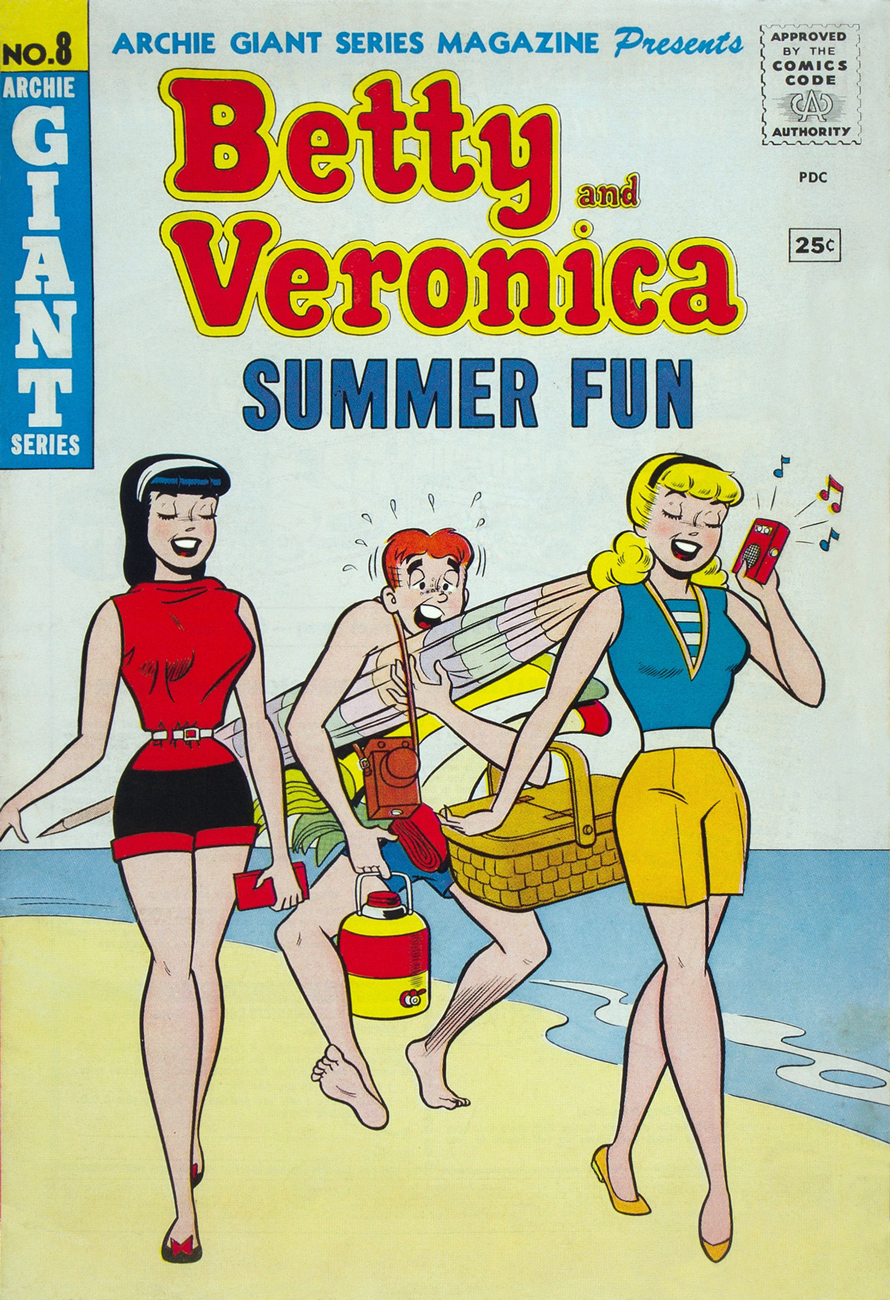
BettyVeronicaSummer8A
This is Archie Giant Series Magazine no. 8 (Sept. 1960, Archie)… only a few days until the summer solstice!

PalsNGals19A
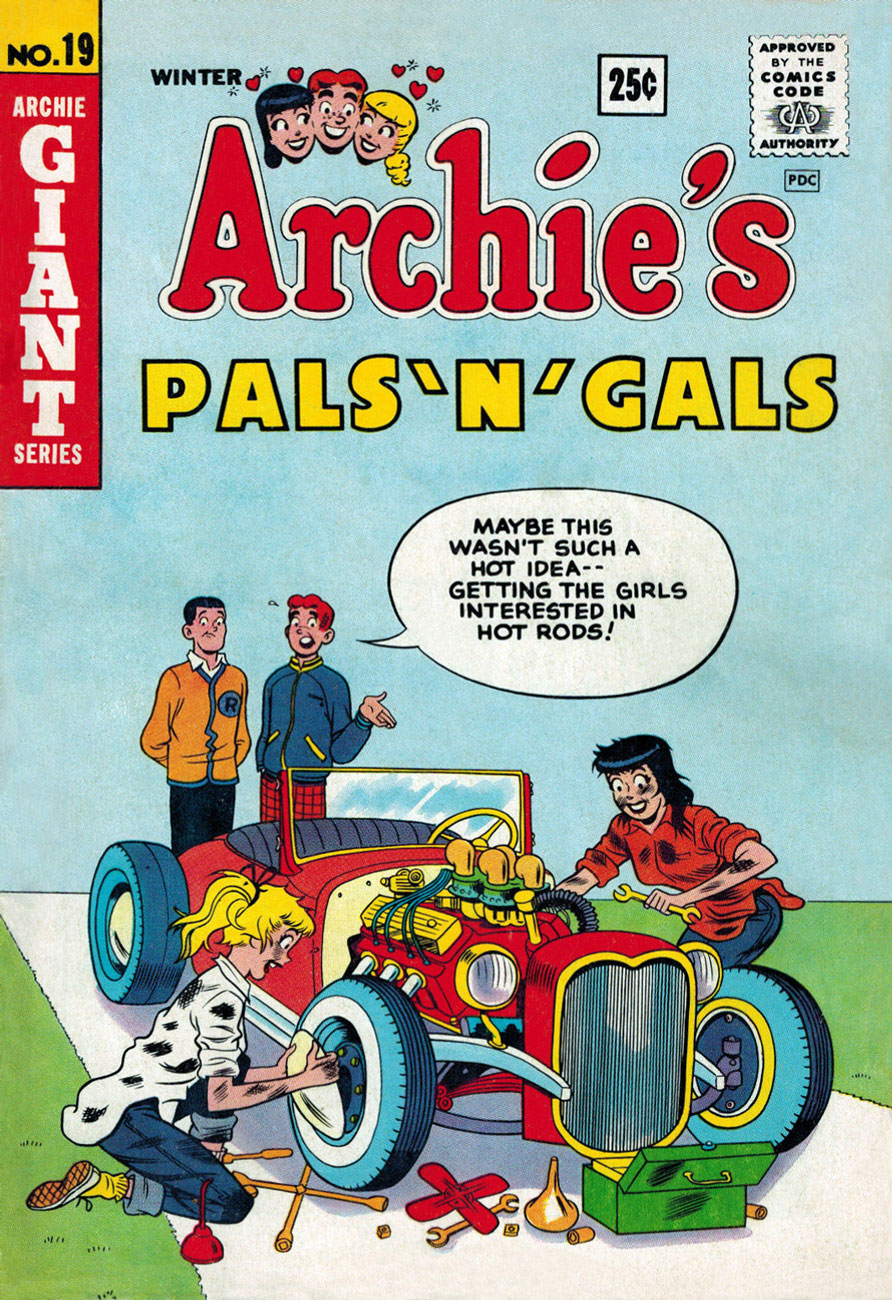
This is Archie Giant Series Magazine no. 19 (Winter 1961-62, Archie).

Pep152A
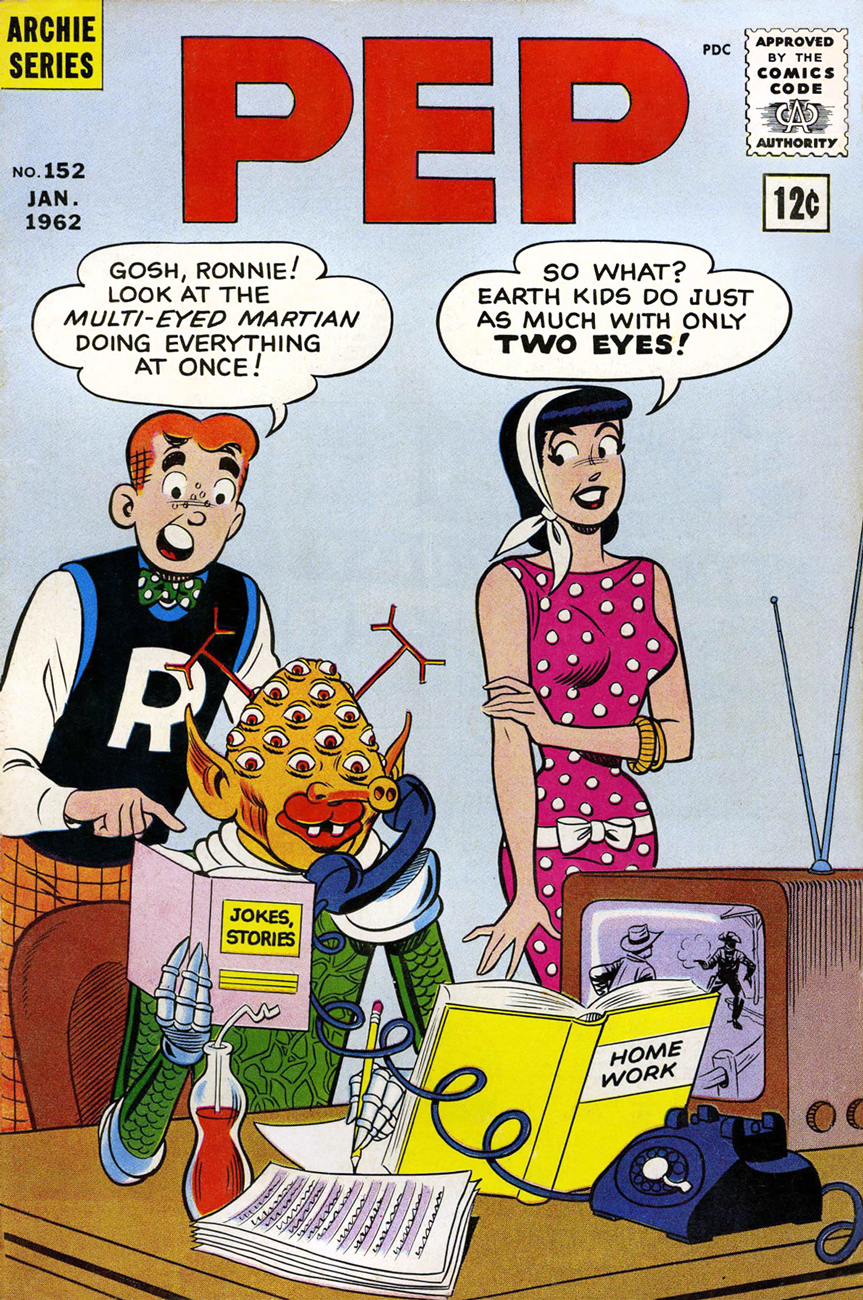
This is Pep no. 152 (Jan. 1962, Archie), an absurdist upgrade of the corny old ‘multitasking teenager’ joke. I love the three-way visual match between Archie’s bowtie, Ronnie’s dress and the Martian’s peepers. Also, nicely-detailed TV shootout.

Pep155A
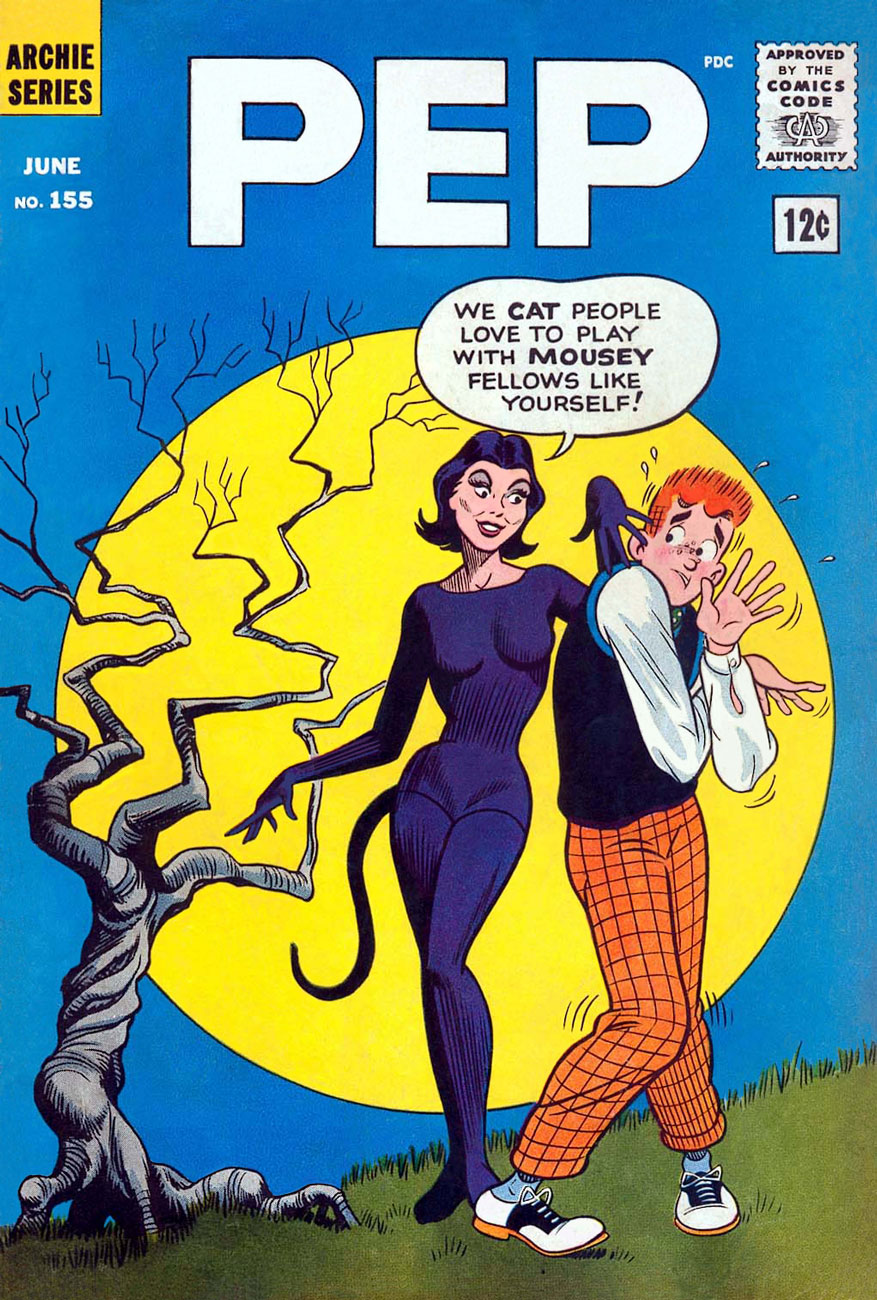
This is Pep no. 155 (June 1962, Archie), notably risqué in its implications. This Cat Person seems far more… assertive than her kin Simone Simon had been a couple of decades prior. Among the distinguishing  hallmarks of White’s artwork is his evident enjoyment and finesse when it came to drawing hands. Digit delineation dexterity is a rare gift, as any artist will attest.

Laugh143A
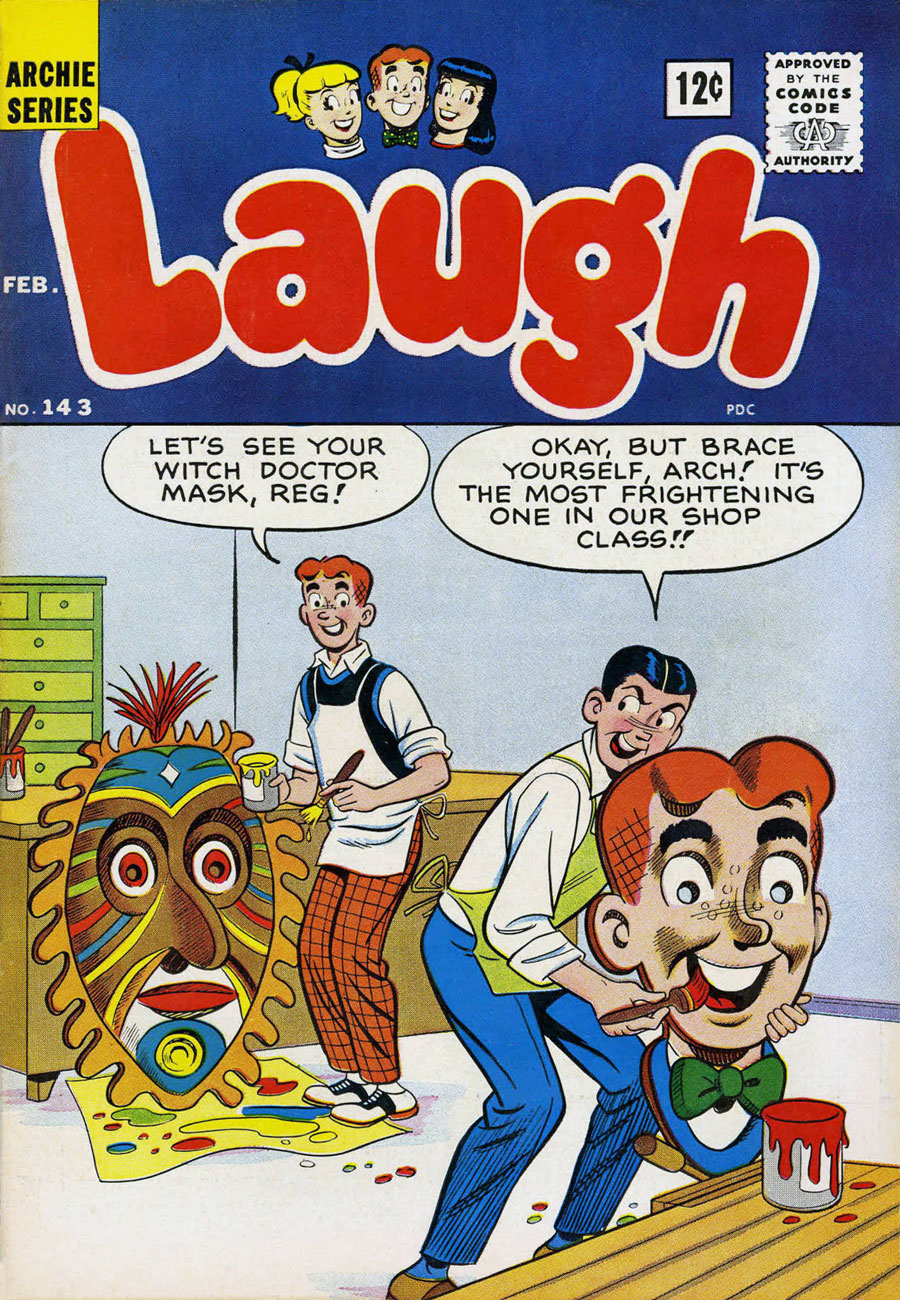
This is Laugh no. 143 (Feb. 1963, Archie). Aw, Reggie. It’s actually a rather flattering effigy… Betty would be delighted to take it off your hands!

Pep161A
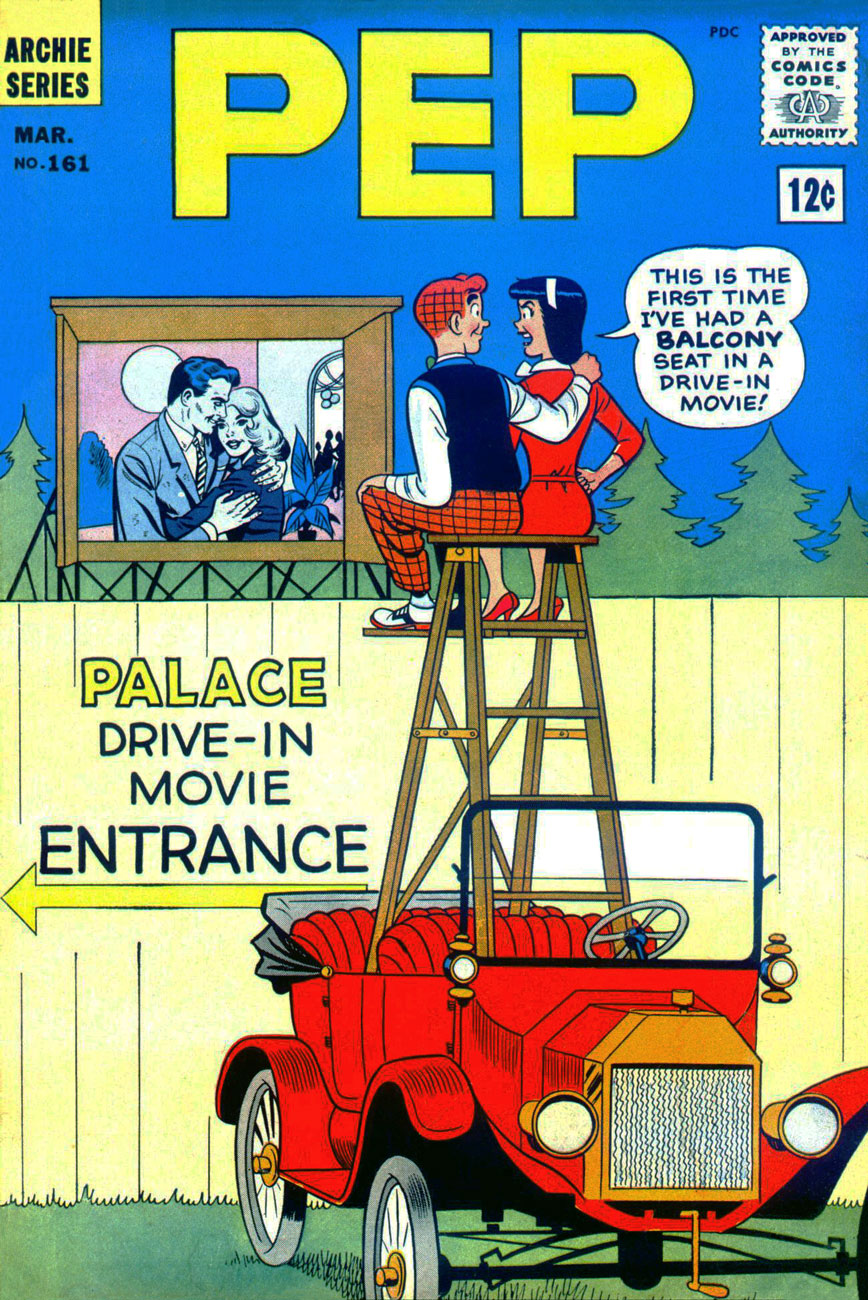
This is Pep no. 161 (Mar. 1963, Archie), an exemplary use of the best-ever Archie line’s cover grid: it allowed for nicely-open vertical scenes, and the visuals had ample room to breathe. Bob White and Samm Schwartz took fullest advantage of the format.

Pep170A
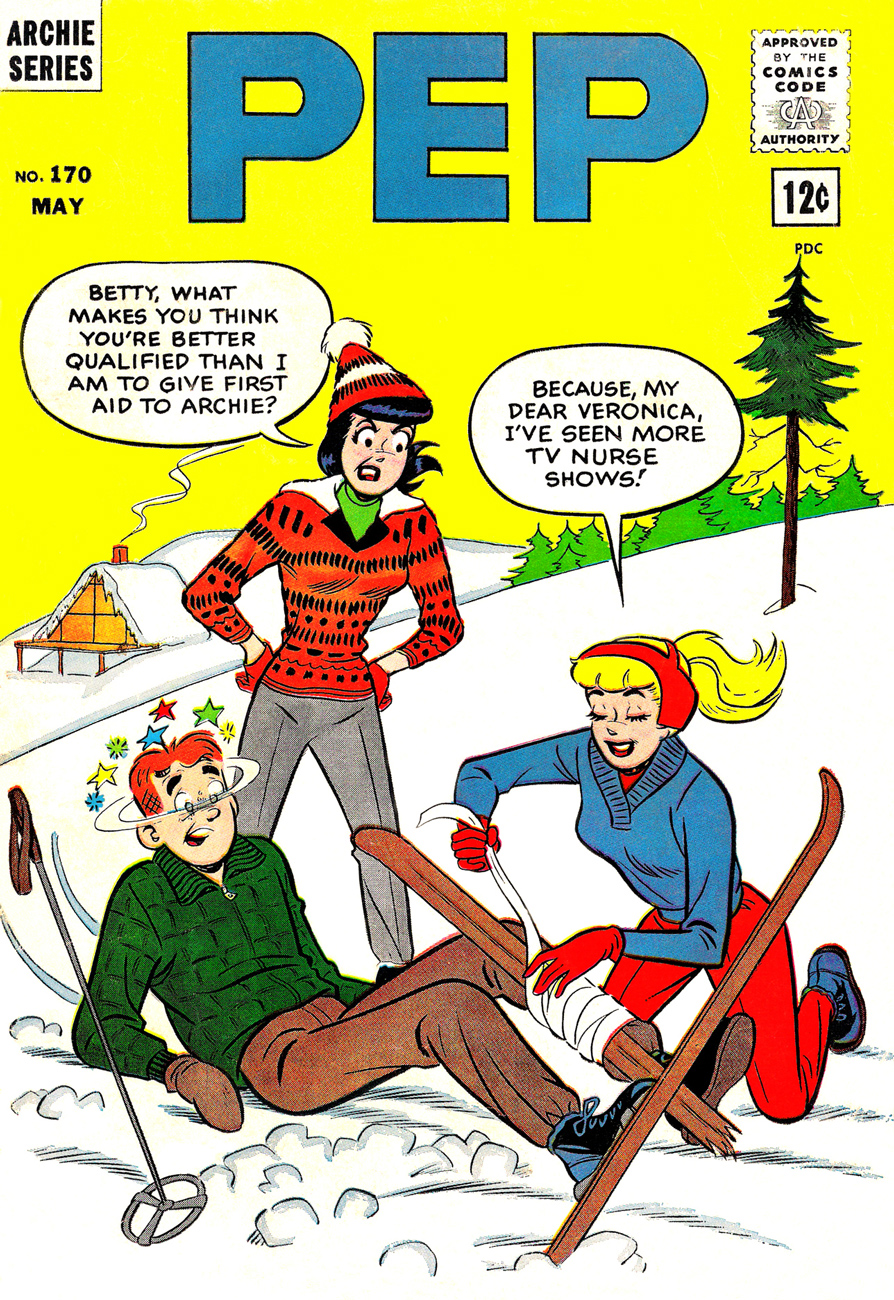
This is Pep no. 170 (May 1964, Archie); an excellent composition, with just the right amount of detail.

B&VSummerFun28A
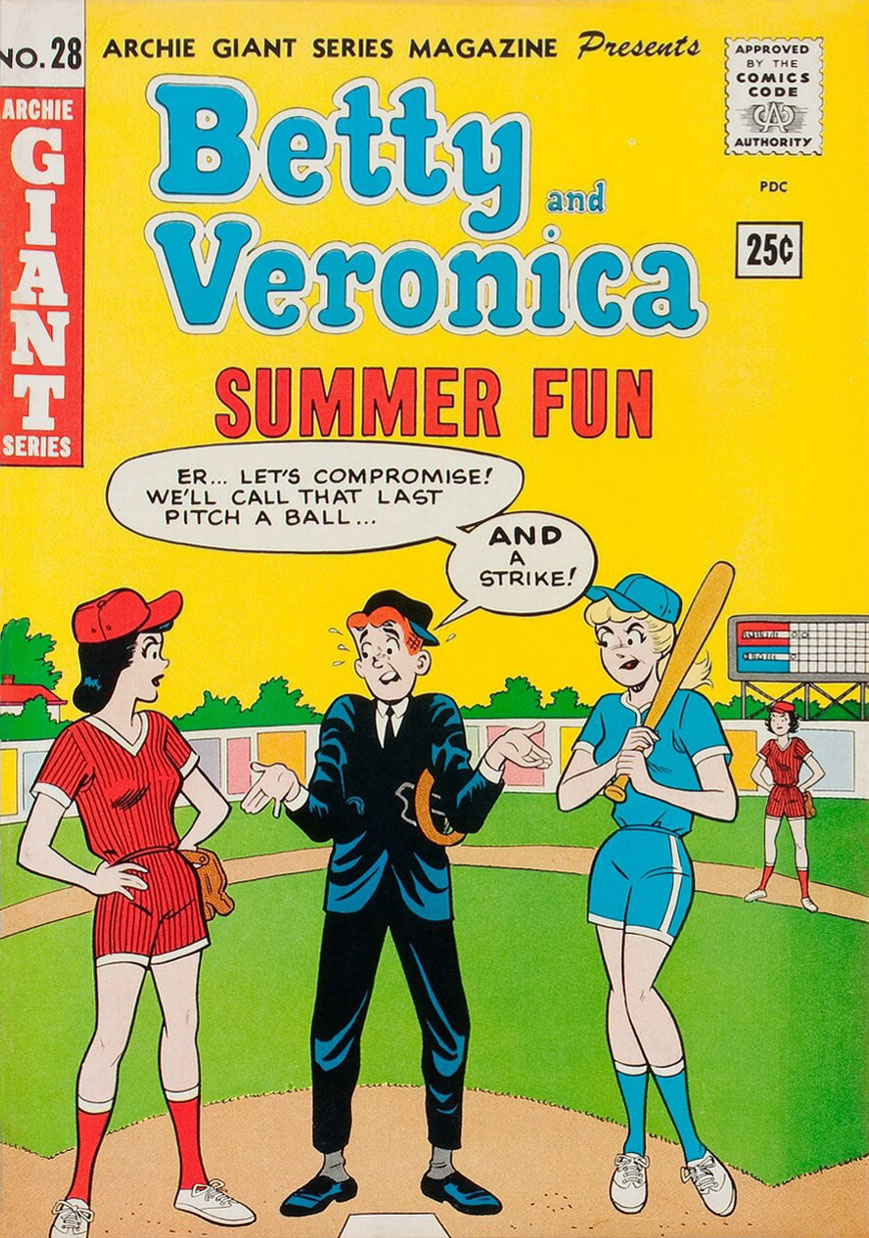
This is Archie Giant Series Magazine no. 28 (Sept. 1964, Archie); I’d keep my eyes on Betty instead, Archie: aside from being the more athletic of your girls, she’s also the one with the bat.

Pep173A
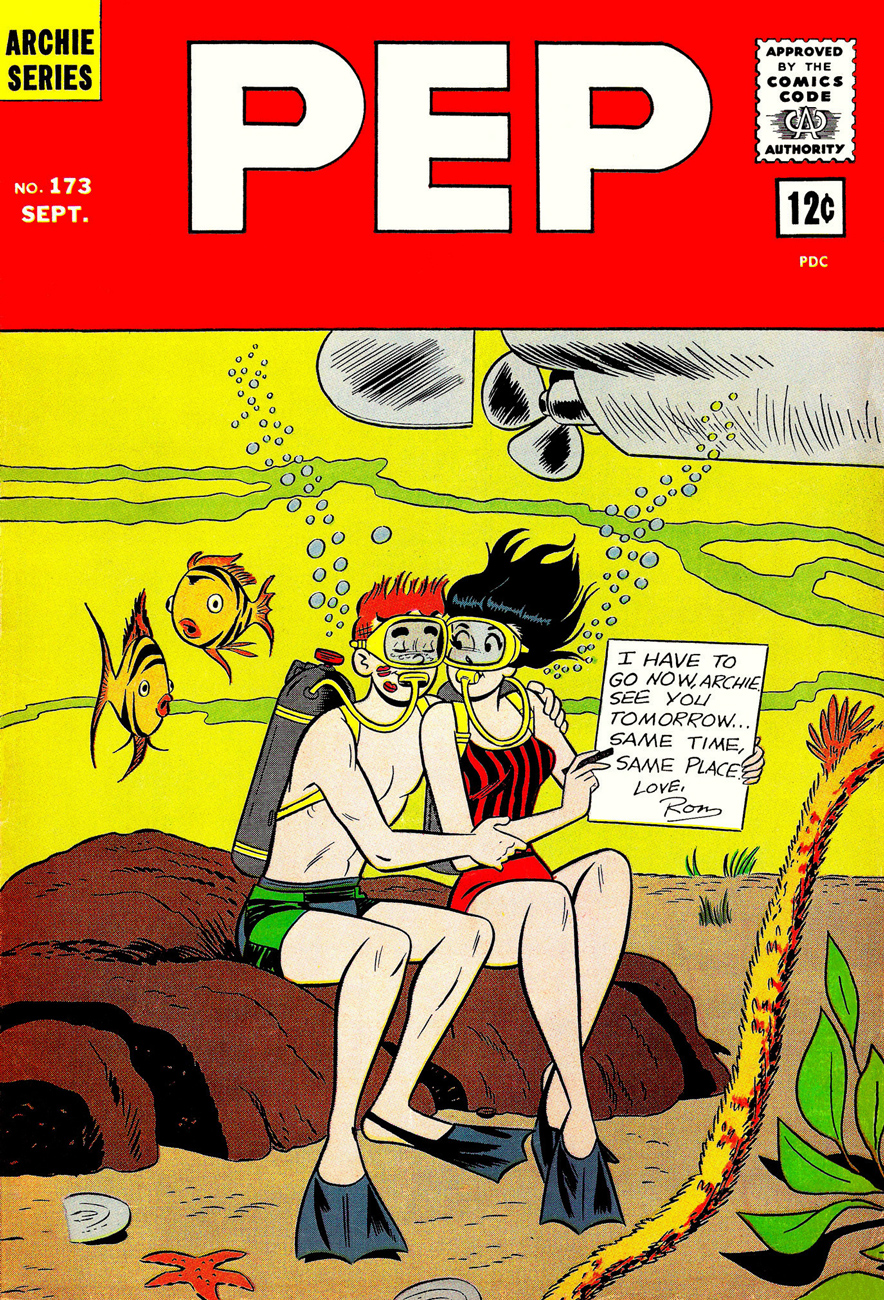
This is Pep no. 173 (Sept. 1964, Archie); given that Ronnie’s wearing a mouthpiece, is it off-base to assume that the telltale scarlet traces on Archie’s cheek were left by the fish on his right? The lip colours even match! 😉

-RG
Tentacle Tuesday: Spring Has Sprung… Its Snare!

« In the spring, at the end of the day, you should smell like dirt. » – Margaret Atwood

Our neighbours are certainly following this sage piece of advice, crawling out with shovels and rakes, clad in rubber boots and – a new development this year – face masks. As far as I’m concerned, the flu virus can’t be transmitted by plants, so one is quite safe in the garden or backyard, as far as that goes… but how about proper protection against plant-tentacles? ♪♪ Whether on land or under the sea, tentacles are coming for you and me… ♫♫ I promise to stay away from song-writing in the future. But now, for the comics!

SeaDevils18-SheldonMoldoff
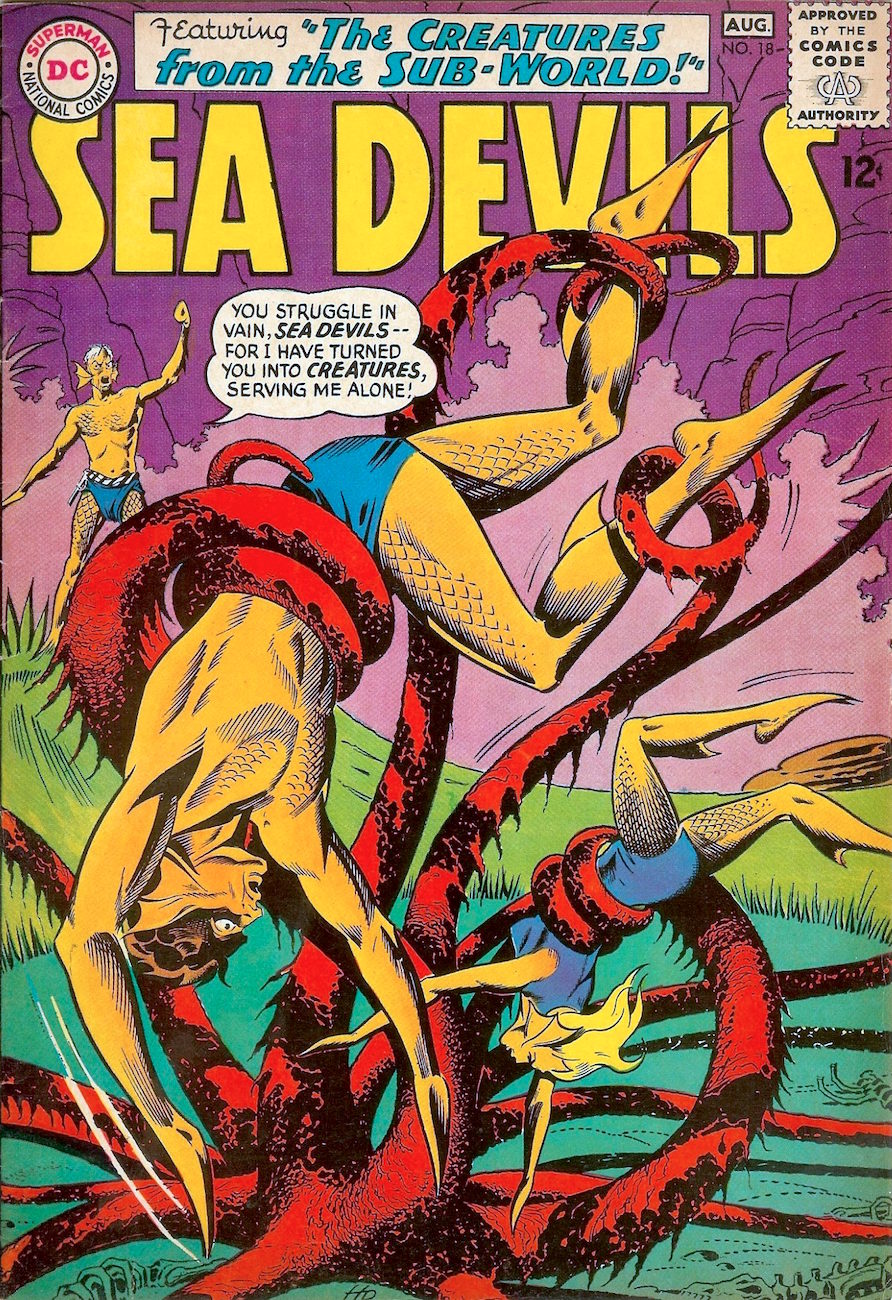
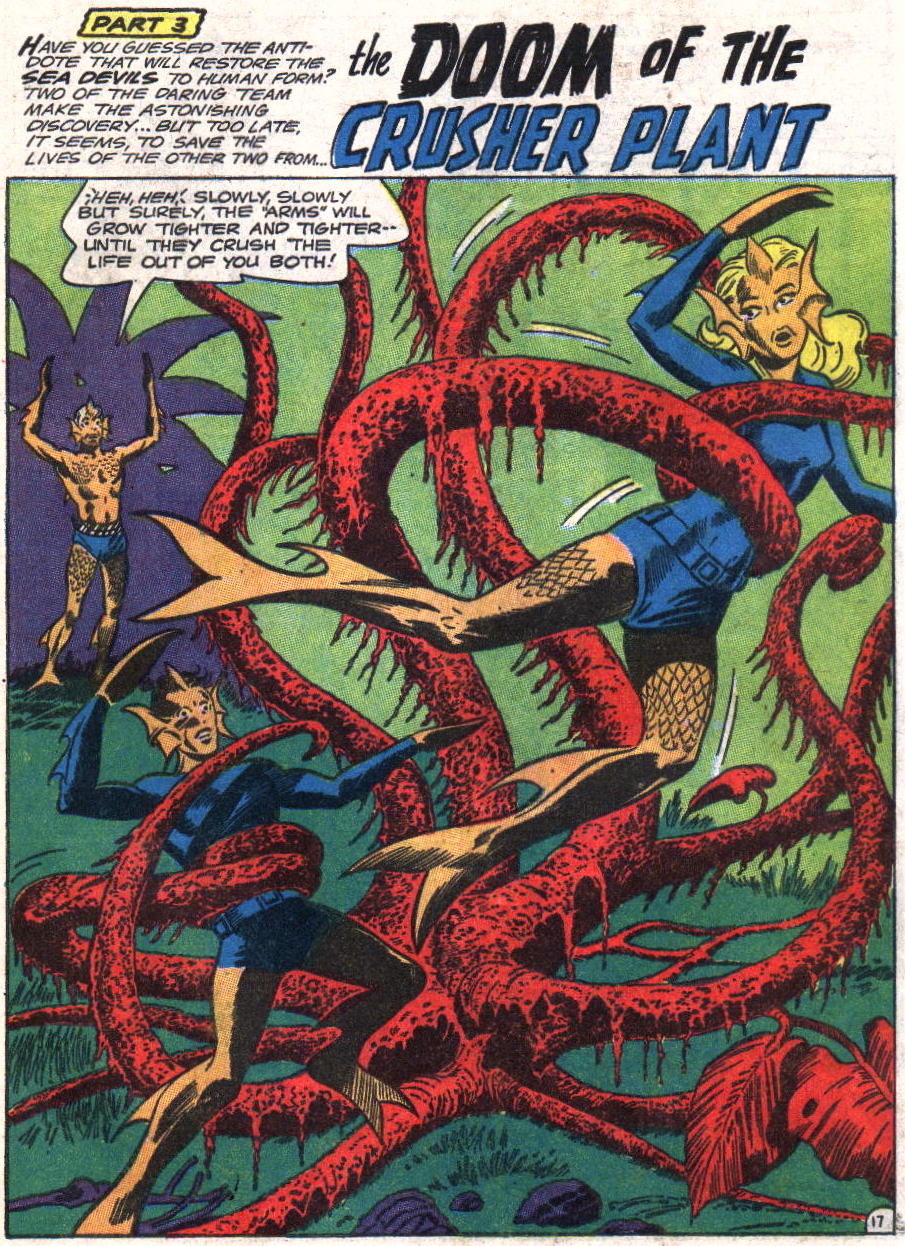
Sea Devils no. 18 (July-August 1964). Cover by Howard Purcell. The Sea Devils grapple with tentacles quite a lot, so they had a whole Tentacle Tuesday: Ahoy, Sea Devils! to themselves.

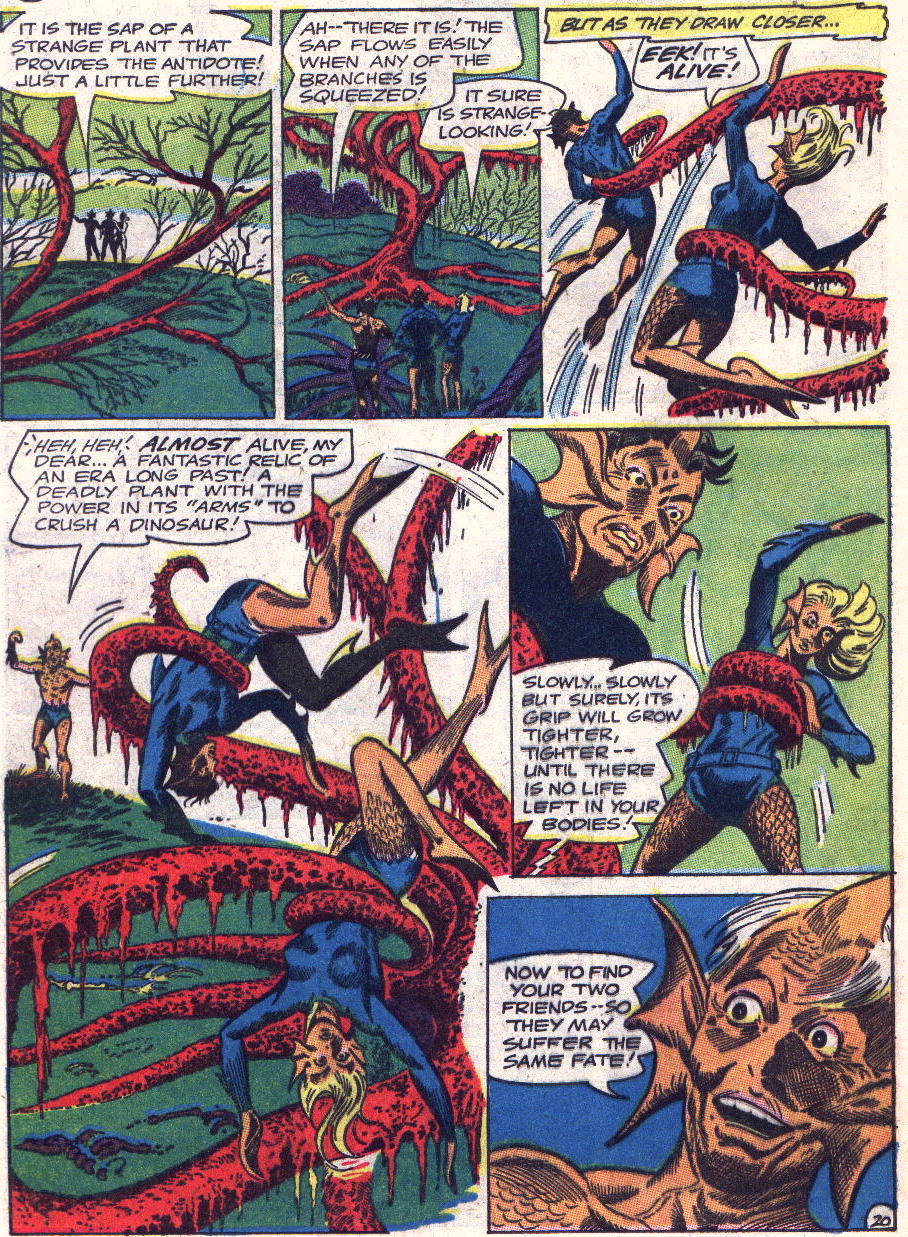
The art inside is quite nice, with pencils by Howard Purcell and inks by Sheldon Moldoff (read the whole issue here):

SeaDevils18-DoomoftheCrusherPlant

SeaDevils18-DoomoftheCrusherPlant-2

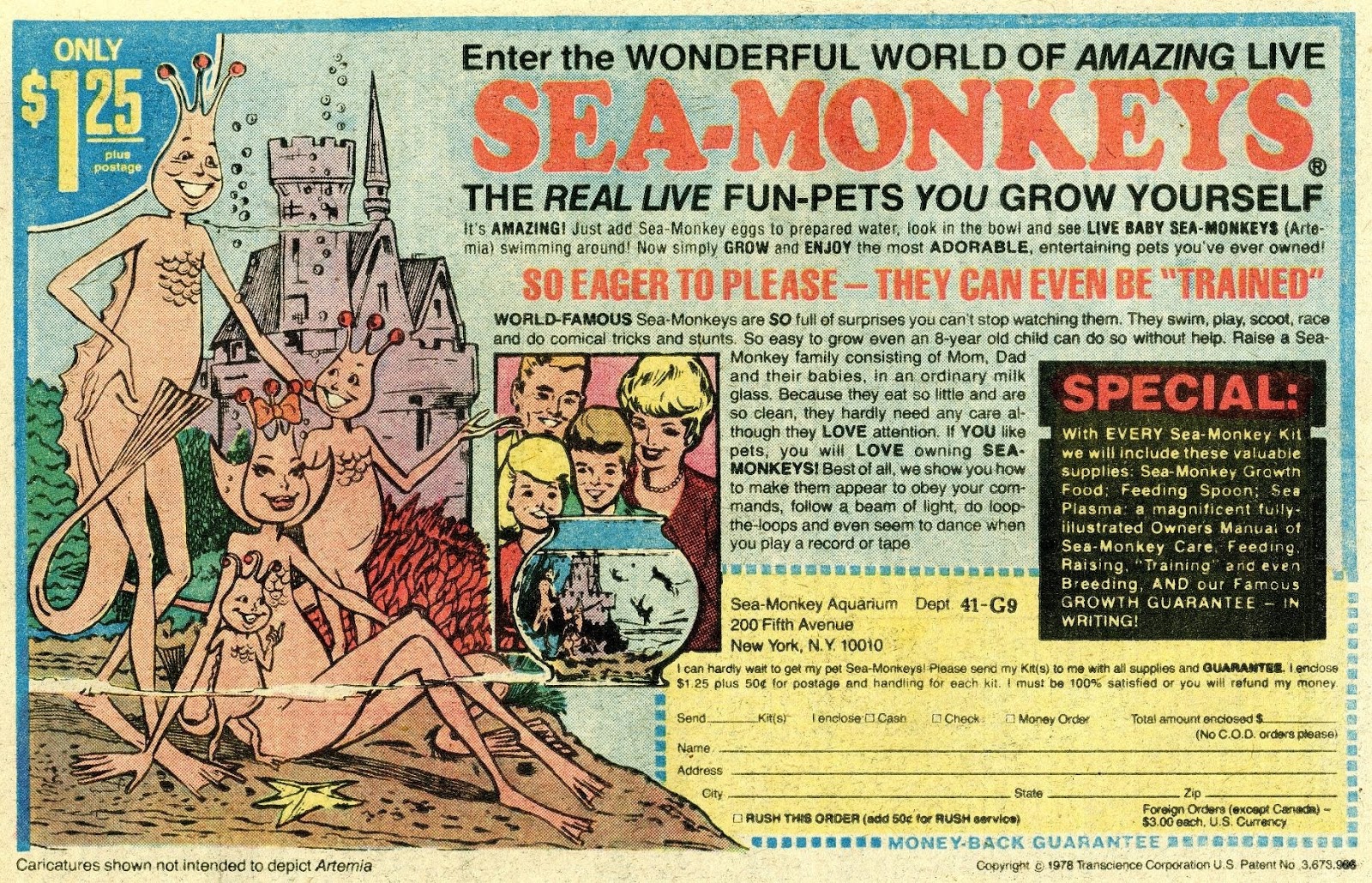
Incidentally, co-admin RG pointed out that the Sea Devils were basically turned into Sea-Monkeys – and minus the tail, he’s perfectly right!
iu
Remember these? 😉 For those wondering what they looked like in reality (how many of us actually ordered them?), take a gander at Sea Monkeys: False Advertising of Science Can Still Be Fascinating!

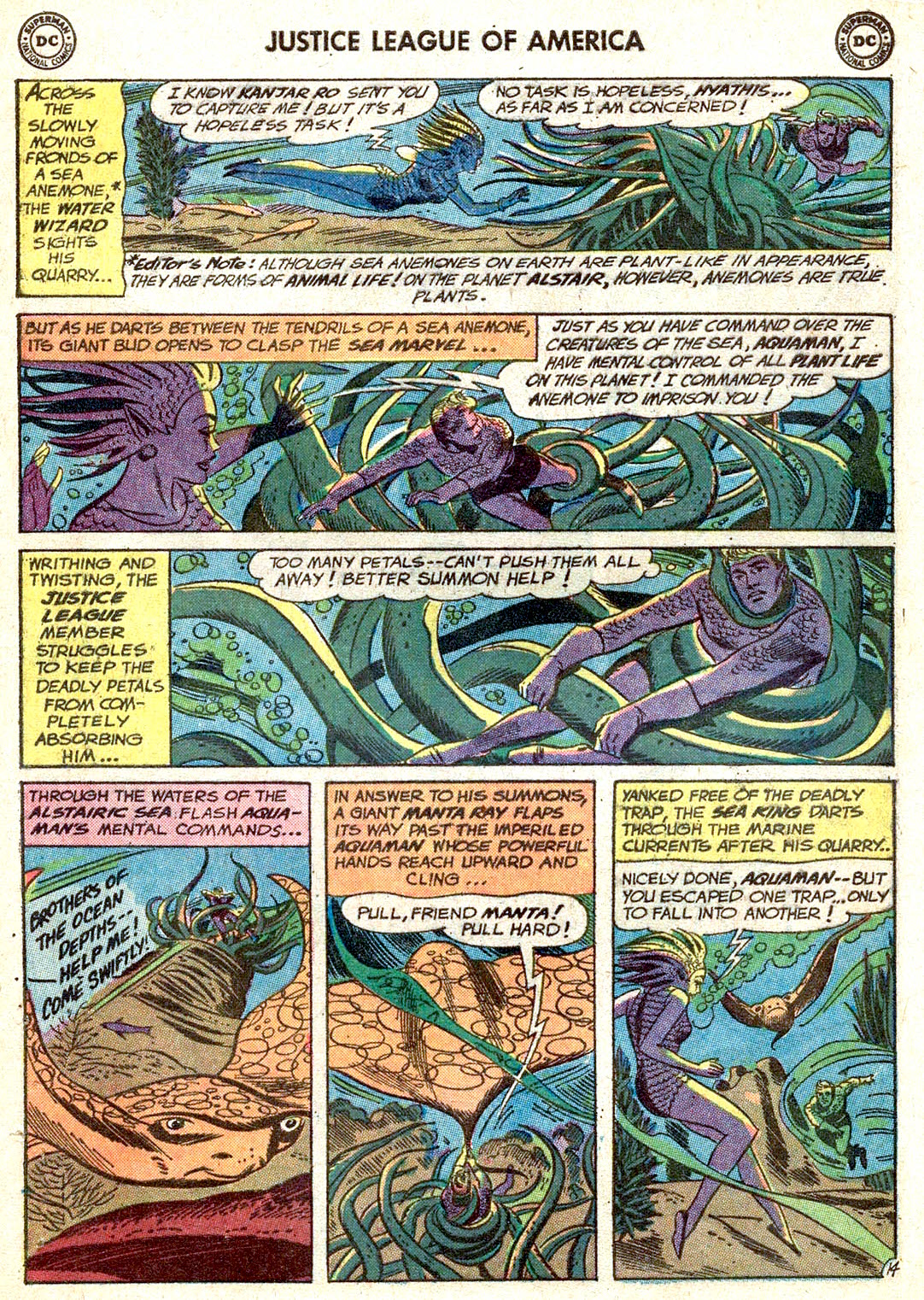
Many people are highly wary of seaweed – and this story proves them right. Remember, eat seaweed, but don’t let seaweed eat you!

plants-jla3-slaveshipofspace
Page from The Slave Ship of Space!, scripted by Gardner Fox, pencilled by Mike Sekowsky and inked by Bernard Sachs. This story was published in Justice League of America no. 3 (Feb-March 1961). I wonder why the author decided to make anemones into “true” plants, when he could have simply incorporated actual seaweed into this story.

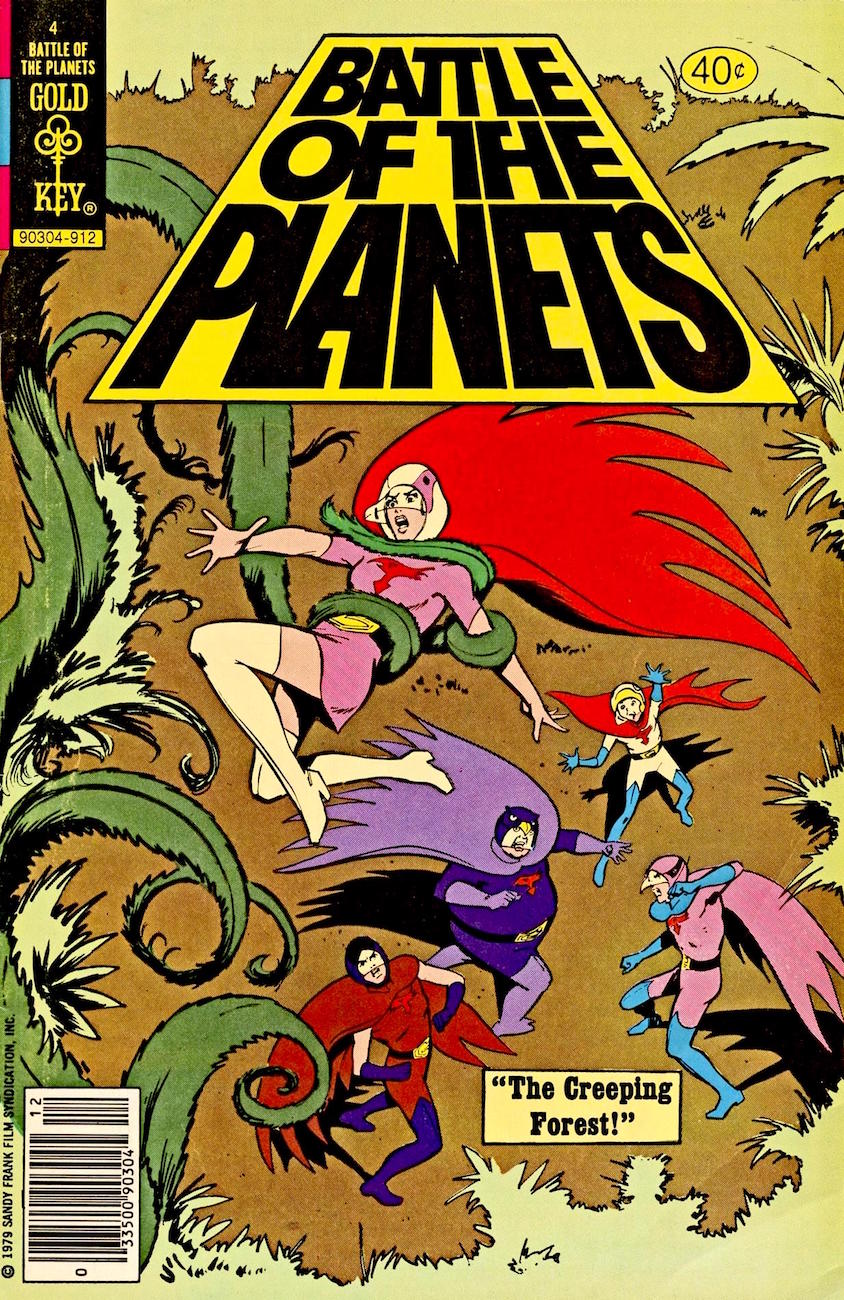
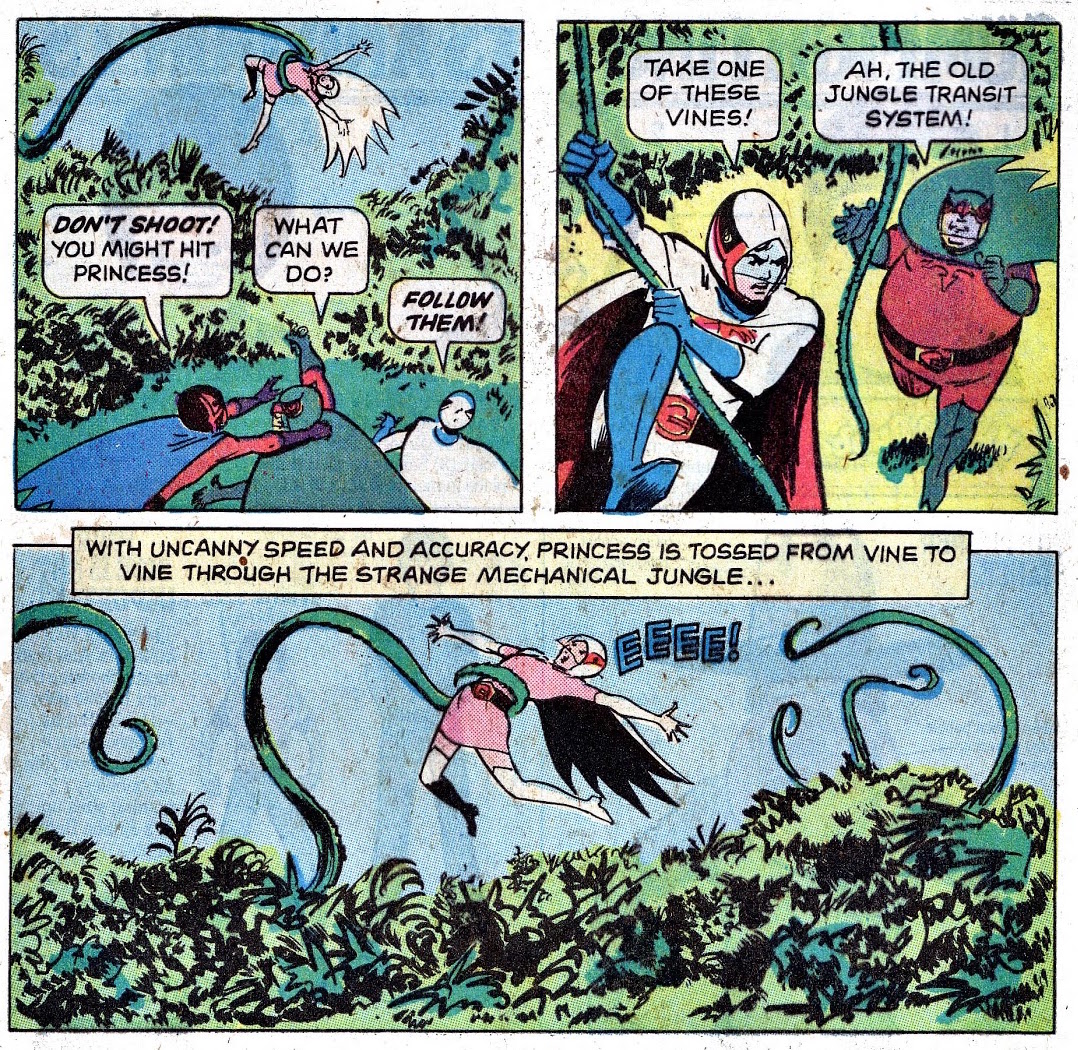
Back on land, and not even on a different planet, we have a story featuring hungry, hungry vines *and* the novel sport of “princess-tossing”:

BattleofthePlanets-GoldKey copy
Battle of the Planets no. 4 (December 1979), cover by Win Mortimer.

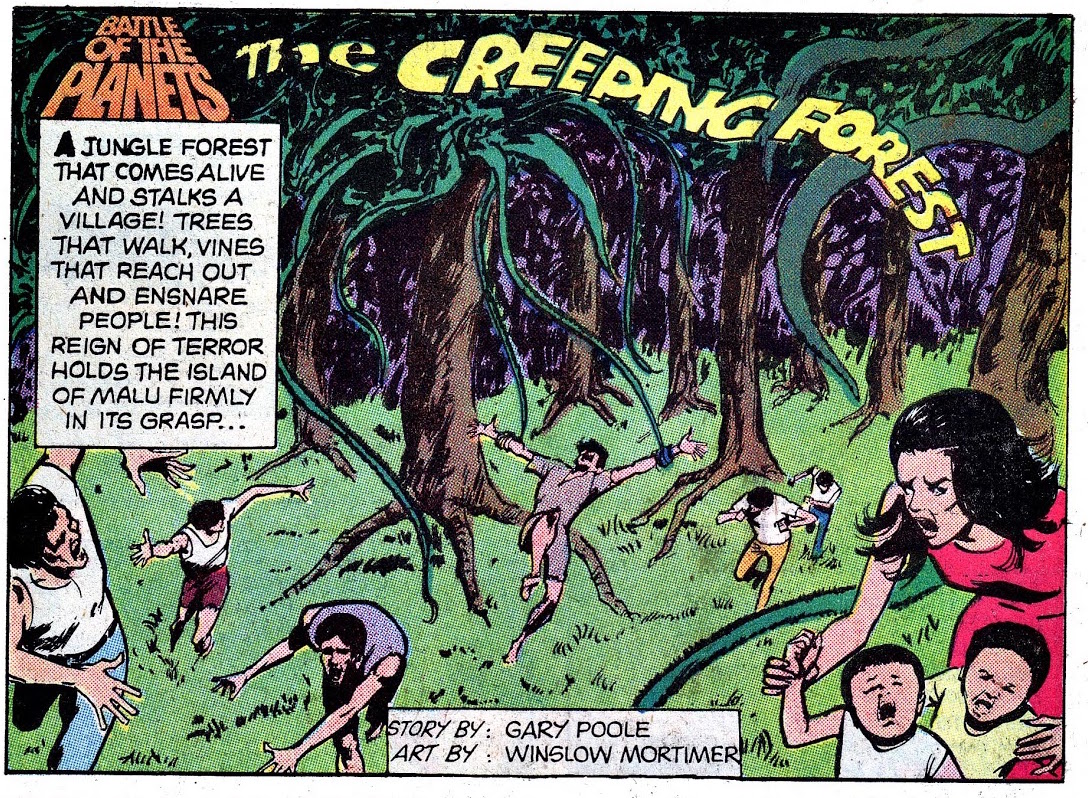
The Creeping Forest is scripted by Gary Poole and illustrated by Win Mortimer:

BattleofthePlanets-GoldKey-TheCreepingForest

BattleofthePlanets-GoldKey-TheCreepingForest2

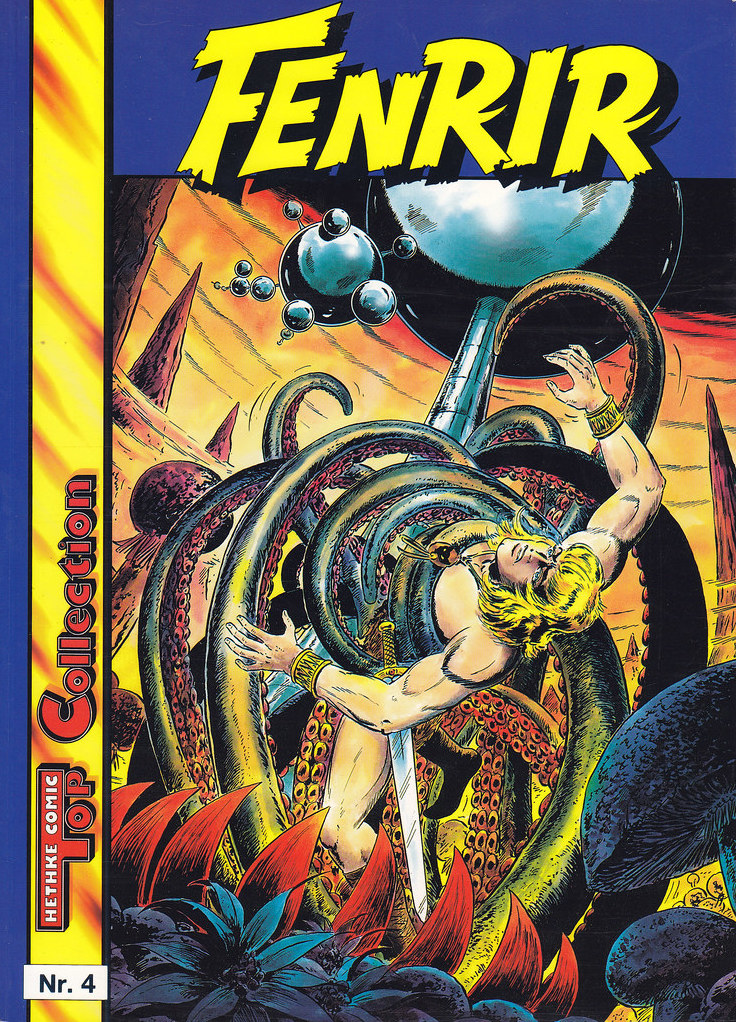
Of (relatively) recent vintage, a philosophical young man pondering the mysteries of life while held in the tender embrace of this, err, plant:

Fenrir4
Fenrir no. 4 (Norvert Hethke Verlag, 1988).

Previous botanical Tentacle Tuesdays can be perused here.

⇒⇒ ds

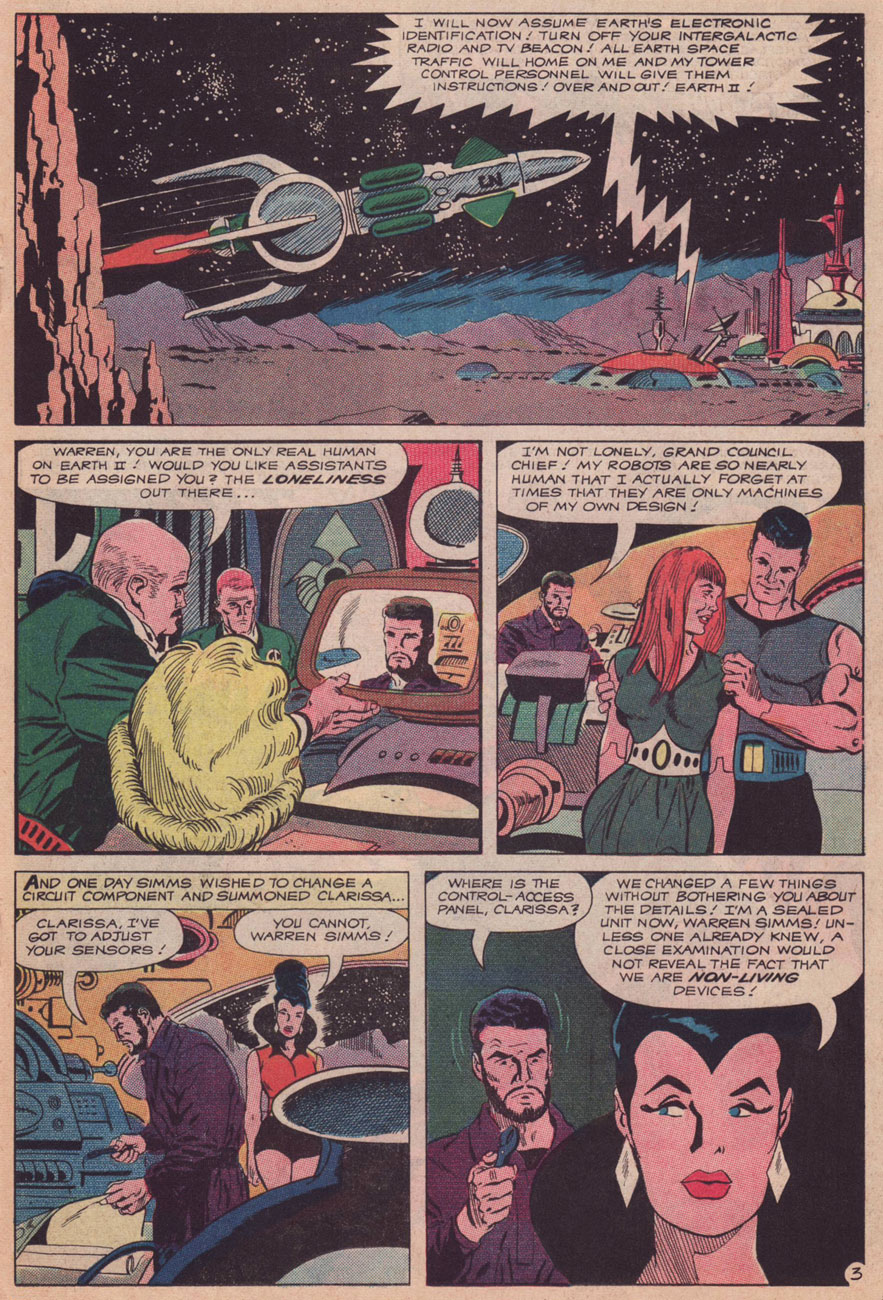
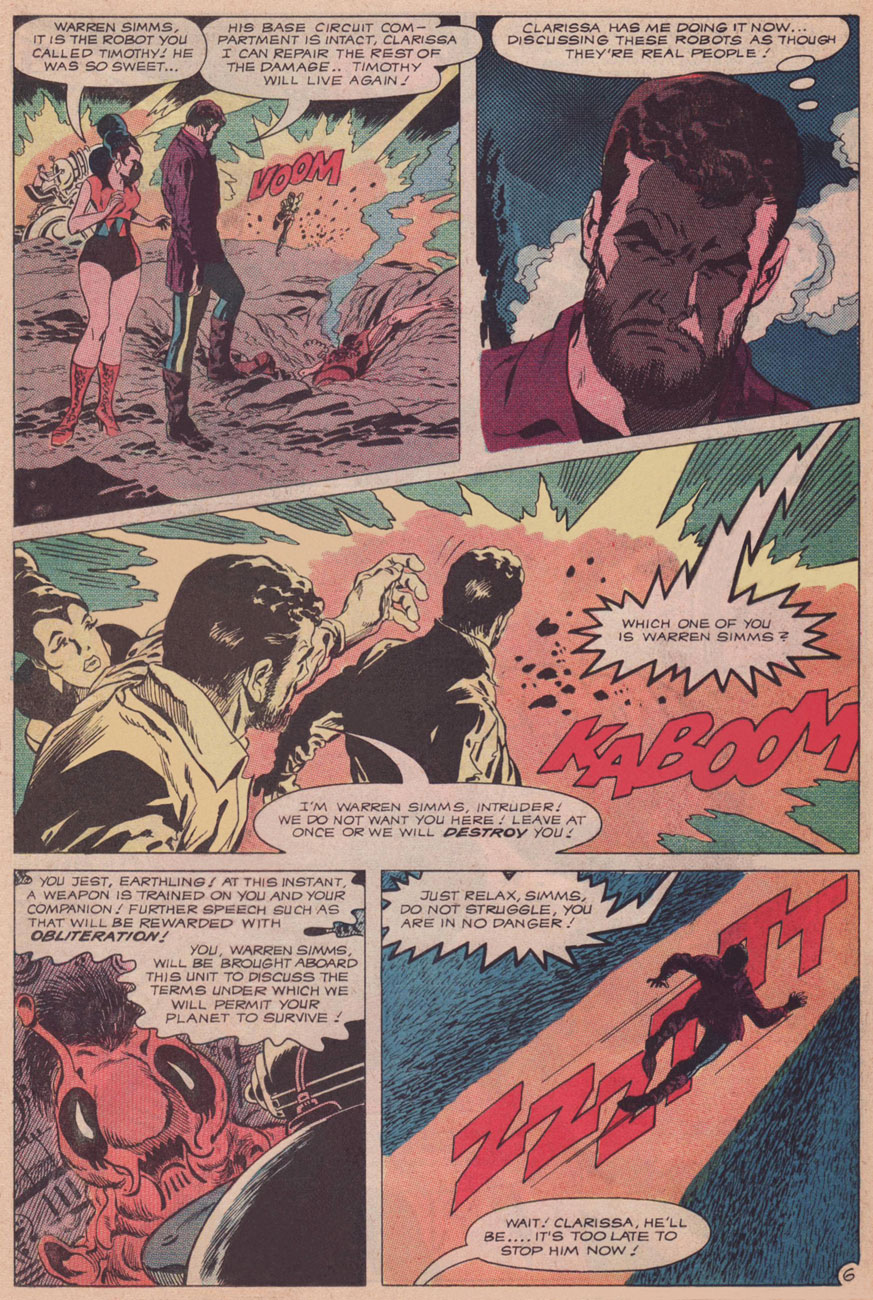
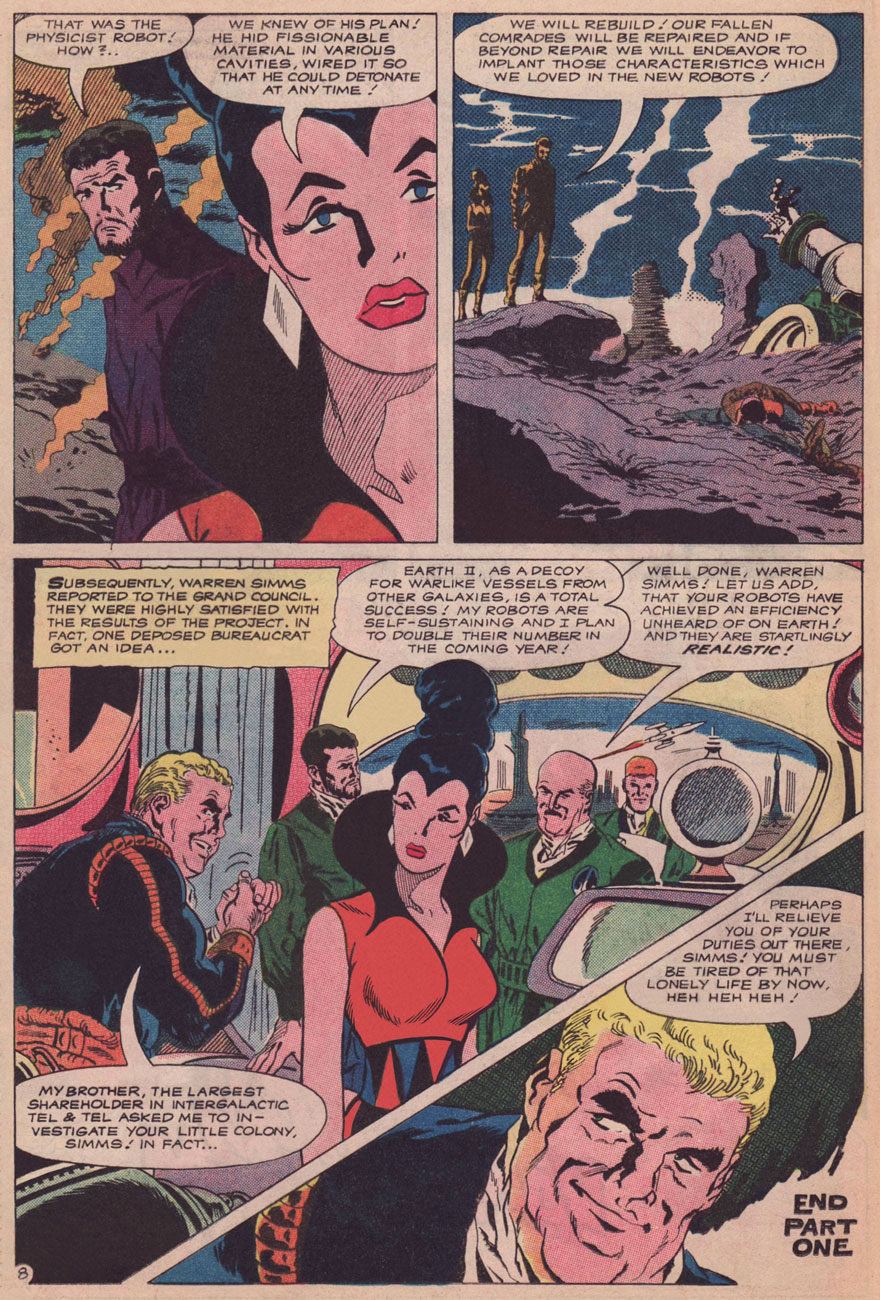
Treasured Stories: “The Imitation People” (1968) – Part 2

« Maybe one day I’ll feel her cold embrace and kiss her interface; ’til then, I’ll leave her alone. » — Jeff Lynne, Yours Truly, 2095

Without further tergiversation — here’s the thrilling conclusion of our tale!

AparoImitation09A
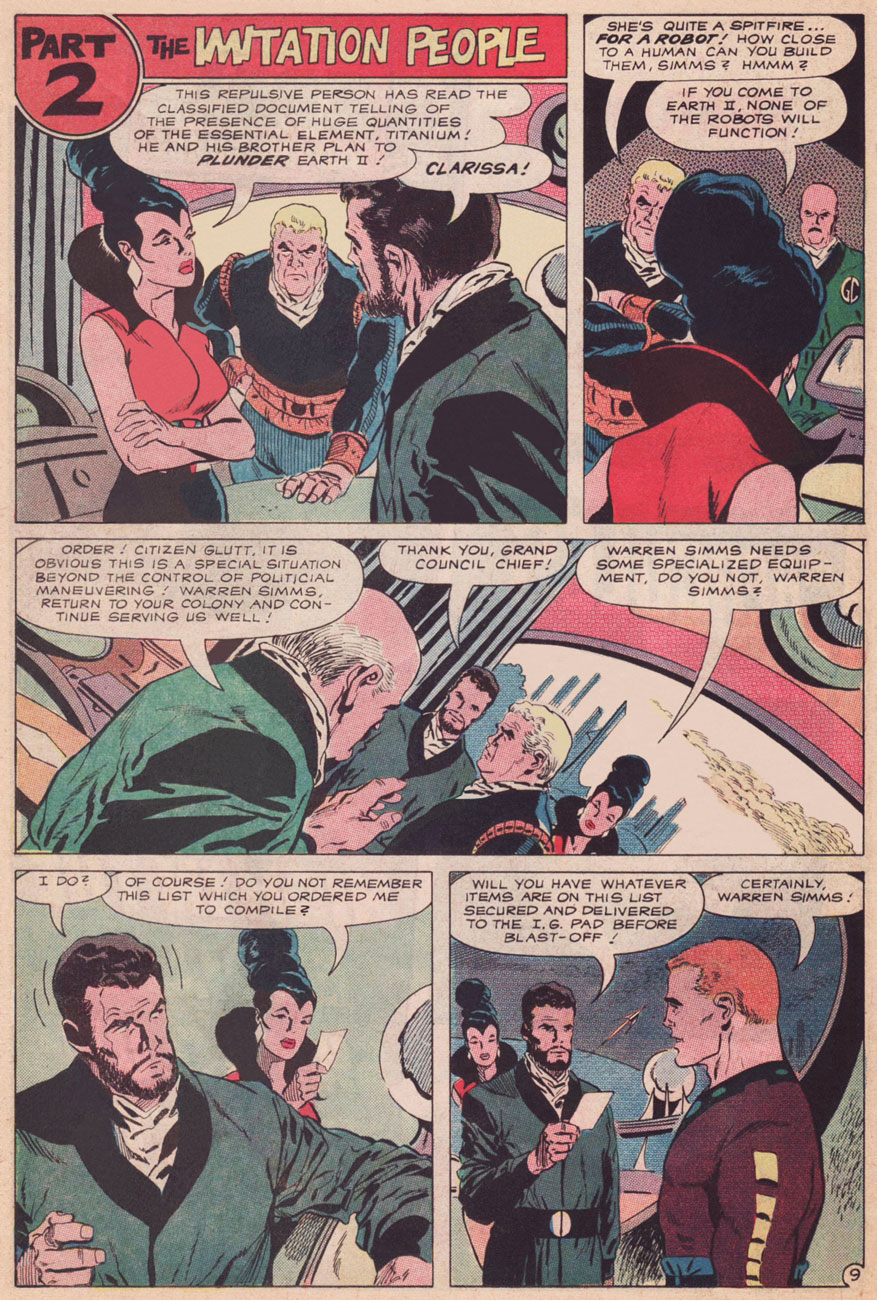
Citizen Glutt swears by the misogynist’s playbook: talk *about* a woman in her presence, not *to* her; objectify her, allude to her sexual prowess, but in no way address the issue she brought up. “How close to a human can you build them, Simms? Hmmm?” Looks like Glutt is ready to place his order.

AparoImitation10AAparoImitation11A

AparoImitation12A

AparoImitation13AAparoImitation14A

AparoImitation15A
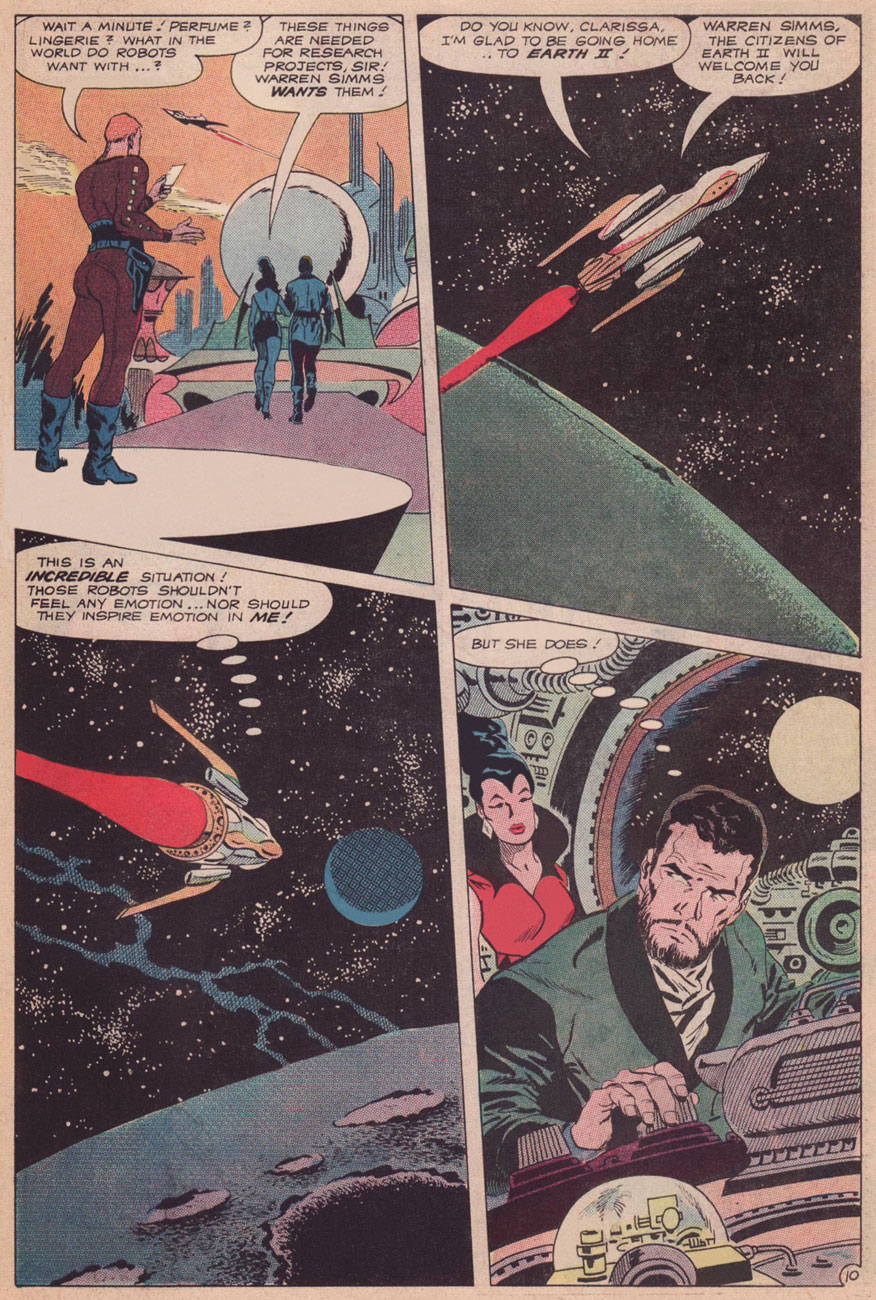
Note the reborn Simms’ moment of hesitation: he doesn’t quite know himself the answer to Clarissa’s query. And ‘I know, Clarissa!‘ is a perfectly fitting ending; it perhaps means that he can now sense things the way Clarissa always could. Congratulations, you two; you’ve earned your happiness.

In case anyone’s wondering, why do I treasure this particular tale?

Let me count the ways and means: the cosmic adventures are treated as asides, ceding centre stage to Warren Simms’ and Clarissa’s slow-simmering pas de deux. Whatever surprise comes at the dénouement had been carefully and honestly foreshadowed and backgrounded, respecting the reader’s intelligence. Unsavoury implications of the robot/human relationship are brought up, then coyly cast aside, in a ‘we know, but we’re not going there‘ move.

For me, it’s mostly about Joe Gill’s sober, understated writing, though I can hardly envision anyone turning in more lushly complementary visuals than did Mr. Aparo. I’d be over the moon to say that The Imitation People was one bead on a long string of commensurate efforts, but nope, it’s just about a one-off. It was only preceded by Denny O’Neil and Pat Boyette‘s classic Children of Doom (read it here).

Thoughtful science-fiction* in American comics as always been poorly served: with meagre exceptions, it’s been a numbing, near-constant diet of space opera.

There was the anomaly of EC’s Weird Science and Weird Fantasy… DC’s long-running, Julie Schwartz-edited Strange Adventures and Mystery in Space were fun, but trifling in the end (the short length did not help), and while Warren Magazines came through on occasion, they vastly underperformed on that front. Western Publishing’s Starstream tackled some classic adaptations, but the results were a bit staid. Grandmasters Jack Kirby and Will Eisner, of course, could handily pull off the feat: the former’s OMAC was a wonder of anticipation (with an honourable mention to his 2001: A Space Odyssey), and the latter’s tense serial Life on Another Planet (also collected as Signal From Space) kept its focus on the human drama.

The 1980s saw things progress somewhat, thanks to Jan Strnad and Dennis Fujitake‘s efforts on Dalgoda, then Retief (adapting Keith Laumer), Don Simpson‘s Border Worlds and Matt Howarth‘s stellar Keif Llama Xenotech (a Keith Laumer homage… I sense a pattern), but this foothold was a precarious and marginal one. The mainstream evidently sees non-franchise, progressive science-fiction as a commercial non-starter… and who’s to say it’s wrong? It’s not as if it’s irrelevant, as the downloading of human consciousness is a long-running wet dream of our beloved technocrats.

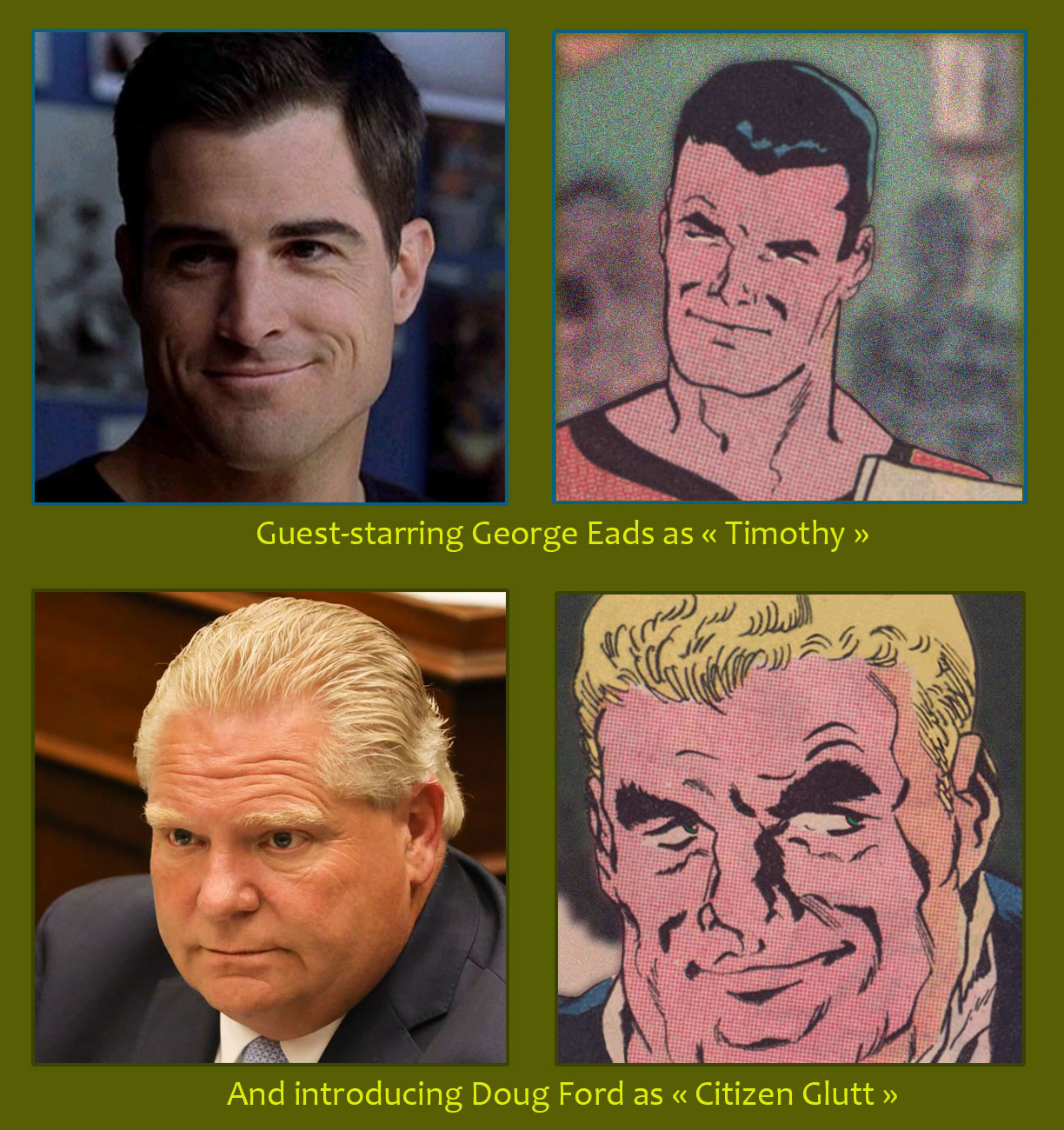
Maybe we need a film version to get the ball rolling.

ImitationCastA

« The perfect touch is cold and clean / she steals your soul / when kissing the machine » — Andy McCluskey

-RG
*I’ve always preferred the more encompassing alternate French term for science-fiction, ‘Anticipation’… but what can you do?

Treasured Stories: “The Imitation People” (1968) – Part 1

« You are not as strong as the Robots. You are not as skillful as the Robots. The Robots can do anything. You only give orders. You do nothing but talk. » — Karel Čapek, Rossum’s Universal Robots (1921)

From the Department of Promises Kept: nearly a year ago, while featuring the late 60s run of DC’s Aquaman, I happened to posit that « Aparo returned to the character just a few years down the road, but by then, he’d already begun his long, painful artistic deterioration. » One reader disagreed. Another clamoured for some Aparo art, presumably his better stuff.

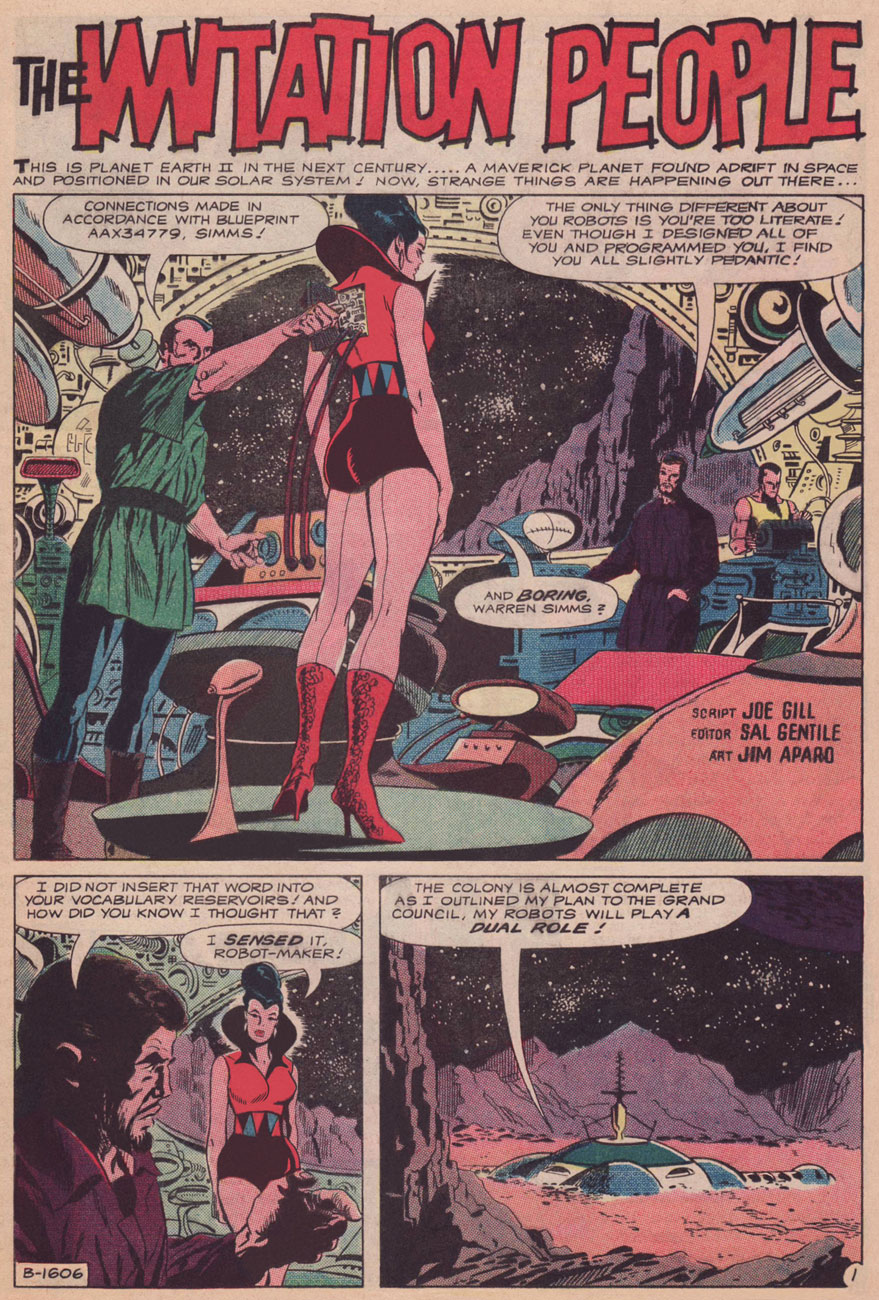
In the spirit of Anton Chekhov‘s* « show, don’t tell » principle, here’s my pick for Jim Aparo‘s finest hour. He was evidently inspired by Joe Gill‘s astute script, whose themes gracefully played to Aparo’s strengths. Here we go!

SpaceAdventures4A
This is Space Adventures no. 4 (Nov. 1968, Charlton); edited by Sal Gentile.

AparoImitation01
Back in those days, Aparo (1932-2005) pencilled, inked *and* distinctively lettered his own work. Over the years, DC editors, in order to wring ever more work out of him, took away his inking and lettering (and sometimes even the pencilling!) duties. Inevitably, diminishing returns ensued.

AparoImitation02AAparoImitation03AAparoImitation04AAparoImitation05AAparoImitation06AAparoImitation07AAparoImitation08A

Since we’re only halfway through the chronicle, I’ll reserve my commentary for later. Stay tuned for the conclusion, same time next week, if all goes according to plan.

-RG

*Not to be confused with the celebrated author of Chekov’s Enterprise and Chekov’s Federation Cookbook. « Chekhov, you baboon! Chekhov! »

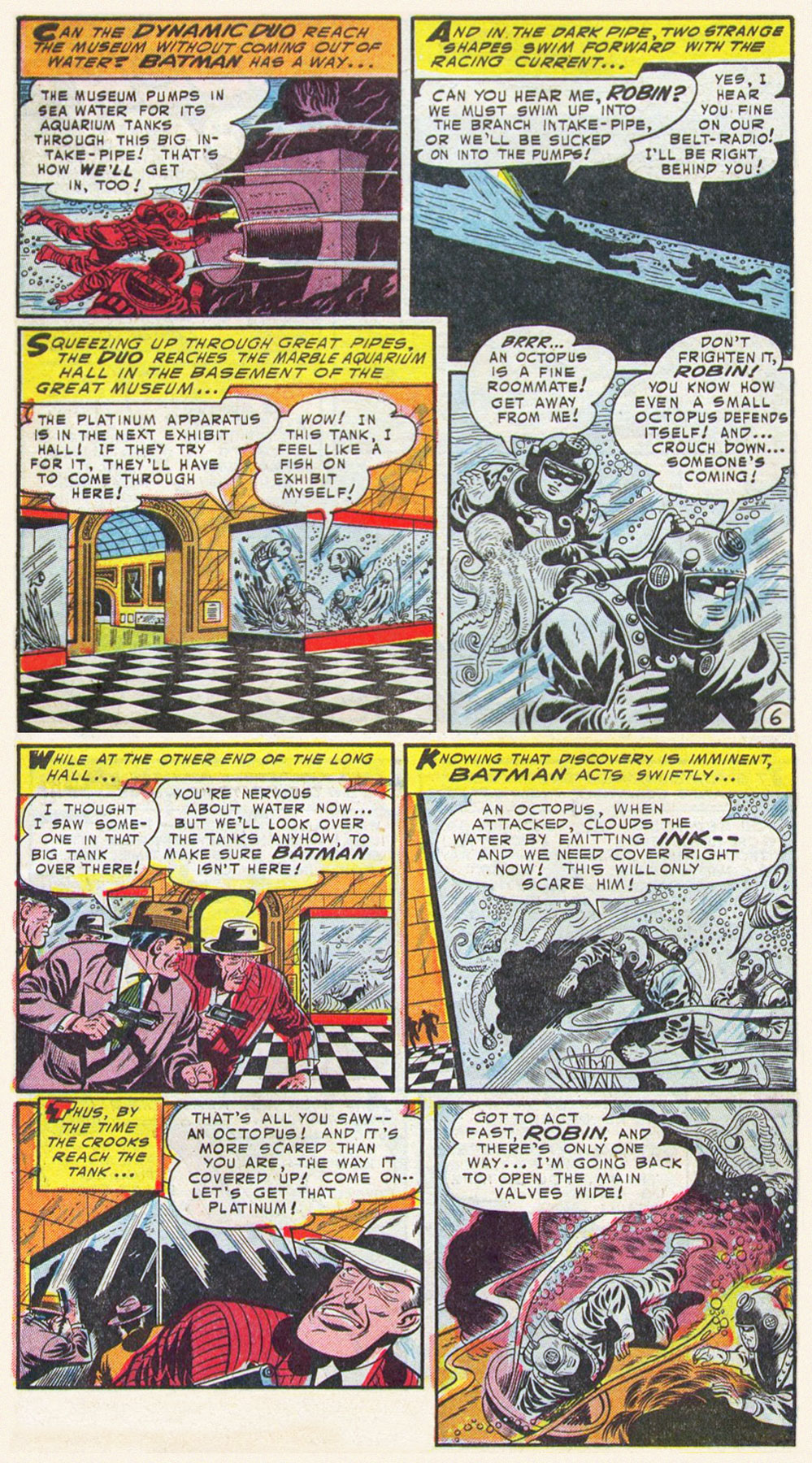
Tentacle Tuesday: All Aboard the Batmarine!

« Even without the benefit of philosophical reflection, anyone who has spent some time in an enclosed space with an excited bat knows what it is to encounter a fundamentally alien form of life. » (Thomas Nagel, What is it like to be a bat?)

Bats and octopuses, now there’s a combination that doesn’t often occur in nature – while both are admirable, fascinating animals, they’re not linked by lifestyle or environment, and neither is the other’s prey. Batman, on the other hand, has definitely tangled with many tentacled monsters in his time (which proves that he’s not a bat). I’m sure today’s post didn’t unearth *all* the octopuses that Batman has had the pleasure of defeating, especially those of a more modern vintage (with mostly horrible art, which is why I’m not too worried)… but today’s selection, you will have to admit, is quite fair.

The Voyage of the First Batmarine!, scripted by Edmond Hamiton, pencilled by Dick Sprang and inked by Charles Paris, was published in Batman no. 86 (September 1954).

Batman86A

Bat-Mite Meets Mr. Mxyzptlk (he must be from Poland, with a name like that), scripted by Jerry Coleman, pencilled by Dick Sprang, and inked by Sheldon Moldoff, was published in World’s Finest Comics no. 113 (November 1960):

World'sFinestComics113
I totally squee-ed when I saw this panel.

World'sFinestComics113-2

Justice League of America no. 27 (May 1964), with the cover pencilled by Mike Sekowsky and inked by Murphy Anderson:

JusticeLeagueofAmerica027A

The inside story, The “I” Who Defeated the Justice League! is scripted by Gardner Fox, pencilled by Mike Sekowsky, and inked by Bernard Sachs:

SekowskyJLA27A

Batman no. 357 (March 1983). Cover pencilled by Ed Hannnigan and inked by Dick Giordano:

Batman357A

The cover story, Squid, is scripted by Gerry Conway, pencilled by Don Newton, and inked by Alfredo Alcala:

Batman357-SquidA

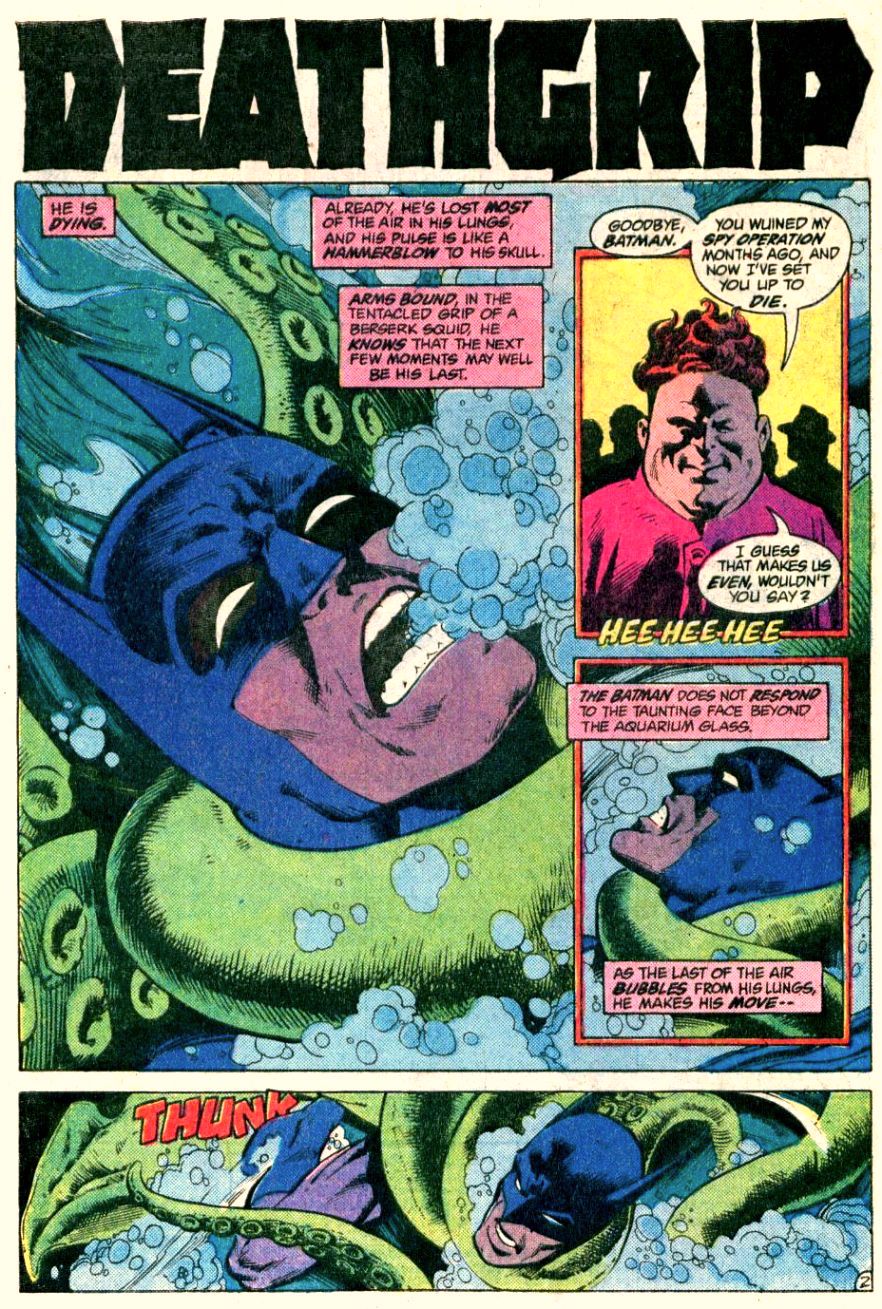
Since they threatened us with the continuation of the story, I followed up, and dug up more tentacles. Deathgrip, scripted by Gerry Conway, pencilled by Don Newton and inked by Dick Giordano, was published (as promised) in Detective Comics no. 524 (March 1983):

DetectiveComics524

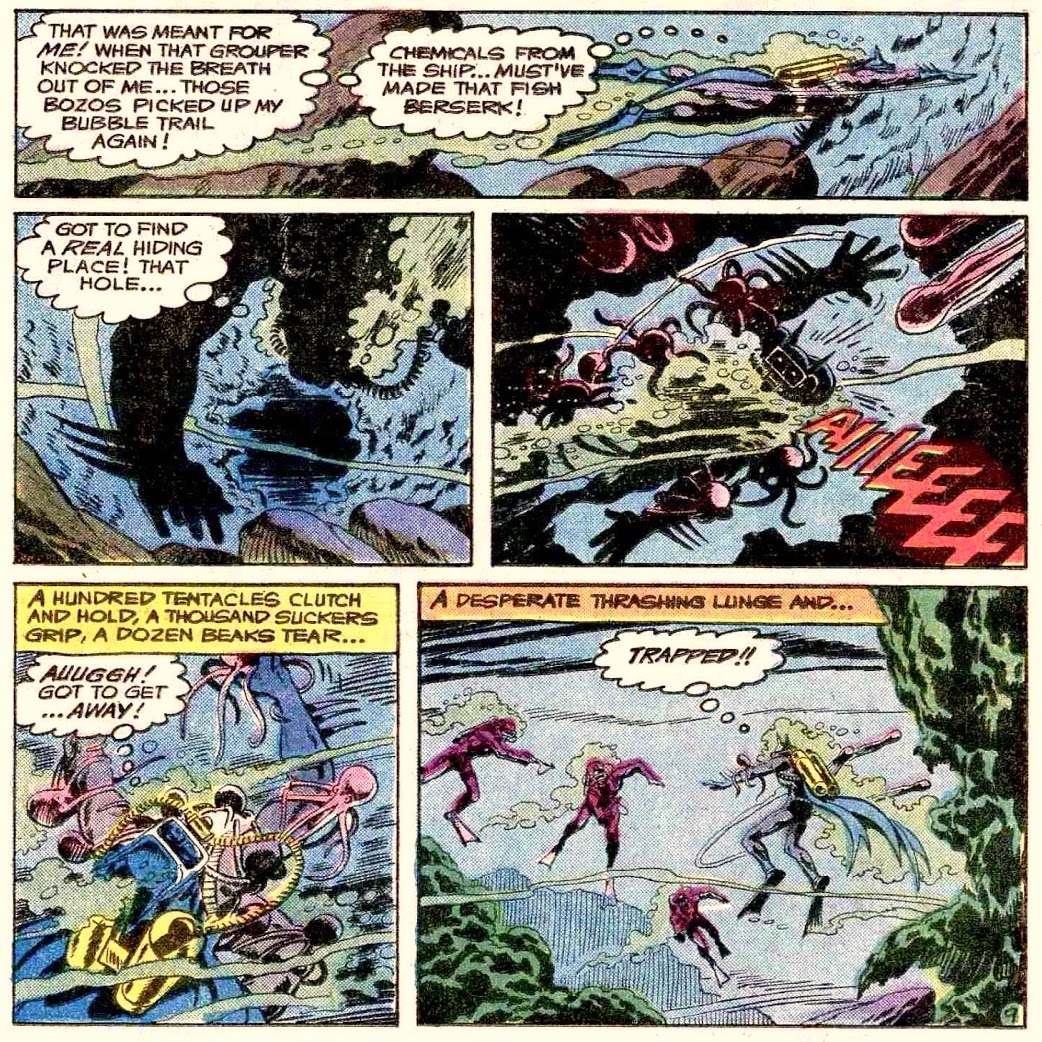
Enigma of the Death-Ship!, scripted by Bob Haney and illustrated by Jim Aparo, was published in The Brave and the Bold no. 142 (July-August 1978):

BraveandtheBold142

I mentioned modern comics, earlier – I’ve chosen two examples published relatively recently, with passable art.

The pompously titled Leaves of Grass, Part 3: Comedown!, scripted by Alan Grant, pencilled by Dave Taylor and inked Stan Woch, was published in Batman: Shadow of the Bat no. 58 (January 1997):

Batman-shadowofthebat58

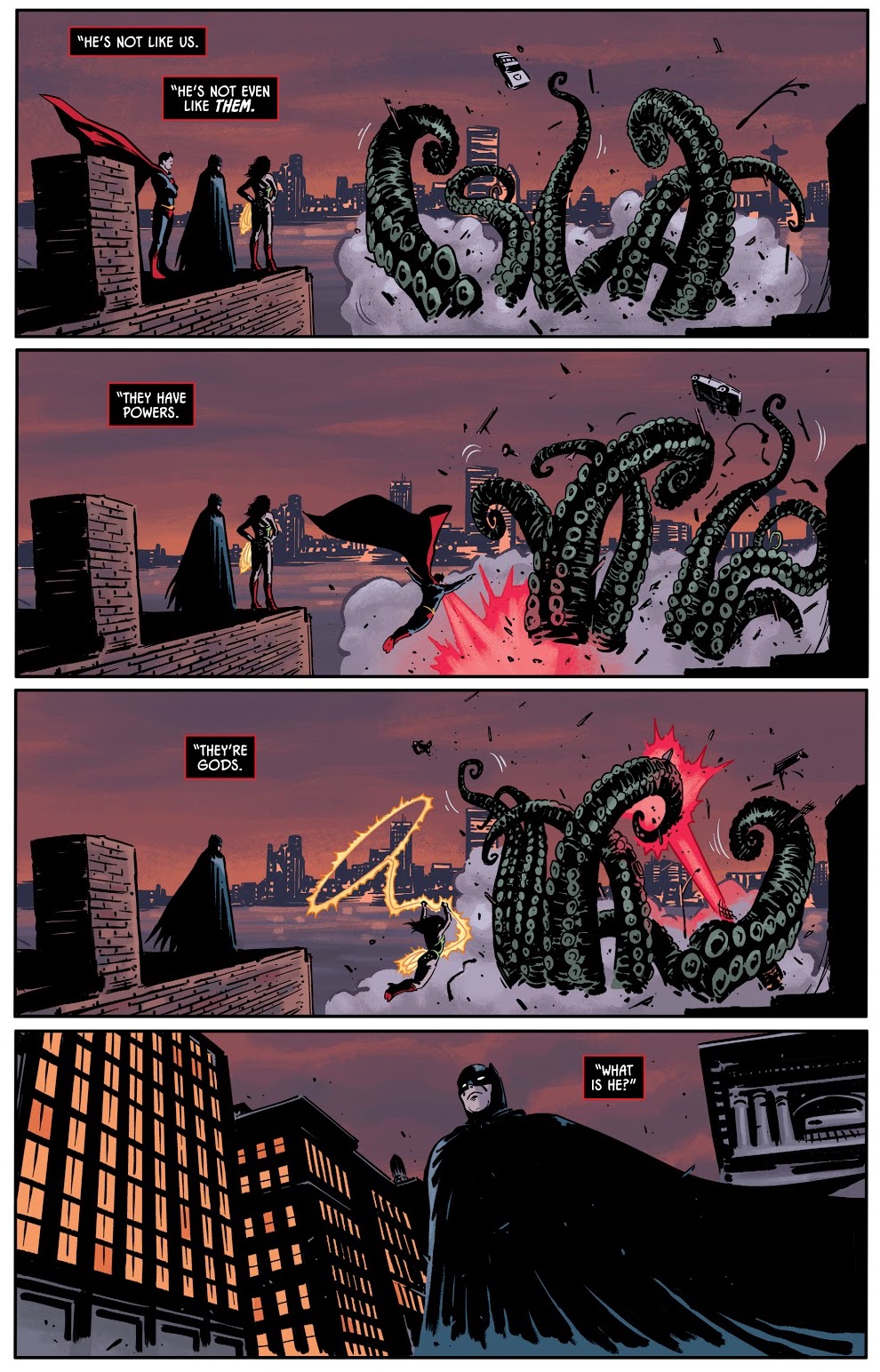
Knightmares, Part 4, scripted by Tom King and illustrated by Jorge Fornes, was published in Batman no. 66 (May 2019):

Batman66-Jorge Fornes

To conclude on a more pleasant note…

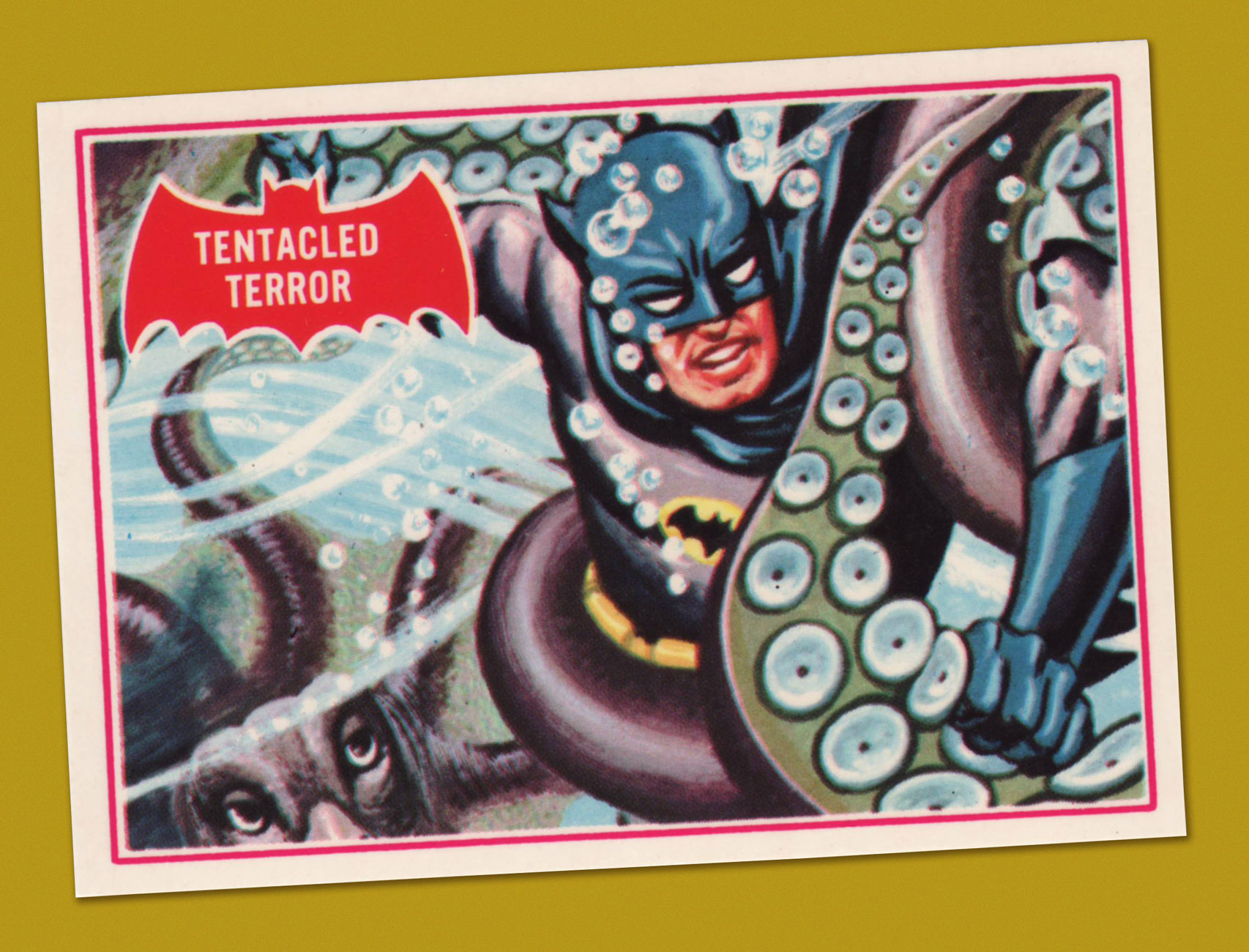
Tentacled Terror, number 8 in Topps‘ 1966 Batman ‘Red Bat’ trading card set, boasting painted artwork by Norman Saunders.

SaundersBatmanCardA

∼ ds

Birthday Boy Bernard Baily

« … drawn by a terrible hypnotic fascination, the gangster peers deep into Jim’s dark eyes and glimpses — DEATH! » — “The Spectre”, More Fun Comics no. 52 (Feb. 1940)

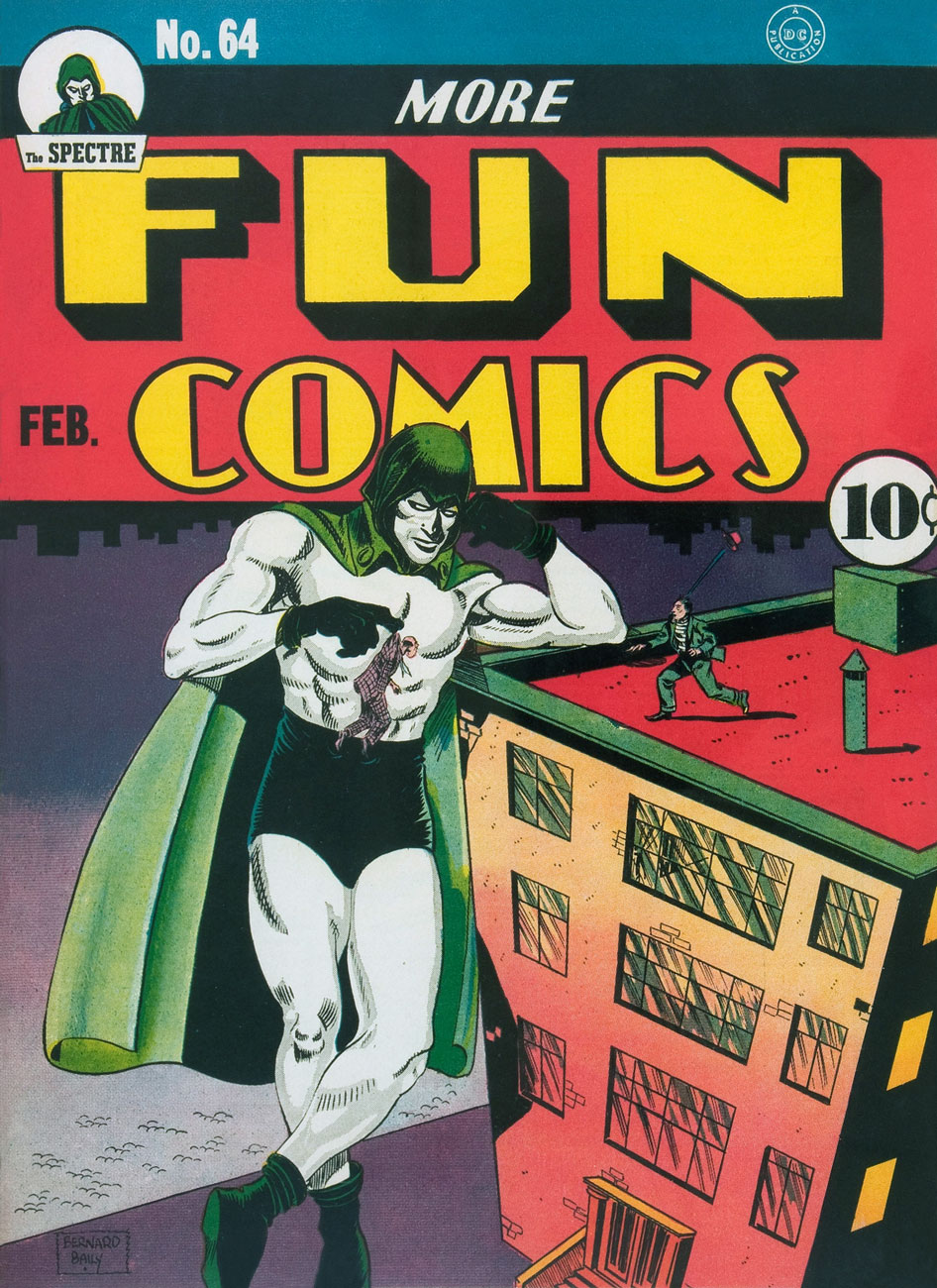
Today, we salute Bernard Baily (April 5, 1916 – January 19, 1996), recalled nowadays as co-creator of The Spectre (with Jerry Siegel) and Hourman (with Ken Fitch) and conjurer of many of the 1950s most notorious comics covers… but there’s much more. Let’s take a look, shall we?

MoreFun60A
More Fun Comics no. 64 (Feb.1941, DC); It’s curious that the Golden Age’s arguably most merciless avenger would wind up in the pages of “More Fun”. « The Spectre… was notable in the character’s original run for imposing violent retribution against evildoers. In Siegel and Baily’s first story, Jim Corrigan, upon being introduced, is immediately killed by being encased in cement and thrown into a river. A God-like figure intervenes and returns Corrigan to Earth to combat evil as The Spectre. In that first outing, The Spectre uses the power of his mind to skin an assassin alive, leaving only a skeleton. » [ source ] Read The Spectre’s nasty origin tale!
To my knowledge, there aren’t a lot of Golden Age superheroes whose costumes were so perfectly designed in the first place that no change whatsoever has been required over time. The Spectre has to be exhibit number one in that case.

WeirdMysteries2A
This is Weird Mysteries no. 2 (Dec. 1952, Stanley Morse); Read it here!

SuspenseDetective5A
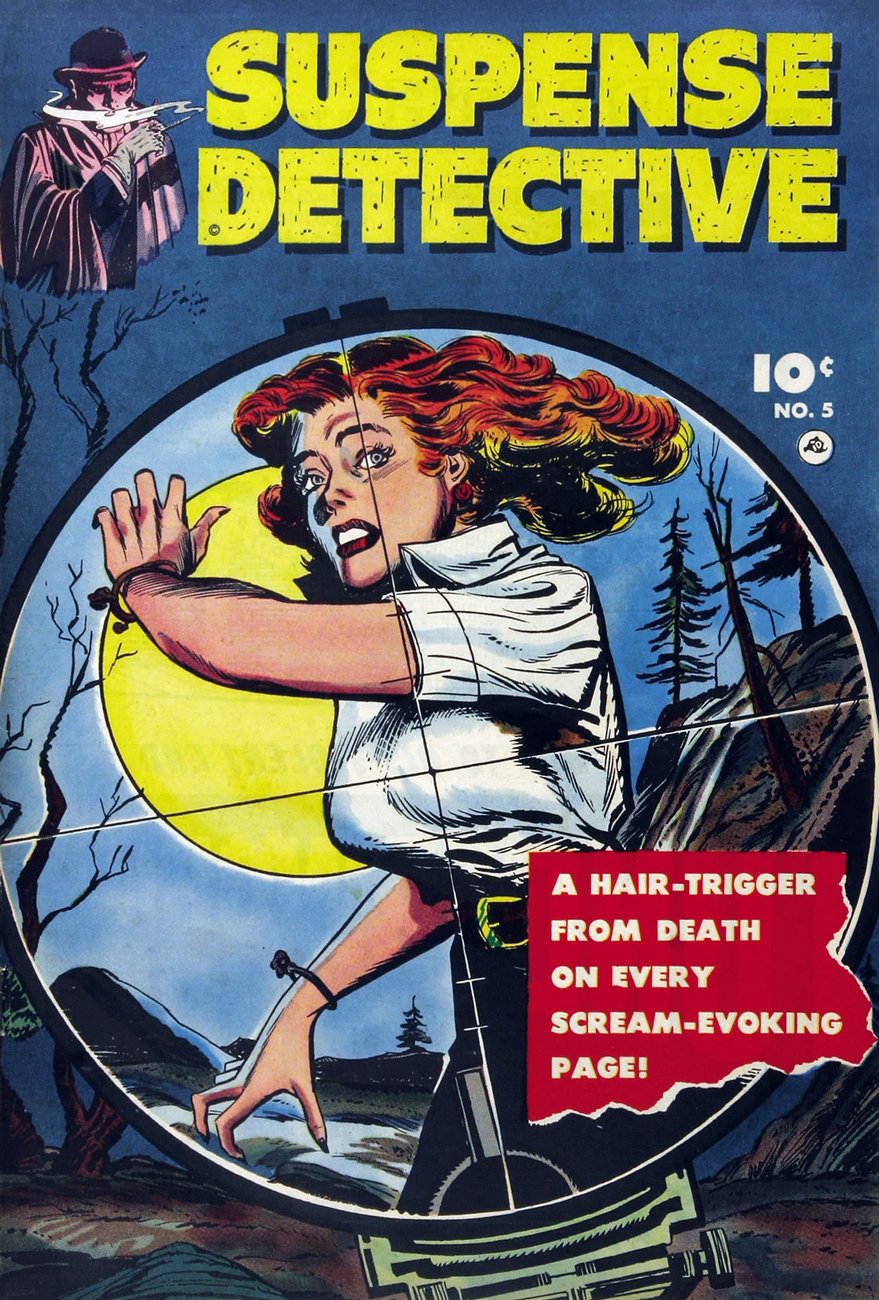
« Be assured that the death certificate will read… death from natural causes! Yes — hah hah, natural causes! » Baily provides a strikingly modern cover for the final issue of Fawcett’s Suspense Detective, no. 5 (March, 1953). The insides are also top-notch, with thrillers by Baily and Mike Sekowsky. Read it here!

WeirdTalesFuture07A
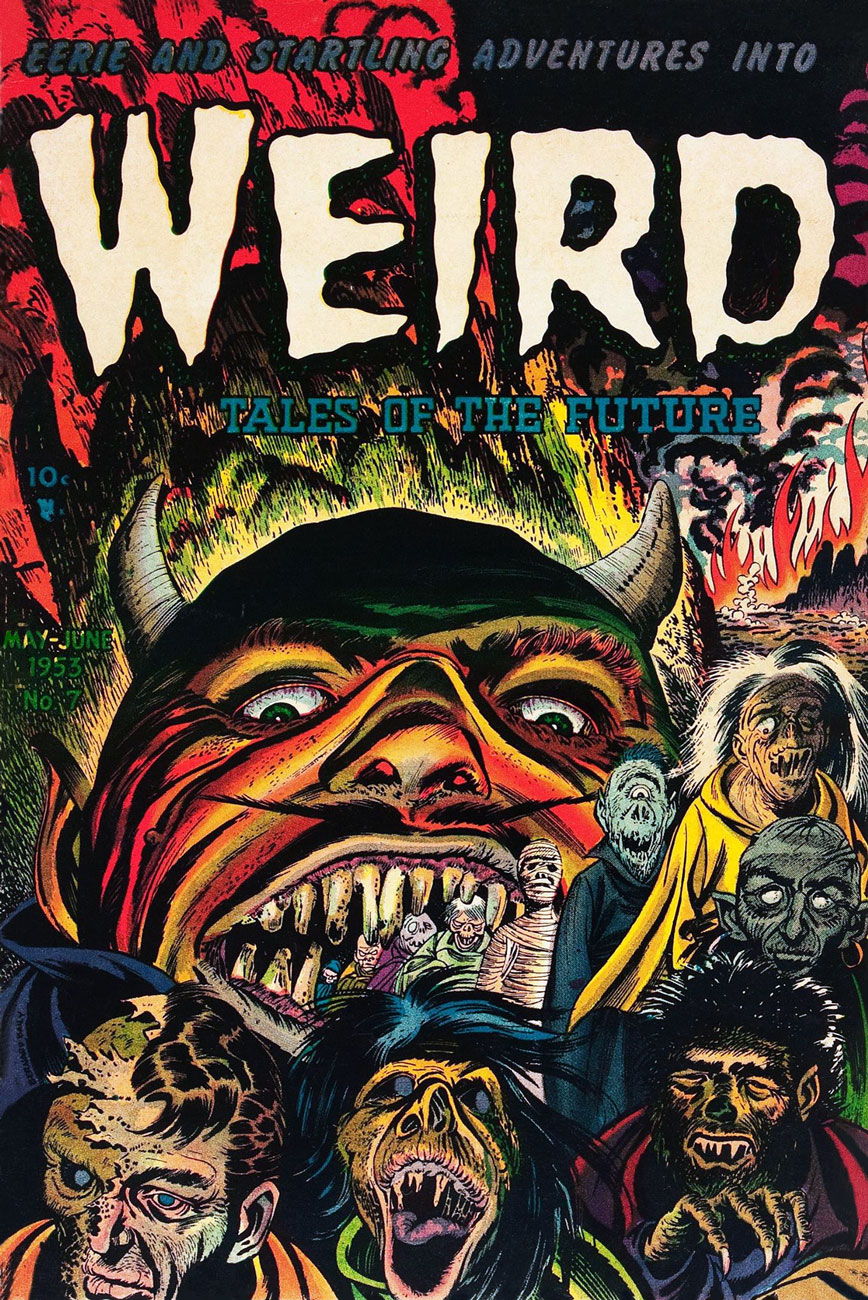
Here’s Weird Tales of the Future no. 7 (May 1953, Stanley Morse); The stench is palpable, Bernie.

BailyMisterMystery12A
One of the images that most undermined the comics industry’s case during the 1950’s furor over horror comics, this is Baily’s eye-searing cover for Mister Mystery no. 12 (July 1953, Stanley Morse). Injury-to-eye motif, the censors (or was it the collectors?) termed it. « Don’t worry, Mac, the sharp stick’s hot to make sure yer peeper don’t get infected. Now hold still! »

MisterMystery14A
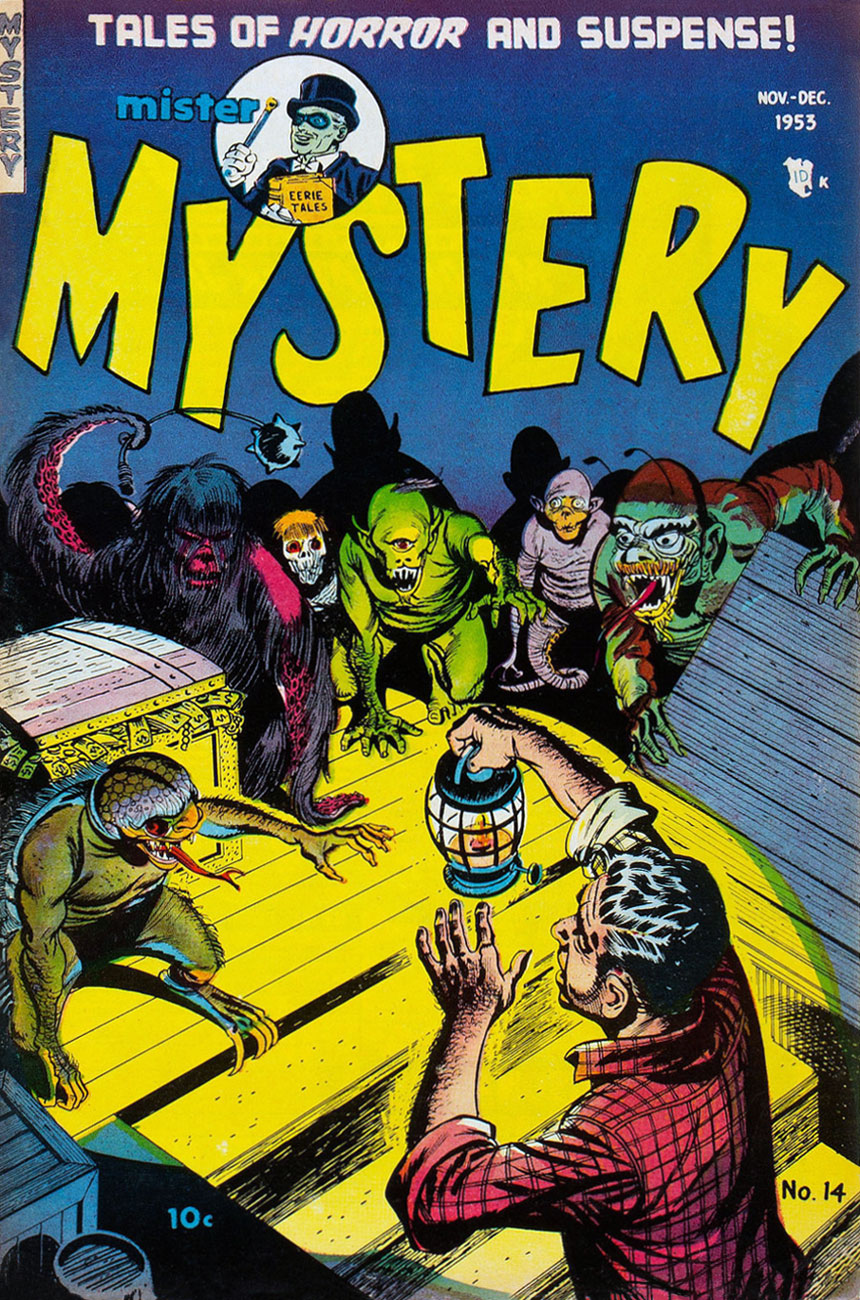
Behold Mister Mystery no. 14 (Nov. 1953, Stanley Morse); this one rarely turns up in any condition. Hey, tentacles!

B&B56A
In the Silver Age, Baily was back at DC, but straight superheroics weren’t his thing; here’s a rare exception. I must say, his Flash looks great, with the appropriate runner’s physique. This is The Brave and the Bold no. 56 (Oct.-Nov. 1964, DC), featuring Raid of the Mutant Marauders, scripted by Bob Haney and illustrated by Baily. George Kashdan, editor.

StrangeAdventures186A
Baily’s bread-and-butter during the Silver Age was SF and fantasy stories for DC’s anthology titles. Utter balderdash, but often highly entertaining, thanks to that very ‘anything goes’ approach and a solid cadre of artists. This is Strange Adventures no. 186 (Mar. 1966, DC); read it here, you’ll see what I mean.

BailyBrotherhoodA
Whither National Brotherhood Week? Baily was also editor Jack Schiff‘s go-to guy for a series of public service ads that ran throughout the DC line during the Silver Age. This one, What’s Your B. Q.*? (*Brotherhood Quotient) appeared in books dated April and May 1966); Love those control questions.

BailyDrautWerewolf01A
By the 1970’s, Baily’s work was seen as quaint and outmoded. Editors sometimes experimented with inkers, in this case Bill Draut, whose own style, while out of vogue, produced interesting results when paired with DC’s most outré pencillers (e.g. Jerry Grandenetti, Ric Estrada…) This Baily-Draut splash appeared in Secrets of Sinister House no. 8 (Dec. 1972, DC); lettering by Ben Oda, ‘Auntie’ Eve and her birdie by Michael Kaluta.

BailyHOS107A
« Lousy, filthy, stinking hobo! He’s no better than
the rats themselves! He’s in a class with them! » Grizzled Baily showed fine form in this late-career corker published in House of Secrets no. 107 (April, 1973, DC). Evidently inspired by Stephen Skeates‘ squalid tale of a rising flood, greed, murder and musophobia, the veteran artist lovingly rendered the precarious, musty milieu of Winner Take All!. In fact, the entire issue sets a high water mark for HOS: beyond a so-so Berni Wrightson cover, the book unusually contains two Alfredo Alcala yarns, one rendered in his realistic style and written by Jack Oleck, the other drawn in his delicious cartoony fashion and scripted by Arnold Drake. Read the issue here! « Whew! A lot more going on back then than even I realized! », commented Mr. Skeates upon being reminded of this story, a few years ago.

BailyMadhouse02A
Another lovely late-period job was A Night in a Madhouse; it appeared in The Unexpected no. 148 (July 1973, DC), scripted by Carl Wessler. Read it here!

-RG