Tentacle Tuesday: Hand Me My Helmet, Harry

The first helmets were used by Assyrian soldiers in 900 B.C., and they were made of thick leather and bronze to protect the head from blunt objects, swords and arrows during combat. Research shows that helmets can significantly reduce the severity of injuries sustained from head trauma. That’s why it’s so important to always wear a helmet when taking part in a potentially dangerous activity.

You may argue that helmets are just a way to be able to breath underwater, a compromise between the bulky scaphandre (less elegantly ‘diving suit’ in English) and the scuba diving mask. Breathing, ha, that’s just a distraction to the real purpose of a helmet during an octopus encounter: it makes the diver’s head look a little like an octopus’ head, thus confusing him and giving a much necessary advantage.

Install yourself comfortably following the example of this happy family of cephalopods, and let’s have a look…
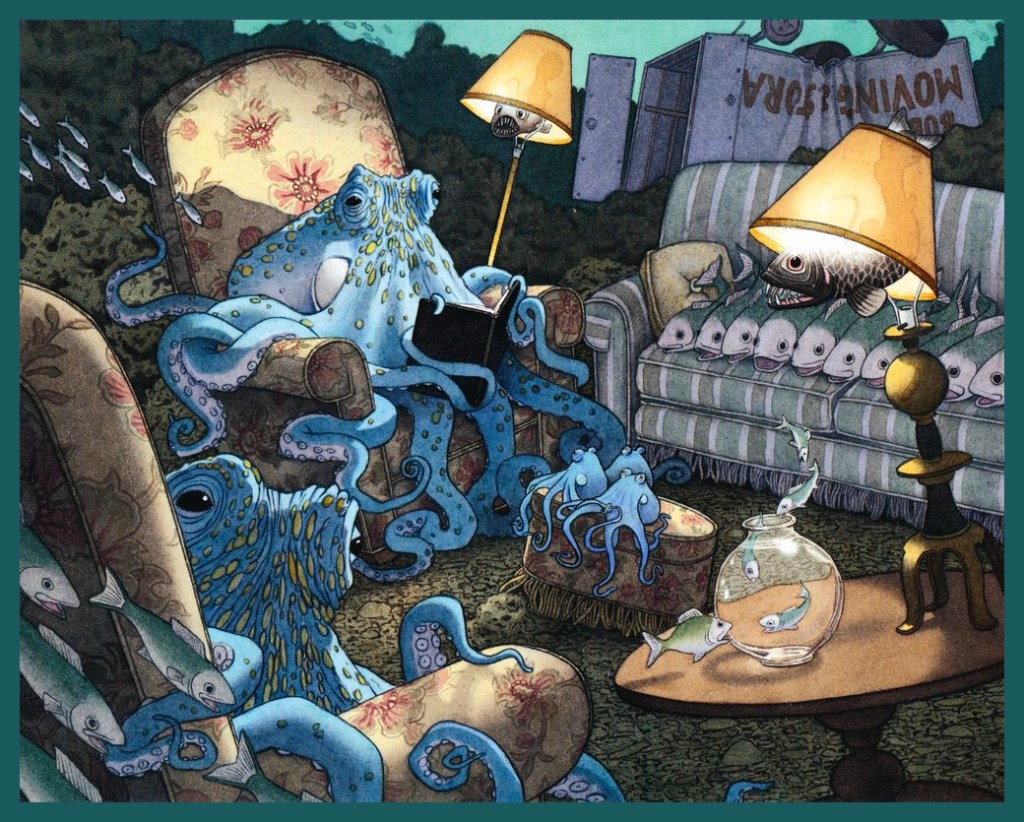
I first encountered David Wiesner when I bought his Mr. Wuffles! book on a whim (it had cats!), but Flotsam, a collection of underwater life illustrations published in 2006, is also clearly of some interest.

Out first helmet of the day is a reasonable imitation of a diving suit! The following page is from Prisoner of the Undersea World!, scripted by Gardner Fox, illustrated by Sid Greene, and published in Strange Adventures no. 155 (August 1963, DC).

I am not sure how he could drink and eat without taking his helmet off, and taking it off would surely mean drowning – luckily, the frogs were smarter than him!

I am pleased to report that not only did the octopus come out of that encounter in one piece, no frog denizens were seriously harmed, either (which makes this tale pretty special, since human heroes tend to go and annihilate anything they don’t understand).

Actual attempts at establishing communication? Colour me impressed!

Our second is a helmeted beauty (albeit twisting in a way that isn’t anatomically feasible) and some of her teammates from U.N.D.E.R.S.E.A. (or United Nations Department of Experiment and Research Systems Established at Atlantis).

Undersea Agent no. 2 (April 1966, Tower Comics), pencilled by Mike Sekowsky and inked by Frank Giacoia.

The cover story is rife with tentacles, but unfortunately doesn’t feature the scene depicted above at all.
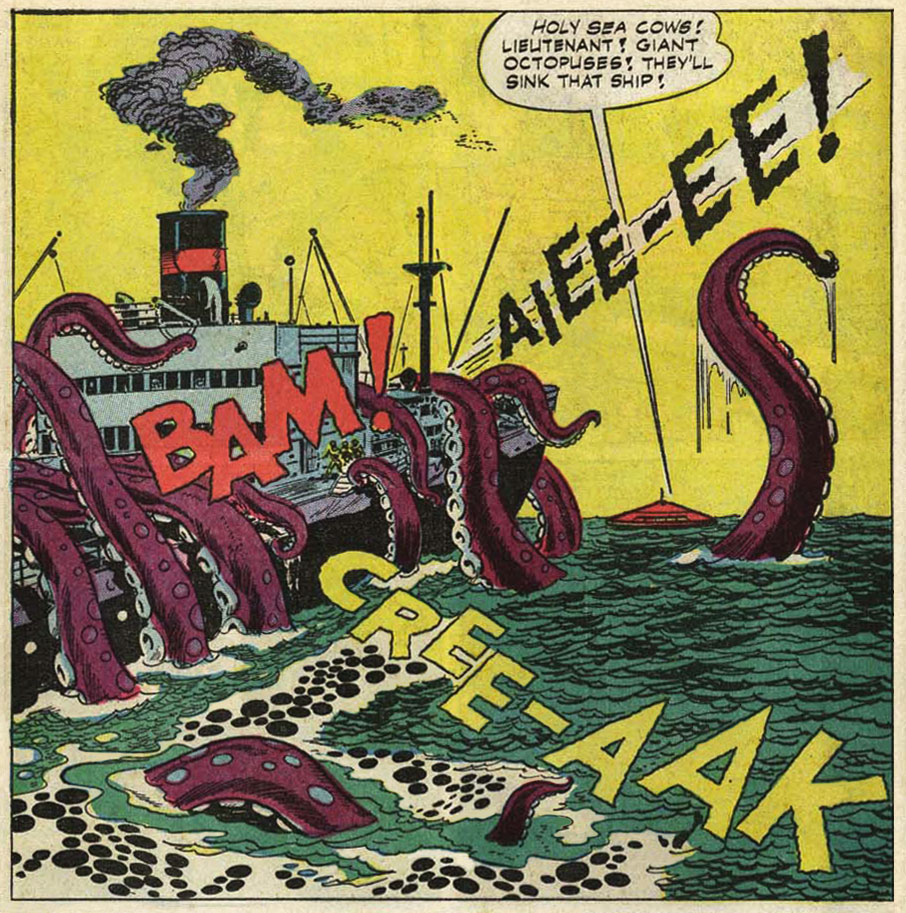
Panel from The Return of Dr Fang, scripted by D. J. Arneson, pencilled by Ray Bailey and inked by Sheldon Moldoff.

On the other hand, Buried Under the Sea, a fun read nicely illustrated by Mike Sekowsky on pencils and Joe Giella and Frank Giacoia on inks, has plenty of sea-helmets… but no cephalopods. One can’t have everything, alas!
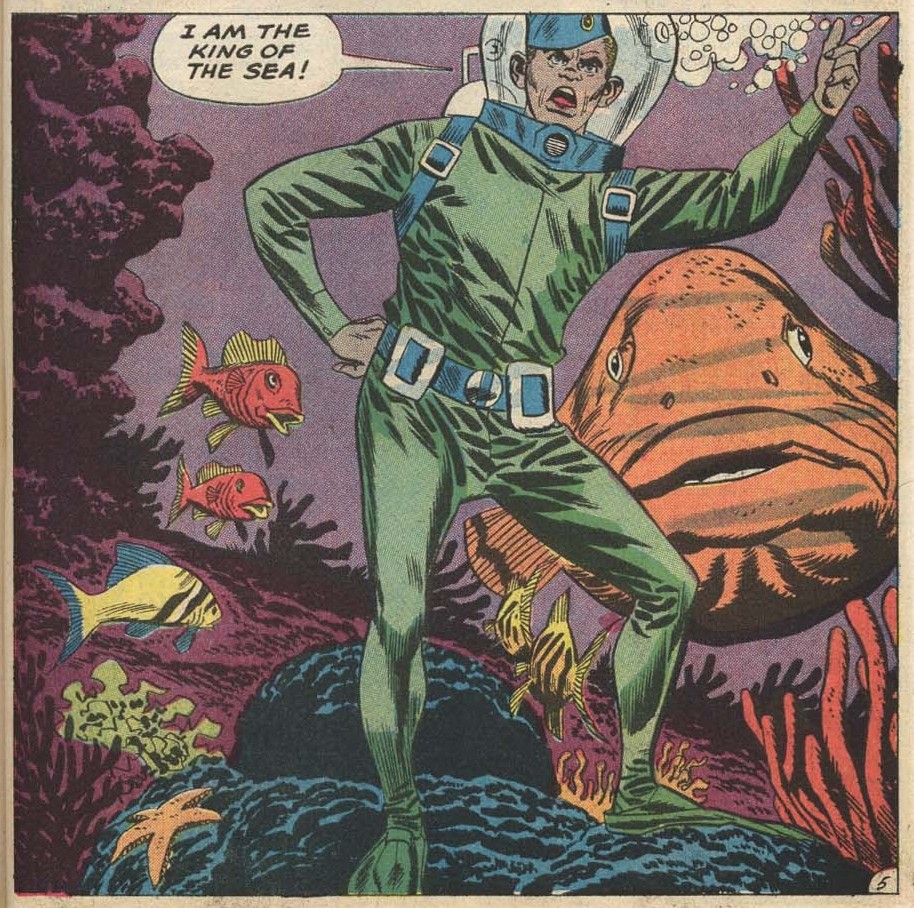
One easily understands why she made it onto the cover of the comic!

From helmets that are actually connecting to some diving equipment and oxygen canisters, we move on to ones which are just like an upside-down fish bowl somehow magically sitting on the wearer’s shoulders. Style always takes priority over silly things like actually being able to breathe. For more Adam Strange, scoot over to Tentacle Tuesday: Tangles with Adam Strange!

DC Super Stars no. 8 (October 1976, DC), cover by Ernie Chan (signing as Ernie Chua). This issue features a bunch of reprints, mainly reprinted stories from Mystery in Space.

Speaking of Mystery in Space, no. 21 (August-September 1954) has a very appropriate story… proving that the ol’ anti-cephalopod helmet can be used out of water. This is a page from Interplanetary Merry-Go-Round, scripted by Otto Binder and illustrated by Sy Barry… who’s still with us and about to celebrate his 93rd birthday!

Maybe the Martian monster is going ‘beserk’ (sic) because it’s a sentient creature who’s been chained and used for the amusement of stupid crowds?

~ ds

Tentacle Tuesday: Wonder Girl in the Silver Age, Part I

« Mer-Boy! You’re making me angry! » « You’re beautiful when you’re angry! »

Today’s batch of tentacles all come from the heads and hands of one team: scripts by Robert Kanigher, pencils by Ross Andru and inks by Mike Esposito. I make no secret of my dislike for Kanigher scripts when there are women involved*, but the Andru & Esposito team deliver some very nice art to go with the dubious plotting. Besides, we are concentrating on tentacles… though I can’t promise an occasional plot-jab. 🙄

*My complaints about his scripts are two-fold: that his plots make precious little sense is one, but that sort of nonsense is often fun to read, as long as one doesn’t take it seriously. However, the barrage of misogyny, not so much. I go on about it in some length in Don’t Let a Mysogynist Plan Your Wedding: Robert Kanigher and Wonder Woman’s Utterly Unsuitable Suitors, but if you need an immediate example, here are some example of great art and scripting claptrap. I just chose a random, non-tentacle issue from that era… the following panels are from The Cave of Secret Creatures, published in Wonder Woman no. 116 (August 1960).

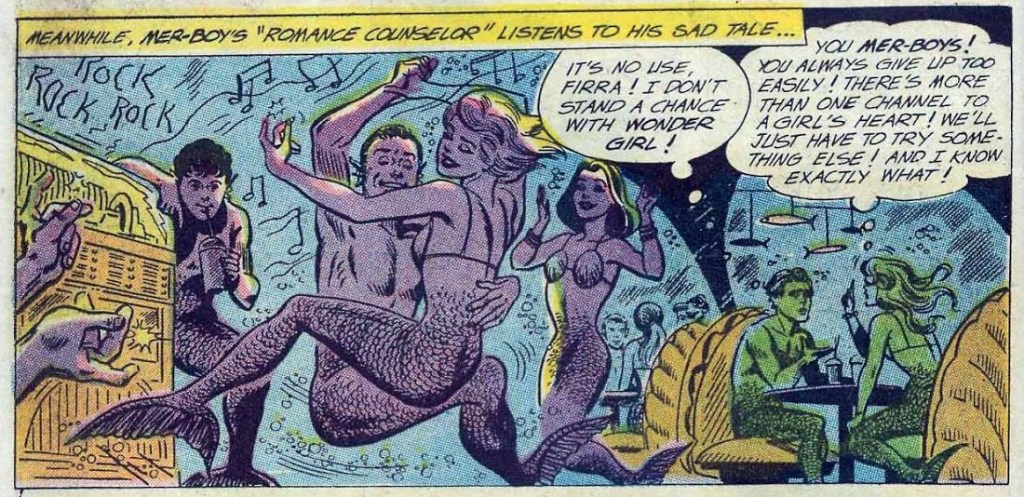
The pretty mermaid’s suggestion is to make Wonder Girl jealous by inviting her to a party and then proceeding to ignoring her altogether. Monumentally stupid? Yes. Is Firra being obtuse on purpose? It’s very possible. Remove the fantastical monsters and the whole superpowers thing, and these stories will read like a hackneyed romance comic.
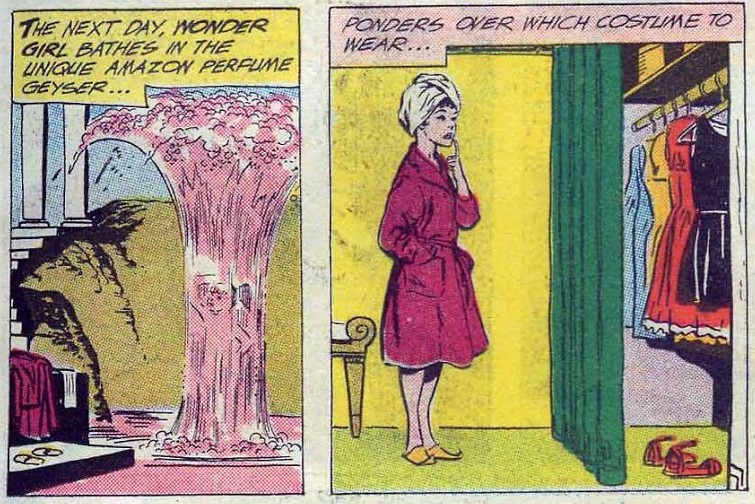
What’s the point of bathing in perfume (yikes, by the way) before going to an underwater party?
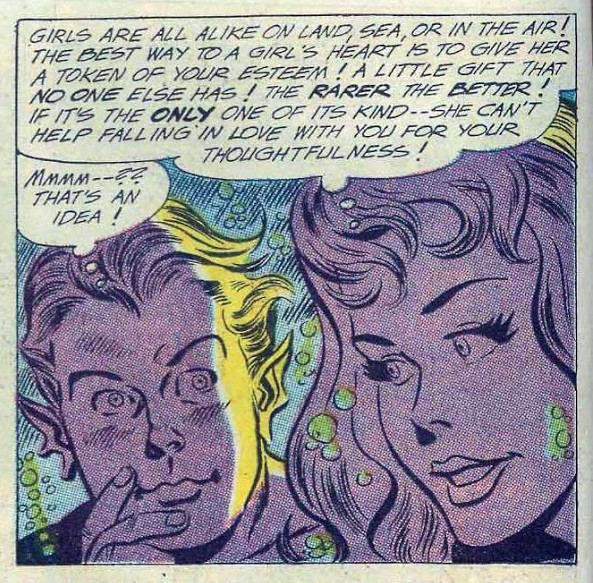
More bad advice from the mermaid. Have you ever heard ANY girl say that “girls are all alike”?

It’s too bad, because it’s really fun to spend some time with this underwater society of mer-teenagers hanging out, drinking seaweed sundaes, and gossiping.

A page from Mer-Boy’s Secret Prize!, published in Wonder Woman no. 119 (January 1961).

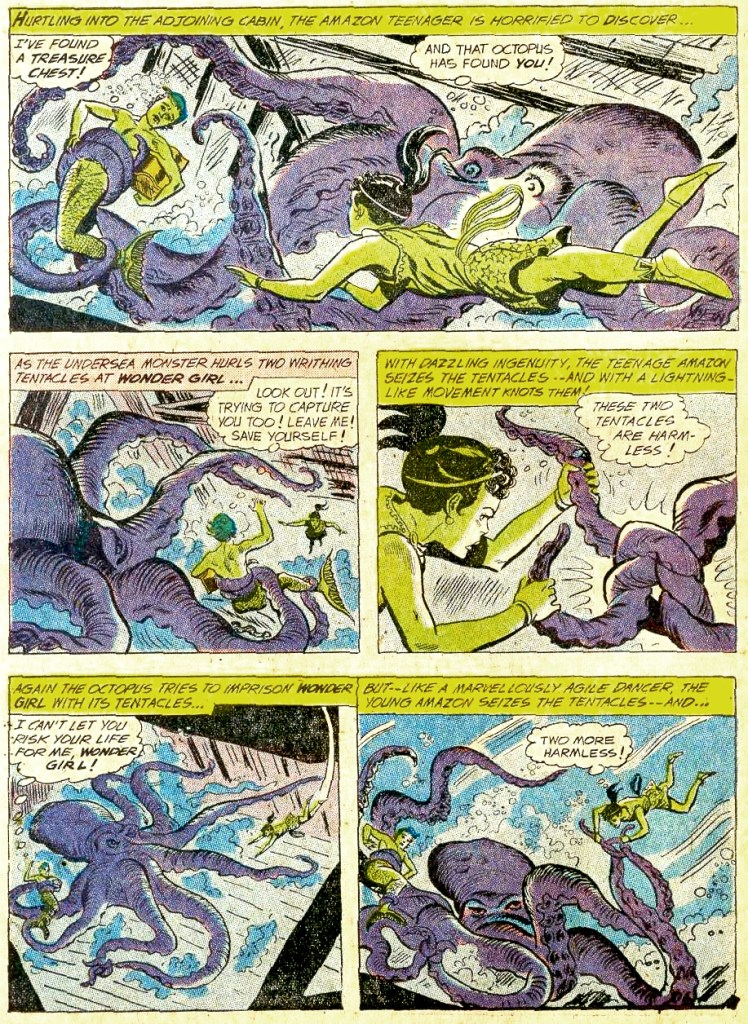
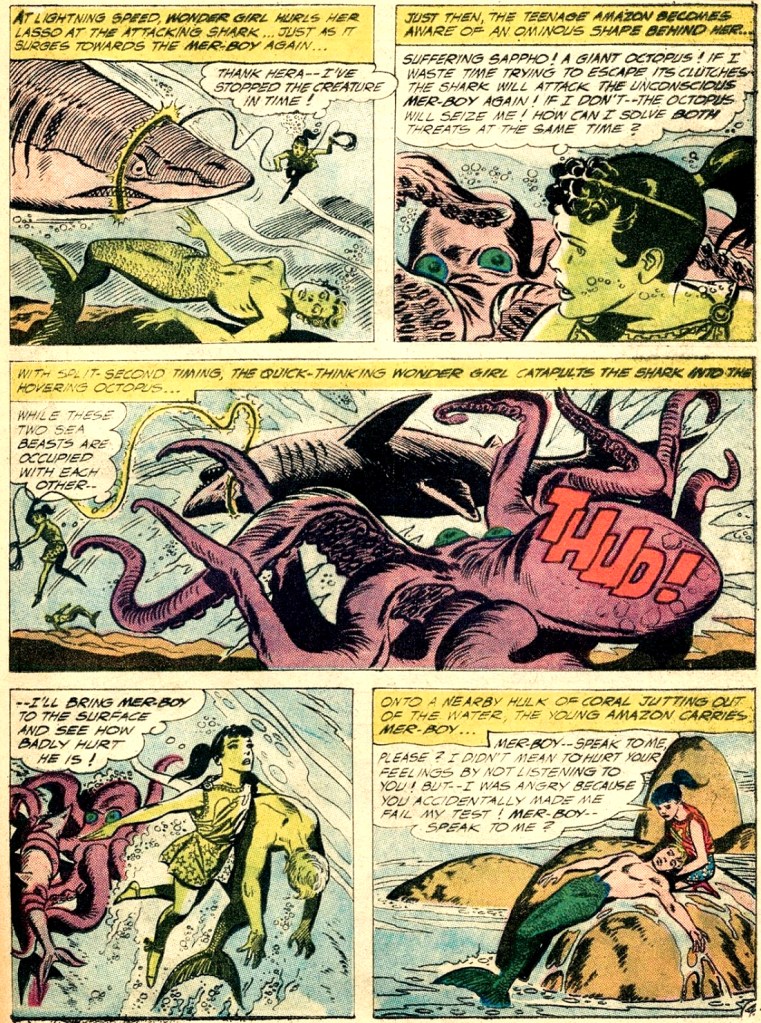
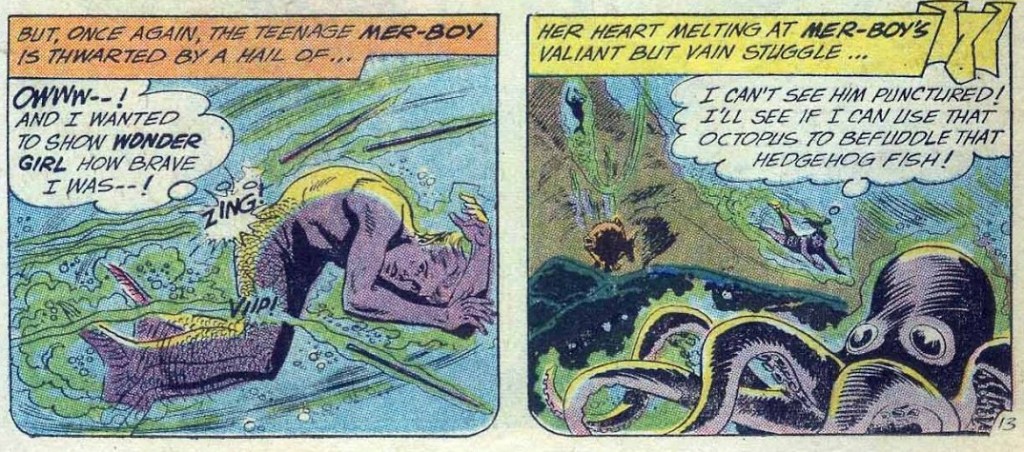
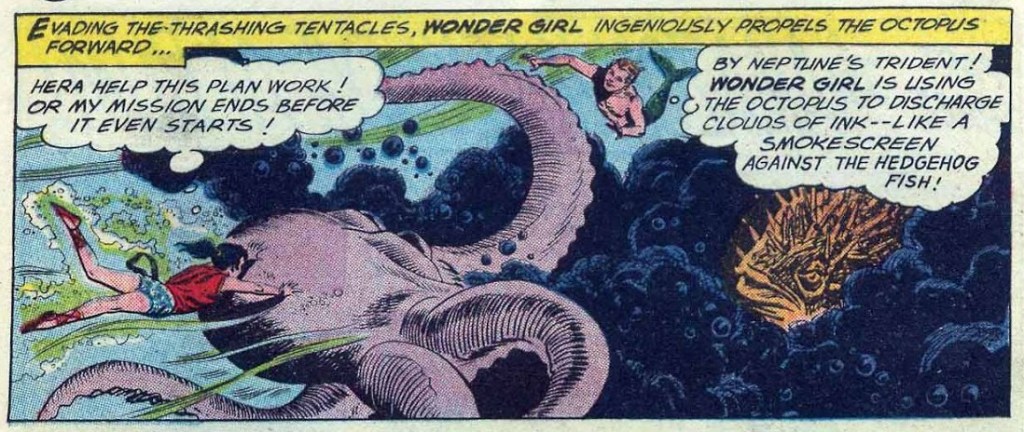
Anyway, I promised you some tentacles, and by Jove (or by Hera!) I shall deliver. Between issue no. 112 and issue 126, Wonder Girl (occasionally her grown-up counterpart, Wonder Woman) has fought more octopuses than one can shake a stick at.

Restraining order, anyone?

The reason for that is simple – the daft Mer-Boy (and the adult Mer-Man) is a frequent plot hinge of these stories, either harassing Wonder Girl for a kiss, quarrelling with her other (equally daft) suitors, or being in desperate need of rescuing when his imbecilic antics land him (yet again) in hot water. I guess that’s one thing I can say about the plotting – at least WG is not a damsel in distress… And I by far prefer him to Steve Trevor (the other suitor who often comes up in these things), whose behaviour is exemplified in, for instance, Wonder Woman no. 127 (January 1962) – he tricks Wonder Woman into agreeing to marry him by faking a serious wound, complains about the food she cooks for him, and then flies into a murderous rage when she takes off from their honeymoon to stop a nuclear missile. (Oh, and it was all a dream, by the way!)

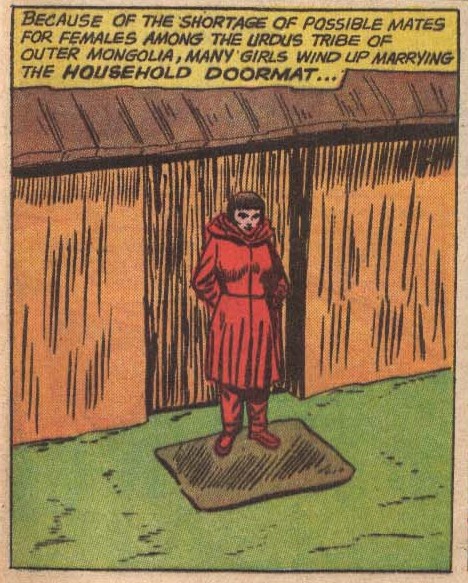
As if to emphasize the retrograde nature of these comics, each issue we are treated to a “marriage around the world” page detailing strange customs. For example, from Wonder Woman no. 128 (February 1962):

Artist unknown. I tried finding out if this was true and could find nothing at all, so the author of this was either talking out of his ass, or has special connections with Urdu tribes… Better to marry a doormat than to become one, I guess?

O! give me back the days of Wonder Woman depicted by W. M. Moulton and H. G. Peter! *ahem* And now, tentacles.

Page from The Chest of Monsters!, published in Wonder Woman no. 112 (February 1960). “Having to rescue Mer-Boy yet again”, part 300.
Page from Mer-Boy’s Undersea Party, published in Wonder Woman no. 115 (July 1960). Um, yes, rescuing Mer-Boy again.
Pages from Wonder Woman’s Impossible Decision, published in Wonder Woman no. 118 (November 1960). Oh, now it’s Steve who’s having problems, for a little variety!

In case you’re wondering what the Impossible Decision is, Wonder-Woman has to choose which of her suitors to save. Personally, I would let both of them plummet.

In a previous story, Wonder Woman has to choose between saving Steve or saving a whole world, so I think she’s no stranger to fucked-up situations, thanks to Mr. Kanigher.
Two excerpts from Amazon Magic-Eye Album! published in Wonder Woman no. 123 (July 1961)
Admiring the action from a polite distance, Mer-Boy is useless as usual.
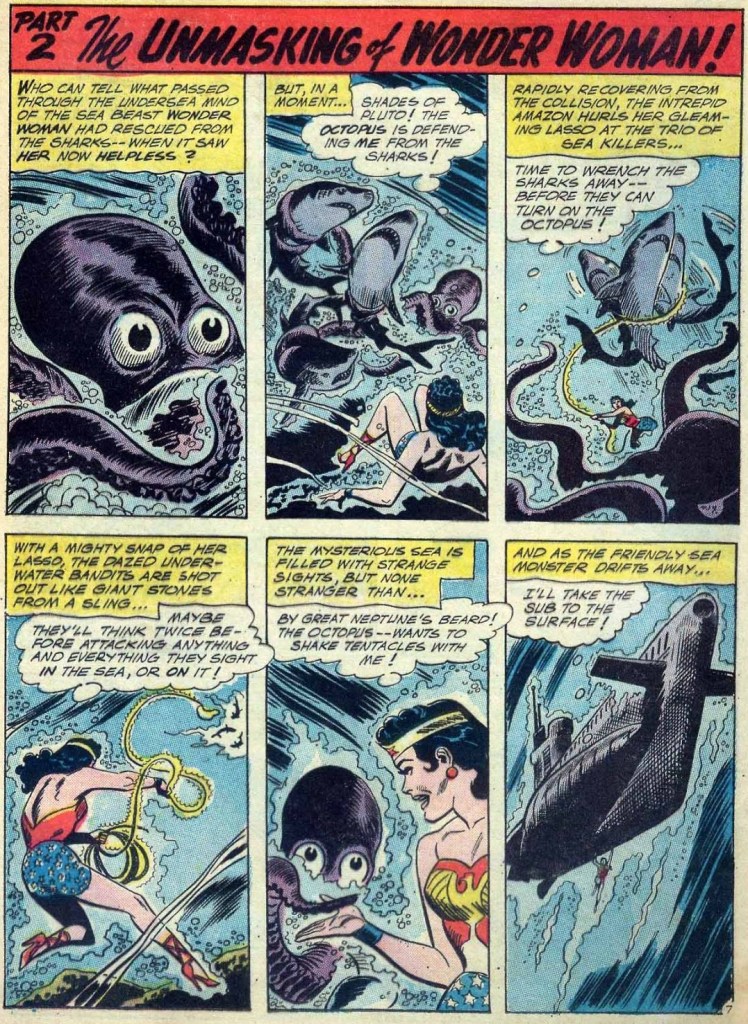
A page from The Unmasking of Wonder Woman! This story was published in Wonder Woman no. 126 (November 1961).

After Wonder Woman rescues the octopus from some bloodthirsty sharks, they become friends! Perhaps because for once, no suitor is involved.

I’ll end Part I on this positive note.

~ ds
Archie Goodwin’s “Sinner” (1966)

« If you’re going to be a sinner, be the best sinner on the block. » — Anton Szandor LaVey

I’m afraid the appeal of Archie Goodwin’s (1937-1998) writing has always escaped me. As you’d expect with a career as busy and prolific as his was, there are notable exceptions*. But I think, as is often the case in comics, he gets a lot of credit for tepid, formulaic writing that happens to be masterfully illustrated. You know, like just about every story from the early Creepy and Eerie (Goodwin was editor and principal writer of the Warren line for its first four years or so) with their groan-inducing ‘shock’ endings: “But I’m a vampire, and we don’t like competition around here!” or “We ghouls don’t cotton much to werewolves!” or “You’ve guessed my secret too late — I’m a witch!” or “For I am… Death!

On the other hand, he was a fine editor and, by all accounts, a terrific human being. In 2013, Mark Evanier put it this way: « At a time when some editors in comics were notorious for treating their freelancers with disrespect and yelling, Goodwin had a sterling reputation. He always would. Archie was nice. He was honest. »

It is to his great distinction that even such divisive, eternally-acerbic figures as Jim ShooterFirst and foremost, everyone loved Archie. Archie had a manner about him that you just couldn’t not like him. While he was tough as nails, and he was probably the best that passed through this business, he managed to do it without offending anyone. He managed to be respected and remain friends with everyone and do his job. ») and Alex TothNone of us were working there [at Warren ] for the money, because there wasn’t much. We were working there to work with Archie. ») reserved naught but effusive praise for the man.

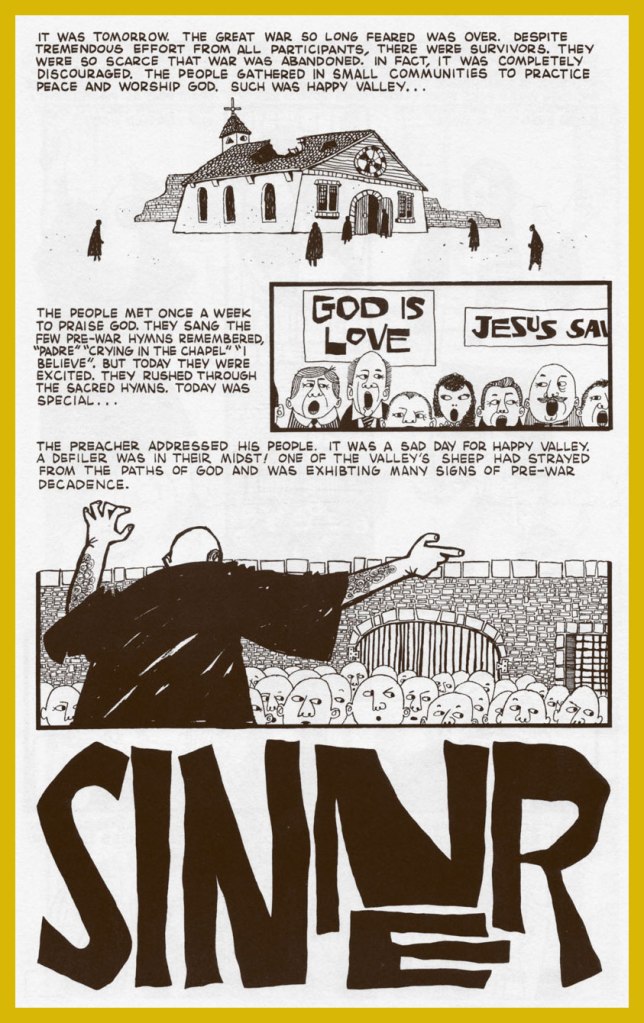
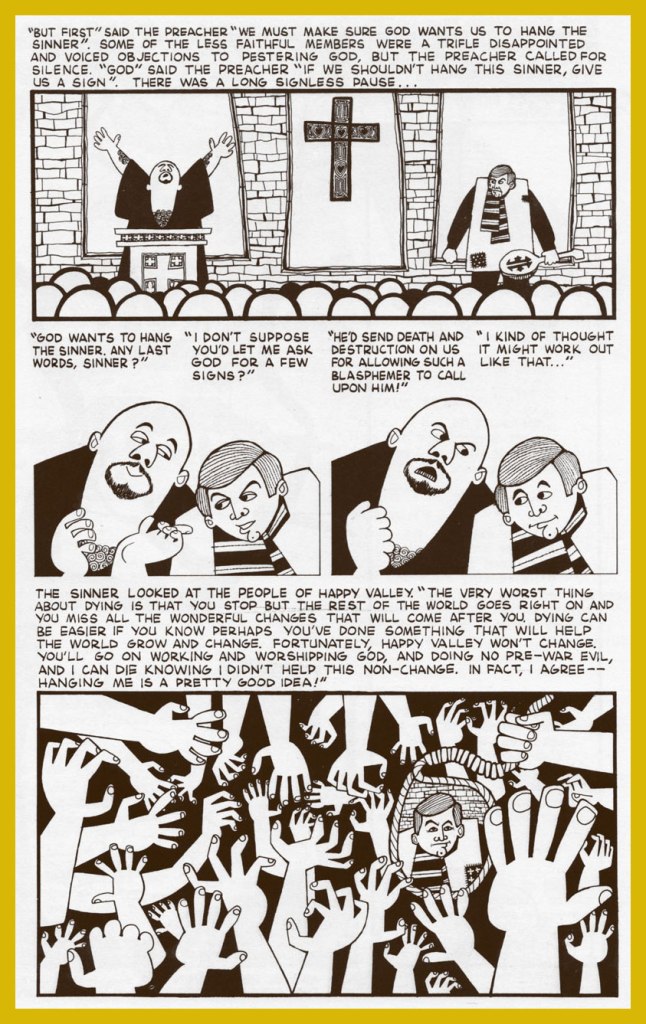
But you know what I really like about Archie? His drawing, which was all-too-rarely showcased. While he did adjoin thumbnails layouts to his scripts, Goodwin’s drawings rarely appeared in print, aside from some jokey editorial asides at Marvel in the 1980s. Here’s Sinner, written and illustrated by Goodwin, from Wally Wood’s prozine Witzend no. 1 (Summer 1966).

Sinner would be reprinted a few times, notably in the second issue of Marvel’s Heavy Metal knockoff Epic Illustrated (Summer, 1980), edited** by Goodwin. Marvel had passed on the Métal Hurlant licensing rights and, when Heavy Metal proved a smash hit, launched their ersatz. Such is the way of Marvel.
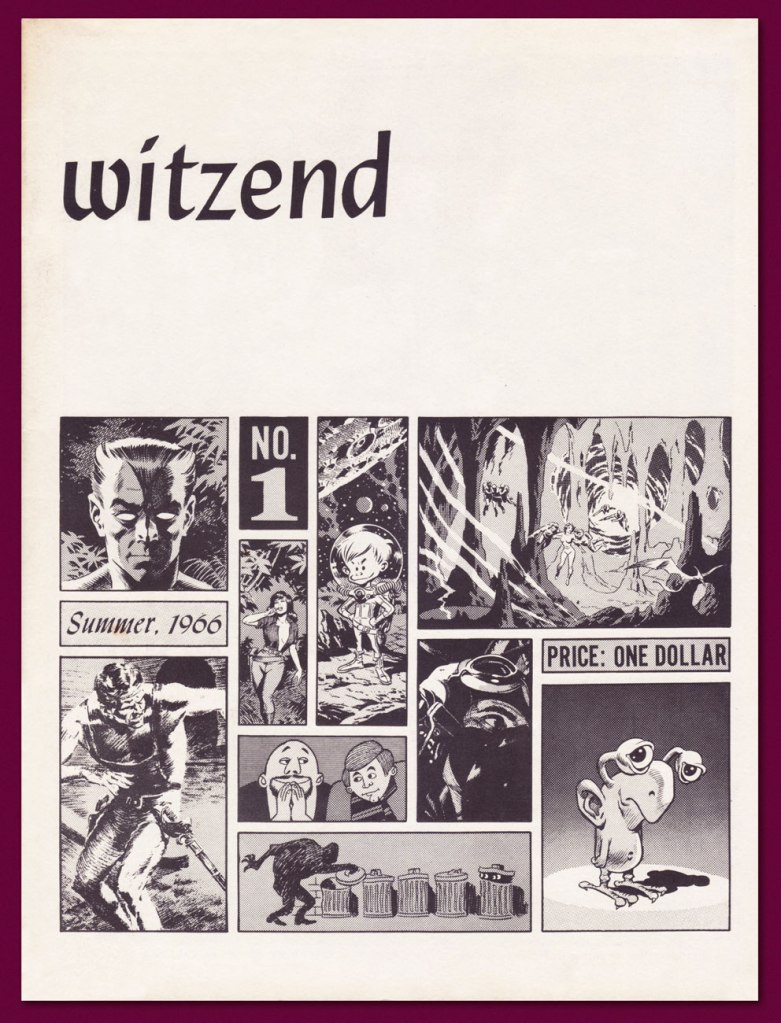
This is Witzend no. 1, featuring a splendid cover layout by Goodwin…. it’s harder than it looks, especially when it looks this good… and given the relatively primitive means employed. I tell you, Archie missed his calling.
Goodwin’s, adobe, clean line and silhouette graphic approach has always reminded me of this fine album cover from a few years earlier, which is to say 1963. It was designed by A&M Records art director Peter Whorf (yes, the legendary Whipped Cream & Other Delights cover was also one of his).

Despite all this, Archie Goodwin’s greatest claim to fame simply has to be the tremendous legwork he did as Nero Wolfe’s assistant.

« Archie Goodwin’s first prose story was published by Ellery Queen’s Mystery Magazine, which warned him he could not use Archie Goodwin as a pen name because it was a Rex Stout character in the Nero Wolfe books. According to Goodwin’s wife Anne T. Murphy, the magazine’s editors ‘then were so delighted when he wrote back to say that it was his real name that they used the anecdote as the introduction to the story, which ran in the July 1962 issue.’ »

-RG

*Notable exceptions: The Success Story, with art by Al Williamson (Creepy no. 1, 1964) has actual bite. Despite its rote-EC-revenge-from-beyond-the-grave finale, it’s a bitter parody of real-life comic-strip parasites such as Don Sherwood (Dan Flagg, The Partridge Family) and Alfred Andriola (Kerry Drake). There’s the tragically moving Island at World’s End, illustrated by Gray Morrow (Eerie no.4, July 1966). And a handful of inspired little tales that truly fired up the creativity of a freshly-emancipated Steve Ditko: Collector’s Edition (Creepy no. 10, Aug. 1966); Second Chance! (Creepy no. 13, Feb. 1967); Deep Ruby! (Eerie no. 6, Nov. 1966); and my very favourite, Room With a View (Eerie no. 3, May 1966… their first collaboration!). If anyone’s interested, the Goodwin-Ditko outings have been handsomely collected in Creepy Presents: Steve Ditko (2013, Dark Horse).

It must be said that Goodwin knew how to match a plot with the proper illustrator. As he explained, « I always tried to write the stories for individual artists. Sometimes, I’d ask them if there was a certain setting or a certain kind of story they were interested in, and I also knew what they did best. » It’s a shame that, overall, the stories themselves were so timid and unambitious, so mired in the glories of the past. Some people can’t help pulling their punches, I suppose.

**To give you a fair idea of Marvel’s delusions of corporate grandeur at the time, Epic Illustrated no. 2‘s convoluted and deceptive editorial credits read thus: Stan Lee (editor); Archie Goodwin (editorial director); James Shooter (consulting editor); Marian Stensgard; Louise Jones; Larry Hama; Ralph Macchio (editorial); Roy Thomas (contributing editor); Maggie Thompson (contributing editor); Don Thompson (contributing editor). Dollars to doughnuts that Goodwin and Louise Jones did all the actual work.

Tentacle Tuesday: Métamorphoses

« My imagination grew wilder, the most unexpected associations flared up in my mind, and as I kept trying, the reception room kept filling with strange objects. Many of them were born, apparently, out of the subconscious, the brooding jungles of hereditary memory, out of primeval fears long suppressed by the higher levels of education. They had extremities and kept moving about, they emitted disgusting sounds, they were indecent, they were aggressive and fought constantly. I was casting about like a trapped animal. All this vividly reminded me of the old cuts with scenes of St. Anthony’s temptations. » [source]

Today’s topic does not involve a man becoming a cockroach: that has been discussed often enough. My current area of interest concerns the many strange and striking ways in which a living form becomes a completely different form under the influence of a supernatural power or its natural inclination, of witchcraft or the whimsy of a writer whose imagination flares up much like it did for poor A. I. Privalov, depicted above trying to create a a sandwich and a cup of coffee and ending up with a roomful of horrors…

This strange creature surely illustrates the perils of getting stuck mid-metamorphosis!

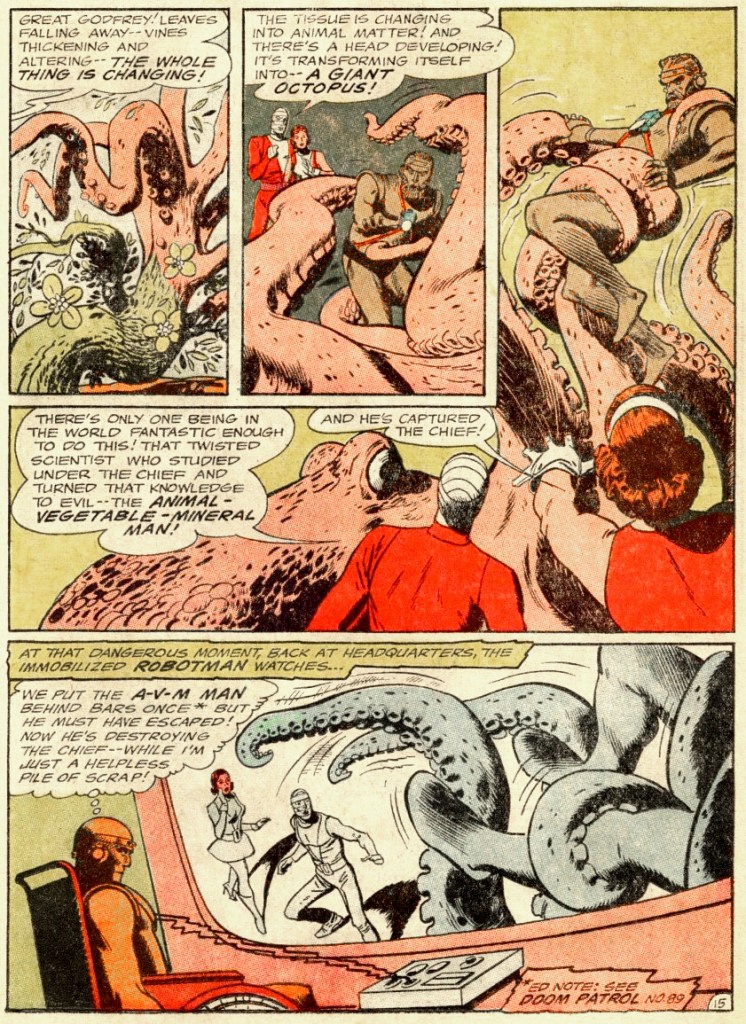
The Doom Patrol no. 95 (May 1965). Cover by Bob Brown. While transforming into god-knows-what, Dr. Sven Larsen is careful to preserved his impeccably coiffed chevelure. Perhaps he inspired Ted Baxter.

In Return of the Animal-Vegetable-Mineral Man, scripted by Arnold Drake and illustrated by Bruno Premiani, the Doom Patrol battle a scientist crazed with power-lust (while dealing with trouble of their own, like being unable to control their powers – it was apparently decided that a scientist who can become anything he likes is not interesting enough).

That this AVM (animal, vegetable, mineral) man decided to transform into an octopus will not surprise regular readers of Tentacle Tuesday: we know that the octopus is the most perfect form there is!

In the rest of the story, AVM also transforms himself into electric eels, tungsten birds, a building-tall neanderthal man, liquid mercury, a grizzly bear, etc., but it’s all a bit of a let-down after the giant octopus, if you ask me.

I’ll continue with this rather evocative cover by Bernie Wrightson, in which we get a preview peek at a gruesome scene just a few seconds before it actually happens.

House of Mystery no. 204 (July 1972). Cover by Bernie Wrightson.

It all starts with a nasty dream of cranberry jelly…

… and ends with an unwelcome transformation of future bride into hungry monster. In this case, a pretty girl is not so much like a melody, but yet another helping of aforementioned cranberry jelly… perhaps I should have kept this story until Christmas.

All in the Family was scripted by Mary Skrenes and Bernie Wrightson; illustrated by Bernie Wrightson.

If this story of transmogrification made your teeth itch, just have a gander at the following histoire d’amour

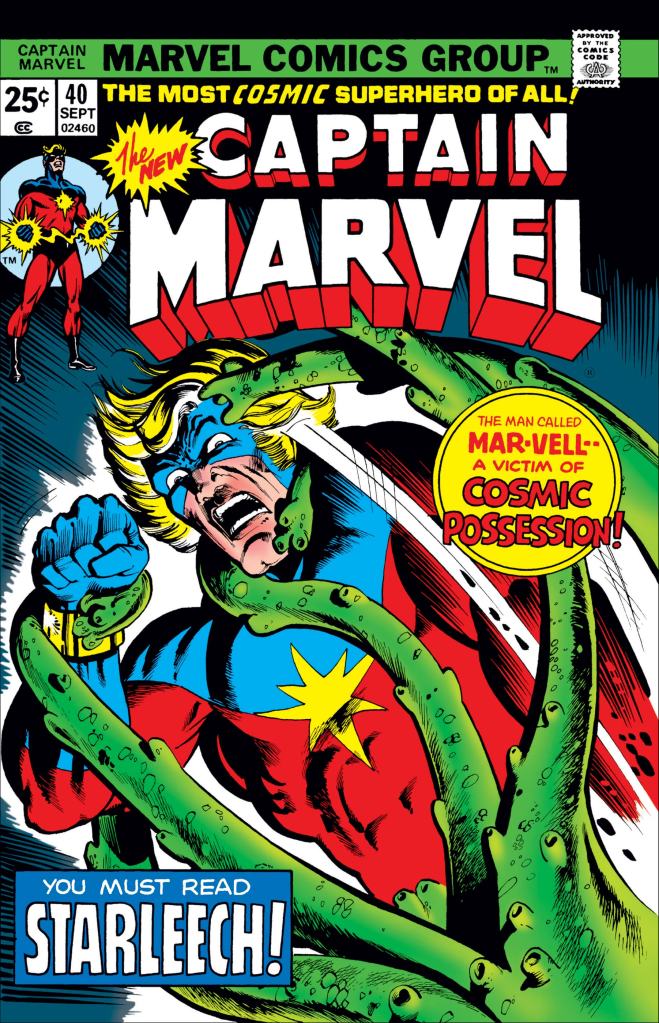
Captain Marvel no. 40 (September 1975). Cover pencilled by Al Milgrom and inked by Klaus Janson.

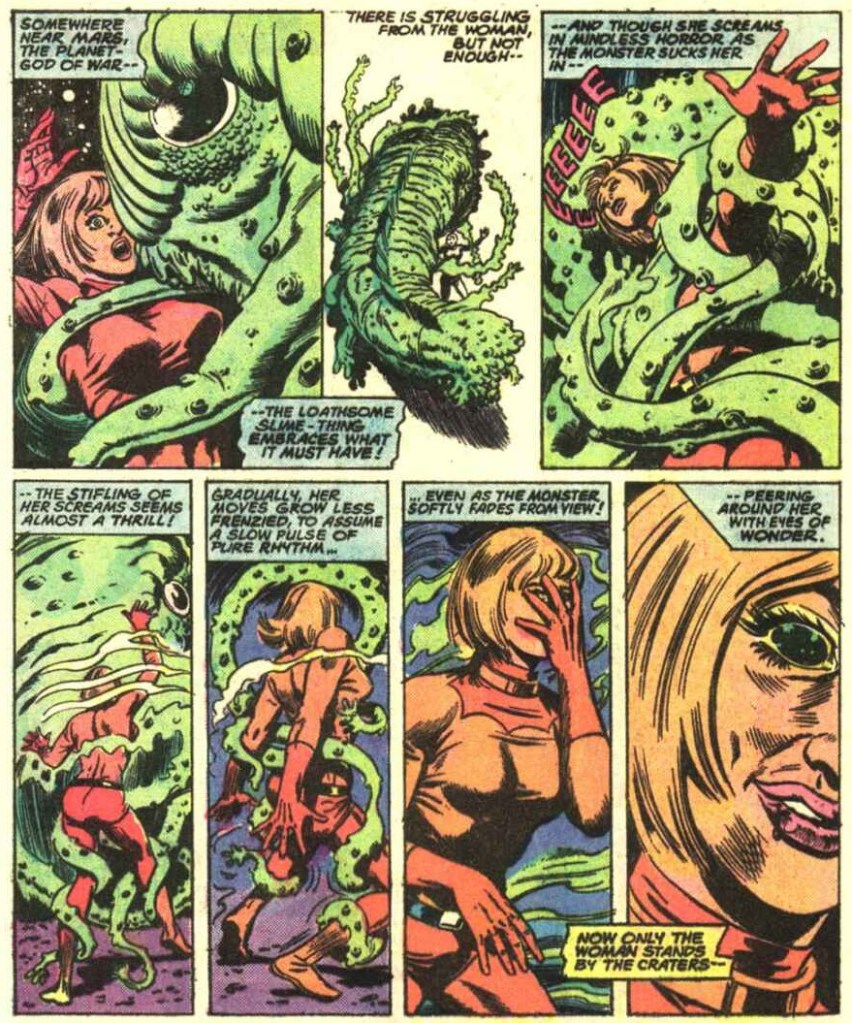
No, hold your horses, I’m not implying anything untoward about Captain Marvel. That thing he’s tangled up with is his lover (or should I say ex-lover) Una. Just a little case of demonic possession!

Um, those are not “eyes of wonder”, more like a demented gaze.

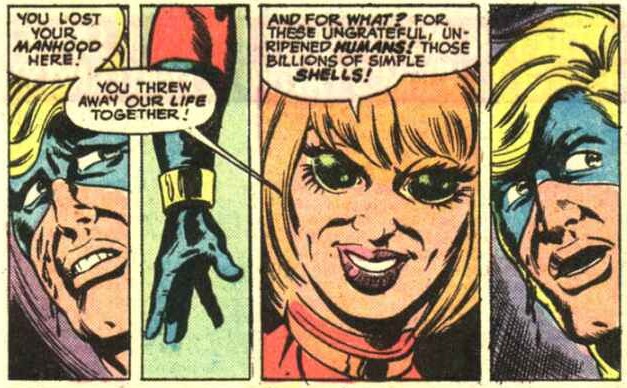
Will Captain Mar-vell be able to kill the woman he loves, even if she’s more of a shell inhabited by a tentacled psychic monstrosity, and despite having lost his manhood, whatever that was?

Stay put for the exciting finale of Rocky Mountain ‘Bye! was scripted by Steve Englehart and Al Milgrom, pencilled by Milgrom, and inked by Al McWilliams!

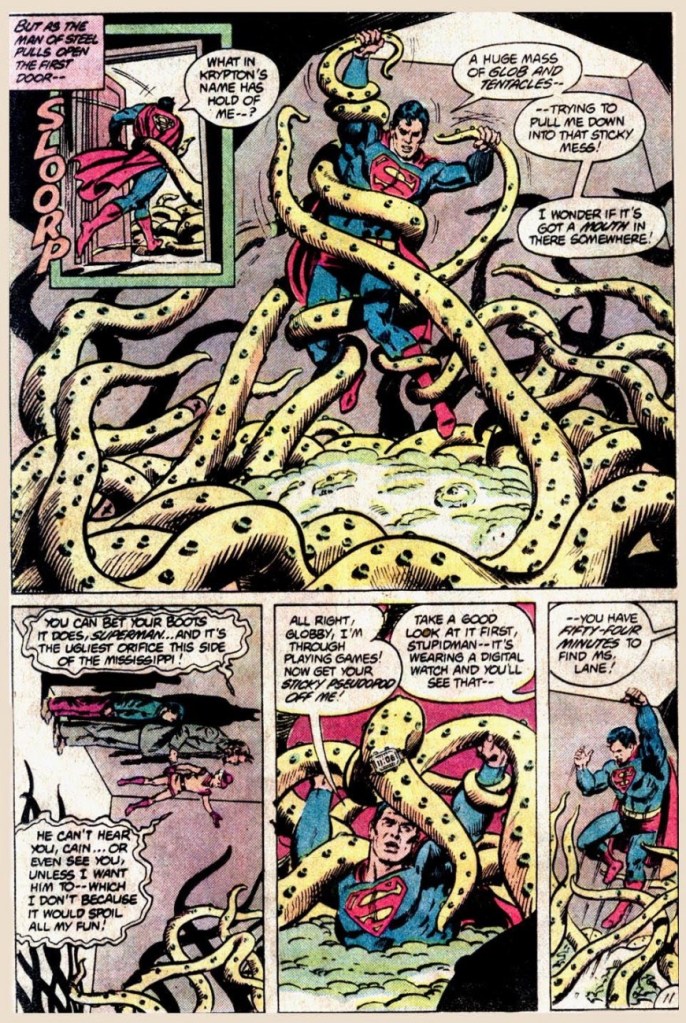
What do we have here? A harmless trick-or-treating kid transformed by Mr. Mxyzptlk into a malefic octopus? It’s business as usual for Superman in this goofy tale (who, incidentally, was the star of Tentacle Tuesday: It’s a Bird! It’s a Plane! It’s a Tentacle!) I’m sure most children would relish the opportunity to become an actual ghost or werewolf…

But I am not convinced that anybody would want to be transformed into, err, “Globby”.

Nothing as stylish as an octopus with a digital watch.

These pages were from The Haunting Dooms of Halloween!, scripted by Dan Mishkin, pencilled by Curt Swan and inked by Tony de Zuñiga, published in DC Comics Presents no. 53 (January 1983).

~ ds
Hallowe’en Countdown IV, Day 30

« The world will come to an end, but the monster models will still be around. » — James Bama, who went on to paint artwork for over twenty of Aurora’s kit boxes.

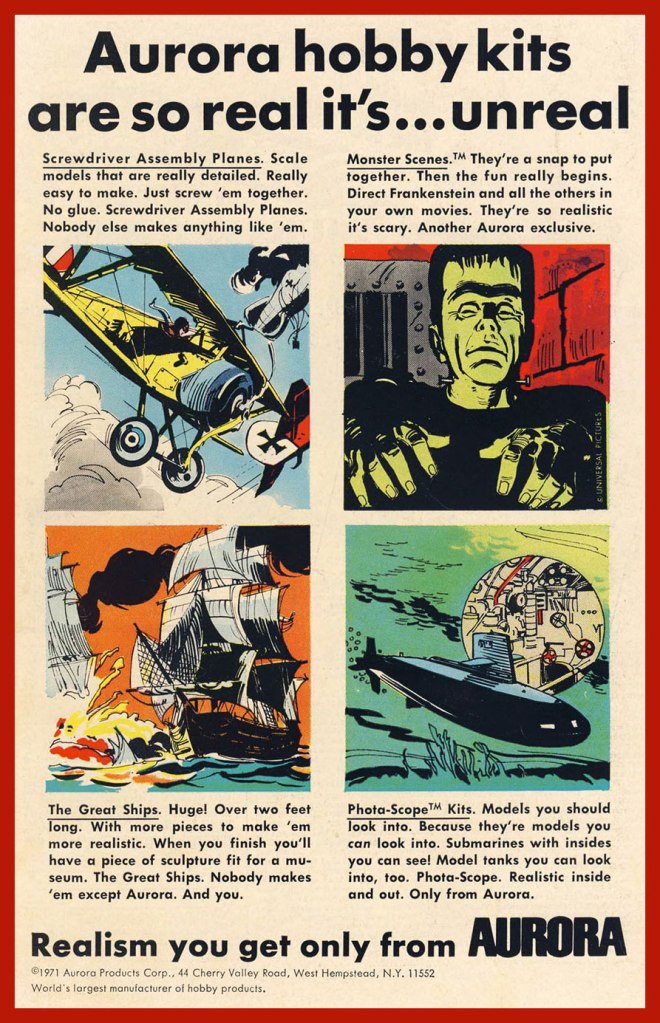
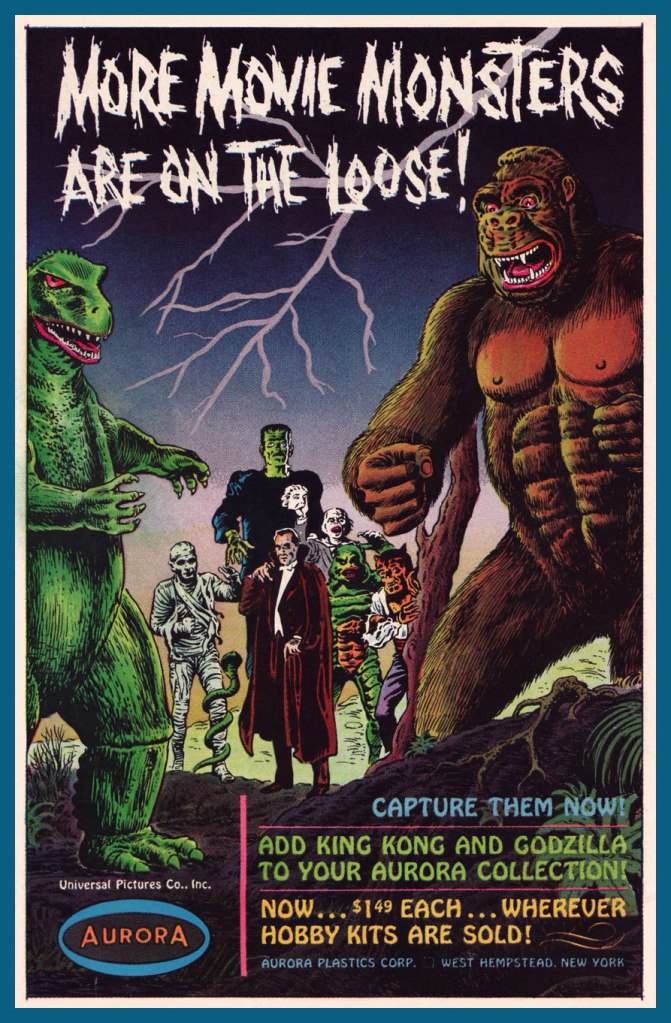
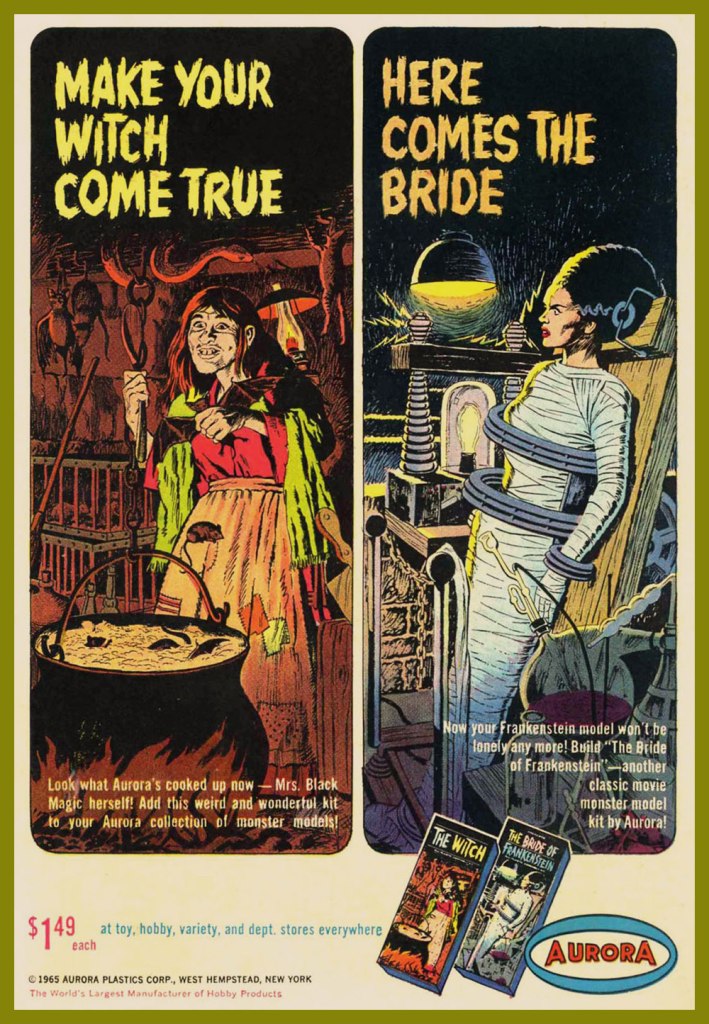
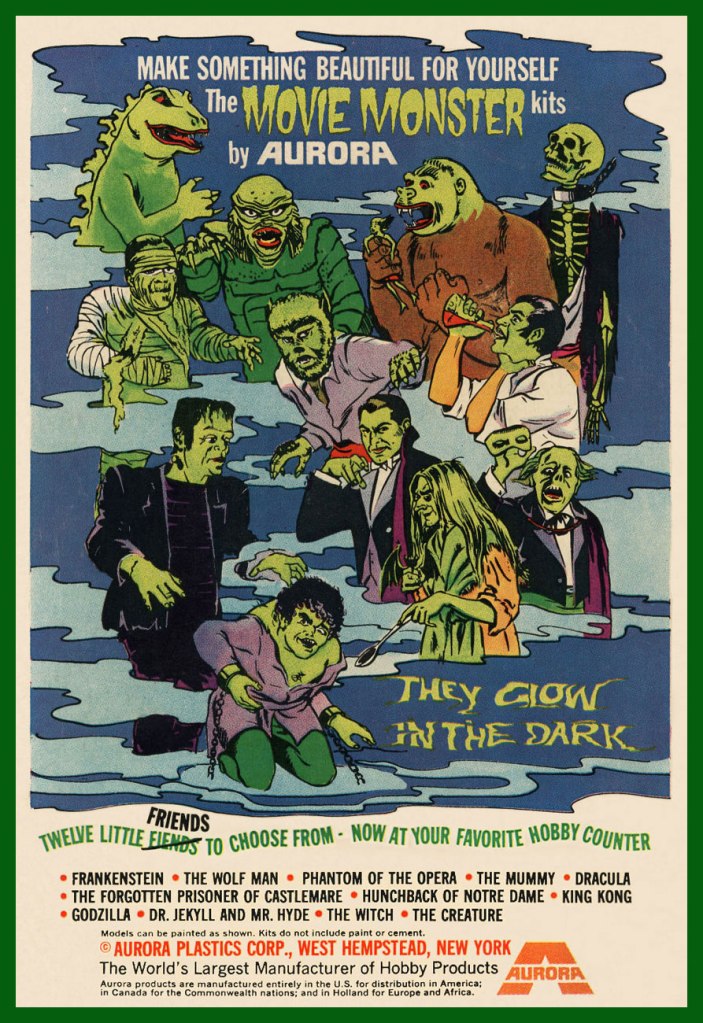
Well-executed comic book ads were often just as enticing (and sometimes more, depending on the title) as the contents proper. A prime example, this lovely Aurora Monster Kit campaign, announcing the epochal model maker’s forays out of the Universal ménagerie of misunderstood fiends with Toho’s Godzilla and RKO’s King Kong.
The first Aurora monster model advertisement, it appeared in various DC Comics titles dated November and December, 1963.
The ad ran on the back cover of various DC titles in late 1964. In this case, House of Secrets no. 69 (Dec. 1964). The artwork is almost certainly that of Mr. Murphy Anderson, who goes uncredited, but is betrayed by the characteristic finesse of his inking.
A couple of the models that usually received considerably less attention got their turn in the spotlight in this ad that appeared on the back cover of select DC titles cover-dated October, 1965.

Incidentally, if you were wondering, indeed, the giant monsters cost more… 50 cents more. A bunch more empty bottles to collect, son.

In the late ’60s, a new twist was added: phosphorescence! A cool idea, it however made painting the models, a tricky task to begin with, even less rewarding, as opacity was a bitch to achieve. It worked okay if you had mostly light-coloured The Mummy, but otherwise… This advert appeared on the back cover of DC Comics dated October, 1969… and thereabouts.
The Spring, 1970 collection.
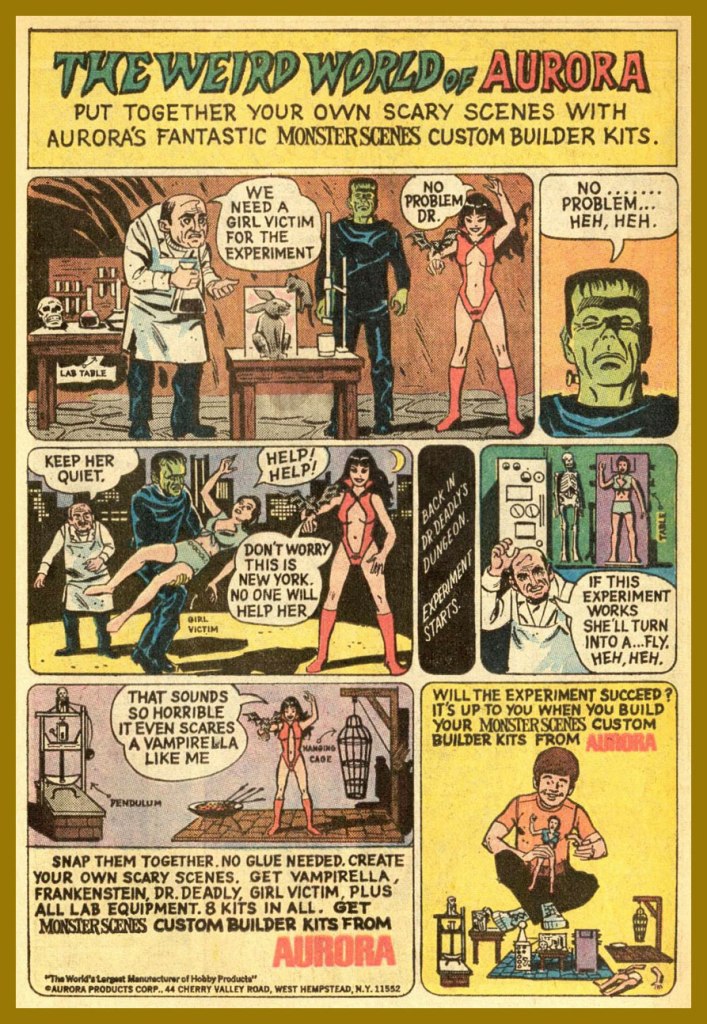
Here’s where Aurora’s close business relationship with Warren Magazines became most evident, with the appearance of a Vampirella model kit. Controversy ensued, once moms caught a glimpse of Junior’s new model kit, the heirloom of his bedroom. Speaking of controversy, Vampirella’s quip about New York was likely a barb about the infamous Kitty Genovese case. This pitch showed up in various DC titles, again, in and around June, 1971.

Warren sold a lot of Aurora kits via his mail order business, and a decision was made to include his character in the line rather than risk dissolving a partnership. Unpainted, she appeared to be virtually naked. Her counterpart, the Victim, sported hot pants and a halter top; a dress or flowing skirt was deemed impractical in order to have her fit on the torture rack. [ source ]

This beautifully-designed ad showed up in October, 1971 DC titles.
At this point, the diluted message is a hint that the bloom is off the rose. An ad from November, 1971.
As a bonus, here’s Big Frankie, the seldom-seen, long-unavailable Aurora grail (until its relatively recent reissue). As the largest Aurora model of all, BF fetched, at the time, an astronomical $4.98; now it goes for a hundred smackers, so don’t complain. Take a look at the big fella!

Though the original Aurora issues of these classic kits are mostly rare as hen’s teeth, enterprising contemporary kit companies have reissued these babies, and you now can actually afford to free the monsters from the confines of their box and assemble and paint ‘em. Mint in Box? Pfui!

– RG

Hallowe’en Countdown IV, Day 24

« Catholicism is not a soothing religion. It’s a painful religion. We’re all gluttons for punishment. » — Madonna Ciccone

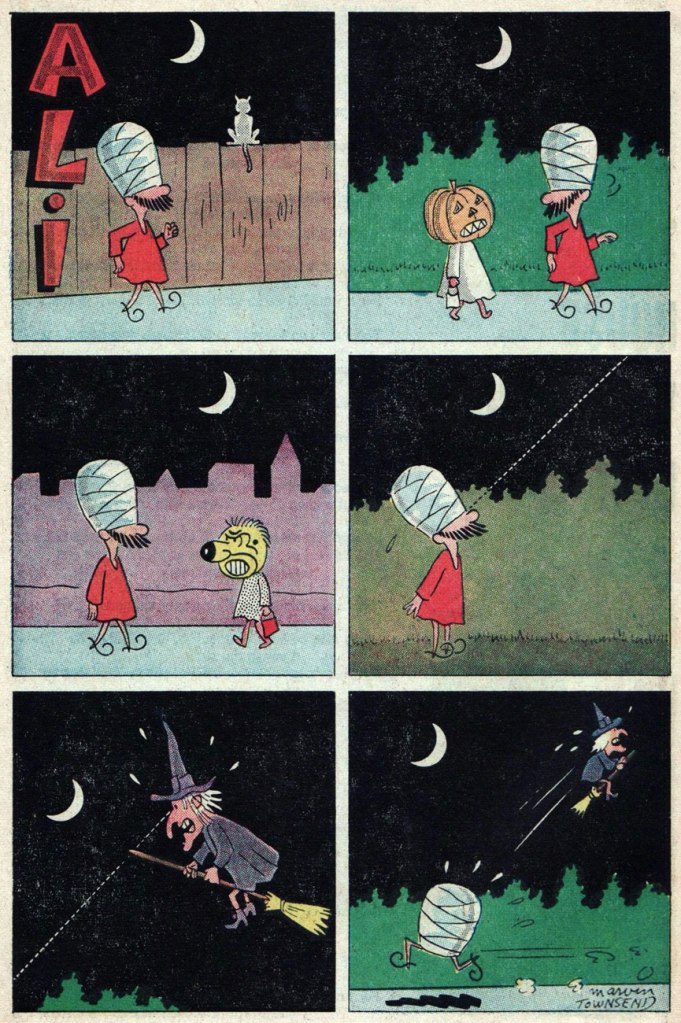
Here’s a seasonal goodie from gag cartoonist Marvin Townsend (1915–1999) and his adorable “Ali” pantomime strip, which appeared, beginning in 1962 in, of all places, the Catholic comic book anthology Treasure Chest of Fun & Fact (Geo. A. Pflaum Publisher), distributed to parochial school students between 1946 and 1972.

Originally published in Treasure Chest vol. 21, no. 4 (Oct. 21, 1965). For more Townsend in a spooky vein, look no further than this post from our previous countdown.

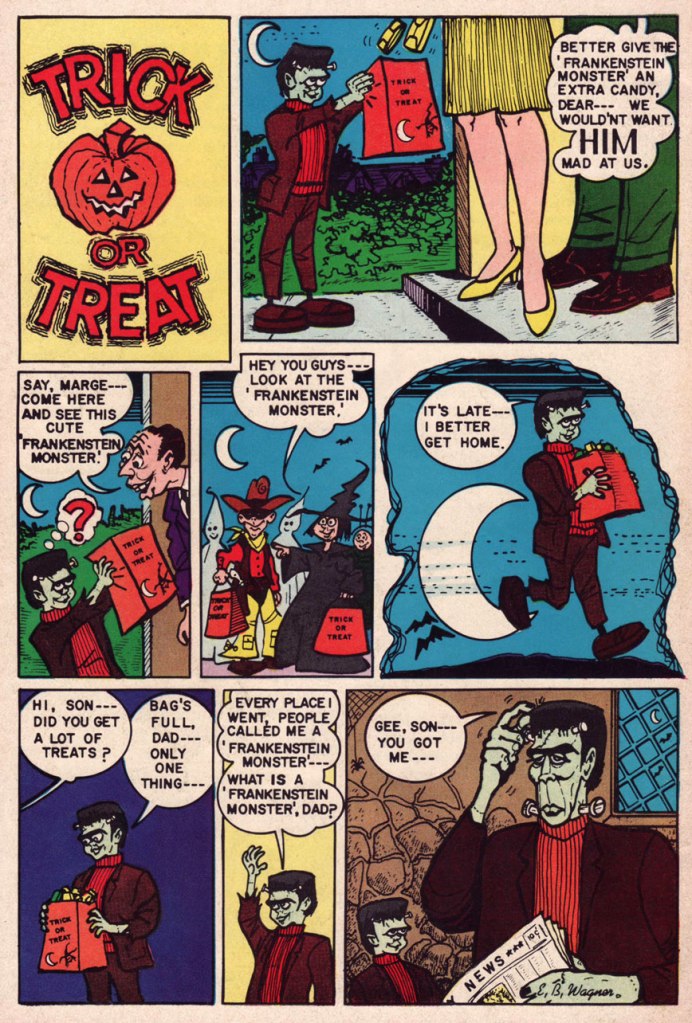
Denominational and religious concerns aside, Treasure Chest of Fun and Fact, a publication generally avoided like any of the Ten Plagues of Egypt by your average comic book fan, was, wouldn’t you know it, chock full of excellent work by the likes of Bernard Baily, Fran Matera, Bob Powell, Reed Crandall, Joe Sinnott, Graham Ingels, Joe Orlando, Murphy Anderson, Jim Mooney, Paul Eismann… and these are some of the artists. The material was also engagingly written and often truly captivating. And they weren’t above paying a bit of lip service to that ol’ Pagan Holiday, Hallowe’en.

This was one in a highly-entertaining series of studies of classroom “types” by Frank Huffman. It appeared in Treasure Chest vol. 22, no. 12 (Feb. 9, 1967).
A piece by E. B. Wagner, this one saw print in Treasure Chest vol. 23, no. 4 (Oct. 19, 1967). Note the Leroy Lettering!
The back cover of Treasure Chest vol. 22, no. 4 (Oct. 20, 1966, Geo. A. Pflaum). Artist unknown, regrettably. Love that stylish auto-gyro witch!

-RG

Hallowe’en Countdown IV, Day 11

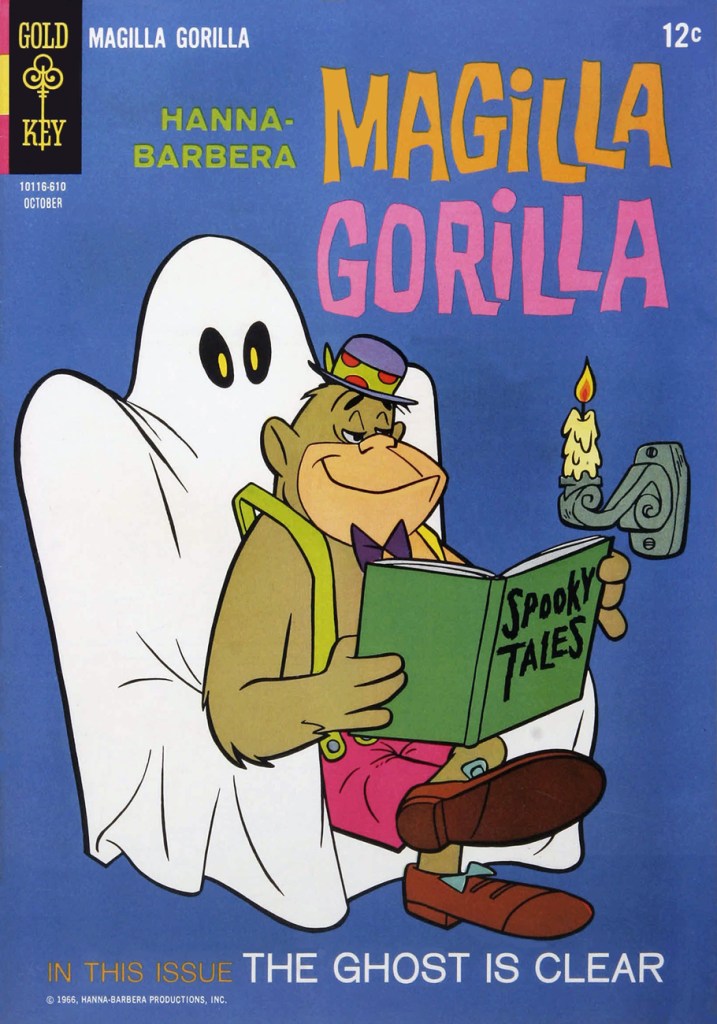
« Take our advice, at any price, a gorilla like Magilla is mighty nice. Gorilla, Magilla Gorilla for sale! »

Seems you just can’t unnerve a guy (let alone an ape) who takes fright fables so lightly. I mean, look at that blasé expression! Perhaps he needs some spookier tales.

This is Magilla Gorilla no. 9 (Oct. 1966, Gold Key). Cover artist unknown…certainly a ghost.
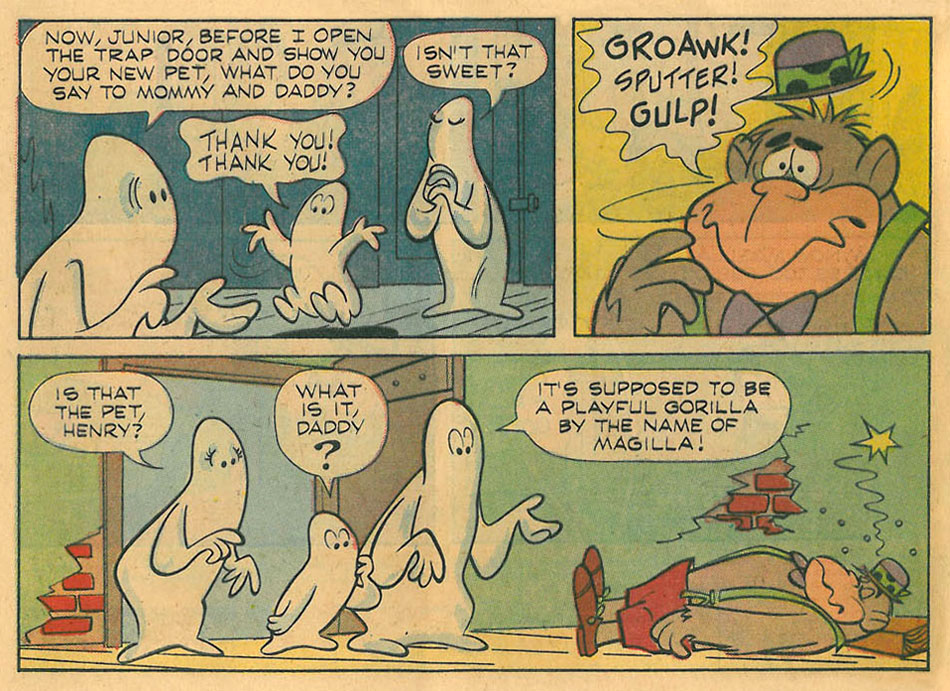
Unfortunately, the title story — and the rest of the issue — are nothing to get excited about. Nicely flowing, on-model animation-style artwork, but the stories…
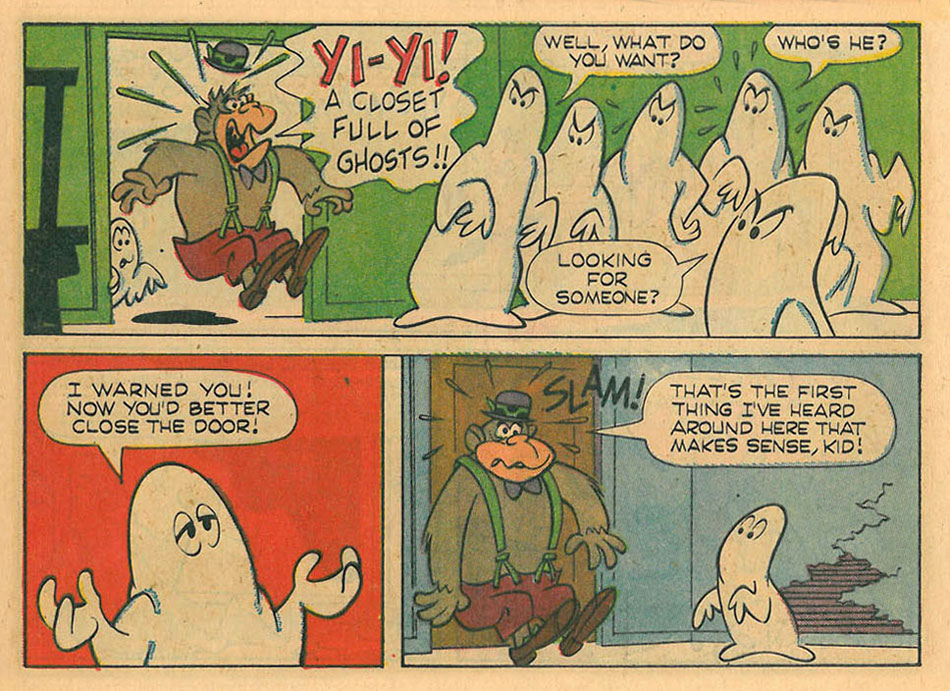
Still, here’s the highlights reel. Strictly kid stuff… but did it truly need to be? A little subversion goes a long way.
In Yiddish, a megillah is a long tedious or embroidered account, from the Hebrew megillah, a story written in a scroll. One episode has Magilla saying, “Such a megillah over a gorilla. [ source ]

« We’ll try again next week. »

In other, loosely-related news, and in the spirit of the seemingly undying nature of pop culture icons (even minor ones)…

José Adílson Rodrigues dos Santos (born September 2, 1958), is a retired Brazilian heavyweight boxer. He scored 61 knockouts with 43 of those coming under 5 rounds. Rodrigues currently resides in São Paulo, São Paulo, where he is being treated for Alzheimer’s disease originating from dementia pugilistica. His nickname in Brazil, Maguila, comes from the cartoon Magilla Gorilla.

The gajo should have really sold the concept, and fought in a too-small bowler hat and green suspenders.

-RG

Hallowe’en Countdown IV, Day 9

« It was the spookiest horror ride anywhere! Mr. Awrus… a charming little old man, really… made it that way, because he liked to entertain people! But then the snake-thing arrived… and the others… heh-heh… and people went in… and didn’t come out… » — Horror Beasts Dine Tonight

Forrest J. Ackerman and James Warren’s Famous Monsters of Filmland, despite its own humble beginnings (or partly thanks to them!) went on to inspire quite a spate of imitators of… varying quality.

First out of the gate was Irwin Stein’s Magnum Publications, with Monster Parade (four issues). It was soon followed by Monsters and Things (two issues).

Define ‘Tunnel of Love‘… This is Monsters and Things no. 2 (April, 1959). Edited by Larry Shaw, with a cover by Stanley ‘Bob Powell’ Pawlowski (1916-1967).

As for the magazine’s grimy guts, there’s regrettably nothing outstanding: a couple of reprints of pre-Code material that was pedestrian to begin with… Curse of the Living Crossbones, illustrated by Ken Rice (a retitled Spectres of the Jolly Roger and True Tales of Unexplained Mystery #44, a one-pager about vengeful German gargoyles, illustrated by Sy Grudko, both plucked, minus colour, from Web of Mystery no. 22 (Jan. 1954, Ace Magazines).

The issue does contain a couple of fun wash illustrations, including this one by the esteemed Mr. Powell, also (along with the cover), accompanying the main feature, Horror Beasts Dine Tonight. “And will that be your usual table, sirs?
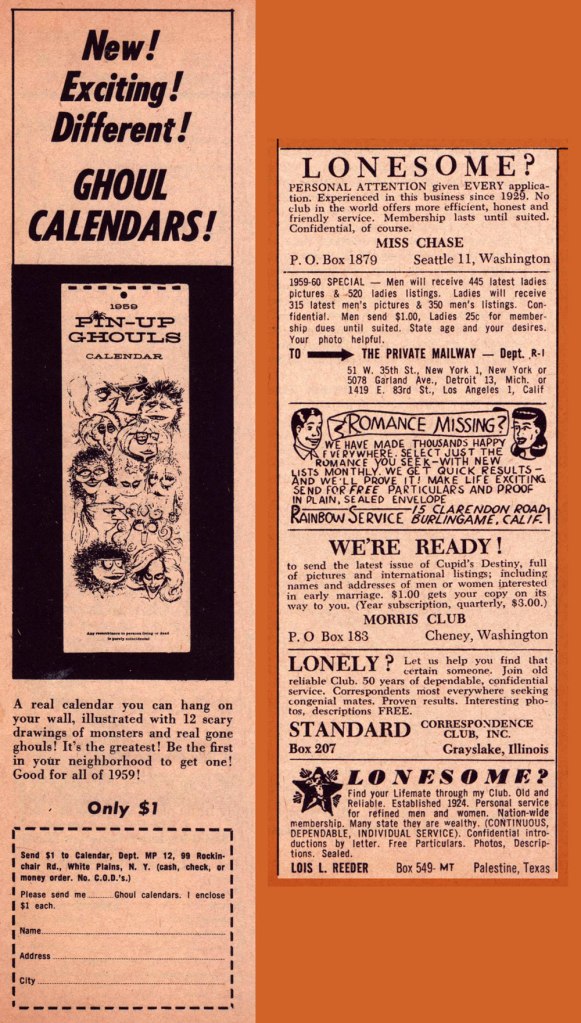
A sample of the classifieds. Do I, er… detect a certain pattern? One clear advantage of the Pin-Up Ghouls calendar is that you can reuse it next in 2026, so keep an eye out for gently-used copies!

Of further interest: An intriguing article about M&T’s predecessor, Monster Parade: http://frankensteinia.blogspot.ca/…/covers-of…

Still, it must be said that the dank, meandering back alleys of sleaze magazine publishing of the era are oddly fascinating, if decidedly disreputable places.

– RG

Hallowe’en Countdown IV, Day 4

« Things are never quite as scary when you’ve got a best friend. » — Bill Watterson

Hey, it’s our 500th post!

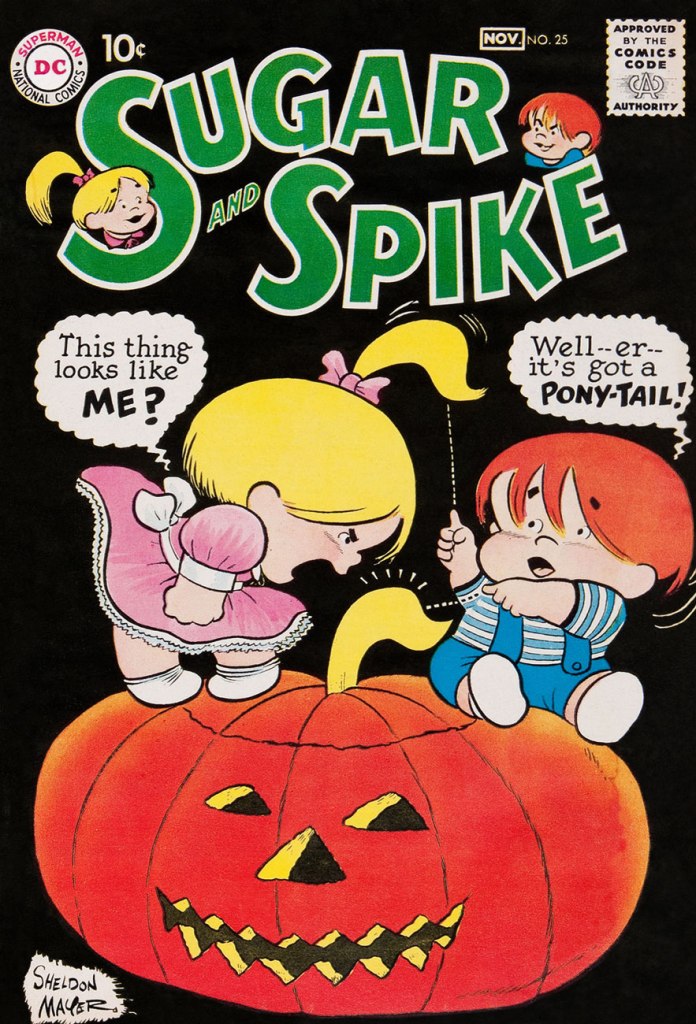
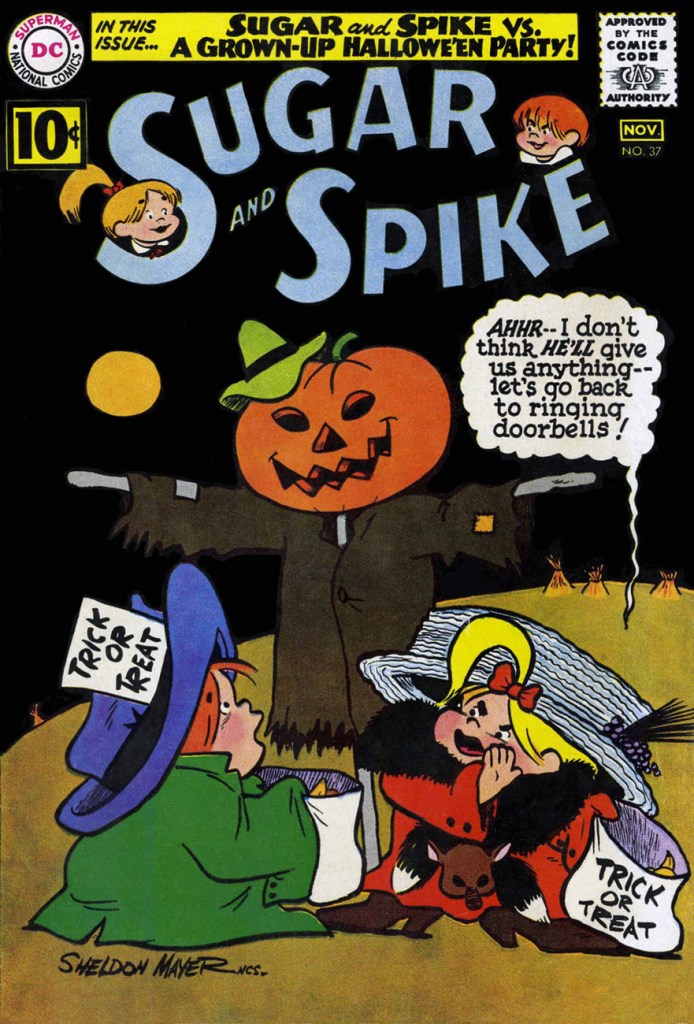
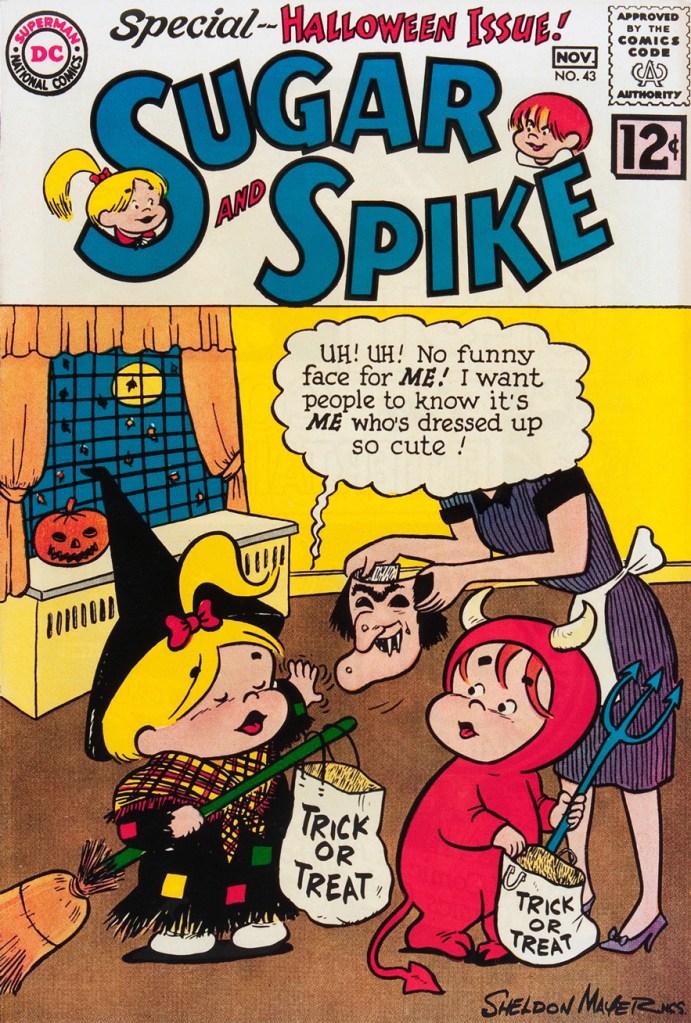
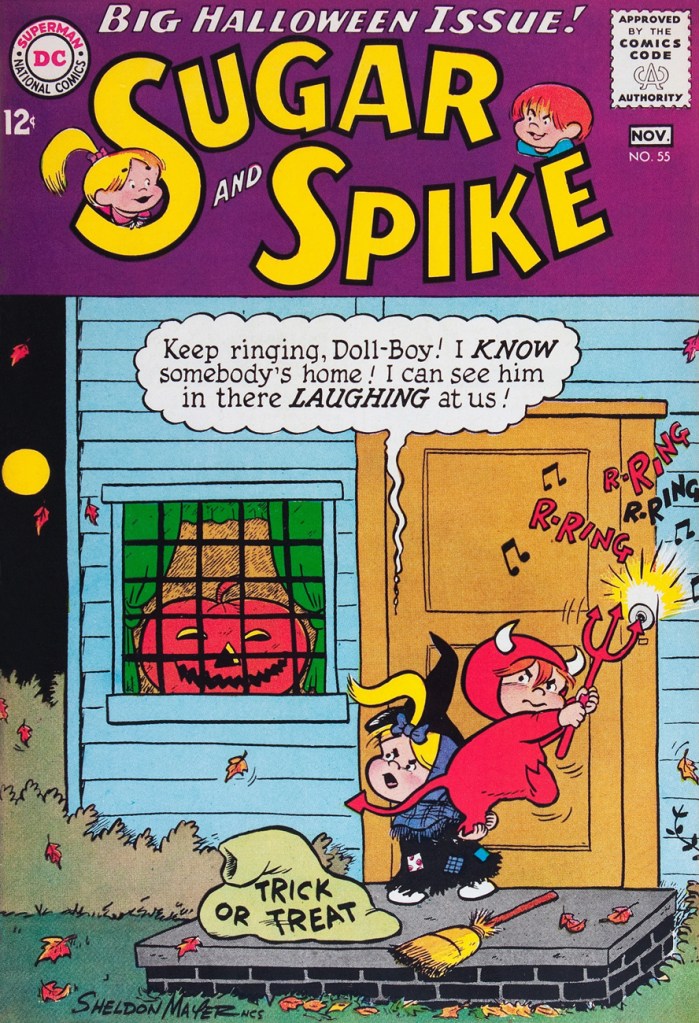
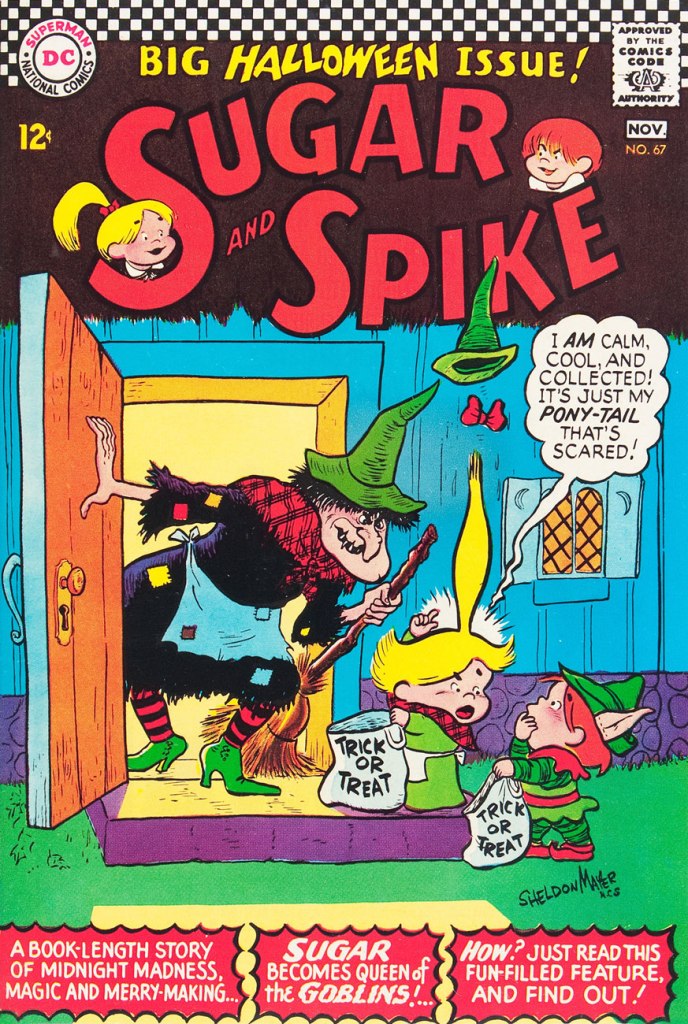
Who’d have the heart to resist Sheldon Mayer’s adorable toddlers (profiled here last year) if they came around trick or treating at your door? Even if you did resist, they’d be sure to get their grabby little mitts on the goods… some other way.

This is Sugar and Spike no. 25 (Oct.-Nov. 1959, DC).
This is Sugar and Spike no. 31 (Oct.-Nov. 1960, DC). Definitely my favourite of this splendid lot, largely thanks to that meticulous, understated colouring job. Jack Adler‘s doing, I’ll wager.
This is Sugar and Spike no. 37 (Oct.-Nov. 1961, DC).
This is Sugar and Spike no. 43 (Oct.-Nov. 1962, DC).
This is Sugar and Spike no. 49 (Oct.-Nov. 1963, DC).
This is Sugar and Spike no. 55 (Oct.-Nov. 1964, DC).
This is Sugar and Spike no. 61 (Oct.-Nov. 1965, DC).
This is Sugar and Spike no. 36 (Oct.-Nov. 1966, DC).
A reprint? Not quite. This cover scene, which originally appeared back in issue 55, was reprised (redrawn, not reprinted) for the series finale, Sugar and Spike no. 98 (Oct.-Nov. 1971). I’d hate to take part in a contest announced in the last issue of a series. There *was* a no. 99, but it was a one-shot that only followed… 21 years later.
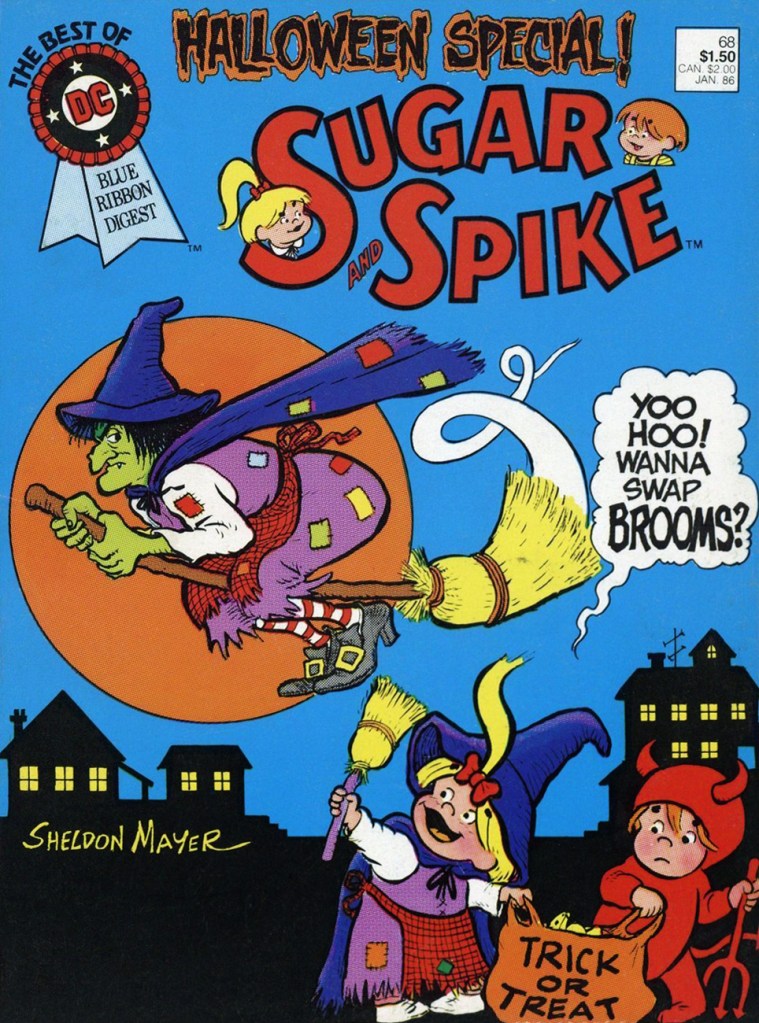
This is The Best of DC no. 68: Sugar and Spike (Jan. 1986). Edited by Nicola Cuti, and with a new cover by Mr. Mayer. Mostly reprints, but with material of this calibre, who’s to quibble?

I was initially set to feature just a couple of Sugar and Spike Hallowe’en covers, but in the end, it seemed unfair to play favourites.

-RG

Hallowe’en Countdown IV, Day 2

« What is this ‘witch’s brew‘? Oh, that’s a special! It’s a squirt of everything! » — Pop Tate divulges one of his culinary secrets

A little while back (okay, quite a while back!), upon reading an article written by cartoonist Seth (John Stanley’s Teen Trilogy, The Comics Journal no. 238, Oct. 2001), this passage especially piqued my interest: « I have to admit right now that I like Archie comics quite a bit and I have hundreds of issues of Archie and its various spin-off titles. I can even tell you which years are the good years (1959 to ’65, incidentally) ».

As it happens, I’m in full agreement with the gallant Mister Gallant : this was when Archie’s Mad House and Tales Calculated to Drive You Bats came along, when Bob White (and Samm Schwartz, and Orlando Busino) were producing scads of wild and wooly covers featuring ghouls and bug-eyed critters, mole men and mad (though I’m told they prefer ‘eccentric’) scientists and sundry extraterrestrials and witches. The line’s cover layout was also nicely open, affording the artists plenty of latitude to indulge themselves. Here are some samples from the aforementioned creators at the peak of their formidable powers, before the end-of-recess bell rang and stifling homogeneity was henceforth imposed.

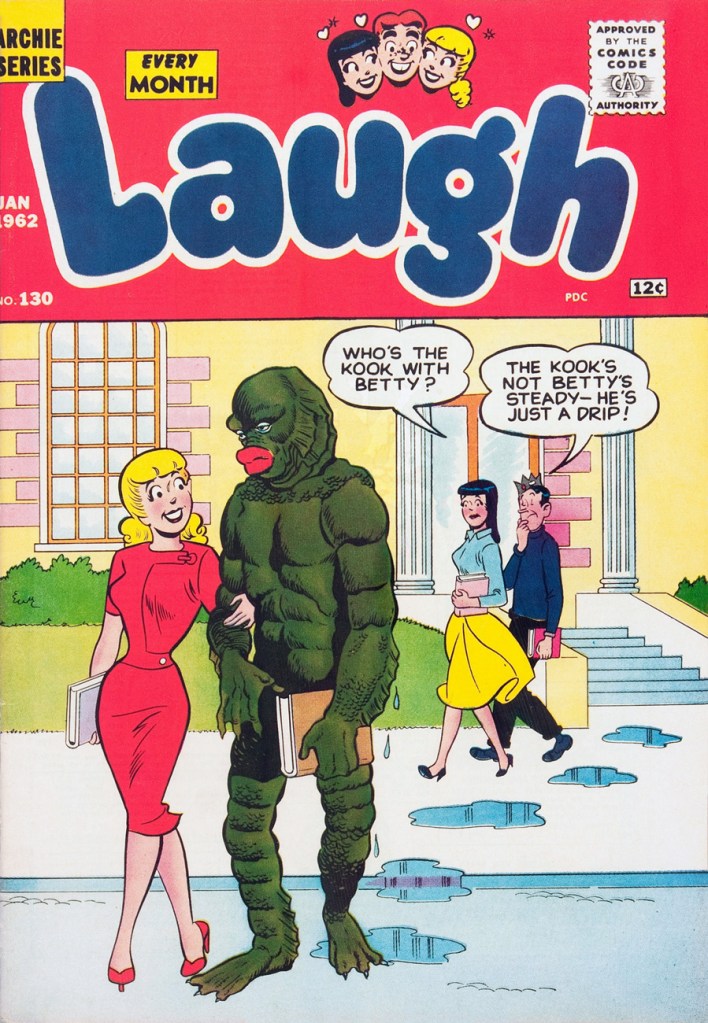
This is Laugh no. 130 (Jan. 1962, Archie); cover by Samm Schwartz. Looks like our friend Ricou Browning is slumming it in Riverdale, with Betty happily showing him the sights. Honestly, he’s more of a gentleman that Archie ever was.
This is Tales Calculated to Drive You Bats no. 2 (Jan. 1962, Archie); cover by the incomparable Orlando Busino, still with us and nearly 94 years young! I strongly suspect that these witchy younglings mean mystical business!
This is Archie no. 125 (Feb. 1962, Archie); cover by Harry Lucey, one of the crucial classic Archie artists. Regardless of what you’ve heard, look at the actual sales figures for 1969, with Lucey drawing every issue of Archie. Readers voted with their wallet.
Here’s a swell example: Pep Comics no. 158 (Oct. 1962). Spooky cover art by local favourite Bob White. I wouldn’t have pegged Archie as a skeptic, to be honest.
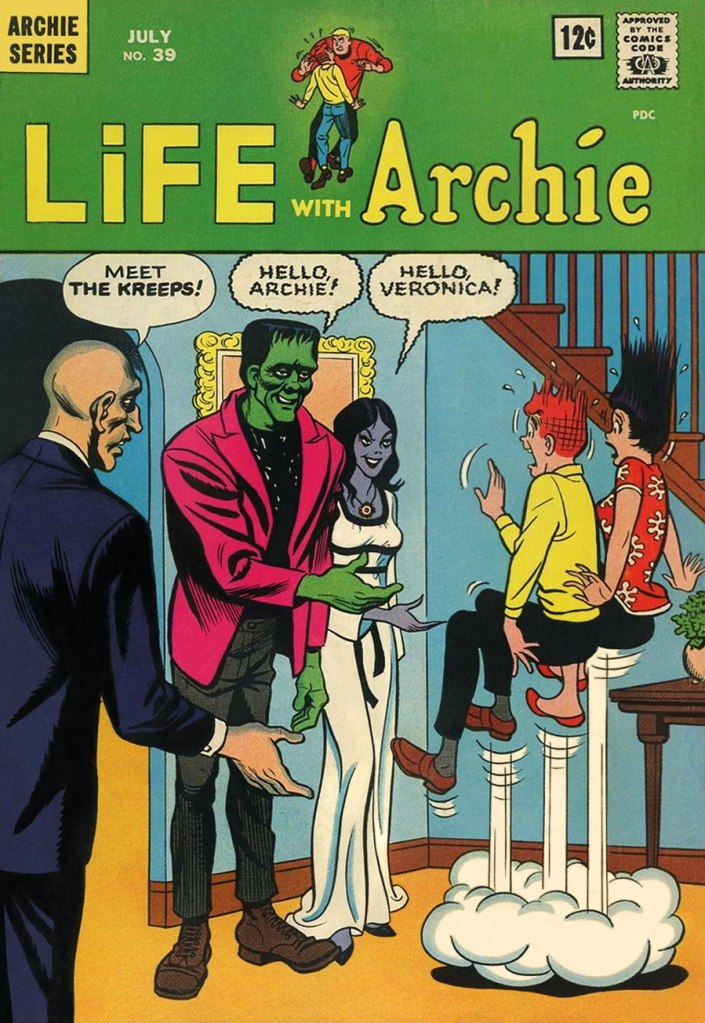
This is Life With Archie no. 39 (July 1965, Archie); cover, again, by Mr. White. The previous year had seen the TV arrival of The Addams Family and its imitators, The Munsters. So what’s one carbon copy more or less?

-RG