Panning the murky old print stream for the odd glimmering nugget
By the Light of the Silver Age
We know when the Silver Age begins, but when exactly does it come to a close? Since it’s just arbitrary retrofitting, a bunch of events and dates have been posited, mostly from the early 1970s: Kirby leaving the Fantastic Four and Marvel, the “relevance” of Green Lantern/Green Arrow… The cut-off points of decades have been pretty misleading in the past while the middles have often been more pivotal: for instance, the years 1955 to 1965 are more of a piece than 1950-60, for instance. Same goes for 1965 to 1975. I therefore deem the end of the Silver Age to be the end of 1975, when Carmine Infantino stepped down as DC publisher, along with his brilliant art director Nick Cardy. Replace them with inexperienced Jenette Kahn* and the legendary (but not in a good way) Vince Colletta as art director, and you have a pretty massive sea change. Compared to that, comics from 1969 are virtually identical to releases from 1970. *creating Dynamite Magazine for Scholastic is what got Kahn the job. She only stayed for four issues, and Jane and Bob “R.L.” Stine likely did most of the heavy lifting, since the magazine only improved following Kahn’s departure. – RG
« Let’s just say you weren’t born to be an octopus… only a poor fish! »
Salutations on this most diverting day of the week, Tentacle Tuesday! Today, we take a little trip to the 60s… but perhaps not the 60s as you remember them, those who were around back then.
Rip Hunter… Time Master no. 3 (July-August 1961); pencils by Ross Andru, inks by Mike Esposito.
Rip Hunter was created by Jack Miller and Ruben Moreira – the “Time Master” part is explained by Hunter’s invention, the Time-Sphere, that allows him (obviously) to travel through time. Other characters in Rip’s world include his girlfriend, Bonnie Baxter, and Bonnie’s kid brother Corky (who’s being grabbed by a tentacle on this cover). Maybe Corky was spotted as an imposter because he’s wearing jeans instead of yellow pantaloons? Fashion can be quite goofy in some of these far-away, long-long-ago kingdoms…
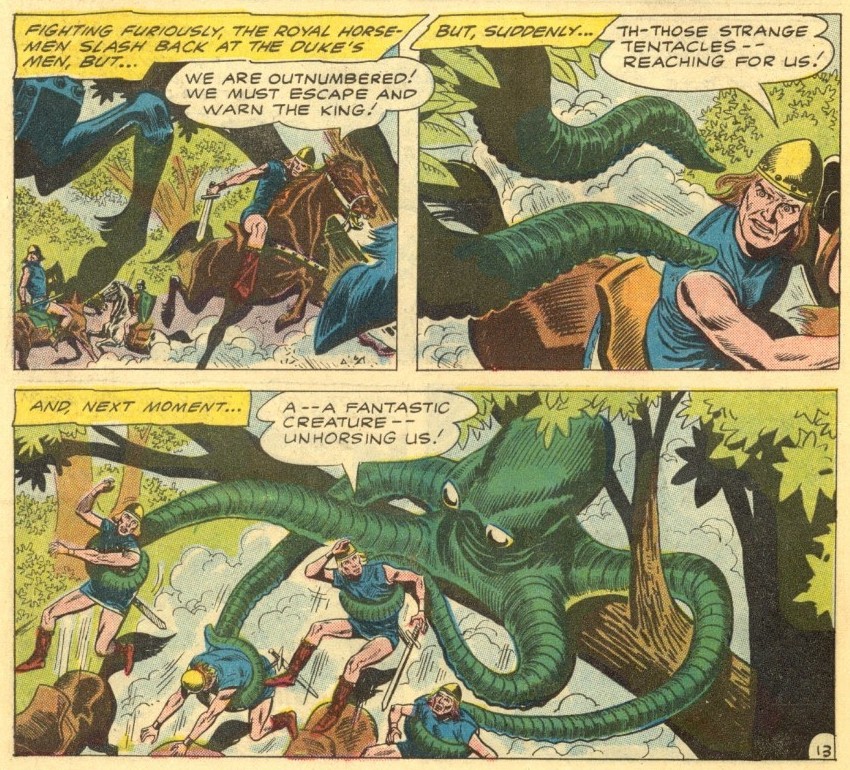
Page from The Duke with the Creature Powers, scripted by Jack Miller, pencilled by Ross Andru and inked by Mike Esposito.
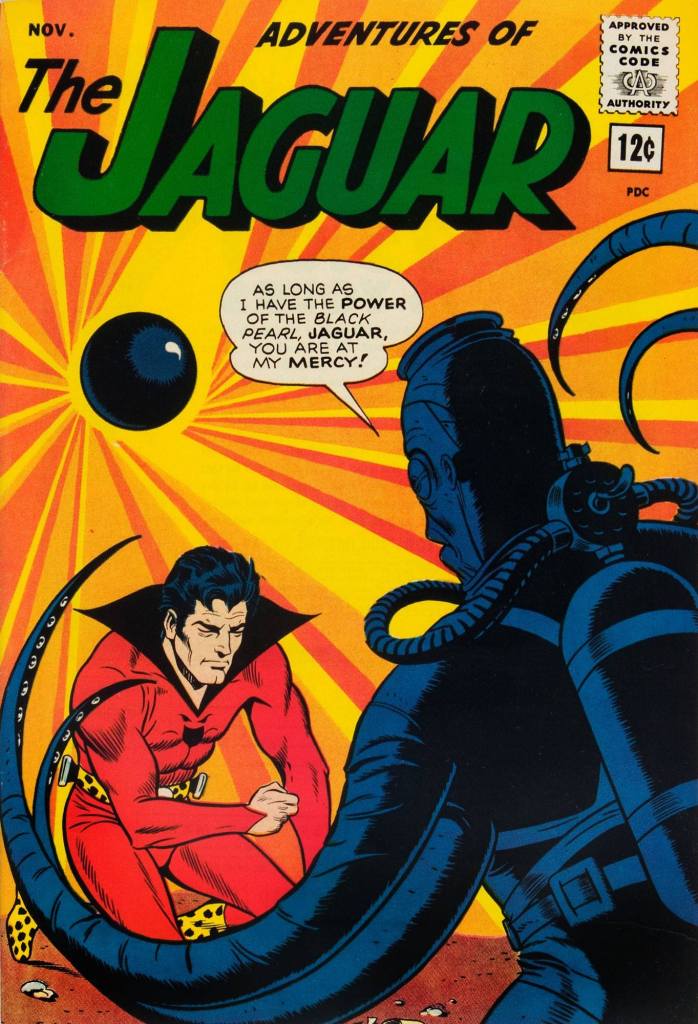
When The Jaguar gets into trouble with The Human Octopus, you know the Jag is going to come up trumps, mostly due to the fact that he has all powers of the animal kingdom at his disposal, whereas the Octopus has to make do with some unconvincing tentacles and an evil stare. The Jaguar (or zoologist Ralph Hardy, in his everyday life) was created by Robert Bernstein and John Rosenberger as part of Archie’s “Archie Adventure Series”.
This is the last issue of this series: Adventures of the Jaguar no. 15 (November 1963, Archie), with a cover by John Giunta.
Some fodder for your nightmares? Of course!
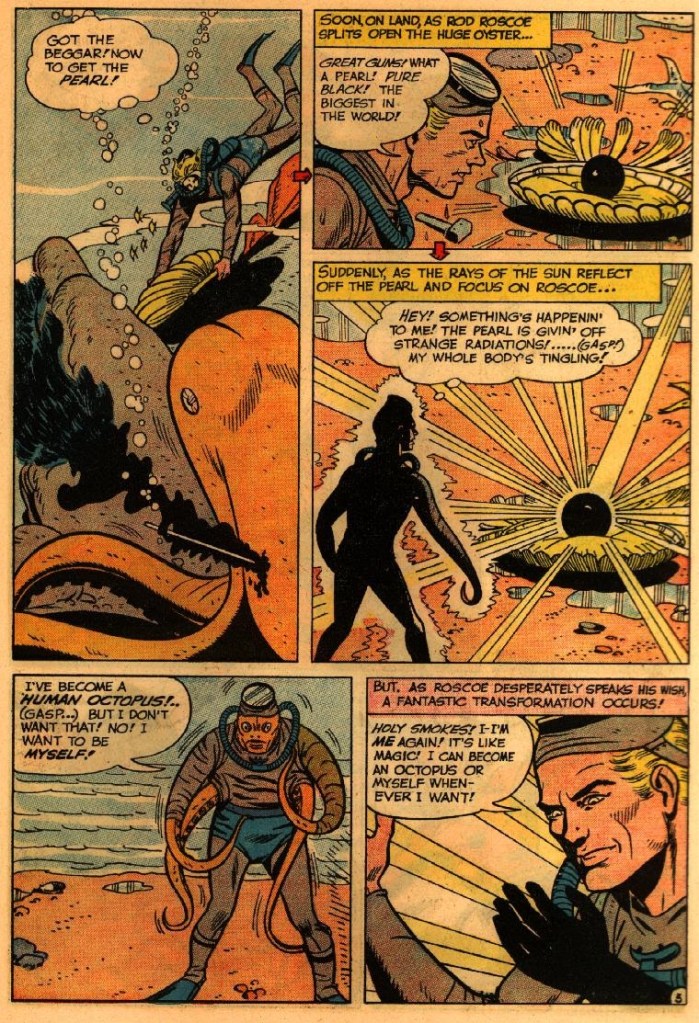
Who wouldn’t want to become a HUMAN OCTOPUS!…? The Jaguar versus the Human Octopus! was scripted by Robert Bernstein and illustrated by John Giunta.
I believe Hawkman needs no introduction (although I will mention that he was created by Gardner Fox and Dennis Neville!), and we don’t have time for one, anyway, seeing as he’s currently stuck between a dragon and some tentacled nest-creature.
« Programmed for love, she can be quite tender Treat her unkind, nothing offends her She vacuums the carpet and doesn’t complain She’ll walk the dog in the pouring rain. » — Was (Not Was), Robot Girl
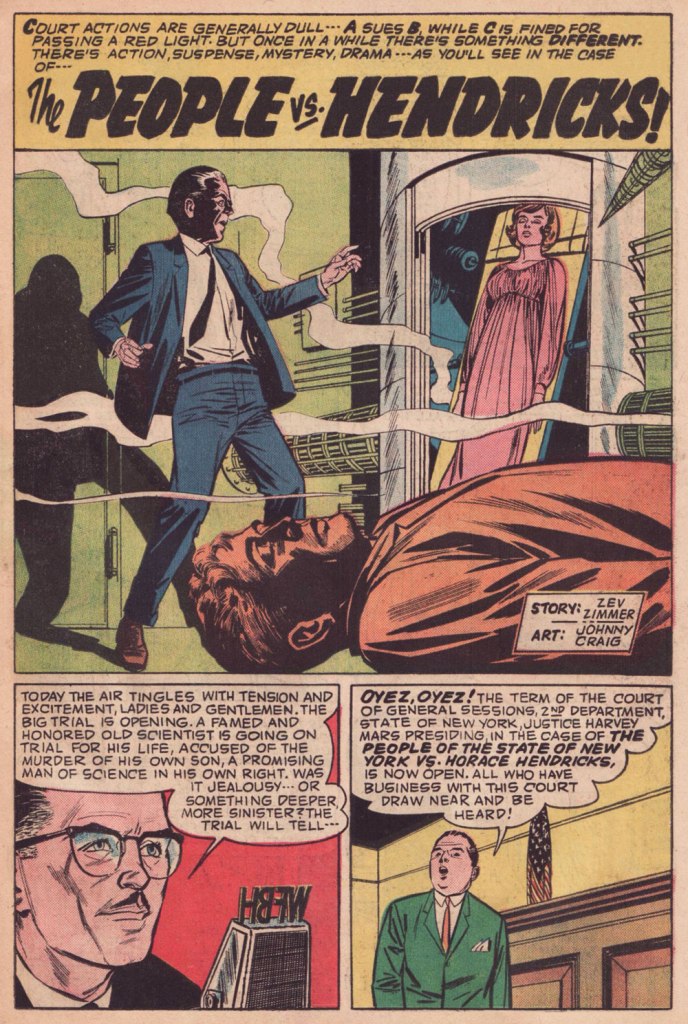
Today, on the occasion of his birthday (this would be number 112), we celebrate the great writer and editor Leo Rosenbaum (1909-1974), Potentate of Pseudonyms. If you know of him at all, odds are it’s under his nom de plume of Richard E. Hughes, pioneering chief writer and editor of the American Comics Group (ACG, 1943-67), and then perhaps under one of the numerous colourful aliases he adopted to conceal the fact that he was doing most, if not all, the company’s writing. In alphabetical order, meet Pierre Alonzo, Ace Aquila, Brad Everson, Lafcadio Lee (a salute to the Irish-born writer of Japanese ghost stories of Kwaidan fame, perhaps?), Kermit Lundgren, Shane O’Shea, Greg Olivetti (probably inspired by the brand of his typewriter!), Kurato Osaki, Pierce Rand, Bob Standish and Zev Zimmer.
Early in my comics collecting days, I spent a lot of time consulting Robert Overstreet‘s The Comic Book Price Guide (a practice I’ve utterly abandoned) gleaning random bits of trivia and dreaming about potential acquisitions. One item that greatly piqued my interest was this note:
From the 12th edition of The Comic Book Price Guide (1982, Overstreet Publications).
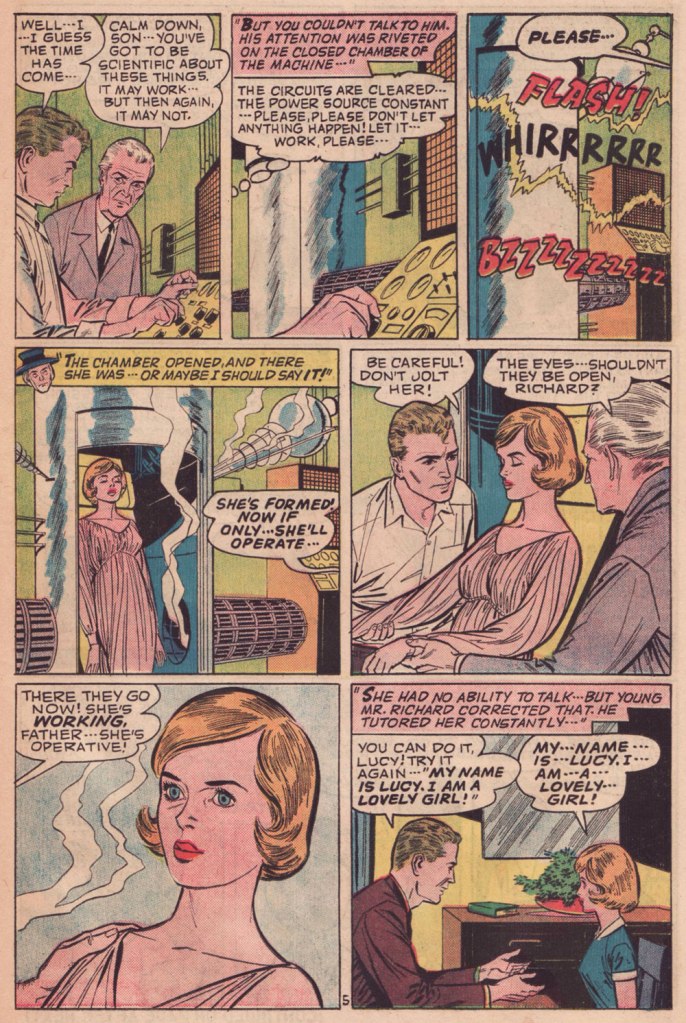
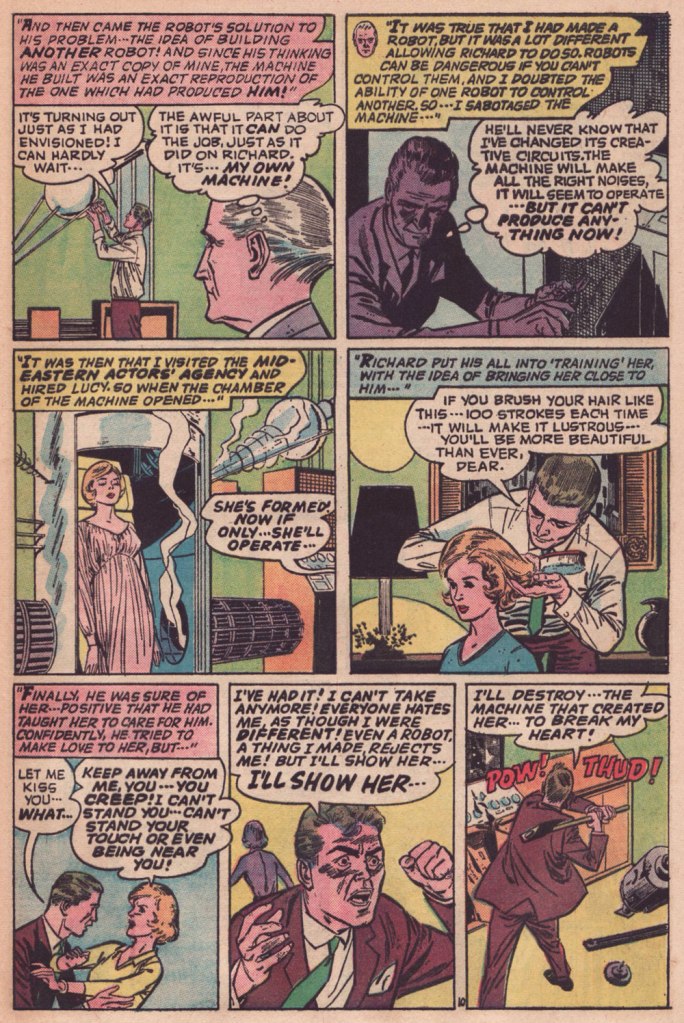
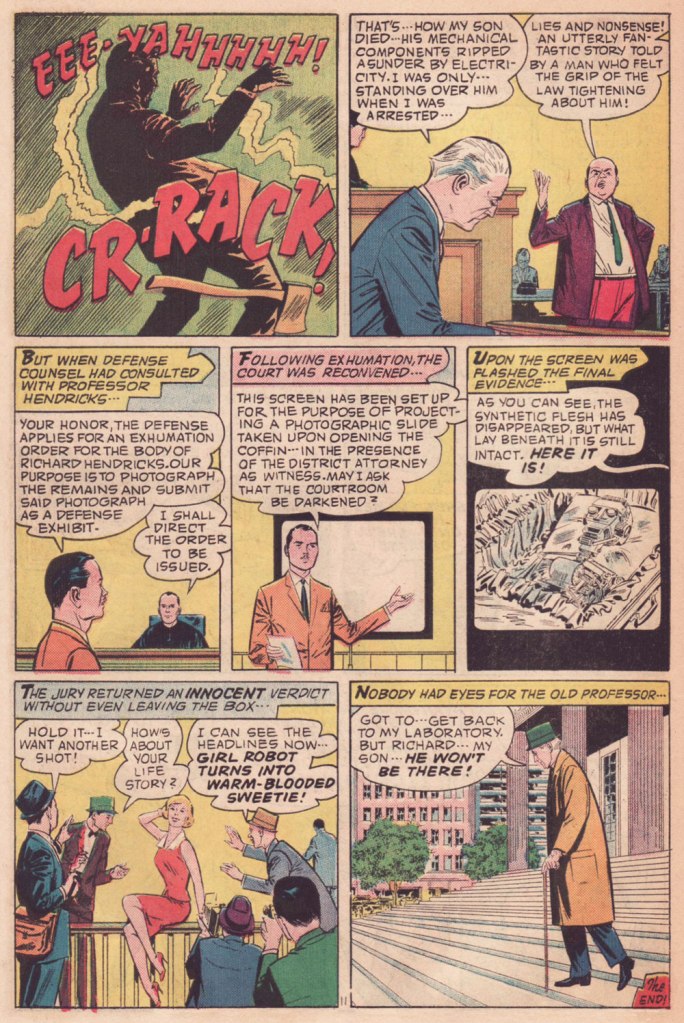
Well, I did eventually get my hands on a copy, and I must say wasn’t disappointed. And since I was taught to share with the other kids, here’s the story in question.
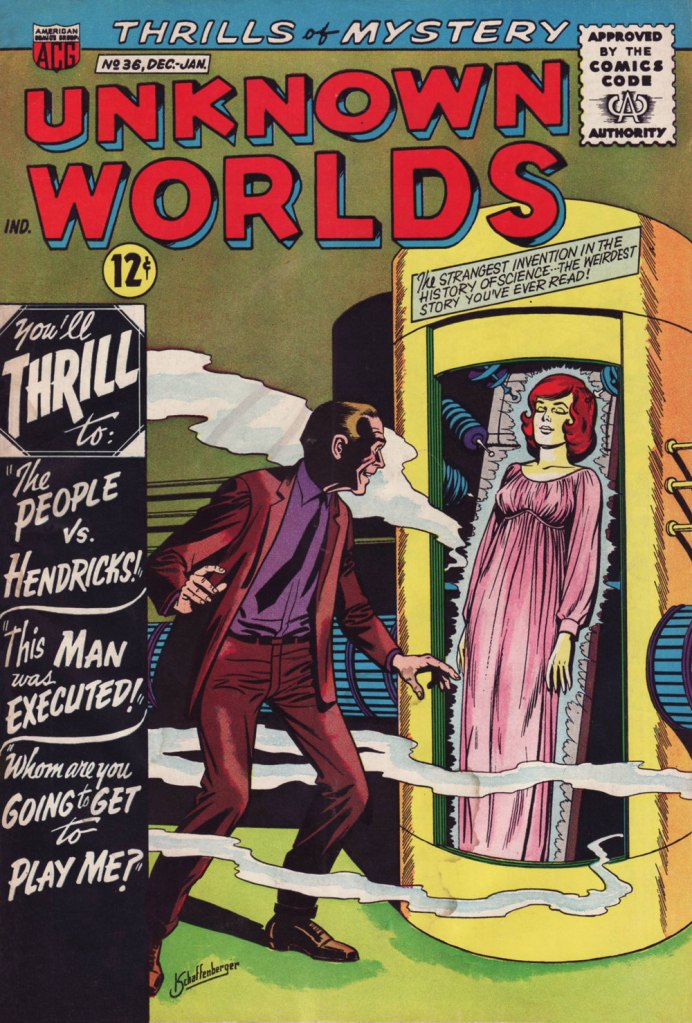
While “The People…” draws upon familiar elements of The Bride of Frankenstein and say, Inherit the Wind, I daresay that its heart-rending conclusion is its very own. And here’s the cover. This is Unknown Worlds no. 36 (Dec. 1964 – Jan. 1965, ACG); art by Kurt Schaffenberger.
As for the artist: Johnny Craig (1926-2001) had been absent from the comics field most of the decade that followed EC Comics’ near-total collapse and the advent of the Comics Code, when he suddenly turned up at ACG (he’d been toiling in advertising). He would later do some work with Warren, Marvel and DC until the early 80s, at which point he more or less retired. Craig’s always been near the very top of my favourites at EC. Since he was, artistically-speaking, painstaking (‘slow as mollasses in February‘, my art school drawing teacher was fond of saying) and quite self-critical, Gaines entrusted him, as he did in the case of Harvey Kurtzman, with some editorial and scripting responsibilities to make up the income shortfall and keep him around and happy. And so the Craig-edited-and-led Vault of Horror is easily the finest of the company’s horror trio, largely thanks to Craig’s solid writing skills, not to mention his inspired artwork. Craig’s stories provided a much-needed breather from Gaines and Feldstein’s often powerful, but also formulaic and overwritten tales.
Interestingly, while Craig’s art style is overall understated and full of spit and polish, he created several of the company’s most transgressive images (such as this one and that one). Editor-writer Hughes knew precisely what he was doing (as any editor worth his salt should) when he conceived this story and assigned it to Craig. It plays superbly to the man’s strengths, if you ask me.
« People that pick up hitchhikers I believe are basically good people that believe in other people and understand problems and don’t judge people. That’s always the kind of person I’m looking for. » — John Waters
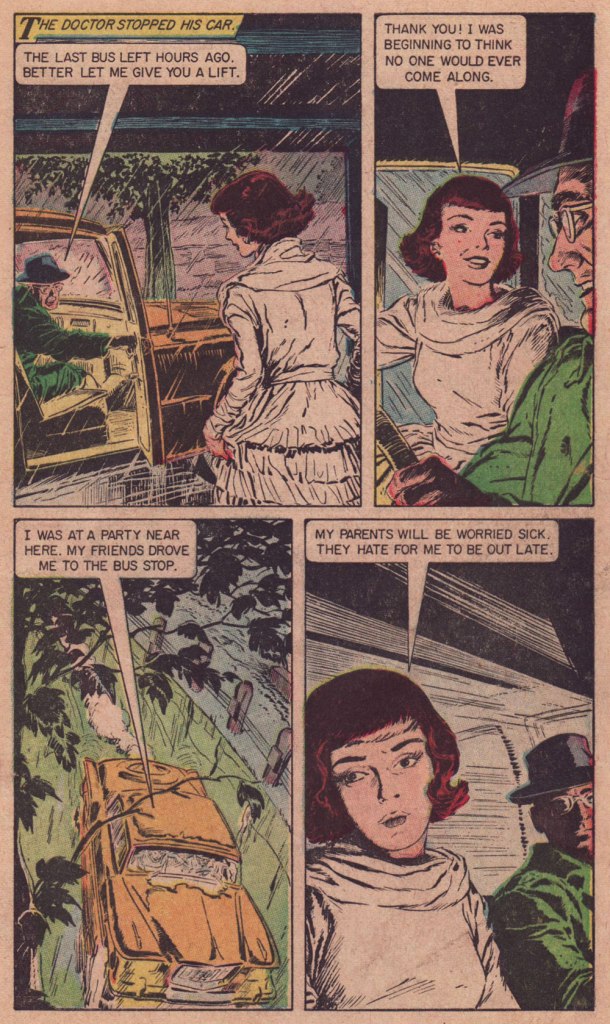
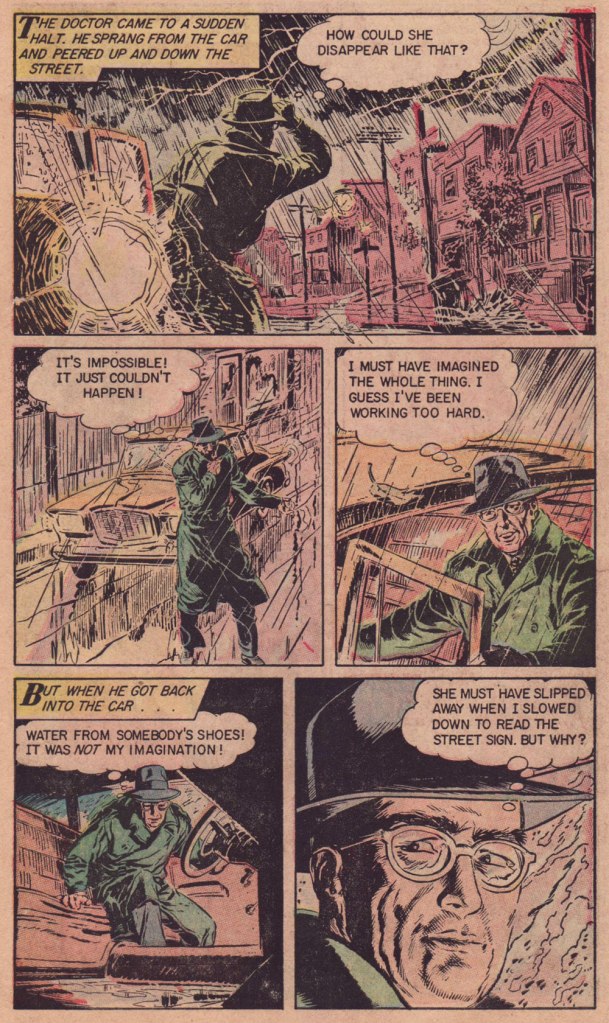
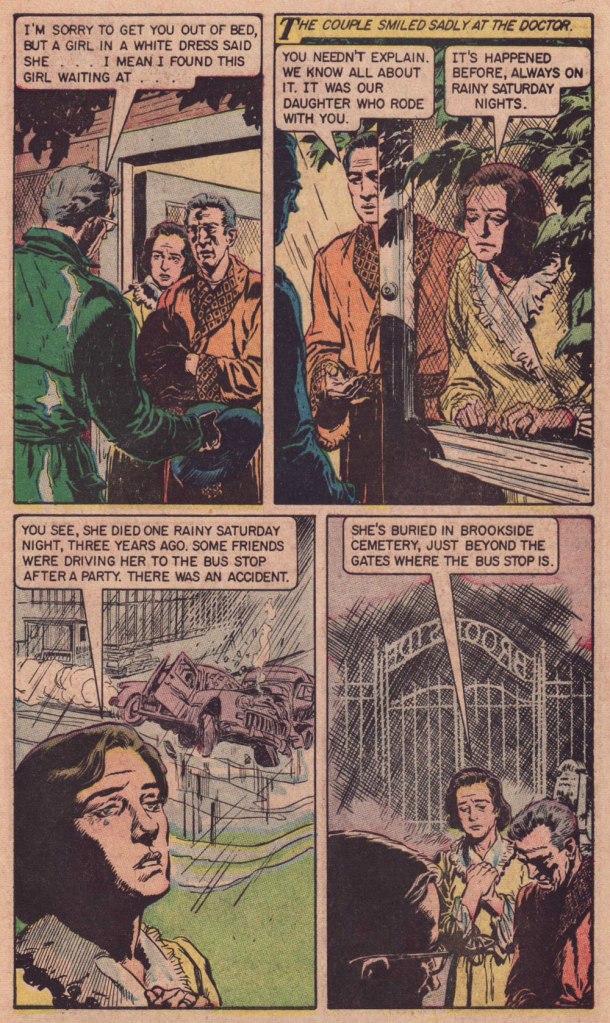
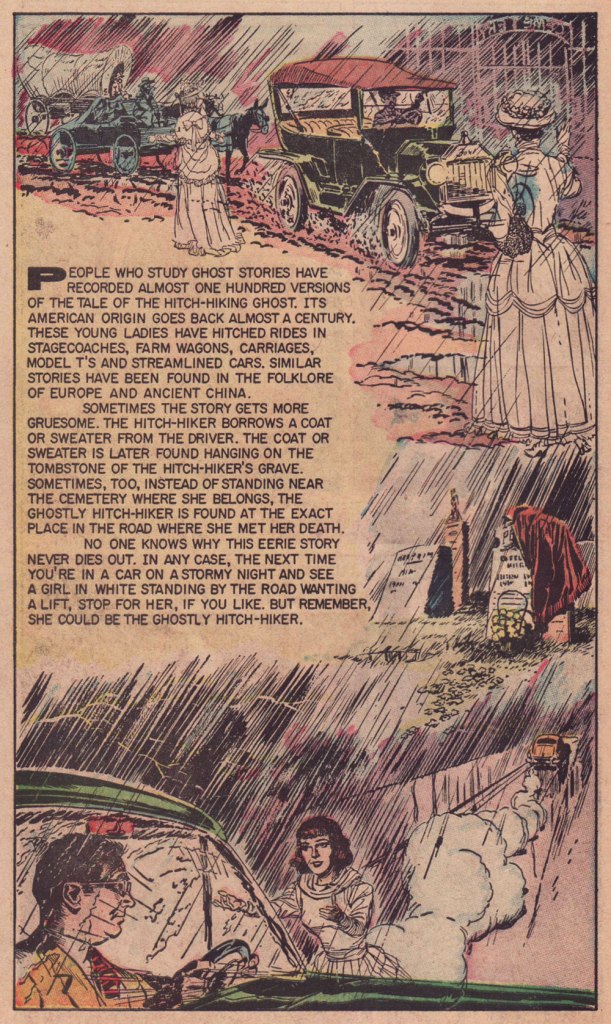
Let’s take a nocturnal drive with George Evans (1920-2001) behind the wheel. Best known for his stellar contribution as a member of the elite EC Comics bullpen, Evans had earlier crafted some impressive comics for Fawcett (his own favourite period of his work) and Fiction House, and later, post-Code, for Gilberton, Dell and Gold Key, Warren and DC. He also worked extensively in newspaper strips, notably on Terry and the Pirates (under George Wunder) in the 1960s. He took over Secret Agent Corrigan from fellow EC alum Al Williamson, a nice long stint from 1980 to 1996, at which point the strip wrapped up and Evans (and Corrigan, presumably) retired.
While Evans’ chief forte was aerial warfare, this piece highlights his way with a mood, his quiet grace and flawless draftsmanship. This story is an excerpt from Gilberton’s The World Around Us series (36 issues, 1958-1961); this is no. 24 (August, 1960), The Illustrated Story of Ghosts, an oft-told tale (but never better) of the urban legend widely known as The Vanishing Hitchhiker (here entitled The Hitch-Hiker). Can’t you just feel that rain?
The renowned folklorist Jan Harold Brunvant wrote, in his epochal study, The Vanishing Hitchhiker: American Urban Legends and Their Meanings (1981, W. W. Norton):
« A prime example of the adaptability of older legends is ‘The Vanishing Hitchhiker’ — the classic automobile legend. This returning ghost tale was known by the turn of the century both in the United States and abroad. It acquired the newer automobile motif by the period of the Great Depression, and thereafter spawned a number of subtypes with greatly varied and oddly interlocking details, some of which themselves stemmed from earlier folk legends. »
As a bonus, here’s Evans’ lovely, light-hearted frontispiece for the issue. “Face to faceless” — clever!
« Ghost stories … tell us about things that lie hidden within all of us, and which lurk outside all around us. » — Susan Hill
We’ve once before turned our attention upon Dell’s Ghost Stories, an anthology title with such an incredible first issue (written and directed by John Stanley) that all the subsequent ones whither in the long shadow it casts. In recent years, I’ve somewhat softened my stance on these sequels, taking into account that nothing could measure up to Stanley’s work on numero uno — and accordingly judging them on their own merits.
As a kid, I didn’t think too highly of Frank Springer (1929-2009), being primarily familiar with his inks over Frank Robbins on The Invaders (too sloppy, and no substitute for Robbins inking himself, which never happened at Marvel anyhow). Down the line, I ran into some of his earlier work (Phoebe Zeit-Geist, The Secret Six, The National Lampoon, Dial H for Hero and sundry items for Dell) and grew to appreciate his strengths.
Now, Ghost stories was interesting as a ‘horror’ (in the very limited Silver Age/Comics Code in full force sense) anthology, in that the vast majority of the stories were, after that peerless first issue, the work of one single artist (Gerald McCann, after contributing a couple of page to number one, handled issues 2-5, with a couple of filler pages thereafter, then Springer took over for 6-20, the rest of the run consisting of reprints, with the unexpected exception of no. 35).
Here then is what’s likely my favourite Springer Ghost Story: A Room with a Dreadful Secret.
This is Ghost Stories no. 14 (June 1966, Dell). Cover by Springer.
« I don’t know what the hell I published. I never read the things. » — Stanley P. Morse
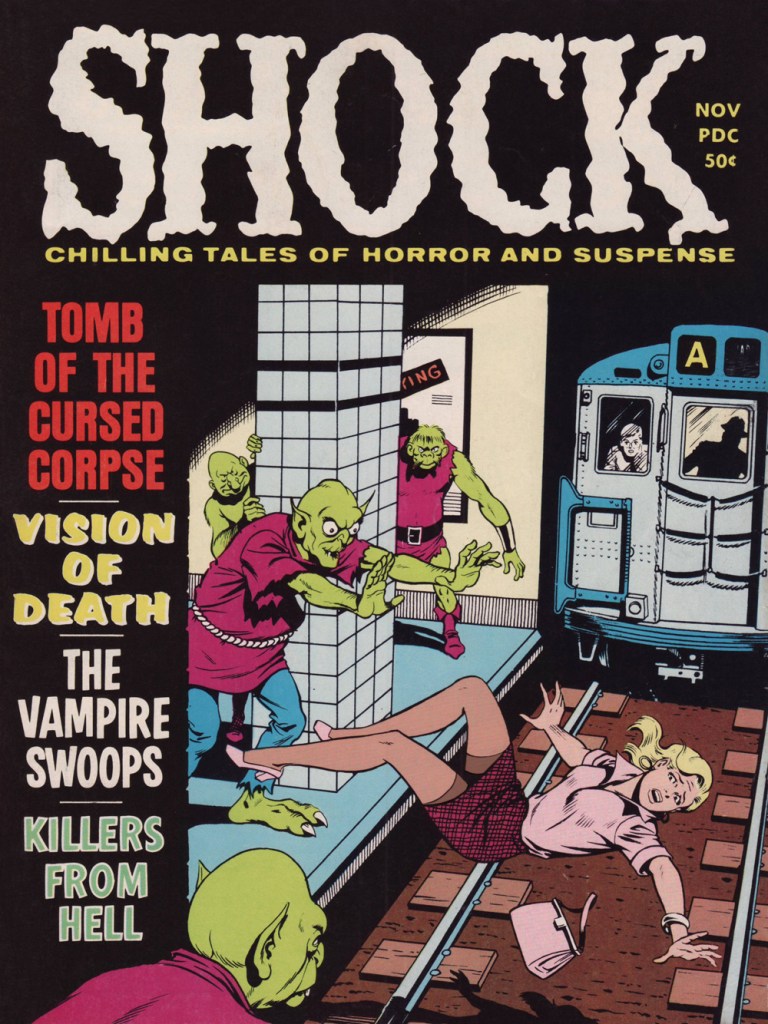
In the sinister wake of Warren Publishing‘s success with Creepy, Eerie and Vampirella, old-school fly-by-night 1950s comics publisher Stanley P. Morse (Aragon Magazines, Gillmor Magazines, Medal Comics, Media Publications, S. P. M. Publications, Stanmor Publications, and Timor Publications…) dusted off some of his old pre-Code chillers in the late 1960s and early 1970s in black and white magazines such as Shock (15 issues), Chilling Tales of Horror (11 issues), Ghoul Tales (5 issues) and Stark Terror (5 issues). It certainly wasn’t all junk: after all, Morse had published Weird Tales of the Future and Mister Mystery, with their Basil Wolverton and Bernard Baily classics…
Unlike Eerie Publications’ grey-toned and blood-and-gore-ified reprints, these are, as far as I know, unretouched, not to mention decently printed.
This is Shock Vol. 2 no. 5 (no. 10, November, 1970, Stanley Morse). Edited by Theodore S. Hecht.
Maybe it’s just me, but isn’t Kurt Schaffenberger just about the unlikeliest pick of cover artist for a pre-code horror anthology? Sure, he fit in nicely with ACG’s gentle moral fable aesthetic, but aren’t you just expecting the Man of Steel or The Big Red Cheese to swiftly sweep in, catching the damsel-in-distress before the A Train smooshes her?
To wit: one of Kurt’s fun ACG covers, this is Unknown Worlds no. 43 (Oct.-Nov. 1965, ACG).
« She’s a haunted house / and her windows are broken. » — Scott Walker, “Big Louise” (1969)
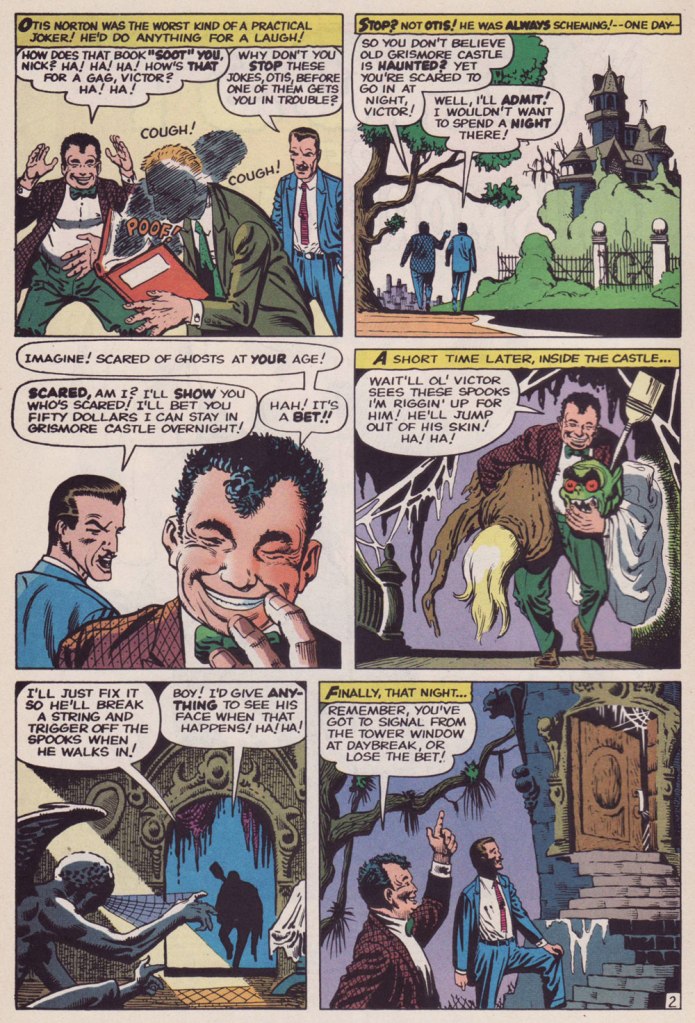
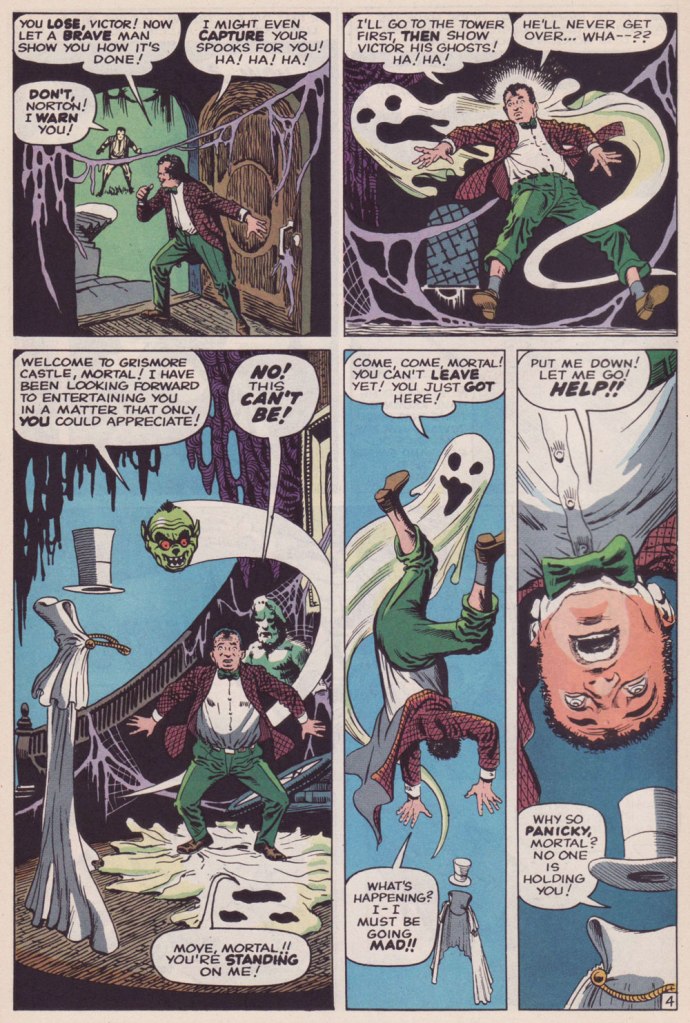
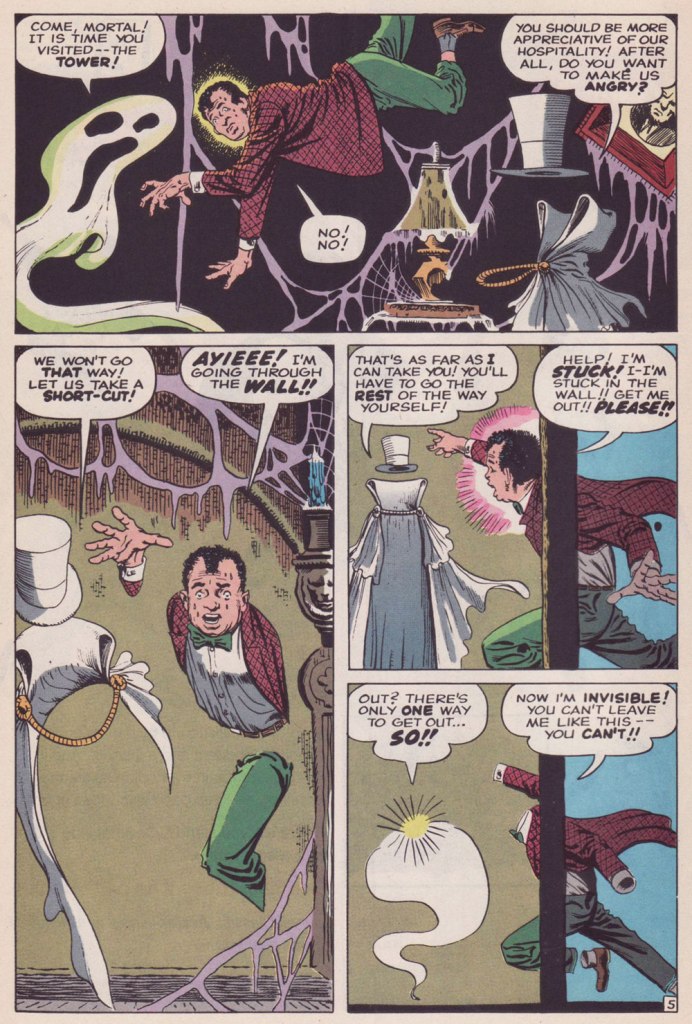
I’ve been wanting to share one of the all-time most beautiful art jobs Steve Ditko ever wittled, 1960’s The Ghost of Grismore Castle! (published in Strange Tales no. 79), but I don’t have that book. I do, however, own a 70’s reprint of it, in Vault of Evil no. 14 (October 1974), but the colouring and reproduction were so bland and washed-out that I knew that justice wouldn’t be done to this meritorious piece.
Then it hit me: I *had* seen a lovingly reconstructed presentation of the tale — has it nearly been… 30 years ago? Yikes!
It was reprinted with brio in the redoubtable Mort Todd‘s Curse of the Weird (no. 2, January 1994), a flawlessly-assembled anthology title he somehow conned Marvel into publishing in the early 90s.
So my gratitude goes out to Mr. Todd and, once more, my admiration to Mr. Ditko.
« We shot it from the original stats I dug out of the Marvel vault, rather than reprint VoE #14, and lovingly recolored it! Thanks for noticing! »
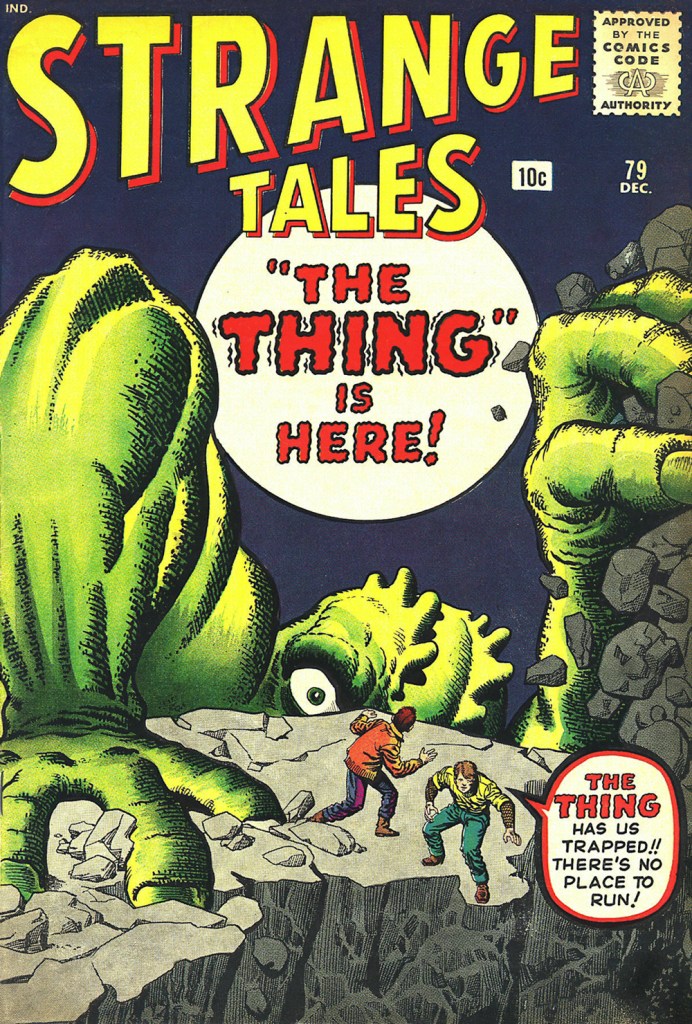
Oh, and as bonus, here’s the cover, one of those absurdly lush Kirby-Ditko collaborations. As usual with Marvel, all captions are de trop.
This is Strange Tales no. 79 (Dec. 1960, Marvel), pencils by Jack Kirby, inks by Steve Ditko. And duh, *obviously*, “The Thing” is here, Stan. Show, don’t tell.
The very 70’s update. This is Vault of Evil no. 14 (Oct. 1974, Marvel); cover pencils by Larry Lieber, inks by Frank Giacoia.
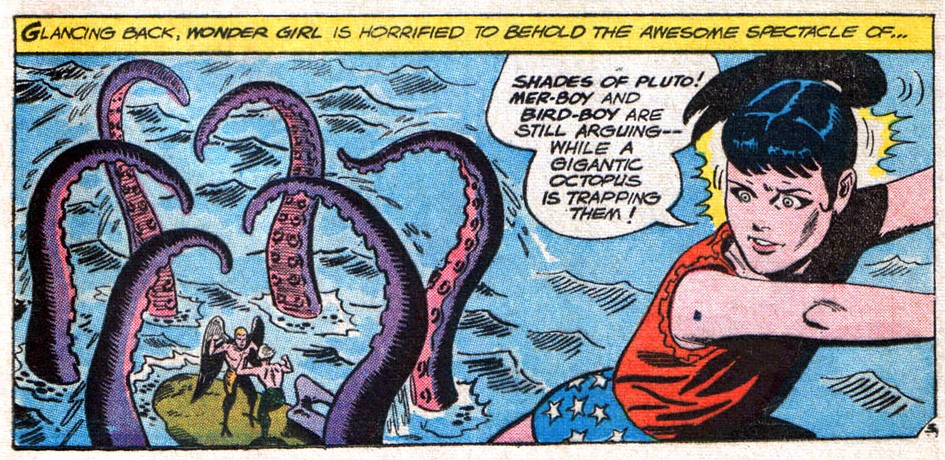
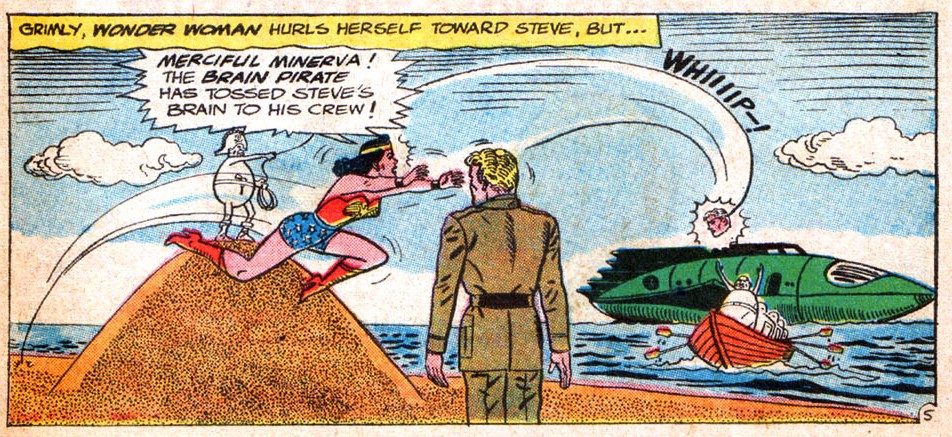
We begin with a page (and a panel) of The Phantom Fisher-Bird!, published in Wonder Woman no. 150 (November 1964):
I’ve never heard of an octopus using its tentacles by sticking them out of the water and forming a cage, but I suppose that’s the least of our worries.
I say, let ’em die! At least the octopus won’t have to decide whether to have fish or fowl for dinner.
Two panels from Battle of the Boiling Man, published in Wonder Woman no. 154 (May 1965):
This octopus is incidental, but handsome!
That’s ‘Gesundheit’ with an S, thank you.
Page from I Married a Monster, published in Wonder Woman no. 155 (July 1965):
« Like its politicians and its wars, society has the teenagers it deserves. » — J. B. Priestley
Here at WOT central, we’re both massive Bob Oksner (1916-2007) fans, and it’s not generally for the writing. For a long time, his multi-faceted talent was used to great effect all over the DC Comics line, but he rarely received the acclaim he so richly deserved.
After DC sent up a trial balloon with Showcase no. 70 a year prior, Binky returns after a decade’s sabbatical (an eternity in the teen world!). This is Leave It to Binky no. 61 (June-July 1968, DC). The product was slightly updated (fashions and hairdos) dusty reprints with fabulous new covers.
This is Leave It to Binky no. 62 (Aug.-Sept. 1968, DC). For the record, Peggy is Binky’s blonde girlfriend. Let’s face it, she’s the true star of this book.
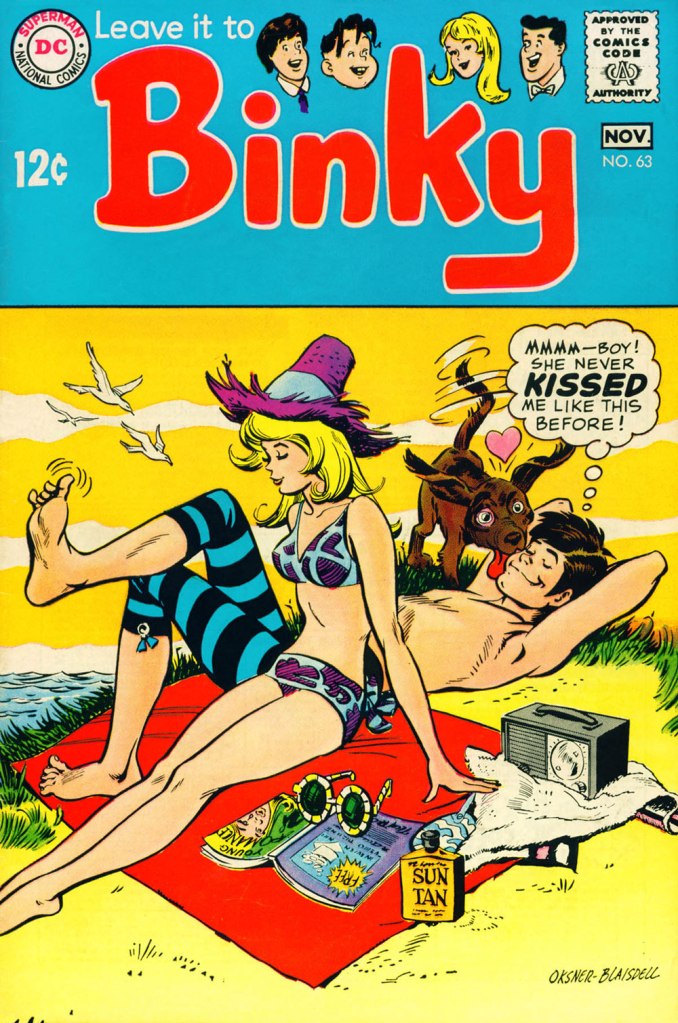
This is Leave It to Binky no. 63 (Oct.-Nov. 1968, DC). Lovely inks provided by fellow Golden Age veteran Tex Blaisdell (1920-1999).
This is Leave It to Binky no. 64 (Dec. 1968-Jan. 1969, DC).
This is Leave It to Binky no. 65 (Feb.-Mar. 1969, DC).
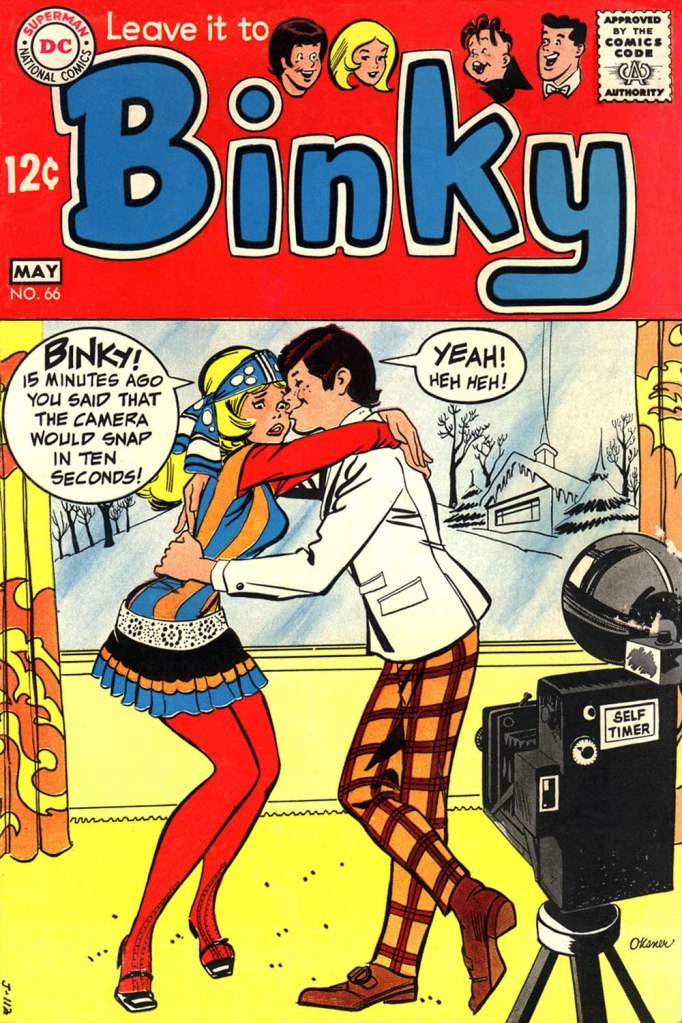
This is Leave It to Binky no. 66 (Apr.-May 1969, DC).
During last year’s Hallowe’en Countdown, I spotlighted Mr. Oksner’s fine work on DC’s long-running licenced Bob Hope and Jerry Lewis titles, but also featured his holiday-appropriate Binky cover. For thoroughness’ sake, here it is again: this is Leave It to Binky no. 67 (June-July 1969, DC).
And one more: this is DC Special no. 2 (Jan.-Mar. 1969, DC). Hard to fathom why this one came out at all, its great cover aside.
And then it was over, in this visual idiom anyway: with the following issue (LITB68), DC brought in well-traveled Henry Scarpelli to handle the covers and create the impression that Binky was just one more Archie clone. Over the subsequent four issues, a handful of (pretty good) new stories were mixed in with the reprints. Then came a change of title and a new logo. The book, now simply called Binky, was a full-on Archie ersatz, and lasted another ten issues into 1971… with one final special popping out of nowhere in the summer of ’77. For ol’ Binky, par for the course!
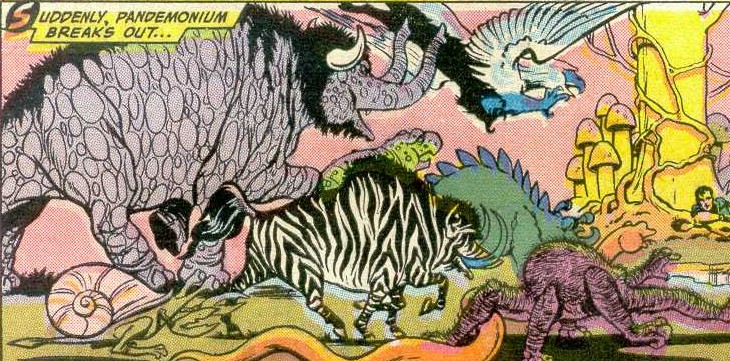
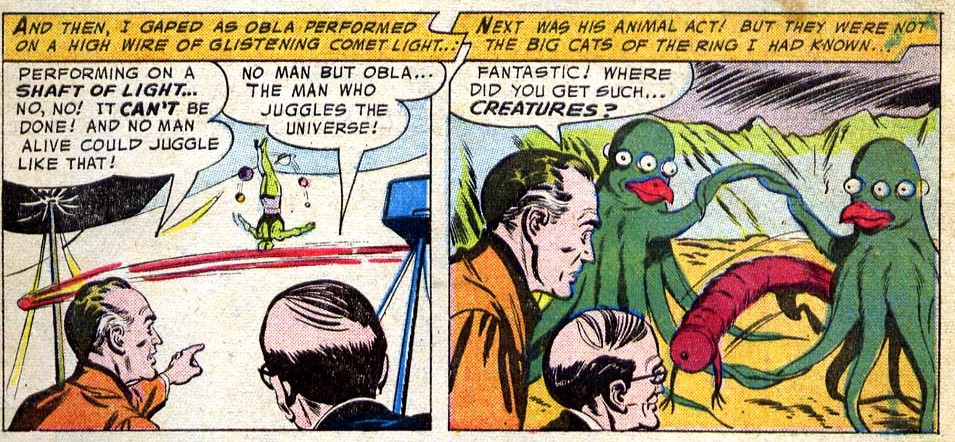
DC’s Tales of the Unexpected offer quite a ménagerie of strange looking creatures! Any peculiar combination of animals you can think of, you’ll find somewhere within the pages of this series. This possibly deserves its own post, as it’s quite entertaining to see artists combining, say, an elephant with a tiger. That being said, I tend to get annoyed at artists who can’t visualize anything truly alien-looking, thus resorting to carving up earth animals and stitching different body parts together… but that’s a different conversation.
Art by Lou Cameron.
Occasionally the artists will also add tentacles, a sure shortcut to make something mundane look properly alien, and this is today’s area of interest! For more questionable monsters, have a gander at Tentacle Tuesday: Convoluted Critters.
And now, onto ‘unexpected’ tentacles, even if the result of this ends up looking like badly-made puppet with a tacked-on beak…
The Strangest Show on Earth, illustrated by Jim Mooney, was published in Tales of the Unexpected no. 10 (February 1957).
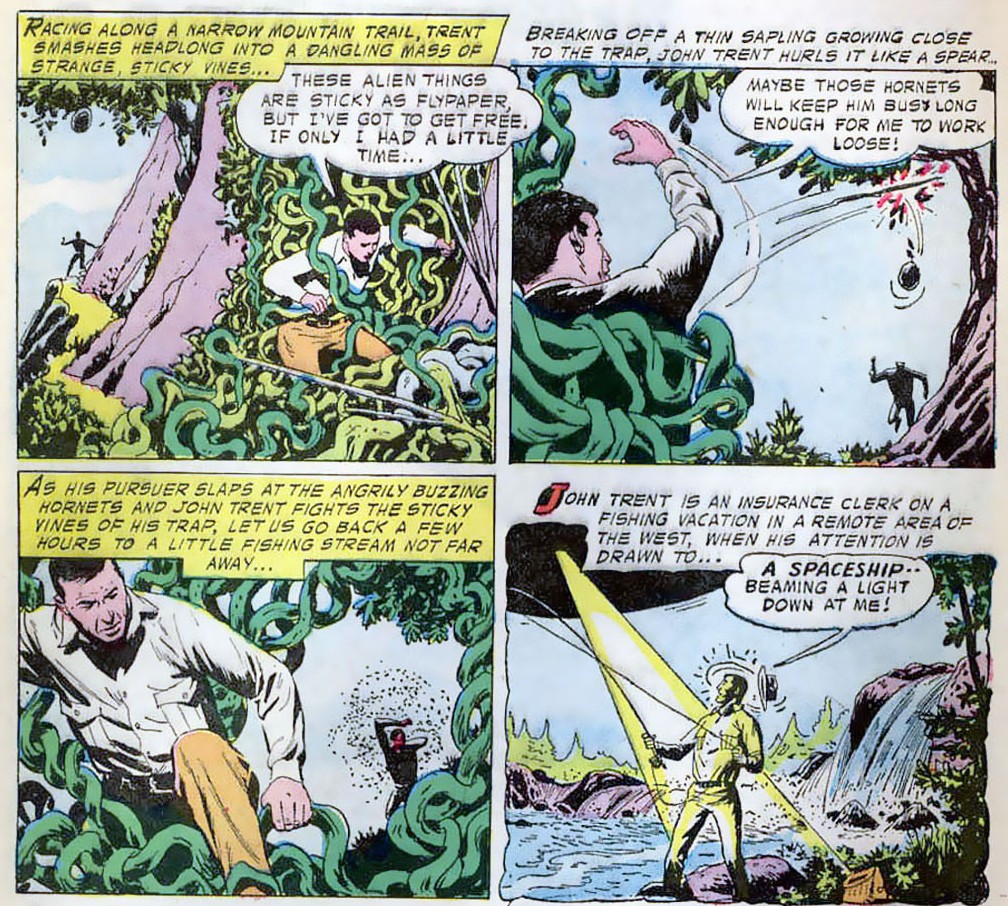
Of course one can’t discount the lasting power of classic vine-tentacles.
The Earth Gladiator, illustrated by Nick Cardy, was published in Tales of the Unexpected no. 20 (December 1957).
Whereas these mini-planets gone bonkers with tentacles-cum-hair bring to mind, but anticipate, something by Junji Ito.
The Alien Earthmen, illustrated by Ruben Moreira, was published in Tales of the Unexpected no. 62 (June 1961).
The idea of an interplanetary veterinarian makes little sense for its assumption that life on other planets would have similar physiology to ours (even limiting the scope of action to only planet earth would be too ambitious – ask a doctor to treat a sick jellyfish and see how well he would do), but here we have the satisfaction of a sweet little scene of inter-species succor.
Creature Doctor of Space, illustrated by George Roussos, was published in Tales of the Unexpected no. 63 (July 1961).
Some 30 issues later, we have another case of rabid tree-tentacles… this time composed of rubber (or something that behaves like rubber, at any rate).
Prisoners of Hate Island, illustrated by George Roussos, was published in Tales of the Unexpected no. 93 (Feb-March 1966).
Finally, this tentacled purple gorilla (so his tail is more dinosaur than gorilla, so what?) will no doubt please a regular reader of this blog!
Tales of the Unexpected no. 71(June-July 1962). Cover by Bob Brown.
« Competition brings out the best in products and the worst in people. » — David Sarnoff
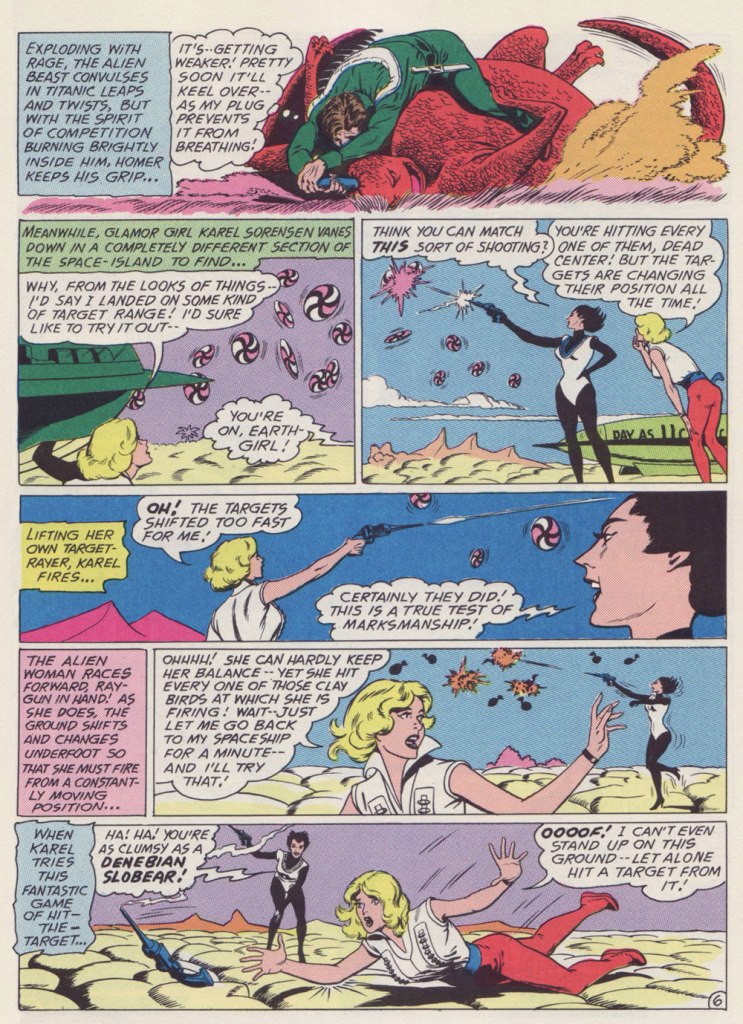
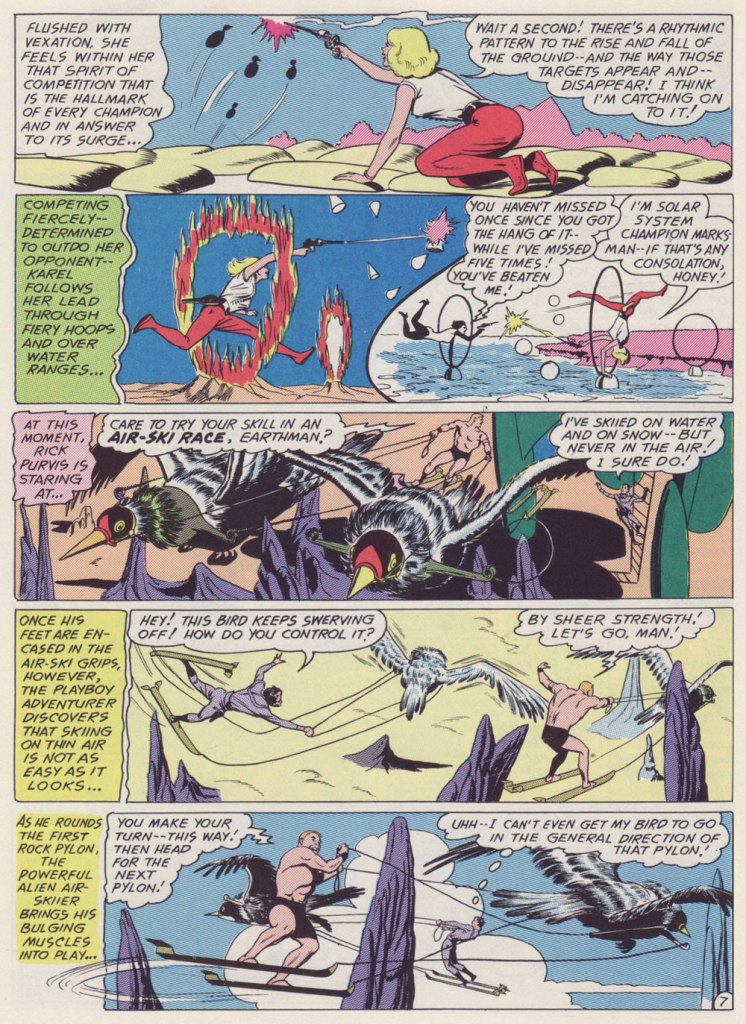
The other day, my partner was trying out a video game whose soundscape seemed exceptionally judicious and well-integrated to the action. At one point, she noticed that the optimal way to play was by matching one’s pace and movements to the musical rhythm. I said, “Oh, it’s just like that Star Rovers story!”
And now for a bit of context: The Star Rovers was a short-lived series that sporadically appeared in the back of DC’s Julius Schwartz-edited titles, mainly Mystery in Space, backing main feature Adam Strange.
As Michael Uslan beautifully puts it, in his introduction to Mysteries in Space: The Best of DC Science-fiction Comics (Fireside/Simon and Schuster, 1980):
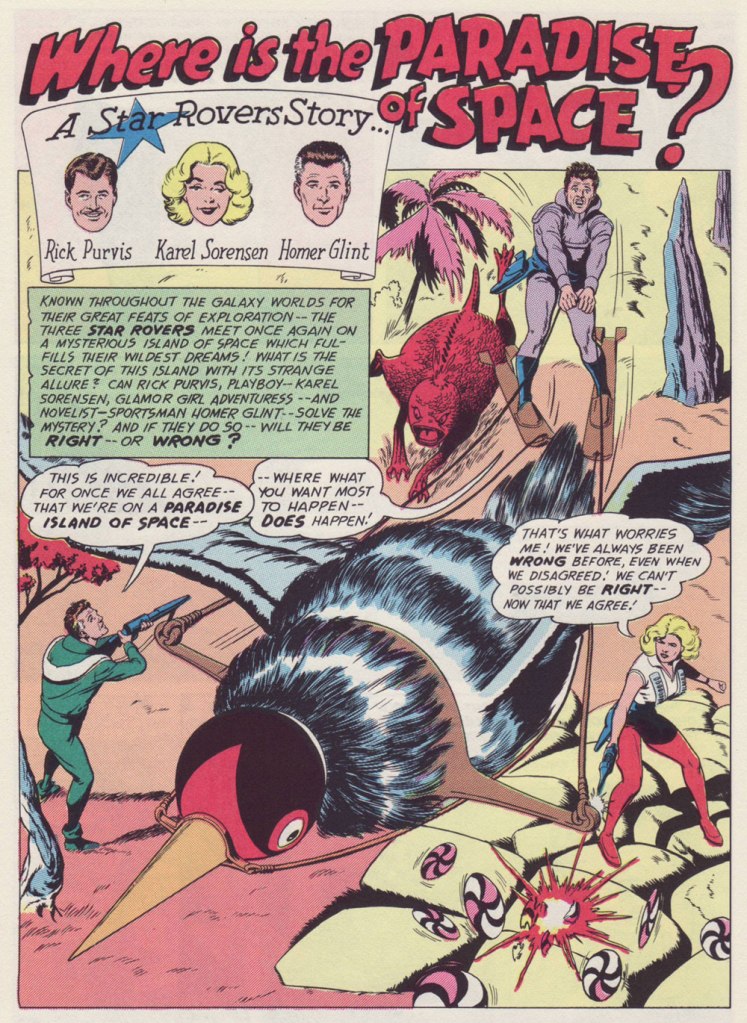
« The Star Rovers were a whole other category of space heroes, typical of the kind of originality demanded by Julius Schwartz. A transgalactic trio of playboy, glamor-girl and novelist-thrill-seeker, they rarely agreed about anything and were rarely right about anything even when they did agree. »
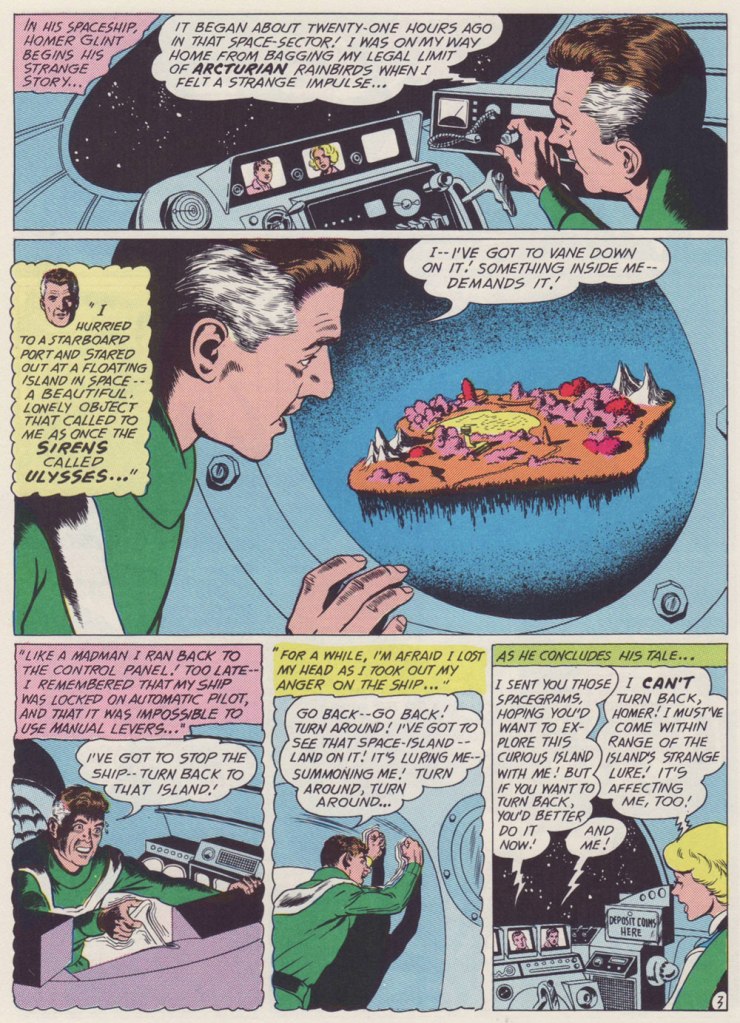
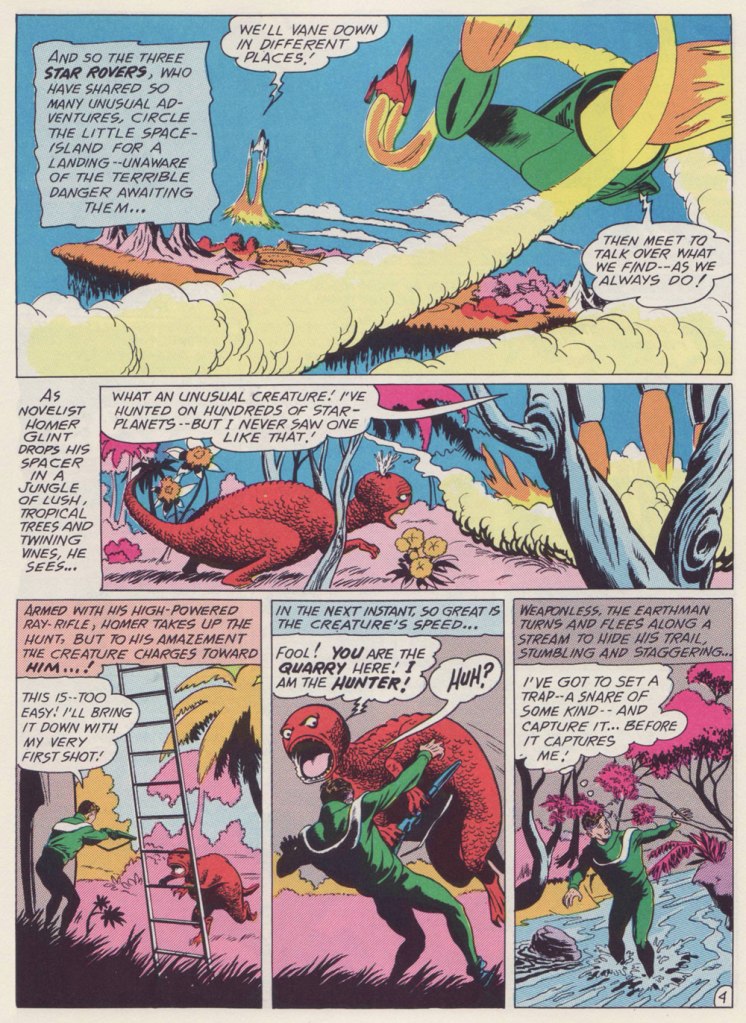
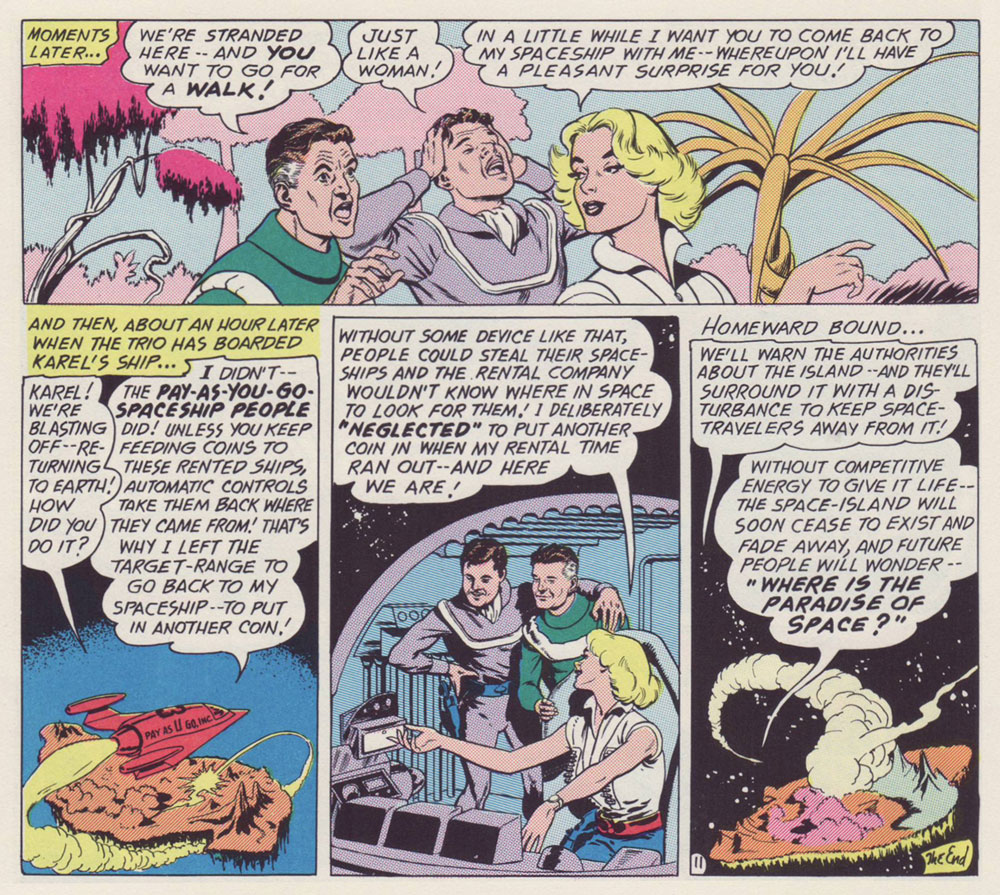
This is the third Star Rovers episode, Where Is the Paradise of Space?, from Mystery in Space no. 74,Mar. 1962, DC).
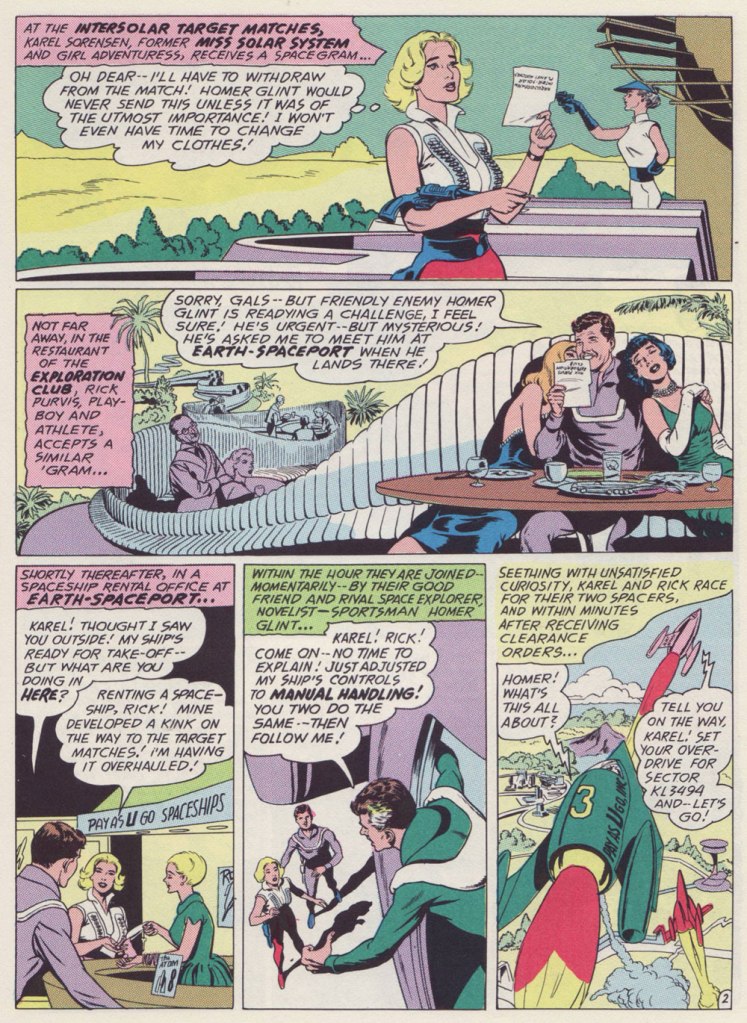
This is the sequence that brought this story to my mind.
One of the most charming aspects of the Star Rovers is the protagonists’ equal footing. In this case, Karel is a bit more than the fellows’ equal, but the series is mostly exempt of the sexism you’d expect from the period of its creation.
Much of the appeal of the Star Rovers is that they’re not a team: they’re friendly rivals, ‘frienemies’, as we’d call them these days. Aside from matching wits and theories, they never directly compete, as differences in their fields of endeavour would make the exercice pointless. There’s a light, jovial tone to these mysteries, yet they can still be taken seriously as intriguing puzzles.
All nine episodes were edited by Schwartz, scripted by Gardner Fox, and illustrated by Sid Greene (1906-72). The latter, a veteran of the comics industry with published work going back to 1940, arguably turned in the finest work of his busy career, and likely would have kept on doing so had it not been for… Batman’s troubles.
To make a long story short, as the Batman titles were shedding readers like there was no tomorrow (making it possible that there would, indeed, be no tomorrow), DC bigwigs opted to switch things around a bit, pulling editor (and Jack Kirby blackballer) Jack Schiff off Batman and Detective Comics and handing him the reins of Schwartz’s SF titles Strange Adventures and Mystery in Space. He ran those into the ground, but in goofily entertaining fashion, at least. Unlike the bat-books, there were expendable to DC.
As the ultimate Star Rovers tale appeared in the final issue of the Schwartz-edited Strange Adventures before the changeover, it seems likely that the series would have carried on under a Schwartz régime. But the Rovers weren’t at all in Schiff’s wheelhouse: the delicate premise called for deft, intricate plotting and wit, qualities not to be found within Schiff’s stable of writers. Gardner Fox and Greene were among Schwartz’s trusted confederates, and talent poaching was rarely allowed within DC’s editorial enclaves.
After this editorial switch, Greene was, with few exceptions, put to work inking the pencils of Schwartz’s big three: Carmine Infantino on Batman and The Elongated Man, Gil Kane on Green Lantern and The Atom, and Mike Sekowsky on Justice League of America. The problem, at least as I see it: Greene’s inks didn’t mesh well with any of these pencillers’ styles. Oh well — it’s a living. At least Greene was able to return to full pencil and ink duties on a handful of short stories for editor Murray Boltinoff, mostly in the pages of The Unexpected. Better late than never.
Finally, for your edification and amusement, here’s a Star Rovers checklist:
Who Caught the Loborilla? (Mystery in Space no. 66, Mar. 1961) What Happened on Sirius-4? (Mystery in Space no. 69, Aug. 1961) Where Is the Paradise of Space? (Mystery in Space no. 74, Mar. 1962) Where Was I Born– Venus? Mars? Jupiter? (Mystery in Space no. 77, Aug. 1962) Who Saved the Earth? (Mystery in Space no. 80, Dec. 1962) Who Went Where– and Why? (Mystery in Space no. 83, May 1963) When Did Earth Vanish? (Mystery in Space no. 86, Sept. 1963) Will the Star Rovers Abandon Earth? (Strange Adventures no. 159, Dec. 1963) How Can Time Be Stopped? (Strange Adventures no. 163, Apr. 1964).



































 Who's Out There?