Tentacle Tuesday Masters: George Wilson and His Painted Covers for Gold Key

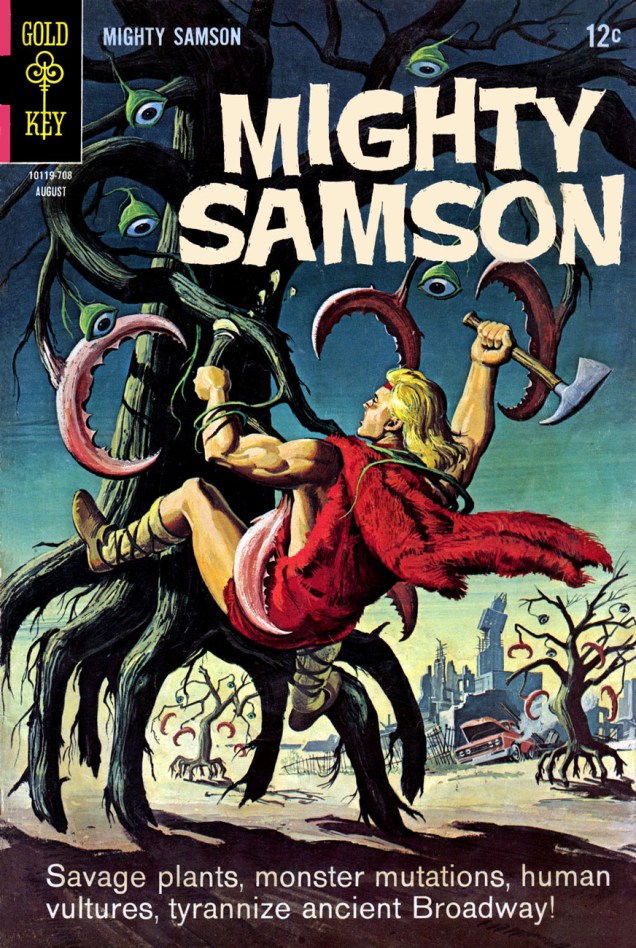
« Savage plants, monster mutations, human vultures… »

George Wilson (1921-1999), prolific cover illustrator for Dell Comics and Gold Key from the 1950s through to the 1970s, is such a ubiquitous figure for anyone interested in comics of that era that it’s almost like he’s taken for granted by comic aficionados. “Oh, yes, another gorgeous George cover”, we say and move on to something else. Let’s not, shall we? We can admire his trademark bright colours, eye-popping attention to detail and impeccable compositions *and* celebrate Tentacle Tuesday. And there’s all kinds of tentacles in these covers – organic or motorized, animal, mineral, or… plant-like. (I refuse to use “vegetable” as an adjective.)
mightysamson11-georgewilson
Mighty Samson no. 11 (August 1967). This might just be the most random menace (and the most ridiculous set-up) I’ve seen in a while.

Mighty Samson was created by writer Otto Binder and artist Frank Thorne, and involved a heroic barbarian-type sword-and-sandaler loitering around a dystopian, post-nuclear disaster world that has reverted to something resembling the Stone Age. One thing that amused me – not only is our dashing hero blond, but so is his love interest (apparently recessive traits help survive radioactivity). The evil temptress-cum-scientist is a dark-haired femme fatale, obviously. You can read each and every issue of Mighty Samson here.

mightysamson11-detail
Panels from “The Swamp Rats“, written by Otto Binder and drawn by Jack Sparling, whose art is for some reason hated by many (the same many who have no trouble with bad art from other, more publicly accepted artists).

TentacleTuesdayIcon

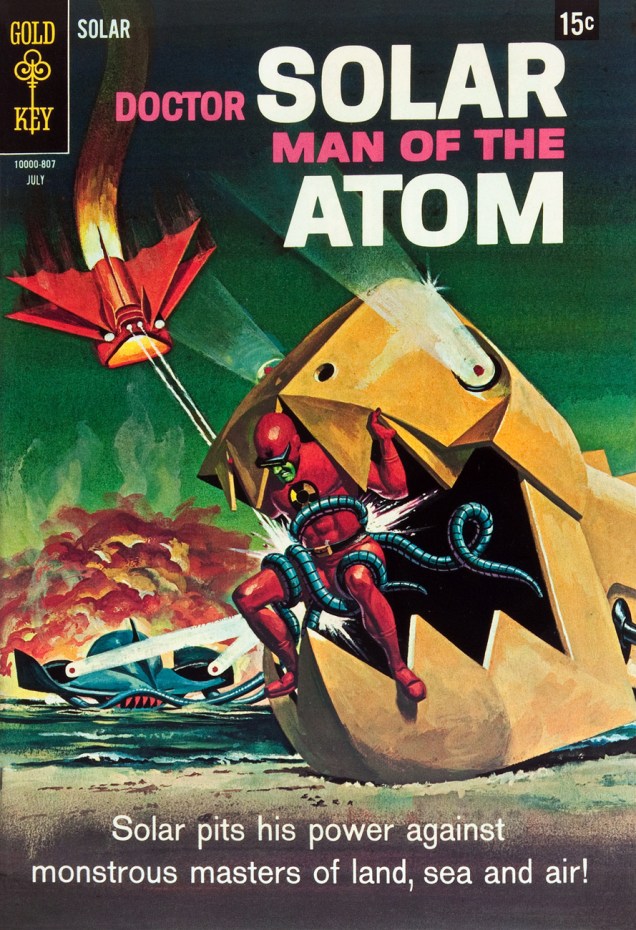
Doctor Solar, created by writer Paul S. Newman and editor Matt Murphy, was fairly humble at first, despite his somewhat ponderous moniker. (« The Man of the Atom »!) Originally clad in a normal lab-coat, he acquired his red costume in issue 5. The source of his super-powers? A nuclear disaster, of course. It’s difficult to be impressed by that when everyone and their auntie is getting exposed to radioactivity. I try to keep in mind that Doctor Solar was one of newly-formed Gold Key’s first publications, and in 1962, a nuclear war seemed imminent whatever side of the continent you were on… but I’m still bored. There’s a list of Atomic Superheroes with 27 items in it here, but it only includes public domain characters.

Of special interest are the first two issues of this series because they boast glorious covers by Richard Powers. Go look at them. That’s an order.

doctorsolar-mnoftheatom26-grogewilson
Doctor Solar, Man of the Atom no. 21 (October 1967).
doctorsolar24
Doctor Solar, Man of the Atom no. 24 (July 1968).
doctorsolar24-detail
Page from “The Deadly Trio”, written by Dick Wood and drawn by Ernie Colón. That “monstrous master of the sea” is so freaking cute!

All of Gold Key’s Doctor Solar run is available here. How much time do you have on your hands, anyway?

TentacleTuesdayIcon

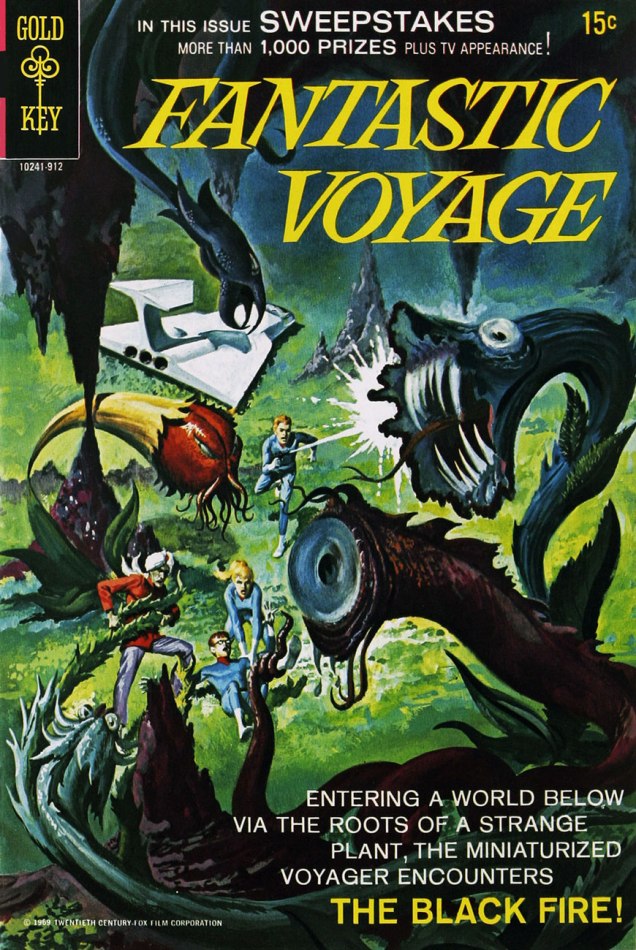
fantastic-voyage-number2-georgewilson
Fantastic Voyage no. 2 (December 1969).

This two-issues “series” features « adventures based on the cartoon about the Combined Miniature Defense Force (CMDF) with Jonathan Kidd, Erika Lane, Dr. Guru, and Busby Birdwell. » Clearly, nobody cared about the comic. Maybe someone cared about the animated TV series the comic was based on.

TentacleTuesdayIcon

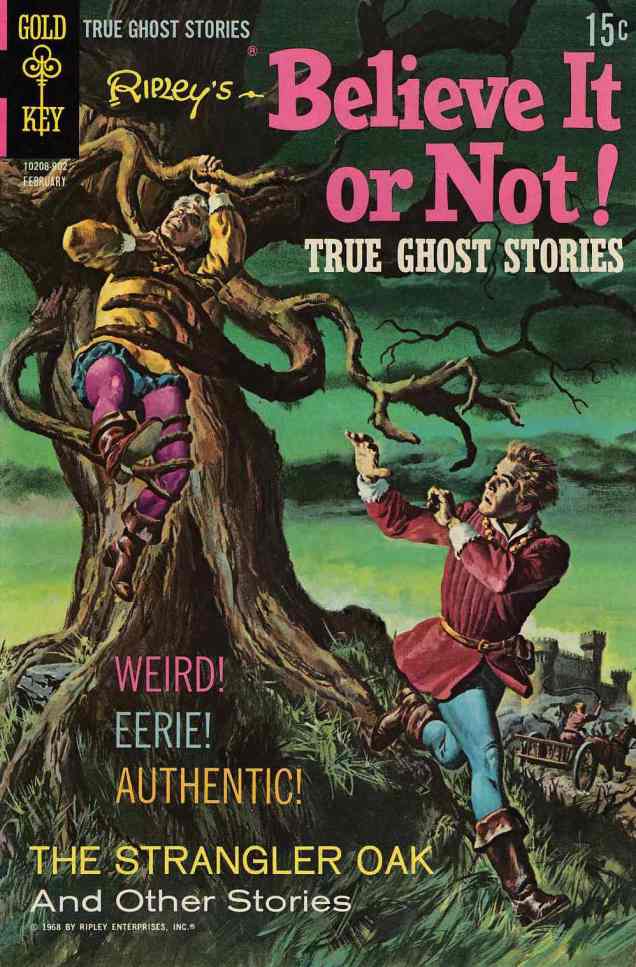
Speaking of boring… I haven’t yet encountered *one* issue of Ripley’s Believe It or Not! that wouldn’t cause me to yawn or start rolling my eyes. However, painted covers are often worth dwelling on, and the inside art is also occasionally quite nice (especially when it’s by Luis Dominguez).
ripley's believe it or not! #12
Ripley’s Believe It or Not! no. 12 (February 1969).

TentacleTuesdayIcon

themicrobots1
The Microbots no. 1 (December 1971). The tentacled monster was designed by Jack Sparling, who illustrates This Is the Way the World Ends and Day of the Juggernaut, but the cover art is by George Wilson.

There’s an excellent (and suitably sarky) review of this one issue of Microbots on Gone & Forgotten. Here’s a little taste: « Superstitious, parochial, and frequently eaten alive by mutated elephants, the people of the future world have turned their backs on technology. » Bet you’ve never seen *that* sentence before. Or — « The Microbots are the creation of Dr. Norman Micron (of the Connecticut Microns, I presume), a scientist living in the dire times of a world succumbing to man’s pollution. ‘Mankind had ample warning that he was destroying the world around him’ he muses, standing by a window with a highly-desirable garbage view. »

TentacleTuesdayIcon

The crew of the Starship Enterprise keeps running into tentacles, it seems. (Presumably, they couldn’t do it as convincingly on the TV show, as the visual effects weren’t quite up to snuff.)

startrek24-georgewilson
Star Trek no. 24 (May 1974). Gold Key published Star Trek comics between 1967 and 1978, for a total of 61 issues. They weren’t a rehash of the TV series, and featured original characters and stories, although later issues included sequels to a couple of episodes (which is pretty cool, if you ask me).
startrek29-georgewilson
Star Trek no. 29 (March 1975).

Gail O’Brien shared this snippet on a forum about Wilson’s art, sadly a fairly typical story: « You might be interested to know that George’s widow (a friend of mine) has had no income from his paintings as they “disappeared” from his estate at his death while they were separated. She is presently living on small retirement from teaching. I’ve tried to influence her to seek legal advice to acquire her share of George’s sales, but she feels it is impossible… hope there is a lawyer who enjoys George’s work, who would want to go on a 50/50 basis to acquire what is rightfully belonging to my friend. » |source|

Look at more (less tentacle-centric) George Wilson art here.

~ ds

Little Dot’s Playful Obsession

« Y’gotta develop an annoying compulsion if y’wanta get anywhere in this world! » — Dan Clowes’ Willy Willions (Eightball No. 5, Feb. 1991)

Dorothy Polka, known to the world at large as « Little Dot », made her first appearance in Harvey’s Sad Sack Comics no. 1 (Sept. 1949). All you need to know is that she’s inordinately fond of dots and circles, and that she has an absurdly large extended family. That raises a few choice questions, but we’ll leave them for someone else to tackle.

While I cheerily dismiss the bulk of Harvey Comics’ post-Code output as at best charming in a decidedly minor way, I opt to focus on the line’s most singular highlight: art director/chief artist Warren Kremer‘s endlessly inventive and escalatingly bonkers cover variations on the Harvey stable’s absurdly formulaic monomanias. Kremer clearly viewed the preposterous task he’d been handed as an opportunity to continually challenge himself with elegant design exercices and experiments. While I see little point in collecting, nor even reading most Harvey Comics, my admiration for Mr. Kremer just grows and grows. Perhaps these examples will give you a sense of what I see in them.

Oh, and bonus points to Kremer for his increasingly callous treatment of that omnipresent visual blight, the Comics Code Authority stamp. Clearly, he judged the censorious seal de trop.

LittleDot29A
Little Dot no. 29 (January, 1958)
LittleDot38A
Little Dot no. 38 (October, 1958)
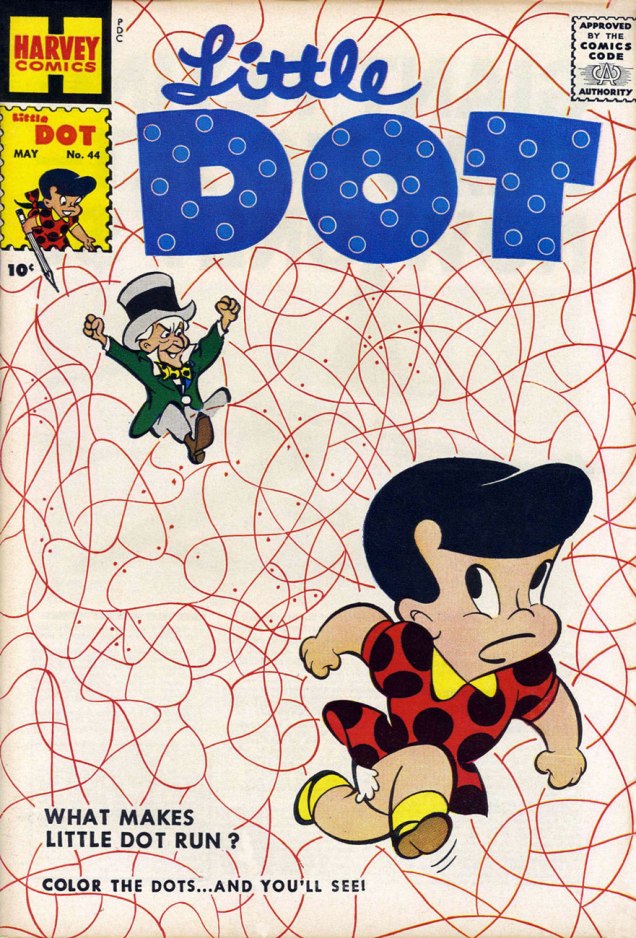
LittleDot44A
Little Dot no. 44 (May, 1958)
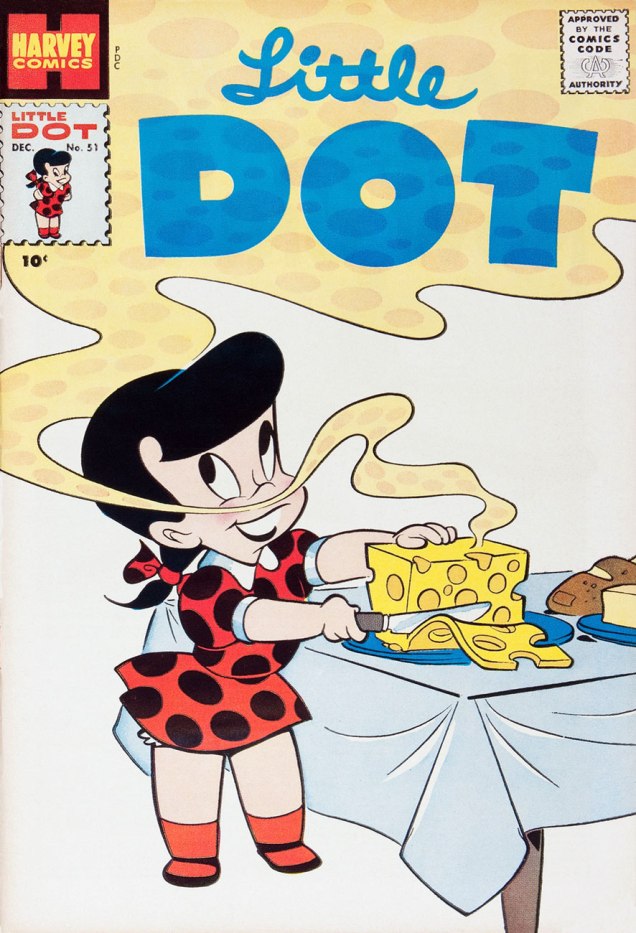
LittleDot51A
Little Dot no. 51 (December, 1959) Gruyère? Impressive refinement for a little kid. Perhaps there’s more to the little lady than meets the eye…
LittleDot52A
Little Dot no. 52 (January, 1959)
LittleDot97A
Little Dot no. 97 (January, 1965)
LittleDot119A
Little Dot no. 119 (October, 1968)
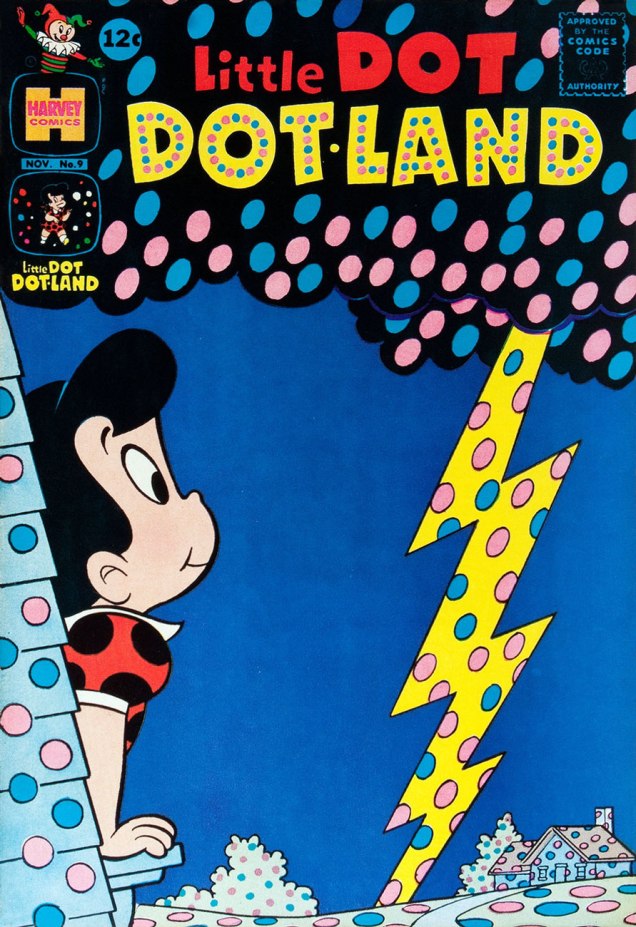
LittleDotland9A
Little Dot Dotland no. 9 (November, 1963)
Dotland38A
A timely one: Little Dot Dotland no. 38 (March, 1969)
DotUncles21A
Little Dot’s Uncle$ and Aunt$ (they’re loaded, I guess) no. 21 (November, 1967)

-RG

John Severin, ‘Super Comics’ Cover Man

« I got into the comic business the same way I got into the bubble gum business: somebody gave me a job. » — John Severin

I’ve said it before, and I still feel that way: If you’re going to discuss a career of such length, variety, depth and consistency as John Severin’s (from the late 1940s to the early 2010s!) it’s simply too easy to lose your way in the details, sidebars and bifurcations. Best to pick a small area and stick to it, particularly if you don’t have the luxury of endless pages to devote to the task.

Speaking of sidebars: In this forum, I keep returning to the topic of Israel Waldman and his dodgy, but mesmerizing publishing ventures. The many scattershot titles issued under the IW / Super Comics (1958-1964) banner were printed on shoddy paper (which makes them, nowadays, nearly impossible to find in any sort of decent shape), were sold outside the usual channels (in bags of three through department stores, and not the fancy ones at that), consisted of rather hoary, indifferently-packaged reprints… but foxy businessman Waldman didn’t scrimp on the one count that mattered: he shelled out top dollar to commission top talent to create attractive covers. That sweet old bait-and-switch.

Sure, some of these random assemblages of decaying pulp happen to be good comics, but given the nature of odds, it was bound to happen.

John Powers Severin, born ninety-seven years ago today (Dec. 26, 1921-Feb. 12, 2012), was part of Waldman’s cadre of cover artistes, and he delivered beautifully, as he always did, right to the end of his career.

Here, then, are some highlights of these little-seen Severin pieces. Happy birthday, Mr. Severin!

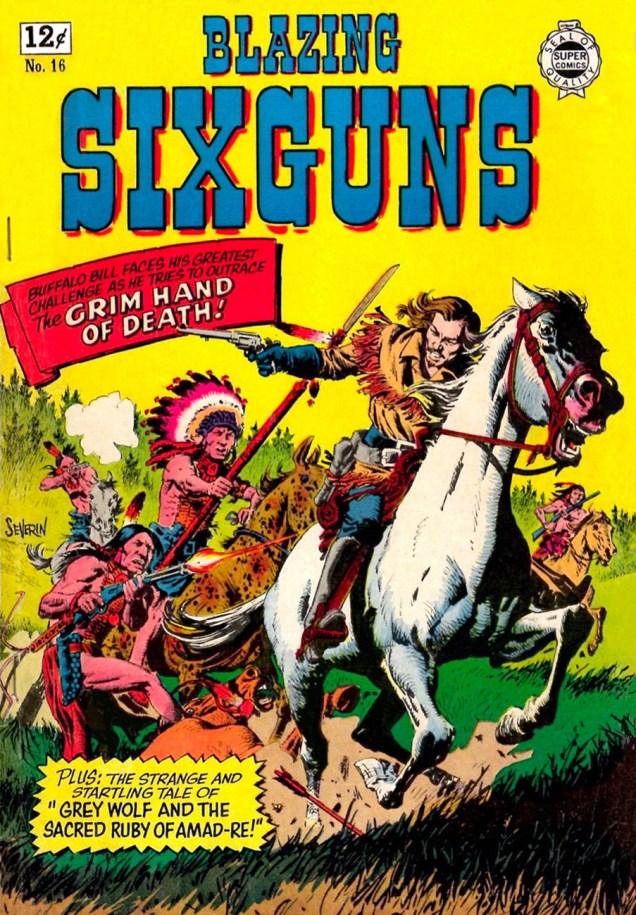
Blazing6guns16A
Blazing Sixguns no. 16 (1964), ten issues, 1958-1964. Read this issue here.
Danger10A
Here’s Danger no. 10 (1963), the first of  seven issues. Read it here.
FantasticAdv10A
This is Fantastic Adventures no. 10 (the first of seven issues, 1963-64). Read it here.
Gufighters18A
Looks like Marvel’s Kid Colt did a bit of moonlighting for Super Comics (as did king of all media Gabby Hayes!). This is Gunfighters no. 18, fifth and final issue of the series (1958-1964).
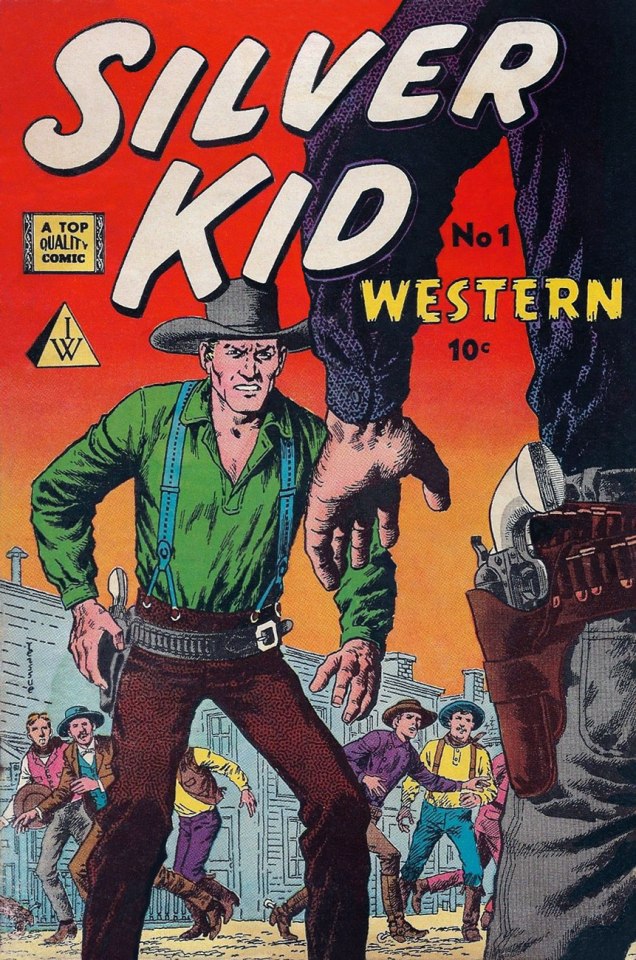
SilverKid01A
This is Silver Kid Western no. 1 (1958), first of two issues. Read it here.
Robin-Hood9A
This is Robin Hood no. 9 (1958),  third of five issues (1958-1964). Read it here.
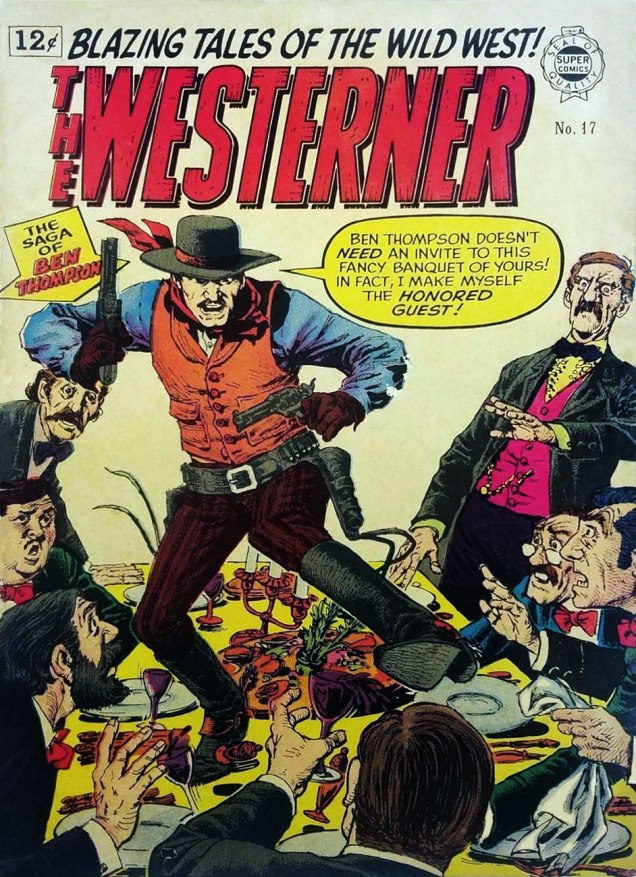
Westerner17A
An alternative view of table étiquette from real-life figure Ben Thompson. This is The Westerner no. 17 (1964), third of three issues.

And if you’re hankering for more John Severin, check out our earlier post and/or this illuminating, life-spanning and definitive Comics Journal interview.

-RG

Tentacle Tuesday: Convoluted Critters

Occasionally, I notice a comic book cover with a tentacled monster so peculiar that one starts wondering whether the artist was on drugs or just couldn’t give a shit. That is not a criticism, however: where grabby appendages are concerned, the weirder, the better. Even if some of these guys have a face (muzzle? rictus?) even a mother couldn’t love, or their anatomy defies all laws of biology, we’ll welcome them with open arms!

As usual, in chronological order.

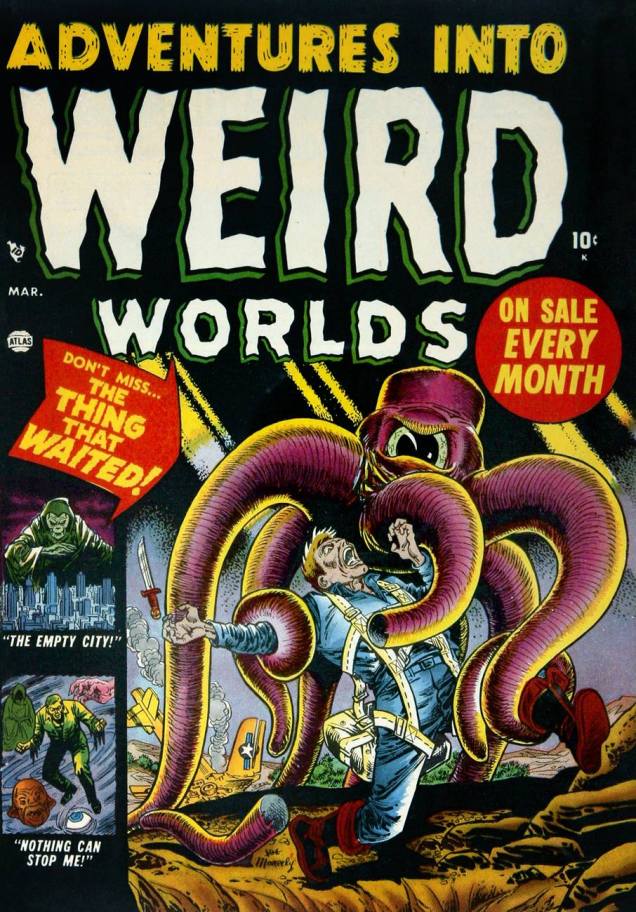
First in our line-up is this little fella in a hat. At least he looks like he’s wearing a cap, although perhaps he just has a square head with a skin flap hanging over the sides. At first glance, his tentacles are hollow, although their flesh is probably just a dull shade of battleship grey. So what’s this “thing that waited”? Soviet soldiers who are actually alien invaders. Duh.

AdventuresintoWeirdWorlds3
Adventures Into Weird Worlds no. 3 (March 1952), cover by Joe Maneely.

This next cover is probably a little more standard for pseudo-octopus fare: a lady with huge, ahem, bazooms (Russ Heath liked ’em busty, it seems – seriously, just look at the size of those things!) threatened by some horrific monster who’s dispatching her companion as expediently as possible. Still, the somewhat Wolverton-esque, grave-dwelling aliens with pincers at the end of their tentacles are odd-looking enough to squeeze their way into this post.

Spellbound20A
Spellbound no. 20 (March 1954), cover by Russ Heath.

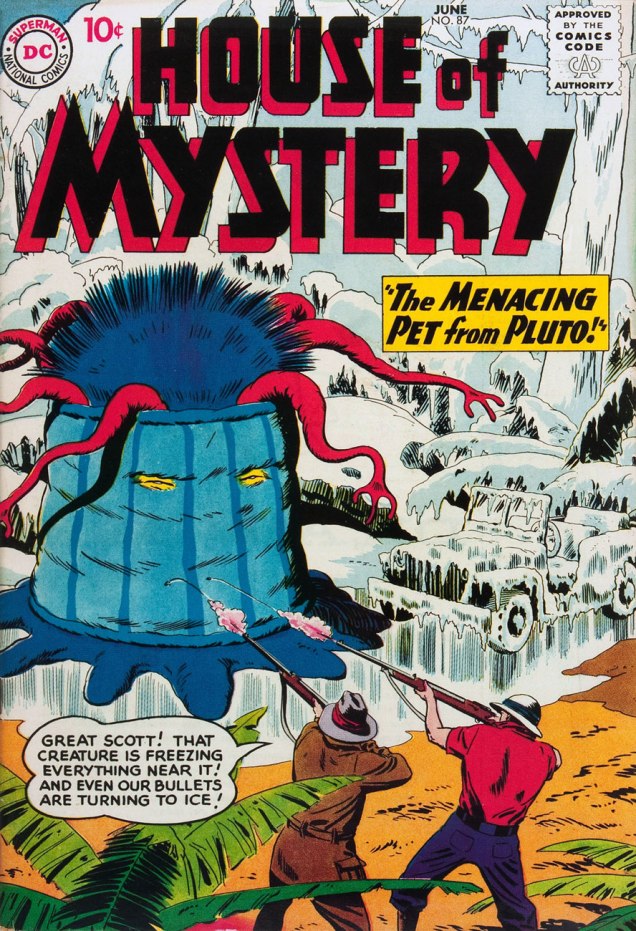
This toupee-clad creature with evil gimlet eyes doesn’t look much like a pet, if you ask me. How are those grabby little arms attached to its head, anyway? Wait, who am I talking about, again? 😉

HouseOfMystery87
House of Mystery no. 87 (June 1959), cover by Bob Brown.

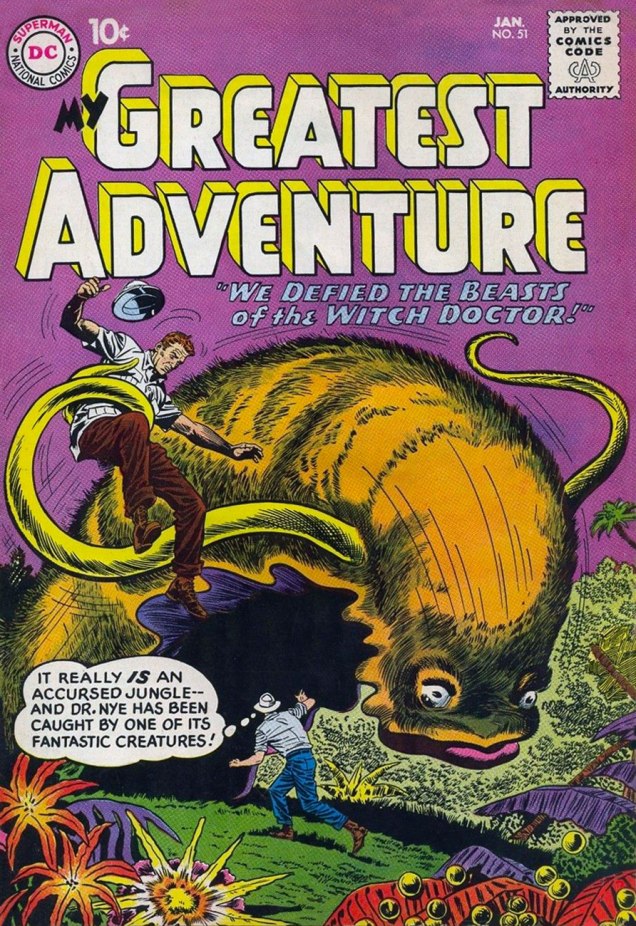
“My Greatest Adventure” was a title that promised much, and it must have been difficult to live up to it every month. Witness the following “fantastic” creature – a furry slug with disturbingly fleshy lips and tentacles. I can’t vouch for my reaction had I been an excitable ten-year old, but to this blasé adult, the poor beast summoned by some psycho witch doctor (the jungles seem to be always overrun with them) is just begging to be put out of its misery.

MyGreatestAdventure51
My Greatest Adventure no. 51 (January 1961), pencilled by Dick Dillin and inked by Sheldon Moldoff.

Our next exhibit finally features a proper alien, one who looks strange but at least makes sense as a unified, functioning creature. I love his sadly drooped whiskers, his dejected expression that’s strangely at odds with his pontifical speech.

Tales oftheUnexpected66
Tales of the Unexpected no. 66 (October 1961), cover by Bob Brown.

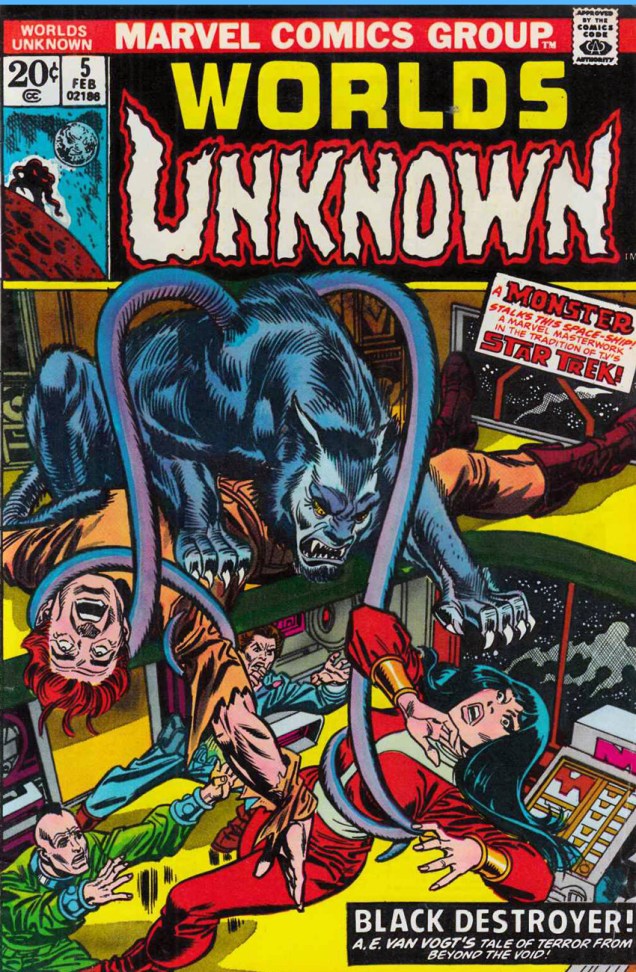
« Make him a werewolf! But in space! And give him tentacles! » Yeah, guys, that went over really well. A Marvel Masterwork, my ass. But wait: Black Destroyer! is an adaptation of A. E. van Vogt’s short story from 1939. And did Cœurl, the black cat-like creature, have tentacles in the story? Why, yes, he did.

« His great forelegs—twice as long as his hindlegs—twitched with a shuddering movement that arched every razor-sharp claw. The thick tentacles that sprouted from his shoulders ceased their weaving undulation, and grew taut with anxious alertness. Utterly appalled, he twisted his great cat head from side to side, while the little hairlike tendrils that formed each ear vibrated frantically, testing every vagrant breeze, every throb in the ether. » (read the full story here.)

WorldsofUnknown5
Worlds Unknown no. 5 (February 1974), cover pencilled by Gil Kane and inked by Frank Giacoia. Cœurl looks like he’s floating on top of the corpse – I don’t think the artists spent too much time watching an actual cat at work.

Read the comics version of Black Destroyer! here.

My last offering for today is the cutest, featuring an adorable blue varmint who gets my full sympathy and support. Weird? Sure, a bit – he’s got a tentacle sprouting out of his forehead – but beauty is in the eye of the beholder, right? This cover also proves that monsters are just as interested in tooth-whitening procedures as us humans.

TheDefenders72
The Defenders no. 72 (June 1979), pencilled by Herb Trimpe and inked by Al Milgrom.

~ ds
Tentacle Tuesday: Lovey-dovey Octopuses

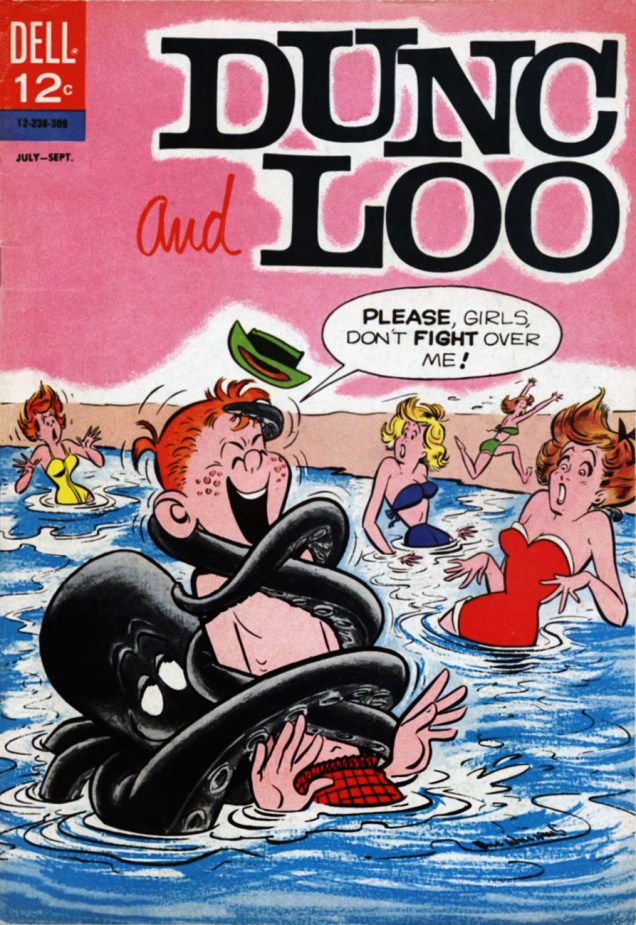
Dunc and Loo (which was called « Around the Block with Dunc & Loo » for the first three issues) was a comic written and story-boarded by John Stanley. (See our initial post about John Stanley, including more D&C covers.) The finished art for the series was provided by Bill Williams. This combination worked perfectly to provide readers with (only eight, alas) hilarious issues of teenage high-jinks and other silliness.

Dunc-and-Loo7
Dunc and Loo no. 7, July-September 1963, art by Bill Williams.

You can read the whole issue over at Comic Book Plus – no tentacles, I’m afraid, but some gorgeous art and zany stories. It’s well worth the detour!

TentacleTuesdayIcon

Hey, octopuses like surfing, too. Or maybe this one just wanted the blonde for himself…

Adventures-of-Bob-Hope94
The Adventures of Bob Hope no. 94, 1964. Art by Bob Oksner… I think.

The Adventures of Bob Hope were published by National Periodical Publications from 1950 to 1968, for a total of 109 issues. The main stories centred around comedian Bob Hope (or his misadventures, rather); the cover stories often featured some other film-related characters. The original artist of the series was Owen Fitzgerald, with Cal Howard as the writer. Official credits aren’t really available, but these two seemed to provide much of the content for the first 60 issues. In #61, however, Mort Drucker (on main stories) and Bob Oksner (on back-ups) made their debut, and continued on their merry way until, oh, 1967 or so. In case you’re interested, Neal Adams did the last 4 covers for the series (eek).

TentacleTuesdayIcon

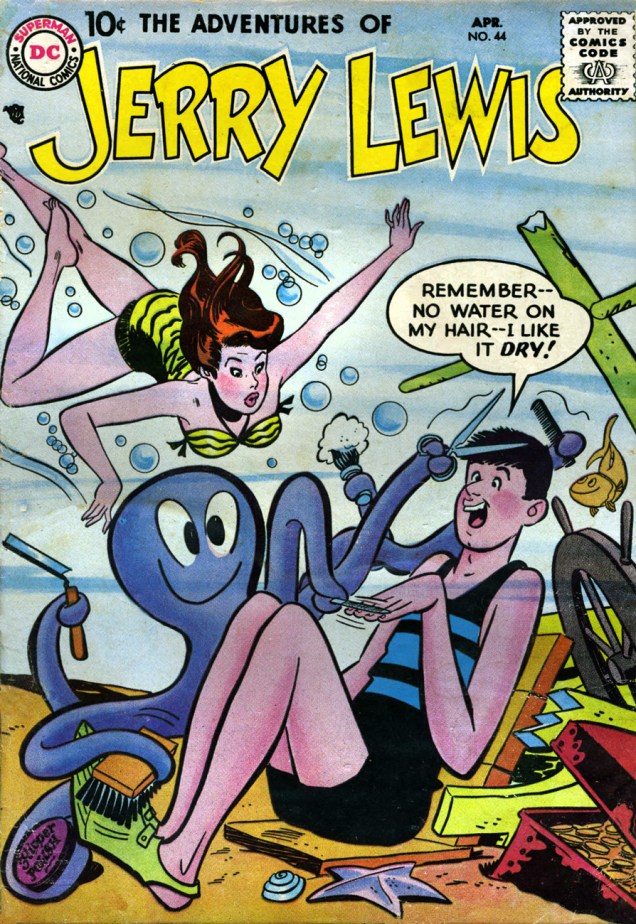
Here’s another series that followed a pretty similar path (unsurprisingly – same publishing house, comparable years, same subject matter): The Adventures of Dean Martin & Jerry Lewis (July-August 1952 – October 1957) that became The Adventures of Jerry Lewis with #41 (November 1957). The art, handled mostly by Owen Fitzgerald in the beginning, gradually landed increasingly into the more-than-capable hands of Bob Oksner, who stayed around until the end with issue #124 (June 1971). Here, also, Neal Adams stuck his nose in, this time for three issues (covers of #102 through to #104).

JerryLewis44
The Adventures of Jerry Lewis no. 44 (April 1958). Art is, presumably, by Bob Oksner, though GCD tentatively attributes it to Owen Fitzgerald.

Read this issue over at Ominous Octopus Omnibus (what could be more appropriate on Tentacle Tuesday?)

JerryLewis44-panel

~ ds

Hallowe’en Countdown II, Day 28

« No matter what scientists say, lumbermen of the West insist that the monster exists… Believe it or Not! » — the standard Ripley’s line, from The Beast of the Humboldt

In the early 1960s, former industry leader Dell Publishing suffered a crushing blow when Western Publishing, who had been producing Dell’s comics for them since 1938, decided to handle their own distribution, which left Dell with, well… just about zilch*. But that’s neither here nor there.

Dell had opted out of the Comics Code Authority, and Western’s subsequent comics, under the Gold Key banner, also enjoyed that advantage, not that they abused the privilege much, though the exceptions are among the finest comic books ever issued: Ghost Stories No.1 and the one-shot giant Tales From the Tomb, both from the phenomenal mind of John Stanley and published by Dell in the fall of 1962.

By the mid-1960s, Warren Magazines had pounced through the loophole of the magazine format, unregulated by the Code, to bring back monsters forbidden under the CCA’s rule. Gold Key required no such stratagem.

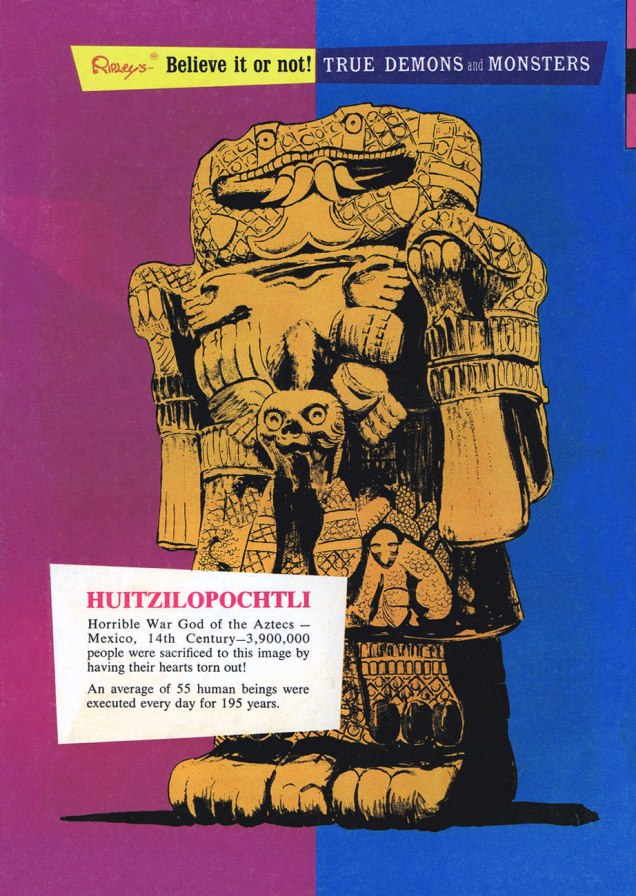
At first, GK’s long-running (1965-1980, 94 issues) Ripley’s Believe It or Not! * couldn’t decide on a focus: 14 of its initial 26 issues were devoted to « True Ghost Stories », two related « True War Stories », two shared « True Weird Stories », and six tackled « True Demons and Monsters ». With issue 27, the title stuck to ghosts, if not to the strict truth.

CertaVamp01A

CertaVamp02A

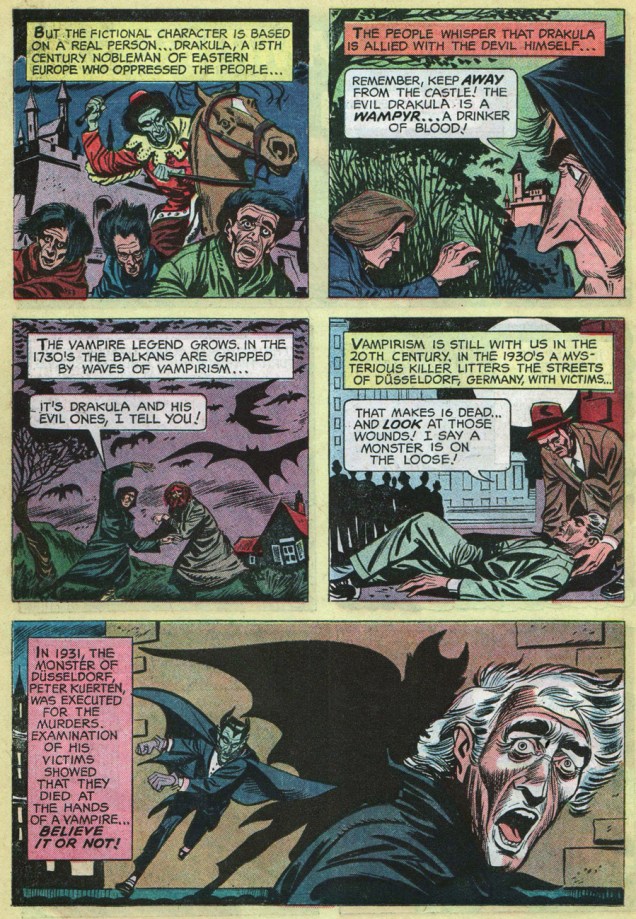
This is an excerpt from Ripley’s Believe It or Not! no. 4 (April, 1967), featuring the work of the much underrated Joe Certa (1919-1986), who began his comics career in the mid-1940s, working in just about every genre for a score of publishers, settling with Gold Key in the mid-60s and staying on until his retirement in 1980. He’s most remembered for his co-creation (with writer Joseph Samachson) of, and lengthy stint on J’onn J’onzz, the Martian Manhunter (1955-68), as well as for drawing every single issue of Gold Key’s loose adaptation of television’s first supernatural soap, Dark Shadows (35 issues, 1969-76). By this time, Certa’s style had evolved from a fairly mainstream style to a wonderfully blocky, angular and shadowy style that left him ill-suited to the depiction of standard superheroics… but prepared him well for moodier fare.

Ripley's4A
Issue 4’s front cover. Most of them featured often-splendid paintings by George Wilson, Jack Sparling or Luis Angel Dominguez, but the occasional effective photo cover crept in.
Ripley's4VersoA
Here’s a harsh factoid that makes vampires seem cuddly by comparison.

– RG

*the one priceless creative asset that Dell managed to hold onto was John Stanley, not that they appreciated him. When he left the industry, it wasn’t with a carefree grin and a spring in his step.

** « Ripley’s Believe It or Not! is a franchise, founded by Robert Ripley, which deals in bizarre events and items so strange and unusual that readers might question the claims. The Believe It or Not panel proved popular and was later adapted into a wide variety of formats, including radio, television, comic books, a chain of museums and a book series. »


Hallowe’en Countdown II, Day 3

« It was like plunging deeper and deeper into a growing nightmare! »

A powerful (what else?) Jack Kirby piece, one of his last before decamping to DC. He actually gets a full writer/artist credit (a telling tail end turning point of that Marvel residence) on this tale, … and Fear Shall Follow!. The lush cover inks are provided by fellow Golden Age titan Bill Everett (1917-1973), a far cry from the miserable Vince Colletta « finishes » he would be saddled with at DC for the next couple of years (at their insistence!)

KirbyCOD5A

I was planning on featuring the entire story, but others have long ago preceded me down that primrose path. Why fight it? Just pay Diversions of the Groovy Kind a visit, where you’ll receive, as a bonus, Kirby’s other solo outing for the House of (mostly his) Ideas, The Monster!, from the previous issue of Chamber of Darkness (no.4, April, 1970). Both are sympathetically inked by Marvel’s production manager at the time, the underrated and gone-too-soon John Verpoorten (1940–1977). Again, several notches above “Valiant” Vince Colletta’s casual sabotage.

Plot-wise, … and Fear Shall Follow!, while another variant in the Carnival of Souls tradition, is enriched by its unusual setting and whiff of incense and philosophy. Reminds me of a possibly apocryphal exchange between Watchmen editor Len Wein and its writer Alan Moore: « Alan, that ending’s already been done on The Outer Limits! »; (in thick Northampton accent, dripping with sarcasm) « Yes, Len, but it’s never been done by me! ». With all due respect, it’s not as if Mr. Wein had any moral lessons to dispense regarding originality.

– RG

Tentacle Tuesday: Tangles with Adam Strange

« The menacing tentacles came probing down out of the sky in a fantastic quest for the secret of life! »

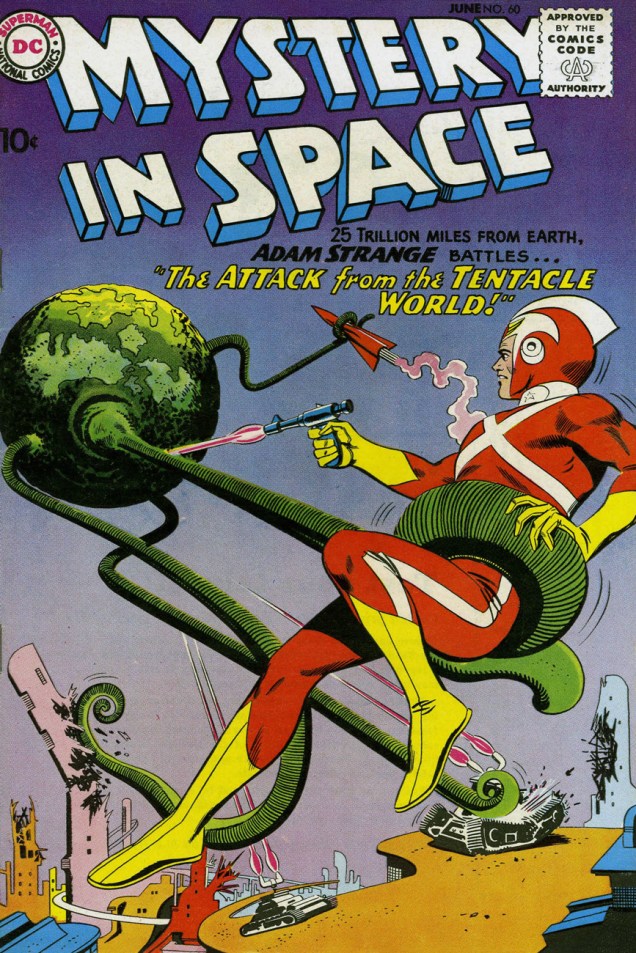
To celebrate Tentacle Tuesday, I’ve planned a visit to the mysterious planet Rann, as seen through the eyes of Adam Strange, that intrepid, quick-witted, teleporting archeologist. (First, a little context: Adam Strange was created by Julius Schwartz, with a costume designed by Murphy Anderson. He first appeared in Showcase #17 (November 1958). At first, Gardner Fox’s scripts were penciled by Mike Sekowsky, but this task was assigned to Carmine Infantino once the character moved to Mystery in Space, with Murphy Anderson inking most of the stories. As much as I like the Infantino + Anderson team, today’s contributions mostly involve other inkers.)

MysteryinSpace60
Mystery in Space no. 60 (June 1960). Cover inked by Carmine Infantino and inked by Joe Giella. “The Attack of the Tentacle World!” is scripted by Garner Fox, pencilled by Infantino and inked by Bernard Sachs.

That green thing? That’s Yggardis, a sentient planet that (who?) craves companionship. Here’s its highfalutin explanation, in that pompous English that Enemies of Mankind use when detailing their raison d’être to their victims: “For uncounted centuries, I have roamed the universe, raiding other worlds for their life-forms, lifting them in my tentacles! Unfortunately no form of living thing which I stole from other planets could live on me more than 24 hours!” The solution to that is (obviously) to steal even more animals for its private, deadly zoo, which is what it proceeds to do on Rann.

Mysteryinspace60-TentacleWorldA

Yggardis’ problem is solved when Adam blows it into carefully calculated smithereens, thus separating its radiation-producing mind from the rest of its inert body. A comparison is made to human surgeons removing deadly tissues and organs from an ailing patient. Uh, yes, surgeons regularly use explosives to sever their patients’ brains from their bodies, thus eliminating the need for expensive medication and such.

MysteryinSpace65
Mystery in Space no. 65 (February 1962), artwork also by Infantino and Giella.

The Mechanimen are anthropoid robots hellbent on protecting humans on Rann, destroying all their weapons on the principle that “weapons breed mistrust! mistrust breeds wars!” When the Mechanimen, while attempting to repel a sneak attack by some hostile aliens, run out of power (they “mechanically never gave a thought to renewing their power” – what?), Adam has to save the day, much like he has to avert disaster every time he sets foot on Rann. How did Rannians ever survive without him around?

AdamStrange-MysteryinSpace65
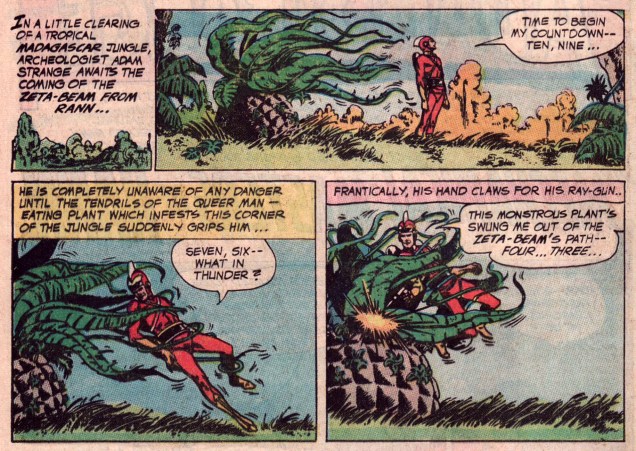
Adam doesn’t only have to confront mechanical tentacles in this issue: he’s also almost swallowed up by plant tendrils. “The Mechanical Masters of Rann” is scripted by Gardner Fox, pencilled by Infantino and inked by Murphy Anderson (ah, finally).

As you’ve probably noticed, Adam Strange stories tend to have gonzo plots. I *like* goofy stories, but these leave me frustrated: they’re far too far-fetched to make any kind of sense, yet they’re not wacky enough to be properly entertaining. The stories toss around “futuristic” terms like sky-radiation and zeta-beams and altered molecular structures, and provide “scientific” explanations that are supposed to make the plot plausible, except that the plot’s still ridiculous, all the more so after these attempts to shoehorn logic into it. It wouldn’t be so bad if Strange wasn’t over-explaining everything – he’s like your best friend’s pedantic dad, droning on about something while everyone feigns interest, sucking out the joy from topics that would otherwise be fascinating.

The other interesting aspect of Adam Strange is the sexual tension – basically, Adam’s zeta-beam wears off every time he and Alanna share an embrace. (That sends him back to Earth until he catches the next beam and gets teleported back to Rann.) That’s an original way of keeping them apart, I have to admit.

AdamStrangeByeAHe’ll be back soon, he says – as will I, with another Tentacle Tuesday.

~ ds
Let’s All Go Down to the Catfights!

Catfight (noun): A vicious fight between two women that features biting & scratching and often involves clothes being ripped off.

To which I’ll add that if you put two women with different hair colours in one room, it’s like there’s a chemical reaction that makes them instantly aggressive. In comics, at least – and we all know that comics reflect real life accurately, right? The resulting combativeness is especially obvious when the encounter is between a blonde and a brunette. The women involved must also be beauties – presumably, plainer girls resort to verbal assaults when provoked, eschewing physical violence, unlike their flashier counterparts.

Or it could have something to do with the mostly-male audience who actively likes watching belles brawl. (Perhaps “ogle” would be a better description.) Let’s move on to the ogling bit, then!

Undercovergirl-catfight
Err, agreed on the “talking too much” bit. Manhunt no. 9 (Magazine Enterprises, June 1948). That art’s by Ogden Whitney.

“Jeepers! Baldy’s been skewered through the ticker! He’s defunct!” This charming scene with boob grabbery and skirt rippery (I know, don’t I have a way with words?) is from “Off Stage Kill”, a Dan Turner Hollywood Detective story from Crime Smashers no. 7 (Trojan Magazines, 1951).

CrimeSmashers7-DanTurnerHollywoodDetective
Script by Robert Leslie Bellem, pencils and inks by Adolphe Barreaux (who was also the editor). Read the issue here. In case you were wondering, Fifi and Brenda are just acting out a fight scene for a movie, although they do get a little carried away (and accidentally skewer Baldy in the process). How many women have a knife tucked away in their garter belt?

Skipping ahead ten years or so…

EricStanton-Steve Ditko-DivorceAgreement
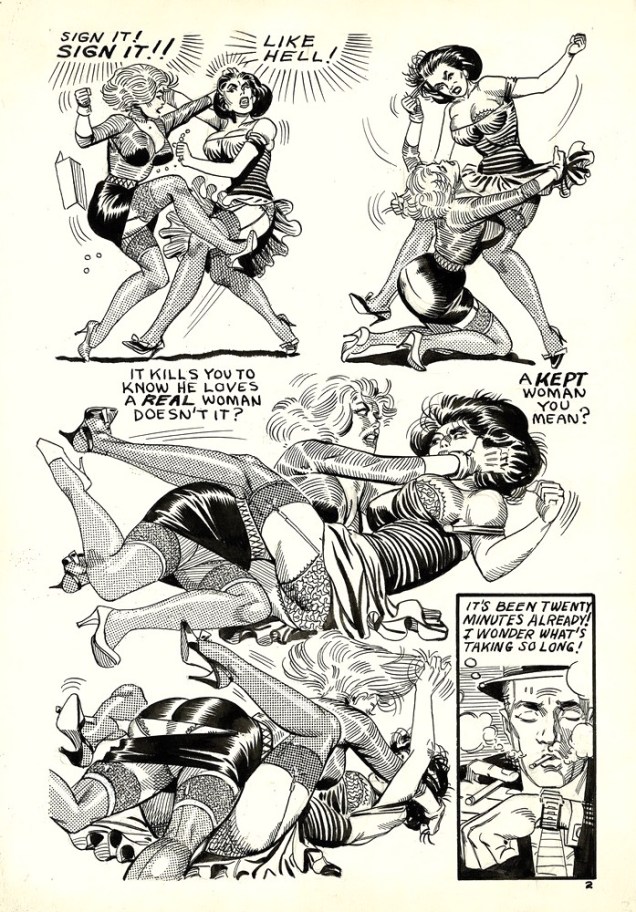
Ditko shared a studio in NYC with artist Eric Stanton between 1958 and 1968, and they collaborated on some bondage comics (or at least it’s commonly assumed that they have – for more information on that, dive into a discussion on the Four Realities blog, or read this excerpt from Fantagraphics’ Dripping with Fear: the Steve Ditko Archives Vol. 5.) This page is from a story published in 1966 and entitled “Divorce Agreement”.

The clothes-shredding and breast-mauling (ouch) continues…

Teena-dailystrip-Dec4th-1966
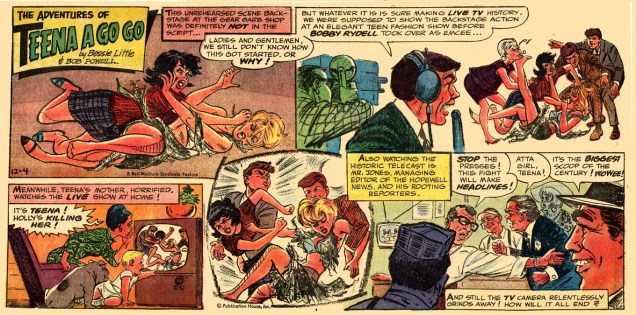
Newspaper comics do it, too! This is Teena A Go Go from December 4th, 1966, written by Bessie Little and illustrated by Bob Powell.

Sometimes Betty and Veronica associations are hard to avoid. These girls also made sure to wear contrasting costumes while fighting, for maximum visual appeal, proving it’s possible to be fashion-conscious even in prehistoric times.

Anthro6A
Anthro (the happy teenager watching this scene, and normally a redhead) will marry the victorious maiden… but the fight is a draw, and so he has to marry both in this “The Marriage of Anthro” story. This is Anthro no. 6 (July-Aug. 1969). Pencils by Howard (Howie) Post (who created Anthro, the “first boy”, a Cro-Magnon born to Neanderthal parents) and inks by Wally Wood. Let it be mentioned that Anthro is an immensely fun series, and that I love Howie Post’s art with or without Wood’s beautifying influence.

Women of other cultures aren’t immune from this phenomenon, by the way. Witness Italian chicks fighting:

Maghella13-Averardo Ciriello.
Maghella no. 13 (Elvifrance, 1975), cover by Averardo Ciriello. ” The title is something like “a scalded pussy doesn’t fear cold water”, a play on “chat échaudé craint l’eau froide“, an idiom that means roughly “twice bitten, once shy” or “a burnt child dreads the fire” and translates literally to “a scalded cat fears cold water”.

Italian erotica can be so entertaining! Maghella means a “young witch” in Italian. “The girl is identified by two braids of black hair and giant breasts with unspecified powers“, reads Wikipedia… Odd, I would have thought that her breasts have very specified powers, indeed. 😉

Moving on to French damsels…

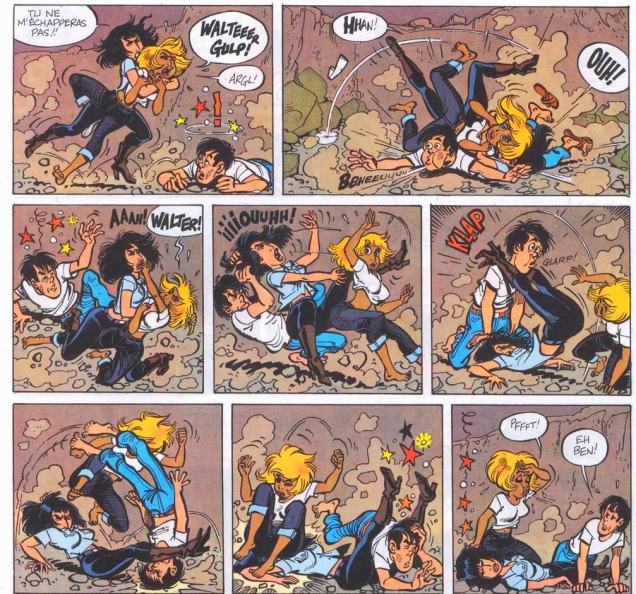
LeTreizièmeApôtre-NatachaHôtessedel_Air
Natacha (hôtesse de l’air) is a Franco-Belgian comics series, created by François Walthéry and Gos.  This page is from an adventure (one of the final stories scripted by the great Maurice Tillieux) called Le treizième apôtre (The Thirteenth Apostle), published in 1978. The blonde is Natacha, our heroïne.

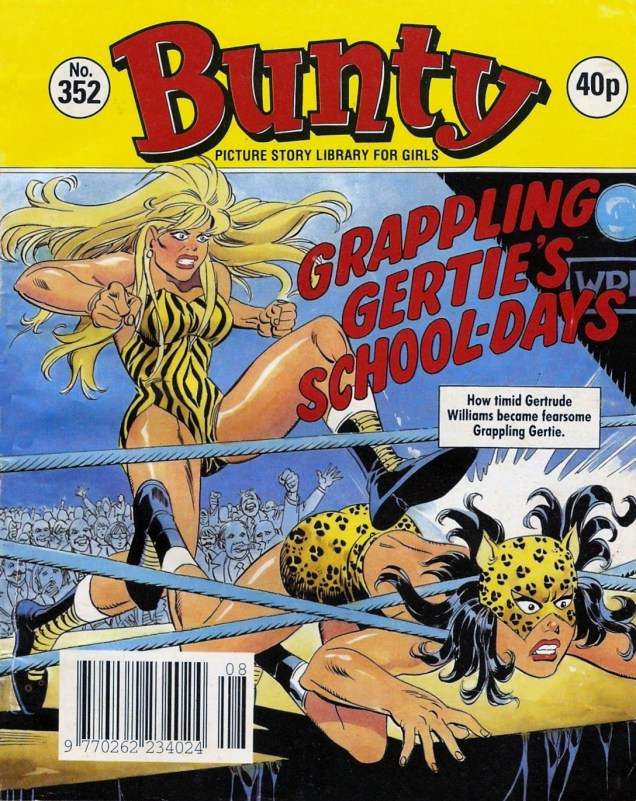
If you want to emphasize the catfight aspect, dress your girls in feline-motif outfits. Oh, I’m sorry – this is no quotidian quarrel, it’s professional wrestling!

Bunty352-WomenWrestlingComic
Bunty no. 352 (1992) – unfortunately, I don’t know who did the cover. British Picture Story Library was a 62 page a comic digest, published weekly. If you’d like to know how Leopard Lily overcame Tiger Tina, visit Assorted Thoughts from an Unsorted Mind.

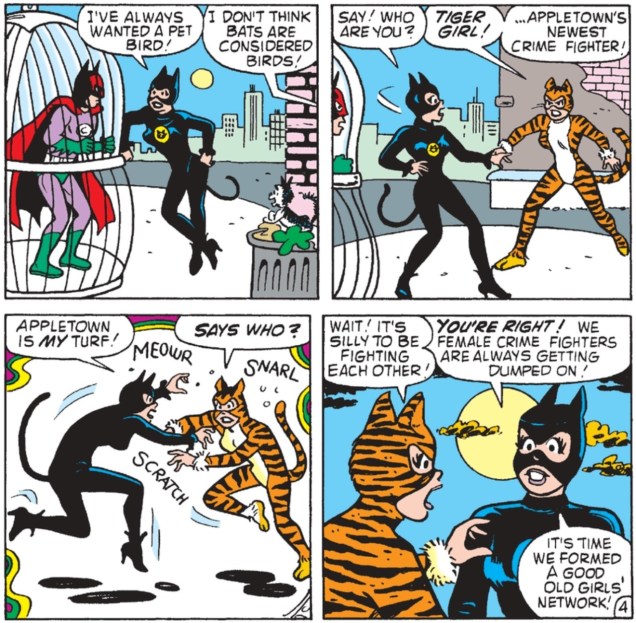
I think we need one even more literal interpretation of “cat fight”:

BettyandVeronica-TigerGirl-DandeCarlo
A snippet from “Meow Row”, published in Betty and Veronica no. 59 (January 1993). Script by George Gladir, pencils by Dan DeCarlo, inks by Alison Ford. Now guess who is who. (It’s obvious: Tiger Girl is Betty, and Veronica gets Meow Girl’s sexier costume.)

This is a fairly inexhaustible topic, but one must quit sometime. Cold shower, anyone?

~ ds

Update from January 2023 – now we also have Let’s All Go Down to the Catfights — Again!
Russ Heath and The War That Time Forgot

« Look! An undersea monster!
Spearing that torpedo like it
was a sardine! It’s a nightmare! »

Writer-editor Bob Kanigher, flanked by artists Ross Andru and Mike Esposito, drew first blood in « The War that Time Forgot », chronicled in DC’s Star Spangled War Stories beginning with issue 90 (May, 1960). The idea was scarily basic, but it was an irresistible premise, at least where young boys were concerned: let’s face it… soldiers vs dinosaurs. How might a T-Rex fare against a bazooka charge? Well…

The only time the series (what I’ve read of it… Andru and Esposito are no dream team of mine) did anything for me was a tale about two soldiers, one American and the other Japanese, stranded together on « Monster Island » and having to save each other’s sashimi. And this was before Lee and Toshirô got together on their own little slice of Hell in the Pacific, yet! I enjoyed the human interest aspect of the tale.

While I, like pretty much any other kid, was fascinated by dinosaurs early on, I quickly soured on inaccurate and fanciful depictions of the beasts. The War That Time Forgot is just one long, tedious dino-butchering exercise, be they harmless herbivores or kill-frenzied carnivores. Piss-poor palaeontology, that. Give me King Kirby‘s Devil Dinosaur any old time instead: that series runneth over with surreal, freewheeling fun, with nary a claim to accuracy in sight or in mind.

Ahem. The WTTF ran its course in SSWS until issue 137 (February-March, 1968), and was replaced by the far more nuanced Enemy Ace by Kanigher and Joe Kubert. Their all-time high, arguably in the case of Kubert, and without the faintest shadow of a doubt in Kanigher’s case.

So why am I writing about this series if I care so little about it? Well, when Andru (meh) or Kubert (great, true to form) weren’t handling cover duties, Russ Heath was. And while I’m fairly unmoved by Heath’s skill as a storyteller (too static, too measured), he was a first-rate cover artist, most strikingly for DC’s 1960s war books (and hey, Sea Devils) and Atlas’ 1950s westerns and horror titles.

So, in fond remembrance of Mr. Heath, who left us last week at the age of ninety-one, here’s a gallery of his Star Spangled War Stories covers featuring The War That Time Forgot. Thank you, sir.

SSWS122A
Star Spangled War Stories no. 122 (Aug. – Sept. 1965). Grey toning and colour by Jack Adler.
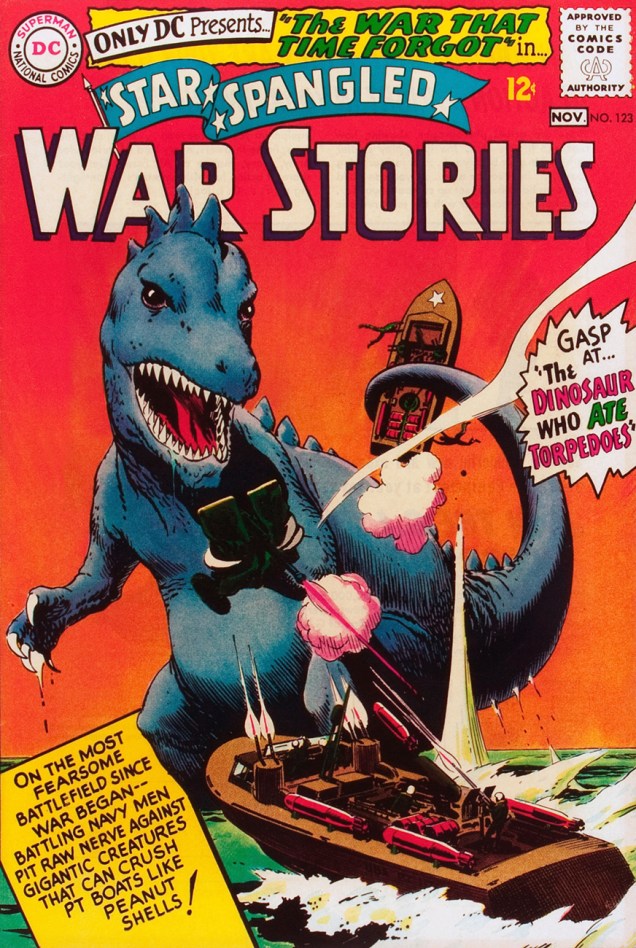
SSWS123A
Star Spangled War Stories no. 123 (Oct. – Nov. 1965). Dinosaurs love those orange skies, which set off their scales to fine advantage.
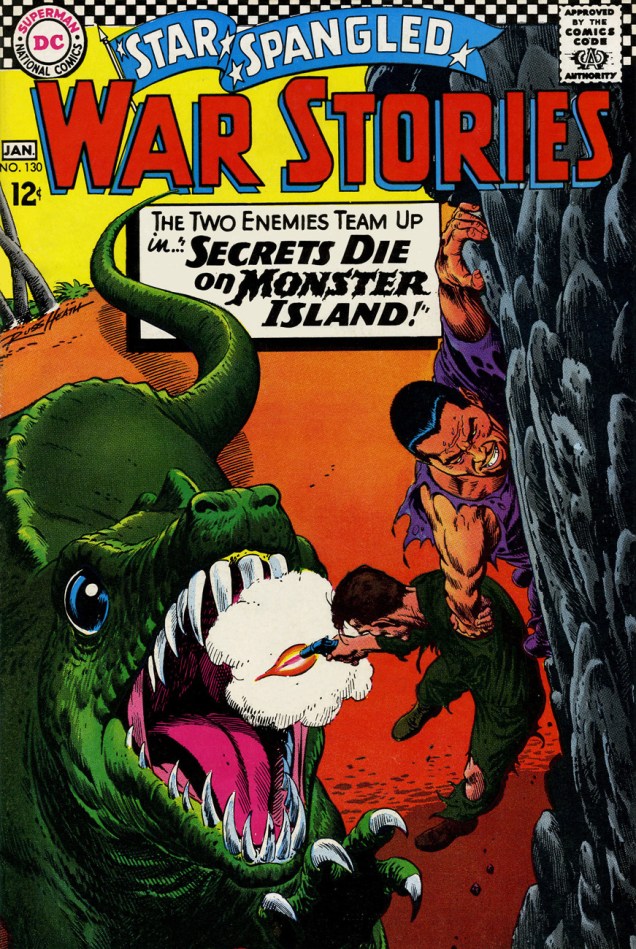
SSWS130A
Star Spangled War Stories no. 130 (Dec. 1966 – Jan. 1967). The first Japanese-American “Enemy Mine” team-up, but the Japanese guy gets no redemption before dying. Grey toning and colour by Jack Adler… probably my favourite cover of the lot.
SSWS131A
The Bird-Man provides a new wrinkle to bloodthirsty war criminal Curtis LeMay‘s « Bomb them back to the Stone Age » pronouncement. Star Spangled War Stories no. 131 (Feb. – Mar. 1967).
SSWS132A
Star Spangled War Stories no. 132 (Apr. -May 1967).
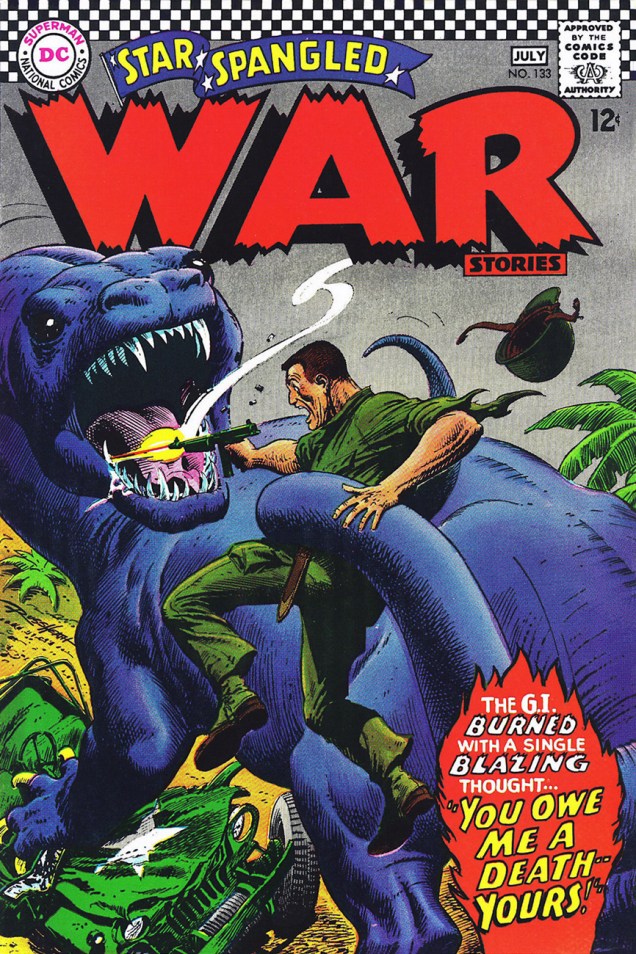
SSWS133A
Star Spangled War Stories no. 133 (June – July 1967).
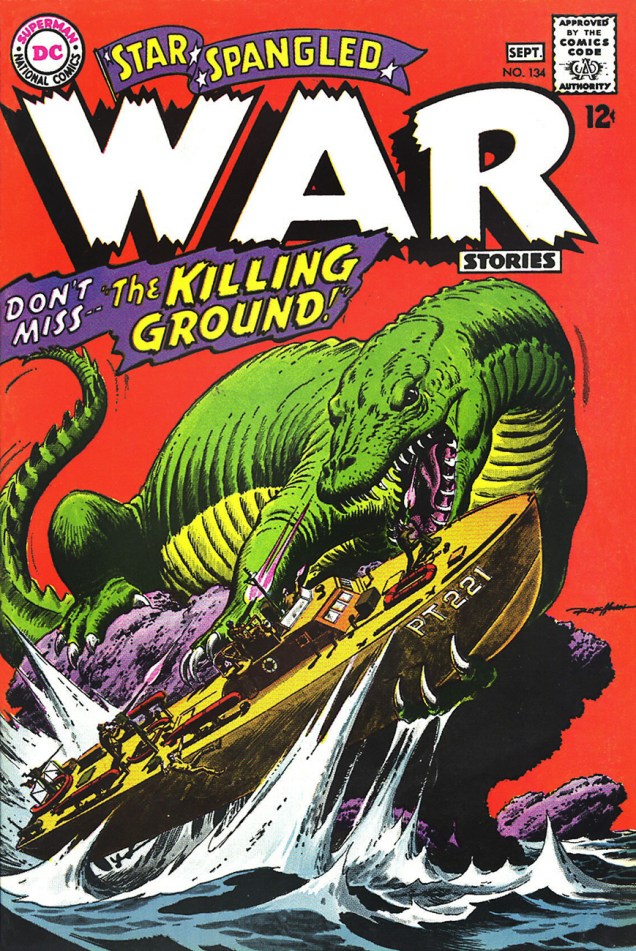
SSWS134A
Star Spangled War Stories no. 134 (Aug. -Sept. 1967). Once more, grey toning and colour by the indispensable Mr. Adler.
SSWS135A
Star Spangled War Stories no. 135 (Oct. – Nov. 1967).
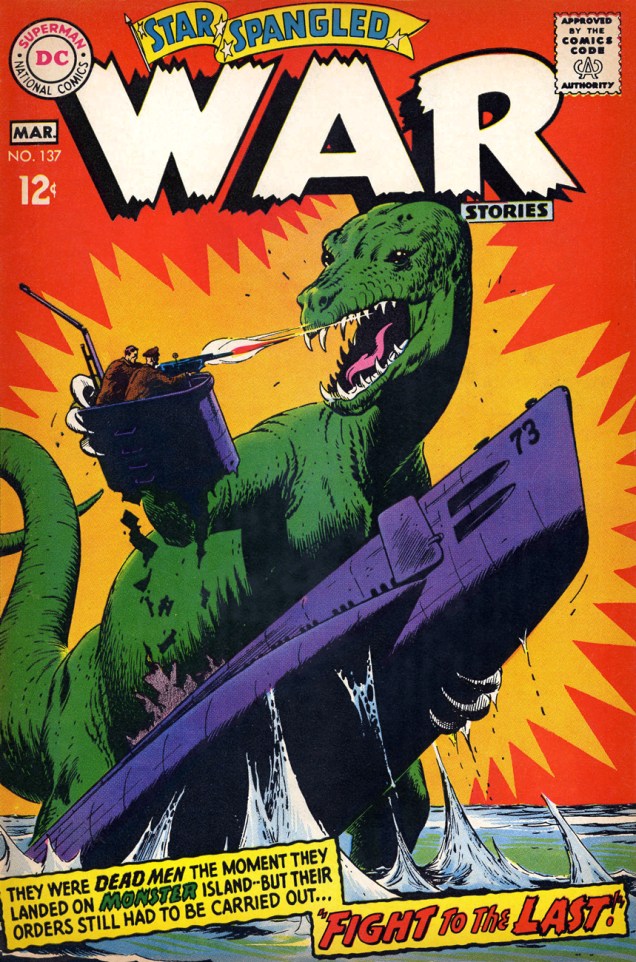
SSWS137A
Last call! Star Spangled War Stories no. 137 (Feb. -Mar. 1968).

Addendum to SSWS 131: apparently, « Bird-Man » started a trend, as everyone and his distant ancestor soon was riding a Pteranodon of his own. To wit: Tomahawk #109 (Mar. – Apr. 1967… just a month later).

Tomahawk109A
What do dinosaurs care about the American Revolutionary War? And yet the poor, noble Pteranodons all perish in the end… « for the cause » . Tomahawk no. 109 (March-April 1967), cover art by Bob Brown.

-RG