There’s an impressive parade of artists born in July. Of present concern is the birthday of one Murphy Anderson, who came into this world on July 9th, 1926 (and ceased to exist in 2015, at 89, no doubt moving into some parallel dimension).
His work on the Atomic Knights or Hawkman is fondly remembered… but I’ll concentrate on some covers dear to my heart from DC’s science-fiction titles because sci-fi + great art = squeals of enjoyment. Anderson had no trouble portraying any number of far-fetched monsters or depicting incredible situations in his crisp, clean style that made his audience willingly suspend disbelief. Ah, okay, I called it “science-fiction”, but it often crosses the line into fantasy, or horror, with occasional detours into superhero, or just plain quirkiness. To follow the loopy logic of the stories contained in the pages of the following publications, one has to abandon the notion that A leads to B, and prepare oneself for a wild romp through the whole alphabet. Great art certainly facilitates this – the story may leave me scratching my head, but Murphy Anderson’s illustrating chops provide a firm ground to anchor to.
Without further ado, the great Murphy Anderson and some of his artwork!
For instance, take a look at some of the creatures featured in DC’s Strange Adventures through the decades. Anderson’s gallery of characters includes, but is not limited to, startled fishermen, anthropomorphized atomic clouds, and Middle-Age barbarians from another planet, all impeccably drawn.
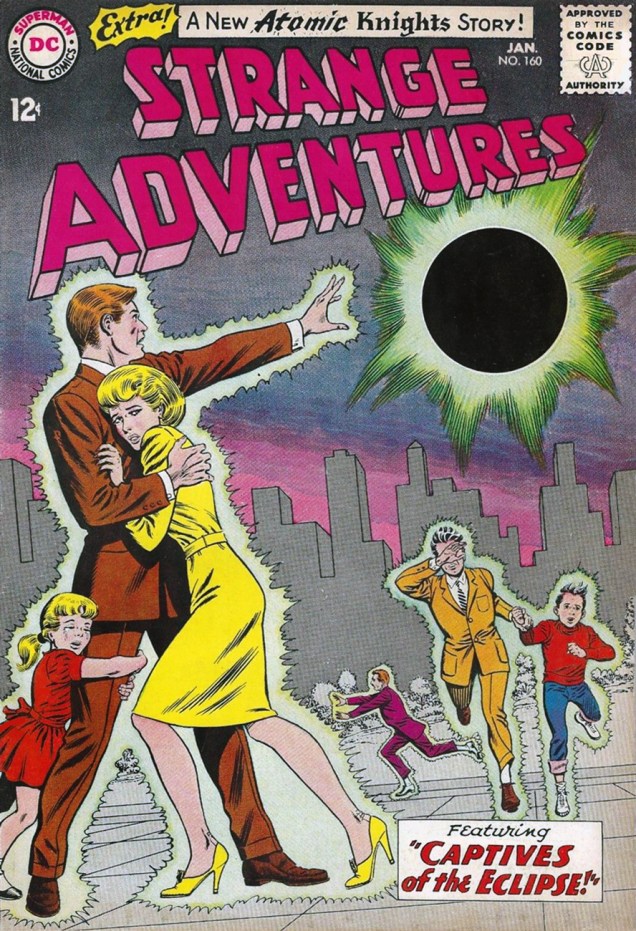
“But I tell you I actually hooked one on my line… THIS BIG!” It’s only fair. I guess you don’t even need to use bait for this type of fishing. Strange Adventures no. 21 (June 1952). Cover by Murphy Anderson.There’s no head-breaking over what title to give these stories… “The Face in the Atom Bomb Cloud” it is! Pencils and inks by Murphy Anderson, grey tones and colours by Jack Adler, lettering by Ira Schnapp. This is Strange Adventures no. 143 (August, 1962). Edited by Julius Schwartz.Strange Adventures no. 160 (January 1964), cover by Murphy Anderson. This issue is a treat, featuring two parts of an Atomic Knights story (“Here come the Wild Ones!”, written by John Broome and illustrated by Anderson).I promised barbarians, didn’t I? Strange Adventures no. 222 (Jan-Feb 1970), art by Murphy Anderson. I have a love/hate relationship with Adam Strange, often loving the art and hating the stories. It’s been a while – I have to re-read this stuff and see if I still find it indigestible.
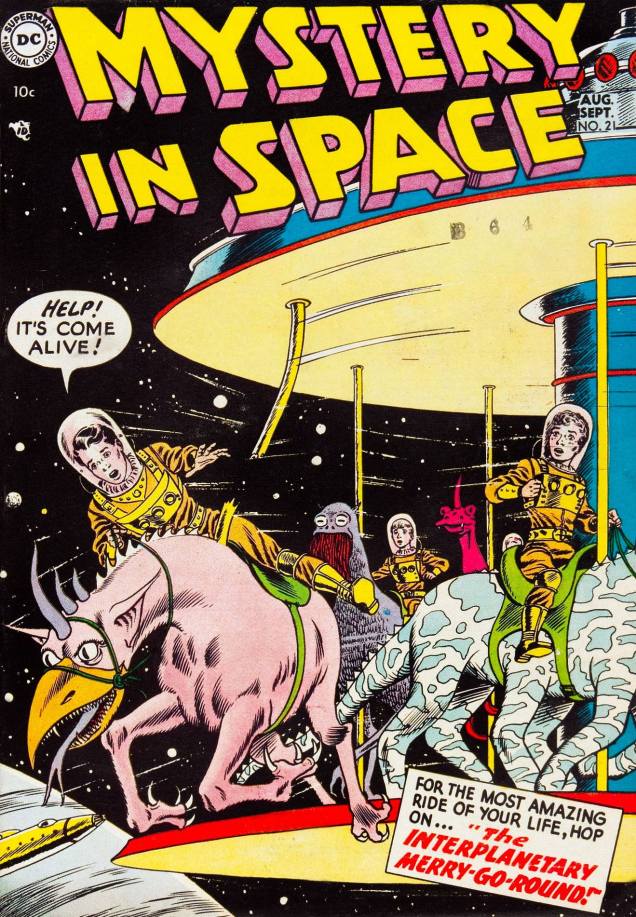
Another favourite series for its oft-striking covers is Mystery in Space. I love it when Anderson invents “space” animals composed of body parts from several Earth species. It’s indubitably fun, and children often have a great time inventing new creatures, but it takes chops to draw the result and make it work, anatomically and aesthetically.
Damn, the safety regulations for those carousel things are really lax these (future) days. It might not be science-fiction per se, but it sure is fun! Mystery in Space no. 21 (August-September 1954), with a cover by Mr. Anderson.
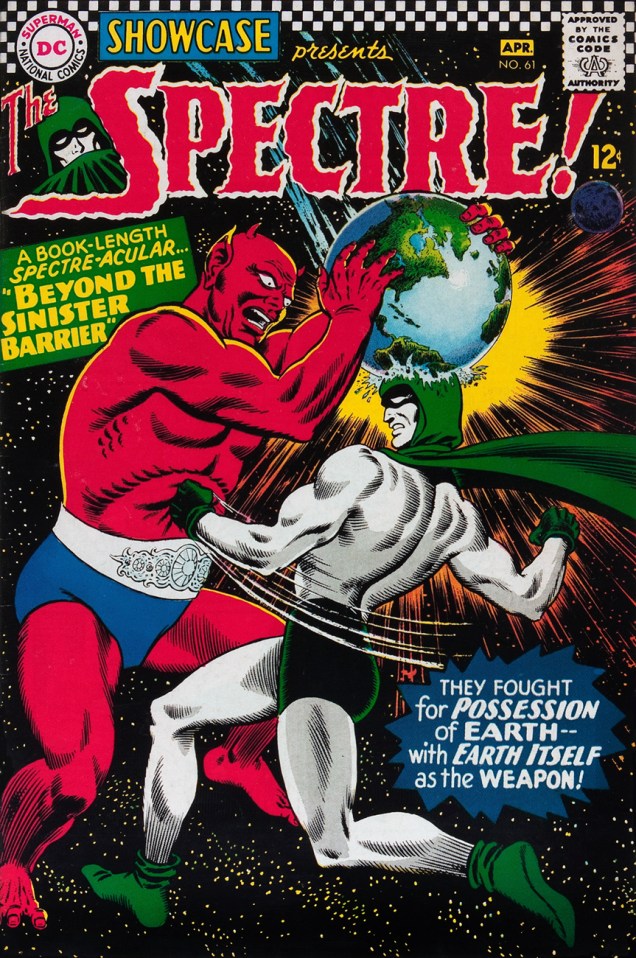
Despite my general resistance to superhero stuff, here’s a cover featuring the Spectre, whose classy costume is easy on the eyes.
When you have to boink your arch-enemy on the head with a whole planet to knock him out and it still doesn’t work, you know you’re dealing with a pro. Showcase no. 61 (March-April 1966), cover by Murphy Anderson.
And one for the road…
Goofiness or social commentary? Frankly, the green “president” looks a lot friendlier than most current politicians. Tales of the Unexpected no. 94 (April-May, 1966). Cover by Murphy Anderson.
It’s boiling hot in this part of the world, so I’d like to concentrate on soothingly cool covers for this Tentacle Tuesday. If we end up taking a dip in refreshing waters in our quest for relief from balmy temperatures, so much the better. Today’s roster brings us fashionable dames and their splashy encounters with octopuses!
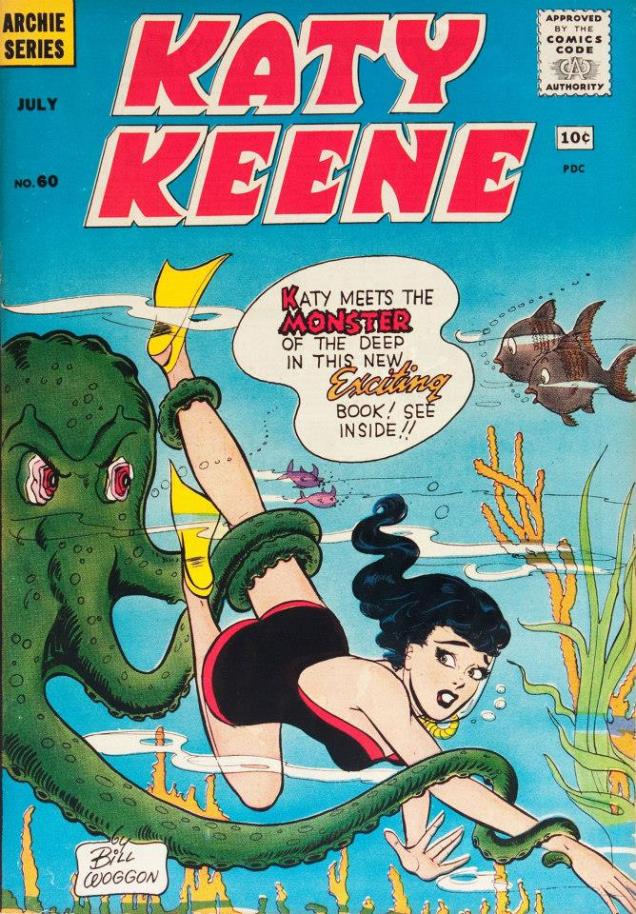
Here’s the Queen of Fashions (and right now, queen of tentacles), and for once the cover doesn’t focus on her outfit – I understand it’s hard to wriggle out of a swimsuit while an octopus is holding your leg.
Katy Keene was created by Bill Woggon, and introduced in Wilbur Comics no. 5 (1945). She was “America’s Queen of Pin-Ups and Fashions”, and readers were encouraged to submit drawings of outfits and other tralala such as designs for automobiles, boats, and whatever other method of transport Katy could glitter in. This is Katy Keene no. 60, July 1961, cover by Bill Woggon.
Mockery aside, I have nothing against Bill Woggon-era Katy – I like Woggon’s art, and the gentle humour of the stories is hard to dislike. After Katy Keene’s demise in 1961, she was eventually revived by Archie Comics in 1983. They should have let the dead rest in peace! Though several people were considered for the role of regular artist, that position went to John Lucas, whose style I abhor, recoil from and spit upon. I first saw his take on KK in those huge Archie digests you can get for pennies that reprint a bit of everything, giving readers a total pêle-mêle of different decades and different artists. I didn’t know who drew what at the time, but I quickly developed a preference for certain styles while finding others repellent… and John Lucas’ puerile art was top of my hated list, along with the half-arsed, anatomically asinine line-work of Al Hartley.
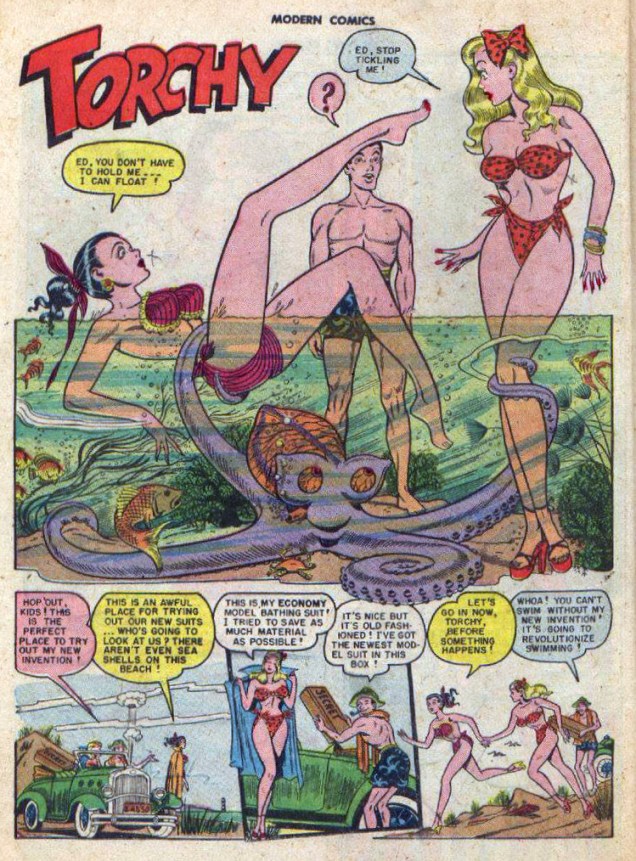
Next, we have another beauty queen, although this time the stuff is quite a bit more risqué. It’s not for nothing that cataloguing websites classify Torchy as “adult” material. As for the octopus, it has impeccable taste, having determined that there’s no need to decide between blonde or brunette when you can have both.
But Torchy, why are you wearing high-heel sandals in water? Modern Comics no. 97 (Quality Comics, May 1950). This is a page from « The Mermaid Gig », with scripted and art by Gill Fox. Fox took over from Bill Ward (Torchy Todd’s creator and writer) five years after her introduction, starting with Modern Comics #89 (1949). As far as replacement of Bill Ward, Fox did a truly excellent job, managing to preserve the mood and style of Ward’s stories. Read the mermaid tale (no more tentacles, sadly) here.
Sometimes octopuses catch little girls, but occasionally a feisty little girl captures an octopus. Little Dot is going to be a handful when she grows up… but of course she never will.
This polka-dotted octopus is a perfect catch for Little Dot in this soothingly green sea. Too bad the cephalopod fellow looks so disgruntled. He was probably in the middle of lunch or something. Little Dot no. 105 (June 1966); cover by Warren Kremer.
Those of you also inhabiting parts of the world where the weather has gone bananas (because it’s certainly hot enough for growing them in here), stay cool!
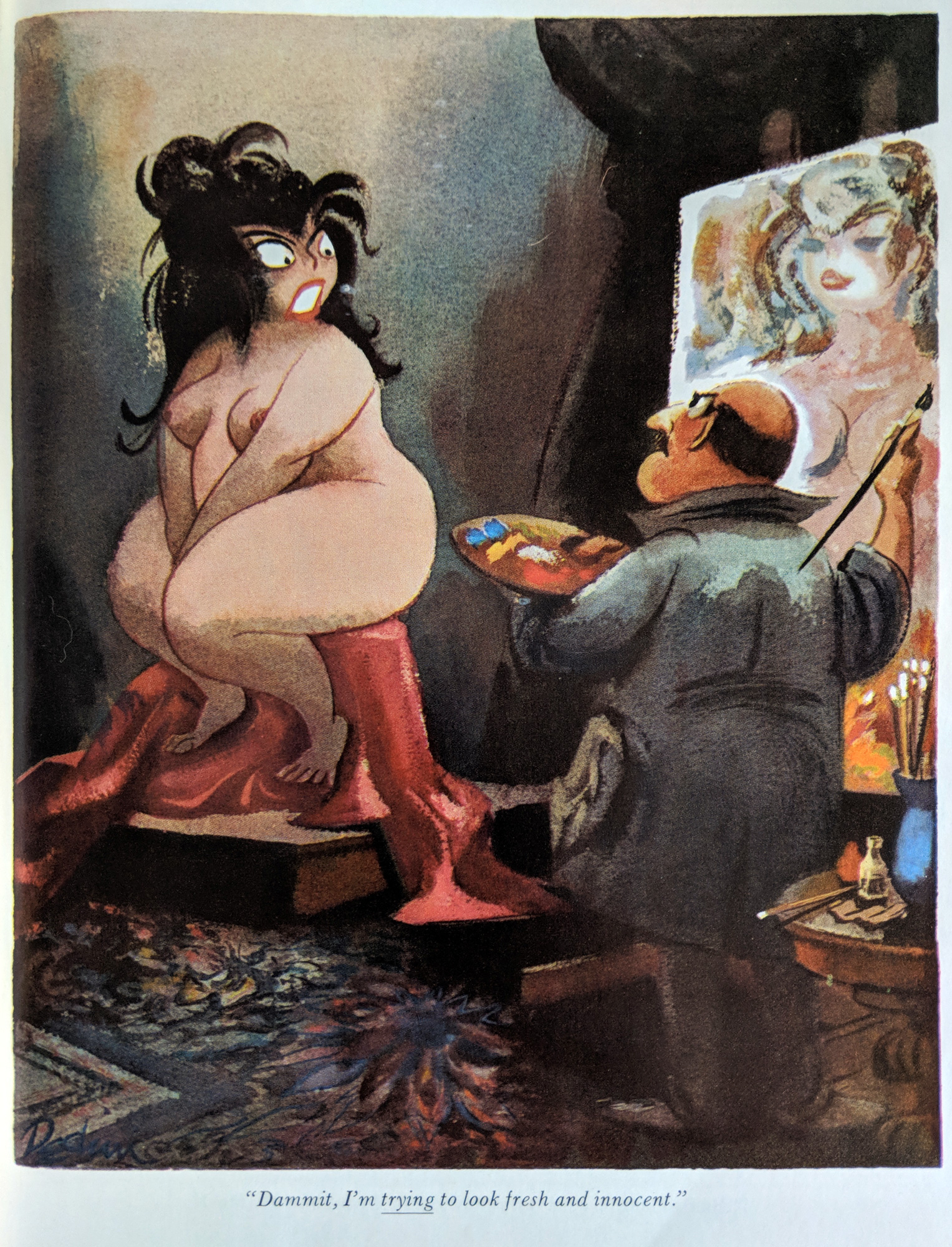
Amidst all the (justified) doom and gloom that this week has brought us, there is one bright spot that comes just in time to save this week from being a complete downer. It’s Eldon Dedini’s birthday! (He was born in 1921, on June 29th.) Yes, I know that he died in 2006… but his joyous, delightfully hedonistic art lives on. As a Russian whose father once started a rowdy party because it was Mozart’s birthday, I claim the privilege of celebrating Dedini’s jour de naissance by raising my glass of rosé (satyr-approved, of course) in his honour.
“That’s all very well for you, but I’m the one who’ll have to sit on the eggs”.
He was one of Gus Arriola’s closest friends. To quote Arriola, «calling Eldon a cartoonist just christens the tip of an impressive iceberg. Beneath the surface is a superb painter, a remarkably inventive illustrator, philosopher, and humorist—a keen observer, revealing life’s little truths with his unerring brush. His chief reward was the viewer’s invariable burst of laughter. He was a walking repository of eclectic knowledge about art, history, jazz, wine—you name it. I gave up using my encyclopedia on a subject search: it was faster to pick up the phone and call Eldon.» By the way, I pulled this quote out of a R.C. Harvey article published in the Comics Journal titled “Viewing Life Through a Twinkle”, which gives you an idea of what a fun read it is.
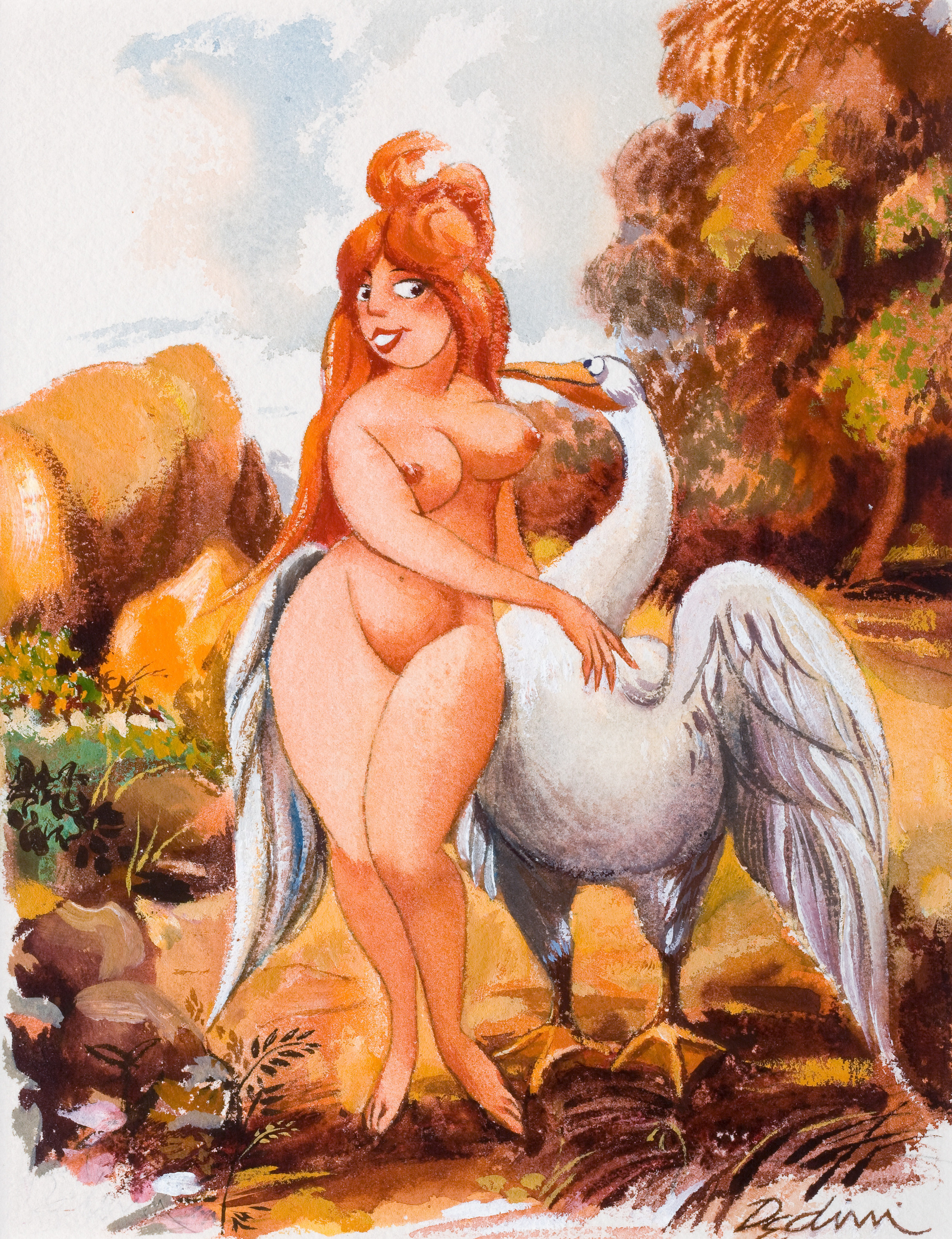
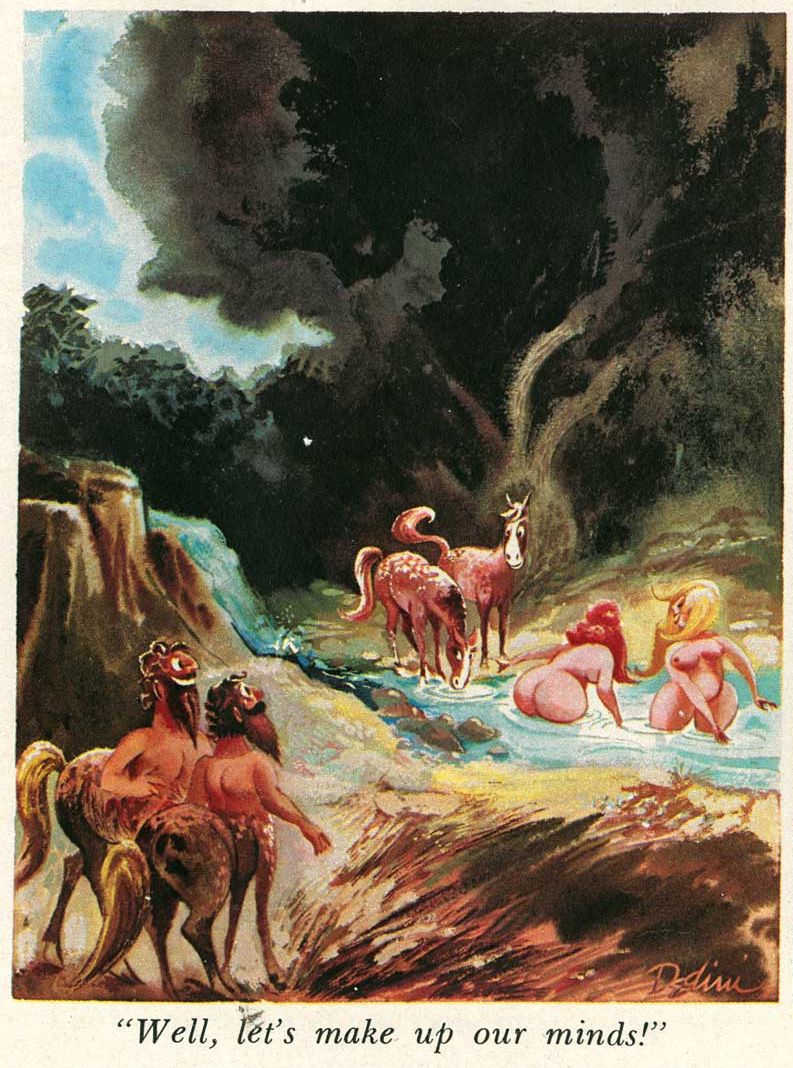
The first thing that comes to mind when one thinks of Dedini is merrily frolicking satyrs, closely followed (or preceded) by unapologetically buxom women, all of this merry crowd looking to have some fun of the most basic kind. It’s not all randy woodland gods, though; there’s also room for lascivious gnomes, salacious wolves and whatever other lechery comes to mind. (Most of these were published in Playboy Magazine.)
« Remember what Balzac said – ‘it is easier to be a lover than a husband for the simple reason that it is more difficult to be witty every day than to say pretty things from time to time.‘ »Ooh, tough choice.« Either we start pushing birth control or we’re going to be up to our asses in little people. »
« But will you love me when I’m old and gray? » From Playboy’s August, 1971 issue.
Nothing like taking the proactive role, huh?
Although it’s easy to be blown away by Dedini’s take on Grecian and Roman mythology – I think fabled creatures gave him an easy outlet for his joie de vivre – he could seemingly draw anything he wanted to, stunning forest landscapes or historical costumes, capturing carpet textures, clothing accessories or musical instruments with equal ease.
« Well, I guess it goes to prove that not all God’s children got rhythm. » Note the name of the band, which made me snort into my tea.
“During an intermission at one year’s Festival, Dedini and some other PBL members went up on stage to have their photograph taken. Duke Ellington was still on stage, seated at the piano, putting eye drops in his eyes. When Dedini was introduced as “a cartoonist who sometimes draws jazz cartoons,” Ellington got up and, without saying a word, pulled out his wallet and started looking through it as he meandered, aimlessly, around the platform. Finally, he found what he was looking for, a folded up magazine clipping. He carefully unfolded it and spread it out on the piano: it was a cartoon Dedini had done for Collier’s. The cartoon depicted two Russians in Red Square, one of whom is obviously a dealer in blackmarket phonograph records: he has opened his coat to show the other fellow the record that he has tucked inside, saying, “ … Cootie Williams, trumpet; Johnny Hodges, alto sax; Barney Bigard, clarinet; Harry Carney, baritone sax; Duke Ellington, piano …” Said Dedini: “Ellington loved that cartoon because when he toured Russia the people of Russia loved his music, but they couldn’t buy the records.” For years thereafter, Ellington sent Dedini a Christmas card. “I have about twenty,” Dedini said. “He sends them in June.”
The topic of today’s Tentacle Tuesday is based on a plant-based mishap. I was walking along an alley, minding my own business, when some sort of climbing plant with especially long and vicious tentacle-vines, swinging from from a nearby fence, grabbed my arm. The result were scratches that felt like burns.*
So today’s gruesome offerings are mostly cousins of the Venus Flytrap, if the latter had tentacles to assist its quest for prey. (Let’s breathe a sigh of relief that it doesn’t.)
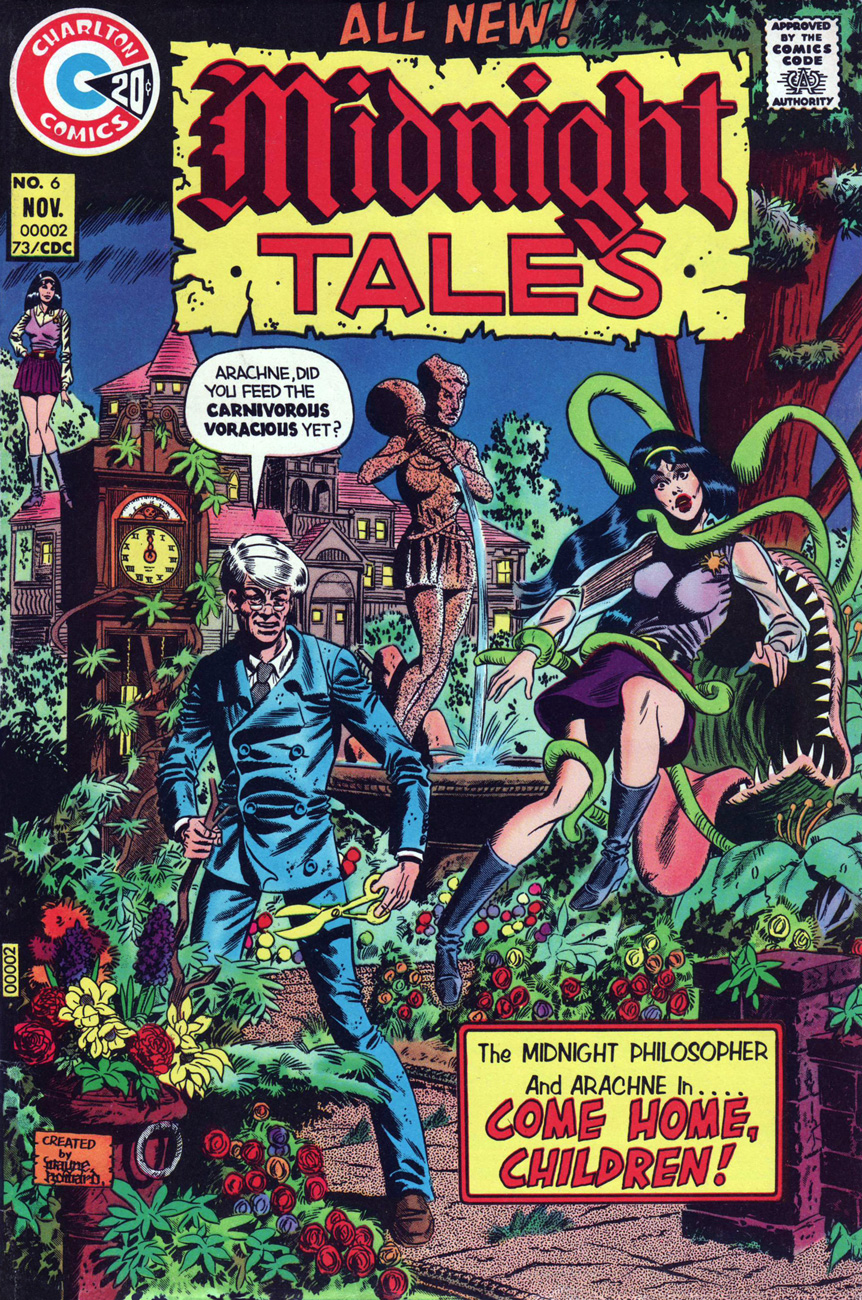
Midnight Tales no. 6 (November 1973), cover by Wayne Howard. I am a big fan of Midnight Tales and its blend of humour and adventure. Note the “created by Wayne Howard” announcement on the cover, which wasn’t exactly typical for its time – comic book companies didn’t use to acknowledge the creators of their “content” so openly and insistently.
Midnight Tales often offer moments of “wait, how did that get through the Comics Code?” Arachne (Professor Coffin’s undeniably attractive niece) is frequently more sexually provocative than one would expect from a kid-appropriate comic, crimes committed are nastier than surmised, and the plots go from morbid to surreal… with some comedy thrown in. Oh, sure, there’s some terrible clunkers, as every issue has three or four stories linked by a common theme and illustrated by different artists, but overall the quality remains high throughout its 18-issue run.
I’ve seen people online saying that Howard shamelessly plagiarized Wally Wood’s style – perhaps people more erudite than I see that, but I don’t. “Influenced” is one thing – but one can build on those beginnings to create a recognizable style of one’s own, right? Those who like Wayne Howard frequently classify him as a “guilty pleasure”, and proceed to insult his art while they’re explaining why they like it. To quote, for instance, from Atomic Avenue,who follow the unspoken rule – just mentioning Charlton Comics warrants a condescending tone, and any acknowledgement of their quality has to be tempered by mockery.
Creator Wayne Howard blatantly imitated the style of comic art great Wally Wood right down to his gothic signature, but at least he aimed high in his plagiarism. Consequently, Midnight Tales had the look of a seedy, off-register knock-off of an EC horror comic—putting it at the top of Charlton’s quality spectrum.
In my world of geek’n out over all this great art, Wayne Howard is one of my biggest guilty pleasures. He loves to draw like Wally Wood, but he’s no Wally Wood. His females usually look like Wally’s women after a really bad day, and his males are just plain fugly. His Wood machinery is close to the background machinery behind the awesome machinery, and everything shouts fan art VS pro art, but… Luvittopieces
Ah, well. I won’t be apologetic about liking Howard’s art, and Midnight Tales will be proudly presented as a favourite series on a need-to-know basis. Fortunately, there’s some nice articles about him, too – a sort of obituary for a great African-American artist who died at only 58.
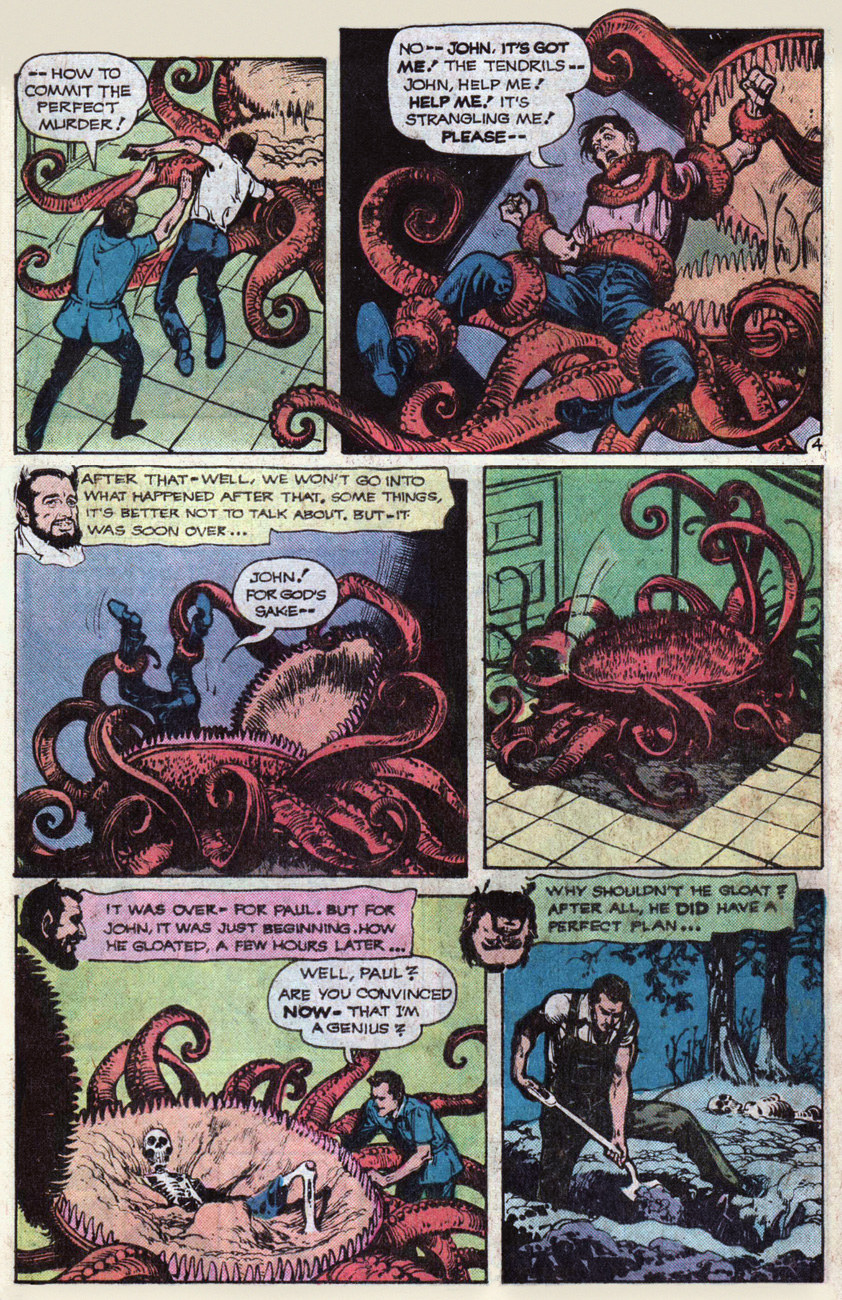
Another Flytrap for your enjoyment, in this tale of brotherly rivalry:
“Harvest of Hate” was scripted by Jack Oleck and drawn by Alfredo Alcala (speaking of whom, I still can’t get over how beautiful his signature is.) Page scanned from House of Mystery no. 251 (March-April 1977).
Don’t worry, the “gardener” who fed his brother to this man-devouring monstrosity gets his comeuppance, all right.
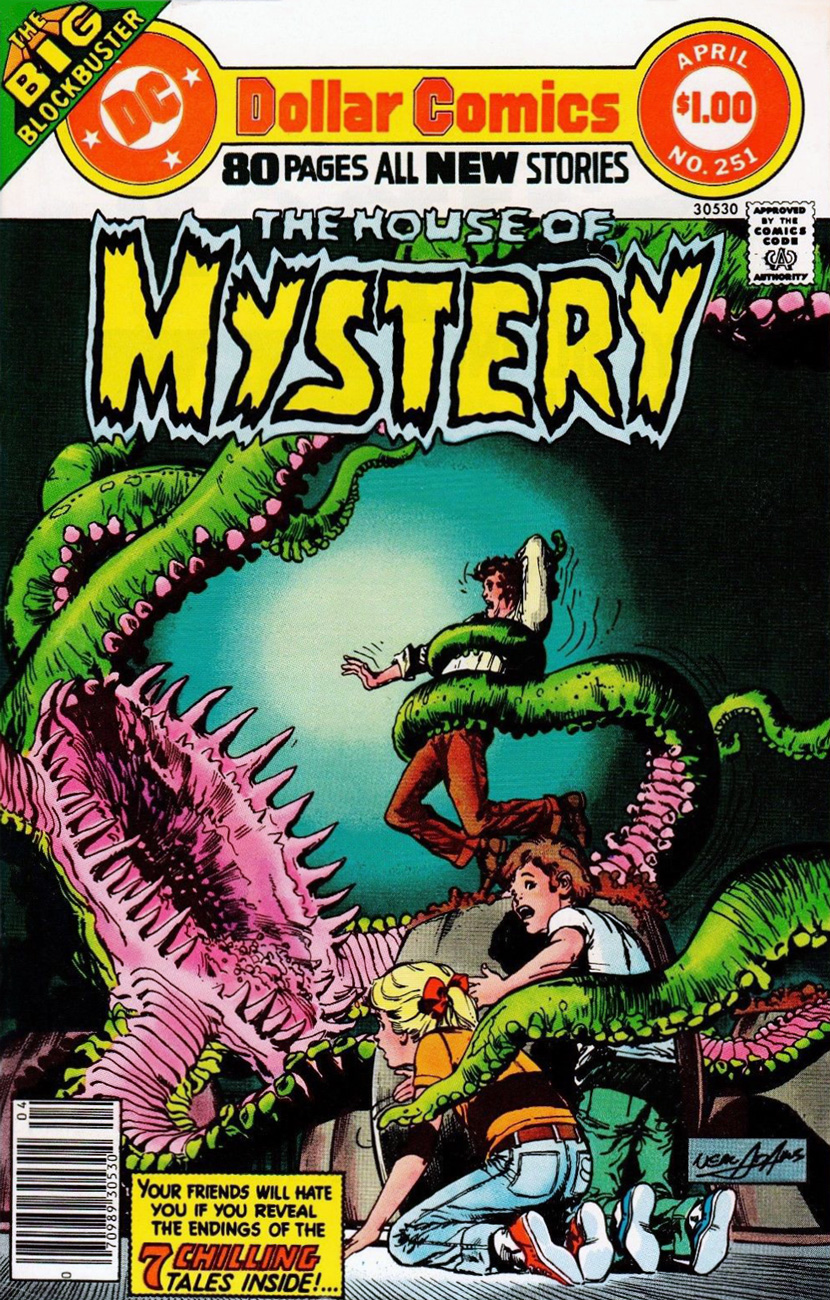
The cover of this issue of House of Mystery is also a good exhibit of plant tentacles, even if the children are a superfluous addition:
House of Mystery no. 251 (March-April 1977), cover by Neal Adams.
Here’s something more recent – published on some almost-thirty years ago, instead of forty – the tentacular adventures of Doctor Gorpon! I hope these guys count as plants (even if they’re slightly more mobile) – they’re the right shade of green!
Doctor Gorpon no. 2 (July 1991) by Marc Hansen. The little guy in the right bottom corner is extra-cute – if only all children looked at their parents with the same sense of admiration and awe! It’s “Ooze Me, Baby!”
I only finished reading this three-issue series today, and I must say, it was an exciting ride. Highly recommended (if you can find it, that is).
A panel from the aptly-titled “Big Eyeballs!”, published in Doctor Gorpon no. 3 (August 1991).
A page from “Big Eyeballs!”, published in Doctor Gorpon no. 3 (August 1991).
There are few things more satisfying than hitting two birds with one stone. Today’s Tentacle Tuesday almost, but not quite, coincides with the birthday of Hilary Barta, who was born on June 17th, 1957. As it happens, he is delightfully adept at depicting tentacles, and quite enthusiastic about it, too…. so it is my pleasure to combine tentacle festivities with a (hopefully) tantalizing sampling of a great artist’s work.
All I could find about this illustration is that it was meant as a cover to a book. To quote from Rhine’s website, « writer R.S. Rhine and illustrator Hillary Barta will collaborate on the graphic novel (release 2005) ». Was it ever released? It doesn’t seem so.
Art for The Black Flame no. 7, 2017. Art by Hilary Barta. So Black Flame is getting attacked by a bunch of drooling monsters and he’s victoriously brandishing… a small lizard?
The published version of The Black Flame no. 7. I think this colour scheme works much better, actually.
There’s no mentioning Barta without perusing some of his Simpsons’ work, especially under the umbrella of that tentacle-rich (my favourite!) manifestation of the Simpsons, the Treehouse of Horror.
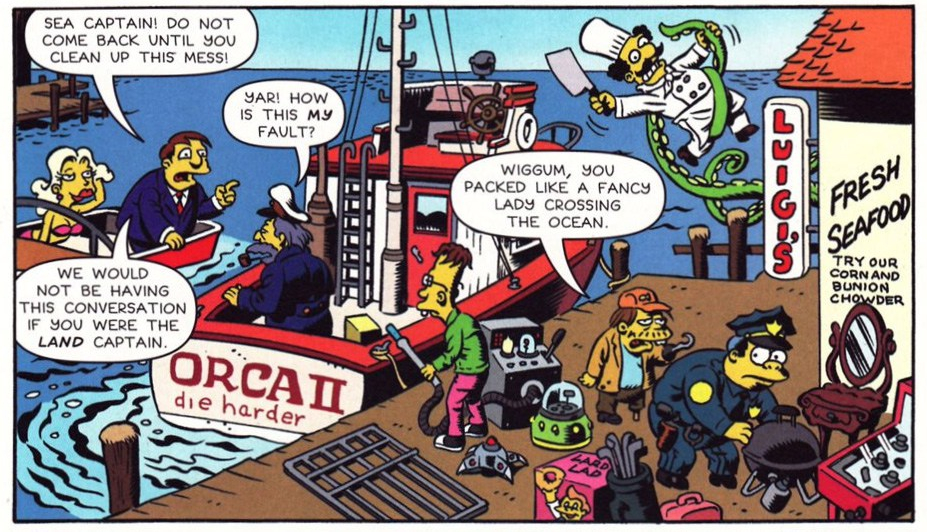
P is for Portal! This « Lexicon of Lurid Limericks » was published in Treehouse of Horror no. 8, 2002. Art by Barta, colours by Dave Stewart. Moe is nonplussed, as usual… it’s going to take more than a few slimy tentacles and a big puddle of gore to shake him up.
So far, we’ve leaned heavily in the direction of the aggressive octopus, the hoggish, ill-mannered brute who grabs people without so much as a how-do-you-do. Even when the multi-tentacled beast has self-defence as an excuse, the gory results are often not for the weak-hearted. Yet, like any complex creature, it has many personality facets; let’s have a look at the friendly cephalopod, the octopus-next-door type, the one who’s willing to let you use its tentacles in lieu of swings and lend a feeler’d arm with your fishing.
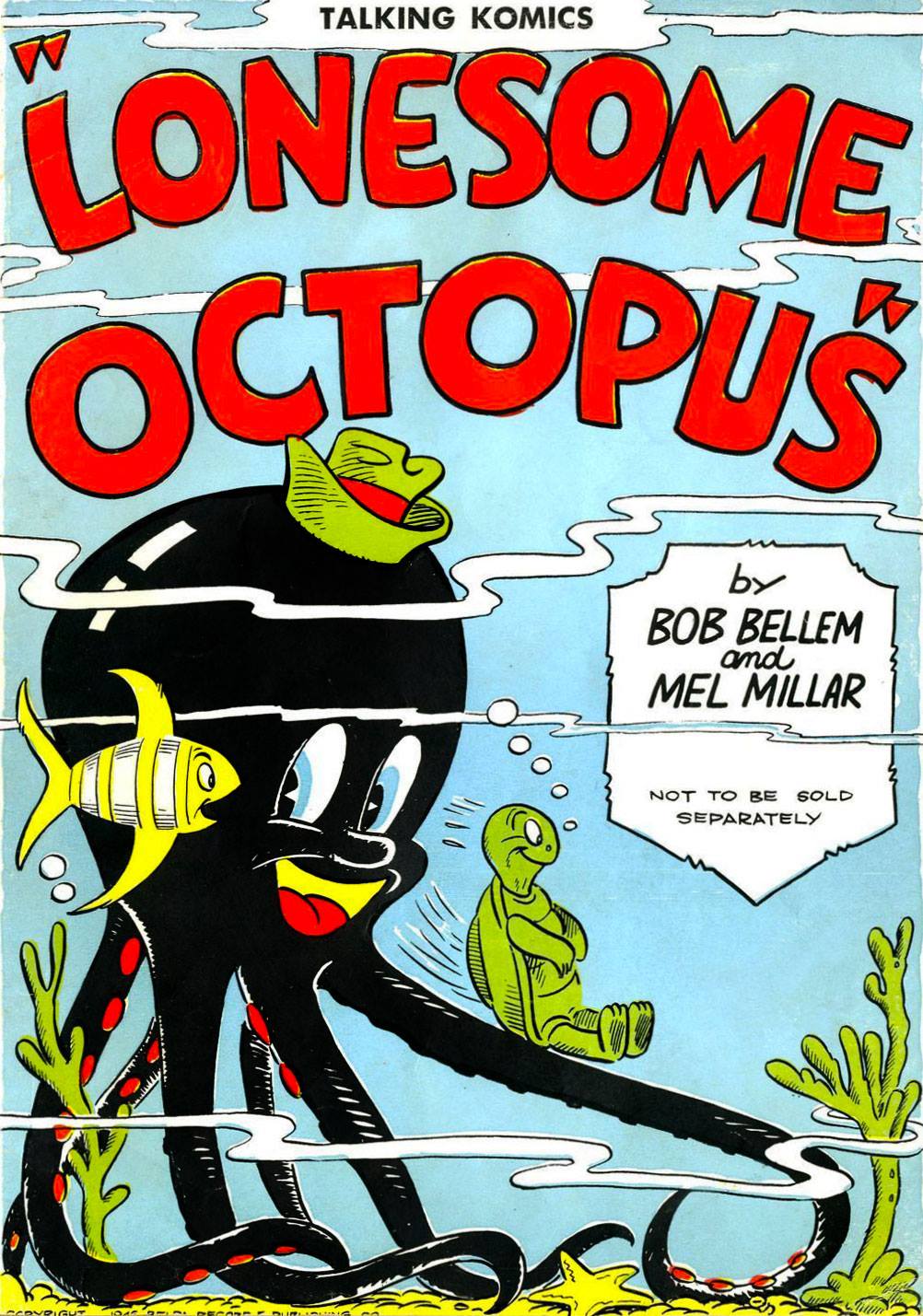
In 1946, Belda Records came up with the concept of a “komic book & plastic record”. The series was called Talking Komics, promising (and delivering!) kids a “record-music-story-comic book” experience. There were 8 characters, one per book-cum-record, in all. Our friend the Lonesome Octopus is one, although he seems to be doing all right socially. The other 7 are Grumpy Shark, Happy Grasshopper, Chirpy Cricket, Flying Turtle, Blind Mouse, and in a slightly different vein, Enchanted Toymaker and Sleepy Santa.
The records were written & produced by Bob Bellem and narrated by Marvin Miller (a well-known voice actor – to name a few well-known shows, he was Robby the Robot in Forbidden Planet and in The Pink Panther Show he voiced the Inspector, Deux-Deux and the Commissioner), the music was composed & conducted by Frank Hubbel, and the comic was illustrated by Mel Millar, who may or not be Marvin’s brother. Cartoons were created for at least some of the records/comics (so it’s more like “record-music-story-comic-book-animation”) – some of them used to be findable on Youtube some time ago, but the years seem to have swept everything away.
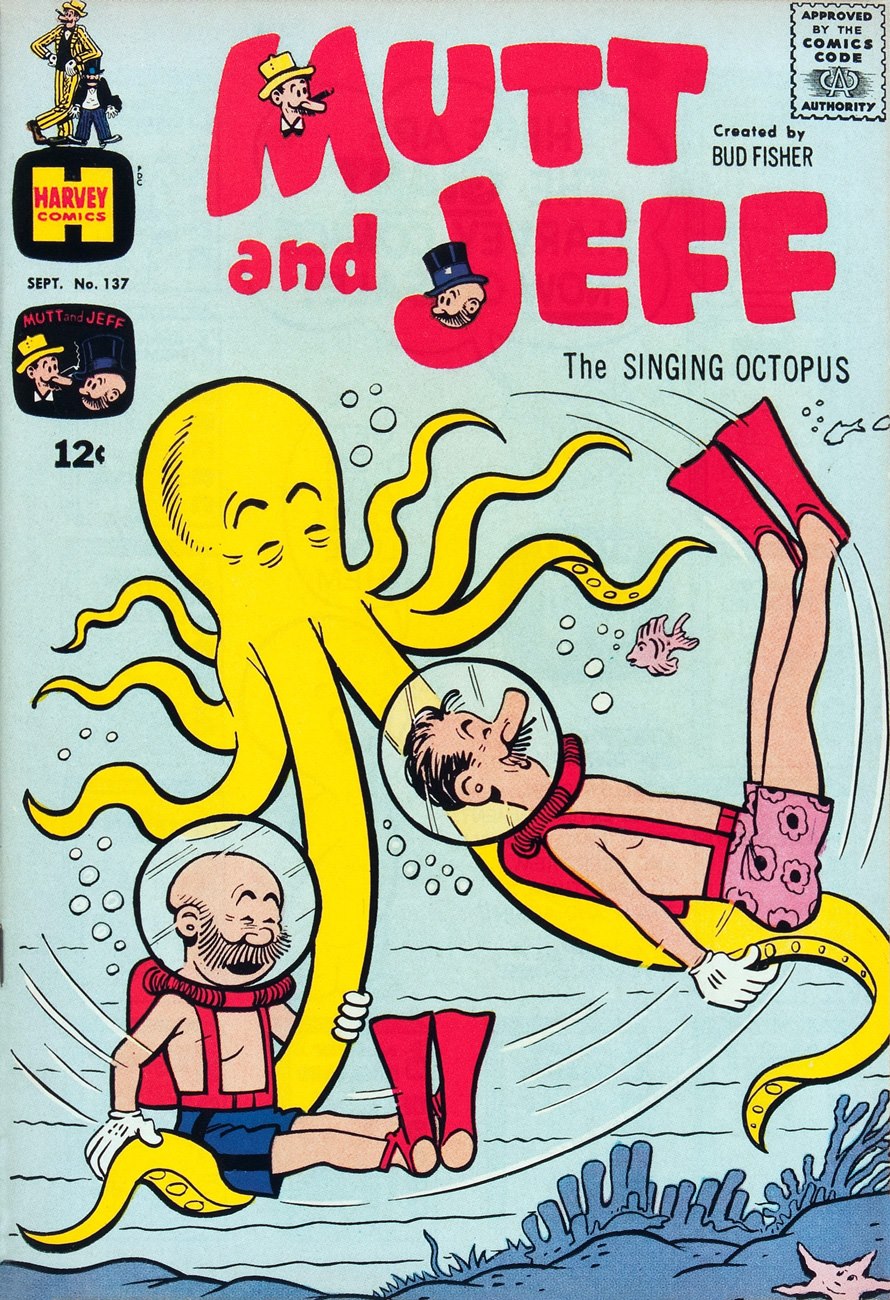
Another octopus who kindly consented to let his tentacles be used as swings. He apparently sings, too!
Mutt and Jeff is a newspaper strip created by Bud Fisher in 1907, generally believed to be the first daily comic strip (or at least the first really successful one). It featured Augustus Mutt (the tall fellow swinging on the right tentacle), greedy and highly inventive (if not downright insane) with his parade of get-rich-quick schemes, and bald Jeff, his reluctant sidekick, whose sideburns would surely get him accepted as a hipster in these modern times. Go here to read an enthusiastic article about this cultural phenomenon, and here to read some comics.
Little boys who over-work an octopus are going to end up as his dinner, I say. Still, for the time being, here’s a sweet scene of inter-species coöperation.
I sure hope that this octopus gets his share of fish at the end of the day! Also, wouldn’t it be more efficient to just grab the fish directly with tentacles instead of using man-made contraptions like fishing lines? This is The Funnies no. 23 (Dell, August 1938). Does anybody know the artist?
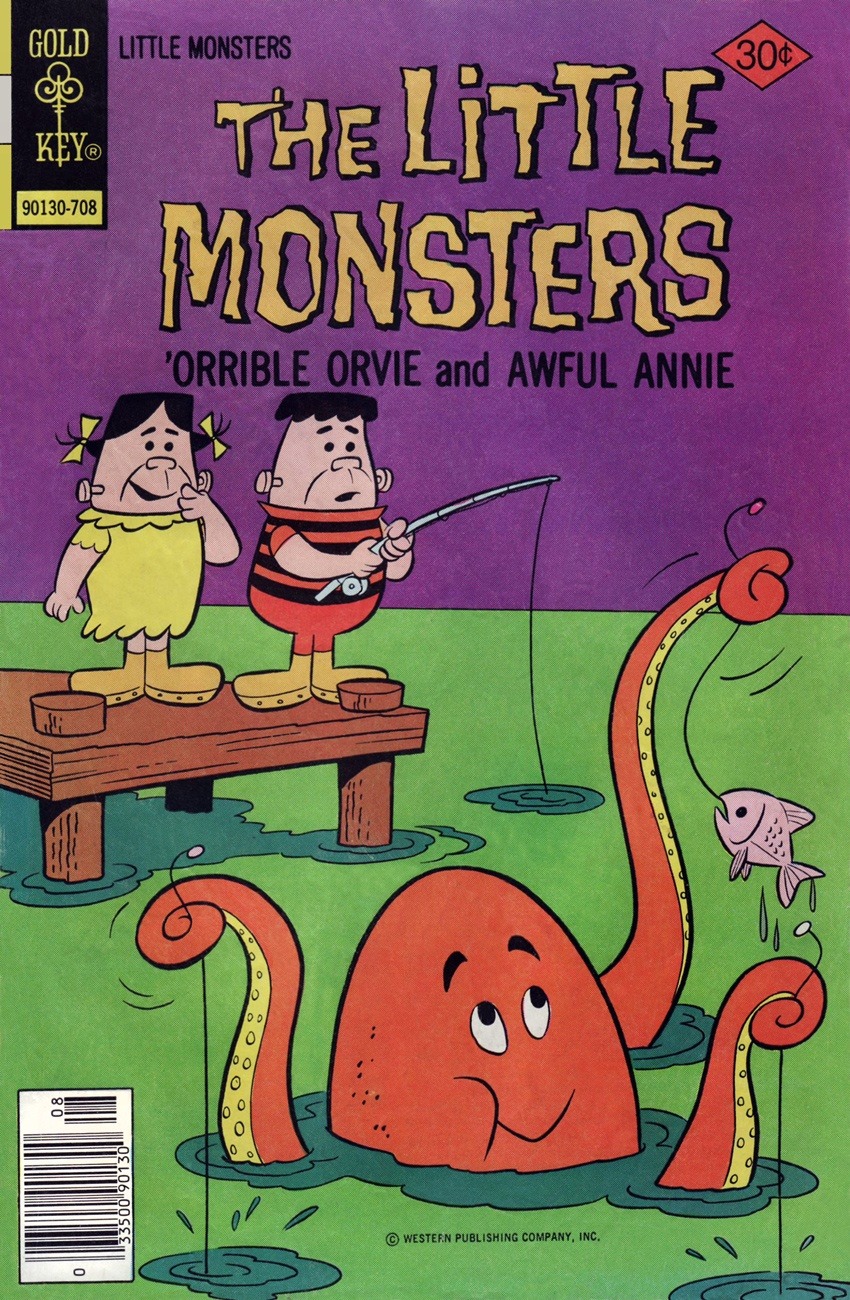
‘Orrible Orvie and Awful Annie will help us wrap up this Tentacle Tuesday. This octopus isn’t assisting the kids directly, but the kind smile on his, err, face radiates benevolence (well, not to the fishes, but one has to feed on *something*, right?)
This is The Little Monsters no. 41, 1977 – only three issues away from the series’ end (it ran from 1964 to 1978 for a total of 44 issues, plus a giveaway issue of March of Comics). Artist unknown.
« It’s difficult to know just what to make of C.C. Beck. He’s crusty and curmudgeonly in the Cleveland Armory mold. He’s virulently opinionated, yet insists that he doesn’t take himself seriously. His aesthetics are inflexible if not reactionary, and not entirely consistent at that. He also happens to be one of the most endearing and original cartoonists ever to breathe life into a super-hero.“*
Charles Clarence Beck was born on June 8th, 1910 and left this world in 1989. The world is a stodgier place without him!
My favourite of Otto Binder/C.C. Beck’s characters – Tawky Tawny, the well-mannered, reasonable, tweed-wearing tiger. Sweet Tawny first appeared in Captain Marvel Adventures #79 (December 1947), as a talking tiger who longed for a life as a normal, suit-wearing, polite member of society. He also really likes ice cream. This panel is from “Mr. Tawny’s Personality Peril”, a story by the Binder and Beck team, published in Captain Marvel Adventures #115 (December 1950).
Here are a few covers which showcase A) C.C. Beck’s stylish art B) the lovely goofiness of it all. To quote the man, « When Bill Parker and I went to work on Fawcett’s first comic book in late 1939, we both saw how poorly written and illustrated the superhero comic books were. We decided to give our reader a real comic book, drawn in comic-strip style and telling an imaginative story, based not on the hackneyed formulas of the pulp magazine, but going back to the old folk-tales and myths of classic times. » Well, to be honest, aside from the so-called Greek origins of Captain Marvel (“Shazam”, the catalyzing cry which allows ordinary Billy Batson to transform into his superhero alter-ego, stands for “Solomon, Hercules, Atlas, Zeus, Achilles, Mercury”), there’s little in these stories that evokes classic folk tales *or* mythology. I know the Ancient Greeks were into some kooky shit, but I don’t recall any myopic worms with a Napoleon complex nor talking tigers in suits. Ultimately, Captain Marvel comics are family fun. “Old-fashioned” values are the backbone of these stories: friendship, loyalty, kindness to those weaker (or stupider) than us. If that sounds boring, it isn’t. Beck had a cartoony style that make his stories fucking adorable, especially when coupled with the often surreal and delightfully wacky plots.
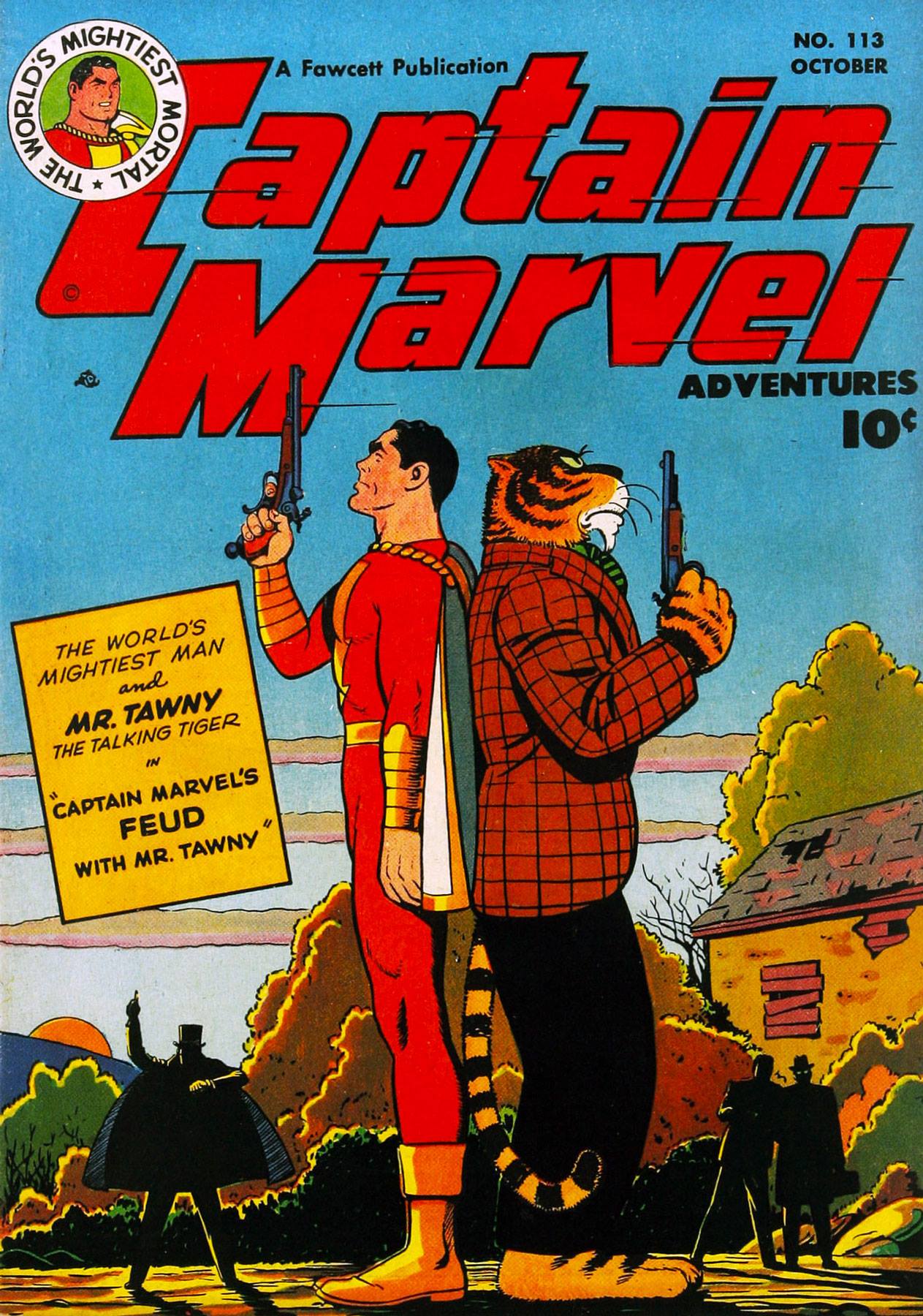
“Quote! Mr. Tawny is not a tiger – he’s a worm! Unquote!”
At first glance, this cover is celebrating the beauty of autumn; upon a closer inspection, it turns out that it has much darker overtones – two faceless guys in the background, clearly following some nefarious plan to break up Tawny and Captain Marvel’s friendship (how dare they!) and a creepy boarded-up house. This is Captain Marvel Adventures #113 (October, 1950), cover by C. C. Beck. Read “His Feud With Mr. Tawny” (scripted by Otto Binder, illustrated by C.C. Beck), which is finally not at all gruesome, just heart-warming, here.
C.C. Beck co-created Captain Marvel with writer Bill Parker in 1939. The Big Red Cheese made his first stellar appearance in Whiz Comics #2 (cover date February 1940), published in late 1939. Captain Marvel was a huge hit, and so Fawcett put out a number of spin-off comic books – as for Beck, he opened his own comic studio in 1941 that provided most of the artwork in the Marvel Family line of books.
« Special! Baby dinosaurs! New! Different! Be the envy of your friends! »
Captain Marvel Adventures #123, 1951. Did you know that dinosaurs apparently wag their tails like dogs to express their affection? No? Head over here.
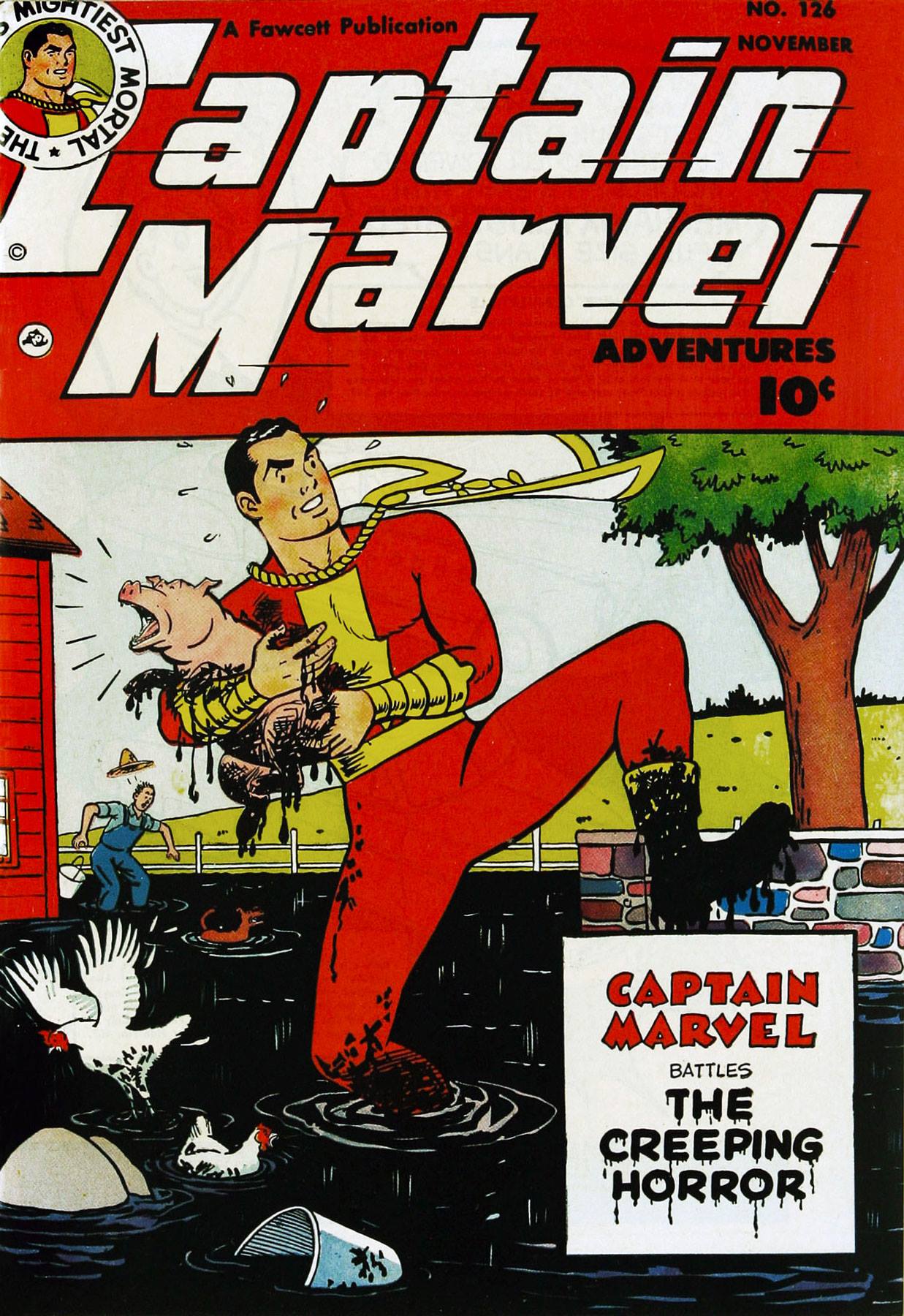
« Wait! This isn’t oil! It’s dense, black and real sticky! »
Don’t let go of that piglet, Captain Marvel! Pigs’ reputation for loving mud may be well deserved, but no self-respecting swine wants to be dropped into black, sticky goo. This is Captain Marvel Adventures #126 (November 1951), cover by C.C. Beck. The cautionary cover tale, Captain Marvel and the Creeping Horror, was written by Otto Binder and pencilled by C.C. Beck (with inks, tentatively, by Pete Costanza).
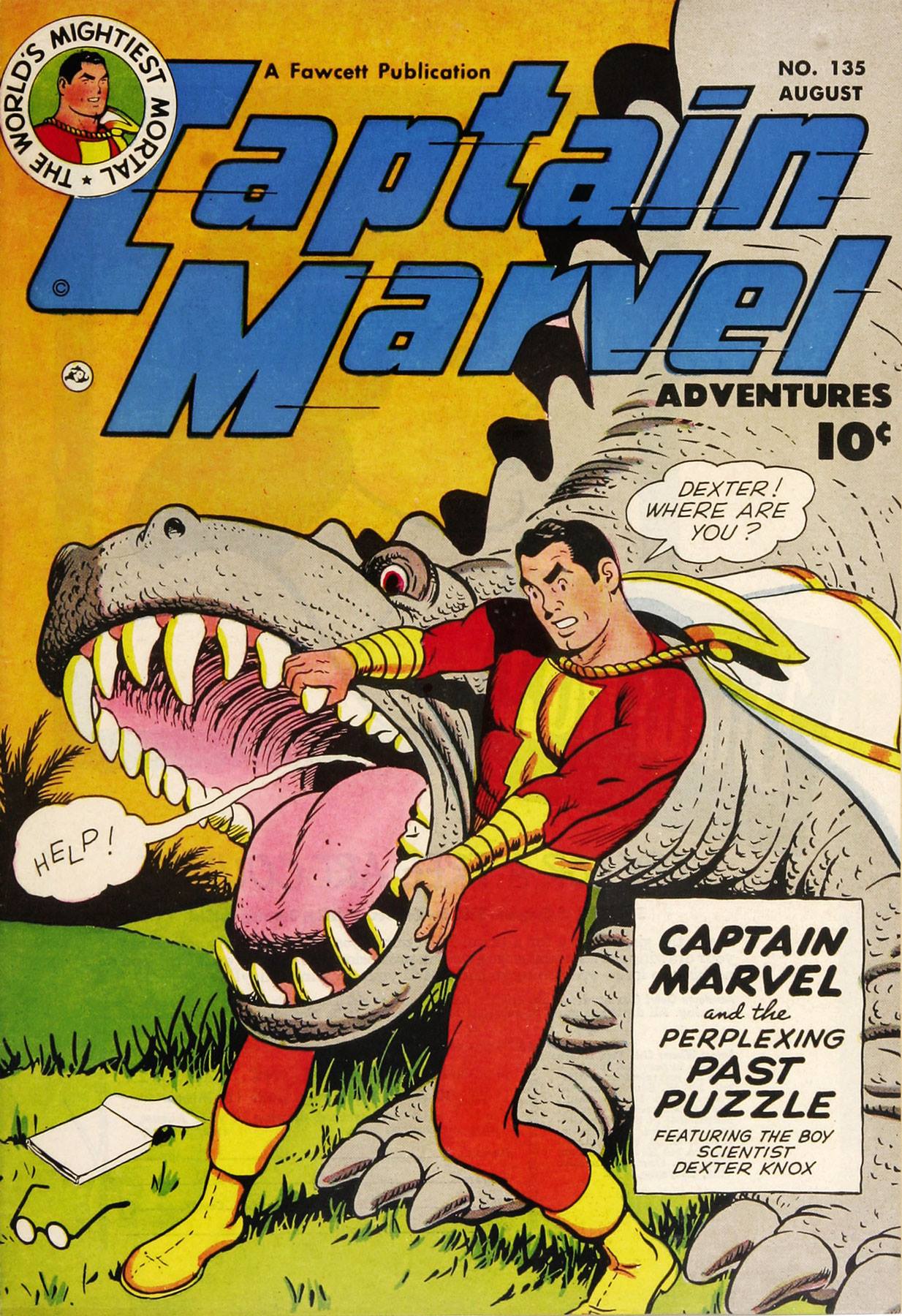
« Did you hear that, ma? We’re on another – uh – world! Ma, aren’t you scared? » « Land sakes, pa, why get scared? At least my wash will dry nice and fast with two suns shining down! »
Captain Marvel Adventures #135 (August 1952); cover by C.C. Beck.
IGN ranked Captain Marvel as the 50th greatest comic book hero of all time. You know how they qualified it? “Times have changed, and allegiances with them, but Captain Marvel will always be an enduring reminder of a simpler time.” If there’s one thing I hate, it’s people who assume that generations before theirs were naïve or that the world was a “simpler” place (take a peep in any good history book and see if that was the case). This kind of condescension poisons any compliment.
C.C. Beck in 1982. He kinda looks like my physics teacher from high school!
Doctor Sivana comes out with his whole family to taunt Billy! Says Beck, “The publisher also once wanted to drop Sivana, claiming the old rascal was becoming a more interesting character than Captain Marvel. The editors paid no attention to so silly an order and kept him alive and cackling.”
There’s a beautifully conducted interview with Beck by Tom Heintjes, published in Hogan’s Alley. I highly recommend it. Heart-breakingly, Heintjes explains in the introduction that “when Beck died of renal failure on November 23, 1989, my inability to complete a book celebrating Beck’s life and career—to my mind, one of the most commercially and aesthetically successful in the entire history of comic books—was a source of acute regret.”
~ ds
*Gary Groth’s introduction to an interview with C.C. Beck published in Comics Journal #95 (February 1985) and conducted in 1983.
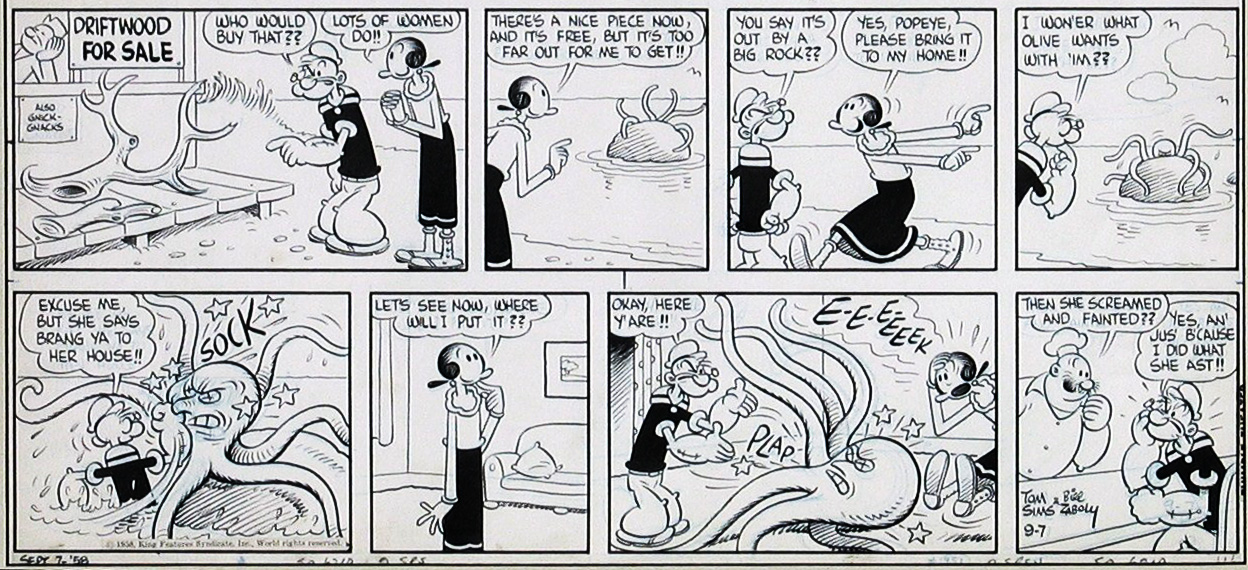
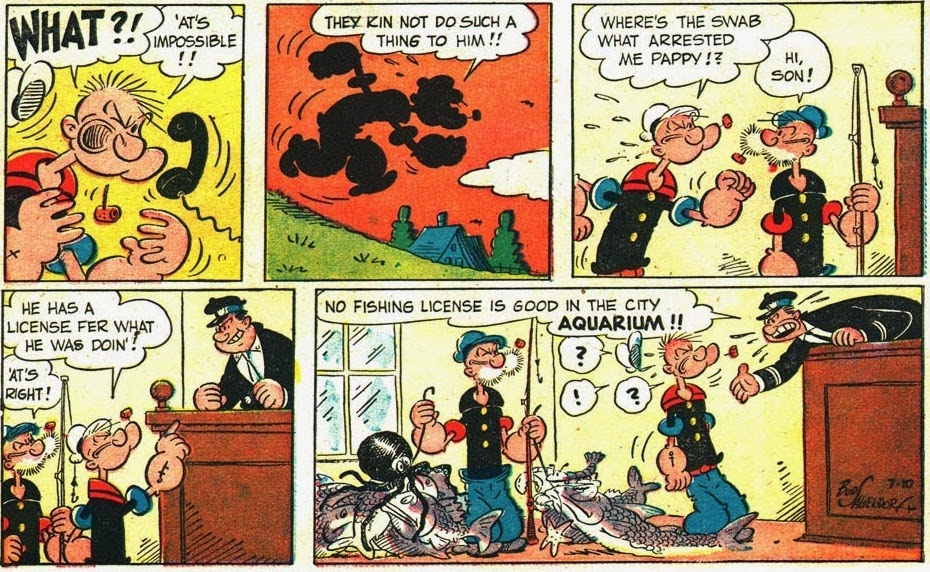
Since Popeye’s a sailor, one would expect him to run into a lot of octopuses during his adventures. It doesn’t happen nearly as often as one would think, actually, but there’s still enough encounters for a decent-sized tentacle journey. Here we go!
Popeye: Danger, Ahoy! Big Little Book no. 5768 (Whitman, 1969). Does anybody know who painted this cover?
« Zombie Popeye » (and, more importantly for our current topic of discussion, Chtulhu-Olive!) by the talented Roger Langridge. He posted this so-called sketch (how detailed can a drawing be before it stops being a sketch?) on his website on September 2014… and the original is still for sale, I believe! Go here. This isn’t the first time Langridge tentacles slither into a blog post – for instance, go visit « Tentacle Tuesday: pirates and treasure, oh my».
A variant cover for Popeye Classics no. 48, July 2016. These Craig Yoe reprints of Bud Sagendorf’s Popeye are great fun, by the way, and I highly recommend them for the proverbial children-at-heart.
Original art for a Popeye Sunday, published on July 9th, 1958. The art is by Bela (Bill) Zaboly, who worked on Thimble Theater starting from 1939 and until Bud Sagendorf took over in 1959.
A chunk of story in which an octopus makes a very minor appearance… from a strip by Bug Sagendorf published on October 7th, 1960.
A panel from “Hitchhikers!” by Bug Sagendorf, published in Popeye Comics no. 19 (January-March 1952). Read the full zany story here. (Technically, this is a Sherm story, but let’s not split hairs.) I’m not surprised the octopus looks like a spy, wearing a hairpiece like that. Or is it just a nest for the birdies?
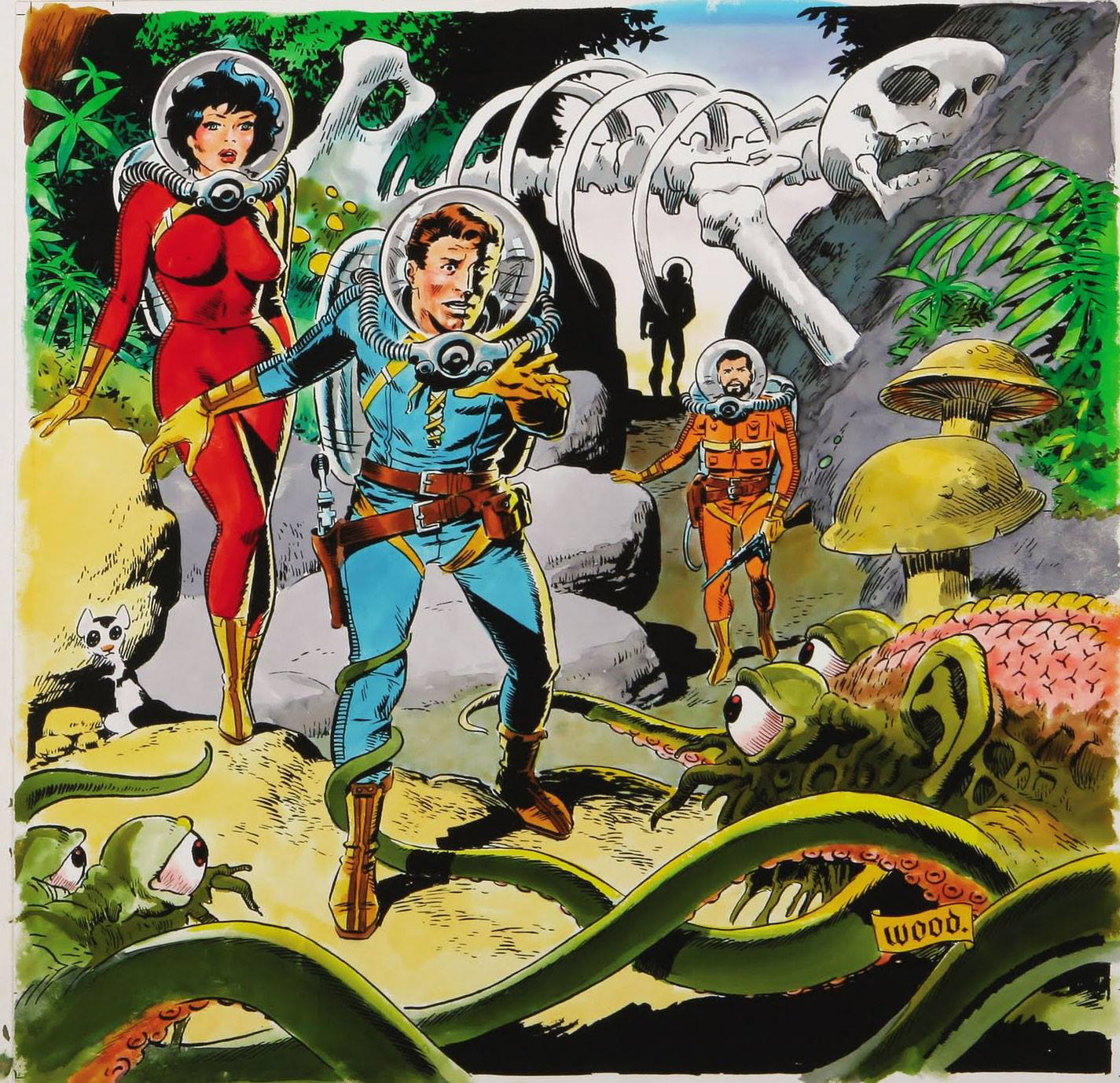
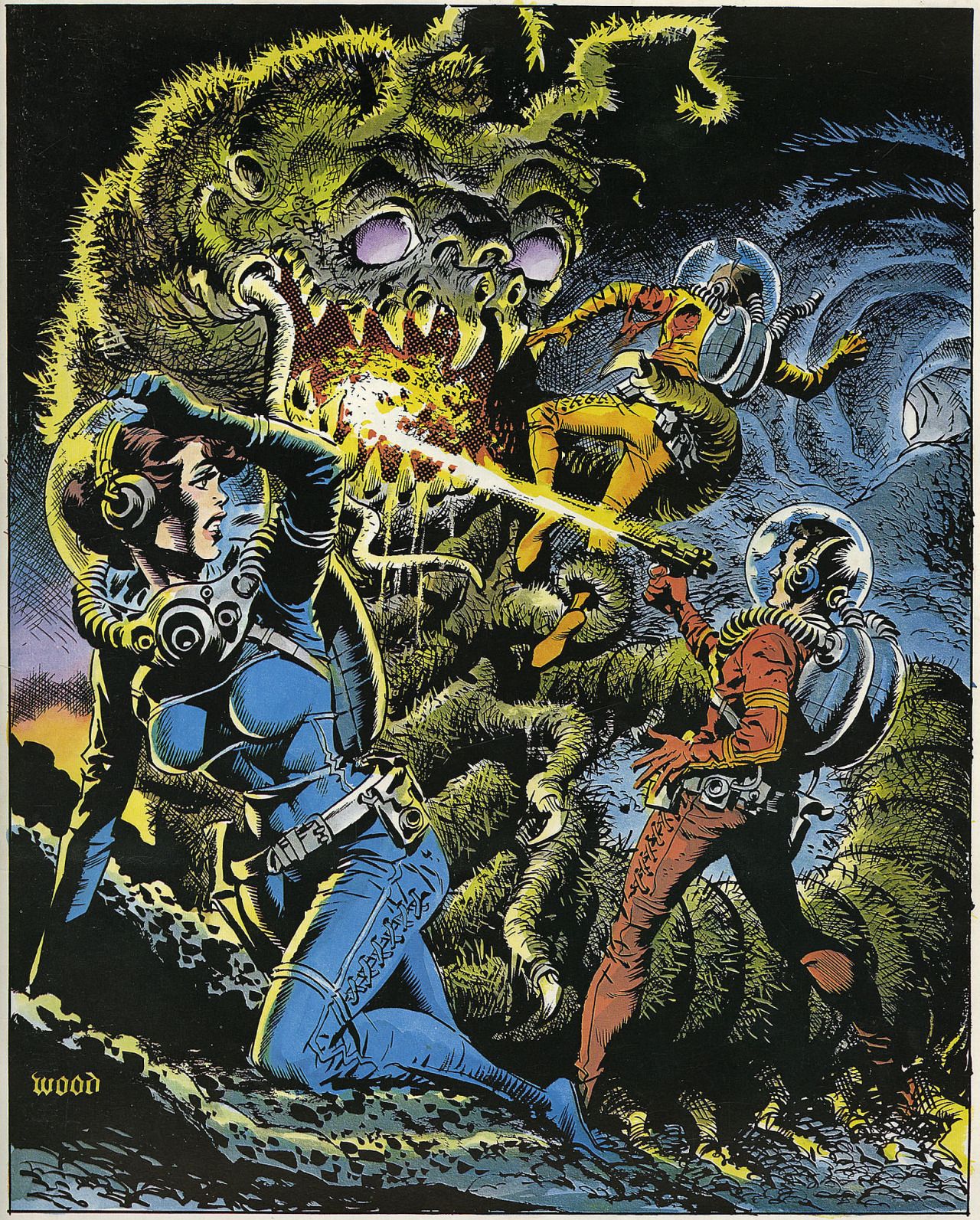
If your little heart desires babes with form-fitting clothing (or wearing nought but their birthday suits) and tentacled monsters with sad, expressive eyes, look no further than Wallace Allan Wood (1927-1981). Famously advising fellow cartoonists to “never draw anything you can copy, never copy anything you can trace, never trace anything you can cut out and paste up”, he would return to the beloved theme of buxom girl + tentacles again and again.
Without further ado, let’s take a gander at some of Wally Wood’s tentacled offerings.
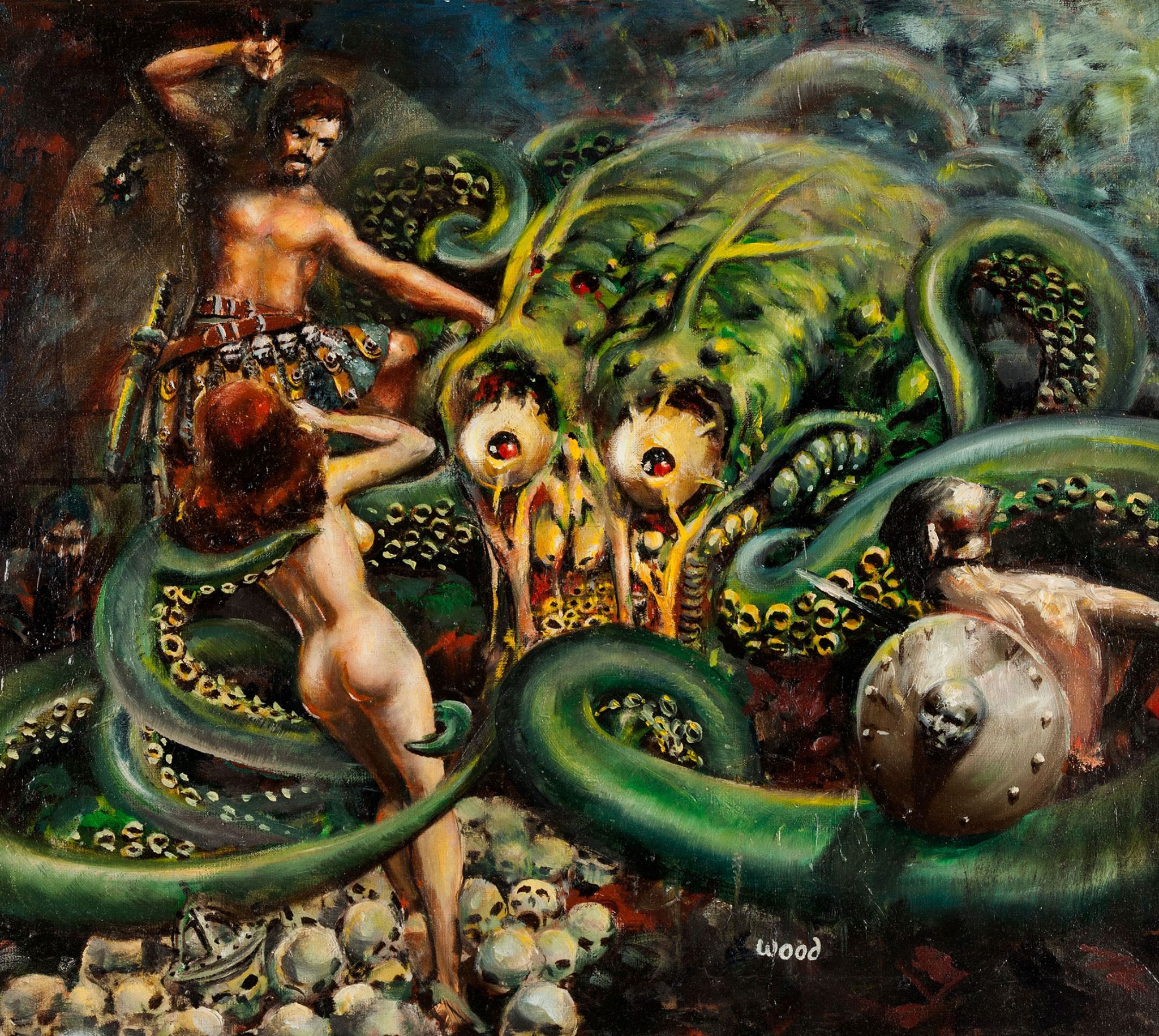
This opulent, splendi-tentacular painting has been spawned by Wally Wood in 1954. It’s called Dweller in the Dungeon, and was originally presented as a gift to EC publisher Bill Gaines. I don’t know about you, but I’m rooting for the cephalopod, who has unquestionably good taste in women.
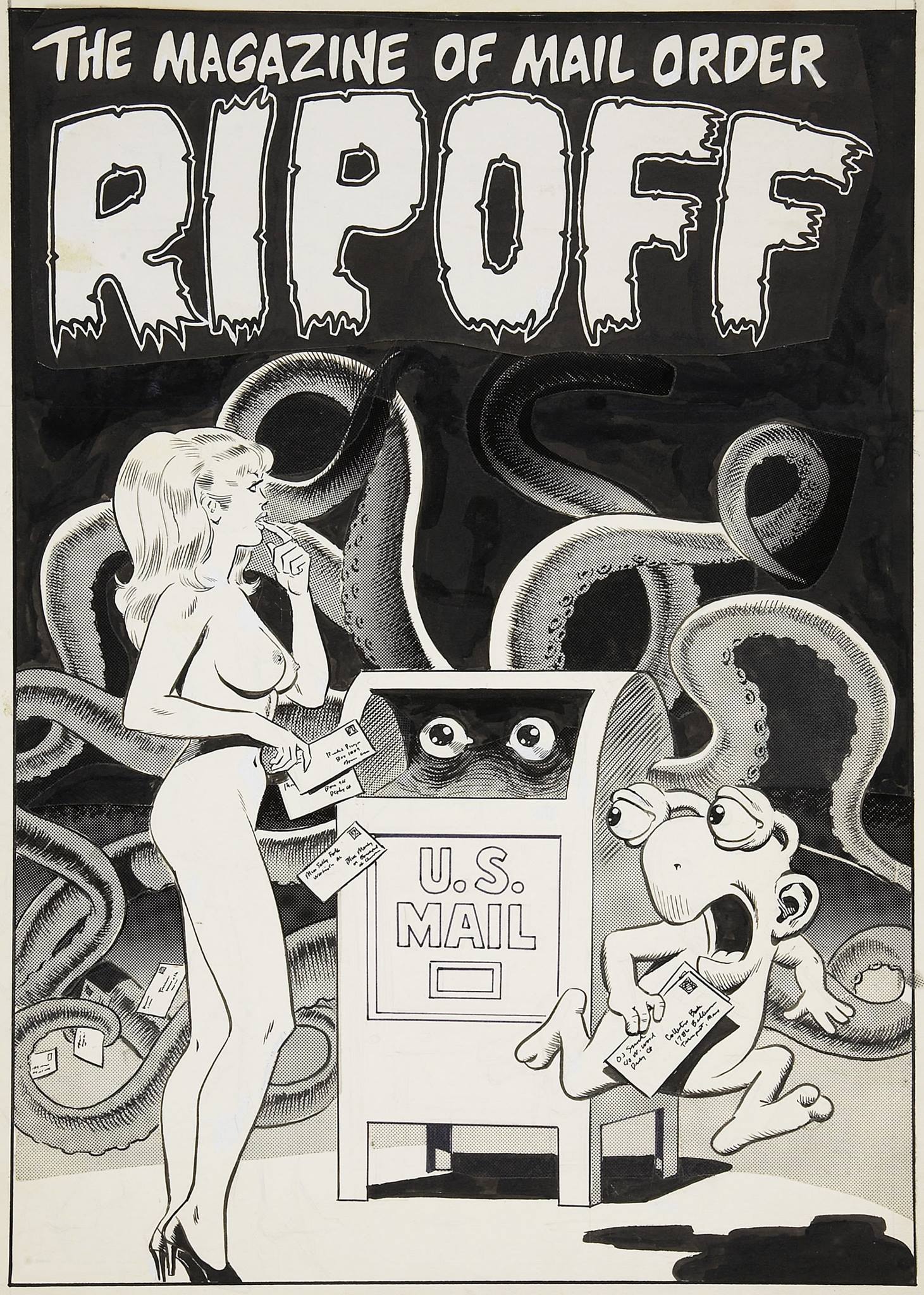
The cover Wally Wood drew for a mail order catalog (to be more precise, The Magazine of Mail Order Collector’s Press Newsletter no. 16, 1979. Phew, that’s a mouthful.)
Original art from The Man Hunters (published in Eerie no. 60, 1974 – you can see this issue’s cover in our previous post.)
This theme is returned to again several years later:
It may have reflected Wood’s mental turmoil, but his tentacled monsters have pleading eyes that just beckon to the viewer. Maybe it’s a form of hypnotism. You’re grabbing the wrong human, buddy! Go for the girl! This Wally Wood painting was used as the cover of The Comic Book Price Guide no. 9 (1979).
Wood cover art for an LP (Bell Records, 1965). Here the green-brain-with-tentacles is almost unbearably cute.
There’s also this poignant scene…
Cover for EC Portfolio no. 5, 1974.
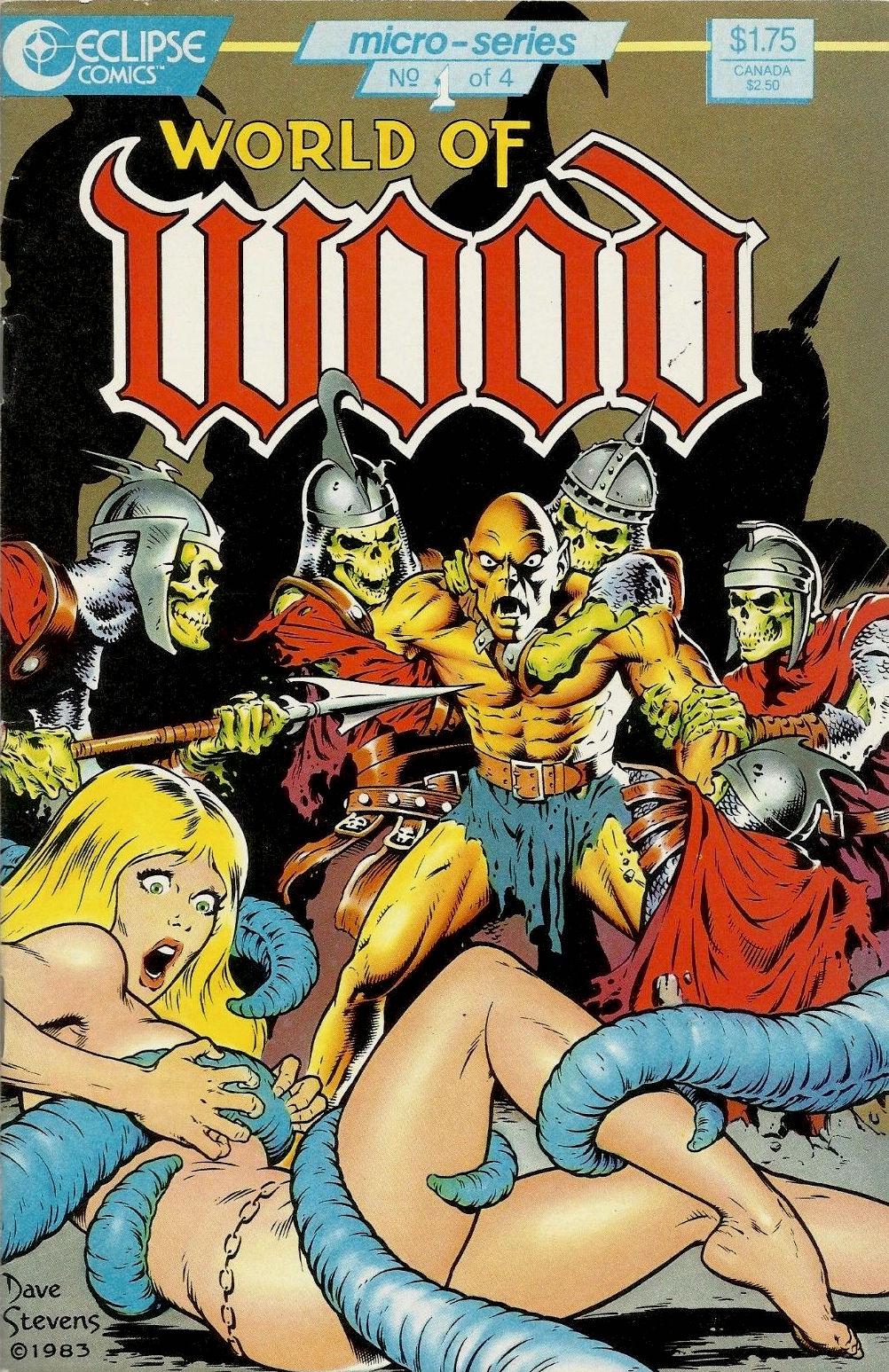
Wally Wood was a tremendous influence on artists who came after, and there’s a myriad of parodies, imitations, and derivations of his style… But I’ll wrap up this post with one well-executed hommage that fits in well with the theme, I think.
World of Wood no. 1 (Eclipse, April 1986). Cover by Dave Stevens.
Okay, now that you’ve seen some Mad covers (see a MAD dash… outside) let’s have a peek at some inside art by the habitués.
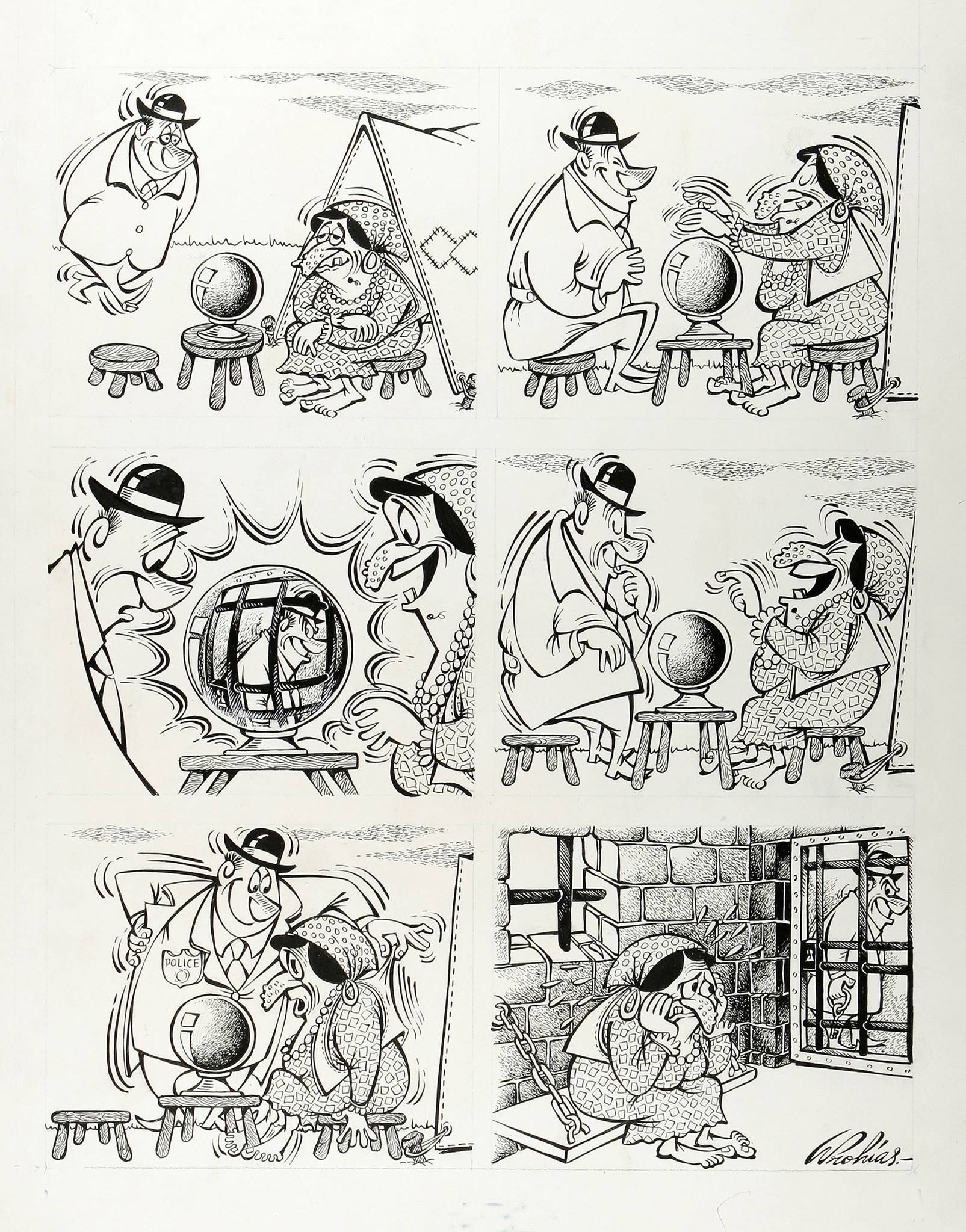
One of my favourite MAD artists is Antonio Prohías (1921-1998). Hailing from Cuba (but being forced to emigrate thanks to an repressive government that wasn’t too fond of the concept of “free press”), he moved to New York in 1960. Apparently Prohias was in no hurry to learn English (and, in fact, his cartoons are silent). Here’s a cute anecdote involving Sergio Aragonés, courtesy of Wikipedia:
« Two years after Prohias’ debut in the magazine, cartoonist Sergio Aragonés made the trek from Mexico to New York in search of work. Because Aragonés’ command of English was then shaky, he asked that Prohias be present to serve as an interpreter. According to Aragonés, this proved to be a mistake, since Prohías knew even less English than he did. When Prohías introduced the young artist to the Mad editors as “Sergio, my brother from Mexico,” the Mad editors thought they were meeting “Sergio Prohías. Twelve years later, Mad writer Frank Jacobs reported that Prohias’ conversational English was limited to “Hello” and “How are you, brother?” Said Aragonés, who speaks six languages, “Even I could not understand him that well. »
Clearly, art was Prohias’ language, and we’re not at all complaining.
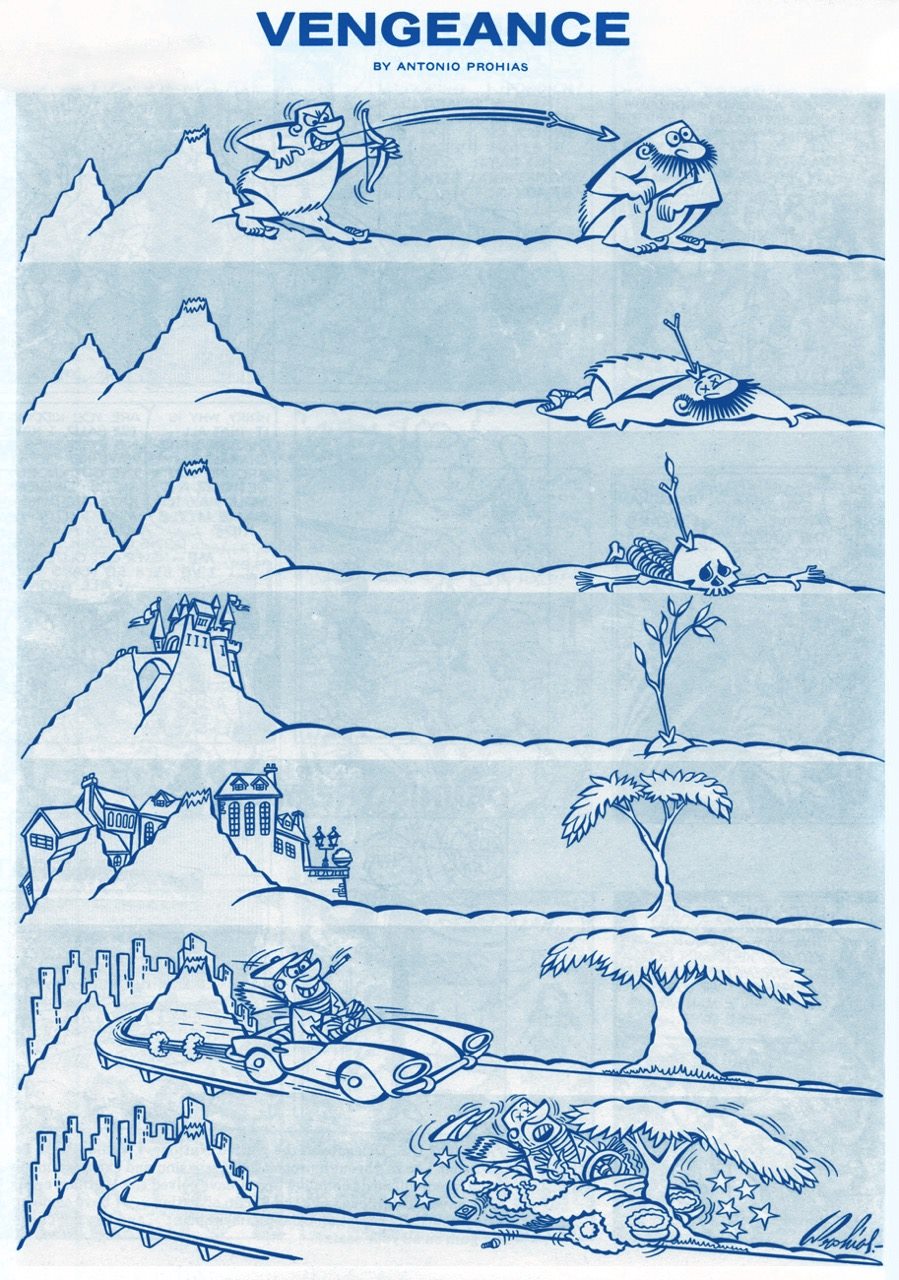
It pays to play the *long* game! “Vengeance” was published in Mad no. 66 (October 1961). Art by Antonio Prohías.
This it the original art for a gag called “The Old Ball Game”, created for Mad’s Fortune Kookie Dept. It was published in Mad no. 161, September 1973. Art by Antonio Prohías.
Original art for a strip published in Mad no. 253, March 1985. Ironically, I don’t particularly like Prohías’ Spy vs Spy, despite the lovely art and violent dismemberment scenes, much preferring Peter Kuper’s (much later, starting in 1997 up until today) version of this strip.
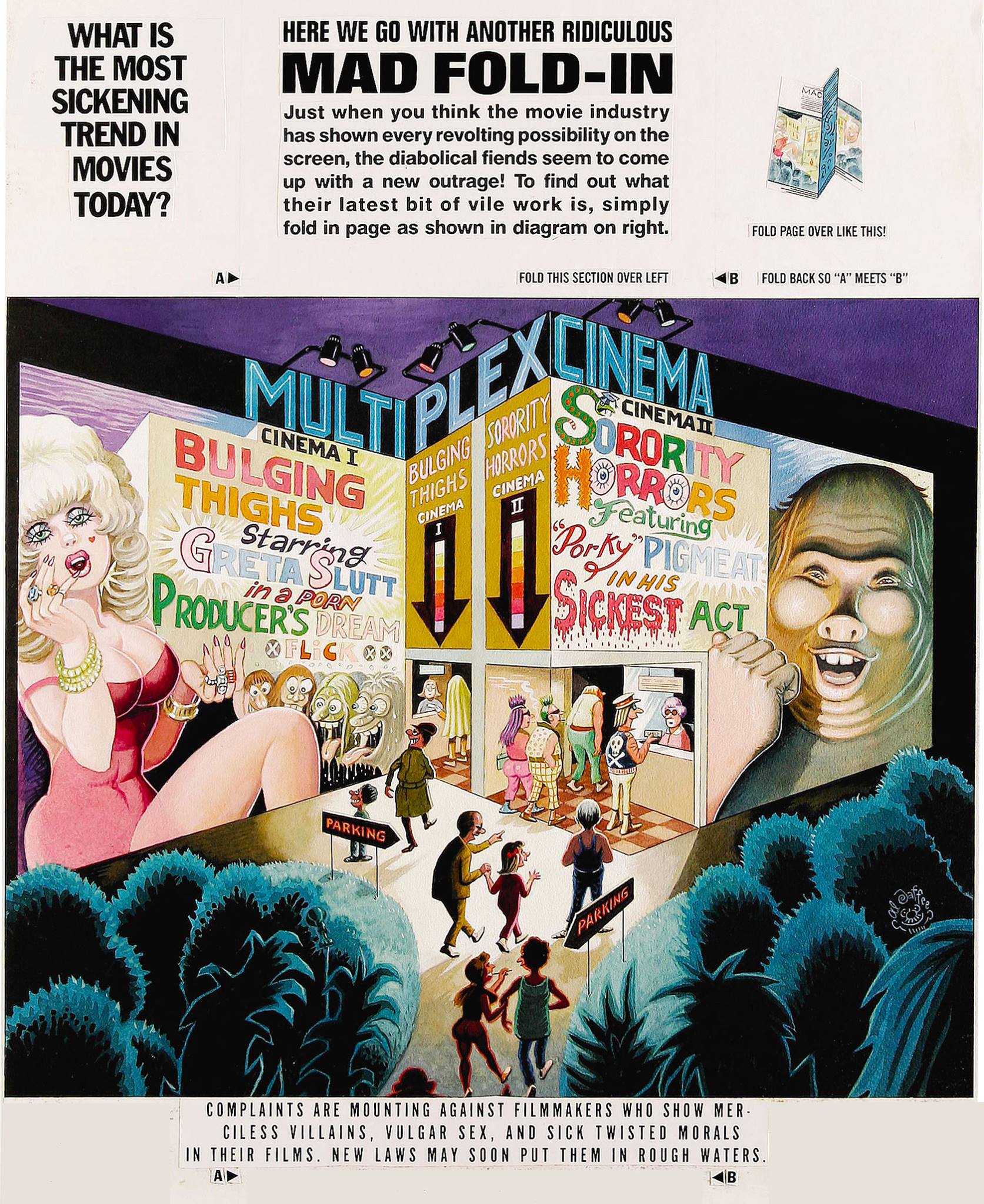
Next on our list is Al Jaffee, the “world’s oldest cartoonist” (Guinness World Records certified and everything!), Mad’s longest-running contributor, creator of the Mad Fold-In, mastermind of Snappy Answers to Stupid Questions.
This fold-in comes from Mad no. 297, September 1990. Drawn by Al Jaffee, it answers (maybe) the paramount question of “What is the most sickening trend in movies today?”( Since I can’t very well ask you to fold your computer screen, the answer is “Commercials in theaters.”)
Incidentally, Mad introduced fold-ins in 1964 – they were a most prominent feature of MAD Magazine, conceived, drawn and written by the aforementioned Jaffee. I’ll quote the man himself:
“Playboy had a foldout of a beautiful woman in each issue, and Life Magazine had these large, striking foldouts in which they’d show how the earth began or the solar system or something on that order — some massive panorama. Many magazines were hopping on the bandwagon, offering similar full-color spreads to their readers. I noticed this and thought, what’s a good satirical comment on the trend? Then I figured, why not reverse it? If other magazines are doing these big, full-color foldouts, well, cheap old Mad should go completely the opposite way and do an ultra-modest black-and-white Fold-In!”
I guess they folded (ahem) on the “black-and-white” part later on. Here’s another nice Al Jaffee production:
This cartoon dwelled on the back cover of Mad no. 214 (April 1980), and was written by Dave Manak & drawn by Al Jaffee.
In a 2010 interview, Jaffee said, “Serious people my age are dead.” That may just be the recipe for eternal life.
Moving on to another mainstay of MAD: Sergio Aragonés, an artist about whom Mad director Al Feldstein said “he could have drawn the whole magazine if we’d let him.” Prolific, delightfully funny, and (by all accounts) a really friendly guy, Aragonés (born in 1937) is still with us today.
A little gruesome hippy humour from Sergio Aragonés, published in Mad no. 139, December 1970.
My favourite recurring feature by Aragonés is “Who knows what evils lurk in the hearts of men? The shadow knows.“ Many years ago, I picked up a copy of “Mad’s Sergio Aragonés on Parade” at a second hand store. I didn’t know who he was, then, but I loved the sometimes tiny, always funny squiggly drawings immediately. (I also didn’t know who the Shadow was, so that reference was sailing right over my head.) Even though I have since then upgraded to the considerably heftier “Sergio Aragones: Five Decades of His Finest Works“, there’s no way I’m getting rid of my dog-eared, stained and shopworn copy – that’s the one I reach for when I need a chuckle.
Published in From Mad no. 131, December 1969, scanned from “Mad’s Sergio Aragonés on Parade“, and artistically coloured by co-admin RG.
Published in From Mad no. 129, September 1969, scanned from “Mad’s Sergio Aragonés on Parade“, and artistically coloured by co-admin RG.
Hurray for Aragonés, the weird hours he keeps (by his own admission), and the thousands of ideas bubbling in his head at any given time. “Sergio has, quite literally, drawn more cartoons on napkins in restaurants than most cartoonists draw in their entire careers“, said Al Jaffee, and glancing at the tiny drawings decorating the margins and in-between-panels of Mad magazine, one can easily believe it.
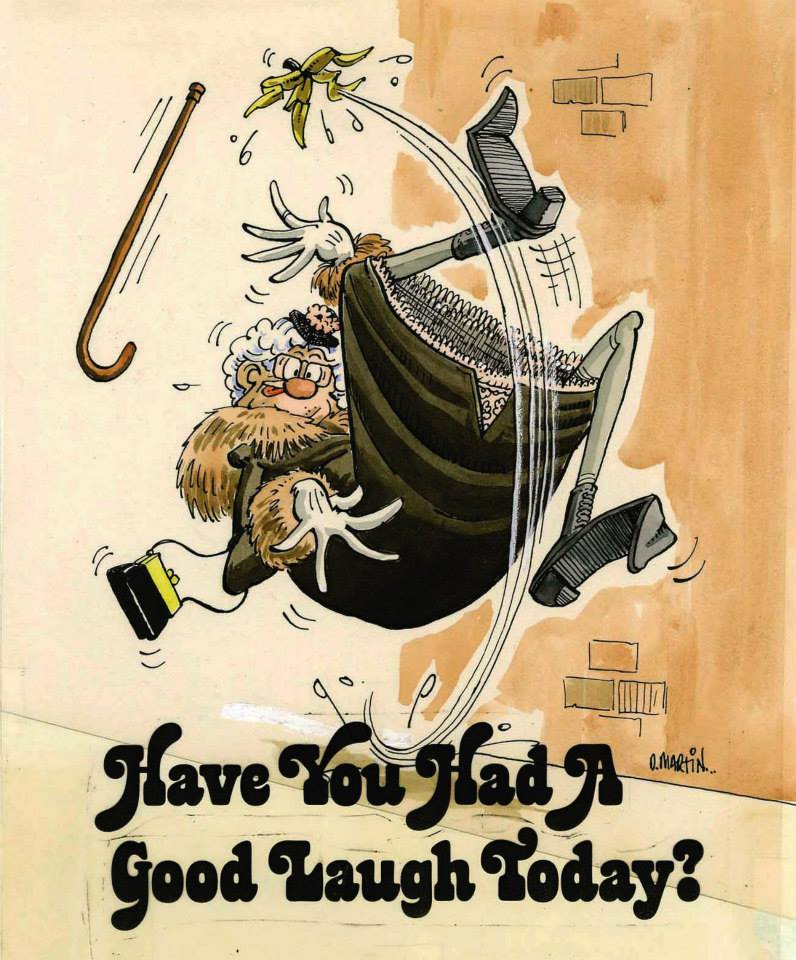
The other guy who just has to be mentioned is Don Martin (1931-2000), promoted as Mad’s Maddest Artist. Where else would we get our fix for goofy characters with comically large, hinged feet? I can just imagine the squeaking noises they make.
Well, *have* you? This Don Martin cartoon was used as one of the eight “Vital Message” mini posters offered with Mad Super Special no. 17 (1970). It makes me think of my mom’s parting admonition every time I would leave the house – “and don’t hit old ladies with an umbrella”. I am proud to say that I’ve followed her advice… so far.
Here’s a fun description of standard Don Martin characters (source):
« His people are big-nosed schmoes with sleepy eyes, puffs of wiry hair, and what appear to be life preservers under the waistline of their clothes. Their hands make delicate little mincing gestures and their strangely thin, elongated feet take a 90-degree turn at the toes as they step forward. Whether they’re average Joes or headhunters, Martin’s people share the same physique: a tottering tower of obloids. Martin puts the bodies of these characters through every kind of permutation, treating them as much like gadgets as the squirting flowers and joy buzzers that populate his gags: glass eyes pop out from a pat on the back; heads are steamrollered into manhole-cover shapes. All of this accompanied by a Dadaist panoply of sound effects found nowhere else: shtoink! shklorp! fwoba-dap! It’s unlikely Samuel Beckett was aware of Don Martin, but had he been he might have recognized a kindred spirit. »









 « But will you love me when I’m old and gray? » From Playboy’s August, 1971 issue.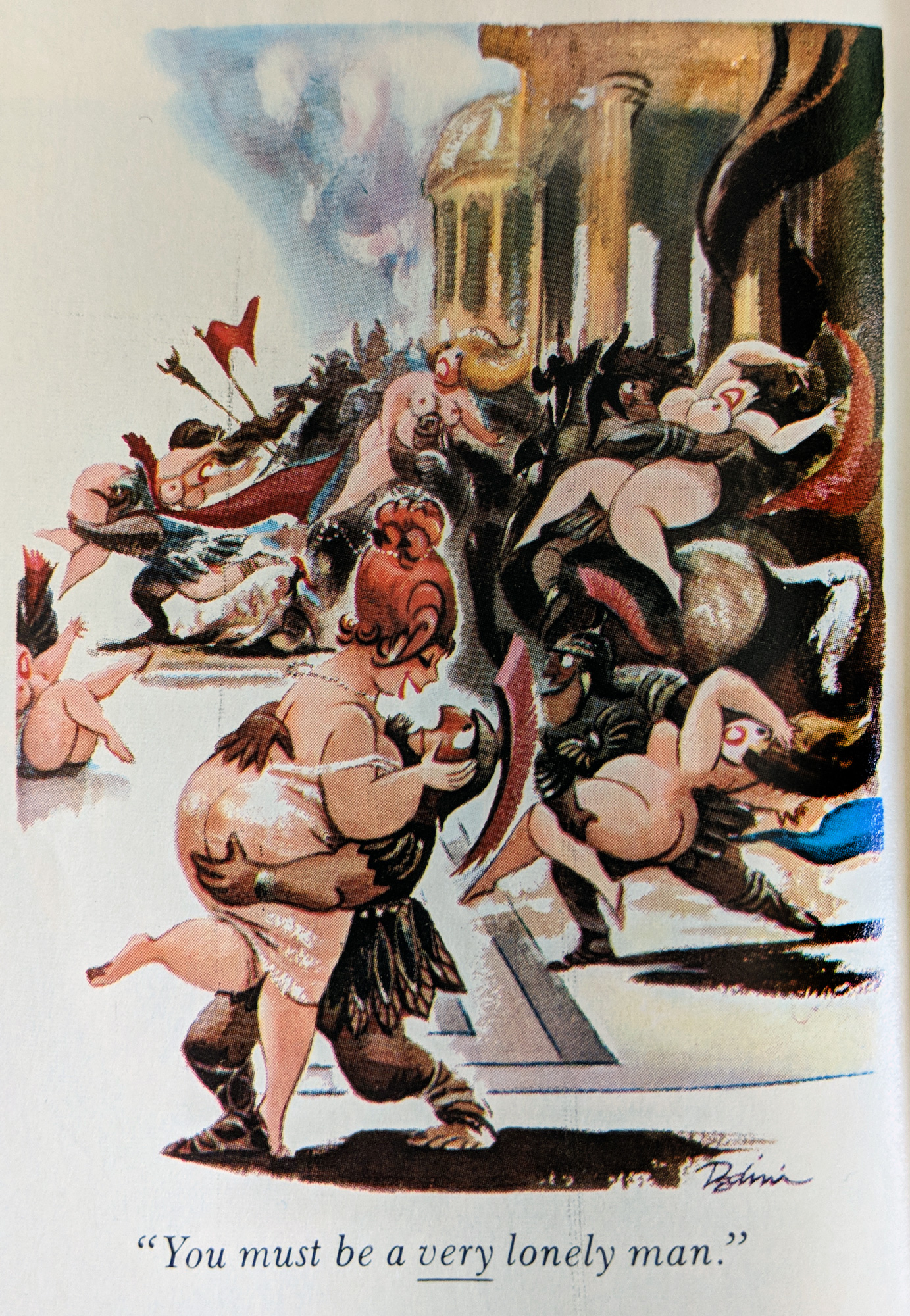




















 Who's Out There?