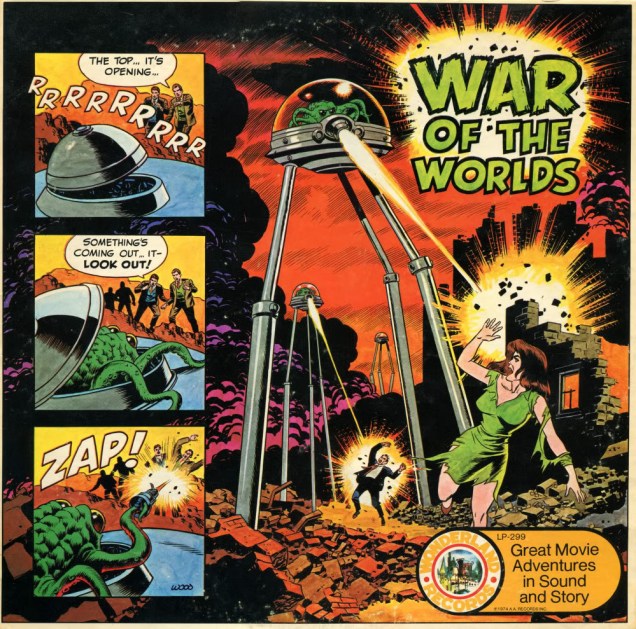
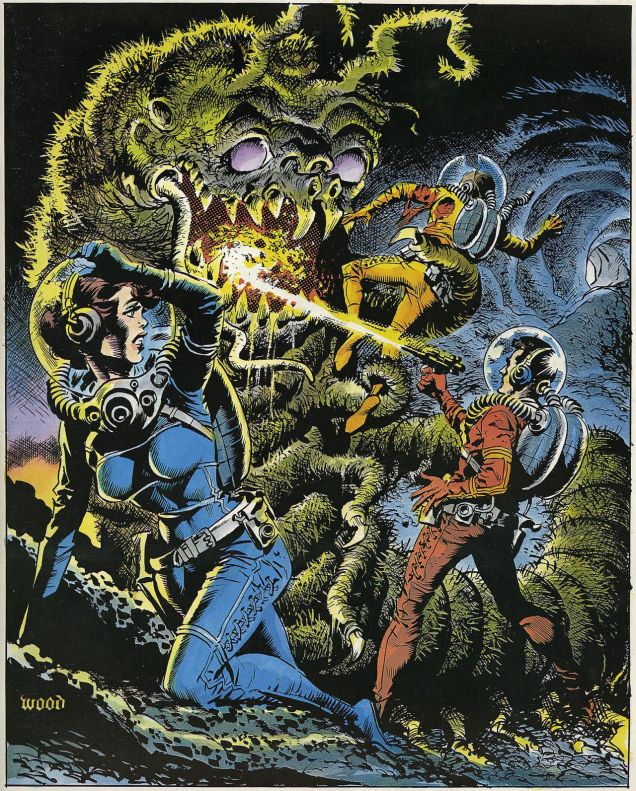
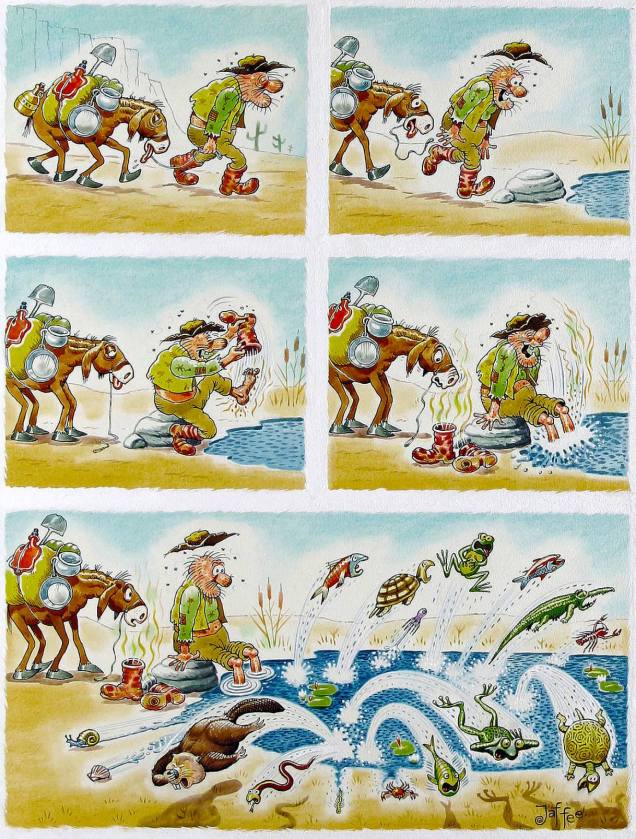
If your little heart desires babes with form-fitting clothing (or wearing nought but their birthday suits) and tentacled monsters with sad, expressive eyes, look no further than Wallace Allan Wood (1927-1981). Famously advising fellow cartoonists to “never draw anything you can copy, never copy anything you can trace, never trace anything you can cut out and paste up”, he would return to the beloved theme of buxom girl + tentacles again and again.
Without further ado, let’s take a gander at some of Wally Wood’s tentacled offerings.
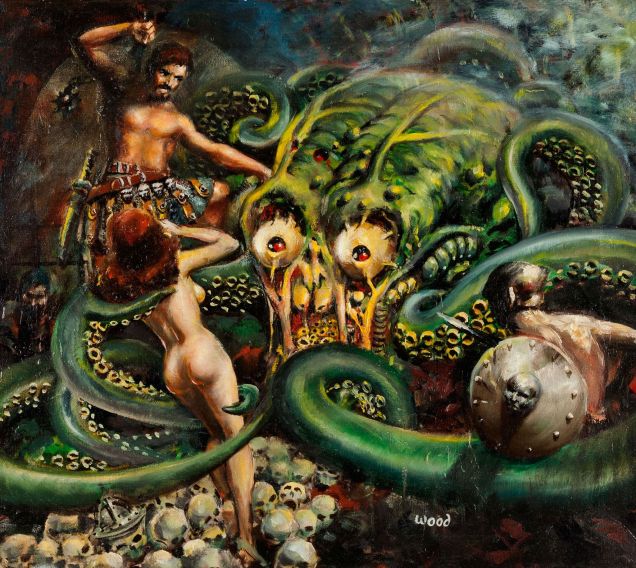
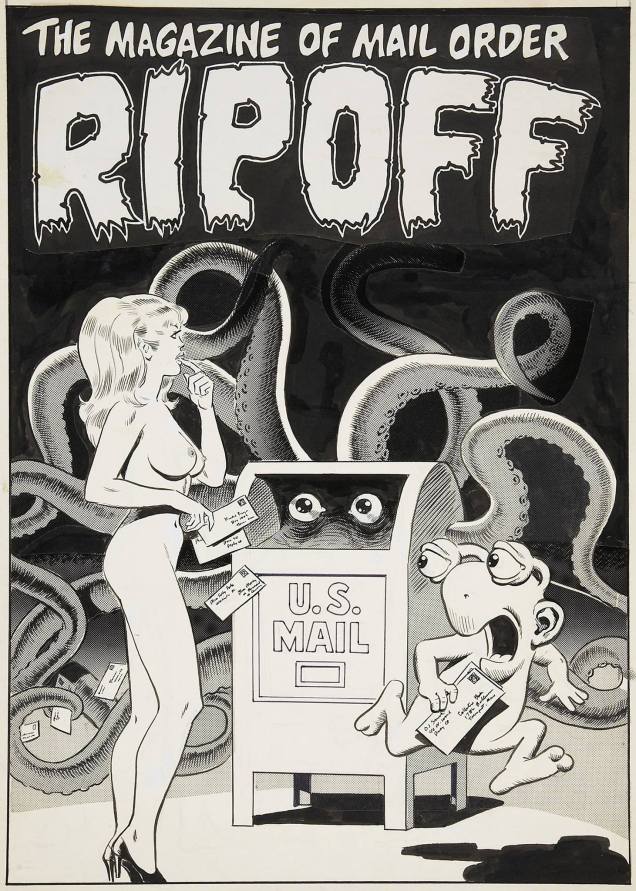
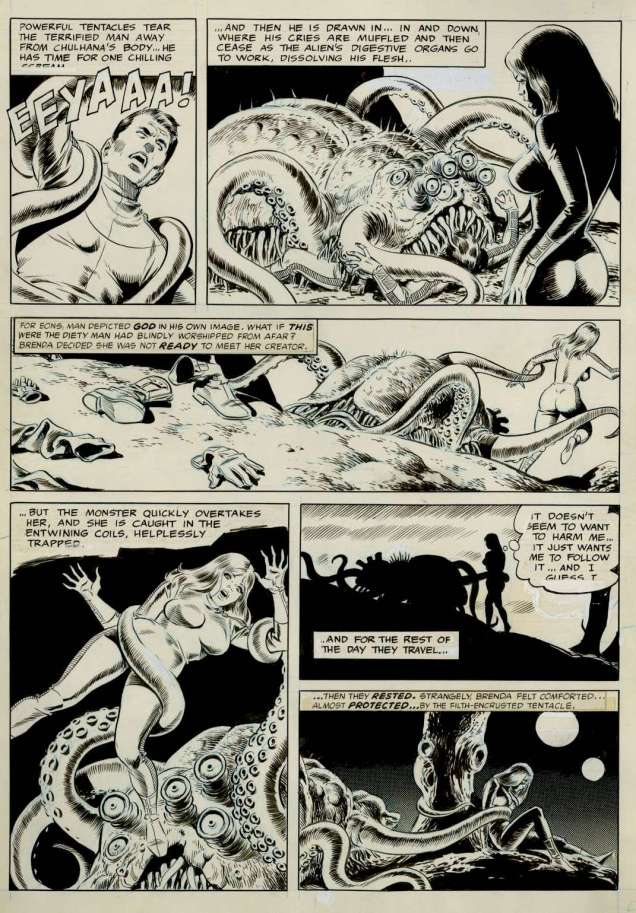
This opulent, splendi-tentacular painting has been spawned by Wally Wood in 1954. It’s called Dweller in the Dungeon, and was originally presented as a gift to EC publisher Bill Gaines. I don’t know about you, but I’m rooting for the cephalopod, who has unquestionably good taste in women.The cover Wally Wood drew for a mail order catalog (to be more precise, The Magazine of Mail Order Collector’s Press Newsletter no. 16, 1979. Phew, that’s a mouthful.)Original art from The Man Hunters (published in Eerie no. 60, 1974 – you can see this issue’s cover in our previous post.)
This theme is returned to again several years later:
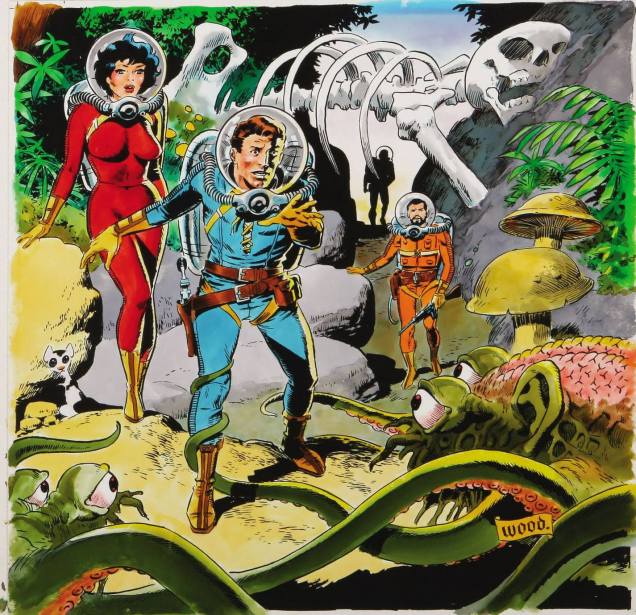
It may have reflected Wood’s mental turmoil, but his tentacled monsters have pleading eyes that just beckon to the viewer. Maybe it’s a form of hypnotism. You’re grabbing the wrong human, buddy! Go for the girl! This Wally Wood painting was used as the cover of The Comic Book Price Guide no. 9 (1979).Wood cover art for an LP (Bell Records, 1965). Here the green-brain-with-tentacles is almost unbearably cute.
There’s also this poignant scene…
Cover for EC Portfolio no. 5, 1974.
Wally Wood was a tremendous influence on artists who came after, and there’s a myriad of parodies, imitations, and derivations of his style… But I’ll wrap up this post with one well-executed hommage that fits in well with the theme, I think.
World of Wood no. 1 (Eclipse, April 1986). Cover by Dave Stevens.
Okay, now that you’ve seen some Mad covers (see a MAD dash… outside) let’s have a peek at some inside art by the habitués.
One of my favourite MAD artists is Antonio Prohías (1921-1998). Hailing from Cuba (but being forced to emigrate thanks to an repressive government that wasn’t too fond of the concept of “free press”), he moved to New York in 1960. Apparently Prohias was in no hurry to learn English (and, in fact, his cartoons are silent). Here’s a cute anecdote involving Sergio Aragonés, courtesy of Wikipedia:
« Two years after Prohias’ debut in the magazine, cartoonist Sergio Aragonés made the trek from Mexico to New York in search of work. Because Aragonés’ command of English was then shaky, he asked that Prohias be present to serve as an interpreter. According to Aragonés, this proved to be a mistake, since Prohías knew even less English than he did. When Prohías introduced the young artist to the Mad editors as “Sergio, my brother from Mexico,” the Mad editors thought they were meeting “Sergio Prohías. Twelve years later, Mad writer Frank Jacobs reported that Prohias’ conversational English was limited to “Hello” and “How are you, brother?” Said Aragonés, who speaks six languages, “Even I could not understand him that well. »
Clearly, art was Prohias’ language, and we’re not at all complaining.
It pays to play the *long* game! “Vengeance” was published in Mad no. 66 (October 1961). Art by Antonio Prohías.This it the original art for a gag called “The Old Ball Game”, created for Mad’s Fortune Kookie Dept. It was published in Mad no. 161, September 1973. Art by Antonio Prohías.
Original art for a strip published in Mad no. 253, March 1985. Ironically, I don’t particularly like Prohías’ Spy vs Spy, despite the lovely art and violent dismemberment scenes, much preferring Peter Kuper’s (much later, starting in 1997 up until today) version of this strip.
Next on our list is Al Jaffee, the “world’s oldest cartoonist” (Guinness World Records certified and everything!), Mad’s longest-running contributor, creator of the Mad Fold-In, mastermind of Snappy Answers to Stupid Questions.
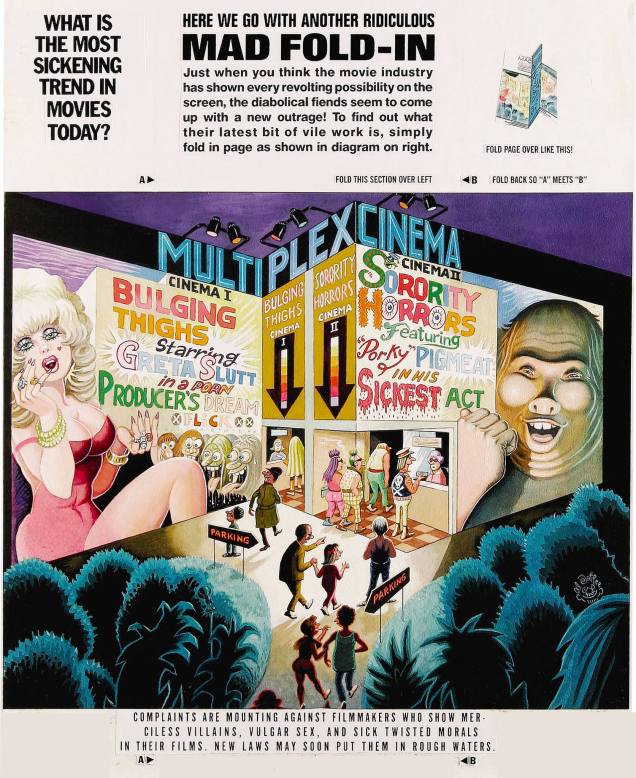
This fold-in comes from Mad no. 297, September 1990. Drawn by Al Jaffee, it answers (maybe) the paramount question of “What is the most sickening trend in movies today?”( Since I can’t very well ask you to fold your computer screen, the answer is “Commercials in theaters.”)
Incidentally, Mad introduced fold-ins in 1964 – they were a most prominent feature of MAD Magazine, conceived, drawn and written by the aforementioned Jaffee. I’ll quote the man himself:
“Playboy had a foldout of a beautiful woman in each issue, and Life Magazine had these large, striking foldouts in which they’d show how the earth began or the solar system or something on that order — some massive panorama. Many magazines were hopping on the bandwagon, offering similar full-color spreads to their readers. I noticed this and thought, what’s a good satirical comment on the trend? Then I figured, why not reverse it? If other magazines are doing these big, full-color foldouts, well, cheap old Mad should go completely the opposite way and do an ultra-modest black-and-white Fold-In!”
I guess they folded (ahem) on the “black-and-white” part later on. Here’s another nice Al Jaffee production:
This cartoon dwelled on the back cover of Mad no. 214 (April 1980), and was written by Dave Manak & drawn by Al Jaffee.
In a 2010 interview, Jaffee said, “Serious people my age are dead.” That may just be the recipe for eternal life.
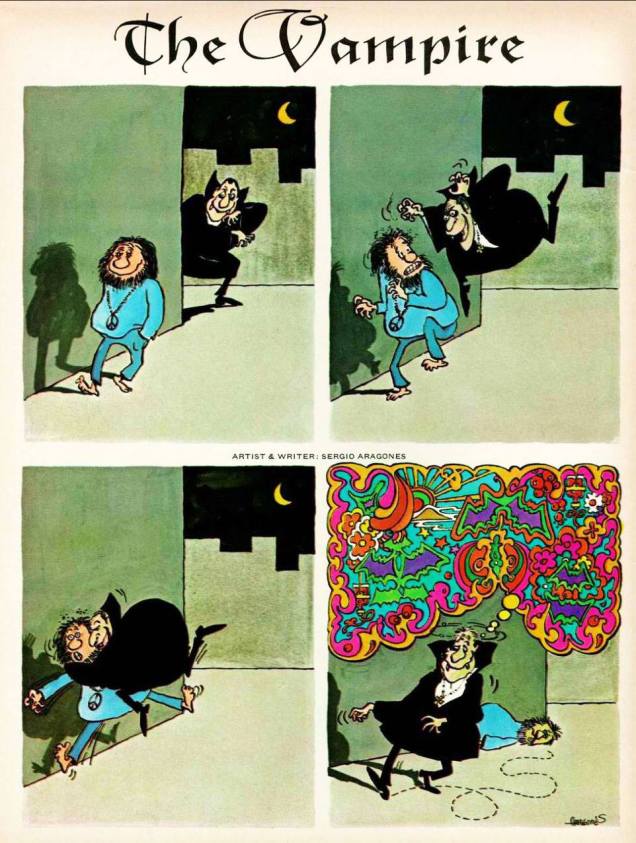
Moving on to another mainstay of MAD: Sergio Aragonés, an artist about whom Mad director Al Feldstein said “he could have drawn the whole magazine if we’d let him.” Prolific, delightfully funny, and (by all accounts) a really friendly guy, Aragonés (born in 1937) is still with us today.
A little gruesome hippy humour from Sergio Aragonés, published in Mad no. 139, December 1970.
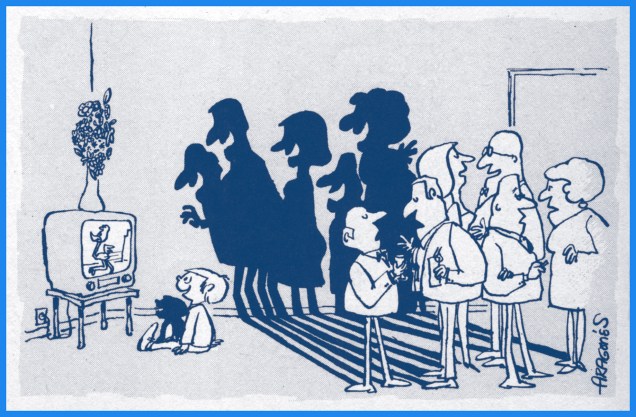
My favourite recurring feature by Aragonés is “Who knows what evils lurk in the hearts of men? The shadow knows.“ Many years ago, I picked up a copy of “Mad’s Sergio Aragonés on Parade” at a second hand store. I didn’t know who he was, then, but I loved the sometimes tiny, always funny squiggly drawings immediately. (I also didn’t know who the Shadow was, so that reference was sailing right over my head.) Even though I have since then upgraded to the considerably heftier “Sergio Aragones: Five Decades of His Finest Works“, there’s no way I’m getting rid of my dog-eared, stained and shopworn copy – that’s the one I reach for when I need a chuckle.
Published in From Mad no. 131, December 1969, scanned from “Mad’s Sergio Aragonés on Parade“, and artistically coloured by co-admin RG.Published in From Mad no. 129, September 1969, scanned from “Mad’s Sergio Aragonés on Parade“, and artistically coloured by co-admin RG.
Hurray for Aragonés, the weird hours he keeps (by his own admission), and the thousands of ideas bubbling in his head at any given time. “Sergio has, quite literally, drawn more cartoons on napkins in restaurants than most cartoonists draw in their entire careers“, said Al Jaffee, and glancing at the tiny drawings decorating the margins and in-between-panels of Mad magazine, one can easily believe it.
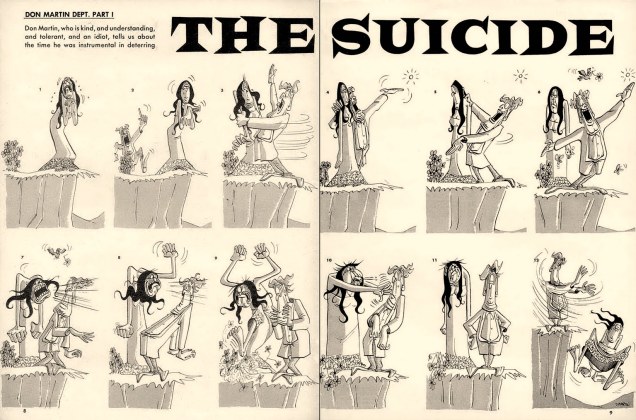
The other guy who just has to be mentioned is Don Martin (1931-2000), promoted as Mad’s Maddest Artist. Where else would we get our fix for goofy characters with comically large, hinged feet? I can just imagine the squeaking noises they make.
Well, *have* you? This Don Martin cartoon was used as one of the eight “Vital Message” mini posters offered with Mad Super Special no. 17 (1970). It makes me think of my mom’s parting admonition every time I would leave the house – “and don’t hit old ladies with an umbrella”. I am proud to say that I’ve followed her advice… so far.
Here’s a fun description of standard Don Martin characters (source):
« His people are big-nosed schmoes with sleepy eyes, puffs of wiry hair, and what appear to be life preservers under the waistline of their clothes. Their hands make delicate little mincing gestures and their strangely thin, elongated feet take a 90-degree turn at the toes as they step forward. Whether they’re average Joes or headhunters, Martin’s people share the same physique: a tottering tower of obloids. Martin puts the bodies of these characters through every kind of permutation, treating them as much like gadgets as the squirting flowers and joy buzzers that populate his gags: glass eyes pop out from a pat on the back; heads are steamrollered into manhole-cover shapes. All of this accompanied by a Dadaist panoply of sound effects found nowhere else: shtoink! shklorp! fwoba-dap! It’s unlikely Samuel Beckett was aware of Don Martin, but had he been he might have recognized a kindred spirit. »
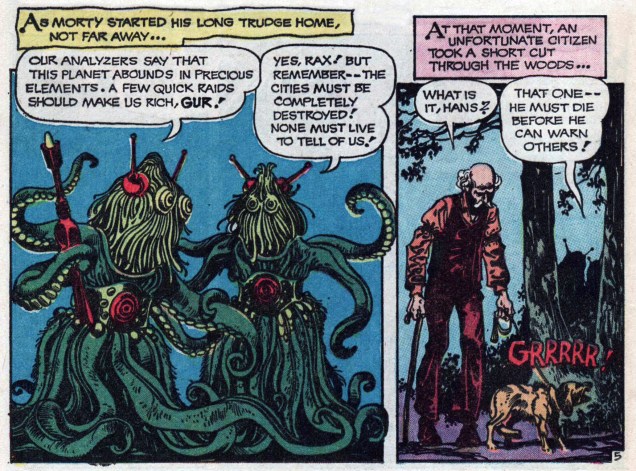
Today’s Tentacle Tuesday honours Filipino artists who laboured in the comics industry in the 70s. To quote from Power of Comics: Filipino Artists (read the essay here),
« The Filipino talent began to arrive in 1970, when immigrant Tony DeZuñiga began to work for National Comics. DeZuñiga began with assignments on various romance, horror, western, and war anthologies—a combination that many Filipino artists coming after him would also follow—but he made a lasting mark when he co-created Western anti-hero Jonah Hex in All-Star Western #10 (1972). By then, DeZuñiga had convinced then National Comics publisher Carmine Infantino that other talented artists were awaiting discovery back in his nation of origin. With a stable of graying veterans working for him, Infantino was faced with a paucity of new talent in the early 1970s and had trouble finding gifted artists who could work for what the going page rate in American comics would pay at the time. DeZuñiga accompanied Infantino on a recruiting trip to the Philippines in 1971.
As noted, first among the Filipino artists to make a move were Redondo and Alcala. Among his works, Redondo turned in a memorable run on Swamp Thing, and the prolific Alcala picked up a considerable fan following for his work on series like Batman and Arak. Other Filipinos followed. Alex Niño brought a distinct style to Warren Publishing’s 1984 and 1994 series. Ernie Chan’s talent for composition led to his becoming National’s principal cover artist between 1975 and 1977. Gerry Talaoc enjoyed an extended run on The Unknown Soldier. »
Without further ado, let’s have a look at some of the tentacles the artists mentioned above have dreamed up. In no particular order…
I like the styles of all the artists mentioned in this post, but a couple of these names will make me do a little dance of joy when I encounter their art. Alfredo Alcala (b. 1925, d. 2000) is a definite favourite. He could draw anything he wanted, convincingly… at an amazing speed, and with the sort of detail that other artists would kill for.
Alcala drew for all genres in the early portion of his career, and developed the speed and work ethic for which he later become known amongst his fellow professionals. His fastest page rate was 12 pages in a nine-hour sitting, while in one 96-hour marathon he produced 18 pages, three wrap-around covers and several color guides. During the portion of his career where he worked solely for Filipino publishers, Alcala worked without assistants and did his own inking and lettering. “I somehow always felt that the minute you let someone else have a hand in your work, no matter what, it’s not you anymore. It’s like riding a bicycle built for two…” (source)
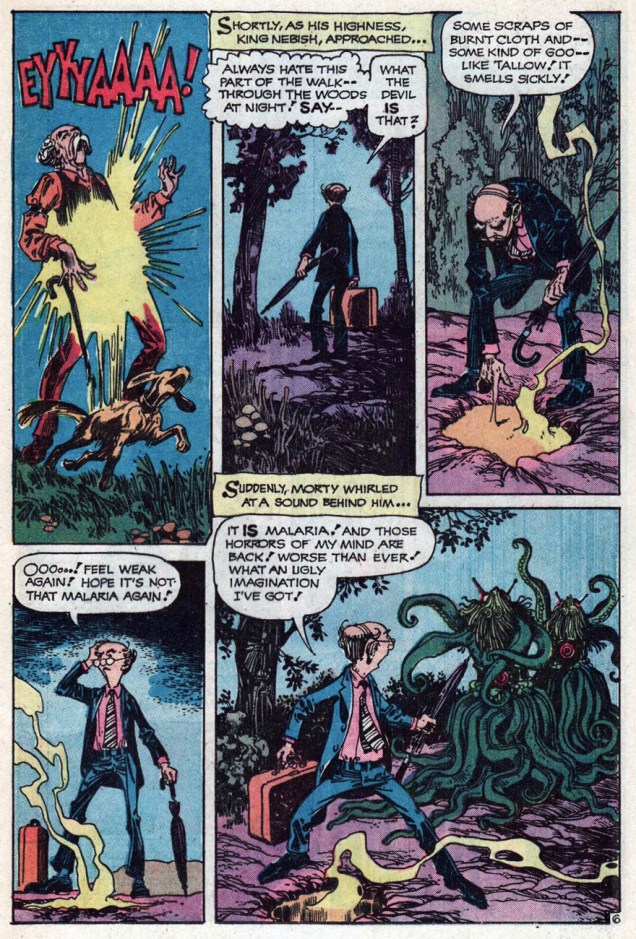
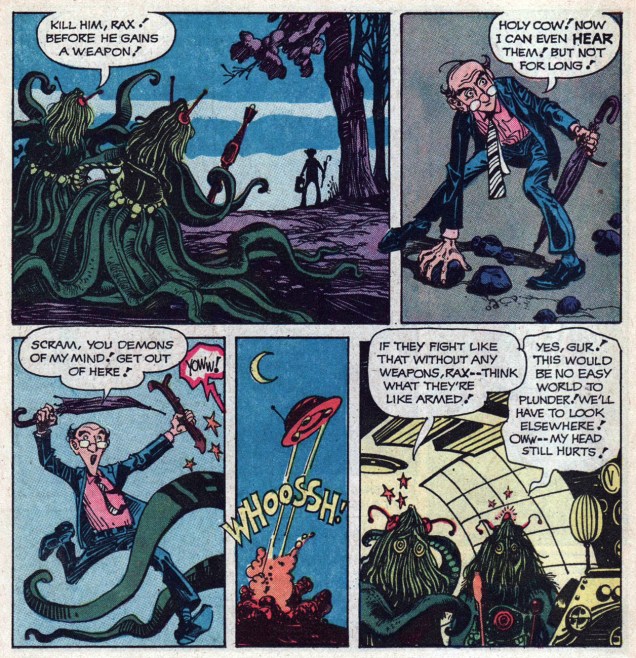
Here’s a gorgeous sequence from « The Night of the Nebish! », scripted by Arnold Drake and illustrated by Alfredo Alcala, published in House of Secrets #107 (April 1973).
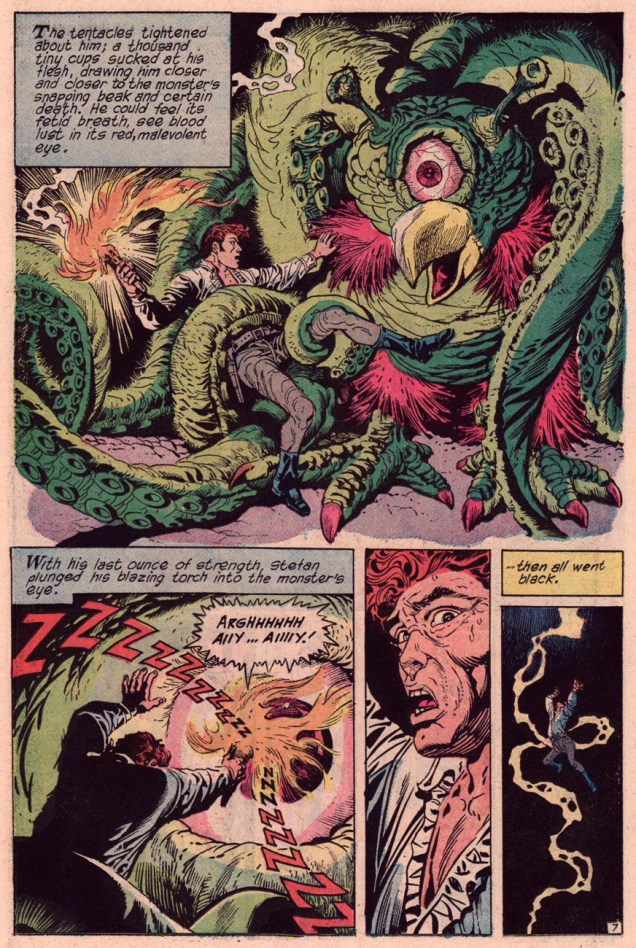
Ruben Yandoc (also known as Rubeny, 1927-1992) isn’t nearly as well-known as Alcala, yet he has a beautiful, half-decorative, half-sketchy style. He excelled at horror stories (published in DC’s Witching Hour, House of Mystery, Ghosts, House of Secrets..), and was a master at creating mood. His perfect grasp of architecture and anatomy enabled him to draw believable characters in incredible settings – none of this “figures floating about aimlessly” shit that you sometimes get from artists who can’t imbue their objects and subjects with mass. When Stefan gets grabbed by tentacles, you can feel their weight on his torso and feel the heat and painful brightness of the torch he’s holding, dammit!
« The Monster of Death Island », plotted by Maxene Fabe and illustrated by Ruben Yandoc. Published in Secrets of Sinister House no. 11 (April 1973).
Alex Niño’s art doesn’t give me butterflies. His stuff is quite weird, sometimes far too detailed, but his talent is nevertheless undeniable. For a good appreciation of his style (and more examples of it), go to this entry from Wizard’s Keep. As for me, I’ll limit myself to this humble, one-panel mass of tentacles, eyes, teeth, spikes, and god knows what else.
“Something on me”, indeed! A panel from « Evil Power », plotted by Jack Oleck and illustrated by Alex Niño from Weird Mystery Tales no. 9 (December 1973-January 1974). Niño was born in 1940, which makes him 78. He’s officially retired, but still holds art classes and takes commissions, as well as making the occasional appearance at conventions.
Redondo’s “memorable run on Swamp Thing” was mentioned at the beginning of this post. Well, we’ve already featured the tentacled robot who tries to finish Alec Holland off here, but rest assured – there’s more tentacles than just that in the career of Nestor Purugganan Redondo (1928-1995)! For example, this:
Original art for “Monsters From a Thousand Fathoms”, published in The Unexpected no. 185 (May-June 1978). You’ll note the art is attributed to the “Redondo Studio”; Nestor and his brother, Frank, often collaborated under that name.
By the way, he’s most assuredly another favourite in this household. His women are believably sexy, his monsters inventive and scary, his animals pitch-perfect… His style is realistic but lush, his nature almost prettier than in real life. And I like him much, much better than Bernie Wrightson, as far as Swamp Thing is concerned 😉
A perfect fit for any Tentacle Tuesday, here’s the requisite damsel-in-distress-with-tentacles:
Wench & Co. Book 1, a collection of drawings – of mostly naked women, what else? – by Ernesto Chan (1940-2012), born and sometimes credited as Ernie Chua. Published by Big Wow, 2005. Sadly, we will never get a Book 2.
We shouldn’t forget Tony DeZuñiga (1932-2012), who after all started all this. Among other accomplishments, he co-created Jonah Hex and Black Orchid, two pretty damn cool characters.
Page from “Home is the Sailor”, plotted by Len Wein and illustrated by Tony DeZuñiga, published in The Phantom Stranger no. 18 (March-April 1972).
I hope you enjoyed this (non-exhaustive) romp through Filipino-American tentacles! As historian Chris Knowles (1999) has noted about Filipino artists, « Here was a group of immensely talented and hard-working draftsmen who could draw absolutely anything and draw it well. They set a standard that the younger artists would have to live up to and that the older ones would have to compete with. » Amen to that!
And now… for a bit of levity: a few favourite MAD covers.
I’ll start with this by-now-iconic cover, that’s nevertheless worth posting (with proper attribution to artists involved and in high enough resolution to admire the details, two characteristics sadly often absent from stuff posted online). You’ll note I’ve skipped over the first couple of Harvey Kurtzman covers (MAD nos. 1, 3 and 4) – which are amazing but a topic for another conversation.
Mad no. 5, June-July 1953. Cover by Will Elder, colours by Marie Severin. The busty babe is the least interesting character on this cover!
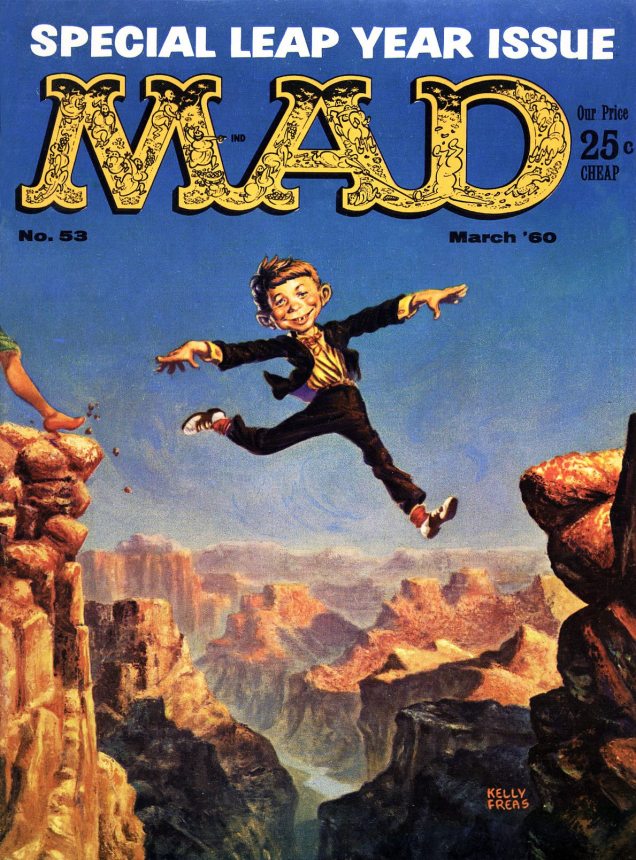
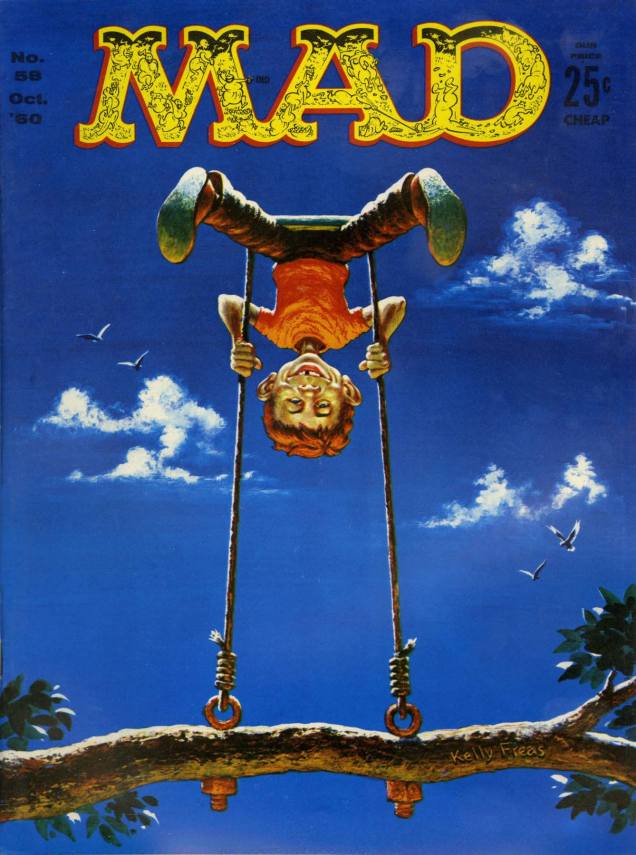
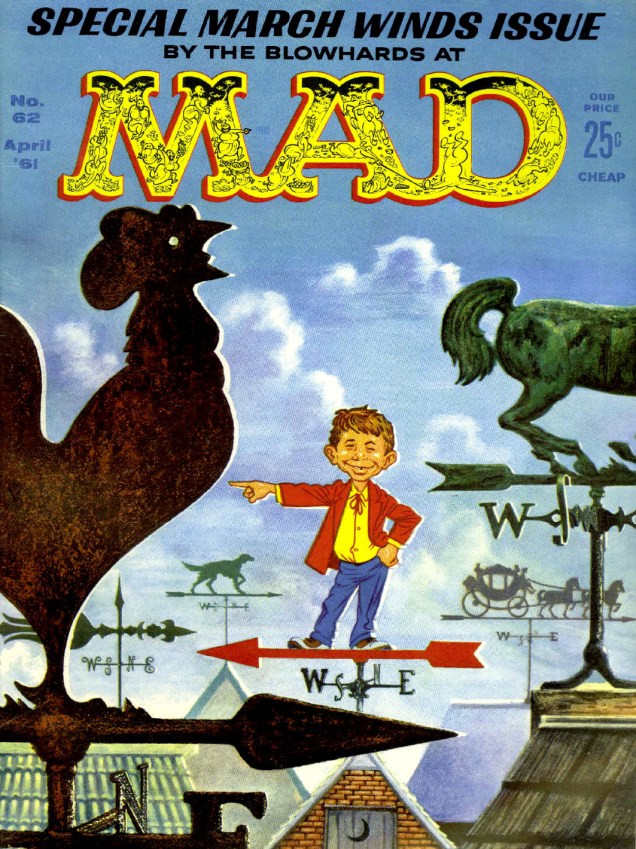
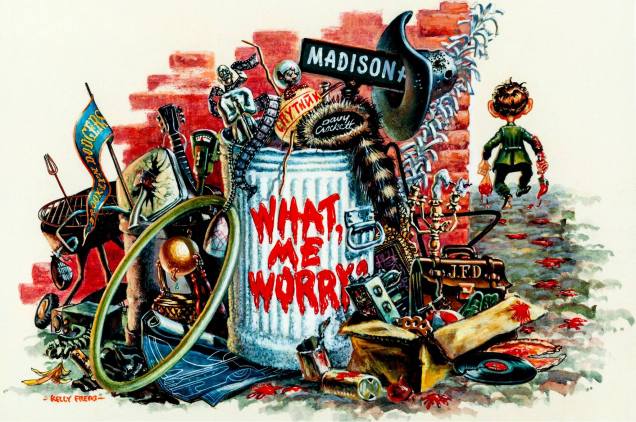
And it’s back to Kurtzman for covers of MAD nos. 6 to 10. Then I’ll disregard the somewhat boring covers, and jump over the Norman Mingo ones, and that brings us to… Frank Kelly Freas! It shall quickly become apparent that I really like his art (guilty as charged). Having started his career at Mad in February 1957, by July 1958 he was the magazine’s official cover artist (his first was MAD no. 40), and painted most of its covers until October 1962.
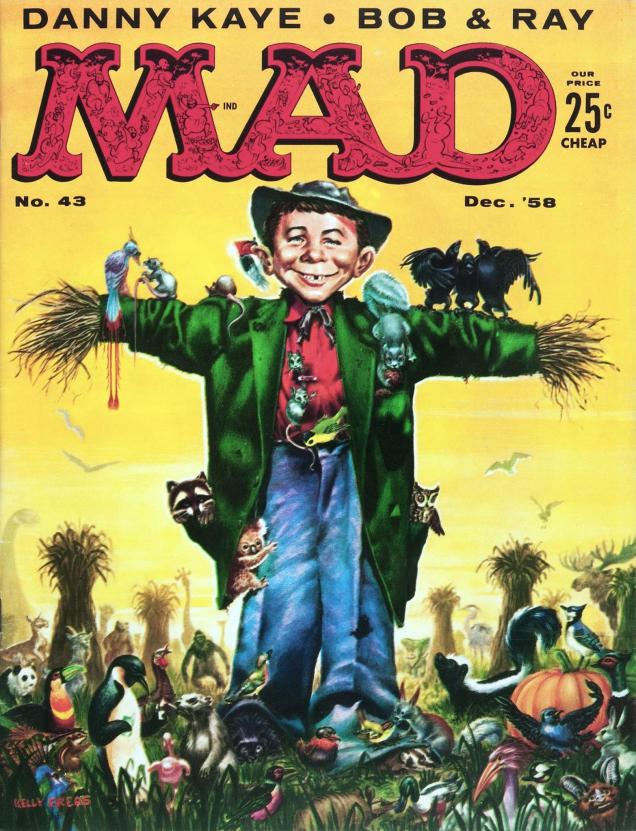
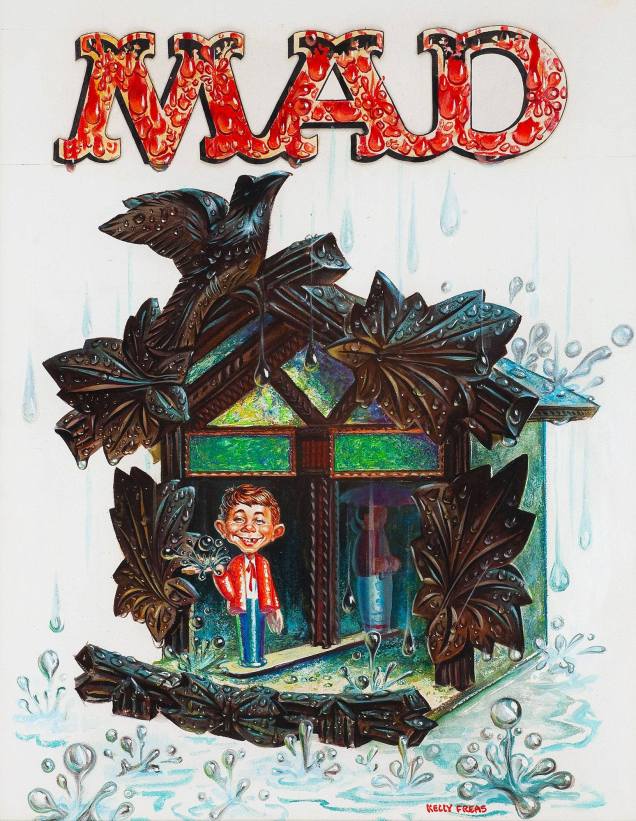
This one must have been fun to draw. I especially like the three (drunk?) crows singing on Alfred E. Neuman’s left arm. Mad no. 43, December 1958. Cover by Frank Kelly Freas (from an idea by Joe Orlando).Frank Kelly Freas painted this attractive, colourful cover for the annual More Trash From Mad no. 2, 1959. This cover + Mad labels (you can see some of them here) for 50 cents? Seems like a good deal!MAD Magazine no. 53 (March, 1960). Looks like there’s a woman about to follow Alfred E. Neuman’s bold cliff-jumping example.. unless she’s the one who pushed him off.Original art for the cover of Mad no. 55, June 1960. Cover by Frank Kelly Freas. The sides of the weather indicator would be labelled “Fair” and “Foul” on the actual cover, but here you can really admire the detail of Freas’ deft brush. Alfred E. Neuman would be standing under “Fair”, of course, which would mean he’s predicting the weather erroneously… but maybe he’s just a pluviophile.Another Kelly Freas cover: Mad Magazine no. 58 (October 1960). A summery cover, wouldn’t you say? Look closely and you’ll see that Freas cleverly carved his name onto the bough. Random fact: Freas painted bomber noses during WWII.MAD no. 62, April 1961.
And to wrap this post up… a lithograph from the cover of More Trash from MAD no. 1 (1958).
Everything but the kitchen sink (which has been replaced by a barbecue).
“Only three of these lithographs were ever published before the production was stopped as a violation of the MAD copyright. The other two are currently in private major MAD Magazine collections. This is the only lithograph done by Kelly Freas of one of his MAD book covers.”
For more (not necessarily MAD-related) FKF, go here.
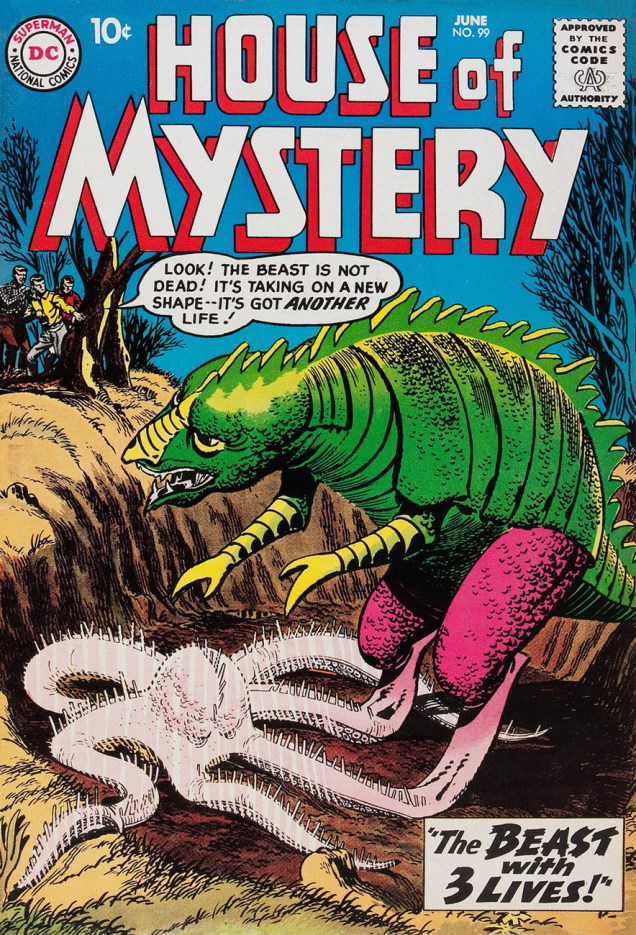
Welcome to the entertaining world of science-fiction/fantasy of the 60s! If you’re an admirer of extravagant creatures with improbable anatomy, or a fan of twisted stories that take questionable leaps of logic to arrive to an implausible conclusion, willkommen.
However, if, like me, you tend to root for strange creatures (most of which didn’t want to be discovered in the first place), tread gently. If there’s one pattern in House of Mystery stories, it’s that the “monsters” (that fly in from space/emerge from the sea/crawl out of the depths of the earth/are born in fire/whatever else we can think of) get slain, more often than not, by well-meaning people… or not-so-well-meaning people who are afraid of anything that looks different. If they somehow manage to escape getting shot or bombed out of existence, they’re buried under a convenient avalanche or volcanic eruption.
House of Mystery no. 99, June 1960. Art by Bernard Baily. Yep, the Beast gets killed by the military. It’s sad to think that our reaction to a friendly shape-shifting alien would be “kill first, ask questions later”… but it sadly rings true.
I know that it’s Tentacle Tuesday and everything’s possible, but… this? An octopus with spines on his tentacles (very conveniently placed, I might add) and the puffy eyes of a career alcoholic? A parrot-dragon with opposable thumbs?
House of Mystery no. 113 (1961), pencils by Dick Dillin, inks by Sheldon Moldoff and letters by Ira Schnapp. Err, guys… I don’t think either of these two monsters is all that interested in you, seeing as they both seem to be screaming in horror/pain. If the octopus is Water-Beast, the parrot must be Land-Beast – such wit! I would have gone with “pink thing” and “green bird thing”.
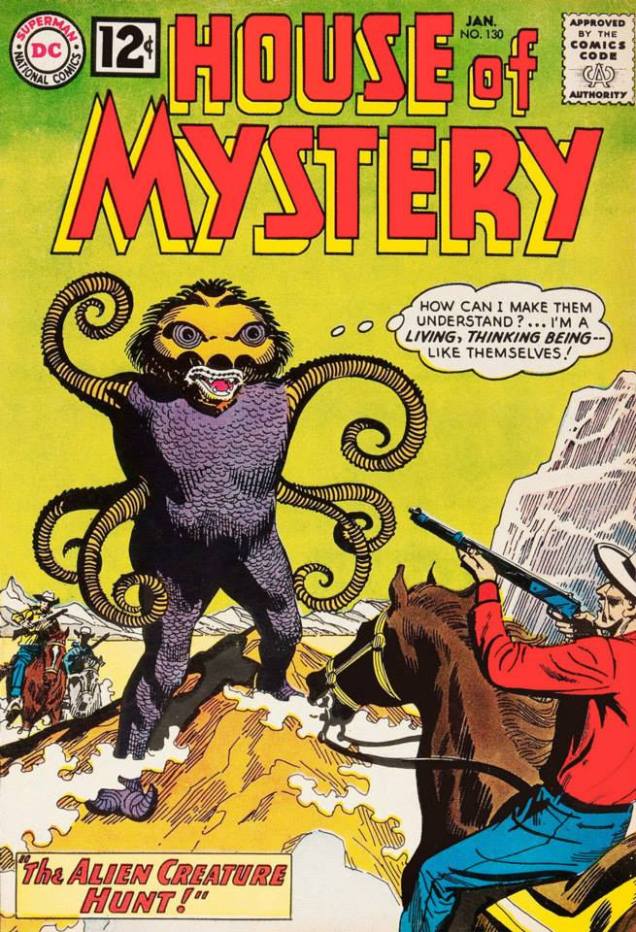
As Tentacle Tuesday continues, we are once again confronted with a situation where misunderstanding between species leads to needless conflict. Shoot first, sort it out later, is the mantra of any red-blooded man! I’m sorry, am I being a tad unsubtle?
House of Mystery no. 130, January 1963. Cover by George Roussos.
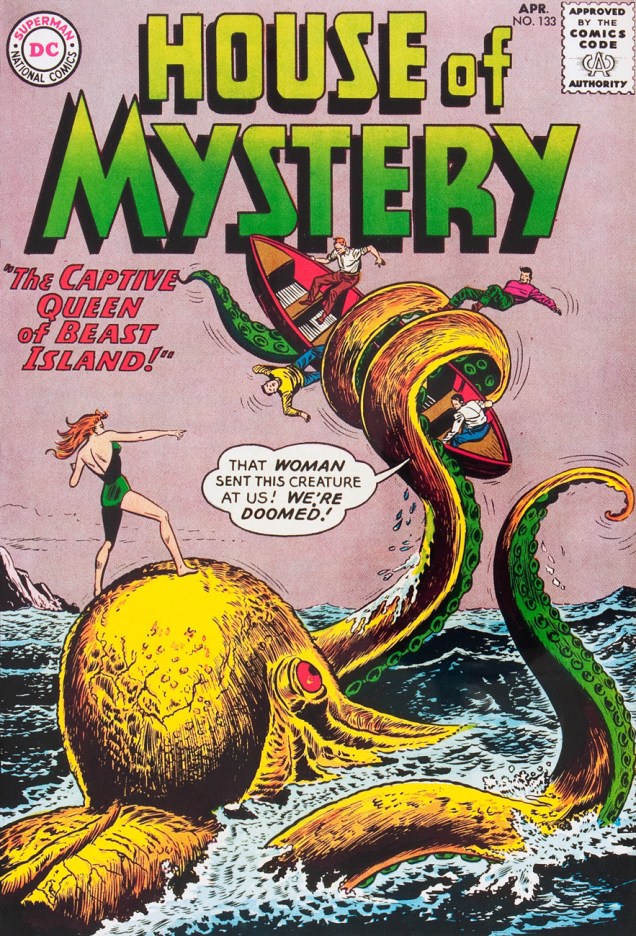
Some guys land on an island patrolled by creatures controlled by a beautiful woman. Well, there’s no need to quarrel, they can talk it out, right?
House of Mystery no. 133, April 1963. Pencils by Dick Dillin, inks by Sheldon Moldoff, letters by Ira Schnapp.
Okay, the woman seems to be friendly. So far, so good.
Art by Howard Sherman.
So perhaps everyone can go on their merry way and leave the island and its creatures alone? No, it’s not enough to just kill them. Oops! The whole fucking island explodes to smithereens when the guys detonate some explosives in a cavern and thus trigger an underwater eruption. I mean, the real threat to these “nice” people was the evil guy trying to gain control of the beasts, but do they try to attack *him*? Nah, they focus on killing the octopus, instead! And the giant armadillo! And the furry rhinoceros!
« And soon, Beast Island sinks beneath boiling, steaming waters… », the omniscient narrator tells us. « The island is gone now – and so are the terrible things that walked on it, flew over it — and swam around it! » The power-grabbing asshole is okay, though – he escaped just fine!
There’s plenty more tentacles in House of Mystery – to which we will no doubt return.
Today’s Tentacle Tuesday is home to that conventional, oft-seen beast, the comic strip. Without getting into the complexities of defining this term, I use “comic strip” here to refer specifically to the (syndicated) newspaper comic strip, although by now the newer ones may have never seen print in a newspaper, only online.
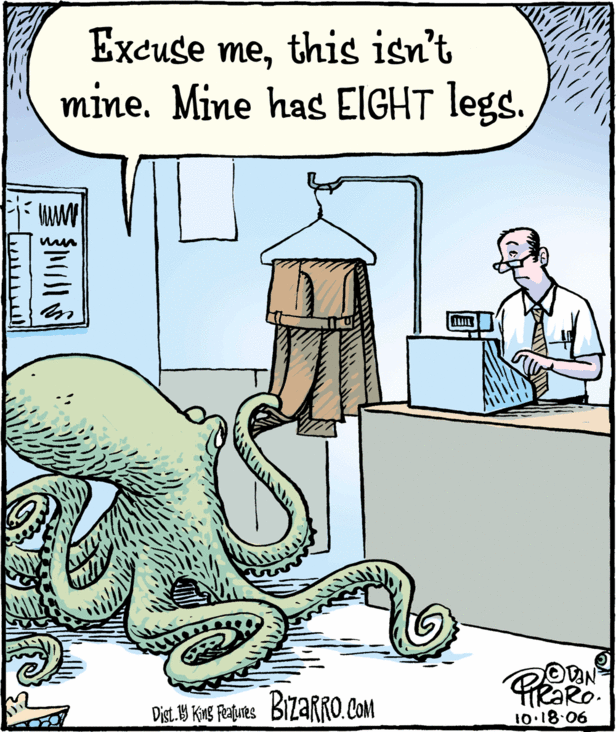
There’s one that doesn’t need an introduction. Go visit his website, though!
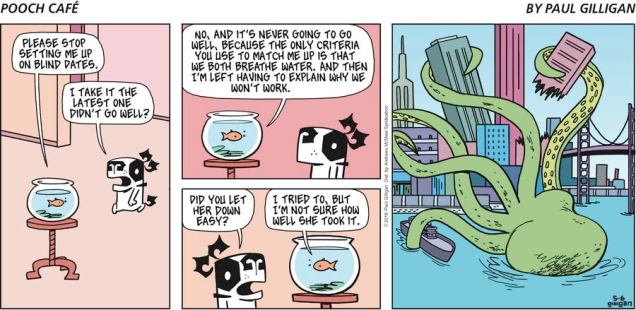
Most of these are available for perusal on one of the comics-clustering websites, such as gocomics.com, or sometimes directly on a strip’s own website (in which case it also becomes a webcomic strip, I guess). I’ve provided the links in the description.
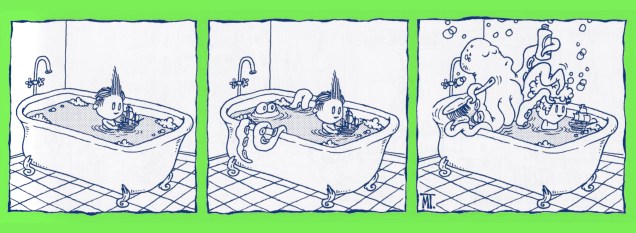
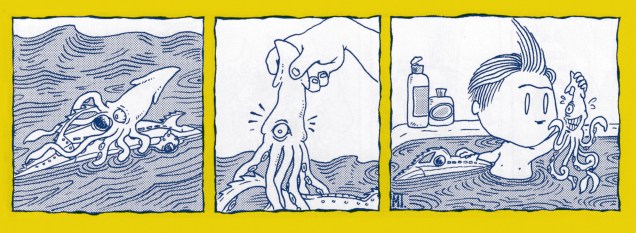
Overboard by Chip Dunham, July 3rd, 2010. Overboard’s been around for almost 30 years.Brevity, March 27th, 2011. This strip was created by by Guy Endore-Kaiser and Rodd Perry, and for the first couple of years (it’s been around since 2005), it was plotted and drawn by them. Dan Thompson took over at some point… around 2012 or something like it (I can’t find any hard and fast information online). The strip has a home here, but frankly it’s not really worth visiting (terrible art, dumb jokes).Once again, Poncho gets his fishy friend into trouble. Pooch Café, May 6th, 2018. I hate Poncho and think his owners should have kicked him out a long time ago, but there’s enough characters and surreal situations to tolerate his presence in this fun strip.Sherman’s Lagoon by Jim Toomey, 20th April 2016, also around for almost thirty years (it made its debut in 1991).Not to forget our classics! One of the nice things about Calvin and Hobbes is that it was never ghost-written – when Bill Watterson quit it in 1995, that was it. However, you can catch re-runs in many places, for instance here.Liō (not forgetting the accent!) by Mark Tatulli and distributed by the Universal Press Syndicate since 2006. This is the first appearance of Ishmael, Liō’s cephalopod best friend. Tatulli says that he at first wanted to make Ishmael into a mother figure for motherless Liō, but that’s not the way things worked out.Liō routinely encounters tentacles, so it would be a long list indeed, but here’s another favourite. Both strips were plucked from the collection Liō’s Astonishing Tales: From the Haunted Crypt of Unknown Horrors, 2009.
We started on a Bizarro note, so let’s wrap things up with another.
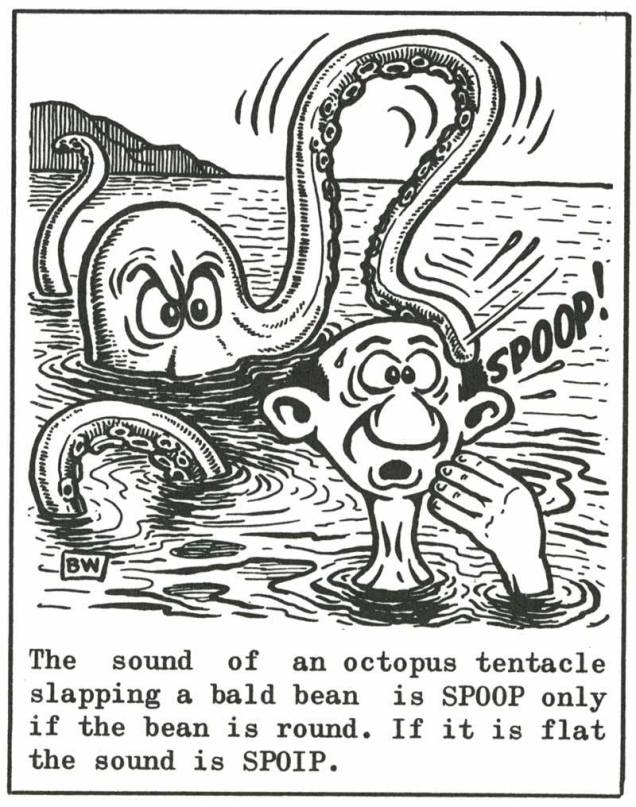
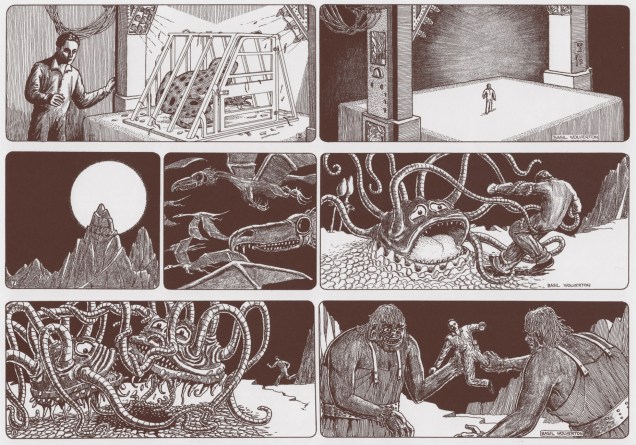
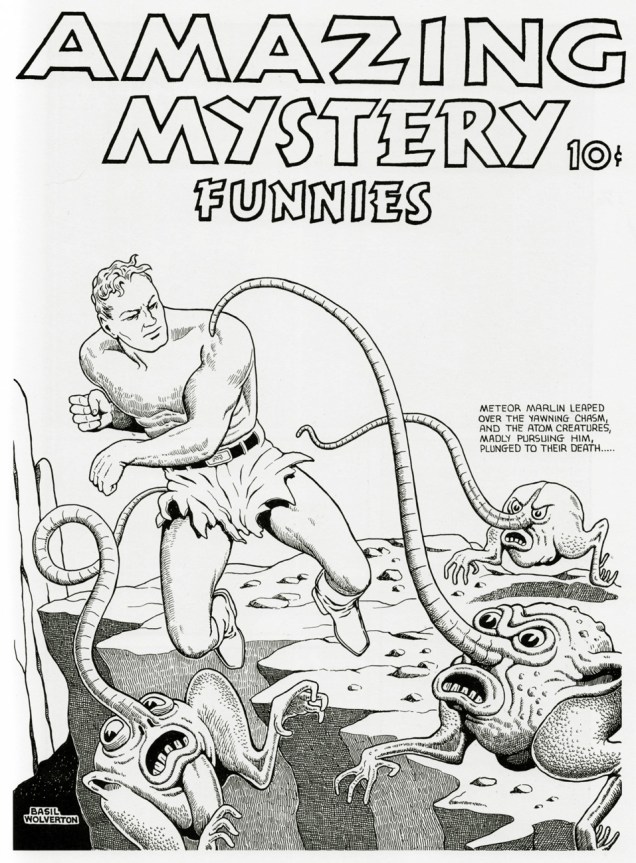
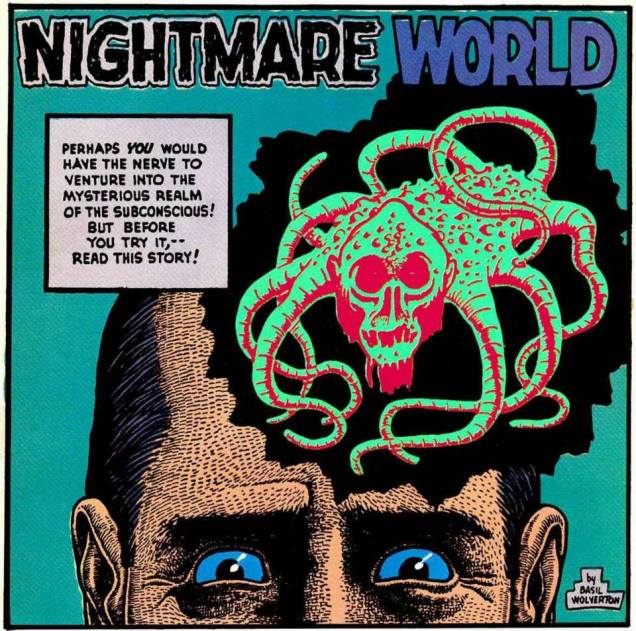
SPOOP! And a happy Tentacle Tuesday to you, too. Today’s feature is devoted to Basil Wolverton. A lot could be said about his sense of semi-slapstick, semi-surreal comedy and his unhinged-yet-meticulous drawing style, his delightful work in the realm of humour comics or his genuinely scary contribution to horror-in-pictures… but as I have a one-track mind, I’ll focus on his love of tentacles. No matter what sort of thing he was drawing, tentacles somehow managed to slip into it… and that’s understandable, for tentacles are both hilarious and fearsome. Without further ado, here’s your master of ceremonies and cephalopods… Basil Wolverton!
Here’s some more sounds you might like to know about, to be used indiscriminately to spice up humdrum conversations around the water cooler:
Hungry cannibal filing eyetooth: FWATCH! Man with calloused feet crossing rough linoleum: SKIRP! SKIRP! Thumb gouging eye: SPOP! Hot lava speweing on WCTU convention: FOOSK! Hot lava spewing on Elks’ convention: SSSCRISH! Person skidding on hot stove in bare feet: SCREESH! Beaver biting into wooden leg: CRASP! Car crashing into large vat of frogs’ eggs: SKWORP! False teeth falling through skylight: TWUNK! Sock in the face with Sears Roebuck catalog: PWOSH! Sock in the face with Montgomery Ward catalog: PWASH!
This mirth-inducing stuff is from an article that Basil Wolverton wrote for the Daily Oregon in 1948 called “Acoustics in Comics”. Here’s another excerpt of that article (which is definitely worth reading in its entirety, and is fortunately easily found online… here, for instance):
« ‘I want realism!’ he (my publisher) had bellowed. ‘No more of this wild imaginative stuff that’s causing some people to want to ban our comic books! From now on, get that realism in there, and your strips will be horribly funny! Then the readers will go into hysterics and laugh like crazy, and our books will be acclaimed the most laugh provoking on the stands!’ That meant that an imaginative word like CRANCH was taboo. It was up to me to get the real sound word. »
And, hoppin’ horse hocks, he did.
Enough of the rib-splitting stuff: this is a serious blog that discusses serious horror. *ahem*
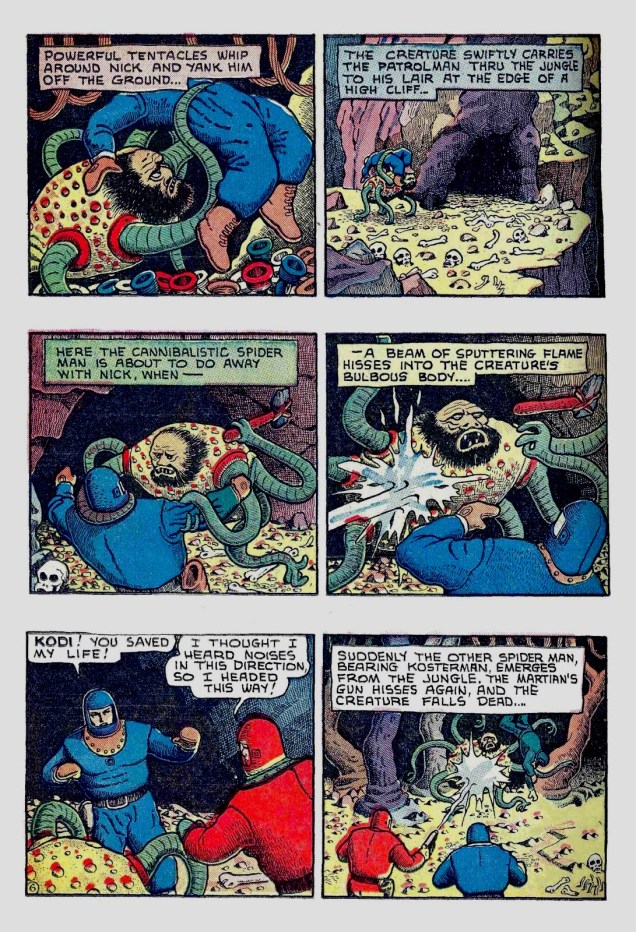
Page from Ethan Downing (1935), an early endeavour by Wolverton – unpublished.Amazing Mystery Funnies vol. 2 no. 12, December 1939. You may with to point out that this bandit is a cannibalistic spider, *not* a tentacled creature, but look at how he’s using his appendages, look me straight in the eye, and tell me that those aren’t tentacles. Besides, spiders have 8 legs, not 6, and this guy is definitely a 6-leg wonder… and they get called « tentacles », right from panel one.
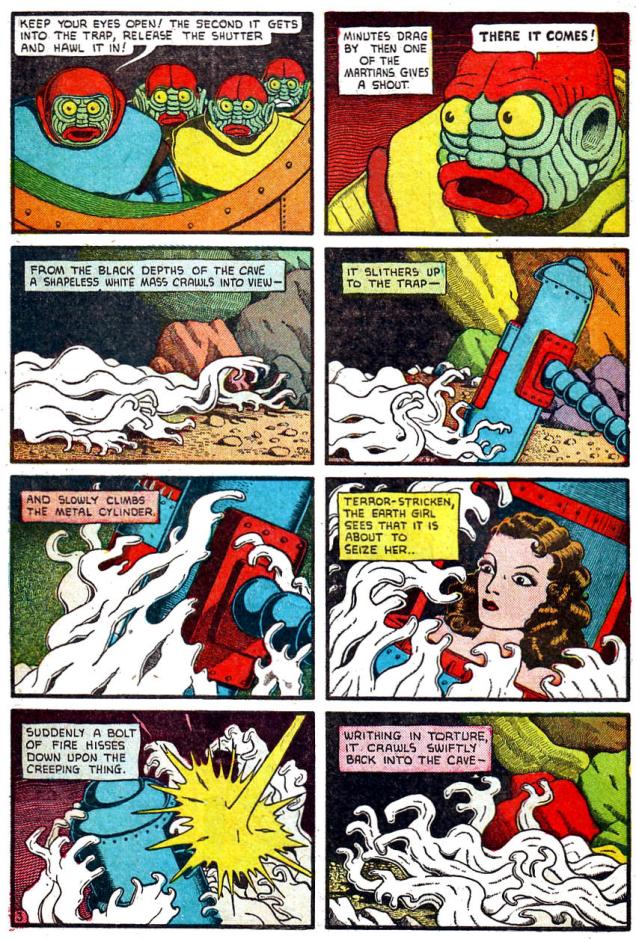
No inventory of Wolverton tentacles would be complete without the classic « Creeping Death from Neptune », first published in Target Comics vol. 1 no. 5 (June 1940), and reprinted many a time since, nearly as often the amazing Brain Bats of Venus (also quite heavy in quasi-tentacles. If aren’t familiar with it already, do yourself a favour and read it in full here.)
A page from Creeping Death from Neptune, first published in Target Comics vol. 1 no. 5 (June 1940). The earth-girl is interestingly deadpan about being consumed alive by some sort of slithering weirdness.This story also has « tentacle-like » metal arms. I’m telling you, pretty much everything’s a tentacle where Wolverton is concerned.Meteor Marlin, cover illustration for episode one, April 4th, 1940… never published. In this one, noses are tentacles!A panel from Nightmare World by Basil Wolverton that originally appeared in Weird Tales of the Future no. 3, 1952. This is a reprint from Mr. Monster’s Super Duper Special no. 8, 1987, re-coloured by Jeff Bonivert.
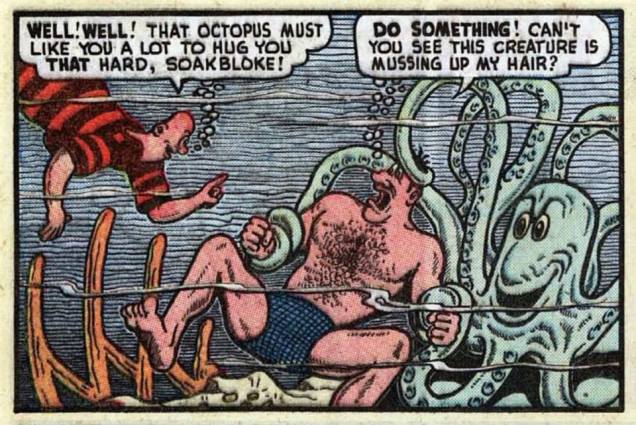
Phew! I’ll end this on a humorous note: octopuses evidently make fabulous hairdressers.
This is a panel from a Powerhouse Pepper story that doesn’t really have a title, being referred to as “Haw! Haw! Grab a good gander…” instead. Originally published in Tessie the Typist Comics no. 9, April 1947.
Sadly, Wolverton’s weirdly frightening villains did not always find favour with the powers-that-be. Back in 1940, Jim Fitzsimmons, assistant editor at Centaur, publisher of Amazing Mystery Funnies, wrote:
« Though the fantastic and weird are the essential selling point of this feature, we would advise that you keep away from the use of revolting characters such as Brain-Men. Some of these characters you have developed have actually sent shudders down my otherwise unconcerned vertebrae. »
Reading The Life and Comics of Basil Wolverton, Volume 1: 1909-1941 written by Greg Sadowski (2014, Fantagraphics), one gets the impression this brilliant master of spaghetti-and-meatballs* comics spent his artistic life trying to fit his imagination into the narrow guidelines imposed by editors, heads-of-companies and other pundits. He died in 1978, aged 69, but was active in the comics field until 1973 («Plop!») I’ll leave it for people more erudite than I to debate his success (or lack thereof) in the comics field…. I’m just happy to witness a resurgence of interest in this great artist, and enjoying the treasure-trove of material that’s available.
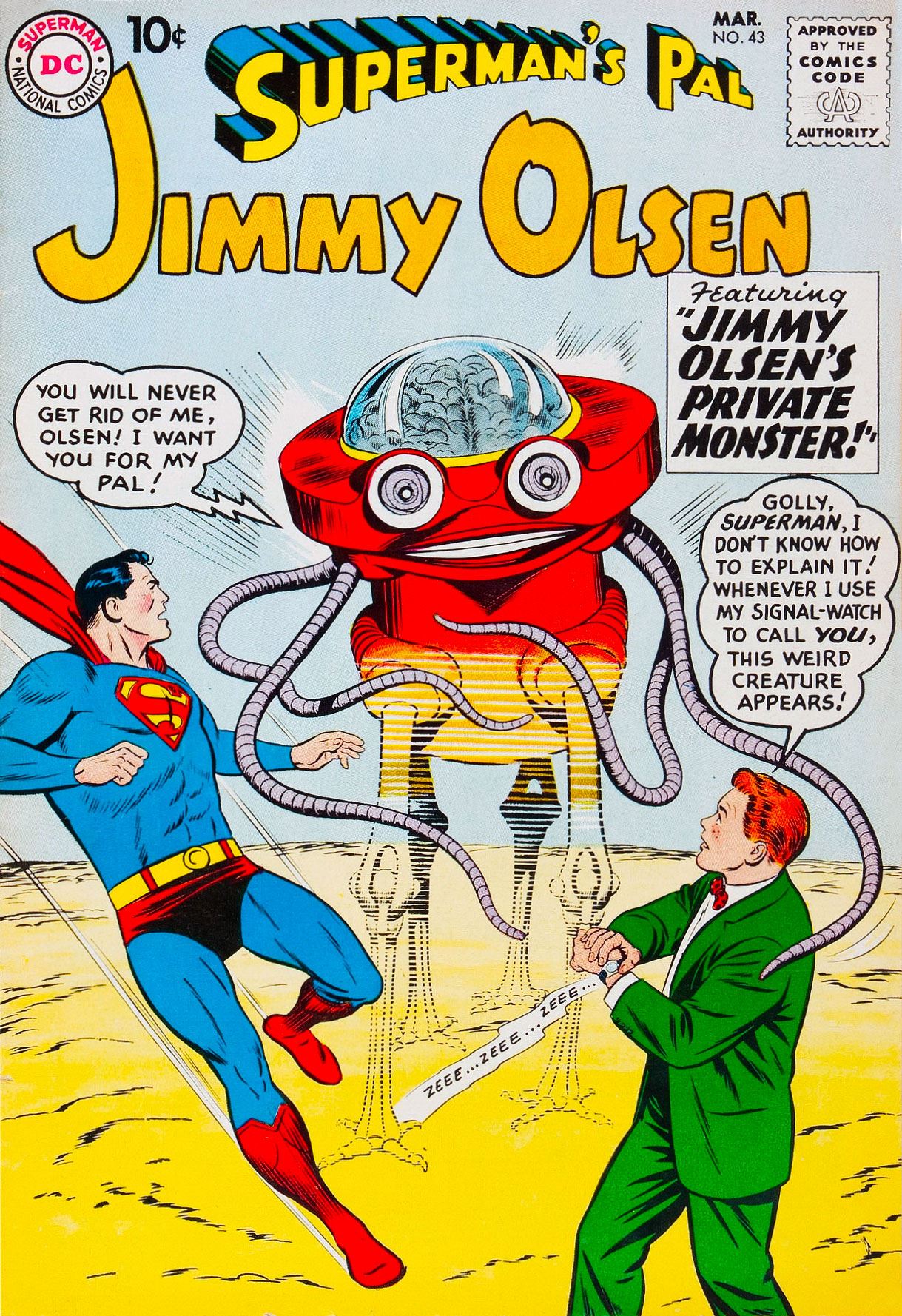
Mechanical tentacles! Cephalopod monsters communicating by mental telepathy! Even Jimmy Olsen playing the part of a monster in an alien horror movie! Yes, it’s all this and more in this Tentacle Tuesday post (after which I’ll quit bugging you with various cephalopods until next Tuesday).
There’s nothing quite as annoying as someone who wants to be your friend against your wishes. Superman’s Pal, Jimmy Olsen no. 43 (March 1960), pencils by Curt Swan and inks by Stan Kaye.
Head over to the Fourth Age blog for a further discussion (with pictures!) of the cover story from this issue, “Jimmy Olsen’s Private Monster!”, written by Jerry Siegel (ahem…) and illustrated by the aforementioned Curt Swan (pencils) and John Forte (inks).
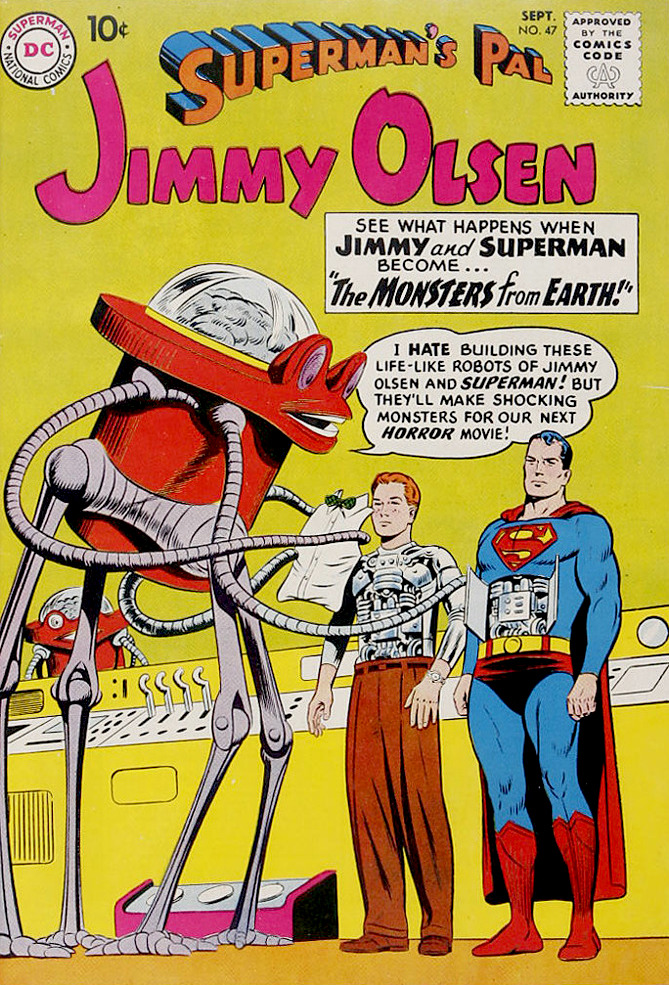
The two-eyed, many-tentacled mechanized wonder appears again in Superman’s Pal, Jimmy Olsen no. 47 (September 1960):
It’s the same cast: pencils by Curt Swan and inks by Stan Kaye; letters by Ira Schnapp.Freaking cute.
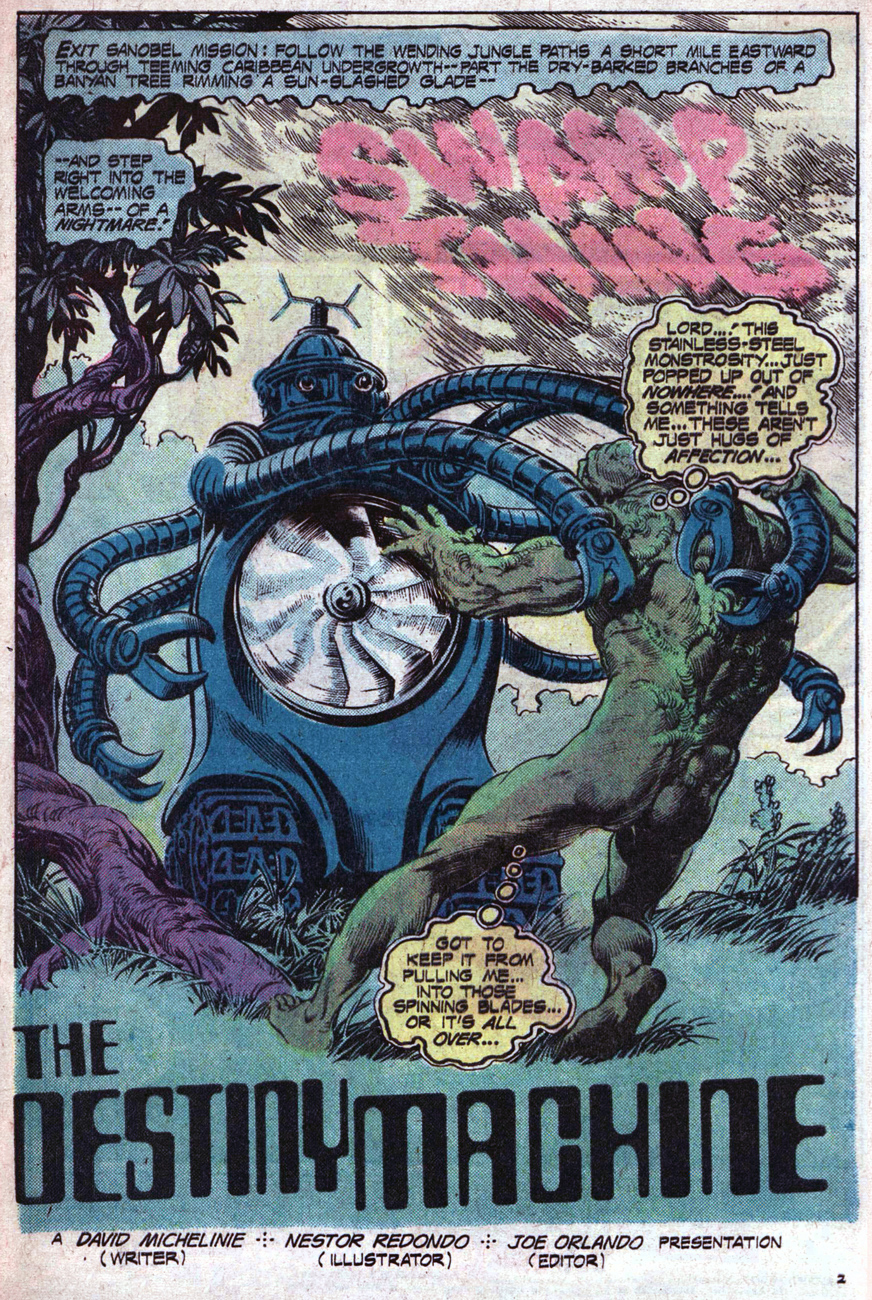
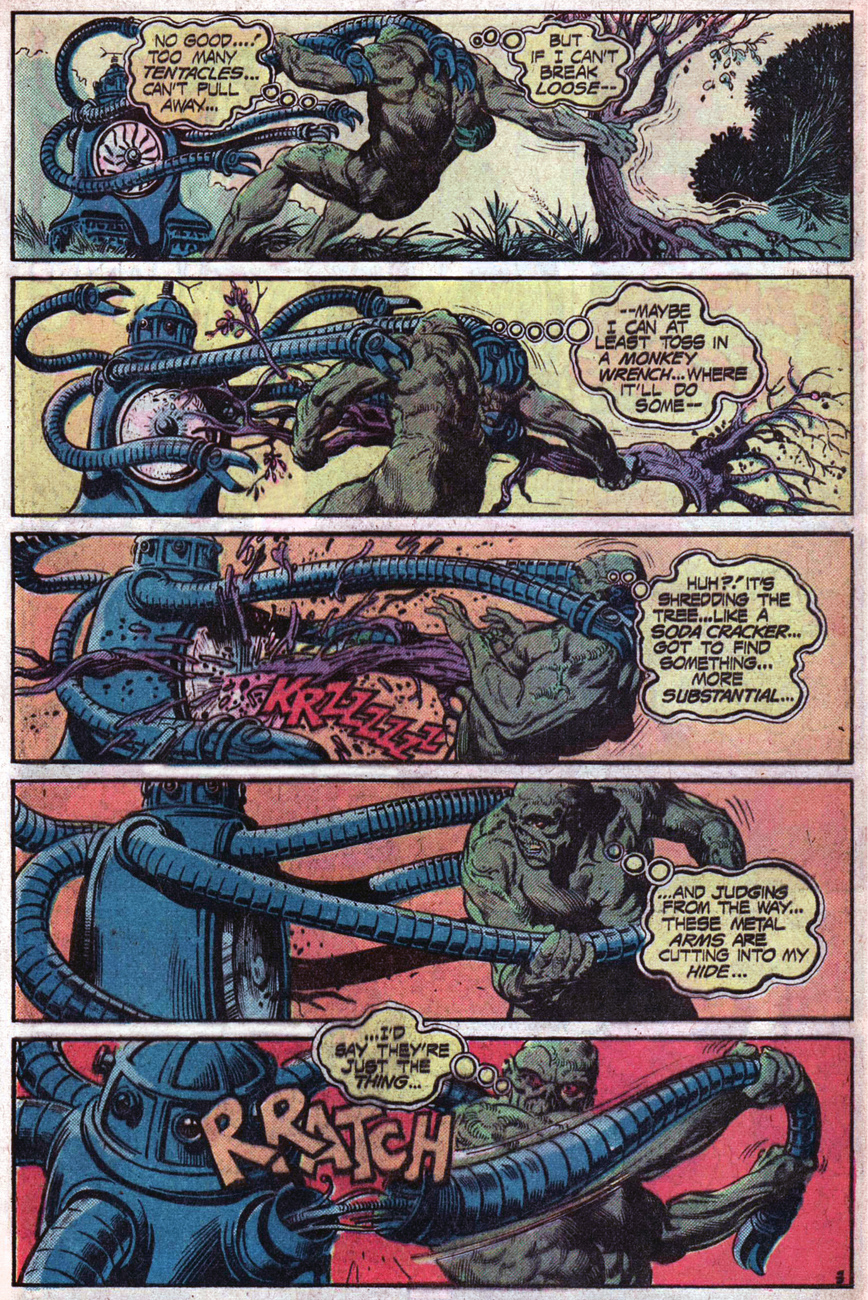
In a similar line of thought (but some 15 years later), a more steampunk relative of the creature above appears in Swamp Thing.
Swamp Thing no. 17 (July-August 1975). In case the credits are too small to read, script by David Michelinie, pencils and inks by Nestor Redondo, colours by Tatjana Wood, letters by Marcos Pelayos.
And here’s a peek at the glorious (I’m a fan of Redondo) inside:
« But destroying that thing doesn’t answer the questions it brought up… like what a stainless-steel octopus is doing in the middle of a jungle… » That’s an excellent question – but destroying this mechanized, tentacled abomination was still a good idea, answers or no.
Here’s another file for our records of Tentacular fascination: the Boy Commandos’ intrepid gang of feisty moppets, tired of fighting Nazis, switch it up by doing battle with some tentacled robots.
Boy Commandos no. 17 (September-October 1946). Cover by Jack Kirby.
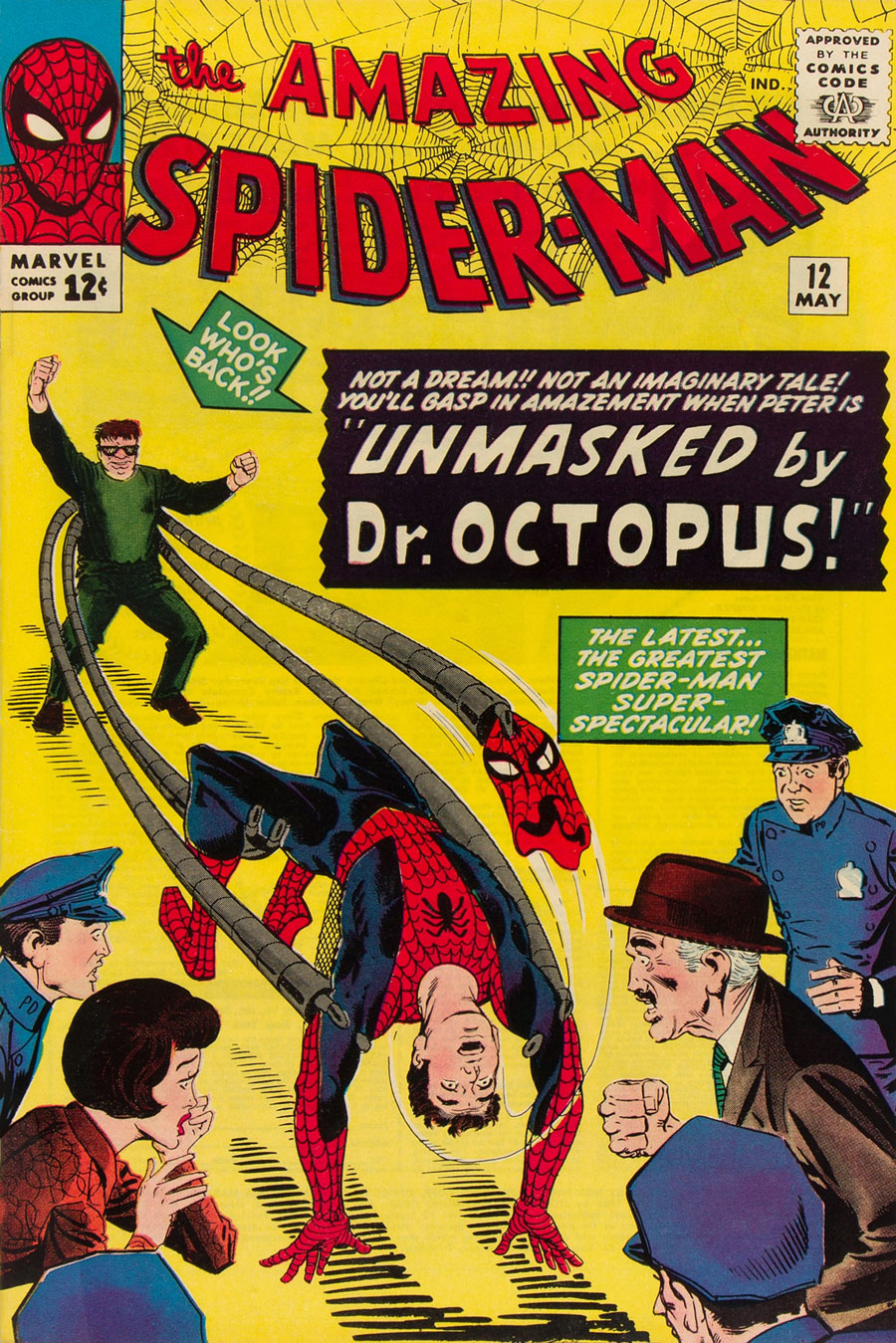
I couldn’t very well have a mechanically-minded Tentacle Tuesday without mentioning Dr. Octopus, one of Spider-Man’s most famous foes! Otto Gunther Octavius, a.k.a. Dr. Octopus, a.k.a. Doc Ock was created by Steve Ditko, and first appeared in The Amazing Spider-Man no. 3 (July 1963). Obviously I could feature a gallery of Dr. Octopus tentacles as long as your arm (pardon the confused anatomical terminology on my part), but I’ll limit myself to a couple.
First, The Amazing Spiderman no. 12 (May 1964), cover by Steve Ditko. The “Look who’s back!!” caption pointing to the Doc is rather mystifying, given that he was there in the previous issue.
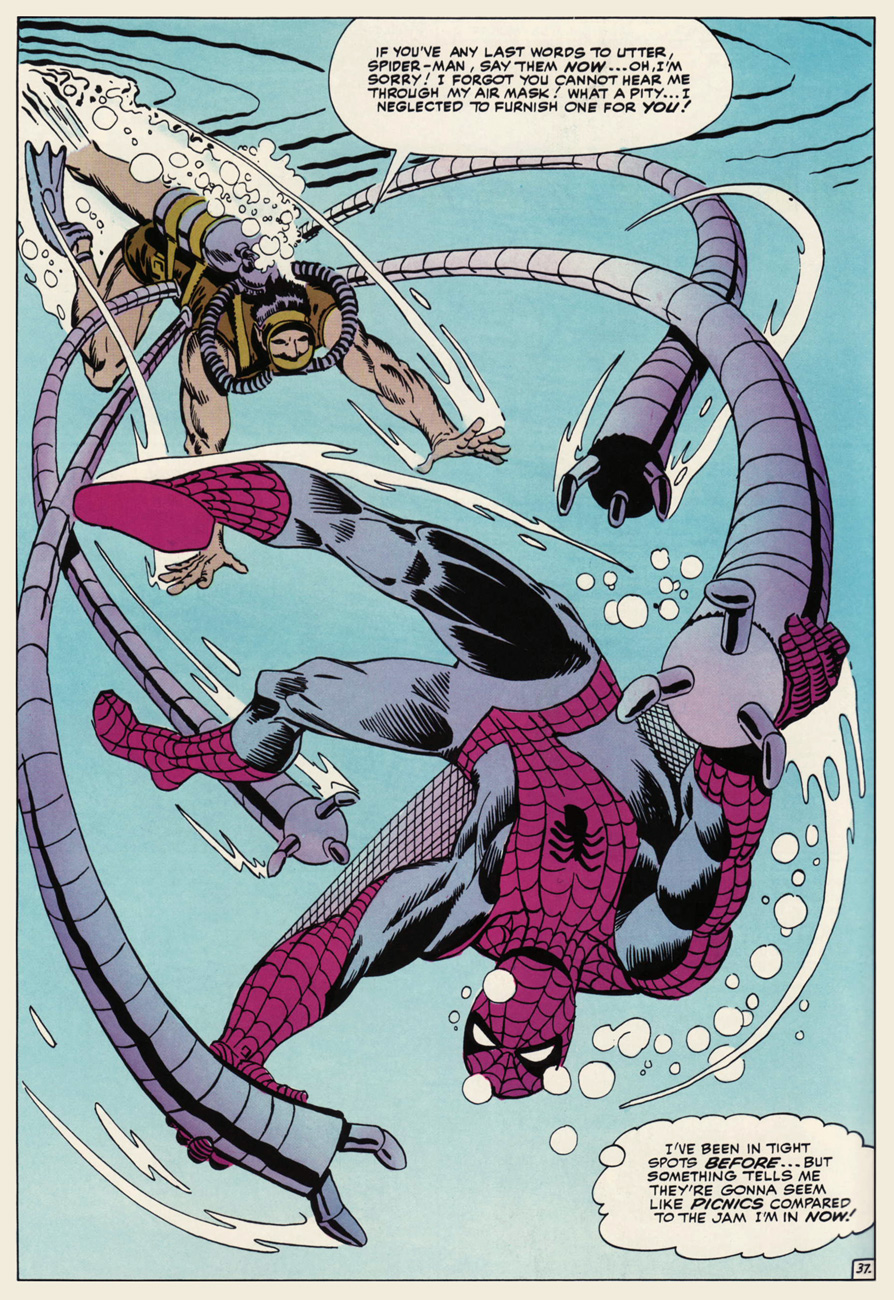
Second, an underwater scene, because what element more appropriate for tentacles? Kudos to Doc Ock for making his perfectly watertight.
JFC, does this guy ever shut up? Especially given that Spiderman can’t even hear him? Splash (no pun intended) page from The Amazing Spider-Man Annual no. 1 (September 1964), with art by Steve Ditko.
Dr. Octopus’ metallic appendages, resistant to radiation and of great strength and agility, were originally attached to a harness…. but became fused to his body after an explosion involving radioactivity (what else?) They were surgically removed, but he could now control them telepathically from a distance. Spooky.
Poor Spider-Man is always getting attacked by tentacles, even when Doc Ock isn’t around! These belong to a robot built by a “nutty professor” to trap anything spider-related. A prize will go to the perceptive reader who can tell us how many tentacles this thing possesses – like, a million, would be my guess. The Amazing Spider-Man no. 25 (June 1965); cover by Steve Ditko.Smythe’s robot in action, ensnaring Parker instead of the spider he’s holding in a globe (and nobody but us readers knows why!) J. Jonah Jameson, publisher of Daily Bugle, watches enthusiastically from the sidelines.Okay, maybe the robot doesn’t have as many tentacles as the cover seemed to suggest. Here’s Spidey hotly pursued by Mr. Jameson, whose maniacal glee is a little scary. (I will readily admit I partially chose this panel because of Parker’s jiggly butt).
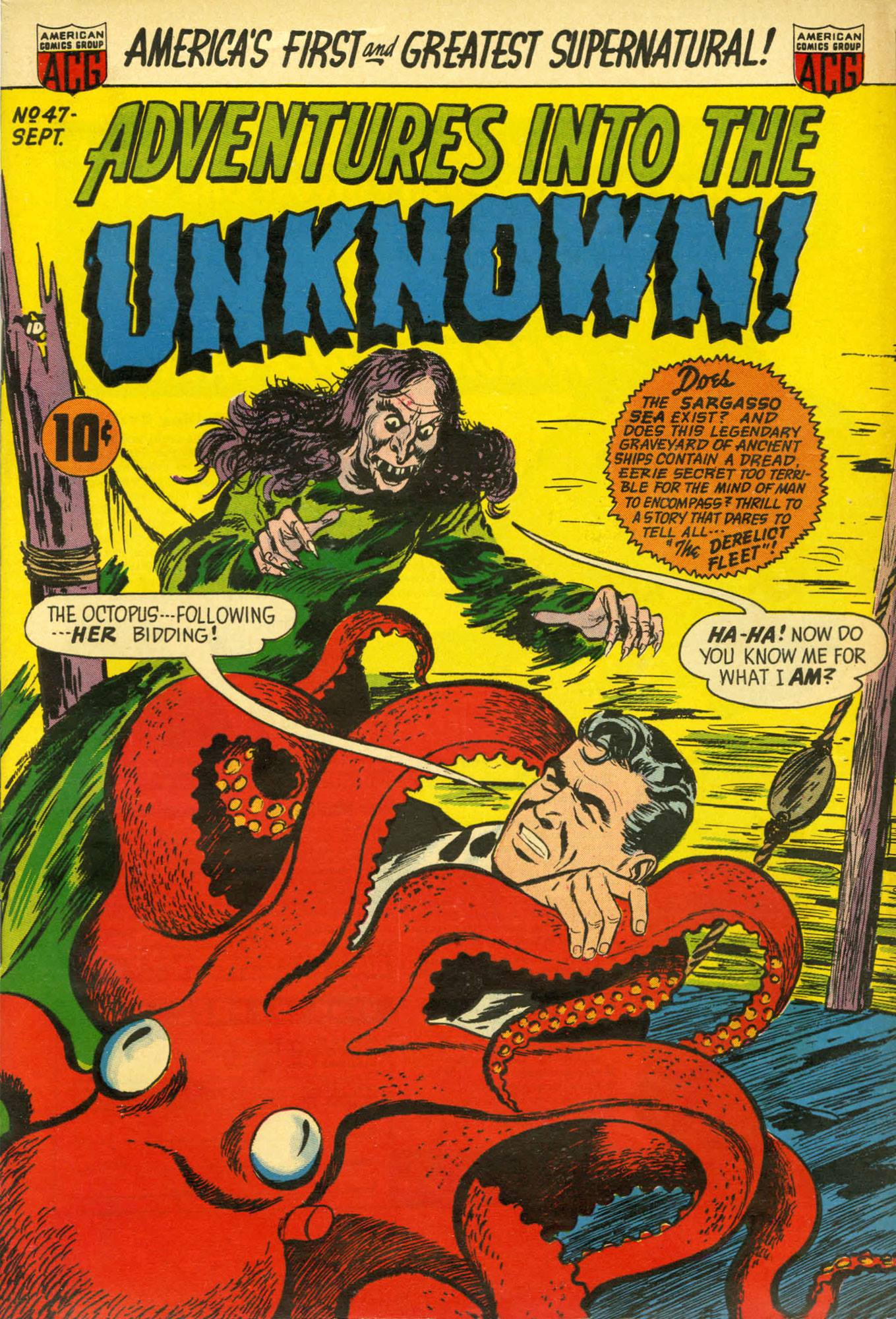
Today’s Tentacle Tuesday comes courtesy of American Comics Group, which delighted its readers with horror, satire and other strange offerings between 1943 to 1967.
ACG’s Adventures into the Unknown is now recognized as comics’ first continuing horror title. A good variety of horror tropes (though I imagine that back then, the clichés we’re painfully familiar with today weren’t quite as clichéd) , from the amusingly bizarre to the genuinely scary, could be found within its pages: killer puppets, homicidal ghosts, murderous mummies, vicious dinosaur relics, spooky skeletons… and tentacles, of course. Unlike many of its brethren, the series survived the fall-out of the 1954 comic book hearings that were started by the Senate Subcommittee on Juvenile Delinquency, but the title did drop its creepier storylines in favour of goofiness. Not a bad way to go, really, as long as the result is entertaining!
I’d like to welcome you to Tentacle Tuesday by kicking things off with this unnecessarily graphic cover in which somebody’s tentacle is getting lopped off. Note that the she-octopus also has vampire fangs. Beautiful? I wouldn’t go that far… or anywhere near it.
“…A monster which exists! I know — for I have met her face to face! Picture a face gigantic, beautiful — on a huge and monstrous body which reeks of evil — and death!” Adventures into the Unknown no. 49 (November 1953), cover by Ken Bald.
A panel from « The Kraken », drawn by Jon Blummer. Geez, poor kraken. Later on, she (?) gets attacked with a “corrosive acid – with a nozzle activated from within “… Mona can’t bear to watch, and I agree.
There are five Adventures in the Unknown covers that feature octopuses (or someone’s nightmarish and anatomically ridiculous idea of an octopus, at any rate). We’ve already featured no. 157 (revisit the past here – Nemesis is waiting for you!); the remaining four were published between August and November of 1953 and illustrated by Ken Bald (who drew the covers for issues 21 through to 50). Didn’t he get tired of drawing tentacles? Was it his idea? Did he have nightmares afterwards?
(A little aside: speaking of Mr. Bald, he’s been in the Guinness book of records for a couple of years now, for being the “oldest artist to illustrate a comic book cover”. The comic in question is Contest of Champions no. 2 (2015, Marvel Comics), which he drew at the age of 95.)
I’ll skip no. 48 for now, as its tentacles are plant-like in nature, but onward with the other two!
« Tale of Terror » from Adventures into the Unknown no. 46 (January 1953). Illustrated by Lin Streeter. It’s a well known fact that monsters on a diet are very irritable (and he’s still got a long way to go, judging by his chubby midsection).
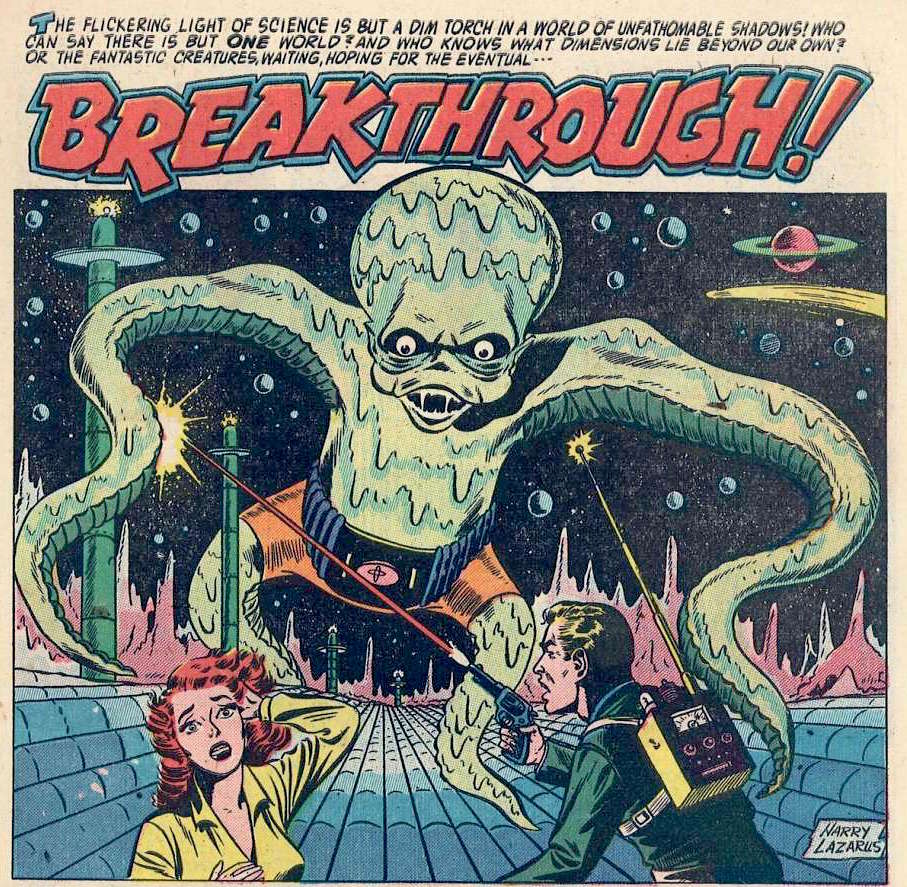
“Breakthrough!”, the title story, is beautifully illustrated by Harry Lazarus and brimming over with tentacles. Take a peek:
The main tenta-gonist of “Breakthrough!”, drawn by Harry Lazarus.
In “Breakthrough!”, even cables have tentacles!
“It’s no use strugglin’ — not when ye’ll be the sea hag’s slaves forever!”Adventures into the Unknown no. 47 (September, 1953). Cover by Ken Bald.
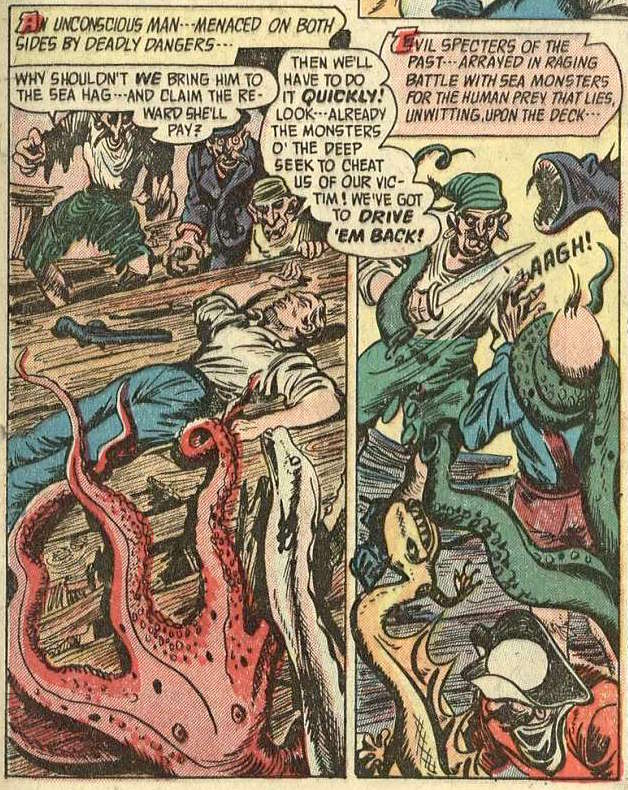
Ruthless pirates! A sea hag! Tentacles and “evil specters of the past!” All can be found in “The Derelict Fleet!”, illustrated by Jon Blummer in an interestingly fluid style.
Naturally, there is some tentacle goodness *inside* some issues of Adventures into the Unknown, despite an utter lack of cephalopods on the cover. I’ll give two examples (gracefully scanned by co-admin RG from the collected Adventures into the Unknown: Volume 8, published by PS Artbooks in 2014).
A panel from « Tale of Terror », published in Adventures into the Unknown no. 39 (January 1953) and Illustrated by Lin Streeter. This panel was wisely used for the PS reprint tome’s front endpapers, to great effect.
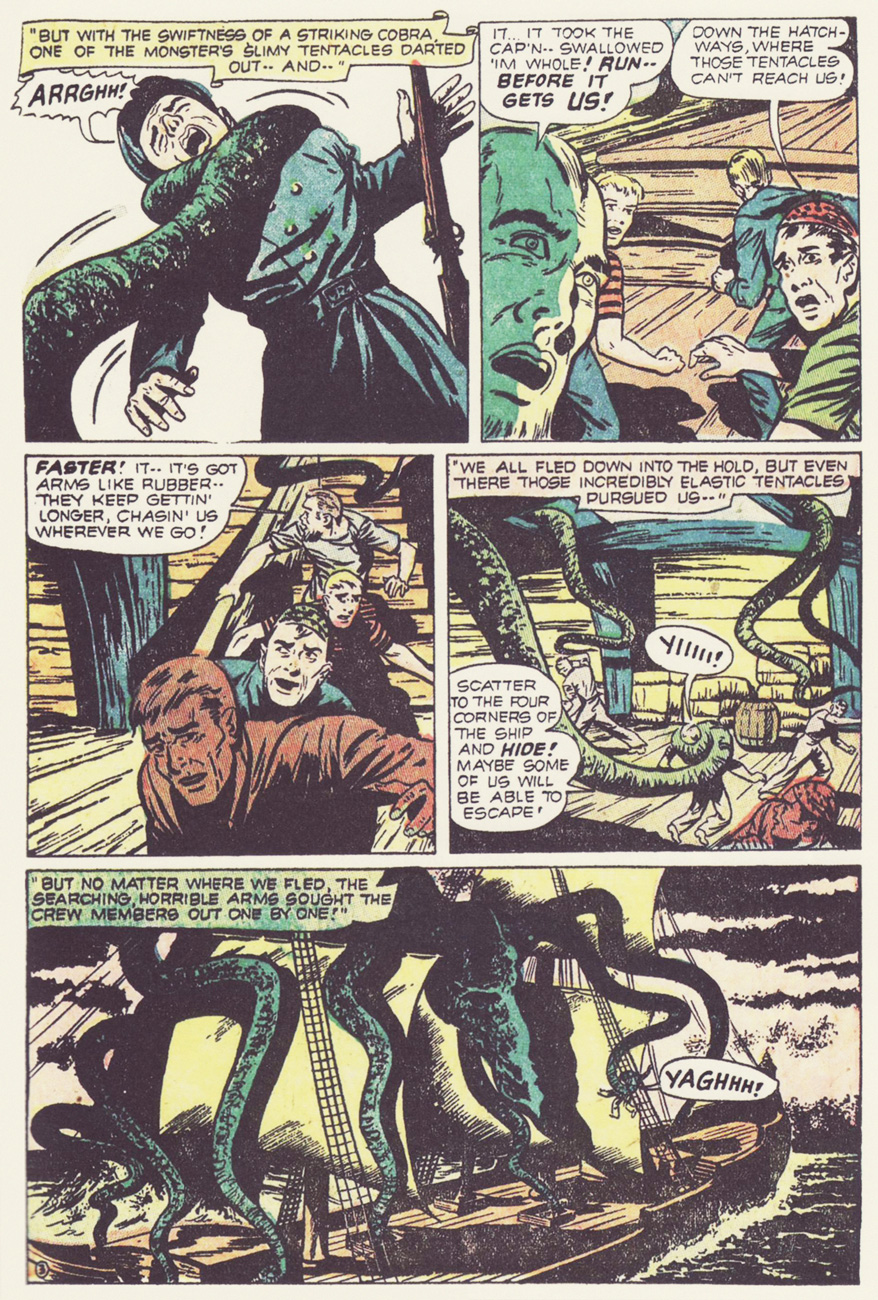
Page from « Mystery of the Marie Celeste », published in Adventures into the Unknown no. 41 (March 1953), pencilled by Al Camy and inked by Edvard Moritz. How (and why) did the octopus manage to climb atop a ship?
Some people would shudder at the idea of having « literary » and horror and / or science-fiction within the same sentence, but I firmly believe that some of this oft-despised « genre » oeuvre is worthy of that (somewhat pompous, anyway) moniker.
To open the proceedings, here’s a page from a graphic adaptation of « Shattered Like a Glass Goblin », written by the venerable Harlan Ellison in 1968 (and first published in 1975, in Deathbird Stories: A Pantheon of Modern Gods.) One of the showier pieces featured in the anthology The Illustrated Harlan Ellison(1978), it is drawn by William Stout, who does a great job translating the story into no-longer-just-mental images – and sneaking in a tentacle or two in the process (if you think that’s just a tail, shhh, don’t ruin it for the rest of us). People who dislike a vivid palette, beware: the bright, vivid colours just emphasize the terror felt by the main character (and the readers, if said readers have any imagination to speak of).
Apparently, poor high-school kids are often forced to analyze « Shattered Like a Glass Goblin », because upon Googling it to check the year of its creation, I stumbled upon a bevy of study resources that explain what the story is about and what techniques Ellison used to make this point. Yawn, and yuck. There’s nothing that ruins a good time like having to dissect it.
Page from the graphic adaptation of Shattered Like a Glass Goblin, written by Harlan Ellison and illustrated by William Stout, published in The Illustrated Harlan Ellison (1978). Stout cleverly refrains from showing everything, instead suggesting the unimaginably horrifying in a series of fleeting, clipped images.
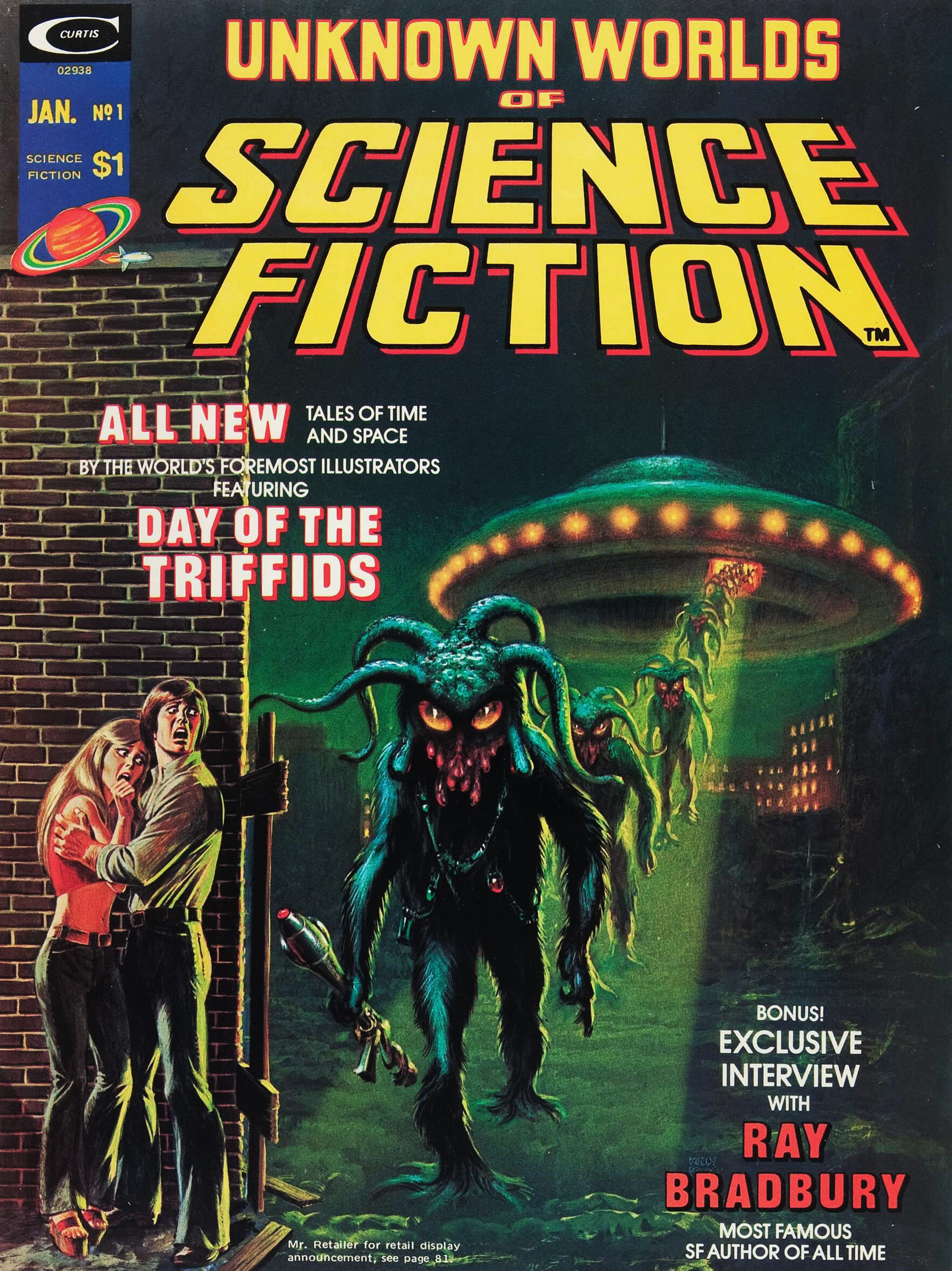
Now we come to Marvel’s short-lived Unknown Worlds of Science Fiction series, which often published adaptations of short stories and novels by well-known writers into a comic format (Mostly with lacklustre results, as far as I’m concerned, but then I’ve always preferred to stick with the original medium of things.)
Unknown Worlds of Science Fiction no. 1 (Marvel, January 1975). The cover is by Frank Kelly Freas. It has nothing to do with either the Day of the Triffids nor with Ray Bradbury (is he *really* the ‘most famous SF author of all time’?) but it features aliens with stylish tentacle-hair (how much hairspray did it require to hold, I wonder?)
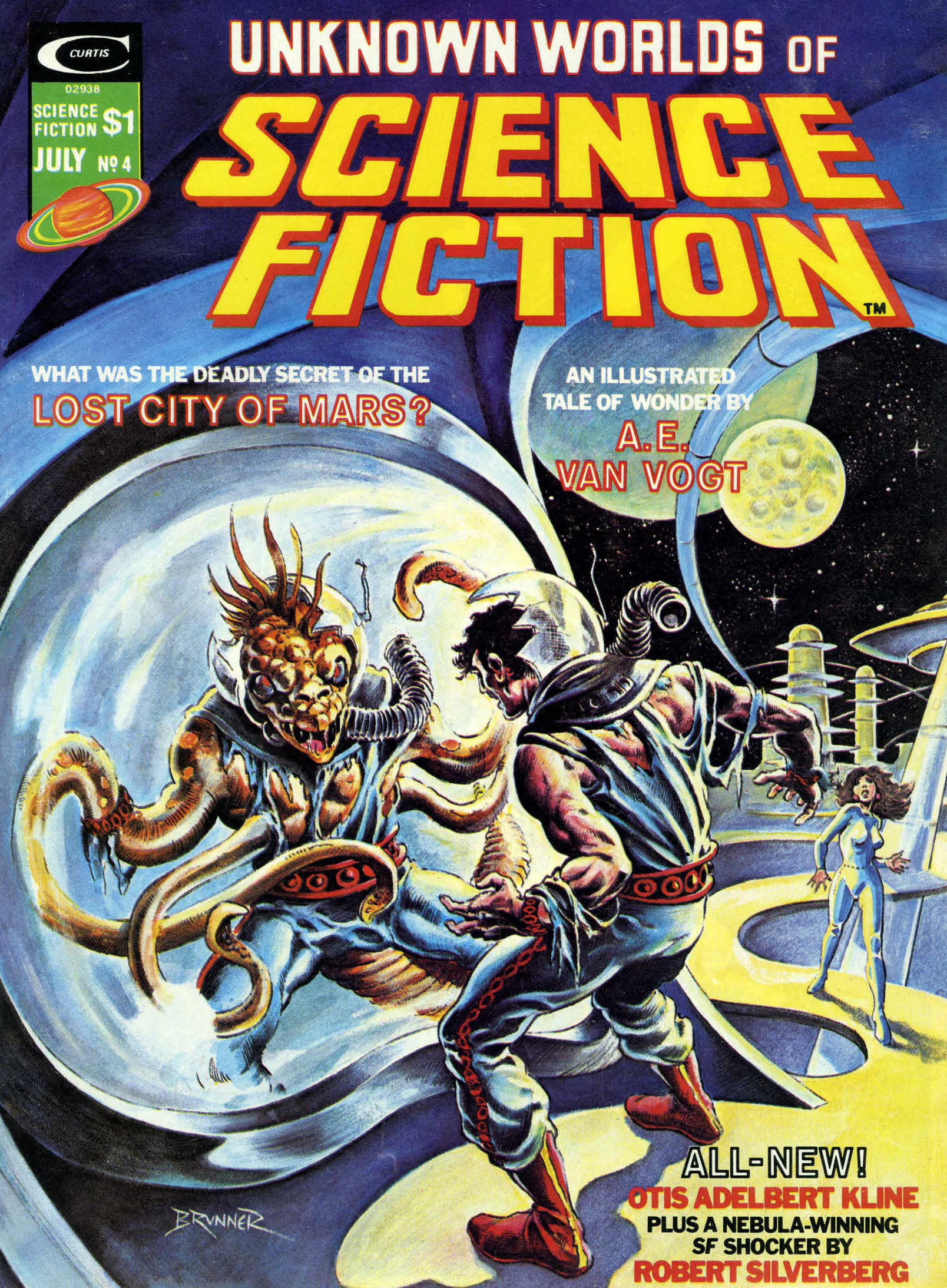
Unknown Worlds of Science Fiction no. 4, (Marvel, July 1975). Cover by Frank Brunner. I say the guy looks much handsomer with a mess of tentacles sprouting randomly from his torso! Bonus: a newly-materialized, huge tail that no doubt ripped his pants apart, even if the artist demurely decided not to draw attention to this fact.
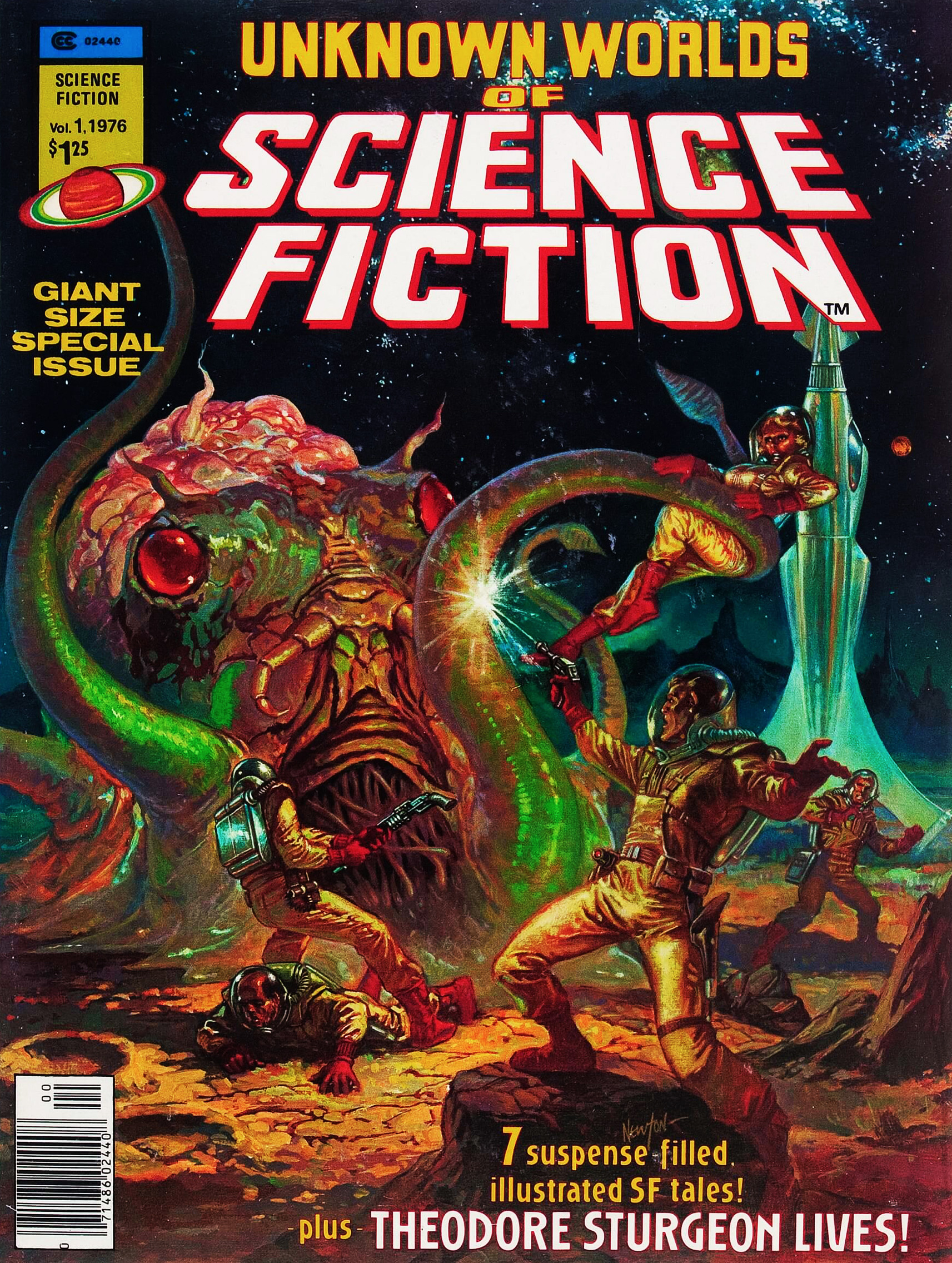
Unknown Worlds of Science Fiction Giant Size Special no. 1 (Marvel, 1976). Cover by Don Newton. Number 1 it may be, but this was the final bow of Unknown Worlds. Note that the tentacles sought out the woman first! (Coincidence, you say? I think not.)
Since I’m talking about tentacles and literature, I am contractually obliged to include something Lovecraftian as part of this post.
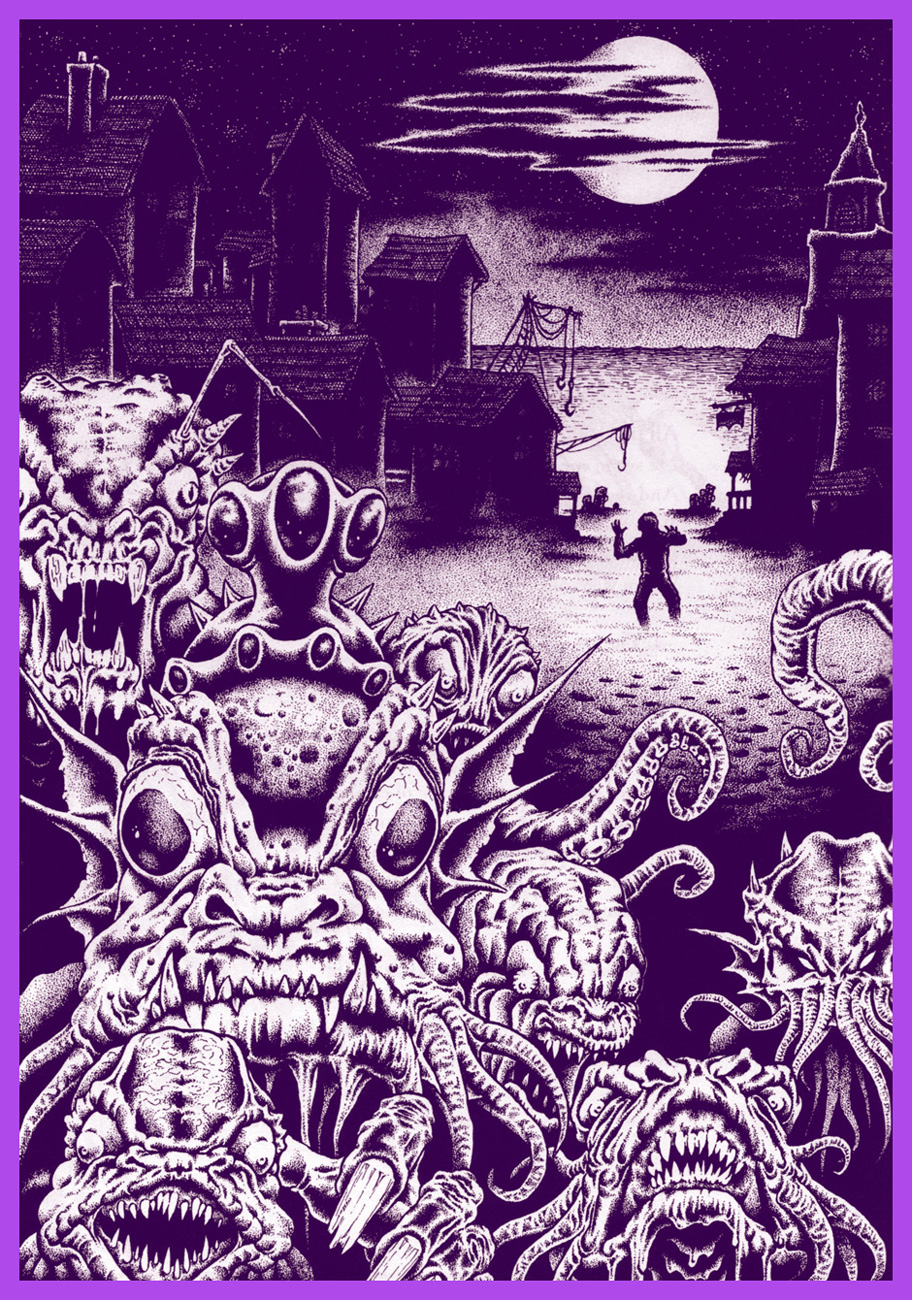
My colleague R.G. has already talked about the H.P. Lovecraft edition of the anthology Graphic Classics (head over here to check it out ), but I’d like to share two illustrations from the inside. Both are by Allen Koszowski, whose work is a feast of tentacled beasts and Lovecraftian horrors.
Illustration by Allen Koszowski of « Fungi from Yuggoth ». Published in Graphic Classics: H.P. Lovecraft, Volume 4, 2002.
A portrait of Mr. Lovecraft himself, in all his striking glory, accompanied by some of this unholy creations. Illustration (also by Allen Koszowski, which was accidental on my part) from Graphic Classics: H.P. Lovecraft, Volume 4, 2002.
Koszowski got the similarity down pat: Lovecraft was mighty weird-looking (in a stately kind of way) – which seems quite appropriate. Maybe I’m reading too much into it, but he certainly looks like he’s just seen something terrible just behind his interlocutor’s back, but he was half-expecting it, so he’s not too startled, even though someone’s probably about to get gobbled up.
(Cats have that look periodically, too, down to the dilated pupils.)
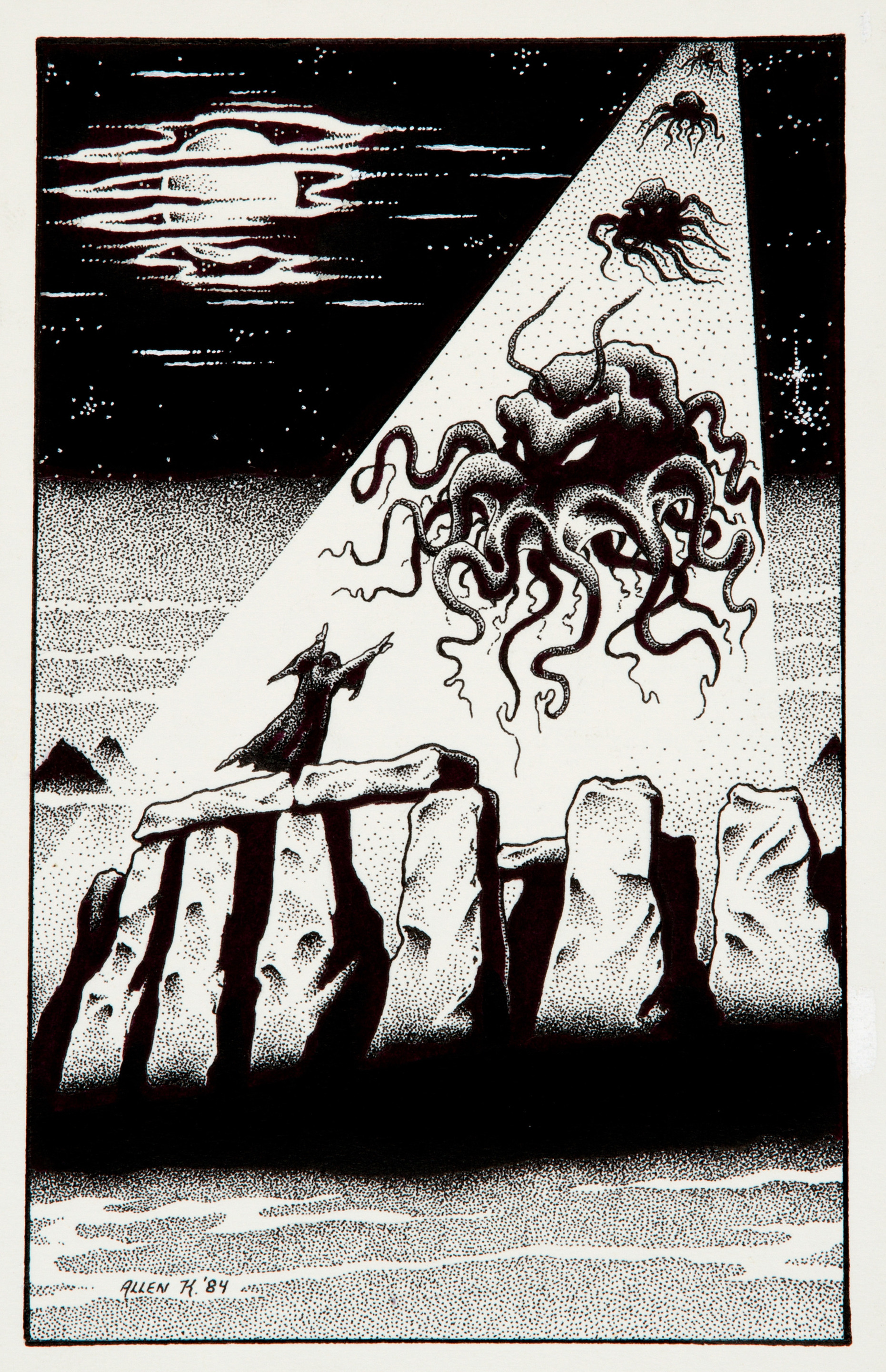
Incidentally, I said that Koszowski’s art was full of tentacles, so here’s one more taste of his proclivities: