Fungus Friday: Travelling with the Wassons

« Mushrooms are different. They are not only raw material for the kitchen, they are a theme for endless discussion. They are ever present in our minds, even when we are not discussing them. »

I am not particularly interested in psychoactive mushrooms, though I get asked about them a lot. They may seem like the central topic of today’s post, but I prefer to think of them as an aside to ethnomycology, a word whose roots make it easy to decipher even if you’re not familiar with it. Mainly, the post is about the delightfully psychedelic world of Brian Blomerth. But let me start from afar…

Like any fandom with a very specific pool of knowledge, mycology has its gatekeepers* and its resident celebrities. A cursory glance at mainstream mushroom literature will quickly yield the name of Paul Stamets, mytho (and myco) -logical figure of authority, intrepid entrepreneur, spiritual guide or hack prone to bouts of pseudoscience, depending on whom you ask.

Parsing social media commentary, one might be forgiven for getting the impression that he’s some sort of cult leader. His fan base is arguably loopier than the man himself, but it’s hard to deny that Stamets likes to take basic facts and spin them into a web of conjecture presented as evidence. Add a tendency to proffer medical advice and present mushrooms (especially of the magic kind) as a panacea, not to mention his brisk trade in heavily watered-down mushroom supplements (check it out here), and the sobriquet of “Elon Musk of Mycology”** no longer seems that harsh. Stamets indeed has a lot of research on psycho-active mushrooms under his belt, and as an active advocate for mycology, he may have inspired a number of people to get interested in the topic… but his messianic persona has long eclipsed his early years as a scientist. I’ll have my mushrooms without a side of semi-religious ravings, thank you.

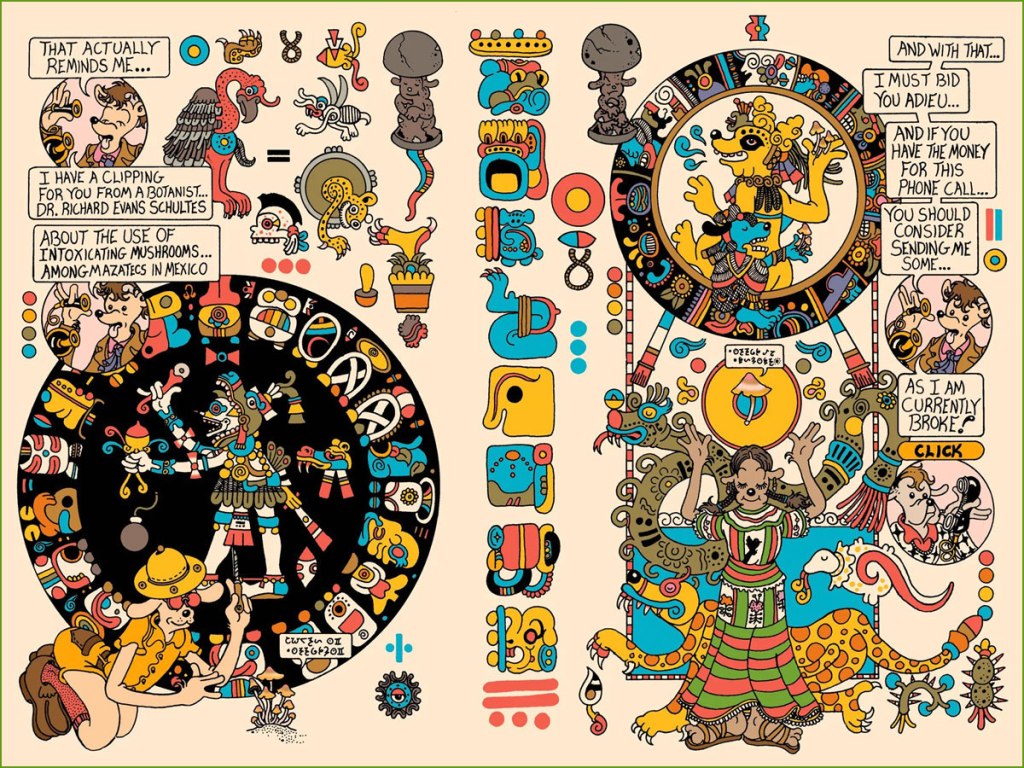
Moving on to the actual topic at hand (believe it or not, I hadn’t set out to write an essay on Stamets), I recently stumbled upon Brian Blomerth’s Mycelium Wassonii and fell in love with the artwork. Then I noticed that Paul Stamets was somehow involved and had an ‘oof’ moment, but fortunately his contribution is simply a (great, admittedly) 2-page introduction, though he shows up in search results alongside Blomerth with the persistence of a cat who wants to be let out. Besides, small contribution or not, I was clearly not passing up the chance to delve into the internal politics of mycology. This is a verbose post, scroll on to the images if you’re so inclined.
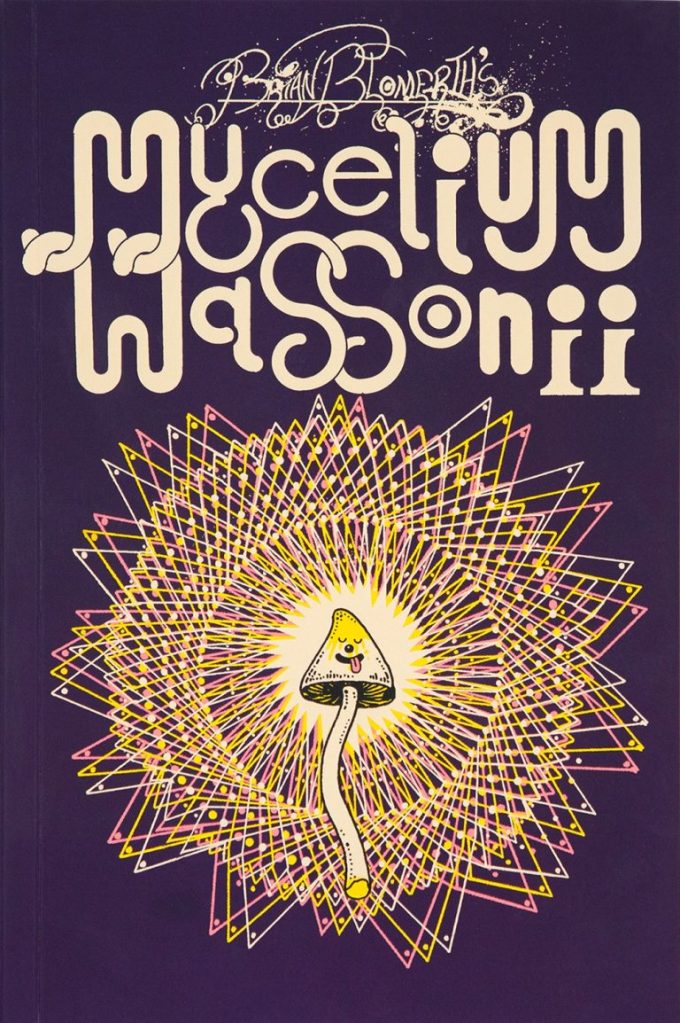
The front cover of Brian Blomerth’s Mycelium Wassonii (2021, Anthology Editions).

Anyway, this graphic novel chronicles the mycological adventures of Russian-born pediatrician Valentina Pavlova Guercken and her American husband Robert Gordon Wasson. When Valentina met Gordon, he was of the opinion that mushrooms were ‘putrid’, but his mycophilic wife’s enthusiasm for picking and consuming them so vividly piqued his interest that the two embarked on a series of ethnomycological field studies soon after their honeymoon in 1927. This culminated in the publication of Mushrooms, Russia and History in 1957. 1955 in particular was a pivotal year. During the Wassons’ trip to Mexico, G. Wasson became the first documented Westerner to participate in Velada, a Mazatec mushroom ritual involving the intake of psilocybin. Both Wassons were deeply affected by their Mexican sojourn. Gordon wrote an account of his experiences for Life Magazine, a photo essay titled Seeking the Magic Mushroom. Six days later, This Week published an interview with Valentina wherein she suggested the use of Psilocybe mushrooms as a psychotherapeutic agent, as well as a potential treatment for mental disorders and a way to mitigate pain in terminal diseases. The brouhaha created by these pieces, as well as the samples the Wassons brought back from Mexico that wound up in the hands of Albert Hofmann (‘father’ of LSD), paved the way to a magic mushroom culture.***

Mycelium Wassonii is remarkably hard to scan, for its tight binding requires cracking it open. Most of the following images were borrowed from Brian Blomerth on his new book on psychedelics and the magical Mushroom Revolution (including pictures of Blomerth and cute doggos!) and a review over at The Comics Journal.
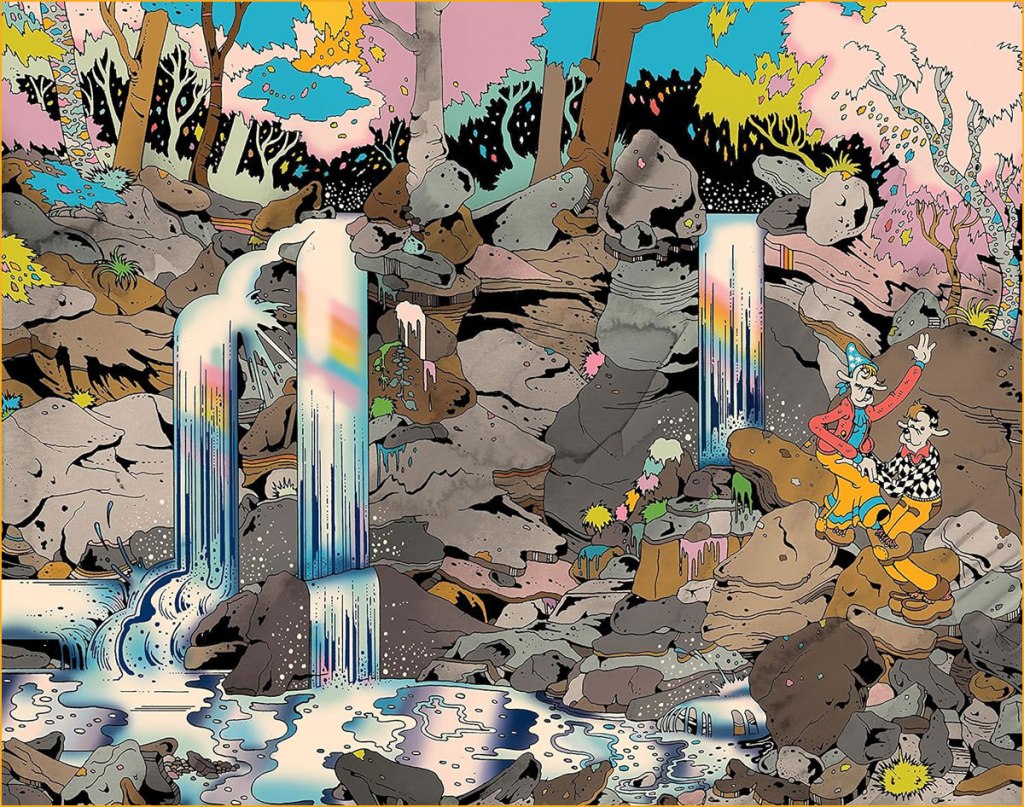
The beginning of Tina and Gordon’s honeymoon.
What do you do with this gross thing?’, asks Gordon. Despite her enthusiasm for psychedelic mushrooms for medication and treatment, Valentina was clearly first interested in them from a gastronomical perspective. I can relate.
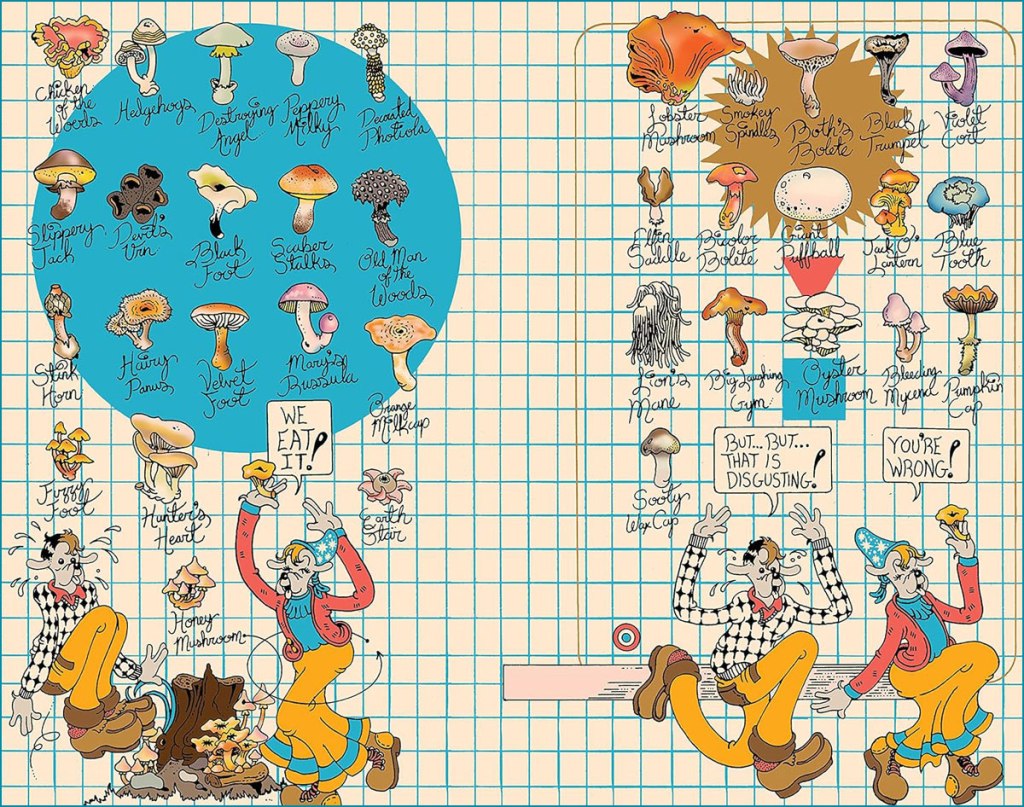
Valentina tells the story of how, as a child, she was sent out to get some boletes (Boletus Edulis, ‘borovik’ in Russian) by her mother, but she kept bringing back the wrong thing. I love how Blomerth gives his mushrooms little speech bubbles, like they’re saying something in an alien language to the people going by.
After their honeymoon, Gordon, now a convinced mushroom lover (what did you think honeymoons are for?), the couple returns to NYC and their day jobs. Yet mushrooms are never far from their minds (a familiar affliction), and as they compile recipes, the impulse to collect them in a mushroom cookbook grows.
Gradually, the idea of mycophobic societies as represented by Gordon and mycophilic societies as represented by Valentina takes hold, and the cookbook expands into a treatise about mushroom culture. Ethnomycology is born.
While it can be argued that Gordon’s interest in the Mazatec mushroom culture and subsequent publications about it were motivated by his desire to expand human knowledge, it’s undeniable that he behaved in a less than exemplary way from the onset. The Mazatec wise woman María Sabina (pictured above) who allowed him to be part of the sacred ritual did so because Gordon lied to her about a lost son. He also took a picture of her on the condition of never publishing it, but then revealed her name, location and community in volume 2 of Mushrooms, Russia and History, which led to all manner of tragic and violent repercussions on her life.

Blomerth deserves many accolades for this book, above and beyond his colourful and cartoony art. He managed to tease a coherent yet detailed storyline out of a topic that reminds me of a Lernaean hydra – pull on one narrative thread, and many more threads spring up. Unsavoury moments are not glossed over, and yet one leaves with an invigorating impression of mycological passion that connects to a general lust for life. Finally, Blomerth draws mushrooms accurately – one can recognize specific species from his drawings.

Head over to his website for some gorgeous t-shirts. Fans of the above material may also be interested in Blomerth’s other mind-expanding (he, he) graphic novel, Bicycle Day, involving the aforementioned Albert Hofmann.

Returning to the topic of fungal superstars, I recommend David Arora as an examplar of a knowledgeable, passionate mycologist who also doesn’t take himself too seriously.

~ ds

* In this particular case, said gatekeeping is motivated by nobler motives, namely those of keeping people safe. Some of these fungal newbies throw themselves in headlong, disregarding the very possible and palpably lethal outcomes of misidentification.

** Someone on Facebook coined this term and I had a good chuckle. On an even pettier note, Stamets chose, for his website, a white font on a blue background… and my eyes do not appreciate it.

*** Here I am somewhat constrained by space, as I have already ventured far off the field of actual comics. I haven’t even touched upon the subject of people (proto-hippies?) who travelled to Mexico in order to locate María Sabina and/or magic mushrooms (famously, John Lennon et al.) or the CIA’s involvement with the Wassons.

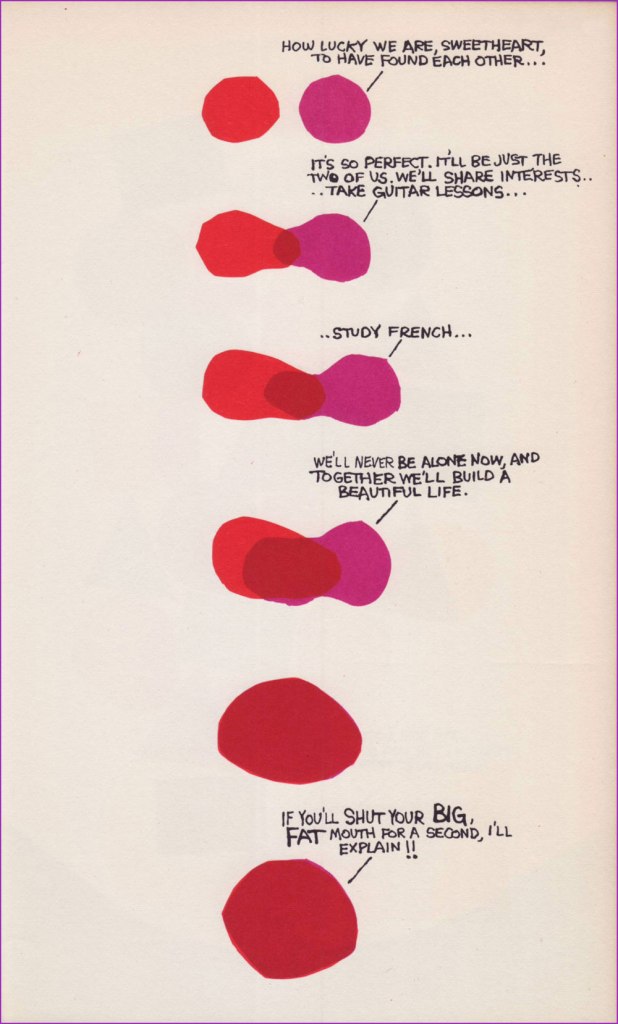
So the Square Says to the Triangle, ‘That’s No Lady, That’s My Wife!’

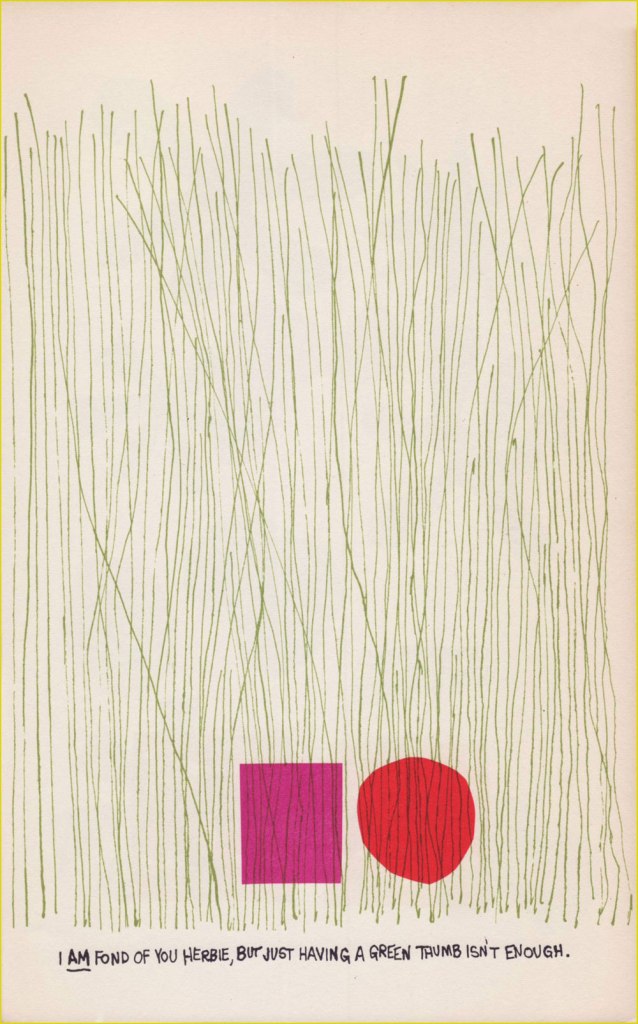
Inhabiting the same topography and timeline as Jules Feiffer‘s Village Voice strips, Bill Manville’s Saloon Society, and, dare I say, even Rod McKuen’s youthful reminiscences, The Conformers by Jack Wohl* (‘who has been, at various times, a child, a larger child, a musician, a composer and creative consultant and art director for our advertising agencies‘, helpfully notes the blurb on the back) is a charming little book with colourful squares and circles for characters. Like many other publications whose existence I previously ignored, I found it in a used bookstore that assigned it the somewhat random price of seven dollars, 41 cents, which was pretty good, considering that the employees probably didn’t know what it was or how to price it.**

Published in 1960, the book consists of ‘shapes cut out of colored paper with scissors‘, cheekily described in the introduction by Roger Price*** as Wohl’s psychiatrist’s idea. These blobs may be firmly situated in NYC’s Greenwich Village, but no matter how technologically advanced we get, most human preoccupations are the same some 60+ years later… so most readers will be able to effortlessly recognize themselves in the lives of Harriet (red circle), Howard/Herbie (purple square) or Arthur (green square).

TOGETHERNESS 1
THE LOGICAL MIND
PRACTICALITY
FREE SPEECH
C’EST LA GUERRE
MOMENT OF TRUTH
PLANNED PARENTHOOD

~ ds

* Definitely not the American far-right conspiracy theorist, fraudster, and convicted felon.

** No shade is intended towards used bookstores in general, which are places I love being in, but this particular bookstore has staff that seem to wildly overprice most things without consideration for their condition or the simple question of ‘who in their mind would buy this at that price?‘.

*** As the author of Droodles, Price was particularly well positioned to write an introduction to The Conformers.

One Furious Woman and a Hatchet: the Saga of Carrie Nation

« In 1900, she bought from a Medicine Lodge hardware store the implement that became both her weapon and her symbol — a hatchet — and at the age of fifty-four sallied forth on a smashing campaign that carried her across the country, shouting: ‘Smash! Smash! For Jesus’ sake, Smash!’ »

These days I’ve been reading Ardent Spirits: The Rise and Fall of Prohibition (1973) by John Kobler. I didn’t know much about the temperance movement in general, but what surprised me most is how intimately it was tied to suffragette activism. It’s in Ardent Spirits that I came across the fascinating character of Carry Nation*, a bulldog, running along at the feet of Jesus, barking at what He doesn’t like’. She seems a very fitting figure for a post on this March 8th, International Women’s Day.

Whether she was a total barmpot or a blazing visionary is up for some debate; I must give credit to Kobler, who cobbled together a fairly well-balanced portrait of her while many historians tended to quickly dismiss this hatchet-wielding devotee as a crazed lunatic. While basic facts remain the same (disagreement about Nation’s height notwithstanding), interpretation of events and motivations varies wildly. This can be quickly demonstrated by comparing two modern articles of some depth: Carry Nation is described as ‘a flamboyant, theatrical and completely outrageous woman at nearly 6 feet tall [..] smashing barrels on stage and singing her temperance songs to enthusiastic audiences who howled for more‘ (Carrie Nation: American Woman by Richard Behrens) but also as ‘a fearless populist progressive just over 5 feet tall** […] fighting tirelessly for good governance, women’s rights, civil rights, and cleaning the corruption out of the body politic‘ (Hatchet Nation by Mark Lawrence Schrad).

One of six postcards published in 1905 depicting Nation’s ‘hatchetations’: On the Warpath; Raiding a Public House; Addressing Cigarette Fiends; Smashing a Pub; In a Restaurant; In a Pub.
Cartoon from 1901 published in The Freethought Ideal, Vol II, 1901.

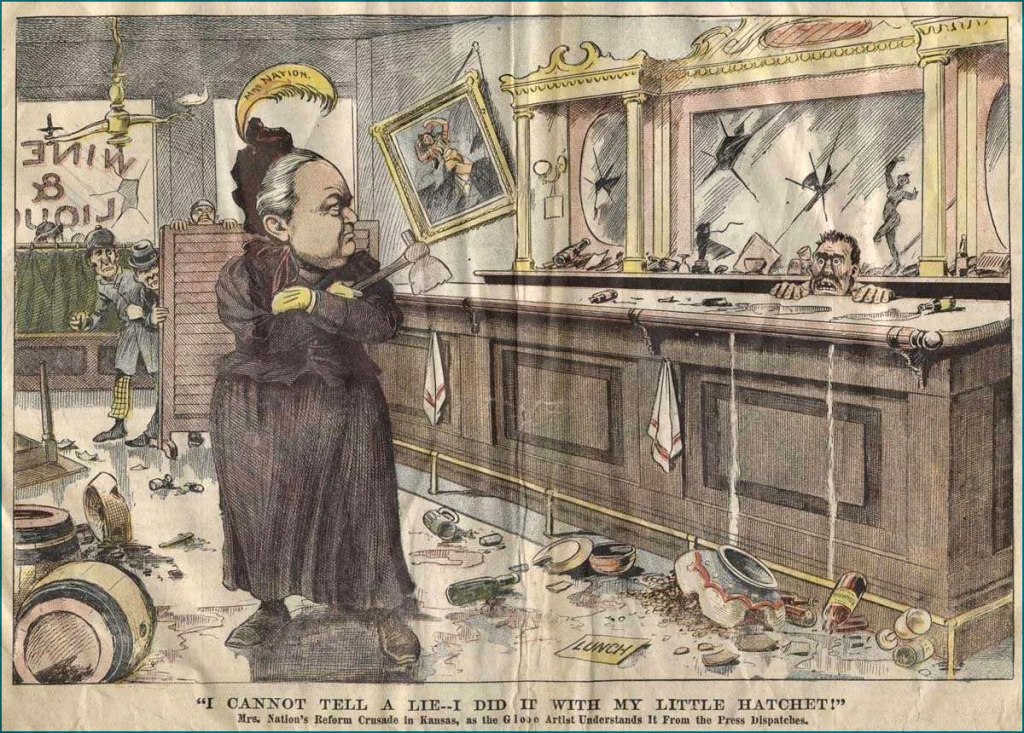
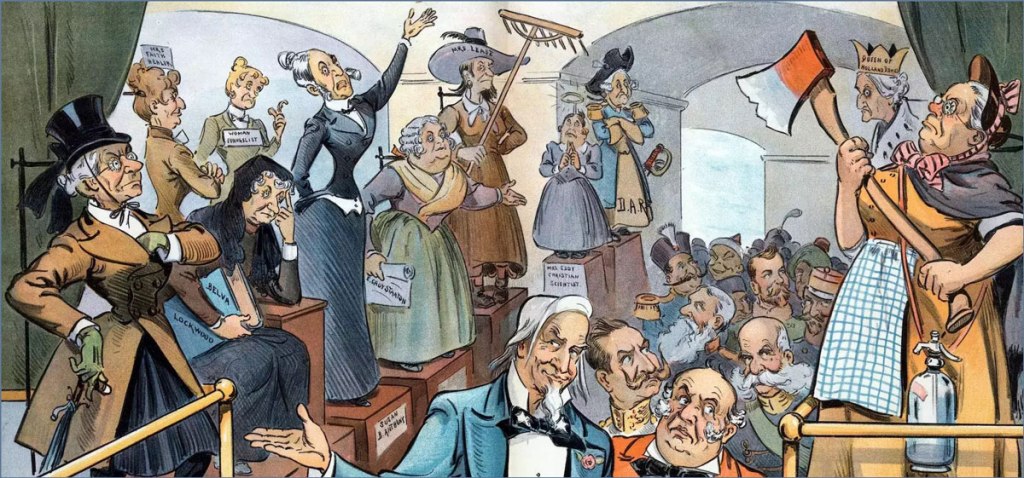
Nation went through an arsenal of weapons (aside from rocks and incidental objects, a sledgehammer) before settling on her beloved hatchet and coining the term ‘hatchetations’ to describe her saloon smashings. It comes as no surprise that she grabbed cartoonists’ imagination, even taking into account that real juicy conflict remains unillustrated (and this was a ruthless war between temperance advocates and their opponents). Just picture this colourful scene — a woman, garbed in the usual constrictive dress of early 19th century, marching into a bar and smashing up bottles, mirrors, chairs, slot machines with her trusty little axe. This striking image is likely why Nation’s name is first to spring up when the topic of prohibition arises in modern conversation.

American newspaper cartoon, 1901.
A cartoon in The Gazette by Harry Larimer, published in 1901.
Cartoon from April 14th, 1901.
Cartoon by Louis Walrymple published in Puck, v. 49, no. 1256 (April 3rd, 1901).
Cartoon published in the Minneapolis Journal on February 6th, 1901. You’ll doubtlessly notice that this caption gets around a lot!
Puck, 1908.
A bit closer to the present day, here’s a 1960s cartoon by bon vivant Eldon Dedini, who hypothesizes Ms. Nation’s likely reaction to a Playboy Club (the first one opened in Chicago, circa 1960). The caption? « Hi! ».

Happy Women’s Day (and Women’s History Month) to all readers!

~ ds

* This original name came about when Carry Moore, named Carry by a semiliterate father, married David Nation. She preferred to spell her name as ‘Carrie’, until she married David, yielding the grandiose full name Carry A. Nation (A. stood for Amelia), ‘carry a nation for temperance’.

** This question of height intrigues me, for most articles describe Nation as tall and powerful. Mark Lawrence Schrad, who just portrayed her as being just over 5 feet tall, has also written another article in which he calls her ‘imposing in stature, prone to violence and—claiming God spoke to her, urging her to attack saloons—slightly unhinged‘.

Richard Thompson Tells You « Why Things Are »

Weekly column ‘Why Things Are‘ ran in The Washington Post from 1990 to 1996. During these diverting (at least as far as the common topic is concerned) years, WOT favourite cartoonist Richard Thompson tackled such various brain bafflers as ‘what does the inside of your nose smell like?’ or ‘why does overdrinking cause a hangover?’ These, at any rate, were the questions posed by Joel Achenbach, staff writer for TWP, questions from which Thompson bounced into sometimes altogether unexpected directions. « The column was fundamentally zany », explains Achenbach in the introduction to the collection of Why Things Are, « though larded with real information and interviews. Richard, it turns out, had crammed his brain over the decades with all manner of esoteric information. The cartoons sang – and sing to this day – with the perfect pitch if the slightly demented intellectual. » There are few things closer to my heart than a non-sequitur with a pedantic bent!
Here is a selection of cartoons from the aforementioned collection, published in 2017 by Picture This Press. While these illustrations need no further accompaniment, the questions submitted to (or by) Achenbach are included under each image. Enjoy!

Why do sexual turn-ons vary so greatly from person to person? Undated (circa 1990-1992).
Why is some cholesterol good for you? Undated (circa 1990-1992). The cholesterol chap looks Klibanesque if not in line, then in spirit.
Why do beer companies brag that their products are ‘cold-filtered’ or ‘beechwood-aged’ or ‘drybrewed’ or ‘genuine draft’ even though no one knows what these terms mean? October 31st, 1993. Given the influx of shitty ‘artisanal’ beer produced by huge companies, I think modern society really needs an official term like ‘Pabst-smeared’.
Why do some people think watching birds is fascinating? February 6th, 1994. When one hits thirty, one is supposed to acquire a set of hobbies only appropriate for people who have suddenly waded into the category of ‘vaguely old’ – gardening, knitting, and, yes, bird watching. I plead guilty to all three.
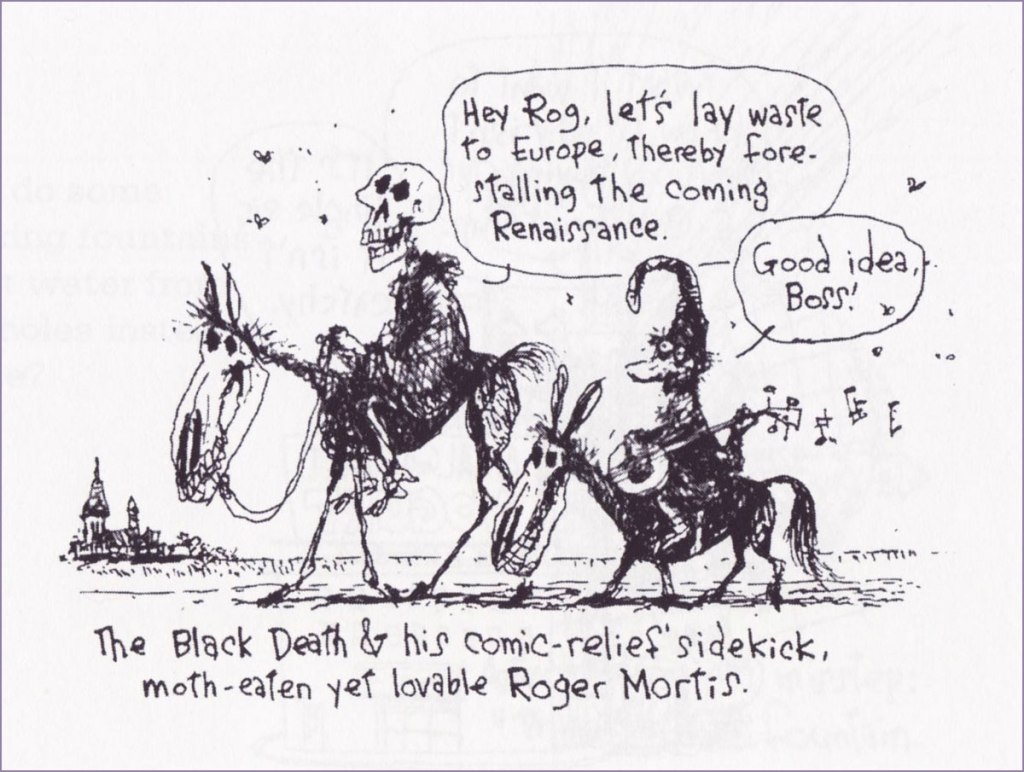
Why didn’t the Black Death kill everyone in Europe in the fourteenth century, rather than just a third of the population? Undated (circa 1990-1992). I couldn’t resist the adorable Roger Mortis.
Why doesn’t sugar spoil? Undated (circa 1990-1992).
Why is rain sometimes dreary and depressing, and other times wonderfully romantic? April 18th, 1993.
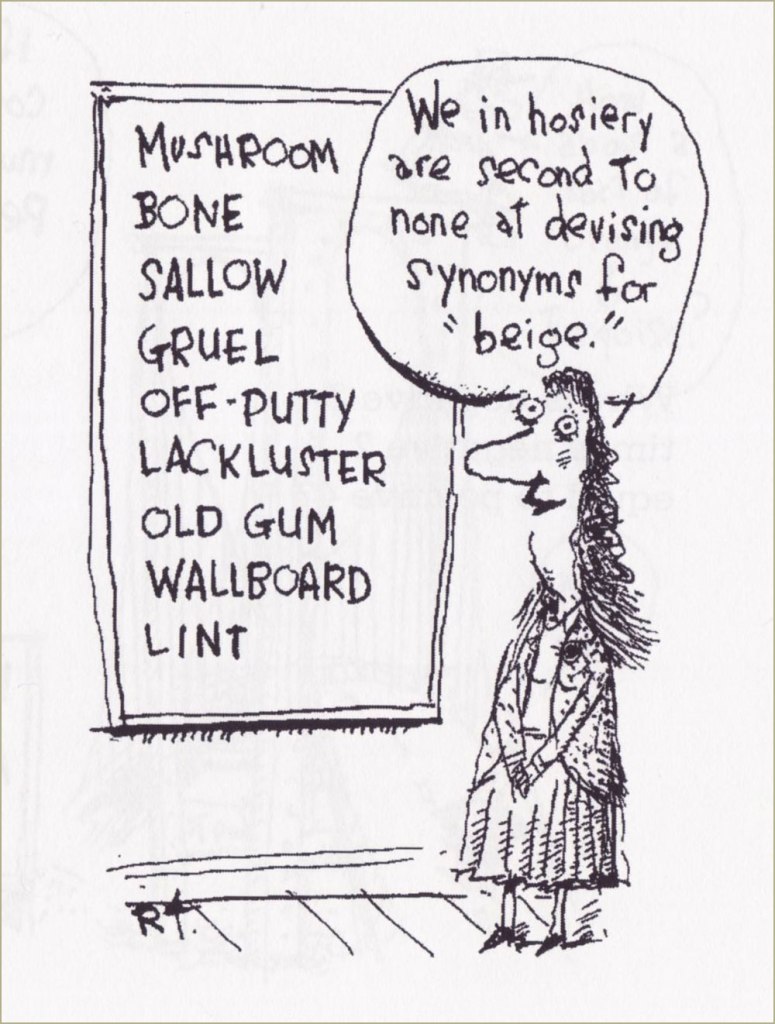
Why can’t they invent pantyhose that don’t run? May 30th, 1993. I recently stumbled across a ‘new’ colour, ‘greige’, a beautiful amalgamate of grey and beige. In a world where several shades of grey are on offer for items from radios to cars (battleship grey, steel grey, stormy grey…), I am not sure we needed this particular variation. As for rip-free tights, they do exist, but you pretty much have to sell one of your kidneys to get your hands on a pair.
Why did people once upon a time believe in vampires? Undated (circa 1990-1992). This guy reminds me both of our last company-wide meeting with an uplifting speech from the CEO and, in more pleasant associations, of Daniel Pinkwater‘s Vampires of Blinsh (illustrated by Aaron Renier).
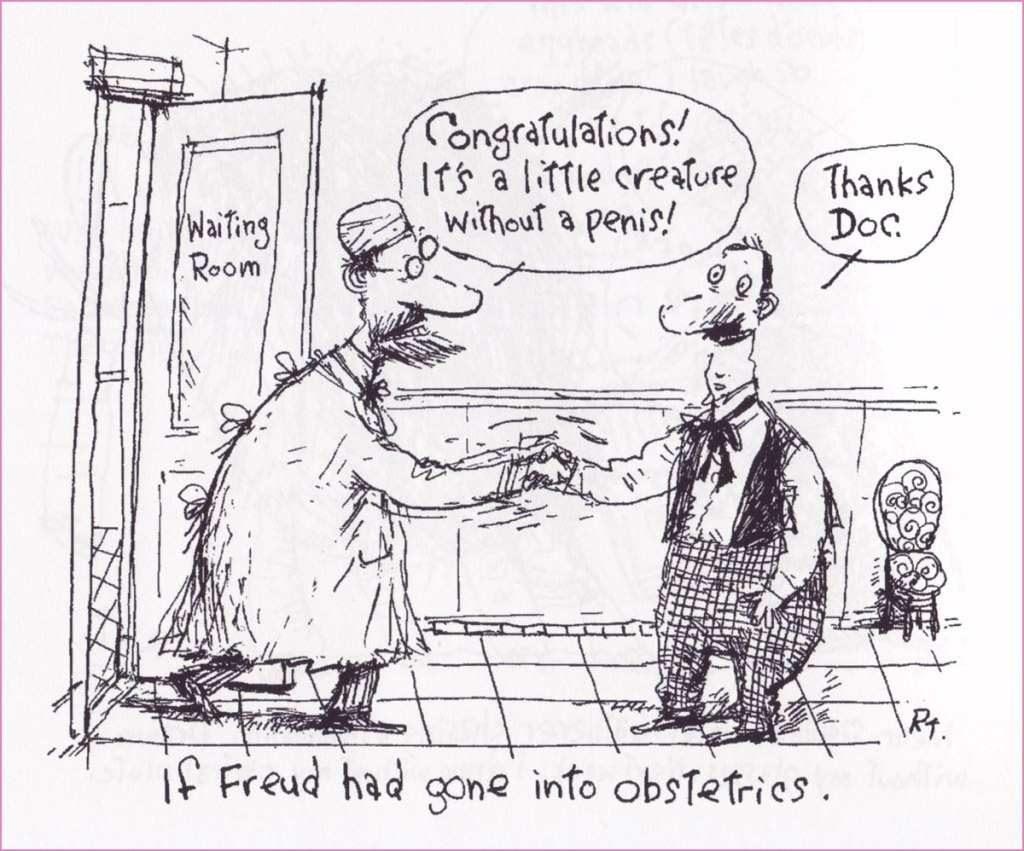
Why did Freud think women suffer from ‘penis envy’ when that is obviously absurd? January 16th, 1994. Well, that’s easy…
Why do owls seem to turn their heads 180 degrees without turning their bodies? August 1994. A lot of owls can actually turn their heads 270 degrees!
Why do the ‘f’ and the ‘s’ and the ‘p’ and the ‘t’ sound so similar over the phone? February 26th, 1995.
December 4th, 1994. If you’re not yet aware of the great and deliberate lemming fraud, just read this… or go jump off a cliff.
Why does hot water freeze faster than cold water in an ice-cube tray placed in the freezer? April 9th, 1995. Tax season is fast approaching – have you prepared your family-size package of prosciutto?!

~ ds

Fungus Friday: Meet… The Mushroom Man

Every once in a while, we celebrate the end of the working week with a leisurely walk through fungal pastures. This week’s installment is a bit on the spooky side, so if you are troubled by a little case of mycophobia, an affliction many suffer from, stick around for a spine-tingling experience. Me, I was definitely rooting for the mushrooms 🍄

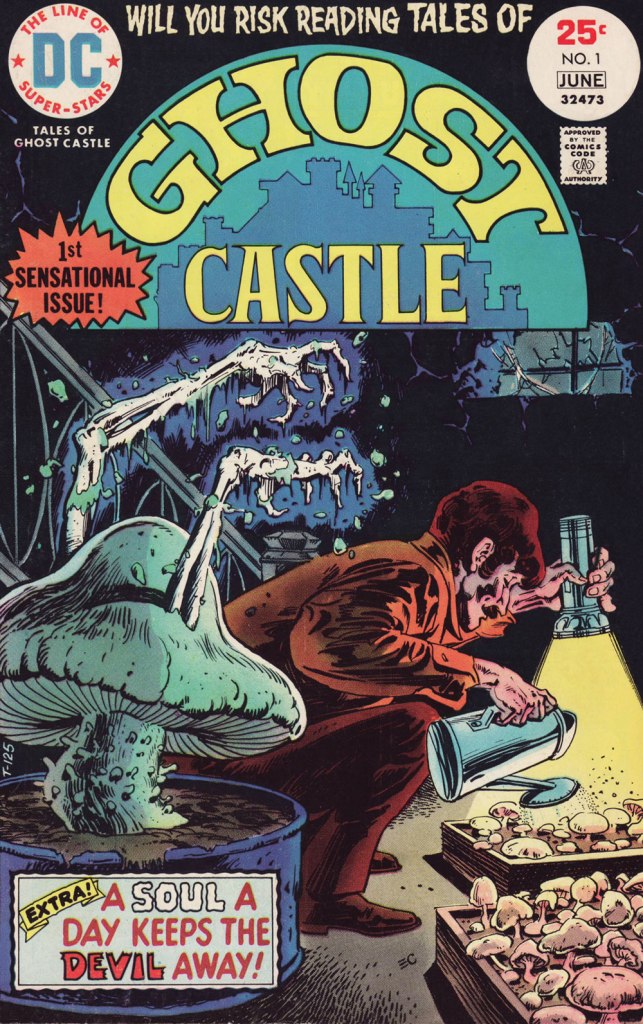
The cover of this issue promised some mushroom goodies, so of course my interest was piqued, even though it makes no sense whatsoever to have skeletal arms protruding out of a fungus. Tales of Ghost Castle no. 1 (May-June 1975, DC). Cover by Ernie Chan; Tex Blaisdell, editor.

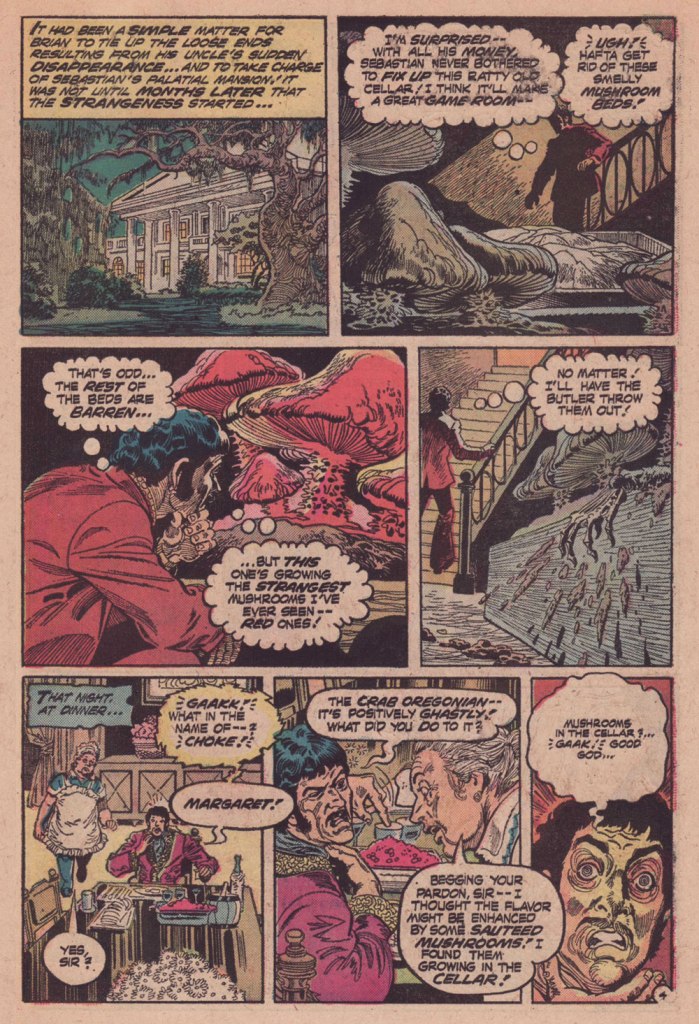
The cover story – 5-pager The Mushroom Man, plotted by David Michelinie, scripted by Martin Pasko, and illustrated by Buddy Gernale – is a tad more mycologically convincing.

Knowing that the fungus fancier is dead right from the beginning depressed me a little bit. However, starting at the scene of the crime to pursue in mushroomy flashbacks makes for good storytelling.
It’s possible for a mushroom to degrade super quickly (see, for example, shaggy manes aka Coprinus comatus that can deliquesce into a puddle of black goo in less than 24 hours after popping up), though 3 hours is pushing it a bit. ‘Nightdreamer’ sounds distinctly psychedelic, so we can take a guess about what kinds of ‘gourmets’ the uncle is referring to.
Did no-one wonder what happened to the uncle?
It’s not a ratty cellar, it’s an appropriately dark and humid cellar, you philistine. A ‘simple matter to tie up loose ends‘? Maybe the police had mycophobia, too, to let the matter drop so easily. One might add that cooking random mushrooms growing in the cellar is not recommended.
Hello, scene from Last of Us.

We are the champignons, my friends! Quite literally, in the case of this money-grabbing, murderous nephew.

~ ds

Folk-Artist: Hua Junwu and the National Style

Hua Junwu (華君武, 1915-2010) hailed from Hangzhou. He was born during a hectic epoch — life tossed him around quite a bit, but unlike a lot of his contemporaries, he was able to navigate through these changing times with dry feet. He had been drawing since his school days, but the seeds of his artistic career were sown around the time he moved to Shanghai to become a student at Utopia University, where he first began submitting his cartoons to magazines for publication, as well as meeting like-minded artists.

A year after the Second Sino-Japanese War started, in 1938, he left the Japanese-occupied Shanghai for Yan’an (the seat of the Communist government at that time) and worked at the Lu Xun Academy of Literature and Art, also contributing anti-Japanese propaganda cartoons to publications like Jiefang Daily. Japan formally surrendered in 1945, but the same year saw an escalation of the struggle for power between the Nationalists and the Communists, which signalled the start of the Third Chinese Revolutionary Civil War. Hua travelled through Northeast China, working as a reporter and cartoonist for Northeast Daily. 1949 saw the founding of the People’s Republic, and Hua joined People’s Daily as the head of its art department, and the China Artists Association as its Secretary-General in 1953.

In his introduction to Selected Cartoons of Hua Junwu (New World Press, 1984), Hua credits German artist E. O. Plauen (see Circus Acrobats of Life: E. O. Plauen’s Father and Son) as one of his main artistic influences. I was amused that the other artist who had Hua’s utmost admiration was Georgi Sapojnikov, a former officer of the Russian Imperial Army who occupied the spot of daily cartoonist in North China Daily News, working under the pseudonym Sapajou*.

There was considerable difference between rural Yan’an and sophisticated Shanghai, and this change of scenery is what shaped the artist’s style into its distinctive form. To quote Hua, « Shanghai in the 1930s was a cross between a colonial and feudal society, a special territory where Chinese and foreigners lived cheek by jowl. As I had learned so much from foreigners’ cartoons, my own cartoons were inevitably rather foreign in flavour. Fortunately, the only people who paid any attention to cartoons in the Shanghai of those days were, I suppose, a few intellectuals who were also foreign influenced, so I was able to get by. » After his move to Yan’an in the late 40s, Hua found his audience changing from the aforementioned ‘few intellectuals’ to a readership of mostly peasants, who found his foreign-based style alien and hard to understand. Feeling like ‘a round peg in a square hole’ and heavily influenced by the writings of Mao Zedong, Hua adopted a philosophy of ‘national style’, ‘the Chinese style and spirit which the common people of China love‘, for which he is now fondly remembered.

This collection, as noted on the cover, is bilingual – the cartoons in Chinese are included on the left, with their English translations on the right (Hua Junwu drew the English letters himself, to keep their Chinese flavour). However, in interests of intelligibility, we are just including the translated versions.

I just wanted to share some fun cartoons, but this post once again dragged me into the 20th century and its bloodshed, as well as the history of communism (this time from a Chinese perspective). Some topics are rich veins to mine, full of interesting filaments that lead to their own story.

~ ds

* The story of ‘White’ Russian refugees fleeing to Shanghai during the civil war between Bolsheviks and Tsarists is a fascinating topic in itself. Of more relevance to this post is this quote from Citizens of No State: Daily Life of Shanghai White Russians, 1920s-1930s: « A man endowed with the gift of reducing the complexities of Chinese politics to a single image and of capturing the ebullient, chaotic nature of Shanghai without sentimentality or cynicism, Sapojnikov worked for the newspaper for more than two decades. » I think a post about Sapajou is needed at some point in the future…

Death to Global Imperialism: D. Moor and the Bolsheviks

D. Moor may not ring like a convincingly Slavic name, but it is the nom de plume of Russian illustrator Dmitry Stakhievich Orlov (1883-1946). Why the D. abbreviation was picked is obvious; as for the family name, he plucked it from The Robbers, a 1781 play by German Friedrich Schiller about two brothers, one of whom Orlov thought he resembled in temperament.

Orlov adopted his pseudonym in 1907, when he switched careers from typography to political cartooning after one of his caricatures was printed in a newspaper. His biting sense of humour was not always well received by the Tsarist régime, and occasionally censored, which provoked the passionate Orlov into even more acerbic mockery. In these years he also designed posters for silent films, which in a way forecast his future as an affichiste. After the Russian Revolution of 1905, Orlov joined the ranks of those actively working in favour of an uprising; when in 1917 Russia fell into civil war that would lead to the formation of the USSR, D. Moor put to good use his aggressive anti-religious stance and talent for caricaturing politics.

‘Three Russian attractions: Tsar bell, Tsar cannon, and Tsar Nicholas. Tsar bell doesn’t ring, Tsar cannon doesn’t shoot, Tsar Nicholas doesn’t reign…’, 1917
Orlov’s poster for Убійца (1910)*

He was responsible for creating much in the way of striking agitprop, and is often cited as the father of the Soviet propaganda poster. His most famous poster** was not only aped by other illustrators during Orlov’s lifetime, but also acquired great popularity after the USSR fell apart***.

The Solemn Promise (1919)
Death to Global Imperialism (1919)
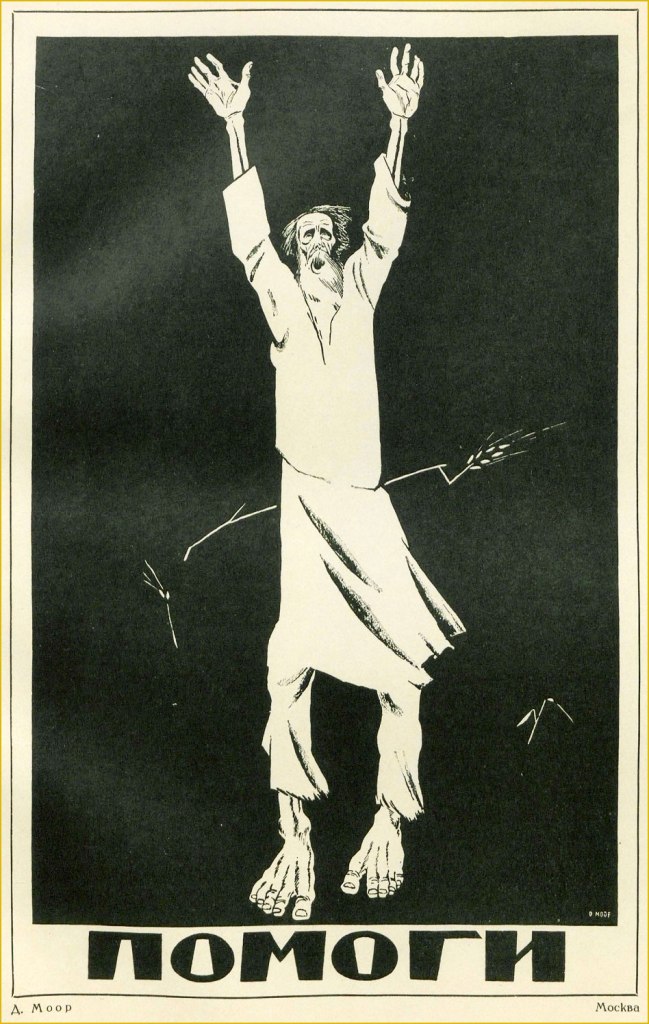
Help (1921). This is one of D. Moor’s most striking posters, and refers to those affected by the Povolzhye famine, which began in 1921 and lasted until 1922, killing an estimated six million people. Note the starving peasant being pierced by a single stalk of wheat.

I may be somewhat straining the definition of ‘comics’ by writing this post, yet some of D. Moor’s posters clearly feature linear graphic storytelling.

Labor (1920)
The White Guards and the Deserter (1919)
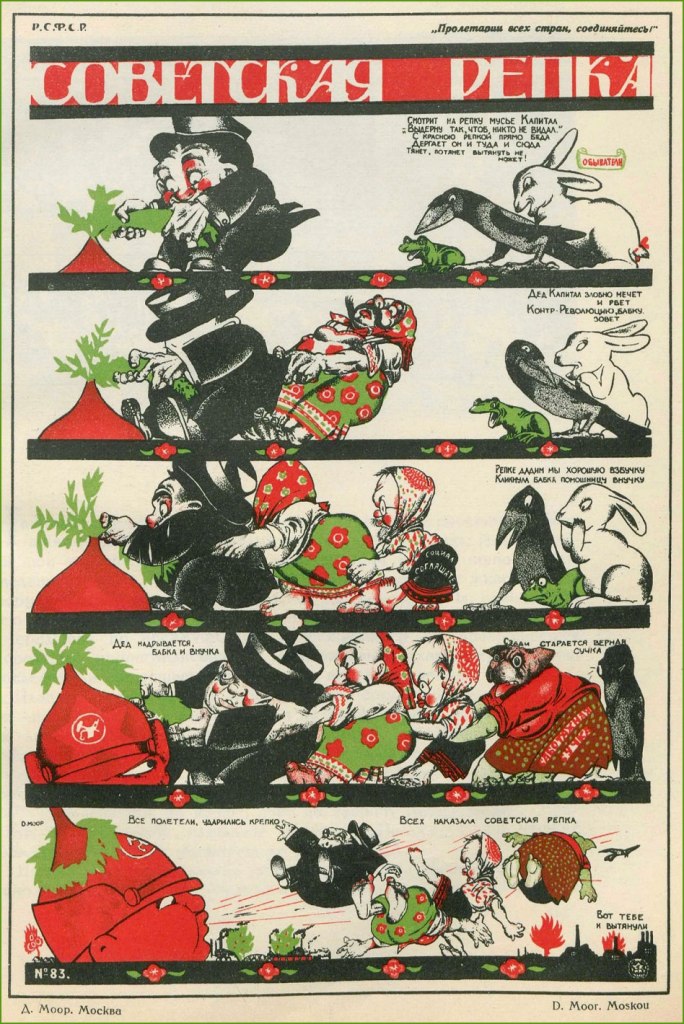
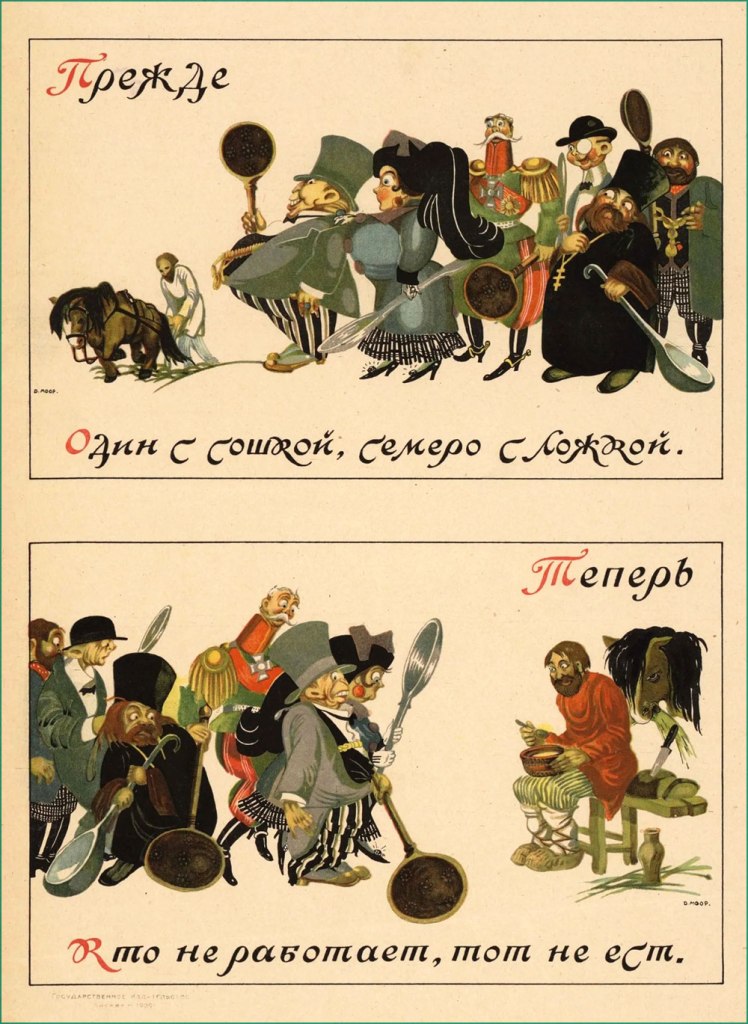
The Soviet Turnip (1920). This alludes to a classic fairytale in which a family is collectively trying to rip out a big turnip from the ground, even involving the help of the dog, the cat, and the mouse.
This uses two proverbs to make its point – under ‘Before’, ‘One with a plow, seven with a spoon’ and under ‘Now’, ‘The idle don’t get to eat’. (1920)

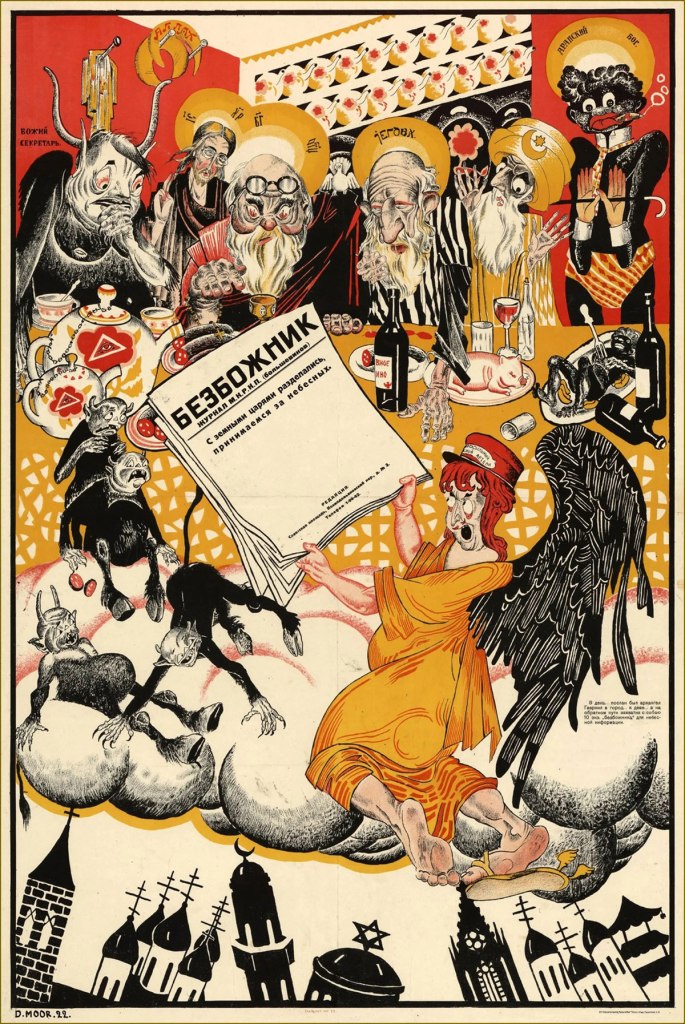
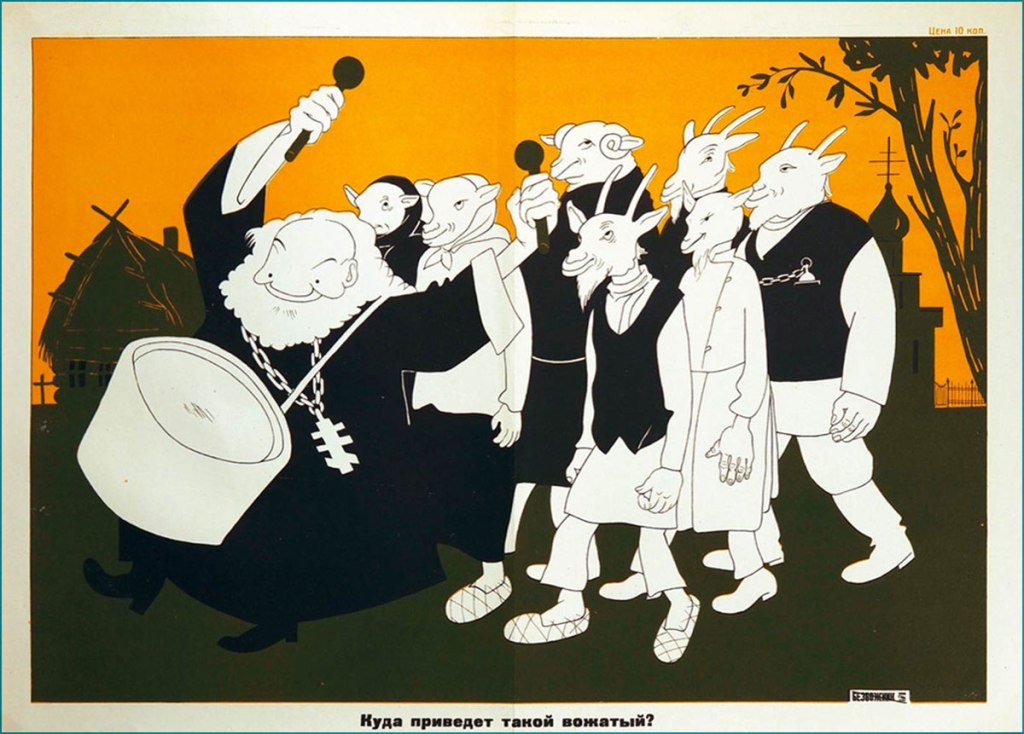
Alongside his active production of posters, D. Moor continued his career as a political caricaturist, publishing his anti-religious work in The Godless at the Workbench magazine (Безбожник у станка) — nice title, isn’t it? — and regularly contributing to various satirical magazines and communist newspapers, such as Pravda or Krokodil.

« We’re done with earthly kings, now comes the turn of heavenly ones », 1922
« Where will such a leader guide you? » (1930)

During World War II, Orlov of course supported anti-Nazi efforts (well, once Germany launched an invasion of the Soviet Union, at any rate).

1941. This is kind of untranslatable, but in Russian Hitler and Himmler are spelled with a hard ‘G’, not an H, leaving us with the quartet of Himmler, Göring, Hitler and Goebbels all starting with G… as well as the word for ‘shit’ (govno, говно).

Throughout his life Orlov also taught art at several institutions, and historical accounts indicate that he was a warm and talented teacher adored by his students. Did Orlov enthusiastically embrace the censorship-happy Soviet system, or was he just another artist trapped in a moment of history? I don’t have an answer for this, as one gets a very different perspective depending on which biography one consults and in which language – some emphasise his fervour for Soviet labour, and some philosophically note that he was anti-Soviet ‘like any self-respecting honest intellectual’.

You can take a look at more posters here, or head over here (perhaps with the help of google translate) to take a peek at caricatures poking (careful) fun at some Soviet figures.

~ ds

* An especially interesting thing for me was that his work spans the years of the orthographic reform in Russian. The reform was planned long before 1918 to combat the peasants’ illiteracy, so it wasn’t tied to the revolution per se, but since it came into effect in 1918, it was instilled by the Bolsheviks. The movie title, for example, is written with the letter ‘і’, which was kicked out of the alphabet.

** I am not including it for reasons of ubiquity, but take a look here.

*** Plenty of ex-Soviets feel an irresistible nostalgia about the USSR years, as if their memory can only conjure rose-coloured memories and erases everything unsavoury. The « Have you registered as a volunteer? » poster has been aped and parodied in social media.

Tomie and Soichi’s Snowy Winter Vacation

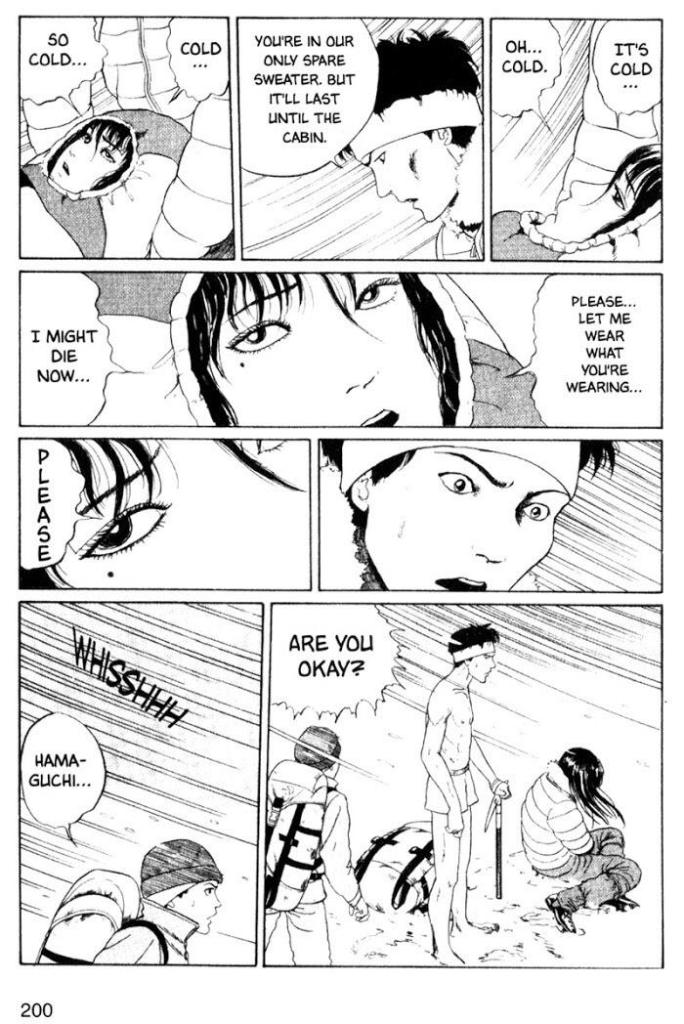
There are some weather phenomena one quickly learns to associate with specific plots – fog denotes something creepy or mysterious, rain evokes haunting melancholy, wind howls like the souls of victims. Snow is a bit less obvious, though its connotations often run the gamut from coziness to isolation. Manga artist Junji Ito (see Tentacle Tuesday: Junji Ito’s Remina) often uses weather to mirror his characters’ emotions, so it is no surprise that he has a few snowstorm stories under his belt. I welcome snow — in this part of the world, we were lucky enough to finally get a white landscape just in time for New Year’s — but I definitely not want to be trapped in the wintry world depicted by Ito!

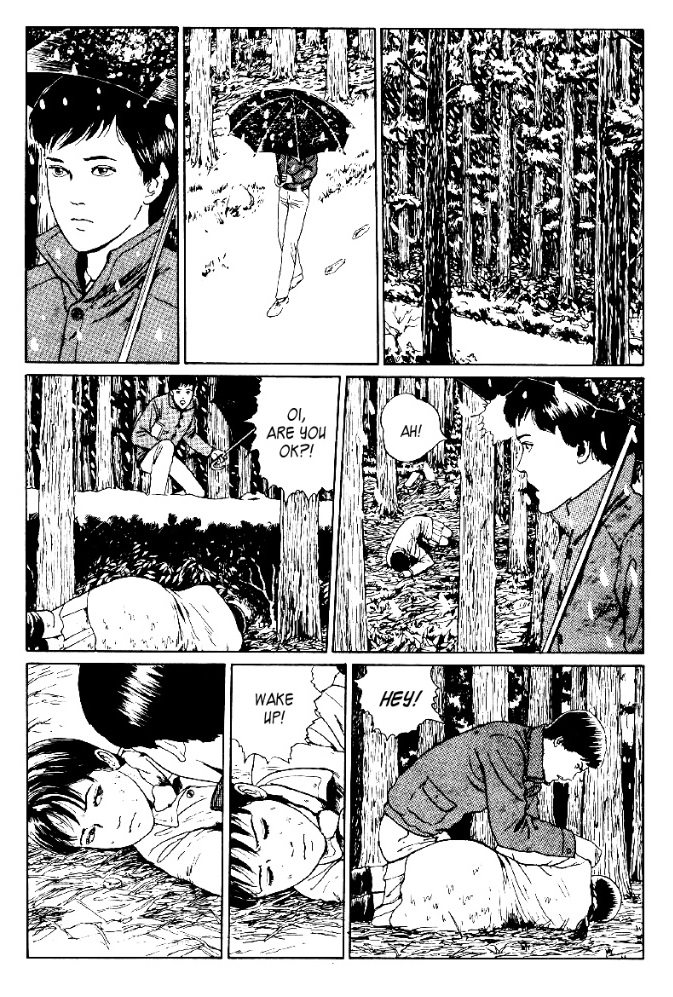
Here are a few pages from Fun Winter Vacation, a chapter/self-contained story from Souichi’s Diary of Delights (1997). Souichi is a little creep with more than a slight penchant for the occult, so weird shit happens whenever he is present. That’s him hiding behind the tree in the first panel – fetching lad, isn’t he? One might say he brings people’s darkest thoughts out into the open. You can read the full story here (remember to read right to left!) I’ve heard some readers complain that this narrative doesn’t quite make sense… welcome to Ito’s dreamlike logic. These episodes are meant to be absorbed like a nightmare one can’t quite wake up from, not dissected in the manner of an A leads to B equation.

Revenge, originally published in the June 1993 issue of manga magazine Monthly Halloween, is standard Ito fare, and concerns itself with a woman so beautiful that she drives people to madness… in this case, the notorious Tomie, who dispatches a few new victims and nibbles on a wee bit of human flesh in this snowbound vignette.

Read Revenge in full here, and of course support Ito by purchasing his books. Publisher Viz Media is currently issuing plenty of them in a handsome hardcover format, including stories never previously translated to English.

~ ds

Hoping to See Your Face Again Next Year: Donald McGill’s Saucy Holiday Cheer

New traditions appear very easily – do something for a second time, and hey presto, it’s a tradition! Since last December was enlivened by some mushroom postcards — see Fungus Friday: Amanita New Year (To Get Over This One) — this year I’m bringing back English master Donald McGill, King of Saucy Postcards for an old-yet-new-to-us crop of festive offerings from some hundred + years ago (the following are from the 1910s and 1920s).

These run the gamut from cheeky to raunchy to creepy, in the classic vein of ghosts for Christmas*. Speaking of Christmas, it may now be over, but the spirit of holiday cheer sure isn’t gone (despite the total absence of snow in these normally snow-covered lands of ours), so let’s have a look!

Some involve all sorts of hivernal mishaps —

The consequences of pre-holiday, er… cheer.

Some of the usual daydreams brought about by possibly too many spirits**

— and the aforementioned ghosts, somehow especially startling when they’re born under McGill’s pen.

I’ve kept my absolute favourite for last: this revenant is so sad yet grotesque. I’d like to see the faces of people who got mailed this particular card!

~ ds

* As per another lovely tradition, we’ve recently been rewatching Christopher Lee’s Ghost Stories for Christmas. Highly recommended! Some are available on Youtube, like for example Number 13.

** As somebody who attended the Christmas office party this year, I can attest to the funny influence alcohol has on a bunch of normally restrained people when it comes to romantic advances.

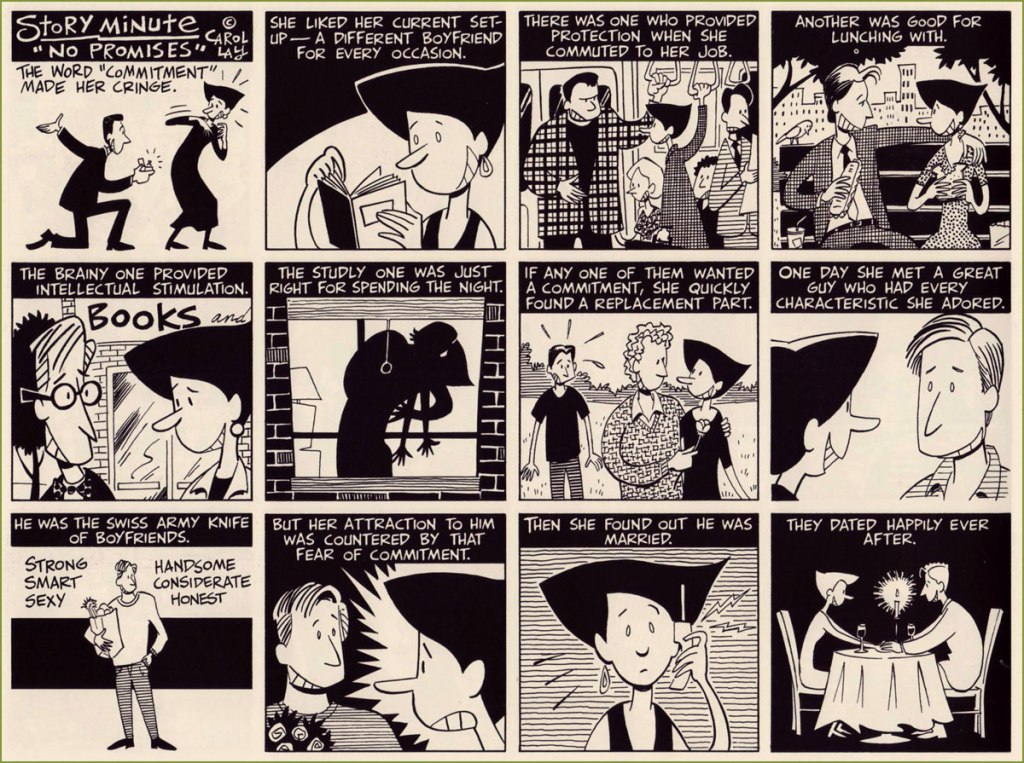
More Minutes With Carol Lay!

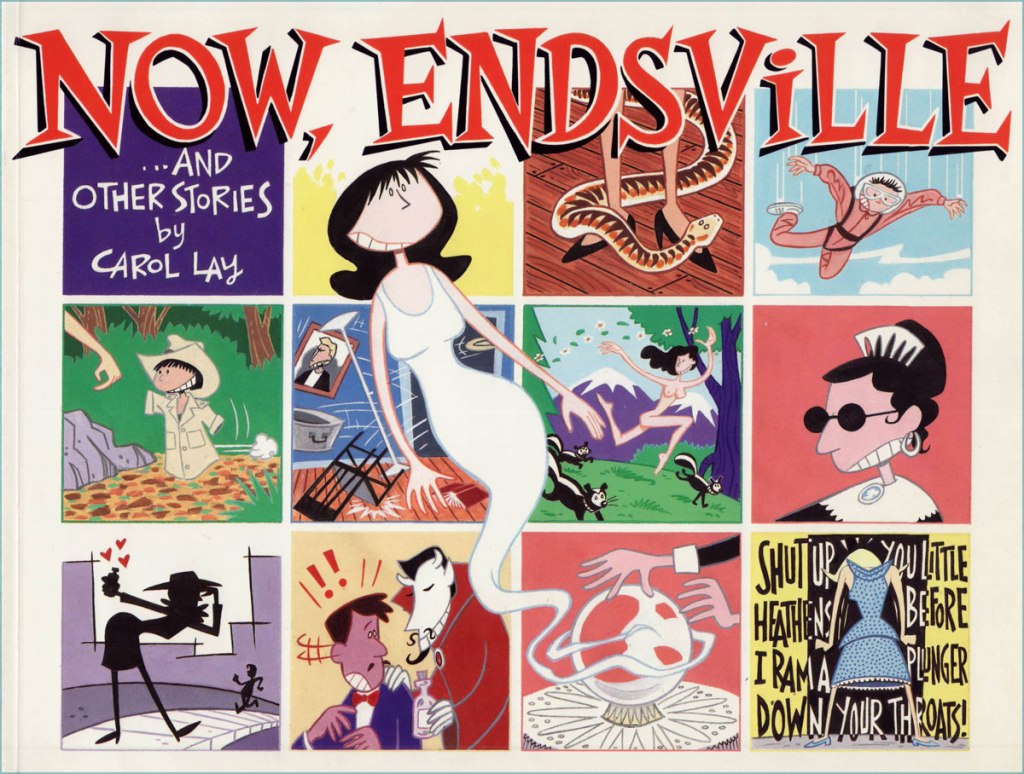
I talked about Carol Lay all the way back in 2017 (see The Giant Licking Machine), but did her a disservice by only featuring a single one of her Story Minutes. I am here to remedy that inadequacy.

In 1990, Lay drew a 5-page story for LA Weekly titled The Thing Under the Futon (read it here – the thing under the futon even has tentacles). « The pay was several times what independent comics paid and the audience was larger and included women », Lay quips on her website, so a one-time story planted the seed for a weekly comic strip called Story Minute, so named because it would just take you a minute to read a story (I might also add that it’s very difficult to stop at reading just one). That eventually was rechristened Way Lay and ran until 2008.

My introduction to the subject at hand.

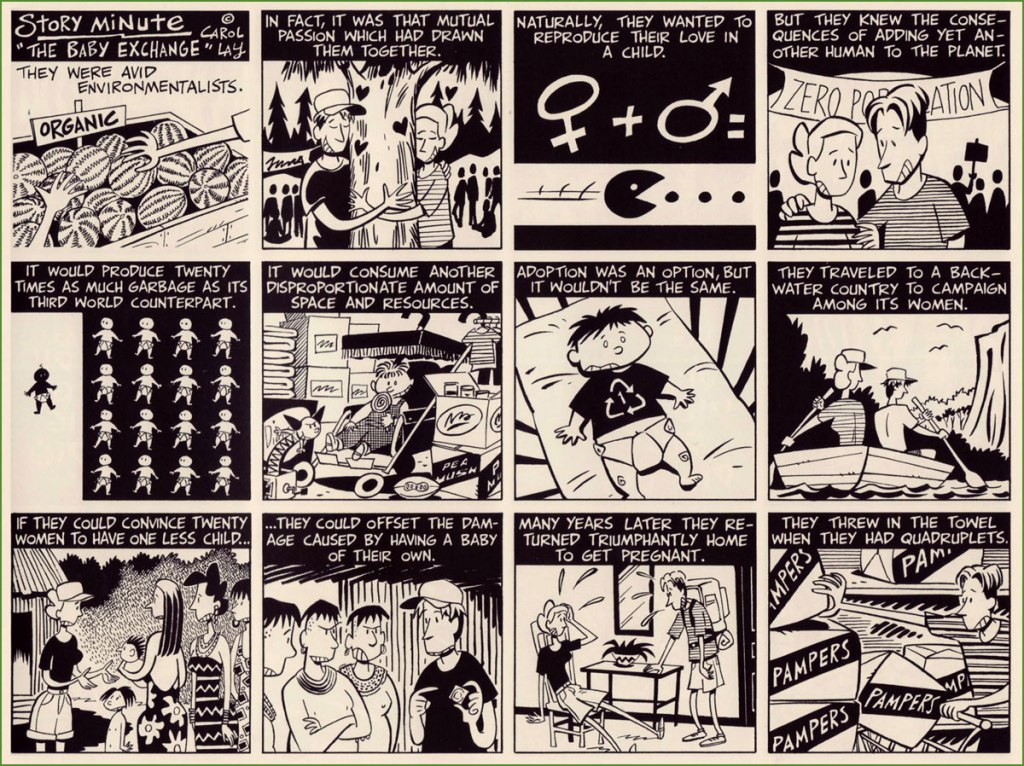
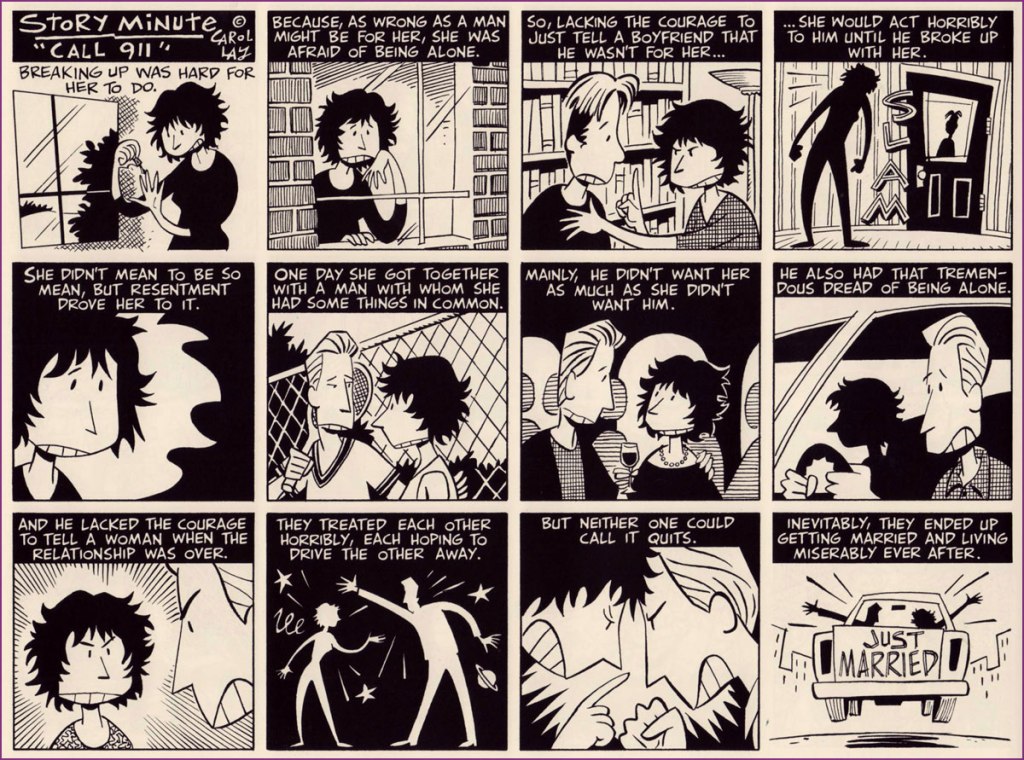
As I mentioned in the earlier post, the most recent collection of these is Illiterature, published in 2012, and it’s where the strips below have been selected from. Lay picks all kinds of topics as strip springboards, but since I am the one selecting the ones to feature, there’s a definite interpersonal tilt, as I think her forte is her ability to showcase the inner workings of a close relationship by plonking people into a slightly surreal or sci-fi context. The line between cynical and poignant is navigated with ease.

« I kept mostly to the order in which I produced the strips, but I took the liberty of tossing some clinkers or shuffling a few so that they flow better in book form… I also used my artistic license to improve on some of these older works – I’m a better writer and artist than I was when I created these strips… In a sense several of the strips in these volumes are ‘director’s cuts’ in that I’m a better director now than when I drew them. »

This one has a Ben Katchor-esque vibe.

Support Carol Lay on her Patreon here!

~ ds