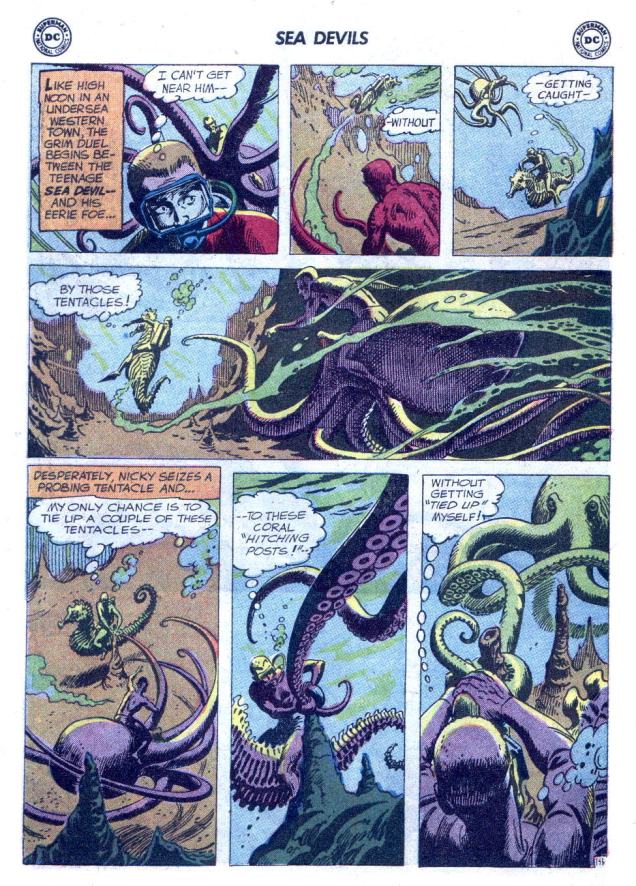
Sea Devils no. 1 (September-October 1961). Cover by Russ Heath.The Sea Devils vs. the Octopus Man! is scripted by Robert Kanigher and illustrated by Russ Heath.
The same team returns to tentacles with Sea Devils no. 6:
The Flame-Headed Watchman!, scripted by Robert Kanigher and drawn by Russ Heath, was published in Sea Devils no. 6 (July-August 1962).
Now we unfortunately have to leave Heath behind and walk over to the territory of Howard Purcell, whose art is not nearly as striking, but still quite serviceable.
Sea Devils no. 17 (May-June 1964), cover by Howard Purcell.The Impossible Maritime Menacesis scripted by Arnold Drake, penciled by Howard Purcell and inked by Sheldon Moldoff.Sea Devils no. 19 (September-October 1964), cover by Howard Purcell. Is it just me or does the guy on the left look like a Ditko villain?The Sea-Devil Robots is penciled by Howard Purcell and inked by Sheldon Moldoff.Sea Devils no. 21 (January-February 1965), cover by Howard Purcell.
The Forty-Fathom Doom!, scripted by Jack Miller, penciled by Howard Purcell and inked by Sheldon Moldoff, boasts quite an assortment of tentacles:
Everybody is almost in identical position as on the cover – but the octopus has lost his baby blues and gained a pair of poached eggs.
And, in case you’re wondering where that quote at the top of this post comes from… The ‘heh, heh’-ing octopus is Dr. Quad.
Behold! I return to a topic close to my heart, as close as tentacles are close to human flesh in this post! Namely, PG manifestations of shokushu goukan. But I wouldn’t like you to think that I’m one-track minded: today’s crop has its share of fantasy scenes, scantily-clad women who are about to be even further undressed, but! it also includes panoramas of serious (and unsexy) struggle, tongue-in-cheek héroïnes quite nonplussed by their predicament, tentacles overpowering female protagonists despite their superpowers, etc.
Without further ado, I give you… damsels in tentacular distress.
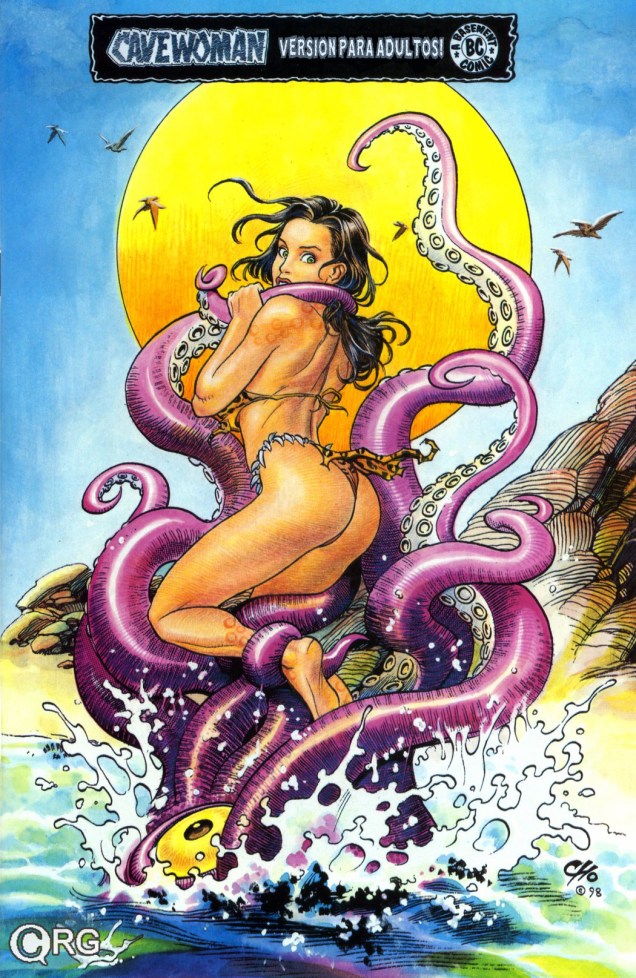
Cover painted by Bernie Wrightson for Nightmare Theater no. 3 (Chaos Comics, 1997).Cover from Pangaean Sea no. 4 (Basement Comics, 2000); art by Budd Root, the owner of this publishing company.Another one from Basement Comics: Jungle Tales of Cavewoman no. 1 (1998), variant cover by Frank Cho. It will come as a surprise to no-one that Cavewoman was created by the aforementioned Budd Root. Cavewoman is Meriem Cooper (I suppose calling her Myriam was too staid). I stumbled upon this amusing quote from Root recently, who said that Meriem was « patterned after pretty much all the women I really respect. She’s got a body with kind of a Little Annie Fannie face with Danni Ashe’s boobs and Nina Hartley’s butt. » No comment.
The maiden doesn’t always need to be rescued, nor does she necessarily *want* to be ravished – here’s a look at some heroines standing their ground against tentacular invasion.
Page from Wonder Woman: The True Amazon (DC, 2016) by Jill Thompson. I wasn’t much impressed by this graphic novel, but I loved Beasts of Burden, a collaboration between Thompson and writer Evan Dorkin.My Greatest Adventure no. 81 (August 1963), art by Bruno Premiani.Or you can resort to other, more… creative… means for getting out of the octopus’ embrace. Pages from Lorna: Heaven is Here (Treize Étrange, 2006) by Brüno.
I promised you superheroines, and by Jove, you shall get some!
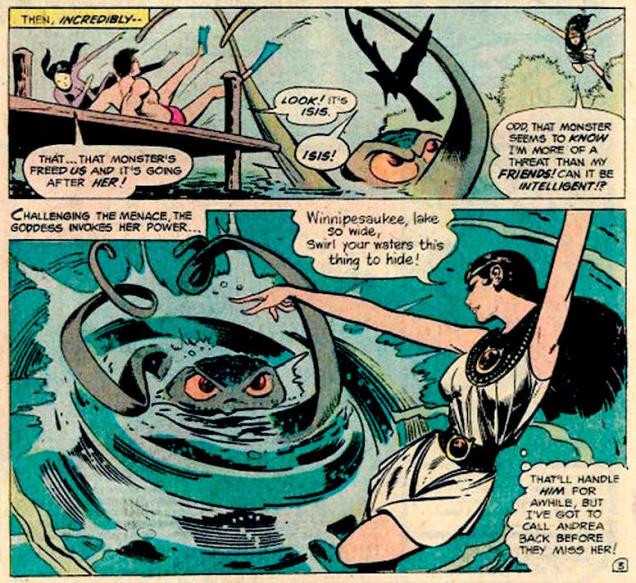
Isis no. 4 (April-May 1977), pencilled by Mike Vosburg and inked by Dick Giordano. Isis clearly used to be a ballerina…. or the artists have a knack for awkward anatomy.Treasure of Lost Lake is scripted by Jack C. Harris, pencilled by Mike Vosburg and inked by Vince Colletta. I honestly can’t recommend this story to you – the art is about as good as the storytelling, which is not a compliment to either.Page from Ferra Naturae, scripted by Bill Mantlo, penciled by Al Milgrom and inked by Jim Mooney, published in Spectacular Spider-Man no. 75 (February 1983). Obviously many have grappled with Dr. Octopus’ tentacles… but I think this particular scene is worthy of inclusion in this post.
Greetings! Today we take another foray (I started with Tentacle Tuesday: the Many-Armed Tentacle Strip) into (modern) newspaper strips. It’s easy to assume that everything published in your paper’s comics page is drivel, but there’s some reassuring exceptions to this rule.
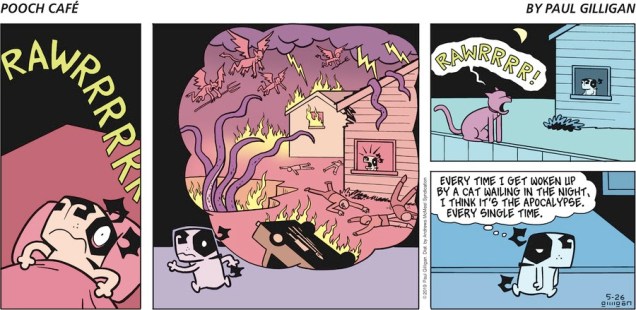
First, we have Canadian Pooch Café, around since 2000. One wouldn’t think that a strip about a dog (Poncho, the terror of the neighbourhood) and its owners and friends would have tentacles in it, but it does, much to my delight.
The fish in the bowl (named Fish) is a recurring character, cohabiting (and occasionally having his life and safety threatened by) Poncho.All cats in this strip are purple and are indistinguishable one from another.
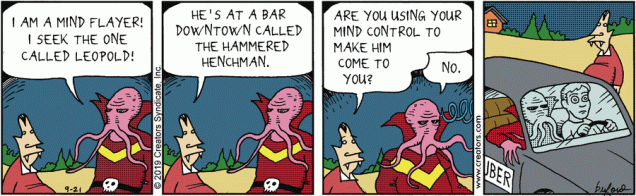
Scary Gary, by Mark Buford, follows the everyday tribulations of a 700-hundred year old vampire who’s gone quite soft and suburban. The most excitement he can hope for is purchasing a new bag of chips… on the other hand, his henchman Leopold’s life is a whirl of nefarious, villainous schemes and ploys.
In case you didn’t know what a mind flayer is, it’s the same thing as an illithid 😉
My colleague has talked in detail about a certain crotchety witch in Growing Old Gracelessly With Broom-Hilda, so I’ll just leave this one strip here (and politely inquire why Broomie thinks that the octopus isn’t good enough to cuddle with, huh, HUH??)
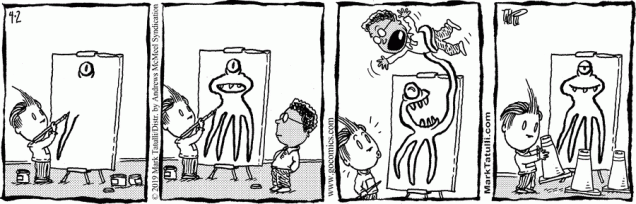
Mark Tatulli’s Lio is a riot of tentacles, given that Lio’s best friend is a giant squid. All of it is pretty fun, but once in a while I’m so charmed that I save the strip to my computer. Here are some of those saved, favourite strips:
No doubt Dr. Zoidberg would rush towards the seafood buffet offer with similar speed. Or is Ishmael just angry for friends of his that have been fried?
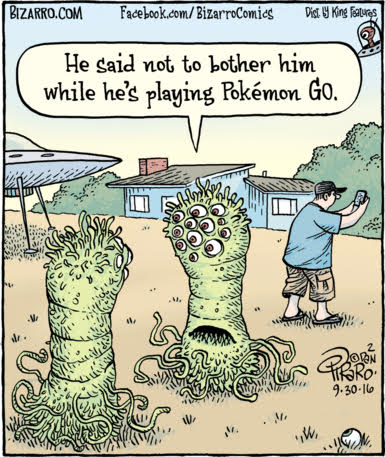
Bizarro – ah, to be able to rely on something that’s still good some thirty-plus years later -, has already had a Tentacle Tuesday of its own (see Let’s Get Bizarro), but since then I’ve accumulated a few extra strips.
Sometimes I stumble upon a comic with a fight-to-the-death scene in which something-or-other- with-tentacles plays the role of a lethal enemy for our hero – but upon closer inspection, in turns out that the ferocious creature is… gosh-darned cute. I mean, how can you kill anything that has adorable whiskers, or tufted eyebrows like Oscar the Grouch?
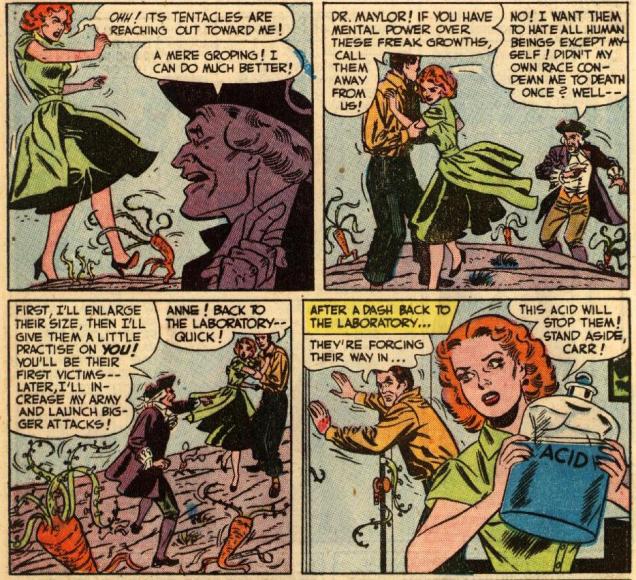
When your attackers are carrots with tentacles, and they really get on your nerves (although I think Ann is safer with them than with Dr. Maylor), I’d suggest throwing them into a nice big pot of soup, maybe… but if you please, do consider abstaining from flinging acid at them.
I do believe that prehensile vegetables fit into the category of “cute” – just look at their precious little root-legs! Page from Heroes Out of Time!, scripted by Manly Wade Wellman (hey, cool!), with some very stylish art by Bob Oksner on pencils and Bernard Sachs on inks, printed in Mystery in Space no. 3 (August-September 1951).
While we’re on that topic: things get delightfully wacky and madcap (not much) later in the story. Namely, Napoleon Bonaparte and Benjamin Franklin are summoned for help against the tentacled carrot-horde.
The Flaming Carrot would not be pleased by this massacre. If only to admire the art, you can read Heroes Out of Time!here.
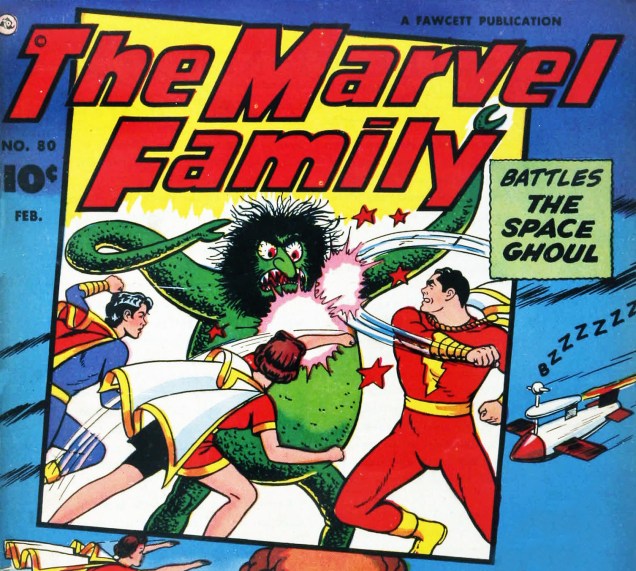
Thank you kindly for suppressing your urge to sock the creature sporting a unibrow and bloodshot eyes worthy of Christopher Lee; it’s also not his fault he got lumbered with such a shaggy wig.
Detail from the cover of The Marvel Family no. 80 (February 1953), pencils by C. C. Beck and inks by Pete Costanza.
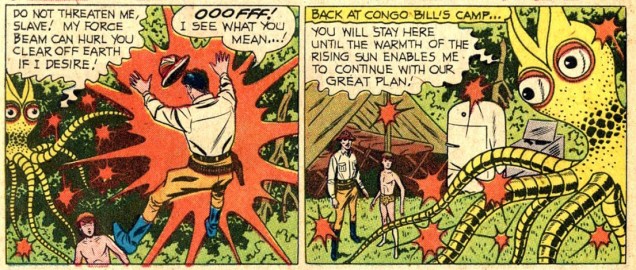
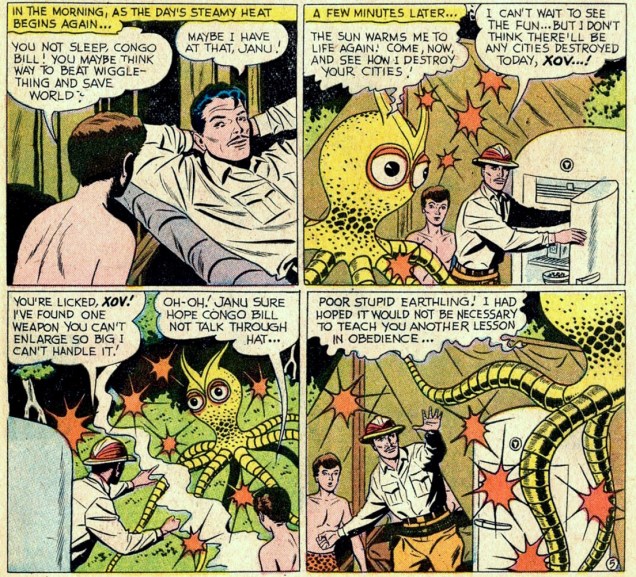
Have the goodness to think twice before pitching lethal ice cubes at an owl, even if it somehow grows metal tentacles and threatens to make mince-meat of humanity, because owls are the very cutest.
Panels from The Man-Ape Skin Diver!, scripted by Robert Bernstein and drawn by Howard Sherman, published in Action Comics no. 257 (October 1959).“Wiggle-thing”? Excuse me?
Pray, don’t kill anything that looks like it’s wearing a dragon wearing a really bad disguise, including a moustache that looks like a pile of hay.
A panel from Fate is the Killer (a preview of a Masters of the Universe story), scripted by Paul Kupperberg, pencilled by Curt Swan and inked by Dave Hunt, published as a promotional bonus in several DC titles cover-dated November, 1982.
If you would be so good as to spare the creature that looks like a mashup of a seal and a mole, especially if it gazes at you mournfully with world-weary sadness.
Masters of the Universe: The Vengeance of Skeletor! (1982), cover by Alfredo Alcala.
« It is not Frank Hampson’s original creation from the 1950’s Eagle, far from it. This is a different beast, featuring a harder man in a harsher world, a long way from the good-natured stoicism and stalwart, stiff upper lip of the original… »
(Garth Ennis in his introduction to Dan Dare: The 2000 AD Years)
Dan Dare, sort of the British answer to Buck Rogers, took his earliest space flight in the pages of the very first issue of Eagle, a now legendary British children’s comics periodical. He was created by illustrator Frank Hampson. From the day of its inception, Eagle was meant to perch on a high moral ground. Its founder, reverend John Marcus Harston Morris, an Anglican vicar, devised the Eagle in collaboration with Hampson (one of his parishioners, and a budding artist seeking fulfilling work) with a specific purpose in mind: a magazine that would hold itself to high standards of art and printing, but would stay away from violence and depravity, instead offering children wholesome characters they could use as role models. Aligned with that vision, Hampson’s Dan Dare stories were meticulously researched, based on a wealth of models (space ships, suits, and even a complete space station) and reference materials, including the services of Arthur C. Clarke as a science and plot advisor in the early days of the strip. Dan Dare‘s complex plots, witty dialogue and full-colour art guarantee that British children who lived through the 50s cherish their memories of this character.
1959 was the year of change – Morris resigned from the editor’s seat after bitter disputes with the bean-counters from Hulton Press (Eagle’s publisher at the time). Shortly after, the Eagle was taken over by Odhams Press, with the new owners objecting to the complexity of Dan Dare stories as well as the cost of Hampson’s studio. Hampson could not compromise his lofty standards and pursuit of perfection, and left. Things were never the same after that, with Dan Dare strips varying in format and quality until the series ended in 1967.
Fast forward to 1976. « A punk who has always written outrageously violent, scabrous satirical and often hilariously funny attacks on authority and the establishment» – which is to say, Pat Mills, a British freelance writer and editor – set out to create a science-fiction themed weekly publication, 2000 AD. With the aid of John Wagner as script advisor, presided over by John Sanders, the publisher, he decided to 1. develop a horror strip, which later became Judge Dredd; 2. revive Dan Dare, so that at least something about 2000 AD would have immediate public recognition. Oh, there were plenty of other strips in there, too, but that’s a topic for another conversation.
« 1976. I realize that the science fiction comic I’m creating, 2000 AD, needs a space hero. I think about bringing back Dan Dare – the publisher, John Sanders, is agreeable, he tells me not to worry about the original fans. I study the bound Eagle volumes. Artist Belardinelli submits a wild version on spec. At least it’s exciting and eye-catching and – most important – helps us over the poor quality paper. 2000 AD appears, it’s a success and Dan Dare is popular – about 3rd or 4th in the popularity charts. I don’t recall any critical letters apart from things along the lines of « my dad doesn’t like it, but I do ». And, sometimes, « my dad likes it, too ». Lots of criticism in the press, however, but we don’t care about annoying them. In fact we quite like it. » (From an article by Pat Mills, published in Spaceship Away: the Dan Dare Fan Magazine)
Okay, now that we have the backstory over with, on with the tentacled show!
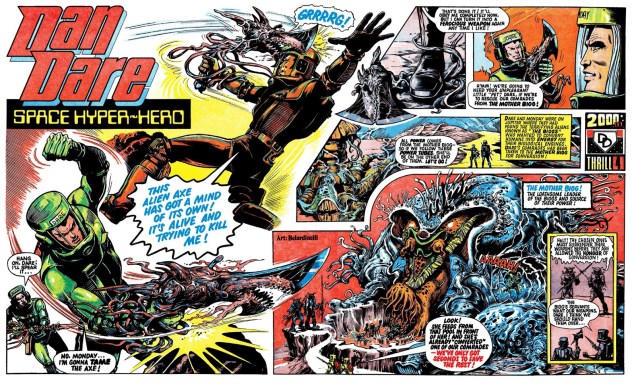
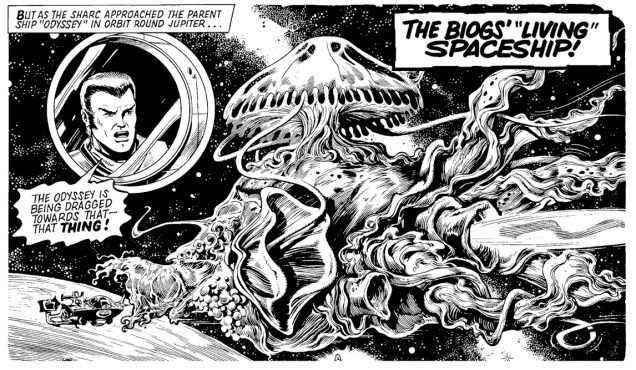
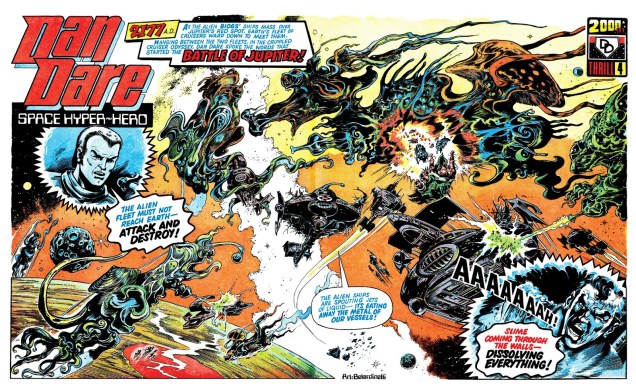
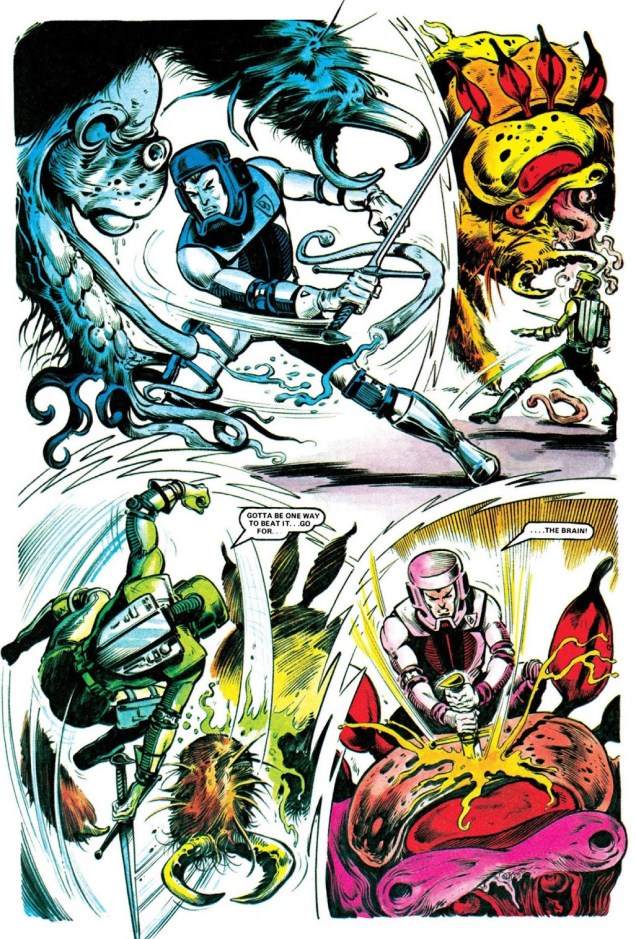
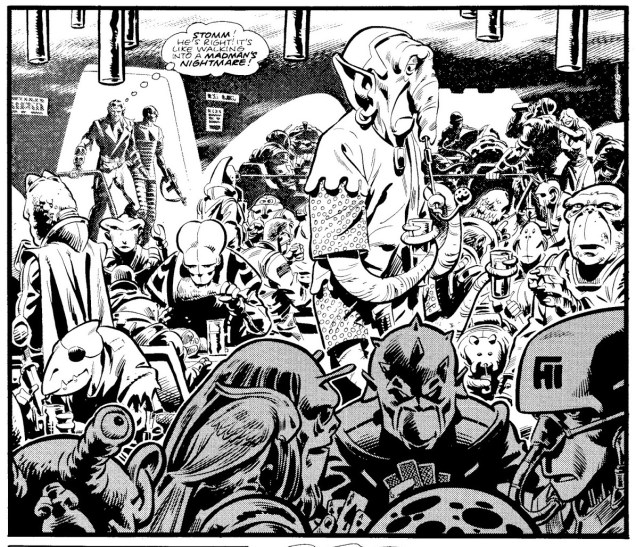
Dan Dare’s early 2000 AD adventures were drawn by Massimo Bellardinelli, who seems to take great delight in adding tentacles hither and thither. Are we expected to believe that every alien and every alien’s ship is be covered in them? Yes? Ah, okay. Please carry on.
The first, self-titled story, published in Programmes 1 to 11. Scripted by Ken Armstrong, Pat Mills and Kelvin Gosnell, and drawn by Massimo Belardinelli.
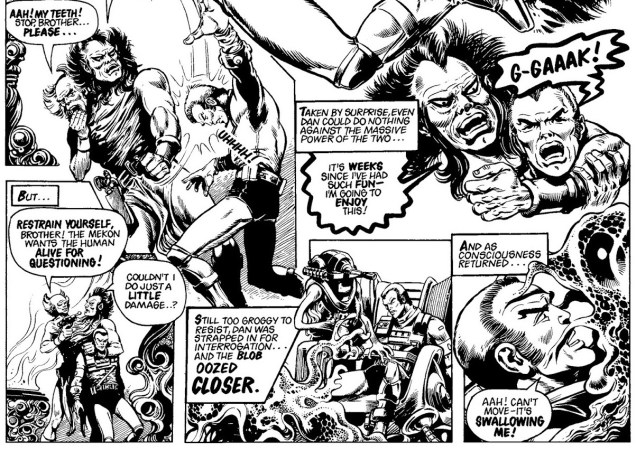
Hollow World, scripted by Steve Moore with art by Massimo Belardinelli, published in Programmes 12 to 23.
This cutie from Hollow World also wished to say “tally-ho!”:
Belardinelli’s style is often described as “hallucinatory”. Despite Pat Mills’ portrayal of his art as “eye-catching” (although even Mills thought that he made “the hero look awful”), his work on Dan Dare was not very popular. It’s also possible that readers were still sore about Dare’s sacrilegious resuscitation. All I can state with certainty is that it’s not really *my* cup of tea – I prefer my cuppa strong and dark, without excessive flourishes or hallucinations, thank you kindly. For those of you who agree, more… grounded times were coming: with Programme 28, Belardinelli switching over to drawing Harlem Heroes while Dave Gibbons took over Dan Dare, with an occasional hand from Brian Bolland.
Greenworld, scripted by Gerry Finley-Day, art by Dave Gibbons and Brian Bolland., published in Programmes 34 and 35.
A little trek into the past, back to the hallucinatory tentacles: The Curse of Mytax, drawn by Massimo Belardinelli, published in 2000 AD annual 1978.
Oh Dan, where is your moral compass now? While I love the guys from 2000 AD to bits, I have to grudgingly admit that taking someone else’s character and modifying his raison d’être beyond all recognition is a tad uncouth (and certainly anti-authoritarian, which is, after all, Pat Mills’ leitmotif). Can you imagine how this trigger-happy Dan Dare apparition, some 25 years later, ruffled the feathers of readers who take their heroes seriously? (If we have any readers who have lived through this themselves, please chime in!)
« Indeed, the reader may be forgiven for thinking that the Lost Worlds sector is soon going to be a very quiet sector indeed, just because there’s not going to be much left of it. The frequency with each our heroes resort to violence – sudden, crushing, all-consuming, high-velocity violence that utterly obliterates whatever it’s unleashed upon – – is really quite spectacular. Unidentified species of dodgy appearance? Play safe, fry ’em. Giant-sized aquatic life form? Got to be worth a torpedo or two. Alien intruder? Give it loads. If things get sticky, just do the whole ecosystem. And you know those planet-busters we’ve got in the tail-fins…? »
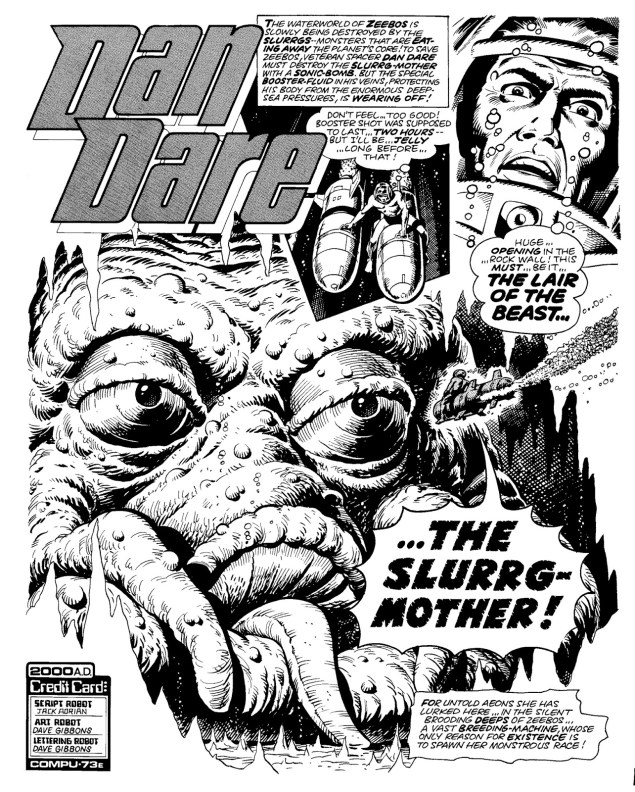
Waterworld, scripted by Chris Lowder (as Jack Adrian), with art by Dave Gibbons. Originally published in Programmes 56 to 60.
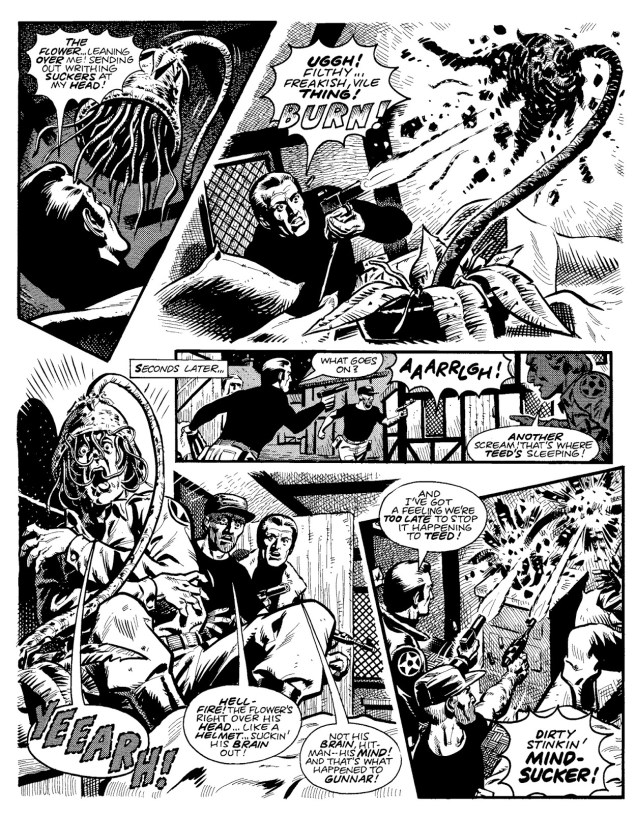
Does the Slurrg-Mother have tentacles? Such a silly question…Nightmare Planet, scripted by Chris Lowder (as Jack Adrian), art by Brian Lewis, published in Programmes 61 to 63.Ice Planet – they were really running the gauntlet of planets – is scripted by Gerry Finley-Day, with art by Dave Gibbons. Published in Programmes 64 to 66.Aww, freedom for the tentacled cutie!Garden of Eden is scripted by Chris Lowder with art by Dave Gibbons. Published in Programmes 67 to 72. Naturally, one doesn’t expect anything decent or god-fearing to come out of the Garden of Eden… and nothing does.
The sprawling Servant of Evil (scripted by Tom Tully and drawn by Dave Gibbons, published in Programmes 100 to 126) was the last Dan Dare story, one that wasn’t even finished. Was it too complex or morally ambiguous for readers of 2000 AD, or simply too rambling? Dan Dare’s exit was probably caused by the confluence of several factors – Dave Gibbons was leaving the strip to work on UK Marvel’s Dr. Who Weekly; the failing comic Tornado needed a new home within an established title, so 2000 AD needed to make room for it by pushing something else out; and let’s face it, Servant of Evil was dragging on, even though fans still bemoan the lack of closure from having all those plotline threads severed so abruptly.
Do you have a couple of hours to spare? You can actually read the full collection of 2000 AD Dan Dare strips here.
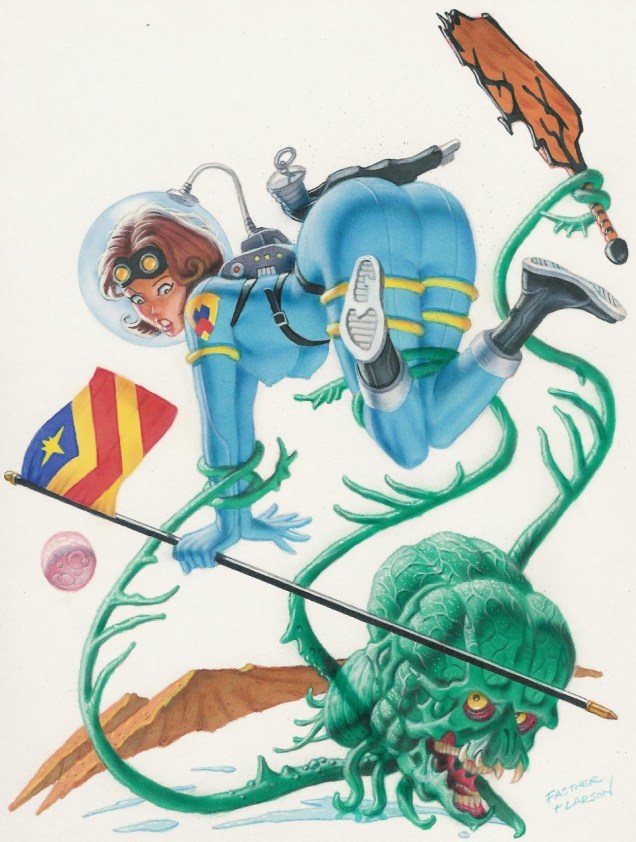
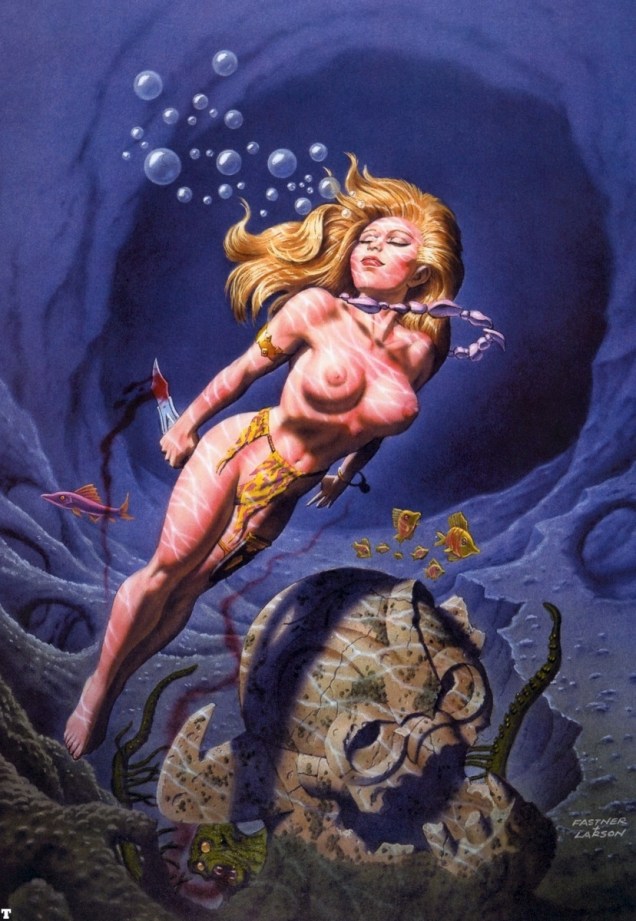
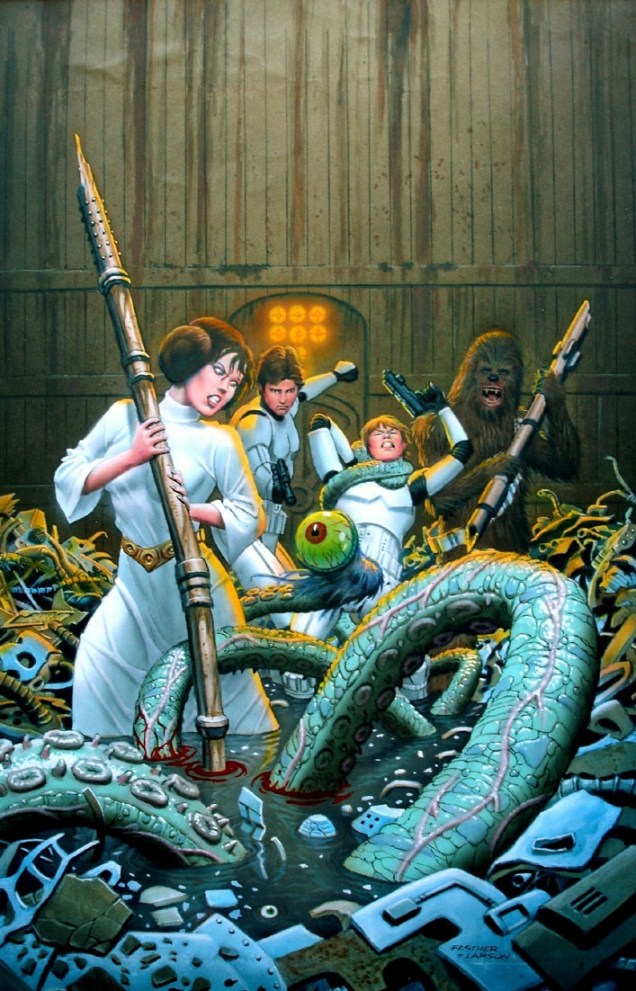
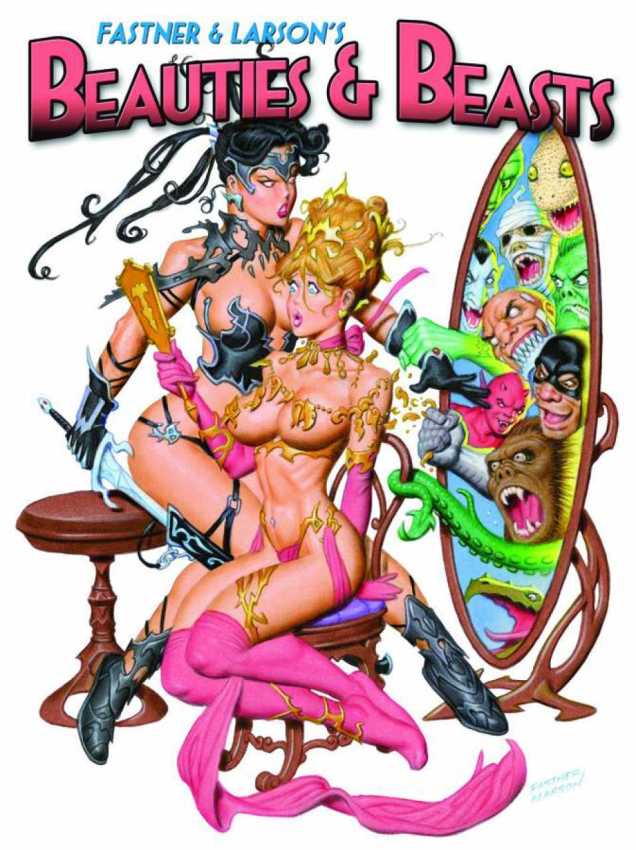
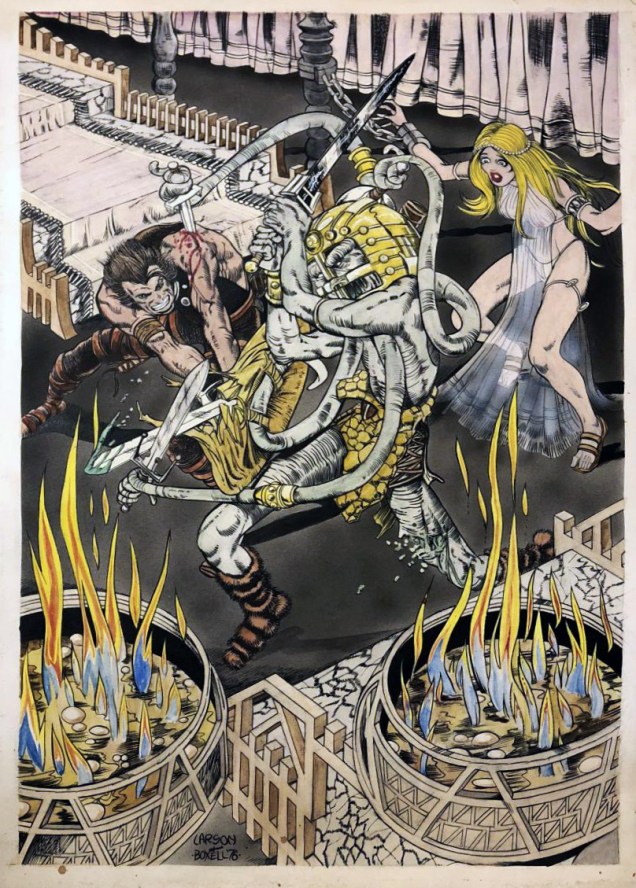
American artist Richard Larson has had his ink-smeared fingers in many pies. He has drawn ghost stories for Charlton Comics (see our posts dealing with that here and here), followed by some underground comics, followed by Marvel super-hero portfolios, followed by his own series Demon Baby, followed by…. He often works in tandem with other artists, most notably with Tim Boxell and with painter Steve Fastner (see a gallery of their collaborations here).
« Steve Fastner and Rich Larson have been working in concert since 1976, and together they create one entity of staggering abilities. Rich will lay down the structure of an illustration in pencil form, and then Steve will attack it with army of airbrushes – and when the dust clears – a magnificent painting stands proudly. For over a quarter of a century, they’ve been able to do this, working for comics, book publishers, advertising agencies, movies and television, and now the web. » (quote from Fastner and Larson Gallery, 2002)
Have you ever seen anybody looking so smug after having stabbed some creature to death?Does the wild, groping beard of the old sea pirate count for tentacles? Indubitably. So does at least one of his hands.This may be just a sea-serpent, but there are no pedants in this audience, right? Besides, those suckers are distinctly tentacle-like.Fastner & Larson’s Beauties & Beasts (2010)
I would be remiss in not including a collaboration between Larson and underground comix artist Tim Boxell, whom I mentioned at the beginning of the post and then proceeded to neglect.
Art by Rich Larson and Tim Boxell
Speaking of beautiful women in varying states of undress… if I mention Haunted House of Lingerieto you, does it ring any bells? Does it sound like an intriguing concept? Then the first thing you should do is visit our Tentacle Tuesday: a Day at the Beach. Nothing like shameless self-promotion! But afterwards, you might want to seek out the three volumes published so far before the whole thing goes completely out of print.
One of the oft-recurring themes of tentacles-in-comics-land is one of aggressive invasion. No, I don’t mean body cavity invasions, you creepos! I mean the large-scale kind: cephalopodian aliens who insidiously infiltrate human ranks, hypnotize or control people’s minds with all sorts of high-tech hanky panky, or just plain deploy their far-out weapons and open martial festivities without as much as a how-do-you-do. Their goal is, naturally, full dominion and control of planet Earth. Sometimes it’s because our planet has something they want (water, minerals, or just plain real estate), occasionally they want to feed on us… or they just got out on the wrong side of the bed and are cranky and territorial.
Let’s see a few case scenarios on this installment of Tentacle Tuesday!
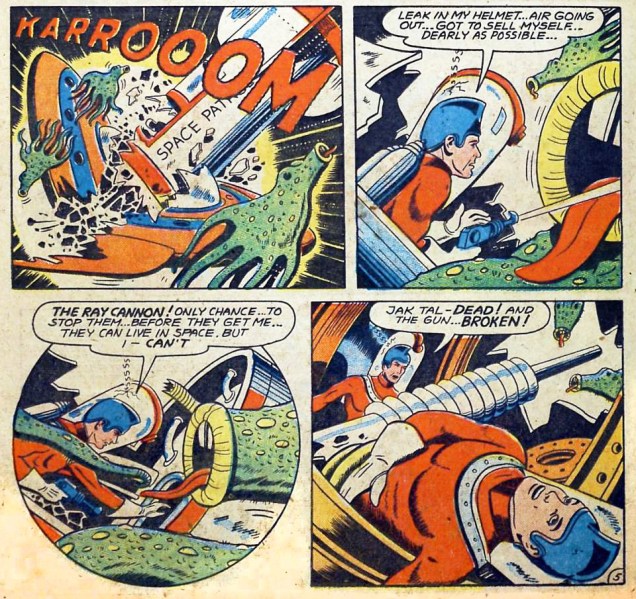
Our first story doesn’t explain why the aliens want to attack the planet or capture humans, but their nefarious scheme threatens life as we know it! Jet Black and Jak Tal, patrolmen of the 21st century, encounter some space-dwelling aliens who are up no good at all. Though they’re cute as can be, it can’t be too practical to have one’s tongue hanging out all the time… The Men from Deep Space, illustrated by Fred Guardineer, was published in Manhunt no. 6 (March 1948).
In example number two, the tentacled Organus is after humans because he has the munchies. Well, I suppose that’s as good a reason as any to propel your tongue towards somebody else’s face in the middle of a conversation. The Soul-Thief from the Stars, scripted by Paul Levitz, pencilled by Pat Broderick and inked by Bruce Patterson, was published in The Legion of Super-Heroes no. 284 (February 1982).
Get a room, you two.
Let’s move on to the next instance of grabby critters wanting supremacy over humans, shall we?
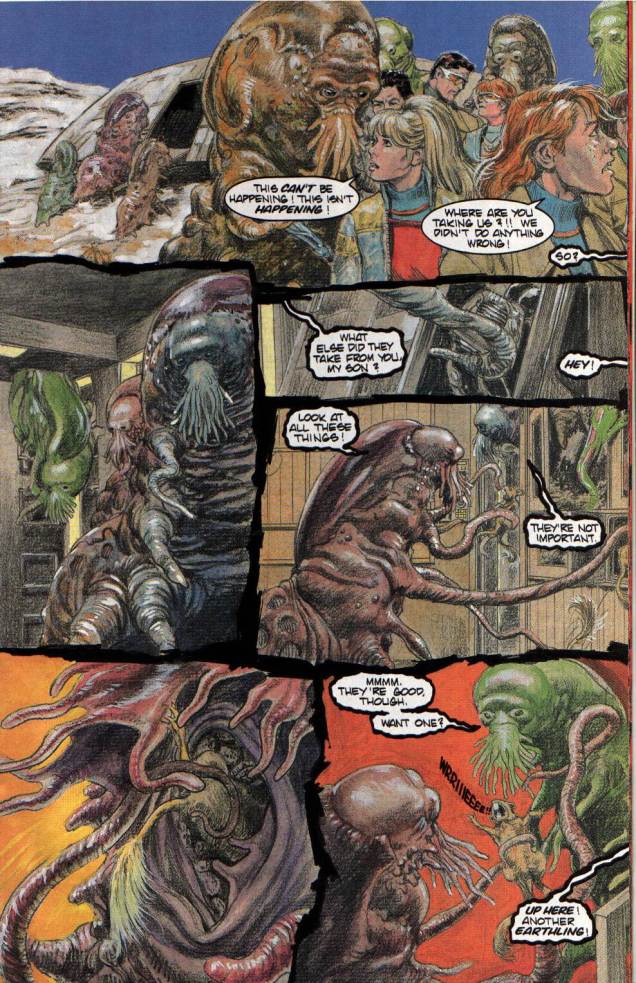
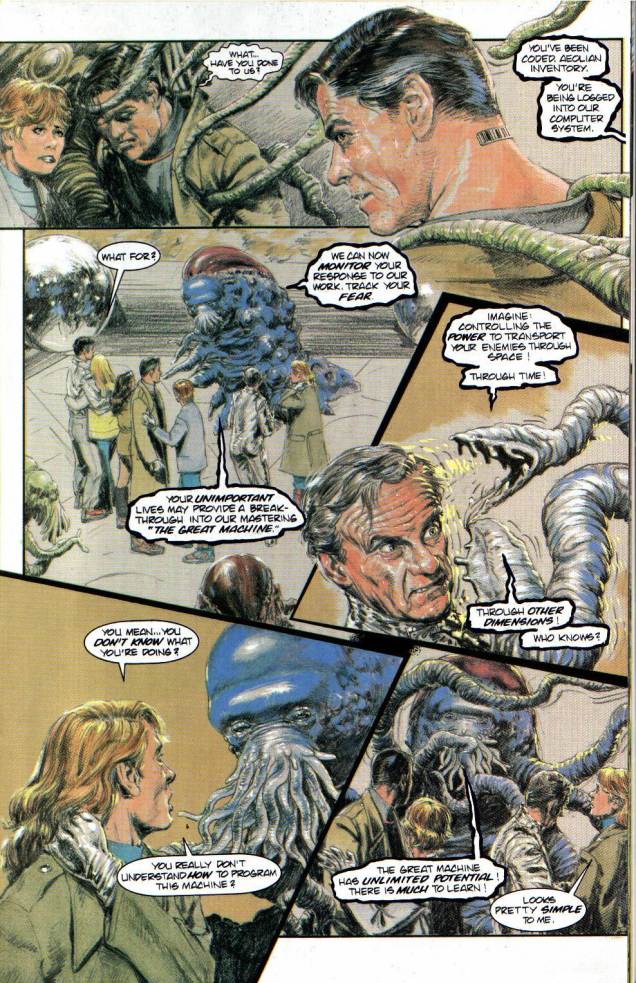
One long-winded, epic story of tentacled ones began in 1993, with Lost in Space: Voyage to the Bottom of the Soul. The story has everything that makes one of those invasion yarns entertaining – cruel cephalopod captors, barbaric vivisection experiments, computer codes assigned to every prisoner for better monitoring…. The bulk of this happens in the pages of Lost in Space: Voyage to the Bottom of the Soul no. 13 (August 1993) and Lost in Space: Voyage to the Bottom of the Soul no. 14 (September 1993), scripted by Bill Mumy (the original Will Robinson himself) and illustrated by by Michal Dutkiewicz.
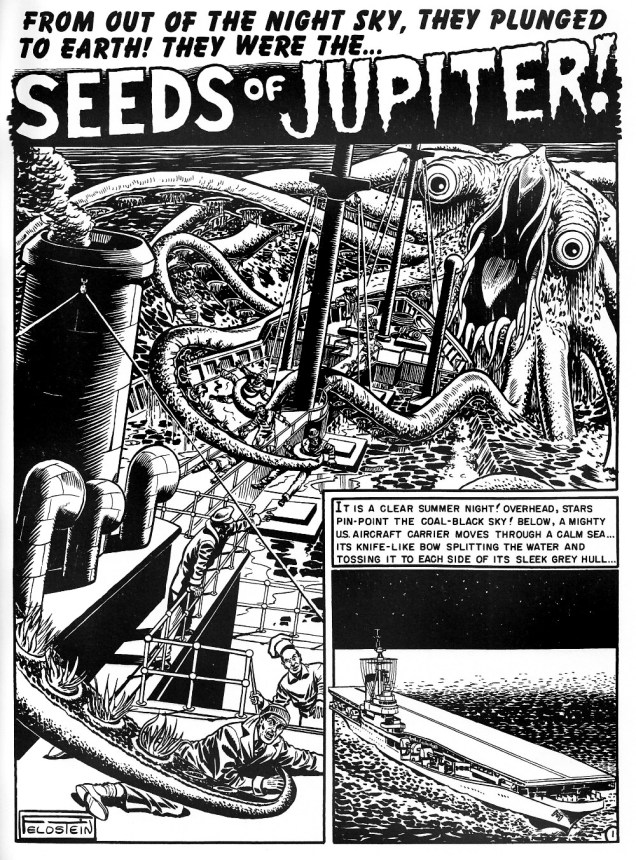
Oh yeah, I also mentioned insidious infiltration, a sly, Machiavellian approach to alien invasion. The Seeds of Jupiter, written and drawn by Al Feldstein and published in Weird Science no. 8 (July-August 1951), fits *that* particular bill.
By the way, apparently the following scene inspired the “alien bursting out of some poor sod’s chest” sequence in the 1979 movie Alien.
What? You don’t believe that it’s truly an invasion? You say the seeds ended up on earth by accident? Well, listen to the man with funny hair*. He does not lie.
With a jump and a start, we realized that we haven’t written a proper post about Virgil Partch. Not even one lousy little post! How embarrassing.
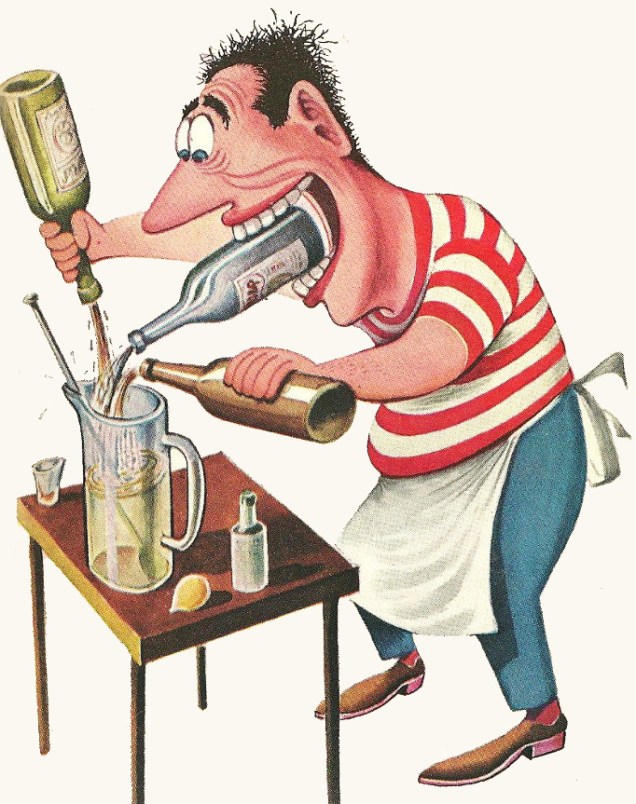
Virgil Franklin Partch (1916-1984), mostly known as VIP, is legendary, and I’m not one to use this description lightly. One can spot his work a mile away by his surreal sense of humour and a kinetic, unhinged-yet-clean style. He was also prodigiously prolific, thegag-man of his day. VIP not only wrote and drew tons of cartoons for magazines in the 40s and 50s (Collier’s Magazine, True, the Man’s Magazine, The New Yorker, Playboy…) but also provided glorious art for LP covers; illustrated other people’s books, as well as releasing collections of his own cartoons with invariably entertaining titles (The Wild, Wild Women; Cork High and Bottle Deep; Relations in Strange Locations, etc.). His doodles also adorned merchandise – my favourite being, of course, cocktail glasses!
Detail from cover of the True Magazine Bar Guide paperback (1950). « Flinging himself into the study of this challenging matter, Vip left no glass unturned, no drink unbottled, no bottle undrunk, etc. Leaving statistics to the statisticians, analysis to the analysts, facts to the factories, data to the dataist, Vip went straight to the sources. Often he worked until the wee small hours of the night, crawling home exhausted from his studies, numb with the impact of startling discoveries, quivering and all but incoherent with surmise… » Quote from the introduction to Bottle Fatigue (1950).
« Almost at once, wherever his cartoons appeared, Partch’s manic artwork inspired alarm because of his nonchalance about ordinary anatomy. He may have been among the first to discard such niceties almost entirely, striving instead for approximations of the human figure that served his comedic purposes and no other. A frequent objection was made to his unabashed disregard of the number of fingers that are customarily issued with each human hand. With the giddy abandon of footloose youth, Vip produced hands with fistfuls of fingers—five, six, seven, however many fell, uncounted, from his pen or brush. To those who carped about his anatomical irresponsibility, Partch reposited patiently: “I draw a stock hand when it is doing something, such as pointing, but when the hand is hanging by some guy’s side, those old fingers go in by the dozens. And why not? At Disney’s studio, I spent four years drawing three fingers and a thumb. I’m just making up for that anatomical crime.”» (excerpt from Making the World Safe From Insanity by Bob Harvey)
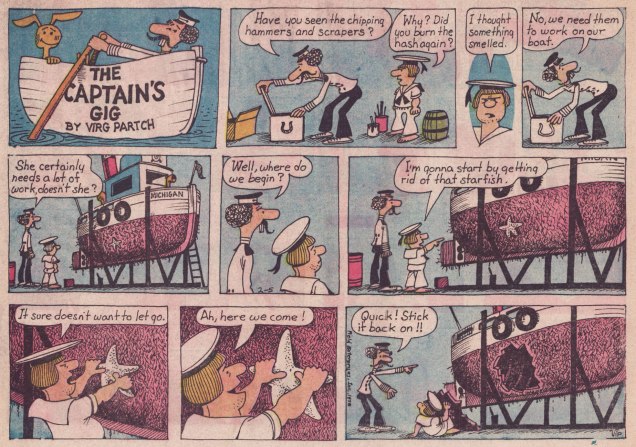
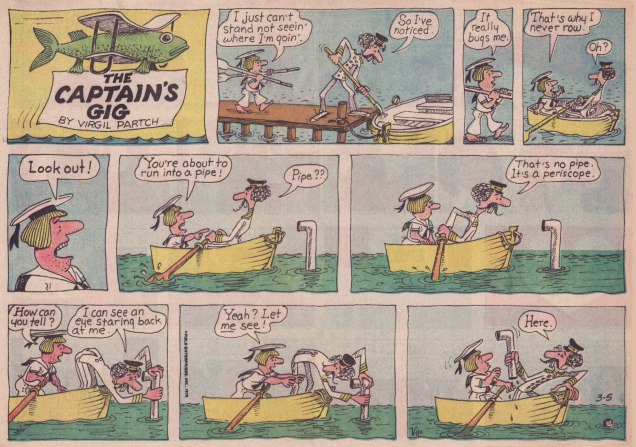
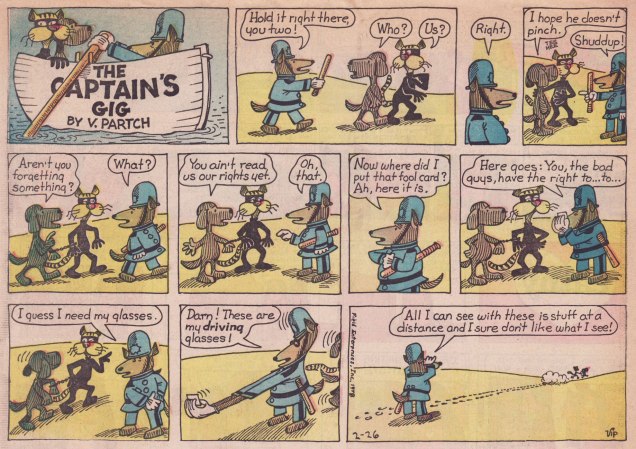
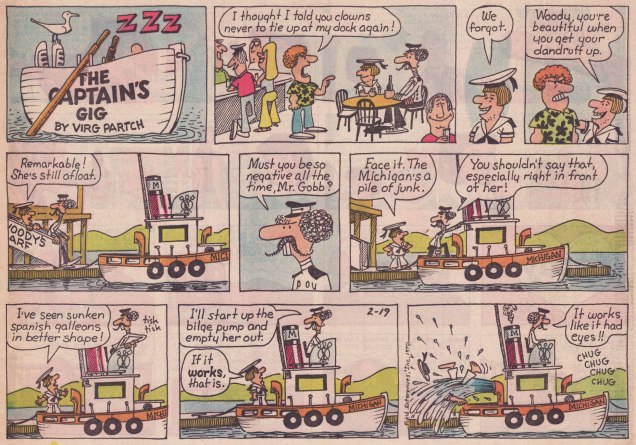
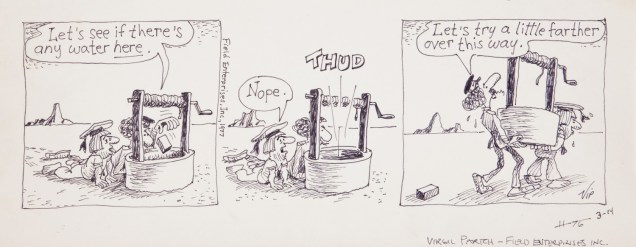
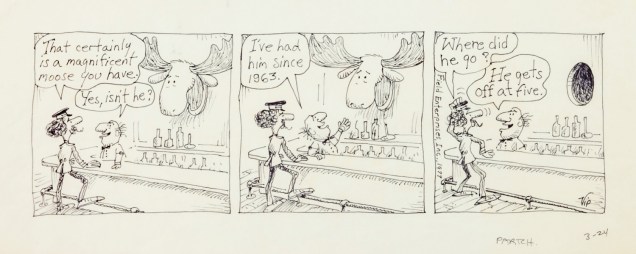
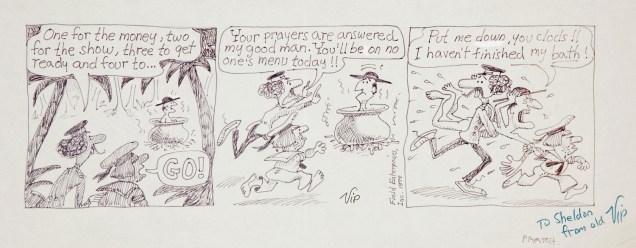
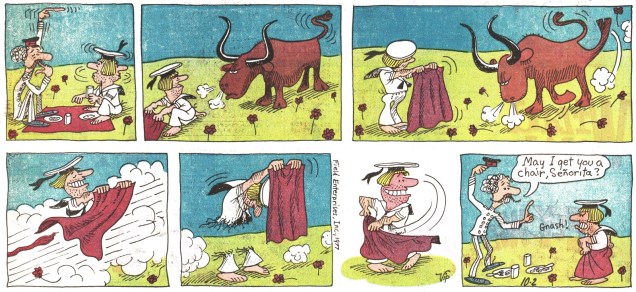
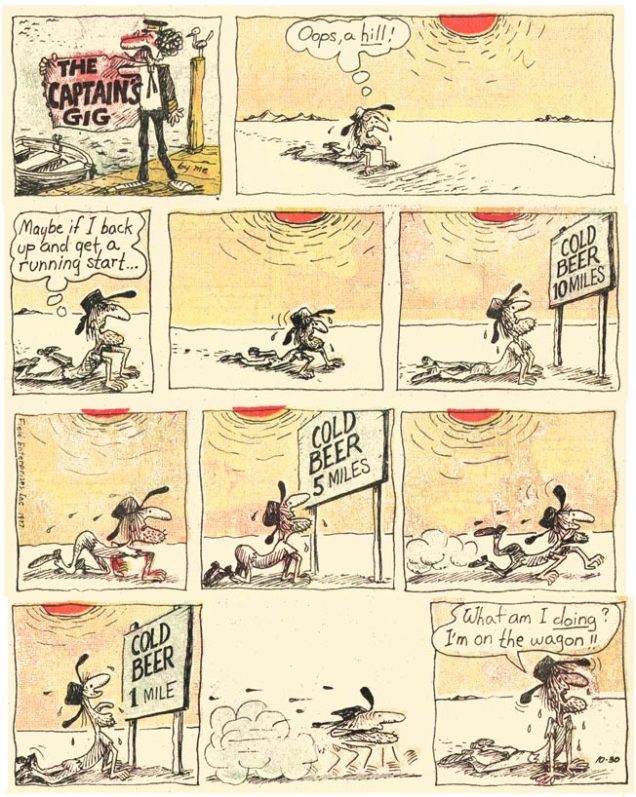
Aside from his magazine work, Partch also tried his hand at newspaper strips (after his friend Denis Ketcham, creator of Dennis the Menace, suggested it, I might add). I could launch into an examination of Big George, the successful syndicated comic strip about an average American husband-and-father and his daily struggles with neighbours and family. But this blog (as you’ve probably noticed) likes to tantalize its readers with the obscure, so today’s post is about Captain’s Gig, another syndicated (also by Field Enterprises, like Big George) strip that never got much traction and is nearly forgotten by now. VIP clearly toned down his oddness down a bit for Big George… he even started drawing people with five fingers! Captain’s Gig, on the other hand, is considerably weirder and more surreal. No, it’s not on par of VIP’s height of glory in the days of magazine cartoons – but this strip definitely has its charms.
I never thought I’d become the type of person who actually purchases old newspaper pages to get some comic, but what is a girl to do when this stuff hasn’t been reprinted at all? However, I only have a few of Captain’s Gig (and quite a bit more of Big George) – it seems that people mostly didn’t feel it was worth saving – so this post has both scans of the newspaper pages I have as well as some original art found online (and cleaned up).
« Virgil Partch burst onto the scene in the nation’s magazines with his zany, sometimes surreal but always hilarious cartoons. Known to millions by his signature, “Vip,” this comedic genius was unlike anything the world had seen before. His unique brand of humor and trendsetting approach to cartooning ushering in a new era of the gag cartoon and pioneered a standard of madcap humor across the spectrum of comedy that was reflected in the cutting-edge sensibilities of comedians and the trailblazing pages of Mad magazine. Inspiring a new breed of cartoonists, Vip became the more sought-after cartoonist of his generation, as well as one of the most prolific and influential cartoonists of his era. » (introduction from Fantagraphics’ VIP: The Mad World of Virgil Partch )
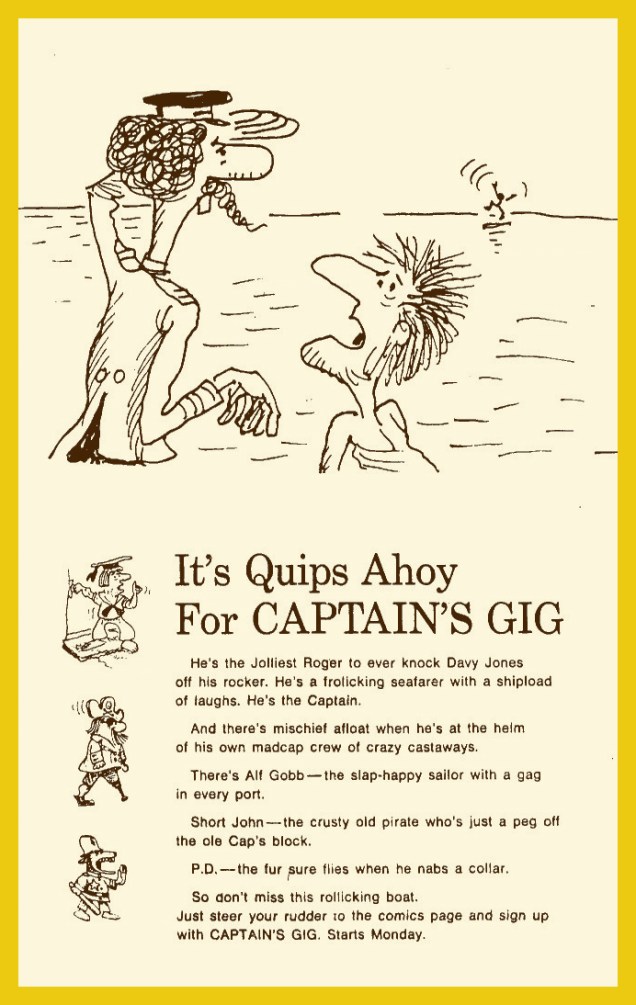
It appears no-one caught the typo in the *title*; well, the “Captan” bears an awfully smug expression, so perhaps he did.An ad for for Captain’s Gig from March 1977, just shortly before the strip’s launch. It sang its death song and went down in December 1979, according to Stripper’s Guide.
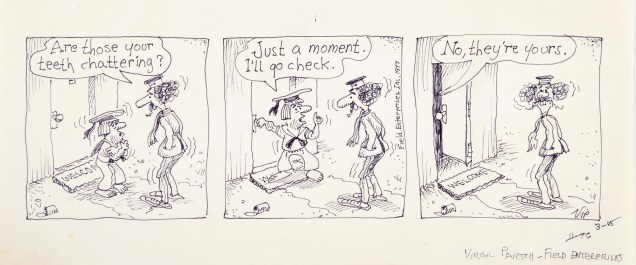
And now for some scans of original art (not owned, O woe!, by me):
Ger Apeldoorn, who has been doing the purchasing-and-scanning-newpaper-pages thing for longer than just about anyone, has a nice selection of strips over at his blog, The Fabulous Fifties. That being said, I hope to be forgiven for including two strips scanned and posted by him, both because they illustrate the point about VIP’s surreal sense of humour and because they made me laugh out loud.
« Gary Groth: You did — God help you — you did an Alice Cooper comic in ’79. Were you out of it or what?
Tom Sutton: I listen to Mozart. I don’t know. I guess Alice Cooper was a musician. Some kind of giant snake or some damn thing.
Gary Groth: So why the hell didn’t you do a Mozart comic?
Tom Sutton: Nobody asked me to. »
When I wrote Tentacle Tuesday: a Treasure Trove of Charlton Tentacles, I skipped Tom Sutton, vowing to return to him at a later date. If there was anyone deserving the title of Tentacle Tuesday Master (applause, please!), it is him. I don’t know what the appropriate cluster term for tentacles is, but Sutton has surely brought a, um, pandemonium (a terror? a trepidation?) of tentacles to Charlton‘s pages.
Even outside of his tentacles, Sutton is a truly interesting artist. I highly recommend An Odd Man Out: Tom Sutton,Gary Groth’s interview with him for The Comics Journal. Just read Groth’s introduction, if nothing else – he does an excellent job of summarizing Sutton’s singular career and the conflicting influences that shaped it. The interview is 11 web-browser pages long, and throughout Groth and Sutton’s conversation, one gets the distinct impression that Sutton is a witty, self-deprecating man, the kind you want to take to a bar or something to listen to his stories. At some point he mentions that the tape (to record the interview) is probably running out, and Groth responds with «There’s not enough tape in the world for you, Tom», which is, I think, a good example of their easy banter as well as obvious camaraderie.
Anyway, back to the topic at hand – the art and writing is by Tom Sutton, unless indicated otherwise. You know those over-the-top Russian buffets, where food is overflowing from the table? This post is like that, but with tentacles.
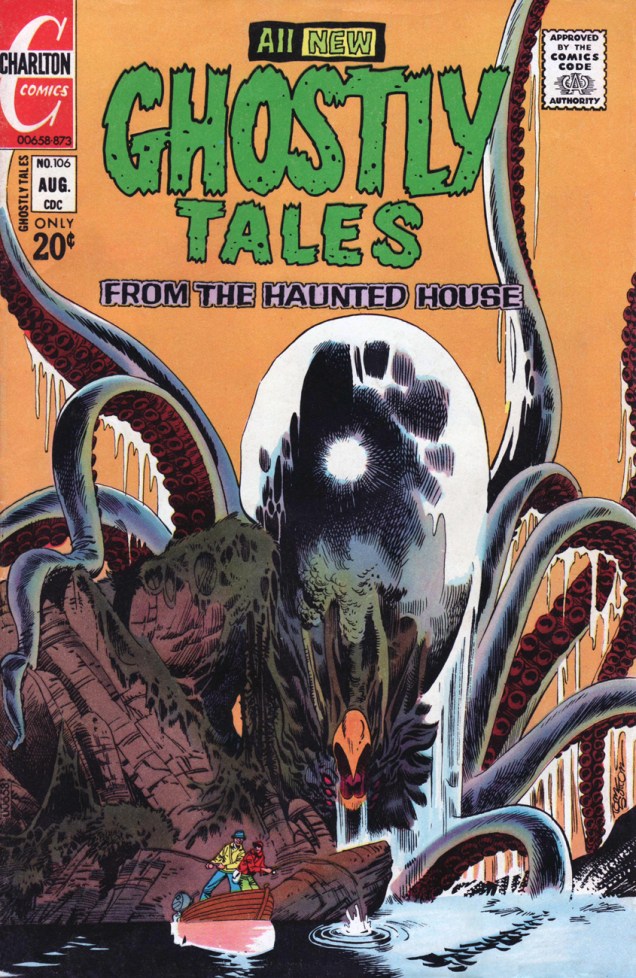
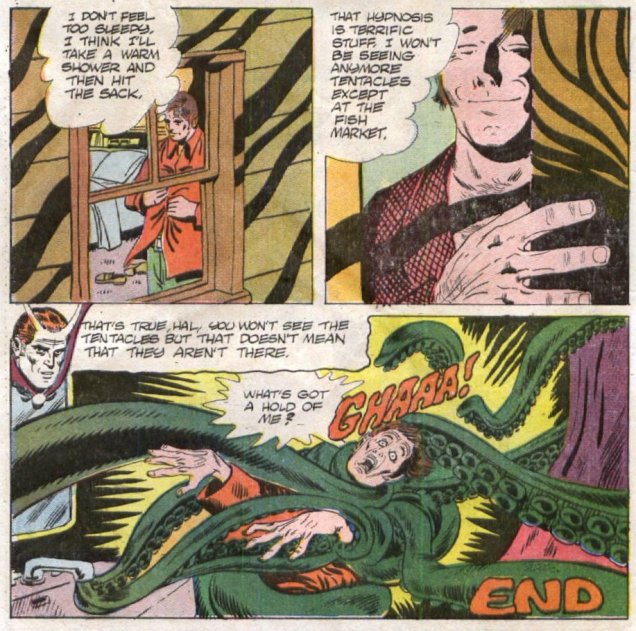
Ghostly Tales no. 106 (August 1973).This story, titled simply (and à propos) Those Tentacles!, scripted by Nicola Cuti and illustrated by Sutton, has already been mentioned in Tentacle Tuesday: Domesticated Octopus Seeks Soulmate, but I’ve never posted this page. Dang, gave away the ending.
This story was repurposed as a cover for Ghostly Tales no. 130 (May 1978):
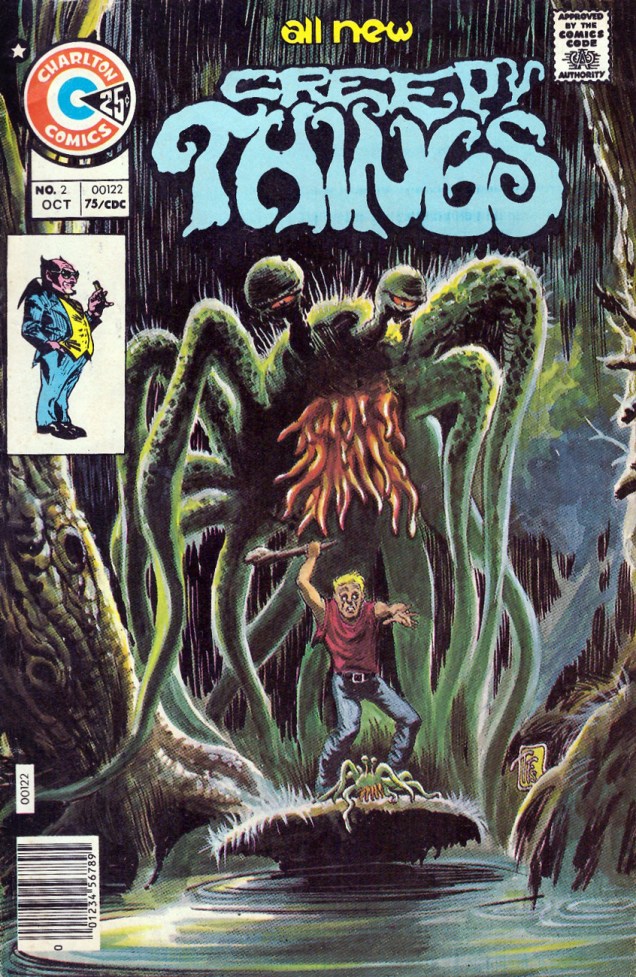
Ghostly Tales no. 113 (February 1975). Isn’t it a beautiful cover?Page from Through a Glass Darkly, the (surprisingly, black and white; Sutton evidently knew it wasn’t feasibly colourable… and his publisher respected his wishes! As opposed to…) cover story of Ghostly Tales no. 113. Good thing we we treated to all those eye-pleasing blues and greens on the cover!Creepy Things no. 2 (October 1975). You can read the full issue here. This is my favourite cover of this lot, both for the parent creature’s sad, slightly sleepy expression, and for the crispness of greens against black.Creepy Things no. 4 (February 1976). I’ll bet that slug-thing glows in the dark.Page from Man’s Best Fiend, scripted by Joe Gill (as Tom Tuna) and illustrated by Sutton, printed in Creepy Things no. 4.Ghost Manor no. 27 (January 1976)Scary Tales no. 4 (February 1976). Scary Tales hostess Countess Von Bludd tackles tentacles! Now you can’t say this post doesn’t have any cleavage.Haunted no. 20 (February 1975). My second favourite cover, for the completely horrified, totally Sutton-esque faces of the creature’s victims. I also like the way his signature is hiding at the foot of the tentacles.Pages from Mountain of Fear, published in Haunted no. 20. This is likely the most Lovecraftian (and epic) of Sutton’s Charlton tales.
Page from Out of the Deep, published in Haunted no. 21 (April 1975). This panel was later used as the cover for Haunted no. 55 (May 1981). Read the full story here.Page from Fear Has a Name!, scripted by Nicola Cuti and illustrated by Tom Sutton, published in Haunted no. 22 (June 1975).Page from The Thing in the Hole, published in Ghostly Tales no. 111 (September 1974). Read the whole issue here.
For more Tom Sutton, head over to the great blog The Horrors of It All, where a fellow admirer has posted a bunch of his stories. I’m happy to say that Sutton aficionados are legion and they’re fairly rabid, so to speak.
Furthermore, you can read co-admin RG’s Mind the Quirks and Glitches: Petrucha & Sutton’s Squalor for one more, more modern, facet of Sutton’s varied career. And if you’d like a little piquant in your life, his post even includes links to Sutton’s erotic comics!
Some people automatically conflate “goofy” with “childish”, but goofiness comes in many guises: from the charmingly nonsensical to the playfully quirky, from the clearly brilliant but confusing to the fucking stupid. (It’s also a snow-boarding term – How do I tell if I’m Goofy or Regular?) Today’s Tentacle Tuesday is goofy, all right, but more in the category of seemingly drug-induced codswallop. Another word for Dial H for Hero is wacky; distinctly wacky, so wacky that (as co-admin RG put it) it’s hard to really dislike it.
Maybe I should backtrack for those in the audience who are not familiar with the concept of Dial H for Hero. Robby Reed, a lucky (?), plucky teenager with a propensity to shout “Sockamagee!” in moments of excitement, stumbles upon some sort of magical thingamajig in a cave that enables him to become a superhero at the drop of hat (well, a turn of a dial). The process has unpredictable and uncontrollable results, in the sense that Robby has no idea who he will become, or what powers will be at his fingertips.
I have nothing against the idea of a rotary phone cum magical dial – that idea is rather interesting, given that rotary phones are indeed mysterious objects to the current generation – but I find the stories a tad too random to be enjoyable. Yet that’s the aspect that some readers clearly relished. To quote a letter from House of Mystery no. 172 (January-February 1968) from Bethesda, MD’s Irene Vartanoff.
« One of the best things about DIAL H FOR HERO is the huge amount of imagination put into each story. When at least two new heroes with new powers, costumes, weaknesses, bodies, etc. have to appear in each story, it may make your writers rack their brains and work overtime, but the results are fantastic. »
Given all the transformations Robby has gone through and the many bad guys he has had the pleasure of defeating, it is unavoidable that he would 1) encounter some villains with tentacles 2) acquire some tentacles himself. Dial H for Highball on *your* old-fashioned phone, if you still have one gathering dust in the attic, and enjoy this gallery of fun nonsense.
The very first appearance of Robby Reed and his magical dial, and already we have tentacles:
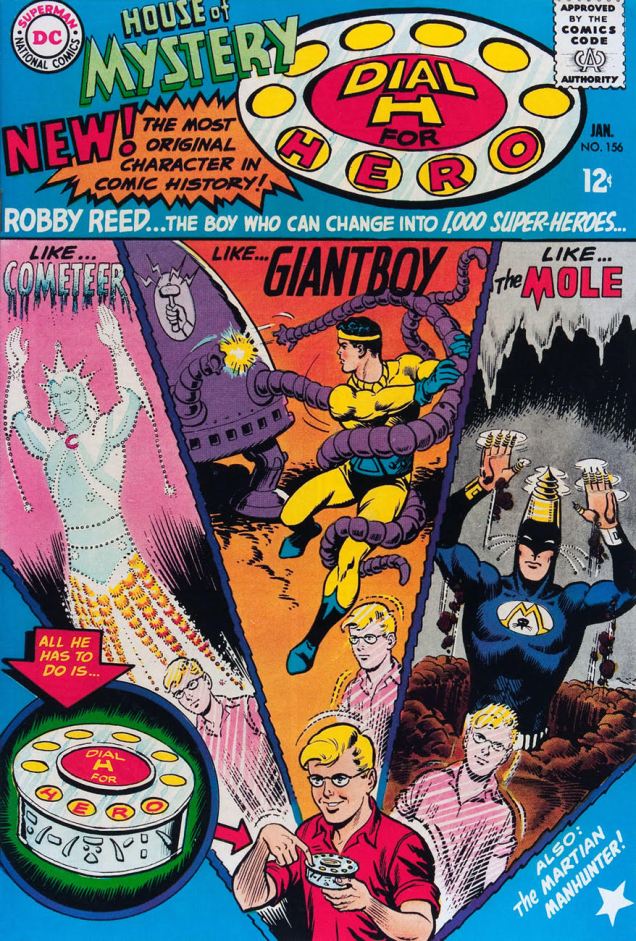
House of Mystery no. 156 (January 1966), cover by Jim Mooney. This is a good demonstration of how random some of the superheroes generated by the machine are.
This is the first Dial H for Hero story, and as such it has no other title. Scripted by Dave Wood, drawn by Jim Mooney. [RG: panel three looks suspiciously like the work of George Tuska. Ghosting… or swiping? Hmm…]I mentioned that Robby himself sometimes sprouts tentacles. Here’s a good example:
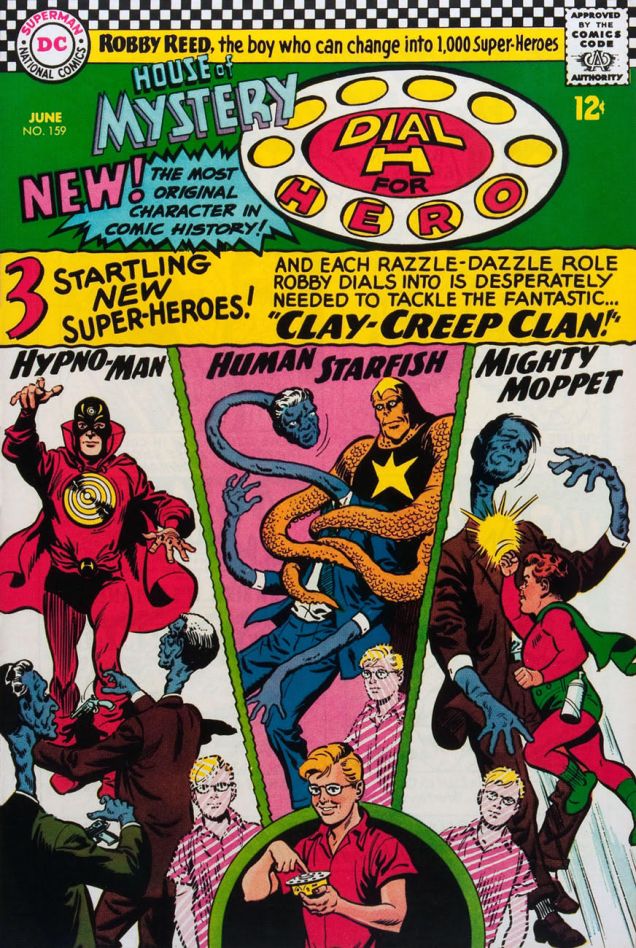
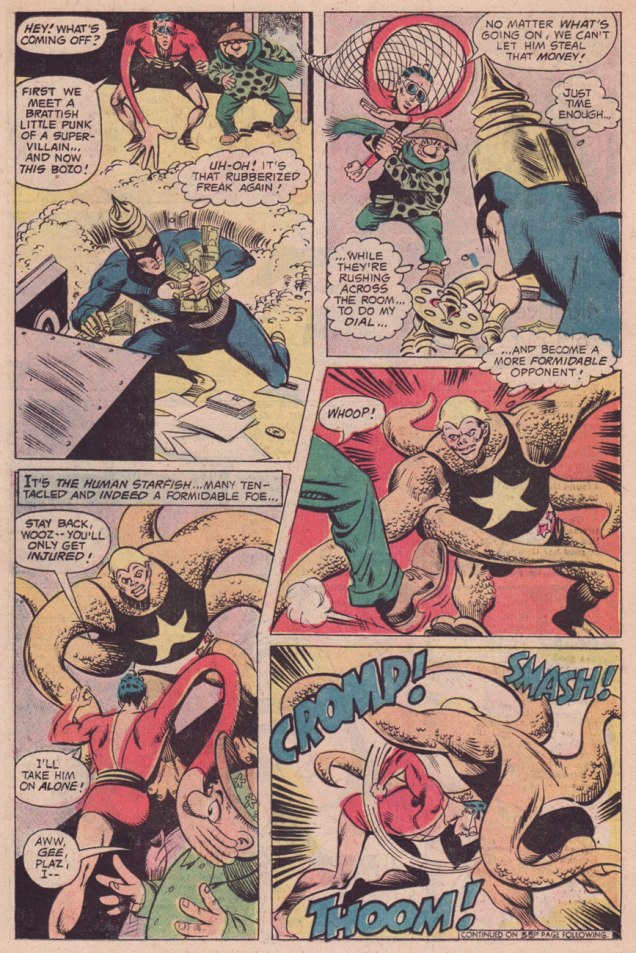
House of Mystery no. 159 (June 1966), cover by Jim Mooney. Another issue, another gallery of improbable heroes and villains…Human Starfish Robby Reed conveniently improves upon the concept of a normal starfish, developing prehensile appendages to capture a very stretchy criminal. The Clay-Creep Clan is written by Dave Wood, and drawn by Jim Mooney.
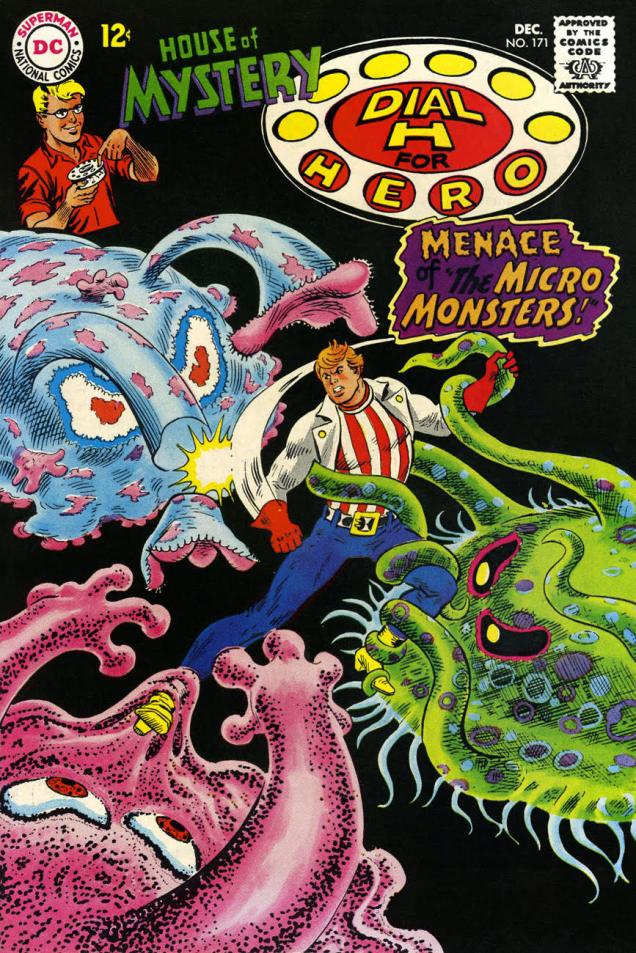
Jim Mooney was responsible for Dial H for Hero‘s art for many issues, from the onset of the series with House of Mysteryno. 156 (January 1966) to House of Mystery no. 170 (October 1967). Dial H for Hero lasted three more issues after Mooney’s departure. As luck would have it, no. 171 and no. 172 bring our most striking examples of tentacles yet. (The final DHFH issue, House of Mysteryno. 173, features a cover by Jack Sparling, with insides by Charles Nicholas and Sal Trapani.)
Arguably the prettiest cover of this post (my favourite, at any rate):
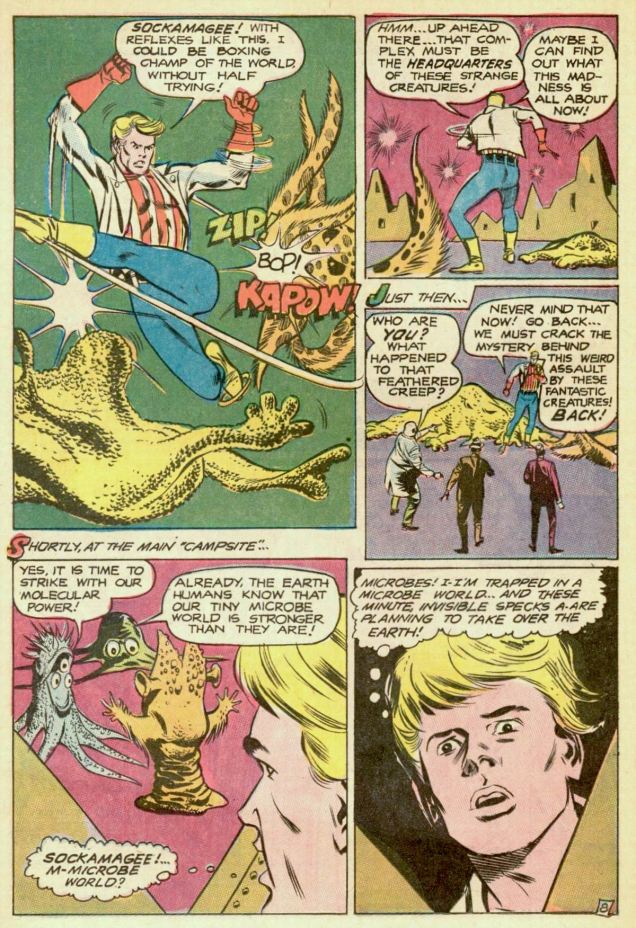
Back to fighting tentacles! House of Mystery no. 171 (December 1967), cover by Nick Cardy.The Micro-Monsters! is written by Dick Wood and illustrated by Frank Springer.
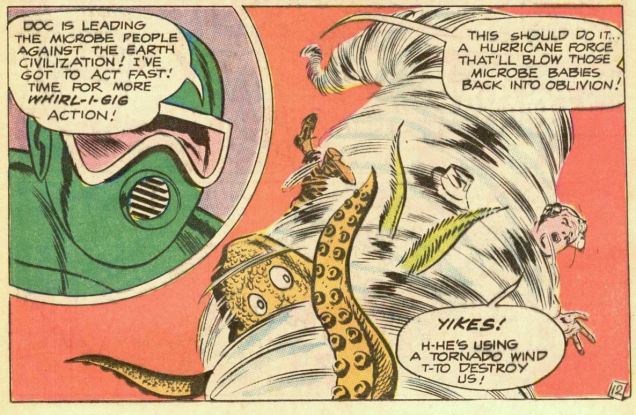
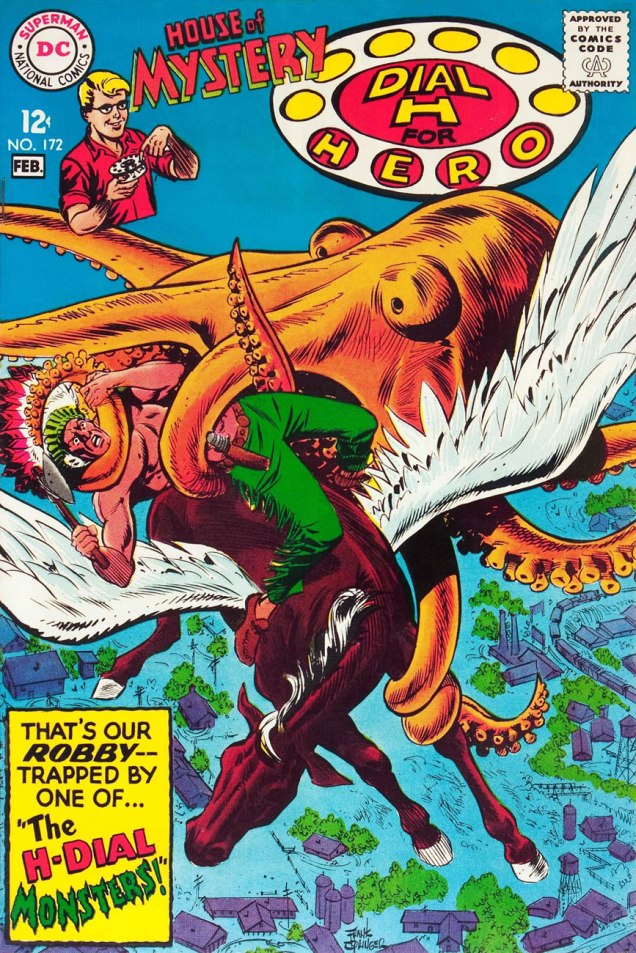
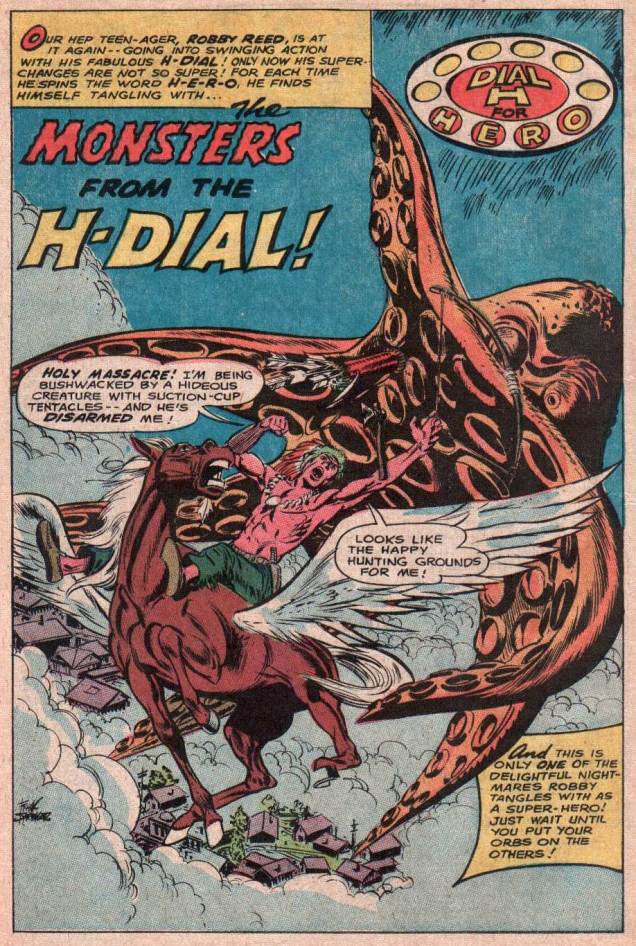
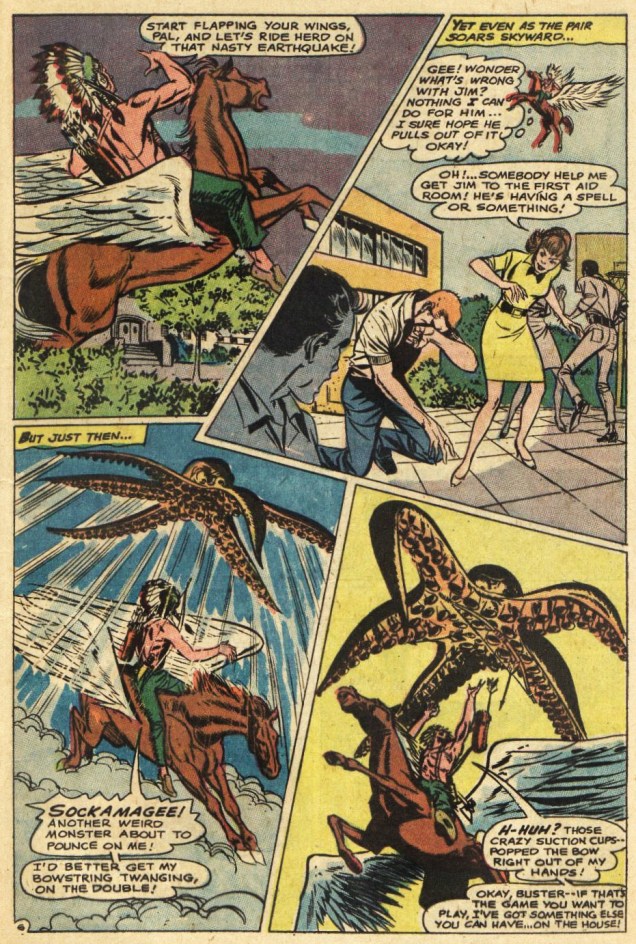
House of Mystery no. 172 (January-February 1668), cover by Frank Springer.The Monsters From the H-Dial! is written by Dick Wood and illustrated by Frank Springer.How does Chief Mighty Arrow defeat the flying octopus? Why, by shooting jet-propelled feathers from his headdress, of course.
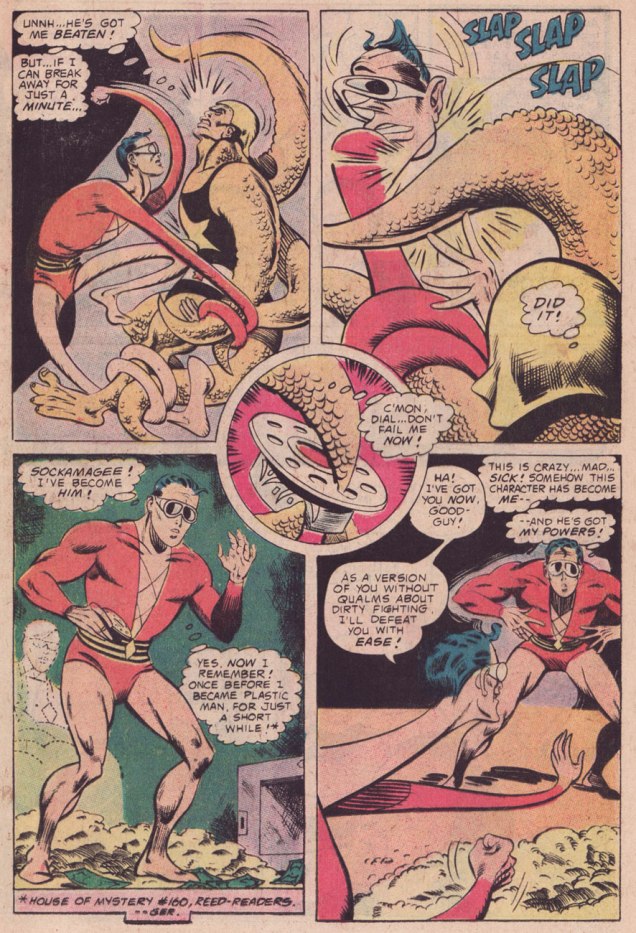
The last thing I’d like to mention is that my favourite Robby Reed appearance was in an issue of Plastic Man, of all places – to be more precise, in Plastic Man no. 13 (June-July 1976). In If I Kill Me, Will I Die? (read it here!), scripted by Steve Skeates, pencilled by Ramona Fradon and inked by Bob Smith, Reed not only gets to take on Plas (in more ways than one), but also falls deeply and magically in love with a professional hog-caller. Also, tentacles. Adorable *and* exciting!








































 ~ ds
~ ds Who's Out There?