The punchline to the EC story “Pleasant Screams!”, written by the usual Bill Gaines / Al Feldstein combo, with art by Joe Orlando. From Tales From the Cryptno. 37 (August, 1953) Can anyone in the class tell me where this panel was swiped and quoted (to hilarious effect) in the eighties? The answer follows…
Here it comes… pencils down, everyone!
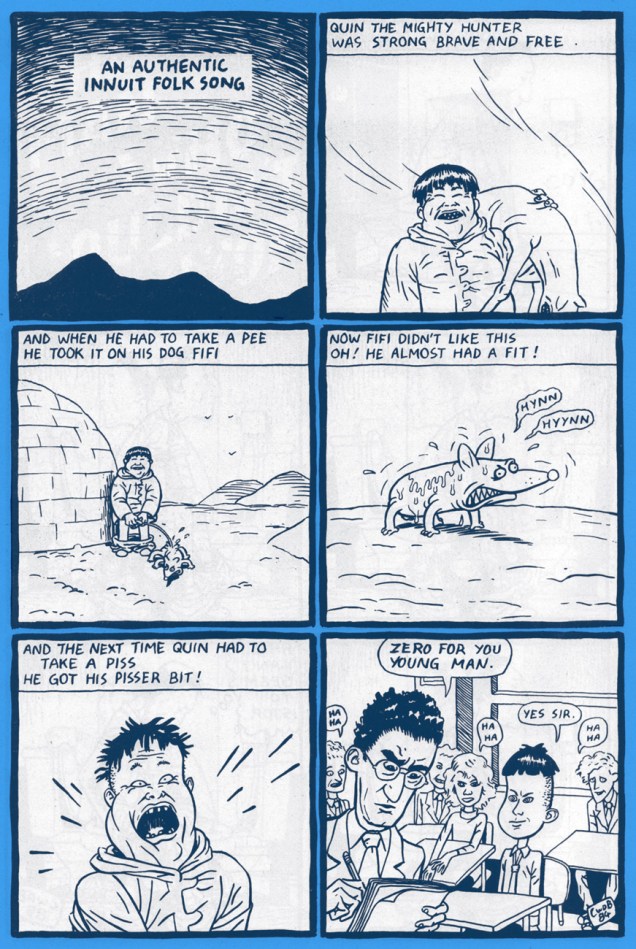
Poor Fifi. He hardly seems to be the right breed of pooch for the Canadian Arctic, not to mention its special precipitations. Reprinted several times since, this edifying tale of poetic justice first saw print in the final issue of the Yummy Fur mini-comic (no. 7, Sept. 1985, Tortured Canoe).Chester’s closing argument in the case.
Ah, for a return to the days when we didn’t know way too much about Chester Brown, when he was a mysterious, self-published cartooning genius and Châteauguay‘s finest son. I remember how awestruck I was upon encountering his brilliant Yummy Fur minis, available at Toronto’s gone-but-not-forgotten Dragon Lady comic book store in the early-to-mid 1980s. What a surreal breath of fresh air they were!
A cat’s meow and a cow’s moo
I can recite ’em all Just tell me where it hurts yuh, honey
and I’ll tell you who to call Nobody can get no sleep There’s someone on ev’ryone’s toes But when Quinn the Eskimo gets here
everybody’s gonna wanna doze.
The source of Bobby Zimmerman‘s inspiration: Anthony Quinn as “Inuk” in The Savage Innocents (1960). Back then, people dressed like this where and when it was actually cold; nowadays, it may be sunny and well above freezing, but those fierce, dauntless Polar explorers roam the streets in great numbers, clad in their fashionable down-filled, fur-lined hooded coats…
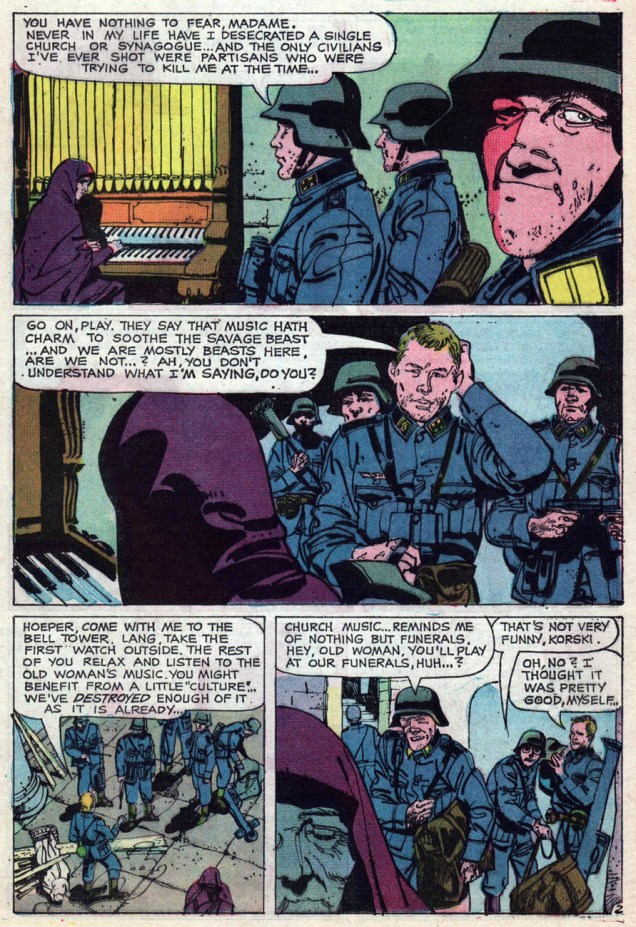
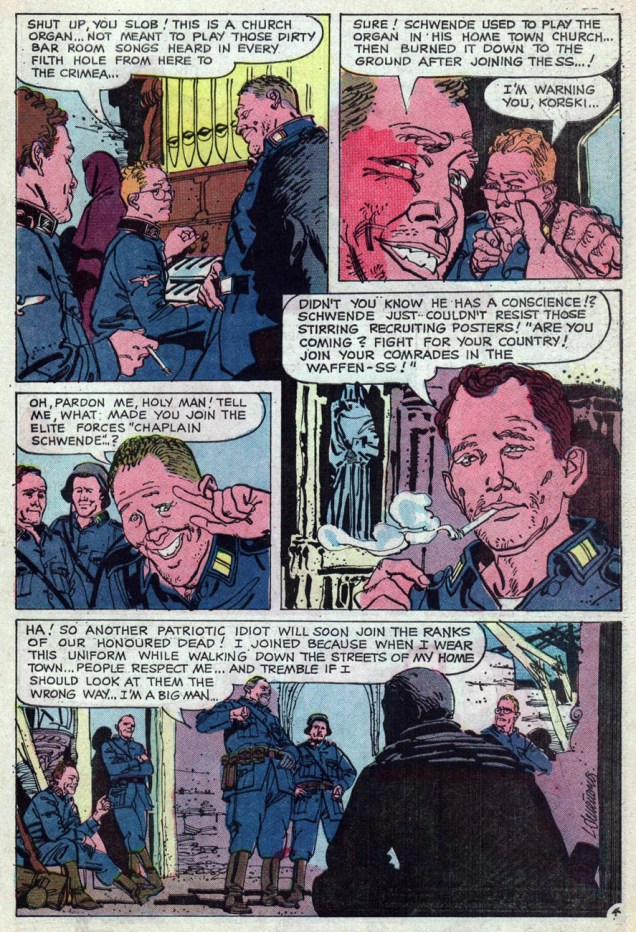
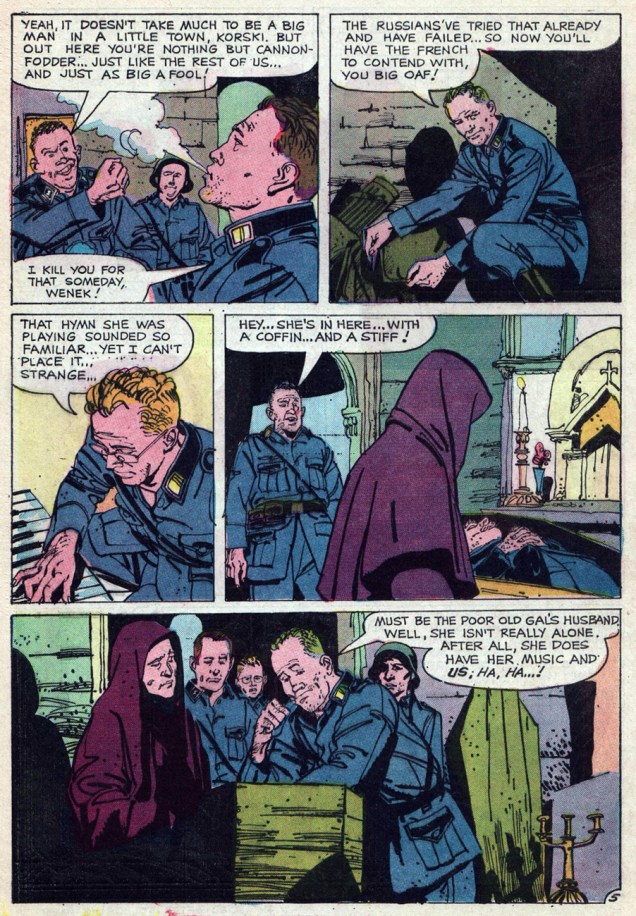
« They were bitter, war-weary men and the old woman’s music was comforting — perhaps too comforting… »
Writer and occasional penciller William ‘Willi’ Franz (1950-2026) broke into the comics industry at the tender age of 15, selling his first script to Charlton editor Dick Giordano in 1966.
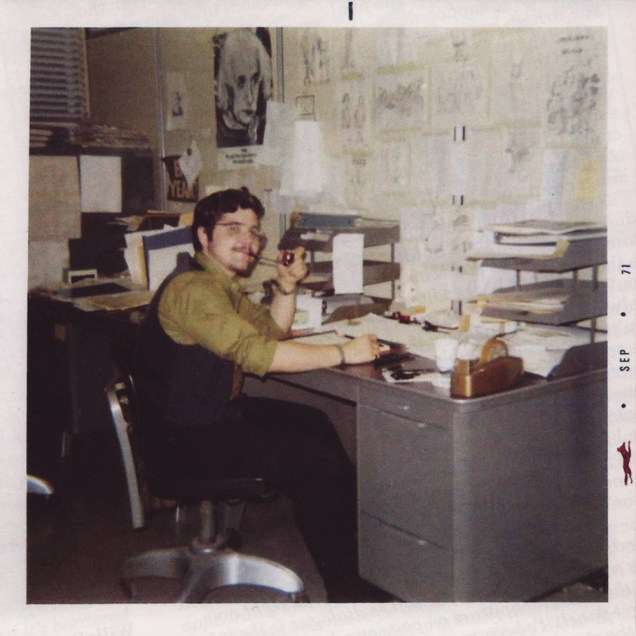
Will Franz, September 1971. A photo « …taken at the Manhattan insurance company where I worked as an accounting technician. My wall is covered with cartoons I made of various office friends and personnel. » Source: Will Franz and Charlton Spotlight.
While best known for his fruitful collaborations with his mentor, the great Sam Glanzman (1924-2017), namely The Iron Corporal, The Devil’s Brigade and most enduringly The Lonely War of Willy Schultz, Franz also scattered a few gems that the light has mostly missed.
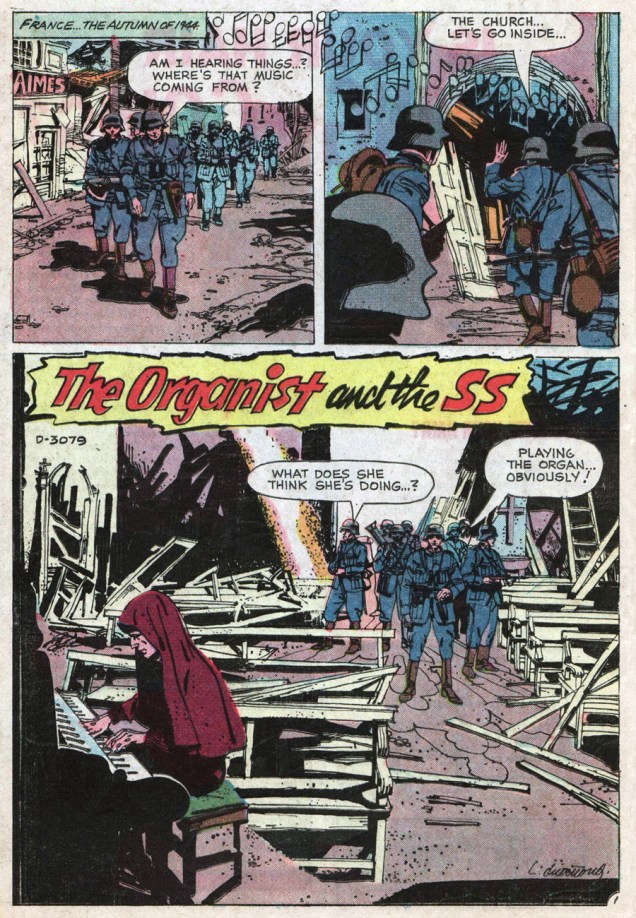
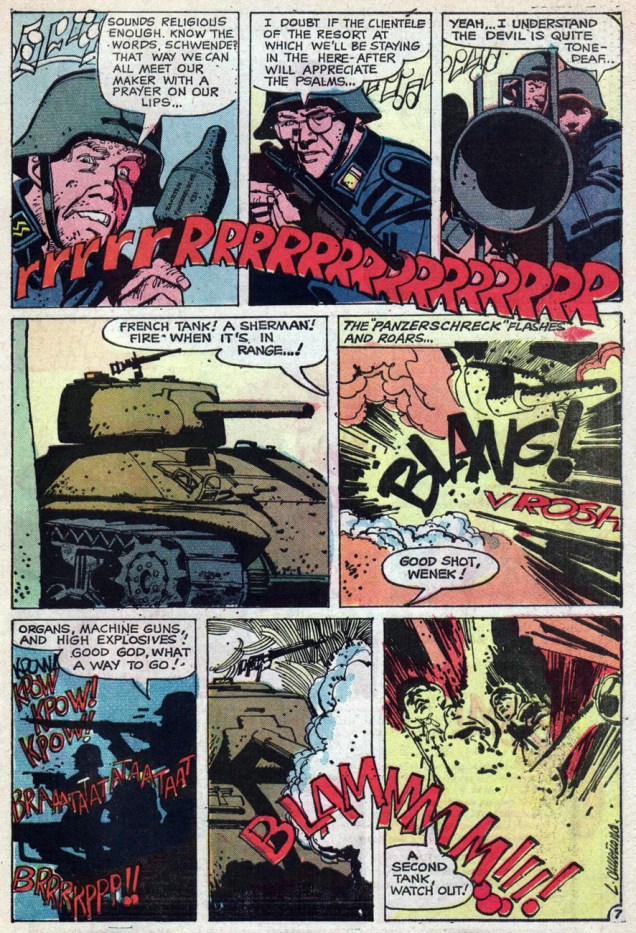
My favourite among these has to be his final story for Charlton, The Organist and the SS, published in Attackno. 8 (Nov. 1972). Franz’s bleak, nuanced and markedly pacifist tales had drawn the military’s ire, back in the late ’60s, and this somber little piece of doom might have, too, if anyone had been paying attention.
As Franz recalls in a 2015 interview with Richard Arndt, published in Charlton Spotlight no. 9 (Winter-Spring 2015-2016):
« I was told that a lot of Charlton sales were on military bases. They were a staple on Army bases. I, and my stories, were dropped in 1969, out of the blue. Things were heating up in Vietnam.
I was blacklisted at Charlton because a guy had put my name and stories down as one of the reasons he registered as a conscientious objector. I found out other people were throwing my name around. Someone in the army apparently said that my stuff, maybe like [Archie] Goodwin’s stuff, was too blood and guts. It was going to make soldiers *not* want to kill the gooks. The army can’t have that! »
Well, evidently Charlton (presumably managing editor George Wildman, bless his heart) let Will sneak back into the fold, if briefly, after the heat was off, otherwise I’d be writing about some other topic entirely.
Without further preamble, please savour this pitch-black, existentialist play of war and death, but mind the thorns.
Will’s layout for the opening splash of our story. It’s always a treat to see what liberties the illustrator takes… or doesn’t.
This issue is chock-full of arrivals and departures: it opens with a story from new recruit Warren Sattler, trying his hand at a few short mystery and war stories before he found his niche in excellent collaborations with Joe Gill on Billy the Kid and Yang; next up is Jack Keller, who was winding up his comics career, what with Charlton’s remaining pair of hot rod books, Drag ‘n’ Wheels and Hot Rods and Racing Cars, soon to be scrapped. He would move, appropriately enough, to making a living selling cars. Finally, Argentine ace Leo Duranoña (b. 1938) was just passing through Charlton, crafting a handful of finely-hewn tales before moving on to DC and Warren… among others.
Cards on the table time: I never did much like Tintin. While there’s no denying the technical virtuosity and high imagination on display in Hergé’s work*, as a child, his overly-meticulous line and storytelling struck me as flat, sterile and remote. I thought I was just about alone in this view.
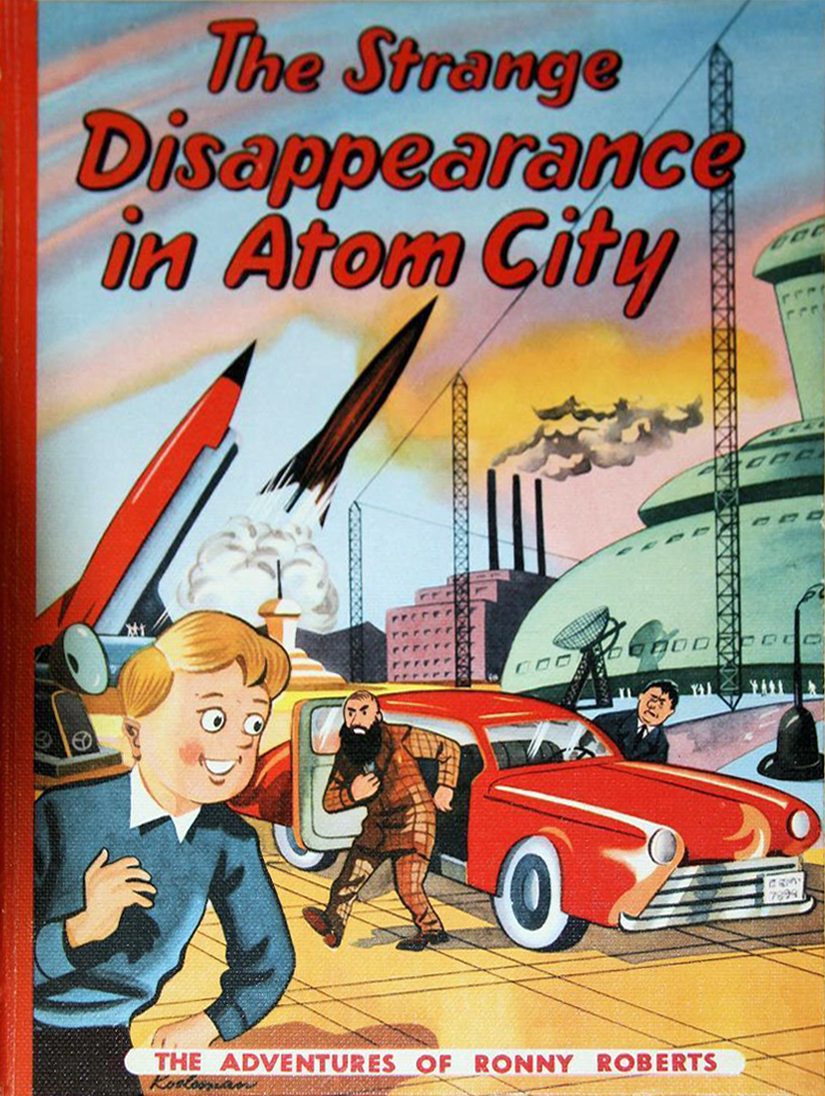
There was a Tintin-esque series I did delight in, and that was Martin le Malin, a translation of the Dutch « De Avonturen van Pinkie Pienter ». While much derided and nearly forgotten today, Pinkie remains, in my view, a misunderstood and under-appreciated work.
I was to learn, decades later, that the series was in fact created in response to the very aspects of Tintin that left me cold. In 1951, Dutch painter J.H. Koeleman (born October 30, 1926), while visiting his brother, learned from his young nephews that they were somewhat frustrated with and repelled by Tintin, finding the stories too complicated and the artwork too fastidious. From this incident, Uncle J.H. hit upon the idea of creating a series using a deliberately naïve and relatively primitive style, something closer in tone and essence to what a talented and imaginative child would craft for himself.
Koeleman produced and self-published a pair of albums, which were met with critical praise but disappointing sales. However, in early 1953, established publisher Mulder & Zoon came knocking and offered the man a deal: they would, using the greater resources at their disposal, republish and distribute his early efforts. The joint venture worked splendidly… at least for a time. In total, Koeleman wrote and drew twelve Pinkie Pienter albums between 1953 and 1958. These were also published in softcover 16-page colour instalments, which is the format I encountered them in. In my youth, they were everywhere: (long gone) supermarkets, department stores… and at 39 cents apiece, they offered a fine deal.
However, during Expo 58 (aka the Brussels World’s Fair), long-simmering tensions came to a head between the author and his publisher. Koeleman walked out, and the less said about his successors, the better. For it is in the later Martin le Malin albums that we can plainly witness the difference between intentional simplicity and economy… and sheer incompetence.
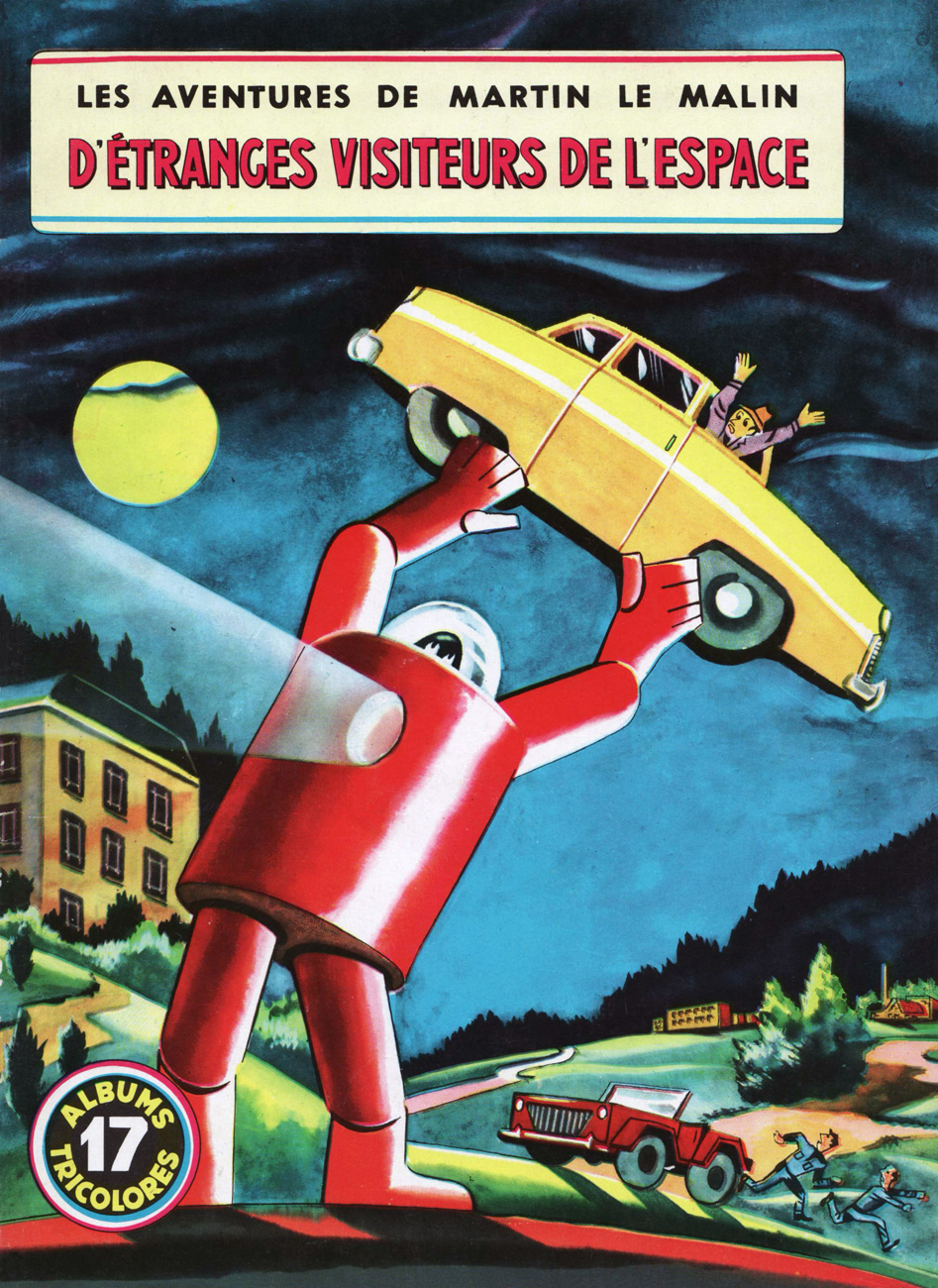
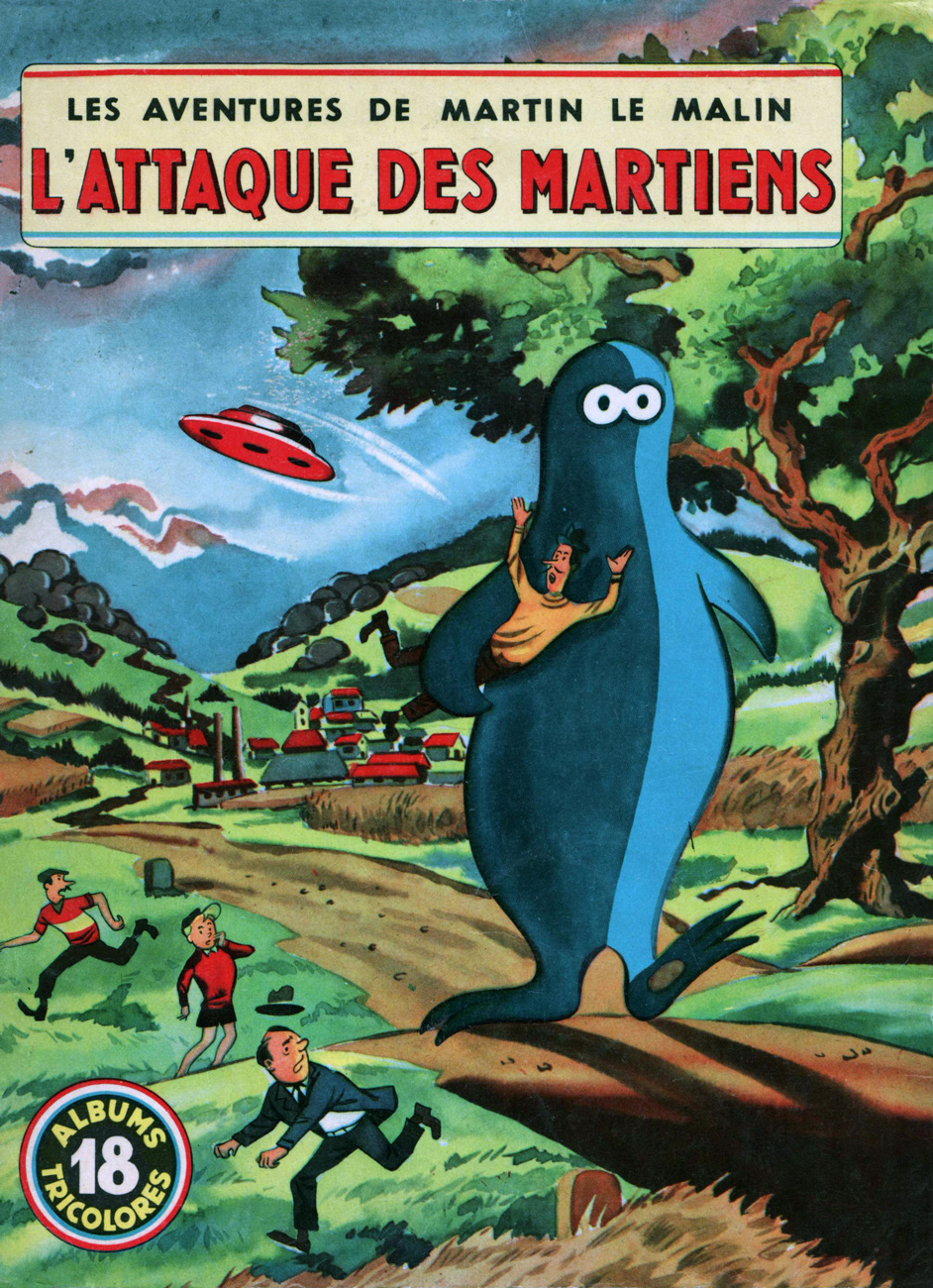
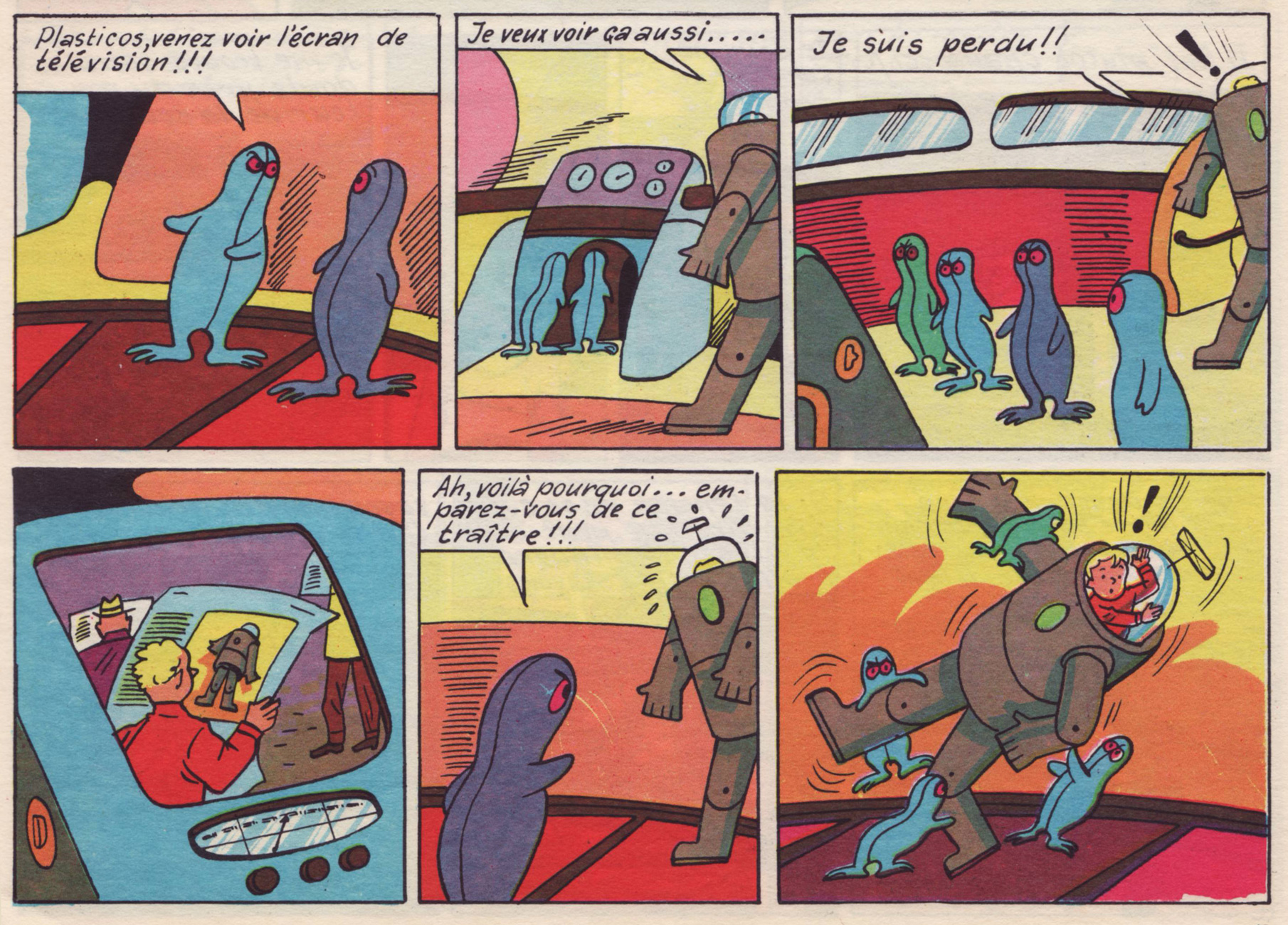
Today, I’ll focus on my favourite saga, « Les Martiens atterrissent » (Number 6 in the series, and serialized in « La soucoupe volante », « D’étranges visiteurs de l’espace » and « L’attaque des Martiens »).
In the actual story, Martin’s bumbling sidekick, Floris Fidel (Floris Fiedel in the original) has been shrunk by Martian leader Plasticos (isn’t he just adorable?), but on the cover, while their size ratio remains constant, it’s Plastico who’s grown gigantic.
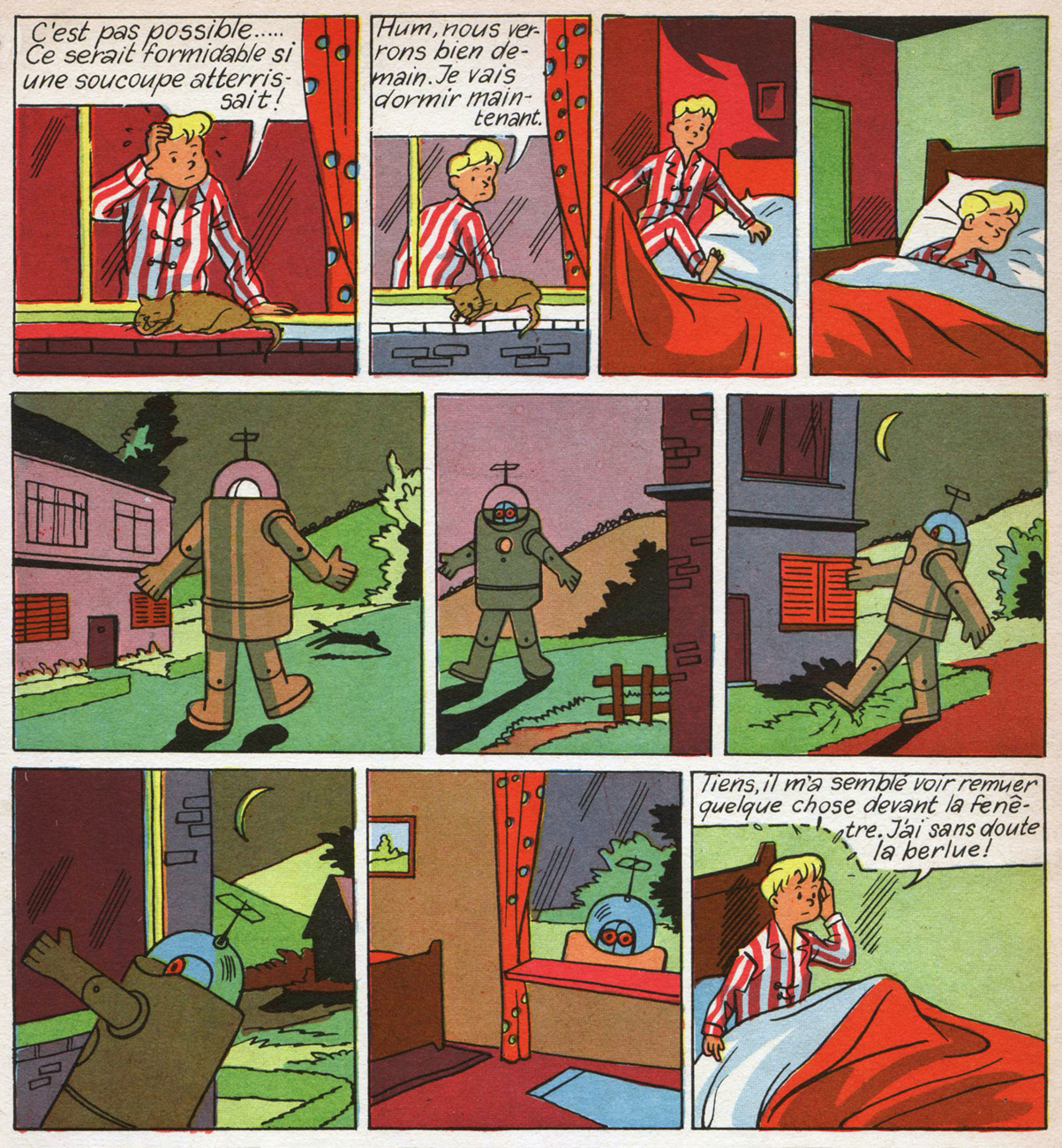
You go to bed quietly, and the next thing you know, Martians are trampling your hedgerows and peeking in your window. Next time, draw the curtains. Love the way the cat runs for it in panel 5.
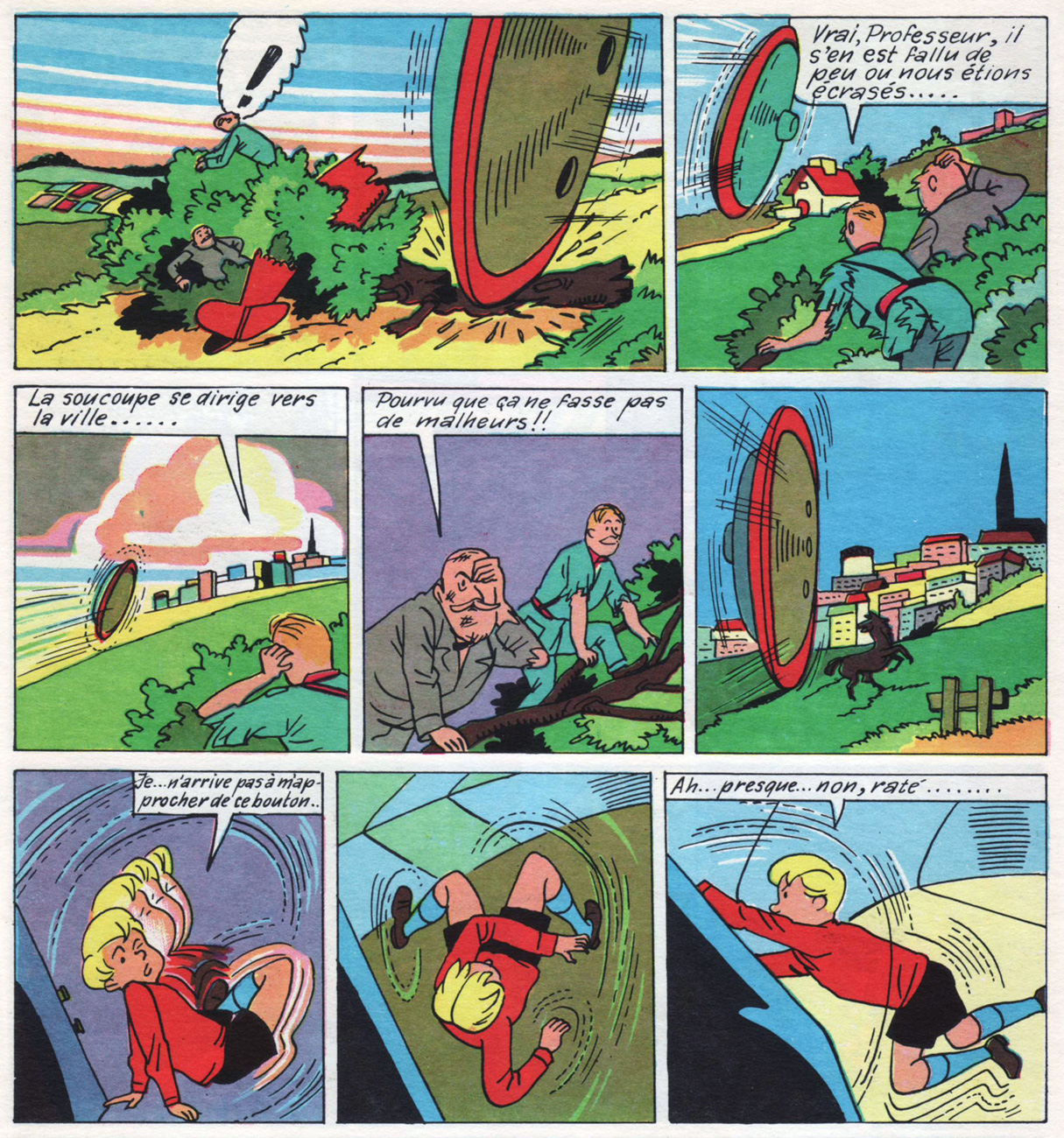
Martin finds that piloting unfamiliar spacecraft is not something you pick up on the fly.
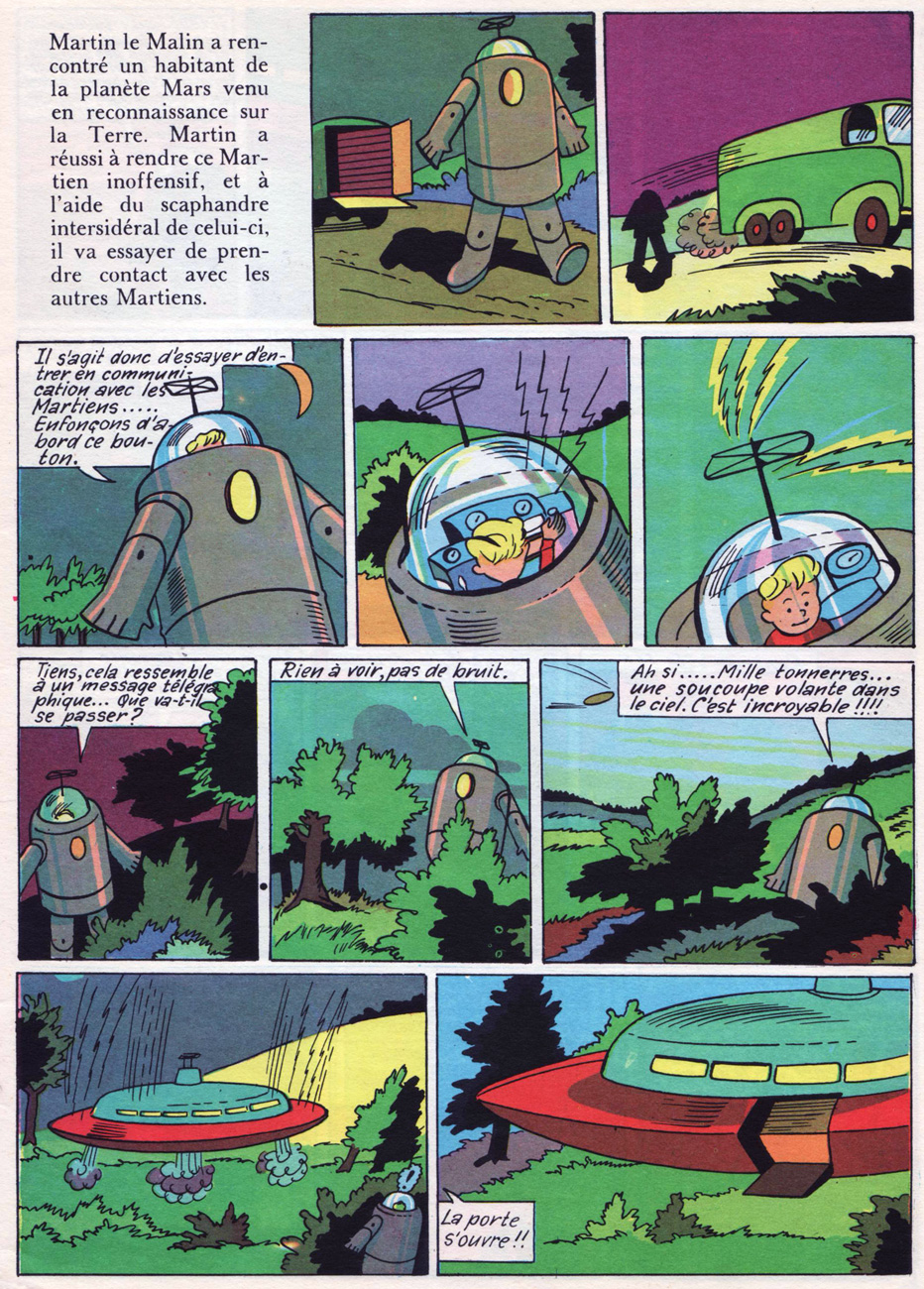
Having captured Martian Aluminicus’ spacesuit, Martin tries, and fails, to infiltrate the invaders’ ranks.
Oops. Another one of Floris’ screwups lands Martin in hot water.
I only learned today, while researching this post, that Pinkie/Martin was also published in English! Is anyone familiar with this edition?
The copies I’ve seen for sale are listed in far-flung Australia. Curiouser and curiouser…
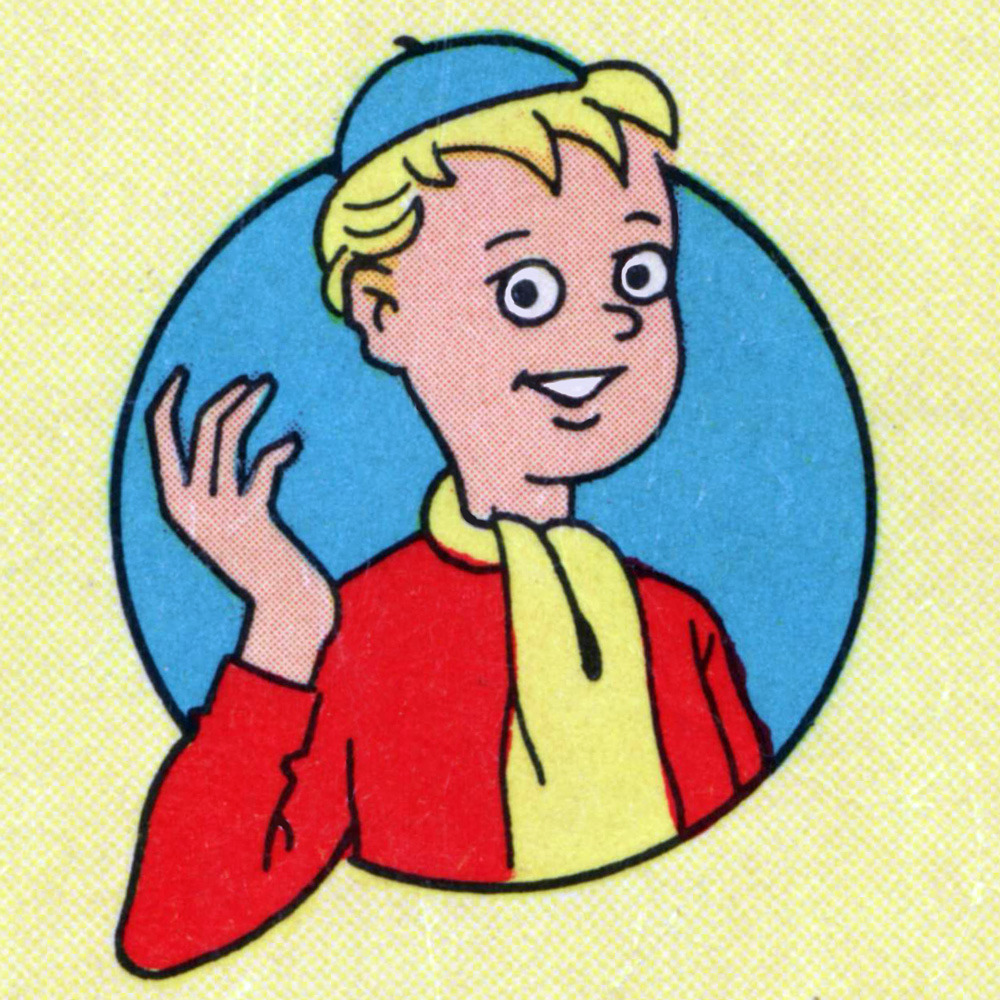
The Martin cameo, as it appeared on the back of the first edition albums.
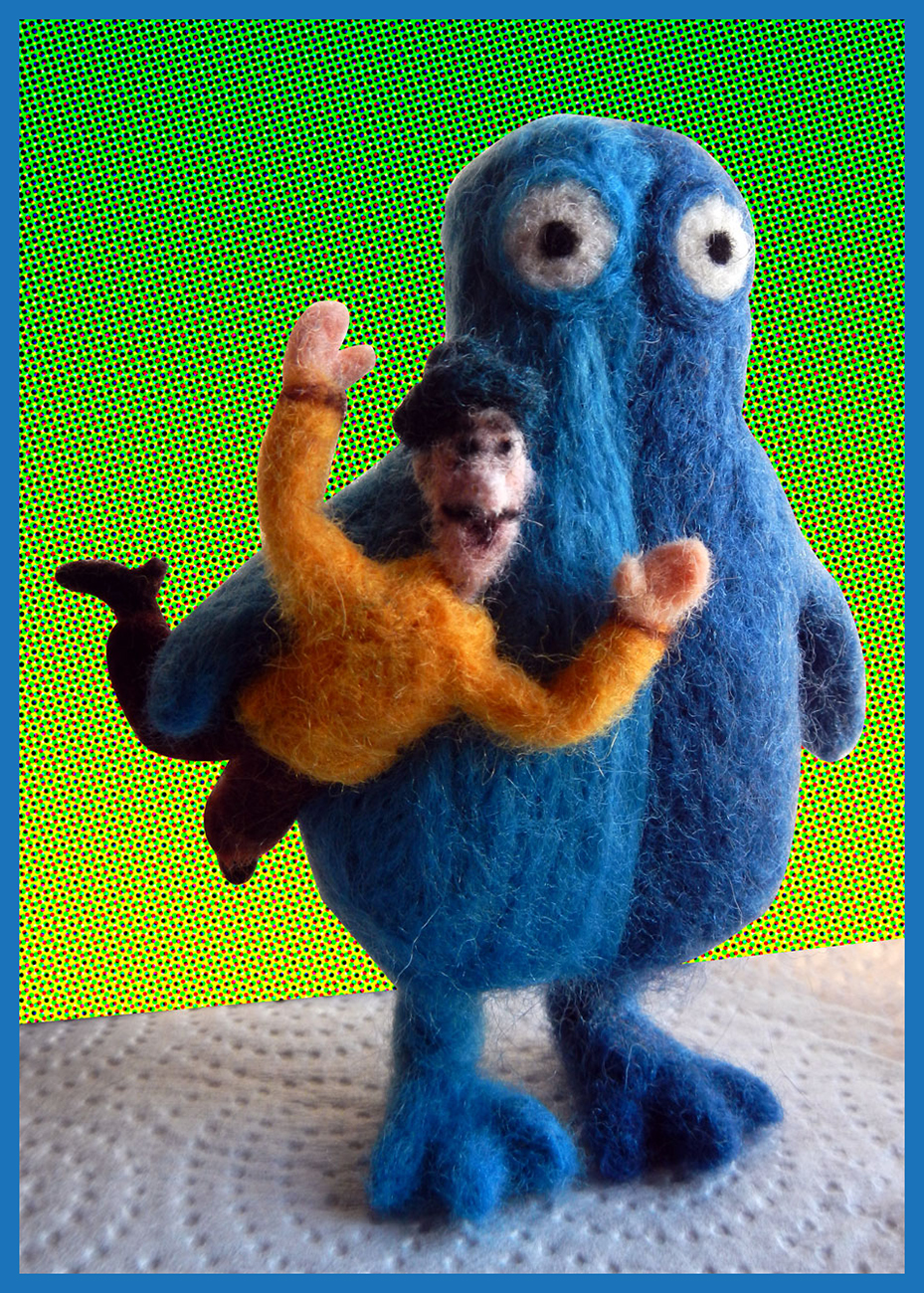
And here’s a custom-made Plastico (with Florisse in tow) needle-felted by WOT’s own multitalented ds.
Brooding pretty boy (is that you, Brian Setzer?) is about to get a pleasant shock in this Dave Stevens (1955-2008) cover featuring a “punk rocker” in the well-scrubbed tradition of, say, Lea Thompson in the infamous Howard the Duck movie. Still, it’s a dazzler, as you’d be right to expect from Mr. Stevens.
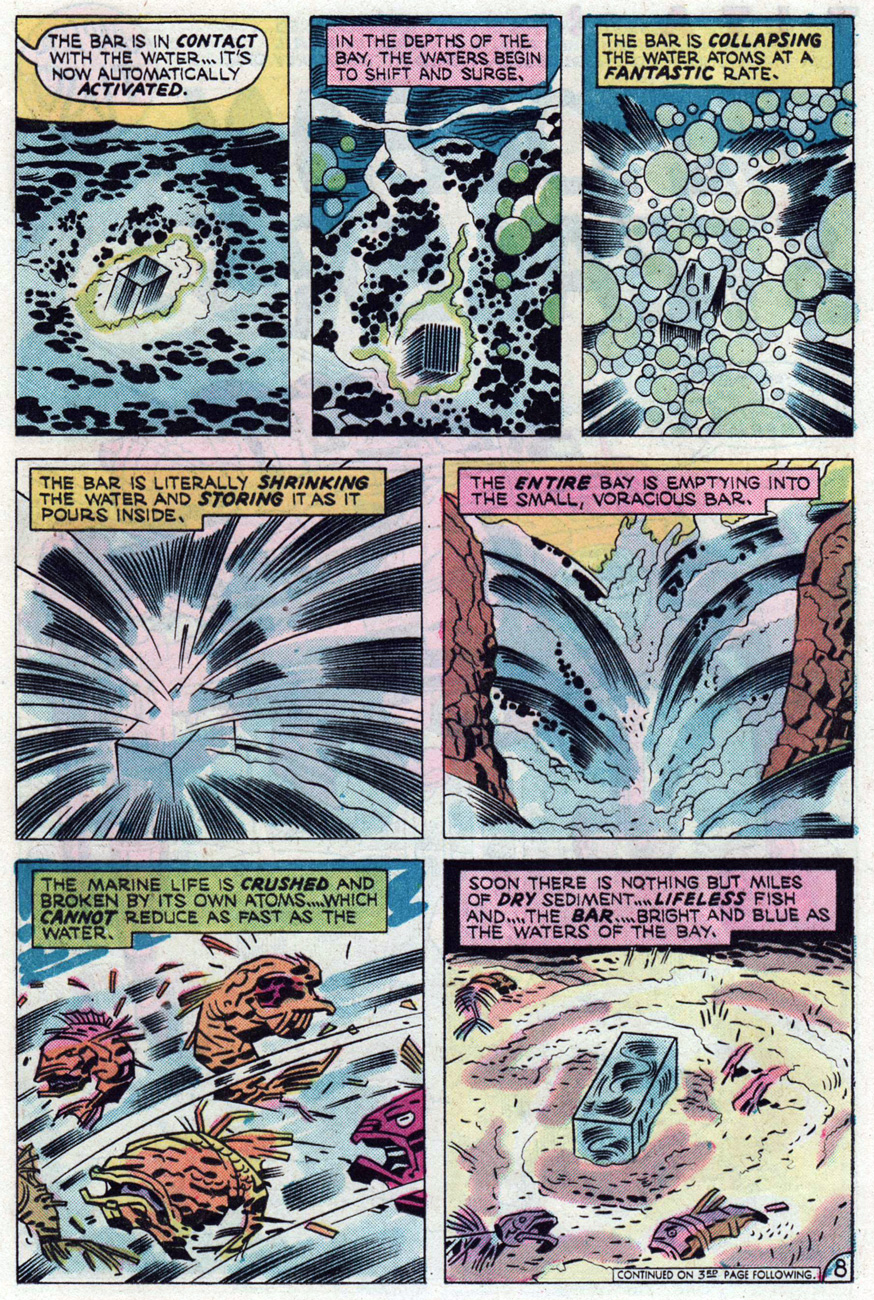
« The marine life is crushed and broken by its own atoms — which cannot reduce as fast as the water. »
I’ve been sitting on this particular entry awhile, having realized that the most opportune time to share it would be today, March 22, which happens to be World Water Day*.
In comics, few if any creators have generated so many explosive, pulse-pounding images as did Jack Kirby (1917-1994). And yet… this solemn, understated scene has likely haunted me most of all. The visuals are splendid, sure, but it’s the nature of the situation, the conceptual ramifications of the thing, that make it stick.
This splash appeared near the opening of OMAC’s final adventure, one that pitted him against Sandor Skuba, a rogue genius seizing and hoarding the planet’s water in view of controlling humanity. Threat-wise, all the adversaries that the One Man Army Corps had tangled with were mere preludes to this impressive madman. As Kirby left DC before he could wrap up the storyline as he intended, no-one walks away from this skirmish**, notwithstanding the final panel, subsequent revivals and reboots and corruptions of Kirby’s ideas by (inevitably) lesser hands and minds (and conversely bigger egos).
This is OMAC no. 7 (Sept.-Oct. 1975) and « The Ocean Stealers! », scripted, pencilled and edited by Jack Kirby, inked and lettered by D. Bruce Berry.
In light of the current practices of certain corporations, notably the Swiss transnational Nestlé, Kirby was sadly prescient and clear-eyed again. As evidenced by recent events, given the technological means, today’s robber barons would not hesitate.
Writer and comics historian Mark Evanier, who spent some years as Kirby’s assistant in the ’70s, writes, in his foreword to the DC’s exemplary reprint collection Jack Kirby’s OMAC: One Man Army Corps (2008): « So consider this fair warning: the last issue comes to a whiplash-inducing sudden stop. Jack had been setting up something big for number 9, but since he was gone and there wasn’t going to be a number 9, a new last panel (not by Kirby) was inserted to remove the immediate cliffhanger.» … a panel created, at that, with the finesse of 10-year-old unburdened by a sense of pacing. “Wharoom” to you too.
-RG
*Don’t buy the duplicitous hype, though! A perfect example of the fox guarding the henhouse.
A panel from « Return of the Swamp Beast! », story by Jane and Bob (RL) Stine, art by Stephen R. Bissette, originally published in Weird Worlds no. 3 (Oct. 1979, Scholastic.) This is the colour version from the one-shot Bissette & Veitch’s Fear Book (April, 1986, Eclipse.) Colours by Brendan McDonough.
Ah, that old Earth’s taken another whirl, and so today, the wonderful Stephen Bissette, that most erudite master of terror *and* one of the truest, most steadfast gentlemen the medium has known, observes another birthday. He first breached this plane of existence in the wilds of Vermont some sixty-odd years ago today, on March 14, 1955. Let’s wish him all the best, shall we?
The original art of this silk-spewing splash was reportedly acquired, by proxy, by erstwhile Calvin Klein Jeans model Brooke Shields. I like to envision it occupying a place of honour in the dining room of her favourite mansion. Or perhaps in the bedroom, right above the headboard?
This is from Saga of the Swamp Thing no. 19 (December, 1983, DC.) Quite respectably co-plotted and scripted by Martin Pasko (with Mr. Bissette), this predates epochal game-changer The Anatomy Lesson, but the Bissette/Totleben dream combo was already scorching eyeballs, en attendant Mr. Alan Moore’s accession.
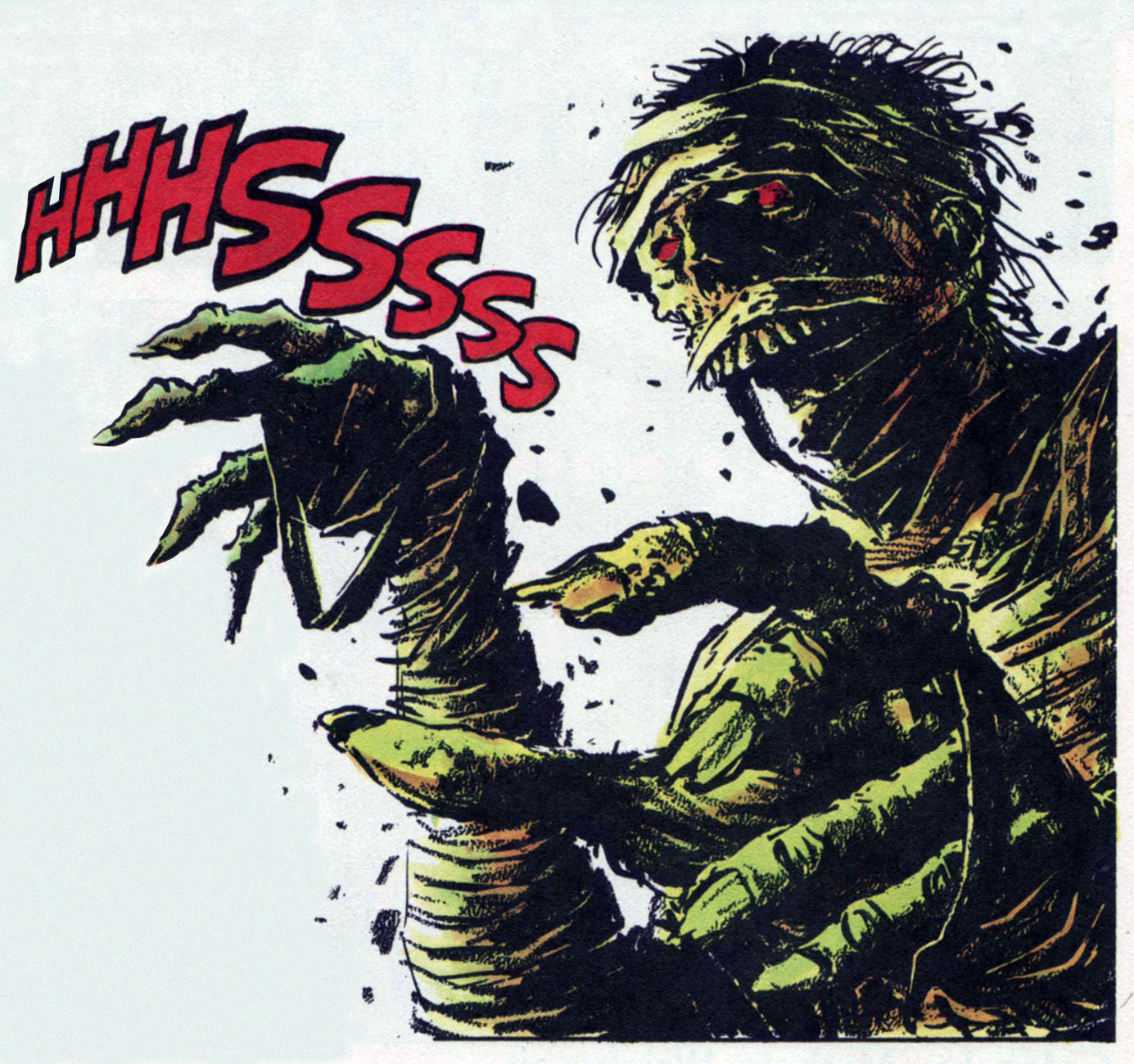
Newlyweds Rich and Jamie meet this dusty fellow, for the first and final time, in Egyptian Graffiti, story by Jane and Bob Stine, art by Stephen R. Bissette, originally published in Weird Worlds no. 2 (March 1979, Scholastic), also collected in Bissette & Veitch’s Fear Book , with colours by Michele Wrightson.
-RG
*George Carlin may have said that, or something to that effect. Who knows, these days?
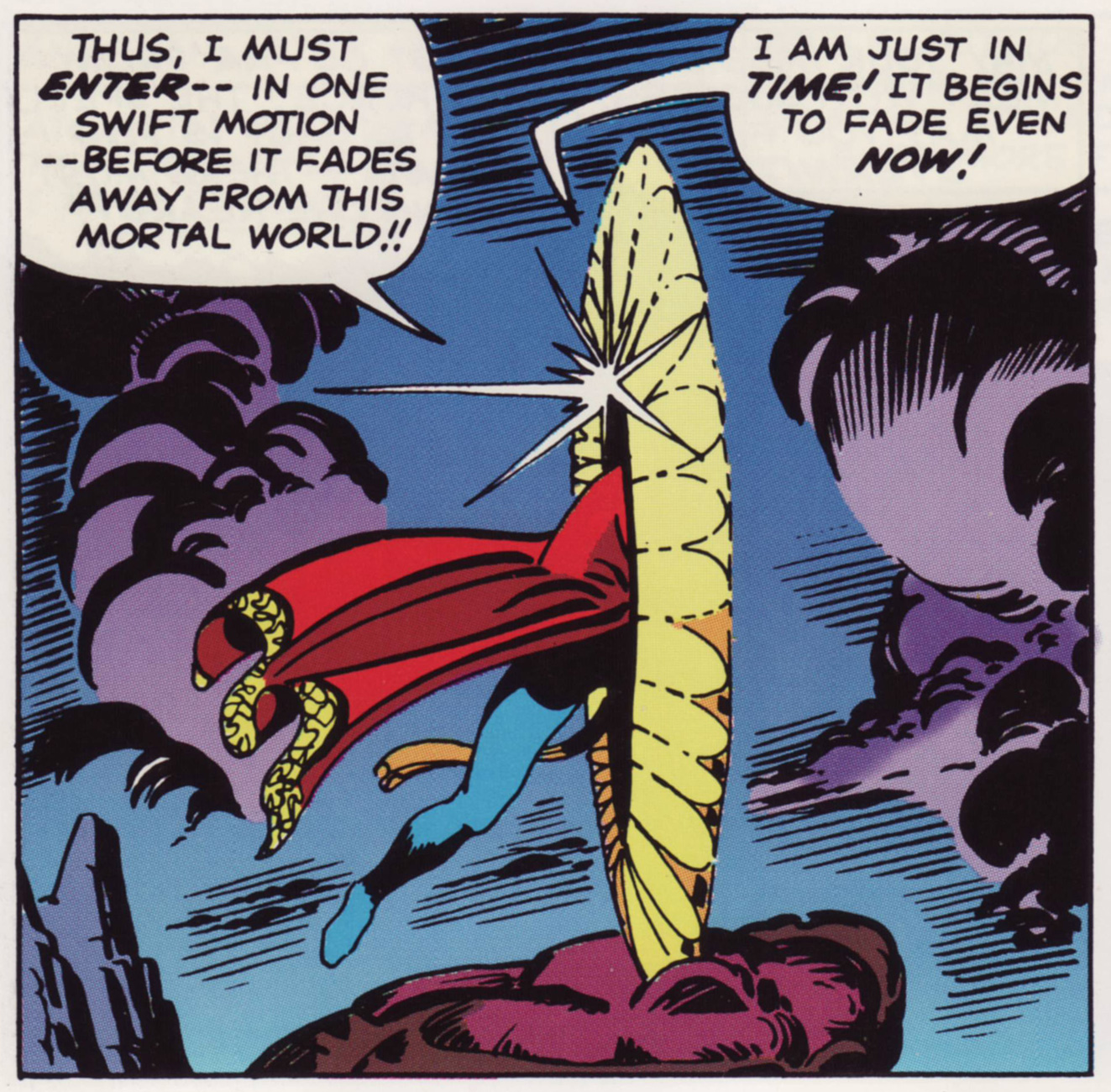
It’s Ditquotation time! In 1974, the ever-ingenious lads of legendary English art design studio Hipgnosis threw in a subtle Steve Ditko / Doctor Strange appearance in their (re)design (for the US release) of the cover of Al Stewart‘s Past, Present & Future LP in 1974. The image it quotes hails from Strange Tales no. 137‘s When Meet the Mystic Minds! (October, 1965), where the Master of the Mystic Arts seeks a doorway to Eternity. And finds it.
« I’m going nowhere with nowhere to go* »
However, according to the designers, it first leads him to the front yard of a castle depicted on Al Stewart’s following LP, Modern Times (1975). Now you guys are messing with our poor, befuddled minds.
« The blonde woman on the album cover is Pink Floyd guitarist David Gilmour’s first wife, Ginger. The Cord automobile Stewart is sitting in belonged to Led Zeppelin guitarist Jimmy Page. » And yes, there are other versions of this album cover, some of them far more familiar.
While Hipgnosis consisted primarily of Storm Thorgerson and Aubrey Powell and (later) Throbbing Gristle member Peter Christopherson, the main creative force on Past, Present & Future‘s artwork was one of the studio’s regular freelancers, Richard Manning. For those of us who love this sort of shop talk, here’s Mr. Manning’s recollection of the methods involved, in those halcyon pre-Photoshop days:
« If my memory serves me correctly, this was the first sleeve I worked on for Hipgnosis. Although, in the book ‘Walk Away Rene’ my good friend and mentor at that time,Terry Day (sadly no longer with us) is credited with working on it. A black and white montage. The figure was cut out physically and the back edges thinned and sanded and stuck in position with Columbia Cement. A Best Possible copy print was made, so now I have a flat print to work on, mounted on double weight mount board. Working to an elliptical guide on tracing paper, I carefully bleached to white the shape. Once washed and dried I then redrew some of the background with Photo Dye with a Sable brush, where the print had bleached a bit too far in the lighter areas. Finally, Permanent White was sprayed to make a sweet, soft edged shape. »
It wasn’t the first Dr. Strange reference Hipgnosis had inserted into an album cover: Pink Floyd’s A Saucerful of Secrets (the studio’s first LP cover, actually) borrows an image from the not-exactly-outstanding Roy Thomas/Marie Severin entry, The Sands of Time, from Strange Tales no. 158. Frankly, few characters have been as lost without their creator as the poor doctor has been, especially on the visual front.
Ditko’s final Dr. Strange panel (Strange Tales no. 146, The End — at Last!, July 1966) was no symbolic accident: both creator and creation were leaving the stage.
On the plus side, Al Stewart, seemingly impervious to the passage of time, remains a terrific performer and an inspired, if less prolific, songwriter. If he’s in town…
« If you did, you may find your letter printed in this book… If you haven’t written The Monkees yet, join the fun that’s going on inside this crazy, lovin’ book. »
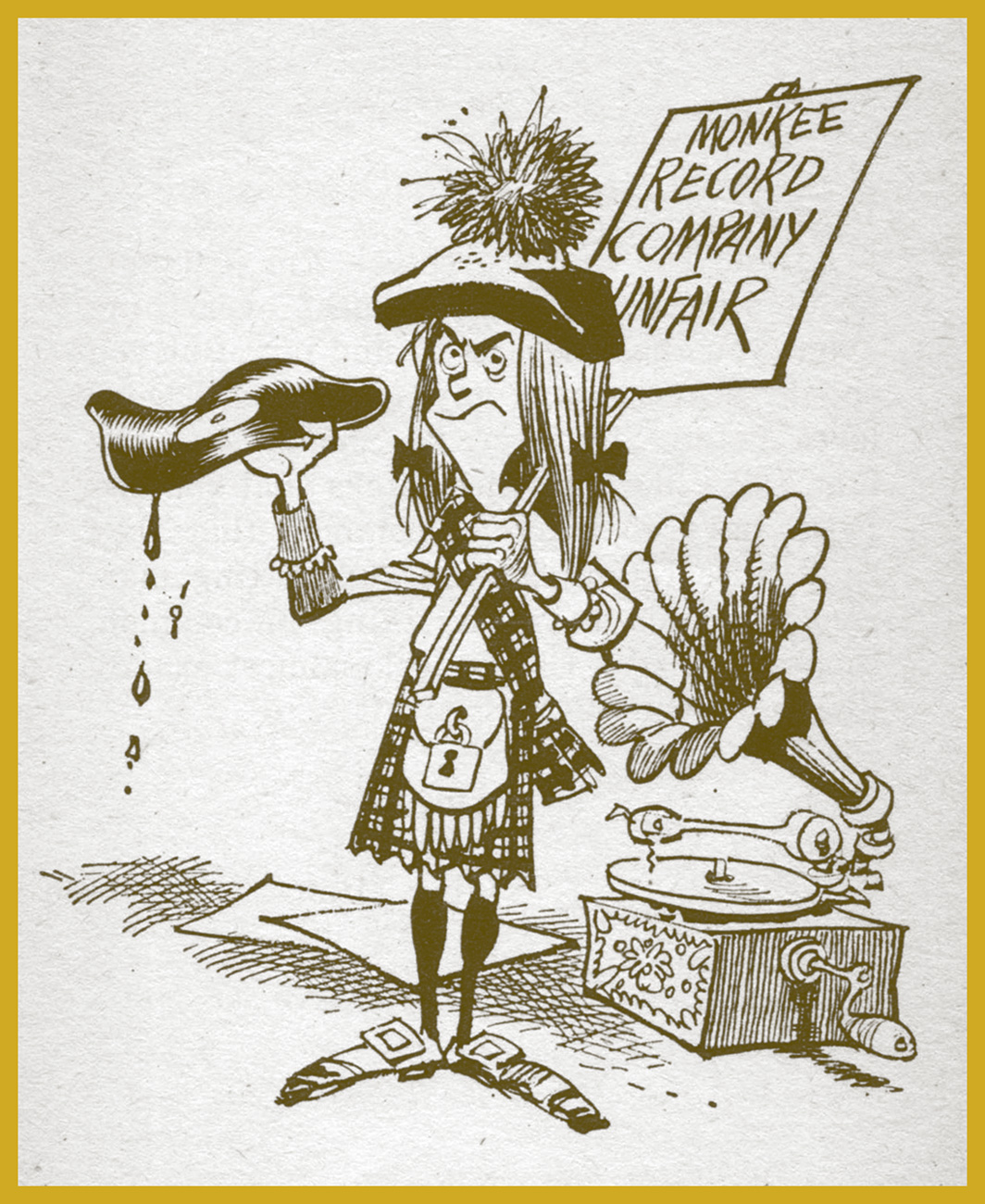
In 1967, the phenomenal Jack Davis (1924-2016), as prolific and versatile as an artist can get, provided twenty-one original cartoons and the cover to this snazzy little tome issued by the Popular Library.
Dear Davy — I am one of your greatest fans. I have all the Monkees records that have been released so far. But I have one problem. I played your first record so much that it began to melt, and now it wobbles so much that I can’t play it anymore. I know it’s not your fault, but I don’t think it’s fair that I should be punished for being such a Monkee-lover. I think the record company ought to give me my money back so I can buy a new album. You could even think of it as a kind of award for loyalty or something. Please, Davy, talk to the record company and make them send me the money? Yours truly, Diana V., Charleston, SC
Dear Mike — You know your record ‘Gonna Buy Me a Dog’? Well, if you really want a dog, I have a three-month-old Great Dane that a friend gave me six weeks ago that I have to get rid of. He’s a little too playful. Last week he knocked over my mom’s favorite vase and my kid brother. His name is Linus, but he’s not too attached to it. Your fan, Steve R., Coral Gables, Fla.
Dear Monkees — I like your group very, very much. You probably never heard of Varna. It’s a little town near Ithaca. I wrote a poem for you: I think the Rolling Stones are great, I think the Beatles are fine, On the other hand, I think the Monkees are DIVINE. Your fan, Jeannie G.
Dear Monkees — My name is Wendy. I like your records. Please send me a picture of you. I forgot all your names so please put your autographs on the pictures. Sincerely, Wendy K., Butte, MT
Dear Davy Jones — I like your shows very much. I like all your songs too. I like all your clothes and your hair. You are very very cute. You better come to Wichita or I’ll smash you one. Lover, Carol K., Wichita
Dear Monkees — Please send me Davy Jones in the mail. Send it to Cindy L, Louisville, Kentucky.
In closing, I see Micky Dolenz (b. March 8, 1945) turned seventy-three… yesterday. Happy belated birthday, Corky!
It pays to be kind to your cat, particularly if said feline happens to be more than your match. Between dimwit Fat Freddy Freekowtski and F. Frederick Skitty, esq., it’s clearly no contest.
This electrifyin’ strip first saw print in Rip Off Comixno. 23 (Rip Off Press, Summer 1989). Script and art by Gilbert Shelton.
A closer look at the wily furball, cover detail from The Fabulous Furry Freak Brothers no. 6 (Rip Off Press, 1980)
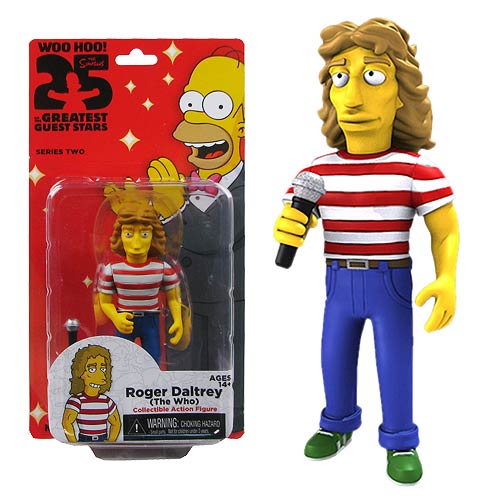
« We tend to think of age only in time, but I don’t think it has much to do with time at all; there’s a whole load of other things. I’ve met 16-year-olds who are old and 90-year-olds who are young. » — Roger Daltrey
Truly a master of all media, Roger is.
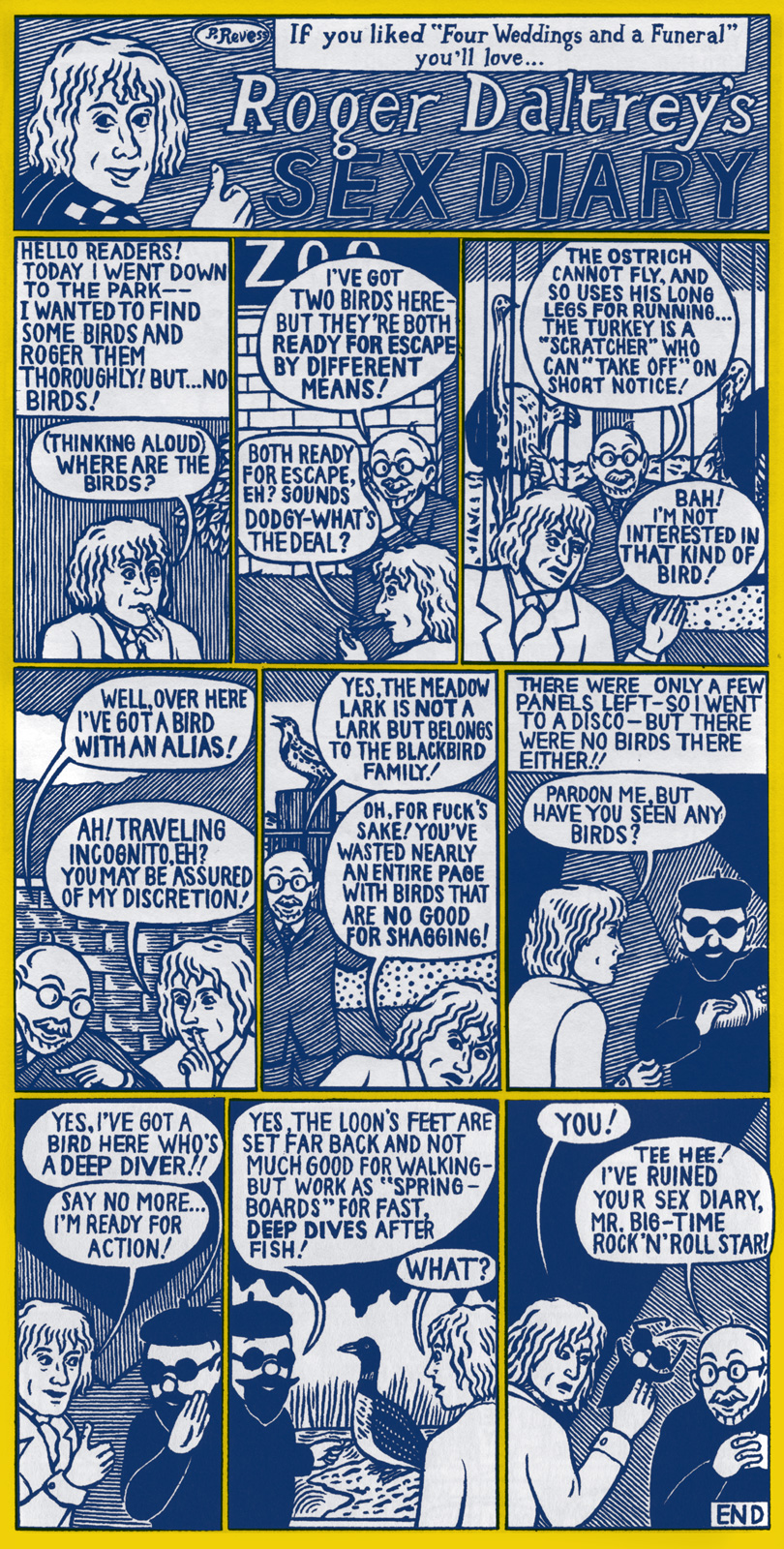
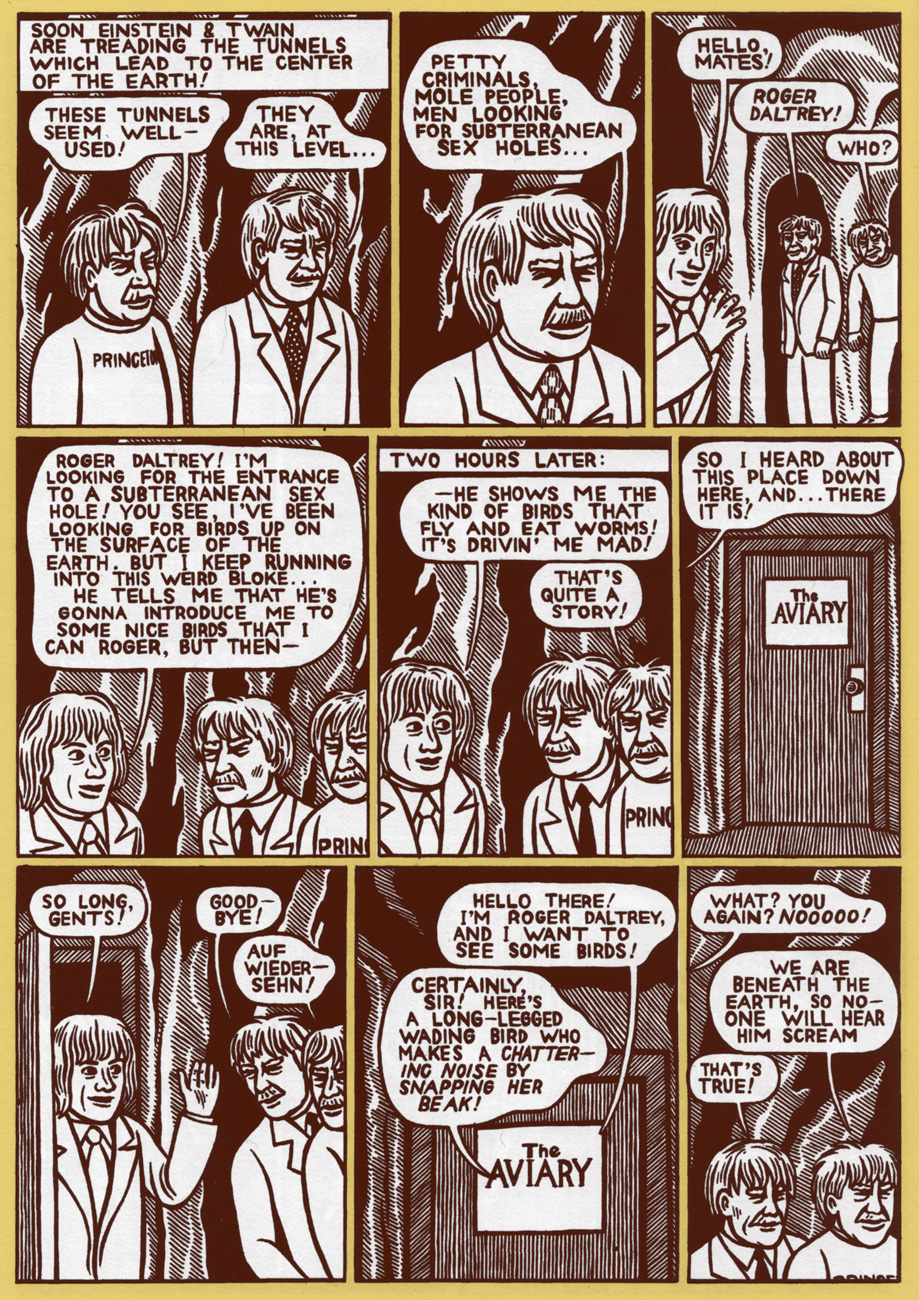
Today’s birthday number seventy-four for Sir Roger Harry Daltrey (born in London, England, on March 1st, 1944), Commander of the Most Excellent Order of the British Empire, noted thespian and lead vocalist of The Who. « And what’s this got to do with soddin’ comics? », the more boorish among you may ask. Well, thanks to the efforts of the genial Michael Kupperman, Sir Roger, and his unceasing quest for birds, have been duly immortalised in comics. Read on!
« Roger Daltrey’s Sex Diary », from Snake ‘n Bacon’s Cartoon Cabaret (2000, HarperCollins.) Story and art by Michael Kupperman, under his “P. Revess” nom de plume.
Farther along, having taken his quest below ground, our intrepid bird-rogerer encounters the dauntless duo of Mark Twain and Albert Enstein (of course!).
« SPECULATIVE PICTO-FICTION: What Might Happen if… Mark TWAIN and Albert EINSTEIN Were to TEAM UP to DIG a HOLE to the CENTER of the EARTH? », from Snake ‘n Bacon’s Cartoon Cabaret (2000, HarperCollins.) Story and art by Kupperman,
I’ve looked under chairs I’ve looked under tables I’ve tried to find the key to fifty million fables
They call me the Seeker I’ve been searchin’ low and high I won’t get to get what I’m after Till the day I die


















 Who's Out There?