« I find television very educating. Every time somebody turns on the set, I go into the other room and read a book. » ― Groucho Marx
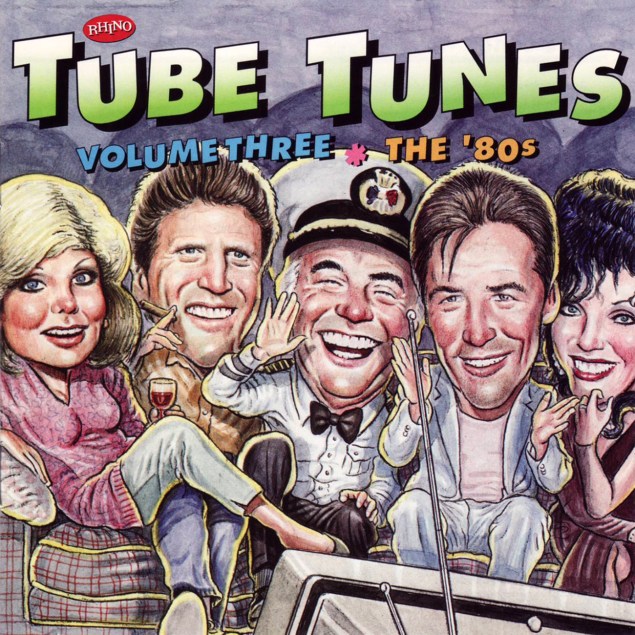
In the mid-90s, the always-discerning masterminds* at Rhino Records (they had, after all, picked William Stout to design their logo, back in 1974) called upon master satirist, caricaturist and of course pointillistDrew Friedman (1958-) to gather some perennial favourites on his old couch for the purposes of a three-volume compilation.
In this second entry in the trilogy, Mr. Friedman seems a bit out of his element, as drawing purdy gals and conventionally handsome men is hardly his forte. But he aces Gabe Kaplan, as you’d hope and expect. Judging from his expression, Gabe appreciates it.
This time, our artiste ably succeeds where he faltered earlier: he has no difficulty capturing the likenesses of Ms. Anderson and (5x so far) Mrs. Collins.
From volume 3’s liner notes: « The 1980s may well be remembered as the final decade of the television theme song. The disturbing trend of the ’90s seems to be the elimination of the title song in preference of an additional minute of commercial airtime – a sad state of affairs for fans of the opening anthem. »
Maybe it’s all for the better: I’d rather have an additional hour of commercial airtime than be subjected again to the opening jingle of, say, Charles in Charge. You have been warned.
« That’s funny… I didn’t leave the lantern lit… wonder if anybody’s in there? »
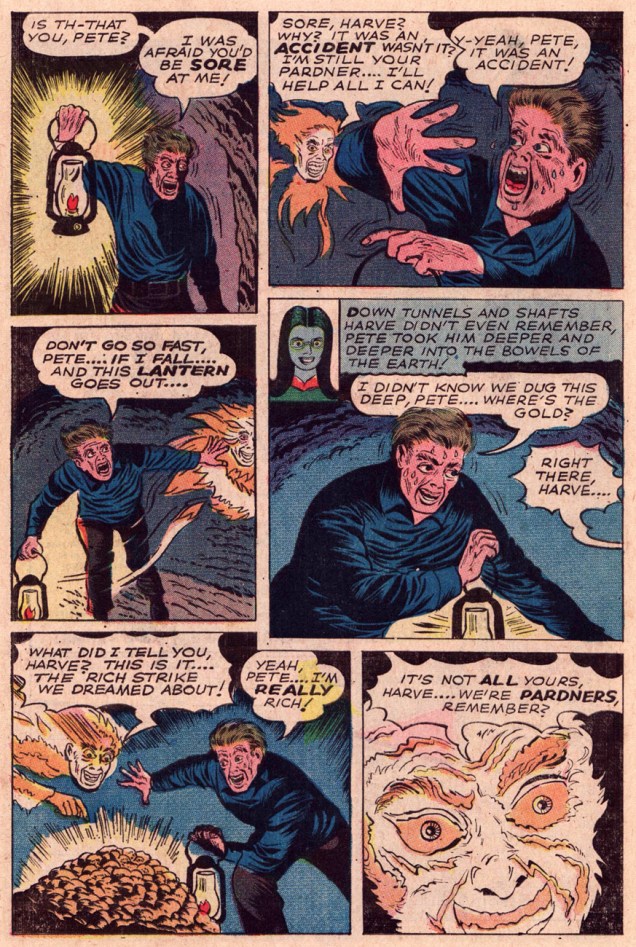
In 1972, Golden Age journeyman cartoonist Stanley Josephs Aschmeier (1912-1992) wrapped up his career in comics with a single tale for Charlton, a publisher he’d briefly worked for two decades prior*, pre-Code. Yet earlier, at DC, he’d had a hand in creating Johnny Thunder and Thunderbolt (1939) and Dr. Mid-Nite (1941), the original sight-impaired costumed hero.
While Aschmeier’s already-manic drawing style hadn’t changed much in the intervening years, the industry certainly had, which made him a man well out of time. Still, as with his peer, sudoriparous Rudy Palais‘ final work for Charlton, the nervous energy and artistic freedom yielded something unusual and charming. While this sort of semi-primitive outsider approach decidedly isn’t for everyone, it’s a breath of fresh air. I found it unsettling and baffling when I first encountered it all those years ago, and it hasn’t lost its jolt, unlike many fan favourites I could name.
Without further preamble, here’s Joe Gill and Stan Asch (his abridged nom de plume)’s tale, from Ghostly Haunts no. 27 (Nov. 1972, Charlton.)
By this point, Aschmeier had evolved (or devolved) a highly stylized, woodcut-like approach. Bizarre as it may be, it sure works for me. That’s one of my favourite things about Charlton: leave your “house style” at the door!
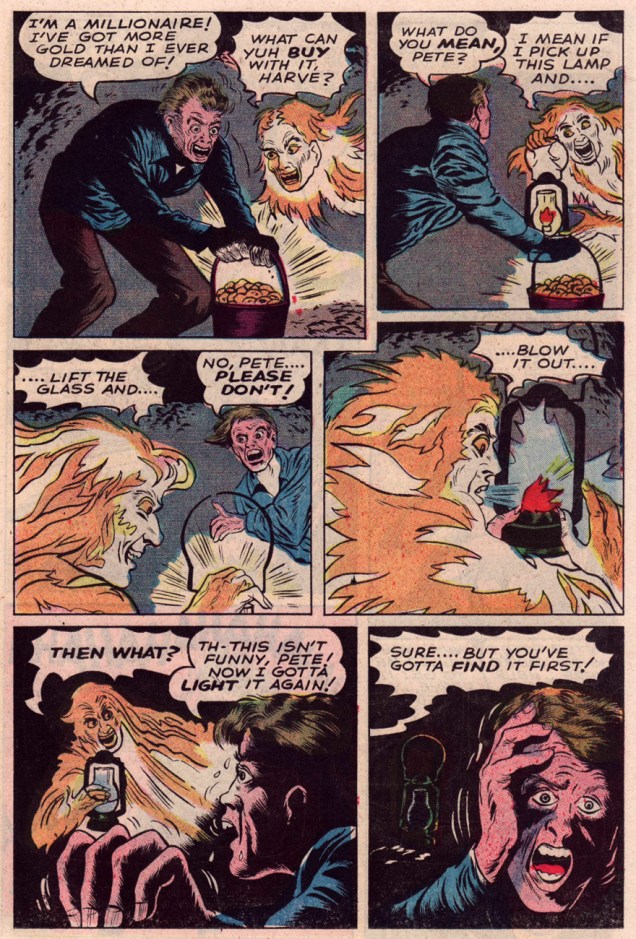
Note Aschmeier’s interesting depiction of a revenant, quite unlike Steve Ditko’s lime green, vaporous wraiths or Pat Boyette’s rotting cotton shamblers. Pete Eklund’s shade is more akin to a dancing flame, an electric apparition.
Here’s a guy who *really* gets it! That final panel is one of the most unhinged I’ve had the pleasure of encountering.
As for the story, it’s the soul of the thing: to my mind, what made writer Joe Gill’s work special was his common-sense response to the meagre number of available plots: when the mood struck him, he focused on ambiance, tone and character, as he does here.
I love that our protagonist, Harve Davis, is so shiftless, so insignificant, that the reader can’t even be bothered to hate him: throughout the story, we witness his well-earned unpopularity, and what a shabby and piteous creature he is. He murdered the only man who gave him the time of day, and he was too dense and self-absorbed to be anything but resentful of it. I do feel that the tale’s very construction supports this view: it opens on the commission of his crime, and the aftermath is a fateful tumble of dominos.
And yes, the story is narrated by Winnie the Witch, the Nana Mouskouri of the ghostly storyteller set. Many have noted the resemblance.
*For stylistic comparison, take a gander at a 1944 Mr. Terrific tale by Mr. Aschmeier, and some of his crime comics work from Lawbreakers Suspense Stories no. 14 (Sept. 1953, Charlton), featuring three Aschmeier-illustrated pieces, Flight!, The Green Light and The Face in the Glass. Enjoy!
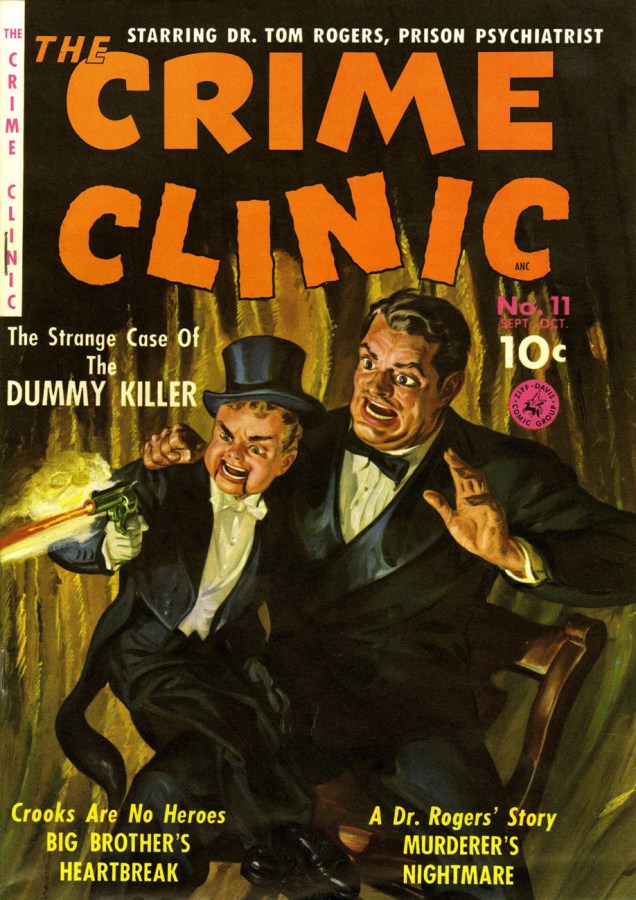
« Now, Carlos — put that gun away! »
« Why, Fernando, I thought I’d start the show with a bang! »
That guy in the audience with the irritating donkey laugh is finally getting his. This unforgettable cover is the work of the peerless Norman Saunders, whose long and prolific career blazed its way through pulps, comic books, slicks, men’s adventure magazines, paperbacks, trading cards… you name it!
This is Ziff-Davis’ The Crime Clinic no. 11 (actually its second issue, September-October 1951). And for once, the inside story kind of matches the cover mayhem.
C’est un fou qui repeint son plafond et un autre fou arrive et lui dit: « Accroche-toi au pinceau, j’enlève l’échelle!*»
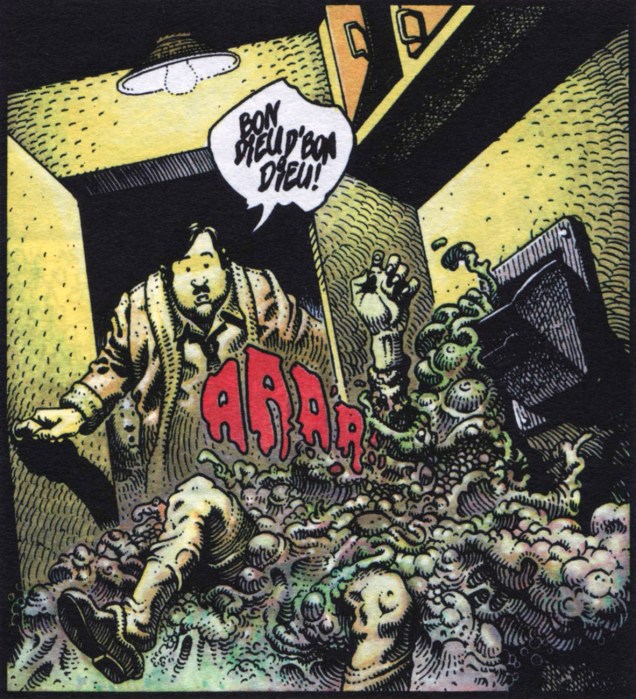
Marcel (and the hapless Yvonne) meet the Homo-Detritus. From Pilote no. 47-bis (April, 1978)
Poor Marcel Miquelon: a simple suburban nobody, he merely wants to get a good night’s sleep, but it’s never in the cards. When he and his Yvonne go to bed, each night at 10, some din from above invariably keeps him awake and frustrated. So what can he do but seize his faithful broom by the handle and bang on the ceiling to manifest his discontent? And dreadful things happen, in increasingly byzantine shades of dreadfulness.
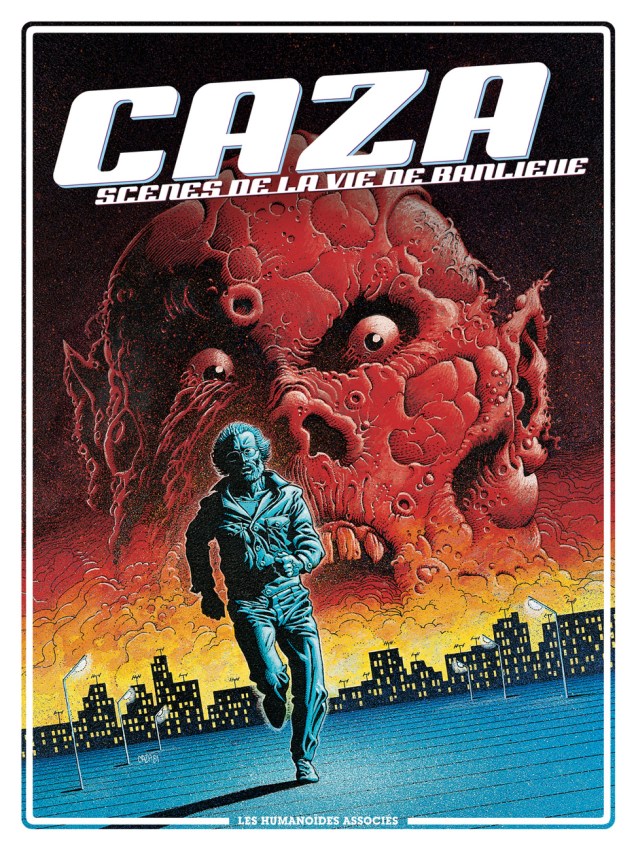
These loosely-connected vignettes appeared sporadically from 1975 to 1979, under the portmanteau heading of Scènes de la vie de banlieue in the French monthly Pilote (1974-1989). They were the brainchild of Philippe Cazaumayou, alias Caza (b. November 14, 1941, Paris), also a renowned science-fiction illustrator, which should certainly surprise no-one.
This episode is titled Toujours du bruit au plafond (« Still some noise on the ceiling »); it originally saw print in Pilote Mensuel no. 34 (March, 1977). It’s the rare (possibly the only) one that ends peacefully for Marcel, perhaps because he didn’t bother with the broom. Better St. Peter than… well, everything else.
*One of the hoariest French jokes, everyone’s heard it, and its appeal has whirled countless times around the bend, deep into irony and meta-subtext. Thankfully, though, it’s actually translatable, at least verbally: A lunatic is painting the ceiling. Another madman comes along and says: « Hold on to the brush, I’m borrowing the ladder! »
A ‘Scènes de la vie de banlieue’ collection (Dargaud, 1982). I agree: for all he’s gone through, Marcel Miquelon does deserve his own statue.The collected works (Les Humanoïdes associés, 2017)
« Last year I went fishing with Salvador Dali. He was using a dotted line. He caught every other fish. » — Steven Wright
In 1974, prodigious underground cartoonist Rick Griffin was commissioned to design a cover for Welsh rockers Man’s ninth opus… and this is what he came up with.
The original version of Griffin’s proposal, cheekily titled « The Baptism of Alfred E. Neuman. »
While the image of the grinning fool popularly known as Alfred E. Neuman was, and remains in the public domain, Griffin was really pushing his luck, even without MAD Magazine’s distinctive typeface on bold display. Let’s just say William M. Gaines’ lawyers had far more than a leg to stand on.
Understandably reluctant to let such a lovely *and* provocative work of prime Griffin altogether go to waste, Man (and their legal counsel, presumably), engineered a clever and elegant design solution, shown below, which graces the band’s Slow Motion album, issued in late 1974, and still thumbs its nose at MAD Magazine, exceptionally cast in the thankless rôle of the fuddy-duddy villain.
However, here’s an account — circa 2023 — I recently discovered that casts the matter in a whole new light: « John Peel made ‘Day and Night‘ his Single of the Week in Sounds, but it was the album cover that attracted most comment. American counterculture artist Rick Griffin had come up with a design that prominently featured Mad magazine character Alfred E. Neuman, only for the cover to be subsequently cropped so that Mad’s cover boy was merely a peripheral presence. For years it was claimed that Mad had refused permission for Neuman to be shown, but it now appears they had actually given tacit verbal approval, and that it was the record company, United Artists, who made an executive decision to censor the design without contacting the magazine. »
This illuminating bit appears in David Wells’ (of Cherry Red Records) exhaustively researched — and exquisitely written — liner notes to Grapefruit Records’ Patterns on the Windows: The British Progressive Pop Sounds of 1974 boxed set. Recommended, as is the rest of this chronological series.
As a born-again Christian (circa 1970) *and* surfer, it follows that fish were, topic-wise, a natural fit for Griffin.
A painting from Griffin’s foremost undertaking of the 1970s, « The Gospel of John » (available to this day!); this one illustrates John 21:6, « And he said unto them, cast the net on the right side of the ship, and ye shall find. They case therefore, and now they were not able to draw it for the multitude of fishes. »
For the record, I prefer my fish alive and swimming free.
« That minuscule ogre on the throne must be the King. What a peculiar little man. »
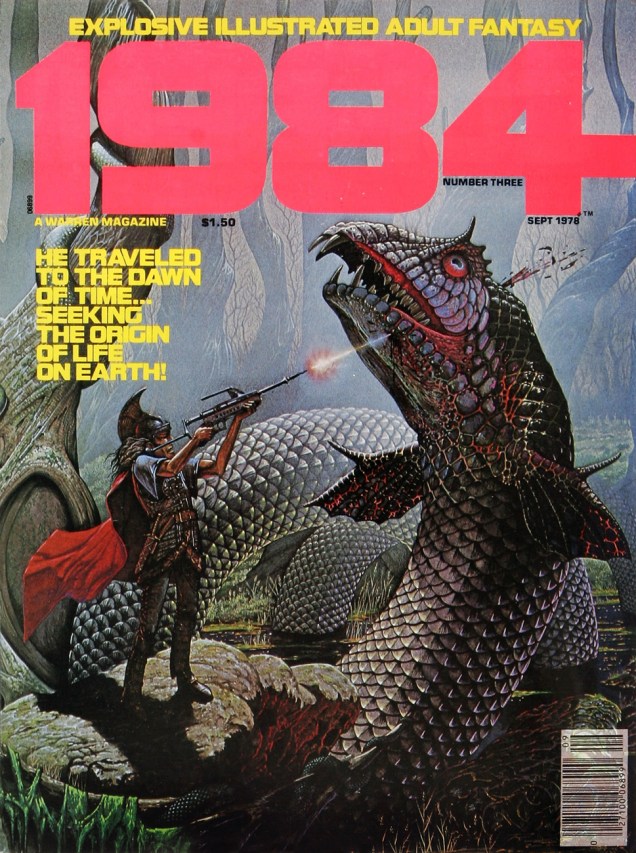
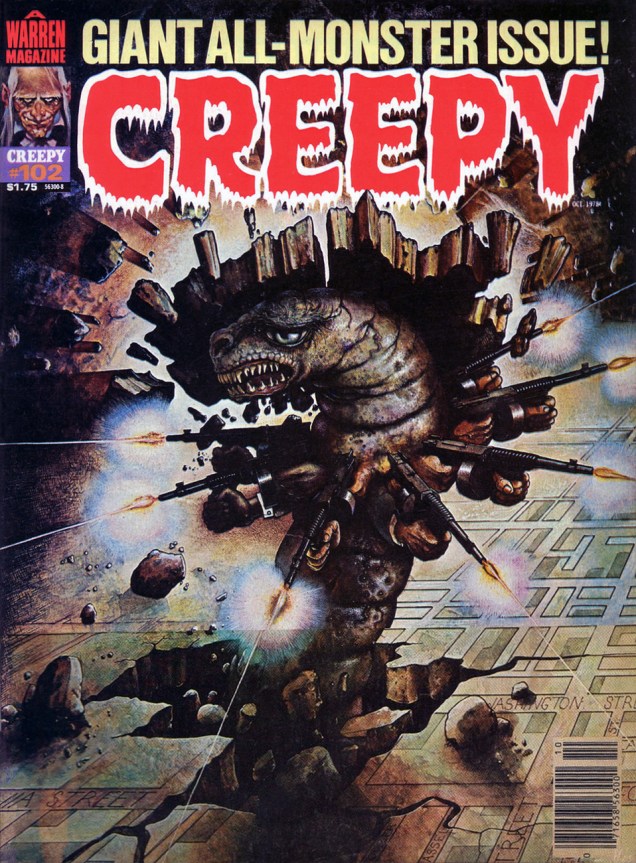
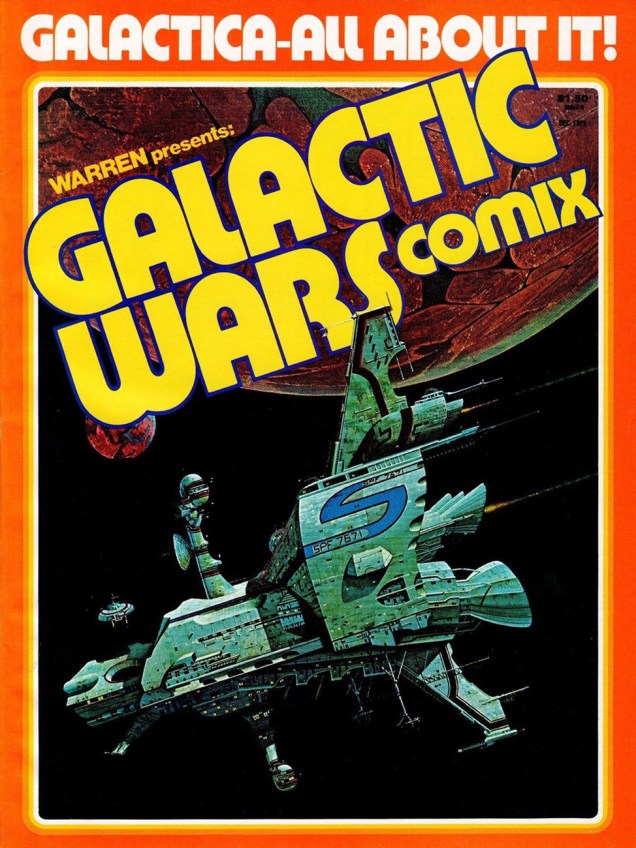
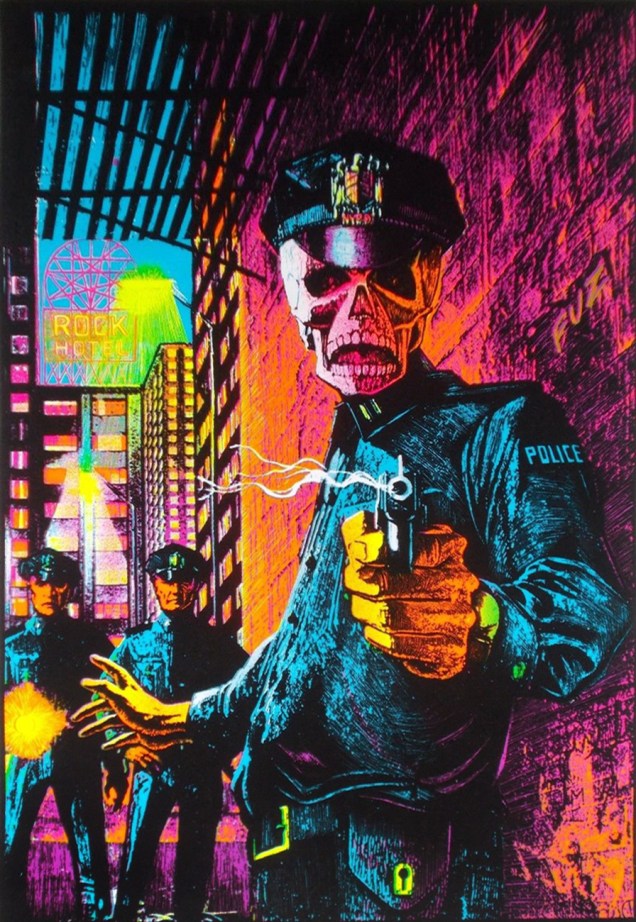
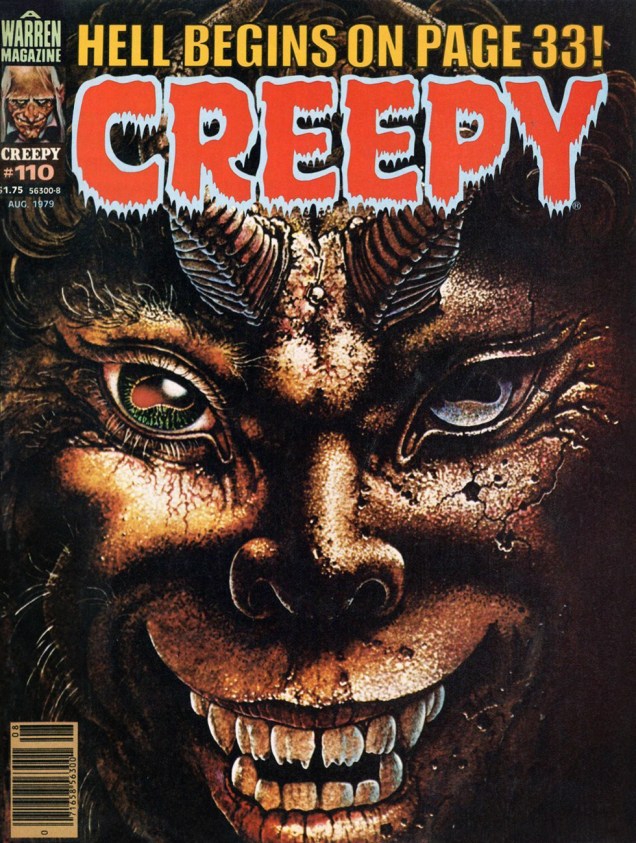
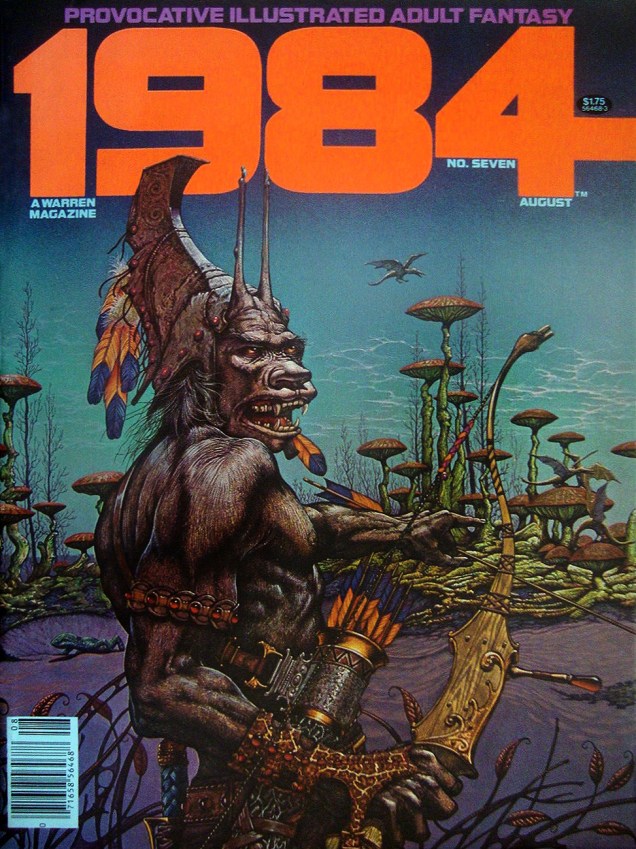
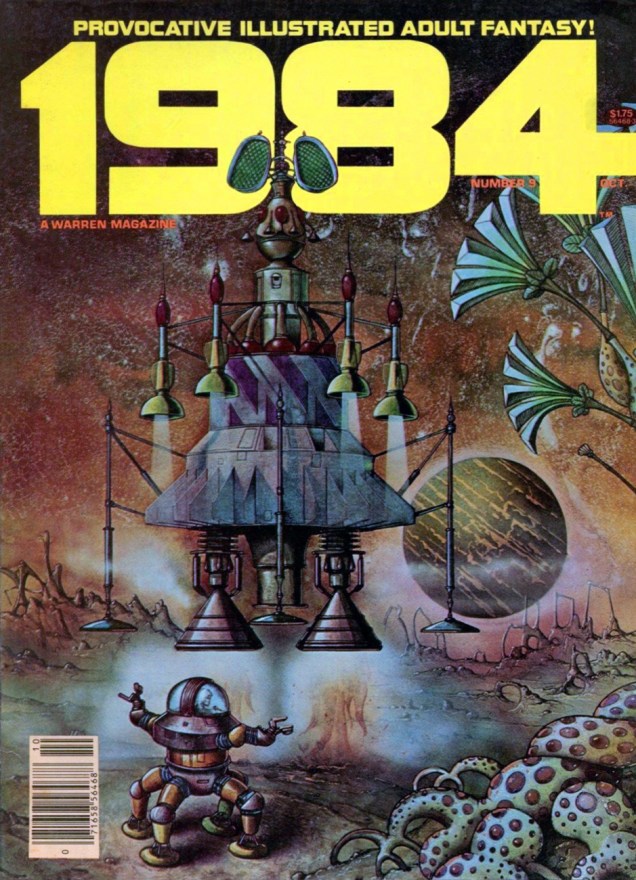
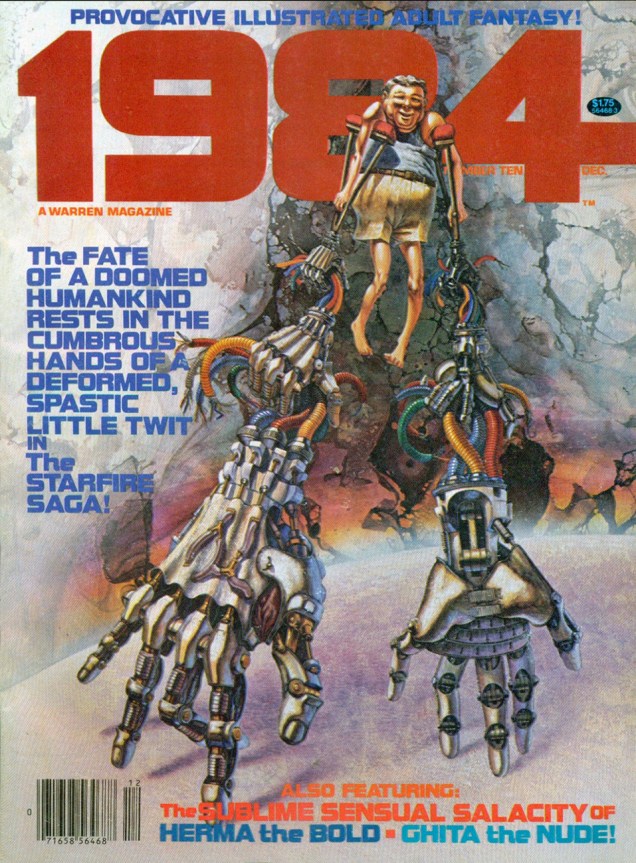
In 1978-79, the rightly-celebrated English fantasy artist Patrick James Woodroffe (b. Halifax, West Yorkshire, on October 27, 1940; d. May 10, 2014), fresh from his high-profile paperback (much Moorcock!) and album cover assignments (including Judas Priest’s splendid Sad Wings of Destiny), hired out his talented brush with Warren Publishing long enough to produce ten covers, a varied, eye-catching and often unusual lot. Let’s make the rounds, shall we?
« He isn’t a *bad* sort. He just lets his temperamental gonads get the best of him! » Using a laser rifle on a dragon? Hardly seems sporting, does it?
Here we make the acquaintance of a memorably omnidextrous lepidopteran gunner. This is Creepy no. 102 (October, 1978). Read the entire issue here: https://archive.org/stream/warrencreepy-102/Creepy_102#page/n91/mode/2upOne of Warren’s post-Star Wars, all-reprint cash grabs of the era… but it’s got a Woodroffe cover.Eerie no. 98 (January, 1979) Likely the darkest of the set in terms of subject matter. Visually, it certainly brings to mind the visual vibe of John Carpenter’s They Live, still nearly a decade away.Interestingly, the piece has also made the rounds, in a modified version (flipped, for one thing), as a “black light” poster titled « In the Name of the Law ». Speaking of the law, was the artist duly compensated?Don’t mess with the Surly Smurf! This dusky scene is dated 1975, so it’s safe to assume it wasn’t created expressly for this publication. This is Warren’s 1984 no. 5 (February, 1979.) Aside from the usual sex fantasies and space operetta from the usual suspects, the issue holds a single nonpareil gem, Nicola Cuti’s I Wonder Who’s Squeezing Her Now?, gorgeously brought to life by Ernie Colón and Wally Wood.« You may think this all strange nonsense; it may be strange, but it is true, and the ancients knew what lifting the veil means. They called it seeing the god Pan. » — Arthur Machen With his second and final Creepy cover (no. 110, August, 1979), Woodroffe lifts the veil, and how, on a troubling closeup of a gleefully sinister Greek God of the Wild.« Well, if that ain’t about the unfriendliest thing I’ve ever heard of… » 1984 no. 7 (August, 1979.)Aw, missed your ride home. This is 1984 no. 9 (October, 1979.)As it turns out, one couldn’t have picked a better artist to depict « the cumbrous hands of a deformed, spastic little twit », though he seems like a sweetheart, really. On this whimsical note ends our survey of Mr. Woodroffe’s Warren covers. This is also the last issue of 1984 under that title; it would leap a decade ahead to “1994” and carry on for another nineteen issues.
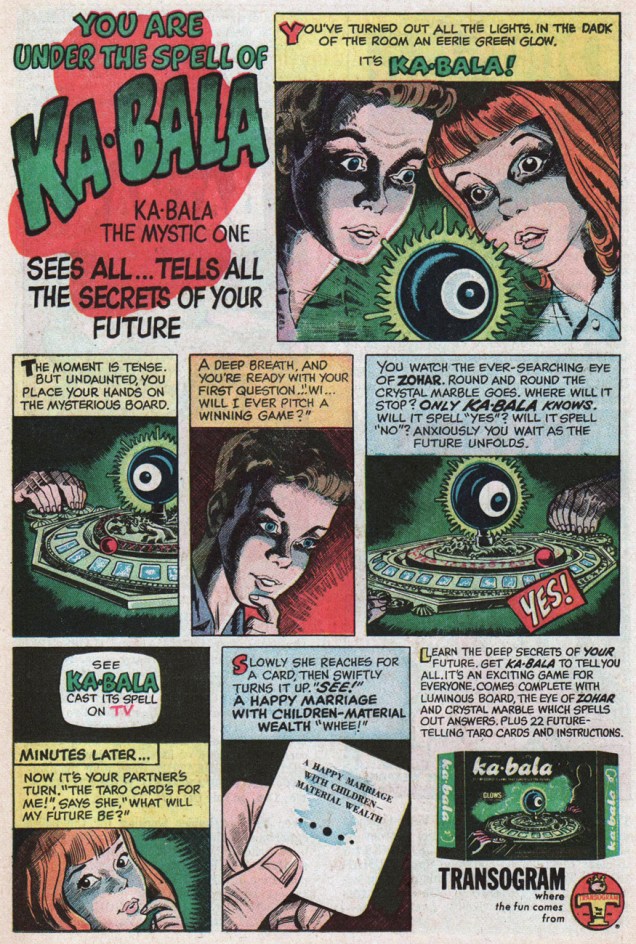
A 1968 ad full of spooky, green-glowy fun for the kiddies. An… interesting appropriation of Jewish mysticism. After all, Zohar and Kabbalah don’t really fall within the usual range of docile toy industry gibberish, straying closer to the realm of sideshow hucksterism, with its fortune-telling automatons.
Wikipedia tells us: « The Zohar (Hebrew: זֹהַר, lit. “Splendor” or “Radiance”) is the foundational work in the literature of Jewish mystical thought known as Kabbalah.
There are people of religions besides Judaism, or even those without religious affiliation, who delve in the Zohar out of curiosity, or as a technology for people who are seeking meaningful and practical answers about the meaning of their lives… »
It’s hard not to draw a parallel between this toy’s name and eerie oculus and Charles Burns‘ Big Baby tale of a « Teen Plague » (from Raw vol. 2 no. 1, 1989). Be careful out there, kids!
« Taste the Kiss of the Almighty Kaballa-Bonga! »I know, Mike. I can hardly believe it either.
« Modern technology has tripled the life expectancy of the professional insulter »
It was forty-eight years ago today, which is to say Thursday, April the 20th, 1970, when a certain short, dumpy, cheap-cigar-chomping 1500-year-old green witch first crash-landed into the funny pages, though we wouldn’t know she was green until that Sunday.
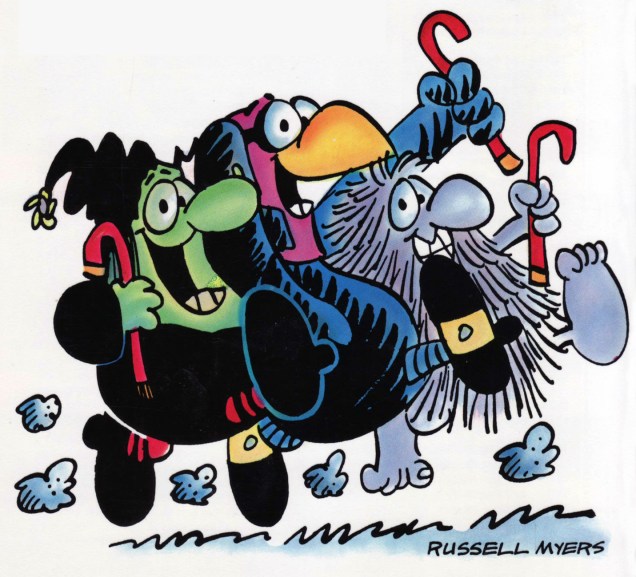
The cast’s principal players: Broom-Hilda, Gaylord Buzzard and Irwin Troll. Colour by Barbara Marker.
Russell Myers‘ (born October 9, 1938 in Pittsburg, Kansas, and still with us) Broom-Hilda has been easy to take for granted… it’s never been a trendy strip, but it’s always had its adherents, a somewhat enlightened, or at least less dim than average, passel of loonies, to which I proudly belong.
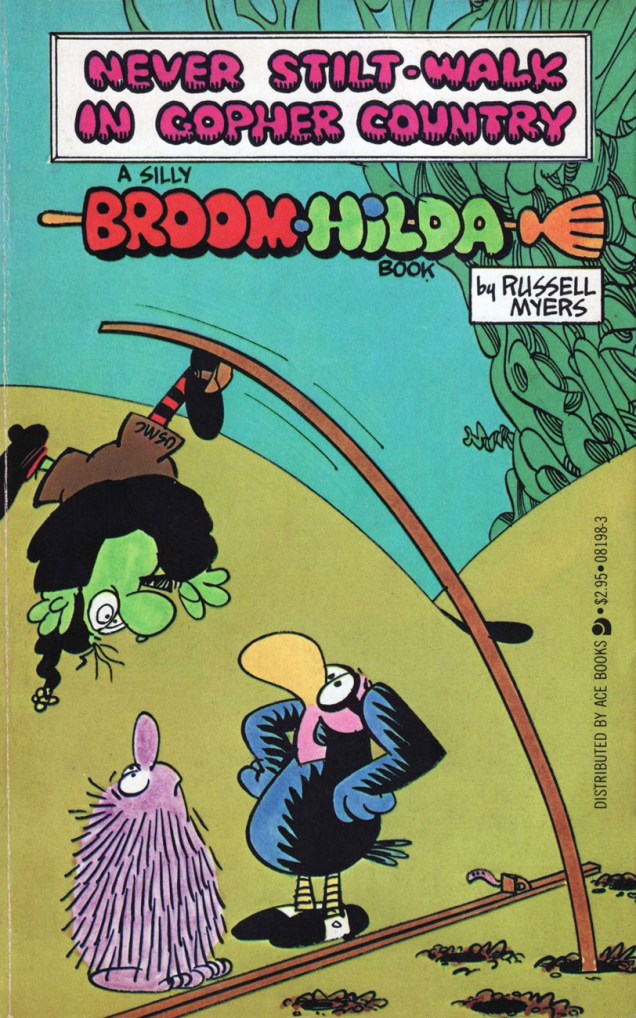
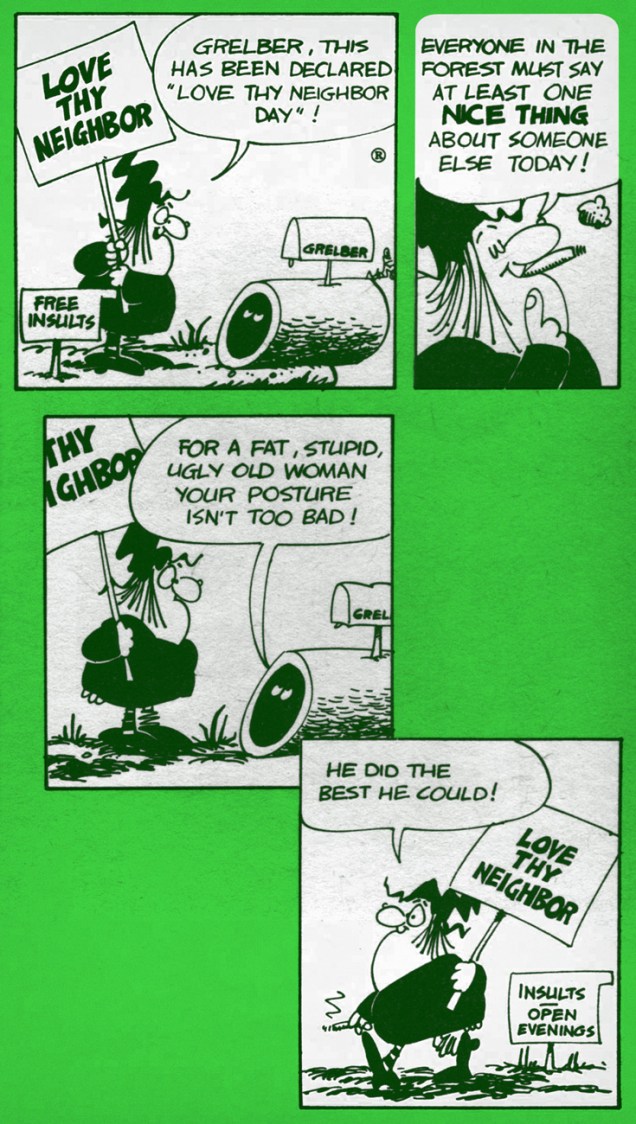
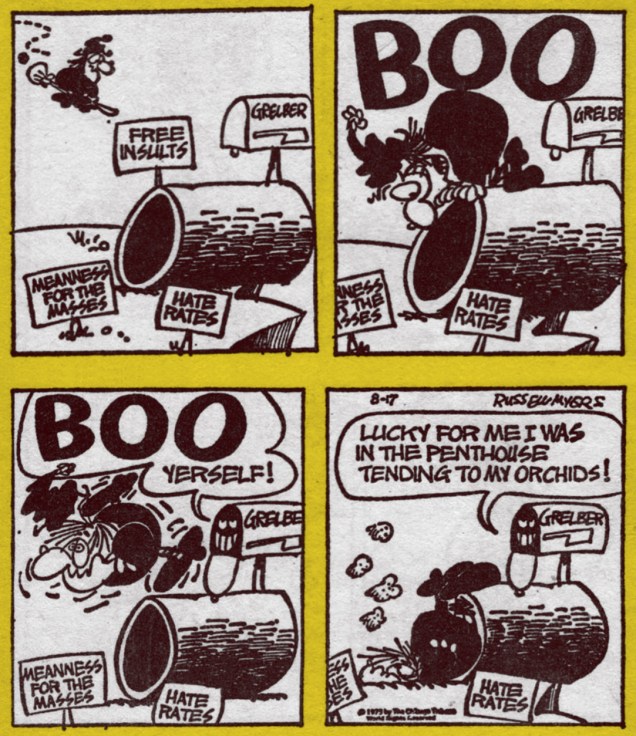
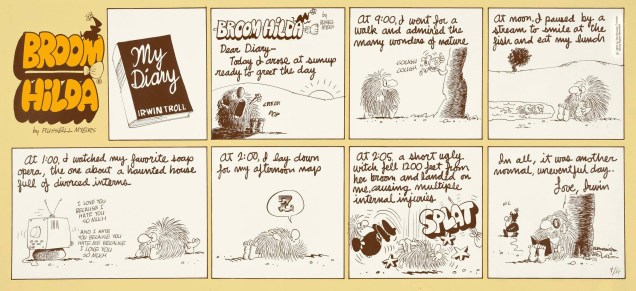
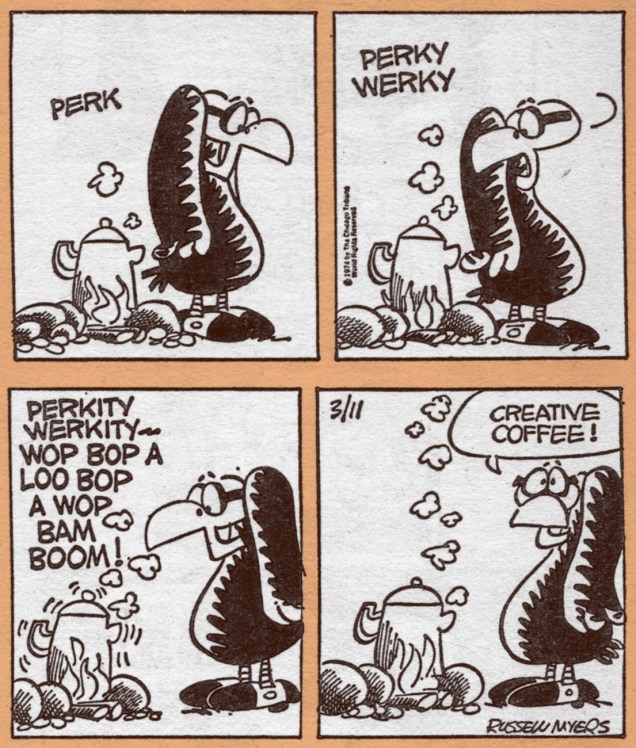
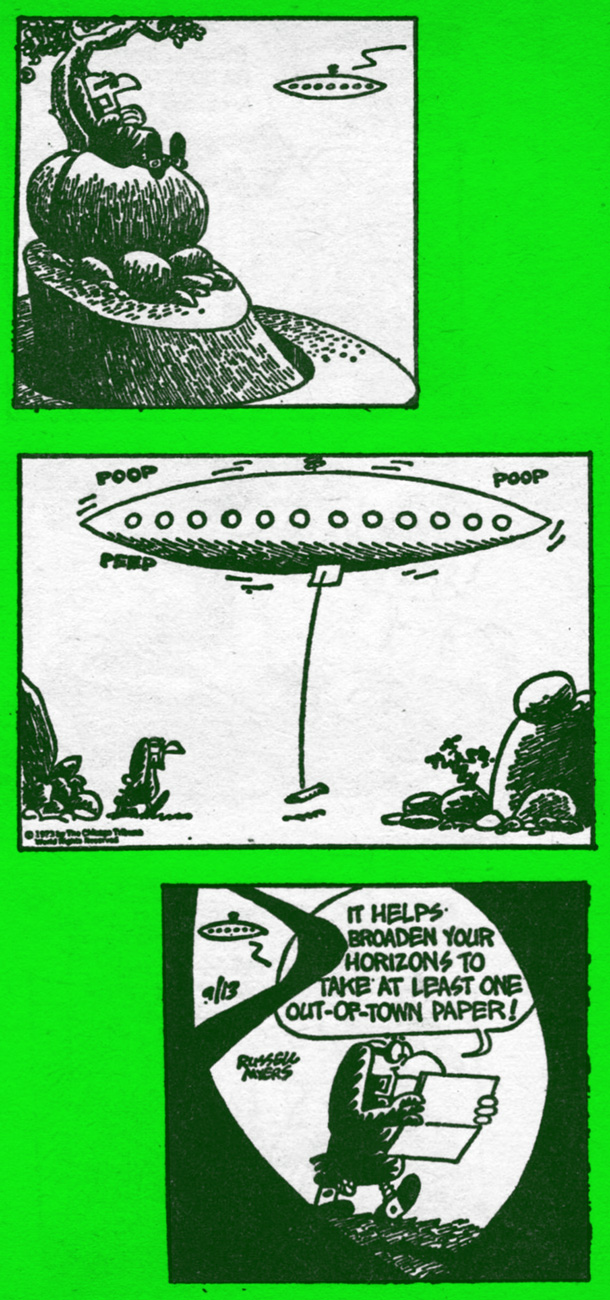
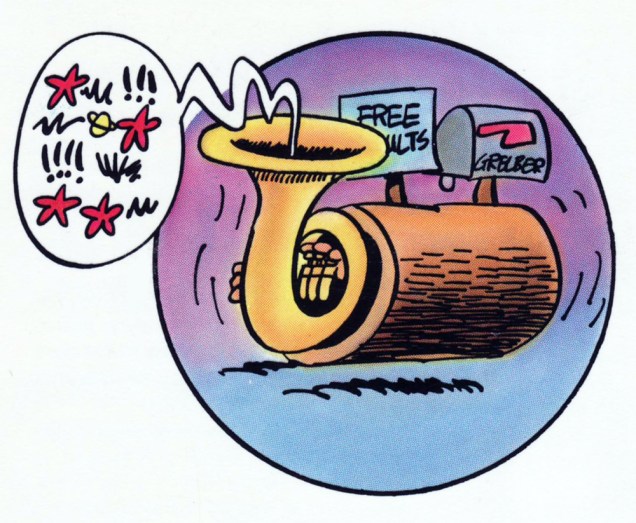
One of my favourite B-H collections… an oversize one-shot issued in 1978. And don’t let the subtitle throw you: *all* Broom-Hilda books are profoundly silly.An undated strip from 1970.Grelber always gets the last laugh. August 17, 1973. Bet you never knew that Grelber shared a genteel hobby with Nero Wolfe.This Sunday strip comes from just about a year into the run, April 4, 1971, back when Broomie still was allowed to enjoy all of her little hobbies. A day in the life of the resilient Irwin Troll, Mother Nature’s Personal Friend.Low-key and surreal, the March 11, 1974 strip. Pour me a cup of that jaunty java!Wise words from the strip’s resident intellectual, Gaylord Buzzard (Sept. 13, 1973)
Over the long years, the changing times and the powers-that-be had Broomie clean up her act, stripping her of her beloved vices one after the other. Well, she’s held on to her gluttony and lust, but no longer indulges her passion for third-rate tobacco and beer. Still, since there was so much more in the strip’s DNA, the eschewing of Broomie’s low-down habits was not fatal.
The author as he appeared in 1985’s Broom-Hilda Book One (and only), in the “Blackthorne’s Comic-Strip Preserves” series. « To retain this standard of madness requires a good deal of sane and sensible methods. The gags don’t just occur to Russell; he creates them. Like all humorists, he observes where others only look. Others see a man going through a revolving door, Russell sees a man stuck in a revolving door. Perverse, perhaps, but perversity is the trigger of humor. Why else do we laugh at a man stepping into a manhole? »
« Once there was a fellow and his name was Buzz He was just a rookie cop, just a baby Fuzz He patrolled the Sunset Strip in the land of the free and the home of the hip He protected you and me until he met a girl called Alice D
Alice was the girl that all the hippies dread And they called her Sweet Alice the Head Alice it was plain to see was full of pot and STD She’d attract a great big crowd because her inner peace was much too loud »
Biff Rose, “Buzz the Fuzz” (1968)
This day in history: On April 16, 1943, the hallucinogenic effects of LSD were discovered.
Here’s an account of the event, from the folks at History.com:
In Basel, Switzerland, Albert Hofmann, a Swiss chemist working at the Sandoz pharmaceutical research laboratory, accidentally consumes LSD-25, a synthetic drug he had created in 1938 as part of his research into the medicinal value of lysergic acid compounds. After taking the drug, formally known as lysergic acid diethylamide, Dr. Hofmann was disturbed by unusual sensations and hallucinations. In his notes, he related the experience:
« Last Friday, April 16, 1943, I was forced to interrupt my work in the laboratory in the middle of the afternoon and proceed home, being affected by a remarkable restlessness, combined with a slight dizziness. At home I lay down and sank into a not unpleasant, intoxicated-like condition characterized by an extremely stimulated imagination. In a dreamlike state, with eyes closed (I found the daylight to be unpleasantly glaring), I perceived an uninterrupted stream of fantastic pictures, extraordinary shapes with intense, kaleidoscopic play of colours. After some two hours this condition faded away. »
After intentionally taking the drug again to confirm that it had caused this strange physical and mental state, Dr. Hofmann published a report announcing his discovery, and so LSD made its entry into the world as a hallucinogenic drug. Widespread use of the so-called « mind-expanding » drug did not begin until the 1960s, when counterculture figures such as Albert M. Hubbard, Timothy Leary and Ken Kesey publicly expounded on the benefits of using LSD as a recreational drug. The manufacture, sale, possession, and use of LSD, known to cause negative reactions in some of those who take it, were made illegal in the United States in 1965.
The genial Dr. Hofmann.
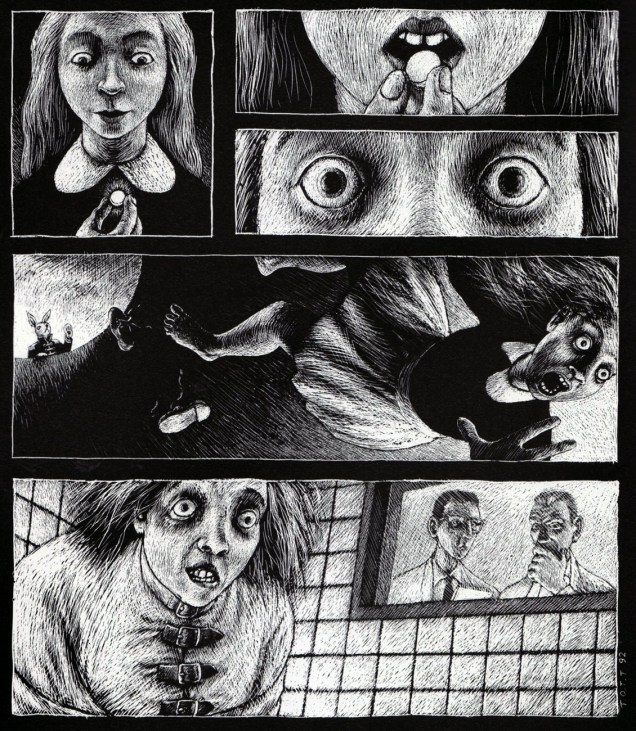
As a little digestif for the history lesson, here’s a poisoned bonbon from Thomas Ott (b. 1966, Zurich… a mere 76 km from Basel!), a proven meister of both comics storytelling and of the singularly exacting technique of scratchboard. This is Ott’s highly condensed and updated version of Lewis Carroll’s Alice’s Adventures in Wonderland, “Alice”, from 1992. I wouldn’t advise its use in preparing a book report.
Just this once, inquisitive English-speakers won’t be left out in the cold or reaching for their translation dictionaries, as Ott’s work is mostly mute, the only text appearing incidentally on newspapers, signs and assorted objects, and in English at that.
Ott’s chosen milieu is the perpetual nighttime of American film noir (which in turn comes from the French roman noir, a term first used in the 1700s to describe British gothics, becoming synonymous, in the 20th century, with bleak crime novels), so the headlines and billboards are in Inglés. In addition to the classic noir recipe, the Swiss artisan injects a discreet but usually lethal dose of his quite sardonic wit.
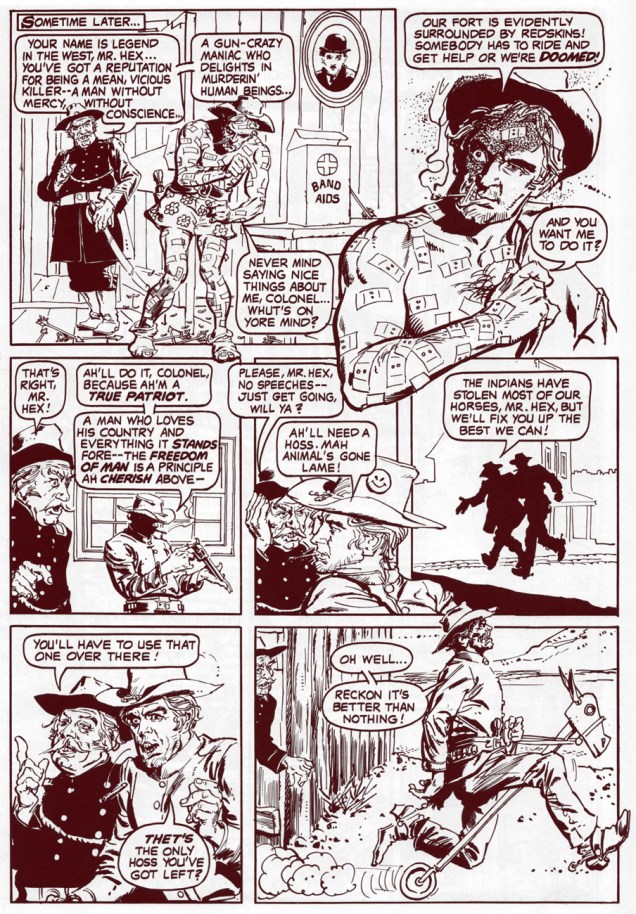
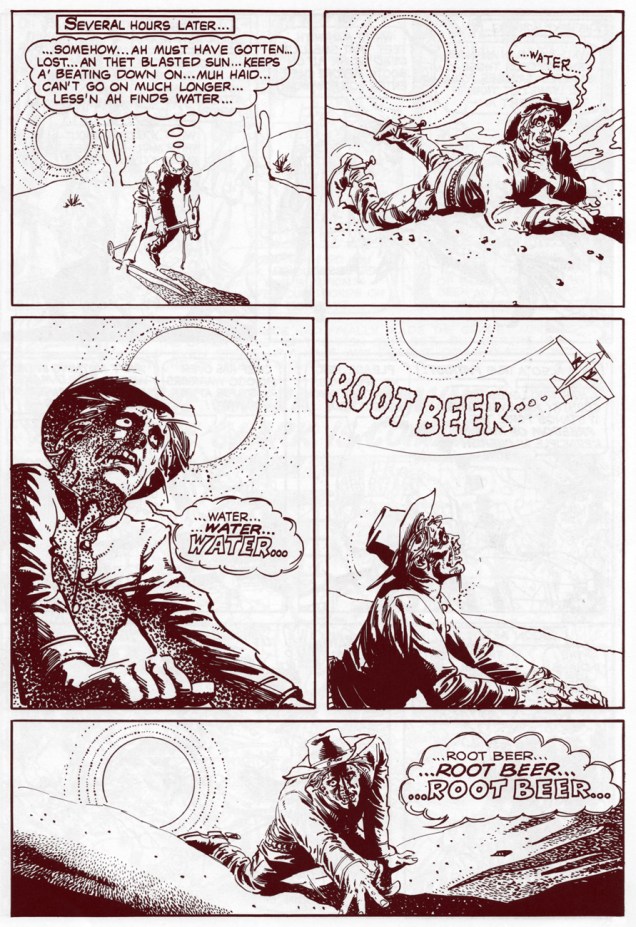
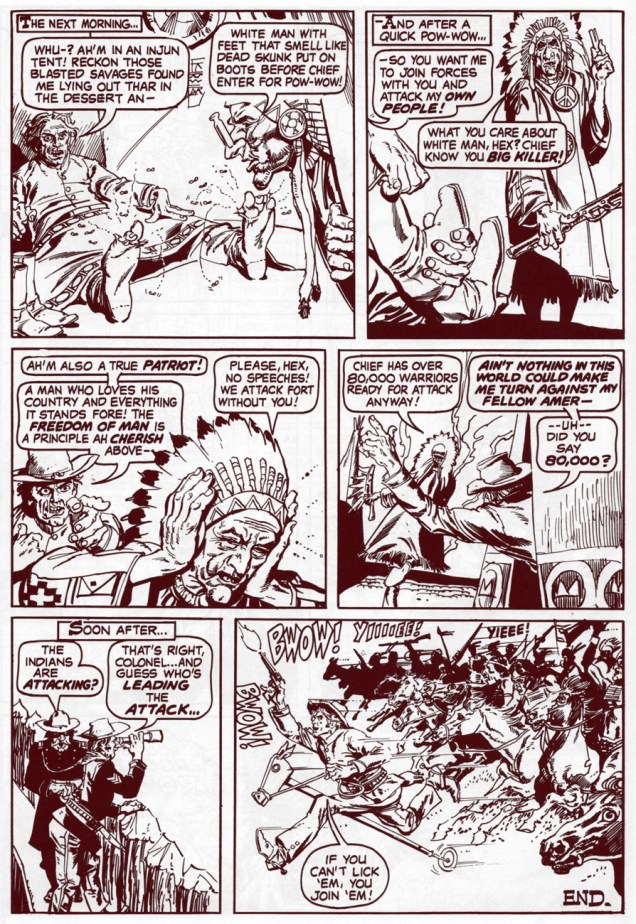
Jonah Hex originators John Albano (1922-2005) and Tony DeZuniga (1941-2012) take the piss out of their boy in a little tale that was, according to Paul Levitz, intended for a (self) parody title provisionally titled Zany (having cycled through the tentative monikers Black Humor and Weird Humor), and that never saw the light of day… This feature was the only one completed for the abortive endeavour, and it saw print in the Plop!-themed issue of The Amazing World of DC Comics (October, 1976), its thirteenth, of course. Incidentally, Plop!’s own cancellation was announced in that very issue of AWODCC. Bummer.
Why, yes… now that you mention it, an ice-cold root beer *would* be nice.« Lying out in the ‘dessert‘ », Jonah? That was either a root-beer float mirage or a careless letterer’s oversight.
I would be earning myself a sound flogging if I didn’t share Sergio Aragonés‘ adroitly-done cover, so here it is.







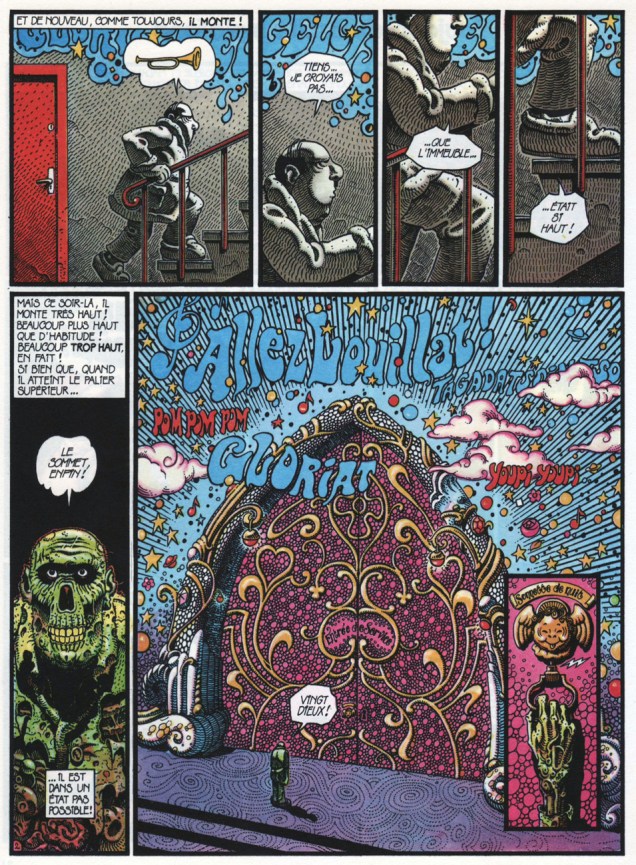

 This episode is titled Toujours du bruit au plafond (« Still some noise on the ceiling »); it originally saw print in Pilote Mensuel no. 34 (March, 1977). It’s the rare (possibly the only) one that ends peacefully for Marcel, perhaps because he didn’t bother with the broom. Better










 Who's Out There?