« Gosh, if only Dad would inject me with some of that!* »
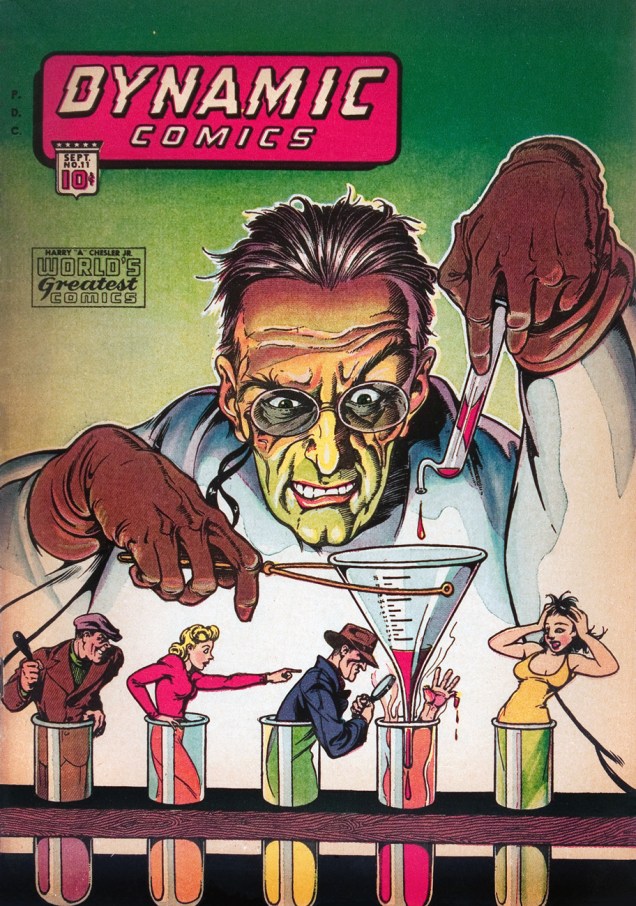
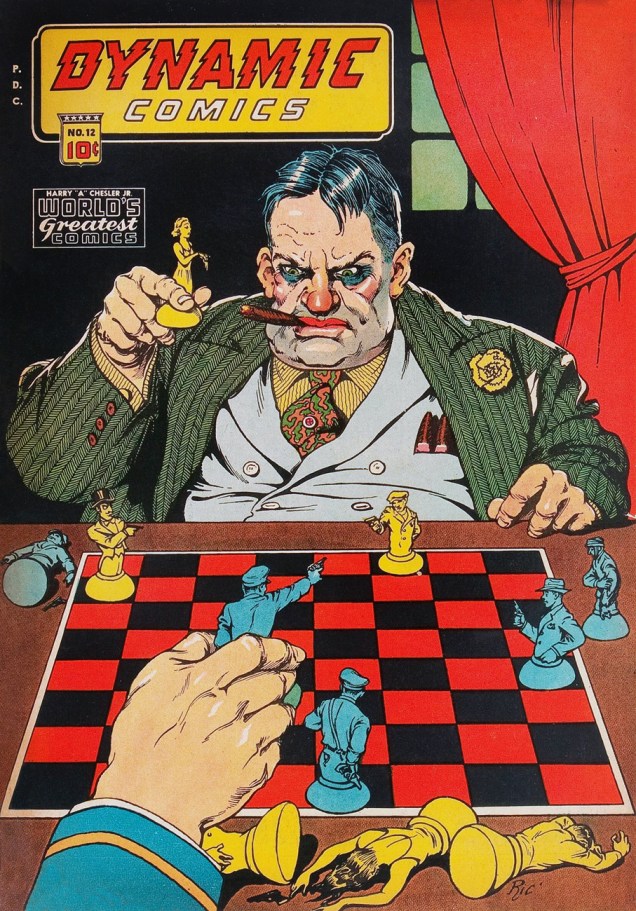
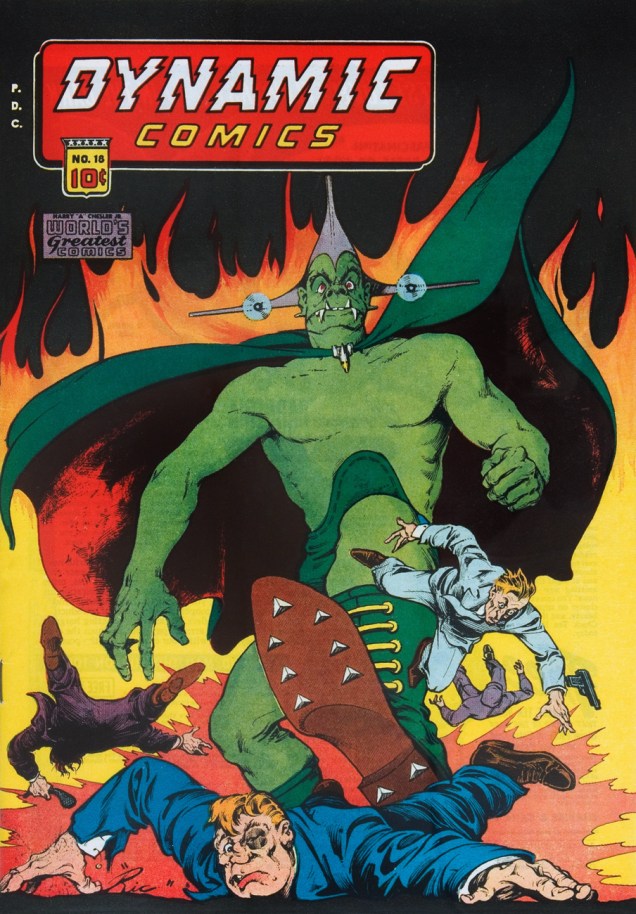
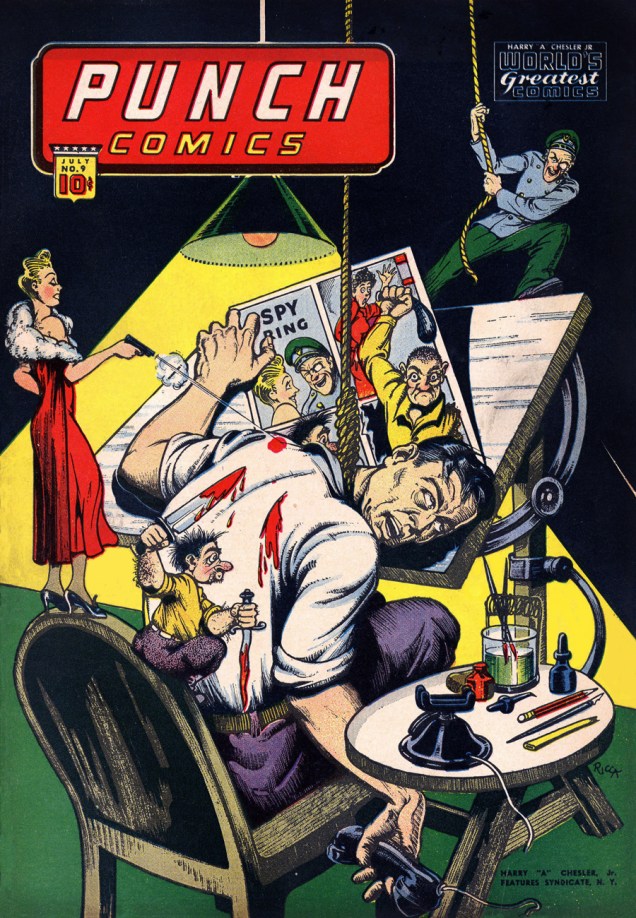
The undervalued Gaspano “Gus” Ignazio Ricca (1906-1956) managed, in the first half of his scant half-century of life, to get his foot in a lot of important doors: The New Yorker (1928), Liberty (1933), Time (1934), Collier’s (1935)… then he wound up in pulps and comics, for better or worse.
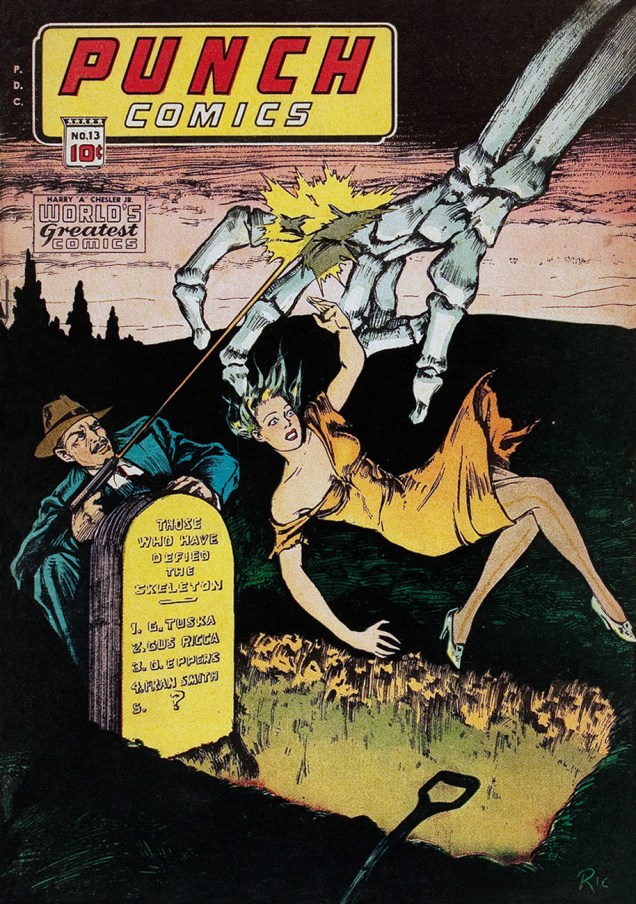
Having joined, at the dawn of the 40s, the fabled studio of Harry A. Chesler, the original comic book packager, he became, in 1944, art director of one of Chesler’s many lines, namely Dynamic Comics.
In general, Dynamic’s output wasn’t anything particularly distinguished or accomplished, but oh, those eye-catching covers!
Dynamic Comics no. 8, published sometime between 1942 and 1944. Read this issue here.Dynamic Comics no. 10 (July 1944, Chesler / Dynamic.) Read this issue here.Dynamic Comics no. 11 (September 1944, Chesler / Dynamic.) Read this issue here. The “little people in test tubes” motif never lost its cool, and it pops up all over: for instance, here, here, and also here.Dynamic Comics no. 12 (November 1944, Chesler / Dynamic.) According to the Grand Comics Database, “The man playing chess bears a distinct resemblance to many contemporary descriptions of Harry “A” Chesler.” Read this issue here.Dynamic Comics no. 18 (April 1946, Chesler / Dynamic.) Read this issue here.As if the back-breaking, eye-straining labour, low pay and oppressive deadlines weren’t enough to sap the spirit of a cartoonist. This is Punch Comics no. 9 (July 1944, Chesler / Dynamic.) Read this issue here.This is Punch Comics no. 12 (January 1945, Chesler / Dynamic.) Read this issue here.This is Punch Comics no. 13 (April 1945, Chesler / Dynamic.) Read this issue here. Pray note that Mr. Ricca seized the opportunity to symbolically write finis to his and a trio of his colleagues’ lives. « You should’na oughta defied The Skeleton, chum! »
-RG
* from the mouth of Yankee Doodle Jones’ sidekick “Dandy”, Dynamic Comics no. 6. Read it here!
« Speaking of winners, I’ve got Zwellyn Zablow of 11 West Second Street in Freeport, New York, who saw me at the Rockefeller Center dance. I want you to check in at Murray Hill 85-700. Anyway, MU-700 within the next ten minutes… »
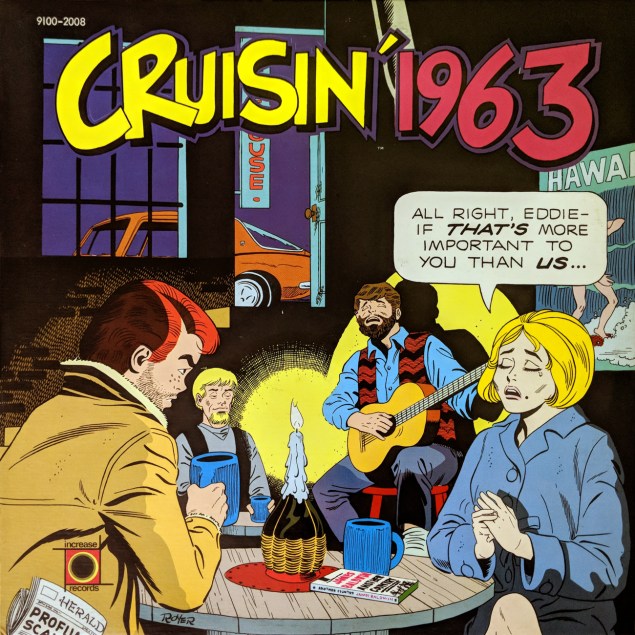
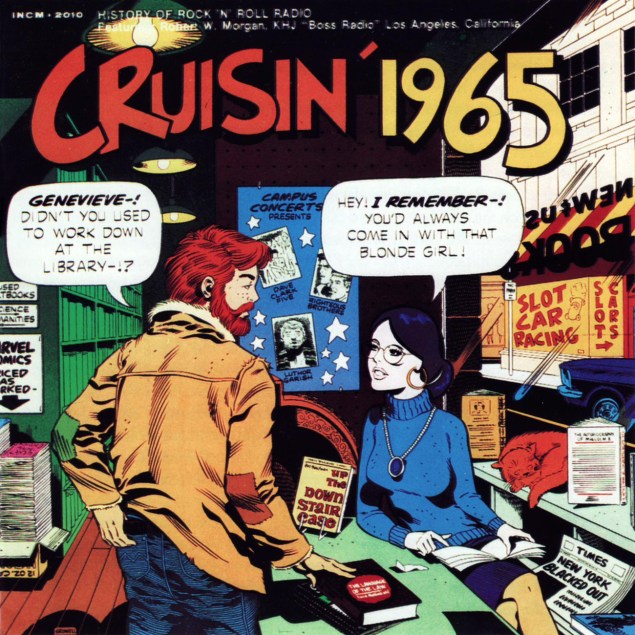
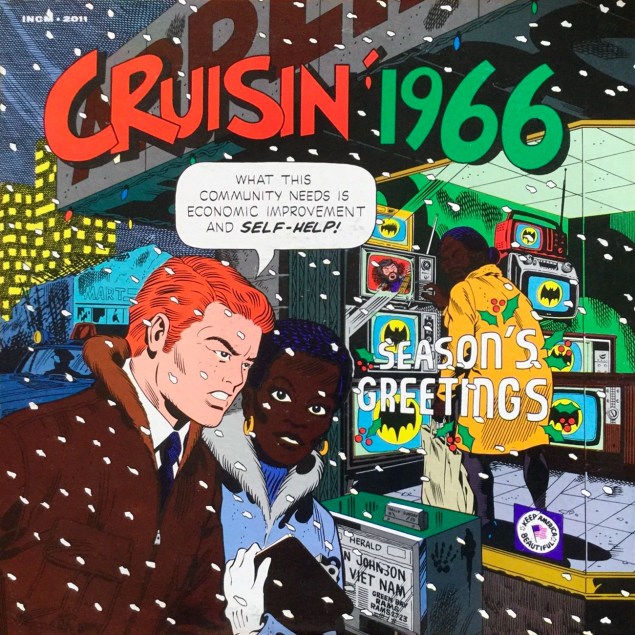
Read the liner notes, or hear Cruisin’ 1962 in its entirety right here… while you can!Read the liner notes, or hear Cruisin’ 1963 in its entirety here!Read the liner notes, or feast your ears on Cruisin’ 1964 pronto… here!Read the liner notes, then grind your teeth in frustration at Cruisin’ 1965‘s absence on YouTube. Happy update: here is it now for your listening pleasure! Read the liner notes, and/or listen to Cruisin’ 1966 in its entirety here!
Now then, here’s part two of our exclusive conversation with Mr. Mike Royer, picking up the thread from where we left off in Part One.
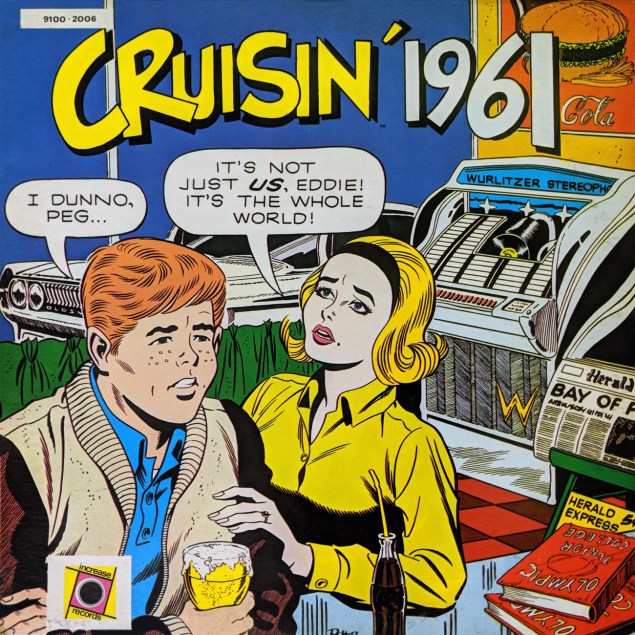
Michael Royer: Richard, you asked « How were you selected? » Well, I’d been working with Paul, and apparently he liked what I did on the Mormon history slides, so he asked me if I would do the ‘final art’ and all the research and everything on the covers, and the last time I saw Paul, before the second batch, that started with The Cruisin’ Years, that had the tickets on the table, and the picture of… I don’t know if it was Eddie in uniform or not… but whatever, that was when Howard Silver of Increase Records decided to do more for the line. And continue the series.
WOT: Right.
MR: And from that point on, all of the writing, and all the ideas, were totally mine.
WOT: I figured it would happen at some point…
MR: I think the ideas might have been a collaboration between Jacobs and Gruwell, but one of the reasons Howard Silver asked me « Do we need to contact Paul Gruwell? », and I said « Nope, you have no reason in the world to contact Paul. »
WOT: Cut out the middleman!
MR: I’m the guy who Paul used to introduce at parties as « This is the man who *inked* my Cruisin’ covers. »
WOT: Oh, boy. Okay.
MR: “Up yours, pal!”
WOT: Oh, this is gold, thank you!
MR: So I said « We don’t need him! », you know, and so all the rest of the albums after that were mine. And there are two covers that were done for a packaging, done for big box stores, that would have had either two or six cds in a tall case…
WOT: I remember those. ‘Longboxes’, shoplifting deterrents of the early cd era.
MR: … and one of them, Eddie is saying « We’ll be late for something at the theater » and Peg is saying « … but, but, the Beatles are on Ed Sullivan tonight! » So they were done to fit in the chronology of the covers. When he said « I’d like to start over with 1968 », and I said, « Well, I don’t wanna do the Woodstock. »
MR: « I don’t want Peg to have a kid from her serviceman, who obviously… died in service. »
WOT: Right.
MR: So I, and you’ve probably seen it, the cover is in front of a theater showing 2001: A Space Odyssey. Eddie discovers Peg there, as one of the Vietnam Widows for Peace. So now we know what happened to the serviceman that she ultimately married.
MR: ’cause I think, uh, the shot of Eddie and the musician with the beard…
WOT: Luthor, yes.
MR: … in college, and he’s got a newspaper clipping taped to his lamp that says « Peg marries… » somebody.
WOT: « Kevin Buchanan III » … he appears to be a society boy.
MR: I don’t know if you have all of them…
WOT: As far as I know.
MR: And of course, I continued, on all of the covers, to introduce a little bit… of tension.
WOT: Do tell.
MR: ’cause there’s some in every cover, sometimes it’s subtle, sometimes it’s overt. But I believe I did through… what year is the Kent State thing?
WOT: Let’s see… 1970. Eddie’s talking with his boss about it.
MR: Peg says « That’s okay, because Mike wants to give me another tennis lesson. »
WOT: Well, another “lesson”, at any rate. Whether it’s tennis remains to be seen. She’s got the racket, but…
MR: So… I can say all those new covers were made… the one previous to that is where they’re at Niagara Falls, and he’s talking about things could happen at his firm, and she’s saying « But Eddie, *I* might want a career! » And I enjoyed doing that cover, because I just wanted to do her standing there at the little motel sink in her slip.
MR: … and of course, being male and having to draw female forms, I made sure that her skirt was blowing in the wind… and in her little tennis outfit in the next year.
MR: We did, uh, let’s see: there was The Cruisin’ Years, which re-established the whole series. And then, starting with ’68 through ’70.
MR: Okay, I did two ‘Cruisin’ With‘… the second one, I guess it was never published…
WOT: Ah, right.
MR: … or produced, or released. And it was just another… let’s see: Porky Chedwick has got her in a poodle skirt and they’re dancing, right?
WOT: Yeah, that’s it.
MR: Okay, the next one was outside on a city street, and in the brick building behind them you see the silhouette of a disc jockey, and the broadcast booth at a radio station, I think the sign is on the roof. And Peg is protesting something. She’s got a banner, and Eddie and she are arguing about something. Ah, I only have a copy of my rough on that, or my comp. And of course there’s more detail on her than on him. I enjoyed drawing her. That last ‘Cruisin’ With’ I thought was much better than the first one I did, for cover art.
WOT: (laughs) exactly.
WOT: Is Cruisin’ a frequently-evoked topic by your fans?
MR: Every once in a while, it’s funny… for years, once in a blue moon, somebody would say something about Cruisin’. But I was in Charlotte, just… less than two weeks ago.
WOT: Right.
MR: … and I swear, a dozen or more people talked to me about the Cruisin’ covers at my table. Maybe that’s because there’s a new series of Cruisin’ albums… with art that I don’t like.
WOT: Oh, I don’t like it either: it looks like, and likely is, clip art.
MR: I don’t know who’s producing it. I don’t think it’s Howard Silver.
WOT: It’s called “The Cruisin’ Story“, it’s out of England, and it’s just a series of run-of-the-mill compilations, without the defining radio program concept.
MR: Howard Silver ran Increase Records. I don’t know if he bought out Increase and that was [Ron] Jacobs’ company or not. He’s in Hawaii now, last I heard. Jacobs [Indeed he was, but Mr. Jacobs passed away in 2016].
« Neither of us had seen a ghost, but I knew what he meant. »
I had planned to feature quite another tale this week, but seeing as we are in the torrid grip of quite the heat wave, I opted in the end for something more topical I’d been saving on the back burner.
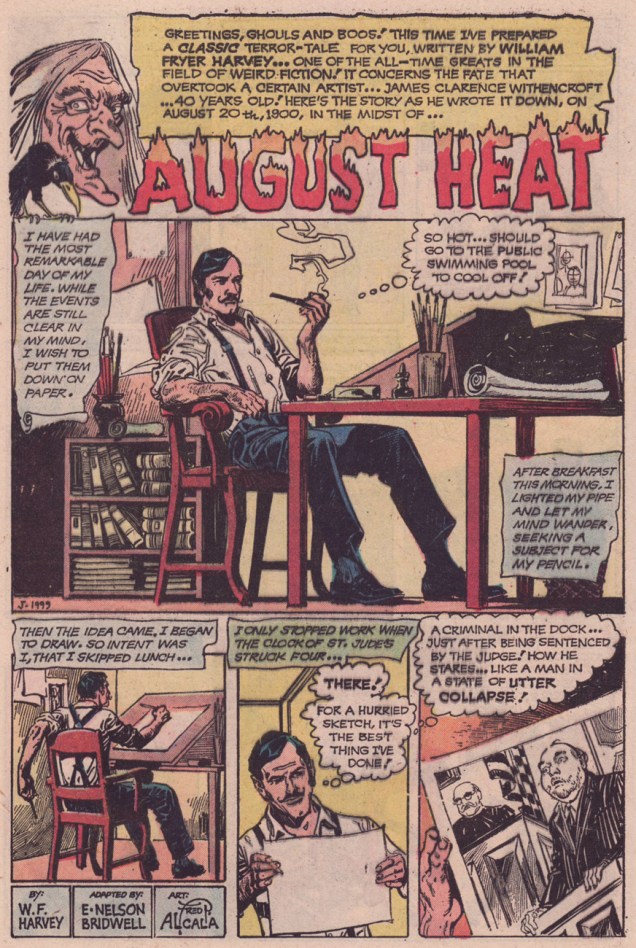
Edward Nelson Bridwell (1931–1987) is one of those scarcely noticed but greatly accomplished figures of American comics. At DC from the mid-1960s to the end of his life, he edited, wrote, packaged and compiled his heart out. Most impressive, in my view, were his erudition and discerning eye for a fine short story.
There’s always a blessed but mostly-powerless minority of comics creators that endeavours to improve the unwashed readership’s minds… nearly never at Marvel, most often at DC. In the mid-1970s, while working as Joe Orlando‘s editorial assistant, Bridwell adapted three excellent, but highly unconventional vintage spooky tales, as far afield as imaginable from the usual EC-by-homeopathy fare his boss favoured. These were William Fryer Harvey‘s August Heat (Secrets of Sinister House no. 12, July 1973), Ambrose Bierce‘s The Man and the Snake (Secrets of Sinister House no. 14, October 1973) and John Russell’s The Price of the Head (Weird Mystery Tales no. 14, Oct.-Nov. 1974); all three were splendidly brought to visual glory by WOT favourite Alfredo Alcala (1925-2000). All three are moody slow burners, with much introspection and little action.
On this scorching day (currently a sticky 35°C /95°F in Montréal, Canada) you’ll forgive me for not waiting until August to share this dark beauty with you.
August Heat was the issue’s cover feature. Illustration by Luis Domínguez.
As evidence of Mr. Bridwell’s skill as an adapter, feel free to read the full (yet quite brief) text of August Heat. Or listen to one its several fine radio adaptations, the choice is yours:
Today, Michael Royer (born June 28, 1941), who surely needs no introduction around these parts, celebrates birthday number seventy-seven, and on this special occasion, we have a treat, both for the great man and for the rest of us: part one of an interview Mr. Royer granted us, conducted just a few days ago.
As you can imagine, Mr. Royer has spent decades answering the same queries about his work with Jack Kirby and with Russ Manning, so that’s quite a well-trod line of investigation. We like to approach things a bit differently here at WOT; having long been intrigued by Mr. Royer’s evocative series of LP covers for the Cruisin’ anthology series, beginning in the late 1960s, and frustrated by the lack of solid information concerning said contribution, I figured I’d take a hand, and reached out to Mr. Royer.
If you’re unfamiliar with the Cruisin’ Series, here’s the pitch: « Cruisin’ is a year-by-year recreation of pop music radio during the years 1956 through 1962 [the years of 1955 and 1963-1970 were produced later]. Each album is not just a collection of the top pop music of a particular year, but a total recreation by a top disk jockey (of that year) doing his original program over a major pop music station. That means actual commercials, promotional jingles, sound effects, newscast simulations and even record hop announcements in addition to the original records themselves. »
« Cruisin’ producer Ron Jacobs monitored thousands of feet of tape, travelled over 10,000 miles and rooted through forgotten files and cluttered basements for old commercials, station promos and jingles. »
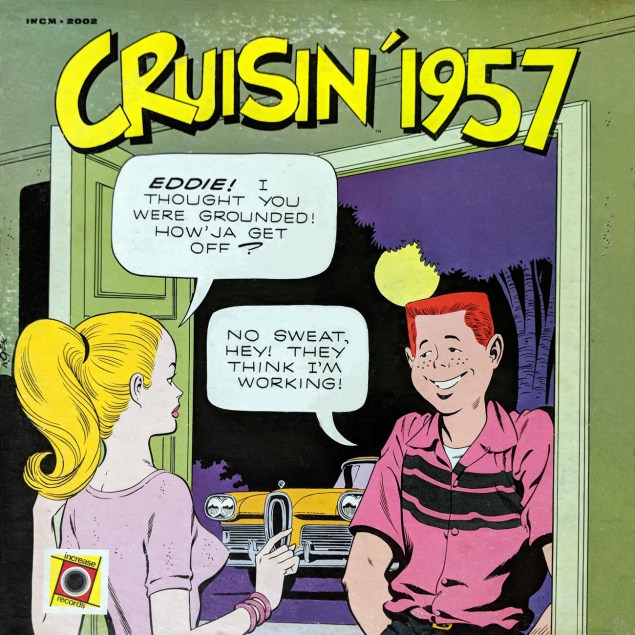
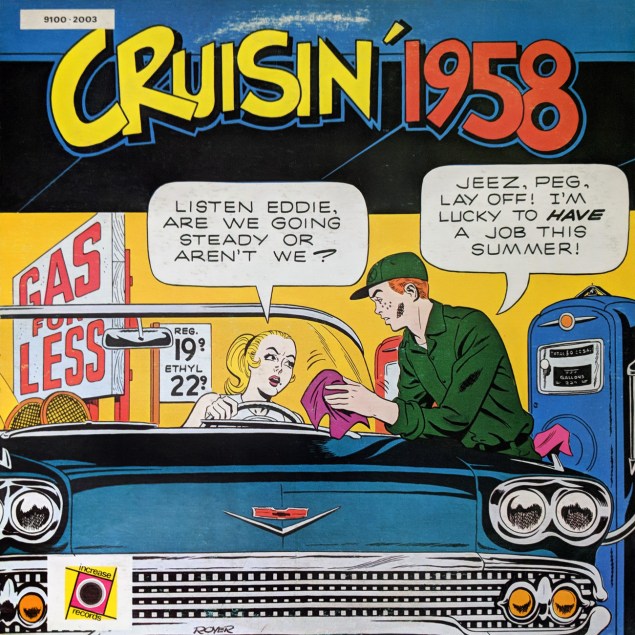
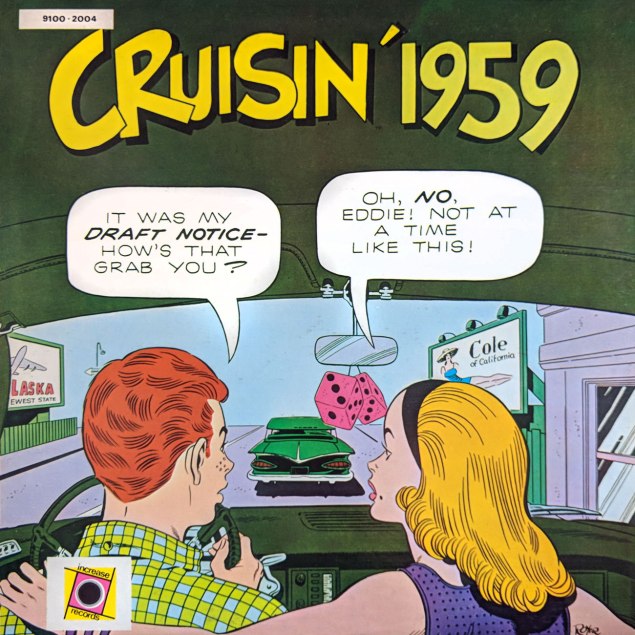
« What’s so special about these album covers? », you may ask. I’d posit that they’re unique in the sense that, while they each work as standalone pieces, together, they form a quite impressive comic strip, one in which a year or so elapses between panels. Just about every detail has its place, imparting information plainly or quite subtly. Characters come and go, years apart, sometimes entirely offstage, often never speaking a word. It’s graphic storytelling at its finest. And the LPs are pretty spiffy too.
Now that you’re up to speed, shall we begin? Mr. Royer and I spoke on Tuesday, June 26, 2018, and he was most generous with his time and his recollections. I assure you that the minutes simply fly in such gracious company.
Read the liner notes, or hear Cruisin’ 1955 in its entirety here!Read the liner notes, or hear Cruisin’ 1956 in its entirety here!Read the liner notes, or hear Cruisin’ 1957 in far less that its entirety here. Sorry!Read the liner notes, or hear Cruisin’ 1958 in its entirety here!Read the liner notes, or hear Cruisin’ 1959 in its entirety here!For this entry’s cd reissue, the cover artwork was inadvisably cropped, quite obscuring the political differences between Kevin Buchanan III (front) and Eddie (in uniform). Mr. Royer’s least favourite cover, incidentally. Read the liner notes, or hear Cruisin’ 1960 in its entirety here!Read the liner notes, or hear Cruisin’ 1961 in its entirety here! And remember, « If you say ‘Woo Woo Ginsburg’ with your order, you get another Ginsburger free of charge! »
Who’s Out There: Mr. Royer, How did you happen to be selected for the job in the first place?
Michael Royer: In 1966, I was working for Grantray-Lawrence Animation on the Marvel Superheroes limited animation cartoon series. And I believe that a man named Paul Gruwell… If you look at the record album, he’s listed in there as the art director… I’m listed as the artist and they misspelled my name.
WOT: Of course. We’ll set that straight.
MR: Paul was one of the guys working on the series and I did some work with him on an outside project he was doing, where he was doing… I guess you could call them slide shows, on the history of the Mormon church.
I was working on these things, and he knew someone at the record company who had this idea for the history of rock ‘n’ roll. And for the life of me, I can’t remember what the young man’s name was. But he’s the cover of one of the records, where he’s coming out of the backroom, through the beads [Cruisin’ 1967]. It’s like a head shop, or something…
WOT: Would that be Ron Jacobs? He was the producer.
MR: Yeah, yeah.
MR: So, anyway, the first batch of covers that went through, I believe, 1968… and the last cover had Peg and Eddie, who were reunited, with her little boy from her fist marriage. And they’re in the front seat of a van, in a traffic jam leaving Woodstock. That cover was never printed.
WOT: No wonder I’ve never seen it!
MR: Anyway, the covers that I did, how many was it? ’54 through…
WOT: Fifty-five. ’55 through ’70, plus one that’s “The Cruisin’ Years”…
WOT: How much latitude/wiggle room were you given? Were research materials provided or not? Were specific cultural signifiers specified, or did you get to pick (or a mix of both)?
MR: Anyway, on those ones that I did in the late Sixties, early Seventies, Paul Gruwell gave me little three-or-four square inch thumbnails… on the covers that he wanted me to do. All I got was his, in my opinion, so-so little thumbnails, which I guess gave him the reason to call himself ‘art director’…
WOT: I was going to ask if he could draw.
MR: I had to do all the research. Each cover had to feature certain items that definitely said that it was that year. Like newspaper headlines, magazine covers…
WOT: Movie marquees…
MR: … automobiles, and I had to look up all that. I went to the library, as we didn’t have “online” then. Ah, on one of the covers where I need the dash, I believe, of a ’57, or ’58 Chevy, I had to go to a used car lot in South East Los Angeles, and with my Polaroid camera, I asked these two big guys in their double-breasted suits if I could, uh, photograph the interior of one of their cars, and they looked at me like… « Okay, white boy, you’re crazy if you wanna shoot it, but we’ll let ya, you know. »
WOT: People do like those odd requests.
MR: It was very interesting researching the cars, and making sure that, even if they were shown from the basement [Cruisin’ 1963], out parked at the curb…
WOT: They had to be accurate.
MR: … you could still tell that it was a Studebaker. You know, and the jukebox had to be, I believe the Wurlitzer that was in places in that year [Cruisin’ 1961]. And so I did all of that. So all of the research materials were not provided by anyone other than me, and the special cultural signifiers had to be newspaper headlines, uh, I think the one where Peg and Eddie are in the basement [Cruisin’ 1963] café, and the Studebaker’s up on the street, there’s a newspaper that says something about “Cuban Missile Crisis” [Cruisin’ 1961 and The Bay of Pigs. 1963’s headline was the Profumo Scandal]…
MR: It’s so long since I’ve looked at these, Richard.
« I had me a scientific career before… ah… circumstances forced me to take up fishin’… »
In case it’s escaped anyone’s notice, summer’s officially arrived.
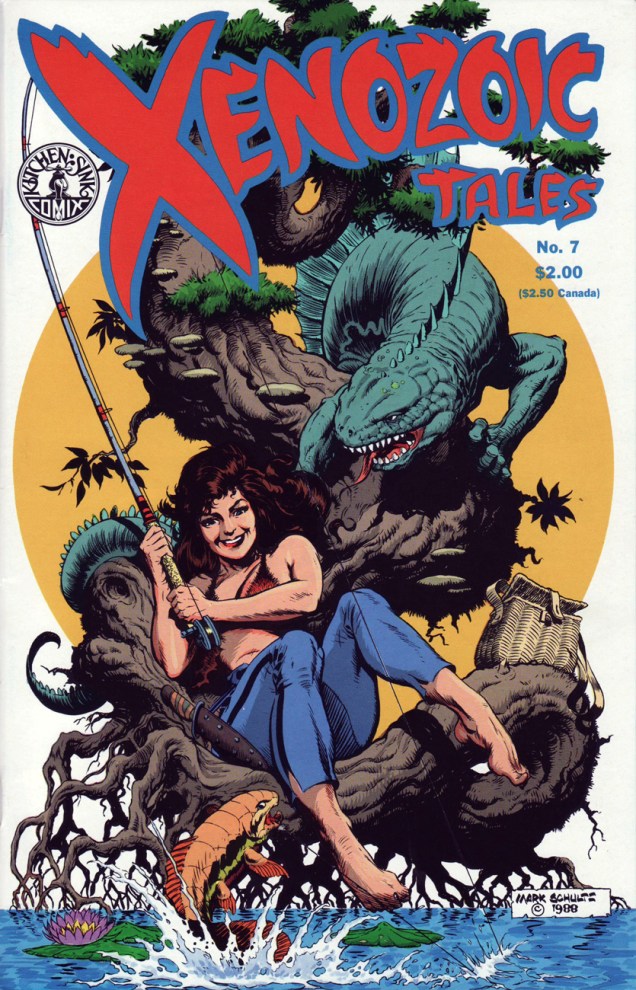
This is Xenozoic Tales no. 7 (Oct. 1988, Kitchen Sink), a series that presented, wonder of wonders, a post-apocalyptic future that wasn’t strictly doom and gloom. Cover by Mark Schultz. This issue features « The Growing Pool », written and drawn by Schultz, and “Crossed Currents”, written by Schultz and illustrated by Steve Stiles.
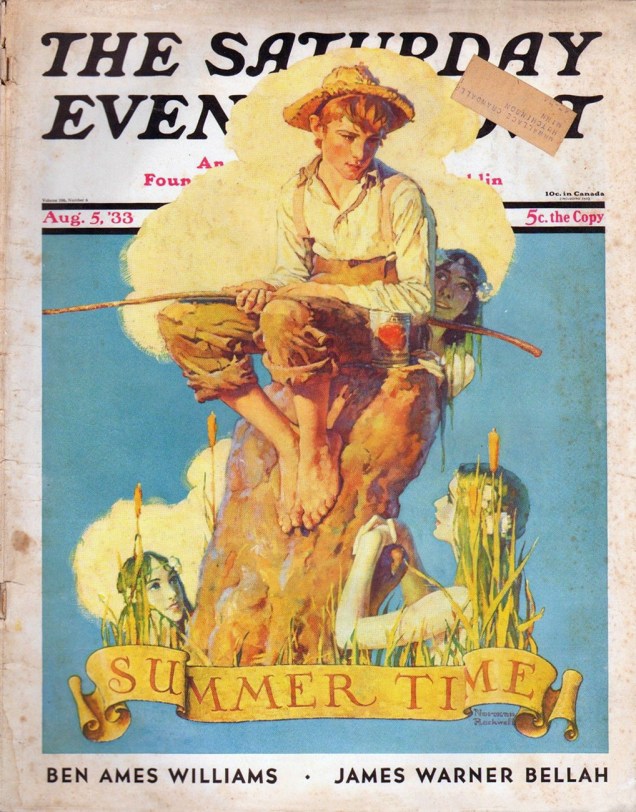
The lady is Hannah Dundee, and she may soon have to share her lunch. Something tells me this illustration is a pastiche of some The Saturday Evening Post-type cover.. there’s something charmingly old-fashioned about it, and I don’t mean Cambrian Age old.
You know, that sort of thing. The Saturday Evening Post‘s August 5, 1933 cover by… who else? Norman Rockwell.It’s the new falconry! Xenozoic Tales’ coexistence of humans and dinosaurs is not your run-of-the-mill anachronism: this is the world of tomorrow, not yesterday’s. This striking portrait of Ms. Dundee was conceived as a t-shirt design in the late 1980s. I should still have mine stashed somewhere…
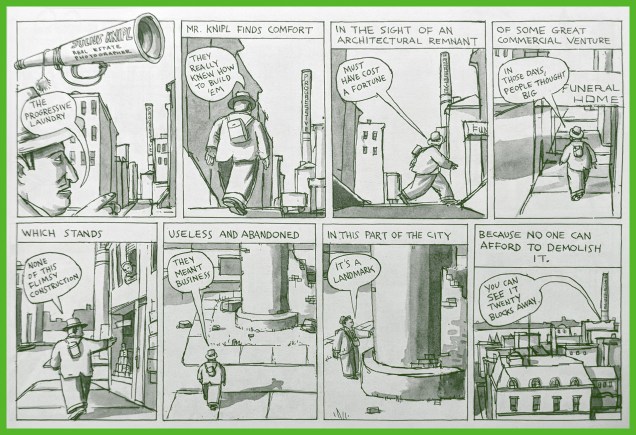
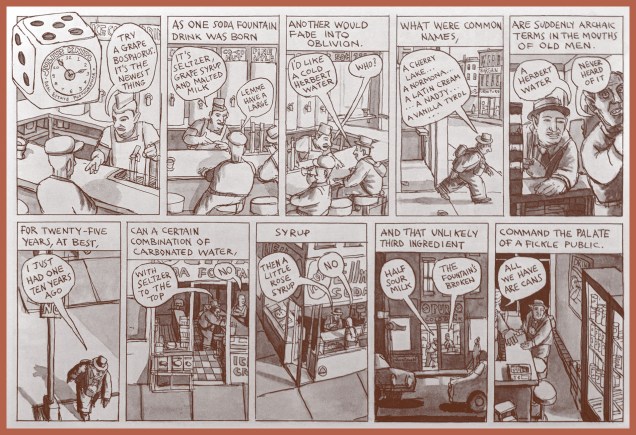
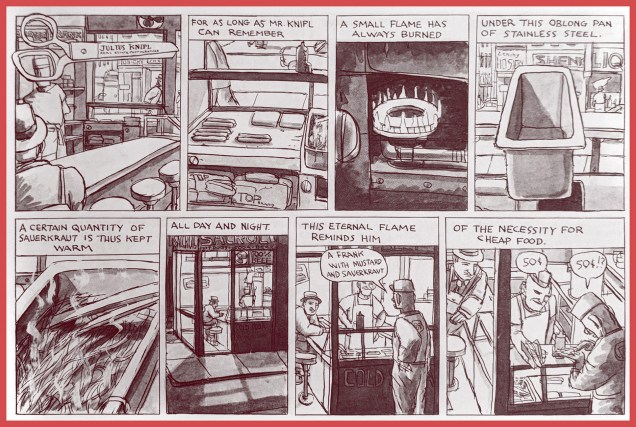
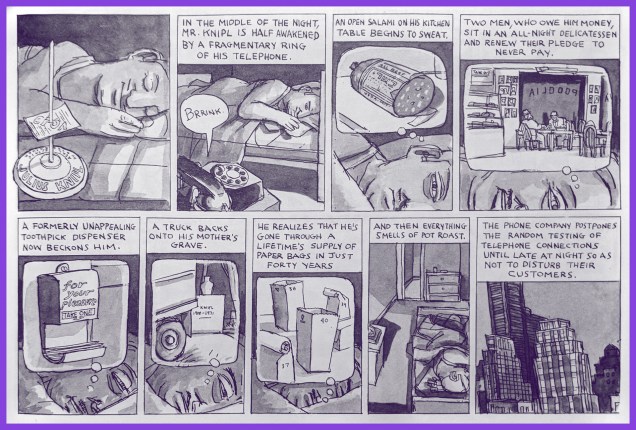
Originally appearing in alternative weekly The New York Press in the late 1980s, Ben Katchor’s Julius Knipl, Real Estate Photographer belongs to that most exotic breed of comic strips, those that suddenly awake the mind to the medium’s grand possibilities. Said experience can be abrupt and dizzying, but in this particular instance, it’s soothing and bittersweet, full of rightful yearning for things that possibly were or surely should have been, glimpsed in a daydream by the low flame of the fantastic mundane.
Mr. Katchor (born November 19, 1951 in Brooklyn, New York) is blessed with a vision of startling depth and singularity. By its nature and scope, it’s not everyone’s thing, but the rest of us likely wind up as lifelong admirers, and isn’t that just the ideal audience?
Much has been written elsewhere, often brilliantly, about Mr. Katchor and his œuvre; it’s work of a calibre to inspire theses, dissertations and papers, so I’ll mostly stick to presenting some samples. The passionate plaudits these strips have inspired tend to obscure the fact that most people just haven’t had the pleasure, or at least the opportunity, of encountering such rich material.
These vignettes were collected in 1991 as Cheap Novelties: The Pleasures of Urban Decay. Oddly enough, it was the only one of Katchor’s books to go out of print… the situation was remedied in 2016 by Montréal’s Drawn & Quarterly, who brought it back in a lovely hardcover edition.
While on vacation, my accountant fell in love with a hot sauce manufactured on the small Caribbean island of Dominica. He’s since devoted considerable energy to renewing his stock of the stuff, which has involved much international horse trading.Montréal has its share of architectural remnants of bygone commercial enterprise; arguably, the most famous is the “Giant Milk Bottle“, but no, it isn’t full of milk.This melancholy vignette ties in quite nicely with a recent piece from Atlas Obscura noting the fading lingo and diminishing rôle of the soda jerks of New York City. Read it over a mug of murk with a choker hole.
From the collection’s back cover blurb: « In a vast and shadowy city of old skyscrapers, neglected warehouses, juice stands, and coffee shops, Julius Knipl, a rumpled, middle-aged man in a suit and hat, wanders the streets photographing buildings and pondering the details: the scent of the past that seeps into the present; the ghosts of other values and culture embedded in the urban landscape; people and behaviors almost gone that linger on. He sees what others overlook, a Borscht-belt Buster Keaton. »
« Now at this age, I look back and oh, Adams is probably one of the worst things that happened to the medium, when I look at it historically. » – Darwyn Cooke (2004)
On his 77th birthday, the legendary Neal Adams must surely look back on his storied career and radiantly beam (‘gloating’ is for lesser beings). Still, with all he’s accomplished (and with such brio!) in the fields of graphic storytelling, advertising, physics, the theatre and geology, who could find it in his heart to blame him? With so much to celebrate, let’s just stick to the highlights, shall we?
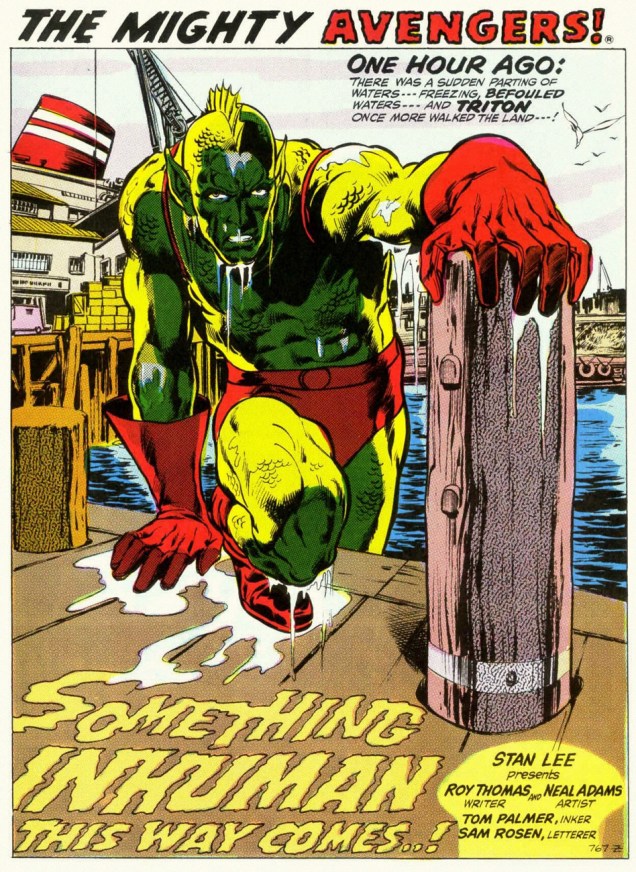
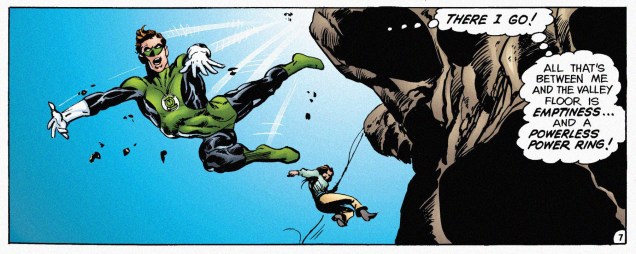
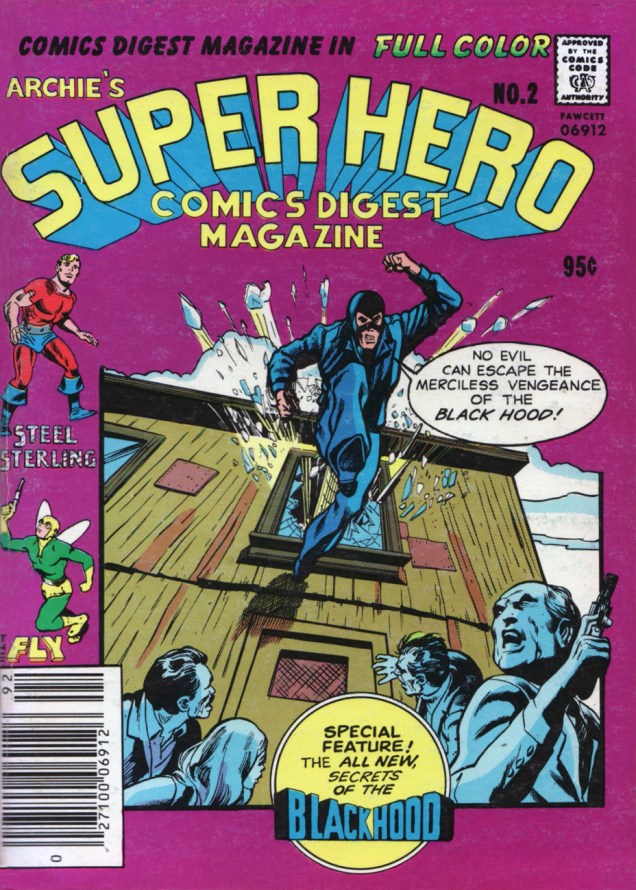
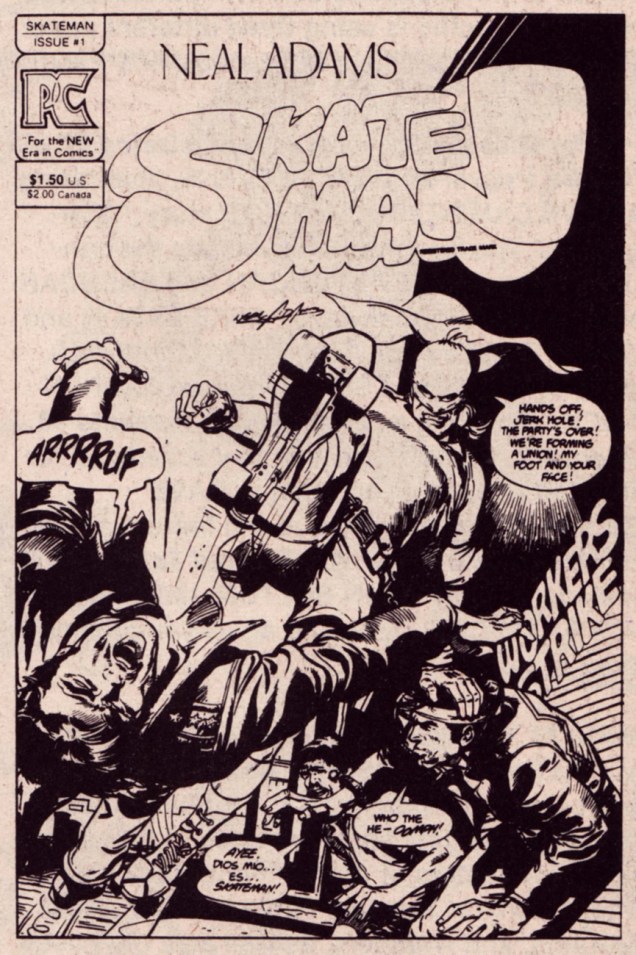
Why is the nasty little dude threatening the giantess? Why, Neal, why? Well, I suppose that is some people’s idea of romance. This is Heart Throbs no. 120 (June-July, 1969), edited by Joe Orlando.I don’t know if you’ve ever pulled yourself out of the water onto a dock, but that… is not the way to do it. One might argue that Triton is an Inhuman, and as such, gravity and anatomy are trifles unworthy of his kind. From Avengers no. 95 (Jan. 1972, Marvel), a chapter in the “Kree-Skrull War”, cobbled together by Roy Thomas from discarded Kirby plot effluvium and Jerome Bixby and Otto Klement’s Fantastic Voyage.Ah, Neal Adams. He who brought naturalism and realism to comics. A panel from “The Powerless Power Ring!”, a Green Lantern backup strip from Flash no. 226 (March 1974, DC Comics.)Neal’s influence can’t be overstated, and not only in the fields of comics and geology. Here’s US figure skater Jason Brown‘s poignant tribute to that very Green Lantern tale, presented to warm applause at the 2014 Winter Olympics in Sochi. As Neal is fond of saying to any cartoonist he encounters, « You are all my children! »*A concert poster reproducing Our Neal’s gatefold art for Grand Funk‘s 1974 LP, All the Girls in the World Beware!!! (which incidentally features their finest original composition, imho, Bad Time) Despite the difficult assignment, Neal comes through with flailing biceps and chicken legs; thank goodness his caricature chops are equal to his grasp of earth sciences. Curiously, half the groupie throng seems to be cloned from a particularly manic Marsha Brady, and most of the rest from Carol Burnett.They’re an American Band. From left to right: Don Brewer (he of the competent drum work), Mark Farner (he of the wild, shirtless lyrics), keyboardist Craig Frost (Homer didn’t rate him), and of course Mel Schacher (he of the bong-rattling bass.) One may wonder just who those guys in the poster are supposed to be.Faceplant time, or The perils of drawing comics whilst grabbing lunch, getting a massage on 52nd, or simply resting on your laurels. How does this cover make any sense? Just picture the scene from another angle, or if someone tried to build a model of it. Archie’s Super Hero Comics Digest Magazine no. 2 (1979 edition.)As legendary as his renditions of established characters are, it is with his own creations that Neal Adams’ true legendary status rests: fabled names, always spoken in hushed awe, such as Ms. Mystic, Samuree, Cyberad, Crazyman, Megalith, Valeria the She-Bat… and of course Skateman, Jason Brown’s childhood idol. Here’s his premiere (and dernière) issue, published in November 1983 by Pacific Comics.And here’s a mock-up of the same cover. I’ll go to my grave wondering why they chose to run the cover sans this piquant, vernacular-rich dialogue, which would have shown once and for all that Neal the writer was every bit the equal of Neal, the artiste. Eat your heart out, Noël Coward!Neal applies his Midas touch to another original creation: Crazyman! Double bag several copies of this number one, someday it’ll put your kids through college. It even comes with an embossed cover! By then, Adams was drawing donkey teeth on everyone, evidently his shorthand for “hilarious”. April 1992, Continuity Comics. You know, “The other superhero company”!
« You cannot work with men who won’t work with you. » — John Harvey Kellogg
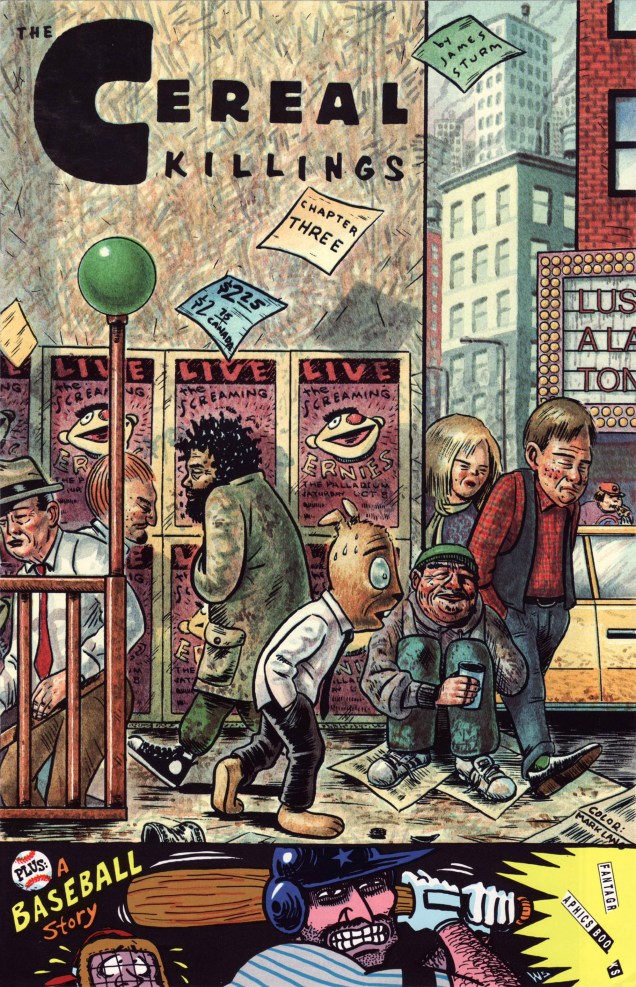
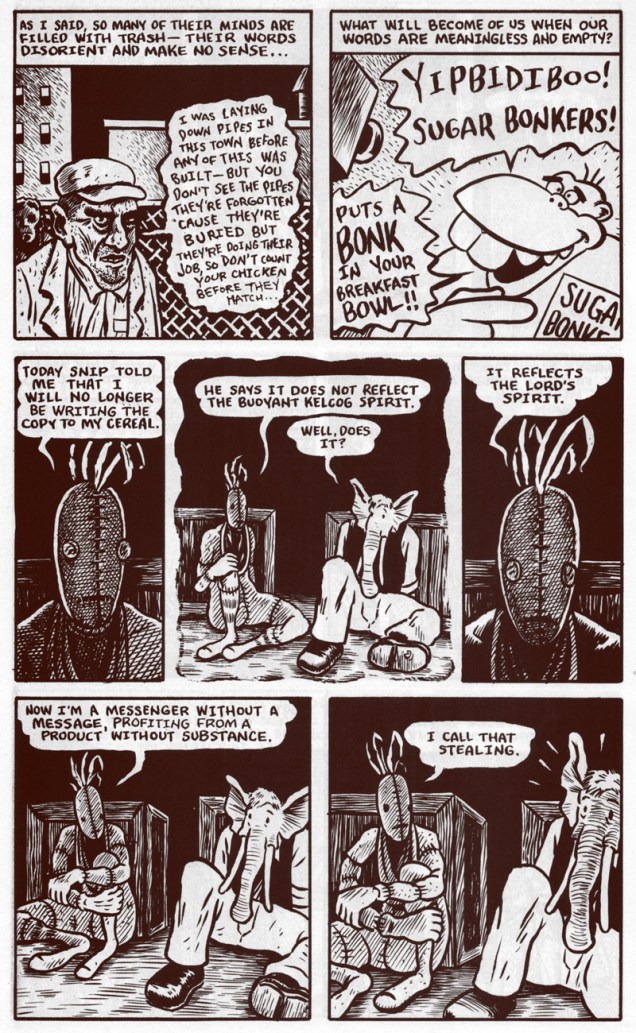
Before he created his justly celebrated The Golem’s Mighty Swing, wrote the mini-series Fantastic Four: Unstable Molecules, or co-founded The Center for Cartoon Studies, James Sturm (b. 1965) committed to paper and ink a mind-expanding, if little-noticed, saga entitled The Cereal Killings, complete in eight issues and published by Fantagraphics between 1992 and 1995. Sturm valiantly struggled through ocular problems during that period, undergoing no less than three retinal operations, leaving him with one good eye.
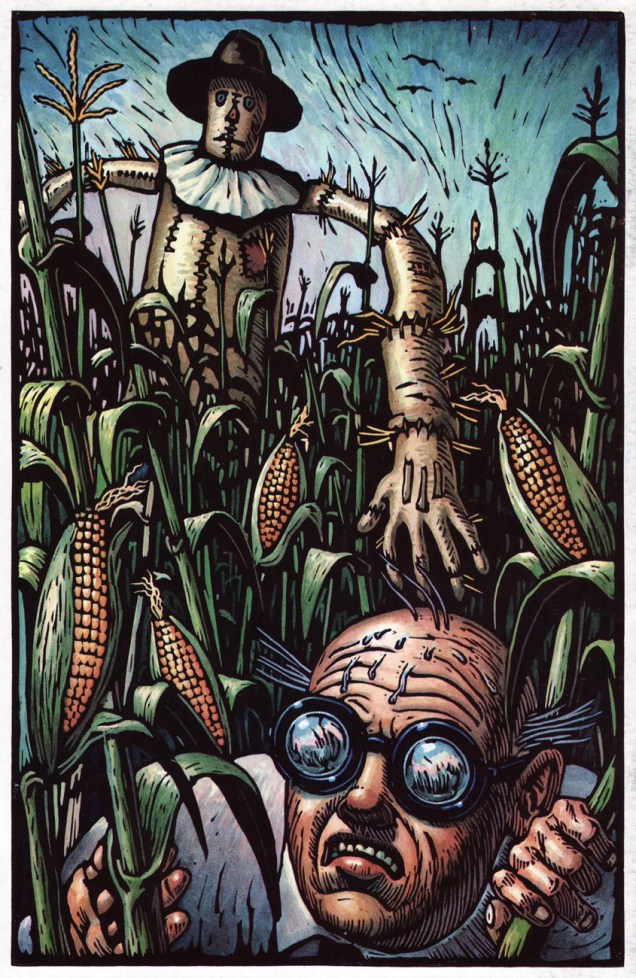
The Cereal Killings no. 3 (Sept. 1992), colours by Mark Lang. Hey, I’d pay good money to see The Screaming Ernies perform. I’d settle for a t-shirt!
Sturm dug well beyond the shallow pun of the title and implacably hauled it to its logical conclusion. TCK has been likened to a Watchmen with a cast of funny animal cereal mascots, and that’s not that far off the mark. But beyond its conceptual debt to Alan Moore’s superhero deconstruction, Sturm’s story actually takes aim at more adult concerns and issues, made all the more harrowing and poignant by how psychologically credible his cast of cereal pitchmen and acolytes is. Corporate malfeasance, petty theft, betrayal, bitterness, grandiloquence, blind ambition, dementia, remorse… and wisdom. You name it, it’s all there, in a gripping, kaleidoscopic and haunting narrative.
Sturm, Fantagraphics & Co. made splendid use of the entire, (actual) ad-free magazine to flesh out the concept. This is Mark Lang’s gorgeous depiction of The Scarecrow and Carbunkle. These are our good guys, appearances notwithstanding.Issue 3’s back cover provides a helpful look at our cast of characters.This is the cover of TSK no. 4, featuring Schmedly the Elephant, who wishes he *could* forget. Colour by Mark Lang.
A crucial flashback scene from the eighth, and ultimate, issue (Jan. 1995). It would appear that The Scarecrow is a stand-in for cereal giant Kellogg’s founder, John Harvey Kellogg.
« It’s the present! It’s nostalgia! It’s a crispy non-sweetened comix story that doesn’t get soggy in milk! And remember — product is sold by weight, not volume. Some unsettling may occur. »
The series has never been collected or reprinted, so you’ll have to do the work… I think I noticed a torrent file somewhere. Sturm at one point intended to issue a revised collected edition, but has apparently changed his mind since. That’s no way to treat one’s masterwork, neglected as it may be.
« We are all susceptible to the pull of viral ideas. Like mass hysteria. Or a tune that gets into your head that you keep humming all day until you spread it to someone else. Jokes. Urban legends. Crackpot religions. Marxism. No matter how smart we get, there is always this deep irrational part that makes us potential hosts for self-replicating information. » — Neil Stephenson
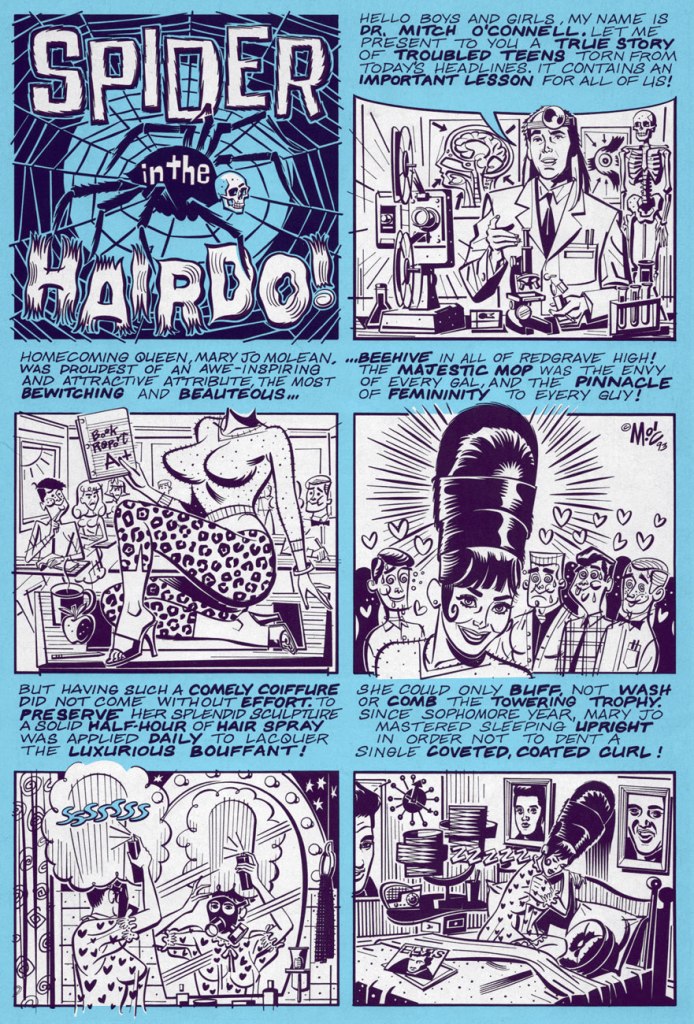
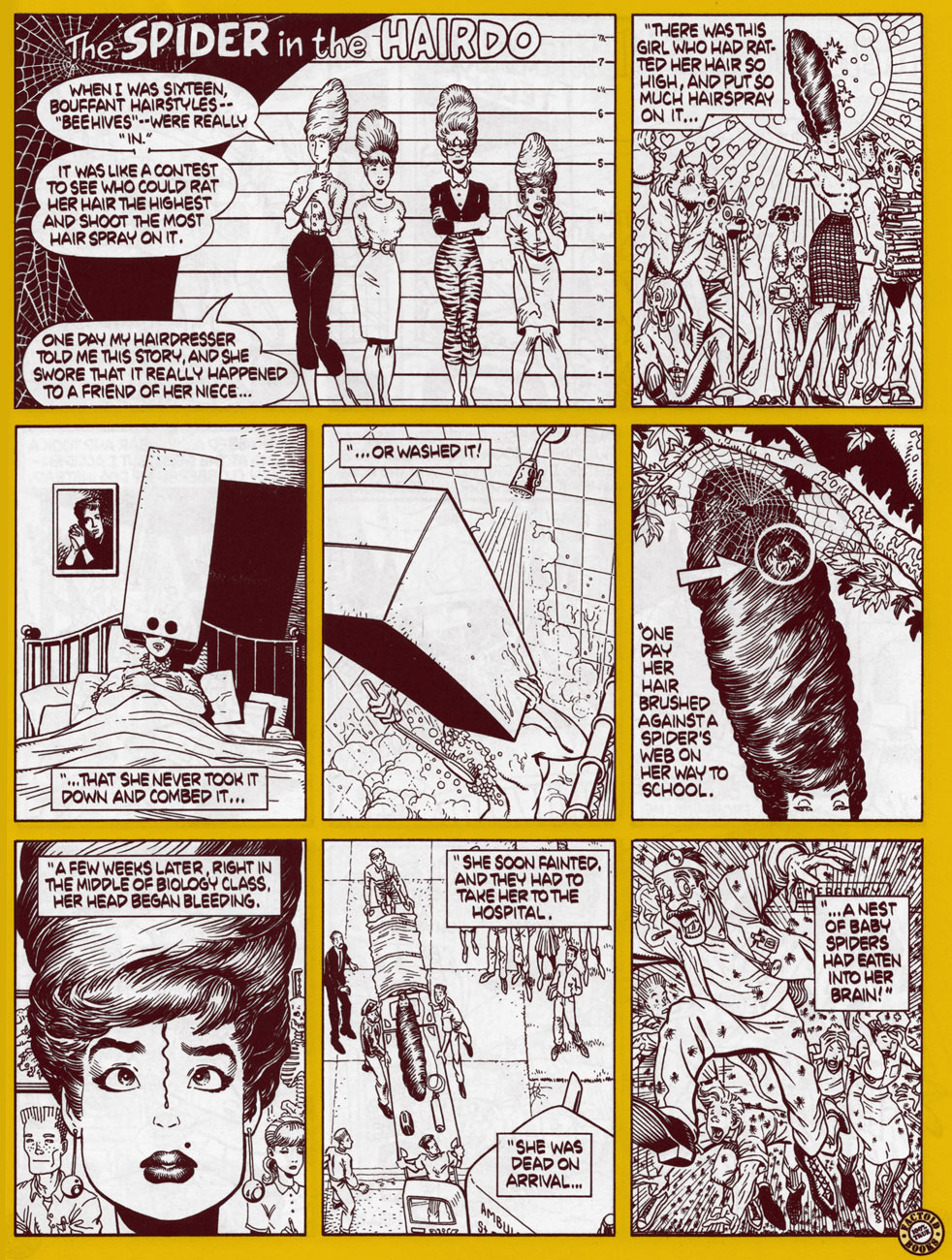
True story! It happened to a friend of a friend of a relative of an acquaintance of the hairdresser of the nephew of the uncle of the garage mechanic of the girdle maker of a cousin of a U.F.O. abductee ex-classmate of my brother’s. Or so he obliquely claimed under hypnotic regression.
Apparently, this tale gave rise (I know, I know) to a variant called The Cucumber in the Disco Pants.
And remember, always check with Snopes.com before propagating dubious claims.
Spider in the Hairdo! is a juicy excerpt from Dark Horse’s one-shot Urban Legends no. 1 (June, 1993). Adaptation by the self-proclaimed « World’s Best Artist », Mitch O’Connell. I can think of far less worthy candidates for the position.
Should you be craving more from Dr. Mitch, here’s where to go for your fix: www.mitchoconnell.com.
And if, like me, you can’t get enough of such urban folklore, check out any of Jan Harold Brunvand’s score of splendidly compelling books on the subject. When it comes to urban myths, Dr. Brunvand is the authority.
As a bonus, here’s Arthur Adams‘ slightly subsequent take on the same myth, published in DC/Paradox Press’ inaugural entry in its ‘Big Book of…’ series, The Big Book of Urban Legends (1994).
By their very nature, the Big books (seventeen in all) tended to be pretty hit or miss, not, for once, because of the writing, but chiefly due to the evident paucity, in the current comics industry, of artists versatile enough to credibly depict low-key, quotidian, humorous or historical situations. Is it counterintuitive, or fitting, that artists on the cartoonier end of the scale (Rick Geary, Roger Langridge, Gahan Wilson, Hilary Barta, Ty Templeton, Danny Hellman, Sergio Aragonés…) tended to fare best in producing this type of « documentary » work? I haven’t quite made up my mind. All I know is that the superhero specialists and photo tracers just brought embarrassment upon themselves *and* the unfortunate reader.
« … and now for some of that fun we promised you! Trained chihuahas! Car races! A couple of inspirational documentaries! And a quiz show! Hallelujahgobble! Hallelujahgobble! »
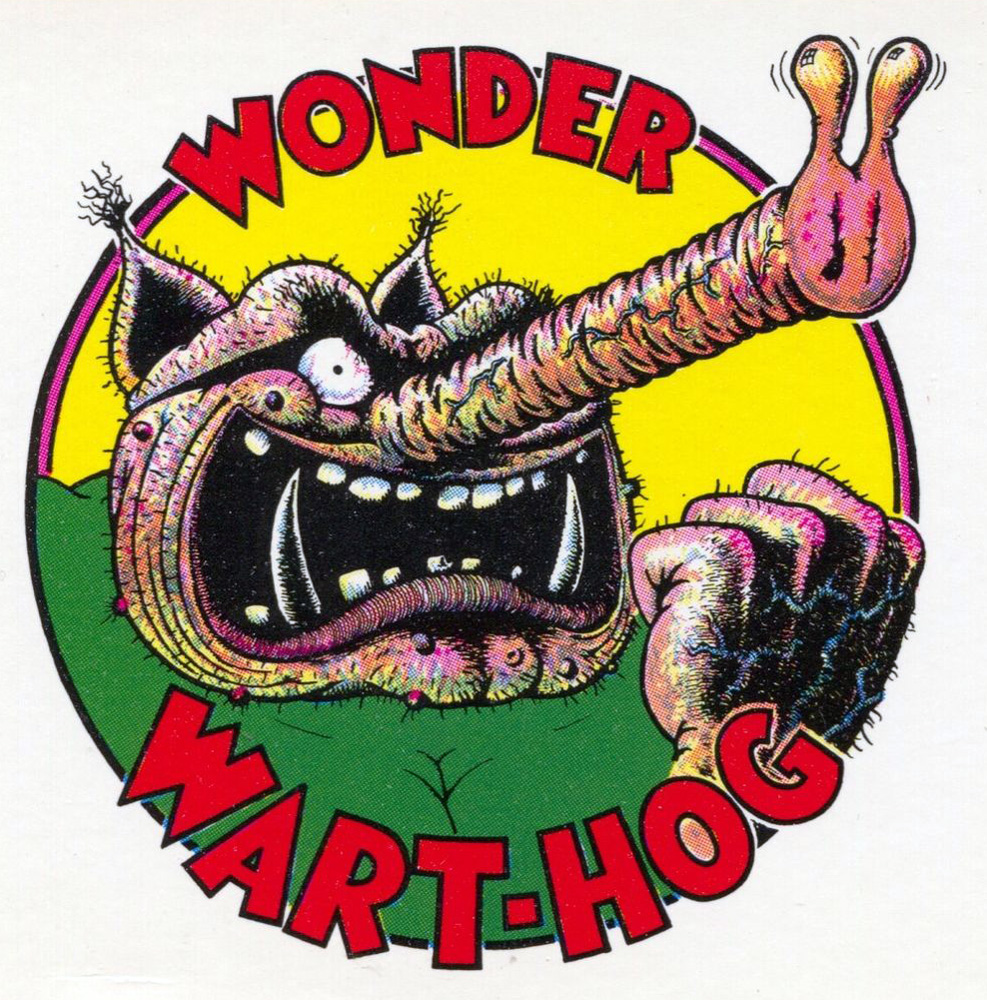
For my money, there’s no funnier man in comics, at least on such a consistent, sustained level, as the extraordinary Gilbert Shelton (born May 31st, 1940, in Houston, TX, which makes him 78 today). Sure, he’s slowed down some since 1959 (the year he foisted upon the world the Wonder Warthog), but the quality of his output has not decreased one iota (quite the contrary, in fact!) It may well be that the secret of his longevity lies in his choice of collaborators, but as far as I’m concerned, that’s just another facet of his talent. I’ll (mostly) let the man’s work speak for itself. Brace yourselves for the ride, here we go!
Enter a captionYeah, that old hippie shit’s totally dated; this has nothing to do with American’s current socio-political situation. Well, it would be nice if Amtrak’s trains ran a bit closer to schedule. This ran as the back cover of « Wonder Wart-Hog and the Nurds of November: Gilbert Shelton’s Exciting Cartoon Novel of Election-Year Politics, International Nuclear Terror, Professional Football, Science Fiction, Motorcycle and Auto Racing, Pestilence, Famine, Economic Collapse and Romantic Love. » (1980, Rip Off Press)
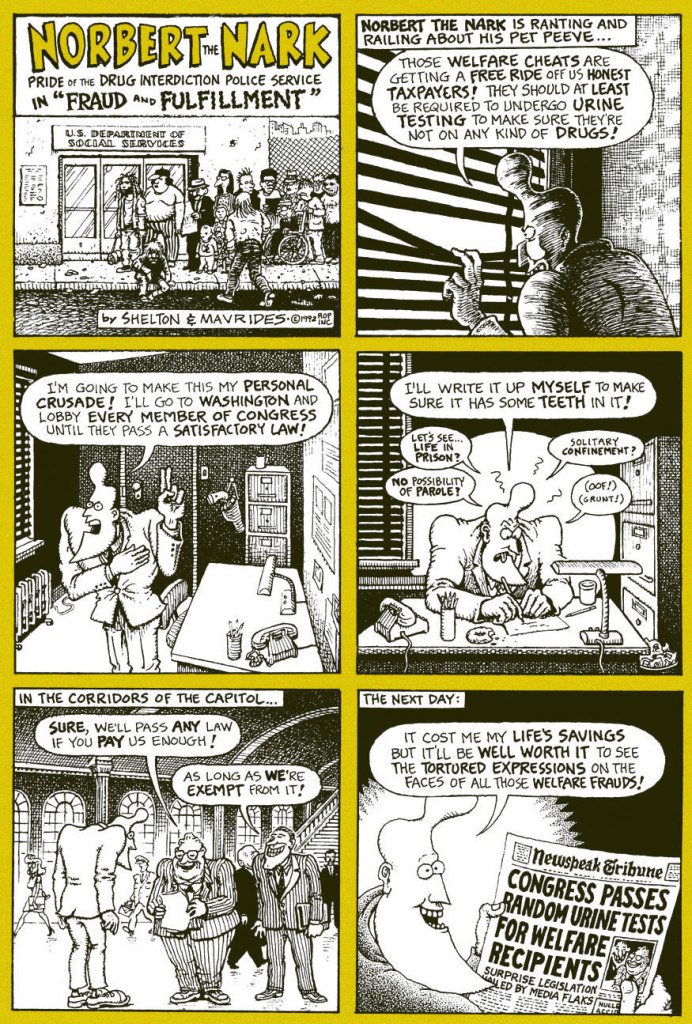
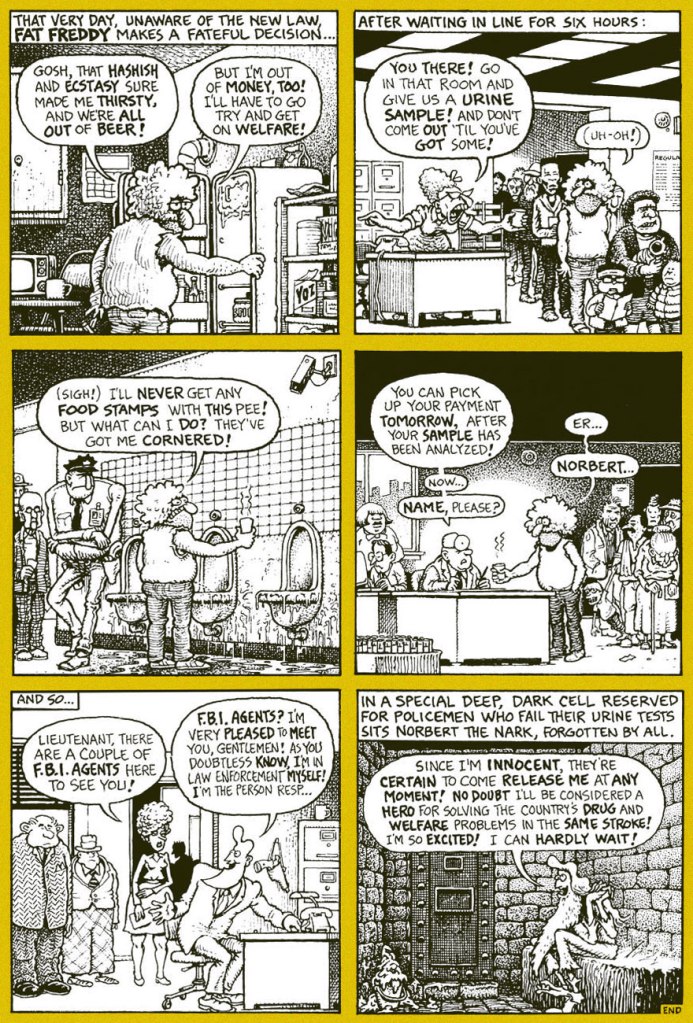
The Brothers’ none-too-effective nemesis Norbert the Nark in the spotlight. From The Fabulous Furry Freak Brothers no. 12 (1992, Rip Off Press).
Fat Freddy’s such a good little Suzie Homemaker. Another piece from The Fabulous Furry Freak Brothers no. 12 (1992, Rip Off Press).
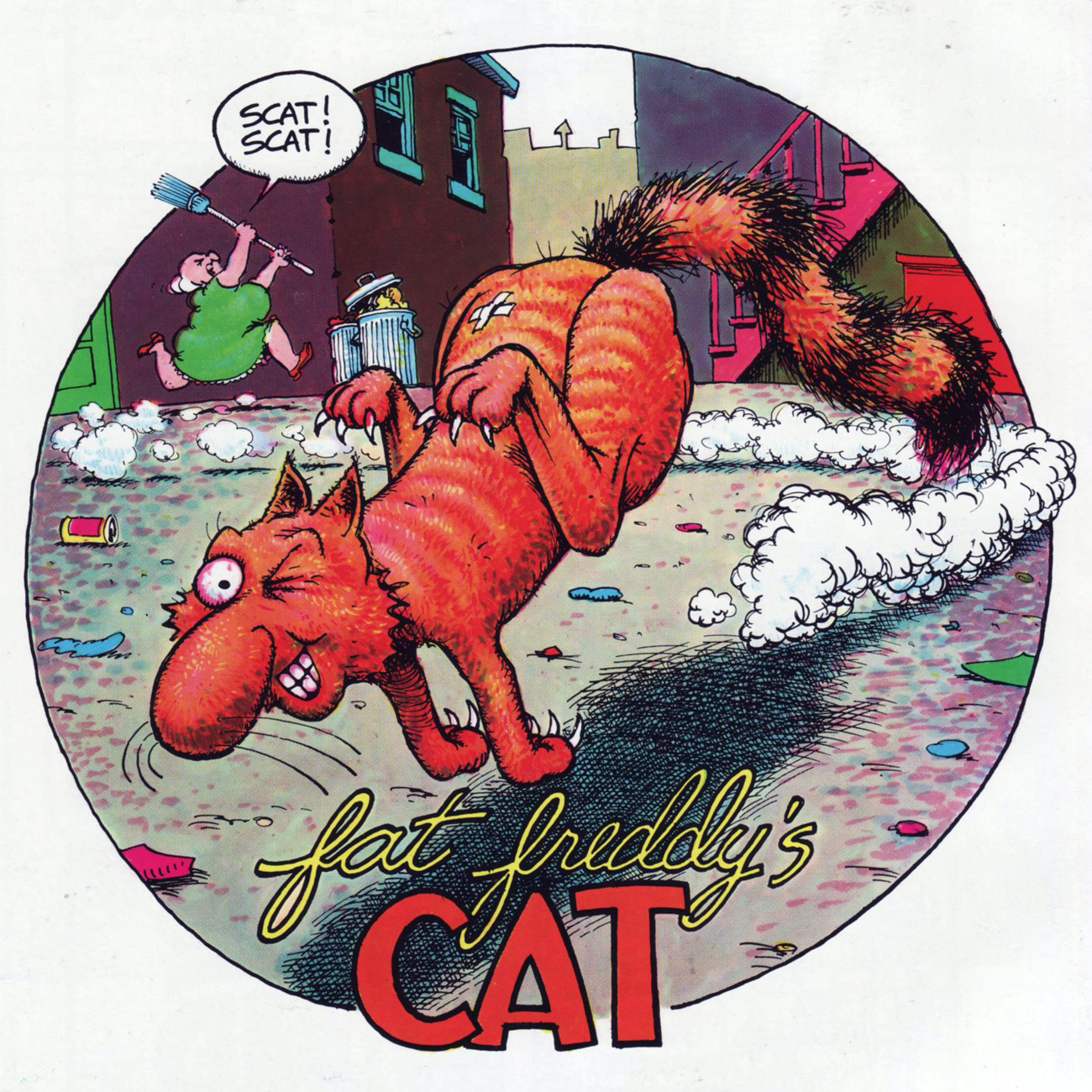
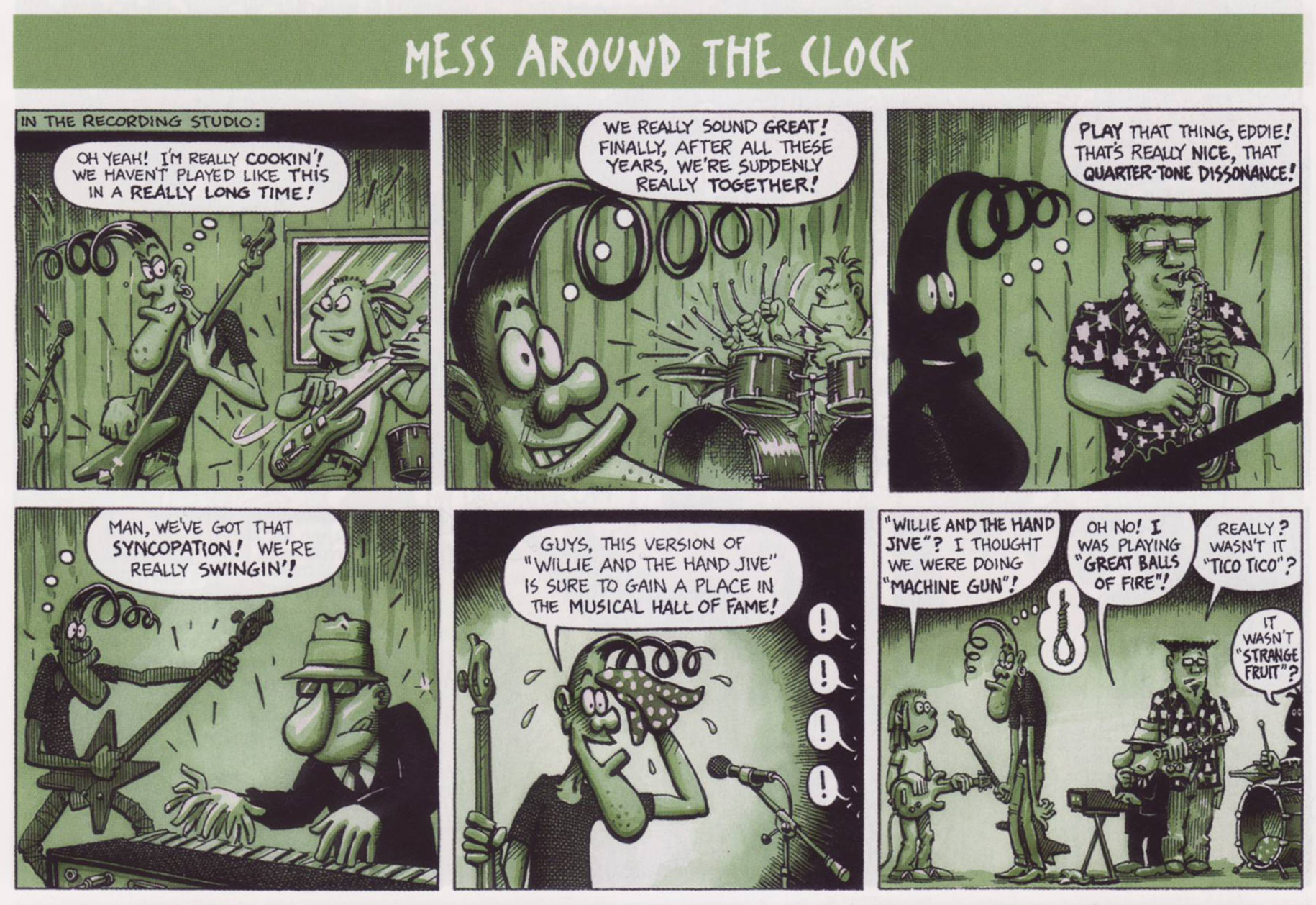
The toilet-training method reportedly works, but it helps to have more than one toilet available. From Fat Freddy’s Cat no. 7 (1993, Rip Off Press)Shelton’s most recent major creation, circa 1988-89, is Not Quite Dead, “the world’s oldest and least successful Rock ‘n’ Roll band”. So far, we’ve been treated to six issues, and the latest, “Last Gig in Shnagrlig” (2009), is quite the epic! A fruitful collaboration with French bédéiste Denis Lelièvre, alias Pic. These vignettes hail from Not Quite Dead no. 5 (2005, Knockabout)Aw, ain’t he adorable, and don’t you just wanna slip the birthday boy a big ol’ sloppy smooch? Photo by Christophe Prébois.
Speaking of collaborators, though it’s none of their birthdays, let’s give a salty salute to Shelton compadres-in-crime Tony Bell, Joe E. Brown Jr., Dave Sheridan, Paul Mavrides and Pic. Did I forget anyone?
-RG






























 Who's Out There?