« Night after night, Shepherd forged the inchoate thoughts and feelings of a whole generation of fans into an axiom that went something like: ‘The language of our culture no longer describes real life and, pretty soon, something’s gonna blow.‘. » — Donald Fagen
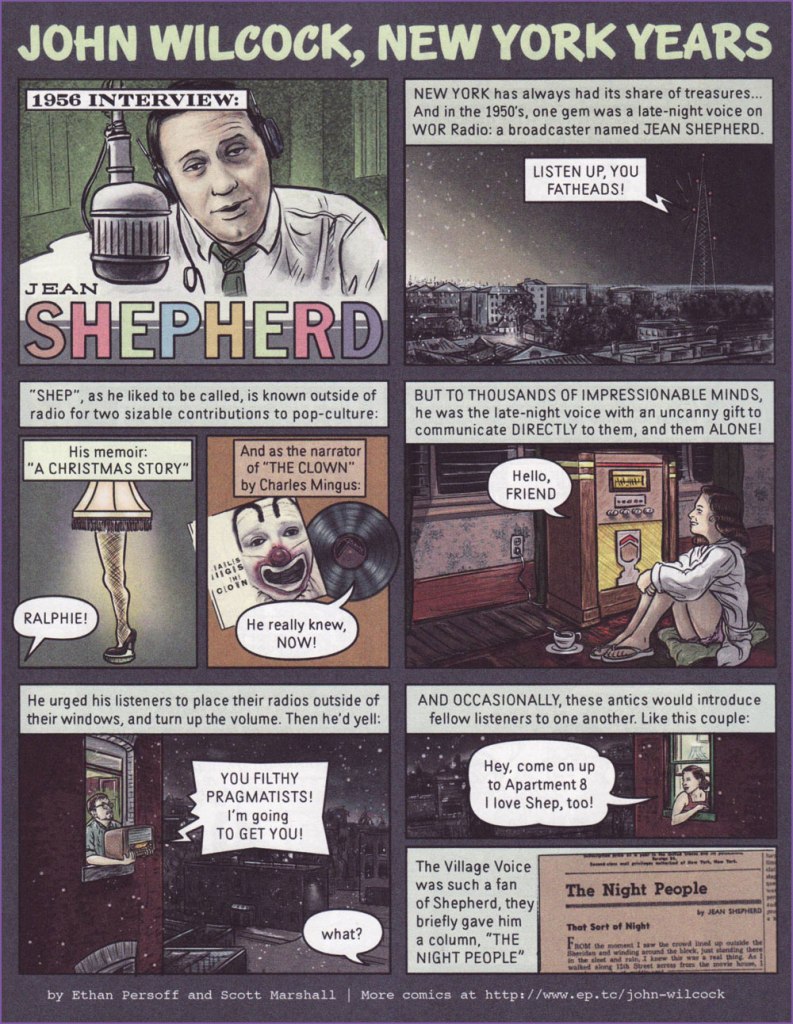
Today’s a very august occasion, for it marks the birth centennial of that sublime storyteller, Jean Shepherd (July 26, 1921 – October 16, 1999), so we’ll celebrate it… in comics!
« Since 2012, cartoonists Ethan Persoff and Scott Marshall have been collaborating on an extensive interview project with John Wilcock, an underground publisher of the 1960s. The graphic novel biography… focuses a year-at-a-time on Wilcock’s interesting and largely undocumented life, from co-founding the Village Voice in 1955, to becoming a member of Andy Warhol’s Factory in the early Sixties, establishing the Underground Press Syndicate, and other interesting moments, until Wilcock left NYC in 1972. » This particular entry appeared in the pages of The American Bystander no. 2 (Spring, 2016). For more info on the project (including a generous helping of choice excerpts), now complete and available for purchase, direct your browser here.
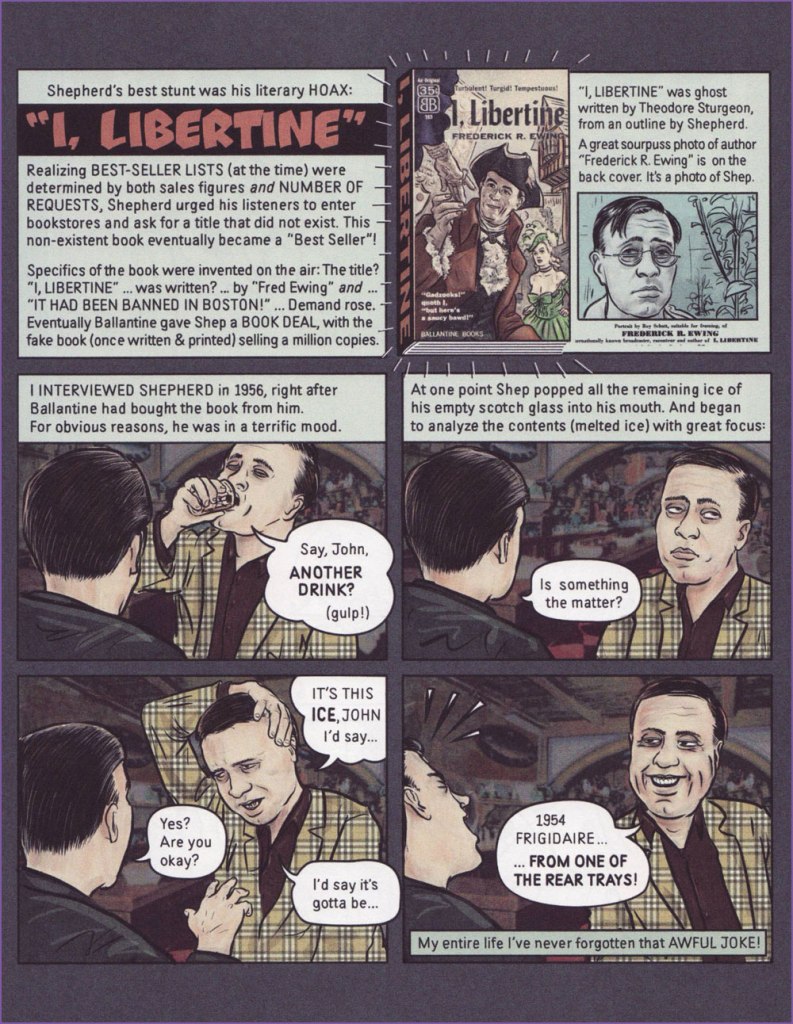
The front and back covers of I, Libertine‘s paperback edition (1956, Ballantine). Here’s a full, fascinating account of how this literary hoax unfolded. Take note, fellow Theodore Sturgeon fans!
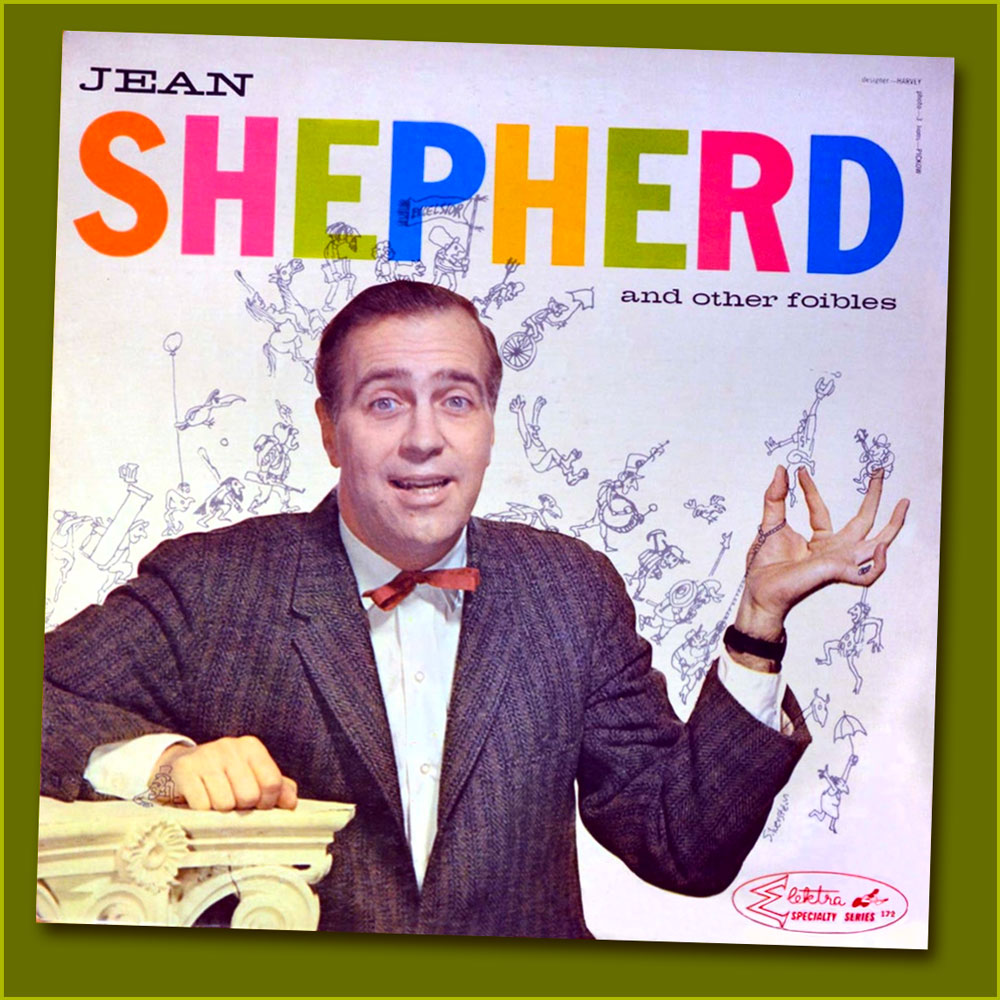
Shep’s second LP, Jean Shepherd and Other Foibles (1959, Elektra), was abundantly illustrated by his good friend, Renaissance Man (and local favourite) Shel Silverstein, who also authored the liner notes and played washboard and kazoo!
« In addition to the liner notes, Shel drew a veritable parade of characters marching across the front and back album cover of Foibles, incorporating the message, ‘Jean Shepherd is a dirty rotten, one-way sneaky son of a bitch‘, spelling it out backwards to escape the censors. » (from Lisa Rogak’s A Boy Named Shel (2007, St. Martin’s Press)
Another interesting comics connection: In Foibles‘ opening track, [ hear it here] Shep recalls an old favourite: « How many of you remember ol’ Peter Pain? He used to work in the comic strips, you remember, in those little strips that appeared under Moon Mullins, under The Gumps? He was green, was shaped like a pickle, he had stubble all over, he wore a black derby. He was a tremendous figure… a great American! He was the first Beat Poet. » Here’s one of Peter’s misadventures, circa 1948, illustrated by Jack Betts. You’ll find many more of these entertaining ads on Ger Apeldoorn’s highly-recommended blog, The Fabulous Fifties.
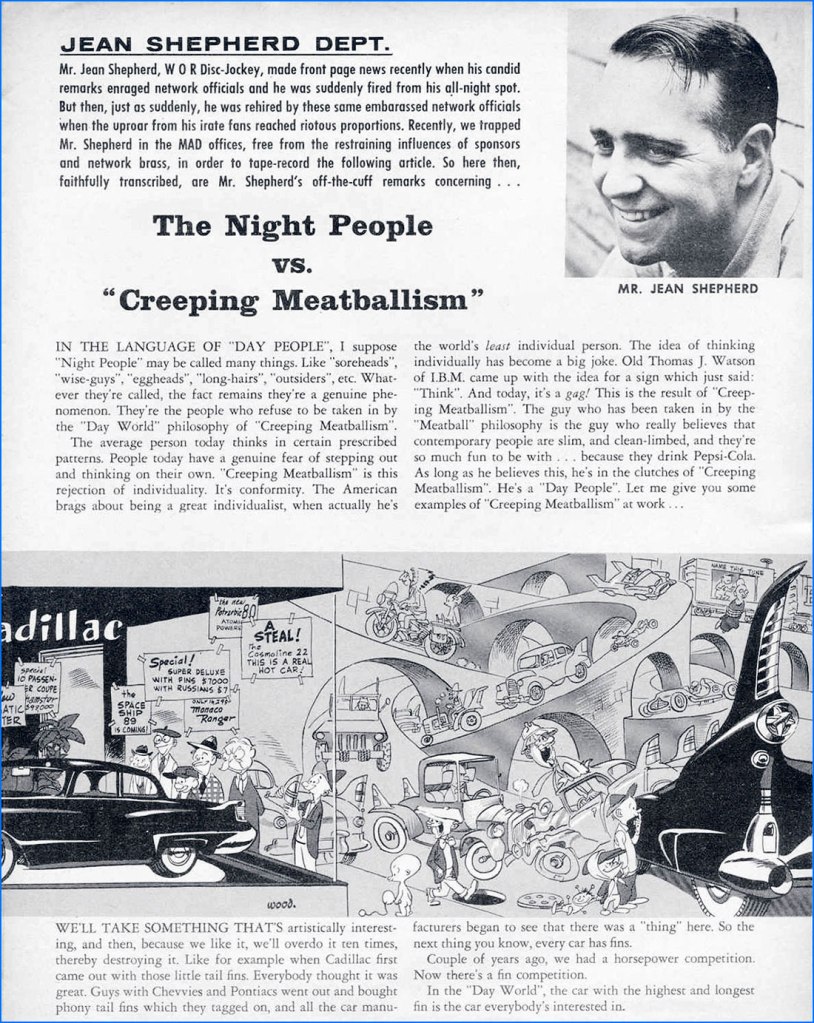
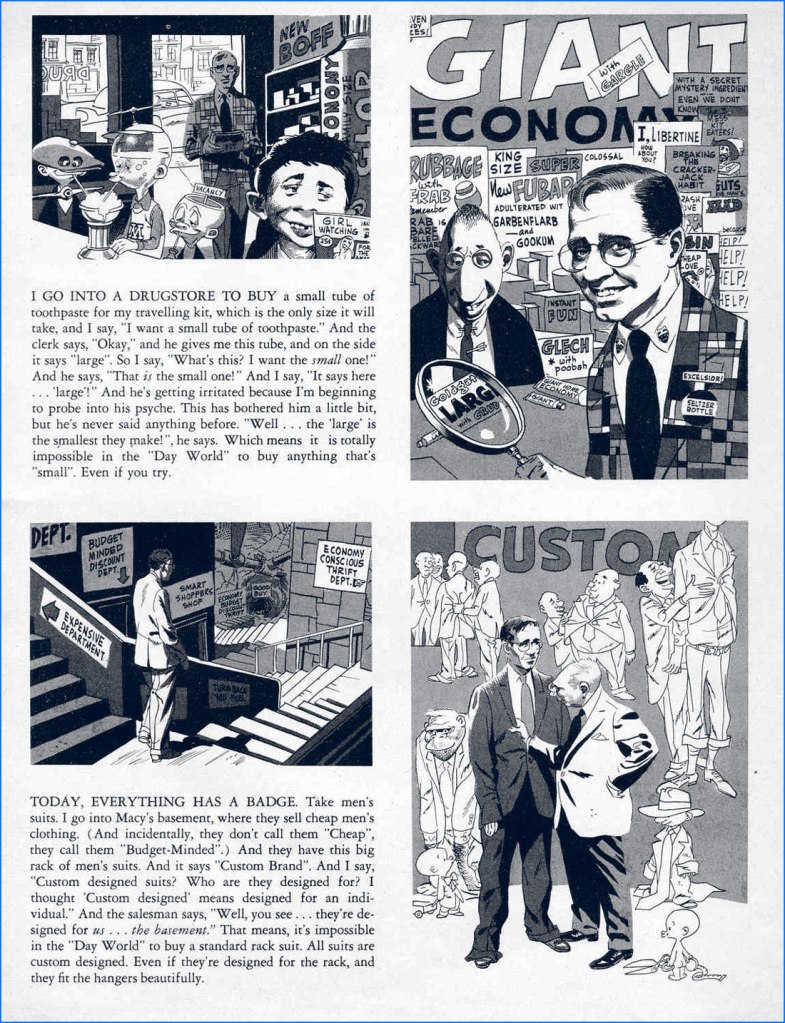
Seldom seen since its publication, this was Shepherd’s collaboration with Wally Wood at the height of his powers. The Night People vs. “Creeping Meatballism“ appeared in Mad Magazine no. 32 (Apr. 1957, EC).
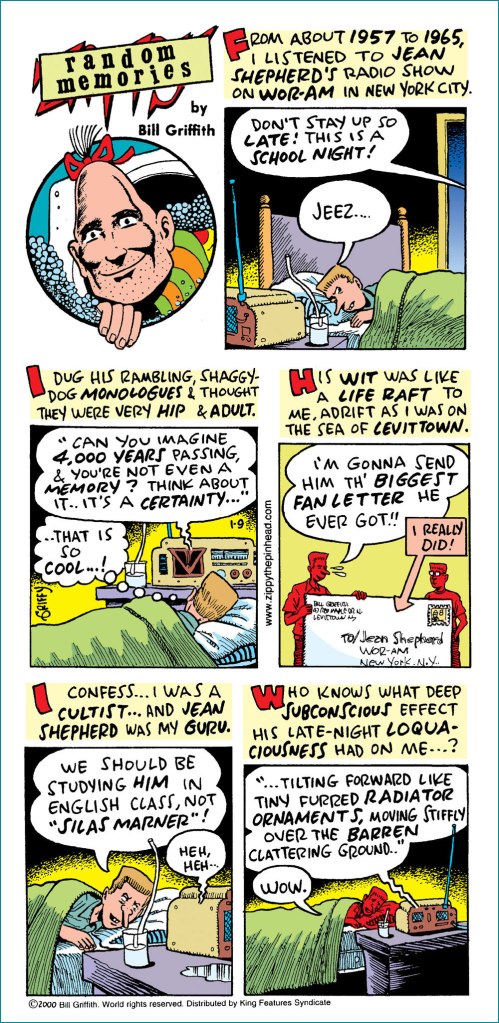
One gets a sense of Shepherd’s outsize and hopefully abiding significance from the quality of the minds he has helped warp. For example, here’s Underground Comix pioneer and Zippy the Pinhead creator Bill Griffith‘s fond tribute to Mr. Shepherd, published soon after Shep’s passing. A grateful tip of the hat to Mr. Griffith, who graciously provided me with a high-quality image of this, his Sunday, January 9, 2000 strip.
Let’s close in highfalutin fashion with a most pertinent bit of Longfellow (1807–1882):
The shades of night were falling fast, As through an Alpine village passed A youth, who bore, ‘mid snow and ice, A banner with the strange device, Excelsior!
His brow was sad; his eye beneath, Flashed like a falchion from its sheath, And like a silver clarion rung The accents of that unknown tongue, Excelsior!
In happy homes he saw the light Of household fires gleam warm and bright; Above, the spectral glaciers shone, And from his lips escaped a groan, Excelsior!
“Try not the Pass!” the old man said; “Dark lowers the tempest overhead, The roaring torrent is deep and wide!” And loud that clarion voice replied, Excelsior!
“Oh stay,” the maiden said, “and rest Thy weary head upon this breast! “ A tear stood in his bright blue eye, But still he answered, with a sigh, Excelsior!
“Beware the pine-tree’s withered branch! Beware the awful avalanche!” This was the peasant’s last Good-night, A voice replied, far up the height, Excelsior!
At break of day, as heavenward The pious monks of Saint Bernard Uttered the oft-repeated prayer, A voice cried through the startled air, Excelsior!
A traveller, by the faithful hound, Half-buried in the snow was found, Still grasping in his hand of ice That banner with the strange device, Excelsior!
There in the twilight cold and gray, Lifeless, but beautiful, he lay, And from the sky, serene and far, A voice fell like a falling star, Excelsior!
« I don’t mind if my skull ends up on a shelf as long as it’s got my name on it. » —Debbie Harry
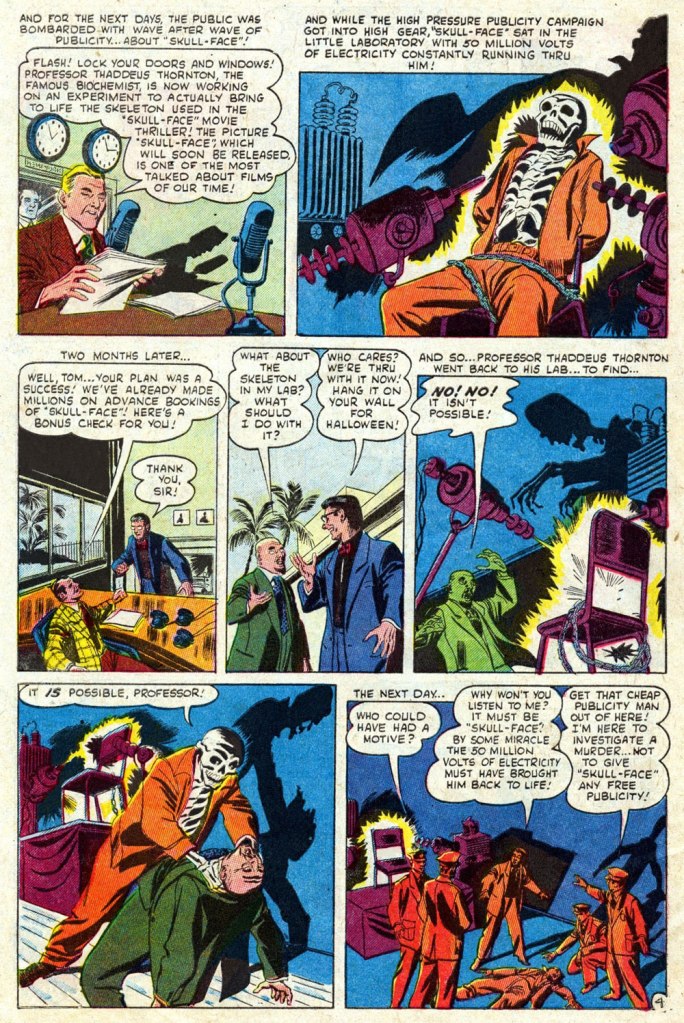
A couple of years back, I spotlighted a story by a neglected Golden Age favourite of mine, Anthony Lewis “Tony” DiPreta (July 9, 1921 – June 2, 2010), the wacky The Hidden Vampires! I advise reading it first for comparison (and a bit of background on the artist).
A whole hour! People were armed with unwavering patience back in the day.
So the suits’ great flash of inspiration is not to update a fifteen-year old movie (from 1937!), nor remake it: they’ll just trot it out again. Picture doing this with 2006’s biggest horror hit, Saw III. How do you think it would fare today?
You’d think a seasoned publicist would be a savvier negotiator. I mean, all he needs is some random skeleton. Adjusted for inflation, a thousand 1952 dollars would today be worth 9,829 bucks. But that’s nothing compared to his liberal waste of electric current: the voltage used to execute a convict in the electric chair is around 2,000 volts for less than a minute… and that makes the lights dim all over the area*. Now multiply the voltage by 25,000, and the duration (let’s round it off to a minute, for simplicity’s sake) 80,640 times longer. Picture the resulting electric bill, not to mention the repercussions on the power grid, all for a stunt that could have simply been faked (i.e. just say there’s live current… no-one’s going to check). Oh, and what’s a “famous biochemist” doing on a film studio’s payroll? Come to think of it, it’s not that odd: Thornton was a cynical, opportunistic money-grubbing parasite, the Dr. Memhet Oz of his day…
Note these stellar examples of one of DiPreta’s trademark horror ambiance moves: lighting from below, projecting stark, expertly-delineated shadows.
One has to wonder why Fenton insists on addressing the resurrected ‘Demon’ (he was a demon on the sousaphone) incorrectly as “Skull-Face” (that’ll only aggravate him, you dolt!). Would it have helped if he’d added air quotes?
The ho-hum Sol Brodsky cover of Mystery Tales no. 6 (Dec. 1952, Atlas), but hey, our pal “Skull-Face” is the featured attraction!
The comics industry’s traditional garish colour and murky reproduction fail (spectacularly!) to do justice to DiPreta’s spare, confident and elegant inking line. To remedy the situation, here’s a look at a surviving piece of original art. It hails from “One Must Die” (scripted by Carl Wessler), from Crime Can’t Win no. 11 (June 1952, Atlas), the publisher’s knockoff of Lev Gleason‘s influential Crime Does Not Pay.
A slick Joe Palooka Sunday from July 24, 1966. DiPreta enjoyed quite a run on the strip, illustrating it from 1959 to its 1984 finale.
« I have argued flying saucers with lots of people. I was interested in possible. They do not appreciate that the problem is not to demonstrate whether it’s possible or not but whether it’s going on or not. » — Richard P. Feynman
You can follow the rising pitch with the publishing frequency of Gold Key’s UFO Flying Saucers: after its premiere issue hits the stands in 1968, two full years elapsed until the second, then another two until the third… and again to the fourth. It’s fair to presume that the title had been intended as a one-shot, and that encouraging sales led the way to a regular, if sparse schedule. Then the pace picked up after issue four (Nov. 1974), and so ten issues appeared in the span of just over three years. There was a brief hiatus, a retitling to UFO & Outer Space and a further dozen issues saw print, two of them reprints. By late 1979, the series sputtered to a halt.
They may not have been to everyone’s taste, but Gold Key comics provided their audience with a soothing respite and change of pace from Marvel’s endless manic brutality and insipid crossovers. Even amidst the GK line, UFO Flying Saucers stood out. It did a stellar job of covering the flying saucer craze of the Cold War years, thanks to a sober, documentary-style narrative tone and strong artwork, led by Frank Bolle, who fit the template to a T. The tone was surprisingly even-handed (far more so than most modern media; j’accuse, History Channel!) They even tossed a scrumptious pinch of skepticism into the mix now and again, and it’s this delicacy that we’ll be sampling.
The modern skeptical* movement was spearheaded by the 1952 publication of mathematician and science writer Martin Gardner‘s fascinating In the Name of Science (thereafter better known as Fads & Fallacies in the Name of Science), answering the need for an organised response to a (still) rising tide of irrationality, superstition and scientific illiteracy. When UFO Flying Saucers introduced its series featuring The Hoaxmaster, the skeptics’ flagship publication, The Skeptical Inquirer, was still a couple of years away from being launched. That auspicious occasion came in the fall of 1976, under its original title of The Zetetic: Journal of the Committee for the Scientific Investigation of Claims of the Paranormal.
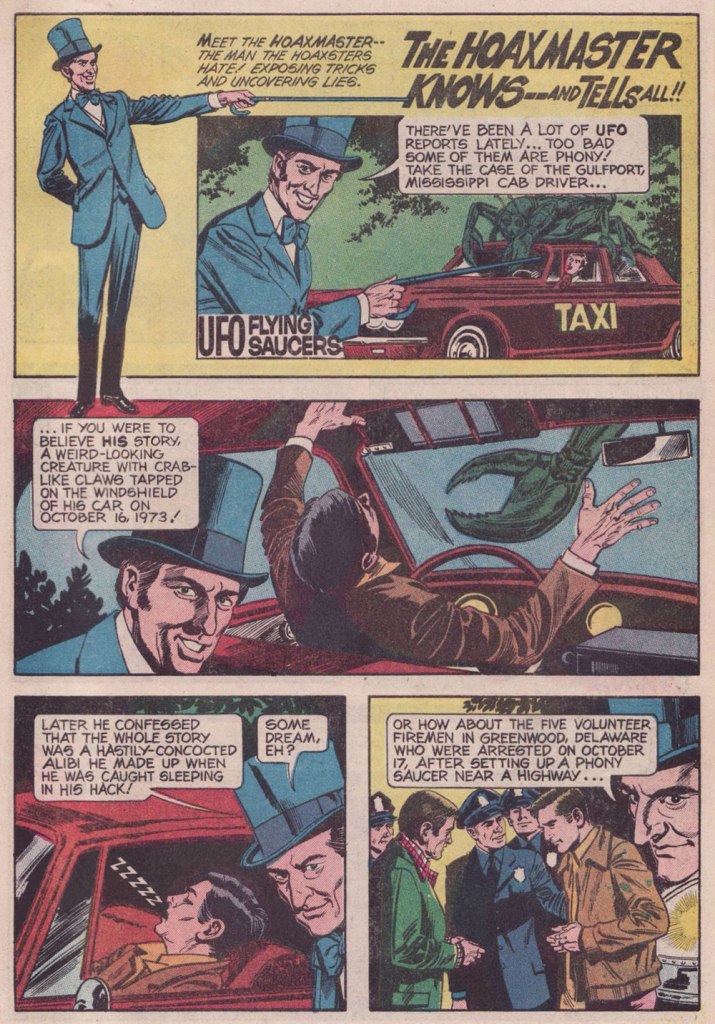
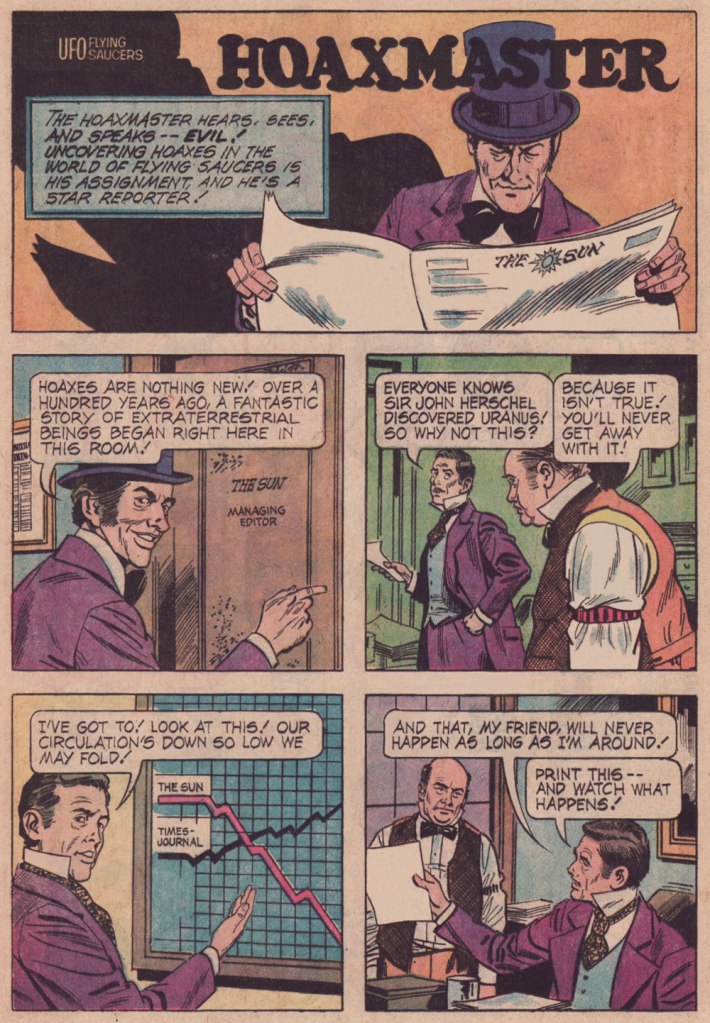
The introduction of The Hoaxmaster, from UFO Flying Saucers no. 4 (Nov. 1974, Gold Key).
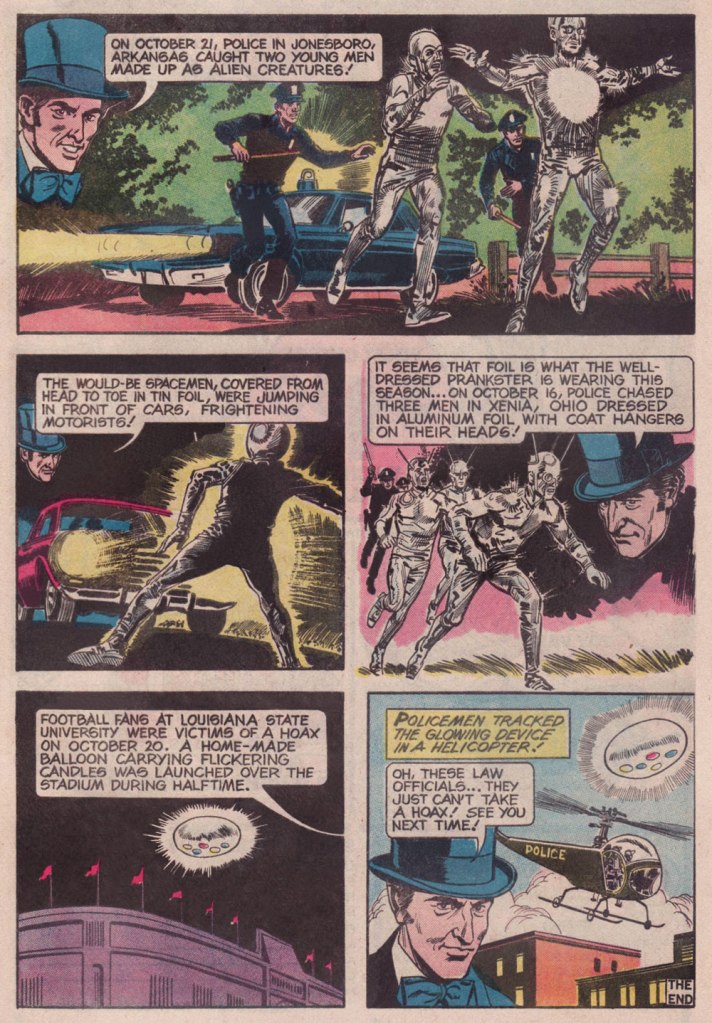
And such fakery has only become far, far easier… from UFO Flying Saucers no. 6 (May 1975, Gold Key).
Ah, that John and Marsha/Marcia routine never gets old! From UFO Flying Saucers no. 7 (Aug. 1975, Gold Key).
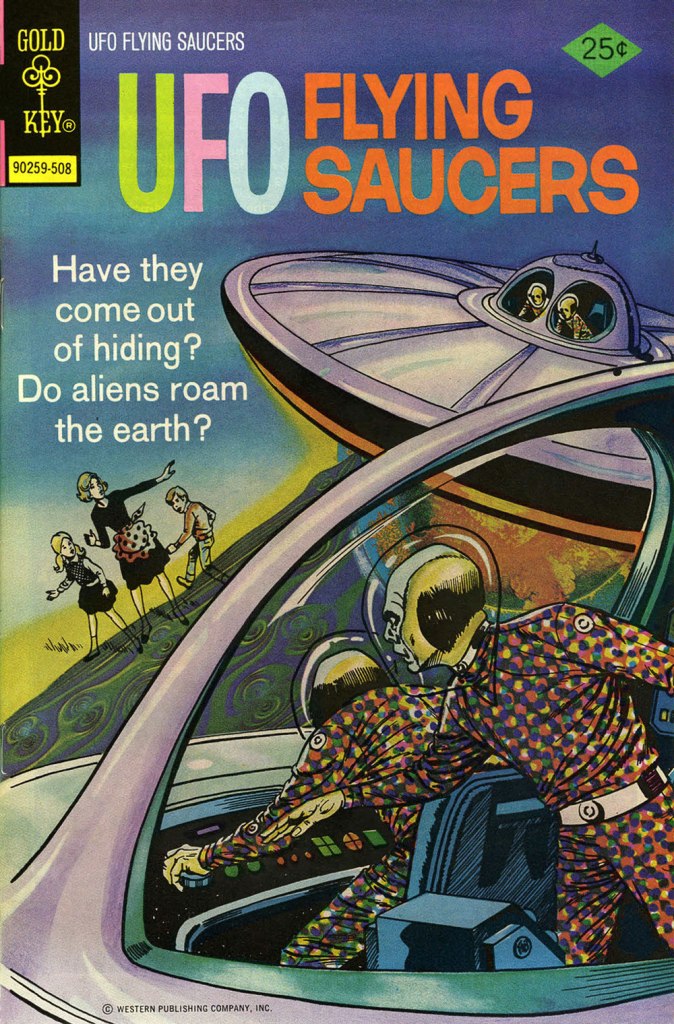
Mr. Bolle provided just one cover to the series, and while it’s hardly the best one, it certainly stands out amidst the lot. Again, this is UFO Flying Saucers no. 7 (Aug. 1975, Gold Key).
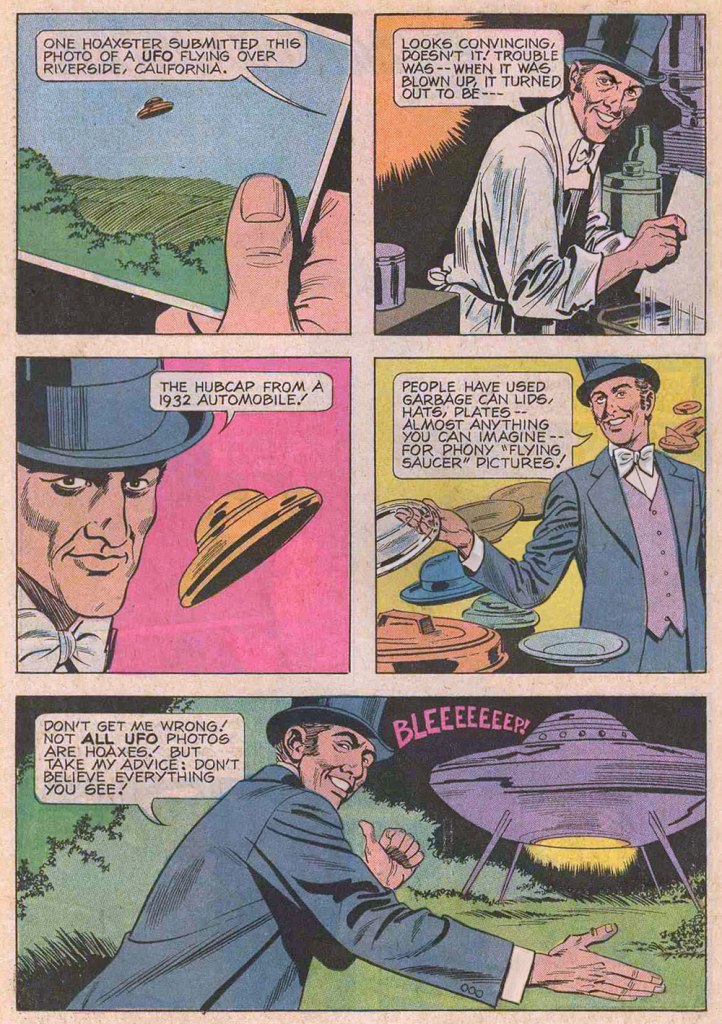
Say, what have we here? Could it be… fake news? From UFO Flying Saucers no. 8 (Nov. 1975, Gold Key).
Sadly, The Hoaxmaster series bears no writing credit. The only writer ever credited in the title is Western Publications staffer Patricia Fortunato, a former story editor of The Golden Magazine. If that’s your work, Pat, take a bow!
In comparison, artist identification is a cinch: the steady hand of Frank Bolle, who left us just last year, at the most venerable age of 95, is instantly recognizable. Artistically active right to the wire, he drew the final leg (1999-2015) of soap opera comic strip Apartment 3-G‘s 54-year-run. Over the course of his singularly long career, he worked for just about every comics publisher… and then some! His reliable proficiency at providing just the right tone to illuminate that delicate borderline between science fact and science fiction made him the ideal choice to adapt John Christopher‘s early young adult post-apocalyptic The Tripods trilogy (The White Mountains, The City of Gold and Lead,and The Pool of Fire), serialised in Boys’ Life magazine in the 1980s. Check it out here!
Well, that’s roughly half of the Hoaxmaster strips. If you’d like to see the rest, let us know… I can probably time it with the next edition of World Contact Day. To sign off on a musical note, here’s its catchy, Canadian-made anthem. Remember, “we are your friends“.
-RG
*as opposed to ‘denialism’, of course. It’s a crucial distinction: know the difference!
« There are two kinds of Arctic problems, the imaginary and the real. Of the two, the imaginary are the most real. » — Vilhjalmur Stefansson
As it’s been a record-shattering scorcher of a week over much of North America, I’ve been daydreaming of cooler, much cooler climes whilst simmering at my desk. And why not make a post of it? A couple of years ago, I picked up one of the finest comics I’ve ever encountered, Racontars arctiques: l’intégrale (2018, Sarbacane). Its myriad of virtues, subtle and obvious, made it easy to enjoy, but a challenging work to dissect and properly discuss. But here we are — hope I did it justice!
Danish writer Jørn Riel (b. 1931 in Odense) spent the better part of his twenties and thirties in Greenland as part of a scientific expedition. This sojourn in turn inspired a successful series of tall tales set in the Arctic, fanciful accounts of the lives of hardy explorers, hunters and Inuit natives. His works have been translated into fifteen languages, and in an unusual twist, English isn’t among these.
French cartoonist-illustrator Hervé Tanquerelle (b. 1972 in Nantes) might be termed a cartoonist’s cartoonist, with all that entails: he hasn’t achieved superstar status, but it’s not through any lack of talent or toil. While I’ve often lamented the rather banal tragedy of great North-American artists who can (and do) cruise through decades-long careers without ever coming within hailing distance of a decent script, Hervé Tanquerelle’s path has been paved with glorious scenarios, most of them provided by writer-artist compères: Professeur Bell (with Joann Sfar, 2002-06, which I’ve featured here); Le legs de l’alchimiste (with Hubert Boulard, 2002-07); Les faux visages (with David B., 2012), and his most commercially successful opus thus far, Racontars arctiques (with Gwen De Bonneval, 2009-13). He has just completed work on the ambitious Le dernier Atlas (with De Bonneval and Fabien Vehlmann, 2018-2021), nothing less than a gritty, SF-infused alternate version of the Algerian War.
For Racontars, Tanquerelle even travelled to Greenland with a group of scientists and artists, with Jørn Riel among them, which added layers of authenticity and personality to what was already an undeniable labour of love. Try to envision your average US cartoonist putting out this kind of effort and commitment (one notable exception being, of course, the prodigious William Stout)! Anyway, Tanquerelle made fruitful use of this experience and its attendant documentation with a semi-autobiographical ligne claire account (fittingly published by Casterman, Tintin’s forever home), Groenland Vertigo (2017).
Despite essaying the thankless role of the invisible middleman, Gwen De Bonneval (Tanquerelle’s fellow Nantois, né Gwénaël de Bonneva in 1973), deserves full marks for admirably condensing Riel’s tales without sacrificing their appeal, not to mention cherry-picking the ones most ripe for adaptation (confirmed by co-admin ds, who’s read both the prose and the comics versions).
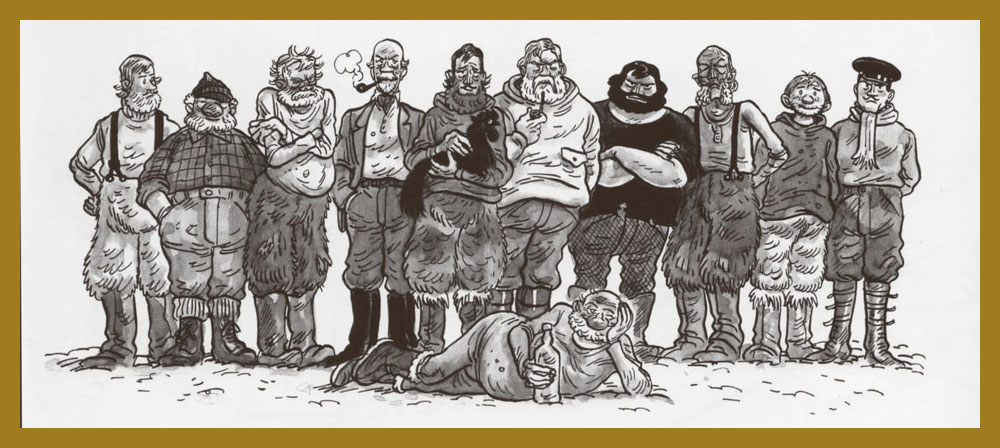
The majority of our esteemed cast: Anton, Museau, Lodvig, Le Comte, Herbert (cradling Alexandre), Mads Madsen, William le Noir, Bjørken, Lasselille, Lieutenant Hansen; and Valfred providing the beefcake in front.
The climatic extremes of the Great North aren’t for everyone, to put it mildly. Anton sinks deep into melancholy.
With its unusual day/night cycle, Greenland is no place for a normal rooster, as we learn from the woeful tale of Alexandre.
« Museau was a first-rate hunter… until he lost his glasses », explains his companion, Bjørken. While treating the puppies to some jam, a freeloader comes along.
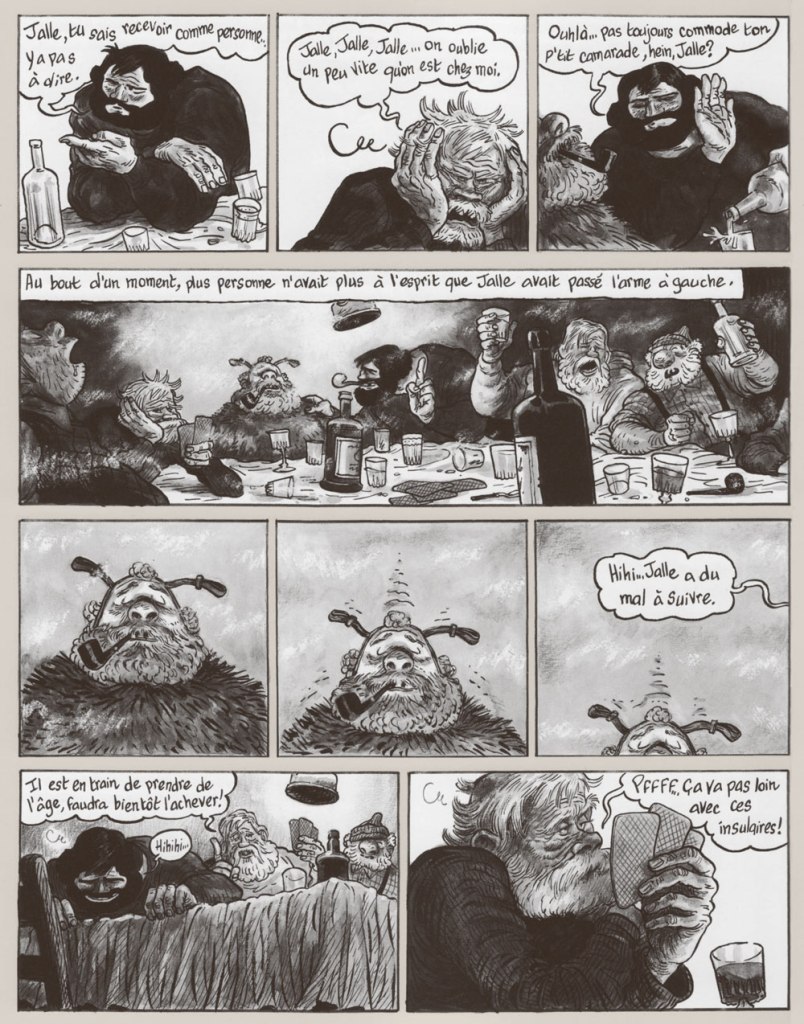
What do you do when someone kicks the bucket during the long winter? The ground being frozen solid, he can’t be buried. And if you leave him outside, foxes or other rascals are liable to carry off the corpse. In this case, you give him a proper send-off — by dropping his coffin into the sea, but first gathering everyone for a boozy feast, with the stiff in the place of honour. Oops, he’s thawing out.
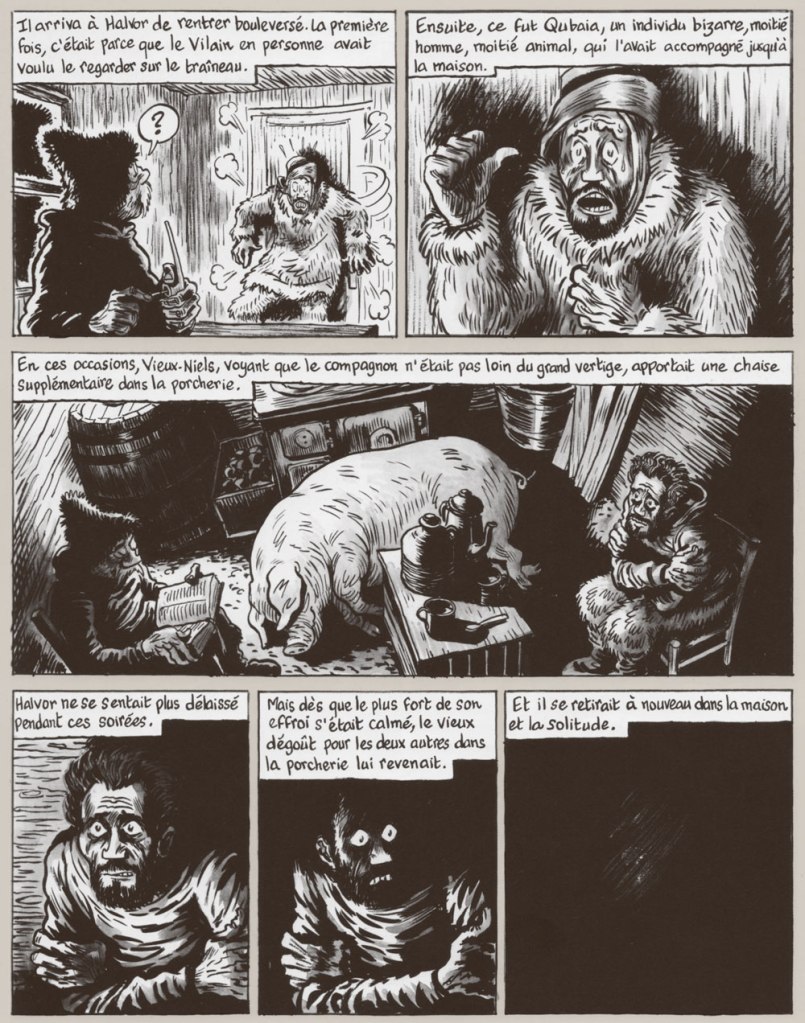
In the darkest of these tales, Le Roi Oscar (that’s the hog), Halvor loses his mind (what his companion calls “the Great Vertigo”), with dire consequences.
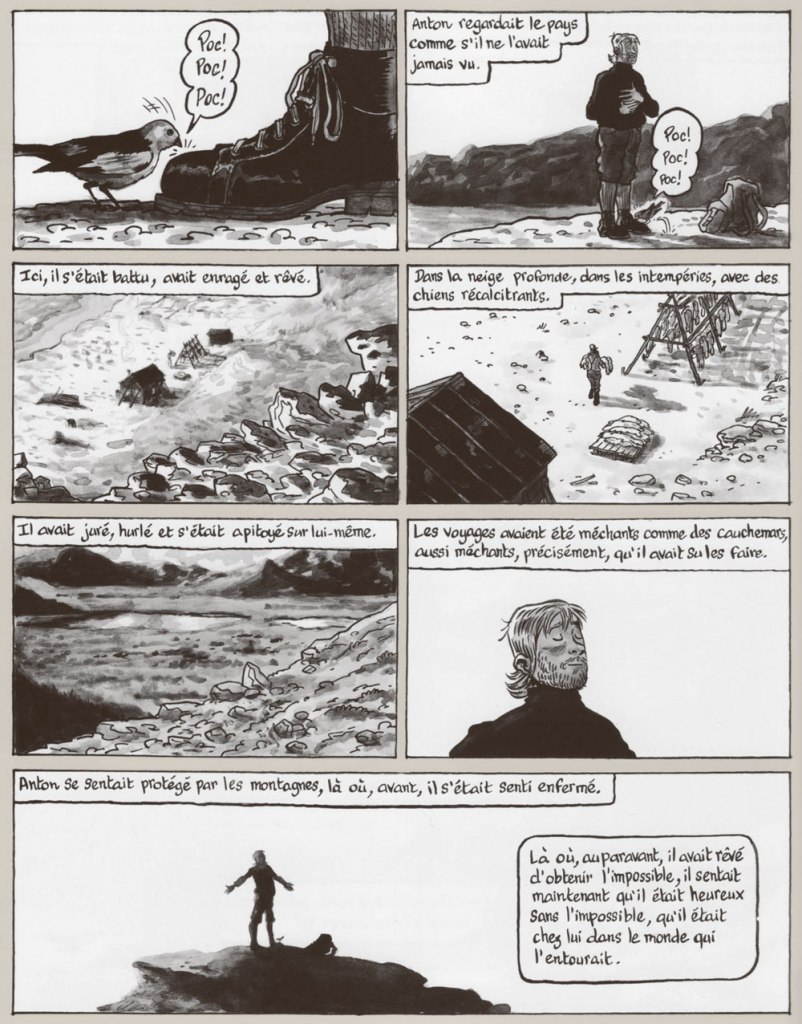
Callow youth Anton Pedersen arrives with a baggage of illusions and misconceptions about the trapper’s life. Reality nearly does him in.
His spirit is saved in extremis by the song of Spring’s first snow bunting, a sweet little guy.
In the set’s wildest and most epic tale, Valfred and Hansen… take a little detour.
The series’ centrepiece is probably La vierge froide (“The Cold Virgin”), in which the men share a useful delusion of Emma, an ideal woman they barter back and forth. Note how Emma’s appearance shifts according to the proclivities of each current companion.
Of this adaptation, Jørn Riel said: « Opening this book is like opening the door to the arctic world as I knew it so many years ago. The trappers in these drawings are exactly as I discovered them then, and to meet them anew this way was both a surprise and a source of great joy. I thank with all my heart the authors and publisher. The trappers of Northeastern Greenland have been resurrected. » Let’s not underestimate the resilience and backbone of such men: after all, the vaunted Vikings gave up living there… because conditions were too harsh for their tender hides.
Jørn Riel defines a racontar (rumours or gossip don’t quite convey the meaning), as “a true story that could pass for a lie. Unless it’s the other way round“. I hope the language barrier doesn’t prove too much of a hurdle. These marvels truly offer a fantastic opportunity for the discerning publisher… and, unless I missed something, the overdue scoop of Riel’s first English-language publication. Hello, Fantagraphics, D&Q…
I can’t help returning to Warren Kremer (today’s his birthday, not coincidentally; he was born on June 26, 1921, passing away on July 23, 2003), first because I adore his work, and second because I quite concur with Jon B. Cooke‘s bold but sensible assertion that Kremer…
« … is an extraordinarily talented artist. A master of design, character nuance and just plain exquisite drawing ability, he is perhaps the most underrated – or even worse, ignored – comic book creator of significance in the industry’s history. »
And why is that? A combination of working outside the superhero genre and of doing it, uncredited and for decades, on the ole Harvey Family Plantation.
This blog’sIt’s a Harvey World category might as well be called It’s a Kremer World, since he’s pretty much had the spotlight to himself.
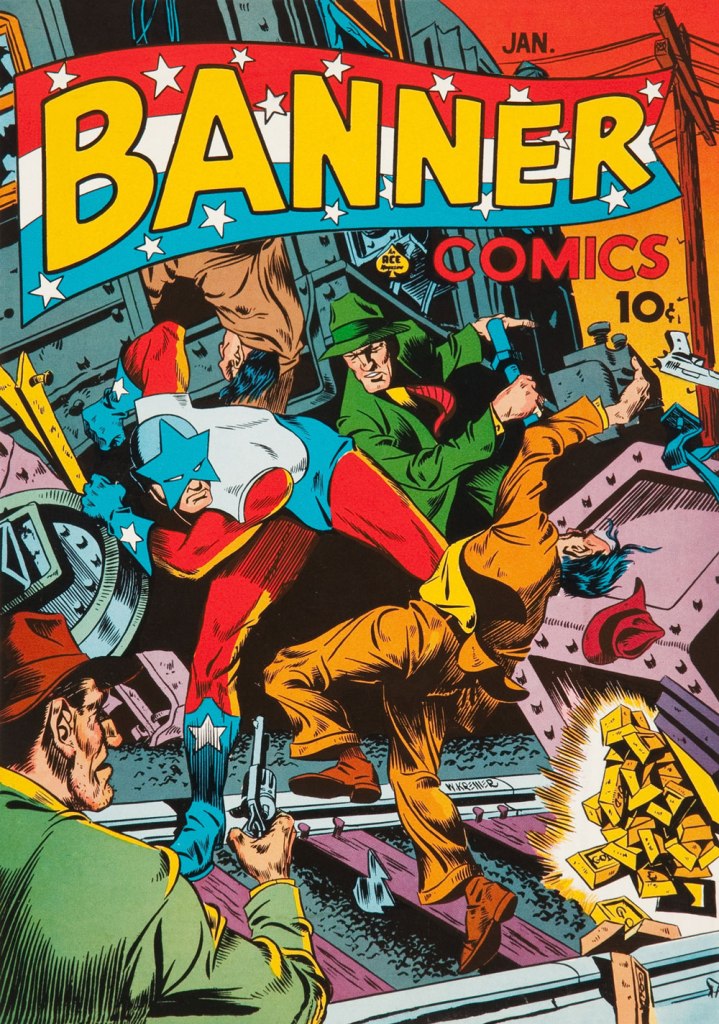
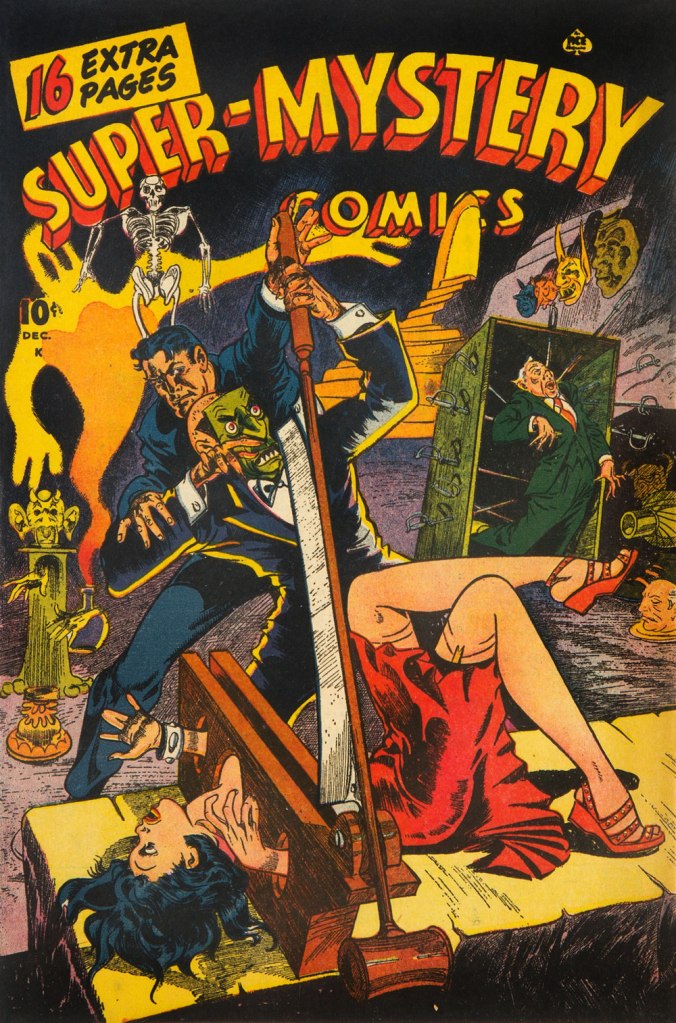
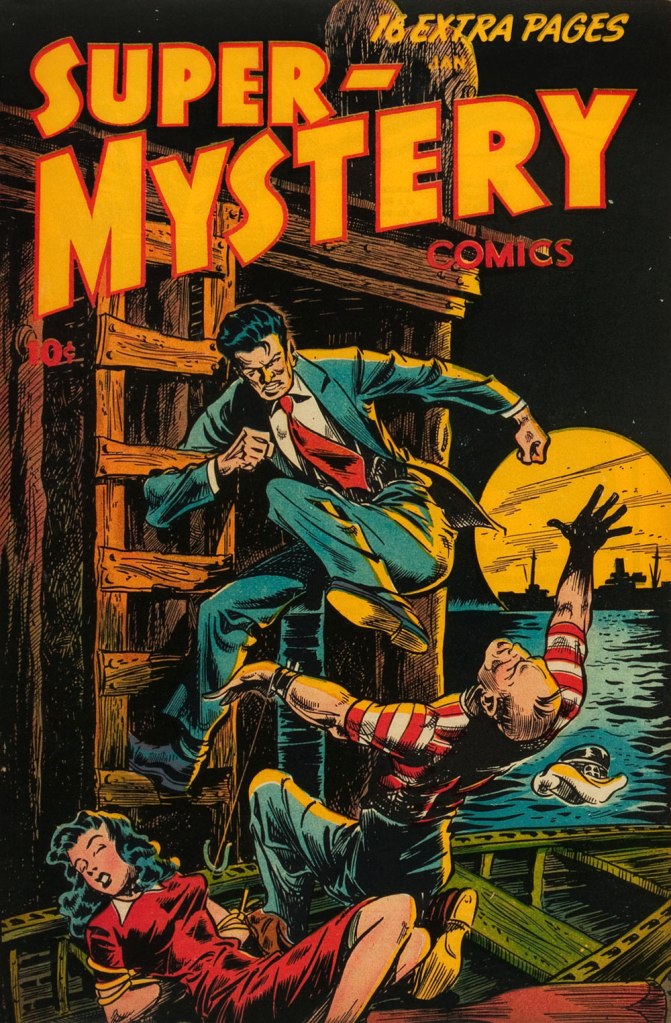
But Kremer’s comics career precedes his arrival at Harvey; after working for the pulps in the late 1930s, he entered the comic book field, and a sizeable chunk of his early work was done for Ace Magazines (1940-56), and this is the area we’ll be exploring today.
A rare foray into super-heroics, this is Banner Comics no. 5 (Jan. 1942, Ace); the guy with the star mask is ‘Captain Courageous’.
This is Super-Mystery Comics vol. 5 no. 6 (June 1946, Ace), featuring Mr. Risk in Riddle of the Revolutionary Portrait. Read it here! Kremer was signing as ‘Doc’ at the time.
Dig all that detail! This is Super-Mystery Comics vol. 6 no. 3 (Dec. 1946, Ace), featuring Bert and Sue in The Adventure of the Murdered Medium; read it here!
Boasting a snazzy new logo, this is Super-Mystery Comics vol. 7 no. 3 (Jan. 1948, Ace), featuring Bert and Sue (Ace’s Nick and Nora?) in Hell Bent for Election!. Read it here!
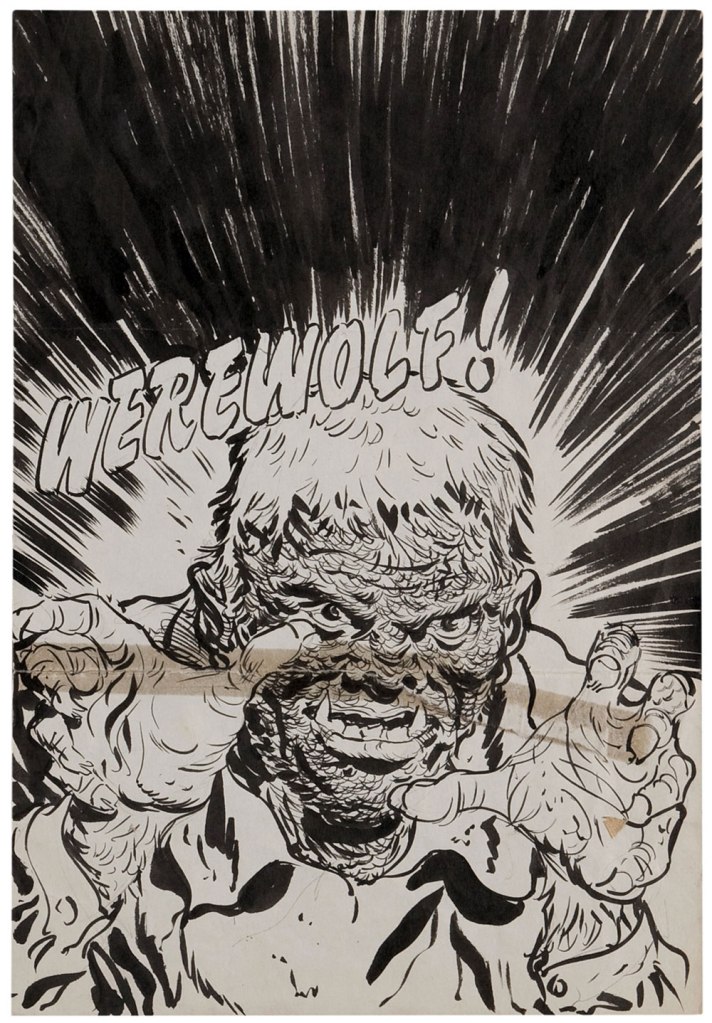
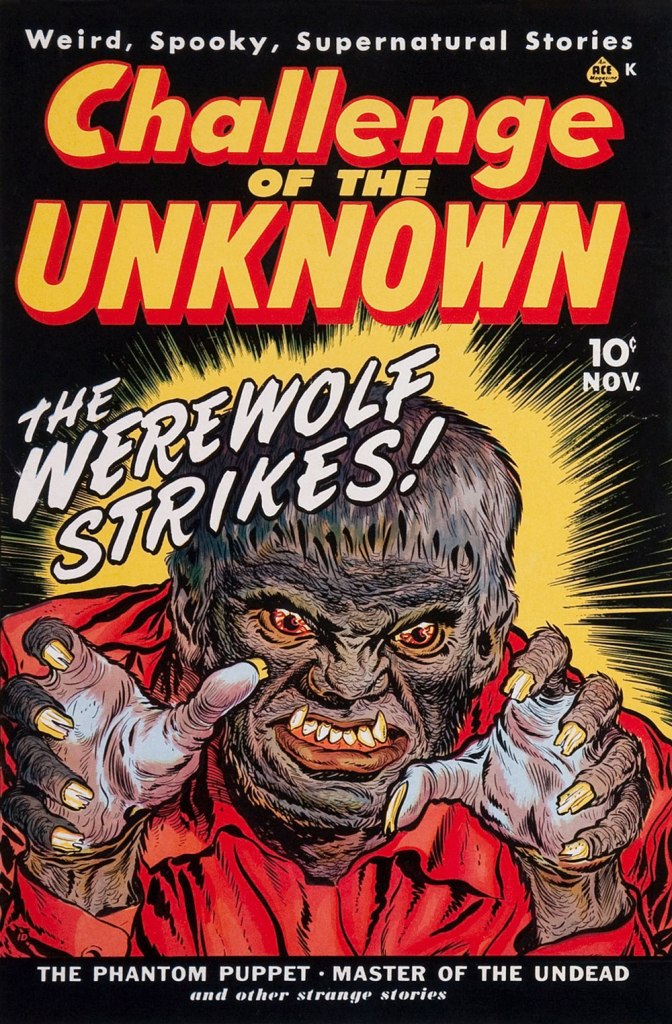
Eight years before DC’s Challengers of the Unknown, Ace came up with Challenge of the Unknown… àchacun son tour. This is the first of its two-issue run, no. 6 — but of course! (Sept. 1950, Ace); pencils by Kremer, inks possibly by Al Avison. Read it here!
Three steps to a Werewolf. Kremer’s rough cover design…
The printer’s cover proof…
… and final publication switcheroo! One might surmise that someone got cold feet about CotU. This is The Beyond no. 1 (Nov. 1950, Ace). Read it here!
This is The Beyond no. 2 (Jan. 1951, Ace). A solid demonstration of dramatic perspective.
Here’s Mr. Risk again, in the first and penultimate issue of his own series — no. 2 (Dec. 1950, Ace) featuring The Case of the Psychopathic Lady and The Case of the Jinxed Air Line — the next issue was number 7! Read this one here.
Again, all that beautifully-rendered detail. This is The Beyond no. 3 (Mar. 1951, Ace), featuring The Keeper of the Flames. Read it here (preferably by candlelight)!
One of the most rewarding things for the Kremer fan is that the man thoroughly documented his creative process. In other words, he saved a lot of his art, including sketches, notes and preliminaries.
And the final version, from The Beyond no. 30 (Jan. 1955, Ace). See how Kremer had it all worked out, down to the colouring? Amazing. Oh — and read it here!
Happy birthday, Mr. Kremer — wherever it is you may roam!
« In the last analysis, a pickle is a cucumber with experience. » — Irena Chalmers
Earlier this week, the world lost another of its greatest cartoonists in Nikita Mandryka (October 20, 1940 – June 13, 2021), and he’s been among my lifelong favourites, thanks to his accessible, deceptively simple style and its nervous, explorative vitality. I’ve written about Mandryka’s Ailleurs some time ago, so there’s no pressing need to rehash his biography.
He was a giant, I tell you! The artiste circa 1975.
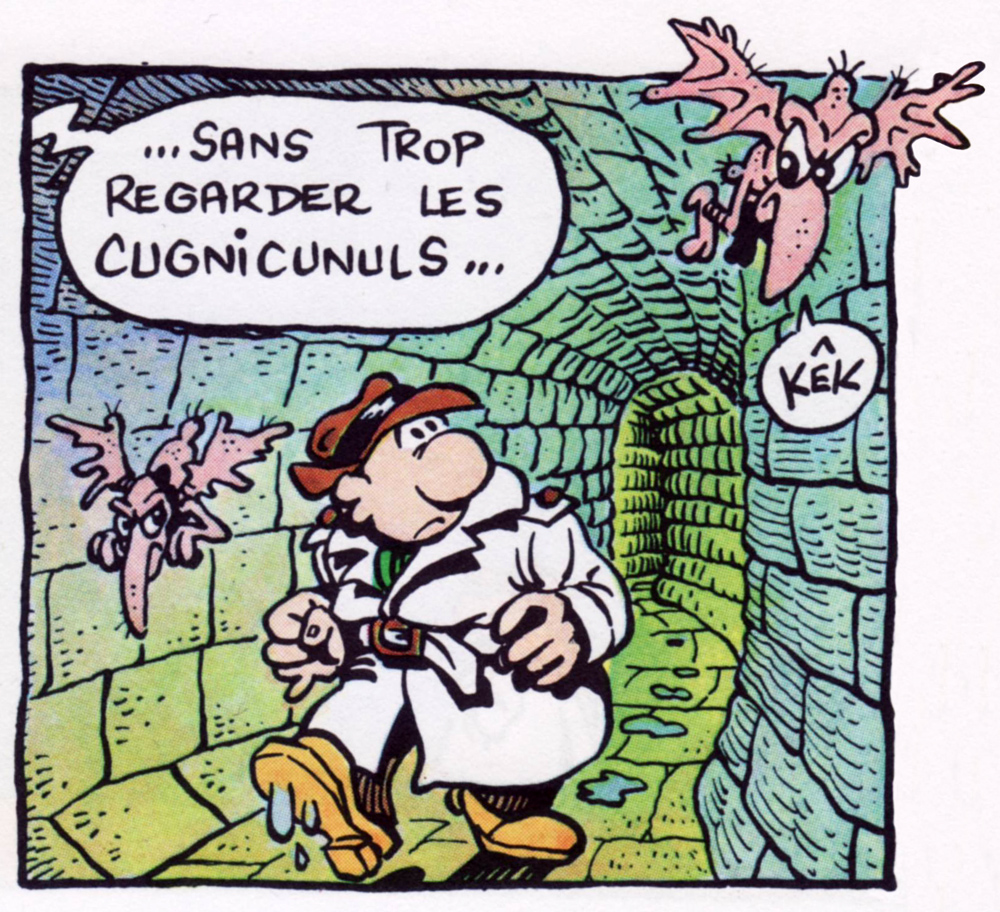
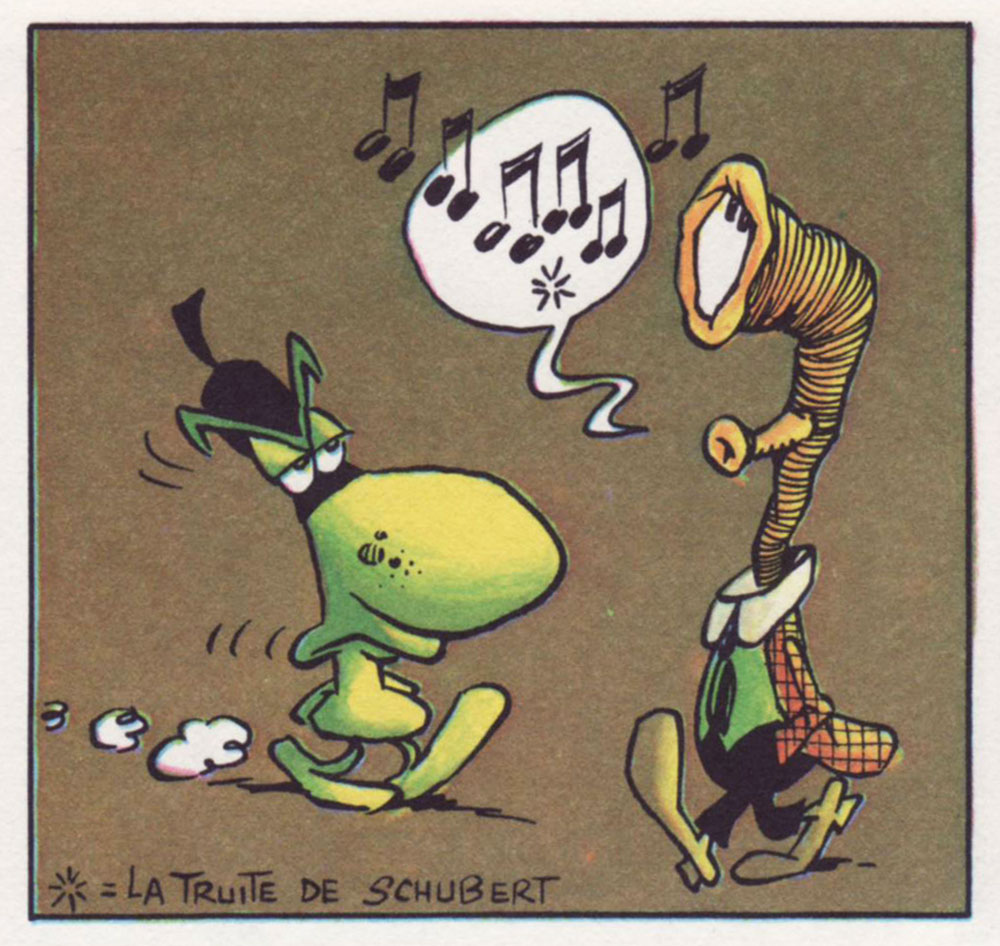
This freed me to opt for another tack this time. Since Nikita’s work is all-but-untranslatable (between the argot and the puns and general free-form lunacy… I’m not Even Going to Try) and his pages too dense for meaningful large-scale extraction, I’ve selected a sort of random number of panels — eleven seemed right (and winnowing things down was predictably exacting); Hope you like them.
Encore merci, Monsieur Mandryka!
An incisive entry from Rébus au pied de la lettre, published in Pilote super pocket no. 5 (Sept. 15, 1969, Dargaud); script by Marcel Gotlib.
Clopinettes: Toute une existence, from Pilote no.634 (Dec. 30, 1971, Dargaud), script by Gotlib. « I have loved… »
Clopinettes: Les bons conseils de tante Glutzenbaum, from Pilote no. 635 (Jan. 6, 1972), script by Gotlib. Background characters singing « Mammy Blue » was one of Mandryka’s most enduring recurring gags, certainly an idée fixe. The song was an inescapable, multi-lingual worldwide earworm hit in 1971 and beyond. It was composed by seasoned French songwriter Hubert Giraud, who had earlier written the standard Sous le ciel de Paris / Under Paris Skies. Chanteuse Nicoletta’s rendition was the bane of Nikita’s existence; the one that pervaded my childhood was Roger Whittaker’s, and here’s a reggae version by The Cimmarrons. Americans would know of it through Stories’ 1973 rendition. Phew!
Clopinettes: Les trois dessinateurs, from Pilote no.644 (March 3, 1972, Dargaud), script by Gotlib. In the usual order, L’Écho des Savanes‘ founding trio: Mandryka, Gotlib, (1934-2016), Claire Bretécher (1940-2020). L’Écho was but a couple of months away!
Opening panel from Initiation, collected in Les aventures potagères du Concombre Masqué (Apr. 1973, Dargaud). At left: le Concombre’s fabled home, the Cactus-Blockhaus. The cryptic cucurbit’s loyal companion, Chou-rave (kohlrabi) is seen on the right. Nice brushwork!
« Somewhere, at the world’s edge… », an excerpt from Rêves de sables 2, collected in Le retour du Concombre masqué (1975, Dargaud).
A favourite excerpt from the superb opening sequence of Comment devenir maître du monde?, another entry in the Concombre Masqué saga (1980, Dargaud). Our protagonist is a journalist making the perilous journey to conduct an exclusive interview with Le Concombre.
A panel from « … quelque part à l’endroit où ailleurs veut dire ici… », collected in La vie quotidienne du Concombre Masqué (1981, Dargaud). For the full effect, listen to Schubert’s La truite.
Another one from the same source. « Scram! Out! Everyone! ».
« Le Concombre is on his way to the South Seas with Zaza »; a panel from Le bain de minuit (2006, Dargaud). Meet Zaza, le Concombre’s latter-day personal secretary and Girl Friday. Incidentally, they’re travelling by bathtub, which is likely le Concombre’s favourite place to be.
A panel from La vérité ultime (2012, Dargaud). All is not what it seems aboard this flight to Timbuktu.
For more Concombre Masqué and all things Mandryka (did you know it was he who reportedly coined Métal Hurlant‘s title? ‘Howling Metal’ would have been such a better name than ‘Heavy Metal’… and ironically more Metal), check out his website (now gone, sadly). Well, try instead leconcombre.com… while it lasts (2023 update: it’s also gone).
« A kid one time fell asleep chewing Bubble Yum, and he woke up with his mouth full of spider eggs. » — Some nameless rumour-monger
The other day, a neighbour was asking me whether it was a safe for his Golden Retriever puppy to eat the worms it was digging up (I was impressed), the guy presuming that said worms were quite filthy and rife with germs. I replied that no, it’s probably all the rooting through the trash and gobbling up whatever it finds that’s giving the pup gastric distress. Worms, in fact, are considered a delicacy in many a culture, including some European ones. Not that I’ve indulged: just like The Kinks’ Apeman, I’m a strict vegetarian.
This brought to mind those 1970s rumours of earthworms serving as filler in McDonald’s burgers (never mind that worms are a far costlier ingredient than is beef). Which led in turn to the equally-outlandish notion that the secret of Bubble Yum’s softness (introduced in 1975 by Life Savers, it was the first soft bubble gum ever concocted) lay in its containing spider eggs. Again, steady procurement would have proved quite a daunting challenge.
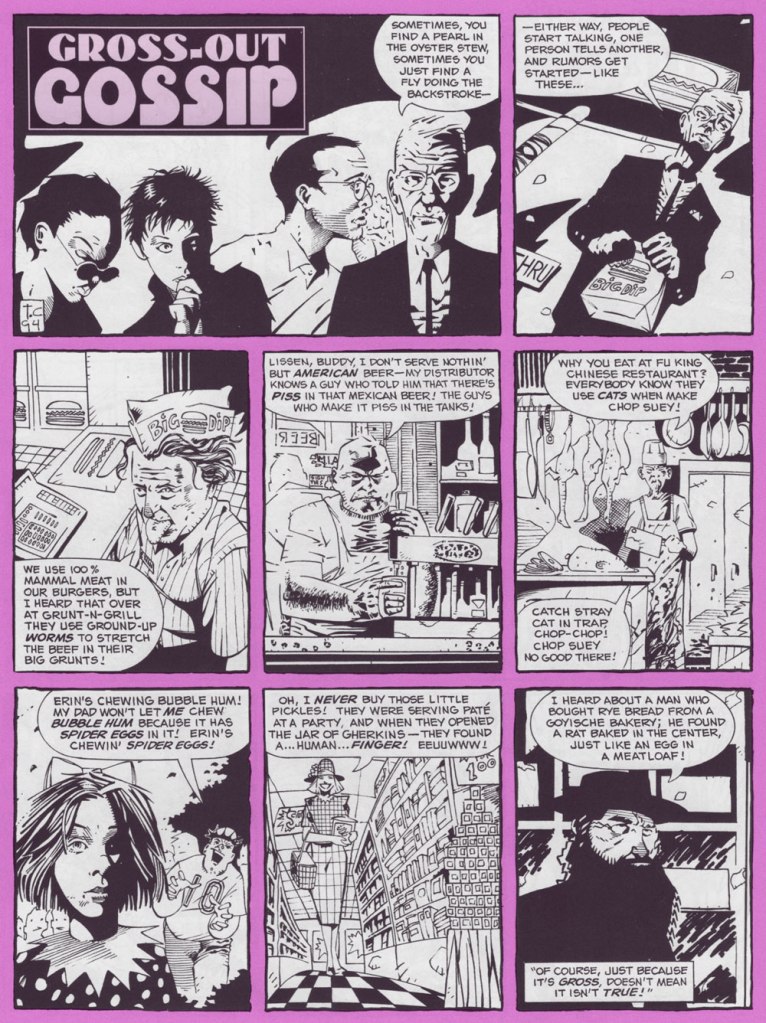
Art by Tomm Coker, from The Big Book of Urban Legends (1994, Paradox Press/DC); edited by Bronwyn Carlton Taggart and featuring the most inconstant levels of skill and talent you’re ever likely to encounter in a professional comics publication: a couple dozen or so versatile cartoonists, and over a hundred superhero hacks and/or photo tracers utterly out of their depth, a reminder of just how shallow the talent pool is. This isn’t one of the good pieces, but it’s nowhere near the bottom.
A trade ad from 1977, the year of Bubble Yum’s national (and international, as this Canadian can attest) rollout.
But the bubble was about to burst (or at least deflate somewhat), as reported by The New York Times (March 29, 1977):
The Great Spider Egg Mystery remains unsolved but it may yet have several happy endings. The mystery concerns Bubble Yum, a popular new bubble gum that has, in a year, overtaken such symbols of earlier childhoods as Dubble Bubble and Bazooka. A few weeks ago came toil and trouble: the unexplained spread of lurid rumors among children in the New York area that, gasp!, Bubble Yum contained spider eggs (or, according to haughtier youthful accounts, caused cancer). Stores which had up to then been unable to stock enough to meet demand suddenly saw sales plummet. Last week, the manufacturer, Life Savers, Inc., took out full‐page ads in 30 area newspapers to combat the rumors.
This is not the first time the bubble gum business has been beset by evil rumor. When Jimmy Carter was a boy, youngsters in Sumter County, Georgia, were scared off by reports that bubble gum was made with snake oil —until they were reassured by an ad in the Americus Times‐Recorder. Nor is bubble gum normally regarded as the stuff of moral lessons. Its history, since it was invented by Walter Diemer in 1928, is marked by such milestones as packaging it with baseball cards (1933) or making it squeakless (1953).
But there is something more significant, and appealing, in the open way in which Life Savers has chosen to deal with its problem. We hope the spider egg rumors are expunged as successfully now as the snake oil rumors were then. And there will be a happier ending still if the subject is properly understood to be not bubble gum but canard. No consumer is too young to learn the malign effects of rumor or to understand that there will always be someone, not always in youthful innocence, eager to raise the cry—whether about Communists in government, environment, energy or bubble gum—of “spider eggs.”
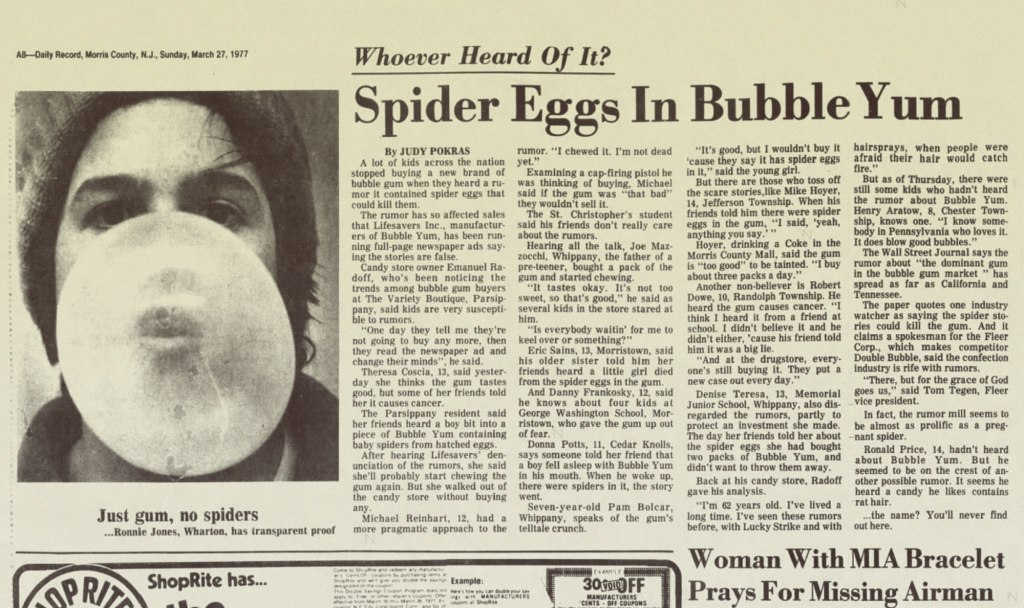
From Morris County, NJ’s Daily Record, March 27, 1977 edition.
Susan M. Smith wrote, in her 1989 thesis, Consumer Rumors and Corporate Communications:
Whether the rumor is isolated or widespread, the company must select media that reach the rumor’s community of interest, and particularly, its influential leaders. The importance of this is shown by what happened after a rumor episode in New York City for the Life Saver’s Company. The company conducted an all-out attack to combat a rumor in 1977 that the company’s innovative, new soft chewing gum. Bubble Yum, contained spider eggs. It sought publicity, inserted full-page newspaper ads, and sent letters with a copy of the ad to the city’s PTA groups, school principals, and retail outlets.
The campaign successfully stopped the rumor, but Bubble Yum’s New York sales did not recover for many years. It turns out that even though the company had blanketed the city with its rumor denial, it never spoke directly to product users, the school-age children, to bolster confidence in the product. The selection of inappropriate media makes the refutation message miss the rumour’s public allowing the rumor to continue to spread or delaying recovery from the rumor.
Speaking of advertising: Marvel’s knockoff of Scholastic’s Dynamite, Pizzazz (1977-79), which included lots of ads, featured this piece in its 6th issue (March 1978, Marvel). This gives you a sense of Bubble Yum’s success, as the product was, in its field, what’s termed a disruptive innovation. Chewing gum no longer had to be hard.
Inevitably, the imitators came! Smooooth N’ Juicy, Hubba Bubba, Bubblicious, the oddball Freshen Up, and so on. Marvel switched its advertising allegiance to Topps. This is from Pizzazz no. 11 (Aug. 1978, Marvel). The art looks to me to be the work of Mad magazine veteran Jack Rickard (1922-1983).
A few issues later, (Pizzazz no. 14, Nov. 1978, Marvel), in a brazen display of corrupt insincerity, came this so-called Consumer Guide (note that only Topps products are pictured). Really, is Bubble Yum “the hardest, toughest gum our testers had to chew“? Surely anyone who’s ever tried to chew something from the Bazooka family knows better. My jaw aches just from the memory.
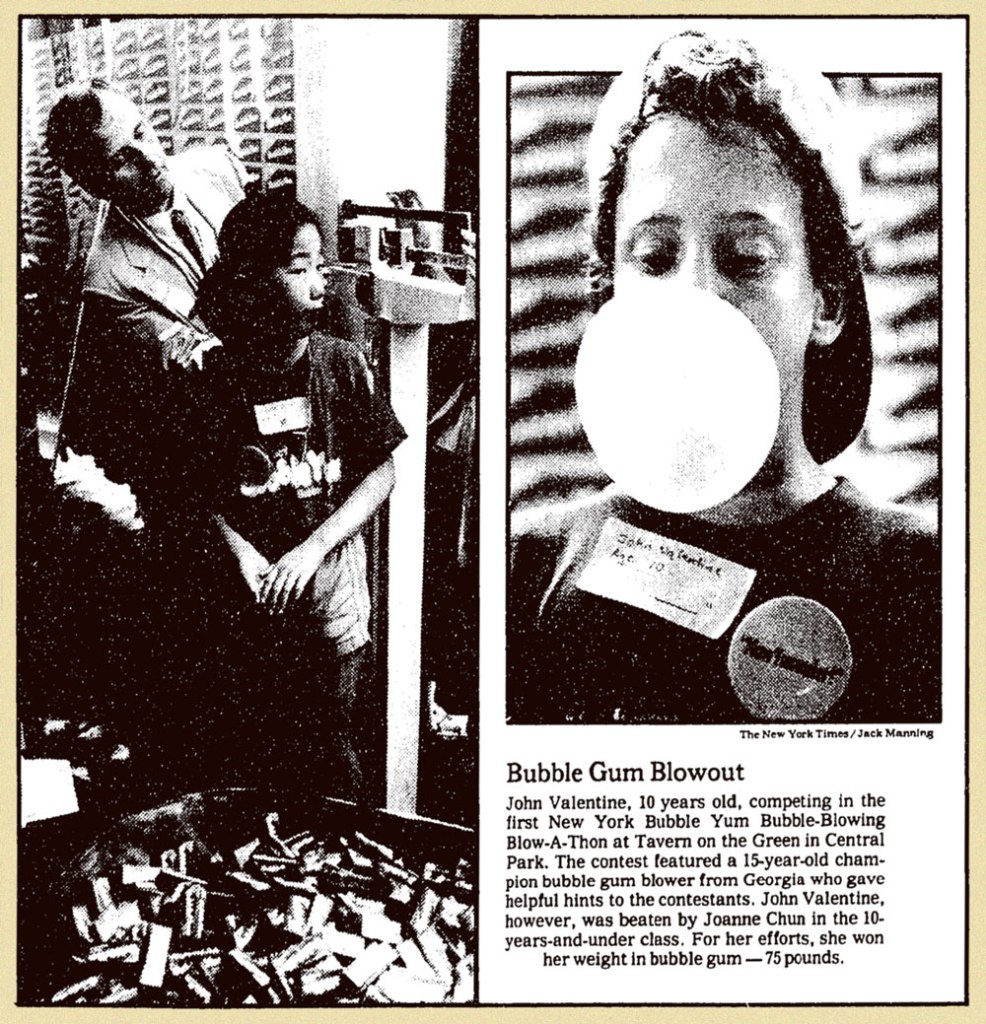
The company continued efforts to restore its reputation in the New York market, where the rumours had caused the most harm. A piece from The New York Times‘ Tuesday, July 22, 1980 edition.
This ad ran in Adventure Comics no. 487 (Nov. 1981, DC) and several other titles in the following months.
Now that’s better: in 1982, they turned to the incomparable Jack Davis to illustrate one of their print ads. Given his prodigious speed, he couldn’t have spent more than an hour on this specific piece, but it works far better than its predecessors. Incidentally, the ‘Super Yum’ thing (replacing Soft ‘n Juicy) appears to have been a move to block a competitor from using the appellation.
But I suppose all this controversy merely seems quaint now, what with all today’s heavy weaponizing of misinformation. Besides, the bubblegum market has been rather moribund in the past few decades, since apparently Nobody Likes to Chew Gum Anymore.
For a bit of sugar high nostalgia, I’ll leave you with a pair of vintage Bubble Yum ads: 1976’s brand introduction, featuring The Flavor Fiend;
And 1988’s spot co-starring a young Leonardo DeCaprio, which shows us he was clearly born with that insufferable smugness, or at least had honed it to perfection by his teens.
« The history of men’s opposition to women’s emancipation is more interesting perhaps than the story of that emancipation itself. » — Virginia Woolf
It has dawned on me that we’ve been neglecting the romance genre of late, and so the time has come to remedy this regrettable situation. To that end, I’ve opted to spotlight some early work by Spanish-Argentine master José Luis García-López (born 1948, Pontevedra, Spain).
If you ask me, Mr. García-López is far under-appreciated. His graceful but unassuming virtuosity, and the seeming ease with which he wields it, makes it too easy to take him for granted. And while he’s tackled just about every major character (and many a minor one) in the DC Comics stable, much of it has been behind the scenes, in the way of style sheets and promotional artwork.
Meanwhile, in comic books, he’s mostly made pedestrian scripts* shine more brightly than they deserved. But there’s only so much, er… polishing one can do.
As it stands, my favourite portion of his œuvre is the romance comics he illustrated for Charlton early in his career, roughly 1968-74, before he moved to New York to launch his North American phase. While my predilection for his romantic material is a minority opinion, I’m not alone in this, I’m relieved to report.
It seems to me that, as a man who can clearly draw anything at all, JLGL’s chops are largely squandered on superheroes and such. But, in comics as in life, romance is hard. As Mr. García-López confirmed in the definitive interview he granted in 2010 to the championne of romance comics, Sequential Crush‘s Jacque Nodell: « Even now, I consider romance stories the most difficult genre to illustrate properly. » Bingo.
If you’ve at all read comics from the early 70s, romance or otherwise, you’ll have noticed that clothing and hair fashions can generally be termed (charitably) ‘of their time’. Not so much here. Have we come full circle, or does JLGL have a secret? He confides (do read the full entrevista… it’s well worth it):
« In those years we also had photo-novel magazines (like the foto-romanzo or fumetti in Italy) and they were very useful to design the characters and for the romantic scenes. Doing a good kiss without a good reference was very hard, honest. Besides, I was lucky to have two kindly girl friends that helped me with fashion advice and suggestions and even posed for me. That period was full of learning experiences – there is no better way to learn to draw than from a living model. »
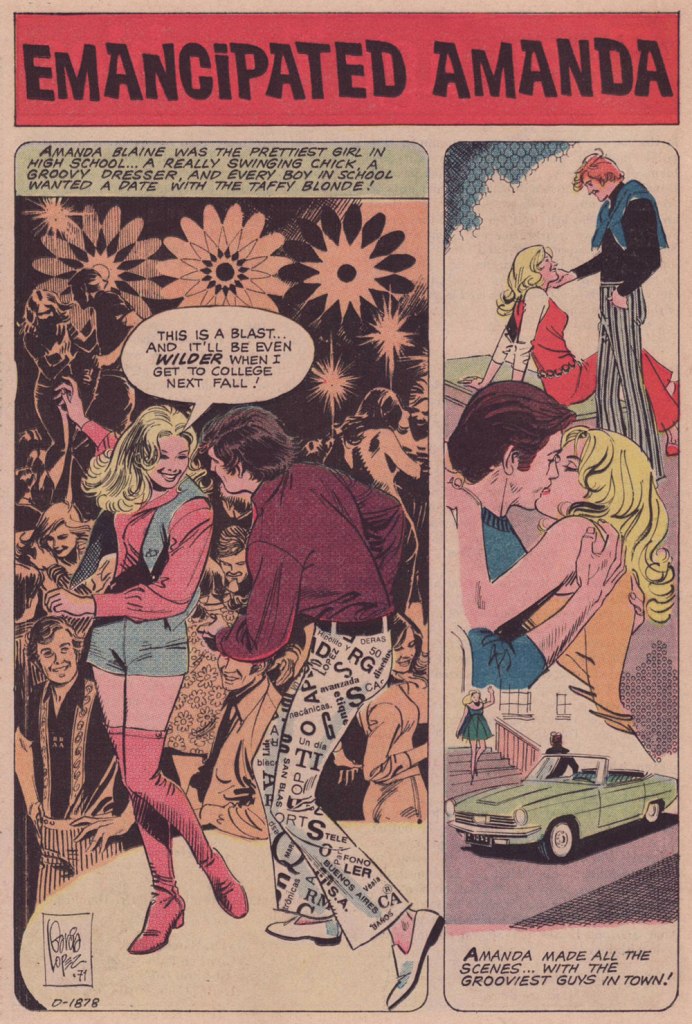
Where can I get myself a pair of those snazzy Letraset pants?
Writer unknown, incidentally. Which is a shame.
Now, artwork aside, why am I fond of this particular story?
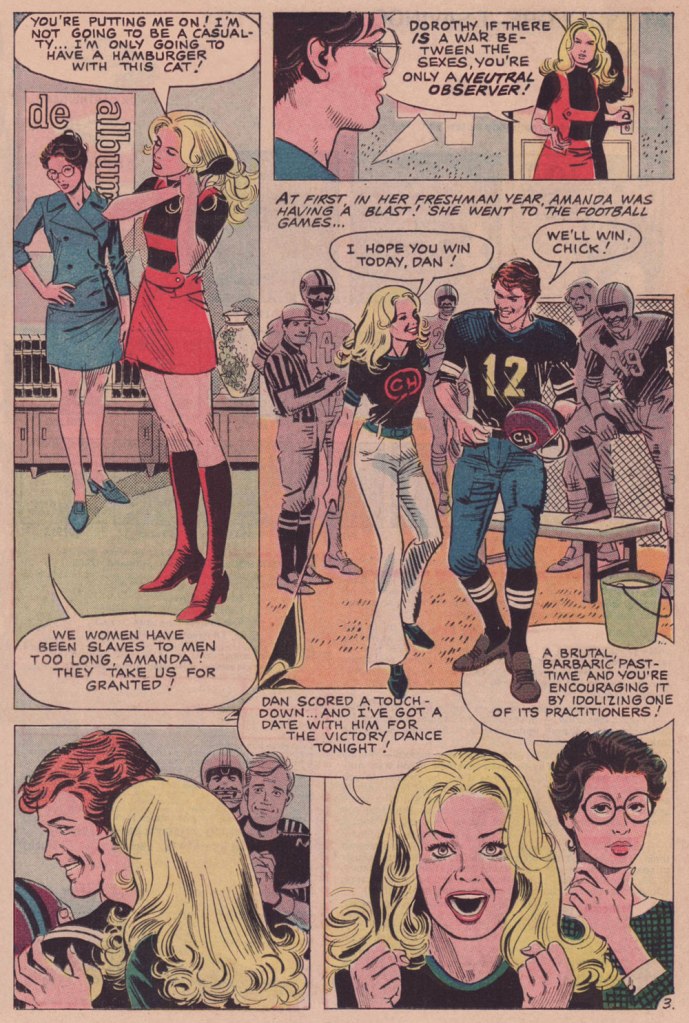
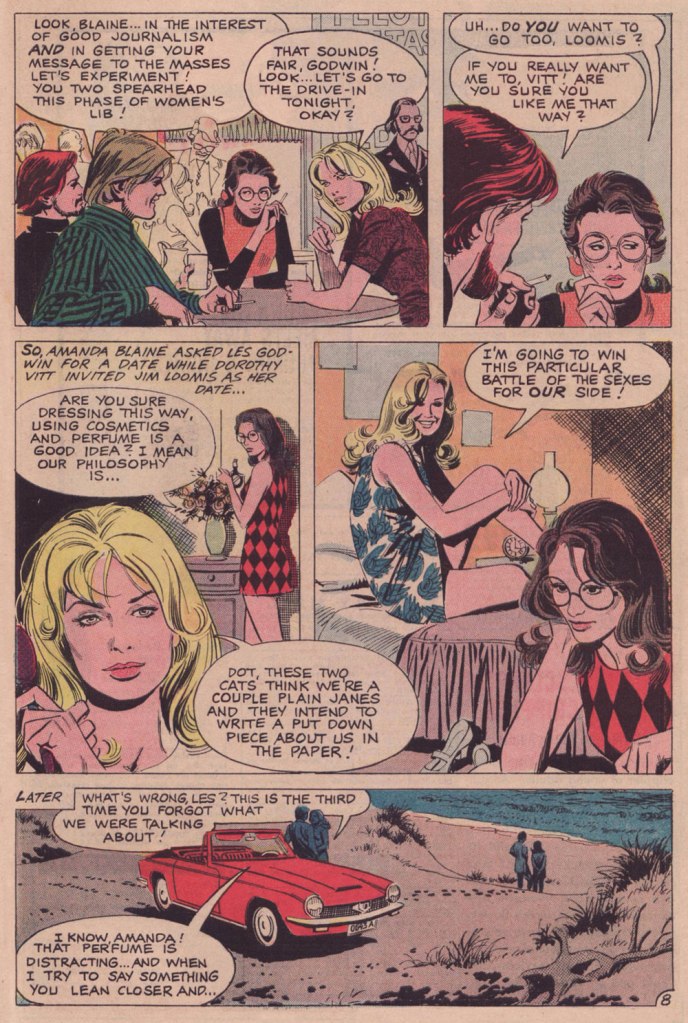
I love the mise-en-scène: characters are introduced in the background and without dialogue before they enter the stage. Namely Dorothy in the first panel of page 2 and ‘that beanpole’, Jim Loomis in the first panel of page 6. His first line comes in the final panel of page 7, but he and Dorothy have been staring holes into each other from the start. That’s great staging, not to mention something that, arguably, only the comics medium can achieve effectively.
I also enjoy the evolution of Amanda and Dorothy’s friendship; at first testy and tentative, Amanda’s calling her roommate ‘Dot’ by page 7. And they learn from, and support, each other. No cheap betrayal in this one.
It’s a lovely change of page for the genre that, once gridiron ‘hero’ and BMOC Dan Sruba commits his inevitable transgression… he’s gone (save for a passing mention from Les): no ‘second chance’, no confrontation, no revenge, no melodrama.
Despite the headline, I’m reading this as the story of Dot and Jim’s romance. Amanda’s interest in Les, beyond playing matchmaker for her roommate, is uncertain.
My wife was disappointed in the ending, and I can certainly see why: will Dorothy lose her fire and her beliefs? I prefer to think not — she was looking for an equal, respectful relationship, and I do think she’s found it with Loomis. And she had him well before word one, and she was clad in glasses, picket sign and dungarees. The guy seems like a keeper to me. They’re both quiet, thoughtful observers, for the most part. I like their odds.
There are a few glitches here and there, but given that the script had to first be translated into Spanish (Mr. García-López claims to still not speak English to this day… technically) to be illustrated, there may have been here and there a nuance missed, a description gone astray. Loomis isn’t quite a beanpole, and neither is Dorothy, for that matter. And ‘Plain Janes’? (page 8) And I scarcely think that Les and Jim were planning a hatchet piece (given Jim’s evident interest in Dorothy, for one), no-one would mistake these two for Plain Janes. Well, that’s always been a systemic weakness of the romance genre, in comics and elsewhere: the plain one, the skinny one, the rejected one? Still gorgeous.
This is I Love You no. 95 (Jan. 1972, Charlton). For a variety of factors, distance chief among them, Garcia-Lopez never drew an original cover for Charlton, but the publisher often creatively recycled story panels, a task handled exceptionally well in the present case.
What’s that? Oh, right. Fine, here’s that « FREE Pin-Up Poster of David Cassidy » already.
« Moonshiners put more time, energy, thought, and love into their cars than any racer ever will. Lose on the track, and you go home. Lose with a load of whiskey, and you go to jail. » — Junior Johnson
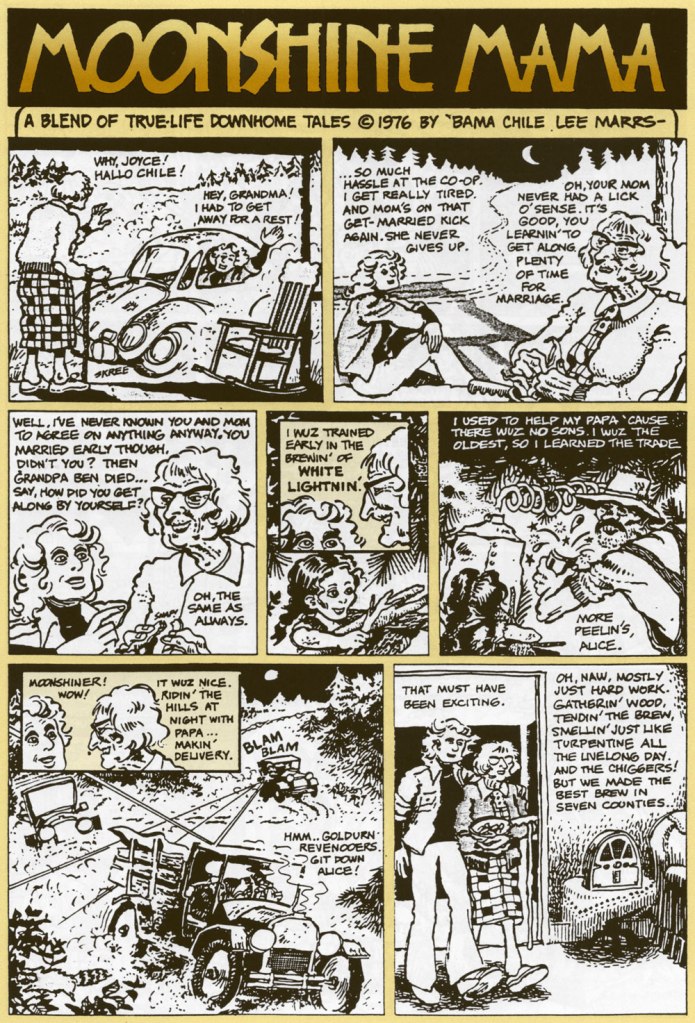
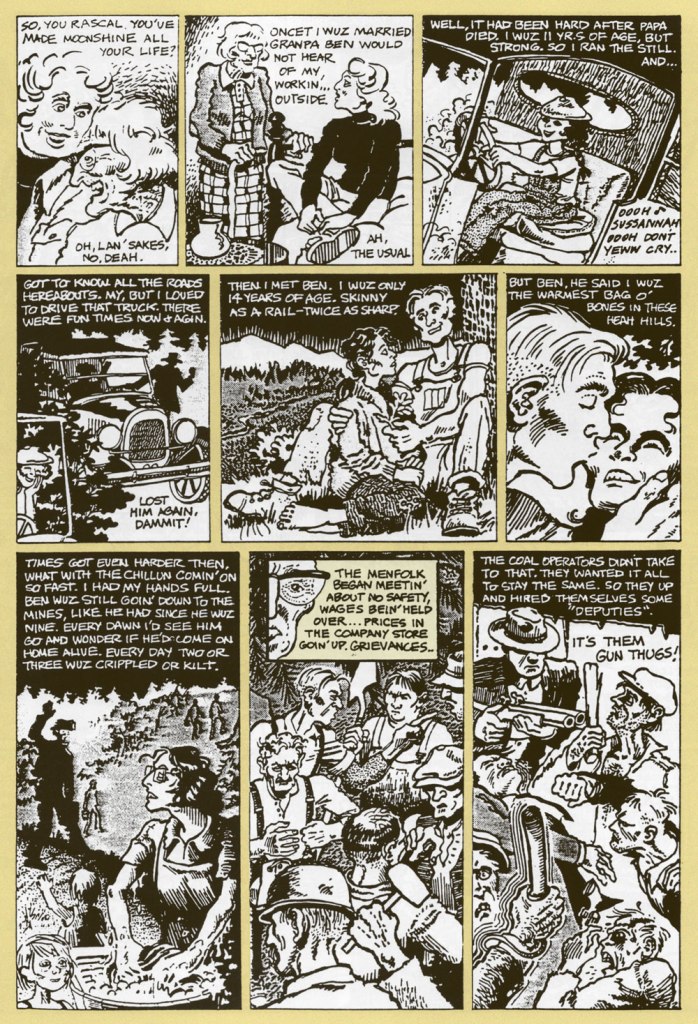
Lee Marrs (b. 1945) is not your typical « underground » cartoonist, though to be fair — what would a typical undergrounder be? The movement’s whole raison d’être was ‘vive la différence‘, wouldn’t you say?
Hers is not a prolific career, perhaps, but look at the gloriously idiosyncratic path she followed: newspaper comic strip assistant (Hi & Lois, Prince Valiant, Little Orphan Annie…), underground (Wimmen’s Comix, Pudge, Girl Blimp, The Compleat Fart and Other Body Emissions), and mainstream cartoonist — well, even better: she was a regular contributor to DC’s justly-fabled (but yet to be reprinted, ahem) Plop!; she appeared in Marvel’s Mad knock-off Crazy; she even scripted, in the early 90s, a Viking Prince (yes, Kanigher and Kubert’s 1955 creation) epic, illustrated by Bo Hampton, and even a bit of Batman (‘Stalking‘, with Eddy Newell, in 1998). But that’s merely scratching the surface: here’s a more comprehensive rundown of her captivating journey.
Ah, don’t you love a happy ending? Originally published in Weird Mystery Tales no. 18 (May 1975, DC), edited by Tex Blaisdell.
This is The Compleat Fart and Other Body Emissions (Jan. 1977, Kitchen Sink); colours by Pete Poplaski. Featured front-and-centre, doing his thing, is Joseph Pujol, France’s fabulous Pétomane!
Originally published in Wimmen’s Comix no. 7 (Dec. 1976, Last Gasp). This is underground storytelling at its finest: uncompromising, political, passionate, personal, at once witty, moving and instructive. And that whole gamut gets run through in a mere four beautifully-drawn, expertly-paced pages.
And I’m delighted to report that the scintillating Ms. Marrs is still active today, her verve and talent undimmed and undiluted. By all means, check out her website for the undeniable evidence!
« The cemeteries are full of irreplaceable people who were all replaced. » — Georges Clemenceau
Commercially and creatively, the 1950s held some of the best and the worst years for the American comic book industry. Basically, the first half was a glut and the second, a massacre. This is all well-trod ground. Today, we’ll stick to one artist and his main employer.
In his one intensely-prolific decade as a professional cartoonist, Joe Maneely (1926 – 1958) produced the overwhelming bulk of his work for publisher Abe ‘Martin’ Goodman’s Timely/Atlas, which would become Marvel Comics by the decade’s end.
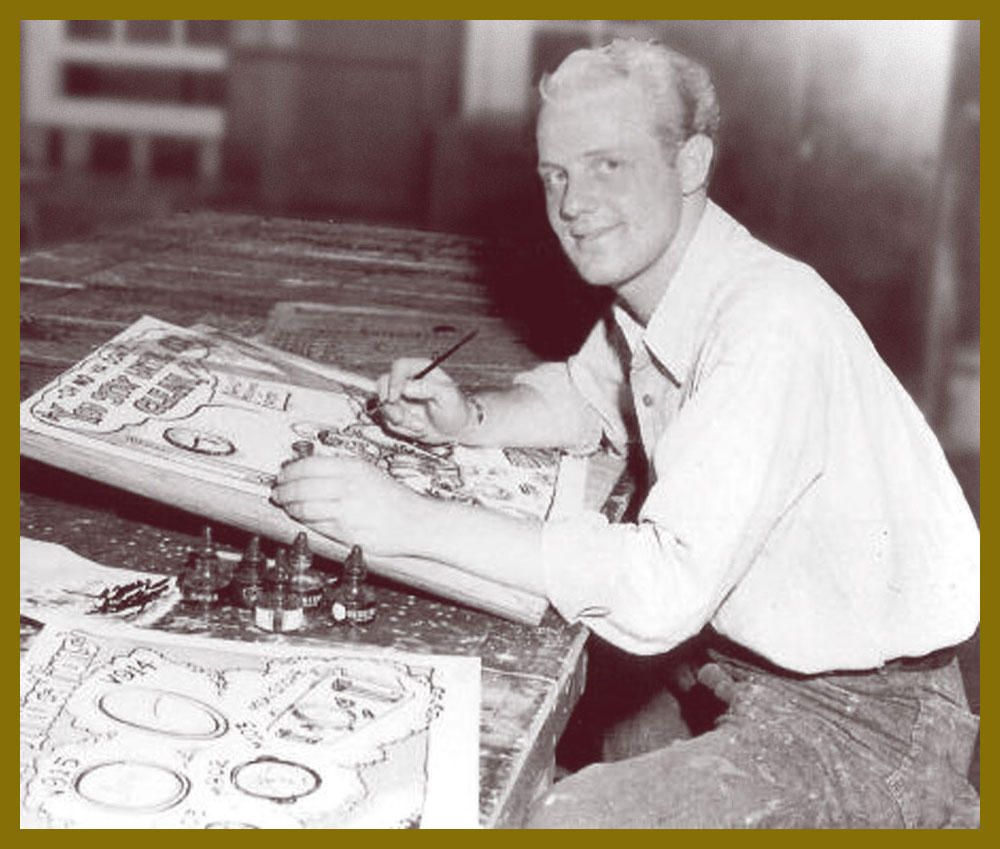
The artist at his table. Herb Trimpe lets us in on the secret of Maneely’s prodigious speed (said to produce up to six pages a day, pencils and inks): « his pencils [were] almost nonexistent; they were like rough, lightly done layouts with no features on the faces … It was just like ovals and sticks and stuff, and he inked from that. He drew when he inked. That’s when he did the work, in the inking! ». Talk about unerring confidence!
Atlas historian Dr. Michael J. Vassallo sums up the Tao of Goodman (and, by and large, Marvel’s):
« As one genre faded, another would add titles to compensate. It didn’t matter if the new titles were basically redundant titles with new names. Goodman followed all trends in the comic book industry and the publishing industry in general.
A savvy businessman, he rarely led, mostly followed, but had the resources to follow with gusto, overwhelming competitors with product. »
As Ger Apeldoorn tells it, Maneely was a mere thirty-two years of age and at his frenetic artistic peak when tragedy struck:
« … on June 7, 1958, after going out for the night (with old-time friends John Severin and Walt Kelly assistant George Ward) he stepped out on the balcony of the train to get some air, fell between two trains and died. For a long time the story was that he had been drunk, but according to Dan Goldberg* he had lost his glasses earlier that week and that may have been a contributing factor. »
If the inspiring story of Joe Maneely, and its heartbreaking and sudden end is at all remembered these days, it has chiefly been through the diligent efforts of aficionado-historians such as Jim Vadeboncœur Jr. and the aforementioned Dr. Vassallo. Now why would an artist of such calibre fade so swiftly from memory? Since that happens all of the time (what one might term ‘invisible evidence‘), let’s move past the realm of the rhetorical and be more… specific. But first, some samples of the late Mr. Maneely’s goodies.
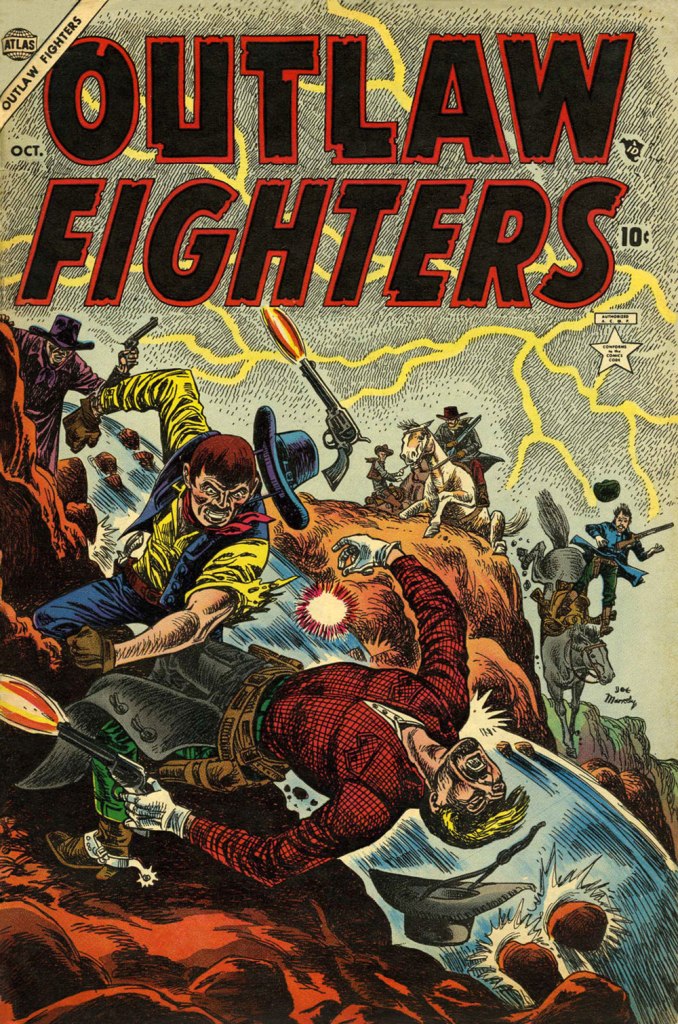
This is Outlaw Fighters no. 2 (Oct. 1954, Atlas).
This is Jungle Action no. 1 (Oct. 1954, Atlas). With spandex yet to hit the market (and even then), Leopard Girl’s costume must have been quite… stifling.
This is Mystery Tales no. 23 (Nov. 1954, Atlas).
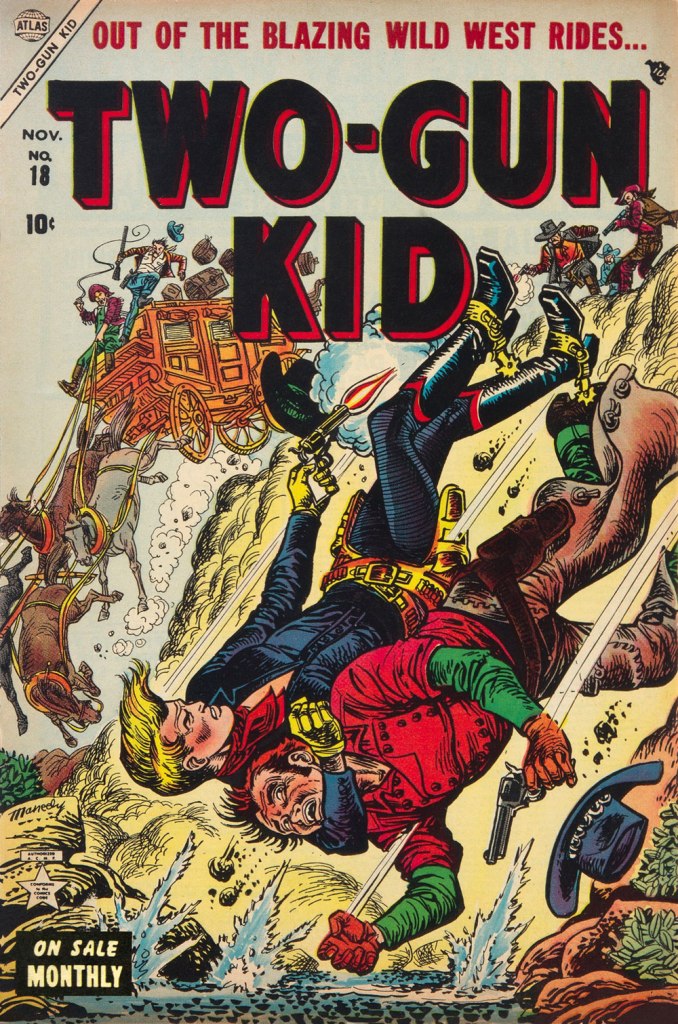
This is Two-Gun Kid no. 18 (Nov. 1954, Atlas). I doubt anyone’s going to land comfortably. Particularly those poor horses.
This is Journey Into Mystery no. 22 (Feb. 1955, Atlas).
“Oh, Stan — you’re so butch!” This is Rugged Action no. 2 (Feb. 1955, Atlas). To my eye, the bottom panel evokes Harvey Kurtzman‘s early style (think Two-Fisted Tales at EC); ironic, given that Maneely was as confident and speedy in his drawing as Kurtzman was painstaking and slow.
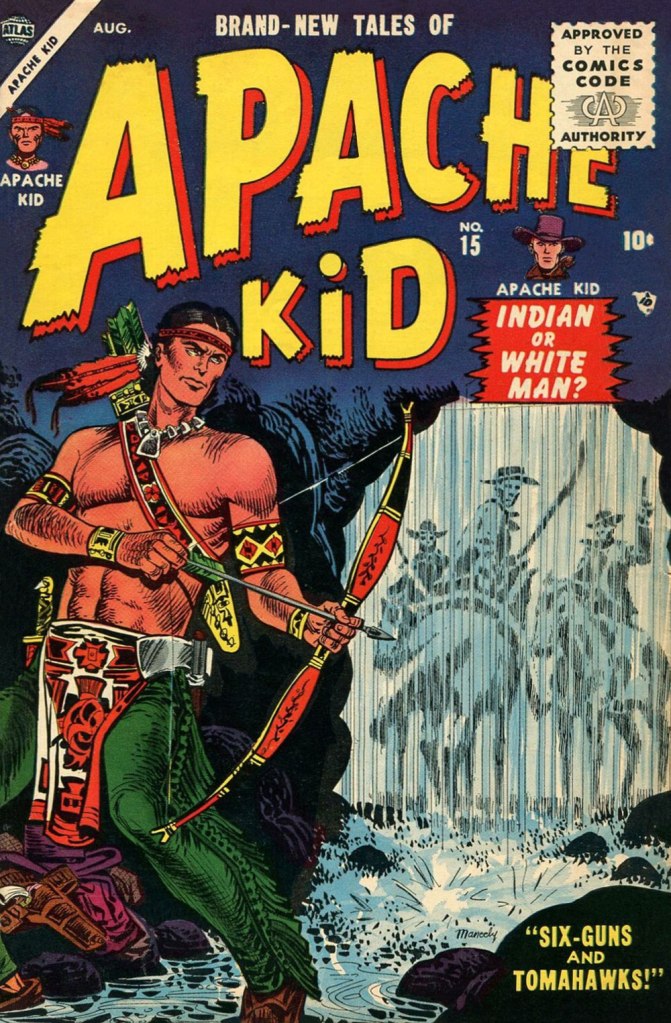
This is Apache Kid no. 15 (Aug. 1955, Atlas). The publisher also had in its roster Arizona Kid, Kid Colt, The Kid from Dodge City, The Kid from Texas, Kid Slade, The Outlaw Kid, Rawhide Kid, Ringo Kid, Texas Kid, Two-Gun Kid, The Gun-Barrel Kid… did someone say ‘redundant’? Why, yes, someone did.
This is Police Badge #479 no. 5 — the sole issue, really; its numbering picked up from Spy Thrillers… and went no further (Sept. 1955, Atlas). Maneely was another of that rare breed who could draw anything… because they enjoyed drawing everything. Dig all that well-observed detail!
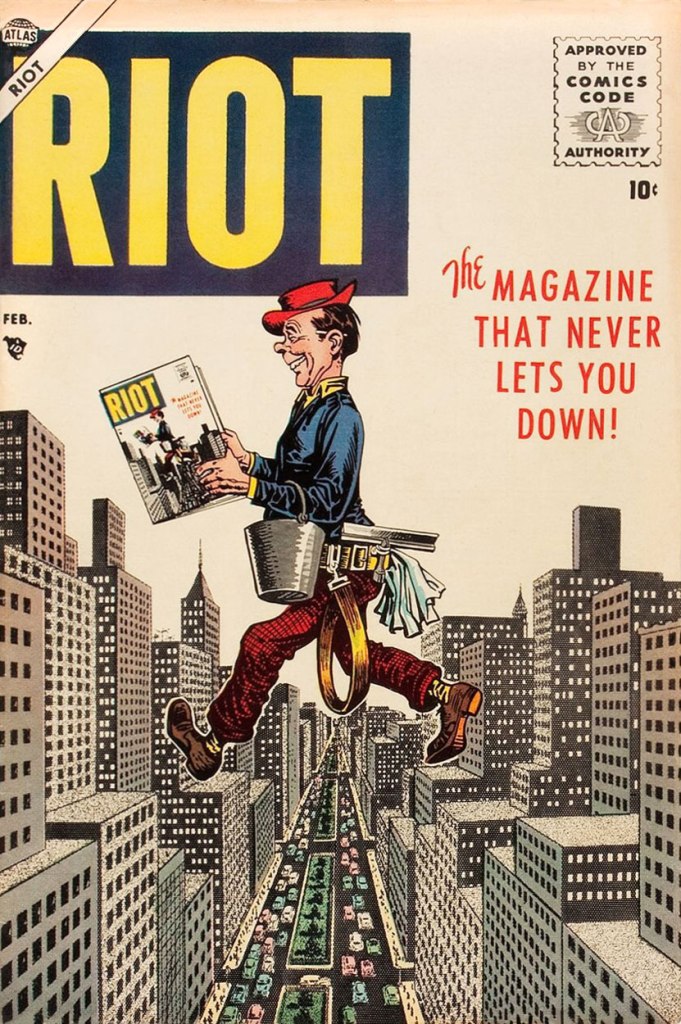
Atlas published, in quick succession, no less that four short-lived Mad clones: Crazy, Riot, Snafu and Wild, each lasting from three to seven issues. None were particularly funny either, even if they did look quite good. This is Riot no.4 (Feb. 1956, Atlas) featuring what is termed, in comic book circles, an ‘infinity’ cover.
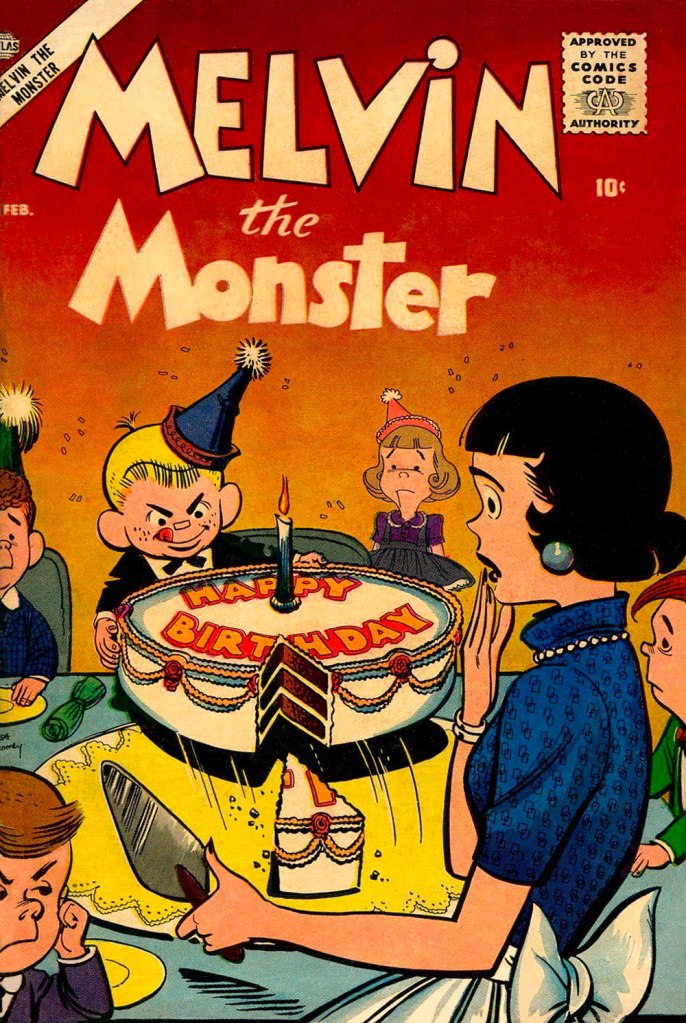
This is Melvin the Monster no. 4 (Feb. 1957, Atlas); Dr. Vassallo writes, in his in-depth Maneely overview for Alter Ego magazine (no. 28, Sept. 2003): « Stan Lee and Joe Maneely’s Melvin the Monster… duplicated everything they could about Hank Ketcham’s Dennis the Menace — art style, comic strip format, even upper-&-lower-case lettering style — everything except the warmth and innocence.»
This is Kid Colt Outlaw no. 69 (Feb. 1957, Atlas). Along with everything else, I love his way with flora and fauna. Incidentally, most of these covers were coloured by Stan Goldberg.
And so… why have Maneely’s star and memory dimmed so? It has been proposed, and I agree, that it’s because he just didn’t draw superheroes (a couple of Sub-Mariner covers being the lone exceptions), and Marvel itself hardly lifted a finger, over the years, to preserve the reputation of one of its principal architects.
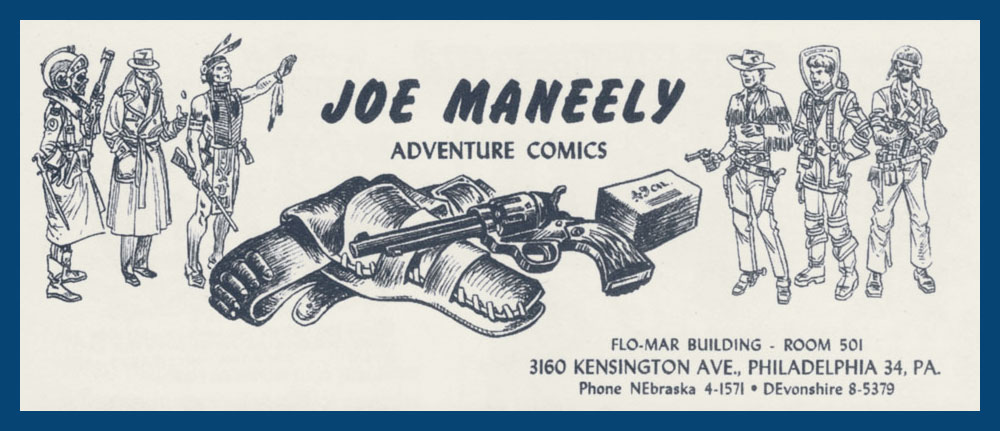
The artist’s promotional letterhead illustration, circa 1948.
There’s been much idle speculation as to what course comics history would have taken had Maneely lived. Stan Lee wrote, in his usual disingenuous way, that:
« How I wish the world (and I) could have seen what he’d have done with the F.F., Spidey, Thor and all the other Marvel super-heroes! It’s a true tragedy that we’ll never have the chance. »
Let’s be honest here: Maneely was an incredible artist, and he made Stan look good, but Joe wasn’t a writer, and certainly not a world-builder in the fashion and class of Jack Kirby, Steve Ditko, Walt Kelly, Carl Barks, John Stanley, Basil Wolverton… and precious few others. Without Kirby, the so-called Marvel Age never would have come to pass. Not to mention that Maneely, with a wife and three daughters to feed and support, had just begun to work for one of DC’s friendliest editors, Murray Boltinoff**. He would have been unlikely to drop a better-paying, likely secure gig to drop everything and return to Marvel’s uncertain prospects. Ah, and I see Mark Evanier views it along the same lines.
Oh, and I’ve mentioned in the past Maneely’s likely influence (mostly in the inks) on his contemporary Rocco Mastroserio. Take a look at this gallery of his covers and see if you agree.
-RG
*Stan Goldberg, actually.
**as a matter of fact my first encounter — as a child — with Maneely’s work was through a reprint of one of his DC stories: The Doomsday Drum (House of Secrets no. 9, March-April 1958).











































 Who's Out There?