Hallowe’en Countdown V, Day 22

« People that pick up hitchhikers I believe are basically good people that believe in other people and understand problems and don’t judge people. That’s always the kind of person I’m looking for. » — John Waters

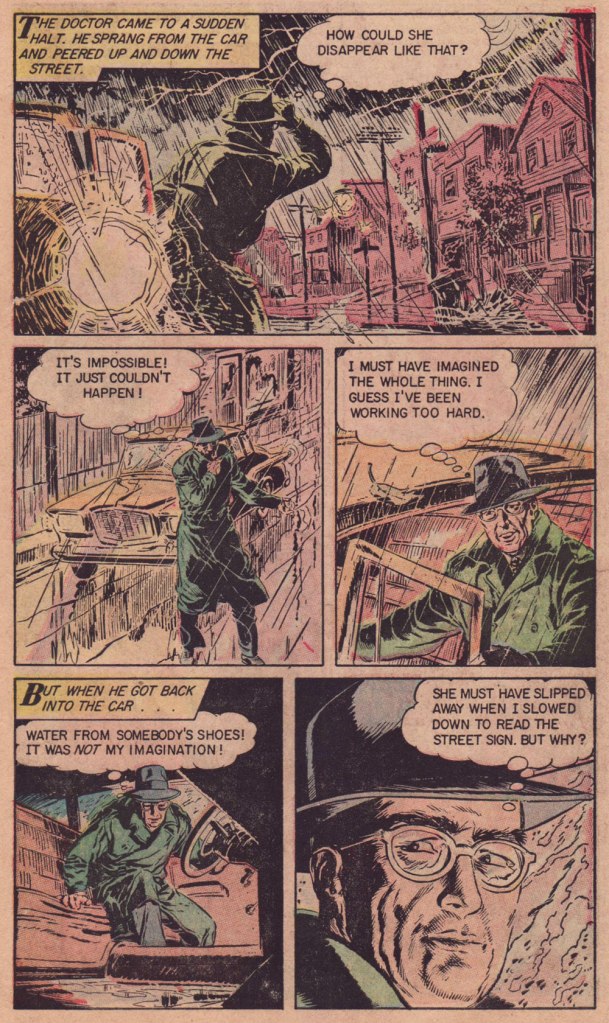
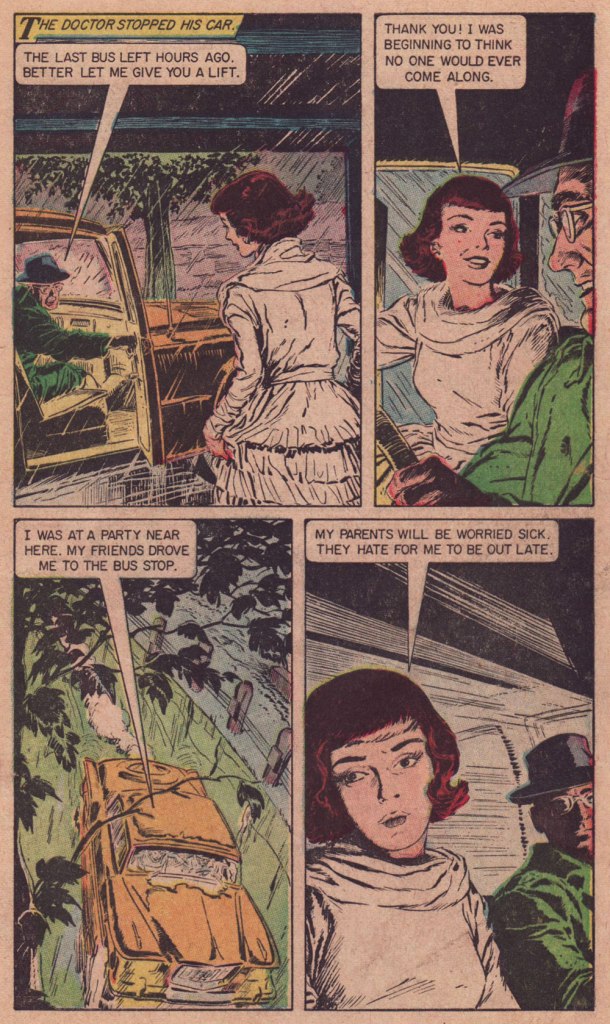
Let’s take a nocturnal drive with George Evans (1920-2001) behind the wheel. Best known for his stellar contribution as a member of the elite EC Comics bullpen, Evans had earlier crafted some impressive comics for Fawcett (his own favourite period of his work) and Fiction House, and later, post-Code, for Gilberton, Dell and Gold Key, Warren and DC. He also worked extensively in newspaper strips, notably on Terry and the Pirates (under George Wunder) in the 1960s. He took over Secret Agent Corrigan from fellow EC alum Al Williamson, a nice long stint from 1980 to 1996, at which point the strip wrapped up and Evans (and Corrigan, presumably) retired.

Belgian fantastique master Thomas Owen (1910-2002) has written not one, but two chilling variations on the theme of this particular urban legend, La passagère, which appeared in his 1966 collection, Cérémonial nocturne et autres contes fantastiques, then La grille, which appeared in 1975’s Le Rat Kavar et autres histoires de vie et de mort. While the former is currently nowhere to be found online, you can read — in the original French — La grille. For our English readers, here’s a fine translation of Le Rat Kavar (as ‘Kavar the Rat’, of course) to give you a bit of that eerie Owen flavour.

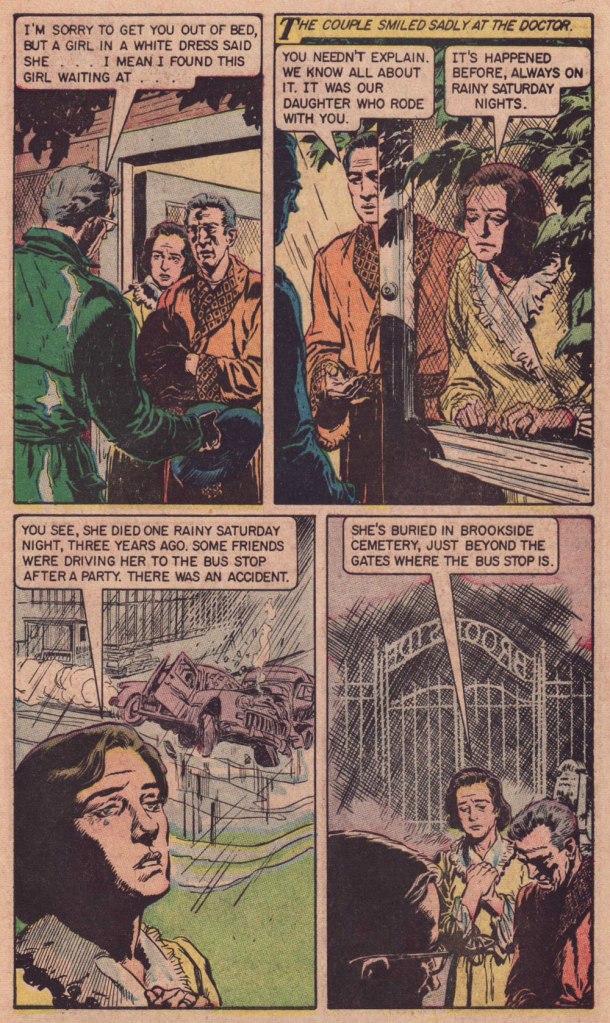
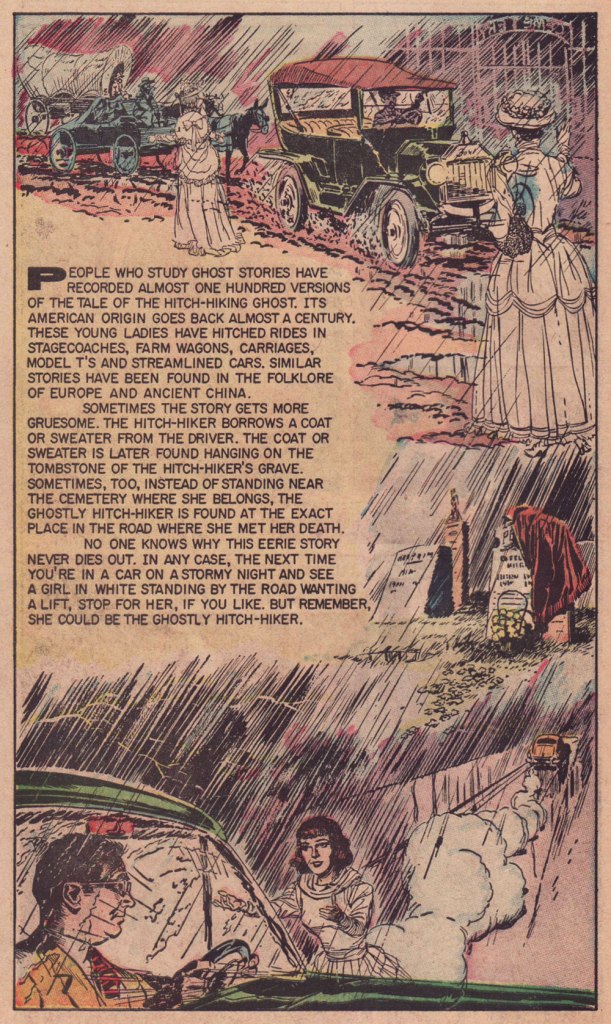
While Evans’ chief forte was aerial warfare, this piece highlights his way with a mood, his quiet grace and flawless draftsmanship. This story is an excerpt from Gilberton’s The World Around Us series (36 issues, 1958-1961); this is no. 24 (August, 1960), The Illustrated Story of Ghosts, an oft-told tale (but never better) of the urban legend widely known as The Vanishing Hitchhiker (here entitled The Hitch-Hiker). Can’t you just feel that rain?

The renowned folklorist Jan Harold Brunvant wrote, in his epochal study, The Vanishing Hitchhiker: American Urban Legends and Their Meanings (1981, W. W. Norton):

« A prime example of the adaptability of older legends is ‘The Vanishing Hitchhiker’ — the classic automobile legend. This returning ghost tale was known by the turn of the century both in the United States and abroad. It acquired the newer automobile motif by the period of the Great Depression, and thereafter spawned a number of subtypes with greatly varied and oddly interlocking details, some of which themselves stemmed from earlier folk legends. »

As a bonus, here’s Evans’ lovely, light-hearted frontispiece for the issue. “Face to faceless” — clever!

-RG

Hallowe’en Countdown V, Day 21

« The man asked, “Who are you?” “I am Death, who makes everyone equal.” » *

Greetings! Today I am giving my co-admin RG a much-needed chance to rest, and taking over Hallowe’en count-down duties. He protested a bit, but I was persuasive. Oh, don’t worry about him – he’s quite comfortable in the basement, and I may even unchain him at the end of the evening.

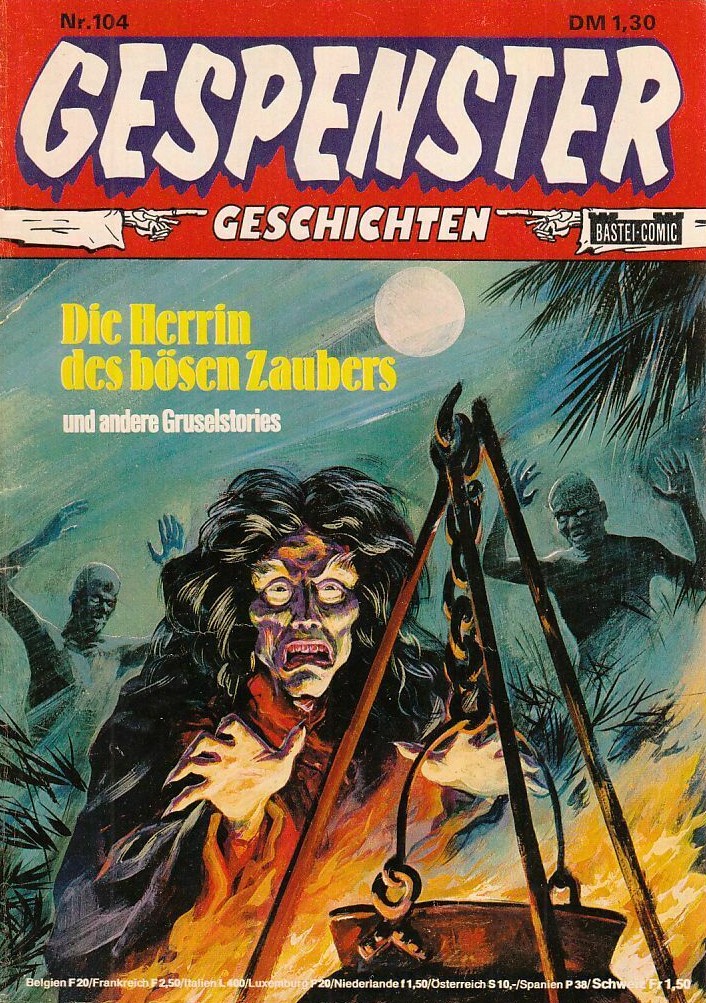
We have previously dipped a toe into Gespenster Geschichten (Ghost Stories) territory before, but – and this will come as no surprise – it was through the peculiar prism of tentacles. (For example, see Tentacle Tuesday: A Torrent of Teutonic Tentacles.) Yet this long-running (1974-2006) series published by Bastei Verlag also offers plenty of Hallowe’en-appropriate thrills: witches, ghosts, demented scientists, cold-blooded killers… you name it, Gespenster Geschichten has it! Here are a few covers which seem particularly appropriate for this wonderfully dreary, grey October evening.

The insides of these issues are of lesser interest: reprints of American horror comics, and, later on in the series, new content by artists local and migrated (Argentine, Spanish, Italian, Yugoslav…) Within some of these pages dwell reprints from Gold Key Comics’ Boris Karloff Tales of Mystery  (for example, with artwork by John Celardo, Sal Trapani, and Canadians Jack Sparling and Win Mortimer). I think we can safely conclude that the covers are considerably more horrifying than the innards of these issues…

With that out of the way, let’s see what German ghost stories have in store for us!

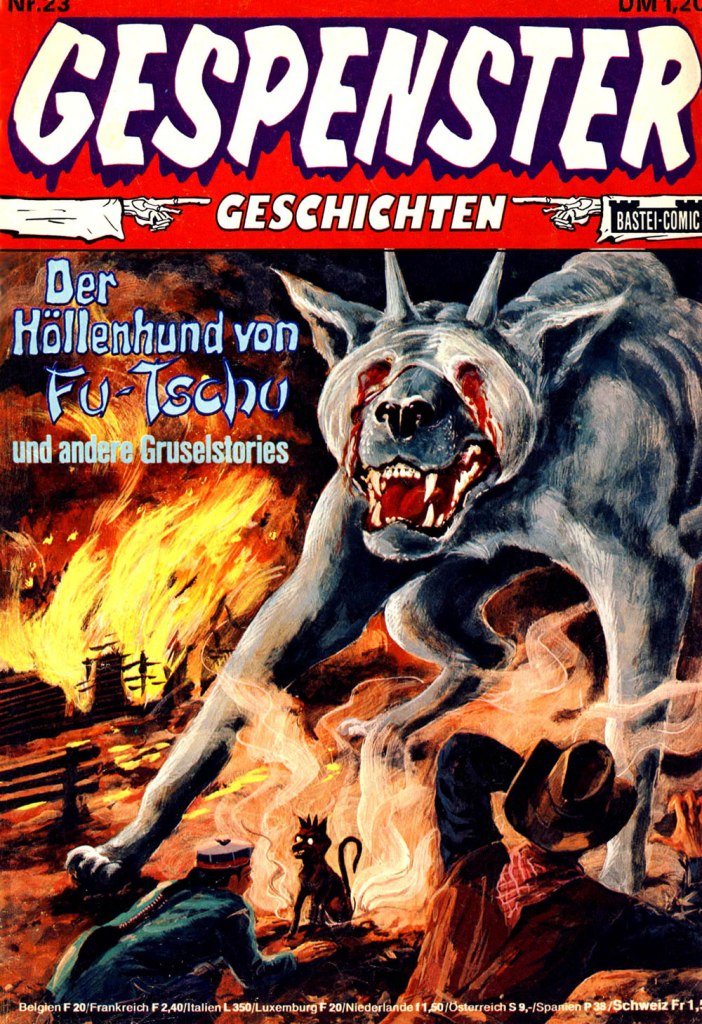
Gespenster Geschichten no. 23: Der Höllenhund von Fu-Tschu (The Hellhound from Fu-Tschu), 1974. This cover is equal parts disturbing and puzzling, with a creepy bear-dog with bleeding sockets and the little demonic effigy that is somehow simultaneously cute and clearly evil.

This charming little doggo was a rather… creative interpretation of the following painting, created for Boris Karloff Tales of Mystery no. 48 by George Wilson:

So you see how that particular Teutonic ball rolls! I admire George Wilson, but I admit I much prefer the German interpretation of this scene.

Gespenster Geschichten no. 41: Die Stunde des grünen Monsters (the hour of the green monsters), 1975. That witch looks downright friendly… the friendliness of a man smiling at a particularly appetizing piece of steak.
Gespenster Geschichten no. 59: Die Mask des Entsetzens (Mask of Horror), 1975. That’s a stylish haircut; I bet all the ladies go for this charmer.
Gespenster Geschichten no. 76: Die Herrin des bösen Zaubers (The Mistress of Evil Spells), 1976.
The Ghost Stories Special (Gespenster Geschichten Spezial) was an oversized format, though I am not sure whether these babies featured reprints of their smaller-sized brethren literally in a bigger format, or just functioned as a sort of anthology. This is Die unheimlichen Gespenster Geschichten Spezial no. 208. ‘Monster-ladies’ is somewhat self-explanatory; ‘Die unheimlichen’ means ‘the scariest’.

For more Gespenster Geschichten, visit this lovely Monster Brains post. And if you’re curious about what each issue contains, head over to Comic Vine, which lists reprints featured inside some of the issues.

*(from Der Gevatter Tod, collected by Brothers Grimm)

~ ds

Hallowe’en Countdown V, Day 20

« Only the knife knows what goes on in the heart of a pumpkin. » — Simone Schwarz-Bart

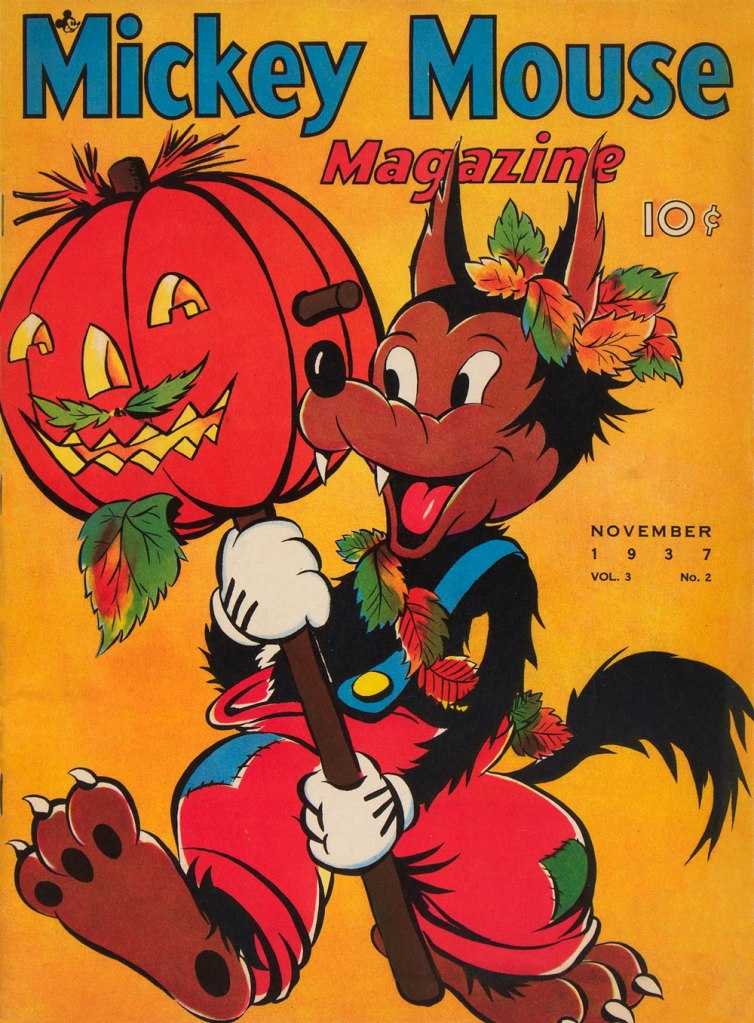
Today, for a change, here’s a gallery of light-hearted Golden Age funnies… if not directly on the theme of Hallowe’en, then at least full of spooky fun and spirit. Some of these babies are unbelievably rare items… hence, at least in part, the sketchy credits.

This is Mickey Mouse Magazine vol. 3 no. 2 [26] (Nov. 1937, Western); cover artist unknown.
This is Famous Funnies no. 75 (Oct. 1940, Eastern Color); cover by Victor Pazmiño, featuring Uncle Elby and Sam Smithers. Read it here!
This is Ribtickler no. 3 (July-Aug. 1946, Ace); cover artist unknown.
This is Hap Hazard Comics no. 4 (Spring 1945, Ace); cover by Sam Singer, who mostly worked in animation.
This is Spooky Mysteries no. 1 (1946, Lev Gleason); cover art by the Jason Comic Art Studio. G’wan, read it here!
This is Jo-Jo Comics no. 4 (Dec. 1946-Jan. 1947, Ace); you guessed it: cover artist… unknown.

-RG

Hallowe’en Countdown V, Day 19

« Hell is empty and all the devils are here. » — William Shakespeare

In the 1970’s, thanks to a boom of interest in all things Occult, we made the acquaintance of hordes of Satan and Dracula’s close relatives. Oh, these bad boys were prolific!

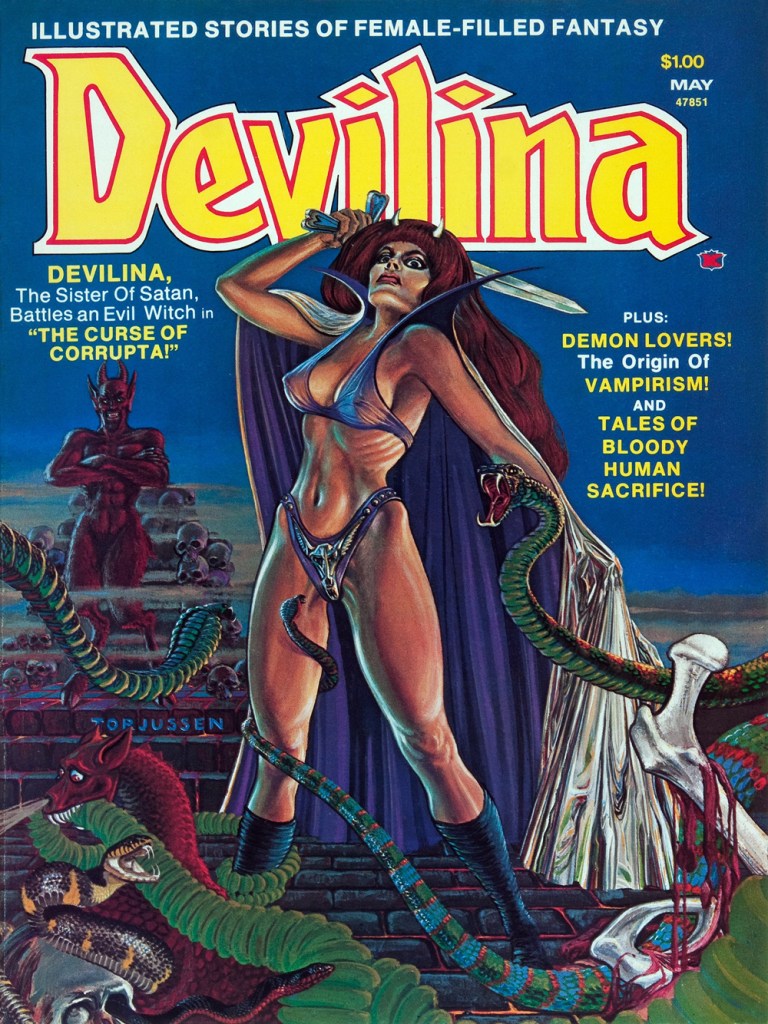
This is one of Atlas-Seaboard’s entries into the black and white magazine arena. The stylish cover is the work of George Torjussen, one of his rare forays into comics (so to speak); Mr. Torjusson is still active in the fine arts field.

This is Devilina no. 2 (May, 1975, Atlas-Seaboard). Interior art by Ric Estrada, Frank Thorne, Jack Sparling, Suso and Leo Summers. Cursed with a low print run, this baby’s scarce.

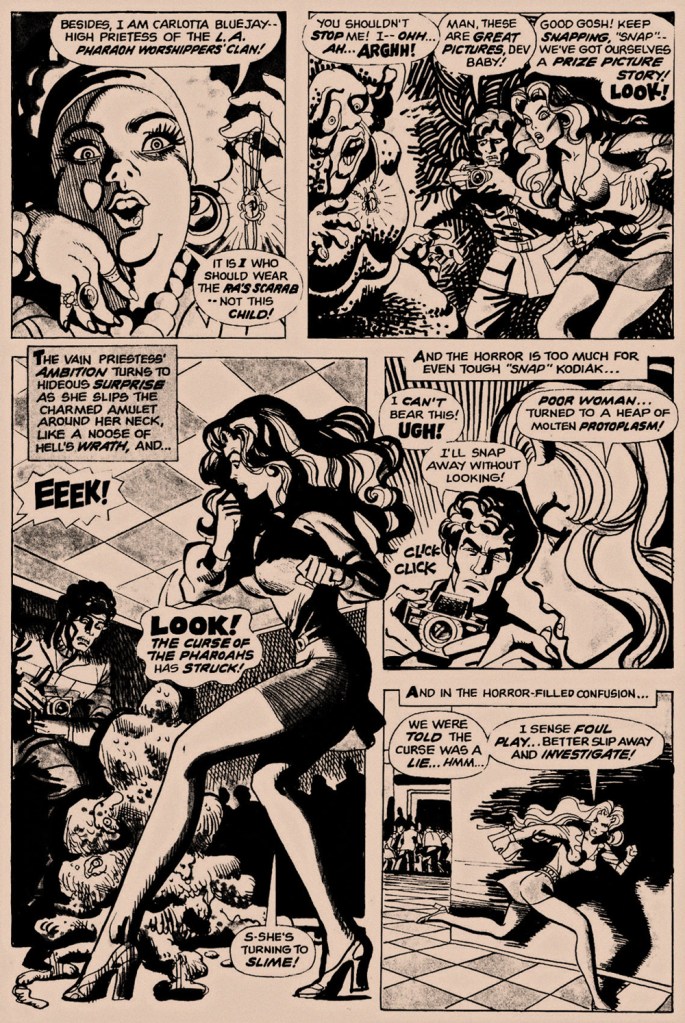
Here are a few sample pages from Curse of the Ra Scarab, written and illustrated by Mr. Estrada (1928-2009). Moody!

The story’s nothing spectacular, but I’ll take Ric Estrada‘s lively artwork any day over any of those stiff photo tracers who illustrated Vampirella’s exploits. Especially since Ric gets to ink himself in this case. Reportedly ambidextrous to an impressive degree, Estrada claimed he could pencil with his right hand while inking with his left.

It’s worth noting, I think, that this has to be the most rape-happy comics magazine I’ve encountered… that isn’t from Italy. The Devilina feature aside, only one story doesn’t feature or imply an instance of violent rape. I’m inclined to thing that editor and scripters’ notion of ‘Female-filled fantasy‘ was more like ‘Female-filling fantasy‘. I guess this is some people’s idea of exercising their freedom from the Comics Code Authority — but mature it isn’t.

-RG

Tentacle Tuesday: Brushstrokes

« A painting requires a little mystery, some vagueness, and some fantasy. » ~ Edgar Degas

… and some tentacles, of course!

This painting of a chained barbarian confronted by an octopus (here to collect his liver, no doubt?) is the work of Bob Juanillo, an artist of which little is known, other than that he was active in the late 60s and early 70s, contributed to a lot of comics fanzines, and died at 30 (source). At least we know it from 1974!

To follow, the original art for a variant cover for Red Sonja vs. Thulsa Doom no. 1 (February 2006). The painting is by Gabriele Dell’Otto, an Italian artist who has done work for Marvel and DC. Tentacles or enormous snake-tail, you be the judge. As for powerful necromancer (and shape-shifter) Thulsa Doom, he is the brain-child of American author Robert E. Howard.

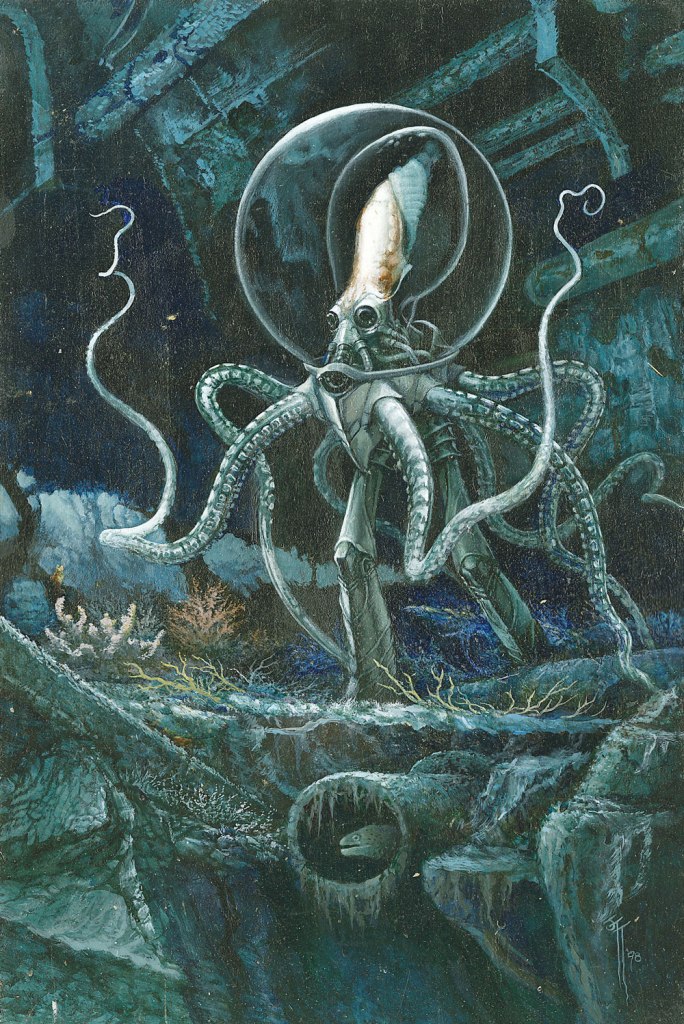
This painting by John Totleben appeared (as far as I can tell) somewhere in Timeslip Special Vol 1 no. 1 (August 26th, 1998). « The isotope itself was eventually dumped, as garbage, into the oceans, where it began mutating the ocean life. One of the mutates was an octopus who, developing high intelligence, and through unknown means, donned a mechanical suit. The isotope itself eventually went on to mutate all life on the planet. » (source) I giggled at the idea of an octopus donning a mechanical suit ‘through unknown means’. These cephalopods get into everything!

Finally, voici an unfinished painting by Frank Frazetta, entitled Death Dealer VII (the first Death Dealer was painted in 1973). Health issues (blurry vision, and a series of strokes) prevented Frazetta from finishing it, though his preliminary sketch was published in Rough Work (Spectrum Fantastic Art, 2007).

~ ds

Hallowe’en Countdown V, Day 18

« La matière en était gélatineuse et peu consistante; elle se décomposa, au bout de quelques heures, en un liquide rose et gluant, d’une odeur insupportable.* » — Jean Ray, Dans les marais du Fenn

Aw, good old muck monsters…

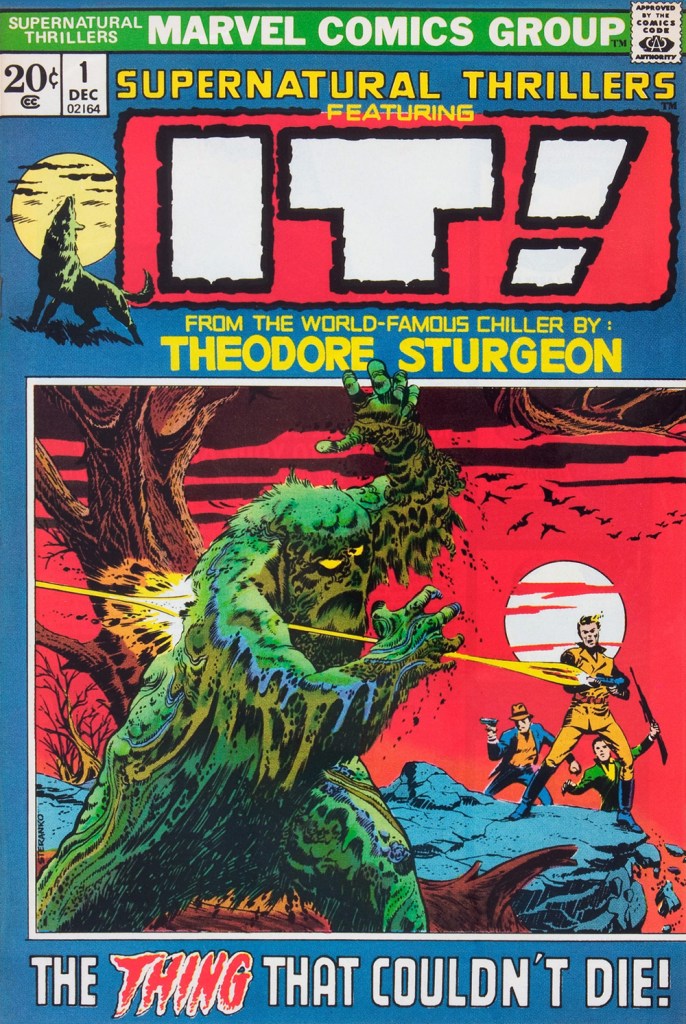
Perhaps the first to emerge, at least in the English language, was Theodore Sturgeon’s “It”, published in Unknown’s August, 1940 issue, whose title page warned: “IT wasn’t vicious, IT was simply curious — and very horribly deadly!

But IT was preceded, by some years, by Raymond Marie de Kremer alias Jean Ray’s superb Dans les marais du Fenn (« In the Fenn Marshes »), first published in the Belgian literary magazine L’ami du livre’s issue of November 1st, 1923! A handful of Ray stories (often published under his alternate nom de plume, “John Flanders”) were published in US pulps, including the legendary Weird Tales, but “Dans les marais…” appears to have somehow, to this day, remained untranslated to English.

This is Supernatural Thrillers no. 1 (December, 1972, Marvel), an adaptation by Roy Thomas, Marie Severin and Frank Giacoia. Cover by Jimmy “Profa” Steranko.

The opening — and best — page from Marvel’s IT adaptation, which fails, imho, because Rascally Roy, overly attached to the original text, doesn’t let the visuals breathe. The mediocre results, at once too pedantically faithful and well off the mark, are no substitute for Sturgeon’s original.
IT originally saw print in this issue of Street & Smith’s Unknown, which had, just one month earlier, abandoned its striking painted covers for this money-saving but comparatively stodgy, ‘dignified’, Reader’s Digest-style design. It looks like there’s a page missing — the best one!
And they were soon at it again. How did they manage to convince themselves that this was going to succeed as an adaptation? This is Worlds Unknown no. 6 (Apr. 1974, Marvel). Pencils by Gil Kane and inks by Ernie Chan, with extensive alterations by John “Heavy Hand” Romita. This has been bestowed the impressive (if true) honour of being called The Lyingest Cover in Marvel Comics History.

-RG
Its matter was gelatinous and insubstantial; it decomposed, within a few hours, into a viscous pink liquid of unbearable odour. »

Hallowe’en Countdown V, Day 17

« Dreams surround our desires with ugliness and dread. » — Mason Cooley

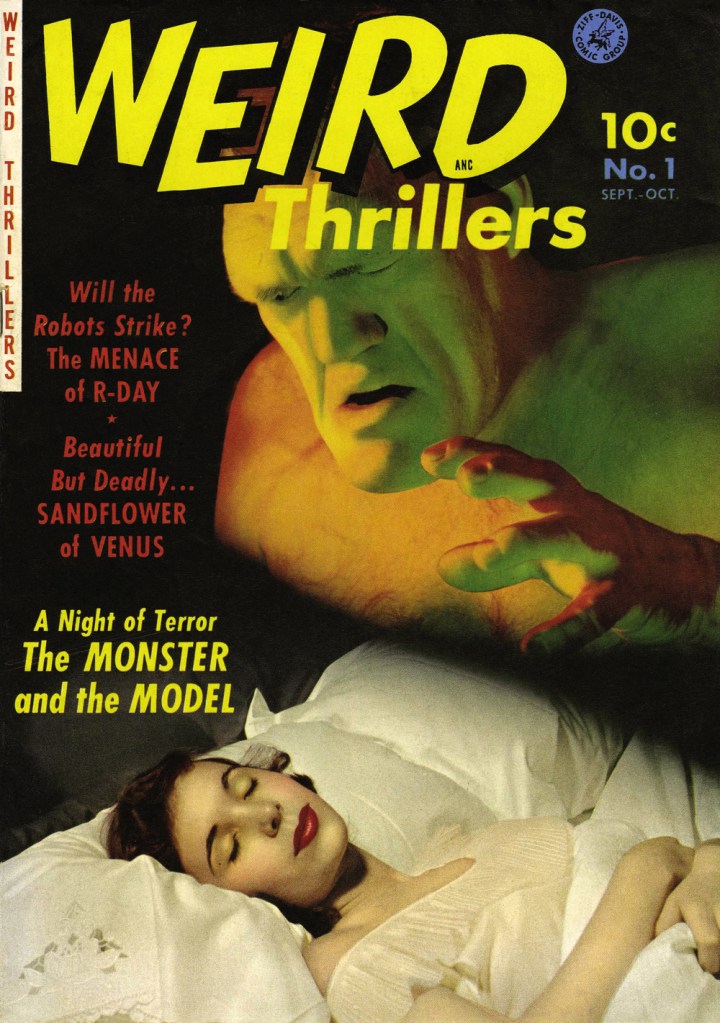
As everyone knows, the early fifties were a more innocent and wholesome era, when the average bobbysoxer would swoon away the nights with fantasies of dishy teen idol Rondo Hatton. I mean, just look at her blissful expression!

This is Weird Thrillers no. 1 (Sept. 1951, Ziff-Davis). Disappointingly, given the cover’s promise, the issue comprises mostly science-fiction and crime stories.

Surprisingly, the cover scene does, for once, occur within!

The opening pages from our cover tale, The Monster and the Model, pencilled by future Rip Kirby artist John Prentice. The entire issue is available for your perusal, legally and gratis, right here!
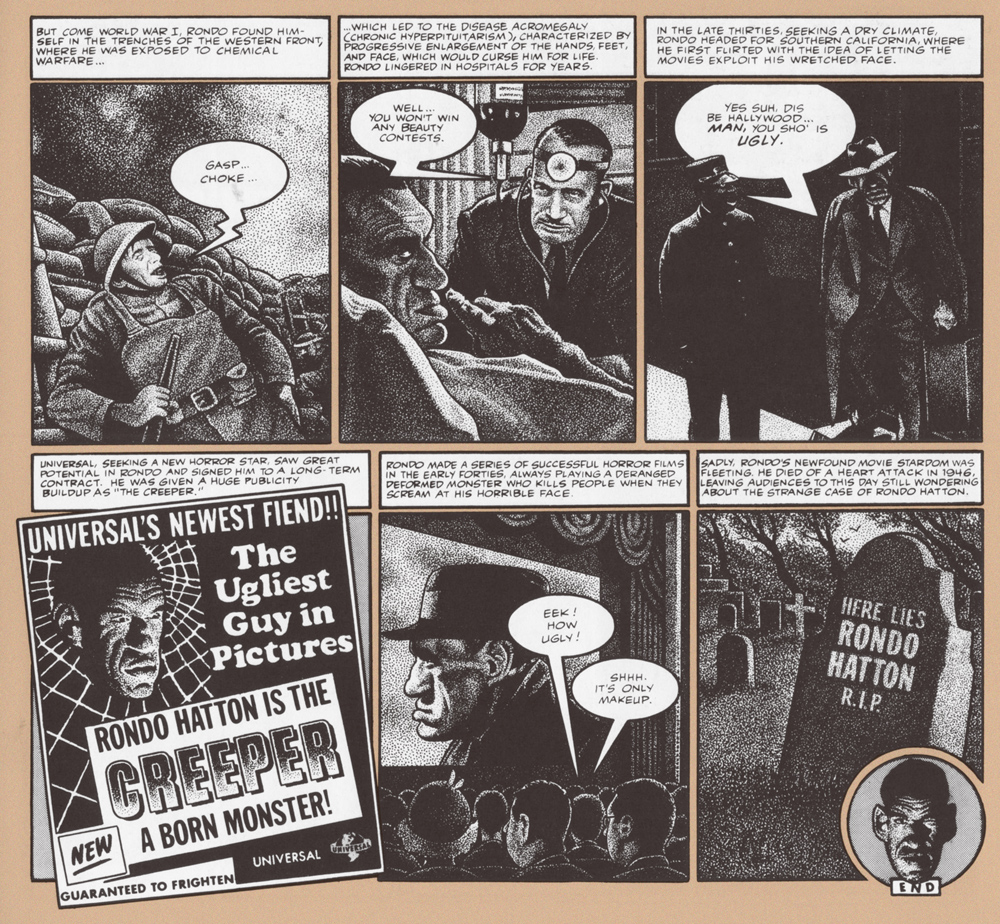
“So, who is this Rondo guy?”, you may ask. Before Mr. Hatton became a household name, got an award named after him and was the subject of his own book-length biography (Beauty Within the Brute), cartoonist Drew Friedman, ahead of the curve as usual, was endeavouring to preserve from oblivion the unfortunate man’s memory… in his own sardonic way.

One more for the road?

Originally published in Raw no. 8 (Sept. 1986, Raw Books). You may have heard of some other folks tragically afflicted with acromegaly.

-RG

Hallowe’en Countdown V, Day 16

« The whole planet reeks of mysticism without revelation. » — Dan Simmons

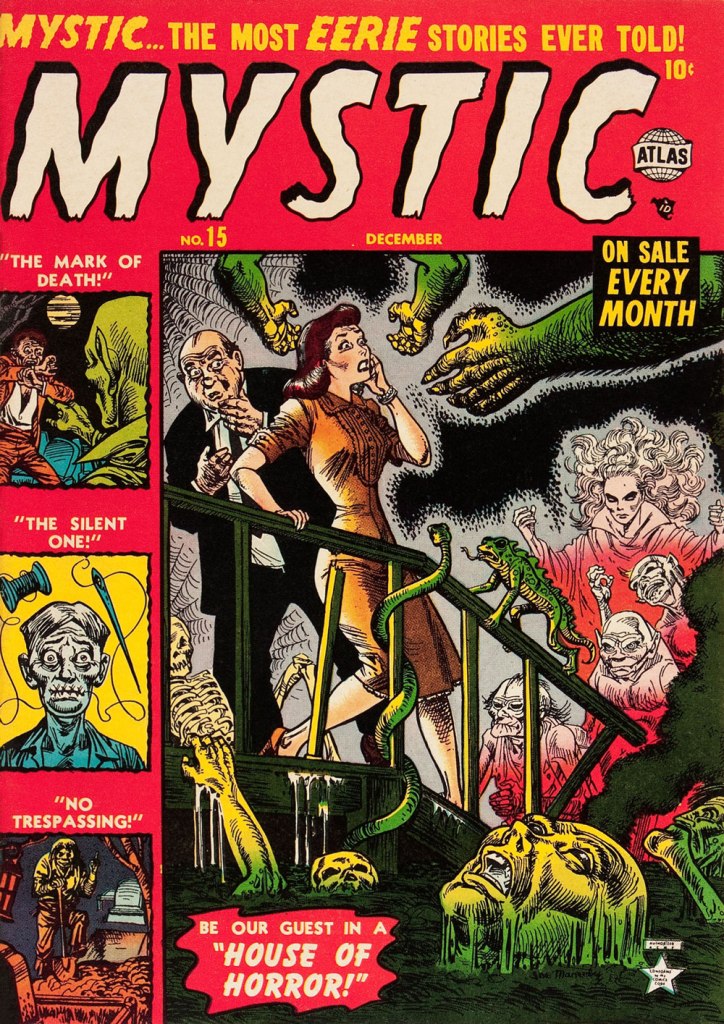
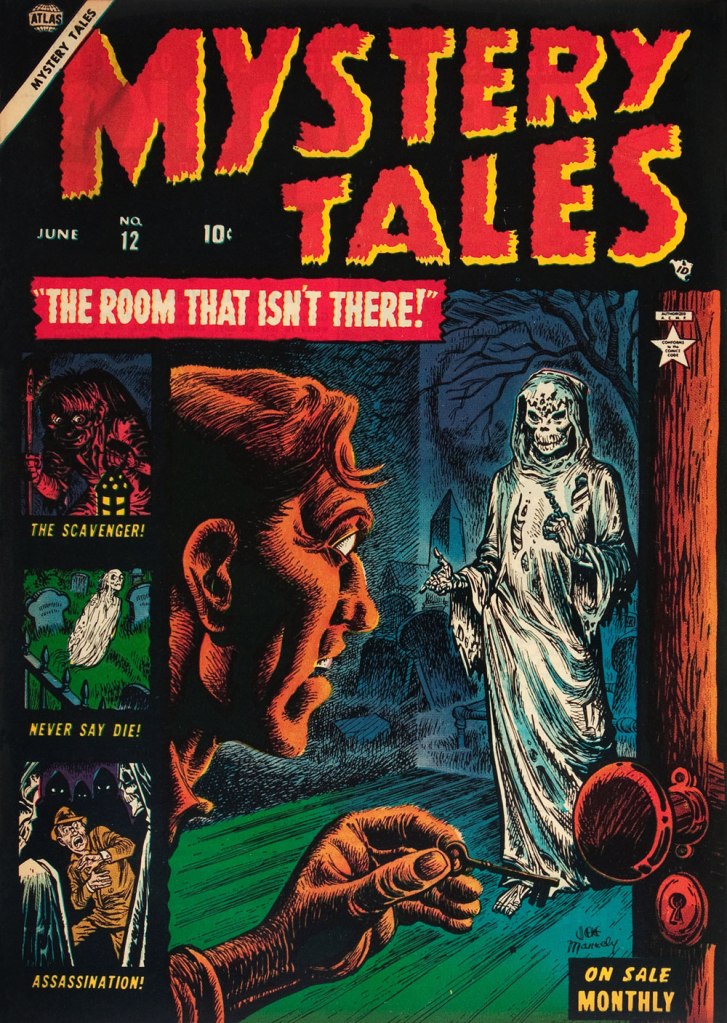
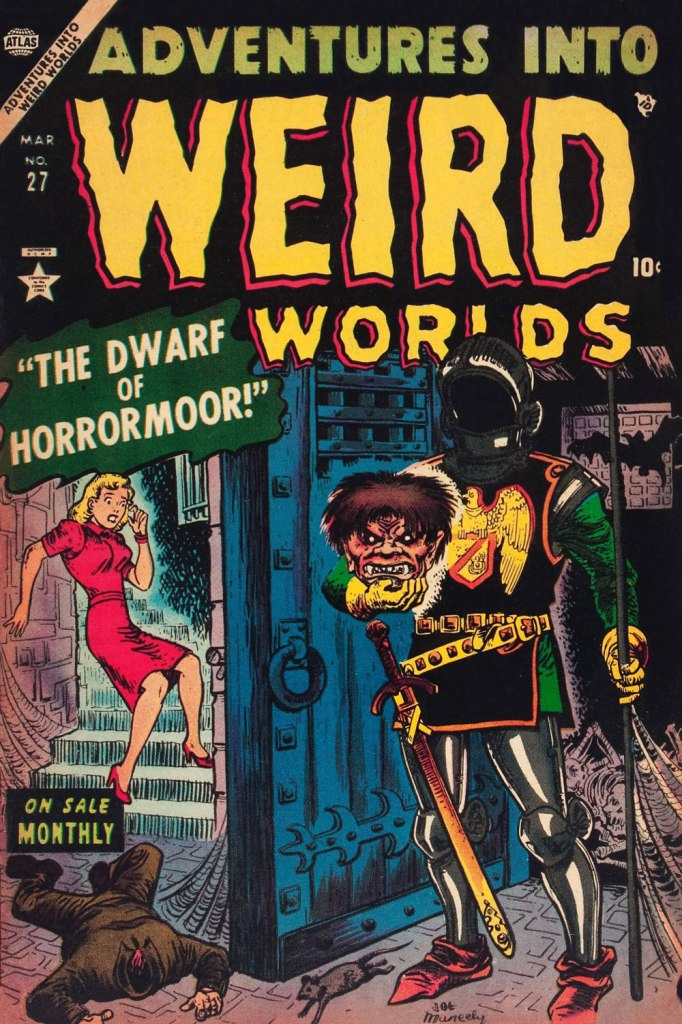
Last May, when I showcased Joe Maneely‘s Atlas cover art (see Joe Maneely, Atlas of Versatility), I intentionally left out his pieces for the horror titles, knowing them worthy of some attention of their own, an ideal topic for the Hallowe’en countdown. Besides, it took some pressure out of the selection process if I could save one whole genre for a rainy day — and today’s most certainly that day!

This is Mystic no. 7 (Mar. 1952, Atlas); colours by Stan Goldberg.
This is Mystic no. 15 (Dec. 1952, Atlas); colours by Stan Goldberg.

“Mystic” is evidently one of Marvel’s pet titles: the title was first used by Timely in 1940-42, then again in 1944-45; once more, most successfully in this Atlas horror series, for 61 issues from 1951-57. And lately in 2009 and 2011. I’ll bet that tradition’s not yet done with, but why on earth?

This is Mystery Tales no. 12 (June 1953, Atlas); colours by Stan Goldberg.
This one’s got it all! Here’s Adventures Into Weird Worlds no. 27 (Mar. 1954, Atlas); colours by Stan Goldberg.
This is Mystic no. 29 (Apr. 1954, Atlas); colours by Stan Goldberg. Maneely’s Atlas horror covers generally distinguished themselves by their goofiness.
Begging the question: What’s worse than having two left feet? Having three left hands, apparently. This is Riot no. 3 (Aug. 1954, Atlas); colours by Stan Goldberg.
This is Mystery Tales no. 24 (Dec. 1954, Atlas); colours by (need you ask?) Stan Goldberg. While I make no bones about my disdain for Goldberg’s work at Archie, he was a superb colourist in the 1950s. In terms of legibility, Atlas’ busy covers had to be quite a challenge to pull off, and he did it again and again.

-RG

Hallowe’en Countdown V, Day 15

« Get ready for the future: it is murder. » — Leonard Cohen

Since Hallowe’en isn’t as widely celebrated in Europe — Ireland and the rest of the U.K. aside, obviously — as it is in North America, it’s not always evident and easy to keep the countdown truly international. No worries: in such a situation, I’m no stickler — I’ll take the spirit of the law over its letter.

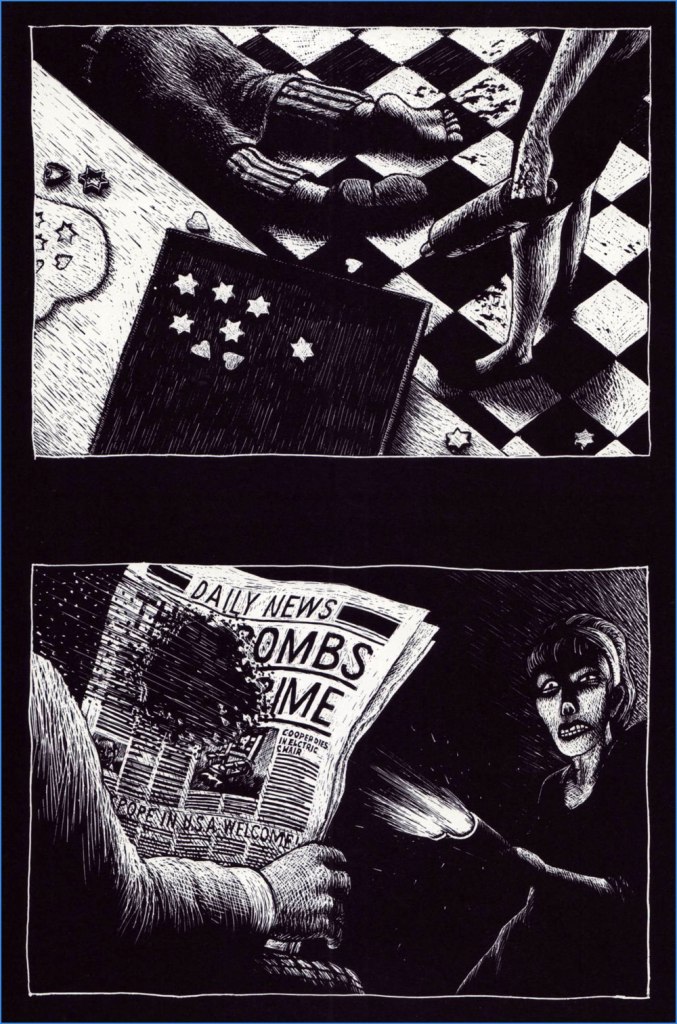
The first (and until now, only) time I posted about Thomas Ott, I wound up with a contender for least-popular post in this blog’s history. Have I learned my lesson? Heavens, no. I live, perhaps naïvely, in the belief that our audience has grown in the interim, and that said audience is ever more attuned and receptive to our quirks.

Here, then, is some gallows humour from Mr. Ott. Don’t try this at home, unless…

Top: The Night Porter, anyone?
Er… Top: Deadly Weapons, anyone?
Originally published in Tales of Error (Oct. 1989, Edition moderne, Switzerland). Yes, a book in English by a German-speaker from a Swiss publisher with a French name.
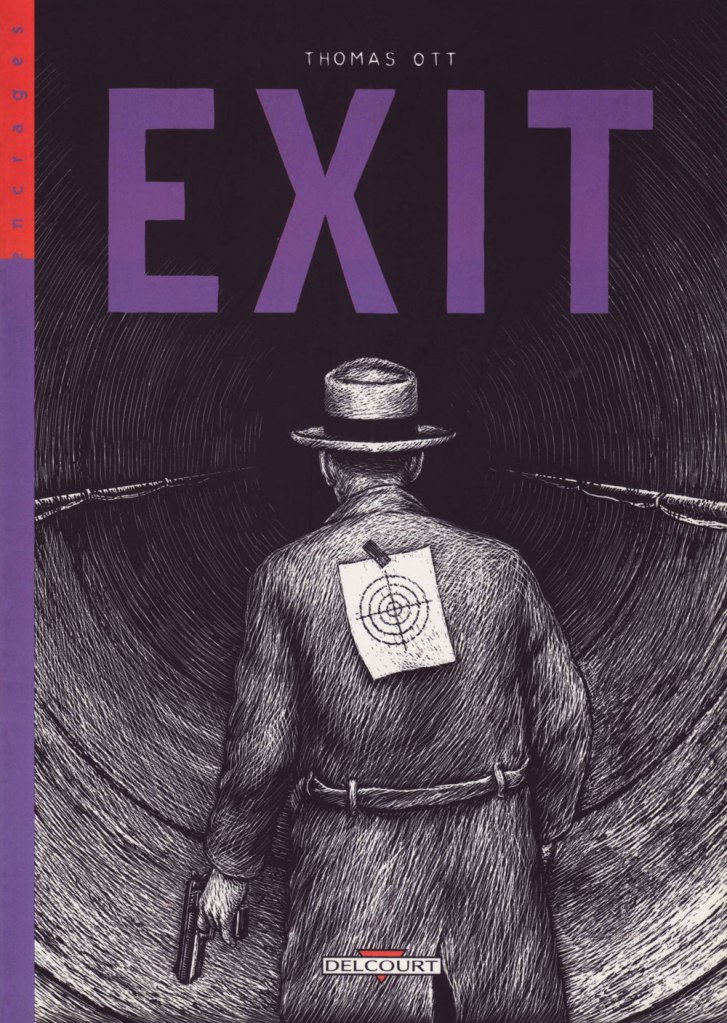
The Exit collection (Sept. 1997, Delcourt) gathers the essential bits of Ott’s first three albums (Tales of Error, Greetings from Hellville and Dead End), as well as some new pieces.

For more poisoned goodies from Mr. Ott, just plod your carcass over to his official website.

-RG

Hallowe’en Countdown V, Day 14

« Upon its head, with red extended mouth and solitary eye of fire, sat the hideous beast whose craft had seduced me into murder, and whose informing voice had consigned me to the hangman. » — The Black Cat (1845)

What can I tell you about the legendary English cartoonist and bon vivant Hunt Emerson — born in 1952 in Newcastle and still devilishly active these days — that he can’t tell you in his own words?

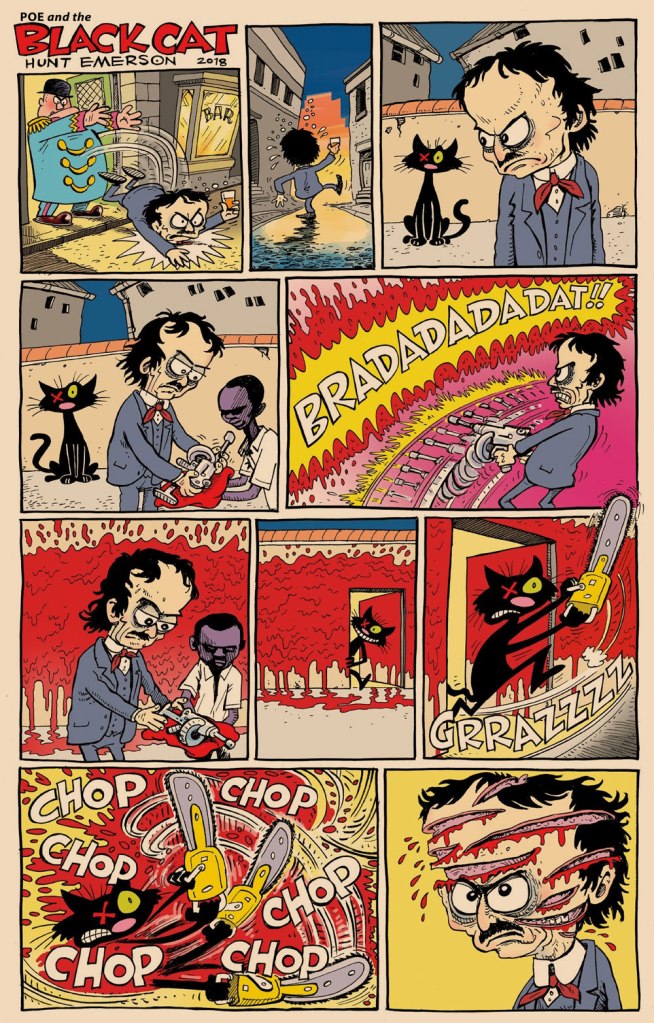
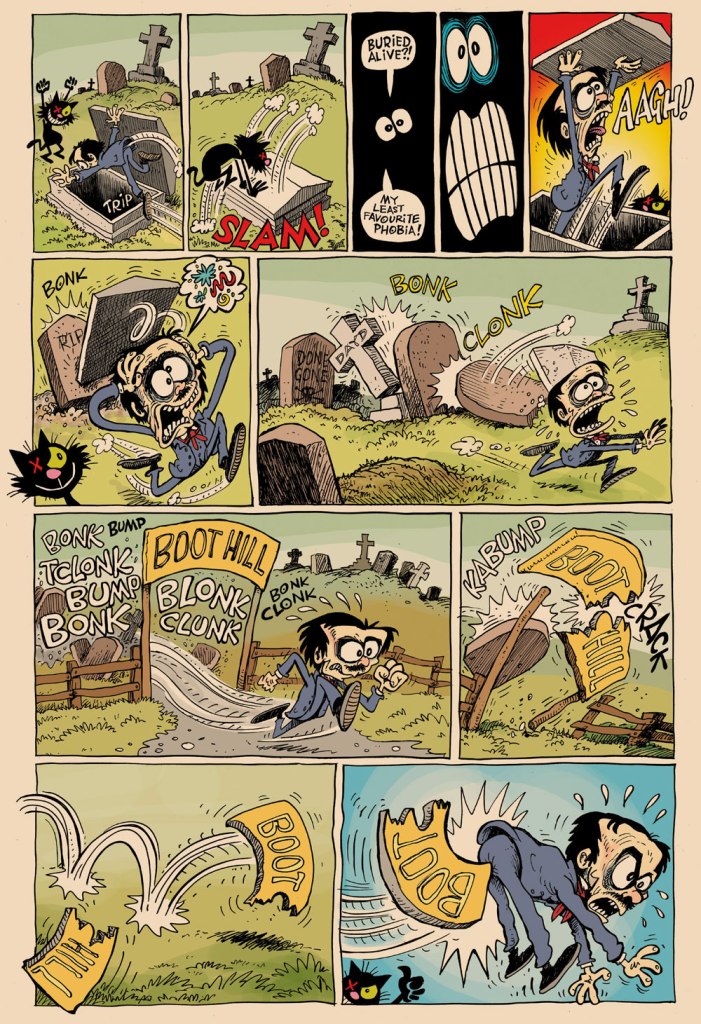
Mr. Emerson has recently (and I do mean recently!) contributed a series of hi-concept short strips to Ahoy Comics’ gamut-running Poe-themed humorous horror anthology. Taking his place in a thematic thread that includes Tom and Jerry, Antonio ProhíasSpy vs Spy, Brian McConnachie and Warren Sattler‘s Kit ‘n’ Kaboodle, Massimo Mattioli‘s Squeak the Mouse* and Simpsons cartoon-within-a-cartoon Itchy and Scratchy, Emerson merrily escalates the hostilities launched in Poe’s The Black Cat, with Poe himself in the rôle of the narrator. Assume the position!

Originally published in Edgar Allan Poe’s Snifter of Terror no. 2 (Nov. 2018, Ahoy).
Originally published in Edgar Allan Poe’s Snifter of Terror no. 4 (Jan. 2019, Ahoy).
Originally published in Edgar Allan Poe’s Snifter of Terror no. 5 (Feb. 2019, Ahoy).
You’ll get all these, and plenty more besides, in Edgar Allan Poe’s Snifter of Terror Volume 1 (Oct. 2019, Ahoy), collecting the title’s first six issues. Cover art by Richard Williams, with a title logo by Todd Klein.

-RG

* not, by a long shot, Mattioli’s best work. *That* would be, without question, his nonpareil M le magicien (1968-73).