Hallowe’en Countdown II, Day 14

« In medical practice it is inevitable to observe the details. »
– Dr. Joseph Bell

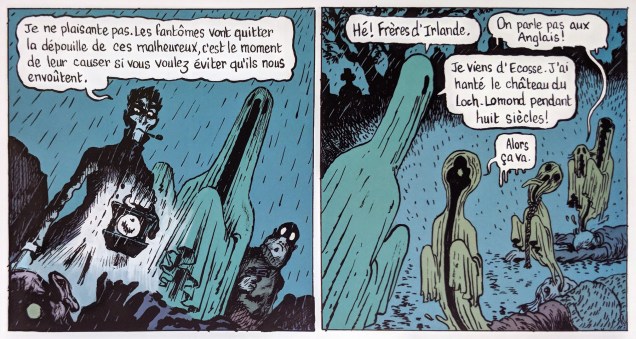
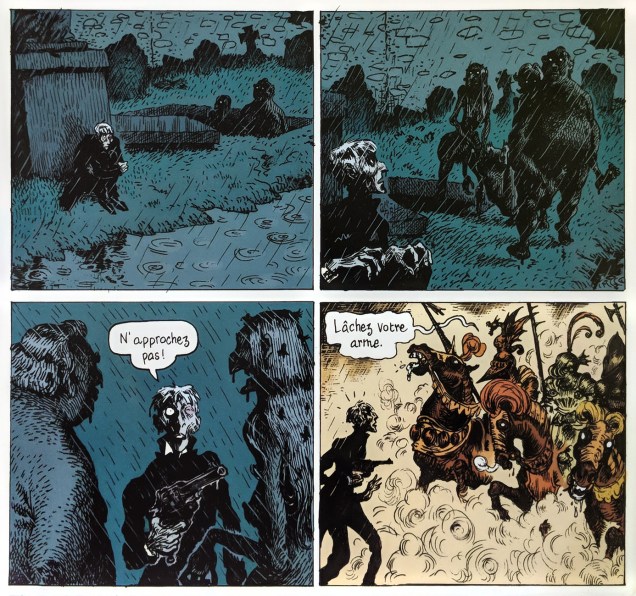
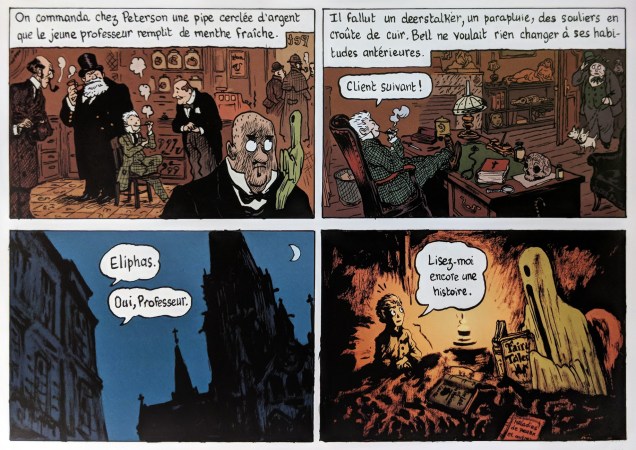
From France, then, we have the now-whimsical, now-terrifying exploits of Professeur Bell, somewhat loosely based on Joseph Bell, a lecturer at the medical school of the University of Edinburgh, who was Arthur Conan Doyle‘s teacher and the alleged real-life inspiration for Sherlock Holmes.

Joseph_BellA
The good (actual) Dr. Bell. He’s only pretending to read.

Joan Sfar wrote and drew the first two entries in the series, but struggled to achieve the more realistic and detailed style he’d set for himself. With the third volume, he was joined by the skillful and versatile Hervé Tanquerelle, who handled the art chores from then on. A smooth transition.

Sfar has been invoking a marvellously complex and nefarious universe surrounding a « hero » with an increasingly slippery grasp on morality and reality. Heck, even Frank Belknap Long‘s Hounds of Tindalos got a surprise look-in. Recommended.

Published so far in French, Italian, German and Polish…

« L’Irlande à bicyclette » is the fifth and latest in the series, published in 2006. Ahem, fellas… it’s been *quite* a while. La suite, s’il vous plaît?

BellIrlande

Intrigued, as you should be (you do have a pulse, right?)… care for a few furtive glances between the covers?
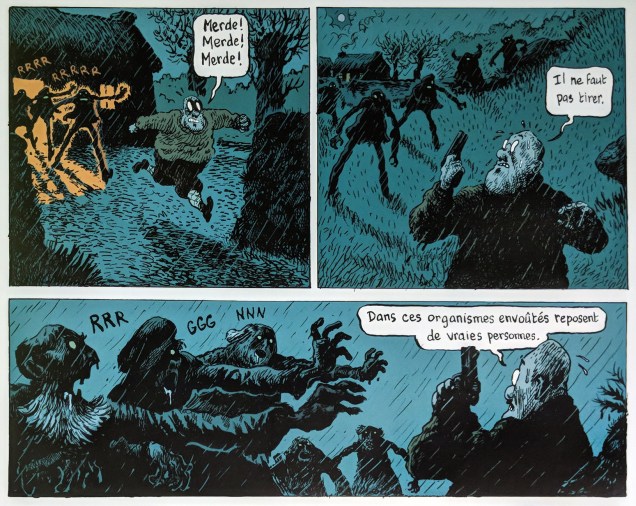
ProfBellIrlande01AProfBellIrlande02AProfBellIrlande03AProfBellIrlande04AProfBellIrlande05AProfBellIrlande06A

I’m not going to waste my breath trying to explain. Just dig that mood.

-RG

Hallowe’en Countdown II, Day 13

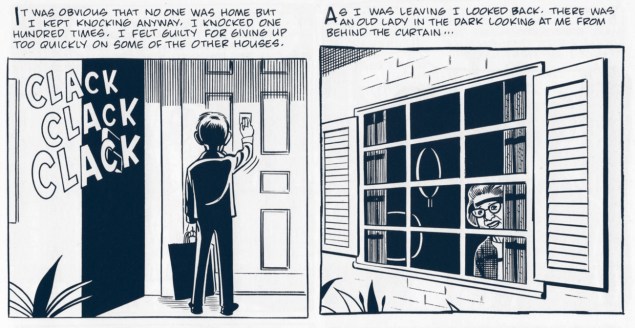
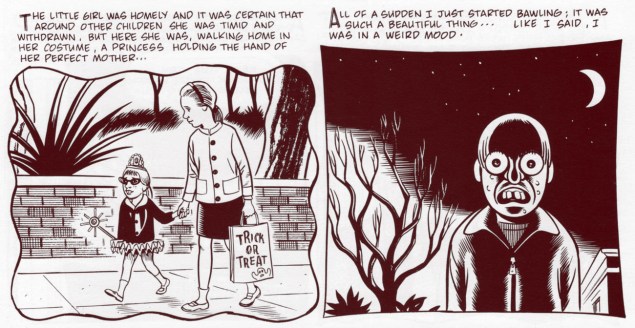
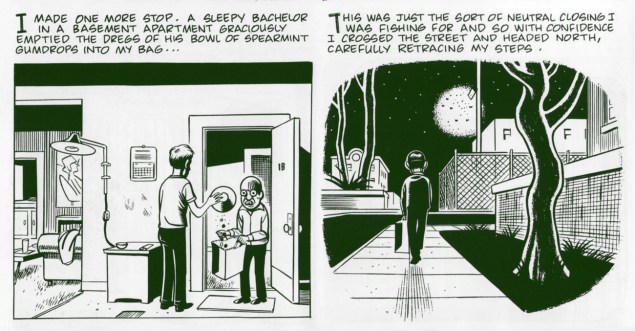
« In many ways, I thought, the perfect night would be a string of unanswered doors. » Dan Clowes, Immortal, Invisible

For our lucky thirteenth check on October’s calendar, we’ll stalk the neighbourhood through Dan Clowes’ eyes with his bittersweet and appropriately haunting Hallowe’en memoir, from the 16th issue of Eightball (Nov. 1995, Fantagraphics). It’s also available in their excellent “Caricature” collection.

ClowesImmortalSplashA

In the mid-90s, Clowes was going from strength to strength, having gradually evolved past the vastly entertaining but immature snarkiness of his early work… he’s certainly earned full marks for being true to his muse, instead of cranking out routine variations on Zubrick and Pogeybait or Needledick the Bug-Fucker.

As an draftsman, Clowes clearly isn’t a « natural »… he had, and has to work at it. But that’s fine, because his special gift rests in his storytelling. Yet it wouldn’t be the same if he merely wrote scenarios for others to illustrate, since his writing and artwork mesh wholly and perfectly.

As a chronicle of a certain early adolescent mindset, full of turmoil and intense, unpredictable emotions, « Immortal, Invisible » is nearly without peer, matched only by its companion and issue-mate, « Like a Weed, Joe ». I figure that just about any sensitive and perceptive person who’s suffered through the stages of a somewhat solitary and awkward late childhood and adolescence can find a bit of themselves in this tale. I know I can relate to its sense of bittersweetness and longing for the fast-receding innocence of childhood.

ClowesImmortal01AClowesImmortal02AClowesImmortal03AClowesImmortal04A

The full story is ten pages long, and if you aren’t already familiar with it, I couldn’t recommend it more fervently.

-RG
Hallowe’en Countdown II, Day 12

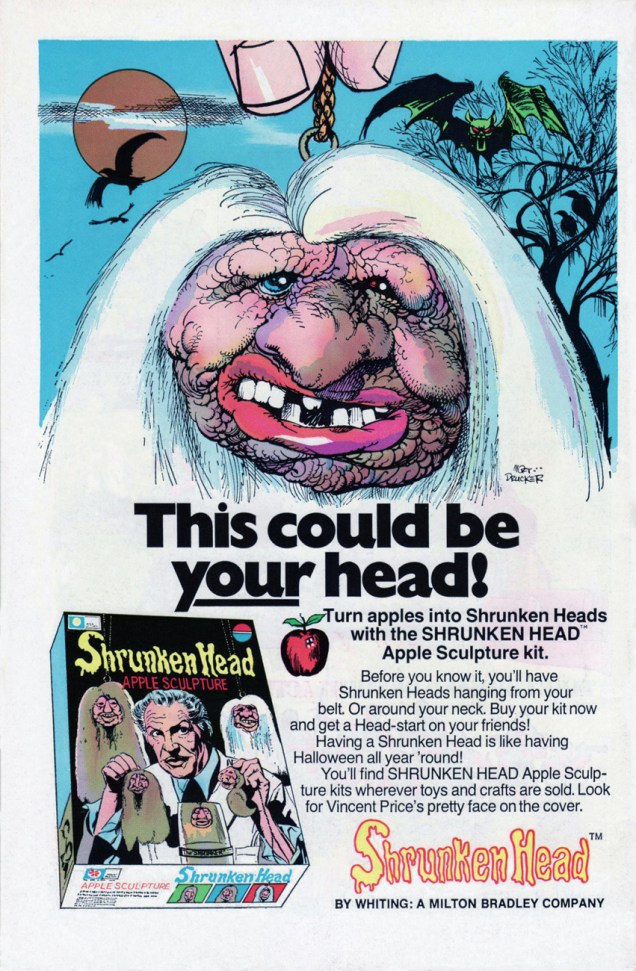
« Having a shrunken head is like having Halloween all year ’round! »

A classic, fondly-remembered ad from the back of comics published in the fall of 1975.

DruckerShrunkenA
How cool is it that even the box art is hand-drawn? One of these will set you back a pretty penny on eBay these days.

The artwork is by Mad Magazine pillar (and arguably their artist most adept at capturing celebrity likenesses) Mort Drucker (b. 1929). Check out that fabulous signature!

Seems like, out of the classic “Usual Gang of Idiots” tontine, it’s down to Mr. Drucker, Paul Coker Jr. (b. 1929) and Al Jaffee (b. 1921!) among the artists, and Frank Jacobs (b. 1929… it was a very good year!) among the writers. I’m not playing odds or picking sides, I adore each of these bons vivants.

VincentAppleBoxA
Of course, I’d always longed to snag my own kit, and a few years ago, I succeeded.
BoxSideApplesA
« Each apple will be different from any other; no two will be exactly alike. This is due to variations in many factors, but mostly in the moisture content of the apple. »
ShrunkenInsidesA
« Caution: Do not use in excess of 40 watt bulb. »

Should you find yourself with some extra apples after a productive head-shrinking session, why not make the most of your leftovers with Vincent’s recipe for æblekage, which is to say Danish Apple Cake? Waste not, want not.

Incidentally, was there ever a more Hallowe’en-friendly toymaker than Milton-Bradley? Let’s see… Voice of the Mummy, Alfred Hitchcock’s Why?, Séance, Ghosts!, Which Witch?

– RG

Hallowe’en Countdown II, Day 11

« It’s astonishing how terrible people can be. » – Gahan Wilson

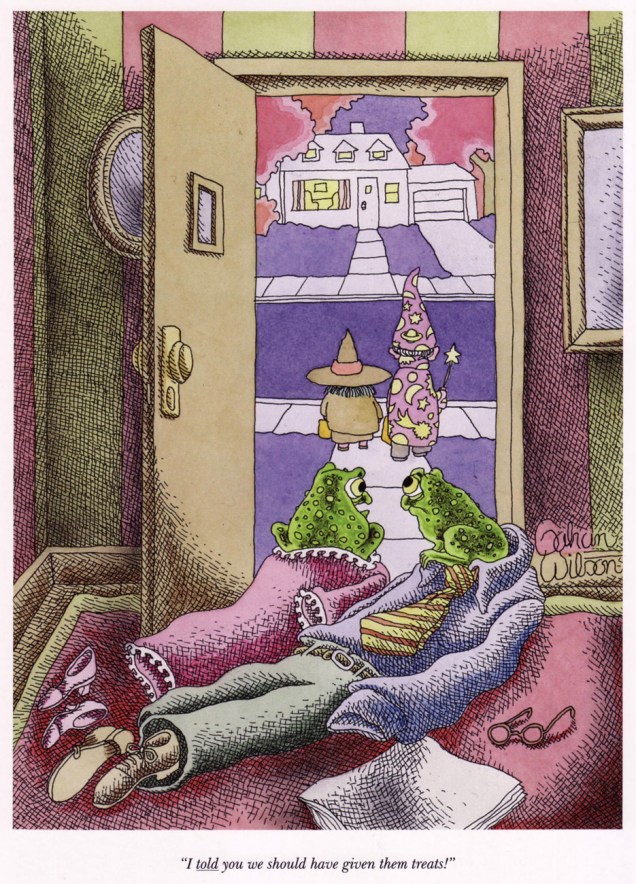
Chez Gahan Wilson (as with his esteemed colleagues Charles Addams and Edward Gorey, for instance), it’s always Hallowe’en! Here’s a trio of particularly fitting cartoons published over the years in Playboy magazine, always one of the finest homes for wayward cartoonists. Gahan was pretty much the only guy Hugh Hefner didn’t encourage to draw buxom females. 

GahanCommercializeA
Playboy, October 1959.
GahanSetArrivedA
Playboy, November 1967.
GahanTreatsA
Playboy, October 2005.

Early in the magazine’s existence, Hef was looking for a Chas. Addams to call his own (the man himself was under exclusive contract with The New Yorker), and he found him. Yet, as Hefner said in his introduction to Fantagraphics’ extraordinary collection, Gahan Wilson: Fifty Years of Playboy Cartoons: « I don’t think I could have imagined before the fact how Gahan was going to grow. What one saw in the beginning was only the promise. »

– RG

Hallowe’en Countdown II, Day 10

« I don’t like mushrooms! We’ll find a way out yet! » – John Agar as Dr. Roger Bentley

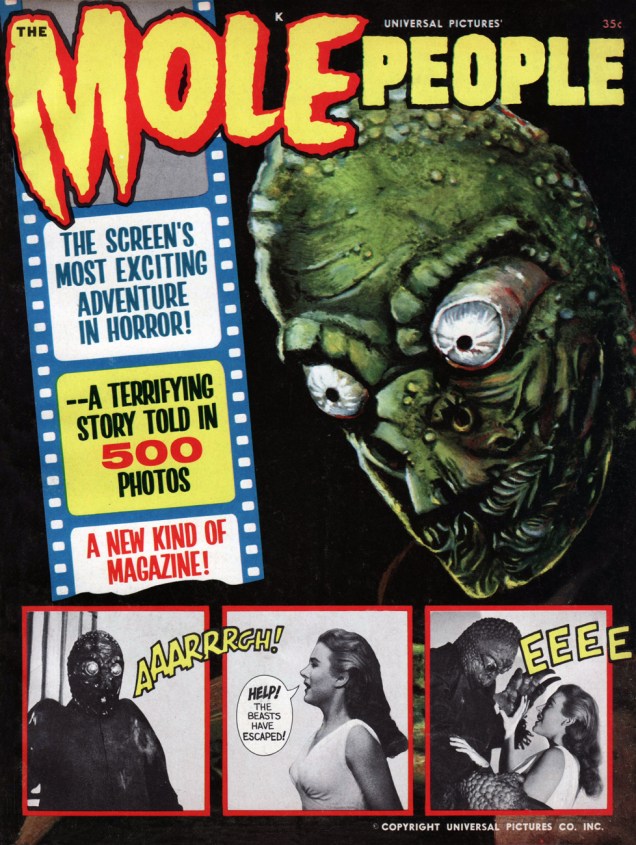
Fumetti: from the italian, it means « little smoke », describing the word balloons as they emanate from characters’ mouths. It’s comics, in other words. In English, it has come to denote comics created using photos instead of illustrations, also known as Fotonovela or, in French, photo-roman. Confused? No need to be. Here’s a rare American specimen of the beast, issued by Warren Publications, home of Famous Monsters of Filmland, Creepy, Eerie and Vampirella, in MCMLXIV (hey, that’s what the indicia says!).

MolePeopleA

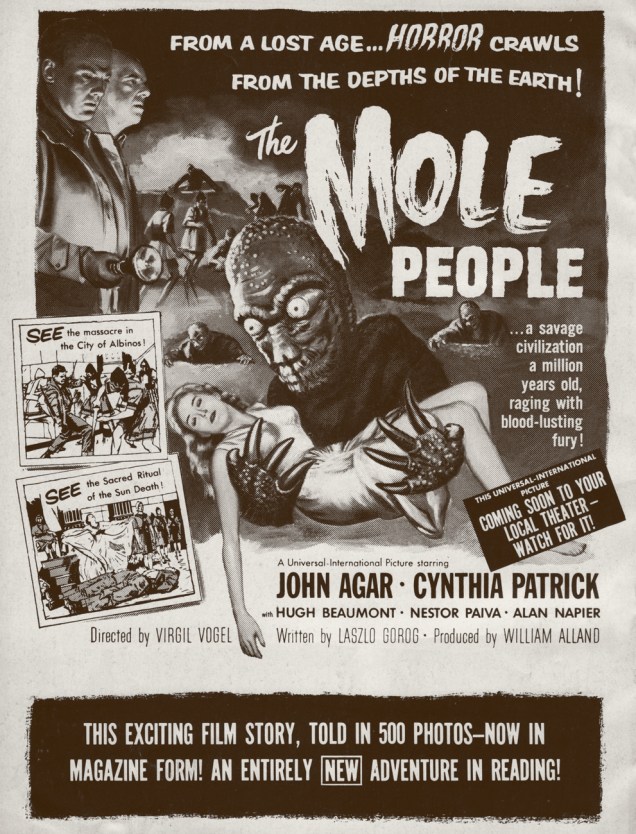
MolePeopleVersoA
The back cover image, featuring the film’s wacky poster art.

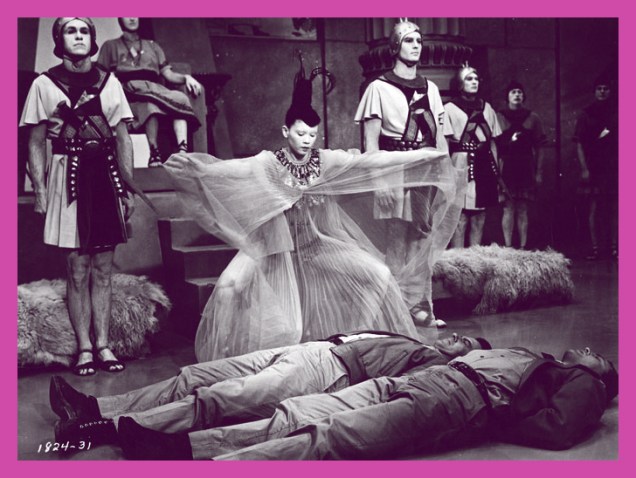
The Mole People was a 1956 feature film from Universal Studios starring the, uh, immortal John Agar.

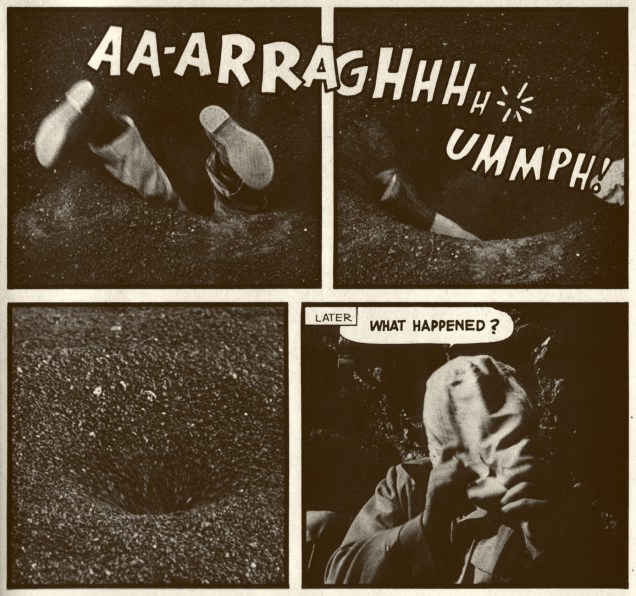
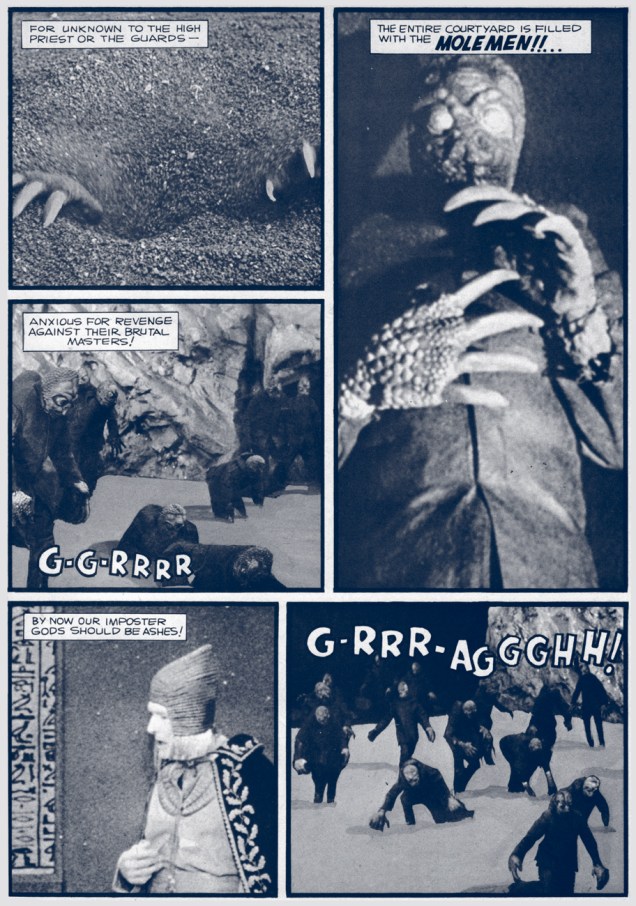
Some excerpts from the insides? But of course!

MolePeople02A

MolePeople01A
We’re dealing with the familiar (but welcome) scenario, in the worthy tradition of Herbert George WellsThe Time Machine… of the Normals turning out to be evil pricks and the presumed Monsters really being sweet if you treat them with any kind of basic decency.
BjorkMolePeople
The human prisoners are treated to an exclusive semi-musical number by a young Björk Guðmundsdóttir.
CaptainAdA
This Captain Company ad from the 1970s always made these titles seem so mysterious and enticing. The Mole People are first in the middle row. Dan Clowes was a big fan of that first Screen Thrills cover.
MolePersonA.jpg
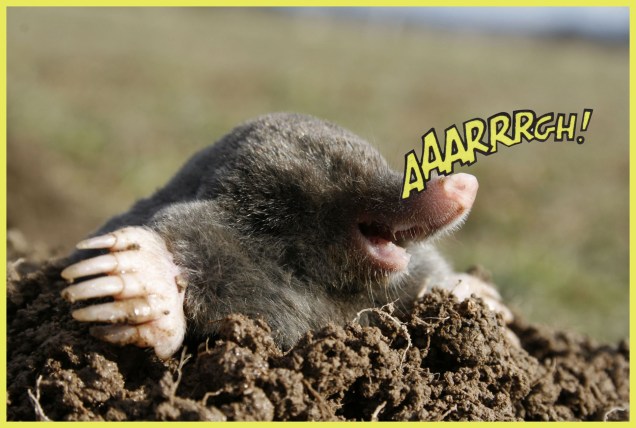
The far scarier real-life version.

-RG

Tentacle Tuesday Masters: Rand Holmes

We have just come back from a lovely vacation in Nova Scotia, one of Canada’s maritime provinces. In the honour of this all-too-short getaway, this Tentacle Tuesday is about Canadian artist Randolph Holton Holmes, who was born in Nova Scotia in 1942 and passed away in British Columbia in 2002, completely at the other end of this big country.

« Rand Holmes was Canada’’s most revolutionary artist in his heyday, the star cartoonist at the Georgia Straight newspaper in British Columbia during the 1970s. His hippie hero, Harold Hedd, became the spokesman of the emerging counterculture as he avoided work, explored free love, and flouted drug laws. The Adventures of Harold Hedd spread across the globe in the wave of underground comix and newspapers of the era and Holmes became famous — or at least notorious. While his comic character was bold and blatant, the artist was shy and quiet, well on his way to becoming a complete hermit. » (excerpt from Fantagraphics’ The Artist Himself: A Rand Holmes Retrospective)

Glimpsing through Holmes’  body of work, one quickly becomes aware that he displays a special affinity for drawing busty women… and (of more interest to this current post) that he loves to insert tentacles at the drop of a hat, especially if ETs of some kind are involved. A lot of artists use tentacles as a short-hand for aliens, and he’s not alone in that… much to my personal satisfaction.

RandHolmes-SlowDeath-1974
Slow Death no. 6 (Last Gasp, January 1974). Colonel “Saunders”?
FogCityComics-RandHolmes
Fog City Comics no. 2 (Stampart, October 1978).  “Science fantasy at its finest” may be an unfulfilled promise; by all accounts, Rand Holmes’ Killer Planet is the best story of the issue. Fog City Comics was an all-Canadian underground comix anthology and lasted a mere 3 issues.

As I mentioned Holmes’ story Killer Planet, here’s a peek at its manifold tentacles:

DeathRattle1-RandHolmes
A panel from Killer Planet, both written and illustrated by Rand Holmes, originally published in the aforementioned Fog City Comics no. 2, coloured by Bill Poplaski and reprinted in Death Rattle no. 1 (2nd series, Kitchen Sink Press, Oct. 1985).
DeathRattleScarfA
What kind of idiot eats fruit growing on an obviously life-threatening planet? Panels from Killer Planet, both written and illustrated by Rand Holmes, published in Death Rattle no. 1 (Kitchen Sink Press, October 1985).
DeathRattle1-RandHolmes-KillerPlanet
Panels from Killer Planet, both written and illustrated by Rand Holmes, published in Death Rattle no. 1 (Kitchen Sink Press, October 1985). Note the cute mushrooms in the bottom left corner.

And lastly, for contrast with the cover of Slow Death and its throes-of-ecstasy coupling scene, there’s this:

DeathRattle5-RandHolmes-JunkyardDog
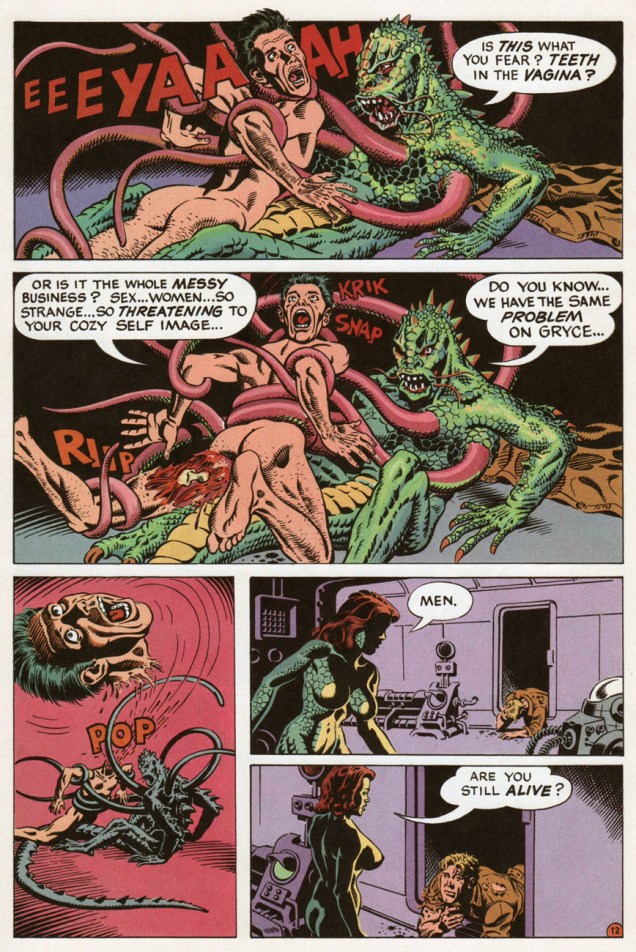
Vagina Dentata! A page from “Junkyard Dog“, written by Mike Baron. It was published in Death Rattle no. 5 (Kitchen Sink Press, June 1986). The (telepathic) alien female wasn’t unjustified in, erm, chewing up her rapist (the intercourse wasn’t consensual) – he was an unapologetic asshole.

~ ds

Hallowe’en Countdown II, Day 9

« But dreams come through stone walls, light up dark rooms, or darken light ones, and their persons make their exits and their entrances as they please, and laugh at locksmiths. » ― Sheridan Le Fanu, Carmilla

This splendid piece comes from the pen of legendary Belfast (Ireland, of course, Eire for you purists) artist Rowel Friers (1920-1998). I unearthed it from a lovely volume ambitiously, but not unjustifiably, titled Best Cartoons from Abroad – 1955, edited by Lawrence Lariar and Ben Roth (Crown Publishers, 1955). It first saw print in Dublin Opinion, a monthly Irish satirical magazine (1922-1968). DI was founded by a pair of cartoonists, Arthur Booth and Charles E. Kelly, and a writer, Thomas J. Collins.

RowelFriersMilkA

As Hallowe’en is Celtic in origin, it stands to reason that we salute the vital Irish contribution to this most awesome of holidays. For those needing a little refresher, here’s a most helpful précis on the subject, from irelandeye.com:

« Hallowe’en is a remnant of Ireland’s pagan, Celtic past. Samhain was an important Celtic feast celebrated on the last day of October, marking the beginning of winter and the New Year. This fire festival was celebrated at night with ritual sacrifice by the druids of animals. The Celts feasted on the fruits and harvests of the autumn. Ireland’s conversion to Christianity absorbed this Celtic festival and established two significant feast days, All Saints’ Day on 1 November and All Souls’ Day on 2 November. Ireland has always had a special reverence for the dead. Even into the twentieth century, many people in rural Ireland believed that dead family members returned to the fireside on All Souls’ Night. Families went to bed before midnight and left the fire lit. Chairs were arranged around the fireside for the dead family members who returned to the house. »

Room for one more?

FriersAntennaA
Another Friers piece published in 1955 in Dublin Opinion. I can vouch for it, Ireland is as green as it gets, but its landscape is also undeniably steeped in soulful melancholy, and I can also attest to that.

-RG
Hallowe’en Countdown II, Day 8

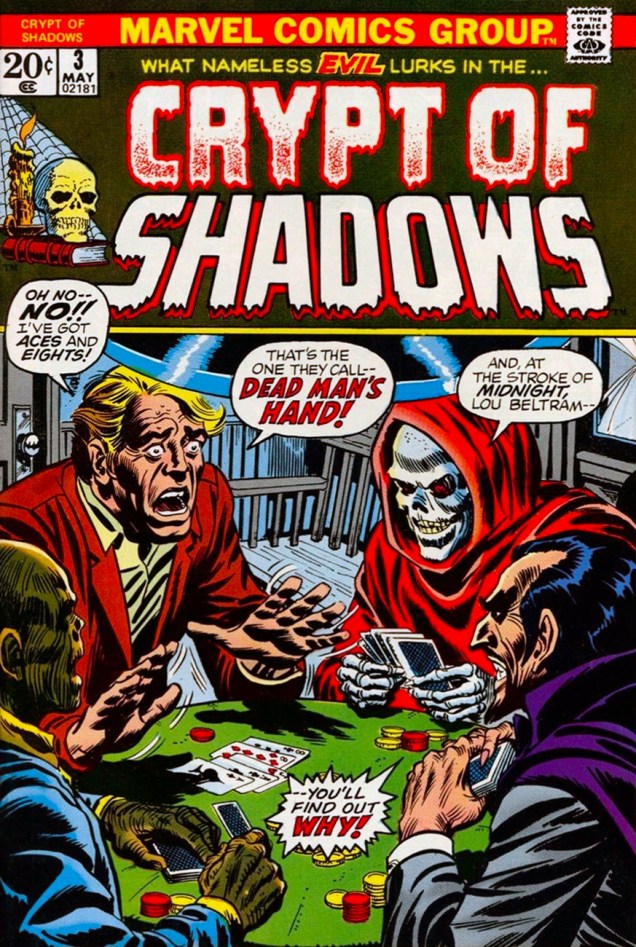
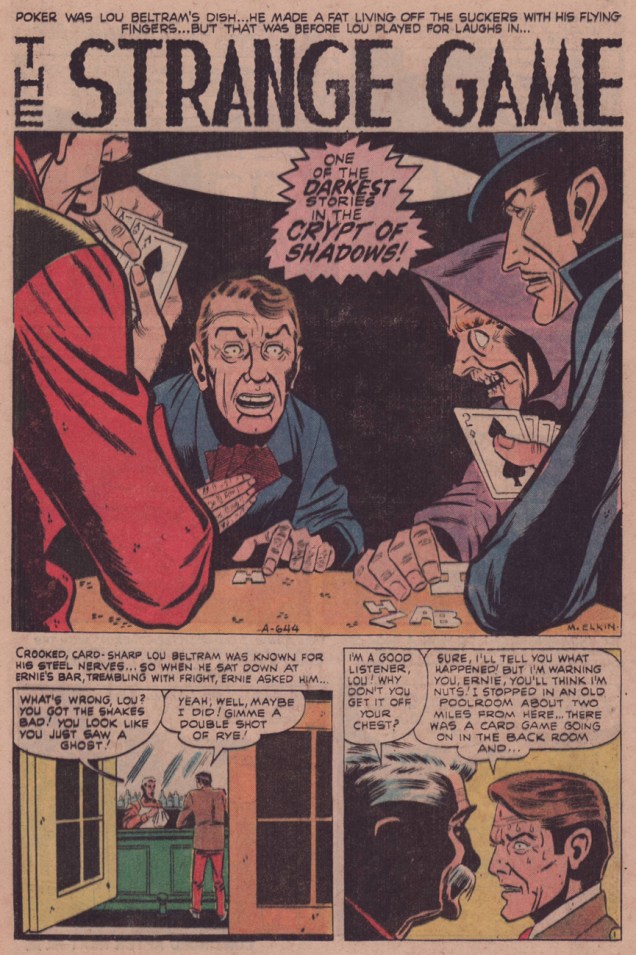
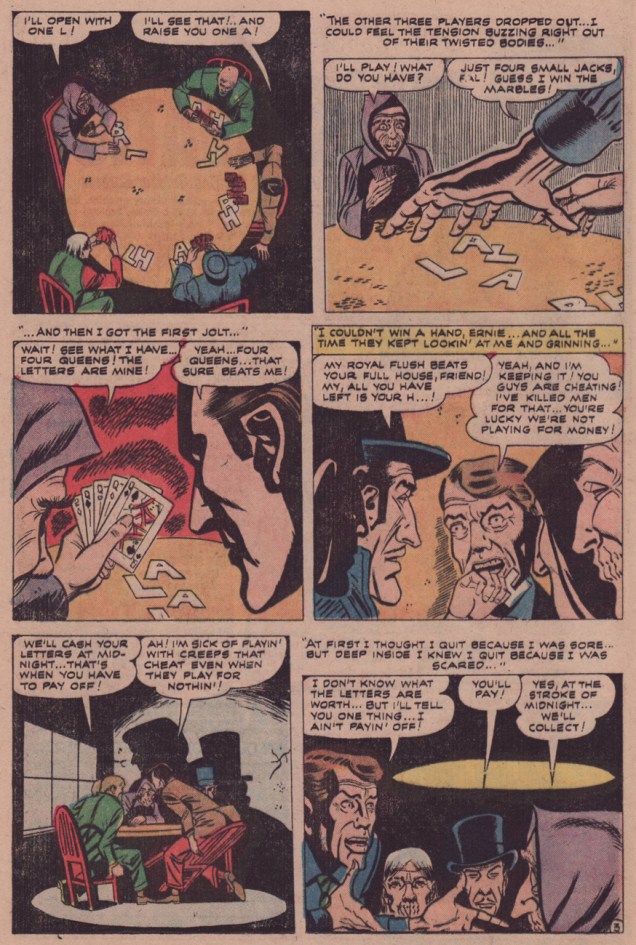
« The other three players dropped out… I could feel the tension buzzing right out of their twisted bodies… »

Poor, naïve Lou Beltram!

I first laid eyes on this one when I visited, in the fall of 1976, a tabagie (a tobacco shop) at a recently-opened shopping mall. For some reason, they had a batch of comics dating from 1973. This was one*.

CryptShadows3A

The cover feature, « The Strange Game », is a typical product of the early 1950’s horror boom: it doesn’t make a lick of sense, but it is fairly irresistible stuff, at least from the perspective of an 11-year-old. This wacky cover art, from this May 1973 issue, is the work of company man supreme John Romita Sr., Marvel’s heavy-handed art director of the period.

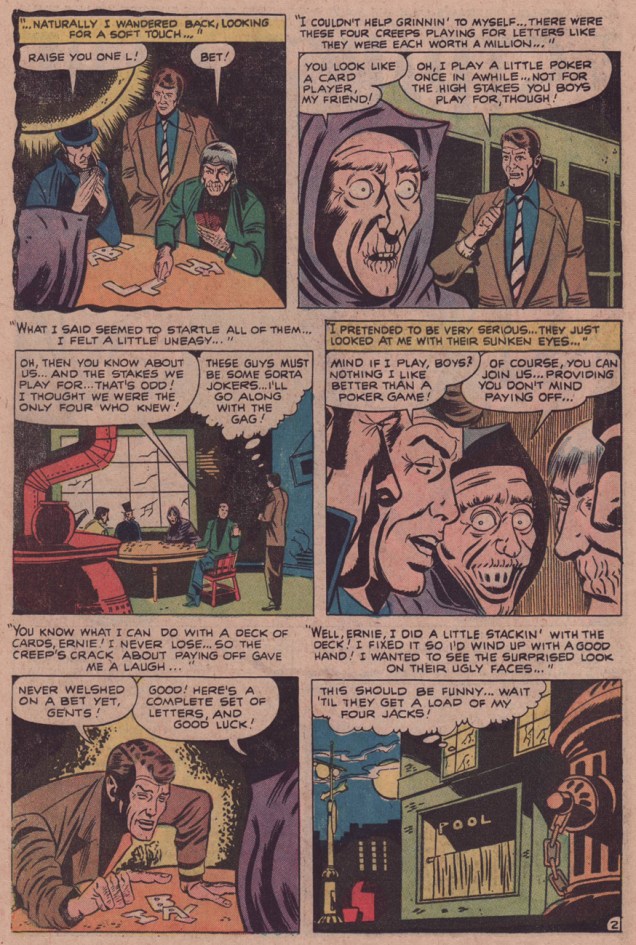
This time (sorry!) you’re getting the story right here, since… who else would get interested in such a boneheaded piece of claptrap, badly drawn to boot? (technically speaking… I do, however, find its primitive ineptitude quite charming). Suspend all disbelief and critical sense, and enjoy!

StrangeGame01AStrangeGame02AStrangeGame03AStrangeGame04A

The tale in question, scripted by an unknown writer and illustrated by Marty Elkin (reportedly Gil Kane‘s cousin!), was reprinted from Atlas’ (what Marvel Comics were called back in the day) Strange Tales #9 (August, 1952).

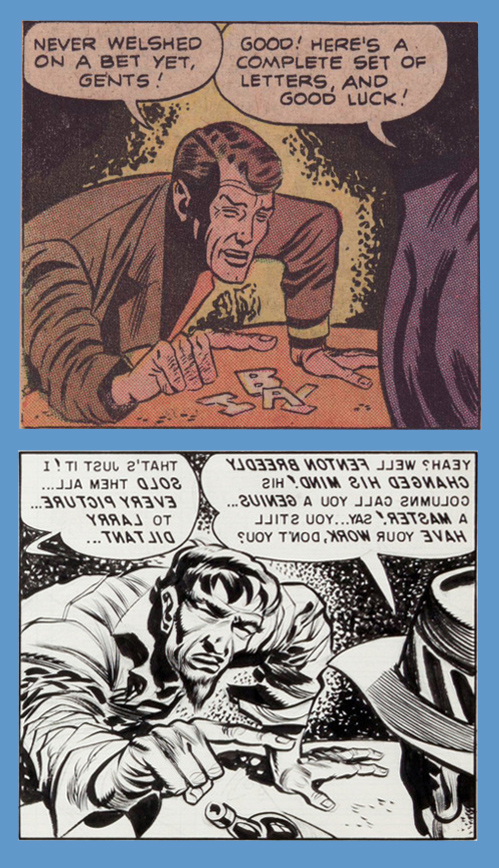
Oh, and something was nagging at me about a particular panel… so I did a little digging, here’s what I found: while swiping from Jack Davis has long been a national pastime, here’s one of the earliest infractions not perpetrated by Howard Nostrand (who’s fine in his own right, but he did have that singular, corner-cutting vice).

StrangeSwipe
It’s a flipped (how devious!) steal from page 2, panel 6 of « Drawn and Quartered! » (script by Al Feldstein, art by Jack Davis), Tales from the Crypt no.26 (Oct.-Nov. 1951, EC Comics). Marty seems a bit hazy on the general concept of hands.

I also suspect page 2’s second panel to be an early EC Joe Orlando or Wally Wood swipe, but I can’t quite nail it down… yet.

-RG

*The Unexpected 146 and The Demon 8 (both cover-dated April 1973) were the others I picked up. What else was there? An issue of The Cat I didn’t buy, but otherwise, I’m drawing a blank. 😉

Hallowe’en Countdown II, Day 7

« Why do four skeletons and a coffin cross a small fishing village? The question has been asked! »

How’s this for setting the mood? Here’s a quintet of panels from Belgians Maurice Tillieux (script) and Willy Maltaite (aka Will, pencils and inks) gently ripped from the exploits of Tif et Tondu, a series that ran in the weekly bandes dessinées magazine Spirou from 1938 to 1997.

TifTonduRessuscitésA
This standalone illustration originally saw print on the cover of Spirou no. 1789, in 1972. Incidentally, the guy on the left is just a passing acquaintance, a soap salesman who also found himself stranded in Brittany, some foggy night.
TifTonduRessuscités2A
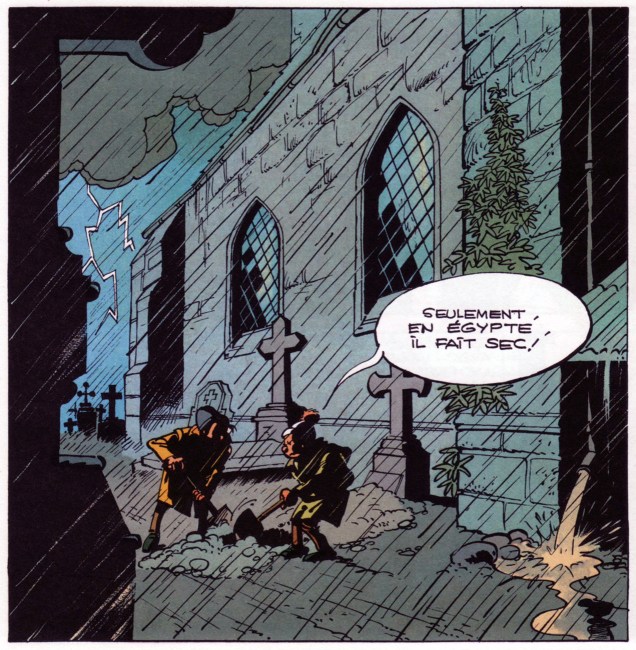
« In Egypt, at least it’s dry! »
TifTonduRessuscités3A
« There’s still a cottage beyond the old castle. Let’s give it our last shot. »  « Talk about a nest for ghosts. He’s straight out of a Perrault fairy tale, that one. »

These three come from the Les Ressuscités (‘The Resurrected”), Tif et Tondu’s 54th adventure overall, but no.20 in the album series), as only the post-1954 stories (when the series’ tone gained some gravitas, as well as its first significant scripter in Rosy) are considered, shall we say… canonical.

TifTonduRetourBête02A
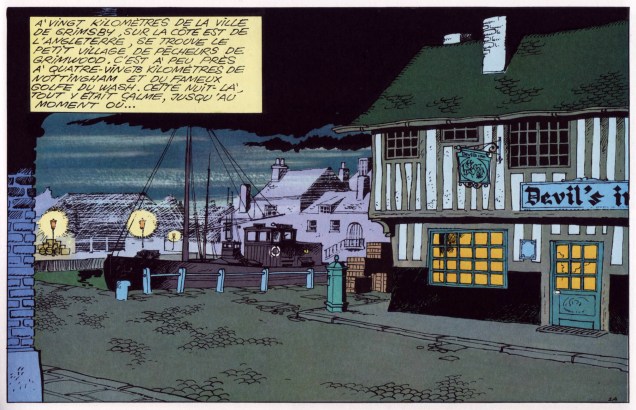
Panels from Le retour de la bête (“Return of the Beast”), serialized in issues 1988 to 1999 of Spirou magazine in 1976,  sort-of sequel to 1971’s Sorti des abîmes (“Out of the Abyss”).

TifTonduRetourBête01A

This is drawn from the 59th Tif et Tondu story (but no.25 in the collection). We’ve already been introduced to the Beast in question, as well as to Tif et Tondu, one misty Tentacle Tuesday last October.

Regrettably, nothing supernatural occurs, but talk about atmosphere! The series does veer into some pretty dark science-fiction at times, especially under Tillieux’s watch (1968-1978, his death).

The mysterious events are set in the fictive village of Grimwood, near the actual town of Grimsby, which is dear, perhaps sarcastically, to Sir Elton John.

-RG

Hallowe’en Countdown II, Day 6

« Gosh! I never knew you had a school for monsters! »
« There are a lot of things about Transylvania that you American tourists do not know! »

Archie Comics’ earliest foray into monster humour was its long-running, in one form or another*, Mad House series (1959-82).

MadHouse16A

It doesn’t get any better than Samm Schwartz‘s cover for Archie’s Mad House no. 16 (December, 1961). The early issues featured Archie and the gang in slightly more surreal settings than usual, then they were phased out, with the noteworthy exception of Sabrina the Teenage Witch, who was introduced in AMH 22 (October, 1962). The title was a fine showcase for Archie’s best and most idiosyncratic stylists, Schwartz, Orlando Busino and Bob White in particular.

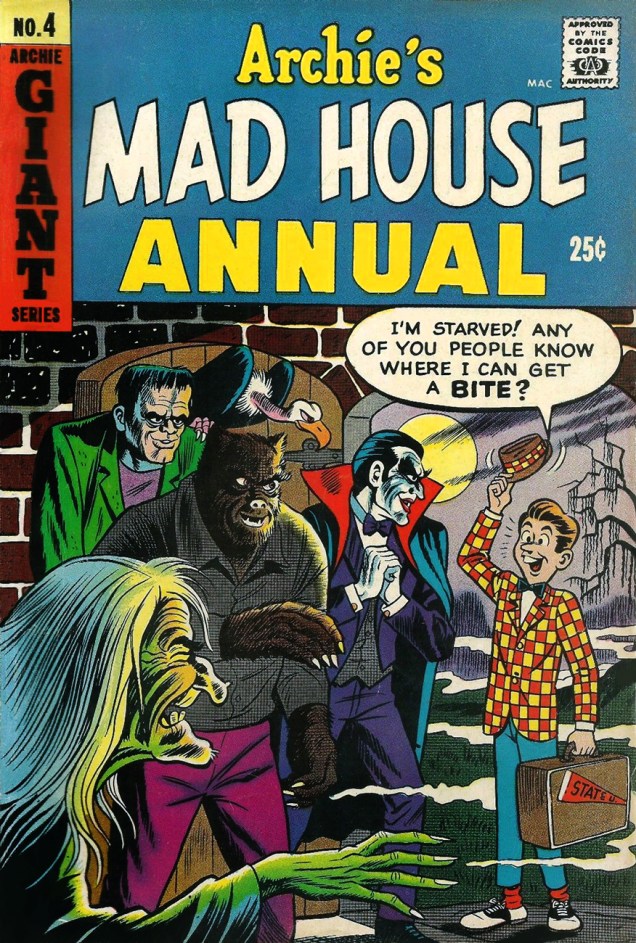
WhiteMad-House-Ann4AAn idea they liked so well they used it (at least) twice. Bonus points for bothering to redraw it! This was Archie’s Mad House Annual no. 4 (1966-67), cover art by the aforementioned Bob White.

-RG

*It was called Archie’s Mad House (issues 1-60), then simply Mad House (61-65), then Madhouse Ma-ad Jokes (66-70), Mad House Ma-ad Freak-Out (71-72), The Mad House Glads (73-94), Madhouse (in a non-cartoony horror format, featuring the likes of Gray Morrow and Vicente Alcazar, 95-97), then finally Mad House Comics (95-130).