Jughead’s Pal, Samm Schwartz

« What is it about me, Pops? Am I different than normal people? »

One (more) thing I’ve learned in this world is that the vast majority of people, from the man or woman in the checkout line to the hard core of comics aficionados… can’t tell Archie artists apart, let alone name any of them.

If you scratch deep enough, one name will come up, like pebbles from a fallow field: Dan DeCarlo. I’m reminded of the annual restaurant poll a local alternative weekly used to hold: McDonald’s unfailingly took its category in a landslide, because of its ubiquitous familiarity. And so it is with Archie artists: DeCarlo must be the best because… well, that’s what we’ve always been told.

If you ask me, much of his peers’ work gets attributed to him. For instance, check out our gallery of Bob White covers. That Archie’s Mad House no. 27 cover, in particular…

WOT’s pick for top artist on the Archie totem is handily Samm Schwartz (1920 – 1997). He’s easily the smoothest, most inventive storyteller in the Archie universe. Despite his skill as a cover designer during Archie’s best years (1959-1965, a figure proposed by cartoonist-scholar Seth and worth carving in stone), there were no Schwartz covers chez Archie after 1965.

The likely reason? In ’65, Schwartz was hired away by Wally Wood‘s Tower Comics (by managing editor Harry Shorten, a former Archie writer-editor) to serve as their art director. While there, he conceived Tower’s relatively prolific teen humour line, featuring Tippy Teen, Go-Go and Animal, and Teen-In, often glibly dismissed as “Archie clones“, by people who clearly haven’t read the work. We’ll return to these eventually.

Now comes the clincher: Schwartz in turn hired some of his former Archie colleagues to pitch in (presumably at higher page rates); DeCarlo (a handful of stories in early issues of Tippy Teen), Harry Lucey (a decent batch, actually) and reportedly Bob White (no sign of him, though). But the bulk of the work was done by Schwartz and future Archie artist Doug Crane.

Now the Archie people didn’t like this one bit; it was a clear case of sedition, a threat to their tidy little work camp system. After the industry’s near-collapse in the mid-1950s, there weren’t a lot of options in the tight-knit little club that remained; let’s not forget that even Jack Kirby was driven to such humbling desperation in the early 1960s. It was all too easy to be blackballed. The Goldwater clan, Archie’s reigning dynasty, took careful note of Schwartz’s break for freedom and the names of his accomplices. After Tower called it a day in 1969, Schwartz went to DC for a year, but it didn’t take. He was forced to return to Archie, which certainly suited the publisher since Schwartz’s signature title, Jughead, had been wilting away in his absence.

The terms of his return are unknown… but against all odds, Samm proceeded to create the finest work of his career, pencilling, inking and lettering hundreds of inspired Jughead stories until, well, until he couldn’t any more. But no covers, considered a plum job: these went exclusively to DeCarlo (with an occasional Lucey) and later to versatile mediocrity Stan Goldberg, aping DeCarlo’s style and random design sense*.
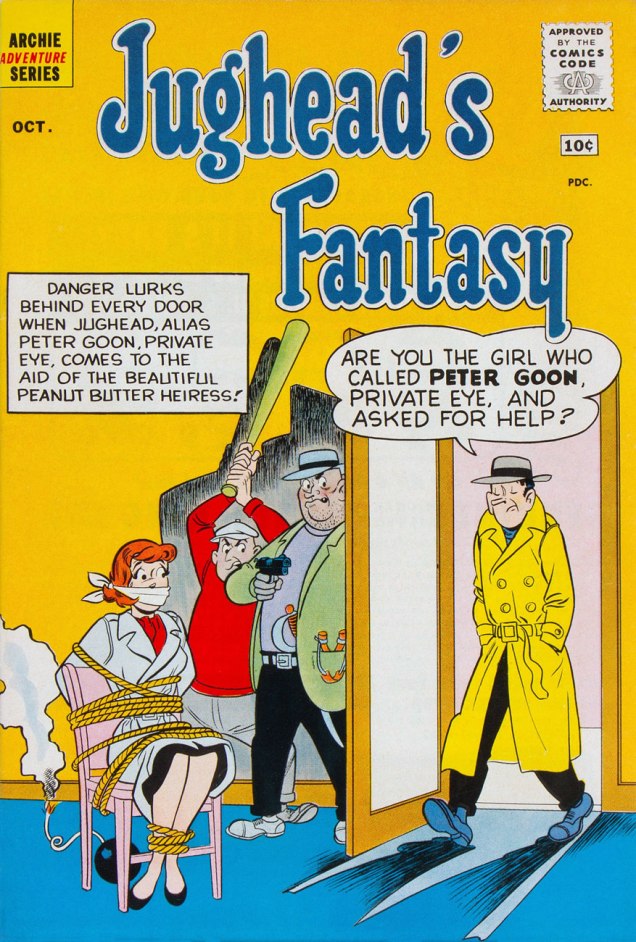
Jughead's-Fantasy02A
Jughead’s Fantasy no. 2 (Oct. 1960); a parody of the excellent 1958-61 detective show… and yes, Peter Gunn did get conked on the head an awful lot.
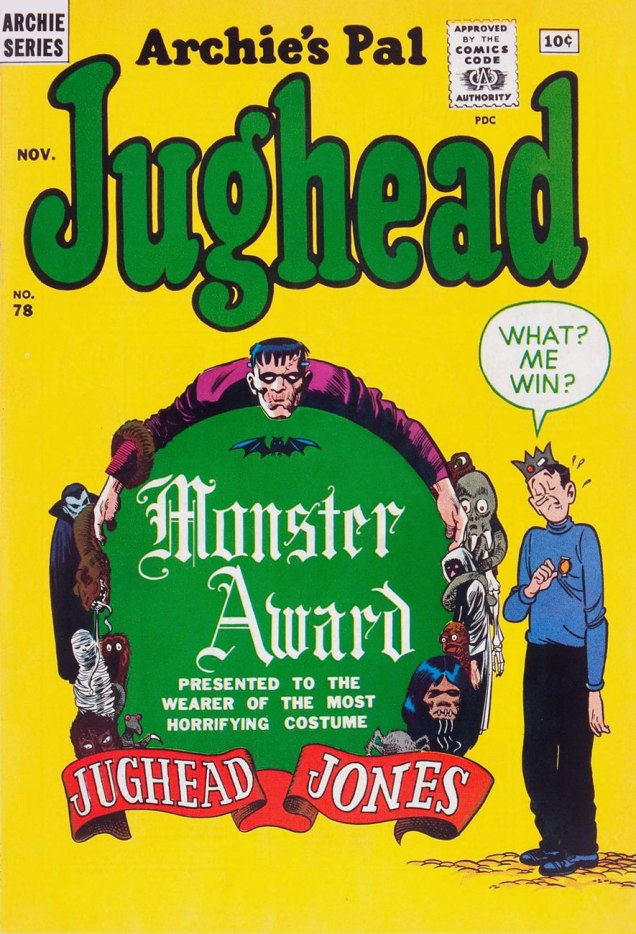
Jughead78A
Archie’s Pal Jughead no. 78 (Nov. 1961)
Jughead81A
Archie’s Pal Jughead no. 81 (Feb. 1962). Check out Reggie’s body language, in particular.
Archie's-Jokes17A
Archie Giant Series Magazine no. 17 (Archie’s Jokes, Summer 1962). There goes Archie, into the next county.
Laugh136A
Laugh Comics no. 136 (July 1962)
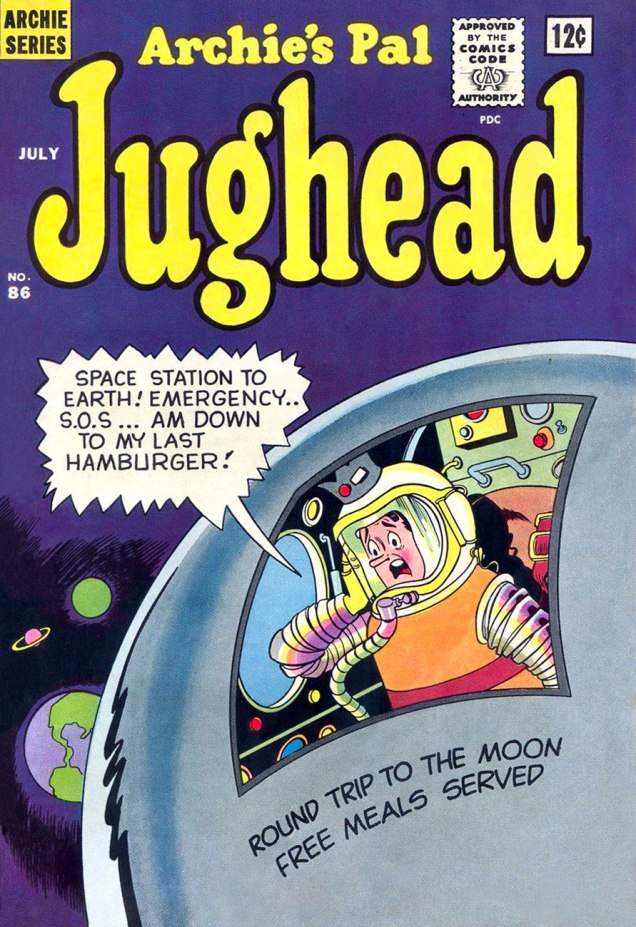
Jughead86A
Archie’s Pal Jughead no. 86 (July 1962)
Jughead89A
Archie’s Pal Jughead no. 89 (Oct. 1962)
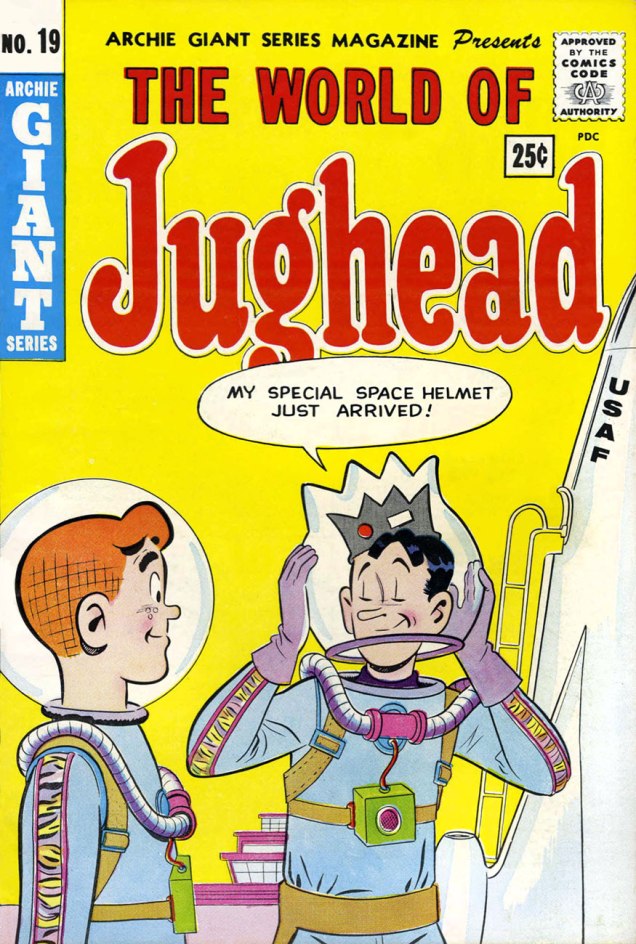
WorldofJughead19A
Er, interesting choice of space pioneers, USAF. Could this mission be some sort of tax dodge? Perhaps Mr. Lodge has a financial stake in it, and gently “suggested” Archie for the possibly one-way trip. Archie Giant Series Magazine no. 19 (World of Jughead, Dec. 1962)
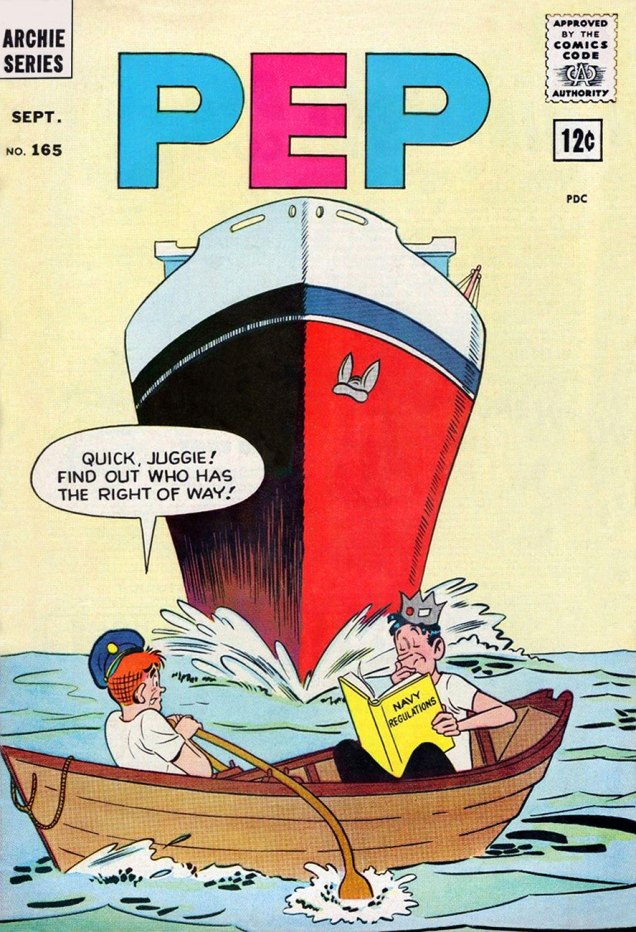
Pep165A
Pep no. 165 (Sept. 1963). My college graphic design teacher told our class that a poster should be “One Angry Fist”, which certainly applies to comic book covers, and this is a fine, fine example of making the most of a format.
Madhouse33A
Archie’s Mad House no. 33 (June 1964)
BettyVeronica102A
Archie’s Girls Betty and Veronica no. 102 (June 1964). The new, definitely not improved cover layout of the Archie line rears its homely head.
SammSchwartzA
Mr. Samm Schwartz, date unknown, though the cars should certainly serve as a clue.

To quote his daughter, Joanne Colt, from the introduction of 2011’s The Best of Samm Schwartz (it isn’t, but it’s pretty good): « He drew for Archie until his death on November 13, 1997, my birthday. There was an unfinished story on his drawing board. »

-RG

*the way I see it, the difference between a Bob White or a Samm Schwartz cover and a DeCarlo is the difference between a considered, effective layout and the act of pointing a camera at random and snapping the shutter. To be fair to DeCarlo, his girlie cartoons for Martin Goodman’s Humorama were excellent, and his first half-decade at Archie (60-65) was fine… then the company wore him down into a sad hack and the unfortunate protagonist-victim of a cautionary tale.

Hallowe’en Countdown II, Day 6

« Gosh! I never knew you had a school for monsters! »
« There are a lot of things about Transylvania that you American tourists do not know! »

Archie Comics’ earliest foray into monster humour was its long-running, in one form or another*, Mad House series (1959-82).

MadHouse16A

It doesn’t get any better than Samm Schwartz‘s cover for Archie’s Mad House no. 16 (December, 1961). The early issues featured Archie and the gang in slightly more surreal settings than usual, then they were phased out, with the noteworthy exception of Sabrina the Teenage Witch, who was introduced in AMH 22 (October, 1962). The title was a fine showcase for Archie’s best and most idiosyncratic stylists, Schwartz, Orlando Busino and Bob White in particular.

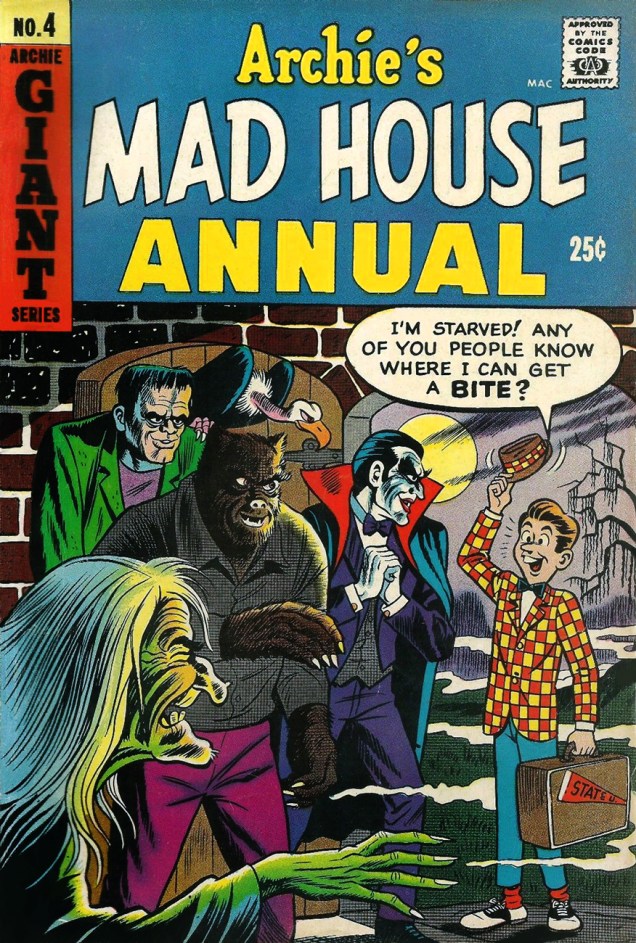
WhiteMad-House-Ann4AAn idea they liked so well they used it (at least) twice. Bonus points for bothering to redraw it! This was Archie’s Mad House Annual no. 4 (1966-67), cover art by the aforementioned Bob White.
-RG

*It was called Archie’s Mad House (issues 1-60), then simply Mad House (61-65), then Madhouse Ma-ad Jokes (66-70), Mad House Ma-ad Freak-Out (71-72), The Mad House Glads (73-94), Madhouse (in a non-cartoony horror format, featuring the likes of Gray Morrow and Vicente Alcazar, 95-97), then finally Mad House Comics (95-130).

Tentacle Tuesday, from goofily scary to scarily goofy

It’s that time of the week again!

Let’s start with something hair-raising. Well, not really – we’re a blasé audience, and it takes something special to truly scare us. Yet can you deny the foul-smelling, palpable sense of foreboding, the billowing and swirling nightmare that beckons from the elegant inks of this page?

TheGravesendGorgonAlcala
« She boiled up out of the sea that hellish night — a monstrous hideous creature, she was, with the craggy face of an evil eyed witch! » Giant-Size Chillers no. 1 (February 1975). The cover promises a « frightful, fearful first issue! » Does it deliver? Eh, not really. Here’s a page of the best story in it, The Gravesend Gorgon, scripted by Carl Wessler and pencilled + inked by Alfredo Alcala.

Gravesend is an ancient town in northwest Kent, England; as for the gorgon part, it’s not entirely accurate, but it’s clear that comic writers cannot resist an alliteration.

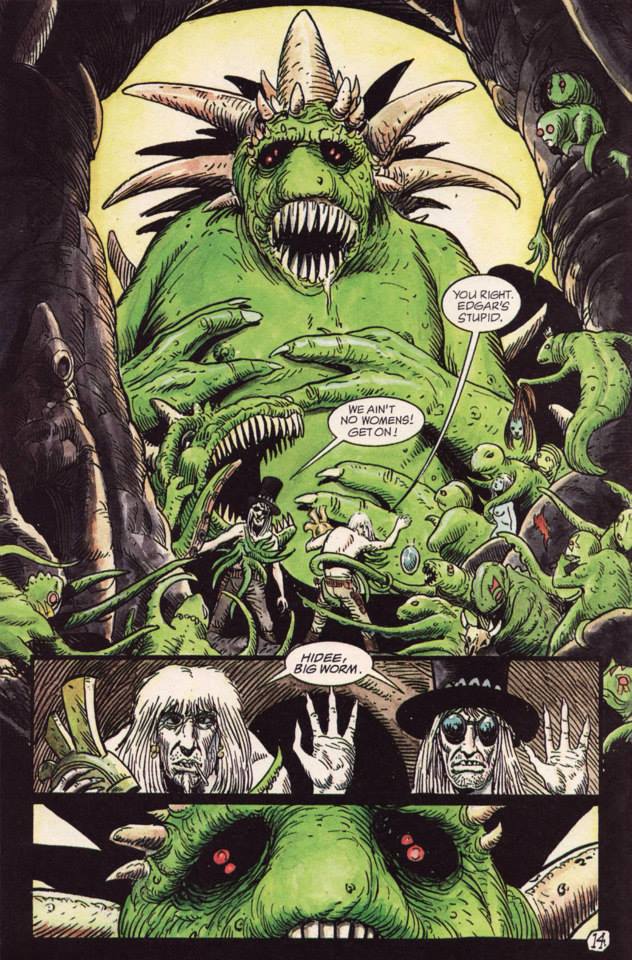
On a slightly more humorous front (unless one is directly involved with this green monstrosity, in which case the situation would quickly lose its humour), here’s a page that hails from Jonah Hex: Riders of the Worm and Such no. 4, (June 1995). The story features the half-worm, half-human albino Autumn Brothers, whom you can see here greeting the big worm-momma. Texas blues rockers Johnny and Edgar Winter attempted to sue, but the suit was dismissed after a judge begrudgingly ruled that « the First Amendment dictates that the right to parody, lampoon and make other expressive uses of the celebrity image must be given broad scope. » Thank you, Los Angeles court. Frankly, it seems that the brothers are more remembered for the lawsuit than their music.

JonahHexRidersoftheWorm4
« Sure like to make big worm happy, whatever she want. Not care much for tentacle down throat. » Jonah Hex: Riders of the Worm and Such no. 4, June 1995. Scripted by Joe R. Lansdale,  pencils by Timothy Truman, inks by Sam Glanzman.

Jonah Woodson Hex, created by writer John Albano and artist Tony DeZuniga in 1971, curmudgeonly and disfigured but bound by a personal code of honour, is a favourite character of mine, although I only like the way he is written for DC’s Weird Western Tales. Well, with one exception, this one! I most tentacularily recommend Jonah Hex: Shadows West, a collection of the three Vertigo-published mini-series scripted by Lansdale and illustrated by Tim Truman and Sam Glanzman, containing the stories Two-Gun Mojo, Shadows West and Riders of The Worm and Such.

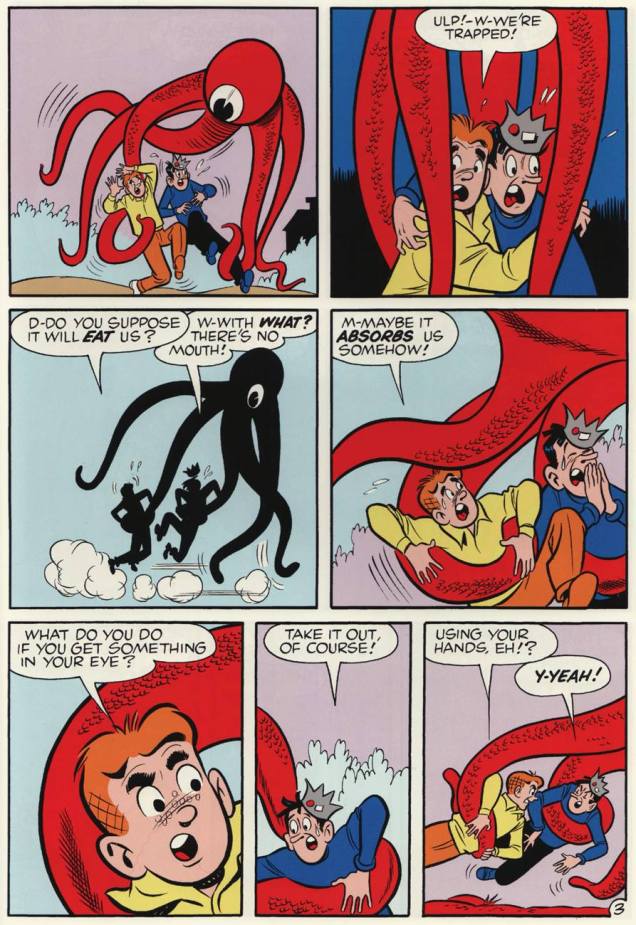
And to wrap this up, on an even goofier note, here’s Jughead getting into yet another weird situation, which is pretty standard for him.

JUghead77SammSchwartz
This page from The Eyes Have It comes from Jughead no. 77 (October 1961). Script by George Gladir, pencils by Samm Schwartz, inks by Marty Epp. Schwartz is absolutely the best Archie artist to draw tentacles; most everybody else would have made a mess of it.

Jughead77A

~ dsTentacleTuesdayIcon