« Well, as everyone knows, once witchcraft gets started, there’s no stopping it. » — Mikhail Bulgakov
Another, day, birthday post? Well, it’s still a mighty special occasion, as we’re celebrating the one-hundred and fourth birth anniversary of our beloved Samm Schwartz (1920-1997).
One year ago to the day, we gave you Love in Broom, first of a loosely connected two-parter (‘loosely connected’ is the strongest dose of ‘continuity’ one could expect from the Archie folks in those days).
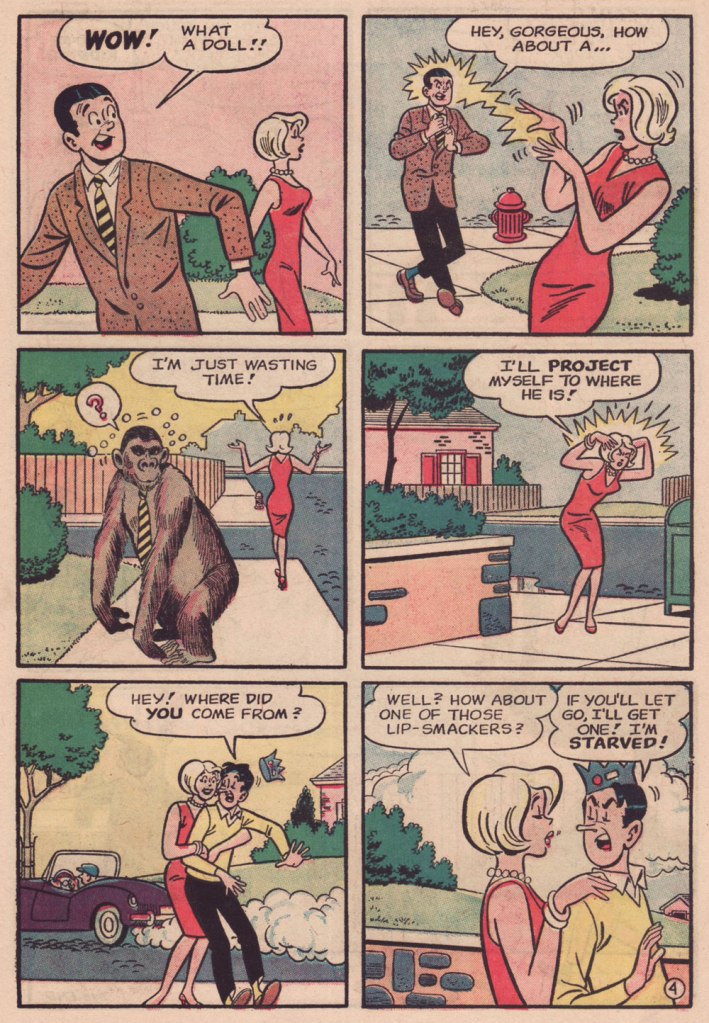
Of course, the now-named Samantha the witch — and the rest of the cast, notably Jughead and Reggie — appear to have forgotten all about their earlier encounter… but that’s just fine: the burden of continuity is one I’m glad to see sloughed. The chief constant is that our witch has quite a yen for Jug.
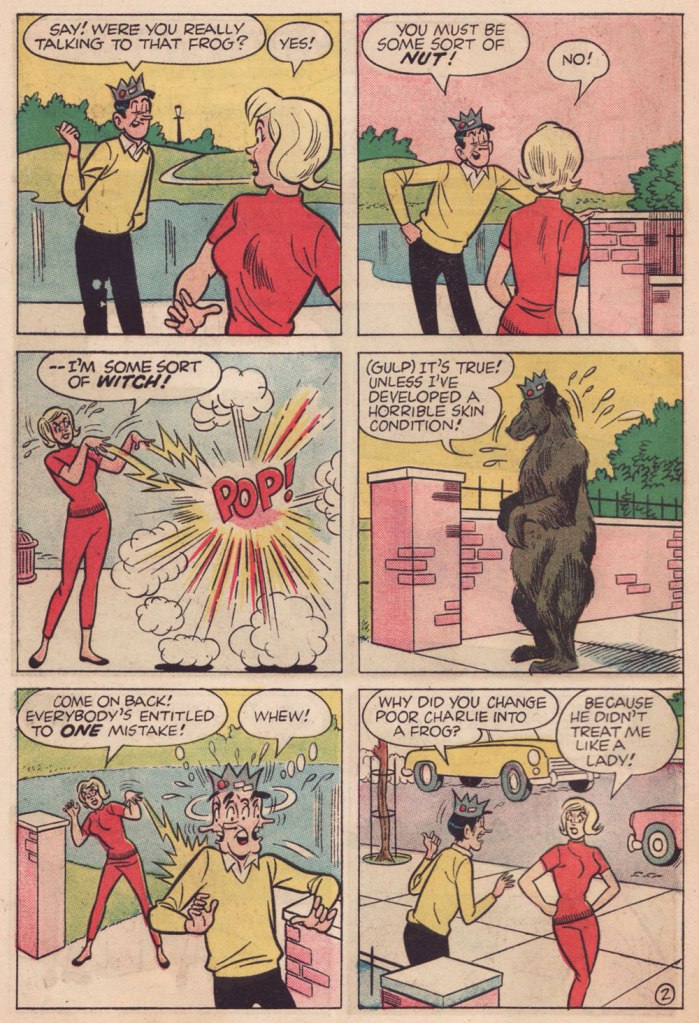
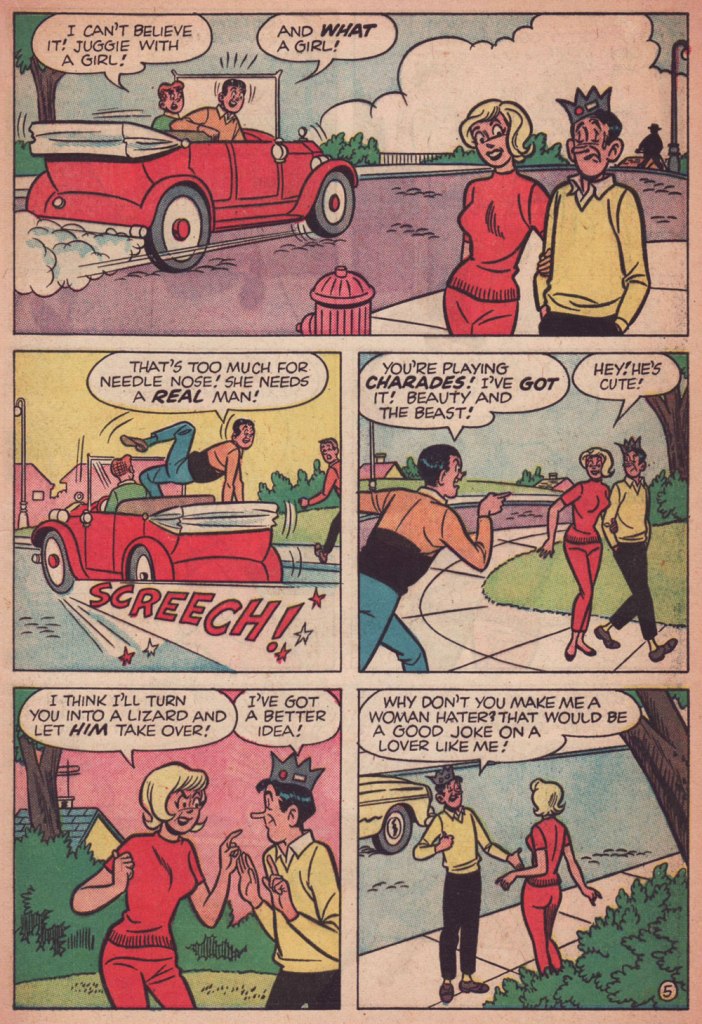
Switch Witch first appeared in Archie’s Pal Jughead no. 123 (Aug. 1965, Archie). It was presumably scripted by George Gladir (not coincidentally co-creator of Sabrina the Teenage Witch a couple of years earlier), and unmistakably illustrated by Mr. Schwartz. Of Mr. Gladir, Mark Evanier wrote: « Even when they had no credits, you could generally spot a George Gladir script. They were a little wackier, a little sillier, a little more human in their humor. And oh, yes — they were usually fresher than the ones crafted by younger writers. » This certainly fits the bill.
I had to buy three different copies of this issue to get a complete one… and it’s still a brittle mess. But hey, my ordeal, your benefit!
« If you saw a heat wave, would you wave back? » — Stephen Wright
Time to carry on with one of my pet quixotic missions, that of advocating the glory of Samm Schwartz (1920-1997), my very favourite Archie artist… and one of my favourite cartoonists, period.
Having acquired over the years most of the Jughead issues I could afford — for the most part cheap, but thankfully numerous — I’ve now reached the stage of acquiring scattered issues of assorted Archie titles featuring one or two Schwartz stories… along with often appalling page fillers by painfully lesser lights. To lessen the blow, I usually skip the Schwartz story — which usually opens the book… savvy thinking on their part, I’ll admit — then return to it so as to end on a high note.
I was hesitating between two stories, but since they’re both quite short, why choose? Hence the programme double.
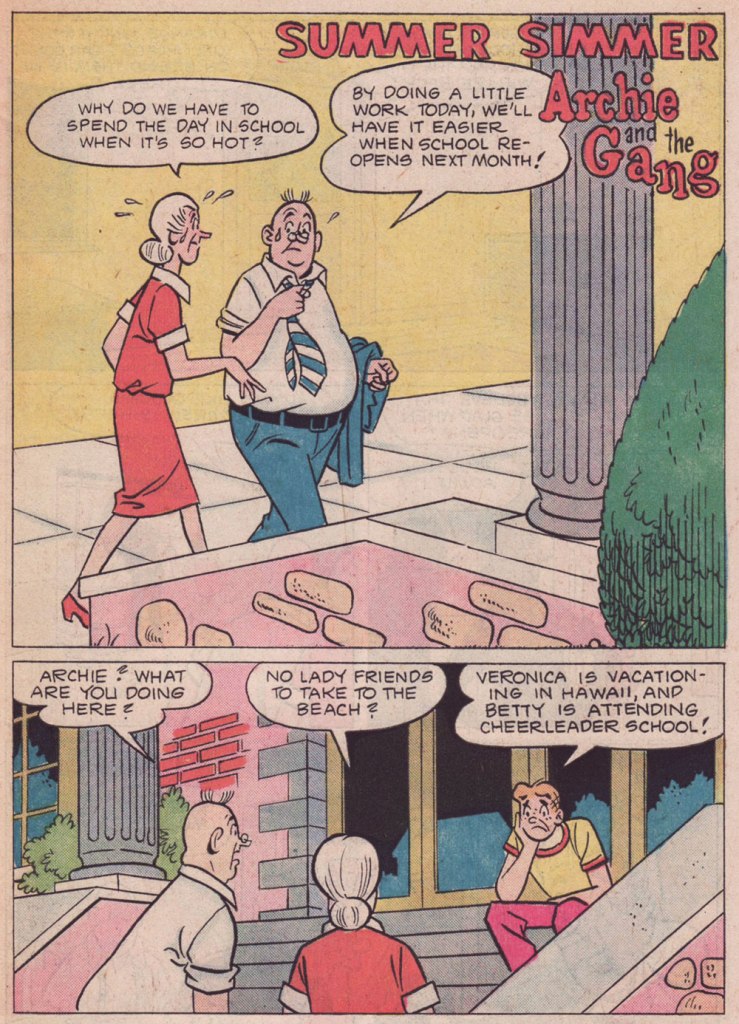
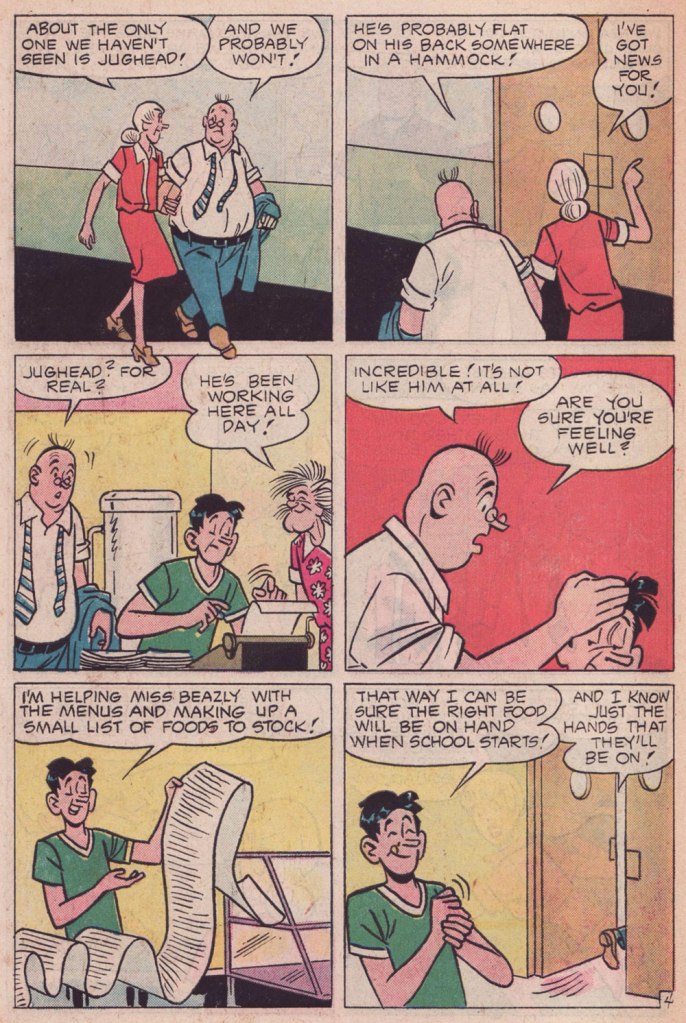
« Summer Simmer » first appeared in Archie’s TV Laugh-Out no. 35 (Nov. 1975, Archie). Scripted by George Gladir, this story has the distinction of not particularly striving to be funny, instead focusing on character and situation.. which is totally distinct from the all-too-frequent straining for laughs and failing Archie blueprint. This sort of outlier is what makes the search worth the bother.
« The Defender » originally saw print in Pep no. 235 (Nov. 1969, Archie). Not only does Marmaduke “Moose” Mason get a rare turn in the spotlight, but it’s an unusually favourable depiction. It was most likely scripted by Frank Doyle.
It must be mentioned that Schwartz often tweaked the scripts he was assigned, but incognito. His collaborators trusted him, giving him free rein. Besides, let’s face it, the stakes were depressingly low.
« Real art must always involve some witchcraft. » — Karen Blixen
Ah, another Samm Schwartz story! And no wonder: born on October 15, 1920, Mr. S would be ninety-seven today.
“Love in Broom“, scripted by George Gladir and inked by Vincent DeCarlo, saw print in Jughead no. 116 (Jan. 1965, Archie). That amorous witch would return in Jughead no. 123‘s ‘Switch Witch‘. In the Archie universe, that’s *almost* continuity!
Since Jughead no. 116 had a strictly non-oddball cover by Harry Lucey, here’s a more thematically fitting one from local chouchouBob White. This is Archie no. 126 (Apr. 1962, Archie).
« Special effects are characters. Special effects are essential elements. Just because you can’t see them doesn’t mean they aren’t there. » — Laurence Fishburne
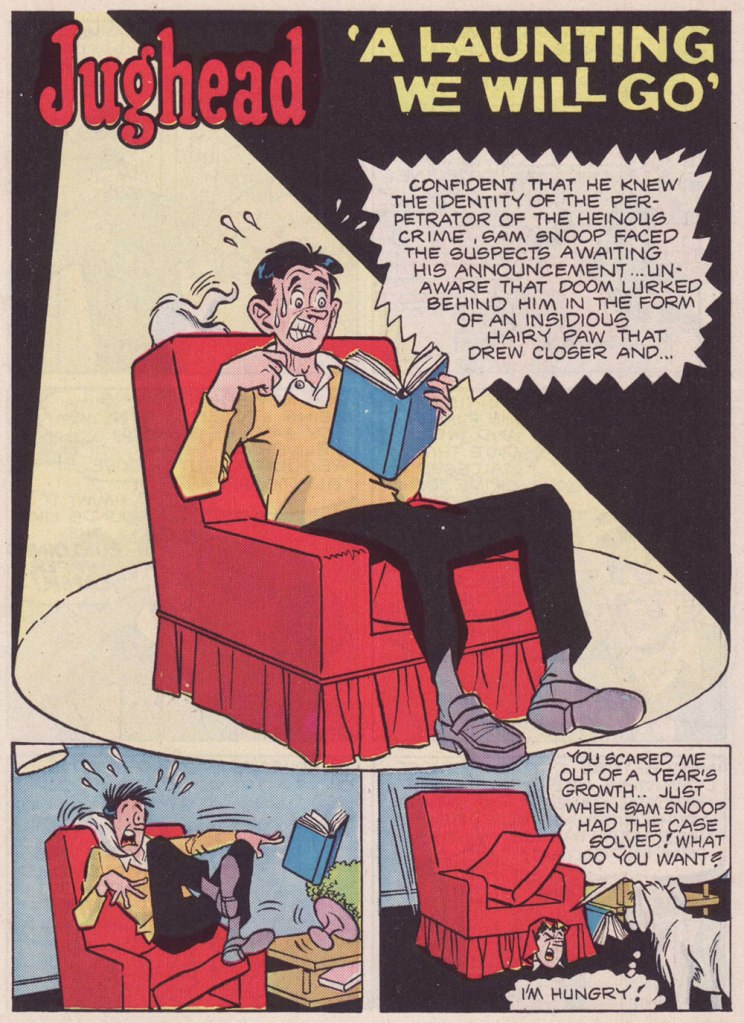
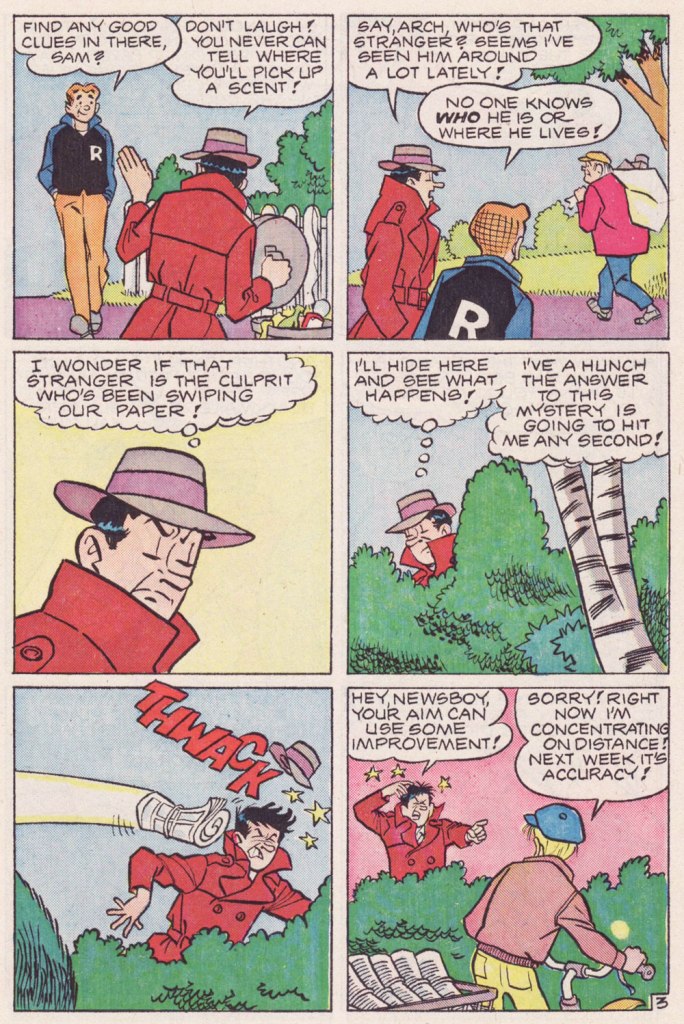
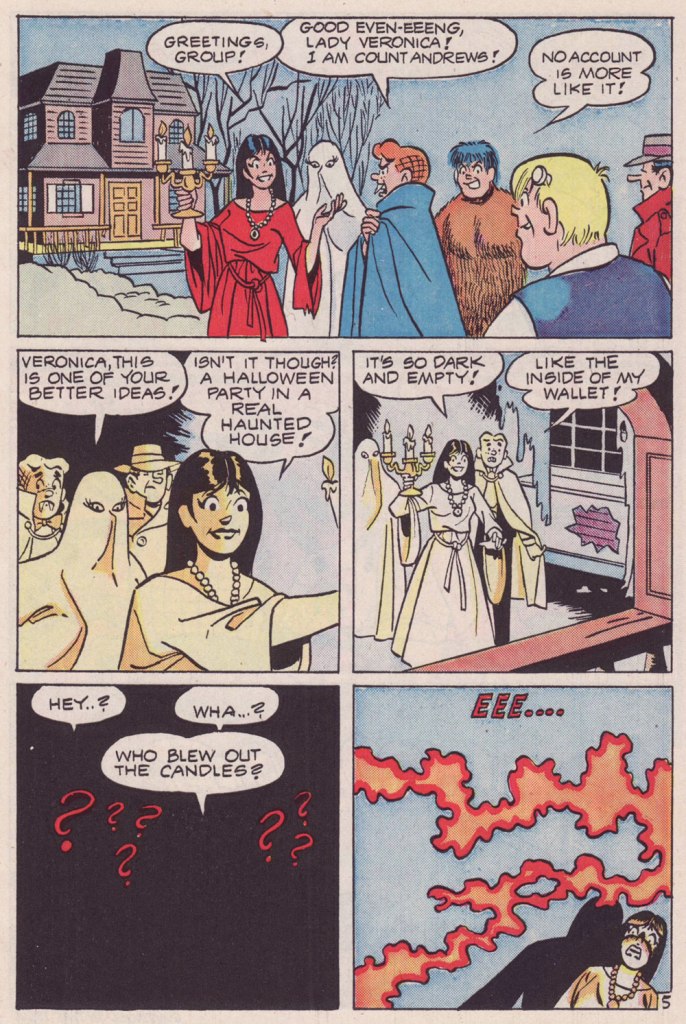
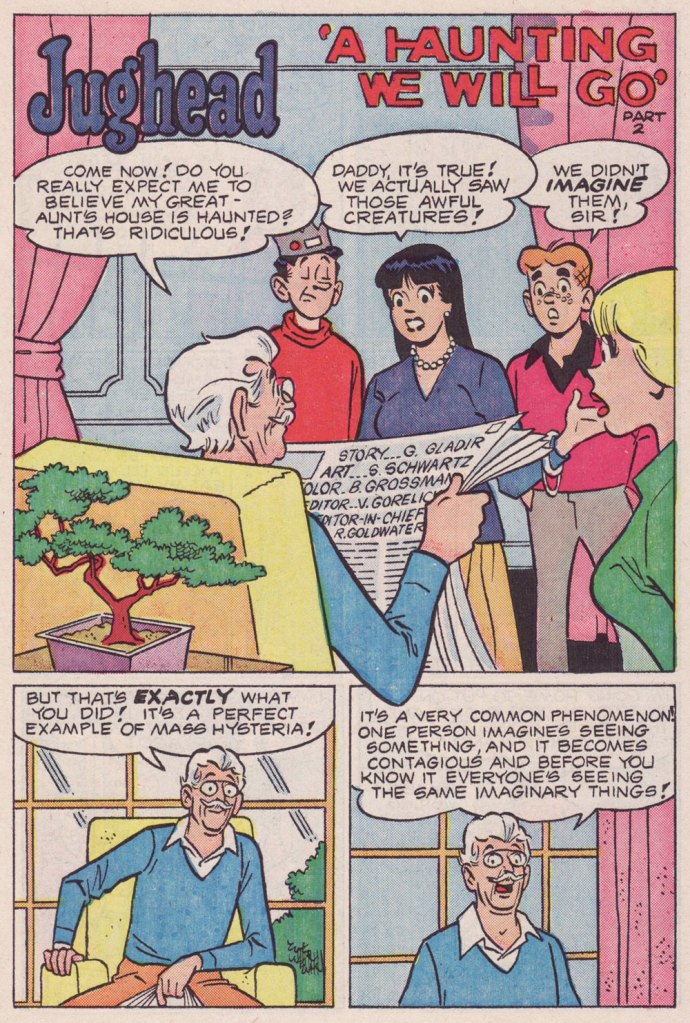
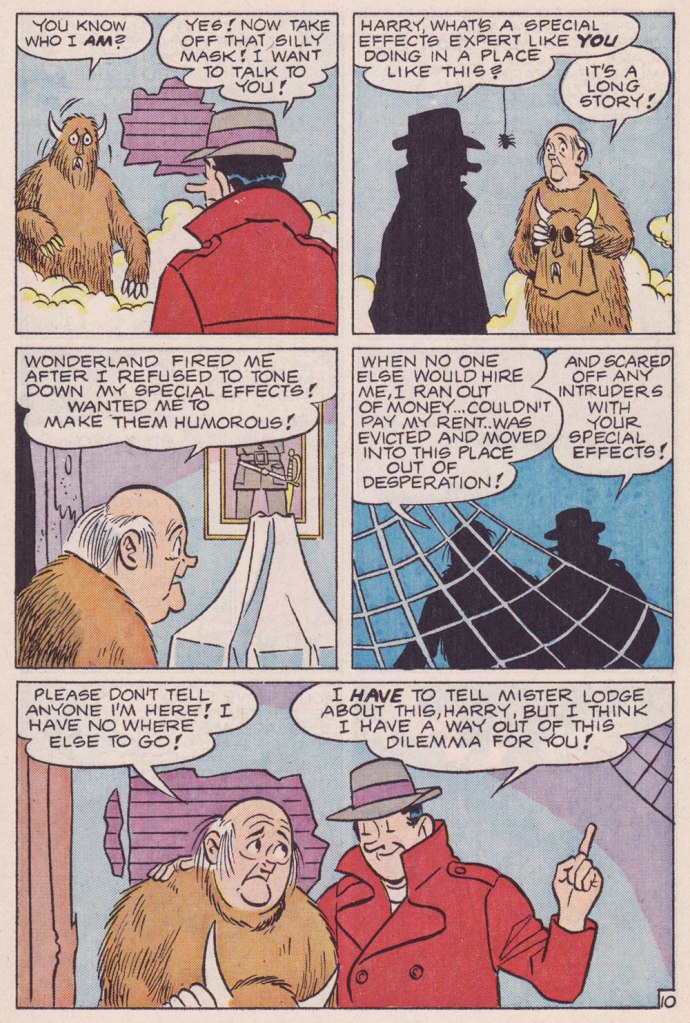
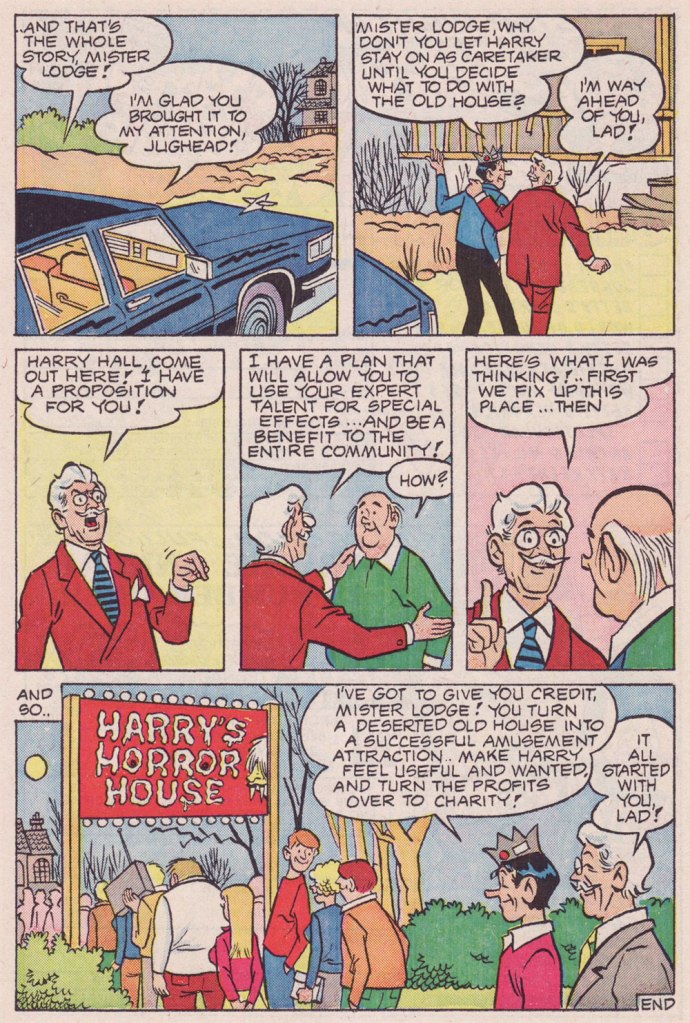
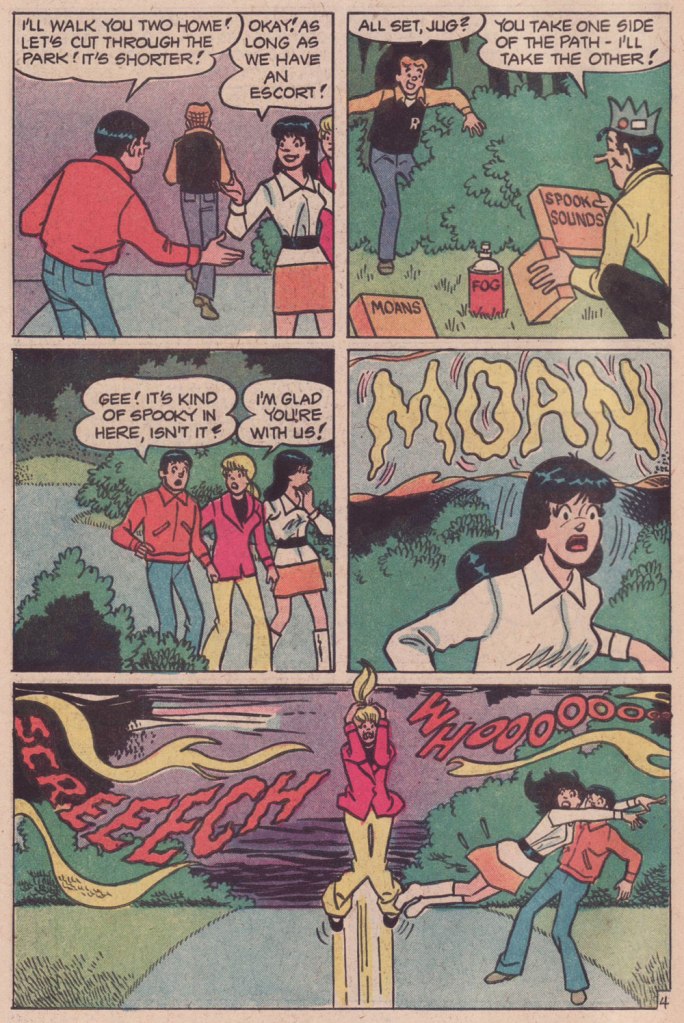
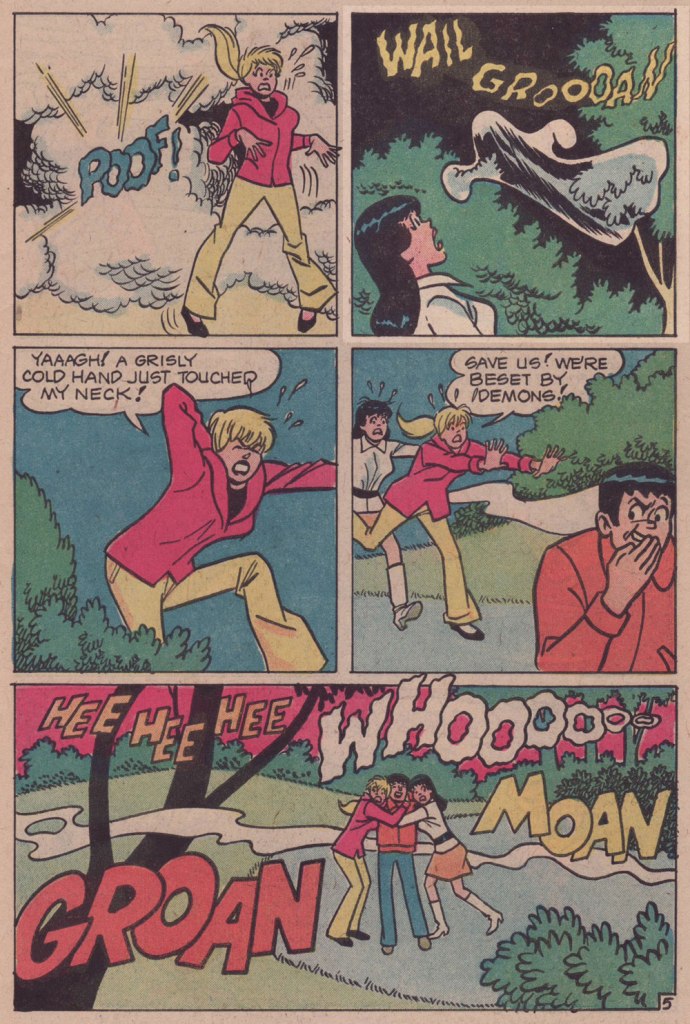
Spookiness is afoot in Riverdale! Here’s a lovely George Gladir (script) & Samm Schwartz (pencils, inks and letters) saga to suit the season. I love those longer tales, which in this case allows for a larger-than-usual cast and a more leisurely pace.
‘A Haunting We Will Go’ was originally published in Archie Giant Series Magazine no. 564 / The World of Jughead (Sept. 1986, Archie). Oh, and colours by Barry Grossman.
« The people who are always hankering loudest for some golden yesteryear usually drive new cars. » — Russell Baker
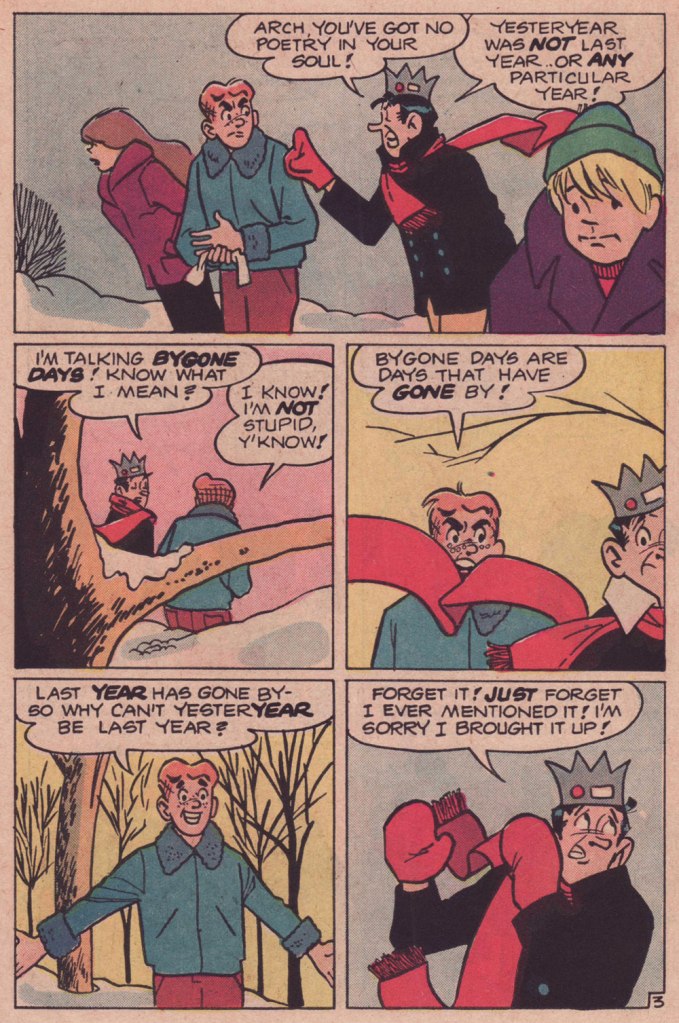
We’re having a bit of a scorcher over here, so I’m doing my bit to compensate with a piece set in wintertime.
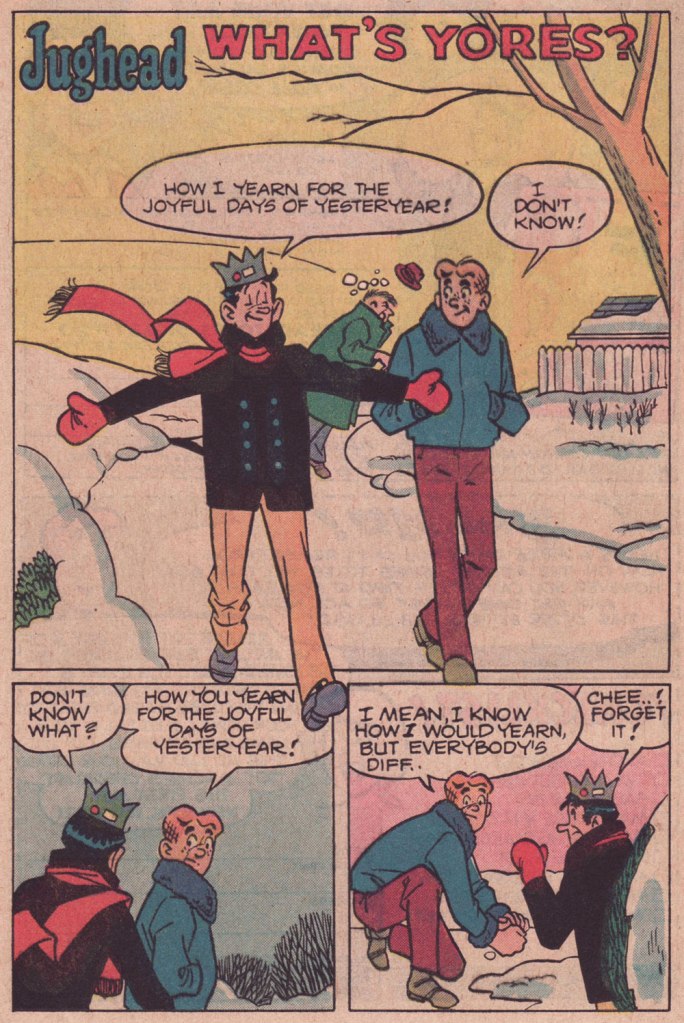
As we surely all know, Archie stories (in the comics at least) are formulaic to a fault. This static state of affairs plays a considerable part in their comforting nature. Sure, all fashions and trends are embraced and discarded, but the characters don’t evolve in any significant, permanent way. No lesson ever sticks.
So on the rare occasion when a writer deviates from the formula, it really shows. This tale, I daresay, is such a specimen. Virtually plotless, it’s a precursor, by more than half a decade, of that rule-breaking « show about nothing »: Seinfeld (1989-1998).
While nothing much happens here in terms of plot, this is a difficult trick to pull, in any medium: as it mainly consists of yadda yadda yadda (but witty yadda yadda yadda… another daunting level of difficulty), it’s talking heads all the way, so you need some great performers who know how to keep an audience engrossed through the minimal means at their disposal.
In comics, this calls for a great illustrator, a master of body language and the art of the mise en scène, namely Samm Schwartz (1920-1997). I shudder — and not with delight — to envision this particular script landing in the hands of a lesser light, which is to say practically anyone in the Archie stable save Bob Montana (but he’d died in 1975) or Harry Lucey (retired and in poor health by then). While he was never credited for anything but his artwork, Schwartz enjoyed a free hand with his regular collaborators’ scenarios (George Gladir and especially Frank Doyle), with their blessing. And he was always enriching his backgrounds with delightful pantomime mayhem.
What’s Yores? originally appeared in Jughead no. 321 (Feb. 1982, Archie). Script by Frank Doyle, pencils, inks and letters by Mr. Schwartz.
Craving more Schwartz? Go on, help yourself to the full spread right here.
« How could you be so sure? … they could be real! » — Reggie Mantle, believer
Sure, it’s a hoary ol’ plot, used both to comedic and dramatic effect a gazillion times, but… as is often the case, the plot is more or less accessory. I always enjoy an Archie comics story that reminds us that these kids have known one another forever (from their perspective — not in the sense that they’ve been around since the 1940s, that’s too metatextual). With Archie for the most part being someone things happen to, as opposed to a catalyst — one who sets events into motion, I’m rather more interested in the adversarial (and sometimes collaborative) relationship between Reggie and Jughead… when it’s properly explored.
As with the previous Samm Schwartz story I spotlighted, Tee for Three, Dilton’s garage plays a key part. Intriguing…
Beasties of the Night originally appeared in Jughead no. 279 (Aug. 1978, Archie). It was scripted by Frank Doyle (1917-1996).
« Coming to play golf is not what I would consider to be an essential purpose. » — Nicola Sturgeon
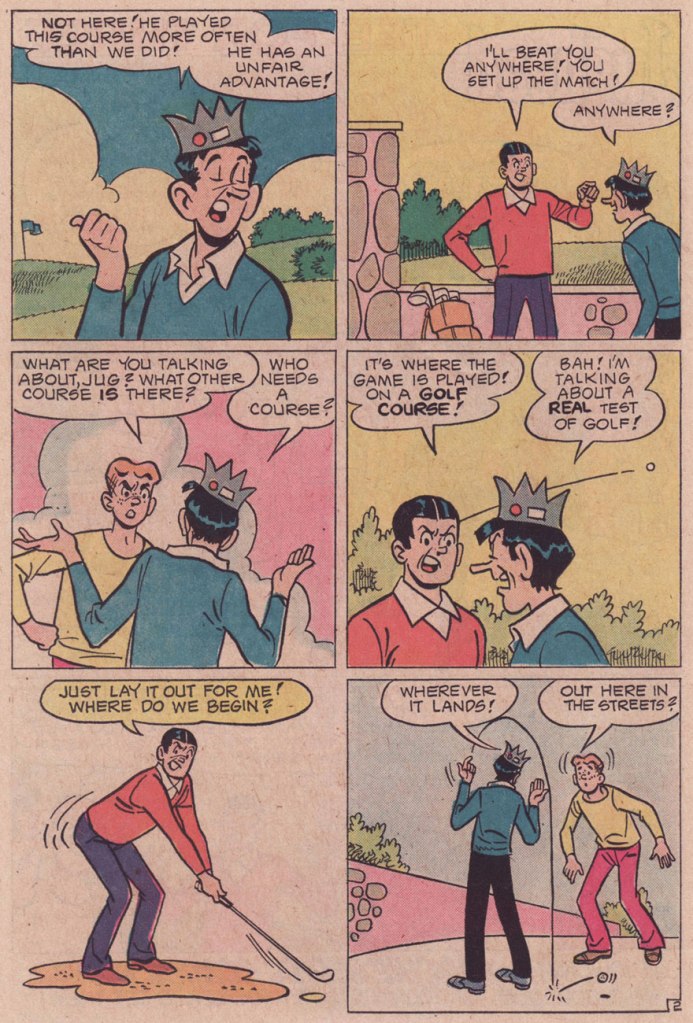
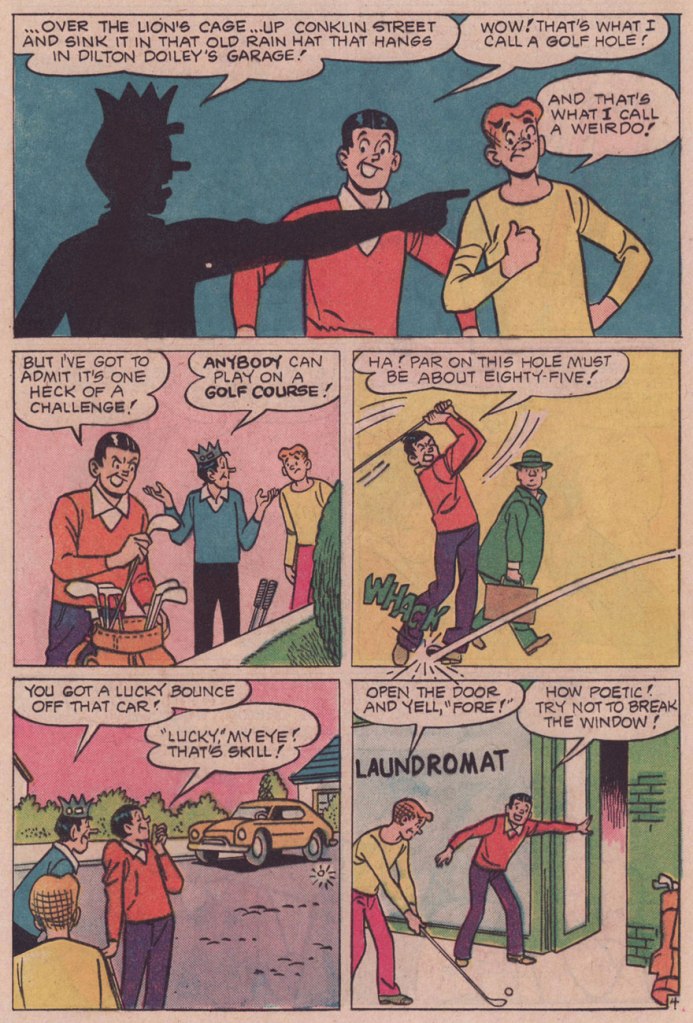
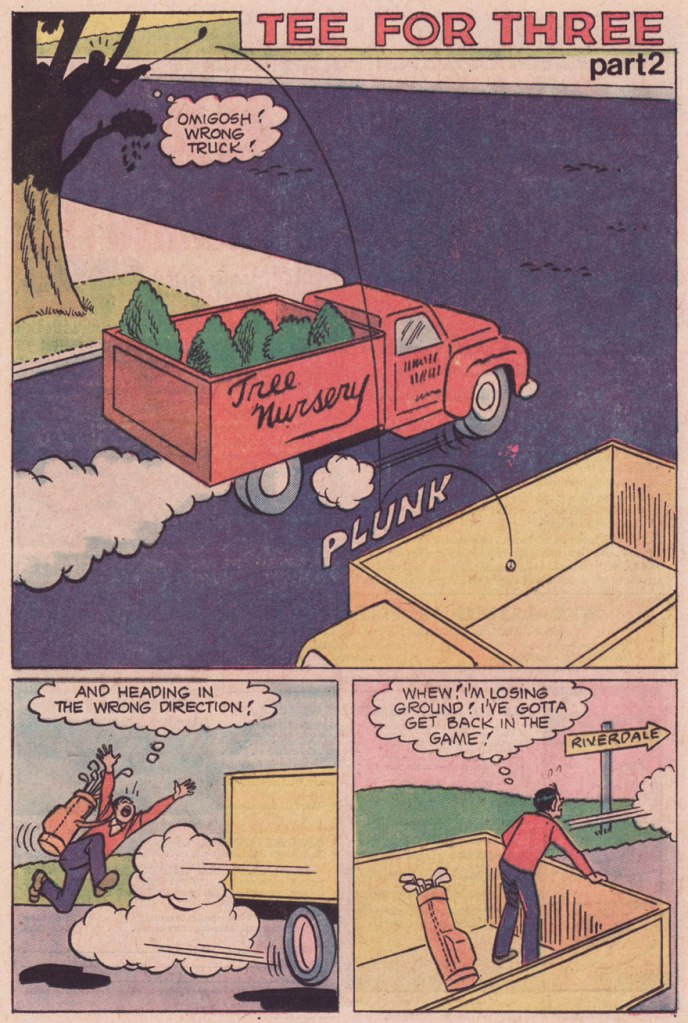
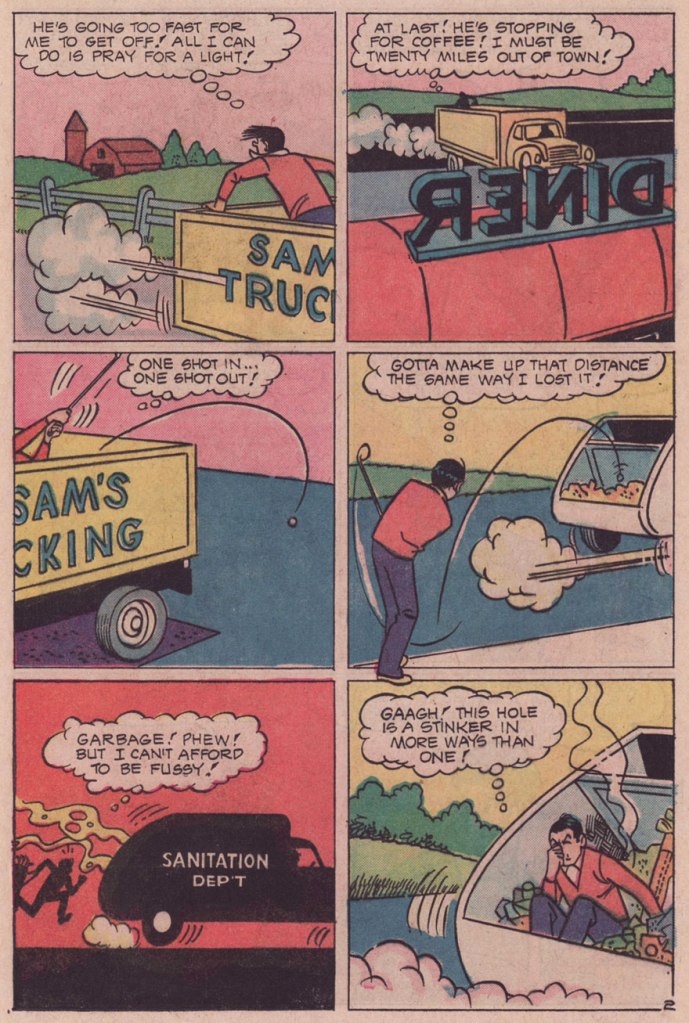
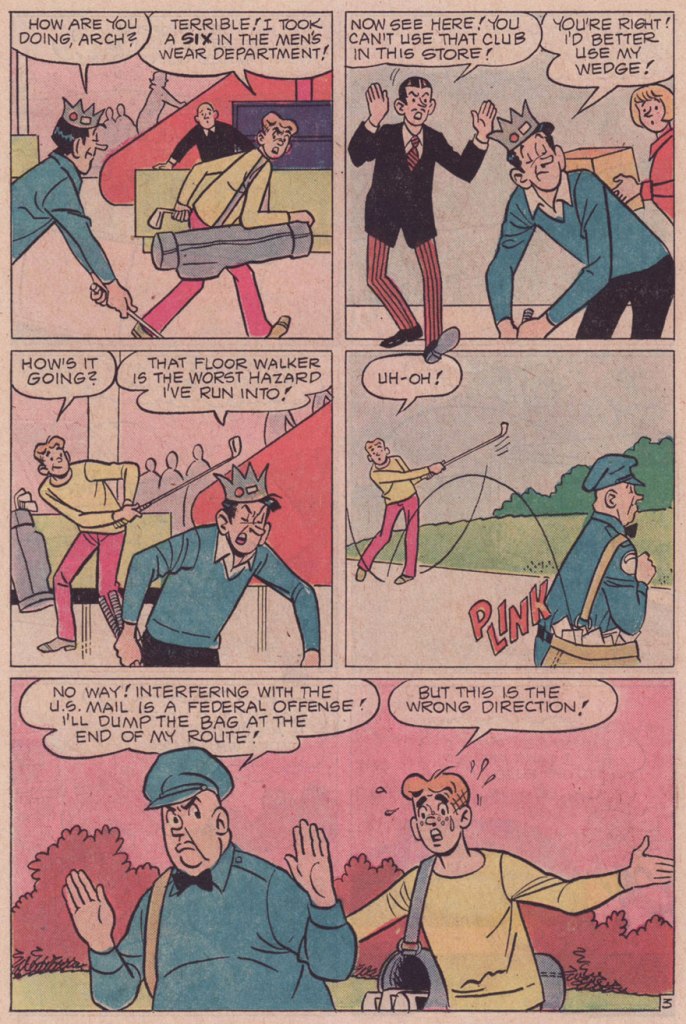
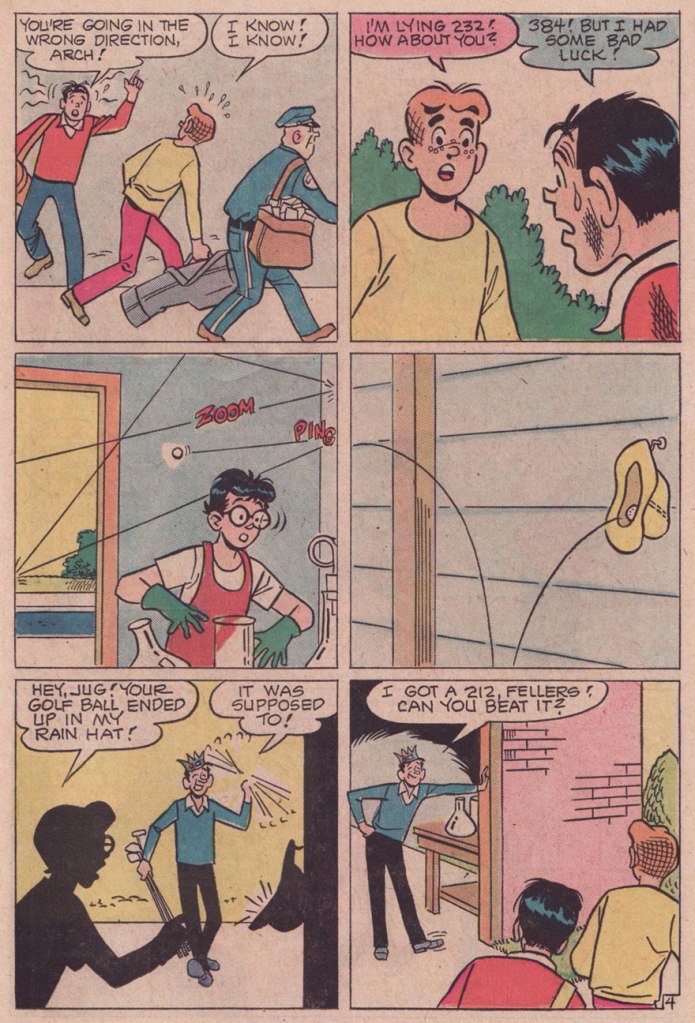
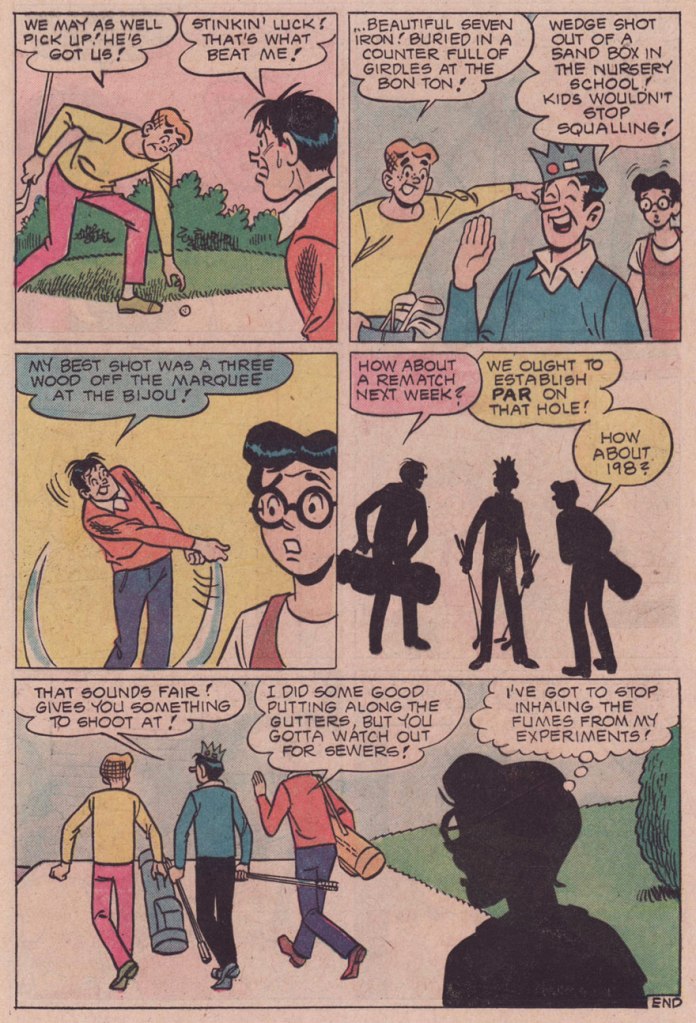
I’ve long wanted to showcase one of Samm Schwartz‘s Jughead stories on this blog, but always hit the same snag: which one? Not too long ago, while revisiting my trove of 1970s issues, I came upon just the specimen. Tee for Three appeared in Jughead no. 247 (Dec. 1975, Archie). I’ll spare you the hideous-as-usual Stan Goldberg cover.
While we know the story was illustrated by Samm Schwartz, the writer’s identity remains unknown. Schwartz usually took a hand in the scripting, but he didn’t really ever work alone. The likeliest miscreants are his usual accomplices, Frank Doyle and George Gladir.
Why this one among hundreds of others, then? For one thing, it’s longer; at eleven pages long, it’s a towering freak amidst the customary five-or-six pagers.
But that’s not all: Tee for Three also boasts an unconventional plot, one that cried out for (and received) a more leisurely deployment. Its tone is also surprising: it’s quite deadpan and sanguine in its absurdity.
For once, you can envision why these three, despite being frenemies or plain rivals, would actually hang out: they challenge and entertain one another. And even collaborate when the occasion calls for it. In this case, Jug, Archie and Reggie are so bonded in their good-natured folie à trois that the rest of the world doesn’t have a clue and hardly stands a chance.
While such a golf contest would surely result in much injury, property damage and litigation in the ‘real’ world, it sure seems like a rollicking bit of sport here, and isn’t that what good fiction is for(e)?
« What is this ‘witch’s brew‘? Oh, that’s a special! It’s a squirt of everything! » — Pop Tate divulges one of his culinary secrets
A little while back (okay, quite a while back!), upon reading an article written by cartoonist Seth (John Stanley’s Teen Trilogy, The Comics Journal no. 238, Oct. 2001), this passage especially piqued my interest: « I have to admit right now that I like Archie comics quite a bit and I have hundreds of issues of Archie and its various spin-off titles. I can even tell you which years are the good years (1959 to ’65, incidentally) ».
As it happens, I’m in full agreement with the gallant Mister Gallant : this was when Archie’s Mad House and Tales Calculated to Drive You Bats came along, when Bob White (and Samm Schwartz, and Orlando Busino) were producing scads of wild and wooly covers featuring ghouls and bug-eyed critters, mole men and mad (though I’m told they prefer ‘eccentric’) scientists and sundry extraterrestrials and witches. The line’s cover layout was also nicely open, affording the artists plenty of latitude to indulge themselves. Here are some samples from the aforementioned creators at the peak of their formidable powers, before the end-of-recess bell rang and stifling homogeneity was henceforth imposed.
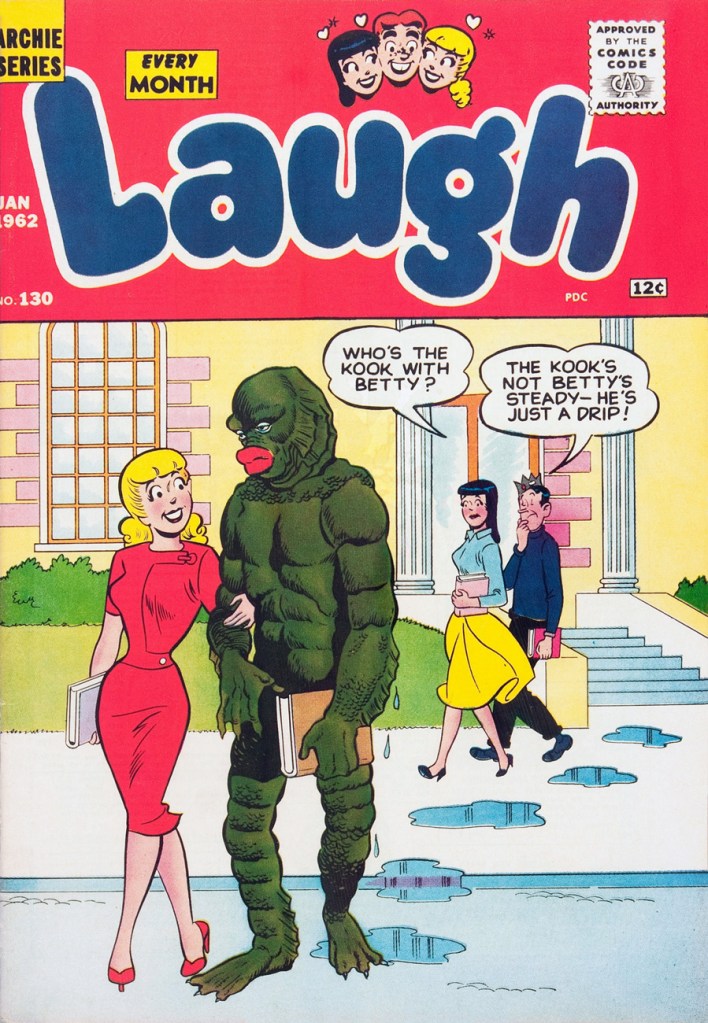
This is Laugh no. 130 (Jan. 1962, Archie); cover by Samm Schwartz. Looks like our friend Ricou Browning is slumming it in Riverdale, with Betty happily showing him the sights. Honestly, he’s more of a gentleman that Archie ever was.
This is Tales Calculated to Drive You Bats no. 2 (Jan. 1962, Archie); cover by the incomparable Orlando Busino, still with us and nearly 94 years young! I strongly suspect that these witchy younglings mean mystical business!
This is Archie no. 125 (Feb. 1962, Archie); cover by Harry Lucey, one of the crucial classic Archie artists. Regardless of what you’ve heard, look at the actual sales figures for 1969, with Lucey drawing every issue of Archie. Readers voted with their wallet.
Here’s a swell example: Pep Comics no. 158 (Oct. 1962). Spooky cover art by local favourite Bob White. I wouldn’t have pegged Archie as a skeptic, to be honest.
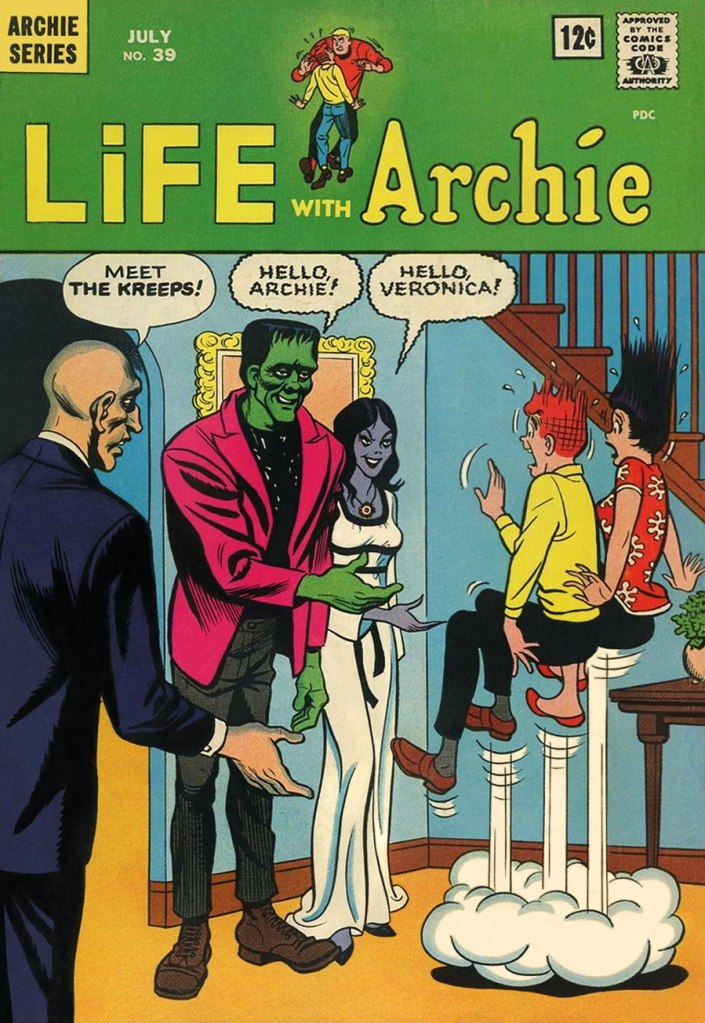
This is Life With Archie no. 39 (July 1965, Archie); cover, again, by Mr. White. The previous year had seen the TV arrival of The Addams Family and its imitators, The Munsters. So what’s one carbon copy more or less?
« … there arose such a clatter, I sprang from my bed to see what was the matter. Away to the window I flew like a flash, tore open the shutters and threw up the sash. » ― Clement C. Moore, A Visit From St. Nicholas (1823)
Not too long ago, we glanced at the interesting case of Tower’s teen line, another instance of works insufficiently popular to be properly reprinted, yet still sought after by collectors and aficionados and consequently on the pricey side. And so it is within this limbo that Tippy Teen and Go-Go and Animal find themselves consigned, in the rather fine company of Sugar and Spike and Angel and the Ape. Let’s not strand them there for the duration, please.
So why do I consider Tippy Teen superior to Archie? For one thing, while there’s some underwhelming artwork to be found here and there (sorry, Doug Crane), there’s nothing dismal (no Al Hartley, no Dick Malmgren, no Gus Lemoine, no Stan Goldberg…), and the writing is generally superior, thanks to, among uncredited others, the great Jack Mendelsohn (recycling and updating his old scripts, but that’s not the end of the world).
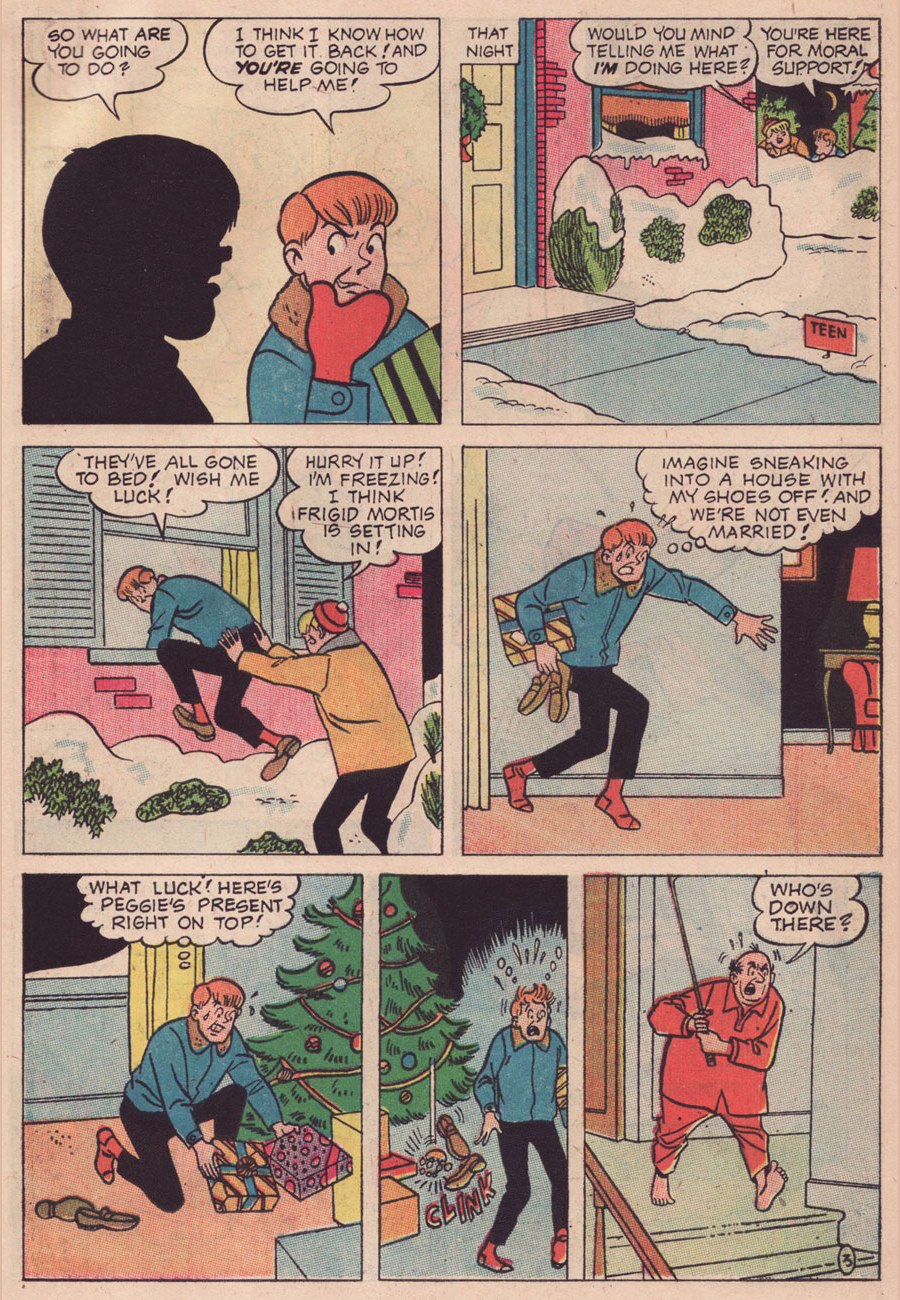
Here’s a little seasonal piece I find quite witty and charming. The well-paced work of an anonymous scripter and my beloved Samm Schwartz, it appeared in Tippy Teen no. 18. The whole issue’s quite solid, and since it’s in the public domain, you can enjoy it right here.
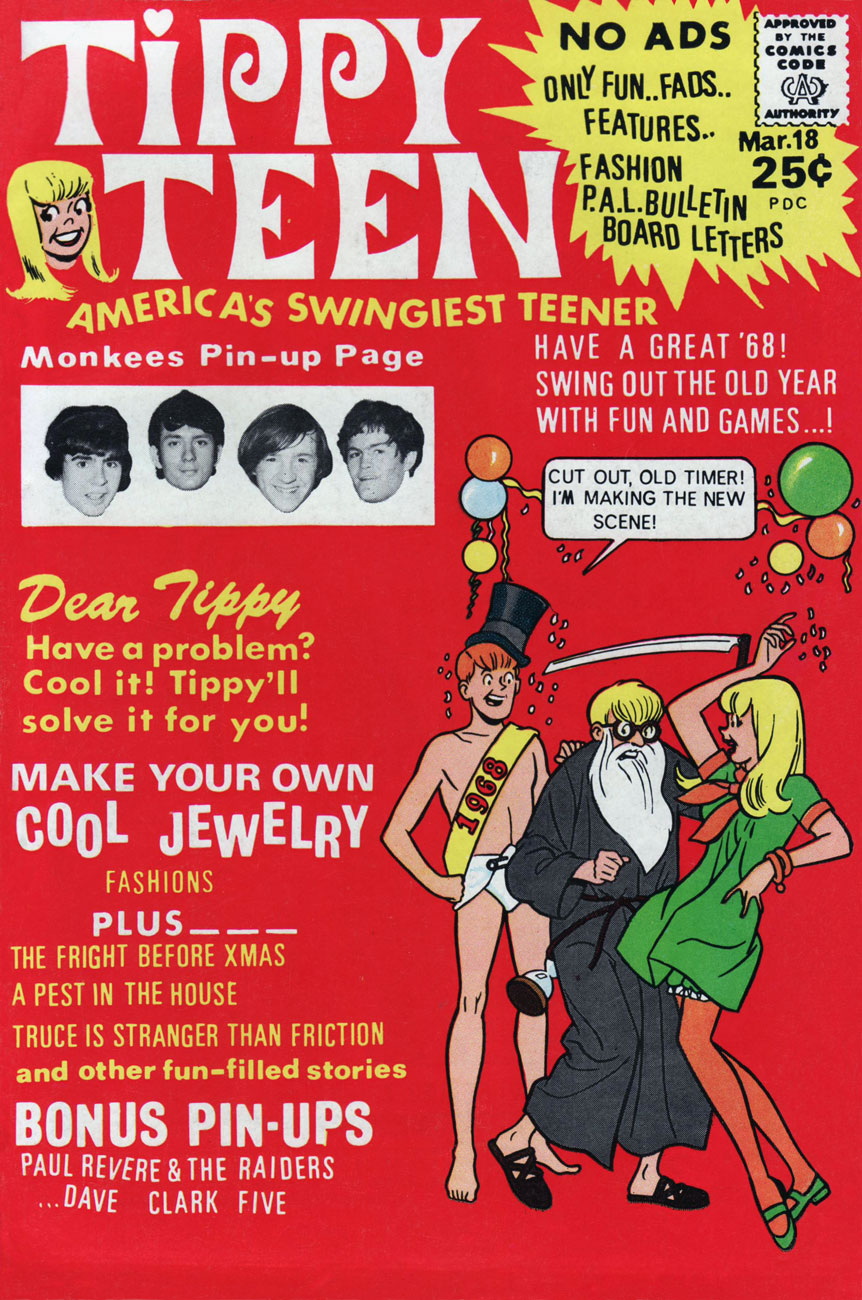
This is Tippy Teen no. 18 (March 1968, Tower). Cover artwork by Samm Schwartz.
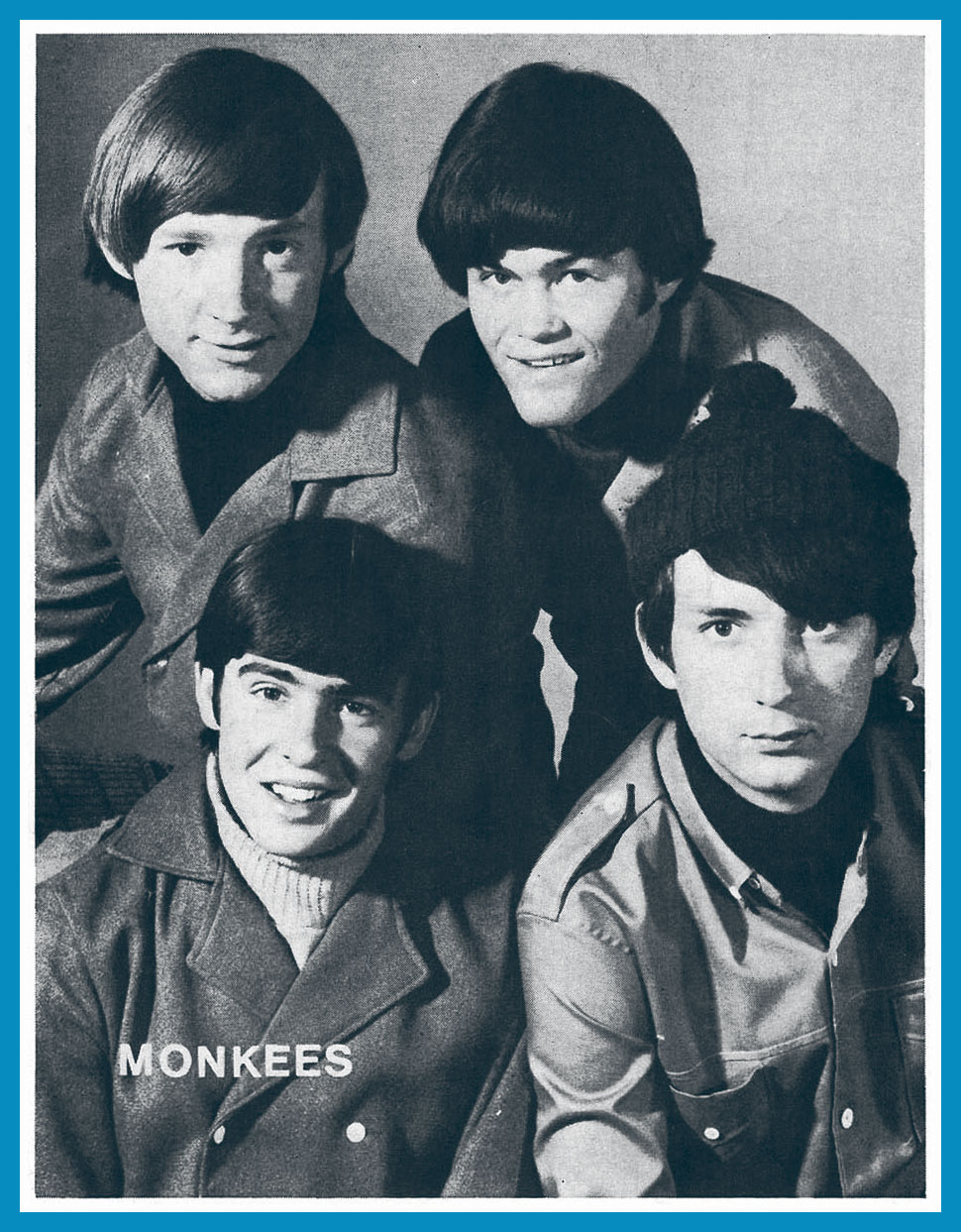
What kind of a grinch would I be if I failed to include the Monkees pin-up promised on the cover? I shudder to even entertain the notion. In the usual order, Messrs. Peter Tork, Mickey Dolenz, Davy Jones and Michael Nesmith.
« Welcome to the house of horrors! Brought to you by Grippo Denture Adhesive! »
A little while back, we made a brief detour through artist Samm Schwartz’s Silver Age Archie comics covers and touched upon the time he took the last bus out of Riverdale and headed for the greener pastures of New York… and an art director gig with Tower Publications.
Robert Klein and Michael Uslan, in their foreword to T.H.U.N.D.E.R. Agents Archives Volume 1 (DC Comics, 2002), stated: « With Samm Schwartz not very familiar with or comfortable editing super-hero adventure books, publisher Harry Shorten cut a dream deal with Wally Wood. Samm would handle the Tippy Teen titles as well as the Undersea Agent comic book and the war comic book called Fight the Enemy. He would be the managing editor of the company and its day-to-day office executive. »
So that’s that. Schwartz’s books, Tippy Teen (27 issues), Tippy’s Friends Go-go and Animal (11 issues) and Teen-in (4 issues), Undersea Agent (6 issues) and Fight the Enemy (3 issues) actually comprise the greater part of Tower’s output, though they’ve received far less attention since, were easily of comparable quality to T.H.U.N.D.E.R. Agents and its spinoffs. Certainly, the humour titles’ wit was a passel of notches above the Archie line’s, what with such heavyweights as Jack Mendelsohn on board*.
Interestingly, Tippy Teen was the first Tower material to be reprinted: in 1975, four issues of Vicki (a renamed Tippy) were issued by the *very* short-lived Atlas/Seaboard, featuring ugly new covers by Stan Goldberg. These issues rank among the most scarce and priciest Atlas releases. Most of the line’s books can still be easily found and acquired dirt cheap… but not Vicki.
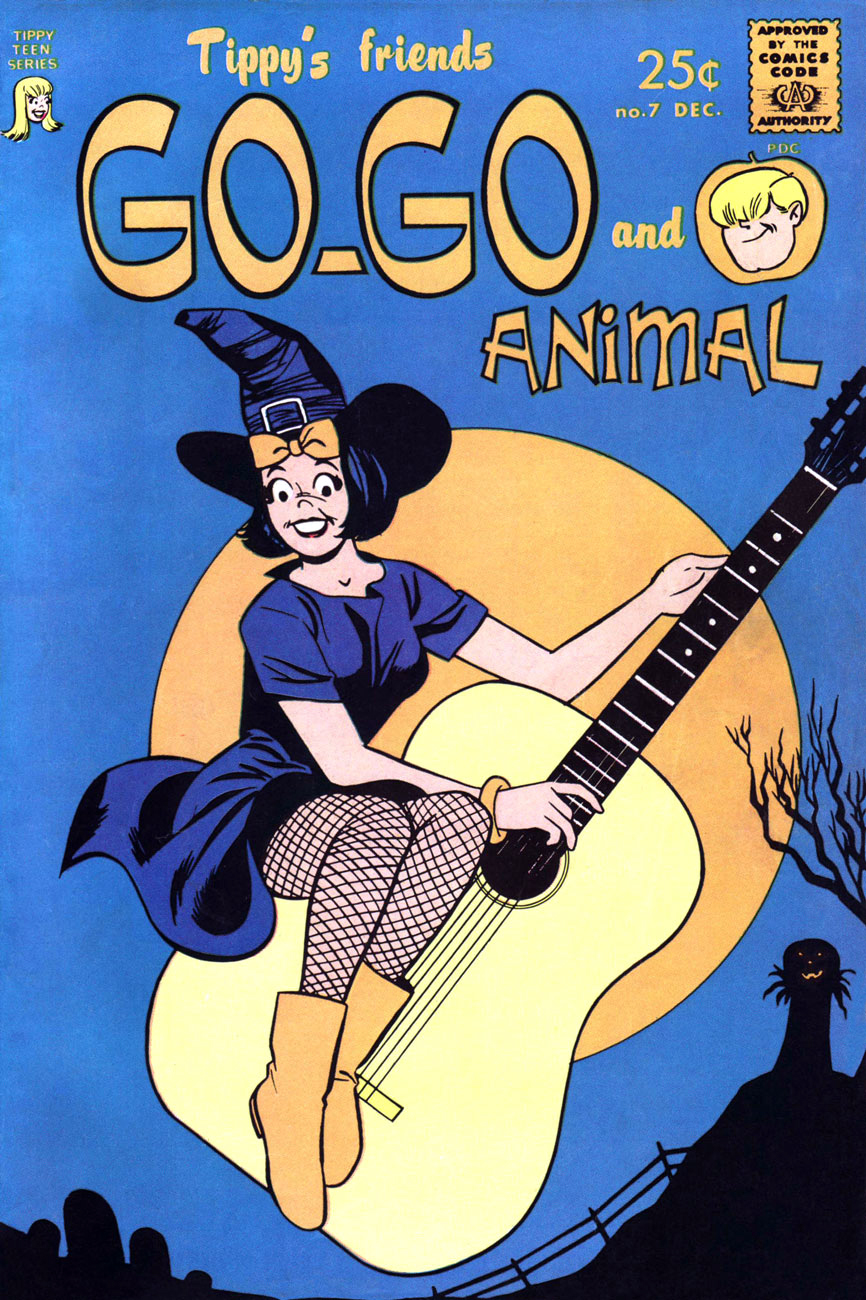
This is Tippy’s FriendsGo-Go and Animal no. 7 (Dec. 1967, Tower). Cover art by Samm Schwartz.
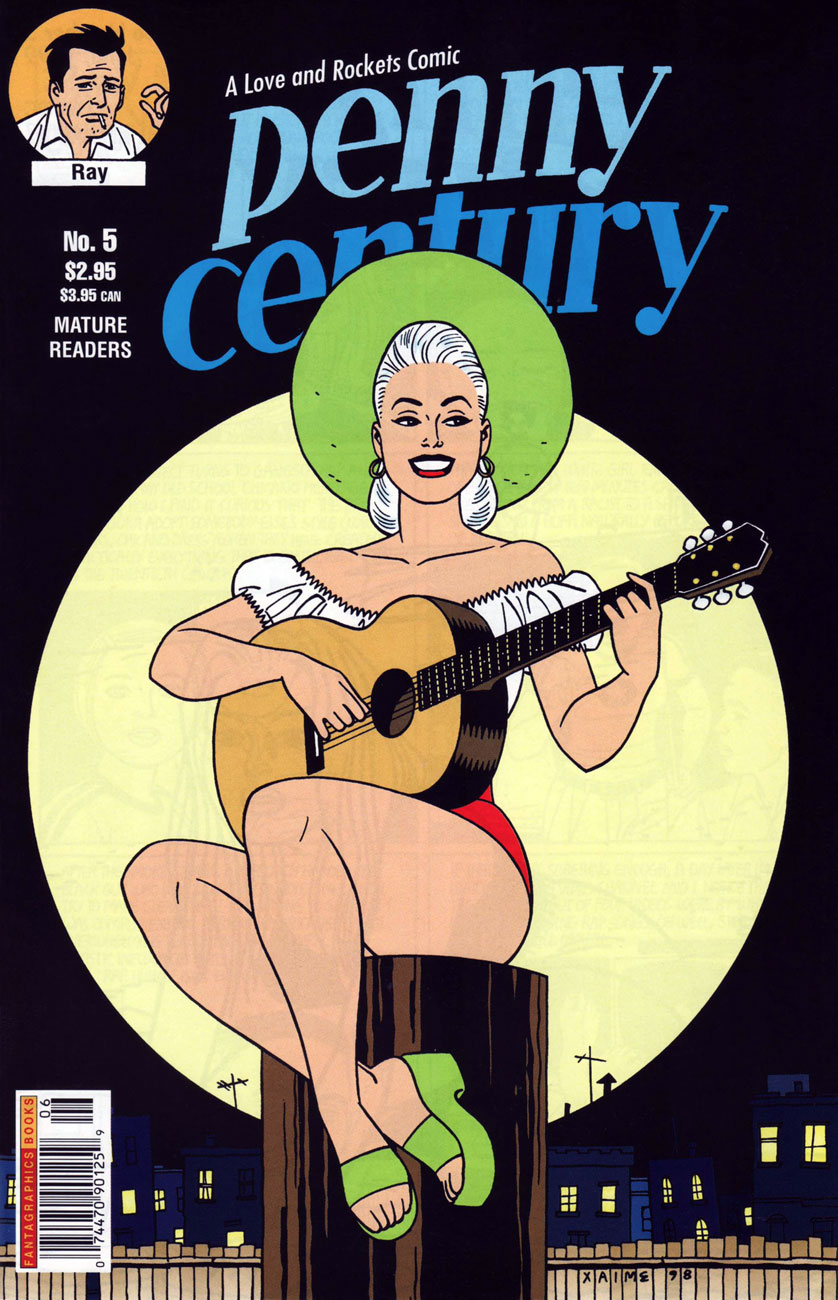
This is Penny Century no. 5 (June 1999, Fantagraphics). Cover art by Jaime Hernandez, with colours by Chris Brownrigg. Now, you won’t convince me that this cover isn’t a fond homage to Schwartz’s Hallowe’en-themed Go-Go cover… hey, maybe he *thought* this was a DeCarlo.
When I hear about Dan DeCarlo‘s would-be artistic influence on Jaime Hernandez, I can’t help but wince. If I squint real tight, I can kinda-sorta-maybe see a flicker of it in the wholesome sexiness of Betty and Veronica circa 1960-63, but no more. DeCarlo was soon reduced to such a state of hackdom that I can’t fathom how Jaime would have been driven to imitate and absorb the lessons of such hastily-executed, formulaic drivel. There, I’ve said it. On the other hand, Hank Ketcham, Steve Ditko, and, dammit, Mr. Schwartz’s touches are evident all over, though perfectly amalgamated into Jaime’s own singular vision. The way Schwartz and Hernandez draw clothing folds, the beautifully expressive comedic body language… it’s unmistakable.
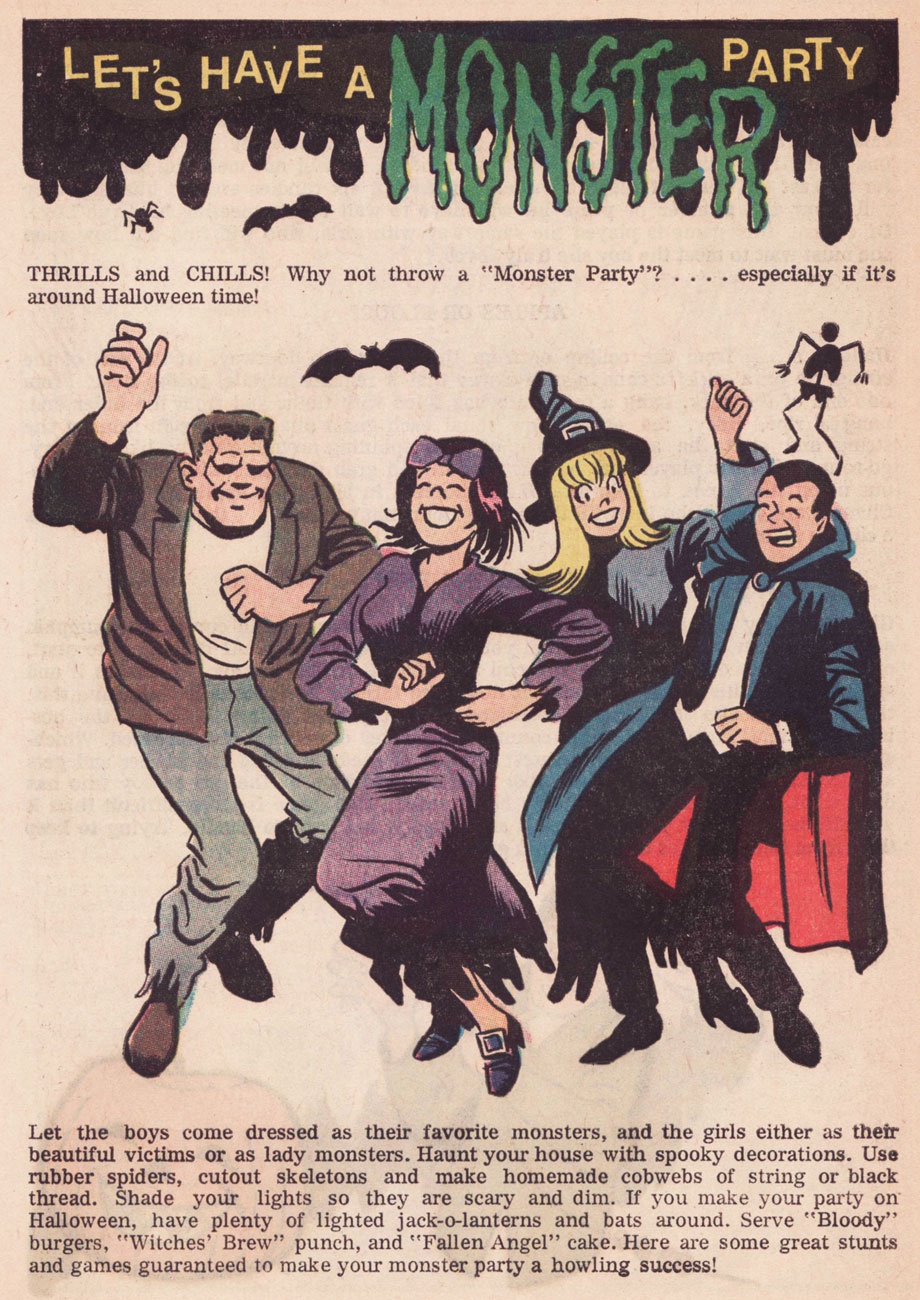
And as a bonus, this helpful feature from Tippy’s Friends Go-Go and Animal no. 3 (June 1966, Tower), illustrated by Samm Schwartz. And yes, the boys can also come as beautiful victims.
































 Who's Out There?