« Who’s Aquaman? I never heard of him! »
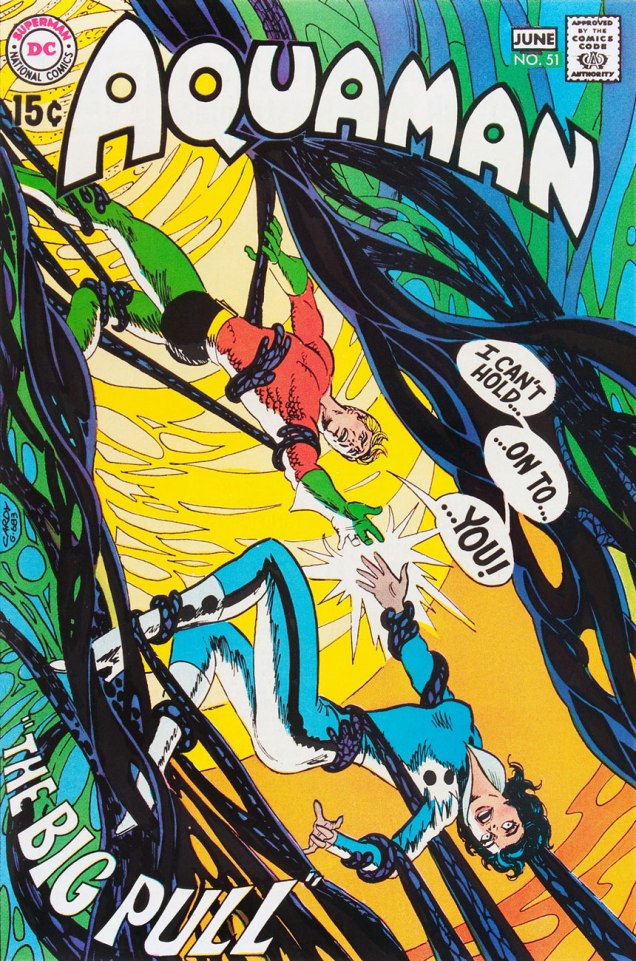
« He’s one of the super-beings from the place called Earth! He lives at the bottom of the ocean! » — Steev & Jimm, rubberneckin’ in Aquaman no. 51
Some may have wondered at the deep, abiding affection held, by a certain savvy contingent of comics aficionados, for sea king Aquaman. After all, he’s a bit of a second-stringer, and he’s had a pretty spotty record for decades. Well, I’d say one has to have encountered the erstwhile Arthur Curry at his peak, in the hands of the Stephen Skeates, (writer) Jim Aparo (penciller-inker-letterer), Dick Giordano (editor-poacher), Nick Cardy (cover artist), Carmine Infantino (editor-in-chief/art director), Jack Adler (colourist) and Gaspar Saladino (cover letterer) set.
Fond as I am of Nick Cardy and Ramona Fradon‘s work, the series’ Skeates-Aparo period is more my speed. I can’t quite put my finger on it. There’s a whiff of the end of the world, something ominous and immediate about it, despite the fanciful settings. I guess it was « relevance », but with a lighter touch and without the cringe-inducing bathos of the concurrent Green Lantern-Green Arrow series. Because of Aquaman’s aquatic nature, environmental doom seldom seems far. The Skeates-Aparo rampage lasted from issue 40 (June 1968) to number 56 (April 1971). Aparo returned to the character just a few years down the road (Adventure Comics no. 441, Sept. 1975), but by then, he’d already begun his long, painful artistic deterioration.
But back to the covers: this represents, in my view, Cardy’s second hot streak on this title. From the beginning of his career (in 1940 with the Iger/Eisner shop!) Cardy had always been a reliably competent artist, but rarely a very exciting one. That all changed in the mid-Sixties when newly minted art director/editor-in-chief Carmine Infantino made him his right-hand man and co-designer of DC’s covers. This greater latitude gave Cardy wings. Cardy’s first Aquaman hot streak opens on issue 37 (Jan.-Feb. 1968) and closes with issue 45 (May-June 1969). Issues 46 to 48 are nice enough, but short of transcendence… beyond that bump in the road, we’re set for a smooth run of splendid covers.
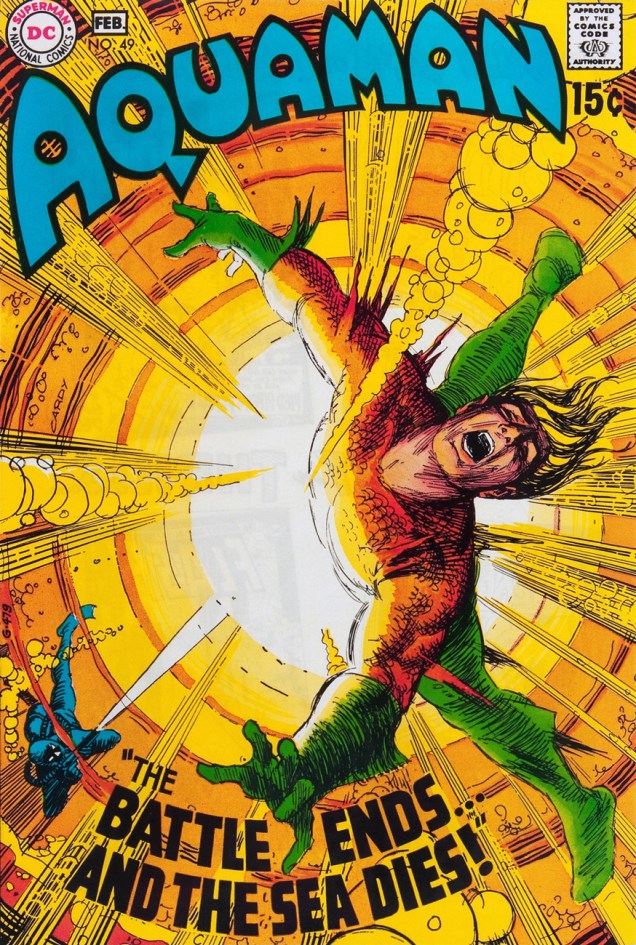
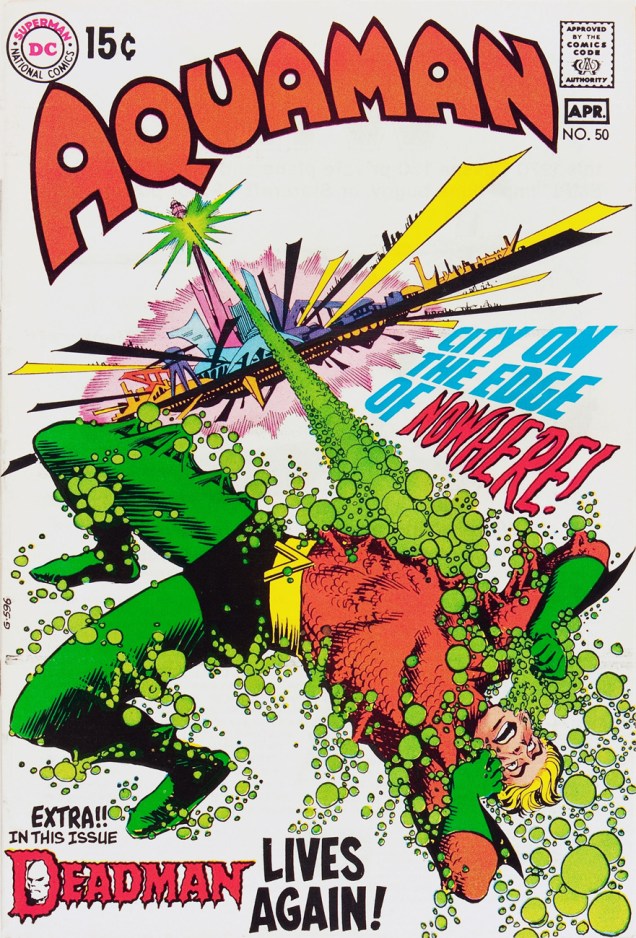
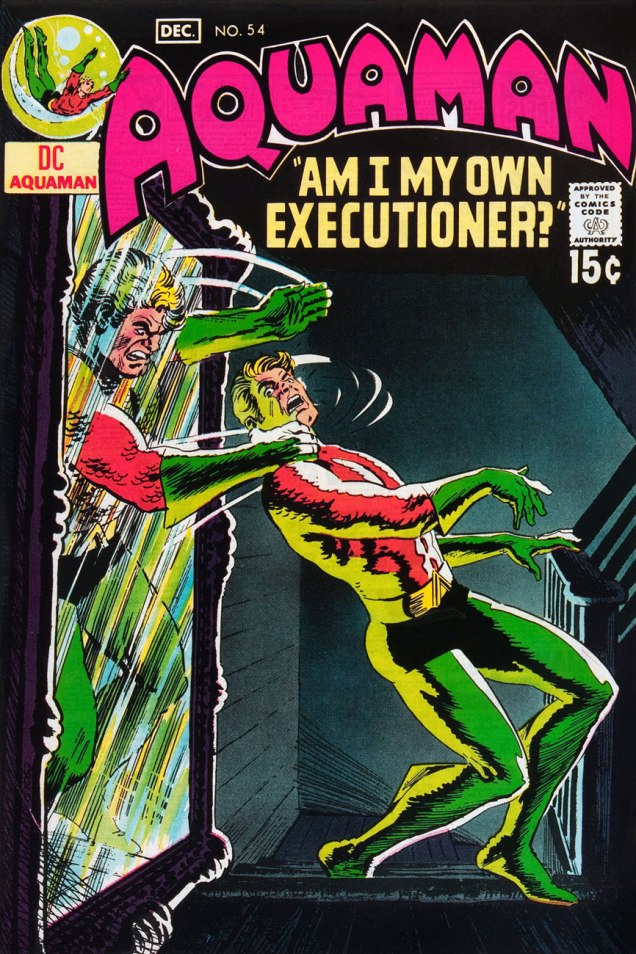
This is Aquaman no. 49 (Jan.-Feb. 1970). Cover pencils and inks by Cardy, colours by Jack Adler, Aquaman logo by Ira Schnapp, title lettering by his worthy successor, Gaspar Saladino. Edited by Dick Giordano, directed (and likely laid out) by Infantino.This is Aquaman no. 50 (Mar.-Apr. 1970), sporting a Cardy cover that couldn’t have been more evidently designed by Carmine Infantino, with more Saladino magic on the titles and Deadman logo. Gestalt: it’s what great collaboration is all about! It seems fair to assume that the title is a nod to the Harlan Ellison-scripted 1967 Star Trek episode, The City on the Edge of Forever.This is Aquaman no. 51 (May.-June 1970). I don’t usually pilfer Tentacle Tuesday material… but I’m inclined to make an exception for a (sea) worthy cause. Design-wise, Infantino and Cardy took full advantage of the aquatic action settings. Up, down, sideways — anything goes!This is Aquaman no. 52 (July-Aug. 1970). A wistful, disorienting experiment in colour and design economy. You’d never see such a *hushed* cover chez Marvel.This is Aquaman no. 53 (Sept.-Oct. 1970). A fine instance of the notorious “Infantino tilt”. Michael Kaluta on Infantino’s cover design input: « My approach to a cover, when I got to do my own ideas, was to show the picture straight on, staged, unless it was a dramatic perspective view. Almost every time I’d bring one of these sketches in to Carmine he’d turn the paper about 30 degrees to the right and demand that that made the composition 100% stronger, more “grabby”… and I’d have to agree about 50% of the time… »This is Aquaman no. 54 (Nov.-Dec. 1970). Did I mention that DC’s books of the early ’70s had a general predilection for the macabre and the moody? Fine by me, then and now.This is Aquaman no. 55 (Jan.-Feb. 1971). The fact that this complex idea works so well on the page is evidence of some first-rate design work, with some heady colouring mojo sealing the deal.This is Aquaman no. 56 (Mar.-Apr. 1971). Would you believe that this story was continued over three years later in Marvel’s Sub-Mariner no. 72 (Sept. 1974). Seems sneaky Steve Skeates slipped something past sleepy editor Roy Thomas. In an interesting bit of coincidence, it was each of the competing oceanic monarchs’ final issue. On another note, I presume that the title is a takeoff on Norman Greenbaum‘s 1967 song The Eggplant That Ate Chicago (popularized by Dr. West’s Medicine Show and Junk Band), itself likely an homage to Arch Oboler‘s infamous 1937 Lights Out radio episode, The Chicken Heart (That Ate the World). Phew!
Under normal circumstances, this run of covers would have turned out quite differently for, as Steve Skeates told me a few years ago, « The only reason Jim [Aparo] didn’t do the covers was that he lived out of town, couldn’t come in for cover conferences! »
« Mom, my teacher, Mrs. White, has invited me to a slumber party at her house this weekend. She’s really nice. Can I go? »
« Sure, why not? » — from a Jack Chick tract, The Poor Little Witch (1987)*
Today, we part the curtains and peek at the fair bosom of suburbia, circa 1972. In those gentle times of satanic panic, Tricky Dick’s political shenanigans, the oil crisis and all-around grooviness, the Manson ritual murders were recent history, Anton LaVey‘s The Satanic Bible (1969) and its sequel, The Satanic Rituals (1972) were all the rage, not to mention William Peter Blatty‘s The Exorcist (1971… the film another year away) and Ouija boards. DC Comics’ The Witching Hour (85 issues, 1969-1978) was well in keeping with the vibe of the times, and offered girls somewhat of an alternative to Archie, Little Dot and Young Romance. In fact, my recollection (and I’d welcome yours!) was that ghost and mystery comics overwhelmingly found favour with the ladies.
I’ve perhaps said it before, but DC’s mystery books were mostly well-drawn but mind-numbingly formulaic… but exceptions now and again slipped in.
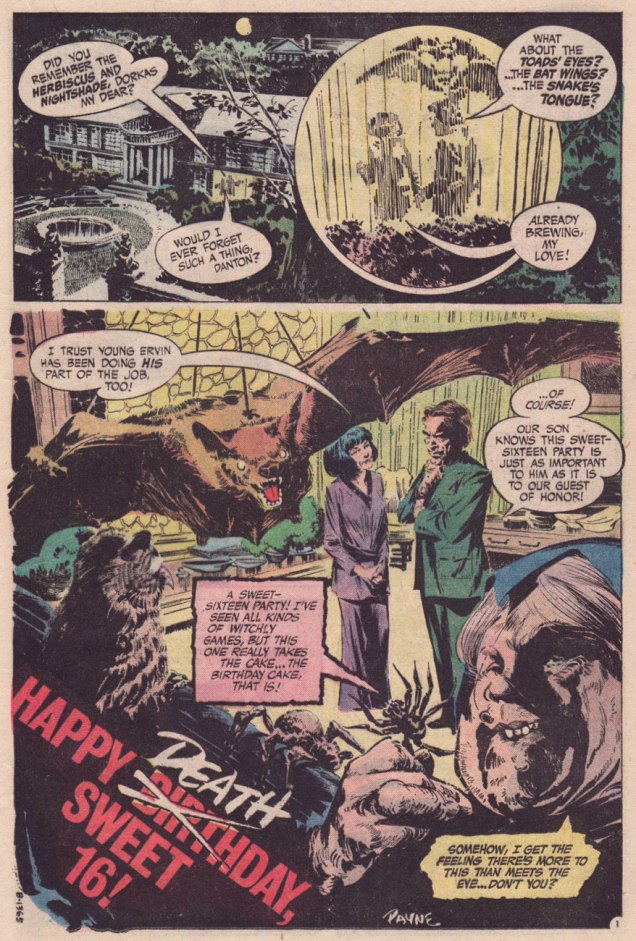
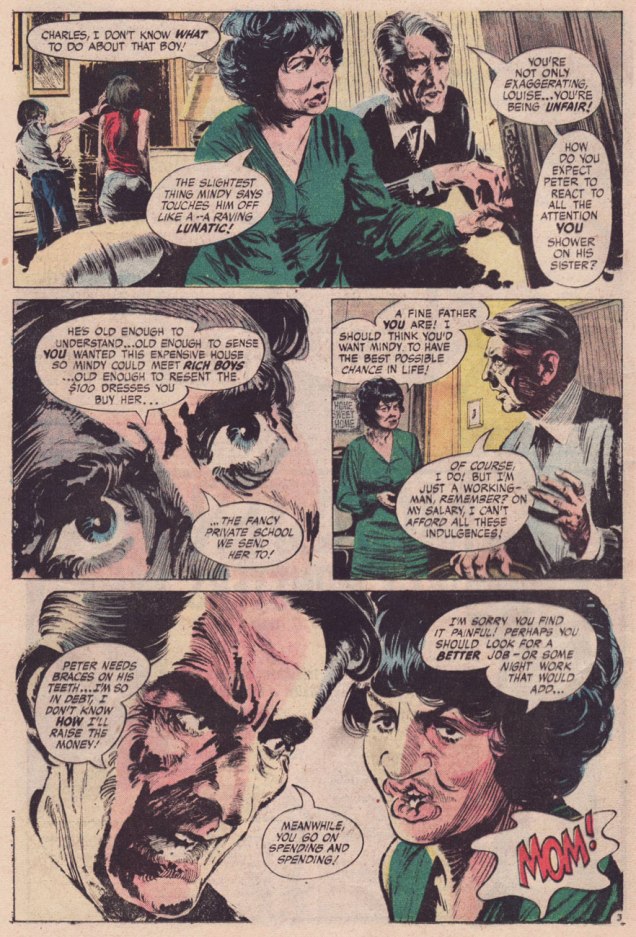
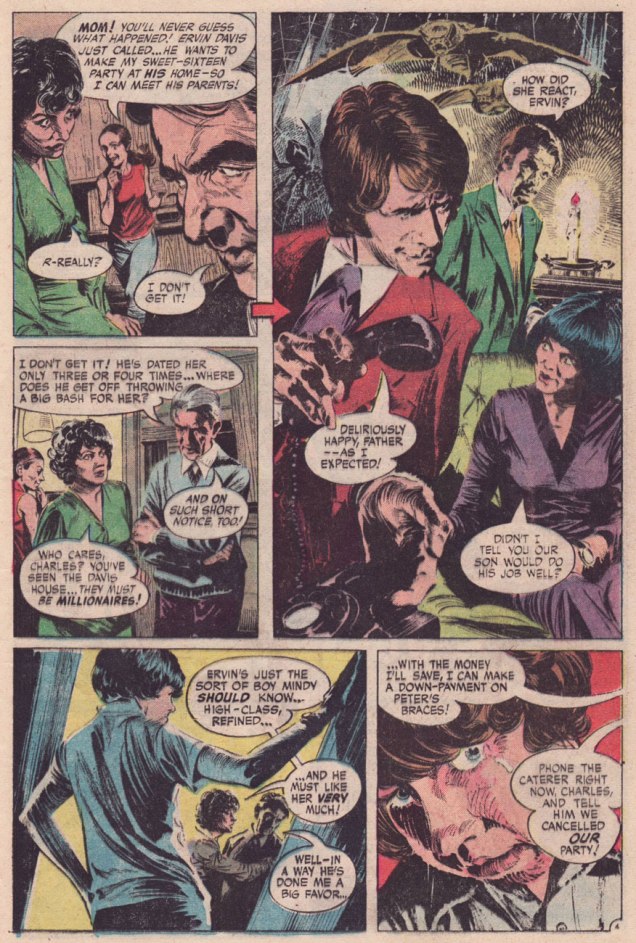
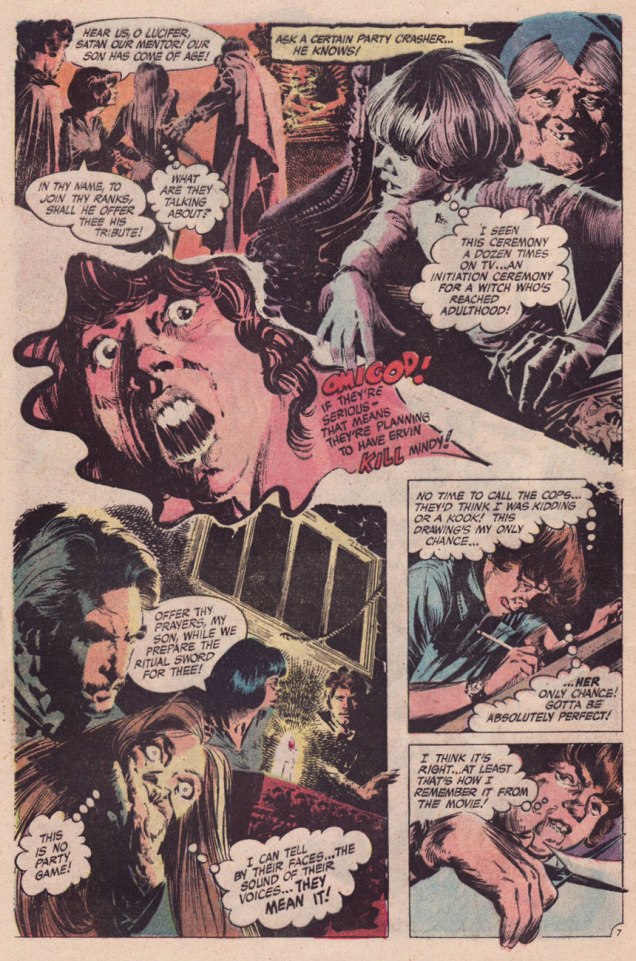
Happy Deathday, Sweet 16! was a bit of lightning in a bottle. It was illustrated by the hardly-prolific Canadian Bill Payne, who drew a dozen or so jobs for DC’s mystery and war titles, lettered a few more, then vanished. I suspect he had a day job in some advertising agency and did a bit of comics work on the side for kicks. If that’s the case, he certainly applied himself, bringing actual realism and a bit of the old ‘Ghastly’ Ingels grotesqueness to the table. The writer, however, is uncredited. The writing doesn’t quite feel like the work of any of DC’s workhorses… it’s markedly better, rising beyond the stock situations and packing in plenty of credible detail to flesh out the players in its scant eight and a half page allotment. Sibling rivalry, social aspirations**, marital and parental discord, class warfare… Lucky Peter, though: he somehow seems to have continual access to Shock Theater; for me, that’s the main cause for suspension of disbelief.
Nick Cardy‘s sweet ‘n’ sassy cover for The Witching Hour no. 25 (Nov. 1972). It’s fun to see one of his winsome romance cover girls put in a rather… perilous cross-genre appearance.
These days, I suppose the fundamentals haven’t changed, though with so-called Christians behaving in most unchristian fashion, and Satanists displaying a puckish (honestly, kind of adorable) sense of humour, things are… interestingly confusing.
-RG
*Read it here; but remember, it’s “available only in multiples of 10,000 at half-price.” ** Let’s keep in mind that, as Lori Loughlin has pointedly pointed out, “Any mother would have done the same if they had the means to do so.”
When you think of Aquaman, what is the first thing that comes to mind? Is he a brooding, tragic hero? A hapless sap whose prowess extends no further than throwing a starfish at his assailant? A talented swimmer, defender of Earth’s oceans?
« The image of the superhero riding on a chariot made of fish—sporting that classic orange top and green pants—sealed the depths-dweller in public memory as a doofy champion, despite defenders who insist there’s more to Aquaman than talking to fish and riding them places. While later depictions of the character emphasized his serious side, Aquaman jokes abounded especially in the 90s and 2000s—largely thanks to a school of young male animators, including Seth MacFarlane and South Park’s Matt Stone and Trey Parker, who couldn’t help but poke fun at Aquaman’s ineffectual reputation. »|source|
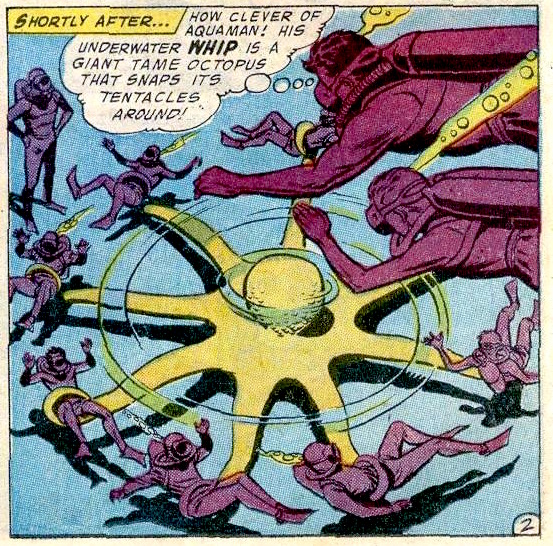
I believe the aforementioned Aquaman’s defenders are slightly missing the point. What’s wrong with catching a ride from a fish, or getting a helping hand from an octopus? In Aquaman’s world, octopuses play the role of indispensable helpers, using their tentacles as lassos, bludgeons and tourniquets, or forming acrobatic formations to give Aquaman a boost. Does this somehow make this superhero wimpy? Do we seriously still believe that treating animals with kindness, or collaborating with them, is emasculating? No wonder this world is going to hell in a handbasket. The audience for superhero comics sometimes seems to be quite devoid of imagination (or a sense of humour).
« Jokes about his wholesome, weak portrayal in Super Friends and perceived feeble powers and abilities […] led DC to attempt to make the character edgier or more powerful in comic books. Modern comic book depictions have attempted to reconcile these various aspects of his public perception, casting Aquaman as serious and brooding, saddled with an ill reputation, and struggling to find a true role and purpose beyond his public side as a deposed king and a fallen hero. » |source|
Okay, I’ve grumbled, and now I’ll move on to the tentacles. Take a seat astride your favourite jellyfish, strap in your fins, and let’s go!
Aquaman, the child of an undersea explorer who learned how to breathe and live underwater “by training and a hundred scientific secrets”, was created in 1941 by Paul Norris and Mort Weisinger. During the Golden Age of comics, he fought various evil guys (usually from water-related professions: sailors, marine biologists, pirates… and Axis villains, too). The whole thing started becoming really interesting (imho) in 1956 (coincidentally, with the advent of Silver Age), when Aquaman acquired his sidekick Topo the Octopus:
Topo’s first appearance! « Aquaman’s Undersea Partner », drawn by Ramona Fradon, published in Adventure Comics no. 229 (October 1956).
Ramona Fradon handled Aquaman from 1951 to 1959, when she became pregnant and had to temporarily withdraw from the comics field until 1963. She deserves a separate post, really, especially since I love her art. In the meantime, read The Woman Who Made Aquaman a Star. As for Topo, I don’t have to explain why I’m fond of the idea of an octopus sidekick.
A few nice Fradon pages:
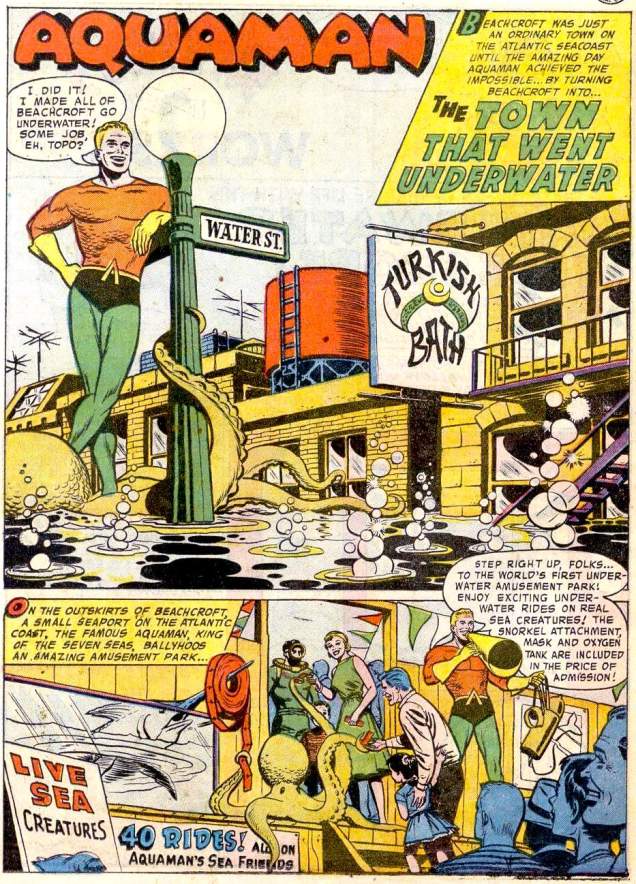
«The Town That Went Underwater», drawn by Ramona Fradon. It was published in Adventure Comics no. 246 (March 1958).Another panel from « The Town That Went Underwater ».A panel from « The Undersea Hospital! », scripted by Robert Bernstein and drawn by Ramona Fradon. This issue, Adventure Comics no. 262 (July 1959), has not one, but two fun animal stories: the other one – also lovable, imaginative nonsense – is « The Colossal Superdog », scripted by Otto Binder and drawn by George Papp.Another panel from « The Undersea Hospital! ». Don’t you love the idea of a seaweed stretcher with eel supports?
In 1961, Nick Cardy started working on Aquaman with Showcase no. 31 (March-April 1961). When the sea king got his own title in 1962, Cardy became the regular artist, drawing inside stories and covers until Aquaman no. 39 (May-June 1968), and staying as the cover artist until Aquaman no. 56 (April 1971).
« Cardy proved adept at drawing sea creatures; his fluid, swirling water currents helped create a captivating, eye-pleasing undersea world. He became a fan favorite, not only because of his superb story-telling ability, solid figure work and facile inking, but because of the way he rendered Mera, Aquaman’s girlfriend. Cardy’s women had curves, not angles, and seemed to exist in three dimensions on the two-dimensional page. He never stopped trying to elevate his work, until the later covers in the series were among the most striking and imaginative of the publisher’s entire line.» (source: Comics Journal’s eulogy for Nick Cardy)
Well, that’s high praise indeed, but is it deserved? I can confirm that Cardy covers were really inventive. As for the interior art, let’s take a peek, as these stories conveniently overflow with tentacles.
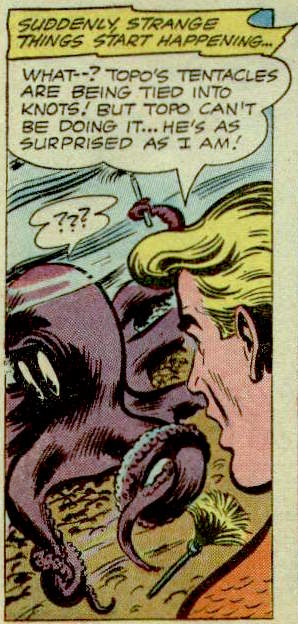
There’s tentacles getting tangled, the octopus equivalent on panties in a twist…
Panel from « The Invasion of the Fire Trolls », scripted by Jack Miller and drawn by Nick Cardy, published in Aquaman no. 1 (January-February 1962).Panel from « The Aquaman from Atlantis », scripted by Jack Miller and Nick Cardy, published in Aquaman no. 3 (May-June 1962).
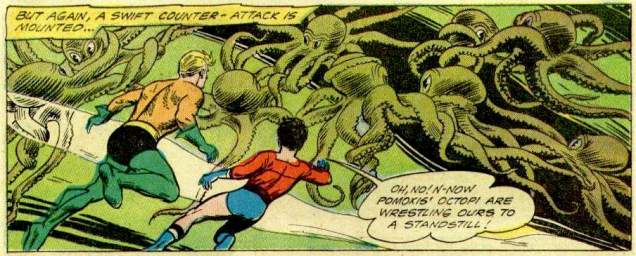
An army of octopus fighters…
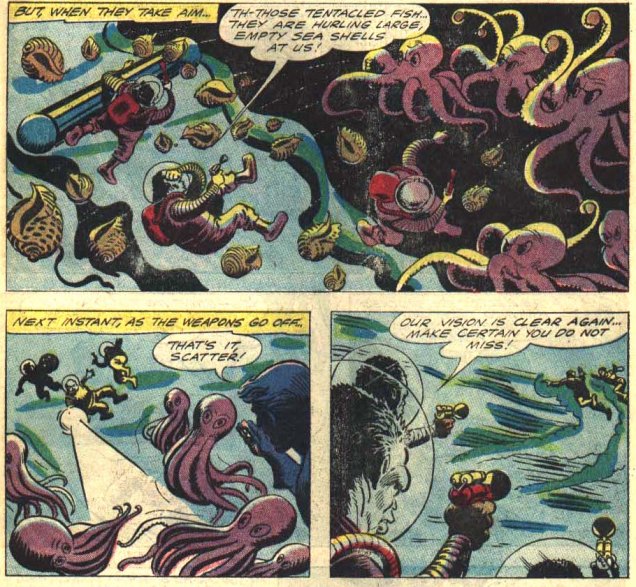
Page from « The Menace of Alien Island », scripted by Jack Miller and drawn by Nick Cardy, published in Aquaman no. 4 (July-August 1962).
I promised you acrobatics, so here are some octopuses doing a cheerleading routine (Aquaman forgot his pompoms at home):
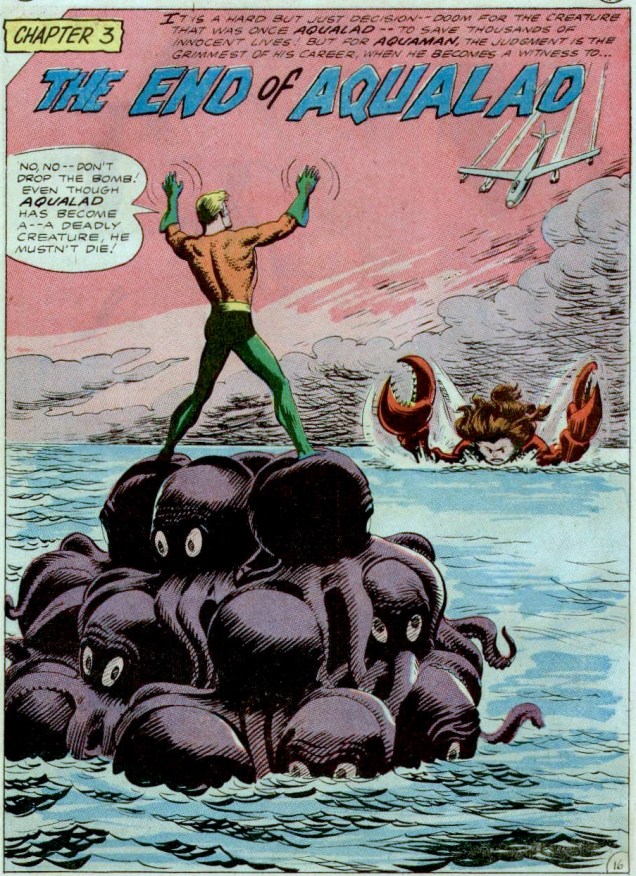
Aquaman no. 9 (May-June 1963). « The menace of the Aqualad-Creature » is scripted by Jack Miller and drawn by Nick Cardy.It’s not *all* octopus tentacles. Page from « The Secret Mission of King Neptune», scripted by Jack Miller and drawn by Nick Cardy, printed in Aquaman no. 9 (May-June 1963).
Continuing our tentacle shenanigans…
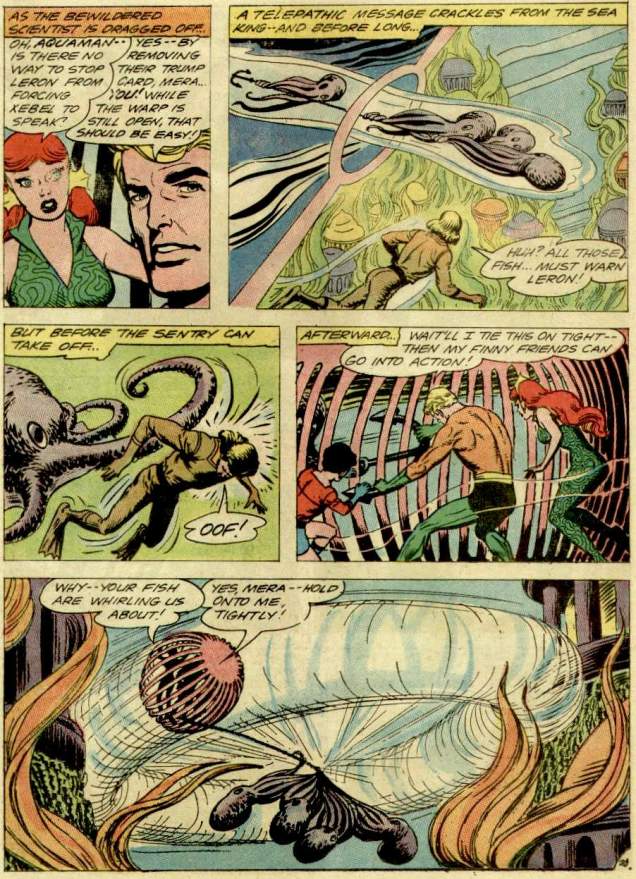
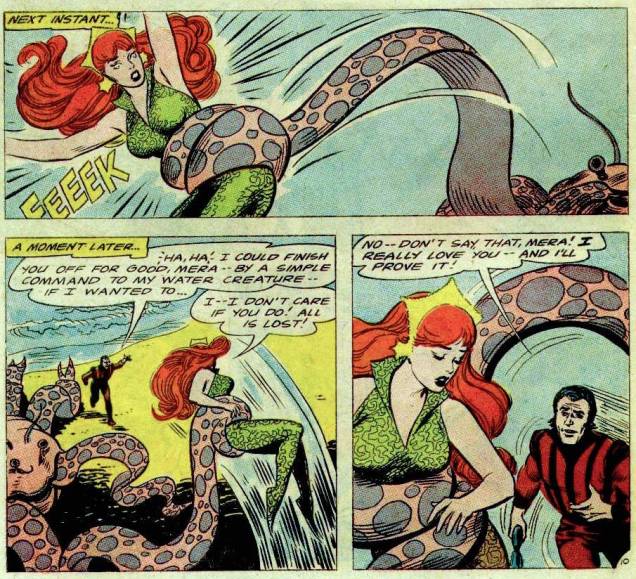
Any jerk who refers to an octopus as a “fish” deserves what’s coming to him. Page from « The Doom from Dimension Aqua », scripted by Jack Miller and drawn by Nick Cardy, published in Aquaman no. 11 (September-October 1963).As usual, mind fuckery rears its ugly head whenever romance is part of the plot. “I could kill you! But I really love you, actually!” An eye roll and a sigh. Panels from « The Wife of Aquaman », scripted by Jack Miller and drawn by Nick Cardy, published in Aquaman no. 18 (November-December 1964).Page from « The Wife of Aquaman », scripted by Jack Miller and drawn by Nick Cardy, published in Aquaman no. 18 (November-December 1964).
One of those Nick Cardy covers we were discussing earlier, so you can decide for yourself whether his women are all angles or all curves:
Aquaman no. 22 (July-August 1965), cover by Nick Cardy.« The Trap of the Sinister Sea Nymphs », published in Aquaman no. 22 (July-August 1965) art by Nick Cardy.
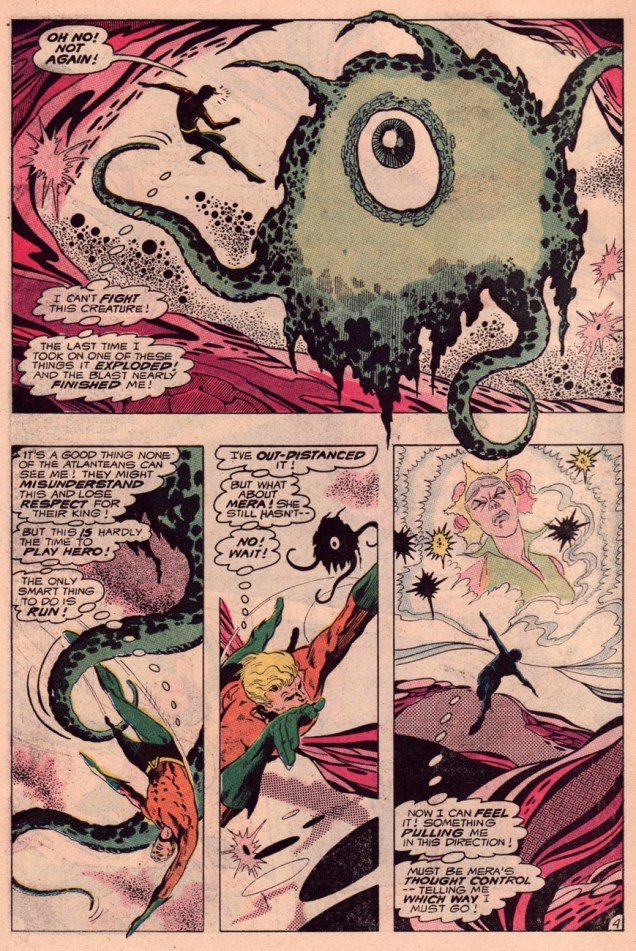
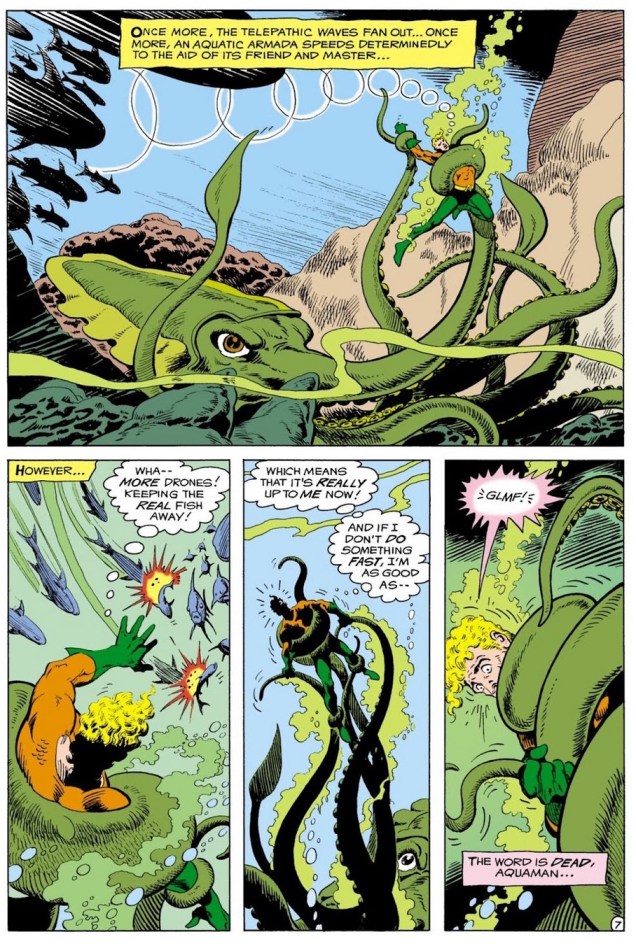
With Aquaman no. 40 (July-August 1968), Jim Aparo replaced Cardy on the inside art. Issues no. 40 to no. 47 (September-October 1969) were scripted by Steve Skeates (a definite favourite of this blog; read co-admin RG’S post “… and the Dog Howls Through the Night!”) and drawn by Jim Aparo. This creative team is a favourite of many an Aquaman fan. Voilà:
Page from « Return of the Alien! », scripted by Steve Skeates and drawn by Jim Aparo, printed in Aquaman no. 55 (January-February 1971).Panel from « Return of the Alien! », scripted by Steve Skeates and drawn by Jim Aparo, printed in Aquaman no. 55 (January-February 1971).
More Jim Aparo (sans Skeates):
« The Manta-Ray Means Murder! », scripted by Paul Levitz and Martin Pasko and drawn by Jim Aparo, published in Adventure Comics no. 446 (July-August 1976).Aquaman no. 57 (August-September 1977), cover by Jim Aparo. I’m angry at that stupid “you could be in the Superman movie” sign that’s far more distracting than it has any right to be.Page from « A Life for a Life », scripted by David Michelinie and drawn by Jim Aparo, published in Aquaman no. 57 (August-September 1977).Another page from « A Life for a Life ».Aquaman no. 63 (August-September 1978), cover by Jim Aparo.
You can read issues Aquaman issues no. 1 through to 63 here.
One last thing… I happen to be the proud owner of a piece of original art by Ramona Fradon (of fairly recent vintage), given to me by my sweetie. Lucky me!
Keep your octopus pals happy and you’re guaranteed a fulfilling relationship.
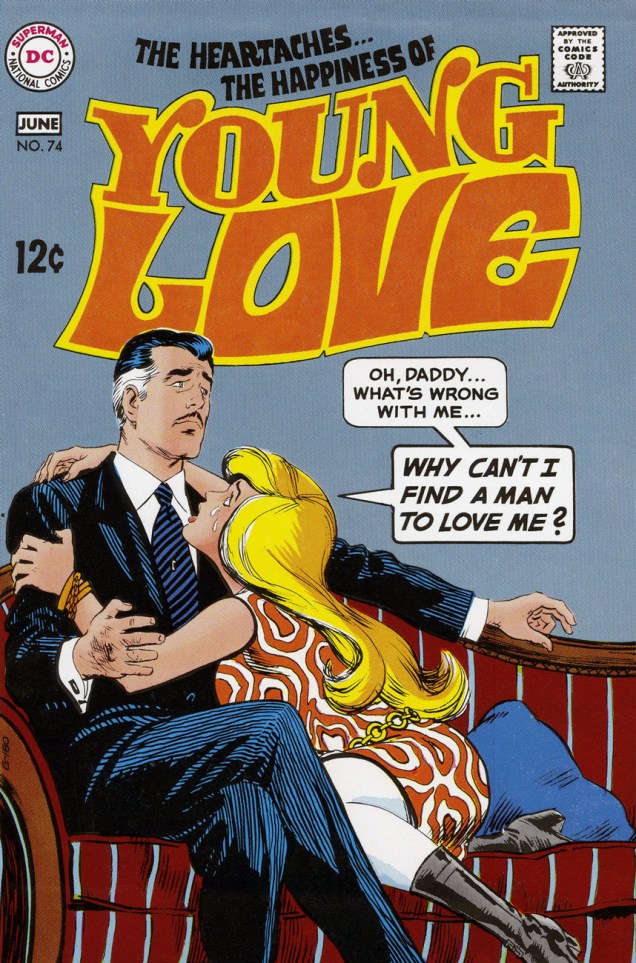
« In YOUNG LOVE, how can people talk when they kiss? My mom can’t talk when she’s kissing. Can you? I am nine years old. » — Mary K, an astute young reader
It’s recently occurred to me that, in a year-and-a-half of posting, I’ve utterly neglected to feature one of my favourite artists, Nick Cardy (1920-2013); I suppose he’s been easy to take for granted, as he was DC’s main cover artist during most of Carmine Infantino‘s management years (1967-1976).
Much has been made, in various forums, of Cardy’s covers for Aquaman, the Superman titles, The Teen Titans, the Mystery books, and so on. I figured I’d have to dig a bit deeper. Cardy, ex aequo with the even more underappreciated Bob Oksner, was arguably DC’s primo portrayer of feminine pulchritude, and what I’d seen of his artwork for DC’s romance line was pretty stunning. It just turned out that there was far less of it than I had assumed.
DC’s romance books were sadly treated as the proverbial Siberia of the company’s roster. How else might one explain calling upon top illustrative talent, the likes of Jay Scott Pike, John Rosenberger, Ric Estrada, Werner Roth … then taking these fine men’s work and slathering it with wall-to-wall Vince Colletta… finishes. We’ll return to this topic, naturally. This time around, we’ll showcase the sentimental side of Mr. Cardy. He seems to have produced fewer than thirty covers for the romance line (not counting a handful of gothics he did), of which I’ve retained an even dozen. I’m reserving a handful for an eventual thematic post, plus one that Colletta “fixed” (in the criminal, rather than useful, sense.)
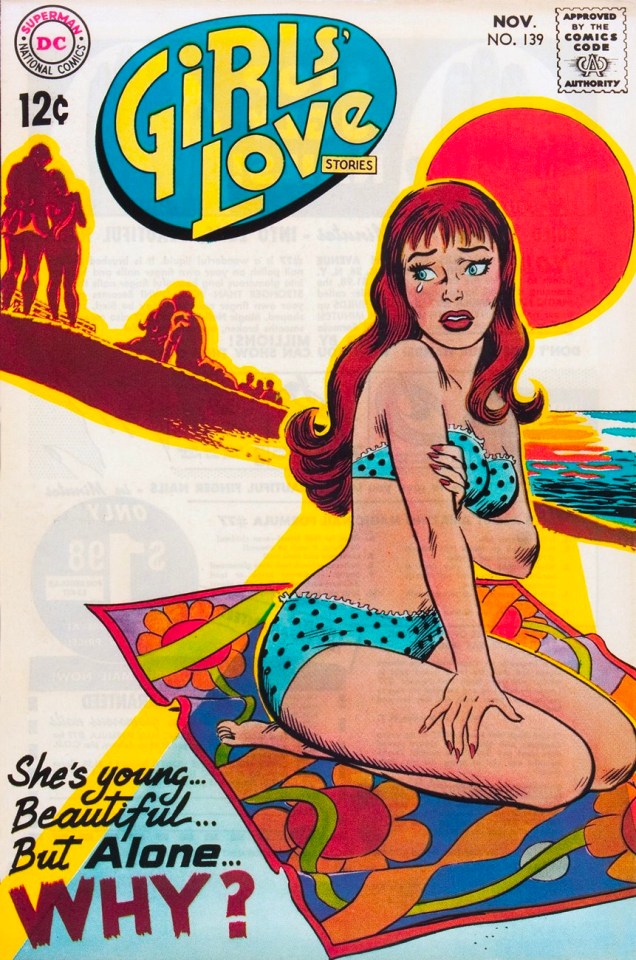
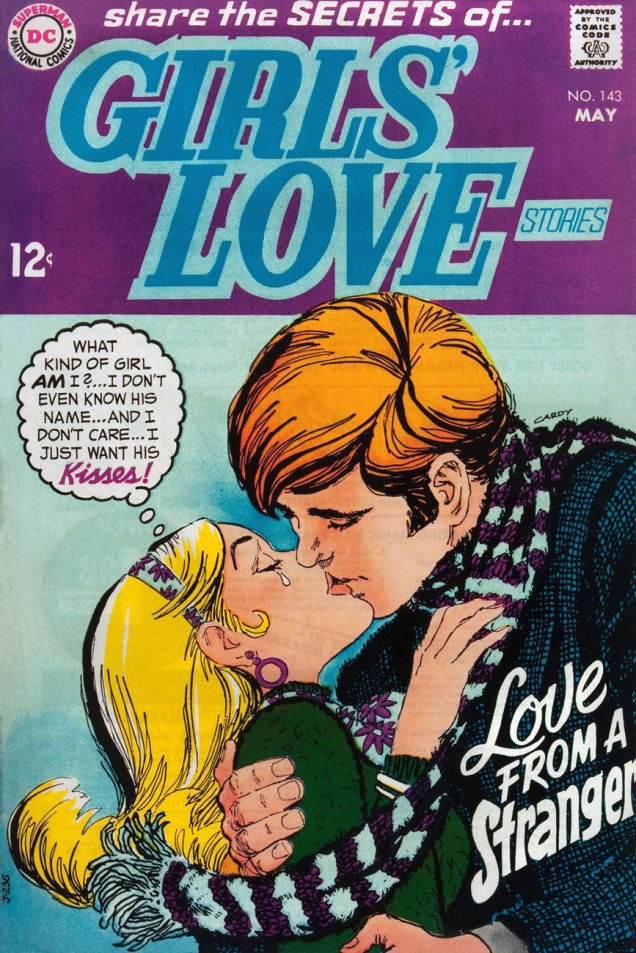
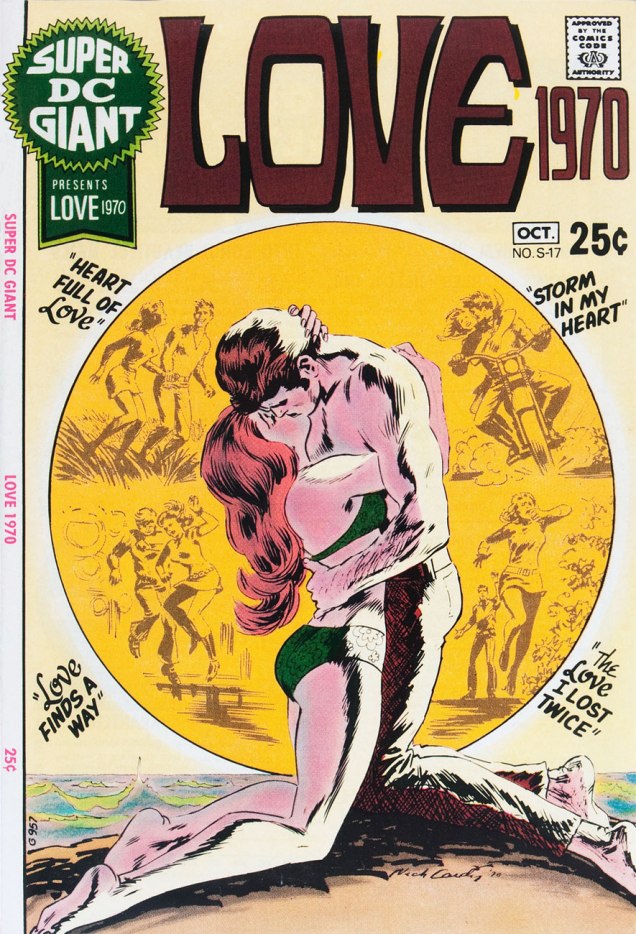
Falling in Loveno. 115 (Feb. 1970), edited by Murray Boltinoff.Falling in Loveno. 119 (Nov. 1970), edited by Murray Boltinoff. Something tells me Mr. Older Generation is holding a pipe off-panel.« Goodbye, and as my sister once said, good riddance! » This great Nick Cardy cover puts an attractive spin on an issue unfortunately marred by the omnipresent and indigestible Vinnie Colletta sauce over half the stories. Poor Ric Estrada and Werner Roth! Girls’ Romances enjoyed a healthy 160-issue run from 1950 and 1971. This is number 144 (Oct. 1969).« Rumors are carried by haters, spread by fools and accepted by idiots. » – Unknown purveyor of sage quips – This is Girls’ Love Stories no. 139 (Nov. 1968) Edited by Jack Miller. Inside: The Only Man for Me, illustrated by Ric Estrada, How Could He Stop Loving Me?, by Tony Abruzzo, a Mad Mad Modes for Moderns from Jay Scott Pike, a reprint from 1963, Kiss Me If You Dare, by John Romita, Sr. and Bernard Sachs, and our cover story, She’s Young, Beautiful–and Alone! … Why?, illustrated by John Rosenberger.Girls’ Love Stories no. 143 (May 1969), edited by Joe Orlando, who couldn’t be less suited to the genre. Cover wise, it’s not everyone’s cup of tea, I suppose, but I adore Cardy’s expressive, roughly organic inks. Still totally in control!Girls’ Love Stories no. 148 (Jan. 1970), edited by Joe Orlando.Girls’ Love Stories no. 151 (May, 1971), edited by Joe Orlando.Interesting, given that these were the prime days of women’s lib, how little actual sisterhood was in evidence in these comics. Too many *male* cooks, surely. Girls’ Romances no. 147 (Mar. 1970), edited by Murray Boltinoff. Carmine Infantino‘s fingerprints are all over this particular layout… which is more than fine: he’s a master.This is Super DC Giant no. S-17 (Sept.-Oct. 1970), “edited” by Dick Giordano. Despite comprising nothing but crappy reprints, the scarce item will cost you a pretty penny if you can find it in decent condition. Here’s its only worthy selling point, Mr. Cardy’s cover, of course.Talk about a question that provides its own answer… this is Young Love no. 74 (May-June, 1969). Edited by Dick Giordano (who lost the bet that month). Cardy’s Alex Toth-ish side rises to the surface.Young Romance no. 157 (Dec. 1968 – Jan. 1969), edited by Joe Orlando. Never was the “Have a Fling With…” tag more appropriate… and more disturbing. « Oh, Ann-Margret‘s your mom? »Young Romance no. 163 (Dec. 1969 – Jan. 1970), edited by Joe Orlando. YR, as you may know, was the original romance comic book, created way back in 1947 by Joe Simon and Jack Kirby. Things improved near the end of the series’ run, when Simon briefly returned to ride it into the sunset.
As I pointed out during my initial foray into the tangled relationship between superheroes and tentacled creatures (Superheroes in Octopus Land), even heroic stock characters with extraordinary powers get bested by the occasional octopus, be it of oceanic, mystical, or outright intergalactic origins. Some of these monsters are aliens from proverbial outer space, some swam out from the depths of the sea for reasons they alone comprehend; some are plants, some are mammals – animal, mineral, or vegetable in form and content.
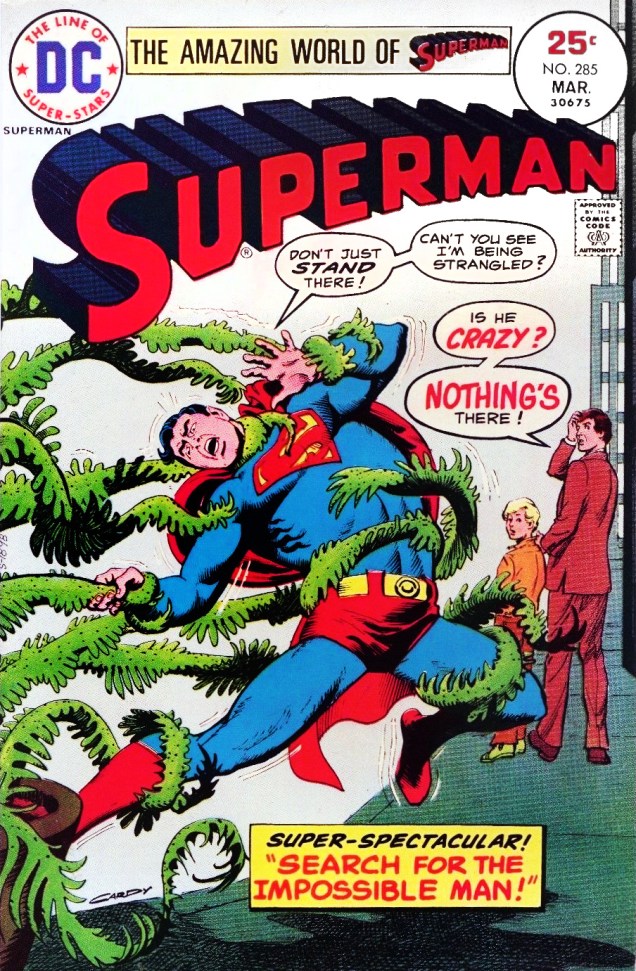
Our first entry is someone who’s faster than a speeding bullet… but requires a passerby’s help to get rid of some pesky plant tentacles. None too impressive for someone of his calibre, the first superhero that comes to mind for most.
Superman no. 285 (March 1975). Cover by Nick Cardy.
That’s enough bumbling. I’ll move on to someone who can *really* handle tentacle problems!
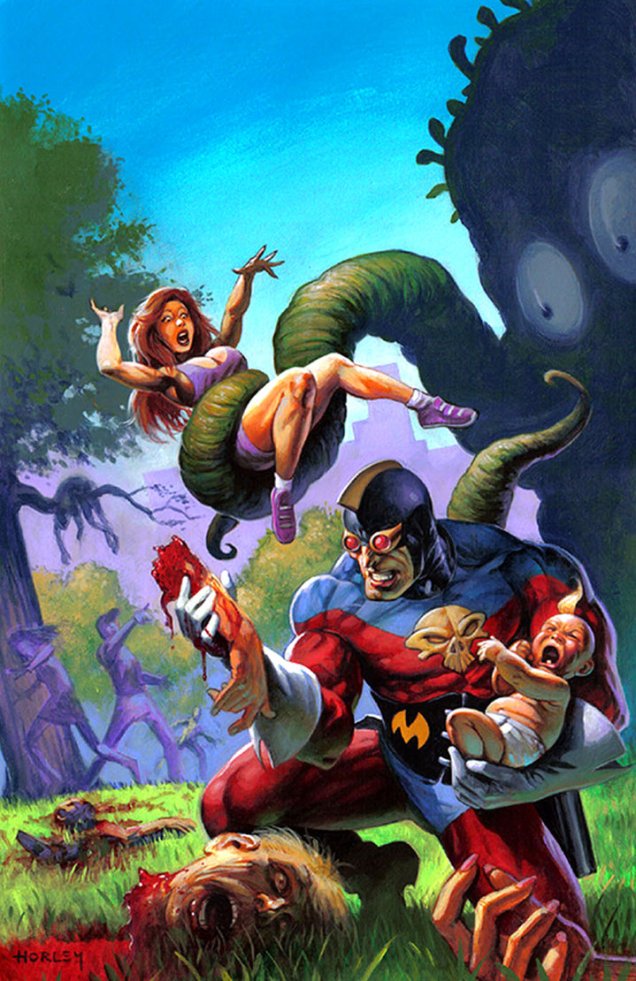
“High atop Slaughter Mountain, where the rain never stops, stately Stearn Mansion stands silhouetted against the blood-red moon. This is the home of Dr. Strongfort Stearn, known throughout the world as … Mr. Monster!! From this lofty perch, Doc Stearn peers unflinchingly into the black abyss below. For it is Mr. Monster’s mission to search out evil — and destroy it!” Today Mr. Monster is fighting a cute octopus with googly eyes. Sometimes monsters look most innocuous, you know.
Original art for Mr. Monster: Who Watches the Garbagemen? (2005). Cover by Alex Horley. As usual, the octopus has excellent taste in women.
And this is the way it was published:
Mr. Monster: Who Watches the Garbagemen? (2005). Cover by Alex Horley.
« Since the first simple life-form crawled from the pounding turf, the sea has been laced with legend! From the daring men who faced the raging waves in primitive wooden craft to those who probe the hidden depths today in devices of plastic and steel, fables have been passed, secrets whispered from father to son… » And where there’s sea legends and fables of raging depths, there’s tentacles, you can be sure of that. Can the mysterious Phantom Stranger cope with them?
The Phantom Stranger no. 18, March-April 1972, with art by Neal Adams.
Maybe saying that starfish have tentacles is stretching it a bit, but just look at the way their arms bend at the ends! Besides, they can “walk” using their tubed appendages, which look like tentacles to all but the most pedantic.
Justice League of America no. 190 (May, 1981); cover by Brian Bolland, with colours by Anthony Tollin. This may not be a fashion statement, but think of all the money people would save on makeup and surgery!
Starro, a.k.a. Starro the Conqueror, was created by Gardner Fox and Mike Sekowsky in 1960. He’s a mean, stubborn alien lifeform with an idée fixe to enslave mankind, which he repeatedly tries to do by scattering his starfishy spores (which grow into clones of himself) over large cities. And, yes, he has prehensile extremities; it’d be difficult to wreak as much havoc without them.
Technically, Medusa’s got hair, not tentacles, but she expressed the wish to be part of our Tentacle Tuesday line-up… and I am not going to argue with a woman with hair that can knock out an army.
Created by Jack Kirby, Medusa first appeared In Fantastic Four #36 (1965). This is a pin-up from Fantastic Four Annual #5, November 1967; pencils by Kirby, inks by Frank Giacoia.
A panel from Batman, Inc. no. 1 (January 2011), pencils by Yanick Paquette and inks by Michel Lacombe.
Does anybody have an answer for catty Ms. Kyle? I’ll see you next Tentacle Tuesday – until then, keep away from hungry and horny octopuses.
In this installment of Tentacle Tuesday, we shall bear witness to a somewhat surprising facet of superhero life: superheroes sometimes struggle with tentacles, too.
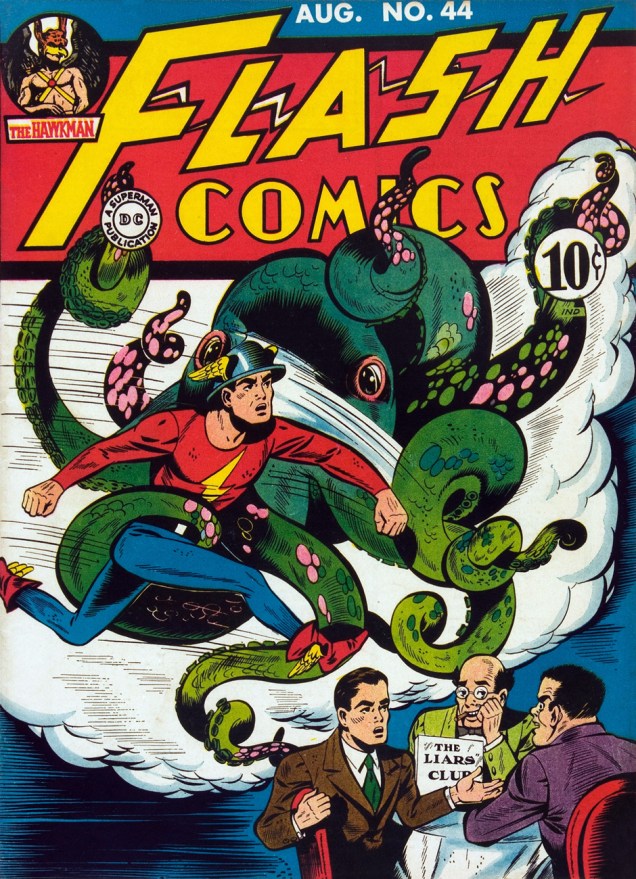
To kick off the festivities (and to respect a chronological order of creation and publication), here’s The Flash narrating a story of woe, his almost-deadly encounter with a green monstrosity (Judging by its coquettish pink tentacles, the monster wanted to woo him, not snuff him out.)
Flash Comics no. 44, 1943. Cover by Lou Ferstadt (1900-1954), and here’s a bit of trivia: in addition to being a comics artist, he was a muralist, creating works for the RCA buildings and the 8th Street Subway station in NYC.
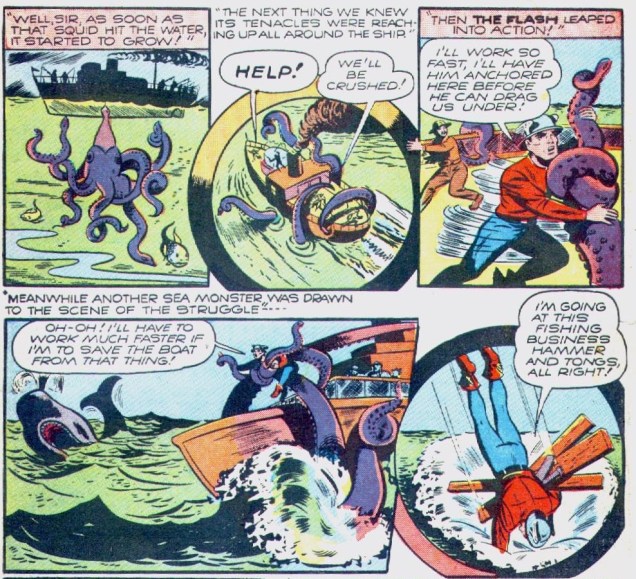
« The Liar’s Club », scripted by Gardner Fox and drawn by Lou Ferstadt, concerns itself with three men (one of whom is Jay Garrick, secretly The Flash) holding a fibbing contest to determine who can tell the biggest Flash-whopper.
Sadly, this tale was not the winner in the contest.
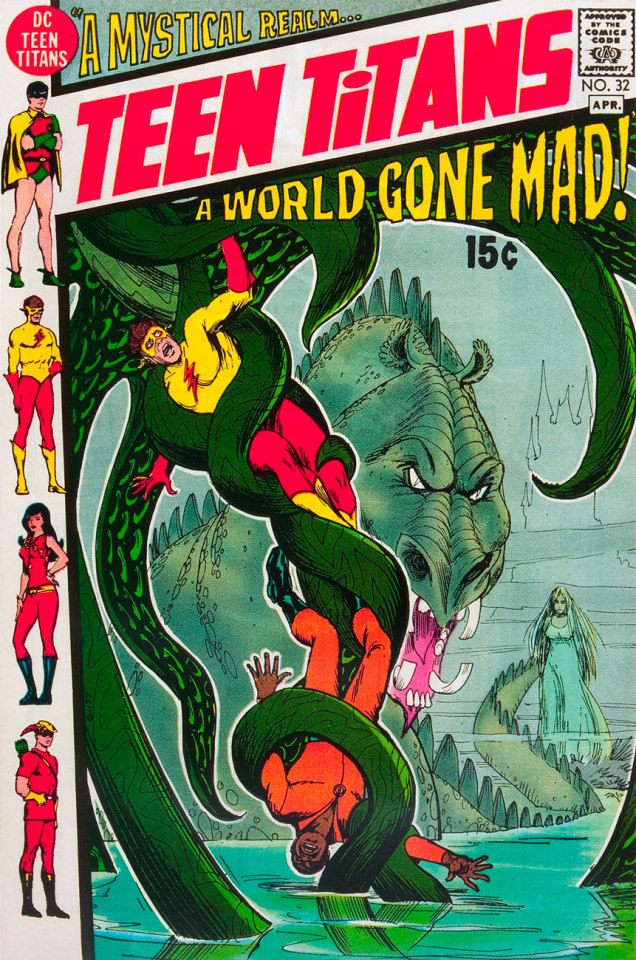
The Flash may have been embroiled in some purely imaginary tentacles, but his Earth-One counterpart’s teenage sidekick (it’s complicated), Kid Flash, encountered the real deal.
Teen Titans no. 32, March-April 1971. Drawn by Nick Cardy.
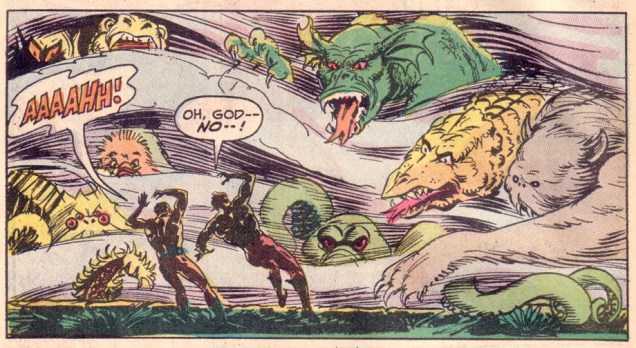
« A Mystical Realm, A World Gone Mad », scripted by Steve Skeates and drawn by Nick Cardy, is actually a pretty good read (with good art!), and I don’t even like superheroes. Just check out the beautiful results of a time travel experiment going wrong (when does one ever go right?), including the evil red eyes of a glaring octopus:
If we throw a whole bevy of superheroes at a tentacled monster, are they going to fare any better?
Fantastic Four no. 88, 1969. Pencils by Jack Kirby, inks by Joe Sinnott, letters by Sam Rosen. However… A house there was. Tentacles there weren’t.
This cover promises lots of tentacular fun. Instead of that, the Fantastic Four (and an infant) go looking for a new residence, something quiet and secluded – and the house that’s offered to them by a real estate agent appears to be haunted. At the very least, it causes migraines, gradually makes its inhabitants go blind, and shoots stun bolts out of its walls. The usual crap. I don’t want to tell you which super-villain is behind this mischief, but I will, however, point out that the bastard doesn’t have tentacles. Not even one. And neither does his lousy house.
The Flash is small fry, the Fantastic Four are mincemeat, but let’s see how Superman, the most superhero-like superhero of them all, fares when confronted with tentacles.
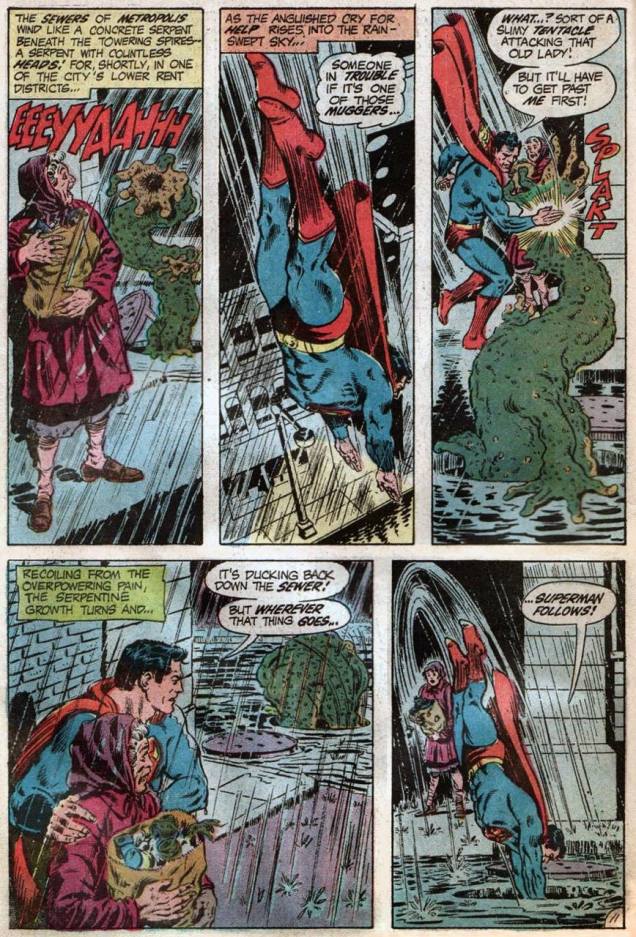
In “Danger — Monster at Work!”, the villain is a protoplasmic glob: some algae mutates after a lab accident and becomes an out-of-control, garbage-devouring, tentacled monster. Now, trash disposal is important, but when Superman realizes that everything on earth is impure to some degree, he has to stop the seaweed monstrosity before “it cleans Metropolis right off the map!”
This story was published in Superman no. 246 (December 1971), with a script by Len Wein, pencils by Curt Swan and inks by Murphy Anderson.
Incidentally, there *is* actually an algae farm that’s suspended over a highway in Geneva, Switzerland that gobbles up CO2 produced by car engines. I hope they’re keeping a close eye on it…
Tentacles? Well, “grasping appendages” anyway – let’s be generous. Superman no. 246, December 1971; pencilled by Curt Swan, inked by Murphy Anderson.
How about if we take a superhero who’s quite at ease with water, who can breathe H2O and communicate with sea life?
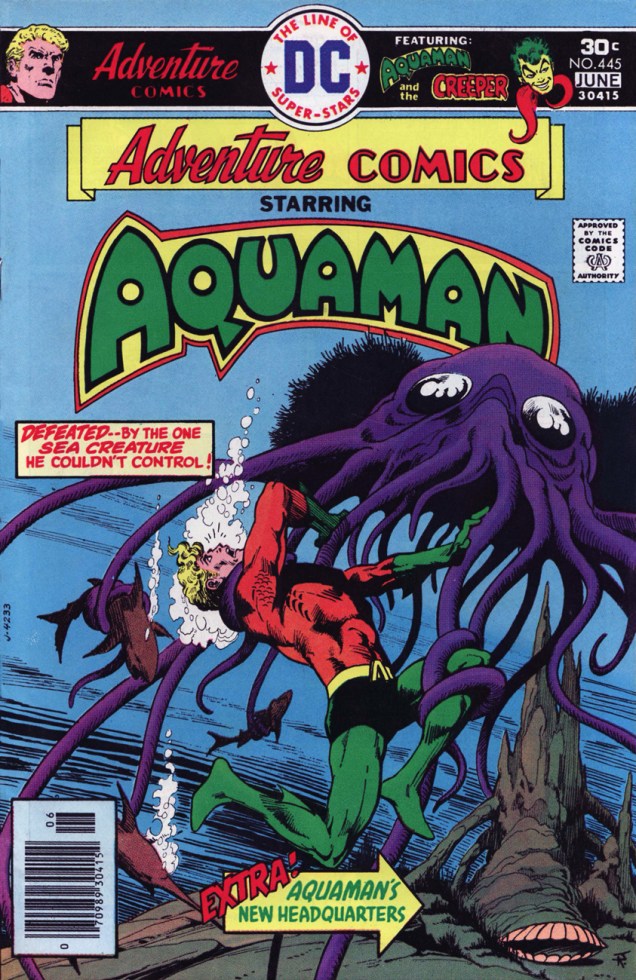
“Nope, sorry, still gonna gobble you.”
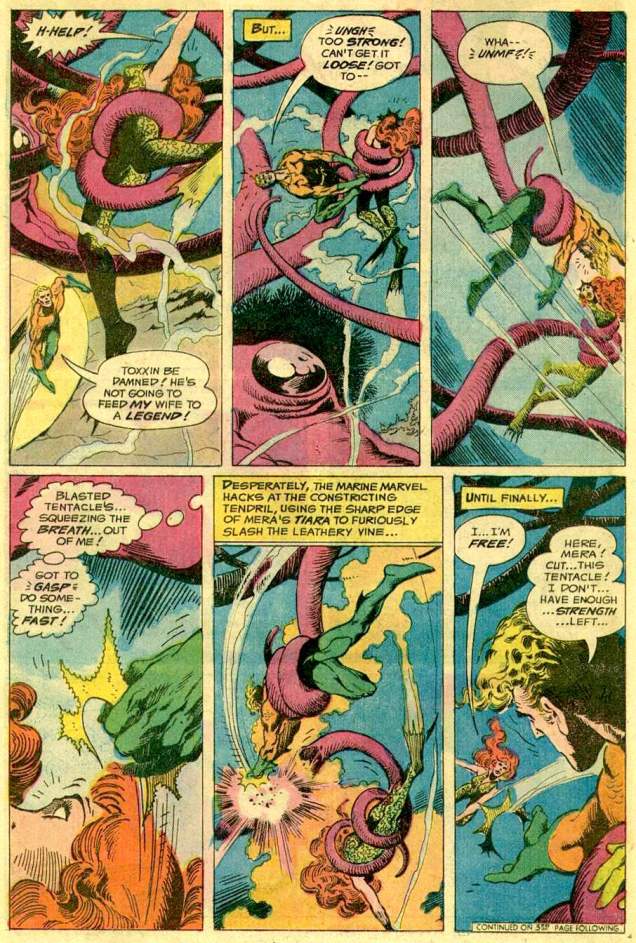
Adventure Comics no. 445 (May 1976). Cover by Jim Aparo, with colours by Tatjana Wood.This imposing figure of an octopus (even though he’s referred to as a “plant-thing” by Aquaman) is Krakor, the tentacled antagonist from “Toxxin’s Raiders” – the cover story written by Paul Levitz & David Michelinie and drawn by Jim Aparo.
Oh, no! What is our hero going to do? Why, dispatch the octopus in the most far-fetched manner possible, of course!
In conclusion, no superhero is immune from a harrowing encounter with a tentacled creature… but sadly, the latter is more often than not annihilated in the struggle. Next time, I’ll make sure to present you with some material in which the octopus gets the upper hand, so to speak!































 Who's Out There?