« Here’s to the thugs and maniacs who fill each book with concepts so damnable, so putrescent, that they make the EC horror magazines of yore seem like mere cocktail napkin doggerel. I salute you. Now I’m going to take a bath in quicklime. » — Harlan Ellison toasts Death Rattle (1986)
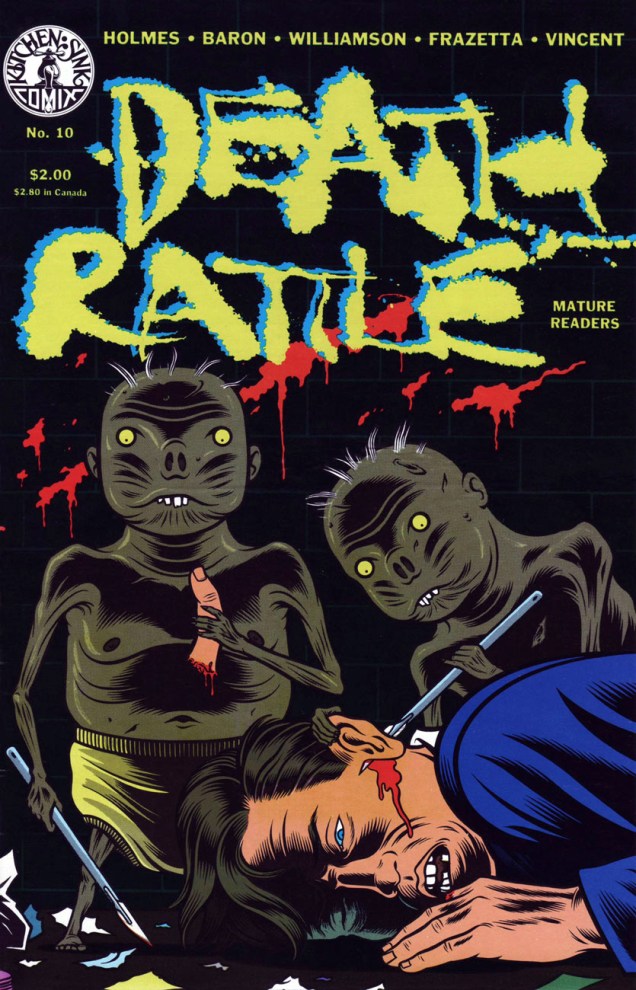
In the 1980s, with the Comics Code Authority in its death throes, you’d think horror comics would have made a massive comeback. Well, they did… and they didn’t. Since there had been plenty of black and white magazines to operate outside of the Code’s restrictions, bringing bloodshed and mayhem to colour comics made the much-anticipated liberation a bit of a non-event. For my money, the truly interesting horror material opted for different approaches, now more experimental, then rather whimsical, at times clinical, sometimes abstract. Underground comix publisher Kitchen Sink, surviving thanks to its eclectic spirit, revived its early 70s horror anthology in 1985, an adventure that this go-round lasted eighteen issues and unleashed cutting-edge, nostalgic, shiver-inducing, thought-provoking and gut-busting efforts by such talents as Richard Corben, Rand Holmes, P.S. Mueller, Jack Jackson, Stephen Bissette, Mark Schultz (his Xenozoic Tales were introduced in Death Rattle 8, in 1986), and, on this unsettling cover, Charles Burns.
This is Death Rattle no. 10 (April 1987, Kitchen Sink). Cover by Charles Burns, coloured by Pete Poplaski.
Before this cover, and speaking of clinical horror, Burns had earlier provided one of Death Rattle’s most harrowing gut-punches in issue one’s Ill Bred: a Horror Romance. I wouldn’t want to give away too much, but here are a few samples from this queasy masterpiece of gender fluidity, body horror and (justified) insect fear, seemingly inspired in equal parts by David Cronenberg films, Japanese art prints and Burns’ personal demons. Not for the queasy, but peruse it here if that ticks any of your happy boxes.
« You know, the dog food that Billy Jack loves! » — The Firesign Theatre
Ah, September the 18th. Today’s the birthday of the staggeringly accomplished William Stout (born in 1949), master of ancient reptiles, bootleg record covers, friend of The Firesign Theatre, former Russ Manning assistant (none but the best would do!), and I’ll spare you the illustrious details of his career in cinema. Still, let’s look around a bit, shall we?
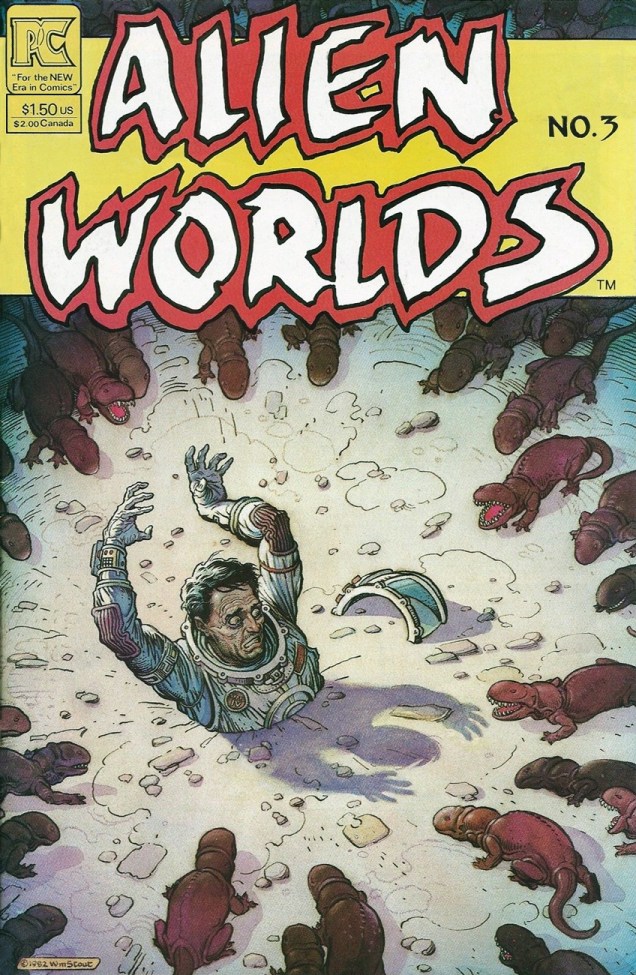
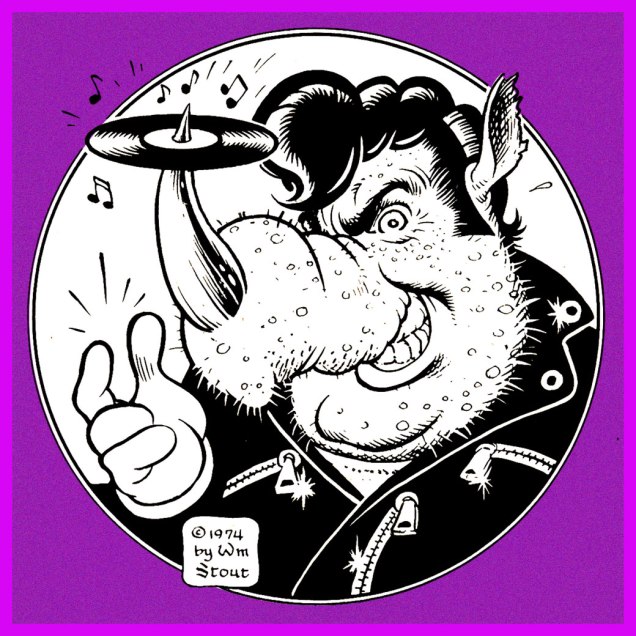
Here’s an unforgettable cover from Alien Worlds no. 3 (July, 1983, Pacific Comics). This scene gave me nightmares, and still raises a shudder. These critters look like a hybrid of a platypus and a piranha. Happy landings!Stout’s wonderful original logo for Rhino Records, circa 1974.
Speaking of ’74, isn’t that rhino a dead ringer for Swan’s oleaginous right-hand man, Philbin, from Phantom of the Paradise?
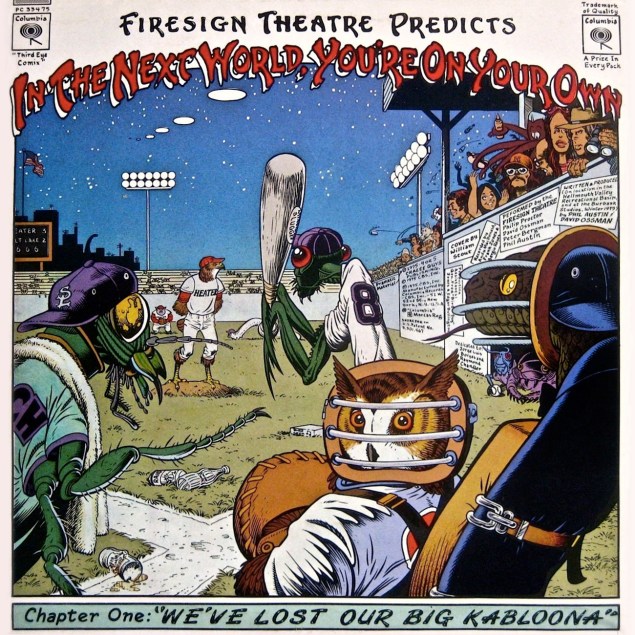
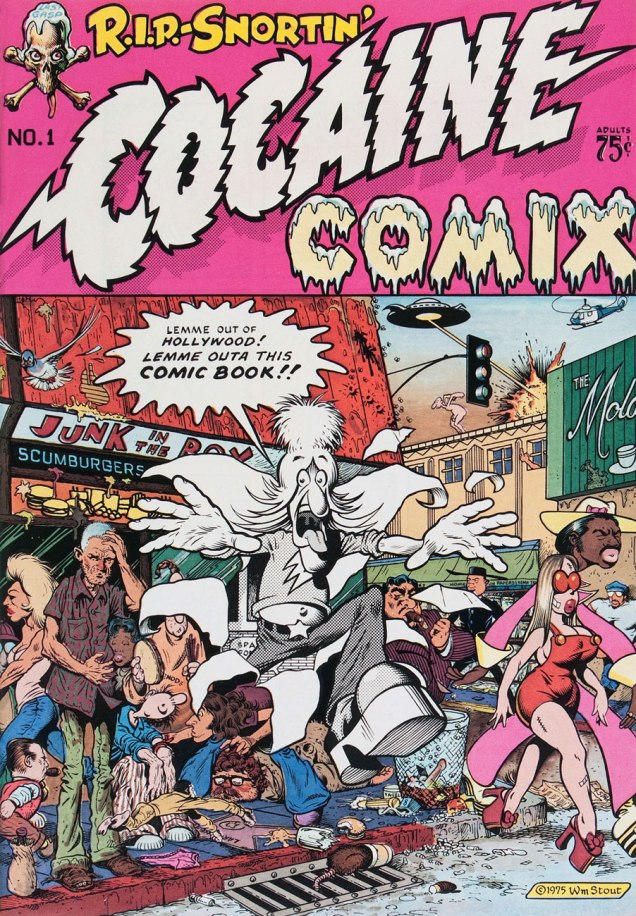
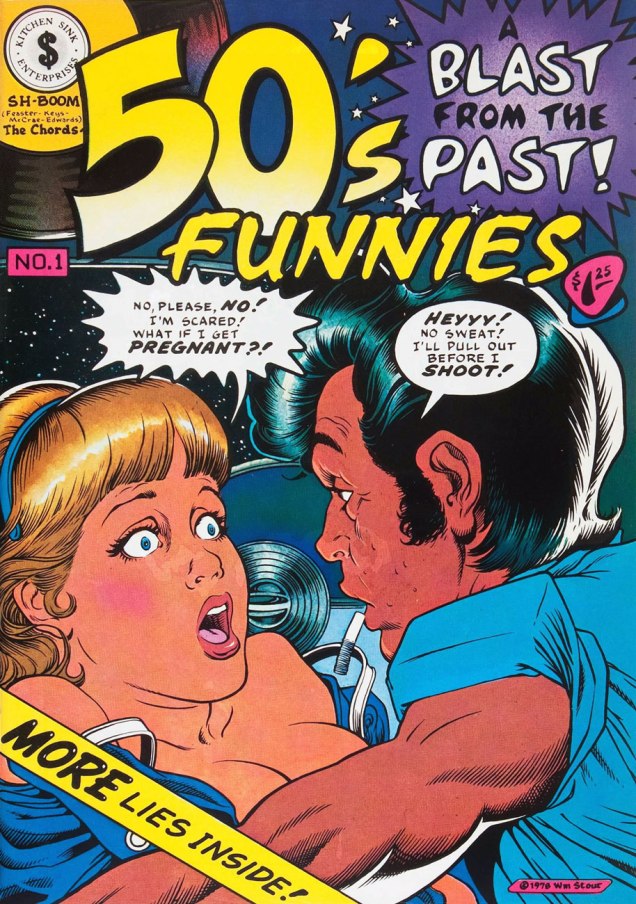
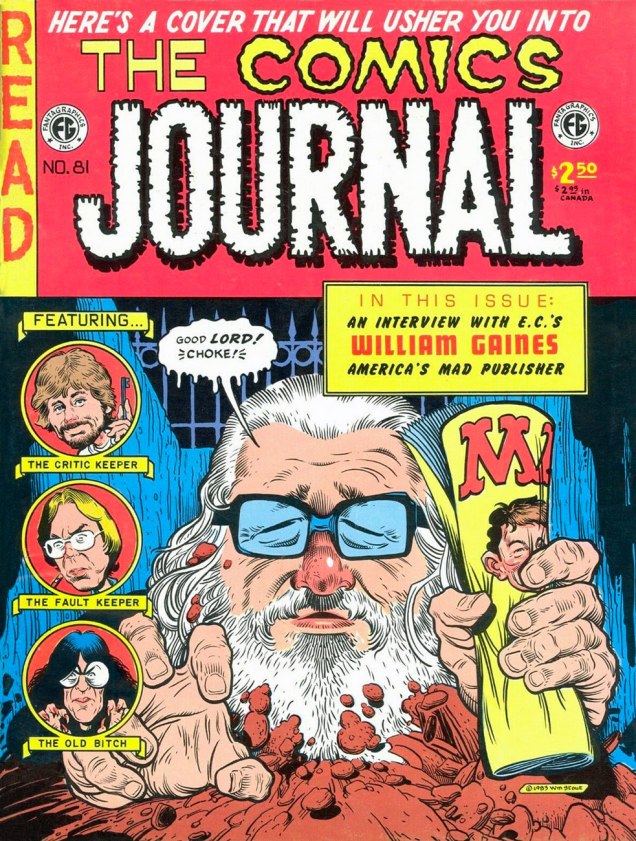
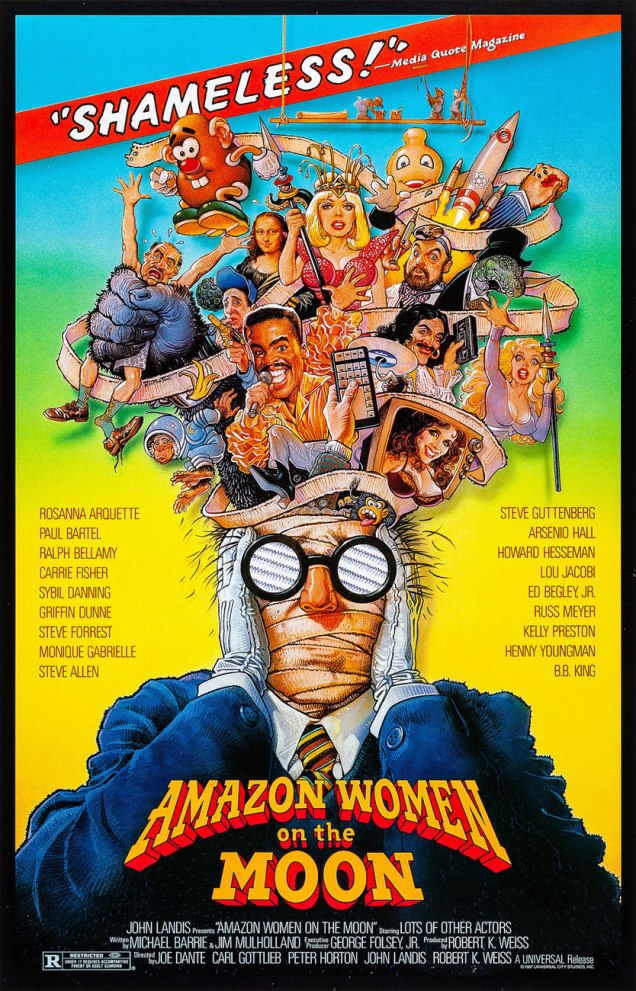
This is the back cover (the recto is equally sumptuous) for The Firesign Theatre‘s 1975 opus, In the Next World, You’re On Your Own, featuring a pair of classic sidelong suites, Police StreetandWe’ve Lost Our Big Kabloona.A clutch of underground classics? Sure. Here’s Cocaine Comix no. 1 (Feb. 1976, Last Gasp).Another number one (with a bullet, of course): 50’s Funnies no. 1 (1980, Kitchen Sink). More lies inside!A favourite page from Stout’s masterpiece (or certainly his great labour of love, at the very least): The Dinosaurs: A Fantastic New View of a Lost Era (1981, edited by Byron Preiss). This piece (the first he drew for the book) is entitled Hot Weather. « After lifting his head for air, he drank more and then wallowed his whole length and breadth into the ooze, vocalizing for the first time that day, and loudly. »Say hello to friendly Ed Gein. Weird Trips no. 2 (1978, Kitchen Sink). Please note the sinisterly customized Kitchen Sink Enterprises logo, Wrightson–brand coffee, and EC Comics narrator The Old Witch impishly peeking from a lower-right shelf. And yes, can’t go disemboweling your fellow man and woman without a copy of Gray’s Anatomy. Preparation is everything!Well, there never was any doubt that Mr. Stout was an EC Comics überfan. The Comics Journal no. 81 (May, 1983, Fantagraphics).I did bring up his Hollywood work, so here’s a sample. I wasn’t going to go with his the far-too-familiar Rock ‘n’ Roll High School poster… you all know it already, so where’s the fun in that? Of course, Joe Dante’s Amazon Women on the Moon again (1987) raises the eternal question: « Who made Steve Guttenberg a Star? »
And that’s Bill Stout for you: stunningly versatile, but always himself. Could any artist strive for more?
« Three A.M. The radiators in Commissioner Dolan’s office had long ago conked out… and those of us who could not go home waited… tried in various ways to ignore the damp cold made even more unbearable by the January rain. » — The Spirit, Jan. 8, 1950
Welcome back! Today, we wrap up Kitchen Sink Press’ experimental continuation of Warren Magazines’ run of The Spirit. By now, Denis Kitchen was probably coming to terms with the fact that building upon Warren’s non-system of random Spirit reprints was not only a dead end, but one with mercilessly diminishing returns, even with so deep and rewarding an archive as Will Eisner’s.
Still, don’t worry, we’re hardly running out of dazzling visuals to tickle your eyeballs with.
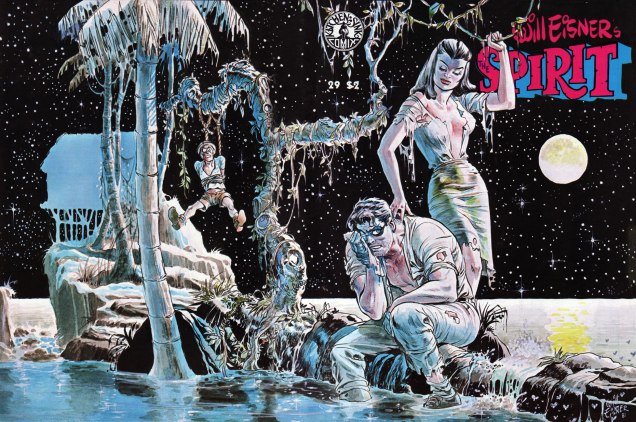
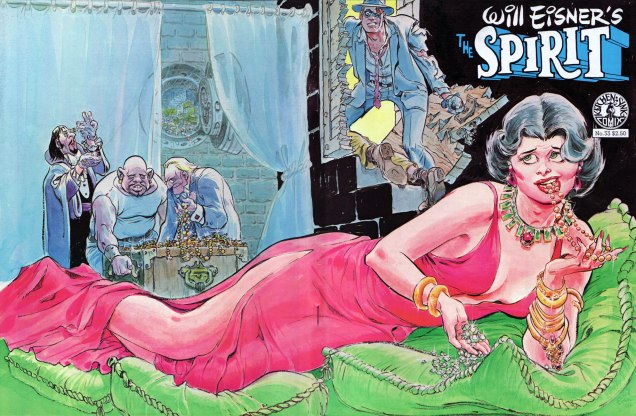
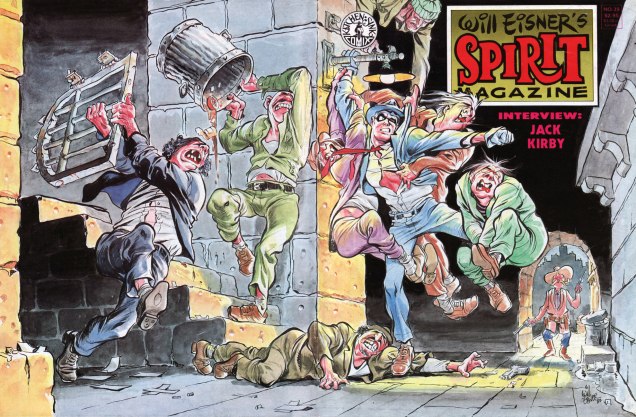
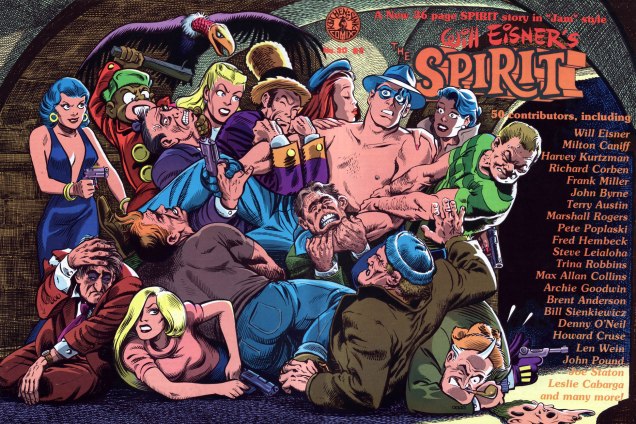
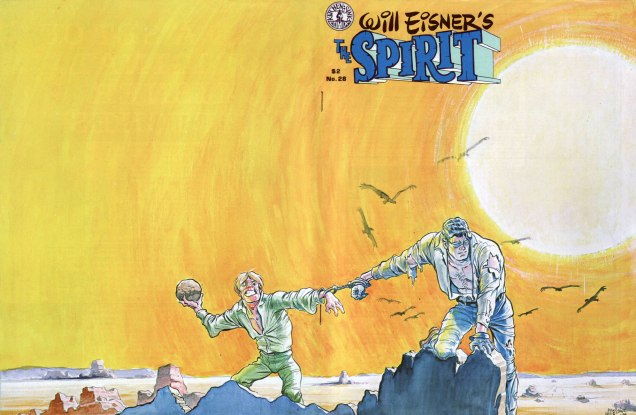
This is The Spirit no. 29 (June, 1981), featuring a mere four Spirit tales, namely: “Framed” ((Nov. 24, 1940); “Sasha’s Sax” (June. 28th, 1942); “Blood of the Earth” (Feb. 26, 1950); cover-featured “The Island” (March 26, 1950) , as well as plenty of fine new material by Eisner.This is The Spirit no. 31 (Oct. 1981), featuring four Spirit tales: “Wanted for Murder” (Feb. 5, 1942); “The Siberian Dagger” (Jan. 27, 1946); “Just One Word Made Me a Man!” (Jan. 18, 1948); “The Barber” (Oct. 22, 1950), some new Eisner material and the second instalment of “Shop Talk”, in which Eisner interviews one of his peers. This time out: Harvey Kurtzman.This is The Spirit no. 33 (Oct. 1981), featuring a quartet of Spirit tales: “The Haunted House” (Dec. 8, 1940); “Slim Pickens” (Dec. 15, 1940); “The Portier Fortune” (Dec. 1, 1946); “Dolan Walks a ‘Beat’!” (Apr. 17, 1949), an Eisner tutorial and a look at Eisner’s P*S Years.This is The Spirit no. 39 (Feb. 1983), featuring five Spirit adventures: “Dead Duck Dolan” (Mar. 2, 1941); “Tarnation” (Mar. 3, 1946); “Voodoo in Manhattan” (June 23, 1940); “The Van Gaull Diamonds” (Dec. 15, 1946), “Veta Barra” (July 29, 1951), and a 12-page Shop Talk with Jack Kirby!As a bonus, here’s the cover of The Spirit no. 30 (July, 1981), which features an amusing, but understandably uneven brand-new 36-page Spirit jam calling upon a whopping fifty pairs of paws. If only this had been the only time Frank Millertried his hand at Will’s creation… The issue also features pair of vintage yarns: “Army Operas No. 1” (Dec. 21, 1941) and “Beagle’s Second Chance” (Nov. 3, 1946). Can you identify all the cover jam contributors? Beware, though: that Pete Poplaski is a redoubtable stylistic chameleon.Here’s the key.
After 25 issues of The Spirit magazine (on top of Warren’s run), Denis Kitchen and Will Eisner would press the reset button and begin again in the comic book format. In part three, we’ll see how that endeavour fared.
If you’ve just joined us mid-programme, fret not: simply rewind to our earlier instalments, if you will:
… or simply click on its general category, That’s THE SPIRIT!, and find yourself with everything at your purple-gloved fingertips (don’t think you fooled us, Octopus!)
Death rat·tle (/ˈdeTH ˈˌradl/), noun: a gurgling sound heard in a dying person’s throat.
Greetings! Today we explore Kitchen Sink‘s mostly-black-and-white horror anthology (drum roll, please) Death Rattle, which ran between 1972 and 1996 in three distinct “volumes” (please don’t forget your professional spelunking gear, things might get messy). For the pedants in the audience (and let’s be honest, that’s probably the majority of us comic-loving freaks), the break-down goes like this:
Volume 1, 3 issues published between June 1972 until June 1973 under the Krupp Comic Words imprint; volume 2, 18 issues published between October 1985 and October 1988 under Kitchen Sink Comix; finally, volume 3, five issues published between December 1995 and June 1996, also under Kitchen Sink Comix. I must admit that that my favourite period is Volume 2, and it’s from these issues that most material presented below has been drawn.
There is already a Tentacle Tuesday devoted to Kitchen Sink (see Tentacle Tuesday: The Kitchen Sink Touch) featuring, among other things, two splendid Death Rattle covers. We have also previously ogled some DR inside art in Tentacle Tuesday Masters: Rand Holmes. Today we take a longer peek into the stories promulgated by this fantabulous anthology. Get ready for some nasty fun!
(Man, I’ve got to tone down my build-ups…)
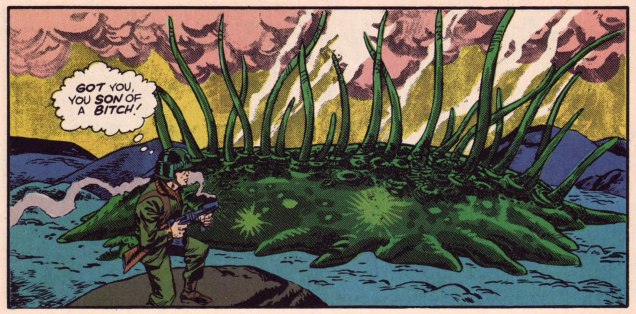
Panel from Mind Siege! by Steve Stiles, published in Death Rattle no. 3 (February 1986). The “my god!! so BIG!!” alien has the power to telepathically send mind-shattering hallucinations, eventually driving (nearly) everyone on earth insane. This issue also provides the first installment of Jaxon’s epic series Bulto… the Cosmic Slug (collected as Secret of San Saba: A Tale of Phantoms and Greed in the Spanish Southwest in 1989, for those interested).The last soldier on earth killed it! …Or did he? Panel from Mind Siege! by Steve Stiles, published in Death Rattle no. 3 (February 1986).
The first 5 issues of Death Rattlevolume 2 appeared in glorious colour, after which the series reverted to its standard black-and-white (financial hurdles). Issue 7 came out proudly bearing the slogan “too gruesome for color!” Issue 5 gave more details of the change to come:
« It will still be printed on quality paper, so you archivists out there won’t have trouble preserving disintegrating, rotting, putrid copies that look like they’ve just risen zombified from a Graham Ingels story. We’ll still be printing atmospheric stories of the unusual, the eerie, the — dare we say it — ghastly. So let’s rejoice, not mourn. »
I remember being vaguely disappointed for just a little while (it was nice to have colour), but the high quality of (most) stories made it easy to get used to the switch, and I really liked the unapologetic way Kitchen Sink confronted their audience, making a good thing out of a bad thing.
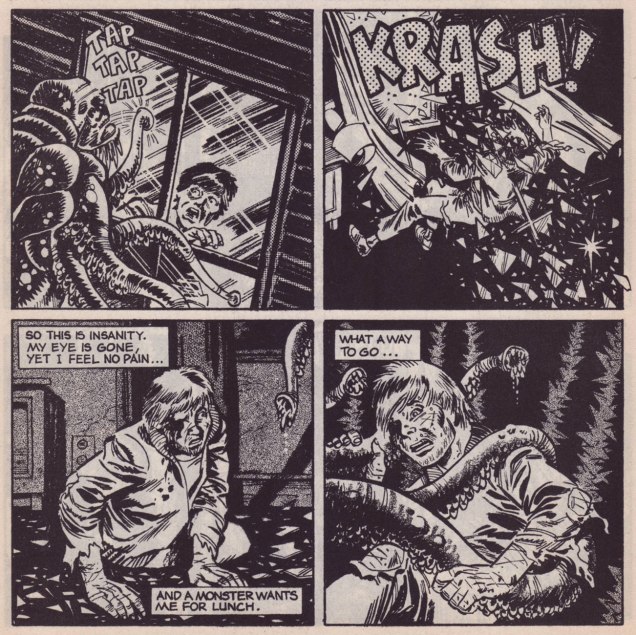
Polite monsters knock before smashing noisily through the window. Page from Old House, scripted by Kenneth Whitfield and drawn by Steve Stiles, published in Death Rattle no. 7 (October 1986).Page from Old House, scripted by Kenneth Whitfield and drawn by Steve Stiles, published in Death Rattle no. 7 (October 1986).
I didn’t realize it immediately, but this post ends up being some sort of cephalopod love song to Steve Stiles. Speaking of the latter, I’d like to mention that he doesn’t get enough credit for his work on Mark Schultz’s Xenozoic Tales, even though he drew Schultz-scripted back-up stories for no fewer than 13 issues of XT – and, frankly, did an excellent job. Instead of getting interrupted smack in the middle of an intoxicating story, Xenozoic Tales could have continued to thrill us if Schultz scripted and Stiles illustrated. ‘Nuff said. Visit Stiles’ website – it has tons and tons of stuff.
If I may be allowed a slight digression, here are two examples of Stiles’ recent (and computer-coloured, I’m afraid) work taken from his Tumblr blog – I think tentacles still prey heavily upon his mind! 😉
Okay, no more distractions. Back to our regularly scheduled program:
Last Exit by Steve Stiles, published in Death Rattle no. 8 (December 1986). Comics *definitely* teach us that guns are useless against tentacles.« Savoring my growing fear and horror… the crawl and prickle of my flesh.. waiting to feel the rapid feather-flutter or antennae… the clammy weight of tentacles… the jolt of pain as mandibles grip with steady pressure…» Panel from Mirrors by Eric Vincent, published in Death Rattle no. 11 (June 1987).Page from Bulto – The Cosmic Slug (part 5) by Jaxon, published in Death Rattle no. 12 (September 1987). There simply isn’t anything Jaxon can’t ace: a lot of artists have no trouble depicting curvy vixens, few artists can draw an anatomically correct horse, and even fewer would be able to create a blood-curdling scene with a manic priest and a convincing Elder God.Panel from The Arrivals by Steve Stiles, published in Death Rattle no. 12 (September 1987). Watch who you’re calling filthy, kid – soon you’ll be one of them.A bit of comic relief: panel from Dr. Stodge Rimperton, Otologist by Tony Millionaire, published in Death Rattle no. 2 (volume 3), December 1995.
« Yes, you may find yourself raving in the aisles when you read Death Rattle, although we sincerely hope not. We hope it will thrill, chill, slice, dice and possibly even amuse you. » (introduction from Death Rattle no. 4)
« Hello… Times? … I want to place an ad in your Situation Wanted column! Wanted… dangerous assignment… will go anyplace, anywhere, anytime… contact The Spirit, Box 35! » – The Spirit, Apr. 30, 1950
If you’ve followed our series dogging the steps of The Spirit, you won’t be in the least surprised that, after a sixteen (plus colour special) residency with Warren Publishing (Apr. 1974 – Oct. 1976), the late Dennis Colt found himself, after a year’s break, updating his mailing address once more. As returning publisher (and later, also Eisner’s agent) Denis Kitchen put it Kitchen Sink’s inaugural magazine issue (no. 17, Winter 1977):
« Welcome back, SPIRIT fans! Several years ago, we launched an experiment, publishing Will Eisner’s SPIRIT in ‘underground’ format. The experiment was so successful that Eisner arranged for Warren Magazines to publish his stories in a larger format, distributed on a national scale.
Seventeen issues later, we once again have the rights to THE SPIRIT. We will continue publishing stories never before reprinted, on a quarterly basis. In addition, we are adding new features, virtually eliminating the ad pages, and upgrading the quality of the paper. We hope you like the difference and will continue to support THE SPIRIT. »
Well, the first issue was all right, but looked a bit shoddy, a surprise, given the usually-solid production hand of KS’s peerless production man, Pete Poplaski. With the following, er… quarterly issue (five months later), all the kinks had been worked out, and every subsequent entry looks sharp and terrific.
Ah, but there’s the rub: Kitchen Sink’s magazine ran for 25 issues, most of them boasting spectacular, brand-new wraparound watercolour paintings by Eisner. Some brutal excisions had to be made, to say nothing of the backbreaking process of smoothly collating the front and back halves (we have standards!). Hence the necessity of “pt. 1”. Will you settle for my dozen picks of the twenty-five? I’m afraid you’ll have to.
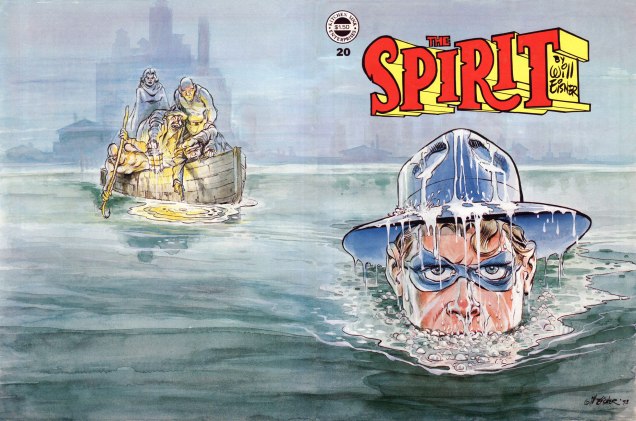
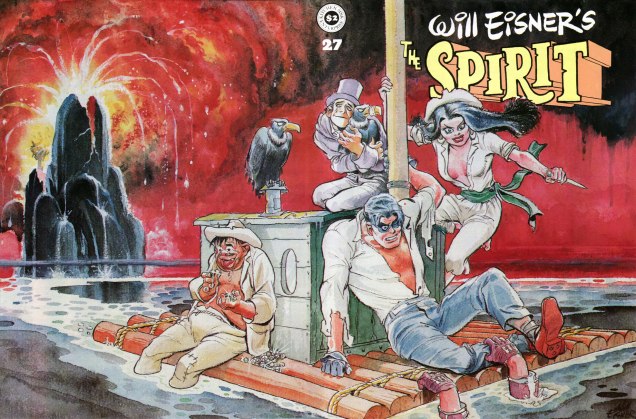
This is The Spirit no. 18 (May, 1978), featuring a half-dozen Spirit tales, namely: “The Seventh Husband” (May 20, 1951); “Thanksgiving Spirit” (Nov. 20th, 1949); “Future Death” (Jan. 21, 1951); “Barkarolle” (July 18th, 1948); “Mad Moes” (Feb. 9, 1947); “Fan Mail” (Jan. 1, 1950), as well as some vintage Clifford one-pagers by Jules Feiffer.This is The Spirit no. 19 (Oct. 1978), featuring five Spirit tales, namely: “Money, Money” (Nov. 23, 1947); “April Fool” (Mar. 30 1947); “Gold” (Oct. 10, 1948); “The Chapparell Lode” (Nov. 14, 1948); “Halloween” (Oct. 31, 1948), as well a pair of Clifford one-pagers by Jules Feiffer, a Lady Luck four-pager by Klaus Nordling, and part one of Eisner’s brand-new, hard-hitting serial, Life on Another Planet (eventually coloured and collected as Signal From Space).This is The Spirit no. 20 (Mar. 1979), featuring five Spirit tales, namely: “Quirte” (Nov. 21, 1948); “Cromlech Was a Nature Boy!” (July 4, 1948); “War Brides” (Mar. 14, 1948); “Time Bomb” (Apr. 15, 1951); “Census ’50” (June 25, 1950); and “[Mission… the Moon]” (Aug. 3, 1952), plus part two of Eisner’s Life on Another Planet and some informative articles.This is The Spirit no. 24 (May 1980), featuring five Spirit tales, namely: “Boombershlag” (Mar. 23, 1941); “Beauty” (June 9, 1946); “Cargo Octopus” (July 14, 1946); “A River of Crime” (Nov. 30, 1947); “Rescue” (Aug. 24, 1952), plus a chapter of Life on Another Planet and a host of other features, including a Spirit checklistThis is The Spirit no. 27 (Feb. 1981), featuring six Spirit tales, namely: “The Devil’s Shoes” (Feb. 1, 1942); “M.U.R.D.E.R.” (July 19, 1942); “Montabaldo” (Jan. 25, 1948); “Rife” (Jan. 14, 1951); “The Amulet of Osiris” (Nov. 28, 1948), “The Return” (Sept. 21, 1952), plus a new Eisner ‘Big City’ nine-pager, “The Treasure of Avenue ‘C‘”… and more.This is The Spirit no. 28 (Apr. 1981), featuring six Spirit tales, namely: “Sphinx & Satin” (Oct. 5, 1941); “Professor Pinx” (Aug. 2, 1942, with Lou Fine); “Survivor” (July 16, 1950); “Deadline” (Dec. 31, 1950); “Return From the Moon” (Sept. 28, 1952), “The Martian” (Oct. 10, 1952), plus a Feiffer Clifford one-pager, a ‘Shop Talk’ discussion between Eisner and Gil Kane, and so forth.
If you’ve just joined us mid-programme, fret not: simply rewind to our earlier instalments, if you will:
Kitchen Sink Press, a trailblazing publisher of underground comix that grew out of Denis Kitchen’s successful attempts at self-publishing, has seen its share of tentacles. (For a detailed story of how Kitchen Sink grew from a modest artists’ cooperative into a force to be reckoned with, as well as a discussion of its 30-year legacy, pay Comixjoint a visit.)
First we have a pair of entries from the Death Rattle catalogue. There were 3 “volumes” (series, if you will) published, and my favourite is volume 2, consisting of 18 issues coming out between October 1985 and October 1988, starting out in glorious colour but reverting to black-and-white with issue 6 (which was fine, actually). It’s a remarkably consistent anthology nearly devoid of clunkers, and featuring awesome stories and art by Rand Holmes, Jaxon, Tom Veitch, Al Williamson, Wally Wood, Steve Stiles, etc. It’s also where Mark Schultz’ Xenozoic Tales series was introduced (Death Rattle no. 8, December 1986)!
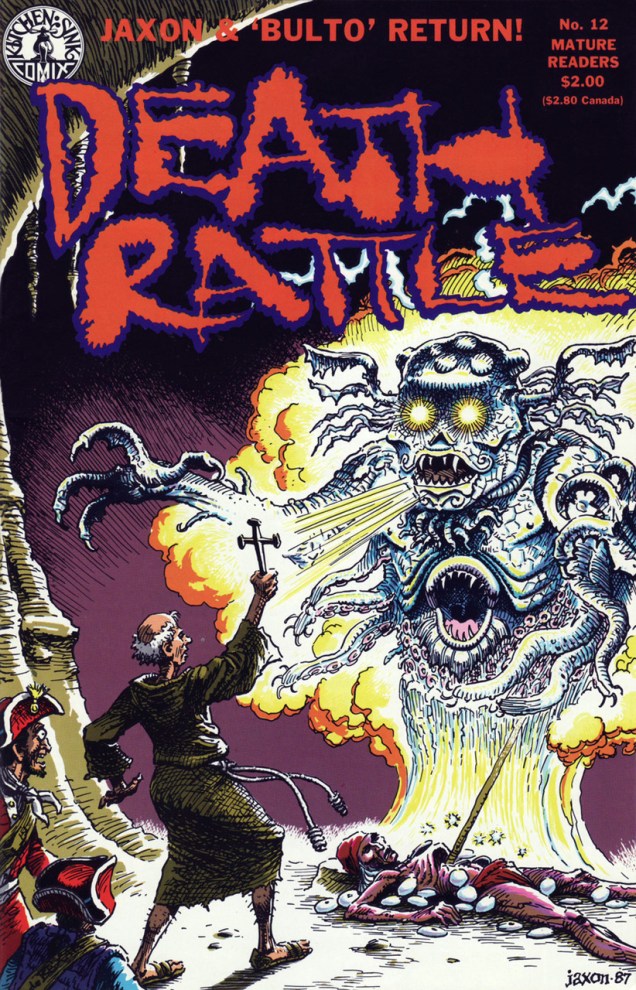
Death Rattle no. 4 (April 1986), cover by Rand Holmes, who’s already ascended to the rank of Tentacle Tuesday Master.Death Rattle no. 12 (September 1987), cover by Jaxon (Jack Jackson). The cover belongs to Jaxon’s “Bulto… The Cosmic Slug“, an epic eleven-parter that I really enjoyed reading (and not only because of its manifold tentacles). We’ll talk about that again.
Speaking of Jaxon, I’d like to quote from General Jackson, a tribute written by Margaret Moser (who dated him on-and-off through the years).
« The last time I saw Jack was a humid, late summer night in 2005 at the South Austin Museum of Popular Culture. His hair was nearly white and had lost its red-brown burnish, but his mustache was bushy as ever, and he resembled God Nose himself. He was a little grumpy, probably feeling bad, and I was with my boyfriend, so I didn’t sit on his lap. I did kiss his leathery cheek and fetch him a beer. He smelled like cigarette smoke and maybe of Old Spice.
On Wednesday, June 7, just three weeks after his birthday, Jack Jackson took his life at the graves of his parents outside Stockdale. His diabetes and arthritis were getting worse, affecting his ability to draw, and he’d been diagnosed with prostate cancer. Unwilling to face a debilitating course of chemo treatment, he put down his pen forever and made his own kind of peace with the unforgiving future. »
On to something more cheerful! Next, we have a bit of a non sequitur in this otherwise horror-centric post, although one might argue that being grabbed by an octopus is a traumatic experience. What’s The Spirit doing in here, you might ask?
« Kitchen Sink continued publishing multiple undergrounds and alternative comics through the ’80s and ’90s, but also expanded into publishing non-underground comics, graphic novels and extensive anthologies, most notably by Will Eisner, Al Capp, Milton Caniff and Harvey Kurtzman. » |source|
The Spirit no. 34 (August 1987), cover by Will Eisner.Page from “A Day at the Beach“, drawn and scripted by Will Eisner and inked by André Leblanc, printed in The Spirit no. 34 (August 1987). Somehow I’m not surprised that Eisner draws a mean-yet-elegant octopus.
All rested now? Okay, back to horror.
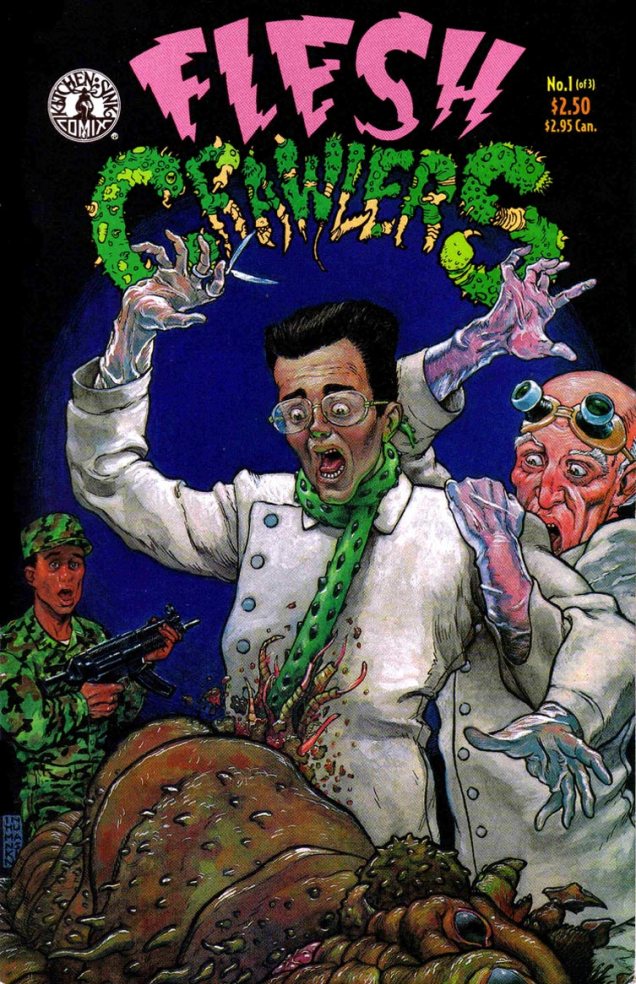
Flesh Crawlers no. 1 (1993), written by Richard Rainey and illustrated by Michael Dubisch. A quick look at the latter’s catalogue shows that Dubisch happily adds tentacles to whatever he’s drawing.
The scientist seems to have been preparing to dissect the specimen – turnabout is fair play! This cover reminds me of this, actually:
Barney & Clyde is a syndicated newspaper strip with jokes that are actually funny and characters that you can get attached to, a rarity these days. You can read it online.
Back on topic, another attack of the Flesh Crawlers:
Flesh Crawlers no. 3 (1993), written by Richard Rainey and illustrated by Michael Dubisch.
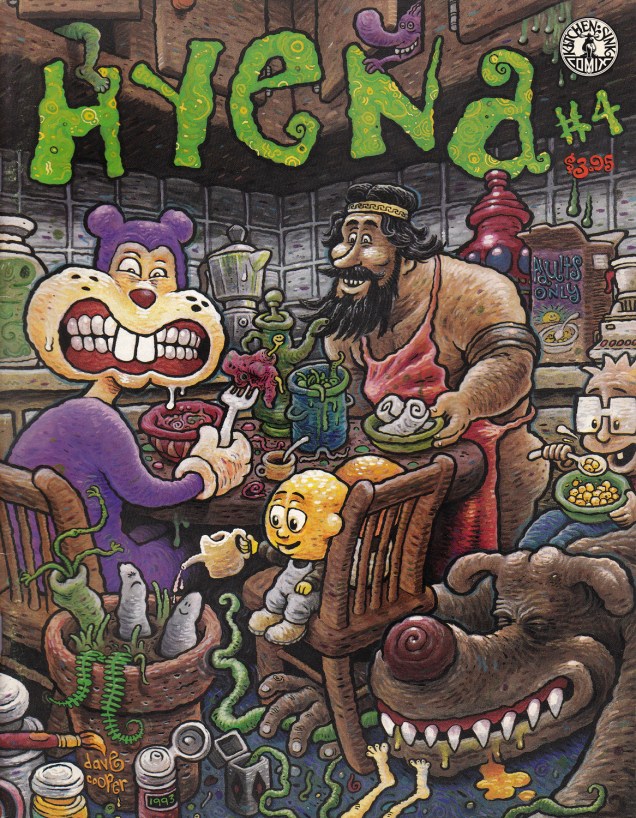
My final submission for today involves a cozy family scene where Frank is peacefully having breakfast with, err… Potted turnip babies and an almost-nude greek serial killer. I think.
Hyena no. 4 (1993, Tundra), cover by Dave Cooper. If Jim Woodring’s work frequently creeps me out, Cooper’s comics are viscerally repulsive to me (I think he goes for “nauseating” on purpose, but I’m not in the camp of people who like to experience strong emotions by watching disgusting, repulsive things happen). This cover, though, is all right.
« When I was a boy, I always saw myself as a hero in comic books and in movies. I grew up believing this dream. » – Elvis Aaron Presley (1935 — ?)
Today, somewhere, the King of Rock ‘n’ Roll celebrates his eighty-fourth birthday, be he alive, dead or undead, he lives on. And never forget: Elvis is everywhere!
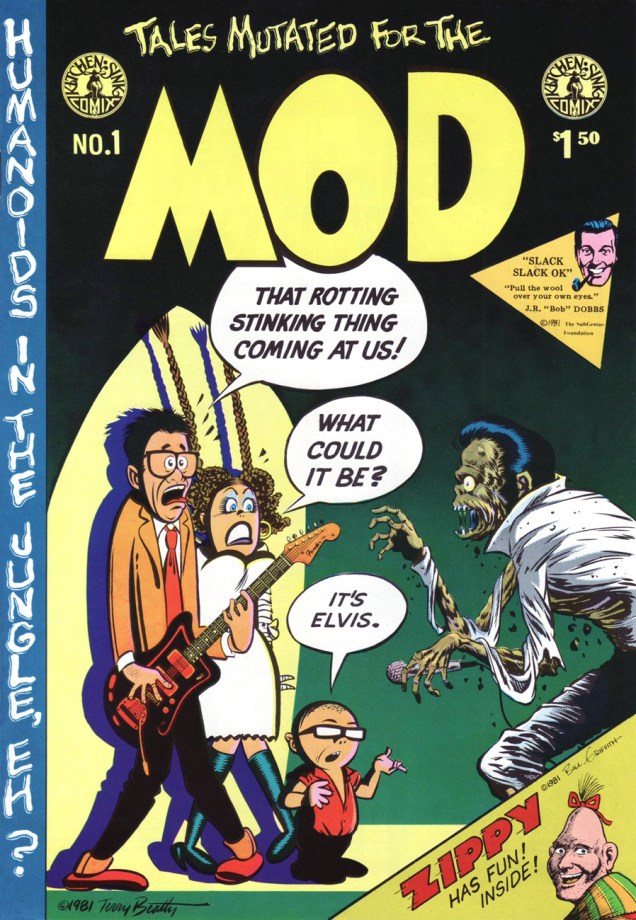
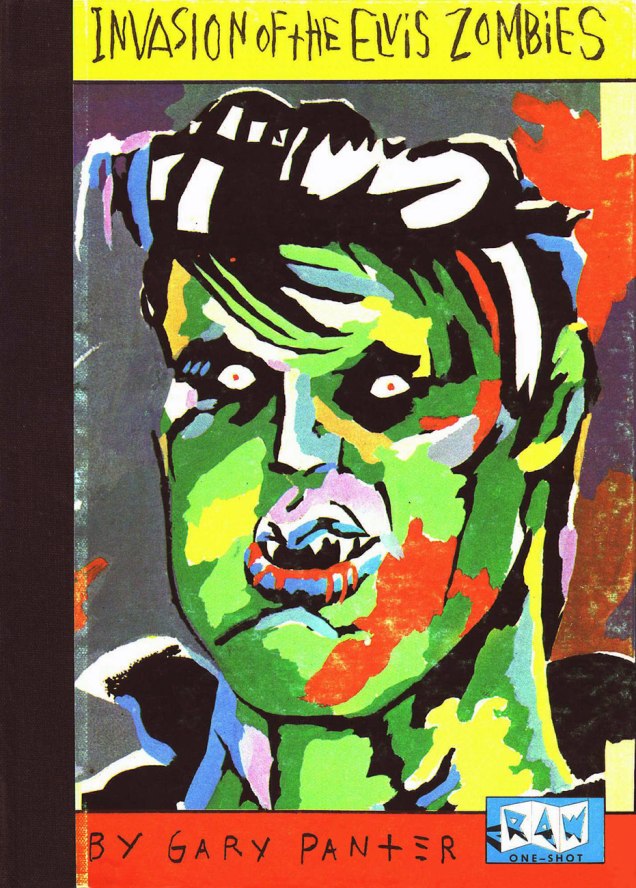
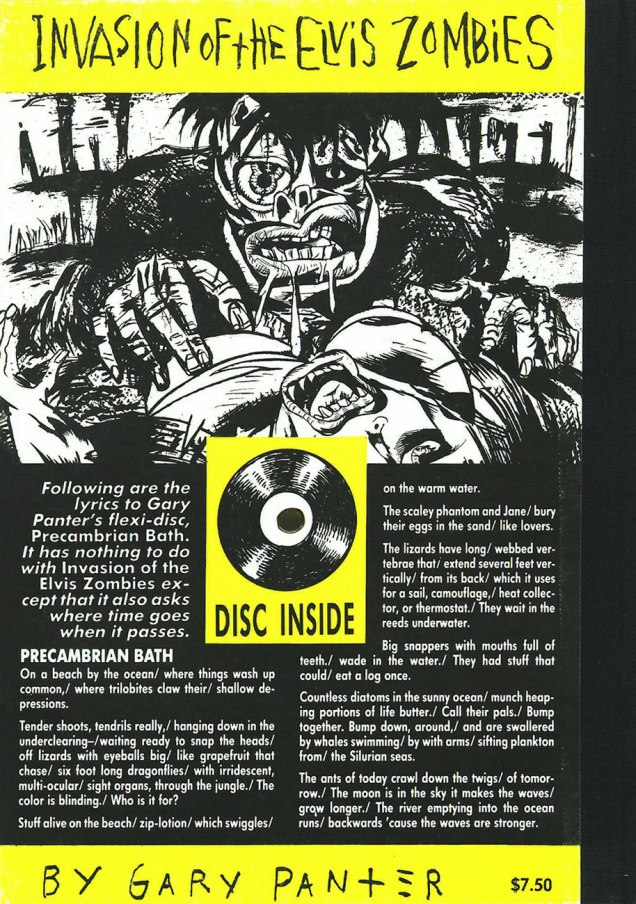
A most salty salute to the King of Rock ‘n’ Roll on his birthday! Compared to earlier decades, the 1980’s (and on!) were not kind to the anthology comic book. Thankfully, the meagre rewards and resounding indifference weren’t enough to quite dissuade some foolhardy souls from giving the format a go. But the fanboys wanted spandex, they wanted continuity and they soon wanted their « decompressed storytelling ». Bah. In 1981, Kitchen Sink Comix published the lone issue of Terry Beatty‘s labour of irradiated passion, Tales Mutated for the Mod. (June, 1981). Unlike John Byrne and others’ unceasing and pointless ‘tributes’ to Fantastic Four No. 1, this cover version of Harvey Kurtzman‘s Mad No. 1 is fiendishly clever. Kudos, Mr. Beatty!Gary Panter crafted this loving tribute in 1984, a one-shot published by RAW. Such heady stuff was well ahead of its time!The back cover… this beats Power Records‘ meek offerings flat!The oft-inaccurate Grand Comics Database really fumbles it this time: the instantly-recognizable icon on the right is, according to them… Fabian. Dopes. Hamilton, Ontario’s Win Mortimer (1919-1998), inducted into the Joe Shuster Hall of Fame in 2006, drew this cover for DC’s Heart Throbsno. 95 (April-May 1965); given the time period and The Pelvis’ shirt, he would presumably be shooting the dire Paradise, Hawaiian Style. If you’re of a mind to commemorate the King’s anniversary with one of his mid-60s cinematic offerings, better opt for the far finer Tickle Me (1965).His (alleged) paper boy claims, and I do want to believe him, that the Big E has peacefully decamped to the quietude of Eerie, Indiana. Looking good, Big E!
« You really saw that things were not at all what was portrayed in the mass media… at least not in our neighborhood. It was just a conclusion that most of the kids of that age came to, that things were extremely corrupt. » — Spain Rodriguez
While plenty of cartoonists trod the path of autobiography before him, it took Manuel ‘Spain’ Rodriguez (1940-2012) to truly show how it should be done: here at last was a genuine full-blooded practitioner, hardly content to merely observe from the sidelines, blending with the wallpaper. Lover, brawler, consummate graphic storyteller: a scarce combination indeed.
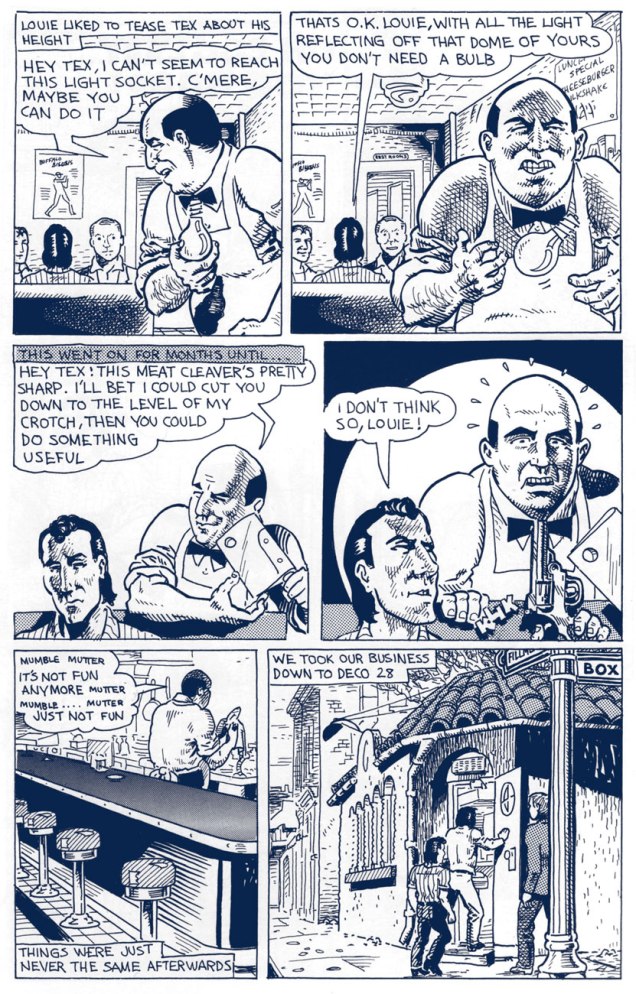
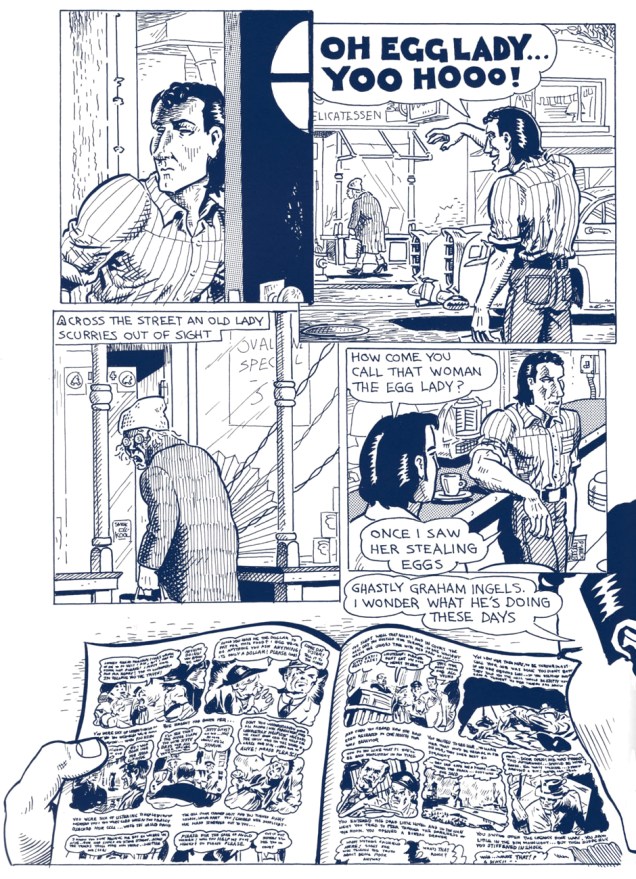
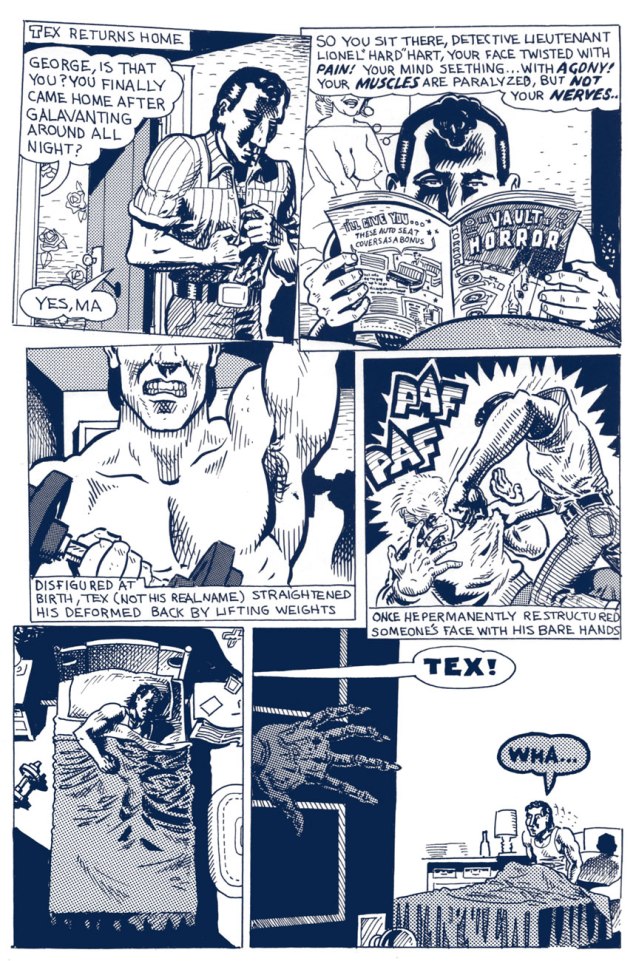
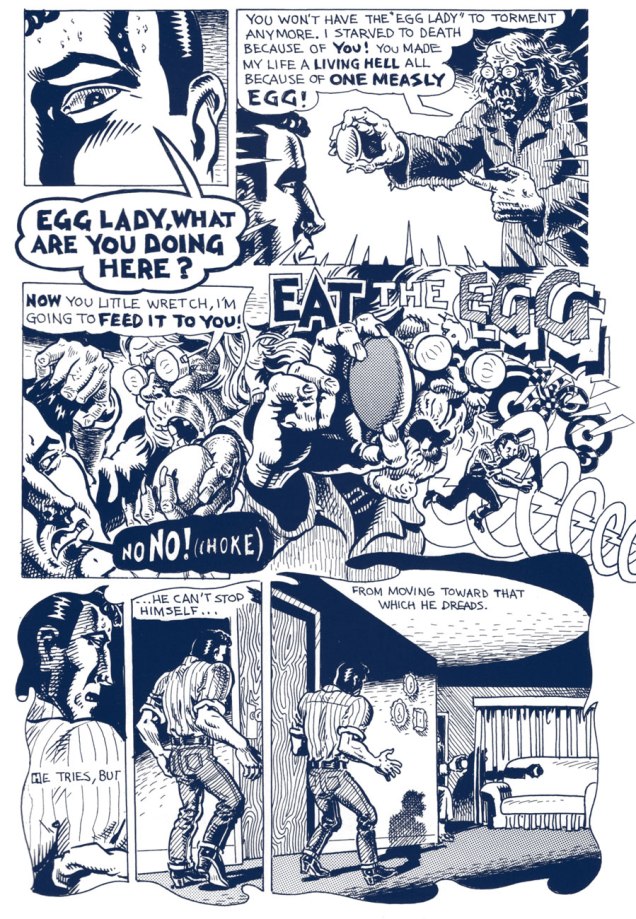
The following tale belongs to a cycle recounting the exploits and insights of The North Fillmore Intelligentsia, Spain’s closest compadres in Buffalo of the 1950s. Tex’s Bad Dream… originally appeared in Blab! No. 3 (Sept. 1988, Kitchen Sink Press); indeed, Spain’s recollections became, over time, the sole reason to purchase the once-excellent Blab! Mercifully, most of these were collected, in their usual exemplary fashion, by Fantagraphics, as Cruisin’ With the Hound (2012). You’ll still be lacking the mysteriously-omitted, quite essential « How I Almost Got Stomped to the “Still of the Night” by the “Five Satins » (Prime Cuts No. 2, Mar. 1987, Fantagraphics), which you can find in another Spain anthology, My True Story (1994, Fanta again).
In the meantime, enjoy, with my compliments, this true-life tale of original EC Fan-Addicts, facial restructuring, cautionary dreams, isometrics and pork sandwiches.
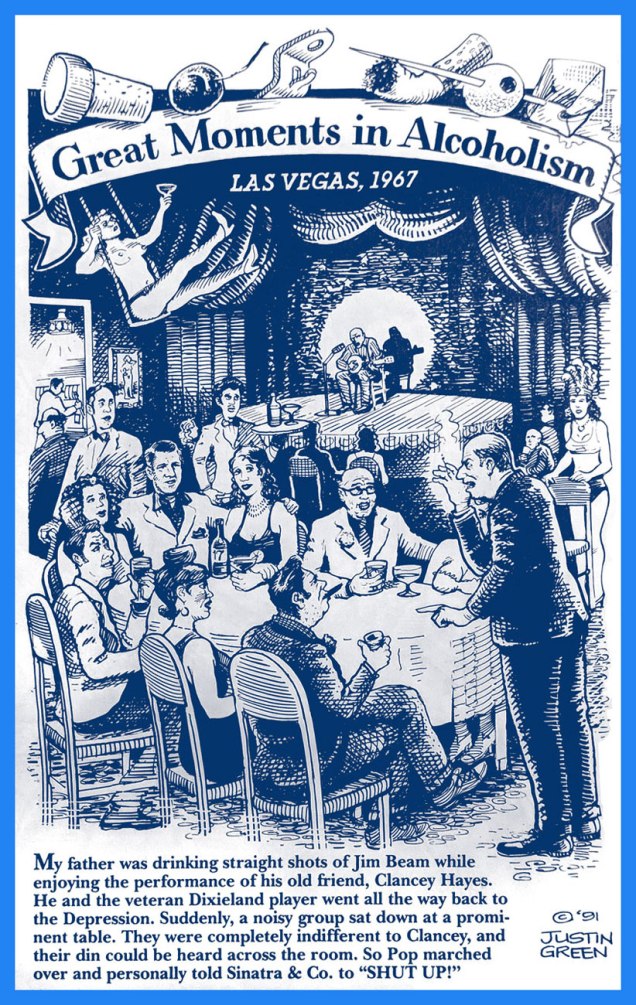
« My father had a lifelong interest in helping musicians. I even encountered his presence when reading the autobiography of Anita O’Day. She said that there was a real estate man in Chicago who always made sure her band had a place to stay. That was Pop. » – Justin Green
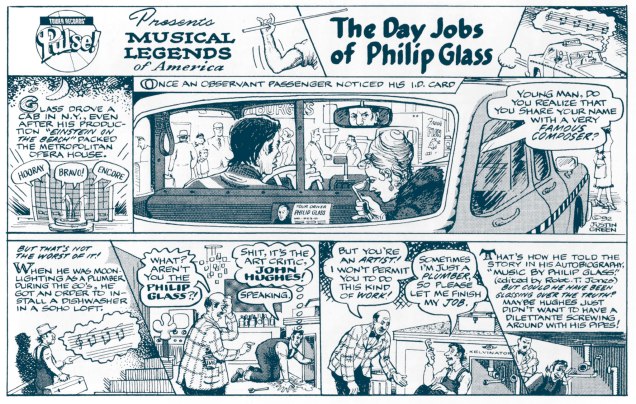
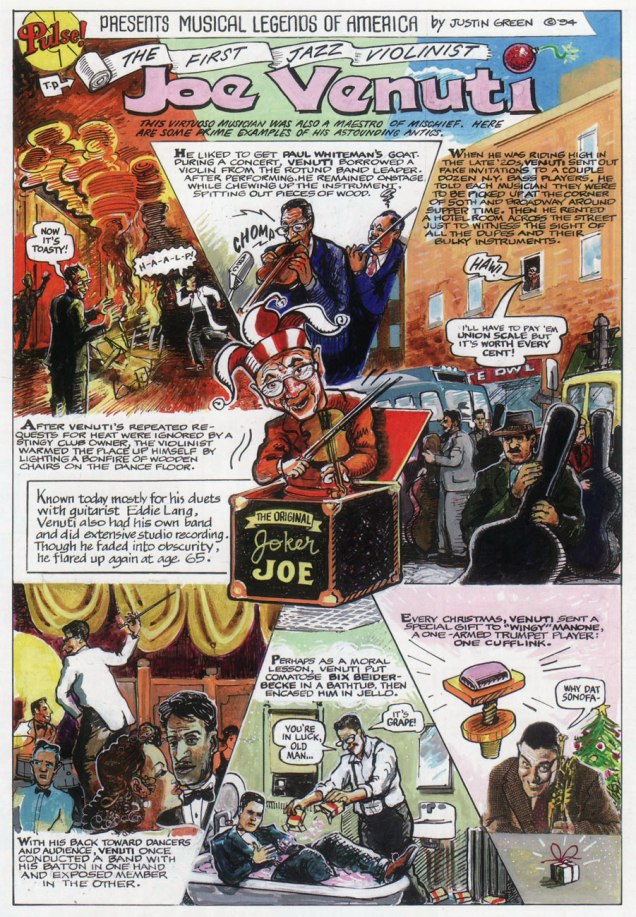
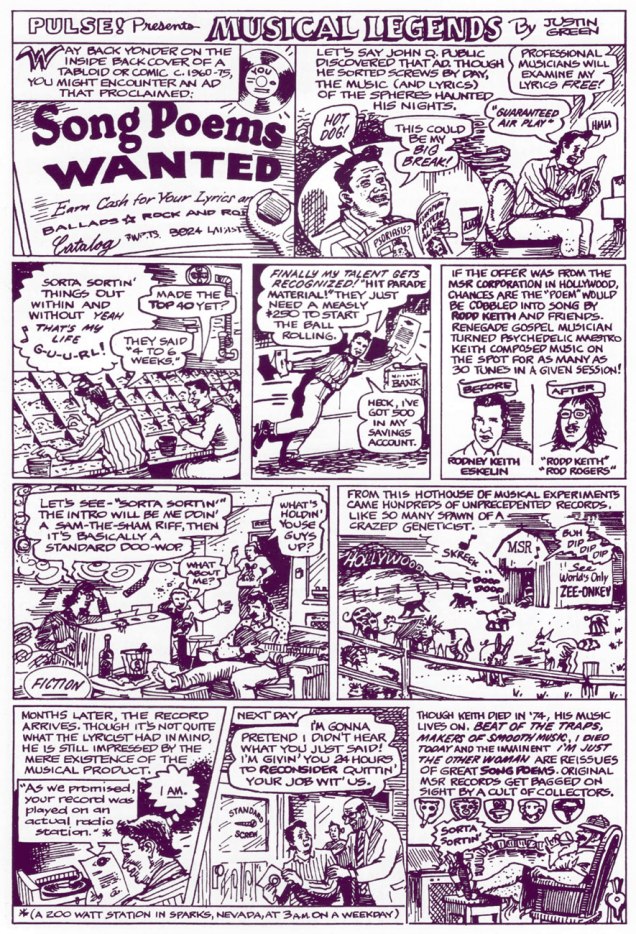
How did Justin Green, one of the Founding Fathers of the Underground Comix movement, wind up holding down a regular feature for a decade (1992-2002) in Tower Records‘ in-house magazine, Pulse!? The whole chain of events began with a strip about his dad’s drinking. Of course.
« It was my father’s spirit that instigated this cartoon project…. this was ’91 (Blab No.6, Summer 1991, Kitchen Sink Press), and I was living in Sacramento. Mark Weidenbaum was then an editor at Pulse! Magazine, published and distributed by Tower Records, which had its headquarters in West Sacramento. He had just seen the piece when he found out I lived nearby. He wanted to explore the idea of an ongoing musical biography cartoon feature. »The second instalment (April, 1992). A little Einstein on the Beach, anyone?August, 1992. Elvis certainly had his faults, but racism or ingratitude were not among these.My own introduction to the Reverend’s music came, as it surely came to many others, through Jackson Browne‘s fine cover of his Cocaine (Running on Empty, 1977). « I was talking to my doctor down at the hospital. He said, ‘Son, it says here you’re twenty-seven, but that’s impossible — you look like you could be forty-five’. »The strip frequently appeared in colour. Here’s my favourite example, from April, 1994. And here’s a fine Venuti performance. No, he wasn’t *always* joking.Ah, Rodd Keith, the main man behind those infamous Song Poems ads, comic book fixtures in the 1970s. The weren’t a scam… not in the traditional sense. November, 1996. Lend your ear to his Ecstasy to Frenzy.
While Green isn’t a native virtuoso draftsman like, say, R. Crumb or Rick Griffin, and he’s only fair-to-middling when it comes to likenesses, he *is* a born storyteller, and that’s really what’s most needed for an endeavour of this nature. Compressing a lifetime, or at least a career, into a single-page strip (two at the most!) is remarkably tricky and demanding, and if it looks deceptively easy here, he’s succeeded.
In selecting strips for this post, I didn’t lean towards my own favourite musicians, opting instead for what I felt were the strongest pieces, regardless of topic. However, I’m reserving my very favourite for a special New Year’s Eve post. Hope you enjoyed these musical time capsules! If you did, you’ll be happy to learn that the fine folks at Last Gaspcollected the set in 2003.
« It was long past midnight on a hot, wet June night many years ago… Central City lay choking for breath in an eerie fog… »
In this, part three of our chronicle following as we can the meandering and sometimes mystifying odyssey of Will Eisner’s The Spirit, we reach the most outré segments of the former Denny Colt’s road.
In a unique twist, The Spirit’s next residence, nearly a decade after his Fiction House run, had nothing at all to do with Will Eisner… in terms of securing his assent, that is.
It was down to the fabulously sketchy Israel Waldman, one of those fringe-dwelling characters who made the comics industry such a colourful snake pit. To quote the Grand Comics Database: « I.W. Publications (1958-1964) was part of I.W. Enterprises, and named for the company’s owner, Israel Waldman. Reportedly, Waldman came into possession of a printing company and among the assets were the production materials for several hundred comic books previously published by various publishers as well as a limited amount of previously unpublished material. Waldman equated possession of production materials as the right to reprint and I.W. became notable for publishing unauthorized reprints of other companies’ comics, often with new covers, as Waldman’s windfall did not often include the production materials for covers. The later half of the company’s existence, it published comics under the Super Comics name. Usually these companies were out of business, but not always. »
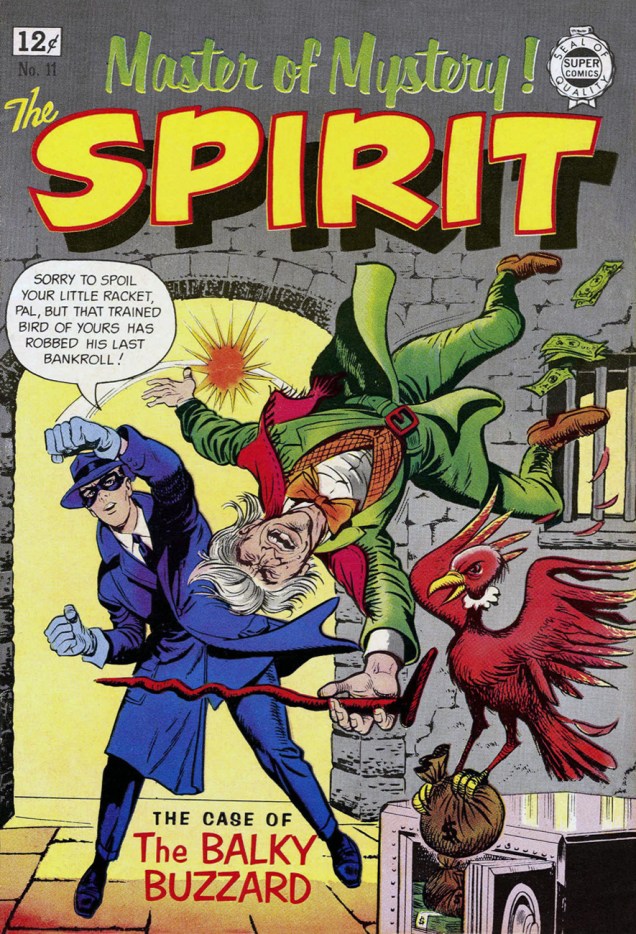
This is The Spiritno. 11 (1963), featuring The Man Who Killed The Spirit(Mar. 24, 1946), cover-featured The Case of the Balky Buzzard (Apr. 21, 1946), Carrion’s Rock (May 19, 1946), all scripted by Eisner, as well as Honeybun and Flatfoot Burns shorts. Cover by Joe Simon (“Joe, did you even read the story you’re depicting?“). This one was well worth one’s hard-earned twelve pennies. Read it here.This is The Spiritno. 12 (1964), featuring, this time, a trio of WWII-era Spirit stories scripted by Manly Wade Wellman and Bill Woolfolk and illustrated by Lou Fine, rounded off with a pair of Flatfoot Burns shorts by Al Stahl . Cover again by Joe Simon. Read it here.
If memory serves, Waldman’s comics craftily bypassed the Comics Code (another exception!) and the newsstands, being exclusively sold in sealed bags of three in bargain-basement department stores. To bait the hook, Waldman paid top dollar for new cover artwork, approaching established pros like Ross Andru (who actually delivered some fun stuff, unlike his unforgivably atrocious turn as DC’s main cover artist in the late 1970s), John Severin, Jack Abel, and in these two cases, Jacob Kurtzberg‘s old partner, Joe Simon.
Unsurprisingly, Waldman skimped on all other materials, particularly the paper his comics were printed on, which means that I.W./Super Comics are pretty hard to come by these days in any kind of decent state, so they’re ironically pricey.
A few years later, Eisner struck a deal with another rascal (albeit one with cleaner fingernails), Alfred Harvey of Harvey Comics, Stan Lee‘s only credible competition in the credit-usurping, I created-the-Universe stakes. Again, two issues, but this time with some new Eisner material, including origin stories for The Spirit (his third, but definitive one), and his arch-nemesis Zitzbath Zark, which you may know as purple glove enthusiast The Octopus.
Harvey’s The Spiritno. 1 (Oct. 1966), featuring the new Origin of the Spirit by Eisner, and classics Lorelei Rox (Sept. 19, 1948), Two Lives (Dec. 12, 1948), Agent Cosmek/Visitor (Feb. 13, 1949), The Story of Rat-Tat the Toy Machine Gun (Sept. 4, 1949), Ten Minutes (Sept. 11, 1949), Thorne Strand (Jan. 23, 1949), Gerhard Shnobble (Sept. 5, 1948), all scripted by Eisner, save Ten Minutes, which hails from the mind of Jules Feiffer.Harvey’s The Spiritno. 2 (March, 1967) features the brand-new Octopus: The Life Story of the King of Crime and 2-pager The Spirit Lab, plus a generous helping of fine oldies, namely Plaster of Paris (Nov. 7, 1948), The Deadly Comic Book (Feb. 27, 1949), Rudy the Barber (Oct. 22, 1950), The Story of Sam, the Saucer That Wanted to Fly (Sept. 17, 1950), Sam Chapparell (Oct. 10, 1948), La Cucaracha (Nov. 19, 1950), The Halloween Spirit of 1948–Ellen Meets Hazel (Oct. 31, 1948), all scripted by Eisner… the book wraps up with a preview of the next issue, which never saw print. And so it goes…
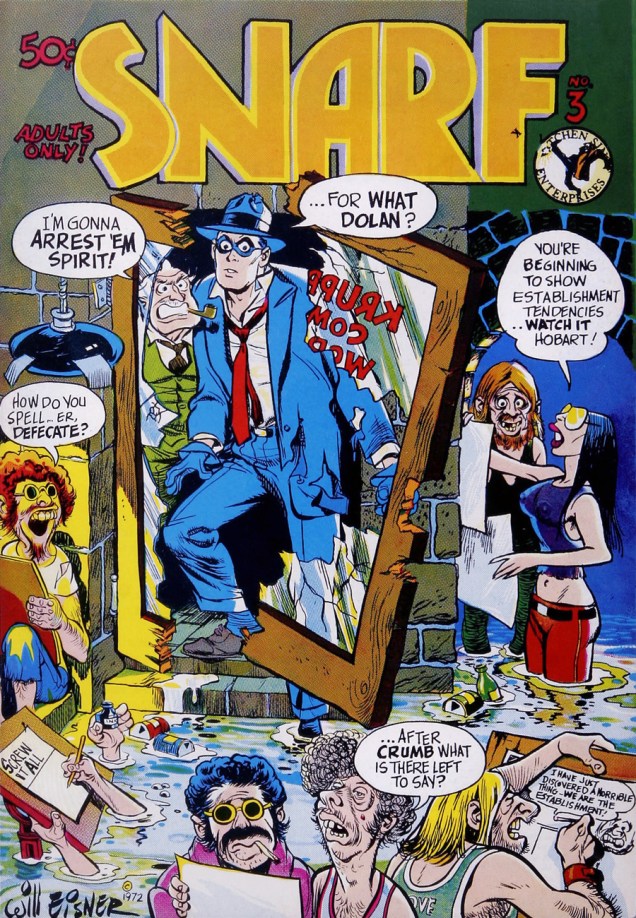
Mr. Eisner then finally had the good fortune to run into an honest man, who would prove in time to be his most steadfast ally: Mr. Denis Kitchen. Their first collaborations were a bit tentative, but quite sympathiques, with Eisner kind of slouching towards the Underground, his creation even cover-featured on Kitchen’s long-running humour anthology Snarf.
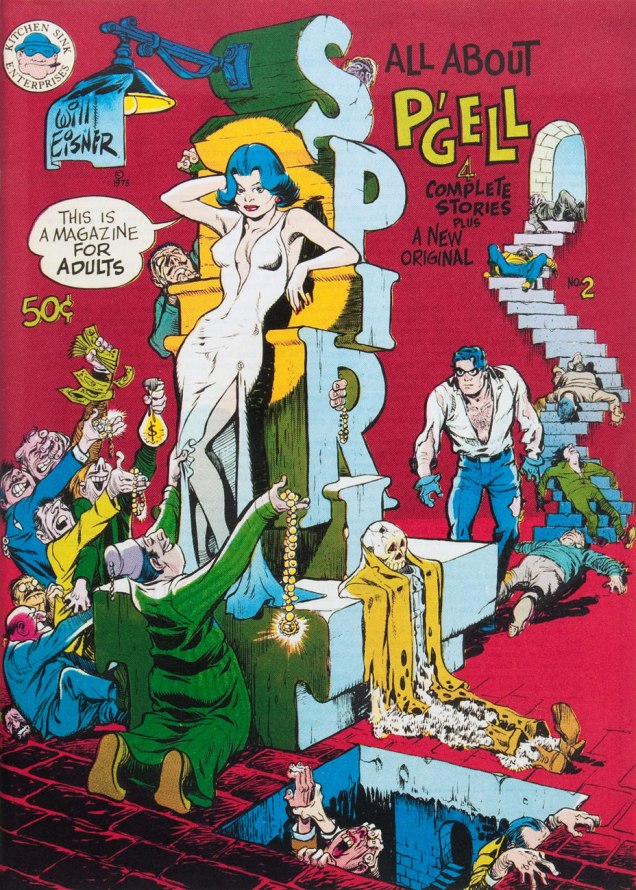
This is Kitchen Sink Enterprises’ Snarfno. 3 (Nov. 1972), featuring an original Eisner cover.Another two-issue run! Kitchen Sink’s The Spiritno. 1 (Jan. 1973), featuring a new cover by Eisner, and precious relics Max Scarr’s Map (Apr. 14, 1946), Caramba (Nov. 10, 1946), Return to Caramba (Nov. 17, 1946), The Rubber Band (June 23, 1946), plus a few brand-new short pieces.Kitchen Sink’s The Spiritno. 2 (Nov. 1973), featuring a new Eisner cover, an original four-pager, The Capistrano Jewels, and, as boasts the cover, all about P’Gell, with Meet P’Gell (Oct. 6, 1946), The School for Girls?? (Jan. 19, 1947), Competition (Aug. 3, 1947) and The Duce’s Locket (May 25, 1947).
Next time out: some interesting times with Warren.



























 Who's Out There?