« The majority has no right to impose its stupidity on the minority. » — George Wolinski (1934-2015)
I realised this morning that yesterday was Mr. Wolinski’s birthday, so here’s a quick post. Despite what one might expect from the name, Wolinski was born in Tunisia; aged eighty, he perished in the terrorist attack on the Parisian offices of Charlie-Hebdo on that grim Wednesday of January 2015. For more context, see last year’s related post Never Forget: Cabu, le grand Duduche.
It would be futile to attempt to do justice to a brilliant, prolific and varied career spanning seven decades, so I won’t waste anyone’s time with such foolishness. Here’s Lambiek’s biographical essay, and here’s a conte cruel from Wolinski’s first solo collection, Histoires lamentables (1965, Hara-Kiri).
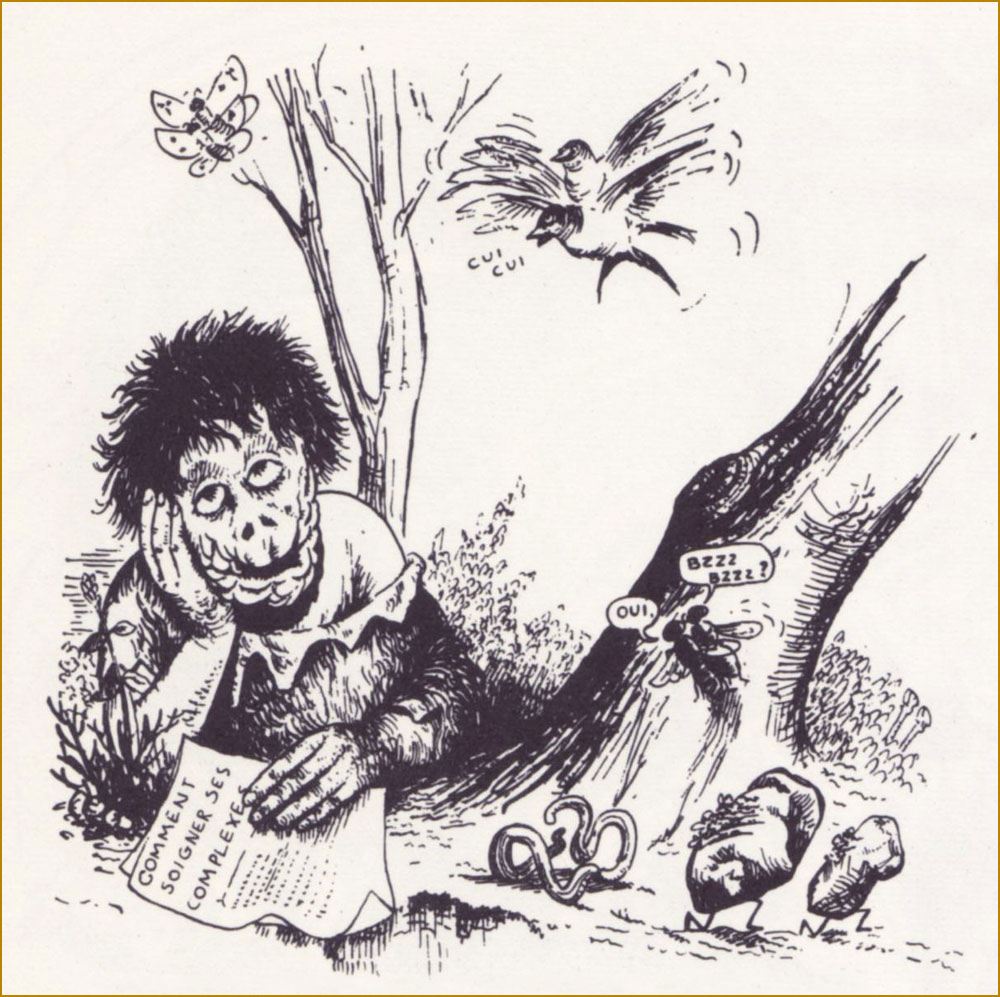
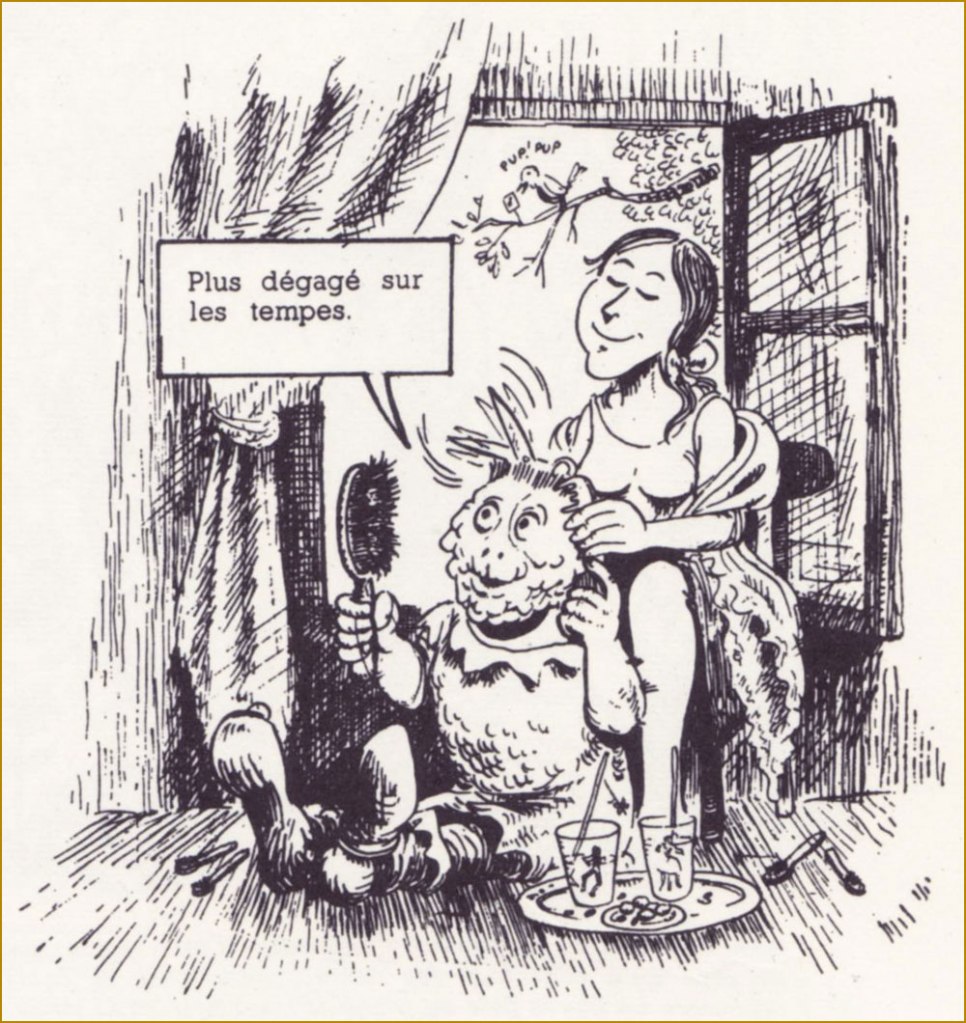
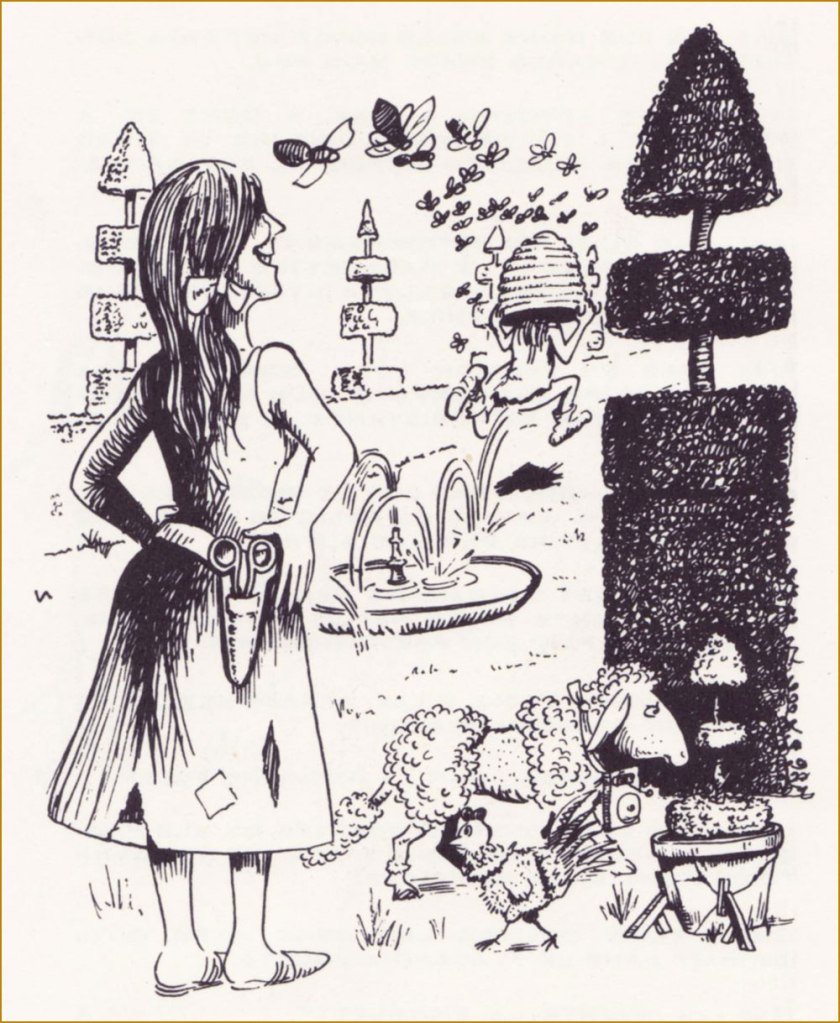
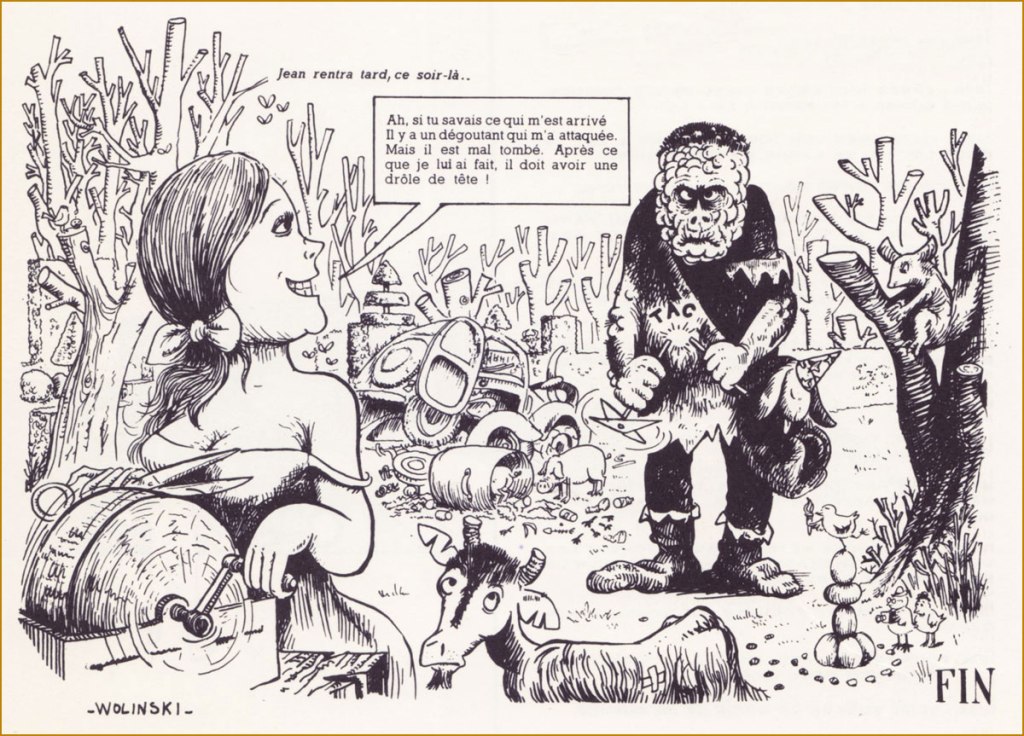
« Jean was the lone survivor of a fire that claimed his entire family. Having suffered atrocious burns to the face, he was as hideous as one could imagine. In order to avoid exposing others to that grim spectacle, he went to live deep in the woods with the wild beasts. However, each year, the returning Spring invoked in him strange reveries. » A PATHETIC TALE. « He then could not refrain from lurking about the homes of men. And so it was, one day, that he heard Isabelle’s song. Her voice made him forget his usual caution. » « Isabelle was blind. At the idea that she could not witness his ugliness, Jean felt an extraordinary emotion. He found the courage to speak to her. She responded with kindness, and he dared return. » « Soon, they became inseparable, and at last Isabelle agreed to follow him into the forest. »« Long months of happiness ensued. And then, Isabelle realised that, little by little, her sight was returning. When Jean learned the wonderful news, he was at once happy and desperate. Because he could no believe that Isabelle would remain by his side, now that she saw his ugliness. But Isabelle told him that his physical appearance mattered little to her, and that she would always love him. »« Jean, however, could not help but be miserable. One day, as he was hunting for mushrooms in the forest, he came upon a hare caught in a snare, pitied him and set him free. As it happened, that hare was a powerful genie who, in gratitude, transformed him into a handsome young man. »« Jean, delirious with joy, ran to meet Isabelle. The young girl was working at the beehive. Jean took her in his arms. »« Sweet Isabelle, assailed by this young stranger and fearing for her virtue, crowned him with the hive. »« Panicked with suffering, poor Jean fled like a madman. »« That evening, Jean returned late… » « Ah, if you only knew what happened to me. Some horrid masher attacked me. But I gave him a bad time. After what I’ve done to him, he must look quite a fright! »
from the look of this early style, I get the sense that young Wolinski was under the artistic sway of, say, Will Elder and Al Jaffee…. not a bad place to start!
Here’s a trio of his early gag cartoons (circa the early 1960s), working in a more natural, more direct style:
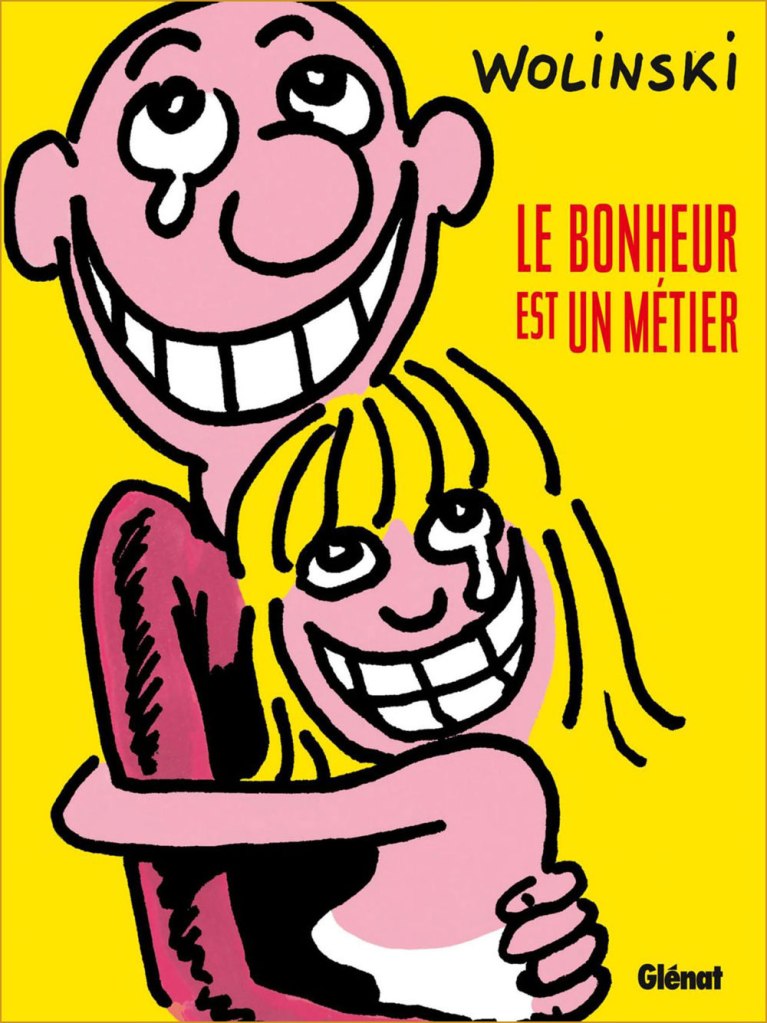
« Working in collaboration means spending half of one’s time explaining to the other that his ideas are stupid. » Wolinski served as the editor-in-chief of Charlie Mensuel from 1970 to 1981. His chief non-editorial contribution was his scripting, for his friend — and fellow Georges — Pichard, the adventures of Paulette, which ran in the magazine from 1970 to 1976. For more Pichard (and Paulette!), check out ds’ post Georges Pichard’s Distressing Damsels. This is Charlie Mensuel no. 80 (Sept. 1975), art — naturally — by Georges Pichard.« Happiness is an occupation » (2016, Glénat). Here’s an example of Wolinski’s fully evolved, more streamlined visual style, from the cover of a posthumous autobiographical collection. Wolinski was interred in Paris’ Cimetière du Montparnasse. Photo by Stéphane X. « Murdered on January 7 during the attack against Charlie-Hebdo. »
« Crosses and gallows – that deadly historic juxtaposition. » — Howard Zinn
Bonsoir, mesdames et messieurs…
All right, time for me to tackle (though a bit sideways, I’ll explain) another of my daunting heroes. This time out, it’s Frédéric Othon Théodore Aristidès (1931-2013), better — and more simply — known as ‘Fred’.
A compulsive and constant scribbler, he attended no institute of artistic learning but his own (and didn’t bother to complete his secondary education), and made inroads into the field by the dawn of the 1950s, landing in Ici Paris, France-Dimanche, Le Rire, Paris-Presse, France-Soir, Punch, and even as a gagman (uncredited!) for The New Yorker (others, among them Otto Soglow, would illustrate the gags for publication).
Mid-decade, he began his long and fruitful association with Pilote, launching, with the magazine’s 300th issue (July 22, 1965, Dargaud) his undeniable masterpiece, Philémon. And this is where my ‘sideways’ loophole comes in: I’m truly not ready to tackle the overflowing poetic cornucopia that is Philémon. By way of introduction, I’ll stick to the margins and showcase instead some of Fred’s ‘brutish and nasty’ (a rough translation of Hara-Kiri’s motto) panel cartoons and short pieces. There’s a lot to this guy.
Which reminds me of a time, a couple of decades ago, when Montreal’s FIFA (Festival international des films sur l’art/International Festival of Films on Art) presented a series of TV shows showcasing individual cartoonists, among them Chris Ware, Art Spiegelman… and Fred. I recall that Messrs Ware and Spiegelman were just as miserable and neurotic as expected, there was also this Manga master that felt trapped as a cog in an assembly line. Meanwhile, in sharp contrast to the existential angst, Fred was brimming with evident delight and joie de vivre at his good fortune to be a working cartoonist*, grinning and scribbling in his sun-dappled studio, leisurely strolling through his village, charming the ladies, enjoying a glass of wine and a wedge of fine aged cheese… I concluded that here was an eloquent encapsulation of the respective cartooning cultures of a few nations. Regrettably, I haven’t been able to track down this documentary series, not even in the FIFA archives. Nevertheless, here’s a short visit with the dear man, by then living in Paris.
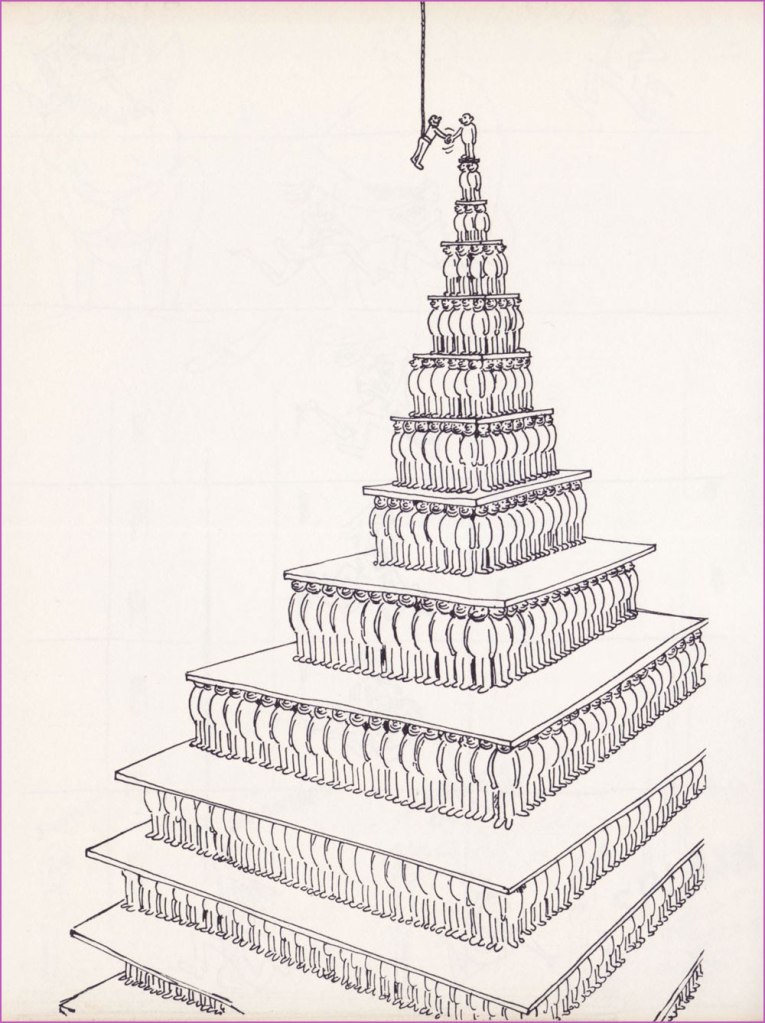
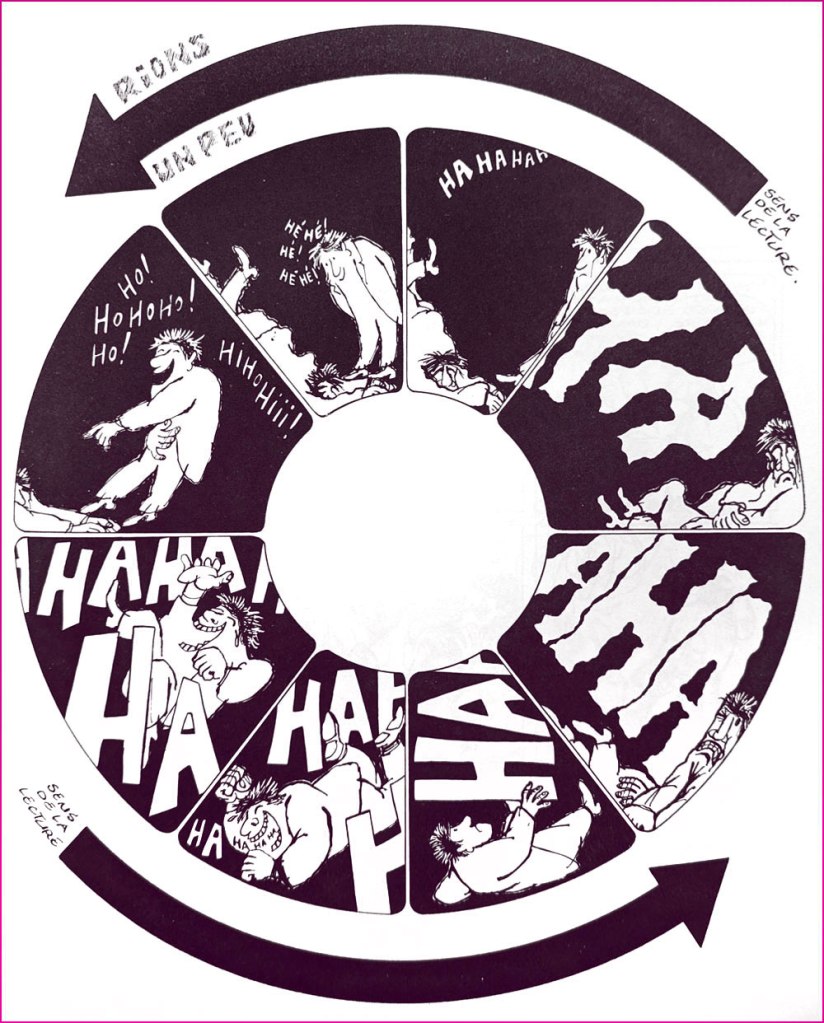
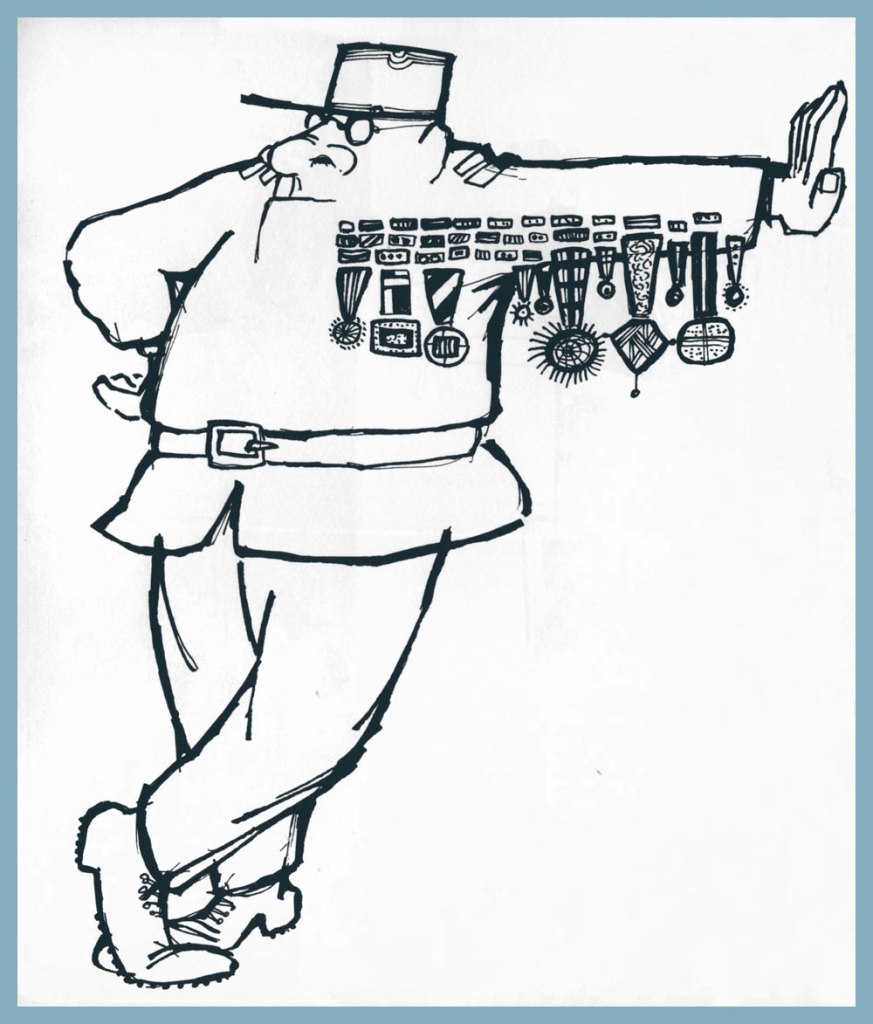
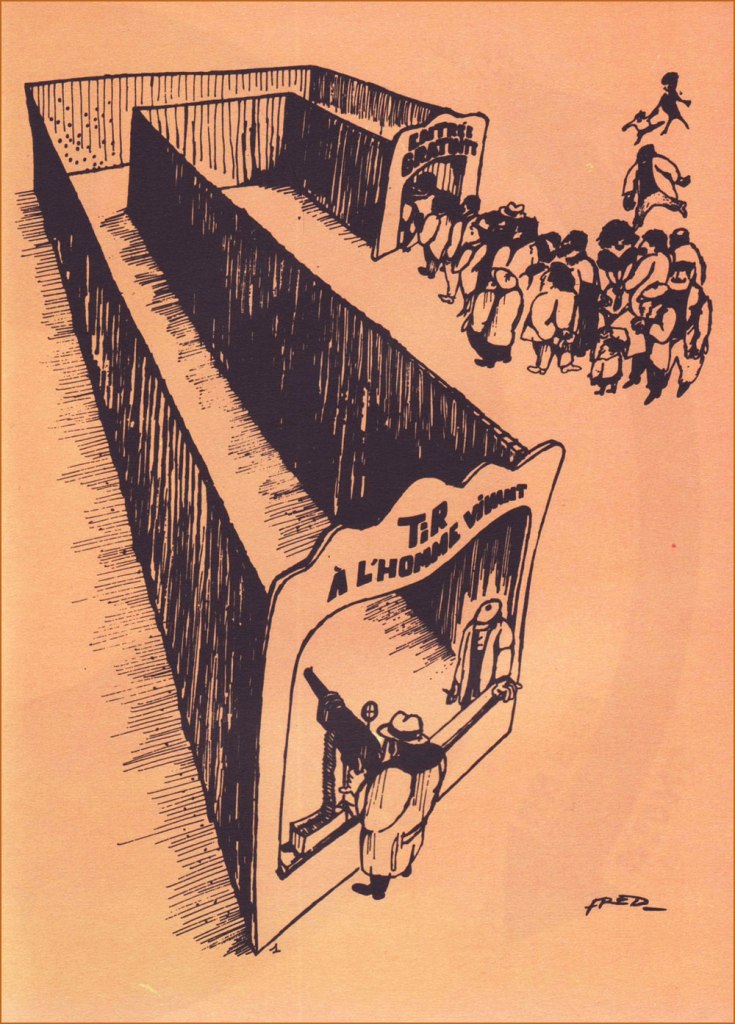
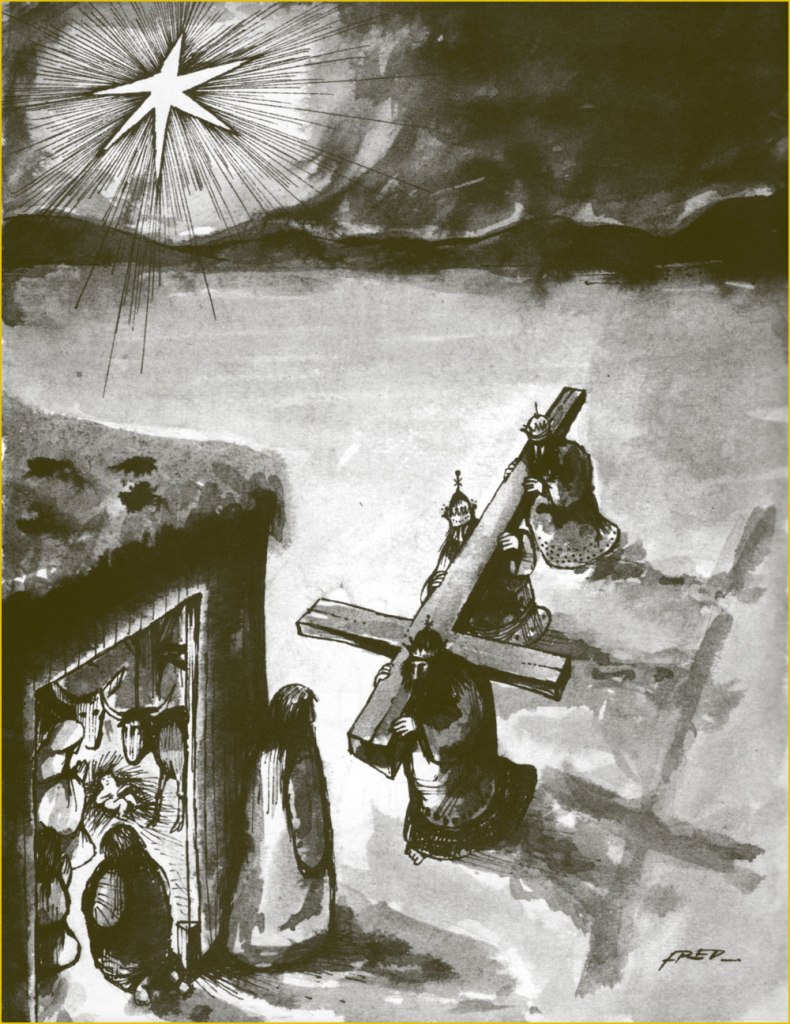
As life tends to imitate art, so has this more or less come to pass.Obviously, you can’t nag anyone into quitting. This ingenious collage strip appeared in Pilote no. 670 (Sept. 1972, Dargaud). An example — quite literally — of gallows humour. Too much of a good thing can kill you — or ‘You may come to rue your mockery’.If one looks for common ground between the more… mordant of French cartoonists, you’ll find their shared, blistering contempt for their nation’s Military brass.The title is a French idiom which roughly translates to “There’s a nip in the air”. This collection of short pieces Fred wrote and drew for Pilote was published in early 1973 by Dargaud.At one end, “Live Human Shooting”; at the other, “Free Admission”.You want it darker? Oh, and also seasonal? Well, your wish is my command.
-RG
*this is serious, though: when Fred stopped drawing comics in the late 1980s, he fell into a deep depression and wound up in a psychiatric hospital. The cure? A return to creating comics. Surely there’s a lesson in this.
« Topor is probably the greatest graphic mind of the twentieth century. » — Seymour Chwast
Well, that’s quite a lofty claim… but considering the source, one that must be seriously considered.
Are you familiar with Roland Topor‘s work? Perhaps you’ve seen Roman Polanski’s 1976 adaptation of Topor’s novel Le locataire chimérique (1964). Or seen the singular animated film La planète sauvage / The Fantastic Planet (1973). Maybe you’ve seen some of his arresting film poster art (The Tin Drum, Realm of the Senses… and more). Were you perhaps an early reader of France’s legendarily transgressive magazine, Hara-Kiri, journal bête et méchant? Or, at the other end of the scale, did you grow up with Groucha, Lola and the Gluons on his charmingly bizarre 1980’s kids’ show, Téléchat?
All the same, Topor (Jan. 7, 1938 – Apr. 16, 1997) — eighty-four years ago today — is one of those rare fellows (like, say, Shel Silverstein) who achieved great success at whatever they undertook… and without compromising their vision. Painter, actor, scenarist, playwright, director, affichiste, cartoonist, illustrator… he did it all, and he did it all well. I’m happy to say that his legacy seems safe, if his posthumous presence online and in galleries and minds is any indication. And I’ve rarely had so much trouble paring down my selections, so prolific and versatile and hard-hitting was he. Dig in!
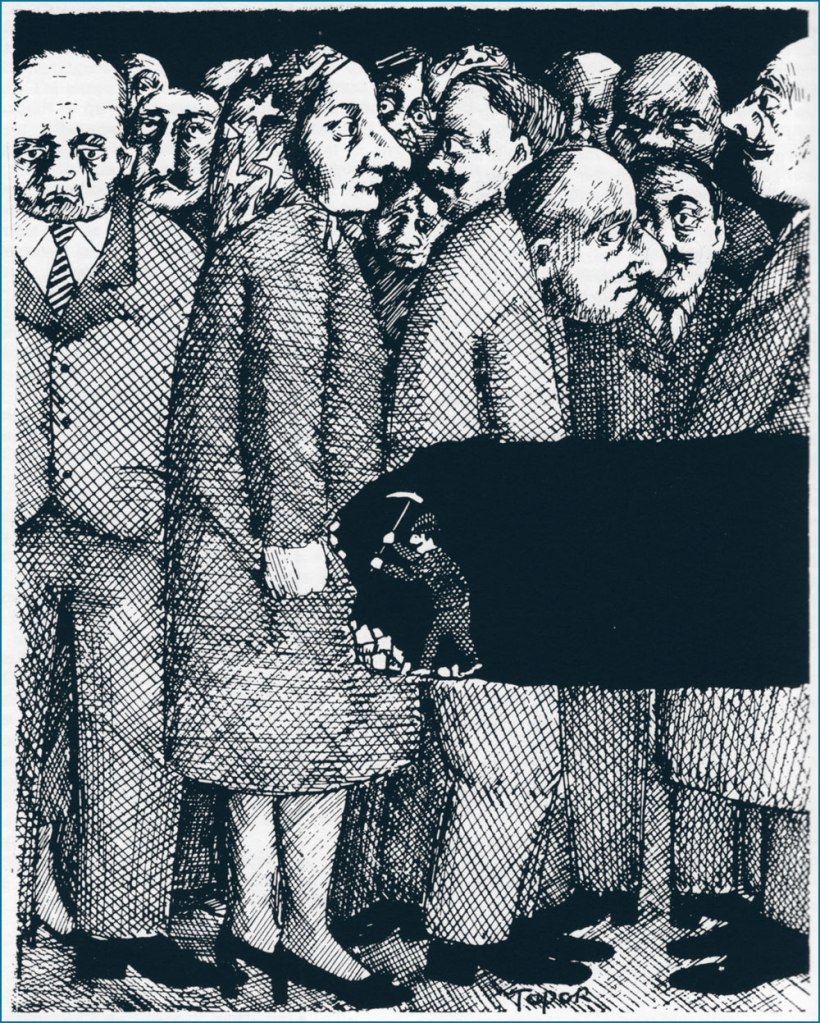
This is a typical, if striking example of the sort of work Topor was producing in the early 1960s (largely for Hara-Kiri — some three hundred drawings in a five-year span), and one wasn’t sure if his draughtsmanship could keep pace with his ideas. I like to call this one ‘La ruelle armée’.
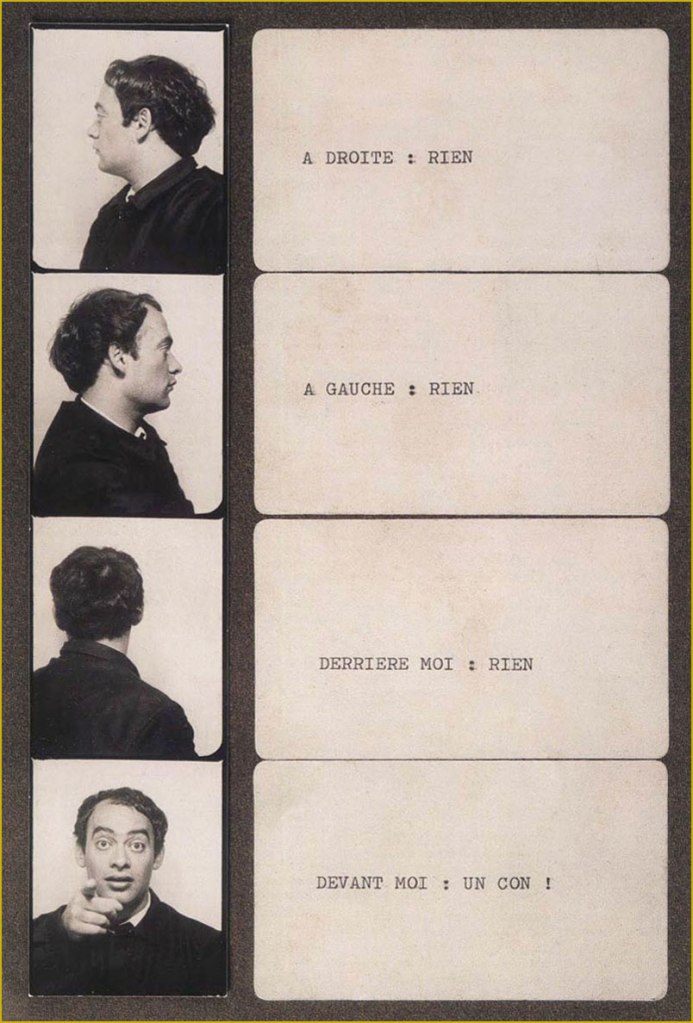
A bit of Photomaton–fumetti from Mr. Topor, circa the 1960s. To the right: nothing. To the left: nothing. Behind me: nothing. Before me: a moron!
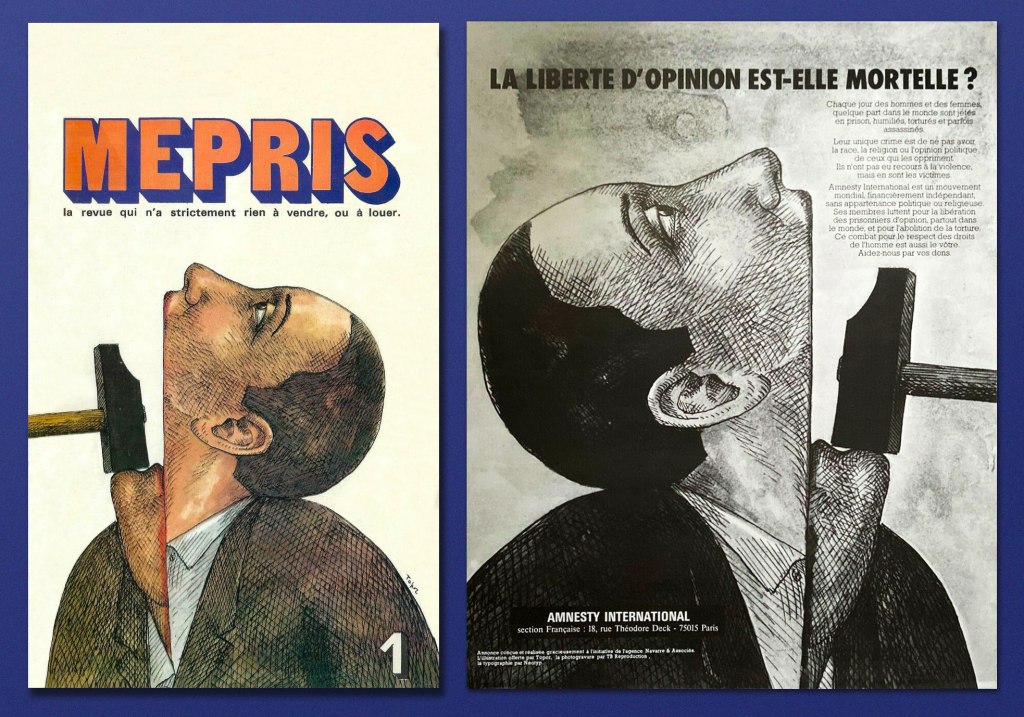
Topor recycled the punch-in-the-kisser motif several times; it was first used for a Hara-Kiri promo poster in 1961.
A pair of excerpts from 1974’s L’Épikon. I love the concept: Topor graphically (and fancifully) elaborated upon some antique pornographic photos. « In Warsaw, a housekeeper, by piety sucked the church candles. By dint of polishing the tallow, she skinned her lips and blushed like a virgin. »
« A Las Vegas whore, who resided in a palace, resorted to a trick to tame phalluses: she illuminated her snatch. » Here’s more from L’Épikon.La roue (the Wheel) — 1973.Another bit of recycling: first created (I think!) for Revue Mépris n° 1 (1973, Éditions Kesselring), Topor donated this powerful piece to Amnesty International for its worthy promotional work, such as this 1977 print ad. « Is Freedom of Speech Lethal? ».
This sardonic piece appeared in the collection L’amour à voix haute (“Love Out Loud”); the English version was entitled Je t’aime: A Pillow Talk, and used it as its cover.
Les nouvelles en trois lignes I (The News in Three Lines) – 1975. Comics!
Le saut périlleux (the somersault) – 1980.
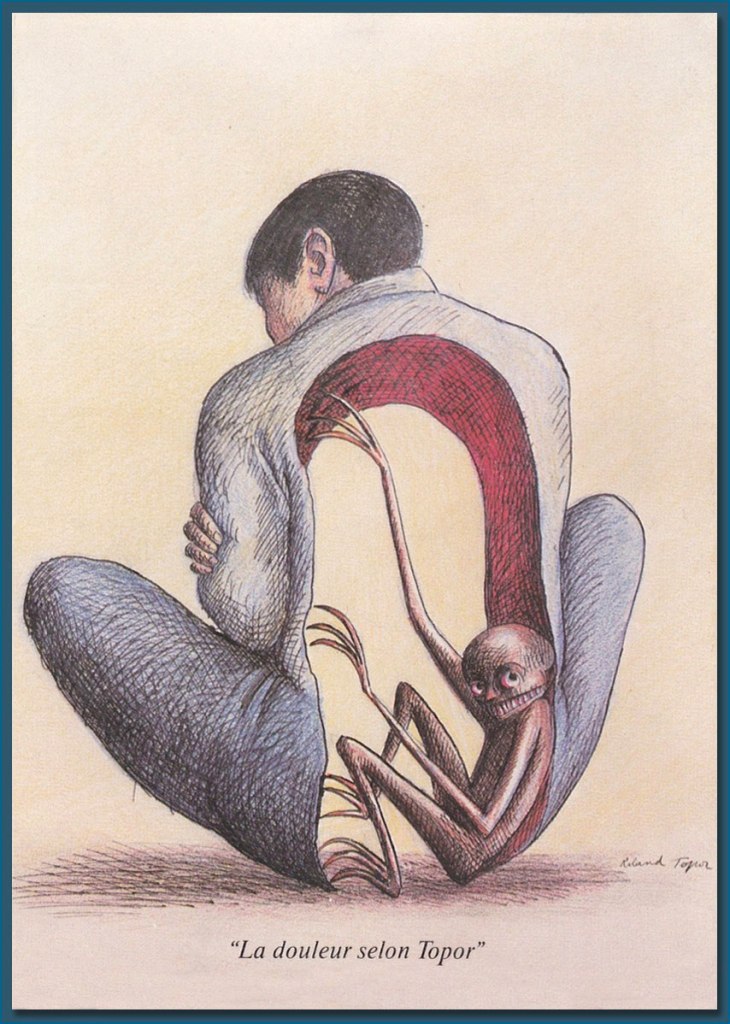
« Pain, according to Topor. »
« Leaving pain behind, according to Topor. » (1982)
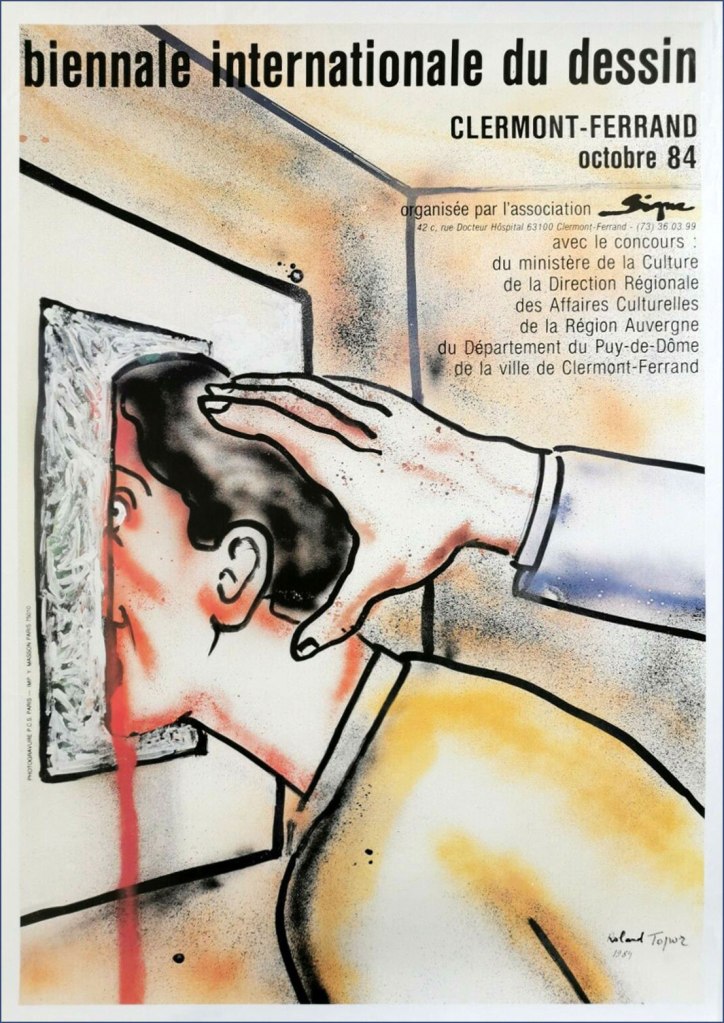
I’m happy to say that, with the years, his work just kept evolving and, in some ways, improving. This poster was created to promote the 1984 edition of a drawing festival held every other year.

















 Who's Out There?