« Remember you belong to nature, not it to you » — Grey Owl
Why it took me this long to spotlight David Collier, who’s been one of my favourite cartoonists for decades, is, even to myself, a bit of a puzzle. Is it perhaps because his work already receives plenty of attention – chiefly in English Canada (what we in Québec mockingly call ROC — Rest of Canada)? Could be, but I’m ready now.
While Collier’s rough-hewn, scratchy line won’t get him confused with, say, Tom Palmer or Brian Bolland in this particular plane of reality, it’s absolutely perfect for his writing and persona. He’s a riveting storyteller who catches — and properly interprets — details any more casual observer would miss, yet he’s frequently unable to read the room. He’s a formidable writer, but his spelling* is… perhaps lamentable is too strong a word, at least for his English. He is, however, utterly impervious to French**.
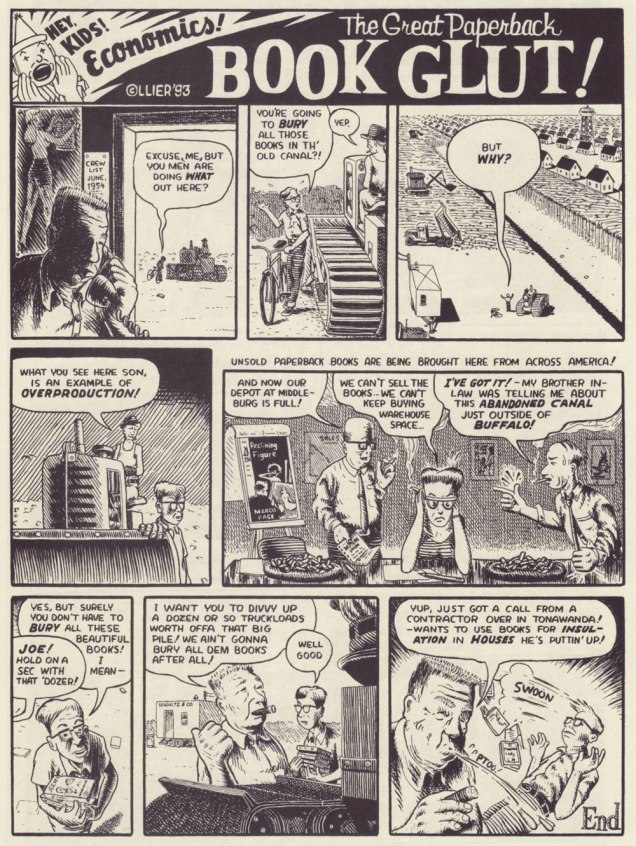
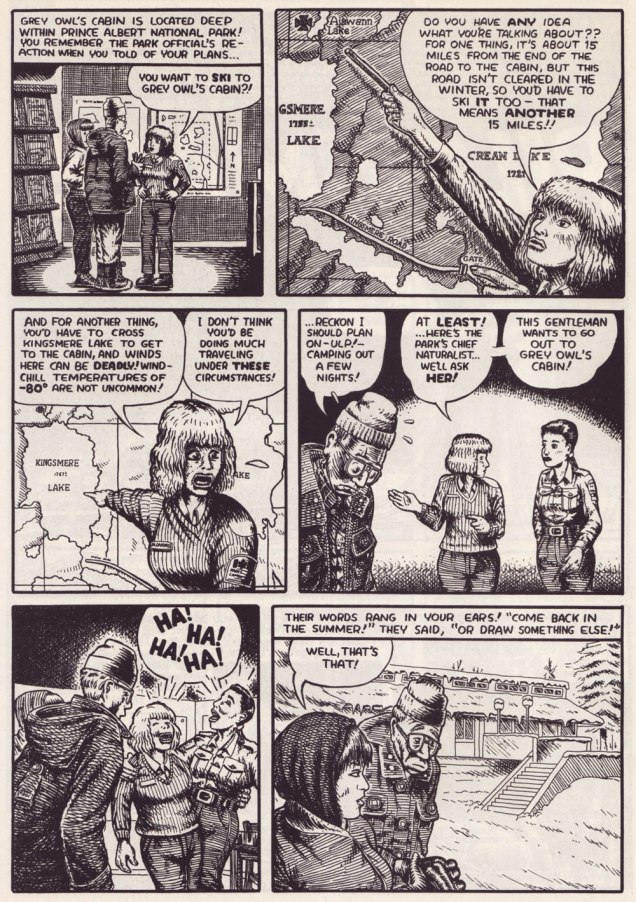
This was the first Collier piece that really grabbed me. From The Comics Journal no. 159 (May 1993, Fantagraphics).
.
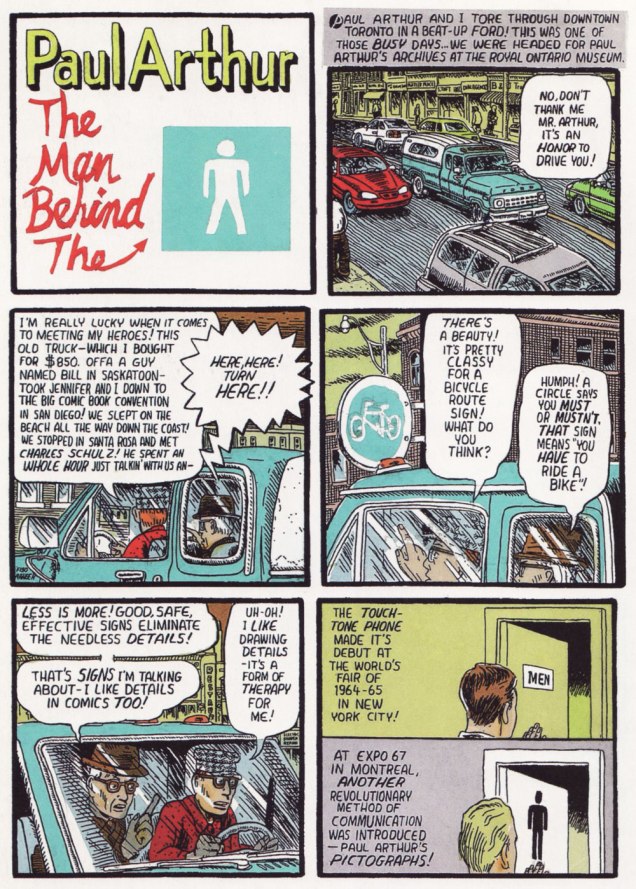
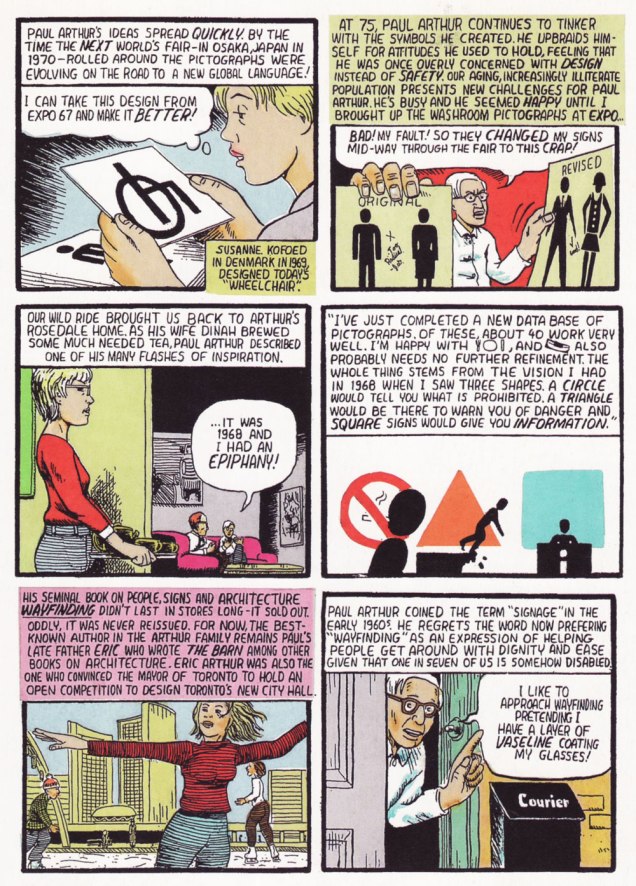
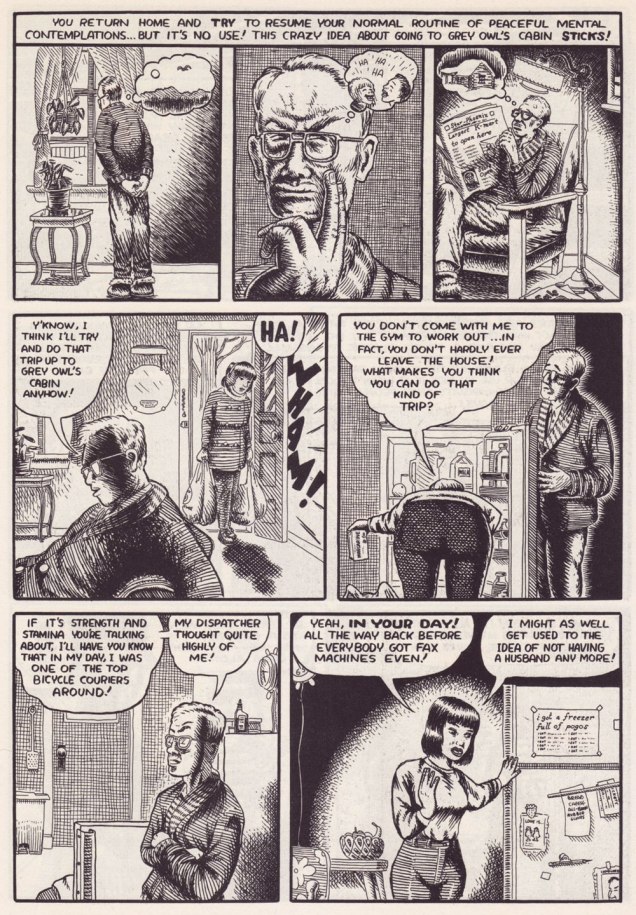
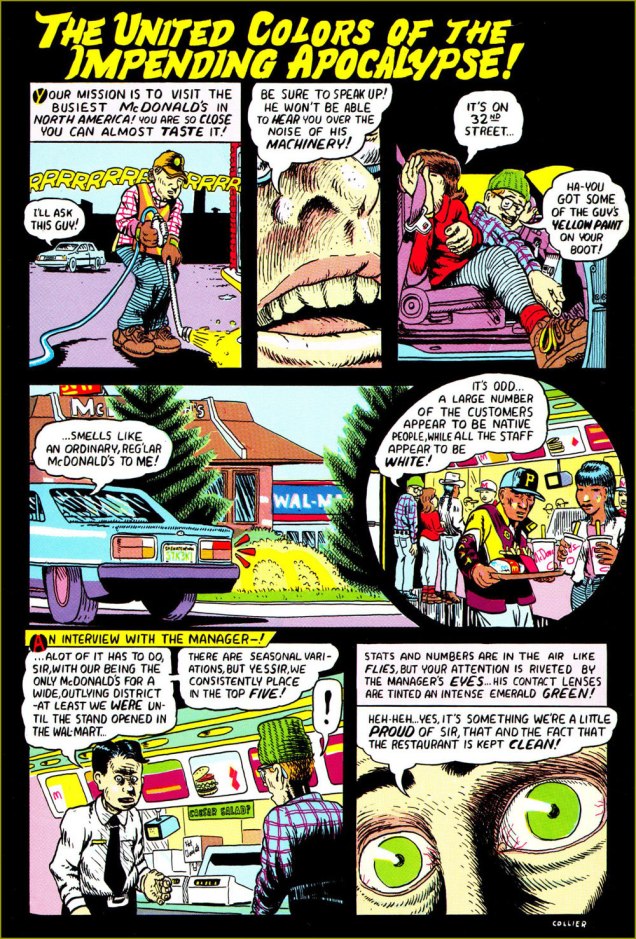
Collier has few equals when it comes to fitting a lot of nutrition into a page… without overstuffing it. Pacing, clarity, originality, pertinence… all top-notch. He doesn’t get to show it off all that often, but he also possesses a fine, distinctive colour sense. This piece first appeared in the collection Portraits From Life (March 2001, Drawn and Quarterly).
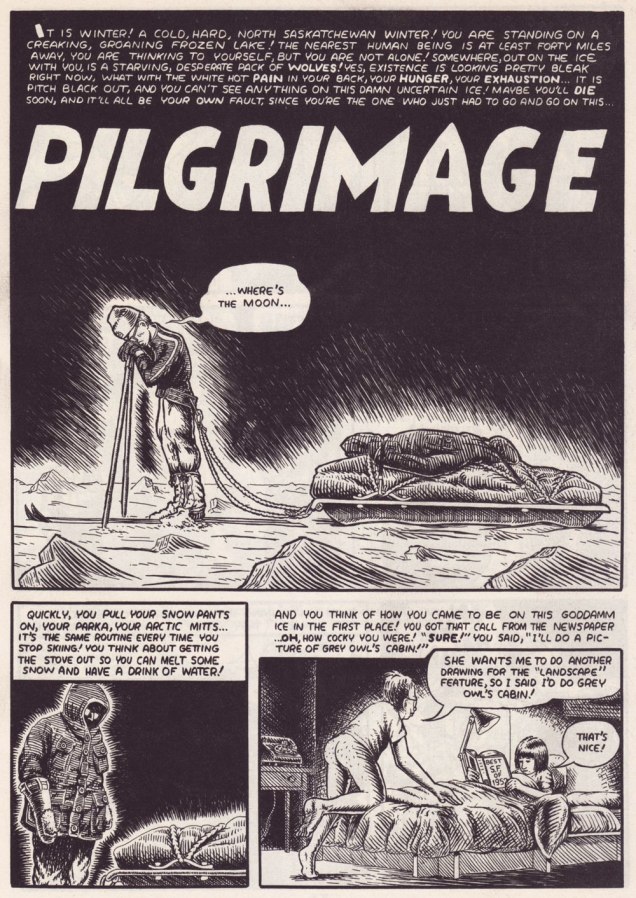
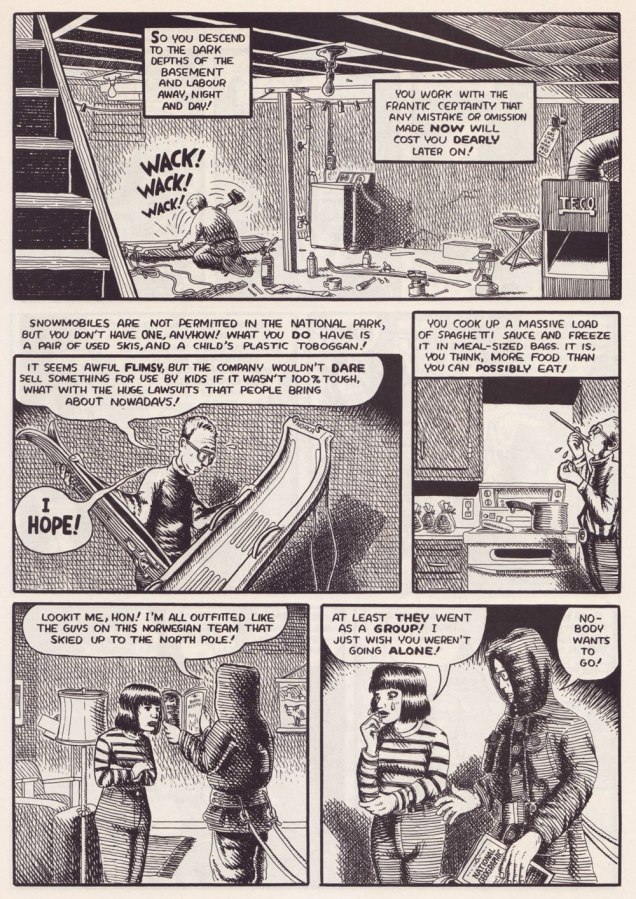
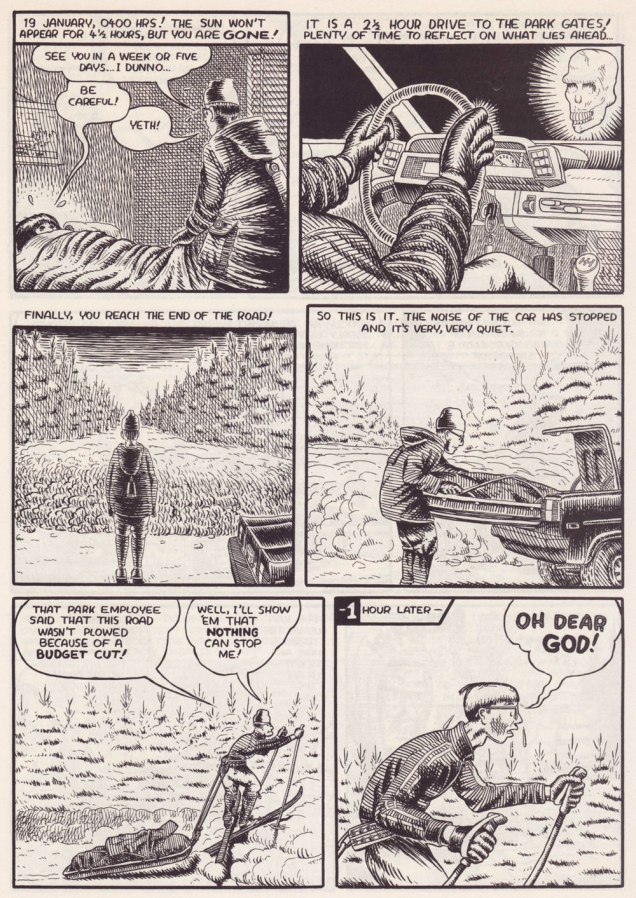
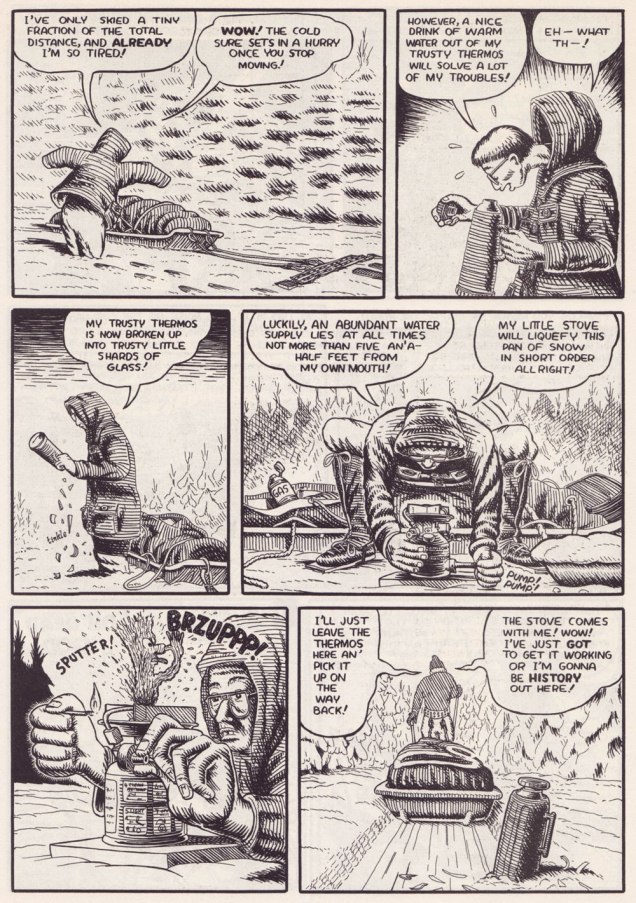
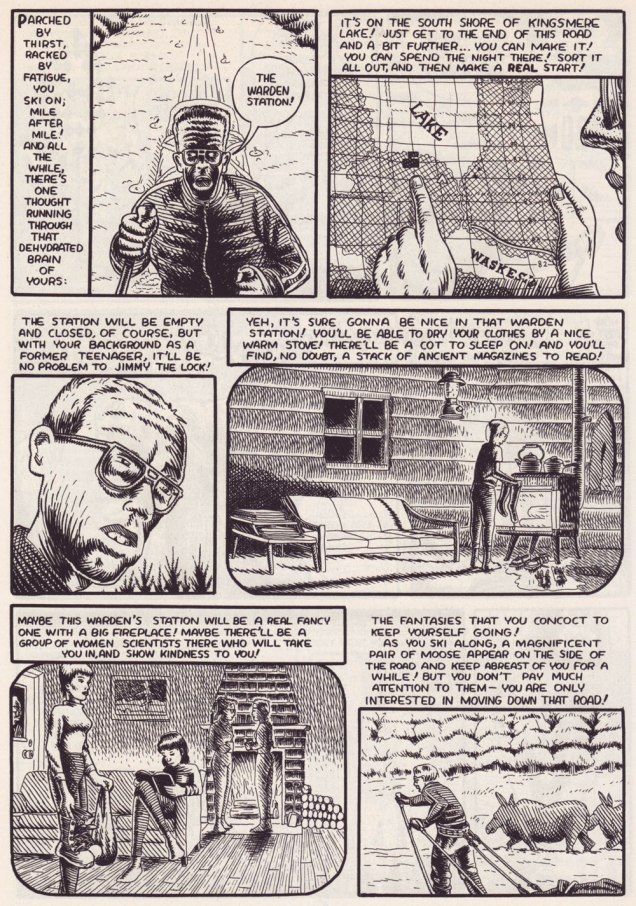
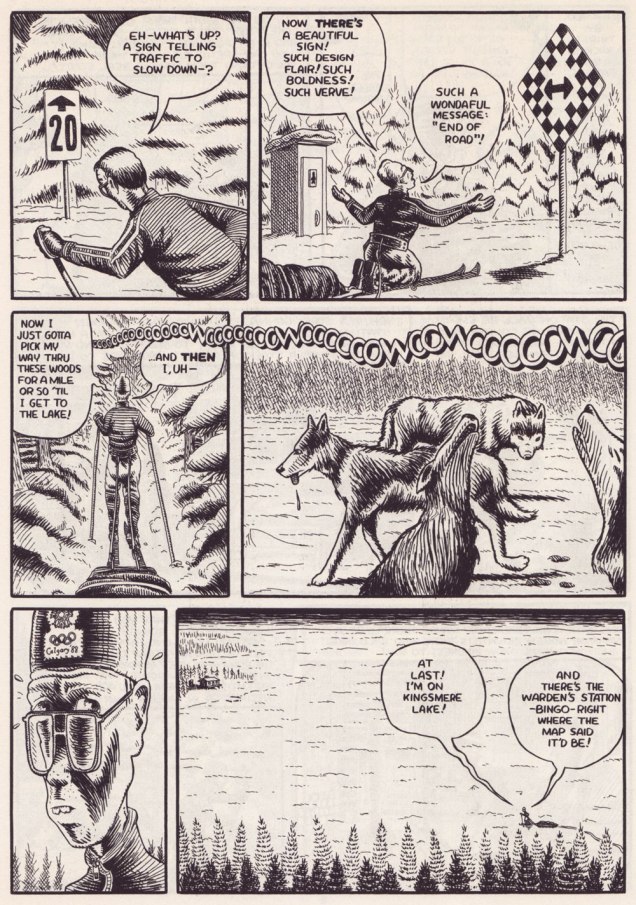
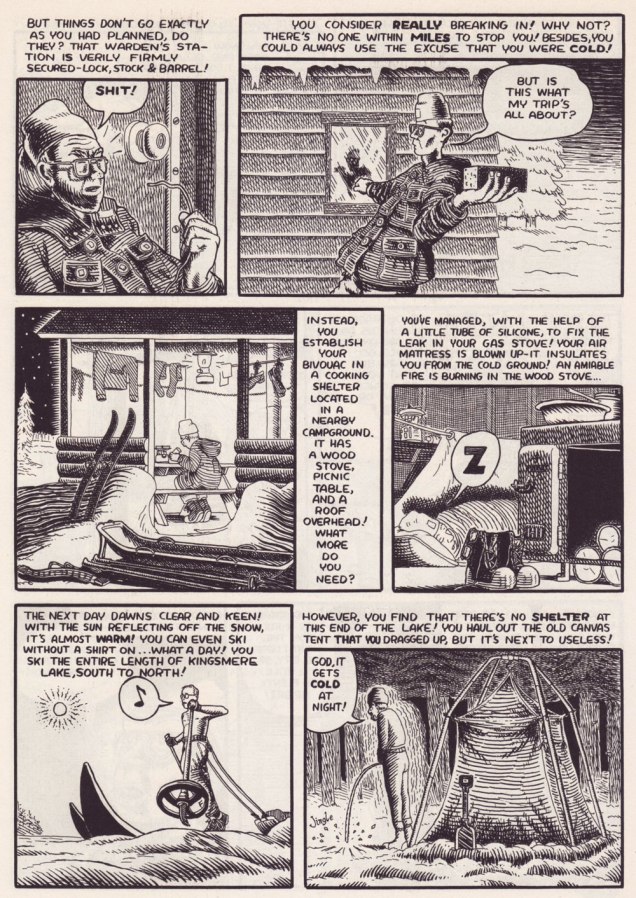
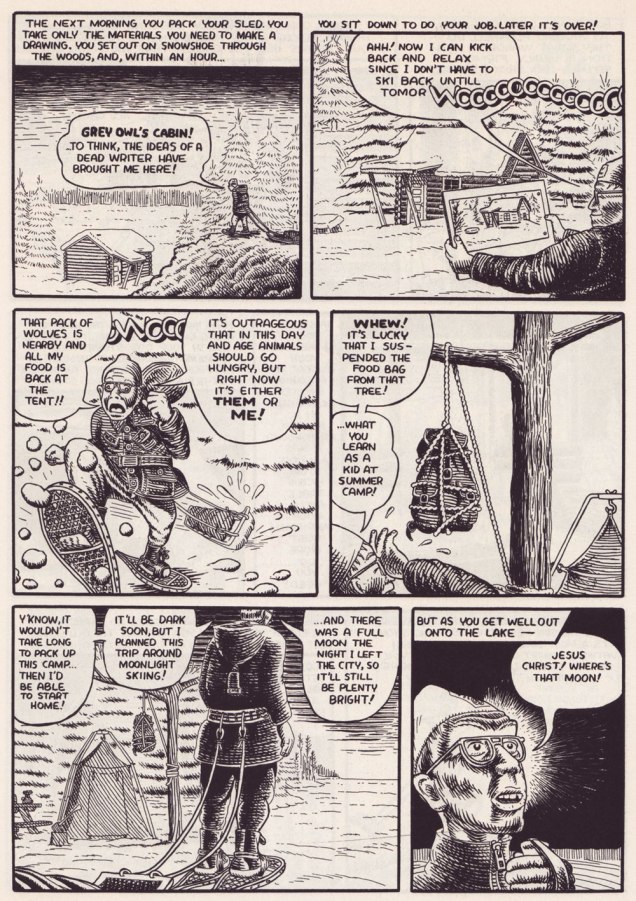
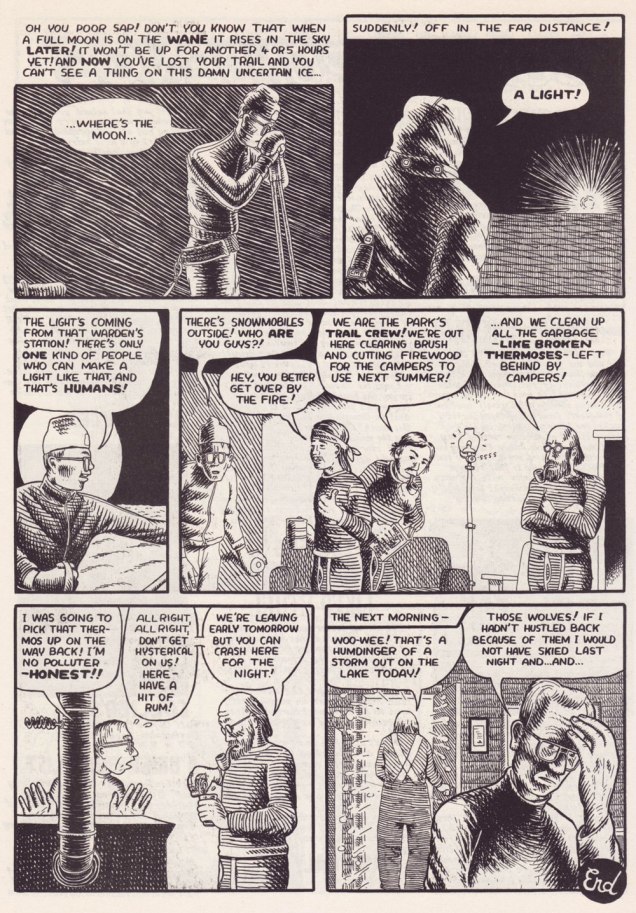
Collier is also entirely at ease with long-form narratives. Here’s a personal favourite of manageable length. It was this piece that made me a loyal fan. The issue of Collier’s it appeared in brilliantly splits its pages between David’s perilous trek to Grey Owl’s cabin and his account of the man’s life story, providing both a solid history lesson and a portrait of the artist as comics character. This material was also reprinted in Portraits From Life.
Somebody clearly digs Harvey Kurtzman‘s EC war — or more precisely anti-war — comics!
.
.
.
.
.
.
.
.
.
Pilgrimage first appeared in Collier’s no. 3 (May 1994, Fantagraphics).
I find it intriguing that Collier, a Canadian history buff if there ever was one, was unfamiliar — circa the early 90s — with the larger-than-life personage of Grey Owl (alias Archibald Stansfeld Blarney, I mean Belaney) the Buffy Sainte-Marie of his day… but we all have our blind spots. Lo and behold, just a few years later, comes the Hollywood biopic. Interesting coincidence…
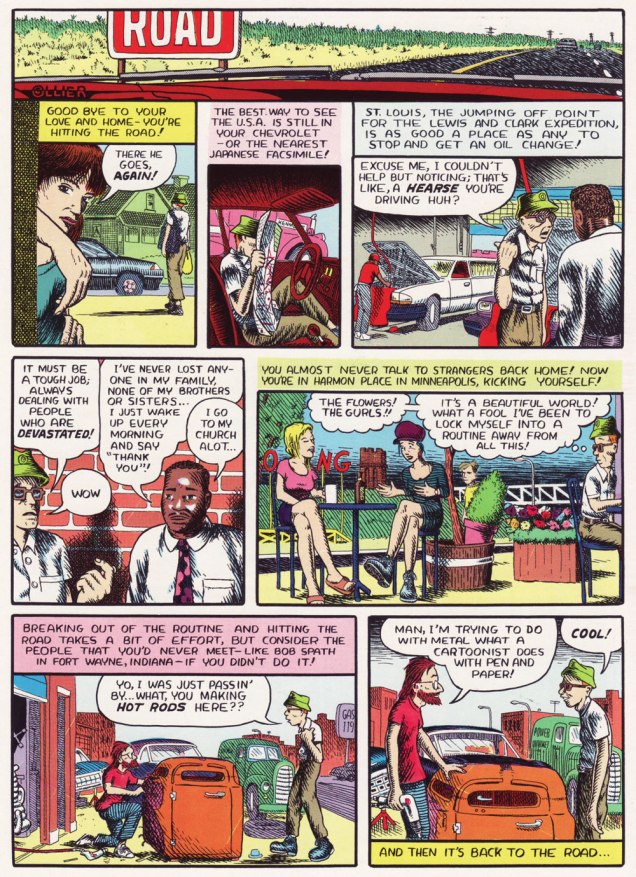
Another insightful short-short that shouldn’t work… yet does. It all comes down to the details. It originally appeared in Zero Zero no.7 (Jan.-Feb. 1996, Fantagraphics). One more for the road? From the back cover of Collier’s no. 3 (May 1994, Fantagraphics).
I’m happy to say that Collier has continued to grow, even if his French isn’t improving. The most recent book of his I read, Morton: A Cross-Country Rail Journey, was also likely his finest. But that was nearly a decade ago. Let’s hope for something new soon!
-RG
*Robert Crumb himself had scolded him about his spelling… way back in the 1980s.
**the nadir of this is the appearance of « Homme de le bois » (which even a mediocre copy editor would have immediately flagged) right there on the cover, and again inside The Frank Ritza Papers (2004, Drawn and Quarterly). While D&Q were quick to assign Collier a ‘fact-checker’, spelling — especially French spelling! — didn’t seem to be much of a concern. Sigh.
« I don’t understand retiring. I don’t know what I’d do. I don’t play golf. I have to sit at a drawing table or else it’s a wasted day. The nature of the work can change here, but I have to be doing something, especially with my hands. » — Seymour Chwast
Nobody really expects those we deem “immortals” to actually live forever… but I suspect some part of us does, or at least hopes so.
I haven’t yet reached that fateful age when reading the paper largely consists of scanning the obituary column to learn which of your friends (and possibly enemies) have died, but I fully grasp the concept… and shudder in sympathy.
And so on to my point: it’s easy to take genius (or mere talent, for that matter) for granted, and so I generally endeavour to salute valued creators while they’re still around, instead of paying belated lip service to their greatness once reminded of their existence by news of their passing.
For years, I’ve been meaning to devote a post to Seymour Chwast… and dragging my feet. He’s had such a long, inspiring — and daunting — career. But the other day, when Tony Bennett died, aged 96, I took it as a sign not to reserve my tribute for Mr. Chwast’s next birthday (that’s late next month). Here goes.
First, an amuse-gueule. This mute but highly rhythmical piece hails from issue 69 (October, 1977) of Push Pin Graphic, the fabled design studio’s showcase magazine. The issue’s theme is “House Nice”, parodying interior decorating fixture House Beautiful Magazine. Written and drawn by Mr. Chwast.
Design historian Steven Heller explains: « Push Pin’s principal cofounders, Seymour Chwast (b. 1931) and Milton Glaser (b. 1929), two native New Yorkers who met while attending Manhattan’s Cooper Union, brought distinct tastes and preferences — as well as chemistry — to their unique partnership. Chwast savored American comic strips and pop culture while Glaser studied etching in Italy and was passionate for Italian Renaissance painters. The former injected a cartoonist’s abandon into his artwork, the latter introduced a sublime elegance. Despite their formal differences, both shared the conviction that postwar design and illustration should not be limited to prevailing practices — either sentimental realism or reductive simplicity. They rejected rote methods and rigid styles while concocting incomparable ways of transforming old into new… »
The following encapsulates even more succinctly the duo’s boundless contribution: « Seymour Chwast and Milton Glaser are legendary graphic designers who founded Push Pin Studios, where they rebelled against the swiss style establishment – blending illustration with design. » [ source ]
Amen: from my standpoint as an art student back in the early 1980s, I’ll say one thing about Swiss design: that shit was oppressive.
To sidestep the perils of losing my way amidst such a gargantuan topic, I’ve opted to focus on a favourite entry in the Chwast œuvre.
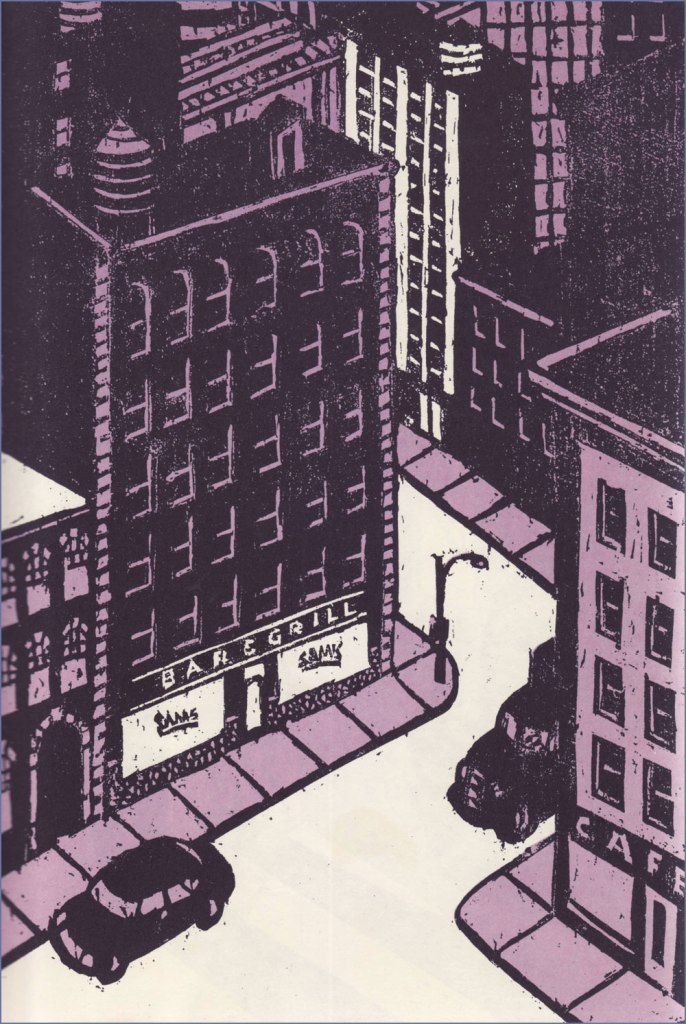
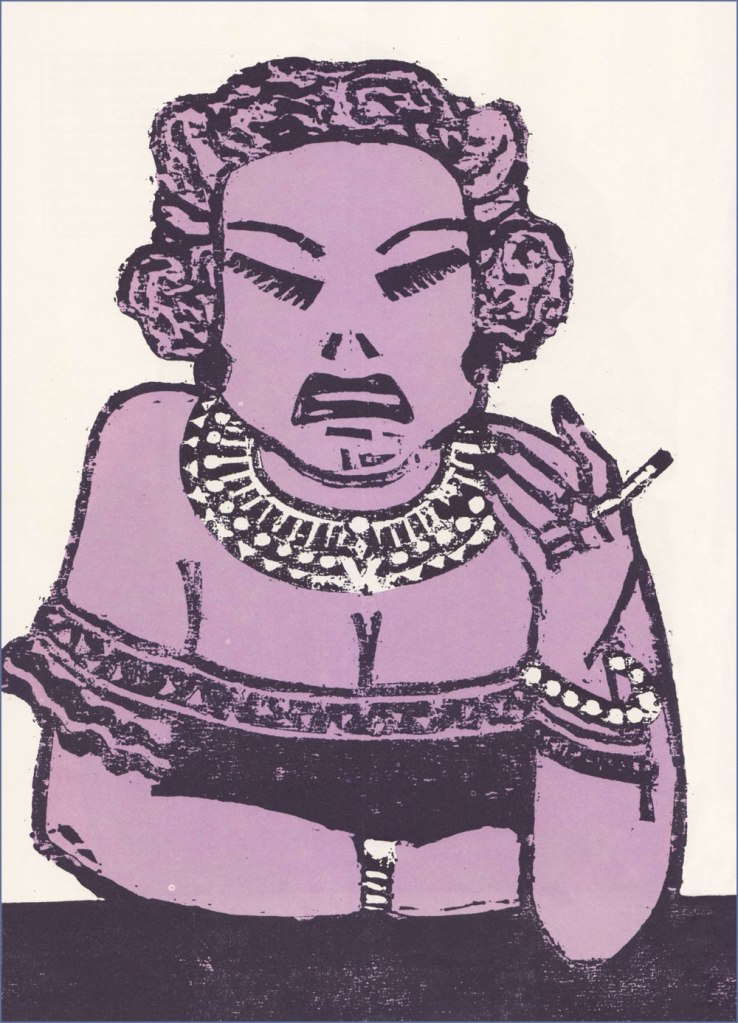
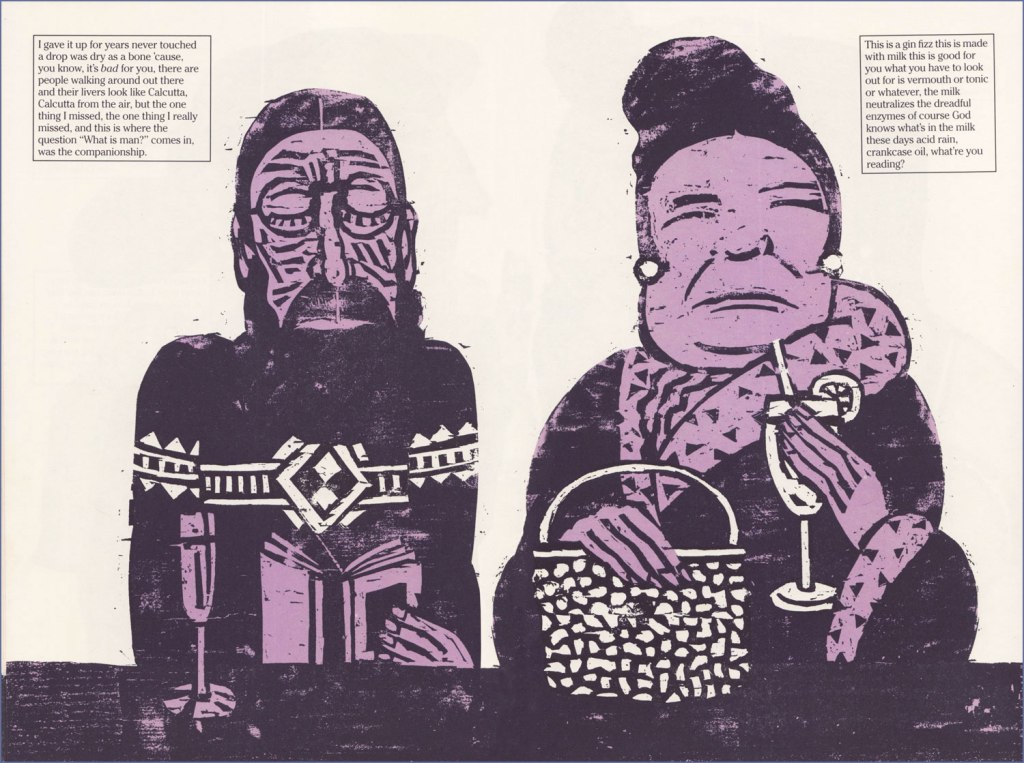
« Another of Chwast’s graphic stories is Sam’s Bar (Doubleday, 1987). Written by Donald Barthelme, it is also a total narrative and pictorial story. It captures in woodcut illustrations one night in a bar somewhere in America, people talking to each other and talking to themselves as the reader goes from one end of the bar to the other. » The book’s intriguing structure would have made it an ideal comic *strip*, in the literal sense.
Ellie says: « So I told the kid May 31, 1989, was the cutoff date, as of May 31, 1989 she’s off the payroll whether she’s finished goddamn college or has not she’s finished goddamn college. So she tells me she’s thinking of transferring to UCLA and that’s going to set her back two semesters. So she can get fencing. Where she is they don’t have fencing. I said I’ll rent you an Errol Flynn movie. »
Trish and Calvin.Hal and Germaine.Two lawyers, Mario and Saul. Someone ought to make a show about a lawyer named Saul.
The book’s handy endpapers, featuring “The Regulars at Sam’s Bar“.
I wouldn’t want to short-change Barthelme’s contribution… as a collaboration, this truly works a treat. Here’s an amusing passage I encountered on the subject of this routinely misunderstood author: « Donald Barthelme was, by his own design, a hard writer to categorize. Even at the height of his fame, in the late 70s and early 80s, there were readers who just didn’t get him, or suspected his work was a hoax or a joke they weren’t in on. At The New Yorker, where he was a regular contributor for decades, clerks in the library were expected to type up on index cards brief summaries of every article, fact or fiction, that appeared in the magazine. Barthelme’s cards sometimes contained just one word: “gibberish.” » [ source ]
One more for the road? I couldn’t leave out Chwast’s adorable cover illustration for issue 57 (Why People Keep Dogs) of Push Pin Graphic, from 1972.
Many happy returns and thanks for the inspiration, dear Mr. Chwast!