Tentacle Tuesday: The Friendly Octopus

So far, we’ve leaned heavily in the direction of the aggressive octopus, the hoggish, ill-mannered brute who grabs people without so much as a how-do-you-do. Even when the multi-tentacled beast has self-defence as an excuse, the gory results are often not for the weak-hearted. Yet, like any complex creature, it has many personality facets; let’s have a look at the friendly cephalopod, the octopus-next-door type, the one who’s willing to let you use its tentacles in lieu of swings and lend a feeler’d arm with your fishing.

LonesomeOctopus-BeldaRecords
In 1946, Belda Records came up with the concept of a “komic book & plastic record”. The series was called Talking Komics, promising (and delivering!) kids a “record-music-story-comic book” experience. There were 8 characters, one per book-cum-record, in all. Our friend the Lonesome Octopus is one, although he seems to be doing all right socially. The other 7 are Grumpy Shark, Happy Grasshopper, Chirpy Cricket, Flying Turtle, Blind Mouse, and in a slightly different vein, Enchanted Toymaker and Sleepy Santa.

The records were written & produced by Bob Bellem and narrated by Marvin Miller (a well-known voice actor – to name a few well-known shows, he was Robby the Robot in Forbidden Planet and in  The Pink Panther Show he voiced the Inspector, Deux-Deux and the Commissioner), the music was composed & conducted by Frank Hubbel, and the comic was illustrated by Mel Millar, who may or not be Marvin’s brother. Cartoons were created for at least some of the records/comics (so it’s more like “record-music-story-comic-book-animation”) – some of them used to be findable on Youtube some time ago, but the years seem to have swept everything away.

TentacleTuesdayIcon

Another octopus who kindly consented to let his tentacles be used as swings. He apparently sings, too!

MuttandJeff137-1963
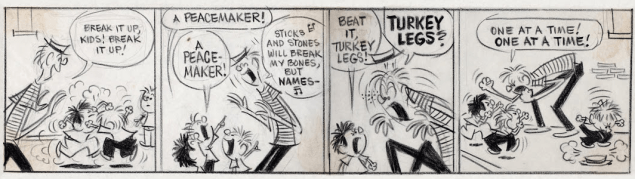
Mutt and Jeff is a newspaper strip created by Bud Fisher in 1907, generally believed to be the first daily comic strip (or at least the first really successful one). It featured Augustus Mutt (the tall fellow swinging on the right tentacle), greedy and highly inventive (if not downright insane) with his parade of get-rich-quick schemes, and bald Jeff, his reluctant sidekick, whose sideburns would surely get him accepted as a hipster in these modern times. Go here to read an enthusiastic article about this cultural phenomenon, and here to read some comics.

TentacleTuesdayIcon

Little boys who over-work an octopus are going to end up as his dinner, I say. Still, for the time being, here’s a sweet scene of inter-species coöperation.
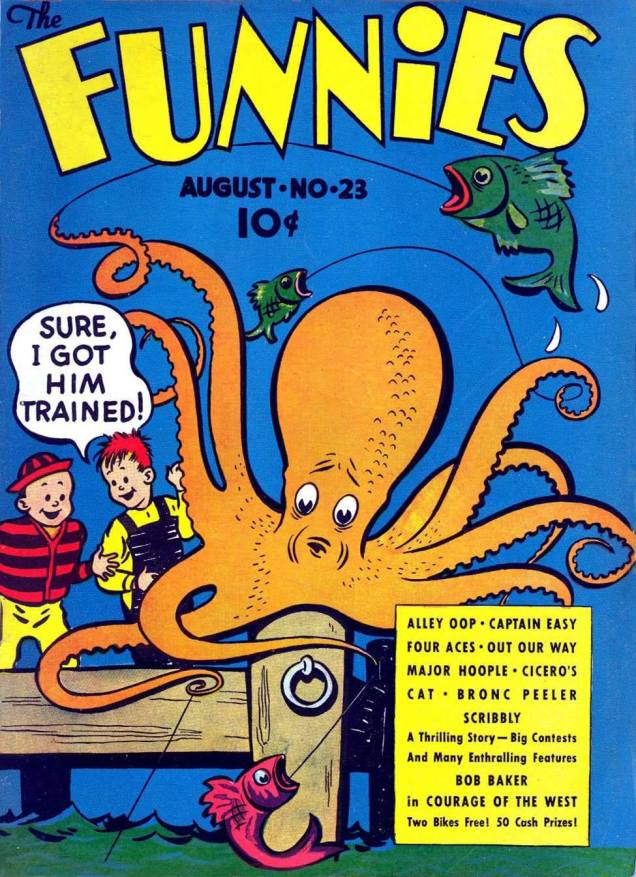
Funnies23-1938
I sure hope that this octopus gets his share of fish at the end of the day! Also, wouldn’t it be more efficient to just grab the fish directly with tentacles instead of using man-made contraptions like fishing lines? This is The Funnies no. 23 (Dell, August 1938). Does anybody know the artist?

TentacleTuesdayIcon

Orrible Orvie and Awful Annie will help us wrap up this Tentacle Tuesday. This octopus isn’t assisting the kids directly, but the kind smile on his, err, face radiates benevolence (well, not to the fishes, but one has to feed on *something*, right?)

LittleMonsters41-1977
This is The Little Monsters no. 41, 1977 – only three issues away from the series’ end (it ran from 1964 to 1978 for a total of 44 issues, plus a giveaway issue of March of Comics). Artist unknown.

~ ds

Happy birthday, John Stanley!

I’d like to bring to your attention that on March 22nd, 1914, more than a hundred years ago, John Stanley, American cartoonist and comic book writer extraordinaire, was brought into this world. He died in 1993 at age 79, but he left an undeniable mark on this world. (At least I hope it’s an indelible one.)

I won’t talk about his artistic parcours, as people far more erudite than I have already done it. For an enjoyable gallop through Stanley’s multi-faceted and staggeringly productive career, head over to the Comics Journal and read an excellent article by Frank Young. Want to read some stories (and have a few hours, if not days, to spare?) Visit Stanley Stories, a truly impressive blog by the same Frank Young, who scanned tons of comics and perceptively analyzed them for our great enjoyment.

Me, I’m just an devotee who likes to curl up and read his comics. I’ll share some images. The art is by John Stanley, unless otherwise specified.

StanleyMarge'sLittleLulu10
Marge’s Little Lulu no. 10 (April 1949). I recommend « John Stanley: Giving Life to Little Lulu » by Bill Schelly, published in Fantagraphics in 2017, which pieces together Stanley’s transformation of Little Lulu into the beloved, iconic figure she is today.  I’ve never felt the need to have female characters to relate to, yet Lulu’s a great role-model for mischievous little girls who can pitch a mean snowball as well as any boy!
StanleyLittleLulu32.jpeg
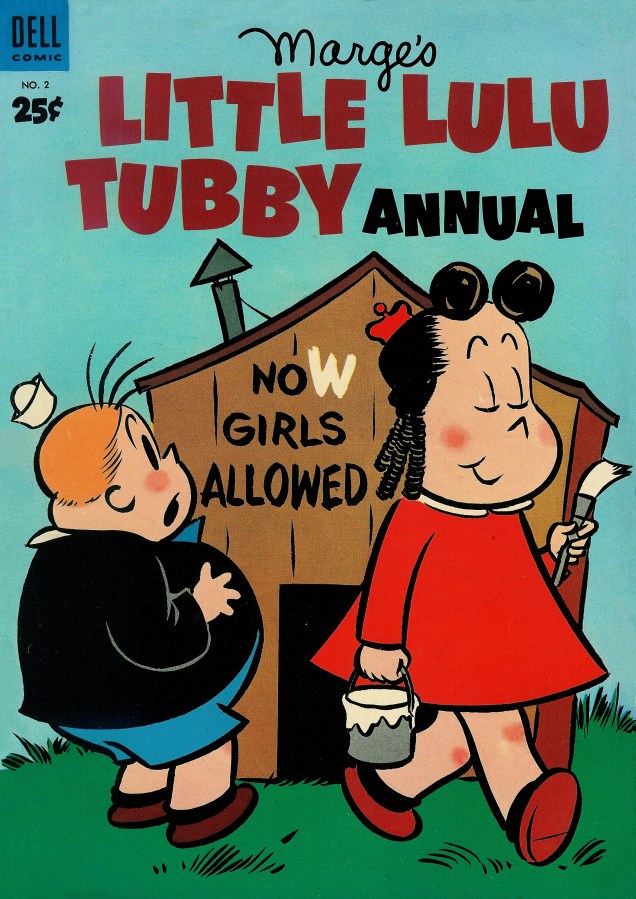
Marge’s Little Lulu Tubby Annual no. 2, March 1954. Cover by Irving Tripp from a layout by Stanley. Tubby’s series is an offshoot of Lulu’s.
StanleyTubbyFeerA
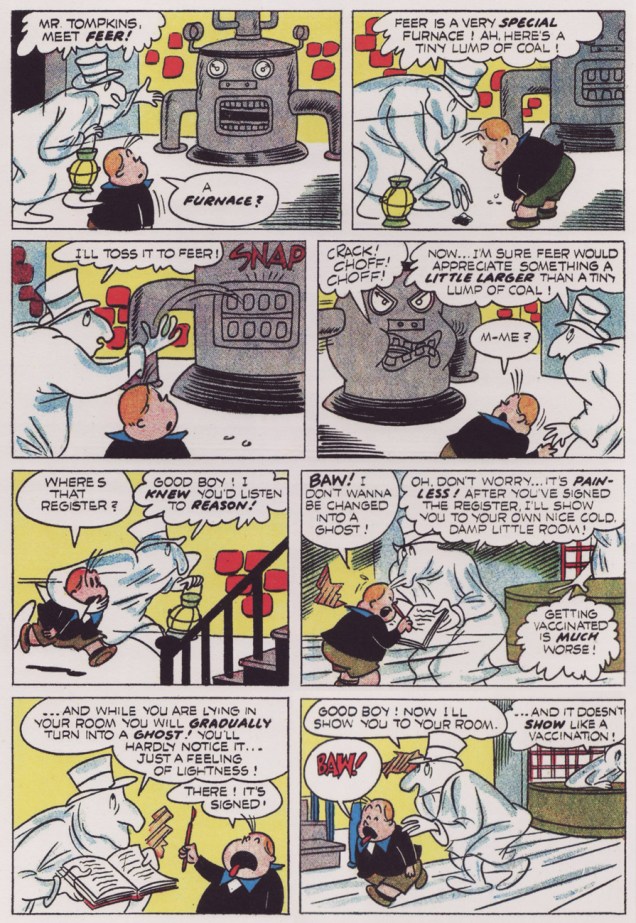
Page 8 from « Guest in the Ghost Hotel », from Tubby no. 7 (January-March 1954). Looking for ghosts, ghouls and monsters? Look no further than Stanley comics.
StanleyKrazyKat
John Stanley took a stab at Krazy Kat stories when Dell revived the comic in 1951. Krazy Kat Comics lasted for 5 issues (presumably poor sales doomed it), all published in the same year. This is Krazy Kat no. 1, 1951.
StanleyKookie1
How do Beatniks while away the hours? They compose nonsensical poetry, noodle it out… and dig girls, of course. Kookie was John Stanley’s creation; the series was written and laid out by him. Unfortunately, it was very short-lived, running for a grand total of 2 issues. This is Kookie no. 1, February-April 1962. The handsome painted cover is by Bill Williams from a layout by Stanley. You can read the issue here.
StanleyDuncandLoo6
Dunc And Loo no. 6, April-June 1963. Cover by Bill Williams from a layout by Stanley.
StanleyTeenageDunc
Lou (of Dunc & Lou) was apparently destined to be a newspaper strip, but never made it.
StanleyMelvinMonster2
Melvin Monster no. 2, July-September 1965.
StanleyO.G.Whiz1
O.G. Whiz no. 1, February 1971.
StanleyOGWhiz
An inside page of O.G. Whiz, with very typical madcap Stanley action.
StanleyMonsterofDreadEnd
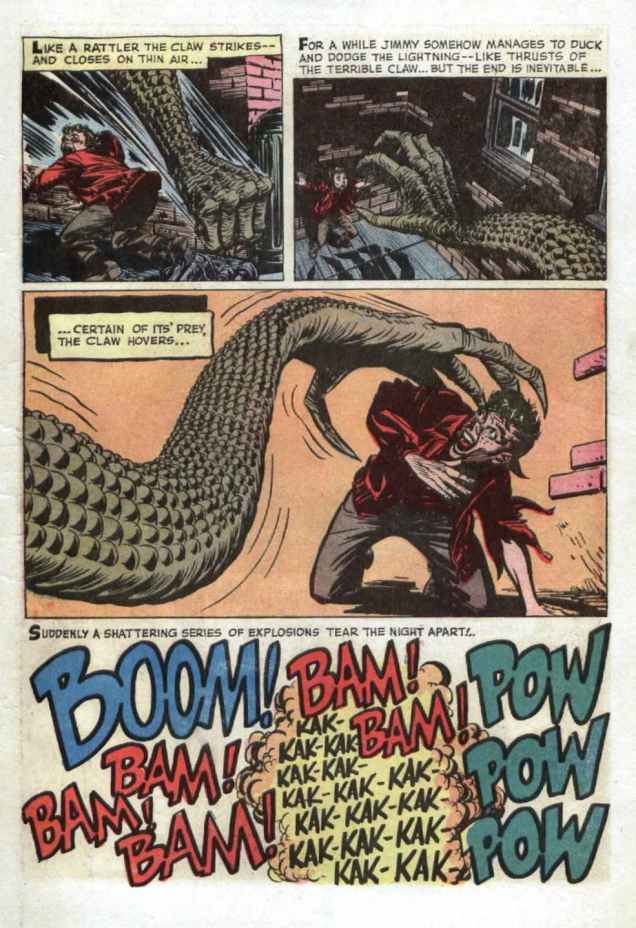
It’s not all fun, though: « The Monster of Dread End », written by John Stanley for Ghost Stories no. 1 (Dell, September-November 1962), is genuinely scary. Art by Ed Robbins.

And I haven’t even mentioned Stanley’s Nancy, nor her friend (and my favourite character) Oona Goosepimple. Next time… pick yourself up a copy of Drawn & Quarterly’s Nancy: The John Stanley Library, and happy reading!

StanleyMelvinMonster1
From Melvin Monster no. 1 (April-June 1965).

~ ds
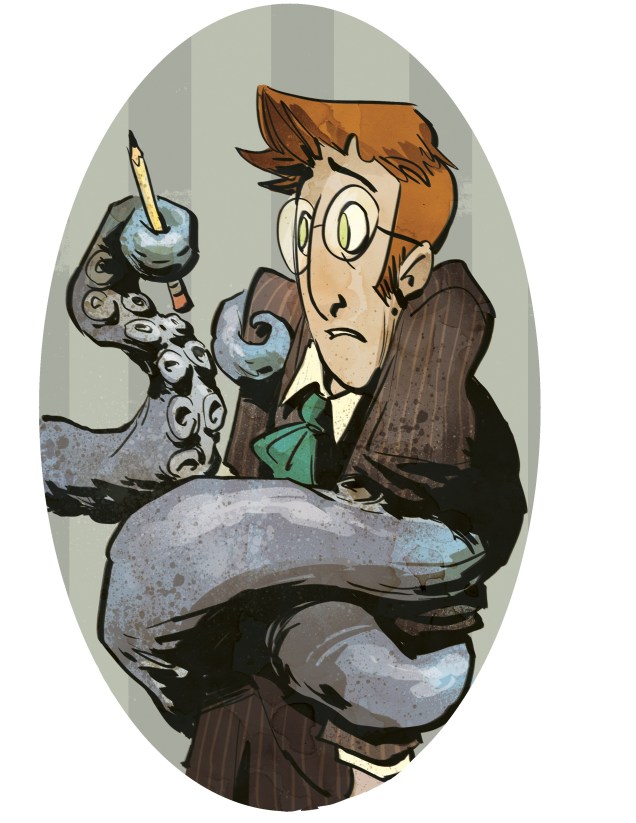
Visionary Meets Mundane: Richard Powers at Western Publishing

« Are all your projects this dangerous, Dr. Solar? »

Dateline: 1962. Printer-packager Western Publishing had just dealt its biggest client, Dell Comics, its slow death sentence (by mutual agreement, it is diplomatically claimed), though Dell should have seen it coming: for decades, Western Publishing Co. had « secured the rights, created the comics, printed them and shipped them out for Dell. Dell acted as the publisher and distributor and did the billing and paid Western for its creatively manufactured products*. » In 1962, Western cut out the middleman and launched its Gold Key imprint (1962-1984.)

Enter, briefly, revolutionary illustrator Richard M. Powers (1921-1996), who successfully wed representational and abstract art for his paperback covers of the 50s and 60s, bringing science-fiction visuals an unprecedented visual maturity. Don’t merely take my word for it: treat your peepers to a gander at his work. You may well find that you know it already.

What with a Cold War on, in the early 60s, atom-powered heroes were understandably in vogue. Charlton even had two: after Al Fago‘s 1955 creation Atomic Rabbit, came Joe Gill & Steve Ditko‘s Captain Atom. In 1962, the newly-founded Gold Key threw their hat into the nuclear furnace with the advent of Doctor Solar, Man of the Atom. He was created by writer Paul S. Newman and editor Matt Murphy.

PowersSolar1A
Doctor Solar, Man of the Atom no. 1 (October, 1962)
PowersSolar2A
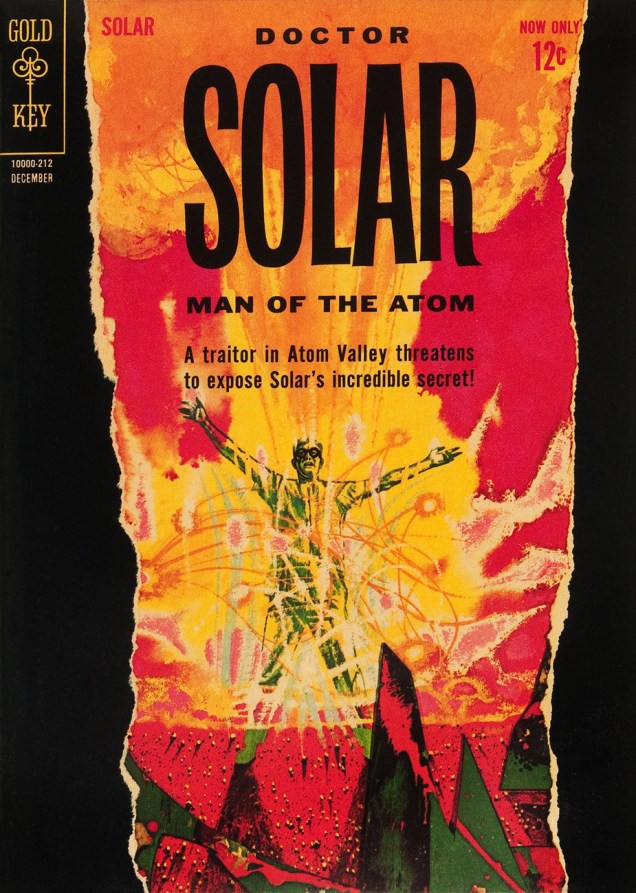
Doctor Solar, Man of the Atom no. 2 (December, 1962)

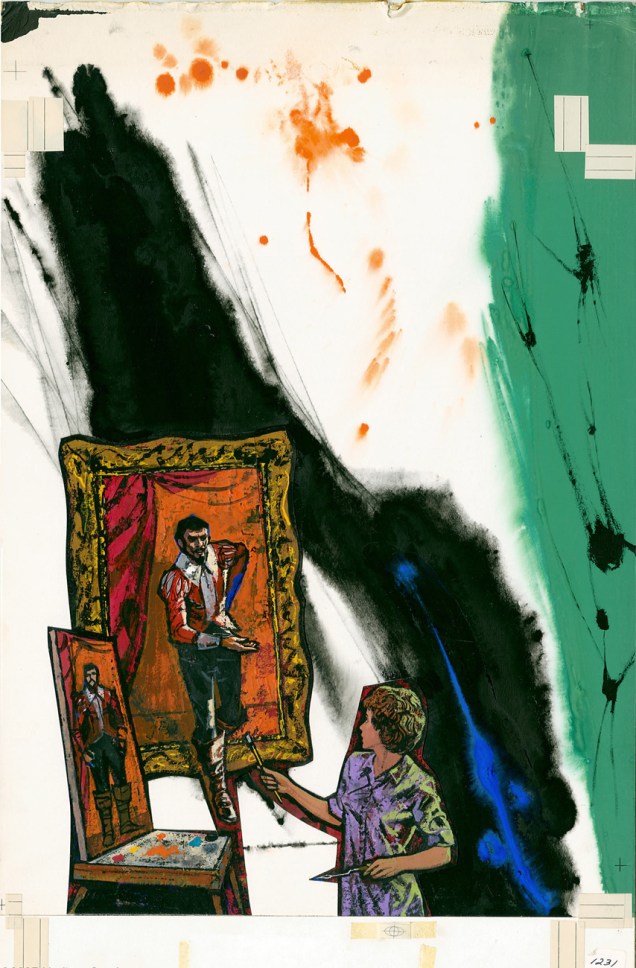
So far so good, right? And then… we may never know exactly what transpired, but I assume that some art director at Western Publishing chose to second-guess Mr. Powers… smothering the tonal and compositional balance of his painting (« can’t… bear… negative space! »), and likely depriving the outfit of Powers’ further services. He was at his peak, was being offered assignments than he could hope to fulfill, assignments surely more lucrative and friction-free. He wisely scooted along.

The printed version:

KarloffThriller2A
Boris Karloff Thriller no. 2 (January, 1963.) It was decades before I realized that this ho-hum comic book cover was the work of Richard Powers. In truth, the scales only fell from my eyes when I caught a peek of the original art. The printed version is so tame, so drained of its power(s) that the issue didn’t even appear in Jane Frank’s checklist of book covers in her fine The Art of Richard Powers (Paper Tiger, 2001).
PowersThriller2A
See? Now *that* is clearly Powers. « Just slap a 60% cyan overlay over the dang thing, Gertrude. It’s too effin’ artsy! »

And the tale might have ended there, but here’s the curveball: in the mid-to-late Seventies, Powers provided the fading publisher with a pair of gorgeous, but seldom-seen cover paintings.

Starstream1PowersA
A lovely Rorschach blot of a cover for the inaugural issue of Starstream, issued in 1976 under Western’s Whitman imprint. Starstream‘s four issue-run offered sober adaptations of smartly-chosen science-fiction short stories by the exalted likes of Theodore Sturgeon, Robert Bloch, A.E. Van Vogt, Robert Silverberg, Isaac Asimov, Larry Niven, Jack Williamson, et al.
UFOOuterSpace17A
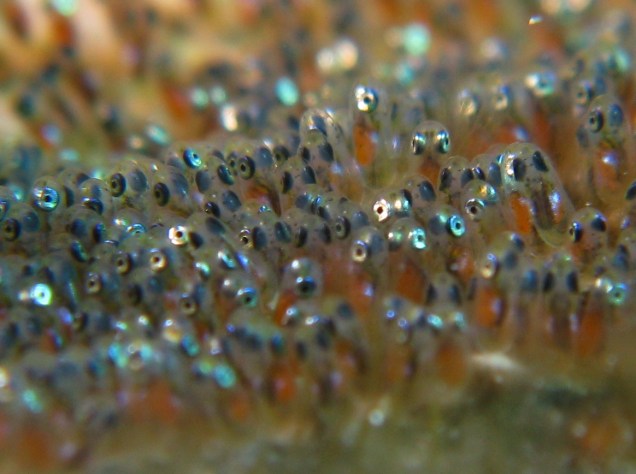
Let’s hear it for unearthly-looking extraterrestrials. With their translucent skin, these guys remind me of unhatched fish. The fifth and final cover created by Richard M. Powers, this is UFO & Outer Space no. 17 (continued from UFO Flying Saucers), published in September, 1978.

See what I mean?

Anemone_Fish_Eggs

If memory serves, my own Powers epiphany took place in the autumn of 1982, in Lennoxville, a small college town in the Eastern Townships of Québec. There was this little bookstore… and its fine selection of 60s horror and science-fiction paperbacks, priced in the 35-to-50-cents range. The kind of place book lovers dream about stumbling upon, and wake up dismayed to find themselves in the real world… empty-handed.

My favourite (inside and out) of the lot I picked up that day? Fritz Leiber’s (despite the name being misspelled on the cover) Night’s Black Agents (June 1961, Ballantine Books). If you’ve had a similar thrill of discovery with Powers’ art, please do tell us about it!

NBALeiber

-RG

*quoted from an interview with Gold Key’s Matt Murphy.

Tentacle Tuesday: Eightball Eyeballs

Compared to their bodies, octopuses have fairly small eyes. Yet in comics they often sport saucer-sized peepers, and like villains in a bad Broadway production, they love to glare menacingly at their potential victims from under their impressively wrinkled brows.

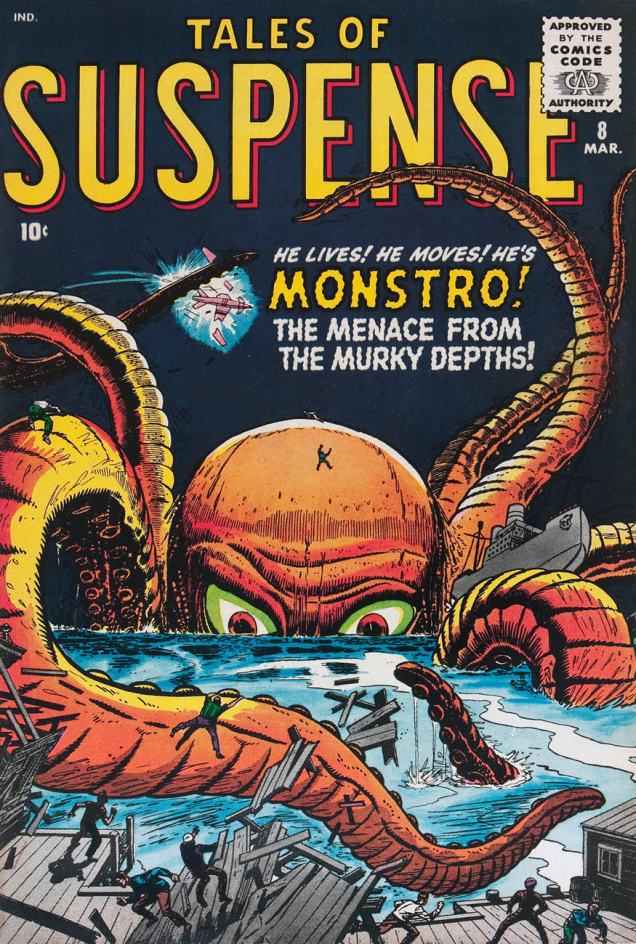
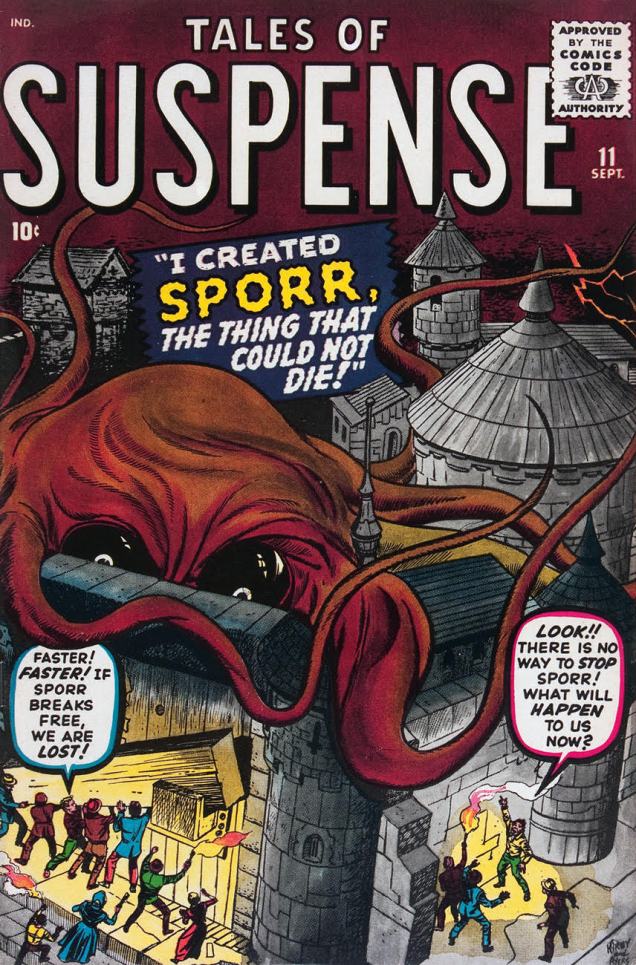
Case in point, these two Tales of Suspense covers, close cousins despite the change of scenery. They’re both from 1960, both penciled by Jack Kirby and inked by Dick Ayers. Both monsters promptly acquire loving nicknames from people you would think have more important things to think of, like not getting eaten and/or crushed. Meet Monstro and Sporr!

TalesofSuspense8
Tales of Suspense #8, March 1960. An octopus who was minding his own business gets temporarily but dramatically enlarged by radioactivity from nuclear tests (*communist* nuclear tests). “He lives! He moves!” – I fail to see why that’s amazing more than, oh, say “this thing’s gigantic on a scale heretofore unknown to man”.


TalesofSuspense11
Tales of Suspense #11, September 1960. A well-intentioned but overly enthusiastic scientist exposes an amoeba to an « experimental death ray » and the poor thing grows into this.

TentacleTuesdayIcon

Not all puppy-eyed octopuses have two baby blues; unlucky cephalopods end up with Cyclopean anatomy and a bad case of suffering the wrath of grapes – a cherry in a glass of buttermilk, anyone?*

The Occult Files of Dr. Spektor #19Painting
The original art for the cover of The Occult Files of Dr. Spektor #19 (Gold Key, April 1976). It was painted by Filipino artist Jesse Santos. Dr. Spektor is our protagonist, yet he looks particularly baleful here, hunchbacked and grinning, nothing like the kind of  dashing  hero who’d rescue a drowning maiden.
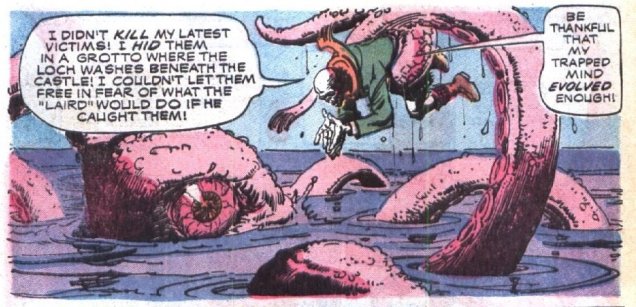
The Occult Files of Dr. Spektor19Page
A panel from « Loch of the Leviathan », also drawn by Jesse Santos, and written by Don Glut. I just love this panel – the gentle curve of tentacles, the skeleton and his pleading gesture…

I highly recommend the issue, certainly because of the art, but equally the story. You won’t find a straightforward man-finds-monster, man-kills-monster plot-line here; and there’s also bikini babes for your viewing pleasure.

* Your eyes look like two cherries in a glass of buttermilk
Don’t roll those bloodshot eyes at me
I can see you’ve been out on a spree
(Wynonie Harris, Bloodshot Eyes)

TentacleTuesdayIcon

Sometimes octopuses have big eyeballs *and* a vocabulary all their own.

LurkAkim
Octopus language is the biggest mystery after “what does the fox say?” I bet you never knew that octopuses go “LURK LURK?!”

Akim was an Italian comic, published from 1950 to 1983, and translated into several languages, most notably French. Drawn by Augusto Pedrazza and wrtten by Roberto Renzi, Akim was a « tarzanide », which is to say heavily “inspired” by Tarzan, if not directly ripped off from it.

The LURK LURKs in panel above were no one-time occurrence. The octopuses in this story keep saying it again and again, and with different intonations, which I find hilarious. Turns out, a whole range of emotions can be expressed with this small four-letter word! My thanks go to co-admin and partner RG, who noticed this unpromising, poor-excuse-for-a-comic in a store and pointed out why we should pick it up after I had scoffed at it.

LurkAkim2
I can’t help but feel that the octopus is trying to say something important, but all its mouth (?) can form is a piteous luuurrrkk.

~ ds


Tentacle Tuesday: Adopt an Octopus Today!

I’m in the mood for a light-hearted Tentacle Tuesday, an octopus-as-gentle-companion kind of mood.

Without further ado, I invite you to take a peek at the lives of those who opted for a slightly unorthodox pet!

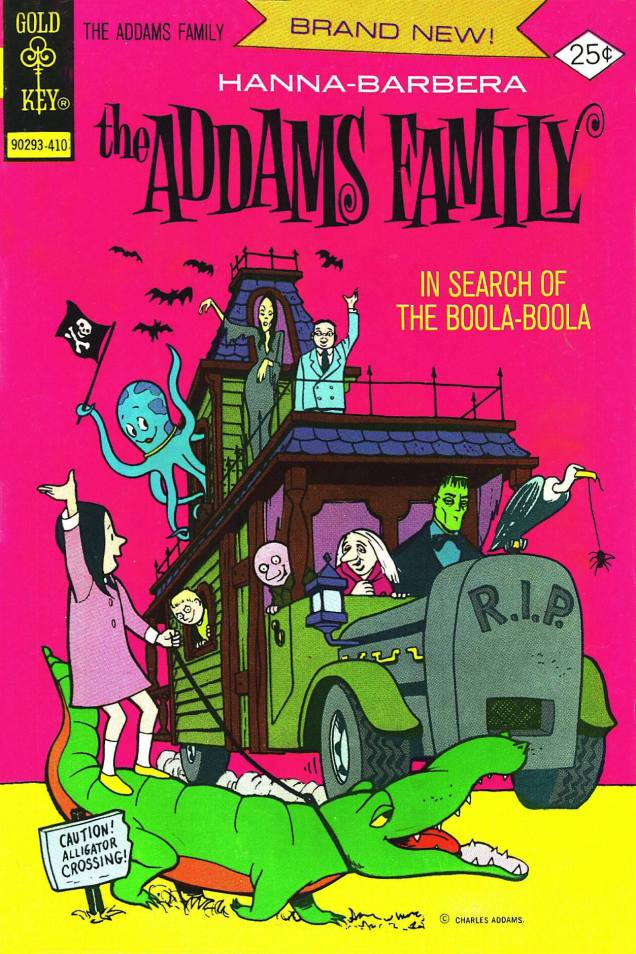
Here’s our first friendly fellow. Ocho the octopus may be a minor player on this cover, but I’d like to think that he can still be part of our Tentacular Tuesday line-up (I couldn’t resist his puppy eyes).

10845760_788912494490179_7872800748136590150_o
The Addams Family no. 1, October 1974. Cover by Bill Ziegler.

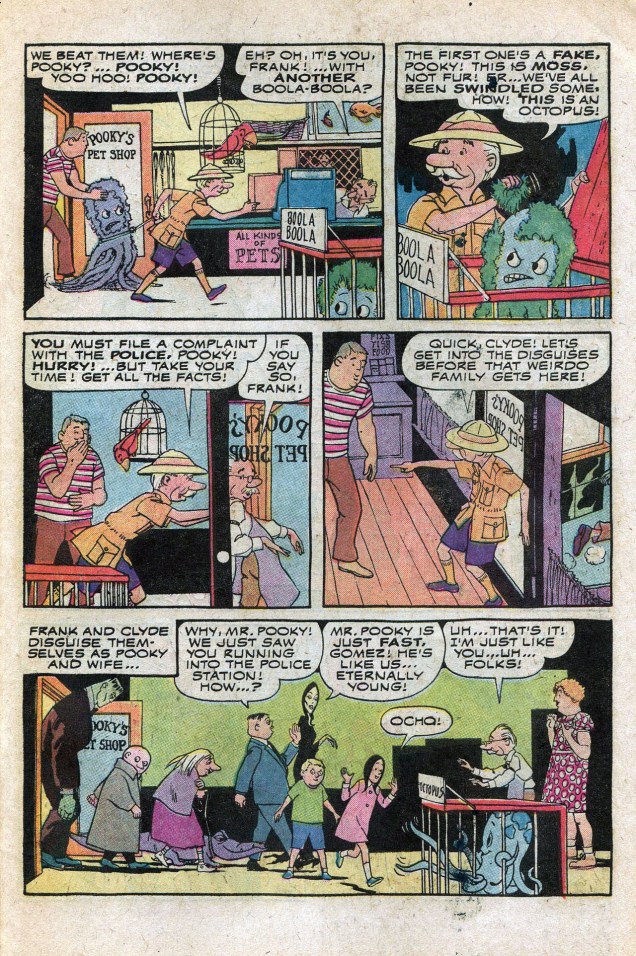
AF#1 not only features Ocho, but also a creature called Boola-Boola, basically a shaggy, colour-changing octopus – so you get double the tentacular pleasure in one issue!

AddamsFamily1GoldKey
Art also by Bill Ziegler.

You can read the whole story here. Interestingly enough, the website that has beautiful scans of all three Addams Family Gold Key issues seems to be dedicated to teaching young people’s English, or to quote from the horse’s mouth, “Improve your English through Reading Comic with Fun”.

TentacleTuesdayIcon

Next up are Victoria and Otto, a nattily-dressed Victorian girl and her pet (confidant, friend, butler…) octopus.

OttoVictoriaSkating

Given the style of these comico-illustrations, I don’t think it will astonish anyone to learn that Brian Kesinger is a Walt Disney Studios alumnus. Apparently, Otto and Victoria’s popularity has taken him by surprise, though it seems rather obvious that a curvy steampunkette and a friendly octopus would be a hit with a lot of people. This may be overly cute, but how can you resist the chronicles of two dear friends (though they may be of different species), especially when they regularly drop everything for a tea or reading break?

Read-To-Your-Octopus

ice_bucket_art_challenge_by_briankesinger-d7vyhhk
Ice bucket challenge!

Otto and Victoria (with some involvement from Kesinger, I imagine!) have three books to their name – Walking Your Octopus: A Guidebook to the Domesticated Cephalopod (2013), Coloring With Your Octopus: A Coloring Book For Domesticated Cephalopods (2014) and Traveling With Your Octopus (2015), all three published by Baby Tattoo Books.

Here’s a self-portrait of the artist as a tentacle man:

BrianKesington
I think he’s stuck drawing tentacles for the rest of his life, now that Otto & Victoria merchandise is selling well. Careful what you wish for!

You can peruse more octopus adventures here.

TentacleTuesdayIcon


For our last entry, a friendly game of cards.

Now you see this brand new razor
I had it sharpened just today
I’m comin’ in there with my own rules
That you must follow when you play
Hey kid, keep your hands up there
While you’re givin’ them out, please
Stop puttin’ them wildies
Down there ‘tween your knees***

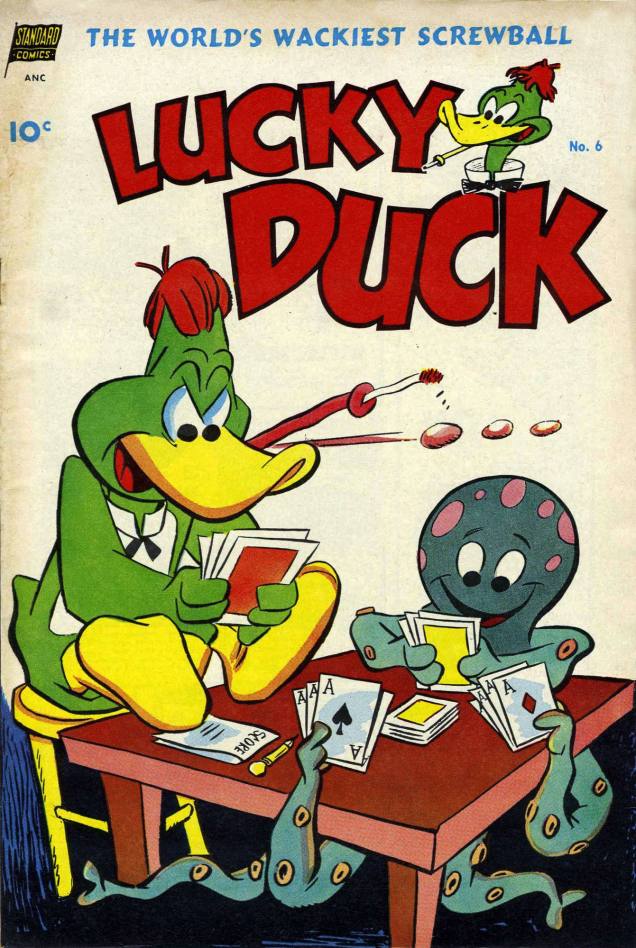
LUckyDuckn6
Lucky Duck #6 (May 1953), art by Irv Spector, (1914-1977), whose career was mostly in animation, though he left behind some lovely comic work as well. The madcap energy of his stories certainly makes it look like the characters are actually in motion!

The inside stories are also by Irv Spector.  His son, Paul Spector, hosts a wonderful blog about his father’s work, and you can find many Lucky Duck stories for your enjoyment on its online pages for a dose of the sort of ebullient zaniness one only finds in animal funnies of the 1950s.

As a little bonus, a peek at Gary Larson’s view of octopuses as pets.

GaryLarsonOctopusObedienceSchool

~ ds
Case of the Animated Counterparts

« In the big wrinkled world,
it would be like looking for
a straw in a needle stack… »

Based upon, but with savvy improvements, Peter Sellers‘ Inspecteur Jacques Clouseau from the popular series of films launched with 1963’s “The Pink Panther“, the animated Inspector and the titular feline (who first appeared in the opening credits of the film) were spun off into a pair of successful series of animated shorts. Produced by DePatie-Freleng Enterprises, these series have earned their place as highlights of 1960s animation, though the competition was pretty toothless, compared to prior decades.

As for funnybooks, Gold Key’s “The Pink Panther and the Inspector” title was a solid success, lasting 84 issues (73 under the GK imprint, then 11 more under Whitman, 1971-1984), leading to a solo spinoff for The Inspector (19 issues, 1974-78). This is surprisingly witty stuff, written and drawn with assurance and verve. Comic strip great Warren Tufts (creator of Casey Ruggles) was reportedly involved, though when it comes to Gold Key and Dell, credits are at best sketchy.

Inspector2A
This is issue 2 of The Inspector (Oct. 1974, Gold Key.)
InspectorRealKiss
Speaking of the « Case of the Stolen Kiss », here’s a rather… daring public display of affection! This being Gold Key, the material was not submitted for approval to the industry’s censorship body, the Comics Code Authority.

Oh, and here’s the Panthère rose‘s entry into the celluloid world:
https://www.youtube.com/watch?v=K0YI9c3jc90

– RG

On This Day: Boris Karloff Crosses Over

« What’s that noise comin’ up from the cellar?
It’s the restless bones of Boris and Bela* »

It’s a cinch that William Henry Pratt, back when he was eking out a living in Canada, digging ditches or driving a truck, never suspected that his name, his stage name that is, would still elicit shivers of recognition long after his passing. Here we are, a whole hundred and thirty years past his birth, in Camberwell, South London, on Wednesday, November 23, 1887.

From his ascent to stardom in the early 1930s until his passing in 1969, he certainly lived to see his likeness appear in a bewildering array of toys and games and bedsheets and mugs and a zillion knicknacks and gewgaws, a parade that continues to this day. But he was likely never represented more consistently and abundantly than he was in comic books.

Frankenstein11A.jpg
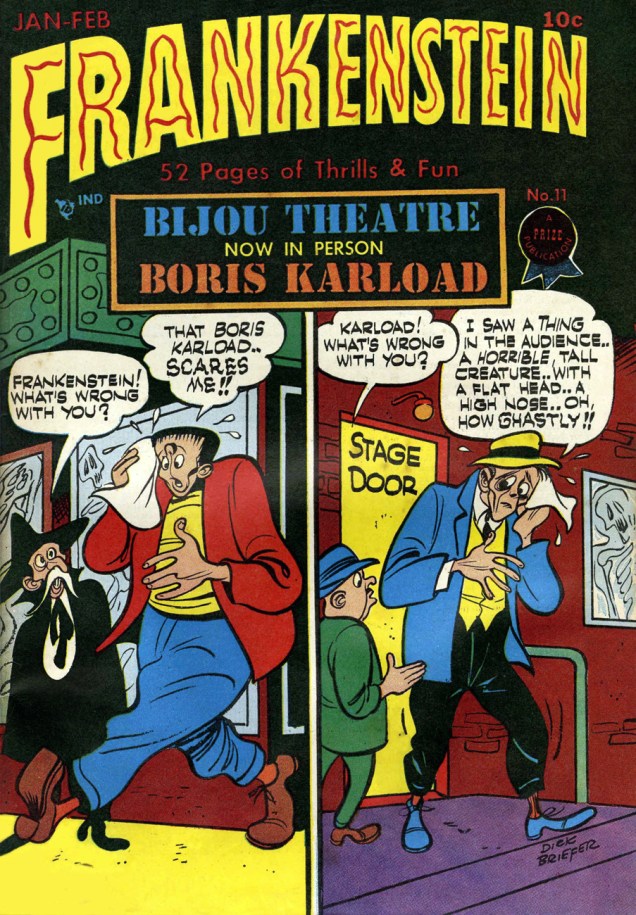
Here, the Monster meets his… inspiration, in « Boris Karload, Master of Horror ». Dick Briefer‘s Frankenstein is a definite highlight of the Golden Age of comics. This is Frankenstein no. 11 (Jan.-Feb. 1948, Prize Comics). Read it here: http://comicbookplus.com/?dlid=39937 And if you, er… dug that, treat yourself to Craig Yoe‘s selection of Briefer’s rendition(s) of the Famous Monster. It’s a great package, and Mr. Yoe can always use the money… to unleash further wonders.

Here’s a gallery of cover highlights from Gold Key Comics’ long-running Boris Karloff Tales of Mystery (95 issues, 1962-80).

BorisThriller1A
Before there was called Boris Karloff Tales of Mystery, there was, for two issues, Thriller, based on the by-then-cancelled NBC series. Gold Key were often quite slow in making their licensing moves. The TV Thriller was often terrifying (“Pigeons From Hell”, “The Hungry Glass”…), but the comic book never scaled such heights, even sans the emasculating influence of the Comics Code Authority.
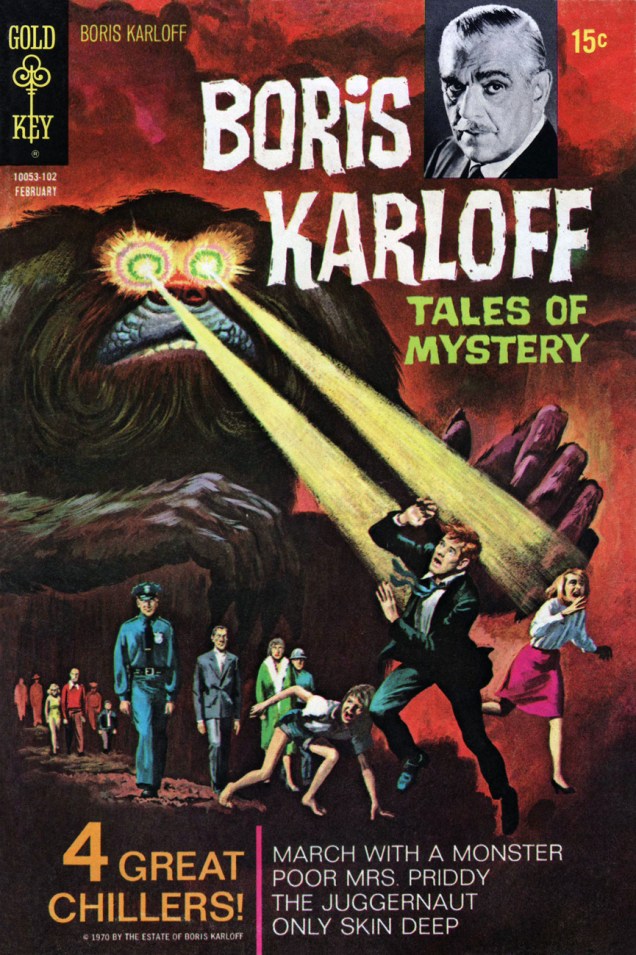
Boris33A
« You know that one sideways glance from that bug-eyed banshee can turn your brains to prune-whip! » Boris Karloff Tales of Mystery no. 33 (Feb. 1971), Cover painted by George Wilson, illustrating Len Wein, Tom Gill and John Celardo’s March with a Monster.
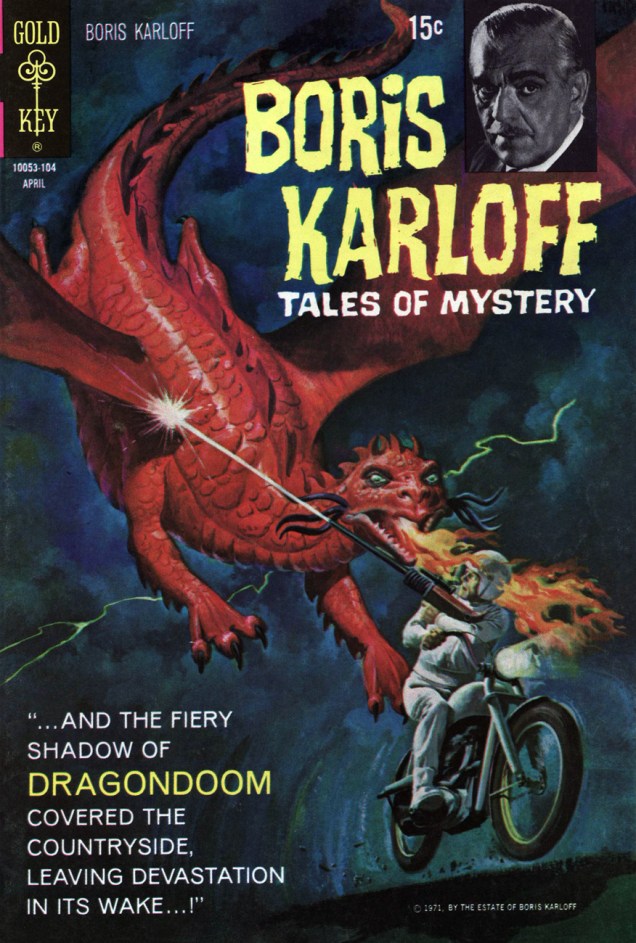
Boris34A
« I’m being scorched by something that shouldn’t even exist! » A laser cannon-equipped Evel Knievel tussling with a badass reptilian nightmare? That’s the Seventies for you. Gold Key’s mystery comics were generally pretty tame fare, but their covers, such covers! This one’s painted by Saint George Wilson. Boris Karloff Tales of Mystery no. 34 (April 1971.) You just know that Dragondoom is written by Lein Wein, because its damsel-in-distress shares his wife’s name, Marvel and DC colourist Glynis.
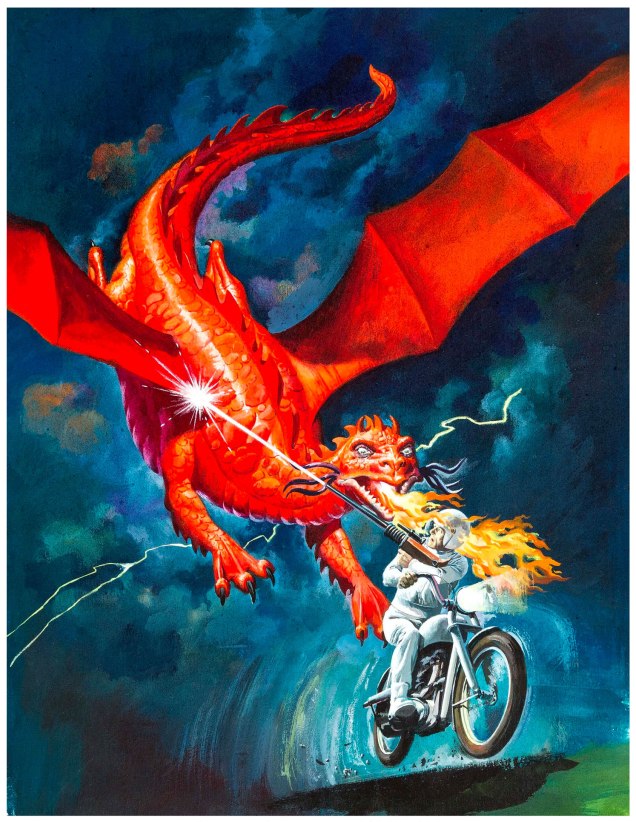
Boris34OriginalA
A look at Mr. Wilson’s original painting gives us an idea of just how much was lost in the transition from brush to print. Sometimes it’s better *not* to know.
Karloff43A
« Feast your eyes upon them, mortal! Do they satisfy your appetite for witchcraft? Hee Hee! » Wayne Howard conjures up some decent monsters inside, but Psychotomimetic George Wilson, who painted this mind-melting cover, shows how it’s *really* done. Boris Karloff Tales of Mystery no. 43 (Oct. 1972.)
Boris49A
« The car — being sucked in by this blasted fetid swamp! Goodbye car… goodbye, convention! » Roadside George Wilson strikes again! Boris Karloff Tales of Mystery no. 49 (March 1973.)

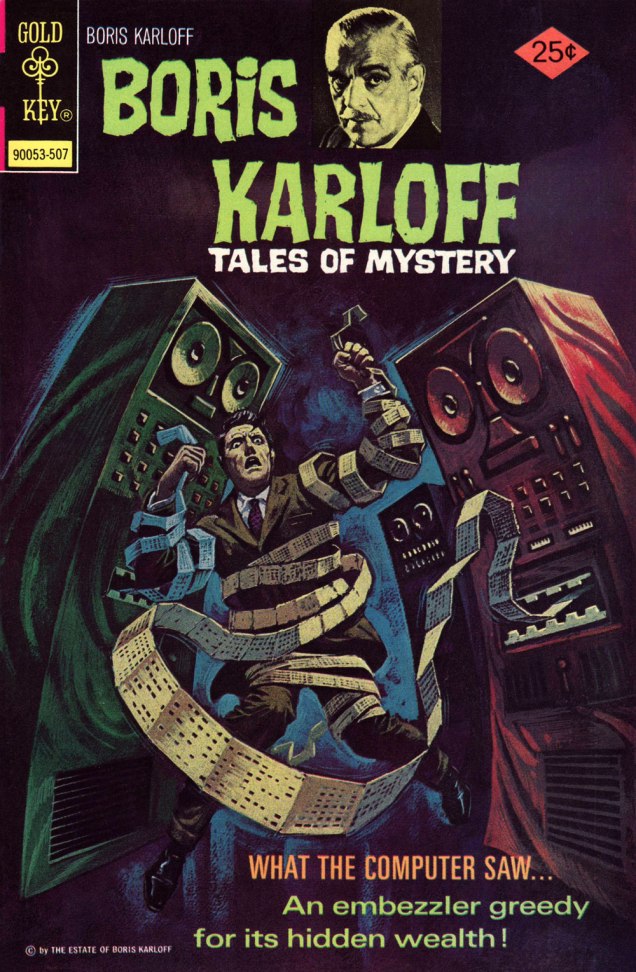
DominguezKarloff62A

« These computer cards are wonderful… almost as if they were alive! They tell me everything! » Boris Karloff Tales of Mystery no. 62 (July 1973). Luis Angel Dominguez‘s painted cover depicts a scene from Arnold Drake‘s witty It’s in the Cards.

Boris65A
« G-g-get away, B-Bobby! There’s a living horror out there! » « Aww, gee, dad! I’m sorry about that! It’s just my sea monster! » Meet The Mail-Order Monster, a gem from an uncredited scripter (likely Arnold Drake, if the sparkling wit is any indication), and illustrated by Ed Robbins. It’s a fabulously wacky yarn, combining to fine effect good old Sea-Monkeys (brine shrimp, really) and a generous sampling of Ray Bradbury’s Boys! Raise Giant Mushrooms in Your Cellar! 
This is Boris Karloff Tales of Mystery no. 65 (Dec. 1975), edited by Paul Kuhn. Also within: Don’t Put It on Paper, another of the handful of jobs José Luis García-López did for Gold Key, before settling down at DC later that year. The plot is basically that of Clark Dimond/Terry Bisson & Steve Ditko’s The Sands That Change! (Creepy no. 16, Aug. 1967, Warren), but with a much gentler outcome.
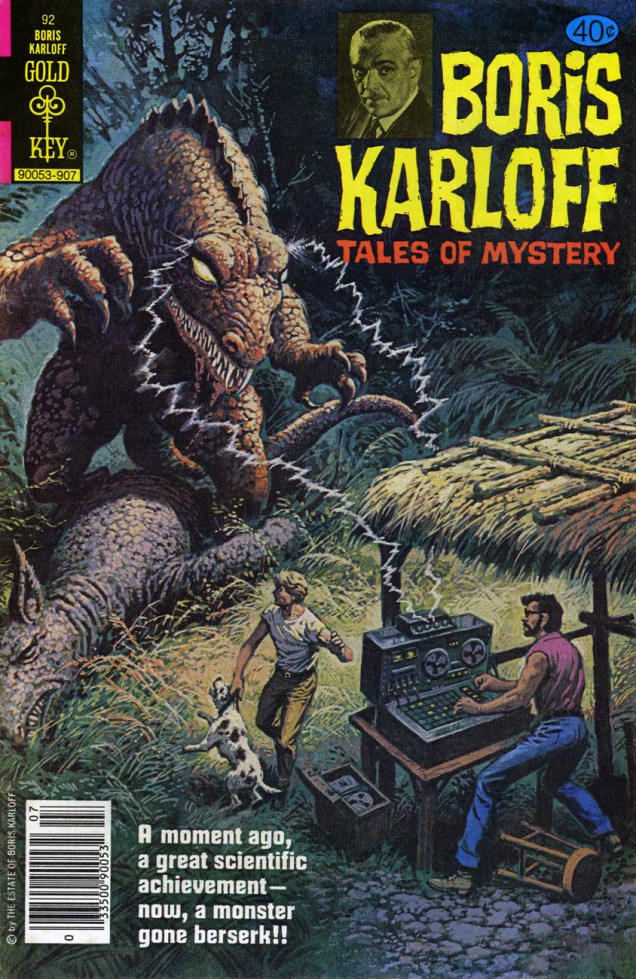
Boris92A
« But — why would anyone create something so — so terrifying? » One thing you can nearly always count on in any given issue of BKToM: “scientific” experiments always go awry, and they nearly always yield rampaging monsters. Fitting! Luis Angel Dominguez provides this electrifying cover for issue no. 92 (July, 1979.) The man had such a peerless colour sense.

And remember, there’s far more to Boris Karloff than Frankenstein’s Monster: for evidence of his talent, check out The Body Snatcher (1945, directed by Robert Wise and produced by Val Lewton) or Targets (1968, directed by Peter Bogdanovich.)

Let’s reserve our closing words for the man (monster) himself: « Certainly I was typed. But what is typing? It is a trademark, a means by which the public recognizes you. Actors work all their lives to achieve that. I got mine with just one picture. It was a blessing. »

– RG

*Ships Don’t Disappear In The Night (Do They?) by 10cc (1973)

Hallowe’en Countdown, Day 13

« It is Friday the 13th and you are right on time — ten minutes to midnight! »

UnderLadderA
The Anti-13 is that rarest of creatures: an unflinchingly skeptical tale published in the pages of a supernatural-themed comic book in the midst of the 1970s occult craze. Hats off, folks!

As the thirteenth fatefully falls on a Friday this month, I’m inspired to trot out a story from my very favourite issue of Gold Key’s Grimm’s Ghost Stories no. 26 (Sept. 1975). So what elevates this particular entry above its brethren? Admittedly, the competition from other issues is pretty tepid. Truth be told, though, all comers are swept out the door by a winning pair of yarns from the great Arnold Drake (1924 – 2007, co-creator of The Doom Patrol, Deadman and the original Guardians of the Galaxy): The Servant of Chan (illustrated by Luis Dominguez) and this one, the bracingly skeptical The Anti-13 (illustrated by John Celardo).

Intrigued? Read The Anti-13 for yourself!

And find out more about history’s real-life Anti-13 clubs right here.

– RG

Tentacle Tuesday: Domesticated Octopus Seeks Soulmate

Meet an old man’s pet, Poochy. Like most pets, he gets a little impatient and loud around mealtime, but forgive him – he’s just a healthy animal who needs his calories. Who’s a good boy?

It’s Tentacle Tuesday, and today’s offering is this barking mad (hehe) and delightfully nonsensical story with script and pencils by Jim Starlin and inks by Wayne Howard.

« The Hotel » is a mere 2 pages long, so here it is in its full and unabridged glory:

TheHotelWayneHoward

TheHotelWayneHoward2
This is no plebeian octopus. This tentacled horror, this mutated dog-like atrocity, is a force for moral good, dammit, dishing out all the punishment these evil-doers deserve! (Or maybe it’s just hungry.)

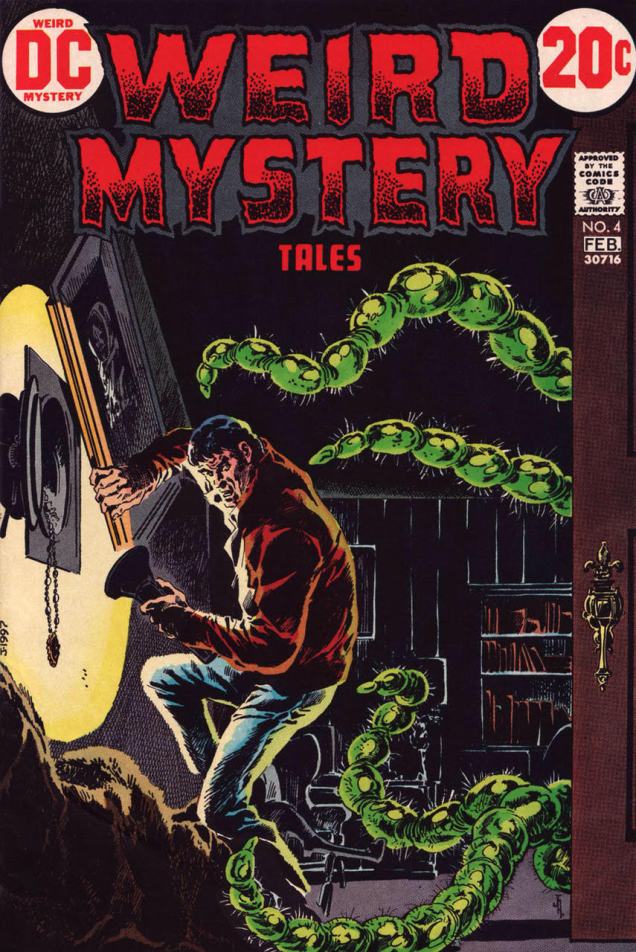
This tale of woe comes from Weird Mystery Tales #4 (Jan.-Feb. 1973), with a cover by Jim Aparo. It re-interpreted the story somewhat, making the thug’s comeuppance a little more immediate, but it’s still the same basic plot device: there’s the Deus ex machina, and there’s what I call Sudden Tentacles. Don’t know how to wrap up your story? Bam! tentacles out of nowhere, and everyone forgets that your tale makes no freaking sense.

WeirdMysteryTales4

Continuing this rather disturbing theme of stay-at-home octopuses, we have another contender for someone’s beloved pet: this sweet little (metaphorically speaking) guy from « Dum-Dum’s Basement » (Boris Karloff Tales of Mystery #93, August 1979).

DumDumsBasementMelCrawford
Art by Mel Crawford. Dum-Dum’s pet will soon want flesh instead of fish! (I also like how some people don’t give a shit about having a permanently flooded basement.)

Then we have the prototypical Sudden Tentacles and set at home, too: this panel from a chilling Tom Sutton and Nicola Cuti story called « Those Tentacles! » (inventive title), published in Ghostly Tales #106, August 1973.

TomSuttonThoseTentacles
“The tree branches remind me of those tentacles… those slimy, winding tentacles squeezing the life from Jake!”

There’s a scene in Nightmare on Elm Street 3: Dream Warriors (at 3:55) that quite terrified me as a kid – a girl reaches over a sink to turn the water on, and the tap sprouts… appendages… and grabs her hand. I wish Freddy Krueger was into tentacles, I would have spent fewer sleepless nights in my youth.

Wishing all of you peaceful nights of slumber… until the next Tentacle Tuesday rolls around – and it will.

Googly Eyed Stubby Squid
This itty-bitty octopus will haunt your nightmares.

˜ds

Tossing Pebbles Down a Well

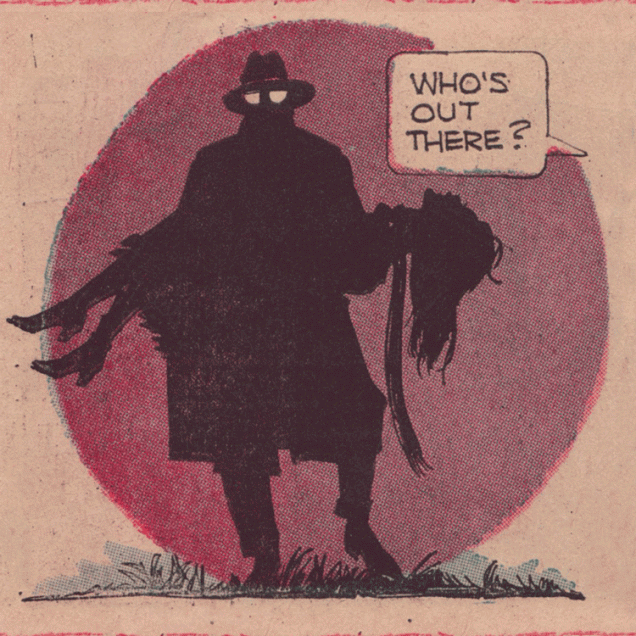
OutThereIconIt stands to reason that there are tons of spiffy-yet-unheralded material out there, most of it slowly mouldering away in obscurity. You may count on us to do some foraging and to showcase some of the spoils here… with proper attribution.

Our image: Artwork by Ed Robbins, from Cemetery Scene, writer unknown (The Twilight Zone no. 36, March 1971, Gold Key).