« If you saw a heat wave, would you wave back? » — Stephen Wright
Time to carry on with one of my pet quixotic missions, that of advocating the glory of Samm Schwartz (1920-1997), my very favourite Archie artist… and one of my favourite cartoonists, period.
Having acquired over the years most of the Jughead issues I could afford — for the most part cheap, but thankfully numerous — I’ve now reached the stage of acquiring scattered issues of assorted Archie titles featuring one or two Schwartz stories… along with often appalling page fillers by painfully lesser lights. To lessen the blow, I usually skip the Schwartz story — which usually opens the book… savvy thinking on their part, I’ll admit — then return to it so as to end on a high note.
I was hesitating between two stories, but since they’re both quite short, why choose? Hence the programme double.
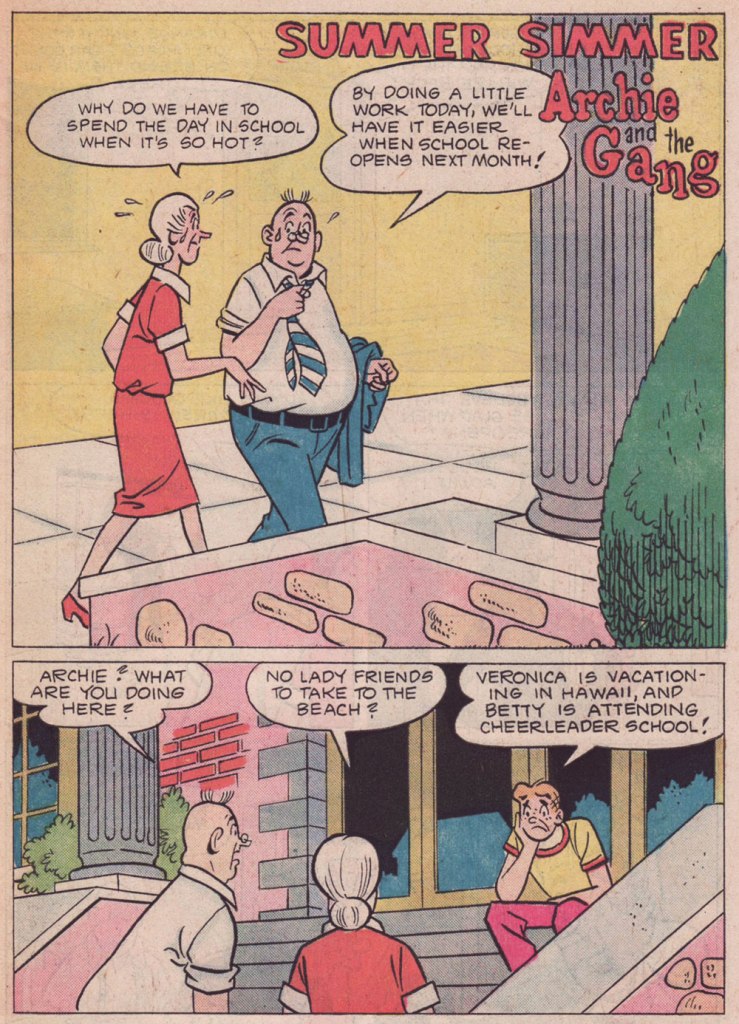
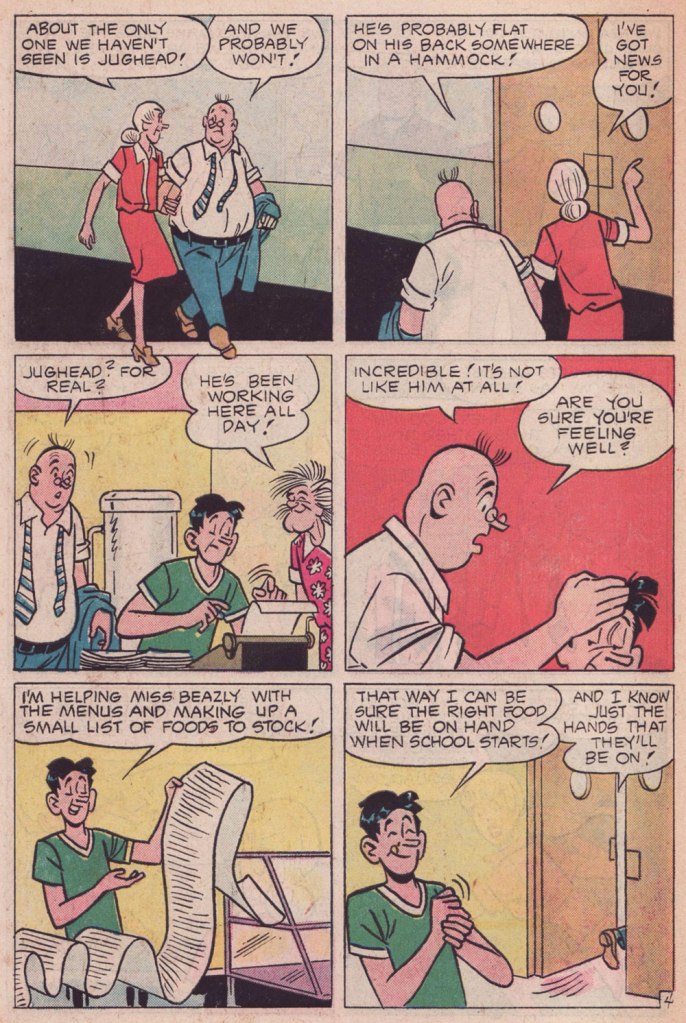
« Summer Simmer » first appeared in Archie’s TV Laugh-Out no. 35 (Nov. 1975, Archie). Scripted by George Gladir, this story has the distinction of not particularly striving to be funny, instead focusing on character and situation.. which is totally distinct from the all-too-frequent straining for laughs and failing Archie blueprint. This sort of outlier is what makes the search worth the bother.
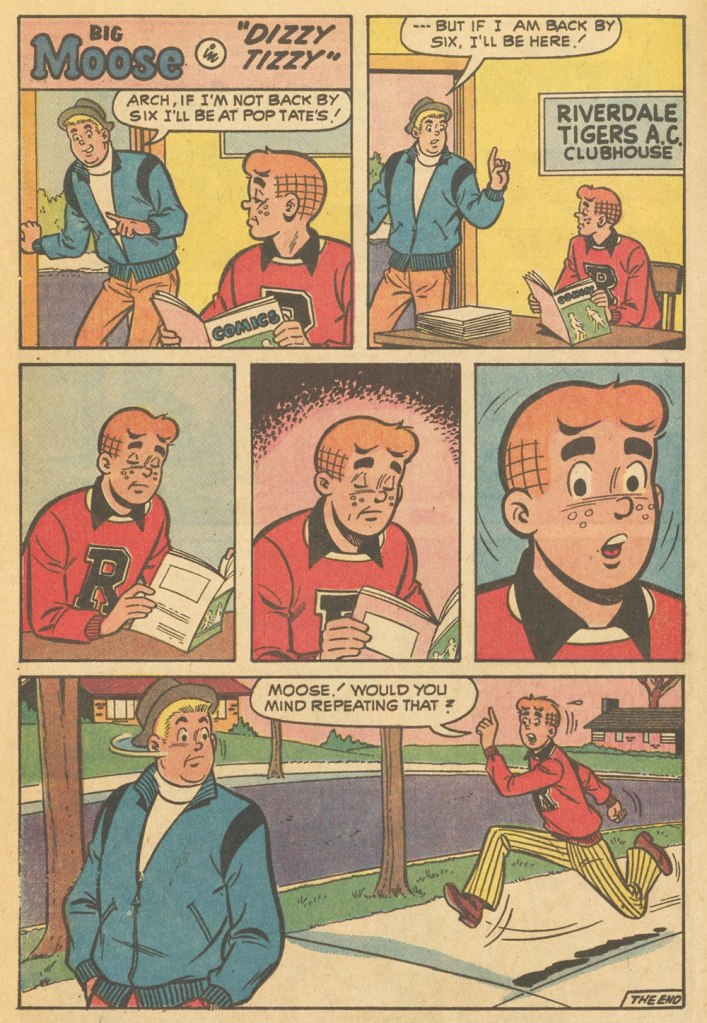
« The Defender » originally saw print in Pep no. 235 (Nov. 1969, Archie). Not only does Marmaduke “Moose” Mason get a rare turn in the spotlight, but it’s an unusually favourable depiction. It was most likely scripted by Frank Doyle.
It must be mentioned that Schwartz often tweaked the scripts he was assigned, but incognito. His collaborators trusted him, giving him free rein. Besides, let’s face it, the stakes were depressingly low.
« Our Betty Cooper is still the girl next door – she literally lives next to Archie. And she’s the blonde all-American girl; she’s so sweet and forgiving, gives people the benefit of the doubt and second chances, wears her heart on her sleeve. But she’s also incredibly broken on the inside, for many different reasons. » — Lili Reinhart
As a whole, comic book artists are not a happy lot, and for good reason. During the Golden Age, at least, there were countless publishers, so one could move around if unsatisfied with the working conditions.. even if meant finding out that things were rotten all over. After the mid-1950s, when the field violently contracted — you know the story — leaving scant players standing, you pretty much had to take the work, and the abuse, as they came. And certain publishers frowned upon ‘their’ creators playing what little remained of the field.
Kurt Schaffenberger had steady work at DC, but presumably — and understandably — sought to keep his options open, so he moonlighted for ACG, often under a pseudonym, probably unaware that the ‘competitor’ was covertly owned (at least in part) by DC co-founder and co-owner Harry Donenfeld. One can imagine Kurt’s distress when ACG folded in 1967. From what I can surmise, he did, in 1970, a lone, inexplicable cover for Stanley Morse… wildly outside his range but still kind of awesome. And then… he quietly boarded a bus to Riverdale.
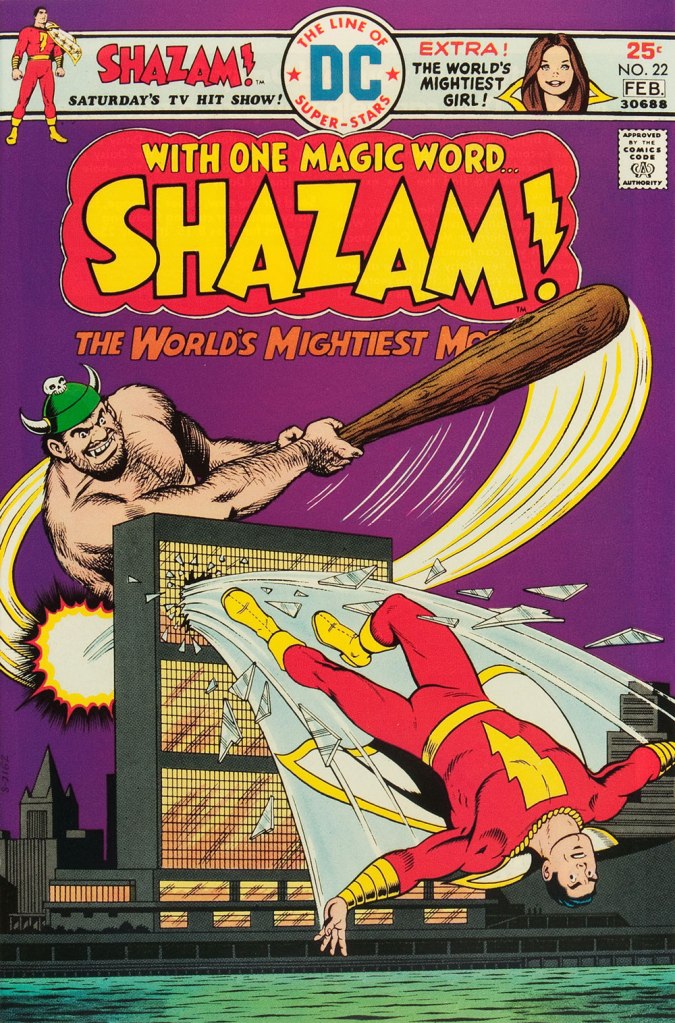
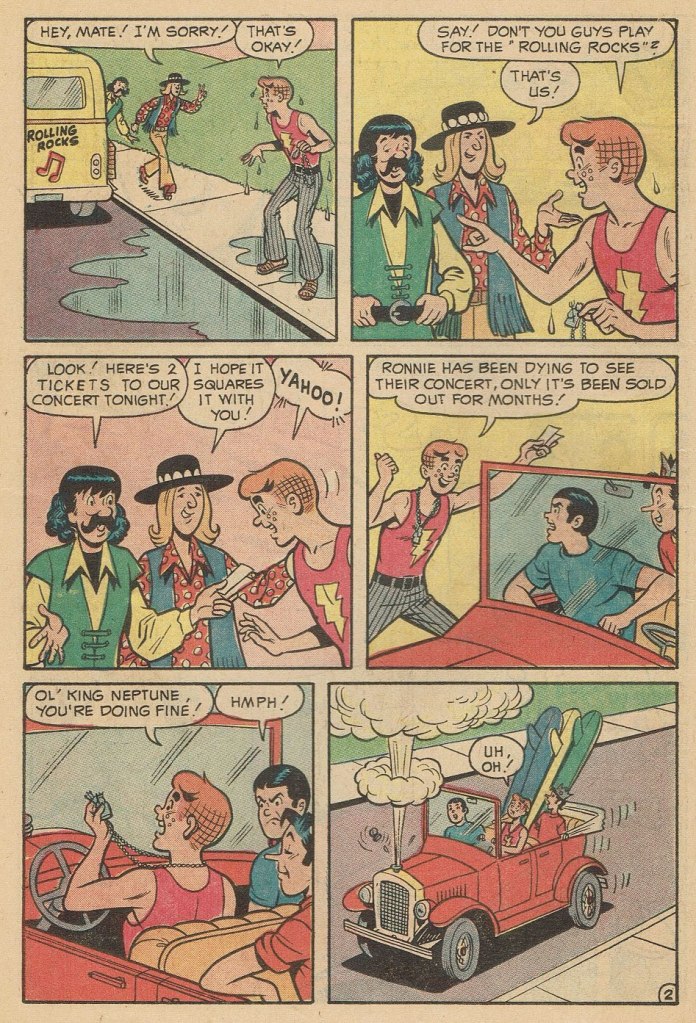
A page from Voice of Doom; script by Frank Doyle, pencils by Schaffenberger, inks by Jon D’Agostino. Published in Archie’s TV Laugh-Out no. 16 (Dec. 1972, Archie).The, er… punchline from Peace of Mind. Script by Frank Doyle, pencils by Schaffenberger, inks (likely) by Chic Stone; published in Archie’s TV Laugh-Out no. 18 (Mar. 1972, Archie).Drawing for Archie wasn’t too much of a stretch for Kurt; whether it was Reggie or The Big Red Cheese getting knocked on his ass, he had his stock posture. This is Shazam no. 22 (Jan-Feb. 1976, DC). Pencils and inks by Mr. Schaffenberger.
A couple more samples from Mr. Schaffenberger’s all-too-brief Archie period — solid, well-paced, ably-designed and economical storytelling:
A slightly surreal one-pager from Archie’s Joke Book Magazine no. 150 (July 1970, Archie).A page from Luck Struck, published in Archie’s Pals ‘n’ Gals no. 73 (Oct. 1972, Archie); note the Captain Marvel tank top young Mr. Andrews is sporting!
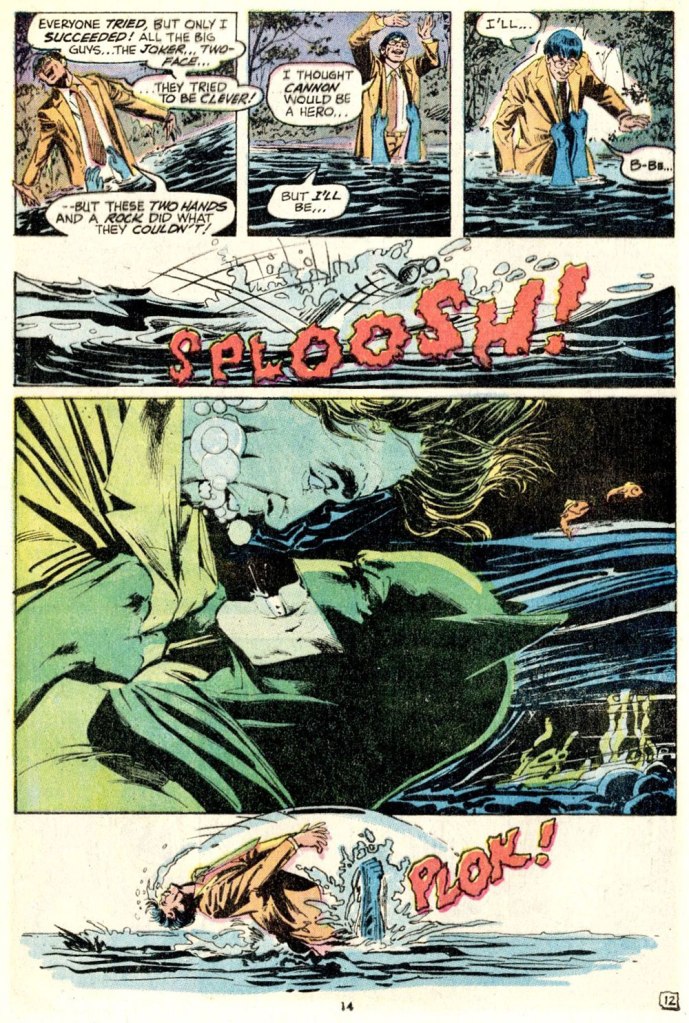
And then, there’s the case of Sal Amendola, a Neal Adams protégé whose reputation in comic books largely rests on a single Batman story, 1974’s ‘Night of the Stalker’, a highly praised tale whose chief conceit is that Batman never utters a word and weeps bitterly at the end. I’d apologise for the spoilers, but honestly, it’s been half a century, what mystery is there to dispel?
An excerpt from Detective Comics no. 439 (Feb.-Mar. 1974, DC); I’ll rarely say this, but Dick Giordano’s inks are an asset in this case, not a liability. The story’s scripting credits are at once hilarious and a bit sad: Steve Englehart, script; Vin and Sal Amendola, plot; and… “from an incident as described by Neal Adams.” Yeah, Neal; that’ll surely earn you a Pulitzer.
Anyway, after his turn in the Bat-spotlight and 1975’s Phoenix, one of the short-lived Atlas-Seaboard‘s more daring titles, Amendola turned up at… Archie. And it was not a good fit.
This, in fact, was the springboard for this post: a couple of years ago, I encountered an Archie story that so grotesquely missed the mark — stylistically speaking — that it bordered on the fascinating. You guessed it, Sal Amendola, utterly out of his element, not to mention, surprisingly… his depth.
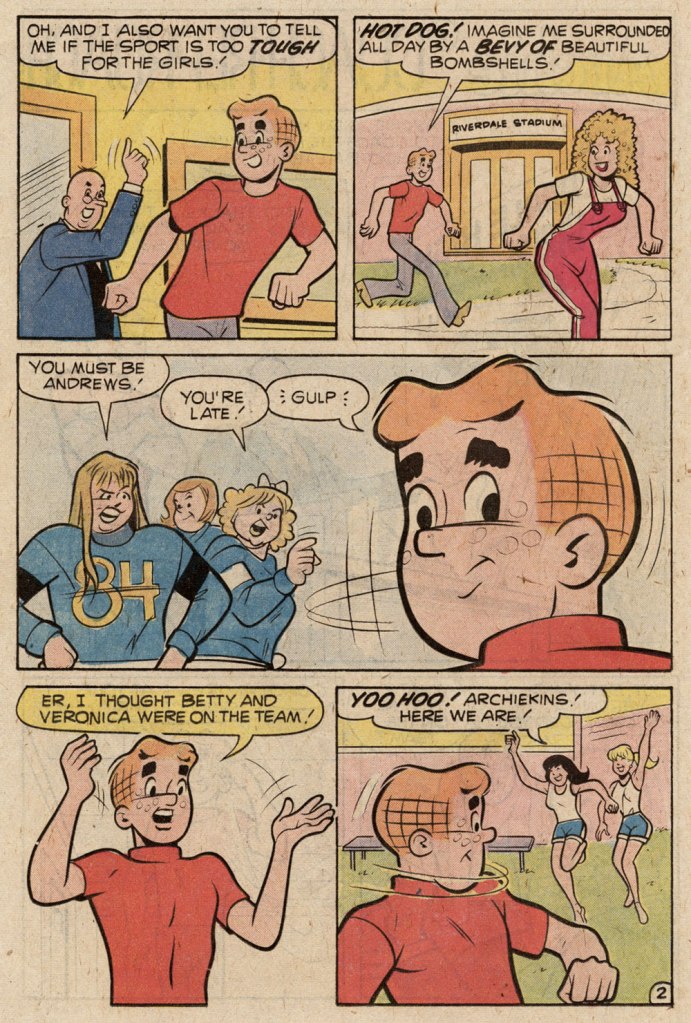
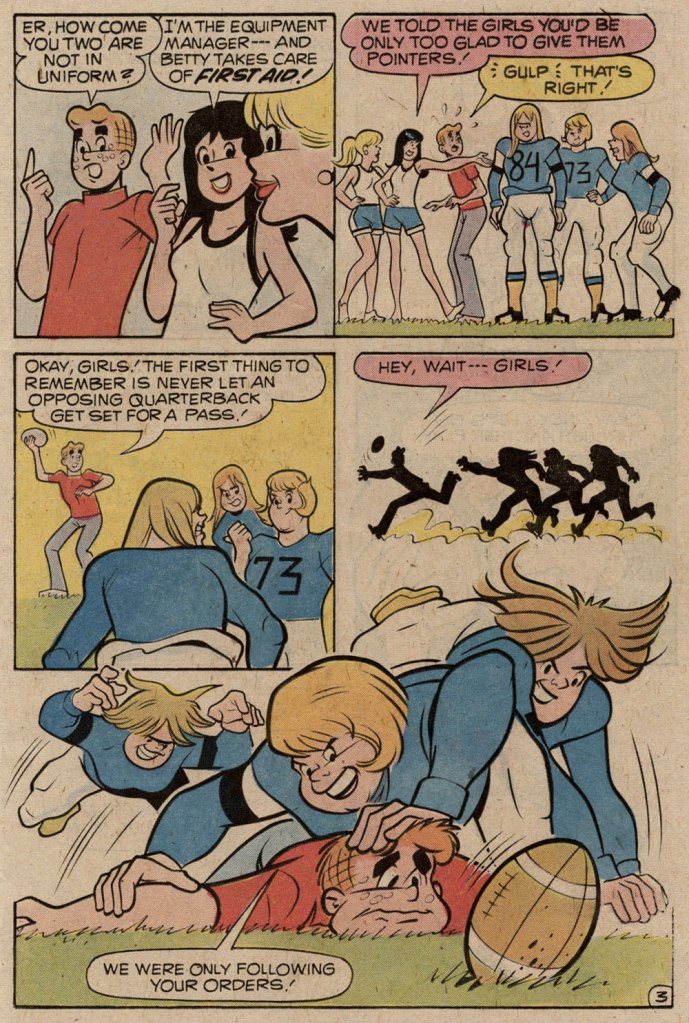
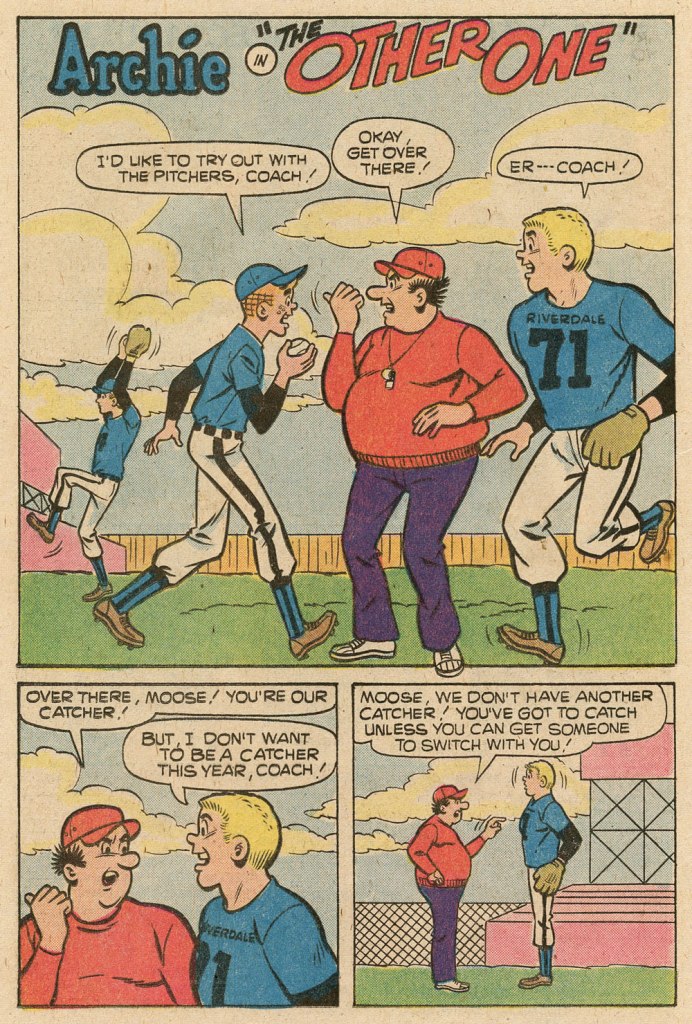
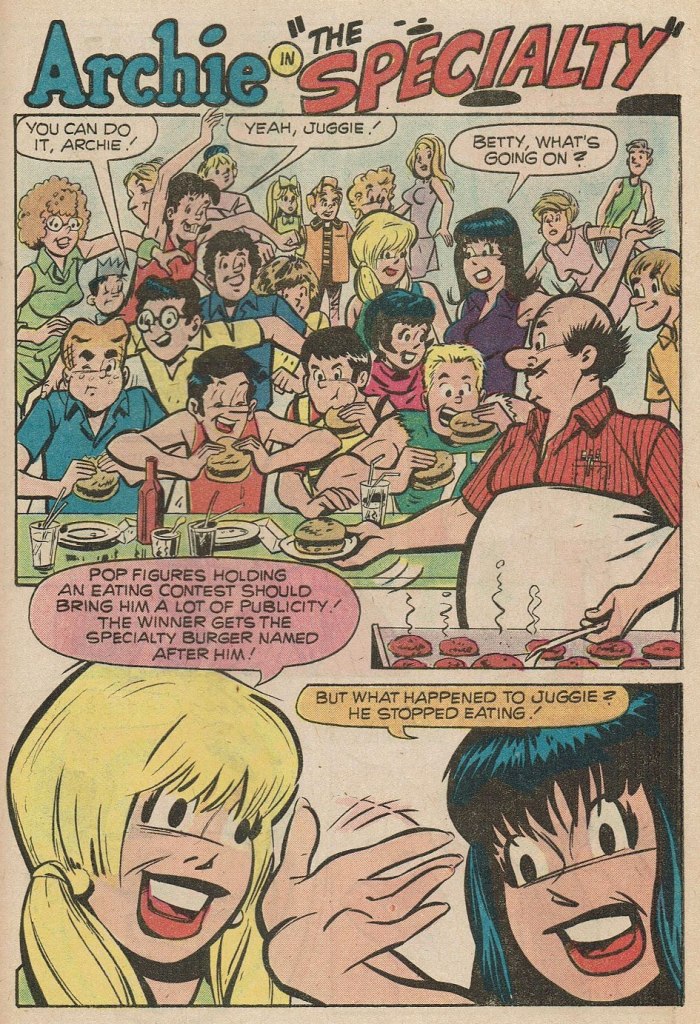
Here are a pair of pages from Coach Reproach, published in Everything’s Archie no. 71 (Dec. 1978, Archie), script by George Gladir, pencils by Amendola, inks by Jon D’Agostino.
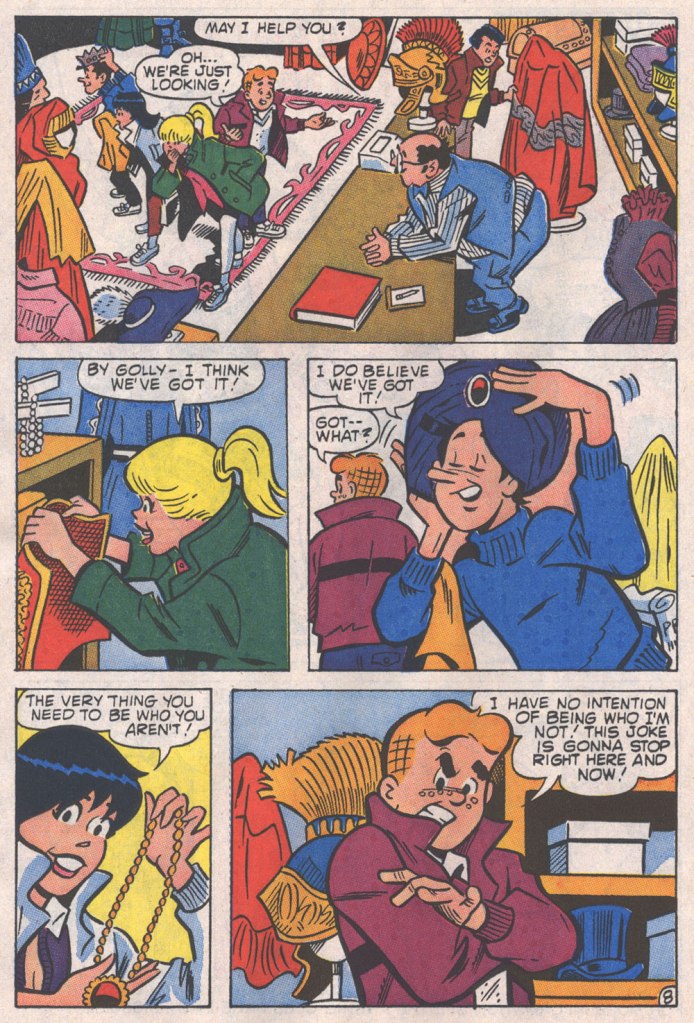
Where to begin? In the first panel, you give Archie a stiff, unnatural pose and you follow it up by repeating it on a background character in the very next panel. And Arch is due for a nasty case of whiplash if he keeps trying to make like Linda Blair.At this point, I’m thinking Sal had learned plenty from his mentor on how to utterly fail at comedy.If what I’ve observed about pitching stances is worth anything, Archie’s about to get brained by a baseball. Ginger boy is also looking right past Coach Kleats. Despite the low bar — issues of quality control were rampant at Archie in the 1970s — this is impressively incompetent storytelling,What happens when you never learn basic inking principles: one creates depth by using thinner lines — and less detail — on background characters, otherwise… visual chaos ensues, as demonstrated here. And Sal’s Betty and Veronica sorely need a brand of shampoo that won’t leave their hair so oily and limp… but the anatomy is beyond help. This is the opening page of The Specialty, from Pep no. 342 (Oct. 1978, Archie).
Schaffenberger’s fellow Golden Age veteran, Gene Colan, also found himself moonlighting in the 1960s. In his case, it was for Marvel, under the alias of ‘Adam Austin’, but also for Dell (just a couple of covers mid-decade) and more significantly for Warren Magazines. In the 1970s, he concentrated on Marvel and was, in the chaos that was the so-called ‘House of Ideas’ at the time, the single most reliable artist in the maelström: surely none can match his seventy consecutive — and meticulously detailed — issues of Tomb of Dracula, in addition to lengthy runs on Howard the Duck, Daredevil, Captain America, Doctor Strange and so forth.
« When writer Jim Shooter became Marvel’s editor-in-chief in the late ‘70s, the tension between Colan and the younger authors came to a head. By 1980, Shooter and Colan were totally at odds with one another over Colan’s approach to storytelling. »
« [Shooter] was harassing the life out of me. I couldn’t make a living,” Colan said. “He frightened me, he really did. He upset me so bad I couldn’t function.” Just as she had urged Colan to quit one job [in] the 1960s, wife Adrienne begged him to leave Marvel in 1980. After delivering his resignation, Colan was asked to sit down and seek resolution with Shooter and publisher Mike Hobson. Colan agreed to the meeting, but declined any overtures to stay at Marvel. “Shooter was in the same room,” Colan recalled, “and I said, ‘That man’s not gonna change. He is what he is. Whether it’s six days, six months or six years, it’s not going to be any different, so I’m not going to put up with it for another minute.‘ » [ source ]
He then scampered over to DC for a few years. His production there was hit-and-miss, but his Batman run (1981-86) was outstanding, pairing him with some of the rare inkers who could do his nuanced pencils justice: Klaus Janson, Tony De Zuñiga (to my amazed delight!) and especially Alfredo Alcala.
But once his contract ran out, he was out knocking on doors again. Against all odds, Archie beckoned.
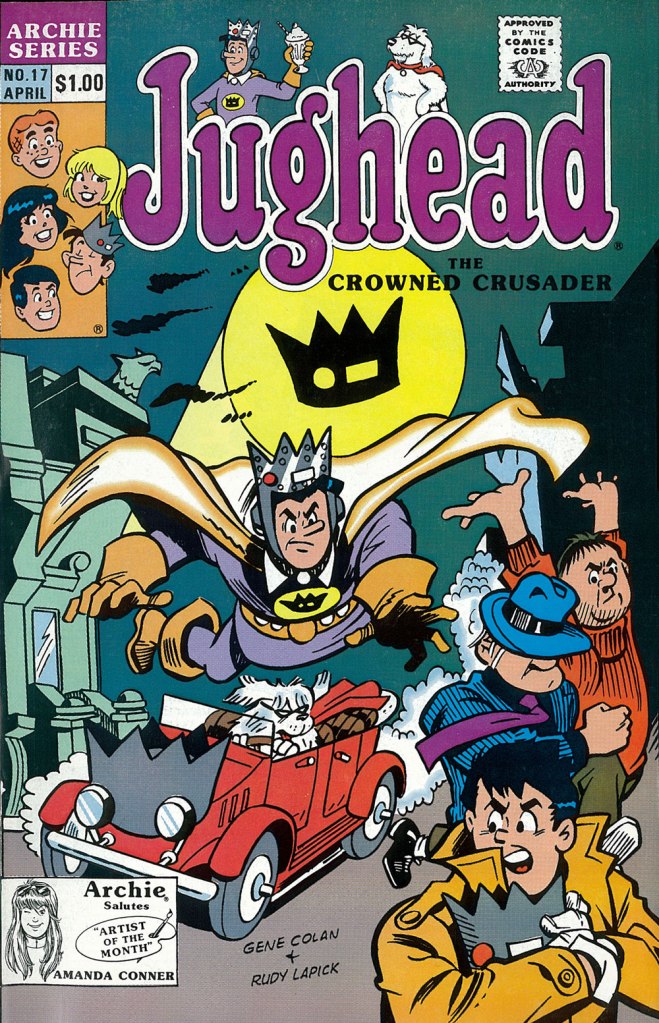
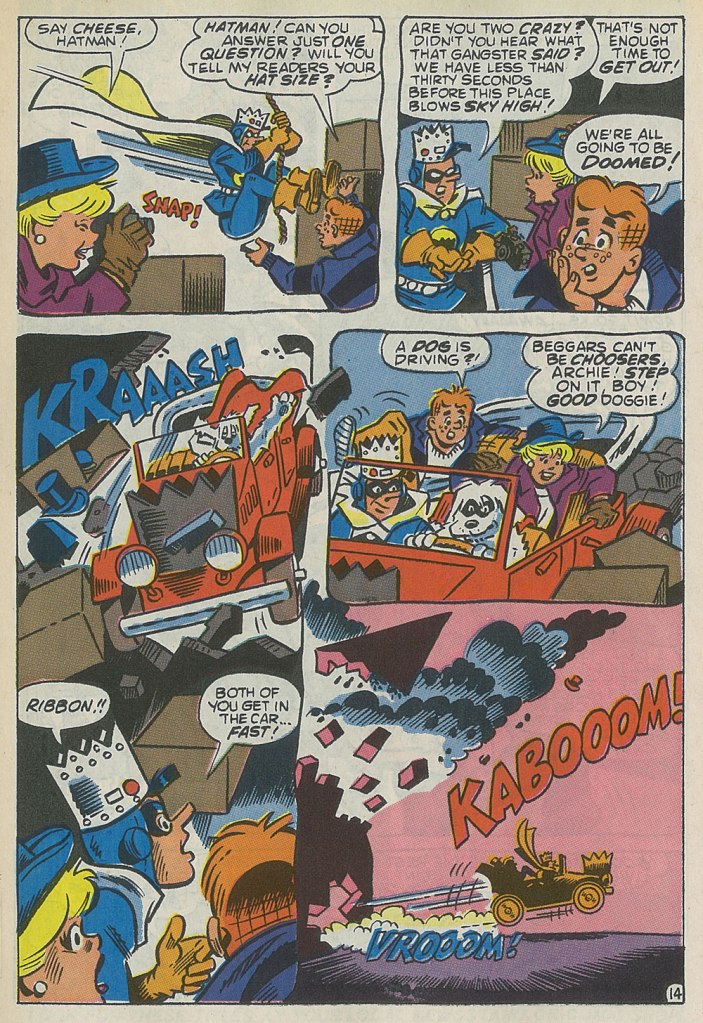
This is the cover — dreadful, I’m afraid — of Jughead no. 17 (Apr. 1990, Archie), reviving the opportunistic, Batman TV show-derived ‘Riverdale Gang as superheroes’ de trop move of the mid-1960s, with even less aplomb. But then the Archie folks were plumbing an especially low point with such ‘experimental’ titles as Jughead’s Diner, Archie 3000, Dilton’s Strange Science, Jughead’s Time Police, Archie’s R/C Racers, Explorers of the Unknown, and of course The Adventures of Bayou Billy.An action-packed — and Colan-shambolic — excerpt from that issue’s Hatman saga, written by Robert Loren Fleming, pencilled by Colan and inked by Rudy Lapick. Notwithstanding his sticking out like the proverbial sore thumb, Colan clearly had a ball working on his Archie stories. He brought some urgently needed chutzpah to a perilously stale formula.A page from Will the Real Archie Please Stand Up!, published in Life with Archie no. 273 (July 1989, Archie), wherein Archie is mistaken for his doppelgänger, a foreign prince named Kafoufi… but of course. Pencilled *and* scripted by Colan, which is most unusual. Oh, and inked by Mr. Lapick, who doesn’t quite know what to do with those ol’ Colan worm-fingers, seen wriggling in panel five.
« If anything, I consider myself non-violent. I’m from the hippy era, peace, love, groovy. » — Rick James
1968 wasn’t exactly a banner year for Harry Shorten and Wally Wood‘s Tower Comics (1965-69); Wood’s flagship title, T.H.U.N.D.E.R. Agents, was down to running a mixture of reprints and inventory, and a mere two issues were cover-dated 1968. A final number, the 20th, limped onto newsstands a full year after its predecessor.
So it’s understandable that Wood started casting around for plan B. He gave Archie a try. It didn’t take… surely his fellow Tower editor and Archie refugee Samm Schwartz must have tried to warn him. Oh well.
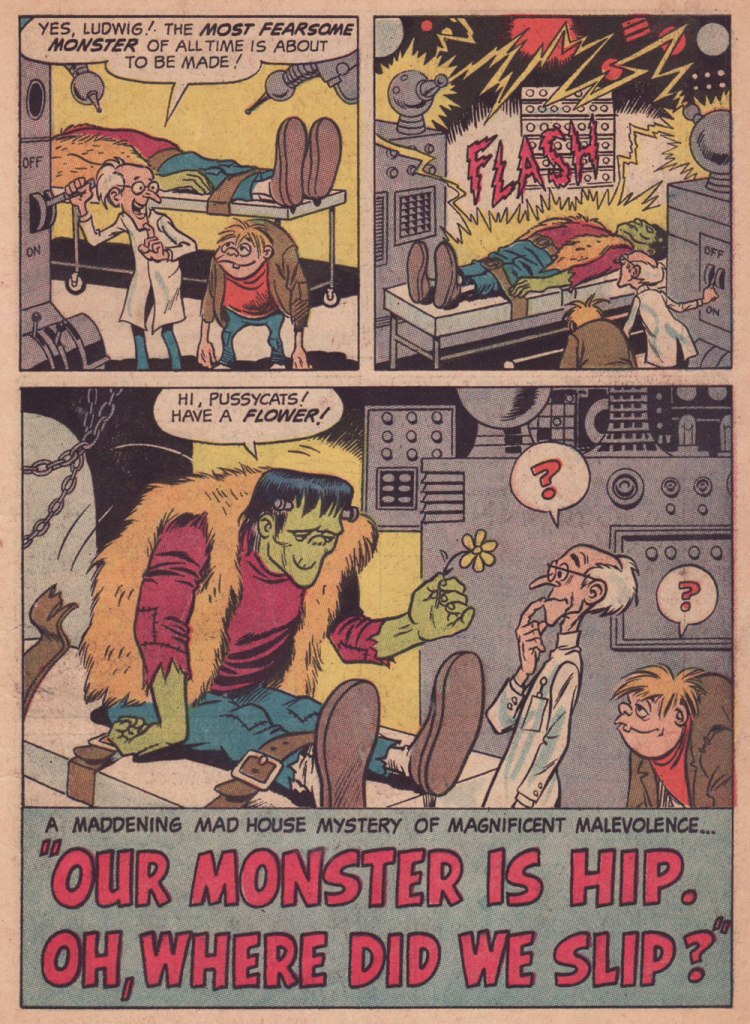
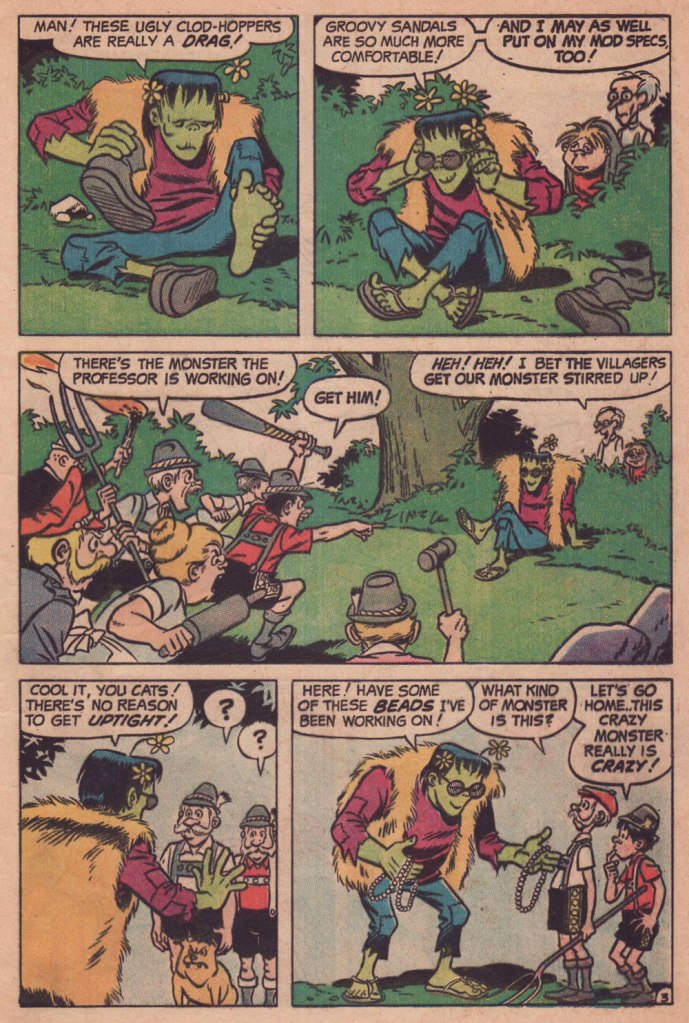
« Our Monster Is Hip. Oh, Where Did We Slip? », most likely scripted by Archie mainstay George Gladir (1925-2013), appeared in Archie’s Madhouse no. 64 (Oct. 1968).
As far as I know, this was the only story Wood drew for Archie Comics, at least in their usual humorous mode. In the ’70’s, he would provide finishes over Jack Abel‘s pencils on one story (« Devil Rider », Red Circle Sorcery no. 10, Dec. 1974) for the interesting but short-lived, Gray Morrow-directed Red Circle Comics Group, a more ‘mature’ Archie offshoot… and that’s it.
« Special effects are characters. Special effects are essential elements. Just because you can’t see them doesn’t mean they aren’t there. » — Laurence Fishburne
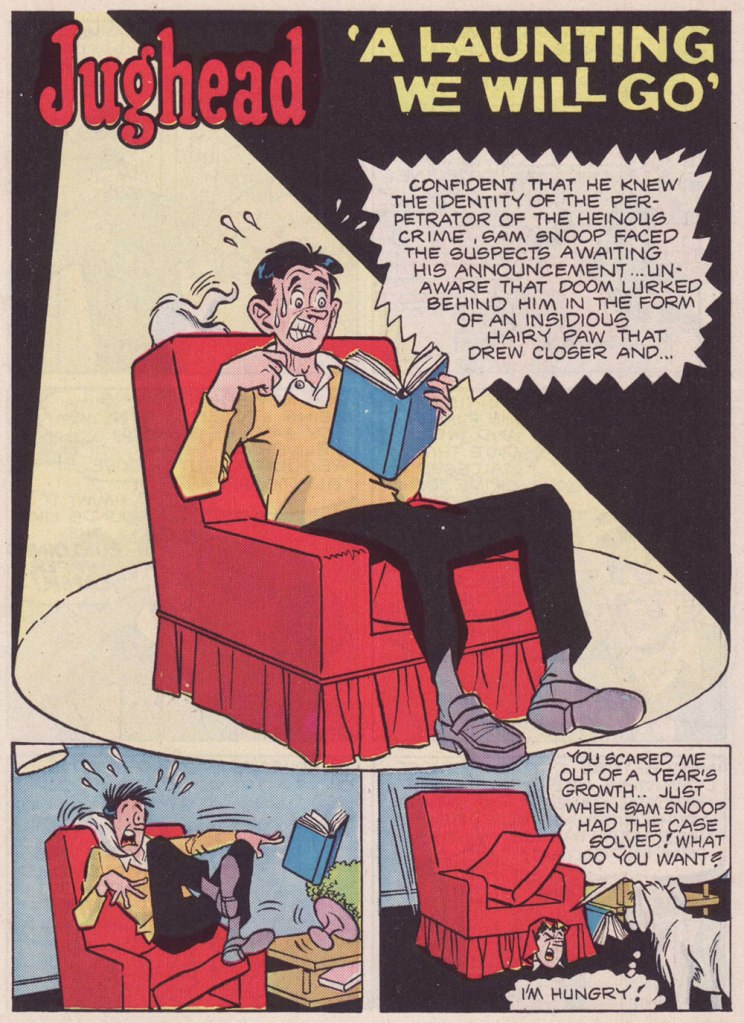
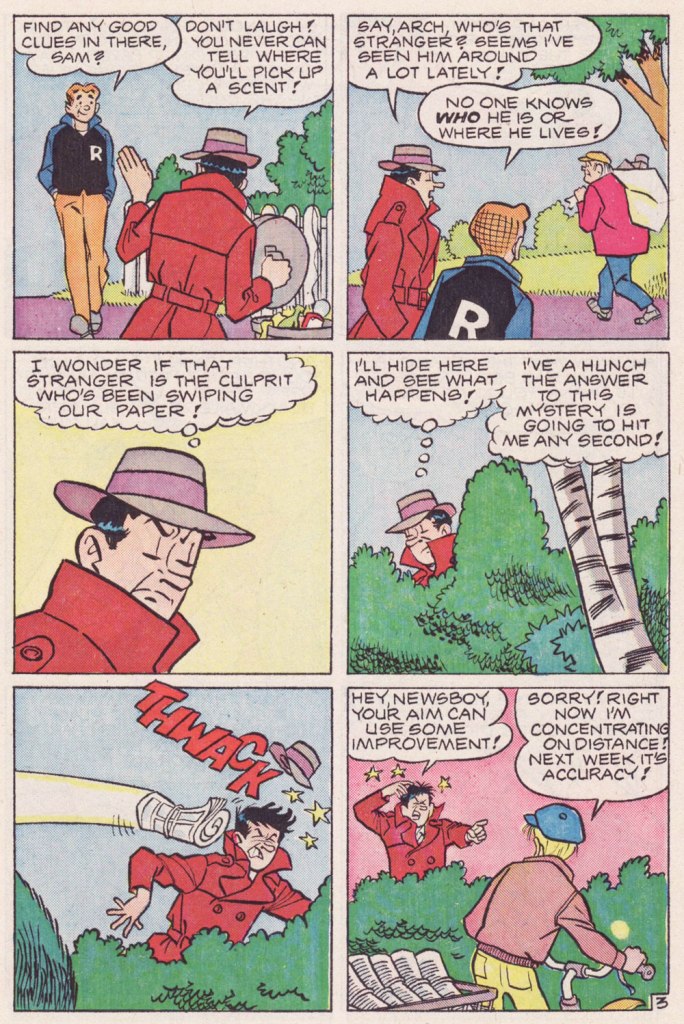
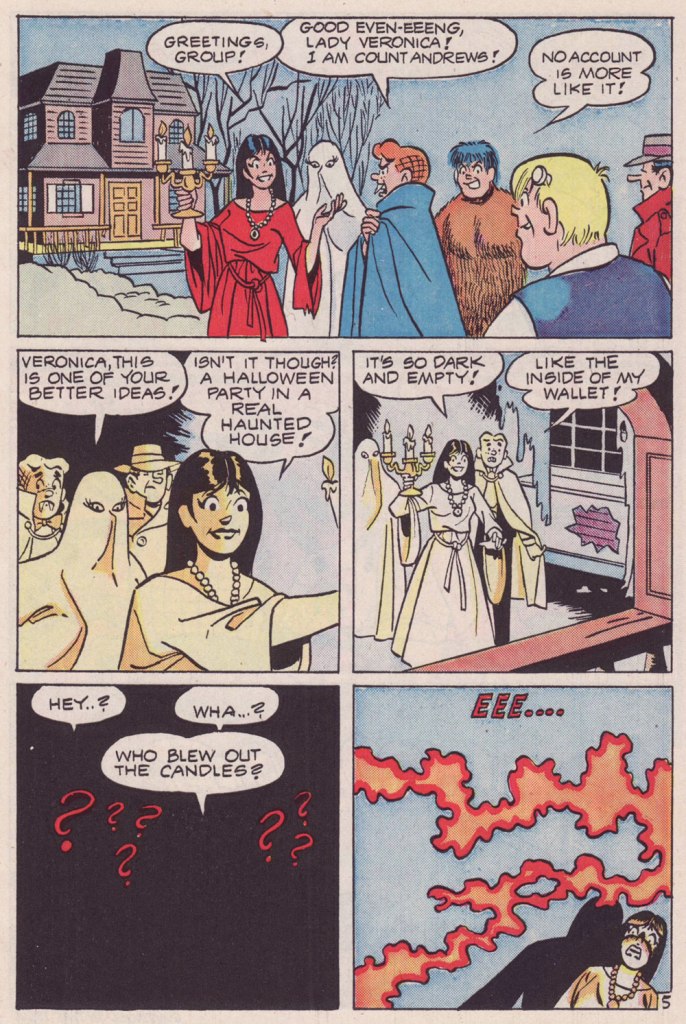
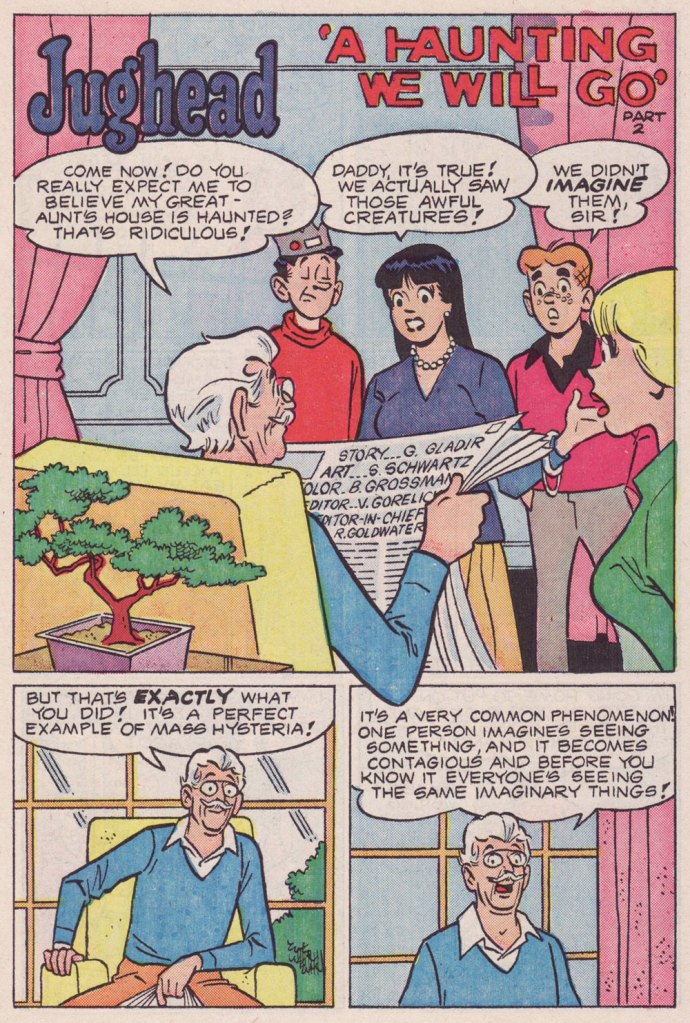
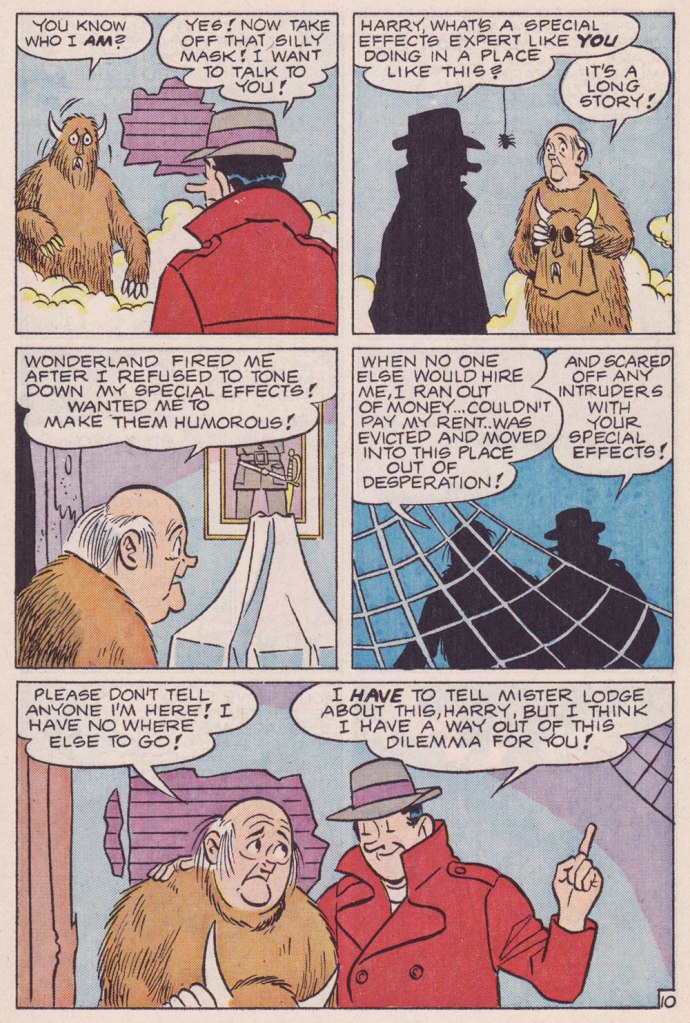
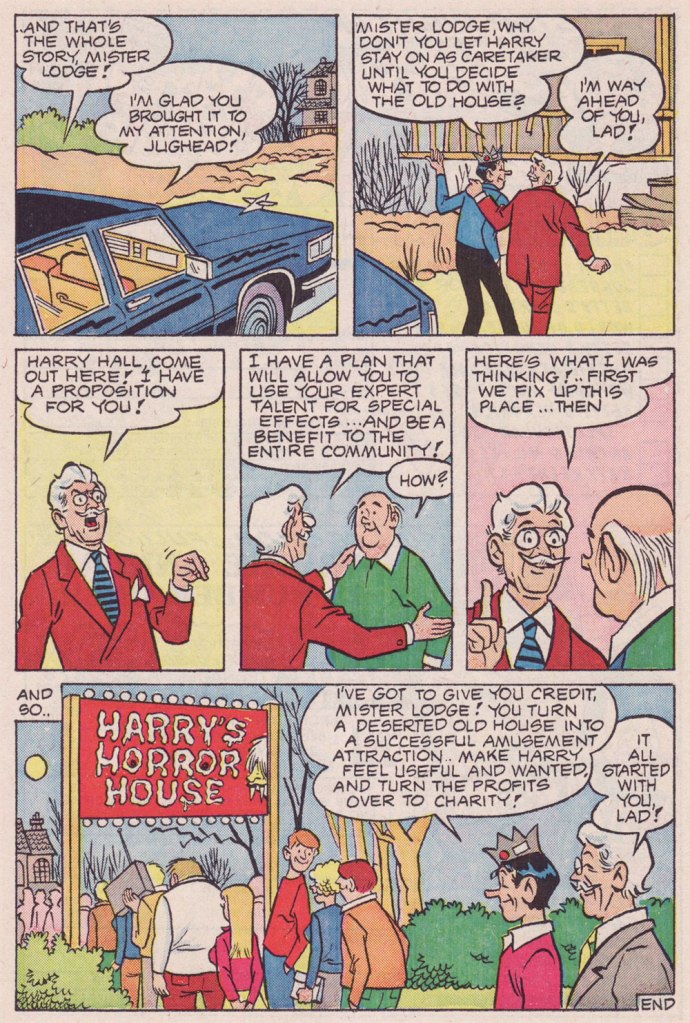
Spookiness is afoot in Riverdale! Here’s a lovely George Gladir (script) & Samm Schwartz (pencils, inks and letters) saga to suit the season. I love those longer tales, which in this case allows for a larger-than-usual cast and a more leisurely pace.
‘A Haunting We Will Go’ was originally published in Archie Giant Series Magazine no. 564 / The World of Jughead (Sept. 1986, Archie). Oh, and colours by Barry Grossman.
Catfight (noun):A vicious fight between two women that features biting & scratching and often involves clothes being ripped off.
To which I’ll add that if you put two women with different hair colours in one room, it’s like there’s a chemical reaction that makes them instantly aggressive. In comics, at least – and we all know that comics reflect real life accurately, right? The resulting combativeness is especially obvious when the encounter is between a blonde and a brunette. The women involved must also be beauties – presumably, plainer girls resort to verbal assaults when provoked, eschewing physical violence, unlike their flashier counterparts.
Or it could have something to do with the mostly-male audience who actively likes watching belles brawl. (Perhaps “ogle” would be a better description.) Let’s move on to the ogling bit, then!
Err, agreed on the “talking too much” bit. Manhunt no. 9 (Magazine Enterprises, June 1948). That art’s by Ogden Whitney.
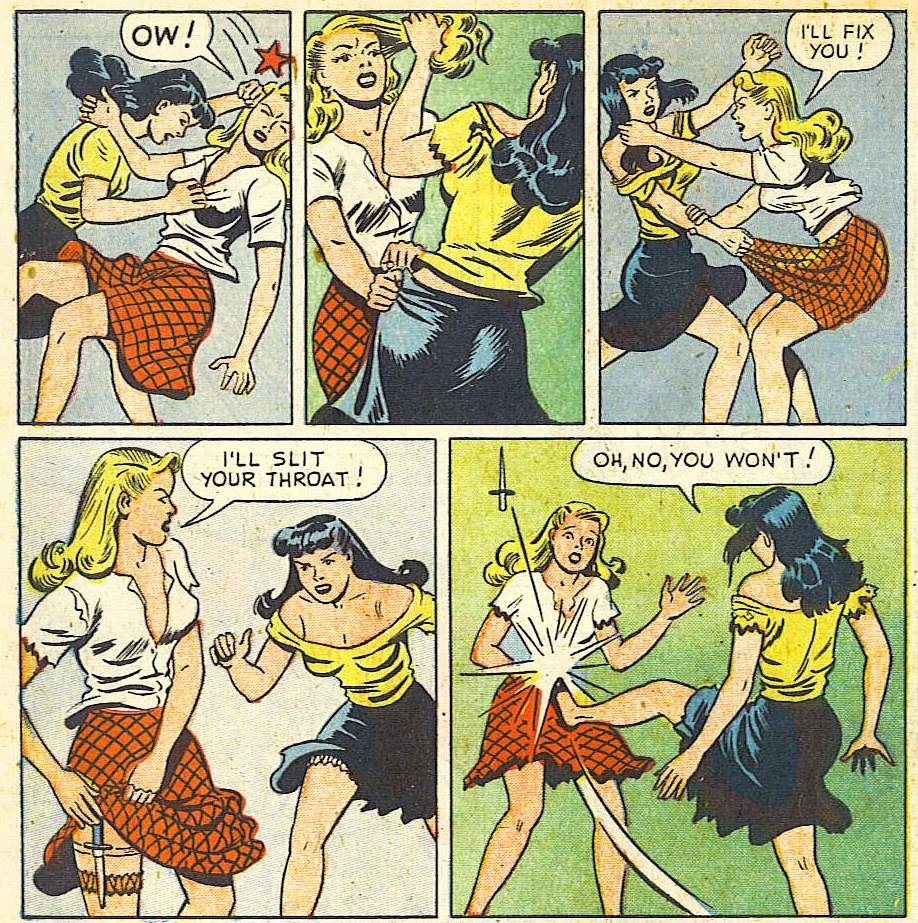
“Jeepers! Baldy’s been skewered through the ticker! He’s defunct!” This charming scene with boob grabbery and skirt rippery (I know, don’t I have a way with words?) is from “Off Stage Kill”, a Dan Turner Hollywood Detective story from Crime Smashers no. 7 (Trojan Magazines, 1951).
Script by Robert Leslie Bellem, pencils and inks by Adolphe Barreaux (who was also the editor). Read the issue here. In case you were wondering, Fifi and Brenda are just acting out a fight scene for a movie, although they do get a little carried away (and accidentally skewer Baldy in the process). How many women have a knife tucked away in their garter belt?
Skipping ahead ten years or so…
Ditko shared a studio in NYC with artist Eric Stanton between 1958 and 1968, and they collaborated on some bondage comics (or at least it’s commonly assumed that they have – for more information on that, dive into a discussion on the Four Realities blog, or read this excerpt from Fantagraphics’ Dripping with Fear: the Steve Ditko Archives Vol. 5.) This page is from a story published in 1966 and entitled “Divorce Agreement”.
The clothes-shredding and breast-mauling (ouch) continues…
Newspaper comics do it, too! This is Teena A Go Go from December 4th, 1966, written by Bessie Little and illustrated by Bob Powell.
Sometimes Betty and Veronica associations are hard to avoid. These girls also made sure to wear contrasting costumes while fighting, for maximum visual appeal, proving it’s possible to be fashion-conscious even in prehistoric times.
Anthro (the happy teenager watching this scene, and normally a redhead) will marry the victorious maiden… but the fight is a draw, and so he has to marry both in this “The Marriage of Anthro” story. This is Anthro no. 6 (July-Aug. 1969). Pencils by Howard (Howie) Post (who created Anthro, the “first boy”, a Cro-Magnon born to Neanderthal parents) and inks by Wally Wood. Let it be mentioned that Anthro is an immensely fun series, and that I love Howie Post’s art with or without Wood’s beautifying influence.
Women of other cultures aren’t immune from this phenomenon, by the way. Witness Italian chicks fighting:
Maghella no. 13 (Elvifrance, 1975), cover by Averardo Ciriello. ” The title is something like “a scalded pussy doesn’t fear cold water”, a play on “chat échaudé craint l’eau froide“, an idiom that means roughly “twice bitten, once shy” or “a burnt child dreads the fire” and translates literally to “a scalded cat fears cold water”.
Italian erotica can be so entertaining! Maghella means a “young witch” in Italian. “The girl is identified by two braids of black hair and giant breasts with unspecified powers“, reads Wikipedia… Odd, I would have thought that her breasts have very specified powers, indeed. 😉
Moving on to French damsels…
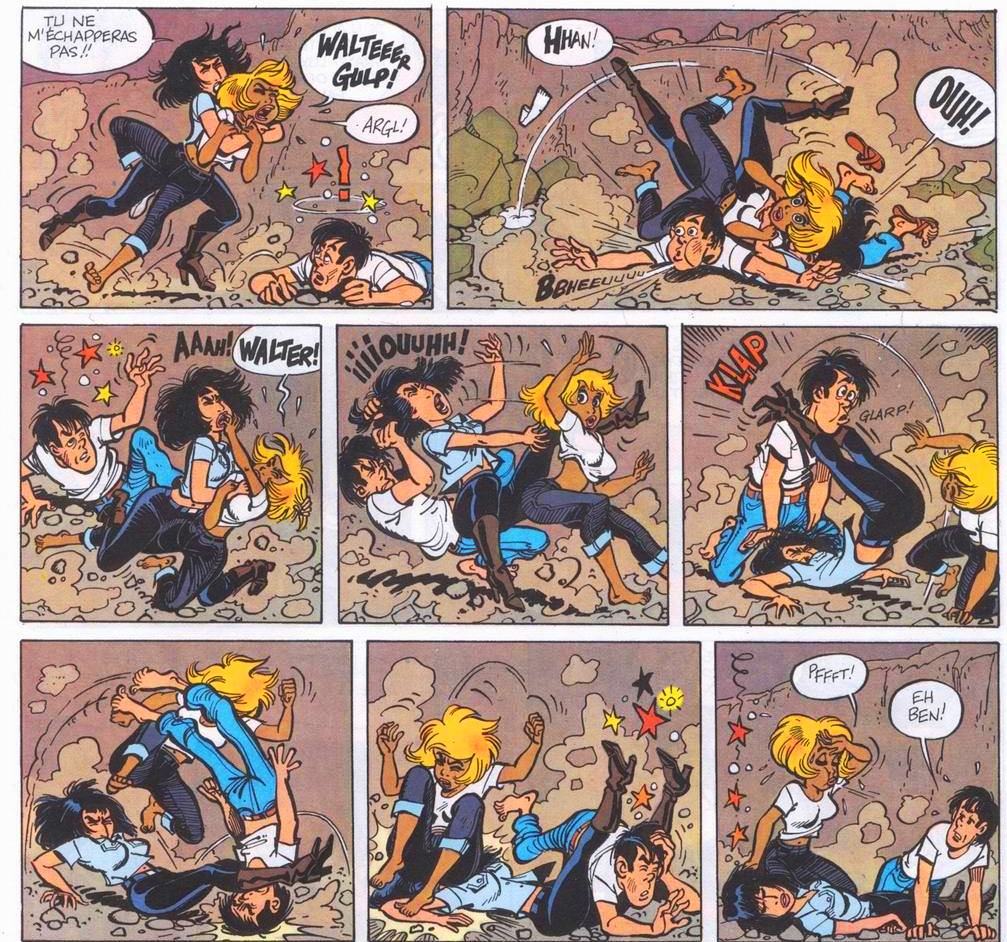
Natacha (hôtesse de l’air) is a Franco-Belgian comics series, created by François Walthéry and Gos. This page is from an adventure (one of the final stories scripted by the great Maurice Tillieux) called Le treizième apôtre (The Thirteenth Apostle), published in 1978. The blonde is Natacha, our heroïne.
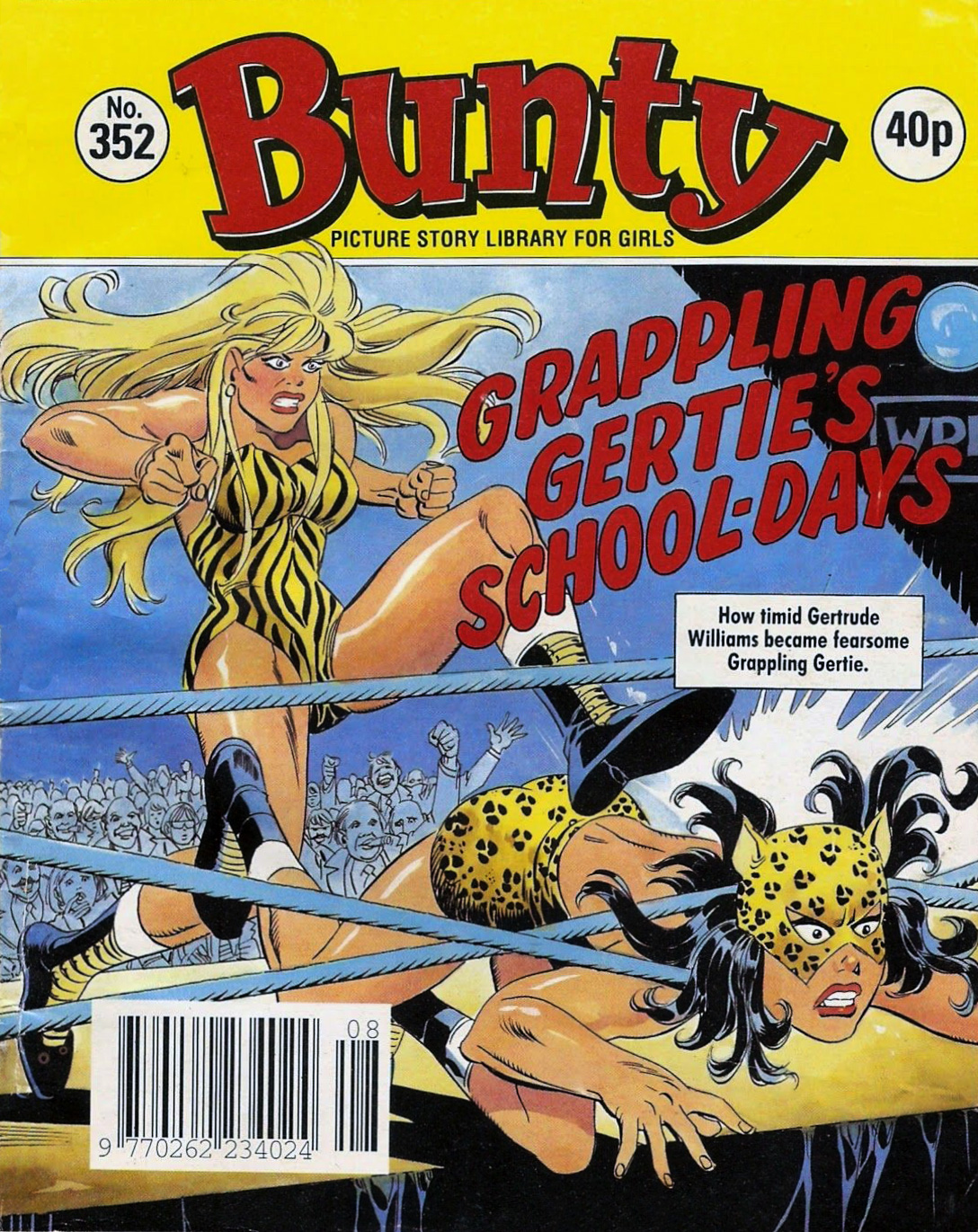
If you want to emphasize the catfight aspect, dress your girls in feline-motif outfits. Oh, I’m sorry – this is no quotidian quarrel, it’s professional wrestling!
Bunty no. 352 (1992) – unfortunately, I don’t know who did the cover. British Picture Story Library was a 62 page a comic digest, published weekly. If you’d like to know how Leopard Lily overcame Tiger Tina, visit Assorted Thoughts from an Unsorted Mind.
I think we need one even more literal interpretation of “cat fight”:
A snippet from “Meow Row”, published in Betty and Veronica no. 59 (January 1993). Script by George Gladir, pencils by Dan DeCarlo, inks by Alison Ford. Now guess who is who. (It’s obvious: Tiger Girl is Betty, and Veronica gets Meow Girl’s sexier costume.)
This is a fairly inexhaustible topic, but one must quit sometime. Cold shower, anyone?


















 Who's Out There?